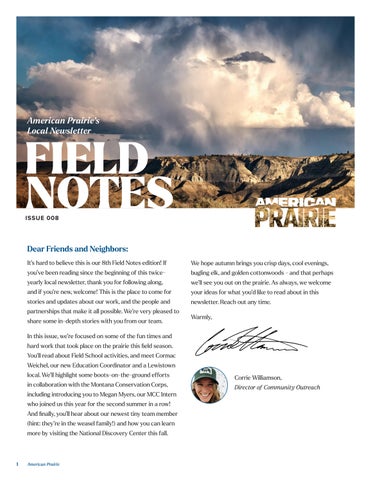
American Prairie’s Local Newsletter
FIELD NOTES
Dear Friends and Neighbors:
It’s hard to believe this is our 8th Field Notes edition! If you’ve been reading since the beginning of this twiceyearly local newsletter, thank you for following along, and if you’re new, welcome! This is the place to come for stories and updates about our work, and the people and partnerships that make it all possible. We’re very pleased to share some in-depth stories with you from our team.
In this issue, we’re focused on some of the fun times and hard work that took place on the prairie this field season. You’ll read about Field School activities, and meet Cormac Weichel, our new Education Coordinator and a Lewistown local. We’ll highlight some boots-on-the-ground efforts in collaboration with the Montana Conservation Corps, including introducing you to Megan Myers, our MCC Intern who joined us this year for the second summer in a row! And finally, you’ll hear about our newest tiny team member (hint: they’re in the weasel family!) and how you can learn more by visiting the National Discovery Center this fall.
We hope autumn brings you crisp days, cool evenings, bugling elk, and golden cottonwoods - and that perhaps we’ll see you out on the prairie. As always, we welcome your ideas for what you’d like to read about in this newsletter. Reach out any time.
Warmly,
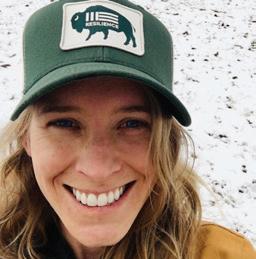
Corrie Williamson, Director of Community Outreach
Build-a-Bison
A Prairie Puzzle Program at the American Prairie Field School
Dusty Rixford Education Manager
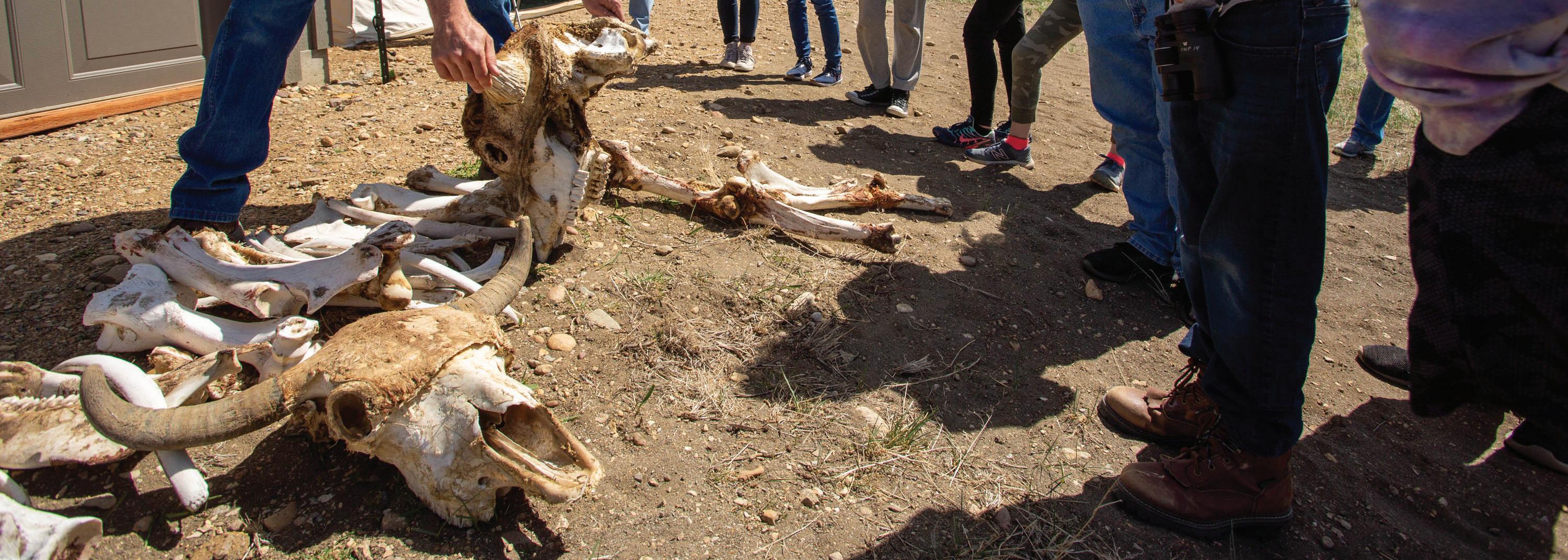
“Whoa, cool! Look, it’s a dinosaur bone!” one of the students shouts when they discover a giant bone nestled under a sagebrush. The bison puzzle activity begins as students search for bones in a field of sagebrush under the vast prairie sky.
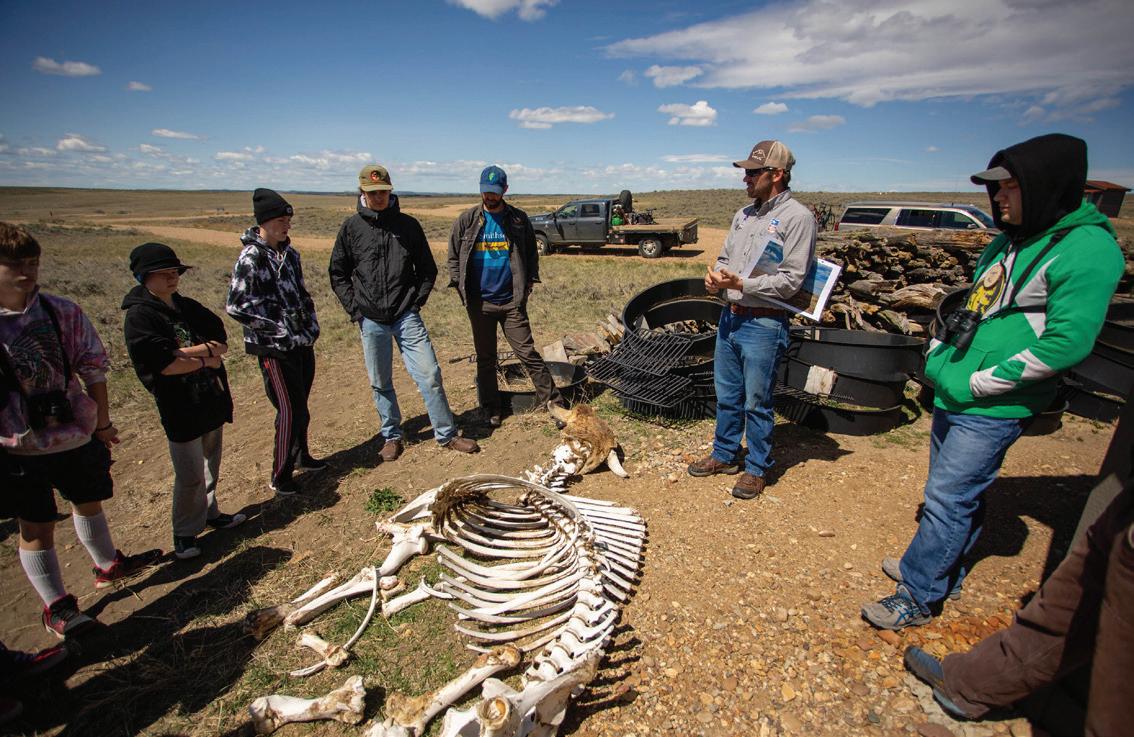
At the American Prairie Field School, we had one of our best years yet, impacting just over 1000 students with our overnight, day, and virtual programming. One of our touchstone activities is “Build a Bison,” or what we sometimes refer to as “the bison puzzle,” where students get an authentic hands-on experience piecing together a real bison skeleton.
In this lesson, students are not just observers; they are actively participating in the learning process as they study each bone with a detective’s eye, running their fingers along dried-out pieces of remnant flesh and fur on bone. Our bison skeleton is the real deal, a bison that died of natural causes out on the prairie in south Phillips County and returned to the earth, feeding scavengers and decomposers. It is not quite a complete set with all of the 213 bones that make up a bison, because smaller bones have been carried away by animals. However, students still enjoy this 3-D puzzle challenge.
With the help of our instructors, students take turns examining their bison bone and explaining to the group what
part of the bison they think they have and why. The real magic comes from the fun and knowledgeable instructors who turn every bone into a clue and a piece of the puzzle with their questions and prompts. In this immersive lesson of discovery, students learn how each bone plays a part in the structure of these majestic animals. From the massive skull and horns that are supported by the powerful shoulder blades and used for plowing through snow, to the sturdy leg bones and hooves built for roaming across miles of open prairie, each piece tells the story of strength, resilience, and adaptation.
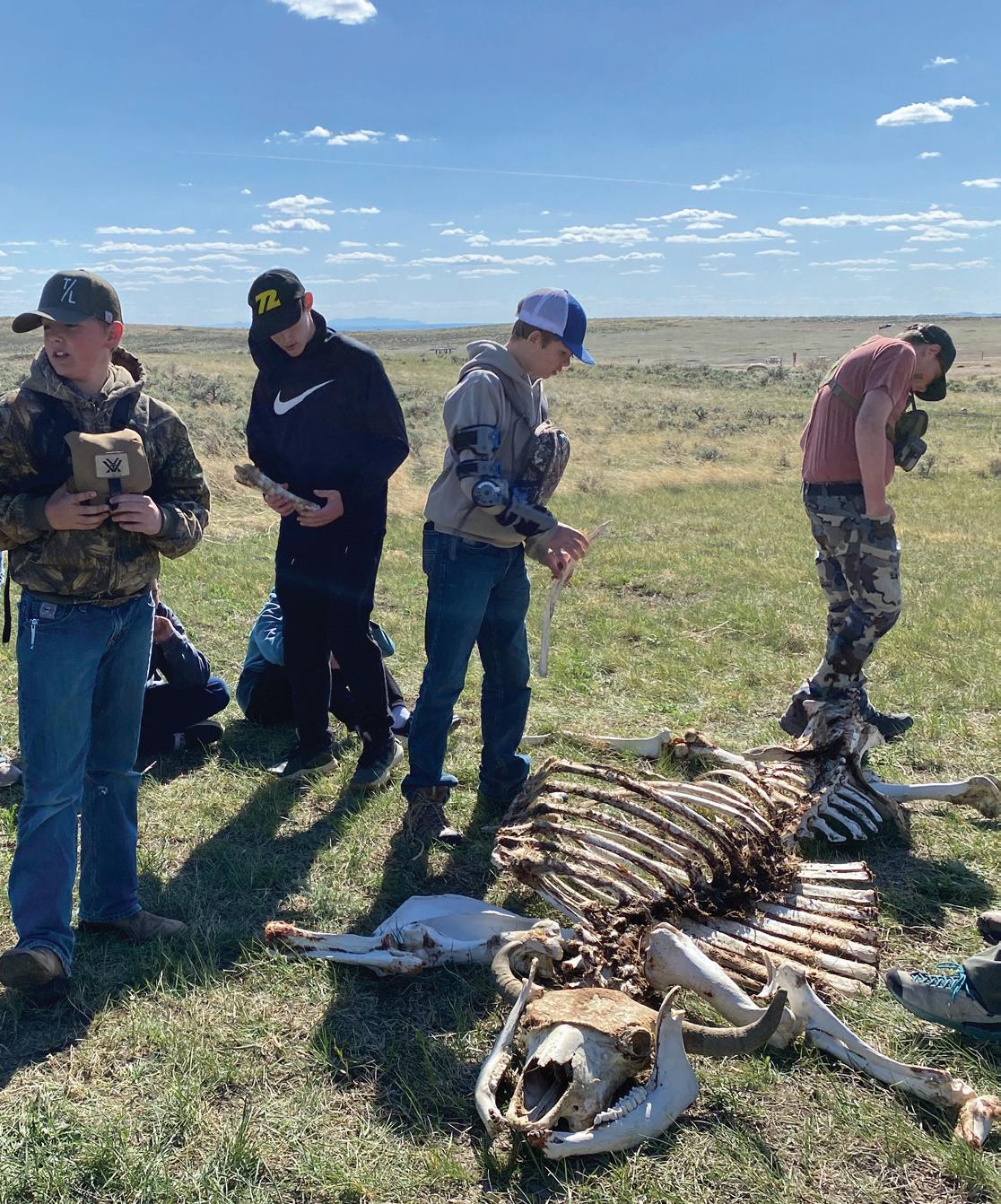
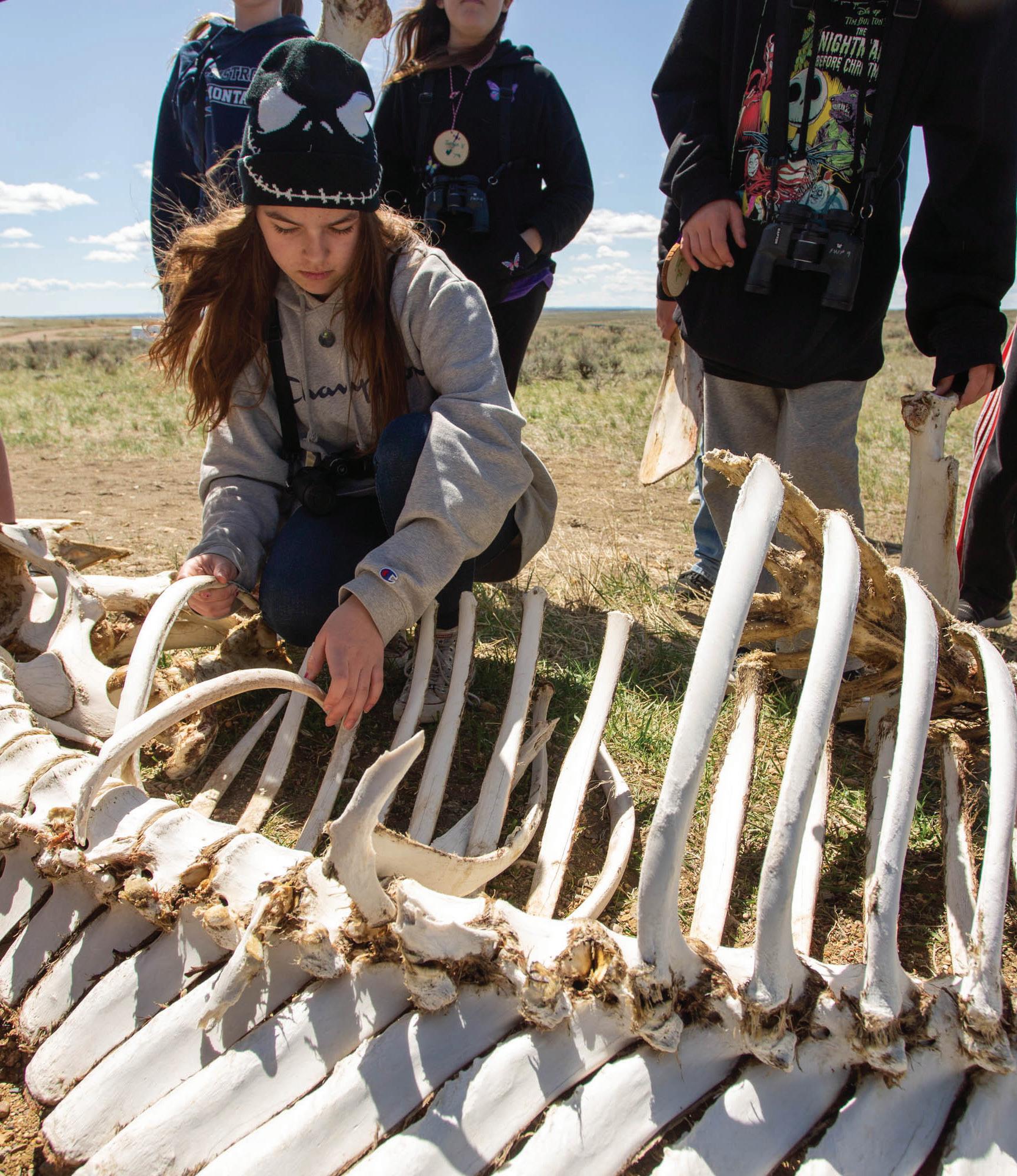
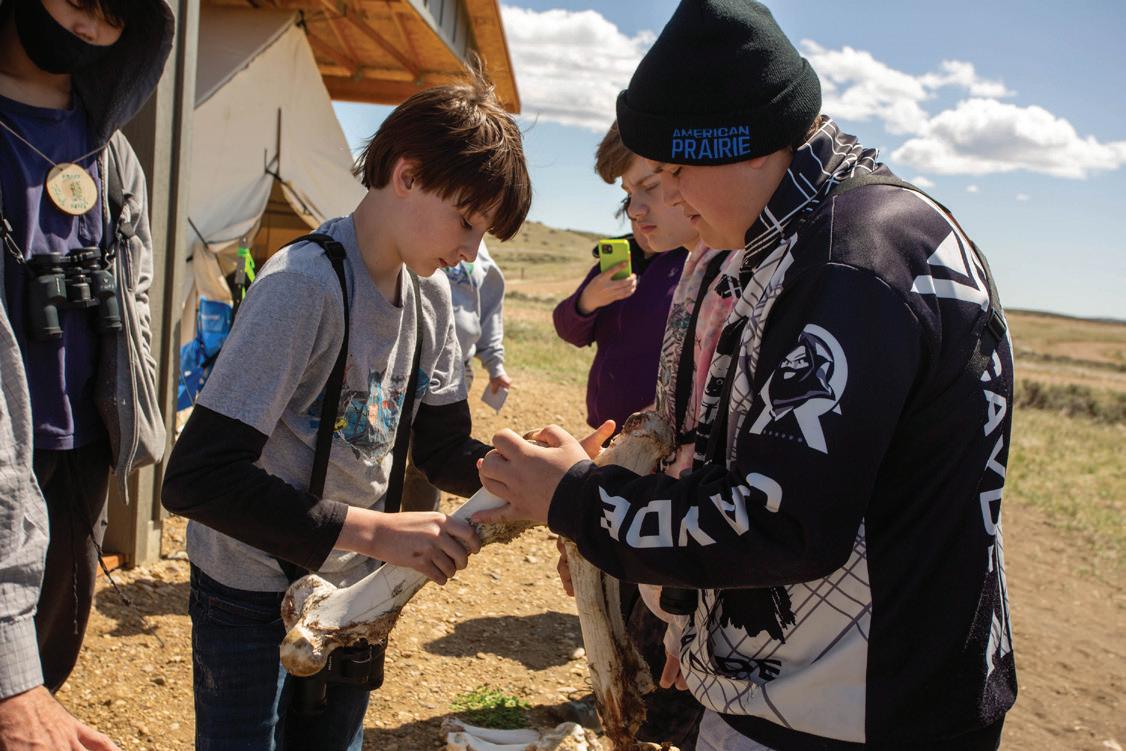
Students thoughtfully place bones head to toe, learning how scientists identify and study animal remains. Comments like “Ew, gross!” or a student telling stories of how their grandmother makes soup from bison hooves fill in the time as the pile of bones slowly becomes a bison. Sometimes bones are placed incorrectly for a time, but it isn’t long before the students take a step back, realize the mistake, and correct the placement.
By the end, this is more than just an anatomy lesson: “Build a Bison” prompts discussion about the role bison play in the prairie ecosystem, their cultural significance to Indigenous peoples, and why their return to the prairie is so important. Concepts like “keystone species” are explained, as bison are considered one of those species playing a vital role in the survival of many other prairie plants and animals.
The bison puzzle, along with many other activities at Field School, comes alive with the expertise and passion of our excellent instructors and partners at the Yellowstone Forever Institute. These instructors create an unforgettable experience for the students attending Field School by sharing their vast knowledge of the prairie ecosystem and their playful and “humerus” demeanor.
My hope for students participating in this activity is that they wash their hands afterwards. Just kidding –kind of–but really, I want students to have fun while also blending science, teamwork, and creating a deeper connection to the true backbone of the prairie.
And finally, what did the rib say to the spine during the “Build a Bison” activity?
“I’ve got your back!”
Prairie Restoration
Powered by the Montana Conservation Corps
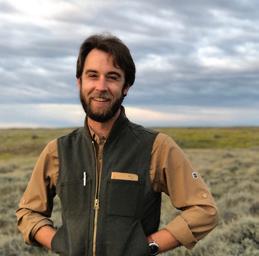
Daniel Kinka Director of Rewilding
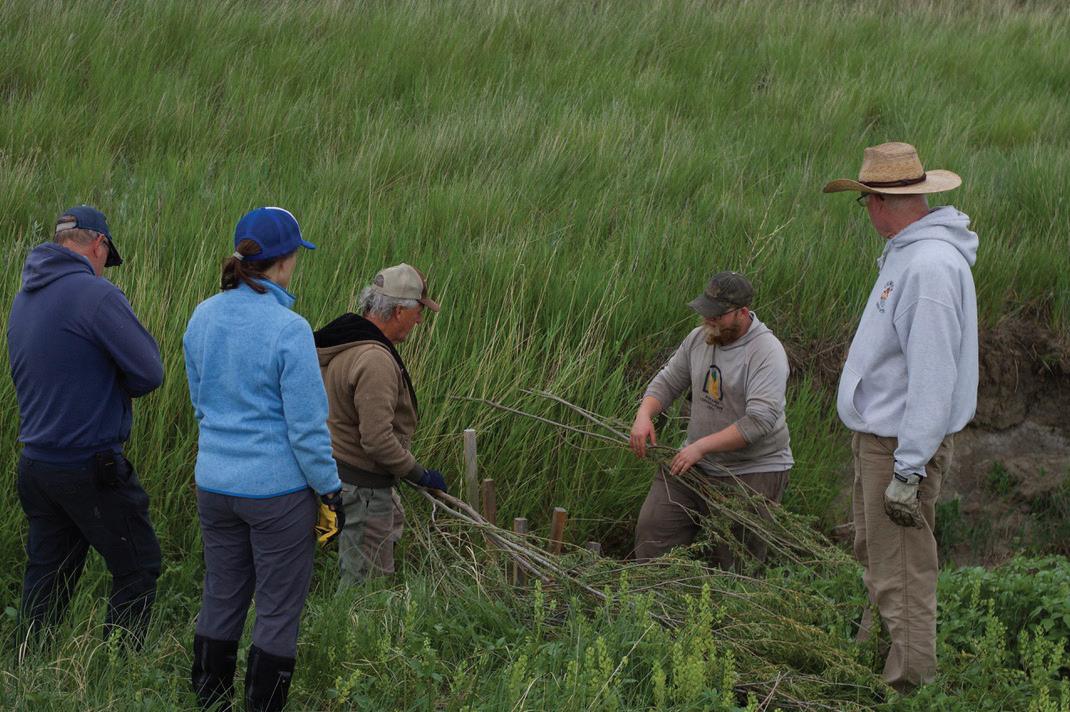
For the third year in a row, American Prairie contracted the Montana Conservation Corps (MCC) in 2025 to help us restore one of our most degraded parts of the grasslands: creeks. This work is part of a growing collaboration between American Prairie and MCC that brings skilled young conservationists to the land to do the critical hard work of restoration.
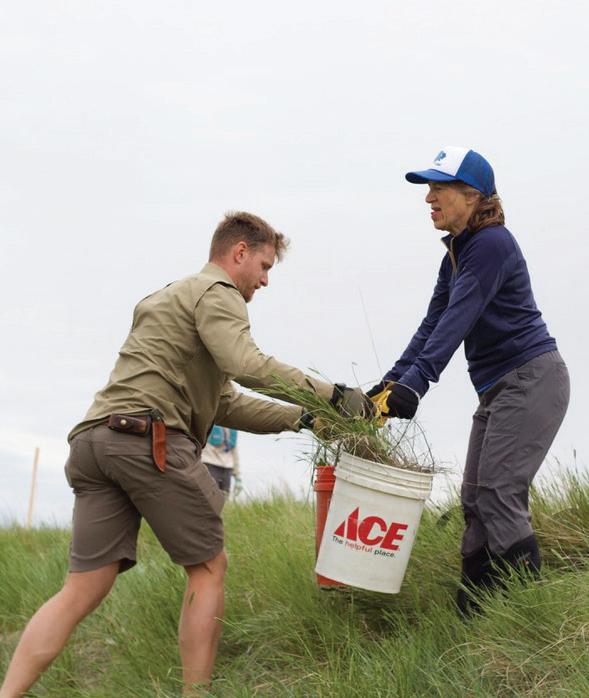
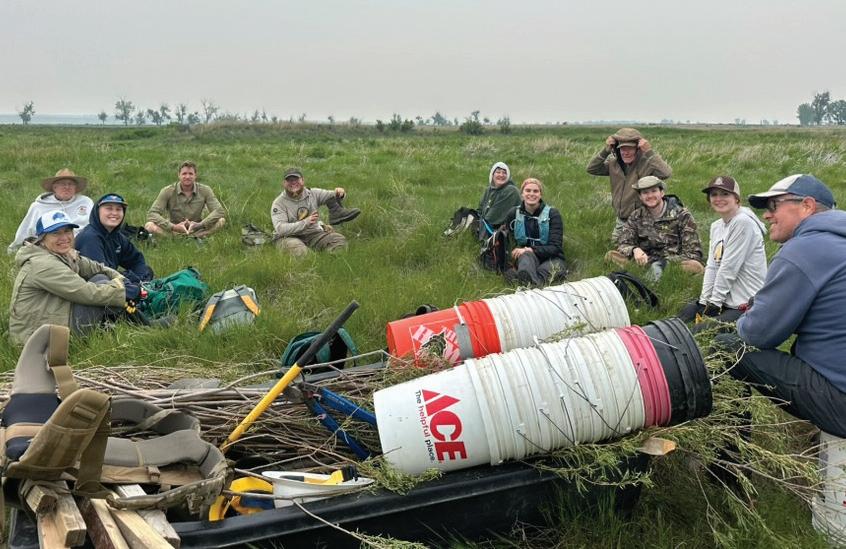
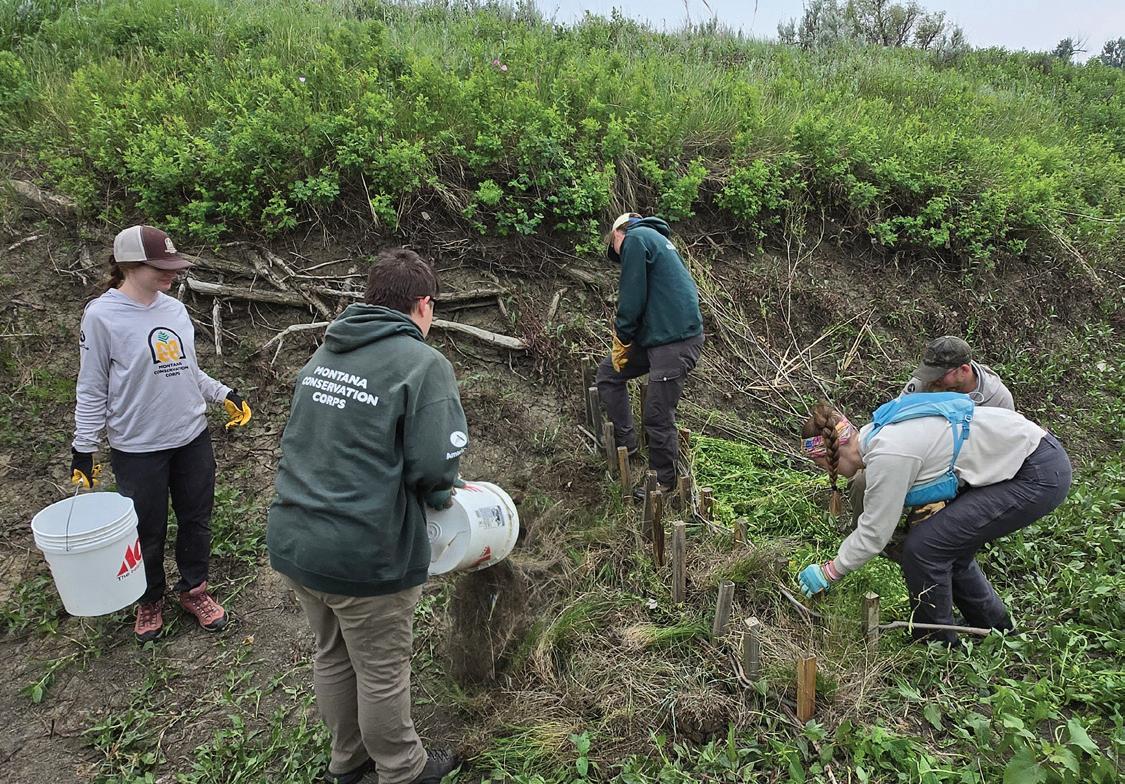
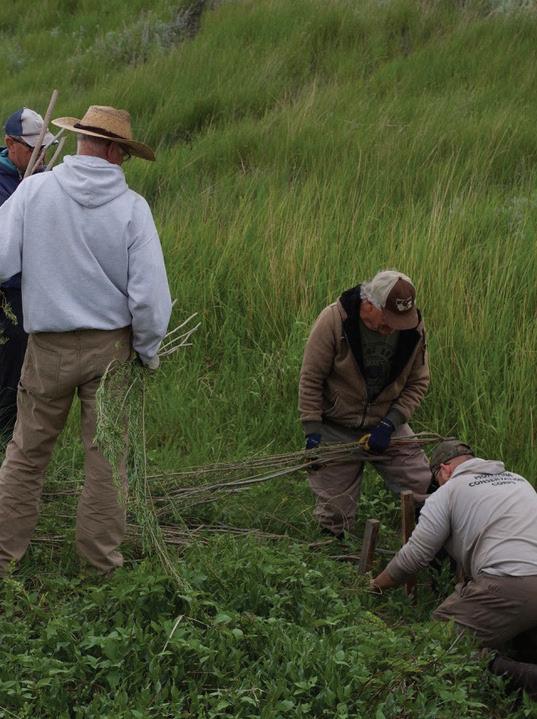
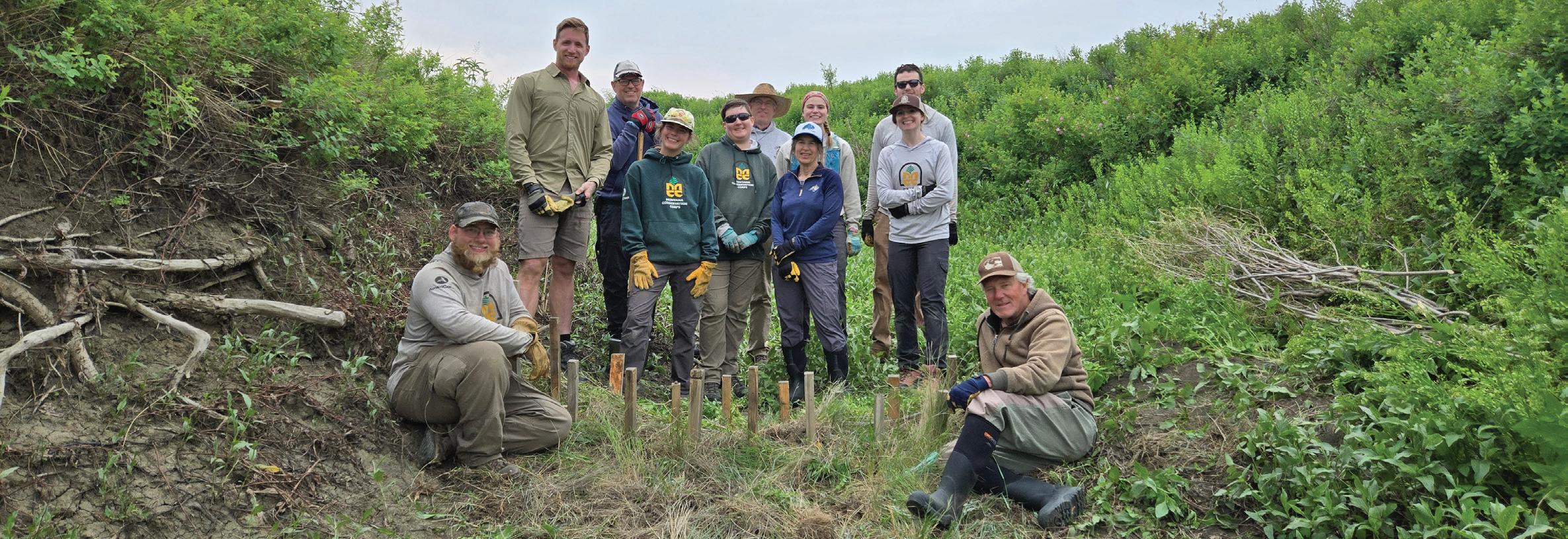
This summer, MCC’s specialist crew worked two hitches on Telegraph Creek, a deeply incised and degraded stream that flows through American Prairie’s Sun Prairie and Blue Ridge Units. Over about three weeks, the team built 54 structures that mimic beaver dams and natural log jams, maintained 17 more, and installed a headcut mitigation system (practices or structures implemented to control and stabilize areas of concentrated erosion). They also took the time to guide a group of community volunteers through building and installing structures of their own—getting a huge amount done while sharing their skills and passion for the work.
These structures are part of an approach known as LowTech Process-Based Restoration. It’s a hands-on method that uses simple materials like untreated wood posts and willow branches to mimic natural processes and help degraded streams recover. The structures slow water, trap sediment, arrest erosion, raise the water table, and create better habitats for native plants and wildlife. Eventually, they also facilitate the conditions necessary for beavers to return and take over the work themselves.
But the real story here is the people making it happen. MCC crews bring not just muscle and field skills, but a remarkable sense of commitment and grit. One crew member who worked on Telegraph Creek in 2024 asked to return to American Prairie this year—this time as the crew’s leader! As in years past, the crew adapted their techniques to our sitespecific needs and goals, worked seamlessly with American
Prairie staff, and carried themselves with all the pride and professionalism of an unshowered, sunburned, and bug-bitten person who has dedicated themselves to a challenging task done well.
MCC’s broader mission is to “inspire young people through hands-on conservation service to be leaders, stewards of the land, and engaged citizens who improve their communities.” That mission comes to life here. In addition to their work on Telegraph Creek, MCC crews have helped us remove or modify barbed wire fencing to support wildlife movement, provided support and exceptional expertise at our National Discovery Center, and— thanks to philanthropic support secured by MCC—will return this fall to remove invasive Russian olives along the otherwise wild Judith River.
Working with the tenacious and dedicated MCC crews each year–some newcomers and some familiar faces–I am reminded of one of my favorite quotes from the endlessly quotable Aldo Leopold: “Acts of creation are ordinarily reserved for God and
poets, but humbler folk may circumvent this restriction if they know how. To plant a pine, for example, one need be neither god nor poet; one need only own a shovel.”
We’re proud to work with shovel-wielders at MCC to create a wilder prairie. Their support advances our rewilding goals, builds conservation capacity, and brings energy and inspiration to the landscape. I look forward to what we’ll accomplish together next.
A New Friend In Lewistown
The Endangered Black-Footed Ferret Finds a Permanent Home at American Prairie’s National Discovery Center
David
Cunningham
Kären
& Jay Abbe Director of the National Discovery Center
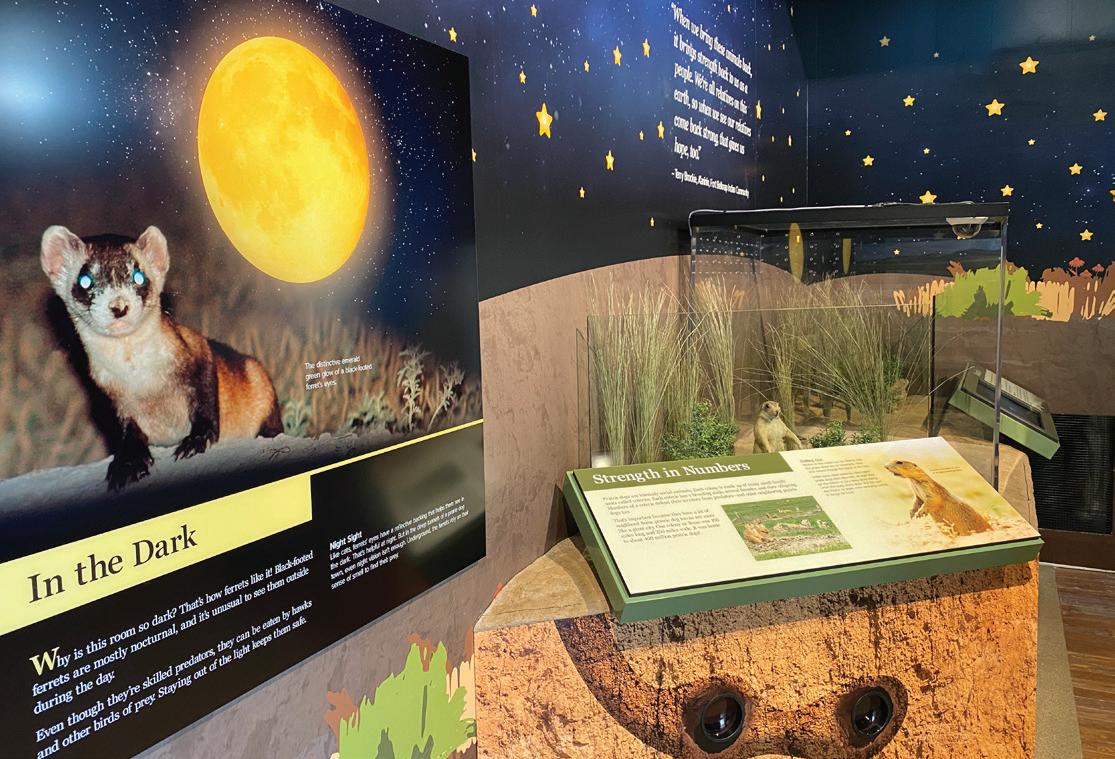
American Prairie is excited to share news of a new permanent exhibit located in the National Discovery Center. The exhibit features a live endangered black-footed ferret provided by the US Fish and Wildlife Service’s National Black-Footed Ferret Conservation Center in Colorado! It is one of only a small number of ferrets that are loaned as “ambassadors” to select conservation-focused organizations around the US, Canada, and Mexico. American Prairie is honored to be one of the host sites for North America’s most endangered mammal.
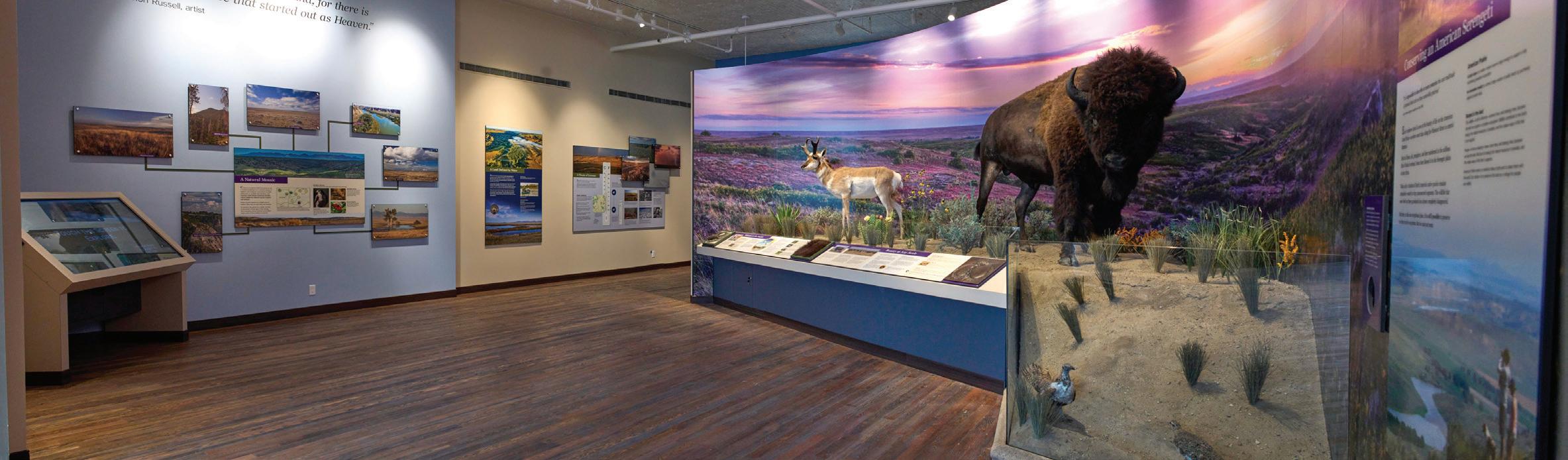
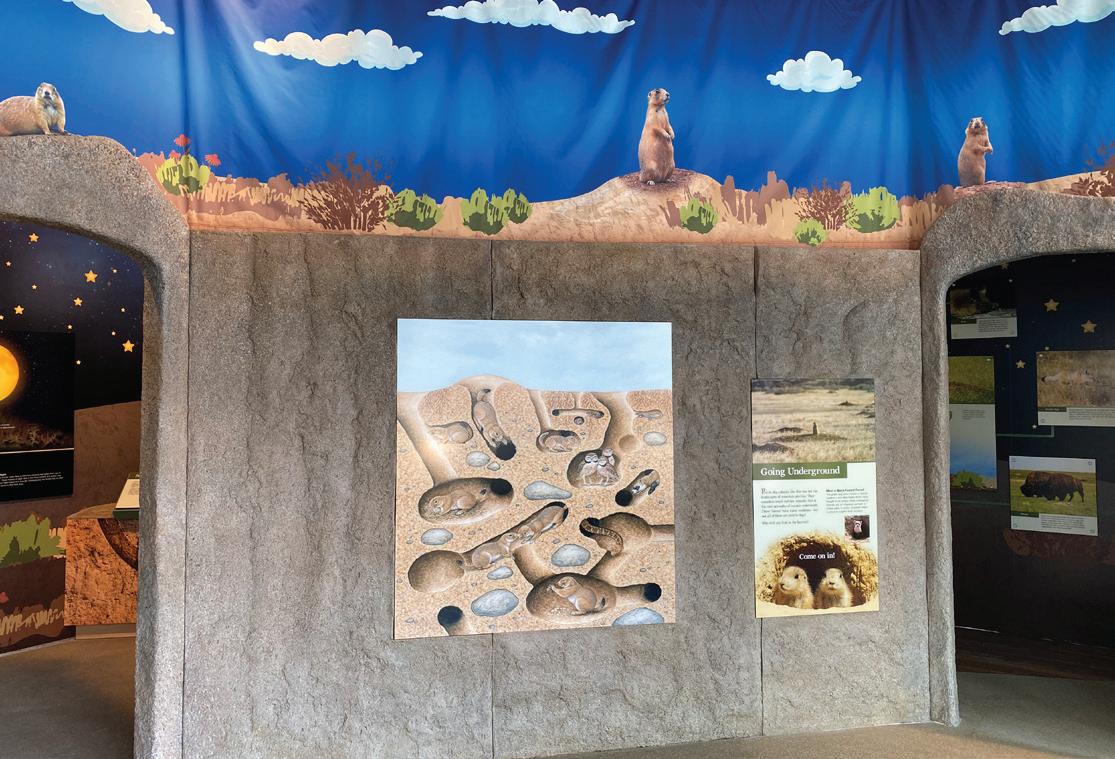
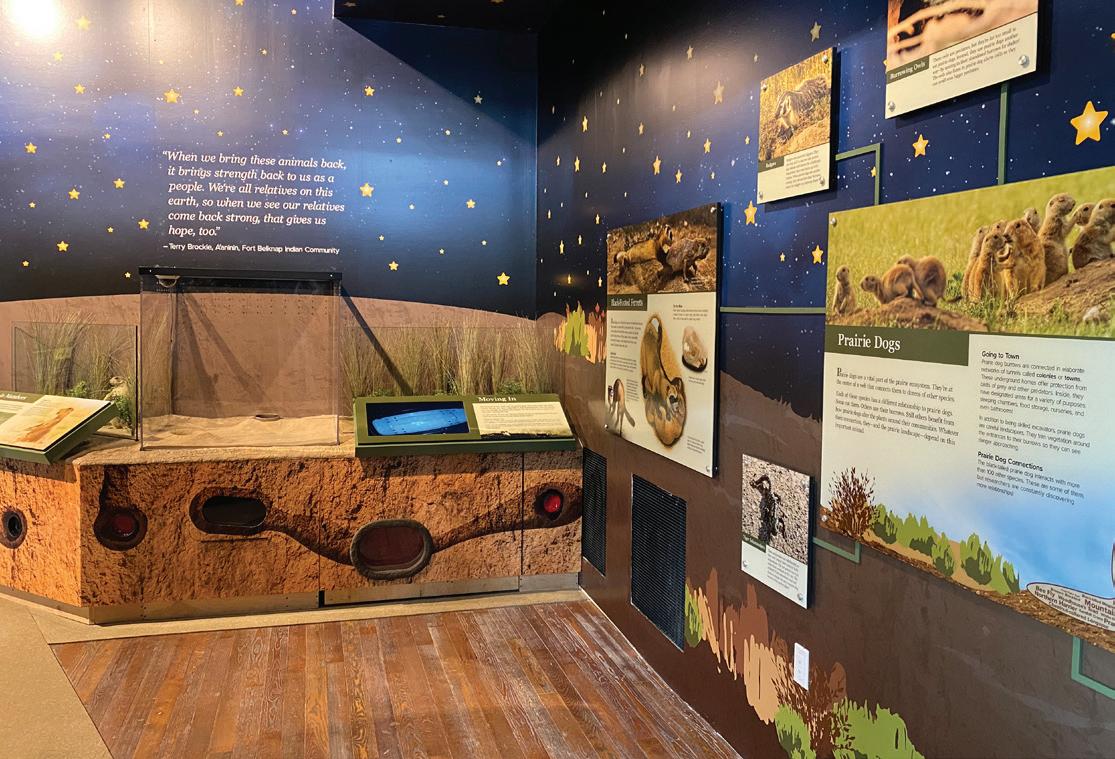
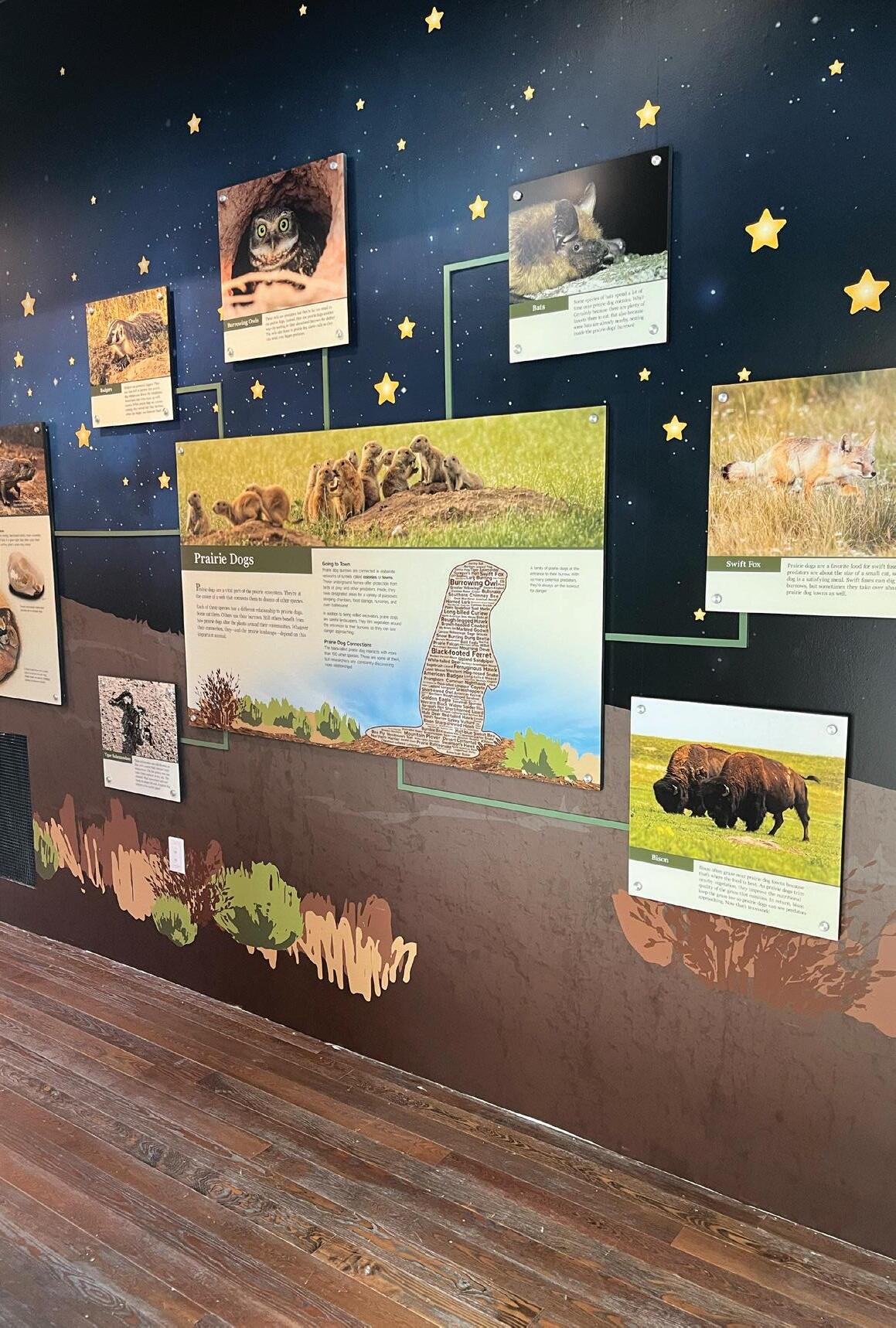
The new exhibit, incorporated into the Talpins Children’s Center, also focuses on prairie dogs and the community of life that depends on those keystone critters. Designed by Split Rock Studios in Minneapolis with the help of American Prairie staff, the exhibit consists of interpretive panels describing the interdependency of life in the prairie dog town, telling the dramatic story of the black-footed ferret, the recovery of the species, and the partners who are instrumental in recovery efforts, including Indigenous communities who play an oversized role in restoring ferrets to their native habitat.
Particular focus, of course, is placed on the black-footed ferret that is housed in a specially-constructed enclosure.
The habitat, which meets US Fish and Wildlife Service standards, includes an above-ground ferret viewing area, a realistic prairie dog diorama with taxidermy by Nature’s Design of Cody, Wyoming, a “ferret cam” for live, anytime viewing of the ferret, “peep holes” that provide representative 3D views of the many species utilizing prairie dog burrows, and informative panels. The habitat also includes below-ground “nesting units” that simulate an underground environment and allow the black-footed ferret respite in a cool, dark space.
It is almost miraculous that we can view a live black-footed ferret at all. The species once blanketed the American West, living in prairie dog towns where they preyed upon the inhabitants (a ferret eats one prairie dog every three days). With the settling of the West and the purposeful eradication of prairie dogs, black-footed ferrets lost their primary food source. Sylvatic plague, a non-native disease, also killed what was left of the already dwindling prairie dog and ferret populations. By 1979, black-footed ferrets were believed to be extinct. Fortunately for the species, in 1981, a ranch dog belonging to John and Lucille Hogg killed a ferret on their ranch near Meeteetse, Wyoming. Biologists sent to investigate the incident quickly located the planet’s last colony of approximately 130 black-footed ferrets on the neighboring Pitchfork Ranch, as well as on the Hogg Ranch and a few others.
Excited biologists from around the world swarmed Meeteetse, where scientists studied the ferrets for several years. But a few years later, sylvatic plague set in, and the ferret and prairie dog populations crashed. Desperate to save the species from extinction, biologists captured the last 18 ferrets left alive and, with them, began a captive breeding program. After early failures, the breeding program finally saw success. Now, there are approximately 30 relocation sites throughout North America and six breeding facilities. The National Black-Footed Ferret Conservation Center is the largest.
Others include the Smithsonian National Zoo and Conservation Biology Institute, Louisville Zoological Garden, Cheyenne Mountain Zoo, Phoenix Zoo, and the Toronto Zoo. Those involved in ferret recovery are now employing cloning as a new and promising technology used to ensure the future viability of this vital prairie species.
In our region today, the Aaniiih Nakoda Community at Fort Belknap has a population of black-footed ferrets, alongside prairie dogs, swift fox, and bison. American Prairie hopes to someday provide habitat for black-footed ferrets on some of our properties as well. First, however, prairie dog acreage and populations must increase, and controlling sylvatic plague remains the main challenge to increasing prairie dog populations. The Black-Footed Ferret Exhibit at the National Discovery Center plays an exciting part in the process of rewilding, as it aims to educate the public about the interconnectedness of life in the prairie dog towns and the importance of conserving prairie dog habitat.
Meet Cormac Weichel:
A Lewistown Local Joins the American Prairie Field School Team
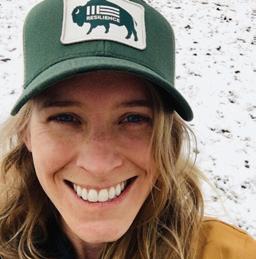
Corrie Williamson Director of Community Outreach
This spring, Cormac Weichel joined American Prairie as our new Education Coordinator, adding expertise and helping hands to our team. Originally from Lewistown, Cormac grew up on his family’s sheep ranch, where his love of the outdoors began. After attending college at the University of Montana and spending seven years working in firefighting, he’s back in Lewistown, where he also volunteers with our local Fire Department. Outside of work, Cormac enjoys taking care of his family’s sheep, skiing, hunting, fishing, backpacking, reading, and cheering on the Montana Grizzlies. Director of Community Outreach Corrie Williamson sat down to learn a little bit more about Cormac and how his first year with the Field School went. Read on!
Corrie: Tell us a little bit about your position with the Field School and what you do at American Prairie.
Cormac: As the Education Coordinator, I work with Dusty Rixford, the Education Manager, to deliver education
programming in schools, here at the National Discovery Center, remotely, or in classrooms around the state. Our curriculum includes prairie ecology, geology, biology, keystone species, and a range of other prairie-related topics. We really want the kids to get a sense of what’s out there.
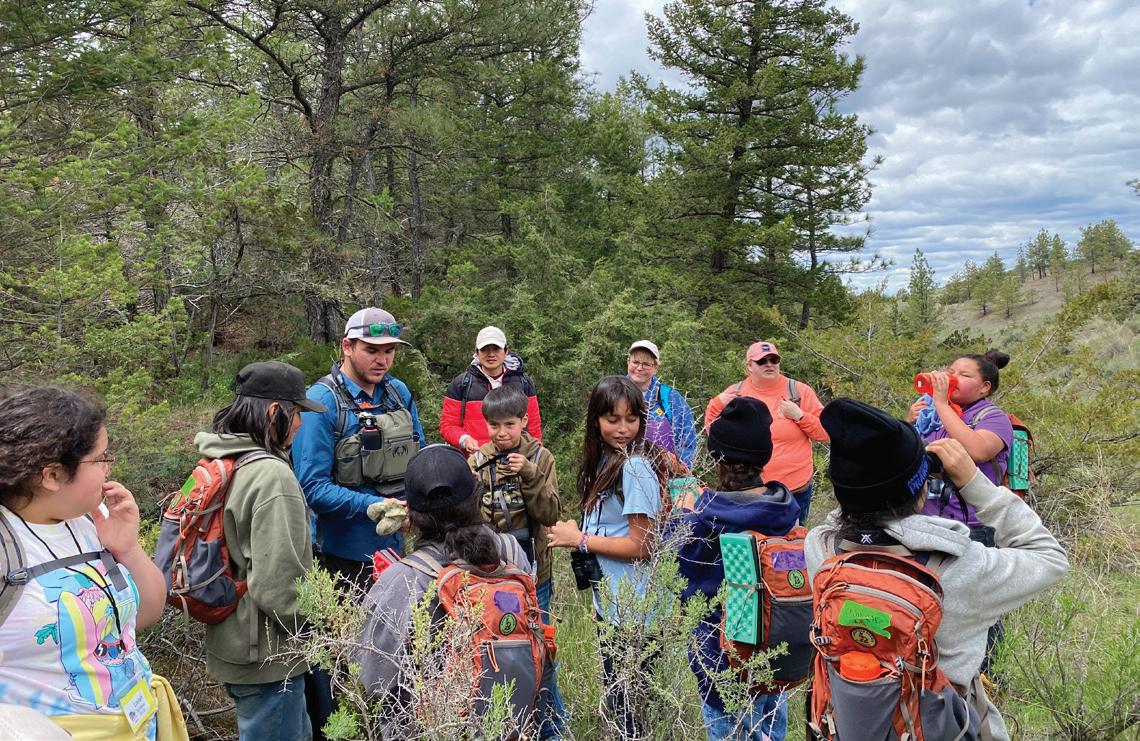
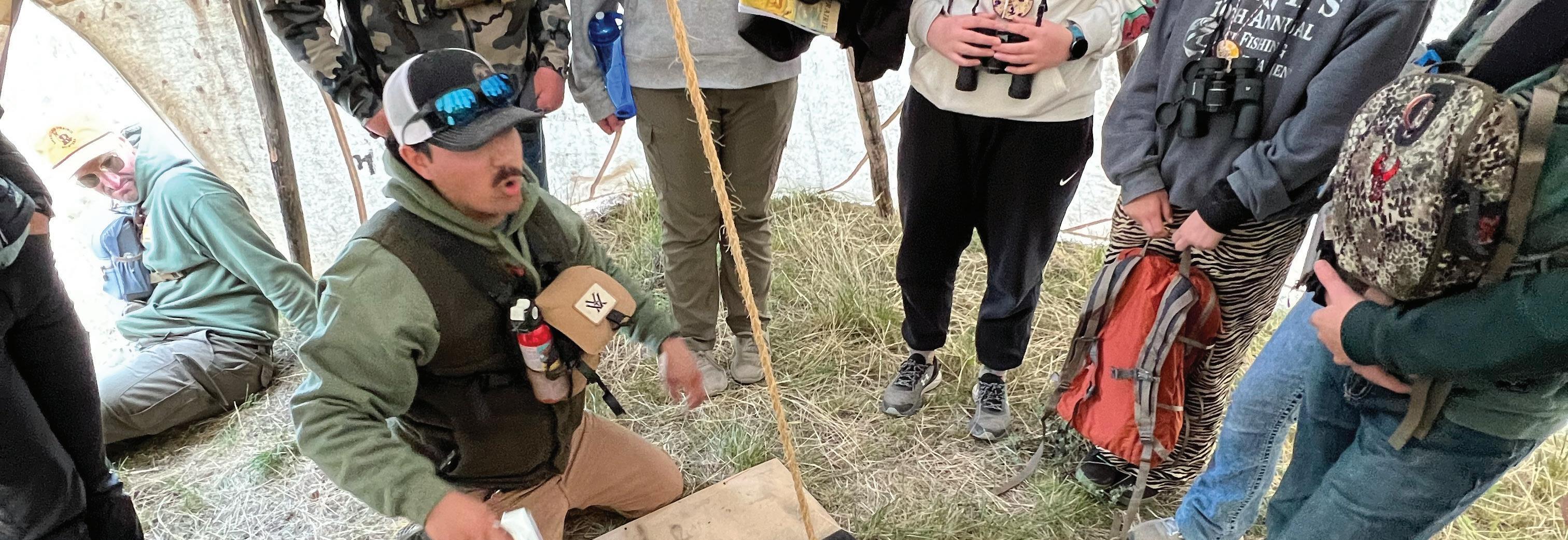
One of my main tasks is to organize and run American Prairie’s outdoor, overnight Field School at Antelope Creek Campground each spring. It is a two-night, three-day program where students from all over come and stay out on the prairie. They go on hikes, play native games with Aaniiih Nakoda Tours, learn from instructors from Yellowstone Forever, and have a whole lot of fun with all their friends out on the prairie.
The other significant aspect of my job involves outreach, attending various conferences and events to connect with educators across the state and, hopefully, inspire more kids to learn about the prairie.
Corrie: What is your background, and how did it lead you to this role?
Cormac: I have my undergraduate degree in history and political science. I briefly explored the education field, considering obtaining my secondary education teaching license. Ultimately, I decided against it because I didn’t want to be confined to a classroom, but I do have a love for education.
I also worked as a wildland firefighter for seven years. I started working in wildland fire on my 18th birthday, and I loved that job because it kept me outdoors, allowing me to see and do cool things while working hard, which is how I enjoy myself.
During the school year and the off-season from fire, I would work at after-school programs, such as Camp Fire of Western Montana. We would play games, go on various field trips, and spend time with the kids. I really enjoyed that a lot.
Corrie: What was the most fun thing that happened at Field School this year?
Cormac: I think the most fun I had was probably when [Bison Operations Manager] Pedro [Calderon Dominguez] demonstrated to the students how to talk to bison. It was a presentation about how to work with bison using low-stress principles. Pedro comes in with a bison hat with horns and a robe and a fake tail. He’s really good at impressions of a bison – he does all the snorts and runs, and he taught all the students how you would move bison, which side of the bison you want to be on to make it go a certain way, or what you need to do to get this bison to move.
Then he became the bison, and the students had to move him through a gate. It was hilarious to watch because some groups took an incredibly long time. They would all follow the protocols initially, but they quickly devolved from that, and it was chaos. It was so fun to watch. Oh, man. Pedro is such a funny guy, and he made it super enjoyable. All the kids and the teachers loved it.
Corrie: What are some of the important things that you think students leave Field School knowing or learning?
Cormac: The most important thing is that they felt safe the whole time they were at Field School. They were having a lot of fun, laughing, hiking with their buddies. You never know with students – this could be the only time in the year where they really have three meals a day, have a bed to stay in, and are not thinking about anything else except being out there on the prairie with their friends, and just having fun. That’s what I think about; even when it gets hard and I’m like, man, I’m tired. That’s what kept me going, just seeing how much fun these kids are having.
Corrie: What do you think is special about the Antelope Creek location?
Cormac: I think it’s an excellent spot up on that high point, past the reservoir there with the tipi on top. You can see for miles and miles down to Lewistown, up to the curve where you can see the Bears Paw Mountains. You can see everywhere. And I think that’s really an inspiring site. I know for me personally, because I was born out here in Lewistown, seeing wide open spaces makes me feel something that is really powerful.
Corrie: What are some of your hopes or ideas for the future of the American Prairie Field School?
Cormac: I’ve been thinking about if I could organize some two to three-day overnight backpacking trips across one of our properties, maybe on the PN or elsewhere, for high school students. I think that would be cool, and I like getting out there and roughing it a little bit.
Other than that, this year we piloted a cook-your-own-food approach with the students, and I think it worked really well. The kids really liked that ownership, and enjoyed making Three Sisters Soup, chili, and other food together. Those are important skills to learn and share.
Corrie: Is there anything else that you want Montana folks to know about education programming at American Prairie?
Cormac: I think it’s incredibly valuable, and it’s strictly educational. It’s science. We meet Montana’s state science standards in all of our programming. We also do a teacher’s workshop and offer continuing education credits. It’s valuable for teachers to take these lessons back to the classroom, because the kids enjoy them so much. They love being able to touch bison skulls, badger furs, and see the coyote skull. The kids love hands-on activities, and we bring a lot of those to the table.
To learn more about how you can get your students involved, reach out to Dusty at dusty@americanprairie. org or Cormac at cormac@americanprairie.org.
Montana Conservation Corp Intern Update
Two summers on the prairie with Megan Myers
My name is Megan Myers, and I have been the Montana Conservation Corps Intern serving at American Prairie for the past two seasons. I was born and raised in Kansas City, Missouri. I’m a senior at the University of Missouri – Kansas City studying Political Science with a minor in Environmental Studies. Although I grew up in the Great Plains, I was eager to explore the mountains and prairie; last summer was my first opportunity to spend time in Montana.
My time with MCC and American Prairie has been the most rewarding experience of my life. I’ve learned so much about land stewardship, facilitating connections between people and nature, and building community amongst diverse people and multiple perspectives. I’ve developed hands-on skills I wouldn’t even have imagined before coming into this position, like perfecting a killer elevator speech, writing curriculum, becoming a human beaver, and navigating gumbo. And of course, my time in Montana has been a strong driver of personal growth. I’ve made new friends, found community, made plenty of mistakes, and developed resilience–all while earning a black belt in mosquito defense.
Some of my favorite experiences have been the long days on the prairie. I learned to relish the days I would start driving at sunrise and return home at sunset, waking up early enough to catch a glimpse of the stars, driving through sage fields as grouse pop their head out of the hedges, and leaving just as the deer begin to overtake the roads. Those days serve as a reminder of my place within a larger ecosystem and my gratitude for experiencing a kind of wilderness that many people never encounter.
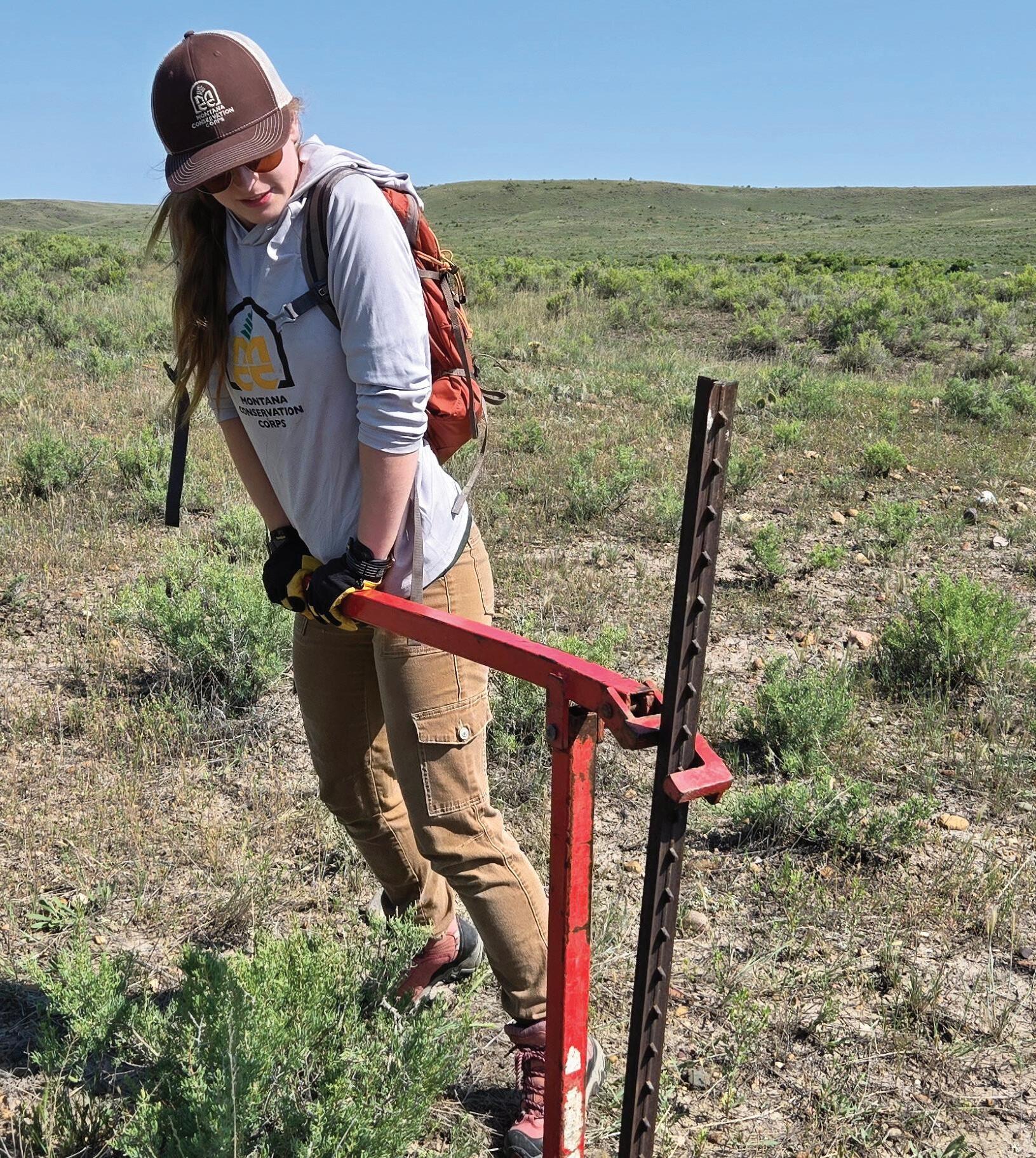
This season, I’ve had the opportunity to work on volunteer field projects. Everything I love about the mission of MCC is demonstrated at our volunteer days.
Megan Myers removing old fence posts with MCC on Sun Prairie.
View from behind the Lewis & Clark hut on the PN.
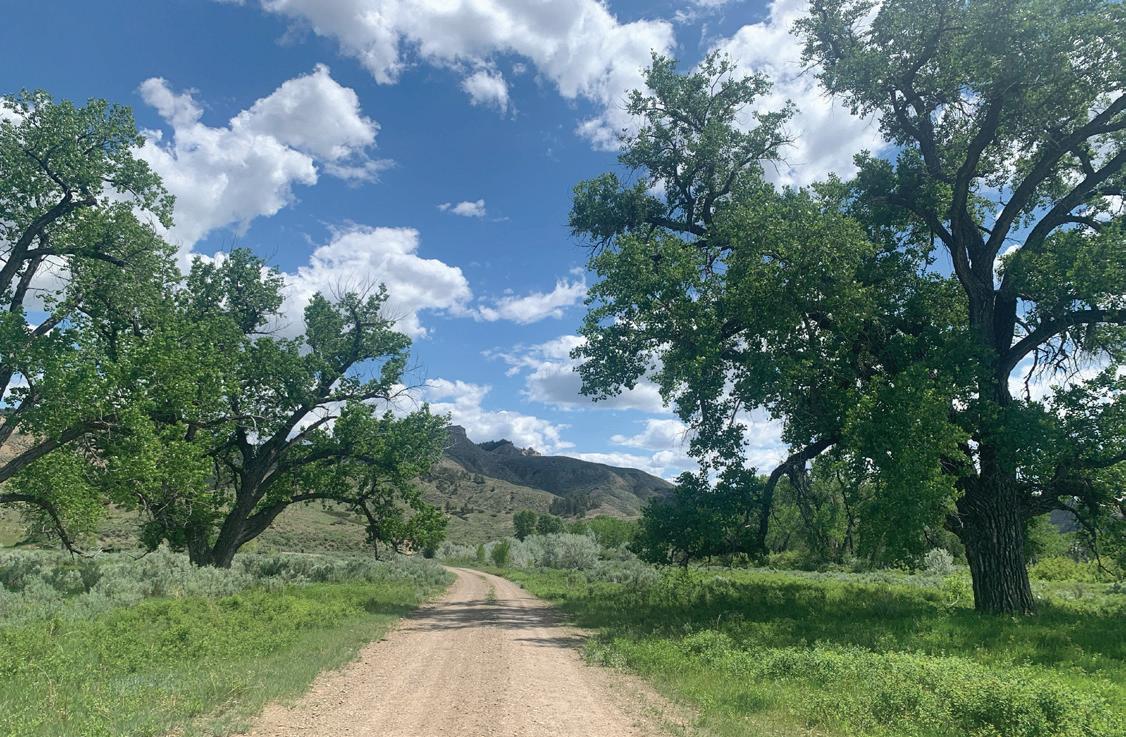
Driving through the cottonwood gallery on the PN.
Prairie
Going out as a team in the heat, in wide-open spaces, slightly sore, seeing both the work you’ve done and the work you have left to do gives our team a strong sense of purpose.
My absolute favorite days on the job were the ones I spent helping pilot the first American Prairie Girls STEM Camp. Working with Dusty was a dream partnership. Dusty is undoubtedly the expert in her field, yet she let me have creative input in the project, which was incredibly fun and rewarding. The kids in that group had the widest eyes for the prairie, for science, and for sharing their knowledge with others. On the last day, one of the girls wrote her own original piece on “Death camas” in her field notebook to share with the class at lunch. That has become a core moment for me: to see firsthand what the next generation can and will do if we give them a space to learn and a platform to share.
I’m so grateful for my time at American Prairie and the opportunity to contribute to such a monumental project with the most amazing people. I brag to all of my friends back home about how cool it is to work for an organization with a global impact accomplished by work done on a local scale. I know I will visit many, many times in the future, and I hope to show my friends and family what the prairie is all about!
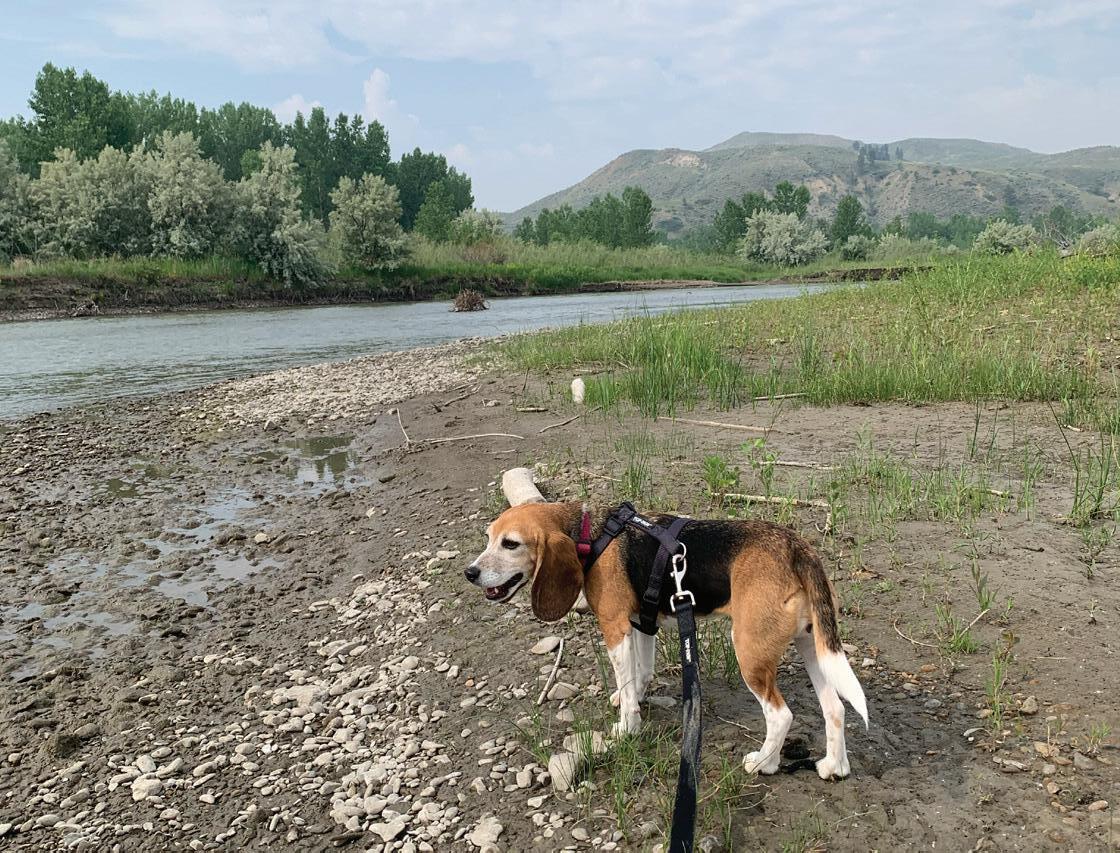
Megan’s dog Rosie enjoying the Judith at the PN.
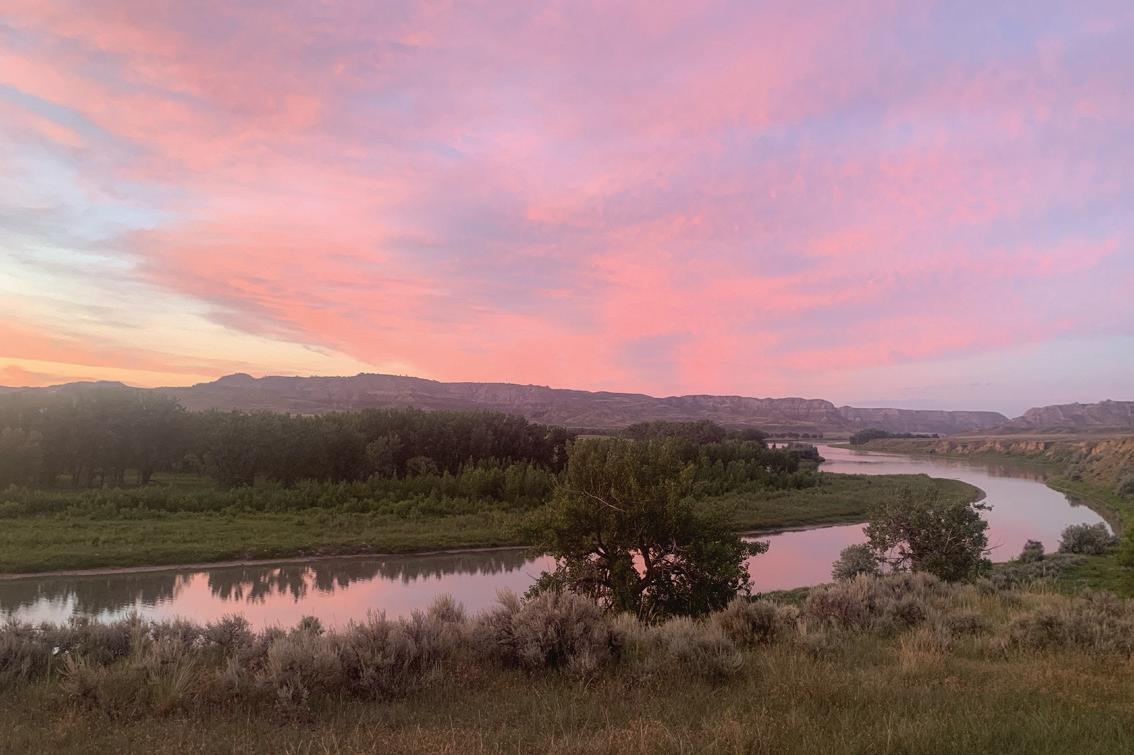
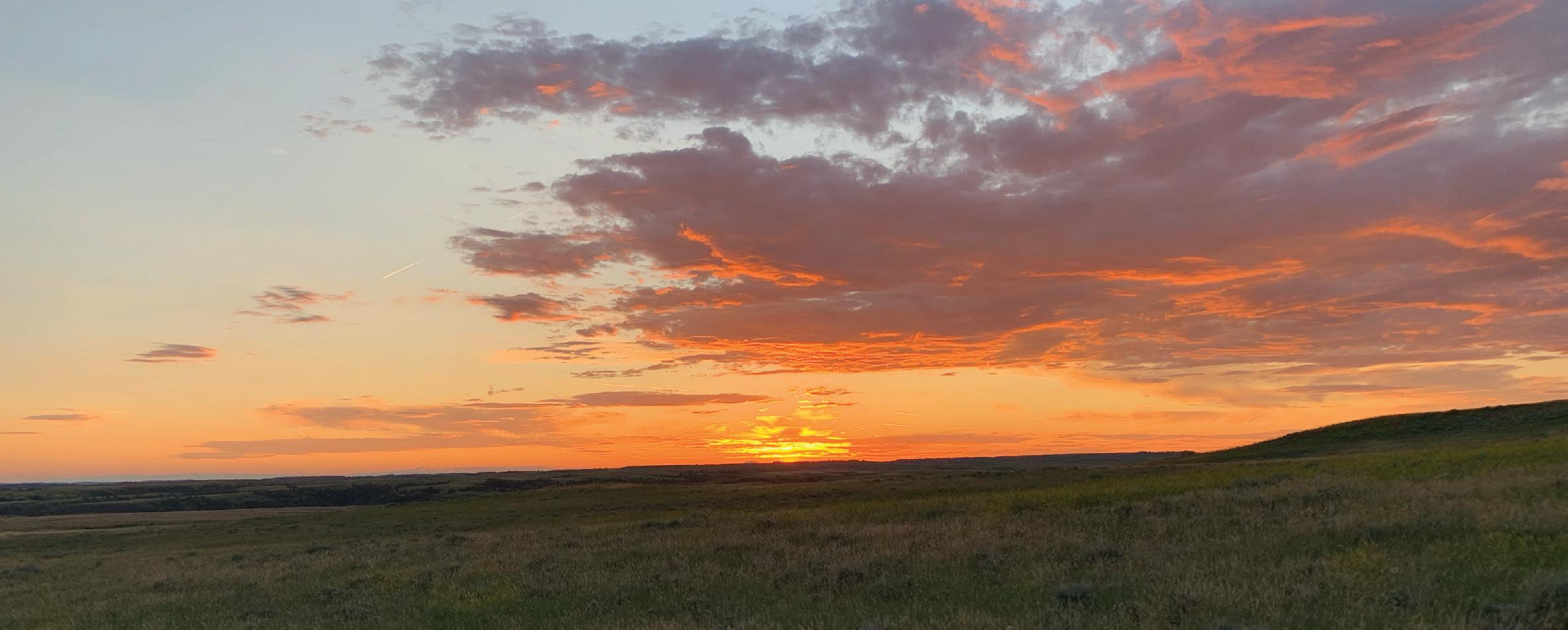
A sunset view from the Antelope Creek Campground Interpretive Trail.
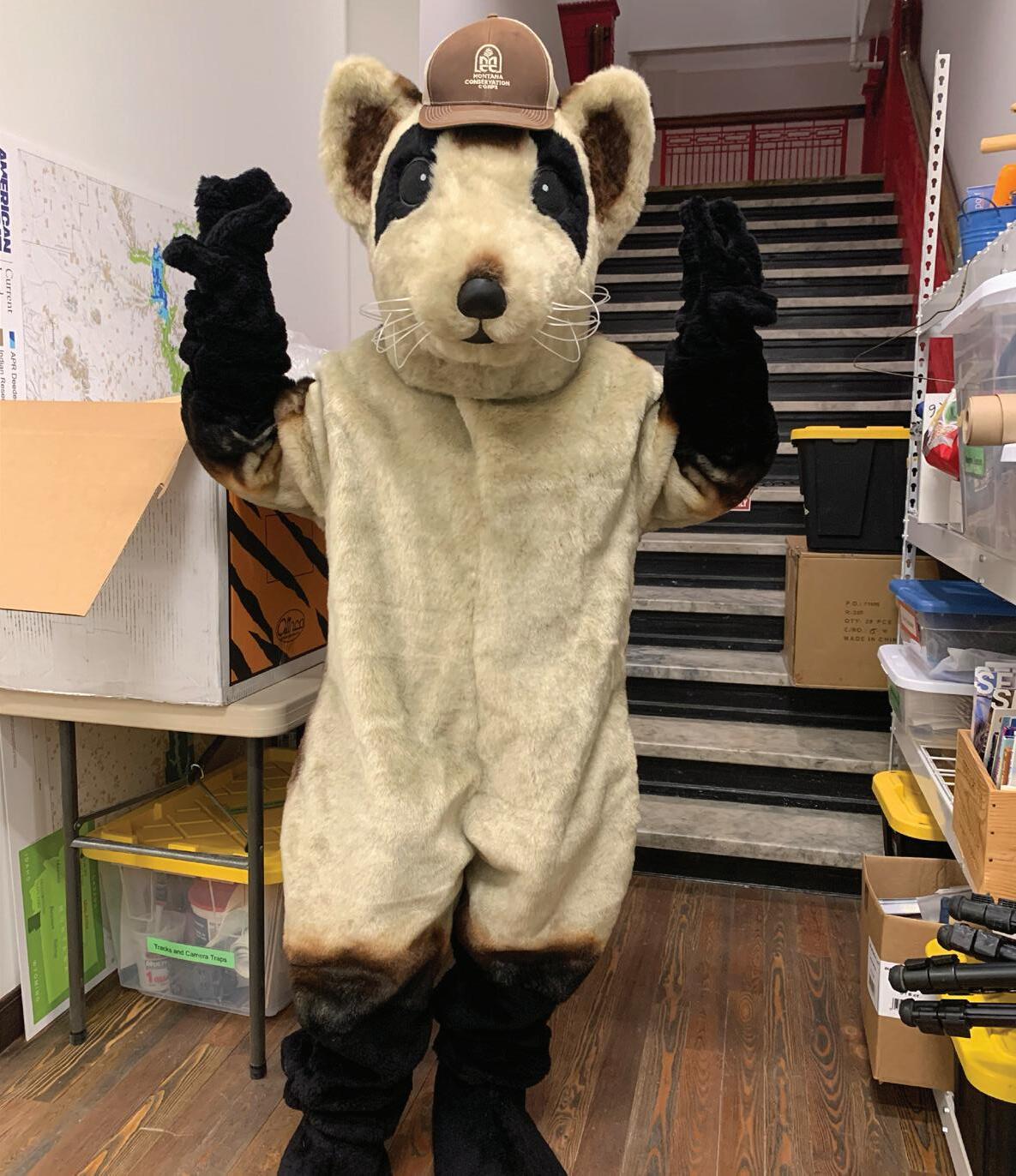
It’s a Black-Footed Ferret job, but someone’s gotta do it!
P.O. Box 892
Lewistown, MT 59457
[Recipient Address]
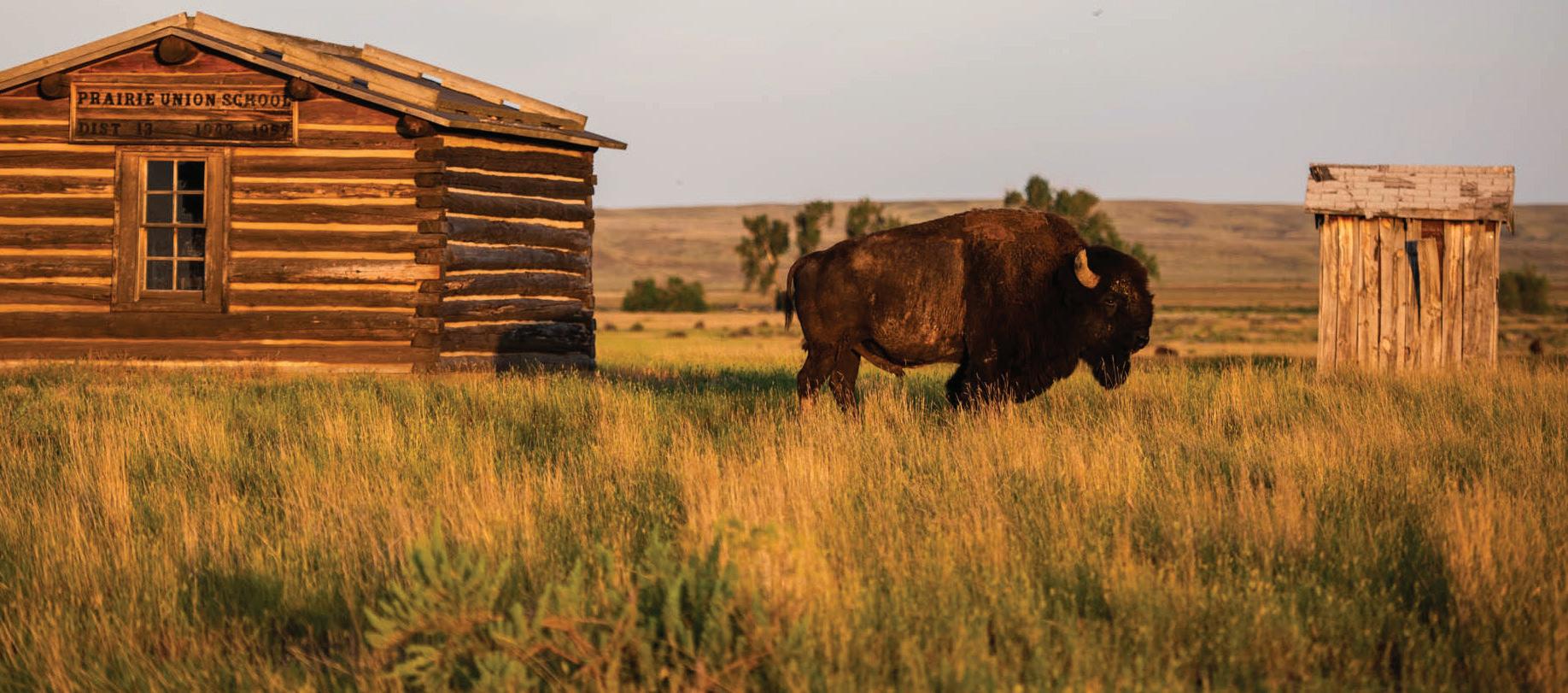
This fall, we are celebrating an incredible milestone—twenty years of bison on American Prairie. Two decades ago, on a rainy October night, we reintroduced our first bison: a group of 16 from Wind Cave National Park. When their hooves hit the ground on our Sun Prairie property, it ended their 120year absence from this region and marked the start of an exciting chapter for American Prairie. To learn more about our bison program and the team who works day in and day out to care for the bison, scan the QR code.

Thank you for your interest in American Prairie! Learn more at AmericanPrairie.org, and don’t hesitate to reach out with questions or concerns, or to share ideas for future newsletter topics.
CONTACT
Corrie Williamson
American Prairie Director of Community Outreach corrie@americanprairie.org