
IN THIS ISSUE Navigating Business FromPressuressupplypressurestotaxes, foreign workers to plant health, AmericanHort is here to help you navigate through the pressures that you and your business face every day. 2022: August An AmericanHort Member Benefit FEATURES Advice from Industry Leaders to Help you Minimize the Effects of Supply and Inflationary Pressures 8 Member Spotlights 12 UPCOMING EVENTS & EDUCATION Webinars & Mastery Series 14 Plug & Cutting 15 Landscape Operations Tour 15 HRI & UPDATESADVOCACY Five Things to Think About Before You Apply for Foreign Workers 2 An Advocacy Success Story 5 New Tool Helps Growers Mitigate Risk and Improve Plant Health 6

WORKERSFOREIGN
Sure, raising the wage well above $15.00 an hour in some occupations is doable, but does it attract reliable labor? Maybe offer incentives like bonuses, medical insurance, paid time off, or work from home schedules. But those types of incentives do not work in every industry or occupation, you cannot really work from home when someone needs to physically be present to care for plants in a greenhouse. And even if those incentives attract labor, is that labor going to be reliable and last a whole season or two? Sadly, we know the answer to that question is most likely no. That answer is why many employers turn to the temporary foreign guestworker visa programs like the H-2A and the H-2B visa programs. So many people are turning to these programs that we are seeing record numbers of applications, in 2021 the U.S. Department of Labor (“DOL”) certified 317,619 H-2A temporary agricultural visas and 181,451 H-2B temporary non-agricultural visas. That is up from a DOL certified 200,049 H-2A visas and 133,985 H-2B visas in 2017. Below are five things I think you should consider before embarking on this journey of hiring workers under these programs.
1. Do You Have a Season? These two visa programs require an employer to have a temporary need or a season. You would think in agricultural production that would not be difficult to prove, but as modern agriculture expands and evolves it has become exceedingly difficult to prove to DOL that your need is not permanent. This is especially true in the nursery and greenhouse industry, as DOL sees your ability to produce year-round as a permanent need or your decision not to produce year-round as an economic decision to be able to access the program. In the landscape installation and maintenance industries, it is much easier. In fact, the largest industry user of the H-2B program is the landscape industry.
2 | AmericanHort.org
Article provided by Shawn M Packer, Principal Member, JPH Law JPH law is an AmericanHort strategic partner
Five Things to Think About Before You Apply for Foreign Workers
With businesses across the United States struggling to find reliable labor, let alone in labor intensive occupations, many are left asking what should I do?


3. EmploymentCorresponding
In both the H-2A and H-2B programs the regulations require you to offer the same terms and conditions to domestic workers as you do the H-2A or H-2B workers, this is called corresponding employment. The definition of corresponding employment differs for each program, but the general idea is the same, if your domestic workforce is doing the same thing that your H-2A or H-2B workforce is doing then you must pay them the same and offer the same terms and conditions of work. This is more of an issue with the H-2A program right now because Congress has stopped DOL from enforcing corresponding employment in the H-2B program, although they cannot enforce this provision it is still in the regulations and required to be followed.
Continued on Page 4… 2022: August | 3
2. Direct Hire or Contractor?
Although some advocates that are against the programs complain about substandard wages, you likely would be paying the H-2 workers more than your domestic workforce. This is why the corresponding employment provisions are important to understand, because if you are paying the H-2 worker more, you would have to pay your domestic workers doing the same job the same wage as your H-2 workers.
This consideration is in large part more of an H-2A concern, as the H-2B program makes it more difficult to hire a contractor. For the H-2A program though, the decision to be a direct hire employer or hire a farm labor contractor that also hires H-2A workers (“H-2ALC”) is important as it determines how involved you will be. As a direct hire employer, you are responsible for all cost of the program (filing fees, transportation, visa and border crossing fees, wages, and housing) however you can ensure that you are doing everything by the letter of the law and have much more control over your use of the program. If you use an H-2ALC they take on all the burden. Although that may seem like an ideal situation, you are relying on a third party to follow all the program requirements. If they fail to comply you could be left without a workforce and potentially liable for their mistakes. But you are not required to provide housing or transportation. Another potential issue when using an H-2ALC is their seasonality. If they take on too many clients in your area and file for longer periods of time to accommodate those clients, you could be left without a workforce if DOL questions their seasonal need.
4. The Adverse Effect Wage Rate or Prevailing Wage
Both the H-2A and H-2B programs require a specific wage to be paid to the foreign workers and workers in corresponding employment. For the H-2A program that wage is the Adverse Effect Wage Rate (“AEWR”) and the national average right now is $15.92. For the H-2B program you pay the prevailing wage, which is determined by DOL based on the job duties. The H-2B wage is the mean wage for the occupation in the area of intended employment, so it is not an entry level wage. So, for instance a landscaping worker in Columbus, Ohio would be paid $15.69 an hour right now, while the entry level wage is $12.53. As mentioned before, this is an important consideration because you are required to pay your workers in corresponding employment the same wage.
4 | AmericanHort.org
Conclusion Both the H-2A and H-2B programs are good and viable options for obtaining much needed labor relief. They come with a cost, but you get access to a reliable workforce. Additionally, the workers that come in both programs are given a fantastic opportunity that they do not have in their home country, they make a great wage and help their families back home. Many employers that use these programs feel that the workers that come are like family and they come to work year after year. These are just some of the considerations an employer must consider when deciding to participate in these programs, there are many other things to consider as well since these programs are highly regulated and not using the programs as intended can get you in serious trouble with the Federal government.
DOL uses this survey to publish the annual AEWR that must be paid in your state. The AEWR has been increasing at nearly 10% each year and in some places is well over $15.00 an hour.
5. The Cost If the cost of paying higher wages was not enough, the programs come with many other costs. First, there are filing fees for both programs. The H-2A program caries a certification fee at DOL of $100 plus $10 a worker, not to exceed $1,000. Then there is the USCIS filing fee of $460, the Department of State filing fee of $160, and the border crossing fee. On top of all that, many people use an agent to file their application, the agents typically charge between $1,000 and $5,000 to file the application, plus a per worker fee. Then there are the other costs of the program, you must provide housing in the H-2A program, transportation to and from the place of recruitment, transportation to and from the housing to the worksite, and either kitchen facilities or three meals a day. This is why many people chose to hire an H-2ALC as they handle all of these costs, and you pay an hourly premium for the labor. The H-2B program on the other hand does not come with the requirement to provide housing and kitchen facilities or meals. You are still required to pay for transportation from the place of recruitment and return transportation, but not daily transportation to the worksite. There is no certification fee at DOL, but you still pay the USCIS, Department of State, and border crossing fees. You can also opt to pay an additional amount at USCIS for premium processing, meaning they will process your case within 15 days. That is an additional $1,500 for premium processing. Like with H-2A, many people use agents to file, and the fees are relatively similar.
WORKERSFOREIGN
Continued from Page 3… For the H-2A program the AEWR is set by a survey called the Farm Labor Survey (“FLS”). The FLS surveys farms and ranches across the country for the wages paid to farmworkers. It is then published as a combined field and livestock worker wage.

avoided...
AN ADVOCACY SUCCESS STORY
Sen. Krysten Sinema (D-AZ), the final holdout vote, negotiated late concessions from her Democratic colleagues, eliminating taxes targeted toward managers of private equity firms and their subsidiaries. Gone for instance is language subjecting firms of any size to the new 15% minimum tax that is part of a subsidiary portfolio with sum revenue exceeding $1 billion. Owing to a technicality, the Senator claimed the subsidiary provision unintentionally increased taxes on small or medium-sized businesses incidentally owned by private equity firms, citing concerns from Arizona firms, including a plant nursery. News on the legislation’s tax provisions brought sighs of relief from taxpayer advocates, particularly farm groups. Remember proposals to raise revenue by taxing plastics, capping like-kind exchanges, or increasing estate taxes? All those tax increases, among others that would have affected the nursery and floriculture industry, were floated to pay for Build Back Better over the past 18 months, but ultimately dropped from the Senate Numerousagreement.letters and corresponding grassroots efforts led by AmericanHort and advocacy partners helped educate Congress on the unintended harm to family-owned farms and small businesses of such new taxes. Successful advocacy on these tax consequences avoided reaffirms why collective advocacy through your associations including AmericanHort is so Ourcrucial.advocacy work influences legislation and regulation to help the industry perform better, grow faster, and prepare for the future. Needless to say, our ultimate success depends on your support; as the adage goes, complaining is free; everything else costs money!
GOSEEK & FI D 2022: August | 5
Good news on tax changes
Evan Lee, Director of Policy and Government Relations, AmericanHort, EvanL@AmericanHort.org
In each issue of Connect, we’ll be “hiding” a new small graphic. When you find it, email us at ConnectSeekAndFind@AmericanHort.org, and tell us where you found it. For this issue, respond by October 1.
In mid-August, the Senate passed a downsized yet still sprawling reconciliation package, dubbed the Inflation Reduction Act. Even casual observers now know the deal, approved on a 50-50 partisan basis with a tiebreaking vote from Vice President Harris, includes $423 in billion in new spending on health care and climate change mitigation policies central to the President’s platform. To offset new spending, and further provide deficit reduction, the agreement raises roughly $790 billion in revenue, notably through a new 15% minimum tax on corporate earnings above $1 billion, a 1% excise tax on corporate stock buybacks, and stepped-up tax enforcement by federal auditors.

“To make the process easier, the Horticultural Research Institute teamed up with the National Plant Board and USDA to develop a web-based risk assessment tool,” states Craig Regelbrugge, AmericanHort Executive Vice President Advocacy, Research, & Industry Relations. Although the tool was designed to help growers more easily perform the risk assessment required to participate in SANC, the tool is available, at no cost, to any U.S. nursery or greenhouse seeking to improve their processes, whether they choose to pursue SANC certification or not.
The Systems Approach to Nursery Certification (SANC) program is a voluntary, grower-driven, officially state-verified plant health certification partnership that applies quality management principles to the entire plant production process. SANC was developed as a holistic approach to growing and certifying plants that satisfies applicable state and federal plant health regulations.
The place to start with system design is a greenhouse or nursery-specific risk assessment that examines what can go wrong where the plant production process.
Jennifer Gray, Research Programs Administrator, Horticultural Research Institute, JenniferG@AmericanHort.org
The Horticultural Research Institute, in partnership with the National Plant Board and the USDA, is pleased to announce the launch of an important new tool for nursery and greenhouse growers seeking to improve plant production processes by identifying hazards (operational areas where plants could be contaminated or introduced to plant pests) and where to apply best practices. Understanding these critical control points helps growers reduce or eliminate risks, paving the way for healthier plants and healthier businesses. Healthy plants are integral to human health and well-being, and to thatenvironmentthesustains us. To ensure that plants moving in the horticultural trade are free of regulated invasive pests that threaten agriculture and the environment, greenhouses and nurseries are regulated by state and federal authorities. A multi-year effort to modernize plant certification has resulted in a new program known as SANC.
Growers may request free user access to begin a facility risk assessment by visiting the Risk Assessment website at HRIresearch-sanc.org.
SANC applies best practices at key points in the plant production process to address identified risks. These practices are integrated into a growing operation system, hence the name: systems approach.
UPDATEHRI 6 | AmericanHort.org
New Tool Helps Growers Mitigate Risk and Improve Plant Health

for Students Entering the Green Industry
To learn more about HRI Scholarships and how you can help contribute, visit
PARTNERHRIresearch.org.UPDATES
StrategicAmericanHortPartner, KCoe Isom, is Now Pinion
HRI ScholarshipsOffers
KCoe Isom has been a strong AmericanHort affinity partner and has proudly supported food, agriculture, and community businesses for 90 years. Now they are writing a new chapter, with a new name—Pinion. What does this mean for you? Future advisory communications to you (emails, mailings, invoices) will now come from Pinion, and their advisors’ email addresses will change to pinionglobal.comfirstname.lastname@ on August 22.
Say Hello to the Newly Rebranded “RealTreeChristmasBoard”
April | 7
Backing motivated students today plays a vital role in protecting and growing the industry tomorrow. Applications for the 2022–2023 school year are due September 2, 2022.
The Horticultural Research Institute believes in helping students obtain the education necessary to successfully pursue horticultural careers. Our generous donors have created seven scholarship opportunities for students to support their academic journey.
To bring clarity to the marketplace, the Christmas Tree Promotion Board has rebranded and is now named “Real Christmas Tree Board.”
The Real Christmas Tree Board offers free listings to anyone who retails real Christmas trees on their Retail Locator. The locator is can be found at RealChristmasTreeBoard.com Retailers can add their stores to the listing right there on the website!2022:



Katie Gustafson, Marketing Communication Specialist, AmericanHort, KatieG@AmericanHort.org
Derek Clark, South Central Growers, Inc, had a similar perspective on getting the most out of your trips, “Our greenhouse has switched to a new cart fleet so that we are now shipping 12% less air in each truck.” Shipping less air means shipping more product. Overtime, this adds to significant savings and more product in the hands of their customers.
The question remains, how do we do that?
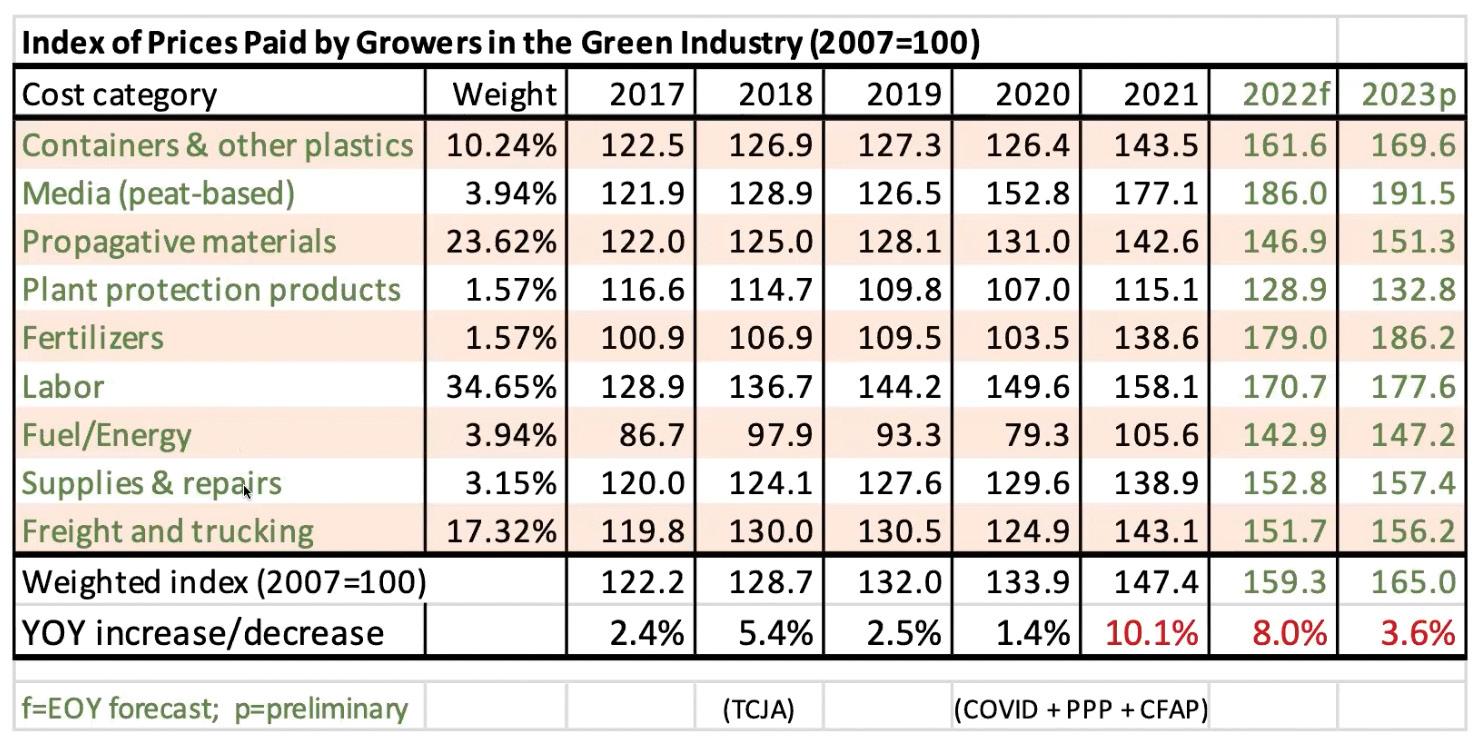
Chart 1 Earlier this month, AmericanHort hosted an Industry Insider covering supply and inflationary pressures. Leading off the program, Dr. Charlie Hall, AmericanHort Chief Economist, summarized where we stand as an industry from an economic perspective, how this spring’s weather effected sales, and reviewed the projected increases in input costs the industry can expect moving forward. With the expected cost of each input rising (Chart 1), it’s more important than ever for our industry to become even more efficient, high-yielding, and essential in the consumer’s eyes.
Advice from Industry Leaders to Help you Minimize the Effects of Supply and Inflationary Pressures
8 | AmericanHort.org
SUPPLY INFLATION&
There are so many different strategies being tried across the industry. To help you plan for your business’s future, Dr. Hall led a discussion with five industry leaders on how supply and inflation have affected their businesses—and what they are doing about it. With increases in freight, fuel, and trucking costs continuing, Tom Hughes from Hughes Nursery & Landscaping recommends being very cognizant about your businesses’ fuel consumption, “From a landscaper’s side, we are out every day going to people’s homes, so fuel is a massive cost. We are always maximizing the efficiencies of our trips to limit milage and the number of trucks needed on the jobsite. Every gallon of fuel we can save is significant with the way the prices are now.”


your company employee roster when you login to your company profile on AmericanHort.org. Questions? Email Hello@AmericanHort.org for answers. Welcome New AmericanHort members! A very warm welcome to the 100+ new AmericanHort members that joined in the months of June and July. We hope you enjoyed Cultivate’22 and look forward to serving you in the coming years. See the list of new AmericanHort members at AmericanHort.org/NewMembers Navigating BusinessFromPressuressupplypressurestotaxes, foreign workers to plant health, AmericanHort is here to help you navigate through the pressures that you and your business face every day. 2022: August An AmericanHort Member Benefit FEATURES Advice from IndustryLeaders to Help youMinimize the Effects ofSupply and InflationaryPressures 8Member Spotlights 12 UPCOMING EVENTS &EDUCATION Webinars &Mastery Series 14Plug & Cutting 15Landscape OperationsTour 15 HRI & UPDATESADVOCACY Five Things to ThinkAbout Before You Applyfor Foreign Workers 2An Advocacy Success StoryNew Tool Helps GrowersMitigate Risk and ImprovePlant Health Spread the knowledge and pass along your Connect issue to other team members! 2022: August | 9
Jeff Webeler from White Oak Garden Center, Inc, spoke on this subject. “We pay attention to our costs, and, over the last 10 years, we have tried to run as lean as possible. However, our biggest reason for being successful is being able to increase our prices and protect our margins from Forshrinkage."moreadvice from these industry leaders, watch the recording of the Industry Insider: Supply & Inflationary Pressures in the AmericanHort Knowledge Center at AmericanHort.org/KC. sure updating
Shane Brockshus from Bailey Nursery said, “We have expanded our use of the H-2A program and will continue to do so. We also continue to explore lean as a mentality and practice baking lean flow practices into our culture. From the automation standpoint, we have invested in concrete in our
With labor prices continuing to rise—and labor making up around 35% of green industry businesses’ input cost— the panelists also spent time discussing labor savings tactics.
greenhouses and warehouses, bought tying machines for our bare root propagation, and are investing in soil mixing equipment— these automations help us not only be efficient with the labor we have, but also increase employeeAssafety.”important as it is to talk about minimizing costs, it’s also just as important to talk about protecting your profit margins and getting the value you’ve earned out of your product.
Brian Lloyd from Olson's Greenhouse added, “We are very focused on doing two things about labor. Number one, implementing better training programs. We want our people to come to work each day and know how to be efficient at their jobs. Number two—we are focused on motivating that workforce. We implemented the Great Game of Business program about three years ago. Our employees earn bonuses based on the efficiencies they gain and increased profitability; we have noticed that they now have a stake in the outcome of what we do everyOnday.”this topic,
to
Don’t forget! As an AmericanHort member company, all of your employees are members too! To be sure all of your employees are receiving member benefits, be





Some manufacturers use components, materials and attachments currently being used on their gas models of the same equipment. This means the look and feel of some products are similar, which may make the transition to battery-powered tools easier.
Smooth Transition: Making the Switch from Gas to Battery OPE
For owners, crew chiefs, and managers, battery-powered equipment has decently long-life spans with batteries that will
Roger Phelps, Corporate Communication Manager, STIHL
Your team knows gas, but they’ll love battery. The seasoned outdoor power equipment veterans of the landscaping industry know how to handle trimmers, edgers, blowers and hedge trimmers and for years, they have used gasoline-powered equipment. Now, you hope to transition them to batterypowered products but wonder if they will accept them. Can you do more than hope? It turns out that with a few initial steps a successful transition is easier than you might imagine.
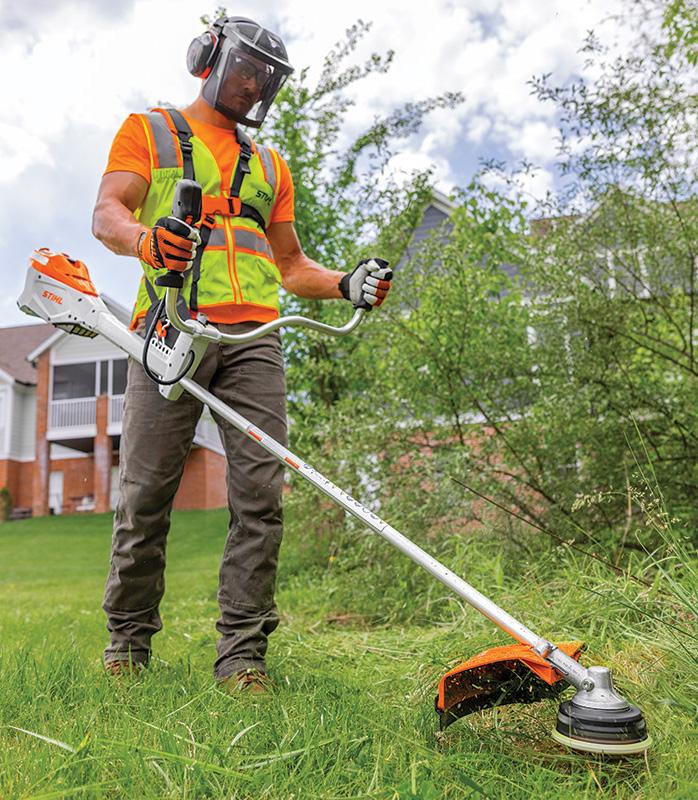
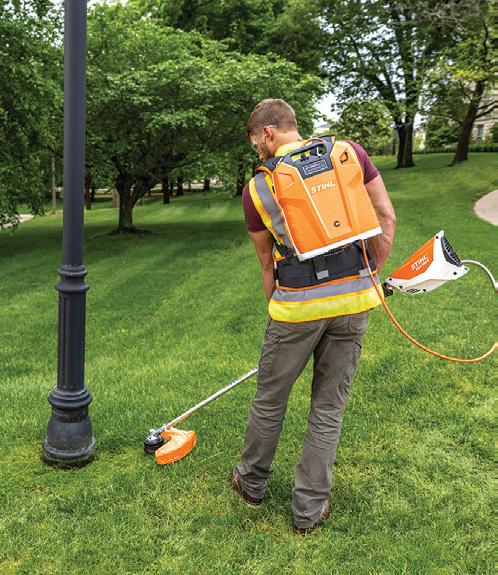
And here’s what they’ll find: first, less noise and zero exhaust emissions. This is a requirement for a growing number of commercial customers, plus public institutions like hospitals, schools, colleges and universities. There may be state or local emissions and noise restrictions in place and the only way to meet the requirement is to use a battery system. It’s also beneficial for the tool operator. The drop in noise level for some battery-powered equipment means hearing protection is optional and they do not go home smelling of fuel. Then, there is the matter of weight—which anyone who uses outdoor power equipment knows can cause fatigue over long work hours. Many battery-powered tools are lighter than traditional gasoline models— even with a battery installed. However, it’s still important to ensure a battery-powered unit has the right balance that delivers ease of movement and maneuverability. In
10 | AmericanHort.org
BATTERYPOWER
The number one negative perception around battery products is a lack of power. It is important for your team to understand the power, ease of use and maneuverability of today’s battery products. Enlist your local dealer or take advantage of manufacturers like STIHL who can connect you to a network of experienced instructors who will visit your facility or operation. There is no better way to understand firsthand the benefits of battery power than to handle and run the product.
Get Hands-On
addition, to lighten the load on hands and arms, consider tool options that feature a long run-time backpack battery or an attached-to-belt battery pouch. After addressing noise and weight, it’s on to ease of use. Your team will find that trigger activation is as easy as it gets and the benefit is even greater if your operation relies on seasonal or summer workers that need to be trained. It takes patience and practice when mixing the oil and gas required to run gas-powered OPE tools and short-term workers may never get the hang of it. With battery this is not an issue—simply ensure the battery is charged, inserted, and pull the trigger. For seasonal workers, battery is the simple and effective choice. Finally, there is the cost of operation. With fuel prices exceeding $5 a gallon in many places, the total cost of operation and ownership of battery equipment is certainly less than their gas equivalent even taking into consideration the higher initial purchase cost.
You Already Know the Tool
The final piece for leaders of any organization in grounds management or landscaping is regulation. More and more municipalities, local and state governing bodies and public entities are legislating to make battery-powered OPE equipment a requirement. Commercial interests like business campuses are doing the same. They want everything from lawn mowers and trimmers to blowers and chain saws to be powered by a lithium-ion battery. More than 100 units of government across the U.S. have placed restrictions on gaspowered grounds maintenance equipment or outright banned these products.
Misconception
Get In the Game
Backpack
Register today at AmericanHort.org/LandscapeTour
2022: August | 11
For people managing workers in landscaping roles, the downside of battery tools has always been power and runtime. Manufacturers are aware of these concerns and have made strong investments in materials, design and production that continue to show progress. For example, the power of some battery tools now equals that of gas-powered equipment. Also, note that the increase in overall battery power in just the last five years has been stunning.
The actual use of batterypowered tools dispels many misconceptions about the equipment lacking power or run time.
Activation Your team will find that point and trigger activation of battery tools is as easy as it gets out on the job.
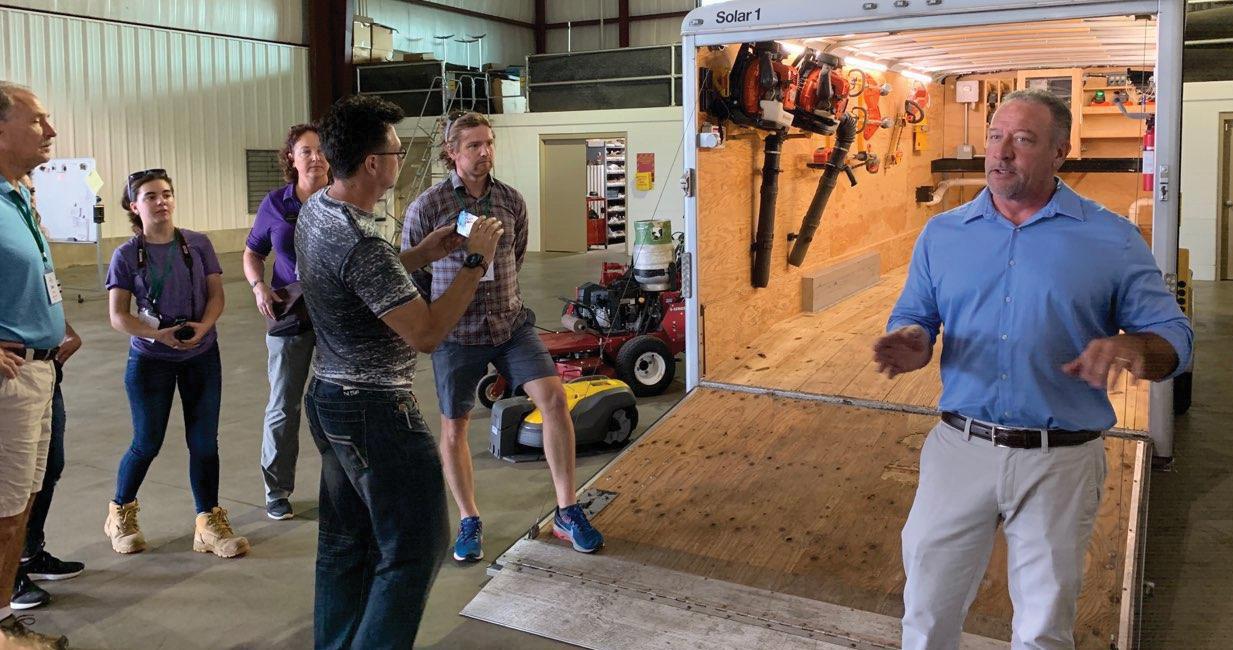
Join us for the Landscape Operations Tour on October 24–25 in Kansas City, MO. This tour provides an up-close, behind-the-scenes view of leading operations in the Kansas City area. You’ll earn best practices around morning roll out routines, use of innovative software and other technologies and tools, see equipment demonstrations and walk away with new ideas to enhance your own company’s bottom line.
To lighten the load on hands and arms, consider tool options that feature a longrun backpack battery or an attached-to-belt battery pouch.
When it comes to transitioning from gas equipment to battery, the progress is rapid. Research dollars, innovation and promotion are focused on the battery segment. You or your customers want to be there and governments and municipalities are demanding that you be there. If you think about the question for just a moment, moving to battery power could be a good fit for your business. Take the time to train your team members on using Lithium-ion powered tools. The actual use of this equipment dispels many of the misconceptions and myths about batterypowered tools lacking power or run time. The time to make the transition is here. Embrace it. Want to learn more about hot topics in the landscape industry like switching to battery-operated equipment?
run 1,500 charging cycles. There’s no winterization, spark plug changing, removing grass clippings from gas tanks or other maintenance with an electric system due to not having an internal combustion engine. The maintenance required on battery products is much more manageable than gasoline-powered tools.

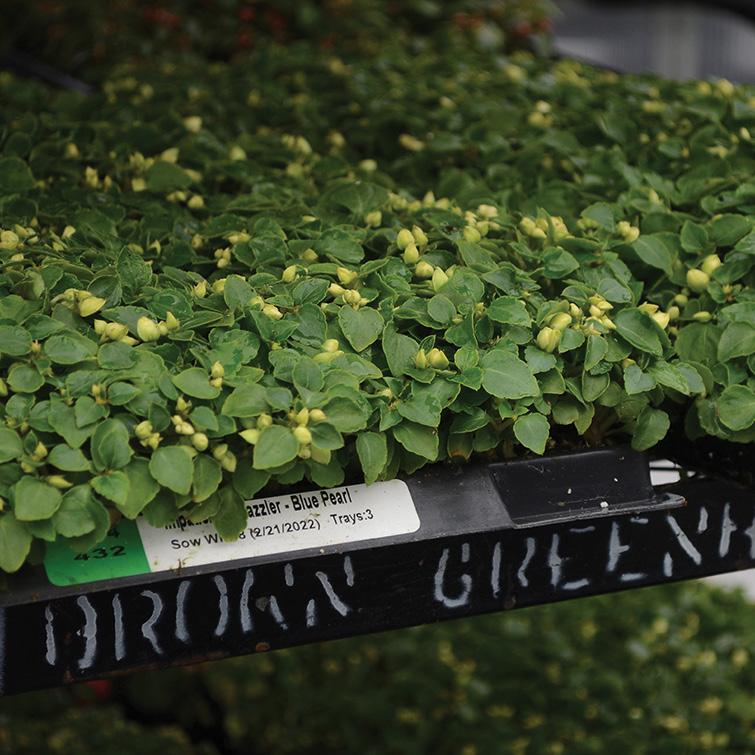
Established more than 30 years ago, the Blooma Farms team strives to grow exceptional and hardy plants and to stay ahead of garden “trends.”
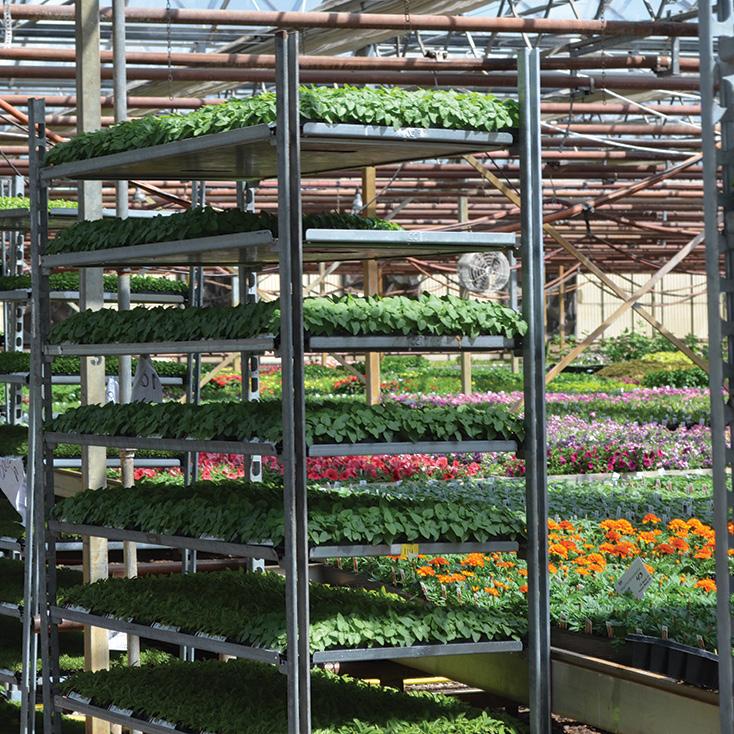
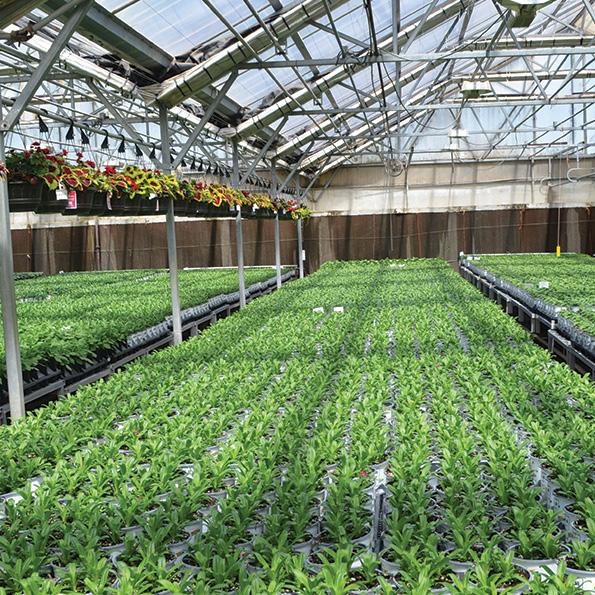
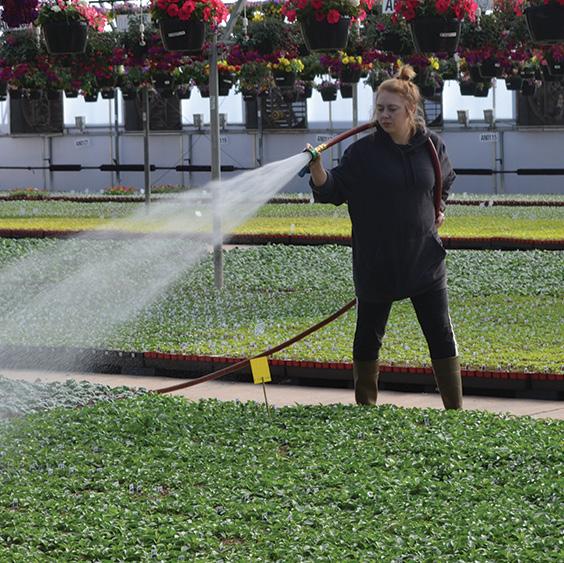
We are excited to spotlight four, world-class AmericanHort members on the Greenhouse Producation Tour at the 2022 Plug & Cutting Conference. During the tour, we’ll taking learning outside of the classroom and getting up-close and personal with companies who are leading the growing game—Botany Lane Greenhouse, Blooma Farms, Tagawa Greenhouse, Welby Gardens.
Spotlighting First-Rate AmericanHort Members in the World of Plugs and Cuttings
certified sustainable greenhouse through the Veriflora® program and meets the highest levels of performance under three recognized pillars of sustainability: environmental stewardship, social responsibility, and economic stability. Visit their 300,000 square foot facility in Denver and learn how they have streamlined production for greater efficiency while maintaining healthy, safe, and fair working conditions, protecting soil and water resources, demonstrating responsible agrochemical use, energy efficiency, climate impact reduction, ecosystem protection, product quality and community engagement. During the tour you will see propagation of tropical flowering plants, foliage plants and stock production.
12 | AmericanHort.org
On the tour you will learn more about their new line of business using the Ball Webtrack® system for young plant sales, under Blooma Farm’s sister company Rocky Mountain Liners. Blooma Farms takes pride in servicing independent retailers throughout the front range and Rocky
Botany Lane focuses on supplying Independent Garden Centers and prides themselves on focusing on unique plants to accentuate their “boutique” approach to plant Botanyofferings.Laneisa
SPOTLIGHTSMEMBER
Blooma Farms,previously known as Brown’s Greenhouse, is a premier wholesale grower of annuals, perennials, and vegetables offering innovative varieties that draw customers back year after year.
Botany Lane Greenhouse is a locally owned and operated wholesale grower of top-quality premium plants and flowers with three facilities, two in Texas, and one in Colorado. With more than 100 employees, Botany Lane is a top 100 grower in the United States and has a total of 835,000 square feet of environmentally controlled growing across all facilities. The Colorado facilities are where most propagation work takes place as they grow and propagate plants in liners and finished sizes, including annuals, perennials, succulents, herbs & veggies, and tropical flowering and foliage.
Tagawa Greenhouses is proud to be one of the largest greenhouse operations in North America, growing more than two million square feet of plants at any given time, and is known to be a top plant producer. They originated as a carnation greenhouse and later expanded into growing bedding plants and roses, and then blooming plants, poinsettias, and young plant production. Their InColor Retail-Ready plants can be found in big box garden centers, like Costco and Home Depot, and grocery chains like Safeway throughout Colorado and the surrounding region. Tagawa offers multiple tray sizes of 50, 102 and 200, to name a few. Their PowerStarts™ program uses the top breeders in the industry and is known for producing consistent quality. They place a strong focus on efficiency and work to maximize space for better freight rates and take considerable pride in their extensive truck delivery network to service all North America. During the tour you will visit stations focused on seeding, collation, and pansy plug production.
Welby Gardens is a fourth-generation family-owned greenhouse and garden retail operation, and the exclusive grower of Hardy Boy Plants. With ten acres of greenhouse and 2.5 acres of hoop houses, Welby Gardens offers annuals, perennials, ornamental grasses, and organic herbs & vegetables. Their plants are sold to independent garden centers and landscapers with a focus on the high-end market. On the tour you will learn about their proprietary 4-pack tray program that is color coded based on pricing, their approach to managing seasonality and product mix, the changes they have experienced in recent years to improve efficiency and their bottom line, and their 20-year expertise in growing young plants. Learn how Welby Gardens developed a hexagon pot to improve shipping efficiencies and about their crossdock partnership program with Tagawa Greenhouse. You will see their shipping in action and their transplanter equipment in operation.
When you register for the Plug & Cutting Conference, be sure to sign up for one of the two workshops covering biocontrols or basic skills for Registergrowers.at
AmericanHort.org/Plug 2022: August | 13
Do You Learn Best by Getting Your Hands Dirty?
Mountain Corridor, and it places great importance on customer relationships, providing excellent customer service. They are one of the few growers who still offer 50 cell trays, and the team continually seeks to find unique niche plants to create excitement in the garden. With a commitment to urban gardening, another sister company, Plum Creek Garden Market opens seasonal pop-up retail operations around the Denver metro area, including Boulder, to reach more customers. During this tour stop you will visit Blooma’s latest expansion featuring a greenhouse with an automated pulley system to improve order picking operations.


OCT November 2, 1–2:30 PM, ET Succession and Exit Planning Mastery Series
29,
September 15, 12 PM,
September 7, 1 PM,
Presented by an expert panel of exit planning advisors
ET Women In Horticulture Interview: September 2022 Summer Field, Spring Meadow Nursery
Joe Neal, North Carolina State University
September 2 PM,
McGrath, Vineland Research & Innovation Centre
Oregon State University
October 6, 2 PM, ET Deep Dive on Consumer Behavior Research
future
October 25–27, 12–1:30 PM, Management Mastery Series
AmericanHort Connect 2022: August Columbus,2130Hello@AmericanHort.orgStellaCourtOhio43215-1033 USA (614) 487-1117 Main ©2022 AmericanHort. All rights reserved. This material may contain confidential information and it is for the sole use of AmericanHort members. The information contained herein is for general guidance and not for the purpose of providing legal advice. It cannot be distributed, reprinted, retransmitted, or otherwise made public without prior written permission by AmericanHort. Please contact the editor at (614) 487-1117 for permission with acknowledgment. EDUCATION & EVENTS Register for all Events and Webinars by going to AmericanHort.org/Education Webinars Opportunities for Education & Connection
ET Effectively Using Air Pruning Systems In Propagation & Nursery Production
ET Keep Your Cash Flow Going, You Earned It So Keep It Sam Kirkland, Epicor SEPT
green industry’s leading association. AmericanHort.org 14 | AmericanHort.org UPCOMING
Dr. Robert Geneve, University of Kentucky the as the
Moderated by Dr. Bridget Behe, Michigan State University
Dr. Darby
Smart andInteractionsPlants—MagicalBetweenFlowersTheirPollinators
September 14, 2–3:30 PM,
October 4, 10 AM, ET Controlling Nostoc, A Slippery Hazard For Nursery Workers
a member of AmericanHort,
ET Inventory
ET How Do Weather and Climate Impact Boxwood Blight?
NOV INVENTORY MANAGEMENT Mastery Series INVENTORY MANAGEMENT Mastery Series About AmericanHort AmericanHort is the national association of horticulture businesses and professionals across the spectrum of the industry. Perform better, grow stronger, and prepare for
November 3, 11 AM, ET
Jason Bader, The Distribution Team
Dr. Len Coop,

Founding Partner: REGISTER NOW at AmericanHort.org/Plug As the premier event for young plant producers and growers from across the country, this conference is the place to learn the newest and best strategies , technologies , and techniques in the world of plugs and cuttings. September 19–21, 2022 | Denver, CO The road to better performance starts at the AmericanHort Plug & Cutting Conference Seeding Smarter SolutionS for Better Performance Join us for... ExperiencialGreenhouseTour Connection-BuildingTradeShowGrower-FocusedEducation WorkshopsHands-On October 24–25, 2022 | Kansas City, MO Register Today! INDUSTR Y TOUR Landscape Operations Coming This Fall! Get an up-close, behind-the-scenes view of leading operations in the Kansas City area as you meet industry peers and build your professional network during the two days of tours. Learn best practices, explore tools and technologies, and walk away with new ideas to enhance your own company’s bottom line. Learn more at AmericanHort.org/LandscapeTour Check Out Our Eight Exciting Tour Stops Ryans Lawn and Tree Rosehill Nursery & Landscape Next to Nature Landscape Belgard/Old Castle High Prairie Landscape Group Colonial Gardens Loma Vista Nursery Kauffman Gardens You’ll See Behind-the-Scenes Views of... • A range of landscape operations serving commercial and residencial, design and maintenence clients • Morning roll-out procedures, equipment, and supplier operations • Software, technology, and tools for scheduling, labor solutions, design, and more!


CourtStella2130 USA43215OHColumbus, 487-1117(614) AmericanHort.org RequestedServiceElectronic heremessageSegment 2023theforReadyGet DirectoryResourceAmericanHort theonstarttoupgearingisAmericanHort 2023 DirectoryResource fulltheincludesthatpublication—a productsfeaturedlist,contactmemberAmericanHort partneraffinityindustry,greentheforservicesand more!andbenefits,memberoflistingadiscounts, Solutions,Associationlookout—NaylortheonBe directory,theforpartnerpublishingAmericanHort’s foropportunitiesaboutmemberscontactingbewill strategiesotherandboosts,listingsupplieradvertising, out.standcompanyyourhelpto meantime,theIn listingdirectoryyoursuremake accurate.is ataccountAmericanHortyourtoinLog AmericanHort.org directorycompanyyourupdateand today!roster @youramericanhort@AmericanHort@American_Hort@AmericanHort STDPRSRT POSU.S.TAGE AIDP OHCOLUMBUS, 8755NO.TPERMI

