


Emerson Hospital located in historic Concord Massachusetts has an opportunity for a Board Certified/Board Eligible Neurologist to join our team.
This opportunity is an employed position with Emerson Practice Associates
• Competitive salary and benefit package
• Sleep Center, Concussion Center, Parkinson’s Center, Telestroke
• Excellent support from a dedicated team of neurologist, administration and staff
• Full service diagnostics are available at hospital, which was certified by the state of Massachusetts as a Primary Stroke Center in 2004
• Practice in one of the most desirable practice locations in Massachusetts For more information
Diane Forte Willis, Director of Physician Recruitment and Relations dfortewillis@emersonhosp.org
Phone: 978-287-3002 • Fax: 978-287-3600
Emerson Health is a regional health system providing advanced healthcare to more than 300,000 people across 25 towns in Massachusetts. We make high-quality healthcare more accessible to those who live and work in our community at Emerson Hospital in Concord, health centers in Bedford, Groton, Sudbury, Westford, and Concord, and Urgent Care settings in Hudson, Littleton, and Maynard.
Emerson has strategic alliances with several academic centers in Boston, including Mass General Brigham and Massachusetts Eye and Ear Infirmary.
Concord, MA and the surrounding communities are among the best places to live in Massachusetts, with several top-ranked school systems in the state and located just 20 miles west of Boston.

Optum is on a mission to make real changes in health care, and it starts by empowering neurologists to lead the way. We’re creating a network of dedicated medical practices led by physicians who are well equipped, supported and empowered to deliver better care locally.
When you join an Optum practice, you can expect:
• Excellent salary, bonuses and comprehensive benefits
• Flexible scheduling and generous PTO
• Leadership training opportunities
• And much more
Join us and see how we’re making health care better by Caring. Connecting. Growing together.

To search Optum Neurology careers, scan the QR code or visit Optum.Co/Neurology

Interviewing, like almost everything humans undertake, is a skill that improves with practice. Unfortunately for busy neurologists, interview “practice” is more likely to happen during the first round of meetings with future employers, and not in a leisurely strategy session with a career counselor. There just isn’t enough time sometimes to prepare as much as you’d like.
Luckily, there are shortcuts you can take on the way to delivering a good interview performance. One of the best is to develop a core set of messages—or as politicians say, talking points—to highlight your relevant strengths for the job. And, since you’re likely to interview for similar jobs during any particular stage of your career, the good news is that you only need to do this once per “campaign.” That is, if you’re interviewing this week with a hospital in Baton Rouge and next week with a clinic in Los Angeles, you’ll likely be performing similar duties. So key messages you prepare at the beginning of your search should serve you well for all your interviews.
The secret to developing a good set of core messages is to base them on your strengths. After all, employers aren’t hoping to hire you for your weak points. They want to leverage what you do well. Your task is to identify what that is, then find a way to present that information throughout the interview.
To be effective, core messages should be relatively few in number—perhaps three or four in all. They need to be general enough to accommodate a variety of questions, but specific enough to have impact. And, most importantly, they should illustrate something that you’re good at and can talk about easily. Here are some examples of core messages that are useful, and some that don’t quite make the grade.
Weak: “I’m good with patients.”
Problem: This isn’t specific enough, so it loses impact.
Better: “I build good rapport with patients and their families. I’ve noticed that patients tend to give me more information than they give other doctors and that lets me create a more targeted treatment plan for them.”
Weak: “I’m a hard worker.”
Problem: Because you’re a doctor, interviewers will assume this about you.
Better: “I’m very committed to my work, and especially to the research aspect. It’s not unusual for me to put in extra hours going over the data or reading other researchers’ results. In a number of circumstances, the extra work I’ve put in has given me a stronger background and let me contribute more to the project.”
As you can see, the best messages go beyond simply stating a fact. They are platforms from which you can launch answers to any number of interview questions. For example, take the universal query, “Why don’t you tell us a little about yourself?” Instead of reciting the contents of your CV in reverse order (“I went to high school in Brooklyn and always wanted to be a doctor…”), you might say, “Well, you have my CV so you already know my background. But I’d like to tell you more about my headache and anesthesia fellowships and why I went that direction.”
Here’s another one. When asked your plans for the next five years, don’t just say “I’d like to work on projects such as…” but instead, start with “I’ve always been a hard worker, and that means that I tend to be motivated by challenges. In five years, I’d like to be working with projects that…”
With some creativity, there’s almost no question that can’t be answered from one of your core messages. And, despite what you might expect to be true, the effect isn’t one of relentless repetition. Rather, because you are changing up the way you present your strengths in connection to each question, the interviewer will hear a varied but cohesive message, delivered with confidence. Better, you will be more relaxed and attentive to the nuances of the question, since you won’t be straining to hold a dozen unrelated, memorized answers in your head.
If you want to give this method a try, you’ll need to identify strengths that fit the criteria noted above—general enough to be applicable to multiple questions, but specific enough to have meaning and impact. Here are some tips to help you identify strengths that are interview-worthy.
Strengths
Think about your personality traits and what others have told you. If you consistently hear that you are compassionate or well-organized or have high standards, chances are this is something that is more true of you than it is of most others. Once you have identified a handful
of traits, triage them according to which might be most useful in your next work. For example, if you’re planning to work in a fast-paced clinic, your natural tendency toward being efficient might make a better interview message than your equally strong creative nature.
Strengths based on your training
Remember that the training itself isn’t the strength. It’s what you can do with that training that sets you apart from other candidates with the same credential. And don’t overly rely on having been first in your class or some other ranking—that won’t be as useful in the interview as specific cases you handled or techniques you learned.
Whether it was earlier work, volunteer engagements, or committee assignments, you might have an impressive strength tucked away in your background. Perhaps you’re multilingual/multicultural, giving you an edge in working with colleagues and patients from other countries. Or maybe you’ve served on administrative committees and bring an understanding of the business aspects of running a practice.
Once you’ve identified three or four strengths, all that’s left is to organize your thinking so you’ll be ready with your answers on a moment’s notice. One way to do this is to think about circumstances, stories, and situations in which you demonstrated one or more of these strengths. Write notes so that you can bring the details to mind and correlate them to questions you expect to encounter. If you have time to practice answering sample questions, all the better. But even if you’re not able to squeeze in the practice session, you’ll be in strong position if you review your three or four strengths ahead of each interview, and your notes about when you used them.
Once you’ve tried an interview with this process, you’ll have trouble remembering why you ever did it any other way. It’s much more relaxing to come to the meeting with your messages in mind, and more rewarding to talk about things you do well.

CommonSpirit Health® is a nonprofit faith-based academic health system dedicated to advancing health for all people. With approximately 160,000 team members and 25,000 physicians and advanced practice providers, CommonSpirit operates 138 hospitals and more than 2,300 care centers serving sites across 24 states.
We are seeking Neurology Physicians and Advanced Practice Providers (NP or PA) to join our affiliated groups in the following states:
Colorado Utah Kentucky Nebraska Ohio Tennessee Texas

Apply online at providers.commonspirit.careers
Arizona California Washington




Join Advocate Health, one of the nation’s largest nonprofit integrated health systems, and be part of a respected and expansive Neurology team transforming care across Illinois and Wisconsin. Why Choose Advocate Health Neurology?
• One of the Midwest’s most comprehensive Neurology programs, with over 120 physicians and 10+ subspecialties
• Nationally recognized Stroke, Epilepsy, and Memory programs with access to clinical trials and digital innovations
• Academic and clinical career paths with robust support for subspecialty interests
• Practice options include inpatient, outpatient, or blended models
• Competitive compensation, generous benefits, student loan forgiveness (up to $180K), and PSLF eligibility
• Choices across Chicagoland and Wisconsin — live and work where you thrive
• H-1B and select J-1 visa sponsorship available


Finding your first neurology job: 12-month timeline for residents, fellows
As their training winds down, neurology residents and fellows begin one more process in the midst of further sharpening their practice skills: the real world job search. Some residents and fellows already have job offers—or contracts signed—soon after their training begins, or even before. For those in the search phase, some good news: The job search can be relatively straightforward. And adhering to a process can help to ensure that you land the coveted position for which you’ve spent years preparing. Below is a simple timeline to help you structure a job search that runs its course during the 12 months of your fellowship. If you have special circumstances—for instance, if you need a J-1 Visa—start your search process earlier and adjust accordingly.
Pinpoint the kind of work you want. “The first thing you have to do is figure out what kind of job you want: A traditional academic research position? A primarily clinical position, seeing patients in a university or hospital? A group practice position?” says Ralph Józefowicz, MD, FAAN. He is professor of neurology and medicine and associate chair for education at the department of neurology at the University of Rochester School of Medicine and Dentistry. His advice to residents and fellows includes deciding what geographic area they want to live in, a decision which might depend on family or personal circumstances. For those who plan to live in popular areas, such as San Francisco or Boston, the earlier the search process begins, the better. Perfect your CV and LinkedIn profile. Recruiters will be in touch, so now’s the time to update and complete your “marketing materials.”
Identify specific organizations where you want to work. Resist the urge to limit too narrowly, as you may not have any basis of comparison. You may, for instance, be drawn to a particular facility due to its salary, but another employer could offer you perks like more flexibility or less call, which you may not take into account if you are too closely focused. Aim for a list of perhaps 20 to 25 organizations; then hone it down by researching and talking to people. For the top 5 or 10, do a deeper dive: If you’re looking at hospitals, for example, discover who would hire you, and who would be your department chief. If you’re investigating private practice, learn about the partners, the patient numbers, the conditions the practice treats, etc.
At this stage, many residents and fellows may already be interviewing, considering offers, or signing contracts, which can be an advantage. “As they go into the new year, residents and fellows can concentrate, and not fly around the country doing interviews,” says Beth Brackenridge, FASPR, senior recruiter with Grand Rapids, Michiganbased Spectrum Health. Recruiters, too, she adds, prefer to have offers buttoned up by December or January, because of the paperwork and the credentialing process involved.
Prepare for the phone interview. “Be knowledgeable,” says Brackenridge. “Search websites. Understand employer goals or missions. Would their systems be good fits? Looking at a website and what a system has done can give you some ideas of where they’ve been, and their growth.”
Visit potential employers, if you don’t yet have an offer. Visits, which are typically scheduled between October and March, are necessary so you can understand job elements, communicate your strengths, and negotiate well. To arrange visits to hospitals, contact hospital physician recruiters: “I’m interested. How do I arrange a visit?” For private practice and academic positions, refer to the list you’ve developed, and contact practice managers, partners, or department chairs. “There’s such a great need for neurologists in all fields; I don’t think people will be struggling to find positions,” says Józefowicz. Still, if there is a particular place you want to work, you’re going to need to strategize to lock it in.
Anticipate offers and contracts. By now you may be fielding offers and peering at employment contracts. Józefowicz advises retaining an attorney to review the contract, for a number of reasons. For example, while some employers offer big money, signing bonuses or incentive plans, “They may be so unrealistic you may burn out,” Józefowicz explains. It’s wise to have an attorney ensure that if you need to, you can get out of the contract before it ends.
Still awaiting offers? Shift action plans if necessary. Send letters directly to department chiefs or chairs, or practice managers or partners and make reference to former visits. If you’re not close to an offer by 30 days out, something needs to shift: You may need to push harder on employers who are close to extending an offer, or accept that you may not be working when your fellowship ends. In this case, consider temporary positions. Józefowicz says he routinely hears from facilities with needs for a range of locum tenens practitioners, from stroke doctors to neurologists who can take in-house calls to those who can commit to working for just one month. Most positions involve 70-hour work weeks but offer very high salaries, he adds. While this can be a grueling start to your professional life, there are some upsides: You will hone your skills quickly while also earning enough to help pay down student debt you may have accumulated during training.
Prepare for business. Heading into private practice? If you can, set aside time during your residency or fellowship to learn medicine’s business operations side. Consider taking an online class; the American Academy of Neurology has a wide range of inexpensive online practice management webinars that can help prepare you. You also may want to sign up for relevant newsletters, or even volunteer at a non-profit clinic to experience real-world practice conditions.
Plan for academics. Is teaching one of your professional goals? Mastering the subject matter is one aspect; mastering the art of teaching is another. Can you enroll in a short course on adult learning styles, or another class to help maximize your teaching methods?
You may not need these extra steps to win over a future employer, but they can increase your confidence in the classroom or lecture hall.
Don’t miss conferences. Attend or present at as many meetings as you can fit into your schedule. In addition to raising your professional profile, you’ll be positioning yourself to meet potential employers and future colleagues.
“It’s never too early to start looking,” states Brackenridge. For more ideas and advice on specific aspects of the job search process, visit the American Academy of Neurology’s online Neurology Career Center. It features nearly 500 open neurology positions in a variety of practice settings nationwide. Save time and stay on top of your job search by creating a job seeker profile, and create a job alert to be notified only when new positions of interest have been posted.


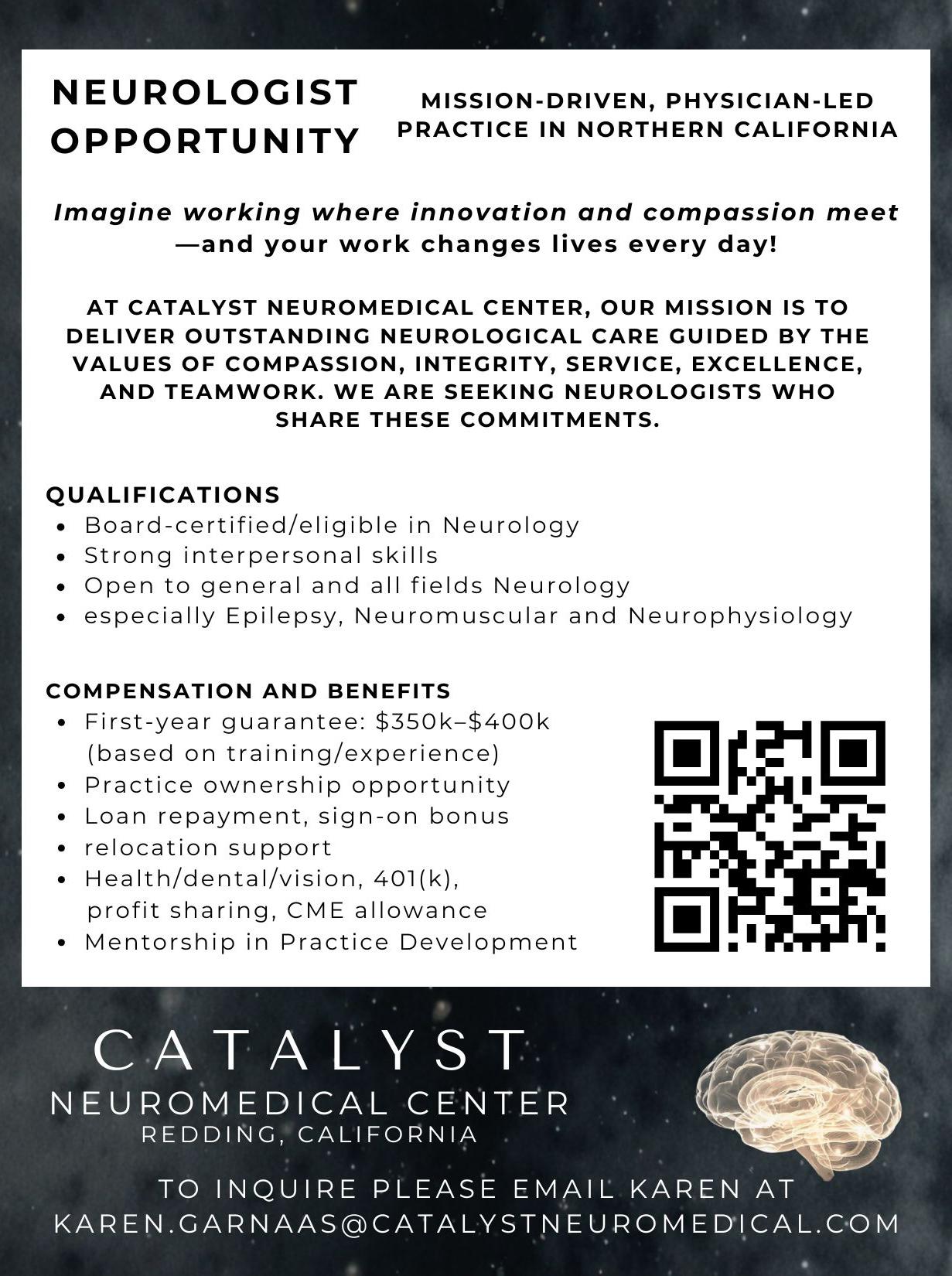


Boston Metro Area
Join a team of dedicated multidisciplinary professionals in the post -acute inpatient care of stabilized stroke, TBI, movement disorder, oncology and polyneuropathy patients. Highly negotiable daytime weekday hours with no call, evening or weekend shifts. No procedures or wet imaging reads required. Excellent opportunity to combine with other opportunities/ commitments while serving a dynamic and invested patient population.
University Consulting Associates, PLLC is a physician owned neurology practice consisting of former, part-time and retired faculty hospitalists who prioritize optimized outcomes in post-acute care settings. Their mission is to deliver quality care and evidence -based recommendations to patients in the post-acute setting to achieve high quality outcomes for all neurological patients.
Learn more and apply:
University Consulting Associates, PLLC Careers and Employment | American Academy of Neurology

If you’ve never interviewed for a job, or if it’s been quite a while, you’re probably feeling a little nervous about the prospect of facing a potential employer or panel of future colleagues. That’s a good sign—not feeling nervous means you’re not paying attention.
Now that we’ve established that interviews are worthy of at least a low level of anxiety, the question is how to convert those feelings into strategy. The answer is simple: One step at a time. Here’s a guide to help you prepare for each interview as if it were your first—as indeed, it might be.
When a recruiter contacts you out of the blue to schedule an interview, it’s common to “go blank.” The recruiter is going to be very business-like and confident and say things like, “We’re hoping you can fly out on Wednesday next week. You can? Oh, good. We’ll email you the travel information. See you then.” Wait, what just happened? Here are a few of the questions you want to ask, whether you get them out in that initial call or in a follow-up email:
• Who will I be interviewing with; what are their positions?
• What is the schedule of interviews; how long will each meeting be?
• Are you meeting with other candidates, or am I the only person being considered at this point?
• Will a decision be made from this set of interviews, or are there more steps to the process?
• What materials do you need from me?
• What other information can you share? For instance, what can you tell me about the practice (or department or research program, etc.)?
Now that you know who you’ll be interviewing with, you can look up each person on the internet, while also asking your colleagues or mentors what they know about them. Your goal is to use what you learn to guide your interview answers, as well as your later decision making. For example, if you discover that the department chair has been vocal about legislation governing research programs, you can surmise that he or she feels strongly about those issues—wouldn’t you like to know that before answering a question on the subject during your interview?
Besides the general research you conduct on the people you’ll be meeting, here are some other things you should look for:
• Size and reputation of the organization, as well as any specialty they practice
• Articles about or written by the principles in the organization
• Competing organizations, particularly if it’s a private practice, so you can understand their pressures better
• Community information, to help you understand their practice environment
While it’s true that your strengths are your strengths regardless of the context, the context still pertains to how you frame your answers. For example, if you’re talking with the partners of a small practice, your creative and innovative approach will be important for streamlining processes and attracting new patients. But if it’s an academic position you’re after, the same strength will be better described in terms of your ability to present the curriculum from a variety of teaching methodologies or your ability to frame research questions from a fresh perspective.
To help you describe your strengths in ways that are relevant to the position, ask yourself these questions:
• What are the primary tasks of the position, and which of these am I especially good at?
• What examples can I give to demonstrate those strengths?
• Do I have any metrics that will help me “prove” the strength?
There are numerous articles available to help you with this step, including several in the AAN’s Neurology Career Center. Here are a few tips to guide you:
• Wherever possible, relate your answers to the employer’s needs and interests
• Use examples or metrics to help your answers come alive
• Don’t be afraid to ask questions of your own
Here’s a cardinal rule of interviewing: People hire people they like. Since it’s much easier to be likable when you’re relaxed and well rested, your task is to protect your time and mental well-being in the days before your meeting so you can present your best self to your future employer. Now that you know the steps needed to prepare for your interview, the following overview information will help you keep things in perspective. Interviews count for most of the hiring decision. Your academic and work records are important guides for employers, but they’ll base their decision to hire on less measurable points, including your personality, your approach, your fit with the patients and the rest of the team, and their perception of your potential to succeed. None of these elements can be derived from documentation, but only from in-person impressions— which is what makes interviews so critical to the overall hiring process.
Interviews come in different shapes. As you may have already discovered when interviewing for medical school or a residency, you could find yourself meeting one-onone with the decision maker, or in a series of consecutive one-on-ones with potential colleagues, or in a panel setting with a half dozen interviewers around a board table. You could also be interviewed by phone or Skype, or even asked to video-record answers for interviewers to review later. While each of these situations differs in
format, your actual approach will not vary much at all: Find out from the recruiter what type of interview to expect, follow the steps noted above to prepare, then find a way to relax so you can be at your best in the meeting.
Interviews are progressive in nature. In a competitive scenario where more than one candidate is being considered for a position, interviews will be used to narrow the field. That means that the winning candidate may have experienced multiple rounds of interviews before being selected. Even when you’re the only candidate for the position, you can expect multiple meetings as the conversation deepens between you and your future employer. With this in mind, don’t worry about getting everything done in one meeting. Instead, follow the flow and pace set by the interviewer while you concentrate on using every question as an opportunity to present another of your strengths.
Now you know the basics for succeeding at your first interview. All that’s left is to cover the logistics so that you’re really ready to roll. Here’s a quick checklist to keep you organized:
• Inspect your interview outfit to be sure it’s clean and fits well
• Get a haircut, manicure, or any other personal grooming assists needed
• Print CV copies for the meeting
• Notify references that they may be called
• If it’s an out-of-town interview, pack and double check your bags; confirm travel details
• For a local interview, take a dry run the day before to ensure you don’t get lost
• Purchase thank-you notes to send after the interview
Still nervous? Breathe deep and enjoy the edge. You’re well-prepared, so the nerves are a good thing—they remind you that you’re taking an important step in your career. Good luck. You’re going to do great.

Pay structures vary and can be confusing, especially for someone just starting their career. The AAN’s Salary Calculator tool brings transparency to the neurology market and can help you gain insight on compensation and productivity benchmarks as you begin your career journey.
This tool is only available to AAN member residents and fellows, and it’s offered at no charge! All you need to enter is your member ID and password, and this insightful information is at your fingertips.
“Whether you are a member of a large academic group or a solo practitioner, the AAN’s Salary Calculator allows you to know your value and demonstrate your worth to your health care system through comparison with your colleagues in the same region and practice setting,” said Michael Markowski, DO, FAAN, member of the AAN Board of Directors.
The AAN’s Salary Calculator tool is based on information from AAN members who completed the 2025 Neurology Compensation and Productivity Survey, making this the most authoritative guide on neurology salaries available. And it’s free! View the Salary Calculator at Careers.AAN.com
If you need assistance, contact Tabitha Sanbower at careers@aan.com or (612) 928-6177.
Access AAN compensation and productivity data
The AAN’s 2025 Neurology Compensation and Productivity Survey captured data from more than 4,300 neurologists and neuroscience professionals, making it the largest resource of its kind available. Not a resident or fellow? AAN members can pay $500 for full access to a userfriendly dashboard that allows you to explore data on neurologist compensation, advanced practice provider benchmarking, on-call rates and duties, patient wait times, and more.




• Cognitive/Behavioral Neurology
• Clinical Neurophysiology
• General Neurology

• Neuromuscular Medicine
• Pediatric Neurology (Epilepsy)
At SCPMG, we believe that exceptional care starts with exceptional physicians. As a physician-led organization, we empower our doctors to shape clinical decisions, lead innovation, and create a culture of collaboration and respect. SCPMG Neurologists enjoy streamlined workflows with no pre-approvals or prior authorizations required. Acute stroke cases in the emergency department and inpatient settings are managed by our dedicated Regional Telestroke Team, allowing for focused and e cient care delivery.
For consideration or to apply, please visit: southerncalifornia.permanente.org/jobs/type/neurology
For additional information, please contact Michelle Johnson at: 877-608-0044 or Michelle.S1.Johnson@kp.org
We are an AAP/EEO employer.

Southern California Permanente Medical Group



The Permanente Medical Group, Inc. (TPMG) is one of the largest multispecialty medical groups in the nation with over 10,000 physicians, 21 medical centers, numerousclinics throughout Northern and Central California and a 80-year tradition of providing quality medical care.
• Our Telestroke program provides comprehensive coverage for all stroke alerts 24/7, and also immediate and urgent consultations during nighttime hours.
• Work-life balance focused practice, including flexible schedules and unmatched practice support
• We can focus on providing excellent patient care without managing overhead and billing. No RVUs!
• We demonstrate our commitment to a culture of equity and inclusion by hiring physicians who reflect the people we serve.
• We are Physician-led and develop our own leaders.
For more information on our career opportunities, wage ranges or to apply, please visit: northerncalifornia.permanente.org
FOR ADULT OPPORTUNITIES, you may contact Ramona Boyd at: Ramona.J.Boyd@kp.org or call: (510) 458-5197.
FOR CHILD OPPORTUNITIES, you may contact Judy Padilla at: Judy.G.Padilla@kp.org or call: (510) 318-0144.

• Competitive compensation and benefits package, including comprehensive vision, medical, and dental
• Interest Free Home Loan Program up to $250,000 (approval required)
• PSLF Eligible Employer
• Relocation Assistance up to $10,000 (approval required)
• Malpractice and Tail Insurance
• Life Insurance
• Optional Long-Term Care Insurance
• Paid holidays, sick leave, and education leave
• Shareholder track
• Three retirement plans, including a pension plan and 401(k)
We are an equal opportunity employer and VEVRAA federal contractor.