Claiming independence and dreams: Machinist program for Utah adults with autism graduates inaugural cohort
Even amid visa worries and other disruptions, international students are flocking to Utah universities
—Tony Robbins, world-renowned author & speaker
By Doug Wilks Executive Editor
By Burke Olsen Publisher
We are pleased to introduce you to The Digest, a sampling of some of the best stories written every day by the dedicated journalists at the Deseret News, Deseret Magazine and Church News. Ouyor hope is that you will make us your trusted news source each day at a time when there is confusion and contention in the nation.
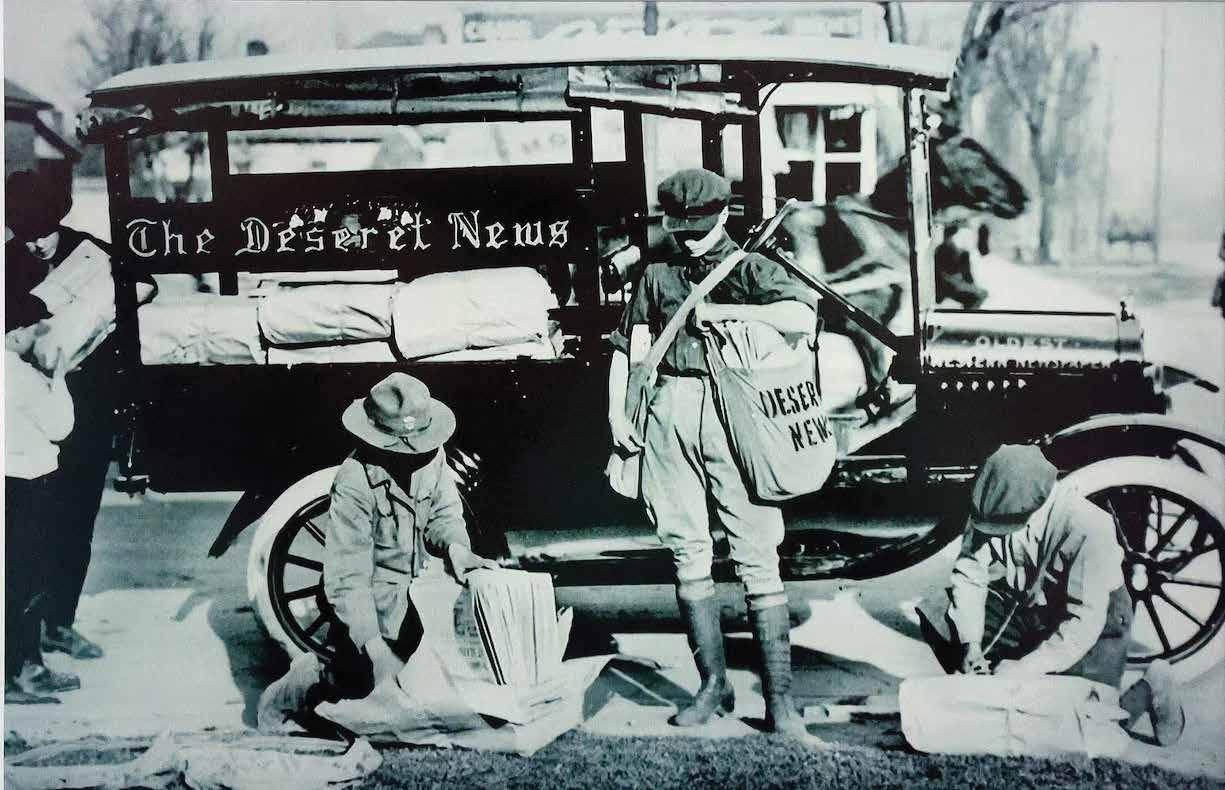
The Deseret News brand stands for unimpeachable journalism centered on the issues most core to the human heart. While the Deseret News since its beginning in 1850 has evolved to meet the demands of its audience — reimagining print offerings, launching an acclaimed magazine and increasing the visibility and reach of its award-winning website — the publication remains committed to certain timeless ideals.
We stand for truth and light. We stand for faith and family. We stand for liberty and responsibility. We provide news and perspective, exploring society’s thorniest problems in search of solutions that will improve your life. That’s our commitment to our readers.
We invite you to discover what we can offer you:
Award-winning website
Our website, Deseret.com, is designed to be user-friendly and available on any device. Whether you’re at home on your computer
INTRODUCING 'THE DIGEST'
or on the go with your mobile phone, you can access our website for the latest news, analysis and commentary.
Mobile apps
Our apps for iOS and Android devices offer a seamless and convenient way to access the latest news, wherever you are. Choose what you want to read, save articles for later and receive push notifications for the breaking news you need to know.
Newsletters
Delivered straight to your inbox, our free email newsletters provide a curated selection of the most important stories of the day, as well as deeper dives into topics that matter to you. Choose from a variety of subjects and frequencies to tailor your news consumption to your needs.
Weekly print newspaper
For those who appreciate the tactile experience of a traditional newspaper, our weekly print edition offers a comprehensive roundup of the week’s most important stories and opinions, including the most comprehensive high school, college and professional sports offerings in the state.
Deseret Magazine
In 2020, we undertook an ambitious endeavor by launching a new magazine with in-depth journalism, unique voices and principled points of view. The reception to the magazine has far exceeded our expectations. You can read more from the magazine online at Deseret.com/magazine or subscribe to have it delivered to your home or office.
Church News
The Church News remains one of our most popular offerings for those who want to know the latest news from The Church of Jesus Christ of Latter-day Saints. It’s available online at TheChurchNews.com and via iOS and Android apps. A print version is included in the Friday edition of the Deseret News.
TRY THE NE W NE W COUGAR PAW AT THE NE W NE W BYU CREAMER
LaVell's Vanilla ice cream dipped in a rich milk chocolate shell. Available now at the new BYU Creamer y on Ninth East.
‘A holy place’: Preserving Native American culture in the Southwest
Amid
ongoing uncertainty, tribes and pueblos with ancestral ties to the land remain deeply connected to it
By Tess Crowley Deseret News
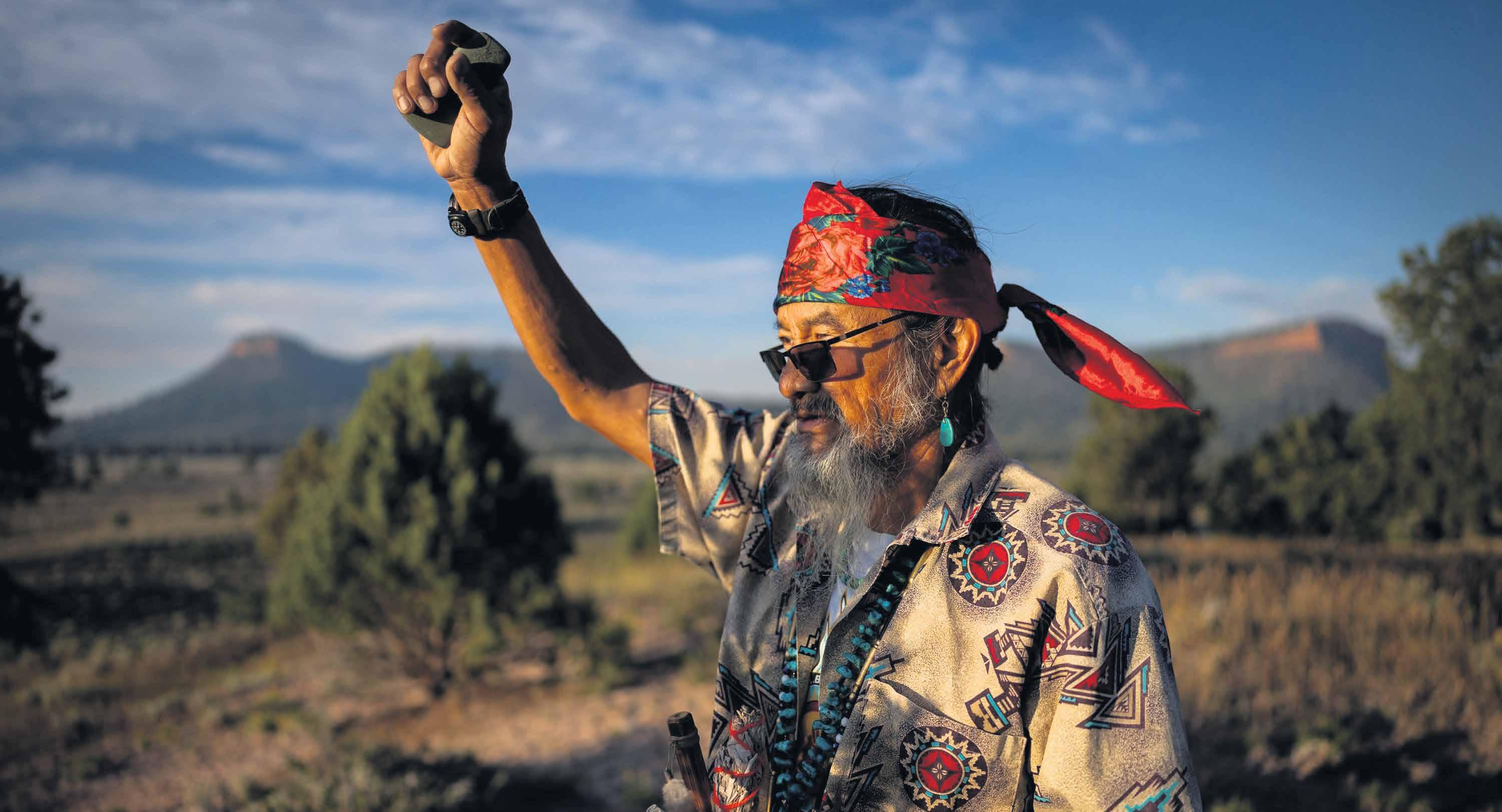
On a windy midsummer day, the breeze appears to tickle the “ears” atop this towering southeastern Utah mesa as it rustles the trees nestled at their tips. The branches move in unison, leaning into the same wind that gives voice to the soft melodies drifting from White Mesa Ute elder Aldean Ketchum’s flute. The tune carries into the pinyon pines and back out to welcome a group of runners cresting over the last stretch of a 50mile relay prayer run to reach the campground.
Martina Maryboy, of the Navajo Nation, leads the pack with her prayer sage in hand as they finish the last leg of their journey, following the same roads that Indigenous peoples had run thousands of years before.
People dance and sing while others make the color yellow by simmering sagebrush and cliffrose in pots, creating a strikingly fragrant blend of earth and flowers that fills the air while weavers teach children how to dye wool yarn. A family flips the last stack of blue corn pancakes full of calcium-rich juniper ash over the stove as campers taste blue corn mush and white corn with sumac.
The twin buttes that resemble a bear’s ears stand tall over everything in sight. From the furthest reaches of the dark canyons below, to the pinyon pine trees that dot the mesa tops, to the cliff dwellings, hogans and rock art that shape the story of this land, the more than 8,900-foot high buttes can be seen from Arizona, Colorado and New Mexico.
Bears Ears holds cultural and spiritual significance for the Native American tribes and pueblos that have historically inhabited and continue to have ties to this land. Despite the ongoing political tug-of-war over the hallowed ground, it remains sacred to them.
The beginning of a lifelong relationship
This July weekend spent sleeping in tents at the Bears Ears Summer Gathering hearkened to a time hundreds of years ago when activity teemed in these mesas and canyons. Men tended to corn and hunted mule deer and bighorn sheep. Women wove baskets, blankets and bags, and made sandals from yucca fibers. Children helped harvest
sumac plants with their bright red berries.
As Dave Mason, a Navajo man from Kirtland, New Mexico, makes an offering of corn pollen to a small pinyon pine tree on the last day of the summer gathering, the bright morning sun washes over the Bears Ears buttes behind him. Mason puts his flute to his lips and points it toward the
buttes as he begins to play.
“These mountains have their own personalities,” he told me after the song. “They talk to each other. They’re not just there.”
Bears were among the earliest animals that humans revered as sacred. Small clay bear effigies have been recovered from prehistoric ancestral
Puebloan sites, evidence of reverence for the animal.
“The bear is a part of us. We don’t eat him and we respect him,” Ketchum said.
While it’s rare to see a bear in Bears Ears, they are present and, more notably, part of the stories that tie tribes and pueblos to the landscape.
Tess Crowley, Deseret News
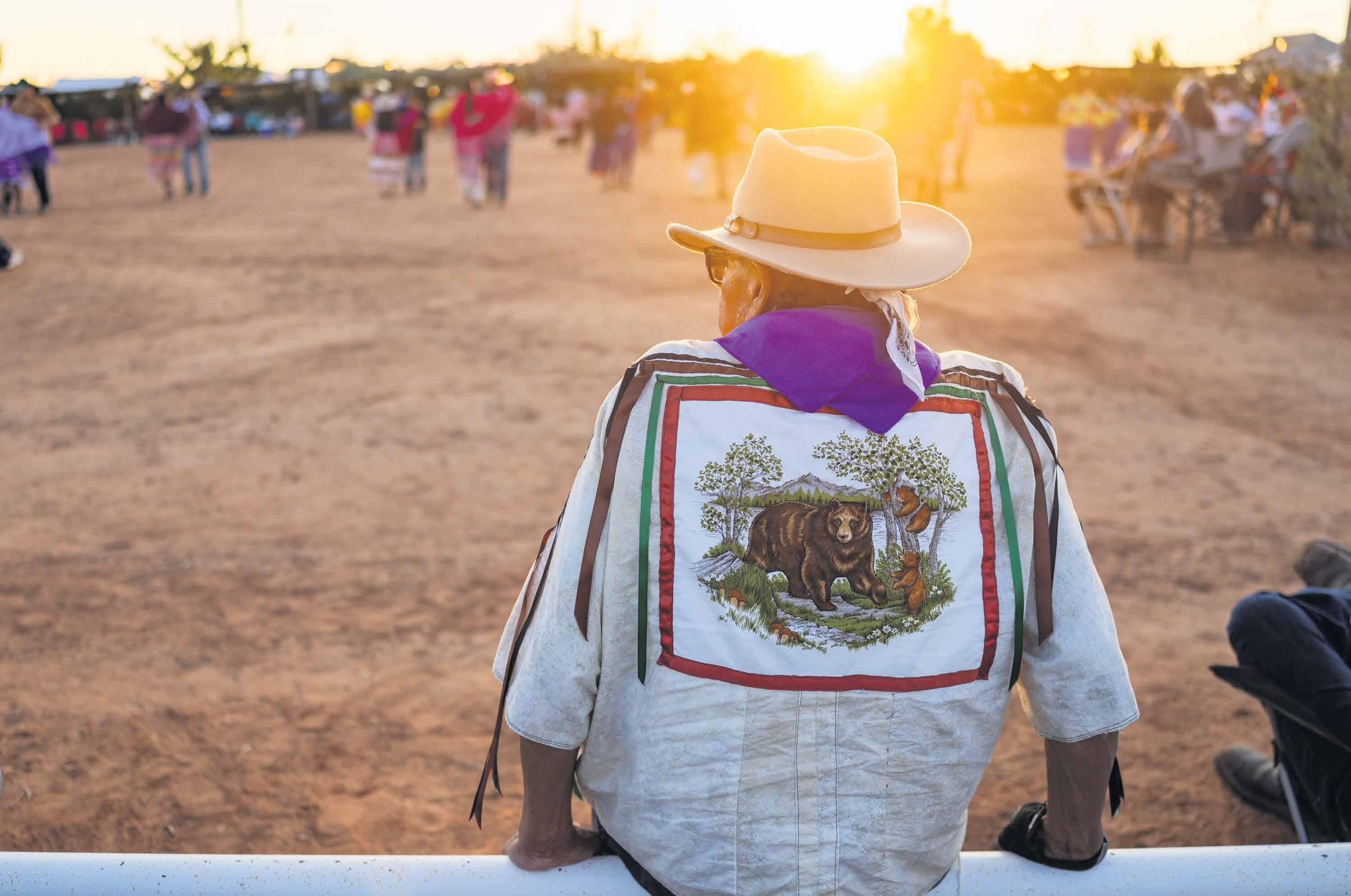
Aldean Ketchum, Ute Mountain Ute elder and bear dance chief of 40 years, wears a shirt representing the bear dance while watching people participate in the White Mesa Bear Dance in the White Mesa Ute community, located directly adjacent to the Bears Ears National Monument, on Sunday, Aug. 31, 2025.
Bears Ears today
A number of tribes and pueblos have a connection to this land. To them, Bears Ears means more than just high desert beauty, or a place where bears roam. It is home to more than 100,000 Native American archaeological and cultural sites.
The area is filled with ancient roads, pueblos, cliff dwellings, ancestral graves, burial sites and petroglyphs, in addition to the ancestral stone tools and pottery from the Hopi Tribe and Pueblo of Zuni, traditional Navajo dwellings and ceremonial structures known as hogans, the Ute tipi rings, and the Navajo, Ute and Paiute rock art. Bears Ears is a living reminder of their ancestors.
However, not all of those sacred sites remain pristine. In San Juan County, where Bears Ears is located, the illegal removal of artifacts from archaeological sites has been a pervasive problem. In 2016, despite their differences, five tribal nations with ancestral ties to Bears Ears — Ute Mountain Ute Indian Tribe, Navajo Nation, Ute Indian Tribe of the Uintah and Ouray, Hopi Tribe, and Pueblo of Zuni — united around the Antiquities Act of 1906 to ask the president of the United States to protect their cultural and spiritual homeland by designating Bears Ears as
a national monument.
It was the first successful Native American-led campaign for a national monument in U.S. history. It was also the first time tribal nations would co-manage a national monument with the federal government. Last year’s Bears Ears summer gathering followed the release of the final federal Bears Ears Resource Management Plan in April 2025, outlining how the 1.36 million-acre monument would be managed in the future.
While there are over 30 tribes and pueblos with cultural ties to Bears Ears, many Indigenous peoples with roots in the land live elsewhere today. Many at the summer gathering traveled from neighboring states to reconnect with their ancestors. Unlike others, Ketchum, of the Ute Mountain Ute Tribe, grew up here.
A healing place
“It’s my backyard,” said Ketchum, who, as a young boy, lived below the Bears Ears buttes in Allen Canyon in the summer and the White Mesa Ute community. Seeking inspiration for new music to fill the hundreds of flutes he has made in his lifetime, he comes to Bears Ears to find new songs.
“I listen to the animals and their songs and combine them with ours to create a healing sound
that is universal and helpful for everyone,” he said. “The (flute) is a healing instrument that we have known for thousands of years.”
When he was a boy, Ketchum healed a redtailed hawk he found with a broken wing in Allen Canyon. As an adult, he honored his old friend by carving a hawk on the end of his healing instrument. “I could call him and summon him like a falconer. He’d hunt for us. He’d go and get a rabbit, or bonus if he got a jack rabbit, and we’d make lunch. I didn’t have to worry about food. I just thought people lived like this.”
For hundreds of generations, Native Americans have relied on Bears Ears’ native plants and wildlife for food, medicine and spiritual healing.
“We are told as a generation that we are from this area. Our hogans are still here. Our sweat lodges are still here. Our sheep corrals are still in this area. We get our firewood in the wintertime from here. We also come here to pray,” said Jean Holiday, a Navajo woman from Train Rock, Utah.
Holiday’s father, John Holiday Sr., was a Navajo Nation medicine man until the day he died at age 100. She said she feels the presence of her father and mother every time she returns to Bears Ears. Recently, Holiday used the knowledge passed down to her from her parents to collect blue corn pollen, cedar and other herbs from Bears Ears that
she used in a ceremony to help heal someone with an illness and wounds.
“There are some holy spots, just like the Mormons having the Salt Lake Temple. This is like that for us. It’s not a temple but it’s still a holy place for us,” Holiday said.
A place of refuge amid persecution
The 19th-century Navajo leader Manuelito, who was born near Bears Ears, used the remote canyons to hide and resist the U.S. Army’s forced removal. He opposed the “Long Walk,” the brutal ethnic cleansing and deportation of the Navajo people from 1864 to 1866 to the Bosque Redondo internment camp in what is now New Mexico. Ultimately, Manuelito became a key negotiator of the 1868 treaty that secured the Navajo Nation’s right to return to their homeland.
“Manuelito is our grandpa on our mom’s side. That’s what we were told when we were youngsters,” Holiday said. “My mom’s side of the family are the ones that hid in this area. It provided them food to survive, like the deer, the roots, the plants … that’s how they survived in this area and that’s why it’s very sacred. If somebody got sick, they CONTINUES ON
Tess Crowley, Deseret News
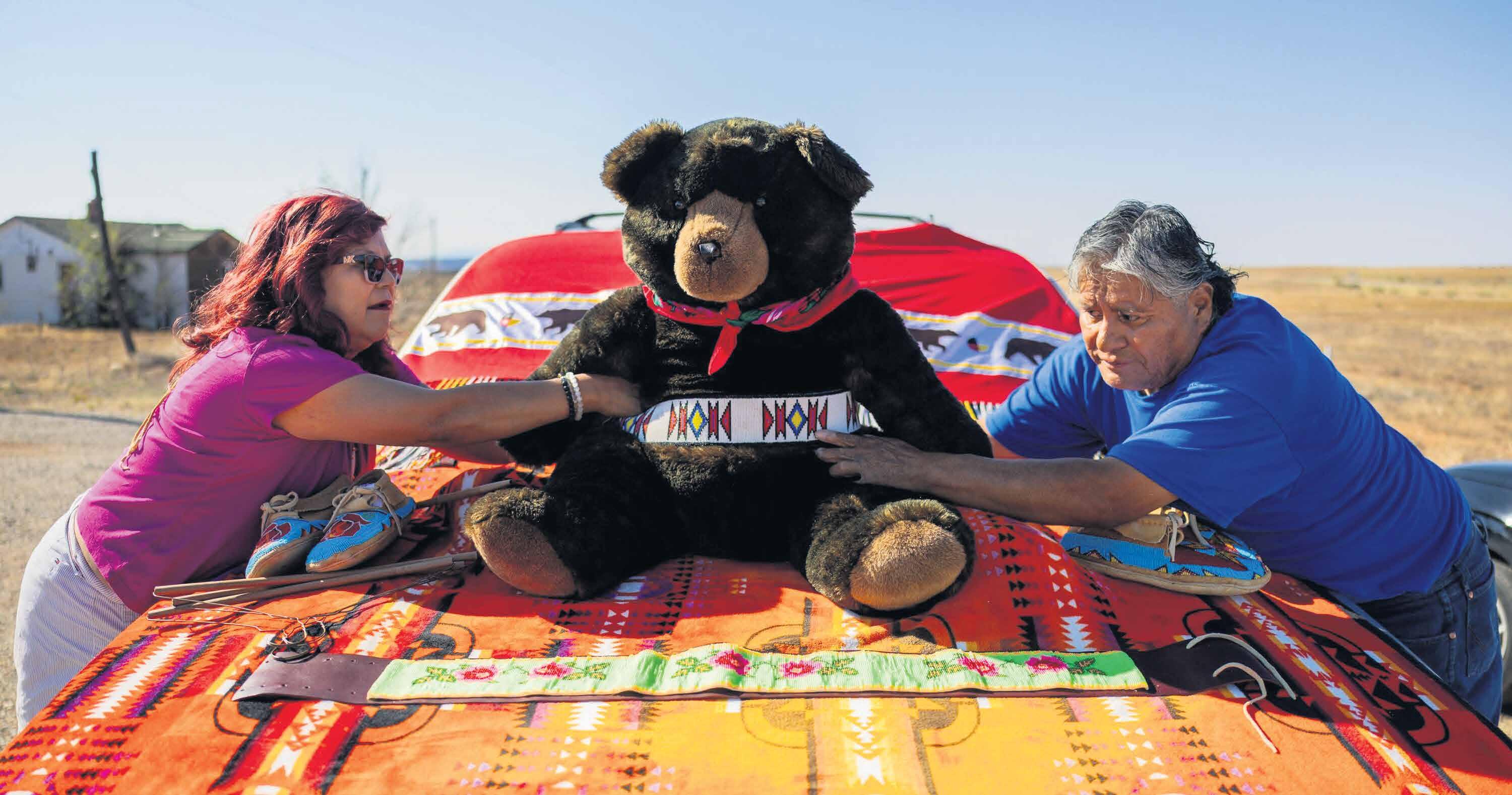
Deena Ute, left, and Elroy Lehi, right, secure a bear atop a car for a parade to celebrate the White Mesa Bear Dance in the White Mesa Ute community, located directly adjacent to the Bears Ears National Monument, on Saturday, Aug. 30, 2025. While it's rare to see a bear in Bears Ears, they are present, and, more notably, part of the stories that tie tribes and pueblos to the landscape.
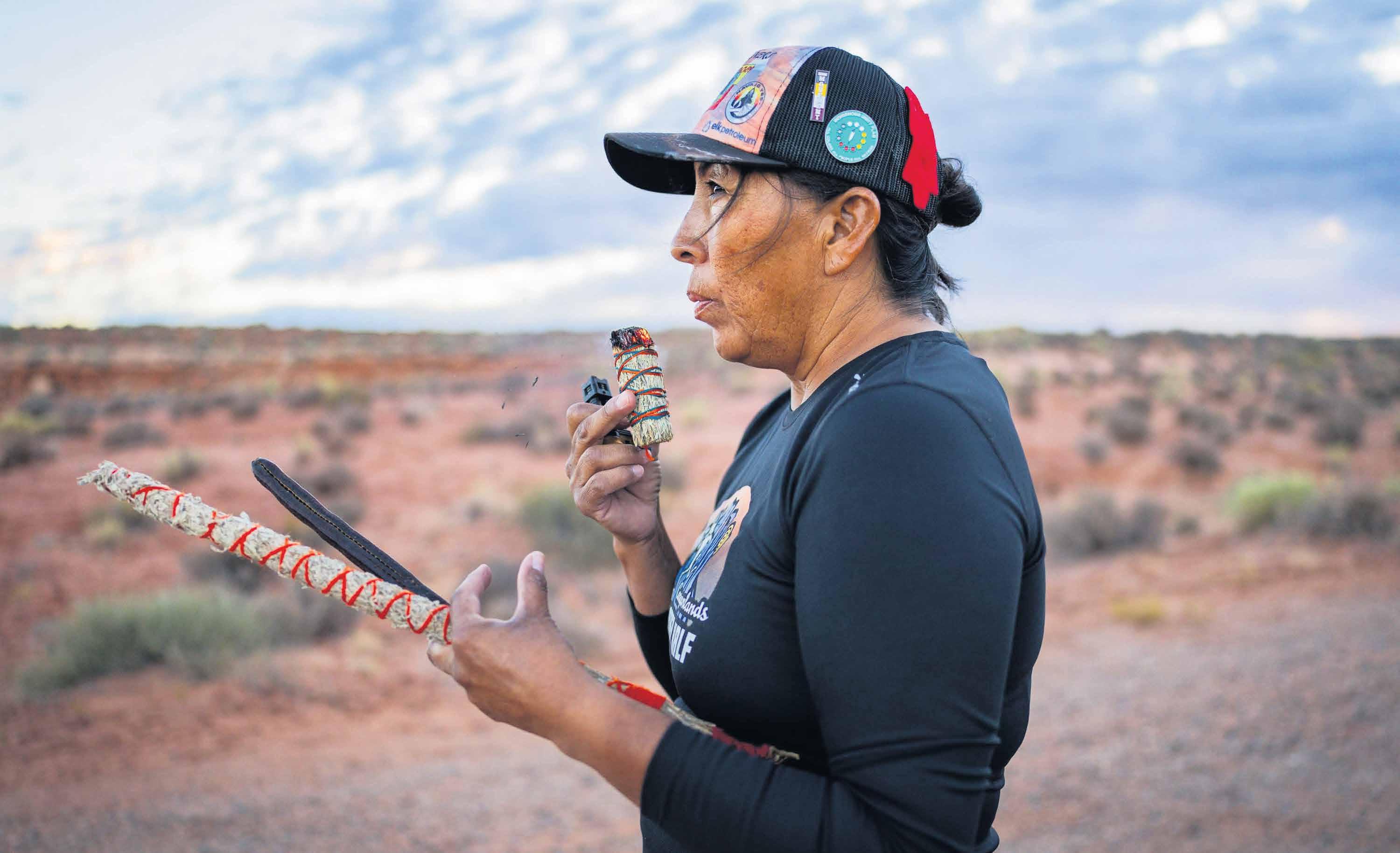
Martina Maryboy, a Navajo woman from Montezuma Creek, blows on a prayer sage while praying with a group at sunrise before embarking on an over 50-mile relay prayer run from Bluff to the Kagalia Guard Station Campground where the Bears Ears Summer Gathering is taking place at Bears Ears National Monument on Saturday, July 26, 2025. Historically, running was integral to communication and ceremony across many tribes. Individuals who could run long distances quickly to deliver messages were highly respected. This prayer run isn't just a run, but a spiritual pilgrimage to honor the land and their ancestors.
already have plants. They don’t run to the hospital or grocery store. They couldn’t do that because of the ‘Long Walk.’ They had everything here.”
“We still do collect herbs. We still do hunt. We want to pass this down to our newer generation and tell them these stories that we are from here,” Holiday said.
Passing down the wisdom of the elders
Roy Kade and his apprentice, Casey Teseny, attended the Bears Ears Summer Gathering last July to do just that: pass down Indigenous knowledge to the youth.
“We look at our Mother Earth as our mother and the Father Sky as our father and we are the children … in that way we are supposed to be stewards to the land. I am turning into a great uncle, and as an uncle I really see that need to learn the culture, learn the traditions, and pass that on to the youth. I would say me being here fits into the role that I needed when I was smaller. I wanted to ask questions, I wanted help,“ said Teseny, a Navajo man from Chinle, Arizona.
Teseny explained to 9-year-old Akaedo Dee, a Navajo boy from Blanding, how sandals were made out of local vegetation. He also shared his knowledge in pottery, weaving and dyeing yarn with children at the gathering, explaining that the arts and crafts aren’t just pretty colors and shapes: They are a reflection of our surroundings.
With every dip into the vegetable dye bath, Dee’s smile grew bigger as he realized sagebrush could give yarn color.
“You’re not only learning about the plants, you’re learning about your home,” Teseny said.
After inspecting the color, the yarn met the sky as Teseny swung it back and forth, like a pendulum. The few water droplets remaining clung to the freshly dyed strand as it hung to dry a few feet above the forest floor.
“I feel all the memories. I feel the stories. Just being here and walking around the trees, they’ve seen a lot. They’ve seen the different people that came through here. They’ve seen families grow. They’ve seen people move. They’ve witnessed a lot. They’re a testament of that presence and that history,” Teseny said.
The Bears Ears Summer Gathering began in 2015 to bring the different tribes and pueblos with connections to Bears Ears together to advocate for the creation of the Bears Ears National Monument. Its status has fluctuated over the past decade.
After President Barack Obama created the monument in late 2016, President Donald Trump reduced its size by 85% in December 2017. In October 2021, President Joe Biden restored its original acreage. Most recently, in May 2025, the Department of Justice released an opinion stating that the president can reduce or revoke national monuments. The document counters almost a century of legal interpretation of the Antiquities Act, calling into
weekend Bear Dance.
The White Mesa Bear Dance is the closing chapter of a season of dances that begins in the spring, when the first Bear Dance of the year is held to wake the bears from their winter sleep.
The Bear Dance is a “woman’s choice” dance, meaning the women pick their partners. The practice originates from a Ute legend about two boys who were in the forest: One of the boys went home and the other boy was found by a mother bear. She sheltered the boy and taught him the ways of the bear, including the bear dance. He brought his knowledge of the dance to the village when he returned.
Today, in the community of White Mesa, Ute tribal members haven’t forgotten mother bear’s wisdom. Women flick their shawl fringe and form lines, holding onto the men they have chosen as their partners as they move backward. They dance back and forth, mimicking a bear scratching against a tree, as the Bear Dance chiefs sing and use growlers, instruments played with sticks to imitate growls and spring thunder, symbolically waking the bears from hibernation.
“The respect is there … when you’re dancing and you’re going backwards your partner is looking out for you because you can’t see what’s behind you. It’s that very concept of you watch my back and I’ll watch yours. You take care of me and I’ll take care of you,” Ketchum, a White Mesa Bear Dance chief, said.
As the sun dipped below the horizon, long lines of shadows moved back and forth, contrasted by the golden light in between each pair of dancers. Ute Mountain Ute Tribal Councilman Malcolm Lehi reflected, “When you dance, you’re dancing for your elders, then you dance for the people that can’t dance, then you dance for the people that need the healing.”
question the status of national monuments across the country, including Bears Ears.
Sending the bear to sleep
Regardless of a governmental proclamation, every year when summer fades to fall, the bears must be sent to hibernation. That is Ute tradition.
Four weeks after this year’s summer gathering, the White Mesa Ute community, located directly adjacent to the national monument, sent the bears to sleep for the winter at its annual Labor Day
Giving voice to the cedar tree
On a cold November day three months after the bears were put to sleep, Ketchum made his way up to the mesa tops of Bears Ears to look for pinyon nuts and cedar wood. And next year, the cycle will repeat. The bear will wake up, the summer gathering will commence, the bear will be put to sleep, pinyon nuts will grow, deer and elk will be hunted, herbs will be collected, the snow will fall, and the bear will be awakened again.
“It’s a never-ending cycle for years. Everything
Tess Crowley, Deseret News
is renewed every year in springtime and this life goes on,” Ketchum said.
While Bears Ears’ status as a protected monument has fluctuated over the last decade, the Native Americans haven’t ceased their harmonious partnership with the land.
“The cedar tree is giving itself up to bring music. I give it a voice,” Ketchum reflects while collecting cedar wood in Bears Ears to make flutes. With every cut into the wood, a powerful, fresh smell filled the crisp air of Cottonwood Canyon.
Ketchum mimics the sounds of the animals when he plays his flute. Once, while hunting, he used his melodies to bring in a whole herd of elk, he reminisces, after running into his cousin who was heading up the canyon to hunt elk. Due to health complications, it’s been almost a decade since he’s hunted.
Later in the day, as snow began to fall, Ketchum called out to birds using the eagle bone whistle that never leaves his side. We stood inside a tipi he helped set up ahead of the Blanding Luminary Walk holiday festival in December where he played his flute for an audience.
From barbed-wire to running free
In 1923, in the same town Ketchum played his flute in a traditional Ute tipi for the annual holiday festival this year, the state of Utah waged the final war in U.S. history against a tribe. The assault, known as the Posey War, ended on April 29, 1923, with a five-week imprisonment of the Allen Canyon Utes in a makeshift, barbed-wire
stockade in the center of town, the loss of access to ancestral lands in the Bears Ears region, the murder of two tribal members, and the forced enrollment of Ute children in boarding school in Colorado, separating them from their families.
Starting in the 1950s, many of the Ute families from Allen Canyon began moving and building homes on tribal land about 11 miles south of Blanding. The settlement eventually grew into the modern-day community of White Mesa.
Ketchum grew up in White Mesa as a descendent of the Allen Canyon Utes 40 years after the Posey War. While the war resulted in the effective end of the Allen Canyon Ute people’s traditional, nomadic way of life in Bears Ears, Ketchum still experienced a piece of that lifestyle during his childhood, spending the summers in the canyon and connecting with the land from which his ancestors had been removed nearly 103 years ago now.
Toward the end of a long drive down the canyon after the Bears Ears Summer Gathering back in July, Ketchum showed me where he spent his summers chasing deer, herding livestock, befriending birds, and learning how to play the flute.
Under that clear summer sky, the unifying and timeless power of Bears Ears was on full display. Children, parents and grandparents of different tribes and pueblos drifted off to sleep next to the ursine buttes, under the same stars that guided their ancestors.
“Now this is the space age, and what more could they do to us now?” Ketchum said, looking out over the land. “We’re invincible.”
Is Your AI Actually Secure?
Claiming independence and dreams: Machinist program for Utah adults with autism graduates inaugural cohort
The 12-week CNC Machine Operation training program is already placing participants in high-demand industries such as aerospace
By Jason Swensen Deseret News
This recent holiday season turned out to be far more festive for Addie Morley.
The Salt Lake County resident took a major step Dec. 19 toward independence and a promising career in a high-demand industry.
Morley is one of six adults with autism who graduated as part of the inaugural cohort of the Utah Uniquely Abled Machinist Program (UUAMP) — a 12-week Computer Numeric Control (CNC) Machine Operation training program.
Morley and her fellow graduates now possess the training, skills and confidence needed to step into entry-level positions in one of the Beehive State’s most high-demand manufacturing sectors.
“I was given a job offer on Wednesday with Boeing; it’s a great opportunity,” she told the Deseret News.
Morley will be making CNC parts for Boeing aircraft.
The UUAMP operates through a partnership with Columbus Community Center, the Utah Manufacturers Association (UMA) and Salt Lake Community College (SLCC).
The program is funded through a Return to Work Grant from Talent Ready Utah that brings a nationally proven training model to Utah that helps prepare uniquely abled adults — specifically individuals with Autism Spectrum Disorder — for skilled careers in advanced manufacturing.
The program’s support model, according to Columbus Community Center, includes 300 hours of technical machining instruction provided by SLCC — which is then coupled with job readiness, coaching and workplace preparation from the Columbus Community Center.
Nationally, the Uniquely Abled Academy averages an 85% job placement success rate. Working with Utah manufacturers, UUAMP managers determine what specific positions are needed in the workforce.
Typical jobs include CNC operators, machinist apprentices and mill/lathe technicians.
For Morley, the UUAMP has allowed her to overcome challenges that once stood between her and a career she loves.
“I have a hard time learning, and this program has made it so I can learn,” she said, adding that the program connected her with instructors “who can take their experiences and teaching and take it to (a place) where I learn,” she said.
Scott G Winterton, Deseret News
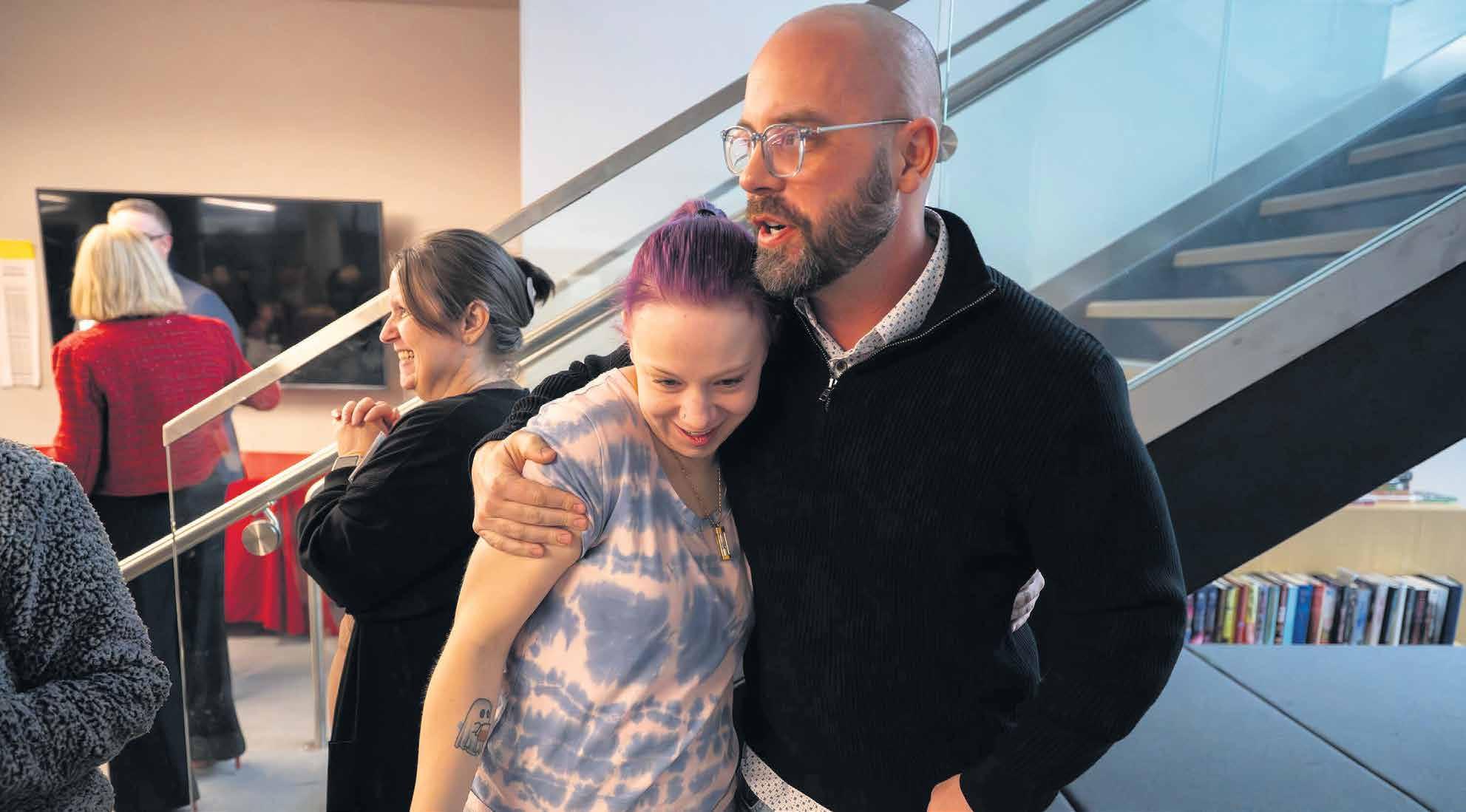
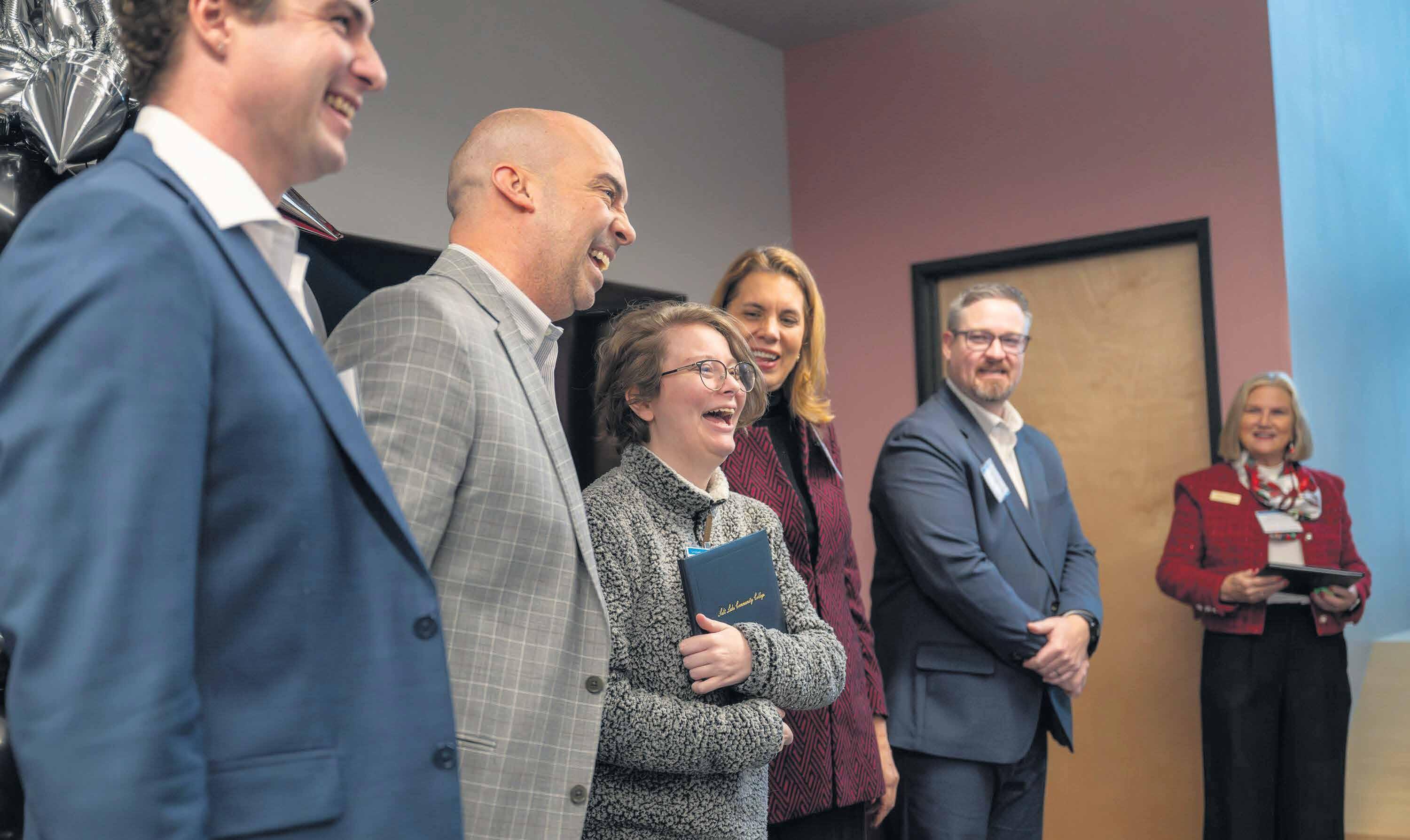
Addie Morley hugs Doug Richter, who is the machining instructor at Salt Lake Community College, during the inaugural graduation exercises of a SLCC-sponsored vocational training program for adults with autism at Nextwork Autism Program in South Salt Lake City, on Friday, Dec. 19, 2025.
“An industry starving for quality machinists”
A key element of UUAMP is connecting graduates such as Morley with employers seeking their newly acquired skill sets.
Richard Ballentine is the owner of Salt Lake City’s Complex Fabricators. His company, he said, makes a variety of products while also anchored to a community-based ethos. “We exist to do good…We want to bless the lives of our employees. And we want to bless the lives in our community.”
Hiring UUAMP graduates, said Ballentine, “is a way to give
back and to benefit, because our industry is starving for quality machinists.”
Being a machinist, he added, offers paths to a solid, long-term career. “You’ll always find employment — and it’s something that you can grow and progress in.”
Ballentine said he plans to hire at least two of UUAMP CONTINUES
Ignite Entrepreneurship Academy
What does a school day look like when children are trusted to think, explore, and take ownership of their learning?
Education is evolving—and families across Utah are asking an important question: Is school preparing children not just to succeed academically, but to think critically, adapt confidently, and contribute meaningfully in an ever-changing world?
At Ignite Entrepreneurship Academy (IEA) in Lehi, the answer is a resounding yes.
Ignite Entrepreneurship Academy is a public, tuition-free charter school serving students in Kindergarten through 8th grade. Grounded in Montessori-inspired principles and practices and enhanced by entrepreneurship and project-based learning, IEA offers a distinctly different educational experience. Together, Montessori structure and entrepreneurship form a powerful foundation for learning—where students are trusted with responsibility, encouraged to think independently, and supported as they apply their learning in authentic ways.
At IEA, entrepreneurship is not a standalone class or enrichment activity. It is a way of learning, intentionally woven across grades and subject areas. Students are encouraged to see themselves as creators, problem-solvers, and contributors from an early age. Through curiosity-driven, hands-on learning, students
develop creativity, collaboration, and confidence while building strong academic foundations.
Montessori practices form the foundation of the Ignite classroom experience. Students learn in multi-age classrooms designed to foster mentorship, leadership, and collaboration. Carefully prepared environments support independence, movement, and choice, while extended, uninterrupted work periods allow students to engage deeply with meaningful work. Teachers act as guides—observing, individualizing instruction, and supporting students as they progress at their own pace.
As students grow, Ignite’s entrepreneurship program becomes increasingly structured and applied. Learners engage in design thinking and innovation cycles—identifying real-world problems, conducting research, prototyping solutions, and communicating their ideas clearly. By middle school, students participate in a capstone entrepreneurship experience that integrates Utah Core academic standards with financial literacy, business planning, and professional presentation skills. This applied learning extends beyond the classroom through Experiential Fridays, a signature middle school program that intentionally connects learning to the broader community. On designated Fridays, students engage in hands-on, real-world experiences that take them into local businesses, organizations, and commu-
nity spaces. These experiences allow students to apply academic skills in authentic contexts—observing, questioning, collaborating, and reflecting as they connect classroom learning to real-life systems and challenges. Experiential Fridays reinforce purpose, relevance, and civic awareness, helping students see how their learning matters beyond school walls.
Families often describe Ignite as calm, purposeful, and deeply relational. The school community is built on belonging—where every student is known, every voice is valued, and families are welcomed as true partners in learning. This culture, combined with Montessori structure and entrepreneurial thinking, helps students develop confidence not just in what they know, but in who they are becoming.
Ignite Entrepreneurship Academy reflects a growing understanding that education must prepare students for a future that cannot yet be fully defined. By blending rigorous academics, Montessori foundations, and entrepreneurial learning, Ignite equips students with the mindset and tools to lead with purpose—wherever their path may take them.
Now Enrolling Students in Grades K-8 for the 2026–2027 School Year.
Learn more and apply now at www.igniteutah.org.
graduates, “and maybe more.”
Doug Richter teaches machine and CNC technology at SLCC, diving into “all the ins-and-outs” of machining.
“We took this cohort and tried to give them the best opportunities that we have available to teach them how to operate and set up CNC machines — and how to apply that to industries like aerospace, medical machining, and machining in general,” said Richter.
“They excelled.”
Richter said working with UUAMP students requires a modified instructional approach.
“We like to communicate clearly with examples that they can refer to, as well as demonstrations of the tasks that they’ll be doing beforehand.
“So it’s very similar to what we do in other machining classes, but we just make sure we’re very rigorous with the demonstrations and the details behind what’s expected.”
As an educator, Richter said it’s thrilling watching people thrive in new opportunities to learn and develop high-demand employment skills.
“I feel like I’m the one that’s been blessed with more than anything I’ve done for those we’ve educated.”
“The perfect first cohort”
During the graduation ceremony, Columbus Community Center CEO Kristy Chambers said innovation, persistence, collaboration, competency, execution and results were all required for the inaugural UUAMP to be successful.
She saluted the graduates — calling them the “perfect first cohort.”
“This doesn’t happen without you,” Chambers told the students. “You took the time, the energy, and you applied for this. You put yourself out there, you were vulnerable. You came into us, and you said, ‘I really want to explore this.’”
Results, she added, are not simply measured by productivity numbers or completed tasks.
“Results are people gaining confidence. Results are individuals earning new skills, earning wages, building routines and the experience and the pride that comes from meaningful work.
“Results are employers discovering talent that they may have overlooked. Results are families and growing stability and possibilities.
“And these results are not just for today, but for the future, because every success builds on that momentum.”
Johnny Ferry, the President and CEO of Utah Manufacturers
Association, said the graduates reflect Utah’s pioneering spirit.
The Beehive State is a friendly place for manufacturing. It’s one of the state’s largest industries.
“It’s a quiet giant of an industry — and that’s what you’re about to enter,” he told the graduates.
Future opportunities, Ferry added, are numerous.
“You’ll be given opportunities to try other things, to do more, to increase and enhance your skill set —and that’s what is so exciting about what you’ve just started into as a pioneer.”
Pathways to independence, claiming dreams
Amy Herbert was a proud mother Friday. Her son, Mitchell Akin, was numbered among the graduates.
“I believe now that he can be as independent as he has always dreamed of being,” she said.
“Mitchell’s always had a goal of just simple independence like having his own place and having his own pets and having his own transportation.”
Akin hopes to travel to Japan one day. Now that’s a more realistic possibility.
“He’s actually starting to believe that he’s capable of creating the life that he wants to design,” Herbert said of her son.
Scott G Winterton, Deseret News
Alyvia Hurtado laughs with special guests during the inaugural graduation exercises of a SLCC-sponsored vocational training program for adults with autism at Nextwork Autism Program in South Salt Lake City, on Friday, Dec. 19, 2025.
Choose how you learn. One class at a time.
Stay enrolled at your local public school while taking select courses online through Utah Virtual Academy (UTVA).
UTVA o ers individual online courses through Utah’s State Online Education Program (SOEP) — designed for flexibility, focus, and real academic support.
Utahvirtualacademy.org 801-262-4922
UTVA Online Courses O er:
•Flexible scheduling
•Certified Utah teachers
•A focused, distraction-free learning environment
Ideal for scheduling conflicts or di erent learning preferences.
Need a di erent class experience?
Swap one course. Keep your school. Keep your friends.
Utah Virtual Academy A public charter school serving Utah students statewide
Utah Virtual Academy
Choose How You Learn, One Class at a Time
For students with complex schedules and individual learning needs, a simple course solution can make learning more manageable.
Utah Virtual Academy (UTVA) has served Utah students since its first operating year in 2008–2009, providing flexible, high-quality online learning supported by experience and accountability. As a public charter school, UTVA is Cognia accredited and offers NCAA-approved courses, giving families confidence that instruction meets rigorous academic and eligibility standards.
Through Utah’s State Online Education Program (SOEP), students may take individu-
al online courses one class at a time while remaining enrolled at their local public school. This option allows families to personalize part of a student’s education without giving up their school community, daily routine, or friendships.
A key benefit of taking an online course through UTVA is the ability to avoid scheduling conflicts at a student’s local school. When required classes overlap with electives, athletics, arts programs, or career and technical pathways, students are often forced to choose. UTVA online courses help students meet graduation and academic requirements while maintaining access to important opportunities.
Students continue attending their local school, participating in extracurricular activities, and staying socially connected while completing a selected course online through UTVA in a focused learning environment. This balance allows students to gain flexibility without disrupting their overall school experience.
UTVA online courses are taught by certified Utah teachers who are extensively trained in online instructional delivery. These educators specialize in engaging students in a virtual setting and supporting learning through clear communication, timely feedback, and consistent academic monitoring. Teachers actively guide instruction
and help students stay on track, giving families confidence that students are supported.
Courses are designed to balance structure with flexibility, helping many students reduce stress and focus on one subject at a time.
Because Utah Virtual Academy is a public charter school, eligible online courses are available at no cost to families through SOEP. Students may enroll in up to 6.0 credits with Utah Virtual Academy while staying connected to their local public school.
Learn more at utahvirtualacademy.org or by calling 801-262-4922
Even amid visa worries and other disruptions, international students are flocking to Utah universities
A variety of campus support services are operating at Beehive State schools to ensure positive outcomes for international students
By Jason Swensen Deseret News
It’s been a year marked by well-publicized uncertainty, visa holdups and deportation fears — but international students remain keen on enrolling in Utah universities.
The public University of Utah and the private Brigham Young University continue to be popular destinations for thousands of degree-seeking students from outside the United States.
And that same enthusiasm for Beehive State campuses appears to be extending to traditionally regional institutions, such as Utah Tech University.
Many across the country’s higher education community worried there would be sizable dips in international enrollment following a series of events this year impacting foreign students — including the Trump administration’s decision requiring student visa applicants to make their social media profiles public.
And last year, the U.S. Immigration and Customs Enforcement temporarily revoked the legal status of hundreds of international students — including several studying at Utah colleges and universities.
But the desirability of an American college education appears to be generally countering fears — although there are disconcerting signs moving forward.
U.S. campuses saw a 1% decrease in international enrollment this fall compared with last year, according to a survey from the Institute of International Education.
But that figure is propped up by large numbers of students who stayed in the U.S. for temporary work after graduating. The number of new students entering the United States for the first time fell by 17%, the sharpest decrease since the COVID-19 pandemic, according to The Associated Press.
Overall, nearly 60% of colleges reported a decrease in new foreign students this fall, the survey found, while 30% saw increases and others held even. More than 800 schools responded to the survey, which offers an early look at trends before full data is released next year.
“I think colleges and universities did absolutely everything in their power to advocate to get these students to the United States,” said Mirka Martel, head of research, evaluation and learning for the institute, according to The Associated Press.
What’s the University of Utah doing to support its international students?
The University of Utah welcomed 3,165 international students to campus for this fall.
The state’s flagship university recorded a 9% increase in international undergraduate students — while the number of first-time international students jumped 15%
“The University of Utah is committed to supporting our international students, especially during moments of global uncertainty,”
said Paul Kohn, senior vice provost for strategic enrollment and student success.
“Our International Student and Scholar Services team is in close communication with students to provide up-to-date guidance on visas, travel, and federal policy changes.”
Additionally, the University of Utah offers its international students one-on-one advising, expanded walk-in services and frequent “info sessions” to ensure they have clear, reliable information.
The school has also fortified its “wraparound support” for international students — including mental health services, academic advising, emergency financial assistance, legal-resource referrals, and year-round programming designed to build community and belonging.
Kohn said the school also coordinates with campus partners and national associations to advocate for stability and clarity in federal processes affecting international students.
“International students are a vital part of our campus community, and the university is fully committed to their safety, success, and well-being.”
Elevating international students at BYU
Sponsored by The Church of Jesus Christ of Latter-day Saints, BYU has long been a desired academic locale for international students — particularly for degree-seeking Latter-day Saints living outside the United States.
A total of 1,306 international students from 103 countries are enrolled this fall at BYU — 981 undergraduates and 325 graduate students.
The top three nations represented on campus: Canada, Mexico and South Korea.
BYU spokesperson Audrey Perry Martin noted that the school’s International Student and Scholar Services Office assigns every international student an adviser who works with them throughout their BYU journey — from admission to post-graduation.
The university also provides a course entitled “International Student Orientation” designed to enhance each international student’s sense of belonging on campus.
BYU also prioritizes connecting international students to campus resources such as advisory resources, food and housing insecurity resources, mental health resources and ecclesiastical support, according to Perry Martin.
Utah Tech: A regional school that’s drawing global attention
While classified as a regional university, Utah Tech University has become an academic home to scores of international students.
This fall, the St. George-based institution’s student body includes 230 international students — 228 undergrads and two graduate students.
Eighty-one of those international students are “first-timers.”
“Last year, we experienced record growth and welcomed our largest-ever international student population. This year, we maintained that same number,” wrote school spokesperson Jyl Hall in an email to the Deseret News.
Hall added that since international students pay out-of-state tuition, increasing the number of international students does increase tuition revenue.
Utah Tech’s Office of International Programs provides international students with immigration support — along with guidance and career direction.
“We also have two hotlines in our office so anyone can reach out from anywhere, anytime,” said Executive Director of International Programs Shadman Bashir. “Through this type of personalized support and strong relationship building, our student numbers grow despite current uncertainties.”
Such support, added Bashir, is further establishing the school’s global reputation as a welcoming higher education institution.
Laura Seitz, Deseret News
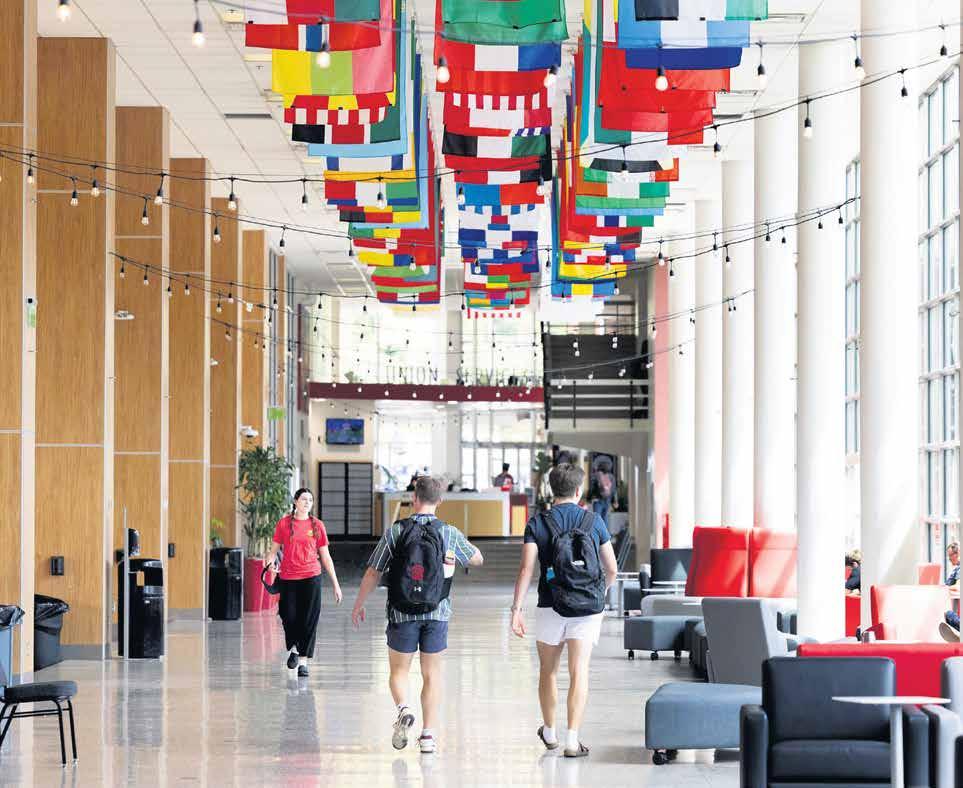
Students are pictured in the Olpin Union at the University of Utah in Salt Lake City on Wednesday, Aug. 20, 2025.