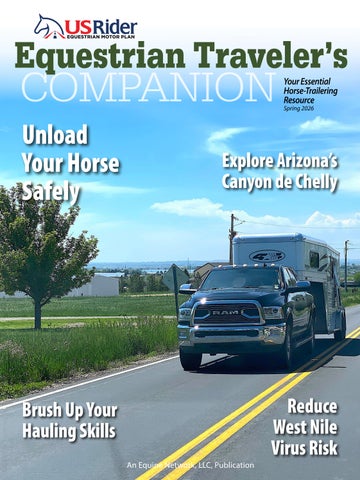
USRider® ETC-Spring 2026

Page 1


Equestrian Traveler’s COMPANION

What Members Are Saying About Recent Services

"So happy we switched from AAA. From the initial call to the resolution all parties were professional and kind. Very happy."

— Robert M, WA (Feb 26)

"I will never be without US Rider membership. The service I have received on numerous occasions has been fantastic. I know that USRider will always be there for me if I have a vehicle problem. From simple issues like changing the tire on my horse trailer, to major issues requiring a tricky tow truck excavation, USRider has always helped me out."

— Fenya S, PA (Feb 26)

"The gentleman with the tow truck was very considerate and professional. Arrived much sooner than the estimated arrival time. He was familiar with the location to where the car was to be taken."

— Kathleen L, IA (Feb 26)

"Greatly appreciated the driver following me to the auto parts store after jump starting my truck to ensure I made it there without further trouble!"

— Laurie J, IN (Feb 26)

Our 24/7 nationwide plan covers everything from lockouts and jump starts to towing your vehicles, trucks, and trailers.

Travel with confidence knowing USRider will get you back on the road safely and efficiently, should unexpected vehicle or trailer problems occur.

"Thank you for being there for us. I LOVE my USRider membership. You have come to my rescue several times through the years and once with two tows for both my truck and my horse trailer with my horse in it. I was so happy to have paid my membership dues for years for just that one incident when it was so important to have you in my corner!"

— Candy M, FL (Feb 26)

"Been a member for years and you have never let me down when I have needed assistance! I appreciate the support from your knowledgeable staff and the recovery services that were able to help me. The recover service was absolutely the best, they handled everything in a timely, polite, and professional way and were so helpful with recovery of my vehicle. I will be recommending your services to all my friends and colleagues !"

— Elaine S, MT (Feb 26)

"So grateful for the assistance! Have already recommended USRider to others."

— Dana A, AZ (Feb 26)

Clean the Mud

Even if the temperatures are rising in your area, it’s not safe to give your horse a full bath until it’s consistently above 50 degrees Fahrenheit. But you do need to clean dried mud from his legs to help reduce the risk of sores, especially if he wears splint or performance boots. Use two small, soft-rubber curry combs to gently curry your horse’s legs from top to bottom. Also, schedule some pedicure time to enhance hoof health. Clean, wash, and disinfect your horse’s feet, then massage hoof oil into his coronary band.

In early spring, check your horse’s legs for mud, and groom his legs frequently until it’s warm enough for a full bath.

USRIDERMEMBER TIP

Emergency Air Transport

Have you ever thought what it would be like if you were traveling with your horse miles away from home and suddenly became incapacitated, which prevented you from driving your rig home? SkyMed, North America’s premier emergency air repatriation membership service, is now available to USRider Members at a 20% discount off everyday annual retail membership rates. In the event of a critical illness or injury when traveling more than 100 air miles from home, SkyMed will dispatch a medically equipped jet to the stranded patient for a return flight home at no cost to the Member. SkyMed also sends a replacement driver to the stranded horse and trailer so they can be safely returned. For more information on USRider’s discount program, click here

Enhance His Comfort

Here are five trailering tips from seasoned equestrian travelers Kent and Charlene Krone.

Check his hooves. Before loading your horse, check his hooves for any compact material that might create uncomfortable pressure over a long period of time.

Take breaks. When it comes to on-the-road breaks, everyone has his or her own routine. We try to drive no more than eight hours per day. After four hours, we unload our horses to give them a break, then load them back up and continue driving the last four hours.

Multitask. To save time, look for places to stop where you can fuel up, get the horses out, and have lunch all in one spot.

Clean your trailer. When you take a break, remove solid waste from the trailer when you whenever you can to make sure your horse is passing manure. If he’s not, check for signs of colic.

Keep the same diet. To help reduce colic risk, give your horse the same feed when you travel as you do at home, and offer plenty of water. Also provide a salt block in your horse’s temporary quarters, along with grain and whatever other supplements he’d normally receive at home.

We try to drive no more than eight hours per day,” say Kent and Charlene Krone. “After four hours, we unload our horses to give them a break, then load them back up and continue driving the last four hours.”

PHOTO BY HEIDI MELOCCO
PHOTO BY KENT AND CHARLENE KRONE

TRAILERTIP

Maintain the Emergency Breakaway System

Imagine what would happen if your trailer became disconnected from your tow vehicle and your emergency breakaway system battery was fully discharged. Disaster! When an emergency breakaway system is working properly, it’ll automatically lock your trailer’s brakes if your trailer becomes disconnected from your tow vehicle. To ensure your emergency breakaway system is in good working order, follow these safety tips.

• Test the system. Have a qualified mechanic test the system for proper operation annually. Also, have your battery load tested to check the current. A qualified trailer mechanic can perform this test. Replace old and weak batteries.

• Inspect the cable and switch. Regularly inspect the cable and switch for the breakaway system. Replace the cable if it’s showing any signs of wear.

• Keep the battery clean. Keep the top of the battery and the battery terminals clean with a small wire brush and dielectric grease.

• Store the battery properly. Remove the battery if you store your trailer or don’t use your trailer for extended periods. Store the battery in a warm area, away from children.

• Use the proper battery. Use the proper battery for your breakaway system. Consult your owner’s manual, or check with the trailer manufacturer.

• Maintain acid levels. If your battery has removable cell caps, maintain acid levels by adding distilled water. However, take care when adding water; wear protective eyewear, and don’t overfill the cells.

• Maintain the charge. Don’t allow the battery to remain discharged for extended periods. A 12-volt battery is considered totally discharged when it measures below 11.9 volts. Check voltage with a digital voltmeter.

• Invest in a built-in battery charger. These systems can be installed on your tow vehicle to charge your battery every time you tow.

• Use the right charging system. If you use your rig infrequently, use a charging system that provides a “float” charge for extended times when your trailer isn’t in use. Frequent travelers should use breakaway battery systems with built-in chargers and battery status LEDs.

• Maintain the electrical system. Keep your trailer’s brake and electrical system in good condition with regular inspections by a competent mechanic.

— Tom Scheve and Neva Kittrell Scheve

Imagine what would happen if your trailer became disconnected from your tow vehicle and your emergency breakaway system battery was fully discharged. Disaster!

Keep your trailer’s brake and electrical system in good condition with regular inspections by a competent mechanic.

PHOTO BY HEIDI MELOCCO

Spring Brush-Ups

Spring is here! If your trailer has sat idle over the

you might need to brush up on your hauling skills. Here’s a quick guide.

Spring is here! You’re looking forward to longer and warmer days—but if you’re in the snow belt, your trailer has likely sat idle for weeks, or even months, since you last used it. You’ve performed annual maintenance on your tow vehicle and trailer, but you might also need to brush up on your hauling skills. Here’s a quick guide.

Hauling Skill #1: Hitching Up

Practice hitching up on non-riding days or after a weekend ride when you’re relaxed and have time to focus.

Make a list. Make a list of the things you need to do to hitch up your particular truck and trailer. Print out the pre-trip safety checklist on the USRider® website, then add to it as necessary. Hitch up. Using your list, hitch up your trailer. As you go, make sure that everything on the list is in the correct order and that it makes sense to you.

Take a photo. Take a photo of the hitch configuration, so you have a record of what it’s supposed to look like when the process is complete. Then you can use the photo as a guide in the future.

winter,

Hauling Skill #2: Backing Up

While your trailer is hitched up, but without your horse, find a level, paved area, and practice your backing skills. When you know how to back your trailer, you won’t have to worry about finding pull-through parking spaces. Set up cones. Cones give you a target and a way to judge your true skills. Set the cones far apart, and practice basic backing skills.

Increase the difficulty level. Set up the cones so that you can back through an L, a serpentine, and into a small space. Then practice a three-point back-up turn. Back without your trailer. At every opportunity, practice backing your tow vehicle without your trailer into parking spaces. The trick is to practice using only your mirrors, without turning your head. As you get the hang of it, backing your trailer will seem more natural. At first, find a parking space away from other vehicles. As you gain confidence, start parking between other vehicles. Go slow, and enlist the help of a ground guide if you need to.

Hauling Skill #3: Driving Gently

As you haul your horse, keep in mind he’s essentially a huge barrel of water standing on toothpicks, so you need to drive smoothly and easily to allow him to adjust to changes of speed and direction.

Check your brakes. Without your horse, on a smooth, level area, make sure your braking system is working correctly by driving straight, then applying a hard brake. Drive a serpentine. Set up a serpentine with cones, then drive around it slowly. Your goal is precision: Without hitting the cones, make smooth, consistent transitions around corners. Avoid jerky braking and acceleration. Measure your braking distance. Measure the length of your truck and trailer. Behind the wheel, accelerate to 30 miles per hour, then apply the brakes as you pass a marked cone. Press the brakes hard but consistently to come to a full stop. Measure how far it took to stop. Repeat this measurement at 50 and 60 miles per hour. You’ll see how much your braking distance will increase as you speed up—and this is without your horse’s weight. You’ll also become more confident that you can stop your rig without sliding or jackknifing. Do a road test. With your trailer, but without your horse, practice merging onto interstate traffic, stopping at lights, and making turns on local routes. Practice driving at different times, such as twilight and night. That way, you’ll be more confident when you do haul your horse. USR

— Rebecca (Gimenez) Husted, PhD

Practice hitching up on non-riding days or after a weekend ride when you’re relaxed and have time to focus.
Practice backing your tow vehicle without your trailer using only your mirrors, without turning your head.
Practice hauling your trailer without your horse at different times, such as twilight and at night.

Slow the Backup

When you unload your horse from the trailer, does he back out too quickly? Slow him down with this technique from top trainer/clinician Julie Goodnight.

To slow a horse that rushes out of the trailer, teach a specific slow-back-up cue.

Does your horse load into the trailer with ease, but “blows out” backward once he’s inside? This behavior is quite dangerous—both to your horse and to anyone who may be in the way as he rushes back.

Here, I’ll first help you determine whether your horse’s behavior is based on fear or is learned behavior. Then I’ll explain how to teach your horse to back out only on command and in a controlled fashion.

Is It Fear?

Your horse may be claustrophobic and genuinely fear confined spaces. To find out, see whether he’ll eat inside the trailer. If he won’t, that’s a sign that he’s genuinely panicked. Physiologically, horses can’t eat when they’re frightened. And keep in mind that using forceful tactics on a frightened

horse never works; it just makes him more afraid. If your horse is backing out in a true panic, start with a larger trailer, or even a wash rack or other confined area. Ask him to go in as far as he’s comfortable. Feed him in the confined space. Gradually move the feed farther into the space, until he’s eating an entire meal inside.

Then load your horse into the trailer, as outlined below. As you do, avoid the temptation to leave the trailer windows and doors open. Panicked horses will try to escape through even the smallest spaces.

Once your horse is eating in the trailer, shut the back door, and let him eat inside the trailer for a week. If you want to expedite the procedure, do several sessions per day, with breaks in between, and feed all of his rations inside the trailer.

At first, allow your horse to turn and walk out a

few times, rather than backing. This helps him to learn where he’s going, and it isn’t as frightening as moving backward down a step—a move he’d never make in the wild.

Before You Begin

You’ll need a rope halter (for training only, not for trailering); a long (at least 15-foot) training lead; a training flag; and a knowledgeable horseperson to work the training flag. Hitch your trailer to your tow vehicle for stability. Drive to a hazard-free area with good footing. Outfit your horse in the halter and lead, and lead him to a level work area out of view of the trailer.

Step-by-Step Technique

Use this technique if your horse’s fast-backing issue is behavioral, rather than based on fear. If he’s fearful, first use the technique described above to teach him to relax in confined spaces. Here, I’ll first explain the correct trailer-loading technique, which forms the basis of a safe, slow unloading process.

Step 1. Establish control. Walk your horse forward and back on a loose lead. Make sure you can control where his head is pointed. Establish a back-up cue: Apply light, backward pressure on the lead, and say “back.” Teach him to respond well to this cue, taking one step at a time on your command.

Step 2. Approach the trailer. Lead your horse toward the trailer. As you do, control his head and neck to keep him pointed toward the trailer.

Step 3. Wave the flag. You’ll use a flag wave to urge your horse forward, rather than touching his rump. This will keep his focus forward and allow him to decide to enter the trailer voluntarily. Don’t touch him with the flag; the sound and movement alone

will make him uncomfortable. Ask your helper to hold the flag wait behind you, subtly in the background. Your helper’s job is to concentrate on your horse’s feet for any sign of backing, then, if spotted, wave the flag vigorously. This action will apply mental pressure to your horse and motivate him to move forward.

Step 4. Stop the flag motion. The instant your horse moves forward, your helper will stop waving the flag. This will release the mental pressure on your horse and reward him for moving toward or staying in the trailer. Your horse will learn that if he backs, he’ll hear an uncomfortable noise, but if he steps forward, the scary stimulus goes away. Backing isn’t an option. Continue in this manner until your horse loads. (If you don’t need to use the flag while loading him, leave him alone.)

Step 5. Offer a reward. When your horse has loaded, offer him a bite of grain as a reward, and pet him to help him relax. The treat isn’t a bribe; it’s used to help him relax and to know that the trailer is a safe place to be.

Step 6. Begin unloading. Stay to the side of your horse, for safety. When he’s relaxed, ask him to back out slowly, one step at a time. Be careful not to pull him—that will make him want to move backward too quickly. Keep the lead loose. Ask your horse for one step back. Then ask him to halt, pet him for a moment, and ask again. Stopping and relaxing between steps will teach him that going slow is the desired behavior.

Step 7. Use the flag. Have your flagger ready. If your horse takes more than one step and starts to “blow backward,” use the flag until he’s moving forward or still. Make sure he’s calm before you ask for a slow backup again. Repeat until he’s safely and slowly out. USR

If your horse is backing out of the trailer quickly, teach him that he must stay inside the trailer until you give a back-up cue.

Julie Goodnight trains horses and coaches horse owners to be ready for any event, on the trail or in the performance arena. After producing the popular RFD-TV series, Horse Master with Julie Goodnight, for 11 years, Goodnight now shares the world of horses through 2Horse Productions, and through appearances at clinics and horse expos throughout the United States. She also hosts her monthly horse training podcast, Ride On with Julie Goodnight.

Heidi Melocco is a riding instructor, photographer, and writer based in Mead, Colorado.

Nature-Scape Your Horse Property

Put native plants, birds, and bats to work on your horse property to nurture the land, and help control insects and rodents.

Native plants and animals can serve both utilitarian and delightful functions on horse properties.

Did you know that there are a great many wonderful ways that plants and animals can actually work for you on your horse property? Native plants and animals can serve both utilitarian and delightful aesthetic functions on your horse property—all while saving you time and money, and reducing your impact on the environment.

Creating a natural habitat might increase your property value, too. The United States Fish & Wildlife Service Office of Migratory Bird Management reports that homes in

neighborhoods with large trees for birds are worth more than similar homes in neighborhoods without trees.

Native plants are the ones that grow in your area naturally. They generally cost less to buy than non-native landscaping plants and are equally attractive.

Native plants are better adapted to local climate and soil conditions than exotics, and are more insect- and disease-resistant, than non-native ones, so you’ll be less likely to need to help them along with pesticides, fertilizers, and even extra watering after they’re established.

Encourage insect-eating swallows to move onto your horse property to reduce the flying-insect population.

Following are eight reasons to “go native.”

1. Minimize mud. Native plants and trees can help dry up an annoying wet area or be the first line of defense in intercepting runoff from the hillside behind your property. A mature Douglas fir can use from 125 to 150 gallons a day. Other types of water-loving plants include willow, dogwood, cottonwood, aspen, and cedar. Vegetated swales channel away surface water. And, if placed down slope from your horse’s paddock, they can pick up excess water and nutrient runoff. Check with your local extension agent or conservation district for specific recommendations on plants suitable for your area and soils.

2. Bust the dust. Use native plants to help cut down on blowing dust from your arena, polluting your neighbor’s property. Generally, a buffer of at least 20 feet deep is recommended. This buffer should include evergreens, deciduous trees, and shrubs. A row of evergreens makes a nice privacy screen between you and your neighbor.

3. Provide timely sun and shade. Well-placed deciduous trees and shrubs around your barn and paddocks can provide cooling shade in the summer, while the bare branches in the winter allow the warming rays from the sun to reach through to your horses.

4. Control erosion. Trees and shrubs hold valuable topsoil in place, keeping it from getting washed away by rain or blown away by wind, which can potentially cause a surface water or groundwater problem. If you’re raising pasture grass, protecting valuable topsoil is paramount. Plants need soil and nutrients to be healthy, so put those native plants to work as a filter strip to catch nutrients and hold topsoil in place.

5. Control runoff. Native plants are also useful around streams, ponds, wetlands, and other water bodies.

Trees and undergrowth are nature’s system for filtering runoff contaminants, such as nutrients from manure and sediment from mud.

6. Feed fish. Vegetation supplies food and shelter for fish and other aquatic life. The overhead canopy trees keep water cool. Cool water is able to carry more oxygen than warm water, which benefits fish.

7. Banish bugs. One swallow consumes thousands of insects per day. During the spring and summer, violet green, cliff, and barn swallows can be seen and heard diving, darting, and chirping on horse properties throughout much of the United States. Other types of insect-eating birds include other types of swallows, bluebirds, and purple martins.

Lure insect-eating birds to your property by providing a habitat for them. Help them build their nests by putting out tufts of horse and dog hair. Also, build or buy nesting boxes specific to the type of swallows in your area.

Encourage bats to take up residence. One bat can eat hundreds of mosquitoes in an hour. Create a friendly bat habitat with bat houses. Place a bat house on a barn, pole, tree, and/or the side of a house, ideally within a half-mile of a stream, lake, or wetland. Note that it can take up to two years for a bat colony to find your house.

8. Control rodents. Encourage larger birds—such as owls, hawks, and falcons, which prey on problem rodents—to be a part of your habitat. Protect large trees and snags that provide housing for these predators. Some of these bird species also do well in nest boxes.

Plant trees outside of confinement areas and pastures to keep trees away from teeth and hooves. Trees inside these areas should be protected to the end of their “drip zone,” or the tips of their branches. To protect your trees, use fencing and physical barriers, such as large rocks and logs. USR

Woods’ roses smell wonderful and are an important food source for certain animals.

Deworm With Ease

Is your horse hard to deworm? Train him to accept the process with top trainer/clinician

Clinton Anderson’s proven technique.

Article and Photos Courtesy of Downunder Horsemanship

If your horse is a moderate to heavy egg shedder, or if you’re raising a foal, you’ll likely need to deworm him in the late spring or summer. Here, top trainer/clinician Clinton Anderson shows you his stress-free deworming technique you can use all year long.

You might think of deworming as a spring and fall horse-management task. But if your horse is a moderate to heavy egg shedder (determined by his fecal egg count) or if you’re raising a foal, summer deworming is also important. (For a recommended equine deworming schedule from the Colorado State University Veterinary Teaching Hospital, click here.)

If your horse is difficult to deworm, he might have had a bad experience being dewormed or doesn’t

like the taste of the dewormer.

Top trainer/clinician Clinton Anderson explains that most deworming issues aren’t the horse’s fault; it’s the approach to the process.

“Avoid sneaking up to your horse and jamming the dewormer in his mouth,” Anderson says. “Also, don’t walk straight up to your horse, hang on to the halter really tight, then jam the syringe in his mouth. You’ll make him defensive.

“Keep in mind that horses are prey animals,” he explains. “If you

First, use the dewormer to desensitize the airspace around your horse’s head. Next, desensitize your horse to the touch of the deworming syringe.

approach him and stick the dewormer in his face, like a predator, then he’s going to stick it back in your face and say, ‘Get lost!’

“On the other hand, if you walk up to your horse and kind of act casual about it, pretty soon, you’ll notice that a lot of his defensiveness will go away, and he won’t be worried about getting dewormed.”

A horse that’s good to deworm will stand still with his head down, body relaxed, and ready to accept the deworming procedure, because he realizes that you’re not trying to hurt him. Here’s a stepby-step technique to deworming the right way, all year long.

Step

don’t go to the next step,” says Anderson. “Your horse must be relaxed for this to work.”

Step 2: Desensitize to the Syringe

Desensitize your horse to the touch of the deworming syringe. You want him to understand that he can be touched by the dewormer without actually getting dewormed.

Starting at your horse’s withers, rub an empty deworming syringe all over his body. Work back toward his withers, and onto his neck and jaw. If he throws his head or moves away from you, continue rubbing until he stands still and relaxes, then retreat.

Desensitizing works, because you’re doing the opposite of what he expects you to do—that is, he expects you to deworm him, but you won’t in this step.

Stand on your horse’s left side, so you’re out of his way if he tosses his head or strikes at you. Wave an empty

Rub the deworming syringe all over your horse’s face, continuing to use the approach-and-retreat method. As he becomes desensitized, gradually rub the dewormer down and around his muzzle.

“When you rub the dewormer around your horse’s nose and face, don’t rub it real slow like you’re sneaking around him hoping that he’ll stand still,” says Anderson. “Instead, rub vigorously. He’ll think, Man, you’re an idiot, you don’t even know where my mouth is.”

“If your horse is difficult to deworm, he might have had a bad experience being dewormed or doesn’t like the taste of the dewormer.”

deworming syringe back and forth around his entire head and muzzle, keeping it eight inches away from his muzzle.

1: Desensitize the Airspace

Use the dewormer to desensitize the airspace around your horse’s head. If he won’t accept the dewormer in the airspace around him, then he won’t accept the dewormer in his mouth.

When your horse keeps his head still, immediately stop waving, retreat, and rub his head with your other hand. Repeat this step until he keeps his head still for the entire time that you’re moving the dewormer.

“If he isn’t relaxed at this point,

When your horse relaxes, and keeps his head and feet still, retreat the dewormer, and rub his head with your other hand.

“You’re trying to establish a starting point,” says Anderson. “You want him to realize that the quickest way to get rid of the dewormer is for him to stop moving his feet, and to relax his head and neck.

“When he does so, take the dewormer away from him, and rub his face with your other hand. Keep doing this until you can rub the de-

Coat an empty deworming syringe with something sweet, such as honey, molasses, or sugar. This sweet coating will help teach your horse to accept the deworming syringe in his mouth.

wormer all over him, and he doesn’t move.”

Step 3: Coat the Syringe

Coat an empty deworming syringe with something sweet, such as honey, molasses, or sugar. This sweet coating will help teach your horse to accept the deworming syringe in his mouth—it’ll help him disassociate the bad taste of dewormer with the deworming process. (Give your horse a taste for the sweet coating by putting a little of it on his feed every night.) Place the syringe within reach. Repeat Step 2, then stand on your horse’s left side, and ease the syringe into the corner of his mouth. Keep the syringe in his mouth; if he throws his head, raise your arms. If he steps backward, move back with him. As soon as he stands still, lowers his head, and relaxes, remove the syringe, and rub his face with your

other hand.

Patiently repeat this step until your horse stands still.

Step 4: ‘Deworm’ with Honey

“In time, you should be able to just walk up, deworm your horse, and walk away.”

‘Deworming’ your horse with honey makes him think that whatever is in a deworming syringe tastes good. Fill the empty dewormer with honey, then wave and rub the syringe around his nose to ensure that he’s desensitized to it. Then place the honey “dewormer” in the corner of his mouth, and slowly “deworm” him by letting him lick the honey off the syringe.

Repeat this step over the course of several days.

Step

5:

Deworm Your Horse

When your horse accepts the deworming syringe in his mouth, you can actually deworm him. Repeat Steps 1 through 4 until he shows no defensiveness towards the dewormer.

Then get a real dewormer, and put a sweet coating on the outside of the syringe. Put the dewormer in the corner of his mouth, and empty the syringe. Wait for him to digest the dewormer, and immediately follow up with a honey dewormer.

“Always leave your horse with a positive taste in his mouth,” says Anderson. “If you just give the bad-tasting dewormer and walk away, the last thing he remembers is a foul taste.”

Step 6: Follow Up

Over the next three or four days, “deworm” your horse with honey to remind him that deworming doesn’t have to be a horrible experience. Each time, desensitize him by waving and rubbing the syringe around his nose before putting the honey dewormer in his mouth.

Step 7: Repeat the Process

Deworm your horse with honey once per day for four days before the next scheduled deworming. Follow up by “deworming” him with honey once per day for four days after the deworming. You’ll then leave him with a positive deworming experience. In time, you should be able to just walk up, deworm your horse, and walk away. USR

Clinton Anderson grew up in Queensland, Australia, learning to ride as a teenager and training with many of his country’s top horsemen. In 1997, he relocated to the United States to perfect his Downunder Horsemanship program. Under Anderson’s guidance, horses learn to respect and respond to their handlers, developing willing partnerships. To learn more about Downunder Horsemanship, Clinton Anderson Walkabout Tours, and more, visit www.downunderhorsemanship.com.

Explore Canyon de Chelly

This spring, hitch up and head to Canyon de Chelly National Monument in northeast Arizona.

Article and Photos by Christine Duval-Sentry

“What began as a trail-riding adventure with friends and family became a spiritual journey through a mystical land,” writes Christine Duval-Sentry of Canyon de Chelly National Monument. Shown are Anasazi pictographs.

The Place Called Tseyi’

Millions of years of land uplifts and stream cutting created the colorful sheer cliff walls of Canyon de Chelly. Natural water sources and rich soil provided a variety of valuable resources, including plants and animals that have sustained families for thousands of years. The Ancient Puebloans found the canyons an ideal place to plant crops and raise families. The first settlers built pit houses that were then replaced with more sophisticated homes as more families migrated to the area. More homes were built in alcoves to take advantage of the sunlight and natural protection. People thrived until the mid-1300s when the Puebloans left the canyons to seek better farmlands.

— National Park Service

Destination: Canyon de Chelly National Monument is located in the heart of the Navajo Nation in northeast Arizona, near Chinle. (Note: Canyon de Chelly is pronounced “Canyon deh SHAY,” derived from the Navajo word, Tseyi’, meaning “among the canyons” or “among the rocks.”) The labyrinthine monument is made up of three canyons: Canyon de Chelly; Canyon del Muerto; and Monument Canyon. Canyon walls rise to more than 1,000 feet above the floor. Elevation ranges from 5,500 feet to just over 7,000 feet above sea level.

History: Anasazi (a Navajo word meaning “the ancient ones”) inhabited the canyon for about 600 years, from about 700 to 1300 AD. Evidence of their existence can be seen throughout the canyon: homesites tucked into the canyon walls; pictographs; petroglyphs; and pottery shards. Since the 1700s, the Navajo Nation has inhabited these lands. In 1931, Canyon de Chelly National

Monument was established to preserve archeological ruins and their record in human history. Embracing 84,000 acres within the Navajo Reservation and comprised entirely of Navajo Tribal Trust Land, the monument is administered by the National Park Service in partnership with the Navajo Nation.

Horse camping: You can trailer into the area and ride your own horse in the canyon. For information on overnight horse camping and private livestock use, contact the Navajo Parks & Recreation Department (928/6742106; navajonationparks.org). For trip-planning guidelines, click here.

Guide services: To enter the monument, you must be accompanied by an authorized Navajo guide. The park requires one guide per 10 riders.

On-trail report: We rode out from camp into the canyon mouth. As we rode deeper into the canyon, the sheer cliffs got higher and higher. We rode primarily along a wash, sloshing through water. Along the way, we stopped at significant archeological sites, and gathered ’round to hear stories about Navajo culture and Anasazi history from our Navajo guides. Next, we rode to Standing Cow Ruins where the Navajo etched drawings into the canyon walls depicting the Spaniards’ arrival in the late 1700s. Twenty-three miles later, we arrived back at camp.

The second day, we rode to White House Ruin, the second largest Anasazi ruin in the canyon. Primarily occupied by Ancestral Puebloan people from approximately 1060 to 1275 CE, it’s the only place in the canyon that visitors can see without a guide—after hiking down from the rim about 500 feet. Our final destination was Mummy Cave, the largest Anasazi ruins site.

Seasons: The best times of the year to ride in Canyon de Chelly are spring and late fall. In the summer, temperatures can climb to the triple digits; in the winter, the canyon does get snow. USR

“At the canyon mouth, the rock walls are only 30 feet high,” notes Christine Duval-Sentry of Canyon de Chelly. “Deeper into the canyon, the walls rise dramatically, until they tower more than 1,000 feet above the floor.”

“The network of sandstone passages and beautiful sheer walls served as our backdrop for four full days of riding,” writes Duval-Sentry.

“The second day, we rode to White House Ruin, the second largest Anasazi ruin in the canyon,” reports Duval-Sentry. “Primarily occupied by Ancestral Puebloan people from approximately 1060 to 1275 CE, it’s the only place in the canyon that visitors can see without a guide—after hiking down from the rim about 500 feet.”

Remote-Road Nightmare

USRider rushed aid to trail riders stranded on a remote road with a broken-down truck.

This USRider Member was driving home from a long trail ride in North Carolina when her truck broke down on a remote road.
“I was well taken care of by USRider,” reports this happy Member, shown here with her trail-riding companion. “I will never, ever be without their coverage and extol their benefits to every horseperson I know!

After a long afternoon of trail riding at the Walthour-Moss Foundation in Southern Pines, North Carolina, that included getting lost and drenched in a thunderstorm, I returned to a truck that wouldn’t start. I knew it wasn’t just a dead battery.

The trailhead parking area, which was located off a remote side road, had emptied, as it was late in the day. I called my husband. Rather than calling for roadside assistance, he wanted to have a mechanic come see if they could get the truck started.

A Long Wait

We were two hours from home, and I was a little panicked about what to do with the horses. My riding companion that day had a local acquaintance with a farm but hadn’t spoken to her in over seven years. Miraculously, the phone number was still good. She told us her place was at our disposal. When we found out that my truck wouldn’t start, other riders with

us that day stayed at the trailhead parking area to see if they could help. When we found out we could go to the guest farm, they unloaded their horses from their trailer and loaded the two horses I had brought to haul them to the farm to relax. All the while, I was waiting in the parking area for the mechanic to show up.

Calling USRider

Knowing it was more than a dead battery, I called USRider. I am relatively new to hauling and had never used USRider before. They couldn’t have been more reassuring. They explained they could either tow the truck home or the trailer or both.

Meanwhile, the mechanic I’d originally called arrived and confirmed he couldn’t get the truck started. Before he even left, the tow truck USRider sent arrived. The owner of Rockwell Towing himself was the driver. I wanted to cry he was so nice.

He told us he could take us wherever we needed to go and stop

wherever we needed to stop. He loaded my pickup onto the flatbed trailer then hitched my horse trailer behind that.

Safe & Sound

Our first stop was the farm where the horses had been relaxing to try to reload them into my trailer. The tow truck was quite big and loud, so I was convinced the horses would be rather spooked. However, our fellas went right in. Phew!

Next, we needed the driver to help us haul the horses to my riding companion’s barn, 1½ hours away. We didn’t arrive until almost 9:00 p.m.

Horses safely stalled, we then had to get the truck to a service center. After another half hour, our driver perfectly placed my truck in a parking spot at the service garage.

It was all exhausting, but I was well taken care of by USRider. I will never, ever be without their coverage and extol their benefits to every horseperson I know! USR

Spring Into Wellness

Metabolic Supplement

Carrying too much weight may increase your horse’s risk for health issues, including Equine Metabolic Syndrome. SmartPak’s SmartMetabo-Lean Pellets provide comprehensive support for horses with EMS, which most commonly occurs in middle age and is characterized by obesity, laminitis, and insulin-resistance. SmartMetabo-Lean Pellets are designed to aid in insulin-resistant management and help horses achieve healthy weight as part of a veterinarian-supervised diet and exercise program.

Botanical Poultice

Finish Line’s EZ-Willow Poultice cools, draws, and tightens your sore horse’s ankles, knees, and tendons. The botanical, clay-based poultice is effective, easy to use, and safe for thin-skinned and white-legged horses. The poultice’s natural ingredients include Arnica montana, white willow, tumeric root powder, methyl salicylate, lemon balm oil, magnesium sulfate (Epsom salts), and methylsulfonylmethane (MSM). The poultice aids in the temporary relief of minor stiffness and soreness of the feet and legs due to overexertion and can also be used as a hoof packing.

Skin Solutions

Help heal your horse’s skin and pamper his haircoat with Equiderma’s equine grooming and skin-care products. Neem Shampoo is designed to improve skin condition without stripping natural oils. After shampooing, strengthen, soften, and soothe your horse’s skin, haircoat, mane, and tail with Equiderma’s Neem Conditioner. The company’s antifungal, antibacterial Skin Lotion helps remedy scratches, sweet itch, ringworm, mane and tail rubbing, and other skin issues. Use the Zinc Oxide Paste as sun protection, as well as to treat scratches, greasy heel, dew poisoning, and mud fever.

Calming Supplement

Travel and unfamiliar environments can induce stress in your horse. Stress not only weakens the immune system, but also can impact his health and performance. RelaxForm EQ by Sweetwater Nutrition is formulated with a drug-free blend of stress-reducing herbs, vitamins, and minerals to provide behavior and calming support that can help take the “edge” off, so he can remain focused and attentive.

Fly Predators® are nature’s most powerful fly control solution. By killing flies before they hatch, Fly Predators dramatically reduce your fly problem without the use of harsh chemicals. Backed by decades of research and more than 23,000 reviews, Fly Predators are the fly control solution that really works!

Access Discounts on Horse Health Products

As a Member of USRider, you can enjoy money-saving discounts from our nationally recognized equine-industry partners. You’ll find exclusive deals on items for you and your horse, including trailering products, tack and equipment, apparel, veterinary supplies, equestrian gifts and jewelry, equine publications, services, and more! If

Etalon Equine Genetics

you’re a USRider Member, please log in to access exclusive discount codes. Not a Member? Join today! This issue, we spotlight discounts on products designed to enhance Horse Health. For more information on products from each of these companies, and for more Members-only discounts, click here.

Team Etalon includes top scientists, geneticists, biologists, tech experts, professional equestrians, and animal lovers anchored in Silicon Valley, esteemed universities, and laboratories around the world. We strive to create meaningful, useful, and scientifically valid methods for improving the lives and health of our valued performance, service, and companion animals. Etalon’s genetic diagnostic platform provides comprehensive panels of commercially available genetic diagnostics you may have seen offered elsewhere as single horse DNA genetic tests. Etalon has also included many new genetic markers and diagnostics you may not have seen and may not have been aware are now available. USRider Members may contact Etalon for discount information.

Kawell

The name “Kawell” comes from the Mapuche word for horse— a symbol of quiet strength, endurance, and steadiness. Our brand is built on the belief that true innovation in animal care should reflect the same qualities. At Kawell, we create products that harness the strength of nature itself. From copper alloy horseshoes to plant-driven hoof care, every Kawell innovation is grounded in science and powered by natural elements to promote lasting health and resilience. We believe that caring for animals should be as natural and strong as the animals themselves. USRider Members receive a 5% discount on all Kawell products.

Med-Vet Pharmaceuticals

Med-Vet Pharmaceuticals has been providing performance-focused supplements to the equine industry for more than 35 years. MVP provides the highest level of quality, potency, and purity to help support overall health and performance. MVP is a certified member of the National Animal Supplement Council, which means products meet regulated compliance and quality standards set by the NASC. USRider Members receive a 10% discount on online orders.

Prescription Drug Savings Card

The USRider Prescription Drug Savings Card is available at no cost to Members and accepted at over 54,000 pharmacies nationwide. The card provides savings of up to 15% on brand-name drugs and 40% or more on generics. The card may also provide discounts on drugs not covered by insurance plans. With Comparison Shop, Members can compare the costs of their prescriptions at all participating pharmacies in an area. This feature will also show the cost of generic equivalents to ensure the best deal. When traveling, USRider Members can access On the Go to find participating pharmacies across the country. Members can also access In the Mail to get mail order pricing and ordering information. Go to www.usrider.org to use the online resources to find the best deals

RevitaVet™

Made in the USA, RevitaVet Infrared Therapy is an outcomes-based product that accelerates the healing process by better than 50%. The noninvasive, safe, easy-to-use, portable, affordable technology (seven pulsating Nogier frequencies) keeps your equine athlete happy, sound, and in top performing condition. USRider Members receive a 25% discount and free shipping in the continental United States.

PHOTO BY HEIDI MELOCCO

Reduce West Nile Virus Risk

Here are 10 ways to reduce your horse’s West Nile virus risk as the weather warms.

In a wet setting like this, it’s nearly impossible to prevent a mosquito bite, but a vaccinated horse is at reduced risk of getting West Nile virus.

Since first being recognized in the United States in 1999, West Nile virus (WNV) has posed a serious threat to horses and humans alike. According to the most recent data, there were 343 cases of equine WNV in 2023 in the United States.

In the equine population, the virus is transmitted when a mosquito takes a blood meal from a bird infected with WNV, then feeds on a horse. While many horses exposed to WNV experience no signs of illness, the virus can cause inflammation of the brain and spinal cord. In some cases, especially in older horses, WNV can be fatal.

As a horse owner, prevention is the key to reducing your horse’s risk of contracting WNV. Follow these guidelines from the American Association of Equine Practitioners to protect your horse against WNV. [Start taking measures now; WNV season in the United States typically runs from May to October; peak is August through September.]

■ Consider vaccinating your horse against the disease. In February 2003, a vaccine was licensed by the USDA’s Center for Veterinary Biologics for use in healthy horses as an aid in the prevention of the disease. Talk with your veterinarian about the most appropriate vaccination schedule for your horse. [For a downloadable PDF of AAEP’s adult horse vaccination chart, click here.]

■ Eliminate potential mosquito breeding sites. Dispose of old receptacles, tires and containers, and eliminate areas of standing water.

■ Thoroughly clean livestock watering troughs at least monthly.

■ Use larvicides to control mosquito populations when it’s not possible to eliminate particular breeding sites. Such action should only be taken, however, in consultation with your local mosquito control authority.

■ Keep your horse indoors during the peak mosquito activity periods of dusk to dawn.

■ Screen stalls if possible or at least install fans over your horse to help deter mosquitoes.

■ Avoid turning on lights inside the stable during the evening or overnight.

■ Using insect repellants on your horse that are designed to repel mosquitoes can help

To reduce your horse’s West Nile virus risk, keep him indoors during the peak mosquito activity periods of dusk to dawn.

reduce the chance of being bitten.

■ Remove any birds, including chickens, located in or close to a stable.

■ Don’t forget to protect yourself, as well. When outdoors in the evening, wear clothing that covers your skin, and apply plenty of mosquito repellent.

For more information about the virus, ask your equine veterinarian for the “West Nile Virus” brochure, produced by the AAEP in conjunction with Bayer HealthCare Animal Health, an AAEP Educational Partner. Additional information about WNV can be found on the AAEP’s horse owner website.

— Reprinted with permission from the American Association of Equine Practitioners

PHOTO BY BOB LANGRISH

Turn static files into dynamic content formats.

Create a flipbook