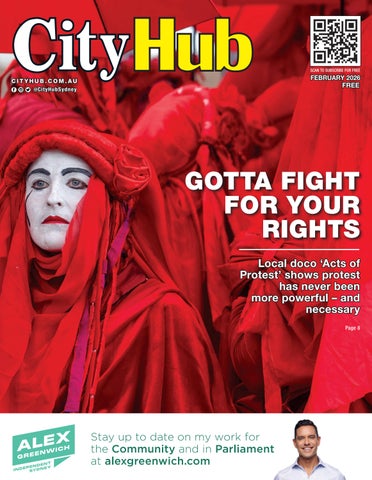
Local doco ‘Acts of Protest’ shows protest has never been more powerful – and necessary
SYDNEY FISH MARKET
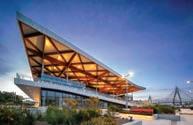
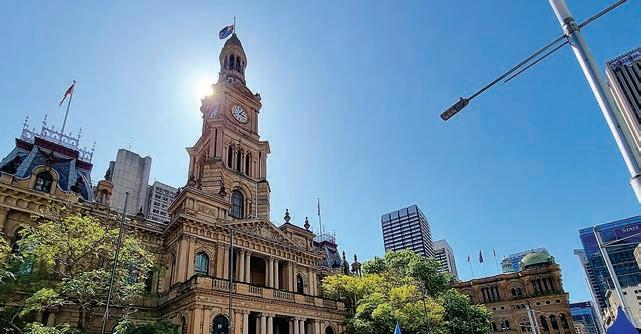
Sydney's newest landmark finally opens its doors
(See p.6)
HUBARTS: GARABARI
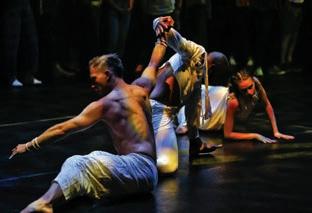
This powerful, pulsing corroboree compels you to move
(See p.12)
Published monthly and freely available throughout the Inner City.
Copies are also distributed to serviced apartments, hotels, convenience stores and newsagents throughout the city.
Distribution enquiries call 9212 5677.
Published by Altmedia Pty Ltd. While every effort is made to ensure accuracy of content, we take no responsibility for inadvertent errors or omissions.
ABN 52 600 903 348
Group Editor & Publisher: Lawrence Gibbons
Publisher’s Assistant: Mal Moody
National Sales Director: Greg Topalian Ph: 0455 120 404
Advertising Manager: Mal Moody Ph: 0484 042 615
Advertising: sales@altmedia.net.au
Managing Editor: Chloe Sargeant
News Contributors: Chloe Sargeant, Lydia Jupp, Naomi Lawrence
Arts Contributors: Angus Sharpe, Josh Kerwick, Lydia Jupp, Naomi Lawrence
If you have a story, or any comments you’d like to share with us: news@altmedia.net.au
@CityHubSydney
HubNEWS
Under new rules, Sydneysiders will no longer be able to speak at Council Meetings
BY CHLOE SARGEANT
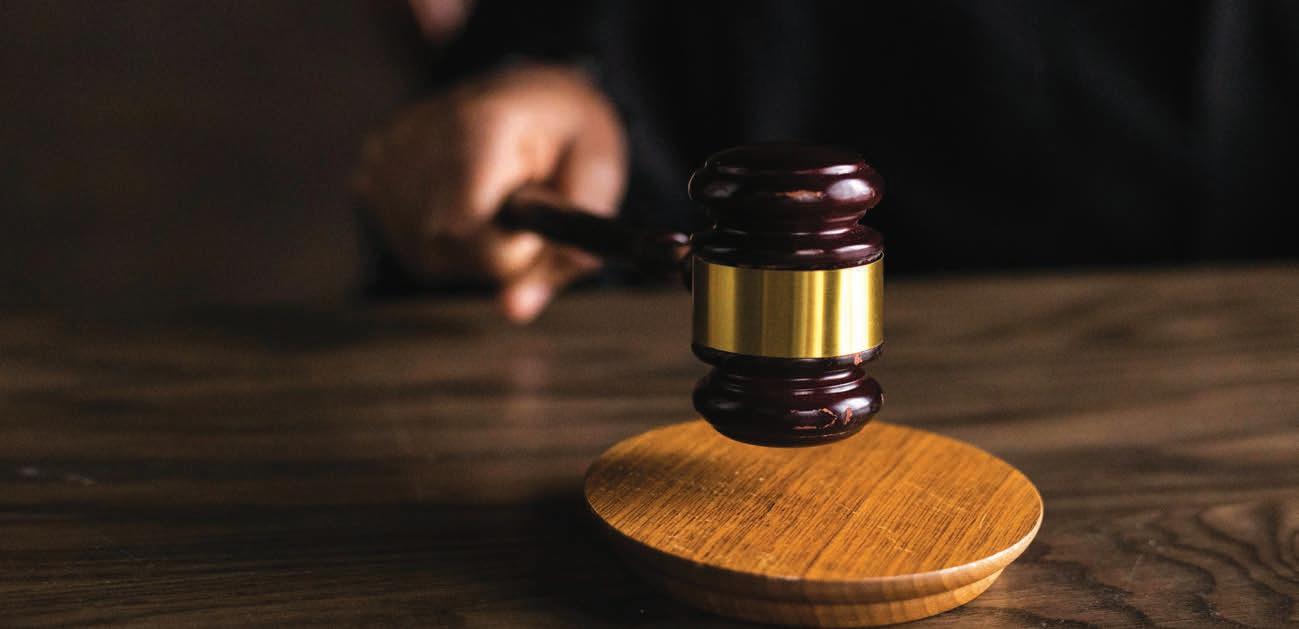
New South Wales residents will face a new way of engaging with local democracy this year, with councils required to separate public submissions from the formal council meeting process. Under the updated Model Code of Meeting Practice, people living in all 128 council areas of NSW will no longer be able to address councillors during the council meetings themselves. Residents will instead need to present their views at dedicated public forums held in advance, typically a week before items are debated and put to a vote.
The Minns government says the reforms are about making meetings more orderly and efficient. Public forums for community input will still be possible, but the spontaneous remarks that have long been a feature of council chambers — where residents could rise to speak on the night — will be removed from the meeting floor. Councils will also adopt new rules banning protest signs in chambers, tightening rules around councillors attending by audiovisual link, and preventing private briefings between councillors and staff on matters listed for decision.
Local Government Minister Ron Hoenig has argued the changes will help councillors focus on decision-making without meetings being disrupted.
DEMOCRACY MORE THAN A BOX-TICK
But the overhaul has drawn criticism from across the political spectrum and from community advocates who say it could weaken how local voices are heard in the places where they matter most.
Greens spokesperson for
Local Government, Dr Amanda Cohn, described the shift in State Parliament as one that risks diminishing residents’ connection to the people elected to represent them. During debates in the Legislative Council, she emphasised that democratic engagement must be more than a procedural box-tick, but something that allows communities real moments to be heard.
We should be supporting mechanisms that enable our communities to participate meaningfully in local government decision-making
“We should be supporting mechanisms that enable our communities to participate meaningfully in local government decision-making,” Dr Cohn told MPs, stressing reforms should enhance, not restrict, democratic engagement at the grassroots level.
Dr Cohn moved a disallowance motion against the updated code, arguing the changes would effectively separate community voices from councillors at the very moment votes are cast — the point
at which local people most need to see their representatives respond in real time.
Under the new framework, councils must officially adopt the updated code by the end of this year, and many are already setting up public forums in the week ahead of formal meetings to capture community input. But opponents of the reforms warn that, without the chance to speak directly on the night, the immediacy and nuance of local opinion could be lost, especially on contentious issues like development proposals or rate increases.
Supporters of the changes maintain that separating public comment from the formal decisionmaking process will prevent meetings from being derailed by disorder and allow councillors to deliberate more calmly and constructively. But for residents who wanted to make their voices heard directly to the council, the shift represents a dramatically negative cultural change in how local government listens.
Community groups and some local councillors have signalled they will closely watch how the new rules play out once in force, mindful that transparency and responsiveness will remain critical as councils make decisions that shape everyday life in suburbs and towns across NSW.
Photo: Wikimedia Commons
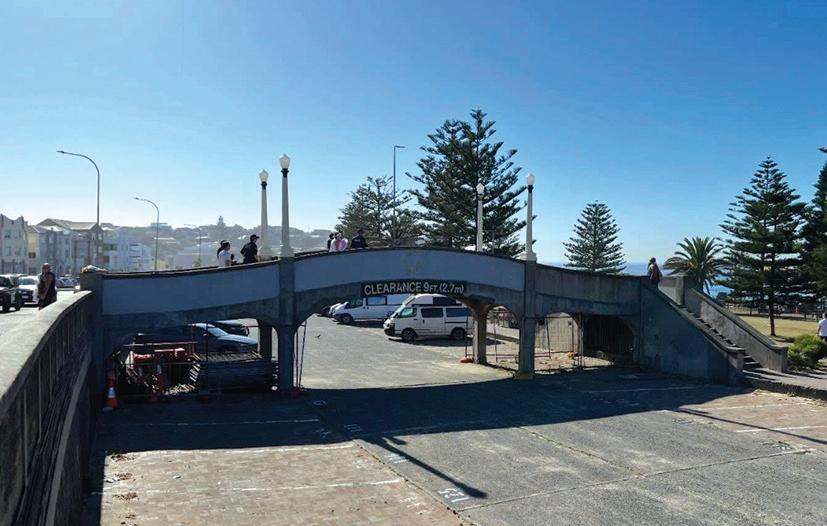
Waverley Council debates future of bridge at centre of terror attack
BY LYDIA JUPP
The future of a bridge that was at the centre of the Bondi mass shooting has been put on hold after councillors urged against rash decisions.
The heritage-listed bridge was used as a vantage point by the alleged Bondi gunmen during the December 14 terror attack that left 15 dead and dozens injured.
Waverley Council held an extraordinary two-and-a-half hour long meeting on January 15 to decide the future of the bridge after it sparked public debate earlier this week, with NSW Premier Chris Minns labelling it a "ghoulish reminder" of one of the state's darkest days.
Waverley Mayor Will Nemesh acknowledged the range of views held by the community, but
emphasised that the decision was not one to be rushed, referencing a 2024 council report that recommended the bridge, along with another over Park Drive, had "reached the end of their useful lives" and would require replacement within several years.
The replacement of the bridge may form part of a future memorial
“The replacement of the bridge may form part of a future memorial,” he said.
“[But] any decision made on the future of one or both bridges will be made in an appropriate time and manner following consultation with the NSW government, Jewish community, Waverley
community and the families of victims and survivors.
“We’re not making a decision on the future of one, both or either of the pedestrian bridges tonight.”
"MUCH WORK TO BE DONE", SAYS MAYOR
A motion was unanimously passed for council staff to
prepare a report determining the “cost, timetable and approvals process for a replacement and/or restoration of both heritage-listed pedestrian bridges”.
“There is much work to be done and many voices to be rightly heard, and we will keep the community updated each step of the way,” said Nemesh.
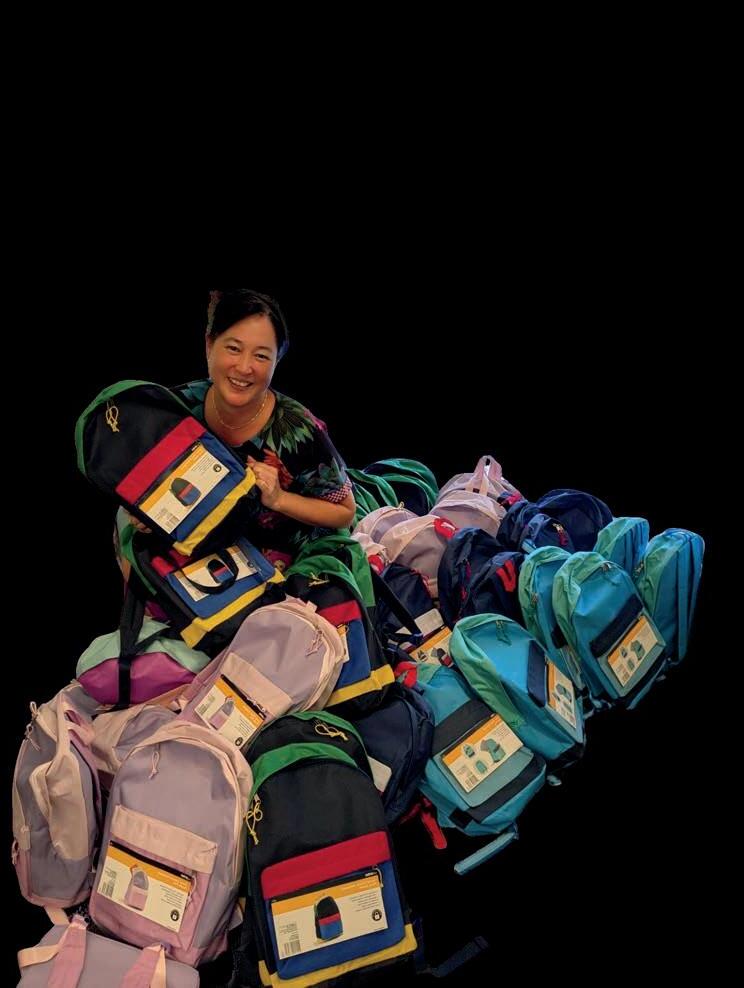
BACK TO SCHOOL PACKS AVAILABLE FOR LOCAL FAMILIES
Public education should be fully funded.
It seems like a no-brainer, but our Federal and State Labor Governments don’t seem to think so - instead choosing to provide massive handouts to elite private schools at the expense of adequately funding public schools across NSW.
This means that public schools end up passing along the hidden costs of education to families who are already facing a worsening cost-of-living crisis.
That’s why the Australian Greens have called on the Government to adopt their plan to fully fund public schools.
But until then, we know that at this time of year, families are starting to make difficult decisions about how to pay for things like essential school supplies and ‘voluntary’ contributions.
That’s why we’re offering schoolaged children in our electorate a free back to school pack to ease some of the pressure households are facing.
Each pack contains a backpack, pens, highlighters, ruler, pencils, notebook, pencil case, eraser, and sharpener.
Packs are available for collection from our Electorate Office located at 383 King St, Newtown - just get in touch using the details below to make sure we still have some available for you.
Leong MP Greens Member for Newtown
Jenny
Photo: Anna Coren / Instagram
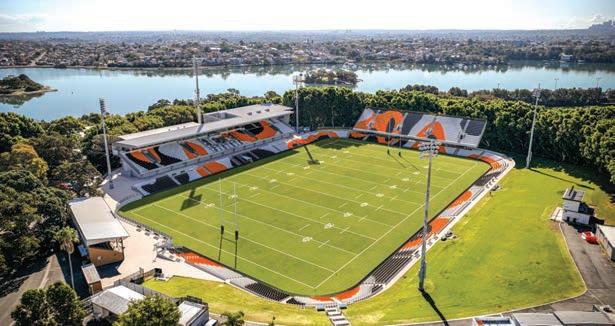
New Leichhardt Oval designs revealed with construction planned for this year
BY LYDIA JUPP
Community members are being encouraged to have their say on the designs for Sydney's iconic Leichhardt Oval ahead of major upgrades that have been in the works for years.
The upgrades are set to transform the beloved oval into a modern hub for community events and sport, allowing for the continuation of its almost century-long history as a rugby league ground, and serving the community as the much-loved home of the West Tigers.
Leichhardt Oval is not just about sport, it's about the identity of the Inner West
Planned improvements include the renovation of the historic western grandstand with new stadium seating, a replacement of the lower seating bowl with a new northern grandstand, and four NRL-compliant female-friendly change rooms.
The upgrade will also include the Inner West Museum of Rugby League, celebrating the legacy of local foundational
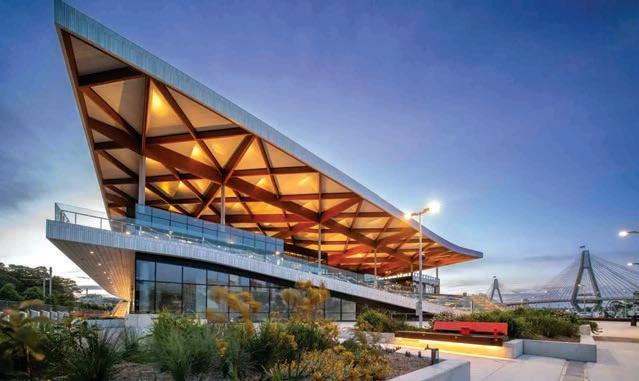
New Sydney Fish Market finally opens its doors
BY LYDIA JUPP / NAOMI LAWRENCE
Almost a decade after it was first announced by the then-Liberal government, the new Sydney Fish Market opened its doors on 19 January, 2026.
The $836 million dollar project has faced a bumpy road, but is being heralded by the Minns government as Sydney’s third major landmark alongside the Opera House and Sydney Harbour Bridge.
The market is expected to help bring in more than six million visitors a year.
FISH MARKET’S MANY HURDLES
The market far surpassed its original budget, requiring an extra $500 million from the state government — to much criticism.
The opening also hasn't been without its issues, with the $30 million pontoon wharf not expected to be completed until 2027, leaving just 400 car parking spaces for visitors.
clubs like Balmain, Newtown, and Glebe. A renovated caretaker’s cottage will house immersive exhibits, with a virtual museum component to broaden access.
Construction is expected to begin after the 2026 winter sports season, with completion targeted for 2028.
RENOVATIONS IN THE WORKS FOR YEARS
Prime Minister Anthony Albanese, a notable Inner West local, said the renovations would allow families to enjoy the hallowed grounds for generations to come.
“Leichhardt Oval is not just about sport, it's about the identity of the Inner West," he said.
“It is a place where the faithful can go along and cheer their local sporting team, and this upgrade from all three levels of government will ensure that spirit is preserved."
The multimillion dollar upgrade is being jointly funded with $20 million from the Federal Government, $10 million from the NSW Government and $10 million from Inner West Council.
The community exhibition is open from Friday, 16 January 2026 until Thursday, 12 February 2026, with submissions to be made through the NSW Planning Portal.
“Today Sydney opens the doors to what is undoubtedly the best fish market in the world … showcasing world-class Australian seafood that gives locals and visitors another mustsee destination in our city,” said Premier Chris Minns.
the doors to what is undoubtedly the best fish market in the world
The new fish market has double its predecessor’s retail space, with 40 operators nestled under the 200-metre-wide canopy roof. All of the tenants from the old markets have found a new home there.
Transport for NSW has added extra evening and weekend services on the L1 light rail, with the nearby Wentworth Park light rail stop undergoing a $40 million upgrade to prevent chaos in the meantime.
The site of the old fish market has been slated for redevelopment, with more than 1,500 new homes expected to be built. 7.5 percent will be kept "in perpetuity" for affordable housing, but the harbourside view will undoubtedly drive up prices.
Residents have long been speaking out against the proposed Blackwattle Bay development, with local group Friends of Ultimo leading the charge. They say the biggest concerns are overdevelopment, lack of affordable housing, and the absence of public infrastructure in the area.
Today Sydney opens
Photo: Supplied
Photo: Supplied
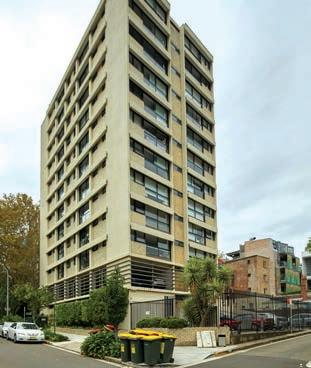
Potts Point units to be demolished for luxury apartment block
BY LYDIA JUPP
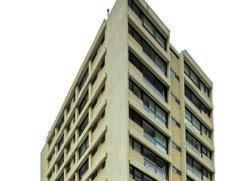
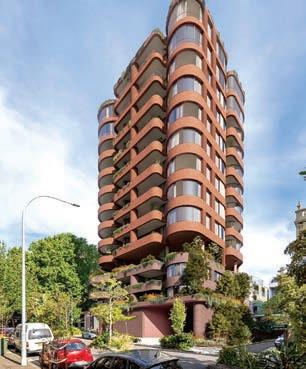
The NSW government has approved a $91 million development application allowing the demolition of a beloved Potts Point unit block, to be replaced with luxury apartments.
The 80-year-old Chimes building on Macleay Street, comprising 80 studio or onebedroom units, will be replaced with a new building of about 34 apartments, following years of backlash from the City of Sydney and community members.
At least 15 percent of the block would be priced lower than market rent for at least 15 years, as per the NSW government’s affordable housing scheme.
Almost 200 negative community submissions raised concerns
about the loss of lower-income housing, the displacement of residents, and the intention to demolish rather than adapt the building.
They chase extra height, carve out views, and sell penthouses for $30–40 million, while the community loses its diversity
Sydney MP Alex Greenwich called the plan “the most perverse use of the affordable housing policy imaginable,” arguing it would slash 80 ‘affordable’ rentals to fewer than 10.
He said the scheme was “essentially evicting essential workers to make way for millionaires” when Sydney needed more affordable homes.
Has a stray kitty stolen your heart?
The Cat Protection Society of NSW can help you with affordable options to get them healthy & safe, and to become a part of your family.
Don’t delay, call the Cat Protection Society today on 9519 7201 or visit catprotection.org.au
‘NO IDENTIFIED HERITAGE SIGNIFICANCE’
The Department of Planning, Housing and Infrastructure ruled the project was in the public interest when it approved an amended application last month.
It also found James Packerbacked company Time and Place had demonstrated why it couldn’t adapt the existing block.
“It would be unreasonable to expect the retention of the existing building which requires substantial upgrade to comply with code and amenity requirements and has no
identified heritage significance,” an assessment report said.
In June, the City of Sydney introduced rules limiting “net dwelling loss” to 15 percent, but as the rules are not retrospective, they won’t apply to the Chimes.
Potts Point Preservation Group chairman Peter Sheridan said that erasing 80 modest units for fewer luxury apartments “makes no sense at all.”
“They chase extra height, carve out views, and sell penthouses for $30 or $40 million, while the community loses its diversity,” he said.
Cat Of The Month
Name: MEOWTH | Age: 2 years (est) Sex & Colour: Female Tortie Point DMH
Meowth cometh for cuddles! This fluffy bundle of joy is a supreme smooch who is looking forward to sharing countless snuggles on the couch with you! Meowth may not be able to see but she sure can sing. She’ll happily serenade you, sharing her feelings throughout the day with a chorus of chirps and plenty of purrs. While she’s settling in and finding her way around her new home, Meowth may need a little extra encouragement and would benefit from a consistent routine. For her safety an indoor-only forever home is a must. This delightful feline thrives on human love and attention and wants to be the centre of everything, so no young children or other pets please, Meowth would much prefer to have you all to herself.
INTERESTED IN ADOPTING? visit www.catprotection.org.au
Rehoming Organisation Number:
‘ACTS OF PROTEST’ SHOWS THE HEROISM OF COLLECTIVE ACTION AND PROTEST IN OUR CITY
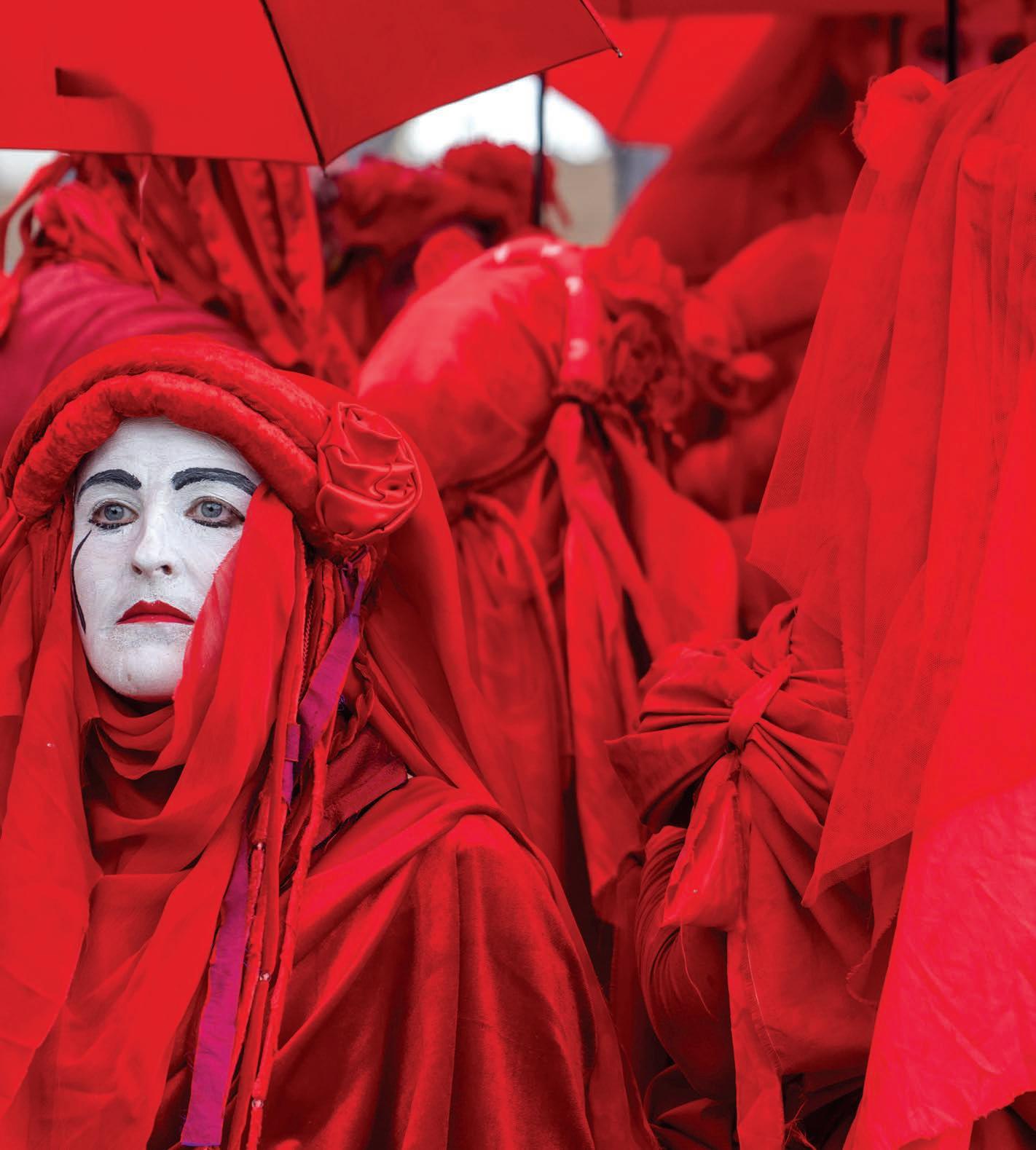
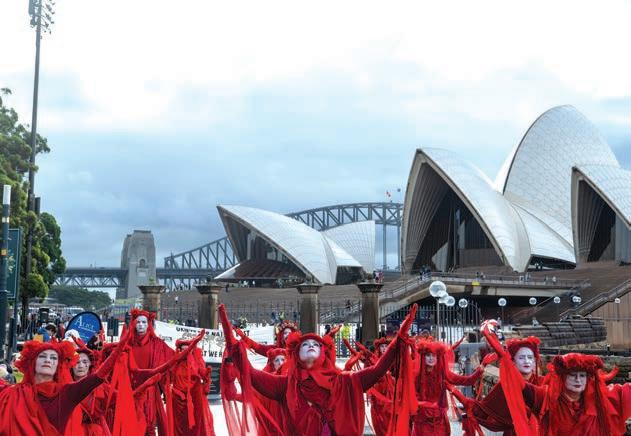
An elderly woman draped entirely in red with a painted white face streaked with black tears outside the Opera House; people scrambling up a freight train carriage loaded with coal; contemporary dancers continuing to move to imaginary music as they’re dragged away by police.
BY LYDIA JUPP
These are some of the scenes in Zebedee Parkes’ 7-minute documentary Acts of Protest, the culmination of his masters degree, which will be aired at this year’s Antenna Documentary Festival.
Acts of Protest takes its audience through years of civil disobedience across the country, and Parkes – a filmmaker and photojournalist – has become a common sight at protests around Sydney over the last few years, documenting moments of hope, grief and justice as communities across the state speak out.
Acts of Protest lets Parkes’ work speak for itself — there’s no narrative through line or central character to follow, but you’re nonetheless engrossed as you watch everyday civilians put their bodies on the line, trusting not only in the people around them to keep them safe, but in the validity of the cause.
represent all the other people that are involved and part of campaigns that often will eventually make change happen.”
“I've always felt very passionate about the need to be representing the collectivism of activism a lot more, “ Parkes said. “Too many activist narratives reflect just one hero as an individual, and they don't
Parkes invests fully into this break from traditional storytelling arcs, forgoing any narration or voice over providing context to the protests, relying on the audiences’ sense of compassion, justice, and the knowledge they already have of the causes.
“When we were trying to find the structure for the film, we actually found that to be more powerful, an invitation for people to actually think of what the film's
saying and think of their own relationship to it, rather than just having a film that's telling people what to think,” Parkes says.
Too
many activist narratives
reflect just one hero as an individual, and they don't represent all the other people that are involved
In this way, Parkes invites the audience members to centre themselves in the story instead, to realise that these strangers marching through the street are not simply nameless public nuisances, but our colleagues, neighbours, the people we grew
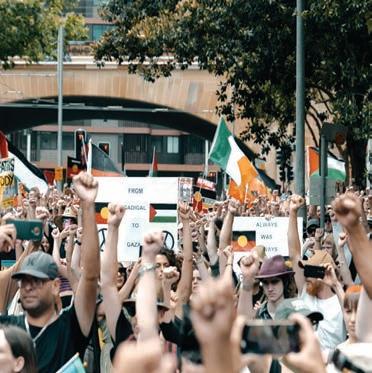
up alongside, standing up for a cause they believe in. The viewer may have already been part of a protest themselves. 300,000+ people marched across the Harbour Bridge for Palestine and many Sydneysiders were arrested in Rising Tide People’s Blockade blocking coal ships last year, Extinction Rebellion protests (which the doco heavily features) are becoming a common sight, and Invasion Day protests to mark January 26 are becoming more mainstream.. It comes at a time in which the New South Wales government has been steadily criminalising protesters. In the last year, legislation has been passed outlawing protest near a place of worship, restricting formal authorisation of protests for a period of time following a terrorist attack, and massively expanded police powers.
“In recent years, I've definitely seen an escalation in terms of the policing of protests in terms of being more aggressive to protesters,” Parkes said.
“I've seen other Premiers find protests kind of annoying, and support various anti-protest laws, but Chris Minns seems to have a particular personal agenda of cracking down on protest.”
If anything, these laws have helped people to realise how important their voice is, and the ways it can be strengthened with the help of others.
Now, more than ever, the power of collective action is being felt.
Photos: Zebedee Parkes
THE MOTION OF LAWS COFFIN ED’S NAKED CITY
Following the horrific mass shooting at Bondi, the NSW Government has now introduced a set of new terrorism-related laws. These include restrictions on the authorisations of protests across a specified area for up to three months, following the declaration of a terrorist incident. This gives the police a continued power to outlaw public assemblies in Sydney.
The extent of any connection between the motivation of the two gunmen at Bondi Beach and the various anti-war protest marches in Sydney remains to be established – and no doubt that’s something the Royal Commission will examine.
In the meantime, some view this aspect of the new legislation as a harsh restriction on freedom of speech, and the rights of citizens to assemble to express their legitimate concerns.
Whilst there’s a basic set of long-established rules that we must abide by in society, governments of all descriptions are continually modifying and often abolishing legislation altogether.
If you look back through the decades in Sydney, some of the older enforcements now seem totally ridiculous.
Right up until 1961, often burly beach inspectors had the right to measure the swimsuits of female bathers, to ensure they met an arbitrary standard of at least three inches long in the leg.
In 1976, nude bathing was first permitted at Lady Bay Beach, and then in 1996, the state government introduced broader legislation opening the way for beaches like Obelisk and Cobblers to become legally swimsuit-optional.
In some cases, ludicrously outdated laws have remained on the statute books for years after their relevance has long expired. So-called ‘public scolding’ was once an offence in NSW, and the specific crime of a ‘common scold’ was not officially abolished until 1995. So prior to that, you could technically be charged for abusing your neighbour for allowing their dog to enter your property.
These days, same-sex marriage is very much taken for granted — but homosexuality,
involving sex between two men, was once a criminal offence punishable by death in Victoria right up until 1949, and not decriminalised in all Australian states until 1997.
Singapore has long been a popular holiday destination for many Australians, and is highly regarded for its cleanliness and public safety. However, it also dishes out draconian and cruel punishments for misdemeanours, that at their worst would attract only a moderate fine in Australia.
We’ve probably all heard about their ban on chewing gum, with the import and manufacture attracting sizable fines and even jail sentences. If you do manage to smuggle a few packets of Juicy Fruit into the island nation, you’ll be pleased to know personal possession is not strictly policed. Spit it out in the street though, and you are in big trouble!
And speaking of restaurants, ‘table littering’ has now been added to the country’s long list of public offences. In the interests of hygiene and ‘social responsibility’, you are expected to return your used
Photo: Pexels
trays and crockery after eating at restaurants and food courts. There’s a first-time warning, but repeat offenders face fines and court appearances.
We can scoff at what, to us, seem like very minor aberrations. But when it comes to serious crimes, Singapore – population just over six million – executed 17 individuals in 2025, and imprisoned many more. In comparison, the USA – with a population around 342 million –executed some 47, the highest number in 16 years.
And even for more minor offences, the barbaric practice of caning remains in Singapore — up to 24 rattan cane strokes across the buttocks for crimes such as graffiti, operating a scam, and overstaying visas by more than 90 days.
Compared to countries such as Singapore, North Korea and even the USA, where ICE agents can gun down an innocent civilian, Australia doesn’t seem too bad. Nevertheless, let’s do our best to uphold our freedom of speech, right to protest, and our basic human rights – and chew gum whilst doing so!
HubARTS
GARABARI: A POWERFUL, PULSING RITUAL THAT COMPELS YOU TO MOVE
BY NAOMI LAWRENCE
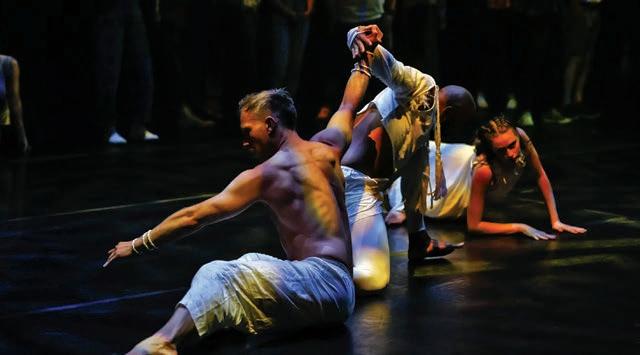
Garabari, the latest work from award-winning choreographer Joel Bray and BlakDance, refuses to be a passive experience. It hums through your body, imploring you to move with it. Performed by a troupe of six or seven powerful dancers swathed in white by designer Denni Francisco, this contemporary corroboree blends animalistic grace, First Nations tradition, and modern dance.
The resulting fusion is fluid, instinctive, and utterly compelling.
The piece begins as clacks, growls, bird calls, and hoots ripple through Sydney Opera House's outdoor space. Performers shift from fluid sculptures into a single gathering, bodies writhing low
to the ground, before snapping into jagged shapes, and weaving between audience members and across three stages with playful intent.
Created from over a decade of retracing Wagga Wagga and the Riverina, Bray sets out to carry forward his Wiradjuri ancestors through a corroboree that endures and transcends.
From this journey, the Story of the Making of the Murrumbidgee – gifted by the late Uncle James Ingram of the matriarchal Goanna clan – became the piece's core.
Past the more formal but nonetheless impressive first half, the line between performer and observer dissolves: you're already part of Garabari
28 YEARS LATER: THE BONE TEMPLE
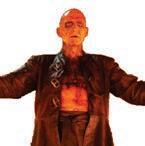
DaCosta absolutely goes for it in part two of the new zombie trilogy (See p.14)
Techno-infused rhythms by Byron Scullin pulse through the space, shifting ceremony into a club-like dancefloor just as audience participation becomes central. The atmosphere exhales bated breath as the Dreaming story unfolds and lightning flashes punctuate projections.
Vivid lighting and striking projections by Katie Sfetkidis guide wandering eyes effectively, from serene warmth to electrifying flashes, while the score rises from deep, thrumming rhythms to a driving, industrial surge reminiscent of a Nine Inch Nails score.
Everything resolves in a seated hum beneath dimming lights and the night sky. The recurring Giilang song of Marramalngidyal Marrambidyagu grounds the performance, providing a visceral reminder of the story at the heart of the corroboree.
Garabari is a primal, explosive, and singular celebration. It's ambitious, with small technical costs for a performance that feels deeply alive. The dancers’ passion, presence, and collective energy make it a moving, musical marvel—one that asks as much of its audience as it gives.
PUTTING IT TOGETHER: A PITCH-PERFECT WAY TO ‘REVUE’ THE MUSIC OF SONDHEIM
BY JOSH KERWICK
Putting It Together follows a pleasingly simple formula for success: take a pentuplet of extraordinarily talented performers, give them material by one of the greatest musical theatre composers to ever do it, and reap the benefits.
This is a relentlessly smileinducing way to experience the
greatest hits of a musical theatre giant.
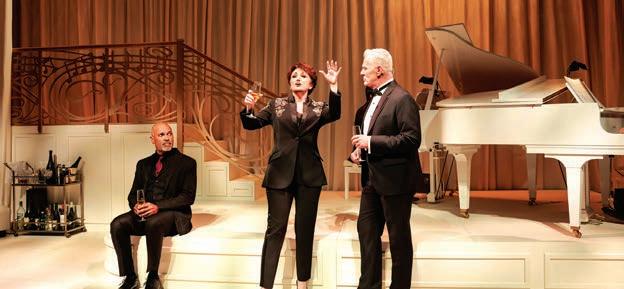
Set at a cocktail party with two couples – one older, one younger – and a noticeably non-silent witness, there is a story in Putting It Together; but as the delightfully observant Bert LaBonté points out in the opening Invocation and Instructions from The Frogs, there’s not an awful lot of plot to
behold. Rather, the show is far more focused on capturing the emotional truths of each songand if they flow into each other well, all the better for it.
And capture those truths it does: it can’t possibly be understated how absurdly talented the cast and accompanying musicians are.
As they step onto the stage, designed as an estimation of a high-end but somewhat dull New York apartment, their skill is immediately apparent from the very first moment.
Under the musical direction of Kevin Wang, who leads a small ensemble of three fantastic musicians, the cast leads a celebration of some of Sondheim’s best work and musical theatre in general.
Once Putting It Together gets in motion, it’s home to some of the most sensationally performed musical theatre pieces I’ve heard in recent memory. Each cast member has their own chance to shine – Michael Cormick’s sorrowful solos, Nigel Huckle’s ballads of deep yearning and Bert LaBonté’s consistently cheeky pieces – but it’s fair to say that the show’s women totally steal it.
In all, it means that this show is a terrific honouring of Stephen Sondheim’s work and a delightful show that manages to stand on its own two feet. A meaningful, supremely fun exploration of musical theatre history, it’s remarkably simple to get on board with the sheer joy on display in Putting It Together.
Photo: Foundry Theatre
Photo: Sydney Opera House
NSW GOVERNMENT CANCELS SXSW SYDNEY AFTER LANDMARK INVESTMENT
BY LYDIA JUPP
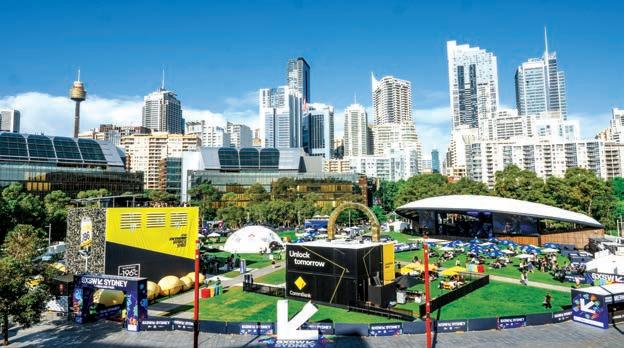
South by Southwest (SXSW) Sydney has been quietly cancelled by the NSW Government only three years after the pair entered a landmark investment deal.
In a statement emailed to past attendees organisers announced the end of the festival, citing “changing global environment that is impacting major events, festivals and cultural programs worldwide”.
"It’s bittersweet to be saying goodbye while the momentum is so high," it continued. "We’re still celebrating the success of this past year – one that saw total attendance of more than 345,000 (representing a 15% year-on-year increase), and cemented a threeyear cumulative economic impact of $276 million."
sectors; however the decision has been made to not proceed with the event in 2026 and 2027,” the statement read.
“The event has delivered cultural, economic and industry outcomes for the city over the past three years. Following a review, it was agreed not to proceed with the event in 2026 and 2027.”
SXSW also received funding from the City of Sydney, worth $300,000 in cash across the three events, plus $369,533 in value-in-kind, a third of which covered the venue fee waiver for the 2025 event. A further $100,000 had been budgeted per year for SXSW between 2026 and 2027, plus $424,000 in non-monetary support.
“SXSW Sydney was an unforgettable three-year journey, and we owe a debt of gratitude
Destination NSW confirmed it “agreed not to proceed” with the event following a review.
The government signed a $12 million deal with the festival in 2022 agreeing to host five events between 2023 and 2027, allegedly invoking their break-fee clause to leave the contract early.
“SXSW Sydney has played an important role in showcasing Sydney’s creative and innovation
to the people who joined us for it,” said co-managing directors Simon Cahill and Jono Whyman in a joint statement.
“We are especially grateful to the SXSW Sydney team for their dedication and hard work in bringing this event to life and establishing a platform that showcased Australia and the Asia-Pacific as pioneers in global culture.”
BY ANGUS SHARPE
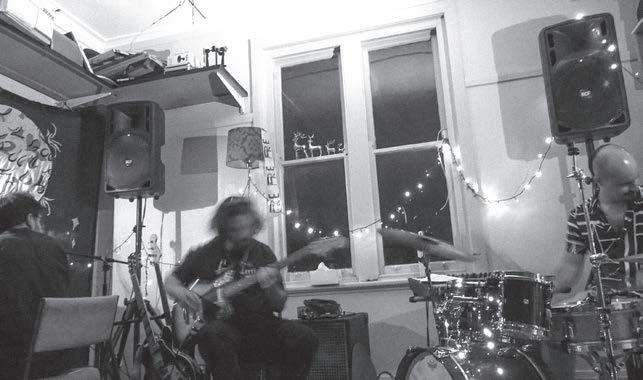
Experimental musicians need grassroots venues to experiment and perform in. Within an increasingly hostile rental environment, this is becoming an ever more difficult task. Fortunately, though, there are heroic individuals who –scattered throughout the city – work hard to sustain such vital spaces.
Located no more than onehundred metres from Rockdale train station, the entrance to Stadium Rockdale was easily lost within the smattering of convenience stores, bakeries and massage parlours. Though once I located the narrow door and navigated the steep staircase, the trouble of finding the venue was instantly forgotten.
Once the twenty-or-so audience members (almost the full capacity of the tiny room) had found their various positions, with little fanfare the night’s first act — saxophonist Hinano Fujisaki and doublebassist Dominic Nguyen – rose from the audience, picked their instruments from the carpet and simply, began. The duo –who had never played together before today – delivered thirty minutes of drifting experimentation. Fujisaki spun
an almost constant mournful tone from her instrument –remaining predominantly soft, low and on the edge of silence. Meanwhile, atop Fujisaki’s bed, Nguyen exercised his fingers over the neck of his bass.
Following Fujisaki and Nguyen, Jetrio – a trio of Sean Valenzuela (piano), Blain Cunneen (guitar) and Alex Inman-Hislop (synth/drums) –arrived before the audience. Like the previous act, this trio’s music worked with stark contrasts of slow repetition and fast explosions of sound. Yet much else of the act sat worlds apart from the gentle performance of the openers.
In such a small space, the combined music filled the room completely. It was a sound that – as I noticed the bowed heads and closed eyes around me –was impossible not to feel. Finally, after almost an hour, when the trio concluded, there was no dramatic bow, nor a grand exit. The three musicians merely thanked us for coming, rose from their places on stage and rejoined their friends in the audience.
The modesty and informality of the evening was beautiful. And the necessity of spaces like this – to platform and inspire artists of tonight’s calibre – was lucidly paramount.
Photo: SWSW / PaulMcMillan
Photo: Angus Sharpe
28 YEARS LATER: THE BONE TEMPLE
BY JOSH KERWICK
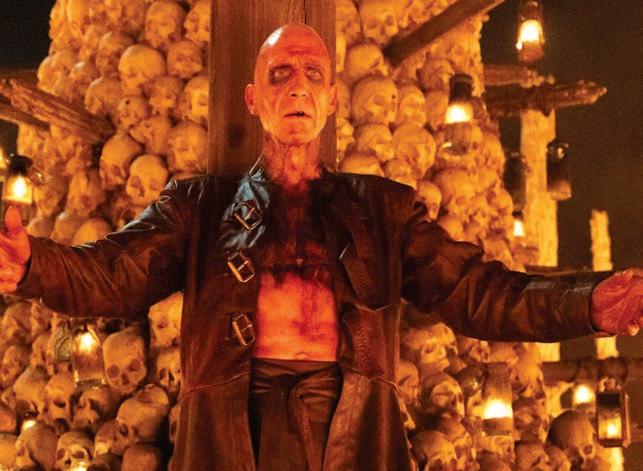
Where the first installment in Danny Boyle and Alex Garland’s new 28 Years Later trilogy felt afraid to commit to its big ideas, Nia DaCosta decides to absolutely go for it in The Bone Temple, and succeeds.
Spike (Alfie Williams) has been forcibly adopted by the ‘Jimmys’, a cult headed by the insane Sir Lord Jimmy Crystal (Jack O’Connell), and Dr. Ian Kelson (Ralph Fiennes) continues to build the ultimate memento mori while forming a strange relationship with Samson (Chi Lewis-Parry), an alpha infected. That is, at least, until the Jimmys come knocking.
Compared to 28 Years Later, The Bone Temple is substantially richer in themes, character and
REVIEW
BY JOSH KERWICK
Although there are scantly few historical documents that suggest a direct link between the death of his son and his seminal work Hamlet, the imagined grief of William Shakespeare and his wife Agnes takes centre stage in Chloé Zhao’s Hamnet.
A piece of speculative historical fiction that’s based on Maggie O’Farrell’s novel of the same name, Hamnet is hardly a historical lesson; instead, it’s an investigation into the nature of grief and how it dictates the artistic process through the eyes of Shakespeare’s wife Agnes (or Anne) Hathaway, portrayed by a brilliant Jessie Buckley. After a speedy courtship and a pre-consummation of their vows, the young couple Agnes (Buckley) and William (Paul Mescal) are wedded. As his career takes off, William is spending more
craft. DaCosta and Garland find a substantially better balance that I think, despite abandoning the grimy, low-budget aesthetic, makes this film the first true successor to the original 28 Days Later
DaCosta achieves this by eschewing constant undead action – still fantastically gruesome when it happens – in favour of human drama, asking questions about the depths of our depravity.
These two characters and the immensely talented performers who portray them are key. Jack O’Connell continues his horror villain hot streak as Crystal, who believes himself the son of Satan while styling himself after Jimmy Savile.
Besides the terrified Spike, his
cronies are looking for answers in the cruel world rocked by the rage virus. Jimmy takes advantage, knowing he can lie or contradict himself because the illusion matters most. The parallels to Savile make the message clear: this is what happens when evil and twisted men are given unchecked power. Alternatively, Dr. Kelson feels like one of the last bastions of goodness in this world. He’s not completely there – he is creating a temple out of human remains, after all – but shows a willingness
HAMNET
and more time in London away from the regional family home, leaving Agnes to care for their three children by herself. But this is the 16th century where plague abounds, and a tragedy will soon tear its way through this family: the
best parts of Hamnet lie in how it navigates the various responses to this unfathomable loss.
Anyone who’s been paying attention to her career won’t be surprised to see Buckley turn in another sensational performance,
to connect with his fellow people.
Ralph Fiennes effortlessly captures the totality of emotion that a human being holds, making it particularly interesting when the two plots collide.
The Bone Temple is a wickedly fun, self-assured movie that’s also an exceptionally rich examination of the human psyche in times of crisis. If you’ve ever found yourself bored with modern horror films, this is the cure.
28 Years Later: The Bone Temple is in cinemas now.
but it’s still one of her best and most emotionally poignant roles to date that serves as an intricate portrait of grief. She embodies the heaving physicality of grief in an impressive, deeply upsetting way.
These performances work in tandem with a tight script that explores the nature of grief and the inherently preservative effects of art. It culminates in an ending that’s easy to predict – especially given the film’s subject matter and name – but that still hits like a freight train thanks to how wonderfully executed it is. When a film has performances this good that drive the storytelling forward, it’s difficult not to feel something — and believe me when I say Hamnet will make you feel a lot more than just ‘something’.
Hamnet is in cinemas now.
Photo:
Photo: TMDB
TANYA PLIBERSEK
FEDERAL MEMBER FOR SYDNEY
Free mental health care
Australians can now receive free mental health care when they need it. The Albanese Government has launched Medicare Mental Health Check In.
The service provides self-help tools and Low-Intensity Cognitive Behavioural Therapy (CBT) delivered by trained professionals, via phone or video.
It’s available to anyone aged over 16 without the need for a referral from a GP.
The service was designed in consultation with people with lived experience and more than 90 organisations working in mental health.
Cheaper medication
The Albanese Labor Government has slashed the cost of medications listed on the Pharmaceutical Benefits Scheme so that you will pay no more than $25 a script. Concession card holders will pay no more than $7.70 per script.
We believe you should be able to get the medicine you need without worrying about the cost.
Affordable gas
The Albanese Labor Government is setting up a domestic gas reservation scheme to deliver more affordable gas for households and businesses.
Detailed design will be developed in consultation with industry, international partners and communities, with a preference for a system where exporters need to meet domestic supply obligations before exports are approved.
Cheaper home batteries
The Albanese Labor Government is helping more households, small businesses and community groups bring down their energy bills. We’re expanding and securing the sustainability of our Cheaper Home Batteries program, delivering $7.2 billion over four years. This increase, from the initial $2.3 billion, is expected to help more than 2 million Australians to install a battery by 2030.
Stored rooftop solar via batteries is good for the grid and good for consumers. It helps smooth out evening demand and reduce peak pricing.
Rooftop solar is a Labor legacy and now we’re adding batteries to this achievement.
From 1 May 2026, rebates for batteries will be staggered in line with battery size to ensure our program is sustainable and so that households get the right sized battery for their needs.
Future-ready workforce
The Albanese Government is taking action to help small business operators and workers seize the opportunities that AI brings.
The National AI Centre (NAIC), in partnership with TAFE NSW’s Institute of Applied Technology - Digital (IATD), is offering one million fully subsidised scholarships for an online microskill course.
The program integrates responsible AI principles into practical, modular learning to equip Australians with the skills to apply AI ethically and effectively in real-world settings
For more details visit the QR codes below.
Cost of living help
The Albanese Labor Government is committed to easing cost-ofliving pressures for all Australians, which is why we’re cutting income taxes for every taxpayer, cutting student debt, and delivering free TAFE and cheaper medicine.
On 1 January 2026 social security payments including Youth Allowance, Austudy, ABSTUDY, Youth Disability Support Pension and Carer Allowance were indexed. Recipients will see more money in their bank account each fortnight.
The complete list of payment rates can found here.