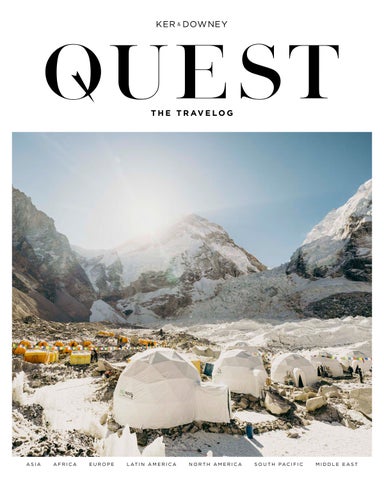
2026 Spring Quest Magazine

Page 1


THE TRAVELOG

WHY KER & DOWNEY WORLD TRAVEL

T he heart of the matter when traveling with Ker & Downey World Travel is more than luxury and style: It’s all about those little ineffable moments, beholding the beauty of the world, the way you always imagined it to be. These experiential interludes—a breath of fresh mountain air, the rush of adrenaline, the peace of a calm beach, the taste of a new cuisine—whatever it may be for you, you’ll know it when you encounter it. And it comes standard on every Ker & Downey World Travel journey.

Singita Kwitonda

Each time our team gathers to discuss the next issue of QUEST, we talk about new product offerings, travel trends, and destinations we want to highlight. Sometimes the theme has to be pulled out and massaged a bit before it comes together. Other times, it’s immediately clear where we’re heading.

With this issue of QUEST, the theme is both timely and timeless: the luxury of being fully present.

Somewhere between my very first trip to Africa in 1978 and now, travel has become something we document as much as we experience. We photograph the first glimpse from the plane window. The perfect coffee. The trailhead sign. The summit. The sunset. Proof that we were there.

This issue, we invite you to consider travel where presence is the ultimate luxury.

In Buenos Aires, it’s the deliberate choice not to interrupt a moment for the sake of sharing it. In Morocco, it’s allowing the sounds of the medina to wash over you. In the Faroe Islands and at Everest Base Camp, remoteness itself demands immersion. In Whistler and Tofino, nature becomes more than scenery; it becomes a form of restoration. These places aren’t meant to be consumed quickly. They are meant to be lingered over.

"These

places aren’t meant to be consumed quickly. They are meant to be lingered over."

And yet, even in places that invite slowness, the most meaningful moments can be fleeting. Director of Marketing & Business Development Sara Marek Kramer’s return to Botswana may capture this idea most powerfully. A decades-long dream to see the African wild dog culminates in an encounter that lasts only minutes. Blink, and it’s gone. The most extraordinary moments of travel are often fleeting. They reward those who are fully present.

At Ker & Downey World Travel, we’ve always believed true luxury isn’t about excess, but about access—to extraordinary places, to remarkable people, and to moments that change you. Increasingly, it’s also about space. Space to slow down. Space to notice. Space to be moved.

These pages are an invitation to embrace that kind of travel. Not disconnected from the world— but deeply connected to the one right in front of you.

That’s the kind of travel we’re here to create.

WHAT'S NEW

Where were you last?

South Africa

What was your most amazing experience? Witnessing the Big Five, including a cheetah family, in a single day on safari in Sabi Sands Nature Reserve: It’s incredibly rare for that to happen in one day, and I will never forget it.

What would you recommend from your trip? Do not skip out on a stop at Grootbos Private Nature Reserve near Walker Bay in the Western Cape. Most

HOT TOPIC

might bypass it in favor of safari animals, but the beauty and indulgence of this slice of heaven will provide a more nuanced look at the South African ecosystem and make you a flower lover forever.

THE LATEST TRAVELS AND EXPERIENCES FROM OUR TEAM OF GLOBE TROTTERS

Where were you last? Dolomites, Italy

What was your most amazing experience? An overnight stay in a rifugio on the slopes: taking the last run of the day directly to our accommodation, enjoying the sauna on the deck, and then waking up in the mountains with no one around was magical.

What would you recommend from your trip?

Hire a guide to maximize your enjoyment. Since there are so many lifts, trains, and gondolas connecting the valleys, it's easy to get mixed up. A guide not only lets you enjoy the day, but also makes lunch reservations too.

TRAVEL, UNPLUGGED

Intimacy, attention, and the quiet luxury of not documenting every moment

Can I make a confession?

I went to Buenos Aires for five days, and I didn’t Instagram a single minute of it. Not the coffee in the airport, my first glimpse of the city from the plane, the day spent at an estancia, or any of the incredible meals. Not only did I not post about the trip, but I barely took any photos at all.

I didn’t set out with that intention. But two days in, I realized I hadn’t shared anything, and I decided to keep it that way. As a Xennial—someone who bridges the gap between Gen X and Millennials—I have a complicated relationship with social media. I love the connection it offers, but I don’t love the anxiety that comes with it. I want to share the extraordinary places I’m fortunate to experience

through my work in travel, but I don’t want it to feel like I’m showing off. I have cherished printed photos from my first trip to Africa in 1993, and a camera roll full of images that may never be revisited, living quietly on my phone.

We live in a world of constant sharing and real-time documentation. But in Argentina, some encounters felt too intimate to turn into content.

That realization crystallized on our first day in Buenos Aires, when our guide brought us to the private home and studio of legendary Argentine silversmith Juan Carlos Pallarols. We stood together in his workshop, talking in a close circle about his current work—a silver rose commissioned by Guns N’ Roses—along with politics, history, and culture. The conversation flowed easily.

THE TRAVEL BUZZ

I couldn't imagine pulling out a phone at that moment, so I didn’t. Doing so would have taken me out of the exchange entirely. Instead, I listened, watched our guide translate as needed, and took in walls lined with tools worn smooth by generations of use.

That moment became a pattern throughout the trip, with experiences too personal to interrupt with a camera. Having the same guide throughout the journey deepened that sense of connection. Each day, we picked up where we had left off. She skipped explanations we already understood, allowing conversations to move forward rather than repeat. Our questions became more nuanced, shaped by shared context and growing familiarity. Over time, it felt less like being guided and more like simply being in conversation.

The contrast was especially clear during a group tour of El Teatro Colón. The opera house was certainly impressive. We even got to drop in on a rehearsal and experience the theater from the box seats. But the experience felt fleeting. We had to keep moving for the next group behind us, aware that there was no time to linger or ask follow-up questions. It was access without continuity, spectacle without intimacy.

Instagram has undeniably changed travel. While it has inspired curiosity and connection, it has also reduced many destinations to a narrow set of images and expectations. More subtly, it has altered how we experience places altogether. Moments are rushed, judged by how they photograph rather than how deeply they resonate. Quiet experiences are often overlooked.

The real loss, I think, is our attention. When experiences are filtered through the need to document them, we stop being present. We stop listening. We stop noticing. In doing so, we trade depth for display, wonder for disillusionment.

Maybe that’s why Argentina lingered with me the way it did. So much of what mattered there couldn’t be photographed without losing its meaning. The beauty wasn’t in how it looked, but in how it unfolded. What I saw in Argentina were moments that asked to be lived, not shared.

Perhaps that’s the real luxury: returning home with nothing to show for a trip except the experience itself, exactly where it belongs.

You can read more about Haley’s journey to Argentina on page 68.

"The beauty wasn’t in how it looked, but in how it unfolded. What I saw in Argentina were moments that asked to be lived, not shared."
El Teatro Colón
Photo by Haley Beham

Travel that makes a difference across the globe

Openings, revamps, and the latest travel news

Insider secrets of luxury travel

JOURNEYS

Top itineraries from Ker & Downey World Travel

98

SHOT GIVING BACK

One memory captured by photographer Dalton Johnson

Read about Al Moudirain the Arrivals section on page13

GIVING BACK

SEE HOW WE GAVE 2025 IMPACT

In 2025, Ker & Downey World Travel adopted new philanthropic initiatives and gave more than $81,000 to our selected philanthropies. For every trip booked through Ker & Downey, a portion of the proceeds is donated to support communities, cultures, and conservation in the countries where we send clients.

EXPANDING OUR REACH WITH THE KER & DOWNEY FOUNDATION

Our in-house 501(c)(3) nonprofit, formerly known as Ker & Downey for Africa, has expanded its reach and is now The Ker & Downey Foundation. What began as a philanthropic effort to provide medical mission trips to Uganda in 2001 is now supporting efforts worldwide. We hope to grow our giving-back programs exponentially, putting them at the forefront of our ethos as an award-winning luxury tour operator.

BUILDING A CLASSROOM FOR BANA BA LETSATSI

Ker & Downey set an ambitious goal: to raise enough money to build a classroom block for Bana Ba Letsatsi, a critical center that supports at-risk youth in Botswana. We are thrilled to say we raised more than $22,000 through bookings and donations this year and will continue raising funds in 2026. That money will go to the construction of the classroom, along with 25 desks. With the building already underway, our hope is that children and teens will have a safe place to pursue their education and receive care for generations to come.

A local school in Botswana

VISITING THE

RIPPLES FOUNDATION

Director of Marketing Sara Marek Kramer had the privilege of visiting the students from Ker & Downey World Travel's longtime philanthropic partner in Uganda, the Ripples Foundation, and was inspired by what she saw.

“When Ker & Downey first began supporting children through the Ripples Foundation several years ago, I saw each of their photos cross my desk. But meeting them in person truly changed my life. Seeing firsthand that they now have the opportunity to not just survive, but truly thrive, even in the most challenging circumstances, is something Ker & Downey and our clients can all be incredibly proud of.”

Ker & Downey World Travel sponsors students who were orphaned after COVID-19 decimated their families and communities. We support 36 students by paying for their tuition, uniforms, and additional schooling. The Ripples Foundation also cares for the elderly, children battling cancer, and other youth with special needs.

NEW FOR 2026!

HITTING THE GROUND RUNNING WITH LEWA WILDLIFE CONSERVANCY

Ker & Downey World Travel’s philanthropy manager, Amy Willis, will be competing in the For Rangers Ultra in Kenya this September while fundraising for Lewa Wildlife Conservancy.

The 5-day endurance race spans 230 kilometers across five northern Kenyan conservancies—Lewa, Borana, Lolldaiga, Ol Jogi, and Ol Pejeta. It is fully self-supported, and runners will sleep in the bush and move through the same rugged wilderness that the rangers patrol every day. Proceeds from the race go towards supporting these rangers as well as Save the Rhino.

“This race has conservation at its core. And being able to raise money for our partners at Lewa was an idea I knew I had to make happen. Being part of something bigger than myself makes this adventure incredibly meaningful,” says Amy Willis.

Funds raised will support Lewa Wildlife Conservancy’s ranger program and critical conservation work, helping protect rhinos, elephants, and other wildlife that depend on this landscape.

SUPPORT THE RACE!

DONATE HERE.

Sara Marek Kramer with the Ripples Foundation students
Local rangers in the For Rangers Ultra
Two racers compete in the For Rangers Ultra

ARRIVALS

Openings, Revamps, and the Latest Travel News

THE LAKE COMO EDITION, ITALY

This 148-room property in a 19th-century palazzo redefines lakeside luxury and offers sweeping views of Bellagio and the surrounding peaks. There’s a choice of suites, penthouses, and private villas, each with white marble bathrooms and enclosed walk-in showers. Many rooms and suites also boast private balconies or terraces overlooking the lake or the hotel’s floating pool, where guests gather for aperitivo as the sun sets. With award-winning dining, a floating pool, a private dock, and a science-based longevity spa, the hotel marries contemporary elegance with timeless Italian lakeside charm.

ANDRONIS LUXURY SUITES,

GREECE Andronis ushers in a new era of Greek luxury with the complete reimagining of Andronis Luxury Suites in Santorini. The hotel’s extensive renovation elevates the original property to an exceptional new standard, introducing redesigned suites with hot tubs and swimming pools, an enhanced Mare Sanus Spa, and a new Greek taverna, Milto’s Greek Table. Now merged with Alta Mare by Andronis, the expanded retreat offers greater space and refined design, including villas with stunning views. Rooted in philoxenia—the Greek tradition of warm hospitality—and awarded a Forbes Five-Star rating, Andronis continues to set the benchmark for Greek luxury.

1 HOTEL TOKYO, JAPAN

Step into the newest sanctuary in Tokyo’s Akasaka district, where timeless tradition meets refined modernity. Inspired by the wabi-sabi Japanese aesthetic, moss-covered boulders, plant-lined walls, and natural materials create a Zen-like retreat above the city. Choose from 211 rooms and suites filled with natural light, hardwood floors, in-room greenery, deep soaking tubs, and rain showers. Wellness unfolds through a skyline-facing spa, indoor pool, sauna, and a state-of-the-art gym with global trainers, yoga, and meditation. Savor sustainable, seasonal cuisine at the 38th-floor signature restaurant, unwind in the lobby bar, or pause at Neighbors Café.

ORIENT EXPRESS VENEZIA,

ITALY Venice exudes undeniable magic and is made even more enchanting with the opening of this meticulously restored 15th-century palazzo. The 47-room Orient Express Venezia brings new glamour to the floating city, featuring a fine-dining restaurant with boat access in Cannaregio and a courtyard eatery overlooking gardens. Expect Gothic windows, frescoed ceilings, Murano chandeliers, and a grand staircase. Individually designed suites showcase hand-painted details, Art Deco accents, and light-filled living spaces draped in sumptuous fabrics. In conjunction, Orient Express will also debut another ultra-luxury yacht, Orient Express Corinthian, and revive its iconic train routes across Europe later this year.

SEDIBA SA RONA, BOTSWANA

Situated at the meeting point of two iconic ecosystems, Sediba Sa Rona is a refined sanctuary overlooking the Khwai River, where the Okavango Delta meets the Moremi Game Reserve. Meaning “Our Source of Water,” this newcomer honors its setting through sustainable design and a light footprint on the land. The main lodge features a swimming pool, elevated viewing platforms, and al fresco dining spaces, while 15 elegant luxury tents rest beneath leadwood and fig trees, each with its own private deck and river views. Days unfold with exceptional game drives, teeming with lions, leopards, and cheetahs, topped with mokoro journeys to spot an impressive variety of birds. Evenings are spent fireside on the deck before lingering over open-air dinners.

KUSINI SERENGETI, TANZANIA

Hidden among the granite kopjes of the southern Serengeti, Kusini is a place for travelers who seek space, silence, and soul. Newly opened and far from the busy routes, it offers an intimate sense of wilderness. Out here, days begin early with long views, unhurried game drives, and moments to simply sit and watch beneath vast African skies. Each of the six elegant canvas tents features an en-suite bathroom, a wide veranda, and netted windows. Crafted by local artisans, the rock-built mess invites sundowners, stories, and stargazing in the timeless quiet of the Serengeti. Here, ancient landscapes frame new adventures, conservation conversations, and intimate encounters.

EMBOO, KENYA

Renowned safari outfitter Asilia adds another camp to its already-esteemed portfolio with Emboo, an owner-run camp in the heart of Kenya’s Masai Mara. Blending understated luxury with purpose, Emboo offers exceptional game drives by day and a solar-powered sanctuary by night. Nestled among the trees and perched above the river, the River Suites place guests front row to the wild, with earthy interiors, locally crafted details, and private decks overlooking the water. Wake to birdsong and distant lion roars, unwind to the river’s flow, and watch wildlife move freely through camp. This is the wild side of luxury.

Photos courtesy of Kusini Serengeti
Sediba
Rona

AL MOUDIRA, EGYPT

An oasis of tranquility, Al Moudira rests on the west bank of the Nile in Luxor, close to the Valley of the Kings and ancient Thebes. The recently reimagined hotel—a longtime legend in the region—is a grand country house arranged around 10 atmospheric courtyards, set within 25 acres of palm groves and lush gardens. Fiftyfour spacious suites and a collection of private villas feature domed ceilings, antiques, and secluded courtyards. Guests dine at evocative restaurants, from the elegant Ottoman Hall to Khan Al Moudira, which serves traditional Egyptian cuisine. A soothing traditional hammam, palm-shaded pools, and private villa pools invite deep relaxation, while private dahabiya cruises on the Nile offer an unforgettable way to experience Egypt.

KING LEWANIKA LODGE,

ZAMBIA Extensive improvements to this lodge make it more appealing than ever. Guests enjoy easy access thanks to aircraft arrivals at the airstrip just six minutes from camp, as well as a feeling of comfort upon arrival at one of just five luxury safari tents (plus one family tent), all of which boast their own private verandas and outdoor showers. Open annually from March to December, the lodge creates exclusive safari moments on the Liuwa Plain. It can even organize an adventurous full-day trip and sleep-out to track the migration in the northern range loop. Partnerships among several organizations, including King Lewanika Lodge, have helped nurture the area, enabling the reintroduction of many species over the last two decades.

BLUE MONKEY, BARBADOS

Nestled amid lush tropical gardens along the sands of Paynes Bay Beach, Blue Monkey Hotel & Beach Club is set to become the new heart of Barbados’ Platinum Coast, just moments from world-class dining, golf, and water sports. This intimate boutique retreat blends laid-back Caribbean charm with polished contemporary design and five-star service. The property’s 28 expansive allsuite accommodations offer rare privacy, generous living spaces, and custom Italian furnishings. Some suites even feature private plunge pools. Steps from the sea, the Beach Club sets a vibrant social rhythm, while Amara reimagines Lebanese cuisine alongside rooftop sundowners and stylish bar offerings.

ELYSIUM NOOSA, AUSTRALIA

Set moments from Noosa National Park and Main Beach, this fresh MGallery Collection retreat is a polished coastal sanctuary where Mediterranean elegance meets Noosa’s relaxed sophistication.

Light-filled suites and residences are designed for seamless indoor–outdoor living, with private terraces, plunge pools, and interiors inspired by the region’s natural palette of sand, sea, and sky. Italian-inspired dining celebrates Sunshine Coast produce, while Noosa’s only swim-up bar sets the scene for golden-hour indulgence. Wellness flows naturally, from Aqua Day Spa rituals to coastal walks through the surrounding Noosa Biosphere Reserve. Positioned between resort tranquility and Hastings Street’s vibrant energy, guests enjoy the best of both worlds.

AMANVARI, MEXICO

Amanvari represents Aman’s newest escape overlooking the Sea of Cortez on the unspoiled shores of Baja’s East Cape. This intimate 18-room beachfront retreat blends seamlessly into the desert landscape through the use of white concrete, natural stone, and tropical wood. Named for the Sanskrit-derived words for “peace” and “water,” Amanvari offers refined resort living alongside exclusive Aman Residences. Villas and pavilions are designed for fluid indoor–outdoor living, with courtyards, expansive glazing, and open lounges that frame endless sea and sky. And as always, wellness unfolds at the Aman Spa, featuring a traditional temazcal and an open-air yoga pavilion.

Photos

FOUR SEASONS RESORT AND RESIDENCES RAS AL KHAIMAH AT MINA, UAE

Located inside Mina’s sweeping island landscape, the Four Seasons Resort and Private Residences Ras Al Khaimah at Mina is all about refined waterfront living. Framed by the Arabian Gulf and the Hajar Mountains, this haven of beachfront elegance blends natural beauty with Four Seasons’ legendary service. Approximately 150 rooms, suites, and villas sit alongside exclusive private residences, offering seamless transitions between resort indulgence and elevated living. Expansive spa facilities, private beaches, marinas, and promenades shape a lifestyle centered on wellness and exploration, positioning Mina as a compelling new luxury destination in the UAE.

AQUA LARES, ARCTIC

Launched in February 2026, this is the world’s only superyacht offering both individual cabin bookings and private charters in East Africa and the Arctic. Originally built as an icebreaker, the vessel has been reimagined for small-ship expeditions, hosting just 30 guests in 15 luxurious suites with a 1:1 crew-to-guest ratio. Guests embark on expert-led excursions across the Seychelles, Aldabra, Zanzibar, Tanzania, and the Arctic, from snorkeling and kayaking to polar treks. Onboard, guests enjoy sun and heli decks, a spa, panoramic lounges, and world-class dining options. Aqua Lares is the ideal vessel for immersive exploration of the world’s most remote regions.

THE TREND: HOLIDAYS WITH HEART

Director of Product Management & Development

Elizabeth Frels explores how luxury travel is redefining the meaning of giving back.

Ker & Downey World Travel has always been in the business of transformation, whether introducing travelers to new landscapes, cultures, or perspectives. Recently, however, travelers have proven they are seeking something deeper than just indulgence. They want their journeys to matter.

We have entered a growing movement in high-end travel in which once-in-a-lifetime experiences coincide with a desire to give back. At Ker & Downey World Travel, this philosophy is woven into the fabric of travel itself. The contributions of the Ker & Downey Foundation are at the heart of our operations, and our individually curated journeys invite guests to actively help protect the world’s many wonders.

From wildlife conservation to community empowerment, the following compilation of favorite hands-on experiences redefines what it means to travel well.

Visit Elephant Orphanages in Kenya and South Africa

Few encounters are as moving as standing mere feet away from a rescued baby elephant as it barrels playfully toward its keepers.

At the Sheldrick Wildlife Trust’s Orphans’ Project in Kenya, travelers gain rare access to one of the world’s most successful elephant and rhino rescue and rehabilitation programs. The trust has hand-raised hundreds of orphaned elephants, many of whom have been successfully reintegrated into wild herds in Tsavo National Park. A visit to the nursery offers a front-row seat to conservation in action, as travelers watch keepers care for young elephants whose lives were saved from poaching, drought, or human conflict.

And in South Africa, travelers can also engage with elephant conservation through the HERD Trust (Hoedspruit Elephant Rehabilitation and Development Trust), located near Jabulani in the Greater Kruger area. Guests have the opportunity to observe elephants in a natural environment, learn about their individual histories, and gain insight into how trauma recovery and reintegration are managed over time.

These experiences underscore the vital role ethical tourism plays in securing a future for Africa’s most iconic species.

Photos courtesy of Jabulani |
The David Sheldrick Elephant Orphanage
Jabulani safari
An orphaned elephant wrapping its trunk around its keeper

Track Big Cats in Chilean Patagonia, Brazil, and Namibia

For travelers drawn to apex predators, few experiences are as meaningful as stepping into the field alongside the scientists and conservationists working to protect them.

In Chilean Patagonia, guests join the Cerro Guido Conservation Foundation at dawn to accompany trackers on their daily puma research at Estancia Cerro Guido. Through binocular observation, camera-trap analysis, and field excursions, travelers learn how pumas are monitored and protected within a working ranch landscape. They also meet the livestock guardian dogs that reduce human-wildlife conflict, demonstrating how conservation and sustainable ranching can thrive together.

In Namibia, the AfriCat Foundation in the Okonjima Nature Reserve takes guests deep into predator ecology. Travelers learn how leopards and brown hyenas are tracked humanely, practice VHF telemetry, analyze live data on the EarthRanger platform, and review camera-trap footage. For those who want to go further, there’s an opportunity to study individual leopard identification and family lineages, transforming sightings into understanding.

Finally, in Brazil’s Pantanal, the world’s largest tropical wetland, travelers encounter jaguar conservation through Caiman Lodge's Onçafari program, a pioneering organization dedicated to protecting threatened species through research, monitoring, and education. With expert guides, travelers gain insight into jaguar behavior, territory, and ecosystem dynamics, all while contributing to one of the world's most successful big-cat conservation initiatives.

Together, these experiences offer something rare: the chance to witness iconic predators not as passive spectators, but as informed participants in their survival.

A leopard at Okonjima Nature Reserve
Caiman Projecto Onçafari

Clean Beaches in the Galápagos and Vietnam

Giving back can be as simple—and as powerful—as a walk along the shore. In the Galápagos, travelers join members of the Molas Eco Club and ECOS instructors on a wildlife-rich hike to a pristine white-sand beach that serves as an important nesting site for endangered green sea turtles. Here, guests are invited to help clean the Galápagos’ unseen threat: microplastics. The plastic fragments they collect, classify, and document in the sand directly contribute to the ongoing marinecoastal research conducted in partnership with the Galápagos National Park.

On the other side of the world, conservation takes a similarly grassroots approach at Six Senses Ninh Van Bay in Vietnam. The resort hosts monthly beach cleanups that welcome staff members and guests alike. Together, they collect an average of 110 pounds of trash each month from the secluded bay.

After each experience, travelers unwind on the beach, carrying with them a deeper understanding of how small actions can safeguard fragile ecosystems.

Plant Trees in Costa Rica and South Africa

In Costa Rica, Ker & Downey travelers can join local conservationists and families dedicated to reforestation. From visiting biological research stations to planting native trees, guests become part of a long-term effort to rehabilitate critical ecosystems in this land of “pura vida.”

And in South Africa, Grootbos Private Nature Reserve has planted more than 7,500 trees since 2008, thanks in part to previous Ker & Downey guests. Travelers staying at Grootbos can work alongside local horticulture students to collect seeds in greenhouses, prune indigenous plants, and plant new trees, thus leaving a living legacy rooted in the land.

Baby sea turtles head to the ocean in Vietnam
Snorkeling with a sea turtle in the Galápagos Photos

Connect with Communities in Uganda, Morocco, and Peru

Giving back isn’t only about wildlife; it’s also about people.

In Uganda, the Ker & Downey Foundation’s partnership with The Ripples Foundation supports the education of orphaned children through classroom resources, desks, and scholarships. Travelers passing through Kampala are invited to visit the school, meet students and administrators, and see firsthand how education changes lives. (Read more about The Ripples Foundation on page 9.)

Then, when visiting Morocco, travelers can take a day trip to a small Amazigh (Berber) village in the Atlas Mountains to not only learn about their culture and cooking, but also to visit and donate to the local schools. Here, women and children alike learn to read and write, as well as to practice traditional crafts, such as weaving baskets from dwarf palm. (Read more on page 44.)

Finally, in Peru’s Sacred Valley, giving back takes on a human dimension at Sol y Luna, an elegant Relais & Châteaux hotel with an adjacent school that provides high-quality education, healthcare, and nutrition to children from underserved Andean communities. Guests are invited to visit the school, where they can witness firsthand how their stay supports local students, children with special needs, educators, and therapists.

These “holidays with heart” prove that meaningful engagement and refined travel aren’t mutually exclusive. In fact, they may be the future of luxury itself: journeys that enrich the traveler while helping the world remain extraordinary for generations to come.

Making pizza with the children at Sol y Luna

THE GUIDE

Insider Secrets of Luxury Travel

Kakslauttanen glass igloo

NOT HOME FOR THE HOLIDAYS

Marketing and PR Associate Mason McGarrity shares her top destinations for escaping the holidays.

Is it on your wish list to be away from home for the holidays? The word “holiday” can feel ironic during the festive season when you’re usually busier than ever.

However, when you leave home for the holidays, you also leave behind the stress of coordinating with friends and family, perfecting decorations, and planning holiday parties. Perhaps this is the year you finally take that vacation you always wished you’d planned by the time mid-December arrives.

Whether you want to skip the festivities entirely or jet off on the 26th to relax and restore for the New Year, these six destinations will make your holiday feel like an actual holiday.

Give yourself the gift of zero holiday stress as you set off to spend Christmas or New Year’s in one of these homes away from home.

Immersing Yourself in Magic

THE ARCTIC

Not being home for the holidays doesn’t mean missing out on the season’s magic. In fact, these three destinations may feel even more enchanting than you ever imagined.

While the Arctic is a winter wonderland year-round, visiting during the holidays is truly the best way to immerse yourself in the festive season. Nothing beats a visit to Santa’s Village, where the magic of Christmas comes alive before your eyes. Take advantage of the ample opportunities to enjoy the snow, such as sleigh rides, snowshoeing, ice fishing, dogsledding, or even ice sculpting. After a full day of Arctic activities, take your pick as to how you’d like to warm up: with a warm drink next to a roaring fireplace, a relaxing massage on a heated table, or a session in a traditional sauna. To wrap it all up, spend a night under a glassroofed igloo that will transport you to the North Pole of your childlike wonder. Your truly white Christmas awaits.

"SANTA’S VILLAGE OFFERS PRIVATE EXPERIENCES FOR JUST YOUR FAMILY, WHICH IS PERFECT FOR THOSE TRAVELING WITH CHILDREN"

- MARY-JEAN ERACI, TRAVEL DESIGNER

Reindeer safari Kakslauttanen

THE DOLOMITES

Skiing in the Dolomites over the holidays is the best way to blend activity with the magic of the Christmas season. While skiing is a popular way to spend the holidays, a ski adventure in the Dolomites is unmatched. Ski in and out of romantic towns nestled between dramatic mountain passes, and through the silent, untouched forests. While you work up an appetite, consider visiting the alpine huts of Alta Badia, each of which features its own Michelin-starred dishes. With a circular “merry-go-round” of lifts, you never need to step out of your skis or out of the festive mood.

PRO TIP

"THERE ARE GREAT RESTAURANTS ON THE MOUNTAINS, AND THE LUNCH STOP IS AN IMPORTANT PART OF THE FULL EXPERIENCE IN THE DOLOMITES."

- TRISTA GAGE, TRAVEL DESIGNER

Winter in the Dolomites
Photos courtesy of iStock
Gleaneagles
"GLENEAGLES IS ONE OF THE MOST FUN PLACES I’VE EVER STAYED. IT REALLY IS AN OUTDOOR PLAYGROUND. MY FAVORITE ACTIVITIES ARE CLAY SHOOTING AND ARCHERY, BUT YOU SHOULD TRY EVERYTHING YOU CAN."

SCOTLAND

Scotland is the perfect New Year’s escape since the festivities don’t dim after the 25th. Hogmanay, the country’s New Year celebration, takes over and brings a whole new level of excitement. Leading up to the big night, stay at Gleneagles, a grand estate turned luxury hotel, where you can unwind during the days following Christmas. Once you’ve fully relaxed, take your shot at becoming a true Scotsman by trying classic country activities such as shooting, fishing, ice skating, horseback riding, whisky tasting, and more. As the New Year approaches, head into Edinburgh to experience Hogmanay on full display. Kick off the festivities by taking part in the commencement ceremony as thousands come together in a torchlight procession through the Old Town. Finally, ring in the New Year at Balmoral’s legendary Hogmanay Ball with a Champagne reception, a lavish six-course dinner, and live music as you dance into 2027.

PRO TIP
Fishing at Gleaneagles
Fireworks in Edinburgh

Stress-Free Switch-Ups

SOUTH AFRICA

If you’re ready for a holiday escape that feels refreshingly different (and welcomingly warm!), these destinations offer unique ways to celebrate Christmas and New Year’s, far from the usual traditions.

Spending your holiday in the wild is a truly intimate opportunity to connect with yourself, your surroundings, and, most importantly, the loved ones you take with you. Any African safari is an adventure of a lifetime that will inspire you down to your core, but when you pair it with the holiday season and reflect on the year that is coming to a close, you’ll more than likely leave your trip feeling transformed. Small odes to the season’s festivities can be sprinkled throughout your safari, as much or as little as you like. From big Christmas Eve feasts and guides wearing Santa hats to singing “Silent Night” under the clearest view of the Milky Way, a South African safari in December can make an already magical journey into a true holiday in the wild.

PRO TIP

"IT’S TEMPTING TO SPEND CHRISTMAS IN CAPE TOWN AND DINE IN ONE OF THE CITY’S FABULOUS RESTAURANTS, BUT INSTEAD, I’D OPT TO SPEND CHRISTMAS IN THE BUSH. I GUARANTEE THE LODGE STAFF WILL GO ABOVE AND BEYOND TO MAKE IT A HOLIDAY TO REMEMBER!"

ARGENTINA

Head down south to the Argentine side of Patagonia for a thrillseeking holiday. A Christmas spent hiking, biking, and kayaking through the mountainous splendor of this famed region will leave you thankful for the gift of our planet’s natural beauty and for your ability to explore it. Argentina’s rural regions invite you to unplug and soak up their stunning landscapes as you draw closer to the traditional gaucho lifestyle that surrounds you. If you’re looking to combine both Christmas and New Year’s, add a few nights in Buenos Aires to kick off the next year in the bustling metropolis known as the “Paris of South America.” Walk through streets full of history, gorgeous architecture, rich culture, and intimate artisan experiences. An Argentinian holiday is nothing short of an adventure that will delight you at every stop.

Jabulani boma dining
Estancia Cristina
Photos courtesy of
Estancia
Cristina | iStock
|
Jabulani

PRO TIP

"THAILAND IS AN AMAZING DESTINATION ON ITS OWN, BUT IF YOU HAVE MORE TIME OVER THE HOLIDAYS, CONSIDER EXTENDING YOUR VACATION TO NEIGHBORING VIETNAM, CAMBODIA, OR LAOS FOR EVEN MORE STUNNING SCENERY, HIDDEN TEMPLES, AND EXQUISITE CUISINE."

- VANESSA NIVEN, PRODUCT MANAGER

PRO TIP

"IF YOU DON'T WANT TO ABANDON THE COLD ALTOGETHER, CONSIDER A STAY IN EL CALAFATE, THE “KINGDOM OF ICE,” WHERE YOU CAN STRAP ON SOME CRAMPONS AND TREK ALONG PERITO MORENO GLACIER WITH A GUIDE, ALL WHILE PRETENDING YOU ARE IN YOUR OWN NORTH POLE."

- ELIZABETH FRELS, DIRECTOR OF PRODUCT MANAGEMENT & DEVELOPMENT

THAILAND

The holiday season allows for longer, more leisurely travel, so take the opportunity to venture further into one of Southeast Asia’s most desirable destinations. Thailand boasts exciting city scenes, tranquil beaches, wildlife-packed jungles, and ancient temples ready for you to explore. Trade the winter cold for a way to celebrate the holidays that feels entirely new. In the rural regions, hike to hill tribe villages, float down winding rivers, and walk with elephants. Along the coast, snorkel in bright blue waters or go cliff diving. In the cities, navigate busy streets by tuk-tuk and indulge in the country’s celebrated cuisine. Whether you’re seeking adventure or stillness, Thailand offers space for both as you welcome the New Year and reconnect with your mind, body, and soul under its golden sun.

Ready to Leave Home for the Holidays?

We’ve crafted four new Christmas-inspired itineraries to Germany, Switzerland, Italy, and the Benelux countries that will launch you into the festive spirit.

A gaucho at Estancia Cristina
Learning how to make Thai food
Exploring Bangkok

A MINI-GUIDE TO GERMANY’S MORE INTIMATE CHRISTMAS MARKETS

Rothenburg at Christmas

While there is something magical about the crowds that swarm to Germany’s Christmas markets every year, the country’s larger markets can get overwhelming and, quite frankly, exhausting. We encounter overtourism everywhere these days, and unfortunately, these magical markets can’t escape it either.

But don’t be discouraged. As the birthplace of the Christmas market, Germany is home to countless festive bazaars beyond the big cities, many of them just as enchanting, if not more so. At these smaller markets, stroll through stalls comfortably without bumping through crowds or waiting in long lines to secure your souvenirs and sweet treats.

These three cities are home to Christmas markets that feel thoughtful and authentic, offering locally made goods and storybook settings.

AACHEN

A spa city situated on Germany's western border with Belgium and the Netherlands, Aachen's festive joy comes in the form of nougat wheels as large as Parmesan cheese, handmade ornaments dangling from every market stall, and a plethora of Printen, Aachen’s most famous holiday biscuit—a little taste of Christmas in bite-size form.

REGENSBURG

Get a glimpse of a royal Christmas inside the Romantic Christmas Market at Thurn and Taxis Palace on the outskirts of Regensburg. An intimate approach to the classic German market will have you interacting with local artisans, watching closely as they perfect their craft. If you’re lucky, you may even encounter Germany’s Christ Child coming to spread holiday cheer.

ROTHENBURG

Learn the true beginnings of Christmas and the evolution of the holiday decorations with a visit to the coveted Kaethe Wohlfahrt museum in Rothenburg, a charming city nestled in Bavaria’s western boundary. Stroll through the twinkling stalls that circle the town square, city hall, and St. James’ Church in the heart of the city while enjoying live music and a warm mug of glühwein.

A child admiring the Christmas decorations
Thurn and Taxis palace of the St. Emmeram Christmas Market
A Christmas market in Aachen

MEANINGFUL BY DESIGN:

A GLOBAL GIFT GUIDE

Whether holiday gift giving or simply picking up souvenirs, here are our top gifts (and experiences) to look for while traveling.

CROATIA

Pick Grapes and Craft Wines

For the oenophile in your life, get them a wine that you made yourself. Visit Roxanich Winery & Design Hotel in Istria and discover the different aromas of the winery's aged, rare, and natural wines made from indigenous grapes. Then, go grape picking and create your own wine from your efforts. The winery will then store, bottle, and send the finished product to you once it is ready.

WHERE TO DO THIS:

Roxanich Winery & Design Hotel, Istria

GERMANY

Meet the Artisans Behind Hand-Carved German Holiday Treasures

German Christmas markets are known for their abundance of festive gifts, but the Romantic Christmas Market at Thurn and Taxis Palace in Regensburg elevates the experience with its enchanting castle backdrop and storybook charm. Admire intricately carved wood nativities, ornaments, and nutcrackers, and meet the local artisans who crafted them.

WHERE TO DO THIS:

Romantic Christmas Market at Thurn and Taxis Palace, Regensburg

ARGENTINA

Watch an

Argentine Silversmith Shape a Timeless Keepsake

Argentina’s connection to silver is woven into its history, from the Río de la Plata to the traditions of gaucho culture. For generations, silversmiths have crafted pieces meant to be used and lived with.

Housed in a historic family home in San Antonio de Areco, the Museo Draghi offers rare access to this living craft. Here, visitors can watch master artisans at work before exploring the museum and shop. Their silver pieces are designed to endure long after your trip, and serve as a meaningful keepsake of your time in Argentina.

WHERE TO DO THIS:

Museo Draghi, San Antonio de Areco

Read more on page 68.

Wooden Christmas market souvenirs
Tasting wine at
Roxanich Winery & Design Hotel

KENYA

Make Your Own Jewelry with the Samburu Beading Ladies

While you can shop for beautiful beaded and silver jewelry all around northern Kenya, nothing beats watching it come to life or making it alongside the Samburu beading ladies.

Learn the significance of the bead colors and the cultural importance of wearing vivid jewelry through ancient traditions passed down for generations while witnessing a timehonored skill that the Samburu have preserved for ages.

You may want to keep this one-of-a-kind piece for yourself, but it also serves as a meaningful gift for a loved one.

WHERE TO DO THIS:

Sarara Camp, Namunyak Conservancy

NEW ZEALAND

Gift a Sacred Piece of Pounamu

Jewelry

Pounamu, or New Zealand greenstone, is a highly sacred stone typically carved into traditional Māori symbols. Taonga, an adornment, can represent ancestors, a connection with nature, or attributes such as strength, prosperity, and love. Pounamu is not meant to be bought for oneself, which makes it a precious and popular gift.

JAPAN

Hunt for Traditional Pottery

Kyoto acts as a true storehouse of Japan's traditional culture and is therefore an ideal stop for the art-centric traveler. Embark on a day-long excursion to the famous ceramic town of Shigaraki and stroll around the many pottery shops. Learn about the kiln used to create this rare pottery, known as one of the Six Old Kilns in Japan, and pick out the perfect piece to take home.

WHERE TO DO THIS:

Shigaraki, Kyoto

WHERE TO FIND THIS:

Mountain Jade in Rotorua gives free guided visits of its workshop.

“Chatting with the beading ladies was a ton of fun. They are open, warm, and really funny! Learning about their life and culture was eye-opening, and it made me fall in love with the piece I designed.” - Amy Willis

SWITZERLAND

Build Your Own Swiss Watch

Swiss watchmaking defines precision. In a private workshop, Ker & Downey guests can work alongside master horologists to assemble a Swiss watch from start to finish. Examine their movements, place components by hand, and learn how balance and restraint create perfection. This one you may want to keep for yourself!

WHERE TO DO THIS:

Zurich, featured on our Classic Switzerland Travel Itinerary

Pounamu
Making bracelets with the beading mamas at Sarara Camp
A craftsman making pottery

BOTSWANA

OUR 2026 DESTINATION OF THE YEAR

D ESTINATION OF THEYEAR

Botswana 2026

DESTINATIONS

The World of Ker & Downey

Playing soccer in Rabat

AFRICA

WHERE WE TRAVEL TO

EASTERN & SOUTHERN

Botswana

Ethiopia

Kenya

Madagascar

Mauritius

Mozambique

Namibia

WESTERN

Benin

Gabon

Ghana Republic of the Congo

Rwanda

Seychelles

South

Africa

Tanzania

Uganda

Zambia

Zimbabwe

São Tomé and Príncipe

Senegal

Togo

Feature Article RETURN TO THE WILD: BOTSWANA, REVISTED

WHAT OUR CLIENTS ARE SAYING

"Ker & Downey creates beautiful travel experiences. The logistics are made easy, no matter how remote the destination is. They seamlessly manage travel, transfers, lodging, and tours. The tours are not just typical sightseeing experiences, but also immersive experiences in the culture of the area. Travel guides and drivers are all experienced, knowledgeable, and never seem to miss a beat.

A Ker & Downey vacation is top-notch."

"Every detail was perfect, and I can’t thank you enough. We both had a trip of a lifetime and are talking about coming back for our 50th anniversary. Each camp in Botswana was better than the one before."

A guest at dinner at Belmond Savute Elephant Camp

Across Botswana’s sweeping reserves, one traveler rediscovers the power of space, stillness, and the rare thrill of finding the endangered African wild dog.

Botswana has always been a study in contrasts—vast yet intimate, untamed yet deeply personal. Nearly 40% of Botswana is protected land, one of the highest levels of conservation commitment in the world. With just 2.5 million people in a country the size of France, space here is inherent.

It is this balance, wild openness paired with quiet intimacy, that makes Botswana unforgettable.

I first traveled to Botswana when I was nine years old. My father owned properties in the country and spent weeks at a time immersed in the bush. I was the fortunate tagalong, proudly claiming the “coolest vacation” in my fourth-grade class: a trip to Africa.

I returned a handful of times over the years. But my most recent visit followed an 18-year absence, long enough for childhood memories to soften into something almost sacred, and for one small unfinished search to remain quietly unresolved.

I wondered what would feel different. And what might still be waiting.

WHERE MEMORY MEETS CHANGE

I land in Maun in March. Botswana is easing from summer into winter. Mornings are crisp, and afternoons linger with warmth. The land itself feels suspended between seasons, much like I am, somewhere between memory and present moment.

The bar that once stood outside the airport is gone. The office where I once bounced around as a 9-year-old is now a restaurant and shop. The airport has more than just one room.

So much has already changed.

And yet, as I pause and take a deep breath, it feels strangely familiar.

That first night, we stay at Grey’s Eden. In years past, Maun lodging had always been limited and practical at best. But this new property feels intentional—white walls, blue accents, a Grecian feel softened by African design. From the veranda, I look out over a lush, dry riverbed that will soon flood again when the Okavango’s annual waters arrive from Angola, months after the rains fall upstream.

Botswana runs on its own rhythm.

And tomorrow, the safari begins.

THE SEARCH BEGINS

The first camp on the itinerary is Dinaka, set deep in the Kalahari Desert. The Kalahari stretches across much of Botswana, a semi-arid landscape that, for much of the year, appears dry and sparse. But in March, after seasonal rains, it transforms. Grasses rise in soft green waves, and tiny wildflowers scatter across the sand.

The desert feels alive here.

Botswana is home to roughly 130,000 elephants, the largest population in Africa, as well as significant numbers of lions, leopards, and cheetahs. But the animal I most hoped to see was one I had somehow never encountered.

Wild dog.

Fewer than 7,000 African wild dogs remain in the wild, making them one of the continent’s most endangered predators. Botswana is one of their last strongholds.

And so the search begins.

There is something about going on safari with the hope of seeing everything at once. Every encounter feels sacred, as though you have quietly stepped into a world that does not belong to you. Each sighting—lion, elephant, leopard—is a privilege.

But there is something different about searching for one single species. To carry that quiet hope from drive to drive, knowing how rare the opportunity might be. And when it finally happens, even for a moment, it feels like more than a sighting. It feels like something completed.

On our first drive, before we even settle into the rhythm of scanning the horizon, a pride of lions appears, resting directly on the runway. They move with quiet authority, nearly invisible against the sand and grass.

And then I remember, Botswana gives you only what it wants to give you.

That evening, we gather on what may be one of the finest sundowner decks in the country. The Kalahari stretches endlessly before us as the sky softens into pink and gold. A sky full of stars as far as the eye can see.

During my days here, we walk in the footsteps of the San people, whose ancestors have lived in this region for tens of thousands of years. We sit quietly in wildlife hides and watch zebras, warthogs, honey badgers, and even rhinos gather at the watering hole beside camp.

The bush does not rush. It reveals itself slowly.

Sara Marek Kramer and her dad, David Marek in Botswana
"Every encounter feels sacred, as though you have quietly stepped into a world that does not belong to you. Each sighting—lion, elephant, leopard—is a privilege."
Photos courtesy of Dinaka, Kamran Ali | Kanana, Dana Allan
On safari at Dinaka
A lioness in the Kalahari Desert
Traditional dance at Dinaka

WATER IN THE DESERT

Next, we head into the Delta. The Okavango Delta is one of the world’s great contradictions—an inland river system that flows into the Kalahari and refuses to disappear. Each year, floodwaters travel more than 1,000 miles from the Angolan highlands, transforming the desert into an oasis.

Water where there should be none.

At Maxa, where we are the very first guests, everything feels rooted in place. The design blends seamlessly into its surroundings, and the owners' pride is tangible.

The camp itself is understated and elegant, built with natural materials that echo the tones of the Delta, soft woods, canvas, and textures that mirror the landscape outside. Large, open spaces invite in light and air, while thoughtful details make each suite feel private and calm. Nothing feels overdone. Instead, there is a quiet confidence in the design, allowing the setting to remain the true centerpiece.

Here, Botswana feels immersive. It’s a slower-paced safari, where every experience feels designed just for you.

Game drives unfold without urgency. There is time to linger at sightings, time to simply sit and listen. In between, we return to camp for long lunches, meaningful conversation, and moments of stillness overlooking the floodplains. Even the silence feels curated.

To fully grasp this landscape, however, you must rise above it, so we then take to the air by helicopter, one of the best ways to understand the Delta’s scale. From above, channels twist like veins across the earth. In March, many areas are still dry, waiting patiently for the floodwaters to arrive.

The Delta breathes. Expands. Contracts. Changes.

Next, we head to Shinde, a long-standing icon here in the Delta. Set on a lush island at the edge of a permanent channel, Shinde is surrounded by a mix of open floodplains and winding waterways. The camp feels classic and comfortable, with spacious tents raised off the ground and broad decks that overlook the water, where elephants and antelope often pass by.

At Shinde, a leopard mother and cub capture our attention. Leopards are solitary by nature, which makes witnessing a mother with her cub especially rare. Cubs remain with their mothers for up to two years, learning patience, stealth, and survival.

But beyond the wildlife, perhaps the Delta's most powerful moment comes at sunrise. Breakfast overlooks the floodplain. The sky turns a shade of orange I have never seen before—deep, saturated, almost unreal.

I cannot recall what we ate, but I will never forget that color.

Or the silence—so complete it rivals the exhilaration of a game drive.

Exploring the Okavango Delta via mokoro

HOPE IN THE REEDS

By now, we have seen so much—lions in the Kalahari, elephants crossing the channels, leopards draped across tree branches. And still, the one animal I have quietly hoped for remains unseen. Maybe now is the time, I wonder, as we head into one of the most wildlife-rich areas of the Delta, the Moremi Game Reserve.

Moremi offers an extraordinary concentration of species, from large elephant herds and buffalo to lion, leopard, and the elusive sitatunga antelope that moves gracefully through the reeds. We spend the next two nights tucked along the banks of the Maunachira River at Okuti, situated at the water’s edge, where pods of hippos gather just beyond camp. Their grunts and splashes become the steady soundtrack of each day and night.

Here, we explore the Delta in two distinct ways, by powerboat and by mokoro, another study in contrasts. In a mokoro, we glide silently through the reeds, guided only by a skilled poler who navigates the narrow channels with quiet precision. The world slows, and every sound feels amplified.

By contrast, the powerboat carries us farther and faster, opening access to broader stretches of water and distant corners of the reserve. Together, the two perspectives reveal the Delta’s range—intimate and expansive, hushed and exhilarating.

We are rewarded with the sight of a single female elephant standing among the reeds, barely acknowledging our presence. Calm. Unhurried. Quietly majestic.

"But somewhere between childhood and now, the quiet hope for the wild dog has followed me back to Botswana."

We approach her slowly and linger, watching the steady, deliberate rhythm of her movements. So immense in scale, yet nearly silent as she moves through water and onto land. My mind drifts back to being 9 years old, the first time I traveled through Moremi’s wild landscape. I remember coming across the largest herd of elephants I had ever seen—at least 75, maybe more—moving together in quiet formation. It was the first time I had witnessed something so vast and so alive.

Back then, elephants felt like the pinnacle of safari— everything I had imagined Africa to be.

Now, 18 years later, I realize the search has shifted. The awe remains, but it has sharpened and focused itself on one elusive species. The elephants still move me. But somewhere between childhood and now, the quiet hope for the wild dog has followed me back to Botswana.

Photos courtesy of Shinde, Kamran Ali | Ker & Downey Botswana

THE WAITING PAYS OFF

There is a moment on every safari when you realize your time is growing short. Some travelers may feel ready to return to routine, but I never do. Instead, I feel the quiet weight of something extraordinary drawing to a close.

Leaving the Delta carries a subtle ache—the awareness that experiences like this are rare and never guaranteed. You begin to wonder when, or if, you will stand in this silence again.

With that feeling lingering, we head north toward our final stop: the Savute Channel.

Savute is open and exposed. Dry grasslands stretch wide, broken by scattered acacia trees and the pale line of the Savute Channel cutting through the earth. During our visit, the channel sits empty. Even the elephant herds, for which Savute is known, are fewer this time of year. The landscape feels expansive but sparse.

By now, we have seen elephants, lions, leopards, zebras— more than I can count.

But still no wild dog.

Until the radio crackles. A sighting.

Wild dogs are constantly on the move, covering miles in a single day. We head toward the coordinates, unsure if we will arrive in time.

And then we see them.

A blur of motion near the park gate. Lean bodies. Oversized ears. Painted coats. They are unlike any other animal in Africa.

Gone in seconds.

We keep going. In a landscape this wide, it would be easy to lose them again. And then, around a bend, there they are—resting in the shade beneath a tree.

Ninety seconds. That is all we have.

But ninety seconds is enough.

Eighteen years after my last visit. Decades after my first childhood trip. The one animal I had searched for is finally in front of me.

When the search ends, what lingers is something quieter.

WHAT REMAINS

So much in Botswana has evolved. Camps are more refined. The infrastructure is stronger. Conservation efforts are globally recognized. Tourism here is intentionally low-impact and high-value, protecting wildlife while supporting local communities.

But what has not changed is the feeling it evokes.

The silence of the bush. The scale of the sky. The humility that comes from watching wild animals live on their own terms.

Botswana reminds you how wild the world still is.

Returning after 18 years to revisit the landscapes that shaped my childhood, this time with a deeper understanding of the world, is a gift.

Wild. Vast. Beautiful. Unapologetically itself.

Botswana is not simply the experience of a lifetime. It is a return to something that had quietly been waiting for me all along.

Sara Marek Kramer seeing wild dogs for the first time.

NORTH AFRICA & MIDDLE EAST

Feature Article A JOURNEY OF SOUND

WHERE WE TRAVEL TO Morocco

NORTH AFRICA

EGYPT MOROCCO TUNISIA

MIDDLE EAST

ISRAEL JORDAN OMAN QATAR

SAUDI ARABIA UNITED ARAB EMIRATES

WHAT OUR CLIENTS ARE SAYING

“Thank you again for putting together such a remarkable trip to Egypt and Jordan. We are so grateful for the care, thoughtfulness, and expertise that went into every aspect of it.”

"First, Leith, our guide throughout Jordan, was truly outstanding. He gave 100% every single day and turned our time there into a once-in-a-lifetime experience. His knowledge, professionalism, and genuine sincerity set him apart, and he absolutely deserves recognition for the exceptional service he provides.”

Wadi Rum, Jordan

A JOURNEY OF SOUND

Beyond the Sahara’s golden dunes and Marrakesh’s storied souks, a symphony unfolds— from Sufi rhythms and Atlantic tides to Atlas Mountain villages and candlelit desert camps.

Whenever Morocco is mentioned, the mind drifts to rippling Saharan dunes and the labyrinthine souks of Marrakesh. But beyond these familiar images lies a country shaped by more than a thousand miles of coastline, varied landscapes, and towns that beckon travelers to discover a different side of the kingdom.

SUFI SOUNDS

Morocco’s sounds are music to my ears. Its cities, beaches, and deserts each carry their own melodies. In Rabat, the happy noise of children and families playing along the sand blends with the steady rhythm of Atlantic waves crashing onto the shore. Above it all, a bright red Moroccan flag atop the Kasbah of the Oudayas flaps in the sea breeze.

Around a sharp bend in a mazelike lane, where a towering arched door studded with brass comes into view, a musician strums an oud, its warm notes echoing softly off the walls.

Near the Royal Palace, at the main gate of the medieval Chellah, flanked by two engraved octagonal towers, a man spins at a pace that would send me into a bout of vertigo. His red kaftan billows as he turns, the long tassel of his tarbouch, adorned with cowrie shells, striking his round drum in a steady, meditative beat. The music is Gnawa, our guide, Seddik, explains, a spiritual tradition rooted in Morocco’s Sufi heritage.

Enclosed within walls built in 1339, Chellah reveals itself as an archaeological sanctuary: paved streets, baths, and temple ruins scattered across the site. I pass the torso of a marble statue, a reminder that this was once a thriving Roman and later Phoenician commercial hub, trading across the Mediterranean and North Africa. Massive storks, unbothered by the layers of history beneath their feet, perch atop an ancient minaret. Olive trees and date palms offer shade near mausoleums and Sufi shrines, making the site feel like a true oasis of calm.

At the Mausoleum of Mohammed V, which houses King Mohammed V and his sons, King Hassan II and Prince Abdullah, families gather for photographs against a brilliant display of blue-and-red geometric patterns. Guards in green caps and white gloves stand perfectly still—brief moments of composure within a swirl of color, movement, and joyful sound.

MOUNTAIN MOMENTS

On a bright, sunlit day, I visit an Amazigh, or Berber, village tucked into a dry valley of the Atlas Mountains. Little girls greet me at the school’s doorway with shy giggles, their arms outstretched to show off henna designs from recent Eid celebrations. Inside, their mothers trace Arabic words in lesson books at a school built by the Travel Link Foundation to support women’s education.

Nearly 950 villages dot the Atlas Mountains, and at this school alone, 20 women attend classes or weave baskets from dwarf palm in the adjacent building. Founded by Mr. Ahmed Nait, Travel Link has established 16 such centers, an effort to give back to his Amazigh community.

I climb a dusty hill past a donkey and a tiny barbershop to share a tagine lunch with a family in their 300-yearold ancestral home outfitted with wooden doors painted bright blue and red. Inside, a sunlit inner courtyard overflows with holy basil and ripening tomatoes. Steaming mint tea is poured into my glass, its fragrance rising with the heat. As we drink, I learn of an engagement tradition: when a man asks for a woman’s hand in marriage, her father’s answer is given through tea. If he pours from high above, the union is approved; if poured closer to the glass,

it is not. In Morocco, a rising stream of tea means far more than a warm welcome.

The mother explains the tagine process in Amazigh. Her sun-worn skin and hardworking hands, which have prepared countless meals, remind me of my own grandmothers, with their kind eyes and lives shaped by experiences so different from my own. As she kneads the dough, sheep bleat in a small enclosure within the family home, and birdsong drifts through the air.

Photos courtesy of Idriss Meliani, Matt Dany, Esteban Palacios Blanco, Austin Curtis on Unsplash
A guard at the Royal Palace
A local woman preparing a meal

COASTAL TALES

The Atlantic meets land in Essaouira, where massive waves crash in loud, frothy abundance against the Moroccan coast.

Once a hub for gold that passed through Timbuktu, along with salt, swords, and enslaved people from subSaharan Africa, Essaouira feels like a whitewashed Greek town infused with the pulse of Gnawa music. Played with drums and iron castanets, the sound is spiritual, linking musicians to ancestors from across the continent. Rooted in Sufi tradition, the music blends Arabic, Amazigh, and West African influences.

Though I don’t understand the lyrics, I am mesmerized. Gnawa music feels inseparable from Morocco’s identity. “There is unity in our diversity,” our guide Seddik says.

We walk through clean, whitewashed lanes, where walls are pierced with bright blue, curved doorways, to an old synagogue that quietly bears witness to Essaouira’s once-thriving Jewish community. Inside, sunlight filters through tall windows, il-

luminating wooden benches and hanging light fixtures. Outside, cats lazily nap atop colorful textiles, unfazed by visitors. Atop an expansive rooftop patio, I pause to take in the city stretching toward the ocean, the Jumuah Friday prayers echoing across the sky, calling the faithful to pause for a moment of worship.

Essaouira
A musician in Essaouira
Instruments in a market

DESERT DREAMS

One clear evening, we drive past Marrakesh into the rolling hills to reach the Agafay Desert and the Inara Camp. Though not as famed as the Sahara, this desert has a quiet, compelling beauty of its own.

At the camp, with just 19 tents, guests enjoy Atlas Mountain treks, horseback rides, meditation, and visits to local Berber families. Vincent Jaquet, a Frenchman enchanted by Morocco during a visit, decided to open Inara here. “This is a place to disconnect from the world and reconnect with yourself,” he tells me.

Just one night here, and I understand why. My hand is adorned with henna as the sky shifts from dusky pinks to inky darkness, pierced by the brilliance of countless stars. Vincent explains that the night sky is especially spectacular from December to February. The name Inara, meaning “beautiful light” in Arabic, feels perfectly fitting.

Inside my cozy tent illuminated by candles, a tagine dinner is served as three men sing Andalusian songs accompanied by a tambourine, hand drum, and oud. Even without understanding the lyrics, I am captivated by the poetic sound—a reminder that Morocco’s cultural influence once stretched across southern Spain and Portugal.

No matter where I go in Morocco, I am met with cheerful smiles and greetings: “as-salaam alaykum,” the Arabic phrase meaning “peace be upon you”; “marhaba,” meaning “welcome”; or the French “bonjour,” meaning “hello.” As a French speaker, I immediately feel at home. Yet even beyond language, Morocco radiates a genuine warmth that makes every visitor feel welcome.

In Morocco, the country’s sounds and languages ring out with layers of history, culture, and a deep sense of connection—an experience that allows me to feel less like a passive tourist and more like part of its symphony of sound.

“THIS IS A PLACE TO DISCONNECT FROM THE WORLD AND RECONNECT WITH YOURSELF.”
Rina walking in Marrakesh

ASIA

Feature Article

THE MOUNTAIN THAT WAITED

WHERE WE TRAVEL TO

BHUTAN

CAMBODIA

CHINA

INDIA

INDONESIA

JAPAN KAZAKHSTAN

LAOS MALAYSIA MALDIVES

MONGOLIA NEPAL

PHILIPPINES

SINGAPORE

SOUTH KOREA

WHAT OUR CLIENTS ARE SAYING

"The homestay was a wonderful experience and so fascinating. The owner's daughter was the Mayor! I think everyone should experience this intimate experience of staying and eating with local families."

SRI LANKA

THAILAND

VIETNAM

UZBEKISTAN

"Thank you for arranging this PERFECT trip to Southeast Asia for us. We truly loved every minute of it, from the awesome spa to the amazing properties, to the excellent guides, to the perfectly curated activities. There were no bumps, no problems, no issues at all. I simply cannot thank you enough."

NEPAL
Amanoi, Vietnam

THE MOUNTAIN THAT WAITED

After a decade-long detour, Travel Designer Nicole Porto returns to Nepal to reach Everest Base Camp.

AS TOLD TO HALEY BEHAM

Hiking towards Everest

I've wanted to go to Everest since I was a kid.

My fascination started with Jon Krakauer’s 1997 book Into Thin Air. Then, in 2014, I was finally on my way to trek to Base Camp when an earthquake hit Nepal. I was in the air when it happened. The trip was canceled. I thought my dream was over.

Eleven years later, the opportunity came again, and I knew if I was ever going to do this, now was the time. I’m a decade older, and my feet are too. If I was going to stand at the foot of Everest, I wanted to do it with the best guides, the smartest pacing, and every possible thoughtful comfort available.

That’s how I found myself flying back to Nepal last March.

WHAT SETS THIS JOURNEY APART

More than 40,000 people trek toward Everest Base Camp each year.

Most never actually reach it.

Many operators run the trek with a volume-driven approach. They move trekkers quickly. Get in and get out. The trail is crowded, and the pace is often too aggressive. Altitude sickness is common. And for many trekkers, the journey ends at a spray-painted boulder that reads “Everest Base Camp,” with the expedition tents far off in the distance. From there, they must turn around and retrace their steps.

But for this trip, I would be traveling with Rugged Luxury Expeditions, a ground partner who is a registered climbing expedition operator. That distinction allows them to lead their small groups beyond the rock-marked boundary and into Everest Base Camp proper.

THE EXPEDITION

The biggest difference between other Base Camp treks and our Rugged Luxury Base Camp Trek is the philosophy of the schedule.

Most programs operate on a trekking schedule, whereas the Rugged Luxury Base Camp Trek follows a mountaineering schedule, built around acclimatization, safety, and giving each guest the highest possible chance of success.

The ascent is intentionally slow with strategic rest days. It’s what makes reaching Base Camp achievable.

Even with those built-in acclimatization days, this elevation climb up to Everest Base Camp was incredibly hard for me. I can’t imagine attempting it on a tighter timeline.

INTO THE KHUMBU

After a few days in Kathmandu, I fly to Lukla, widely regarded as the most dangerous airport in the world. That is not an exaggeration. The runway tilts upward and ends at a mountain wall.

From there, we begin the 12-day trek to Everest Base Camp at 17,500 feet. Along the route, we cross suspension bridges strung high above rushing rivers, pass mani stones carved with centuries of prayer, and watch snow peaks rise in every direction, larger than your mind can process. No photograph does it justice.

Our first stop is Phakding, and from there, we weave our way up the Khumbu Valley, past Namche Bazaar and then on to Tengboche.

By Namche Bazaar, which sits at over 11,000 feet, the headaches begin. I live at sea level, and altitude is not my strength, so I am thankful for an acclimatization day there.

"At that altitude, everything is hard. Even brushing my teeth takes effort. These three nights are some of the hardest of my life."

In Tengboche, we receive a Buddhist blessing before continuing into the high Himalayas, where the air is rarefied, and the scenery is impossibly beautiful.

As we press on toward Base Camp, the air thins even more—and the comforts do, too. Interior heating disappears, and bathrooms move outdoors. Along the route, we stay in the best possible mountain lodges and tea houses, but by Lobuche, our accommodations move to private expedition camps. It’s tough to stay warm in a tent at 16,000 feet, with temperatures hovering around 10 degrees Fahrenheit. I layer every piece of clothing I have and sleep with a hot water bottle inside my sleeping bag.

At that altitude, everything is hard. Even brushing my teeth takes effort.

These three nights are some of the hardest of my life.

I am nauseated, exhausted, and emotional. I’m not eating, and I’m crying. At one point, I consider asking to be evacuated. Our guide offers a gentle but firm reality check: “You’ll have to improve if you want to go higher.” I am frustrated and nervous about the possibility of not being able to proceed, but looking back, I appreciate that the guide’s priority was my safety.

So, I double my medication. I rest. I focus on getting to Base Camp. That is the goal.

Photos courtesy of Rugged Luxury
Nicole Porto at the foot of the Khumbu icefall at Everest Base Camp.
Trekking through Khumbu Valley
A Rugged Luxury Expeditions guide in prayer
Monks at a monastery in Khumbu Valley
Trekking to Everest Base Camp

THROUGH THE GATES

When I imagined Base Camp, I pictured something the size of a campground. It is not.

It’s a city of tents stretched across the Khumbu Glacier. It’s easily an hour’s walk from one end to the other. Everything is built atop moving ice and rock, carved fresh each season. Since you must be with a registered climbing expedition, everyone else at camp is preparing to summit.

Our campsite sits at the foot of the Khumbu Icefall—impossibly beautiful. Geodesic domes are set up with electricity, proper beds, and heated blankets— luxuries I am glad to have. A chef prepares gourmet meals that I wish I could eat, but at that altitude, I can hardly stomach them. There’s even a tent set up for ping pong (laughable to imagine playing—I can barely make it to the tent!), and a much-appreciated barista making cappuccinos. For those who feel up to it (not me), they also have an ice-climbing clinic on the glacier.

Standing there, at 17,500 feet, I feel the full weight of what Everest means.

And also, honestly, I feel terrible.

Humans are not meant to be at this altitude. I am breathless and nauseated again. But I am here.

THE DESCENT

After two nights, it is time to leave. Helicopters can only take two passengers at that altitude. When ours finally arrives, I am told to run because the pilots don’t shut off the engine.

Running at 17,500 feet feels impossible. My lungs feel as if they’ll burst.

When I depart Base Camp, I’m dressed for zero-degree weather, but when I arrive in Kathmandu, it’s a balmy 80 degrees, and my altitude symptoms have miraculously disappeared. In that moment, I am so grateful that I was able to helicopter down instead of spending several days retracing my steps.

Instead of walking down the mountain, I use the time to explore more of Kathmandu, soaking up the culture, basking in the warmth, and reminding myself that I made it.

NOT QUITE READY TO TAKE ON EVEREST?

Getting to Everest Base Camp is a bucket-list destination for many experienced trekkers, but it also comes with challenges. Consider another trek that can also be tackled alongside luxury and expert guiding.

MACHU PICCHU

See one of the seven wonders of the world the way it was intended, by hiking along the iconic Inca trail. Surrounded by the stunning Andean landscapes, hikers will experience rich cultural heritage along the way and conclude the trek with a celebratory ending at the Sun Gate to Machu

MOUNT KILIMANJARO

SUMMIT CLIMB

Climb to the “Roof of Africa” in Tanzania for another popular trek. With luxury touches like chefprepared meals, private oversized tents, personal Altox oxygen for summit day, and even a helicopter descent, this expedition provides a once-in-a-lifetime adventure alongside exceptional hospitality.

Picchu.
The social dome at Rugged Luxury Expeditions Base Camp
Trekking to Machu Picchu

PRO TIP!

"Standing there, at 17,500 feet, I feel the full weight of what Everest means. And also, honestly, I feel terrible."
“If

you live close to sea level, it might be a good idea to spend a few days at a relatively high altitude before the trip. Any advantage you can gain to prepare for being at 10,000 feet and higher for days on end would be a huge benefit.”

- Nicole Porto, Travel Designer

NORTH AMERICA

Feature Article WHERE WILDERNESS MEETS WELLNESS

WHERE WE TRAVEL TO CANADA

CANADA MEXICO

THE CARIBBEAN ISLANDS UNITED STATES

WHAT OUR CLIENTS ARE SAYING

"The Lodge at Blue Sky was absolutely amazing! It was a beautiful property, our rooms and views were stunning, and the staff and food were also great!"

"Seeing a bison at Yellowstone for the first time was spectacular, especially in the winter. I loved the photos I took, and thanks to my private guide, we were able to find spots where there were no other people. It was a special moment I will never forget."

Jackson Hole, Wyoming

WHERE WILDERNESS MEETS WELLNESS

Writer Lauren Kramer discovers the symbiosis between nature and nurture in two of British Columbia's most stunning jewels: Whistler and Tofino.

Clayoquot Sound Photo

I’d heard whispers that British Columbia was the jewel of Canada, but it’s a vast province with massive mountain ranges and tremendous distances. However, two destinations perfectly capture the breadth of its beauty and wildlife. One is the alpine village of Whistler, where the mountain slopes provide a playground for hiking and biking in the summer and a skier’s paradise all winter long. The other is Tofino on Vancouver Island, where rainforests yield to emerald bays and long beaches with silky, soft sand.

I am fortunate to visit both on one epic journey.

Whistler's Nurturing Nature

We start our journey in Whistler, a magical, 90-minute drive from Vancouver on the Sea-to-Sky highway. There’s no sleeping through this drive, with the jagged rock of the mountains on one side and on the other, steep slopes plummeting to the open ocean. As we climb that highway into the mountains, we feel our cares slipping away, our minds energized by the sight of gushing waterfalls, verdant forests, distant islands, and the utterly wild splendor of this pristine landscape. While there’s no bad time to come to this mountain village, spring and summer are special times to retreat, rejuvenate, and soak up Whistler’s nourishing beauty.

We quickly discover that Whistler is an adventure-lover’s oasis, with a plethora of summertime activities designed to get our pulses racing. We ponder our many options from ziplining over the forest floor at high speed and conquering high rope obstacle courses, to whitewater rafting trips on the glacial rivers. We choose a more sedate, offroad buggy drive, careening along the mountain trails and culminating in a guided hike. Inhaling the fresh scent of pine, we learn about the bears and birds of Whistler as we make our way through one of the many paths that snake through the mountains.

That afternoon, we board the Whistler-to-Blackcomb Mountain Peak 2 Peak Gondola and are transported between the two mountains in one of the cabins with a glass floor. We look down on a mass of forest hundreds of feet below us, with the rivers and waterfalls that snake through the mountain ranges looking like nothing more than trickles from the sky. At the Blackcomb peak, we stop for a meal at Christine’s, a fine-dining restaurant whose light, fresh fare highlights the bounty of British Columbia’s fertile soil and seafood.

It’s a sobering experience to learn about the meaning of the land to the First Nations, who have lived here from the beginning. To hear their story, we head to the Squamish Lil’wat Cultural Centre, a living museum that showcases the lives and history of the Squamish and Lil’wat people. While these First Nations lay claim to different territories, they share Whistler. To this day, they honor their ancestral alliance, living side by side and revitalizing their culture and traditions. We take a guided tour through the center with a young Squamish woman who explains how her nation created its art, made clothing, and harvested food. We also learn of the hardships

and suffering of First Nations in Canada, and the many injustices they have experienced. We leave feeling deep respect for the wisdom of their ancient ways and their determination to survive against all odds.

Before evening sets in, I sit in a deep eucalyptus-scented mist, the sound of dripping water the only thing audible. At the Scandinave Spa, guests’ only task is to immerse themselves in heat, plunge into the cold, and then rest peacefully. The rules are strict: no chatting, buzzing phones, or smart watches pinging on your wrist—in fact, no electronic devices whatsoever. Staff wear shirts emblazoned with the word “Silence,” and everyone who passes through the entrance adheres to one central rule: keep the peace intact. There’s a haze of relaxation as visitors move between hot tubs, cold plunge pools, wet saunas, dry saunas, and solariums overlooking forests of spruce and cedar, their branches laden with lime-green lichen. With no time limit, I take as long as I like to rest, recuperate, and use that serene stillness to soothe my tired mind.

Finally, we check into the Four Seasons Resort Whistler, Whistler’s only five-star hotel, and a classy venue located steps from the Blackcomb Mountain ski lifts. The hotel exudes warmth, friendliness, and understated luxury. Still, it also comes with an assortment of unexpected guest amenities, including afternoon cookies and hot chocolate, complimentary guided hikes, and tickets to the Squamish Lil’wat Cultural Centre. We end the day with a swim and a few minutes of bone-warming heat in the dry sauna. Then we slip beneath the sheets for a night of deep, comfortable rest, inspired by Whistler's ability to both nurture and exhilarate.

From left: Enjoying the sauna at Scandinave Spa; Right: Hiking in Whistler
Whistler
Singing the welcome song at Squamish Lil’wat Cultural Centre
Peak 2 Peak Gondola

Vancouver Island’s Wild Beauty

After a few nights in Whistler, we journey back down the mountain, stopping in Squamish for a flightseeing tour. Our four-seater plane climbs from the valley into the Tantalus Mountain range, leaving the winding path of the Squamish River far below. Some 5,000 feet into the air, we see a version of Squamish few ever get to explore. It’s a region with remote, almost-impossible-to-reach alpine lakes, jagged peaks still covered in glacial ice, and waterfalls that tumble down the mountains, emptying into the Sound. The plane circles the mountains before heading back towards the Howe Sound biosphere, which stretches south towards the Gulf Islands and Vancouver Island in the distance. We look out over the expanse of ocean, hoping to glimpse orcas, which have been spotted here before. En route back to the airport, the rock walls of the Squamish Chief reflect in the sunlight, and the thundering waterfalls of Shannon Falls plunge down the mountainside.

Our commute continues to West Vancouver, where we board a ferry to Nanaimo on Vancouver Island. We then drive three hours to Tofino for the next leg of our journey, leaving the mountains for the beaches. We check in at the legendary Wickaninnish Inn, a boutique, family-owned 75-room inn overlooking the crashing sea waves. Fondly known as the “Wick,” it attracts guests for storm-watch-

ing in the winter, while spring through fall promise long walks on Chesterman Beach, Zodiac trips to look for bears, and hikes through the verdant, lush rainforests. We love the inn’s quintessentially Northwest architecture, design, and décor, and its gallery-like walls filled with exquisite art that reflects the wildlife and forests surrounding it.

The next day, we pad the few steps from our room to Chesterman Beach to meet our local foraging guide. Over the next two hours, she guides us through some of the edible delicacies of the intertidal zone and adjacent rainforest. We feel the contours of the purple Turkish towel, a seaweed that’s great for skin exfoliation in the bathtub, and touch the soft greens of sea lettuce, a species easily plucked off the rocks and eaten raw or added to soups, salads, or pastas.

“The First Nations have a saying, ‘when the tide is out, the table is set,’ and it’s so true, because that’s when everything is at its freshest,” she says as we gaze inside the tidal pools with new appreciation of their culinary offerings.

By the time we wrap up, we have a new perspective on the smorgasbord of nutrient-rich, healthy ingredients that can be easily foraged under the right conditions.

“Getting to Tofino is a day-long commute. We recommend taking a seaplane transfer from Vancouver’s downtown harbor to enjoy a one-hour journey over jawdroppingly beautiful mountains, available between April and October.” - Catherine Brown, Travel Designer

Next, we hop on cruiser bikes and take a jaunt into town, an easy three-mile ride. We spend a fun few hours exploring Tofino’s retailers, rubbing shoulders with locals as we browse at Mermaid’s Tales for books and visit coffee shops, boutiques, and galleries.

The Tofino Clayoquot Heritage Museum, a modest, one-room museum, offers a sobering glimpse of the town’s history, before and after white settlers arrived. While there are stories of brave pioneers who endured great challenges in the early days, there is also information on the area’s two residential schools, which, as recently as 50 years ago, were still wrenching children from their families, changing the trajectory of First Nations’ lives for generations.

Later, we head to the Tofino dock to board a boat for Moon Jelly, unquestionably the most distinctive hot-cold plunge in the Pacific Northwest.

The adventure begins the moment we board the boat, embarking on a ride that weaves between forested islets and passes remote, off-the-grid homes perched on the cusp of forested, steep rocky cliffs. At an oyster farm, seals sunbathe lazily on barrels beneath which the oysters grow. The water is an exquisite emerald, and in the background, BC’s iconic snowcapped mountains look straight out of a postcard.

Our floating hot-cold plunge experience, in the middle of a cove in Lemmens Inlet, is equipped with two hot baths, a shower and change room, lounging furniture, composting toilets, and hot tea. There are paddleboards for exploring the cove, books on seaweed, a gas fireplace to reduce any chill in the air, and blissful silence but for birdsong and the breeze.

“Just last week we saw a wolf in the cove,” says Kaeli Robinsong, who built Moon Jelly with her partner, Mike Mavis.

The tubs, heated by wood, are filled with fresh salt water and sustainably harvested seaweed for each visit. Cautiously at first, we immerse ourselves in the hot seaweed bath, feeling our skin caressed by silky fronds of bull kelp and macro kelp rich in antioxidants and healing minerals. When we need a respite from the heat, we simply descend the ladder into the emerald water surrounding the protected cove. Then we dry off in the sunshine on the float house’s sofas and hammock.

Over the course of four unforgettable hours, we repeat this formula of hot, cold, rest, and relaxation, listening to birdsong and watching the sunshine glisten on the water. We head back to Tofino feeling invigorated and refreshed, filled with wonder at the pristine beauty of Vancouver Island.

Seals sunbathing on the rocks
A guest soaking in a hot tub of seaweed at Moon Jelly

CENTRAL & SOUTH AMERICA

WHERE WE TRAVEL TO

CENTRAL

SOUTH BELIZE COSTA RICA GUATEMALA HONDURUS NICARAGUA PANAMA

ARGENTINA

BOLIVIA

BRAZIL

CHILE

COLOMBIA

ECUADOR & GALAPAGOS ISLANDS

FRENCH GUIANA GUYANA PERU SURINAME URUGUAY

Feature Article BUENOS AIRES UP CLOSE

ARGENTINA

WHAT OUR CLIENTS ARE SAYING

"The hotels you selected were fantastic, and the guides were exceptional. We really appreciated the seamless airport assistance—it made our travels so much smoother. The opportunities to see wildlife and our visit to the Andean village in Peru were highlights we won’t forget."

"We had such an incredible trip to Chile and Bolivia. The logistics for this trip were overwhelming for me to plan, and the fact that everything went perfectly and allowed us to get the most out of our time in the area amazes me. Thank you so much!"

Atacama Desert, Chile
Tango dancers in Buenos Aires

BUENOS AIRES UP CLOSE

A journey through craft, food, tango, and the art of paying attention.

My husband and I came to Buenos Aires for the simplest reason: a few days away together in one of the world’s great cities.

After an overnight flight from Houston, we hit the ground running in Buenos Aires. It is early spring, and the city is waking up alongside us. The jacaranda trees are on the verge of blooming, and a light breeze flows through the street beneath a cloudless blue sky.

From the start, Buenos Aires feels lived-in and comfortable. It’s the kind of city where life carries on, whether you’re there to witness it or not. The grand facades and sidewalk cafés lean European, but the city’s warmth, late nights, and easy rhythm make it unmistakably Argentine.

Connection Through Craft

Our private guide meets us for a walking tour that begins in San Telmo, one of the city's oldest neighborhoods. Cobbled streets and iron balconies lead us to a small shop where the daughter of Juan Carlos Pallarols, a worldrenowned Argentine silversmith, greets us. Inside the display cases are pieces that hint at the country’s deep connection to craft and tradition: ornate silver gaucho stirrups, delicate silver roses, objects that feel both functional and reverent.

Argentina has a long tradition of silversmithing tied to gaucho culture, with intricate maté cups, knives, and horse gear serving as both practical tools and artistic expression. Pallarols stands within that lineage, elevating traditional forms into nationally significant works.

Down the street, we are buzzed into Juan Carlos’ personal family home and studio, where generations of his family have lived and worked. The house feels less like a residence and more like a living museum. Walls and shelves brim with his personal art collection and pieces of his own work, woven seamlessly into daily life. Across from his office sits a table covered in commissioned works: a custom silver book cover made to protect a deeply personal keepsake, and a six-foot silver snake stretched across the surface. Its segmented body is bent and curved with an almost life-like fluidity. This particular piece, once commissioned and sold, has eventually made its way back to Juan Carlos’ personal collection. I find myself wondering how he had ever parted with it in the first place.

Inside Juan Carlos’ studio, chisels and hammers hang on the walls, many of them used by his father and grandfather before him. He works at a desk positioned by a window overlooking the street below, an open torch flame burning nearby. At the time of our visit, he is finishing a silver rose, a motif for which he is known. He recently completed another rose for the band Guns N’ Roses, who are arriving in Buenos Aires to pick it up themselves just days after our visit. The interior of that piece incorporates bullet casings, wrapped in silver petals.

Juan Carlos is a sixth-generation silversmith. His work includes a chalice commissioned for the Pope and the ceremonial batons used in Argentine presidential inaugurations. Standing face-to-face with him in his studio, talking about his life and work, feels quietly profound and intimate. This is not a presentation but a conversation. We leave without anything to show for the experience, only the memory of it.

That sense of intimacy stays with me as we continue through San Telmo. Once home to Buenos Aires’ wealthiest families, the neighborhood sits just south of the city center.

Connection Through Food

Buenos Aires built its early wealth through the silver trade, transporting precious metals down the Río de la Plata, which translates to “River of Silver,” from the Andes. Over time, cattle ranching and agriculture became equally important, earning Argentina its reputation as one of the world’s great suppliers of grain and beef.

Nowhere is that felt more than around a table. One night, we gather around a communal table for a 16-course tasting menu shared with just a handful of other diners. The experience showcases Argentina’s culinary confidence: exceptional beef, five thoughtfully paired wines, and desserts such as alfajores, a traditional Argentine cookie, that reflects both European influence and local tradition. It is engaging and hands-on, the kind of meal where conversation unfolds as naturally as the courses themselves. Food here isn’t presented as spectacle, but as a form of storytelling, where each dish expresses the country’s flavors, traditions, and the culinary legacy passed down through generations. Each course is meant to be lingered over, discussed, and shared.

That same spirit of connection shows up in smaller, everyday rituals as well. During one of our experiences, we learn about maté, a hot, caffeinated tea, and its cultural significance in Argentina. Maté is made from dried yerba maté leaves that are steeped in hot water and then sipped through a metal straw called a bombilla. Maté is far more than a drink. It’s a social ritual woven into daily life. It’s shared in parks, on street corners, and in living rooms across the country, passed hand-to-hand as conversation unfolds. Throughout Buenos Aires, we see people walking with thermoses tucked under their arms, always ready to pour another round.

Maté isn’t rushed. It’s about slowing down, lingering, and connecting. This everyday tradition has endured for centuries.

San Telmo
A gaucho's knife
Photos courtesy of
Gustavo Sanchez on Unsplash
A chef at Estancia La Bamba de Areco
"Tango is less like a performance and more like a conversation unfolding in real time."

Connection

Through Tango

By the late 19th century, waves of immigrants arrived from across Europe and beyond. San Telmo’s long, narrow casa chorizo houses (homes built on narrow lots with rooms arranged in a straight line, typically opening onto a central patio) were subdivided to accommodate multiple families. Overcrowding led to outbreaks of cholera and yellow fever, prompting much of the city’s elite to move north. Those southern neighborhoods, including nearby La Boca, became home to newly arrived immigrants who shared little in common except for a collective hope for a new life.

It was here, in this melting pot of cultures, that tango was born.

Argentines often say that tango came before the music. The dance emerged first as a means of communication without words. In neighborhoods like La Boca, young people from different countries and backgrounds found expression through movement. Tango became a shared language, rooted in proximity, improvisation, and trust. Artists and musicians gravitated to La Boca as well, further shaping its creative identity. Even today, the neighborhood retains that energy, from its brightly painted buildings to the legendary Boca Juniors stadium, whose iconic blue and yellow colors are said to have been chosen based on the next ship to arrive in port—a Swedish vessel.

Experiencing tango firsthand brings that history into focus. We begin with a private lesson in a small studio with Natalia and Pedro. At first, it is uncomfortable. Tango requires

closeness, awareness, and vulnerability. Natalia explains that tango is about communication, not through words, but through the body. You make mistakes and continue. You don’t judge the misstep; you simply move to the next beat. It feels like an analogy for life delivered through movement.

That evening, Natalia and Pedro take us to a milonga, a traditional social tango gathering. From the outside, it is unremarkable—just a nondescript door on a quiet street. I wouldn’t have noticed it had Natalia and Pedro not been with us. Inside and up the stairs, the room opens onto a dance floor surrounded by chairs and tables. Pedro tells us that there are unspoken rules governing everything at a milonga: where single women sit, where couples gather, how partners are chosen. Men seek eye contact across the room rather than approaching directly, preserving dignity and discretion should they be turned down. Once paired, partners dance a tanda—a set of three or four songs—before returning to their seats.

There are basic steps in tango, but the artistry lies in improvisation. The man leads with confidence, navigating not only his partner but the movement of other dancers around them. The woman follows with intention and trust, maintaining a firm frame without collapsing into the embrace. Tango is less like a performance and more like a conversation unfolding in real time. We observe a few songs, and then at the urging of my husband and Natalia, I join Pedro on the dance floor. I am nervous and excited. It is scary to be among these incredibly talented locals moving effortlessly around the room, yet thrilling too.

La Boca

PRO TIP!

"Order a choripán—chorizo on crusty bread—with chimichurri at a cafe in La Boca.”– Haley Beham, Lead Content Strategist

Colorful buildings in La Boca
Tango in the street
Photos courtesy of Eduardo Sanchez, Emmanuel Cassar, Renato M Chugo on Unsplash | iStock
The restaurant at Estancia La Bamba de Areco
Estancia La Bamba de Areco
Horses at Estancia La Bamba de Areco
A room at Estancia La Bamba de Areco

Connection Through History and Traditions

Two hours outside Buenos Aires, the landscape opens into the Pampas, where Estancia La Bamba de Areco is nestled amid rolling fields. The Relais & Châteaux property dates back to 1830 and is one of the oldest colonial-style estancias in Argentina. Once a post house along the Camino Real linking Buenos Aires to the north of the country, La Bamba is deeply rooted in gaucho history and tradition.

We spend the day exploring the property on horseback, moving at an unhurried pace that feels in sync with the land itself. Lunch is an Argentine asado, a traditional barbecue served family-style around a communal table. Platters keep arriving with three different cuts of meat, vegetables prepared simply and beautifully, and dessert. We swap stories with fellow travelers and soak in our surroundings.

Later, seated beneath the shade of large trees, we watch the estancia’s horse whisperer work with one of the horses. Without force or haste, he guides the animal gently, leading it in a slow, deliberate circle before bringing it calmly down to the ground. At one point, he lies across the horse, arms outstretched, the animal completely at ease. It is a stunning display of trust and connection between the gaucho and horse.

Returning to the city, the contrast between neighborhoods is striking. In the north, Recoleta and Palermo are more formal and grander than San Telmo and La Boca. After leaving San Telmo, many of the city’s wealthiest families built Parisian-style homes among parks, embassies, and private clubs, shaping a side of Buenos Aires that still carries a distinctly European influence.

Recoleta is also home to the city’s famous cemetery, a place that feels less like a burial ground and more like a marble city of its own. Its elaborate mausoleums speak to legacy, class, and the stories Argentina holds close—none more enduring than Eva Perón, the former first lady of Argentina, also known as Evita, whose myth still lingers in the national imagination.

But Argentina is not defined by a single story. It is defined by a convergence of cultures, histories, crafts, and voices. It is a place where silver is not just metal but memory, where dance becomes language, and where identity is expressed through both pride and resilience.

What stays with me most are not the grand landmarks or iconic moments, but the experiences that have room to unfold in conversations, in shared meals, and in quiet exchanges. Buenos Aires rewards travelers willing to pay attention, offering a depth that lingers long after you leave.

"Don’t skip the guide. It’s tempting to explore a big city on your own, but Buenos Aires is far more rewarding with someone who can help you understand the layers, history, and nuance that make it such an enduring place.”– Haley Beham, Lead Content Strategist

PRO TIP!
Haley and her husband with a gaucho

EUROPE

Feature Article

AT THE EDGE OF THE ATLANTIC

WHERE WE TRAVEL TO FAROE ISLANDS

NORTHERN & WESTERN

AUSTRIA

BELGIUM

DENMARK

ENGLAND

ESTONIA

FINLAND

FRANCE

GERMANY

GREENLAND

ICELAND

IRELAND

LATVIA

LIECHTENSTEIN

LITHUANIA

LUXEMBOURG

MONACO

NETHERLANDS

NORWAY

SCOTLAND

SWEDEN

SWITZERLAND

WALES

WHAT OUR CLIENTS ARE SAYING

"We absolutely loved our trip to Türkiye. It was definitely a trip of a lifetime. The sites, the history, the food, the people—and our guide, Cengiz Ildir, was very pleasant and knowledgeable. We really enjoyed getting to know him during our trip. Overall, I would say it exceeded my expectations."

EASTERN & SOUTHERN

ALBANIA

ARMENIA

AZERBAIJAN

BOSNIA & HERZEGOVINA

BULGARIA

CROATIA

CYPRUS

CZECH REPUBLIC

GEORGIA

GREECE

HUNGARY

ITALY

MALTA

MOLDOVA

MONTENEGRO

POLAND

PORTUGAL

ROMANIA

SERBIA

SLOVAKIA

SLOVENIA

SPAIN

TÜRKIYE

"Everything was very seamless, and we were able to really unplug and enjoy our visit to Spain, knowing that all the logistics were taken care of. We also appreciate you helping us design an itinerary that reflected our interests and pace of travel we enjoy— not to mention, all the restaurants we booked in advance were really delicious."

Argos in Cappadocia, Türkiye

AT THE EDGE OF THE ATLANTIC

Ker & Downey Travel Designer Catherine Brown explores the Faroe Islands, where dramatic North Atlantic landscapes meet Michelin-recognized dining and deeply rooted island traditions.

Múlafossur Waterfall at Gásadalur Village

As some of the world’s favorite cities get more crowded, I’ve found myself craving something different—the excitement of discovering places that still feel untouched and under the radar. Lately, I’ve been especially drawn to destinations most people haven’t experienced yet, like the Yukon, Greenland, remote corners of Iceland, and the far reaches of Scotland.

Within this string of pearls across the top of the world is the Faroe Islands, a rocky and windswept archipelago in the North Atlantic. When I heard that the tiny capital, Tórshavn, was home to an unexpected collection of Michelin-level restaurants, I knew I had to see it for myself.

I leave Boston’s Logan Airport on Iceland Air in early October. Iceland Air is no-frills, but reliable, and I love flying through Reykjavík. I always like to pick up a new Nordic noir novel from the bookstore and stock up on Draumur bars, my favorite confection from this part of the world. From Reykjavík, it’s just a short 90-minute flight to Vágar, the sole gateway to the Faroe Islands.

Exiting the airport, I am immediately struck by the feeling of being perched on a rock in the middle of the Atlantic—a strange sensation after the hustle of daily life. I hop in the car and head for the capital.

The Faroe Islands are an autonomous region of Denmark, and are made up of 18 islands, all of which are inhabited except one. The islands are extremely easy to navigate, thanks to a well-maintained network of tunnels and bridges, including the world’s first underwater roundabout. As I drive towards Tórshavn, I get my first taste of the islands’ efficient infrastructure, and as I go further through the high mountain passes, I also get an understanding of how the islands got their name. The name Faroe is Old Norse and translates to “sheep.” Yes, these sheep islands are so named because sheep dot every part of the land and far outnumber the human population of around 51,000.

In the Faroe Islands, you’re never more than three miles from the ocean. From October through April, a strong Arctic wind whips across the islands, and I am glad I packed my wool layers. In this climate, there are virtually zero trees, but the vibrant green grass and heather pop against the sea, making for an incredible sight. The weather changes constantly—truly by the minute—with a magical result: there are waterfalls and rainbows at every turn. I had not been prepared for it to feel like a fairytale.

"THE WEATHER CHANGES CONSTANTLY— TRULY BY THE MINUTE— WITH A

MAGICAL

RESULT: THERE ARE WATERFALLS AND RAINBOWS AT EVERY TURN. I HAD NOT BEEN PREPARED FOR IT TO FEEL LIKE A FAIRYTALE."

I arrive in the city with time to explore. Tórshavn has a large harbor and a small population of about 15,000, with restaurants, designer boutiques, and beloved shops honoring the Faroese knitting traditions. There is everything from classic wool sweaters and mittens to striking, innovative handmade pieces you will find nowhere else. As the sun begins to set, the glow from the windows of the turf-roofed houses signals it is time for dinner. Finally!

Tórshavn
Exploring the Faroe Islands
Photos courtesy of Unsplash_Joshua Kettle; Rogerio Toledo | Remot

A FIRST TASTE OF FERMENTATION

For my first foray into Faroese cuisine, I choose Ræst, a Michelin-recognized restaurant located in a charming 400-year-old house in the harbor district. The candle-lit rooms are cozy, with books lining the walls and sheepskins scattered on every chair— perfect for a cold evening. The name Ræst means “fermented,” and every one of the 12 courses has an element of fermentation. The menu begins with a starter of sea urchin foam and fermented leek, then continues with a journey through the islands' produce, including pickled crowberries, langoustines, horse mussels, sea cucumbers, and more.

During the evening, I accept the invitation to go into the kitchen to join the staff in celebrating a big culinary award. Their head chef, Sebastian Jiménez, is making waves in the islands and across the world with his Mexican influence on Faroese traditions, like his tostada with preserved scallop roe and seaweed, one of my favorite courses. The star of the meal is the skerpikjøt, meaning “wind-dried lamb,” which has been hung and fermented in a traditional hjallur, or ventilated shack, typically placed at the water’s edge to absorb the salt air. Dessert is an incredible feat—fermented grass ice cream, laced with chamomile and macadamia nuts—and one I will never forget.

Luxury accommodations in the city are limited, but fortunately, just steps from the restaurant is Nólsoyarstova, a beautiful three-apartment retreat, housed in a renovated 18th-century historical building. Warm and welcoming, the apartments are beautifully decorated with local art and textiles, boasting views over the harbor and Atlantic. It’s a perfect home base with cafes and coffee shops at the doorstep and the outer islands in easy reach.

Langoustine Pipián Rojo at Ræst
Photos courtesy of Ræst; Young Mee
A private dinner at Nólsoyarstova
Sea urchin dessert at Ræst

OVER THE ISLANDS AND INTO THE FJORDS

Over the following days, I explore the highlights of Streymoy, Eysturoy, and Vágar, three of the archipelago's main islands, by boat, vehicle, and on foot with my guide. We see the optical illusion of Lake Sørvágsvatn, the towering Fossa Waterfall, the picture-perfect traditional village of Saksun, and the black sand beaches of Tjørnuvík.

Tjørnuvík is a village of about 50 inhabitants and a favorite surfing spot, with a view of two famous sea stacks named the Risin og Kellingin, or the Giant and the Witch. Here, stories of trolls, giants, and other mythical creatures abound— and with the jaw-dropping landscapes around every bend, it’s easy to see why. On a clear day, you can take the old village paths on a hike from Saksun, over the mountains and down into the fjord to reach Tjørnuvík, with cairns marking the way. And it is not a trip to the Faroes without the famous ritual of a dip in the cold ocean followed by a hot sauna in the heart of the wilderness.

Early one morning, we pack breakfast, gear, and rods, and hike deep into the fjords to fish. With great success, we leave with a bushel of whiting.

UNEXPECTED SURPRISES

That evening, I experience the Faroese tradition of Heimablídni, which means home dining, when we go to my guide’s sister’s home to make fish stew from our catch. While some of the world’s top restaurants reside just around the corner, this turns out to be one of my favorite evenings of the trip. With lots of fun in the kitchen and great conversation, I learn about family life and tradition on the islands.

I stop by the National Gallery, which has a fantastic collection of art by celebrated Faroese artists that reflects the islands' folklore, challenges, and spirit. I am also lucky enough to try the casual Rocks restaurant, and elegant Paz, with its two Michelin stars and unique Kombucha pairings. It is such a delight to hear my waitress whisper, “This is my family’s favorite!” as I am served the Ræstur fiskur, a favorite Faroese comfort food consisting of air-fermented cod. There is nothing like sitting down to a meal that has been lovingly prepared and crafted from the produce of this ruggedly beautiful place.

"Because fall, winter, and spring can be unpredictable, summer is the best time to visit.”

As I pack to head home, I am happy to see the sun shining and a rainbow right outside my hotel window. I check out, and when I open the front door moments later, I am greeted with a torrential downpour. I unpack my rain gear and put it right back on. Lessons learned—there is no weather like Faroese weather—and thank goodness for my personal guide who can pivot on the spot to showcase the awe and beauty of the islands in any meteorological situation.

As a travel designer who has been planning trips for almost 25 years, I find it so rewarding to discover places that surprise me, as the Faroe Islands have.

PRO TIP!
Photos courtesy of Georgi Kalaydzhiev; Dan Mall on Unsplash | Catherine Brown
Catherine Brown and her guide
Ræstur fiskur

SOUTH PACIFIC

Feature Article

IN

A LAND THAT BECAME LEGEND

WHERE WE TRAVEL TO NEW ZEALAND

AUSTRALIA

FIJI

FRENCH POLYNESIA

NEW ZEALAND

PAPUA NEW GUINEA

WHAT OUR CLIENTS ARE SAYING

“Thank you for designing an amazing trip to Australia. It was a perfect itinerary. You gave us a great diversity of experiences and knew just how much time we should spend in each place. The hotels were fabulous. Our guide in Melbourne was super. He was knowledgeable, fun, organized, and made our time in the Yarra Valley and on the Great Ocean Road really memorable."

The Hobbiton movie set

IN A LAND THAT BECAME LEGEND

On the 25th anniversary of The Lord of the Rings: The Fellowship of the Ring, Product Managers Elizabeth Frels and Vanessa Niven explore how New Zealand continues to blur the line between landscape and lore—proving Middle-earth was never just movie magic.

For as long as we can remember, Middle-earth has lived somewhere just beneath the surface of our imaginations. It was there in childhood rereads of The Hobbit, in the hushed darkness of movie theaters, and in the quiet, persistent hope that one day we might stand in a place where fiction and landscape blur into something tangible.

Arriving in New Zealand, that hope feels less like fantasy and more like inevitability. Because here, the world that once existed only on the page and screen seems to rise naturally from the land itself. Here, nature doesn’t just frame the story; it becomes it.

HOBBITON

The road to the Hobbiton Movie Set winds through the Waikato countryside in gentle folds of green, the kind of pastoral calm that feels deliberately composed. Sheep graze without urgency, and hills roll softly into the distance.

Before even entering the property, I have already shed tears, moved by the sheer beauty of the surrounding landscape and the overwhelming sense of nostalgia I am experiencing. I can't help but think, “I’m going on an adventure!” just like Bilbo Baggins.

When Hobbiton finally reveals itself, it does so without spectacle. There is no dramatic unveiling, just a footpath, a rise in elevation, and then suddenly the Shire is simply there. Hobbit holes tuck into the hillsides, gardens spill over with herbs and flowers, and laundry sways on lines as if the tiny residents have only just stepped out for second breakfast. The illusion is so complete that my instinct is not to photograph it, but to move more quietly, careful not to disturb a world that feels improbably alive.

On screen, Hobbiton feels expansive, almost mythic in its charm. In person, however, it feels intimate and unstaged. The narrow paths, the low fences, and the perfectly imperfect gardens invite closeness rather than awe. The breeze carries the scent of grass and damp earth, and birds move through the hedgerows. I find myself slowing down, noticing details I might otherwise miss, like the worn grain of a wooden bench, the scatter of petals along a stone step, and the deliberate asymmetry that makes everything feel real rather than constructed.

Climbing the hill toward Bag End is the moment that lingers longest in my memory. The green door, perfectly round, stands framed by sky and garden in a composition I have seen countless times before. Yet standing here now, there is an unexpected stillness. No music swells. No dialogue breaks the quiet.

"FOR A MOMENT, IT IS EASY TO BELIEVE THAT THIS RHYTHM OF SIMPLE PLEASURES IS THE TRUEST MAGIC TOLKIEN EVER WROTE."

No admittance, except on party business Bag End only features an exterior facade and its idyllic English cottage garden, with an enormous artificial tree “growing” on the hill above. The interior shots were filmed on a soundstage to allow Peter Jackson to perfect his forced-perspective filming techniques. But even so, I feel thoroughly transported into a simple, carefree fantasy world, far from the worries of everyday life.

Fortunately, in December 2023, Hobbiton Movie Set opened two new Hobbit holes that offer visitors a slice-of-life experience, walking through the kitchen, bedrooms, living and dining areas, and, of course, the all-important larder, packed to the brim with foodstuffs. These two homes on Bagshot Row were designed at 83% human scale, giving visitors a sense of the smallness of Tolkien’s iconic characters while still being large enough to accommodate humans of all shapes and sizes.

At the Green Dragon Inn, the experience softens into warmth and conviviality. Dark wood, low beams, and the glow of firelight create a welcome that feels both theatrical and sincere. A locally brewed Southfarthing ale in hand, I step outside to the water’s edge as the Shire settles into an afternoon calm where conversations drift, and laughter rises and fades.

For a moment, it is easy to believe that this rhythm of simple pleasures is the truest magic Tolkien ever wrote.

Vanessa Niven at Hobbiton
Photos courtesy of Hobbiton
Movie
Set
| Vanessa Niven
Bagshot Row at Hobbiton
A living room inside of Bagshot Row

QUEENSTOWN

Outside of Queenstown on New Zealand's South Island, my first introduction to Middle-earth comes in the form of the idyllic expanse of glacial valleys and towering mountains surrounding Glenorchy. Despite the clear blue sky, the panoramic sweep here is instantly recognizable as the Isengard fortress featured in The Lord of the Rings. The infamous tower itself may have been much smaller in real life, later transformed by visual effects into the seat of Saruman’s power, but what endures today is an amphitheater of vast mountains, river flats, and sky. In fact, these jagged and commanding mountains—aptly named The Remarkables—played multiple roles in the films, doubling as Mordor, the Misty Mountains, and Dimrill Dale.

Not far away lies the Greenstone Valley, the setting for the final, epic battle in Return of the King. This was the largest scene ever staged with extras in the trilogy. In fact, locals from across the South Island were enlisted to fill the ranks, with one condition: they had to bring their own horses. What the production received, however, was not a band of seasoned warriors, but an enthusiastic turnout of young women from the local pony club. No matter, they were promptly fitted with beards and sent into battle as Rohirrim, also known as the Horse-lords, for the epic Charge of the Rohirrim scene.

In the woods that doubled as the Elven realm, Lothlórien, the mood changes entirely. Light filters through the trees with an almost intentional softness, and the forest seems to breathe. Here, I’m invited to don a cape and hold a small sword (a replica of Sting, the weapon that glows around Orcs) and for a moment, channel my inner hobbit. The experience is playful, yet surprisingly moving as I walk the path once journeyed by Frodo and Sam. I visited Amon Hen, where Boromir met his end, and the humble patch of land where Sam famously cooked coneys—as well as the entrance to Ithilien, where the Oliphaunts thundered into battle against the Rangers of Gondor. The terrain here is dramatic and cinematic, the kind of place where scale becomes everything, and I don't hesitate to lie on my stomach and point in the direction of the oncoming Oliphaunts in an exciting reenactment.

Nearby also stands a tree–one of many–that could very well have inspired Treebeard, the giant, ancient, tree-like character. It's easy to see why, with roots that seem to twist with authority and branches that spread with age and patience. This is a tree that feels ancient enough to speak, to remember, to judge, and maybe even perhaps, to forgive.

The Remarkables
Scenic helicopter flight to Hobbiton

"Short on time? Opt for a scenic helicopter transfer from Auckland to Hobbiton for your tour and then continue by helicopter to the ultraluxurious Huka Lodge in Taupō

Many of the original helicopter pilots who worked on the production are still flying today and offer private scenic flights across the stunning landscapes that inspired or were featured in the films."– Vanessa Niven, Product Manager

"TRAVELING THROUGH THESE SITES ISN’T ABOUT CHASING SCENES. IT’S ABOUT HONORING THE LANDSCAPES THAT CARRIED THEM."

WELLINGTON

My pilgrimage through Middle-earth concludes in Wellington, where the imagination behind the films takes physical form at Wētā Workshop. Iconic, life-sized troll sculptures from The Hobbit trilogy stand guard outside, setting the stage for what is to come inside.

As expected, walking through the workshop's doors feels like stepping behind the curtain of cinematic history. I wander past exquisitely crafted characters and creatures from films far beyond The Lord of the Rings, each one a masterclass in artistry and storytelling. Armor bears the scars of imagined battles, prosthetics look eerily lifelike, and familiar faces from decades of filmmaking (think King Kong, Black Panther: Wakanda Forever, Dune, and Avatar) remind me that Wētā’s genius lies in the details.

Finally, the journey ends where fantasy and travel intersect one final time, at the Wellington Airport. As I check in for my departing flight, a giant sculpture of the dragon Smaug, of The Hobbit fame, pokes out from a rocky facade, its blinking yellow eyes and smoking nostrils providing one last taste of this magical land. It’s whimsical and a little surreal, an unmistakable farewell from a country that fully embraces the worlds it helped bring to life.

Traveling through these sites isn’t about chasing scenes. It’s about honoring the landscapes that carried them. New Zealand doesn’t just host Middle-earth; it is Middle-earth. And 25 years on, these places continue to remind us why the story endures: because the world it depicts still exists.

PRO TIP!
Wētā Workshop
Photos courtesy of iStock | Wētā Workshop | IDNZ

JOURNEYS

Top Itineraries from Ker & Downey World Travel

Selinda Camp

A BOTSWANA LUXURY SAFARI

14 DAYS / 13 NIGHTS

Ker & Downey's Botswana luxury safari features exclusivity in the country’s game-rich reserves. Experience four stunning properties, each in a unique and remote location, where African wildlife roams freely. Explore on foot, by vehicle, or even by traditional dugout canoe. Plus, each property features excellent cuisine, fascinating cultural experiences, and little extras to surprise and delight.

SUGGESTED JOURNEY AT A GLANCE:

DAY 1-3: MAKGADIKGADI PANS NATIONAL PARK | JACK'S CAMP

DAY 4-6: MOREMI GAME RESERVE | TAWANA

DAY 7-9: OKAVANGO DELTA | SHINDE

DAY 10-13: SELINDA RESERVE | SELINDA CAMP

DAY 14: DEPART MAUN

JAPAN PRIVATE TOUR OF THE SETO INLAND SEA

10 DAYS / 9 NIGHTS

This exclusive tour of Japan explores the tranquil beauty of the Seto Inland Sea, where contemporary art, island traditions, and centuries-old craftsmanship come together. Travel from Osaka to Shodoshima, Naoshima, Kurashiki, and Kobe over 10 days, and discover quiet coastal landscapes, remarkable museums, and hidden cultural gems along the way. With private guides and curated experiences across Japan’s premier islands, this journey offers travelers a rare glimpse of the islands’ creativity and local life.

SUGGESTED JOURNEY AT A GLANCE: SEE THE ITINERARY

DAY 1: OSAKA | THE RITZ-CARLTON, OSAKA

DAY 2-3: SHODOSHIMA ISLAND | UMIOTO MARI

DAY 4-5: NAOSHIMA ISLAND | BENESSE HOUSE

DAY 6-7: KURASHIKI | RYOKAN KURASHIKI

DAY 8-9: KOBE | HOTEL LA SUITE KOBE

DAY 10: DEPART OSAKA OR TOKYO

THAILAND ROMANCE

12 DAYS / 11 NIGHTS

Celebrate love with an unforgettable Thailand luxury escape, a 12-day journey that blends world-class comfort with vibrant culture, majestic landscapes, and romantic moments in Thailand’s most enchanting destinations. From the rich traditions of Bangkok to the tranquil jungles of the north and the turquoise waters of Koh Yao Noi, this handcrafted itinerary is a dream getaway for two.

SUGGESTED JOURNEY AT A GLANCE:

DAY 1-3: BANGKOK | THE SIAM

DAY 4-5: CHIANG SAEN | ANANTARA GOLDEN TRIANGLE

ELEPHANT CAMP & RESORT

DAY 6-8: CHIANG MAI | 137 PILLARS HOUSE

DAY 9-11: KOH YAO NOI | SIX SENSES YAO NOI

DAY 12: DEPART BANGKOK

LUXURY ACROSS THE ADRIATIC

14 DAYS / 13 NIGHTS

Experience unrivaled luxury on this two-week journey to four countries on one epic adventure. Private jets and private yacht charters allow you to optimize your time as you discover the hidden beauty of Slovenia, Croatia, Montenegro, and Albania, while VIP experiences offer deeper exploration of these stunning destinations.

SUGGESTED JOURNEY AT A GLANCE:

DAY 1-4: LJUBLJANA, SLOVENIA | ZLATA LADJICA

BOUTIQUE HOTEL

DAY 4-11: CROATIA & MONTENEGRO YACHT CHARTER

MOTOR YACHT SOL

DAY 11-14: TIRANA, ALBANIA | MARITIM HOTEL

PLAZA TIRANA

DAY 14: DEPART TIRANA

INDULGE IN the luxury OF THE

Albanian Riviera

THE BALKANS' WARM SHORES AND BOLD FLAVORS excite the senses at every turn. Ker & Downey World Travel invites you beyond the crowds to luxury getaways, exclusive villas, private yachts, and remote shores across Slovenia, Croatia, Montenegro, Albania, and beyond. Tours to Albania, in particular, promise an authentic, uncrowded, and spectacular experience, from the turquoise waters of the Albanian Riviera to the UNESCO-listed “City of a Thousand Windows,” Berat. Experience this last unspoiled corner of Europe, either as a standalone destination or as part of a larger multi-country Balkans tour.

SHOT THE

One picture, one moment, one memory captured by

As we head back to our hotel in a bus, I hear a whisper that I can’t shake: “Did you know, instead of mushing his dogs to win, Daley runs by their side, encouraging them? Often in the dead of night, under the aurora.” And, “He doesn’t even care if the dogs are not in their prime, his focus is on making sure the dogs are enjoying the outing. What an empathetic man!”

Only hours before these whispers, a handful of others on the bus and I are pulled by Daley’s dogs through the snow-covered boreal forest, witnessing the respect Daley and his team have for their tradition.

The winter days above the 58th parallel are short, so as the sunlight fades to darkness, we wait for the northern lights. Our wait is not long, but it is cold!

Looking like the Michelin Man, I wear layer after layer of clothing akin to an onion. Feeling the chill seep through, I murmur a pep talk to myself, “You chose to come to Churchill, Manitoba, to photograph the northern lights and learn about those who choose to call this land home. Make the most of it!” So, this California kid tries his best to ignore the -48°F reading the weather app is claiming and creates a worthwhile image of the aurora.

Framing up my next shot, my camera’s LCD screen is frozen black. Pressing against the camera’s viewfinder, my nose and cheek touch the aluminum camera body. Cold. Yet, only for a moment. However, the thought lingers that it only takes a second to get frostbite.

Meanwhile, Dave Daley, a local Métis dog musher and owner of Wapusk Adventures, is humbly standing nearby with his earflaps down on his hat, sharing a beautiful recollection from one of his many sleepless nights dog sledding under the aurora.

Daley is tall, slender, and speaks with a calming voice. Wise. The kind of wisdom one gains through true compassion and connection for something other than themselves.

When Daley speaks, you can tell he is being modest, only talking about himself as it relates to the dogs, the land, and the Métis way of life. Attempting to connect the dots for an outsider like me, he vulnerably speaks of the struggles he sees in his community and its representation on a larger scale. Yet his years of dog sledding have given him the tools to overcome adversity, which shine through in his approach to helping the community be more empathetic.

photographer Dalton

Turn static files into dynamic content formats.

Create a flipbook