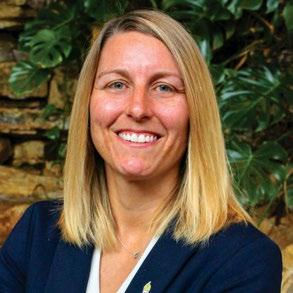
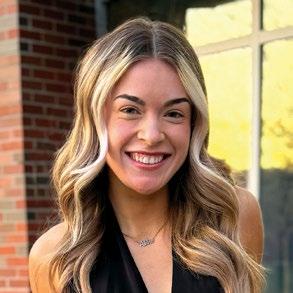
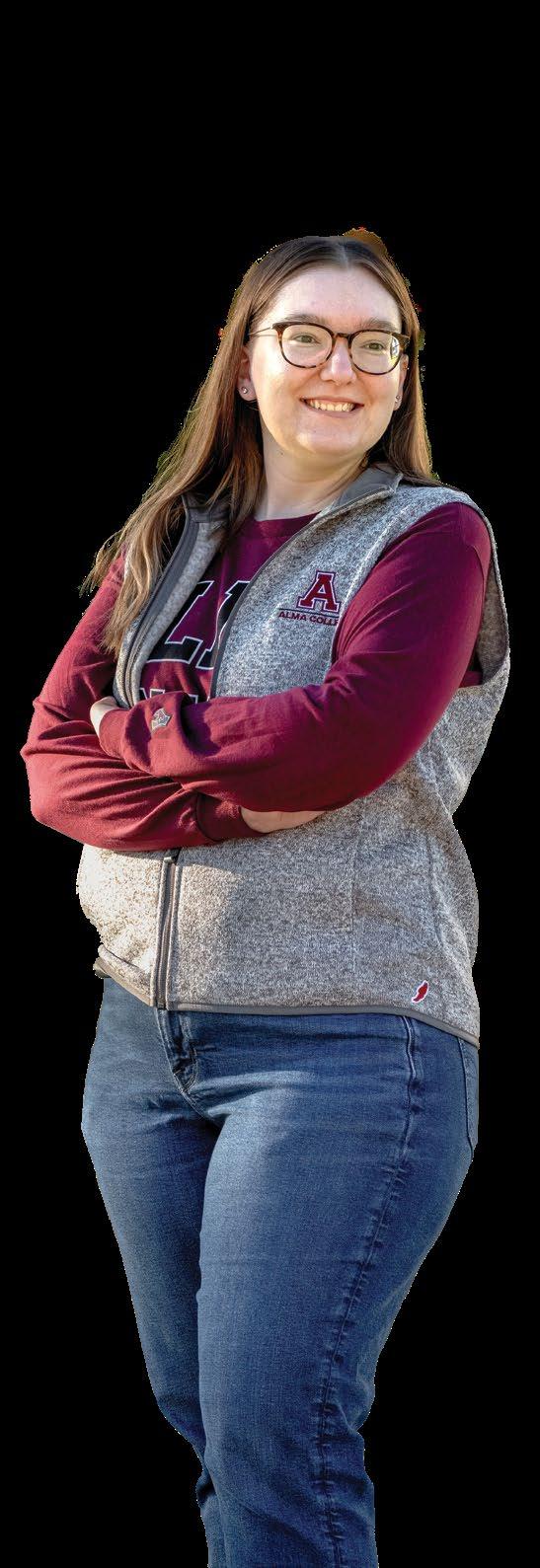
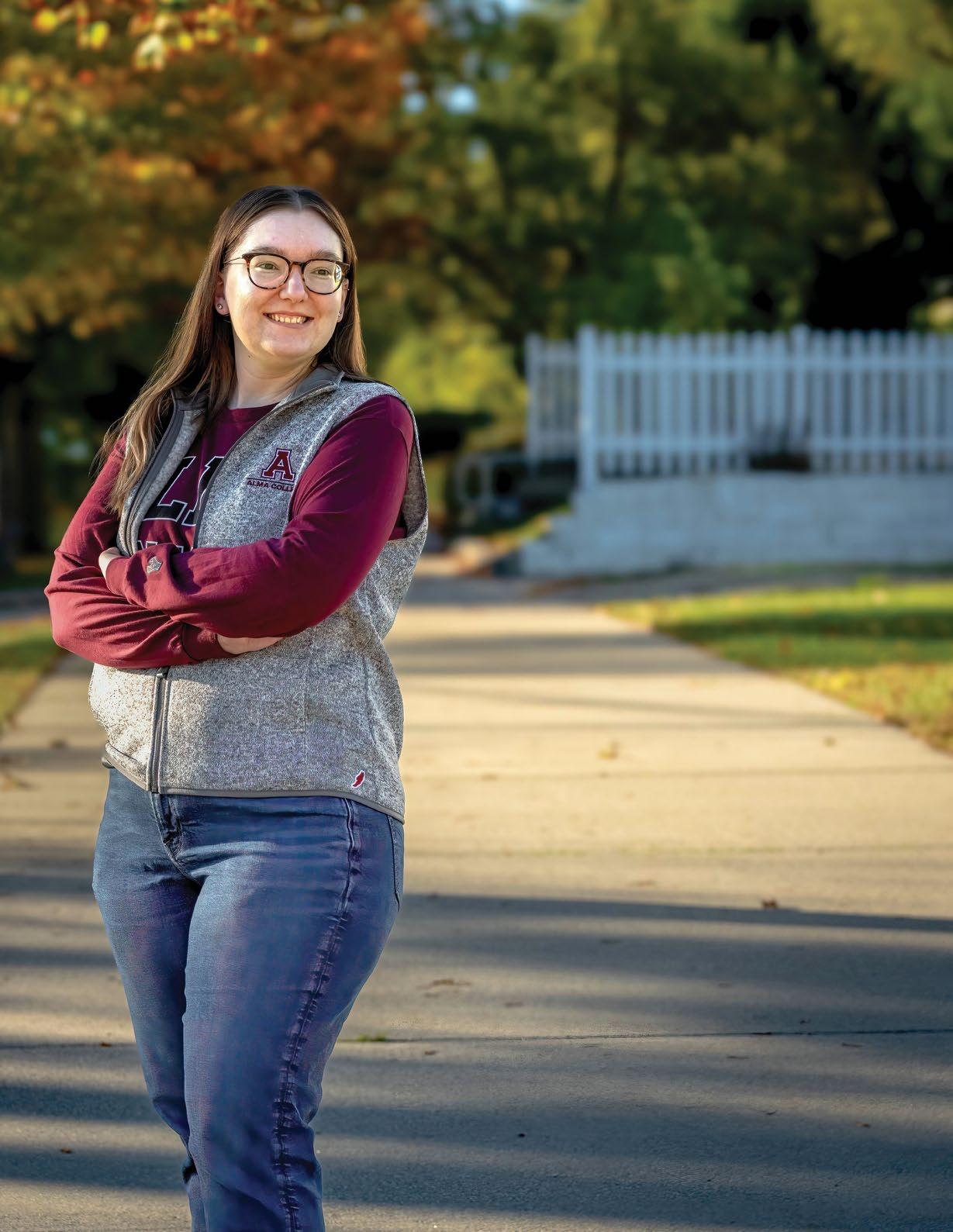
In the spirit of iGEM, Alma students unite code, communication, and biochemistry to engineer new solutions and prove that great ideas thrive in small labs.
6 Arguing for Understanding
Alma’s new Moot Court program draws students from across disciplines, challenges them to think critically under pressure, and prepares them for lives of leadership in and beyond the law.
8 In Perfect Time
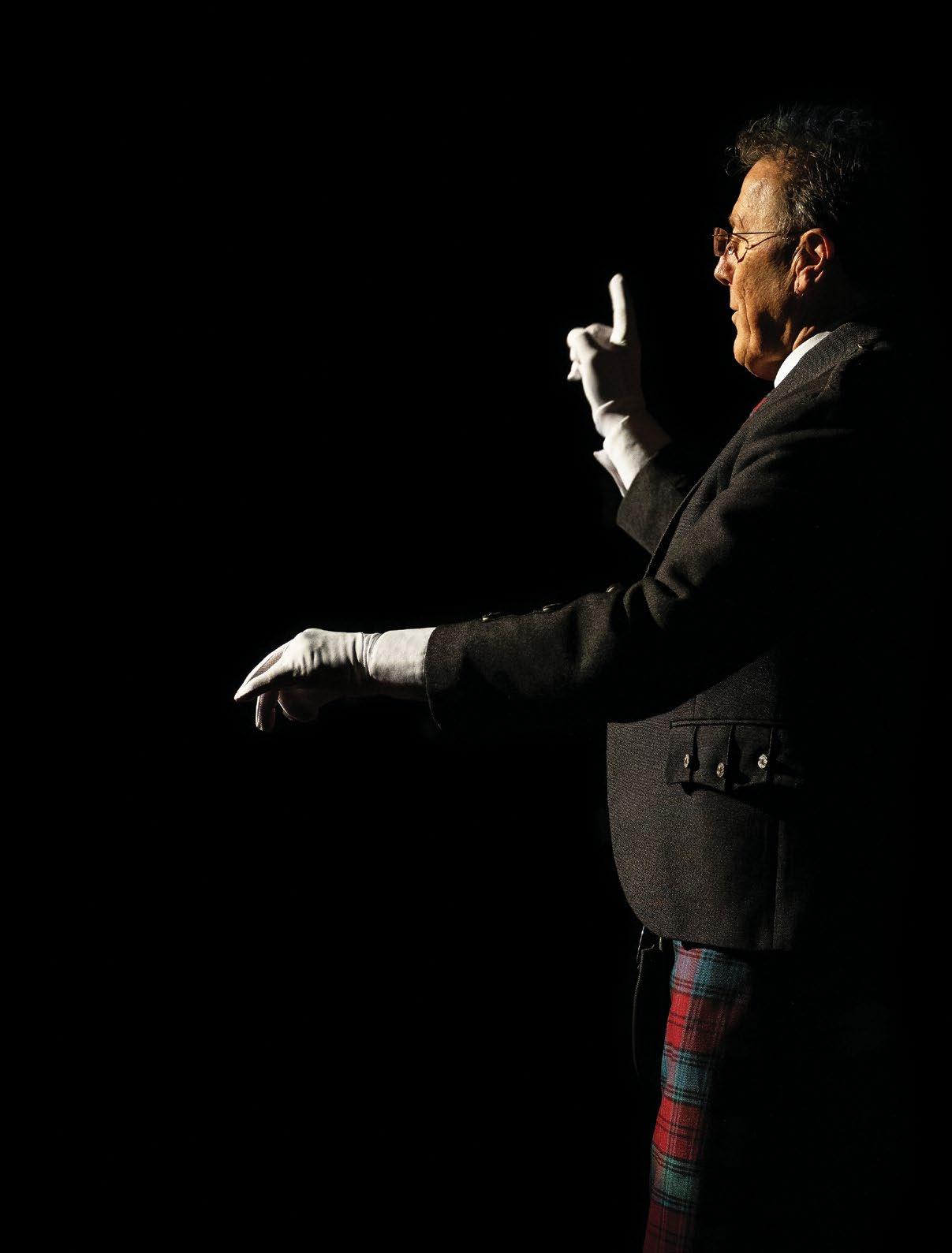
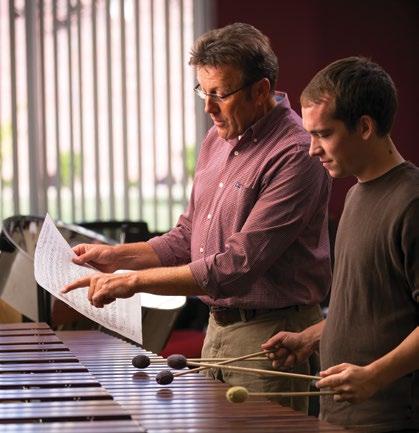
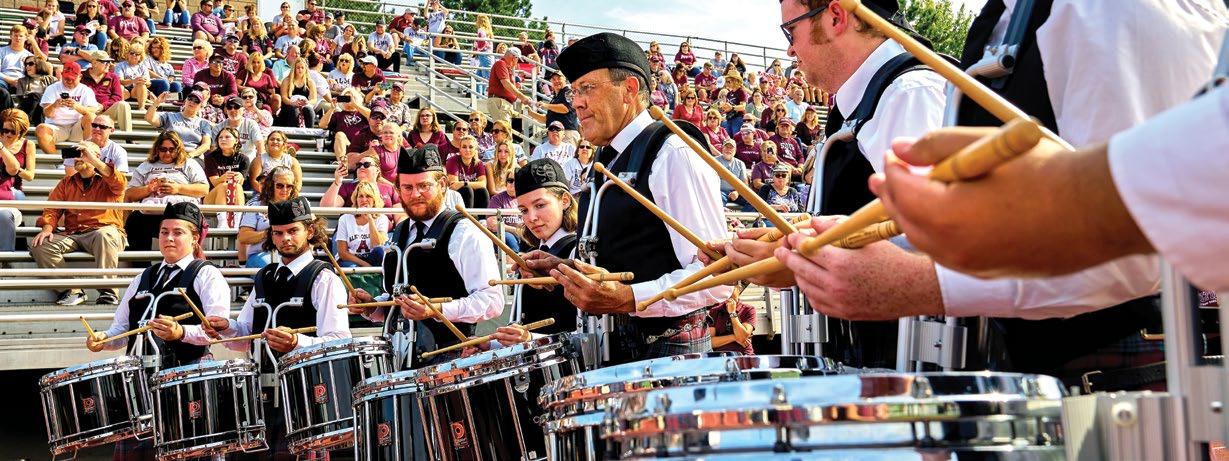
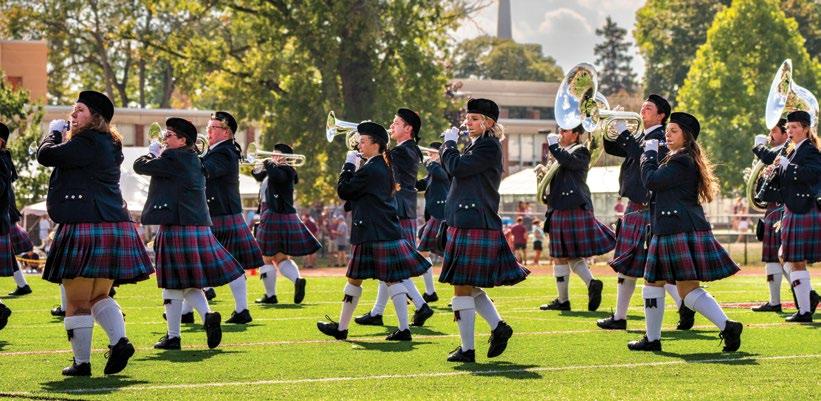
For more than three decades, Professor Dave Zerbe has set the tempo for Alma’s bands and percussion ensemble, blending musicianship, mentorship and tradition into a legacy that will resonate long after his final season on the field and in Presbyterian Hall.
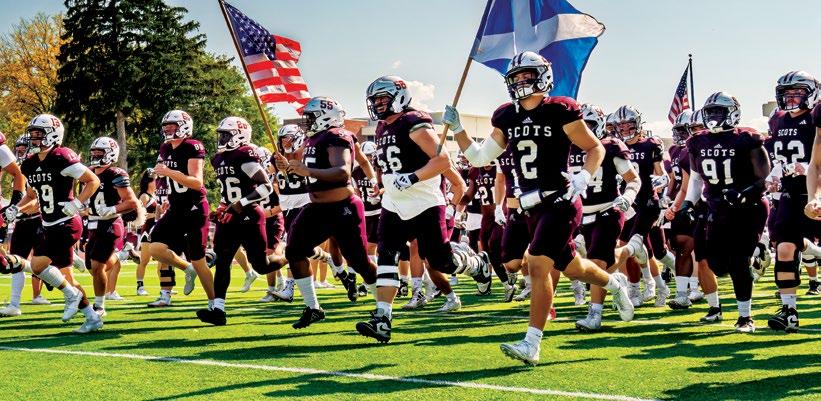
16 Home-field Advantage
From the classroom to the football field—and now through the next generation—Jason and Becca Couch are proving that being a Scot truly runs in the family.
19 Making a Difference
As the new assistant director of Alma’s Great Lakes Watershed Institute, Madee Hall ’23 is helping build an organization devoted to real science, education, and community collaboration.
20 Honoring a Legacy
George “Gaz” Gazmararian, who passed away in 2023 at the age of 93, left an enduring mark on Alma College. His influence lives on through a new tribute created by alumni: the George Gazmararian Room in the Altman House.
EDITOR
Tim Rath
DESIGNER
Cody Marecek
PHOTOGRAPHERS
Marissa Dillon
Morgan Horvath
(Mo Marie Photography)
Steve Jessmore
CONTRIBUTORS
Joseph L. Odenwald
Sarah Dehring
Abbie Wasson ’25
PRINTER
McKay Press
ALMA COLLEGE BOARD OF TRUSTEES OFFICERS 2025–26
Erika K. Powers Appelt ’91, Chair
David A. Devine ’90, Vice Chair
Rachelle Jacques ’93, Secretary
ALMA COLLEGE ALUMNI BOARD OFFICERS 2025–26
Amy Pratt ’04, President
Sammy Bohy ’13, Vice President
Robyn Carr ’04, Secretary
T.J. Miller ’17, Membership Chair
THE TARTAN IS PUBLISHED TWO TIMES YEARLY BY:
Alma College Communication and Marketing Office 317 Grant Ave., Alma, MI 48801-1599 | alma.edu | plaid@alma.edu
CHECK OUT OUR WEBSITE alma.edu/tartan
OUR MISSION
Alma College’s mission is to prepare graduates who think critically, serve generously, lead purposefully and live responsibly as stewards of the world they bequeath to future generations.
ON THE COVER
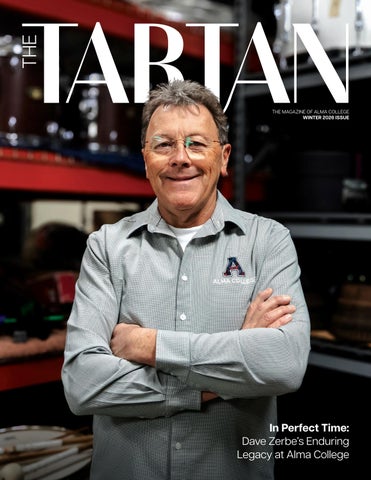
Dave Zerbe, who serves as the Paul Cameron Russell Professor of Music, Director of Bands and Percussion Studies and Chair of the Music Department, prepares to conclude his tenure at the end of the 2025–26 academic year.
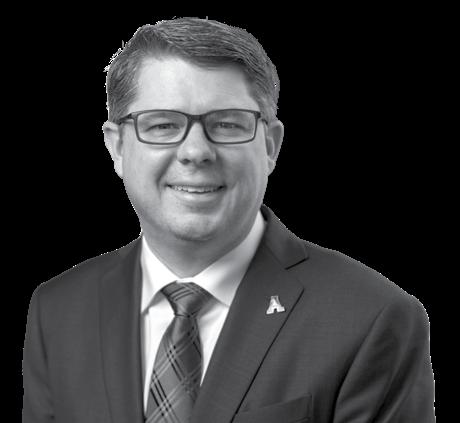
Listening and learning the roots of our next chapter Dear Scots,
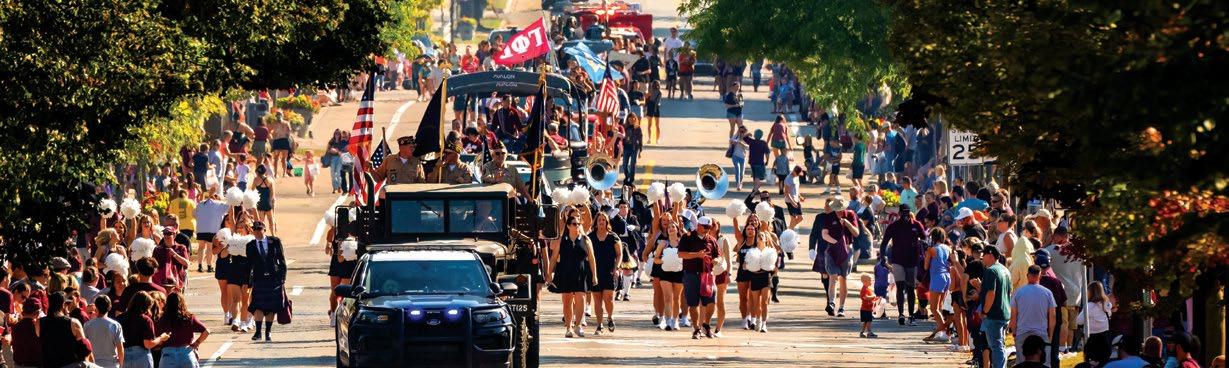
It’s hard to believe it’s already been six months since I first wrote to you in these pages. What a joy it has been to truly experience life at Alma College—from my first Homecoming parade, where I proudly wore a kilt (and learned there’s definitely a “right” way to do that!), to the many moments that have filled my days with gratitude, laughter and purpose.
Since arriving in “Scotland, USA,” I’ve been on the move —meeting alumni on the road, enjoying spirited conversations in offices and coffee shops, and becoming something of a regular at a few local favorites like Main Cafe. Each stop has reminded me that Alma’s reach extends far beyond our campus. Everywhere I go, I meet people who light up when they talk about the professors who inspired them, the classmates who became lifelong friends, and the lessons that shaped their character.
Back on campus, I’ve visited with students and faculty in
strategic plan, an update to the Evergreen initiative that will guide our shared work in the years ahead.
In this issue of The Tartan, you’ll find some wonderful examples of the stories that make Alma College unique. Our students in iGEM are showing what happens when creativity and collaboration meet science—proving that innovation flourishes when disciplines connect. Our Moot Court team continues to impress on the national stage, helping students master the art of critical thinking and civil discourse. And the Couch family reminds us that Alma’s legacy extends across generations, carried forward by the love and loyalty of those who call this place home.
I like to think of myself as Alma College’s storyteller—and each of these pieces tells a chapter of who we are: curious minds, servant hearts, and Scots committed to making a difference.
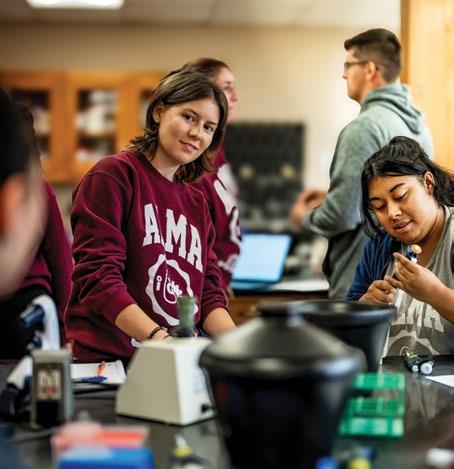
In the spirit of iGEM, Alma students unite code, communication, and biochemistry to engineer new solutions and prove that great ideas thrive in small labs.
Inside a lab on the second floor of Dow Science Center, a group of Alma College students have spent the past year working to solve a problem most people never think about—but one that has massive ecological impact: the spread of WhiteNose Syndrome, a fungal disease devastating North American bat populations.
Their work recently took them all the way to Paris, France, where the Alma College iGEM team earned a silver medal at the 2025 International Genetically Engineered Machine (iGEM) Grand Jamboree—an annual global competition that brings together more than 400 student teams from around the world to present research in synthetic biology.
“It’s a remarkable accomplishment for a college of our size,” said Elie Schwarz, faculty advisor for the team. “Our students are competing at an international level, standing shoulder-to-shoulder with teams from major research universities. It shows the kind of hands-on, interdisciplinary science that Alma does best.”
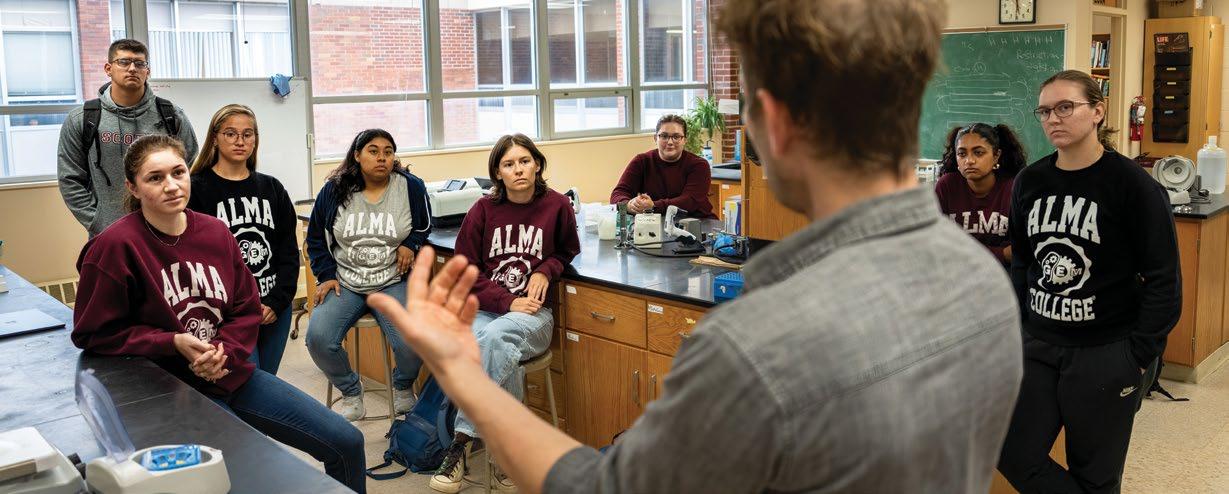
For Schwarz, iGEM exemplifies what a liberal arts approach to science looks like in action. Students from majors across campus—biology, chemistry, computer science, art, communication and more—collaborate to design, test, and communicate a solution to a real-world problem. The work is as much about public engagement and teamwork as it is about molecular biology.
“iGEM asks you to imagine new possibilities for biology,” Schwarz explained. “It’s not just about running experiments. Students have to think about ethics, communication, accessibility, and the communities affected by their work.”
This year’s project, titled “Com-bat-ting White-Nose Syndrome,” aims to explore innovative ways to slow the spread of the fungus Pseudogymnoascus destructans, which has killed millions of bats since it was first discovered in New York in 2006.
The Alma team’s long-term goal is to create a biological system that could eventually support healthier bat populations—and, by extension, healthier ecosystems.
What is iGEM?
The International Genetically Engineered Machine (iGEM) Foundation is a global nonprofit dedicated to advancing synthetic biology through education and competition. Each year, student teams design, build, and present original biological systems that address issues in health, environment, and sustainability. Each year, students present their projects at the Grand Jamboree—a global showcase of innovation, collaboration, and scientific communication.
For Reagan Keyser, a senior biochemistry major and president of the iGEM team, the project connects directly to her dream of becoming a translational researcher.
“Translational research bridges the gap between bench science and clinical application,” Keyser said. “That’s exactly what iGEM allows us to do. We’re taking what we learn in class and applying it to solve real-world problems.”
In October, Keyser and four teammates traveled to the Grand Jamboree to present their work before an international panel of judges. The event brought together students from across the globe—each tackling local environmental, medical, or agricultural challenges through genetic engineering.
“It was incredible,” Keyser recalled. “You could be sitting next to someone from Thailand, China, or France and learning how they’re using synthetic biology to help their communities. It really puts into perspective how global this field is—and how much potential it has to make a difference.”
Joey Colucci, a senior computer science and mathematics major, co-led the team’s “Wiki” division, which designed and built the online platform that documents every aspect of the project—from lab notes and data to outreach and ethical considerations.
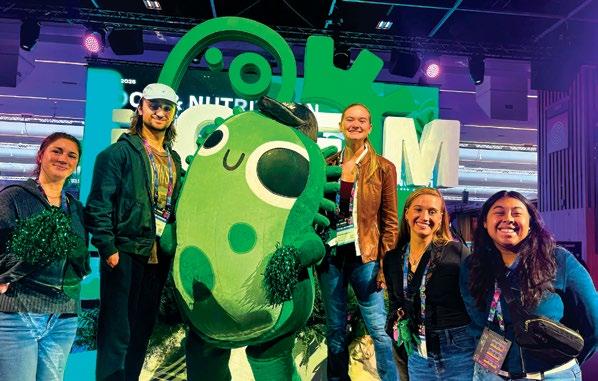
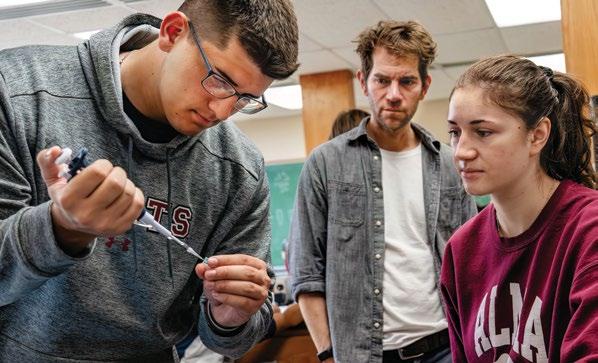
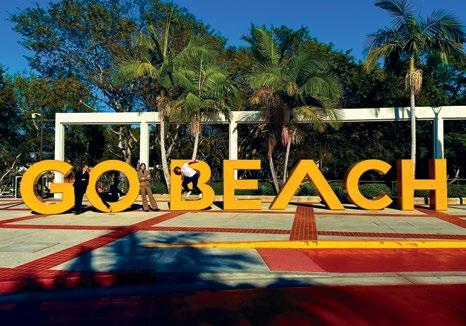
At top, students are pictured taking part in the iGEM Grand Jamboree in Paris, France, in October. Below, iGEM participants Owen Denk and Reagan Keyser are pictured working while faculty advisor Elie Schwarz looks on.
“Most people don’t realize how much communication goes into science,” Colucci said. “The wiki is what connects all of our work and makes it accessible to anyone in the world. It’s our way of showing that complex science can still be understood by everyone.”
He said one of the most rewarding aspects of iGEM is how it brings together students from completely different academic backgrounds. “We have people coding, people in the lab, people doing graphic design and community engagement. There’s something for everyone on this team.”
That inclusivity, Schwarz added, is part of the program’s strength. “Synthetic biology is inherently collaborative,” he said. “You need creative thinkers—scientists who can communicate, programmers who understand biology, artists who can visualize concepts. That’s why iGEM thrives at a place like Alma.”
ARGUING — FOR — UNDERSTANDING
Moot Court builds confidence, critical thinkers, and future advocates
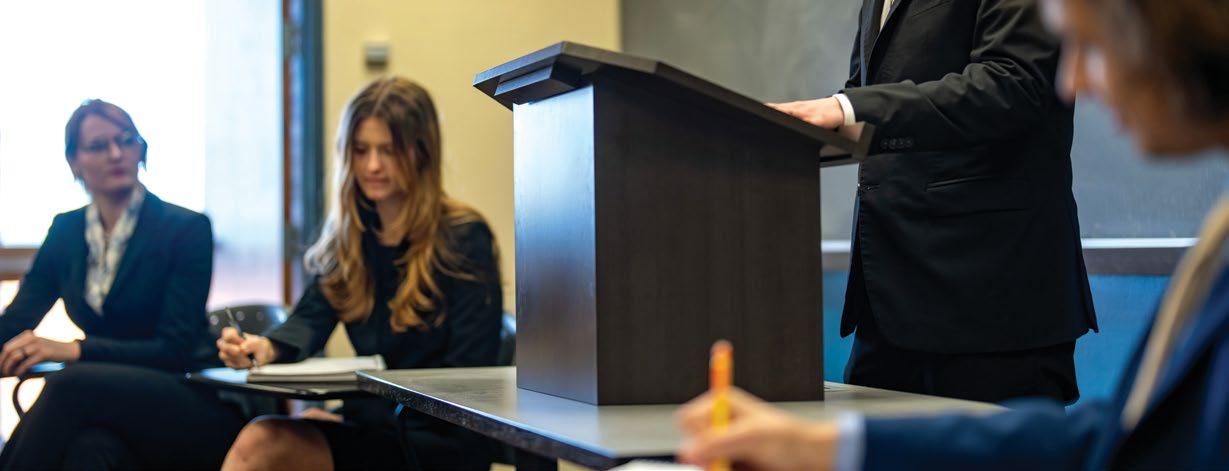
When Associate Professor of Political Science Ben Taylor arrived at Alma College two years ago, the Moot Court program was little more than an idea in a job description. Today, it’s a growing academic community—one that draws students from across disciplines, challenges them to think critically under pressure, and prepares them for lives of leadership in and beyond the law.
“Moot Court simulates oral argument before the Supreme Court,” Taylor explained. “Students are arguing complex legal issues while being interrupted by judges who can ask them to clarify their position or demonstrate their understanding. It’s not just a prepared speech—it’s a dialogue about the law.”
That conversational rigor, Taylor said, is what sets Moot Court apart from other academic competitions. “It demands deep comprehension and quick thinking,” he added. “Students must argue both sides of a case, not as individuals with opinions, but as interpreters of the law. That process—learning to see through another perspective—is the essence of critical thinking.”
Building from the ground up
Alma’s Moot Court program launched in 2023 with a class of 25 students, most of whom had never heard of the activity before. By the end of the term, 14 remained—and from that small group came the program’s first regional competitors.
Now in its second year, the class has grown in both size and experience. Five returning students, including team captains Jackson Eelbode and Stephanie Rauch, spent the summer reading cases, preparing arguments, and mentoring new participants. “That foreknowledge has made all the difference,” Taylor said. “They came back ready to lead, and that experience helps integrate new students much more smoothly.”
The team’s calendar this year reflects that growth: early-season tournaments in Long Beach, Calif., and Ann Arbor, followed by two regional competitions—including one that Alma hosted on campus in the fall. “Hosting our own tournament was a milestone,” Taylor said. “We welcomed teams from a dozen schools, including several from across the country, and nearly 30 of our judges were Alma alumni. It was a great opportunity to connect our students and alumni through shared intellectual engagement.”
Confidence in the courtroom
For Eelbode, a senior political science major, Moot Court began as a way to earn upper-level credits. It quickly became something much more.
“You gain a lot of knowledge of the law through close study,” he said. “But beyond that, it changes how you understand current events. You start to see how laws are interpreted, how they impact people, and what rights individuals actually have.”
Those lessons, he adds, connect directly to Alma’s mission. “Moot Court helps you think critically and live responsibly. Every person should understand their rights—and this program helps you do that.”
Eelbode says his experience has also opened new doors. “I just signed up for the LSAT,” he noted. “I wouldn’t have considered law school before Moot Court, but I realized how much I enjoy it—not just the competition, but the way it makes you think.”
Finding her voice
Rauch, also a senior and co-captain, echoes that sentiment. “I enjoy composing arguments and cutting through the facts to the main issues,” she said. “But the presentation— communicating clearly and concisely—was the hardest part for me at first.”
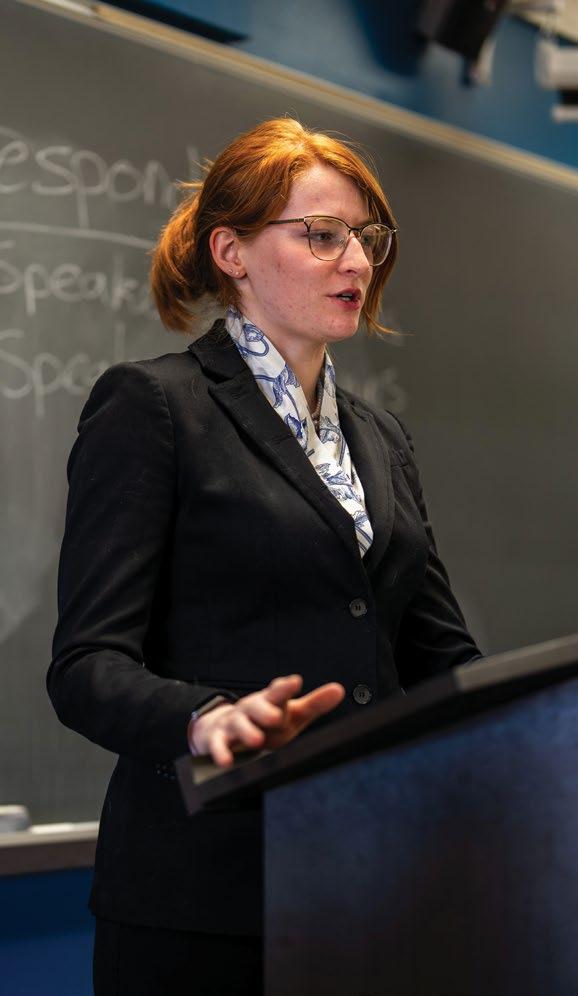
Over time, those challenges became opportunities for growth. “The vocabulary and precision required in Moot Court have changed how I think and speak,” Rauch explained. “Before, I was nervous to present or ask questions. Now, I don’t hesitate to get up and speak—whether it’s in class, at a competition, or a job interview.”
That transformation, Taylor said, is the true measure of success. “It’s not just about winning tournaments. It’s about the quality of the students’ thinking—their ability to respond thoughtfully, to read deeply, to speak with confidence. Watching that growth happen is the most rewarding part.”
One moment stands out for Taylor: watching Rauch and Eelbode advance to the second day of competition at Fitchburg State University, in Massachusetts, last year. “It was the first time I got to see one of our teams move forward in real time,” he recalled. “I probably fist-pumped. It was a big moment—not just for them, but for the entire program. It showed that Alma students can hold their own against much larger, more established teams.”
As the program continues to expand, Taylor hopes it will remain a place where students discover not just how to argue well, but how to think well—about the law, about the world, and about themselves.
“Moot Court,” he said, “develops seriousness—a commitment to knowing something deeply and engaging with it honestly. That’s the heart of what a liberal arts education is all about.”
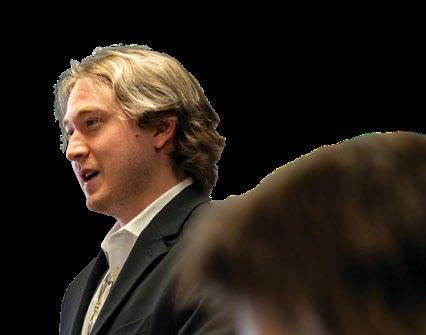
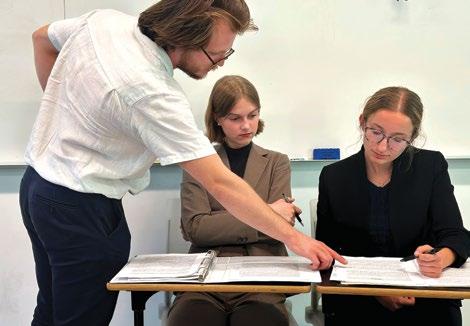
Pictured at top: Associate Professor of Political Science Ben Taylor instructs Moot Court participants Natalie Krause and Stella Lampert at an early-season tournament in Long Beach, Calif. At right, Stephanie Rauch is pictured arguing.
in time
Dave Zerbe’s Enduring Legacy at
Alma College
For more than three decades, Professor Dave Zerbe has set the tempo for Alma’s bands and percussion ensemble, blending musicianship, mentorship and tradition into a legacy that will resonate long after his final season on the field and in Presbyterian Hall.
When Dave Zerbe steps onto the football field on a crisp Saturday morning, the rhythm of life seems to fall into perfect time.
For more than three decades, Alma College has been that place for Zerbe, who serves as the Paul Cameron Russell Professor of Music, Director of Bands and Percussion Studies, and Chair of the Music Department. As he prepares to conclude his tenure at the end of the 2025–26 academic year, he reflects on a career defined by continuity—not only in sound, but in the community and care that have shaped generations of students.
Zerbe first came to Alma College in 1988, while still an undergraduate at Central Michigan University. That humble start grew into a lifetime of teaching and leadership that transformed Alma’s bands and percussion programs into models of excellence.
“I had three private lesson students and taught a pedagogy class. I was still in undergrad,” he said. “I was in my mentor’s office when his office phone rang, He answered, turned to me and said, ‘Would you be interested in a college teaching position?’ Of course I jumped at the opportunity. The rest spooled out from that beginning.”
Finding a rhythm
Originally from North Muskegon, Michigan, Zerbe’s love of music took hold early. “I started playing drums before I even knew I was doing it,” he said. “It’s always been my go-to thing— the thing that’s driven me, that I could never get enough of.”
By eighth grade, he was already marching in the high school band, a formative experience that helped shape his lifelong sense of belonging to musical ensembles.
At Central Michigan, Zerbe studied under his mentor and lifelong friend Robert Hohner, whose influence helped define Zerbe’s philosophy of teaching. Hohner suggested that his students get a Bachelor of Music Education degree and then pursue a master’s degree in performance—the former of which teaches students how to teach and certifies them for the same. The latter improves performance techniques, musicality, and broadens repertoire.
“For years, that was my push to all my students: get the BME, but practice your instrument as if you were a performance major,” Zerbe said. “Do the BME, and be a great player. After all, as a band director you will be the musical example for your students. You should be a phenomenal musician and have spent significant time in the practice room honing your personal musicianship.”
THE BEAT GOES ON HIGHLIGHTS FROM DAVE ZERBE’S CAREER
The teacher’s tempo
Ask any of Zerbe’s former students what stands out most, and they’ll likely mention his exacting standards—delivered with humor, patience, and the deep conviction that hard work creates artistry.
“Music is about process,” Zerbe often reminds his ensembles. “It’s about what happens in rehearsal—how we listen, how we adjust, how we respond to each other.”
That same philosophy has guided his work as a mentor and department chair. Whether he’s rehearsing with the percussion ensemble or meeting one-on-one with a first-year music major, Zerbe emphasizes preparation, professionalism and respect for the craft. “Success is never owned, it is rented, and the rent is due everyday,” reads a wooden sign on his desk in the Eddy Music Building.
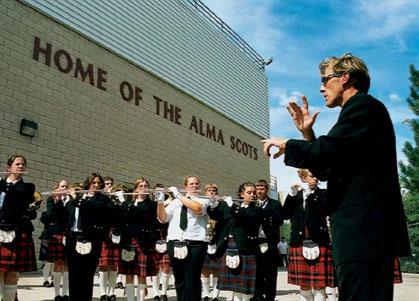
That care extends to the broader campus community as well. Zerbe has been a visible presence at countless campus events, from athletic contests to commencement ceremonies, where his students’ performances mark many of Alma’s most memorable moments. His leadership has helped the Kiltie Marching Band become not only a musical ensemble but also a living symbol of the college’s spirit and tradition.
Through it all, Zerbe has remained focused on teaching as a human art—one that balances structure with spontaneity, expectation with encouragement. “You try to build people who can handle themselves in a lot of different rooms,” he said. “That’s what music teaches you, and that’s what Alma teaches you too.”
In conversation, Zerbe’s stories tumble out with the percussive rhythm of a lifelong teacher: quick, precise, and rich with humor. He identifies photos in the band room by the tartans students wore and laughs about the “illegal frequencies” of old portable PAs for metronome amplification, still stored somewhere in the back.
“That’s how you know you’ve been around a long time,” he said.
• Faculty Barlow Award winner in 2013 and 2024
• Outstanding Faculty Award for the Humanities in 2011
• Performed live with the late, great Aretha Franklin
• Founding member of the internationally acclaimed recording group, the Robert Hohner Percussion Ensemble
Family and full circle moments
Zerbe’s path to the podium included time performing with Holland America cruise lines, traveling the world as a musician before returning to complete his degrees. Those experiences shaped not just his musicianship but his belief in resilience and purpose.
“Everything happens for a reason,” he said. “Had my college career not rolled out the way it did, I never would have met my wife.”
He met Christine in a Mount Pleasant gift shop called the Dondero House, where he worked during school. The two have been partners ever since, sharing a love of music and raising three children—Cyrus, Gabe, and Abigail—all of whom graduated from Alma College.
As Zerbe prepares to step away, his thoughts turn to legacy—not only the music performed, but the people shaped by it. “You think about the transition plan, about making everything easy for the next person,” he said. “Because all of this—the culture, the traditions, the little things that make it work—it’s all been cultivated for so long.”
Documentary project earns international acclaim
“Did You Guys Eat? ¿Ya Comieron?: Stories of Michigan Agriculture,” a documentary produced and directed by Alma College staff and faculty members, has racked up awards and kudos from audiences since being released in 2025. Among its accolades are the Audience Choice Award at the Soo Film Festival and Best Feature Cinematography at the Grand Rapids Film Festival, as well as an “Excellence” Award at the Hispanic International Film Festival.
Sisters of Mercy return to support spiritual life
Alma College is deepening its connection with the Religious Sisters of Mercy, welcoming them back to campus in an official capacity to support student spiritual growth and community life. They began serving students in 2024 through Bible studies, prayer gatherings, and communitybuilding efforts, and will continue in this role for the 2025–26 academic year in partnership with Alma College Chaplain Rev. Katrina Pekich-Bundy and Catholic priest Father Paul Werley.
New scholarship represents commitment to local students
The Tartan Edge, a new scholarship model launching in Fall 2026, reimagines how the college supports students in the mid-Michigan region. Designed in response to declining college-enrollment rates across rural Michigan, The Tartan Edge represents one of the largest access-focused investments in the college’s history.
Across the three participating counties, The Tartan Edge provides students with a significantly reduced price and cost certainty to attend Alma.
P-Global fellows celebrate 20 years
Alma College marked a milestone this fall as the 20th cohort of Posey Global (P-Global) Fellows gathered at the Wright Leppien Opera House in downtown Alma to share the results of their summer projects, representing a program that has now supported 560 students in 55 countries over two decades. At the event, students presented on experiences ranging from cybersecurity in France to child care in western Africa; from archaeology in Peru to marine life conservation in Australia.
Professor publishes textbook on social media ethics
Alma College philosophy professor Douglas R. Campbell has published “An Introduction to the Ethics of Social Media,” possibly the first textbook to offer a comprehensive, introductory exploration of one of the most rapidly evolving ethical issues of the digital age. The book was released in September by Hackett Publishing Company. Interest in the book has been strong. Since its release, more than 160 instructors have requested physical desk copies for potential course adoption, with many more requesting digital versions.
Miller named athletic director at Alma College
Phil Miller, a college athletics administrator with experience in NCAA Divisions I, II and III, has been named Alma College’s Director of Athletics following a national search. He most recently served as associate director of athletics for operations and facilities at Franklin and Marshall College (Penn.).
Miller holds a bachelor degree from Edinboro University, master’s degrees from Indiana University of Pennsylvania and Slippery Rock, and a doctorate from East Stroudsburg.
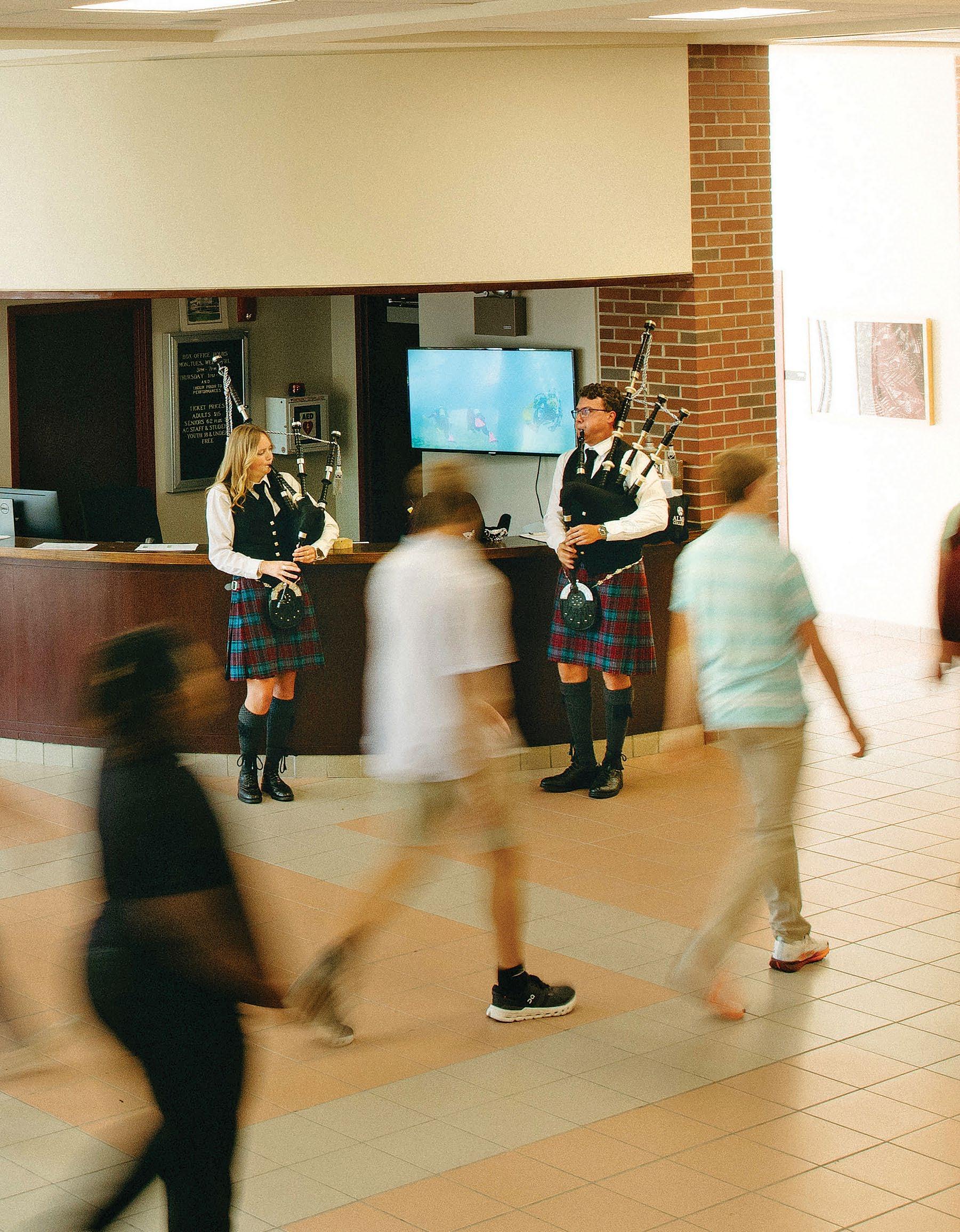
First-year students are pictured filing into Presbyterian Hall as part of the convocation ceremony in August, while bagpipers play on in the background.
HOMECOMING 2025
Home-field Advantage
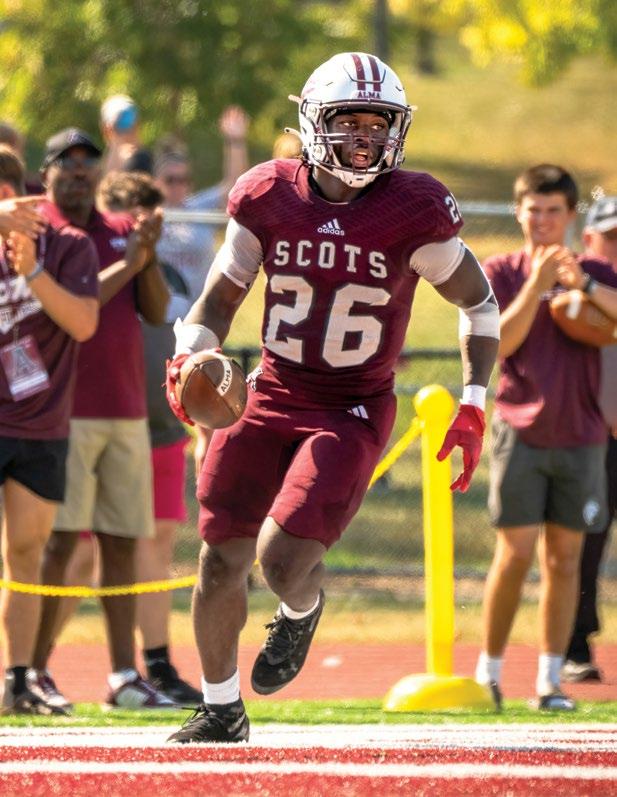
From the classroom to the football field—and now through the next generation— Jason and Becca Couch are proving that being a Scot
If you ask Jason and Becca Couch how they keep up with their busy household, they’ll laugh—the kind of laugh that comes from shared chaos, mutual understanding, and a deep love for Alma College.
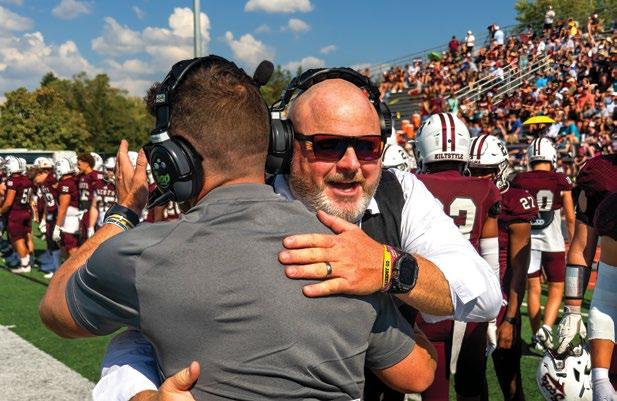
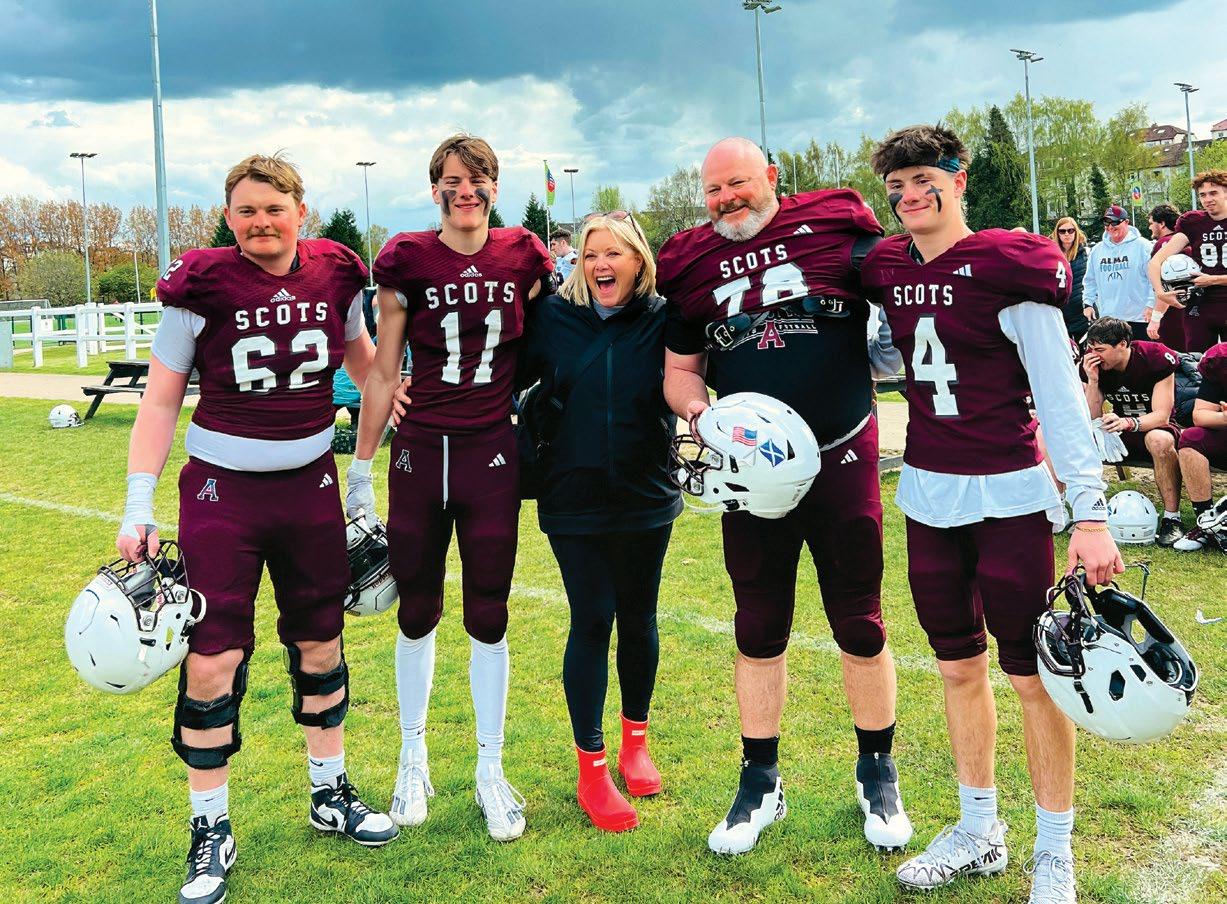
Between Jason’s role as head football coach, Becca’s position as an instructor of education, and their three sons— JB, Cooper, and Sam—all studying and playing sports at Alma, the Couch family’s lives are woven into the fabric of the college.
“Alma has always been about family,” Jason Couch said. “And we’re just lucky enough to live that out every day.”
Shaping young minds
For Jason, being back on Alma’s sidelines is more than just a job. It’s a return home.
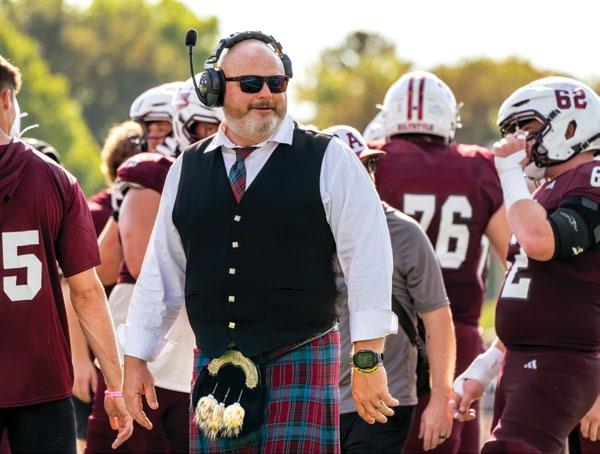
A 1997 graduate of the college, Couch was a standout lineman during his student days and built a coaching career that included successful stops at several programs before returning to his alma mater in 2018 to lead the Scots. Since then, his teams
truly runs in the family.
have set new standards for success—earning MIAA championships, playoff berths, and national recognition. But the wins tell only part of the story.
“It was actually a difficult decision for me to come back. I was very safe and secure in the role that I had prior to this one—and I said at the time, ‘The Alma College head coaching job is the only one I would consider besides the one I had,’” Couch said. “Ultimately, this is the place that shaped who I am.”
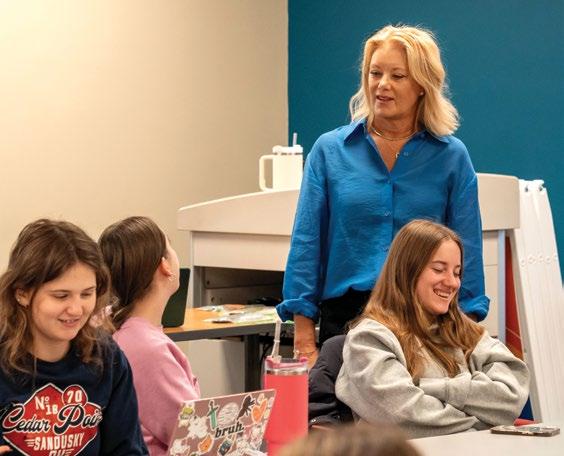
Becca, meanwhile, is shaping students of her own. An instructor in the education department, she brings both classroom expertise and real-world insight to her teaching. Her passion lies in preparing future teachers not only with strong instructional practices but also with empathy and adaptability— qualities she lives out daily at home.
“Working with college students, you get to see their confidence grow,” she said. “It’s the same kind of joy you feel as a parent. You watch them figure out who they are, what they love, and how they can make an impact.”
1 FAMILY, 5 ALMA ROLES
3 siblings currently enrolled at Alma College (JB, Cooper and Sam Couch)
3 varsity sports (football, swim and dive and men’s golf)
Head football coach (Jason Couch)
Education instructor (Becca Couch)
Scots in the making
The Couches’ three sons—JB, Cooper, and Sam—don’t have to look far for role models. With JB and Sam on the Scots football roster and Cooper competing on the men’s golf and dive teams, athletics have become a natural extension of family life—a shared language built, Jason said, on lessons rather than expectations.
That shared language is woven into the place they live as well. The Couch family’s home was built in 1906 by the Bahlkes, the same family that donated the grounds for what is now Bahlke Field, where the Scots compete on fall Saturdays. It’s a setting that makes the connection between family and campus feel almost inevitable.
“We typically have more than 50 students on the football team come to our house at Thanksgiving. We’ve had football players come over in the summertime and hang out at the pool. As coaches, we try to teach our players the value of kinship, and as a family, Becca and I value the opportunities to live that lesson out, throughout the year,” Couch said.
For JB, the oldest, playing for his dad is both a privilege and a challenge.
“It’s definitely unique,” he said. “I get to see the amount of work he puts in, and I want to match that. He always tells us to represent Alma the right way—on the field, in the classroom, and around campus. That’s something I take seriously.”
Youngest brother Cooper, who competes for the men’s golf and dive teams, appreciates that same sense of accountability in a different setting.
“Golf and diving are such individual sports, but being part of a college team still gives you that brotherhood,” he said. “We all push each other to get better, just like we do at home. And being at Alma—where Mom and Dad are so involved—it really does feel like everything connects.”
Sam, the middle brother, said being a Scot has always felt inevitable—and he wouldn’t want it any other way.
“I grew up watching Dad coach here,” he said. “When it was my turn to come to Alma, it just felt right. There’s something about this place—everyone knows you, everyone supports you.”
Living the values of Alma
Jason agrees that Alma has given his family a rare opportunity—to live, work, and grow together in a place that values connection.
“I tell my players all the time—this place is about relationships,” he said. “It’s about people who care about you and challenge you to be your best. That’s what makes Alma special.”
The Couch family has become a visible embodiment of that philosophy. Whether in the classroom, on the field, or around town, their presence reinforces the college’s values of community, hard work, and lifelong learning. They are, in many ways, a modern Alma success story—one that spans generations and roles, but always comes back to a shared sense of purpose.
“This is home,” Becca said. “We get to work with amazing students, coach incredible athletes, and watch our kids grow in the same environment that shaped us. There’s nothing better than that.”
Staying connected to Alma —and to each other
By Sarah Dehring, Senior Director of Alumni and Family Engagement, and Abbie Wasson ’25, Assistant Director of Alumni and Family Engagement
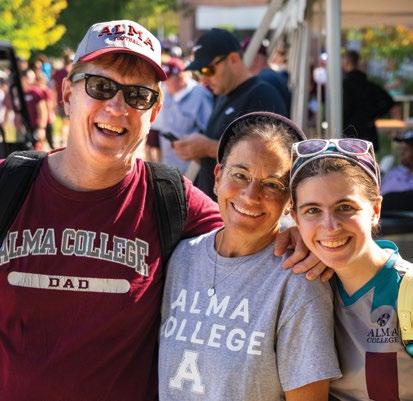
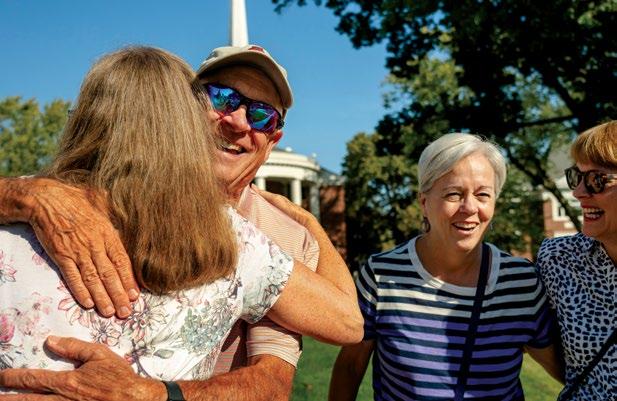
At Alma College, being a Scot doesn’t end at graduation— it’s a lifelong connection. Whether through teaching, coaching, mentoring, or celebrating student achievements, we’ve both seen how Alma’s spirit stays with you long after leaving campus. And now, in our roles with the Alumni Association, we get to help alumni and families continue that story.
For Sarah Dehring, Alma has been home for well over a decade. She first joined the college as head volleyball coach and later served as Vice President of Athletics. Along the way, she’s seen countless students grow, alumni give back, and families become part of the larger Alma community. Abbie Wasson graduated just this past spring, earning her degree in Business Administration with a focus in Sports Management and a minor in Communication, all while dancing as a member of Alma’s 11-time national champion dance team. Her experience as a student and now as a young alum gives her a fresh perspective on how deeply students and alumni care about this place.
Alumni engagement is about more than events—it’s about connections, shared experiences, and ongoing support for Alma’s mission. Our office works to create opportunities for alumni, families, and friends to reconnect, celebrate, and contribute to the college in ways that are meaningful to them. From Homecoming and Alma Day to regional events and virtual programs, we see the energy and enthusiasm that alumni bring to each gathering. We also collaborate with departments across campus to connect students with alumni mentors, help with career exploration, and recognize alumni achievements—all while strengthening the bonds that unite our community.
Engagement can look different for everyone, but we like to frame it around three simple ways to get involved: Time, Talent, and Treasure. There are so many opportunities to contribute your Time—attending college fairs or alumni dinners with prospective students, writing a note to an accepted or recent graduate, joining networking events or alumni-student mixers, or even representing your employer at career fairs to connect Alma students with jobs and internships. Your Talent is invaluable, too—you can present about Alma in high schools, participate in career panels, guest lecture in your area of expertise, or mentor a student exploring the same field as you. And, of course, your Treasure makes a lasting impact: donations to initiatives like the Alma College Career Closet or gifts to the college help ensure that future generations of Scots have the resources and support they need. Every contribution, whether big or small, strengthens the network that connects alumni, students, and the Alma community.
As we continue to build connections, our goal is to make every Scot—no matter when they graduated, where they live, or how they want to participate—feel welcome and included. Alma’s story is written not only by students on campus but by alumni everywhere who carry the college’s values into their families, careers, and communities. We are honored to help foster these connections and to celebrate the incredible people who make Alma College what it is today. Wherever life takes you, you will always have a home here—and we can’t wait to see the many ways you choose to stay involved.
GO SCOTS!
Madee Hall ’23 helps shape Alma’s Great Lakes Watershed Institute
When Madee Hall ’23 returned to Alma College this fall, she brought with her a master’s degree in environmental sustainability from Indiana University’s O’Neill School of Public and Environmental Affairs—and a passion for connecting students to meaningful environmental work.
As the new assistant director of Alma’s Great Lakes Watershed Institute, Hall is helping build an organization devoted to real science, education, and community collaboration. She works alongside longtime faculty member Murray Borrello to expand research opportunities, develop environmental curriculum, and manage the Institute’s soon-to-launch website.
“I love that we advocate for real science and real change,” Hall said. “We’re giving students the chance to do research and see how their work connects to the community around them.”
A Greenville native and former political science and history double major, Hall embodies Alma’s interdisciplinary spirit. Her academic background allows her to approach environmental issues through policy, history, and education—an intersection she believes is vital to lasting impact.
Among her current projects is developing outreach for local high schools, providing resources that introduce students to environmental study and data analysis. The Institute also plans to relaunch a summer camp that brings high schoolers to campus for hands-on research and fieldwork experiences.
“It’s been great to reconnect with the Alma community,” Hall said.
“The Great Lakes Watershed Institute is all about helping people— students, teachers, and neighbors—learn, grow, and make a difference together.”
Learn more about the GLWI at alma.edu/GLWI
Honoring a Legacy: The George Gazmararian Room at Alma College
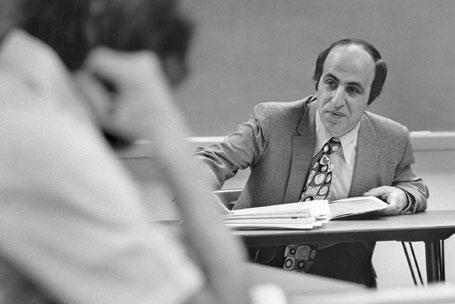
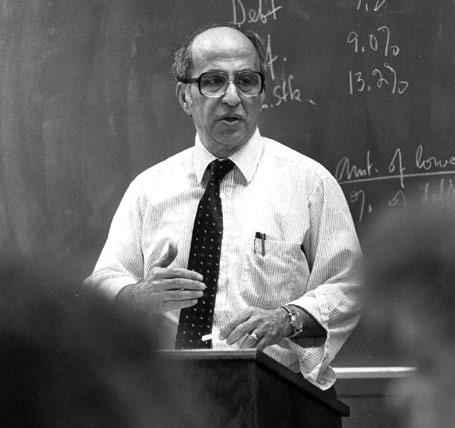
George “Gaz” Gazmararian, who passed away in 2023 at the age of 93, left an enduring mark on Alma College. A beloved professor of business administration from 1966 to 1996, he was known for his sharp intellect, dry wit, and unwavering dedication to his students. During his three decades at Alma, Gazmararian chaired the Business Administration department, led international business programs, and inspired countless future professionals through his real-world approach to teaching.
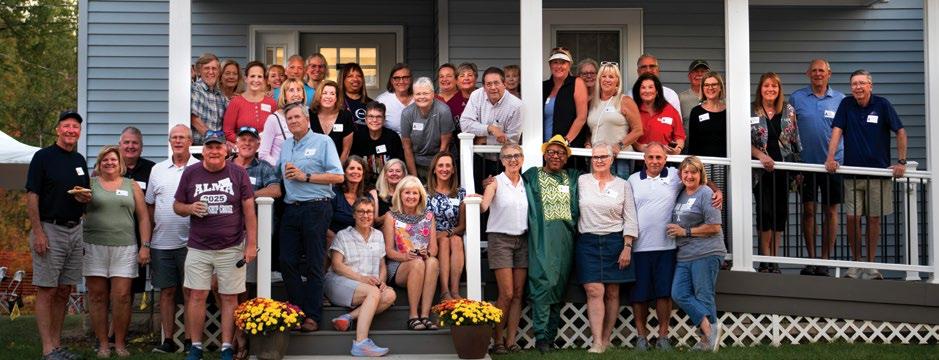
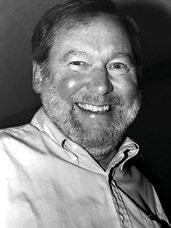
His influence lives on through a new tribute created by alumni: the George Gazmararian Room in the Altman House. The project was led by Michael Altman ’80, who helped organize his class’s 40th reunion. When the idea arose to enclose the Altman House patio, Altman suggested naming the space for Gazmararian. “There was nothing on campus named after him,” Altman said. “He was a legend.”
“He gave us the confidence to succeed in the real world. He taught us lessons you couldn’t find in a textbook.”
— Michael Altman ’80
Alumni from the Class of 1980 rallied around the effort, quickly raising more than $10,000. The enclosed room—now a comfortable space for visiting alumni and guests—honors both Gazmararian’s memory and the close bonds formed through his teaching. “He gave us the confidence to succeed in the real world,” Altman said. “He taught us lessons you couldn’t find in a textbook.”
Gazmararian’s life extended far beyond campus. Born in Jerusalem, he came to the U.S. in 1951 and went on to earn degrees from Warren Wilson College, the University of Detroit, and Michigan State University. Known for his love of animals, nature, and his trademark “Christmas list” of stock picks, he approached life with humor and generosity.
Today, the George Gazmararian Room stands as a lasting reminder of a teacher who shaped generations of Alma students—and the alumni who continue to carry his lessons forward.
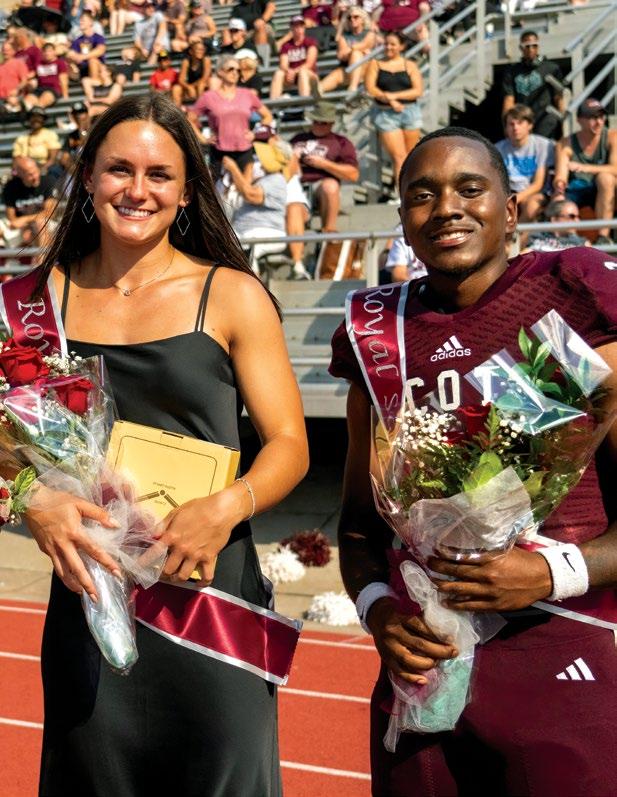
A ceremony was held at Homecoming in 2025 to honor the legacy of George Gazmararian at the Class of 1980 House.
Learn more about giving to Alma College by visiting alma.edu/giving
Honoring our departed Scots
Alma College mourns the loss of alumni, friends, faculty, staff and students who have passed away. This page specifically honors the lives of the college community members whose passing we have become aware of since the last issue of The Tartan. To continue paying meaningful tribute to those we have lost, we have created a webpage where you can view full obituaries for each person. Visit alma.edu/in-memoriam to learn more.
1940s
Silena Luchini Fortino ’43
1950s
Wayne E. Patterson ’52
Ernest William “Bill” Bauer ’53
Marcia Risser Bolo ’54
Lotus Witham Young ’57
Patricia Wilson Arrick ’59
Sharon Beardsley Cobb ’59
1960s
Mary McCall Howrey ’60
Allen B. Stevens ’60
Harold Ellsworth ’61
Eugene H. Miller ’61
Elizabeth Pasquina Nucc-O’Shea ’62
Sandra Hall Rule ’62
Neal Weaver ’62
Willa Knapp Kersten ’63
John C. Fellows ’64
Laura Huyssen Kracke ’64
Dwight E. Lowell ’64
Lionel Burton Garrison, Jr. ’65
Corwin C. Hale ’65
Janis Johnston Papineau ’65
Cristin Niemetta Donovan ’66
David F. Blanden ’67
Thomas D. Everson ’67
Shirley Thomas Hightower ’67
1970s
Stanley M. Hunter ’70
Caro Spendlove Mabbitt ’70
Linda Evans Deemie ’71
Stephen G. Strickland ’71
Lauri Holt Schwab ’73
Ernest L. Yoder ’74
Robert Price ’76
Timothy J. Jank ’78
1980s
Ben Long, Jr. ’80
Peter John von Oeyen ’80
Patrick Hesch ’85
Jeffrey S. Williams ’88
Lisa M. Paulus ’89
1990s
Erika Soderholm Holmes ’92
Friends of the College
John M. Buchanan
Marilyn L. Clark
Michael Lamrock
Terri L. Lamrock
Larry Lippert, Sr.
Barbara L. Marble
Delphine M. Sefcik
John W. Shroyer
Robert Yin
Former Faculty and Staff
Robert D. Marble
Douglas Scripps passed away July 20, 2025.
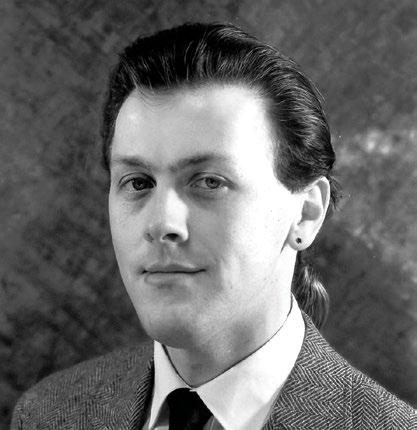
Scripps served as professor of music at Alma College from 1985 to 2003, where upon retirement he was named professor emeritus. He served as principal conductor of the Alma Symphony Orchestra from 1985 to 2002.
A Grand Rapids native, Scripps held degrees from Calvin College and the University of Michigan; and also studied at the University of Music and Dramatic Art in Vienna, Austria, where he studied under and was mentored by Leonard Bernstein. In 1998, he returned to his beloved Vienna as a visiting professor and made multiple visits in his retirement years to Austria, the Czech Republic, and Slovakia, to teach and conduct.
Charles
A.
“Charlie”
Gray passed away Oct. 11, 2025.
From 1965 to 1993, Gray held numerous roles at the college, coaching basketball, track, and cross country, and later serving as athletic director. He played a pivotal role in transforming the physical education program into what became the Exercise and Health Science Department, which he regarded as the crowning achievement of his career.
Under his leadership, Alma’s track and cross-country teams achieved remarkable success, capturing eight conference titles, two regional championships, and producing six All-American athletes. He founded the Alma College Athletics Hall of Fame in 1971 and was inducted into the Hall of Fame in 1994 for meritorious service.
ALUMNInotes
Tell us what’s new!
T. Robert Wagner ’56 is living in Florida and regularly gets together with classmates and members of “The 90-Year-Old Club,” Sally Posey ’56 and Betty Hahn ’56
Richard Douglass ’68—with his Rural Health Group and allied with the Central Michigan University College of Medicine and Rural Health Excellence Institute— have entered into a third year of research and development of nonemergency medical transportation deficiencies in rural Michigan. Two research grants have been completed and another for the Michigan Department of Labor is underway.
Tim Lutes ’70 would be happy to hear from his former teammates on the Scots basketball squad, from 1968–70. Contact the college alumni office for Tim’s phone number.
Dale Nowlin ’75 hiked Maine’s 100 Mile Wilderness and Mount Katahdin in July to complete the 2,200-mile Appalachian Trail over 11 years of section hiking. He currently serves on the Bartholomew Consolidated School Board in Columbus, Ind., where he served as a math teacher and administrator for 35 years.
Jim Daniels ’78 in August 2025 published “An Ignorance of Trees: A Memoir in Essays,” through Cornerstone Press. Following a long career of publishing poetry and fiction, “An Ignorance of Trees” is Daniels’ first published work of nonfiction. Daniels is a faculty member in the Alma College Master of Fine Arts in Creative Writing program and delivered the commencement speech for the Class of 2021.
The Tartan and your friends want to know what you are doing these days. Submit your news online at alma.edu/alumni-notes.
To celebrate 50 years of friendship, in August 2025, six alumni who met at Alma spent three weeks traveling around the United Kingdom together:
Linda Frederick Churchill ’79, Judy Foor Howland ’79, Dawn Secor Jaramillo ’79, Cheryl Keyser Blanchard ’79, Cheryl Chapman ’79 and Brian Churchill ’80.
Carolyn (Towar) Phillips ’81 retired in January 2025 after 15 years as a cataloger with the Grand Rapids Public Library.
Anthony Bohac ’82 was reappointed by Michigan Gov. Gretchen Whitmer in July to represent District 6 growers on the Michigan Wheat Promotion Committee. He owns Bohac Farms in Owosso, Mich.
Judy (Daniels) Jenema ’84 retired from teaching secondary sciences for 30-plus years in 2021. She dabbled with a bookstore sales position for two years and is now teaching full-time in a boys’ home.
Christopher M. Trebilcock ’87 was appointed by Gov. Gretchen Whitmer to the Michigan Court of Appeals effective May 19, 2025.
Kelly Hall ’90 was named senior vice president regulatory and legal affairs and deputy general counsel at CNS Energy. In her new role, Hall oversees legal, regulatory and compliance organizations.
After 33 years of church work, Tim Davenport-Herbst ’92 became CEO of Project Vida in El Paso, Texas, a 50-yearold faith-based group of nonprofits that provide health care for 15,000 people annually in five clinics and over 30 school-based sites. He also celebrated his 32nd wedding anniversary to Cynthia.
Rachelle Jacques ’93 was named chair of the board of trustees at Corbus Pharmaceuticals Holdings Inc., a clinical-stage company focused on oncology and obesity.
Christopher Butler ’93 has been appointed as the new president/CEO of the YMCA of Muncie (Ind.). Butler most recently served with the YMCA of Greater Indianapolis, where he held multiple executive roles.
Eunice McFarland ’93 has been appointed to serve as vice president of human resources at Fred Finch Youth and Family Services, a California-based nonprofit organization. In this role, McFarland leads all aspects of human resources strategy across the agency, including talent development, employee engagement, equity initiatives and trauma-informed employment practices.
Christopher Girard ’97 was elected mayor of Bay City, Mich., in 2025. He looks forward to continuing his lifelong commitment to community service and leadership while representing Alma College with pride.
Brandon Edward Miller ’98 has completed his service with the U.S. Agency for International Development. He is now senior counsel for institutional and administrative law at the Asian Development Bank in Manila, Philippines.
Carrie Rau ’00 recently moved to Pontypridd, Wales, to complete an M.Sc. course in Conservation and Wildlife Management at the University of South Wales.
Alicia (Hegle) Zuiker ’03 has been appointed executive vice president and chief human resources officer at TransUnion, overseeing human resources and communications functions. Prior to joining TransUnion, Zuiker served as chief people officer at Lyft and Visby Medical, and held HR leadership roles at Google Cloud and GE.
TBA Credit Union has announced the appointment of Maxwell Janis ’04 to its board of directors. Janis also currently serves on the board of directors for Big Brothers Big Sisters of Northwestern Michigan and plays an active role in his family’s business, Maxwell Medals and Awards.
Amber (Poulsen) Steele ’06 was recently named assistant vice president of student life at Regent University in Virginia Beach, Va. Her new role encompasses supervision of Title IX, conduct, care team, disability services, counseling services, residence life and commencement. Amber and husband Joshua live in Chesapeake, Va., with their sons Noah, 17, and Sullivan, 4.
Samantha (Lyttle) Samuels ’08, a teacher at Oak Valley Middle School in Commerce Township, Mich., was awarded the title of Oakland County Middle School Teacher of the Year with a surprise announcement made before her students in March. Samuels, who has served at Oak Valley since 2019, was also the recipient of the Henry Ford Innovator Award, an accolade that highlights her innovative and creative approach to education.
Devon Anthony ’09 graduated in May 2025 with a Master of Science in Strategy, Leadership, and Management from Michigan State University’s Eli Broad College of Business, pursuing her passion for lifelong learning and purposeful leadership.
Aaron Hahn ’13 won the gold medal at the United States Strongman Nationals competition in Charlotte, N.C., in July. Hahn competed in the 165-pound, open lightweight category. He works as a physical therapist at MyMichigan Health in Alma.
Lauren Wagner ’13 recently became certified as a contract specialist at Army Contracting Command at the Detroit Arsenal.
Mary “Maggie” Chambers ’15 designed a button that was adopted by the Mackinac Island Tourism Bureau, to commemorate visitors’ first times to the island. Chambers, an artist and designer, has also illustrated two children’s books and a coloring book about the island.
Anthony Porath ’18 graduated with his doctorate in chemistry from Wayne State University and joined AGC Automotive as a research scientist.
Alexandria Wentworth ’21 graduated from Clemson University (S.C.) in December with a Ph.D. in Industrial Organizational Psychology.
Rachel (Moran) ’22 and Nick Dilly ’22 met in nursing school while attending Alma College. Since their graduation from nursing school, they have been working at Corewell Health in Grand Rapids—Rachel on the labor and delivery unit, Nick in the surgical intensive-care unit. Nick has recently graduated with his Master of Science in Nursing degree in adult gerontology acute care nurse practitioner and passed his board exams. Nick recently proposed to Rachel and they are getting married Aug. 29, 2026.
Aubrey North ’23 has been accepted as a Fredericks-Follet-Roethke Graduate Fellow in the Arts and Humanities at Saginaw Valley State University.
The Tartan is published for alumni, students, parents, families and friends of Alma College. Please recycle this magazine and pass it on to a prospective student. THE
Accommodations for Every Stay
• 7 private suites with shared common spaces
• 1 hotel-style suite with private bath, mini fridge, ADA accessible
• Bungalow-style home for families or longer stays
Rest, relax, and reconnect with modern
quiet surroundings, and easy access to campus events, downtown Alma, and the Fred Meijer Heartland Trail.