HOW TO WRITE HEADLINES
WHAT A HEADLINE DOES
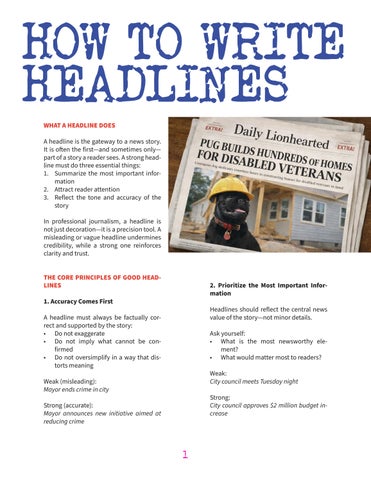
A headline is the gateway to a news story. It is often the first—and sometimes only— part of a story a reader sees. A strong headline must do three essential things:
1. Summarize the most important information
2. Attract reader attention
3. Reflect the tone and accuracy of the story
In professional journalism, a headline is not just decoration—it is a precision tool. A misleading or vague headline undermines credibility, while a strong one reinforces clarity and trust.
THE
CORE PRINCIPLES OF GOOD HEADLINES
1. Accuracy Comes First
A headline must always be factually correct and supported by the story:
• Do not exaggerate
• Do not imply what cannot be confirmed
• Do not oversimplify in a way that distorts meaning
Weak (misleading):
Mayor ends crime in city
Strong (accurate):
Mayor announces new initiative aimed at reducing crime

2. Prioritize the Most Important Information
Headlines should reflect the central news value of the story—not minor details.
Ask yourself:
• What is the most newsworthy element?
• What would matter most to readers?
Weak:
City council meets Tuesday night
Strong: City council approves $2 million budget increase
3. Be Clear and Specific
Avoid vague or generic wording. Precision helps readers quickly understand the story.
Weak: Local event draws crowd
Strong: Food festival draws 5,000 attendees downtown
4. Be Concise
Headlines must be tight and efficient, especially in print where space is limited:

• Cut unnecessary words
• Avoid filler phrases
• Use strong verbs
Wordy: There was a fire that destroyed several homes
Concise: Fire destroys several homes
THE STRUCTURE OF A HEADLINE
Most news headlines follow a Subject–Verb–Object structure: School board approves new policy
This structure:
• Emphasizes action
• Keeps writing direct and readable
WRITING IN PRESENT TENSE
Even though news stories often describe past events, headlines are typically written in the present tense.
Example:
• Story: The governor signed the bill yesterday.
• Headline: Governor signs bill into law
This creates a sense of immediacy and relevance.
USING STRONG VERBS
Strong verbs make headlines more engaging and informative.
Replace weak verbs:
• “is,” “are,” “was,” “were”
• “has,” “have”
With stronger verbs:
• “approves,” “rejects,” “launches,”
“cuts,” “expands,” “wins,” “files”
Weak:
School board is making changes to policy
Strong: School board revises policy
AVOIDING “HEADLINE-ESE” PROBLEMS
“Headline-ese” refers to awkward or unnatural phrasing used to save space.
Common Issues:
• Dropping necessary words
• Creating confusing phrasing
• Using unclear abbreviations
Confusing:
Council OKs tax hike plan
Clearer (still concise): Council approves tax increase plan
Clarity should never be sacrificed for brevity.
AP STYLE IN HEADLINES
While headlines are more flexible than body copy, they still follow general Associated Press (AP) style principles.
Key Guidelines:
• Use numerals for most numbers:
• 5 injured in crash
• Use title case or sentence case depending on publication style
• Avoid unnecessary punctuation
• Use standard abbreviations carefully and only when widely recognized
These are the most common and should be your default.
Example: Police arrest suspect in robbery
2. Feature Headlines
Feature stories allow for slightly more creativity, but clarity still matters.
Example: From Classroom to Kitchen: Student Builds Baking Business


3. Question Headlines (Use Sparingly)
Avoid when possible—they can sound weak or speculative.
Weak: Will the new policy work?
Better: New policy aims to improve graduation rates
4. Avoid Clickbait
In journalism, credibility matters more than clicks.
Clickbait (avoid): You won’t believe what happened at the city council meeting
Professional: City council debates controversial zoning proposal
WRITING FOR DIFFERENT PLATFORMS
Print Headlines:
• Limited by space
• Must be extremely concise
• Often omit articles (“a,” “an,” “the”)
Online Headlines:
• Can be slightly longer
• Must be search-friendly (SEO)
• Should include key terms readers might search
Example (online): Arkansas schools close after winter storm causes icy roads
COMMON MISTAKES TO AVOID
1. Being Too Vague
Officials make decision (What officials? What decision?)
2. Overloading with Information
City council approves budget, discusses zoning, hears public comments (Too much—focus on the main point)
3. Editorializing
Avoid inserting opinion.
Biased: City council foolishly approves budget

Neutral: City council approves budget
4. Misleading Emphasis
Do not highlight a minor detail just because it sounds dramatic.
5. Repeating the Lead Word-for-Word
A headline should complement the story, not simply duplicate it.
STEPS FOR WRITING A STRONG HEADLINE
1. Read the entire story carefully
2. Identify the main news point
3. Choose the strongest verb
4. Write a clear, concise sentence
5. Trim unnecessary words
6. Check for accuracy and tone
7. Revise for clarity and impact
PRACTICE EXAMPLES
Example 1:
Story Summary:
A high school volleyball team wins its first

state championship in school history.
Weak: Team wins game
Strong: Central High wins first state volleyball title
Example 2:
Story Summary: A new campus policy restricts parking for freshmen.
Weak: New rules affect students
Strong: New policy restricts freshman parking on campus
FINAL TIPS FOR STUDENT JOURNALISTS
• Accuracy is non-negotiable
• Clarity beats cleverness
• Strong verbs drive strong headlines
• Always reflect the story’s true focus
• Revise—great headlines are rarely written in one attempt
CONCLUSION
A well-crafted headline is not just a summary—it is a promise to the reader. It tells them what matters, why it matters, and invites them into the story. Mastering headline writing is essential for any journalist because it combines precision, judgment, and clarity in just a few words.