











most read water ont newspaper

most read water ont newspaper
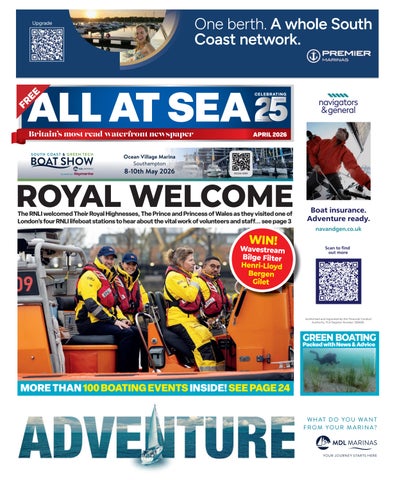
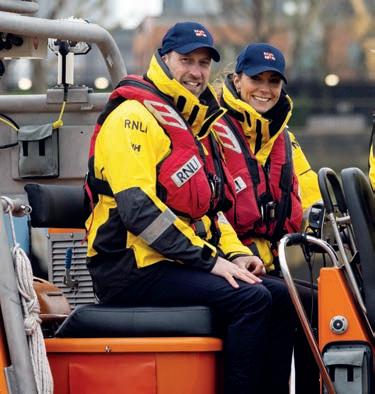
The RNLI welcomed Their Royal Highnesses, The Prince and Princess of Wales as they visited one of London’s four RNLI lifeboat stations to hear about the vital work of volunteers and sta ... see page 3





























Boat insurance experts since 1921, Navigators & General gives you complete peace of mind. With up to £1.25m agreed value, we provide specialist cover for yachts, dinghies, motor boats, day boats, RIBs and more. Get advice from our specialist team today:
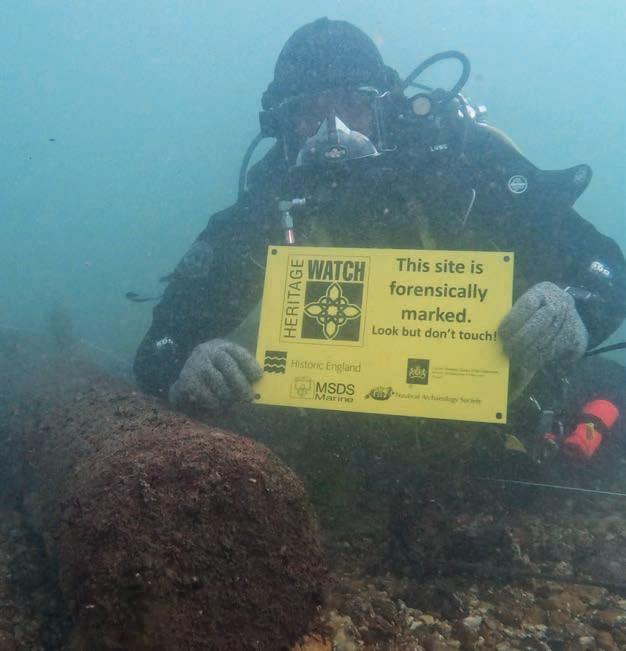
A significant step forward has been made to protect England’s most historic and archaeologically important shipwrecks, together with England’s wider underwater cultural heritage, from the threat of heritage crime.
Historic England, in partnership with the University of Plymouth’s School of Law, Humanities and Social Sciences, has launched new guidance to make it easier for law enforcement agencies to detect and act swiftly in response to heritage crime at sea.
The guidance applies to any form of criminal activity directed towards any kind of maritime heritage in English waters, whether protected by heritage legislation or not. Its key aim is to make a range of complex legislation easily accessible to frontline agencies in real time.
Mark Harrison, Historic England’s Head of Heritage Crime, said: “Responding to heritage crime at sea requires swift action, clear procedures and the secure preservation of evidence. By strengthening awareness and coordination among the law enforcement agencies patrolling England’s waters, we are enhancing our collective ability to identify o enders, secure crime scenes and protect historic wreck sites. This sends a clear message that criminal activity will not be tolerated.”
The majority of divers abide by the law, however an unscrupulous minority have caused irreparable damage to historic shipwreck sites, through the removal of material and failure to follow legal requirements.
This reference tool complements existing Historic England partnership
initiatives to prevent and investigate heritage crime. These include Heritage Watch and the forensic marking programme of cannon and artefacts on underwater sites, such as the 17th century Klein Hollandia, launched in 2023.
The Common Enforcement Manual for Heritage Crime at Sea includes comprehensive legal advice and protocols for the observation, investigation and interception of vessels suspected of being involved in criminal activity as well as communication protocols between relevant organisations.
Jason Lowther and Mike Williams, from the University of Plymouth, and Beccy Austin from MSDS Marine, co-authors of the Manual, said:
“The Common Enforcement Manual is an unprecedented piece of joined-up action. It has buy-in from key agencies including the police, government and fisheries bodies and marks a major milestone in the protection of our rich underwater cultural heritage.”
SergeantJulian Fry,Heritage Crime Tactical Lead forDevon & Cornwall Police, national lead for‘Operation Birdie’ the national policing response to coastal, marine and maritime crime, added: “This is truly pioneering work which brings together the knowledge, skills and experience of those involved with enforcement in the maritime heritage crime sector into one place for the first time.
“The new Common Enforcement Manual will be a game changer, o ering clear and easy to use guidance for those involved in operational enforcement.”
Their Royal Highnesses, The Prince and Princess of Wales have visited one of London’s four RNLI lifeboat stations to hear about the vital work of volunteers and sta saving lives.
In the last 24 years since the service began, the four stations have launched 20,655 times and saved 732 lives. Tower, which the Royal couple visited, is the RNLI’s busiest lifeboat station with the crew moving into their brand-new floating base next to Waterloo Bridge in 2023.
They arrived via the charity’s E class lifeboat with volunteers, RNLI Commander Storm Smith-Suckoo and Crew member Laura Lewis,
where they were welcomed by the RNLI’s Deputy Director of Lifesaving Operations Ryan Hall and Tower’s Station Manager Kevin Maynard.
The Prince and Princess enjoyed a ‘brew with the crew’ and the charity’s Occupational Health and Wellbeing Manager, Michelle Johnson, where they heard firsthand about the type of rescues undertaken along the Thames, and how the charity provides training, equipment and support to deal with challenging situations.
Following their conversations with the crew, Their Royal Highnesses met with RNLI lifeguards who will be helping to keep the public safe at
The University Boat Race on the Thames this month.
Kester Sheppard, Lead Lifeguard Supervisor for East Dorset, said: “As well as our highly visible lifesaving work on beaches, our lifeguards also travel to the Thames once a year to support The University Boat Race. They operate rescue boats along with our lifeboat crews and bring their prevention and water safety expertise to the banks of the Thames.
“A di erent operating environment o ers partnership working and gives our lifeguards broader skills to take back to their coastal work when our beaches come on service for the summer.”
Water safety organisations are sharing an important message ahead of another busy boating season.
HM Coastguard, the RNLI and RYA have launched their annual safety campaign for recreational boaters.
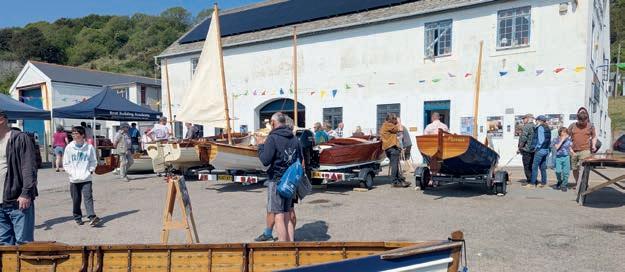
double ender with inboard diesel, a 17’ Strip planked Gartside #221 outboard runabout and the renovated 18’ 6’ Carvel Cruising Sloop Decibel. Previously built boats and gigs will also be on show, along with unique furniture designed and made by students on the Academy’s furniture-making courses. Visitors can chat with tutors about the boat building and furniture-making courses on o er, and enjoy children’s activities, food and drinks, as well as music from the Lyme Bay Moonrakers. A prize ra e will raise funds for the Academy’s student bursary programme.
‘Reduce the risk, boost your skills’ aims to provide both new and experienced boaters with handy tips and guidance for getting themselves and their vessel ready for the upcoming boating season.
Pre-season checks, onboard equipment and crew all feature in the campaign’s safety checklists, which are provided free of charge across the UK –including a version available in Welsh.
The laminated booklet includes simple advice, such as discussing passage plans and man overboard procedures, checking equipment and engine, identifying a second-in-command and ensuring an e ective means of calling for help is kept onboard.
Tom Barnett, Network Commander for HM Coastguard, said: “Created in
collaboration with partners at the RNLI and RYA, our campaign provides tips, advice and a helpful set of free Boating Checklists, designed to help boaters carefully consider their safety, the safety of their passengers and the safety of their vessel and its features. If you do get into trouble on the coast or at sea, call 999 and ask for the Coastguard.”
Sarah Pennicard, RNLI Water Safety Delivery Manager, said: “We always want people to enjoy being on the coast, but things can quickly go wrong at sea. It is so important to stay prepared. By keeping the essential checklists onboard, you will be reducing the risks of incidents occurring or increasing in severity.”
Richard Falk, RYA Director of Training, said: “The start of the season is also the perfect time to refresh your knowledge with an RYA training course, either in a classroom or afloat, or through reading one of our many RYA handbooks which cover all forms of boating.” hmcoastguard.uk/checklist

This month we have a preview of May’s South Coast & Green Tech Boat Show, which takes place at Southampton’s Ocean Village Marina. So, it is a great time to bring you a round-up of green boating news and advice including, in this month’s news pages, an interactive map helping boaters across the Solent protect seagrass and an up-date about the plastic crisis polluting our beaches.
April’s features include a look at alternative fuels, Boatshed’s Neil Chapman talks abandoned boats and we look at MARPOL compliance in the leisure sector. Plus, in the first part of a new series we get to know more about the Ocean Conservation Trust (see page 18).
We also have a fantastic competition; helping you protect the environment, Wave International is giving away a Wavestream bilge filter to one lucky reader. Bookmark The Green Blue website too, as it is a fantastic resource for information and useful contacts and to make the Green Boating Pledge.
As well as the South Coast & Green Tech Boat Show preview we have the first part of our annual events guide, looking at things
to do on and o the water for the next three months (page 24).
In May we will bring you events for the remainder of the year; send your local boating events to editor@allatsea.co.uk and we will do our best to include them.
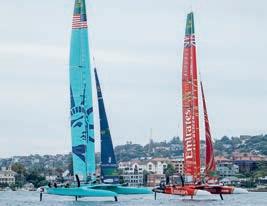
One of the events mentioned in our guide is the next SailGP weekend, which takes place over 12 – 13 April. On page 6 you can read about Emirates GBR’s continued podium success after their secondplace finish in Australia.
We also have an up-date from SailGP following the high-speed collision between the New Zealand SailGP Team and SailGP Team France during February’s New Zealand SailGP in which several athletes required hospital treatment, including one crew member not initially reported.
March saw both International Women’s Day and, of course, Mother’s Day, and last month the RYA and SailGP announced the launch of JUMP – the Junior Upskill Mentor Programme, a new workshadowing initiative for young women aged 16–25 which forms part of the RYA’s role as Event Purpose Partner for the Emirates Great Britain SailGP in Portsmouth this summer.
The RNLI also celebrated women in its Search and Rescue Training Week at the RNLI College in Poole, Dorset “bringing women together to share knowledge, build capability and grow as a supportive, skilled community”.
Also supporting women in boating, this year’s Sunsail Funding the Future initiative, aimed at RYA-a liated sailing, yacht clubs, charities and university teams across the UK, is introducing a focus on women and girls in the judging criteria, where clubs, charities and university teams will be scored on how they are supporting female participation. You can catch up with these stories on page 8.
Lastly, on a very di erent note, it is fantastic to see a significant step forward has been made to protect England’s most historic and archaeologically important shipwrecks. You can read all about the new guidance designed to make it easier for law enforcement agencies to detect and act swiftly in response to heritage crime at sea on page 3.
All this and much more in your April issue – enjoy!
ONBOARD
By Jane Hyde























Thursday
Thursday 16th to Sunday 19th May




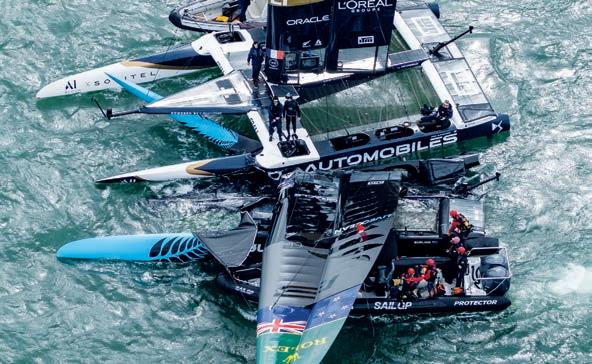
SailGP has released the initial findings from its technical review into the high-speed collision between the Black Foils New Zealand SailGP Team and DS Automobiles SailGP Team
France during February’s New Zealand Sail Grand Prix, in which several athletes were hospitalised.
SailGP engineering teams conducted a detailed review using high-rate performance data, onboard telemetry, simulator recreations and video analysis.
The analysis shows that the New Zealand F50 was sailing towards mark one at 90km/h, when it encountered a gust during the first reach of the race.
That sudden increase in wind speed caused the boat to accelerate rapidly, increasing lift on the hydrofoils and raising the ride height of the boat. As the boat rose, the leeward foil pierced
the surface of the water, triggering a side slip and a rapid increase in leeway.
SailGP Director of Performance
Engineering Alex Reid said the combination of speed, gust conditions and foil ventilation created a highly dynamic sequence which developed within seconds.
Alex said: “Once the leeward foil pierced the surface, the boat entered a side slip where the foil began generating unwanted lift through leeway rather than via rake. At that point the dynamics of the boat changed very quickly.
Control inputs from the flight controller were still being applied, but we believe the physics of the slide meant the boat could not be brought down in time.”
As the side slip developed, the rudder angle increased significantly as the crew attempted to regain control while

avoiding nearby boats. The rudder briefly lost e ective flow before re-attaching along with the windward bow immersing, causing the boat to round up sharply into the wind and decelerate rapidly.
With the French F50 sailing close astern at speed, there was insu cient time or distance to avoid contact once the sequence began. Analysis of high-rate performance data and onboard systems shows no abnormal system behaviour or structural failure prior to the incident. Instead, findings concluded the collision stemmed from a rapid hydrodynamic loss-of-control sequence triggered by foil ventilation during high-speed foiling in gusty conditions.
As part of its ongoing review process, SailGP engineers are assessing mitigations which could help crew better manage similar scenarios in future.
A penalty review hearing has upheld the original decision that New Zealand broke Rule 14 (avoid contact), resulting in an eight event point penalty, while France was found to have had no reasonable opportunity to avoid the collision.
It was initially reported that Black Foils grinder Louis Sinclair and DS Team France strategist Manon Audinet required hospital treatment following the collision, but it has since emerged that Leigh McMillan, the British wing trimmer for the French SailGP team, su ered a traumatic tear to the suppinatus and scapularis tendons, which completely detached from the bone. The injury required surgery and means Leigh will miss the upcoming SailGP events.

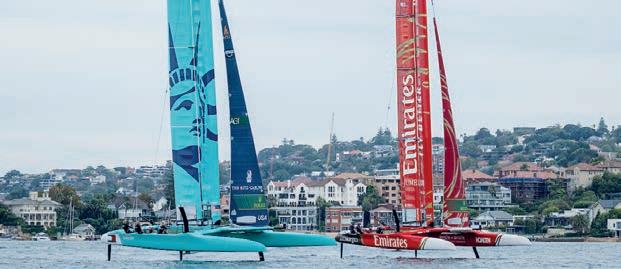
Emirates GBR continued its podium streak at the Sydney Sail Grand Prix with a second-place finish.
The result is the British team’s fifth consecutive podium, which started with a win in Cadiz, Spain, in October 2025, followed by the 2025 Season Championship win in Abu Dhabi in November, a win at the 2026 Season Opener in Perth in January and a secondplace finish in Auckland.
On Race Day 1 in Australia, Emirates GBR placed 3rd, 7th, 5th and 6th in the fleet races after patchy conditions caused havoc on the harbour. The Brits managed to get o the start line well, but found themselves in light air which led to them falling o the foils and struggling to make gains.
The team entered Race Day Two in fourth place, but had a great start with a win in Race 5, before finishing 7th and 5th in the final two fleet races, giving them enough points to reach the final.
Emirates GBR faced the USA and Spain in the winner-takes-all $400,000 event final. Despite a strong start, the British team was unable to catch the Americans in conditions which made it almost
impossible for the 50ft catamarans to foil and fly above the water at speed.
Emirates GBR CEO Sir Ben Ainslie said: “It was very, very challenging conditions with unusually light winds on Sydney Harbour. I think the team did a fantastic job, they sailed really well both days and did a great job to get themselves in that final race. They took every chance they got, but the Americans just managed to get on the foils a tiny bit earlier, but looking at the whole season and the bigger picture, it is a fantastic result to come away with second.”
Emirates GBR’s performance means the team sits at the top of the 2026 Season Leaderboard with 28 points, followed by Australia’s BONDS Flying Roos in second with 25 points and the U.S. SailGP Team in third with 20 points. The next stop is the Enel Rio Sail Grand Prix on 12 - 13 April. The event will mark SailGP’s debut in South America, but for Emirates GBR’s Dylan Fletcher and Hannah Mills, it will be a return to Rio after they both competed in the 2016 Olympic Games; Hannah won one of her two Olympic gold medals there.
























Automatic 10% discount for marina berth holders in the UK.
Industry leading 25% NCB* after 5 years claim free.
No excess to pay and NCB fully protected should any loss occur while moored or ashore in a marina.
Emergency out of hours claims helpline when you need us most.
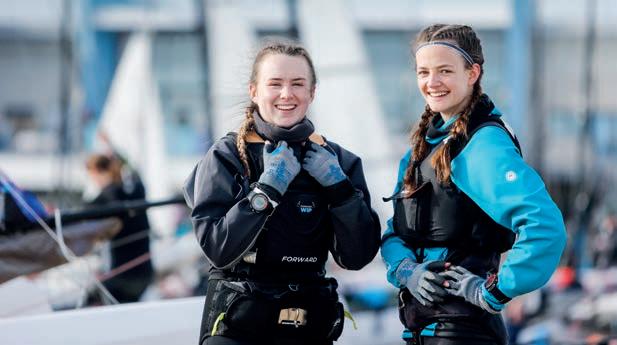
The RYA and SailGP announced the launch of JUMP – the Junior Upskill Mentor Programme, a new workshadowing initiative for young women aged 16–25.
The initiative forms part of the RYA’s role as Event Purpose Partner for the Emirates Great Britain Sail Grand Prix in Portsmouth this summer.
JUMP was designed to provide meaningful experiences across the marine, events and competitive sailing sectors, o ering participants the opportunity to go behind the scenes to shadow professionals from both the RYA and SailGP in the lead up and around the Emirates Great Britain Sail Grand Prix Portsmouth event.
Despite living in a country surrounded by water, many young women remain unaware of the diverse breadth of career opportunities available to them across the UK’s marine landscape. From media production and sustainability strategy to major event delivery, logistics and high performance sport, the industry o ers far more career pathways than many realise.
JUMP will connect young women with mentors who have not only built successful careers in these spaces, but
who are also actively shaping the future of the industry.
According to 2024 global insights from the International Maritime Organisation, women represented just under 19 per cent of the maritime workforce surveyed. Meanwhile, the Global Maritime Forum estimated that in 2024 women made up less than two per cent of the global seafaring workforce.
Sara Sutcli e MBE, RYA CEO, said:
“As a woman who has established a career in this industry, I know first-hand how powerful it is to be given a chance to step inside the world you aspire to join. JUMP represents exactly the kind of change the RYA is striving to achieve — creating practical, handson opportunities that show young women what is possible when they are empowered to explore careers the water can o er.
"I am excited to be personally taking on a shadowee and, alongside our partners at SailGP, helping to spark that early confidence that can set someone on an entirely new path.”
Applications are open until 6 April. www.rya.org.uk/making-a-di erence/ reflections-on-water/jump
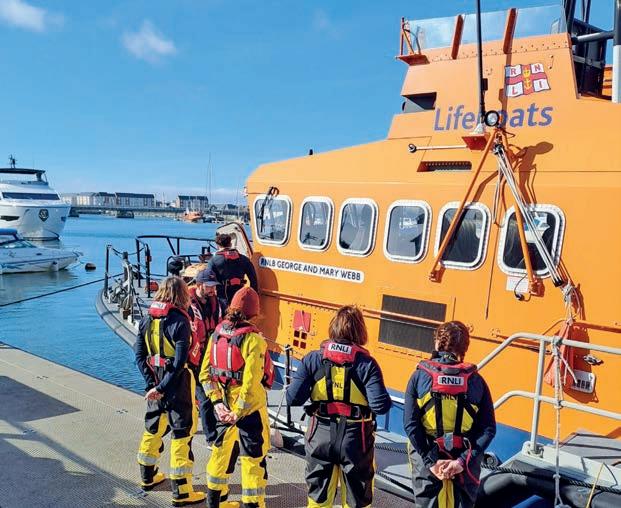
Ahead of March’s International Women’s Day, around 80 women from across the RNLI, each fulfilling a variety of frontline lifeboat station roles, came together for the RNLI’s Women in Search and Rescue Training Week at the RNLI College in Poole, Dorset.
The five-day event brought together women from RNLI lifeboat teams across the UK and Ireland to inspire, connect and share their experiences while learning new skills. Attendees were put through their paces in the Crew Emergency Procedures course in the RNLI’s sea survival training pool and headed out on a Shannon class lifeboat for command training.
Sunsail has announced the return of its Funding the Future initiative for 2026.
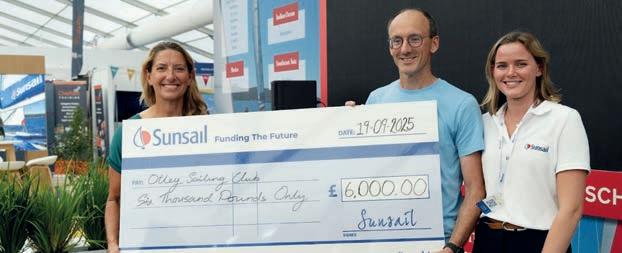
Aimed at RYA-a liated sailing, yacht clubs, charities and university teams across the UK, the initiative o ers the opportunity to secure up to £6,000 in funding to invest in facilities, equipment and innovative programmes designed to grow participation in sailing at the grassroots level. In addition to the top prize, Sunsail will also award £2,000 to two runners-up.
For the first time, the Funding the Future initiative will introduce a focus on women and girls in the judging criteria, where clubs, charities and university teams will be scored on how they are supporting female participation – whether through new initiatives or the expansion of existing programmes. This is part of Sunsail’s long-term e orts to ensure clubs are actively working to improve gender representation within the sport.
Dee Ca ari MBE, Funding the Future judge, Sunsail Ambassador and recordbreaking sailor, remains a core part of the initiative. Having recently participated in the Jules Verne record attempt as the first all-female crew, Dee continues to advocate for club accessibility.
Dee said: “I am thrilled to see Sunsail encouraging clubs to showcase their support for female participation. Grassroots sailing clubs play a vital
role in encouraging inclusivity and accessibility in a sport that can and should be enjoyed by all. They are the place where confidence is built, skills are learned and passion begins. Ensuring these clubs are recognised for their inclusive programmes and environments is paramount to inspiring the next generation of sailors.”
Funding the Future has already delivered a significant impact across UK sailing clubs. Otley Sailing Club from West Yorkshire was awarded the top honour last year, with Wilsonian Sailing Club and Henley Sailing Club, where last year’s application was written by a nineyear-old sailor, celebrated as runners-up.
Henley Sailing Club said: “Winning the Funding the Future runners-up prize was a huge moment for us at Henley Sailing Club and has provided a real boost to our community. Our original application
was written by Charlotte, one of our nine-year-old sailors, so it felt only right that the junior members decided how the £2,000 funding should be spent.
“They voted for a Pico dinghy to help them progress from optimists into the next stage of sailing. Even before it has hit the water, the funding has created huge excitement and a real sense of ownership among the children. We are incredibly grateful to Sunsail and the RYA for investing in our club.”
To apply, clubs must complete an online application by 22 May 2026, outlining a clear vision on how the funding would be used and how it would benefit members and the wider sailing community – including attracting new participants. The winners will be announced at the Southampton International Boat Show. sunsail.com/uk/funding-the-future
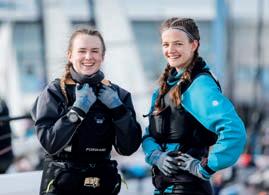
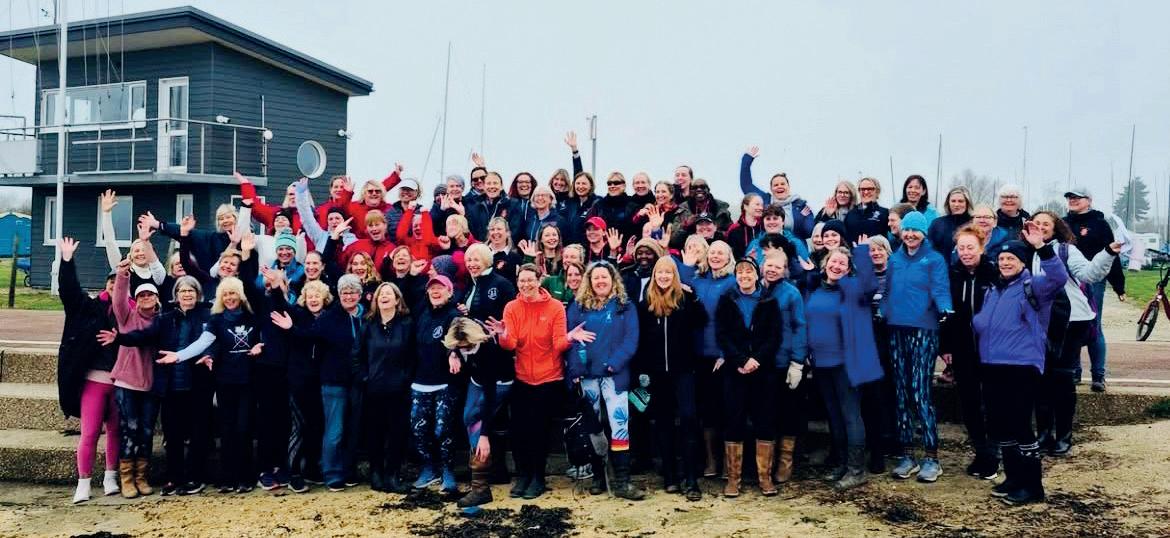
Taken on International Women’s Day, here are the women racing in the Harkers Yard Winter Series, hosted on this occasion by Brightlingsea University Community Sailing & Rowing Club in Essex
‘Seal

Along with a number of speakers, attendees took part in a mix of networking, confidence and leadership workshops, fitting in with the Give to Gain theme of this year’s International Women’s Day.
Jill Hepburn, RNLI Head of Region in Scotland, said: “International Women’s Day is a powerful reminder that when we give our time, skills and support to one another, we all gain strength, confidence and opportunity.
"Our Women in SAR Training Week is a brilliant example of this in action — bringing women together to share knowledge, build capability and grow as a supportive, skilled community while developing vital lifesaving expertise.”
This picture of a seal and pup has won the Beaulieu River photo competition for the fourth time for keen amateur photographer Maggie White.
Maggie said: “I was overjoyed to receive the news. It has been a di cult six months for me, having had a nasty accident last summer when I lost some fingers on my hand. In fact, it was the day after taking this shot.”
She added: “Fortunately, I have found photography very therapeutic. I belong to the Beaulieu Camera Group, to which I must give my thanks for their
encouragement and support after having had my accident. I love taking landscape and wildlife photographs, especially in the New Forest, and my project at the moment is taking images of birds in flight.”
Maggie’s winning entry has been featured in the 2026 Beaulieu River Tide Times & Information booklet and she will be presented with her £200 prize at Buckler’s Hard Yacht Harbour.
Lord Montagu, who chose the winner and runners-up, said: “Gratitude to Maggie for seeing the photographic potential of our seal population and being
there at just the right moment to take the shot which is this year’s winner. The two seals could not have posed better if they were able to take instruction!”
The annual Beaulieu River photo competition is open to all amateur photographers who are inspired to capture the unique qualities of the river, which has been kept special by the custodianship of the Montagu family for more than four centuries.
The 2026 competition is open and entries can be sent, with full contact details, to photo@beaulieu.co.uk
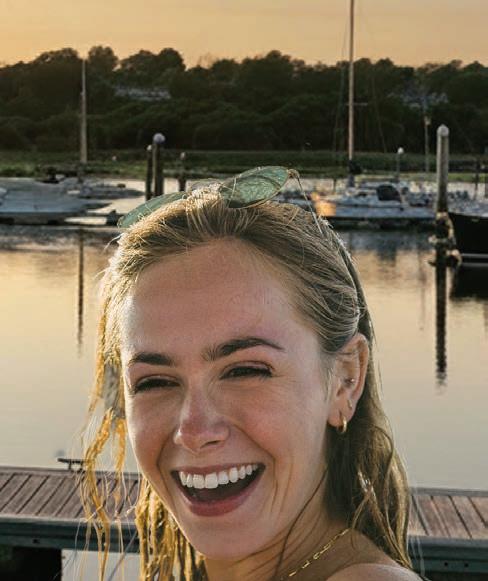




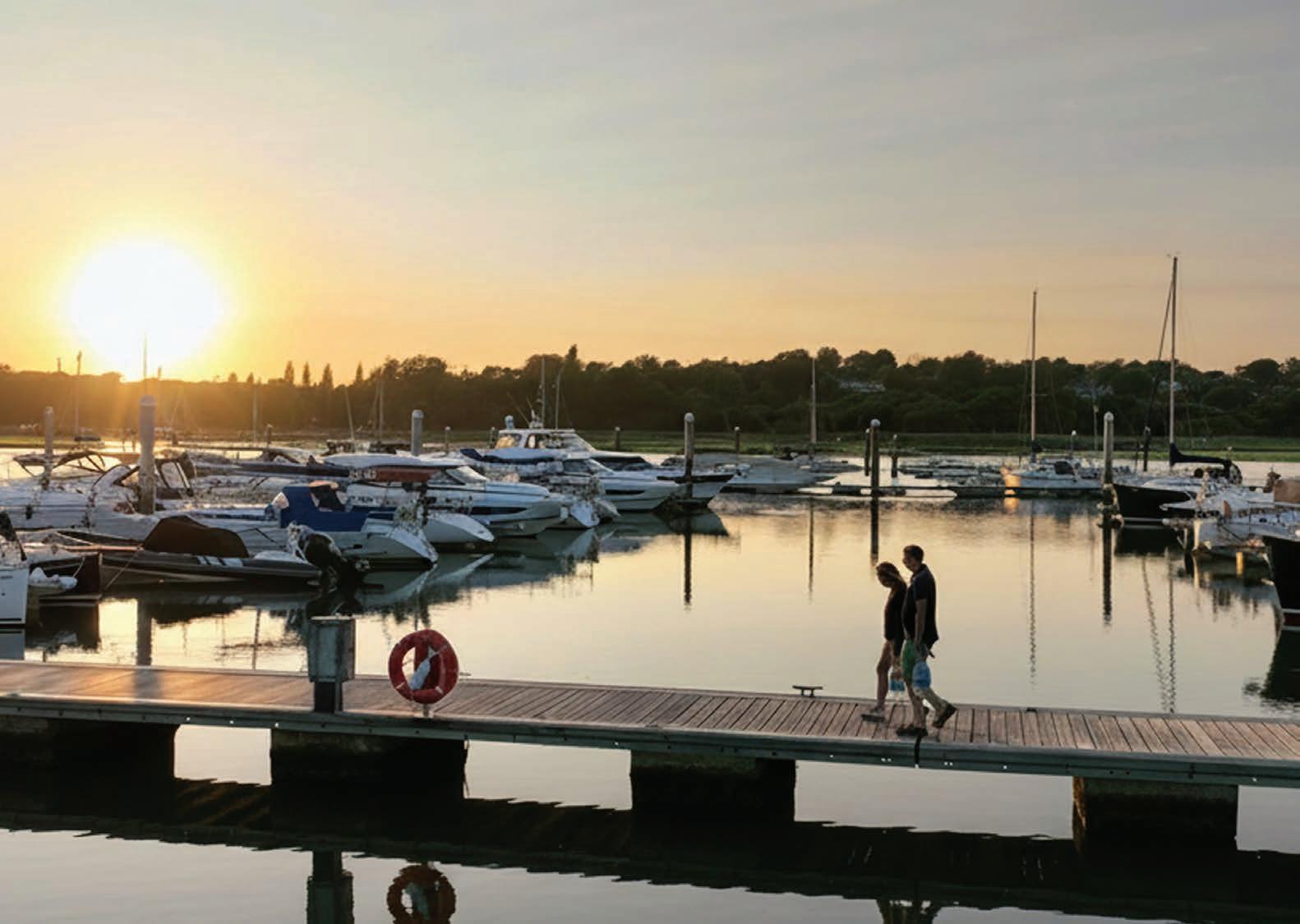




















More than 75 new and pre-owned boats from 26 brands will be available to view over 27 – 28 March at The River Hamble Boat Show at Hamble Point Marina in Southampton. Find out more at www.riverhambleboatshow.uk
The Dubai International Boat Show is postponing its upcoming edition following the conflict taking place in the Middle East. Originally planned for April, the show will now take place from 25 – 29 November, with organisers also confirming that the event will move permanently to November going forward, aligning the show with the start of the Middle East’s prime boating season.
The concerts planned during the Bluebird K7 – The Festival in May have been cancelled with organisers saying: “This is due to a number of factors, including tra c management and Park and Ride provision proving to be extremely di cult to manage in the evenings. In cancelling the concerts, we are taking into account not only what we are providing to visitors but the impact on local residents. A great deal of time and e ort has been spent on planning the festival, but as time went on, it became clear that we would be unable to meet everyone’s needs.”
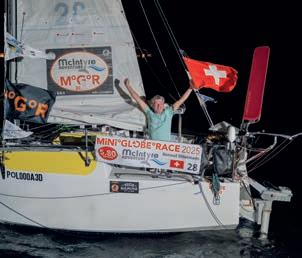
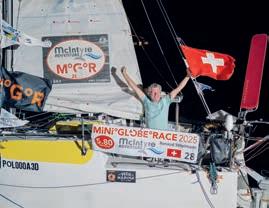
Renaud Stitelmann won every leg of the race and established the first o cial race record at 180 days, 11 hours, 25 minutes and 57 seconds
The first ever around-the-world yacht race sailed in ‘Mini’ yachts, the Mini Globe Race, an idea conceived by Australian adventurer Don McIntyre in 2020, sailed into the history books as the finishers arrived in Antigua having raced 24,000 miles solo around the globe over 13 months.
15 sailors - 13 men and two women from eight countries - set out from the National Sailing Academy in Antigua on 23 September 2025, sailing ALMA Class Globe 580 home-built 19ft plywood yachts. They raced west about via all the oceans of the world.
Winner Renaud Stitelmann (#28 Capucinette / CH) won every leg of the race and set the inaugural record time of 180 days 11 hours, 25 minutes and 57 seconds. His average speed was 5.54 knots, or 133 miles a day. He returned 377 days after the start having visited 15 ports in 13 countries.

Further records were broken: Jasmine Harrison ‘NUMBATOU’ (88) became the first British woman to circumnavigate the globe solo in the smallest yacht and Pilar Pasanau is the first Spanish woman sailor to solo circumnavigate and also in the smallest yacht. Josh Kali set a record for the smallest Americanflagged yacht to circumnavigate solo or otherwise.
All this follows in the footsteps of the late John Guzzwell who, in 1955, set o in his home-built 20ft timber yacht, ‘TREKKA’, to sail solo around the world. Returning three years later he was the first ever to do so. John Guzzwell passed away in 2024 at the age of 94, just weeks after honouring the McIntyre MGR team by accepting the role of Patron of the ALMA Globe Class.
While most entrants experienced knockdowns at some point, the onedesign ALMA Globe 580s have proven themselves. There was one man overboard incident (Eric Marsh was tethered and managed to re-board) and a couple of close calls. There were quite close encounters with shipping and fishing vessels and many impacts with UFOs – some quite hard.
One final validation of the Mini Globe concept, though, is that not one of the 15 starters abandoned the race because of boat or challenge issues. Of the four retirements, one was due to a health issue and the three Australians retired were simply short of money to leave Australia again.
The second edition of the McIntyre MGR is scheduled for 2029 with over 25 sailors already committed.
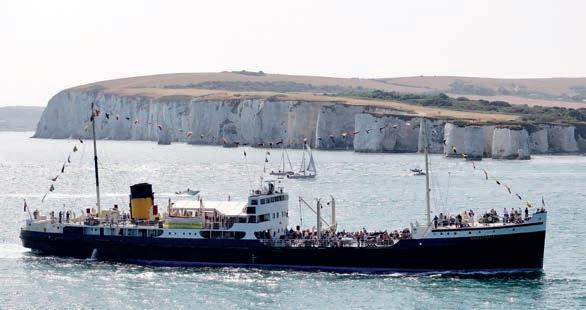
Development funding of £202,500 has been awarded by the Heritage Fund to help The Steamship Shieldhall Charity progress their plans to apply for a full National Lottery grant of £1.67m at a later date.
Based at Southampton, Steamship Shieldhall is Europe’s largest operational heritage steamship. Twice flagship of the UK’s National Historic Fleet, Shieldhall is of national and international maritime heritage significance, and without this funding continued operation would be increasingly di cult, with the ship needing to comply with current and future maritime legislation.

The ‘Steamship Shieldhall: towards 2055, the next 10 years’ project will enable extensive conservation work to take place on the ship, which is over 70-years-old. Steamship Shieldhall is wholly run by volunteers, and provides opportunities to get directly involved in all aspects of operating and maintaining an historic ship. In addition to volunteering, another way to support the ship - and experience first-hand its operation - is to book a trip on a public sailing. Opportunities will be developed for local community groups and schools/ colleges to engage with the ship. ss-shieldhall.co.uk
This April, Sir Ben Ainslie is taking on the 2026 TCS London Marathon. Ben is not a marathon runner – stepping outside his comfort zone, he will push himself physically and mentally to complete the 26.2 mile course, as he runs to raise awareness and funds for the 1851 Trust, the charity he founded over a decade ago. Donate at: 2026tcslondonmarathon.enthuse.com/ pf/sir-ben-ainslie
































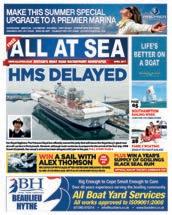
This time nine years ago it was a case of HMS Delayed with the news that the arrival of the new aircraft carrier
HMS Queen Elizabeth had been delayed until later in the year. Also in the news, Fairline Yachts was expanding its manufacturing capabilities to accommodate increased demand and Maiden left the Seychelles bound for Southampton and a much needed re-fit, not knowing the huge successes which were to follow… You can find many past issues of All at Sea at www.allatsea.co.uk/ all-at-sea-the-paper
For her solo, non-stop, unassisted circumnavigation of the UK & Ireland, the Yachting Journalists’ Association Yachtsman of the Year 2025 trophy was awarded to Jazz Turner. The Young Sailor of the Year Award 2025 was presented jointly to Sabine Potter and Merle Nieuwland and Lila Edwards and Amelie Hiscocks. The combined e orts of both partnerships at the Youth Worlds in the 420 and 29er classes demonstrated outstanding teamwork, determination and racing success. A special certificate was also awarded to Emirates GBR for Team of the Year 2025.
Congratulations to February’s competition winners. Doug O’Malley, Devon, and Philip Neil Linfield, West Sussex, each won a copy of Anchorages of the British Isles, and Linda Savas, Manchester, won an Icom IC-M25 EVO Handheld Marine VHF Radio. This month’s competitions can be found on pages 19 and 21.
Andark Diving & Watersports is celebrating 50 years with Andark’s 50th Anniversary Family Fun Weekend taking place from 26 – 28 June at Andark Lake in Swanwick, near Southampton. Part of the year’s celebrations, this fun-filled, familyfriendly weekend by the water will be packed with activities, entertainment and food including free and bookable activities, live music and talks.
British sailor Craig Wood has been honoured with the Seamaster Award at the 2026 Flagship Night in Düsseldorf after becoming o cially the first triple amputee to cross the Pacific solo. The award honours those who shape the world of watersports through exemplary commitment and sporting success. Craig joins an elite group that includes Rolex World Sailor of the Year Kirsten Neuschäfer, Boris Herrmann, François Gabart, Jimmy Spithill and Loïck Peyron.
Sunseeker International has confirmed that a consortium led by KCP Holdings, in partnership with Lionheart Capital, is to become the new owner of the company following completion of a debt purchase from existing lenders. The transaction, which includes an agreement to acquire 100 per cent of the shares in Sunseeker, is subject to customary regulatory approvals.
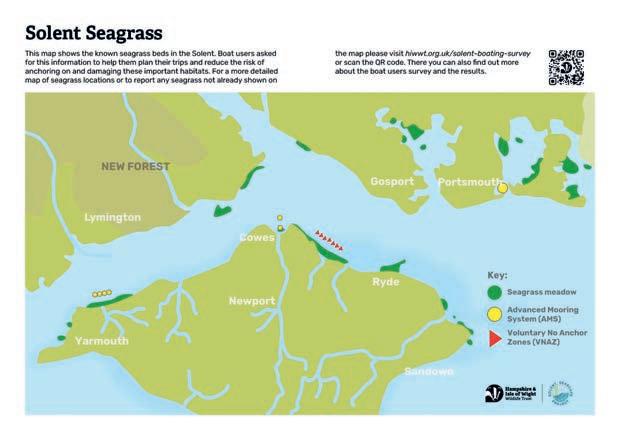
A new interactive map is helping boaters across the Solent protect seagrass, one of the UK’s rarest marine habitats.
The map was developed in response to the Trust’s Solent Boating Survey, which gathered insights from nearly 600 boat users in the Solent and was carried out as part of the Solent Seascape Project. The survey showed strong awareness of seagrass and its importance, but identified a lack of clear, trusted information about seagrass locations as one of the main barriers to avoiding damage while anchoring.
In busy coastal areas like the Solent, seagrass can be particularly vulnerable to damage from anchoring. Anchors and chains can uproot the seagrass, releasing stored carbon and pollutants and destabilising the seabed, which makes our coastlines and boating channels vulnerable to shifting sediments and coastal erosion.
So, the map shows the locations of known seagrass meadows, helping skippers to avoid anchoring on them and reduce the risk of damaging these precious habitats; once damaged, seagrass can take many years to recover.
Across the UK, seagrass meadows have declined by up to 90 per cent in the last century, making the remaining beds in the Solent particularly valuable and in need of careful protection.
Seagrass meadows are particularly important in the Solent, where sheltered bays and tidal waters create ideal conditions for safe anchoring and areas for these rare habitats to flourish. Home to species including pipefish, cuttlefish and thornback rays, they also support local jobs in fisheries by providing nursery grounds for fish such as bass.
Alongside the map, boaters can also play an active role in improving knowledge of the Solent seabed. Seagrass that does not currently appear on the map can be reported, with sightings submitted using a Seagrass Spotter app. These contributions will help refine the map over time and build a clearer, more accurate picture of Solent habitats, shaped by the boating community itself.
The Solent Boating Survey and interactive map are part of the Solent Seascapes Project, a partnership initiative working with the boating community to keep boating enjoyable while supporting healthy marine habitats. The partnership is also working with the local community to restore seagrass, oyster reefs, saltmarsh and seabird nesting habitats across the Solent’s seascape.
The map, survey findings and reporting tools are available at: hiwwt.org.uk/ solent-boating-survey
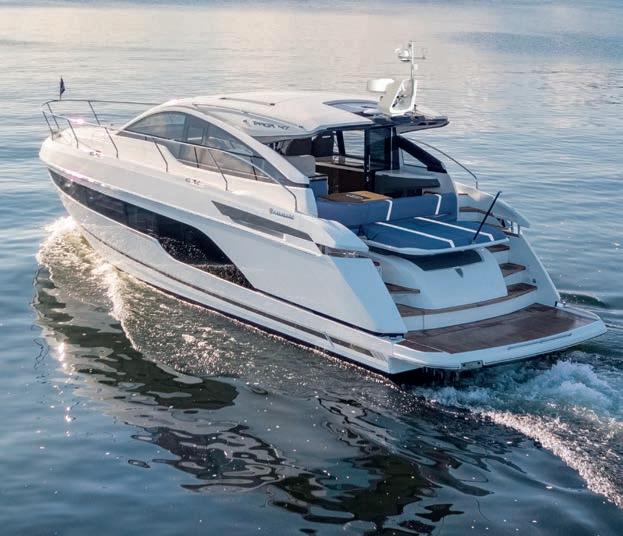
This year’s South Coast & Green Tech Boat Show will showcase the UK debuts of the all-new Fairline Targa 47 GT and Fairline Targa 50 Edition, presented by Approved Boats at Ocean Village Marina from 8 – 10 May.
The show will welcome two additions to the Fairline range as they make their first appearance on UK waters in Southampton this spring. The new Targa 47 GT brings a fresh evolution to Fairline’s renowned Targa range, combining sleek exterior styling with practical luxury. Designed as a true gran turismo cruiser, the 47 GT features a contemporary hardtop with an expansive glazing system that floods the cockpit and saloon with natural light.
The sociable cockpit layout flows into the saloon, creating a spacious entertaining area, while below deck the yacht o ers beautifully appointed cabins and refined detailing throughout.
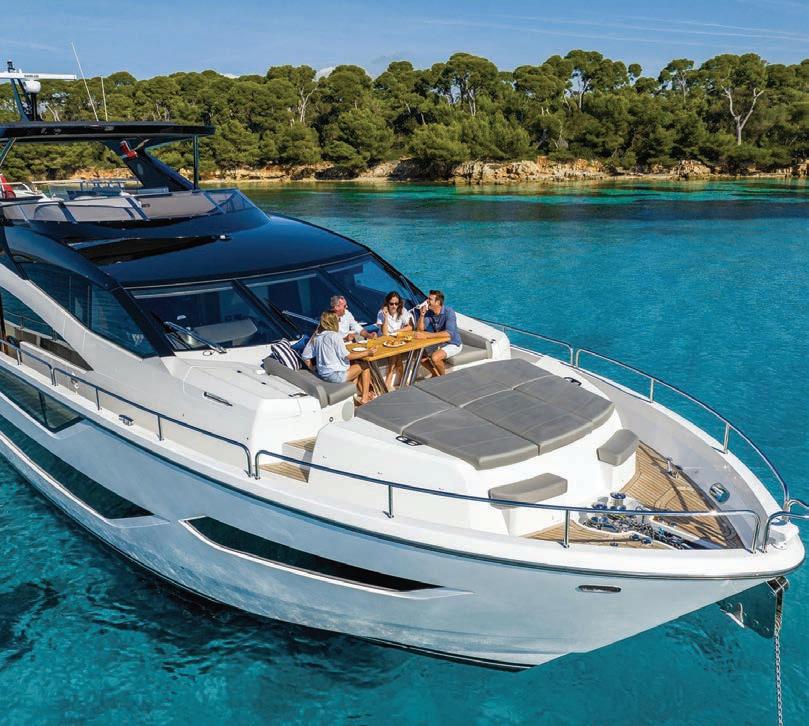
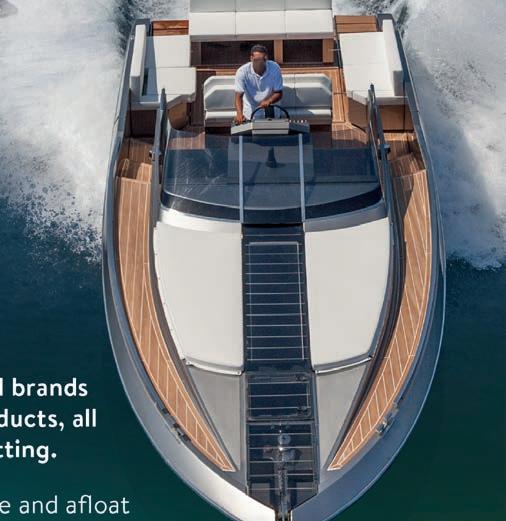
Making its UK debut alongside the 47 GT, the Targa 50 Edition (pictured) focuses on outdoor living, o ering generous seating, sunpads and a helm designed for an engaging driving experience. The yacht’s layout maximises space both on deck and below, with carefully considered finishes and craftsmanship that reflect Fairline’s
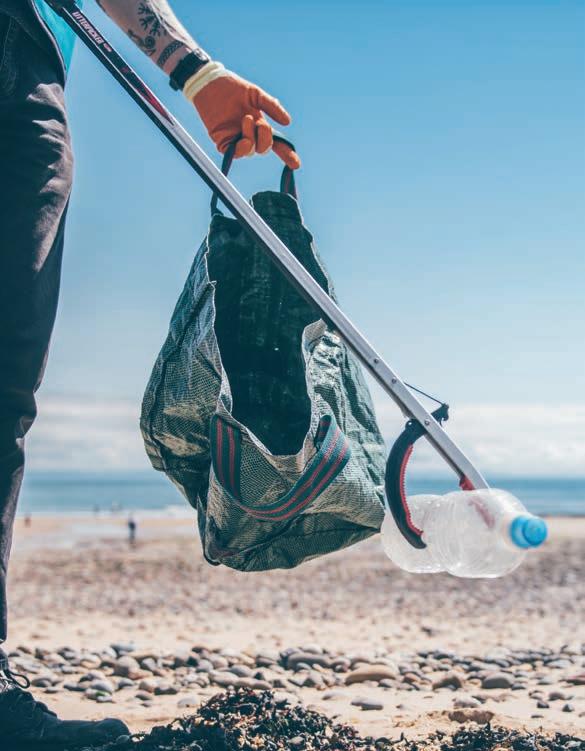
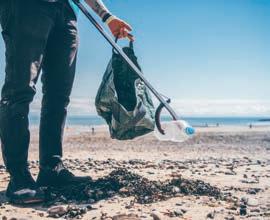
From takeaway containers to tiny plastic fragments, marine litter remains a daily reality on UK’s shores – despite signs of progress.
According to the Marine Conservation Charity’s State of our Beaches 2025 report, last year nearly 15,000 volunteers recorded 603,963 pieces of litter across UK beaches. On average, volunteers found 141 pieces of litter for every 100 metres of coastline surveyed.
Data collected by volunteers over more than three decades allows the Marine Conservation Society to track which litter items appear most often, identify their sources and use this evidence to push for policies that protect our oceans from pollution.
Plastic pollution remains persistent across the UK, on 99.5 per cent of UK beaches surveyed and making up 87 per cent of litter items recorded.
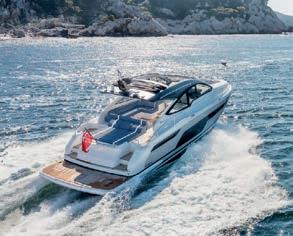
heritage. Designed for owners who enjoy speed, style and sociable cruising, the Targa 50 Edition is expected to draw significant attention over the three-day show.
Alongside the two Targa debuts, Approved Boats will also be showcasing an impressive collection of new models, including the Fairline Targa 40, Fairline Squadron 58, as well as the Absolute 52 Fly and Absolute Navetta 53 from Absolute Yachts.
Tickets are free and can be booked at www.mdlmarinas.co.uk/events/ boat-show-tickets. Appointments to view specific boats or meet with the individual exhibitors can be arranged via a booking portal on the website. Turn to page 16 for our South Coast & Green Tech Boat Show preview.
The three most commonly found items were the same in England, Wales and Northern Ireland:
■ Small plastic fragments, found on 86 per cent of beaches
■ Single-use plastic wrappers, such as crisp, sweet and sandwich packaging, recorded on 80 per cent of beaches
■ Plastic caps and lids, present on 83 per cent of beaches
For many marine species, plastic is not just pollution – it is a serious threat to life. Sea turtles, seabirds and fish commonly ingest plastic
Ancasta is set to showcase a carefully curated collection of turnkey yachts –new and pre-owned – at its Spring Boat Show, taking place at Swanwick Marina from 17 - 19 April.
This boutique, appointment-led event is designed for serious buyers seeking immediate access to the water, o ering the opportunity to step aboard some of the industry’s most desirable motor yachts, sailing yachts and multihulls –available now for delivery in time for the upcoming season.
thinking it is food. Once swallowed, it can obstruct their digestive systems, leaving them unable to eat and ultimately leading to starvation. Larger items, such as ropes and discarded fishing gear, can entangle animals, causing injury, exhaustion and, in many cases, death.
Unlike natural materials, plastic does not biodegrade – it simply breaks into even smaller pieces that persist indefinitely in the environment. These tiny particles, known as microplastics, represent an often invisible but widespread threat to the marine ecosystem.
The charity’s report does, however, reveal signs of progress, with average litter levels across the UK dropping by 15 per cent between 2024 and 2025, while single-use plastics presence fell by 18 per cent.
This is strong evidence that e ective policies, such as the ban on single-use plastic cutlery, are making a measurable di erence. Cutting down on single-use plastics, reusing, recycling and disposing of litter correctly, are simple steps that add up to real change when adopted widely.
The charity gathers beach clean data year-round, with a third of its data being collected during their flagship Great British Beach Clean event, which will take place from 18 - 27 September. www.mcsuk.org/what-you-can-do/ join-a-beach-clean
The Spring Boat Show will feature brand-new models from leading names including Prestige, Beneteau Power & Sail, Bluegame, Lagoon Multihulls and Protector Boats. Selected models will also be available for sea trials.
Will Blair, Ancasta Group Marketing Director, said: “This event brings together an exceptional range of yachts that are ready to go now, giving buyers the chance to secure the right boat and be on the water without delay and ready for the 2026 season.”
All viewings are conducted by appointment. To arrange an appointment: ancasta.com/spring-boat-show




























































REEDS WEATHER HANDBOOK
3RD EDITION
THE COMPREHENSIVE POCKET GUIDE
By Frank Singleton | £11.99
www.bloomsbury.com
With practical explanations and helpful diagrams and photographs, this is the ideal aide-memoire for skippers and crew, especially those studying for their Day Skipper and Yachtmaster exams. This new edition updates availability and usage of computer-generated forecasts with a glimpse into the AI future. Climate change impacts on sailors are described and there is a scientifically correct description of the Coriolis e ect.
THE PADDLEBOARD BIBLE 2ND EDITION: THE COMPLETE GUIDE TO STAND-UP PADDLEBOARDING
By Dave Price | £16 www.bloomsbury.com
From the basics of getting on and moving, to mastering advanced techniques and going on paddleboard adventures, this book gives you everything you need to know to get SUPping. This second edition is updated throughout to reflect current guidance and safety regulations, and includes new advice on accessibility and travel.
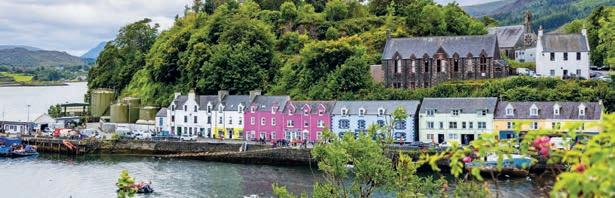
The publication of Giant Opportunities (2026–2030), a new strategic framework for Scotland’s marine tourism sector, marks the next chapter in a decade-long strategic journey to grow and futureproof one of Scotland’s most valuable tourism industries.
It sets out an ambitious pathway for the sector’s continued growth and sustainability, critical to both the prosperity of Scotland’s coastal communities and national economy.
Scotland’s marine and coastal tourism sector already supports over 34,500 jobs and generated £699 million in Gross Value Added in 2023. This framework outlines a pathway for focused collaboration to grow this by a further £100 million over the next five years.
At its core, it identifies four strategic areas of focus:
Sector Growth by Value and Visibility –enabling the sector’s growth and raising awareness of the opportunities it o ers.
Skills Development – tackling workforce shortages and creating clear career pathways
Community and Placemaking –maximising local benefits through strong partnerships and placebased development
Net Zero and Sustainability –capitalising on opportunities arising from the transition to a low-carbon economy
The framework identifies new and emerging opportunities, not only with the rising popularity of paddle and board sports but also the rising demand for more sustainable, nature-based tourism, the growth in wildlife tourism and the increased focus on blue health and wellbeing – all areas where Scotland’s coasts, lochs and waterways are uniquely placed to lead.
Giant Opportunities calls for stronger collaboration across marine and the wider tourism sectors, and for the active support of government, to address long-standing challenges, particularly around skills shortages, infrastructure investment and funding access.
By working together, British Marine Scotland and its partners believe it will be possible to address current skills shortages and funding barriers that plague many small marine tourism businesses, while also unlocking new opportunities linked to green technologies, low-carbon infrastructure and the demand for more sustainable marine experiences.
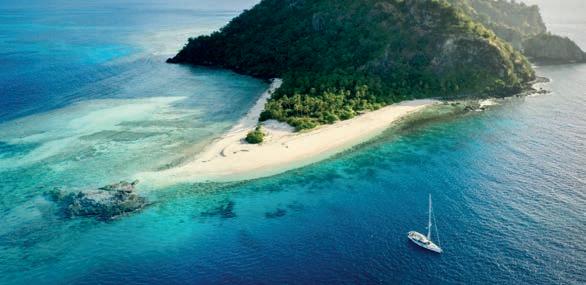
As the 2026 fleet settles into the early chapters of its own global voyage, Oyster Yachts has announced the launch of the Oyster World Rally 2030–31.
Open only to Oyster owners and limited to just 30 yachts, the 2030–31 Rally begins in Antigua in January 2030, covering 27,000nm and crossing three oceans over 16 months. The Rally route has been meticulously planned to align with favourable global weather systems, ensuring owners experience each destination at its very best.
Unlike traditional rallies, the Oyster World Rally is non-competitive and does not require participants to sail in close formation. Owners are encouraged to explore independently if they wish, forming smaller groups organically, venturing o to discover remote anchorages or rejoining fellow participants further along the route. It is this distinctive balance of independence, community and meticulous planning that defines the Rally experience and sets it apart.
Richard Hadida, Owner and Chairman of Oyster Yachts, who is currently participating in the 2026-27 Rally with his wife and their two-year-old son, said: “Oyster yachts are built to cross oceans in safety, comfort and style, and the Rally is the ultimate expression of that capability. But beyond the yachts themselves, it is about enabling extraordinary life experiences.”
At the heart of the Oyster World Rally is a dedicated, sailor-led team providing comprehensive logistics, technical and concierge support from the moment owners sign up. Preparation begins 18 months before departure with an extensive training programme included within the entry fee.
Throughout the voyage, Oyster technicians are present at key destinations to provide specialist support tailored specifically to Oyster yachts, working alongside the logistics team to manage berthing, immigration and customs formalities, and on-theground coordination.
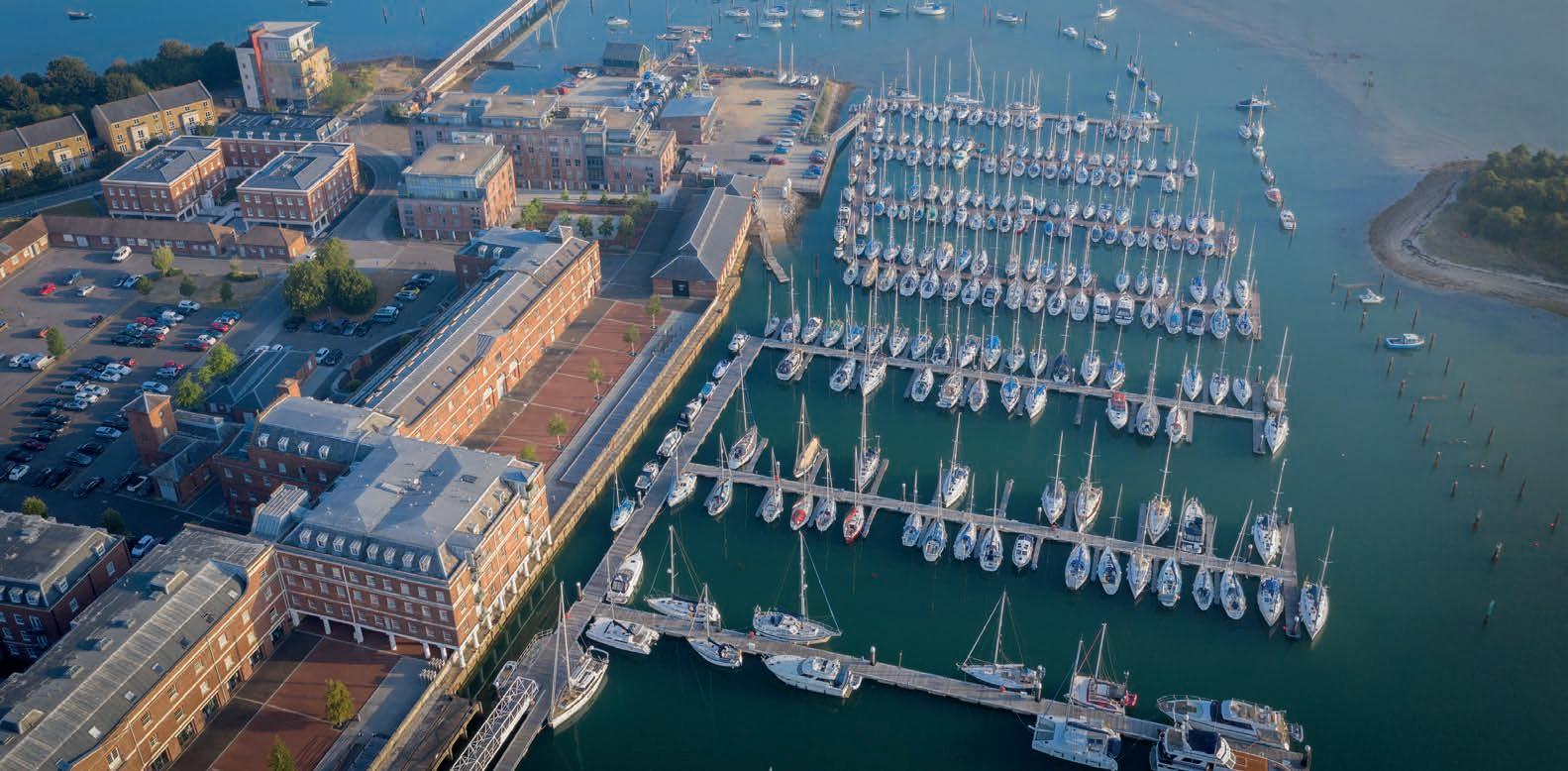
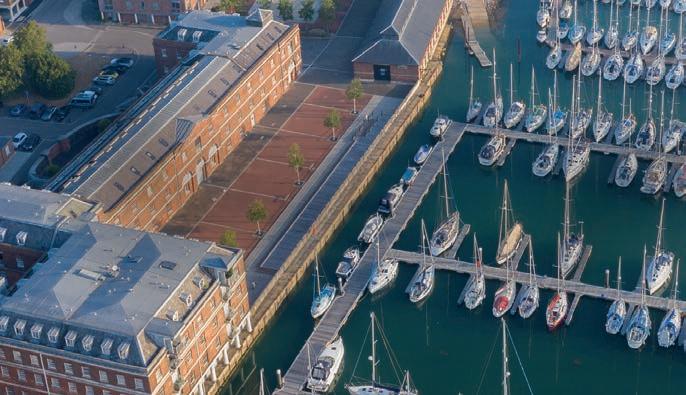









Record numbers, major debuts and green innovation: inside the South Coast & Green Tech Boat Show 2026.
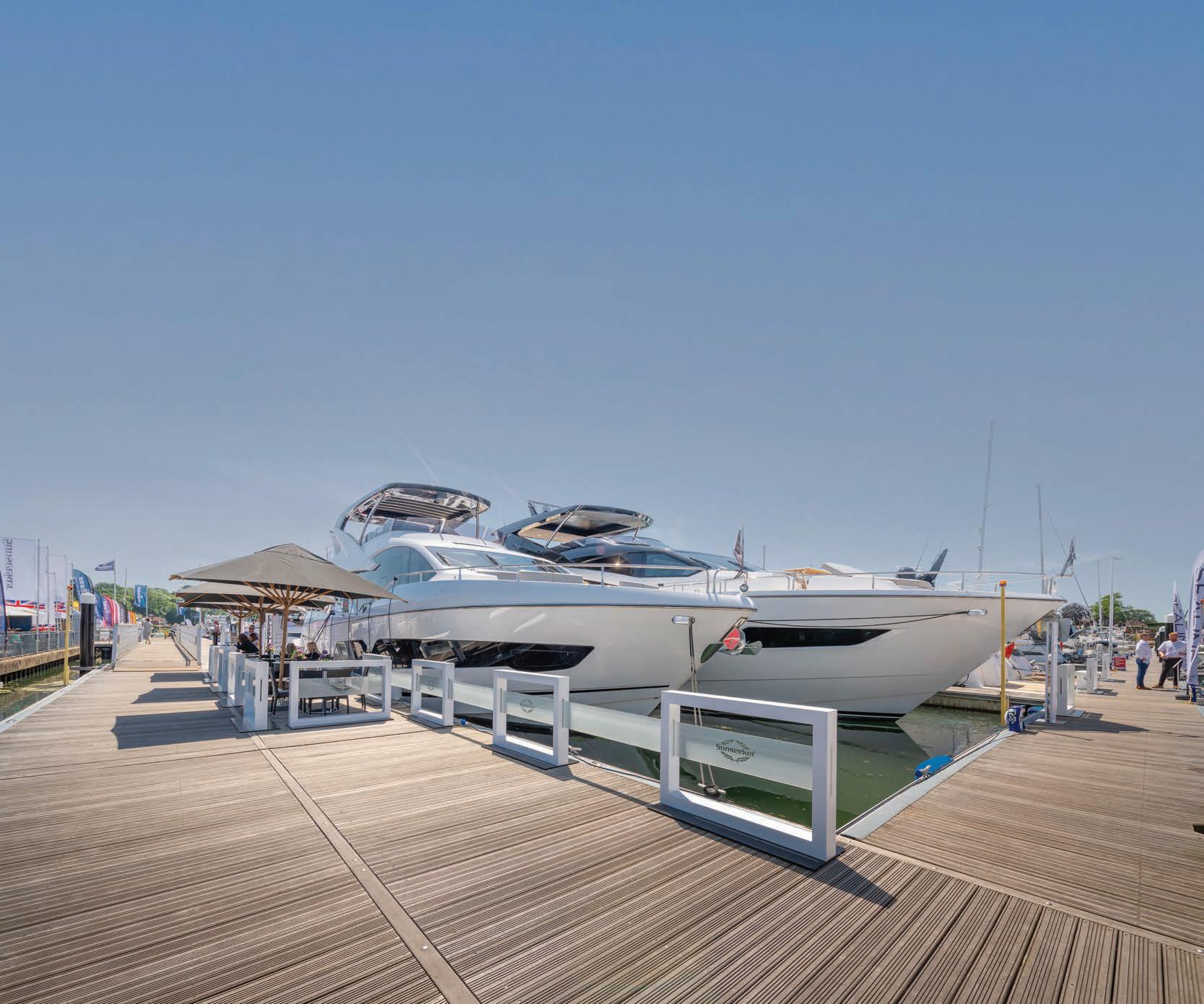
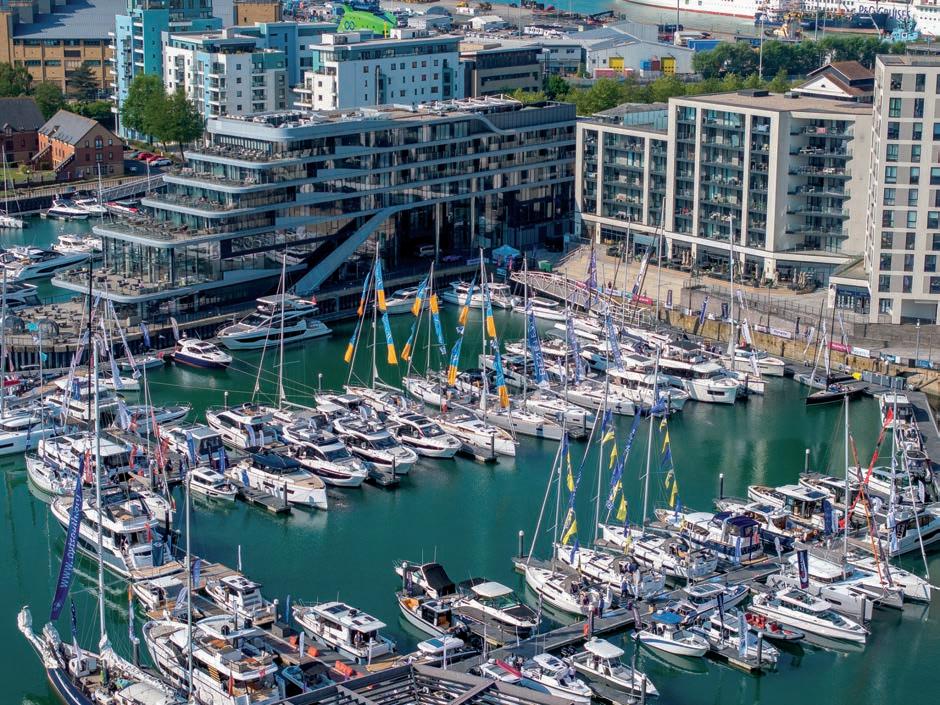
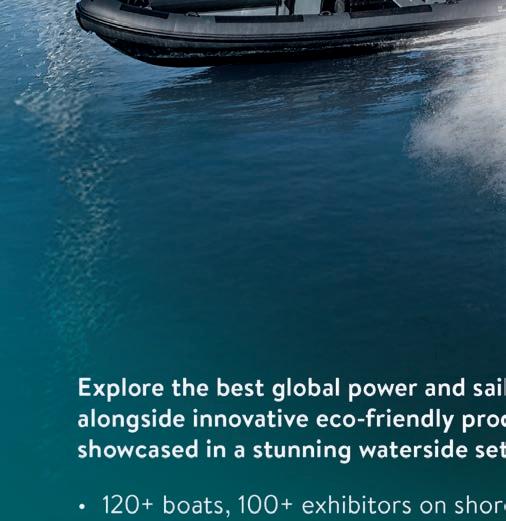
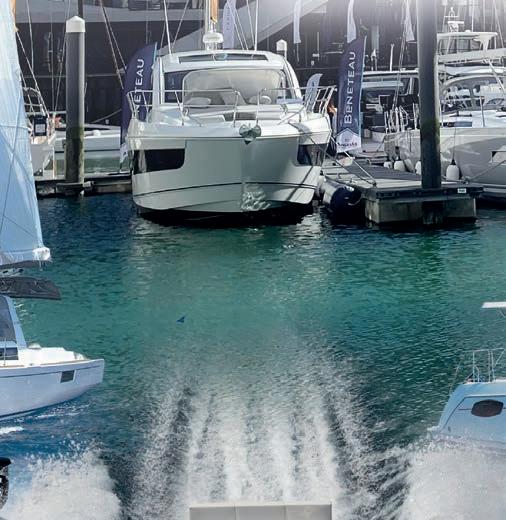
The South Coast & Green Tech Boat Show 2026 returns to MDL’s iconic Ocean Village Marina in Southampton, bringing together leading global power, sail and electric brands alongside innovative eco-friendly products and marine accessories.
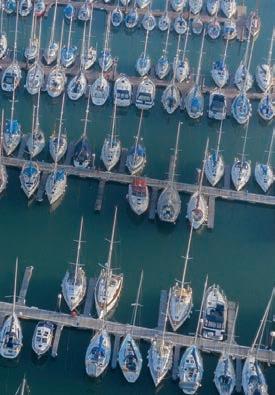
Guided by Raymarine, the three-day event takes place from 8 – 10 May. Following last year’s expansion, the show’s extended waterside area will welcome its largest display yet, with 120 boats showcased throughout the marina. Visitors can also explore a wide range of onshore exhibitors, alongside essential services including marine equipment, finance and insurance.
With its open-air waterside setting and relaxed atmosphere, the show o ers a chance to step aboard a wide range of boats and speak directly with manufacturers and industry experts.
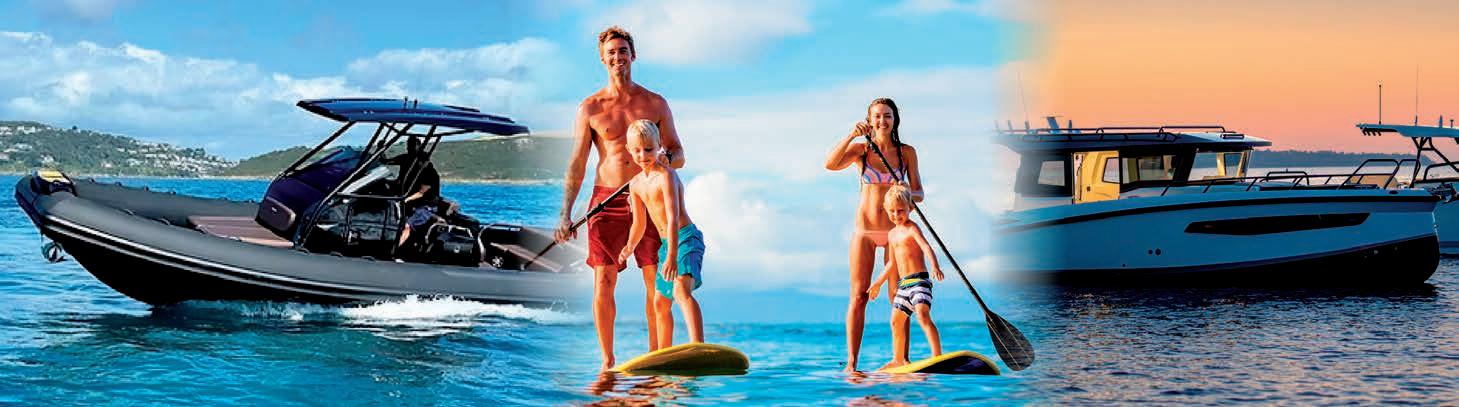
The event caters for experienced boat owners, newcomers to boating and anyone interested in marine innovation. From practical family cruisers and performance boats to premium yachts and next-generation electric models, the show highlights the diversity of today’s market and the direction it is heading.
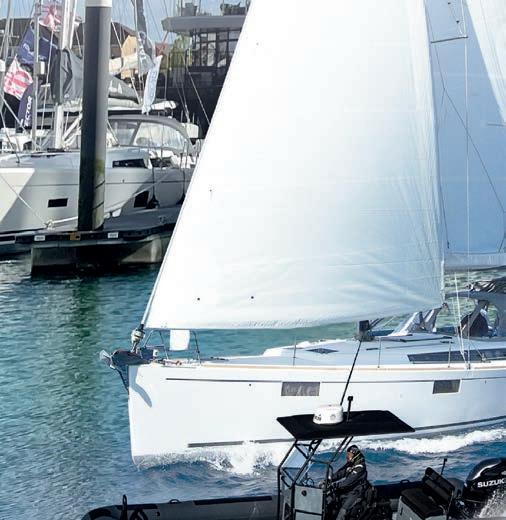
This year’s line-up features several exciting debuts and award-winners from world-leading brands such as Sunseeker, Absolute, Finnmaster, Nimbus, Delta, Fairline, Fjord, Hanse, Windy and many more.
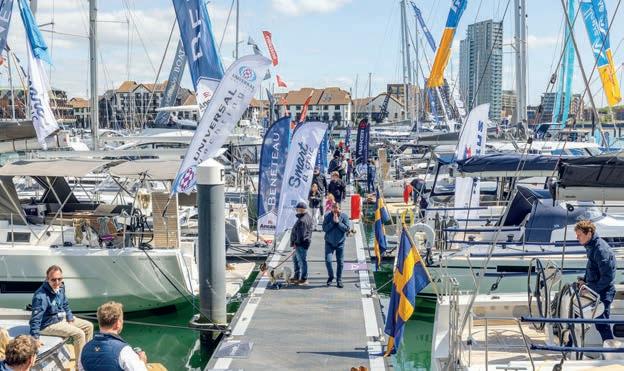
The South Coast & Green Tech Boat Show has built a strong reputation for its focus on sustainability. Visitors will be able to see one of the UK’s most comprehensive displays of electric boats, hybrid propulsion systems and environmentally responsible marine technology.
Manufacturers and suppliers will be on hand to explain how these systems work, the benefits they o er and how boat owners can reduce running costs and environmental impact. From electric outboards and alternative power systems to energy management and charging solutions, the show reflects the
“The South Coast & Green Tech Boat Show has become a key date in the calendar for serious buyers”
growing shift towards cleaner boating. Alongside boats on display, exhibitors will present a wide range of supporting technology, components and onboard systems designed to improve e ciency and reduce emissions.
A central feature of the show is the Innovation Hub, which highlights emerging ideas and new developments across the marine sector.
Taking place on the live stage at the heart of the show, the Innovation Hub will feature an exciting line-up of talks, covering a wide variety of topics from ocean preservation to preparing boats for long-distance cruising. Industry experts at the cutting edge of clean marine technological innovation will deliver these sessions, including an expert-led panel discussion with Q&As.
The Innovation Hub also provides a platform for newer companies to present their work and connect with potential customers and partners.
The show will once again host MDL’s Green Innovator Award, which recognises companies making a meaningful contribution to sustainability in the marine sector.
Open to both established businesses and emerging innovators, the award highlights products and services that demonstrate clear progress in environmental responsibility, design and performance.
Nominations for MDL’s Green Innovator Award 2026 are open at www.mdlmarinas.co.uk/green-award
The winner will be announced during the show.
Once again, Raymarine will be giving registered visitors the chance to win prizes worth up to £7,000, featuring a wide range of high-performance marine electronics. All registered visitors to the South Coast & Green Tech Boat Show will be automatically entered into the prize draw.
Renegade Brewery will be making a welcome return to the show, supplying a great selection of craft beers, including MDL’s very own Nauti Buoy on draft. Also returning for 2026, Earth to Oven will o er their locally sourced seasonal street food.
Ocean Village Marina o ers a vibrant waterfront setting, with a variety of nearby bars, cafés and restaurants open throughout the event, including Banana Wharf, Maritimo Lounge, Bacaro, Casa Brasil, Blue Jasmine, Figurati, HarBAR on 6th and The Jetty. Visitors can enjoy refreshments while taking in views of the marina and boats on display.
Bringing together leading global brands, cutting-edge green marine technology, expert insight and an impressive display of boats on the water, the South Coast & Green Tech Boat Show has become a key date in the calendar for serious buyers.
is available at the on-site multi-storey Ocean Car
nav postcode SO14 3TJ.
Tickets to the show are free and can be booked at www.mdlboatshow.co.uk/tickets
Appointments
Appointments to view specific boats or meet with individual exhibitors can also be arranged via a booking portal on the website.For a full list of confirmed exhibitors visit www.mdlboatshow.co.uk




In the first part of this
more about the Ocean
new
series we
learn
Conservation
Trust –who they are, what they do for boaters and why they need your help.
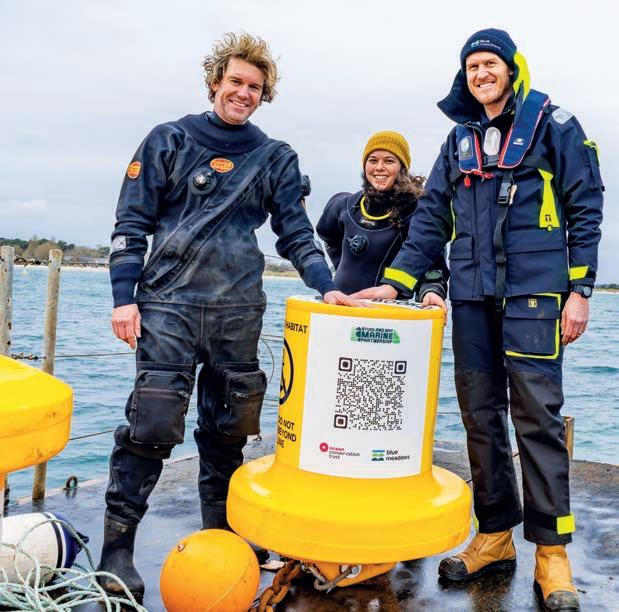
The Advanced Mooring System provides protection to seagrass meadows
OCT’s vision is for a healthy ocean to sustain all life and to protect the ocean for all. Boaters are blessed to know the ocean with an intimacy that most people do not get to experience. But that means they are also likely to be more in-tune with the seemingly endless waves of bad news surrounding it. Species loss, habitat destruction, warming water, ocean acidification; it is hard to talk about the planet’s largest body of water without these topics entering the conversation.
But here at the Ocean Conservation Trust, we refer to ourselves as Ocean Optimists. That is because we see a bright future for the ocean, its ecosystems and the humans who interact with it.
Our programmes are all-inclusive and we encourage people to join us in any way they can. Whether you are making use of our Advanced Mooring System, an innovative buoy rig that provides protection to seagrass meadows, or taking our ‘Motion for the Ocean’ set of pledges to your local council, there are so many ways you can get involved.
OCT has been working toward this future for over a quarter of a century, and we invite all ocean users to join us in our mission, whether you are a boater, a fisherman, a diver, a swimmer or simply someone who cares about protecting the planet’s most vital resource.
The Blue Meadows seagrass restoration and protection project is the charity’s flagship conservation programme
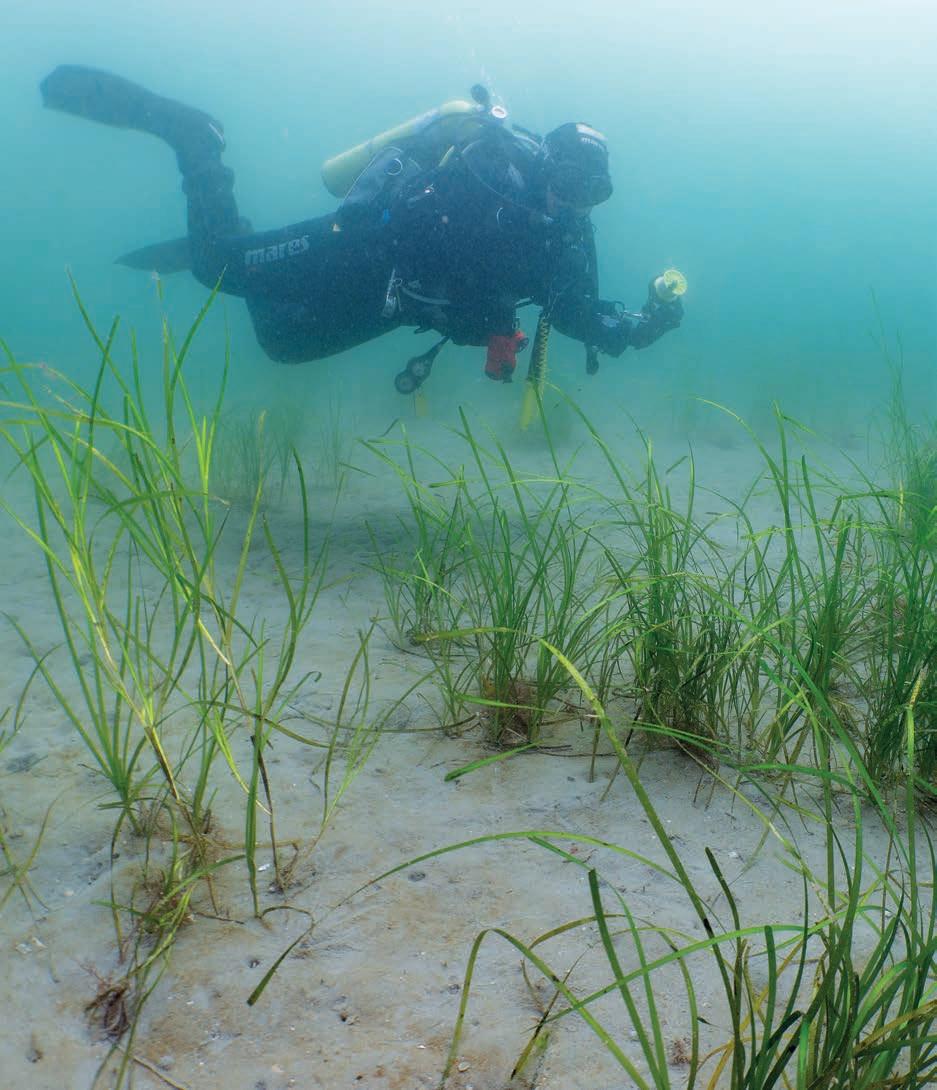
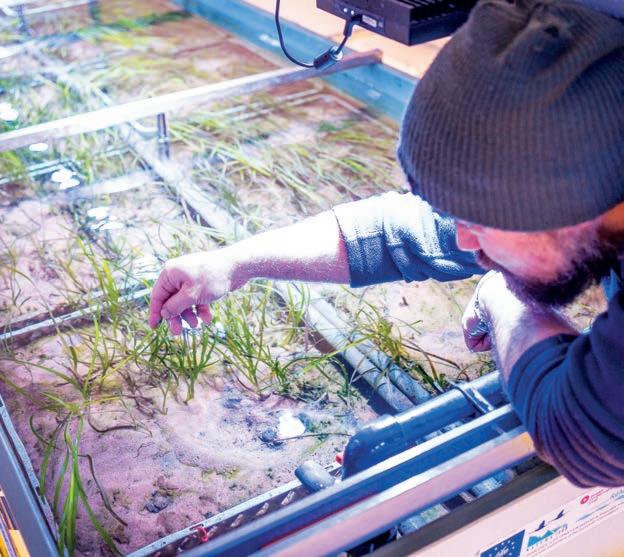
Seagrass flowers and produces seeds, which are collected by divers in the summer for restoration e orts
“OCT’s vision is for a healthy ocean to sustain all life and to protect the ocean for all”
OCT began its journey under a di erent name, over a quarter of a century ago.
In 1998, The National Marine Aquarium was opened by the Duke of Edinburgh in Plymouth. The NMA, which now provides a home to over 5,000 marine animals, was conceived of as an educational window to the ocean for the public. 25 years later, and that mission has only grown – OCT has worked with communities from Plymouth to as far as Japan.
A significant milestone for the charity came in 2013 when it began to focus on seagrass habitat loss in the UK. Blue Meadows, a seagrass restoration and protection project, is now the charity’s flagship conservation programme. Over its lifetime, the charity’s reach and ambition has expanded beyond what anyone could have expected.
What began as an aquarium has now blossomed into a full-blown conservation powerhouse, sta ed by a dynamic group of marine scientists, divers, educators and advocates. The charity works tirelessly toward its goal of a healthier ocean, through three approaches: experiences, advocacy and habitat restoration.
The OCT experiences programme is driven by the National Marine Aquarium as our Centre of Ocean Excellence, connecting many audiences from a young age through to lifelong learning.
In addition, we have a dedicated engagement team that conduct outreach to the local communities, ensuring that the ocean is accessible to all regardless of whether you can get up close to the physical ocean. Jacques Yves Cousteau, the renowned French explorer and conservationist, once made a simple yet profound statement: ‘People protect what they love’. We believe that an emotional connection to the ocean can lead to achievable action.
OCT advocacy refers to the charity’s attempts to have local, national and global authorities focus more on the ocean when they are making big decisions. The advocacy and engagement team also champions ocean literacy among the public with the belief
that conservation must start with people. We encourage people to ‘Think Ocean’ every day, and to take small, simple actions that support ocean health. With regard to habitat protection, OCT is currently primarily focused on restoring and protecting seagrass meadows under the Blue Meadows programme. Since the 1930s, an estimated 90 per cent of the UK’s seagrass beds have been lost, largely through physical disturbance, pollution and disease. This habitat is not only a haven for biodiversity (a single hectare can support 80,000 fish and tens of millions of invertebrates) it is also an incredibly e ective carbon store, sequestering carbon more e ciently than forests. Seagrass meadows are arguably one of the most vital marine ecosystems in British waters, and they continue to disappear at a rate of seven per cent a year.
OCT cannot act alone. We believe that our mission requires everyone to be pulling in the same direction. That is why we need the support of boaters everywhere – and it is in boaters’ interests to get involved. Seagrass meadows can provide protection to our coastline, acting as a line of defence against erosion. They also support commercial fisheries, by providing a nursery environment for a range of economically important fish species. Whatever activity you engage with, in, on or around the water, there is a good chance our work supports you. So why not connect with OCT and join us in creating a future with a healthier ocean? You could start using our Advanced Mooring Systems, or take our Motion for the Ocean to your local council or even simply take the Think Ocean quiz. And keep an eye out for future All at Sea articles, which will focus on our seagrass conservation work, and expand on what boaters could do to protect this vital habitat.
Would you like find out what you can do to help? Head to www.oceanconservationtrust.org or sign up to our newsletter to find out more.
All at Sea has teamed up with Wave International to give away a Wavestream bilge filter, helping boaters to protect the environment.
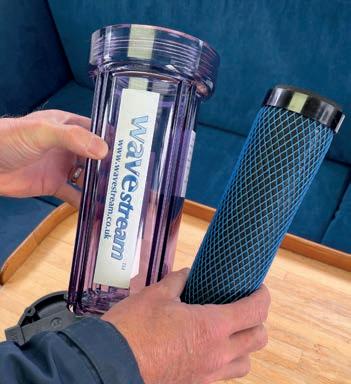
Join the growing community of boaters playing a crucial role in helping the marine industry keep our oceans and waterways clean by ensuring you never again discharge polluted water overboard.
Most boaters would be shocked to know that the water pumped out from the bilge not only contains harmful oils, but also highly polluting micro bres, microplastics and heavy metals. Simply by pumping out the bilge, these pollutants end up in the ocean and o en create that embarrassing blue sheen on the water.
By tting a low cost Wavestream bilge lter, boaters can play a crucial role in helping keep our oceans and waterways clean. This compact unit is installed between the boat’s bilge pump and bilge outlet. It removes all traces of oil and diesel, down to <5 ppm
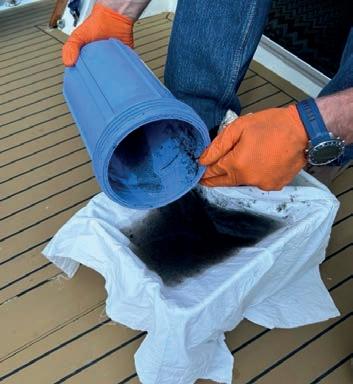
as well as the many harmful particles of paint, microplastics and micro bres that are washed down into a boat’s bilge.
Designed to meet the stringent Lloyds Register of Shipping Type Approval and the Boat Safety Scheme the range of Wavestream Filters starts with the Wavestream Micro System at £130, up to the Wavestream System 3 - for vessels over 20m - at £500.
Halyard (M&I) Ltd are the UK distributor for Wave International: www.halyard.eu.com technical@halyard.eu.com


To be in with the chance of winning this great prize enter below, at www.allatsea.co.uk or by email to editor@allatsea.co.uk with the subject header Wavestream Bilge Filter Competition. You can also enter via the All at Sea newsletter (sign up at www.allatsea.co.uk/aasnewsletter).
Q: What is the name of the smallest Wavestream Filter
A:
EMAIL:
As the marine industry faces growing pressure to decarbonise, methanol is emerging as a realistic, scalable solution, bridging today’s technology with tomorrow’s zero-carbon ambitions.
From container ships to superyachts, the industry accounts for nearly three per cent of global greenhouse gas emissions. Regulators are tightening standards, consumers are demanding cleaner alternatives and the window for action is narrowing. For decades, diesel has dominated, but its reign is ending.
A fuel once overlooked, Methanol is now surging to the forefront of the decarbonisation debate. Its appeal lies in practical versatility of cleaner combustion, relative safety and ease of storage, and renewable production potential. Recent UK consortium funding for a methanol rangeextension project signals that innovation is accelerating from theory to reality.
For the leisure sector, methanol o ers unique advantages. Unlike hydrogen, which requires either high-pressure storage tanks or cryogenic systems, methanol remains liquid at ambient temperature and handles easily. While batteries o er zero local emissions, limited range makes them impractical for extended cruising. Methanol bridges these gaps, balancing performance, safety and environmental responsibility.
International shipping produces nearly one billion tonnes of CO₂ annually. Beyond carbon dioxide, pollutants such as nitrogen oxides, sulphur compounds and particulate matter contribute to air pollution, while some of them also play a role in ocean acidification, leading to far-reaching consequences.
The International Maritime Organisation has mandated a 40 per cent reduction in carbon intensity by 2030 and a 50 per cent reduction in total emissions by 2050, both compared to 2008 levels. Upcoming regulations may impose carbon pricing and emission standards that make business-as-usual untenable. Even luxury yacht markets, once insulated from scrutiny, now face pressure.

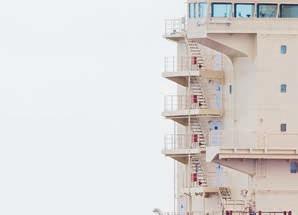
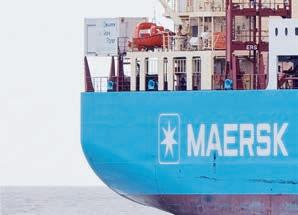
As a result, high-net-worth individuals are increasingly demanding vessels that reflect their values that sustainability credentials matter as much as performance. Marinas and ports are also introducing green berth incentives and, in some cases, restricting high-emission vessels. Despite this, diesel remains entrenched in the industry. Its energy density, established infrastructure and proven reliability have made it the default choice. But beyond emissions, diesel carries a reputational burden. Plumes of black smoke and visible environmental impact have become increasingly di cult to justify in an era of heightened ecological awareness.
Methanol’s credentials are compelling. Liquid at room temperature and traded globally for decades as an industrial feedstock, it o ers infrastructure familiarity that reduces adoption barriers. What distinguishes methanol is its production pathway. While conventional methanol derives from natural gas, renewable e-methanol can be synthesised from captured CO₂ and green hydrogen produced via electrolysis powered by renewable energy. This circular approach means combustion CO₂ emissions are balanced by the CO₂ captured during production, achieving net-zero emissions over the full lifecycle. As renewable energy costs fall, e-methanol economics improve, making it genuinely scalable.
Methanol also delivers tangible combustion benefits: significantly lower nitrogen oxide and particulate emissions than diesel, zero sulphur emissions and carbon dioxide reductions of up to 15 per cent even with fossil-derived methanol, approaching zero with renewable variants.
Crucially, methanol integrates with existing engine technologies. Modified internal combustion engines can run on methanol with minor adjustments, avoiding wholesale redesigns. It also works with fuel cells, where methanol reforms into hydrogen onboard, enabling zero-emission propulsion without pure hydrogen’s storage challenges.

All alternative fuels come with drawbacks, especially for the leisure yachting industry:
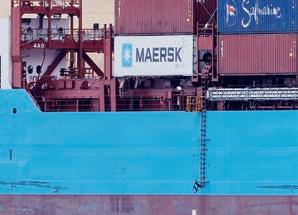
● Hydrogen requires storage at minus 253°C or extreme pressure, creating unsuitable safety and space challenges for leisure vessels.
● Ammonia is highly toxic and corrosive, presenting risks di cult to mitigate in confined yacht spaces.
● Battery-electric propulsion remains hobbled by limited range and lengthy charging times.
● LNG, once a transitional fuel, is losing favour as methane leakage undermines climate credentials, and it remains a fossil fuel.
● Bio-diesel and synthetic diesel face feedstock availability and lifecycle emission questions, alongside potential storage challenges at low temperatures.
Methanol strikes a pragmatic balance: safe, scalable, available now, with a clear pathway to full decarbonisation as production matures.
Commercial shipping has taken notice, with Maersk now committing to methanol dual-fuelled vessels, with multiple containerships operational or under construction. This trickledown e ect is reaching the leisure market, where yacht builders explore how methanol technologies proven at commercial scale can adapt for private and charter vessels.
Despite its promise, methanol faces its own challenge, with renewable e-methanol remaining in limited production. Scaling requires substantial investment in renewable energy, carbon capture and electrolyser facilities. Equally bio-methanol, where breakdown of organic matter produces methane gas which can be converted to methanol, is in its infancy. Both of these current ‘green’ methanol prices are several times higher than fossil methanol, though costs are expected to fall.
Safety and regulatory frameworks also present various hurdles. Methanol is toxic if ingested and mildly corrosive, requiring robust handling procedures.

Certification bodies are still developing comprehensive standards for methanolfuelled vessels, particularly in leisure markets. Without clear guidelines, uncertainty slows adoption.
Infrastructure is perhaps the most immediate constraint. Methanol refuelling facilities are sparse outside industrial ports, and leisure marinas lack incentive to invest without critical mass. This creates a chicken-and-egg problem: owners hesitate without convenient refuelling, while operators will not install infrastructure without guaranteed demand.


Integrating methanol systems within yacht confines also presents engineering challenges. Methanol has roughly half diesel’s energy density, requiring larger tanks for equivalent range. This impacts weight distribution, storage and interior layout; trade-o s requiring careful management to preserve performance and comfort.
Government support is critical, with programmes like Innovate UK’s funding helping de-risk early development, enabling prototyping that would otherwise be financially prohibitive. Grants, incentives and regulatory frameworks favouring lowcarbon fuels can accelerate adoption.
The leap from commercial vessels to leisure yachts requires translating industrial robustness into elegance and comfort. Technologies proven in harsh commercial environments must be refined and integrated where aesthetics and user experience are paramount.
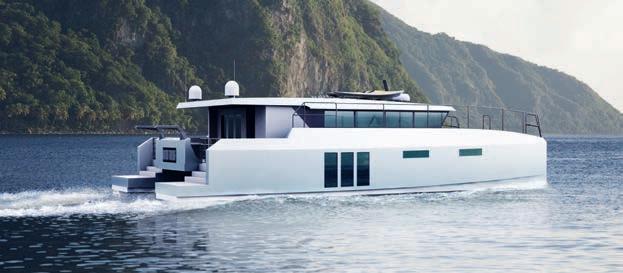
The Archipelago zero.63 typifies this evolution. Designed as a methanolhydrogen hybrid, it combines parallel hybrid propulsion with onboard reformers and fuel cells alongside a methanol combustion engine, enabling long-range, zero-carbon cruising.
The vessel’s design is centred on flexibility and resilience. The methanol engine provides reliable propulsion and range extension, while fuel cells o er silent, emission-free operation for coastal cruising and harbour manoeuvring. Reformers convert methanol into hydrogen on demand, eliminating high-pressure storage needs, an elegant solution prioritising practicality without sacrificing ambition.


Dr Stephen Weatherley, CEO of Archipelago Yachts, describes it as a proving ground: “We are demonstrating what is possible when you combine existing technologies innovatively. Methanol gives us the range and reliability clients expect, while the hybrid architecture allows zero emissions when it matters most.”
away from the industry’s reliance on diesel is still unclear. Innovative leisure vessels, such as the zero.63, can pave the way for the de-risking commercial uptake of alternative fuels.”
Methanol’s value lies in being a bridge; practical enough to deploy today, while o ering a clear pathway to full decarbonisation as renewable production scales. This dual character suits an industry in transition.
For yacht builders, methanol represents a di erentiation opportunity. As regulations tighten and preferences shift, early adopters gain competitive advantage. Collaborations such as the work between Archipelago Yachts and Chartwell Marine are proving essential, combining expertise to cut risk and bring solutions to market faster.
Ports and marinas must evolve in tandem. Installing methanol infrastructure requires investment but positions facilities as leaders in the green transition. Government initiatives like Innovate UK’s Transport Vision 2050 explicitly support alternative fuel infrastructure development.
Demonstration vessels are essential for building confidence in new maritime technologies. Projects like the Methanol Pathfinder UK provide empirical data on performance, reliability and emissions that inform both regulatory frameworks and commercial decisions. Each successful voyage strengthens the case for wider adoption.

The original Archipelago zero.63 vessel was designed in collaboration with Chartwell Marine. Managing Director of Chartwell, Andy Page added: “The route
Methanol’s journey is accelerating, but mainstream adoption requires coordinated action: expanding production, building infrastructure, refining safety standards and demonstrating real-world performance. The yachting sector has an opportunity to rewrite its narrative. By embracing methanol and sustainable technologies, the industry can position itself as a leader where innovation and environmental stewardship coexist, where luxury is redefined not by conspicuous consumption but by responsible excellence.


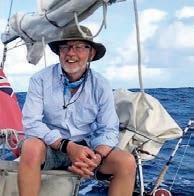
Every month Neil Chapman, founder of Boatshed.com, discusses important topics in the marine industry and o ers advice for buying and owning boats.
The dirtiest thing in boating is not fuel, it is abandonment. And if you want to understand the real environmental problem in boating, do not start with engines, focus on ownership behaviour.
Our marine industry is obsessed with propulsion because it is tidy. You can measure emissions, compare technologies, launch products and sell optimism – while giving the impression progress comes from buying something new.
But isn’t this conveniently avoiding the messier truth? The biggest environmental failure in boating is not what powers boats, it is what happens when people stop taking responsibility for them.
Abandonment
Across harbours, creeks, rivers and yards, there are tens of thousands of boats in limbo. Not actively used or properly maintained, not responsibly disposed of, just quietly decaying. And no amount of electric drive systems will o set that.
According to EU estimates, between one and two per cent of recreational boats are abandoned each year. With a fleet of roughly six to seven million boats, this translates into tens of thousands of environmental liabilities annually. Sunken hulls, leaking fuel tanks, corroding batteries and antifoul, shedding toxins year after year.
This damage does not come from people using boats, it comes from people disengaging from them.
Here is where an important distinction needs to be made, because the industry often muddies it deliberately. There is a world of di erence between cheap boats and abandoned boats.
A cheap boat that is used, maintained, repaired and passed on is not an environmental problem. In many cases, it is the opposite - an example of resource e ciency in action. Boat sheds, back-street yards, owner refits, patched sails and second hand gear does not represent an environmental failure; it is environmental restraint.
Look back in boating history, boats were not floating showrooms, they were floating shelters, in e ect it was camping on water. You did not need a touchscreen helm, lithium banks or app-controlled lighting to cross an estuary or sleep aboard. You needed a sound hull, a simple engine, dry bunks and enough sense to know your limits.
That kind of boating still exists, but the industry increasingly treats it as something to apologise for.
Greenwashing
We are told environmental responsibility means upgrading - new hulls, systems, principles and narratives about sustainability that almost always end with a sales invoice. This is where the greenwashing creeps in. Buying a new boat is presented as an environmental act. In reality, new boat construction carries a significant footprint; composite resins, foams, metals, electronics, global transport chains. This does not disappear just because the propulsion brochure uses the word ‘green’.
Refurbishment
A well-maintained 40-year-old yacht, kept in use and refurbished sensibly, will often have a lower lifetime environmental impact than a brand
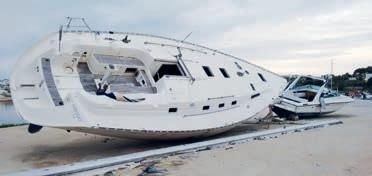
new boat. But refurbishment does not suit the industry’s economics.
Refurbishment is messy. It is decentralised, does not scale neatly and involves people learning skills, fixing things and adapting boats to their lives, rather than upgrading to impress others. Most importantly, refurbishment keeps boats alive, so they are not an environmental problem.
Behaviour
The real failure happens when boats stop being useful before they stop existing. This usually follows a familiar pattern. A boat is bought with optimism and a bit too much stretch, use declines, maintenance slips, costs feel heavier and selling is emotionally loaded. The asking price drifts away from reality. Months turn into years and eventually, responsibility thins out. At that point, the boat has not failed, the system around it has. The industry quietly encourages this by flattering sellers, indulging unrealistic pricing and pretending that value is something you assert rather than what the market reveals. Boats linger unsold, slowly degrading, inching closer to abandonment. This is not an environmental inevitability. It is a behavioural one.
Culture change
A healthier boating culture should advocate:
Simple boating. Use boats as tools for access to water, not status symbols. Have fewer systems and dependencies and more use.
Active refurbishment. Treat older boats as assets worth adapting, not embarrassments waiting to be replaced. Skills, sheds and second hand parts matter more than glossy innovation labs.
Honesty. Make it socially and practically acceptable to say ‘this boat no longer fits my life’ early enough for it to find a new owner while it still has momentum. When those things fail, abandonment creeps in. And when a boat truly has no next life, we need to stop pretending otherwise.
Recycling
GRP does not biodegrade and wishful thinking is not a disposal strategy. Cutting up boats is unpleasant, expensive and unavoidable. The environmental damage comes not from doing it, but from delaying it until the boat collapses into the water or becomes someone else’s emergency.
This is where BoatRecycle.com fits in, and it is important to be clear about what it is and is not. It is not a celebration of disposal, but a backstop when refurbishment and resale are no longer viable. Its existence is an admission that boats, like all manufactured things, have an end. Responsible industries plan for this, irresponsible ones look away. If the marine world genuinely wants to reduce its environmental impact, it needs to stop framing progress as a shopping list and start framing it as stewardship. Use boats more, fix them properly, pass them on sooner and when the time truly comes, deal with them honestly. The dirtiest thing in boating is not fuel, it is pretending responsibility ends at the same time as enthusiasm.
The Bergen Gilet is a lightweight, highperformance mid-layer designed for life on and o the water. Created to deliver exceptional warmth without bulk, the Bergen Gilet can be worn on its own or layered beneath an outer shell, making it a versatile essential, whatever the weather.
Focused on performance and protection, the Bergen Gilet features a chemical-free C0 durable water-repellent PU coating to help resist wind and light rain, while recycled PET insulation provides reliable thermal e ciency. Available in three colourways - Navy with O -White, Navy and Sea Spray - the unisex Bergen Gilet is available in sizes from Small - 2XL and combines technical performance with style, whether on or o the water.
The Bergen range represents a signi cant step forward in responsible design from Henri-Lloyd. It is the brand’s rst collection to incorporate NetPlus® fabric, created from discarded shing nets recovered through a global recycling programme, and insulated with REPREVE®, the world’s leading
















recycled performance bre made from plastic bottles. By using NetPlus®, greenhouse gas emissions, water usage, fossil fuel consumption and energy use are substantially reduced compared to virgin nylon, while supporting coastal communities and preventing harmful plastics from re-entering the ocean.
REPREVE® insulation further helps divert billions of bottles away from coastlines and land ll, without compromising on warmth, durability or comfort.
With a maritime heritage that dates back to 1963, Henri-Lloyd continues to prove that technical excellence and environmental responsibility can - and must - go hand in hand.
To be in with the chance of winning this great prize enter below, at www.allatsea.co.uk or by email to editor@allatsea.co.uk with the subject header Henri-Lloyd Gilet Competition. You can also enter via the All at Sea newsletter (sign up at www.allatsea.co.uk/aasnewsletter).
Q: What kind of discarded nets are used in Henri-Lloyd’s NetPlus® fabric?
A:
NAME:
ADDRESS:
EMAIL:
MARPOL in the leisure marine sector - a compliance gap hiding in plain sight. Peter Wallbank, Group Technical Director at August Race Group, explains…
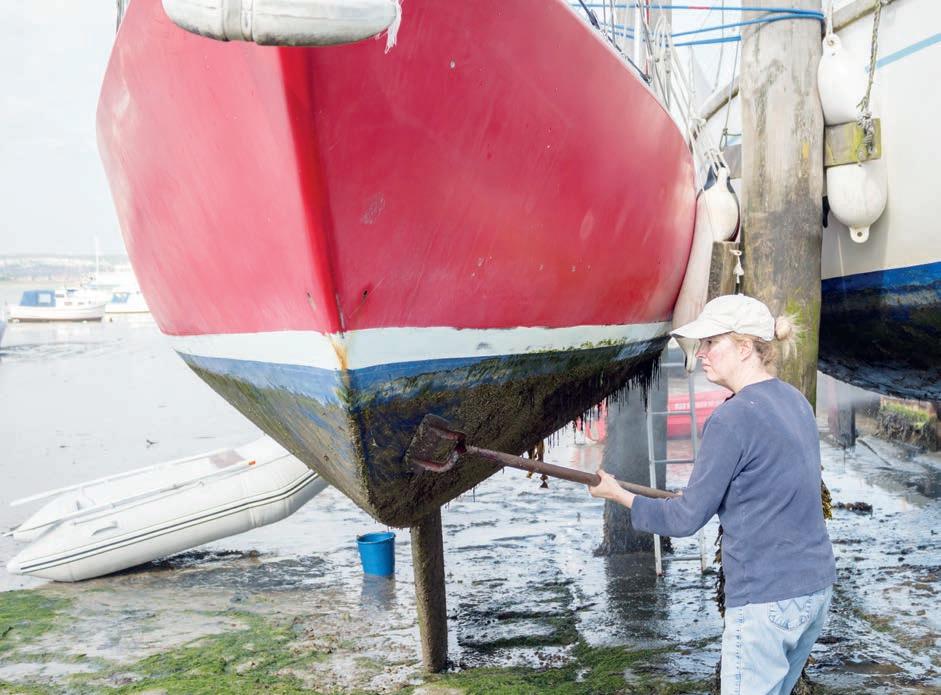
For many people in the leisure marine sector, MARPOL is not on their radar or it is something that feels irrelevant - a regulation for large commercial ships, tankers and cruise liners, far removed from everyday boating life. Yet MARPOL has applied to all vessels, commercial and leisure alike, since the 1970s.
What has become increasingly clear over recent years is that there is a significant compliance gap in the leisure marine industry - not because of bad intent, but because of a widespread lack of operational knowledge about how MARPOL applies in practice.
That gap has real consequences for the marine environment, for marinas and boatyards and increasingly for insurers and policyholders.
MARPOL (the International Convention for the Prevention of Pollution from Ships) is often simplified in conversation to “don’t throw rubbish overboard”. While that is part of it, MARPOL Annex V is much broader in scope.
Annex V governs the discharge of garbage and harmful substances into the sea, and critically, this includes substances introduced into the water through routine operational activity and not just deliberate dumping.
In a leisure marine context, this has three very common and often overlooked areas of relevance:
● Cleaning operations in marinas
● Boat maintenance in yards
● The discharge of treated bilge, grey or black water
These are everyday activities across the leisure sector and they are exactly where the compliance gap most often appears.
The International Maritime Organization (IMO) has consistently stated that operational pollution is a far more significant issue than accidental pollution. Large accidental pollution events are typically isolated to a single location and are time-limited as well as being highly visible.
Operational pollution, by contrast, occurs daily, across many locations, in small but cumulative quantities. Because it has no single source or defining moment, it is far harder to identify, control and regulate, yet collectively it represents a much greater environmental burden.
Historically, MARPOL enforcement in the leisure sector has been inconsistent and poorly understood. That position is now changing. Three forces are driving this shift:
This is precisely why MARPOL was designed as a fact-based, evidenceled framework. Rather than relying on assumptions about intent, it focuses on outcomes (what substances enter the sea, in what form and with what impact).
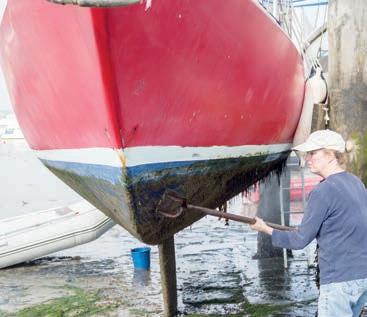
As the leisure marine industry moves increasingly towards evidence-based sustainability, MARPOL’s relevance has arguably never been greater. Walk around almost any marina on a busy weekend and you will see boats being washed down. Buckets, hoses, deck brushes and specialist cleaning products are all part of normal boat ownership.
What is less well known is that chemical run-o from cleaning operations entering the sea constitutes a MARPOL Annex V breach if the product being used is not certified as Non-harmful to the marine environment (Non-HME).
If a product used is harmful to the marine environment and that run-o flows directly into the marina basin, the discharge is not neutral simply because it was part of ‘cleaning’. MARPOL does not distinguish between accidental and routine releases, it focuses on the result.
The same applies in boatyards, where wash-down areas may drain into systems that ultimately lead back to coastal waters.
Another area of misunderstanding relates to bilge, grey and black water.
Many boat owners reasonably assume that if they purchase a marine bilge cleaner, it is safe to use and discharge. In reality, most bilge cleaning solutions are actually classified as harmful to the marine environment and should go through a bilge filter system before being discharged overboard.
Ensure any products used are certified as Non-harmful to the marine environment (Non-HME)
“While MARPOL is not new, industry recognition of the legislation is and as awareness grows so too will environmental standards”
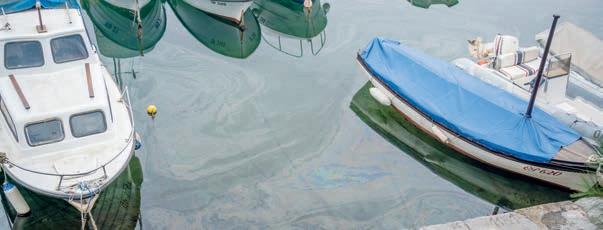
1. Greater environmental scrutinyWater quality in marinas and coastal areas is under increasing public and regulatory focus.
2. Fact-based, evidence-led sustainability - The leisure marine industry is moving away from assumptions and marketing claims towards demonstrable compliance, data and documented good practice.
3. Insurance and liability awareness - Insurers are paying closer attention to whether activities constitute ‘illegal acts’ under international conventions such as MARPOL.
This last point is particularly significant because a breach of MARPOL is not just an environmental issue, it is a legal one. Where an activity is classed as illegal, insurance policies may not respond in the event of prosecution or enforcement action. This applies not only to vessel owners, but potentially to marina operators and contractors.
For marina operators, the risk profile is evolving. Insurers expect marinas to provide clear guidance to berth holders on what is and is not acceptable in terms of operational practices in the marina setting. Where evidence of this cannot be demonstrated, commercial policyholders may find themselves exposed.
Through engagement with industry bodies, regulators and insurers and particularly via work at international level through ICOMIA, the focus has been on translating MARPOL into practical, operational guidance that aligns with today’s evidence-led approach to sustainability.
The objective is not restriction, but clarity on expectations, product selection, operational behaviour and compliance.
MARPOL compliance in the leisure sector is not about blame. It is about shared responsibility.
Boat owners cannot comply with obligations they do not understand, marinas cannot manage risk without clear frameworks and insurers cannot provide protection where illegal acts occur.
MARPOL, despite being decades old, is fundamentally aligned with the modern direction of travel in leisure marinepreventing pollution through evidence, facts and demonstrable good practice, rather than assumption.
While MARPOL is not new, industry recognition of the legislation is and as awareness grows so too will environmental standards, further ensuring that our waters remain clean for generations to come.
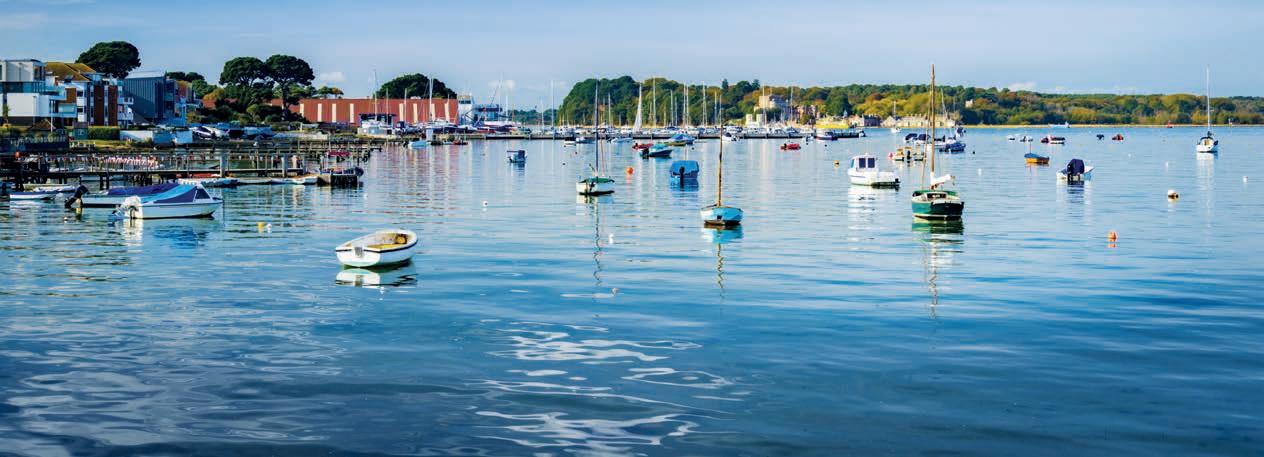
Orwell Yacht Club is a thriving East Coast club run entirely by its members for members.
If you venture a couple of miles up river from Pin Mill (where all TV documentaries about East Coast sailing start out) you will find, nestled in the Oyster Creek, in the shadow of the Orwell Bridge, a small yacht club with a long standing tradition.
Set up in 1918 as a ‘working man’s’ boat club Orwell Yacht Club continues to maintain a philosophy of a ordable boating for ordinary people.
Since its inception the club has evolved from a group of small boats, lying on a beach, to a thriving community with over 450 members. In that time, through the e orts of the members themselves, the two story
clubhouse has been built containing, in addition to a main function room and bar, separate meeting rooms and a library. Additionally there is a sail loft with assorted sewing machines for members to repair sails, make sprayhoods or reupholster cushions. Being run by members for members it is possible to keep costs down so that members can benefit from the facilities at a ordable rates. Using a strategy of ‘self-help’ most activities concerning boat maintenance and repair can be carried out by members themselves and other members will gladly chip in with advice and, where necessary, muscle to get a task done.
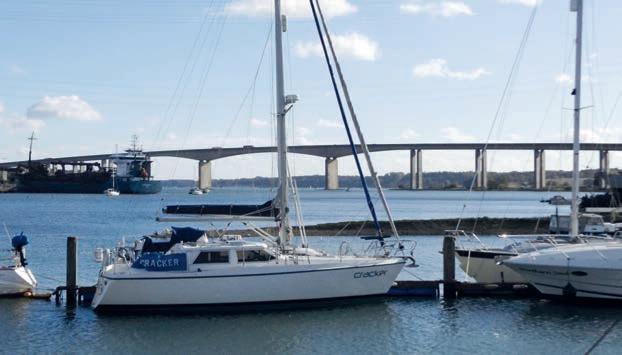
Of course in an East Coast club, many members have bilge keel boats and there is always the banter as to which is superior amongst the owners.
However there is no discrimination, since the club boasts both scratching posts (for twin keelers) and a ‘dolphin’ (for the Fin boys) to carry out the mid-season scrub, for the cost of waiting for the tide to drop. There is even a pressure washer on-site for the job.
There is a boat carrier too, which was built by the members for launching and recovering boats. The carrier and its accompanying tractor are operated by trained members o ering their services in return for tea and cake.
The 150 moorings at the club are also maintained and serviced by members under the supervision of their mooring master who has over 40 years’ experience working on the river.
Family club members, both adult and youngsters, are able to learn sailing skills with the help of the club’s RYA qualified instructors using the club’s fleet of dinghies, supported by trained members operating Orwell Yacht Club’s two safety RIBs.
There is a long standing relationship with the Colne Yacht Club whereby an annual regatta to Ostend occurs every June, with everyone forming up o Harwich for the trip across the North Sea. Many members then use this as a
jumping o point for Holland or the run down to France.
There is also a thriving social life, to help people through the long, cold winters, with hobby nights and live music events. Then, come summer, there are activity days and cruise in company events, both local in nature and venturing up and down the East Coast. ■ orwellyachtclub.org.uk
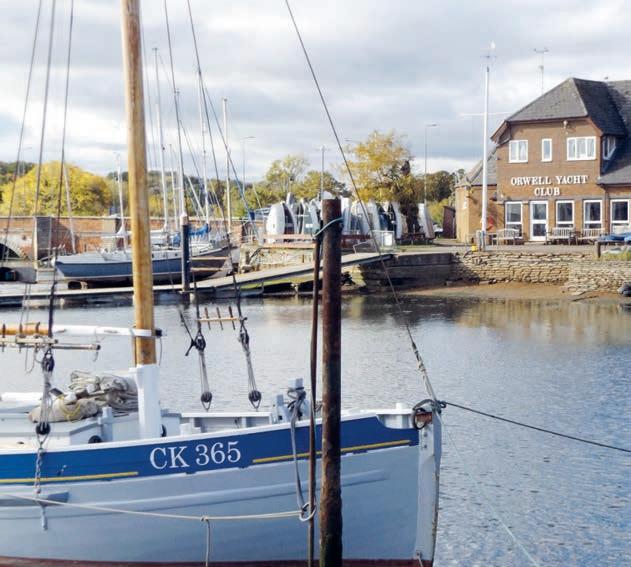

3 – 5 April
RORC Easter Challenge Royal Ocean Racing Club Cowes www.rorc.org
3 - 6 April
Easter Historic Boat Gathering National Waterways Museum Cheshire CH65 4FW canalrivertrust.org.uk
3 – 10 April
RYA Youth National Championships Hayling Island Sailing Club, Hampshire www.rya.org.uk
4 April Boat Club Open Day Walton Marina, Surrey tingdeneboating.com/inland-marinasuk/walton
4 April
The Boat Race River Thames (Putney to Mortlake) www.theboatrace.org
4 – 5 April
Sea Shanty Singers Cutty Sark, Times: 11.45, 12.45, 13.30 www.rmg.co.uk
5 April
RNLI Porthdinllaen Easter Dip Traeth Bwlch, Morfa Nefyn rnli.org/find-my-nearest/events/2026
10 April
Cleethorpes RNLI Dogs Easter Bonnet Parade Brighton Street, Cleethorpes rnli.org/find-my-nearest/events/2026
11 April
Spring Parhelion Series Portsmouth Sailing Club Hampshire www.portsmouthsc.co.uk
11 – 12 April
Boatfest West Exeter, Devon boatfests.com

11 - 12 April
Enel Rio Sail Grand Prix Brazil sailgp.com
11 – 12 April
Classic Yacht Open Sail Overlord and Sea Scamp Ocean Village Marina Southampton Tinyurl.com/OpenSail
12 April
Norfolk Boat Jumble Norfolk Showground Norfolk www.rotaevents.co.uk
12 April
Irish Boat Jumble Carrickfergus Sailing Club Carrickfergus, Northern Ireland www.carrickfergussc.org
16 – 19 April
RYA Olympic Classes
Double Handed Qualifier WPNSA, Dorset racingevents.rya.org.uk/en/default/races
18 April
Spring Parhelion Series
Portsmouth Sailing Club, Hampshire www.portsmouthsc.co.uk
18 - 19 April
Chichester Marina Lock Workshops Chichester, West Sussex www.premiermarinas.com
18 – 25 April
Semaine Olympique Française Sailing Grand Slam, Hyères, France sailinggrandslam.com
22 – 26 April
International Multihull Show La Grande-Motte, France www.multicoque-online.com
22 – 26 April
Antigua Sailing Week Nelson’s Dockyard, St Johns, Antigua sailingweek.com
24 April
Marlborough The Lifeboat Concert Marlborough, Wiltshire rnli.org/find-my-nearest/events/2026
25 April
#LivingTheBream3
Charity Angling Competition Sparkes Marina, Hampshire sparkes@mdlmarinas.co.uk
25 April
Poole Yacht Club Jumble Poole, Dorset www.pooleyc.co.uk
25 April
Boat Building Academy Open Day Lyme Regis, Dorset boatbuildingacademy.com
25 April
Spring Parhelion Series Portsmouth Sailing Club, Hampshire www.portsmouthsc.co.uk
25 – 26 April
Boatfest South Portsmouth Hampshire boatfests.com

26 April
Northern Boat Jumble Farm Yard Brewery
CockerhamLancaster Phil Driver 07871 747123
26 April
Wareham Whalers - Shanties and Strange Stories RNLI Concert The Hamworthy Club Canford Magna Dorset rnli.org/find-my-nearest/events/2026
29 April – 2 May
Palma International Boat Show Marina Moll Vell, Mallorca palmainternationalboatshow.com
29 April – 3 May
Oyster Yachts ‘London Private View’ St Katharine Docks London www.skdocks.co.uk/events/oysteryachts-london-private-view
1 - 3 May
World Pilot Gig Championships Isles of Scilly www.wpgc.uk
1 – 3 May
Dieppe Dash English Channel www.dieppedash.com
1 - 4 May
St Richard’s Canal Festival Droitwich Spa, Worcestershire www.strichardsfestival.co.uk
1 – 4 May
Broadlands Beer Festival
Broadlands Marina Su olk tingdeneboating.com/ inland-marinas-uk/east-anglia
2 May Devon Boat Jumble
Newton Abbot Racecourse Kingsteignton, Newton Abbot sales@compassmarine.co.uk
2 – 3 May
Open Day
Waveney River Centre Norfolk tingdeneboating.com/ inland-marinas-uk/waveney
2 – 4 May
IWA Canalway Cavalcade Little Venice London waterways.org.uk
2 - 4 May
Norbury Canal Festival Norbury Wharf Ltd Shropshire Union Canal festival@norburywharfltd.co.uk
2 – 4 May
RYA Eric Twiname Junior Championships Rutland Sailing Club racingevents.rya.org.uk
2 – 4 May
Brixham Pirate Festival Brixham, Devon www.brixhampiratesfestival.com
2 – 4 May
Jersey Boat Show Channel Islands www.jerseyboatshow.com
3 May
East Portlemouth Boat Jumble East Portlemouth Village Hall, Devon www.eastportlemouth.org.uk
3 May
Salcombe Crabfest Salcombe, Devon salcombecrabfest.co.uk
8 – 10 May
15 May
Scottish Islands Peak Race West Scotland www.scottishislandspeaksrace.com
15 May
North Sea Race Harwich to Scheveningen rorc.org
15 – 17 May
Sailing Champions League Qualifier Starnberg, Germany sailing-championsleague.com
16 May
Rods & Ribbons Species Hunt Nationwide Facebook: Rods & Ribbons Species Hunt
16 May

South Coast & Green Tech Boat Show Ocean Village Marina Southampton www.mdlmarinas.co.uk /events/boat-show-tickets
9 – 10 May
Bristol Channel IRC Championship Shanghai Cup Portishead, North Somerset www.shanghaicup.co.uk
9 – 10 May
Apex Group Bermuda Sail Grand Prix Bermuda sailgp.com
9 – 10 May
Haven Knox-Johnston Kip Regatta Kip Marina Renfrewshire, Scotland www.kipmarina.co.uk/kip-regatta-2026
10 May
RNLI Looe Boathouse Concert Service of Thanksgiving RNLI Looe Lifeboat Station East Looe, Cornwall rnli.org/find-my-nearest/events/2026
10 May
Solent Boat Jumble Royal Victoria Country Park Southampton, Hampshire boat-jumbles.co.uk
11 – 17 May
Bluebird K7 – The Festival Coniston, Cumbria bluebirdk7thefestival.co.uk
12 May
RNLI Looe Boathouse Concert Sea Shanties with the Derry Airs RNLI Looe Lifeboat Station East Looe Cornwall rnli.org/find-my-nearest/events/2026
14 – 17 May
British Motor Yacht Show Swanwick Marina Hampshire www.britishmotoryachtshow.com

Gosport Marine Festival Gosport Hampshire www.gosportmarinefestival.uk
16 May Tales from the Sea Shanty Festival Gosport, Hampshire
Facebook: Tales from the Sea Shanty Festival
16 – 17 May
Open Weekend Farndon Marina, Nottinghamshire tingdeneboating.com/inland-marinasuk/farndon-marina
16 – 17 May
Moira Canal Festival Moira Furnace Museum & Country Park Leicestershire www.moiracanalfestival.com
21 – 24 May
America’s Cup Preliminary Regatta Cagliari, Sardinia www.americascup.com
22 May
Royal Escape Race
Brighton’s Palace Pier – Fécamp www.sussexyachtclub.org.uk/ royal-escape-race
22 – 24 May
Brixham Heritage Sailing Regatta Torbay, Devon www.brixhamheritageregatta.uk
22 – 24 May
Lugger Fest
Ullapool, Scottish Highlands luggerfest.wordpress.com
22 – 25 May
IRC Scottish Championship Scottish Series Tarbert, West Scotland www.scottishseries.co.uk
22 – 25 May
Yarmouth Ga ers Regatta Yarmouth, Isle of Wight solentga ers.org


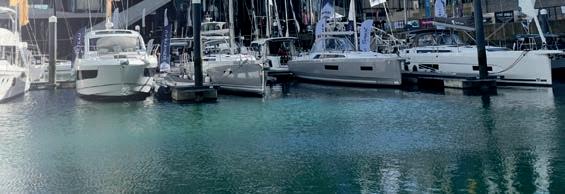
22 – 25 May
Yarmouth Sea Songs Festival
Yarmouth, Isle of Wight
Facebook: Yarmouth Sea Songs and Shanties
22 – 25 May
International Paint Poole Regatta Poole, Dorset pooleregatta.co.uk
22 – 25 May
IRC European Championship International Paint Poole Regatta Poole, Dorset www.pooleregatta.co.uk
23 May
East Coast Motor Boat Training Open Morning Brundall Bay, Norfolk www.eastcoastmotorboattraining.co.uk
23 May
World Boating Day worldboatingday.com
23 May
Portrush RNLI Raft Race Portrush Harbour Northern Ireland rnli.org/find-my-nearest/events/2026
23 – 24 May
Bristol Channel IRC Championship Shanghai Cup, Cardi , Wales www.shanghaicup.co.uk
23 – 25 May
IRC Southern Area Championship International Paint Poole Regatta Poole, Dorset www.pooleregatta.co.uk
23 – 25 May
Crick Boat Show Crick Marina Crick, Northants www.crickboatshow.com
24 May
RNLI Mudeford Blue Light Day and Lifeboat Station Open Day Mudeford Quay Green Christchurch, Dorset rnli.org/find-my-nearest/events/2026
24 May
Mevagissey Lifeboat Day
Mevagissey Harbour Cornwall rnli.org/find-my-nearest/events/2026
24 May
Blakeney Harbour Boat Jumble Henry Archer’s Morston Boat Yard (North Entrance) Blakeney, Norfolk sarahgreen614@gmail.com
29 – 31 May
Cowes Spring Classics Cowes Corinthian Yacht Club cowesspringclassics.com
29 – 31 May
IRC North West Championship Liverpool Yacht Club www.lyc.org.uk
30 May
Maldon Shanty Festival Maldon, Essex bargetrust.org/events/the-firstmaldon-shanty-festival
30 May
Winsford Water Festival
Winsford, Cheshire winsford.gov.uk/events/winsford-waterfestival-2026
30 – 31 May
Mubadala New York Sail Grand Prix New York, USA sailgp.com
30 – 31 May
Bembridge Gig Fest Isle of Wight www.bembridgeharbour.co.uk
30 – 31 May
The Three Rivers Race Horning Sailing Club, Norfolk Broads www.3rr.uk
30 - 31 May
Pirates in the Port Shanty & Folk Festival Newport, Wales www.shantywales.com
30 – 31 May
Etruria Canals Festival Stoke-On-Trent www.etruriacanalsfestival.org.uk
30 May – 7 June
Dutch Water Week Almere, Netherlands sailinggrandslam.com
4 - 7 June
Middlewich Folk & Boat Festival
Middlewich, Cheshire Facebook: Middlewich Folk & Boat Festival
4 – 7 June
Cowes Classic Regatta www.cowesclassicsregatta.org
4 – 12 June
Richard Mille Fife Regatta Largs Yacht Haven, Ayrshire, Scotland www.fiferegatta.com
6 – 7 June
Leicester Riverside Festival Leicestershire www.visitleicester.info
8 June
World Ocean Day worldoceanday.org
9 June
RNLI Looe Boathouse Concert
Sing Rock will rock the boathouse RNLI Looe Lifeboat Station, Cornwall rnli.org/find-my-nearest/events/2026
9 – 11 June
Seawork Mayflower Park, Southampton seawork.com
12 – 14 June
Falmouth International Sea Shanty Festival Falmouth, Cornwall www.falmouthseashanty.co.uk
12 – 14 June
White Water SUP Festival Aberfeldy, Scotland www.standuppaddleboarduk.com/ white-water-sup-fest-scotland
12 – 14 June
Falmouth Classics
Carrick Roads and Falmouth Bay Cornwall www.falmouthclassics.org.uk
12 – 14 June
Scottish Traditional Boat Festival Portsoy, Aberdeenshire stbfportsoy.org
13 June
Eddystone Charity Sailing Pursuit Devon eddystonepursuit.org
13 June
Rock the Boat
Duver Marina St Helens, Isle of Wight www.bembridgeharbour.co.uk
13 June
Essex Boat Jumble & Boat Sales Day
Fambridge Yacht Haven North Fambridge Essex www.yachthavens.com/fambridgeboatjumble
13 - 14 June
50th Anniversary Celebrations
National Waterways Museum Cheshire CH65 4FW canalrivertrust.org.uk
13 – 14 June
Active Marina Workshop
Broadlands Marina Lowestoft tingdeneboating.com/inland-marinasuk/east-anglia
13 – 14 June
Marlow Town Regatta & Festival Marlow, Buckinghamshire www.visitthames.co.uk
13 – 14 June
Boatfest North Chester, Cheshire boatfests.com

13 – 14 June
MOGSAF - Tope Event Drummore, Luce Bay Scotland www.mogsaf.co.uk
18 – 21 June
Sea Angling Classic Premier Port Solent Marina Portsmouth www.seaanglingclassic.com
19 June
Newport Bermuda Race Newport, Rhode Island –Bermuda bermudarace.com
19 - 20 June
J Cup Europe Cherbourg, France j-cup.co.uk/europe
20 June
Round Ireland Race Wicklow, Ireland roundireland.ie
20 June
Edinburgh Canal Festival Edinburgh, Scotland edinburghcanalfestival.org.uk
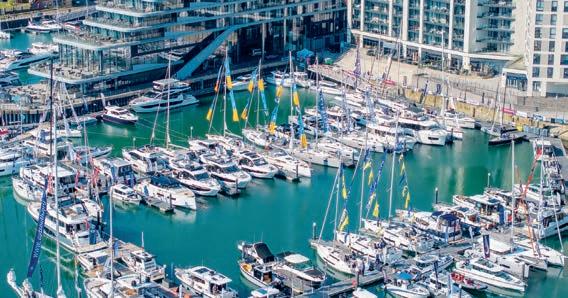
The 2026 South Coast & Green Tech Boat Show, hosted by MDL Marinas, promises to be an exceptional event for maritime enthusiasts, boat owners and industry professionals.
Located on the picturesque South Coast, this renowned boat show will feature a stunning array of the latest vessels, alongside innovative eco-friendly products and marine accessories. With a history of showcasing both luxury yachts and smaller craft, this event has grown into one of the UK’s premier boat shows, and the 2026 edition looks set to bring more of the same.
The show takes place at Ocean Village Marina in Southampton, one of the UK’s most popular boating hubs. The marina o ers the perfect blend of
20 June
Plymouth Boat Fest Plymouth Yacht Haven, Devon plymouthboatfest.co.uk
20 – 21 June
Canada Sail Grand Prix Halifax, Canada sailgp.com
20 – 28 June
Kieler Woche Kiel, Germany sailinggrandslam.com
21 – 25 June
Youth Match Racing World Championship Middelfart, Denmark gosail.dk/youth-match-racingworlds-2026
23 June
RNLI Looe Boathouse Concert The Polperro Fishermen’s Choir RNLI Looe Lifeboat Station East Looe, Cornwall rnli.org/find-my-nearest/events/2026
24 – 27 June
Tall Ships Races
Aarhus - Harlingen sailtraininginternational.org
25 – 28 June
Foyle Maritime Festival Derry~Londonderry, Northern Ireland foylemaritime.com
26 – 28 June
Classic Regatta Su olk Yacht Harbour www.syhclassicregatta.co.uk
picturesque surroundings and worldclass facilities, making it the ideal location for this marine showcase.
With its comprehensive displays of boats, advanced technology, networking opportunities and focus on sustainability, the event will o er something for every type of boating enthusiast. Whether you are looking to purchase a new boat, discover cuttingedge marine technology or simply enjoy the vibrant atmosphere, this show is set to be one of the highlights of the 2026 boating calendar.
Tickets are free and can be booked at www.mdlboatshow.co.uk/tickets.
Appointments to view specific boats or meet with individual exhibitors can be arranged via a booking portal on the website.
26 – 28 June
Andark’s 50th Anniversary Family Fun Weekend Andark Lake Swanwick, Hampshire
Facebook: Andark’s 50th Anniversary Family Fun Weekend
27 June
Reading Water Fest Berkshire www.facebook.com/Rdgwaterfest
27 – 28 June
Medway Regatta River Medway, Kent www.medwayregatta.co.uk
27 – 28 June
Ilfracombe Shanty Festival Ilfracombe Devon www.facebook.com/groups/ ilfracombeshantyfestival2026
27 – 28 June
Historic Boat Rally Braunston Marina Northamptonshire braunstonmarina.co.uk/historic-boat-rally
30 June – 5 July
Henley Royal Regatta Henley-on-Thames Oxfordshire www.hrr.co.uk
Next month we will bring you events for the rest of the year. Send dates to editor@allatsea.co.uk. Please check with organisers as events are subject to change. All at Sea cannot be held responsible for the quality of events.







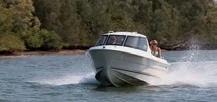
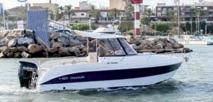
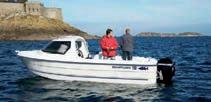

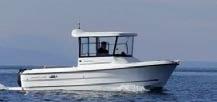
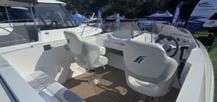
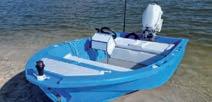
Berthing or docking a boat can be one of the most nervewracking parts of a day spent out on the water - especially when there is a crowd gathered at the marina bar, watching with a drink in hand.
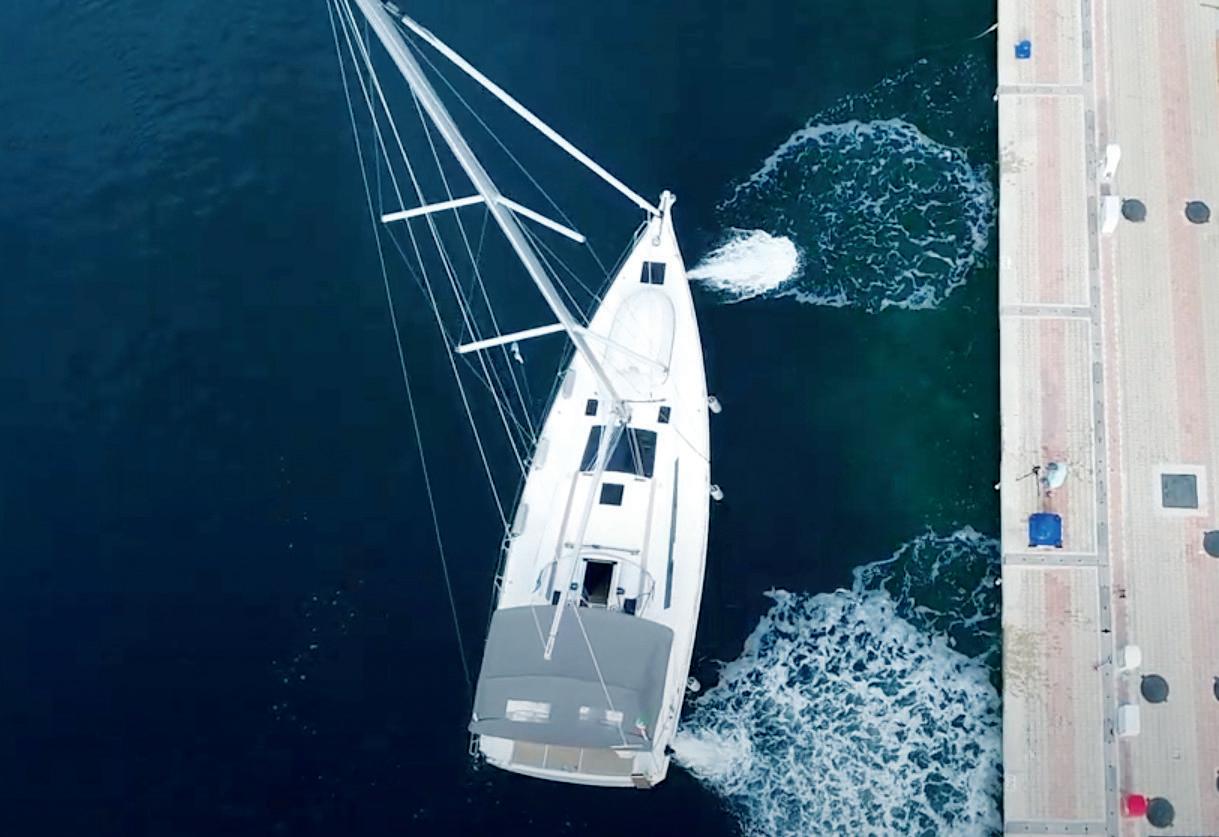
Whether you are a seasoned sailor or just starting out, navigating tight spaces can be a challenge. But with the right gear, pulling into your berth can be smooth and stress-free.
We spoke to Paul Hardy, at Ancasta Yacht Services, to get the insider view on the various types of thrusters, the pros and cons, and how they can make docking easier and less intimidating.
“Thrusters are the secret weapon of impressive boat handling - giving you the control you need to glide into place with confidence, no matter the wind or current,” says Paul.
TUNNEL THRUSTERSRELIABLE AND COST-EFFECTIVE
Tunnel thrusters are the go-to option for many yachts and motorboats. Installed within a tunnel across the bow, they use one or two propellers to push water sideways, giving you that extra bit of lateral control.
Why they are popular:
● Reliable and e ective in most conditions
● A ordable and available in various sizes
● Relatively easy to install and maintain
Potential drawbacks:
● Fixed in place, so they create drag, a ecting speed and fuel e ciency
● Installation requires hull modifications and takes up internal space
● Can be noisy, especially at higher speeds
Despite the downsides, tunnel thrusters are a solid, budget-friendly choice for most boaters looking for dependable control.
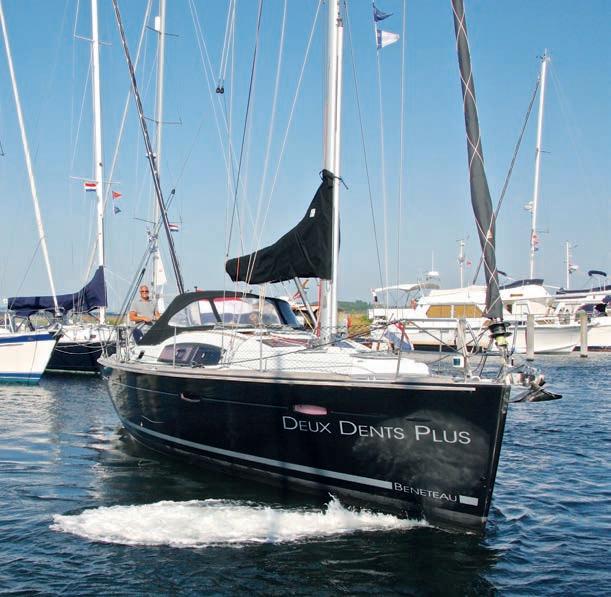
RETRACTABLE THRUSTERS –SLEEK AND EFFICIENT
If reducing drag and maximising performance are your top priorities, retractable thrusters are a gamechanger. They are mounted inside the hull and pop out only when neededkeeping your boat streamlined the rest of the time.
Why they are worth it:
● Minimise drag for better fuel e ciency and speed
● Provide powerful, precise control when deployed
● Ideal for performance-oriented boats
What to keep in mind:
● Higher price tag than tunnel thrusters
● More complex installation and maintenance
● Requires a carefully engineered fit for a flush finish
If you are a performance-focused boater, retractable thrusters are an investment that pays o in smoother handling and improved speed.
Jet thrusters take a di erent approach
— using a water pump system to draw in and expel water through nozzles for thrust. Since there are no external moving parts, they are lowermaintenance and sit flush with the hull for a clean, drag-free profile.
Why they shine:
● Quiet operation
● Less maintenance since there are no exposed propellers
● Compact design allows for flexible installation (bow, stern or even midship)
● Great for preserving the integrity of classic timber or metal hulls
● More economically viable (one pump unit) if bow and stern thrusters are required
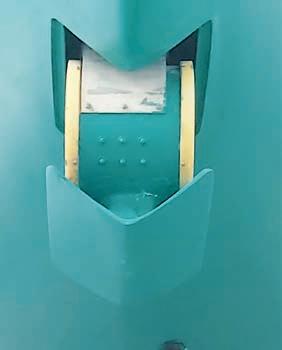

Considerations:
● Higher upfront cost mid-range price range, but lower than retractable thrusters
● Requires a dedicated pump and plumbing system
Jet thrusters are especially popular for vessels where quiet, seamless operation is a must. Plus, they are DIY-friendly if you are comfortable with the installation.
STERN THRUSTERS – EXTRA CONTROL WHEN YOU NEED IT
Stern thrusters work the same way as bow thrusters, but they are positioned at the back of the boat - giving you more complete control over your positioning.
They are a lifesaver for larger boats, single-engine vessels or anything prone to drifting in the wind.
Why they are helpful:
● Better control when reversing or docking
● Ideal for large yachts or boats with single engines
● Perfect when paired with a bow thruster for full control
Potential downsides:
● If mounted externally, they can create drag
● Installation may be tricky depending on hull design
For those navigating tight spaces or dealing with di cult conditions, adding a stern thruster alongside a bow thruster can make docking feel e ortless.
CHOOSING THE RIGHT THRUSTER
Picking the perfect thruster comes down to a few key factors:
Boat size and type – Larger boats need more powerful thrusters.
Hull design – Certain hull shapes work better with specific thruster types.
Budget – Costs vary depending on complexity and installation.
Docking conditions – If you regularly dock in tight spaces or challenging winds, extra power might be worth it.
Consulting a marine professional, like the expert team at Ancasta Yacht Services, is always a smart move. They will help you size up your boat, choose the best thruster for your needs and handle installation the right way - saving you time, stress and potential headaches. The right thruster can turn docking from a heart-racing event into a smooth, controlled manoeuvre so the next time you pull into the marina on a sunny afternoon, you can dock with confidence.
Part of the Ancasta Group, Ancasta Yacht Services is a professional yacht refit, repair and services company with a team of highly skilled craftsman, with excellent facilities based in Hamble, Southampton. ancasta.com/yacht-services
A fascinating and beautifully illustrated journey across the world and through the centuries in search of the sea monster.
This absorbing exploration of the sea monster in all its tentacular forms is a deep dive into the world of sirens, mermaids, Scylla and kraken from 3C BCE to the modern day. In The Book of Sea Monsters Prema Arasu brings together excerpts from Beowulf, Moby-Dick and other works by authors such as Homer, HP Lovecraft, Edgar Allan Poe, Jules Verne, HG Wells… Each is brought to life with an introduction and beautifully gory artwork. Here we share an extract from The Book of Sea Monsters.
Monsters are human creations. They are the product of our imaginations, recurring and reforming across time and space. The word monster comes from the Latin monstrare, ‘to show’ – monsters show what is within. They represent our greatest fears: fear of the unknown, fear of the dark, fear of the natural world – even fear of the self. These anxieties are symbolically expressed in the monster’s fearsome appearance and its transgressive behaviours: its excess size, its claws and tentacles, its bloodlust, its violation of territories. As symbolic manifestations of abnormality, monsters are ultimately reflections of our innermost anxieties and, sometimes, desires. It is not surprising, then, that sea monsters are often present in the mythology of seafaring and coastal cultures. Great serpents and giant lobsters infest the waters of medieval and renaissance maps as a warning of what might lie in the unknown.
Stories and art about sea monsters are projections through which anxieties about the natural world can be expressed, examined and ultimately mastered. The sea monsters of stories transmitted from generation to generation are analogues for dangerous weather events, foreign invaders, enemy nations, physical phenomena and real animals. Such stories may allegorically transmit information about where it is and isn’t safe to sail, tell us how di erent cultures believe the world was created, or contain historical narratives. The Babylonian creation epic Enūma Eliš, which we only know from clay tablets discovered in modern-day Iraq, is about the mixing of the primal embodiment of fresh water, Apsû, and the primal embodiment of seawater, Tiamat, and their progeny. In the story of Jonah and the Whale, the whale is both divine punishment and allegory for the Resurrection of Christ.
Cultural groups or nations might express their maritime or naval dominance through triumphant stories of battle with serpents, or explore concerns about the dangers of seafaring through stories of ships swallowed whole. A history of sea monsters across time and space might, therefore, equate to history of the relationship between di erent cultures and the ocean. An examination of the sea monsters of coastal, seafaring and maritime cultures can provide us with important clues as to how these cultures relate to and conceive of the ocean and, in turn, how they have constructed themselves in accord with or in opposition to the sea depths.
kraken)
But can we regard sea monsters as purely fictional entities? The Roman naturalist Pliny the Elder documented mermaids – ‘tritons and nereids’ –alongside dolphins and whales in his Naturalis Historia. In the subsection ‘The sea monsters of the Indian Ocean’, he describes creatures of great size, including one so large that it took the fleet of King Ptolemy 12 days to pass by.
Re-positioned mast. Mooring ball Falmouth
In Ovid’s Metaphormoses, the mortalturned-immortal fishman Glaucus insists that he is a god, not a monster, despite his fearsome appearance.
Most people today would agree that monsters, by definition, are fictional. If a monster became known to science, it would be stripped of its monstrosity and become an animal. This is what happened to the kraken, i.e. the giant squid. A close look at the history of the kraken suggests that there is some slippage between the categories of ‘monster’ and ‘animal’ in the scientific writing of the past. The kraken has origins in Nordic mythology and folklore – in this book, The Natural History of Norway by the Danish bishop Erik Pontoppidan, whose description went on to influence, among others, Victor Hugo, Herman Melville and Jules Verne. By including them in his Natural History – an early form of scientific writing – Pontoppidan classified sea monsters as a category of animal worthy of scientific discussion just as much
Pliny the Elder recorded several accounts of sea monsters attacking or threatening ships, often emphasizing their size
remained a point of fascination in society, although by then was fully relegated to the realm of fiction.
However, the kraken’s shift from the realm of the mythological to the taxonomically defined realm of science reminds us that the term ‘monster’ is subject to cultural shift. In the medieval imagination, whales were depicted as fanged, firespouting beasts. During the age of whaling, whales retained their monstrousness (and are extensively referred to as monsters in Moby-Dick), but they were also resources to be extracted and exploited for human use. Now, in the age of mass extinction, they are beautiful and vulnerable giants in need of our protection. The mythological kraken has been taxonomically identified as the giant squid but, unlike the whale, it has not undergone the same transformation from monster to aquatic ally.

Dr Prema Arasu is a research fellow at the University of Western Australia. They completed a PhD in creative writing at UWA in 2022 and have a Master’s degree in Modern and Contemporary Literature and Culture from the University of St Andrews. Prema’s postdoctoral research considers the representation of the deep sea in the popular imagination and the significance of sea monsters across di erent cultures and mythologies. @prema_arasu
as fish and whales. It was not until the enlightenment that the kraken was linked to the giant squid and consequently imagined as a cephalopod. This may have been linked to the fragments of giant squid arms regurgitated by hunted sperm whales. In 1857, the Danish biologist Japetus Steenstrup first described Architeuthis dux, the giant squid, in the scientific journal Forhandlinger ved de Skandinaviske Naturforskeres (Proceedings of the Scandinavian Naturalists).
While the scientific world had thoroughly disproven the existence of a ship-sized human eating cephalopod in the late 19th century, however, tales of sea monsters and underwater cities proliferated. From Melville’s maritime novels developed a new genre of supernatural oceanic horror and early science fiction by Edgar Allan Poe, Jules Verne, HG Wells, Sir Arthur Conan Doyle, William Hope Hodgson, and HP Lovecraft. These stories reinvigorated the sea monster as a symbolic figure of contemporary fears in the age of warring empires and evolutionary anxieties. They also played upon events in existing memory: Jules Verne’s Vingt Mille Lieues Sous Les Mers (1870) was based on an 1861 witness report from the crew of the French corvette Alecton, and in the novel, the Nautilus is suspected by many to be a giant sea monster. The kraken
By Prema Arasu
Hardback | £25
Adlard Coles
For centuries, sea monsters have haunted the depths of human imaginations. With their excess size, claws, tentacles and bloodlust, monsters represent our greatest fears: the unknown, the dark, the natural world and even ourselves. As stories passed from generation to generation, they were analogues for dangerous weather events, foreign invaders, enemy nations, physical phenomena and real animals.
Told through writings from ancient myths, early scientific natural histories and iconic literature, tales are intertwined with wonderful engravings, diagrams and paintings. These accounts give a unique perspective on the histories of societies and cultures around the world, taking in significant events like the Age of Sail, the Enlightenment and Darwinian evolution.
Bringing together excerpts from Homer’s Odyssey, Beowulf, Herman Melville, and the works of Edgar Allen Poe, Jules Verne, HP Lovecraft and more, with lively introductions and beautifully gory artwork, this is a gorgeous book that is sure to draw you in and drag you down… For a chance to win this book enter at www.allatsea.co.uk/competitions or by email to editor@allatsea.co.uk with the subject header ‘Book of Sea Monsters’ competition.
Q: The Book of Sea Monsters includes excerpts from which epic Homer poem?
Fancy sailing on a classic, 90-year-old racing yacht, but cannot a ord a J-Class berth?
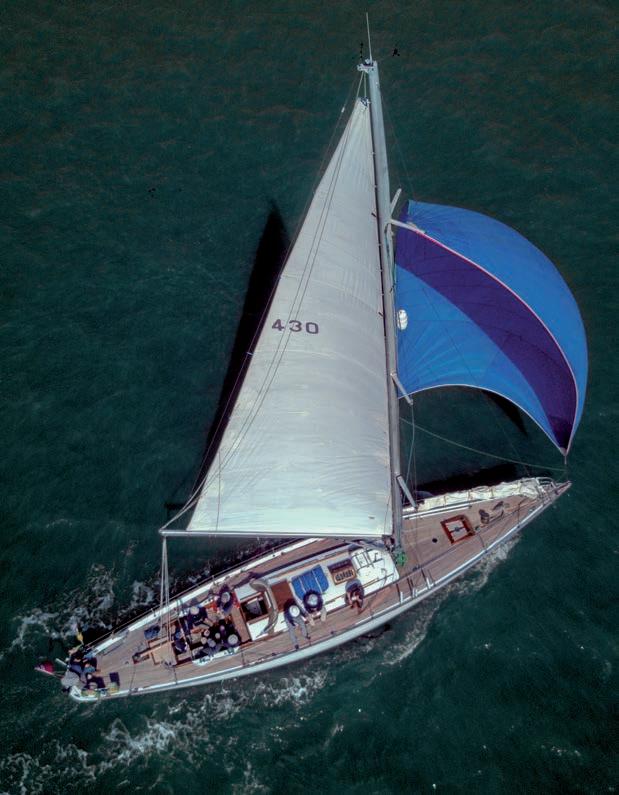
Asolution is at handOverlord. Originally built in 1936 by Abeking & Rasmussen of Lemverder for the German Luftwa e, Overlord is a 58ft Bermudan sloop which sails wonderfully, is maintained in top condition and sailed by highly-qualified club skippers and mates. She is stable, fast in a decent breeze, well balanced and comprehensively equipped. In short, a beautiful boat to sail in all kinds of weather.
Owned by the O shore Cruising Club and its avid sailors, Overlord spends eight months a year cruising (and occasionally racing). From its base in Gosport, the highly experienced club skippers take crews of up to nine members on various sailing and training adventures around the Solent and the South Coast from April to June and September to November.
During the summer months, Overlord embarks upon a cruising programme which varies each year, depending on where members wish to sail. In recent years they have enjoyed sailing Overlord along the coasts of Spain, Scotland, South West Ireland, Norway, Denmark and France.
These trips are a wonderful way to get to know a coastline from a unique vantage point. There is always time for sightseeing ashore and mealtimes are especially convivial sharing delicious food around the dinner table or up on deck.
Putting the spotlight on organisations, clubs, charities and people making a di erence in the boating community.
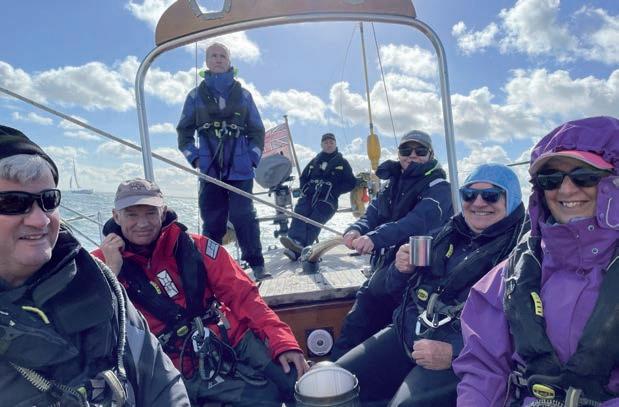
The OCC runs its own training programme to ensure that those members who wish to, can develop a range of skills and knowledge from competent crew up to skipper. Whilst this is encouraged it is by no means compulsory, and they have many members who just enjoy being on the water in a relaxed and social environment.
They welcome new members, whatever your ability, and they would love you to join them to experience sailing on a classic. Potential members have the option to embark upon up to two trial cruises on the Solent for a nominal fee, which is then deducted from the membership fee should you join.
Sailing fees are £73 per day and expenses are shared to cover living costs onboard, mooring and fuel; this normally
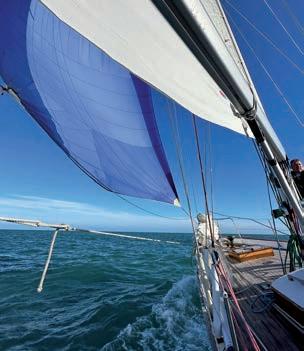
works out at around a further £30 per day depending on where they cruise. To learn more - including Overlord’s history and how to sign up for a sail - head to: www.sailoverlord.org ■

Solent based dinghy sailor David Henshall is a well known writer and speaker on topics covering the rich heritage of all aspects of leisure boating
The Kent town of Ramsgate is famous for having the UK’s only Royal Harbour as well as a rich maritime heritage, which is well worth exploring.
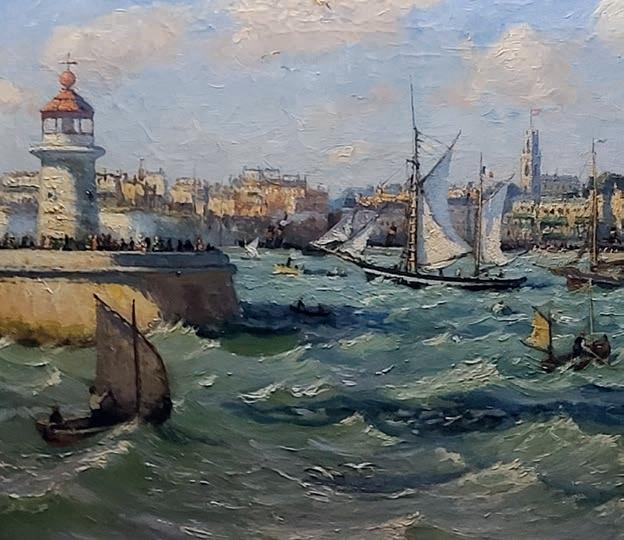
It will be three years this summer since these diary pages crossed the line by going eastwards from the central South Coast to an area just beyond Seaford in Sussex, where the GPS suddenly changes from everything being west, to the display reading everything with a big E! Back then my destination was the charming seaside town of Eastbourne but for those wanting something even better, it is worth pushing on further, past historic Rye (which also featured in these pages), then the huge structures of the Dungeness power stations that dominate the skyline. Sailors have to be on their guard now, as despite the ease of the Channel Tunnel, ferry tra c from Folkestone and Dover seems as busy as ever.
We all know the story from Greek mythology of Scylla and Charybdis, the two terrible monsters that sailors had to steer between, but this last easterly stretch of the South Coast has its own ‘devil and the deep blue sea’ with the towering white cli s on one side and the treacherous Goodwin Sands on the seaward side, but these two guard a real jewel in the south-east coast.
In a gap in the cli s that gave the town its name, lies the glorious large harbour of Ramsgate. For many sailors, Ramsgate is the last stopping place before the sharp left turn into the Thames Estuary or the more daunting challenge of the passage north, across the mouth of the Thames and on to the wonderful cruising grounds on the East Coast (nor should it be forgotten that Ramsgate is an ideal departing point for sailors heading for the Belgian and Dutch coast).
But just using Ramsgate as a stepping o point or worse, passing it by all together is a shame as the town is a worthwhile destination in its own right. Thrust
Ramsgate’s facilities was recognised by King George IV when he stopped there with boats of the Royal Yacht Squadron. After his visit, the King bestowed the title of ‘Royal Harbour’ on Ramsgate, and it remains the only harbour in the UK to carry this Royal patronage.
It is easy to see why the King was so impressed, for with its eye-catching Georgian architecture that o ers great views out over the harbour and the sea, Ramsgate is indeed one of the jewels in the east Kent coastline.
Nor was it just the royal elites that thought so, for as the Victorian love of the beach holiday grew, Ramsgate, with its easy access from London, south-easterly aspect and super sandy beaches became a hugely popular tourist destination.
over in his motor yacht Sundowner from the harbour to the beaches of Dunkirk as part of Operation Dynamo. Lightoller survived this as well, bringing more than 120 men back in a boat licenced for 12 (Sundowner lives on in Ramsgate Harbour as part of the Marine Museum there).
One of the activities the holidaymakers would have watched was the growing sport of yachting.
It must have been an exciting time for the spectators, as the races started with the yachts at anchor and under bare poles. A cannon would be fired from the pier head, at which point the crews had to hoist sails, weigh anchor and start sailing, all within the confines of the harbour.

year club boats were ‘flying the blue’. The splendidly appointed clubhouse is up on the hill, overlooking the harbour and soon set a high standard for the amenities and welcome that they o ered to visiting yachtsmen, a tradition that continues through to today.
Ramsgate has also faced some dark times, being very much in the front line of the two World Wars, with there being a further connection when the Royal Temple clubhouse was requisitioned, becoming HMS Fervent, the HQ for Coastal Forces activities in the area.
With the return to peaceful activities, the club has thrived and is now the home to Ramsgate Week (19 - 24 July), a great regatta that is a fitting rival to that other sailing week further westwards in the Solent!
Channel meets the Noth Sea, since the earliest days in history the town has been busy, both as a major fishing port but also as a connection to the nearby continent.
In AD597 one of the leading Christian missionaries, St. Augustine landed at the town, though he would have probably known it as Hræfnes Geat, which translates to Raven’s Gate. By the mid-1300s, the town was being recorded as Ramesgate and it was a part of the Cinque Ports, being classed as a limb of nearby Sandwich. However, at the same time as ships were getting larger, changes to the coastline were seeing Sandwich finding itself further and further from the sea, with Ramsgate taking on more of the commercial tra c (though Sandwich remains one of the UK’s best preserved medieval towns, making it a great excursion for those spending time at Ramsgate).
In the mid-1700s a century long project to build a large, well-protected harbour was started and although they had not been fully completed, the quality of
It would not only be the first generation of sun-seekers who would frequent Ramsgate, but there is a long list of famous names associated with the town. Coleridge, of ‘Rime of the Ancient Mariner’, was a visitor along with Mary Shelley, whilst Jane Austen set a number of scenes from Pride and Prejudice in Ramsgate. Vincent van Gogh lived and taught there too, but bringing the topics back to all matters nautical, John Deane, the inventor of the diving helmet lived and died in Ramsgate.
However, one survivor who made the town his home was Charles Lightoller, who was the senior o cer saved from the Titanic. Having had a close brush with the fates in the North Atlantic, Charles would take more risks, heading
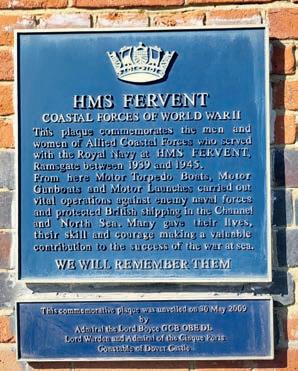

The racing was being conducted under the burgee of the Royal Temple Yacht Club, who can trace their origins back to the Temple Steps in central London. With the Thames becoming ever more congested (not to mention the pollution) a number of yachtsmen took the decision to move their sport out to the coast at Ramsgate, but they kept that connection with their home in the capital by naming their new club ‘the Temple’.
The then Commodore was none other than Baron de Rothschild, who just happened to include the great sailor, the Prince of Wales, amongst his friends.
From 1897 the club was to be known as the Royal Temple and the following
Ramsgate’s fortunes have fluctuated somewhat, as the swinging sixties saw the decline of the traditional British seaside holiday in favour of a fortnight in the sun further south.
The town has long enjoyed a ferry link to France, with the advent of ‘Roll on, Roll o ’ ferries Ramsgate enjoyed a new lease of life which even included a splash of glamour as the huge SR N4 hovercraft operated from a nearby beach to bounce its way across the Channel carrying 30 cars and 250 passengers.
Sadly, access issues (at sea and ashore) and then the building of the Channel Tunnel would see the end of Ramsgate as a ferry port, though the faded and now rusting road signs directing tra c to the terminal are still evident on the roundabouts at the end of the Thanet Way...
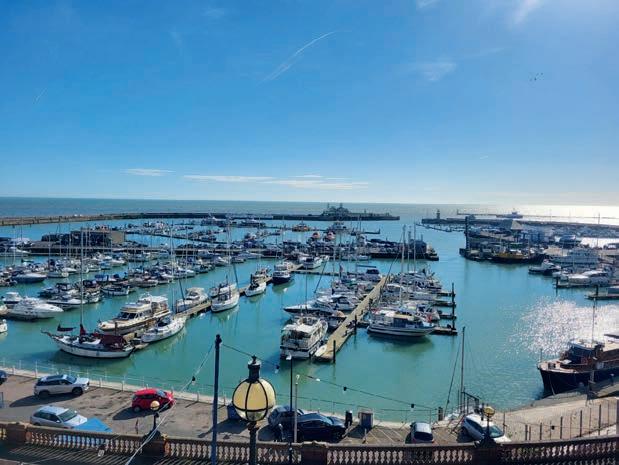
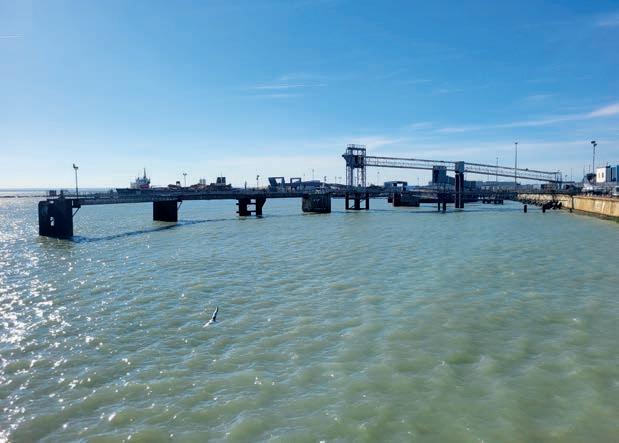

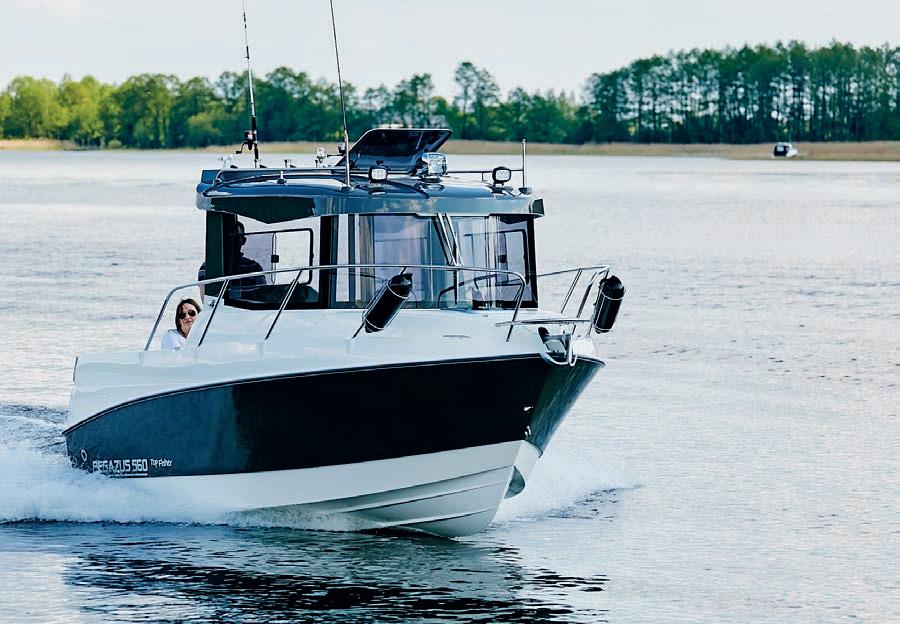
The Pegazus 560 Top Fisher is a versatile pilothouse boat designed with anglers in mind. At 5.6m long with a wide 2.54m beam, it o ers impressive stability, making it well suited to coastal fishing trips. The boat is capable of reaching speeds of around 30–35 knots, allowing anglers to reach o shore marks quickly.
The cockpit layout is clearly designed for fishing. There is plenty of space for multiple anglers to work
lines, along with rod holders, live bait storage and dedicated fish boxes built into the deck. Inside the wheelhouse, a compact cabin o ers shelter from the elements and even a small berth for overnight trips, making it a practical platform for longer sessions at sea.
One of the Pegazus 560’s standout features is its innovative sliding helm system. The steering console can be moved so the skipper can drive either from inside the wheelhouse or
from the cockpit. This gives excellent visibility when manoeuvring, trolling or fishing with friends, while still allowing the option of steering from a sheltered position in poor weather.
For anglers, this flexibility makes the Pegazus 560 a practical and highly adaptable fishing platform.
Guide Price: Boat and engine packages from £50,000 UK Distributor: Waterside Boat Sales
Send in your best angling pics every month – you and your catch! If yours is the winning photo, you will receive a RAILBLAZA Rod Holder R and cap. Email your photo to editor@allatsea.co.uk including your name, fish species and where it was caught.
This month’s winner is Alastair Timmins with a carp caught at Twynersh. The runner-up is Andrew Spence with a ballan wrasse caught at Holyhead breakwater. See more of your catches at www.allatsea.co.uk.


The RAILBLAZA HEXX Hybrid Fish Finder Mount is a robust and versatile mounting solution for modern marine electronics. Its hybrid construction combines a marine-grade aluminium extension arm with glass-reinforced composite components, delivering excellent strength while keeping weight low. The mount is designed to minimise wobble and absorb shock, ensuring your fish finder remains stable even in rough conditions. With broad compatibility across major brands and secure adjustment points, it is a practical upgrade for anglers wanting a reliable, professional-grade display mount on their boat or kayak.
Price: £85.95 www.railblaza.co.uk

Ragworm: A spring favourite for UK shore anglers
As spring arrives around the UK coastline, fish begin moving back into inshore waters and feeding more actively. One bait that consistently produces results during April is ragworm.
Naturally found in sandy and muddy seabeds, ragworm is a key food source for many species and works well in both clear and coloured water. Its natural movement and scent make it highly e ective when fish are still feeding cautiously after winter.
Ragworm is particularly good for targeting bass, flounder, plaice, dabs and whiting, especially around estuaries, harbour walls and sandy beaches.
Simple rigs such as a running ledger or two-hook flapper are ideal. Many anglers find that using half a worm with the tail left free to move can improve bites. Reliable, versatile and widely available, ragworm remains one of the best all-round baits for UK sea fishing in April.
A great start to the angling year for an All at Sea reader











Send us your catch photo and you could win a prize from RAILBLAZA too!









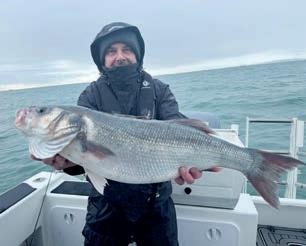
What a way to start the fishing year. Our first o shore bass boat trip of 2026 was nothing short of unforgettable; an adventure that delivered big fish, brutal conditions and memories that will last all season.
The fishing was simply outstanding. From the first drift, we were into quality fish, with powerful takes and hardfighting bass coming steadily throughout the day. Among them were two truly special captures: double-figure bass that tested tackle, technique and nerves before being safely brought to the boat. Fish like that are what we all dream of, and to land two in a single day felt extraordinary.
As always o shore, the sea had the final say. The weather turned quickly, and the run home was lumpy and demanding, with rough seas building as the light faded. We made it back just as darkness fell, tired, cold, but grinning from ear to ear.

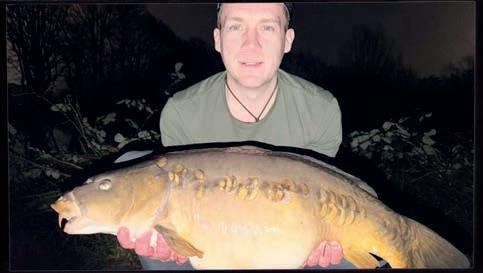





We set o in complete darkness with the thermometer reading a bitter -4°C. Before we could even think about launching, we were scraping ice from the windscreen, hands numb and breath hanging in the air. Conditions like that test your resolve, but they also sharpen the senses. With the coastline still invisible, the Lowrance radar proved invaluable, guiding us safely through the dark as we pushed o shore, confident but cautious. Then came the reward. As the sun finally broke the horizon, the sky erupted into colour: deep reds, fiery oranges and soft pinks reflecting o a glassy winter sea. It was one of those sunrises that makes every early start worthwhile. When we got to the mark almost immediately the bass decided to play their part too.

A tough start, spectacular fishing and a hard-earned finish. If this trip is anything to go by, 2026 is going to be one hell of a year on the water. Ben Bream. All at Sea reader
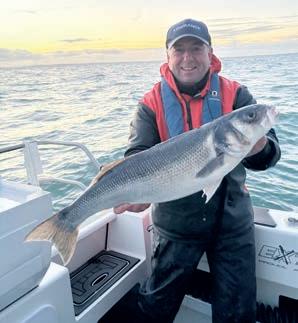





Our furry friends love spending time on the water as much as we do!
Tilly is getting ready to head out fishing.
very cute
Charlie the Cockapoo spends most of her days with her owner at work (Gillingham Marina) and is really now the marina’s dog – she loves it there!

Send in your photos and you could be in All at Sea, on our social pages or in our weekly newsletter. Send entries, with a caption, to editor@allatsea.co.uk. Each month’s winning photo will be included in the Photo of the Year reader vote.
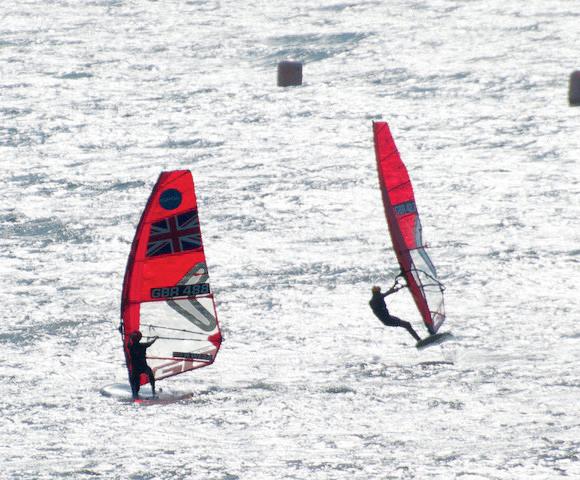
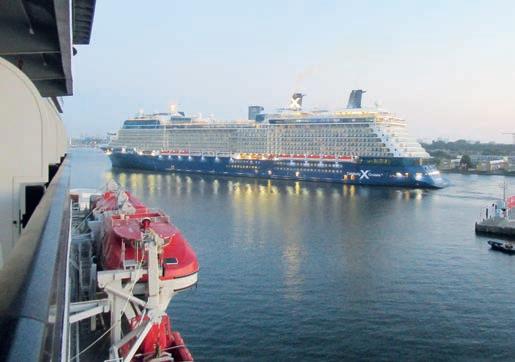
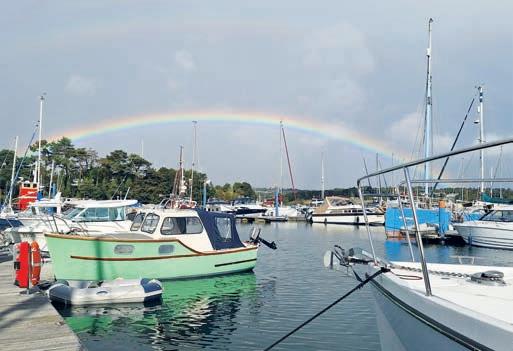


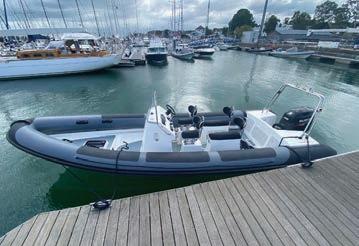
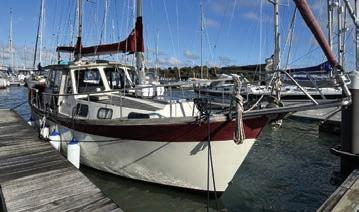
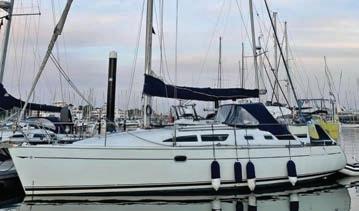
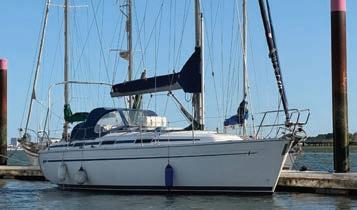
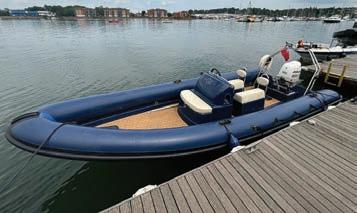
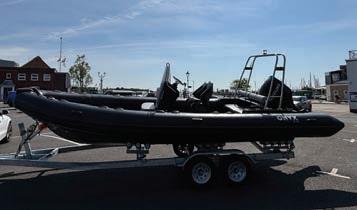
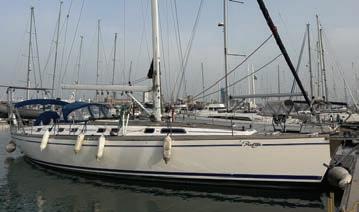
advice and mixed outcomes highlights the need for better orca reporting.
The Cruising Association has updated its Orca Interaction Comments Library, which collates first-hand reports from skippers describing the deterrent actions they took when encountering orca attacks and the outcomes that followed.
The latest update includes further reports of conflicting success and failure stories when the same deterrent measures were used. These reports underline the continued complexity and unpredictability of orca interactions.
In particular, the CA has analysed available evidence in the reports relating to the di ering advice from the Portuguese and Spanish authorities.
In early studies, Grupo Trabajo Orca Atlantica (GTOA) analysed the reports submitted to them and found marginally less damage among yachts that stopped compared with those that did not (51 per cent vs 55 per cent). A slightly more noticeable di erence was observed in cases involving extensive damage where 24 per cent of vessels that stopped sustained extensive damage compared with 31 per cent that continued moving.
More recently, o cial guidance has diverged on what to do in the event of an interaction. Portuguese authorities advise
WAS THE BOAT DAMAGED AND IN NEED OF REPAIR? No
COMMENTS: “We were approx 40nm north of Bilbao crossing Biscay from La Rochelle in +1000m depth. Spotted what we thought were dolphins in the distance. As they got closer they started to circle the boat. This is when I saw they were orca (two females). They then approached us at rapid speed, swimming under the stern and emerging either side of the rudder before circling again. They did not make contact. We accelerated away but no further measures were needed.”
ORCA BEHAVIOUR: Two females circled the boat before swimming under the stern and circling again.
skippers to ‘play dead’ or reverse if conditions permit. Whereas the Spanish authorities advise motoring away as fast as possible towards shallower water. The CA understands this is based upon a tested theory that orca are unlikely to pursue a yacht for more than 2km, as they typically hunt within a defined area, and that the force of any impact on the rudder is likely to be lower when the yacht is moving.
Here we have four examples extracted from the Orca Interaction Comments Library illustrating both successful and unsuccessful outcomes using each approach.
For example, you will read that Sailor A reported success by increasing speed and moving away as soon as orca were sighted, with orca inspecting the yacht but not making contact. Whereas Sailor B, whose boat sank, had the opposite experience and indicated that in future he will stop the boat and ‘play dead’. Sailor C says that keeping out of sight and stopping the boat proved e ective, but sailor D su ered catastrophic damage following repeated hits for almost an hour while the boat remained stopped in the water, leading to the boat sinking. These contrasting accounts reinforce the importance of reviewing the available evidence and understanding that no single approach has been shown to guarantee success. The CA will continue to update the Orca Interaction Comments Library as further reports are received.
Sailor B – From a magazine article
WAS THE BOAT DAMAGED? The boat sank
COMMENTS: “When motoring away I got up to 8 knots for about 15 minutes and they continued to hit the rudder; I tried reverse for about 10 minutes both in a straight line and circle. They continued to attack the rudder for the duration of the attack even once steering was broken. They hit the rudder when reversing. I did not try to reverse once the rudder was disabled. Structural damage was after rudder was broken they seemed to be hitting keel and midships, it felt like they gave up on keel and went to push boat and slam the boat sideways.”
He goes on to say that in hindsight he would have stopped the boat immediately and turned everything o as soon as the orca encounter began.
Sailor D (CA report Inter 94)
WAS THE BOAT DAMAGED AND IN NEED OF REPAIR? The boat sank
COMMENTS: “We followed the recommended protocol [which recommends yachts should stop], the interaction continued but we could not manoeuvre much because one of the killer whales was constantly clinging to the rudder.
After almost an hour a leak opened up behind the boat and we sank.”
ORCA BEHAVIOUR: The killer whales circled around the boat and hit the rudder. They took turns grabbing the rudder blade in their mouths and shaking it.
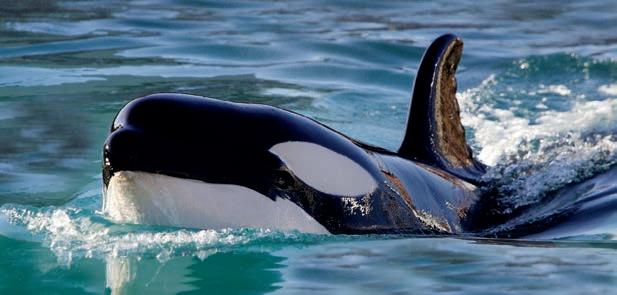
These case studies represent a small selection of the reports received. Please take time to read the Orca Interaction Comments Library before heading out into an a ected area and consider what action you might take in similar circumstances. Examine both the successes and failures experienced when motoring away or ‘playing dead’, and the use of deterrents such as noise, sand and other measures like trailing chains over the stern - noting that some skippers used a combination of measures.
Having done so, please become part of the solution by supporting the CA’s ongoing work to identify best practice to avoid or deter interactions.
While a range of helpful resources is available to sailors, the Cruising Association provides the only publicly accessible resource where data and comments are collated, and skippers’ first-hand accounts are categorised by di erent deterrent measure. The CA also publishes and regularly updates:
■ A monthly table detailing the sea areas a ected by attacks since the outset of the problem, to assist with
passage planning to reduce the risk of an encounter with orcas.
■ Reports from passages through the areas of orca interaction activity when no incident occurred and provide a comparative analysis of interaction and uneventful passage reports in order to help identify any emerging patterns.
However, in 2025 there were 133 recorded interactions, yet the CA received only 19 corresponding reports, significantly fewer than in previous years. If the CA is to identify patterns, draw meaningful conclusions and provide guidance to skippers in the light of di ering scientific and governmental advice, then we need more reports.
The CA will continue to update our website as further information becomes available, and we appeal to all skippers sailing within and through the a ected area to submit both interaction and uneventful passage reports. The report forms take approximately 10-15 minutes to complete.
Explore all resources at www.theca. org.uk/orcas
Sailor C (CA report Inter 206)
WAS THE BOAT DAMAGED AND IN NEED OF REPAIR? No
COMMENTS: “After feeling a nudge or bump on the port hull/stern, we downed sail and switched o the engine. We avoided obvious sounds and movements, remaining out of sight. Once the boat had come to a calm stop and we were drifting (within 5/10 min), their interest waned and no further contacts were made. 90 minutes after the last sighting/last hearing them, we restarted the engines and motored away without incident.
ORCA BEHAVIOUR: Swimming near to/bumping the stern/ hull, initially on the side of the running engine. Swimming under the vessel at a depth of about 10m, forward to aft then circling around, although once we had stopped moving they generally stayed between 20 and 100m away. We heard them in the vicinity for another 30 min or so.
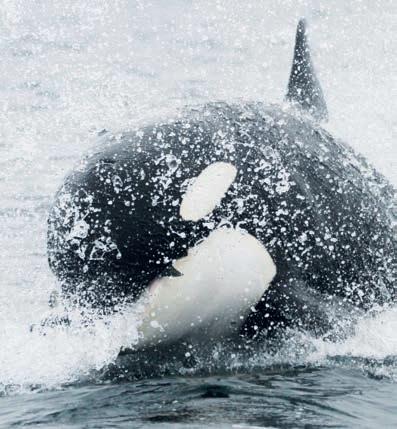
at
of £172.
are planning your first passage or your next big adventure, CA membership connects you with a community of experienced cruisers, trusted knowledge and invaluable resources to support your boating. *First year of membership, when paying by Direct Debit.
With over 500 Tonnes of chain in stock, as well as a huge selection of rope, shackles, swivels, buoys and other mooring products, BGD are able to help you with most of your mooring & anchoring requirements .
Titan HDG 6x18.5 DIN766
Titan HDG 7x22 DIN766
£3.45 per mtr
£4.56 per mtr
Titan HDG 8x24 DIN766 £6.95 per mtr
Titan HDG 10x28 DIN766 £9.36 per mtr
Titan HDG 10x30 ISO £9.36 per mtr
Titan HDG 12x36 ISO £12.24 per mtr
Titan HDG 13x36 DIN766 £13.80 per mtr

MF Solid Zinc 6x18.5 DIN766 £4.90 per mtr
MF Solid Zinc 7x22 DIN766 £6.30 per mtr
MF Solid Zinc 8x24 DIN766 £8.80 per mtr
MF Solid Zinc 10x28 DIN766 £12.50 per m
MF Solid Zinc 10x30 ISO £12.50 per m
MF Solid Zinc 12x36 ISO £16.30 per m
Titan 316 Stainless Chain
6x18.5mm DIN766 £9.96 per mtr 8x24mm DIN766 £17.50 per mtr 10x28 mm DIN766 £26.50 per mtr 10x30 mm ISO £26.50 per mtr 12x36 mm ISO £35.90 per mtr


DIN766 8x24, Grade 70 Windlass & Anchor Chain
MBL = 7000kg HDG / Solid Zinc DIN766 Calibrated £12.50 mtr

Chain
to 58mm diameter.
for ground tackle. From £15.00 mtr
Please call for details
MF Solid Zinc 13x36 DIN766 £17.80 per m
Trefoil Anchor (Bruce Pattern)
2kg

Channel Anchor

Tested Anchor Swivels
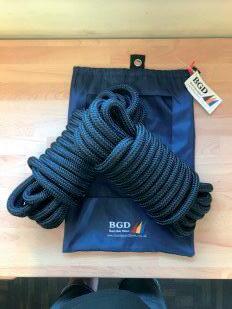
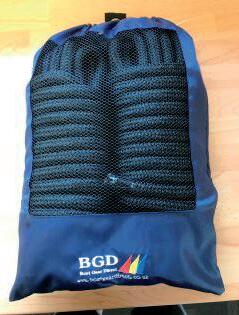
Anchor (Delta Type)
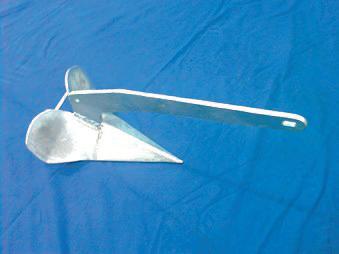
Cruising Anchor (Danforth Style)
2.5kg £14.95
4.5kg £22.65
7kg £40.29
10kg £49.75
14kg £69.60
20kg £99.75
Anchor Straightener
Polyester Mooring Lines
Ready spliced, braided black polyester with 15” soft eye & whipped end. Packed in pairs in a netted stowage bag.
16mm Diam x 10mts £35.71
16mm Diam x 15mts £50.47
18mm Diam x 8mts £33.41
18mm Diam x 10mts £40.13
18mm Diam x 15mts £56.93
20mm Diam x 8mts £42.65
20mm Diam x 10mts £51.50


Sturdy Tripod Open Base for Stability and Easy Storage
Polysteel Risers


Double Fixing Points for Storm Chains & Straps
316 S/S Trefoil Anchor
2k £69.00 5kg £124.95
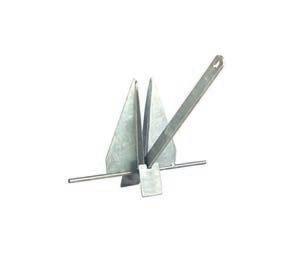

7.5kg £182.40 10kg £299.00
15kg £399.00 20kg £496.80
25kg £649.00
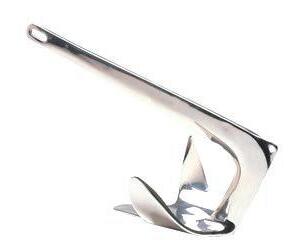
316 S/S Voyager Anchor (DeltaType)
2kg £69.20 5kg £139.00
10kg £240.00 16kg £384.00 20kg £480.00 25kg £625.00
Dock Bumpers
110cm x 25cm Now only £39.95
Zinc Anodes Hull &Skeg
4kg Lozenge ZN78
£39.00

Ever Popular! ‘Titan’ Heavy Duty Boat Stands
250mm Threaded Bar for finer pad adjustment
New Ball Joint assembly with easy to replace rubber pads

Ratchet Strap 6m x 5 Tonne £9.95


1 Quickly and without warning (8)
5 Had in one’s hands (4)
8 Express in speech (5)
9 Attributing responsibility to (7)
11 Knot ted item of clothing (3)
12 Rubs soap all over (7)
13 Kidnaps (7)
15 Took on duties or o ce (7)
17 Stick vegetable, eaten as a fruit (7)
18 Gave permission to (3)
20 Fabulous monster (7)
21 More glacial (5)
22 Name of the dog in Peter Pan (4)
23 Italian painter and sculptor, ___ da Vinci (8)
1 Share a boundary (4)
2 Slow the growth or development of (6)
3 Get involved (11)
4 Identification tags (6)
6 Revised before printing (6)
7 Broke down (food) in the stomach (8)
10 Noisy quarrel (11)
13 Native of the USA (8)
14 Painful swelling of the big toe (6)
15 On fire (6)
16 Measurement for the fineness of stockings (6)
19 Therefore (4)
Each letter of the alphabet has been given a di erent number. Substitute numbers for letters to make words to complete the puzzle. The check-box and letters either side of the grid may help you keep track.
Using the letters in the wheel, you have ten minutes to find as many words as possible of three or more letters, none of which may be plurals, foreign words or proper nouns.
Each word must contain the central letter and no letters can be used more than once per word unless they appear in di erent sections of the wheel.
There is at least one nine-letter word to be found. Nine-letter word(s):
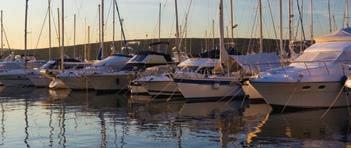





or visit gjwdirect.com/MG26 or call 0151 473 8000

ST KATHARINE DOCKS
Manager: Paul Atkins
50 St. Katharine’s Way, London, E1W 1LA
T: 0207 264 5312
E: marina.reception@skdocks.co.uk
W: ww.skdocks.co.uk
PREMIER MARINAS FALMOUTH
Manager: Mark Evans
North Parade, Falmouth, Cornwall, TR11 2TD
T: 01326 316620
E: falmouth@premiermarinas.com
W: www.premiermarinas.com
PORT PENDENNIS MARINA
Manager: Mark Webster
Challenger Quay, Falmouth, Cornwall, TR11 3YL
T: 01326 211211
E: marina@portpendennis.com
W: www.portpendennis.com
MYLOR YACHT HARBOUR
Manager/contact: Culum Matheson
Mylor Churchtown, Falmouth, Cornwall, TR11 5UF
T: 01326 372 121
E: marina@mylor.com
W: www.mylor.com
FALMOUTH HAVEN
Contact: Daisy Gould
44 Arwenack Street, Falmouth, TR11 3JQ
T: 01326 310990
E: welcome@falmouthhaven.co.uk
W: www.falmouthhaven.co.uk
MAYFLOWER MARINA
Manager: Charles Bush
Plymouth, Devon, PL1 4LS
T: 01752 556633
E: info@mayflowermarina.co.uk
W: www.mayflowermarina.co.uk
PLYMOUTH YACHT HAVEN
Manager: Steve Cox
Shaw Way, Mount Batten, Devon, PL9 9XH
T: 01752 404231
E: plymouth@yachthavens.com
W: www.yachthavens.com
YACHT HAVEN QUAY, PLYMOUTH
Manager: Richard Brown
Breakwater Road, Plymouth, Devon, PL9 7FE
T: 01752 481190
E: boatyard@yachthavenquay.com
W: www.yachthavens.com
MDL QUEEN ANNE’S BATTERY
Manager: Alex Warner
Plymouth, Devon, PL4 0LP
T: 01752 671142
E: qab@mdlmarinas.co.uk
W: www.queenannesbattery.co.uk
SUTTON HARBOUR MARINA
Marina Manager: Mark Brimacombe
Sutton Harbour, Plymouth PL4 0DW
T: 01752 204702
E: marina@sutton-harbour.co.uk
W: www.suttonharbourmarina.com
KING POINT MARINA
Marina Manager: Mark Brimacombe
Brunel Way, Milbay, Plymouth, PL1 3EF
T: 01752 424297
E: marina@kingpointmarina.co.uk
W: www.kingpointmarina.co.uk
PREMIER MARINAS NOSS ON DART
Manager: Mike Smith Bridge Road, Kingswear, Dartmouth Devon, TQ6 0EA T: 01803 839087
E: noss@premiermarinas.com W: www.premiermarinas.com
DOLPHIN BOATYARD
Galmpton Creek, Brixham, Devon T: 01803 842424
E: info@dolphinhaven.co.uk
W: www.dolphin-haven.co.uk
MDL BRIXHAM MARINA
Manager: Martyn Sherratt
Berry Head Road, Devon, TQ5 9BW T: 01803 882929
E: brixham@mdlmarinas.co.uk
W: www.brixhammarina.co.uk
MDL TORQUAY MARINA
Manager: Martyn Sherratt Torquay, Devon, TQ2 5EQ T: 01803 200210
E: torquaymarina@mdlmarinas.co.uk
W: www.torquaymarina.co.uk
WATCHET MARINA
Manager: Matt Driscoll Harbour O ce, Watchet, TA23 0AQ T: 01984 322230
E: watchetmarina@westernmarinas.co.uk
W: www.westernmarinas.co.uk
PREMIER WEYMOUTH MARINA
Manager: Neil Bedwell Commercial Road, Weymouth Dorset, DT4 8NA
T: 01305 767576
E: weymouth@premiermarinas.com
W: www.premiermarinas.com
WEYMOUTH HARBOUR
Manager/contact - Ed Carter 13 Custom House Quay, Weymouth T: 01305 838423
E: weymouthharbour@dorsetcouncil.gov.uk
W: www.weymouth-harbour.co.uk
PREMIER PORTLAND MARINA
Manager: Paul Swain
Osprey Quay, Portland, Dorset, DT5 1DX
T: 01305 866190
E: portland@premiermarinas.com
W: www.premiermarinas.com
LAKE YARD MARINA
Manager/contact - Jenny Burrows
Lake Drive, Hamworthy, Poole, Dorset, BH15 4DT

T: 01202 674531
E: o ce@lakeyard.com
W: www.lakeyard.com
PARKSTONE BAY MARINA
Manager: Henry Cobley
Turks Lane, Poole, Dorset, BH14 8EW
T: 01202 747 857
E: info@parkstonebay.com
W: www.parkstonebay.com
POOLE QUAY BOAT HAVEN
Manager: Kerrie Gray
Poole Town Quay, Poole,Dorset, BH15 1HJ
T/F: 01202 649488
E: info@poolequayboathaven.co.uk
W: www.poolequayboathaven.co.uk
PORT OF POOLE MARINA
Manager: Kerrie Gray
Poole Quay Boat Haven, Poole Town Quay, Poole, Dorset, BH15 1HJ
T/F: 01202 649 488
E: info@poolequayboathaven.co.uk
W: www.poolequayboathaven.co.uk
SALTERNS MARINA LTD
Manager: Robert Golden
40 Salterns Way, Lilliput, Poole, Dorset, BH14 8JR
T: 01202 709971
E: reception@salterns.co.uk
W: www.salterns.co.uk
MDL COBB’S QUAY MARINA
Manager: Kelly Trewern
Hamworthy, Poole, Dorset, BH15 4EL
T: 01202 674299
E: cobbsquay@mdlmarinas.co.uk
W: www.cobbsquaymarina.co.uk
LYMINGTON YACHT HAVEN
Manager: Rupert Wagsta
Kings Saltern Road, Lymington, Hampshire, SO41 3QD T: 01590 677071
E: lymington@yachthavens.com
W: www.yachthavens.com
BUCKLER’S HARD YACHT HARBOUR
Harbour Master: Wendy Stowe
Harbour Master’s O ce, Buckler’s Hard Yacht Harbour, Hampshire, SO42 7XB T: 01590 616200
E: harbour.o ce@beaulieu.co.uk
W: www.beaulieuriver.co.uk
HAVEN QUAY, LYMINGTON
Manager: Matt Toms
Haven Quay Dry Stack, Mill Lane, Lymington, Hampshire, SO41 9AZ
T: 01590 677072
E: havenquay@yachthavens.com
W: www.yachthavens.com
DEACONS MARINA BY BOATFOLK
Contact name: Julie Spensley-Corfield
Bursledon Bridge, Southampton, SO31 8AZ
T: 023 80 402253
E: deacons@boatfolk.co.uk
W: www.boatfolk.co.uk
MDL HYTHE MARINA VILLAGE
Manager: Debbie Scott
The Lock Building, Shamrock Way Hythe, Southampton, Hampshire, SO45 6DY
T: 023 8020 7073
E: hythe@mdlmarinas.co.uk
W: www.hythemarinavillage.co.uk
Tingdene Marinas and Boat Sales’ Upton Marina on the River Severn has been awarded Clean Marina accreditation by The Yacht Harbour Association, becoming the first marina on the River Severn to achieve this environmental standard which includes best practice in waste management, pollution prevention, emergency preparedness, sta training and encouraging responsible boating behaviour among customers and visitors.
Jamieson Harris, Marina Manager at Upton Lake & Marina, said: “This is a fantastic achievement and something the whole team should be extremely proud of. Everyone has played a part in meeting the Clean Marina standards, and it is rewarding to see that hard work recognised.”
In addition, Upton Marina has achieved the continuation of its 4 Gold Anchor accreditation, further confirming the marina’s ability to
MDL OCEAN VILLAGE MARINA
Manager: Lauren McCann Marina O ce, 2 Channel Way, Southampton, Hampshire, SO14 3TG
T: 023 8022 9385
E: oceanvillage@mdlmarinas.co.u
W: www.oceanvillagemarina.co.uk
MDL SHAMROCK QUAY
Manager: Barry Radband
William Street, Northam, Southampton Hampshire, SO14 5QL
T: 023 8022 9461
E: shamrockquay@mdlmarinas.co.uk
W: www.shamrockquay.co.uk
MDL SAXON WHARF
Manager: Lauren McCann Lower York Street, Northam, Southampton, SO14 5QF
T: 023 8033 9490
E: saxonwharf@mdlmarinas.co.uk
W: www.saxonwharf.co.uk
MDL HAMBLE POINT MARINA
Manager: Dominic Brown School Lane, Hamble, Southampton Hampshire, SO31 4NB
T: 023 8045 2464
E: hamblepoint@mdlmarinas.co.uk
W: www.hamblepointmarina.co.uk
MDL PORT HAMBLE MARINA
Manager: Bertie Marsh Satchell Lane, Hamble, Southampton Hampshire, SO31 4QD
T: 023 8045 274,1
E: porthamble@mdlmarinas.co.uk
W:www.porthamblemarina.co.uk
TOWN QUAY MARINA
Associated British Ports, Town Quay, Southampton, SO14 2AQ
T: 023 8023 4397
E: info@townquay.com
W:www.townquay.com
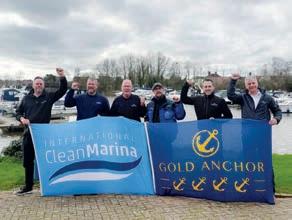
consistently meet high standards of facilities, services and customer care for its berth holders.
Adam Buck, Senior Business Support Manager at Tingdene Marinas and Boat Sales, said: “Achieving Clean Marina accreditation while also retaining our 4 Gold Anchor status is a fantastic result for Upton Marina. It reflects the hard work of the entire team and demonstrates the continued commitment to environmental responsibility and customer service across Tingdene Group.”
MDL MERCURY YACHT HARBOUR
Manager: Debbie Burns SatchellLane, Hamble, Southampton, Hampshire, SO31 4HQ T: 023 8045 5994
E: mercury@mdlmarinas.co.uk W: www.mercuryyachtharbour.co.uk
PREMIER MARINAS SWANWICK
Manager: Graham Bristowe Swanwick (on the Hamble) Southampton, Hants, SO31 1ZL T: 01489 884081 E: swanwick@premiermarinas.com W: www.premiermarinas.com
HAMBLE YACHT SERVICES
Port Hamble, Hamble,Southampton, Hampshire, SO31 4NN T: 02380 201501 E: info@hysgroup.co.uk W: www.hambleyachtservices.co.uk
PREMIER MARINAS UNIVERSAL
Manager: Martin Bowman Crableck Lane, Sarisbury Green, Southampton, Hampshire, SO31 7ZN T: 01489574272 E: universal@premiermarinas.com W: www.premiermarinas.com
PREMIER HASLAR MARINA
Manager: Ben Lippiett
Haslar Road, Gosport, Hampshire, PO12 1NU T: 023 9260 1201 F: 023 9260 2201
E: haslar@premiermarinas.com W: www.premiermarinas.com
PREMIER MARINAS GOSPORT
Manager: Jonathan Walcroft
Mumby Road, Gosport, Hampshire, PO12 1AH
T: 023 9252 4811
F: 023 9258 9541
E: gosport@premiermarinas.com W: www.premiermarinas.com


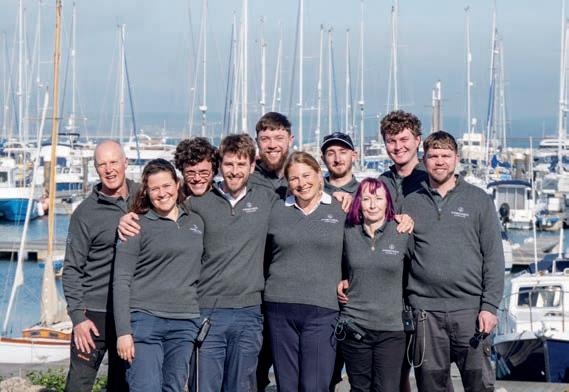
Weymouth and Portland Marinas have been integrated into the Premier Marinas South Coast network.
The move marks the latest step in the company’s strategy to integrate the recently acquired boatfolk sites and close the coastal cruising gap along the South Coast. The result is a broader cruising network for berth holders to explore through the Premier Advantage scheme, which o ers members 42 free visitor nights at partner locations.
Andrew Lewis, Sales & Marketing Director at Premier Marinas, said: “Weymouth and Portland are the third and fourth marinas to join our pre-season integration programme which is creating a network of 16 South Coast destinations for our berth holders.
“We have been hugely encouraged by the positive response from the teams and berth holders at Haslar and East Cowes (who were the first two marinas to join the network), and I am confident Weymouth and Portland will experience the same smooth transition and strong engagement.
“For years, customers have moved between Premier Marinas and boatfolk locations to connect the coastline between the Solent in the east and Noss on Dart and Falmouth Marinas in the west. Now they can enjoy those same destinations as one network, without incurring additional visitor berthing fees.
“As with the marinas that have already transitioned, we will continue to deliver a schedule of local events and activities, ensuring customers and the wider community can enjoy their marina just as they always have.”
Berth holders at Portland and Weymouth Marinas will benefit from the Premier Advantage rewards and benefits programme. The marina teams are on hand to ensure customers take full advantage of their new entitlements. The MyPremier app and online portal also o er easy-to-use tools, helping berth holders manage destination bookings and make the most of their time afloat with ease and confidence.
Marina Port Andratx has joined the portfolio of IPM Group, which includes marinas and refit yards across the Balearics and mainland Spain. Located in the harbour of Andratx in Mallorca, the marina features 547 berths for yachts up to 30m. This partnership includes the o cial adoption of the name Marina Port Andratx, with a new logo and corporate identity.
A fire at Marker 37 Marina in Corpus Christi, Texas left around 20 boats and more than 200ft of dock structure destroyed. The cause of the fire is being investigated.
CVC Capital Partners is working with Goldman Sachs to explore a sale of Mediterranean marina operator D-Marin at a valuation of around €1 billion, according to a report by Bloomberg.
Construction has started on the new south marina at Nanny Cay in the British Virgin Islands. The development, on Tortola, forms part of a wider infrastructure programme at the marina resort. The project,
estimated at over $30 million, is expected to take three years to complete in two main phases.
Haven Knox-Johnston’s Specialist and Commercial divisions, part of Howden, relocated to a new o ce at Yacht Haven Quay Plymouth enabling the team to work more closely with marinas, yacht clubs and marine service providers.
Falmouth Harbour and the Port of Falmouth Sailing Association announced a new partnership for the management of seasonal race marks in the best way for events, safety and the environment. Falmouth Harbour will lay 16 race marks in Falmouth Bay and the Carrick Roads before the start of the main sailing season and retrieve them at the end.
MDL Marinas has a fuel-saving boost for boaters this spring, giving Otium members 10p off every litre of fuel at MDL’s network of 12 fuel stations throughout April. Members will continue to earn Otium loyalty points on fuel purchases during the promotion.
In preparation for the anticipated launch of the revised TYHA Code of Practice, The Yacht Harbour Association is to deliver a nationwide roadshow to promote the updated guidelines for marina planning, design and operations. The 2026 programme comprises events across the UK and Ireland, which began in March and carry on into May.
The Code of Practice is widely recognised as the benchmark for best practice within the marina industry, providing guidance that supports safe, sustainable and commercially successful marina operations.
In partnership with Marina Projects, the 8th edition of the
AQUAVISTA ROYAL CLARENCE WATERSIDE & MARINA
Weevil Lane, Gosport, Hampshire, PO12 1AX
T: 023 9252 3523
E: royalclarence@aquavista.com
W: www.aquavista.com
PREMIER MARINAS PORT SOLENT
Manager: Ben Boardman
South Lockside, Port Solent, Portsmouth, Hampshire, PO6 4TJ
T: 023 9221 0765
F: 023 9232 4241
E: portsolent@premiermarinas.com
W: www.premiermarinas.com
PREMIER MARINAS SOUTHSEA
Manager: Dave Frey
Fort Cumberland Road
Portsmouth, Hampshire, PO4 9RJ
T: 023 9282 2719
F: 023 9282 2220
E: southsea@premiermarinas.com
W: www.premiermarinas.com
GUNWHARF QUAYS MARINA
Manager: Carl Jarmaine
Gunwharf Quays, Marina O ce Portsmouth, Hampshire, PO1 3TZ
T: 02392 836732
E: gwqmarina@incentive-fm.com
W: www.gunwharf-quays.com/marina
COWES YACHT HAVEN
Manager: Katy Ednay
Vectis Yard, High Street, Cowes, PO31 7BD
T: 01983 299975
E: berthing@cowesyachthaven.com
W:www.cowesyachthaven.com
VHF: Channel 80
PREMIER EAST COWES MARINA
Manager: Mike Townshend
Britannia Way, East Cowes, Isle of Wight, PO32 6UB
T: 01983 293983
F: 01983 299276
E: eastcowes@premiermarinas.com
W: premiermarinas.com
TYHA Code of Practice reflects extensive consultation with TYHA members and incorporates principles from established international standards and regulatory frameworks.
Geared primarily towards TYHA members or those interested in joining, the roadshow will give marina operators and stakeholders the opportunity to gain first-hand insight into the revised code, understand its practical application and discuss emerging challenges and opportunities within the sector.
Those wishing to attend one of the TYHA Code of Practice Roadshow events are encouraged to register early as places are limited. Details, including what to expect and tour dates, can be found at:
COWES HARBOUR SHEPARDS MARINA
Manager: Jock Ra erty
Medina Road, Cowes, Isle of Wight, PO31 7HT
T: 01983 297821
E: shepards.chc@cowes.co.uk
W: cowesharbourshepardsmarina.co.uk
ISLAND HARBOUR MARINA
Manager: Danie Erasmus Mill Lane, Newport, Isle of Wight, PO30 2LA
T: 01983 539994
E: info@island-harbour.co.uk
W:www.island-harbour.co.uk
BEMBRIDGE HARBOUR
Jack Miskin, Harbour Master The Duver, St Helens, PO33 1YB
T: 01983 872828
E: mail@bembridgeharbour.co.uk
W: www.bembridgeharbour.co.uk
YARMOUTH HARBOUR
Harbour O ce, The Quay, Yarmouth, Isle of Wight, PO41 0NT
T: 01983 760321
E: info@yarmouth-harbour.co.uk
W: www.yarmouth-harbour.co.uk
VHF: Ch 68 (harbour), Ch 15 (water taxi)
MDL NORTHNEY MARINA
Manager: Tom Ward Northney Road, Hayling Island, PO11 0NH T: 023 9246 6321
E: northney@mdlmarinas.co.uk
W: www.northneymarina.co.uk
MDL SPARKES MARINA
Manager: James Rizzi
38 Wittering Road, Hayling Island Hampshire, PO11 9SR
T: 023 9246 3572
E: sparkes@mdlmarinas.co.uk
W: www.sparkesmarina.co.uk
PREMIER MARINAS CHICHESTER
Manager: Andrew Collumbell Birdham (Chichester Harbour) West Sussex, PO20 7EJ T: 01243 512731
E: chichester@premiermarinas.com
W: www.premiermarinas.com
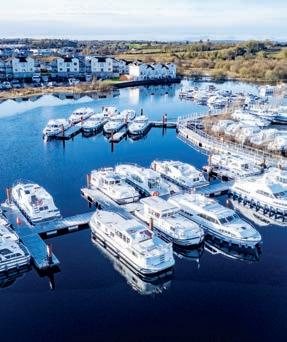
www.britishmarine.co.uk/ news/2026/february/invitationtyha-code-practice-tour-2026
AQUAVISTA BIRDHAM POOL
WATERSIDE & MARINA
Chichester, West Sussex, PO20 7BG T: 01243 512310
E: birdhampool@aquavista.com W: www.aquavista.com
LITTLEHAMPTON MARINA
Berthing Manager: Darren Humphries Ferry Road, Littlehampton, West Sussex, BN17 5DS T: 01903 713553 F: 01903 732264
E: sales@littlehamptonmarina.co.uk W: www.littlehamptonmarina.co.uk
LITTLEHAMPTON YACHT CLUB
Rope House, Rope Walk Littlehampton, West Sussex BN17 5DH T: 01903 732 926 F: 01903 725 911
E: fiona@littlehamptonyachtclub.co.uk W: www.littlehamptonyachtclub.co.uk
PREMIER MARINAS BRIGHTON
Manager: Mike Hatch
West Jetty, Brighton, East Sussex, BN2 5UP
T: 01273 819919 F: 01273 675082
E: brighton@premiermarinas.com
W: www.premiermarinas.com
PREMIER MARINAS EASTBOURNE
Manager: Dan Heckford
Sovereign Harbour, North Lockside, Pacific Drive, Eastbourne, BN23 5BJ T: 01323 470099 F: 01323 470077
E: sovereignharbour@premiermarinas.com
W: www.premiermarinas.com
SMALL BOATS WELCOME
NEWHAVEN MARINA
Manager/Contact: Russell Levett
Newhaven Marina, The Yacht Harbour, Fort Road, Newhaven, BN9 9BY
T: 01273 513 881
E: info@newhavenmarina.co.uk
W: www.newhavenmarina.co.uk
LADY BEE MARINA, SHOREHAM PORT
Manager: Julian Goldie
Lady Bee Marina and Chandlery, 138-140
Albion Street, Southwick, BN42 4EG T: 01273 591705
E: LBChandlery@shoreham-port.co.uk W:www.shoreham-port.co.uk/chandlery
GILLINGHAM MARINA
Manager: Chris Aldous
173 Pier Road, Gillingham, Kent ME7 1UB
T: 01634 280022
E: berthing@gillingham-marina.co.uk
W: www.gillingham-marina.co.uk
MDL CHATHAM MARITIME MARINA
Manager: Emma Powell
The Lock Building, Leviathan Way, Chatham Maritime, Kent ME4 4LP
T: 01634 899200
E: chatham@mdlmarinas.co.uk
W: chathammaritimemarina.co.uk
MEDWAY YACHT CLUB
Contact: Sue Bannister
Lower Upnor, Rochester, ME2 4XB
T: 01634 718399
W:www.medwayyachtclub.com
MDL PENTON HOOK MARINA
Manager: Benedict Moran Staines Road, Chertsey, Surrey KT16 8PY
T: 01932 568681
E: pentonhook@mdlmarinas.co.uk


MDL WOOLVERSTONE MARINA
Manager: Shane Cheshire
Woolverstone, Ipswich, Su olk IP9 1AS
T: 01473 780206
E: woolverstone@mdlmarinas.co.uk
W: www.woolverstonemarina.co.uk
LOWESTOFT BEACON MARINA
Manager: Lucy Edmonds School Road, Lowestoft, Su olk NR33 9NB
T: 01502 580300
E: lowestoftbeacon@abports.co.uk
W: www.beaconmarinas.co.uk
FOX’S MARINA & BOATYARD
Marina Manager: Lee Gilson
Fox’s Marina, Ipswich Su olk IP2 8SA
T: 01473 689111
E: foxs@foxsmarina.com
W: www.foxsmarina.com
FAMBRIDGE YACHT HAVEN
Manager: Danyal Adams Chelmsford, CM3 6LU
T: 01621 740370
E: fambridge@yachthavens.com
W: www.yachthavens.com
ABERYSTWYTH MARINA
Manager: Adam Knowles
NEYLAND YACHT HAVEN
Manager: James Cotton
Brunel Quay, Pembrokeshire SA73 1PY
T: 01646 601601
E: neyland@yachthavens.com
W: www.yachthavens.com
PORT DINORWIC MARINA
Dock Manager: Kevin Roberts
Y Felinheli, Gwynedd LL56 4JN
T: 01248 671500
E: sharon@portdinorwic.co.uk W: www.port-dinorwic.co.uk
BURRY PORT MARINA
Harbour Master: Robert Hockey
The Harbour O ce, Burry Port
Carmarthenshire
T: 01554 835 691
E: Info@themarinegroup.co.uk
W: www.themarinegroup.co.uk
BANGOR MARINA
Manager: Kevin Baird
Bangor, Co. Down
T: 02891 45329
E: bangor@boatfolk.co.uk
W: www.boatfolk.co.uk
CARRICKFERGUS MARINA
Harbour Master: Ryan Hack
Marina Manager: Karen Steelen
3 Quayside, Carrickfergus BT38 8BJ
T: 028 9336 6666
E: harbour.master@midandeastantrim.gov.uk
W: www.midandeastantrim.gov.uk
RHU MARINA
Contact: Suzanne Bell
Rhu, Helensburgh G84 8LH
T: 01436 820238
E: rhu@boatfolk.co.uk
W: www.boatfolk.co.uk
LARGS YACHT HAVEN
Manager: Dave Hewitt Irvine Road, Largs Ayrshire KA30 8EZ
T: 01475 675333
E: largs@yachthavens.com
W: www.yachthavens.com
TROON YACHT HAVEN
Manager: Stephen Bennie The Harbour, Troon Ayrshire KA10 6DJ T: 01292 315553
E: troon@yachthavens.com
W: www.yachthavens.com
MDL SANT CARLES MARINA
Manager: Nicolas Gonzalez Ctra Poble Nou s/n, Apartat de Correus 192, 43540 Sant Carles de la Ràpita, Spain
T: (0034) 9777 45153
T (UK): 023 8045 0227 enquiries@santcarlesmarina.com W: www.santcarlesmarina.com


MARINARA
Front Desk: Federica Civilla Via Marinara 11, Marina di Ravenna, 48122 Italy
T: (0039) 0544 531644
E: info@marinara.it W: www.marinara.it



Y Lanfa Aberystwyth, Trefechan SY23 1AS
T: 01970 611422
E: aberystwythmarina@westernmarinas.co.uk
W: www.westernmarinas.co.uk
CARDIFF MARINA
W: www.pentonhookmarina.co.uk
MDL WINDSOR MARINA
Manager: John Harris Maidenhead Road, Windsor Berkshire SL4 5TZ
T: 01753 853911
E: windsor@mdlmarinas.co.uk
W: www.windsormarina.co.uk
MDL BRAY MARINA
Manager: John Harris Monkey Island Lane, Bray Berkshire SL6 2EB
T: 01628 623654
E: bray@mdlmarinas.co.uk
W: www.braymarina.co.uk
AQUAVISTA GLASSON
WATERSIDE & MARINA
School Lane, Glasson Dock, Lancaster, Lancashire LA2 0AW
T: 01524 751491
E: glasson@aquavista.com
Manager: Andy Coles OBE
Watkiss Way
Cardi CF11 0SY T: 02920 396078
E: cardi marina@westernmarinas.co.uk
W: www.westernmarinas.co.uk
CONWY MARINA
Manager: Jon Roberts
Conwy Marina, Ellis Way LL32 8GU
T: 01492 593000
E: conwy@boatfolk.co.uk
W:www.boatfolk.co.uk
MILFORD MARINA
Manager or contact: Melanie Durney Milford Haven, Pembrokeshire SA73 3AF
Tel: 01646 696312
E: enquiries@milfordmarina.com
W: www.milfordmarina.com
PENARTH MARINA
PORTISHEAD MARINA
Manager: Simon Davis
Portishead, Bristol BS20 7DF
T: 01275 841941
E: portishead@boatfolk.co.uk W: www.boatfolk.co.uk
ROYAL QUAYS MARINA
Manager: Keeran Stephenson North Shields, Tyneside NE29 6DU T: 01912 728282
E: royalquays@boatfolk.co.uk
W: www.boatfolk.co.uk
AQUAVISTA HULL WATERSIDE & MARINA
Warehouse 13, Kingston Street, Hull
Yorkshire HU1 2DQ
T: 01482 609960
JACHTHAVEN BIESBOSCH
Manager: Maarten Voskuil Nieuwe Jachthaven 54924 BA, Drimmelen, NL
T: +31 (0)162 682249
E: info@jachthavenbiesbosch.nl W: www.jachthavenbiesbosch.nl

E: hull@aquavista.com W: www.aquavista.com
LIVERPOOL MARINA
Manager: Stuart Jones Penarth
Vale of Glamorgan F64 1TQ
T: 02920 705021
E: penarth@boatfolk.co.uk
W: www.aquavista.com

W: www.boatfolk.co.uk
Manager: Daniel O’Dea
Liverpool Marina, Coburg Wharf, L34BP
T: 0151 707 6777
E: reception@liverpoolmarina.com
E: manager@liverpoolmarina.com
W: www.liverpoolmarina.com

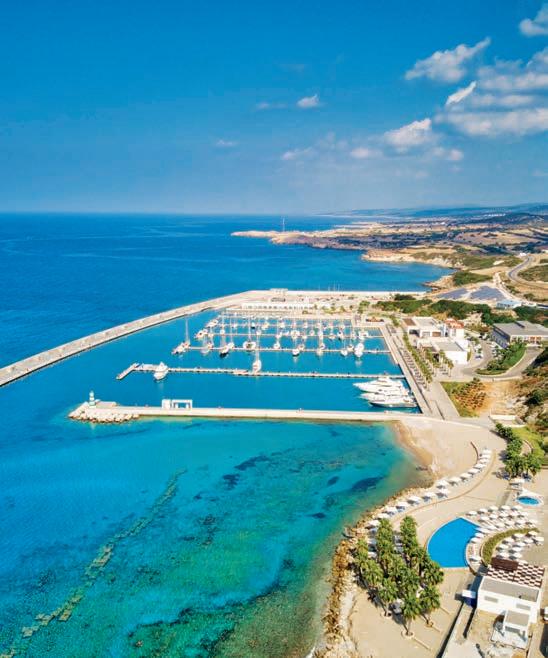




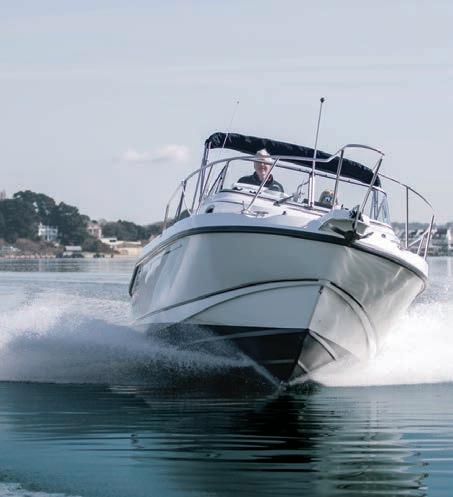
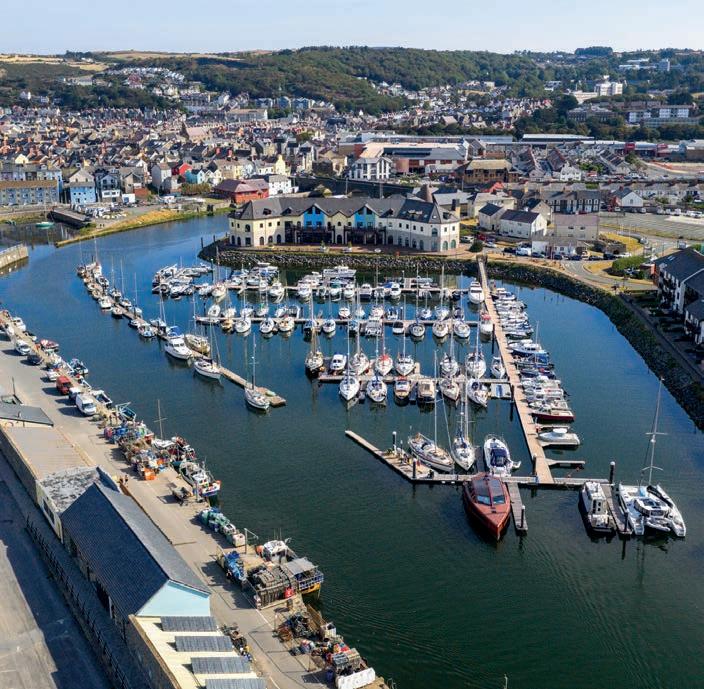

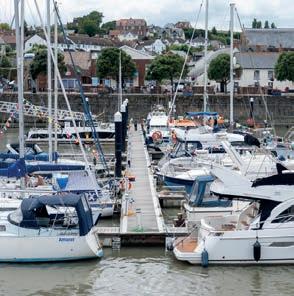


Ushering in the spring, Easter means di erent things to di erent people. There is the traditional significance of course, but for many it is a time of celebration for other reasons. For nature lovers, it is the joy of seeing new life sprouting from the earth. For children, it is all chocolate eggs and Easter bunnies. For boat owners, it is the uno cial start of the boating season knowing the dark, chilly days in the boatyard are over and on water adventures await.
But whatever it means to you, certain meals and tasty treats go hand in hand with this very welcome four-day break from work.
A nod to the historical absence of meat during the lead up to Easter, fish in various guises has become synonymous with Good Friday. For a larger family a air, a creamy fish pie with lashings of mash can be transformed from a humble dinner to haute cuisine when accompanied by a rich white wine with good acidity to cut through the buttery potato and luscious parsley sauce.
A lightly oaked chardonnay would be my first port of call – especially if the pie in question includes some smoked fish in the recipe - whether that is white burgundy or a varietally labelled bottle from Australia. And for something much drier, my grandparents swore by Italian Frascati or Soave to go with fish pie – and just about everything else as well!
Fish Friday does not have to be fancy though. If, like me, you are down by the coast, a visit to the local ‘chippy’ will do the trick. Usually at Easter,
the weather is improved enough to wander down to the front to enjoy fish and chips in the fresh air, with a cheeky beer – a Camden Pale Ale or Beavertown’s Gamma Ray APA would be my preference as the balanced hops and malt cut through the crispy, fatty batter without overpowering the more delicate fish.
For seasonal, as well as a traditional reasons, roast lamb is a popular choice for Easter Sunday entertaining. Having written about roasting reds extensively last month, I will not dwell but want to add one more into the mix to bring a bit of feasting fun to the table. The Chocolate Block. Widely available, and mostly a ordable, this South African wine’s name is a reflection of its rich, velvety texture with hints of cocoa on the palate - drawn from its predominantly Syrah blend, complemented by Grenache, Cinsalt, Cabernet Sauvignon and a touch of Viognier. Great with the main course, but equally delicious with dark chocolate desserts - or Easter eggs.
Whether spending Easter with family or friends – onboard or not – with the summer season approaching it is a time of celebration and inspiration. But this does not need to be accompanied with a % ABV – I am at home this year being thankful with a hot cross bun and a delicious cup of Lady Grey tea! ■
“whatever it means to you, certain meals and tasty treats go hand in hand with this very welcome four-day break from work”

Not just a berth – a launch point for your next adventure. Perfectly placed for exploring. Always ready to welcome you home.
Across our collection of 19 marinas in prime locations, each features a distinct character, from our large flagship marina villages to charming smaller havens.
Explore the MDL Marinas collection and discover where your next adventure begins at mdlmarinas.co.uk /explore








POOLE QUAY
BOAT HAVEN
POOLE QUAY BOAT HAVEN
POOLE QUAY
POOLE QUAY
BOAT HAVEN
BOAT HAVEN







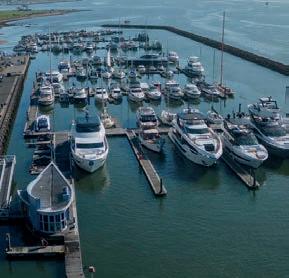

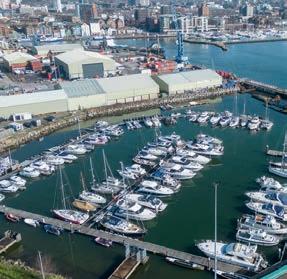




Relax with a glass of wine, on a sunny afternoon, on your own swinging mooring in Poole Harbour overlooking Brownsea Island. Away from the madding crowd, these offer you ultimate privacy, peace & tranquillity.
PORT OF POOLE
PORT OF POOLE
PORT OF POOLE MARINA
PORT OF POOLE

125 visitor berths all year for vessels up to 75m in length and up to 4.8m draft
On the Port estate we can accommodate vessels up to 210m in length with a maximum draft of 9m.