chapter 12: Thermal mass vs. insulation building envelope design in six climatic regions of South Africa
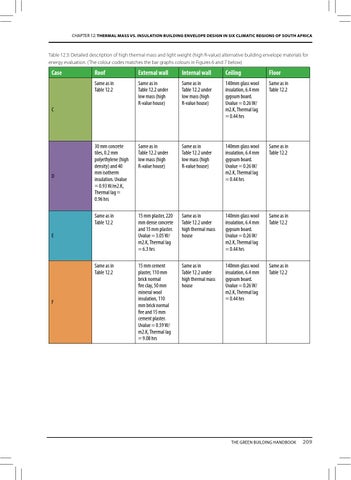
Table 12.3: Detailed description of high thermal mass and light weight (high R-value) alternative building envelope materials for energy evaluation. (The colour codes matches the bar graphs colours in Figures 6 and 7 below)
Case
Roof
External wall
Internal wall
Ceiling
Floor
Same as in Table 12.2
Same as in Table 12.2 under low mass (high R-value house)
Same as in Table 12.2 under low mass (high R-value house)
140mm glass wool insulation, 6.4 mm gypsum board. Uvalue = 0.26 W/ m2.K, Thermal lag = 0.44 hrs
Same as in Table 12.2
30 mm concrete tiles, 0.2 mm polyethylene (high density) and 40 mm isotherm insulation. Uvalue = 0.93 W/m2.K, Thermal lag = 0.96 hrs
Same as in Table 12.2 under low mass (high R-value house)
Same as in Table 12.2 under low mass (high R-value house)
140mm glass wool insulation, 6.4 mm gypsum board. Uvalue = 0.26 W/ m2.K, Thermal lag = 0.44 hrs
Same as in Table 12.2
Same as in Table 12.2
15 mm plaster, 220 mm dense concrete and 15 mm plaster. Uvalue = 3.05 W/ m2.K, Thermal lag = 6.3 hrs
Same as in Table 12.2 under high thermal mass house
140mm glass wool insulation, 6.4 mm gypsum board. Uvalue = 0.26 W/ m2.K, Thermal lag = 0.44 hrs
Same as in Table 12.2
Same as in Table 12.2
15 mm cement plaster, 110 mm brick normal fire clay, 50 mm mineral wool insulation, 110 mm brick normal fire and 15 mm cement plaster. Uvalue = 0.59 W/ m2.K, Thermal lag = 9.08 hrs
Same as in Table 12.2 under high thermal mass house
140mm glass wool insulation, 6.4 mm gypsum board. Uvalue = 0.26 W/ m2.K, Thermal lag = 0.44 hrs
Same as in Table 12.2
C
D
E
F
the green building HANDBOOK
209