PHASE CHANGING MATERIALS
9
Methods of incorporating PCM into wall boards There are generally two methods for incorporating PCMs into wallboards (Baetens, et al., 2010): 1.
2. • • • •
Encapsulating PCM into pellets and using a binder to produce the wallboard: Baetens, et al., (2010) states that the disadvantage of this method is that pellets have low surface area to volume ratio thereby reducing the overall heat capacity. The second method is impregnating PCMs into wall boards. The procedure of impregnating is as follows: Melt PCM at controlled temperature Introduce aggregates into the molten PCM; the molten PCM coats the aggregates Mix coated aggregates with binder Press the mixture to obtain a board
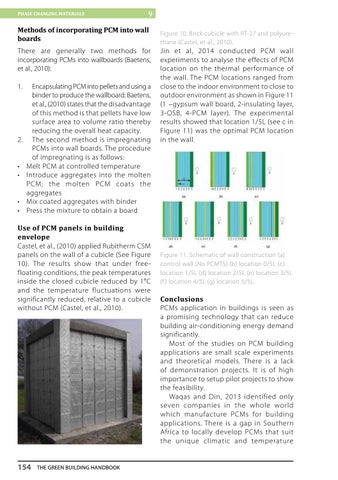
Use of PCM panels in building envelope Castel, et al., (2010) applied Rubitherm CSM panels on the wall of a cubicle (See Figure 10). The results show that under freefloating conditions, the peak temperatures inside the closed cubicle reduced by 1°C and the temperature fluctuations were significantly reduced, relative to a cubicle without PCM (Castel, et al., 2010).
154
THE GREEN BUILDING HANDBOOK
Figure 10. Brick cubicle with RT-27 and polyurethane (Castel, et al., 2010).
Jin et al, 2014 conducted PCM wall experiments to analyse the effects of PCM location on the thermal performance of the wall. The PCM locations ranged from close to the indoor environment to close to outdoor environment as shown in Figure 11 (1 –gypsum wall board, 2-insulating layer, 3-OSB, 4-PCM layer). The experimental results showed that location 1/5L (see c in Figure 11) was the optimal PCM location in the wall.
Figure 11. Schematic of wall construction (a) control wall (No PCMTS) (b) location 0/5L (c) location 1/5L (d) location 2/5L (e) location 3/5L (f ) location 4/5L (g) location 5/5L.
Conclusions PCMs application in buildings is seen as a promising technology that can reduce building air-conditioning energy demand significantly. Most of the studies on PCM building applications are small scale experiments and theoretical models. There is a lack of demonstration projects. It is of high importance to setup pilot projects to show the feasibility. Waqas and Din, 2013 identified only seven companies in the whole world which manufacture PCMs for building applications. There is a gap in Southern Africa to locally develop PCMs that suit the unique climatic and temperature