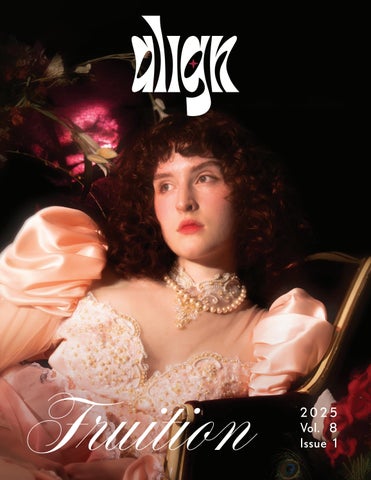
Editors


EDITORIAL BOARD L
STELLA RANELLETTI EDITOR-IN-CHIEF
WALLIE BUTLER EXECUTIVE PRINT EDITOR
ANAYA LAMY EXECUTIVE DIGITAL EDITOR
MIA MICKELSEN EXECUTIVE FINANCE MANAGER
EMESE BRACAMONTES VARGA WRITING EDITOR
LIV BOURGAULT DESIGN EDITOR
JOEY BEZNER ILLUSTRATION EDITOR
ISABELLA THOMAS MUSIC EDITOR
MAURA MCNEIL VIDEO EDITOR
DANIEL SANTOYO PODCAST EDITOR
KYM ROHMAN FACULTY ADVISOR
MIA FAIRCHILD MUSIC EDITOR
MEHANA BYRNE BLOG COPY EDITOR
RUBY JOYCE BLOG COPY EDITOR
OLIVIA ROBERTS STYLING EDITOR
MAYA CLAUSMAN STYLING EDITOR
NATALIE ENGLET SOCIAL MEDIA MANAGER
ANNA CURTIS ART DIRECTION EDITOR
AYLA FUNG PHOTO EDITOR
ZOE MAITLAND PHOTO EDITOR
ELLIE JOHNSON PRINT COPY EDITOR
BEATRICE KAHN PRINT COPY EDITOR
MARK MUNSON-WARNKEN PRINT COPY EDITOR
Letter From The Editor THE EDITOR
LETTER FROM
Dear Align Readers,
It’s hard to believe that after three years, I’m writing this letter to you now.
In March 2022 of my senior year of high school, I remember browsing the University of Oregon club list. I hadn’t even committed to enroll as a student yet. I saw Align at the top of the alphabetical list, and I immediately stalked the entire Instagram and website. I can’t imagine what the Editor-in-Chief at the time, Kaeleigh James, thought when she saw an email from 17-year-old me excitedly asking how I could join Align. I reread that email from three years ago and laughed at what a full circle moment this is.
When I joined the design team at the beginning of my freshman year, I could never have guessed where this journey would take me, but I am incredibly grateful to be in this position. Throughout the seasonal changes and growing pains I have experienced in the last few years, Align has always been a constant in my corner. I am forever thankful for what this community has given me.
We chose Fruition to celebrate the fruits of labor through community, abundance, and warmth. The word has several meanings: to produce fruit, the attainment of something desired, and the realization of a plan. All of these ring true to this issue where we delve into themes of history, accomplishments, seasonal patterns, and the cycles of our lives. In times like now it is incredibly important to support and uplift those around us, and appreciate our unique traditions, givings, and networks that shape who we are. We hope that reading this issue will inspire your own personal harvest, and cherish what is special to you.
I am so grateful to Align’s hardworking members that delivered this issue. The contributions of every single person are integral to the success of this magazine, and I am so proud of the effort and creativity this team dedicates. This is the first issue I am publishing as Editor-in-Chief, and I will be savoring every second before the year is over.
Thank you to previous editors like Sydney, Eliot, Ainsley, and Ella. You taught me so much, and we miss you. Thank you to Align’s exec team and editors, you keep me afloat. And a special thank you to all of the fall 2025 members, returning or new, who showed up this term to make something amazing to start off the year.
I hope you enjoy Fruition.
Till next time, Stella Ranelletti
JOIN OUR TEAM
Applications open two weeks before the beginning of every term, and we publish three printed issues per year. Check our socials to know when applications are released.
Follow @align_mag on Instagram Read past issues and our digital content at alignmaguo.com
PHOTOGRAPHERS
Anathyn Burton
Aubrey Jayne
Aubrey Kunz
Ayla Fung
Bella Snyder
Carter Garrett
Hana Wittleder
Isabela Torres
Izzi Lipari Maxson
Jacob Mitani
Joaquim Gruber
Julian Ramirez-Sanchez
Ky Myers
Lac Nguyen
Maddy Lazarow
Megha Panikar
Piper Shanks
Sofia Moscovitch
Zoe Maitland
DESIGNERS
Allie Harakuni
Amelia Fox
Ava Klooster
Bryant Leaver
Drake Michael
Ella Kenan
Elliott Parsons
Evan Giordano
Iris Gray
Joey Matsuno
Kayla Chang
Liv Bourgault
Natalie Englet
Natalie Koski
Noah Gagnier
Porter Wollam
Ryan Ehrhart
Sadie Wehunt
Stella Ranelletti
STYLISTS
Abigail Ghio
Alyssa Samuel
Alyssia Truong
Annika Patil
Ava Kook
Carmen Peredia
Clarissa Perez
Diego Vasquez
Ella Hutchinson
Eve Haghighi
Francesca Overton
Gidi Batya
Karter Green
Nina Latto
Olivia Roberts
Quinn Vormbaum
Sophia Besaw
Tamayra Corpuz
Zoë Walkenhorst
Zöe Fruits
STAFF
ART DIRECTORS
Aamani Sharma
Ainsley McCarthy
Alexandra Bondurant
Angelika Stolecki
Anna Curtis
Anna De Sanctis
Audrey Stephens
Avery Wachowiak
Charlotte Miller
Cocoro Darby
Cori Markus
Danielle Collar
Elias Contreraz
Emily Casciani
Harper Meyer
Harry Nowinsky
Isabella King
Keiran Christiansen
Lela Akiyama
Lucy McCannon
Maura McNeil
Maya Clausman
Mia Fairchild
Ruby Joyce
BLOGGERS
Addie Jensen
Amelia Gaviglio
Anna Viden
Bridget Newman
Daisy Simpson
Elise Alvira
Frankie Little
Hannah Dean
Helen Bouchard
Helen Myers
Kellen Cox
Lindsey Pease
Mars G.A.
Minami Salas
Nahla Wilson
P.K. Rector
Phoenix Nwokedi
Sophie Butsch
ILLUSTRATORS
Ash Dunteman
Braylon Belloni
Ella Jaksha
Flavia Gjishti
Jackson St. Denis
Joey Bezner
Kent Porter
MaryClaire Lane
Natasha Korbich
Ruby Knott
Sara Spencer
Stella Ranelletti
Wallie Butler
Ying Thum
WRITERS
Amanda Lan Anh
Amelia Fiore
Anaya Lamy
Anna Liv Myklebust
Avery Wilson
Beatrice Kahn
Bridget Donnelly
Campbell Williams
Catalina Kurihara
Ceci Cronin
Celia Hutsell
Claire O’Connor
Cora Callahan
Drew Turiello
Ellie Johnson
Emese Bracamontes Varga
Emily Hall
Emily Hatch
Fiona McMeekin
Hannah Kaufmann
Hope Call
Julie Saive
Keira Wilson
Khushi Mishra
Kiana Heilfron
Kimberly Bowman
Libby Findling
Liv Vasquez
Mark Munson-Warnken
McKenzee Manlupig
Mehana Byrne
Meileen Arroyo
Niobe Hauger
Skylar DeBose
Sophie Turnbull
MUSIC CONNOISSEURS
Anja VanderZee
Ben Cohen
Bianca Lewis
Danahea Heart
Ellie Acosta
Fiona Ryan
Grace Sinkins
Henry Martin
Isabella Thomas
Lauren Gross
Lucy Fromm
Mia Fairchild
Moréa Manson
Sylvie Rokoff
VIDEOGRAPHERS
Adrian Beltran
Matias Crespo
Nathan Wooley
Sam Browdy
Tallulah Hutchinson
MODELS
Abigail Ghio
Ailsa Huerta
Alyssa Samuel
Anathyn Burton
Andrea Rivera
Anja VanderZee
Annika Patil
Arden Brady
Ash Dunteman
Ava Kook
Avery Wilson
Bella Ahlheim
Bryant Leaver
Carmen Peredia
Clarissa Perez
Danielle Collar
Davis Lester
Drew Turiello
Elias Contreraz
Eliyah Syrai
Emily Casciani
Emily Hatch
Eve Haghighi
Fiona Ryan
Francesca Overton
Harper Meyer
Helen Myers
Isabella King
Isabella Razura
Jackson Jones
Jacob Mitani
Jenneh Conteh
Julian Ramirez-Sanchez
Katie Lantz
Kayla Chang
Khushi Mishra
Lily Mock
May Ishida
Maya Gangishetti
Meara Stephens
Mika Maii
Mila Brucato
Mina Gushee
Monty Gunnell
Moréa Manson
Nadia Rouillard
Naseeb Reyes
Ossean Barbès
Parker Kirkwood
Rose Ruhnke
Ruby Knott
Sage Murphy
Sailor Lombardi
Sophia Soleil
Stella McShane
Will Ficker
Zoe Maitland
Zoë Walkenhorst
PODCASTERS
Daniel Santoyo
Hannah Bard
Matthew Bedrosian
Sophia Soleil
ART DIRECTOR KEIRAN CHRISTIANSEN
PHOTOGRAPHED BY ISABELA TORRES
MODELS EMILY CASCIANI, KATIE
LANTZ & ANJA VANDERZEE
STYLIST ZOE FRUITS
SEE MORE ON PAGE 60

fruition playlist listen

See you on monday (you’re lost)
please, please, please, let me get what i want
BALLAD OF SIR FRANKIE CRISP (LET IT ROLL)
YOU CAN’T ALWAYS GET WHAT YOU WANT
This must be the place (naive melody) summer wine empires never know cherry-coloured funk cowgirl float on vienna
THANK YOU
CHIQUITITA
DREAMS
STARMAN
CHAMPAGNE SUPERNOVA i guess incomprehensible

TAME IMPALA
THE SMITHS
GEORGE HARRISON
THE ROLLING STONES talking heads
NANCY SINATRA & LEE HAZLEWOOD
JESSICA PRATT
COCTEAU TWINS
ORA COGAN
MODEST MOUSE
BILLY JOEL
BONNIE RAITT
ABBA
THE CRANBERRIES
DAVID BOWIE
OASIS lizzy mcalpine big thief
In addition to playlists, the Align Music Team also publishes music blogs available at alignmaguo.com. Here are some highlights:
Everyone Has Their Goliath BY
FIONA RYAN
The Heartbeat Continues: Indigenous Music and Sovereignty Today BY DANAHEA
HEART
How “Album Eras” Transformed the Pop Music Scene BY
ELLIE ACOSTA
Video
Video`
The Align Video Team has worked throughout the term to shoot projects capturing the feeling of Fruition. All videos are available on our website and @align_mag on Instagram, with more to come soon!
Here are some of our favorites from this issue.
“Align Asks”
VIDEOGRAPHER MATIAS CRESPO
ART DIRECTOR ANNA DE SANCTIS

“Fall Crossed Lovers”
VIDEOGRAPHER SAM BROWDY
ART DIRECTOR ANGELICA STOLECKI
MODELS BRYANT LEAVER & ROSE RUHNKE
Align on Air Align on Air`
Our official podcast, Align On Air, produces a variety of content from interviews to round table talks. Visit our Spotify to listen to the new episodes: Discussing Fashion Around the University of Oregon Roundtable Talk with Align’s podcast team.
Future of Fashion Club (with Lara Clute) Podcast editor Daniel Santoyo interviews UO Fashion Club president Lara Clute on the club’s success and future plans.


ART DIRECTOR EMILY CASCIANI
PHOTOGRAPHED BY BELLA

SNYDER
STYLIST DIEGO VASQUEZ
MODEL ALYSSIA TRUONG

The QuieT arT of gleaning a home away from home reimagining relaTionships all nine lives aT once archiving an archive
The Tales of appalachia women of The earTh living arT eve’s daughTers six seeds public arT...for who?
Threads ThaT remember
The beauTy in unseen individualism in memoriam: monsTerhouse poppy in The garden
The harvesT we wear
The packaging of persona
This wouldn’T be funny in The homeland
The dream ThaT ouTlives The dreamer could heaven ever be like This? flesh and memory sprouTing a new day darkness losT under arTificial lighT
The wiTches’ ledger a legacy of laughTer and learning censored sea, swallow me
The rush To nowhere a bloom drenched in blood okToberfesT a seaT aT our Table are we feeling good yeT? carl jung vs The clean girl fruiT symbolism in media
JOHNSON

ART OF
Gleaning QuietTHE
How the practice of gleaning is a way to notice, preserve, and endure.

In the Musée d’Orsay, a painting depicts three women bending towards the earth. They are gathering wheat left in a field after a harvest. The women in Jean-François Millet’s “The Gleaners” are fixed on their labor — bending, reaching, and collecting. They glean wheat to ensure their survival, to ensure they have enough sustenance to make it through the winter. To glean, from the Old French word “glener,” means to gather the leftover grain after a harvest, to collect what remains once abundance has passed. This painting serves as an ode to unseen labor and endurance. In 1857, when peasant labor was rarely dignified, Millet turned survival into art.
More than a century later, Agnès Varda captured similar gestures with a camera rather than a brush. In her 2000 film, “The Gleaners and I,” Varda travels through France in search of modern gleaners — people who salvage what has been discarded. She encounters individuals who collect misshapen potatoes left in the fields after a harvest, and those who dumpster dive for survival.
“The Gleaners and I” develops a philosophy of noticing. Throughout the film, Varda gleans moments in time, collecting fragments of a country, of a people, and of herself. She asks what it means to glean what is left behind, not just from harvests but from time itself.
In the film, Varda encounters many kinds of gleaners. Along a rural road, she meets a group of people living in trailers at the edge of farmland. Dependent on welfare and ousted from the city, they glean to survive. They gather vegetables in fields that are still edible but deemed unfit for sale. At night, they visit grocery dumpsters, rescuing discarded meat and fish that are past their sell-by dates. The food is not rotten, only thrown away to meet consumer standards. For these people, gleaning is a necessity, a way to survive off of what society deems inadequate.
However, not everyone gleans out of necessity. One man, employed and housed, gathers food from trash bins out of principle. He rejects the endless cycle of buying, discarding, and replacing. For him, gleaning becomes a protest and an ethical act against overconsumption.
Others glean for their artistic pursuits. Varda visits Ukrainian-born artist Bodan Litnianski, who has built a sprawling palace from discarded materials. Every castoff: dolls, toy cars, broken ceramics, rusted metal, becomes part of a mosaic surrounding his home. His work transforms waste into wonder, proof that discarded items can still hold beauty.
“The Gleaners and I” is unique in its reflexive quality. Varda is an active participant and subject in the film. She positions herself as a gleaner of images, stories, and herself. She turns the lens towards her own hands, and she treats them with the same care she gives to each of her subjects. In this, she is gleaning herself and preserving her own beauty and purpose. The attention paid to her wrinkled, aging hands becomes a way of honoring what persists as usefulness begins to fade.
Gleaning, then, extends beyond a field or a dumpster. It becomes a way of being in the world, a way of noticing, and a way of honoring what might otherwise be overlooked. We often walk through life carrying trauma, insecurities, and fear. But we forget the


fragments of conversation, lingering eye contact, and small gestures of love. These remnants become a quiet archive that sustains our daily nourishment.
Modern life rarely allows this kind of attention. Our collective consciousness values the harvest, but not the gleaning. It prioritizes the product, but not the process. Yet value accumulates in these smaller gestures, the gathering and the remembering. Varda’s camera often lingers a few seconds after a scene should have ended, as if reluctant to look away. That delay is deliberate. It insists that attention is a form of care.
The gleaners painted by Millet persist today, though the fields have changed. Varda’s camera finds them in dumpsters, in fields, and in the streets of Paris. Modern gleaners remind us that value does not vanish when usefulness fades. To glean is to keep noticing, and to find purpose in what remains. Like the women in Millet’s field, Varda’s gleaners show that attention itself is a form of endurance.

She turns the lens towards her own and she treats them with the same she gives to each of her subjects.
hands,
care “ ”

PLAYLIST CONNOISSEUR ELLIE ACOSTA
A home away from home
Growing up, I wasn’t aware of the cultural aspects that surrounded my everyday life. The paintings, photographs, and figurines that adorned my home, the ill verses of hip-hop greats blasting from our kitchen speaker, the smooth voices of Black women, the aromatic scents of my father’s soul food recipes, the rainbow array of books that told my people’s history and resilience, and the role models that enveloped our living room TV. Each of these cultural aspects shaped the first community I was a part of — my family.
The foundations of culture and community have forever shaped the people I surround myself with, the opportunities I undertake, the morals I follow, and the stories I tell. For much of my life, I obliviously incorporated these lessons into my life. It wasn’t until I began writing my personal essay for college applications that I really sat and asked myself what and who have shaped me into the person I am.
Over the past two years, my communities and cultural understandings have shifted, grown, and persisted. As we transition into a new school year, from summer into fall, I find myself reflecting on the newfound cultural understandings and communities I found during my six weeks abroad in Ghana this past summer.
As a Black woman who grew up in the predominantly white city of Portland, Oregon, for most of my childhood, it was difficult to find communities outside of my home with people who looked like me. Yet, within my home, I was constantly reminded of the lesson, “I’m Black, and I’m proud.”

Although the colonizer’s enslavement of my ancestors prevents me from knowing the geographical roots of my family history, I have always known who my people are. I knew my roots were in Africa.
I knew of my people’s long resistance to white supremacy and colonization. I knew the beauty of my people’s hair — its versatility, its kinks, its coils, its skin-tight twists and braids. I knew the comforting aromas of soul food that quite literally feed the soul. I knew the sounds of jazz instruments, the breathtaking voice of Aretha Franklin, the upbeat rhythms of Michael Jackson, and the rap flows of Nas and MF DOOM. I know that each of these is a part of me, and I am beyond proud of it.
Yet my knowledge and access to all of these would not have been possible without the persistence, strength and pride of my ancestors. Their determination to never let the other side win, to show their children where and who they come from and to be unapologetically Black, all of this and more, led me to the homeland.
Visiting Africa showed me how and why someone can feel at home in a continent they had never set foot on, or find community in people who were strangers just days before. I’ve always felt that something was drawing me to Africa. I felt the strength, knowledge and love of my ancestors pulling me home.
For five weeks in Ghana, I interned at a company called Zed Multimedia. The small, tight-knit community at Zed quickly embraced me. We bonded on similarities and differences, as we learned to understand how so much can change, so much can remain the same, and still bring us back to this place. Each day, I would go to lunch with my coworker, Praisewell, spending $2 to $5 on a Ghanaian dish. I would be repeatedly humbled as I mistakenly chewed on Fufu or failed to eat rice with my hands.
I quickly discovered my favorite dish: Kenkey with okro stew. The familiarity of my favorite vegetable, okra, reminded me of home. I explained to my Ghanaian coworkers how we often deep fry okra, and we laughed at the absurdity of American diets.
The newsroom at Zed was not the work environment that I was used to. My coworkers were some of the most hardworking people I’d ever met, working more than 12 hours a day, writing several stories for print and sometimes leading the radio broadcast. Despite the stress of everyday obligations, the newsroom culture reminded me of my family, of home. The elders’ lengthy storytimes that silence the room and are passed down from generation to generation made me feel at home. The singing outbursts from the most tone-deaf family member reminded me of home. The harmless debates that would lift aunts and uncles out of their seats as they argued over the best Ghanaian dish brought me back home. The feelings of Black joy as people who looked like me, who spoke like me, and who understood me, made a place 7,517 miles away feel like home.
As I sat at my desk at Zed, I was brought back to family reunions in my grandma’s cluttered apartment in Yonkers, New York. I recalled late-night dinners on random school nights in my childhood kitchen in Portland, Oregon. I was reminded of my grandparents’ backyard in Harvey, Illinois, where we caught fireflies and danced to the chirps of cicadas. Despite being thousands of miles from the only place I had known, it all felt so familiar. My ancestors, my culture and my community brought me here. I was home.

WRITTEN BY SKYLAR DEBOSE ILLUSTRATED BY ELLA JAKSHA

Reimagining
Relationships
WRITTEN BY HOPE CALL
ART DIRECTOR MAYA CLAUSMAN
PHOTOGRAPHED BY SOFIA MOSCOVITCH
MODELS MONTY GUNNELL & MINA GUSHEE
STYLIST OLIVIA ROBERTS
DESIGNER ALLIE HARAKUNI


HOW ARE YOU TENDING TO YOUR GARDEN?

Wproudly over the fruits of their labor — a celebration of individual success. But no harvest exists in isolation. In nature, trees share nutrients through underground root networks, fungi sustain forests through quiet reciprocity, and no crop ripens in the same way. What if we viewed our relationships this way: as living ecosystems rather than as transactions?
Western capitalist ideologies have conditioned us to see everything — products, services, and even people — through a transactional lens. This mindset pushes us to frame our relationships around the question: how little can I give for the maximum payout? It’s a way of thinking that turns connection into currency and reduces care into an investment strategy. Relationships have become measured by what an individual alone can gain, capitalizing on the company and compassion of others.
However, Indigenous teachings offer a different truth, one rooted in reciprocity and relational balance.
I grew up in a small town in rural Alaska, where Tlingit, Haida, and Tsimshian values deeply shaped my perspective. I was taught that everything in nature gives and receives in equal measure, an economy where gratitude, not greed, sustains life. To take from the earth, or another person, without giving back is to disrupt the very cycle that keeps everything alive. This same principle applies to platonic and romantic relationships and our broader communities, a worldview where growth is communal, not competitive. In an era where relationships have become commodified and monetized, pause to consider: what are the fruits of your relationships, and how are you tending to your garden?
Some relationships require steady watering: consistent check-ins and small acts of care. Others need pruning — setting boundaries, engaging in difficult conversations, and sometimes even release. Tending does not always mean control; sometimes it means stepping back and allowing growth to unfold on its own. And just as one invasive weed can damage an entire harvest, toxic patterns left unchecked can ripple through relationships for seasons to come.
Like the seasons, relationships also have natural rhythms. Spring brings new connections and summer offers warmth and abundance. Autumn is a time to reflect, gather lessons, and express gratitude, while winter marks endings, making space for renewal. We often fear a relationship’s “winter,” seeing endings as signs of failure. But just as a field must lie fallow to regain its strength, seasons of rest are vital for future growth. And endings do not signify fruitlessness — there are
always lessons to harvest, even from relationships that have run their course.
Historically, harvests were never about individual survival. Festivals and rituals celebrated the collective joy of many hands sustaining one another. In contrast, today’s Western capitalism glorifies the “self-made” myth, leaving us isolated even in our most “successful” seasons. Whether one tends a garden or a human being, nothing grows alone. Create the space and time to celebrate those who nourish you: the friend who listens without checking the time, the partner who makes you breakfast in the morning, the professor who saw potential in you before you could see it in yourself. These are the people who keep you alive, not in a biological sense, but a spiritual one.
The current cultural mindset may tell you to hoard your energy, your time, your affection. Don’t listen to it. Connection was never meant to be transactional. It was meant to be symbiotic, cyclical, and endlessly regenerative.
I want my garden to be sprawling and colorful, bursting with the biodiversity of care, honesty, laughter, and loss. But it starts with you. To receive, you must first give. To be full, you must first fill others. To have a village, you must first be a villager. Because that’s what real reciprocity is — not keeping score, but


The Eye of Ra Bastet
WRITTEN BY JULIE SAIVE
ILLUSTRATED BY ASH DUNTEMAN
DESIGNER NATALIE KOSKI
ALL NINE LIVES AT ONCE:
On mummified cats, displacement, and what it means to preserve a moment in Tokyo
Iheld up the dryer, raking my fingers through my scalp, hair whipping wildly as the hot air dried my braids. It’s raining in Tokyo. Actually, more accurately, it was as if the skies had opened up and a bottomless bucket was being dumped on the city. As I sat in the dainty blue chair pulled up to my room’s vanity, my entire body churned with displeasure. I had already planned to get out of Ginza and make my way to Shibuya, but the rain coupled with the humidity called those plans into question.
I turned off the dryer. My hair was dry enough and it wasn’t as if I was going out today. I traded my bathrobe for clothes and left my hotel room for the all-inclusive breakfast. Here I was the only foreign person. The hotel served a crowd of people on business trips. It was nine in the morning, and everyone was dressed for work. I found it fascinating how so many people in one room were dressed so similarly. I mimicked the look to fit in a bit better: white blouse, black pencil skirt with polka dots on the bottom, and most regrettably, my black New Balance sneakers.
When I stepped out of the elevator, there was a long table in the lobby with various flyers. One stuck out immediately. A collage of ancient Egyptian artifacts, all gold and royal blue. It was an exhibit for Ramses II. I grabbed one and took it into the dining room, copying the address into my phone. As I sipped my too bitter morning coffee and chewed on an under baked blueberry muffin, I decided that I would take the journey to the exhibit. It was something dry for me to do.
Navigation told me it would take about an hour. It took me forty minutes more. Somewhere during the second transfer, I realized I was going the wrong way.
When I finally arrived, the building emerged through Tokyo’s grey curtain of rain like something surfacing from underwater. Inside, the air was climate-controlled, sterile. I stood off to the side so I could read the English translations on the screen, and walked at the back of the group so as not to get in anyone’s way. The tour moved through gilded sarcophagi and hieroglyphic tablets, jewels, and organ boxes, but I lingered behind, drawn to a different section.
The mummified animals. The cats.
I spent a while there, pulling out my phone to snap pictures of the small buddled creatures behind glass. They were smaller than I expected, some no bigger than my forearm. Who had sacrificed them? The placard explained that they were offerings to Bastet, “the essence of femininity,” goddess of protection and fertility. These cats, with their mythical nine lives embodying resilience and rebirth, had been given only one. Cut short deliberately, wrapped carefully, buried with intention. All to curry favor for someone else’s afterlife.
There was something ethically violating about standing in the exhibit. These weren’t artifacts in the way a pot or tool becomes an artifact. These were someone’s sacred insurance policy, their desperate bid for immortality, now behind glass for a rain-soaked tourist taking telephone photos. The Ancient Egyptians went to extraordinary lengths to preserve what they believed would sustain them beyond death — bodies, stories, animals. The Book of the Dead was their instruction manual for preservation, for carrying accomplishments and blessings across the ultimate threshold.
And here I was, a foreigner twice over — in Tokyo, viewing Egyptian treasures, participating in a kind of grave robbery I’d paid lofty admission for. I felt slimy. I stayed anyway.
Fruition, I realized, isn’t an endpoint but preservation. It’s the ongoing process of harvesting what matters and carrying it forward even when the carrying feels uncomfortable. The Ancient Egyptians understood this. They entombed everything they hoped to keep.
I thought about my own preservation efforts in writing this about my encounter with the mummified cats. This moment, mummified in words. The photos on my phone were inadequate translations of my fascination and disgust. Like the English subtitles I’d been reading all day they were slightly off from the intended meaning. I had gotten lost on the trains. I stood in the pouring rain. I had worn the wrong shoes. And now I was trying to wrap this experience carefully, to carry it forward, to make it mean something beyond itself.
Outside, Tokyo’s rain had finally stopped. I was still out of place, still lost, still landing on my feet. Still living all nine lives at once.
LINDBURG NANCY LINDBURG


Nancy Lindburg looked out to her verdant garden in the suburbs of Salem, Oregon. I sit next to Lindburg on a wicker chair; my fingers poised over the keyboard. A steaming cup of decaf coffee on a porcelain tray sits in front of us, alongside two manila folders. Each folder is marked with a six by four-inch sticker, reading in capitalized letters:
OREGON PROJECT NEWGATE.
Conceptualized by Thomas Gaddis, an Oregonian prison reformer, Project NewGate was funded in 1967 by President Lyndon Baynes Johnson’s Office of Economic Opportunity. The program provided incarcerated students with a pathway from taking classes in prison to taking college classes on the campus. The NewGate model, piloted at the Oregon State Penitentiary, was adopted by six other states before federal funding ran out in 1974.
Nancy Lindburg was originally just a name on a piece of institutional correspondence I discovered in the University of Oregon Special Collections; Lindburg volunteered to teach art to convicts deemed irredeemable because she recognized their humanity. This spring, I established contact with Lindburg through LinkedIn. She listed her job as a retired arts administrator, which fails to capture the quintessence of her career as a public arts educator. Color and imagery are central tenets in her worldview, qualities that cannot be represented in the ‘experience’ section of a job page.
This year, while cleaning her garage, she discovered two folders from 1972, containing her NewGate class lists. Information is scribbled in the margins: checkmarks indicating attendance and remnants of eraser dust around grades once changed, signifiers of the malleability of the prison education program. It was an organic process. Through creativity and imagination, Lindburg worked to supplement the isolation and inhibition that her incarcerated students faced.
Lindburg’s aspiration to improve her pedagogy, alongside her deep passion for accessible education, is evident in her musings. She lists the things she would do differently for class in the final blank pages of her folder, “give short papers every two weeks. Oral research — share with class. More discussion.”
The statements found within her institutional folder are both elaborate and concise. Lindburg’s sentiments, written during the winter of 1972, articulate a plan to continue refining her methods to the diverse population of incarcerated students. Her musings elucidate her philosophical approach to life and to education. She tells me, “we are all mark-makers.” While her courses are centered around art, the ideas of sharing research with others and communicating ideas beyond oneself transcends the subject.
Actualized through revolutionary practitioners such as Lindburg, Project NewGate was developed from an idea.
Establishing rehabilitation in an innately punitive prison requires dedication and creativity. Lindburg’s ingenuity is evidenced through the props she brought into the Oregon State Penitentiary for her classes. Items like an eggbeater and a child’s tricycle were props for her art class. In a prison, a toy and a kitchen tool can become weapons. Lindburg took the risk and carted these props into the penitentiary. What at first glance may be viewed as a violent instrument by corrections officers sparks a remarkable still life drawing. Her disobedience facilitated creativity for incarcerated students who otherwise could not access such inspiration for their artwork.
Lindburg graciously gifted me her yellow manila NewGate folder. It rests on my desk, a physical reminder of the continuity of the idea of Project NewGate. The rigidity of the institutional NewGate folder, which required Lindburg to take attendance and submit final grades for each student, is contrasted by the freedom it represents. Blank paper appends the folder, filled with reflections of her courses. In red ink, she penned reflections on her courses, and on humanity more broadly. Her desire to articulate intangible ideas permeates from the page. Lindburg writes, “The value of art for a civilization lies in its power to communicate feeling and intuitions that would otherwise remain suppressed.”
The history of Project NewGate has thus far been untold. Covered by dust, its legacy was forgotten by the University of Oregon, the very institution which shaped it. By virtue of speaking with me in her home and impressing her folder upon my hands, Lindburg humanizes the prison education initiative. In 1972, the folder passed through the doors of the Oregon State Penitentiary. This August, the folder passed from the hands of a prison educator to a curious history student. Now, the story of the people who characterized Project NewGate emerges from the margins, no longer suppressed.

WRITTEN BY BEATRICE KAHN
ART DIRECTOR RUBY JOYCE
PHOTOGRAPHED BY JACOB MITANI
STYLIST ANNIKA PATIL
MODELS MIKA MAII, HARPER MEYER & ASH DUNTEMAN
DESIGNER PORTER WOLLAM


Folklore of America’s oldest region and its roots in history
In the sprawling hills of the Appalachian Mountains, centuries of stories have been told about strange monsters, eyes that glow like the moon, and mysterious screams heard from the forest. Social media has discovered these tales and become fascinated with their mythos, however, beneath the theories and retellings of scary fables lies a community overlooked by its government and isolated from the country. What is it about Appalachia that makes it infamous for monsters while its residents suffer from disparities?
Appalachia refers to a region of the United States comprising 423 counties across 13 states, from southern New York to northern Mississippi. One of the oldest regions of America, it is renowned for its rich folklore, natural beauty, and socioeconomic problems. Across generations of Appalachian communities, the folklore of creatures hidden in the mountains and anomalous occurrences has persisted. These stories have found a new audience through the internet, leading to an increase in their popularity and the expansion of their mythos. The attention usually associated with the region focuses on its high levels of poverty, lack of education, unemployment, and inadequate services and infrastructure.
One of the most celebrated cryptids of Appalachia is the Mothman of Point Pleasant. In 1966, a couple in West Virginia reported to police they had seen a creature standing at the end of a road near a World War II munitions plant. The witnesses described seeing a large, seven-foot-tall, muscular man with white wings and red glowing eyes. They were unable to make out its face, given the hypnotic effect of its eyes, and said the creature flew after them

as they drove away. Over the next few days, people began reporting sightings after the story was covered in a local newspaper, where the creature was dubbed “Mothman.” After a horrific bridge collapse in December 1967, where 46 people died, these sightings stopped, yet some claimed to have seen Mothman at the scene. Although its origins remain unexplained, Mothman has become a mascot for the town of Point Pleasant, where an annual festival and museum dedicated to the creature are held.
For decades, reports have surfaced of odd, sporadic lights appearing on Brown Mountain in North Carolina. Some say these lights move slowly, while others describe the lights as making quick, bursting motions, with the orbs appearing in different colors. The first sighting of the Brown Mountain lights is often debated. The first alleged sighting was in 1771 by a German engineer, John William Gerard De Bahm, who wrote about the lights in his diary. Others claim that the lights were first seen during the early 1900s.
A federal government investigation in 1922. concluded the lights were nothing more than distant train lights. Many who research the lights say that the sightings predate the introduction of electricity in the area, discrediting the train theory.
Either way, the consistency in sightings of the lights and ongoing observations to this day make the Brown Mountain lights all the more elusive.
While the local folklore of the region is worth dissecting, it’s hard to delve into these mysteries while ignoring the conditions of the area. Appalachia
has experienced depressing amounts of poverty, with a higher rate of unemployment than most of the country. The region’s once-booming coal/steel industries are no longer, earning it the nickname Rust Belt. These towns are severely underfunded in terms of social, economic, and educational expansion. They lack the capacity to maintain public infrastructure, attract business opportunities, or provide the medical services necessary to sustain a growing population. Residents are forced to hunt for food or travel 40 miles to the nearest Dollar General to eat. The lack of opportunities for these communities makes it easy to stereotype Appalachians as uneducated, mysterious recluses. Characterizing them in this way certainly aids in setting the scene for these stories while making it easier to ignore the real horrors of the region as part of the mystique.
If Appalachia residents had the resources needed to thrive, the same locals who were passed down these generational legends could be the ones capitalizing on them, creating their own narrative about the region and its inhabitants. I hope the next time a story about Appalachian folklore comes across our feed, we pay closer attention and advocate for Appalachians so that we can hear their myths for another 100 years.
WRITTEN
BY
ILLUSTRATED
AVERY WILSON
BY
JACKSON ST. DENIS DESIGNER


AND THE BIG, TERRIBLE DEVIL THAT IS FEMALE AUTONOMY
WOMEN OF THE EARTH

Before the birth of organized religion, humans prioritized connection with the earth and all things born from it. Nature worship is considered the most primitive source of spirituality, before industrialism and the digital age; landscapes, resources, animals, and all mediums of natural beauty had a stake in the overall flow of the universe. Some women, traditionally bound to the role of gatherers, have used these natural resources as a means of curing illness and performing rituals for good fortune. These women were commonly described as “wicce,” the Old English term for witches.
History hasn’t been kind to them. One of the most wellknown instances of this is the European witch trials that took place during the 16th and 18th centuries, in which around 100,000 women, men, and children were accused of witchcraft and prosecuted. Between 40,000 and 60,000 of these individuals were executed, and around 75-85 percent of them were women. These “witch hunts” were fueled by the Protestant and Catholic Churches’ dominating narrative, socioeconomic hardship brought on by war and famine, and fear of powerful and independent women.
One of the earliest records of witches is in the Bible’s Book of 1 Samuel, which was thought to have been written between the 10th and 7th centuries B.C. Many other Old Testament verses condemn witches, such as Exodus 22:18, which commands, “thou shalt not suffer a witch to live.”

Witches have always been a threat to patriarchal religious structures. And from its very conception, the Church has vilified women like them. Stories like Adam and Eve, wherein Eve succumbs to evil due to assumed malevolent values, helped shape misogynistic religious views that still carry weight today. Christian institutions have historically portrayed women as morally fragile creatures, and that there is no evading the sin woven into their DNA. Since witches were “agents of Satan,” femininity indicated an inherent vulnerability to his manipulation.
The Church’s prejudice wasn’t exclusive to women. During the 16th-century colonization of the United States, many Native Americans practiced beliefs akin to what Europeans labeled as witchcraft, incorporating healing abilities and supernatural forces. They dismissed Indigenous spiritual traditions as inferior, especially those that upheld respect for the natural world. Using piety as justification, they drove the persecution and assimilation of Indigenous peoples by outlawing their spiritual practices and systematically destroying their way of life.
Now, after the centuries-old storm of witch hysteria has been pacified, a powerful desire to connect with nature and embrace unchurched spirituality has emerged. Astrology, numerology, and crystals are heavily popularized through the accessibility of social media — they are also mediums of witchcraft. While crystals may journey from unethical
mining practices to the shelves of Urban Outfitters, they are watched by the public eye nonetheless.
People yearn to be grounded, to live a life more substantial than the capitalistic nightmare that is being a human today. They don’t want benign structure; they want, however small, a connection to the possibility of something naturally fulfilling. Still, crystal-loving, tarot card-reading, astrology-believing women are scrutinized for their beliefs, written off as tacky or moronic. It seems that any form of female spirituality is inherently unsavory when deviating from the moral order of Christianity.
Witchcraft allows people to both exclude themselves from society and connect with the essential fabric of the earth alongside each other. Covens, groups of witches, will gather to perform rituals and celebrate Pagan holidays. Outside the bounds of normalcy, these groups have found community within their own isolation. They encircle bonfires for Beltane (an ancient festival celebrating the arrival of summer) and drink wassail for Yule (a celebration of the winter solstice), connecting with something both bigger than and within themselves; there is solace to be found within a group of outcasts.
People fear the unknown, and they’re even more scared to offend a god the Church characterizes as a harsh punisher. In a world where women are still subjected to various forms of oppression, the persecution of witches plays an unfortunate

role. Witch hunts and the propagation of anti-witch ideology fuel patterns of gender-based persecution, justifying the quick accusation of and violence towards women. In the US, there is a growing stigma against non-Christian spirituality, coinciding with the rise in conservatism in recent years.
According to UN Women, nearly one in three women worldwide has experienced physical and/or sexual violence in her lifetime. In 2023 alone, approximately 85,000 women and girls were killed, 51,100 of which by an intimate partner or family member. While few, if any, of these women were accused of witchcraft, the legacy of witch hunts continues to reinforce systems of misogyny and violence against women today.
And yet, women of nature persist. Traditional practices that have withstood witch hunts still exist in Mexico, Italy, Africa, Slavic countries, and many other corners of the world. Modern witchcraft is reaching more people than ever with the influence of social media. They gather, praise something other than a traditional doctrine, and are exuberantly removed from the constraints of the materialistic, patriarchal void that feeds on us all. Why not be a witch?
WHY NOT BE A WITCH?


WRITTEN BY AMELIA FIORE
ART DIRECTOR LELA AKIYAMA
PHOTOGRAPHED BY AUBREY KUNZ
MODELS FIONA RIDER, PARKER KIRKWOOD, SOPHIA SOLEIL & AVA KOOK
GIDI BATYA
FOX
ArtivingL
Exploring the Living Art of Marina Abramović and Ulay
Marina sits at the small wooded table at the Museum of Modern Art, waiting for the audience’s electricity to send currents through her work. This is Marina Abramovic’s near 50th piece of performance art. She is determined in her work, with meticulously planned rules for the piece. The rules of this performance are simple: sit silently in a chair and let any audience member sit across from her. She must have complete control of her body and mind to harness the energy it takes to masterfully pull this off. She sits as each stranger takes their turn sitting in her presence. Hours go by, strangers from all different backgrounds enter her unflinching gaze. She closes her eyes between each new passing stranger. Opens them again, has a moment of connection, repeats. She closes her eyes and breathes. She can feel her body pulsating as she harnesses her willpower to be present. A new stranger enters. She opens her eyes – and suddenly, they flood with tears. She breaks her rules for the first time.
“The Artist is Present” was a solo performance done by Marina Abramovic in 2010 at the MoMA. The project spanned three months with an astounding 700 hours of live performance. During this time, Abramovic was fully living in her art, and inviting her audience to do so too.
Abramovic is known as the “grandmother of performance art," and rightly so, as she was one of the founders of performance art when it started gaining traction in the 1970s. Her history with live performance art started in 1973 when she performed her first solo piece; "Rhythm Series," in which she explored themes of bodily limits, identity, ritual, and how art is shaped by audience participation. These performances were considered extreme, often leading Abramovic to pass out during the performances or be severely threatened during them. They were wildly captivating and showed her extreme dedication to her art. During that same period, Uwe Laysiepen (Ulay) was producing his own experimental works, among them were polaroids that depicted the male-female relation and challenged gender norms.
In 1975, the two artists met in Amsterdam, and formed a connection right away, bonding over their shared birthday, shared passion for performance art, and similar central themes present in their work. After deciding to live together, the pair produced collaborative art which grew from their mutual trust and devotion.

WRITTEN BY KIANA HEILFRON
ART DIRECTOR ALEXANDRA BONDURANT
PHOTOGRAPHED BY HANA WITTLEDER
STYLIST ALYSSA SAMUEL
MODELS DREW TURIELLO, STELLA MCSHANE, ABIGAIL GHIO & JACOB MITANI DESIGNER JOEY MATSUNO


They became longtime performing partners and lovers, with works spanning over the course of a decade. Of these works were “Relation in Time” (1977), “Rest Energy” (1980), and “Nightsea Crossing” (1981-1987). “Relation in Time” was one of their major influential works because it expressed their feelings of connection. In this piece, Abramovic and Ulay sat back to back with their hair tied tight together in a ponytail for 16 hours. They physically could not move because of their connected condition, and they performed the last hour live. This highlighted how audience presence can give artists the energy they need to preserve through extreme discomfort. In “Rest Energy," Abramovic held a bow to her chest while Ulay held the arrow pointing at her, while each leaned back. In a “Louisiana Channel” documentary, Abramovic explains that “'Rest Energy' was probably the most dramatic and most dangerous of all of them” due to the unpredictability of getting shot. Abramovic also recalls Ulay’s answer as to why they chose to point the arrow at her instead of Ulay: “because her heart is my heart too."
Unfortunately, after a decade of loving, living, and working together, the pair started to venture their own ways. This split occurred over many years during one of their last performance collections together: “Nightsea Crossing.” During this collection, the pair experimented with human connection through no interactive means. Instead, they simply sat still across from one another for hours on end — battling hunger, sleep, and exhaustion. During the last performance in “Nightsea Crossing," Ulay could no longer take the extreme physical and emotional strain, and had to leave the performance. Amid increasing tension, the two planned their final collaboration, “The Great Wall Walk.”
“The Great Wall Walk” was first an idea they had for their future wedding, however, with their shift in attitudes towards each other, they decided the walk would be a performance to demonstrate their final goodbye. They each walked from one end of the Great Wall of China to meet in the middle and say their goodbyes. Abramovic expressed that it was “the most dramatic goodbye” with both artists crying and hugging when they met for the last time before walking their separate ways.

Back in the MoMA, the lights go dark as Marina closes her eyes in anticipation for her next visitor. It’s 2010, 22 years since her extreme separation from Ulay. She takes a breath and opens her eyes. Sitting across from Marina is none other than her longtime collaborating artist and friend, Ulay. The two are filled with tears as memories of all of their past work comes flooding back. Later on in an interview, Marina reflects on her emotion to seeing Ulay on opening night of her performance. She says to him , “You [were] not just another visitor, you were my life.”


Eve’s Daughters
How Romantasy Reclaims the Power of Female Curiosity and Defiance
Girlhood is a season. First, the sowing, the rules we are told to follow. Then, the ripening, the ache to know and to want. And eventually, the harvest, when we take what feeds us, even when it is not offered.
As literature has evolved, so has the audience that is allowed to claim it. A space once dominated by male authors is now being rewritten by women. Out of this shift has emerged “romantasy,” a genre that blends romance and fantasy.
This genre has given women a space to reclaim power and voice, something long denied in both sacred and secular storytelling. Historically, women have been robbed of a voice in a male-dominated world. This silence is evident in modern storytelling, particularly in the fantasy genre. But unlike the religious Biblical narrative where Eve is condemned, the heroines of romantasy novels rebel against restrictive male-driven narratives. Empowered by rage and injustice, these protagonists rise from the ashes of the forces trying to destroy them.
The strength and power of choice shown originally by Eve reappears in characters such as Aelin Galathynius from Sarah J. Maas’s “Throne of Glass” series. Aelin begins as a broken assassin, missing, enslaved and surviving in a world full of enemies until she reclaims her destiny as Queen of Terrasen.
Throughout the saga, Aelin loses cherished allies and endures torture. But she continues to fight for herself throughout the 4,642 pages of the series. She builds from her wounds and emerges from her suffering. As Adrianna King writes in Halftone Magazine, “Romantasy doesn’t skirt past hurt and pain; it takes that pain and turns it into growth and strength.”
Aelin’s rise gives female readers hope for a world in which they can endure, survive, and claim power too. Her rebellion against the male-dominated forces in the fictional realm proves that power and ambition are forces to lean into. As Megan Scott writes in CultureFly, “Romantasy gives women the possibility of being powerful … in a way that’s not threatening like it is in real life.”
Even the oldest myth of female disobedience, the Garden of Eden, is being reread through this same lens. “A closer reading suggests that the transgression itself may reflect a reclaiming of knowledge, agency and the violation of patriarchal injunctions,” said Jacob Ford, the research communications coordinator for the College of Pharmacy and Allied Health Professions, who examined reinterpretations of the Eden story in a South Dakota State University study.
Since the Bible, Eve has been framed as a weak-minded and naïve woman who is responsible for sin in the world. But what if she was not the villain — what if she was the first person to demand knowledge in a society that tried to keep it out of reach?
In a study of the book of Genesis, Bates College researcher Sarah Herde argues that Eve’s choice was rooted in agency rather than weakness, “eating the apple provides Eve with the knowledge needed to ensure she is not overconsumed by Adam even beyond the space of Eden.”
Herde argues that Eve consumed the forbidden apple not out of malice or manipulation — as traditionally framed by patriarchal Christian teachings — but in pursuit of knowledge. In a study of male-dominated interpretation in
Christianity, Maeve Pioli, an honors graduate student at the University of South Carolina, wrote, “for centuries, the traditional Christian understanding has relied heavily on the patriarchal biases of historic church figures to enforce a gendered hierarchy where women are deprived of authority, voice and agency.”
Today’s heroines follow in those footsteps, stepping into their own power.
As a reader of both the Bible and romantasy since elementary school, I grew up alongside Eve and Aelin. Every woman first sows the seeds of who she could become. Every woman ripens beneath the weight of a world that was never designed for us. And eventually, every woman harvests the knowledge and power we were never meant to claim. Being a young woman is not a downfall — it is a becoming.
What Eve began, the heroines of romantasy continue. They invite readers to ripen with them, to hunger for more, and to rise stronger for having asked. Eve didn’t fall — she grew too powerful to stay in the garden. The first sin wasn’t hunger, it was calling ambition a sin.
WRITTEN BY CECI CRONIN
ILLUSTRATED BY MARYCLAIRE LANE
DESIGNER BRYANT LEAVER
PLAYLIST CONNOISSEUR FIONA RYAN

WRITTEN BY AMANDA
ILLUSTRATED BY RUBY
LAN ANH
KNOTT
DESIGNER NATALIE KOSKI
PLAYLIST CONNOISSEUR MORÉA MANSON
Six Seeds
A hunger made holy and an appetite as myth
Every harvest lies. It says it is about fullness, about fields bowed under their own generosity. But beneath the ripest orchard is want — sharp, skeletal want. Desire is the root system no one draws on the map. It twists beneath the soil, drinking darkness, splitting stone.
Persephone ate six seeds. The world calls it her undoing, as if appetite were shameful, as if hunger were not the first truth every creature learns.
But what if hunger itself was the point? Not the fruit. The wanting. The mouth saying more in a language that no mother or husband could translate.
They name it captivity. I name it metamorphosis. You cannot chew a fruit so red, so stubbornly alive, and still pretend you are untouched.
This is fruition’s trick — what looks like bloom is often endurance given a new costume. They say she returns each spring. What they don’t say: she returns with the taste still pulsing against her tongue, with a throat lined in pomegranate, with a body that knows it can live underground and still flower.
Hunger is not the opposite of survival. Hunger is the engine of it.
There are many versions of the descent. In some, a cleft opens and swallows her; in others, a hand does the swallowing. The details rearrange themselves like reeds in a current, and still the current pulls down. Name it kidnapping, marriage, migration, metamorphosis; the earth does not annotate. What matters is that below is a country, and a threshold is a kind of hunger: a mouth in the ground, a mouth in the self. You can be carried across or step across; either way, you are across.
Above ground, a mother unthreads the world. Grain shrivels under her grief; oxen sleep in their yokes; ovens grow cold. What mothers know: fruit hangs from a broken branch anyway. Loss makes a weather of its own. She bargains with sky, with soil, with gods who count by eras while she counts by heartbeats. The famine answers in the only language it has. Everything stops until the story listens.
The earth opens and does not apologize. Descent, in myth, is always narrated in a passive voice — as if to strip the subject of agency, as if gravity alone explains a girl’s hunger. But language is never neutral, and neither is silence. To say “she was taken” is to deny the possibility that she looked at the pit yawning below and said, “yes.” Said, “let it be me.” Said, “I am already half-gone.”
And what of the mother? The one who watches the girl vanish and makes a drought of her grief. What of the hands that held ripeness as covenant, only to find the tree bare in morning? Demeter curses the world not out of rage, but out of recognition. She knows what it costs to ripen. She knows the fruit doesn’t ask permission from the branch. She knows, better than anyone, that all harvests are laced with absence.
This is the part we forget when we praise the bloom: something dies for every sweetness we taste. Every full field is a monument to what fed it: the rot, the ruin, the rain that wouldn’t stop. And still, we name it abundance.
Fruition is not about ripening. It is about what the world demands in exchange for fruit. It is about how much of yourself must be buried so that something beautiful can grow from your remains.
Gods are not made. They’re made of.
Of want, of worship, of whatever burns loud enough to echo. No one chooses to become a god. It happens when the story gets too big to be held in the throat of a single girl. It happens when the hunger becomes holy — when everyone starts to call your longing a prophecy, and your ache a miracle. Persephone was not made into a goddess; she was made of thresholds, of the dirt she bled into, of six red seeds that refused to digest.
This is what fruition really means: not culmination, but construction. Not reward, but raw material. You are not full, you are filled, and there is a difference. The girl they mourned bloomed into a country. Into seasons. Into law. Her body became a boundary between life and something else. Every spring she emerges not as a daughter reclaimed, but as a deity who knows the cost of returning.

Public Art For Who?
Today, when the market value of artworks exceeds millions, you’re just as likely to find a da Vinci painting hanging above a Saudi prince’s toilet as you would on a museum wall. In response, most would agree emancipating art from the grip of billionaires and speculative capital should be the art world’s foremost concern. Perhaps this is why public art — artwork made for and belonging to public spaces — holds such mass appeal. Public art refutes private ownership and mandates art be made accessible to the community. At least, such is the contention.
At the same time, if we were to joke that publicly-funded art is but a bureaucratized art, this wouldn’t be far from the reality. However, it’d be equally unreasonable to expect art today to be wholly free from its institutional constraints. This is why it remains important to emphasize the role of public art as an agent of discourse despite such restrictions.
Shouldn’t we start by asking the age-old question: “What is art good for?” To answer this would be impossible, because no matter what, you implicate yourself in your response. What is art good for? In the end, it’s only good for what you deem it to be good for.

namely a vehicle for thought and dialogue.
But what’s the role of the public space in all this? What is public space even for? This last question has baffled sociologists and art critics alike, but for our purposes what makes a space “public” has little to do with property rights and more to do with its use by people: the mode of being “public” exists insofar as it constitutes open discussion. The oldest examples of such spaces, the Roman forum and Greek agora, have become synonymous with politics because they provided the conditions for people to gather. The public space exists anywhere that invites discourse: a city square, a park, a plaza, or even a classroom. Public art, therefore, should reflect the discursive impulse of the public sphere.

Still, let’s say this: since the advent of Modernism in the early 20th century, art ceased to be merely concerned with representation or ornament. This switch was informed by a conceptual turn toward avant-garde radicalism, which reestablished art as a social practice and critique of institutions (think Dadaism). A residual avant-garde radicalism still subsists in the cultural imagination of what art ought to be,
In 1975, Oregon passed the “Oregon Percent for the Arts” legislation, mandating 1 percent of the construction budget for state building projects be used for the commission of artwork. This type of “Percent for Art” scheme, first adopted by Finland in the early 1930s, has subsequently spread throughout Europe and the United States since. Yet the process for commissioning art under this program has become dubiously longwinded: to finalize proposal submissions to selection committees an artist must first endure multiple rounds of voting, then filings and re-filings of budget estimates, negotiations with sponsors, and finally approval from an appropriate council board.
This top-down strategy too often prevents the realization of a project’s full potential. Ultimately, it’s the commissioning
agency, not the artist, who gets the final say about an artwork. Such a process extinguishes the possibility for the production of a discursive, potent work of art by carefully wrapping it in administrative red tape.
Needless to say, while there exist conceptual limitations to public art projects, having infrastructure that supports the direct public subsidization of artists is 100 percent necessary. In the United States, federal funding for the arts is largely administered through the National Endowment for the Arts (NEA), an agency that was founded in the mid-1960s. The NEA provides grants to state and regional arts agencies, allowing for programs like “Oregon Percent for the Arts” to continue. As of 2025, however, under an administration that threatens the permanent termination of the agency, the outlook for the future of arts funding in the United States appears bleak. But why does it matter that the NEA is bound to a precarious fate?
When visiting a museum, we can’t avoid having rarified encounters with art: paintings appear as if belonging to a realm outside everyday life. But in the public space, this veil is lifted and we’re able to come across the same artwork on our own terms, without the pretensions of the gallery. People have a purer interaction with art in the public sphere.
Funding cuts and reduced access guarantee art occupies a privileged realm. It’s clearer than ever the commodification of art into a luxury good degrades its value to the public. Neoliberal market deregulation and the gross privatization of everything under the sun have only cemented art as a bonafide financial product. The market value of artworks goes up when income inequality increases, as art prices are propped up by the capital streams of the ultra-wealthy. Within capitalism, art inevitably assumes an inherently anti-democratic, profit-driven function.
Clearly, the exaggeration of art’s economic value has smothered its discursive potential. Even so, we must resist the temptation to give up on imagining a better future for public art in the face of this. Sure, while this future may not realistically realize a system where art is divorced from capital, it could still achieve an equitable distribution of capital toward revitalizing social programs. Ultimately, we should start asking ourselves the exact question we feared to be unanswerable — “what is art good for?” and more importantly, for who?


WRITTEN BY EMESE
BRACAMONTES VARGA
ART DIRECTOR LUCY MCMAHON
PHOTOGRAPHED BY CARTER GARRETT
MODEL ISABELLA KING
STYLIST FRANCESCA OVERTON
DESIGNER NATALIE ENGLET

Threads that Remember
FASHION AS CULTURAL PRESERVATION AND RESISTANCE
Until the lion has a historian, the hunter will always remain the hero. An antiquated yet relevant Nigerian proverb used to describe stories untold, expunged from the archives by huntsmen of the past. While established Western fashion houses continue to churn out the remnants of their colonial past, a new generation of designers has begun to weave together threads of southern heritage with modern tastes. From runways in Paris to the streets of Eugene, these unapologetic creatives refuse to be silenced, crafting the culture of the future.
African fashion in particular has been profoundly disrupted once trade routes, missionaries, and colonizers imposed European ideas that encouraged modesty as an equation to “civilization.” However, developed textile industries in Mali and Nigeria had sophisticated textile industries recorded as early as the 13th century, despite colonial connotations that Africans had “no fashion.” In the 15th century, missionaries enforced dress codes that criminalized Indigenous clothing. Despite reshaping, the cultural significance of the textiles remained through garments and wrappers that acted as stylish forms of resistance.
Aurora James, creative director, fashion designer, and founder of Brother Vellies, has built her life’s work to use stitching as storytelling. Her mother was an avid fashion collector – from Danish clogs to cowboy boots from Texas to kimonos from Japan. At an early age, James learned that what we wear should not just be a reflection of taste, but of one’s values. As James moved through the world, she became acutely aware of how colonialism had attempted to sever fashion from its origins. She preserves African craftsmanship through leatherwork, weaving, and shoemaking traditions that colonialism attempted to erase.
With Brother Vielles, James has reimagined the Vellie, a traditional African shoe, into a practical staple that can be seen walking the streets of Manhattan. She aims to reframe the role hands of color plays in luxury fashion. The shoes are made in Africa as she changes the connotations of “made in Africa” to reflect opulence rather than charity and pity. In James’ memoir, “Wildflower,” she says, “Luxury to me meant more than interlocking letters forming a prestigious logo – It meant everyone in the supply chain getting paid fairly and being treated with respect.” James ensures that artisans behind each pair of shoes are recognized as luxury makers, not charity cases. That community is reflected in the product.
Across the sea, Nicholas Daley, a London menswear designer and fellow fashion trailblazer, uses clothing to trace his own lineage. Born to Jamaican and Scottish parents, Daley’s work is a textile conversation between two histories. For his Autumn/ Winter 2023 collection, Daley reinvented the Scottish tartan while also incorporating elements inspired by his Jamaican roots. While crafting the collection, he collaborated with British craftswomen whose techniques are vanishing. He released his “Slygo” collection that honors his father’s reggae club nights while serenading guests with live reggae music at his fashion shows and a Jutepois collection that honors Dundee’s female jute mill workers. Daley shows that heritage isn’t static. It can be remixed, reworked, reimagined.
These explorations of lineage and craft are not exclusive. 2021’s CFDA fashion fund winners, Rebecca Henry and Akua Shabaka from House of Aama, contribute to reshaping fashion’s purpose as they show fashion as mythology and ritual. Drawing on African diaspora folklore, Louisiana Creole histories, spiritual traditions, and early jazz culture, juxtaposing such elements with modern Hollywood. They emphasize the importance of hands-on creation in their design process and an act of intimacy and resistance in an era of detachment.
Intimacy and craftsmanship needn’t only take place on the runways of Paris or the streets of Bushwick. It’s in our neighborhood. In Eugene, the Walugembe family at Swahili African Modern partners with Ugandan women artisans whose weaving and carving traditions stretch back generations. Their clothing is not only beautiful, but it is also economic empowerment, cultural continuity, and a tangible connection to African heritage.
With threats to erase DEI and the passing of former creative director of Louis Vuitton, Virgil Abloh, the fashion industry may be in danger of swimming in the sea of sameness. But worry not, true revolution is underway. High fashion brands like House of Aama, Nicholas Daley, and Brother Veilles all create a blueprint for a future where fashion and heritage are mutually sustaining.
Textiles have become testimonies; patterns have become maps. Each bead, stitch, and hem is an artifact of those who have lived, created, and resisted.
The future of fashion will not only come from the seasonal cycles of Paris, New York, or Milan. They will come from the hands of weaving women in Uganda, from designers remixing ancestral lineages, and creatives who refuse to be erased. With clothing, the lion can become the protagonist.


WRITTEN BY ANAYA LAMY
ILLUSTRAITED BY WALLIE BUTLER
DESIGNER ELLA KENAN
PLAYLIST CONNOISSEUR MIA FAIRCHILD
We learn early in our lives how to fit in, to play roles, to perfect ourselves for unseen audiences. Most times, we don’t know who these audiences are, yet we censor our curiosity to make ourselves more palatable to them; our parents, our friends, our community, even strangers.
Our entire lives we are taught to perform. We learn to adhere to social norms and sanctify stereotypes and trends. Yet, it’s in our adolescence that we begin to question who we are doing this for. In that moment, we subconsciously decide who our audience should be.
I am not a huge party person, but I am a lover of a good kickback with a fire. When we gather around, I always want to ask: what makes you, you? Maybe you don’t have a five-year plan, and that’s okay. I just want to meet you, the individual, rather than the lifelong performer.
At the end of the day we have our status, our follower count, and our jobs. But, I want to know what lights your fire? Do you know what the shape of your soul looks like?
If not, you’re not alone. For years, I looked for myself in other people constantly. I spent so long trying to perfect the aesthetic of myself others wanted to see. Even the smallest things — a color — became part of that performance, sage green or cowboy copper becoming a mark of attendance in the in-crowd. But over time, through droughts of summer and long, quiet winter breaks, I started tending to my own soil. That’s where I found the truest friendship, within myself.
I never had a sibling to bother when I was bored as a child. I don’t know what it’s like to share the spotlight with my parents. I’m constantly told I’m lucky to be an only child, but it was hard to find out who I am without someone to compare myself to.
Yet, I somehow do.
Sometimes I dance without music just to feel the rhythm move through my hips. I sing out loudly on my walk home — maybe badly — but without a care. And in those small acts of freedom, I feel the pulse of who I am.
This relationship with myself has become my saving grace in every hardship. I’ve learned I’m not perfect. But I am grateful that I have the stamina to reflect and to try again.
The real growth and being that I crave comes from the pauses between acts, from moments of vulnerability rather than exhibition. I want to make my own happy endings from within, rather than from external validation. Get to know the shape of my soul, even the parts that scare me.
I used to hate pink. I wanted to be more than just a girl who liked the color pink. I wanted to change the world. So, I protested pink. To show my defiance, I punished my vulnerability. For years, I would act disgusted at the sight of pink.


Then, in high school, I took a psychology class. I learned that pink signifies love, calmness, innocence, and well-being.
As a child, I was scared of all of these feelings. Afraid that my innocence and well-being would derail my shot at greatness. Petrified that my calmness would be seen as weakness. Nervous that love would supersede my dreams.
A couple years later, the summer before my freshman year of college, my mom wanted me to make a theme for my dorm. Without even thinking, I said, “What about pink, Mama?”
At that moment, I met the little girl within me who once despised pink and whispered, “Softness doesn’t make us fragile; it is the seedbed of our becoming. We are worth investing in, even as we change along the way”
Safe to say, my dorm was filled with the color pink. Surprisingly, it brought me calmness and reminded me of the love I needed to excel in my freshman year as the first woman on my mom’s side of the family to go to college.
That’s the beauty of self-discovery and being alone.

Embracing pink wasn’t just about a color, it was about reclaiming the parts of myself I didn’t know existed. I pruned my fears to allow for more growth. Maybe no one noticed this change, but I did.
Now, pink is one of my favorite colors.
I once believed my aesthetic defined my soul, so I poisoned the parts of myself I deemed out of line – and I can’t say I regret it. Every calamity that once derailed me has fertilized the soil of who I am today.
Yes, it was hard, but in the process I got to meet myself. Maybe my evolution will go unnoticed by the world, but I feel it blooming quietly within me, and that is enough.
We crave the fruit, but forget to tend to the soil. We forget that the fertile nature of the soil determines the fruit, not the height of the tree. And the only way to cultivate your soil is to understand your roots.
Like the ripening of your first fruit, the self emerges through stillness rather than spectacle. Don’t show off your first fruit. Taste it. Savor what you’ve grown and who you’ve become, all for yourself. Enrich your mind, body and soul in your passions. Learn what makes you come alive. Life will always bring storms and seasons of drought, but through self-discovery you’ll find the deepest truth: You already have everything you need to grow, to thrive, and to bear fruit, again and again.


MONSTER HOUSE
On April 9, 2025, the studentrun music venue Monster House played its final show. Settled on the busy corner of East 18th Avenue and Hilyard Street, the venue, nicknamed for its resemblance to the titular house in the 2006 movie, had played host to local bands and roaring crowds for two years. The hosts were expecting a massive crowd, but commented that even they were surprised by the 800-person turnout.
The line wrapped around the block. Vendors set up shop outside, waving down potential customers as people shoved cash into the little briefcase popped open under a canopy.
In the yard, the crowd swayed from side to side almost as one, entranced by a beat that rocked the stage, blurry under a haze of smoke. Some people got on each other’s shoulders, others fought through the barrage of bodies to get to the front.
“We might have to start denying people,” Kameron English, Monster House resident and host, commented. “It’s so packed in here already.”
It was only 8 p.m.
The closure of Monster House, run by and for University of Oregon students, was inevitable. Graduations and careers were on the horizon, while the bustling backyard and crumpledup beer cans faded into memory.

April 2023 - April 2025

THE LOCAL VENUE THAT CREATED COMMUNITITY SPACE IN EUGENE

Over its lifetime, Monster House accomplished a feat few local house venues could: cheap shows, spectacular lineups, massive crowds, and little trouble from local law enforcement.
In fall 2023, English, along with Jett Hulen and Logan Taylor, began renting the house on East 18th. By the spring, their friends noted how much space there was in the backyard. Local indie band Bowl Peace thought it would be perfect for a show.
“We wouldn’t have been able to do any of this without the band’s help. They knew how to set it up, where to put the stage, they had a lot of insight for us before we knew anything about it,” Taylor said.
English cobbled together a stage. “I’m always scratching my head, thinking, ‘What if someone falls through?’” he joked, adding, “Nobody ever has. That thing is like a rock.”
The first show, on April 9, 2023, kicked off on unsure footing; busy spring midterms and an unknown name meant a sparse turnout. The second show, a week later, was the same. There were maybe 100 people in attendance both nights — a number that would be trumped repeatedly in the coming years.
English, Hulen, and Taylor charged a $7 fee to cover operating costs. They bought string lights, installed a Port-APotty in the far right corner of the yard, set up a merch station by the shed for bands to sell T-shirts and CDs. It was a small way for the talent to make a little revenue — soon, though, as crowds erupted, Monster House offered to start paying them for gigs.
“90 percent of the money I’ve made in music has been from Monster House,” said Eli Filnore, lead singer of local rock band and Monster House regulars, Cosplay Jesus. “We got paid $1,000 on our first show. Local DIY bands don’t get paid $1,000, ever.”
Local musicians treasure the spaces where they get to develop their performing chops and reach new audiences. In the last few decades, those spaces have dwindled, sacrificed to the COVID-19 pandemic or otherwise shut down by local law enforcement — Monster House accomplished what few were able to.
English, Hulen, and Taylor did all the legwork for Monster House themselves, from organizing the lineups to decorating the yard to taking cash at the entrance. The venue was operated solely by students, for students — and it was incredibly successful. The hosts managed to get the brand labeled under an LLC to protect their assets, but Monster House was never a business in the traditional sense. It was a wholly communityrun music venue, a space without the limits or rules of its more
formal counterparts. And yet, it was deeply respected by the tremendous crowds. A girl smacks her boyfriend upside the head for littering. People kneel down next to a young woman having a panic attack, and escort her to a quiet space. Lead singers and guitarists wade into the crowd to take pictures with attendees, and they thank each other for coming.
Filnore clarified that, at a certain point, people weren’t attending Monster House shows to see the bands; with crowds reliably over 800 people, no one local musician has a big enough following to take credit for the shoulder-to-shoulder audience. They were going for the venue.
“Monster House is the star,” he said.
In the blinding spring daylight of the final show — which started early, since Eugene city code mandates quiet hours after 10 p.m. — Filnore had pulled his shirt off halfway through his set, donned a straw farmer’s hat, and held up a painted sign. People hustled in to sign a big sheet of paper hung up near the back door, with ‘RIP MONSTER HOUSE’ inked in big purple letters. A documentarian hoisted a camera over his shoulder, working pro bono for English, Hulen, and Taylor to document the night.
By 8 p.m., Hulen, English, and Taylor were debating closing the doors. They opted not to.
Instead, they climbed through the upstairs window, onto the roof of the backyard shed, to look out over the crowd.
“Online, it’s one thing, seeing pictures of the people,” Hulen said, “you do these shows so often, you sort of forget... it becomes just another show. But hearing from the bands, the people, how much they care. The appreciation keeps you motivated, makes you want to do the best you can with what you have.”
As the night drew to a close, and people began filtering out of the backyard, English, Hulen, and Taylor stayed perched up on top of the shed. The bands stood on the handmade stage to say a final farewell, praising the residents, their fellow musicians, and, most of all, the crowd.
“It won’t be the same without them,” said Filnore. “They’re on top. They’re keeping the scene alive.”

WRITTEN BY
CELIA HUTSELL
ILLUSTRATED BY BRAYLON BELLONI


in the
Poppy Garden
A fictional story on loss and life


On a windy November morning, as the thin birch tree branches rattle outside, the woman finds a girl lying in the fireplace. Her limbs are in odd positions, legs twisted and fingers bent too far. The woman wraps the girl in a thick blanket from the rocking chair, watching her eyelids shift and jump. After ensuring there are no more children left on the ashy bricks, the woman sets the girl down on the carpet.
The woman spends all her waking hours with the girl, giving her slow sips of water and extra pillows. As the air grows colder, the woman keeps the windows closed and only leaves the girl’s side to collect the mail.
It is a Thursday when the woman gathers the courage to graze her fingers, almost reverently, along the, pale yellowgreen hair that reaches the girl’s collarbones. The girl is still startlingly pale. The woman searches for a story from her bookshelf to read to the girl. When she turns around, the girl’s eyes are open and focused on her.
The woman yelps. The girl raises her thin green eyebrows and stretches her arms up to the ceiling, yawning inaudibly. The book falls to the floor.
The girl walks to the woman, who reaches out an open palm. The girl smiles and places her own warm hand in it. “You’re awake,” the woman whispers.
The girl nods. The woman puts a blanket around the girl’s shoulders and leads her to the garden, where the sun hits the girl’s skin. She beams and lifts her face to the sky. The woman follows her example and feels the heat seep into her chest.
The next day, the woman takes Poppy — the only name the girl’s green eyes widened for — to the old, unfrequented park in the woman’s hometown. The two sit on the swings, clinging to rusty chains with mittens from the back of the woman’s closet. The woman shows Poppy how to push off the ground, and soon the girl is swinging higher than the broken seesaw. Her hair, now a vibrant red, flaps around her face. Each time Poppy reaches the
highest point of the arc, it seems to the woman as though she is about to fly off into the sun.
The woman regales Poppy with tales of normalcy: the stray cats she feeds in the summer, the way the ocean roars and pounds against cliffs, what a kiss from her mother felt like. Poppy listens, gaze focused and fingers tapping on the chains.


WRITTEN BY KIMBERLY BOWMAN
ART DIRECTOR DANIELLE COLLAR
PHOTOGRAPHED BY JULIAN RAMIREZ-SANCHEZ NADIA ROUILLARD, MORÉA MANSON, HELEN MEYERS & LILY


In the following weeks, Poppy continues to sleep upright in the chair. As she prepares her tea one morning, the woman asks Poppy what she dreams about. Poppy points to the fire, and the woman’s bedroom. The woman understands. She dreams of glorious warmth, and stretching out, like freedom, like sleep.
When the bees visit the woman’s garden again, she decides the weather is mild enough to play outdoors. She and Poppy go to a nearby stream, where the woman and her brother used to fish. Poppy is pleased with the sensations of her toes in the water; the woman knows because soon, she stands up and splashes her way down the stream, sending water rippling back toward the woman. Poppy catches a tadpole. “Let it go,” the woman tells the girl. “So it can grow big.”

reads her books and collects her mail. On Thursday, as she places the mail on the kitchen counter, a gust of wind carries one letter all the way to the front of the fireplace. The woman finds only a pressed poppy in the envelope. She places it on the
The two spend March exploring — bringing their favorite rocks back to the garden and watching clumsy baby rabbits learn to hop. They run through fields of wheat, then run from angry farmhands.
One evening, as the starlight casts strange shadows through the window, Poppy looks worried. “What’s wrong?”
Poppy points outside. “We can go out tomorrow.” Poppy shakes her head. “Not tomorrow?” Poppy furrows her eyebrows and points at herself. “You can go out tomorrow?” Poppy nods and points to herself again. “Just you.”


the harvest we wear
Inside the closets, jewelry boxes, and personal archives that shape how we inherit style.
Whenever I see my grandmother, we always joke about who will get what when that day comes. I promise, it’s not as morbid as it sounds; my grandmother is a healthy woman, destined, I’m sure, to become a centenarian. In her jewelry box, I see the harvest of choices, stories, and hands that came before mine. We speak of her jewelry like treasured seeds: an opal ring and a gold necklace, which I’ve never seen her without, and two pieces of delicate 19th-century filigree I’ve only glimpsed once. Four heirlooms for four granddaughters.
My closet, like my mother’s and my grandmother’s before mine, has grown slowly, shaped by time and intention. It took years to move past that inevitable, chaotic era of disjointed style, when nothing quite felt right, and into a space where each piece feels like an act of self-definition. The items I reach for the most aren’t necessarily the trendiest, but the ones with stories. Each morning, I dress myself in a mosaic of my personal history: gifts from friends and family, a skirt found at a thrift store that made me feel impossibly lucky, or the necklace I saved for months to buy. Even the pair of diamond earrings passed down from my grandmother, who bought them with money won on a game show, was the first valuable piece of jewelry I ever owned.
Thinking about my own harvest made me curious about others. I asked a few friends to open the doors to their collections and show me what they’ve gathered over time. What memories, labors, and inheritances hang quietly in their closets and jewelry stands?
Sofie Kardas
Sofie invited me into her small, warm room filled with soft yellow light, and the walls were covered with family photographs, watercolors, and collected ephemera from her travels. Her jewelry stand was overflowing, and throughout our conversation, she’d procure new pieces from random shelves and corners; an entire archive hidden in plain sight.
Most of her necklaces belonged to her mother: one a red and white beaded piece handmade years ago. Another, a tiger’s eye pendant gifted from a childhood friend during an annual trip to the beach. “I like things with stories,” she said, gazing fondly at the jewelry laid out on her desk. “It makes them more special. Those objects all had a life before me.”
Her collection of watches alone could tell a family’s history: three from her mother, one from her greatgrandfather, one from her grandmother, and another found in Amsterdam. Then there’s her personal favorite: a belt buckle won in a rodeo in 1952 by her grandfather Jerry, a bucking-bronco rider who used to brag that he’d broken every bone in his body at some point — though Sofie doubts the credibility of that statement.
Her closet showed a preference for blues, browns, and autumnal tones, all emphasized by the bold prints and


Abby Jones Shantam Tyagi
My friend Abby Jones owns a jewelry collection that never fails to make me jealous, and all of her best pieces have been passed down from her mother or grandmother.
She has two golden medallions set on long gold chains that she tells me were her mother’s in college. Her mother also went to the University of Oregon, and when Abby wears them, she feels like she’s living in her mother’s footsteps.
Her most cherished pieces were bequeathed to her on important milestones: birthdays, graduations, and seasons of becoming, signifying the harvest of accomplishments. The first significant piece of jewelry she ever received was her grandmother’s garnet ring set in gold, a gift for her 10th birthday.
Jewelry is Abby’s favorite form of selfexpression. She says that wearing it makes her feel put together. Every couple of months, she “reinvents her everyday stack.” When she returns home to California, she raids her mother’s jewelry box and nearby flea markets for new pieces to add to her collection.
Like Sofie, she also redefined her personal style while studying abroad, where dressing well felt like an everyday expectation. Back in Eugene, that culture isn’t as prevalent, and both lamented they no longer feel that they can wear their favorite pieces anymore.
When I met with my friend Shantam Tyagi, I expected to talk about his fashion sense — always crisp and intentional — but what really caught my attention was the patchwork of tattoos covering his arms. A collage of inked memories and impulses that began the moment he left home for college.
“Most of them don’t mean much,” he admitted, laughing. “I just liked how they looked.”

Still, a few carry a legacy. A swallow flies across his wrist, his mother’s favorite bird. Just above it, a cat on a skateboard does a kickflip because why not? Soon, he will get a Hindi phrase tattooed in the small bit of space still left on his bicep that translates to “control.” He told me it’s a phrase that can be found written all over his uncle’s home, which was a phrase his grandfather used to say. A mantra turned heirloom, passed on from grandfather to son to nephew.
As I reflected on my friend’s stories, I realized that personal style isn’t just about aesthetic tastes. It’s how we practice memory, carrying forward the people and experiences that shaped us. For some, it comes in the form of gems and jewelry, for others, it’s cloth and ink.


Everything we accumulate becomes a seed, each a small vessel of a life lived, planted before us or by us, and that we continue to tend and nurture; a testament to our personal histories and an archive for the future.
WRITTEN BY EMILY HATCH ILLUSTRATED & DESIGNED BY STELLA RANELLETTI


For some, choosing which apple to buy from the store involves careful attention to detail. Small variations in shape or color can be the distinguishing feature separating an apple people want to buy from an apple people avoid. Knowing this, grocery stores will deploy all available means of persuading their customers using visuals. Stores are designed for easy buying; signs permeate the aisles, foods proudly flaunt their labels, and you’ll never be too far away from an obliging plastic bag. Artificial lights bounce off polished surfaces. Vegetables are routinely sprayed with water, or even disinfectants. Fruits are coated in wax. Not even the food’s DNA is free from scrutiny; some have been genetically altered so that a trip around the world won’t leave too much of a visual impact. Modern society has learned to expect this laboriously manufactured, perfect abundance when shopping for groceries. There is no room for ugly veggies in our kitchens. Appearances are important when it comes to choosing what we want to buy.


The way we choose food bears an unsettling resemblance to the way we choose people. Many people fear rejection and discrimination, so they meticulously fabricate their appearance. Like coating an apple with wax, people craft and tweak their appearance to become more appealing. Arranged in neat groups with stickers announcing what they are, people are


STYLIST ELLA HUTCHINSON DESIGNER LIV BOURGAULT


Gen Z in particular is hyperconscious of appearance. Social media may be one culprit. Instagram and TikTok promote fast fashion and introduce hundreds of aesthetic categories. Typical fashion items such as necklaces, watches, and hats no longer define the limits of what an accessory can be. Today, any item that alludes to a certain lifestyle could be considered an accessory. Things like books, hairstyles, music, and even pets can be used to construct identity and imply personality. Take, for example, books. They can be more than just a means to intellectual activity, with their content independent from the reader; they also project the reader’s character, and signal, or perhaps hope to signal, depth and intelligence. Also, just like an outfit, different genres of books can fit into different aesthetics.
Falling into different aesthetics is easier to do online, where the visual persona of a person is only available through photos or videos, and where every detail can
MODELS ANDREA RIVERA, WILL FICKER, JENNEH CONTEH, FRANCESCA OVERTON,

be scrutinized before being displayed. Similarly to a grocery store’s produce section, a curation of idealized and perfected appearances takes place over the internet.
People have found a way to commodify lifestyles, and in doing so they encourage unnecessary consumption. Participating in these aesthetic trends lets the people around you know you are one of them — that you are willing to follow norms, stifle your personality, and market yourself in order to be accepted as a part of society. The message that buying more items is a path to happiness and freedom through expression keeps consumers stuck in a system of inauthenticity, performance, and consumerism.
Is performance something we can or should avoid entirely, though?
Performing ourselves to a certain extent, whether that’s through altering our appearances or behaviour, is not necessarily something we can control or do on purpose. Also, it might not always be a bad thing; it can be a way to fit into society and find community. Curating an outward persona can make it easier for others to know your personality and inner self, and these kinds of visual signifiers can help you find similar, like-minded people. It takes a while to actually get to know someone, but when choosing who we want to befriend we only have a short period of interaction and visual cues to make the decision. Just as an apple at a grocery store will
be judged by its appearance, people will inevitably be judged as well. Sure, it would be great if at the grocery store you could really get to know and taste the apple, but you can’t. You only have a brief moment to make a decision — which apple to buy or person to befriend — so marketing yourself to let people know who you are can ultimately be a way of building more authentic connections.
But at the same time, it may be driving division among society as a whole. Are our contrived appearances helping us foster deeper connection, or actually keeping us divided and encouraging biases? You may be leaving behind a perfectly good apple.

WRITTEN BY MCKENZEE MANLUPIG
ILLUSTRATED BY KENT PORTER
DESIGNER STELLA RANELLETTI
this wouldn’t be funny in the HOMELAND
Idon’t yearn for the homeland. I am Asian American. My people reside along the United States’ West Coast, where pine trees kiss the Pacific. Across the ocean, they mirror the fanning palms cooling the scorching Filipino beaches. Despite having these likenesses, both evergreens and palms stand tall on their own.
Cackling fills the room, as students of the Kultura Pilipinas (KP) club shake their hips in figure eights at the Pilipino Cultural Night. “Otso Otso” or “eight eight” is a song and dance that is a 2005 staple that is known to be a hit among Filipino communities. In that moment, the pearly smiles of Southeast Asia shone on the second generation — bridging a past I never fully lived with a present I do.
Later that night, I sent the video of the performance to my brother, knowing I wouldn’t get a response for hours. I stared at the moon before I closed my eyes.
On the other side of the world, the Philippine morning rays hit his eyes as I entered REM. He has class in about an hour.
“Haha. That’s hilarious,” he texts back, “but now that I think of it, none of my local friends would find this funny.”
I do not have the lived experience to understand the deep cultural embedding this song had in Filipino American communities in the early 2000s. However, I can trace the divulging paths it took: drifting out of the motherland’s cultural space while still conjuring joy in Filipino-Americans. I find inspiration in my homeland but it doesn’t need to define me.
My connection to the Philippines is neither complete nor static; it is stitched together from family stories and the rhythm of dances performed at cultural nights, and the laughter shared with cousins across oceans.
Identity is not a checklist, it is living and breathing, honoring the past while embracing the present. I carry fragments of tradition while shaping them into something uniquely my own.
Yesterday, the KP club had another event, “Fil-Am Showtime,” An event specifically honoring Filipino American culture.
The crowd watched in awe as KP members performed to budots, a Filipino EDM genre and street dance performance born from the neighborhoods of Davao. These beats were the foundation of the melody while Bruno Mars and Beabadoobee sang overtop. The bass thumped through the auditorium, its pulse unmistakably Filipino. Arms swung, shoulders bounced, knees bent into that signature controlled-chaos groove. It wasn’t an imitation, it was an evolution.
This is heritage. Not the kind preserved in textbooks or guarded by gatekeepers, but the kind that grows wild and invents itself. The kind that laughs at its own inside jokes. The kind that is allowed to be loud.
I used to think identity was something inherited, passed down in full like a family heirloom. But as I watched my peers transform a street dance from Davao into a Fil-Am spectacle under LED stage lights, I understood: identity is also something we remix. Something we make room for. Something we dance into existence.
I don’t yearn for the homeland because the homeland isn’t behind me. It’s moving with me. It’s in the spaces we create, the rhythms we reinterpret, the confidence we cultivate as children of two worlds. Palms and pines, budots and hip-hop, archipelagos and coastlines.
We are not half of anything.
We are whole in a way that’s entirely our own.


admired. Her charming character became known on and off-screen. She became the embodiment of her own fantasy — a quiet, hopeful girl people couldn’t stop looking at — and ultimately became entangled in her own work. Even after her young death, the world continued to be captivated, even obsessed, with not only her beauty and talent, but also the myth of what she would become.
But when fame exhausts these fresh lives, it is common to see their stories cut short, halting their journeys before they can fully ripen. The death of young stars feels like a stolen future, leaving us wondering whether they have reached their full fruition.
Yet these losses inevitably allure the public eye. People latch onto the unfinished promise of these young lives, becoming captivated by their deaths, sparking myths, circulating stories, and ultimately shaping legacies that outlive them.
“The 27 Club” is an infamous roster of artists, including Kurt Cobain, Amy Winehouse, Jimi Hendrix, Jim Morrison, and Janis Joplin, who all died at the age of 27. Rather than just a group, “The 27 Club” is a cultural myth and an entertainment industry rumor, fueled by the voices of those who appreciated their talents but were enthralled with their endings. This gave rise to the urban myth that celebrities’ deaths are more common at 27; however, this was only true in the eyes of those who became absorbed in their becomings.
People became fascinated with their untimely demise and the fragility of young celebrities. Their names stirred conversation, and their legacies became questions without answers. Even so, in wondering what they could have become, we continue to keep their names alive.
Legacy becomes a “second life” for celebrities who never got to watch their dream mature. But these legacies don’t survive on their own – they rely on those left behind. Fans and communities extend their stories, turning tributes, documentaries, and remixes into forms of revival. To reach fruition, something
must grow beyond its original form; in this sense, death doesn’t end the story but allows it to evolve, offering new ways to answer the questions these early losses left us with.
We are reminded that fruition isn’t always about completion, but continuation. Legacy becomes their second life, giving them a moment where their dream can reach its fullest attainment. These figures become legends, and rather than leaving behind just a legacy, their identity transforms into a myth — something larger than life. For young celebrities, death rarely marks the end, but is rather the beginning of when the dream extends beyond the dreamer.


WRITTEN BY SOPHIE TURNBULL
ART DIRECTOR KEIRAN CHRISTIANSEN
PHOTOGRAPHED BY ISABELA TORRES
MODELS EMILY CASCIANI, KATIE LANTZ & ANJA VANDERZEE
STYLIST ZOE FRUITS
DESIGNER EVAN GIORDANO
PLAYLIST CONNOISSEUR ANJA VANDERZEE


“Nobody can stay in the garden of Eden," Jacques said. And then: "I wonder why."
— “Giovanni’s Room,” by James Baldwin
With her arm outstretched, Eve reached forward to pluck the fruit from the tree before her. And as her teeth sunk into its sweet, tender flesh, her eyes opened. For the first time in her life she could see — everything. Desire. Consequence. Contradiction. Self. Her innocence evaporated and was swallowed by awareness.
Before this moment, God had gifted His precious offspring with abundance. Adam and Eve spent their early days merrily tending to the Garden of Eden, a utopian oasis ripe with sustenance, beauty, and bliss. A place where the Heavens met Earth, filled with more pleasure than a celestial being could ever desire. Yet, even the mere taste of divinity was unsustainable for man. It wasn’t long before curiosity outgrew purity. But in the face of perfection, what craving is left unmet?
Many approach this life as a bridge one must traverse to reach their final destination. Heaven, then becomes the fruition of our existence in this mortal realm. Some people actively pine for this higher existence — using the concept to offer them solace in the face of soul-crushing situations. They cope with gruesome wars, greed, hatred, existentialism and nihilism by reminding themselves — this isn’t it, this can’t be it, there has to be something else out there. Many organize their lives in pursuit of this higher existence — abstaining from and embracing certain behaviors to ensure their entry past those pearly gates.
For some, the idea is a possibility — it glimmers in the background of their lives. For others, like me, it teeters closer to an impossibility. Still, the skeptic in me can’t help but wonder, what happens
once we reach this hypothetical end to our human journey? And more importantly, would it even be enjoyable?
There is no clear description of Heaven available to an insistent inquirer such as myself. This makes sense — if it does exist, our human minds could never conceptualize a world so divergent from the one we know. However, certain commonalities do exist throughout various faiths, painting the essence of an image, no matter how abstract it may be.
Immortality in unbroken ecstasy. Freedom from sin and suffering, the plights of the worldly spirit. Infinite time with your loved ones — those taken from you too early, and those you have yet to meet. That is, if your beloveds led a life as saintly as you did, and made the cut. Infinite joy, infinite pleasure. Doesn’t it sound indulgent? Excessive, even?
From my understanding, duality is fundamental to how humanity creates meaning. Pleasure flattens without contrast, highs collapse in the absence of lows. It takes a stuffy nose to appreciate the ease of unconstricted breathing. Suffering gives satisfaction its edges; one shapes the other.
What is the value then, of a complete euphoria that frees us from this crucial discontent? Where is the fulfillment in an existence without hardship, and the lessons and growth that it spurs? Is it possible then, that an eternal existence of perfection, devoid of all that makes life truly meaningful, is possibly the greatest punishment of them all?
Anniversaries. Birthdays. Doctor’s appointments. Each date is a reminder of the fleeting blip in time that is our existence, rationed out via Google Calendar events and revolutions around the Sun. Our finitude is the most beautiful curse, inspiring us to cherish every fiber of our being, for it could disappear in the blink of an eye.


Moreover, impermanence characterizes our human existence. Every experience carries the underlying understanding that it can never be repeated. Every page of life edges toward the same, inevitable end. Due dates.
On this basis, an eternal afterlife exists outside the bounds of our human understanding — a level of awareness that is stitched to time. This afterlife, after all, is a vast ocean next to the tiny ripple of our lives, which may already feel endless. Infinity might be incomprehensible, impressive even, but it still doesn’t sound very appealing. Even perfection loses its shape when it never ends.
A perfect world, frozen in its own purity, cannot hold us forever. Not once we learned what it meant to want, to question, to change. You can’t stay in a place where nothing truly evolves. You can’t grow in a world without risk. You can’t understand joy if it isn’t threatened by loss.
Maybe that’s the whole point. Maybe this life — the brief, terrifying, beautiful mess of it all — isn’t the exile we’ve been told it is. Maybe the deadlines, the accidents, the tiny moments that vanish the second they happen, are the very things that give our days any significance.
Eve’s fateful decision is often framed as the moment everything fell apart — a divine disappointment, condemning mankind to this flaw-filled existence. But, could it be that we didn’t lose Eden, but instead, outgrew it? Perhaps leaving paradise wasn’t a punishment — it was the first moment humanity became capable of anything at all.
Maybe Eden wasn’t paradise, after all.
Maybe this is.

WRITTEN BY KHUSHI MISHRA
ART DIRECTOR CORI MARKUS
PHOTOGRAPHED BY LAC NGUYEN
MODEL ALYSSA SAMUEL STYLISTS ALYSSIA TRUONG & ABIGAIL GHIO
DESIGNER NOAH GAGNIER PLAYLIST CONNOISSEUR MORÉA MANSON
“I remember I would replay his voice in my head”

FLESH AND MEMORY
THE INTERSECTIONALITY OF GRIEF AND THE BODY.
Our bodies act as diaries, holding and recording what our conscious mind tries to erase. Every physical sensation, body ache, change in mood or mark tells a dynamic story of what we’ve experienced. Sometimes our bodies are better at communicating our reality than words themselves.
In 2014, Dr. Bessel van der Kolk coined the phrase, “the body keeps
the score,” describing the inseparable connection between the mind and the body, where our memories are reframed as deep embodiments that include both emotional and physical states of being. Perhaps you’ve gone through a breakup or have been fired from a job. Maybe you’ve lost a loved one or even a pet. Whatever it may be, these periods of grief are not just experienced in our head, but also the rest of our body in quiet, distinct ways.
Many of us have heard of the five stages of grief: denial, anger, bargaining, depression, and acceptance — a model used to track the process of grief in a set, predictable order. This common narrative that portrays grief as a checklist of sequential steps is counterproductive. Grief in a “onesize-fits-all” model creates unrealistic expectations on what deserves to be grieved and how to grieve “correctly.” The outcome is that we risk criticizing
WRITTEN BY MEILEEN ARROYO ART DIRECTOR HARPER MEYER PHOTOGRAPHED BY ANATHYN BURTON MODELS ANNIKA PATIL & ARDEN BRADY STYLIST SOPHIA BESAW DESIGNER LIV BOURGAULT
ourselves if we fail to process grief exactly as shown in the model. Grief is far from linear — it’s unpredictable, messy, and incredibly individual. It is gradual in nature with a timeline of its own.
In January of 2023, Arden Brady, a University of Oregon cinema studies major, received a sudden call that her grandpa had passed away. Three years prior, Brady experienced the loss of her grandma. She said it was “expected” as her family “started seeing the signs early.” This time things felt different. Now, there was no time for Brady to grapple with the waves of grief.
“I remember I would replay his voice in my head,” Brady said.
According to the American Heart Association, our brain interprets the stress from grief as a threat, activating our “fight or flight” response and releasing stress hormones like cortisol and adrenaline throughout the body, affecting our cardiovascular, immune, and digestive systems.
For Brady, the physical echo of grief manifested through upper body tension. She recalled the dissociation, mental fog, anxiety, and skin flare-ups she experienced. Her heightened stress response caused issues with immune function. Brady said she got sick more often during this grieving period. Her grief was a physical and tangible reminder of the loss of her grandpa even after the feelings had subsided. During grief, “it’s hard to be the best to your body,” Brady admitted. “It’s hard to pinpoint where you are emotionally.”
when a chapter closes, when a dream disappears, or when parts of ourselves fade as we grow. At its core, grief is about change. The change in our lives that requires us to reorient ourselves to the new.
but more about mourning the person she used to be. Patil said she misses the innocence she used to have. “I’ve learned to accept that I can’t go back in time and I can’t have what I had as a kid.
Keeping that perspective and moving forward with it is what helps me navigate through [it].”

“it’s hard to be the best to your body,”
The language of death is the most common understanding of grief — funerals, white roses, and obituaries that honor those who have passed. However, grief transcends the narrative of death. Grief can be the emptiness that lingers
The things, people, situations, and aspirations we grieve are unique to us and our life experience. “The things I grieve the most are not people. It’s my past that I grieve. I miss that childlike curiosity and seeing everything in such a bright color,” said Annika Patil, University of Oregon business major.
For Patil, grieving her childhood is less about yearning to be a child again,
Patil’s grief lives in her chest, collarbones, throat, and eyes. Think of upside down treeroots; the base of the roots start at the chest, rising up to the throat and separating up to the eyes. When grief swarms in, her eyes pulsate, her chest becomes heavy, and her throat feels sticky and dry. It’s grief and nostalgia all bundled up into one intense manifestation.
According to Patil, grief “stays with you and lingers.” Rather than forgetting what you lost, you “learn to live with the grief.” Over time, the pain gets softer and softer, and shifts into a “celebration and remembrance of the loss,” Brady says. “That allows you to grow and go about your life and make room for more.”
Grief evolves and teaches us to listen to our bodies. By paying attention to the ways our flesh retains our memories, we begin to understand that grief is not only an emotional experience, but a physical one, where the imprint of loss remains, hanging in all corners of our lives.
And yet, even as wthese experiences leave physical traces, they don’t confine our ability to heal. Instead, grief opens space for the shedding of old habits and thoughts, creating space for a renewal of self. It is not an end, but a beginning of continuous growth.

The intimiate role of gardens in community


“The cold smell of potato mould, the squelch and slap Of soggy peat, the curt cuts of an edge Through living roots awaken in my head. But I’ve no spade to follow men like them.
Between my finger and my thumb The squat pen rests. I’ll dig with it.”
With these words, Seamus Heaney concludes one of his great works, “Digging.” Navigating the cultural duty to tend to the land, Heaney finds his destiny diverging from this path, and instead towards poetry. Through his stanzas, he discovers poetry can carry those same values, but through a different medium. This notion is explored through a connection to your land and community, specifically by bearing substance and sustenance for them. This is seen in the dirt beneath all of our feet, even here at University of Oregon.
Nestled in a small patch of land a few blocks past campus, the Grove Garden at UO has completely transformed tending and harvesting here in Eugene. Specks of green and brown dominate the scene, with wellloved flower beds holding tight a variety of vegetables, and red buckets lined with dirt protecting the day’s bounty. It’s clear that many hands have held this space.

competency, doing their part no matter the weather. After a couple hours of rain on heads and dirt in fingernails, the group comes together again to generously offer up what was harvested.
A member of the club and recent transfer to UO, Ella Hayden is fulfilling their dreams of getting involved with a community garden. Growing up in rural Oregon without access to gardens, they have always felt a disconnect from the land and yearned to build one. Now in that space, Hayden has worked against the high barrier of entry to open it up for all.


“With a community garden, you all are members of that space. You’re responsible to each other, but you’re also responsible to the land, and mistakes that are made. It’s not as dire consequences, because you are part of a collective, and I think that’s what’s really beautiful and been meaningful for me to learn,” said Hayden.
The forging of community in a garden isn’t limited to others in the space, but building this relationship with the space itself. Recognizing the uniqueness of this relationship, Hayden finds it analogous to caring for someone.


WRITTEN BY BRIDGET DONNELLY
ART DIRECTOR ANNA CURTIS
PHOTOGRAPHED BY ZOE MAITLAND
STYLIST QUINN VORMBAUM
MODELS BELLA AHLHEIM, SAGE MURPHY & DAVIS LESTER
PLAYLIST CONNOISSEUR BIANCA LEWIS
DESIGNER STELLA RANELLETTI


there, the garden will do the rest,” said Hayden.
Born out of necessity and community aid, the garden and gardeners continue to give back beyond their scope.
“There’s something really beautiful about, say, the tomato that I plant. It’s gonna produce way more than I’ll ever be able to eat. I will probably never see the faces of the people who take some home, make something, feed their friends,” says Hayden, “It’s a really beautiful ripple effect, and even if not everyone’s making the connection of where their food comes from, they still have access to it.”
The catch with gardening lies in the uncertainty of fruition. When you agree to garden, you agree the successes and failures will be done on the garden’s terms. Working without the

made their summer program so much more important.
“Getting people out there who were just like me, who had never even been to the space, never planted something, never put their hands in the dirt intentionally. Being able to collectively heal through being able to reconnect.”
Hayden emphasized how gardens often are a reflection of the dynamics that surrounded us, such as on campus. Start small however, and focusing on the abundance, love and connection that surrounds us each day allows us to counter these issues. Much like Heaney’s revelations, forging a connection to the land and harnessing your unique contribution to it opens a world of mobilization and power. Real change comes from the dirt.

Darkness Lost Under Artificial Light
FROM ANCIENT STARGAZING TO POLLUTED SKIES
On a clear dark night, where the time is just late enough for black to envelop the evening dusk, countless stars are revealed, all shimmering above. Each one tells its own story, has its own timeline, with a history unknown to us. Perhaps this is why stargazing has become such a natural part of human history for thousands of years. Ancient civilizations looked to the stars for guidance, showing them the way home. From this, they’ve created calendars, born from myths of the constellations above. To the Babylonians and Egyptians, the sky was not only a canvas of stories, but a reliable clock, for which marked the seasons — guiding their harvests and foretelling the annual flooding of the Tigris and the Nile river.
This natural beauty is fading, slowly and silently. Light pollution is the disease; pollution caused by cities that never sleep, enveloped in glowing streetlights, loud billboards, and lights that drown out the stars from above.
As humanity makes advancements in technology, paving the way for innovation and ideas, the growing issue of light pollution continues to be ignored. At one point in time, the stars served as a compass. But now, in major cities such as New York, Chicago, and Miami, light pollution is dire. Today, more than 80 percent of the world’s population lives under a light-polluted sky.
Losing the ability to see constellations is not the only sign that our world is being disrupted by pollution. Light pollution heavily impacts our environment, wildlife, and ecosystems. There are many animals that depend on natural light cycles. For example, baby sea turtles have been crawling towards city lights instead of a moonlit ocean. Other animals, such as bats, have been affected by
artificial light. Many bat species are nocturnal and rely on the dark to find food and avoid predators. Artificial light can disturb their patterns, and therefore shrinks the range of habitat they can safely survive in. This reduces their population due to continuous pollution and change of their ecosystem.
When it comes to humans, light pollution can severely affect health. Artificial light at night interferes with the body’s ability to produce melatonin — a hormone that regulates sleep. Human and animal bodies alike are designed to follow a natural light cycle, and that disruption can cause issues such as sleep deprivation and increase anxiety.
While light pollution may seem like the cost for human advancement, especially as larger cities continue to develop, there are ways to mitigate it . Cities can install shielded street lights, which reduces artificial pollution. In the US, cities such as Pittsburgh and Boulder have already done so with the goal of reducing light pollution. On an individual level, we can turn off lights in our homes when they aren’t needed, advocate for dark-sky initiatives in our community, and continue to raise awareness for environmental issues that affect our planet.
If awareness grows, the night sky can heal. The stars above us may be hidden in certain parts of the world, but they are not gone. Protecting our night is not just about combating pollution — it’s about restoring the balance between human progress and the preservation of our environment and world. If we are able to find a balance, future generations can continue to stand under a dark sky, and gaze up at the stars. WRITTEN BY
ANNA LIV MYKLEBUST

WRITTEN BY KEIRA WILSON
ILLUSTRATED BY JOEY BEZNER
DESIGNER AMELIA FOX

The Witches Ledger The Witches Ledger
A VILLAGE LEARNS WHAT REMAINS WHEN GENEROSITY DISAPPEARS
With the changing of seasons comes the unveiling of a deeper truth: generosity itself was once a kind of magic. No one called it that aloud — it was simply how life worked. A loaf for a neighbor, a day’s labor freely given — each act was said to leave a trace, recorded by unseen hands in the great ledger kept by the coven of women on the hill. When the last leaves lay dead on the ground, and when the fields began to sleep under frost with the daylight thinning into candlelight, the coven opened the book. The deeds of kindness — hundreds of them, small yet significant — would be etched across the golden brown pages. They would speak the old words, and from those gestures of goodwill came the feast: bread rising from empty tables, cider filling hollow cups, warmth unfurling like dawn. It was not trickery, they said, but transformation — the harvest of the heart.
But this year, when the first frost fell over the village, all that came from the pages was dust. The women gathered in the old chapel, the small stone structure damp with age and laced with fresh moss. They turned the pages again, hoping for a name, a trace of something offered freely. Nothing. Not one. “Greed,” the eldest finally spoke, her voice trembling like a dying flame. “They’ve mistaken abundance for grace.”
Past the forest, once bright with an array of oranges and yellows, sat the village which overflowed with prosperity — barns filled with livestock, brimming silos, the air thick with the scent of harvest. Yet the people had grown suspicious, transactional. Help was bartered, kindness tallied. Every gift came with an asking price. Full summer harvests were rare. One hadn’t happened in centuries, but every so often, the land can provide far more than what is needed. But, when everyone had full harvests, they stopped depending on each other. Abundance created the illusion that one no longer needed community, and once interdependence faded, generosity followed.
When the women descended from the hill for the solstice, the villagers cheered. They expected the same miracle as every year. The great table in the square was set with burning candles and soft linen, waiting to be filled. The eldest woman laid the ledger before them.
“The Feast is born from what is given,” her voice booming through the square. “Each good deed, each small mercy, is a seed. Tonight, we reveal what you have sown.” She opened the book and the soft breeze caught its pages — blank, ruffling in the wind as if taunting the village people. The villagers stared,
eyes wide, blinking slowly. Silence settled for a moment, only the sound of stray leaves blowing in the wind could be heard. Until someone spoke: a farmer, the most prosperous of the year. “There must be some mistake,” he spoke aloud. “We’ve worked harder than ever.”
“Yes,” she said softly. “But not for each other.”
The torches flickered in the cold. The table remained bare. Around them, the crowd began to murmur, anger seeping into their voices. “You promised,” one shouted. “You’ve cursed us,” said another. The women said nothing. They gathered the book and left the square as the first snow began to fall, heavy and soundless.
Winter settled in cruelly. The grain spoiled. The river froze early. Those who had hoarded found their stores thinning faster than they’d thought. Neighbors passed without nodding. Smoke rose from chimneys but no warmth crossed the threshold between homes. The women waited. The ledger stayed cold on its stone table. Until one night, the youngest of them — Liora, a bright eyed girl who still believed people could be kind — carried a basket half her size to a widowed woman’s door: it held two golden brown loaves, a bowl of honey, a scarf she had outgrown. She did not knock, she simply left it there. The next morning, the women found a single line etched across the first page of the ledger:
Bread for another when one loaf would have sufficed.
Days later, another entry appeared: Hands mending what no one asked to be mended. Then another: A fire shared. Slowly, light began to return to the book — and to the hollow. People traded less, gave more. It wasn’t a flood of goodness, but a thaw — a quiet undoing of the frost that had settled over the village. By the next solstice, when the women opened the ledger again, it was heavy with words, glowing faintly at the edges like sunrise through fog. When they read from it, food did not burst from the earth or rain from the sky; instead, the villagers themselves began to share — bowls passed from hand to hand, laughter blooming like warmth. The Feast was smaller that year. But the hope was there. The women left the ledger open on the table. Its pages whispered in the night breeze, faint and steady as a breath:
You cannot reap what was never sown. But even one seed — one — can feed the world, if it is given freely.
A LEGACY OF LEARNING AND LAUGHTER:

HOW “SESAME STREET”
REVOLUTIONIZED CHILDREN’S TV


It is simply undeniable that there are fixtures of childhood that have become so ingrained in the American psyche that they feel as familiar as a hug: cafeteria food, Little League, Girl Scouts, the smell of crayons and Elmer’s glue. Each memory holds a hallowed place in our hearts, but none quite match the joy of a Saturday


Their vision was to create a show that not only entertained children but also provided real academic and social education. Master puppeteer and creator of The Muppets, Jim Henson, handcrafted each of the show’s iconic
air amidst a world of chaos. Its lack of advertisements, robust scientific background, and emotionally intelligent teaching methods were a novelty, but what made it different was that it directly targeted working-class, inner-

the AIDS crisis, homelessness, and child abuse in a way that was both informative and compassionate.
In the 1983 episode “Goodbye, Mr. Hooper,” the show confronted death


the system read.” By providing equal educational materials to children across the country, “Sesame Street” tore down the barriers that structural oppression places on those born without privilege. Through its authentic efforts and carefully calculated execution, “Sesame Street” accomplished what no children’s TV show had before.
The show has found lasting success with its approach, garnering 222 Emmy Awards over the course of 55 seasons. Yet the true impact of “Sesame Street” cannot be quantified by a number. Instead, it can be found in the hearts of its audience. By building upon the

foundations of kindness, empathy, and a passion for learning, “Sesame Street” influenced generations of viewers to have compassion and empathy for their neighbors. Today, amidst the destruction of the American institutions our nation holds dear, this sentiment is needed more than ever.
As of 2025, the Public Broadcasting Service is facing threats of government funding cuts. This is a heartbreaking demonstration of the truth we are facing: in a society that values profit over the well-being of its people, public programs rooted in selflessness will struggle to exist. But we cannot lose hope or resign ourselves to a life of apathy. Not only did “Sesame Street” teach millions of viewers their ABCs, it built a nation of fighters against injustice and inequality, armed with love and humility. Now, we must honor its legacy by moving forward with unity and compassion, and remembering that the future of a kinder world lies with us.
ART DIRECTOR ISABELLA KING PHOTOGRAPHED BY JOAQUIM GRUBER
STYLIST ZOË WALKENHORST
MODELS MILA BRUCATO & ANATHYN BURTON
DESIGNER RYAN EHRHART PLAYLIST CONNOISSEUR LAUREN GROSS


WRITTEN BY MEHANA BYRNE

WRITTEN BY CAMPBELL WILLIAMS
ILLUSTRATED BY MARYCLAIRE LANE
DESIGNER SADIE WEHUNT
CeNsored
A LOOK AT MODERN MEDIA THROUGH THE LENS OF “NETWORK”
*CONTENT WARNING: THE FOLLOWING PIECE CONTAINS MENTION OF SUICIDE. VIEWER DISCRETION IS ADVISED.
On July 17, 2025, CBS announced the cancellation of “The Late Show with Stephen Colbert.” “The Late Show” was the highest rated American late-night talk-show for nine consecutive seasons leading up to this decision, leaving audiences and Colbert himself shocked and confused.
CBS said the reason for this choice was that the show was losing money; nearly $40-50 million was lost in 2024 alone according to the New York Times. Many viewers noted that this cancellation happened suspiciously near the merger between Paramount Global, the company that owns “The Late Show,” and Skydance Media, a company with strong ties to the Trump administration.
Additionally on July 2, 2025, only 15 days before the cancellation, Colbert had commented during his broadcast on a $16 million legal settlement Paramount had made with Trump, calling it “a big fat bribe.” Viewers noted these connections and theorized that the reasoning given was not the only driving force towards Colbert’s firing.
While Paramount and CBS adamantly denounced such rumors, the day after the news broke Donald Trump posted on X, “I absolutely love that Colbert got fired.” He later said, on July 21, “The reason he got fired was a pure lack of TALENT… Next up will be an even less talented Jimmy Kimmel, and then, a weak, and very insecure, Jimmy Fallon.” As his show will run until May of 2026, Colbert has been able to address the cancellation in full during his broadcasts. On July 21, in response to the comments made by Donald Trump on X, Colbert said very plainly during his monologue, “go f*ck yourself.”
This level of public disrespect for the government has become relatively commonplace in our country, but there was a time when it was purely a concept of fiction. In 1976, Sidney Lumet released a film titled “Network ,” discussing many themes akin to what is currently going on with Colbert and the media landscape as a whole.
“Network ” follows the story of Howard Beale, a veteran news anchor, after he is forced into an early retirement due to a drop in ratings that is primarily because of his temperament after the loss of his wife. Upon discovering his firing, Beale goes onto his second to last broadcast and announces to the world that he will be committing suicide on his final episode, as the show was the only thing left he had going for him.
The network hurries Beale off stage and fires him on the spot, but agrees reluctantly to let him share a farewell message to the people. When he returns to broadcast, he cites his moment of madness as due to him, “running out of bullshit.” Beale rants about the “demented slaughterhouse” of a world he lives in, citing “bullshit” in all directions such as government, religion and media.
“I don’t have any bullshit left. I just ran out of it, you see.”
It is easy to see how Beale simply ran out of “bullshit,” and it is equally as easy to see how Colbert did as well. When someone is ripped away from their passion due to the powers that be, but are left on their stage in front of the world, one can only assume that they would curse those powers for as long as they could. Especially, in the case of Colbert, for the president of the United States to announce his joy at your shortcomings to the world, it would be hard not to say something.
Colbert is not alone in his criticisms of this country’s current government, and is not the only one with a stage to share his message. On July 21, Jon Stewart, host of “The Daily Show,” expressed his feelings towards Colbert’s cancellation and the assumed reasoning by saying, “The fact that CBS didn’t try to save their number-one-rated network late-night franchise that’s been on the air for over three decades is part of what’s making everyone wonder: was this purely financial or maybe the path of least resistance for your $8 billion merger… killing a show that you know rankled a fragile and vengeful president.”
Director Sidney Lumet saw a world to criticize and did through “Network” and the character of Howard Beale: a world filled with lies, exploitation, and hypocrisy. Those attributes have run rampant in our current government, and many individuals have stood up as Beales in their own right. People like Colbert, Stewart, and many others see their responsibility as voices of the people to share their beliefs, or rather disbeliefs, towards our government.
In the film, upon seeing the ratings that Beale and his rants have brought in, the network decides to give him his own show surrounding his beliefs towards the world. In one program, Beale tells the audience to get up from their seats, go to their windows and shout, “I’m mad as hell and I’m not going to take this anymore!” Colbert is telling us the same, showing that he is not afraid to speak against the powers that be and share his thoughts, while he still has the stage to do so.

Sea, Swallow Me
HOW SYSTEMS IN NATURE REFLECT HUMAN EMOTION
Enough strength for a bird to fly can be found in a puddle of water. That small amount is also enough to dampen the wings of a bumblebee, drowning it. Oceans are a powerful force that challenges humanity, every passing wave creates newfound resilience and change. They also reflect the human psyche, as our oceans and their ecosystems thrive, so do we. But our oceans are at risk. Centuries of hubris have turned humanity against the waters, leaving them in a sorry state. Is it possible to amend our relationship? To become one once again?

Life begins, composed mostly of water. We emerge from the amniotic fluid of creation, thrust into the air with no choice but to take the first breath. The breath turns to a scream as we are frightened by this new alien environment. But in this moment, the accidental gift of life shines bioluminescently through the water of our newfound reality. As we age, adjusting to this new environment, we find ourselves reconnecting with the water, driving hours to commune with our lakes, rivers, and oceans once again.
Unbeknownst to the vacationer, who stands with their toes in the water, the blue worlds that we return to are constantly shifting. For centuries, our oceans have long been viewed as homogenous walls of water, solid and unchanging. But as tides rise and fall, beneath the surface lies a complex system of currents that regulate climate and weather patterns. Coined the Great Ocean Conveyor Belt in

the 1980s, it relies on a delicate balance of salt and water to connect all earth’s oceans. Beginning the process, water, cooled by frosty air descends to the seafloor. As it falls, warm equatorial water is displaced and pushed to the poles, where it is cooled. Like two beating hearts, one at each pole, each drop of water travels through an intricate system of aquatic veins, taking over a thousand years to circulate. To the human mind, the breadth of such an event is incomprehensible. The water we touch once, its presence taken for granted, becomes significant to that moment in time, never to be seen again.
As powerful as the deep current system is, climate change, pollution, destruction of land, and chemical warfare are slowing the thousand-year cycle. Consequently, we are left to live with rising sea levels, covering cities on the Atlantic coast, lower temperatures in the Northern Hemisphere, and heat trapped in the Southern Hemisphere to name a few. Instead of idly admiring the blessing of resilience, we need to find ways to nurture the conditions needed for the ocean, and our soul, to flourish.
Humans and the water are inseparable, both with many forms. As Yann Martel writes in “Life of Pi,” “there were many seas. The sea roared like a tiger. The sea whispered in your ear like a friend telling you secrets. The sea clinked like small change in a pocket…The sea sounded like someone vomiting. The sea was dead silent.”
Martel’s fiction, describing a boy’s challenges on the sea, touches upon the fact that reflecting off our oceans surface is the condition of the human psyche. As we watch ice caps melt and reefs wither, our minds become polluted. When the ocean of our mind is tainted with doubt, like chemicals filtering in, these negative thoughts quickly disrupt our equilibrium. This influx of overwhelming emotion can lead to rash decisions. Often, this crush of negativity creeps up on us, a wave of problems growing higher and higher.

The stress we feel is a result of a lack of control. Life is a violent cycle of being caught up, tossed by the waves, and fighting for breath. Pushed to the brink, the water can feel so heavy that consciousness begins to fade. But as the deep current system shows, change builds strength and resilience, eventually becoming a new peace. Like the ocean, stress and anxiety eventually become quiet, offering unexpected peace if you are willing to look for it.
Such moments become a place of salvation, somewhere you can find strength. Calm waters are reflective, small moments where, from fear and pain, a line of truth can be drawn out. It is in times like these where decisive action can be taken. By analyzing the causes of the chaos that manifests within our lives, we gain the tools to chart a path to the future.
Overall, our journey forward has never looked more treacherous, a society running on the fumes of 20th-century excess. As the corporations who account for the bulk of the carbon footprint continue amending their green goals, ice continues to melt and humanity is poised to topple the Great Ocean Conveyor Belt, one of our most primeval systems. Unless direct action is taken to mitigate and reverse our production and consumption habits, the oceans will continue to deteriorate and so will we.

WRITTEN BY LIV VASQUEZ
ART DIRECTOR AAMANI SHARMA
PHOTOGRAPHED BY MEGHA PANIKAR
MODELS DIEGO VASQUEZ & DANIELLE COLLAR
STYLIST KARTER GREEN
DESIGNER ELLIOTT PARSONS
PLAYLIST CONNOISSEUR MIA FAIRCHILD


The Rush to Nowhere:
How
the Fear of Inconvenience is
Killing our Community
The fruits of our community often grow from small, mundane interactions within our immediate surroundings. When these opportunities for connection are ignored, they wither away like the fruit of a neglected tree; overgrown and unattended, the fruit falls to the ground and is wasted. Just as we miss the sweetness of ripe fruit left to spoil, we lose out on rich opportunities for connection when we ignore our community.
In an interview, Kurt Vonnegut, an American author known for his social commentary and satirical writing, described the joy he found in performing ordinary errands. When his wife asked why he didn’t simply order things online to avoid going to the store, he explained he preferred shopping in person because of what he encountered along the way.
“I meet a lot of people… and I give them the thumbs up. And I ask a woman what kind of dog that is. Of course, the computers will do us out of that. What the computers don’t realize, or they don’t care, is we’re dancing animals. You know, we love to move around. But it’s like we’re not supposed to dance at all anymore.”

Vonnegut died in 2007, a decade before artificial intelligence began offering us countless shortcuts to make life more efficient and fast-paced. But even then, there was already a growing trend toward automating every aspect of daily life and striving to become the most productive versions of ourselves. Leading up to the 2008 housing crisis, for example, it was popular to buy cheap properties with the intention of flipping them for profit rather than keeping them long-term; people weren’t buying homes to build lives, but rather to make a profit. This obsession with productivity and efficiency often leads us to cut corners and to miss out on essential human experiences.
At the heart of Vonnegut’s words lies an important question: what really makes us human? The truth is, it’s the small, seemingly mundane interactions we share within our immediate communities every day that define our humanity. A barista remembering your coffee order, the quiet ritual
of waiting for the morning bus alongside familiar faces, the comfort of being a regular at a local café, or a bouncer greeting you by name at your favorite bar. These small exchanges are powerful reminders of what it means to belong. Yet our fear of inconvenience has stripped away many of these communal moments. Like fruit left unpicked, our neglected interactions represent a harvest of connection that never ripens.

Convenience culture, fueled by artificial intelligence, delivery apps and online shopping, erodes the rituals of daily life that once nourished our communities by replacing them with countless shortcuts. We now choose immediacy over interaction: streaming movies instead of gathering together in theaters, ordering delivery instead of sharing a table, using selfcheckout instead of chatting with a cashier, streaming music instead of listening to local radio and calling Ubers instead of riding the bus. These missed moments of connection are withering our sense of community.
These shortcuts reflect a broader societal shift toward instant gratification and relentless competition, encouraged by a culture that prizes output over presence. Increasingly, we value accomplishment over connection, which is especially evident in university life, where students often feel trapped in a neverending race. Vonnegut, an observer of human absurdity, had told university students in the past to focus, even amid chaos, on what makes life worth living; to recognize joyful experiences by living in the moment and finding meaning in the seemingly mundane interactions that give depth to everyday life.
As Vonnegut reminds us, we are dancing animals. The point of being human isn’t to finish first, but to move, connect, and experience life. So go for that walk. Talk to your neighbors. See that movie in theaters. Say hi to your barista. Remember that we are here to dance, to live, to connect and to share the fruit of being human. Don’t let the computers dance for you.
WRITTEN BY CLAIRE O’CONNOR

Blood

WRITTEN BY MARK MUNSON-WARNKEN
ART DIRECTOR ELIAS CONTRERAZ
PHOTOGRAPHED BY JOAQUIM GRUBER
MODEL SAILOR LOMBARDI
STYLIST AVA KOOK
DESIGNER EVAN GIORDANO
UNPACKING THE MENTAL COST OF MODERN MASCULINITY
*CONTENT WARNING: The
Aseed was planted in the morning light of the 20th century’s second quarter. It was a sickly thing, its stem shooting through a crack in the paved roads of Tokyo proper. The seedling, stunted by both modernity and isolation, took the shape of a frail child. Soon to become the most contentious literary figure of postwar Japan, the fragile youth’s formative years were marked by sparse publications: desperate attempts to grasp his surroundings for a means of articulating his condition.
As the youth grew into a man, he watched his city descend into the inferno. Air raid sirens squealed as roads and buildings crumbled under the force of American bombers. The boy, now a late teen, lay caged in indecision. Desperate to join his compatriots on the front, he was restrained only by the human desire for survival, which left him to live out his accursed youth as an idle witness to the destruction of his homeland. This decision would haunt him for the remainder of his life.

under the mentorship of literary legend Kawabata Yasunari, donned the veil of the his childhood pen-name, Mishima Yukio, and published the brief yet shocking novel, “Confessions of a Mask.”
The fiction outlined the adolescence of a lad, markedly similar to Mishima himself, coming to grips with his latent homosexuality. Arising from his frenzied desires of the naked martyr St. Sebastian, the unnamed youth became fascinated with the ecstasy of death. Contradicting his obsession, by abandoning the war, the conflicted protagonist lay trapped in guilt. The work, indistinguishable from autobiography, set fire to the Japanese literary world, provoking disputes of its meaning and Mishima’s sexuality.
“Confessions” was only the beginning. As his works garnered critical acclaim, the era of Mishima began. The combination of his complex prose and dandylike public image intrigued the East and West alike. But even amongst such praise, nightmares of his frail youth and dissatisfaction with the aesthetics of his intellectual contemporaries began to corrupt his carefully curated image of composure.
In 1949, just four years after the war’s devastating end, reconstruction was in full-swing. Bombed roads began to see new concrete and houses were erected from the rubble of the firebombings. Unbeknownst to the wider literary community of the time, a rose was about to bloom, its petals exploding into the midst of Tokyo’s reconceptualization. Spurred on by guilt and hoping to make sense of his own adolescent urges, the precocious Kimitake Hiraoka, now a spry 20-something,
Mishima’s idiosyncratic struggle is reflective of a wider conflict within masculinity. For the adolescent man, there’s no feeling quite like an unrealized ideal. Insecurity mounts in leafy tendrils, as feet, desperate for movement, lie rooted in fear. It is only following the sharp revelation of the laughing clock, taunting the idle witness with jabs of mortality, that drive him to action. While the proper dose of temporal recognition can
following piece contains mention of suicide. Viewer discretion is advised.

drive even the most uninspired to the joy of a life fulfilled, for a select few, who stare, enraptured by the maddening eyes of unspent time, seeds of madness are planted, bearing tragic fruit, one after another.
Mishima, one of maddened, emerged from the nocturne of his 20s, embraced the sun, and began to live out the classical aesthetics that so fascinated him. In other words, he began bodybuilding. Mishima’s newfound philosophy of “Sun and Steel” allowed him to reclaim his insecurity and provided a means of regaining his presence of mind. But much like men of the 21st century, he dove too far down the manosphere rabbithole. Preceding the likes of Andrew Tate, David Goggins, and similar internet figures, the philosophical development which followed Mishima’s turn to physical training took on a traditional and nationalistic tone. Publishing charged works like “Patriotism” and “Runaway Horses,” Mishima rejected the mounting materialism of the 60s and found refuge among samurai heroes and soldiers of old.
Unlike his 21st-century counterparts, the Silicon Valley Huberman crazed optimization bros and similar zealots, Mishima’s newfound conservative masculine identity began to assimilate with his previously established conceptions of eros and death. In 1968, seemingly parallel paths converged with the founding of Mishima’s private militia termed “Tatenokai” or “Shield Society,” and the first publication of “Barakei”, translated “Ordeal by Roses,” a photographic testament to his own eros. The latter, a decidedly avant-garde collaboration with photographer Hosoe Eikoh drew upon Mishima’s aesthetic obsessions with the ecstasy of martyrdom, and included photographs of Mishima as St. Sebastian, the muse who provoked his desire as an adolescent. Concluding the collection, Mishima writes, “so the collection draws to a close, with death, and ascension to a dark sun,” a haunting prophecy of the years to follow.
Autumn of 1970 saw the final act of public retribution against the laughing clock, beauty’s only antagonist, when the tormented rose clipped itself at its root, finding a resting place in a pool of its own blood. The amalgamation of blood and steel wrapped its thorny stem around the international media before retreating into the annals of history, appearing to be just another drop in the bucket of late century political unrest.
But the pact Mishima made that day — when his heart, beating to the rhythm of eros, united with the cold iron of tradition for the last time — brought the burden of ideals in a world of contradiction roaring into view.
In the 21st century, Mishima, now firmly the idea he hoped to become, lies clasped between the dusty covers of leatherbound tomes while his descendants are tormented by the emasculation of imminent recession and the diluted aesthetics of Instagram reels. Though such men aren’t exactly plotting a coup d’etat (yet), the disconnect between masculine ideals of certainty, confidence, and actualization, in a reality fraught with uncertainties poses a very real problem for the 21st-century man.

Oktoberfest Harvest Celebration &
Every autumn, as the air turns crisp and fields glow amber under a fading sun, the world lifts a glass to the season of plenty. In Munich, the scent of roasted nuts and hops fills the air, brass bands echo across open fields, and millions gather to celebrate what has become one of humanity’s most joyful harvest rituals: Oktoberfest.
The first Oktoberfest was never meant to last beyond a day. On October 12, 1810, Crown Prince Ludwig of Bavaria married Princess Therese of Saxony-Hildburghausen, and the citizens of Munich were invited to join in the festivities. The celebration culminated in a horse race on the meadow that now reprises the princess’s name, Theresienwiese, which means “Theresa’s Field.” It was a gift from the royals to the people, but its timing was no accident. The wedding fell during the most exciting stretch of the Bavarian calendar: the harvest season.
In the early 19th century, agriculture defined the rhythm of life. The arrival of autumn marked not just the end of work, but a moment of relief and reflection. Grain had been threshed, hops harvested, and livestock readied for winter. Across Europe, such times were celebrated with festivals of abundance, moments to thank the land, feast on its gifts, and gather as a community before the cold months returned. Bavaria’s Oktoberfest simply merged that age-old harvest ritual with royal pageantry, creating a celebration that would outlast both its monarchs and its time.
Beer, the festival’s beating heart, has always been a liquid embodiment of harvest. Long before refrigeration, brewing paused during the summer heat to avoid spoiling. The final batches of March, stored cool in cellars, were finally ready to drink come September and October. These aged “Märzen” lagers, rich and malty, became the signature taste of Oktoberfest, a drink that literally carries the flavor of the year’s harvest.
As Munich industrialized, the festival evolved from royal spectacle to people’s celebration. Agricultural shows were added, vendors filled the fields, and carnival rides rose beside beer tents. It became a space where farmers and factory workers, aristocrats and artisans, all shared the same tables, equalized by music, laughter, and overflowing steins.
In that sense, Oktoberfest is not merely a celebration of harvest, it is a harvest of humanity itself, gathering people of every kind into a single moment of shared joy.
Today, though far removed from the horse races of 1810, the spirit remains the same. The imagery of Oktoberfest, the golden pretzels, the warm glow of lanterns, the hum of conversation under striped tents, still mirrors the emotional texture of autumn. It is the season of gathering, of food, of friends, of gratitude. Even cities half a world away recreate this atmosphere each fall, transforming parks and breweries into biomes of Munich’s great meadow. No matter where it’s held, the festival’s pulse beats with the same message: celebrate what you have together before it’s gone.
For a creative eye, Oktoberfest is a living artwork: part performance, part ritual. The synchronized lifting of mugs, the sway of bodies to music, the riot of color and sound, all are brushstrokes in a portrait of seasonal abundance. The festival blurs the line between art and life, turning the act of celebration itself into an expression of gratitude and beauty. It is proof that joy, like art, can be both a reflection and a creation of the human spirit.
Imagine weaving your way through the festival grounds, the air thick with the warm scent of roasted almonds and freshly baked pretzels. Laughter rattles the wooden tables, beers clink like bells, and a brass band’s music spills out from a nearby tent, pulling you closer. As you drift from stall to stall, the beer tastes golden and bright, cold at first sip, then blooming into something rich and comforting. The crowd buzzes with a kind of joyful chaos, cheeks flushed from the autumn chill and the thrill of being part of something bigger than themselves. For a moment, wrapped in music, light, and the gentle sway of strangers dancing beside you, Oktoberfest feels less like an event and more like a heartbeat you’ve stepped inside.
As leaves fall and the world grows colder, Oktoberfest reminds us that harvest is more than crops, it’s the gathering of moments, people, and memory. Each clink of a glass is a small act of thanks, a recognition of what has been sown and what has endured. Two centuries after that royal wedding, the world still celebrates not just Bavaria’s history, but something far older and universal, the art of giving thanks for life’s abundance.


A SEAT AT OUR TABLE : Celebration and Connection Through Food

couple cuts their wedding cake together, beginning their marriage with a shared slice. Dinner with the roomies is a weekly special that involves some form of pasta, wine from various mugs, and a deck of cards. The holiday season is decorated with hearty soups, straight from a reliable can or homemade with care, keeping us warm through the winter. Celebrations are centered around great food among loved people.

Shared meals during celebrations are a pillar of community and culture, allowing us to embrace abundance and our human nature.
It's our instinct. The natural calling to share meals with others can be traced to primitive times, when survival meant relying on a community to be fed night after night. Sharing food reinforced trust and signaled safety.
Not only is it hunger that brings us together, but the human desire for connection, belonging, and expressing our affection. Giving the gift of food


that was prepared with pure dedication tells a story of love. Eating Grandma's chicken soup, rich with nutrients she knows will nourish, as well as eating in the presence of our people fills our bellies and deepens our sense of belonging.
The foods don't have to be elaborate or homemade to evoke emotion either. Think of the soft white cookies with their iconic pigmented frosting, or box cupcakes decorated with a chaotic mix of sprinkles. These treats


are tied to childhood nostalgia – food carries memories from our lives.
Stephen Wooten, professor and sociocultural anthropologist at the University of Oregon, is a firm believer that food brings people together. Even if students come to class without having done the reading, he believes everyone has an experience with food, and therefore something to contribute to the conversation. “People who might not have had such a place at the table, so to speak, get a place at the table. That’s one of the things I love about teaching food, because it gives people some space to say, ‘I can do this.'”


Wooten teaches the study abroad program Food and Culture in Greece, immersing students into Greek foodways

In fact, any dinner on a weekday can be a celebration that lasts well into the night. “They don't want you to leave
restaurants. They are happy to have you stay all night. If you keep eating it, they will keep bringing it. The same is true for drinks.” He tells his students to leave a bit on their plate when they are full to communicate their completion.
Reflecting on his time immersed in Greek culture, Wooten recognizes a theme: that meals are a time for savoring togetherness. While glasses clink and bellies fill, some ineffable bond links us. Meals allow us to put our walls down, turn off our fear, and savor flavors, people, and place. “It’s not so much about the recipes or the menu. It's about the moment,” Wooten shared. “I wish we gave more time to each other and to food. Americans are known for their speed. If we are rushing everything, we’re not savoring anything.”
It’s easy to come home starving after an exhausting day and order food with the tap of a finger on a screen, avoiding interaction with the people who cooked it and delivered it, and eat alone in the simplicity of our own presence. While this system was helpful during the pandemic and is positive for many, if we abuse it, we can become isolated, weakening our skills and connections.
Food has the power to shatter boundaries. Traveling can give us insights to new cultures, revealing new people and flavors. Sharing a sweet treat or a love for red velvet creates a commonality despite our differences. This idea is heightened during celebration, a time to slow down, dismiss our
conflicts, and intentionally appreciate the blessings we share.
The digital age can so easily give us the illusion of socializing, when in reality, we are distancing ourselves further from each other, and therefore detaching from our human nature.
As we start to see the effects of excess screen time, now more than ever may be the time to silence the phone and savor the moment. Inside every person there is the need for connection. To open our mouths, sharing food and conversation, every bite a celebration.
WRITTEN BY LIBBY FINDLING
ART DIRECTOR AUDREY STEPHENS PHOTOGRAPHED BY PIPER SHANKS STYLIST NINA LATTO MODELS EVE HAGHIGHI, EMILY HATCH, ISABELLA RAZURA & ZOË WALKENHORST DESIGNER RYAN EHRHART


There are a multitude of words to accurately describe the present social and economic climate, but in my mind, “turbulent” seems to fit the bill perfectly. There’s a lot of talk about different economic number reports that haven’t been seen since 2009. From the recent job report revision indicating there were about 911,000 less jobs than originally predicted, rounds and rounds of corporate layoffs, and the rising costs of mortgage rates and everyday products, “prosperity” might not accurately describe the time. Many current trends reflect this. The recent boom of “tradwives,” “clean girls,” and everything in between emphasizes different modes of restriction and conservatism. Prioritizing conserving your peace, preserving your body through food regimens reminiscent of the “Make America Healthy Again” (MAHA) movement. In doing so, using restrictions as safeguards to reach an area of optimization. Cultural trends lean towards a pursuit of optimization, which would make you better, rather than the pursuit of various pleasures, which would feel better.
Earlier this week, I came across a photo featuring a runof-the-mill box of chocolate chip cookies. On it was a tiny sticker advertising that the item was covered by EBT/SNAP, the Supplemental Nutrition Assistance Program. The poster’s captions praised the new SNAP restrictions the current administration is pushing, which entails that recipients are barred from “junk food” or sugary purchases — even as the program faces additional limits stemming from the

federal shutdown and budget restraints. For those in office, the message is monetary. Oklahoma Representative Josh Breechan who is leading the “Healthy SNAP Act” explained to Fox Digital, “If someone wants to buy junk food on their own dime, that’s up to them. But what we’re saying is, don’t ask the taxpayer to pay for it and then also expect the taxpayer to pick up the tab for the resulting health consequences.” The justification for regulation lies in taxpayer entitlement. Yet it feels most like punishment. If a parent wants to use their SNAP subsidies to buy their child a birthday cake, one with neon icing and the amount of sugar only a child turning six could want, why deny them? There’s no fundamental need for chocolate-chip cookies but getting yourself some feels good. Biting into one and letting the chocolate sit in stasis on your tongue just to taste it a little while longer makes it feel fundamental. Sometimes these small pleasures are all we have.
There seems to be an underlying cultural obsession with the idea of pleasure. Who’s receiving it, who’s allowed to have it, and if it’s necessary at all. It makes sense that in a time of turbulence we gravitate to restriction, to necessity, to optimization. It feels like a safeguard, like protection. In pursuit of balance, doing things solely for the sake of it being pleasurable can end up feeling like protection as well.
Yesterday I put my bare feet in the freezing river. Today my feet feel lighter when they touch the ground.


WHY SELF ACTUALIZATION WILL NEVER GO VIRAL
Our social media algorithms plague us with self-optimization culture left and right. If any person only has 24 hours in one day, how can they cut out the moldy bits and become the hottest, most interesting, most successful version of themselves? What needs to be tweaked to be faster, more efficient, more appealing to the ever-present Other?

Psychiatrist Carl Jung believed that, inside every individual from every culture and era, there is an innate, enigmatic part of our minds called the collective unconscious. The collective unconscious can be navigated by its four archetypes: the Self, the Anima/Animus, The Persona, and the Shadow. Here, we’ll focus on the latter two.
The Persona is the mask that we show to others around us; what we’re trying to convey to our social world. While we can control our personas (the specific traits we choose to show), the archetypal Persona opposes the Shadow by being a nonconscious manifestation of the internalized ideals and norms of our society. In other words, the mask we socially perform in is choosable, so long as it’s a mask that others want to see.

An in-person persona may fluctuate from day to day. One’s online presence, which, coincidentally, has far greater reach, can be curated in a much more concentrated and precise manner. While your everyday actions may not always align with your ideal mask, everything you post is completely in your control.
The Shadow is like the dark closet of the mind. As we learn what behavior in our society is acceptable, we repress the not acceptable. This conglomeration of “unacceptable” parts of ourselves becomes our Shadow self: not evil, but primitive, awkward, and unadapted to social norms. The Shadow balances out the Persona: one stands in the spotlight while the other cowers behind the curtains.

WRITTEN BY HANNAH KAUFMANN
ART DIRECTOR AVERY WACHOWIAK
PHOTOGRAPHED BY IZZI LIPARI MAXSON
MODEL MAY ISHIDA
STYLIST TAMAYRA CORPUZ
DESIGNER DRAKE MICHAEL
Jung believed that one’s life practice should be the journey of individuation, or self-actualization. The archetypes are like spokes of a wheel of this process. When balanced with each other and integrated into consciousness through practices, the practicer will achieve fulfillment of their purpose to its greatest extent.
Sound familiar? Where else are we experiencing a push towards fulfilling our purpose to its greatest extent?
Here’s the difference: Jung’s method of self-actualization focuses on quietly embracing your shadow, not negating it. These parts of ourselves that we’ve hidden for so long? They can be secret strengths, or creative forces. They’re a part of our humanity, and we can’t reach self-fulfillment if we haven’t yet embraced the less-appealing parts of ourselves.
Will confronting the shadow ever become a mainstream idea in self-optimization culture? If someone were to post about shadow work, would it reach more than just the faction that typically entertains that kind of content?
We would need a collective movement towards the abstract, which just cannot be presented well through social media. A successful internet trend relies upon externalizing an idealized internal state. “The clean girl,” as popularized on social media since around 2021, can portray the abstract idea of being healthy with a green juice, defined abs in a workout set, and dewy, “natural” skin. When it comes to short-form content, you can post yourself doing or having something, but you cannot post yourself being.

Our persona-oriented society would also have to become a lot more patient and honest. Self-actualization isn’t turning the ugly parts of yourself pretty; it’s loving the ugly even though it isn’t pretty. Ugly doesn’t go viral, aspirational does. And when your idea of self-actualization doesn’t have presentable deliverables (e.g. clear skin or manifesting a boyfriend), then you’re trying to convince a lot of people to do something very mentally and emotionally taxing for what might appear to them as no reason at all. Not quite aspirational.
Jung didn’t believe that one’s exploration of their inner reality even started until the second half of their life. As author James Hall writes in his book “The Jungian Experience,” “Individuation is never complete. It is more a quest than a goal, more a direction of movement than a resting place.” Selffulfillment is a lifelong process, addressing parts of yourself one at a time as they come up, and can’t be packaged neatly into content.
Of course, that does bring us to some good news: because it’s less popular with self-optimization culture, Individuation is less likely to be commodified. However, that does give me hope in a way: if never in-trend, I suppose self-actualization will never go out of style.

SYMBOLISM

SYMBOLISM


SYMBOLISM
How Films Help Shape the Cultivation of Feminine Identities
Through ripened tales and rotted myths, the essence of womanhood has been planted in often conflicting expectations. The act of plucking the forbidden fruit in the Garden of Eden, and the temptation of Snow White’s poisonous apple laid the groundwork for fruit being linked to qualities of femininity. Fruit has long symbolized temptation, enticing with a shiny exterior. Like fruit that teeters between ripe and rotten, societal expectations of femininity walk a fine line between purity and rebellion. Both fruit and women are often confined to narrow, rigid categories. Are they sweet and consumable? Deceptively dangerous? Or should they be discarded when overripe and spoiled?


Cinema challenges these questions of femininity by using fruit as a motif that shapes cultural interpretations. It becomes a powerful tool, actively influencing perceptions of how womanhood is and should be represented. Using fruit as a symbolic metaphor for expectations of femininity, Studio Ghibli’s “Only Yesterday” and Terrence Malick’s “Badlands” reimagine femininity in nuanced ways.
Studio Ghibli’s 2011 film “Only Yesterday” explores themes of aging, growing up, and becoming who you are, and expertly uses fruit as a symbol for unrealistic ideals. The film focuses on Taeko, a young Japanese girl, as she passes through different developmental milestones, experiencing the joys and turmoil of childhood through adulthood. In one scene, Taeko’s family becomes fascinated by the pineapple her father brings home, a tropical fruit unfamiliar to them. Taeko dances with excitement as her mother carves into the flesh with ritualistic care. But as each family member finally tastes the pineapple, disappointment sweeps the table. Taeko’s two sisters, without hesitation, dismiss the unripe
of both these responses, clearly expressing disappointment while masking her frustration out of a desire to appear mature. This scene effectively shows how the expectations of womanhood are not as sweet as we imagine. The pineapple, like femininity, carries the weight of expectations to be ripe and composed, often before it is.
The 1973 film “Badlands” by Terrence Malick explores similar themes of femininity through a vehement rejection of innocence. While Taeko conforms to societal expectations of femininity, Holly sets them on fire. 15-year-old Holly is confined to a simple South Dakotan lifestyle, with a widowed and overly protective father. 25-year-old Kit seems to be the answer to Holly’s quiet rage against confinement. He convinces her of love and murder as they go on a rampage across middle America. After Kit murders her father, Holly is released from her small-town existence. Burning down her childhood home, she signs a declaration against the innocence of girlhood. As Holly flees the burning house, the camera pans to a series of objects engulfed in flames: a stuffed bear, a dollhouse, and a pile of burning


fruit. Holly ignites her innocence and rejects sweet obedience.


Here, the symbol of fruit sharply contrasts with that in “Only Yesterday.” While “Only Yesterday” explores fitting into feminine ideals and following generational cues, “Badlands” attempts to reject such confinement in pursuit of liberation. Taeko treats the fruit of femininity with ritualistic praise as Holly objects to feminine norms, instead setting expectations on fire. Ironically, there is something unavoidable about feminine containment. Though Holly’s defiance serves as resistance to expectations, her autonomy is spoiled by the man who promised her freedom. Kit continues to control Holly’s narrative, casting her as an unwitting accomplice as she watches with a detached gaze.


Whether we try to fit into expectations or rebel against them, feminine identities will always be situated within the constraints of their time. While Taeko tries to follow a path made for her, Holly lights that path on fire. Both stories demonstrate a need for self-cultivation. Consumable narratives imposed by onlookers are an inescapable aspect of feminine identity. By centering women’s perspectives, cinema reimagines standards, shifting autonomy from the surveyor to the women themselves


Cultivation takes time, but when you are constantly placed into a narrow dichotomy of ripe or rotten, the fight to define who you are is rushed. It’s vital for women to have space for gentle cultivation, allowing them to decide their identities on their own terms.