Seven effective principles for the acceptance of prayer to start implementing this Ramadan
Have you ever wondered what makes a prayer effective and guaranteed to be accepted?
Hazrat Musleh-e-Maudra has explained seven essential principles – found in Surah al-Fatihah – that can transform one’s supplications. From the profound meaning behind Bismillah to tapping into Allah’s infinite mercy, he has guided us on how to align our prayers with divine will.
Thus, the seven principles, as explained in Tafsir-e-Kabir, when followed and embraced with sincerity, have the power to transform one’s prayers and move the very throne of God, igniting His boundless mercy that encompasses all things. And so, understanding the seven principles is of utmost importance when wanting to establish a relationship with our Creator.
With regard to the following principles, Hazrat Musleh-e-Maud has stated: “The truth is that it was the Holy Prophet (sa) and his sincere followers who perfectly demonstrated these principles of the acceptance of prayer.” (Tafsir-e-Kabir [2023], Vol. 1, p. 7; Published in English in reviewofreligions.org)
First principle: The intent behind the Bismillah
Hazrat Musleh-e-Muadra has started the first principle with the following:
“Bismillāh [In the Name of Allah]
“The word bismillāh infers that the intent behind any prayer offered should
be pious. It is not the case that the prayer of a thief, who supplicates to God for help in committing a crime, will be accepted. A prayer which is offered by invoking the name of God and by seeking His help should necessarily be for something which is worthy of Allah’s help. Consider how the concise words of bismillāh have elucidated the vast scope of prayer.
“I have observed that many people pray for the downfall or ruin of others, and then complain that their prayers are not been answered. Likewise, they pray for unlawful objectives and then bemoan that their prayers were not accepted.
There are some who clad themselves in an artificial mantle of asceticism and piety,
and yet give amulets[1] to other people to attain their forbidden desires. They then pray for this, while in fact all their supplications and amulets will be vehemently rejected.”
(Ibid.)
It is essential to identify the intent behind any prayer. If one’s heart is filled with malice or one is asking for something categorically against Islamic values – like desiring haram or harm to befall another –then, such a prayer is not in alignment with the principles of Islam. Suppose someone is dealing with a difficult relationship with a family member—perhaps there’s tension, misunderstanding, or repeated disputes.
Continued
Importance of ritual purity for salat
Nu‘aym al-Mujmir narrated: “I once ascended to the roof of the Mosque with Abu Hurairah[ra]. He performed ablution, then said: ‘I heard the Prophetsa say, ‘On the Day of Resurrection, my ummah will be summoned with radiant faces and shining limbs, on account of their ablution. So whoever among you can extend the brightness of his radiance, let him do so.’’”
The station of Prophethood
From among the excellences that are conferred upon those who receive the boun- ty of God, foremost is the excellence of prophethood, which sits at the loftiest of ranks. I regret that I am unable to find the words with which to expound the deeper reality of this excellence. It is a matter of principle that when something grows in rank, words become all the more insufficient to describe it. And then, prophethood is a station that is the most supreme rank or level that any person can attain. How then can it be described? I can say, only
(Sahih al-Bukhari, Kitab al-wudu, Bab fadli l-wudu’i wa l-ghurru al-muhajjaluna min athari l-wudu’, Hadith 136)
Hazrat Mirza Ghulam Ahmadas, In His Own Words
This Week in History
A glimpse into the rich history of the Ahmadiyya Muslim Jamaat 7 - 13 March
7 - 8 March
7 March 1921: On this day, Hazrat Musleh-e-Maudra travelled to Malir Kotla, India, to testify in a legal case. Hazrat Nawab Muhammad Ali Khanra, Hazrat Nawab Muhammad Abdullah Khanra and some other members were present at Malir Kotla railway station to meet Huzoorra. (Tarikh-eAhmadiyyat, Vol. 4, p. 277)
7 March 1980: On this day, Hazrat Khalifatul Masih IIIrh, while delivering
III
the Friday sermon in Karachi, Pakistan, directed that every Ahmadi household should have a copy of the tafsir compiled from the writings of the Promised Messiah and a copy of Tafsir-e-Saghir. (Khutbat-e-Nasir, Vol. 8, p. 565)
: On this day, Hazrat
Huzoorra Maqbarah
day period of visiting and praying at the grave of the Promised Messiah For 40 consecutive days, Huzoorra would visit Bahishti Maqbarah after Asr prayer and fervently supplicate for the triumph of Islam. ( , Vol. 8, p. 629)
: Administrators of the French Mandate in Syria issued expulsion orders for Jalaluddin Shams Sahib, the missionary appointed there. On this day, he was told to leave Damascus within 24 hours. Upon the instructions of the Markaz, he moved to Haifa in the Holy Lands and resumed his missionary duties there.
(Tarikh-e-Ahmadiyyat
9 March 1990
Tarikh-e, Vol. 4, p. 525)
which was the first ever Friday sermon of a Khalifatul Masih, on this land. During this tour, Huzoorrh also formally inaugurated the Ahmadiyya Mission House Portugal and addressed some press gatherings. After this visit to Portugal, Huzoorrh went to Spain. (Khutbat-e-Tahir, Vol. 9, p. 127)
10 - 11 March
: On this day, Hazrat Khalifatul Masih IV where he delivered his Friday sermon,
10 March 1944: On this day, Hazrat Musleh-e-Maudra introduced a novel scheme to serve the cause of Islam; named Waqf-e-Jaidad. Upon the call of their beloved Khalifa, within hours, Jamaat members pledged their properties worth four million rupees. In fact, in just over a month, the number of people pledging to devote their properties for the sake of Islam reached 2,271. Moreover, Huzoorra encouraged the family members of the Promised Messiahas to devote their lives to the cause of Islam. Upon this call, Hazrat Mirza Nasir Ahmadrh was the first person to submit to this noble cause. (Al Fazl, 14 March 1944)
11 March 1910: On this day, Hazrat Khalifatul Masih Ira called for Jamaat members to volunteer and assist in
the work for the extension of the Aqsa Mosque, Qadian. Huzoorra also took part in the labour by shifting mud during the construction. (Tarikh-eAhmadiyyat, Vol. 3, p. 314)
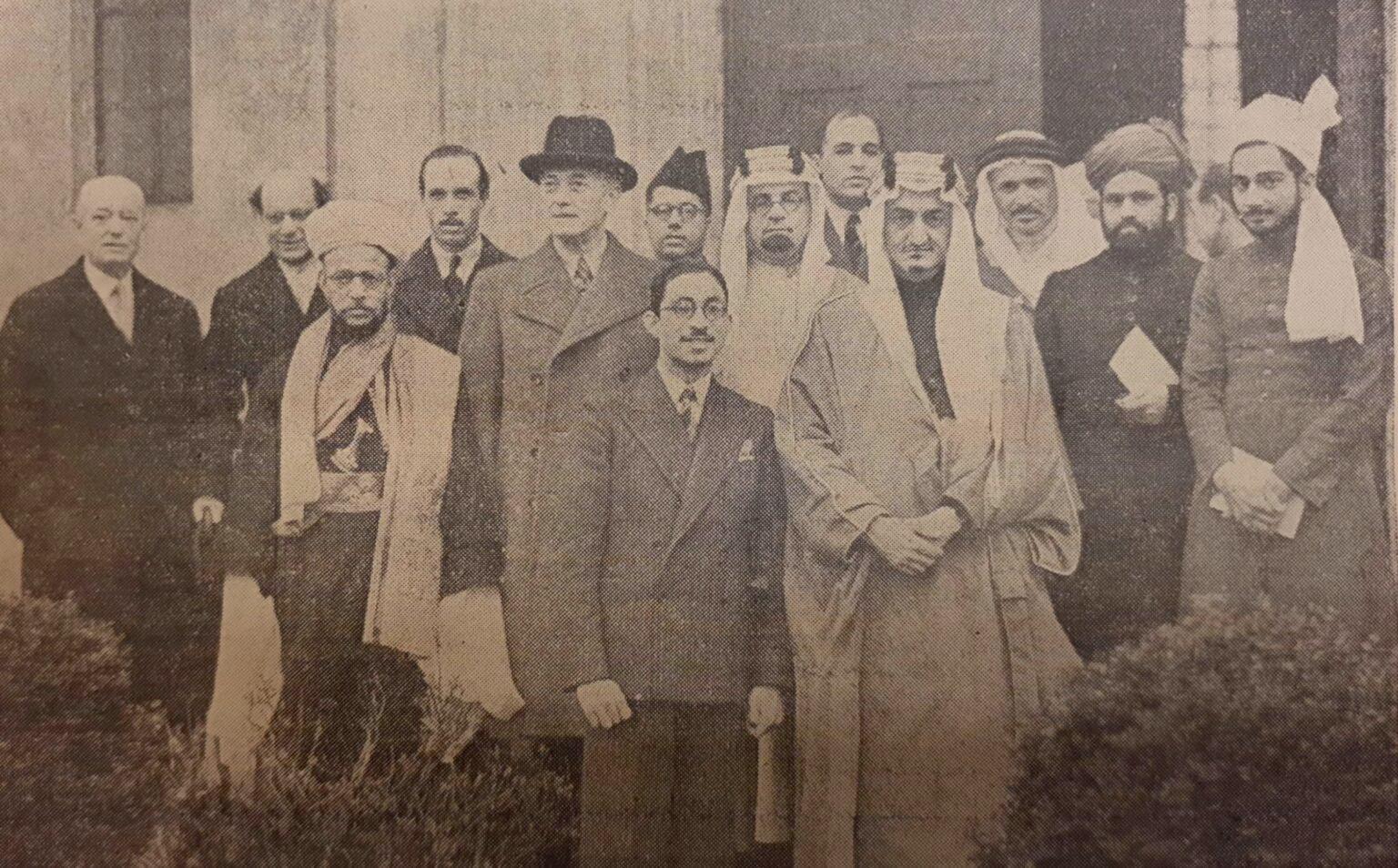
11 March 1939: On this day, Hazrat Maulana Jalal-ud-Din Shamsra invited the Viceroy of Mecca and representatives of Palestine, Iraq and Yemen — who were in London for the Palestine Conference — to a reception at the Fazl Mosque in which 200 guests participated in total, including various dignitaries.
Hazrat Musleh-e-Maudra sent a special message to the Arab delegates through a telegram. The message was read out in both English and Arabic by Hazrat Maulana Jalal-ud-Din Shamsra
The South Western Star of London published a lengthy article on this event along with a photograph as well.
For more details, see “Ahmadiyya advocacy for Palestinian rights: A historical examination of Arab-Jewish tensions in 1939”, at alhakam.org (10 November 2023, p. 10).
Hazrat Maulana Jalal-ud-Din Shamsra and the Viceroy of Mecca and representatives of Palestine, Iraq and Yemen. 1939
12 March
12 March 1923: On this day, the Ahmadiyya Muslim Jamaat sent its first tabligh delegation to counter the apostasy of the Malkana Rajputs. The delegation, consisting of 20 men, left Qadian for UP (United Provinces, now Uttar Pradesh in India) and reached Achhnera, District Agra, on 14 March 1923. (Tarikh-e-Ahmadiyyat, Vol. 4, p. 351)
12 March 1953: During the horrific anti-Ahmadiyya riots of 1953 in Pakistan, due to the forced closure of Al Fazl, a series of letters were issued to contact members of the Jamaat. In a letter dated 12 March, among other things, it was written that a jamaat in Pakistan had informed that by the grace of Allah there was no panic in their area; however, they said that they were concerned about people living in the Markaz. Another Jamaat reported that mischief caused by opponents was increasing in their area every day. Upon this, Hazrat Musleh-eMaudra said:
“There is a Living God in heaven Who shall seize these mischievous people.” (Tarikh-e-Ahmadiyyat, Vol. 15, p. 221)
13 March
13 March 1971: On this day, Hazrat Khalifatul Masih IIIrh graced the farewell ceremony held for 13 doctors who were going to West Africa under the Nusrat Jehan Leap Forward programme. (Tarikh-e-Ahamdiyyat, Vol. 27, pp. 31-32)
13 March 1981: On this day, the Chief Minister of Punjab, India, Sardar Darbara Singh, visited Qadian. The Ahmadiyya Jamaat of Qadian welcomed the honourable guest appropriately and also presented Jamaat literature as a gift. (Al-Badr Qadian, 19 March 1981, p. 2)
Continued from page 1
Rather than praying for the situation to go in their favour or for the other person to change, they could simply pray for Allah to soften both parties’ hearts, grant both patience in dealing with each other, and help lubricate the communication with kindness and understanding. One could seek and implore Allah to guide both parties toward reconciliation and forgiveness.
Further, when saying Bismillah, we remind ourselves of the fact that we are standing before Allah. We are beginning our supplications in the name of Allah, who created us, through whom all living and nonliving things came into being, and who gave life, and so on. Thus, we must remember that any prayer we utter must align with God’s commandments, and we should strive to understand God.
As, in Surah al-Fatihah, we start our prayer in the name of Allah, it’s an indication that it is also desirable for us to remember His other attributes. For example, if God introduces Himself as the Most Forgiving, then we know that our prayer for forgiveness, if made sincerely, shall be granted.
This is why we are reminded to call upon God with His various attributes. And so, Bismillah reminds us that prayers must be sincere, lawful, and aligned with Islamic values.
Second principle: The benefit of the prayer for the greater good “Al-hamdu Lillāh Rabbil Alimeen
“The second principle for the acceptance of prayer is mentioned in al-hamdu Lillāhi Rabbil Alimeen. In other words, the prayer ought to be such that its outcome not only proves beneficial for the believers of God Almighty, but also the world at large, or at the very least, the prayer should not cause harm to anyone. Similarly, any prayer that would find acceptance ought to establish the glory of Allah and not bring any charge against the exalted Being of Allah.” (Ibid.)
The phrase Lord of all the worlds highlights that Allah is the provider and sustainer of all and that He does not desire ill for His own creation. Thus, prayers that serve a selfish or harmful intent from His creation have less likelihood of being accepted.
For example, if a person prays for success in their studies, it’s more pleasing to Allah that such a one also prays for the success and guidance of others who are aiming for the same objectives, or the improvement of society through the knowledge one gains.
This is also why the Holy Prophetsa has stated that whoever helps his brother, Allah will help him (Sahih al-Bukhari, Hadith 2442). When we pray for a collective good, be it peace, justice, and prosperity for all, no doubt such a prayer shall receive greater reward from Allah.
Third principle: Stirring Allah’s vast mercy
“Ar-Rahmān [The Most Gracious]
“The third principle for the acceptance of prayer is to stir the vast mercy of Allah the Almighty. The acceptance of the prayer ought to manifest the All-Encompassing Grace of Allah the Almighty.” (Ibid.) When we think of Ar-Rahman, we must remember Allah’s vast and limitless mercy.
When we pray, we must make it certain within ourselves that we know that we are asking not just for a specific thing, but for the manifestation of His mercy in our lives. This means understanding that sometimes, His mercy and blessings can come in ways we may not expect:
and it may be for most profitable even if it doesn’t match our direct wants.
For example, one might pray for a job they really want, however, if they don’t get it, trust that Allah’s mercy and compassion means He knows what’s better for them. Perhaps that job was not the best fit, or there’s another opportunity that will lead to greater success in future.
And thus, it’s essential to remember that when Allah decrees a matter, His command is followed by His mercy. God’s mercy is endless, and His mercy constantly attends to the answers to our prayers, even in unforeseen ways. Occasionally, Allah may not grant precisely what we ask for, however, His mercy is displayed in other forms.
Never forget, if God had so desired, He could have allowed Prophet Muhammadsa to establish Islam in Mecca, and He could have allowed the people of Mecca to accept his message with open hearts from the get go. However, Allah willed that he migrate and establish Islam in various regions. For the people of Medina, this was a blessing in disguise to have Muhammadsa join them in their city. Furthermore, if God had so desired, He could have allowed Prophet Muhammadsa to perform Hajj during the Treaty of Hudaybiyyah. However, the Muslims and the Prophetsa returned to Medina without performing Hajj. At first glance, it may seem like a loss, but the blessings that resulted from the Treaty of Hudaybiyyah were manifold.
Fourth principle: Reflecting Allah’s attribute of Rahimiyyah “Ar-Rahīm
“The fourth principle is that the prayer should reflect God’s attribute of rahīmiyyah [The Ever Merciful]. This signifies that the prayer ought to lay such a foundation that its virtues should last a considerable period of time within the world. The outcome of such a prayer should continuously be beneficial for the pious and virtuous, or the very least, this prayer should not be a hindrance for others.” (Ibid.)
Supplications should be offered for things that have lasting benefits, whether it’s peace, knowledge, or health. Transient desires or things that solely benefit us in the short term should not be the fixation of one’s prayer.
For example, instead of asking for a fast solution to a situation, pray for patience, perseverance, and the ability to overcome challenges in a way that brings long-lasting growth and spiritual reward.
“Allah’s mercy prevails over His anger.” (Sahih al-Bukhari, Hadith 3194) The Holy Prophetsa reminded us that God’s mercy is extensive, and we should remember this in our supplications. We should seek things that lead to long-term good—things that will benefit us and society. This is a reminder that the mercy of Allah encompasses all, and that we should always ask for things that bring lasting goodness, not fleeting desires.
Continued from page 1
briefly and inadequately, that when a human being abandons their base life, and separates themselves from this world just as a snake sloughs off its skin, the state of such a person becomes transformed. Such a one apparently walks about on the same earth, eats and drinks, and is subject to the law of nature, as are others, but despite all this, he is detached from this world; he continues to advance and progress until he finally reaches the point known as prophethood, where he converses with God Almighty. This converse begins when the person in question separates themselves from their own inner self and its relations, until ultimately forging a relationship with Allah the Exalted alone, after which it is with Him alone that the individual converses.
(Malfuzat [English], Vol. 2, pp. 72-73)
Fifth principle: Utilising the means provided by Allah “Māliki Yawmid-Dīn
“The fifth principle is that whilst praying, one ought to consider God’s attribute of Māliki Yawmid-Dīn [Master of the Day of Judgement]. That means that at the time of praying, one should not discard the material means that Allah the Almighty has provided to achieve successful results, since these very resources have been created by God. It is illogical to seek His Help but not use the means He has provided.
“Therefore, as long as these material means are available for the supplicant to use, it is incumbent to avail themselves of these resources in conjunction with prayer. However, if the material means are not available to the supplicant, the attribute of māliki yawmid-dīn manifests itself beyond the realm of these material means.
“It is also indicated in this verse that the one who supplicates should be forgiving to others, and not be obstinate or harsh in demanding their own rights.” (Tafsir-e-Kabir [2023], Vol. 1, p. 7; Published in English in reviewofreligions.org)
It is essential to remember that God has furnished us with intellect, strength, opportunities, and various other means to achieve our goals. While prayer is paramount, it should go hand-in-hand with utilising resources Allah has made available. If one needs something, prayer should accompany actions to fulfil it.
For example, if a person prays for success in an exam, they should not simply rely on prayer alone. They must study and prepare diligently as well. Prayer and action should go hand-in-hand, as God has granted the ability to use these means.
It is reported that the Holy Prophetsa said to make use of medical treatment, for Allah has not made a disease without appointing a remedy for it, except for one disease, namely old age. (Sunan Abi Dawud, Hadith 3855)
Meaning that we are exhorted to seek the material means Allah has furnished, such as knowledge, medicine, and effort.
Though supplication is fundamental, we are also expected to make use of the benefits Allah has granted us to reach our goals. A simple example can be found in medicine. If one falls ill, we pray for recovery, yet we should also seek medical treatment and follow proper procedures.
Sixth principle: Be free from polytheistic and idolatrous thoughts
“Iyyāka Na‘budu [Thee Alone Do We Worship]
“The sixth principle mentioned is that a person who offers prayers should have a perfect relationship with Allah the Almighty and be completely sincere to Him. They should be completely free from polytheistic and idolatrous thoughts.” (Tafsir-e-Kabir [2023], Vol. 1, p. 7; Published in English in reviewofreligions.org)
Our supplications – at the threshold of God – are far more likely to be accepted when we are in a state of sincerity. Meaning that one must shun any form of associating partners or equals with Allah and we must be pure in our intentions. It is also essential to note that associating partners with God comes in various forms, be it relying on idols, charms, or any entity other than Allah, including oneself. That’s why we pray: Thee alone we worship and Thee alone do we implore for help.
For example, if one is praying for God’s grace and forgiveness, one must make sure their heart is truly remorseful and that they are not relying on anything or anyone but the One True Lord for forgiveness. Trust that He alone has the power to forgive.
Thus, in regard to the best supplications made by all Prophets is that they associate nothing with Allah. The Holy Prophetsa is reported to have said that the best supplication is the one made on the Day of Arafah, and the best that I and the Prophets before me have said is: “None has the right to be worshipped but Allah, alone, without partner. To Him belongs all that exists, and to Him belongs all praise, and He is powerful over all things.” (Jami‘ at-Tirmidhi, Hadith 3585) And so, the Prophetsa has emphasised that the best and most powerful supplication is one made with full sincerity, acknowledging the oneness of Allah.
Seventh principle: Complete reliance on Allah
“Iyyāka nasta‘īn [I Beseech None But God Alone]
“The seventh principle is that the supplicant should be devoted wholly to Allah. They should have complete trust and reliance on God Almighty. They should not turn to anyone besides Allah. They should reach such a stage that no matter what the circumstances or whatever calamity or difficulty befalls them, they always declare, ‘I beseech none but God alone.’” (Tafsire-Kabir [2023], Vol. 1, p. 7; Published in English in reviewofreligions.org)
A firm believer has unwavering faith in God’s ability to answer their prayers. Come what may, the supplicant should bow to Allah alone, trusting that He is the best of planners. This does not mean disregarding worldly means but holding ultimate trust that Allah will guide one to what is best.
NEWS
Seerat-un-Nabi Jalsa held in Virginia, USA
Syed Shamshad Ahmad Nasir Missionary, USA
On 16 February 2025, Jamaat-e-Ahmadiyya South Virginia, USA, held a Jalsa Seerat-unNabi at the Masroor Mosque, attended by over 410 members. The jalsa was designed to deepen attendees’ understanding of salat, worship and the Holy Quran, drawing inspiration from the life and teachings of
the Holy Prophet Muhammadsa Opening remarks were delivered by Zeeshan Ahmad Sahib, Qaid Majlis Khuddam-ul-Ahmadiyya, South Virginia, followed by speeches from all auxiliaries, with participation from atfal, khuddam and ansar. The speeches were delivered on “The Holy Prophetsa and His Emphasis on Wudhu”, “The Holy Prophet’ssa Devotion to Worship” and “The Holy Prophet’ssa Love for
the Holy Quran”. The concluding speech was delivered by my humble self. I highlighted multiple remarkable attributes of the Holy Prophetsa, such as his unparalleled devotion to worship, immense generosity and kind treatment of all people.
The closing remarks were delivered by Zaeem Ansarullah, South Virginia, Bashir Ahmad Sahib. The jalsa concluded with a silent prayer.
Humanity First Germany provides urgent medical aid to Sudanese refugees in Chad
Dr Wajahat Ahmad Waraich
Vice Chairman, Humanity First Germany and President AMMA Germany
A team of Humanity First Germany got the opportunity to serve once again in rural areas of Africa. A team of six doctors and one pharmacist was recruited by the Ahmadiyya Muslim Medical Association (AMMA) Germany to conduct medical camps and assist Sudanese refugees in Chad. The team arrived in N’Djamena on 10 November 2024.
The first medical camp for Sudanese refugees in Chad treated over 600 patients with free consultations and medicine. Many had gone months without proper care and were deeply grateful. The team encountered numerous cases of gunshot wounds from people fleeing the war, as well as respiratory infections, skin diseases, UTIs, malaria and parasitic infections. The doctors conducted consultations and translators from the refugee camp and local team members assisted.
By the grace of Allah and the prayers of Hazrat Khalifatul Masihaa, everything went smoothly and without any complications. In fact, a few days earlier, our chairman, Athar Zubair Sahib, met Huzooraa, updated him and requested prayers. Upon this Huzooraa said, “Allah fazl farmae aur unko khoob
For example, if a person faces a personal crisis, they may seek advice and help from others, but their ultimate trust should be in Allah’s will. For example, if we consider the case of Prophet Abrahamas, not only did he listen to and obey all of God’s commandments – whether he understood it or not – but he also demonstrated loyalty to God in ways that are almost unparalleled. The Holy Prophetsa once said that if you
khidmat ki taufeeq ata farmae,” [i.e., “May Allah bestow His grace upon you and grant you the ability to serve well.”]
We witnessed that “fazl” and got the opportunity to serve as much as possible, alhamdulillah. We worked until sunset, as there was no electricity at the camp. After packing the medicines, we returned to their accommodation, where a specially prepared dinner awaited them, offering much-needed relief after a long and demanding day.
That evening, Vanessa from WFP informed the team that we had to vacate our accommodation the next day as previously booked teams were arriving. The team began searching for a new place to stay but secured permission to continue having meals at the WFP guesthouse. Meanwhile, they learnt that the German federal minister for development, Svenja Schulze, was planning a visit to Chad, including Adré, on Wednesday. We contacted her office to inform them about the medical camp and invited her to visit. While she appreciated their work, scheduling a visit seemed difficult, but we remained in contact with her team.
The next morning, the team continued their medical mission, noticing that new tents from WFP, WHO and other organisations had been set up. That day,
they treated over 900 patients. Throughout the day, they also searched for a new place to stay and sought help from the Medical Director of the hospital, who offered them a classroom on the hospital grounds. For dinner, we returned to the WFP guesthouse, where we also used the facilities, which was a great relief. On the third day of the camp, we again treated over 900 patients. We also noticed that the newly built tents were now providing additional services that had not been available before, further improving conditions for the refugees.
On the final day of the medical camp, German federal minister Svenja Schulze arrived in Adré, though her office had stated she couldn’t visit due to security reasons. She met with the team and appreciated their work. That day, the team treated over 1200 patients, bringing the total to nearly 3700 in four days.
On our last day in Adré, we distributed 415 sets of clothes and food packets for over 400 families. After that, we travelled back to Abéché. The next day, we flew to the capital and later back to Germany.
During this tour, despite many challenges, every problem was solved. From finding unexpected places to stay to flight delays that led to important meetings, we saw clear signs of God’s help at every step.
ask, ask of Allah, and if you seek help, seek it from Allah. (Jami` at-Tirmidhi, Hadith 2516)
This Hadith highlights the importance of turning to Allah alone for help. Complete trust in Allah means that, while we may seek assistance from others in worldly matters, ultimate reliance is on Allah alone. When we pray, we should ask with full confidence that He is the only one capable of answering
our prayers and providing what is best for us.
Conclusion
By firmly following these seven principles – sincerity, mercy, reliance, and more – one can surely ignite God’s mercy and have their prayers answered. One can transform their prayers into powerful tools for spiritual growth and divine blessings.
(Jalees Ahmad, Al Hakam)
Answers to Everyday Issues
Imam Mahdi’s lineage, Huzoor’s relationship with the Promised Messiah and his Khulafa, tasliyah and taslim, interpretation of a hadith and narcissism
Guidance regarding basic Islamic issues that Hazrat Amirul Momineen, Khalifatul Masih Vaa, has given on various occasions in his written correspondence and during MTA programmes is being published officially below for everyone’s benefit.
Imam Mahdi’s lineage
A lady from Indonesia asked Hazrat Amirul Momineen, Khalifatul Masih Vaa, whether the Promised Messiahas was from the lineage of the Holy Prophet Muhammadsa, since one hadith states that the Mahdi will be from the progeny of Hazrat Fatimahra
In his letter dated 24 January 2023, Huzoor-e-Anwaraa offered the following guidance on this matter:
“The first point regarding this issue is that the narrations in the books of Hadith concerning the Imam Mahdi display a great deal of inconsistency. Some ahadith describe the Mahdi as being from among the descendants of Hazrat Fatimahra, while others declare him from among the descendants of Hazrat Hasanra, or Hazrat Husainra, or Hazrat Abbasra, or Hazrat Umarra. Yet other ahadith report that the Holy Prophetsa simply said that the Mahdi to come would be an individual of my ummah
“Allamah Ibn Khaldun, in his Muqaddimah, critiqued these narrations and wrote that all the ahadith presented by the scholars concerning the Mahdi and his emergence in the Latter Days are – aside from a very small number – not free from criticism. [Muqaddimah of Ibn Khaldun, Al-fasl 53 fi ‘amri l-fatimi wa ma yadhhabu ‘ilayhi n-nasu f sha’nihi wa kashfi l-ghita’i ’an dhalik]
“The Promised Messiahas, discussing this issue at length, states:
“‘This indeed is the divine practice that all the Signs recorded in the prophecies about a Prophet-to-come are never fulfilled literally. At places, there are allegories and
at places a difference occurs resulting from one’s own understanding, while yet at other places old accounts suffer some distortion. Therefore, the way of righteousness is to derive benefit from what has been fulfilled, keeping in view the time and the need.
“‘Had it been necessary to reconcile all the preconceived Signs according to one’s own understanding, we would have to give up all Prophets and the consequence would have been nothing but deprivation and faithlessness, because there has not been any Prophet concerning whom all the preconceived Signs have been literally fulfilled; somehow or other, there has been some shortfall. The Jews used to say about the first Messiah—namely, Hadrat ‘Isa— that he would appear only when Prophet Ilyas [Elijah] had returned to the earth before him. But did Ilyas come? Similarly, the Jews used to insist that the awaited KhatamulAnbiya’ [the Seal of the Prophets] would be from among the Israelites. Did he appear from among the Israelites? When, defying the Jewish expectation to which all their Prophets agreed, the Khatamul-Anbiya’ did not come from among the Israelites, why is it any wonder then if the Promised Mahdi has not appeared from the House of the Fatimids or the Abbasids? God’s prophecy carries many a hidden secret; a trial is also intended.
“‘Study the ahadith with careful deliberation, for they are so disparate about the Promised Mahdi as if they were a collection of contradictions. Some ahadith say that the Mahdi will be a Fatimid, some say he will be an Abbasid, while others report that he will be a person from among my Ummah. And the hadith of Ibn-e-Majah
has repudiated all these reports, for this hadith has these words
meaning that, ‘Isa himself is the Mahdi; there is no Mahdi besides him. Moreover, the ahadith concerning the Mahdi are such that none is beyond question and none of them can be described as authentic. Therefore, the way the prophecy manifested itself and the verdict that was given by the Promised Arbiter is what is correct.’ (Haqiqat-ul-Wahi, Ruhani Khazain, Vol. 22, pp. 216-217)
“In truth, these discrepancies in the narrations arose due to political factors. After the era of Khilafat-e-Rashidah, when multiple groups and sects emerged within the Muslim ummah, each faction manipulated certain narrations in order to assert its own superiority over others. Hence, all reports that specify the Mahdi’s birth in a particular family are not free from criticism. Only the narrations stating that the Imam Mahdi would belong to the ummah of the Holy Prophetsa remain acceptable, for they appear to have remained unaltered by political motives.
“This is why, in the narrations of Sahih al-Bukhari and Sahih Muslim concerning the Messiah and Mahdi who was to be raised in the Latter Days for the revival of Islam,
Image: heliaziyaee/Unsplash
the words ‘
’ [‘And he will be your Imam from among yourselves’] and ‘
[‘He will lead you from among yourselves’] are recorded, respectively. (Sahih al-Bukhari, Kitab ahadithi l-anbiya’, Bab nuzuli ‘isaas ibn maryam; Sahih Muslim, Kitab al-iman, Bab nuzuli ‘isaas ibn maryam hakiman bi shari‘ati nabiyyina muhammadsa)
“Furthermore, regarding the lineage of the Promised Messiahas, it is a marvellous manifestation of Allah the Almighty that even these apparent indicators were fulfilled in his noble person. The Promised Messiahas states:
“‘The very foundation of the Sādāt lineage is their descent from the progeny of Hazrat Fatimahra. Thus, although I am not an ‘Alawi, I am nevertheless of the Bani Fatimah; some of my paternal grandmothers belonged to well-known and indisputably verified families of Sayyids. In our family, it has been customary at times to marry women from Sayyid families and at other times our family’s women would be married into Sayyid families.’ (Nuzul-ul-Masih, Ruhani Khazain, Vol. 18, p. 426, marginal footnote within the footnote)
“He further states:
“‘Within my being, there exists an
Israelite and a Fatimid essence. And I am an integration of these two blessed lineages. Those versed in the ahadith and historical reports [athar] are well aware that it is written concerning the awaited Mahdi of the Latter Days that he would be of a composite nature.’ (Tohfa-e-Golarhviyyah, Ruhani Khazain, Vol. 17, p. 118)
“Moreover, according to the Holy Quran and authentic ahadith, the most conspicuous sign about the forthcoming Messiah and Mahdi was that he was to be of Persian origin – that is, he was to be a non-Arab or ‘ajami. Thus, we read in Sahih al-Bukhari that when Surah al-Jumu‘ah was revealed to the Holy Prophetsa, someone asked him three times about the verse: ‘اوۡقُحَلۡیَ
[‘And among others from among them who have not yet joined them.’ (42:4)], wondering who those people were among whom the Holy Prophetsa would appear again. The Holy Prophetsa offered no reply until he had been asked thrice. Hazrat Abu Hurairahra, who narrates this hadith, says that at that moment Hazrat Salman alFarisira was among them. The Holy Prophetsa placed his blessed hand on Hazrat Salman al-Farisira and said that, ‘Even if faith were to ascend to the Pleiades, some people – or one man – from among these (i.e., the people of Persia) would bring it back.’ (Sahih alBukhari, Kitab tafsiri al-qur’an, Bab qawluhu: ‘wa akharina minhum lamma yalhaqu bihim’)
“The Promised Messiahas belonged to a family of Persian descent. Evidence of this can be found in the 1865 land settlement documents, recorded many years before the Promised Messiahas made his claim, at a time when his noble father and other elders were still alive. Under the genealogical table of the owners of Qadian, there is a footnote titled ‘Qasbah Qadian ki ‘Abadi awr Wajahe-Tasmiyah’ [‘The Settlement of the Town of Qadian and the Reason for Its Name’], which states:
“‘Our forefather – the progenitor of us, the landowners – did, in the age of bygone sovereigns (of the kingdom of Persia), journey hither by way of service […] and, having arrived, […] did settle this hamlet in what was then a forsaken wilderness.’
“Below this appear the signatures of Mirza Ghulam Murtaza Sahib, Mirza Ghulam Jilani Sahib, Mirza Ghulam Muhyiddin and others. Thus, these official documents – dated well before the Promised Messiahas declared his claim – serve as definite and irrefutable proof of his Persian descent. (Malik Abd-ur-Rahman Khadim, Tablighi Pocket Book, p. 462)
“Furthermore, the Promised Messiah’sas opponent, Maulvi Muhammad Hussain Batalvi, wrote in his magazine Ishaa‘atus-Sunnah that ‘The author [of Barahin-eAhmadiyya] is not Qurayshi but is of Persian origin.’ (Ishaa‘at-us-Sunnah an-Nabawiyyah, ‘Review of Barahin-e-Ahmadiyya’, No. 7, Vol. 7, p. 193)
“The Promised Messiahas himself writes about his family:
“‘My family is, in reality, Persian, not Mogul. I do not know by what misunderstanding the family became known as Mogul. [...] It appears that Mirza and Baig were bestowed upon them as titles, as Khan is bestowed as a title. In any case, what God has manifested is indeed correct. Man can fall into error from a minor mistake, but God is free from omission and
error.’ (Haqiqat-ul-Wahi, Ruhani Khazain, Vol. 22, p. 81, footnote)
“In conclusion, although there has been extensive divergence in the narrations about the lineage of the Messiah and Mahdi –and although most of these narrations are unreliable – the Holy Quran and reliable ahadith establish that he was to be from among the ummah of the Holy Prophetsa and of Persian origin. By the grace of Allah the Exalted, both of these signs were perfectly fulfilled in the holy person of Hazrat Mirza Ghulam Ahmad of Qadian, the Promised Messiah and Mahdi, peace be on him.”
Tasliyah and taslim: Salutations for Prophets
Someone from Germany wrote to Hazrat Amirul Momineen, Khalifatul Masih Vaa, asking, “Why do we use the phrase ‘alayhi s-salām (مالسّلَا هيلۡع) for various Prophets or the phrase sallallahu ‘alayhi wa sallam (ىلۡص مۡلۡسوَّ
هللا) for the Holy Prophet Muhammadsa?”
He also enquired about the familial relationship between Hazrat Mirza Masroor Ahmadaa and the Promised Messiahas as well as his other Khulafa
In his letter dated 5 February 2023, Huzoor-e-Anwaraa provided the following response:
“Both ‘alayhi s-salām and sallallahu ‘alayhi wa sallam are supplicatory phrases that we offer before Allah the Exalted for the Prophets. We find the basis for both forms of these salutations in the Holy Quran itself. Indeed, in the Holy Quran, Allah the Exalted uses the word ‘peace’ [salaam] for various Prophets. For example, He says:
“‘Say, ‘All praise belongs to Allah and peace be upon those servants of His whom He has chosen.’’ (Surah an-Naml, Ch. 27: V.60)
“Similarly, in Surah as-Saffat (Chapter 37), it is stated:
“‘And peace be upon the Messengers!’ (182)
“Then, citing several Prophets by name, Allah says:
“[‘Peace be upon Noah among the peoples!’ (80)]
“[‘Peace be upon Abraham!’ (110)]
“[‘Peace be on Moses and Aaron!’ (121)]
“‘[Peace be on Elias and his people!’ (131)]
“Following this teaching of the Holy Quran, we also attach the supplicatory phrase ‘alayhi s-salām to every Prophet’s name, thereby supplicating before Allah that He may forever continue to shower His peace upon these noble individuals.
“As for the blessed name of the Holy Prophet Muhammadsa, the reason we say sallallahu ‘alayhi wa sallam is likewise founded on the command of Allah the Almighty. In the Holy Quran, Allah
commands:
“‘Allah and His angels send blessings on the Prophet. O ye who believe! you also should invoke blessings on him and salute him with the salutation of peace.’ (Surah alAhzab, Ch. 33: V. 57)
“Thus, in obedience to this Quranic directive, we recite sallallahu ‘alayhi wa sallam whenever we mention the sacred name of the Holy Prophetsa
“According to certain authentic ahadith, the Holy Prophetsa also used the phrase sallallahu ‘alayhi wa sallam for earlier Prophets. In one tradition recorded in Sahih Muslim (Kitab al-iman, Bab adna ahli l-jannati manzilatan fiha), the Holy Prophetsa applied these supplicatory words, i.e., sallallahu ‘alayhi wa sallam, to Hazrat Adam, Hazrat Noah, Hazrat Abraham and Hazrat Moses, peace be upon them all. Likewise, in Sunan an-Nasa’i (Kitab almasajid, Fadlu l-masjidi l-’aqsa wa s-salati fih), he used sallallahu ‘alayhi wa sallam for Hazrat David and Hazrat Solomon, peace be upon them.
“Therefore, if someone were to recite sallallahu ‘alayhi wa sallam for a Prophet other than the Holy Prophet Muhammadsa, there is no harm in that. Yet the general practice remains that we use sallallahu ‘alayhi wa sallam exclusively for the Holy Prophetsa and ‘alayhi s-salām for the other Prophets.”
Huzoor’saa relationship with the Promised Messiahas and his Khulafa
“You also enquired regarding my genealogical descent from the Promised Messiahas and my familial ties to his successors. By lineage, I am a paternal greatgrandson of the Promised Messiahas. Hazrat Khalifatul Masih Ira was the noble father of one of my maternal grandmothers. I am a maternal grandson of Hazrat Musleh-eMaudra and a maternal nephew of both Hazrat Khalifatul Masih IIIrh and Hazrat Khalifatul Masih IVrh.”
Narcissistic behaviour
Someone wrote to Hazrat Amirul Momineen, Khalifatul Masih Vaa, asking about certain matters concerning an individual suffering from narcissistic behaviour.
She also enquired about the authenticity of the following narration:
“A man set out on a journey, having instructed his wife not to leave the house. While he was away, her father fell ill. She sought permission from the Holy Prophetsa to visit her father, but he said, ‘Do not disobey your husband.’ Subsequently, her father passed away and she again asked the Holy Prophetsa for permission to attend the funeral. Once more, he forbade her from disobeying her husband. Following this, Allah revealed to the Holy Prophetsa that this woman had been forgiven because of her obedience to her husband.”
In his letter dated 14 February 2023, Huzoor-a-Anwaraa gave the following reply:
“Narcissistic behaviour is regarded as a psychological disorder of one’s personality, in which an individual becomes overly self-
focused, develops a significantly inflated ego and neglects the feelings of those around them.
“In dealing with such individuals, others should show love and compassion, while close family members should persevere in advising them kindly. Furthermore, those suffering from this condition should receive proper medical attention, whereby a psychologist prescribes various therapeutic interventions that may lead to improvement in the patient. However, it is also essential to recognise that if a patient suffering from this condition inflicts harm amounting to a legally defined offence, they cannot evade legal punishment by citing their disorder as an excuse.
“If one of the parents suffers from this disorder, the children should speak to them gently, remaining within the bounds of respect and courtesy and endeavour to guide them with kindness. As noted earlier, arrangements for their treatment must also be made.
“Likewise, in the case of a married couple, if one spouse develops this disorder and it becomes difficult for the other spouse to cope and if repeated efforts to remedy the situation prove fruitless – making it impossible in their view to continue living together – then at such a juncture, after prayerful consideration, they should decide to separate.”
Interpretation of a hadith
“As for the authenticity of the hadith about which you enquired, the first point to note is that this narration is not recorded in any of the authoritative collections of Hadith. It appears in works such as Al-Mu‘jam alAwsat by at-Tabarani (Bab al-mim min ismihi Muhammad, Hadith 7863) and Musnad ‘Abd bin Humayd (Musnad of Anas bin Malik, Bab ’ati‘i zawjak, Hadith 1372). However, the scholars of hadith have critiqued certain narrators in its chain and declared it weak [da‘if]. (Al-Albani, Irwa’ alGhalil, Vol. 7, p. 76)
“The second key point regarding this narration is that the Holy Prophetsa – the Most Perfect Man, who embodied compassion and mercy, as the Holy Quran affirms in the clearest terms:
(Surah at-Taubah, 9:128), meaning: ‘Surely, a Messenger has come to you from among yourselves; grievously heavy is it on him that you should fall into trouble, ardently desirous is he of your welfare; compassionate and merciful towards the believers,’ could never be conceived as being so unfeeling as to disregard the distress of a vulnerable woman. It is utterly inconceivable that he would, in compliance with her husband’s unreasonable command, forbid her both from visiting her father in his illness and from paying her respects at his passing.
“Hence, from the viewpoint of rational analysis [dirayah], this hadith cannot be accepted because it contradicts the noble character of the Holy Prophetsa and, in particular, the explicit teachings of the Holy Quran. Therefore, the scholars’ classification of this narration as da‘if is wholly justified.”
(Compiled by Zaheer Ahmad Khan, Head of Records Department, Private Secretariat, London. Translated by Al Hakam.)
Coming from every distant track
Qadian welcomes American students (1971)
Awwab Saad Hayat
Al Hakam
On 15 March 1971, at 3:15 PM, a group of 20 American students, accompanied by their teachers, arrived in Qadian to explore its historical and spiritual significance. The group consisted of 11 girls and 9 boys, along with three professors from Baring College, Batala. They were warmly welcomed, and Sheikh Abdul Hameed Sahib Ajiz, Nazir Jaidad, was assigned the responsibility of guiding them through the sacred sites of Qadian.
Exploring the sacred hamlet of Qadian
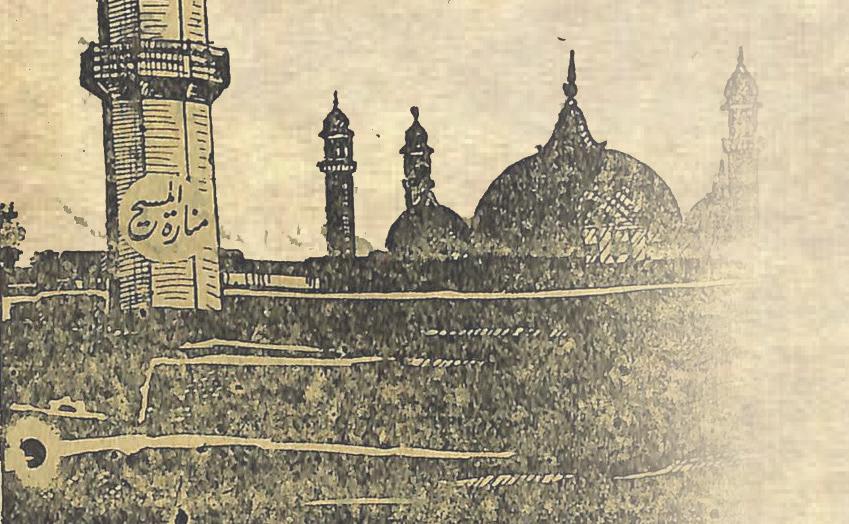
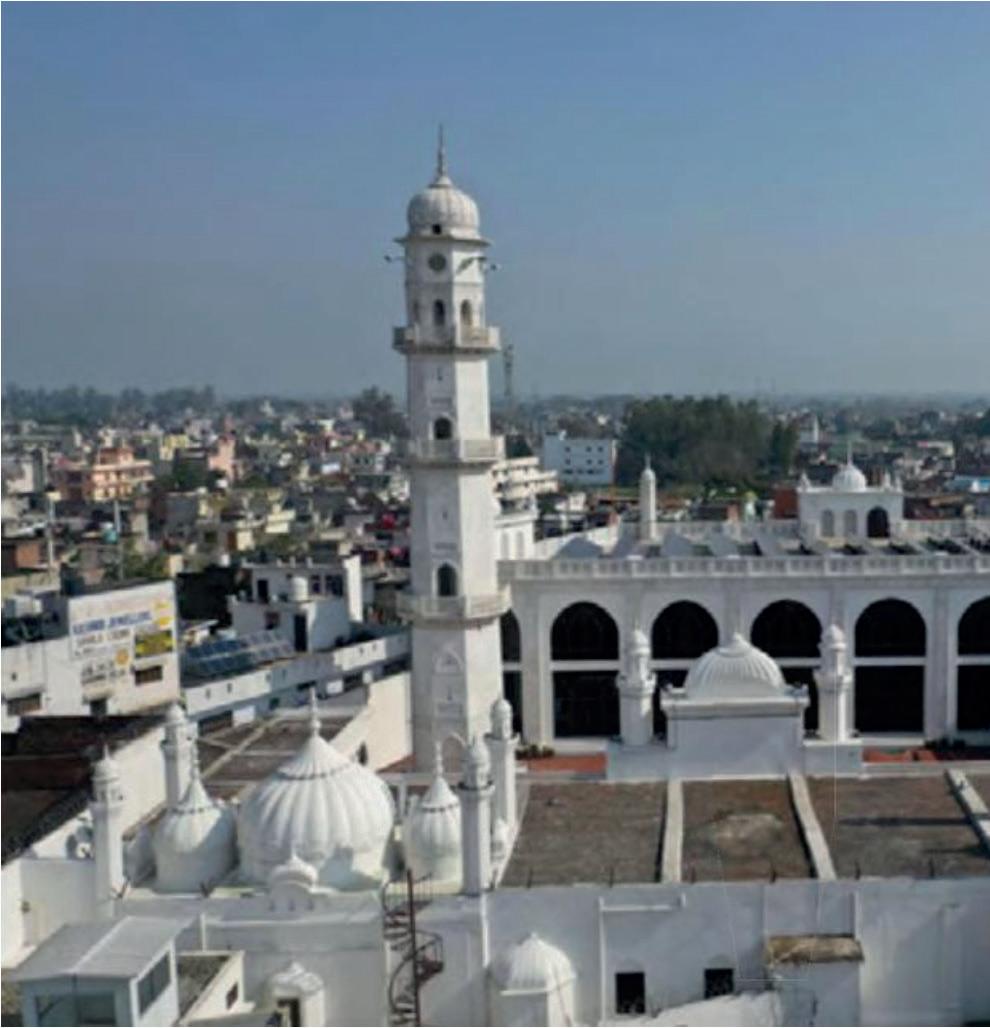
The visit commenced with a tour of Masjid Aqsa, one of the most revered mosques in Qadian. The visitors showed great enthusiasm as they admired the architectural beauty and historical significance of the mosque. They had the chance to go to the top of Minarat-ul-Masih, taking photographs of the view from the top. As they explored, they were given an overview of the history of the Minarat-ul-Masih, the expansion of the Aqsa Mosque, the grave of the Promised Messiah’sas father, and the offices of Sadr Anjuman Ahmadiyya, which are located nearby.
Following this, the group was taken to Masjid Mubarak, Bait-ul-Fikr, and Baitud-Dua, places deeply associated with the Promised Messiahas. They were informed that these sacred spaces were where he offered special prayers and wrote more than 85 books that carried significant religious and intellectual value. The visitors were particularly intrigued to learn that, according to Ahmadiyya belief, prayers made here with sincerity are accepted by Allah the Almighty.
Visit to Bahishti Maqbarah
After completing their visit to the mosques, the group proceeded towards Bahishti Maqbarah, the blessed graveyard of Qadian. To ensure clear communication, several English-speaking residents of Qadian accompanied the guests, helping them
understand the historical and spiritual importance of the site.
At Bahishti Maqbarah, they visited the graves of the Promised Messiahas and were also informed about Hazrat Khalifatul Masih Ira, Hazrat Khalifatul Masih IIra, and Hazrat Khalifatul Masih IIIrh. The martyrdom of Hazrat Sahibzada Abdul Latifra was also narrated to them, leaving a lasting impression. The visit sparked discussions on the meaning and purpose of establishing Bahishti Maqbarah, the one-tenth chanda contribution system, and the construction of the solid boundary wall surrounding the graveyard.
Presentation of literature and introduction to Ahmadiyyat
Upon concluding their visit to Bahishti Maqbarah, the guests were taken to the guest house, where each student was presented with a packet of tabligh literature. The three professors accompanying them were given additional books. In addition, copies of an address that had been presented to a previous American delegation in October 1969 were handed to the group leaders, with extra copies made available for distribution among the students.
To further introduce the guests to the Ahmadiyya Muslim Jamaat’s beliefs and mission, a brief ceremony was arranged. The event began with the recitation of the Holy Quran, after which Sheikh Abdul Hameed Sahib Ajiz warmly welcomed the visitors. He elaborated on the spiritual significance of Qadian, explaining the claims and teachings of the Promised Messiahas and the Ahmadiyya Muslim Community’s perspective on Jesusas
He also highlighted the global missionary efforts of the Ahmadiyya Muslim Jamaat, including the construction of mosques worldwide and the translation of the Holy Quran into multiple languages. Furthermore, he explained the purpose of the Promised Messiah’sas advent, using his own words, and shared the peaceful perspective of the Ahmadiyya Community regarding interfaith dialogue. A brief overview of the Jamaat’s administrative structure under the spiritual system of Khilafat was also provided, including details on Sadr Anjuman Ahmadiyya, the financial contributions through the chanda system, and the Waqf-e-Zindagi (life dedication) scheme.
Reflections and departure
After Sheikh Abdul Hameed Sahib Ajiz concluded his address, a representative from the American delegation stood up to express gratitude on behalf of the group.
He provided a brief overview of their travel experiences in India and acknowledged the enriching experience they had in Qadian. He mentioned that their knowledge had significantly increased through this visit and specifically praised the warm hospitality of the Ahmadiyya Muslim Jamaat.
Following the ceremony, tea and refreshments were served, marking the conclusion of a day filled with spiritual learning and cultural exchange. In the evening, the American delegation departed,
carrying with them the knowledge and experiences they had gathered in Qadian.
The weekly Badr Qadian, in its 1 April 1971 issue (p. 12), recorded this historic visit and concluded with the following prayer:
“We pray to Allah the Almighty that He may produce positive and pleasant results from this event and may enlighten fortunate souls with the light of Islam Ahmadiyyat. Amin.”
(Badr, Qadian, 1 April 1971)
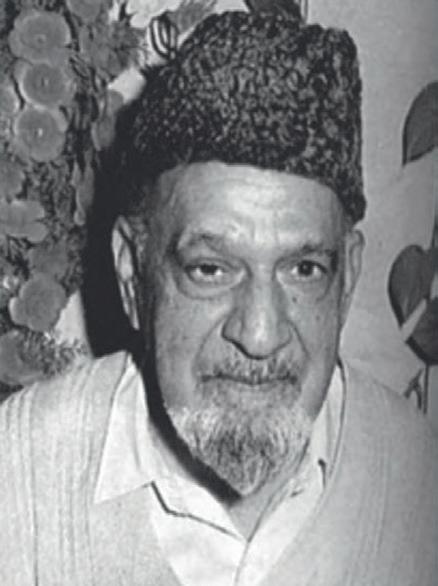
Sheikh Abdul Hameed Sahib Ajiz, Nazir Jaidad
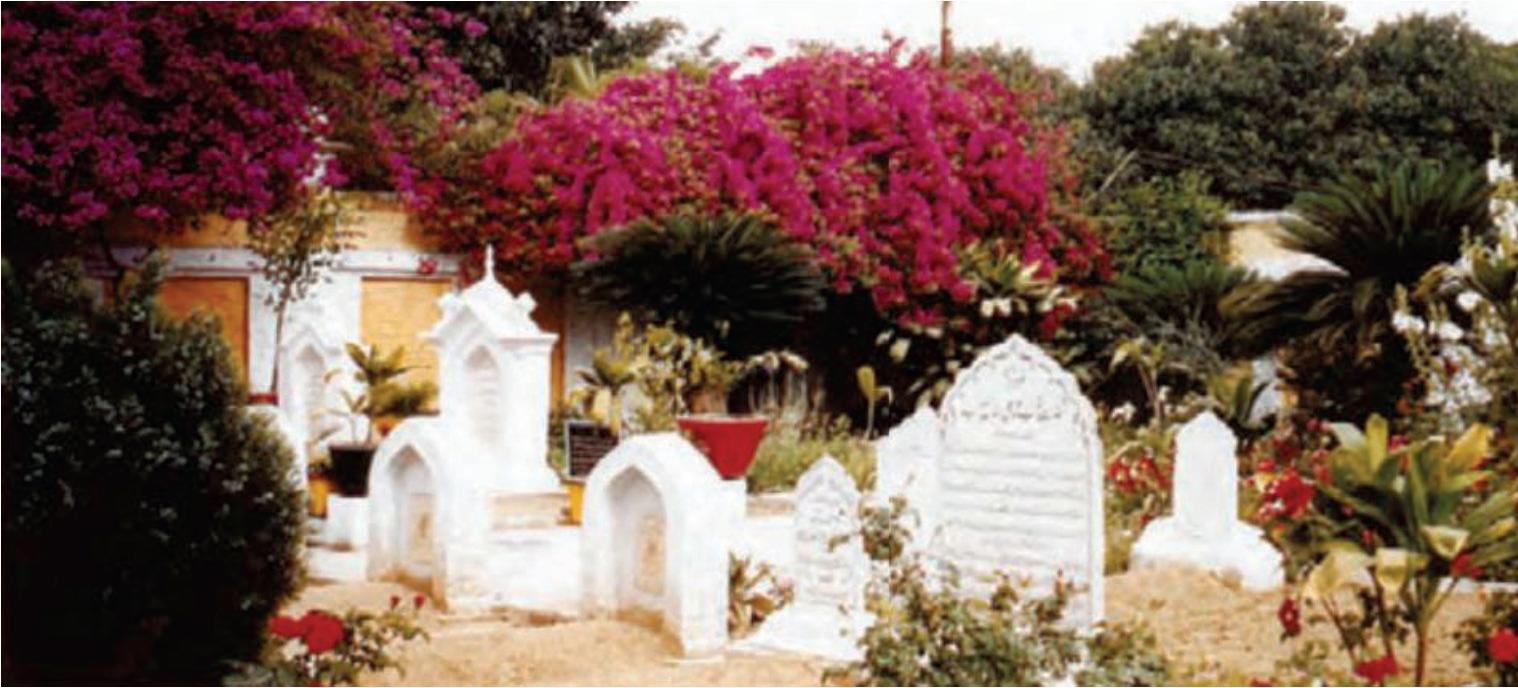
Old photo of Bahishti Maqbarah, Qadian
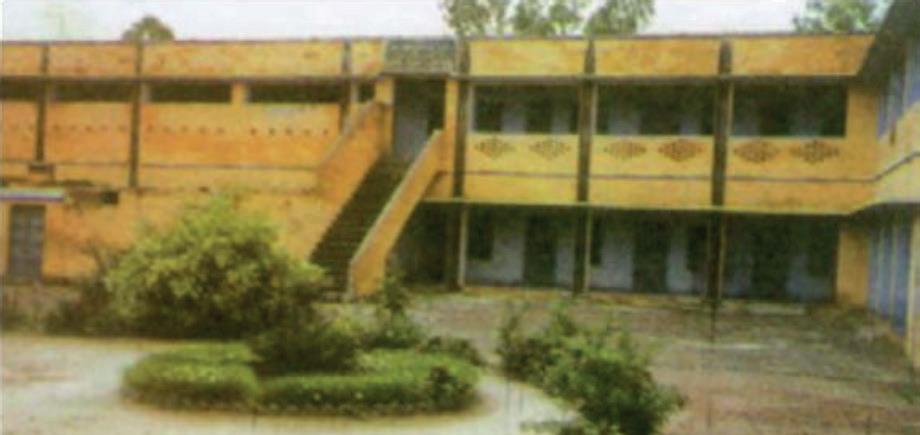
Langar Khana Qadian (Circa 1970)
Ramadan: A spiritual guide to nearness with Allah the Almighty
Sami Fakhra Maryland, USA
As a child, I remember going to the Ahmadiyya Hall in Saddar, Karachi, during Ramadan with my siblings and mother. We would listen to the dars, break our fast there and perform our tarawih prayers. I also recall some days when we broke our fast at home, and our grandmother would read prayers from a prayer book. We children would say “amin” after each du‘a (prayer).
Allah the Almighty states in the Holy Quran:
“O ye who believe! fasting is prescribed for you, as it was prescribed for those before you, so that you may become righteous.”
(Surah al-Baqarah, Ch.2: V.184)
While many of the youth are familiar with the cultural aspects and practices of their families during Ramadan, I would like to share the guidance of Allah found in the Holy Quran, the narrations of Prophet Muhammadsa, and the advice of the Promised Messiahas, as reminded in various sermons by our beloved Khalifatul Masih V, Hazrat Mirza Masroor Ahmadaa
Salat, Tahajjud and recitation of the Holy Quran
It is narrated that the Holy Prophetsa once said that two Fridays or two Ramadans become a means of expiation for the sins carried out in between, so long as a person abstains from committing grave sins. (Sahih Muslim, Kitab al-taharah, Hadith 233c)
Of course, the true essence of worship is prayer. The Promised Messiahas states that we must offer prayer in the manner which the Holy Prophetsa offered it, which is to pray in one’s language after reciting the prescribed recitations and prayers. (Malfuzat, 2022, Vol. 3, p. 58)
It should be remembered that not seeking repentance for one’s faults and sins also falls under great sins; hence, seeking forgiveness is of the utmost importance.
Huzooraa stated in his sermon on 29 April 2022 that another way of joining one Ramadan with the next is to focus on the recitation of the Holy Quran. In this regard, Huzooraa quoted the Promised Messiahas who has explained that the word ‘Quran’ carries in it a great prophecy which is that this Book alone is worthy of reading, and there would come a time when it would
become of even more importance to hold fast to reading this Book. (Malfuzat, Vol. 3 [English], pp. 9-10)
The Promised Messiahas has also advised that every Ahmadi should strive to offer Tahujjud [pre-dawn voluntary prayer], should offer the five daily prayers, avoid all things that displease God, eliminate anger, establish forbearance and adopt excellent morals. In essence, every Ahmadi must pray, seek forgiveness, and give alms that God may have mercy on you. (Malfuzat [English], Vol. 1, pp. 215-216)
Durood and its importance
The Holy Quran tells us: “Allah and His angels send blessings on the Prophet. O ye who believe! you [also] should invoke blessings on him and salute [him] with the salutation of peace.” (Surah al-Ahzab, Ch.33: V.57)
We find many narrations which explain the necessity of sending durood [invoking salutations upon the Holy Prophetsa]. It is narrated that the Holy Prophetsa said that one who abandons sending salutations upon him, abandons the path leading to Paradise. (Sunan Ibn Majah, Kitab iqamat al-salah wa al-sunnah fiha, Bab al-salah ‘ala al-Nabi, Hadith 908)
On another occasion, the Holy Prophetsa said that God would send ten salutations upon the person that sends salutations upon him, and would raise them ten ranks and record ten good deeds under their name. (Kitab-ul-Sunan Al-Kubra Li-Al-Nisai, Kitab amal-ul-yaum wa lailah, Riwayat 9892, Darul-Kutb Al-Ilmiyyah, Beirut 1991)
This tells us how important it is to send salutations upon the Holy Prophetsa Lailatul-Qadr: The Night of Destiny
The Holy Quran speaks about Laylatul Qadr – the Night of Destiny, Decree, or Dignity. (Surah al-Qadr, Ch. 97) In another Surah, we learn that the Holy Quran was revealed during this blessed night. Allah states:
“Truly, We revealed it in a blessed Night. Truly, We have [ever] been warning [against evil].” (Surah ad-Dukhan, Ch. 44: V.4)
The Holy Prophetsa said that one who fasts with fervour of belief and to gain pleasure of God, has his/her previous sins forgiven and one who wakes up for Laylatul Qadr with a passion of belief will have his/ her previous sins forgiven. (Sahih Bukhari, Kitab fadl laylat al-qadr, Bab fadl laylat alqadr, Hadith 2014)
In his Friday sermon on 27 August 2010, Huzooraa explained that whoever
experiences Laylatul Qadr does so due to a very special blessing of God. It is most important to value this experience, and this can be done by continually developing one’s spirituality. The worship of this one night is better than a 1000 months.
Huzooraa said 83 years make up 1000 months. Thus, if one experiences it, one’s lifetime’s prayers – that are good for a believer – are accepted. All prayers made are not good in God’s sight; He thus accepts what He deems good. This night also gives a believer a higher spiritual status, and the descent of angels brings a revolutionary change in a believer’s connection with God. (Khutbat-e-Masroor, Vol. 8, p. 446)
Eid-ul-Fitr prayer and Zakat-ulFitr
Eid Salat is also an important part of worship in Islam. Muslims around the world gather in the mosque to offer it on 1 Shawwal. It is a day for increased worship. Where there are normally five obligatory prayers in a day, on Eid, there are six.
Thus, Eid holds special significance. The Holy Prophetsa has stated that one who offers prayers on the nights of two Eids, his heart will be granted eternal life. (Sunan Ibn-e-Majah, Kitab al-siyam, Bab fiman qama laylatay al-‘idayn, Hadith 1782)
On this day, there are special prayers, known as takbirat, which are recited from sunset on the last day of Ramadan (i.e., the first day of the month of Shawwal) until the Imam rises to lead the prayer of Eid. The prayer is:
“Allah is the Greatest, Allah is the Greatest. There is none worthy of being worshipped but Allah; Allah is the Greatest, Allah is the Greatest, and to Him belongs all praise.”
There is also a mandatory financial contribution for this day, known as Sadaqat-ul-Fitr or Zakat-ul-Fitr. Allah has commanded every Muslim who has more food than he needs for the day and night of the feast to give a measure of one Sa (approximately three liters) of food – such as wheat or rice – or its equivalent in money to needy Muslims so that no one is left without food on this day. The amount should be paid or distributed before the sermon of Eid starts. (“The Fourth Pillar of Islam: Saum, The Islamic Fast”, www.reviewofreligions.org, 25 October 2020)
Six fasts of Shawwal Muslims are forbidden to fast on Eid. However, one may follow the day of Eidul-Fitr with six days of voluntary fasting during the Islamic month of Shawwal. The Holy Prophetsa is reported to have said that whosoever does so will be rewarded as if they had fasted perpetually. (Sahih Muslim, Kitab al-siyam, Bab istihbab sawm sittat ayamin min Shawwal ittiba‘an li-Ramadan, 1164a)
I hope and pray that this Ramadan brings abundant blessings to all who fast and follow the Prophet Muhammad’ssa sunnah and the way of worship during Ramadan. May Allah make this Eid-ul-Fitr blissful for everyone, and may He grant us the strength to observe six days of voluntary fasting in Shawwal. Amin!
Price of rebellion: Collapse of the Ottoman Caliphate
Mahmood Ahmad Al Hakam
A fragmented world
Loyalty to one’s state is an important Islamic tenet – one which might have been overlooked when Sharif Hussein led his rebellion, known as the Arab Revolt (1916-1918), which contributed towards the collapse of an already declining empire, the resulting fragmentation of Muslim unity and loss of the Caliphate in the political sphere.
This disunity, which was partially sown during the revolt, has had lasting repercussions, leaving the Muslim world fractured and extremely vulnerable to external interventions.
Caliph-less
It is no secret that Trump has his eyes set on Gaza, whilst the Muslim world helplessly looks on at the fleeting dream of an independent Palestinian state. This is a stark contrast to when a Sultan-Caliph would simply turn away powerful and influential people who had set their eyes on Palestine over a century ago.
However, the Muslim world has been without a political Caliphate for over 100 years now, since Mustafa Kemal Ataturk abolished the Ottoman Caliphate on 3 March 1924. Many factors led to the decline and fall of the empire, one of which was Sharif Hussein’s revolt against the Ottoman state.
Guardians of the two holy shrines
The Ottoman Empire was vast. Throughout its 7-century history, at various times it covered the lands of modern-day Turkey, Syria, Palestine, Egypt, Greece, Libya, the Balkans and many more thousands of square miles of land. The most important of these, to Muslims, would have been the Hejaz region of modern day Saudi Arabia, which consists of the two holy cities of Mecca and Medina.
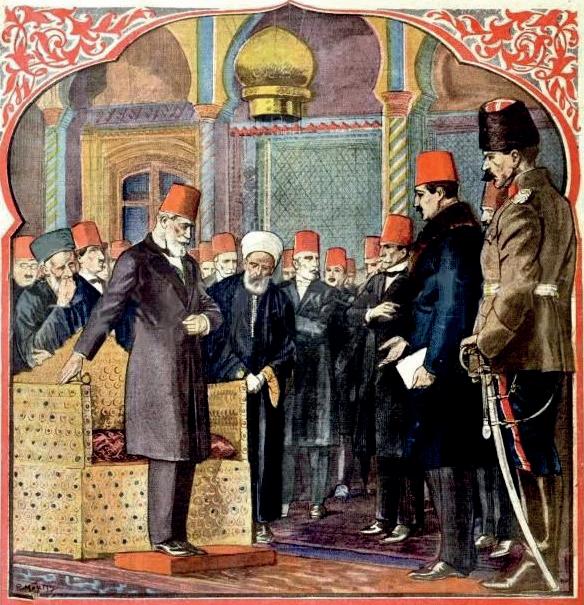
The Sultan – or Caliph, as Sultan Selim I additionally styled himself after the conquest of the Hejaz, and every Sultan after him as well – usually held immense, if not absolute power. One of these was Sultan Abdul Hamid II, who ruled absolute from 1876 to 1909.
Zionist aspirations
In the late 19th century, Theodore Herzl, the founder of modern Zionism, expressed his desire to approach the Sultan-Caliph with an offer to purchase land in Palestine:
“Supposing His Majesty the Sultan were to give us Palestine, we could in return pledge ourselves to regulate the whole finances of Turkey.” (Theodore Herzl, The Jewish State, 1917, p. 12)
According to some reports, he even
approached the Sultan at least twice with a proposal to purchase land in Palestine for Jewish settlement. (Ibid. pp. vi-vii)
The Sultan’s supposed response to this offer has been immortalised in variations of the following words:
“I cannot sell even a foot of land, for it does not belong to me but to my people. My people have won this Empire by fighting for it with their blood and have fertilised it with their blood. We will again cover it with our blood before we allow it to be wrested away from us.”
He stayed true to this statement throughout his reign. This, along with other efforts to unite and lead the Muslim world under his Caliphate resulted in the era of Abdul Hamid II’s reign to be described as the “Era of Pan-Islamism”. (Muhammad Harb, Sultan Abdul Hamid II, The Last Great Ottoman Sultan, p. 208)
With this stance, he made himself an enemy of Herzl and the Zionists, along with the already extensive list of other enemies he had accumulated. Eventually, through various means and factors, the Sultan was deposed and the CUP (Committee of Union and Progress), or Young Turks Movement, took the reins of power, with the new Sultan acting only as a figurehead.
The revolt: Seeds of division
Sharif Hussein was appointed the Emir of Mecca by the Ottomans in 1908. Even before then, anti-Ottoman and nationalistic sentiments were brewing throughout the
empire. It was already in decline, and likely would’ve continued to do so after Abdul Hamid II’s reign.
It was only after the CUP took power and joined the First World War on the side of the Entente that Sharif Hussein made his move. In 1916 he initiated a strategy of guerilla warfare against the Ottomans, which Lawrence of Arabia would later write an analysis of, who played a crucial role in instigating and facilitating this rebellion.
The Sharif’s army consisted mainly of the Arabs of the Hejaz, but it was undoubtedly supplemented by Great Britain in various ways. For example, in June 1916, British intelligence officers desperately attempted to recruit Arab prisoners to join the Sharif’s cause through the Viceroy of India. Although 300 prisoners were sent to fight for the Sharif, many declined to fight against the Ottomans out of loyalty. (Mesut Uyar, Ottoman Arab Officers between Nationalism and Loyalty during the First World War, p. 542)
This is an interesting fact as it shows that the Arab revolt cannot be seen in absolute terms of loyalty or disloyalty. It would be an abstract oversimplification to claim that all Arabs betrayed the Ottomans.
The fact remains, however, that certain groups of Muslims betrayed their state –an Islamic state – and sided with Britain, a non-Muslim state. Whatever their reasons and justifications, the irony of this situation might be lost on some.
Promises made, promises broken Britain went further than just providing military support. It even promised the Sharif an independent Arab Kingdom in event of victory, along with other lofty promises, as the correspondence between the British statesman Sir Henry McMahon and Sharif Hussein shows:
“To his Highness the Sherif Hussein […] We rejoice, moreover, that your Highness and your people are of one opinion –that Arab interests are English interests and English Arab […] our desire for the independence of Arabia and its inhabitants, together with our approval of the Arab Khalifate when it should be proclaimed. We declare once more that His Majesty’s Government would welcome the resumption of the Khalifate by an Arab of true race.” (Sir Henry McMahon, Correspondence between Sir Henry McMahon, G.C.M.G, His Majesty’s High Commissioner at. Cairo and the Sherif Hussein of Mecca, p. 4)
The above correspondence makes one wonder; what’s worse, loyalty to a nonMuslim state which rules over you, or disloyalty to a Muslim state which does? And what would the status of such a caliphate be which depended on the approval of the disbelievers?
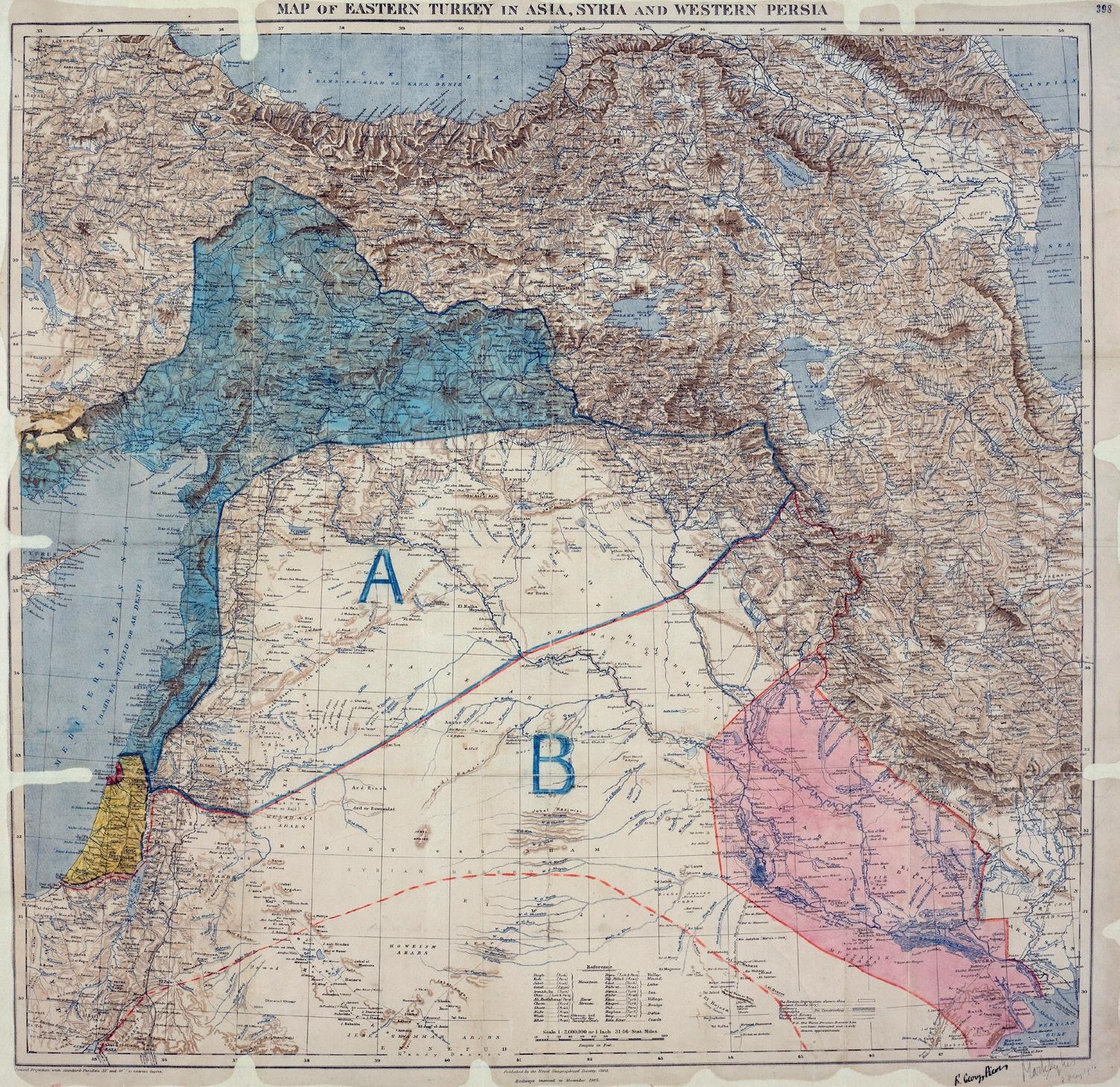
In any case, the British eventually reneged on their promise, and instead of handing over the Arab lands to the Arabs, they carved up the Middle East along with France in the Sykes–Picot Agreement. (Arab Question; Sykes and Georges-Picot, Memorandum, 3 January 1916)
This agreement wasn’t Syke’s only contribution. He was, in fact, the person who designed the flag of resistance for the Arabs, which many modern-day Arab states have taken inspiration from for their national flags. (William Easterly, The White Man’s Burden, 2006, p. 295)
Fall of the Ottomans
With his own Hashemite forces, along with backing from the British military’s Egyptian Expedition Force, Sharif Hussein successfully fought and expelled the Ottoman forces from the Hejaz and surrounding Arab lands. The rebels had captured Damascus by 1918 and declared their independent Arab Kingdom of Syria, which was short-lived due to the SykesPicot agreement.
This was a massive blow to the Ottoman Empire. By this time it not only lost its Arab provinces, but also World War I in general, along with the other Entente powers.
Greatly weakened, Britain, France and other allied nations enforced the signing of the Treaty of Sevres, which would have the allies occupy the former territories of the empire, including the Turkish heartland of Anatolia as well as Palestine. Although completely and utterly defeated, the
Daniyal
Ottoman Empire remained intact in name, whilst being occupied by foreign powers.
(Eugene Rogan, The Fall of Ottomans, p. 397)
This blow to the Muslim world had been intended all along, as David Fromkin states: “[..] .the assumption that Europeans had shared about the Middle East for centuries: that its post-Ottoman political destinies would be taken in hand by one or more of the European powers.” (David Fromkin, A Peace to End All Peace: The Fall of the Ottoman Empire and the Creation of the Modern Middle East, 1989, pp. 76)
Eventually, Mustafa Kemal Ataturk led his rebel forces to liberate the Turkish mainland from the allies, and after successfully doing so, finalised the dissolution of the Ottoman Empire in 1922, deposing the Sultan and establishing the Republic of Turkey. (Caroline Finkel, The History of the Ottoman Empire, Osman’s Dream, p. 1)
End of the Caliphate
Throughout this turmoil, perhaps the deepest wound that the Muslim world suffered on the political stage was the abolition of the Ottoman Caliphate.
The Times reported on 3 March 1924:
“The Motion for the abolition of the Caliphate was passed in the Grand National Assembly to-day after a stormy debate.”
Abdulmecid II, the last Caliph of the Ottoman dynasty was deposed and exiled.
This was the last generally recognised political caliphate in the Islamic world. Accompanied by the dissolution of the Ottoman Empire, the abolition of the Ottoman Caliphate signified the breakup of a unified Islamic authority and entity that could have been able to potentially protect not just the rights and interests of Palestine as it had done in the past, but also much of the rest of the Muslim world. The Muslim world, it seemed, was fragmented and leaderless.
Islamic perspective on unity & loyalty to state
This situation could have been avoidable if Islamic injunctions were properly followed. Islamic literature is replete with teachings on unity and loyalty to the state
The Holy Quran mentions that Muslims should hold fast to the rope of Allah and not to become divided (Surah Al-e-’Imran, Ch. 3:104). This is a clear instruction and call for unity among Muslims.
The Holy Prophetsa expounded further on this concept in one of his narrations:
“The similitude of believers in regard to mutual love, affection, fellow-feeling is that of one body; when any limb of it aches, the whole body aches, because of sleeplessness and fever.” (Sahih Muslim, Hadith 2586)
With regard to loyalty to the state in which a Muslim lives, the Holy Quran categorically states:
“O ye who believe! obey Allah, and obey [His] Messenger and those who are in authority among you.” (Surah an-Nisa’, Ch.4: V.59)
The Holy Prophet Muhammadsa further reinforces this injunction:
“Whoever obeys me, obeys Allah, and whoever disobeys me, disobeys Allah, and whoever obeys the ruler I appoint, obeys me, and whoever disobeys him, disobeys me.” (Sahih al-Bukhari, Hadith 7137)
The above verses and ahadith provide us with the valuable insight that Muslims, as an entity, can derive immense benefit in unity and loyalty. The natural conclusion would be that disunity and disloyalty would result in harm and damage, as can be deduced
from the events mentioned in this article.
Power of true Caliphate
The factors which led to the dissolution of the Ottoman Empire and Caliphate and the current turmoil that the fragmented Muslim world finds itself are many.
Depending on perspective, the Arab revolt led by Sharif Hussein might be to blame. Whilst others may consider Mustafa Kemal Ataturk to have been the final nail in the coffin. Yet again, some might argue that it was the interference of the Western powers that led to the fragmentation of the Muslim world.
The abolition of the political Caliphate was definitely a deep wound, even though by that time the characters and acts of the caliphs didn’t resemble those of the four righteous Caliphs.
There is no doubt, however, that true Khilafat – as promised by Allah the Almighty in the Holy Quran in Surah anNur, Ch.24: V.56 – would have provided the Muslim world with the right guidance to navigate the stormy seas of the modern-day political landscape.
Additionally, perhaps a stronger counterbalance to external interference –past and present – could have been provided by stronger Muslim unity, which would have been the natural result of loyal obedience to Khilafat.
Conclusion
With the helpless situation of the Muslim world and its leaders in the face of powerful entities and people such as Trump and his plans for Gaza, it’s worth reflecting whether unity amongst the Muslim world and loyalty to the state and people in authority, such as the caliph, might have provided a more robust defence of the interests of the Muslim world today.
With the above in mind, and now that the Muslim world has entered the second century of no political caliphate, it can learn a powerful lesson from the words of Hazrat Mirza Bashir-ud-Din Mahmud Ahmadra, the second Khalifa of the Ahmadiyya Muslim community:
“When the Turks ruled over the Arabs, we supported the Turks. When Sharif Hussein became the ruler, people strongly opposed him, but we said that it was not appropriate to spread disorder and conflict. The person whom God has made a ruler should be accepted so that the continuous unrest in Arabia may come to an end.
“After that, when the Najdis took over the government, despite the fact that people raised much commotion, accusing them of demolishing tombstones and disrespecting the Sha’airillah, we supported Sultan Ibn Saud solely because we did not approve of frequent battles in the sacred city of Makkah […] We do not wish for unrest in these regions.” (Khutbat-e-Mahmud, Vol. 16, pp. 549-550)
The True Revolution – Part 18
Social teachings of Islam and establishing a just civilisation
English translation of Inqilab-e-Haqiqi
An address by Hazrat Mirza
Bashir-ud-Din Mahmud Ahmadra, Khalifatul Masih II, al-Musleh al-Mau‘ud
Delivered at Jalsa Salana Qadian on 28 December 1937
The Need to Earn a Livelihood
Earning a living is a part of Islam. Once, a group of Companions approached the Holy Prophetsa and said, ‘O Messengersa of Allah, there is a person who spends his days and nights in worship. Would you say that he was the best among us?’ The Holy Prophetsa demonstrated his profundity of thought by asking them how this gentleman fed himself. They replied by saying that other people provided for him. The Holy Prophetsa said that those who looked after him were better than he was.
Similarly, it is related in ahadith that the Holy Prophetsa was sitting with his Companions. A tall, well-built young man ran past their gathering on his way to work. Some of the Companions derided him by saying that may he be cursed [for being in such a hurry]. It would have been better for him to employ his youth to win the favour of Allah. At hearing this, the Holy Prophetsa admonished them for calling him cursed. A person who works [hard and] in haste in order to look after his wife and feed his children strives in the way of God. On the contrary, a person who expends his efforts in order to win the praise of others, strives in the way of Satan. Hence, to earn a living through lawful means and with diligence is to walk the path that leads to God.
Safeguarding One’s Assets
Likewise, Islam has placed particular emphasis on looking after and protecting one’s property and assets. The Holy Prophetsa said that a person who sells his property and lives off its proceeds is unworthy and does not deserve the blessings of God Almighty. These are just a few examples of the hundreds of detailed injunctions found within Islam. In Islam, politics is the name given to the system of organisation under which all these injunctions can be implemented. This is an essential part of Islam.
The Establishment of An Islamic Civilisation
An Islamic civilisation cannot be established without the implementation of the following:
Reformation of Thought
The Jama‘at’s way of thinking has to be reformed. The Community has to be informed that simply bearing witness to the fact that there is none worthy of worship except Allah does not relieve you of your responsibilities. Nor is merely believing in the Holy Prophetsa and the Promised Messiahas sufficient to make a person a believer or an Ahmadi. The fulfilment of belief rests on hundreds of branches of faith, many of which fall into the realm of culture, civilisation, society, economics and politics. Until a person strengthens every aspect of his or her religious life, they cannot be called a believer in the true sense. It is incumbent on our ulema to reform their process of thought and impress on the Community the enormity of their obligations. Unfortunately, however, when many of them go abroad [as representatives of the Jama‘at] they come back having delivered a few lectures on topics such as the death of Jesusas and the finality of prophethood and think that this is all they were sent to do. Hence, they are like a person who sets out to build a palace, but considers the project complete after the first brick has been laid. Thus, the work of the ‘ulema is to prepare the members of the Community and instil within them the spirit to sacrifice their lives for the revival of the sunna of the Holy Prophetsa and the Islamic sharia.
Complete Obedience
Secondly, we have to create a spirit of complete obedience within the Jama‘at and instil within them the resolve to obey no matter how much loss they have to endure. Obedience holds up the structure of the Jama‘at and if just one person [is disobedient], the whole thing collapses. For example, Islamic law stipulates that traders should sell things of a certain standard and refrain from selling defective goods. If we enforce this on our traders and instruct people not to buy from those who refuse to comply with these rules, then a number of people were to protest against the action of the Jama‘at on the basis that it was depriving the shopkeeper of earning a living; how
could we implement this aspect of Islamic law in the world? Similarly, if other parts of the law are not applied in order to appease people, then our situation will resemble that of a person who went to get a lion tattooed on his body. [It is said that] when the artist began piercing his skin with the needle, the man felt the pain and asked him what he was about to draw. The artist told him that it was the lion’s ear. The man asked whether a lion could still be called a lion if he did not have one of his ears. The tattoo artist said yes. So he told him to leave the ear and continue with the rest. When he went to draw the second ear, the same conversation ensued. The line of questioning continued for each part of the lion. Ultimately, the tattoo artist abandoned his work. When the man asked him what he was doing, he replied that there was nothing left of the lion for him to draw. Similarly, if people fail to comply with Islamic law and we do not act on this, nothing will remain of the Jama‘at or the religion. It is our responsibility to guide those who heed the advice and offer an ultimatum to others to stop defaming the Jama‘at, repent and join the rest of the Community [or else leave]. Everyone in the Community should be ready to cooperate with and fully obey the administration, even if this means having to sever ties with their parents, wives, sons or brothers.
Publishing
Thirdly, to achieve this goal, the Community also needs to publish books that expound on the teachings of Islam and offer rulings based on those principles.
Lawful Coercion
Fourthly, under Islam, ‘politics’ is the term given to lawful means of coercion. An Islamic political system should be established regardless of whether it is objectionable to some people or not, or even if it proves to be a source of trial or tribulation for them. [In religious terminology] politics is the implementation of those aspects of religious law that require lawful coercion. The Islamic ‘ulema have produced voluminous works in which they
have argued that it is within the definition of politics to enforce Islamic laws on those used to coercion through certain types of coercive measures. It is imperative that we too adopt these methods. [For example], it is our obligation to apply legitimate pressure on a person who, after having joined the Community and taken the pledge of allegiance, is lax about their responsibilities. They have to live their lives in accordance with Islamic law because they are now part of the Community. If they dishonour themselves, they also dishonour the Jama‘at and their weaknesses and failings have the potential to harm it. Any pressure exerted on them would be legitimate because they joined the Community of their own free will and thereby gave it the right to oblige them in certain matters. For instance, when children are placed in a boarding school, they consent to the teacher’s authority over them without objection. Those who disagree with the way the Jama‘at functions are free to leave it.
Revival of the Sharia
Prior to its implementation, the task of reviving the sharia takes two forms. The first relates to the governance of the state and the second to the administration [of the Community]. The Islamic injunction that the hand of a thief who is a persistent offender should be cut off,1 relates to the former. Similarly, the injunction that the murderer does not necessarily need to be executed and the survivors of the victim should decide either to execute or forgive the murderer2, also pertains to matters of the state. Under the current circumstances, neither injunction can be implemented, for there is no form of Islamic government. Islam also commands that a murderer be handed over to the victim’s family, so under the supervision of the authorities, they may decide whether to carry out the execution themselves. However, [the current legal system sees] the government executing murderers without involving the victim’s family. Consequently, even if the perpetrator of the crime is hanged, often the survivors of the victim harbour resentment and seek vengeance by killing his kith and kin
at another time. Under an Islamic form of government, the first right of refusal to kill the murderer, under the supervision of the government, would be given to the family of the victim. However, they would be subject to the condition that they do not transgress the limits prescribed by Islam when executing him.3 In fact, the government would regulate the rules pertaining to how an execution is conducted and the concerned party would be obligated to follow them. The survivors of the victim would also have the right to let the government punish the murderer in accordance with the law if they do not find within them the will to carry out the execution on their own. This approach helps eliminate the resentment that often persists in people by the rulings of the current British government and becomes a source of revolt. At other times, the more appropriate course is to pardon the accused. The family of the victim should also have the first right to make this decision. Nevertheless, such matters are for the state and not the common population.
There are other parts of the sharia that, despite relating to politics and administration, do not necessarily come under the authority of the state. For example, we have the system of Qadha4 established in Qadian. The government does not interfere in the matters pertaining to Qadha and has given us permission to decide those affairs among us that do not come under the jurisdiction of the police. We are free to implement aspects of the sharia that do not concern the state and which the government has given us the right to administer ourselves. We have to put these parts of the law into practice within the Community. By not applying certain parts of the sharia that could be implemented, we would show disrespect to the law. Thus, we should strive towards enacting this extremely important and significant purpose that God Almighty has given us power over and not concern ourselves with the weakness or missteps of any individual within the Community.
Endnotes:
And as for the man who steals and the woman who steals, cut off their hands in retribution of their offence as an exemplary punishment from Allah. And Allah is Mighty, Wise. (Surah al-Ma’idah, 5:39) [Publishers]
O ye who believe! equitable retaliation in the matter of the slain is prescribed for you: the free man for the free man, and the slave for the slave, and the female for the female. But if one is granted any remission by one’s brother, then pursuing the matter for the realization of the blood money shall be done with fairness and the murderer shall pay him the blood money in a handsome manner. This is an alleviation from your Lord and a mercy. And whoso transgresses thereafter, for him there shall be a grievous punishment. (Surah al-Baqarah, 2:179) [Publishers]
But let him not exceed the prescribed bounds in slaying. (Surah Bani Isra’il, 17:34) [Publishers]
In the Ahmadiyya Muslim Community, Dar-ul-Qadha is a religious and administrative body established in 1919 to handle civil disputes and matters of arbitration. [Publishers]
To be continued...
(Translation by Fazl-e-Umar Foundation, English Section)
100 years ago...
The West embraced what Muslims neglected – and rose to power
Maulana Sardar Misbahuddin Sahib
(1899-1988)
Maulana Sardar Misbahuddin Sahib was born in October 1899 and received his early education in his native village before pursuing further studies in Sialkot. His deep commitment to faith led him to the guidance of Hazrat Maulvi Faiz Uddinra, shaping his spiritual and intellectual development.
In 1910, he travelled to Qadian, where he took bai‘at at the hand of the first Khalifa, Hazrat Hakeem Noor-ud-Deenra and immersed himself in Islamic studies, forming close ties with esteemed scholars.
In 1922, under the directive of Hazrat Khalifatul Masih IIra, he was appointed to the London Mission, marking the beginning of his significant contributions to the Ahmadiyya Muslim Jamaat. His efforts for the tabligh of Islam Ahmadiyyat included personal outreach, public gatherings, and diplomatic engagements – most notably, his meeting with Abdullah I bin Al-Hussein, the King of Jordan, to introduce the message of Hazrat Mirza Ghulam Ahamdas, the Promised Messiah and Mahdi.
After serving in England for over two years, Sardar Misbahuddin Sahib returned to Qadian with Hazrat Khalifatul Masih IIra, continuing his dedicated service. He passed away on 1 August 1988, leaving behind a legacy of religious devotion and missionary work.
the race for progress. However, the moment it cast off the yoke of Christian dogma and practically embraced the eternal and natural truths brought by Islam, it ascended from a state of obscurity to their zenith.
At this moment, I do not intend to recount the historical causes of Europe’s advancement, as this is an extensive subject that cannot be adequately addressed within the confines of a newspaper column. Rather, my purpose is to highlight a single truth conveyed by the Holy Prophet Muhammadsa – a truth that England today is actively implementing and promoting.
Since the Conservative group has once again come into power (1925), it takes great pride in the fact that its presence in the House of Commons has grown to such an extent that the possibility of a new election within the next four or five years is virtually impossible. However, alongside this sense of triumph, there is also a looming concern: if, within these next four or five years, they fail to establish their foundations on a solid footing, their very existence will be permanently at risk.
[“The covenants of sharia (divine law) that we broke were upheld, in the end, by all of Europe.”]
Observing certain aspects of the practical life of the English people, this verse from Musaddas-e-Hali would often come to mind while I was in England. Although Europe does not explicitly acknowledge it, the reality remains that its political, material, and intellectual progress is rooted in the teachings of Islam. By adhering to these principles, the people of Europe have attained their current stature. The pinnacle of their advancement has been reached through the very ladder that was constructed centuries ago by an unlettered Arab community.
The world is well aware that, over the past thousand years, Islam has been the only religion that has provided comprehensive guidance in governance, commerce, and the pursuit of knowledge. Europe, in particular, has firsthand experience of this truth: as long as it remained bound by the teachings of Christianity, it consistently lagged in
For this reason, the government and its members are implementing strategies and proposals aimed at, on the one hand, eradicating the influence of the Labour Party’s ideology and, on the other, uniting public opinion across the nation. The objective is to transform the Conservative group from merely representing a particular ideological faction into the representative body of all of England.
To achieve this objective, a series of articles is currently being published in The Daily Telegraph, one of England’s most renowned newspapers. In these articles, certain policymakers, disregarding all philosophical debates on “free will,” have declared it essential for their survival to adopt the teachings of an “unlettered Arab Prophet” [may thousands upon thousands of peace and blessings of Allah be upon him].
They have begun emphasising the need for a system through which all young children in the country can be controlled and indoctrinated with political ideology from an early age. Parents have been instructed that, instead of telling their children fairy tales or stories about birds and animals, they should raise them within the
framework of their own political traditions. When children reach the age of eight, they should receive systematic instruction, and by the time they complete their education at fifteen, they should be thoroughly grounded in their political ideology. The ultimate goal is that, by the time they turn seventeen or eighteen, they will be ready to vote in the next election in favour of the Conservative group.
Those in Europe who once objected to the Holy Prophet’ssa teaching – that a newborn should hear the azan in their ears and that by the age of 7 or 8, they should be taught prayer and adherence to a particular faith –should now reflect upon their own stance. If indoctrinating children at an early age with a specific creed is deemed essential for sustaining a temporary worldly order, then why should it be considered meaningless to instil in them the teachings necessary for eternal and everlasting life?
– Misbahuddin Ahmed
(Translated by Al Hakam from the original Urdu, published in the 3 March 1925 issue of Al Fazl)
Friday Sermon
Mubarak Mosque, Islamabad, Tilford, UK
7 February 2025
Muhammadsa: The Great Exemplar
After reciting the tashahhud, ta‘awwuz, and Surah al-Fatihah, Hazrat Khalifatul Masih Vaa stated:
The Battle of Khaibar was being discussed. The details of the Holy Prophetsa setting out towards Khaibar are as follows: An army of 1,600 devotees set off from Medina under the leadership of the Holy Prophetsa. This included a cavalry of 200 men. Prior to setting off, the Holy Prophetsa dispatched a unit to gather intelligence, which was given the duty of securing the path ahead and also to gather intelligence. The leader of this unit was Hazrat ‘Abbad bin Bisrh Ansarira.
In order to navigate the routes of Khaibar, two guides were hired for 20 sa’ of dates. 20 sa’ equates to 50 kilos. Their names are recorded as Hasil bin Kharijah Ashja’i and ‘Abdullah bin Nu’aim. Both of them belonged to the tribe of Ashja’. On the way from Medina to Khaibar, they camped in various places and set up their tents in a place called Sahba’. The time for prayer approached when they reached this place. In Bukhari, it is recorded that the Holy Prophetsa offered the Asr prayer there. Following this, he requested some food. The army was only carrying sattu [a nutritious flour made from pulses and cereals] and the Holy Prophetsa and the Companions ate that. The narrator relates that the Holy Prophetsa then got up for the Maghrib prayer. He rinsed his mouth and so did we. He then offered the prayer, but did not perform ablution again. The distance between Sahba’ and Khaibar was 12 miles.
During the journey, some incidents occurred, which indicated that even during such tumultuous circumstances, the Holy Prophetsa paid great attention to the moral training of the Companions and drew their attention towards developing qualities such as discipline and obedience.
A similar incident has been related: One night, something was seen flashing in front of the army. The Holy Prophetsa
became concerned, and upon investigating it, he came to know that it was a soldier of the Muslim army who had left the army and was marching far ahead. His helmet was reflecting light as it was made from silver. His name was Abu ‘Abs. The Holy Prophetsa said: “Bring him to me.” Hazrat Abu ‘Absra relates that “I became worried that something might have been revealed lest I had made a mistake.” He anxiously presented himself before the Holy Prophetsa The Holy Prophetsa inquired: “Why did you leave the army and march so far ahead?” In any case, he apologised. The Holy Prophetsa guided him and said: “You should travel alongside the army.”
Following this, the Holy Prophetsa started talking to him. He was one of the poor Companions who did not have provisions to take into this battle. He came to the Holy Prophetsa and said: “O Messengersa of Allah! I do not have any provisions, and there is nothing left at home either.” Upon this, the Holy Prophetsa gave him one of his clothes. This wise Companion took this cloth to the market, said that the Holy Prophetsa had given it to him and sold it for eight dirhams. For two dirhams, he bought provisions, etc. for his home and for [another] two dirhams, he bought provisions for the journey and for the [remaining] four dirhams, he bought a cloth for himself and joined the army.
During the conversation, the Holy Prophetsa asked him: “Where is the cloth that I gave you?” He answered, “I sold it,” and then he gave all these details, which have just been mentioned. Hearing this from Abu ‘Abs, the Holy Prophetsa smiled and said, “O Abu ‘Abs, you are now in very constrained circumstances. But by He in Whose hand is my life, if you survive and live a long life, O Abu ‘Abs, you shall see that there will be a great increase in your provisions, you will
see a great increase in the amount of food you have for your family, you shall possess vast amounts of wealth, and you shall possess many servants. However, none of this will be very good for you.” Hazrat Abu ‘Absra witnessed with his own eyes how this prophecy of the Holy Prophetsa was fulfilled, and he would say that by Allah, everything transpired just as the Holy Prophetsa had stated.
Abu ‘Abs’ introduction is that his original name was ‘Abd al-‘Uzza, and the Holy Prophetsa renamed him ‘Abd al-Rahman. He reached the age of 70 and passed away in the era of Hazrat Uthman’sra Khilafat. Hazrat Uthmanra led his funeral prayer, and he was buried in Jannat al-Baqi’.
The Holy Prophetsa also sent a message of reconciliation to the Banu Ghatafan. As has just been mentioned, whilst advancing towards Khaibar, the Holy Prophetsa set up camp in Sahba’ and offered the Asr, Maghrib and Isha’ prayers there. This place was located 12 miles from Khaibar. Having completed the prayers, the Holy Prophetsa called the two guides and whilst informing them of his battle plans, he said, “I desire to attack Khaibar in a manner whereby I come between the people of Khaibar and the land of Syria so that they cannot flee from there towards Syria. At the same time, I shall obstruct the Banu Ghatafan so that they cannot lend support to these Jewish people.”
The guide, named Hasil, set off with the army and stopped at a place where there were several paths from Khaibar to that valley. The Holy Prophetsa enquired about the names of all these paths, to which he gave the names of Hazan, Shash, Hatib, etc., which, in terms of their meaning, indicate narrowness, difficulty, grief and trouble. One of the names he gave was Marhab, which means spaciousness and prosperity,
and so, in line with divine guidance, the Holy Prophetsa took a good omen and selected this path of Marhab.
The Holy Prophetsa was informed that the Banu Ghatafan pledged to support the people of Khaibar and they had set off with a further army of 4,000 with the mission of attacking the Muslim army on its path before it could reach Khaibar. The Banu Ghatafan had already sent an army of approximately 1,000 towards Khaibar under the leadership of their renowned leading warriors Tulaihah bin Khuwailid and Uyainah bin Hisn, and they had reached the fortresses of Khaibar. Now, there was an army of 4,000 in the path of the Muslim army, who, in their own estimation, was going to stop them and put an end to them. The Holy Prophetsa corresponded with the Banu Ghatafan and sent them a letter in which he wrote that they should refrain from participating in this imminent war with Khaibar. He made it clear to them that Allah Almighty promised to him that He would give him victory over Khaibar.
According to some historians, the Holy Prophetsa gave this message that if they moved aside and accepted Islam, then after they conquered Khaibar, it would be granted to these tribes. But others are of the opinion that this was not tied to the condition that they accept Islam; rather, he states that they should not assist the people of Khaibar and should not support them; [in return], they would receive half of Khaibar’s annual produce.
However, an army of 15,000 seasoned warriors fortified in their castles against 1,600 Muslims solidified the arrogance within their minds, due to which they refused to accept this prophecy of the Holy Prophetsa
Upon this, the Holy Prophetsa sent Hazrat
Sa’d bin Ubadahra, the chief of the Khazraj tribe and a righteous Companion, to the commander of the Ghatafan army, ‘Uyainah bin Hisn. He was leading 1,000 soldiers of the Banu Ghatafan and was stationed at the fortress of the Jewish leader Marhab in Khaibar at that time. When ‘Uyainah learned that Hazrat Sa’dra had come as the representative of the Holy Prophetsa, he was about to bring him inside the very same fortress. However, Marhab objected, saying that the Muslim representative should not be allowed inside, so that he doesn’t observe the entry points of the fortress. On the other hand, ‘Uyainah said that he wished to bring the Muslim representative inside so that he could witness their great strength, preparations and military equipment. Despite this, Marhab did not agree, upon which ‘Uyainah met Hazrat Sa’dra outside the fortress.
Hazrat Sa’dra conveyed the message of the Holy Prophetsa to ‘Uyainah, that, “Allah has promised us the conquest of Khaibar. Therefore, you should retreat from here and refrain from battle. After defeating Khaibar, you will even be given a year’s worth of dates from its produce.”
In response, ‘Uyainah said to Hazrat Sa’dra, “We will never abandon our allies under any circumstances, and we are well aware of just how [little] strength you possess. These Jews possess fortified castles, their soldiers are younger, and they have far more weaponry. If you choose to fight, you will all be killed. These people are not like the Quraish, whom you managed to gain victory over.” And he also added, “Deliver my message to Muhammad [sa] as well.” Upon hearing this arrogant response, Hazrat Sa’dra said to ‘Uyainah, “I bear witness that Muhammadsa will surely enter this very fortress, and the offer we have made to you today – at that time, you will seek it from us, but then you will receive nothing but the sword (i.e., there would only be war). And O ‘Uyainah! I have already witnessed how we entered the courtyards of the Jews of Medina, and they were utterly devastated.” Saying this, Hazrat Sa’dra returned and reported everything to the Holy Prophetsa
Then, with great sincerity, he submitted, “O Messengersa of Allah, Allah will surely fulfil the promise He has made to you, and will grant victory to His religion. Do not give even a single date to this Bedouin (i.e., ‘Uyainah). O Messengersa of Allah, if the sword meets them, they will abandon these Jews and flee to their area just as they fled prior, on the day of the Battle of the Trench.”
During the Battle of the Trench as well, this very tribe had arrived with an army of 6,000 to support the Quraish, but they ultimately ran away.
The divine awe and the withdrawal of the Ghatafan is also mentioned. The Holy Prophetsa had stated:
“I have been granted assistance through awe.”
This phenomenon once again manifested itself against the Ghatafan forces. As it was mentioned, a 4,000-strong army from the Banu Ghatafan was pursuing the Muslim army to attack them, so that they could prevent the Muslims from reaching Khaibar. However, a form of divine decree manifested, and this army of the Ghatafan suddenly turned back and returned home. In
books of history and biography, it is written that the commander of the Ghatafan army heard a loud voice from behind; a warner was proclaiming that the Muslim battalions had launched a raid on their homes, wealth and livestock, and were about to seize their wealth, women, and children. Upon hearing this, they immediately returned and were not able to assist the Jews. This was an unseen assistance, a voice from Allah the Almighty. (Sirat Encyclopaedia, Vol. 8, 348, Dar-ul-Islam, p. 346; Sharah Zurqani, Vol. 3, Dar Al-Kotob Al-Ilmiyah, Beirut, p. 245; Fatah Khaibar, Bashmeel, Nafees Academy, Karachi, pp. 76, and 90-91; Dairah Ma’arif Sirat Muhammad Rusoolullahsa, Vol. 8, Bazm-I-Iqbal Lahore, pp. 376 and 378-379; Sahih al-Bukhari, Kitab-ul-Wudhu, Hadith 209; Imta-ul-Isma’, Vol. 10, Dar Al-Kotob Al-Ilmiyah, Beirut, p. 56; Usdul Ghaba, Vol. 3, Dar Al-Kotob Al-Ilmiyah, Beirut, p. 428; Kitab-ul-Maghazi, al-Waqidi, Vol. 2, [translation], p. 135)
The various historical sources disagree about the exact size of the Ghatafan tribe’s army. As has been mentioned in reference to one such book, the army of the Banu Ghatafan, which comprised 1,000 soldiers led by Uyainah bin Hisn, joined the Jews in their fortresses at Khaibar to assist them, whereas other historical sources record that the army was actually 4,000 men strong. (Kitab-ul-Maghazi, al-Waqidi, Vol. 2, [translation], p. 135; Sirat Encyclopaedia, Vol. 8, Dar-ul-Islam, p. 357)
Thus, its recorded by some sources that when this army of 4,000, led by Uyainah bin Hisn, was en route to Khaibar, they actually ended up speaking with the Holy Prophet’ssa delegation, which evoked such divine awe in the hearts of the disbelievers that they returned back to their region. This is how it is recorded in Sirat Ibn Hisham. (Sirat Ibn Hisham, Dar Al-Kotob Al-Ilmiyah, Beirut, p. 694; Sharah Zurqani, Vol. 3, Dar Al-Kotob Al-Ilmiyah, Beirut, p. 252)
In any case, the Messengersa of Allah continued his journey toward Khaibar. And when the fortresses of Khaibar became visible through the darkness of evening, the Holy Prophetsa instructed his followers to halt there. When they halted, he prayed:
were greatly confident on account of their fortresses, artillery and large numbers. When the Jews learned that the Holy Prophetsa was advancing toward them, they devised that every day, an army of 10,000 soldiers would march row-by-row and say, “Would Muhammad[sa] ever dare try to attack us? It is impossible.” When the Holy Prophetsa reached them, they had no idea until the sun had risen. The Holy Prophetsa arrived at night time. When the Jews left their fortresses in the morning with spades and buckets in hand for various tasks, they saw the Holy Prophetsa and raced back to their forts to hide. (Subul Al-Huda Wa AlRishad, Vol. 5, Dar Al-Kotob Al-Ilmiyah, Beirut, pp. 118-119)
Hazrat Anasra relates, “The Holy Prophetsa arrived at Khaibar in the evening. However, he did not attack until morning time. Come morning, the Jews emerged from their forts with their buckets and spades.” Although the Holy Prophetsa arrived at night time, he didn’t want to attack them at night, but in the morning. When morning came, the Jews emerged with their buckets and spades in hand. When they saw the Holy Prophetsa, they began to say, “It’s Muhammad[sa]! By God, it’s Muhammad[sa] and his army!” The Holy Prophetsa replied:
“Ruined is Khaibar; for verily when we (the believers) arrive upon the doorstep of a nation who had been warned, then its people shall wake to a heavy morning.”
(Sahih al-Bukhari, Kitab l-maghazi, Hadith 4197)
the Holy Prophetsa had already declared that the battle would take place from this very spot. Therefore, after the battle concluded in the evening, the entire Islamic army was relocated to the new site. (Imta-ul-Isma’, Vol. 9, Dar Al-Kotob Al-Ilmiyah, Beirut, p. 231; Subul Al-Huda Wa Al-Rishad, Vol. 5, Dar Al-Kotob Al-Ilmiyah, Beirut, p. 119; Subul Al-Huda Wa Al-Rishad [translation], Vol. 5, Zawiyah Publishers Lahore, p. 130; Al-Sirah Al-Nabawaiyyah, ibn Hisham, Dar Al-Kotob Al-Ilmiyah, Beirut, p. 694)
The mention of the various fortresses of Khaibar is also important as well as the details in terms of their geographical distribution. This is because the battle was closely related to them, with each fortress being conquered in succession. There is a difference not only in the number of fortresses, but also in their names. Furthermore, the events of this battle are attributed to different fortresses in various books – some accounts attribute certain events to one fortress, while others link them to a different one.
“O Allah, Lord of the seven heavens and all that they overshadow, Lord of the seven earths and all that they bear, Lord of the Satanic forces and all whom they have led astray, and Lord of the winds and all that they scatter. We ask You for the good of this settlement and its people, and we seek refuge in You from any harm of this settlement and its people!”
After this, the Holy Prophetsa commanded the army to march forward in the name of Allah. (Subul Al-Huda Wa AlRishad, Vol. 5, Dar Al-Kotob Al-Ilmiyah, Beirut, p. 118)
Then, the Holy Prophetsa proceeded until he reached Manzilah, which was Khaibar’s marketplace. After the battle, this marketplace was given to Zaid bin Thabit as spoils of war. The Holy Prophetsa spent a part of the night here.
The Jews didn’t think that the Holy Prophetsa would attack them, as they
No permanent encampment was established at Manzilah. The position of the Islamic army’s camp was changed. It is mentioned in this regard that when the Holy Prophetsa arrived at Khaibar, he spent the night at a place called Manzilah and remained there till the morning. Hazrat Hubab bin Mundhirra approached him and said, “O Messengersa of Allah, if this place, Manzilah, is where you have been ordered by Allah to set camp, then we say nothing. However, if this is your personal opinion, we would like to offer some counsel.” The Messengersa of Allah replied, “This is my own opinion.” Hazrat Hubabra continued, “O Messengersa of Allah, you are now positioned near their fortresses and in front of their orchards, and the land is barren. I know the people of Nata‘at (the enemy), and their archers are unmatched in distance and skill. They are positioned on higher ground, and their arrows can easily reach us. Furthermore, we are not safe from their attacks at night. They can hide within the palm groves. Therefore, I suggest that you move the camp to a different location.”
The Holy Prophetsa said, “Your suggestion is good, but we will engage in battle with them today, regardless.” However, at the same time, the Holy Prophetsa called for Muhammad bin Maslamahra, who was in charge of the defensive army unit and instructed him to find a place for them a little distance away from their fortresses. Muhammad bin Maslamahra went from there and reached the location of Raji‘, situated between the tribes of Khaibar and Ghatafan. He then returned to the Holy Prophetsa and said, “O Messengersa of Allah, I have found a place for you.” The Holy Prophetsa replied, “Proceed with the blessings of Allah.” However, prior to this,
In Tarikh al-Ya’qubi, six fortresses of Khaibar are mentioned, but the fortress of Na’im is not listed, even though most books of sirah state that the battle of Khaibar began at Na’im. In Zurqani, the number of fortresses is listed as ten. When reviewing all these sources, it can be concluded that the Khaibar region was divided into three parts: Nata‘ah, Shaqq, and Katibah, with a total of eight fortresses distributed as follows: Nata‘at contained three fortresses: Na’im, Saab, and the fortress of Zubair. This fortress was known as Qul’ah, but later came under the possession of Hazrat Zubair bin al-Awwamra; hence, it became famous as the Fortress of Zubair.
Shaqq contained two fortresses: Ubayy and Bari, or, as some have stated, Nazar. Katibah contained three fortresses: Qamus, Watih, and Sulalim. (Sharah Zurqani, Vol. 3, Dar Al-Kotob Al-Ilmiyah, Beirut, pp. 264-266; Ghazwah Al-Nabi, Abul Kalam Azad, pp. 162-163; Tabqat ibn Sa’d, Vol. 2, Dar Al-Kotob Al-Ilmiyah, Beirut) The details of the battle are as follows: Before the battle began, the Holy Prophetsa addressed the Companions in a brief address, saying: “Do not wish to encounter the enemy. Instead, seek protection from Allah. You do not know in what trial you may be placed. When you face the enemy, recite the following prayer:
“‘O Allah, You are our Lord and their Lord; our foreheads and their foreheads are in Your hands. You alone will defeat them.’” (Subul Al-Huda Wa Al-Rishad, Vol. 5, Dar Al-Kotob Al-Ilmiyah, Beirut, pp. 119-120)
After this, the Holy Prophetsa commanded the battle to commence and encouraged the Companions to remain patient. The first fortress to be besieged was the fortress of Na’im, which was one of the strongest of their fortresses. On that day, the Holy Prophetsa engaged in fierce fighting, and the people of Nata‘at put up a vigorous resistance. The Companions defended with great resolve. The Holy Prophetsa, wore two coats of armour and a helmet, and he was mounted on his horse, Dharib. Dharib was the name of his horse. In his hand, he held a spear and a shield. The enemy relentlessly showered arrows, but the Muslims, in turn, carefully fired arrows since they had very
few arrows, and they were even picking up the arrows that had fallen from the enemy.
Among the casualties of the battle was the martyrdom of Hazrat Mahmud bin Maslamahra. Hazrat Mahmud bin Maslamahra became fatigued; his armour became heavy for him, and the intense heat made it difficult for him. He sat in the shade of the wall of the fortress of Na’im. It is said that the Jewish chief, Marhab, saw him and rolled a large stone upon him. Some reports state that Kinanah bin Rabi‘ was the one who pushed the stone from above. The stone struck Hazrat Mahmudra on the head, causing such a severe injury that his scalp tore and fell over his face. He was brought to the Holy Prophetsa, who gently placed the scalp back in its place and bandaged it with a cloth. However, the injury was so severe that Hazrat Mahmud bin Maslamahra did not survive and passed away a few days later.
When Hazrat Mahmudra was fatally wounded, the Holy Prophetsa consoled his brother, Hazrat Muhammad bin Maslamahra, saying: “Your brother’s killer will soon meet his end.” On that first day, the Muslims suffered great losses, with 50 Muslims injured by arrows shot from the fortress. As evening approached, the Holy Prophetsa went to Raji’ and ordered the people to gather there. This was the very location that was chosen on the advice of Hazrat Hubabra, and now this became the central meeting point for the Muslims.
As mentioned previously, this fortress was the most formidable stronghold of the Jews, and its defence was led by the renowned and valiant warrior of Khaibar, Marhab. Assisting him were his two brothers, Yasir and Harith, who, among the cavalry, were no less courageous and fearless than him.
Historical accounts reveal that the Holy Prophetsa remained engaged in battle for ten consecutive days. Each day, he would set out with Hazrat Muhammad bin Maslamahra while entrusting the supervision of the encampment to Hazrat ‘Uthmanra. As night fell, he would return to the same location, where the wounded Muslims were also brought and their wounds were tended to. (Sirat Al-Halabiyyah, Vol. 3, Dar Al-Kotob Al-Ilmiyah, Beirut, pp. 50-51; Kitab-ulMaghazi, Vol. 2, Dar Al-Kotob Al-Ilmiyah, Beirut, p. 121; Sirat Encyclopaedia, Vol. 8, Dar-ul-Islam, p. 361; Dairah Ma’arif Sirat Muhammad Rusoolullahsa, Vol. 8, Bazm-IIqbal Lahore, pp. 388 and 390; Furhang-eSirat, Zawar Academy Karachi, p. 183)
Among the incidents of this battle, there is also mention of the duel of Marhab and the martyrdom of ‘Amir bin Akwa‘. The account is as follows: During those days, on one occasion, Marhab – the Jewish commander of the fortress, who was unmatched in valour and bravery – emerged from the fort and began openly challenging the Muslims. With arrogance and pride, he brandished his sword and recited the following couplet:
When Hazrat Amir bin Akwa’ra heard the challenge of Marhab, he stepped ahead of the army and responded with the following couplets:
“Every inch of Khaibar bears witness that I am Amir – an armed warrior, valiant and steadfast, who, amidst the perils of battle, sings with a fearless resolve.”
After this, they both faced off and traded blows. Marhab struck with his sword, which Hazrat Amirra blocked with his shield and immediately attacked him from below, but since his sword was small, rather than landing on Marhab, Hazrat Amirra struck himself. This caused a deep wound to himself and, as a result, he embraced martyrdom. This was the second martyr of this battle and both were buried in the same grave at Raji’. (Dairah Ma’arif Sirat Muhammad Rusoolullahsa, Vol. 8, Bazm-IIqbal Lahore, pp. 388-389)
Hazrat Salamah bin Akwa’ra narrates that when his uncle, Hazrat Amir bin Akwa’ra, was martyred by his own hand, some Companions remarked that his deeds had been wasted. Upon hearing this, Hazrat Salamahra states: “I went to the Holy Prophetsa crying and said, ‘O Messengersa of Allah! Amir’s deeds have gone in vain.’” The Holy Prophetsa asked, “Who has said this?” I replied, “Some of your Companions.” Upon this, the Holy Prophetsa said:
us aspired for a position from the Holy Prophetsa, yet on that day, every Companion wished to be the one entrusted with the banner.” He continues, “I even stood on tiptoes and raised my head, hoping that perhaps I may be chosen.”
Hazrat Salamahra and Hazrat Jabirra narrate that Hazrat Alira had remained behind due to an ailment in his eyes, which had prevented him from joining the initial campaign of Khaibar. However, he became restless and was unable to stay behind. He later caught up with the camp despite the severe pain in his eyes, which made him unable to see.
When the Holy Prophetsa set out for Khaibar, Hazrat Alira thought that how could it be possible for him to remain behind whilst the Holy Prophetsa was going. Hazrat Alira set out after him until he caught up to the Holy Prophetsa
Muslims love. God Almighty has destined this fortress to be conquered at the hands of this person.’ Then, the next morning, the Holy Prophetsa summoned Hazrat Alira and bestowed him the flag. Hazrat Alira took the army of Companions and attacked the fortress. Despite the fact that the Jews were fortified, Allah the Almighty granted Hazrat Alira and the other Companions such strength on that day that the fortress was conquered before the evening.” (Dibacha Tafsir-ul-Quran, Anwar-ul-Ulum, Vol. 20, pp. 325-326)
“Khaibar knows full well that I am Marhab, “Armed and valiant, a warrior seasoned in battle,
“Ever ready to fight when the flames of battle are ablaze.”
“Whoever has said this has erred. Amir shall receive a double reward.”
He then brought together two fingers to indicate the dual reward and continued, “Indeed, he fought valiantly in the way of God. Among the Arabs who have set foot upon this land, rarely has there been a person like him.” In another narration, it is reported that instead of “set foot upon this land,” the words were “No Arab has been born the likes of Amir”. The Holy Prophetsa then affirmed: “He has indeed attained two rewards. Whoever says he did not attain a reward is wrong.” (Sahih al-Bukhari, Kitab l-maghazi, Hadith 4196)
At that time, the Holy Prophetsa was encamped in Raji’, from where he continuously dispatched his Companions for ten days in order to conquer the fortress of Na‘im. However, their repeated setbacks, the wounding of many Companions, and the martyrdom of two further emboldened the Jews. Then, one night, the Holy Prophetsa said:
“Tomorrow, I shall entrust the banner to a man through whose hands Allah shall grant victory. He is one that loves Allah and His Messenger.”
This narration is found in Sahih alBukhari. Hazrat Buraidahra relates: “That night, we rejoiced, for we were certain that we would attain victory the following day. Throughout the night, people speculated as to who would be granted the banner the next day. When morning arrived, the Companions eagerly presented themselves before the Holy Prophetsa, each hoping and yearning to be chosen for this great honour.”
Hazrat Umarra relates: “Before that day, I had never desired to attain any form of leadership. But on this occasion, I longed for it.” Hazrat Buraidahra further narrates: “Previously no one from among
Hazrat Buraidahra states that the next morning the Holy Prophetsa offered the morning prayer and then asked for the flag to be brought. He stood and gave advice to the people. He then asked where Hazrat Alira was. The Companions replied saying that Hazrat Alira was experiencing an ailment of the eyes. The Holy Prophetsa said, “Bring Ali.” Hazrat Salamah says, “I brought Hazrat Alira and the Holy Prophetsa said, ‘What has happened?’ Hazrat Alira said, ‘I am experiencing pain in my eyes to the extent that I cannot even see what is in front of me.’ The Holy Prophetsa said, ‘Come near me.’” Hazrat Alira says, “The Holy Prophetsa placed my head in his lap and then put some of his saliva in his hands and placed it upon my eyes.” Hazrat Alira was cured in such a manner as if he had never experienced the ailment in the first place. Until his demise, he never experienced any ailment of the eyes again. The Holy Prophetsa prayed for Hazrat Alira and bestowed him with the flag. (Subul Al-Huda Wa Al-Rishad, Vol. 5, Dar Al-Kotob Al-Ilmiyah, Beirut, pp. 124-125; Dairah Ma’arif Sirat Muhammad Rusoolullahsa, Vol. 8, Bazm-I-Iqbal Lahore, pp. 376 and 390; Sahih al-Bukhari, Kitab-ulMaghazi, Hadith 4209)
Hazrat Musleh-e-Maudra has also mentioned this incident. He states:
“On the day of Khaibar, the Holy Prophetsa said, ‘Today, I will grant an opportunity to a person who loves God and whom God Almighty loves, and I will bestow the sword to the one whom God has granted excellence.’ Hazrat Umarra says, ‘I was present in that gathering and raised my head in hopes that the Holy Prophetsa might see me and bestow it to me. However, when the Holy Prophetsa would see me, he would remain silent. I would raise my head again, he would see me, but would remain silent. Eventually Ali, who was experiencing severe pain in his eyes, arrived. The Holy Prophetsa said, “Ali, come forward.” He went to him and the Holy Prophetsa placed his saliva upon his eyes and said, “May Allah the Almighty cure your eyes. Take this sword which Allah the Almighty has entrusted to you.”’” (Khutbat-e-Mahmud, Vol. 19, p. 614)
In another instance, Hazrat Musleh-eMaudra writes:
“One day, God Almighty told the Holy Prophetsa that this town was destined to be conquered at the hand of Hazrat Alira. In the morning, the Holy Prophetsa announced, ‘Today, I will grant the black flag of Islam to a person who God, His Messenger, and the
Hazrat Alira ran and reached the foot of the fortress and wedged the flag between some rocks. (Sirat Ibn Hisham, Dar-ul-Kutub, Al-Ilmiyyah, Beirut, p. 697) Regarding the killing of the enemies, it is recorded that Hazrat Jabir states, “The first to come out from the fortresses for battle was Marhab’s brother Harith. Hazrat Alira killed him, and Harith’s comrades fled back into the fortress. Then, the Jewish general. Amir was killed. Amir emerged for battle. He was a heavy-set man. Hazrat Alira proceeded to face him and made many blows, but none of those blows were successful. Then, Hazrat Alira struck his shin, which caused him to fall. Hazrat Alira then killed him and took his weapons.” (Subul Al-Huda Wa AlRishad, Vol. 5, Dar Al-Kotob Al-Ilmiyah, Beirut, p. 125)
Then, there is the incident of the Jewish general Usair being killed. Another Jewish general named Usair emerged looking for a duel. Muhammad bin Maslamahra stepped forward to battle him and killed him. (Imtaul-Isma’, Vol. 1, Dar Al-Kotob Al-Ilmiyah, Beirut, p. 311)
Then Marhab’s brother Yasir was killed. Ibn Ishaq writes that Yasir, Marhab’s brother, emerged as he recited poetry. Muhammad bin Umar writes that he was the strongest among them, and he had such weapons that would crush people. Hazrat Alira stepped forward to face him. Hazrat Zubair bin al-Awwamra said to him, “I swear, do not come between me and him.” He expressed that he would fight him and so Hazrat Alira stepped back. When Hazrat Zubairra started advancing towards that disbeliever, his mother, Hazrat Safiyyahra said, “O Allah’s Messengersa, he will kill my son.” The Holy Prophetsa said, “In fact, your son will kill him, insha-Allah.” Hazrat Zubairra advanced towards him and said a few poetic couplets, after which both started fighting, and Hazrat Zubairra killed him. (Subul AlHuda Wa Al-Rishad, Vol. 5, Dar Al-Kotob Al-Ilmiyah, Beirut, pp. 125-126; Al-Sirah Al-Nabawiyyah, Ibn Hisham, Dar Al-Kotob Al-Ilmiyah, Beirut, p. 696)
Then, the most prominent and brave soldier from among the people of Khaibar emerged laden with his armour and began reciting poetic couplets, the same as mentioned earlier:
“Khaibar knows that I am Marhab, bearing arms, brave, experienced, as the flames of battle advance.”
Hazrat Alira bin Abi Talib stepped forth against him. He was wearing a red robe. He drew his sword and said the following couplets:
That is to say, “I am he whose mother is named Haider, like the awe-inspiring lion that dwells in the forests. I give a sandarah [large measure] in exchange for one sa’ [a measure of volume].” This is an idiom meaning to give more than one receives or to respond to a brick with a [larger] stone. The literal meaning of sandarah is a large measure, while a sa’ is somewhat less, equivalent to two and a half seers
It is further stated that Hazrat Alira struck Marhab on the head and killed him. Then, victory was achieved by his hands. (Subul Al-Huda Wa Al-Rishad, Vol. 5, Dar Al-Kotob Al-Ilmiyah, Beirut, pp. 126-127; Sahih Muslim, [Translation], Kitab-ulJihad Wa Al-Sair, Vol. 9, footnote, Noor Foundation, p. 240; Lughat-ul-Hadith, Vol. 4, p. 487 [under the word “Wasq”]; Vol. 2, p. 648 [under the word “Saa’”], Numani Kutub Khana, Lahore, 2005)
One narration states that a battle took place between Hazrat Alira and Marhab. Hazrat Alira stepped forward and struck Marhab with such force that it cut through his helmet and head, reaching his teeth. Then, people advanced with Hazrat Alira until they conquered the fort. (Subul AlHuda Wa Al-Rishad, Vol. 5, Dar Al-Kotob Al-Ilmiyah, Beirut, pp. 126-127)
Some biographers state that Muhammad bin Maslamahra killed Marhab. According to Hazrat Jabir bin Abdullah’sra narration, when Marhab emerged from the fort brandishing his weapons, challenging to combat and reciting verses of war, the Holy Prophetsa asked who would face him. Hazrat Muhammad bin Maslamahra said, “O Messengersa of Allah, I will face him. By Allah, he killed my brother yesterday.” The Holy Prophetsa said, “Rise to face him,” and prayed, “O Allah, help him.”
It is narrated that when both drew near for combat, an old tree came between them. Both began to dodge behind the tree. Whenever one would take shelter behind the tree, the other would cut away at that part until they came directly face to face. Then, Marhab struck Hazrat Muhammad bin Maslamahra with his sword, but he defended himself with his shield. Marhab’s sword got stuck in the shield and cut through it. Hazrat Muhammad bin Maslamahra struck him with his sword and killed him. Another narration states that Muhammad bin Maslamahra struck Marhab and cut his legs, causing him to fall, and then Hazrat Alira came by and killed him.
The commentator of Bukhari, Hafiz Ibn Hajar, wrote that Ibn Ishaq, Musa bin Uqba, Waqidi, and several other biographers wrote that Muhammad bin Maslamahra killed Marhab. Muhammad bin Maslamahra had killed Marhab’s brother Harith, but some narrators became confused and wrote Marhab’s name instead of Harith. If this is not the case, then what is in Sahih Muslim – that Hazrat Alira killed Marhab – takes precedence over other accounts. In Sahih Muslim, Salamah bin al-Akwa’ra narrates that Hazrat Alira killed Marhab. The Sahih
Muslim narration takes precedence for two reasons: first, it has an authentic chain of narration, and second, Hazrat Jabirra, who narrated the version that states it was Muhammad bin Maslamahra, was not present at the Battle of Khaibar. Regarding this, it should also be clarified that there is disagreement in historical and biographical books about which fort these duels and killings took place in. Neither Bukhari, Muslim, nor the other six authentic books of Hadith mention any fort by name. Similarly, some biographical books narrate these events without specifying any fort, such as Sirat Ibn Hisham, Tabaqat Ibn Sa’d, and Sharh Zurqani. However, some books attribute these events to Fort Qamus, while others attribute them to Fort Na’im. Nevertheless, the Holy Prophetsa and the Muslims continued to attack this fort for nine days until, on the tenth day, Allah the Almighty granted the Muslims victory over it. (Subul Al-Huda Wa Al-Rishad, Vol. 5, Dar Al-Kotob Al-Ilmiyah, Beirut, p. 120; Ghawah Khaibar, Bashmeel, Nafees Academy, Karachi, pp. 115-116; Imta-ulIsma’, Vol. 1, Dar Al-Kotob Al-Ilmiyah, Beirut, p. 311; Fath-ul-Bari, Vol. 7, Qadeemi Kutub Khana Aram Baagh, p. 608)
In describing the Muslims’ capture of Fort Na’im, no historian has mentioned how much spoils and weapons the Muslims seized when conquering this strongest fort of Khaibar. It’s possible that Muslims didn’t acquire anything noteworthy because the Jews had already transferred women and children to other forts due to the emergency situation. When the Jews were defeated and became unable to prevent the Muslim attack on Fort Na’im, they themselves also conveniently moved to Fort Sa’b bin Mu’adh, and not a single Jew was captured by Muslims in the battles of Fort Na’im. (Fatah Khaibar, Bashmeel,, Nafees Academy, pp. 129-131)
There are more details about this, which will be stated, insha-Allah, in the events of the remaining forts.
I continue to draw attention towards prayers for the current state of the world and the state of the Muslims. Pray particularly for the Palestinians and for the Muslim world in general. Though people seemed to be happy over the ceasefire and were of the opinion that perhaps the conditions would improve, they continue to worsen. The policies and schemes of the newly elected US President have reached new heights of injustice. The American citizens initially thought that he was a threat only to their own country and that he doesn’t meddle with the affairs of other countries. However, now, he has proven a great threat to the entire world. May Allah the Almighty have mercy upon the Palestinians and on the world in general and may they remain protected from him.
The Arab countries should open their eyes even now and seek to establish unity, as there is no other option for them. It is not just the Palestinians, but the rest of the Arab countries will also have to face extreme hardships. Though some non-Muslims have started raising their voices against the injustices being done to the Palestinians, those who wield power at this time are completely intoxicated in their desire for
power and are unwilling to listen to anyone. Therefore, Muslims need to pay a great deal of attention towards this and we must pray for them, for we do not possess any other power.
Similarly, pray for the Ahmadis in Pakistan as the opposition there at times becomes very extreme for them. Pray for the Ahmadis in Bangladesh; may Allah the Almighty also protect them from every kind of opposition and attack from the enemy. Pray for all those who are facing injustices
anywhere else and also for all those Ahmadis against whom cruelties are being perpetrated. May Allah the Almighty keep all of them in His protection and security and may He grant sense to the world so that they focus towards establishing peace. May Allah the Almighty grant us the ability to pray.
(Official Urdu transcript published in the Daily Al Fazl International, 28 February 2025, pp. 2-7. Translated by The Review of Religions.)