Al Hakam - 27 March 2026

Page 1


‘Thee

alone do we worship and Thee alone do we implore for help’

Highlights from Huzoor’s Eid-ul-Fitr Sermon 2026

Islamabad, Tilford, UK, 20 March 2026:

At approximately 10:30 am local time, Hazrat Mirza Masroor Ahmad, Khalifatul Masih V, may Allah be his Helper, made his way into the Mubarak Mosque to lead the congregation in Eid-ul-Fitr prayer and deliver the Eid sermon.

Following the Eid prayer, Hazrat Amirul Momineenaa recited tashahhud, ta‘awwuz and Surah al-Fatihah, and said:

“Today, upon completing the month of Ramadan, we are celebrating Eid. This Eid should be an opportunity to express gratitude to Allah the Almighty for enabling us to fast during this month. Many people were blessed to partake in the Tahajjud and Tarawih prayers. Likewise, to read the Quran on a daily basis and to complete. Additionally, to listen to dars of the Holy Quran, to remember Allah and some were also able to sit i‘tikaf.”

To sit i‘tikaf is possible, Huzooraa said, in countries where we have freedom; however, in countries like Pakistan, Ahmadis are not allowed to openly worship and express their faith. On the contrary, they are prosecuted for doing so. We should pray that such restrictions are lifted and Ahmadis are able to practice their faith openly.

If, during Ramadan, there was no real attention towards these spiritual elements, then for such people, Eid is just a festival where people merely gather together, wearing new clothes, to have a laugh and a

Continued on page 3

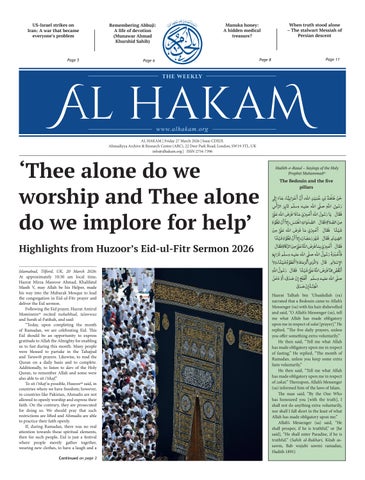
The Bedouin and the five pillars

Hazrat Talhah bin ‘Ubaidullah (ra) narrated that a Bedouin came to Allah’s Messenger (sa) with his hair dishevelled and said, “O Allah’s Messenger (sa), tell me what Allah has made obligatory upon me in respect of salat [prayer].” He replied, “The five daily prayers, unless you offer something extra voluntarily.”

He then said, “Tell me what Allah has made obligatory upon me in respect of fasting.” He replied, “The month of Ramadan, unless you keep some extra fasts voluntarily.”

He then said, “Tell me what Allah has made obligatory upon me in respect of zakat.” Thereupon, Allah’s Messenger (sa) informed him of the laws of Islam.

The man said, “By the One Who has honoured you [with the truth], I shall not do anything extra voluntarily, nor shall I fall short in the least of what Allah has made obligatory upon me.”

Allah’s Messenger (sa) said, “He shall prosper, if he is truthful,” or [he said], “He shall enter Paradise, if he is truthful.” (Sahih al-Bukhari, Kitab assawm, Bab wujubi sawmi ramadan, Hadith 1891)

This Week in History

27- March- 2 April

A glimpse into the rich history of the Ahmadiyya Muslim Jamaat

27 March

27 March 1923: Hazrat Maulvi Muhammad Din (ra), former headmaster of TI High School, Qadian and editor of The Review of Religions, the missionary designated for America, landed in Boston from England on this day. He reached Chicago on 29 March 1923. He took up his work in earnest under the guidance of Hazrat Mufti Muhammad Sadiq (ra).

To read more about him, see: ‘‘Pioneer Missionaries: Part 19 – Hazrat Maulvi Muhammad Din – Companion of the Messiah, resilient missionary and devoted individual’’ at www. alhakam.org (19 November 2024).

27 March 2004: On this day, Hazrat Khalifatul Masih V (aa) addressed the closing session of the Jalsa Salana of Burkina Faso. During the proceedings, Omar Moaz Sahib recited a poem based on the revelation of the Promised Messiah (as):

“Surely, I am with you, O Masroor.” (Tadhkirah [English], UK, 2019, pp. 1016)

This revelation was repeated in the poem and 13000 Ahmadi Muslims, together in one voice, repeated the revelation during the recitation of the poem. (Al Fazl, 9 April 2004, p. 4)

28 - 29 March

28 March 1999: On this day, Hazrat Khalifatul Masih IV (rh) led the Eid-ul-Adha at the proposed site of the Baitul Futuh Mosque, Morden, UK. (Al Fazl, 16 April 1999, p. 1)

29 March 2013: On this day, Hazrat Khalifatul Masih V (aa) inaugurated an Ahmadiyya mosque in Valencia, Spain. It was the second mosque of the Ahmadiyya Muslim Jamaat in Spain after the Basharat Mosque in Pedro Abad. (Al Fazl, 19 April 2013, p. 5)

30 March

30 March 1905: On this day, the Promised Messiah (as) appointed Hazrat Mufti Muhammad

Sadiq (ra) as the editor of Al Badr [later Badr] after the demise of Hazrat Babu Muhammad Afzal (ra). (Malfuzat [1988], Vol. 4, p. 251)

30 March 1984: On this day, Hazrat Khalifatul Masih IV (rh) encouraged members of the Jamaat who had retired from their jobs to devote their lives to the service of the Jamaat as waqifeen, to cater for the ever-expanding needs of Jamaat projects. (Khutbat-e-Tahir, Vol. 3, p. 173)

31 March

31 March 1906: The Paisa Akhbar was a popular Urdu newspaper published in Lahore, British India. The paper was established in 1887. On this day, the Paisa Akhbar published the Promised Messiah’s (as) prophecy about the upcoming heavenly signs and global sufferings:

[O friends, the days of earthquakes are nigh again.]

This prophecy, which was encapsulated in a poem, spread far and wide through the circulation of this newspaper. (Majmu‘ah Ishtiharat, Vol. 3, p. 551)

31 March 1972: On this day, Hazrat Khalifatul Masih III (rh) inaugurated Masjid Aqsa, Rabwah, with the Friday prayer. For more details, see “Masjid Aqsa, Rabwah”, at alhakam.org (22 October 2021, pp. 10-11).

31 March 1989: On this day, Hazrat Khalifatul Masih IV (rh) inaugurated an Ahmadiyya mission house in Galway, South Ireland, which he announced in his Friday sermon. It was the first journey of Huzoor (rh) in the second century of Jamaat. In the evening, a special reception was also held to mark the occasion, where many dignitaries participated. (Khutbat-e-Tahir, Vol. 8, p. 203; Silsila-e-Ahmadiyya, Vol. 4, p. 854)

1 April

1 April 1901: The Promised Messiah (as) was resolute in his efforts to spread the message

of Islam to the Western world. To attain this grand goal, alongside other schemes, he desired to publish a magazine, to manage which, he formed an association by the name AnjumanIshaat-e-Islam [Society for the Propagation of Islam]. It held its first meeting on this day. The association decided to name the magazine “The Review of Religions”, which has been published to date. Hazrat Hakim Maulvi Nuruddin (ra) was appointed the president of the Anjuman. (Tarikhe-Ahmadiyyat, Vol. 2, p. 165)

1 April 1953: On this day, the martial law authorities of Pakistan arrested Hazrat Mirza Sharif Ahmad (ra) and Hazrat Mirza Nasir Ahmad (rh) in Lahore, falsely accusing them of holding unauthorised arms. Following an imprisonment of about two months, both were acquitted by the courts, which found no evidence of criminal activity. (Tarikh-e-Ahmadiyyat, Vol. 15, p. 254)

2 April

2 April 1935: On this day, the Lahore High Court issued a ruling against the implementation of Section 144 in Qadian, which was imposed amidst the anti-Ahmadiyya agitation from the Ahrar. This meant that local Ahmadis were not allowed to move freely in town. The next day, The Civil and Military Gazette wrote the following:

“The restrictions which were imposed upon the residents of Qadian by the District Magistrate of Gurdaspur under Section 144 of the Criminal Procedure Code and which remained in force from 30 January to 30 March last were invalid, according to a judgement delivered by Mr Justice Currie of the Lahore High Court on Tuesday.” For more details, see “Historical analysis of Ahrar’s anti-Ahmadiyya agitation – Part 2” at alhakam.org (13 October 2023, p. 14).

2 April 1989:

In connection with the Jamaat’s centenary celebrations, on this day, Hazrat Khalifatul Masih IV (rh) participated in a discussion at the studio of LBC Radio with the representatives of the Christian and Jewish faiths. (Silsila-e-Ahmadiyya, Vol. 4, p. 854)

good time. However, Eid is not just for this purpose. It is a means of expressing gratitude to Allah the Almighty for enabling us to worship Him and make all these sacrifices.

Huzooraa said that he hopes most Ahmadis strove to reap the benefits of Ramadan, so that they may have increased in their taqwa, worship of Allah the Almighty, and doing good deeds. He said to continue to always pray to Allah the Almighty and ask Him for His help – that just as He allowed us to do good in this month, He may make such deeds a consistent and permanent feature of our lives. In this way, the benefits and blessings will not just be limited to Ramadan but extend to our daily lives.

We recite Surah al-Fatihah multiple times every single day – in it, we are reminded to strive to worship Him in the best way possible and to fulfil his commandments. In this Surah, the foundational attributes of Allah the Almighty are mentioned. We are taught to be grateful to Him in relation to these attributes. Also, to pray to become a part of those people who attained Allah’s pleasure, and not be like those who incurred His wrath and anger.

In the verse “Thee alone do we worship and Thee alone do we implore for help”, Allah the Almighty emphasises that the first step should be from us. We should strive in the way of Allah and try our best to worship Him in the best way possible, but the true power and ability to do so comes from Allah alone.

The Holy Prophetsa said that the one who takes a step towards Allah, Allah takes two steps towards him, and the one who walks to Allah, Allah runs to him. But we must remember that the first step should always come from us, and we should pray that Allah blesses our efforts. If we want to continue to benefit from the blessings of Ramadan, we must strive to continue our good deeds and pray for Allah’s help.

Huzooraa said he will present some enlightening points of tafsir of the Promised Messiahas on the verse “Thee alone do we worship and Thee alone do we implore for help.”

The Promised Messiahas writes:

“In the verse: We worship Thee alone and we implore only Thy help; We worship Thee; takes precedence over: We implore only Thy help; for, man approaches God, the Supreme, in prayer, after having involved all his faculties in the subject matter of the prayer. It would be impertinent and insolent on his part to come to Him without using his faculties and without observing the requirements of the Law of nature. For instance, if a cultivator were to pray to God to bless his field with a plentiful harvest without preparing it and sowing any seed in it, he would be guilty of insolence and mockery. This is what has been called testing and trying God and that is forbidden.

“[...] It is, therefore, necessary to employ all one’s faculties before submitting one’s petition and this is the real significance of this prayer. It is necessary that one should first take stock of one’s beliefs and effort. It is the way of God to bring about a desired change through change in the means. He creates some factor which becomes the means of the desired improvement.”

Huzooraa mentioned that some people question: if prayer exists, what is the point of

“No Prescription is Definitive

1899—The Promised Messiah (as) said: “In our household, Mirza Sahib (referring to his revered father, the late Mirza Ghulam Murtaza Sahib) practiced medicine for fifty years. He was well-renowned in the art of medicine, but he would say that there was no such thing as infallible cure. In reality, he was right, because without the permission of Allah Almighty, not a single particle that enters a human being can have any efficacy at all.”

These verses also urge towards confession and acknowledgement that we are weak and cannot carry out the duties of Thy worship without Thy help and cannot seek the ways of Thy pleasure without support and that we can act only with Thy help and can move only with Thy succour and hasten to Thee like mothers pining over the deaths of their children and like lovers who are on fire with love.

using means? Addressing this, the Promised Messiahas wrote:

“Those who consider that if prayer is available then means become irrelevant should ponder this seriously. They should realise that prayer is in itself a means which activates other means. The precedence of: We worship Thee alone; over: We implore only Thy help; which is a supplication, emphasises this.”

Huzooraa said that the Promised Messiahas emphasised that man’s effort should never decrease. We should not aim to do good deeds in Ramadan only and think that now it is incumbent upon Allah the Almighty to give us all we want – if not for the rest of our lives, then at least until the next Ramadan. This is an erroneous thought. A true believer must always strive to carry out these good deeds, and only then will they attain the true grace of Allah the Almighty.

Hazrat Musleh-e-Maudra gave the example of such a person. Once, during the month of Ramadan, he heard a man praying to Allah – he was telling Allah about all the hardship, pain and suffering he had endured in order to fast. Huzoorra said that, in reality, a believer does not feel pain when sacrificing or enduring hardship in the way of Allah. Even if the person’s intention was good, his choice of words could have been better. He explained that by enabling us to fast, Allah has actually done a favour upon us rather than us putting ourselves through pain for the sake of Allah.

Huzoorra said that had he himself made

such a prayer, he would first pray: O Allah, you enabled us and gave us the ability to do all this; now make this grace complete for us on Eid, so that these blessings remain constant and permanent. Had the person prayed in such a way, it would have been a beautiful prayer.

Hazrat Khalifatul Masih Vaa said that in a like manner, we should make such a prayer regarding Eid, that Allah allowed us to fast and carry out such good deeds in this month, now Allah show us the blessings attached to Eid – our true Eid will be when we see your oneness established in the world, and the message of the Holy Prophetsa and his devoted servant, the Promised Messiahas, and when we see the powers of dajjal be destroyed. This will be our haqiqi (true) Eid.

The Promised Messiahas writes: “Allah, Lord of Honour and Majesty, has placed the phrase: We worship Thee alone; before the phrase: We implore only Thy help; as a reminder of the grace of Rahmaniyyat (Divine Graciousness) before supplication. Thus the worshipper begins, as it were, with: Lord, I thank Thee for Thy bounties with which Thou hast favoured me long before my petitions and prayers and my deeds and efforts and my seeking help from Thy Providence (Rabubiyyat) and Graciousness (Rahmaniyyat) that precedes the supplication of a suppliant. Now I beg of Thee the strength, virtue, prosperity, success and aims that are bestowed only on supplication, prayer and begging for help, for Thou art the most munificent Bestower of bounties.”

The Promised Messiahas continues:

“These verses urge towards grateful appreciation of gifts that have been granted and towards steadfast supplication for that which is needful and towards eagerness for whatever is perfect and excellent so that the worshipper may be steadfastly grateful. They also urge towards non-reliance on one’s own competence and ability and towards throwing oneself before the Holy One in hope and expectancy, persisting in supplication and prayer in humility with glorification and praise, in a state between fear and hope, like a suckling infant in the arms of the wet-nurse, dead to the rest of creation and everything on earth.”

Another meaning highlighted by the Promised Messiahas is regarding humility:

“These verses also urge towards confession and acknowledgement that we are weak and cannot carry out the duties of Thy worship without Thy help and cannot seek the ways of Thy pleasure without support and that we can act only with Thy help and can move only with Thy succour and hasten to Thee like mothers pining over the deaths of their children and like lovers who are on fire with love.

“They urge also towards discarding pride and arrogance and towards holding fast to the power and might of Allah when affairs become involved and hardships pile up and towards joining the company of those who are lowly of heart as if the Lord of glory were saying: O My servants, regard yourselves as corpses and ever seek strength from Allah. Let not a youth take pride in his vigour, nor

(Malfuzat [English], Vol. 2, pp.174)
Hazrat Mirza Ghulam Ahmadas, In His Own Words

an old one rely on his staff, nor a wise one feel elated with his intelligence nor a scholar trust in the accuracy of his knowledge, or the soundness of his understanding or the keenness of his intellect, nor let a recipient of Divine revelation depend for support on his inspiration and revelation and the fervour of his prayers. Allah does what He pleases, rejects whom He pleases and admits among His chosen ones whom He pleases.”

The Promised Messiahas continued:

“The phrase: We implore only Thy help; warns of the great wickedness of the evil-prompting ego which frisks away from virtue like the unbroken she-camel from its would-be rider, or which is like a vicious reptile who cleans up its victim like a bleached bone, emitting venom all the time, or is like a lion who is not diverted once it leaps. There is no power, no strength, no earning and no substance except with the help of Allah Who annihilates the satans.”

Huzooraa said that this is the state of the Muslim world at large nowadays. They must turn to Allah alone and seek his help.

The Promised Messiahas states:

“There are other implications in placing: We worship Thee alone; before: We seek only Thy help; which we propose to set down here for the benefit of those who are enamoured of the verses of the Fatiha, and not of the music of guitars, and run to them like eager devotees. Allah here teaches His servants a prayer which is a source of happiness for them and says, in effect: O My servants, beg of Me with humility and in lowliness of spirit: Our Lord, we worship Thee alone, but we have to struggle hard and have to grapple with affectation and remorse and distractions and satanic insinuations and confusing ideas and superstitions and dark thoughts like the muddy waters of a flood, and like one who gathers fuel in the dark we follow only conjecture and we are not firmly anchored in faith. In this situation we seek only Thy help. We beg Thee for the gift of keenness, eagerness and readiness of heart and overflowing faith and spiritual response and joy and light and for embellishing our hearts with the decor of truth and the garments of delight, so that, by Thy grace, we may win through to certainty of faith, and achieve our highest goals and arrive at the ocean of Reality.”

An additional meaning is regarding complete obedience of Allah the Almighty. The Promised Messiahas writes:

“In the phrase: We worship Thee alone; Allah, the Supreme, urges His servants to put forth, in their obedience to Him, the utmost energetic effort, standing upright, constantly responding to His call, with: Lord, we spare no pains in our striving and in observing Thy commands and in seeking Thy pleasure; but we seek Thy help and Thy protection against pride and self-esteem and beg of Thee to grant us the strength that would lead us to Thy guidance and to winning Thy pleasure. We are firm in our obedience to Thee and in Thy worship; so write us down among those who submit to Thee. There is yet another point to be noted in this context. The worshipper declares: Lord, we have adopted Thee alone for worship, preferring Thee over all else and we adore nothing save Thy countenance and we believe in Thy Unity.”

In these verses, to remember one’s brethren in prayer is also emphasised:

“In this verse, Allah, the Lord of Glory and Majesty, has instructed the use of the first person plural, conveying thereby that this prayer is for the benefit of all brothers and not only for the benefit of the supplicant. Thus Allah urges the Muslims towards mutual accord, unity and love and requires that a supplicant should put himself to hardship for the promotion of his brother’s welfare as he would put himself to hardship for the promotion of his own well-being and should concern himself with and strive to meet his brother’s needs as he is concerned with and strives to meet his own needs, making no distinction between himself and his brother, and should be his brother’s well-wisher, with all his heart as if Allah, the Sublime, had commanded: O My servants, give one another gifts of prayer as brothers and friends exchange gifts, and widen the scope of your prayers and your motives and your aims, making room in them for your brethren and become like brothers and fathers and sons in mutual affection.” (Karamatus Sadiqeen, pp. 77-80)

Hazrat Khalifatul Masih Vaa said that we should all aim to widen the scope of our prayers in this manner, and when this happens, it will create a beautiful atmosphere and society.

It is the desire of opponents and enemies of Islam that Muslims continue to fight with each other – we must unite to escape this. Huzooraa said he mentioned this two weeks ago, and that when Muslims do unite, this will be our haqiqi (true) Eid.

Huzooraa narrated an incident of Hazrat Musleh-e-Maudra, when he was returning from Hajj on a ship. The captain told him that his assistant was interested in Islam and wanted to convert, and hence he wanted Hazrat Musleh-e-Maudra to speak to him.

Huzoorra went to the captain’s room, where he showed Huzoorra around and served him tea also. In the conversation, Huzoorra sensed a hint of jest in his voice. The captain said to Huzoorra: Now that you have done your Hajj, you can do whatever you wish. Huzoorra asked how that was possible, to which the captain replied that his first slate (of sin) is now clear. Hazrat Musleh-eMaudra asked the captain: When a person wears a new suit, does he take care of the new suit more, or his old, worn-out clothes? The captain answered the new suit, to which Huzoorra said: So then, how are you giving this advice? The new suit I have received from doing Hajj, shall I ruin it or continue to do more good?

Hazrat Musleh-e-Maudra, mentioning this example, explained that when Allah enables man to do some good, he must tread very carefully. Robbers only go after treasure – something which is worth robbing. If during Ramadan you have performed good deeds, be prepared for Satan’s attack. Satan is relentless in this attack, and like robbers, if he cannot steal your treasure, he desires to burn the entire house down so that the treasure is destroyed.

Now we must strive to protect our good deeds even more, instead of becoming complacent and thinking we have done enough. We must ask Allah for help so that Satan never attacks us in such a way, and that no robber may ever take this treasure away from us. If we pray for this and strive to implement this habit of constantly protecting our good deeds, then this will be

a successful Eid for us.

In the end, Hazrat Khalifatul Masih Vaa said, while we celebrate Eid, we must remember those Muslims who are doing Eid in circumstances where their houses have been destroyed, children have lost parents, parents have lost children, and they are living in constant fear for their lives.

Huzooraa prayed that may Allah improve their circumstances and enable them to turn solely to Allah and rely on Him alone, rather than on worldly powers. What is happening in Arab countries today is a result of this reliance on worldly powers. May Allah

protect everyone, including the Ahmadis suffering for their faith, from oppression. Huzooraa said we must remember the prayer “Thee alone do we worship and Thee alone do we implore for help”. Our true Eid will be when we see the world turning towards monotheism, and towards the message of the Holy Prophetsa and his servant, the Promised Messiahas Huzooraa prayed, “May Allah make this Eid blessed, in both a worldly and spiritual sense, and make this Eid truly mubarak (blessed) for us. Amin.

NEWS

Saskatoon Southwest Jamaat hosts interfaith symposium on ‘peaceful coexistence’

Canada Correspondent

Jamaat-e-Ahmadiyya Saskatoon, Southwest Canada, organised a World Religion Day interfaith symposium on the theme of “peaceful coexistence” at the Baitur Rahmat Mosque on 23 January 2026. The event brought together individuals from diverse faiths and backgrounds to engage in meaningful dialogue and strengthen the bonds of understanding within the community. Several world religions were represented by their respective scholars, including Christianity, First Nations, Hinduism, Islam and Sikhism.

Among the distinguished attendees were

First Nations Elder Ben Audrey; Saskatoon Police Chief Cameron McBride; Canadian Senator Tracy Muggli; Member of the Legislative Assembly of Saskatoon Darcy Warrington; and Deputy Mayor of the City of Saskatoon Randy Donauer. The symposium featured insightful discussions highlighting the importance of compassion, respect and cooperation in building a harmonious society. Speakers emphasised that peaceful coexistence is not only a shared responsibility but also a pathway toward stronger, more resilient communities. Around 90 non-Ahmadi guests were welcomed at the event, reflecting the strong interest in interfaith collaboration and mutual respect.

‘Iftar with a Muslim’ event held in Norway

On 26 February 2026, Majlis Khuddam-ulAhmadiyya Norway, in cooperation with Lajna Imaillah Norway, hosted the “Iftar with a Muslim” event at the Baitun Nasr Mosque in Norway. The event brought together guests from diverse backgrounds to experience the spirit of Ramadan and to foster understanding, dialogue and unity.

The evening began with the opening of the fast at sunset, followed by the Maghrib prayer and a recitation from the Holy Quran. This was followed by opening remarks by Sadr Majlis Khuddam-ul-Ahmadiyya Norway, Unib Sarwar Sahib, who warmly welcomed the guests and emphasised the importance of creating spaces for dialogue and mutual respect. Then, an address was delivered by the Mayor of Oslo, Anne

Lindboe, whose presence highlighted harmony, integration and understanding in Norwegian society.

Following the meal, guests attended an engaging and informative presentation about Ramadan, explaining its spiritual significance and practices. This was complemented by a video showing Ramadan from the perspective of Muslim children, which offered a joyful, personal and relatable insight into the holy month.

The programme concluded with a short speech by Amir Jamaat Norway, Zahoor Ahmad Chaudhry Sahib, who spoke about the universal values of peace, compassion and unity. He then led everyone in silent prayer.

With seating arrangements for 220 people, the mosque hall was filled to capacity. Several guests shared their positive experiences on social media, including STL Oslo.

US-Israel strikes on Iran: A war that became everyone’s problem

Ataul Fatir Tahir

Lecturer Jamia Ahmadiyya UK

The US-Israel war against Iran is already being felt far beyond the region. In both the West and the East, their effects are showing up in everyday life – most immediately in our wallets, as rising oil and gas prices push up fuel and energy bills.

For more than two decades, Hazrat Mirza Masroor Ahmad (aa), the current Caliph of the Ahmadiyya Muslim Community, warned of the growing risk of a global war – often dismissed as pessimistic. Today, however, talk of “World War Three” is no longer fringe; it is becoming part of mainstream political discourse.

Alongside this, he consistently emphasised a crucial point: that even smaller, regional conflicts would not remain contained but would have far wider consequences in an interconnected “global village”.

That warning went largely unheeded and is now playing out in real time, as the effects of the US-Israel war against Iran are being felt far beyond the region.

Thirteen years ago, in the Houses of Parliament, London, His Holiness (aa) warned:

“The world has become a global village and so a lack of mutual respect and a failure to join together to promote peace will not only harm the local area, city or country but in fact will ultimately lead to the destruction of the entire world.” (World Crisis and The Pathway To Peace, 2017, p. 149)

He said: “[…] it is essential that they

always keep in mind the critical point that it is from local wars that devastation and destruction spreads far and wide.” (Ibid., p. 162)

His Holiness (aa) had stressed that in an interconnected world, distance offers no protection. Conflict in one region inevitably spreads until its effects are felt far beyond its origin.

Speaking on modern warfare in 2015 in Tokyo, Japan, he said:

“Conflicts in one part of the world do not remain limited or local, rather their effects and consequences spread much further afield. […] In the olden days, it was possible for a war to remain confined to those who were directly involved, but now the consequences of each conflict and each war are truly global. In fact, for many years I have been warning that the world should realise that the effects of a war in one region can and will affect the peace and harmony of other parts of the world.” (Ibid., p. 191)

Events have followed that exact pattern.

Within days of the US-Israel attacks on Iran, Iran moved to restrict the Strait of Hormuz – a global chokepoint through which roughly a fifth of the world’s oil and gas passes; disrupting around 20% of global energy flows.

As a result, petrol and diesel prices rose sharply. According to the IMF, oil prices have jumped by more than 50%, climbing above $100 per barrel amid the disruption.

World leaders are now warning of wider consequences. Spain’s Prime Minister, Pedro Sánchez, stated:

“We stand at a global tipping point.

Further escalation could trigger a long-term energy crisis for all humanity. The world should not pay the consequences of this war.”

The disruption is not limited to shipping routes. Israeli strikes have hit key Iranian energy sites, including the South Pars gas field, while US attacks targeted infrastructure around Kharg Island, Iran’s main oil export hub.

Iran retaliated by launching strikes on Gulf energy infrastructure and warned that regional oil and gas facilities could become targets.

The escalation has already spread further. Damage to LNG infrastructure in Qatar – one of the world’s largest gas exporters – forced production halts, placing a significant share of global supply at risk.

These shifts are already being felt in everyday life. Gas prices in Europe have surged, with the UK market hitting threeyear highs.

For households, this means higher heating and electricity bills. For businesses, it means higher production and transport costs – costs that are ultimately passed on to consumers.

The global food supply may also be severely affected. Modern farming runs on fertiliser and fertiliser is made using natural gas. When gas prices rise or supplies are disrupted, fertiliser becomes more expensive and harder to produce.

At the same time, supply is being physically choked as around one-third of the world’s fertiliser trade passes through the Strait of Hormuz, so any disruption there

means less fertiliser reaching global markets.

Supply of fertiliser is tightening further as major producers like China restrict exports:

The result is simple. Farmers get less fertiliser and pay more for it. They use less. Crops produce less. Food becomes more expensive.

This is precisely the pattern Hazrat Mirza Masroor Ahmad (aa) has warned about for years. But his warning did not stop at pointing out what could happen, but he also pointed to a cause.

He repeatedly emphasised that global instability is rooted in a failure of justice. In his words:

“[…] the requirements of justice are only fulfilled when all parties and all people are treated equally.” (World Crisis and The Pathway to Peace, 2017, p. 163)

And he warned clearly:

“If the requirements of justice are not fulfilled, the conflagration and flames of these local wars can escalate and embroil the whole world.” (Ibid., p. 12)

It’s clear that the US-Israel attacks on Iran were outside the bounds of justice and the consequence is a lack of peace for the whole world.

What leaders need to understand is that in a globalised world, wars do not stay where they start, they spread through our global village whether through supply chains or even sophisticated long-range weapons. And as was warned: no one is insulated from the consequences.

Remembering Abbuji: A life of devotion (Munawar Ahmad Khurshid Sahib)

They say that time does not stop, but life continues. This is a truth that only becomes fully apparent after the demise of a loved one. My father, the late Munawar Ahmad Khurshid Sahib, was a missionary, a devotee of Khilafat, a teacher, a visionary and a mentor. For his children, he was simply “Abbuji”. Friends and family members have often asked me to write about him. I always hesitated, not knowing where to begin, but I pray that this piece will serve as a means of keeping Munawar Ahmad Khurshid Sahib in your prayers.

Those who remember Khurshid Sahib will recall a man who met others without a trace of worry on his face, with a radiant smile that touched the hearts of so many. Yet behind this smile was someone who was very unwell: He had been on dialysis for over 10 years and had to visit a dialysis centre three times a week. He would wake in the early hours of the morning and a taxi would take him to the centre, where the entire process would take around five hours. He had undergone open-heart surgery and continued to struggle with serious health issues. Not long before his demise, he also had a finger amputated due to gangrene.

But Abbuji was never fazed by any of this. If ever asked how he was, he would often jokingly reply, “I am fine, but more importantly, I am concerned about your health.” He remained very cheerful and his infectious smile, kindness and love for others were constant features of his life.

The more I reflect on Abbuji’s love and care for the Jamaat of the Promised Messiahas, the more I realise how deeply he understood the personal struggles of others. As a senior missionary, he felt that it was his primary duty to provide help and comfort to those around him. For this reason, he would put his own worries aside and make the other person the focus of his attention.

The love and concern he showed to others were returned to him in equal

measure. One incident from those years has remained with me ever since.

I was still in Jamia when Abbuji suffered a heart attack. When I went to visit him in hospital, he was fast asleep, clearly still under the effects of his medication. Standing next to his bed was a member of his local Jamaat, quietly praying for him, with tears streaming down his face. After a while, he gently kissed Abbuji’s forehead.

I graduated in 2013 and have served as a field missionary since then, but this incident remains etched in my mind. It was at that moment that I truly understood that Ahmadiyyat is indeed one family.

A moving dream

The day Abbuji passed away, I received a message from a dear friend and missionary, Abdullah Dibba Sahib. I sought his permission to include this message in the article.

“Assalamu Alaikum wa Rahmatullah, my good brother!

“I literally woke up from a dream in which someone told me on a phone call that my father had passed away. I was terrified but smiling. And I wondered why I was smiling.

“Then I opened my eyes and realised that it was a dream. A few minutes later, I picked up my phone because I was still a little nervous. And the first thing I see is a message from Tahir Khalid Sahib about the passing of Maulana Sahib. ‘Innaa Lillahi wa Innaa Ilayhi Raji‘un’.

“Immediately, I said to myself, ‘Indeed, a father of mine has passed away.’ He lived a great life that has to be celebrated.”

Abdullah Dibba Sahib is a missionary of the Jamaat from the Gambia, a small country in West Africa, where Abbuji served as a missionary for many years. Abbuji was a fatherly figure to many, a constant presence in people’s lives despite his ill health.

Unexpected journey to Pakistan

Given his health issues, it was difficult for him to travel and, as such, his journey to Pakistan, where he passed away, was all the more surprising. My mother recalls how he would watch videos online of the place where he grew up and longed to return there; none of us expected him to make the journey.

I recall calling him shortly before his departure to Pakistan. Naturally, I was worried about his health, but he simply replied that it was time to offer his salaam at the graves of his late parents.

He was due to fly back from Lahore and had travelled from Rabwah to Lahore in preparation for his return when he became unwell. He was rushed to hospital and later transferred back to Tahir Heart Hospital. He passed away soon after.

Beloved Huzoor’saa tribute

On 31 March 2023, when beloved Huzooraa mentioned Abbuji in his Friday sermon, I

found myself in awe of the man Huzooraa was describing. My mind went back and forth, reflecting on what a great devotee of Khilafat he was and how fortunate we, his children, were to have witnessed the life of this great servant of Ahmadiyyat so closely. In his Friday sermon, beloved Huzooraa paid tribute to his life of service in the following words:

“At present, I would like to speak about a few deceased members, the first of whom is a missionary of the Jamaat who fulfilled his devotion with exceptional faithfulness. He was an exceedingly humble man who had the opportunity to serve for a long time, living up to the true standard of rendering service. His name is Munawar Ahmad Khurshid Sahib and he served as a missionary in Western Africa. He passed away a few days ago.” (“Ramazan and The Holy Quran”, Friday sermon, 31 March 2023, www.alislam.org)

Our mother commented on the sermon, saying, “It seems that I didn’t know your father well enough.” This feeling resonated deeply within all of us. Many missionaries remarked that he was a simple person. It was only after Huzooraa shed light on his services that we came to realise the qualities of Khurshid Sahib. As we walked out of Masjid Mubarak that day, it all felt surreal.

A miracle and a promise fulfilled

In his Friday sermon, beloved Huzooraa also referred to the remarkable circumstances surrounding our father’s birth:

“All the children born to the parents of Munawar Ahmad Khurshid Sahib would fall ill and pass away. When he [Munawar Ahmad Khurshid Sahib] was born, he also fell ill. There was no hope in sight and so his grandfather, Mian Abdul Karim Sahib, who was a Companion [of the Promised Messiahas], decided to dedicate the child’s life to God’s way. His reasoning was that if God required the child, He would save him. Nonetheless, in the same instance, a doctor who lived in a far-off village came to their village. He administered treatment, and through a miracle, Allah the Almighty cured him.” (Ibid.)

As my grandparents feared the worst and thought that their son might also pass away, as the children before him had, they pledged that if he survived, they would devote his life to the service of Islam. This shows the strength of their faith and trust in Allah.

When Abbuji completed his basic studies, my grandmother fulfilled the pledge she had made to Allah, despite the concerns of many people who felt that he should not go to Jamia Ahmadiyya and should instead assist his father on the family farms. My grandmother remained firm, saying that she had not forgotten her oath to Allah and that nothing would stand in the way of his service to Islam.

As Abbuji was the eldest child, much was expected of him. In an environment where poverty was common and life was

a struggle, the promise made to Allah was nevertheless upheld and Abbuji devoted his life to the service of Islam Ahmadiyyat.

Simplicity and sacrifice

Even in places where he could have stayed at nearby hotels, he preferred to rest in mosques, often without electricity and while enduring mosquitoes through the night.

A mu‘allim from the Gambia once told me that he had travelled with Khurshid Sahib to a very remote village where the hosts could only offer unfiltered water, served in a single cup shared by both guests and hosts. The mu‘allim admitted that he felt hesitant to drink from it, mostly out of concern for hygiene. However, when he saw Khurshid Sahib drink from the same cup without the slightest hesitation, it gave him the courage to do the same. Incidents like this reflected Abbuji’s simplicity and humility, as well as the respect he showed for the people and customs of the communities he served. It was this perseverance and sacrifice that led many to accept the message of Ahmadiyyat.

A blessed dream

Beloved Huzooraa further narrated:

“His father-in-law, Muhammad Khan Darwesh Sahib, also saw a dream about him that he was on a towering and brilliant minaret. Upon this, the darwesh told him that he would illuminate the minaret of Ahmadiyyat and render great services. Thus, Allah the Almighty enabled him to do so.” (Ibid.)

Huzooraa then drew attention to the hardships he endured in the field:

“There were some places where even motorcycles, etc., were not available, so he travelled long distances on donkey carts and visited various villages.

“In fact, some of the missionaries who are currently serving there now, say that when they went to these villages, the people mentioned that a long time ago, Maulana Munawar Ahmad Khurshid Sahib used to visit them and did so in very difficult circumstances. And so, he would travel to these areas and preach there.” (Ibid.)

It might seem remarkable that someone would travel on a donkey cart in the scorching heat to propagate the message of Islam Ahmadiyyat, but Abbuji undertook many such journeys. Hifazat Naveed Sahib, a missionary of the Jamaat, arrived in a village where he believed the message of Islam Ahmadiyyat had not yet reached. When he got there, he was met by an elderly gentleman who said that he was already an Ahmadi and went on to recall that a missionary had arrived 20 years earlier on a donkey cart with the message of Ahmadiyyat. He had accepted Ahmadiyyat there and then lost contact with other Ahmadis for 20 years; such was his conviction that, despite not meeting another Ahmadi for the next 20 years, he remained steadfast in his belief in the truth of the Promised Messiahas

Abbuji used to recount a story about his

Muhammad Ahmad Khurshid Missionary, UK

first Eid in the Gambia, while serving in a distant town far from the capital. His family was still in Pakistan and, as Eid approached, he wanted to travel to the city to meet other Ahmadis and celebrate with them. He stood by the dirt road for hours, waiting for a car or any other form of transport. Eventually, a truck carrying livestock stopped and the only available space was among the animals.

I sometimes picture someone on Eid day sitting among livestock and travelling for many hours just to arrive and meet his friends and Jamaat members.

Abbuji never recounted these incidents to highlight the hardships he faced. Rather, they were always lessons for us – that humility and the opportunity to serve the Jamaat are great blessings from Allah, which He bestows upon His servants.

Obedience to Khilafat

Highlighting his deep obedience to Khilafat, beloved Huzooraa said:

“The spirit of obedience to the Khalifa of the Time was deeply rooted within him. I have observed this as well: when he came here [to the UK], he had been very ill for the last 10 years, but despite his ill health, whenever he was assigned any work, he would immediately try to fulfil it.” (Ibid.)

Abbuji lived a life of complete obedience to Khilafat. A remarkable example of this came when, as he was approaching the age of 70, he was assigned a new task by Huzoor-e-Anwaraa. By this stage, Abbuji had already undergone major bypass surgery and multiple angiographies and, later, suffered from gangrene, which resulted in the amputation of one of his fingers. Most difficult of all, he was undergoing dialysis three times a week.

It was during this period that he was instructed to go to Spain and deliver the message of Islam Ahmadiyyat to people who had migrated there from West Africa. I saw a renewed passion awaken in him. He became completely engrossed in the task ahead and his illnesses no longer seemed to hinder him. He travelled to various cities across Spain for this purpose. The Jamaat arranged dialysis for him at each destination and he continued his mission as though he

were a young man, fully fit and able.

Here, I must also mention my mother. Given Abbuji’s fragile health and the number of medications he had to take throughout the day, our mother accompanied him on every trip to Spain. She travelled with him from city to city and remained by his side while he met people and spoke to them about Ahmadiyyat, ensuring that he remained well enough to continue. Amiji cared for Abbuji with great devotion until the very end. Together, they were fully devoted to the task given to Abbuji by Huzoor-e-Anwaraa

Further emphasising this spirit of obedience, beloved Huzooraa said:

“Nonetheless, he rendered a great service in Spain and established a jamaat there as well. He had a true passion to propagate the teachings of Ahmadiyyat, the true Islam. It is absolutely true that, alongside this, he was very humble. When I asked him to go to Spain, he went without presenting any excuse, even though he was unwell at the time.”

Opening a shop: A creative approach to tabligh

Huzoor-e-Anwaraa referred to an incident shared with him by Raja Burhan Ahmad Sahib, a professor at Jamia Ahmadiyya UK:

“Towards the latter part of his life, when he was very ill and was having to undergo dialysis daily, he met me once at a wedding and said, ‘I have opened a shop.’ I asked him what he meant by opening a shop and he said, ‘I am at home and so I have placed a table outside and in the summer, I put out some water along with Jamaat literature. If they require it, I provide water to those passing by and give them some literature along with it.’ He did not sit idle during his illness, but even then, he found a new way of preaching.” (Ibid.)

An excellent muballigh

A muballigh is a preacher. Abbuji was highly effective in conveying the message of Islam Ahmadiyyat. He fully followed the guidance of the Holy Quran to deliver the message with wisdom.

Huzoor-e-Anwaraa referred to what Salman

Even in this state, he remained eager to continue his work as a missionary. He began learning to type with the help of various Jamia students because he wanted to write a book based on his experiences in Africa. Such was his passion that he would search for each letter on the keyboard, press it and continue this process for hours on end. Slowly but surely, the book was completed and later published. Abbuji was never one to sit idle.

As his proficiency in typing grew, he went on to write multiple books and articles. It still surprises me to this day how he went from slowly searching for each letter on the keyboard to eventually publishing several books.

A fatherly figure

As a teacher in Jamia Ahmadiyya, he primarily taught the history of Islam and Ahmadiyyat to students. Teaching was not merely a responsibility for him; it was something he approached with great sincerity and care.

Salmi Sahib from Spain wrote to Huzooraa:

“‘During his visits to Spain, I had the chance to accompany him on many tabligh endeavours. The astonishing thing I saw was that he would be able to strike up a conversation with any African passerby and get to know them. In a short space of time, he would be able to form a good connection with them. He would then say that the individual was from such-and-such a village and the villages around that area are such-and-such and that those people are very sincere. He knew influential people of different areas. Since he would be conversing in various African languages, people would be inclined to listen to him. They would be astonished and also happy. After two or three meetings, he would form a bond with them and then give them the message of the Jamaat.’ He says that he would not preach to them in the first meeting; he would first establish a personal connection and then, on the second or third visit, he would preach to them about Ahmadiyyat. He says that through his personal connections and his morals, the groundwork would be completed and then later people would readily pledge allegiance.” (Ibid.)

A few months before his demise, I met a Senegalese man and began speaking with him about Senegal while I had Abbuji on a video call. Abbuji asked him where he was from and he mentioned the capital city. Abbuji then told him that, from his features, he could tell that he was actually from another part of the country. This completely took him by surprise. Abbuji then asked him to name his village and a few elders from the area. Abbuji went on to say that he knew one of those elders and the man’s expression of sheer disbelief was unforgettable. I met him again on another occasion and the first thing he asked me was whether he could speak to Abbuji once more.

Typing with one finger

Dialysis is a very painful and lengthy process that requires repeated visits to hospital several times a week, often for many hours at a time. As Abbuji’s kidneys were no longer functioning properly, he had to endure this demanding procedure several times a week.

It was only after he passed away that many missionaries reached out to me and said that he had played a key role in their personal growth. Several shared how, during their years in Jamia, they would often approach him when facing personal or academic challenges. In their times of difficulty, they found in him a compassionate teacher who listened patiently, offered sincere advice and encouraged them to remain steadfast in their service to Islam.

For many of them, Abbuji was not only a teacher in the classroom but also a mentor who helped shape their character and outlook as future missionaries. Even years after graduating from Jamia, they remembered him with deep affection and gratitude for the guidance he had given them during their formative years.

Duty to the very end

Abbuji had just suffered an almost fatal bout of pneumonia in November 2022. Whilst he was in hospital in London, all his family came to visit him, as his health had deteriorated greatly. One day, as he began to feel better and was able to sit up, he asked for the thesis of a Jamia student that he had been assigned to review and began marking it. It was surreal for me to witness first-hand that, after such a difficult phase in his life, the first thing that came to his mind was the responsibility he still had to fulfil.

A blessed end

“O soul at rest, return to thy Lord, thou well pleased with Him and He well pleased with thee. So enter among My chosen servants and enter My Garden.” (Surah al-Fajr, Ch.89: V.28-31)

There could be no better way to conclude than with the prayer offered by beloved Huzooraa:

“May Allah the Almighty continue to grant the Jamaat such loyal and devoted missionaries who render services selflessly and fulfil their tasks. May Allah elevate his rank [in paradise].” (Ibid.)

Manuka honey: A hidden medical treasure?

Honey is widely recognised and valued across the globe. It is also very important to Muslims, as it is mentioned in the Holy Quran as a cure and also as a reward in paradise. Allah the Almighty states:

“A description of the Garden promised to the righteous: therein are rivers of water which corrupts not; and rivers of milk of which the taste changes not; and rivers of wine, a delight to those who drink, and rivers of clarified honey.” (Surah Muhammad, Ch.47: V.17)

Honey is also mentioned as a cure in the following verse:

“‘Then eat of every [kind of] fruit, and follow the ways of thy Lord [that have been] made easy [for thee].’ There comes forth from their bellies a drink of varying hues. Therein is cure for men. Surely, in that is a Sign for a people who reflect.” (Surah anNahl, Ch.16: V.70)

It is important to understand how honey can benefit patients and how it can potentially serve as a cure for several medical diseases. The scope of this article will be mainly focused on Manuka honey due to its medicinal advantages, such as anti-bacterial and anti-viral effects. It is also important to outline how to use Manuka honey for the best results.

Origins of Manuka honey

Manuka honey originates mostly from New Zealand and Australia. The nectar used in this honey comes from the flowers of the Manuka tree (Leptospermum scoparium).

The Maori people of New Zealand were among the first to use the Manuka tree for its medicinal benefits, brewing its leaves into tea and creating ointments to treat various ailments.

In the 19th century, Europeans introduced bees to the locals and they began producing honey from the nectar of the Manuka tree flowers. Manuka honey is a thick, dark and monofloral honey with an exceptional taste. Interestingly, honey with a darker colour tends to have a higher antioxidant content.

In the late 1980s, Dr Peter Molan, a New Zealand biochemist, scientifically confirmed Manuka honey’s powerful antibacterial and medicinal benefits, solidifying its reputation as a potential natural remedy with widespread health applications.

Science behind Manuka honey and its applications

Research shows that Manuka honey contains MGO (methylglyoxal), which is a special chemical compound known to be highly reactive. It is mainly formed during the metabolism of sugars in Manuka honey and interacts with several proteins and amino acids. These chemical reactions due to MGOs can damage bacteria, viruses and inhibit their growth and destroy their cellular structures (which they need to multiply). There are different kinds of MGOs present in Manuka honey.1 The higher the MGO, the higher the potency of the Manuka honey.2 They can be divided into different categories and different uses for each health condition.

The classification can vary, depending on the country. In this article, we will use the Manuka honey guide strength chart from BIOSOTA as a guideline.3 The main focus will remain on the MGO classification (instead of NPA/ULF).

The above chart advises the suggested use of the responding MGO for the following – which we will discuss with research and scientific articles.

Skin health, immune health, cancer and flu

Manuka honey (everyday strength) can be considered for daily strength, such as skincare and immunity.

In a review, honey in general shows promise in multiple dermatologic contexts (wounds, burns, tinea, seborrhea, dandruff, psoriasis) largely due to antimicrobial activity (via e.g., hydrogen peroxide release, phenolic compounds, methylglyoxal) and anti-inflammatory effects.4

Another study found that in a skincare product containing Manuka honey and royal jelly, there were significant improvements in fine lines, wrinkles, hyperpigmentation, dryness and overall skin health over eight weeks.5

In general, honey can also have a positive effect on immunity. A review published in 2021, describes how honey in general has modulatory effects on immune cells, via anti-oxidant, anti-inflammatory and possibly direct immune cell activation pathways.6 Honey has been shown to suppress cancer cell growth by promoting apoptosis (cell death) and exhibiting anti-proliferative (anti-growth) and antimetastatic (anti-spreading) effects.

If we focus deeper on Manuka honey, a study in 2022 showed that in mice (in-vitro), administration of manuka honey induced changes in immune cell populations (e.g., increased neutrophils (white blood cells) indicating modulation of innate immune responses.7

In another study, Manuka honey shows

promising antitumor effects in preclinical breast cancer models in these mice (invitro), meaning supporting the immune system in the fight against cancer cells.8

This basic medicinal strength dosage, MGO 300+ to 990+, can help fight bacterial and viral infections, which are responsible for flu and cold symptoms.9

Respiratory health

Recent studies have explored its potential role in managing respiratory tract infections, including chronic bacterial and acute viral infections. In a randomised controlled trials on chronic rhinosinusitis have shown that Manuka honey nasal irrigations can reduce bacterial colonisation and improve sinonasal symptoms compared with saline or standard treatments. These findings indicate that topical Manuka formulations may serve as safe, feasible adjunctive therapies for persistent upperairway bacterial infection.10,11

Laboratory investigations provide stronger mechanistic support. In vitro and ex vivo lung models demonstrated that Manuka honey disrupted Pseudomonas aeruginosa biofilms and enhanced the antibacterial efficacy of conventional antibiotics. Additional studies confirmed activity against Staphylococcus aureus and P aeruginosa biofilms relevant to chronic airway disease.12 Histologic evaluations further suggest that Manuka honey is well-tolerated by respiratory mucosa at therapeutic concentrations.13

Regarding viral infections, in vitro research reported inhibition of influenza A and B virus replication by Manuka honey, improving host-cell survival and reducing viral yield.14 Reviews of honey’s bioactive compounds also emphasise Manuka’s superior antiviral and immunomodulatory properties, likely due to its phenolic content and MGO-mediated oxidative stress modulation.15

Collectively, these findings indicate that Manuka honey exhibits potent antibacterial, antibiofilm, and antiviral activities that could aid respiratory health, particularly as an adjunctive therapy to antibiotics or antiinflammatory agents.

Oral care and digestive health

The high medicinal strength MGO 500+ to 900+ can be used in oral care and digestive health.

A study published in the Swiss Dental Journal demonstrated that Manuka honey exhibits potent antibacterial activity against key oral pathogens (including Streptococcus mutans, Porphyromonas gingivalis and Aggregatibacter actinomycetemcomitans). These microorganisms are commonly associated with dental plaque and gingivitis. The authors concluded that the regular use of Manuka honey may contribute to improved periodontal health through inhibition of these pathogenic bacteria.16

Recent research suggests that Manuka honey may also benefit the gastrointestinal tract through multiple mechanisms, including inhibition of pathogenic bacteria,

protection of gastric mucosa, modulation of inflammatory responses and maintenance of a balanced gut microbiota.

The gram-negative bacterium Helicobacter pylori is implicated in the development of gastritis, peptic ulcer disease and gastric carcinoma (stomach cancer). Early in vitro studies demonstrated that Manuka honey inhibited the growth of H pylori strains isolated from gastric biopsies, showing minimal inhibitory concentrations comparable to standard antibiotics.17

Experimental models support a protective role of Manuka honey against gastric mucosal injury. In an in vitro study, it demonstrated that rats pretreated with Manuka honey exhibited significantly fewer gastric lesions following ethanol or indomethacin exposure.18

A balanced gut microbiota plays a pivotal role in digestion and intestinal barrier integrity. One study about microbiota demonstrated that Manuka honey derived oligosaccharides selectively stimulated Bifidobacterium longum and Lactobacillus acidophilus in vitro, indicating a potential prebiotic effect that supports gut microbiota balance and assist digestive health.19 These polyphenol-rich honeys, including Manuka, enhanced short-chain fatty acid production, thereby improving colonic health and epithelial energy supply.20

The anti-inflammatory potential of Manuka honey has been investigated in experimental models of inflammatory bowel disease (IBD). Preclinical studies have demonstrated the therapeutic potential of Manuka honey in inflammatory bowel disease models.

In a study, it was reported that oral administration of Manuka honey markedly reduced colonic inflammation, suppressed pro-inflammatory cytokine expression and improved histopathological features in a rat model of ulcerative colitis.21

Similarly, another study found that Manuka honey enhanced antioxidant enzyme activity and restored colonic mucosal architecture in acetic acid-induced colitis, indicating its role in mitigating oxidative stress and promoting tissue healing.22

Wound management

The last and third group is the MGO 1000+ and above and can also contribute to its efficacy in wound management and control. In a recent study conducted in 2021, the study reviewed the use of medicalgrade Manuka honey as a wound-dressing material in chronic non-healing discharging wounds. Manuka honey dressings of high MGO significantly improved healing rates, reduced infection signs and were well tolerated by patients.23

Recommended advice practical of general practitioner methods of usage

At present, there are no standardised clinical guidelines for the therapeutic use of Manuka honey in digestive or respiratory health management. Here is some recommended advice for practical use.

For digestive health, Manuka honey

is commonly consumed on an empty stomach, as this is believed to enhance its absorption and bioactivity. A practical method involves dissolving approximately one teaspoon (5 ml) of Manuka honey in a glass of lukewarm (not hot) water and consuming it before breakfast. Following ingestion, it is recommended to avoid additional food or fluid intake for at least 30 minutes to minimise potential interactions with the honey’s active components in the gastrointestinal tract.

For respiratory tract health, Manuka honey may be administered orally either in its natural form or as part of commercial lozenges or syrups. These preparations are used to soothe throat irritation, reduce cough frequency and potentially support immune function.

Conclusion

It is important to note that there are many studies (systematic reviews and metaanalyses) about Manuka honey and its medical benefits but mostly in pre-clinical stadium. Further and larger clinical trials with humans are needed to determine the precise medicinal qualities of this precious Manuka honey.

While most current evidence arises from in vitro or animal studies, Manuka honey’s therapeutic potential in digestive and respiratory health appears promising. Its multifaceted effects such as antibacterial, antioxidant, anti-inflammatory and prebiotic address several underlying mechanisms of gastrointestinal disease.

Manuka honey is generally safe for adult oral consumption, though excessive intake may contribute to hyperglycemia in diabetic individuals. It should not be administered to infants under 12 months due to the risk of botulism.

It is important to consult a health care professional to ensure your safety and appropriateness for your specific condition. When selecting or buying Manuka honey, always ensure it is certified, indicating its potency and authenticity.

1. “Antibacterial activity of Manuka honey and its components: An overview”, Frontiers in Microbiology, pmc.ncbi.nlm.nih.gov, Article 2603, 27 November 2018

2. “Methylglyoxal in Manuka honey –Correlation with antibacterial properties”, Czech Journal of Food Sciences, doi.org, Vol. 27 (Special Issue), pp. S163-S165, 2009

3. “Manuka honey guide and strength chart”, Biosota Organics, biosota.com.au, 2024

4. “Honey in dermatology and skin care: A review”, Journal of Cosmetic Dermatology, doi. org, Vol. 12, No. 4, pp. 306-313, 4 December 2013

5. “Investigating the effects of a Manuka honey, royal jelly, and bee venom-derived face serum on skin health and signs of aging”, Cureus, doi. org, Vol. 16, No. 8, e81244, 26 March 2025

6. “The immunomodulatory effects of honey and associated flavonoids in cancer”, Nutrients, doi.org, Vol. 13, No. 4, 1269, 13 April 2021

7. “Characterization of immunomodulatory responses induced by manuka honey”, Frontiers in Immunology, pmc.ncbi.nlm.nih.gov, Vol. 13,

The meaning of time: How 60 minutes make an hour

Time is the one thing we all possess equally, yet it’s also the one thing we can never reclaim once it slips away. Every glance at a clock, every deadline and every tick of a second defines our existence, but few ever pause to ask a simple question: why does an hour have 60 minutes? It seems natural to us today, but behind this common measure lies an ancient story of mathematics, astronomy and human wisdom that still governs our lives thousands of years later.

The birth of time

The origins of time measurement stretch far back into ancient history, long before digital watches and wall clocks. Many civilisations measured time, but the earliest known concept of dividing the day into measurable parts came from the Babylonians, a remarkable civilisation that thrived over 4,000 years ago in Mesopotamia. They used a base-60 numerical system that could be divided easily by 2, 3, 4, 5 and 6, making calculations for trade, astronomy and calendars simple. (“A history of time – the story behind our days, weeks, and months”, stneotsmuseum.org.uk, 22 January 2021)

This gave rise to systems we still use today: 60 minutes in an hour, 60 seconds in a minute and 360 degrees in a circle. Interestingly, Islam links time to the movements of the sun and moon. Allah

states in the Holy Quran: “He it is Who made the sun [radiate] a brilliant light and the moon [reflect] a lustre, and ordained for it stages, that you might know the number of years and the reckoning [of time]. Allah has not created this but in truth. He details the Signs for a people who have knowledge.”

(Surah Yunus, Ch.10: V.6)

The Egyptian division of the day

While the Babylonians gave us the numbers, the Egyptians gave us the structure. By observing the movement of the sun and stars, they divided the day into 12 hours of light and 12 hours of darkness. This 24-hour system, inspired by nature and celestial patterns, became the foundation for how humans organise their days. (“Telling Time in Ancient Egypt”, metmuseum.org, 1 February 2017)

When Babylonian mathematics met Egyptian astronomy, modern time was born: a day had 24 hours, an hour had 60 minutes and a minute had 60 seconds.

From shadows to seconds

Before gears and glass, time was measured by light and flow. Ancient people used sundials, which followed the sun’s shadow, and water clocks, where dripping water marked the passage of minutes. (“A Brief History of Time Measurement”, nrich. maths.org, 1 February 2011) But these natural clocks had flaws; cloudy skies and uneven flow made time uncertain. Then came the mechanical clock. For the first time, humans could capture and control

References

Article 1020574, 2 November 2022

8. “Manuka honey inhibits human breast cancer progression in preclinical models”, Nutrients, doi.org, Vol. 16, No. 14, 2369, 22 July 2024

9. “Anti-influenza viral effects of honey in vitro: potent high activity of manuka honey”, Archives of Medical Research, pubmed.ncbi.nlm.nih.gov, Vol. 45, No. 5, pp. 359-365, 29 May 2014

10. “Safety and efficacy of Manuka honey sinus irrigation in chronic rhinosinusitis: A randomized controlled trial”, International Forum of Allergy & Rhinology, doi.org, Vol. 7, No. 11, pp. 1112-1120, 1 September 2017

11. “Manuka honey irrigations in recalcitrant chronic rhinosinusitis: Phase 1 trial results”, International Forum of Allergy & Rhinology, doi. org, Vol. 9, No. 6, pp. 629-637, 23 April 2019

12. “Manuka honey inhibits biofilms of Pseudomonas aeruginosa and Staphylococcus aureus”, Otolaryngology-Head and Neck Surgery, doi.org, Vol. 141, No. 2, pp. 253-258, 1 August

2009

13. “Histological effects of Manuka honey on respiratory mucosa”, Australian Journal of

time with moving parts. The invention of the pendulum clock brought incredible accuracy. In our era, atomic clocks define time so precisely that they lose less than a second in millions of years. (“What Is an Atomic Clock?”, jpl.nasa.gov, 19 June 2019)

The philosophy behind time

Putting the science aside for a moment, we come to realise that time remains one of life’s greatest mysteries. It is both real and abstract, a dimension we live within but cannot see or touch. For one person, an hour may pass in joy; for another, it drags with pain. Yet the clock remains neutral, reminding us that time itself doesn’t change, only our perception does. Every human being receives 24 hours a day. The difference between success and failure, peace and regret, often lies in how those hours are used.

When we put all this in perspective, we are reminded of the ominous words of the Holy Quran: “By the [fleeting] Time, Surely, man is in [a state of] loss, Except those who believe and do good works, and exhort one another to [accept] truth, and exhort one another to be steadfast.” (Surah al-Asr, Ch.103: V.2-4)

So the next time you glance at your watch, remember it’s not just 60 minutes ticking by. It’s 60 chances to do good, to reflect and to live with purpose before time runs out.

Otolaryngology, doi.org, Vol. 13, pp. 21-27, 12 March 2012

14. “Anti-influenza viral effects of Manuka honey in vitro”, Archives of Medical Research, pubmed.ncbi.nlm.nih.gov, Vol. 45, No. 7, pp. 359-365, 29 May 2014

15. “Antiviral and immunomodulatory effects of phytochemicals from honey against COVID-19: potential mechanisms of action and future directions”, Molecules, pmc.ncbi.nlm.nih.gov, Vol. 25, No. 21, 5017, 29 October 2020

16. “Antibacterial potential of Manuka honey against three oral bacteria in vitro”, Swiss Dental Journal, pubmed.ncbi.nlm.nih.gov, Vol. 124, No. 9, pp. 922-927, 13 October 2014

17. “Susceptibility of Helicobacter pylori to the antibacterial activity of Manuka honey”, Journal of the Royal Society of Medicine, pubmed.ncbi. nlm.nih.gov, Vol. 87, No. 1, pp. 9-12, December 1993

18. “Manuka honey exerts antioxidant and antiinflammatory activities that promote healing of acetic acid-induced gastric ulcer in rats”, Evidence-Based Complementary and Alternative

Medicine, pubmed.ncbi.nlm.nih.gov, 2017, Article 5413917, 28 May 2017

19. “Oligosaccharides from Manuka honey promote the growth of beneficial gut bacteria”, Food Chemistry, doi.org, Vol. 173, pp. 480-486, 15 April 2015

20. “Honey polyphenols and gut health: Modulation of microbiota and metabolic outcomes”, Nutrients, doi.org, Vol. 13, No. 5, 1638, 13 May 2021

21. “Manuka honey exerts protective effects against experimentally induced colitis in rats”, BMC Complementary and Alternative Medicine, pubmed.ncbi.nlm.nih.gov, Vol. 17, No. 1, p. 399, 13 September 2017

22. “Effect of different doses of Manuka honey in experimentally induced inflammatory bowel disease in rats”, Phytotherapy Research, pubmed. ncbi.nlm.nih.gov, Vol. 22, No. 11, pp. 1511-1519, 7 August 2008

23. “Manuka honey: A promising wounddressing material for chronic non-healing discharging wounds – A retrospective study”, National Journal of Maxillofacial Surgery, pubmed.ncbi.nlm.nih.gov, Vol. 12, No. 2, pp. 233-237, 15 October 2021

How the West viewed the Ahmadiyya Movement in Islam (1926)

In an article on “The Future of Islam,” Mr FW Chardin writes in the London Quarterly Review:

“Of definitely Modernist bodies within Islam, there are two only, one of which is an offshoot of the other. The heterodox Ahmadiyya sect was founded in 1839 [sic; 1889] by one Mirza Ghulam Ahmad [as], who was born in the village of Qadian, in the Punjab. The original sect still has its headquarters at Qadian, but its more enterprising offshoot is established in Lahore.

“Both conduct proselytising activities in Europe and the United States of America, and particularly in the latter country, boast a considerable number of converts. They have established centres at Woking and Chicago; the Qadian body publishes a quarterly magazine in the latter city known as Moslem Sunrise, while, at Woking, the Lahore community publishes an English monthly known as the Islamic Review

“These two Modernist sects translate the Quran into other tongues than the sacred Arabic; they assert that Christ did not expire on the cross, but only swooned and that he revived after being anointed with an ointment called ‘marham-i-Isa’ by Joseph of Arimathea. After these events, it is related that he travelled to Kashmir and died in Srinagar, where his tomb is pointed out today.

“The aim of this sect is not to reconcile Christianity with Islam but to teach that Islam is the development from, and supplanter of, Christ’s teaching and that Jesus is the looked-for Mahdi who will come in the last days to guide the world aright.

“This movement, containing many Indian scholars well-versed in Christian cultures and learning, makes a definite intellectual appeal and disallows the use of force.

“It is noteworthy that several of its adherents have suffered death for their beliefs recently in Afghanistan.”

Church Assembly report on Islamic expansion

The Commission appointed by the Church Assembly, in their report entitled “The Call from the Moslem World,” says:

“Indian sects such as the Ahmadiyya have carried their propaganda across three continents and are seeking the conversion of England to Islam through Moslem missions at Woking and Putney.

“Moslem literature from India is to be found in bookshops all over the world, and Moslem missionaries have established mosques in Trinidad and Lagos, in Peking and other centres in China […]”

“Few people realise the extent of

the organised efforts of Islam today to capture the world. In South Africa, we are told that there are signs of a great struggle commencing between Islam and Christianity for the souls of the Bantu races. In Cape Town, there are now 23 mosques, and Islam is becoming an increasingly serious competitor with Christianity in the whole Dominion.

“A Mohammedan writer in The Review of Religions for June 1925 says:

“‘Our mission on the Gold Coast is progressing very steadily. Our brethren are building mosques and schools in different parts of the country […]’

“The nationality movements in Islam have created a ferment that has changed the outlook of the people, altered their beliefs in many respects, opened their minds to new and non-Moslem impressions, and overthrown much that was viewed but a few years ago as a permanent element in Islam.

“Out of it is arising, among the educated classes, a new Islam which aims at the adaptation of the Moslem faith to modern requirements. This new type is represented by the Moslems of Woking and Putney in England, and Moslems of similar views are to be found in many parts of the Islamic world.”

Critique by Reverend Arthur Jeffery

The Reverend Arthur Jeffery, MA, Professor, School of Oriental Studies, American University, Cairo, says:

“The Baháʼís have taken over into their system the concept of incarnation, and their attitude on the question is that, while Jesus was certainly the incarnate word, God manifest in the flesh, he was a manifestation only for his own day. Incarnation did not stop with him, and in our day, Baha‘ullah was the divine essence manifested in human form.

“One might have expected a similar claim to have been made by Mirza Ghulam Ahmad [as] of Qadian, who founded the Ahmadiyya Community; but, while he claimed to be the Messiah and to come in the spirit and power of Jesus, he has only ridicule for the divine sonship and the Trinity. On the latter, indeed, he [wrote] in The Review of Religions, Vol. 1, p. 280:

“‘The manner is very amusing in which the three persons of the Trinity shifted the responsibility of the reformation of mankind from one to the other. There was the Father, who, having a certain superiority in name if not in reality, thought of restoring man to his original state – one should think it means the savage state, for the human progress has been gradual from a lower to a higher stage – but he found his hands

tied by the strong manacles of Justice. Out of filial reverence, the son offered himself, but when he came into the world, he went away with the empty consolation that the third partner shall come and teach them all truths and guide them into all truth. The third person, being only a pigeon, found himself unable to undertake the teaching of truths, but thought he had done his duty by teaching the apostles a few dialects, which they were thus able to speak stammeringly.’”

Clarification on the nature of Islam Ahmadiyyat

We must point out that the Ahmadiyya Movement is not in any sense a national movement. It is, on the other hand, above politics and all-comprehensive. It does not recognise any distinction of caste, colour or country. It is pure Islam in its original form.

Response to Reverend A Jeffery’s remarks

The Reverend A Jeffery seems to be a bit overbold and overconfident. Seeing the slavish imitation of the Christian ideas on the part of Mirza Husam Ali, he would expect the same from the divinely inspired Messenger [as] of the latter days. He seems to be offended, however, at the exposure of the Pauline dogmas. He should remember that the most devout Christians of today are themselves ashamed of these doctrines, and many a time have they ridiculed them in the Press.

Prophet Ahmad [as] is above ridicule, and exposing a falsehood is not ridiculing in any sense.

(Transcribed and edited by Al Hakam from the original English, published in the March 1926 issue of The Review of Religions)

When truth stood alone – The stalwart Messiah of Persian descent

This is the chronicle of a man who stood alone, yet was never alone; forsaken by many, yet supported by the Divine. A Messiah who did not fear isolation, for his strength lay not in numbers, but in an unbreakable bond with the One Who sent him.

The arrival of the Promised Messiah stands as one of the most profound fulfilments of latter-day prophecies. Foretold to arise from the men of Persian descent (Sahih al-Bukhari, Hadith 4897), he emerged as a divinely commissioned reformer, resolute in purpose and fearless in the face of universal opposition.

There are many who falter when abandoned by the world – yet this stalwart Messiah declared, with unshakable certainty, that even if the whole world abandoned him

and not a single person stood by him, he would remain unmoved. (Anwar-ul-Islam, Ruhani Khazain, Vol. 9, p. 23)

The Promised Messiah and Mahdi, Hazrat Mirza Ghulam Ahmad (as) said:

“I know that God Almighty is with me. Should I be trampled [beneath men’s feet], crushed and reduced to a state more insignificant than the least mote of dust; should I be beset on every side with injury, reproach, and bitter revilement – still shall I, in the end, emerge triumphant.

“None truly knows me save the One Who is with me. I can by no means be brought to ruin. The endeavours of my enemies are vain, and the designs of the envious shall assuredly come to naught.

“O foolish and blind people! Who among the truthful before me was ever ruined that I should be ruined? Which true and loyal servant did God ever destroy in

humiliation that He should destroy me?

“Remember this with certainty and listen attentively: my soul is not one that will perish, and the very fabric of my nature contains no element of failure. I have been granted such courage and truthfulness before which mountains are insignificant. I care not for anyone. I was alone, and I was not displeased at being alone.

“Will God ever abandon me? Never will He abandon me. Will He ever ruin me? Never will He ruin me. My enemies will be disgraced, the envious will be ashamed, and God will grant victory to His servant in every field. I am with Him, and He is with me; nothing can sever our bond.

“By His honour and majesty, I swear that there is nothing dearer to me in this world or the Hereafter than the manifestation of the greatness of His religion, that His majesty should shine forth and His supremacy be established. With His grace, I fear no trial –even if there are not one but a million trials. In the arena of trials and in the wilderness of suffering, I have been granted strength.”

(Ibid.)

Then, in Persian, he expressed this sentiment in a couplet, saying:

God Almighty sent him, and through which righteousness is cultivated in hearts – is not something new. As is evident from his own words, ‘that the age of truth and faith may return,’ it signifies that such an age of truth, faith, and righteousness once existed but has since been lost. It is, therefore, the mission of the Promised Messiah (as) to restore it once again.” (Friday Sermon, 22 April 2011; Khutbat-e-Masroor, Vol. 9, p. 198)

Allah the Almighty says:

“O ye who believe! if you help [the cause of] Allah, He will help you and will make your steps firm.” (Surah Muhammad, Ch.47: V.8)

Explaining this verse, Hazrat Amirul Momineen (aa) highlights:

“In this verse, there is both counsel and admonition for the Muslims of the era following the Holy Prophet Muhammad (sa). It teaches that mere belief is not sufficient; rather, it is incumbent upon you to help the religion of Allah.

“It is this very endeavour that will enable you to partake of the blessings of Allah and grant you His divine help. Your faith will be strengthened, and you will come to be recognised as a Jamaat.

“I am not of those who, on the day of battle, turn their backs; I am he whose head thou shalt behold in the middle of dust and blood.” (Ibid.)

The Messiah’s mission and our responsibility

Highlighting his mission, Hazrat Ahmad (as) writes:

“I have been sent so that the age of truth and faith may return, and that taqwa (righteousness) be established in the hearts.”

(Kitab-ul-Bariyyah, Ruhani Khazain, Vol. 13, p. 293, footnote)

Mentioning the above words of the Promised Messiah (as), Hazrat Mirza Masroor Ahmad, Khalifatul Masih V (aa) states:

“An Ahmadi who claims to have entered into the bond of bai‘at with the Promised Messiah (as) ought to keep these words ever before him. He should reflect deeply upon them and strive to mould his life in accordance with them.

“Only when an Ahmadi does so can he be regarded as one who fulfils the pledge of allegiance in its true spirit. Otherwise, it remains a mere claim that we are Ahmadis.

“The truth and faith which the Promised Messiah (as) sought to revive – or for which

“Particularly in the age of the Promised Messiah (as), when the revival of the religion [of Islam] is destined to occur, it becomes obligatory upon Muslims to support the one sent by God Almighty. If they render this support, they shall witness the manifestations of divine assistance; and those who fail to believe [in him] will meet a fate similar to that of the deniers of earlier prophets.

“Even today, this is a matter for Muslims to reflect upon. As has been stated repeatedly before, the promise of Allah is one of help and victory – a promise to lead towards [divine] light. Yet, despite calling themselves believers, even contemporary columnists lament in newspapers that we are moving towards weakness in faith, drifting from light into darkness, and even declining materially rather than progressing. They themselves write that there is scarcely any moral failing that is not present among us.

“Thus, it is evident that, somewhere, we have incurred the displeasure of that God Who is the Guardian of the believers.

“Even now, the time remains to reflect: to rekindle the light of faith within ourselves, to step forward in support of the religion of Allah and recognise the Imam of the age.” (Friday Sermon, 23 October 2009; Khutbate-Masroor, Vol. 7, p. 499)

Friday Sermon

Mubarak Mosque, Islamabad, Tilford, UK

27 February 2026

The Prophet (sa): The perfect herald of divine unity

After reciting the tashahhud, ta‘awwuz and Surah al-Fatihah, Hazrat Khalifatul Masih Vaa stated:

All Prophets came to the world to establish Tawhid [the Unity of God], and they imparted this teaching to their people. Unfortunately, however, most people abandoned this teaching. The Holy Prophet (sa) also brought the same message, and he came to advance the same mission: to instil the spirit of Tawhid within his followers. Furthermore, the status of the Holy Prophet (sa) in this regard is unmatched. Whenever he taught people to accept Tawhid, he presented arguments in support of doing so after having received knowledge from Allah the Almighty. When he strove against shirk [associating partners with God], he did not do so without any arguments. Rather, he explained the evils of shirk, and after doing so, he instilled in those people an aversion towards it. Moreover, his followers showed through their actions that the concept of Tawhid and an aversion to shirk had become deeply rooted in them.

This was because the teaching that Allah the Almighty revealed to the Holy Prophet

(sa) was so comprehensive and impactful that once a person truly grasped its depth, it was impossible to turn away from it. This teaching of his, which greatly influenced his followers, was as impactful as it was because every word and deed of the Holy Prophet (sa) was a true reflection of it. He was an embodiment of the magnificent teaching that Allah the Almighty had given him.

His primary concern was that just as other nations had started worshipping their prophets, the Muslim Ummah would also adopt this grievous sin. And so, he sought refuge from ever being held equal to God Almighty. Moreover, he also taught this to his Ummah and instructed them to never make him a means of committing shirk (Musnad Ahmad bin Hanbal, Vol. 3, Musnad Abi Hurairah, Hadith 7352, Alam al-Kutub, Beirut, 1998, p. 54)

He taught them to never cast their sights on anyone besides God Almighty. In the previous sermons, I discussed the topic of love for Allah and His worship.

Every incident I related in this regard from the life of the Holy Prophet (sa) guides us towards Tawhid, and one can see his heartfelt passion and deep yearning for the establishment of Tawhid. On the one hand, this reflects his most elevated status in relation to establishing Tawhid, which Allah the Almighty had endowed him with since childhood, but alongside this, we also gain a deeper understanding of the perfect teaching of Allah the Almighty that was revealed to him.

In the Holy Quran, we have repeatedly been taught about Tawhid in various ways, just as Allah the Almighty states in chapter 21 (Surah al-Anbiya):

“And We sent no Messenger before thee but We revealed to him, [saying], ‘There is no God but I; so worship Me [alone].’”

(Surah al-Anbiya’, 21:26)

The method of worship which the Holy

Prophet (sa) was taught and the manner in which he worshipped whilst fulfilling the due rights of Tawhid, was to such a degree that not even a fraction of it can be seen in any other religion. Then, Allah the Almighty says in the Holy Quran:

“Say, ‘Verily I am commanded to worship Allah, being sincere to Him in religion.’”

(Surah az-Zumar, 39:12)

Thus, when a true Muslim reads this, he too will announce that he must worship Allah Almighty with complete sincerity, strive to establish the pure Oneness of God, and follow that model which the Holy Prophet (sa) established, in accordance with the command given in the Holy Quran. If, alongside the true establishment of the Oneness of God, we raise the standards of our worship, then we can bring about a true revolution. Otherwise, they are merely claims. Only then will we truly deserve to be deemed true believers in One God.

Then Allah the Almighty says:

“And worship Allah and associate nothing with Him.” (Surah an-Nisa’, 4:37)

In another place, Allah the Almighty says:

“And your God is One God; there is no god but He, and he is the Gracious, the Merciful.” (Surah al-Baqarah, 2:164)

Then, towards the end of the Holy Quran, Allah the Almighty proclaims the establishment of His Oneness:

“Say: He is Allah, the One. Allah, the Independent and Besought of all. He begets not, nor is He begotten. And there is none like unto Him.” (Surah al-Ikhlas, 112:2-5)

Here, Allah Almighty has declared the refutation of every kind of association of partners with Him and commanded the Holy Prophet (sa) to proclaim this to the world. Thus, as his followers who read this, it is also our duty to proclaim this pure Oneness of God, which is declared in this chapter and in many other places of the Holy Quran. And through both our words and our actions, we must show the world that Allah the Almighty alone is One, free from all need; rather, everything is dependent upon Him. He is neither anyone’s father nor son, and none can ever be equal to Him. This proclamation refutes the corrupted teachings found in all other religions. It is this very teaching, the proclamation of which enables a person to attain nearness to Allah the Almighty. The highest and loftiest example of this teaching is our master and leader, the Holy Prophet Muhammad (sa).

Every moment of his life was spent establishing the Oneness of God. In fact, as I mentioned earlier, from his very childhood, Allah the Almighty guided him for the establishment of pure Tawhid. I have only presented a few examples from the Holy Quran, whereas the Holy Quran is, in fact, replete with this message.

I will now present some incidents from the life of the Holy Prophet (sa), which exhibit how, from the time of his childhood to the time of his claim of prophethood, and indeed, throughout his life, he possessed a heartfelt desire and strove for the establishment of the Oneness of God. The nature of the Holy Prophet (sa) was so pure that love for Tawhid was instilled into every fibre of his being. And even before being raised to the station of prophethood, he naturally despised shirk and idol worship.

It is narrated by Hazrat Umm Aiman (ra) that Buwanah was greatly revered by the Quraish. They would visit it and offer sacrifices to it. Once a year, they would spend an entire day devoted to its worship. Abu Talib would go there with his people and would also desire to take the Holy Prophet (sa), but the Holy Prophet (sa) would refuse to the extent that on one occasion, his aunts and Abu Talib became extremely upset with him and said, “O Muhammad, what do you want? Will you not join your people in their festival and increase their gathering?” Eventually, upon the insistence of his aunts, he went to the idol, but soon returned in immense fear and said, “I witnessed a strange

sight there”. His aunts said that Satan cannot afflict such a righteous person and asked what he had seen. The Holy Prophet (sa) replied, “Whenever I begin approaching the idol, a white-clad figure would loudly shout, ‘O Muhammad, stay back and do not touch this idol.’” After that, the Holy Prophet (sa) never again participated in any polytheistic festival, and Allah the Almighty always safeguarded him from such idolatrous customs. (Dala’il al-Nabuwwah, Baihiqi, Vol. 1, Dar Al-Kotob Al-Ilmiyah, Beirut, p. 138)

This was before his proclamation of prophethood. During his childhood, on a journey to Syria with his uncle Abu Talib, he met a Christian monk named Bahirah. In response to one of Bahirah’s queries, the Holy Prophet (sa) said, “Do not ask me about the idols Lat and Uzza. I swear by God, I do not hate anything more than I hate these idols.” (Dala’il al-Nabuwwah, Baihiqi, Vol. 2, Dar Al-Kotob Al-Ilmiyah, Beirut, p. 35)

When the Holy Prophet (sa) travelled to Syria with the trade goods of Hazrat

aversion to idols from the very beginning, but he was also greatly concerned for those who worshipped idols and distanced themselves from the One and Only God. He not only refrained from this himself, but also worried for those who worshipped idols. Before his advent, he would withdraw from the populated areas and worship in that cave.

When the Holy Prophet (sa) reached the age of forty, Gabriel appeared one day, and the first revelation was sent down upon him, through which God Almighty commissioned him. With that first revelation, the Holy Prophet (sa) began calling people toward the Unity of God and teaching against shirk [associating partners with God]. However, in the beginning, he did not openly proclaim his mission. Rather, he proceeded quietly and confined his teaching to those within his close circle. (Sirat Khatamun Nabiyyin, pp. 117 and 120; Farhang-e-Sirat, p. 101)

The Promised Messiah (as) states:

Khadija (ra), he sold the merchandise and purchased other goods. During this journey, a disagreement arose between him and another man. That man said, “Swear by Lat and Uzza.” In other words, he told the Holy Prophet (sa) to swear by them and only then would he believe him. The Holy Prophet (sa) replied, “I have never sworn by these idols. Even when I pass by them, I turn my face away.” The Holy Prophet (sa) said that the man was telling him to swear by those idols, but how could he possibly do so? (AlTabaqat al-Kubra, Vol. 1, Dar Al-Kotob AlIlmiyah, Beirut, p. 124)

In pursuit of this very Tawhid, the Holy Prophet (sa) would go to the Cave of Hira, as I have mentioned before. His heart longed for the worship of the One God and the establishment of His Oneness. Hazrat Mirza Bashir Ahmad Sahib (ra) has described that in the following manner: Cave Hira is located in a well-known mountain called Hira, which is located among the mountains near Mecca, about three miles from the city. Today it is called Jabal al-Nur. The Holy Prophet (sa) had an

“Our Holy Prophet (sa) was the Greatest Reformer who brought the lost truth back into the world. No Prophet shares with our Holy Prophet (sa) the distinction that he found the entire world steeped in darkness, and he turned its darkness into light; nor did he die until the entire people among whom he appeared had shed the garb of shirk (polytheism) and put on the gown of Tawhid (belief in One God). Not only that, but they attained the highest levels of faith. They displayed such unprecedented sincerity, faithfulness and certainty as was not to be found anywhere in the world. No Prophet of God ever achieved such a kind and degree of success except the Holy Prophet (sa). The prime argument in favour of the Holy Prophet’ssa Prophethood is that he graced the world with his presence at a time when it was steeped in darkness and was in dire need of a great reformer, and he did not die before hundreds of thousands of people had abandoned shirk and idol-worship and had adopted Tawhid and the right path. None but the Holy Prophet (sa) could have brought about this great reformation. He taught human values to a people who were savages and brutes. In other words, he transformed brutes (or beasts) into men, men into civilised men, and civilised men into godly men. He infused spiritual qualities into them and established their communion with the True God. In His path, they were slaughtered like goats and trampled underfoot like ants, but they held fast to their faith and kept marching forward in the face of every hardship. Our Holy Prophet (sa) was undoubtedly the Second Adam by virtue of establishing spirituality in the world. Rather, he was the true Adam, as it was through him that all human virtues reached their perfection, all the forces for good became active in their respective spheres, and no branch of human nature was left fruitless. The finality of Prophethood in his person consists not only in his being last but also in the fact that all the perfections of Prophethood culminated in him.” (Lecture Sialkot, pp. 5-7)

In another place, the Promised Messiah (as) states:

“Countless thanks be to You, O Allah, for guiding us to the path that leads to You, and for saving us from errors of thought and reason by sending down Your Holy Books.

“We invoke blessings on the Chief of

Prophets, Hazrat Muhammad Mustafa (sa) [the Chosen One], on his progeny and on his Companions. Through him, God guided an entire world that had lost its way to the right path. He was the teacher and the benefactor who led misguided people back to the right path; the benevolent and compassionate one who delivered people from shirk [polytheism] and the curse of idols; the light and the disseminator of light who illumined the world with the light of Tauhid [Oneness of God]; the healer and physician who enabled ailing hearts to tread the path of righteousness; the noble miracleworker who revived the dead with the elixir of life; the merciful and compassionate one who suffered pain and sorrow for his Ummah [the Muslim people]; the valiant and the brave one who rescued us from the jaws of death; the humble and selfless one who bowed his head before his Lord in total submission and completely annihilated his self; the perfect believer in the Oneness of God and the ocean of knowledge who was overawed by nothing except the Majesty of God and saw everything beside Him as worthless; and the miracle of divine power who, despite being unlettered, surpassed all in respect of divine knowledge and brought home to all nations the errors and mistakes from which they suffered.” (Barahin-eAhmadiyya – Part I & II, pp. 25-26)

In yet another place, the Promised Messiah (as) writes:

“Tauhid, in its purest form, is not to be found among any people on the face of the earth except the followers of the Holy Prophet, may peace and blessings of Allah be upon him. And there is no book upon the earth, other than the Holy Quran, that has firmly committed millions to this holy doctrine and that leads mankind so reverentially towards the One True God. People of every religion have created artificial gods for themselves, whereas the God of the Muslims is the One, Eternal, and Immutable God, whose attributes are the same today as they were before.” (Barahine-Ahmadiyya – Part I & II, p. 138)

Alas, today even the followers of Prophet Muhammad (sa) are forgetting the honour of Tawhid, and true Tawhid no longer remains among them in the manner taught by Allah the Almighty and instilled with such pain and guidance by the Holy Prophet (sa). By neglecting pure Tawhid, even faith in the attributes of Allah the Almighty has weakened from what should characterise a true Muslim.

In such circumstances, it is the duty of those who claim to follow the True Servant of the Holy Prophet (sa) to understand the reality of Tawhid and to bring about special changes within themselves for its sake. This is the month of Ramadan, a month devoted to worship, and in it, special effort should be made and special prayers offered for this purpose.

If we claim love for the Holy Prophet (sa), then we must strive earnestly, as he did throughout his life, for the establishment of Tawhid

By the command of Allah the Almighty, he endured hardships and pain in striving to establish the Unity of God. Elaborating on this, Hazrat Musleh-e-Maud (ra) states at one instance:

“In the Holy Quran, Allah the Almighty says to the Holy Prophet (sa):

“[‘And warn thy nearest kinsmen.’ (Surah ash-Shu‘ara’, 26:215)]

“O Muhammad, Messenger (sa) of Allah, warn the people in every corner of the world, but first warn your own relatives. For the rights you owe them are two-fold: one right is that, like the rest of the world, they too are perishing; and the other is that they are your kin, and their forefathers once treated you with kindness.

“There is also a well-known English proverb: ‘Charity begins at home.’ That is to say, charity and almsgiving begin within one’s own household. Likewise, the process of admonition and counsel should always begin at home.

“Accordingly, the Holy Prophet Muhammad (sa), fulfilled this command in such a manner that, according to the custom of Mecca, he stood upon Mount Safa and began calling out the names of various tribes. First, he summoned the tribe of Aal-e-Ghalib, and they came out of the Sacred Mosque and gathered at the foot of Mount Safa. At that moment Abu Lahab said to the Holy Prophet (sa), ‘The tribe of Aal-e-Ghalib has arrived; say whatever it is you have to say.’ The Holy Prophet (sa) paid no attention to his remark and called out to the tribe of Lu’ayy. When they arrived, Abu Lahab again said, ‘Now that the tribe of Lu’ayy has also arrived, tell us what you wish to say.’ Still, the Holy Prophet (sa) did not deem this statement worthy of attention and called for the Aal-e-Murrah, who also arrived.

“Then he summoned the Aal-e-Kilab and the Aal-e-Qusayy, until all the people had gathered. Those who could not come themselves sent messengers so that they might report back about why they had been assembled that day. When all the tribes of Mecca, including the Quraish, had gathered, the Holy Prophet (sa) began to address them and said:

“‘Tell me, if I were to inform you that behind this mountain a great army has assembled, intending to attack you, would you believe me?’

“They replied, ‘Of course! We would certainly believe you, for we have always known you to be honest and truthful.’

“Those familiar with the conditions of Mecca know that this question presented by the Holy Prophet (sa) was in reality akin to asking them to accept something that was impossible. The Meccans’ animals grazed in the valley, and it was a region in which it would have been utterly impossible for an army to remain hidden. Yet such was the impression of his truthfulness upon them that they declared: ‘Even if our eyes were unable to confirm it, we would still believe you, for your truthfulness is beyond doubt in our estimation.’

“When they unanimously expressed this conviction and trust regarding the Holy Prophet (sa), he said:

“‘Then listen. I bring you an important announcement. I have been sent by Allah the Almighty as His Messenger. Therefore, I tell you that if you wish to be saved from the punishment of Allah the Almighty, then follow me.’

“No sooner had he said this than Abu Lahab exclaimed angrily:

“Meaning – God forbid – ‘May you be Perished! Is this why you gathered us?’ And likewise others began to laugh and mock as they dispersed.” (Tafsir-e-Kabir [2023], Vol. 9, pp. 582-583)

Yet this ridicule and opposition did not deter the Holy Prophet (sa) from striving for the establishment of the Unity of God. He continued steadfastly in this effort.

As I have mentioned, ridicule arose, and opposition increased further. This opposition has been described by Hazrat Mirza Bashir Ahmad Sahib (ra), on the basis of historical works, in the following manner:

“His opposition was to be proportionally equivalent to the magnitude of his mission. Since the Holy Prophet (sa) was raised in an era when darkness was especially prevalent, and it was inevitable that upon the advent of light, the armies of darkness would contend their utmost; so it happened as such – in comparison to all the Prophets of the past, the Holy Prophet (sa) was faced with the most opposition. The primary causes as they appear for this opposition are as follows:

“Firstly, the people of the Quraish were idolaters of the highest degree. The honour and love of idols had become so impressed in their hearts that to hear even a word against them was unbearable. These wrongdoers had placed hundreds of idols in the Ka‘bah, which was built for the worship of Allah the Exalted alone. They would turn to these idols for all their needs. When Islam came, its principal foundation was the Unity of God; its clear commandment was not to bow one’s head before any human, tree, rock or star, etc. Rather:

“‘Prostrate yourselves before Allah, Who created them.’ [Surah Fussilat, 41:38]

“Furthermore, the words used to describe the idols of the Quraish in the Holy Quran appeared to the Quraish as very insulting, for they were declared the fuel of hell […] These statements had blazed a fire among the Quraish, and they stood up united to obliterate Islam.” (The Life & Character of the Seal of Prophets(sa), Vol. 1, pp. 186-187)

There were many other causes as well, but this was a major one.

The Promised Messiah (as) states:

“When a Prophet or Messenger comes from God, his followers are perceived to be a promising, truthful, righteous and progressive group that is likely to advance quickly. Pre-existing communities and religious sects inevitably begin to develop a certain kind of anger and jealousy towards them. Religious experts and leaders are particularly vocal about expressing such feelings because the arrival of a man of God leads to a change in their incomes and prestige. Their students and disciples begin to emerge from their trap because they find all excellent qualities of faith, morality and knowledge in the person who is from God. (The righteous and wellnatured followers of other religious leaders become drawn to the man of God.) Those possessing sense and discrimination, therefore, begin to understand that these scholars do not deserve the respect that they had been previously accorded on the basis of educational accomplishment, piety and abstinence. Exalted titles such as Najmul-Ummah [Star of the Nation], Shamsul-Ummah [Sun of the Nation], Sheikh-

ul-Masha’ikh [Leader of the Honourable] and so forth no longer befit them. Sensible people who do not wish to lose their faith, therefore, turn away from these scholars (These are the actions of those believers who are pure in nature.)

“Religious scholars and patriarchs have always been jealous of God’s Prophets and Messengers because of the foregoing losses. The members of this faction are, in fact, deficient; they possess very little of Divine light, and their flaws are totally exposed during a Prophet or Messenger’s time. Their egos give rise to hostility towards God’s Prophets and the righteous, and they selfishly devise plans to injure them. Such people sometimes even know in their hearts that they have fallen under God’s wrath by unjustly persecuting his pure-hearted man. Their instinctive actions against the righteous indicate the guilty state of their hearts, and the fire of their jealousy –moving like a fast locomotive – pushes them towards the abyss of hatred.

“These reasons incited the hostility of pagan, Jewish and Christian scholars and prevented them from accepting truth in the time of the Holy Prophet (may peace and blessings of Allah be upon him). They therefore sought to eliminate Islam from the face of the earth. Since there were so few Muslims during Islam’s early period, their opponents treated them with bitter hostility out of the natural arrogance that inspires the minds of those who consider themselves to be superior to the followers of a new faith in terms of wealth, property, numbers, esteem and rank. They did not want this heavenly plant [of Islam] to take root upon the earth, but rather were fighting with all their might to destroy these righteous people. They feared that the firm establishment of this religion would, in turn, sow the seeds of destruction for their faith and nation. Because of this fear, which was deeply impressed on their hearts, they committed acts of extreme viciousness and cruelty and brutally murdered many Muslims.

“Their ways remained unchanged for a lengthy thirteen-year period. Many of God’s faithful – the very honour of humanity – were cruelly cut to pieces by the swords of these barbarians. Orphans and weak, helpless women were slaughtered in the streets and alleys. Even so, God commanded that there be no retaliation against evil. These righteous, chosen people adhered to this instruction precisely. While the streets ran red with their blood, they did not utter a sound. They were slaughtered like animals but did not protest.” (The British Government and Jihad, pp. 4-6)

The disbelievers of Mecca sought to deter the Holy Prophet (sa) from spreading the message of Tawhid [the Unity of God]; at times they threatened him, and at times they tried to tempt him. Yet his response was always the same: that the purpose of his life was to establish the Unity of God in the world, and it was for this reason that Allah the Almighty had sent him.

In this regard, Hazrat Musleh-e-Maud (ra) writes at one place:

“When the opposition became intense and, on the other hand, with great persistence, the Holy Prophet (sa) and his Companions began to convey the message of God Almighty to the people of Mecca that: the Creator of this world is One; there is none worthy of worship beside Him. All

the Prophets of the past have borne witness to His Unity and called their respective peoples to this very teaching. Believe in the One God and abandon these idols of stone as they are utterly useless and possess no power.

“O people of Mecca! Do you not see that when offerings are placed before them, and swarms of flies settle upon them, they do not even have the power to drive those flies away? If someone attacks them, they cannot defend themselves. If someone questions them, they cannot respond. If someone seeks their help, they cannot help them. But the One God fulfils the needs of those who supplicate to Him. He answers those who ask of Him. He aids those who seek His help. He subdues His enemies and grants lofty progress to His devoted servants. From Him comes a light which illumines the hearts of His devotees.

“Why then do you forsake such a God and bow before lifeless idols, wasting away your lives? Do you not see that by abandoning the Unity of God your thoughts have become impure and your hearts darkened? You have fallen into all manner of superstitious doctrines (They had fallen into superstitions on account of abandoning Tawhid). Delusions arise in your hearts because you have forsaken the Unity of God. You no longer distinguish between lawful and unlawful. You cannot differentiate between good and evil. You dishonour your mothers; you oppress your sisters and daughters and do not grant them their due rights. Your treatment of your wives is appalling. You devour the property of orphans and deal harshly with widows. You oppress the poor and the weak, and by usurping the rights of others, you seek to establish your own greatness. You feel no shame in falsehood and deceit. You harbour no aversion to theft and robbery. Gambling and wine are your pastimes. You pay no heed to the acquisition of knowledge or to the service of the nation. How long will you remain heedless of the One God? Come and reform yourselves and abandon injustice.” They should reform these evils that had taken root within them.

Even today, those who are afflicted with such evils suffer from being distant from the Unity of God. In whatever nations such vices are found – even if some virtue remains – many of the evils that have been mentioned are present within them, and the reason is the same: estrangement from Divine Unity. Unfortunately, the condition of some Muslims is also the same.

Hazrat Musleh-e-Maud (ra) then states that the way to attain nearness to God is that:

“Every rightful claimant be given his due. (This is an essential matter.) If God has granted wealth, then spend it in the service of your country and nation, and for the uplift of the weak and the poor. Honour women and fulfil their rights. Regard orphans as a trust from Allah the Almighty and consider caring for them to be a virtue of the highest order. Become a support for widows. Establish righteousness and piety. Make justice and fairness – not justice alone, but also mercy and benevolence –your distinguishing qualities. (Justice alone

is not sufficient; there must also be mercy and kindness. This is what a true believer has been taught.)

“Your existence in this world should not pass in vain. Leave behind noble legacies so that the seed of enduring virtue may be sown. True honour lies not in merely claiming one’s rights, but in sacrifice and selflessness. (Do not strive only to take your rights; sacrifice and selflessness are also necessary.) Thus, make sacrifices and draw near to God. Display the highest example of selflessness before the servants of God, so that your rights may be established in the sight of God. (These are the signs of standing firm upon true Tawhid.)

“Indeed, we are weak, yet do not remain fixated with our weaknesses. (This is also what the Holy Prophet (sa) proclaimed.) The decree has been issued in heaven for the sovereignty of truth. Now, through Muhammad, the Messenger (sa) of Allah, the scale of justice shall be established, and a government of justice and mercy shall be established in which no one shall be wronged. There shall be no interference in matters of religion. The injustices inflicted upon women and slaves shall be eradicated, and in place of the dominion of Satan, the Sovereignty of the One God shall be established.

“When these teachings began to be proclaimed repeatedly to the people of Mecca, and noble-natured individuals started inclining towards Islam, the chiefs of Mecca one day assembled and went to his uncle, Abu Talib. They said to him:

“‘You are our chief, and out of regard for you, we have thus far said nothing to your nephew, Muhammad [sa]. But the time has now come for a final decision to be made. Either you should counsel him and ask what it is that he ultimately desires from us.

“If he desires honour and respect, we are prepared to appoint him as our chief. If he seeks wealth, each one of us is ready to contribute a portion of their wealth to him. If he desires marriage, let him name any woman in Mecca whom he prefers,

and we shall arrange his marriage with her. In return, we shall ask nothing of him and shall not restrain him in any other matter. We only request that he desist from speaking ill of our idols. Let him proclaim, if he wishes, that God is One; but let him not say that our idols are false. If he accepts this one condition, reconciliation shall be established between him and us.

“You should advise him and persuade him to accept our proposal. Otherwise, one of two courses will remain: either you will have to renounce your nephew, or your people will withdraw their allegiance to you and deny you your chieftainship.’

“This matter was exceedingly burdensome for Abu Talib. Among the Arabs, material wealth was scarce; their true pride and happiness lay in their tribal leadership and honour. The chiefs lived for their people, and the people lived for their chiefs.

“Upon hearing these words, Abu Talib became extremely anxious and called for the Holy Prophet (sa) and said, ‘O my nephew, my people have come to me and have passed on a message and have stated, ‘If your nephew does not agree to any one of the proposals – and having exerted all our efforts and offered him what we can (having offered him whatever they could) – if he still does not desist, then you must renounce him. And if you are not willing to leave him, then we shall reject your authority and leave you.’’

As Abu Talib mentioned this, his eyes welled with tears. Upon seeing his tears, the Holy Prophet’ssa eyes also filled with tears, and he stated, “O my uncle, I do not say to you to leave your people and support me instead. You can remove your support from me and join with your people. But, I swear by the One God, Who has no partner, that even if the sun were placed in my right hand and the moon in my left, I would still not desist from preaching the Oneness of God Almighty [Tawhid]. I shall continue in this endeavour of mine until death overtakes me. You can decide what is best for you.’

This response, which was filled with utmost faith and sincerity, was enough to open the eyes of Abu Talib. He understood that, though he did not have the opportunity to accept Islam, to even witness such a sight of absolute faith was more valuable than any wealth. Abu Talib then said, ‘O my nephew, continue to render your duty. If my people want to leave me, then they may do so, but I will not abandon you.’” (Dibacha Tafsirul Quran, Anwar-ul-Ulum, Vol. 20, pp. 199202)

For the establishment of Tawhid [the Unity of God], the Holy Prophet (sa) endured every form of persecution and cruelty at the hands of the disbelievers of Mecca. He instilled the same spirit within his Companions, as has also been written by the Promised Messiah (as). They offered the ultimate sacrifices; as a result, they steadfastly bore persecution whilst proclaiming “Ahad, Ahad” [God is One, God is One] and sacrificed their very lives. (Al-Tabaqat al-Kubra li Ibn Sa‘d, Vol. 3, p. 175, “Bilal bin Rabah” & Vol. 8, p. 207, “Sumayyah bint Khabat”, Dar Al-Kotob AlIlmiyah, Beirut)

All the evils of the disbelievers of Mecca that have just been mentioned stemmed from their remoteness from Divine Unity and from their indulgence in shirk [associating partners with God]. Even today, wherever such moral ills are found among nations or individuals – as I mentioned before – they arise from estrangement from Tawhid

Therefore, our duty is to continue proclaiming the Unity of God. Wherever we convey this message of Tawhid, we must also strive to bring about a manifest transformation in our own spiritual and moral conditions. Only then can we truly be counted among those who believe in Tawhid and who act in accordance with the commandments of Almighty Allah. May Allah the Almighty grant us the ability to do so.

(Official Urdu transcript published in the Daily Al Fazl International, 20 March 2026, pp. 2-7. Translated by The Review of Religions.)

Editor-in-Chief: Qaasid Muin

Turn static files into dynamic content formats.

Create a flipbook