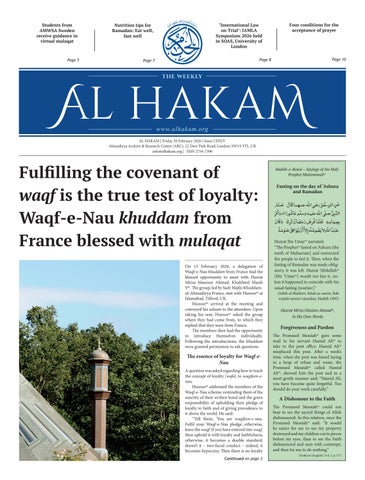
blessed with mulaqat

On 15 February 2026, a delegation of Waqf-e-Nau khuddam from France had the blessed opportunity to meet with Hazrat Mirza Masroor Ahmad, Khalifatul Masih Vaa. The group, led by Sadr Majlis Khuddamul-Ahmadiyya France, met with Huzooraa at Islamabad, Tilford, UK.
Huzooraa arrived at the meeting and conveyed his salaam to the attendees. Upon taking his seat, Huzooraa asked the group where they had come from, to which they replied that they were from France.
The members then had the opportunity to introduce themselves individually. Following the introductions, the khuddam were granted permission to ask questions.
The essence of loyalty for Waqf-eNau
A question was asked regarding how to teach the concept of loyalty [wafa] to waqifeen-enau
Huzooraa addressed the members of the Waqf-e-Nau scheme, reminding them of the sanctity of their written bond and the grave responsibility of upholding their pledge of loyalty to faith and of giving precedence to it above the world. He said:
“Tell them, ‘You are waqifeen-e-nau Fulfil your Waqf-e-Nau pledge; otherwise, leave the waqf. If you have entered into waqf, then uphold it with loyalty and faithfulness; otherwise, it becomes a double standard, doesn’t it – two-faced conduct – indeed, it becomes hypocrisy. Then there is no loyalty
Hadith-e-Rasul – Sayings of the Holy Prophet
Fasting on the day of ‘Ashura and Ramadan
Hazrat Ibn Umarra narrated: “The Prophetsa fasted on ‘Ashura [the tenth of Muharram] and instructed the people to fast it. Then, when the fasting of Ramadan was made obligatory, it was left. Hazrat ‘Abdullahra [Ibn ‘Umarra] would not fast it, unless it happened to coincide with his usual fasting [routine].”
(Sahih al-Bukhari, Kitab as-sawm, Bab wujubi sawmi ramadan, Hadith 1892)
Forgiveness and Pardon
The Promised Messiahas gave some mail to his servant Hamid Alira to take to the post office. Hamid Alira misplaced this post. After a week’s time, when the post was found laying in a heap of refuse and waste, the Promised Messiahas called Hamid Alira, showed him the post and in a most gentle manner said: “Hamid Ali, you have become quite forgetful. You should do your work carefully.”
A Dishonour to the Faith
The Promised Messiahas could not bear to see the sacred things of Allah dishonoured. In this relation, once the Promised Messiahas said: “It would be easier for me to see my property destroyed and my children cut to pieces before my eyes, than to see the Faith dishonoured and seen with contempt, and then for me to do nothing.”
(Malfuzat [English], Vol. 2, p.172)
Muhammadsa
Hazrat Mirza Ghulam Ahmadas, In His Own Words
20 February
20 February 1915: On this day, Hazrat Sufi Ghulam Muhammadra set off from Qadian to Mauritius to establish a mission. He reached his destination on 15 June, spending months in Sri Lanka to establish a local chapter on this island. (Tarikhe-Ahmadiyyat, Vol. 4, p. 169)
20 February 1944: On this day, a special Jalsa Musleh-e-Maud was arranged in Hoshiarpur, India, where Hazrat Musleh-e-Maudra delivered a powerful and insightful speech. During the Jalsa, 18 missionaries shared the tabligh achievements of their respective countries. After these faith-inspiring accounts, Huzoorra proceeded to Bait-udDu‘a (the room where the Promised Messiahas would often pray in seclusion in Qadian), where he remained occupied in supplication for a heavenly sign. (Tarikh-eAhmadiyyat, Vol. 8, p. 580)
21 February

21 February 1899: The book of the Promised Messiahas , Haqiqatul Mahdi (The True Nature of the Mahdi) was published on this day. As far as the language of this book is concerned, Urdu, Persian and Arabic are all used. Maulvi Muhammad Hussain Batalvi, having been thwarted in all his attempts to demean Hazrat Ahmadas , started a campaign of vilification against the Promised Messiahas, and to incite the Government against him, he indulged even to the extent of fabricating lies and claiming that Hazrat Ahmadas was – God forbid – a rebel and more
leniency to him.
This Week in History
A glimpse into the rich history of the Ahmadiyya Muslim Jamaat 20 - 26 February
21 February 2003: On this day, Hazrat Khalifatul Masih IVrh announced the establishment of a fund for the marriage of underprivileged girls. In his Friday sermon of 28 February, Huzoorrh named it the “Maryam Shadi Fund”. (Al Fazl, 25 February 2003, p. 1)
22 February
22 February 1935: On this day, Hazrat Musleh-e-Maudra graciously donated 500 rupees towards the fund for the construction of Gurdwara Patna Sahib. The local press lauded this act of generosity. (Tarikh-eAhmadiyyat, Vol. 7, p. 281)
22 February 2014: nHazrat Khalifatul Masih Vaa addressed the delegates of the European Annual Symposium of the International Association of Ahmadi Architects and Engineers (IAAAE). During his address, Huzooraa congratulated the members of the IAAAE for their continued commitment to selflessly serving humanity. Huzooraa said the Association had now installed or rehabilitated thousands of water pumps in Africa that were providing clean drinking water to thousands of deprived people.
‘‘Report: Hazrat Mirza Masroor Ahmad Addresses Concluding Session of Annual IAAAE Symposium’’ www. pressahmadiyya.com


(Tarikh-e-Ahmadiyyat, Vol. 23, p. 487)
24 February
24 February 1990: On this day, Hazrat Khalifatul Masih IVrh delivered a lecture in the English language at the Queen Elizabeth II Centre in London. This important lecture about Islamic solutions to contemporary problems was later expanded and published in book form under the title Islam’s Response to Contemporary Issues (Silsila-e-Ahmadiyya, Vol. 4, p. 862)
24 February 2012: On this day, Hazrat Khalifatul Masih Vaa inaugurated the Baitul-Wahid Mosque in Feltham, UK. On this occasion, Huzooraa also urged the Jamaat to pray for the Ahmadis of Hyderabad Deccan, India, where non-Ahmadi Muslims were attempting to occupy the Ahmadiyya mosque.
the truthfulness of the Promised Messiahas – the sign of the solar and lunar eclipse – the Jamaat commemorated the occasion in a special manner. On this day, Hazrat Khalifatul Masih IVrh delivered his Friday sermon at Fazl Mosque, London, shedding light on this subject. Huzoorrh also mentioned that in Pakistan, Ahmadis were prohibited by the government from holding gatherings to mark the occasion. (Khutbat-e-Tahir, Vol. 13, pp. 139-158)
To read more about this sign, see: ‘‘Observatory images of eclipses of the time of Promised Messiah and Imam Mahdi’’ at www.alhakam.org (16 October 2023, pp. 12-13).
26 February
26 February 1936: On this day, Hazrat Maulvi Sher Alira set out for England with the aim of translating the Holy Quran into English. He stayed there for three and a half years and returned to Qadian on 9 November 1938. Despite his old age, he made this long journey only to complete the English translation of the Holy Quran. (Tarikh-eAhmadiyyat, Vol. 7, p. 301)


dangerous than the bloodthirsty Sudani Mahdi. However, the government did not show





23 February 1966:


On this day, I‘jaz, a book of the Promised , was published by Zia-ulIslam Press, Qadian. This remarkable Arabic work was written in response to the deceptive tactics of Pir Meher Ali Shah. The Promised Messiah composed this masterpiece in an exceptionally short period.
On this day, upon assessing the situation in Pakistan in a sitting, Hazrat Khalifatul Masih III emphasised the importance of building strong ties between West Pakistan and East Pakistan.



Speaking at the formal reception that was held in the evening, Huzooraa said, “The world today is fraught with danger and turmoil. We sit at an extremely critical juncture and so there is an urgent need for us to all recognise our Creator and to fulfil the rights of His creation. Otherwise, if we fail to uphold and discharge each other’s due rights, it will undoubtedly lead to great destruction in the world.” (“Love for All, Hatred for None: Baitul Wahid Mosque Opens in Feltham, London”, www.reviewofreligions. org)
25 February
25 February 1921: On this day, a Sikh religious leader from Kartarpur district, Jalandhar, India, visited Qadian and enjoyed the blessed audience of Hazrat Musleh-eMaudra
To read more about his visit, see: “The Guru of Kartarpur, Jalandhar, in Qadian” at www.alhakam.org (18 June 2021, p. 13).
25 February 1994: On the completion of 100 years of the extraordinary heavenly sign of
26 February 2010: During his Friday sermon on this day, Hazrat Khalifatul Masih Vaa shed light on the Islamic teachings regarding taking care of orphans and advised Ahmadis living in Western countries to participate in the Orphans Fund, which serves orphans in Pakistan. Huzooraa said he wants to especially encourage the Pakistani Ahmadis residing in the West to participate in this fund because what could be more fortunate for a believer than being in the company of the Holy Prophetsa in paradise as a result of their caring for orphans, as has been mentioned in a hadith. Huzooraa added, there is ample room for everyone to contribute, and he estimated that if each Ahmadi family member in the West donated seven to ten pounds annually, it would go a long way in helping the orphans in Pakistan and this small amount can play a significant role in transforming the lives of many orphans.

Continued from page 1
left. Loyalty is simply this: we have pledged that we will give precedence to faith over the world.
“Therefore, waqifeen-e-nau should bind themselves to this pledge more than anyone else: that we are to give precedence to faith over the world, more than others. Only then can we make sacrifices; and those who do this with faithfulness, Allah the Almighty will also be pleased with them and it also reflects a person’s lofty morals.
“Look, even an ordinary person in the world – if they make a promise, they fulfil it. If they do not fulfil that promise, people turn against them. If a case goes to court, the court calls them to account: ‘You made a promise, [but failed to honour it].’ And if that promise is written down, it becomes even more binding.
“Here, in this case, [the waqifeen-e-nau] have even given a written bond – first the parents wrote it, then their children wrote a bond at the age of 15 and then they wrote a bond at the age of 21. Yet if they still do not do so, then they will be breaking their own pledge. A court even punishes. We do not punish as such, but Allah the Almighty will certainly question them.”
The Big Bang and the creation of the universe
A khadim asked what existed before the Big Bang, whether other worlds existed previously and about the continuity of Allah’s creation.
Huzooraa remarked that if humans possessed knowledge of everything, they would share in the attribute of knowing the Unseen (Alim-ul-Ghayb), which belongs solely to Allah. However, regarding the physical universe, Huzooraa referred to the Holy Quran, which states that the heavens and the earth were a closed-up mass [ratqan] before Allah opened them out [fafataqnahuma] – a process describing the Big Bang. (Surah al-Anbiya, Ch.21: V.31)
Huzooraa explained that this specific universe did not exist before that event, but there are many other universes. He referenced the Quranic verse stating that Allah will eventually roll up the heavens like a scroll and bring forth a new creation. (Surah al-Anbiya, Ch.21: V.105) Huzooraa advised the khadim to study the commentary of Surah al-Anbiya for a deeper understanding of this subject.
Preserving
dignity when giving charity
A question was raised about whether one must inform a recipient that the money being given is sadaqah, especially in cases where doing so may compromise the dignity of a respectable person or a Syed who might find it difficult to accept.
Huzooraa advised that if a person does not like to receive sadaqah, the giver should change their intention from sadaqah to a gift. Huzooraa explained that Syeds traditionally do not accept sadaqah. In such cases, one should help them with the pure intention of giving a gift, just as one would help a sibling or relative. However, if the intention remains sadaqah, it is generally
appropriate to disclose it so the recipient is aware of what they are accepting.
Spiritual fluctuations
A khadim asked about the “ups and downs” in one’s spiritual journey and how to identify true spiritual progress. He mentioned experiencing times of intense focus in Tahajjud, followed by periods of lesser concentration.
Huzooraa reassured him that such fluctuations are natural for human beings. He explained that moments of tenderness [riqqat], where prayers flow from the heart, are times of acceptance and should be cherished. However, when one experiences a state of spiritual constriction [qabz], one must not abandon worship. Instead, one should strive to offer the obligatory prayers and Tahajjud, praying to Allah to open the heart once more.
Huzooraa referred to his recent Friday sermon, wherein he mentioned an incident related by the Promised Messiahas regarding the development of attentiveness in prayer. It so happened that once, the Promised Messiahas sought to develop greater attentiveness in prayer. Consequently, he went out to find a secluded place to offer his supplications. Along the way, he encountered a drunkard who was saying that he had started drinking but had not yet become intoxicated, so he would continue drinking until he finally got drunk. The Promised Messiahas reflected that, in a similar manner, he would continue offering voluntary prayers until he developed the desired attentiveness and fervour. Huzooraa advised the khadim to adopt this persistence and recommended repeatedly reciting the prayer for guidance to the straight path (i.e., ihdina s-sirat l-mustaqim) during nawafil to rejuvenate spiritual focus.
Salvation and Divine judgement
An attendee raised a question about the fate of non-Ahmadis and non-Muslims, noting that some people assert that only Muslims will enter Paradise and that all others –despite being kind, honest and helpful – are destined for Hell.
Huzooraa responded that such categorical verdicts are not supported by the Holy Quran or the Hadith. He remarked that those who make these claims may say so as though they have been informed by God, whereas, in reality, neither the Quran nor the Hadith states that every non-Muslim – regardless of their deeds – will inevitably go to Hell. Rather, Allah has clearly declared that He rewards goodness and that whoever does righteous deeds will be granted recompense. (Surah al-Baqarah, Ch.2: V.63)
Huzooraa explained that punishment is for those who knowingly reject the truth and then go beyond mere denial –actively opposing the Prophets, opposing their communities, committing cruelty and injustice and exceeding all bounds in enmity. Even then, Huzooraa stated, if such a person has performed genuine acts of goodness, Allah will not leave those good deeds unrewarded; Allah grants recompense for virtue in some form. He further pointed out the Divine principle that good deeds are multiplied, while wrongdoing is repaid only to its due measure: Allah says that a person
who brings a good deed will receive many times over, whereas the one who brings an evil deed is recompensed only in proportion to it. (Surah al-An‘am, Ch.6: V.161)
Huzooraa pointed to the example of Hilf al-Fudul – the pre-Islamic pact formed to support the oppressed – explaining that the Holy Prophetsa valued righteous collective action, even when it was undertaken by those who were not Muslims. He recalled the Holy Prophetsa saying that if he were called to such a pact again in the time of Islam, he would respond. (Sunan al-Kubra, Hadith 12114)
Huzooraa stressed that the final decision of salvation and punishment lies with Allah alone. No group has the right to issue “certificates” of Heaven or Hell for others. He emphasised that Allah’s mercy is vast and that He may lessen punishment for whom He wills. In this regard, Huzooraa reminded that Allah’s mercy encompasses all things (Surah al-A‘raf, Ch.7: V.157) and cited the hadith in which the Holy Prophetsa said that, [before creating creation, Allah inscribed]: “My mercy has preceded My anger.” (Sahih al-Bukhari, Kitab at-tawhid, Hadith 7553)
To illustrate the believer’s plea and hope in Divine forgiveness, Huzooraa referred to two couplets from Durr-e-Adan:
Huzooraa concluded by outlining what a believer should focus on: rectifying one’s own actions, fulfilling the rights of Allah and the rights of His creation –establishing prayer and worship, adopting good morals, caring for the poor and vulnerable, honouring the young and the old and dealing with all people respectfully. Alongside this, a believer should remain in a state of humility, turning to Allah with repentance and istighfar and constantly praying for a good end – leaving the final judgement, in every case, to Allah alone.
Restoring motivation
A khadim asked how to deal with a temporary lack of motivation in serving the Jamaat.
Huzooraa advised him to recall the example of Prophet Abrahamas, regarding whom the Holy Quran testifies in the following words:
[“And of Abraham the Faithful.” (Surah an-Najm, Ch.53: V.38)]
Huzooraa said that waqifeen-e-nau must constantly remind themselves of their covenant. When one remembers their pledge, the question of a lack of motivation does not arise. If laziness occurs, the remedy lies in istighfar and praying for guidance by reciting
to restart with renewed vigour.
International training for students
[“Do not block my path, O Master, let me go in haste, Thy gate of Paradise is open, let me pass. My sins can never exceed the extent of Thy forgiveness, I am a sacrifice for Thee! Let go of the reckoning.”]
Huzooraa also narrated the well-known incident of the man from the Israelites who had killed 100 people, yet, when sincere repentance took root within him and he set out to reform, Allah accepted his turning back. (Sahih al-Bukhari, Kitab ahadithi l-’anbiya’, Hadith 3470)
In the same vein, Huzooraa related the hadith of two men among the Israelites: one was devoted to worship, while the other lived sinfully. The “devout” man repeatedly looked down upon the sinner and eventually swore that Allah would not forgive him. When they died and stood before God, Allah rebuked the one who presumed to limit Divine mercy and He forgave the sinner by His mercy. (Sunan Abi Dawud, Kitab al-adab, Hadith 6069)
Huzooraa further reminded that even the Holy Prophetsa taught that entry into Paradise is not achieved by one’s deeds alone, but by Allah’s grace and mercy. When some Companions asked, “Not even you, O Allah’s Messengersa”, the Holy Prophetsa replied, “Not even me, unless Allah bestows His favour and mercy upon me.” (Sahih alBukhari, Kitab al-Marda, Hadith 5673)
On the other hand, Huzooraa drew attention to a grave contradiction: some who call themselves Muslim and commit bloodshed, terrorism and cruelty, yet still claim Paradise is guaranteed for them. He observed that such people are not walking the path that leads to Paradise.
A civil engineering student asked for advice on which country to choose for a threemonth training placement to improve his professional skills and English.
Huzooraa advised him to prioritise professional development over English proficiency, as language skills can be acquired anywhere. Huzooraa suggested considering countries where significant construction and development projects are underway.
Islam as a ‘stranger’
A question was asked regarding the hadith: “Islam began as something strange and will revert to being strange as it began, so give glad tidings to the strangers.” (Sahih Muslim, Kitab al-iman, Hadith 200)
Huzooraa explained that Islam was “strange” to the Arabs at its inception because they were immersed in ignorance and unaware of the Oneness of God. The Holy Prophetsa transformed them from a savage state into Godly people. Similarly, the hadith prophesied a time in the Latter Days when people would again forget the true teachings of Islam and return to a state of moral decay. (Mishkat al-Masabih, Kitab al-iman, Hadith 276) Huzooraa referenced the poetic description of this era:
[“Neither faith remains, nor Islam remains; Only the name of Islam remains.”] Huzooraa stated that the “glad tidings” are for those who, in such a time of spiritual darkness, accept the Promised Messiahas and hold fast to the true teachings of
Islam. While the world – and even many Muslims – may view the Ahmadiyya teachings as “strange” or unfamiliar due to the prevalence of extremist ideologies and the distortion of faith by clerics, Ahmadis are the fortunate ones who have recognised the truth and revived the original spirit of Islam. This explanation, Huzooraa said, is one interpretation and the hadith inherently encompasses several aspects.
Engaging khuddam
A khadim asked how to engage members who only attend sports events but avoid other Jamaat programmes.
Huzooraa advised creating a personal bond of friendship with such members. He suggested inviting them to informal get-togethers rather than formal meetings initially. When they attend sports, they should be encouraged to offer salat in congregation. Through friendship and gradual explanation of the importance of religion in the contemporary world, they can be brought closer to the Jamaat.
Prohibition of fasting on Eid
An attendee asked why fasting is prohibited on the day of Eid.
Huzooraa explained that fasting is a form of worship because it is a command of Allah. Worship is defined by obedience to Allah’s specific instructions. Allah has commanded believers to fast for the month of Ramadan and has designated Eid as a day of reward and celebration.
Huzooraa elaborated that Satan is distressed during Ramadan as believers strive to improve their spirituality. On Eid, when believers are commanded to celebrate and eat, Satan attempts to deceive people into fasting to prevent them from obeying Allah’s command to rejoice. Therefore, fasting on Eid would be contrary to the divine command. (Sahih Muslim, Kitab assiyam, Hadith 1911) Huzooraa added that obeying the command to eat is just as much an act of worship as obeying the command to fast.
Balancing busy careers and service
A khadim asked how waqifeen-e-nau working in demanding fields, such as research or medicine, can serve the Jamaat if they have limited time.
Huzooraa instructed that regardless of one’s career, the obligatory prayers must never be neglected. He advised starting the day with the recitation and study of the Holy Quran. Huzooraa suggested utilising weekends for Jamaat service. Furthermore, he explained that tabligh and preaching within one’s own professional circle is a significant form of service. He cited the example of Dr Abdus Salam, who, despite his immense busyness, always found time to explain Quranic insights and his faith to his colleagues.
Increasing love for the Holy Prophetsa
A question was asked about how to increase the love for the Holy Prophet Muhammadsa in one’s heart.
Huzooraa advised reciting durood with deep reflection and sincerity. He explained that when durood comes from the heart, love
for the Holy Prophetsa increases naturally. This love, in turn, compels a believer to study his sirah or his life and character and follow his sunnah. Huzooraa concluded that invoking durood upon the Holy Prophetsa and following his footsteps leads to the love of Allah, thereby granting the believer a twofold benefit – the love of the Prophetsa and the love of Allah, as the Holy Quran states:
[“Say, ‘If you love Allah, follow me: then will Allah love you.’” (Surah Aal-e-Imran, Ch.3: V.32)]
Marriage and self-discipline
A khadim asked at what stage in life one should consider marriage.
Huzooraa replied that Islam recommends marriage upon reaching maturity. He noted that the primary purpose of marriage in Islam is to safeguard oneself from sin. Huzooraa advised the youth to practise ghadd-e-basar or lowering the gaze and avoid inappropriate mixing of genders. If one feels they cannot maintain their chastity without marriage, they should ask their parents to arrange it. To protect against sin, Huzooraa recommended istighfar and fasting, noting that fasting also has health benefits.
Integrating new converts
The final question was regarding how to help new converts attach themselves to the Jamaat.
Huzooraa emphasised the need for
Jalsa Seerat-un-Nabi
Ataul Mujeeb Rashed Missionary-In-Charge, Jamaat UK
During the months of January and February 2026, a series of Jalsa Seerat-un-Nabisa was organised across the United Kingdom. These gatherings served to illuminate the magnificent life, noble character and sublime qualities of the Holy Prophet Muhammadsa
In the London and Southern regions, Jalsa Seerat-un-Nabisa was held at numerous mosques, where speakers addressed the themes of compassion, justice, moral excellence and the timeless relevance of the blessed example of the Holy Prophetsa
These gatherings took place at the Baitul Ahad Mosque in Newham, Baitul Ata Mosque, Baitul Aman Mosque in Hayes,
Nasirat summer camp held in Australia
Saima Fazeel
Secretary Nasirat, Lajna Imaillah Australia
Nasirat-ul-Ahmadiyya Sydney, Australia, held a two-day Summer Camp on 10-11 January 2026 with an attendance of 98 nasirat on Day one and 86 on Day two. The event was designed to foster spiritual growth, personal confidence and sisterhood among the participants, allowing them to fully enjoy their time at the mosque.
The first day began with registration
genuine friendship. He advised khuddam to bring new converts closer by speaking to them in their own language and making them feel like family. Huzooraa warned against the tendency of some members to sit together and speak Urdu in the presence of those who do not understand it. He stated that converts must feel they are part of a family that genuinely cares for them, rather than just collecting chanda or inviting them to meetings.
Conclusion
The mulaqat concluded with a group photograph. Huzooraa distributed pens to the attendees and then took his leave.
(Summary prepared by Al Hakam)
held across the UK
Baitun Noor Mosque in Hounslow North, Bilal Centre Mosque in Tooting, Nasir Mosque in Gillingham, Baitus Subhan Mosque in Croydon, Baitul Futuh Mosque in Morden and in Surbiton, with an average attendance of 300-350 members at each venue. The attendance at the Baitul Futuh Mosque was 2700 and it was 120 in Surbiton.
The Midlands region witnessed equally spirited programmes. In the East Midlands, the Baitul Ikram Mosque in Leicester hosted a well-attended Jalsa with approximately 200 participants, similar to the Baitul Hafeez Mosque in Nottingham, while in the West Midlands, gatherings at the Darul Barakat Mosque in Birmingham and Baitul Ghafoor Mosque in Halesowen drew an average of 300-350 members. At the Baitul Ata Mosque in Wolverhampton, a total attendance of 100
after which members were encouraged to write their personal goals on a “Goal Wall” of what they would like to achieve by the end of the camp. This was followed by the formal proceedings, including tilawat, hadith and nazm, and a briefing on camp rules and general housekeeping.
The morning session, titled “My Superpowers,” focused on self-discovery. The members identified their personal strengths, aspects they liked about their religion and what they enjoyed about being nasirat. After lunch, the afternoon was filled with diverse activities, including a presentation on current “Trends” by the nasirat themselves. A cooking class was held, followed by an Art and Crafts session and indoor sports. The day concluded with dinner and Maghrib prayer.
The second day commenced with a presentation and group discussions on maintaining a healthy digital balance, titled “Freeing Our Families From the Harmful Use of Technology.” This was followed by
was recorded.
In the North and North West, Jalsa Seerat-un-Nabisa was organised at the Baitul Haleem Mosque in Keighley, Darul Aman Mosque in Liverpool and Baitul Aman Mosque in Manchester. The Liverpool Jamaat recorded an attendance of approximately 150 participants. A Jalsa was also held by the Jamaat in Northern Ireland.
My humble self joined several of these programmes, for instance, at the Baitul Aman Mosque in Manchester, Baitun Noor Mosque in Hounslow North, Baitul Ahad Mosque in Newham and Baitus Subhan Mosque in Croydon.
In total, over 3000 members across the United Kingdom participated in these programmes.
outdoor sports and a creative workshop. The highlight of the day was the “Talent Show and Tell,” where members displayed a variety of handmade items, showcasing their immense creativity.
Throughout the two days of the Summer Camp, various amila members were invited to introduce their respective departments to the nasirat. This provided them with an opportunity to gain insight into the different areas of work within Lajna Imaillah, ask questions and express their interests. The interactive sessions encouraged engagement and helped them better understand how they can serve the Jamaat in the future.
At the conclusion of Day two, the members were asked to write their names along with the departments they were most interested in, allowing us to identify areas of interest and begin early guidance and training as they prepare to transition into Lajna Imaillah. The programme concluded with speeches by my humble self and Sadr Lajna Imaillah Australia.
From the markaz
Integration means serving the country, not compromising on faith: Students from AMWSA Sweden receive guidance in virtual mulaqat
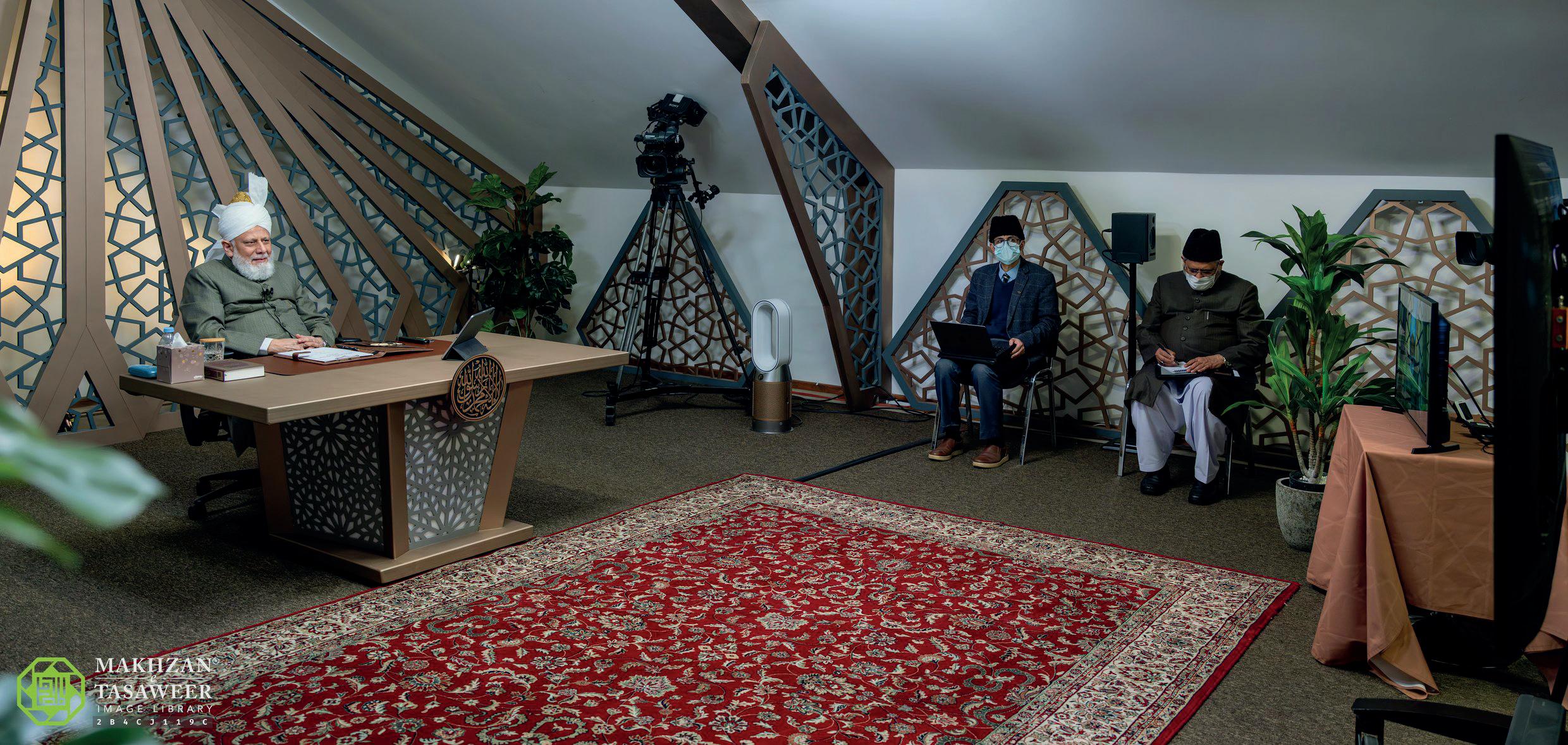
On 8 February 2026, members of the Ahmadiyya Muslim Women Students’ Association (AMWSA) Sweden were blessed with a virtual mulaqat with Hazrat Mirza Masroor Ahmad, Khalifatul Masih Vaa Huzooraa presided over the meeting from the MTA Studios in Islamabad, Tilford, UK.
After conveying salaam and taking his seat, Huzooraa invited a student to recite a portion of the Holy Quran. The student recited verses 103-104 of Surah Aal-eImran, followed by their Urdu translation by another student.
Huzooraa then addressed the AMWSA President and enquired about the composition of the audience, asking how many were university students and how many were in secondary or pre-university education. After the students raised their hands to indicate their respective levels, it was confirmed that the total attendance in the hall was 82.
Following this, the floor was opened for questions.
Priorities for AMWSA and balancing knowledge
A student asked for guidance on the future roadmap for AMWSA, specifically how members could progress in both religious and worldly fields to become responsible servants of the Jamaat.
Huzooraa remarked that he had addressed these themes in numerous addresses to Lajna Imaillah and in his sermons. He stated that the advice given to men applies equally to women and the work being done by the male students’ association (AMSA) should also be undertaken by AMWSA.
Huzooraa emphasised that students must excel in their chosen secular fields. Whether pursuing a degree, postgraduation or a PhD, they should aim
for the top positions. When they achieve academic excellence, people will naturally ask about their background. This provides an opportunity to identify as Muslims and explain that seeking knowledge is a religious injunction given by the Holy Prophetsa (Sunan Ibn Majah, Hadith 224) He also instructed to learn half the faith from his wife, Hazrat Aishara. Huzooraa noted that the Holy Prophetsa granted women a high status regarding education and Ahmadi women must manifest this through their achievements.
Huzooraa further instructed that alongside secular education, they must advance in religious knowledge. They bear the responsibility of training the next generation, guiding their younger siblings and influencing their broader environment to convey the true message of Islam.
Regarding tabligh, Huzooraa observed that in modern societies, people are often
detached from religion due to materialism. Therefore, direct preaching may not always be effective immediately. Instead, Huzooraa advised AMWSA to organise seminars in their universities or other venues on secular topics such as history or science, inviting non-Muslims to attend. Such events generate interest and allow for a gradual introduction to the Jamaat, helping to dispel misconceptions and present the true image of Islam. Huzooraa said:
“And this is precisely your task: to make yourselves recognised, to establish your identity and to show people the true picture of Islam – that this is the correct picture of Islam which we are presenting. This is Islam’s teaching.”
Understanding Divine attributes
A student asked how one should understand the instruction to adopt the attributes of Allah, given that some attributes, such as
Al-Mutakabbir, seem exclusive to Allah. She asked how a human can distinguish between attributes to adopt and those where one must remain humble.
Huzooraa replied that the Holy Quran instructs believers to take on the “colour of Allah”. (Surah al-Baqarah, Ch. 2: V. 139) He explained that this means striving to reflect Allah’s attributes within human limits, while recognising that a person cannot attain the exalted station that is proper to Allah alone.
To illustrate how an attribute’s sense differs when applied to Allah and when applied to human beings, Huzooraa cited the attribute Ash-Shakoor (the Most Appreciative). He explained that Allah does not “give thanks” to a servant in the human sense; rather, in this context, Ash-Shakoor signifies that Allah values and acknowledges those who obey His commands. When the related quality appears in a servant, however, “shukr” carries its familiar meaning: that when someone does one a kindness, one expresses gratitude and offers thanks.
With regard to Al-Mutakabbir, Huzooraa clarified that it does not mean that Allah is arrogant. Rather, it denotes Allah’s absolute greatness: Allah is supremely Great and none can ever reach His rank. Huzooraa added that, when this attribute is considered with reference to a human being, it does not take the form of pride; instead, it should appear as breadth of spirit and moral fortitude, cultivated alongside humility – so that one is not upset by trivial matters, does not fall into quarrels and does not harbour resentments. Developing such forbearance, he explained, is itself a form of inner greatness.
Huzooraa concluded that, in this way, the “colour” changes in its human application: one should strive to conduct oneself in one’s surroundings in accordance with the higher moral qualities indicated by the attributes of Allah. This, he said, is the meaning of being “coloured” with the colour of Allah.
Global conflict and the role of Ahmadis
A student asked about the Quranic prophecy regarding Ya’juj and Ma’juj (Gog and Magog) causing disorder. Referencing the political situation involving Greenland, Denmark and the USA, she asked how Ahmadis should understand these prophecies in the current context.
Huzooraa stated that whether the issue concerns Greenland, Palestine or other regions like Ukraine, major powers are often seen creating disorder to establish their supremacy. Huzooraa identified the forces as the Dajjal or the Antichrist mentioned in ahadith, who seek to dominate the world through deception and force. He noted that, regrettably, some Muslim nations also rely on these powers for weaponry and support, effectively aiding them.
Huzooraa explained that the Promised Messiahas came to break this power of Dajjal through spiritual means. Seeing these geopolitical developments should compel Ahmadis to focus more on prayers, on tabligh and on spreading the peaceful teachings of Islam to both Muslims and non-Muslims. Huzooraa said:
“For this, we should strive – and the way to do so is this: how can we counter it? That we must, as far as possible, demonstrate Islam’s teaching through our actions as well
and convey Islam’s message too and say to people: if you desire peace in the world, if you wish to save the world from disorder, if you want to protect yourselves and your future generations from destruction, then keep away from the [evil] things.”
Huzooraa remarked that the major powers have reached a peak in their desire for control, leading to conflict amongst themselves and against Muslims. Citing the example of the USA seeking an airbase in Greenland, Huzooraa noted that yielding even a small piece of land to such powers often leads to them expanding their control further.
Ahmadis, as followers of the DhulQarnayn (the one with two centuries), have the duty to counter this disorder. Huzooraa advised the students to study the Quran and its commentaries, build a strong relationship with Allah and focus on prayer. He urged them to demonstrate the true teachings of Islam through their actions to warn the world that safety from destruction lies only in avoiding such conflicts and injustices. Huzooraa said:
“That is why I am presently delivering sermons on love for Allah the Exalted. The life and character of the Holy Prophetsa is narrated precisely so that we may become those who act upon it ـ– that we should also pay attention towards love for Allah the Exalted, we should also pay attention towards prayers and our actions should be righteous. In the future, insha-Allah, if the opportunity arises, attention will also be drawn towards righteous deeds – namely, what the Holy Prophet’ssa conduct was like in every matter and how we are to act upon it.”
Guidance for students facing visa issues
Another student raised a concern regarding some Ahmadi youth who migrate abroad for studies but leave their education incomplete due to visa issues or financial difficulties, often resorting to menial jobs. She asked for advice on how to encourage them to return to higher education.
Huzooraa first clarified the context, noting that this issue generally pertains to students migrating from poorer nations to wealthier ones, rather than those already living in Sweden. He observed that while some face genuine financial struggles, others arrive with the intention of using a student visa as a gateway to seek asylum and earn money quickly.
Huzooraa noted that talented and sincere students usually find a way to continue their education, even if they have to pause while their asylum claim is processed. He mentioned that the Jamaat also assists talented students with fees where possible. However, due to those who misuse student visas solely to settle abroad, some governments have introduced stricter barriers, which unfortunately affect genuine students as well.
Facing World War III with faith and planning
A ninth-grade student asked how a Muslim can survive a potential World War III and how one should plan for the future when the world seems so unstable.
Huzooraa replied that if a war breaks out, bombs do not differentiate between
Muslims and non-Muslims. However, Huzooraa referenced an Urdu couplet of the Promised Messiahas, stating that those who love Allah will be saved from the “fire” of conflict:
[“There is a fire, but all those shall be saved from this fire who possess love for the God of Great Wonders.”]
He assured her that while the Jamaat as a whole will, insha-Allah, be preserved, individuals must strive to build a strong relationship with Allah to attract His grace.
Huzooraa firmly advised against falling into “tired thinking” or depression by wondering if life will continue. He stated that a believer must trust in Allah, which entails ignoring the uncertainty and continuing to plan and strive for the future. He advised the student to pursue her studies in science or medicine if she has the aptitude and to work hard as long as there is life.
Huzooraa said:
“People of the world, after all, love the world, do they not? In a hadith I related in a sermon a few days ago, the Holy Prophetsa said: ‘What have I to do with the world?’ Yes, Allah the Exalted has bestowed blessings in this world; one should benefit from them and plan accordingly. And the purpose of life in this world – if we, as Ahmadi Muslims, understand that purpose and strive to fulfil it – then that purpose is: to worship Allah the Exalted, to become His grateful servant, to act upon His commandments and to fulfil the rights due to His servants. If we do all these things, we shall remain safeguarded from it as well and it is with this very outlook that we shall continue to plan.
“If, instead, we sit thinking that we do not even know whether we shall remain alive in this world or not, then it will lead to the onset of the illness of depression – we will become depressed. Therefore, so long as life remains, keep striving, keep struggling and for as much life as Allah the Exalted has granted, seek help from Allah the Exalted, make good planning for it and strive to excel in whatever your field may be.”
Navigating local culture and identity
A student asked to what extent an Ahmadi should be influenced by the local culture and environment and how much of it is acceptable to adopt.
Huzooraa asked about her field of study, to which she replied she was studying a preschool teaching course. Huzooraa advised her to adhere to religious injunctions, including observing the hijab, offering prayers, helping God’s creation and maintaining modesty. He stated that one must strictly avoid aspects of the local culture that conflict with Islam, such as drinking alcohol or dancing, etc.
However, Huzooraa clarified that traditions and cultural aspects that do not conflict with Islam can be adopted. He emphasised that loyalty to one’s country is part of faith; therefore, one should integrate by serving the country and adopting its positive traits. Huzooraa noted that if Ahmadi women manifest high morals and a spirit of service, locals will respect them and their choices, including their modest dress.
Overcoming the sense of ‘statelessness’
A student asked how to deal with the feeling of having “no homeland”. She compared the opposition in Pakistan to the bias sometimes faced in Sweden as a foreigner and Muslim. Huzooraa recited the following couplet:
[“None is more hopeless and griefstricken than he, who does not hold the handle of the sword of God in his hand.”] He advised her not to despair. He contrasted the situation in Pakistan – where Ahmadis face legal bans on practising their faith, calling the azan, offering prayers, reciting the Holy Quran or even saying salaam – with Sweden, where religious freedom exists. Huzooraa described the bias in the West as often being “hidden” but noted that no one prevents Ahmadis from worshipping, reciting the Holy Quran or professing the faith in Islam.
Huzooraa termed the feeling of statelessness as a form of despondency that does not behove a believer. He urged the students to interact with locals, build friendships and demonstrate good character. Through positive interaction, prejudices will fade and people will become sympathetic friends.
Career uncertainty and trust in Allah
A student asked how students can maintain trust in Allah when their career paths feel uncertain.
Huzooraa explained that this uncertainty usually stems from a few causes: lack of real interest in the subject, low confidence, reluctance to put in the necessary effort or choosing a field that does not match one’s aptitude. He noted that competitive routes such as medicine require sustained hard work and strong results in key subjects like chemistry, physics and biology. Similarly, options such as engineering depend heavily on maths and physics and success in law also demands commitment and suitability.
Huzooraa advised students to make thoughtful, informed choices rather than copying friends or relatives without reflection. He encouraged them to assess their own interests and strengths and to consult teachers directly for an honest evaluation of their abilities and the subjects they should pursue.
He also mentioned that jamaats should have a career planning and guidance committee to help students understand their aptitude and plan accordingly.
He reassured the student that there is no need for despair: once a suitable path is chosen, consistent hard work alongside prayer will bring progress and Allah does not allow sincere effort to go to waste.
Conclusion
Towards the end of the meeting, Huzooraa spoke briefly with the Sadr Lajna Imaillah and the Sadr AMWSA. Huzooraa offered prayers for the attendees, conveyed his salaam and the meeting concluded.
(Summary prepared by Al Hakam)
Nutrition tips for Ramadan: Eat well, fast well
By the grace of Allah, another month of Ramadan is here. By fasting, praying and practising kindness and charity on a personal and communal level, we can deepen our spirituality during this month. Choosing to abstain from food and liquids from sunrise to sunset is known as fasting during Ramadan. The length of the fast can range from 11 to 18 hours, depending on the region and season. (“The effects of diurnal Ramadan fasting on energy expenditure and substrate oxidation in healthy men”, British Journal of Nutrition, Vol. 118, No. 12, 2017, pp. 1023-1030)
It’s critical to comprehend the effects of fasting on our bodies as well as hydration and nourishment needs.
How does Ramadan affect the body?
In the early hours of the fast, the body produces energy from the food eaten overnight. Then it breaks down its stores: first carbohydrates from the liver and muscles are used up, followed by a gradual increase in energy production from the breakdown of fat stores. (“The effects of diurnal Ramadan fasting on energy expenditure and substrate oxidation in healthy men”, British Journal of Nutrition, Vol. 118, No. 12, 2017, pp. 10231030)
Studies have reported a significant reduction in the metabolic rate and total energy expenditure during fasting hours throughout the day in the month of Ramadan. However, studies have found no significant differences between the average energy expenditure during and post-Ramadan. (“Energy metabolism and intermittent fasting: the Ramadan perspective”, Nutrients, Vol. 11, No. 5, 2019, p. 1192)
The body cannot store water and loses water through urine, breathing and sweat (in warm weather). However, the kidneys conserve as much water as possible. Individuals living in hot weather may experience symptoms of dehydration: headache, tiredness or loss of concentration. However, studies have found no adverse health consequences associated with dehydration provided enough fluids are consumed after the fast to replace the losses. (“Energy metabolism and intermittent fasting: the Ramadan perspective”, Nutrients, Vol. 11, No. 5, 2019, p. 1192)
A rehydration solution or plain water with some sugar and salt can be provided to a person who experiences dizziness or extreme fatigue.

How does Ramadan affect our nutrition and health?
Our eating pattern changes from having three main meals and snacks in between to eating two meals during the night: Suhoor or sehri (predawn meal) and iftar (after sunset). This implies that skipping the lunch meal would result in a significant reduction in food and total energy intake.
A meta-analysis of 80 studies found that average energy intake during Ramadan decreased by 142 kcal/day compared to pre-Ramadan. (“Changes in energy and macronutrient intakes during Ramadan fasting: a systematic review, meta-analysis, and meta-regression”, Nutrition Reviews, Vol. 82, No. 11, 2024, pp. 1482-1513)
These findings negate the misconception that Muslims tend to overeat during the night to compensate for missing lunch.
Studies suggest variation in the food groups consumed during Ramadan. A study among Ghanaian adolescents reported that while Ramadan was associated with an increase in dietary diversity, or variety of nutrient-rich food groups consumed (fruits, dairy products), it also led to a decrease in the intake of staples, legumes and green vegetables. (“Ramadan fasting alters food patterns, dietary diversity and body weight among Ghanaian adolescents”, Nutrition Journal, Vol. 17, No. 1, 2018, p. 75)
Other studies from Asia have reported that Ramadan was linked to a decrease in the consumption of cereals, legumes and nuts and an increase in the consumption of fruits and energy-dense foods (sweet snacks and fried foods) and sugar-sweetened beverages, resulting in weight gain. (“Impact of Ramadan fasting on dietary intakes among healthy adults: a year-round comparative study”, Frontiers in Nutrition, Vol. 8, 2021, pp. 689-788; “Determinants of body weight changes during Ramadan fasting in India amid COVID-19: A cross-sectional study”,
Medicine, Vol. 103, No. 4, 2024, p. 37040)
A systematic review of 70 studies found that Ramadan fasting resulted in a modest weight loss of 1.3 kg, with significant loss of weight and fat mass among individuals who were overweight/obese compared to those with normal weight before Ramadan. Weight loss was short-term, since subsequent weight regain was observed 2-5 weeks after Ramadan. (“Effect of Ramadan fasting on weight and body composition in healthy non-athlete adults: a systematic review and meta-analysis”, Nutrients, Vol. 11, No. 2, 2019, p. 478)
Fasting is associated with other health benefits, such as improved glucose and lipid profiles, and increases the body’s anti-inflammatory response. (“Impact of intermittent fasting and/or caloric restriction on aging-related outcomes in adults: a scoping review of randomized controlled trials”, Nutrients, Vol. 16, No. 2, 2024, p. 316)
Individuals with health conditions such as diabetes who wish to fast should seek guidance from their healthcare team on how to manage their condition during Ramadan.
Steps for eating healthy during Ramadan
Eating practices and weight can have variations depending on individual, cultural, social and environmental factors. Therefore, let us make a conscious effort to eat well and fuel our bodies with the right quantity and quality of food, which will enable us to maintain weight, good health and actively participate in Ramadan’s faithinspiring activities.
· The first step is to plan and prepare for Ramadan: this involves making a list of achievable and measurable healthy eating goals and keeping a diary to track progress (“3 steps to Building a Healthy habit”, http:// cdc.gov, 15 May 2024). For example: “I will
not skip suhoor”, or “I will include a ladle of vegetables with my meals”, etc.
· Then write down a weekly menu for suhoor and iftar. Select, shop for and stock ingredients based on your goals, your budget and what suits your family. Stock more nutrient-rich foods (whole grains and cereals, fruits and vegetables, nuts or dairy products) than high-energy, low-nutrient foods (sweet snacks, fried foods, pastries, soda and fruit juice drinks).
· Try to make one change at a time and be consistent. This may involve adding a new vegetable to your curries, stew or salad if vegetables are not commonly consumed in the household. Although children are exempted from fasting, encourage them to participate in the preparation and consumption of suhoor and iftar. Be consistent in the serving of healthy foods, but do not force your children to eat. Encourage them and be a role model.
What can we eat and drink for suhoor?
Prioritise waking up early for suhoor and do not skip it. Eating suhoor is a sunnah of our beloved Prophetsa, who emphasised its importance by saying:
“Eat suhoor, as there is a blessing in it.” (Sunan Ibn Majah, Kitab as-siyam, Hadith 1692)
Eating so early can be difficult for most of us, but let us try to take this blessed meal and fuel our bodies for work and worship throughout the day. Eating sehri may prevent fatigue, dehydration and overeating after iftar
Have a light, healthy and balanced meal, which means selecting a variety of whole (minimally processed) foods from different food groups in their correct proportions. (“A healthy Ramadan”, nutrition.org.uk, accessed on 15 February 2025)
A healthy, balanced diet ensures that our body gets the different nutrients for its daily function and good health. A balanced meal comprises the following food groups:
· Carbohydrate: the energy-giving starchy foods (rice, pasta, fufu, ugali, banku, chapati) should represent ¼ of your plate. If possible, include more fibre-rich whole grains and cereals (oats, whole-grain wheat flour bread or chapati and unsieved cereal porridge). Fibre slows down the rate of energy production in your body and gives you a feeling of fullness. It can improve your digestion and prevent constipation.
· Fruits and vegetable stews/soups should represent ½ of the plate: They are a good source of fibre, vitamins and minerals for energy, fullness and fluid for hydration. You
Salmana Mehmood Ghana
‘International Law on Trial’: IAMLA Symposium 2026 held in SOAS, University of London
Staff Writer
Al Hakam
The International Ahmadiyya Muslim Lawyers Association (IAMLA) is a global body of more than 900 Ahmadi Muslim lawyers, jurists, law students and former members of the judiciary. They have members in over 28 countries worldwide. The IAMLA are dedicated to serving humanity and securing human rights for all, particularly the marginalised and vulnerable. (ahmadi-lawyers.org)
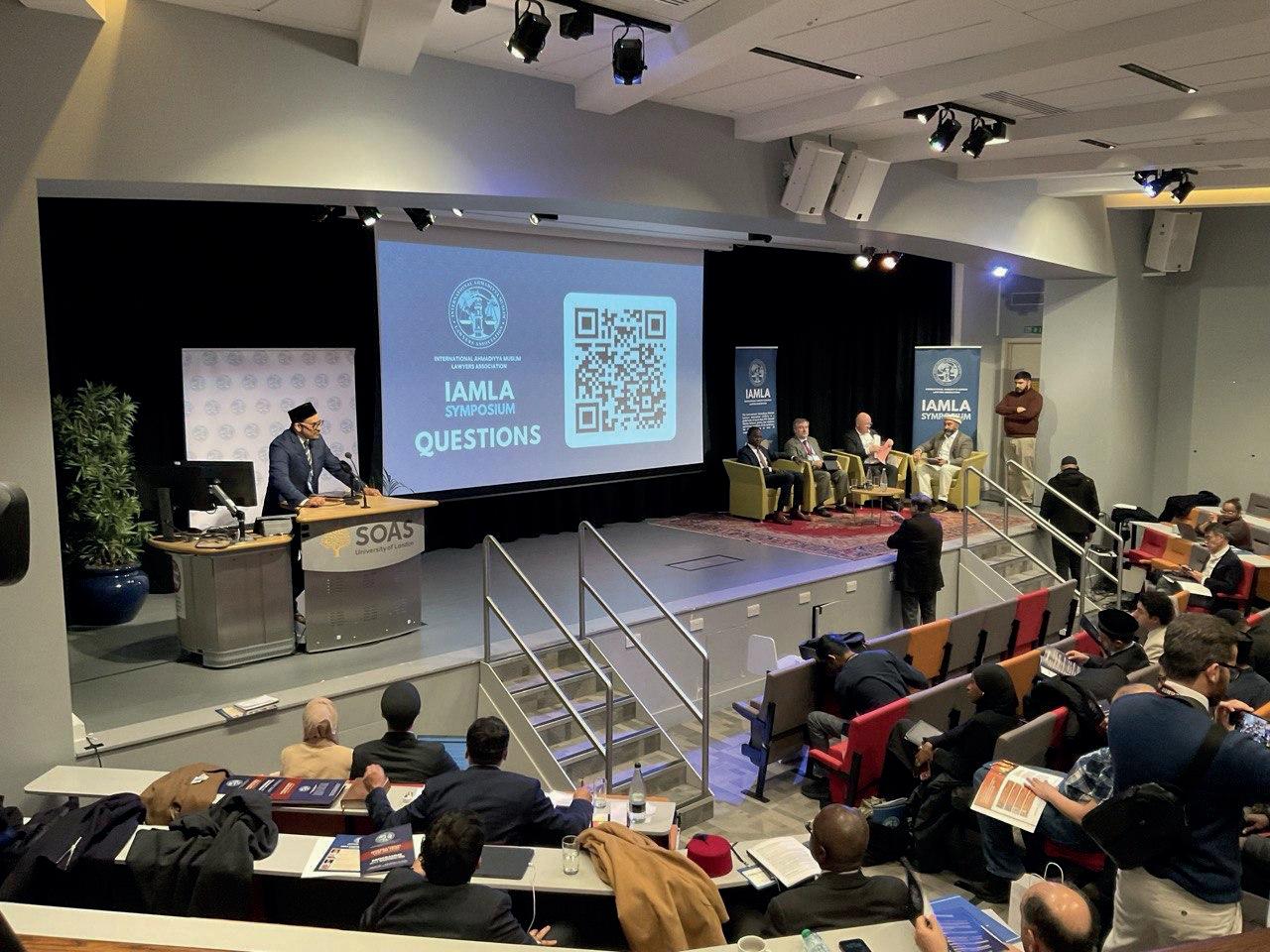
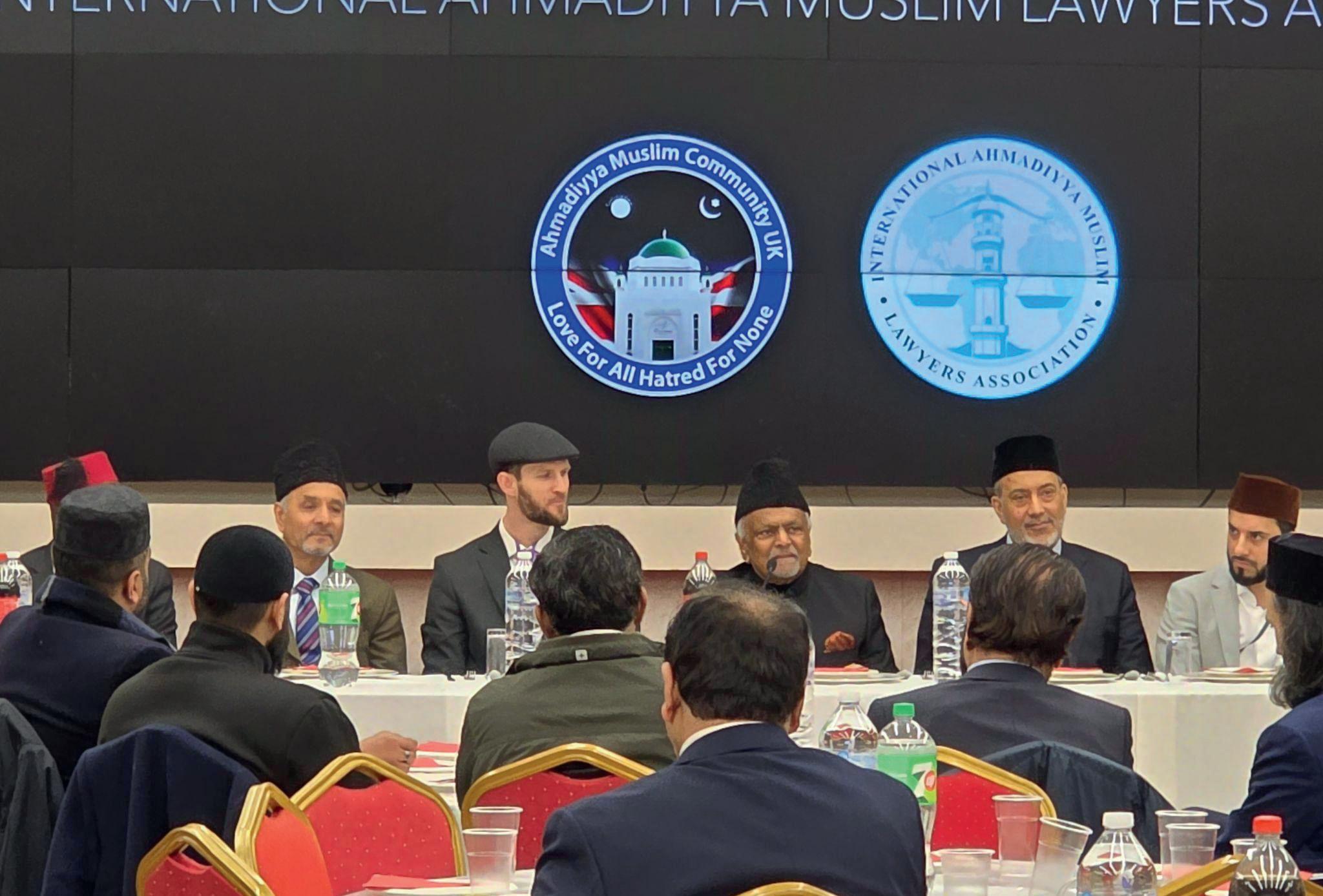
On 7 February 2026, the IAMLA held its inaugural international symposium. It was titled International Law on Trial: Justice in a Divided World and held at the Brunei Gallery Lecture Theatre, SOAS University of London. The event brought together Ahmadi Muslim lawyers from across the world and invited legal professionals to reflect on the state of international law amid growing global division.
The symposium took place at a time when we are witnessing growing concerns that international law is being undermined. Treaties and international organisations are facing pressure as nations withdraw from them or fail to fulfil their obligations. The wars in Gaza and Ukraine, as well as recent developments in Venezuela and Greenland,
serve as clear examples. Issues such as climate justice, international criminal law, arms control and free trade are all being affected by this situation.
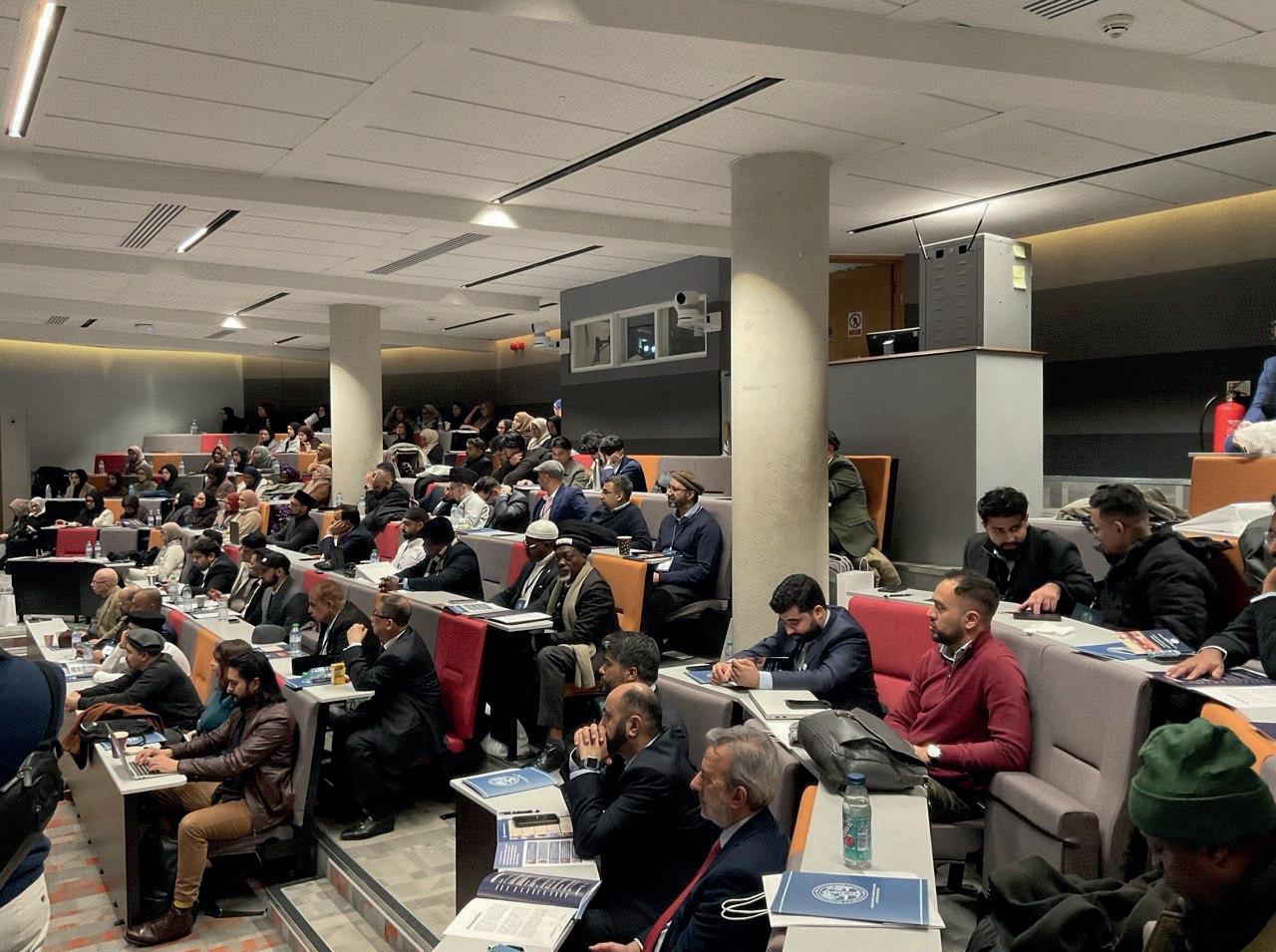
The event marked a significant milestone for IAMLA, with over 100 Ahmadi lawyers flying in from nine countries. Total attendance was close to 250, with the hall at near full capacity, indicating both the relevance of the topic and strong interest among legal professionals.
Registration commenced at 8:30 am, with attendees receiving a detailed programme upon entry. Breakfast and light refreshments were provided. The symposium opened at 9:00 am and began with the recitation of the Holy Quran.
The opening address was given by Amjad Mahmood Khan Sahib, the event’s host. This was followed by a series of panel discussions on various topics. A brief break was held at noon, followed by a panel on climate justice, lunch and prayer.
The exhibition
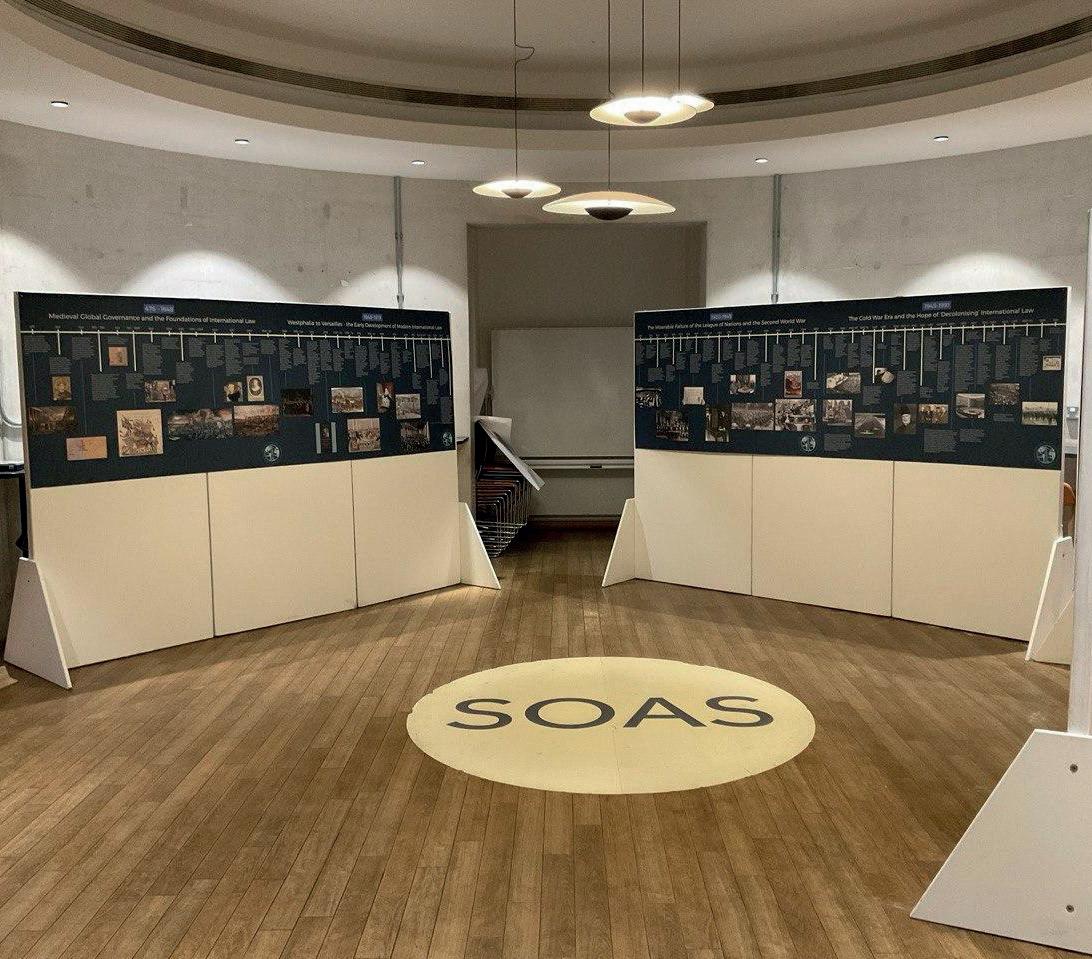
During the break, attendees received a guided tour of an exhibition on the history of law and the evolution of global governance since Emperor Justinian. The exhibition compared different ages of political turmoil,
highlighting the misuse of the Veto and the unrest that follows when international law is manipulated for personal gain.
Panel discussions and panellists
The symposium featured an impressive list of internationally recognised speakers. The programme was organised into five panel discussions conducted throughout the day. Attendees were invited to submit questions, which were later incorporated into the discussion. The panels were divided into the following topics:
Panel 1: The Accountability Gap and Armed Conflicts: Are International Humanitarian Law and International Criminal Law Fit for Purpose?
Panel 2: Constitutional Discrimination Against Religious Minorities: International Human Rights, National Blasphemy Laws, and the Shrinking Space for Refugee Protection
Panel 3: Defining the Limits of Free Speech: Legal, Political and Social Dimensions of Freedom of Expression Laws
Panel 4: Climate Justice and Just Transitions: A Multifaceted Challenge for the International Community
Panel 5: What is the Role of International
Law in Ensuring Justice in a Divided World?
The speakers who participated in the various panels included:
Jonathan Butterworth, Chairman, International Ahmadiyya Muslim Lawyers Association (IAMLA)
Professor Satvinder Juss, Professor of Law, King’s College London
Dr Yenn Lee, Deputy Head of the Doctoral School, SOAS
Peter Oborne, Associate editor of Middle East Eye and former chief political commentator of The Daily Telegraph
Victor Kattan, Assistant Professor of Public International Law at the University of Nottingham
Nada Ali, Lecturer at SOAS Law School, researching the politics of international criminal law
Ján Figel, former EU Commissioner and EU Special Envoy for Freedom of Religion or Belief
Marco Respinti, Italian journalist and Director-in-Charge of The Journal of CESNUR Mohamed Elsanousi, Commissioner of the US Commission on International Religious Freedom
Professor Alison Scott-Baumann, Professor of Society and Belief at SOAS
Professor James (Jim) Cavallaro, former President of the Inter-American Commission on Human Rights
Kamran Mustafa, specialises in public international law and global governance
Kiiza S. Hussein, an environmental lawyer, social entrepreneur
Dr. Kamal-Deen Ali, the Director General of the Ghana Maritime Authority
Zamzam Ibrahim, a climate justice advocate and community organiser
Qudus Malik, an international human rights lawyer with over 15 years of experience
Farooq Aftab, the General Counsel of the International Human Rights Committee (IHRC)
Dr Nazila Ghanea, the UN Special Rapporteur on freedom of religion or belief
Dr Nicholas Levrat, currently the UN Special Rapporteur on Minority Issues
Amjad Mahmood Khan, Lecturer in Law at University of California Los Angeles (UCLA) Law School
Mubarak Waseem, a Barrister at Essex Court Chambers, in Lincoln’s Inn Fields
Message from Hazrat Khalifatul Masih V
A special message from Hazrat Mirza Masroor Ahmad, Khalifatul Masih Vaa, was presented. Huzooraa began by highlighting the growing disregard for international laws by major powers and the resulting injustice it creates. He pointed out that many lawyers prioritise money over justice and truth. However, Ahmadi lawyers should stand apart from such practices by upholding truth and remaining dedicated to justice.
“Without doubt, it is necessary for lawyers to strive to right every wrong, to tirelessly advocate against injustice and to work towards ending the conflicts that afflict the world. Indeed, this is a foremost duty for all Ahmadi Muslims and is the reason that I, for over twenty years, have been urging all nations and all peoples to adopt true justice and to strive for peace and security in the world.”
Huzooraa cited Hazrat Chaudhry Sir Zafrulla Khanra as a role model for all Ahmadi lawyers. He highlighted Islamic principles of justice and the Holy Quran’s teachings on international law. Huzooraa emphasised the increasing injustices in today’s world and how they contribute to its decline. He expressed concern that the world is heading toward destruction.
“Today, you have chosen ‘International Law on Trial: Justice in a Divided World’ as your theme and while this topic is commendable, the reality is that law and order at all levels of society, not just internationally, are on trial today. This, as I have already made clear, is because the fundamental principle of justice is under a sustained attack. Thus, let it be clear that, until true and absolute justice is established there can be no lasting peace in the world.”
The message concluded with a call for a pledge from all Ahmadi lawyers, along with a prayer for the world to rectify itself and uphold justice.
“Therefore, it is my sincere request to all of you that, in your deliberations today, you reach a consensus amongst yourselves pledging to make whatever sacrifices are required in order to defend justice and to focus seriously and wholeheartedly on this mission. If you are collectively resolved to do this, it is possible, at least to some extent, that you may be able to make a real and positive difference globally. Otherwise, as I have repeatedly stated, all signs point only towards unimaginable destruction.”
Conclusion of the symposium
The symposium concluded at 4:45 pm with an address by Jonathan Butterworth, Chairman of IAMLA. He emphasised the points raised by Hazrat Khalifatul Masih Vaa in his message. Following the formal close of the symposium, attendees later gathered for a dinner at Baitul Futuh Mosque hosted by AMA UK.
Interview with the chairman of IAMLA
Al Hakam had the opportunity to interview the Chairman of IAMLA, Jonathan Butterworth sahib. Here is what he had to say:
“This symposium was inspired particularly by the guidance of His Holiness, Hazrat Mirza Masroor Ahmadaa, the fifth Khal-
ifa and head of the worldwide Ahmadiyya Muslim community. He has, in many of his Friday Sermons and addresses over recent years, been calling on Ahmadi Muslims to raise their voice against injustice that has seen in the world.”
Butterworth Sahib highlighted the significant injustices occurring globally and how Huzooraa has been drawing attention to Ahmadi Muslims, urging them to raise their voices.
“His Holiness has established the International Ahmadiyya Muslim Lawyers Association, and so we feel a special duty as lawyers because we have the knowledge and capacity to be able to speak in terms of international law and use legal mechanisms to help to achieve justice, and we felt a particular duty that we should raise our voice on these topics.”
“As for why the theme ‘International Law on Trial’ was chosen for the symposium, we had a meeting with the worldwide presidents of the IAMLA, and asked them to propose themes. His Holiness then gave us guidance on those themes, and the theme Huzooraa approved was ‘International Law on Trial: Justice in the Divided World.’”
Butterworth Sahib told us that the aim was to focus on tackling three key points:
1. International law is under trial in this era and major changes are taking place
2. In its essence, international law is there to ensure justice
3. The UN, which came into place after World War II to promote peace and human rights through international law, has failed
“These were the three themes that we looked to cover within that broader symposium title, and then we broke that down into five different panel discussions.
“By the grace of Allah, we received a very special message from Hazrat Khalifatul Masih Vaa. Our plan will be to fulfil our work on this. There is a number of different actions we are looking to take in relation to this symposium, and then we will seek further guidance for next year.”
Butterworth Sahib emphasised the Quranic injunction to protect the rights of God and His creation as a key objective of IAMLA. He said, “Whatever work we are doing is always guided by that, and the symposium is just one part of that wider work, but certainly from our side we will be looking to continue it, and we will be seeking guidance on that.
“I would like to highlight the end of Huzoor’saa message. Huzooraa called on all Ahmadi Muslims lawyers to make a pledge to make whatever sacrifices are necessary to defend justice, and to paraphrase, to sincerely and wholeheartedly focus on this mission.
“That is actually something that we have already sought to implement, so on the day after the symposium, we had our closing session in Morden and we gathered the many lawyers who attended from all around the world, and they signed this pledge to defend justice and to focus sincerely and wholeheartedly on this mission.”
Butterworth Sahib shared with us further instructions from Hazrat Khalifatul Masih Vaa:
“Huzooraa has approved for the established national lawyers’ associations in each country to hold their own events where they
convey this message. Our main focus is to share this message of Huzooraa, because, as many of the non-Ahmadi speakers recognised, this type of address is very rare. Many of them who are non-Ahmadi Muslims have not heard anything like this. They are used to addresses by politicians and religious leaders, some of them mention this,
but they have not heard something like this. They gave their various reasons, but for most, it was so clear, honest, frank and impartial that it resonated deeply with them. So, what we now want to do is continue to share this message of Huzooraa beyond the symposium.”
Four conditions for the acceptance of prayer
Nuhu
Jamia Ahmadiyya International Ghana
For several years now, Hazrat Khalifatul Masih Vaa has been delivering a profound and continuous series of sermons on the blessed Companions of the Holy Prophetsa Week after week, year after year, Huzooraa has illuminated their lives, character and sacrifices, urging members of the Ahmadiyya Muslim Jamaat to mould their lives according to the example of these noble souls.
This emphasis also finds deep roots in the Holy Quran itself. When Allah the Almighty foretold the coming of the Promised Messiahas in Surah al-Jumuah, He declared:
“And among others from among them who have not yet joined them – He is the Mighty, the Wise.” (Surah al-Jumuah, Ch.62: V.4)
Explaining who these “others” referred to, the Holy Prophetsa stated: “If faith were to ascend to the Pleiades, it would be brought back by a man from among these people.” (Sahih al-Bukhari, Kitab at-Tafsir, Hadith 4897)
This prophecy found its perfect fulfilment in the advent of the Promised Messiah and Mahdi, Hazrat Mirza Ghulam Ahmadas, and in his Jamaat – a spiritual revival of the original Companions. It means that the final Jamaat of the true believers would be formed under the spiritual tutelage of the Holy Prophetsa, animated by his love and strengthened by the same heavenly bond that linked him with his earliest followers.
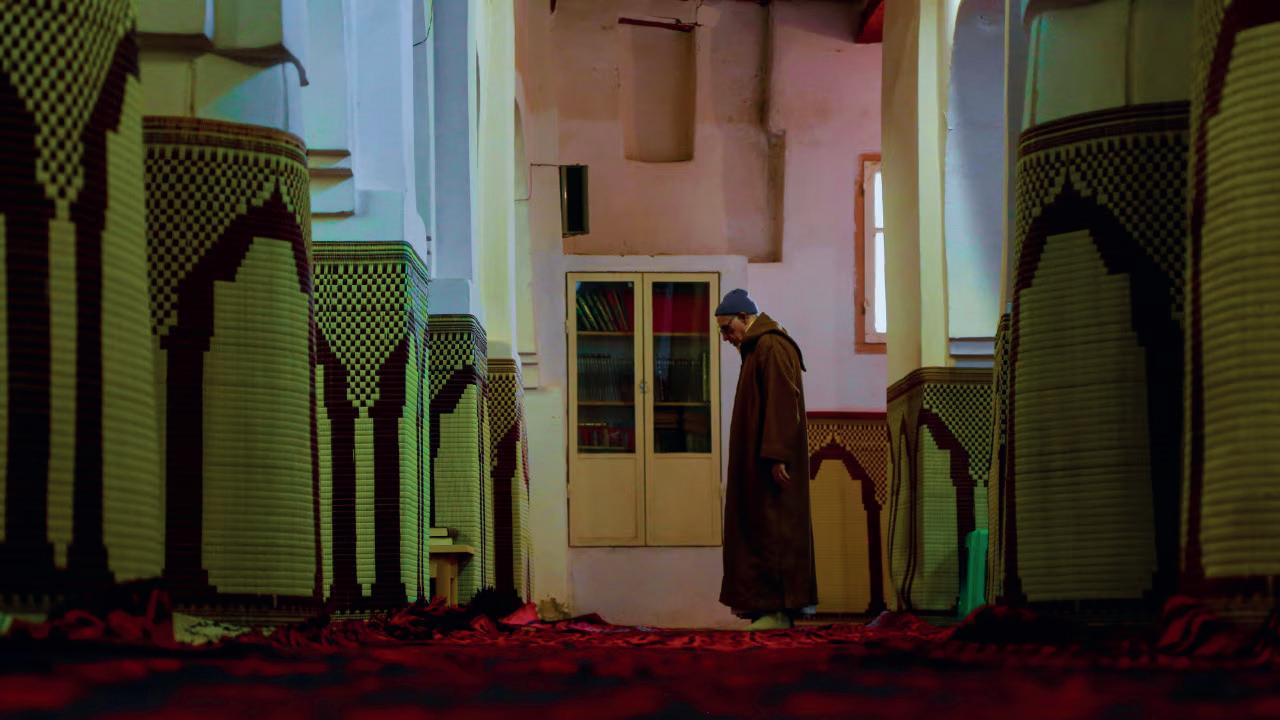
One of the most striking characteristics of the Companions was their constant turning to Allah in prayer. Their victories were not to be born of worldly strength, but from the tears they shed in solitude before their Lord. The Holy Prophetsa himself was the fountainhead of this spirit of supplication. He prayed at every stage of his mission and his Companions followed his example with absolute sincerity.
In one prophetic narration describing the era of the Promised Messiahas, the Holy Prophetsa said: “Then Jesus, son of Mary, and his companions shall pray to Allah, and Allah will respond to their supplications and destroy the Dajjal.” (Sahih Muslim, Kitab alfitan wa ashrat al-sa‘ah, Hadith 2937a)
We now turn to the conditions necessary
for the acceptance of prayer. The Promised Messiahas has outlined numerous conditions in his writings; however, four primary ones have been emphasised by Hazrat Khalifatul Masih IVrh in his speeches. It is these four key conditions that we shall focus on, drawing upon the guidance of the Promised Messiahas
Certainty in the efficacy of prayer
The first condition for the acceptance of prayer is certainty – an unwavering belief in the power of Allah to respond to supplication. Until a person is fully convinced of God’s unbounded power and possesses absolute certainty, the prayer itself remains powerless. In accordance with this principle, the Promised Messiahas explains:
“When you stand up in prayer, it is necessary for you to have firm faith that your God has power over all things. Only then will your prayer be accepted and you will behold the wonders of God’s power that we have beheld. Our testimony is based on observation and not on hearsay. How should the supplication of a person be accepted and how should he have the courage to pray at times of great difficulty, when according to him he is opposed by the law of nature, unless he believes that God has power over everything?” (Noah’s Ark, p. 34)
This unwavering certainty and excellent trust in one’s Lord is beautifully exemplified in the Holy Quran in the form of the prayer of Hazrat Zakariyaas. Allah the Almighty says:
The prayer was so significant that Allah the Almighty preserved it in the Holy Quran, so that the Holy Prophet Muhammadsa and his followers could learn from it and adopt it as a model of sincere and unwavering supplication.
Patience and perseverance in prayer
The second essential condition for the acceptance of prayer, as emphasised in the writings of the Promised Messiahas, is the proper etiquette and patience in supplication. Prayer is not merely a verbal expression; it requires patience, perseverance and steadfastness. A person lacking patience, unable to endure difficulties or delays, cannot attain the highest level necessary for the acceptance of prayer. The Promised Messiahas elucidates this principle beautifully in the following words:
“Between the period of prayer and its acceptance, trials and tribulations often occur, and sometimes such severe trials come that they are backbreaking. Yet a person of steadfast and fortunate disposition, even amidst these trials and difficulties, perceives the fragrance of his Lord’s blessings and with foresight, recognises that victory and assistance follow thereafter.” (Malfuzat, 2022, Vol. 4, p. 91)
The Promised Messiahas compares a believer’s certainty in prayer to a farmer’s certainty in sowing a good seed. Although it is difficult for an ignorant mind to comprehend how a plant will grow from that seed, the farmer remains firmly convinced that in a few days, his hard work will pay off.
Huzooras states:
“[This is] an account of the mercy of thy Lord [shown] to His servant, Zachariah. When he called upon his Lord, a secret calling, He said, ‘My Lord, the bones have indeed waxed feeble in me, and the head glistens with hoariness, but never, my Lord, have I been unblessed in my prayer to Thee.’” (Surah Maryam, Ch.19: V.3-5)
This is a striking example of an accepted prayer by a most remarkable prophet of God. All the physical circumstances of nature seemed to oppose the fulfilment of his supplication. Yet, his unwavering certainty in Allah overcame every doubt presented by the material world. It was this steadfast trust and complete conviction in his Lord that enabled his prayer to be answered.
“So too is the case with prayer; it is nurtured in the same way and bears fruit. Those who are hasty tire quickly and give up, and those who are steadfast persevere and arrive at their objective.” Those who are farsighted, patient in waiting for the outcome, who are steadfast in their work and continue to pray “arrive at their objective.” (Malfuzat, 2022, Vol. 4, p. 75)
Humility and meekness
The third condition for the acceptance of prayer is profound humility before Allah the Almighty. True prayer demands that a believer approach their Lord with complete submission, recognising their own weakness and total dependence on Divine
mercy. In elaborating upon this principle, the Promised Messiahas explains it in the following words:
“Therefore, one should engage in prayer and seek forgiveness in the presence of Allah Almighty, for Allah is Self-Sufficient and free of need. No one has dominion over Him. If a person does not approach Him with humility and lowliness, how can he expect Allah to care for him? To demand from Allah while setting conditions upon one’s faith is a grave mistake and leads to spiritual stumbling.” (Malfuzat, 2022, Vol. 3, p. 182)
In our worldly lives, we often see people employing every form of flattery and selfinterest to gain the favour of their leaders or to secure promotions. Yet, when it comes to Allah Almighty – Whom we often neglect in the pursuit of worldly gains – some of us approach Him with conditions, as if challenging the Divine will. The Promised Messiahas instructs us instead to approach Allah with complete humility, seeking His grace solely and earnestly.
With respect to this condition as well, Allah the Almighty has provided us with vivid examples from the lives of the earlier Prophets in the Holy Quran. Consider the prayer of Hazrat Mosesas when he arrived in the deserts of Midian as a helpless and solitary traveller. Calling upon his Lord, he supplicated:
“My Lord, I am in need of whatever good Thou mayest send down to me.” (Surah alQasas, Ch.28: V.25)
Here, we observe that Hazrat Mosesas made no demands and imposed no conditions. He did not prescribe what Allah should give him. Instead, with complete humility and self-effacement, he presented himself before his Lord like a beggar with an empty bowl, ready to receive whatever his Master deemed best.
This is the attitude we, too, must adopt in our prayers: pure humility, surrender and trust. When we approach Allah in this state, He approaches us with His protection and grace. Allah the Almighty presents yet another prayer of Hazrat Mosesas where he declares:
Yusuf Fazakkir
Continued from page 7
can add vegetables to your meat curries or soups, or have green soups/stews (okro, spinach, kontomire or sukuma), or a mixed vegetable salad.
· Protein: should be ¼ of your plate. Include any of your protein-rich foods, such as lentils, beans, eggs, lean meat (fish, chicken) or dairy products. You may have some yoghurt to improve your digestion and provide you with protein, calcium and fluid for hydration.
· Fat: should be consumed in moderation. Healthy fats can be obtained from cooking your meals with vegetable oil (olive, canola, soy, corn, sunflower, peanuts, etc.) or taking a handful of nuts (almonds, peanuts or cashews) or seeds (sesame, chia, flaxseed, etc.) with porridge or yoghurt.
(“Sahur Sempurna Ramadan – Effective Nutritional Guide to Achieve Optimal Glucose Levels During Ramadan”, nestlehealthscience.my, accessed on 15 February 2025)
What can we eat and drink for iftar?
Iftar is usually a time of family and friends coming together. Be mindful of your nutrition as you enjoy the feast. Break your fast slowly with a light iftar comprising low-fat and fluid-rich foods. (“A healthy Ramadan”, nutrition.org.uk, accessed on 15 February 2025)
This helps with digestion and prevents overeating. Start with 1-3 dates, as it is the sunnah of our Prophetsa. (Sunan Abi Dawud, Kitab as-siyam, Hadith 2356)
Dates are an excellent source of energy and fibre. You can have a small piece of fruit or just have plain water. After 30 minutes, eat a healthy, balanced dinner comprising starchy and whole-grain carbs, and vegetable soups/stews/salad as well as protein. (“A healthy Ramadan”, nutrition. org.uk, accessed on 15 February 2025)
If craving sweets, replace processed foods containing added sugars (fizzy drinks/ fruit juice drinks or sweet pastries/biscuits) with a medium-sized fruit, or its unsieved, blended fruit juice or smoothie. Fruits (banana, watermelon, oranges, coconut, etc.) are good sources of fibre, vitamins and minerals for energy, immune function and
Continued from page 10
“My Lord, I have power over none but myself and my brother; therefore make Thou a distinction between us and the rebellious people.” (Surah al-Ma’idah, Ch.5: V.26)
Here again, Hazrat Mosesas expresses utter submission. He acknowledges his own powerlessness and affirms that any success, any victory and any protection can only come from Allah. His prayer embodies the deepest humility, recognising that without divine support, he possesses no strength of his own.
This is precisely the spirit that the Promised Messiahas wants us to develop in our supplications. If we pray with such humility, acknowledging our incapacity and Allah’s limitless power, then – as the Promised Messiahas explained – our prayers
hydration.
Other foods high in fat and energy, such as creams and deep-fried foods (meat pies, samosas and rolls), can contribute to weight gain. Thus, it is important to reduce their intake by preparing fried foods with less oil or by reducing the quantity one eats.
Enjoy your meals and eat slowly to avoid overeating. Eating in moderation is emphasised by our Prophetsa, who is reported to have said:
“A human being fills no worse vessel than his stomach. It is sufficient for a human being to eat a few mouthfuls to keep his spine straight. But if he must (fill it), then one third for food, one third for drink and one third for air.” (Sunan Ibn Majah, Kitab al-at’imah, Hadith 3349)
You may take a snack after tarawih prayers, if necessary. Overeating will put a burden on your digestive system and may cause discomfort during your prayers. Eat the right amount that suits your body. Eating large portions in a hurry may cause heartburn and discomfort.
Hydration is essential: drink enough plain water between your iftar and suhoor (2-3 litres). Try eating fluid-rich foods such as soups, citrus fruits, coconut and watermelon. Avoid caffeinated drinks such as coffee, tea and cola, as caffeine may cause frequent urination, leading to dehydration. You may reduce the quantity consumed or replace them with decaf tea or coffee. (“A healthy Ramadan”, nutrition.org.uk, accessed on 15 February 2025)
Being active is important for improving digestion and well-being. This does not mean going to the gym for vigorous strength training, but trying to schedule 10-15 minutes of light exercise at a suitable time (stretching or walking to the mosque).
Conclusion
In conclusion, healthy eating is not difficult if we intend to take gradual steps, be consistent and enjoy our food, which is one of the countless blessings of Allah on us. Ramadan could be our pathway for making our meals healthy and balanced, being physically active and sustaining the good habits afterwards, insha-Allah. May Allah make this Ramadan a source of our physical and spiritual nourishment, amin summa amin
gain access to the divine court and receive the blessings of acceptance.
Weep earnestly
The fourth and final condition for the acceptance of prayer is to weep earnestly before Allah the Almighty. When a believer has fulfilled the first three etiquette –certainty, patience and deep humility – a profound inner state is produced. The heart becomes awakened, softened and drawn irresistibly toward its Creator. At that moment, true prayer naturally flows in the form of intense, heartfelt crying.
This weeping is not merely emotional; it is the soul melting in the presence of its Lord. It is the moment when one feels utterly dependent on Allah and the eyes express what the tongue cannot articulate. Such tears cleanse the heart, strengthen faith and
“The month of Ramadan is that in which the Quran was sent down as a guidance for mankind with clear proofs of guidance and discrimination.”
(Surah al-Baqarah, Ch.2: V.186)


unlock the doors of divine mercy.
Regarding this lofty station of supplication, the Promised Messiahas states:
“Do not think that we already pray everyday, and that the Salat we offer is also prayer; for the prayer which follows true knowledge and is born of Divine grace is of an altogether different colour and complexion. Such prayer is a thing that consumes, it is a fire that melts, it is a magnetic force that draws Divine mercy, it is a death but ultimately gives life, it is a raging flood but finally turns into a boat. Through it every wrong is redressed and every poison finally becomes an antidote.
“Blessed are the prisoners who never tire of supplication, for they shall one day be freed.” (Lecture Sialkot, p. 31)
With this fourth and final condition explained, the Promised Messiahas turns
our attention to the special divine grace that descends upon a servant when such tears begin to flow. When a believer has truthfully cultivated the first three conditions –certainty, steadfast patience and profound humility – and then seeks his Lord with a heart fully awakened, these tears become the natural outpouring of the soul. At that moment, a powerful assurance arises within the servant that Allah the Almighty will surely come to his aid.
In this age of darkness, when humanity rushes toward destruction and stands at the very brink of a blazing abyss, it is once again only through prayer that salvation can dawn. Today, the divinely guided Jamaat of the Holy Prophet’ssa spiritual heir must combine its humble entreaties with the blessed prayers of its Khalifatul Masih.
Neo-nationalism and the decline of human values
Islam’s vision of universal brotherhood beyond nationalism
The world order established in the aftermath of the Second World War now appears to be entering a phase of decline. For nearly eight decades, Western powers, led by the United States, have projected their economic, financial, technological and military dominance to impose their interests and preferred policies across the globe.
History, however, consistently reminds us that every action generates a reaction, and that no period of ascendancy is permanent. Today, the signs of weakening Western supremacy are increasingly evident.
Global economies are grappling with prolonged recessions, while decades of war imposed by Western powers have left entire nations reduced to rubble.
Alongside this devastation, millions of refugees, many from Muslim-majority countries have been forced to migrate toward Western states in search of safety and a dignified life.
In response to these developments, right-wing extremist politicians have once again revived the rhetoric of nationalism to serve their political ambitions. Beneath its appealing surface, this movement often masks a deeper hostility toward Islam and Muslim communities. In contemporary political discourse, this resurgence is described as neo-nationalism.
Understanding nationalism
Nationalism has always been a popular slogan. Love for one’s nation and the preservation of national identity are presented as a beautiful and emotionally appealing concept. Islam, too, has declared love for one’s homeland to be an essential part of faith.
However, the other side of the picture is dangerous. If nationalism comes to mean nothing more than the superiority, welfare, development and racial dominance of one’s own nation regardless of trampling over global laws, justice and fairness then this mindset becomes a deadly poison for humanity and a serious threat to global peace.
History bears witness to the fact that extremist nationalism has given rise to world wars, genocides and countless regional conflicts. The history of previous world wars that occurred in the last century is sufficient to open our eyes.
Nazi Germany
Germany’s notorious Nazi leader, Adolf Hitler, fueled nationalism and pushed the entire world into a global war. In 1920, when Hitler promoted German nationalism in the Nazi Party manifesto, he stated:
• None but members of the Volk (a people; large tribe) may be citizens of the state. None but those of German blood, whatever their creed, may be members of the Volk. No Jew, therefore, may be a member of the Volk
• Whoever has no citizenship is to be able to live in Germany only as a guest and must be regarded as being subject to foreign laws. (“Nazi Party Platform”, encyclopedia. ushmm.org, accessed on 8 February 2026)
In a speech delivered in 1928, Hitler said:
“I am a German nationalist. This means that I proclaim my nationality. My whole thought and action belong to it. I am a socialist. I see no class and no social estate before me, but that community of the Volk, made up of people who are linked by blood, united by a language, and subject to a same general fate.” (Hitler’s Secret Book, 1961, Grove Press edition, pp. 8-9 and 17-18)
The consequences of this surge in nationalism were borne by the entire world, particularly Europe, in the form of the catastrophic devastation of the Second World War, during which millions of people lost their lives.
Establishment of the United Nations
In the aftermath of this conflict, influential nations came to recognise this harsh reality and, under the banner of the United Nations, brought the nations of the world together to make collective efforts toward the establishment of equality and justice.
The United Nations went on to render valuable services to humanity across multiple fields, playing a notable role in the independence of many countries and achieving significant progress in areas such as health and education.
However, in international territorial, economic, military and political conflicts, powerful countries have virtually hijacked the United Nations. In preventing conflicts between powerful and weaker states and in restraining wars among major global powers, the United Nations often appears ineffective and constrained. The ongoing Israel-Palestine conflict stands as a stark and enduring example of this institutional weakness.
The rise of far-right nationalism
Today, the world once again appears to be standing on the brink of destruction. In an atmosphere marked by fear, polarisation and confrontation, the same toxic ideology is being repackaged and promoted under
the appealing banner of nationalism to serve narrow personal and political interests.
In place of globalisation, there is a growing emphasis on restrictive immigration policies, the expulsion of refugees, the curtailment of global trade for national advantage and the limitation of freedom of expression in the name of national interest. Slogans such as America First have been prominently raised by the President of the United States. (“President Trump’s Inaugural Address”, hr.usembassy. gov, 21 January 2025)
In Germany, the popularity of the farright party AfD continues to rise with each election.
In Hungary, the hardline Prime Minister has gained public support through policies that tighten immigration systems, construct border fences, and promote the expulsion of refugees.
India, which claims to be the world’s largest democracy, has witnessed a marked increase in Hindu nationalism (Hindutva) and growing oppression of minorities since the rise of Prime Minister Modi.
Likewise, in the United Kingdom, Italy, France, Spain and other European countries, the influence and electoral strength of rightwing nationalist political parties continue to expand.
Justifiable reasons cited for opposition to refugees
Within this entire scenario, there is one point that appears to carry some truth: certain refugees and migrants have been found involved in illegal activities in Western countries.
In Europe, some individuals involved in terrorist incidents entered the continent under the guise of refugees. Sometimes these individuals are linked to Islam. Many people enter these countries falsely using forged documents.
Likewise, in some incidents, young refugees have been found involved in violence, including misconduct and sexual harassment or abuse of women and young children. There have also been reports of gang violence, drug use and attacks on police.
There are some who receive government assistance, and pay no taxes, while simultaneously engaging in illegal work. The large influx of migrants also places a heavy financial burden on the systems of wealthy countries.

Using these incidents as a basis, right-wing extremists form fronts against refugees and carry out campaigns to deport them back to their home countries. As the number of refugees increases, this campaign continues to intensify. In recent times, millions of people have participated in rallies held in favour of expelling refugees.
The Holy Quran’s universal teaching for establishing a global community
The solution to all these problems and concerns lies only in the true teachings of Islam.
The Holy Quran is an eternal source of guidance and everlasting light for all nations of the world. It is the first and only revealed book that presents comprehensive principles for reforming prejudices based on race, nation, colour and language.
Previously revealed religious books were limited to specific times and peoples, and therefore their audiences were restricted. This is why the Bible declares only the Jews as the children of God and distinguishes them from other nations. Jesus also forbade spreading his teachings among non-Jews (Matthew, 15:24-26).
Similarly, according to many Hindus, they are superior to other nations based on being bearers of the earliest law.
In contrast, the Holy Quran laid the foundation of universal brotherhood and equality.
Allah the Exalted is the Creator, Sustainer and Developer of all nations
One of the very first verses of the Holy Quran is proof of its universality and the equality of all nations. The Quran begins by declaring that Allah alone is the Creator, Master and true Sustainer of all nations, races and all worlds. It states:
“All praise belongs to Allah, Lord of all the worlds.” (Surah al-Fatihah, Ch.1: V.2)
Allah has created all humanity from a single soul. Our God is not limited to any one nation, region or race, but is the One who nurtures the entire universe.
Then, the Holy Quran states:
“It is Allah Who has created you, [and] then He has provided for you; then He will cause you to die, [and] then He will bring you to life.” (Surah ar-Rum, Ch.30: V.41)
In another place, it states:
“And that man will have nothing but what he strives for; And that his striving shall soon be seen.” (Surah an-Najm, Ch.53: V.40-41)
The Holy Prophetsa and the Holy Quran are addressed to all nations By declaring all nations of the world as its audience in its very first proclamation, the Holy Quran established a clear principle of equality: every nation is equally capable of accepting God’s guidance and acting upon it. No tribe or nation in the world is inferior
Shahood Asif Lecturer, Jamia Ahmadiyya International, Ghana
merely because the Holy Prophetsa was not raised among them, nor are the Arabs superior simply because the Holy Prophetsa belonged to them. The Holy Quran declares on behalf of the Holy Prophetsa:
“And We have not sent thee but as a bearer of glad tidings and a Warner, for all mankind, but most men know not.” (Surah Saba, Ch.34: V.29)
The purpose of the division into nations is only identification and recognition
The guiding principle of the Holy Quran is that God divided human beings into different tribes solely for the purpose of identification and recognition. It states:
“O mankind, We have created you from a male and a female; and We have made you into tribes and sub-tribes that you may recognise one another.” (Surah al-Hujurat, Ch.49: V.14)
The only criterion of distinction in the sight of Allah is righteousness Allah has declared that all people are equal by virtue of being human. Whoever acts upon God’s commandments and keeps His fear in their heart is more honourable in the sight of Allah than others. He states:
“Verily, the most honourable among you, in the sight of Allah, is he who is the most righteous among you. Surely, Allah is All-knowing, All-Aware.” (Surah al-Hujurat, Ch.49: V.14)
The Holy Prophetsa proclaimed this very truth in his Farewell Sermon before hundreds and thousands of people:
“O people! Be aware that your Lord is One and your father (Adam) is one. Remember! No Arab has superiority over a non-Arab, nor does a non-Arab have superiority over an Arab, nor does a white have superiority over a black, nor a black over a white – except by righteousness. Have I conveyed the message?” They (the Companions) replied: “The Messenger of Allah has conveyed the message.” (Musnad Ahmad, Beirut: Mu’assasat al-Risala, 2001, Vol. 38, p. 747, Hadith 23489)
Disputes among nations must be decided based on justice
The Holy Quran laid down the fundamental principle of equality and justice, commanding that judgments among people must be made with fairness. If any country or nation seeks advantage only for its own people or its own bloc, it will never be possible to establish a just international community. The Holy Quran states:
“[...] when you judge between men, you judge with justice.” (Surah an-Nisa, Ch.4: V.59)
It further commands that even when dealing with an enemy nation, justice must still be upheld:
“O ye who believe! be steadfast in the cause of Allah, bearing witness in equity; and let not a people’s enmity incite you to act otherwise than with justice. Be [always] just, that is nearer to righteousness.” (Surah al-Ma’idah, Ch.5: V.9)
In times of conflict, reconciliation should be pursued instead of forming blocs and the oppressed must be supported
If war breaks out between different countries for any reason, instead of making decisions based on narrow national interests and nationalism, efforts should be made to reconcile the parties. If one party refuses reconciliation and persists in aggression, then all should unite to restrain the aggressor. Allah says:
“And if two parties of believers fight [against each] other, make peace between them; then if [after that] one of them transgresses against the other, fight the party that transgresses until it returns to the command of Allah. Then if it returns, make peace between them with equity and act justly. Verily, Allah loves the just. Surely [all] believers are brothers. So make peace between brothers, and fear Allah that mercy may be shown to you.” (Surah al-Hujurat, Ch.49: V.10-11)
The Messengersa of Allah strongly emphasised reconciliation between disputing parties. In one hadith, reconciling people is described as superior even to prayer, fasting and charity.
The Messengersa of Allah said: “Shall I not tell you of something better in rank than prayer, fasting, and charity?” They said: “Yes.” He said: “Reconciling people with one another, for discord among people destroys them.” (Sunan Abi Dawud, Kitab al-adaab, Hadith 4919)
Preventing false news and propaganda is essential
While developments in media have created many conveniences, the flood of fake news has also given rise to a new challenge.
Powerful countries and groups, through heavy investment, use all means to spread propaganda for their interests and frequently rely on false news to inflame national and religious sentiments against others.
Social media has acted like fuel on fire in spreading falsehood. The Holy Quran also addresses this issue, stating:
“O ye who believe! if an unrighteous person brings you any news, ascertain [the correctness of the report] fully, lest you harm a people in ignorance, and then become repentant for what you have done.”
(Surah al-Hujurat, Ch.49: V.7)
Mockery and humiliation of other nations is forbidden
The Holy Quran instructs respect and dignity for the leaders and common people of every nation, regardless of whether they are poor or weak.
Insulting other nations or tribes based on wealth, lineage, colour or nationality creates divisions in hearts that sustain conflicts for centuries. Allah says:
“O ye who believe! let not one people [deride] another people, who may be better than they, nor let women [deride other] women, who may be better than they. And defame not your own people, nor call [one another] by nicknames. Bad [indeed] is evil reputation after [the profession of] belief; and those who repent not are the wrongdoers.” (Surah al-Hujurat, Ch.49: V.12)
The Holy Quran also condemns arrogance and pride. It states:
“And turn not thy cheek away from men in pride nor walk in the earth haughtily; Surely, Allah loves not any arrogant boaster.”
(Surah Luqman, Ch.31: V.19)
Treaties and relations with other nations must be based on truthfulness and righteousness, not deception
Today, in the name of diplomacy and statecraft, falsehood and deception dominate. It is often said that nations have no friends, only interests. This is why, despite treaties made under the umbrella of the United Nations in the name of peace, cooperation and development, justice and peace remain elusive.
The Quran provides guidance in this regard as well:
“Cooperate with one another in righteousness and piety, and do not cooperate in sin and aggression.” (Surah alMa’idah, Ch.5: V.3)
Fulfillment of covenants
Islam places great importance on honoring covenants. Fulfilling promises and respecting international agreements are among the core teachings of Islam. Allah the Almighty states:
“And fulfil the covenant of Allah when you have made; and break not the oaths after making them firm, while you have made Allah your surety. Certainly, Allah knows what you do.” (Surah an-Nahl, Ch.16: V.92)
Respect for the beliefs and rituals of others
Allah has placed in every human heart an inclination toward recognising God and maintaining a relationship with Him. Likewise, He has sent prophets and righteous individuals to every nation.
To promote mutual love and respect, Islam teaches that one should not speak ill of the deities or revered figures of others, lest they respond by speaking ill of Allah. He says:
“And revile not those whom they call upon beside Allah, lest they, out of spite, revile Allah in their ignorance.” (Surah alAn’am, Ch.6: V.109)
Economic assistance to poor nations
One of the major causes of disorder and corruption in the world is the unjust distribution of wealth. Wealthy and developed nations, due to their power and technological superiority, dominate the resources and wealth of poorer countries.
Many Third World countries are unable to benefit from their natural resources. Consequently, powerful nations, operating through large corporations, exploit their economies, while local populations suffer from hunger and poverty.
The Holy Quran guides us here as well, stating that wealth should not circulate only among the rich, but should flow justly so that the poor, needy and vulnerable may also benefit. Allah says:
“Whatever Allah has given to His Messenger as spoils from the people of the towns is for Allah and for the Messenger and for the near of kin and the orphans and the needy and the wayfarer, that it may not circulate [only] among those of you who are rich.” (Surah al-Hashr, Ch.59: V.8)
Similarly, the Holy Quran advises poorer nations not to covet the wealth of the rich (Surah TaHa, Ch.20: V.133) but instead
to focus on improving their condition by utilising their own resources.
Justice in weights and measures
The Holy Quran draws attention to transparency and honesty in trade also. It states:
“Woe unto those who give short measure; Those who, when they take by measure from other people, take it full; But when they give by measure to others or weigh to them, they give [them] less.”
(Surah at-Tatfif, Ch.83: V.2-4)
Islam did not merely teach these principles but demonstrated them through the practical example of the Messengersa of Allah, who established a society in which complete justice and harmony existed between the wealthy and the poor.
The rights of slaves, orphans and the needy were fully protected, while wealthy individuals like Hazrat Abdur Rahmanra bin Auf were permitted to conduct trade with honesty and integrity.
This justice was not limited to Muslims alone; under the Charter of Medina, the rights of Jews and non-Muslims living in Medina were also fully safeguarded. The treaty between the Messengersa of Allah and the Jews stands as clear evidence that despite having power and authority, the Prophetsa granted them full rights and allowed them to live with political and religious freedom.
Address of the Head of the Ahmadiyya Muslim Jamaat to the European Parliament
Foreseeing the issues arising from the influx of refugees, Hazrat Mirza Masroor Ahmadaa, the Head of the worldwide Ahmadiyya Muslim Jamaat drew the attention of Western countries and refugees to their respective responsibilities 14 years ago. While addressing the European Parliament in 2012, he stated:
“We also find that as a result of mass immigration, restlessness and anxiety are spreading in certain countries. The responsibility for this lies with both parties – the immigrants and the local people. On the one hand some immigrants provoke the locals by refusing to integrate to any degree, whilst on the other hand some of the locals are displaying a lack of tolerance and openheartedness. From time to time the hatred boils over to a very dangerous extent. In particular, hatred or enmity on the part of the locals in Western countries is often manifested towards Islam in reaction to the negative behaviour of certain Muslims, especially immigrants.” (World Crisis and the Pathway to Peace, 2017, p. 104)
He further stated:
“Governments need to make policies that establish and protect mutual respect, through which hurting the sentiments of others or causing them any type of harm should be outlawed. With regard to the immigrants, they must enter with a willingness to integrate with the local people, whilst the locals should be ready to open their hearts and display tolerance. Furthermore, simply to enforce certain restrictions against Muslims will not lead to peace, because they alone cannot change people’s minds and views. This is not specific to Muslims, but whenever any person is forcibly suppressed due to his religion or belief, it will lead to a negative reaction
through which peace will be severely harmed.” (World Crisis and the Pathway to Peace, 2017, p. 105)
Western countries face danger without immigration
At another instance, Huzooraa stated:
“Blaming refugees as the root cause of all problems is entirely unjust. The truth is that without immigration, many wealthy Western countries are in danger. In reality, all countries depend on one another, and we now live in an interconnected global world. Therefore, instead of erecting barriers and isolating themselves from others, it is essential that people from different regions cooperate with one another and work together for mutual benefit. Governments should plan systematically for this purpose and ensure that countries work together and that migrants are supported at the local level so they may become part of society.” (Al Fazl International, 14 March 2024, p. 2)
Responsibilities of migrants and refugees
In the present era, Allah the Exalted has placed upon the Jamaat of the Imam of the Age the responsibility to call the world toward justice and guidance.
While the Head of the Ahmadiyya Muslim Jamaat has repeatedly urged powerful nations and their leaders to fulfill the demands of justice, he has also drawn the attention of Muslim migrants to their own duties and responsibilities.
Feelings of gratitude toward Western governments must be developed and one must abide by the laws
Huzooraa states:
“Your [Sweden’s] generosity places a very great responsibility upon the immigrants and refugees who come here, and it demands of them that they live here as peaceful citizens and remain grateful and appreciative to the government and the people of this country.
“The Holy Prophetsa taught us that a person who cannot be grateful to his fellow human beings cannot be considered grateful to God either. Therefore, it is a religious duty of these Muslim immigrants and refugees to always remember the kindness this country has shown them by allowing them to live here and benefit from its facilities.
“These refugees left their previous lives in search of peace, and now that they have found safety and protection, it is their duty to live peacefully within this country and to obey its laws.” (Al Fazl International, 15 July 2016, pp. 11-12)
Immigrants should assimilate into the local society and contribute to economic development
Regarding assimilation and contribution to economic development, Huzooraa states:
“Many immigrants who come to Western countries do not integrate into the society they enter, and apart from that, many of them do not work. Or even if they do work, they do not pay taxes and keep themselves separate from the local population.
“When local people see that these individuals are not becoming part of society
yet are receiving government benefits that are paid for by the taxes of the local population, it naturally angers them. Leaders who harbor hatred toward immigrants then incite the public against them. If immigrants themselves try to integrate into local society, they can remove the suspicions of the local people.
“Integration does not mean that you must dress like the local people, or start going to clubs, or begin consuming alcoholic drinks. Nor does it mean that you should go to clubs and dance. Nor does it mean that you abandon your moral values.” (Al Fazl International, 20 August 2021, p. 3)
The meaning of integration is to serve the nation
In response to a question from a lady, Huzooraa advised that the true foundation of integration lies in service to the country, and stated:
“To integrate means to serve the country. If you are doing that, then it is correct. We are rendering service; we are loyal to the country – and what is loyalty? It is precisely this: not to speak against the country, and to serve for the betterment and progress of the country. Ahmadis should prove their loyalty to the country through their services. If the Jamaat says that we are loyal to the country, then there should be tangible proof of this loyalty, that we serve the country as doctors, teachers, engineers, or through any form of service.” (Al Fazl International, 23 October 2025, p. 2)
Pay taxes instead of relying on government aid
Regarding paying taxes and avoiding relying on government aid, Huzooraa has also given extensive guidance.
This includes instructions that all immigrants who come here should work so that instead of consuming the taxes of taxpayers and taking assistance, they themselves become taxpayers. He encouraged immigrants to become the giving hand, not the receiving hand.
We must act upon this. This is an Islamic teaching, and since we follow this teaching, we must act accordingly. (Al Fazl International, 22 February 2025, p. 2)
After migration, show loyalty to the country you live in, not your ancestral homeland
In a speech in Germany at the Baitur Rashid Mosque in Hamburg, Huzooraa stated:
“I explained, according to Islamic teachings, what should happen if a situation arises whereby Germany is engaged in a war with the country of origin of an immigrant who has become a German citizen. If the immigrant feels sympathy towards his original country and thinks there is a risk of him desiring or causing harm to Germany, then such a person should immediately relinquish his citizenship or immigration status and return to his native country. However, if he chooses to remain, then Islam does not permit any form of disloyalty to the country whatsoever.” (World Crisis and the Pathway to Peace, 2017, pp. 122-123)
Develop a comprehensive plan to spread your message
Presenting a solution to campaigns run by opponents of immigration, Huzooraa gave detailed guidance to a second delegation of Ahmadis from the USA East Region who met him.
He stated that just as political groups run campaigns, Ahmadis must initiate a move to create widespread awareness about the true teachings of Islam. Huzooraa reminded them of the target he had set over 17 years ago to convey the peaceful message of Islam to 5% of their country’s population annually – a target which, had it been pursued seriously, would have yielded tremendous results by now.
Huzooraa advised them to make a comprehensive plan, using modern methods of outreach. Khuddam-ul-Ahmadiyya should organise seminars at universities and with academics to show them how Islam promotes peace and how Ahmadis integrate into society to work for the betterment of the nation. An active effort is required, as nothing can be achieved by sitting at home. Huzooraa gave the example of a politician in the UK who has been striving for decades and is only now predicted to gain a majority due to shifts in public opinion against immigrants. Ahmadis in the US, who are hardworking taxpayers and a benefit to the country, must create their own effective advocacy to showcase this reality and the true, peaceful teachings of Islam. This plan, Huzooraa stressed, should be undertaken on a large scale by all auxiliaries of the Jamaat.
In response to a question regarding this issue, Huzooraa further provided guidance to the National amila of Lajna Imaillah Germany who met him on 8 February 2025 He instructed them to work together with members of the press and media to write such articles in newspapers and upload short clips on social media. Form a dedicated team for this. Properly inform people about anti-Muslim racism as well and explain what the true teachings of Islam are.
Regarding the eradication of antiMuslim racism, Huzooraa reminded that he has spoken about this many times in Germany as well, and that several speeches exist on this subject. Use quotations from them. There are verses of the Holy Quran and hadith that explain what Muslims are taught, that Muslims are peace-loving, what Islam teaches regarding women and their lawful rights, regarding government and regarding deprived people. Efforts should be made to spread such information as widely as possible.
Ahmadi immigrants should give precedence to their faith and remember the purpose of migration
In response to a question regarding the moral training of newly arrived Ahmadi immigrants in a meeting with khuddam from the USA’s North Region, Huzooraa noted that these immigrants are largely arriving from countries like Pakistan, not from some polytheistic nations. He advised the khuddam to remind these newcomers that they emigrated due to the adversities faced in their homelands – restrictions on performing salat, denial of access to mosques, inability to worship or express their faith freely and persecution for being Ahmadi Muslims.
Therefore, Huzooraa emphasised, the fundamental reason for their migration is religion. If religion is the impetus, then upon arrival in their new countries, they must not forsake it but rather cherish and remember it. The paramount method prescribed by Allah the Exalted for honouring faith, Huzooraa continued, is to worship Him, perform the five obligatory daily prayers, engage in istighfar and avoid becoming ensnared by the superficial allure and attractions of Western societies. They must remain mindful of their core purpose.
Conclusion
Today, once again, the world stands on the brink of war. If the world wishes to be saved from disorder and destruction, the nations of the world must adhere to the guiding principles of Islam.
• They must rise above the narrow mindset of only their own countries or nation’s benefit and superiority and unite at a global level for justice and development.
• Disputes between countries must be resolved with justice. The practice of forming blocs for political and economic interests and pressuring weaker nations must be abandoned.
• Under the guise of freedom of expression, insults and ridicule of other religions especially Islam must be stopped. Those who, God forbid, draw caricatures of the Holy Prophetsa must realise that they are igniting a fire of hatred that will eventually burn everyone to ashes.
• Journalism based on truth and integrity is needed instead of false propaganda. The spread of one-sided lies merely to promote one’s own objectives must be stopped.
• International agreements must be honoured, and the demands of justice must be fulfilled.
• Poor nations must be supported economically with sympathy so that they can stand on their own feet.
• Global trade must be conducted fairly, rather than wasting energy on unilateral tariff and tax wars for narrow self-interests.
• The practice of imposing wars on poor countries to seize their resources and install governments of one’s own choosing must come to an end. This is the only way the issue of immigrants and refugees can also be resolved.
• Those immigrants who have legally arrived in Western countries must obey the law and become loyal citizens of those countries.
• Those seeking asylum in Western countries should, instead of becoming a burden on governments, work hard and become productive citizens so that they do not strain the resources of the local population.
• Muslim countries, too, must act upon Islamic teachings and fulfill the rights of their people. Political, economic and religious freedom must be granted so that people can live better lives in their own homes and countries.
As Ahmadis, it is our responsibility to convey the true teachings of Islam to the influential segments of the world. May Allah the Almighty grant us the ability to fulfill this responsibility.
Friday Sermon
Mubarak Mosque, Islamabad, Tilford, UK
23 January 2026
The Prophet’ssa love for Allah: A model of devotion and tranquil worship
After reciting the tashahhud, ta‘awwuz and Surah al-Fatihah, Hazrat Khalifatul Masih Vaa stated:
The various aspects of the life of the Holy Prophetsa were being mentioned. In the previous sermons, his love for Allah was being mentioned, and I will further discuss this very subject today as well. The manner and beauty in which the Holy Prophetsa worshipped have previously been discussed. Today, I will present some references from the Ahadith, as well as the writings of his ardent devotee, the Promised Messiahas and how he depicted the status and rank of the Holy Prophetsa and his love for Allah.
In one narration, it is recorded that Hazrat Hudhaifahra relates: “One night, I offered prayers with the Holy Prophetsa. He began with Surah al-Baqarah. I thought that he would go into ruku‘ [bowing position] after 100 verses, but he continued on. I then thought that he would go into ruku‘ after completing the chapter, but he continued further. Then I thought he would go into ruku‘ [at this point], but he began reciting Surah an-Nisa, and then he started reciting Surah Aal-e-Imran as well. He recited in a very soft tone and slowly. Whenever he recited a verse glorifying Allah, he would glorify Him. Whenever he recited a verse containing a supplication, he would supplicate. And whenever he recited a verse seeking refuge with Allah the Almighty, he would seek refuge. He then went into ruku’ and said:
“‘Holy is my Lord, the Most Great.’ His ruku‘ was as long as his qiyam [standing position].
“(It was a very long ruku‘). Then he said:
“‘Allah listens to him who praises Him’. He then remained in qiyam for a long time, almost equal to the length of his ruku‘. Following this, he went into sajdah [prostration] and said:
“‘Holy is my Lord, the Most High’, and his prostration was almost as long as his qiyam.” (Sahih Muslim [Translation], Kitab salati l-musafirina wa qasruh, Hadith 1283, Noor Foundation, pp. 270-271)
Such was the manner in which he
offered voluntary prayers, as witnessed by a Companion on one occasion.
Similarly, Hazrat Aishara relates that one night, the Holy Prophetsa stood in prayer reciting only a single verse of the Holy Quran. (Sunan at-Tirmidhi, Abwab as-salat, Hadith 448)
That is, after Surah al-Fatihah, he repeatedly recited only one verse during the qiyam. In one narration, a Companion relates that he recited several long chapters, while in this narration, it is stated that he prolonged his qiyam by [reciting] a single verse. In relation to how long his qiyam was, a previous narration of Hazrat Aishara has already been mentioned, and I have discussed this in my previous sermons, that his qiyam, ruku’, and sajdah were so lengthy and so beautiful that words fail to describe them. (Sahih al-Bukhari, Kitab as-manaqib, Hadith 3569)
Likewise, Hazrat Abu Dharrra relates that the Holy Prophetsa stood up for worship and continued to recite a single verse repeatedly until morning. The verse was:
“If Thou punish them, they are Thy servants; and if Thou forgive them, Thou surely art the Mighty, the Wise.” (Sunan Ibn Majah, Kitab iqamati s-salat wa s-sunnati fiha, Hadith 1350)
Due to his love for Allah the Almighty and due to the compassion he had in his heart for the creation and servants of God, he continued to pray for their forgiveness, that although Allah the Almighty has the power to punish them, yet he prayed that He forgives them, for this supplication itself has also been taught by Allah the Almighty.
Then it is narrated by Hazrat Aishara that during the lifetime of the Holy Prophetsa, a solar eclipse occurred. The Holy Prophetsa stood up to lead the prayer. He observed a very long qiyam (as is performed in the eclipse prayer). He then performed a long ruku‘ – the ruku‘ was for a very long time. He then raised his head and again stood for a long time, though shorter than the first qiyam. Then he went into ruku‘ again for a long time, though shorter than the first ruku‘. Then he went into sajdah, then
stood again and remained standing for a long time, though shorter than the previous qiyam. He then went into ruku‘ for a long time, though shorter than the previous one. Then he raised his head and stood, remaining standing for a long time, though shorter than the previous qiyam. Then he went into ruku‘ and prolonged it, though shorter than the previous ruku‘, and then went into sajdah
Thereafter, the Holy Prophetsa completed the prayer, and the sun had become bright again. He then addressed the people with a sermon. He praised Allah and glorified Him, and then said:
“The sun and the moon are among the signs of Allah, and they do not eclipse because of the death or the life of any person. So when you see them, proclaim the greatness of Allah, supplicate to Him, observe the prayer and give charity.”
He then said: “O community of Muhammadsa! There is no one more protective of their honour than Allah when His male servant should commit adultery, or His female servant should commit adultery.”
This is a deeply stirring warning and admonition: do not provoke the sense of honour of Allah by becoming entangled in sins. Seek mercy from Allah and avoid inciting His sense of honour.
Then he said: “O community of Muhammadsa! By Allah, if you knew what I know, you would weep much and laugh little.”
Then he said, “Hearken, have I conveyed the message?” (Sahih Muslim [Urdu Translation], Vol. 4, Kitab al-kusuf, Hadith 1490, Noor Foundation, pp. 58-59)
That is, he had delivered the message to them.
Thus, he drew attention to turning towards Allah, worshipping Him, and humbling oneself before Him, and said that in this lies your survival and your life. And if you were to know the depth of these matters as I know them, you would give up laughter, weep more, and supplicate to Allah abundantly.
Thus, attention was drawn to the fact that we too should give great importance to prayers and should establish a special bond with Allah the Almighty.
Regarding supplication on the
battlefield, Hazrat Abdullah bin Abbas narrates that Hazrat Umar bin al-Khattabra told him that on the day of [the battle of] Badr, the Messengersa of Allah looked at the idolaters and saw that they were 1000 in number, whereas his Companions were 319. The Holy Prophetsa turned his face towards the Qiblah, then stretched out both his hands and began to call upon his Lord aloud, saying:
“O Allah, fulfil for me what You have promised me. O Allah, grant me what You have promised me. O Allah, if You allow this small band of Muslims to be destroyed, You will not be worshipped on the earth.”
Facing the Qiblah, with both hands outstretched, he continued to call upon his Lord aloud, until his cloak slipped from his shoulders. (That is, his body was trembling due to intense weeping and supplication, and because of this, his cloak fell.) At that moment, Hazrat Abu Bakrra came to him, picked up his cloak and placed it back upon his shoulders. Then he embraced the Holy Prophetsa from behind and said:
“O Messengersa of Allah, your earnest, imploring supplication before your Lord is sufficient for you. He will surely fulfil the promises He has made to you.”
Thereupon, Allah the Almighty revealed the following verse:
This is a verse of Surah al-Anfal. “When you implored the assistance of your Lord, and He answered you, saying, ‘I will assist you with a thousand of the angels, following one another.’”
Thus, Allah aided him through the angels. (Sahih Muslim [Urdu Translation], Vol. 9, Kitab al-jihadi wa s-siyar, Hadith 3295, Noor Foundation, pp. 150-151)
The Promised Messiahas states that:
“In the Holy Quran, the Holy Prophet, may peace and blessings of Allah be upon him, was repeatedly given the promise of the victory over the disbelievers, but when the Battle of Badr – which was the first battle of Islam – started, the Holy Prophet, may
peace and blessings of Allah be upon him, began supplicating and praying, and these are the words that issued from his tongue:
“‘O my Lord! If you destroy these people (they were just 313 men or, according to some narrations, 319), none will worship You till Doomsday.’ When Hazrat Abu Bakr, may Allah be pleased with him, heard these words from the mouth of the Holy Prophet, may peace and blessings of Allah be upon him, he submitted, ‘O Prophetsa of Allah, why are you so perturbed? God has given you the firm promise that He will give victory.’ He said, ‘This is true, but I am keeping my eyes on the fact that He is in need of no one.’ That is to say, God is not obligated to fulfil any promise. Now, it must be understood that when the Holy Prophet, may peace and blessing of Allah be upon him, observed this much deference to etiquettes of respect of God, why should one turn aside from this accepted belief of all Prophets, may peace be upon them, that sometimes God’s prophecy is fulfilled literally and sometimes it is fulfilled metaphorically and figuratively?”
(Zamima Barahin-e-Ahmadiyya, Part V, Ruhani Khazain, Vol. 21, pp. 255-256)
After narrating this incident, he also said to those opponents who objected that his prophecies were not fulfilled, that there are different ways in which prophecies are fulfilled. Sometimes they are fulfilled literally, and sometimes in another form, but Allah the Almighty certainly fulfils the promise He has made. In any case, we should remain bowed before Allah the Almighty at all times, lest due to Allah the Exalted’s selfsufficiency there arise any interruption in this. It should not come to an end; rather, the support and help of Allah the Almighty should always remain with us.
The Promised Messiahas states: “Understand it well that true monotheists are those who do not make the slightest display of their virtues and are not afraid of the world in accepting the truth. They do not care if the world becomes alarmed by any of their actions. Some say that the extent to which the Companionsra used to strive or fast is not proven in the case of the Holy Prophet, may peace and blessings of Allah be upon him. Some of the Companionsra had well-nigh reached a life of asceticism. (Meaning they were so inclined towards faith that they abandoned the world). It does not follow from this that they were (God forbid) superior to the Holy Prophet, may the peace and blessings of Allah be upon him. In fact, the Holy Prophet, may peace and blessings of Allah be upon him, was compelled by Allah the Almighty to come before the world. (He was occupied in the worship of Allah the Almighty and was intoxicated in His love. His entire life was devoted to the Being of Allah the Almighty. But Allah the Almighty instructed him to appear before the world.) His habit of living behind a veil had not gone away. Who knows how much striving and worship he remained engaged in secretly.”
In the same way, the incident of the cemetery has already been mentioned earlier. By narrating it, he proved the Holy Prophet’ssa desire to worship in solitude. It was the turn of Hazrat Aishara for the Holy Prophetsa to visit her house, however when she awoke, she found the Holy Prophetsa was not present. She became very surprised.
She searched but couldn’t find him. She went out in search of him and found him in the cemetery, where the Holy Prophetsa was engaged in supplication with intense fervour, saying: “O my God, my soul, my life, my bones, my every hair has prostrated before You.” The Promised Messiahas presented the incident in this manner and stated:
“Had Hazrat Aishara not informed others of this matter, who would have known what kind of relationship the Holy Prophetsa had with his Lord – how much he worshipped, and how he would worship in concealment and in complete privacy, hidden from people. Such was the state of his spiritual striving and worship.
“Indeed, Allah the Almighty instils this habit in such people – the habit of concealment – and therefore the world is not fully aware of their true condition. They do not do anything for the sake of the world. The One with Whom they have dealings and a relationship knows and sees everything, wherever they may be.” (Malfuzat, 2022, Vol. 8, pp. 214-215)
That is, they worship Allah the Almighty, they love Him, and He is fully aware of every matter. Such people do not act for the sake of worldly display.
Then, in one place, he states that the state of the Holy Prophet’ssa enjoyment of the world, or worldly possessions and benefits, was such that once, Hazrat Umarra went to meet him. He sent in a young boy to seek permission for him to meet him. The Holy Prophetsa was lying on a mat made from date palm. When Hazrat Umarra entered the room, the Holy Prophetsa sat up. Hazrat Umarsa saw that the whole house was empty, without any decorations of any sort. There hung only a sword on a hook, and the datepalm mat upon which he sat, the pattern marks of which were still visible on the Holy Prophet’ssa blessed back. Seeing this, Hazrat Umarra burst into tears. The Holy Prophetsa asked him, “What has made you cry, O Umar?” He replied, “Caesar and Chosroes possess every means of comfort, luxury and opulent commodity at their disposal, while you, who are Allah’s Messengersa and the king of both worlds, lie on date-palm mats such that their patterns leave an imprint along your back.”
The Holy Prophetsa replied, “O Umar, what care do I have for material things?
I spend my days like a wayfarer en route upon his camel to his destination. Along the sandy path of the desert, owing to extreme wind gusts and heat, he sees a tree and seeks to cool down in its shade for just long enough that he stops sweating, and then he resumes his journey.” (Malfuzat, 2022, Vol. 6, pp. 228-229)
Similarly, Hazrat Abu Hurairahra relates that when God Almighty revealed the verse “
which means, “And warn thy kin,” the Holy Prophetsa stood up and declared, “O people of the Quraish, secure your own souls, for I shall not avail you anything against Allah Almighty.” Meaning that if you do good works and incline toward God Almighty, worshipping Him and delving deep into His love, then you will be saved. Otherwise, I will not be able to save you.
Then, addressing his other relatives and tribesmen, he said:
“O children of Abd Manaf, I shall not avail you a whit against Allah. O Abbas,
son of Muttalib, I shall be of no use to you against Allah. O paternal aunt of Allah’s Messengersa, Safiyyah, I shall not be able to save you against Allah, and O Fatima, daughter of Muhammadsa, ask whatever of my wealth you wish, but know that I shall not be able to save you against Allah.” (Sahih al-Bukhari, Kitab at-tafsir, Hadith 4771)
Meaning that only your worship and your relationship with Allah will save you.
Compared to his love and adoration for God Almighty, he did not even care about his own life. Thus, when the Holy Prophetsa began preaching, the Quraish went to Abu Talib, telling him to stop his nephew from finding fault with their idols; otherwise, “we will stop him ourselves – don’t try to get in our way then.” They expressed that they had asked him before as well to get his nephew to desist, but he did not stop him. Now they had come again to ask him. So, either they would take things into their own hands to stop him from saying what he says about them, or they would oppose Abu Talib and his nephew until one of them was annihilated.
When the Quraish said this to Abu Talib, he called for the Holy Prophetsa and said to him, “O my brother’s son, don’t put me in a situation that I haven’t the strength to bear.”
The Holy Prophetsa thought that perhaps his uncle would give up supporting him and hand him over to the Quraish. Thus, the Holy Prophetsa replied, “By God, O uncle of mine, even if these people place the sun in my right hand and the moon in my left, I shall not back down in fulfilling my duty and shall persist in my mission until God Almighty either brings it to completion, or I die in this mission.”
Then, the Holy Prophetsa stood up and started to make his way out when Abu Talib called him and said, “O my nephew, do whatever you wish. By God, I shall not give you over to them in exchange for anything.” (Al-Sirah Al-Nabawaiyyah, Ibn Hisham, Dar-ul-Kotob Al-Ilmiyyah, Beirut, Lebanon, pp. 199-201)
This incident has been recorded in Sirat ibn Hisham. The Promised Messiahas has also mentioned this incident. He states:
“When these verses were revealed – that the idolaters are ‘rijs’ (impure); ‘sharr albariyyah’ (the worst of creation), ‘sufaha’, i.e., foolish; the progeny of Satan; and that their deities are fuel for the Fire, and fuel for Hell – Abu Talib called for the Holy Prophetsa and said:
“‘O my nephew, due to your denunciation, the people have become incensed greatly, and it is nigh that they will destroy you and me as well. You have declared their intelligent ones to be foolish, called their elders the worst of creation, named their revered deities firewood of Hell and fuel for the Fire, and, overall, have deemed them to be impure and the progeny of Satan. Out of goodwill, I advise you to restrain your tongue and desist from these insults; otherwise, I do not possess the strength to stand against the people.’
“In reply, the Holy Prophetsa said, ‘O uncle, these are not insults; rather, it is the manifestation of reality and the statement of the true state of affairs at its proper place. Indeed, this is precisely the task for which I have been sent. If death overtakes me because of this, then I willingly accept such a death for myself. My life is devoted to this very path; I cannot refrain from
proclaiming the truth out of fear of death. And O uncle! If you are wary of your own weakness and hardship, then withdraw from giving me protection. By God, I have no need of you. I shall never desist from conveying commandments of God. The commandments of my Master are dearer to me than my own life. By God, if I am killed in this path, then I wish to be brought back to life again and again, so that I may always continue to die in this very path. This is not a state of fear; rather, I experience the utmost delight in enduring suffering in His cause.’” (Izala-e-Auham, Part 1, Ruhani Khazain, Vol. 3, pp. 110-111)
In the commentary on this, Hazrat Musleh-e-Maudra writes:
“It is evident that throughout his entire life, the Holy Prophetsa was immersed in divine love. Despite bearing immense communal responsibilities, he would remain engaged in worship day and night. When half the night had passed by, he would get up for the worship of God Almighty and remain engaged in worship until morning. Hence, the Holy Prophetsa stated that since it is a true reality that I am an intimate friend of God Almighty and that God Almighty, through His grace, has granted me His nearness, then is it not my duty that I should express gratitude to Him to the extent possible? After all, gratitude is rendered in response to a favour,” (i.e., when Allah the Almighty has bestowed a favour upon him, it is incumbent upon him to offer thanks.)
“Similarly, he would not undertake any major task without divine permission. When the command of God Almighty came, only then would he act. Thus, we observe that despite the intense cruelties inflicted by the people of Mecca, he did not leave Mecca until revelation descended upon him from God Almighty, and through revelation, he was instructed to depart therefrom. In view of the severity of the persecution inflicted by the people of Mecca, he granted the Companions permission to migrate to Abyssinia; they expressed their wish that he too should accompany them. He replied that he had not yet received permission from God Almighty and that his leave had not been granted.
“At a time of oppression and hardship, when people gather their friends and relatives around themselves, the Holy Prophetsa directed his community to migrate to Abyssinia and depart, while he himself remained alone in Mecca, because his Lord had not yet commanded him to migrate. Whenever he heard the word of God, his eyes would involuntarily fill with tears, particularly those verses in which he was directed towards his responsibilities. Accordingly, Abdullah bin Mas‘udra relates:
“‘One day, the Holy Prophetsa told me to recite some verses of the Holy Quran to him. I responded, ‘O Messengersa of Allah! The Holy Quran has been revealed upon you directly; how could I recite a portion to you?’
“The Holy Prophetsa stated, ‘I like to have others recite the Holy Quran to me so that I may listen to it.’” Hazrat Abdullah bin Mas‘udra says, “I began to recite Surah anNisa to him until I reached this verse:
“‘What will be the condition when We
will bring forth from every nation their prophet, and stand him before his people and pass judgement on that nation, and We will also stand you before your nation and take them to account.’ Then the Holy Prophetsa said, ‘Enough, enough.’ I looked towards him, and tears were flowing from his eyes.” (Dibacha Tafsir-ul-Quran, Anwarul-Ulum, Vol. 20, pp. 382-383)
I have narrated this account before as well, but each time it is mentioned, it reveals a new perspective of the Holy Prophet’ssa fear and love for Allah the Almighty.
In connection with divine love, history records the incident of the Holy Prophet’ssa injuries during the journey to Ta’if. In the 10th year of Prophethood, after the demise of Abu Talib, when the Quraish intensified their persecution against the Holy Prophetsa, he proceeded to Ta’if. He stayed in Ta’if for 10 days and continued to invite the people to Islam, but no one accepted his call.
When the leaders realised that the youth might respond positively to his message – lest repeated exhortations lead them to accept it – they incited the miscreants against him. They began pelting him with stones until blood flowed from both his feet. Hazrat Zaid bin Harithahra was also with him. Whenever stones were hurled, Hazrat Zaid would attempt to shield him with his own body, to the extent that Zaid himself sustained multiple wounds to his head. (AlTabaqat Al-Kubra, Vol. 1, Dar-ul-Kotob AlIlmiyyah, Beirut, p. 165)
It is narrated in Sahih al-Bukhari concerning this incident that the Holy Prophet’ssa noble wife, Hazrat Aishara, related that she once asked the Holy Prophetsa whether there had come upon him a day more severe than the Day of Uhud, when he was injured. The Holy Prophetsa replied, “The most severe hardship I had endured at the hands of your people was the ordeal I faced on the Day of ‘Aqabah – that is, in Ta’if – when I went to Ibn ‘Abd Yalil bin ‘Abd Kulal and conveyed the message to him, but he did not give the response I had hoped for. I then departed from there, concerned and in my own thoughts, until I reached Qarn al-Tha‘alib, a small mountain near Mina. There, this state of anguish was alleviated. I raised my head and saw that a cloud was shading me. I saw within it the angel Gabriel, who called out to me and said that ‘Allah had heard what your people had said concerning you – that Allah had heard all the treatment meted out to him and the responses given to him – and that Allah had sent to him the angel that governs the mountains, so that he might command him to do whatever he wished regarding them.’”
The Holy Prophetsa, further related that “the angel of the mountains then called out to me and said ‘Salaam’, and then said, ‘O Muhammadsa, command whatever you wish concerning them. If you so desire, I shall cause these two mountains to collapse upon them,’” meaning that they would be crushed beneath them.
The Holy Prophetsa, replied, “No. Rather, I hope that Allah will bring forth from among their progeny people who will worship the One God and will not associate anything with Him.” (Sahih al-Bukhari, Kitab bud’i l-khalq, Hadith 3231; Furhange-Sirat, 2003, p. 235)
Thus, even here, his compassion prevailed. He saved those people, and later – after the conquest of Mecca – within some
time, their descendants also accepted Islam.
The Promised Messiahas, while elucidating the rank and station of the Holy Prophetsa, states:
“That high degree of light which was granted to man – that is to say, upon the perfect man – was not within the angels, the stars, the moon, or the sun; neither was it in the oceans and the rivers of the earth, nor was it in rubies, emeralds, sapphires, diamonds, or pearls. In short, it was not in any earthly or heavenly object. It was only in man, that is, the perfect man, whose most complete, highest, and loftiest, and most perfect example was our Lord and Master, the Chief of the Prophets, the Chief of all living ones, Muhammad, the Chosen One, may peace and blessings of Allah be upon him. So that light was bestowed upon this [perfect] man and, according to their ranks, upon all those who bear some degree of the same nature and disposition.”
That is, to those who accept him and act upon his sunnah
Then, explaining what that trust was which had been bestowed upon man, the Promised Messiahas said:
“The word trust refers to all the faculties of the Perfect Man – his intellect, knowledge, heart, soul, senses, fear, love, honour, dignity, and every spiritual and physical bounty that Allah the Almighty grants to the Perfect Man. Then the Perfect Man returns all these trusts to God Almighty in accordance with the command of the Quran:
“[‘Verily, Allah commands you to make over the trusts to those entitled to them.’]
“That is, he annihilates himself in Him and dedicates his being in the way of God. The trusts which Allah had granted him, he expends entirely in obedience to God and for the attainment of His pleasure, so that the trusts may be duly discharged and the love of God may be gained in abundance.”
Thus, this was the exalted manifestation of trust which the Holy Prophetsa fulfilled by losing himself entirely in the love of God. Clarifying this further, the Promised Messiahas said:
“This supreme, complete, and perfect state was found in our Master, our Guide, our Leader – the unlettered, truthful, and trustworthy Prophet, Muhammad, the Chosen Onesa – as God Himself testifies in the Holy Quran:
“Furthermore, God states:
“[‘Say, “If you love Allah, follow me: then will Allah love you and forgive you your faults. And Allah is Most Forgiving, Merciful.”’]
“Then, God states:
“[‘Say, “I have submitted myself to Allah.”’]
“God then further states:
“[‘And I have been commanded to submit myself to the Lord of the worlds.’]”
He explained:
“Say to them that my prayers, my striving in worship, my sacrifices, my living, and my dying are all for Allah alone and in His cause – the same God Who is the Lord of all the worlds, Who has no partner. And I have been commanded to this, and I am the foremost of those who submit. That is to say, from the beginning of the world to its end, there is no other perfect man like me who has attained such an exalted degree of selfannihilation for God, and who has returned to Him all the trusts entrusted to him.
“In this verse is a clear refutation of those ignorant monotheists who claim that the superiority of our Holy Prophetsa over the other prophets is not absolute, and who, quoting weak traditions, say that the Holy Prophetsa forbade anyone from considering him superior even to Jonah, son of Matta. Such ignorant people fail to understand that even if that narration were authentic, it would only reflect the Prophet’ssa humility and modesty, which was our beloved leader’s disposition. Every statement has its time and context. If a righteous person signs a letter as ‘the most humble servant of Allah’, can one conclude from that that he is, in fact, worse than all people – even idolaters and sinners – and that he himself confesses to being so? How ignorant and spiritually dishonest such reasoning would be.”
The Promised Messiahas said:
“It must be reflected upon carefully that when Allah, the Exalted, Himself names the Holy Prophetsa the First of those who submit, and appoints him as the Leader and Chief of all who obey and submit, and declares him the first to return all the divine trusts to God, then after this, how can any believer in the Quran dare to speak in a manner that diminishes his exalted rank?
existence so that, as He is the Lord of the worlds, I become the servant of all creation, wholly belonging to Him and to His cause. Thus, I have given over my entire being and all that I possess to Allah; nothing of mine remains – all that is mine now belongs to Him.” (Aina-e-Kamalat-e-Islam, Ruhani Khazain, Vol. 5, pp. 160-165)
This was the exalted comprehension of the station and rank of the Holy Prophetsa, which Allah the Almighty granted to the Promised Messiahas, and which he conveyed to us. Yet despite this, our opponents allege that, God forbid, we dishonour the Holy Prophetsa and give a higher rank to the Promised Messiahas. May Allah protect every Ahmadi from their mischief.
In one instance, the Promised Messiahas states:
“I always wonder what a sublime Prophet this Arabian Prophet is, whose name is Muhammad (thousands upon thousands of blessings and peace be upon him). One cannot fathom the limit of his sublime status, and it is not given to man to estimate the extent of his spiritual effectiveness. It is a pity that his rank has not been recognised as it should have been. He is the champion who restored to the world the Tauhid [oneness of God] which had disappeared from the world; he loved God to the extreme, and his soul melted to the extreme out of sympathy for mankind. Therefore, God, Who knew the secret of his heart, exalted him above all the Prophets and all the first ones and the last ones and bestowed upon him all that he desired within his lifetime. It is he who is the fountainhead of every grace, and anyone who claims any superiority without acknowledging his grace is not a human being but is the spawn of Satan, because he (the Holy Prophetsa) has been bestowed the key to every exaltation, and he has been given the treasure house of every understanding. He who does not receive through him is deprived forever. I am nothing and possess nothing. What am I, and what do I amount to? I would be ungrateful if I were not to confess that I have found true Tauhid through this very Prophet. I have attained the recognition of the Living God through this same perfect Prophet and through his light. The honour of converse and communion with God, through which I behold His countenance, has been bestowed upon me through the same Great Prophet. The rays from this Sun of Guidance fall upon me like sunshine, and I continue to be illumined only so long as I am facing towards it.
“[‘Say, “My Prayer and my sacrifice and my life and my death are all for Allah, the Lord of the worlds. He has no partner. And so am I commanded, and I am the first of those who submit.”’]
“Then, God states:
“[‘And say, “This is My path leading straight. So follow it; and follow not other ways, lest they lead you away from His way. That is what He enjoins upon you, that you may become able to guard against evils.”’]
“In this very verse, Allah the Almighty has described various degrees of submission, but has declared the highest of them to be that which was granted to the nature of the Holy Prophetsa.”
The translation of the remaining verses that were read out is as follows:
“Allah the Exalted says to His Messenger:
“‘Tell them, this is My path, the straight one; so follow it and do not follow other paths that will take you far from God.’ Tell them: ‘If you truly love Allah, then come and follow me; adopt my way, which is the highest reality of Islam, and then Allah will love you and forgive your sins.’ Tell them: ‘My way is that I have been commanded to surrender my entire being to God and to devote myself wholly to the Lord of all the worlds.’ That is, I have effaced my own
“Those who adhere to the notion that one who does not believe in the Holy Prophet, may peace and blessings of Allah be upon him, or turns apostate but remains firm in Tauhid and considers God to be One without any partner will attain salvation and shall suffer no harm on account of his disbelief or apostasy […] are indeed ignorant of the true meaning of Tauhid […] But mere belief that He is One is not enough for salvation; rather, salvation depends on two things:
“1. One is the absolute conviction in the Being and Oneness of God Almighty.
“2. Second is that such perfect love for the One Glorious God should be instilled in one’s heart that, as a consequence of its influence and dominance, obedience to God Almighty should truly become the delight of one’s heart, without which he could not live
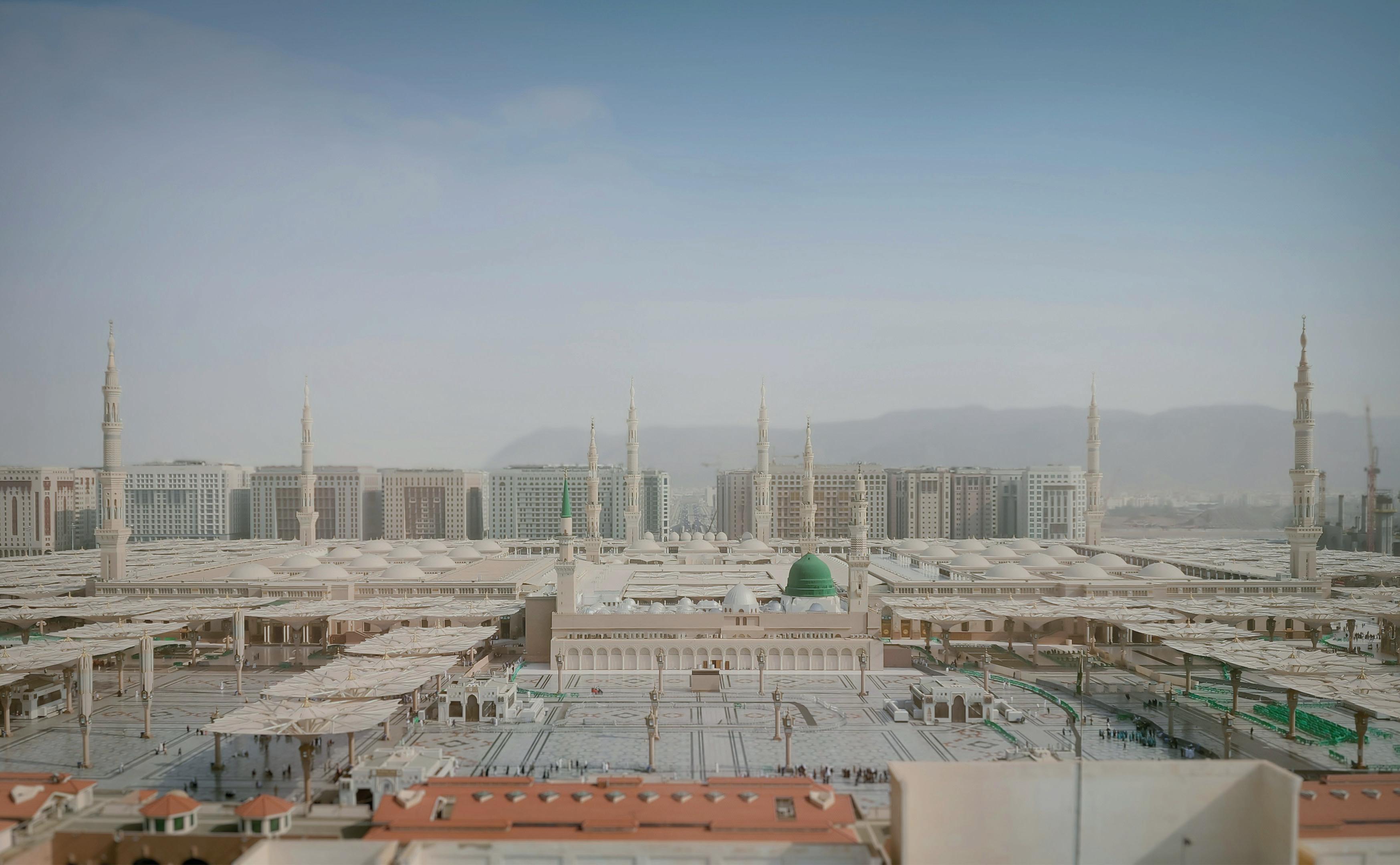
at all. Love for the Divine should trample and obliterate love for all besides Him.
“This is true Tauhid that can never be achieved except through following our lord and master, Hadrat Muhammad, may peace and blessings of Allah be upon him. Why can it not be achieved? The answer is that the Being of God is unseen beyond the unseen, concealed beyond concealed, and extremely hidden. The reasoning faculties of humans cannot discover Him on their own. No rational argument can constitute an incontrovertible proof of His existence, because the reach and access of reason is limited to the extent of realising the need for a Creator by reflecting upon the created beings in the universe. However, to acknowledge the need for His existence is one thing, but it is quite another to arrive at the stage of ‘Ain al-Yaqin [certainty by sight] that God, the need for whose existence has been acknowledged, does indeed exist. (Reason can only take one to the stage of recognising that God exists, as many people say, but they do not know who God is). However, since the methodology of reason is imperfect, incomplete, and doubtful, not every philosopher can recognise God through reason alone. Rather, most people who seek to discover God solely through reason become atheists in the end. Their reflections on the created things in the earth and heavens cannot benefit them at all. They ridicule and mock God’s elect, contending: ‘There are thousands of things throughout the world whose existence we do not find useful, and our research in them does not
indicate any such creativity that would prove the existence of a Creator (when they employ reason they are unable to explain why certain things exist); on the contrary, the existence of these things is entirely pointless and useless.’ It is a pity that such ignorant people do not understand that the lack of knowledge about something does not entail its non-existence (just because one doesn’t know about something doesn’t negate its very existence).
“There are hundreds of thousands of such people in the world today (now they are in the millions) who consider themselves superior intellectuals and philosophers, yet they vehemently deny the existence of God Almighty. It is obvious that if they had found any strong rational argument, they would not have denied the existence of God Almighty. Nor would they have repudiated the existence of God Almighty with extreme shamelessness, disdain, and ridicule, had they been proven wrong by an irrefutable rational argument for the existence of the Glorious Maker. So, no one can be delivered from the storm of doubts while sailing in the ark of the philosophers (interacting only with philosophers or adopting their views cannot rid one of doubts. There is a storm of doubts in the hearts of these philosophers who are becoming deniers of God’s existence); rather, he would certainly drown and will forever be deprived of the elixir of pure Tauhid
“Now ponder how false and foul the notion is that Tauhid can be achieved, and salvation can be attained, without the
medium of the Holy Prophet, may peace and blessings of Allah be upon him. (If one wishes to know true Tauhid, to truly know about God, they will have to deeply study the teachings of the Holy Prophetsa and understand the Holy Quran.) O ignorant ones! How can there be faith in His Tauhid until there is perfect certainty in the existence of God? Know for sure, therefore, that certainty of Tauhid can be achieved only through a Prophet, as our Holy Prophet, may peace and blessings of Allah be upon him, convinced the atheists and pagans of Arabia of the existence of God Almighty by showing them thousands of heavenly signs. Even to this day, true and perfect followers of the Holy Prophet, may peace and blessings of Allah be upon him, present those signs to the atheists. What is really true is that, until a person observes the living powers of the Living God, Satan does not depart from his heart, nor does true Tauhid enter into it, nor can he be convinced with certainty of the existence of God. This pure and perfect Tauhid is attained only through the Holy Prophet, may peace and blessings of Allah be upon him.” (Haqiqatul-Wahi, Ruhani Khazain, Vol. 22, pp. 118-121)
In this era, this teaching has been clearly elucidated by the Promised Messiahas. The Promised Messiahas further states:
“Have you any notion what was the strange event that occurred in the wasteland of Arabia when hundreds of thousands of the dead were revived within a few days, and those who had been misguided through generations exhibited Divine complexion,
and those who were blind began to see, and those who had been dumb began to utter words of Divine wisdom, and the world underwent a revolution which no eye had seen before and no ear had heard of. Do you know how all this came about? It was the supplications during dark nights of one who had lost himself in God which caused a revolution in the world, and showed such wonders as could never have been expected from that Unlettered and Helpless one.
“‘Send down Thy blessings and peace, O Allah, on Muhammadsa and his people according to the amount of pain and anguish he felt for his Ummah, and pour down upon him the light of Thy mercy forever.’”
He then states:
“I too have observed from personal experience that the effect of prayers far excels that of water and fire. In fact, nothing in the chain of natural causes is as gloriously potent as prayer.” (Barakat-ud-Dua, Ruhani Khazain, Vol. 6, pp. 10-11)
May Allah the Almighty enable us to offer prayers whilst treading this path; prayers that are granted acceptance. May He enable us to offer prayers in the true sense and truly grant us the ability to become true believers who do justice to offering prayers and strive to follow the example established by the Holy Prophetsa
(Official Urdu transcript published in the Daily Al Fazl International, 13 February 2026, pp. 2-7. Translated by The Review of Religions.)
Editor-in-Chief: Qaasid Muin