Update on the construction of Talimul-Islam School and mission house in Saltpond, Africa (1926)
Answers to Everyday Issues
Page 6
Page 4
A
A Russian-Turkic traveller at the Hong Kong Mosque and the echo of Qadian, 1909
Part 112
Opinion: Reflecting on faith, balance and raising children
Page 10
Page 8
THE WEEKLY
www.alhakam.org AL HAKAM | Friday 12 June 2026 | Issue CDXXX Ahmadiyya Archive & Research Centre (ARC), 22 Deer Park Road, London, SW19 3TL, UK info@alhakam.org | ISSN 2754-7396
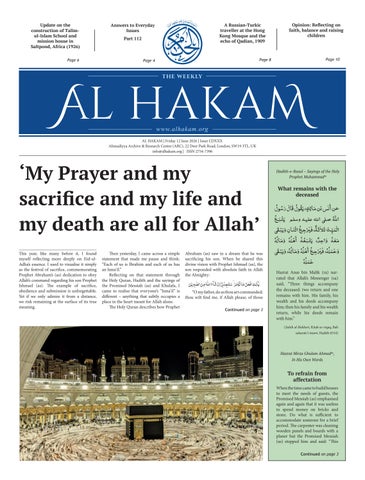
‘My Prayer and my sacrifice and my life and my death are all for Allah’ This year, like many before it, I found myself reflecting more deeply on Eid-ulAdha’s essence. I used to visualise it simply as the festival of sacrifice, commemorating Prophet Abraham’s (as) dedication to obey Allah’s command regarding his son Prophet Ishmael (as). The example of sacrifice, obedience and submission is unforgettable. Yet if we only admire it from a distance, we risk remaining at the surface of its true meaning.
Then yesterday, I came across a simple statement that made me pause and think: “Each of us is Ibrahim and each of us has an Isma‘il.” Reflecting on that statement through the Holy Quran, Hadith and the sayings of the Promised Messiah (as) and Khulafa, I came to realise that everyone’s “Isma‘il” is different – anything that subtly occupies a place in the heart meant for Allah alone. The Holy Quran describes how Prophet
Abraham (as) saw in a dream that he was sacrificing his son. When he shared this divine vision with Prophet Ishmael (as), the son responded with absolute faith in Allah the Almighty:
َ �ُیاَِبَ ِﺖ ِۡاِف ََع ْۡل َِّما ُتُ ْۡؤ َِّمَرُ � َُس َْتَّج ُِدِن ْۡیۤ ِِا ۡۡن ََش �ٰ ﺂٍء ِال ٰ�ّٰل ُُہ ِِّم َۡن ِالﺼبِرُِیۡ َۡن ِ ِ
“O my father, do as thou art commanded; thou wilt find me, if Allah please, of those Continued on page 3
Hadith-e-Rasul – Sayings of the Holy Prophet Muhammadsa
What remains with the deceased
ُ َ َ ُ ُ ََ ﻳَﻘﻮل ﻗﺎل َر ُﺳﻮل،ﻋﻦ أ�ﺲ ﺑْﻦ َﻣﺎﻟ ٍِﻚ َّ ُ �ا�� ُ� ﺻﻠﻰ ا��� �ﻠﻴﻪ وﺳﻠﻢ� ﻳ َ ْﺘ َﺒ َ َْ ُ ََ ٌ ََ َ َ ْ ﺎن َوﻳ َ ْﺒﻘﻰ ِ ﻓ� ْ� ِﺟ� اﺛﻨ،اﻟ َﻤ ِّﻴﺖ ﺛ��ﺛﺔ ُ َْ ُ ُ ٌ َ ُ ََ �ُ � ﻳ َ ْﺘ َﺒ ُﻌﻪ أﻫ� ُ� َو َﻣﺎ،اﺣﺪ ِ ﻣﻌﻪ و َ ُ ْ ُ ََ ُ َ ُ َ َوﻳ َ ْﺒﻘﻰ،�ُ � ﻓ� ْ� ِﺟ� أﻫ� ُ� َو َﻣﺎ،�ُ �َوﻋ َﻤ ُ َ ��ُ �ﻋ َﻤ Hazrat Anas bin Malik (ra) narrated that Allah’s Messenger (sa) said, “Three things accompany the deceased: two return and one remains with him. His family, his wealth and his deeds accompany him; then his family and his wealth return, while his deeds remain with him.” (Sahih al-Bukhari, Kitab ar-riqaq, Bab sakarati l-mawt, Hadith 6514)
Hazrat Mirza Ghulam Ahmadas, In His Own Words
To refrain from affectation When the time came to build houses to meet the needs of guests, the Promised Messiah (as) emphasised again and again that it was useless to spend money on bricks and stone. Do what is sufficient to accommodate someone for a brief period. The carpenter was cleaning wooden panels and boards with a planer but the Promised Messiah (as) stopped him and said: “This Continued on page 3