alestle THE
The Alestle offers its opinions on life after the Dobbs decision
Baseball player Brennan Orf selected for AllMidwest First Team


The Alestle offers its opinions on life after the Dobbs decision
Baseball player Brennan Orf selected for AllMidwest First Team
LGBTQ+ students have responded to the current political climate by asking for their safety to be prioritized. To ensure the well-being of the community within our institution, community members say it is crucial for students and faculty to collaborate and support one another.
“As cliche as it sounds, we are all in this together,” Nick Niemerg, president of the Queer Faculty and Staff Association said. “The more collaborative efforts that faculty and students utilize it and do, the better it is for everyone.”

According to Niemerg, this is especially important given SIUE’s close proximity to Missouri, where several anti-LGBTQ+ bills prohibiting things like gender-affirming health care have been introduced and passed into law.
“Faculty can help with the university’s greater retention efforts by being more inclusive,” Niemerg said. “Being able to show that all students are welcome on this campus and creating a safe home in a safe space [is crucial].”
Dean of College of Arts and Sciences, Kevin Leonard, said that the environment of a university can be very alienating for LGBTQ+ member, and because of that it, is incredibly important for people to be available to students and willing to challenge heterosexism and sexism in our institutions.
“I found myself in many experiences being — if not the
only LGBTQ person in the room — one of a very small number,” Leonard said. “Sometimes that felt really disempowering.”
Leonard said that having LGBTQ+ faculty be present and visible in the university holds great significance for him. He said that students require role models and examples to understand that success in this environment is achievable for them.
Leonard said that faculty are here to do more than teach basic life lessons such as showing up on time, completing tasks and coming to class.
“I think there’s something of value in being able to share experiences with students,” Leonard said. “Especially at this time.”

According to Leonard, maintaining open communication among faculty and students is important. He said this communication serves to challenge barriers that have made us overly complacent, assuming that we can’t learn anything from those who haven’t read the same books as us.
“I’ve met a lot of faculty who really do care about their students,” Leonard said. “We just need to create spaces where that caring is able to be expressed.”
Jessica Harris, Vice Chancellor for Anti Racism, Diversity, Equity, and Inclusion, said that these spaces are actively being built and should be implemented in the upcoming semester.
“I think it’s important for our community to know that what was brought forth in [last year’s climate survey] has been listened to and analyzed,” Harris

Wednesday, June 28, 2023 Vol. 76 No. 32 said. “There are actions being put in place to respond to it.”


Harris said that fostering inclusion and a sense of belonging in the university community can be achieved by establishing meaningful connections and learning about one another.
“There are things that make us all unique, but there may be things that bring us together,” Harris said. “All of us have something valuable that we can offer and bring to the table, whether it be students or faculty or staff. To leverage the benefits of diversity, I think that interaction is important.”
Stella Smith, Gender-Sexuality Alliance president, said that the support from faculty is incredibly valuable to them as a queer student.
“It’s important for students to see that they are willing to help band us together because they are the ones with the power behind their voices,” Smith said. “We can complain all that we want, but until faculty and staff are behind us, it is not really going to hit as hard.”
According to Smith, faculty need to be involved, because showing up is only half of the battle.
Smith said that this can be done by participating in handson learning such as Safe Zone training, a program that teaches professional allyship.
“Even if you don’t agree with someone’s existence, being able to sustain a healthy relationship with them and understand that they’re a person outside of their identities [is vital],” Smith said.
ANDREW ADAMS
Capitol News Illinois
CHICAGO – Next time you attend a parade, there might be an eye in the sky.
A new law signed by Governor J.B. Pritzker on Friday expands local police departments’ authority to use drones to surveil certain events, respond to certain 911 calls, inspect buildings and participate in public relations events.
House Bill 3902 passed 56-1 in the Senate and 84-7 in the House, with three members voting “present.” The law drew some concerns from civil liberties groups, which ultimately led to added privacy protections and disclosure requirements.
The push to expand police drone authority originated after a 2019 mass shooting at the Henry Pratt Company in Aurora, according to the bill’s House sponsor, Democratic Representative Barbara Hernandez from Aurora. She and others received renewed calls after a 2022 shooting at a Fourth of July parade in Highland Park last year.
“I hope people are safe and that this can prevent anything
else from happening,” Hernandez said.
Kenny Winslow, executive director of the Illinois Association of Chiefs of Police, supported the measure and is already planning to offer training on the new law to police departments. He said drone technology could save lives and expects more departments to use them moving forward.
But he added that the protections contained in the bill – including requirements that police post notices if they are surveilling an event and keep a record of flight paths – were an important part of the final product.
“We’re trying to be as transparent with the public as we can,” Winslow said.


The ACLU of Illinois – a civil rights organization that has long been a voice of opposition to unrestricted drone use by police departments – took a neutral stance on the bill. ACLU staff were key architects of a 2013 state law referred to as the Freedom from Drone Surveillance Act that placed significant restrictions on police drone use.
“Our concern is that this


A board with the transgender pride flag painted on it assures transgender people they have support.
| Unsplash
kind of technology can be used in fairly invasive ways that intrude on our constitutional and privacy rights,” ACLU attorney Liza Roberson-Young said.
These concerns led to some key protections in the bill, including limitations on what circumstances warrant the use of drones and how long the information collected by drones can be stored.
“We wouldn’t want this to be a first step to a slippery slope to chipping away at the Freedom from Drone Surveillance Act,” Roberson-Young said.
Under the new law, drones may only be used at outdoor, government-hosted events. These include events such as parades, walks, races, concerts or food festivals. These events must meet minimum size requirements depending on the size of the municipality in which they are hosted in order for police to use drones.
The law explicitly bars drones from being used to monitor “any political protest, march, demon-
stration, or other assembly protected by the First Amendment.”
The law also allows police to use drones when responding to 911 calls to find victims, to assist with health or safety needs or to coordinate emergency personnel.
The information drones collect, which could include video, images, sounds or other data, may only be stored temporarily and must be deleted within 24 hours after a parade or other special event, and within 30 days for most other uses. There are some exceptions where police may retain that information, such as if there is reasonable suspicion that the information contains evidence of criminal activity, if the information is relevant to an ongoing investigation or if it will be used for future training.
The Illinois Attorney General’s office can investigate police departments’ patterns and practices of drone use and compel their compliance by seeking a court order. Departments can lose drone authority for at least six months the first time they are found to violate
the law and up to one year for subsequent violations.
In an interview, Hernandez encouraged people to reach out to the attorney general if they find police violating the new regulations.
“I hope people get to see that there are clear instructions in the law to prevent people from violating privacy,” Hernandez said.
The law also explicitly bans police from equipping drones with weapons, such as firearms, chemical irritants or lasers.
The law also places significant restrictions on the use of facial recognition technology in conjunction with drones, barring police from using it during a flight and only allowing it to counter a high risk of a terrorist incident based on U.S. Department of Homeland Security intelligence or to prevent “imminent harm to life or to forestall the imminent escape of a suspect of the destruction of evidence.”
But some in the digital rights world say that the law still leaves the door open for police
to use other surveillance technologies that encroach on people’s civil liberties.
Beryl Lipton is a law enforcement technology and surveillance researcher at the Electronic Frontier Foundation, a digital rights advocacy group. EFF was not engaged in the process of drafting HB 3902.
“It’s good that they have protections on facial recognition technology, but there are other biometric technologies that could be used,” Lipton said.
Although Lipton said that her organization has concerns any time police use drones, she added that there are good reasons for drones to be used in some circumstances.
Ultimately, however, Lipton said that local governments should be involved in determining appropriate use of police technologies for their communities.
“There should be a municipal, local conversation about surveillance,” Lipton said.
The law went into effect immediately after Pritzker’s signature Friday.
06.15.23
An officer responded to a report of a child crying in Cougar Village. Arriving at the apartment, the parent said that their children were at school.
06.15.23
An officer took a report of someone finding an offensive message written in a men’s bathroom in the MUC. The message and incident were later reported to SIUE’s B.I.A.S. group after being removed.
06.22.23

An officer took a report of a car being broken into and having credit and debit cards be taken, which were later used to make purchases. The investigation is ongoing.
Democratic governors and state lawmakers across the country are mobilizing against a surge of Republican restrictions on transgender health care by establishing their states as sanctuaries for gender-affirming care.
Earlier this month, Democratic Gov. Wes Moore signed an executive order making Maryland the 11th state, plus the District of Columbia, to declare itself a sanctuary. A bill in New York has cleared the legislature and is awaiting the signature of Democratic Gov. Kathy Hochul.
Last year, California became the first state to declare itself a sanctuary. It has since been joined by Colorado, Connecticut, Illinois, Maryland, Massachusetts, Minnesota, New Jersey, New Mexico, Vermont and Washington. A growing number of cities, including New York City; Kansas City, Missouri; and West Hollywood, California, also have become sanctuaries.
These states and cities are emerging as havens with legal protections to shield health care providers, transgender people and their supporters from lawsuits and criminal penalties levied by other states.
Maryland’s executive order prohibits the use of state resources, such as incarceration facilities, to comply with subpoenas against transgender people and their health care providers. It mandates that all state agencies “take whatever action is necessary” to protect those involved in providing, receiving or assisting in travel for genderaffirming care.
The order also ensures that transgender people will not be extradited from Maryland for seeking gender-affirming care, and doctors will not lose their licenses for providing such care. Similar measures have been implemented by other sanctuary states.
New York Democratic Assemblymember Harry Bronson,
who led the effort to pass the sanctuary bill in the lower house, highlighted his state’s commitment to embracing and protecting transgender people.
“That’s what New York state is saying by this piece of legislation, that we love you for who you are, and we’re going to support you for who you are,” Bronson said in an interview with Stateline. “We’re going to make sure that whatever legal means we have, we’re going to make sure that you’re protected from those who will hate.”
Republican-led efforts to curtail or criminalize providing or receiving gender-affirming medical treatment have gained momentum in recent years, fueled by concerns over parental rights, religious beliefs and the ongoing debate surrounding gender identity.
At least 20 states have restricted or banned gender-affirming care for minors, according to data from the Movement Advancement Project, a nonprofit think tank that advocates for LGBTQ+ rights.
At least five states — Alabama, Florida, Idaho, North Dakota and Oklahoma — have made it a felony to provide gender-affirming care to minors. In other states, laws range from banning the use of public funds or state property to provide care or promote social transitioning, to prohibiting out-ofstate providers from delivering telehealth care.
Some states, including Arizona, Georgia and Texas, approved bans with exceptions, such as allowing medication or nonsurgical gender-affirm-
ing care and allowing minors who were diagnosed or receiving treatment prior to the law’s passage to continue or wean off medication.
Many of the laws explicitly bar gender-affirming treatments such as hormone therapy and surgeries for transgender minors. Proponents argue that they protect children from making potentially irreversible medical decisions, while preserving parental authority.
“There is no doubt that these procedures are ‘abuse’ under Texas law, and thus must be halted,” Texas Attorney General Ken Paxton said in a February statement. “The Texas Department of Family and Protective Services (DFPS) has a responsibility to act accordingly. I’ll do everything I can to protect against those who take advantage of and harm young Texans.” (Paxton has since been suspended from office and faces an impeachment trial.)
Olivia Hunt, the policy director for the advocacy group National Center for Transgender Equality, said proponents of transgender health care bans often misrepresent transition-related health care as new or experimental to garner support.
“The science reliably shows that the proponents of anti-trans policies are simply wrong,” Hunt said in an interview with Stateline.
Gender-affirming care encompasses both medical and non-medical services, such as social affirmation, puberty blockers, hormone therapy and surgical procedures, according to the U.S. Department of Health and
Human Services.
Social affirmation involves adopting or using a name, hairstyles, clothing, pronouns and restrooms or other facilities that correspond to one’s gender identity, according to the department.
Surgeries are typically reserved for adults, although they may be considered for adolescents on a case-by-case basis, the department said.
Leading medical associations, including the American Academy of Pediatrics, endorse gender-affirming care as safe and effective. The American Medical Association considers it medically necessary, highlighting the importance of these interventions in supporting the well-being of transgender individuals.
However, some European nations, including Norway, Finland, Sweden and the United Kingdom, recently have introduced restrictions on gender-affirming care for minors.
Research conducted by public health authorities in England, Finland and Sweden has not shown “meaningful improvements in youth’s mental health” as a result of gender-affirming care, according to an article published in the journal Current Sexual Health Reports in April. The article also suggested that puberty blockers may hinder bone development.
Attitudes toward transgender people and issues in the United States are divided, according to polling data from the Pew Research Center. Although the survey found that 64 percent of adults support transgender nondiscrimination laws, 60 percent also hold the belief that a person’s gender is determined by the sex assigned at birth, and 46 percent support legislation that would prohibit gender-affirming health care for minors.
At least 130 bills restricting gender-affirming health care have been introduced in state legislatures across the country this session — a roughly threefold increase from 43 bills last year,
according to American Civil Liberties Union data.
The consequences of transgender health care bans are profound, Hunt said. These restrictions may exacerbate gender dysphoria — a disconnect between a person’s gender identity and their assigned sex at birth — leading to heightened rates of depression, anxiety and selfharm, according to research cited by the Association of American Medical Colleges Center for Health Justice.
“Having your civil rights up as a matter of public debate is one of the most stressful things that you can do to anybody who’s part of a marginalized population,” Hunt added.
In addition to simply declaring themselves sanctuaries, Hunt said, states that want to support the health care needs of transgender people should pay attention to insurance coverage and affordability.
“When politicians are considering these sanctuary refuge laws, they also need to look at what they’re doing to ensure broader equity for people who are trying to rely on them to actually access care, access social services and be able to lead fulfilled lives as part of the communities they’re moving into,” she said.
Transgender health care bans have led a growing number of transgender people to seek refuge elsewhere.
“Trans people who can afford to do so and have the flexibility to do so are often picking up and leaving,” Hunt said. “That’s creating people who are refugees within our own country. That’s something that every lawmaker that’s voting in favor of these bills — those that are attacking their own constituents — should be deeply ashamed of.”
Recent polling data gathered by Data for Progress, a progressive think tank and polling firm, showed that at least 43 percent of transgender adults have considered relocating and another 8 percent have already relocated due to anti-LGBTQ+ legislation.
“
Trans people who can afford to do so and have the flexibility to do so are often picking up and leaving.”
Olivia Hunt, Policy Director for National Center for Transgender EqualityCHLOE WOLFE opinion editor
Since becoming the first program of its kind in 1956, the SIUE Suzuki Strings program has brought the love of music, both to its young participants and people all over the world.
According to Erika Lord-Castillo, director of SIUE’s Suzuki program, the Suzuki program exists worldwide and serves to teach students based on Shinichi Suzuki’s teachings.
Suzuki theorized that students, from birth, learn music better when they learn the same way they learned their first language. He called this the ‘mother-tongue approach.’ He also included heavy parent involvement into his method, to ensure that the child involved in the program continues to learn even though they are not always in class.
“The main idea was that all children can learn, and all children can learn music through emulating how they learn how to speak,” Lord-Castillo said. “We do a lot of listening. We keep parents involved in the process.”
The Suzuki program was first brought to SIUE in 1956 by John Kendall and became the first of its kind by not only teaching students but also teaching university students how to teach the Suzuki method.
“We train graduate students who are learning to be Suzuki teachers and also working on their master’s degrees,” Lord-Castillo said. “They are a part of our program as much as the young students.”
The program is worldwide, so all the students learn the same songs. This allows the students to travel and play with other groups.
Recently, the group traveled to Krakow, Poland, and Prague, Czechia, where they performed songs from Bach to the Beatles with local Suzuki programs.
The group’s tour director, Allison Woerner, is the one who organizes all of their trips, which are made bi-yearly. Woerner said the group can make these trips because of their founder Kendall.
“[Kendall] had students come to get a master’s degree and Suzuki training from all over the world, especially from Europe, because Europe didn’t have a Suzuki Association yet,” Woerner said. “I was a grad assistant with him in 1992. And when I was doing my master’s degree, I met people from all over the world, so I have taken my tour group to meet my friends.”
Through traveling and playing music, Woerner said that the kids can learn more about the world.
“There’s something magical about the Suzuki method. Because of those 400,000 plus students across the world, we all play the same literature [music],” Woerner said. “They learn that there are kids like them doing the same thing and that’s really motivating. Music is an international language. They see places that aren’t just their school or their hometown, they realize there’s a whole world out there. And there’s a whole world that values what they’re doing.”
Lord-Castillo and Woerner also explained that the kids were learning the languages and history of the places they were visiting when they were not playing music.
“Beyond music, in Poland, the people didn’t speak English,” Lord-Castillo said. “So the kids had to still communicate somehow even though they couldn’t speak Polish.”
During the trip, the group played at St. Nicholas Cathedral in Prague and the St. Catherine Cathedral in Krakow. Woerner said that when she contacted the local leaders that they were excited to play in the cathedrals because they’d never played there before.

“People canceled their holidays, to play with us. In Poland, it was a national holiday [Corpus Christi], and people canceled so they could get the opportunity to play in St. Catharine’s,” Woerner said.
While they were in Prague and Krakow, Woerner and Lord-Castillo said they made sure the children got to experience the places they were visiting.
When they were in Prague, Woerner said they were going to spend the day in Old Town shopping. As they were wandering around though, they noticed there was a large crowd gathering around so they decided to go into Prague’s Astronomical Clock to look at the crowd and see what was happening.
When they got to the top they realized they were witnessing a crowd wait-
ing for a soccer game taking place in seven hours, Woerner said.
“We looked down and we saw these 20,000 West Ham people doing this soccer chant,” Woerner said. “So I said, ‘Erika, this is the most amazing moment.’ Then Erica started taking a video and posted it to Facebook. The West Ham page contacted her saying they wanted her video, so she went viral.”
Lord-Castillo and Woerner said that these experiences are important for learning not just music, but also the things around them.
“They see other places and eat different food and hear different noises, but they still realize that we’re all human beings, and the world is filled with really cool places and cool people,” Woerner said.
Food waste takes up nearly 25 percent of solid waste in a landfill according to the Environmental Protection Agency, but local groups are taking the product head-on, helping Edwardsville be a more sustainable community.
A group known as Good Dirt Composting Collective, which educated people on how to use scraps of donated food to create nutrient rich soil, has partnered with New Earth Farm composting service to assist in bringing the composting service to the Metro East as well as educating people on how to use New Earth Farm’s service in their own composting endeavors. While Good Dirt Composting Collective teaches individuals, New Earth Farms can be credited with
the act of turning wasted food into new soil.
When table scraps are discarded, all energy that went into preparing that food is now wasted. The efforts of processing, producing and transporting create outputs of energy that would otherwise be consolidated. Instead of being saved for another use, the fuel used now only adds to the emissions of greenhouse gasses.
Not only is the output of carbon dioxide spiked, but the output of the more destructive methane gas is as well. When food rots in landfills, it releases methane, which can quickly become unsafe. In a study done by the U.S. Environmental Protection Agency, it was found that 24 percent of solid waste in landfills is food scraps.
Mary Grose, a member of
the Good Dirt Composting Collective, spoke on the company’s goals. “We help people to do traditional composting,” Grose said. “We answer questions and troubleshoot all those kinds of things that some people can do in their backyard if they have a yard and if they are physically able, but there are a lot of people who can’t or don’t want to do those ways that still want to compost. Maybe they physically can’t do that or they live in an apartment, but they understand the importance of composting.”
Composting is a way to create new, nutrient-packed soil from discarded food waste. New Earth Farms is making composting widely available and easy, allowing for people to contribute to better caring for the world around them.
New Earth Farms compost-

ing service has begun to open host sites for donations in Edwardsville in addition to other sites stationed in St. Louis.
“New Earth Farms provides a drop-off service. What they do in St. Louis is that they have several bins already in several places. There is a subscription of $12 a month and they can drop off as much food waste as they want … They called me and said they wanted to do the same thing in Edwardsville,” Grose said. In Edwardsville, New Earth Farms already has two host sites.
“They are looking for four host sites. We have two that have been confirmed and the two others who we are still waiting for final approval: Main Street Community Center and the second one is the Myers Center YMCA on Goshen Road,” Grose said.
In order to further spread information, people within Good
Dirt Composting often have informational cards on their person to distribute at their places of work and at the Goshen Market.
“Somebody in our group is on the board of the Fuller Dome, so they’re there on campus as well as the professor Susan Kooiman,” Grose said. Susan Kooiman is a professor involved with the Good Dirt Composting collective who can be contacted for more information on upcoming educational events at SIUE.
“We talk to people at festivals and at Goshen Market. We also do presentations with Scouts and Rotary clubs,” Grose said. “We are several people working on spreading valuable ways to decrease the amount of food waste that ends up in landfills.”
Whether you are in a long-term relationship, a summer fling or dating yourself this summer, we have the perfect summer romance playlist for all. From upbeat pop songs to slower, more sensual ones, this playlist has it all for all your romantic adventures this summer.
‘Enjoy the Silence,’ Depeche Mode
You know the feeling of having a stressful day and sinking into your lover’s arms while all your worries and anxieties wash away? Yeah, this song is that feeling.
‘Heaven,’ Talking Heads
This song is about finding heaven in another person, where nothing is expected of you, and finally receiving the love you deserve after past harmful relationships.
‘I Wanna Be Yours,’ Arctic Monkeys
While slower and more sensual, this song gives the vibe of being wholly and completely in love with another person and giving them your all, no walls up.
‘Nara,’ alt-J
This is the ideal song about finding your person and being able to spend the summer days laying in bed basking in the soft summer sun.
‘Bottom,’ McCafferty
Another song about when you still love someone, and they don’t love you back but you are content with just being around them because you love them as a person.
‘Glitch,’ Taylor Swift
While this playlist could be entirely made of Taylor Swift songs, this song is the perfect friends-to-lovers vibes; upbeat and catchy and perfect for playing in the car with the wind in your hair.
‘golden hour,’ JVKE
This song is that moment when you are looking over at your person at sunset and seeing them at their most beautiful state as they are basked in golden summer light. It’s pretty wonderful.
‘Very Few Friends,’ Saint Levant
This is a love song in French, Arabic and English that speaks about the joy of being alone with your person and finding home in another person.
‘APHRODITE,’ Ethan Gander

A bit more racy than some of the others on the list, this song speaks to the feeling that attraction is sometimes a bit more than initially expected, and can knock one off their feet.
‘i wanna be your girlfriend,’ girl in red
More of a heartsick vibe, this song is the feeling of wanting your dear friend to be as in love with you as you are with them.
‘Die For You,’ The Weeknd

Sometimes it can be hard to tell someone you love them, but working up the courage to tell them you love them, even if it is scary, this song speaks to all those emotions.
‘Pretty,’ The Cranberries
This soft song is perfect for when you might be a little bit mad at your partner, but it’s okay because they’re still pretty.
‘Hrs & Hrs,’ Muni Long
This song is a testament to not giving up on love, eventually finding that one person you want to spend hours and hours with.
WINTER RACINE online editor


Every year, fireworks displays make a grand return. Join in the Independence Day celebration with these seven incredible events taking place in and around Edwardsville.
July 1 | Experience a show from the comfort of your college town with the City of Edwardsville Fireworks. This event is planned for 2-9:30 p.m. at Edwardsville American Le-
gion Post #199 and is an all-day celebration. Enjoy drinks, food, vendors, music and more while you await the 8:30 p.m. display.
July 2 | Enjoy beautiful light displays over the Mississippi River with Grafton Independence Day Fireworks. This event is planned for 9-10 p.m. at Lighthouse Park on Vine Street and is the perfect way to spend your Sunday night.
July 3 | Enjoy an annual event
with Fireworks Over O’Fallon. This event is planned for 8:30 p.m. near the entrance of O’Fallon Family Sports Park.
July 3 | Kick back, relax and enjoy live entertainment with the Alton Fireworks Spectacular. This event is planned for 5-10 p.m. at the Liberty Bank Alton Amphitheater on 1 Riverfront Drive. Fireworks will begin at 9:30 p.m..
July 4 | If you’re looking for a show with hands-on activities,
Family Fun Fest with Fireworks is perfect for you. This event is planned for 5-9:30 p.m. at Glazebrook Park in Godfrey. Experience a variety of activities including vendors, concessions, inflatables, bungee bounce, zip line, cow train, games, arts and crafts, a fire truck, a talented face painter and a special flag and veterans recognition ceremony. Fireworks begin at 9:15 p.m.
July 4 | Celebrate good old-fashioned American fun
with Troy Fourth of July Fireworks. This event is planned for 6-10 p.m. at Tri-Township Park and will include food, drinks and live music. The fireworks display will begin at 9:15 p.m.
July 4 | If you’re looking for something quick and straight to the point, the Highland Fourth of July Celebration is the way to go. This event is planned for 8-10 p.m. at Korte Rec Center in Highland. Fireworks begin at dusk.
to different worlds.
Editor’s Note: This review contains spoilers for the movie.
After a five-year wait following the first movie, Spider-Man Across the Spider-Verse exceeded the expectations I had.
My friends and I made plans to go see this movie a couple of months in advance, so I had high expectations.
Undoubtedly, my favorite part of the movie was the animation. I’m not an artist, but I feel like you do not even have to know anything about art to see how much work went into everything.
Each character had a different art style, making each character so unique. Different animations made each character stand out when they went
In the opening scene, we see Spider-Gwen’s world, a pastel watercolor theme. Throughout the scenes we see of this world, this animation style is used for heavy queer coding in my opinion. Queer coding is often used in media to signify a character is queer without actually saying it, it can be a harmful stereotype or proper representation. In this case, it was done correctly. Above her door, we see a “Protect Trans Kids” sign, and every time she and her father are arguing, the characters are bathed in pink, white and blue which are the colors of the transgender flag.
Daniel Kaluuya’s character, Spider-Punk, is what reportedly took the longest to animate. The character hates conformity, so the animators changed his animation in every clip. He never looked the same twice.
We also see Lego animation, a reference to the directors who also directed the Lego movies. The animation was done by 14-year-old Preston Mutanga, known for his Lego stop motion. He also recently recreated the entire trailer using the same technology.
Not only was the animation thought out, but so much work went into the writing.
In the middle of the movie, Miles Morales’s family is discussing the nationality of their Spider-Man. His mom says she heard he was Puerto Rican and Miles is half-Puerto Rican. In his response, Miles said he heard Spider-Man was Dominican. Not only is this a reference to the rivalry between the two nationalities in New York, but at the end of the movie, a different version of Miles Morales who becomes the Prowler is voiced by a Dominican American actor.
Pavitr Prabhakar, Spider-Man India, was another character that was well thought-out. The directors said they brought in Indian writers just to make sure they were writing the character right. He called out several other characters for saying “chai tea” which means “tea tea” and made references to “Eat Pray Love.”
Even the storyline was compelling. We followed the main characters of the first Spider-Verse movie through different universes building up two different plots. An accidental villain, the Spot, made by a bagel wanting to destroy Miles Morales’ world, and a morally-gray antagonist, Miguel O’Hara, who lost his daughter and is committed to keeping the “Spider-Verse” together.
whole plot could have been tied up in one movie, I’m glad they split it into two because towards the end I was starting to wonder when the movie would be over.
I’m not a die-hard Spider-Man fan, but it was also really interesting to see all the different Spider-Man come together and see references to the comics and movies we all grew up with.
The coolest bit of writing though was the lack of Stan Lee anywhere in the movie.
For those unfamiliar, in every Spider-Man movie, Stan Lee, the creator of Spider-Man has made an appearance. This is the only one that didn’t have a feature. I do not think it is because he passed away, but rather because the entire premise of the antagonist’s entire argument is that Miles Morales is not supposed to be Spider-Man. Stan Lee has done several interviews saying that anybody can be Spider-Man.
The movie even included a fan-made character called Sun Spider, who uses a wheelchair and is queer.
Everything about this movie makes it a must-see for everyone, not just kids. It’s up there with Asteroid City and Barbie for best movie of the summer for sure.
SEE NEXT WEEK’S ONLINE
EXCLUSIVE ISSUE:
WE SHOULD LET PEOPLE TALK ABOUT WHAT THEY LOVE
DAMIAN MORRIS Multimedia Editor






 MERRETT Program Director ANGIE TROUT Offi ce Manager




HAVE A COMMENT?
Let us know! opinion@alestlelive.com
Campus Box 1167 Edwardsville, IL. 62026-1167

LETTERS TO THE EDITOR POLICY:
The editors, staff and publishers of The Alestle believe in the free exchange of ideas, concerns and opinions and will publish as many letters as possible.



Letters may be submitted at The Alestle office: Morris University Center, Room 0311
e-mail: opinion@alestlelive.com
All hard copy letters should be typed and double-spaced. Letters should be no longer than 500 words. Include phone number, signature, class rank and major.

We reserve the right to edit letter for grammar and content. Care will be taken to ensure that the letter’s message is not lost or altered.
Letters to the editor will not be printed anonymously except under extreme circumstances. We reserve the right to reject letters.


Despite public opinion leaning toward abortion rights for all, the United States Supreme Court overturned Roe v. Wade one year ago which protected the right to abortion. Since then, people have had to travel thousands of miles and spend more money than they can afford to get the care they need. Others have had no choice but to suffer.
Roe v. Wade was a 7-2 decision making abortion completely legal throughout the first trimester, allowing loose state regulations throughout the second trimester and heavier state regulations or complete prohibition in the third trimester.
Dobbs v. Jackson, the case that overturned the previous decision on abortion, now allows states to regulate and enact outright bans on abortion
throughout an entire pregnancy. This action also presents a danger in other cases decided on the same precedent as Roe v. Wade.
In the concurring opinion by Justice Clarence Thomas, he says all cases protected by due process – the same principle Roe v. Wade was decided on – should be looked at again. Laws that govern rights regarding same-sex marriage, contraceptives and sodomy would all fall under scrutiny. The only case Thomas left out was Loving v. Virginia, which protects interracial marriage. Thomas himself is in an interracial marriage.
Now, a year after that decision, 14 primarily southern states have banned abortion completely. In addition to the 14 with complete bans, one state has a sixweek ban and five have a 12-20week ban.
For many people in the south, the closest access to

abortion services is in Carbondale, while many others are flocking to Fairview Heights.
The people most affected by the decision are poor people and people of color.
According to a study published by the American Psychological Association, “More than 60 percent of those who seek abortions are people of color and about half live below the federal poverty line.”
Many people already have nightmare stories about their inability to access safe and healthy abortions.
Stories about parents carrying fetuses with fatal prognoses unable to stop their suffering, a 10-year-old child having to cross state lines to receive care after she had been raped and many more stories of women almost dying before getting abortions for their nonviable pregnancies.
The problem with many of
these laws and bans is that it goes against the majority public opinion. According to a poll done by the Pew Research Center, 60 percent of Americans believe that abortion should be legal in almost all situations.
The only way to ensure that we continue to have the human right to abortion is to vote and participate in politics. Call your local representative and your state representatives and let them know your stance. Encourage them to introduce legislation to protect abortion or encourage them to get the issue put on the ballot.
Most importantly though, vote for the people who protect these rights.
If you have time, volunteer at local pro-choice groups that provide assistance to those in need.
The only way we can help our fellow people out is by letting our government know we want our human rights protected.
The endless cycle of tuning into awful things has been amplified in recent years through social media sites like Twitter. Breaking out of this cycle is important to your health, and a tangible goal if you set your mind to it.
Doom-scrolling has been a common pastime of mine. I enjoy reading bad news and ideas. Though, “enjoyment” may not be the correct word to use; I have a sick fascination with seeing what awful people have to say.
To seek out the loudest pundits, I usually go to Twitter. On there, I can find anything I want that will sink me deeper and deeper into the giant melting pot of dismay.
Here, I find “freethinkers” who believe it was the woke mob that caused the recent submarine fiasco, or I find “scholars”
who believe the 81-year-old Unabomber’s death in prison was conspired — similar to the reaction to the death of Jeffrey Epstein.
Reading this hate speech is one of my favorite activities, as it tends to be the most insidious while also being the least intelligent.
But beyond the skim of Twitter conservatism lies the best place to bring misery to myself. By going through profile to profile (equivalent to chasing the White Rabbit), I find myself in the real dredges of regressive thinking.

You can find anything on Twitter if you look hard enough, and I’ve found my fair share of people posting monstrous things: monarchists, fascists and 13-yearolds alike. This is where I see the real hate that turns the gears in my brain, which remain dormant until I pursue the previously mentioned sick fascinations.
It’s not necessary to say all that I’ve seen from these accounts. Just know that much of it is etched in my head and consists of a lack of basic human dignity or any developed morals.
While I have my own experiences with doom-scrolling, others have different ones. Some people may watch circuit news constantly or scroll through endless threads about climate change and brutal conflict in foreign nations.
However, there’s a common thread behind it all.
Doom-scrolling, in essence, is an addiction-like pursuit of things that make us feel bad. It can consume you if you’re not careful and will slowly tear away at you until you’re stuck online reposting and replying to all the awful things you see (which is sort of a subset of the chronically online crowd.)
But with any addiction, there’s only one solution: quit-
ting. No matter what you do, you cannot escape the negativity that is proliferated online; if you stay online too often, you will always run the risk of falling into the doom-scrolling cycle.
Unfortunately for any Luddites and other technophobes, it is impossible to escape the internet. And so, to avoid the vicious cycle, you must catch yourself at every moment and stop doing it. Do not go down the rabbit hole, do not reply to the rabble-rousers and always be aware of your online habits.


Another solution is to only use social media whenever required. This could mean for work, communication or whatever else that fits within necessity.
While social media is fun, using it for entertainment can easily push you into doom-scrolling, which will inevitably harm you in the long run. Do the right thing and take a break!
The 2022 Water Quality Report from Southern Illinois University Edwardsville provides information about the source of campus drinking water, contaminant testing, general health precautions and how calendar year 2020 sample results compare to regulatory requirements. Southern Illinois University Edwardsville is pleased to report that all United States Environmental Protection Agency (USEPA) and Illinois Environmental Protection Agency (IEPA) drinking water quality standards have been met, with no violations of maximum contaminant levels (MCLs).
If you have any questions about this report or SIUE drinking water quality, please contact Facilities, at 618-650-3711 or via email at fmserv@siue.edu. In compliance with state and USEPA regulations, the university issues a report annually describing the quality of your drinking water. The purpose of this report is to increase the understanding of drinking water standards and raise awareness of the need to protect your drinking water resources.
SIUE purchases water from the City of Edwardsville. Edwardsville’s water treatment plant is located outside of the Edwardsville city limits. Water is obtained from two well fields that draw water from the American Bottoms Underground Aquifer. The system has nine wells that have been drilled to an average depth of 114 feet. The water is filtered, softened and disinfected. Water is pumped from the water treatment plant to the City and its bulk water customers through a network of water mains. Water pressure is maintained in the system by two elevated storage tanks and two ground-level storage tanks. The tanks are constructed of steel and concrete and have a
combined volume of 3,420,000 gallons of water. SIUE’s water system receives water into a 400,000-gallon underground reservoir. Water is then pumped from there through a system of underground mains serving the entire campus and into a 500,000-gallon elevated tank which maintains system water pressure. A second connection to the Edwardsville water system at the east edge of campus near Highway 157 provides us with a backup, should the primary system experience trouble.
Illinois Environmental Protection Agency’s Source Water Assessment Plan (SWAP) is available at the City of Edwardsville Water Department. This plan is an assessment of the delineated area around our listed sources through which contaminants, if present, could migrate and reach our source water. It also includes an inventory of potential sources of contamination within the delineated area, and a determination of the water supply’s susceptibility to contamination by the identified potential sources.
Drinking water, including bottled water, may reasonably be expected to contain at least small amounts of some contaminants. The presence of contaminants does not necessarily indicate that water poses a health risk. More information about contaminants and potential health effects can be obtained by calling the Environmental Protection Agency’s (EPA) Safe Drinking Water Hotline (800-4264791). The sources of drinking water (both tap water and bottled water) include rivers, lakes, streams, ponds, reservoirs, springs and wells. As water travels over the surface of the land or through the ground, it dissolves naturally
occurring minerals and, in some cases, radioactive material, and can pick up substances resulting from the presence of animals or from human activity such as:
• Microbial contaminants, such as viruses and bacteria, that may come from sewage treatment plants, septic systems, agricultural livestock operations and wildlife
• Inorganic contaminants, such as salts and metals, which can be naturally occurring or result from urban stormwater runoff, industrial or domestic wastewater discharges, oil and gas production, mining or farming
• Pesticides and herbicides, which may come from a variety of sources such as agriculture, urban stormwater runoff and residential uses
• Organic chemical contaminants, including synthetic and volatile organic chemicals, which are by-products of industrial processes and petroleum production and can also come from gas stations, urban stormwater runoff and septic systems
• Radioactive contaminants, which can be naturally occurring or be the result of oil and gas production and mining activities. In order to ensure that tap water is safe to drink, EPA prescribes regulations that limit the amount of certain contaminants in water provided by public water systems. Food and Drug Administration (FDA) regulations establish limits for contaminants in bottled water which must provide the same protection for public health.
To ensure tap water is safe to drink, USEPA prescribes regulations that limit the amount of certain contaminants in water provided by public water systems. United States Food and Drug Administration (FDA) regulations estab-
lish limits for contaminants in bottled water, which must provide the same protection for public health as public water systems. The City of Edwardsville’s advanced water treatment plant processes are designed to reduce any such substances to levels well below any health concern.
The University is required to test the water in its distribution system for coliform, lead, copper, trihalomethanes (TTHM) and haloacetic acids. IEPA requires 4 samples per moth to be analyzed for coliform. The most recent testing results for coliform, lead, copper, haloacetic acids and TTHM are provided in the Data Summary table at the end of this report.
If present, elevated levels of lead can cause serious health problems, especially for pregnant women and young children. Lead in drinking water is primarily from materials and components associated with service lines and home plumbing. Southern Illinois University Edwardsville is responsible for providing high quality drinking water, but cannot control the variety of materials used in plumbing components.
On the SIUE campus, there are no lead service lines. When your water has been sitting for several hours, you can minimize the potential for lead exposure by flushing your tap for 30 seconds to 2 minutes before using water for drinking or cooking. If you are concerned about lead in your water, you may wish to have your water tested. Information on lead in drinking water, testing methods and steps you can take to minimize exposure are available from the Safe Drinking Water Hotline or at http://www.epa.gov/safewater/ lead.
In order to ensure that tap water is safe to drink, EPA prescribes regulations which limit the amount of contaminants in water provided by public water systems. The table below lists all of the drinking water contaminants that we detected during the calendar year of this report. Although many more contaminants were tested, only those substances listed below were found in your water. All sources of drinking water contain some naturally occurring contaminants. At low levels, these substances are generally not harmful in our drinking water. Removing all contaminants would be extremely expensive and, in most cases, would not provide increased protection of public health. A few naturally occurring minerals may actually improve the taste of drinking water and have nutritional value at low levels. Unless otherwise noted, the data presented in this table is from testing done in the calendar year of the report. The EPA or the State requires us to monitor for certain contaminants less than once per year because the concentrations of these contaminants do not vary significantly from year to year or the system is not considered vulnerable to this type of contamination. As such, some of our data, though representative, may be more than one year old. In this table you will find terms and abbreviations that might not be familiar to you. To help you better understand these terms, we have provided the definitions below.
Term Definition
ppm ppm: parts per million or milligrams per liter (mg/L)
ppb
NA
ND
NR
ppb: parts per billion or micrograms per liter (µg/L)
NA: Not applicable
ND: Not detected
NR: Monitoring not required, but recommended
Term Definition
MCLG MCLG: Maximum Contaminant Level Goal –The level of a contaminant in drinking water below which there is no known or expected risk to health. MCLGs allow for a margin of safety.
MCL MCL: Maximum Contaminant Level – The highest level of a contaminant that is allowed in drinking water. MCLs are set as close to the MCLGs as feasible using the best available treatment technology.
TT TT: Treatment Technique – A required process intended to reduce the level of a contaminant in drinking water.
AL AL: Action Level – The concentration of a contaminant which, if exceeded, triggers treatment or other requirements which a water system must follow.
Variances and Exemptions Variances and Exemptions – State or EPA permission not to meet an MCL or a treatment technique under certain conditions.
is convincing evidence that addition of a disinfectant is necessary for control of microbial contaminants.)
Additional Contaminants: In an effort to ensure the safest water possible, the State has required the City of Edwardsville to monitor source contaminants.
Brennan Orf credits his teammates, coaches and staff with shaping him to be a better player. A short while ago, he became the fifth player to earn Division I honor and the second player to be selected for the All-Midwest First Team.
His stats last season included 19 home runs, 17 doubles, 48 runs batted in, a .351 batting average, a .506 on-base percentage and a .980 fielding percentage — becoming the third overall lead hitter in the All-Ohio Valley Conference. These statistics helped him find himself at the All-Midwest First Team selection.
“It is a nice reward not many people get. [I’m] thankful for the opportunity and thankful to be recognized,” Orf said.
Orf, a junior studying accounting, began playing baseball at a young age.

“I really loved [baseball] when I was a kid,” Orf said. “I remember watching Albert Pujols, who was a big name in St. Louis. I just really loved watching him and fell in love with [baseball] that way.”
His fondness for baseball grew more as he got older. Orf committed a lot of time to getting equipped with the skills required to thrive at the game.
“When I was little, I did pitching and hitting, and then later on in high school, I focused more on hitting. [I] dropped pitching and took off with it,” Orf said.
His appreciation for the team and their connection helped him not only on the field, but also off the field.
“I was fortunate enough
to have a house with three other teammates and really just loved being with them, like it was a great chemistry with them,” Orf said.
Orf said outside activities, such as playing recreational volleyball with the team, helped build team spirit. Orf upholds the coaching staff as
|prominent during his time on the team.
“I’ve always really liked the coaching staff at SIUE — they are just great, genuine people. They are honest with what you have to improve,” Orf said. “They want the best from you by telling you what you need to work on, and that really
Sollenbergerhelped me grow a relationship with them and grow into the player I became.”
Orf said that there is a lot of potential for the team, with new players joining the program who could lead the team in a new direction. He also said that he hopes the next couple of years the team could
see good seasons.
Despite the successful season, Orf feels there is room for improvement.
“I think there is always room for improvement,” Orf said. “I would say that defensively I could get better and also using the whole field for power could be a good thing to improve on.”
While Orf is focused on baseball, he has also been making sure to focus on his studies.
“My parents were pretty much on me about trying to be attentive in school,” Orf said. “I have a lot less time than you would normally have to do assignments, it is just being aware and being good with time management — ever since high school I had to do that with baseball.”
At the moment, Orf is still determining what he wants to do afterhis graduation next year.
“I am getting some looks at some [Major League Baseball] teams, [and there is the] coming draft in July. Or I can have an accounting [job] somewhere — not sure what kind of accounting I want to do yet, but I got that,” Orf said. “As of right now, I want to see where baseball takes me.” Baseball has had a huge impact on Orf, and he applies the lessons he learned to his day-to-day life.
“Take advantage of opportunities you have. You never know if this is the only opportunity you have,” Orf said. “Just take the moment that you are given, that’s important to do. [You] can’t be timid, can’t be afraid, just go out there and try to do it, whatever you want to do.”
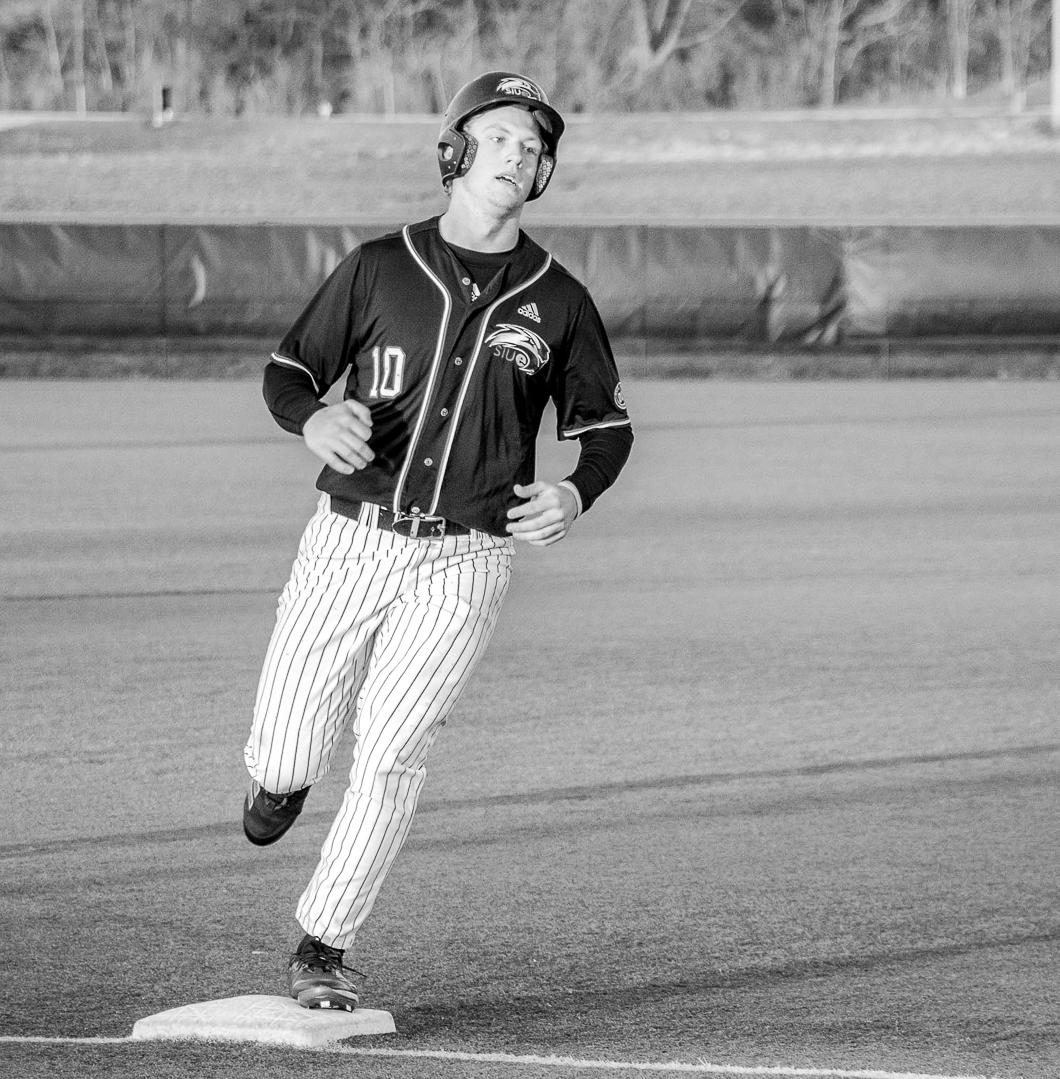
 Brennan Orf rounds the base at a game last season. Orf said he is looking at MLB teams to join during the draft in July.
Clair
/ The Alestle
Brennan Orf rounds the base at a game last season. Orf said he is looking at MLB teams to join during the draft in July.
Clair
/ The Alestle