A premium business magazine about entrepreneurship and immigration
UKRAINIANS AND
MAGAZINE
Ukrainian Cinema in America as the Cultural Voice of a Nation
The 11th Star Independent International Internet Film Festival in Chicago
Dear Readers!
The sixth issue of “Ukrainians and the World” marks a new stage in the development of our magazine. In response to numerous requests from our readers, we have launched a dedicated website for the magazine and introduced regular online meetings with our authors and readers to foster closer, more meaningful collaboration.
Our journalists are Ukrainians from all over the world. We write about business and creativity, about people who create, build, inspire, and shape reality wherever they live.
Today, more than 40 ambassadors around the globe are involved in the magazine. We are proud that they represent major cities in the United States, including New York, Miami, and Chicago; key European cities such as Warsaw, Amsterdam, and Luxembourg; cities of the Caucasus—Baku and Tbilisi; and of course, Kyiv, Vinnytsia, Lviv, and many other cities across Ukraine and worldwide.
Our ambassadors are ordinary Ukrainians who have relocated to other countries, as well as foreigners who love, support, and genuinely admire Ukraine.
The magazine is gradually forming its own distinct identity and core focus areas: new technologies, business, science, law, gastronomy, fashion, civic engagement, and undoubtedly, culture.
It is culture and creative expression that make us Ukrainians, regardless of borders or distance.
Miami, where the magazine’s journey began, is also becoming a center of Ukrainian culture. In this issue, you will read about Ukrainian-American leaders in Miami, a film festival in Chicago, and Ukrainian literature in Baku.
Style, beauty, and humanity — these are all integral elements of Ukrainian culture that we share with the world.
We warmly invite you to share your own authentic stories about Ukrainians around the world.
Together, we are creating a space where Ukraine is heard with dignity, relevance, and truth..
With respect, Olena Yaremchuk Editor of “Ukrainians and the World”
by Iryna Khmara, Master of Laws Candidate at Chicago-Kent College of law, Illinois Institute of Technology
December 28, 2025
Being a student is always an adventure—especially when you are pursuing a Master of Laws (LL.M.) degree in the United States later in life, in your 30s, 40s, or 50s.
Today, more than 30 Ukrainian students are enrolled in the LL.M. program at Chicago-Kent College of Law, Illinois Institute of Technology. Each of us brings a unique personal and professional journey, prior legal experience, strong motivation, and remarkable inner resilience. For many Ukrainian students, legal education in the U.S. is not merely an academic pursuit—it is a continuation of professional identity, and a tool for advocacy during one of the most challenging periods in Ukraine’s history.
Against this backdrop, attending the Annual Conference of the Ukrainian American Bar Association (UABA) in Philadelphia, PA (November 13-15, 2025) became an especially meaningful experience for Chicago-Kent LL.M. students.
The honor to be present at the conference had: Yuliia Stelmakh - Legal Project Coordinator at McCarter & English, LLP; LL.M. Candidate at Chicago-Kent College of Law, International, and Transnational Law program; UABA member.
Olena Yaremchuk - Producer, Senior Partner at Yaremchuk & Partners; LL.M. Candidate at Chicago-Kent College of Law, Intellectual Property Law; UABA member.
Roman Khmara - Independent Legal Researcher, Attorney at Law in Ukraine; CEO at United Smart Assistance LLC; LL.M. Candidate at Chicago-Kent College of Law, U.S., International, and Transnational Law program; UABA member.
Iryna Khmara - Chief Manager at United Smart Assistance LLC; LL.M. Candidate at Chicago-Kent College of Law, U.S., International, and Transnational Law program; UABA member.
The conference was a powerful combination of knowledge, professional dialogue, inspiration, and genuine human connection. From the very first moments, the atmosphere was warm and welcoming, yet deeply substantive—filled with informative panels, thoughtful dis-
cussions, and sincere engagement across generations of legal professionals.
One of the most memorable aspects of the conference was the sense of unity within the Ukrainian legal community in the United States. Conversations flowed naturally—between students, new attorneys, judges, and diplomats. There was an openness to share experiences, exchange ideas, and support one another. Events like this reaffirm that meaningful change is possible when a community stands together.
Students also greatly benefited from the invaluable advice shared by Honorable Orest Jejna, an outstanding judge of Ukrainian heritage, whose words resonated strongly with those at the beginning of their legal careers. It was especially meaningful to congratulate Judge Jeina on becoming the new President of UABA—a moment of pride for the entire community.
Judge Jejna has served for nearly 25 years as a Judge of the Scottsdale Municipal Court and previously practiced law in Arizona for more than two decades. Born in Rochester, New York, to Ukrainian immigrant parents, he represents a powerful example of how immigrant roots and dedication to justice can shape an extraordinary legal career in the United States.
Throughout his professional life, Judge Jejna has remained actively engaged in the Ukrainian American legal community. His commitment to mentorship, ethical leadership, and public service was evident in the invaluable advice he shared with new and aspiring attorneys during the conference.
Panels on the Conference addressed a wide range of critical topics, including the work of non-profit organizations, Intellectual Property, IT in law, and—most painfully—the legal uncertainty faced by Ukrainians who
arrived in the U.S. after the start of Russia’s full-scale invasion.
The immigration law panel, skillfully led by Hon. Consul Iryna Mazur, Esq., whose professional credentials and advocacy work command deep respect. As the moderator of the immigration panel, Ms. Mazur guided a substantive and candid discussion on the current challenges faced by Ukrainians in the United States, particularly those who arrived after the start of Russia’s full-scale invasion. Her ability to combine legal precision with empathy and advocacy made the panel especially valuable for lawyers seeking to understand both the technical and human dimensions of immigration law. For many of us, her example illustrated what it means to be not only a skilled attorney, but also a committed public servant.
A bill that could help resolve the legal status of Ukrainians in the United States is the Ukrainian Adjustment Act
of 2025 (H.R. 3104), which would allow eligible Ukrainians to adjust their status to lawful permanent residence. This bill is essential for providing stability, access to healthcare, and social protection. This is very important especially for families with children who fled Ukraine to raise them in peace and security, to protect them from the trauma of war. Ukrainians are hard working and smart people, they contribute to the United States and this bill
will help to solve a huge legalization problem.
We were honored that Congressman Brian K. Fitzpatrick, co-sponsor of the bill and a steadfast supporter of Ukraine since the first days of the war, was present at the conference. His continued commitment is vital for advancing this legislation.
Also in attendance was Congresswoman Madeleine Dean. I had the opportunity to personally express grati-
tude for her ongoing support of Ukraine and Ukrainians in the U.S., and to ask her to support the Ukrainian Adjustment Act.Her words, “You have my support,” were incredibly meaningful and inspiring. Moments like these remind us how crucial advocacy, unity, and persistence truly are.
At the Conference, we had the great pleasure to listen to Trudy Rubin, a columnist for The Philadelphia Inquirer and an expert in international affairs, with decades of
experience as a foreign correspondent and analyst. A recipient of numerous prestigious awards and a Pulitzer Prize finalist, Ms. Rubin shared a deeply personal story alongside her professional insights. Her family originates from the Rivne region of Ukraine, an area where Jewish communities were brutally destroyed.. Her family was forced to flee in order to survive. Her family’s history is a powerful reminder of the consequences of persecution and violence. Hearing this story in the context of today’s
global and Ukrainian realities added profound emotional depth to the conference discussions.
Impactful was the discussion on Ukrainian anti-corruption legislation, featuring Pavlo Lutsiuk, an Attorneyat-law, Doctor of Juridical Sciences, Honored Lawyer of Ukraine and a prominent legal figure with extensive experience in Ukraine’s judicial and disciplinary institutions. His insights bridged theory and practice, offering valuable context for understanding Ukraine’s legal reforms.
The conference also featured a compelling diplomatic panel with Ambassador Andriy Melnyk, the Permanent Representative of Ukraine in the United Nations, Ambassador Extraordinary and Plenipotentiary, whose honest and courageous stance sparked important conversation about the situation in the world diplomatic arena.
For Chicago-Kent students, the conference was not only educational, but deeply affirming. It reinforced that we are not alone—that there is a strong, compassionate, and highly professional community ready to support us as we grow into our roles as U.S. attorneys.
This sense of connection did not begin or end in Philadelphia. In December, UABA organized a large-scale networking meeting in Chicago for students and alumni of Chicago-Kent College of Law. Sincere thanks go to Peter Piddubnyi, Yulia Bikbova, Marta Farion, and Yulia Stelmakh for making this gathering possible. It was one of the first events of its kind, bringing together such a significant number of Ukrainian-American lawyers in Chicago. For many of us, it was a rare opportunity to feel such a powerful professional unity in the U.S..
Thanks to Peter Piddoubny this event was made possible. Peter told an impactful story about the importance of perseverance and endurance in the legal profession.
Peter Piddoubny is a partner at Piddoubny & Pelekh, P.C., a New York–based law firm, with decades of legal experience. Admitted to the New York Bar in 1986, he practices in business and commercial law, international trade, litigation, real estate, and trusts and estates. Educated at the University of Bristol (LL.B.), Mr. Piddoubny represents both individuals and businesses and is fluent in Ukrainian, actively serving the Ukrainian-American community. Students had an honor to meet and listen to the incredible experience and family story of Timothy Michael Tymkovich who is an American lawyer who has served as a United States circuit judge of the United States Court of Appeals for the Tenth Circuit since 2003; serving as chief judge from 2015 to 2022. In November 2023, he was designated by Chief Justice John Roberts to serve as a judge of the United States Foreign Intelligence Surveillance Court of Review.
Born in Denver, Colorado, Tymkovich is a third-generation Coloradan. His great-grandfather emigrated from Ukraine to the United States via Ellis Island and worked as a miner. Tymkovich graduated from Colorado College in 1979 with a Bachelor of Arts. He then attended the University of Colorado Law School, where he was an editor of the University of Colorado Law Review. He graduated in 1982 with a Juris Doctor degree.
Marta Farion encouraged students to be strong and not afraid of difficulties and changes. Marta Farion is an American attorney, a President of Kyiv-Mohyla Foundation of America, a non-profit organization established to support the National University of Kyiv-Mohyla Academy in Ukraine.
Ms. Farion received her J.D. degree in 1980 from Chicago Kent College of Law, and M.A. and B.A. degrees from Loyola University Chicago. For over 20 years Ms. Farion worked as inhouse attorney at a research and development company, where her duties included matters related to employee relations, business, and legal transactions. Born in Rome, Italy, after living her early years in Argentina, Ms. Farion came to the United States when her family immigrated to Chicago.
Julia Bikbova showed her courage and unbreakable faith in human ability to educate and succeed. Julia Bikbova is a principal attorney with over 15 years of experience in civil litigation, immigration law, white-collar criminal defense, and international law. A former immigrant from Ukraine, she brings a strategic, results-driven, and compassionate approach to representing individuals and small to mid-sized businesses. As the founder of Bikbova Law Offices, P.C., Julia is widely recognized for her work in complex litigation, class actions, and immigration matters, as well as for her strong advocacy for immigrants’ rights and human rights within the community. Julia earned a degree of Juris Doctor from The John Marshall Law School in 2007, and LL.M. Tax Law from The John Marshall Law School..
Julia told her story, how she got her education, and passed the Bar exam. She is an example that no matter how hard it is - it is still possible and you can do it.
As a Chicago-Kent law student, I can say with confidence: these experiences matter. They shape us not only as legal professionals, but as advocates and members of a resilient community. Together, we are stronger and we can change the world.
Iryna Khmara, Master of Laws Candidate at Chicago-Kent College of law, Illinois Institute of Technology
Can cinema be a language of memory?
Can it shape a country’s image thousands of miles away from home? And can Ukrainian culture in America not only be preserved, but actively create a new history? These very questions became central during the 11th Star Independent International Internet Film Festival, which this year launched its offline events in Chicago — the city with the largest Ukrainian community in the United States.
Chicago
as
a Point of Cultural Strength
Chicago has long been more than just a place where Ukrainians live — it is a center of active cultural, educational, and business life of the diaspora. It is here that Ukrainian cinema sounds especially powerful, because the audience does not simply watch — it lives through each story as its own.
A symbolic moment was the screening of the feature film “Call Sign Banderas” directed by Zaza Buadze, which took place on November 7 at Chicago-Kent College of Law, where Olena Yaremchuk, President and Founder of the festival, is currently studying. The choice of venue carried deep meaning: Ukrainian history, Ukrainian pain, and Ukrainian truth were voiced at the heart of the American academic community.
The Ukrainian Voice Through Art
The goal of the festival is not only to showcase films, but to introduce American and international audiences to the origins of the war, contemporary challenges, and the inner world of Ukrainians.
In 2024, the festival brought together more than 90 works, many of which were created by Ukrainian Americans — people living in the United States while remaining culturally and emotionally connected to Ukraine.
These include:
• social videos about what hurts,
• music videos about strength and loss,
• songs about fallen young soldiers,
• short films about fear, love, hope, and humanity.
A special place among documentary works was taken by “Antarctica. War Diaries” — the first days of the war against the breathtaking beauty of Antarctica, permeated with deep concern for the fate of the homeland.
Unity of Community and Business
In just two weeks of preparation, the festival in Chicago was supported by 40 companies. This demonstrates a high level of unity and an understanding that Ukrainian culture is an important component of the UkrainianAmerican business environment.
The festival also brought together works from Poland, Germany, Estonia, and other countries, highlighting the international dimension of Ukrainian cultural influence.
Humanity as the Central Theme
Despite the diversity of formats and genres, humanity became the central thread of every work. That is why the words of Vasyl Symonenko resonate so powerfully:
“Do you know that you are a human being?”
In times of darkness, light is seen most clearly.
Ukrainian cinema today is exactly that light.
The Jury as Bearers of Cultural Responsibility
Each year, the jury of the Star Independent International Internet Film Festival includes representatives of the Ukrainian and global film elite — directors, screenwriters, producers, actors, and cultural figures whose professional reputation and experience shape the high standards of the festival.
In 2024, the Chair of the Jury was Oksana Osher (screenwriter, writer, Ukraine / USA), whose creative path and deep understanding of dramaturgy gave the festival a special intellectual and emotional dimension.
The jury also included Vadym Perelman (director, Ukraine / USA / Canada), Steven Manas (actor, composer, France / USA), Valentyn Opaliev (producer, Ukraine / USA), Oleksandra Smilyanska (screenwriter, Ukraine / USA), Tetiana Lohush (producer, Ukraine / USA), Volodymyr Filipov (producer, Ukraine), Andrii Karpov (actor, Ukraine), Oleksander Berezan (director, Ukraine / USA), and Mykola Martynenko (singer, cultural figure, Ukraine / USA).
The work of the jury is extremely important, as they not only evaluate artistic quality, but also define the cultural direction of the festival, supporting authors who
speak about humanity, freedom, pain, hope, and identity. In times of war and global challenges, such expert evaluation becomes a form of cultural responsibility and a way to bring the Ukrainian voice to the international community. The participation of a jury of this level strengthens trust in Star Independent and confirms its status as an international platform for dialogue, memory, and creative solidarity.
Gala Evening: Cinema, Fashion, and Charity
During the evening gala event, audiences watched the series “Beehive” — a project by Ukrainian artists currently living in America. The producer of the series is Serhii Wenger. The series tells the story of truck drivers,
a community especially relevant to Chicago. It became an honest reflection of everyday reality, challenges, human stories, and the strength of character of the Ukrainian diaspora.
A special highlight of the evening was a creative segment featuring the Malgivski sisters and Ivanna Melay. Guests also enjoyed the fashion show “Ukrainian Beauty” by designer Sandra and Sabrina, which demonstrated a combination of contemporary aesthetics and national identity. The evening culminated in the award ceremony of the winners of the 11th Star Independent International Internet Film Festival, followed by a charity auction in support of Ukraine.
The auction lots included a traditional Ukrainian korovai, paintings by Olena Yaremchuk and Yuliia Stelmakh. All funds raised were donated to the Protez Charity Foundation, which provides prosthetics and rehabilitation for Ukrainian soldiers injured in the war, the U4UA Children’s Foundation, and the Maestri Air Bro Unmanned Systems School. Special thanks to our benefactor, Andrii Kulbachnyi.
Partners and Support
The opening of the 11th IIFF Star Independent Chicago was supported by:
General Sponsors / Gold Sponsor: @abcorhh @chicagokentlaw @yaremchuk.group
Media Partners: @petrosorba @mariiatopolnytska_photografer @photostudio_mae @humani.films @urc_radio @radiouachicago
Social Partners: @rescue.now @urc_life @luminance.video
WINNERS
11th Star Independent International Internet Film Festival
Music Videos
1. Tell It — Ivanna Melay ft. Really Doe — Best Music Video
2. Forever — Andrii Pidluzhnyi — Grand Prix, Best Music Video
3. Dance With Me — Malgivski — Outstanding Dance Music Video
4. American Ukrainian — GREMO — Best Patriotic Video in Chicago
5. Peace in War — Yuliia Frants — Special Jury Award
Children’s Music Videos
1. Fly Away — MartA — Best Children’s Video in Ukraine
2. Gotham | Present Chronicles — Nora Polinha — Best Children’s Video in the USA
3. Feeling Good — Sophie Bastet — Best Children’s Video
Children’s Social Videos
• Culture Against War — Viktoriia Zelenko — Outstanding Young Reporter Animation
• UFO — Anatolii Matviichuk — Best Animated Film Non-Traditional Art
• Main — Diana Koshevoy — Best Non-Traditional Art Video
Advertising
1. We Are Soft. Happy.
— Olena Akimova & Nobel Le — Best Commercial Video
2. Why So Many Caregivers Choose Abcor? — Abcor — Best American Commercial Video
3. WindowsWeatherGuard: When the World Got Loud
— Alisa Wenger — Special Jury Award Social Impact Videos
• Protez Foundation — Yaroslav Savchak — Best Social Impact Video
• United Ukrainian Culture Festival in Florida — REC USA — Best Social Impact Video Short Films
• The Perfect Friend — Serhii Aloshiechkyn — Best Actress: Anzhelika Petrovska
• The Cake — Flame World Production — Outstanding Social Impact Film
• BURDEN — Alex Hramakovskyi — Best Actor
• Berehynia — Siia Titova — Best Ukrainian SocialThemed Short Film
• Tender Ones Triumph — Francisco Bassignana — Best Foreign Film About Ukraine Series
• Beat, Heart, Beat — COSMOS AGENCY — Best Director: Dasha Trehubova; Best Actor: Oleksii Horbunov; �� Best Actress: Daria Leheida
• BEEHIVE — Best Chicago Series Documentary Films
• The Story of Olena Yaremchuk — IMMIMENTARY — Best Contemporary Atmosphere
• Antarctica: War Diaries — UP UA Studio — Best Vi-
sual Mastery
• War in Ukraine: An Inside View — Mykhailo Hershtein — Best American-Ukrainian Film
• A Sentimental Journey to Parajanov’s Planet — Taras Tomenko — Best Documentary Director
Shows and Interviews
• The Time of Ukrainian Song — Andrii Pidluzhnyi — Best Art Program
• No Filters: Alyona Alyona — URC Radio — Best Contemporary Atmosphere
• Skrypin, Halan | Radio UA Chicago — Best Ukrainian-American Political Program
Feature Films
• BANDERAS — dir. Zaza Buadze — Best Feature Film Director
Closing Film
Special recognition goes to the closing film of the festival — “Parajanov’s Planet” directed by Taras Tomenko, which became a profound cultural event and a symbolic finale of the 11th Star Independent International Internet
Film Festival. The film is not only a cinematic portrait of a genius, but a subtle reflection on creative freedom, inner independence, and the power of culture to transcend borders and time. Parajanov’s Planet resonated as an intellectual and spiritual final chord, reminding us that Ukrainian cinema is a space of depth, memory, and global dialogue.
Conclusion
The film festival has come to an end, but its core mission continues — to preserve and amplify the Ukrainian voice in the world through the language of cinema, to
support talent, and to unite the community around culture, memory, and humanity. The 11th Star Independent in Chicago once again proved that Ukrainian art in America not only exists — it evolves, shapes new history, and creates a space for solidarity and action.
We sincerely thank all participants, partners, sponsors, and audiences for their trust and support. The festival has concluded, but we eagerly await new works and powerful stories from our filmmakers at the 12th Star Independent International Internet Film Festival.
RisingfromtheAshes: TheHumanCapacityto BeginAgain
There are moments in life when destruction feels total. Not a loss that can be repaired with time or effort, but something burned to the ground: a country left behind, a profession interrupted, an identity fractured, a future rewritten without consent. For millions of Ukrainians today—both at home and in emigration—this is not a metaphor or a literary exaggeration. It is lived reality, unfolding day by day.
What makes this experience especially difficult is not only the scale of loss, but its comprehensiveness. When war, displacement, or forced migration enters a life, it rarely affects just one area. It touches language, work, social roles, family structures, and the quiet inner sense of who one is. Life no longer continues along a familiar line; it breaks, scatters, and demands reassembly.
And yet, across cultures, philosophies, and spiritual traditions, one idea returns with striking consistency: the human being has an extraordinary capacity to rise from the ashes. Not to restore what was, not to rewind time or recreate a former version of the self, but to become something new—often truer, deeper, and more resilient than before.
When Collapse Becomes a Beginning
In everyday thinking, crisis is almost always viewed as failure: something went wrong, something was lost, something should not have happened. But in deeper philosophical and spiritual perspectives, crisis is often understood differently—as a threshold.
The Austrian psychiatrist and Holocaust survivor Viktor Frankl articulated this insight with clarity born of experience: “When we are no longer able to change a situation, we are challenged to change ourselves.”
This is not a call for resignation or passive endurance. It is an invitation to inner responsibility. While we may not control circumstances—war, displacement, loss, political violence—we retain the power to decide who we become in response.
For immigrants, this moment is especially sharp. The old coordinates no longer work. Professional titles lose their currency. Social reputations do not transfer. Even ways of speaking, thinking, or presenting oneself may suddenly feel out of place. What remains is the person beneath these structures—often disoriented, sometimes frightened, but also unexpectedly free.
Collapse, in this sense, strips life down to essentials. And essentials, though uncomfortable, are fertile ground.
The Fire That Burns Away Illusion
In many spiritual traditions, destruction is not seen as punishment but as purification. Fire does not only destroy; it clarifies. It removes what is superficial and exposes what can no longer be avoided. The Persian Sufi poet Jalal ad-Din Rumi captured this paradox with poetic simplicity: “Why are you so busy with this or good or bad; pay attention to how things blend.”
Sometimes, what collapses in crisis was already hollow. Routines that once felt secure may have been quietly suffocating. Roles that once brought pride may have long
stopped reflecting inner truth. Crisis breaks walls we did not know had become prisons. The pain of this rupture is real and should not be romanticized. But so is the freedom that follows—the freedom of no longer having to pretend, maintain, or uphold what is no longer alive.
To rise from the ashes does not mean returning to the past. It means releasing outdated identities and allowing a more authentic self to emerge, often for the first time.
Suffering Does Not Transform — Awareness Does.
It is important to speak honestly: suffering alone does not ennoble. It does not automatically make people wiser, kinder, or deeper. On the contrary, it can harden, exhaust, distort, or numb.
Transformation occurs only when suffering is met with awareness. The philosopher Jiddu Krishnamurti warned against unconscious endurance: “The crisis is not the problem; the problem is that we do not understand the crisis.” When pain is observed without denial, self-pity, or compulsive distraction, it begins to reveal uncomfortable truths: where we lived according to others’ expectations, where we clung to security instead of truth and where we confused survival with meaning
This process is rarely comfortable. It requires patience and a willingness to stay present with uncertainty. But in that clarity, something shifts. Not optimism, not positive thinking—but honesty. And from honesty, a new direction becomes possible.
Rebirth Is Not Heroic — It Is Quiet
Modern culture often glorifies strength: endure, overcome, move on. Social narratives reward visible success and dramatic comebacks. But genuine rebirth rarely looks heroic. More often, it is slow, uneven, and invisible to others.
The Advaita Vedanta teacher Ramesh Balsekar offered a disarming insight:
“Enlightenment is not the acquisition of power, but the loss of the illusion of control.”
Paradoxically, when the struggle to dominate life ends, inner stability begins. One stops fighting reality and starts responding to it intelligently, moment by moment. This is not weakness; it is groundedness. It is the quiet strength of someone who no longer needs to prove anything.
Rebirth does not announce itself. It unfolds in small decisions, subtle shifts in perception, and a growing alignment between inner truth and outer action.
The Ukrainian Experience: Renewal Without Pathos
For Ukrainians today, the theme of rebirth carries particular weight. Displacement, professional reinvention, emotional fatigue, and the burden of representation all converge. Many feel compelled to be strong not only for themselves, but as symbols—for family, for country, for history. Yet perhaps this moment is giving rise to a new Ukrainian identity in the world: not defined solely by trauma, not reduced to symbols or suffering but grounded in agency, dignity, and inner freedom. This is an identity that does not deny pain, but does not live inside it either. It allows grief without turning it into a permanent home. It recognizes loss without surrendering the future. To begin again does not mean erasing the past. It means refusing to be imprisoned by it.
Personal Experience: Returning to One’s Own Roots
For me, the theme of renewal carries a deeply personal dimension. I began to truly discover the Ukrainian cultural code only at the age of forty-four—an age at which one is often considered already “fully formed.” This return was not the result of external pressure or abstract reflections on identity. It emerged through a living human connection.
My wife is Ukrainian. Through her natural, quiet sense of belonging to Ukraine—through her love for the language, the culture, the history, and the very feeling of Ukrainianness—there gradually awakened in me a desire to explore what for a long time had remained in the background: an unexamined inheritance. It was not a sudden awakening, but rather a gentle inner movement that, over time, grew into a steady aspiration.
I began to hear the language differently, to notice cultural meanings, to approach history not as a collection of facts but as the living experience of my lineage. What had once seemed secondary or “optional” suddenly acquired depth and significance. I came to understand that cultural identity is not a matter of age and not a formality, but a process of self-recognition—one that can begin at any point in life.
This path is not about guilt for what was previously unknown, nor about a heroic “return.” It is about a mature, conscious acceptance of one’s roots—without pathos, but with respect. And perhaps this is how many people today come to discover Ukraine within themselves: not because they “must,” but because they are inwardly ready.
Resurrection from the Ashes of Immigration
Immigration is often perceived as a loss: of status, familiar surroundings, professional continuity, even language. Yet over time, a different understanding emerges. Immigration is not only a rupture; it is a transition. A
space in which a person, stripped of former supports, is compelled to search for new meanings—and in doing so, discovers their true self.
In this sense, resurrection from the ashes of immigration happens not in spite of difficulties, but because of them. When external props disappear, what comes to the foreground is the inner core: resourcefulness, ingenuity, the ability to adapt and to create. These qualities are historically inherent to the Ukrainian cultural code— *ingenuity*, the ability to find solutions where none seem to exist, and the drive for self-expression not only in words, but in action.
For many Ukrainians abroad, business becomes more than a source of income; it becomes a form of expressing identity. Through entrepreneurship, startups, consulting, and creative projects, a person does not lose themselves—they translate their culture into a new language: the language of initiatives, venture projects, and responsibility for one’s own path.
When combined with the favorable business climate of the United States—transparent rules, access to capital, and respect for ideas and initiative—Ukrainian entrepreneurial spirit gains scale. Here, not only survival and adaptation are possible, but growth and leadership. Immigration, in this context, ceases to be a story of loss. It becomes a story of bringing forth the best: diligence without aggression, flexibility without the loss of principles, and the courage to start from zero.
This is how Ukraine is present in the world today— not only through pain and trials, but through people who rediscover themselves and transform this journey into value for others.
And if along this path there arises a need for self-determination, for calm and human support—moral, intellectual, or simply the opportunity to be heard—you are welcome to reach out to me. I do not offer ready-made formulas, but I am willing to share my own experience of living through immigration, searching for meaning, and building a new life without losing inner integrity. Sometimes, that is enough to move forward not blindly, but consciously.
From Ashes Emerges the Essential
The phoenix is not a symbol of immortality. It is a symbol of courage—the courage to burn, to let go, to surrender what no longer lives. Those who have passed through loss are no longer the same. But that difference does not have to mean damage. It can become depth, perspective, and quiet authority. Not everyone who falls is broken. Some are simply freed from what was false. And perhaps this is humanity’s quiet miracle: the ability to rise—not despite life’s fire, but because of it.
WhenaBusiness StartstoBreathe
About completed tasks that change everything
Ididn’t immediately connect these two things — income and completed tasks. It became clear not through theory, but through real life. At some point, I caught myself thinking: my companies continue to operate even when I’m not around. Decisions
are made. Processes keep moving. Money comes in.
Not because I control everything. But because things are actually brought to completion. And not my tasks — but the tasks of the people I work with.
What seems obvious — but is rarely lived through
We can exchange with the world only what is finished. No one buys “almost done.” No one pays for intention.
Value always appears at the point of completion.
And this sounds simple — until you start managing not just yourself, but a team. Not one person, but dozens. Not ideas, but processes.
When you stop being a person and become the “bottleneck”
Every person is capable, to some extent, of managing themselves.
Yes, we procrastinate. Yes, we get tired. But we are responsible for the consequences.
In a company, everything is different.
An unfinished task by one employee almost never remains their personal problem. It becomes the manager’s problem. Then the department’s. Then the entire team’s.
I have seen many times how strong, smart, talented business owners became hostages not of the market, not of competition, and not even of finances — but of other people’s unfinished work.
A story from practice
Once, a businessman came to our “Life Repair” program.
He had a stable but extremely exhausting business. He described it roughly like this:
“I’m constantly finishing things. I’m supposedly the leader, but it feels like I’m the main executor.”
We created an individual program for him. It included various courses, and at some point he encountered the topic of unfinished tasks — not in the abstract, but applied directly to his reality.
He saw a simple but painful truth: his employees were not completing their cycles.
And he was silently completing them for them.
He began to implement what he learned.
Not harshly. Not through pressure. But through clarity: where a task begins, where it must end, and who is responsible for it.
A few months later, he said a phrase I remember well:
“For the first time in many years, I was able to breathe.”
He stopped being a firefighter. He gained time for strategy. For development. For new directions.
And that was exactly when his business began to move to a different level.
When energy stops leaking
The most interesting part came after the “Life Repair” program ended.
He had more energy. Not because there were fewer
tasks. But because he stopped living in a mode of constantly patching holes.
He was no longer oriented around problems. He knew how to work with barriers.
And this is a key point.
Why unfinished tasks affect money so strongly
Unfinished tasks are not only about work. They are about attention. About energy. About inner noise. They quietly drain focus, create background anxiety, and distort the picture of what is happening.
When a leader constantly keeps “loose ends” in mind, they cannot truly look forward. They are still living in the past — in what was never brought to completion.
What I came to understand
Over the years of working with the “Planet” group, I have seen a clear pattern: companies grow not when more ideas appear, but when the percentage of actions completed to the end increases. Without heroics. Without constant tension.
Without the feeling that everything depends on one person.
Completed tasks are not about rigidity.
They are about respect: for yourself, for people, and for life, which loves clarity.
And when this clarity appears in the system, money stops being a struggle.
It becomes a consequence.
If you feel that you are ready to move to a new level — in business, income, or quality of life — it is important not to look for another source of inspiration, but to gain practical tools that provide clarity and support.
At the “Planet” group, we have been accompanying people in this process for many years: helping them close old cycles, build new ones, and move forward calmly without constant tension.
My team is here. And if you are at a point of growth right now, we would be happy to walk this path with you.
Author: Margaryta Sotnykova
Founder of the “Planeta” group and co-founder of the “Logos” tutoring center
Contact phone numbers
+1 754 802 0690
+380 96 297 0195
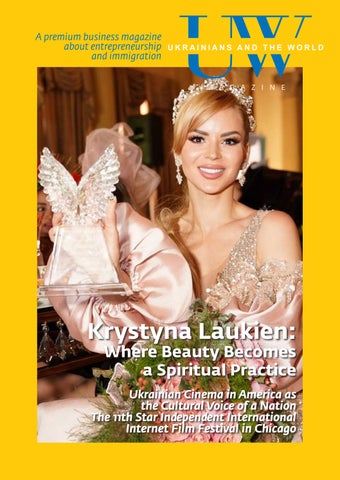
Krystyna Laukien
WhereBeautyBecomes aSpiritualPractice
Q1. “Manifesting Goodness, Kindness, and Love” is more than a philosophy for you—it’s a way of life. How did these values become the foundation of your journey?
– These values didn’t come from theory; they were shaped through lived experience. Life has shown me that when everything external falls away, what remains—and
what truly matters—is how much goodness we have created, how much kindness we have offered, and how deeply we have loved. Over time, I realized that these are not abstract ideals but values we embody. When aligned with them, life responds with grace, clarity, and purpose. They guide every decision I make, both personally and professionally.
Q2. You often redefine beauty beyond aesthetics. How do you personally understand beauty today? – True beauty is coherence—when the inner world and the outer expression are in harmony. Outer beauty without inner alignment feels empty, while inner beauty
naturally radiates outward and becomes visible. Beauty lives in intention, in presence, in how we touch the world. It is felt before it is seen. To me, beauty is not about perfection; it is about authenticity, care, and consciousness.
Q3. Spirituality is a central pillar in your life and work. How has your spiritual path shaped who you are today?
– Spirituality taught me to listen—deeply. It showed me that intuition is intelligence, that silence is powerful, and that trust is a form of wisdom. Through my spiritual path, I learned that leadership begins within and that creation is most potent when it flows from alignment rather than force. It shaped my relationship with myself, with others, and with life itself.
Q4. In a world obsessed with speed and constant achievement, you advocate for presence and inner connection. Why is this so important now?
– Because speed disconnects us from meaning. Presence allows us to remember who we are beneath roles, expectations, and noise. When we slow down, we reconnect with our body, our breath, our intuition—and beauty naturally returns. Presence is not passive; it is deeply restorative on a personal level. It is the foundation of a
more conscious way of living.
Q5. Luxury, spirituality, and purpose beautifully intersect in your work. How do you see the future of conscious beauty?
– For me, the future of beauty is intentional. It is intelligent, soulful, and deeply respectful—of the body, the planet, and the human spirit. I see conscious beauty no longer as a niche, but as a new standard of living.
We are moving beyond products created only to function. The next evolution of beauty is about how something feels—how it is approached, how it is experienced, and how it invites presence. Spaces, rituals, and objects can carry meaning and a sense of energy through intention, craftsmanship, and awareness, even before they are touched.
In my world, beauty is not just about promises or performance. It is about relationship. A relationship with the body, with time, with care, and with oneself. When beauty
is approached as a ritual rather than a routine, it becomes something that is felt from within and gently reflected outward.
This is the language I am interested in exploring— where beauty meets consciousness, and where intention becomes the quiet luxury that elevates everyday life.
Q6. Giving back plays a profound role in your life. How has service shaped your understanding of success?
– Service redefined success for me. Success is not accumulation—it is contribution. When you give from the heart, you realize that abundance flows through generosity. Giving back keeps me grounded, humble, and deeply connected to humanity. It reminds me that our lives are meant to uplift others, not just ourselves.
Q7. You were recently honored as Humanitarian of the Year at an Influencer Global Award. What did this recognition mean to you?
– I received it with deep gratitude and humility. This recognition is not just for me—it reflects every heart, every hand, and every intention involved in the work of service. It affirmed that compassion and leadership can coexist, and that kindness is not weakness but strength. It was a beautiful reminder that when we act from love , united in our power , the impact reaches far beyond what we can see.
Q8. Your journey has included challenges and profound transformations. How do you view hardship today?
Hardship is a teacher. It refines us, strips away illusions, and brings us closer to truth. I no longer see challenges as obstacles but as initiations—portals into deeper growth, wisdom, resilience, and compassion. Every difficulty has expanded my capacity to love, live, and understand.
Q9. You often speak about living a “magikal” life. What does that truly mean to you?
– Living magikally means living consciously. It is choosing intention over fear, trust over control, and love over limitation. It is recognizing that life responds to our inner state. When we align our thoughts, actions, and energy, what once felt extraordinary begins to feel natural.
Q10. You are preparing for the launch of your MGKL Spa and Body Care line, where spirituality meets beauty. What can we expect?
– This launch is my soul mission embodied. The MGKL Spa and Body Care line is designed for sacred experiences—where beauty rituals become moments of reconnection, transformation and elevation. Every detail is infused with intention, care, and reverence for the body as a temple. It is where spirituality meets beauty not as a concept, but as a lived experience.
Closing Reflection
Beauty is not something we apply—it is something we remember. When we live manifesting goodness, kindness, and love, beauty naturally follows.
Olena Yaremchuk
In times of rupture, art ceases to be merely a form of self-expression—it becomes a refuge, a vessel of memory, and an act of resistance. This is precisely the story of the Ukrainian International Ballet (UIB), a company born not of institutional logic, but of forced displacement, inner resilience, and a profound belief in the transformative power of dance.
TFrom Displacement to Creative Unity
After the outbreak of the full-scale invasion, the founders of UIB joined the large-scale United Ukrainian Ballet (UUB) project as dancers.The initiative was founded
he Ukrainian International Ballet Foundation was established in March 2024 by four Ukrainian artists—Kseniia Novikova, Vladyslava Kovalenko, Iryna Khutorianska, and Dmytro Borodai. Its home is The Hague, a city of international law and humanistic values, where displaced Ukrainian dancers were able not only to survive, but also to reimagine themselves through art.
by prima ballerina Igone de Jong in collaboration with Ukrainian artists Stanislav Olshanskyi, Oleksii Tiutiunnyk, and Matthijs Bongertman, and became a landmark cultural refuge for dozens of Ukrainian artists.
It was precisely this experience that revealed a deeper truth: a shared roof is not enough. What is needed is a space in which Ukrainian dancers can become authors of their own stories, preserve their identity, and speak to the world in their own voice.
This is how the Ukrainian International Ballet came into being—not merely as a ballet company, but as a cultural home where art becomes a restorative and mobilizing force for both personal and collective narratives. Through the universal language of dance, UIB preserves Ukrainian cultural heritage, fosters international dialogue, and creates a sense of belonging grounded in humanistic values—empathy, inclusivity, dignity, and solidarity.
The company’s mission is to use ballet as a living art of preservation, cultural exchange, and social connection, transforming beauty into hope and renewal.
Independent24: A Choice of Humanity
The first major project of UIB, Independent24, created with the support of the United Ukrainian Ballet Foundation, became a powerful manifesto of this philosophy. In 2024–2025, the production was presented with great success on tour across cities in the Netherlands and Belgium.
The project is a unique collaboration between Dutch choreographer Rish l Wieles and Ukrainian choreographer Dmytro Borodai—a dialogue between two cultures united by compassion and humanity.
The first act, the ballet Project Emotions by Dmytro Borodai, guides the audience through the emotional landscape of an inner world. The narrative unfolds around the experiences of Ukrainian veteran Andrii Siromakha, who journeys through trauma, vulnerability, and release. Rich in emotional states, the choreography does more than tell a story—it invites the viewer into an inner dialogue: to let go, to become aware, to heal.
Dmytro Borodai, a native of Tokmak in the Zaporizhzhia region, is one of the most prominent representatives of contemporary Ukrainian choreography. From 2019 to 2022, he worked at the National Opera of Ukraine, later continued his career with the United Ukrainian Ballet, and since 2024 has been a member of the Ukrainian International Ballet.
The second act, the ballet de/het/ n by Rish l Wieles, presents the real stories of ten Ukrainian dancers, interwoven with the image of the modern Netherlands. It is a performance of gratitude, dedicated to the Dutch people for their openness, support, and solidarity.
The project’s culminating message is voiced on stage at the end of the first ballet: “Let’s be unstoppable!”
These words leave the audience reflecting on freedom, culture, art, independence, and faith—feelings that inspire conscious and meaningful action in life.
Past | Present | Future: Time as Movement
The company’s second large-scale project, Past | Present | Future, is a transdisciplinary ballet triptych created in collaboration with the United Ukrainian Ballet Foundation. It explores the past, present, and future as a living human experience.
Past, choreographed by Vladyslav Dietiuchenko, immerses the audience in the creative philosophies of Piet Mondrian and Alexandra Exter, juxtaposing geometric rationalism and kinetic expressionism within the dynamics of order and chaos.
Present, choreographed by Marne van Opstal, explores the nature of the present moment. Two dancers create a living image of the “here and now,” inviting the audience to experience their own presence, freedom of thought, and the connection between body, mind, and soul.
Future, choreographed by Dmytro Borodai, addresses the cyclical nature of human relationships, social change, and inner transformation. At its center are women living in harmony until dark forces disrupt their unity. Yet even in destruction, something new is born—memory, renewal, or the anticipation of a new cycle.
Past | Present | Future is a profound exploration of philosophical and emotional questions that unite cultures and generations, and a testament to the resilience of Ukrainian culture, made possible through international support.
Beyond the Stage
Today, the Ukrainian International Ballet is participating in Eurovision 2025 in Amsterdam, engaging in charity events in the Netherlands and Germany, developing inclusive projects, and expanding collaboration with Dutch and international artists. The team is currently preparing a new Gala program, and well-known productions will return to the stage in 2026.
The Ukrainian International Ballet extends its sincere gratitude to the Government of the Netherlands, the Dutch people, its partners, sponsors, and everyone who supports the company.
On behalf of the entire team, we wish you a season filled with warmth and light. May the New Year bring new dreams, new connections, and meaningful achievements—and may art continue to remind us of who we are, even when the world attempts to erase it.
Mariya Spartalis is an international expert in private banking, family office advisory, and business development, as well as an international speaker operating at the intersection of two banking eras: classical private banking and institutionalized crypto banking.
Born in Kyiv, she has lived and worked in Zurich and Vienna for over 25 years. She holds a legal background and combines a long-standing international career with her role as a mother of three.
She began her professional career in traditional Austrian private banks, where she contributed to the establishment and development of Eastern European desks serving clients from the CEE and CIS regions. Capital preservation, disciplined risk management, and longterm financial sustainability have consistently been the guiding principles of her work.
Her career includes key roles at Credit Suisse and Schoellerbank, one of Austria’s oldest private banks and
a pillar of the classical European private banking tradition. Within these conservative institutional environments, she developed a rigorous and structured approach to compliance, asset structuring, and risk control.
A defining chapter of her career was her role as Director at Falcon Private Bank, one of the first banks to legally integrate crypto assets into the traditional banking system. This experience positioned her as a distinctive expert bridging traditional finance and digital assets at an institutional level.
Today, Mariya Spartalis develops her own brand, Spartalis Capital, collaborates with Terreus Capital, advises HNWI and family office clients, and speaks internation-
ally at financial forums and business congresses. She is also actively engaged in supporting the Ukrainian business ecosystem, facilitating international expansion and integration into global financial markets.
At a time when childhood is increasingly spent in digital environments and parents search for safe and meaningful content, the Ukrainian project YagaBook introduces a new format of children’s storytelling — a fusion of a book, animation, gaming, and emotional education tools. The initiative was created by writer, journalist, and animation director Nadiia Kyrei.
YagaBook has already received support from journalists of leading European radio stations — Beno î t Martin (Radio France) and Eduards Lini ņš (Latvijas Radio 1), as well as from the Embassies of Ukraine in Azerbaijan, Spain, and France, which help broaden the project’s international presence.
At the heart of the app is the story “Who Stole My Anger?” — a warm, humorous tale about the emotion of anger and healthy ways to interact with it. Such resources are especially important today: emotional tension among
youth is rising worldwide, while systemic emotional education remains insufficient. According to Rating Group and UNICEF, in 2024, 27% of Ukrainian children experienced high or elevated levels of stress, and by 2025 this number grew to 37%.
YagaBook helps children, parents, educators, and social workers explore feelings through storytelling, interactivity, familiar characters, and gentle, accessible guidance. The fairy tale brings back Baba Yaga, the Lesovyk, and the Kikimora — figures from a shared European folklore tradition.
The app includes an audio story with selectable languages, an interactive game, offline-friendly coloring pages, and recommendations from child psychologists. Importantly, YagaBook contains no ads, no subscriptions, and no in-app purchases — a principled anti-commercial approach that builds trust among families.
Multilingualism as Cultural Diplomacy
Today, YagaBook is available in ten languages: Ukrainian, English, Polish, Spanish, German, Azerbaijani, Latvian, Georgian, Filipino, and Crimean Tatar.
The Crimean Tatar version holds special significance. The text was adapted in Crimea, and the narration was performed by Anife Kurtseitova, head of the NGO Krymska Rodyna and a renowned public figure who supported the project and contributed to creating the audio version.
For Crimean Tatar children, this is a chance to hear a native voice in an international product. For Ukrainian children, it is a bridge to the culture of Ukraine’s Indigenous people.
Each YagaBook localization is created by volunteers and professional actors. The Ukrainian version is voiced by Akhtem Seitablayev, Oksana Voskanian, Natalia Ohnieva, Lidiia Alieva, and other well-known performers.
“Projects like YagaBook help us speak with children about difficult things in a language they understand and perceive without fear. At a time when the entire country is going through trials, it is crucial to give children tools that help them cope with their emotions and preserve their inner light. I am happy to be part of a project that brings cultures together.”
— Akhtem Seitablayev
Support from Ukrainian embassies makes it possible to integrate the app into cultural programs, school activities, and international events for children.
In Kyiv, the YagaBook presentation at the National Li -
brary of Ukraine for Children brought together students who actively asked questions and shared personal stories about emotions. In Madrid, the Spanish version was introduced by volunteer, translator, and global ambassador of Ukrainian music Olga Ledo-Galano, and in Baku — as part of the program “New Horizons of Ukrainian Culture” — both Ukrainian and Azerbaijani versions were presented.
“YagaBook impressed me with its simple yet deeply meaningful story. It opens the door to the world of emotions so naturally and gently that even adults find themselves reflecting on their own feelings. For Spanish audiences, it is also an encounter with Ukrainian culture — vibrant, modern, and capable of reimagining even characters like Baba Yaga, who for decades was viewed as irredeemably evil.”
— Olga Ledo-Galano
Across different countries, audiences express special interest in hearing familiar characters in different languages — from Ukrainian to Azerbaijani.
Why YagaBook Matters
YagaBook is a modern tool for developing emotional literacy — now a key part of education in many countries. More and more school systems are integrating soft skills into curricula, recognizing that the ability to understand one’s emotions and interact with others is no less important than academic knowledge.
This is where YagaBook emerges — responding to the
needs of parents, teachers, and children who seek simple, sensitive, and engaging ways to experience emotions naturally and safely.
The project also supports the Ukrainian diaspora: children abroad receive content in their native language, while international readers discover Ukrainian culture through a high-quality, original fairy tale.
YagaBook demonstrates how a team of over 50 volunteers from across the world, united by a shared vision, can create a world-class product.
Looking ahead, the YagaBook team plans to expand the platform: an animated version of the fairy tale is in development; new language localizations — including Turkish and Japanese — are being prepared; and international educational events are being designed to integrate emotional education into schools worldwide. New interactive stories are also planned to help children better understand and navigate their inner world.
About the Author and Founder of YagaBook
Nadiia Kyrei is a journalist, animation director, and children’s book author, as well as the founder of Veseloped, a platform promoting Ukrainian animation. Her claymation film represented Ukraine at the 8th Animafilm International Festival in Baku.
Her recent works include the bilingual Ukrainian–Azerbaijani early-language-development book “Balaбалаchka”, the animated film based on Taras Shevchenko’s poem “In Our Heaven on Earth…” dedicated to mothers affected by war (narrated by Tymur Miroshnychenko), and the animation “My First Carol” — a fairy tale with woolen characters introducing children to winter holiday traditions.
“When I created YagaBook, I wanted to offer children a simple, gentle way to talk about difficult things. Emotions aren’t enemies — they’re part of our inner world, and children deserve to understand them just as adults do. I wanted to show that folklore can be modern, kind, and close to the heart. And our once-scary Baba Yaga suddenly reveals a different side — and this very transformation helps children see that every story holds room for warmth, empathy, and strength.”
Nadiia Kyrei
AfterSix:HowDressCodeSet theRulesoftheEvening
An evening dress code is neither an instruction manual nor a whim of the host. It is a language through which an event tells you in advance who you will be there: an observer, a participant, or part of the scene itself. That is why the line Black Tie, White Tie or Cocktail on an invitation matters more than any idea of dressing “by mood.” It defines the scale of the evening, its ambition, and the level of composure expected of you.
At a time when style is increasingly replaced by comfort, the evening remains one of the few spaces where appropriateness still matters. And here, there are no small details: not in the length of a dress, not in the cut of a tuxedo, and not in how complete the overall image appears.
Black Tie — the universal code of a grand evening Today, Black Tie is the defining evening dress code of modern society. It is specified for gala dinners, premieres, charity balls, formal weddings, ceremonial receptions and events where status, aesthetics and a sense of occasion are essential. It is a format that balances tradition with contemporaneity.
In a Black Tie look, evening is immediately recognisable in the female silhouette: elongated lines, a sense of proportion, fabrics that move beautifully and respond to evening light. The interpretation may be restrained or sensual, but it is never careless or daytime in spirit. For men, Black Tie centres on the tuxedo — precise tailoring, restraint and impeccable fit. Decorative excess is irrelevant; what matters is how the suit sits and how the man inhabits it.
The most common mistake with Black Tie is trying to make it too relaxed. When a dress slips into cocktail territory or a tuxedo becomes just a dark suit, the sense of occasion disappears. Black Tie does not demand theatricality, but it is not about everyday ease. It is a dress code where the look must feel composed at first glance — for both women and men.
White Tie — the rare domain of ceremony
White Tie is no longer simply an evening; it is a ritual. It is reserved for events of the highest formality: state receptions, diplomatic balls, major ceremonial occasions. There is little room for interpretation, and that is precisely its strength.
For women, White Tie means a floor-length gown that emphasises the event rather than personal fashion. For men, it is a tailcoat with flawless structure and strict logic of detail. White Tie demands posture, restraint and the understanding that one is not merely a guest, but part of a protocol.
Mistakes in this dress code usually stem from attempts to modernise it — simplifying lines, shortening length, introducing casual elements. But White Tie does not
work halfway. It is either respected or undone. Here, the outfit is not self-expression, but a gesture of respect toward the occasion.
Cocktail — the style of the social evening
Cocktail is the most dynamic and the most delicate of evening dress codes. It is chosen for parties, exhibitions, presentations, birthdays, weddings without strict protocol and events where atmosphere and interaction matter most. It offers freedom — but that freedom requires taste.
For women, Cocktail allows shorter lengths, tailoring, play with colour and form. For men, it suggests a wellcut suit with less rigidity, sometimes without a tie, but always with intention. It is a style that should feel effortless, yet never accidental.
The most common mistake in Cocktail dressing is incompleteness. The look appears acceptable, but lacks evening tension: overly daytime clothing, missing accents, the sense that one has simply arrived straight from work. Cocktail is not about minimalism — it is about precision. Everything must appear deliberate.
On the completeness of the look
Evening always brings different lighting, a different distance and a different scale. For that reason, any evening dress code, regardless of formality, implies grooming and completion. This is not about dramatic effect, but about ensuring that the face, hair and overall silhouette support the chosen format.
For women, this may mean restrained yet intentional
makeup and styled hair. For men, careful grooming, attention to detail and clean lines. Evening is not about “natural as is,” but about composure. It is this composure that makes an image convincing. How to choose without error
If an invitation specifies Black Tie, prepare for an evening of status and ambition. White Tie signals entry into a world of ceremony and protocol. Cocktail speaks of social interplay, where style should be light yet conscious. And when in doubt, it is always better to choose the more formal interpretation and bring the look to a complete conclusion.
Because evening style is not only about clothing. It is the ability to read context and respond to it precisely — and that, perhaps, is the highest form of elegance.
Alona Komisarchuk
I am Alona Komisarchuk, a Ukrainian woman living in New York City, though my heart is always with Ukraine. My life is a journey of continuous growth, learning, and service. I am currently adapting my studies in the U.S. to become a nurse because I strive to be of help to people — physically, emotionally, and spiritually.
My mission is to be a bridge between cultures, to support Ukrainians around the world, and to show that Ukrainian identity is not just about the past — it holds a powerful future.
Together with the magazine “Ukrainians and the World,” I want to share the stories of those who are not afraid to dream, transform, and take action. Ukrainians abroad are a great force, and my goal is to unite this force around knowledge, support, beauty, and self-belief.
My love for literature teaches me to listen more deeply and understand more fully, while my love for Ukraine teaches me never to give up.
I believe that the true beauty of our nation lies not only in appearance but in dignity, intelligence, kindness, and the desire to create a new reality.
I am the voice of a young Ukrainian woman in a vast world — and my heart will always beat to the rhythm of Ukraine.
My name is Yevgeniya Smirnova, I used to work for many years as a Ukrainian litigation lawyer and after obtaining my degree in the UK, I gained experience in private international law (issues related to various business processes, especially in the financial sector). I have been living in the US for three years now, first in Florida and now in Massachusetts.
It is very important for me to share my own experience, which I am still gaining on the road of life. I love discovering new things - a city I’ve never been to, a painting I’ve never seen, a song I’ve never heard. This is what brings peace and meaning to my life.
Parent and child coach; conscious parenting consultant; personal development program trainer; founder of Conscious Parenting, LLC and Playful Pals LLC.
I am a Ukrainian professional who has been living and working in the United States since 2022. My vocation is to help parents and children build conscious, harmonious relationships, and to support adults in finding inner stability, growth, and self-realization in new life circumstances.
I work with Ukrainian families abroad, support the adaptation of Ukrainians in the United States through educational and coaching programs, and create and develop mutual-support communities for parents and children.
I share the magazine’s mission of uniting Ukrainians around the world and building a strong global community. It is important to me to represent Ukrainians in the United States and to share stories of achievement, growth, and mutual support.
Theatre artist, scenographer, costume designer, and designer; educator. I work in the fields of culture, education, and interdisciplinary artistic projects.
I am an artist with training in theatre and higher education, working at the intersection of art, spatial thinking, and pedagogy. My professional experience includes work in theatres, residencies, educational and social projects, including international ones. In my work, I combine artistic sensitivity with a structured and responsible approach.
Participation in cultural and educational initiatives, work with children and adults, and involvement in social and humanitarian projects, including those implemented with the participation of international organizations. Theatre and artistic projects with a social and educational focus.
I decided to become an ambassador of the magazine “Ukrainians and the World” because it is important to me to represent Ukrainians as carriers of culture, professsionalism, and thought integrated into the global context. The magazine creates space for a meaningful Ukrainian voice beyond stereotypes.
I had long dreamed of doing something to unite and support the Ukrainian community in the United Kingdom—especially in London and Cardiff.
There are many Ukrainians here working in various fields: the beauty industry, real estate, transportation services, as well as talented artists, musicians, painters, and organizers of charity events and concerts. But there was a lack of a platform that could connect them all and provide essential information. When I discovered the wonderful magazine UKRAINIANS AND THE WORLD, published by Olena Yaremchuk, I was truly impressed. This magazine represents the Ukrainian community in over 17 countries around the world. It offers a high-quality presentation, engaging articles, and a noble mission. That’s why I am delighted to become the magazine’s representative in the United Kingdom.
About me: I hold a degree in law and previously worked in the legal field in Ukraine. Currently, I provide consultations on launching, developing, and financing business projects in the UK. (If you’re interested in more details, feel free to read about it in Issue # 2 of UW Magazine, page 44.) In my free time, I enjoy sports, traveling, socializing, and visiting exhibitions, museums, and other cultural events.
I’m Natali Ross — a psychologist, mentor, and creator of the “Designers of the Future” method.
My calling is to help Ukrainians around the world reconnect with their true power, align with their inner core, and elevate their lives — professionally, personally, and financially.
I create spaces of transformation — where knowledge turns into wisdom, experience becomes capital, and a person becomes the leader of their own life.
My mission is to support a new generation of leaders: deep, sensitive, and courageous. Those who don’t just dream, but create. Who don’t wait for the right time, but are the time of change. Who lead — with love, awareness, and inner strength.
I believe it is exactly these kinds of people who are reshaping the face of the nation.
And today — it’s our time to show the world who Ukrainians truly are.
My passions: traveling, learning, personal growth, connecting with like-minded souls, and creating impactful projects.
Sergiy Wenger — CEO of the American consulting company Wenger Consulting and President of the Mindful Management Institute.
For over 30 years, I have been leading companies and managing projects around the world — and life has now brought me to the United States. I help companies and entrepreneurs grow their businesses, overcome crises, develop and implement strategies, create new products and ventures, build strong values and corporate culture, and become more resilient and conscious.
My personal mission is to plant the space with meaningful knowledge and share relevant experience. For many years, I’ve been exploring and developing Mind Fu — the art of conscious management. It allows for a radical shift in the managerial paradigm within companies and takes business into a fundamentally new dimension.
That’s why the mission of Ukrainians and the World resonates deeply with mine, and I’m excited to share my insights with its readers.
Profession: Management and Marketing
Country: USA
City: Chicago
@zotievich@gmail.com
Phone: +12244187886
linkedin: Sergiy Wenger
Oleksii
Tryfonov
Why I Became an Ambassador of the Magazine «Ukrainians and the World» in the Netherlands The relationship between Ukrainians and the Dutch has deep roots, originating from historical ties shaped through trade and cultural exchange. The year 2022 became a harsh trial, as Russian aggression brought immense suffering to Ukrainians. However, the Dutch showed unwavering support for our country, standing on the side of humanity and justice. From the beginning of the war until May 2025, the Netherlands has become a second home for many. My name is Oleksii Tryfonov, and I am proud to serve as an ambassador of the magazine Ukrainians and the World in the Netherlands. This role allows me to collect and highlight the stories of Ukrainians living in this country so that the world can learn about our culture, resilience, and remarkable achievements. The magazine serves as a platform for Ukrainians living abroad to share their experiences and build solidarity within the Ukrainian community—people who are seeking safety and new opportunities. Moreover, Ukrainian culture, traditions, and values have positively influenced the relations between our two countries. We share a common vision of the importance of peace, tolerance, and cooperation.
Oleksii Tryfonov Ambassador of the Ukrainian Community and the Magazine in the Netherlands. +380 50 400 6983
AndriiIhorovych Karpov
Area of Expertise (Business / Professional Field):
Theatre and Film Actor, Producer, Cultural Manager, Founder of Art and Educational Projects.
About You (2–3 sentences):
A professional actor with over 13 years of experience in theatre and film. Founder and leader of cultural and educational art spaces that combine creativity, education, and social impact. Actively engaged in promoting contemporary Ukrainian culture in Ukraine and internationally.
Public / Community Activity (if any):
Initiator of cultural and educational projects for children and youth, organizer of charity art events, collaboration with civic and volunteer initiatives, and cultural support projects for the Armed Forces of Ukraine.
Why did you decide to become an ambassador of “Ukrainians and the World” magazine?
I believe it is essential to represent modern Ukraine through individuals who shape its cultural and social identity. “Ukrainians and the World” provides a strong international platform for sharing Ukraine’s voice globally.
Area of Expertise (Business / Professional Field):
Entrepreneurship, business consulting, management, training for business owners and top executives
About You (2–3 sentences):
Co-founder of the “Logos” Tutoring Center and coleader of the “Planetа” Group. Founder of SotnikovGroup and a business consultant, working with business owners and top executives on building effective management systems, leadership development, and strategic thinking.
Public / Community Activity (if any):
Educational programs and seminars for entrepreneurs and executives, contribution to the development of business communities in Ukraine and internationally.
Why did you decide to become an ambassador of “Ukrainians and the World” magazine?
I believe it is essential to showcase strong Ukrainian leadership and business expertise globally. I support initiatives that unite Ukrainians worldwide and strengthen Ukraine’s international presence.
Area of Expertise (Business / Professional Field): Entrepreneurship, education, management, personal and organizational development
About You (2–3 sentences):
Co-founder of the “Logos” Tutoring Center and Head of the “Planet” Group. I work with entrepreneurs, executives, and teams, focusing on leadership, mindset development, and unlocking human potential.
Public / Community Activity (if any):
Educational and outreach initiatives, support for personal, professional, and spiritual development projects in Ukraine and internationally.
Why did you decide to become an ambassador of “Ukrainians and the World” magazine?
I resonate with the mission of presenting Ukrainians to the world through values, strength, and meaningful contribution. I believe it is important to support initiatives that unite Ukrainians globally and amplify Ukraine’s voice.
I am a Ukrainian film director who has made more than 15 short films and one feature-length documentary film with the support of the Ukrainian fund. I was a participant in Berlinale Talents 2024.
I conduct animation classes and workshops for children with disabilities and from socially vulnerable groups. In order to help inform Ukrainians in the United States about contemporary achievements in the Ukrainian film industry.
+380638589559
Email: bbbred@ukr.net Instagram: @siatitova
Svyatoslav
Volodymyrovych
Leshyk
Individual legal practice
Twenty years from now, you will be more disappointed by what you did not do than by what you did do. So, set sail from the pier. Hoist your sails and catch a fair wind. Explore. Dream. Discover.” — Mark Twain
Today, in 2026, Ukraine is a global symbol of invincibility and innovative revival. To most effectively demonstrate the strength and potential of our state, it is worth focusing on key aspects that combine historical depth and modern leadership