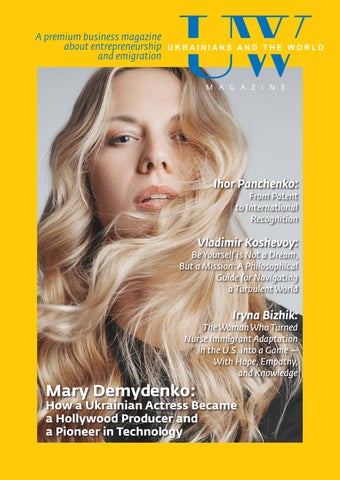
UW_issue_4_eng

Page 1


A premium business magazine about entrepreneurship and emigration

UKRAINIANS AND THE WORLD MAGAZINE

Ihor Panchenko: From Patent to International Recognition

Vladimir Koshevoy: Be Yourself is Not a Dream, But a Mission: A Philosophical Guide for Navigating a Turbulent World

Iryna Bizhik: The Woman Who Turned Nurse Immigrant Adaptation in the U.S. into a Game — With Hope, Empathy, and Knowledge

Mary Demydenko: How a Ukrainian Actress Became a Hollywood Producer and a Pioneer in Technology

Hello, dear friends from Chicago!

It seems moving is my destiny. Wherever life takes me, all my projects, ideas, and dreams travel with me. That’s why I created this online magazine — to continue sharing the stories of Ukrainians around the world, to spread inspiration, experience, and discovery.

I invite you to join me in exploring the beautiful city of Chicago — a place of contrasts, culture, and incredible energy. My new studies at the Chicago-Kent College of Law, part of the Illinois Institute of Technology, have immersed me in a vibrant community of international students. Every day I meet people from all corners of the globe, and each time I’m reminded: every one of us has a unique story worth telling.

Today, Ukrainians live and create on every continent. We study, build businesses, raise children, support Ukraine, and at the same time adapt to new cultures. This magazine is about us — strong, creative, free, and intelligent people who love their culture and are shaping a new chapter of history.

Ukrainians and the World is a magazine by experts and for experts — an independent platform with a wide reach and open opportunities. In just the past two months, I have visited Warsaw, Sambir, Lviv, Kyiv, Uman, and Bershad — reconnecting with Ukrainian activists, thought leaders, and those who transform their communities every day.

I am just beginning my journey in Chicago — but already, I want to invite you to meet our new friends, wonderful authors, and heroes of this publication. Let their stories, ideas, paths, and achievements inspire you.

This is only the beginning. There is much more to come. With love and faith in Ukrainians around the world — Olena Yaremchuk Founder of Ukrainians and the World

Iryna Bizhik:

OleksiiAksonov: FromKyivtoChicago— HelpingPeopleFindMoreThan aHome

What drew me to real estate?

Real estate is such an exciting field! There’s never a dull moment. Each client and every transaction brings their own flair, which keeps me on my toes and pushes me to embrace new challenges. I chose this path because it offers wonderful opportunities for daily learning and personal growth while connecting with fascinating individuals and discovering the best solutions for their needs. It’s a lively career that truly inspires me and fills me with joy.

My path to real estate started long before I received my license in Illinois. For five years, I ran a successful immigration law firm in Kyiv. That experience shaped me into a confident communicator, strategist, and problemsolver—skills that now serve my clients every day.

Why Chicago?

Chicago is one of the most diverse and dynamic real estate markets in the country. Whether you’re drawn to modern condos in the West Loop, classic greystones in Lincoln Park, or investment opportunities in up-and-

coming neighborhoods, this city offers it all. With its rich history, strong job market, cultural scene, and beautiful lakefront, Chicago is a place where people from all over the world come to build their future. My job is to help them do it wisely.

Real Estate with Heart, Strategy, and Results

In recent years, I’ve seen growing interest from clients—especially families and remote workers—who are looking to buy homes in the suburbs surrounding Chicago. Whether it’s for more space, better schools, or a quieter

pace of life, the suburban market presents great value and long-term potential. I regularly help clients explore areas like Skokie, Evanston, Glenview, Oak Park, and Arlington Heights—guiding them through everything from commute times to school ratings and community amenities. Today, I work as a real estate broker in Chicago, focusing on helping clients buy, sell, and invest in residential property. I specialize in:

For Buyers: Market analysis and neighborhood research

Mortgage budget planning and monthly payment estimates

Property tours with investment insight

Strategic negotiation and full transaction support

I always conduct a risk assessment for my buyers, which includes checking tax rates, HOA stability, resale trends, and even zoning or permit issues that might affect property value. This ensures clients don’t just fall in love with a property — they make an informed decision.

For Sellers:

Pricing strategy and property positioning

Professional photography and marketing (MLS, social media, ad campaigns)

Open house planning and hosting

Offer negotiation and closing coordination

For Investors:

ROI, cap rate, and cash flow calculation

Identifying high-demand rental areas

Turnkey investment opportunities

Leasing and post-sale support

For every investor, I break down the full financial model: expected rental income, ongoing costs (taxes, HOA, management, repairs), and calculate both cap rate and cash-on-cash return. We also plan an exit strategy in case the client decides to sell in 3–5 years.

For Renters:

Free property search based on budget and lifestyle Guidance through paperwork and application process

Direct communication with landlords or management companies

Where to Buy in Chicago — My Neighborhood Picks

For rentals/investments: Uptown, Edgewater, Albany Park — stable rental demand and relatively affordable prices.

For living: Andersonville, Lincoln Square, West Town — cozy, walkable neighborhoods with a strong sense of community.

For future growth: Bronzeville, Avondale, Pilsen — actively developing areas with potential for value appreciation.

How I Work — Step

by Step

Free consultation to understand your goals

Neighborhood and market research

Custom search with curated recommendations

Showings and transparent feedback

Offer strategy, negotiation, and due diligence

Closing and post-sale support (contractors, leasing, etc.)

My Philosophy: Smart Guidance, Lasting Impact

I don’t just show homes — I provide clarity, education, and confidence. Real estate is one of the most important decisions in a person’s life, and I approach every transaction with responsibility and transparency.

I speak English, Ukrainian, and Russian — making the process smoother for many clients.

I’m always in touch, ready to answer questions or provide insight.

I believe in honest assessments — even if it means advising a client to wait or walk away.

Most of my clients come through referrals. I view that as the highest form of trust and recognition. After closing, I stay connected — whether it’s answering questions about tax deductions, helping find a contractor, or preparing for the next purchase.

My entrepreneurial mindset drives me to keep learning, adapting, and improving. I treat every client as a long-term partner, not just a one-time deal.

Client Story: A Smart Investment in Edgewater

One of my recent clients — a first-time investor from Ukraine — had a budget of $140,000 and wanted a safe, stable return. We found a 1-bedroom condo near Loyola University in Edgewater, close to the lake and public transit. I helped them negotiate the price, coordinate inspection and financing, and connect with a property manager. Two weeks after closing, the unit was rented for $1,650/month — producing a net income of $500/ month after expenses. This client is now looking for their second property.

Advice from the Field: My Top 3 Tips for Buyers

Know your numbers. Get pre-approved, understand your max budget, and factor in taxes and HOA fees.

Buy the neighborhood, not just the home. Research schools, crime stats, transit, and long-term value.

Think long-term. Even if it’s your first home, consider resale and rental potential — life changes fast.

A Personal

Note

Having personally gone through the journey of relocation, reinvention, and starting from scratch in a new country, I deeply understand what it means to look for stability, security, and growth. I’m here to help others build not just equity, but a sense of belonging.

If you’re thinking about buying, selling, or investing — let’s talk. Together, we can turn your goals into results.

What My Clients Say

“Alexey explained every step and helped us buy our first home in the U.S. His calm, honest, and proactive approach made the whole process smooth and comfortable.”

— Oksana K., Chicago

Bio:

Alexey Aksonov is a licensed real estate broker in Illinois, based in Chicago. Originally from Kyiv, he brings a background in law, a passion for service, and a strategic approach to every transaction. Fluent in English, Ukrainian, and Russian, he works with buyers, sellers, renters, and investors to deliver smart real estate solutions with heart.

WhatsApp & consultations: +1 773 796 0738

Oleksii Aksonov

Real Estate Agent

E-mail: oleksii.aksonov95@gmail.com

www.komarrealestate.com

1700 W Higgins Rd Suite 240, Des Plaines, IL 60018

In a world where ideas are often more valuable than factories or machinery, mastering the monetization of intellectual property is essential for achieving new levels of professional and financial growth. Let’s explore how this is done in the U.S. and how Ukraine approaches it.

What is Intellectual Property?

Intellectual property (IP) isn’t just about patents or copyrights — it’s a strategic asset that can be sold, licensed, leased, or even inherited. IP owners may include not only inventors or artists, but also entrepreneurs, designers, IT professionals, course creators, or even marketing copywriters.

Global

Trends

In 2023, patent applications worldwide exceeded 3.6 million.

The global market for licensing intellectual property surpassed $500 billion.

In the U.S. alone, companies earn billions annually by selling intangible assets such as formulas, code, designs, and brands.

The U.S. Ecosystem: How it Works

The United States has built a clear and effective infrastructure around intellectual property: Legal protection — via patent registration (USPTO) or copyright registration (Library of Congress).

Valuation — through commercialization: licensing in manufacturing, media publications, exhibitions.

Marketing & promotion — from investor pitches to online IP marketplaces (e.g. Ocean Tomo, IP Marketplace). Sale or licensing — as companies acquire technology outright or under license.

American innovators commonly collaborate with patent brokers, specialty attorneys, accelerators, venture capital funds, and professional associations. This system enables not only financial gains but also the building of a strong personal brand, often as valuable as the patent itself.

Ukraine’s Integration into the Global IP System

Increasingly, Ukrainians are:

Registering patents in the U.S. and Europe.

Recording copyrights with the Library of Congress.

Licensing or selling their technologies.

Joining international inventor and startup associations. Winning grants, gaining media visibility, and achieving professional recognition.

Case in point: A Ukrainian cybersecurity specialist received a national grant to develop a unique data-protection system. After registering the patent and copyright in the U.S., a large American company expressed interest. This led to a licensing agreement, and the expert now serves as an international forum speaker.

The keys to success: legal protection → public reputation → attracting buyers or partners.

Why Successful Monetization Requires Strategy

It’s not just about being inspired or brilliant — monetizing IP demands a clear strategy, consistency, and market engagement. Here are the five key stages anyone turning ideas into real income must navigate:

1. Protect Your Idea

To transform your creation into a commercial asset, it needs legal protection through:

Patent (for technical solutions like inventions or models),

Copyright (for creative content such as software, music, text, design, video, courses),

Trademark (for brand names, slogans, logos).

Choose the jurisdiction wisely:

Ukraine – via UKRNOIVI

USA – via USPTO

EU – via EUIPO

International – via WIPO

Without this step, legal sale, licensing, or proof of authorship isn’t possible.

2. Assess the Commercial Potential

Legal protection is just the foundation. To monetize your asset, you need to understand its market value: Does it solve a specific problem?

Who is the target user or buyer?

Are similar solutions available? If so, how is yours better?

Can it scale?

This phase often involves patent analysts, marketing consultants, or focus group testing. Clear valuation is the basis for negotiations with investors or partners.

3. Build Public Presence

Your reputation becomes part of your asset. Investors look not only at the idea but at the person behind it. To raise visibility:

Publish in media, blogs, or niche outlets.

Participate in startup competitions or forums.

Present at international exhibitions.

Build a personal expert brand through webinars, talks, and public speaking.

The more you are mentioned in press and professional circles, the more attractive your IP becomes.

4. Find Partners through Professional Channels

An idea alone won’t go far — you need collaboration and communication. That means:

Joining international associations.

Participating in accelerators and industry hubs.

Listing your asset on global platforms relevant to your field.

It’s there that buyers and licensees seek technologies just like yours.

5. Licensing or Selling: Make the Right Deal

At the final stage, you negotiate either:

Licensing agreements (retain rights, allow usage for a fee),

Full rights transfer (one time sale), Joint commercialization (partnering with investors or manufacturers).

Earnings may come in the form of:

Royalties (monthly or annual payments), Lump-sum payments, Equity or profit share.

Tip: Seek legal assistance when drafting agreements — key terms include duration, territory, payment structure, and liability.

Example: From Concept to Licensing Success

An ordinary sketch of an adjustable children’s chair became a successful IP product. The inventor: Built prototypes.

Tested them in kindergartens (positive feedback from caregivers and pediatricians).

Filed industrial design protection in Ukraine, then internationally (covering EU and beyond).

Commercial analysis showed her design filled a market niche.

Created promotional materials and a pitch kit.

Presented at a trade-show in Stockholm with a grantsupported booth.

Attracted a Swedish children’s furniture maker interested in licensing.

Signed an exclusive license for Northern Europe, received upfront payment and ongoing royalties, while retaining full rights elsewhere.

Her design was credited on product packaging—boosting her professional reputation.

Secured further collaboration opportunities in Germany and Canada.

The product now sells independently — and she collects royalties without continuous involvement.

Final Thoughts

If you want your idea to bring profit, treat it as an investment. Properly protected and professionally marketed IP becomes a long-term asset that can generate revenue—and influence—for years.

Monetizing intangible assets is a complex but highpotential journey. The most successful stories follow a path of legal protection, market insight, visibility, and strategic action.

About

us: Lotus Innovations

Our team specializes in commercializing Ukrainian and European technologies, patents, and methodologies. We help turn technical creations into market success and sustainable growth.

Our services include:

Evaluating market potential and identifying viable commercialization paths.

Developing monetization strategies via licensing, selling rights, creating startups, or other business models.

Securing investment needed for launch or scaling.

Connecting you with potential partners, licensees, or buyers.

Phone +1 970 398 0895

Instagram: lotus.innovations

Websites: www.lotus-innovations.net ayaremchuk.com/ua/

Time is the most valuable resource we receive completely free of charge. These days, you can buy almost anything with money — health, relationships, emotions. But you cannot buy even a single second or fleeting moment of your life. How much would you be willing to give for an extra five minutes of life?

To truly appreciate time, we must first understand what it is.

The nature of time has perplexed the greatest minds on Earth for thousands of years — from Vedic sages to modern philosophers, physicists, and mathematicians. Democritus, Aristotle, Augustine, Kant, Newton, and Einstein each spent years trying to grasp the essence of time.

Over the past three thousand years, four main philosophical concepts of time have emerged: substantial, relational, static, and dynamic. Their key differences lie in how they define the relationship between time and objects. Christianity, Buddhism, and Islam all offer their own perspectives on time, yet each fits into one of these four fundamental frameworks.

The concept of time evolves slowly. It took over three centuries to move from Newton’s idea of absolute time — given by God and separate from objects — to Einstein’s theory of relativity, which explained that time depends on the observer’s location, speed, and gravity. From there, the very notion of absolute time gradually faded from scientific use.

Despite the work of the world’s brightest minds, no one has yet provided a definitive answer to the question, “What is time?” As early as the 4th century, Saint Augustine remarked, “What is time? If no one asks me, I know. But if I try to explain it, I do not know.”

Einstein once called time “a stubborn illusion.” In plain terms, scientists are suggesting that time may not actually exist at all. So why is this illusion so precious to us?

In the modern world, the value of time is defined by the individual — and by circumstances.

Culture, religion, and society all influence our relationship with time. Some African tribes, for example, still live strictly in the present, experiencing only the here and now as dictated by natural rhythms and daily life. In contrast, societies in North America and Europe are future-oriented, while many post-Soviet cultures remain anchored in the past. Yet under extraordinary circumstances, our perception of time changes regardless of cultural context — time seems to shrink in moments of crisis, or stretch painfully long when waiting for something important.

In business, time is not just valuable — it’s measurable. One of the founding fathers of the U.S. Constitution, and the face on its most expensive banknote, Benjamin Franklin, famously wrote: “Remember that time is money. He that can earn ten shillings a day by his labor, and goes abroad, or sits idle one-half of that day, though he spends but sixpence during his diversion or idleness, ought to consider that he has really spent... five shillings more.”

It’s no wonder his portrait has adorned the hundreddollar bill for over a century.

Modern humans are paradoxical creatures. They treat their most precious resource — time — with inexplicable carelessness. They never seem to have enough of it for what truly matters: their health, their soul, or their loved ones. They convert time into value using strange, irrational, and constantly shifting personal exchange rates.

People pay for time without hesitation — to lawyers, therapists, nannies, personal trainers, consultants. They are willing to spend money to speed up decisions, reduce travel time, or be compensated for delays. In doing so, they assign a specific value to their own time.

At the same time, this priceless resource is wasted on brainless TV shows, random websites, and endless scrolling through social media. People let time slip through their fingers in meaningless meetings and passive distractions. They spend decades in well-paid but joyless jobs, chasing goals imposed by society.

I can calculate the cost of time in a business project — the price of delay or the premium for decisiveness. I can estimate the financial value of an employee’s time. But I doubt anyone could ever determine the true price of a minute of someone’s life. Time is priceless, and no regulator on Earth can set a real exchange rate or monetary equivalent for it.

you want to truly understand how priceless time is, try calculating how much of it you hypothetically have left in your life. All you need to do is take the average life expectancy in your country and subtract your current age. Then convert the remaining years into minutes.

For example, in the United States, the average life expectancy for men is about 76 years. In Ukraine (before the full-scale war), it was around 66. Let’s imagine you’re a 40-year-old man living in Ukraine. That means your estimated remaining lifespan is 26 years — which actually translates into just 13,674,960 minutes, assuming 525,600 minutes per year (plus a few more for leap years).

Research shows that people aged 40 to 50 spend, on average, about 2.5 hours a day watching television and 1.5 hours on social media. That adds up to 87,600 minutes per year — nearly 17% of your remaining time, or onesixth of your life, spent in front of screens.

Another third of life is spent sleeping. Almost a quarter is consumed by work — and that’s assuming you have two full days off per week and work 8-hour days (excluding commuting time).

In total, three-quarters of your life go to screens, sleep, and work.That leaves, at most, a quarter of your life — around 360 minutes per day — for everything else. In reality, it’s even less. Now try to grasp the value of each minute — and draw your own conclusions.

Sergiy Wenger

IhorPanchenko:FromPatent toInternationalRecognition

“Innovation is not just technology. It’s a strategy that changes the rules of the game in the market.”

In today’s world, logistics is not only the backbone of international trade but also one of the drivers of technological progress. The name Ihor Panchenko stands as an example of how a Ukrainian inventor and entrepreneur can transform entire industries. His patented visual control technology is already in use in both Ukraine and the United States, while his company Valera Logistics Inc. successfully competes in the American market. Add to this his recent role as a jury member for The American

Business Expo Award 2025 — and we have a story worthy of an international business magazine.

Origins and Early Path

— How did your interest in logistics and inventive solutions develop?

— My introduction to logistics began in the automotive industry, where I spent over 15 years managing projects related to vehicle sales, maintenance, and import. At first glance, it’s a different business, but it was there that I understood the importance of process precision and control at every stage. Logistics became a natural continuation of this experience, but on a larger scale and with more complex challenges.

— Do you remember the moment when the idea that later became your patent first came to you?

— Yes. It happened when a human error in cargo tracking caused significant losses for a company. I realized the need for a system that not only records data but also visually confirms each stage of delivery. Over time, this idea evolved into the visual control technology that is now patented.

— How did your previous experience in Ukraine influence your approach to business in the United States?

— In Ukraine, I learned to work in a highly competitive environment where it’s often necessary to find unconventional solutions. In the U.S., these skills helped me adapt quickly, build partnerships, and find a balance between innovation and regulatory requirements.

The Invention and Patent

— Tell us about the visual control technology: what

makes it innovative?

— It’s an integrated system that combines data processing algorithms, visual analytics, and elements of logistics cybersecurity. It allows real-time visibility of cargo condition, control over loading, transportation, and unloading, while also reducing risks of fraud and loss.

— What challenges did you face during development?

— The main challenge was integrating the technology into existing logistics platforms. We had to make it universal so it could work both in Ukraine and in the U.S. without complex modifications.

— Were there differences between the patenting processes in Ukraine and the U.S.?

— Yes. In Ukraine, the procedure is more formalized, while in the U.S., it is more focused on the commercial potential of the invention. There, it’s important to show not only technical uniqueness but also a viable business model for its use.

— Where else could this technology be applied?

— Beyond logistics, it could be useful in construction, industrial manufacturing, and even in healthcare to track the movement of critically important assets.

Business in the USA

— What was the biggest challenge in founding Valera Logistics Inc.?

— The hardest part was building operational processes from scratch in compliance with U.S. standards. This

included licensing, hiring, and working with clients.

— How did you adapt your business model?

— We implemented a TMS system, analytical modules, and standardized documentation to meet both market requirements and client expectations.

— Did integrating the patent change your company’s operations?

— Yes. The technology became our competitive tool — it increased client trust and opened doors to major contracts.

— Which markets are most promising for you now?.

— Apart from the U.S., we see great potential in Canada and EU countries, especially in projects related to smart cargo monitoring.

International Recognition and Jury Role

— How did you become a jury member of The American Business Expo Award 2025?

— I was invited by the organizers, who recognized my

experience in international logistics, engineering developments, and strategic management.

— Which criteria do you consider key?

— For me, the most important are the innovativeness of the solution, its practical value, and scalability.

— Were there any projects that particularly impressed you?

— Yes, I was inspired by last-mile delivery solutions that combine eco-friendliness with artificial intelligence technologies.

— Tell us more about the participants you personally highlighted.

— In the Fleet Management category, I was impressed by the work of Yurii Gerasymov (USA), Fleet and Safety Manager at BSG Logistics LLC. He carried out a complete route optimization that reduced delivery times, improved safety, and eliminated vehicle downtime. This is an example of how a strategic approach can transform the efficiency of an entire company.

— In the Consumer Services category, I highly valued the project of Erik Arutinyan (Georgia), owner and CEO of LTD “E.D.E.” His company services over 300 commercial refrigeration units for leading food and beverage producers, maintaining zero major failures and expanding service reach even in times of crisis.

— In the Delivery & Last-Mile Logistics category, Natalia Maliarchuk (Norway), a manager at Nova Poshta, stood out. Her routing and warehouse optimization algorithms reduced delivery time by 22%, fuel usage by 12%, and order errors by 40%. She also shortened route planning time from 90 to 10 minutes, opening up new opportunities for scalable growth.

— What did serving on the jury mean to you?

— It was not only an opportunity to evaluate innovative projects but also to exchange experience with colleagues from different countries. Such competitions shape the business future and create an international platform for cooperation.

— How did serving on the jury affect your image?

— It became further confirmation of my expertise at the international level and expanded my network of contacts in the U.S. and Europe.

— Do you plan to serve on a jury again?

— Yes, I enjoy being part of the selection process for innovations that will shape the market of the future.

Looking to the Future

— What trends will define logistics in the coming years?

— Automation, artificial intelligence, cybersecurity, and green logistics.

— Is global standardization in logistics cybersecurity possible?

— I believe it is, but it will require initiative from major players and support from international organizations.

— What are your main principles in business?

— Honesty, process transparency, and innovation in every decision.

— What advice would you give Ukrainians planning to start a business in the U.S.?

— Be prepared for the long game, adapt, but never give up your uniqueness.

— Where do you see yourself in 10 years?

— My goal is to make Valera Logistics Inc. one of the leaders in innovative logistics in North America and Europe.

«My journey proves that a Ukrainian inventor can be a leader on the global stage».

Alona Komisarchuk

The legal profession is becoming increasingly global. International agreements, investments, litigation — all these extend far beyond the boundaries of national legal systems. This is why lawyers who possess knowledge of multiple jurisdictions gain not only a competitive edge but also the ability to build a career on a global scale.

My legal career began in Kharkiv, Ukraine, where I graduated from National Law University named after Yaroslav Mudryi. For more than 10 years, I worked in the fields of financial law and litigation. My collaboration

with European banks while handling large cross-border transactions became the turning point for my professional growth. At that moment, I realized that knowledge of Ukrainian law alone was no longer sufficient to work effectively in the international market.

The first step was my decision to pursue legal education in the United Kingdom, in London. The geographical proximity to Ukraine, the global prestige of the English legal system, and the quality of education made the UK an obvious choice. I enrolled in BPP University Law School in the Graduate Diploma in Law (GDL) program. This program allowed me to quickly convert my Ukrainian law degree into an English equivalent, opening the door to the common law system. English and Wales law is frequently used as the governing law in international contracts, including as the procedural law in litigation and arbitration.

After moving to the United States in 2022, for several years I had no immediate plans to pursue legal practice. However, I eventually returned to this idea. Obtaining a U.S. license is not just a legal step, it is a chance to elevate one’s career to the level of international practice. I conducted research on how to adapt Ukrainian and UK legal degrees for U.S. requirements and the steps needed to obtain a license. The general pathway looks like this:

• Choose the state – Typically New York (NY) or California (CA), though Texas, Florida, or Maryland may also be options. The choice depends on where you intend to practice.

• Credential evaluation – Accreditation of foreign legal education; all Ukrainian degrees require this process.

• LL.M. (if required) – In New York, this is almost always mandatory. Personally, I considered only two states whose licenses are recognized in most other jurisdictions: New York and California. In my case, an LL.M. may not be required due to my UK degree.

• MPRE (Ethics Exam) – A separate test that is mandatory before admission.

• Bar Exam – Includes multiple-choice questions, essays, and performance tests.

• Character & Fitness Review – Background and moral character check.

• Oath of Admission – The final step. Comparison of Key States

(MBE + MEE + MPT)

LL.M. Mandatory

Another alternative is obtaining a Foreign Legal Consultant license, which allows you to work in the U.S. on matters related to your home jurisdiction — ideal for those in international business, arbitration, or investment — but this does not grant full attorney privileges and provide consultations/advices on US law.

Currently, I am beginning my preparation to pass all required exams by February 2026 (using Barbri or Law School prep programs).

As all my U.S. colleagues say: “Start preparing as early as possible.” So plan every step, calculate your budget, and mentally prepare for a new level of competition.

The legal profession is not about borders. It’s about opportunities.

Bar Exam (essays + MBE + Performance Test)

(MBE + MEE + MPT)

Imagine this: you have international publications, a few patents, or hundreds of thousands of social media followers. You receive applause at global conferences or acclaimed art festivals. You seem like the perfect candidate for a U.S. talent visa — yet you get denied. It’s not uncommon. And it’s not a tragedy — if you understand the reasons.

O-1, EB-1, and EB-2 NIW visas offer a legal path to live and work in the U.S. without a sponsor, quota, or lottery. But when applications are submitted with the wrong strategy, even the most accomplished professionals are left behind.

This article explores the most common mistakes applicants make — and how to avoid them. It’s especially relevant for Ukrainian professionals increasingly choosing talent-based immigration over traditional work or family programs.

First, a quick reminder of the three talent visa categories:

O-1 – A temporary visa for individuals with extraordinary ability. Suitable for artists, scientists, IT professionals, and athletes. Requires a U.S. employer or agent.

EB-1 – An immigrant visa leading to a green card. High standards, but no employer needed. Ideal for industry leaders, scientists, inventors, and artists.

EB-2 NIW (National Interest Waiver) – A green card without a sponsor, based on national interest to the U.S. Less strict than EB-1, but requires proof that your work is beneficial to the country.

Mistake #1: Confusing visa categories

The most common error is choosing the wrong category. Applicants apply for EB-1 using O-1 criteria, or apply for EB-2 NIW without understanding how to prove “national interest.”

Each visa serves a different purpose and has its own legal standards. Choosing incorrectly often results in an automatic denial.

USCIS clearly states: EB-1A requires evidence of international recognition, not just local or corporate success. To avoid this mistake, ask yourself:

• Which visa category best suits my career stage?

• What level of evidence can I realistically provide?

• Can I clearly meet the legal criteria for the specific category?

Mistake #2: Lack of logical narrative — documents ≠ case

Applying for a talent visa is not about compiling a thick stack of achievements. It’s about building a legally coherent story that demonstrates:

• Who you are;

• What makes you unique;

• What your contribution to your field is;

• Why it matters to the U.S.

Without this, even the most impressive certificates or publications become background noise.

Mistake #3: Insufficient proof of qualifications

You must clearly prove your education or exceptional ability in your professional field. Incomplete, vague, or undocumented claims are a common reason for denial. Typical applicant mistakes include:

• Submitting local awards without international recognition;

• Failing to explain the significance of an award or the authority of the institution granting it;

• Including interviews from unknown or low-traffic websites.

Solution: Collect high-quality documentation: Internationally recognized diplomas and certificates; Letters of recommendation; Verified work experience and impact; Certified English translations of all documents.

Mistake #4: No evidence of commercial or societal impact

Some applicants think having a patent, a creative project, or a startup is enough to prove their value. But for USCIS, it’s not about creation — it’s about impact.

A patent that was never commercialized, a book no one bought, or an artwork that never left the studio — these are not proof of contribution.

USCIS wants to see real-world results:

• Has your work generated income?

• Has it made a societal impact?

• Has it influenced industry practice?

• Has it been covered by media, experts, or institutions?

A strong case may include:

• A licensed or implemented patent;

• A funded startup with users or revenue;

• An art project exhibited in international galleries;

• A scientific discovery cited by other researchers or used in real-world applications.

Supporting evidence:

• Financial statements, contracts, or grants;

• Press coverage and expert reviews;

• Sales data, licensing agreements, partnerships;

• Requests for usage of your work;

• Citation metrics (for scientists).

Mistake #5: Weak explanation of “national interest” (for EB-2 NIW)

Many EB-2 NIW applications are denied due to vague claims about how the applicant benefits the U.S.

Being talented or highly qualified is not enough. USCIS expects answers to three critical questions: Does your work have societal or strategic value to the U.S.?

(e.g. in science, healthcare, education, environment, energy, or national security)

Can you carry out your work in the U.S.?

This requires concrete plans, contacts, research results, or pilot initiatives.

Why should you get a green card without a job offer?

You must prove that a waiver of the job offer is in the U.S. national interest (e.g. your work is independent or not tied to a single employer).

Statements like “my experience will benefit the U.S.” are too general. You need a clear, evidence-backed argument of your national-level impact.

Tips to improve your chances of success:

• Analyze both your accomplishments and the legal criteria;

• Choose the right visa category and tailor your case to it;

• Build a logical story: What you did → Why it’s unique

→ Who benefits → How it connects to the U.S.;

Support your case with specific, documented evidence, not general claims;

Don’t hesitate to involve experts — lawyers, consultants.

America welcomes talent — but not just potential. It wants proof of real value.

If the application is well-structured, talent-based immigration is absolutely possible. Mistakes are not fatal — but they’re not trivial either.

The most successful cases aren’t always the most glamorous. They’re the ones that are:

Strategically built;

Legally sound;

Coherently presented.

A real success story (name withheld for confidentiality):

One of our clients was a cybersecurity expert who developed a unique technological solution to defend infrastructure from complex hacker attacks.

Key facts:

The invention received grant funding from an international tech-support program;

The creator won several prestigious cybersecurity awards;

His achievements were featured in top professional media;

He was a member of professional associations in both the U.S. and Europe;

Most importantly, a major company acquired and implemented the technology, reporting a notable decrease in cyberattack risk and damages.

Our role:

• Determine the appropriate visa category (O-1 or EB-1, depending on strategy);

• Prepare a detailed portfolio of evidence meeting USCIS criteria;

• Collect strong letters of recommendation from industry leaders;

• Emphasize the applicant’s international recognition and measurable impact.

Talent visa approved without any Request for Evidence (RFE).

You don’t need to be a celebrity or Nobel laureate. If your ideas work, generate results, and are respected by your field — you have a real chance at a talent visa. The key is presenting it properly.

We can help you:

• Discover and define your unique value;

• File a patent — in Ukraine, Europe, or the U.S.;

• Register your copyright (including U.S. Library of Congress registration, which strengthens your legal case);

• Prepare for competitions, conferences, and media exposure;

• Build your reputation through professional associations, jury roles, and international engagement.

This is your path.

It may not be fast, but with a clear goal, a plan, and the right strategy — everything is possible.

Yaremchuk & Partners International Legal Consulting Group helps professionals, artists, inventors, and entrepreneurs from around the world build a legal path to the U.S. through talent visas.

We know for sure: talent is only half the story.

The other half is a well-documented, well-structured narrative of your impact, achievements, and recognition — submitted in the right category.

If you have a patent, academic publications, a startup, international projects, or outstanding achievements — you already have a strong foundation.

We’ll help you:

Assess which visa (O-1, EB-1, or EB-2 NIW) suits your case;

Prepare documentation proving your qualifications, experience, and social relevance;

Structure your application to meet USCIS legal criteria, not just the idea of “being talented”;

If needed, we’ll help you register a patent or copyright that’s not just decorative, but a convincing proof of your value to the U.S., with options for international protection.

Contact us: Phone +1 970 398 0895

Instagram:Yaremchuk.group Website: ayaremchuk.com/ua

BetweenTwoWorlds

«Even

if the ground slips from under your feet, strength lies in not losing yourself. A profession is not just a job. It is the voice of my soul.»

When life changes overnight — you either break, or you begin to build a new self. I was born and raised in Kharkiv, where I obtained a higher legal education at Yaroslav Mudryi National Law University. My legal career took me from lawyer to head of the legal department and deputy general director for legal affairs. Since 2012, I have been an attorney, and from that moment a new stage in my legal career began. In 2019, I was recognized by the Ukrainian National Bar Association as «Lawyer of Kharkiv Region — 2019.» However,

more important than any awards has always been the trust of people who came for help in the darkest moments of their lives.

Life led me to mediation. It is a separate philosophy based on the ability to listen, understand, and help the parties find a common solution where it seemed there were no more paths. I am a certified mediator and have a letter of gratitude from the Ministry of Justice of Ukraine for successful mediation practice. However, in 2022 I had to pack my life into a bag. My

son and I found ourselves in Leipzig, Germany. Professionally, it meant clients’ tears, calls, and unfinished cases, because the courts in Kharkiv were not functioning, and cases were not being considered. I felt this new reality, but still I remained the same — a lawyer from Kharkiv. Eventually, I completed the registration procedure with the Bar Association of Germany and opened the possibility to provide legal services as a Ukrainian lawyer in Ukrainian and international law.

I am not perfect. There are days when it seems — I won’t cope. But next to me are people who also found themselves in difficult circumstances, yet continue their journey. I will never leave Ukraine. But now I am here — in Germany. And my duty is to be useful here as well. I believe in the future of Ukraine. And in the fact that Ukrainian professionals are capable not only of integrating but also of enriching new societies. I am part of both worlds. And I do not choose between them. I unite them.

US/THEM

A person’s value is defined by their product.

By product, we mean the result of one’s actions — something created by a person that holds value for others.

The safest and only true criterion for evaluating a person is their productivity — the ability to achieve the expected result. Upbringing, education, social status, character traits, worldview, political or religious beliefs are not as important as productivity.

A person may hold three university degrees, know everything about everything, support any conversation, be the embodiment of good manners and charm — yet still be completely unproductive. You’ve likely encountered such people among your colleagues: when given a task, they logically explain why it cannot be completed, or they simulate intense activity that leads nowhere.

On the other hand, someone may be stubborn, impulsive, even inconvenient — but productive. Whatever task you assign them, it gets done, and the expected result is achieved. Typically, such people enjoy working hard and delivering results that exceed expectations. They love to create, build, and help others. These people are extremely valuable — not only to a company, but to a nation.

In business or any other group, there is a constant process of selecting such individuals. The extent to which they can be attracted and motivated determines how successful the company or group will be.

When times get tough, selection based on productivity is often replaced by a simplified us vs. them recognition system, which uses external signs of loyalty as the main criteria — declarations of allegiance, repetition of propaganda slogans, language, cultural or national identity. This reflects the principle of Don Reba from the Strugatsky brothers’ novel Hard to Be a God: “We don’t need the smart ones. We need the loyal ones.” The group begins to reject those who could truly lead it out of crisis, while making room for cunning yet unproductive opportunists. As a result, the number of poor management decisions grows exponentially, eventually leading the group to collapse.

Perhaps this is what Jesus warned us about in the Sermon on the Mount:

“By their fruits you shall know them. Do people gather grapes from thornbushes, or figs from thistles?” (Matthew 7:16)

What if Everything is Simpler Than it Seems?

The modern world often compels us to adapt, defend, prove, and merely survive. It’s easy to get lost in roles, in the demands of daily life, or in the struggle to «keep face.» Yet, the answer to being yourself is wonderfully paradoxical: it’s not about clinging to a static image or «standing your ground.» Instead, it’s about embracing fluidity, allowing yourself to «flow,» «change,» and «open up.» To be yourself means to truly «live,» not just exist, letting life move through you without the futile attempt to control or rewrite it.

In a world of constant flux and profound challenges, the seemingly simple directive to «be yourself» has transformed from a naive slogan into a revolutionary act. For many, particularly for Ukrainians facing the darkest nights, it is a deeply personal journey, a vital inner choice, and perhaps the most important mission in life.

«Let’s Start with the Truth: You’re Already Not Bad.»

The Indian sage Ramesh Balsekar once offered a profoundly liberating insight that challenges our ingrained notions of self-improvement: «You are already who you should be. Everything that happens is the will of the Divine. Let go of the idea of control.» (Ramesh Balsekar, A Net of Jewels, 1996)

For those accustomed to endless self-work, striving for perfection, and reaching ambitious goals, this can feel like a jolt. How can one be «enough» when there’s so much more to achieve? However, Balsekar is not advocating for laziness or apathy. His message is one of «liberation» from the pervasive illusion of inadequacy. He asserts that our true nature is inherently perfect, and all that’s required is to «see it.»

«Who is This ‘Me’?»

When we say «be yourself,» our minds often conjure an image: a collection of traits, habits, and beliefs – a psychological passport, a comfortable mask. But this is not the true «you.» This is «your story.»

You are not merely a collection of roles: «lawyer, volunteer, mother, emigrant.» Nor are you defined by labels like «strong» or «vulnerable.» You are the «witness» who experiences all these facets of life. As J. Krishnamurti wisely stated, «Freedom is when you observe without judgment.» (J. Krishnamurti, Freedom from the Known, 1969). Therefore, being yourself isn’t about constructing a perfect self, but about «seeing,» «feeling,» and «not interfering with being yourself.»

«There is No Silence Inside. There is Life Inside.» When you consciously choose silence – free from

phones, tasks, and television – what remains? We often assume silence brings peace, but upon truly entering it, we discover a vibrant «life bubbling inside.» Thoughts, desires, memories, and worries rise like effervescent bubbles from the depths. And at the core of many of these are «desires.»

Desires: Enemy or Clue?

Many spiritual traditions view desires as the root of suffering, asserting that they cause attachment, endless striving, and inevitable disappointment. However, let’s explore an alternative perspective.

Desire is not merely a whim; it is the «movement of life» within us. It’s a signal: «I want to connect with something.» It’s an innate call to expand, to experience fullness, and to return to our source. Even in material desires – for a home, recognition, or love – there’s a deeper impulse: «to

be full,» to be in the flow. Desire is the delicate thread connecting our human form to the «Divine Impulse to grow.»

As Ramesh Balsekar noted, «True desire does not come from the mind. It is from the Source. The mind only formulates, distorts, and labels.» (Ramesh Balsekar, Who Cares?!, 2001).

But How Do You Know Where the Real Desire Is and Where the Illusion Is?

The answer is surprisingly simple. Real desire «does not create tension.» It doesn’t drive or compel; instead, it expands naturally, like a breath.

False desire, conversely, buzzes with urgency, demands gratification, and often leads to suffering. It’s rooted in fear: «If I don’t succeed, I’m nobody.» This is not the authentic voice of the heart, but a program of the mind.

Therefore, being yourself means «listening to desires,» but not blindly chasing them. Look to their root. Ask, «What am I really looking for?» Perhaps not a car, or glory, or control, but intimacy, peace, joy, or simply the space to authentically be yourself?

You’re Not Your Own Story.

You Are a Living Experience.

Every day, society conditions us to be «someone»: an exemplary citizen, a successful immigrant, a patriot, a professional, a good parent. And we play these roles, often with honesty and dedication.

Yet, amidst all these roles, «there is you.» The real you. And being yourself isn’t about ignoring these roles, but remembering that you are «not reduced» to them. Your depth extends beyond your biography. You are not your resume, your social media profile, or the opinions of others. You are «life experiencing itself.» Like the ocean, which can be stormy, serene, and infinitely deep, but always remains the ocean.

Being Yourself Doesn’t Mean Being Perfect.

We often believe that true self-acceptance will only come when we eliminate mistakes, overcome anxieties, achieve financial success, or resolve all our life’s dilemmas. But you already are. You are already alive. You can already feel. And that means you already deserve to be yourself.

To be yourself means not being afraid to be «awkward,» «vulnerable,» or fully «alive.» This is the strongest stance, because it is profoundly honest.

Not to Correct Yourself, But to Love

This doesn’t imply «staying in your comfort zone.» Instead, it means not «correcting» yourself out of fear. It

means «exploring» yourself out of love.

Allow yourself to «be weird,» «be quiet,» «be bright,» or «not be according to plan.» Do this not for someone else, but for your own sake. For the sake of the life that yearns to be lived «inside you,» not confined to a perfect, external picture.

Acceptance is Not Surrender. This is Wisdom. Ramesh Balsekar further emphasized, «Surrender is not passivity. It is an active acceptance of what is already there. This is the wisdom of the heart.» (Ramesh Balsekar, Peace and Harmony in Daily Living, 2006).

In a world that constantly demands control, the act of letting go and accepting yourself for who you are is a profound act of courage. This does not mean «doing nothing.» It means «to act not out of fear,» but out of «clarity.» When actions stem from clarity, they become pure, and all desires become a pathway home.

For Ukrainians Today, This is Not Just a Philosophy.

For Ukrainians, this concept transcends philosophy; it is survival. It is about saving oneself, one’s soul, and one’s light. It means resisting anger, avoiding self-imprisonment, and not losing touch with the essence of living. To remain «real» within oneself – not embittered, not hardened – is a testament to resilience.

Being yourself means remembering that you are more than a participant in a war, a refugee, or an activist. You are a «living person,» with morning tea, your favorite song, your memories, and your own silence.

And Finally: Being Yourself is a Mission

This is not selfishness; it is the «service of life.» Because an authentic person – lively, honest, open – naturally becomes a «pillar» for others. They don’t preach; they simply «shine.»

Such a person may not save the world, but they certainly do not add pain to it. And this, in itself, is an enormous contribution.

So be yourself. Now. Not later. With all the feelings, mistakes, joy, fears. Let yourself be. This is the Light. This is Divine. This is freedom.

Starting a new life in a new country is always a challenge. A different environment, a different language, new rules, and new people. As for me, life has taken me through 19 cities, five countries, and three U.S. states — and every time, I’ve become a new version of myself.

When I moved to Miami, I immediately began organizing Ukrainian cultural events and community gatherings. At one of those events, I met Liuba — a brilliant Ukrainian lawyer who, like me, shared a passion for video production and creative communication.

She told me about the School of American Law — a program offered by Chicago-Kent College of Law (Illinois Institute of Technology) in cooperation with the Center for American Law in Ukraine. I hesitated. My English wasn’t strong enough, I thought. The legal system was so different. Could I really do this?

But legal practice is a lifetime of learning. Every political change, every new client, every global shift — it all demands constant growth. So I took a leap of faith and joined the program.

We began exploring the American legal system — and it truly felt like driving on the other side of the road. A precedent-based system, endless documents in legal English, and a huge amount of independent study. I still remember my first homework assignment — surrounded by AI tools and translators just to understand the basic meaning. Slowly, though, the fog began to lift. My eyes began to open.

I remember every professor. The learning was intense, challenging, and truly transformative. We started building connections with fellow students — and many of them, I know, will remain lifelong friends.

This program inspired me to change my life once again — to pack up and move to Chicago to pursue further legal education.

My Chicago: A New Chapter Begins

After the intense Miami heat, I arrived in the heart of Chicago — a city full of beautiful parks, rich architecture, and a cozy apartment just 6 minutes from campus. I was nervous. But I wasn’t alone — Volodya, a steady and supportive friend, walked with me through those first emotional days. Then he returned to Miami, and I stayed — but this time, with more confidence.

There were over 200 international students, and our Ukrainian group had more than 40 participants. I instantly felt the power of academia again — diverse languages, cultures, brilliant minds, experienced legal professionals, and a strong intellectual atmosphere.

I absolutely love learning. Every lecture excites me. And all my fears about my language skills disappeared as soon as I began talking to classmates. I’m especially grateful for our Legal English course — the professor spoke clearly and thoughtfully, and slowly I settled into a rhythm.

Of course, it’s not easy. We have to read 100 pages of legal texts in English every day, and the material is demanding. We’ve already taken our first exams, and I’m still learning how to effectively work with precedent law. But I’ve once again found myself in my element — surrounded by books, ideas, and the law. I now truly understand that America is a country of lawyers, and I’m grateful to be learning here.

A Message to Those Who Hesitate Education isn’t only about knowledge. It’s about bravery — the courage to start over, the will to grow beyond your comfort zone. It energizes, inspires, and brings you back to life.

So if you’re hesitating — if you think it’s “too late,” or “too difficult,” or “not for me” — just start. One step at a time. And soon, you’ll be thanking yourself for saying yes.

Childhood dreams are idealistic because it’s natural for a child not to model out life’s difficulties or evaluate her prospects through the lens of reality, but instead through the vivid colors of her own imagined world.

«I’ll be an actress, marry a producer, and move to Italy!» — 10-year-old Mariia Demydenko (who now goes by Mary) once said with sincere excitement. Of course, to Italy. Italian music was everywhere, Italian brands were the height of fashion, and Italian films were so romantic that even kids were allowed to watch them. The word “Italy” itself melted in the mouth like candy. When the time came to choose a path in education, the young Kyiv girl with a creative heart opted for a practical profession. No, she didn’t abandon her dream, but she made her choice through the more grown-up lens of a thoughtful girl from a “good family.”

Needless to say, Mary studied with excellence, easily landed a job after graduation, and had every opportunity to build a successful career in international management. Still, this energetic young woman craved more space

for individuality. She approached that need both creatively and rationally, by becoming a manager at a casting agency. There, she finally felt like the atmosphere truly fit her nature. And considering her love for theater and her obsession with never missing a single premiere, it was only natural that Mary decided to pursue acting education. In her very first student film, created by a team from the Ukrainian Film School, she landed the leading role.

Through the expected first steps — commercials and music videos — Mary Demydenko found her way into major film productions. Is that something you’d call inevitable for someone entering such a competitive profession? Probably not. But for Mary Demydenko, it absolutely was. Every step she took in the film industry seemed to reaffirm it.

The world of cinema gave the Ukrainian artist not only a chance to fulfill her childhood dream and fully express her creative side. It also gave her love. Cinematographer Ivan Sakhno, whom Mary met during one of her first shoots, became the one person who could “tame” the fiery beauty. None of their friends believed that a relationship between two such strong, ambitious personalities could go the distance. And yet, over time, their bond only deepened.

Thanks to her organizational skills, experience in casting, and relentless energy, Mary began working as an assistant director on films Ivan Sakhno was shooting as cinematographer. The most important of those, both for Mary personally and for the emerging Ukrainian film industry, were “Escape from Stalin’s Death Camp” and “My Carpathian Grandpa.” Both films were rich in historical and social themes and directed by Zaza Buadze.

On set, colleagues would joke, “Mary’s the one who can manage to sit in two chairs at once — both in front of the camera and behind it.” Each new project gave her more experience, more confidence, and more ideas she wanted to bring to life. Thoughts of launching her own production company, in a family of two filmmakers, came quite naturally.

But in February 2022, that steady and inspiring momentum was disrupted. And so was her entire worldview.

Mary found herself in the Czech Republic. Ivan stayed in Ukraine. Surprisingly, the forced separation brought them closer and led to their decision to officially marry. As she contemplated her next steps in the midst of this new and chaotic reality, Mary took a job as a waitress at a hotel in Prague.

Some things that happened afterward could honestly be described as straight out of a movie. Brazilian writer Paulo Coelho famously wrote about the art of reading signs in his novel The Alchemist, and Mary had one of her own.

One day, the only Hollywood star she had ever truly wanted to meet checked into the very hotel where she worked. After a brief conversation, Johnny Depp told her, “You should go to Hollywood.”

It wasn’t something Mary had planned, but the words planted a seed. Her husband supported her. If anyone knew Mary’s potential, it was him.

She arrived in the United States under the Uniting for

Ukraine (U4U) program, having met her future sponsor almost by chance. There was never any doubt in her mind where to go in this unfamiliar new country — Los Angeles. Tens of thousands of ambitious Americans move there every year in search of creative opportunities. For a foreigner like Mary, the path to recognition would be immeasurably harder. But that wasn’t going to stop her.

As an actress and as a person of action, she began meeting with agents and quickly realized that the role that could bring her success might take a month, a year, or even years to arrive.

Could that challenge be solved both creatively and rationally? Absolutely — if you believe in yourself and refuse to give up.

So, Mary decided to write a role for herself.

Out of many story ideas swirling in her mind, she chose the one that felt the most meaningful. And the most emo-

tional. Over three years of wandering across countries — by train, plane, and through unfamiliar cities — she kept meeting Ukrainian women, forced to start their lives from scratch, to tap into inner reserves they didn’t know they had, and to protect their identities in a crumbling world.

The raw, honest stories of these women — vulnerable, yet incredibly strong — touched her deeply. And she, too, was one of them. From working night shifts in factories to serving tables in Prague, to building a career in Hollywood — she had lived it all.

Emigration in general, and forced emigration in particular, is one of the defining challenges of today’s world. Not just for individuals, but for entire nations. Countries and continents alike are grappling with legal and illegal migration.

Mary Demydenko built a concept for a series about Ukrainian women, with the story unfolding between Ukraine and France.

As it turns out, she wasn’t the only one who believed the idea would resonate with audiences. She was supported by Zaza Buadze, a respected Ukrainian director with whom she had worked before and whom she trusts completely, both as an artist and as a human being. He wrote the script for the upcoming series, and the producer of

the project is Mary’s husband, Ivan Sakhno, with whom she shares both creative vision and life partnership.

Mary managed to attract investors.

In under two years in the U.S., she co-founded her own production company, 4U Film Company, together with Ivan. She secured financing for her first independent project, held negotiations with a respected French production company for co-production, and organized the entire pre-production phase. The series, titled «Yellow & Blue», will begin filming this year.

A story about the strength of spirit and the strength of love.

Mary is convinced that what drives her is her own creative soul. And if, as her father used to say, “everything happens in its own time,” then her time is now.

Today, this rising producer operates within a much broader canvas — a reimagined picture of the world.

Her next goals: to create a mobile platform that helps streamline actor casting, and to develop several new tech-driven tools for the film industry. And who knows — maybe one day, the world will watch a new film.

A biopic about Mary Demydenko.

ArtThat FindsItsVoice

Art is a language that can speak even when words fail. Sometimes it manifests itself in stage design that creates an atmosphere, sometimes in the lines of a logo or the silhouette of clothing, and sometimes in a reading that makes you reflect on what truly matters. For me, creativity is a path of constant movement forward, even when the world around changes unpredictably.

Since the beginning of the war, I have realized how important it is not to stop but to continue creating images that help to feel, understand, and find meaning. Moving to Poland opened new horizons: conceptual, formal, and technological. Today, an artist is no longer tied to a specific studio or stage — we create online, beyond borders and time zones.

I am Marianna Sorochynska, and my work lives at the intersection of theater, graphic design, fashion, and psychology. My portfolio includes seven performances staged in collaboration with teams from Poland, Germany, and Ukraine. One of the highlights is the scenographic-musical show “Backstage, or Who’s Next?” in Chernihiv. It’s an entertaining performance with hits, dances, and irony, where musicians perform world-famous songs in Ukrainian. It creates a space for emotional rest and vibrant entertainment.

Another notable project was a Polish reading performance about the war — a powerful and emotional experience, resonating even without translation.

But theater is just one part of my work. I design logos that convey a brand’s emotion and story, create illustrations and portraits that reveal more about people than words, and develop capsule clothing collections where each piece is a character in its own narrative.

My background in psychology has allowed me to create metaphorical associative cards (MAC cards) — a tool for art therapy and self-reflection. When art combines aesthetics and depth, it turns any project into something meaningful, not just visually appealing.

What matters most today is flexibility and freedom. Remote work and modern technology allow me to create set designs for a theater in Ukraine, develop a logo for a European client, and illustrate a book for someone on another continent — all at the same time. It’s not routine, it’s the creative drive that moves me forward.

In every project, I look for individuality — not template solutions but reflective visuals that resonate: a brand, a character, a story, a team. Theater has taught me spatial awareness and collaboration, graphic design has given

me precision and conceptual thinking, fashion — the ability to create strong images, and psychology — an understanding of the inner world of people I work with.

Today, I am open to international collaboration. If you are looking for an artist who can create a visual identity that works for your brand, your emotions, and your atmosphere, or set designs that emphasize the narrative, or a collection that tells a story — I am ready to join.

True art never goes silent as long as we create it together — here, now, under any sky.

instagram: @marianna_art_logo

Tel/WhatsApp: +48 507 322 862

PolinaHerman.Howawomanfrom Yevpatoriabecamethevoiceof ukrainiancinemainHollywood

In a rapidly changing world, sometimes it takes just one story—raw, honest, with all its breaks, falls, and rises—to remind us: courage changes everything. The story of Polina Herman is one of those. It’s the story of a woman who journeyed from a small town in Crimea to the red carpets of international film festivals; from family trauma to inner wholeness; from a desire to escape to the conscious choice to be present everywhere. A citizen of the world.

Polina was born in Mykolaiv and moved to Yevpatoria, Crimea, at the age of six. She spent her entire childhood and youth there—studying, getting married, giving birth to her son, going through a divorce, and facing unsuccessful attempts at running a business. Yevpatoria always felt too small for her big dreams—not physically, but internally. It was a place she had longed to leave since childhood. And the moment she found the courage to start living independently, she seized it. Moving to Kyiv was not an escape but a choice. The capital didn’t greet her with red carpets—but with challenges. Dorm life with a child, no stability, a constant

struggle to stay afloat. But within those walls, she found her strength—through creativity. Working in theater and staging performances, including the iconic Black Square in the Dark, which entered the Ukrainian Book of Records, were her first steps toward her greatest passion— cinema.

Polina had always been drawn to psychology and art. As a schoolgirl, she participated in drama clubs, filmed short videos, and experimented with self-expression. In Kyiv, she not only worked but also studied—marketing, PR, and communications. She learned how to create cultural products and craft stories. Her path was not linear—it was a mosaic composed of theater, video art, student festivals, photo projects, and independent initiatives.

She started from the very bottom: bringing extras to film sets, then becoming a costume assistant, later the “girl with tea,” a production runner, and an assistant. She studied the industry from the inside. And the deeper she immersed herself, the clearer it became: she didn’t want to simply be part of the team—she wanted to create. To invent. To shape meaning.

That’s how UP UA Studio was born—her first production company in Kyiv. Her films weren’t about gloss and

glamour—they were about pain, complex topics, and the silence where human truth resides. She produced films not for entertainment, but for reflection. Among them: Numbers by Oleg Sentsov and Akhtem Seitablaiev, The Price of Conflict, King Lear: Searching for Love During the War, and others. She learned how to balance creativity and management—and that became her strength.

In 2022, when the full-scale war began, Polina evacuated with her son to the U.S.—in search of safety and new opportunities. No English, no connections. But with a deep inner intention: not just to survive, but to be of service. In Los Angeles, she remembered telling a friend years earlier: “I don’t know how, but I’ll end up in Hollywood.” Five years later—there she was.

Studying at UCLA Extension and becoming a member of the prestigious Producers Guild of America—these were not trophies but tools. Polina founded UP USA Studio, which quickly gained a reputation as a trusted partner. In just three years, she produced six short films in Los Angeles, shot three documentaries in Europe, wrote the psychological book A Guide for Provincial Girls, created a self-discovery game of the same name, developed a transformational lingerie brand, led coaching sessions, marathons, retreats, and explored the subconscious mind.

Everything she does is about self-acceptance. In 2024, Polina survived a serious car accident. That moment became a turning point. She realized that in order to fully show up in the world, she had to accept all parts of her-

self. Producer, coach, writer, mother, manager, leader—not contradictions, but a unified whole. From that point on, she stopped hiding pieces of herself—and became whole. Today, she holds a U.S. Green Card as an “extraordi -

nary person”, officially recognized by the U.S. government. She lives across three continents—Los Angeles, Bali, and Ukraine—works across time zones, and develops multiple projects at once. She is a global citizen who never loses her connection to her roots. For her, it’s essential that the world not only hears about Ukraine—but truly understands it.

She organizes Ukrainian Film Days in Los Angeles, presents Ukrainian films to American audiences, and introduces Ukrainian filmmakers to the global industry. At the same time, she is preparing English-language versions of A Guide for Provincial Girls, hosts online retreats for producers, and develops new practical tools for self-awareness. Her projects aren’t just meaningful— they are therapeutic. For herself and for others.

But her most significant professional milestone to date is the film Divia.

It’s more than a film—it’s a manifesto. A documentary about ecology, about the truth that there is no Planet B. About the fragility of the human world and the strength of the feminine voice. The film premiered in 2025 at the Karlovy Vary International Film Festival—one of Europe’s most prestigious Class A festivals. A packed 1,130-seat hall. Long ovations. Powerful reviews in leading publications including Variety, Cineuropa, and Screen International. The film is already Ukraine’s official Oscar submission. Next stop—Sarajevo, then the U.S. premiere and a global festival run. Polina and her team are actively negotiating with distributors in North America and Europe.

It was her breakthrough—but not her last. In parallel, she is working on her directorial debut, The Key—a project that weaves together the personal and the universal, pain and hope. She is now seeking producers, partners, and investors—and is open to bold international collaborations.

Polina doesn’t believe in quick success. She believes in depth. In discipline. In combining feminine intuition with producer-level precision.

“I no longer have to choose who to be. I already am all of it. And I can share it with others,” she says.

Her story is not about luck—it’s about conscious choices and determination. About the strength to find meaning even in crisis—and turn that meaning into action. Her films are about truth. Her coaching is about the journey. Her life is about the freedom to be yourself. Her approach combines feminine intuition and strategic vision. She is not afraid to be vulnerable—and that honesty resonates with audiences worldwide. Her films are not just stories—they are spaces for reflection. Her book and game are tools for deep self-exploration. And her life is proof that true transformation begins with the courage to be yourself.

AUniqueUkrainianTrend: CombiningthePropertiesof PlantsandPeople

What will Ukraine be like after the war? Of course, responsible minds are already working on ambitious plans! They are tackling complex issues, such as whether to rebuild the industrial giants that have been almost entirely destroyed. What will happen to industrial energy facilities, many of which were put into operation back in Soviet times and have since been damaged by missile strikes from the “elder brother”? Which industries will be renovated first? What are Ukraine’s prospects for becoming a testing ground for the cuttingedge trends of the 21st century? After all, Ukrainians are capable not only of mastering new technologies but also of generating them, impressing the world with their creativity. Oksana Devo is one of these innovators.

Ajournalist by education, as well as an intelligent, beautiful woman and a mother of three, she already had entrepreneurial experience when her family members suggested she join a new project: they had purchased a hemp processing plant and were thinking about how to expand the

product range, sales market, and planning horizons. For those unfamiliar, hemp fiber is extremely strong and is considered one of the best materials for ropemaking (it is especially resistant to salt water) and cord production. Hemp yarn is made from the stems of industrial hemp, which contains no narcotic substances.

Alongside flax, hemp has always been a traditional crop in Ukrainian agriculture. It was used, among other things, in weaving. After studying the properties of the raw material, Oksana decided it would be a good idea to create a line of home textiles from hemp. However, it was clear that the spinning technologies of the past did not meet modern market demands, and the particular strength of hemp made the fabric rather coarse.

Being a creative and determined person, the Kyiv native was not deterred by these challenges. She turned to the Institute of Bast Crops of the National Academy of Agrarian Sciences of Ukraine, and as a result of the combined efforts of the institute’s team and Oksana, they managed to create a pleasant-to-the-touch fabric that preserved all the advantages of natural cloth—namely,

its natural origin, hypoallergenic properties, durability, as well as excellent temperature regulation and breathability.

In 2013, the first products under the DevoHome brand appeared. The collection presented at a specialized exhibition was almost entirely sold out. The next steps included opening a showroom, launching an online store, and entering foreign markets. Today, DevoHome home textiles are known and appreciated in Western Europe, and the brand’s team in Ukraine handles everything— from growing the crops to developing technologies, producing the material, and designing the products. The company manufactures hemp-filled blankets (even recommended for babies, and they still smell like grass after washing), towels, throws, pillows, furniture covers, toys, shoes, and more. The product range also includes

cozy mats for pets, made from fabric scraps as part of a zero-waste production concept.

But Oksana Devo didn’t stop there. She decided to unlock a new potential of hemp. Since she had thoroughly studied the raw material at all stages of processing, she saw an opportunity to create hemp fur. It took three years from idea to result, but Oksana’s team succeeded! And it’s genuine ecological fur.

Here it’s important to clarify the terminology. “Eco-fur” already exists—it refers to an artificial material derived from petroleum products, whose production generates toxic emissions and which cannot naturally decompose. Like plastic, it can take hundreds of years to break down in landfills.

The eco-fur patented by Oksana Devo under the name HempFur is made using a cotton knit base onto which combed hemp fiber is attached with starch-based glue. While it resembles untreated sheepskin, it is a completely vegan product. Moreover, hemp fur is warm, pestresistant, and lighter than animal fur.

When the production technology for this unique material was perfected and designers had developed fashionable coat models, the pandemic struck, bringing cancellations of planned events and a drop in consumer demand—not the best time to launch a new product meant for use outside the home.

But the true test for Oksana Devo and her team came with the full-scale Russian invasion—just as it did for all Ukrainians. The war affected farmers, who faced enormous difficulties due to fighting, shelling, and fuel shortages. Production had to be adapted to meet frontline needs. New challenges arose: power outages, the loss of staff—some of whom had left the country. Yet the company endured.

Recently, the DevoHome brand was honored with the Green Product & Concept Award, an annual prize for products and concepts that stand out for their design, innovation, and environmental friendliness. Participants from 40 countries submitted a record 1,300 applications, demonstrating the determination of forward-thinking

people to create a more sustainable future. And the DevoHome hemp fur coat won the top prize in the “Fashion” category.

This is not only a reason to be proud of Oksana Devo and her colleagues—it is also a strong reminder of Ukraine’s vast potential and its ability to realize it. Among the unique properties of hemp is its capacity to “heal the land.” At least, that’s what our ancestors believed when they planted the crop on exhausted soil. In the same way, every piece of good news strengthens and heals the wounded souls of Ukrainians.

I am a professional strongwoman from Ukraine, the strongest woman in the world in 2017 and 2022. I was doing sports for all my life, I was born and raised in Donetsk, where my sister and mother still live. Since the beginning of a full-scale invasion, I am living in the United States, now I live in Nashville, Tennessee, compete in competitions and get new sporting achievements!

Since the previous issue of the magazine, I have competed in my favorite competition, the Arnold Strongwoman Classic, taking 2nd place, and this was my 9th appearance in these games! I already have 2 wins in these competitions in 2019-2020, and still no one has managed to win three times, and I will try to do it next year.

Among my sporting achievements since I have been living in the USA are winnings in competitions such as World’s Strongest Woman 2022, Clash 91’s 2022, Shaw

Classic Open (Women) 2023, America’s Strongest Woman 2024.

Now, between competitions, I’m doing my trainings, improving my language skills and updating documents, also, I have recently launched my own series of T – shirts in collaboration with the Surplus Strength brand - The Olga Tee.

In my preparation for the competition, I am supported by Cerberus Strength, the manufacturer of sports equipment, Bearfoot shoes, Aurora IV Wellness, Yesoul the manufacturer of equipment for the home workouts, as well as all my fans who have watched and supported me all these years!

In my preparation for the competition my coach Denis Berezhnyk helps me. We have been working with him since last year and he prepared me for the America Strongest Woman 2024, Rogue Invitational 2024 and Arnold Strongwoman Classic 2025, and I was on the podium on each of them, so I hope that in the future our cooperation will become even more productive.

I’ve known Denys for many years. During this time, he has become a multitime winner and finalist of national and international strongmen competitions. Also he is a multiple record holder, in particular, in setting the world record for pulling the largest aircraft in the world - the AN-225 «Mriya». This achievement is registered in the National Ukrainian Book of Records, but we hope that

it will also be noted in the international book of records. I am grateful to Denis for sharing his many years of experience and knowledge and helping me achieve high results

My next competition The America’s Strongest Woman will be held on October 10-11 in Las Vegas, so if you have the opportunity, come and support me, this year I will try to confirm my title of the strongest woman of America, which I received last year.

Also, I invite everyone who has the opportunity to go to Aberdeen, Scotland on October 31 - November 2 for the Rogue Invitational games, where I will also compete, last year at these competitions I won 2nd place and this time, I will try to improve my result.

Regarding plans for the future, I would like to open my own gym, with all the necessary equipment, in America strongwomen’s and strongmen’s is very popular, almost every week in any state there are some competitions of different levels, also the level of development of strong-

sport and the level of organization of competitions in America is ahead of other countries, so there will also be enough visitors in the gym.

And if we talk about the difficulties of life in America, and many people have encountered this, then the most difficult thing is the registration of various documents and certificates, in this regard, everything is done much faster in Ukraine. A certificate that in Ukraine can be ordered online and picked up ready in a few days, in America you can wait for months, this was the case in Nashville, perhaps in other cities or states of Uadministrative services are provided faster.

In the end, I will say that life in America is not as easy as it may seem, but if you have a big dream and you are pursuing it, everything becomes possible!

Therefore, I wish everyone who moved to the United States for one reason or another success and good luck, I am sure that you will succeed! Be strong!

ShortinterviewwiththeUkrainian strongman-championwhopulled An-225“Mriya”Aircraft.

- Please introduce yourself to our readers.

In 2021 I became the champion of Ukraine in the strongsport, also I’m a multiple winner of Ukrainian championships. One of the most memorable events in my life was participating in the pulling of the world’s largest aircraft An-225 «Mriya. It was not just a challenge, but a historic moment, and I am proud to have been a part of it.

- Are you currently preparing for new competitions?

So, now I am actively preparing for the Official Strongman Games (OSG) — this is one of the most prestigious strongman tournaments in the world. I have already had the experience of participating in these competitions, and this time I plan to perform even stronger and more confidently.

- How is the training going?

The training is very intense: daily training, work on technique, endurance, strength. Much attention is paid to nutrition, recovery, and mental concentration. At this level, every detail is important.

- What motivates you?

I am motivated by the desire to represent Ukraine on the world stage, to prove that Ukrainians are strong physically and mentally. And also, I like sport, strength, and constant self-improvement.

- What are your goals for the future?

To show the maximum at the Official Strongman Games , reach an even higher international level and motivate young people to do sports and do not give up, believe in themselves and work on themselves every day.

IlonaNesterova— FromDreamstoLegacy

Ilona Nesterova’s life is a powerful story of resilience, reinvention, and purpose. Born and raised in Ukraine, she grew up with a strong sense of ambition and a belief that life is meant to be designed, not simply endured. With a natural gift for communication and a passion for excellence, Ilona pursued higher education, earning a Master’s degree in Law. Her legal studies instilled discipline, analytical thinking, and negotiation skills that would later become invaluable across her career paths.

Even during her years of study, Ilona was drawn to the world of beauty and fashion. Her striking presence, poise, and professionalism quickly led her to an international modeling career that would span 17 years. Through modeling, she traveled extensively, worked with renowned photographers and designers, and developed the confidence and stage presence that would carry into every aspect of her life.

In 2013, Ilona made a life-changing decision — to move to the United States. She arrived with determination, an entrepreneurial spirit, and a vision for a brighter future. The journey was not without challenges, but Ilona embraced each obstacle as an opportunity to grow. America offered her a chance not only to continue her modeling career but also to expand into new ventures. She went on to earn prestigious beauty titles including Mrs. Sunny Isles, Mrs. Miami, and Mrs. Universe Ukraine, each recognition symbolizing more than physical beauty — they represented empowerment, confidence, and the ability to inspire other women to pursue their dreams.

Beyond the stage and camera, Ilona’s heart has always been rooted in giving back. In 2019, alongside her husband, she co-founded the Lion King Tavadia Foundation, a nonprofit dedicated to supporting charitable initiatives that make a tangible difference in people’s lives. Through

the foundation, she has contributed to causes ranging from children’s welfare to community support programs, embodying her belief that true success comes with the responsibility to uplift others.

One of Ilona’s greatest passions is supporting women in building independence and self-worth. She mentors women from diverse backgrounds, showing them how to transform their skills, passions, and talents into thriving businesses. Whether it’s guiding them into real estate, mentoring them in the travel industry, or encouraging them to believe in their own potential, Ilona focuses on helping women not only achieve financial freedom but also gain the confidence to shape their futures. She believes that when women support each other, entire communities are strengthened.

At the same time, Ilona began building her career in real estate. As a licensed Florida Realtor with Core Realty, she specializes in luxury residential properties, investment opportunities, and new construction — particularly in the Miami and Sunny Isles Beach areas. Her background in law provides her with a unique edge in negotiations, while her global connections and multilingual skills (English, Russian, and Ukrainian) allow her to serve a diverse, international clientele. For Ilona, real estate is not just about transactions — it’s about helping

clients create a lifestyle, a sanctuary, and in many cases, a long-term financial legacy.

Never one to limit herself to one field, Ilona also built a thriving travel business, founding TRAVELONA. As a travel business mentor, she empowers others — especially women — to create freedom and income through the travel industry. Under her guidance, aspiring entrepreneurs learn how to book travel for others, build teams, and market themselves, all while gaining the ability to work from anywhere in the world. Her approach blends business strategy with personal empowerment, helping people see travel not just as a vacation but as a vehicle for designing the life they truly want.

Ilona’s philosophy is simple but powerful: “You are the designer of your life. Own it. Win it. Live it.” She believes that dreams should be pursued with both vision and action, and that every person — regardless of where they start — has the ability to rewrite their story. Her own journey — from law graduate to international model, from beauty queen to nonprofit founder, from Realtor to travel business leader — is proof of that belief in action.

Her days are full and purposeful. In real estate, she’s showing multi-million-dollar penthouses to investors or guiding first-time buyers. In her travel business, she’s hosting team trainings, speaking at events, and mentoring new partners. She is equally at home in a business meeting as she is on a stage, at a charity gala, or exploring a new destination. And yet, despite her accomplishments, Ilona’s proudest role remains that of a mother and wife. She treasures her time with her two children, believing that the greatest legacy she can build is one of love, values, and opportunity for them.

Recognition and titles have brought her into the spotlight, but it is her authenticity, generosity, and drive that keep her there. Whether she’s wearing a crown, holding a property contract, or boarding a plane for her next travel adventure, Ilona embodies the balance of elegance and entrepreneurial spirit. She has mastered the art of turning challenges into stepping stones, dreams into plans, and plans into achievements.

Looking ahead, Ilona’s mission is to expand her impact even further — growing TRAVELONA into a global trav-

el business community, increasing the reach of the Lion King Tavadia Foundation, and continuing to help clients and team members alike build a legacy they are proud of. She envisions a world where more people — and especially more women — can experience the freedom she has built: freedom of time, financial independence, and the ability to live life on their own terms.

For Ilona, success is not just about personal gain; it’s about creating a ripple effect. Every home sold, every business launched, every charitable project funded has the potential to inspire someone else to take action on their own dreams. Her story serves as a reminder that with passion, persistence, and purpose, it is possible to transform your life — one decision at a time.

Key Highlights of Ilona Nesterova’s Journey: Master’s Degree in Law, Ukraine

17-year international modeling career

Beauty titles: Mrs. Sunny Isles, Mrs. Miami, Mrs. Universe Ukraine

Founder of Lion King Tavadia Foundation (est. 2019)

Licensed Florida Realtor, specializing in luxury properties with Core Realty

Founder & Mentor of TRAVELONA, empowering others to build legacy businesses in travel

Advocate for women’s empowerment, independence, and entrepreneurship

Fluent in English, Russian, and Ukrainian

Ilona Nesterova’s biography is not just a record of her achievements — it is an invitation to dream bigger, work harder, and never settle for less than the life you deserve. From her roots in Ukraine to her flourishing life in Miami, she has proven that the path to success is built on courage, resilience, and a clear vision for the future.

Ilona Nesterova, PA

Luxury Real Estate Specialist

Core Realty - Sunny Isles Beach, Miami & South Florida

Address: Sunny Isles Beach, FL

Phone: 786-469-9235

E-mail: ilonarealty@gmail.com www.ilonamiami.com Instagram: @miamiluxinvest

ABraveWomanWill NotCryAlone

AN: You’re working in a tough area of real estate, managing construction and renovation teams. How did it happen? And what does it look like from a woman’s perspective?

NJ: When I came to Poland 3.5 years ago, I started with cleaning. I worked in hotels and was hired to clean apartments after renovations. Visiting these places, I realized how inspiring apartment transformations can be. They allow for creating a completely new space, different in color, light, and layout. I started to wonder if I could do this as a business. I have an artistic sense and had access to renovation crews. I also thought I could

Natalia Javorska, born in Ukraine, started a new life in Poland more than three years ago. Her strength of character and determination led her to open a renovation and finishing company during the pandemic. When she received the Business Woman Awards last year, she said: “This is just the beginning. All the hard things are behind us, and the good times are only starting.” But then the war came. Natalia reorganized her life again to help her fellow countrymen, as she shared with Aneta Nagler.

manage better than a man, because of how I see things. A man might focus on the size of a cabinet, but not think about how it fits visually. I do.

AN: So you opened your own renovation and finishing company. How many employees did you have?

NJ: I started the company in April last year. I worked with a few people from Ukraine. At first, the biggest challenge was construction terminology. I could explain things in Russian or Ukrainian, but it was harder to do so in Polish.

AN: What does your work look like today?

NJ: I work with investors buying properties to flip, as well as housing cooperatives. We renovate staircases, garage entrances. I’m always looking for new contracts and participate in public tenders. I love when residents appreciate our work—like complimenting the tile colors. That matters to me. My investors are from both Poland and Ukraine.

AN: What challenges do you face most often?

NJ: It’s frustrating when people don’t appreciate our work despite the effort. For example, scaffolding is set

up in stairwells, but someone moves it while workers are away. The team then has to reset everything. It’s not a rare thing—it happens repeatedly, almost like someone’s doing it on purpose.

AN: The pandemic didn’t stop the real estate market. Have you noticed major changes?

NJ: We had more renovation orders because people were buying new apartments—especially Ukrainians who were getting mortgages and settling in Poland. I think such projects will continue. I prefer working on new builds—we can plan and define the cooperation

clearly. With older properties, surprises can pop up, like having to replace old pipes.

AN: You started during the pandemic. Weren’t you afraid it would be hard?

NJ: I wasn’t afraid. I knew 100% I would succeed. That’s just my nature—I never give up. When it’s hard, I work even harder. I’m not afraid of tough jobs. I took on cleaning staircases in housing cooperatives. People were so grateful. After 30 years, someone finally cleaned their stairwell. I met many people during those jobs—some I’m still in touch with. I offered small repairs, and then came the first flips.

AN: You received the Business Woman Awards 2021 last year. Does it have special meaning for you?

NJ: That award confirms I chose the right path. I’m glad others noticed and appreciated it. I got many calls with congratulations. People said, “If Ukrainians had awarded you, that would be nice—but expected. But you were recognized by Poles.” That’s a huge success. I’m proud of it.

AN: To me, you are a strong, resourceful woman with a beautiful heart. You help your fellow countrymen. You organize buses to transport people. How can someone join your efforts?

NJ: I post all updates on Facebook, including what is needed most at the time.

AN: Do you think Poles are passing the test of solidarity with Ukraine?

NJ: Yes. I’ve never met unkind Poles. In all my jobs, I’ve only met good people. Ukrainians who arrive in Poland are often moved to tears by the kindness they receive. It’s amazing how selflessly Poles help. I try to do the same. I help anyone who comes to me. I connect people. For example, Agnieszka from Kraków offered her 3-room apartment to a Ukrainian family. Within two days, I found people to stay there—three women and four children. My son lives in Kraków and promised to help them settle in.

AN: What do you think of the disinformation from Russian media?

NJ: We have family in Russia—siblings, an uncle. They have no idea what’s going on here. They live in a different reality. The media lies. My Russian relatives say, “It’s all fake. Your soldiers are pretending to be ours.” Meanwhile, Russians come to Ukraine waving white flags, pretending not to shoot—and then they do. Ukrainians welcome them, and they get shot.

AN: At the beginning, you coordinated with the mayor of your hometown, transporting people to Poland.

NJ: Yes. It started with 16 people. Then 32, then two groups of 50. Then 100, and now 250. Cars and buses constantly drove back and forth, bringing more people.

AN: Where did you house all these people?

NJ: Some stayed at the border. There are many centers there. Volunteers helped transport people across Poland. The director of Hotel Warszawa – Ostrobramska helped a lot by hosting mothers with children.

AN: There was help from individuals too?

NJ: Yes. Tatiana Pa ucka took in a girl with two small children. Her brother-in-law picked up a 17-year-old boy who had no one but his mother, a doctor still in Ukraine. Imagine—17, crying, doesn’t speak Polish. Tatiana, I, and a friend calmed him down. In the early days, I picked people up at the border and left them at social help points, like at Ko mi ski University. Now there are many more locations—stations, arenas, Torwar—and many more people helping.

AN: Besides organizing transport and housing, do you offer other kinds of support?

NJ: I help people from my hometown come on specific days. They organize and travel to the border, and I pick them up with a driver. I send them photos and messages about Poland, so they’re not afraid to come. I tell Ukrainians at the border that if a volunteer offers a bus to France or Sweden, take it. Go where there’s a place to live—don’t fixate on Warsaw, Opole, or Gda sk. Of the 250 who came through me, only five could afford a hotel. People crossed the border without passports or birth certificates. They left with kids and whatever they had. Only on the bus did they realize they had no documents or money. It’s very hard. But I do what I can. And I thank the Polish people for their open hearts and support for Ukraine

Mygoalistohelppeoplecreatea friendlyandstrongfamilysothat womenandchildrencanbehappy.

The well-known phrase “Know yourself” has existed since ancient times, and only a few have been able to embody it in life. It is extremely difficult to truly know—and therefore change— oneself. It requires giving up familiar stereotypes, stepping over certain principles, seeing yourself through the eyes of others, and overcoming your own ego. We suffer greatly because we cannot and do not want to understand ourselves, and consequently, we fail to truly hear others. So many people ask themselves, “Why am I so unlucky?” Of course, one should not ignore the influence of upbringing, circumstances, etc., but most of the reasons lie within ourselves. That’s why psychologists come to our aid—and Mrs. Yulia Dorozhovets is one of them.

A native of Dnipro, Mrs. Yulia lived in Kyiv since 2006, where she graduated from Kyiv National University with a degree in psychology. She later lived in Israel and Warsaw, where she worked with displaced people, and returned to Ukraine seven months ago. The city of Volodymyr has become a second home for Yulia, as she is the daughter-in-law of the well-known Dorozhovets family. It is no coincidence that fate led her to this historic town.

Mrs. Yulia holds certifications as a children’s and women’s yoga trainer, and now also holds a master’s degree in psychology. She completed her psychological practice at a school.

Her main areas of work include:

• Psychological support for women through transformational games and consultations

• Yoga classes for children incorporating psychological practices

• Creative workshops for children

• Talent development

• Yoga sessions for women

• Psychodiagnostics

• Correctional and developmental sessions

• Creative workshops for women and children

“Psychology is a movement forward. It’s a science that

allows you to grow, to avoid stagnation, and to change your life for the better,” says Mrs. Yulia.

“We face many questions in life that seem to have no answers. But in reality, the answers exist—we just need to find them.

The most painful thing for people is often injustice. Why did this happen to me and not someone else?

Why can’t I build a relationship?

Why did my child die?

Why do families fall apart?

Why do children around the world suffer from hunger?

There are so many such questions. I found the answers, and I want to help people understand why they experience such pain. I began by letting these questions pass through my own soul. Using my personal experience, I started working with people. To deepen my knowledge, I pursued a master’s degree, and now I am a family psychology specialist.

My mission is to help people build a friendly, strong family where women and children are happy.

Of course, to help people, we need to give them knowledge about the unconventional structure of the world, about how to cope with emotions. For example, it’s commonly believed that emotions should be suppressed. That’s not always true. A person has the right to their own feelings and to express them. Children especially need this.

Usually, we view life from a single perspective—and we teach children to do the same. But for instance, both sunny weather and thunderstorms have their positives and negatives. It’s not always helpful to smile all the time or to be constantly sad. Not everything that seems funny is truly funny, just as not everything that’s sad is deeply tragic. Emotions dominate. It’s important for children to learn to understand themselves. And to do this, we must show the problem from another angle.

Unfortunately, we build many internal boundaries that we’re afraid to cross. Sometimes we’re more concerned about how we look or what others will think than about how we actually feel. We don’t know how to protect our boundaries, fearing that others might take offense.

Mrs. Yulia feels genuinely happy when her sessions with people bring the desired results.

But yoga?

Let’s admit it—the word still feels foreign and incomprehensible to many of us.

“Usually, people see yoga just as a form of physical exercise. But in reality, yoga includes many directions. Believe me, no sports club can influence a person the way yoga can. It helps open up energetic channels. It gives you the chance to focus, to calm down, to feel something you’ve never felt before.”

Alyona Komisarchuk:

Ms. Bizhik, nowadays educational innovation is often associated with technology: apps, platforms, artificial intelligence. But in your story, «innovation» has a very different dimension — humanity. How did the idea of creating a board game that models the journey of an immigrant nurse in the U.S. come about?

Iryna Bizhik:

The idea came from real life. I work every day with women who have medical degrees and years of experience but feel lost in a new country. They struggle with language barriers, financial hardships, and a loss of professional identity.

I wanted to give them more than advice — I wanted

In a world where emigration has become a daily reality for thousands of people, having the right tools to not only survive but confidently adapt and thrive is essential. Today we spotlight an extraordinary woman — Iryna Bizhik, Director of the Concord Rusam school in New York City. She is the creator of a unique board game for immigrant nurses and the developer of the bilingual training methodology Adapt2RN. Her innovations go beyond traditional education — they are about belief, support, and the power of community.

Interview by Alyona Komisarchuk

to offer them a safe space to “live through” their journey toward success.

That’s how the board game idea was born. It’s not just entertainment — it’s a learning tool. Within a single evening, players experience all the typical stages: diploma evaluation, NCLEX-RN preparation, budgeting, and getting the first job. It’s a life simulator built with deep respect for the immigrant experience.

Alyona:

The game has already been called a “miniature version of the American medical journey.” What inspired its scenarios?

Iryna:

All the scenarios are based on real-life cases. At Con-

cord Rusam, we have students from Ukraine, Uzbekistan, Lithuania, Armenia, Georgia, and Moldova. We conducted dozens of interviews, listened to their stories — their pain, fears, and dreams — and then built game mechanics step by step that reflect real stages of adaptation.

It’s not just a professional journey. We included psychological challenges as well: fear of speaking English, working multiple jobs, raising children in a new culture, fatigue, emotional burnout. The game trains players to manage resources, make hard decisions, and most importantly — not give up.

Alyona:

I was personally impressed by the financial component of the game. It’s deep and realistic. Tell us more about that.

Iryna:

Thank you — that’s one of the most crucial parts. Many of our students face financial stress: rent, kids, courses, exams, unexpected expenses.

We built a realistic income-and-expense simulation into the game — players can take part-time jobs, receive scholarships, pay for documents, or delay certain decisions.

This skill is critical in real life. The game teaches: you can reach your goal, but every choice has consequences. Better to explore those choices in a game than face them unprepared in reality.

Alyona:

The game is just one piece of your contribution. Tell us about the Adapt2RN methodology. It’s already being called a revolution for non-native English speakers.

Iryna:

I went through the adaptation process myself. I know what it’s like to know the material but not have the words. Or to fear making a mistake in front of a patient. That’s why I created the bilingual NCLEX-RN preparation system.

Adapt2RN is more than a course — it’s a support system.

We use:

• Translations of key terms

• Subtitled video lessons

• Interactive exercises

• Quizlet flashcards

All materials are available in English, Ukrainian, and Russian. Most importantly, we respect each student’s level. We don’t force memorization — we teach through understanding, association, and real-life scenarios. And the results speak for themselves — hundreds of our students have obtained licenses and now work in the U.S.

Alyona:

What do Ukrainian students mean to you personally?

Iryna:

They are my pride. Ukrainian women are incredible — highly educated, driven, quick to learn. But they often lack support.

I want them to know: they are welcome here. Their education is valuable. Their hands are golden.

My advice: don’t be afraid. Start with diploma evaluation. Embrace your accent — it’s part of your story. Take one step at a time. Concord Rusam is always here — as an educational center and a place of strength.

Alyona:

Do you plan to expand the project?

Iryna:

Absolutely. We’re already developing an online version of the board game, making it accessible to nurses and healthcare professionals across the U.S. and beyond.

We’re also creating adapted versions for other medical professions — doctors, paramedics, clinical medical assistants, phlebotomy technicians, sterilization specialists, and even social workers.

We’re planning a mobile app and interactive platform with training modules, video lessons, financial simulators, and community support. It won’t just be a game — it’ll be a complete adaptation system that combines education, motivation, and practice.

Alyona:

If you could sum up your mission in one sentence, what would it be?

Iryna:

My mission is to be the quiet but confident voice of support for every immigrant who arrives in a new country with a suitcase full of hope — but no clear plan.

I help people find their way into the U.S. healthcare system — whether they already have a nursing or medical degree or are just dreaming of a future in medicine.

Every day I see fear and confusion — but also strength, drive, and sacrifice.

I transform the chaos of immigration into a structured pathway — with steps, choices, and guidance.

I don’t just create courses or games — I create a safe space where people can believe in themselves again and move forward, with purpose and support.

Because real education is not only about knowledge — it’s about faith.

And that’s what I try to give every person who walks through the doors of Concord Rusam.

Alyona:

Thank you for those powerful words. They resonate deeply with me. Every bridge I try to build is the result of people who didn’t give up — even when everything around them said they should. I just walk beside them, holding a light when it gets dark. If even one person feels hope from this game, this method, or this conversation — then my work has meaning. That is my greatest reward.

Iryna:

Thank you. The eyes of our students — that’s my inspiration.

They hold so much pain, strength, and hope. And when those eyes fill with tears of joy after earning a license — I know exactly why I do this.

This is more than a job — it’s a calling.

And I know: this is only the beginning.

There are many more stories to live through, many hearts that need help believing in themselves.

And I am ready to walk alongside them.

If you’re a healthcare worker from another country and want to work in the U.S., contact Concord Rusam. You won’t just gain knowledge — you’ll gain a community, support, and the chance to thrive in a new land.

Fromhiringleadershipto women’sentrepreneurship: howIbecameabeautymentor

My name is Victoria, and I believe that a modern woman can combine strength, softness and influence — through the cause she loves.

My journey did not start with the beauty sphere. I worked for hire as an accountant, economist, recruiter, and head of the recruitment department. The biggest transformation took place together with the company, where I was the head of recruitment, where from a team of 7 people we scaled to a full-fledged structure with more than 50 employees. It was an intense and valuable period: I learned how to systematically build processes, develop teams, and create a structure that works without «manual mode». She was trained, practiced management, hiring, delegation, financial management — everything that is so necessary in any business today.

One day, my husband and I decided to realize a long - standing dream — to create our own business-and opened a beauty salon. I was not as a craftswoman, but as a mistress. It was a challenge: a new niche, full responsibility and a lot of «first time». But it was here that I felt in my element. I saw how many incredible, talented women there are in the beauty industry-and how many of them work «for survival» without having a system, support, or vision.

This is how my new role as a beauty mentor was born. I started sharing my experience as a Owner, Manager, and strategist.

My goal is to help craftswomen and owners get out of the chaos, teach them how to build a systematic business and not lose themselves along the way.

Along with all this, a year ago I got another important role - mom. And this only inspires me to create and enjoy the results.

So I created the Women Talk project together with a friend — these are live meetings for businesswomen who

are looking not only for business knowledge, but also for deeper contact with themselves and others. We talk about development, support, the courage to change, share experiences and inspire each other. Women Talk brings together craftswomen, leaders, and creatives — and every meeting changes us from the inside out.

My story is not about how «everything happened at once». And about how with experience, honesty and a desire to develop, you can create your own path. And I am happy to support those who also follow them.

Having collected all the knowledge, practical experience, and mistakes, I have created my own system and will help you not to get bruises, but to grow easily, consciously, and profitably.

You can earn more, have stability, customers who respect you, and a life that has a place not only for your work, but also for yourself.

And if you’re ready — I’m here. So that your path in business is not about struggle, but about growth, financial freedom and real pleasure from what you create.

Anastasiia Hewitt, stylist and visual positioning expert

We live in a world where first impressions are formed within 3 seconds. Even before you start talking about your ideas, achievements, and ambitions, the person across from you has already unconsciously assessed: are you a professional or not, do you inspire trust or doubt, are you “one of us” or not? And they do this automatically — by your style.

Style is the visual language of business

Clothing is not just fabric. It’s a subconscious message about your status, level of awareness, values, power, ambition, and… intent. Your appearance says: “I know who I am and why I’m here.” Or the opposite: “I’m not confident in myself and I’m not sure how to present my offer.”

When your appearance doesn’t match your words, the other person experiences an internal conflict. They may not even realize what unsettled them, but they will instinctively pull away. This is especially critical in negotiations, sales, public speaking, fundraising, or building a personal brand.

Mismatched style = loss of trust

If you’re talking about structure, systems, and efficiency, but wearing casual, overly relaxed or colorful clothing, the brain detects dissonance.

If you’re asking for investment, yet wearing flashy jewelry, prominent logos, and a loud look — that can raise doubts: “Where will my money go?”

Style is not about being trendy or not. It’s your portfolio. It’s your visual business plan. It’s a continuation of your strategy.

Style depends on scale and industry

Of course, there’s no one-size-fits-all approach. Each industry has its own dress codes. What works for a tech startup may not work for a bank negotiation. But there are universal principles: Consistency. Your style must match what you communicate. People trust those who feel authentic. Clarity. Minimize distractions. Maximize meaning. Context awareness. Dressing appropriately shows re-

spect — for the moment, the people, the money, and the scale.

Key style elements to pay attention to:

Structure and silhouette.

Sharp lines, structured fabrics, a proper fit — all of this conveys competence and control. A straight, tailored silhouette signals focus, composure, and serious intent. The subconscious reads this as strength and reliability.

Color.

Deep and neutral tones build authority. If you want to look truly expensive — go for high-contrast combinations. Black and white is timeless: it subconsciously communicates discipline, clarity, and high status. These colors are perceived as “premium,” especially when styled minimally and in high-quality fabrics.

Cleanliness and grooming.

It may sound obvious, but it’s often overlooked. A wrinkled shirt or scuffed shoes can negate even the strongest message. Your clothes should not only be clean, but fresh, pressed, properly fitted, and radiate care and self-respect.

Online presence.

Your social media profile is your business card — especially if you are building a personal brand. Everything — from color palette to background — should support your positioning.

Documents and presentations.

Everything you share — from pitch decks to your Instagram profile or a talent visa application — is also part of your visual strategy.

Presentation matters: colors, fonts, layout, photos — it all shapes perception.

This is even more important when you don’t have the chance to make a live impression. For example, when applying for a talent visa, your photo may be the first (and

Business casual

only) impression someone forms of you. You won’t meet the officer reviewing your file, but they will see your image. And their subconscious will instantly decide: do you seem trustworthy, respected, compelling — or not?

The same logic applies to emails, social media, and video calls. When your style doesn’t match your substance, people feel that disconnect — even if they can’t explain it. But when style and message align, trust grows instantly.

Style as strategy

Investors, partners, and clients are always reading you — visually. Your job is to shape that perception intentionally, not leave it to chance. Style is not surface — it’s strategic. It works on the level of trust, scale, and energy.

To make your business style work for you, start with the basics — a wardrobe audit. It’s not about throwing everything out. It’s about conscious editing. Keep only the items that:

● match your professional positioning;

● suit your body shape;

● are relevant and current;

● help you look composed, confident, and clear.

A stylist can help you not just assemble a working wardrobe, but also build a strong, memorable image — especially if you often speak publicly. In this case, visual anchors become essential: unique elements that make you recognizable, spark recall, and reinforce your personal brand.

For women, especially in formal or male-dominated spaces, clothing becomes a powerful positioning tool. If you want to be taken seriously — create a more closed, structured silhouette. This doesn’t mean abandoning femininity. It means expressing strength through elegance.

Classical (protocol)

Summer–justsummer

I will never forget that moment: the first buses, the tired but shining eyes of the children — and the gentle excitement inside me. It was my debut as a volunteer counselor at a camp for kids from European countries who had recently moved to the U.S. We were all new — both the kids and us, the counselors. But within just a few hours, it became clear: no one here felt like a stranger. The camp instantly became a place where everyone could be themselves. Everything around — the language, the tone, the habits, even the games and favorite songs — felt so familiar. Many children said with relief, “It feels like home here.”

Ididn’t end up there by accident. Now I realize — it was something magical. I live in Miami — a city where dreams really do seem to come true. One evening, during a casual conversation with a friend, I said how much I wanted to become a counselor one day. I wanted to be for the kids what my counselors once were for me: a friend, a support, someone they could trust, someone to laugh with until they cried — and to cry with on the last night of camp, not wanting to leave. I dreamed of giving them the same warm memories I had once received. And the very next morning — a phone call. I was offered a vol-

unteer counselor position at “Miami Family Club.” After just a five-minute talk with the camp director, I knew — this was my chance. The next day, I was on my way to camp. To my dream.

Every day at camp felt like a new adventure. Mornings started with music-filled workouts, and the rest of the day was packed with games, creative workshops, quests, and dances. One day, we organized a colorful Holi powder party on the beach. The kids threw colored powder, screamed with joy, got covered head to toe — and were completely free and happy. We laughed, hugged, and took

photos. No one cared about their phones or what others thought. It was pure, real happiness.

Evenings were always extra warm and heartfelt. Sometimes we had discos with songs that everyone knew — from kids to counselors. We danced together, sang at the top of our lungs, not acting like “grown-ups,” but just being with them, on the same level. But the most unforgettable times were our campfire nights.

At the opening of the session, we sat around the fire, sang songs with a guitar, shared marshmallows, and got to know each other. The kids were just starting to make friends, and the counselors were getting to know one another, sharing hopes, dreaming, and getting inspired. The air was filled with new beginnings, ideas, and incredible energy — everything was just starting.

But the closing of the session… That was the most emotional evening of my life. We gathered around the fire

again — this time as one big family. The kids hugged each other, cried, and shared warm words. Each of them took the mic and thanked their friends, counselors, and the organizers. The girls came to hug us personally and say, “Thank you.” Even the boys were holding back tears. And no matter how strong we counselors were, we stood together, hugging, crying too. No one wanted to leave or go back to routine. We didn’t want to say goodbye to these honest, open, deeply grateful kids.

Sometimes in the evening, we’d walk to the beach — tucked away in a forested area by a lake. It was quiet and dark, with real stars overhead — not like in Miami, where the city lights hide everything. We’d lie on our backs, stare at the sky, and make wishes on shooting stars. In those moments, we felt like children again. Happy, authentic, surrounded by people who had become family in just a few days.

When I first arrived at camp, I was nervous. I worried: what if I don’t fit in with the team? Seventy kids — could I handle it? Would anyone help me? What if I became a burden? But all those fears turned out to be pointless. The team welcomed me with warmth and support, shared their experience, hugged me when I was anxious, and laughed beside me when things got fun. By the end of the session, during the final campfire, the head counselor gave a speech — and named me “the debut of the year.” I couldn’t believe it. My heart was glowing. But what happened next topped even that. At the end of each session, there’s a special tradition — the flag-lowering ceremony. Usually, the counselors are called up to choose kids to help lower the flag together. This time, they called me. I stood there in disbelief — they had chosen me to close the session. And then, they said: “We can’t wait to see you at the fall camp.” That was the moment I knew

— I was exactly where I was meant to be.

I also want to say something about children’s friendships. It’s amazing how quickly and deeply they connect. They aren’t afraid to be emotional, to hug someone just because they sense the other needs it. They say thank you even when all you did was be there. Their smiles, little notes, farewell tears, and sincere “thank yous” — that’s what stays in your heart forever. Being around kids like that makes you want to be better. To give more. And now I know this for sure: dreams do come true. Especially when they come from the heart. Sometimes all it takes is one conversation, one phone call, one leap of faith. And then, like in my story, you’ll find yourself exactly where you always dreamed of being — maybe even the very next day.

Alona Komisarchuk

I am Alona Komisarchuk, a Ukrainian woman living in New York City, though my heart is always with Ukraine. My life is a journey of continuous growth, learning, and service. I am currently adapting my studies in the U.S. to become a nurse because I strive to be of help to people — physically, emotionally, and spiritually.

My mission is to be a bridge between cultures, to support Ukrainians around the world, and to show that Ukrainian identity is not just about the past — it holds a powerful future.

Together with the magazine “Ukrainians and the World,” I want to share the stories of those who are not afraid to dream, transform, and take action. Ukrainians abroad are a great force, and my goal is to unite this force around knowledge, support, beauty, and self-belief.

My love for literature teaches me to listen more deeply and understand more fully, while my love for Ukraine teaches me never to give up.

I believe that the true beauty of our nation lies not only in appearance but in dignity, intelligence, kindness, and the desire to create a new reality.

I am the voice of a young Ukrainian woman in a vast world — and my heart will always beat to the rhythm of Ukraine.

Profession: Pharmacist, Nurse, Cosmetologist, Psychologist Interests: Literature, Music, Art, Cinema Country: USA

City: New York

Phone: +1 (201) 312-1745

elenushkakom61@gmail.com

@alona_komisarchuk

alona-komisarchuk

Yevgeniya Smirnova

My name is Yevgeniya Smirnova, I used to work for many years as a Ukrainian litigation lawyer and after obtaining my degree in the UK, I gained experience in private international law (issues related to various business processes, especially in the financial sector). I have been living in the US for three years now, first in Florida and now in Massachusetts.

It is very important for me to share my own experience, which I am still gaining on the road of life. I love discovering new things - a city I’ve never been to, a painting I’ve never seen, a song I’ve never heard. This is what brings peace and meaning to my life.

Place of residence - Boston, Massachusetts, USA

Contact information: email - yevgeniya.lawyer@gmail.com

phone - 305 988 3005 www.linkedin.com/in/yevgeniya-smirnova-953a07152 www.linkedin.com/in/yevgeniya-smirnova-953a07152 instagram @__yevgeniya_sm

Liliia Bielousova

I am Liliia Bielousova, a Ukrainian woman who has been living in the United States, in the state of Oregon, since 2022.

My inner calling is to help parents raise happy and successful children. To help adults find their way back to themselves — to a conscious, joyful life. This mission guided me in Ukraine — and I carried it with me into my new life across the ocean.

When I moved to the U.S., I had to start everything from scratch — and sometimes from even lower than that. But it was within this challenge that I discovered strength.

I founded the consulting company Conscious Parenting, LLC, and now I’m on the verge of launching an Educational and Developmental Center for children called Playful Pals LLC.

The idea was simple yet profound: If I could walk this path myself, I can guide others through it too.

Creative expression has always been close to my heart. My deepest passion lies in creating original intellectual products.

I love giving birth to new meanings, shaping ideas into forms that touch, inspire, and transform. Writing books, creating games, developing training programs — this is how I stay connected with myself, the world, and the people I serve.

This is more than a profession. It’s a calling — to catch something invisible, make sense of it, and pass it on to others.

And I find deep fulfillment in seeing how my creations help people better understand themselves, discover new horizons, heal relationships, or find the strength to change.

Today, together with the magazine “Ukrainians and the World,” I help Ukrainians not only adapt to their new realities but also rise — to believe in themselves, realize their dreams, and find inner grounding even far from home.

I sincerely believe that the future lies in strong communities — where people support one another, share experiences, offer comfort in hard times, and celebrate victories together.

In spaces where there is warmth, where every voice is heard, where everyone can truly be themselves — new stories of strength are born.

And “Ukrainians and the World” is exactly such a community.

Liliia Bielousova

Parent and child coach, trainer in parenting and personal growth programs

Country: USA

State: Oregon City: Gresham

Phone: +1 (971) 895-3274

Email: acp.liliia@gmail.com

Website: www.acparenting.com

Instagram: liliia_bielousova

LinkedIn: Liliia Bielousova

Olha Anisimova

I had long dreamed of doing something to unite and support the Ukrainian community in the United Kingdom—especially in London and Cardiff.

There are many Ukrainians here working in various fields: the beauty industry, real estate, transportation services, as well as talented artists, musicians, painters, and organizers of charity events and concerts. But there was a lack of a platform that could connect them all and provide essential information. When I discovered the wonderful magazine UKRAINIANS AND THE WORLD, published by Olena Yaremchuk, I was truly impressed. This magazine represents the Ukrainian community in over 17 countries around the world. It offers a high-quality presentation, engaging articles, and a noble mission. That’s why I am delighted to become the magazine’s representative in the United Kingdom.

About me: I hold a degree in law and previously worked in the legal field in Ukraine. Currently, I provide consultations on launching, developing, and financing business projects in the UK. (If you’re interested in more details, feel free to read about it in Issue # 2 of UW Magazine, page 44.) In my free time, I enjoy sports, traveling, socializing, and visiting exhibitions, museums, and other cultural events.

Contact: Olha Anisimova

London, United Kingdom

+44 7455 890540 (WhatsApp)

Email: ariadnamail702@gmail.com

Instagram: @primevera23

www.linkedin.com/in/olha-anisimova-3b3a40167

Natali Ross

I’m Natali Ross — a psychologist, mentor, and creator of the “Designers of the Future” method.

My calling is to help Ukrainians around the world reconnect with their true power, align with their inner core, and elevate their lives — professionally, personally, and financially.

I create spaces of transformation — where knowledge turns into wisdom, experience becomes capital, and a person becomes the leader of their own life.

My mission is to support a new generation of leaders: deep, sensitive, and courageous. Those who don’t just dream, but create. Who don’t wait for the right time, but are the time of change. Who lead — with love, awareness, and inner strength.

I believe it is exactly these kinds of people who are reshaping the face of the nation.

And today — it’s our time to show the world who Ukrainians truly are.

My passions: traveling, learning, personal growth, connecting with like-minded souls, and creating impactful projects.

Poland, Warsaw +48575381065

natalirosnew@gmail.com

@nataliiaross

www.instagram.com/nataliiaross?igsh=MTJkaDAxajN6dT h5OA%3D%3D&utm_source=qr

Sergiy Wenger

Sergiy Wenger — CEO of the American consulting company Wenger Consulting and President of the Mindful Management Institute.

For over 30 years, I have been leading companies and managing projects around the world — and life has now brought me to the United States. I help companies and entrepreneurs grow their businesses, overcome crises, develop and implement strategies, create new products and ventures, build strong values and corporate culture, and become more resilient and conscious.

My personal mission is to plant the space with meaningful knowledge and share relevant experience. For many years, I’ve been exploring and developing Mind Fu — the art of conscious management. It allows for a radical shift in the managerial paradigm within companies and takes business into a fundamentally new dimension.

That’s why the mission of Ukrainians and the World resonates deeply with mine, and I’m excited to share my insights with its readers.

Profession: Management and Marketing Country: USA City: Chicago @zotievich@gmail.com Телефон: +12244187886 linkedin: Sergiy Wenger

Oleksii

Tryfonov

Why I Became an Ambassador of the Magazine «Ukrainians and the World» in the Netherlands The relationship between Ukrainians and the Dutch has deep roots, originating from historical ties shaped through trade and cultural exchange. The year 2022 became a harsh trial, as Russian aggression brought immense suffering to Ukrainians. However, the Dutch showed unwavering support for our country, standing on the side of humanity and justice. From the beginning of the war until May 2025, the Netherlands has become a second home for many. My name is Oleksii Tryfonov, and I am proud to serve as an ambassador of the magazine Ukrainians and the World in the Netherlands. This role allows me to collect and highlight the stories of Ukrainians living in this country so that the world can learn about our culture, resilience, and remarkable achievements. The magazine serves as a platform for Ukrainians living abroad to share their experiences and build solidarity within the Ukrainian community—people who are seeking safety and new opportunities. Moreover, Ukrainian culture, traditions, and values have positively influenced the relations between our two countries. We share a common vision of the importance of peace, tolerance, and cooperation.

Oleksii Tryfonov Ambassador of the Ukrainian Community and the Magazine in the Netherlands. +380 50 400 6983

Turn static files into dynamic content formats.

Create a flipbook
Issuu converts static files into: digital portfolios, online yearbooks, online catalogs, digital photo albums and more. Sign up and create your flipbook.