I O
T R I U M P H E
‘The Vision in action’
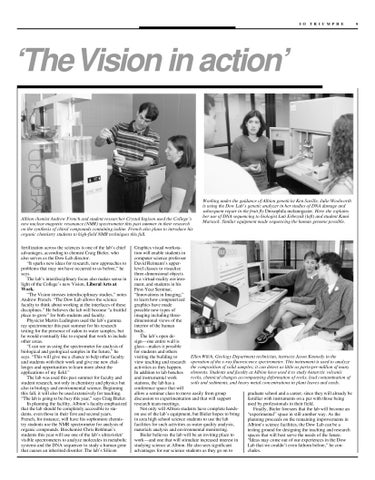
Albion chemist Andrew French and student researcher Crystal Ingison used the College’s new nuclear magnetic resonance (NMR) spectrometer this past summer in their research on the synthesis of chiral compounds containing iodine. French also plans to introduce his organic chemistry students to high-field NMR techniques this fall. fertilization across the sciences is one of the lab’s chief advantages, according to chemist Craig Bieler, who also serves as the Dow Lab director. “It sparks new ideas for research, new approaches to problems that may not have occurred to us before,” he says. The lab’s interdisciplinary focus also makes sense in light of the College’s new Vision, Liberal Arts at Work. “The Vision stresses interdisciplinary studies,” notes Andrew French. “The Dow Lab allows the science faculty to think about working at the interfaces of these disciplines.” He believes the lab will become “a fruitful place to grow” for both students and faculty. Physicist Martin Ludington used the lab’s gamma ray spectrometer this past summer for his research testing for the presence of radon in water samples, but he would eventually like to expand that work to include other areas. “I can see us using the spectrometer for analysis of biological and geological samples in the future,” he says. “This will give me a chance to help other faculty and students with their work and give me new challenges and opportunities to learn more about the applications of my field.” The lab was used this past summer for faculty and student research, not only in chemistry and physics but also in biology and environmental science. Beginning this fall, it will also be used extensively for teaching. “The lab is going to be busy this year,” says Craig Bieler. In planning the facility, Albion’s faculty emphasized that the lab should be completely accessible to students, even those in their first and second years. French, for instance, will have his sophomore chemistry students use the NMR spectrometer for analysis of organic compounds. Biochemist Chris Rohlman’s students this year will use one of the lab’s ultraviolet/ visible spectrometers to analyze molecules in metabolic systems and the DNA sequencer to study a human gene that causes an inherited disorder. The lab’s Silicon
Working under the guidance of Albion geneticist Ken Saville, Julie Woolworth is using the Dow Lab’s genetic analyzer in her studies of DNA damage and subsequent repair in the fruit fly Drosophila melanogaster. Here she explains her use of DNA sequencing to biologist Luti Erbeznik (left) and student Kami Marsack. Similar equipment made sequencing the human genome possible.
Graphics visual workstation will enable students in computer science professor David Reimann’s upperlevel classes to visualize three-dimensional objects in a virtual-reality environment, and students in his First-Year Seminar, “Innovations in Imaging,” to learn how computerized graphics have made possible new types of imaging including threedimensional views of the interior of the human body. The lab’s open design—one entire wall is glass—makes it possible for students and others Ellen Wilch, Geology Department technician, instructs Jason Kennedy in the visiting the building to view teaching and research operation of the x-ray fluorescence spectrometer. This instrument is used to analyze the composition of solid samples; it can detect as little as parts-per-million of many activities as they happen. elements. Students and faculty at Albion have used it to study Antarctic volcanic In addition to lab benches rocks, chemical changes accompanying deformation of rocks, lead contamination of and instrumental work soils and sediments, and heavy metal concentrations in plant leaves and seeds. stations, the lab has a conference space that will allow a seminar class to move easily from group graduate school and a career, since they will already be discussion to experimentation and that will support familiar with instruments on a par with those being research team meetings. used by professionals in their field. Not only will Albion students have complete handsFinally, Bieler foresees that the lab will become an on use of the lab’s equipment, but Bieler hopes to bring “experimental” space in still another way. As the in area high school science students to use the lab planning proceeds on the remaining improvements in facilities for such activities as water quality analysis, Albion’s science facilities, the Dow Lab can be a materials analysis and environmental monitoring. testing ground for designing the teaching and research Bieler believes the lab will be an inviting place to spaces that will best serve the needs of the future. work—and one that will stimulate increased interest in “Ideas may come out of our experiences in the Dow studying science at Albion. He also sees significant Lab that we couldn’t even fathom before,” he conadvantages for our science students as they go on to cludes.
9