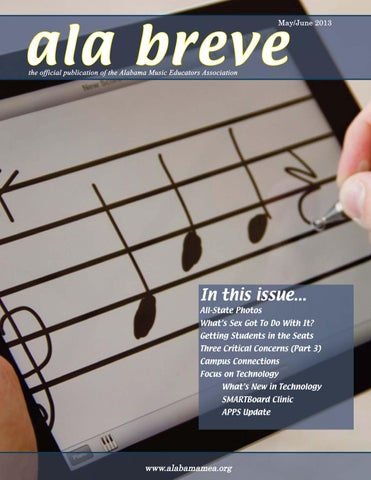
ala breve
publication
May/June 2013 www.alabamamea.org In this issue...
Photos
Sex Got To Do With It? Getting Students in the Seats
Critical Concerns (Part 3)
Connections
on Technology
New in Technology
Clinic
Update
the official
of the Alabama Music Educators Association
All-State
What’s
Three
Campus
Focus
What’s
SMARTBoard
APPS
www.music.ua.edu205-348-7112
Druid City Opera Workshop
May 22 - May 30, 2013
Jazz Cavaliers Reunion
May 31 - June 1, 2013
Crimson Music Camp (Jazz & Double Reeds)
June 6 - June 9, 2013
Crimson Music Camp (Band & Piano)
June 9 - 14, 2013
Summer String Camp (Rising 5th - 9th grade)
June 24 - 29, 2013
Adult Strings Weekend
August 23 - 25, 2013
Degrees include:
bachelor of arts
composition
jazz studies
music administration
music education
music therapy
performance
music theory
Choirs and Orchestra
Million Dollar Band
Opera Theatre
Band Camp
Scan this image with a QR code reader on your smart phone or tablet for more on The UA School of Music
a l la a b br r e e v v e e
AMEA/NAfME .....................................44 American College of Musicians.............14 Arts Music Shop, Inc................back cover AU High School Summer Camp............10 AU Middle School Summer Camp.........33 AU Music Department............................22 AWB/Wayne Broom...............................16 High Note Festivals..................................8 Huntingdon College Bands.....................27 Jacksonville State University Music.......34 John M. Long School of Music (Troy)...41 Lee University.........................................30 NAfME Collegiate....................................9 QuaverMusic.com...................................13 UNA Department of Music....................43 UA School of Music.......inside front cover University of Mobile................................6 University of Montevallo.........................3 University of South Alabama Bands.......38 University of South Alabama Music.......18 Yamaha.....................................................7 Index to Advertisers the official publication of the Alabama Music Educators Association May/June 2013
News/Features 5.....................................................................................................AMEA Directory 9 ........................................................................AMEA Presidents - Past to Present 11 ......................................................Meet the 2013-2014 AMEA Governing Board 15 ..........................................................................................AOA All-State Photos 17 ..........................................................................................ABA All-State Photos 19 .............................................................................Phi Beta Mu “Tips That Click” 21............................................................................................AVA All-State Photos 23 ............................................................................................Campus Connections 24.............................................................................What’s Sex Got To Do With It? 28 .......................................................AMEA State and District Calendar of Events 31..................................................................................Getting Students In The Seats 36.........................................................................What’s New In Music Technology 39 ..................................................................................Apps Update for Music Educators 42........................................................................................................SMARTBoard Clinic 45.......................................................................................Three Critical Concerns (Part 3) Forms Departments 6.................................................................................................................President 9 ..............................................................................................................Collegiate 11......................................................................................................................HED 12..........................................................................................................................Elem/Gen 14.................................................................................................................................AOA 16......................................................................................................................ABA 20.......................................................................................................................AVA 4 May/June 2013 46 .............................................................................2014 Conference Call for Sessions 47 .......................................................2014 Conference Performance Nomination Form 48 ............................................2014 Conference Lobby Performance Nomination Form 49 ..................................................Outstanding Administrator Award Nomination Form 50 ...............................................Outstanding Music Educator Award Nomination Form 51 ....................................Outstanding Young Music Educator Award Nomination Form 52 ...........................................Barbara Odom Distinguished Service Award Application 53 .....................................................................AMEA Hall of Fame Nomination Form
a
President Sara Womack Greystone Elementary School 300 Village Street Birmingham, AL 35242-6447 (205) 439-3200 sara@music.org
President, ABA John AustinCooper High School 1625 Danville Road SW Decatur, AL 35601 (256)john.cooper@dcs.edu 355-3829 School
Past PresidentSteve DothanMcLendon High School 1236 S. Oates St. Dothan, AL 36301 (334)dhstigerband@aol.com 794-0146 School
President, AOA Clay McKinney 1084 North and South Road Apartment 1F University City MO 63130 musicalistening@gmail.com
President-Elect Carl Hancock University of Alabama Box 870366 Tuscaloosa, AL 35487 (205) 348-6335 chancock@bama.ua.edu
Executive Director Editor, Ala Breve Garry Taylor 1600 Manor Dr. NE Cullman, AL 35055 (256) 636-2754
amea@bellsouth.net
Treasurer Chris Walker Clay-Chalkville Middle School 6700 Trussville Clay Road Trussville, AL 35173 (205) 379-3100 christopherwalker@jefcoed.com
Recording Secretary Carla Gallahan 212 Smith Hall, Troy University Troy, AL 36082 (334) 670-3502 School cgallahan@troy.edu
President, Collegiate AMEA Ethan Lolley UNA Box 7710 1 Harrison Plaza Florence, AL 35632 (205) 269-9426 ellolley@una.edu
Collegiate AMEAAdvisor Moya SamfordNordlundUniversity School of the Arts/ Division of Music 800 Lakeshore Drive Birmingham, AL 35229 (205) 726-2651 minordlu@samford.edu
Unless otherwise indicated, permission is granted to NAfME members to reprint articles for educational purposes. Opinions expressed in this publication are not necessarily those of AMEA or the Editor. All announcements & submissions are subject to editorial judgement/revision.The Alabama Music Educators Association is a state unit of NAfME: The National Association for Music Education, a voluntary, nonprofit organization representing all phases of music education in schools, colleges, universities, and teacher-education institutions. Active NAfME/AMEA membership is open to all persons engaged in music teaching or other music education work.
by the Alabama Music Educators Association.
as part of annual NAfME/AMEA
Ala
for
is $4.00 per year
Subscriptions for
is $15.00 per year. Bulk rate postage paid at Dothan, AL.
Breve is published four times a year (August, October, February & May)
Subscription
members
dues.
non-members
AMEA Governing Board 2012-2013 Garry Taylor, Editor & Advertising Manager 1600 Manor Dr. NE Cullman, AL 35055 (256) 636-2754 amea@bellsouth.net ADVERTISING & COPY DEADLINES Fall - August/September (Back to School) issue: July 15 Winter - October/November (Conference) issue: September 15 Spring - February/March (All-State) issue: January 15 Summer - May/June (Digital Only) issue: April 15 President, AVA Jody Powell St. Paul’s Epicopal School 161 Dogwood Lane Mobile, AL 36608 (251) 342-6700 jpowell@stpaulsmobile.net President, Elem/Gen Beth Davis Somerville Road Elementary 910 Somerville Road SE Decatur, AL 256-559-020735601
President, Higher Education Lori Ardovino University of Montevallo Station 6670 Montevallo, AL 35115 (205) 666-6670 ardovinl@montevallo.edu ala breve 5
brdavis2@crimson.ua.edu
Sara Womack, AMEA President
Summer Reflection and Planning
As the weather is getting warmer and the to do list is growing longer, summer is right around the corner. For many teachers, summer is a hard-earned reprieve from the day-to-day routine of the school year. Some use the time to prepare for the upcoming school year, while others spend the time working supplementary jobs or volunteering.
I asked my students what they thought teachers do during the summer. They said that teachers
• Sleep a lot.
• Go on vacation.
• Spend time with their family.
• Have a big party and then, close the school.
• Make people be quiet.
• Learn about next year’s students.
• Get ready for the next school year. While I’m sure that teachers do most of
those things, one activity the students failed to mention was reflecting on the past year’s successes and failures. When I look back over the past year, I ask myself the following questions based on a list posted on Dr. Troy Roddy’s educational leadership blog, The Art of Education:
1. What were my goals for this year? Did I accomplish my goals? If so, how do I know? If not, why?
2. What were my best lessons this year? How do I know?
3. What were the lessons that were the biggest disappointments? Why?
4. Is my classroom set up to facilitate the type of class I want to teach?
5. What feedback did I collect from students about their learning experience?
6. Did I grow as a professional this year? If so, in what areas? If not, why?
7. If I could do one thing over again, what would it be and why?
The answers to these questions naturally lead to thoughts on how I can improve my performance and have a more significant impact on student learning in the upcoming
center for performing arts
The course of study is music - the four-year journey is the real education! To schedule an appointment to audition: cpaauditions@umobile.edu or call
school year. I ask myself the following questions when developing my goals and plan for accomplishing those goals:
1. How will I turn this year’s reflections into action? How can I repeat my successes and transform disappointments into celebrations?
2. How will I encourage collaborative problem solving?
3. How will I develop leadership skills in students?
4. How will I further incorporate technology to impact student learning?
5. How will I become a better leader in my school and professional organizations?
6. What areas do I need to focus on for professional development? What opportunities are available in those areas?
7. What resources or support do I need to accomplish my goals?
Just as I reflect and plan as a teacher during the summer, the AMEA leadership reflects and plans on the organization’s successes and disappointments during this time. We reflect on the conference using member evaluations to begin planning for next year’s professional development offerings. We analyze membership surveys to develop our strategic plan with the assistance of personnel and resources from NAfME. We reflect on the goalposts set forth at the beginning of my tenure as President and enable an action plan to complete the unfinished business. We reflect on our needs as leaders and attend the Leadership Assembly in Tyson’s Corner, Virginia to further develop leadership skills and connections with other state and national organizations.
John Dewey said, “We do not learn from experience. We learn from reflecting on experience.” Don’t let the summer pass by without reflecting on how you can improve your teaching skills and have a more profound impact on student learning, which will further cement music education’s importance in the school environment.
6 May/June 2013
Whether you sing in the choir, dance in a musical theater production, play an instrument in a band, have a passion for opera, or lead worship for your church, the University of Mobile Center for Performing Arts has the program for you!
If you desire a university that prepares you to make a difference in today’s culture, UMobile is for you!
YCL-450NM
Duet+ Clarinet
An injection-molded inner bore in the upper joint gives this clarinet the durability to withstand the rigors of school use. Now featuring an industry-leading 10-year warranty against cracking in all Duet+ Upper Joints.
ala breve 7
Non-Competitive and Motivational High School Middle School Elementary School Band Choir Orchestra Jazz Band Show Choir Performance in the Morning, Fun in the Afternoon 2013 LOCAL PARKS: SIX FLAGS OVER GEORGIA ATLANTA, GA Fred & Lynda Martin, Site Directors May 4, 11 See our complete brochure on the web at: www.highnotefestivals.com 877-239-3007 ARKP PA S: 2 0 3 ectorsDir ynda ed & L Ly Fr GA TLANTA, TA A AT GEORG EROV LAGSF GIA 13 Sc Schoo h School Hig Motivat Non-Compe hool ol tional etitive Performanc www.high See our comple ning ce in the Mor Ba chestraOr notefestivals.c e on the we ochur te br , Fun in the Afte nd 877-239- om eb at: noon r 3007 8 May/June 2013
Fellow Collegiate NAfME members,
Greetings from North Alabama! As this spring semester is coming to a close, I wish you all the best as you prepare for finals, spring concerts, and of course, juries (I hope that’s what you all call them as well. If not, then I mean your private lesson performance exams!). We here at UNA are preparing for our annual honor band on April 25-27 and look to be hosting over 600 students to our campus! I remember the days back in high school when a person was respected according to the number of medals on their uniform. Those were great times of friendly competition that always kept us on our toes and constantly in our practice rooms! As a young instrumentalist, nothing was more exciting then visiting a college campus, meeting college musicians, and feeling welcomed. I encourage you all as your university may also host honor bands or honor choirs to welcome these aspiring musicians and encourage them to continue music in higher education.
What a month March has been! March, being Music In Our Schools Month, is NAfME’s own official month when music education becomes the focus of schools across the nation. I hope you all were able to participate in some capacity by being advocates for music education. This year’s theme was “Music Education: Orchestrating Success.” For our chapter
1946Yale H. Ellis
Ethan Lolley - President, Collegiate AMEA
here at UNA, we decided to volunteer at the local elementary schools in Florence and present fun music lessons to the students. We were able to get their feedback by asking the students to decorate note cards that described what music meant to them. We then sent these to the local senators so they can see the importance of music to these students and press for continued support of music in all schools. I have a challenge to all my fellow future music educators. Let’s make every month Music In Our Schools Month by doing what we can to promote advocacy for music programs everywhere. Funding for music programs continues to lessen, but we can make a difference, even as collegiate members. Remember, these are our jobs we are fighting for! If your chapter was able to participate, I would love to hear about it! Contact me through email anytime. Through communication we gain ideas from each other and become better chapters because of it.
On another note (no pun intended), it seems like my presidency has just begun. I have not yet had the privilege of thanking the members in attendance at the AMEA conference for having enough confidence in me to vote me as your NAfME Collegiate President. I thoroughly enjoy serving in any leadership capacity, especially one involving music education!
I hope to finalize the plan for the Collegiate Summit by the end of summer to give everyone ample time to make plans to attend. If your university is centrally located in the state and interested in hosting this event this fall, please contact me. This would be a great opportunity for your chapter to get involved at a higher level. Also, the planning for next year’s AMEA conference is already in the works. I look forward to my meeting with the rest of the AMEA board in June. If you have any ideas for workshops that Collegiate NAfME can sponsor, I would love to help make that idea happen. I want this conference to be a tremendous success as I’m sure you do as well. I hope to meet some of you soon with a possible visit to your campus and meeting with your chapter. Until then, keep making music!
Ethan Lolley
Alabama NAfME: Collegiate President
University of North Alabama
ellolley@una.edu
205-269-9426
AMEA Presidents - Past to Present
1948Walter A. Mason
1950Vernon Skoog
1952John J. Hoover
1954Lamar Triplett
1956Carleton K. Butler
1958Mort Glosser
1960Wilbur Hinton
1962Lacey Powell, Jr.
1964G. Truman Welch
1966Jerry Countryman
1968Floyd C. McClure
1970Jerry Bobo
1972Frances P. Moss
1974George Hammett
1975Frances P. Moss
1976S. J. Allen
1978W. Frank McArthur, Jr.
1980Paul Hall
1982Lacey Powell, Jr.
1984Johnny Jacobs
1986Merilyn Jones
1988Ronald D. Hooten
1990Ken Williams
1992Dianne Johnson
1994James K. Simpson
1996Johnnie Vinson
1998Michael Meeks
2000John McAphee, Jr.
2002Tony Pike
2004Becky Rodgers
2006John Baker
2008Pat Stegall
2010Steve McLendon
2012Sara Womack
ala breve 9
10 May/June 2013
Greetings Music Educators,
Many thanks to those of you who teach the students who participated in the AllState Ensembles. We are fortunate to have these dedicated and talented students that are motivated to make wonderful music. This is all due to the skillful teaching of their directors and to their private instructors. You are their incentive and inspiration.
As we wind down this spring semester, many of you will be involved with summer teaching and research projects. In the planning of your projects, don’t forget that it is not too early to be thinking about the 2014 AMEA Conference.
The Call for Sessions, Performance Applications and Lobby Performance applications are now available on the AMEA website. Deadline for submitting
proposals for the 2014 AMEA Conference is June 1. I highly encourage everyone to submit proposals in all areas. Last year we were represented very well and it would fantastic to see even more participation by the Higher Education Division. Please remember that in order to submit a proposal for a session or performance, the clinician must be a member of NAfME/AMEA. In addition to sessions and performances, please consider submitting a poster for the Poster Session. Dr. Jane Kuehne, Auburn University will once again head up this Call for Posters. The Higher Education Recital was a success this past year with more attendance than usual. I will be coordinating this recital so if you are interested, please contact me via email with your proposal.
At the end of this year, there will be openings for President, President-Elect,
and Secretary/Treasurer positions in the Higher Education Division. There will be a scheduled business meeting at the 2014 Conference so we may elect new officers. If you are interested and would like to be considered for an office, please email your interest in serving or if you know of someone who would make a great representative for the division, please submit their name. My address is ardovinl@montevallo.edu. Please consider serving as an officer.
Have a productive and enriching summer!
Meet the 2013-2014 AMEA Governing Board
Effective June 1, 2013
ala breve 11
Lori Ardovino - President, Higher Education Division
Sara Womack, President Carl Hancock, President-Elect
Steve McLendon, Immediate Past President
Garry Taylor, Executive Director
Carla Gallahan, Secretary Chris Walker, Treasurer/Registrar
Rusty Courson, ABA President
Lori Ardovino, HED President
Jody Powell, AVA President
Karla Hodges, ELEM/GEN President
Ethan Lolley, Collegiate President
Moya Nordlund, Collegiate Advisor
Lisa Caravan, AOA President
What inspired Michelangelo to paint the Sistine Chapel? What was the inspiration behind Mozart’s Magic Flute? How did Robert Frost become inspired to write The Road not Taken? What motivated a team to win a championship title in their sport? The answers to such questions and the stories behind these great achievements are quite intriguing.
However, a more important question is what inspires you? What inspires you as a person? And, what inspires you as a musician and educator? As this school year draws to a close, we have the opportunity to reflect on this year, our accomplishments, and mistakes. In addition, there is time for rejuvenation. According to the Free Online Dictionary, inspire is the stimulation of the mind or emotions to a high level of feeling or activity. Inspiration comes from various sources. Consider what inspires you.
At the school in which I teach, we recognize a Leader of the Month from each class. Each month the criterion is different. We recognize students who are most improved during April, which is my favorite time of recognition. Just this week, I was brought to tears as I witnessed the ceremony for these most improved students. One particular student in kindergarten began the year with some learning and behavioral difficulties. He has been successful because of the dedication, high expectations, and hard work of his teachers, the encouragement of his parents and classmates, and his perseverance. The improvement he made and the synergy of everyone involved inspires me.
A fifth grade student has participated in chorus for the past two years, which includes performing in public. When this student first came to school, transitions were difficult for him. Leaving the comfort of his classroom to go anywhere else in the school caused him much stress. Noises bothered him. He was timid about participating and lacked confidence. The fact that he is able to fully participate in all
aspects of our school, that he can perform in public without much fear and even be a leader for a song inspires me.
Having a group of first grade girls come up to me on the playground to show me a chant they created inspires me. Collaborating with a group of teachers to solve a problem inspires me. Talking to a parent who has overcome multiple obstacles to rear four polite and respectful boys inspires me. Receiving a phone call, text, or email from a friend just because they wanted to check in with me inspires me. Seeing my former student teachers succeed in their careers inspires me. Creating music with my students inspires me. Working on my doctorate has been an inspiring journey. Attending professional development opportunities serves as inspiration.
Now, what inspires you? Take some time to reflect on your school year. What did you accomplish? What do you aspire to accomplish next year? What inspires you to continue to make music and teach others about music? Read a book. Network with colleagues. Attend a concert. Visit a museum. Write a poem. Paint a picture. Run. Travel. Carpe Diem!
Beth A. Davis
Thank you for serving our division as an officer 2011 - 2013
Karla Hodges – President Elect
Heather Atkins – Secretary
Lea Hoppe – Treasurer
Sharon August – Past President
Officers for 2013 – 2015
Karla Hodges – President
Cliff Huckabee – President Elect
Melissa Thomason – Secretary
Lori Zachary – Treasurer
Save the Date
• June 1 Elementary Division Officers Strategic Planning Meeting
• June 10 - 21 Orff Level One Certification Training, Samford
• June 24 – 28 tentative date for AOSA Music Camp – You can volunteer to teach and be eligible for a free workshop.
• August 5 AOSA Chapter Share
• October 4 Elementary Choral Festival with Dr. Maribeth Yoder-White. Contact Cliff Huckabee or Carlee Means for more information. cliffhuckabee@gmail.com or carleemeans@mac.com.
• October 5 AMEA/AOSA Joint Workshop at Samford with Dr. Maribeth Yoder-White. Watch for fall newsletter for more information.
• January 23 - 25, 2014 AMEA State Inservice Conference Montgomery
Dr. Maribeth YoderWhite is a choral and general music education specialist and serves as Adjunct Associate Professor in the Hayes School of Music at Applachian State University in Boone, NC. Yoder-White is a certified OrffSchulwerk specialist and frequently presents workshops featuring her compositions and arrangements. She teaches Orff-Schulwerk certification courses at Appalachian State University and DeKalb County Schools, and serves as clinician and author for Silver Burdett Making Music and Silver Burdett Interactive Music. Yoder-White received a Bachelor of Music Education degree in choral/general music from Lenoir-Rhyne College and a Master of Music degree at the University of North Carolina at Greensboro. Yoder-White taught middle school choral and general music in Charlotte-Mecklenburg Schools before returning to UNCG to complete doctoral studies. An arts integration specialist, Yoder-White delivers teacher workshops, teaches demonstration lessons, advises artsintegrated lesson design, and creates resources to facilitate implementation of authentic arts integration instruction. Active in many professional organizations, YoderWhite served as President of the North Carolina Music Educators Association and the North Carolina Chapter of the American Choral Directors Association. She is President-Elect of the Southern Division of the National Association for Music Education (NAfME).
12 May/June 2013
Beth Davis - President, Elementary/General Division
Check it out at QuaverMusic.com/Preview ©2013 QuaverMusic.com, LLC 1-866-917-3633 • info@QuaverMusic.com • Facebook.com/QuaverMusic • QuaverMusicBlog.com NEW Your Teaching Assistant! Y W hi i A ! T r sist st gAsss tant! averM avQu C com/PMusic. Check out at wPrevie 1-866- averMuso@Quinf • -917-3633 91 om/Qua /Q .cFacebook Fa • comic. C om LL uaverMusic.c ©2013 Q averMusicBlogQu • verMusic g.com
We have done so much for our orchestra programs in the state, and we have done it together. We have raised the level of playing at the All State festival to an unprecedented level, not just in terms of our state but on a national level as well. The guest artists we bring from all across the nation are always and increasingly impressed with the skill at which the students perform. We have something special in our state and it has been such an honor to be a part of it. Just in my time we have increased the number of youth orchestras in the state, increased the number of string programs outside of schools, increased the number of auditions to All State Festival, and expanded one of the festival’s orchestras to include winds, brass and percussion students. I am so proud to have grown up in Alabama being a part of its string programs. To see how far we have come is a blessing beyond compare.
The part I am not so proud of is the part of the statement I just wrote “….outside of schools”. Getting strings into schools on a large scale continues to be difficult and the reason is plain and simple, funding. We have the students, talented ones, and lots of them. What we don’t have is the money to pay teachers. And while it would be easy to blame the legislature they are not at fault. We the voters, including us teachers, the parents of your students and your neighbors who vote are the ones that need to change. No matter
what statistic you are looking at, whether it’s a raw percentage, or a median percentage based on per capita in Alabama, or a dozen other variations, Alabama ranks very near the bottom and in many cases dead last when it comes to property tax. How low is it? Like so many people these days I go out for coffee a couple of times a week, definitely more during the busy concert seasons when all of us are so busy and need a pick me up. At $2$3 dollars a cup twice a week that’s anywhere between $208 and $312 I spent on coffee last year. In property taxes last year in Montgomery County, I spent $187.49. That’s less than even the smallest amount I could have spent on coffee. So, for many Alabamians who are regulars at the coffee shop, even if they are getting a small regular coffee, the cheapest thing on the menu, they are probably spending more in a year on one single beverage than they are on property taxes. Maybe for you or your neighbor or the parents of your students it isn’t coffee, perhaps it’s something else that rings true. Whatever it is I challenge all of us to start talking to the people we know, our friends, our neighbors, the parents of our students, and begin to help Alabamians realize that the priority of the education of our children ranks somewhere below coffee. Probably in your local community someone has already produced a figure that shows how a very small increase would mean a very big difference for our students. I encourage you to find out more.
Despite our challenges we continue to do exciting things and continue to have amazing students. Our composer in residence this year commented in amazement at the level of playing in the orchestra. He really couldn’t
believe how good it was. He is from New Jersey and historically the northeast has had large school orchestra programs. When I told him how few we have he was taken aback. I told him that most of these students did not play at school, that they were in private lessons and played in their local youth orchestra. Meaning, most of these students didn’t simply just sign up for an elective at school, that they don’t get to play at school and must fit it in at other times, and that most of them spoke up to their parents and said “I want to play a string instrument, I want to do this.” Of this I am most proud. We have dedicated impassioned students and you can hear it in their playing. If we continue to work together and collaborate I know we will continue to foster this kind of musicianship and we will see string playing grow in our state. As long as we work together to build our programs, educate, and encourage each other we can accomplish anything.
The next time you will get to hear these passionate young musicians perform at the All State Festival will be February 16th 2014 in the Moody Music Building on the Campus of the University of Alabama. For more information including dates and deadlines for registration go to our website www.alabamaorchestraassociation.org. You can also find us on Facebook at http://www.facebook.com/alabamaorchestraa ssociation. And don’t forget, there is another opportunity for playing at the state level that happens in the fall. ASTA holds it’s state festival every fall and it also continues to grow and challenge our students in new and exciting ways. For more information on the festival and other events offered by ASTA visit their web site www.astabama.org.
It has been an honor and a privilege to serve as your president. I could not have asked for a better group of people to work with or a better time to serve. I hope you will all join me in thanking our board that has served selflessly for many years. This truly is an outstanding group of people. Also please join me in welcoming Dr. Lisa Caravan as our new president. She has already taken a great leadership role and is sure to take our organization to new and exciting heights. I look forward to serving as past-president and hope that we can continue to build string playing in our state. Lastly, as I have said on many occasions, the biggest shoe of gratitude goes to the students. They make this worthwhile, and not just worth while, but joyous. Thank you to all the students, you really are exceptional.
Sincerely and with much appreciation, Clay
14 May/June 2013
Clay McKinney - President, Alabama Orchestra Association
AOA
ala breve 15
All-State 2013 Photos
Are you beginning to see the light at the end of the tunnel that is the 2012-2013 school year? I am! It has been a wonderful year for me and I hope it has been a great year for you!
All State 2013 in Huntsville was a wonderful success and I have so many people to thank. David Raney did a wonderful job of putting information online. This saved the ABA a considerable amount of money and I think made it so much easier for everyone. Dr. David Ragsdale and the staff and students at the University of Alabama in Huntsville did a superb job of hosting the State Solo Festival. It was great to be back on a college campus for this event. Emily Parker and the volunteers and staff at First Baptist Huntsville were so gracious and helpful in opening their facilities to our 600+ students, 100+ directors, and many parents for the chair audition process. We
have probably come to take for granted the great job that Doug Farris does every year in preparing for the auditions and tabulations. Our band hosts (James Ed Champion, Damon McAllister, Heather Henson, and Connie Hammond) do more than you can imagine in preparing for both the 160 students in the band and their guest clinician. They all did a fantastic job! We can’t thank enough the schools that provide percussion (Sparkman High School, David Raney and Jack Albert, James Clemens High School, Keith Anderson, and Huntsville High School, David Spencer). This is a much bigger job that you might imagine! I also want to thank the District One directors who were able to help with the percussion moves (and I’ll expect to see more of you next time!). And of course, we should thank the University of Alabama Wind Ensemble and Dr. Ken Ozzello for the wonderful concert on Friday night. I hope I have not forgotten anyone, but the list is so long to make an event like this run smoothly that I’m sure I have not thanked everyone that I should.
I also want to thank each member of the Alabama Bandmasters Association for allowing me to serve as your president. When I received the call four years ago inquiring as to my interest and willingness to serve, I must confess it was a shock. It was never my goal or ambition to fill this capacity, but I have been happy to serve. It can be a difficult job, but the best part was getting to work with the other Board members. I am thankful for the opportunity to get to know those fine directors from every part of the state.
I believe that what we do each day is vitally important to the lives of our students. I believe that the pursuit of musical excellence provides the skills to be academically, socially, physically, and psychologically better students and adults. Our students are cheated to the extent that we “forget” this as an educational culture. We must redouble our efforts to inspire our students with a passion for music!
16 May/June 2013
John Cooper - President, Alabama Bandmasters Association
ABA All-State 2013 Photos
Piccolo - Juliana Bayhi,
Brockton
Flute - Nicole Carrion, Baker HS, Oboe - Lian Remley, Shades Valley HS, Bassoon - Presley Ready, Spanish Fort HS, Bb Clarinet - Andy Choi, Spain Park HS, Alto Clarinet - Kirby Pitchford, Abbeville HS, Bass Clarinet - Leah Sneddon, Sparkman HS, Alto Saxophone - Sam Liaw, Sparkman HS, Contra Bass ClarinetJessica Mansel, Pelham HS, Tenor Saxophone - Chase McKoy - Shelby County HS, Bari Saxophone - Michael Jones, Grissom HS, Trumpet - David Holladay, Clay-Chalkville HS, French Horn - Joshua Hill, Covenant Christian Academy, Trombone - Patrick Weis - Sparkman HS, Euphonium - Jonathan Harris, Bob Jones HS, Tuba - cory Chueng, Hoover HS, Percussion - Jacob Lipham - Daphne HS, String Bass - Katherine Reardon, Bob Jones HS
White Band Conductor- Glenn Price
All-State Solo Festival Finalists
1) Sam Liaw - Sparkman HS - Alto Sax, 2) Tripp Gwaltney - Oak Mountain HSMarimba, 3) Hannah Jacobs - Winston County HS - Flute, 4) Jessica Elder - Spanish Fort HS - French Horn, 5) Nicole Carrion - Baker HS - Flute, 6) Alden Ford - Enterprise HSTuba, 7) Greg Wheat - Baker HS - Euphonium
1st Chair Red Band
New
HS,
ABA/Photography By Suzanne Scholarship Recipient Tripp Gwaltney Oak Mountain High School
Red Band ConductorDavid Gregory
Blue Band ConductorDavid Starnes
ala breve 17
Middle School
ConductorWilliamBandOwens
18 May/June 2013
This article is the conclusion of a review of some exciting DVD resources that are available to band directors. These videos are available from dealers in this state such as Art’s Music Shop (www.artsmusicshop.com) and Gadsden Music Company (www.gadsdenmusic.com)
Foundations for Wind Band Clarity (www.visionpublications.net) is an outstanding resource that gives a systematic explanation of how to improve the
Tips That Click
in this hour-long video. There are also printed materials for use with ensembles that are available separately.
ensemble sound of any instrumental group. David Vandewalker, former band director at Harrison High School in Georgia and presently on the faculty of Georgia State University, walks you a logical process that can be used of bands of any size or proficiency. Measureable improvement in tone quality, balance, blend, and articulation are demonstrated with a live ensemble. An important element of the process is that the students are engaged in the improvement process through participation in the assessment of the performance segment and evaluation comments. The video is organized into modules with a single concept receiving focus. Mr. Vandewalker gives an overview and narrative of the skill being addressed, and then the video proceeds to drills being used in a band setting. The improvement that occurs during the band segments is quite remarkable, and directors can easily see how this process could be adapted to fit the needs of their group. My only complaint about the DVD is that the production value lacks a little in professional polish, but the content that is contained is first rate and well worth the price of $39.95. If you are a young teacher and every wondered what that little bit of magic is that separates an “Excellent” rating from a “Superior” or a “Superior” from a “Superior with Distinction”, I think you will find many of the answers
Bravo Music (www.bravomusic.com) has a great set of instructional DVDs for band directors. These videos were originally developed to help train bandmasters in Japan. The band programs in Japan exist as clubs and most of the bandmasters actually teach other subjects and meet with their band outside of the school day. The WINDS series covers demonstrations of all the band instruments as well as extensive coverage and analysis of rehearsal techniques. I have been purchasing these over the last few years and watching them during lunch and planning. The volume that I am viewing presently is titled Teaching Smaller Bands. This particular DVD addresses the unique challenges of reduced instrumentation and has live examples of how to adapt literature and fundamental programs to small groups. A great feature of this video are the excerpts played by groups of larger than 45 and then gradually getting smaller until there are less than 20 musicians. It is impressive to see and hear how the excellence of sound and sonority is maintained using the techniques utilized by the clinicians. All of the DVDs that I have purchased from this company are outstanding and well worth the $32.00 invested.
What are your favorite DVD resources? Send your nominations to pemin@mac.com for review in a future column.
Rho Chapter of Phi Beta Mu International Bandmaster Fraternity is committed to developing excellence in school bands in Alabama and their instruction. Please email pemin@mac.com with comments and suggestions for this column.
ala breve 19
Outstanding Video Resources for Band Directors (Part II) Phi Beta Mu
Wow! In this business there is hardly any time to even come up for air. The world of choral music is a fast paced, exciting, grueling profession that we were all called to be a part. As this year starts to wind down, we are scrambling to finish our Spring Concerts, Musicals, Baccalaureate, Graduation, etc., etc… With all of this going on, I would like to take a moment and reflect on the past year in AVA.
AVA has had a great year. We started last May with the Summer Board meeting and progressed to Fall Workshop, ASSC Auditions, Fall Solo/Ensemble, All-State Auditions, AMEA, ASSC, All-State and SCPA. It was a busy, but very productive year. We had wonderful Clinicians, Presenters, Choral Performances, and outstanding All-State Choirs and Show Choir. I would like to thank all of our membership for supporting all of the AVA events. If it were not for the individual teachers with the individual students striving to make the choral music experience the best it can be, we would not have had such an outstanding year.
This next year will be just as active. Our Fall Workshop will be held at the
University of Alabama September 6-7, 2013. We have some great things in store for that event. All-State Show Choir auditions are in Montgomery on October 10th and in Hanceville at Wallace State October 11-12, 2013. Your District Chairs will set any Fall Solo/Ensemble dates. Honor Choir Screenings will be set by the District Chairs to fall within the dates of November 11 through December 5, 2013. AMEA is January 23-25, 2014 at the Renaissance in Montgomery. The 2013-14 year is an Honor Choir year. Remember , this takes place at AMEA along with All-State Show Choir. Go ahead and look at the requirements, music, and process for the screenings. All-State Choral Festival will be held April 3-5, 2014 at Samford University in Birmingham. The Spring SCPA will be set by your District Chairs at Summer Board.
The AVA Board will meet in Mobile June 3-6, 2013 and iron-out several items that are pending. This is the year we review SCPA, as it has been in existence for two years now. If you would like to add agenda items for the Summer Board meeting, please submit those to your District Chair or to me at jody@alavocal.org by May 31st. If you ever need information or need to bring something before the Board for discussion, please contact your District Chair.
If you have not completed the Technology survey for AVA, please take 5
minutes and do this. Your District Chair will follow up with those who have not completed this. Please don’t cause them to do more work. They work very hard as it is. You can do this on our website, www.alavocal.org . The link is on the home page. Thank you.
We need more of the membership to submit presentation sessions at AMEA and/ or submit recordings and forms to AMEA for consideration to perform at this prestigious conference. The deadline for the Performance Hall (Stage) concerts is June 1st, 2013. Please submit your info, which may be found on the AMEA website, to Garry Taylor, Executive Director.His email is amea@bellsouth.net. If you would like to perform a Lobby Concert, the forms and submission material are also found on the AMEA website. That deadline is October 1, 2013. We have a tremendous amount of talented people within our ranks. Be willing to share what you do or have learned with others in our organization.
I would like to express my gratitude to the AVA Board and Executive Board. These are some of the best folks from all across our state. They are always willing to go the extra mile to make things better for you as a membership. You could help all of our chairs and the executive board by striving to get all of your registrations in on time. This would alleviate late fees and confusion of scheduling. I know that sometimes things can slip up on you, but let’s all try to stay ahead of the game.
I want you to know what an honor it is to serve as your President. It is through the camaraderie of the established teachers down to the very newest directors, who have chosen this profession to impart the essence of choral music to each student that makes our organization so successful. It is our responsibility to our students to create the best atmosphere to yield the best experience to each individual. You have to Give to Get! I know I’ve said it before, but…You only get out of something what you are willing to put into it. Work hard, get involved, give more to your students, learn more, and most of all…Have Fun! Hope you have a great rest of the year and a great summer.
Jody
20 May/June 2013
Jody Powell - President, Alabama Vocal Association
Outstanding Accompanists
AVA All-State 2013 Photos
District
District
State Winners
District 1: Outstanding Female Choral Student - Sarah Catherine Hook - Florence High School, District 7: Outstanding Male Choral Student - Robert Quittmeyer - UMS Wright Press, District 1: Outstanding Accompanist - Carrie Ann Davison - Florence High School, District 3: Music Ed. Scholarship winner - Tori PinkertonHoover High School
ala breve 21
Outstanding Female Choral Students
District 1: Jessica Mashburn, District 2: Maggie McGuire, District 3: Lauren Hughes, District 4: Emma Jensen, District 5: Shelby Morgan, District 6: Sarah Catherine Hook, District 7: Jenna Draughter
Outstanding Male Choral Students
1: Trevor Dodson - Florence High School, District 2: Jacob Ferguson - Calera High School,District 4: Logan Lee Adams - Oxford High School, District 5: Josh Hill - Covenant Christian Academy, District 7: Robert Quitmeyer - UMS-Wright Preparatory School
District 1: Carrie Ann Davison - Florence High School,
5: Derrick Byars - Lee High School, District 7: Katy Atchison - UMS Wright Preparatory School, Reid Black - UMS Wright Preparatory School
2013 AUDITION DATES
Saturday, February 9 | Saturday, February 23
INSTRUMENTAL ENSEMBLES
• Symphonic Band
• Orchestra
• Concert Band
• Campus Band
• Marching Band
• Percussion Ensemble
• Jazz Band
• Trumpet Ensemble
• Low Brass Ensemble
• Wind Quintets
CHORAL / VOCAL ENSEMBLES
• Chamber Choir
• Concert Choir
• Gospel Choir
• Men’s Chorus
• Conductor’s Chorus
• Women’s Chorus
• Opera Workshop
• AU Singers
DEGREES
• Bachelor of Arts in Music
at AUBURN UNIVERSITY
www.auburn.edu/music
• Bachelor of Music
• Bachelor of Music Education
• Master of Education in Music Education
• Education Specialist in Music Education
• Doctor of Philosophy in Music Education
FOR MORE INFORMATION
Auburn University
Department of Music 101 Goodwin Music Building
Auburn, AL 36849-5420
Phone: 334.844.4165
Fax: 334.844.3168
www.auburn.edu/music www.auburn.edu
Email: music@auburn.edu
Auburn University is an equal opportunity educational institution/employer.
Campus Connections...
News and Happenings from Alabama’s Colleges and Universities
John M. Long School of Music Troy
University
We are once again grateful to AMEA for providing this opportunity to share information and opportunities with our music colleagues and music students across the state.
New John M. Long Hall
A new John M. Long Hall for the School of Music is scheduled to open this fall on our Troy University campus. This new 8 million dollar facility will serve as “home” to our university bands, university choirs, percussion, and administrative areas in the School of Music.
National Band Association and Virtual Hall of Fame
On February 2, 2013 the National Band Association Hall of Fame of Distinguished Band Conductors held its 20th Induction Ceremony in the Hall of Fame on the campus of Troy University. The ceremony was held in conjunction with the 40th Annual Southeastern United States Concert Band Clinic. Inductees included Bobby Adams, Ray Cramer, Paula Crider, Thomas Fraschillo, and John Paynter. Additionally, a new National Band Association Virtual Hall of Fame of Distinguished Band Conductors site was unveiled at the Midwest Clinic in December of 2012. The curator of the virtual Hall of Fame is Professor Robert W. Smith of Troy University. The site may be accessed at www.nationalbandassociation halloffame.org.
2014 American Bandmasters Association Convention
Troy University will serve as host for the 80th American Bandmasters Association Convention. The convention will be held at the Renaissance Montgomery Hotel March 4-9, 2014. The Troy University
Symphony Band will perform as part of this convention.
Our Music Industry Program
The Music Industry Program at Troy University completed its first educational tour with POPulus, a band within the music industry program that showcases student artists performing diverse and eclectic styles from all genres of American popular music. As a part of this tour, POPulus and additional music industry students from concert production and audio classes in the program traveled to Nashville to record at Playground Studios. In this professional setting, Troy student artists recorded their own music with Troy students serving as audio engineers.
Additional information and highlights from the John M. Long School of Music may be found at music.troy.edu. We invite you to visit us online or in person soon.
Auburn University Department of Music
Auburn University Department of Music is anticipating an exciting summer as the Auburn University Singers embark on a performance tour of Europe (Brussels, Paris, Strasbourg, Munich, and Salzburg) in May. Singers, instrumentalists, faculty, members of the Dean’s Advisory Council, and Dean of the College of Liberal Arts will spend ten days touring and performing.
We are also pleased to announce that we will add two summer camp opportunities for students in the areas of Strings and Chamber Music and Guitar to the band camps that already exist. The Strings and Chamber Music Camp will be June 2729, 2013 and will be led by members of the Music Department string faculty and guest artists. It is open to musicians aged 10-18 who play violin, viola, cello, and string bass. The camp will offer a wide range of musical experiences including
chamber music, orchestra, and jazz improvisation, as well as a movement awareness session taught by a certified Alexander Technique instructor.
The Guitar Workshop will be led by Auburn University Music Department guitar faculty member, Joseph Ikner and guest artists on July 26-28. This workshop is open to guitarists of all levels, aged 8 –18, and beginners are welcome! The workshop will offer a wide range of musical experiences including group and individual instruction, ensemble coaching, a variety of presentations, and evening artist’s recitals. Visit this website for additional information on these summer opportunities:
http://www.auburn.edu/outreach/opce/su mmercamps/.
We are already gearing up for next year and announce our prospective student auditions for next spring:
Vocal and Piano student auditions will be held on campus on Saturday, February 15, 2014 and Wind, Brass, Percussion, and String instrument auditions will be held on Saturday, February 22, 2014. Interested students should complete the Music Department Application on our website: www.auburn.edu/music.
In the Auburn Department of Music, we are proud to offer an intimate and nurturing atmosphere that provides opportunities for individual attention and regular performance for students. We are fortunate to be able to bring in frequent guest artists for concerts and master classes. I invite you to read about our distinguished faculty, major performing ensembles, programs of study, and available scholarships, and assistantships on our website at: www.auburn.edu/music. Contact the Department of Music at 334-844-4165 if you have questions about our degree programs or offerings. War Eagle!
ala breve 23
Colleges and universities are encouraged to submit newsworthy material and announcements for publication in Ala Breve
What’s Sex Got To Do With It?
By Megan Wicks-Rudolph
Biological and sociological sex differences in the secondary music classroom
Are there differences in the way males and females learn and process information? Some educators may be skeptical about this question. Well, let’s think for a minute about two different scenarios to see if sex differences exist in the secondary music instrumental and choral classroom.
Scenario One - Instrumental:
You are a secondary band director and you have two sectional rehearsals scheduled. Your band is working on Holsinger’s “Prairie Dances.” The first sectional is with the Tuba section, which is all male. The other sectional is with the flute section, which is all female. Do you approach each section the same (pacing, verbiage, questioning, etc.).
Scenario Two - Choral:
You are a secondary choir director and you have two sectional rehearsals scheduled. Your choir is working on Mozart’s “Dies Irae.” The first sectional is with the basses, which is all male. The second sectional is with an allfemale group of sopranos. Do you approach each sectional the same (pacing, verbiage, questioning, etc.).
The literature pertaining to sex differences suggests that an educator should teach these groups differently, and that there is a possibility that knowledge of these differences could positively impact the instruction and learning in the classroom (Cable & Spradlin, 2008; Hannon & Ratliffe, 2007; Rex & Chadwell, 2009; Sax, 2005; Sax, 2010). Additionally instructors who teach in both a same-sex and mixed-sex environment should not use the same pedagogical strategies or materials (Streitmatter, 2002). Secondary choral and instrumental directors tend to be in these situations all of the time (ex. Sectionals, women’s choirs, men’s choirs, etc.). It is important to note that not all females and males may exhibit the traits that are about to be discussed, as these are generalities.
Biological and sociological differences
Researchers and authors suggest there are numerous issues regarding sex differences that affect learning and instruction in general education classrooms. Most of these sex differences can be categorized into either biological or sociological differences. Differences include, but are not limited to, (a) brain differences (Bland, 2003; Brizendine,
2006; Gurian, 2001; James, 2007; Moir & Jessel, 1991; Obleser, Rockstroh & Eulitz, 2004; Ruytjens, Albers, Van Dijk, Wit, & Willemsen, 2006; Shaywitz et al., 1995; Snodgrass & Harring, 2004-2005; Van Dyke, Zuverza, Hill, Miller, Rapport, & Whitman, 2009), (b) hearing differences (Brizendine, 2006; Moir & Jessel, 1991; Sax, 2005), and (c) behavioral differences (Cable & Spradlin 2008; Carp, 2004; Downey & Vogt, 2005; Jorgensen & Pfeiler, 2008; Pollard, 1999; Sadker & Sadker, 1994; Sax, 2009; Wilson, 2010). The author believes that knowledge of these biological and sociological sex differences could potentially benefit instruction in the secondary choral and instrumental classroom.
Brain differences
Biological sex differences in the brain’s structure and function are important to understanding the optimal way in which each of the sexes learns. Educators who have knowledge of the brain’s structure and function could possibly be more effective in the classroom because of their increased knowledge of how each of the sexes learns. Structural brain differences include, but are not limited to, differences in hemispheric size and amount of connectors between the hemispheres. Functional biological sex differences include, how each sex processes information and communicates (BarhonCohen, 2005; Gurian, 2001; James, 2007; Moir & Jessel, 1991; Sax, 2005; Shaywitz et al., 1995; Vasich, 2005).
In 1967, Herbert Lansdell was the first to discover major structural differences in the female and male brain (as cited in Moir & Jessel, 1991, p. 42). Lansdell’s research led to the hypothesis that spatial skills and language skills are controlled by both halves of the brain in women and are more specified to one area of the brain in men (Moir & Jessel, 1991). Numerous studies have confirmed Lansdell’s initial findings (Obleser et al., 2004; Ruytjens et al., 2006; Shaywitz et al., 1995; Snodgrass & Harring, 2004-2005; Van Dyke et al., 2009). This finding is important because it was the first research to indicate that there were processing differences in the brain. Males tend to have brains that are very compartmentalized; therefore they are efficient processors of information (Moir & Jessel, 1991). The information enters the male brain, travels to the
section that needs to process that information, and an answer is verbalized or the information is stored. The female brain, on the other hand, tends to be more complex. When information enters the female brain the hemispheres communicate with each other regarding that information before it is verbalized or stored (Bland, 2003; Brizendine, 2006; Gurian, 2001, Gurian & Stevens, 2004; Moir & Jessel, 1991). Hence females tend to connect past experiences with new ones, where males tend to only process the new information with little connection to past experiences. Additionally sharing information and connections to the verbal side of the brain makes expressing emotions easier for females (Gurian, 2001; James, 2007).
Language processing differences
Broca’s area is responsible for producing words, processing grammatical structures, and formulating speech. Broca’s area is more engaged in females and could be the reason for female dominance in verbal and communication skills (Gurian, 2001). The literature regarding sex differences suggests that it is difficult for males to express feelings, because of the lack of communication between the hemispheres (Moir & Jessel, 1991). Therefore, it may not be beneficial in the secondary music classroom to ask males “How does this music make me feel.” Generally males have a difficult time answering this question and often their answer may sound insensitive when in reality their brains are not wired to answer that question efficiently. When females are asked the same question they usually have no problem coming up with how the music makes them feel. This is because of the communication that takes place between the hemispheres during most activites (Bland, 2003; Brizendine, 2006; Gurian, 2001; James, 2007; Moir & Jessel, 1991; Obleser et al., 2004; Ruytjens et al., 2006; Shaywitz et al., 1995; Snodgrass & Harring, 2004-2005; Van Dyke et al., 2009).
Based on a study done by Ruytjens et al (2006), males showed a weaker connection between a visual image pertaining to speech and the auditory speech sound. This finding could be beneficial to conductors who are trying to show their ensembles visual cues by using their mouths to form vowel shapes, form words, or give silent direction during rehearsal or performance. This research suggested that
24 May/June 2013
males would have a harder time connecting a visual example from the director to an audible sound when they are singing or playing. Further, females in an ensemble ought to be able to translate what the director is indicating into an audible sound. This information could affect the ways in which conductors provide instruction for a piece of music (Ruytjens et al. 2006).
Van Dyke et al. (2009) reported that women seemed to respond faster than men to certain words shown. In this study, women utilized their language processing regions bilaterally, while men seemed to utilize only their left hemisphere. This may suggest that women input verbal stimuli more efficiently than men. The concepts of speed and accuracy in word recognition could be beneficial to teachers when planning delivery of instruction, especially since music is full of words and symbols. Gurian and Stevens (2004) reported that females tend to have language arts learning advantages because of the increased size of their hippocampus. This is important for the ensemble director to know as music is all about reading notation, symbols, and words in order to create the music.
Hearing differences
Hearing differences among the sexes are small but significant (Brizendine, 2006; Moir & Jessel, 1991; Sax, 2005). One of the major auditory differences between males and females is the size of the cochlea. The cochlea is the innermost part of the ear that tends to be slightly longer in males (James, 2007). This added length of the cochlea adds to the time it takes for sound to enter the ear and travel to the brain, therefore males have a slight hearing disadvantage compared to females. Females are more apt to hear somewhat better than males because their cochlea is not as long (Brizendine, 2006; Moir & Jessel, 1991; Sax, 2005). Hearing differences between the sexes could be attributed to sound taking longer to travel to the brain once it enters the male ear. Females are also more sensitive to sound than males (Moir & Jessel, 1991; Sax, 2005). The average 12 year-old female has hearing at least seven times as acute as males of the same age (Moir & Jessel, 1991; Sax, 2005). Due to this hearing difference, females often perceive male teachers as yelling during regular instruction while males may have difficulty hearing female teachers. Males may seem distracted in the classroom when in reality they cannot hear what the teacher is saying (Sax, 2005). In fact, females hear distracting sounds that are 10 times softer than sounds that will
distract males. This hearing difference could contribute to the reason that females tend to learn best in an environment free from extraneous distractions (Sax, 2005). Assumptions regarding how individuals process speech could result from collective experiences of learning over time. Accordingly, males tend to hear males better, and females tend to hear females better. Therefore, males could potentially have difficulty hearing female teachers (Obleser, Rockstroh & Eulitz, 2004).
Emotional Sex Differences
Emotional sex differences are tied to how the brain processes language and emotion. According to the literature, females process language and emotion in the same area of the brain while males process language and emotion in two separate areas of the brain (Cable & Spradlin, 2008). These structural differences in the brain impact how the sexes express emotion both between and among the sexes. The knowledge of structural brain differences and its relationship to emotional expression might be of great benefit to teachers as they prepare to instruct students.
A study revealed that gender differences based on emotions were not found when words or faces were shown (Snodgrass & Harring, 2004-2005). They were evident when pictures were shown. Overall, women were less sensitive to negative stimuli and more sensitive to positive stimuli than men. Since musicians rely on symbols or pictures almost entirely to process information that pertains to music, emotionally stimulated communication could impact processing of important musical information, especially in females.
Males and females differ in their behaviors. Experienced teachers know that keeping the classroom loud and lively is the most effective way to motivate males to learn (Sax, 2009). Males tend to monopolize teachers’ attention when they are a part of a mixed-sex classroom (Carp, 2004; Jorgensen & Pfeiler, 2008; Pollard, 1999; Wilson, 2010), and this attention tends to be negative (Pollard, 1999). Negative attention can result in peers rewarding males for negative behavior exhibited in the classroom (Downey & Vogt Yuan, 2005). Pollard (1999) noted that classroom enthusiasm and behavior improved in the same-sex classroom for both sexes.
Competition seems to be one of the motivating variables for males, and testosterone released from the brain fuels competition in males.
Males are taught from a young age to be independent, active, and aggressive.Traditional schooling, however, is organized in ways that conflict with these social tendencies (Cable & Spradlin, 2008). According to Sadker and Sadker’s (1994) book about how schools cheat girls, schools also tend to expect males to be conforming, passive, and quiet.
Teachers need to be trained in order to be successful in dealing with the behaviors of males. Scholars have stated that teachers are more likely to successfully address the ways in which males learn when the sexes are separated. Knowing how to best teach students could improve classroom behavior in any classroom environment (Hannon & Ratliffe, 2007; Rex & Chadwell, 2009; Sax, 2005; Sax, 2009).
Compared to males, females tend to have different traits that could potentially affect their success in the classroom. These differences could potentially impact the method a teacher chooses to instruct the same-sex classroom. Females are more apt to want things orderly and quiet, and they enjoy group work and cooperative learning (Streitmatter, 2002). Further, females tend to have better grades (Barton, 2004) because of their favorable classroom behavior (Yaun Vogt, 2005). Based on the research literature, females often are given fewer opportunities for problem solving and learning in a mixed-sex classroom. Additionally, females are more likely to receive less teacher attention than males because of disruptive male behaviors (Pollard, 1999). Froesse-Germain (2006) and Sadker (2002) reported that teachers tend to focus on males in a mixed-sex classroom because of males’ behavior. Females may sometimes feel constrained in mixed-sex classes; therefore, perform below their potential. Females may also have a tendency to be less willing to participate in classroom instruction in a mixedsex classroom environment (Pollard, 1999).
Cable and Spradlin (2008) found that collaborative learning and noncompetitive environments seem to be where females thrive. Other researchers have found that females tend to be more motivated than males in school (Martino et al., 2005), are more likely to ask adults for help, and are more likely to set goals for themselves (Cable & Spradlin, 2008). Additionally, females tend to be more nurturing than males (Bjorklund & Bering, 2000), which in turn, creates a different behavioral situation in the classroom.
ala breve 25
Learning Style Differences
Males and females tend to have different learning style preferences. Males tend to be more peer-oriented, kinesthetic, and prefer peer groups rather than teacher-directed instruction (Honigsfeld & Dunn, 2003). In contrast, another scholar wrote that males prefer the structure of teacher-centered learning as long as the classroom is active (Sax, 2005). Females, on the other hand, tend to have greater levels of self-motivation and persistence when it comes to learning (Honigsfeld & Dunn, 2003). In general, females tend to want to please the teacher and avoid risk taking (Sax, 2010). This trait of fear of risk taking is traditionally not associated with males. Males tend to like to take risks. Teachers that understand these learning style differences could be more effective in the classroom.
Teacher awareness of learning preferences can impact learning. Honigsfeld and Dunn (2003) concluded that teachers should be aware of male and female learning preferences so that improvement in learning can take place in the classroom. Males need to move or be kinesthetic in order to think and learn. Therefore, teachers should not require that male students be still throughout a lesson. Males are also more peer-oriented than females, thus they need to be learning with their peers instead of solely teacher directed learning. Females are more apt to need varied ways of learning compared to males. Teachers of females should consider having them work in different types of learning groups (e.g., in large groups, with the teacher, with peers, in pairs, and in independent settings).
Temperament
Researchers have identified temperament as another sociological sex difference that affects instruction in the classroom (Else-Quest, Hyde, Goldsmith, & Van Hulle, 2006). Overall, females tend to have a more agreeable temperament and are able to deal with aggression in less confrontational ways than males. Females tend to internalize feelings while males tend to externalize feelings. Researchers have reported that male’s externalization of feelings can often lead to behavioral issues in the classroom (Else-Quest, Hyde, Goldsmith, & Van Hulle, 2006).
Teacher Training
Researchers have indicated that training relating to biological and sociological sex differences tends to aid instructors in making better pedagogical choices (Hannon & Ratliffe,
2007; Martino, Mills, & Lingard, 2005; Rex & Chadwell, 2009; Sax, 2005; Sax, 2010). Awareness of these issues could be beneficial to teachers’ success in the classroom, which may include better classroom discipline, better understanding of how each of the sexes processes and comprehends information, and better pedagogical choices (Hannon & Ratliffe, 2007; Rex & Chadwell, 2009; Sax, 2005; Sax, 2010). A study suggested that one of the keys to teaching boys was, “…developing teachers’ knowledge about boys and in the ways that the teachers taking the boys’ classes sought to utilize pedagogical practices and curriculum materials that connected to their perceptions of boys’ interests” (Martino et al., 2005, p. 250).
Teacher attention differences
The literature states that teacher attention directed at the students differs between the sexes (Sadker, 2002). Overall, during instruction females tend to receive less teacher attention than males. Sadker (2002) observed that this lack of teacher attention towards female students might be due to attention being redirected toward male students who are disruptive to the classroom environment. Some scholars have suggested that same-sex classes may be the answer to try and equalize teacher attention. Same-sex classes enable the teacher to focus on pedagogical practices and materials that will be most effective for the sex being instructed (Cable & Spradlin, 2008; Pollard, 1999; Sax, 2005).
Summary
Researchers have identified numerous biological and sociological sex differences that could potentially affect student success in the classroom. Authors have stated that knowing about and understanding these biological and sociological sex differences could aid student and teacher success in the classroom (Hannon & Ratliffe, 2007; Rex & Chadwell, 2009; Sax, 2005; Sax, 2010). Even though this literature is not specific to the secondary music classroom it seems to be very important to what takes place in the secondary music classroom. Maybe offerings of more training on this subject would be beneficial to secondary music teachers.
References
Barton, B. K., & Cohen, R. (2004). Classroom gender composition and children’s peer relations. Child Study Journal, 34(1), 29-45. Bland, J. (2003) About gender: Sex differences. Retrieved from http://www.gender.org.uk/about/07neur/77_dif fs.htm.
Bjorklund, D. F., & Bering, J. M. (2000). The evolved child: Applying evolutionary developmental psychology to modern schooling. Learning and Individual Differences, 12(4), 347-373.
Brizendine, L. (2006). The female brain. New York: Broadway Books.
Cable, K. E., & Spradlin, T. (2008). Single-sex education in the 21st century. Education Policy Brief, 6(9), 1-12. Retrieved from www.ceep. indiana.edu/projects/PDF/PB_V6N9_Fall_200 8_EPB.pdf
Carp, R. S. (2004). Single gender choral ensembles, attitudes and practices: A survey of southern California high school choir directors. Retrieved June 30, 2011 from Dissertations & Theses: A&I. (Publication No. AAT 3145167).
Downey, D. B., & Vogt Yuan, A. S. (2005). Sex differences in school performance during high school: Puzzling patterns and possible explanations. The Sociological Quarterly, 46, 299-321.
Else-Quest, N., Hyde J. S., Goldsmith, H. H., & Van Hulle, C. A. (2006). Gender differences in temperament: A meta-analysis. Psychological Bulletin, 132(1), 33-72.
Froese-Germain, B. (2006). Educating boys: Tempering rhetoric with research. McGill Journal of Education, 41(2), 145-154.
Gurian, M. (2001). Boys and girls learn differently: A guide for teachers and parents. San Francisco, CA: Jossey-Bass.
Gurian, M., & Stevens, K. (2004). Closing achievement gaps: With boys and girls in mind. Educational Leadership, 62(3), 21-26. Hannon, J., & Ratliffe, T. (2007). Opportunities to participate and teacher interactions in coed versus single-gender physical education settings. Physical Educator, 64(1), 11-20.
Honigsfeld, A., & Dunn, R. (2003). High school male and female learning-style similarities and differences in diverse nations. Journal of Educational Research, 96(4), 195206.
James, A. N. (2007). Teaching the male brain: How boys think, feel, and learn in school Thousand Oaks, CA: Corwin Press.
Jorgensen, N. S., & Pfeiler, C. (2008). Successful single-sex offerings in the choral department. Music Educators Journal, 94(5), 36-40.
Martino, W., Mills, M., & Lingard, B. (2005). Interrogating single-sex classes as a strategy for addressing boys’ educational and social needs. Oxford Review of Education, 31(2), 237-254.
Moir, A., & Jessel, D. (1991). Brain sex: The real difference between men and women. New
26 May/June 2013
York: Dell Publishing.
Obleser, J., Rockstroh, B., & Eulitz, C. (2004). Gender differences in hemispheric asymmetry of syllable processing: Left-lateralized magnetic N100 varies with syllable categorization in females. Psychophysiology, 41, 783-788.
Pollard, D. (1999). Single-sex education. WEEA Digest, October. Retrieved from http://secure.edc.org/WomensEquity/pubs/dige sts/digest-singlesex.html.
Rex, J., & Chadwell, D. (2009). Single-gender classrooms. The School Administrator, 8(66), 28-33.
Ruytjens, L., Albers, F., Van Dijk, P., Wit, H., & Willemsen, A. (2006). Neural responses to silent lipreading in normal hearing male and female subjects. European Journal of Neuroscience, 24, 1835-1844.
Sadker, D. (1999). Gender equity: Still knocking at the classroom door. Educational Leadership, 56, 22-27.
Sadker, D. (2002). An educator’s primer on the gender war. Phi Delta Kappan, 92(5), 81-88.
Sadker, M., & Sadker, D. (1994). Failing at
fairness: How our schools cheat girls. New York, NY: Touchstone.
Sax, L. (2005). Why gender matters: What parents and teachers need to know about the emerging science of sex differences. New York, NY: Broadway Books.
Sax, L. (2009). Boys Adrift: The five factors driving the growing epidemic of unmotivated boys and underachieving young men. New York, NY: Basic Books.
Sax, L. (2010). Girls on the edge: The four factors driving the new crisis for girls. New York, NY: Basic Books.
Shaywitz, B. A., Shaywitz, S. E., Pugh, K. R., Constable, R. T., Skudlarski, P., Fulbright, R. K., …. Gores, J. C. (1995). Sex differences in the functional organization of the brain for language. Letter to nature, 373(6615), 607609.
Snodgrass, L. L., & Harring, K. H. (20042005). Right hemisphere positivity bias in preconscious processing: Data from five experiments. Current Psychology: Developmental, Learning, Personality, Social, 23(4), 318-335.
Streitmatter, J. (2002). Perceptions of a singlesex class experience: Females and males see it differently. In A. Datnow & L. Hubbard (Ed.), Gender in policy and practice (pp. 212-226). New York, NY: Routledge-Falmer.
Van Dyke, S. A., Zuverza, V., Hill, L. A., Miller, J. B., Rapport, L. J., & Whitman, R. D. (2009). Gender differences in lateralized semantic priming. Developmental Neuropsychology, 34(4), 381-392.
Vasich, T. (2005). Intelligence in men and women is a gray and white matter. Retrieved from http://today.uci,edu/news/release_detail. asp?key=1261.
Wilson, J. (2010). Practices of and attitudes toward high school treble clef choral ensembles. (Doctoral Dissertation). Retrieved from Dissertations & Theses: A&I. (Publication No. AAT 3430419).
ala breve 27
Megan Wicks-Rudolph is Director of Choral Activities at Vestavia Hills High School in Vestavia Hills, AL.
AMEADivision Events 2012 - 2013
Alabama Bandmasters Association
AMEA In-Service Conference/All-State Jazz Band
January 10-12, 2013 - Renaissance Montgomery Hotel at the Convention Center
All-State Solo Festival
April 17, 2013 - UAH, Huntsville
District I
District Fall Meeting
HS All-State Band Auditions
MS All-State Band Auditions
District Honor Band
State MPA (Huntsville) State MPA (Decatur)
Solo & Ensemble Festival
Solo & Ensemble Festival District Spring Meeting
District II
District Fall Meeting
All-State Band Auditions
District Honor Band State MPA
Solo & Ensemble Festival
District III
All-State Band Auditions District Honor Band State MPA
Solo & Ensemble Festival
District IV District Fall Meeting
All-State Band Auditions State MPA (High School)
State MPA (Middle School)
District Honor Band
Solo & Ensemble Festival
Solo & Ensemble Festival District Spring Meeting
District V
All-State Band Auditions State MPA
District Honor Band
Solo & Ensemble Festival
District VI
All-State Band Auditions
District Honor Band State MPA
Solo & Ensemble Festival
District Spring Meeting
District VII District Fall Meeting
All-State Band Auditions State MPA
Solo & Ensemble Festival
District Spring Meeting
District VIII
District Fall Meeting
All-State Band Auditions
State MPA
District Honor Band
Solo & Ensemble Festival
All-State Band Festival
April 18-20, 2013 - Von Braun Center, Huntsville
Summer In-Service Conference
June 26-27, 2013 - Hampton Inn and Suites, Orange Beach
August 27......................................UAH University Center
January 25.....................................................Sparkman 9th
January 26.....................................................Sparkman 9th
February 8-9...................................Bob Jones High School
February 21-22..............................................Huntsville HS
March 14-15......................................................Decatur HS
April 6...................................Meridianville Middle School
May 3..............................................Priceville High School
May 13...........................................UAH University Center
August 27.................................................Gadsden City HS
January 19.......................................Southside High School
March 15-16..................................Albertville High School
February 27-March 1...............................Gadsden City HS
April 22...................................................Arab High School
May 4...................................................Oxford High School
January 26...............................Muscle Shoals High School
February 22-23.............................Russellville High School
March 5-7....................................................................UNA
May 4 ...........................................TBA
September 10......................................Hoover High School
January 26.................................Homewood Middle School
February 26-28.............................Homewood High School
March 5-7............................Hewitt-Trussville High School
April 5-6.......................................Homewood High School
April 23.....................................Homewood Middle School
May 4.............................................Bumpus Middle School
May 20................................................Hoover High School
January 26......................................Prattville High School
February 20-21..............................University of Alabama
February 22-23..................................District Honor Band
March 14........................................Prattville High School
April 23............................................................Tuscaloosa
January 26..........................................Opelika High School
February 22-23...................................Auburn High School
March 11-13.......................Benjamin Russell High School
April 6................................................. Trinity Presbyterian
May 4..................................................Auburn High School
May 16.........................................................................TBA
August 27....................................Spanish Fort High School
January 19.......................................Davidson High School
Week of March 11.................................Baker High School
TBA...............................................Semmes Middle School
May 4......................................Spanish Fort Middle School
May 6...........................................................................TBA
August 27.....................................................................TBA
January 26.....................................Troy Elementary School
March 6-8.......................................Enterprise High School
March 15-16...................................Enterprise High School
May 4.....................................................Excel High School
May 11..........................................Troy Elementary School
28 May/June 2013
District I
Alabama Vocal Association
Fall Workshop - September 7-8, 2012 - Location TBA
All-State Show Choir Auditions - September 27-28, 2012 - Wallace State, Hanceville
All-State Show Choir Auditions - September 29, 2012 - First Baptist Church, Montgomery
All-State Auditions (You may register at any site)
November 1, 2012 - St.James, Montgomery
November 2, 2012 - Spring Hill Baptist Church, Mobile
November 4, 2012 - Florence Middle School, Florence
November 5 & 6, 2012 - Mayfair Church of Christ, Huntsville
November 7, 2012 - Mt. Zion Baptist Church, Alexandria
November 8 & 9, 2012 - Site TBA, Birmingham
All-State Show Choir Festival at AMEA Conference - January 10-12, 2013 - Renaissance Montgomery Hotel
All-State Festival - March 6-9, 2013 - Samford University, Birmingham
OA, OCS, & Music Ed Scholarship State Choral Performance Assessment
District II
District III
District IV
OA, OCS, & Music Ed Scholarship State Choral Performance Assessment Spring Solo & Ensemble
OA, OCS, & Music Ed Scholarship State Choral Performance AssessmentSpring Spring Solo & Ensemble
District V OA, OCS, & Music Ed Scholarship State Choral Performance Assessment Spring Solo & Ensemble
District VI
OA, OCS, & Music Ed Scholarship Music Ed State Choral Performance Assessment Spring Solo & Ensemble
District VII Fall Solo & Ensemble OA, OCS, & Music Ed Scholarship State Choral Performance AssessmentHonor Spring Solo & Ensemble
November 29..........................................................................TBA
March 13-14....................................First Baptist Church, Decatur
April 4-5........................Willowbrook Baptist Church, Huntsville
November 29..............................Tuscaloosa County High School
April 4....................................................................................TBA
April 3-4.................................................................................TBA
November 29..........................................................................TBA
February 25-27.......................................................................TBA
November 29...........................................Alexandria High School
April 5..............................................First Baptist Church, Oxford
February 28.....................................Jacksonville State University
TBA.......................................................................................TBA
March 1..................................Columbia High School, Huntsville
April 4-5........................Willowbrook Baptist Church, Huntsville
November 29..........................................................................TBA
March 15.......................................First Baptist Church, Tallassee
November 15..........................................................................TBA
November 29..........................................................................TBA
February 21............................................................................TBA
Elementary/General Division
September 28, 2012 Elementary Music Festival, Samford University, Rollo Dilworth Conductor
September 29, 2012 Joint AMEA/AOSA Fall Workshop, Deer Valley Elementary, Rollo Dilworth Clinician
November 14 – 18, 2012 AOSA Conference St. Louis, MO
January 10 – 12, 2013 AMEA Conference, Renaissance Montgomery Hotel and Convention Center
Collegiate AMEA Division
October 20, 2012 Collegiate Summit , University of Alabama
January 10-12, 2013 AMEA Conference, Renaissance Montgomery Hotel and Convention Center
Alabama Orchestra Association
January 10-12, 2013 AMEA Conference, Renaissance Montgomery Hotel and Convention Center
February 7-10, 2013 AOA All-State, University of Alabama
See page 17 of this issue for All-State audition dates and deadlines
ala breve 29
30 May/June 2013
GETTING STUDENTS IN THE SEATS...
As a first year teacher, I can recall the excitement of my first day teaching middle school and the many aspects of teaching that I was so ready to share. What I do not recall on that first day is thinking about where the 112 beginners who were very anxiously smiling back at me had come from, or how they had found their way into my band room. When I arrived in late June, my roster was already set and my concern certainly wasn’t how they ended up there, but how to get their instruments together, start learning music and not have a sense of chaos surround us. It wasn’t until around February that I was ‘caught up’ enough that I began considering what could have possibly drawn these students to the band program and a sudden worry encompassed me as I became concerned that my number of students would plummet from 112 to Zero! I needed a plan and not just any plan but a plan for success.
Throughout the ten years that I taught middle school band, I found that the most important aspect of recruiting is to know that it is ever changing, there is no clear- cut formula that I can give you to recruitment. I taught at two schools in my career, however, the methods that I used to ‘get students in the seats’ were much more than two. Each year presented a new challenge and with that challenge I had to keep an open mind and adjust. I honestly do not recall doing the same thing two years in a row.
In an effort to help you formulate a plan and explore ideas, I would like to share some things that worked for me. Some of them I used alone, some in conjunction with others and some never again. However, any of these could work for you in your beginning band program alone, combined or in addition to what you already do, it just depends on your situation.
1. Tradition!
If you find yourself in this situation, congratulations! You have won the recruitment lottery! This is very hard to establish and often times is something from which you benefit or that you build for the next person. It is in no way instant.
I discovered my first year teaching that I was in a very fortunate situation; I had unknowingly entered a program that had a tradition of being in the band. The high school director went to school there, had been teaching there for 27 years, the parents all had him in band. The parents simply signed their students up for band, simple as that. Numbers depended on how many students had parents that were in the band that year and the
numbers were always fine and not a concern. As a first year teacher this created a situation that was quite easy, but also very misleading.
Unlike number One on the list, the remainder of my career was not the same. My second teaching experience gave me the opportunity to try anything and everything to ‘get students in the seats’.
2. Being the ‘Face’ of your program
Students certainly don’t know who you are just because you direct the band. If they know your name, they still don’t know YOU. They need to see for themselves that you are not the villain that they have heard about from the disgruntled 7th grader who you had to tell to be quiet in class yesterday. The same 7th grade student who sits by them on the hot school bus in the afternoon and shares stories to make them look like the ‘big bad 7th grader’ who is in charge of it all, including your band class. Yes, this does affect your recruiting? It DOES! Incoming students need to see that you are human and friendly and genuinely eager to have them in your class to learn. This has to be done before they ever sign up for band and is more effective if it is more than a one-time thing. I know, we all can attest to busy schedules, hours teaching, no time, and the like, but this is something we must simply find the time to do. When you walk into your feeder elementary school, the students should know who you are. I found that this is fairly easy once you have students in the band with little brothers and sisters. A simply “how are you”, goes a long way. If you happen to find out the little brother is in baseball and you ask about the most recent game. You are instantly an all-knowing psychic hero! How else could you have known? Students talk to each other, but often forget that adults do too, use it to your advantage. Making students feel important is a sure way to get them interested in your band program.
3.
Selling the program.
a. Making a website or a band blog can be very beneficial to your program. No money, no problem! There are several free blogs and websites for teachers that you can find through a simple Google search. One of my favorites that is easy to use and update is www.blogger.com. You can likely get a page on your schools website as well, just be sure you are up to date on internet policies concerning names, pictures and such.
b. Communicate with your feeder school and your principal about setting up a way to talk with the students and show them a recruitment video that highlights your program. If you have the
by Danielle Todd
resources, you may even consider making copies of the video for everyone or linking it to your website so that students and parents can view it on their own. The elementary school may also be willing to post it for you on their site as well. However, it is very important that you do not let posting this video to a site serve as your only source of showing this video. The likelihood of every student watching your video is not very high, plan to schedule a viewing time at the school where you can be present and answer questions.
4. Phone calls
As many directors do, after 4 years of teaching, I moved on to a new adventure at another school. During the first summer at my ‘new’ job, I was given a very SHORT roster for my 7th grade beginning band class. Panic set in and I did all that I knew I could do... I picked up the phone! My best advice if using this method is to have a list of students and numbers and document each call on the same sheet, preferably beside the students name and information. By documenting this you can save yourself time and embarrassment.
Example 1: April 10 – 1:00 pm - Called Mr. and Mrs. Jones, left message. Example 2: April 10 –2:00 pm - Called Mrs. Smith, she does not want Mark in band.
a. Teachers can access a phone list quite easily from the front office. If it is summer and the schools have not switched information in the computer, you may have to go to each elementary feeder school or the central office to obtain this list. But it is there; don’t let them tell you otherwise! And, it is very helpful. When I panicked and needed numbers, I took a phone list and called every incoming 7th grade parent. Sure, there were wrong numbers, disgruntled people who did not want their child to be in band, to which I smiled and replied “Thank you, if you change your mind, we would love to have him”, but ultimately, I was able to build a band this way.
b. Not enough time? Too many students? Consider splitting the student phone lists and having reputable parents help with the calls, for instance, the band booster president. If doing this, it is best to provide a script for the person calling with appropriate responses to a parent who wants their child to join band and for a parent who does not. I would also recommend having the parents come to the school to do this task if possible. By doing so, you are still involved in the process.
c. Leave a message! Not everyone checks messages and those that do may not call you back, but it will at least get them to thinking. However, don’t wait to hear from them to call
ala breve 31
again the next day. At the point where I documented that I had left two messages, the next message would be something like: “Mrs. Jones, I am calling you about Jimmy being in the band next year. We would love to have him join the band. However, we need to know your decision for scheduling purposes, please call and let me know what you have decided at 222-222-2222. After 5pm I will not be available to answer the phone, but feel free to leave a message, I check them daily.” This message may very well result in a call after hours with a message that says, “no, we do not want Jimmy to sign up for band”, but at least it is a response and you can move on.
5. Post Cards
Do not underestimate the importance of ‘snail mail’. Each summer, even after students were signed up for band, I would create post cards and send them to every student. You can get mailing addresses from the same contact list that the school will provide you with phone numbers. Typically I sent out two versions of the postcard. Version one was the Welcome! to band postcard, with needed information, dates, times, etc. Version two was the ‘we would love to have you’ postcard that included the absolute last day to sign up and information on how to do so. Even though it seems a little silly, receiving that piece of paper in the mail at least for an instant on a hot summer afternoon has them thinking about your program. I was always able to pick up a few more students using this method. If choosing to do this method, you may also send a newsletter or something different. I chose to send the postcard because the stamp was cheaper!
6. The Interest meeting
Schedule an interest meeting for parents and students to provide you the opportunity to meet and tell them about the program. Ask your principal, the counselor and additional band directors, such as, the high school director to attend as well. Informal with refreshments is great! You may consider involving the high school program and have some of the band boosters and current bandleaders speak briefly. The most important part of this step is getting the students and parents to the meeting.
a. The more special the student feels the better. Send out invitations to the upcoming beginners by mail, email, or a letter given out at school. Our school had an automated phone system so we were not only able to send home letters, but also used the automated system to provide a reminder a day or two before.
b. If getting students and parents to show up to a meeting is an issue, talk with the elementary school enough in advance to see if there is an event at the school with parents in attendance where you could possibly do a short presentation, set up a booth to promote your program, or
maybe even have a small group play. It doesn’t have to be an event for solely the students you are aiming to recruit, younger students being exposed to your program early is a plus.
c. Be sure when scheduling your interest meeting that you take into consideration your community and whether or not parents travel to work. If they do, then be sure to allow adequate time for them to leave work and make it to the meeting.
7. Put an instrument in their hands. Students can see things and be somewhat interested, but put the actual instrument in their hands and create a moment of instant success and that small amount of interest will sky rocket to a whole new level. There are three ways that I have utilized this method in my teaching career.
a. Traveling instrument zoo. When students can’t come to you, you go to them. I was in a situation where getting the parents and students to the meeting was an issue, therefore, I wanted to reach out to the students during school time. My principal was very supportive and paid for a substitute teacher, while I traveled to each of five elementary schools and saw every single 6th grader. With me, I took two 8th grade students and one of each of the following instruments; flute, clarinet, saxophone, trumpet and trombone and went on tour. We set up in a classroom, saw five students at a time and let them try the various instruments. When the students were finished we wrote down names and gathered information. They received a piece of paper with their name and the name of the instrument they were best suited for and were invited to sign up for band. This may very well be the only way I had a beginning band each year. It takes time, but is very beneficial in a situation such as this. I was then able to call parents and not only ask if their student was joining band, but I was able to say something like, “Suzie did very well on the clarinet last week. I am calling to see if she will be joining band next year.” This particular method provided me with two steps, recruiting and instrument selection.
b. Instrument petting zoo. The instrument petting zoo can generate interest among students who had no idea that they wanted to be in band or even what it is. This can take place during the school day or after school. I have found that it works best if done during school hours at each individual elementary school. When planning the instrument zoo you will need the following:
• Instruments: Flute, Clarinet, Trumpet and Trombone
• Four instrument stations with 5-10 instruments of each instrument
• Two workers per table, one of which has to have knowledge of how to start on the instrument,
the other to help, however if they can start beginners too, then that is ideal.
• Disinfectant for instruments - We used mason jars and had 6 at each station in three sizes. The largest two had water, the medium two had alcohol and the smallest two had mouthwash.
• Paper towels
• Time!
• Handout showcasing the program and giving follow up instructions, such as; how to sign up for band.
• As outgoing of a personality as possible. Students need to leave excited!
We had 10 students at each station for a total of 40 students at a time. They were on each station for approximately 10 minutes. The goal is to get every student to play at least one brass and one woodwind instrument. In some instances, students will be able to play three, even four, depending on the amount of time you have available.
c. Instrument zoo with parents and students. Typically this event will occur prior to the school year beginning, anywhere from 2 weeks to a month before. It is important when using this method to know what the scheduling practices are of your school and if this will be early enough for them to make needed accommodations. In most instances when using this method, the student has already signed up for band, we just need to know what they are going to play.
The event typically takes place on a Saturday and in a large room, preferably a gym or large lunchroom. Information is sent out to students prior to the event and the student’s show up to ‘audition’ for instruments. When students arrive they sign in and receive a scorecard. There is a table set up for each instrument in which you wish to start beginners and is manned by a knowledgeable musician, which is typically hired by the band director. Students go from table to table and they attempt each instrument under the instruction of the musician at each table. They receive a score for each instrument and at the end the band director discusses with the parent and student what the best options are. This is a great process if you are in a situation where parents thrive on being involved. One of the most important things when using this method is to make sure the people you hire are people you trust and that you have shared what you value and consider as successful on each instrument. Even though my experience with this method has been to set the students on instruments, I include it because you can easily adapt this to an event that recruits for the program, similar to the con’t on page 35
32 May/June 2013
ala breve 33
34 May/June 2013
instrument petting zoo. Much like the ‘traveling zoo’ students may be invited to attend just to see what band is about. When the students leave if they join the band you will already know which instrument you may want them to play. The benefit of this method is that the parents are able to see and experience with the student their first sounds, which hopefully will help them see the significance of joining your band program.
8. The Recruitment Concert.
The recruitment concert is a great way to showcase your program and expose students to every aspect of the program, not just the beginning band. We did this at my school during the school day so that we did not have to worry about getting them to attend after school hours. The elementary schools treated this event as a field trip since it was held at the high school and the central office coordinated having every 6th grader brought to the high school by bus.
The program consisted of the following:
•7th and 8th grade bands combined (1 piece)
•Middle School cadet winter guard
•2 high school winter guards
•High School Concert Band (1 piece)
•The High School Jazz Band – we used them to play for transitions.
*obviously this may be different for your program. You will want to do what highlights what you have to offer.
The key to this presentation is length and organization. We set up the winter guard floors so that they were all on top of each other and were removed after each performance quickly. We began with the 7th and 8th grade because it was easier for them to remove chairs quickly than add them. Overall, the presentation lasted an hour or a little longer. Afterwards, we gave the 6th grade students goody bags that were made by the middle school band students and included candy, a brochure about the program with important dates, registration information, commonly asked questions, etc. Once we began this event, many students who joined the band told us that this event is what made them sign up for band.
9. The Music Survey.
I will use the Selmer music survey for reference; however, there are others that are available as well. If you are not familiar, this survey tests student’s ability to recognize difference in pitch, chords, melodies and rhythm. It is also a chance for you to introduce the instruments to the students and let them indicate what they like. As long as you have a good sound system where all students can hear and a large screen, you can test a larger numbers of students. However, I like to
test one class at a time, which ends up being between 20-27 students. This survey is perfect if you have elementary music and can have the teacher implement this survey into the end of the year process for you.
How you use these results is the most important part of the survey test. I would not recommend using this solely to get students into band or seeing if they were ‘eligible’ or ‘musically inclined’. It may however, help you with placing already strong students throughout the band to help balance strengths. It is important to remember that ability and results from this test are affected by prior instruction. At my school, there were no elementary music classes. Therefore, I did not use this test for much other than creating an interest.
10. Follow up.
Whether or not you choose one of the recruitment methods mentioned above, a combination of several or something of your own that is totally different, the most important aspect of recruitment is the follow-up! Present a concert to the students, let them play the instruments, talk to them and show them a recruitment video, and without a Follow –up the benefits are minimal; Seeing students and telling them once is simply not enough. In some cases you can use one of these methods to recruit and another for followup. Remember that if you use a method that did not require you to ‘place’ a student on a particular instrument, then the follow up will at some point need to include instrument selection.
Also, remember that in a situation like band where we recruit to ‘get students in the seat’ and it is not a requirement, you may want to inquire to teachers about the students you should pursue a little harder. The student’s, who work hard, make good grades, already show musical ability, etc.
In conclusion, I would like to share my most successful combination of the above methods. In late March or early April, we presented the recruitment concert, in conjunction with Music in our Schools Month. Which by the way has some great things that you can purchase to give to the students. There is a lot to be said about a sticker! In late April, early May, I did the traveling instrument zoo at all 5 elementary schools, creating interest, getting to know students and collecting information. From the day the zoo ended and over into the summer, I did the phone call method, trying to get as many students to commit as possible. I also sent the postcard out as suggested and tried again to recruit a few more, as well as provide information for my ‘new’ band students. Prior to the start of the school year, parents and students came to a meeting at the
school to purchase instruments and receive final information. I scheduled this meeting on the same day as the school wide, ‘back to school’ meeting and found that this helped it be a little more successful. Our town did not have a local music company so we provided this service through a company that came to our school once a week. Parents were not required to purchase here, but we provided the service and many did.
Finally, after what seems like a lengthy process we had students in the seats and were ready to teach music. However, recruitment is a neverending cycle. As we begin teaching and learning with these new students and creating exciting and fun memories, instantly we begin to look ahead to the next class of students to see which of these students would ‘be in the seats’ in the future.
Additional References and Materials:
Beaudette, Cynthia. (2013). Symphony to host 'Petting Zoo,' for area youth – Event provides a venue for kids to experience band instruments. Muscatine Journal (IA).
Fischer, B., & Hamburg, D. (2001, May 1). Improving Student Participation in Beginning Band Programs through the Use of Effective Recruiting Techniques. Retrieved from ERIC, EBSCOhost April 21, 2013.
Mixon, Kevin. (2005) Building Your Instrumental Music Program in an Urban School. Music Educators Journal. 91(3), 22
Nierman, Glenn E. & Veak, Micheal H. (1997) “Effect of Selected Recruiting Strategies on Beginning Instrumentalists’ Participation Decisions”, Journal of Research in Music Edcucation. 44 (4), 387.
Web Sources:
Music in Our Schools Month. National Association for Music Education. Retrieved on April 21, 2013. http://musiced.nafme.org/events/ music-in-our-schools-month
Selmer Music Guidance Survey. BandHallReviews.com. Retrieved April 21, 2013. http://www.bandhallreviews.com/ styled/styled-10/index.html
Google Document: (2010) Sample Post Card. https://docs.google.com/file/d/0B0jW7dKQgybY NWRrYTVhckttODQ/edit?usp=sharing
Danielle Todd has taught middle school band in Alabama for 10 years. She is currently pursuing a PhD in Music Education at The University of Alabama.
ala breve 35
What’s New in Music Technology: a report from NAMM 2013
It was snowing here in Carson, WA when I left for NAMM 2013 in Anaheim, CA on January 24th. I thought I could get away from the foul weather here but arrived to rain, thunder and lightning and of course snow. Nonetheless, the NAMM convention offered comfort inside and a few new and exciting things in music technology coming your way for 2013.
Sibelius is alive and well and not going out of business! I had a 1.5hr meeting with Bobby Lombardi Senior Manager/Product Management at Avid and Andy Cook Training Partner Program Manager. They assured me that Sibelius is here to stay, they have new programmers in place in CA, planning an update to 7.5, and have started a Sibelius certification-training program of which I will be a part. No worries!
iPad Software Apps
The Apple iPad™ is definitely turning into a music making device, and a lot of companies are offering some great new products for it.
Thinkmusictechnology is coming up with a music notation app that will recognize music hand writing via a stylus, input using the on screen piano, or hook up a midi controller and just play it in. The product is being created by a start up company of 4 musicians and tech savvy people. It is scheduled to be released fall of 2013 and will cost $29.99. They are asking for contributions to help fund their project. Make sure to watch the videos on their website at www.thinkmusictechnology.com
MakeMusic™ is bringing out SmartMusic for the iPad in the spring of 2013. Offering much of the functionality found in the desktop version of SmartMusic, the upcoming app includes quality practice tools, assessment and accompaniment features as well as access to the entire content library with a SmartMusic subscription.
Chromatik is a free web platform with everything you need to practice, perform, and teach music. It is available for iPad and web. It allows the teacher to share music with students, make assessments and have everything synced in the Cloud. Upload your own sheet music or workbooks for free into the Cloud or purchase music thru their store. When I saw it at NAMM my first impression was a free SmartMusic. For more information go to www.chromatik.com
iPad Hardware
IK Multimedia™ has just about everything you will need as far as iPad music hardware.
By Mike Klinger
Their new iRig Keys $99 is the first ultra-slim and highly portable universal MIDI controller keyboard for iPhone, iPod touch, iPad and Mac/PC. iRig KEYS connects directly to the iOS device 30-pin dock connector or the USB port on your Mac/PC. The iRig mic $59 is the first handheld, quality condenser microphone for iPhone, iPod touch and iPad.
Of course if you have your own mic, then go with the iRig Pre $39which allows you to connect your XLR mic directly into the iPad and includes phantom power.
Apogee™ is a definite step up in quality and has some wonderful hardware for the iPad ranging in price from $199-$799. The Duet $595 is a 2x2 audio interface, headphone amp, and midi interface. The Apogee Mic $199 is a USB Condenser Microphone with Cardioid Pickup Pattern, Adjustable Input Level, and Monitoring LED.
Notable Keyboards
I am very excited about the new M-Audio™ Axiom Air keyboard line coming in at $99, $299, $399, and $499 for the Mini, 25, 49, 61 note models. As a controller it is massively equipped with knobs, sliders, pads and switches to control the included Pro Tools Express ($49 value) and Ignite software that ships with the 25, 49, and 61 keyboard. I was really impressed with Ignite as it provides a refreshingly original and musician-centric way to quickly capture, combine, and arrange your musical ideas.
Korg’s new MS20 mini $599 made the show for me. For those of you “old school” synth players, this thing is a blast. In a nutshell it is an analog synthesizer featuring the original circuitry from 1978 with 2VCO / 2VCA / 2VCF / 2EG / 1LFO structure. Much fun!
Notable Software
Ilio™ introduced a new notation product called Score Cleaner $99 teacher/$69 student that I was really impressed with. This software is designed for those who just want to play in without a metronome with a midi keyboard and get great results. It amazes me how the software can interpret your key, your time signature, your phrasing, your quantization and artistic intent without ever having to pre set things up ahead of time. Just click and play and Score Cleaner will dictate your score with amazing accuracy. You can also save as XML to bring into Finale or Sibelius.
The Garritan Ultimate Collection $449 contains a collection of 6 Garritan Sound Sets Including Instant Orchestra, Jazz & Big
36 May/June 2013
Band 3, World Instruments, Personal Orchestra 4, Classic Pipe Organs, Concert & Marching Band 2 - RTAS, VST, AU (Mac/PC).
Need female background singers? Realivox –The Ladies $295 comes with 5 singers, with over 30 articulations and true sampled legato. Check out their website at www.realitone.com
Digital Audio
Steinberg™ introduced the new UR 22 USB 2.0 audio interface $149. This portable 2-in/2-out device with 24-bit/192 kHz resolution is the perfect choice for mobile musicians, touring DJs and everyone in between.
Acoustica™ and MXL Microphones have teamed up to create Mixcraft 6 Vocal Studio $169, a stream-lined software and hardware package that turns any PC into a powerful and easy-touse recording studio. Packed with pro-quality effects, authentic virtual instruments, thousands of audio loops and sound effects, and a high-end versatile USB recording microphone, Mixcraft 6 Vocal Studio provides musicians with everything they need to create professional mixes with ease.
Roland™ introduced the new STUDIO-CAPTURE $999 highperformance USB 2.0 audio interface for studio and mobile production. With 16 audio inputs, 12 premium-grade mic preamps (a first for a compact USB audio interface) and 10 audio outputs, the STUDIO-CAPTURE provides extensive connection capabilities for professional production needs – and will fit easily into a travel bag. You also get 24-bit/192 kHz audio quality, comprehensive front-panel metering, XLR monitor outputs with dedicated level control, dual headphone outputs, rock-solid drivers with VS STREAMING technology, and much more.
M-Audio introduced 3 new audio interfaces. The M-Track $99 is a simple two-channel Portable USB Audio/MIDI Interface and ships with Ignite software. The M-Track Plus $149 is a twochannel Portable USB Audio/MIDI Interface With Digital I/O and ships with both Pro Tools Express and Ignite software. The M-Track Quad $249 is a four-channel USB Audio/MIDI Interface and ships with both Pro Tools Express and Ignite software.
Blue Mic™ introduced the all-new Nessie $99 the first adaptive USB mic. Nessie is plugand-play compatible via USB with both PC and Mac with driverless installation. For mobile recording, you can connect to iPad using Apple’s camera adapters (30-pin to USB or Lighting to USB), sold separately.
The HK Lucas Nano 300 portable PA system $699 blew me away. At only 22 pounds, 230 watts, and a frequency response of
44-20khz, this powerhouse has the quality of much larger systems. Perfect for the music classroom. Just watch the video at http://www.youtube.com/watch?v=aEGDWmmmRms
Summer Workshops
I will be offering a variety of face-to-face and online workshops this summer to include:
Pro Tools 10, Sibelius 7, Teaching Music Using Technology in the Classroom, iPADs in the Music Classroom 101, Music Technology Projects, and of course Private Study. Go to www.midiworkshop.com for more info.
Mike Klinger is the owner of Synthesis
Midi Workshop, Inc that specializes in music technology educational sales and training. www.midiworkshop.com (800) 248-9699.
This article is reprinted from the Idaho Music Notes with permission from the author.
ala breve 37
38 May/June 2013
Apps Update for Music Educators
By Elizabeth Sokolowski
During this semester one of the courses I am teaching is Integration of Technology in Music Education. Last year during this course I began a segment called App of the Week. My graduate students really seemed to love this portion of the class. Each student had to post their app to our Facebook group page, give a brief description of the app, the cost, what devices their app is available for, and provide a link to watch the app in action or to the info page. The rules were: no repeats of apps already posted, and the apps must have a musical or educational value to them. By the end of spring semester last year we had about 80 apps posted to this page!
This year, instead of a Facebook group page, each student created a profile on Linkedin, and we established a group page on this site. I thought in this way we would get their professional profiles and networks up and running as well as finding a new and innovative way to post our apps for each other to view.
This first week of App of the Week with this group of grad students was amazing. I want to share some exciting new resources for music education teachers that my students have both discovered and are using in their teaching. These are my top picks from our maiden App of the Week voyage!
SMULE Auto Rap
If you are a general music teacher and you want or need to add a literacy component to your lesson design, this app might just be something very cool and creative for your and your students. This app records an individual, turns the speaking into a rap, and adds a backing track, for lack of a better explanation. On the Apple iTunes Preview page for this app is states that Auto Rap “maps the syllables of your speech to any beat, creating a unique rap every time.” Auto Rap is available for Apple devices and Android. If you want to preview an absolutely brilliant and hysterical use of Smule Auto Rap check out this video by Ge Wang, Co-founder of Smule and professor at Stanford University: http://www.youtube.com/watch?feature=player_ embedded&v=k1DgNfz1g_s
Pluto Learns Piano was created by Pluto Games, and is for iDevices. Master of Arts in Teaching in Music Education (MAT) student
Alexander Younger
writes, “Pluto Learns Piano is an award-winning free app for iPhone, iPad, and iPod Touch. It is a great way for kids to learn piano in a fun, game-like manner. It includes thirteen songs; the more difficult ones are unlocked by playing the easier ones. It is a great supplemental tool for younger piano students to help them learn the notes on the piano.”
Tutti Player, explains MAT student Ryan Weidman, “is a program developed by the company Tutti Dynamics located in New Orleans and Brooklyn. This corporation ‘publishes next generation media and interactive teaching tools that allow students to practice with master artists and share their work with others.’ Essentially, this practice tool uses video recordings to allow one to isolate any member of the band while having the capability to follow along with the sheet music. Tutti Dynamics has partnered with many famous artists such as Wynton Marsalis and his fabulous big band. In addition to full band recordings, many practice grooves in various genres are made available.” This is an amazing app, available in BETA version. Contact http://www.tuttiplayer.com for an access and activation code.
Mapping Tonal Harmony Pro by Ariel Ramos is available for iPad.
If you are a high school music theory teacher, checking this app out is a MUST. MAT student Timothy Treweek presented this app and everyone in class thought it was amazing. Cost is $4.99, and is well worth the purchase price due to the way in which the app visualizes and “maps” chord progressions. Tim writes, “The main purpose is to aid in the instruction and study of tonal harmony, and provides a visual map of harmonic sequencing that is viewable in 7 levels of complexity. It appears just like a map of a city and its surrounding suburbs and rural areas, with all possible harmonies illustrated in their own relativity to the circle of fifths, and showing the path of resolution. This app is also accompanied by a workbook, one for each level of harmonic complexity, which is available at their
ala breve 39
website mDecks.com. You can also touch any of the chord names and hear them, allowing you to create and experiment. Another feature allows you to record and playback your own harmonic sequences. This app allows countless opportunities for instruction, demonstration and also hands on learning and experimentation.”
The Orchestra for iPad is an innovative perspective for listening, viewing, and studying all aspects of… the Orchestra! The cost is $13.99. If you teach a music appreciation course, general music class, music theory course, a strings or orchestral program, this app is definitely worth the purchase price. Andrew Rhoads, the discoverer of this great app and MAT student writes, “This app allows for the user to experience some of the great orchestral scores in different ways. The full playback mode, which features a full score as well as a condensed score, allows the user to follow as the Philharmonia Orchestra plays the piece. Within the playback mode, the user can look at a BeatMap of the different instrument sections as well as watch videos of certain sections play. If the user is not fluent in reading music, there is an option to switch the notes of the score to graphics that notate the score in a way that the user can see the contour of the lines being shown in the score. There are also options to listen to commentary from the conductor as well as other orchestra members about the piece that is being played. This app also allows the user to dig deeper into the instruments and sections of the Philharmonia Orchestra with 360º displays of their instruments as well as commentaries and videos of the orchestra members talking about and playing their respective instruments. It also features interactive samples of those instruments where the user can play notes on a keyboard on the bottom of the screen. In my opinion, this app can be used to teach any level of music education about orchestras and orchestral music because the teacher can use this app to show what instruments look and sound like as well as to do score studying and analysis with pieces like Beethoven's 5th, Berlioz's Symphonie Fantastique, and Stravinksky's The Firebird.”
Songify by SMULE is an app available for all iDevices as well as Android. Cost is $2.99. This app has limitless possibilities for creating songs, making interdisciplinary connections, and unlocking some original content by users of all ages and in many different music education classrooms. Francis Carpino says,
“This app takes regular speech, breaks it up into phrases, and autotunes it to the melody of the track.” Search this app on YouTube to check out some very funny and creative uses of Songify.
Finally an award winning app, A Jazzy Day – Swinging with the Big Band is a very creative and informative app for young audiences learning about jazz. It is made by The Melody Brook and costs $4.99. Victoria Zajac writes, “It's an interactive app for children ages 5-8 where they can either read an interactive book by themselves or have it read aloud to them on how a big band is formed. It goes over every instrument found in a big band and how it is set up. Children can tap on the screen and hear each instrument being played separately.“ This app is especially cool in a general music classroom where a smart board is available so that students can come up to the board and interact with the app and all that students can experiment with while learning about jazz.
These are just a few picks from our first round of App of the Week for Spring 2013. I will continue to archive the great apps my students are collecting to share in future PMEA journal issues. What I love about this component of our course is that there truly is something for everyone in terms of all that is out there for every genre of music education.
40 May/June 2013
This article is reprinted from the PMEA News with permission of the author.
Elizabeth Sokolowski is division head of music education at The University of the Arts in Philadelphia, PA.
SMARtBoard Clinic: Using the Internet To Keep Students Engaged
I began teaching seven years ago. My teaching titles run the gamut of a music classroom and beyond. I began in public schools as the traditional 5-12 Band and Choir director and followed that year at a different school district where I became the K-12 Band, Choir, and Drama teacher as well as interim-newspaper and technology assistant. I am now located at St. Joseph Cathedral School in Jefferson City and teach K-8 General Music and Drama as well as have three after school choirs and two Masses on a weekly basis. I understand what it feels like to be without a plan time, lunch break, or bathroom jaunt. So instead of spending my weekends and evenings worrying about the next class, the next week, or the next grading period, I decided to let technology work for me. My classroom received a brand new SMARTBoard my second year at SJCS. I refused to touch that board for a week. I was scared on how to approach the massive electronic wall hanging! Once I got over my nervousness, I began small. I started using the board to write and save notes from class to class. I found that if I saved my notes from a previous class, I could refer to them at the next class for review or quiz preparation. If the students had a question they wanted a quick answer to, I could pull up the notes from that particular class and let them look on their own time without spending a lot of my free time playing catch-up. My notes became organized by class, subject, or overall concept. Saving the notes was very easy: open SMART Notebook, use your pen or keyboard to write the notes you plan to save (either one page or multiple pages), click on ‘File’ and select ‘Save’ or ‘Save As’ and rename the file in a way you will remember, then save to a location you will remember (either an external drive or your desktop or other file). After you have saved your notes as a file, you can open them as often as you like. After a few months of using the board like a very expensive projector, I wanted to see what the board could really do.
I began looking for lessons as a part-time hobby and came across the website SMART Exchange. This site has lessons made by teachers for use on the board for nearly every subject imaginable. Those lessons helped me learn a bit more about my SMARTBoard and got the students interested in the subject content I was trying to get across to them. They began
to ask on-task questions and really show that they were paying attention in class. I also found a way to present new music to the class or keep students focused on sheet music without taking a lot of time. I take a picture of the music itself, put it on the SMARTBoard, and have it available to circle, count, or change notes or words and the students never ask, “Where is that?” because the music is right there in front of them on a large screen. Saving classroom rehearsal time is the key!
Another website I found to be very helpful was the one based on my classroom books. I have the Making Music! Series and the website they have is PearsonSuccess.net. This website follows the book series through every lesson, handout, or sound clip. The site also has the option of setting a calendar for your classes and letting the website plan your year for you! When I found that trick, my plan time became less of a hassle and more enjoyable. I was not stuck at the desk or copy machine during my short breaks and instead setting the SMARTBoard up with the current lesson, opening the PDF worksheet for the class, and getting the sound clips ready either on the CD player or on the computer itself. I now took half the time to plan the same amount of lessons!
Some other websites I have enjoyed in the classroom are WatchKnowLearn.org which is a site that has short video clips available in nearly every subject that can teach students a concept for your classroom. This website is not blocked at our school district so I use it regularly to help my younger grades learn a new song, hear a different version, or compare their version to a classic. I also use KeepVid.com to save videos from YouTube, TeacherTube, or WatchKnowLearn.org onto a thumb drive. This allows me to sort the videos out by name and content and have them available whether or not my internet is working.
My absolute favorite website has to be Prezi.com. This is an upgrade to those traditional PowerPoint lessons I used to make when I first received my SMARTBoard. I now show the students the same notes and lessons but in a movie format. Prezi takes the information, puts a 3-D background behind it, adds animation and dimensions, and the students never take their eyes away from the board. They watch the notes whip past like a
by Samantha Sekelsky
short video clip. I have used this website for free because of my educator email and school website and you can too! (More information and websites below)
These are only a handful of websites that I use on a daily or weekly basis. I have found that the more technology I bring into the classroom, the more focused my students have become. The way I learned about my SMARTBoard was to start small. I began somewhere I was comfortable with (note taking) and expanded from there (pre-made lessons to pre-planned lessons to all lessons). My students now interact with the board daily and in nearly every class I have students who learn something new or different just because it is shown to them in a new and interesting way. I recommend you start small as well. Look at your books, your resource guides, or your current notes and music and see where you can go from there. It is worth a shot!
Websites I love!
Prezi.com - www.prezi.com
KeepVid.com - www.keepvid.com
WatchKnowLearn.org
www.watchknowlearn.org
PearsonSuccess.net
www.pearsonsuccess.net
Must have the ISBN numbers for the Making Music! Series teacher editions
PBS Jazz lessons: www.pbs.org/jazz/classroom
PBS Continental Harmony lessons: www.pbs.org/harmony
BBC Orchestra information and games: http://www.bbc.co.uk/orchestras/learn/
Music Theory and History Games: library.thinkquest.org/15413/games/games.htm
Music Dictionary: www.dolmetsch.com/musictheorydefs.htm
Help teach music theory: www.musictheory.net
SMART Exchange:exchange.smarttech.com
This article is reprinted from MSM (Missouri School Music) with permission of the author.
Samantha Sekelsky currently teaches K-8 general music at St. Joseph Cathedral School, St. Joseph, Missouri. You may reach her by email at Samantha.sekelsky@ cathedralschooljc.com.
42 May/June 2013
44 May/June 2013
THREE CRITICAL CONCERNS (Band Directors)
PART 3: INSTRUMENTATION
I thought I would wrap up my series on critical concerns with the one issue that is perhaps the most difficult to resolve. Much has to do with our philosophy, personnel and financial support. I will address issues that we each face and possible remedies for these issues. I hope that this will prove to be a tool for one to use that will help to balance our program and encourage excellence.
Our philosophy of band will dictate how we address struggles and issues regarding band, including that of instrumentation. The first aspect of dealing with instrumentation is the overwhelming issue of financial stress. We are expected to perform at hundreds of events throughout the year and they (administrators, parents, community, etc.) want the band to be at everything and to be BIG! Each of these events usually involves us paying for buses, equipment trucks, instruments, etc. These events, although wonderful for our program, tend to sap the budget clean. I have found that communication is key! We must communicate with our administration how important it is to fund what we do and how we do it. Many administrators don’t realize the exorbitant costs of moving our bands to and from the events that they want us to participate. They also don’t realize that we can spend over five thousand dollars for one new Sousaphone!
Instruments are designed and manufactured for use in specific venues such as marching (outdoors) and concert (indoors) and as a result these instruments do not provide an appropriate ensemble sound outside of its intended context. When looking at the band inventory, our philosophy will dictate how important it is to have marching band instruments or concert band instruments or both. In most cases, we will need both; however, I have seen many band directors decide to purchase convertible instruments that can be used for both ensembles. For example, one can buy a convertible tuba or baritone for half the price of buying one specifically for each ensemble. The cost savings is obvious; however, this often precludes the concert band from having quality instruments because they are abused on the field at practices and games. In addition, our philosophy will dictate whether our bassoonist will play his/her instrument during the fall. I have seen programs where the double reed players literally don’t touch
their instruments until January. This is not fair to these students! We should focus on having well rounded musicians and focus less on the marching band show. With all of this being stated, I absolutely understand the pressure of getting the show on the field and how important that is compared to your fall concert. We need a balance! How do you strike a balance between the two issues? Well, you need to communicate to all involved (students, parents, administration, community, etc.) that what we do is equally important both on and off the field.
As I said, the financial stress is overwhelming! How does one deal with this stress? Communication as stated earlier is paramount! There are a plethora of ideas for raising money and I have a few ideas for you. One is to do a Concert Under the Stars Band Auction! You can use your cafeteria for the event (free rental) and use your students as the entertainment (free). You get the food donated and then charge everyone for the dinner and get donations from area vendors for the auction. One high school band would make close to $20,000 in profit each year and a middle school band here in the Birmingham area has made $10,000 in profit each of the last four years! Another idea is to do a community door to door ask for donations event. This is still being done at a school where I taught at in Orlando. The students dress up in their marching band uniforms and go door to door asking for donations. We made $20,000 every year with no cost to the band program! The community knows when it will happen, the band parents chaperone the students as they go in groups of 2-4 and it is extremely well supported. There are many other ideas that could take up an entire book, and the way to find out is ask those who have been teaching for years.
Now that you have raised the money for your program it is time to buy the needed instruments. However, it is important that we procure instruments for the growth of our programs. For example, look at how many horn and bassoon players you will need for a larger ensemble. Purchase the instruments and they will come! Yes, that is what one must do to make our program viable. Purchase the best instruments that you can find because the lousy instruments equal a mediocre band and that is not what any of us want. If you can only purchase one bassoon and a cymbal, then
that is what you should do. Another idea is to borrow instruments from those programs that surround you. I borrowed instruments every year of my career. I would sign the appropriate paperwork and then take the instruments to the shop to be put in “working condition” and then return them in the best possible condition at the end of the year. Often times, the students would be so excited about playing the “new” instrument that they would go out and purchase their own. In addition, you can help get the students excited about these instruments by offering them lessons at a discounted price. When dealing with a shortage of bassoonists, oboists, horn and tuba players, etc., I would get them the instrument and then bring in a professional teacher of that instrument to teach at our school. I would explain to the teacher that we are working to increase the size of our (tuba) section and were willing to supplement the student’s payment. I paid Mike Roylance, tubist with the Boston Symphony, to come in during the day and teach my tuba students at the cost of $20 hour (I paid $10). That was a “game changer”!
Encourage them to seek other musical experiences like honor bands and youth symphonies. Our students learn through all of these experiences and they also bring back ideas that will help our band programs. I also encourage you to bring in your colleagues to work with your band students. You will learn as much or more than your students by witnessing the professionalism of your colleagues. I often found that while he/she was working with my ensemble I discovered that one of my students was playing an incorrect note or was horribly out of tune and has been for weeks! Student motivation is key throughout this process of music education. You are expected to keep them on task and to perform at their best. We must expect our students to strive for excellence at all times. Motivation is not something that will simply happen! Every time they pick up that instrument they should try to be the best that they can be. We should emulate the U.S. Army slogan from 1980 until 2001, “Be All You Can Be”!
ala breve 45
Dr. James J. Smisek is director of bands and chairman of instrumental studies at Samford University.
2014 In-Service Conference
January 23-25
Renaissance Montgomery Hotel and Convention Center
Division (please check all that apply):
Conditions:
Session proposals must be submitted by the individual who will be presenting the session as the primary clinician.
All Alabama clinicians who are music educators must be members of NAfME/AMEA and must register for the conference in order to present a session.
AMEA does not pay honoraria or expenses to its members.
Individual requests for particular times cannot be granted. Submission of a proposal assumes acceptance of the scheduled times.
If a session is accepted, the primary clinician will be responsible for informing all other participants of all the specifics relating to the session.
Please attach a black and white photograph and clinician biography (100 words or less), Submit to:
Garry Taylor AMEA
Deadline: June 1, 2013
1600 Manor Drive NE Cullman, AL 35055
AA M M EEAA CCAALLLL FFOORR SSEESSSSIIOONNSS
____________________________________________________________________________________
_________________________________ City ____________________State ______Zip ___________
__________________________________ Email_____________________________________________
Name
Address
Phone
Title _______________________________________________________________________
_________________________________________________________________________
Proposed Session
Session Description
_____Band_____Collegiate _____Elem/Gen_____HED _____Orchestra _____Vocal
46 May/June 2013
2014 In-Service Conference
January 23-25
Renaissance Montgomery Hotel and Convention Center
Name of Ensemble
Current
School
Address
School Phone
Email
Division (please check all that apply): _____Band_____Collegiate
Conditions:
Submissions must include completed performance application, high quality unedited recording of the ensemble (no more than two years old), programs from recent concerts, biography of the conductor and performing group, picture of the performing group, and two letters of recommendation. (A current photograph of the group and conductor will be requested should the ensemble be selected to perform.
Unedited recordings must include two varied selections of high-quality literature.
Performing groups will be selected using the following guidelines:
Diversity of school demographics, geography, and age level
Quality and variety of music performed on recordings
Conference scheduling and planning
Directors must be current members of NAfME/AMEA and register for the conference.
Directors will be notified by July 30, 2013
Final decisions will rest with the Division Presidents.
Please attach a black and white photograph of the performing group, biography of the group and conductor (100 words or less each), recent concert programs, and two letters of recommendation. Submit to:
Deadline: June 1, 2013
Garry Taylor AMEA
1600 Manor Drive NE Cullman, AL 35055
AA M M EEAA PPeerrffoorr m m aannccee AApppplliiccaattiioonn
__________________________________________________________________________
________________________
# of Members ___________________________ Age Level of Ensemble
_______________________________________
_____________________________________
Director
______________________________________
_________________________
___________
City
Zip
__________________________________
______________________________
Personal Phone
____________________________________________________________________________________
_____Elem/Gen_____HED _____Orchestra _____Vocal
ala breve 47
AMEA LOBBY GROUP APPLICATION AMEA LOBBY GROUP APPLICATION
Teachers are encouraged to submit applications for small ensembles to perform in the lobby, in an informal setting, at the anuual AMEA In-Service Conference. Submissions are due by October 1. Submit to:
Garry Taylor
AMEA
Deadline: October 1
1600 Manor Drive NE Cullman, AL 35055
Teachers will be notified by October 15.
Name of Ensemble __________________________________________________________________________
Number of Musicians ____________ Type of Ensemble ____________________________________________
Name of School ____________________________________________________________________________
School Address______________________________ City ____________________State ____Zip ___________
Director/Faculty Member Name _______________________________________________________________
Director/Faculty Member NAfME# ____________________________________________________________
Director/Faculty Member Phone (Cell preferred) __________________________________________________
Director/Faculty Member Email________________________________________________________________
Guidelines:
Applications must be submitted by a member in good standing of NAfME/AMEA.
Lobby groups must use no amplification.
Percussion ensembles and jazz bands will not be considered.
Chairs and music stands will be provided. However, no other equipement will be provided. A piano will not be provided.
Submission of an application assumes acceptance of the scheduled day and time. Individual requests for specific days or times cannot be granted.
Lobby performances are not considered in lieu of stage performances. Larger ensembles (bands, choirs, orchestras, etc.) should apply to perform on the stage.
Recommended lobby groups: small brass, woodwind, string, vocal, or guitar groups, such as trios, quartets, or quintets.
48 May/June 2013
AMEA Outstanding Administrator Award
AMEA honors outsanding administrators who have shown a special interest and dedication to music education in Alabama. Various individuals have been honored with AMEA’s “Outstanding Administrator” award because members have taken the time and interest to nominate them. This award provides our organization the opportunity to honor those administrators who have shown outstanding support of music education and who give all of us inspiration and direction. It is likely that every member knows of an administrator who is deserving of our recognition.
Forms must be received by July 15. The presentation of the awards is scheduled for the AMEA In-Service Conference in January 2012. Please complete this form and mail to the address below before July 15, 2011.
Garry Taylor, AMEA Executive Director
1600 Manor Drive NE Cullman,
Alabama
35055
Qualifications:
1. Administrator must have served a minimum of ten (10) cumulative years in any school system(s) and /or collegiate institution(s) in Alabama.
2. Nomination must be made by a current member of AMEA.
This nomination should be accompanied by the following:
1. A list of specific actions which have initiated, and/or enhanced music programs in the system which the nominee administers.
2. Four (4) letters of recommendation from school personnel, community leaders and/or parents.
AMEA Outstanding Administrator Award
Name of Nominee____________________________________________________________________________
Address____________________________________________________________________________________
Present Position_____________________________________________________________________________
School System______________________________________________________________________________
Number of cumulative years served as an adminstrator_______________
Nominated by_______________________________________________________________________________
Address ____________________________________________________________________________________
Present Position_____________________________________________________________________________
DEADLINE: JULY 15, 2011
ala breve 49
AMEA Outstanding Music Educator Award
AMEA honors its members who have shown a special dedication to music education in Alabama. Various individuals have been honored with AMEA’s “Outstanding Music Educator” award because members have taken the time and interest to nominate them. This award provides our organization the opportunity to honor those who have set high standards for our profession, and who give all of us inspiration and direction. It is likely that every member knows of colleagues or former teachers who have influenced him or her greatly, and who should be honored with our recognition.
Forms must be received by July 15. The presentation of the awards is scheduled for the AMEA In-Service Conference in January 2012. Please complete this form and mail to the address below before July 15, 2011.
Garry Taylor, AMEA Executive Director
1600 Manor Drive NE Cullman, Alabama 35055
Qualifications:
1. Educator must have served a minimum of ten (10) cumulative years as a music educator in any school system(s) and/or collegiate institution(s) in Alabama.
2. Nomination must be made by an AMEA member or by a school administrator. AMEA Board members are ineligible for nomination during their terms of office.
This nomination should be accompanied by the following:
1. A list of specific actions which have initiated or enhanced music education at the local level and/or at state, regional or national levels.
2. Four (4) letters of recommendation: one from a fellow music teacher and three others from any appropriate source. (May include one from a former student, if available.)
AMEA Outstanding Music Educator Award
Name of Nominee____________________________________________________________________________
Address____________________________________________________________________________________
Present Position_____________________________________________________________________________
School System______________________________________________________________________________
Number of cumulative years served as a music educator_______________
Nominated by_______________________________________________________________________________
Address ____________________________________________________________________________________
Present Position_____________________________________________________________________________
DEADLINE: JULY 15, 2011
50 May/June 2013
AMEA OUTSTANDING YOUNG MUSIC EDUCATOR AWARD
AMEA honors young members that have shown a special dedication to and enthusiasm for music education in Alabama. This award recognizes innovative leaders, who set high standards for our profession and offer inspiration and direction. Nominees should have demonstrated professional and academic growth as music educators, as well as enthusiasm for teaching and love of music.
Forms must be received by July 15. The presentation of awards is scheduled for the AMEA In-Service Conference in January. Please complete this form and mail to the address below by July 15.
Deadline: July 15
Qualifications:
Garry Taylor
AMEA
1600 Manor Drive NE
Cullman, AL 35055
Educator must be a NAfME/AMEA member.
Educator must have served at least three years, but no more than five years, as a music educator in any school system(s) and or collegiate institution(s) in Alabama
Nomination must be made by an AMEA member or by a school administrator. AMEA board members are ineligible for nomination during their terms of office.
Nominations should be accompanied by the following:
A list of specific actions which have initiated or enhanced music education at the local, state, regional, or national levels.
Four letters of recommendation: one from a fellow music teacher and three others from any appropriate source, including a former student, if applicable.
Name of Nominee __________________________________________________________________________
Address _________________________________ City ____________________State ______Zip ___________
Phone __________________________________ Email_____________________________________________
Present Position ____________________________________________________________________________
How many years has the nominee taught in Alabama (total)? ________________________________________
Nominated by ______________________________________________________________________________
Address _________________________________ City ____________________State ______Zip ___________
Phone __________________________________ Email_____________________________________________
Present Position ____________________________________________________________________________
ala breve 51
Barbara M. Odom Distinguished Service Award
Awarded to a person “who has clearly given very special service to AMEA or to the goals and purposes of AMEA.” The recipient is “clearly recognizable statewide, and the service for which the award is given represents a long range commitment that, in every way, can be considered extraordinary and distinguished.” The person has given tirelessly and selflessly to the cause of music education in Alabama and this person’s service would be greatly missed. Forms must be received by July 15. The presentation of the award is scheduled for the AMEA Conference in January. Please remove or copy the form below, and mail the completed form and papers to:
AMEA, 1600 Manor Drive NE, Cullman, Alabama 35055
NOMINEE FOR THE BARBARA M. ODOM DISTINGUISHED SERVICE AWARD
Qualifications:
1. Nominee must have served the cause of music education in Alabama.
2. Nomination must be made by a current member of AMEA.
This nomination should be accompanied by a list of specific actions which have initiated, supported and/or enhanced music education in Alabama.
In addition, three (3) letters of recommendation from school personnel, community leaders and/or parents should be mailed directly to AMEA, 1600 Manor Drive NE, Cullman, Alabama 35055.
DEADLINE: JULY 15
Barbara M. Odom Distinguished Service Award
Name of Nominee
Address
Present Position
Nominated by
Address
Present Position
Phone Email
52 May/June 2013
Alabama Music Educators Association
Hall of Fame
Nomination Form
Name of Nominee_________________________________________________________
Teaching Field___________________________________________________________
Name of School(s)________________________________________________________
Current Status Active_____ Retired_____ Deceased_____
Number of years spent in teaching, administrating or supporting music education in the state of Alabama_________ Dates___________________________________________
Nominee’s Address________________________________________________________
City__________________________________State_______________Zip____________
Telephone___________________Email_______________________________________
In your letter of recommendation please address the following qualifications:
1. Member of AMEA/NAfME and/or supporter of music education and/or professional musician.
2. Excellence in teaching or administration
3. Contributions and improvements made in music education.
4. Betterment of our profession through exemplary service or acts.
5. Professional offices, publications, awards, performances.
6. Professional ideals and academic integrity.
7. Age 55 or older.
In addition, three letters of recommendation should be mailed directly to AMEA by July 15, to 1600 Manor Dr. NE, Cullman, AL. These letters may be from any of the following: students, administrators, fellow teachers, community, state or national leaders.
Nominator _______________________________________________________________
City__________________________________State_______________Zip____________
Telephone___________________Email_______________________________________
Please submit this form by July 15 to:
AMEA
1600 Manor Drive NE
Cullman, Alabama 35055
ala breve 53
PRSRT STD US POSTAGE PAID Dothan, AL 36303 Permit No. 623 • Award winning first class service • Delivery service second to none • Full line of educational aids and services • Experienced assistance in recruiting programs • Full inventory of band and orchestra instruments • Acoustic pianos and digital keyboards • Large print music department • All major brand names. and the winner is YOU, OUR CUSTOMER! 334/271-2787 3030 East Blvd. Montgomery, AL 36116 334/793-1284 1861 West Main Street #1 Dothan, AL 36301 205/995-8376 4647-O Highway 280 Birmingham, AL 35242 Award Winning Service 800-341-2787 www.artsmusicshop.com