ala breve
February/March 2016
The Official Publication of the Alabama Music Educators Association
A world-renowned faculty, state of the art facility and a name synonymous with champions. Become a star at the University of Alabama School of Music.
For audition information and our upcoming calendar of events please visit our website.
Performing
of
Jazz
Theory
Bachelor
Music
Theory
Composition Performance Education
Ensembles Huxford Symphony Orchestra Alabama Wind Ensemble Alabama Symphonic Band Alabama Concert Band Alabama Jazz Ensemble Contemporary Ensemble University Singers University Chorus UA Opera Theatre The Million Dollar Band music.ua.edu The University
Alabama Bachelor of Music Performance
Studies Composition
Music Therapy
of Science Music Education/Instrumental
Education/Choral Bachelor of Arts General Music Music Administration Master of Music Performance Wind Conducting Choral Conducting Church Music Composition
Arranging Music History Master of Arts Music Education Doctor of Musical Arts
Specialist PhD Music Education
Music
School of
music.ua.edu https://vimeo.com/112295255 where the stars land in alabama
to The University of Alabama
Welcome
School of Music. Scan here :
ala breve
Features... 8AMEA Governing Board Directory 14ABA All-State Clinicians 16ABA All-State Schedule 18Celebrating 70 Years 19 What People Are Saying 20Campus Connections 21AMEA Membership Honor Roll 22Assistant Executive Director Job Description 24AVA All-State Schedule 25AVA All-State Clinicians
Reviews by Diane Orlofsky 282016 AMEA Conference Photos 292016 AMEA Awards and Recognition 31Noteworthy 32AMEA Industry Members 33Sousa March Interpretation by John Bourgeois 36Meet the Candidates (AMEA 2016 Election) 38 Middle School Students’ Response to Live Brazilian Music byElisa Macedo Dekaney 42Healthy Singing and “Pop Music” by Kenneth H. Phillips 44AMEA Schedule of Events 47Which Version of Band Are You Teaching -1.0, 3.0 , 6.0? by Jill M. Sullivan 52AMEA Meeting Minutes the official publication of the Alabama Music Educators Association February/March 2016 Advertisers Index American College of Musicians...............37 Arts Music Shop, Inc..................back cover AU Bands ................................................27 AU Music Department...............................2 AWB...........................................................7 Belmont University..................................13 FSU Summer Camps................................40 Gadsden Music Company.........................46 Huntingdon College Bands.......................23 John M. Long School of Music (Troy).....54 JSU Music..................................................9 Smoky Mountain Music Festival..............36 UA Bands..................................................39 UA School of Music...................................4 UAB Music...............................................53 UNA Department of Music........................3 University of Georgia...............................51 University of Montevallo.........................17 University of South Alabama Bands........30 University of South Alabama Music........55 Yamaha.....................................................11 6........................President 10..............................HED 10.....................Elem/Gen 13.................................AVA 14..............................ABA 12..............................AOA 12..............Past Presidents 22.......................Registrar Departments... ala breve 5
26Choral
Carl Hancock, AMEA President
Celebrating 70 years of the Alabama Music Educators Association!
Happy Anniversary Friends!
This year marks the 70th anniversary of the Alabama Music Educators Association. Seventy years is a long time. Indeed, the AMEA is the same age as the United Nations and the film, It’s a Wonderful Life. Considering the growth of our association over seven decades, I would say the AMEA has had a wonderful ride, and is looking forward to a wonderful future.
We have become the leading organization promoting the advancement of music education in Alabama through our sponsorship of professional development, curricular support, and advocacy. Our organization comprises a rich history as shown in the contributions of members of our Hall of Fame, progressive initiatives shepherded by the 36 presidents of the AMEA, and stories documented in 61 years of the Ala Breve. The rich traditions of the AMEA that I want to reflect upon are our annual professional development conference and the Ala Breve.
The 2016 Professional Development Conference.
Minutes after the opening-night concert by Boston Brass, I found myself leading these incredible brass musicians off stage, into the foyer, and through a swarm of excited audience members eagerly awaiting a chance to get a photo with these incredible “rock stars.” As we made our way through the throng, tubist Sam Pilafian looked down at his dress shirt, studied it, raised his head, and with great enthusiasm said, “Carl, I popped a button off my shirt for you guys!”
The concert was sensational and, in my mind, Sam’s words captured the enthusiasm for this very special performance and our very special conference. We had historic attendance with 1,025 registrations and included musicians, scholars, and speakers from across the United States and Canada. This conference also hosted the largest number of vendors,
conference sessions, and performing groups. A huge thank you to the performers, clinicians, and many others who made this conference the most successful on record for the AMEA. It would not have been possible without the hard work of the AMEA Governing Board. It is been a true privilege to work with the fine educators listed below, and I am honored to know them.
Garry Taylor, Executive Director and Ala Breve Editor
Susan Smith, President-elect
Sara Womack, Immediate Past President
Pat Stegall, Treasurer/Registrar
Carla Gallahan, Recording Secretary
Mike Holmes, Alabama Bandmasters Association President
Sarah Schrader, Alabama Orchestra Association President
Carl Davis, Alabama Vocal Association President
Cliff Huckabee, Elementary/General Division President
James Zingara, Higher Education Division President
Thad Walker, Collegiate President
Ted Hoffman, Collegiate Advisor
Becky Lightfoot, Industry Membership Representative
Andy Meadows, ASDOE, Fine Arts Specialist
It has been said that the success of the AMEA Conference lies in the hard work put in by the members of the board and the leaders of our various divisions. Once again, I have seen it first hand and I know it to be true. Thank you to these individuals for their tireless leadership.
The Ala Breve or is it Ala. Breve or Ala. breve? Regardless, its a great journal!
As our conference has grown so too has our journal, the Ala Breve. In 1955, out forbearers took on the challenge of producing their very own state journal. The cover of the first issue carried the charge, “Thy name shall be ‘Ala. breve’, and thou art commanded to henceforth and continuously serve well and faithfully the music educators and students of Alabama.” It was an immediate success within and beyond Alabama.
Following this first issue, George Hicks, then President of Kentucky Music Educators
6 February/March 2016
BOSTON BRASS
Association wrote, “May I offer a hearty congratulations to you, your staff, and the AMEA on the publication of Ala. breve. Your first issue has proven to be interesting reading even for an out-of-state person like myself. I am sure teachers will find it indispensable in their profession. Good luck to you and may Ala. breve live up to its commandment. The title and cover drawing represent two of the the cleverest ideas I have seen in years.”
Since the inception of the Ala Breve, our state journal has stood out as a carefully crafted publication among our peers. The current issue, under the editorship of Garry Taylor, continues this honored tradition.
I’ve always found the title of our journal to be an interesting playon “alle breve” and while reading past issues I came across a brief article from 1956 explaining the name of our journal to readers. It is reprinted in this issue and can be found on page <insert page number for article>.
Besides the important information about allstate and other events, this issue of the Ala Breve includes four articles that were especially written for us. First is a research article exploring multicultural music education issues
by examiningmiddle school studentsand their reactions to a live performance of Brazilian music. The article was written by Dr. Elisa Dekaney from Syracuse University and includes an abstract that summarizes the contents of the article.See page <insert page number for article>. The second article was written by noted choral pedagogue, Dr. Ken Phillips from the University of Iowa, on the topic of inaccurate pitch singing among vocalists and can be found on page <insert page number for article>. The third article is by Dr. Jill Sullivan from Arizona State University, and it challenges us to look at our band programs from several alternative views. See page <insert page number for article>. And the fourth featured article is a reprint from a 1985 issue of the Ala Breve and was written by Colonel John R. Bourgeois when he was the 25th Director of “The President’s Own” United States Marine Band. His article examines the interpretation of Sousa marches and can be found on page <insert page number for article>.
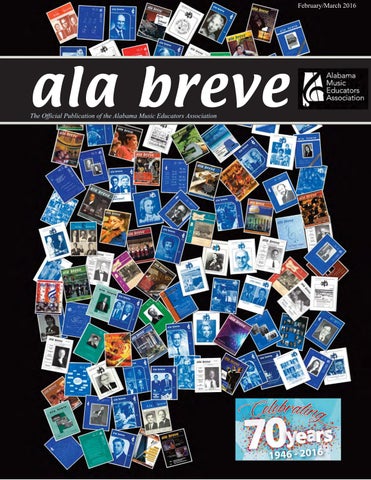
Through the years, the covers of the Ala Breve have undergone several changes and are filled with interesting trivia. The collage we created on the cover of this issue includes many
familiar scenes that we hope reminds you of the progress we’ve made, the events that shaped our organization, and the members who have given their time in service to our profession.
Conclusion
I want to wish everyone the best of luck as you prepare for upcoming concerts, assessments, and all-state events. Let us continue the great work we are doing as an organization and as a profession. The privilege of teaching kids the value and power of music is one that we should always remember is something most people do not get to do.
Thank you for a wonderful conference, your words of support, and for the great work all of you are doing every day.
All the best, Dr. Carl B. Hancock, President Alabama Music Educators Association
ala breve 7
President Carl Hancock University of Alabama Box 870366 Tuscaloosa, AL 35487 (205) 348-6335
chancock@bama.ua.edu
President, ABA Micheal MountainHolmes Brook Junior High School 205 Overbrook Rd. Birmingham, AL 35213 (205) 871-3516 x8525 thetubaman@charter.net
Past President Sara GreystoneWomack Elementary School 300 Village Birmingham,Street AL 5242 (205) 439-3200 saratwomack@gmail.com
President, AOA Sarah Schrader P.O. Box 2221 Foley, AL 36536 (334) 728-2855 burkart_sarah@yahoo.com
President-Elect Susan Smith Saint James School 6010 Vaughn Road Montgomery, AL 36116 ssmith@stjweb.org
Executive Director Editor, Ala Breve Garry Taylor 1600 Manor Dr. NE Cullman, AL 35055 (256) 636-2754
amea@bellsouth.net
President, AVA Carl Davis Decatur High School 1011 Prospect Drive Decatur, AL 35601 (256) 559-0407
carlbethemeryellen@gmail.com
Industry Representative Becky Lightfoot Arts Music Shop 3030 East Blvd. Montgomery, AL 36116 334/271-2787
beckyl@artsmusicshop.com
AMEA Collegiate Advisor Ted UnivesityHoffman of Montevallo Station 6670 Davis Music Building 308 Montevallo, AL 35115 (205) 665-6668
ehoffman@montevallo.edu
Treasurer/RegistrarPat POAMEAStegallRegistration Box 3385 Muscle Shoals, AL pstegall@mscs.k12.al.us35661
President, Higher Education James Zingara UAB 231 Hulsey Center Birmingham, AL 35294 (205) 934-7376 jzingara@uab.edu
Recording Secretary Carla Gallahan 212 Smith Hall Troy University Troy, AL 36082 (334) 670-3502
cgallahan@troy.edu
President, AMEA Collegiate Thad UniversityWalker of Montevallo (205) 636-0756
jwalker14@forum.montevallo.edu
President, Elem/Gen Cliff Huckabee The Montgomery Academy Lower School Campus 1550 Perry Hill Road Montgomery, AL 36106 334-462-3790
cliffhuckabee@gmail.com
Unless otherwise indicated, permission is granted to NAfME members to reprint articles for educational purposes. Opinions expressed in this publication are not necessarily those of AMEA or the Editor. All announcements & submissions are subject to editorial judgement/revision.The Alabama Music
for
Education,
teacher-education
NAfME/AMEA
education
Ala Breve is published four times a year (August, October, February & May) by the Alabama Music Educators Association and printed by Hardwick and Son Printing in Dothan, Alabama. Subscription for members is $4.00 per year as part of annual NAfME/AMEA dues. Subscriptions for non-members is $15.00 per year. Bulk rate postage paid at Dothan, Alabama. Garry Taylor, Editor & Advertising Manager 1600 Manor Dr. NE Cullman, AL 35055 (256) 636-2754 amea@bellsouth.net ADVERTISING & COPY DEADLINES Fall - August/September (Back to School) issue: July 15 Winter - October/November (Conference) issue: September 15 Spring - February/March (All-State) issue: January 15 Summer - May/June (Digital Only) issue: April 15
Educators Association is a state unit of NAfME: The National Association
Music
a voluntary, nonprofit organization representing all phases of music education in schools, colleges, universities, and
institutions. Active
membership is open to all persons engaged in music teaching or other music
work.
AMEA Governing Board 2015-2016
8 February/March 2016
ala breve 9
James Zingara - President, Higher Education Division
Dear HED Colleagues,
I greatly enjoyed seeing you at the recent AMEA Conference. I believe that this year’s Higher Education Division offerings were a great success due in large part to the increased participation from the membership. Our sessions included an eclectic mix across the music education spectrum including technology, teacher education, applied music, music business, and special education. Our presenters (Ellary Draper, Jane Kuehne, Denise Gainey, and Ted Hoffman) represented five institutions of higher education in the State of Alabama including Alabama, Auburn, Montevallo and UAB. I am especially thrilled to say that our colleague Mildred Lanier of Jefferson State Community College presented the first session representing our community college HED members.
I was also pleased with the second HED Panel
Discussion: The Breakdown between the Higher Education Classroom and First Year Teacher Experiences. I believe that our HED panelists Brian Kittredge (UAB), Becky Halliday (University of Montevallo), and Anne Witt (University of Alabama) framed relevant questions and provided common sense solutions to many of the presented issues. Our first and second year teacher panelists Courtney Cooper, Sarah Commer, Russell Greene, and Cara Thomas were outstanding examples of young music educators and voiced their opinions and concerns in a relevant and well-articulated manner.
The HED Student Recital featured seven outstanding chamber groups from five schools from across the state. I would like to thank Lori Ardovino, Kip Franklin, Brenda Luchsinger, Adam Murphy, Michael Pendowski, and Katrina Phillips for showcasing their student ensembles at this recital.
The HED Luncheon was again a great success, and 24 HED colleagues representing
8 universities met to vote on the offices of President-Elect and Secretary-Treasurer of the Division. It is my pleasure to announce that the new President-Elect is Mildred Lanier of Jefferson State Community College,and the new Secretary-Treasurer is Dr. Katrina Phillips of Alabama State University. Both will take office this coming June; I would like to give both of them my heartfelt congratulations on their new leadership role in HED. Also assuming a new role is Dr. Becky Halliday (University of Montevallo), who is the current President-Elect and will become President this summer. HED is in very good hands, and I will look forward to much progress in the future.
Please check this column in upcoming editions and our webpage for announcements concerning the 2017 Conference. The Higher Education Division is growing and your contributions will be most welcome in the coming year. In the meantime, I would like to wish you a very successful and productive Spring semester.
Greetings from the Elementary Division of the Alabama Music Educators Association! We are a few weeks past our very successful 2016 Annual In-service Conference and saw some great things from our Elementary Division.
First, two of our very own were inducted into the Hall of Fame – Vicki Portis and Teresa McKibben. Both are very well deserving and represent the very best of elementary music education and the impact it can have on our youngest students. They have inspired so many students and teachers with their skillful instruction and quality lessons. They also supported our elementary division with their leadership on our elementary board and through their support of our Elementary Music Festival. But most of all, they are both loving and compassionate people that are a joy to be around and inspire the very best from everyone they meet. I wish them both the very best as they enjoy their retirement and this great honor bestowed upon them.
Second, we had two great performancesBoaz Intermediate under the direction of Miriam Richey and The Kitty Stone Singers under the direction of Lisa Gillespie and Cheryl Wight. Both groups performed fabulously and showed what quality instruction from a skilled elementary music educator can produce. I loved seeing the excitement and enjoyment from all the kids as they performed. It is an experience that the students will never forget.
Third, we had some wonderful clinicians and sessions. It was my honor to welcome our two featured clinicians, Denise Gagne and Roger Sams. Both of them thoroughly enjoyed being in Alabama and both want to come back to future AMEA conferences. Both had booths in the exhibit hall providing valuable resources for our elementary music teachers. We hope to have Roger’s company back next year in our exhibit hall. It was also great to have several of our own elementary division teachers presenting sessions – Tiffani Stricklin, Kelly Hollingsworth, & Jeanette Shorey provided valuable sessions on topics that are affecting elementary music teachers here in Alabama. We also had Gail Kopetz from Mississippi present a session on Orff
integration on Saturday morning and had sessions from Quaver Music and ChordBuddy.
Overall, our 2016 In-service was one of our best ever! We look forward to one more year in Montgomery in 2017 and then we will move to Birmingham for the 2018 In-service.
There are several events coming up in the spring and summer that we would love to keep you informed about. We maintain an email list of our elementary music teachers and would love to have you on this list. If you have not received emails from us before, please send an email to:elementaryamea@gmail.com
We will gladly add you to our email list for future notifications. Our elementary board is here to serve you and your needs. Please do not hesitate to contact us with any need you may have. I wish you all the very best as you finish out the 2015-2016 school year.
Respectfully Submitted,
Cliff Huckabee
10 February/March 2016
Cliff Huckabee - President, Elementary/General Division
Introducing the NEW CSVR
The Yamaha Custom CSVR clarinets are the result of years of develo pment dedicated to a clearly focused concept: crafting a Custom clarinet that has a beautiful sound, consistent quality, and an affordable price. Both student and professional clarinetists require a rich sound and comfortable playability. These qualities were combined with the high level of consistency that only Yamaha can provide, allowing clarinetists to demand a higher standard than ever before.
•Redesigned keys offer comfortable, ergonomic hand placement. In addition, the new keys have thicker silver-plating for a dark and resonant sound quality.
•Durable leather pads ensure a precise seal between pad and tone hole for ease of response throughout the entire range of the clarinet.
•A new Custom barrel design provides the CSVR with a well-balanced response and rich, warm tonal colors that will elevate the progressing clarinetist’s playing. Learn more now at www.4wrd.it/csvraab
©2015 Yamaha Corporation of America. All rights reserved.
WOW! The AMEA conference this year was AMAZING! Thank you to everyone who made this conference possible. Thank you AOA members for attending this year’s conference, it was especially great to see new faces! Our presenters this year were spectacular! Some of the conference wide highlights included the Boston Brass and Dr. Tim Lautzenheiser. We were especially blessed to have stellar string presentations this year. Our headline presenter was nationally renowned composer Soon Hee Newbold. Her sessions and personality were delightful and helped to make the conference exhilarating. Our string sessions this year included; selecting the perfect piece, improving ensemble skills, group class teaching techniques, score preparation, the publishing process, classroom management, incorporating strings into your band program, and injury prevention for musicians.
We were lucky to have some of our own state
1946Yale H. Ellis
colleagues present this year. Thank you Dr. Anne Witt, Dr. Daniel Stevens, David Pryor, and Caroline Nordlund for your wonderful sessions.We also enjoyed a spectacular performance by the Shoals Symphony from Florence.They then stayed to provide the instrumentation for our JW Pepper sponsored reading session that was conducted by Soon Hee Newbold. Those in attendance were thrilled to get to perform some great music under Soon Hee’s direction.If you missed it this year, I hope you will make time in your busy schedules to attend next year’s conference in January.
Our next AOA event, The All State Orchestra Festival will be underway or completed when this issue is published. Thank you to all the conductors, judges, sectional coaches, and teachers for taking the time to work with Alabama’s talented young musicians. This weekend is an amazing experience for all who attend. I appreciate you sharing your time and talents with the students to make this weekend amazing. Thank you to the University of Alabama for hosting us again this year. It is a blessing to have this venue to hold the festival.
AOA will be hosting our first ever Orchestra Music Performance Assessment (OMPA) at Auburn University, April 22nd and 23rd. The registration form is now up on our website
and must be postmarked by March 4th to not incur late fees. We are so excited to be offering this! Thank you to our OMPA committee Dr. Guy Harrison, Dr. Anne Witt, Dr. Dan Hornstein, Dr. Katherine King, and Steven Findley for getting everything organized. Your planning efforts have made this event a possibility!
I would also like to thank the AOA Executive Board and district chairs, Sam Nordlund, Felicia Sarubin, Jacob Frank, Lisa Caravan, Julie Hornstein,Matthew Grant, Julianne Odahowski Steele, Eugene Conner, ChinMei Li, and Roland Lister for your help this year with all events. These events would not be possible without all your hard work. Thank you for all you do!
In closing, I pray that you can continue to keep your enthusiasm high throughout the end of the school year. Set your goals for your students and stick to them. I look forward to hearing your success stories from this year!
Dates:
Orchestra Music Performance Assessment Registration deadline- March 4, 2016
Orchestra Music Performance AssessmentApril 22 and 23, 2016
AMEA Presidents - Past to Present
1970Jerry Bobo
1992Dianne Johnson
1948Walter A. Mason
1950Vernon Skoog
1952John J. Hoover
1954Lamar Triplett
1956Carleton K. Butler
1958Mort Glosser
1960Wilbur Hinton
1962Lacey Powell, Jr.
1964G. Truman Welch
1966Jerry Countryman
1968Floyd C. McClure
1972Frances P. Moss
1974George Hammett
1975Frances P. Moss
1976S. J. Allen
1978W. Frank McArthur, Jr.
1980Paul Hall
1982Lacey Powell, Jr.
1984Johnny Jacobs
1986Merilyn Jones
1988Ronald D. Hooten
1990Ken Williams
1994James K. Simpson
1996Johnnie Vinson
1998Michael Meeks
2000John McAphee, Jr.
2002Tony Pike
2004Becky Rodgers
2006John Baker
2008Pat Stegall
2010Steve McLendon
2012Sara Womack
2014 Carl Hancock
12 February/March 2016
Sarah Schrader - President, Alabama Orchestra Association
In the Hear t of Nashville 2016 SUMME R MUSIC CAMPS
SSCHOOLOFMUSICSUMMERCAM
BELMONT UNIVERSITY’S SCHOOL OF MUSIC SUMMER CAMPS FOR WINDS, PERCUSSION, STRINGS, PIANO AND VOCALISTS.
VOCALIS
STRING CROSSINGS CAMP
June 12–17 for Grades 9–12
iolin • For V
BELMON
• For Violin, Viola, Cello and Double Bass
• Mu Ce
12 e 9 iola, Cello and Double Bass n, V ltiple Classica eltic, Rock, Jazz and Bluegrass
BELMONT PIANO CAMP
June192
MPS TS T 4forGrades912
June 19–24 for Grades 9–12
• Clas
• Study Multiple Styles including Classical, Swing, Celtic, Rock, Jazz and Bluegrass
l,
• Study Classical or Jazz Piano
• O SUMM Jun
• String Orchestra and Small Group Opportunities Available
SUMMER WINDS BAND CAMP
Orchestra and Small vailableA ER
June 19–25 for Grades 9–12
e19–25forGrades9–12
oo • For W
odwinds, Brass and Percussion
• For Woodwinds, Brass and Percussion
• Study Classical and Jazz Styles
• Stud
• Ense ind En W mble Oppor
dy Classical and Jazz ble nsemble, sembleand
• Ensemble Opportunities include Wind Ensemble, Jazz Ensemble and Chamber Music
• Classes in Musi Te VOC
sical or Jazz Piano , c Theory and AL
• Classes in Music Theory, Sight-Reading, Technique and Improvisation SUMMER VOCAL ARTS INTENSIVE
June
2 for Grades 9–12
June 26–July 2 for Grades 9–12
• Solo, Ensemble and
• Solo, Ensemble and Choral Singing Experiences
Choral sesinClassicalJazz
• Masterclass Musical Theater a
•Masterclass
• Masterclasses in Classical, Jazz, Musical Theater and Contemporary Styles
• Elective Cla echn Music T Te ScatS
Scat Sin
ses in nd asses ips, , Auditi Audition T gy ology nging and more
• Elective Classes in Conducting, Music Technology, Audition Tips, Scat Singing and more
cting,
ala breve 13
MUSIC of CHOOL STRI Jun
NG –12 e12–17forGrades9
BELMONTUNIVERSITY’S FOR PERCUSSIO
N, PIANO AND
The Process: We’re Not Done Yet
AMEA Conference 2016 was a huge success. President Carl Hancock and the AMEA Governing Board earned “STRAIGHT ONES”! The Boston Brass proved themselves to be worth the effort it took to get them to the conference. They are both world-class musicians and world-class human beings. When the weather began to affect planned performances,the Boston Brass stepped in with an encore performance that was just what we needed to cheer us up a bit after we received the sad news that the Oak Mountain bands had to turn the buses around and go back home. We can certainly understand the disappointment that was felt by the students, parents, and conductors of this fine band program. Our hope is that they will be in a position to perform for us in 2017. Dr. Ken Ozello, Professor Randall Coleman, and composer Tyler Grant also stepped up to the podium when Brian Balmages was thwarted by Mother Nature and could not make it to Alabama. These musicians presented a great Reading Band session on his behalf. Thanks! And through the magic of technology, Brian, at least a digital version of Brian, was with us as well.
ABA was well represented at the conference through concerts and clinic sessions. The Randolph School Middle School Percussion Ensemble and the University of North Alabama Percussion Group entertained with quality literature and execution. Grissom High School Symphonic Band II (Theo Vernon conductor), James Clemens High School Symphonic Band(Keith Anderson conductor), and The University of Alabama Wind Ensemble(Dr. Kenneth Ozello conductor), presented performances that will be remembered for many years to come. We definitely have quality band programs in our state. Will your band be the next to perform at the AMEA Conference? The due date to apply will be here soon. We need more applicants. We want you to make our job of choosing performing ensembles and clinics even more difficult than it was this year. So start making plans to apply.
Nope, not done yet. Music Performance
Assessment is quickly approaching. Take a deep breath. This is an important event for our association. Your ABA Board members have taken great care to secure adjudicators that are to provide you and your students with a constructive, positive, and honest assessment of your band’s performance at MPA. Accept the outcome with an open mind. There will be information there that can help your band make improvements and achieve musical growth. Then Sight-Reading. Take another deep breath. This is no big deal. Many of you sight-read everyday in band rehearsal. Every time you play a new line out of your Method book, Chorale book, or Rhythms studies book, your students are Sight-Reading. Don’t abandon daily fundamentals to work on the “contest” music. Those fundamentals are what it takes to get your band to where you want it to be. Once many years past,Phi Beta Mu Hall of Fame member Larry Deagan told me “Concerts and contests are a necessity, but they sure do interfere with teaching”. So, keep teaching.
Still not done yet. All-State Band district level auditions have been completed. I am looking forward to being in Mobile once again. It is a beautiful area for our All-State Festival. I am certainly excited to witness the performances of our state’s fine soloists as they perform on the campus of the University of South Alabama in the All-State Solo Festival Finals Concert on Wednesday, April 13, 2016. This event never disappoints. So don’t miss it. We have contracted four of the finest conductors in our profession to work with the best band students in the country, our students, and this is going to be an awesome All-State Band Festival. You don’t want to miss it.
I don’t think we will ever be done. Still to go: honor bands, scholarship auditions, recruiting, spring concerts, trip performances, drill writing, music arranging, drum major tryouts, visual ensemble auditions, new uniforms to order, fundraisers, faculty meetings (my personal favorite), ABA Summer Conference, marching band camp .. . . . . . . . . . .
2016 Alabama All State BandConductors
Ray E. Cramer was a member of the Indiana University School of Music faculty from fall 1969 through May 2005. In 1982, Cramer was appointed director of bands, and under his leadership the Indiana University Wind Ensemble earned an international reputation for outstanding musical performances, including the 1982 ABA Convention, Indianapolis; the 1984 joint American Bandmasters Association/Japan Bandmasters Association Convention, Tokyo; the 1988 MENC National Convention, Indianapolis; the 1991 National CBDNA Convention in Kansas City, the 1994 National MENC Convention in Cincinnati, the 1995 ABA Convention in Lawrence, Kansas, the 1997 National CBDNA Convention in Athens, Georgia, the 2003 CBDNA National Convention in Minneapolis, MN, a 2000 spring tour to Japan performing in six cities and the All Japan Band Clinic, and a 2003 performance at the Midwest Clinic.
In addition to his administrative responsibilities as the department chairman, Cramer taught graduate courses in wind conducting, history, and literature. He also conducted the University Orchestra for seven years during the fall semester. He is a past national president of the College Band Directors National Association and the American Bandmasters Association and has served as president of the Indiana Bandmasters Association, the North Central Division of CBDNA, and the Big Ten Band Directors Association. He is the current president of the Midwest Clinic, an international band and orchestra convention held in Chicago each December.
David Willson is a “band director’s band director.” His teaching at all levels has been the catalyst for his mission to serve others through directing bands and bettering his profession. He is in his twenty second year as Director of Bands at The University of
14 February/March 2016
FORGET THE
. . . . . . . AND DON’T
SUNSCREEN!!
Micheal Holmes - President, Alabama Bandmasters Association
Ray E. Cramer Red Band Clinician
David Willson Whtie Band Clinician
Mississippi where he was named Teacher of the Year in 2007 and awarded the First Award “for his service to students” in 2005. In 2010, Willson was honored by Phi Beta Mu International Bandmasters Fraternity with the Outstanding Contribution to Bands Award. Under his direction the University Wind Ensemble has performed at Mississippi Band Masters and CBDNA Southern Convention, live for Mississippi Public Radio, featured on national public radio, received the NBA Citation of Excellence multiple times, and has toured throughout extensively throughout the midsouth. The Pride of South Marching Band, while under his direction, has more than doubled in size, performed in nine bowl games, and made the “Grove Routine” part of the Ole Miss Tradition. Prior to coming to Ole Miss Willson served sixteen years as a public school band director in Mississippi. His bands were award winning in every category consistently in local and national competitions, including receiving the prestigious Sudler Award in 1990. He placed many students in the Mississippi All-State Band and served as conductor/director five times including trips to Brisbane, Australia and the world championship trip to Seoul, Korea. Willson received the ASBDA-Stanbury young band director of the year in 1985 and was named Mississippi’s Outstanding Band Master in 1989. In 1982 NIFMA honored him with the Southeastern Music Educator of the Year award. Willson is past president of Phi Beta Mu International, the Mississippi Band Masters Association and the Delta Chapter of Phi Beta Mu, state chairman for CBDNA, NBA, and served for four years on the National Federation of Music committee. He is active in many professional organizations. Publications by Willson include Starting Beginner Band Students, Band Calisthenics and Mr. Willson’s Warm Up, which are used extensively throughout the midsouth. His articles have frequently appeared in The Instrumentalist, BandWorld, Phi Beta Mu Journal, and most recently in the August 2011 issue of SBO Magazine. He is active as a clinician and speaker throughout the United States. Professor Willson has always put a strong emphasis on training students fundamentally and has been equally concerned in developing students as well-rounded citizens through his philosophy of being all superior “Every Day in Every Way”. He is most proud of his former students that are successful band directors.
A native of Montgomery, Alabama, Carlton J. Wright attended schoolin the Montgomery County School System and graduated from G.W. Carver High School. He earned the Bachelor of Science Degree in Music Education from
Alabama A&M University in 1986. He was awarded the Master of Arts Degree in Music Education from Hampton University (Virginia) in 1993. In 1984 Wright received a commissionof2nd Lieutenant in the United Stated Army Reserve. The former Captain Wright proudly served in various positions until his honorable discharge. Mr. Wright’s previous teaching assignments include, Minor High School, George Washington Carver High School-Montgomery,and Fairfield High School.Throughout hiscareer, Mr. Wright’s bands have consistently earned superior ratings at district, state, regional, and national band festivalsin the concert, jazz,and marching band genres. In 2013, Wright was named Director of Bands at his undergraduate Alma Mater, Alabama A&M Universityin Huntsville.
His teaching philosophies are partially influenced by his friends and mentors such as; Mr. Curtis Hollinger,Mr. Barrett Alexander, Mr. Arthur B. Wesley,Dr. Sue Samuels,Mr. Arthur Means, Mrs. Dianne Johnson, Dr. Jon Remley, Mr. William T. Robinson, III, and the late Mr. Barney E Smart, Sr.
Mr. Wright is an active trumpeter, clinician, arranger, and adjudicatorfor variousband related activities. Some of his pastinvitations include the University of Alabama at Birmingham,Samford University; Alabama State University;Miles College;Stillman College; Hampton University;Mississippi State University;Montgomery, Alabama County Schools;Houston County,AlabamaSchools; Calhoun County, Alabama Schools, and DeKalb County,Georgia Public Schools.
Wright attends the Sixteenth Street Baptist Church in Birmingham, where he is serves as a trumpeter and Assistant Orchestra Director. Mr. Wright holds membership in the following organizations: National Education Association (NEA),AlabamaEducation Association (AEA), National Association for Music Educators (NAfME), Alabama Music Educators Association (AMEA), Alabama Bandmasters Association (ABA), Kappa Kappa Psi Band Fraternity, Phi Beta Mu Band Fraternity, Tau Beta Sigma Band Sorority, and the Omega Psi Phi Fraternity.
His parents are the late James and Adeline Wright. He is marriedto the former Jocelyn
Payton. They have three wonderful children: Walter Payton, Carmen, and Jaylen;and a very loyal dog, Sno.
Deborah Confredo (formerly Sheldon) is Professor of Music Education and Director of Graduate Programs for Music Education at the Boyer College of Music and Dance. Confredo’s specialties include instrumental rehearsal techniques and teaching methods, assessment, research, music psychology, cognitive-behavioral techniques, conducting, wind band literature, and systematic observation. Confredo has taught elementary and secondary instrumental music in Pennsylvania and New York. Her numerous articles in music education, pedagogy, and research are published in journals such as the Journal for Research in Music Education, Bulletin of the Council for Research in Music Education (CRME), Update: Applications of Research in Music Education, Journal for Music Teacher Education, Journal of Music Therapy, Music Educators Journal, Journal of Band Research, The Instrumentalist, and Contributions to Music Education, as well as in several state music education journals. A past editor of the Bulletin of the Council for Research in Music Education, Confredo has also served multiple terms as an editorial board member for that journal as well as the Journal of Research in Music Education, as is currently an editorial board member for Education
She has co-authored the texts The Complete Woodwind Instructor: A Guidebook for the Music Educator and Lessons in Performance (FJH), and is editor of Superior Bands in Sixteen Weeks, and Chorales and Rhythmic Etudes for Superior Bands. She is an instrumental editor, arranger, author, and consultant for the FJH Music Company and lead author for the FJH publication Measures of Success, a band method for beginning and intermediate instrumentalists. She is founder of the Temple Night Owls Campus/Community Band. Confredo is in demand as clinician, adjudicator, guest conductor, and lecturer. Tau Beta Sigma and the Illinois Music Educators Association have honored her for her distinguished service to music and music education. Mansfield University has recognized her as a distinguished alumnus. At home in the Philadelphia/South Jersey area, Confredo plays saxophones and keyboards in the four-member jazz fusion band, West River Drive
ala breve 15
Carleton Wright Blue Band Clinician
Deborah Confredo MS Band Clinician
APRIL 13-16, 2016
Wednesday All-State Solo Festival-University of South Alabama
10:00 A. M. Registration and check-in
11:00A. M-6:00 P. M.Preliminary Competition
7:30P. M. State Solo Festival Finals Concert – Recital Hall
Thursday
Auditions-Meetings-Rehearsals-Convention Center/Hotel
12:00-7:00 P. M. Exhibits Open
12:00 P. M. Directors Meeting
1:00 P. M. Auditions begin
5:30 P. M. Audition results posted at each rehearsal location
6:30-9:30 P. M. All-State Band rehearsals
Red Band-Dr. Ray Cramer- Conductor
White Band-Mr. David Willson-Conductor
Blue Band-Mr. Carlton Wright-Conductor
Middle School Band-Dr. Deborah Confredo-Conductor
7:00-9:00 P. M. Alabama Bandmasters Association Executive Board Meeting
11:00 P. M. Curfew for all participants
Friday
Meetings-Rehearsals-Convention Center/Hotel
8:30-11:30 A. M. Exhibits Open (Exhibits will close for lunch from 11:30-12:00)
8:30-9:30 Exclusive time for directors to visit exhibits
8:30 A. M. -5:30P. M.Rehearsals
10:00-11:30AM ABA General Business Meeting-Hotel
12:00-1:30 PM Lunch Break for all All-State Band participants
12:00-1:15 PM Phi Beta Mu Luncheon
12:00-5:00 PM Exhibits Open
2:00-4:00 P. M. Possible Committee meeting/training session TBA
8:00 P. M. University of South Alabama Concert-Saenger Theatre 11:30 P.M Curfew for all participants.
Saturday Rehearsals-Meetings-Concert-Civic Center/Hotel
8:00-8:45 A. M. Middle School Band Rehearsal
8:45-9:30 A. M. Blue Band Rehearsal
9:00-9:30A. M. ABA Board Meeting-Hotel 9:30-10:15 A. M. White Band Rehearsal
9:45-10:45 A. M. ABA General Business Meeting-Hotel 10:15-11:00 A. M. Red Band Rehearsal
1:00 PM All-State Band Concert-Civic Center
Hotel - Renaissance Riverview Plaza Hotel, Mobile
Thursday & Friday rehearsals – Mobile Convention Center
Saturday morning rehearsals – Mobile Civic Center
Saturday afternoon concert – Mobile Civic Center
16 February/March 2016
ALABAMA BANDMASTERS ASSOCIATION ALL-STATE BAND FESTIVAL MOBILE ALABAMA CONVENTION CENTER/RENAISSANCE HOTEL
COLLEGE of FINE ARTS
DEPARTMENT of MUSIC
COLLEGE of FINE ARTS
DEPARTMENT of MUSIC
AUDITION DATES:
NOV. 14, 2015
JAN. 30, 2016
MARCH 12, 2016
For more information, visit www.montevallo.edu/music
AUDITION DATES:
NOV. 14, 2015
JAN. 30, 2016
MARCH 12, 2016
For more information, visit www.montevallo.edu/music
ala breve 17
18 February/March 2016 1955-1965 1966-1969 1970-1984 1985-1990 1990-1992 1992-1999 1999-2000 2001-Present 1st AMEA Conference January 1974 1st Ala Breve November 1955 Ala Breve mastheads through the years 1st AMEA Logo From April 1956
ala breve 19
from Ala Breve January 1956
Campus Connections...
News and Happenings from Alabama’s Colleges and Universities
ANIMATE at Samford:
I June 20 – June 24, 2016
Samford University
Samford University is busy serving students and musicians from all around the region!
January 7-9
Alabama Honor Band Festival
February 5-6, 13, 26-27
Audition and Interview Days
March 4-5
Alabama All-State Choral Festival
We are currently making plans for some exciting summer events as well that include opportunities for pre-college pianists, elementary music teachers, and worship leaders of all ages.
PACMI at Samford: June 5 – 11, 2016
Samford’s Piano and Chamber Music Institute is a one-week program affording interested pre-college students an opportunity to further their performance abilities and enjoy classes in music history, theory and ear training. Students encounter daily lessons with a private teacher and have the opportunity to be involved in various kinds of chamber music. Registration deadline is May 15, 2016. For more information go to http://www.pacmi.net or contact Ron Shinn:(205) 601-3694, or rshinn@samford.edu
ORFF at Samford: June 20–July 1, 2016
The music education department at Samford is hosting Orff Certification Levels courses again this summer. We are delighted to have highly qualified clinicians in Brent Holl (Level II), Ellen Koziel (Level I), and Jennifer Donovan (Movement and Recorder). The Level I fee is $675.00 and the cost for Level II is $750.00. Spaces are limited. Register by May 9, 2016. For more information contact Susanne Burgess:(205) 726-2651, or sburges1@samford.edu
II June 27-July 1, 2016
Animate is an interdenominational, intergenerational academy in worship, theology, and the arts for high school students and their adult mentors. Students can attend as an individual or with a friend. Adult leaders can bring an intergenerational team from your congregation or school. At Animate, students hone leadership skills, adults sharpen their mentoring tools, and everybody works together to practice and reflect on the intersection between worship, theology, and the arts. Fees are $249/per person for each session prior to May 1. For more information contact Eric Mathis:(205) 726-2323, or emathis@samford.edu
composer selected for the middle-school groups isRobert Sheldon and conductors are Matt Koperniak, Donald Dowdy, and Gwendolyn Rakoff.
Students from across the Southeast and the nation have been selected to participate in the festivals based on submitted applications and director recommendations. Each participant will be placed in an ensemble after an on-site audition. During the course of the festival, students will participate in master classes with Auburn University faculty, hear performances by the AU Symphonic Winds, Concert Band, and Jazz Band, and work with renowned conductors and composers. The festivals will culminate with student bands performing their finale concerts on Feb. 6 and Feb. 13. We hope you and your students will join us for one of these festivals.
Auburn University
Auburn University Department is pleased to announce the 25th Annual Auburn University Symphonic Honor Band Festival and the 7th Annual Auburn University Middle School Honor Band Festival which will be held on campus during the first two weekends in February.
The Auburn University Symphonic Honor Band Festival will celebrate its 25th anniversary during this year’s event on February 11-13, 2016. Guest composers who have been engaged to write a new piece for the senior high ensembles are Julie Giroux,and Randall Standridge. Our ensemble conductors will be Thomas Leslie, Kenneth Beard, David Raney, and Tracy Leslie. Every participant will have the opportunity to play under the baton of one of these outstanding conductors.
The Middle-School Honor Band Festival will be held on February 4-6, 2016 on the Auburn campus. The
Last fall the Auburn University Chamber Choir joined Columbus State and LaGrange College choirs in a thrilling performance of Ninth Symphony by Ludwig van Beethoven in concert with the Columbus Symphony Orchestra. Experiences like these abound for students majoring in music or performing in the many varied ensembles at Auburn! We are proud to offer an intimate and nurturing atmosphere that provides opportunities for individual attention and regular performance for students. We are fortunate to be able to bring in frequent guest artistsfor concerts and master classes. I invite you to read about our distinguished faculty, major performing ensembles, programs of study, and available scholarships, and assistantships on our website at: www.auburn.edu/ music. Contact the Department of Music at 334-844-4165 if you have questions about our degree programs or offerings.
War Eagle!
20 February/March 2016
Colleges and universities are encouraged to submit newsworthy material and announcements for publication in Ala Breve
AMEA M AMEA M EMBERSHIP EMBERSHIP
H H ONOR ONOR R R OLL OLL
The Alabama Music Educators Association is proud to recognize those AMEA members having 25 or more years of continuous membership in NAfME. This year, each person attaining 25 years and those reaching increments of five years beyond that will be honored. The following music educators will be honored during the Friday morning General Session.
Merilyn Jones - 60 years
John Robert Hinton - 55 years
Stewart Hampton - 50 years
Ronald Lett - 50 years
William T. Robinson - 50 years
Thomas Smith - 50 years
Thomas Brannan - 45 years
Freddie Meadows - 45 years
Arthur Means - 45 years
Milton Welch - 45 years
Frank Blanton - 40 years
Dennis Carroll - 40 years
James Duren - 40 years
Rebecca Rockhill - 40 years
Suzanne Winter - 40 years
Virginia Carlisle - 35 years
Paul Edmondson - 35 years
Larry Hardin - 35 years
Micheal Holmes - 35 years
Susan McCall - 35 years
Debra Ellis - 30 years
Rhonda Farley - 30 years
Bryan Kreps - 30 years
Rondall Mallory - 30 years
Theo Vernon - 30 years
Kim Bain - 25 years
John Bradley - 25 years
Beth Davis - 25 years
Jennifer Fyock - 25 years
Lester Harris - 25 years
Brian Lowe - 25 years
Gary McNutt - 25 years
Karen Morgan - 25 years
David Pryor - 25 years
Michelle Reburn - 25 years
Jon Remley - 25 years
Paul Tallent - 25 years
Natasha Tidmore - 25 years
Reggie Tolbert - 25 years
ala breve 21
Pat Stegall, AMEA Treasurer/Registrar
“Wow, that was really fast!” This comment was heard multiple times at the registration desk for the conference. We owe a big “thank you” to the helpers from NAfME that streamlined our registration check-in process. Our future plans are to keep this process in place and improve the on-site registration process. We had a record attendance with 1,025 members participating.
Our membership campaign is just about to wind up, so I should be able to share that information with you in our next publication. Thanks to the volunteers who have made calls and contacts with our potential members. I look forward to seeing the final numbers.
You may want to add the NAfME app to your smartphone. It has many features that are accessible, including your membership card! This alone will help make the registration process easier for you. Another feature is for renewing your membership by credit card. If you do this, there is a box you can check that will allow NAfME to automatically renew your membership on the renewal date. I love that feature, and you will, too! PS
GENERAL RESPONSIBILITIS:
Add the NAfME app to your smartphone.
Now, with the new NAfME Mobile Membership app, you can access all of your pertinent NAfME membership details and renew your membership on the go (more features coming soon.)
Download the app to get the experience of NAfME in your pocket and do your your part for music education!
JOB DESCRIPTION
AMEA Assistant Executive Director
An educational festival for elementary, middle, and high school students in band, choir, and orchestra
2016 dates:
April 22-23, April 29-30, May 6-7
2017 dates:
April 21-22, April 28-29, May 5-6
www.SMMFestival.com or call:1-855-766-3008
• Aide and assist the AMEA Governing Board in planning professional development programs for the association and assist the Executive Director in implementing those plans.
• Serve as the AMEA liaison to the State Department of Education.
• Assist the Executive Director on-site during the AMEA Conference.
• Maintain the AMEA Constitution, Bylaws, and Executive Handbook.
• Assume the duties of the Executive Director in the case of disability or absence of the Executive Director.
PREREQUISITES:
• Membership in the Alabama Music Educators Association and the National Association for Music Education.
• Hold current Alabama residency.
• Experience with Microsoft Word, Microsoft Excel, Dropbox file sharing, and pdf file creation.
• Willingness to learn Adobe Acrobat and the suite of Adobe software programs.
• Ability to collect, organize, and compile digital files including those in audio, text, image, and video formats.
• Reliable transportation to all governing board meetings and to meetings with the Executive Director of the AMEA.
• Excellent writing and oral skills.
• Ability to display a diplomatic demeanor in all communications with the public and AMEA members.
• Quick and flexible learner.
• Teaching experience is desirable.
HIRING PROCESS - Candidates should submit an application along with a cover letter, resume', and list of three (3) references. Applications will be accepted until April 1, 2016. A committee appointed by the President will conduct an initial interview during May and a finalist will be selected with the approval of the AMEA Governing Board at its June meeting. Employment begins July 1, 2016.
COMPENSATION - Salary shall be suggested by the Budget Committee with the approval of the Governing Board. Legitimate expenses of the office should be itemized and presented for reimbursement. The suggested salary for the first year is $3,000.00.
Visit AMEA’s website alabamamea.org for more information and on-line application.
22 February/March 2016
ala breve 23
Carl Davis- President, Alabama Vocal Association
We just enjoyed a superb winter conference reconnecting with each other, sharing information, and attending sessions and concerts. We certainly seek your feedback concerning the move of the concert venue for choral performances to the ballroom from the Performing Arts Center Auditorium. The move afforded us the opportunity to enjoy a two-hour concert block to which some of us affiliated with ACDA are accustomed. I think that the Honor Choir strained the capabilities of the room; however, we will not have to be concerned with such a large ensemble next year.
I appreciatedmy interaction with Dr. Jeffrey Benson. I think over the past three years we have certainly gained collaboration with some of our very finest in the profession— Dr. Chris Aspaas, Dr. Tucker Biddlecombe, and Dr. Jeffrey Benson. Dr. Benson, I hope, has offered us an opened door to some future association—either at an All-State festival or honor choir. I thought his reading session addressedcontentfor various levels
2016 All-State Festival Schedule (All Ensembles on SAMFORD CAMPUS)
Wednesday, March 2, 2016
that is quite usable. There was nothing substandard and a majority of the literature is accessible by all. I encourage you to contact JW Pepper anytime that you need literature as they provided the reading session booklets at no cost to AVA. I got to attend some quite effective sessions by our own presenters. We were afforded sessions targeting functional aspects of the choral rehearsal— vocal health, theory, rehearsal pacing, sight-reading, and reasoning of why we selectthe literature that we do. Again this year, my hopes were that your students rehearsing this spring semester would directly benefit from your attendance.
I congratulate the directors who provided performances at the conference. I want to encourage you to submit for a performance. Certainly consider recording your SCPA selections and submitting for a concert performance.
Being chosen for All-State Chorus is one of the highest honors a choral student in the state can receive. We auditioned approximately 3,000 students in November with approximately one-third of those being chosen for one of our five All-State ensembles. Those students will interact with some of our finest vocal conductors. Go to the AVA website to read information concerning the all-state festival.
11:00 AM Board Meeting, Wright Center Basement
2:45 PMFemale OCS Competition, Brock Recital Hall
4:30 PM OCS/OA – Picture, Brock Recital Hall
5:00 PM Male OCS Competition, Brock Recital Hall OA Competition, Buchanan Hall 109
Thursday, March 3, 2016
8:00-11:30 AMASSC Rehearsal, Wright Performance Center
10:00-1:00 PMRegistration, Wright Basement
1:00-1:45 PMGeneral Assembly – ASSC Performance, Wright Performance Center
2:00-5:30 PMHS SATB, Wright Performance Center
HS SSA, Brock Recital Hall
HS TTBB, Cooney Hall 305(3rd Floor Seminar Room)
MS Mixed, Brooks Hall Auditorium (Room 134)
MS Treble, Cassese Band Hall
5:30-7:30 PMDinner Break – OFF CAMPUS
7:30-9:30 PMRehearsals, Same sites as first rehearsal
11:00 PMCurfew
Friday, March 4, 2016- MIDDLE SCHOOL
8:30-10:00 AM MS Mixed Rehearsal, Cassese Band Hall
MS Treble Dress Rehearsal, Wright Performance Center
10:00-11:30 AMMS Mixed Dress Rehearsal, Wright Performance Center
MS Treble Rehearsal, Cassese Band Hall
11:30-1:30 PMLUNCH
Be aware that the all-state schedule this year is again quite different. All ensembles are on the campus of Samford University. By the time that you read this article your All-State information will be available on the AVA website from our president-elect Ginny Coleman.
I’ve asked our district chairmen to update their web pages on the AVA website. You should expect all communications for all AVA events to be disseminated via our website. If you are attending an SCPA in another district you should be able to get all information concerning the event you are attending from that district’s web page. Let your district chairman know if you have difficulty accessing the information.
Lastly, I look forward to our website moving to the newly hosted AMEA website. We should transition over the spring and summer to the new site. Registration for Fall Workshop will be done just as you registered for the AMEA conference. Pending some more training and us discovering what is available, hopefully all registrations will be done online this next school year—more info to come at the All-State Festival concerning this. Please communicate with your district chairman.
See you at Samford.
1:30-3:30 PMMS Mixed, Reid Chapel
MS Treble, Cassese Band Hall
6:30 PMCall Time for Concert
7:00 PMMS Concert, Wright Performance Center
Friday, March 4, 2016- HIGH SCHOOL
8:30-11:00 AMHS SATB, Reid Chapel
HS TTBB, Cooney Hall 305
HS SSA, Brock Recital Hall
11:00-1:00 PM LUNCH – All groups will eat at rehearsal space except HS SATB, who will eat at Brock School of Business (BSOB 400)
1:00-2:30 PM HS SATB Dress Rehearsal, Wright Performance Center
HS SSA, Brock Recital Hall
HS TTBB, Cooney Hall 305
2:30-4:00 PMHS SATB, Brock Recital Hall
HS SSA Dress Rehearsal, Wright Performance Center
HS TTBB, Cooney Hall 305
4:00-5:30 PMHS SATB, Brock Recital Hall
HS SSA, Reid Chapel
HS TTBB Dress Rehearsal, Wright Performance Center
Saturday, March 5, 2016
11:00 AMHS SATB Warm-Up, Wright Performance Center
HS SSA Warm-Up, Brock Recital Hall
HS TTBB Warm-Up, Cassese Band Hall
11:30 AM Call Time for HS Concert, Wright Performance Center
All Performers Seated
12:00 PMHS Concert
24 February/March 2016
2016 Alabama
AVA All State Conductors
Bret Peppo is beginning his ninthyear as Director of Choral Activities and Music Department chair at Diablo Valley College where he conducts the Concert Chorale, Chamber Singers Masterworks Chorale and the Vocal Jazz Ensembles. Prior to his appointment at DVC, Peppo was the Director of Choral Activities at Alderson-Broaddus College at the University of South Alabama and at Illinois State University. He also held the positions as director of the Old Gold Singers (show choir), at the University of Iowa. His concert, show and jazz choirs have toured extensively throughout the country and have been selected to perform for the Mississippi and Illinois All-State Conferences. As a conductor, Mr. Peppo has conducted many high school and collegiate all-state festivals for both honor choir as well as jazz choirs and is a frequent adjudicator and clinician with many national music festivals and is busy as a judge from show choir and vocal jazz competitions. Peppo is active with Phi Mu Alpha Sinfonia where he has served as faculty advisor at Illinois State University, University of South Alabama and Alderson-Broaddus College. He is also active in the American Choral Directors Association and serves as R&S chair (2-Year Colleges) and coordinates the Tactus newsletter on the Western Division Board. Bret Peppo earned a bachelors degree in Vocal Music Education from Eastern Illinois University, a Masters of Conducting at Illinois State University and doctorate from the University of Iowa in Choral Conducting and Pedagogy.
Gregory Fuller is a Professor of Music and the Director of Choral Activities at The University of Southern Mississippi. He conducts the Southern Chorale and the Hattiesburg Choral Union, teaches graduate conducting courses, and supervises candidates in the master’s and doctoral conducting program. In 2004 he launched the first Southern Invitational Choral Conference, an event that now hosts over sixty institutions each September. . Gregory Fuller is becoming known as a champion of new extended works.He will conduct his sixth premiere of a multi-movement work for chorus this spring when he debuts The Seven Last Words, by Richard Burchard for orchestra and chorus.Dr. Fuller has remained active as a conductor in orchestral and wind settings.To date, he has appeared with professional or university ensembles on more than 80 occasions.His father and mentor, James Fuller, served churches in Alabama and
Missouri for 40 years.Regarded as model administrator of graded choir programs for children, James Fuller fostered music education and choral excellence in churches.As a continuing advocate for those values, Fuller organized Sacred Festivals in Hattiesburg, worked closely with Cardinal Daniel Dinardo and the Catholic Diocese of Sioux City in executing music for important liturgies, and is now chorus master at Parkway Heights United Methodist Church in Hattiesburg, Mississippi.
Leslie J. Blackwell is the Director of Choral Activities and Professor of Music and Music Education at Kennesaw State University where she has directed choral activities since 1998. Dr. Blackwell’s duties include conducting the KSU Men’s Ensemble and KSU Chamber Singers as well as teaching advanced choral conducting and literature along with supervision of student teachers. A native of Georgia, Blackwell received the Associate of Arts degree from Gordon Junior College (1982), the Bachelor of Music in Music Education from West Georgia College (1984), the Master of Music from Georgia State University (1991), and the Doctor of Musical Arts degree from the University of Kentucky (2002). Recognized for her work with men’s voices, Dr. Blackwell served six seasons as the Artistic Director of the Atlanta Gay Men’s Chorus, conducted the 2013 Georgia AllState Men’s Chorus, and established the annual KSU Male Chorus Day at Kennesaw State University, bringing upwards of 200 high school male students to campus. Influential musicians with whom Dr. Blackwell has worked are Robert Shaw, Ann Howard-Jones, Yoel Levi, Norma Raybon, John Haberlen, Rodney Eichenberger, David Maslanka, Ola Gjeilo, Ethan Sperry, and Jefferson Johnson.In addition to her commitments at Kennesaw State University, Dr. Blackwell is active as a clinician and adjudicator and holds memberships in MENC, GMEA, and ACDA. She also serves on the Board of Directors for Georgia ACDA. Currently, Dr. Blackwell is the Artistic Director and Founding Director of the Kennesaw State University Community and Alumni Choir.
Dr. Patrick K. Freer is Professor of Musicand Interim Director of the School of Music at Georgia State University where he holds Affiliate Faculty status with the Institute of Women’s, Gender, and Sexuality Studies. His degrees are from Westminster Choir College and Teachers College, Columbia University.He has guest conducted or presented in 36 states and 16
countries, including the 2014 Southwest Division ACDA Junior High Honor Choir. He has presented at six National Conventions of the American Choral Directors Association and five National Conferences of the National Association for Music Education. His 2015-16scheduleincludes research, presentations and/or teaching graduate courses in Canada, Geece, Spain, Thailand, and Turkey. He will serve as keynote speaker and guest conductor for the inaugural Symposium of Singing and Song (St. Johns, NF) in October2015, and guest conductor of regional and All-State choirs in Alabama, Georgia, Kansas, and Missouri. Dr. Freer is Academic Editor and Chair of the Editorial Committees for Music Educators Journal and has authored multiple book chapters and over 100 articles in most of the field’s leading national and international journals.Publications include "Getting Started with Middle School Chorus" (named Outstanding Academic Title by Choice) and the DVD series Success for Adolescent Singers. His most recent publications include articles in the 2015-16 volume years of the British Journal of Music Education, Bulletin of the Council for Research in Music Education, Research Studies in Music Education, Music Education Research, and the Journal of Historical Research in Music Education. Dr. Freer’s research focus is on the sociological and pedagogical factors impacting the singing of boys during and beyond the adolescent voice change. Dr. Freer lives in Atlanta, GA with his husband, Kevin Sullivan and their two rescue pitbulls, Luka and Zaira.
Neil A. Johnson has directed music groups of every age level from elementary through university and adult. He has over 40 years experience from elementary through college level (30 of those in junior high) and community choruses. He has taught band, orchestra and chorus, and groups under his direction have been selected to appear at state and district music conventions on several occasions and have attained "best concert choir" status in several competitions. Neil has served as a clinician for regional and state elementary, junior high, and high school choral workshops, new materials reading clinics, and local and state choir festivals. He has directed all-state choirs and served as an adjudicator for concert and jazz/show choirs in over 20 states and 2 Canadian provinces and has been on the staff of show choir camps of America for 35 years as clinician and teacher workshop coordinator.Neil’s first choral arrangement was published in 1978 and he has since had over 70 choral compositions published with Shawnee press, Hal Leonard/Jensen Pub., Kimmel Pub., and Heritage Music Press. Most of his works are for 3 and 4 part mixed choruses or men's chorus and have a junior high/early high school emphasis.
ala abreve 25
Choral Reviews
Locus Iste
Paul Mealor (1975 - )
Text: Ancient Latin text, contemporary English text by Peter Davidson
SATB Divisi, unaccompanied; brief bass, tenor solos; soprano solo
Publisher: Novello & Co.
Duration: approx. 6 minutes
Locus Iste is another choral gem by Welsh composer, Paul Mealor. Mealor first came to the attention of an international audience when his work, Ubi Caritas, was performed at the royal wedding of Prince William and Catherine Middleton. Locus Iste was commissioned by the University of Aberdeen (Scotland) to celebrate the 500th anniversary of the consecration of the King’s College Chapel.
This beautifully lush and serene work is centered around an ancient text (Locus iste a Deo factus est, inaestimabile sacramentum, irreprehensibilis est; translated “This place was made by God, a priceless sacrament, beyond reproof”). This text is part of the Gradual of the Mass typically reserved for church edifice dedication services. Mealor juxtaposes a lovely contemporary English text (“O flawless hollow, O seamless robe, lantern of stone, unbroken”) by Peter Davison at the end of the piece (sung by soprano soloist).
Mealor manipulates choral layers and suspended dissonances to move from the simplicity and intimacy of SATB to full 8-12 part writing (all beautifully informed by the text). And you have to hear measures 39-56 to fully appreciate Mealor’s restraint and other-worldly text painting. Due to the range demands of this piece, it is recommended for advanced choirs.
Midi practice files for each voice part are located at www.johnfletchermusic.org/
mealorp-locus-iste/. Follow these YouTube links to hear performances by the Chapel Choir of King’s College, Aberdeen (https://www.youtube.com/watch?v=j5bod gP1K1c)
or Tenebrae (https://www.youtube.com/
watch?v=81DckCL0CMU, from the CD A Tender Light).
Filled with His Voice
Steve Danyew (1983 - )
Text: minister, poet and hymnwriter, Joseph Swain (1761-1796)
SATB, Piano, Alto Saxophone
Publisher: www.stevedanyew.com
Duration: approx. 5-6minutes
Filled with His Voice is a piece that programs well for any occasion and with a group of any size or ability level. I actually first became acquainted with Danyew while listening to one of his wind ensemble pieces, The World Alive. I was so captivated by Danyew’s writing style that I subsequently made contact with him and found out that he writes for solo voice and for choirs as well.
Everything in this piece works—from the lyrical piano accompaniment to the weaving of alto saxophone (as both melody and accompaniment) to the choral interpretation of text by British minister and poet, Joseph Swain. Danyew utilizes several call and response exchanges between SA and TB throughout (almost like a conversational dialogue), followed by full SATB choir. A terrific teaching piece to use with your young choir or church choir (it will work their sense of phrasing and unison singing!) or as a large combined group number. This piece features lovely programmatic writing with a tender sensitivity that your audience will be sure to enjoy.
This piece was commissioned by the Bethel College Concert Choir, Dr. William Eash, Conductor and a performance by this group can be heard here:
https://www.youtube.com/watch?v=FDXq 1DfMu_o
Musica Dei Donum
John Rutter (1945 - )
Text: According to Rutter’s editorial note, this text of unknown authorship is “known only from the musical setting of it by Lassus, first published in 1594 in a volume of that composer’s Cantiones sacrae”
SATB (some divisi), solo flute
Publisher: Hinshaw Music
Duration: approx. 5 ½ minutes
Are you looking for a challenging Rutter piece that is also not performed often? Look no further than Musica Dei Donum
The Latin text extols the virtues of music (“Music, the gift of the supreme God, draws men, draws gods; Music makes savage souls gentle and uplifts sad minds. Music moves the very trees and wild beasts”).
The choirmaster at Clare College from 19751979, Rutter wrote this piece for that very group and for his successor, Timothy Brown. (You can hear the Choir of Clare College, Cambridge (Timothy Brown, Conductor) perform this delightful work here:
https://www.youtube.com/watch?v=Hrt8Y 9OLOq8).
The piece begins with a melancholy flute melody and eventually includes all voices. Mixed meter occurs throughout the piece (the opening 12 bars of flute solo utilizes 6/4, 4/4, 3/8, and 2/4) and the voices enter on a 7/4 measure. Tonal shifts are delightfully unexpected (listen to the “trahit deos” repetition in measures 28-45 as an example) and chromatic leaps are everywhere (great ear training!),but be forewarned. The flute part is challenging and the unaccompanied voices need to be adroit with the occasionaluse of polytonality. However, the piece is worth every bit of work that your choir will invest! A hidden gem in the Rutter canon.
Dr. Diane Orlofsky is Professor of Music and Director of Choirs at Troy University, where she oversees the choral program and teaches undergraduate and graduate classes in music education. She is the conductor of the Troy University Concert Chorale and the Director of the Troy University vocal jazz ensemble, frequency.
26 February/March 2016
Dr. Diane Orlofsky
AMEA 2016
28 February/March 2016
Awards & Honors
Theresa Mckibben (center) AMEA Hall of Fame class of 2016, congratulated by Immediate Past President Sara Womack and President Carl Hancock
Vicki Portis (center) AMEA Hall of Fame class of 2016, congratulated by Immediate Past President Sara Womack and President Carl Hancock
Terrance Cobb (left) congratulates AMEA Outstanding Young Composer Finalists Caleb Roy Vaught (front), Harrison Hornsby (middle) and Chandler Ogles (right)
Diane Orlofsky (center )2016 Lacey Powell Outstanding Music Educator, congratulated by Immediate Past President Sara Womack and President Carl Hancock
Taylor Cash (center )2016Edward H. Cleino Outstanding Young Music Educator, congratulated by Immediate Past President Sara Womack and President Carl Hancock
President-elect Susan Smith presents President Carl Hancock the gavel plaque at the President’s reception
ala breve 29
AMEA Membership Honor Roll (see page 21 for names and years of service)
What is School Band All About?
Wikipedia defines school band as… a group of student musicians who rehearse and perform instrumental music together. This is a pretty good definition, if I say so myself. But band is much more than student musicians rehearsing and performing. They are a family that comes together for a common purpose. Sometimes that is to rehearse or perform, but many times other activities occur during school band (like social activities, parties, banquets, pep rallies, bus rides, lifelong friendships and just good times). Band teaches us to work together for a common goal, giving it our all when we are tired, exhausted, and seemingly cannot go any further we dig down deep and find a way to push forward.
I have been a band director for over 29 years and have taught hundreds of students, received many band awards, had students in all-state band, all-star bands, students in the Macy’s Thanksgiving Parade performing for millions, but never was I so proud of my students than on October 10, 2015 at the Southern Showcase Marching Invitational when we received the Challenge Cup for Best Overall Band in our Class. But it wasn’t the Challenge Cup that made me so proud of our seniors on the field representing our band but it was the way they reacted by sending out their classmate and fellow band member for 7 years. The finest young man you would ever meet but with a disability of autism. The seniors chose not to walk with him to accept the trophy but instead sent him on his own way encouraging and clapping for him all the way to the fifty yard line center stage to accept the most valuable piece of hardware they had received all year at competition. Only the Valley band students and parents knew what was going on because none of the other thousands of spectators knew of their classmate’s disability. Only we knew of his disability which gave our senior band members the ability to show us all WHAT BAND IS REALLY ABOUT. Band is about life and showing love and appreciation to others no matter who they are, where they come from, what color their skin may be or if they may have a disability.
I believe our children possess an ability to teach the adults life lessons also. Instead of we adults worrying about the future of our world maybe we need to handle the present because it looks like to me the youth has the future under control.--
Shannon Chandler, Band Director Valley High School
Noteworthy
The All-National Honor Ensembles performed during the NAfME National Conference in Nashville, October 25-28, 2015
Alabama students selected to the All-National Ensembles:
Carrie Ciecierski, Dothan High School
Ben Cooper, Austin High School
Hannah Love, Saraland High School
Devan Payne, Austin High School
Lian Remley, Shades Valley High School
ala breve 31
Jon Bubbett, Thompson High School (3rd from left) presenting the clinic session, Tips, Tricks, and Techniques at the 2015 Midwest Clinic in Chicago. Pictured along with Jon are co-presenters Brandon Crawford, John Cisetti and Jim Cude.
Pictured are Alabama band directors in attendance at the Pizitz Middle School performance during the 2015 Midwest Clinic in Chicago. The Pizitz Band is directed by Kim Bain and Leah Seng.
AMEA Industry/Institutional Membership
AMEA would like to express appreciation to the following partners who have joined AMEA in our efforts to promote music education in Alabama. Please support these industry/institutional members who support you as music educators!
Arts Music Shop Inc., 3030 E. Blvd., Montgomery, AL 36116
AWB Apparel, 206 Potomac Ct., Woodstock, GA 30188
Beau Vinci Violins, 116 N. Main Street, Alpharetta, GA 30009
Custom Fundraising Solutions, 225 Distribution Drive, Homewood, AL 35209
Eastman Music Company, 2158 Pamona Blvd., Pomona, CA 91768
Gadsden Music Company Inc., P.O. Box 132, Gadsden, AL 35902
Group Travel Network, Inc., 410 N. Dillard Street, Suite 104, Winter Haven, FL 34787
Huntingdon College Bands, 1500 E. Fairview Ave., Montgomery, AL 36106
John M. Long School of Music, School of Music, Troy, AL 36082
JW Pepper, 9053 Riverside Pkwy, Lithia Springs, GA 30122
Landmark Tour and Travel, 704 37th Street South, Birmingham, AL 35222
Marchmaster Inc., P.O. Box 73379, Newnan, GA 30271
Mouchette Enterprises, Inc., P.O. Box 394, Northport, AL 35476
Musical Destinations, PO Box 771060, Winter Garden, FL 34777
OrlandoFest, 7081 Grand National Drive, Suite 111, Orlando, FL 32819
QuaverMusic.com, 1706 Grand Ave., Nashville, TN 37212
Simply Sheets Fundrasing, LLC, 3065 Heatherbrook Trace, Canton, GA 30114
Southeastern Performance Apparel, 142 S. Woodburn Drive, Dothan, AL 36305
Southern Performances, P.O. Box 6852, Gulf Shores, AL 36547
Sunburst Indian River Citrus, 4960 Meadow Brook Rd., Birmingham, AL 35242
Super Holiday Tours, 116 Gatlin Ave., Orlando, FL 32806
Superior Travel and Tour, 1270 Coronado Terrace, Deltona, ,FL 32725
Thomas Tours, Inc., 2405 12th Ave. South, Nashville, TN 37204
UAH Department of Music, 301 Sparkman Drive, Huntsville, AL 35899
University of Alabama Bands, Box 870368, Tuscaloosa, AL 35487
University of Alabama School of Music, Box 870368, Tuscaloosa, AL 35487
University of North Alabama Dept. of Music, UNA Box 5040, Florence, AL 35632
University of South Alabama, LPAC 1072, 5751 USA Drive South, Mobile, AL 36688
32 February/March 2016
Sousa March Interpretation
The following are excerpts from a clinic given by Colonel John R. Bourgeois, Director of “The President’s Own’ United States Marine Band, during the 1989 Alabama All-State Band Festival. This article first appeared in the October 1989 Ala Breve.
It is a pleasure to discuss the marches of John Philip Sousa. In recent years, the number of Sousa March performances has diminished and the quality of those performances has dropped as well. Unfortunately, the performances of Sousa Marches (and all marches, for that matter) have not received the degree of attention given to the other music on the program. As a consequence, the music has suffered and the result has been mediocre performances which may lead listeners to conclude that march music is mediocre.
A Sousa March, like any other piece of music, requires careful preparation and rehearsal. Without paying attention to characteristic devices found in the music, a Strauss Waltz would not be a Strauss Waltz and the same is true for a Sousa March.
With the Marine Band, Sousa marches are a staple of our musical diet. Every Marine Band performance includes at least one Sousa march, often, one of his concert works as well.
In the mid-1970’s, the Marine Band completed a major recording project consisting of eighteen albums of Sousa’s Marches and Concert Music. The nine-volume series was entitled “The Heritage of John-Philip Sousa” and some of you may have encountered it in your school or university record libraries.
This year, we are embarking upon another Sousa recording project which will initially cover ten marches and five concert works. Without the deadlines and pressures of an entire series facing us at once, we are re-examining the Sousa Marches and are consulting every available source to try to record the most authentic interpretations of each piece. It has been a fascinating project and I wanted to share with you some of the insights which we have gained through this study.
Our first challenge in recording these marches was to insure that we were performing this music from the most authentic editions of each march. One of the problems is that many Sousa Marches have been republished in editions which have significantly changed what Sousa wrote, with no indication of those changes.
For example, if you purchase the edition of “The Stars and Stripes Forever” which is currently available from Theodore Presser, that edition will contain ten instrumental parts which Sousa did not compose, nor did he ever perform them.
When the original copyrights on a number of the more popular Sousa Marches expired, the publishers apparently decided to expand the instrumentation and to re-copyright the march in
its new form. These changes served largely to expand the original instrumentation to meet that of the full symphonic band but, surprisingly, rather major changes were made. The new parts were not simply doublings of existing lines but entirely new material. In some cases, the new parts were written, basically, in thirds as a harmony part to an existing part. In other cases, entirely new music was composed which appears nowhere in Sousa’s original scores.
William Gens, president of the society at that time, reported about a speech given by Edwin Franko Goldman to the Sousa Band members on this subject. He wrote, “Dr. Goldman asked us to do everything in our power to stop publishers from murdering Sousa Marches. It is a crime what they are doing to make a sale. We should all refuse to buy, play, or handle anything but those from the original publishers.”
Knowing that such problems existed, we began by selecting editions of the marches which were published within Sousa’s lifetime. We know that Sousa was aware of these editions and used them with his band. All editions of Sousa which were republished in the early 1950’s obviously did not have the benefit of Sousa’s scrutiny.
To verify the correct editions, we consulted the Sousa Band Encore Books, which are in the Sousa collection in our library. These encore books were used at every performance by the Sousa Band and include the actual performance parts used by his musicians. Following a programmed work, Sousa would call out the march encores to the band and they would be played from the parts in these encore books.
In addition to verifying the editions themselves, the encore books are also a valuable source of information about Sousa performance practice – a subject we will discuss later. Once the correct editions of the marches had been identified, we located all of the original manuscript scores which were known to exist. Copies of these manuscript scores would be used to verify notes, articulations, and dynamics of the marches.
To add to the problem, the original cornet parts were redistributed, totally changing the balances and eliminating the important first cornet part and, further, two trumpet parts were composed from out of thin air.
It may come as a surprise to many of you that the arpeggiated trumpet figures which we often hear in the trio of “Stars and Stripes” are not original Sousa and were never played by the Sousa band. Unfortunately, the music simply indicates that it was written by John Philip Sousa and no indication is given that a change was ever made. Because no full scores were published to these marches, the changes and discrepancies with the original versions became harder to find.
Former members of the Sousa Band were aware of this problem and discussed it during the 1952 meeting of the Sousa Band Fraternal Society.
The next challenge was to prepare the instrumental parts and to reconcile discrepancies within the edition itself. Although Sousa did not approve the publication of the marches in his lifetime, his publishers were not always precise and thorough in giving exact notations, accents, and other critical markings. This required checking each part to each march with the key parts – solo cornet and solo clarinet – and then checking the entire march against the original score.
The purpose of checking against the solo cornet and solo clarinet parts is that, in many cases, the most correct accents, articulations, and dynamics were indicated in these parts. The problem is that these marking were not always carried consistently throughout all the other parts. When Sousa conducted his own music, he could give elaborate verbal instructions on note lengths, accents, and interpretations and some of these discrepancies were less critical to him in his work with his professional band. He thoroughly coached his
ala breve 33
John R. Bourgeois
John Phillip Sousa
musicians in the style and interpretation he wanted and, soon, the marches were played correctly from memory, despite the actual notations on the page.
In checking the ten marches we recorded, we found hundreds of small and large discrepancies within the marches themselves. Articulations were inconsistent, dynamics were missing or misplaced by several bars, accents were not carried throughout all the parts, and on and on. In some cases, instructions in the original manuscript scores did not make it into the published edition and these also had to be incorporated into the parts. Therefore, our first goal was to insure that we were using the most authentic published edition and our second goal was to clarify and make consistent all markings, indications, dynamics, and accents on the music. This involved hours and hours of work but these are changed which could not have been made effectively without having gone through this step.
Having reconciled problems and inconsistencies in the published editions, the next step was to address the area of Sousa performance practice. This is an area which has ceased to be a part of the corporate knowledge of band conductors, particularly since so many prominent members of Sousa’s band are no longer with us to remind us of these traditions.
The first point is this – the published versions of Sousa’s Marches bear no resemblance to the way he actually performed them. The published “Quickstep” editions were designed for use by bands in marching situations and are scored with considerable doubling and extra support to make the march sound good in an outdoor setting. This was done for a reason, and also, to make the march more accessible to the average school band which might want to play in it.
When Sousa would play these marches, he would make considerable changes in order to add variety and contrast to the performance. This is well documented in the writings of former Sousa Band members. Following a 1951 clinic at the University of New Hampshire, given by these former members of the Sousa Band – Frank Simon, August Helmecke, and Same Harris – George Reynolds made the following observation:
“To quote Helmicke – ‘Sousa would simply jot down his themes, hand them over to the band copyist, and then snap right into action on them. Consequently, when they came to be published, nothing but the notes reached the page. The notes alone give the barest skeleton of what a Sousa march can be.’ This means that either you play under the baton of a Sousa Alumnus – of that you are probably not observing the proper performance techniques.”
Another former Sousa member, Howard Bronson, gave an address on Sousa marches at the 1951 CBDNA Easter Division Meeting, Bronson said: “Sousa’s own compositions were played with meticulous attention to the dynamics, shading and tone coloring. The printed scores did not carry the marking as actually played by the band. Each player
knew exactly how Sousa wanted certain passages played.”
To document these performance changes, we consulted three main sources:
1) The writings of former Sousa solo cornetist Frank Simon
2) The Sousa Band Encore Books
3) Recordings of the Sousa Band and others conducted by Sousa authorities like Frank Simon.
Frank Simon served as solo cornetist and assistant conductor of the Sousa Band from 1914 to 1921. In the later years of his life, he devoted considerable time to sharing his insights into Sousa’s music by writing and by guest-conducting all over the nation. In 1966, Frank Simon participated in a series of interviews in which he discussed two dozen or so Sousa marches in great detail, documenting the exact performance changes as Sousa had done them. These interviews were transcribed and published in two booklets and accompanying recordings which were produced under the auspices of the A.S.B.D.A.
Simon’s information is the most complete written information available about the performance of the Sousa marches and its authenticity can be verified by other Sousa Band members.
Perhaps the most famous exponent of the “Sousa Sound” was a bass drummer August Helmecke. He performed with the Sousa Band for a record 22 seasons and was considered by all who knew him to be the ultimate authority on Sousa marches. Helmecke participated in the 1951 Sousa clinic conducted by Frank Simon and commented: “Frank Simon conducted and his interpretations were like Mr. Sousa’s. Frank did an excellent job. He really remembers the accents, despite being away from the band for a number of years. Because I and only a few others retain this knowledge, I strongly feel the urge to have everyone know them.”
There can be no stronger endorsement of Simon’s information on Sousa march performance and, therefore, we consider it very reliable and valuable.
The Sousa Band encore books are another important source of information. Although most of Sousa’s information to his players were given verbally and usually not written down, some marking were made in these encore books which give insight into how Sousa played the marches. I should point out that the information from the Sousa encore books totally supports the information which Frank Simon gave about the marches.
Finally, there are recordings of the Sousa Band and recording conducted by Simon and others. The Sousa Band made nearly 1200 recordings for the Victor Talking Machine company over the years. But, as many of you know, Sousa only conducted on a half-dozen or so of those recordings. The rest were conducted by Arthur Pryor, Herbert L. Clarke, Walter Rogers, or other longtime Sousa
Band members. The question is this – how reliable are those recordings? The answer is not easy to determine. While there are many interesting features of the Sousa Band recordings, it is obvious that there were concessions made to the recording process which may have been at variance with the actual performances of the Sousa Band.
Some of the changes were undoubtedly demands of the recording company. For instance, several of the marches are performed with a Da Capo and are played through the second strain on the repeat. Sousa did not approve of this practice in his own performance but it seems very possible that, in this case, the recording company held the final control on these sessions. In other cases, there seems to be more emphasis on the melody parts, with additional players on the melody in order to make it come out more prominently on the recording. Due to the quality and limitations of the recording, it is often difficult to hear whether certain inner parts are being performed at all. It would be understandable if the limitations of the recording process required changes for the purpose of recording but it certainly does not provide an accurate picture of the exact performances of the Sousa Band. In addition, certain accents and other effects could not be accommodated without great distortion on the recording and were, therefore, left out.
Of all the Sousa Band recordings, two recordings which were conducted by Sousa, stand out. These perhaps provide the most complete picture of how the Sousa Band might have sounded in a concert performance of a march. These recordings were made on September 6, 1918, of John Philip Sousa conducting his marches “Solid Men to the Front” and “Sabre and Spurs.”
There are many interesting things about these recordings. First: tempo. Sousa Band members reported that he conducted his marches anywhere from 120 to 126 beats per minute. In his later years, the tempos often got as fast as 132 beats per minute. Other Sousa Band recordings ranged from 126 to 138 beats per minute but this one is different. Both of the Sousa recordings with him conducting range between 112 and 118 beats per minute, considerably slower than any of the other recordings.
Memories of the Sousa men aside, I feel the recordings speak for themselves and that this is the tempo Sousa would have chosen for a concert performance of one of his marches. Now – since many of his marches were performed as encores on his concerts, perhaps he endorsed a faster tempo for this purpose. We also know he sometimes eliminated first endings in the first and second strains when playing the marches as encores. One possible explanation is that he wanted to play as many Sousa Marches as he possibly could and the faster tempos helped. With these two recordings ranging between 112 and 118 beats per minute, and another recording of Sousa conducting “Stars and Stripes” clocked at 120, I can find no reason to perform these marches faster than 120 beats per minute, and perhaps a shade
34 February/March 2016
slower. Many of the marches we recorded came in at 116 beats per minute, except for Sabre and Spurs which we recorded at around 112 in order to emulate the Sousa recording.
Another factor for using the slower tempos is that they stimulate a tempo which would actually have been used for marching and provide for much more precision and clarity. It should also be noted that Sousa condoned no change in tempo once it was set, including the last time through the final strain.
Second is rhythm – It is imperative that the rhythm be as steady as possibly throughout the march. A thoroughly consistent tempo will help in achieving this goal.
Sousa Band recordings do demonstrate some stylistic and imperative devices which compress certain rhythms and expand others – but the most important thing is that these changes are accomplished within the framework of a consistent beat. These slight hesitations and other mannerisms seem to pull shorter-valued notes toward the strong beats, giving a certain life and dance-like character to the music. These effects are very difficult to explain, and nearly impossible to reproduce. When it comes to rhythm in a march, metronomic accuracy is not at all boring.
The third factor – dynamics. All dynamic changes should be exaggerated in order to make a dramatic and audible change for the audience. Dynamics in the Sousa marches are as important as in any other piece of music and the orchestration changes (which we will discuss later) make it possible to achieve some wonderful effects.
If it is necessary to reduce the number of players on each part to get the volume down, do so. The most important thing is to have a wide range of dynamics and keep the tempo steady. The march should not slow down when playing softly and not speed up when playing the loud passages. Although – this was a constant challenge even in making our recordings with the Marine Band.
Fourth – the accents. Correct and judicious use of accents in Sousa marches makes them much more exciting and interesting. Some of the accents are, in some cases, a matter of bringing out what is already written in the parts and others are added to add variety. This is often difficult because the key accents as performed by Gus Helmecke were never written in the printed versions of the marches. Helmecke once asked Sousa why the accents were not written in and Sousa would not commit himself to an answer. Helmecke decided that Sousa refrained from writing in the accents because he didn’t want any other band to play the marches the way his band did. And in the era of competitions between the bands, these “trade secrets” were very highly valued.
Leonard Smith, conductor of the Detroit Concert Band, knew many of the Sousa Band Members and he also performed with Gus Helmecke in the
Goldman Band for many years. Regarding the use of accents in the marches, Dr. Smith commented: “The Sousa accents were placed logically, not whimsically. The interpretation is found within the music itself and has nothing to do with sentiment or caprice. Sousa’s accents were so effective because he conceived them. People fantasize that Gus created them but it is not true. Sousa originated the accents in all of his marches.”
Dr. Smith’s fine recordings of Sousa Marches with his Detroit Concert Band show the benefit of his experience and of good taste. Because the Sousa Band recordings do not employ the accents as used in performance and because they have not always been thoroughly documented elsewhere, the placement of accents is at the discretion of the conductor. The rule in every case is that the accents must enhance the music and not detract from it.
Several of the later editions of Sousa marches as published by Presser contain drum parts as edited by Gus Helmecke. These editions are worthwhile for the drum parts, but the other parts are better obtained from earlier editions.
Fifth – unique effects in the Sousa Marches
Many of the Sousa Marches have distinctive and interesting features which add a great deal to the concert performance of the work. These include regimental trumpet and drum parts (which can be played by a separate section from the band), horses hoofs, the use of orchestra bells or a ship’s bell, bosun’s pipe, whistles, sirens, pistol shots, and more. In addition, several of the Sousa marches contain published harp parts which are quite interesting and add a great deal to the texture of the march. The Sousa Band added a harpist in its later years and it is possible that the harpist played along on the marches but we have chosen to use only those marches which contained printed harp parts.
In performing the regimental trumpet and drum parts, four trumpet players and two percussionists with field drums were positioned off to the side of the band. The sound of the field drums on this regimental part provided an interesting contrast to the sound of the concert snare used in the rest of the march. Orchestra bells were added at the trio to double the melody where a manuscript bell part was found as part of the Sousa Encore Books. Using this effect at the trio is nice but should not be overdone or used on every march. The point of all this is that every interesting feature of each march should be brought out and used to its best effect.
Finally – orchestration changes and other stylistic effects – in general, the note values in the marches should be played shorter than written in order to give a lighter texture to the sound. Sousa was insistent that his players put what he called “daylight” between the notes. Frank Simon commented “it used to burn ‘the Governor’ up when one of his players would fail to space his notes.” The orchestration changes are somewhat different in each march but can be roughly outlined as follows: The introduction and first strains are
played as written. At the pick-ups to the second strain, the cornets and trombones do not play, and the clarinet parts are taken down an octave if they are written above the staff. The dynamic level should be Mezzo Forte. For the second time through the second strain, the brass are back in, clarinets back up to the upper octave, everyone playing Forte to Fortissimo.
At the trio, clarinets are again down an octave and the solo and first cornets do not play. The Simon information has the cornets and trombones out altogether at the trio yet, in some cases, we have elected to leave in the 2nd-3rd cornets playing very softly and the trombones as well. This should be very soft. In some cases, the trombone part at the trio is different than the part in the last strain. If the trombones do not play at the trio, the entire line would not be played in the march. Keeping the trombones in at the trio also adds nice texture. Some of the Sousa recordings have the trombones in softly so I believe this is a valid option.
At the “Break-Up Strain,” “The Dogfight,” or the “Bridge Passage” (whatever you choose to call it), everyone is in at the dynamic marked. In some cases, Simon instructs different changes but this is generally as printed. In the final strain – cornets and trombones are out the first time through, clarinets playing in the staff – everyone playing Piano to Mezzo Forte. The last time through, everyone is “as written.”
These are very general instructions which do not apply categorically in every march but they do serve as an outline of the general changes which were employed. There is much research and writing to be done on the subject of Sousa and his music. Hopefully, this will one day result in critical editions of Sousa’s works which are true and faithful representations of the way “The March King” himself would have wanted them performed.
Director Emeritus Colonel John R. Bourgeois, USMC (Ret.), was 25th Director of "The President's Own" United States Marine Band. His acclaimed career spanned nine presidential administrations, from Presidents Dwight D. Eisenhower to Bill Clinton. Bourgeois is a graduate of Loyola University in New Orleans. He joined the Marine Corps in 1956 and entered "The President's Own" as a French hornist and arranger in 1958. Named Director of the Marine Band in 1979, Bourgeois was promoted to colonel in June 1983. He retired from active duty July 11, 1996. As Director of "The President's Own," Bourgeois was Music Advisor to the White House. He selected the musical program and directed the band on its traditional place of honor at the U.S. Capitol for four Presidential inaugurations, a Marine Band tradition dating to 1801. He regularly conducted the Marine Band and the Marine Chamber Orchestra at the White House, appearing there more frequently than any other musician in the nation.
ala breve 35
Meet the Candidates... for
President-Elect
Lori F. Ardovino is Professor of Clarinet and Saxophone at the University of Montevallo. Dr. Ardovino is an active performer in the Birmingham area and performs occasionally with the Alabama and Tuscaloosa Symphony Orchestras and tenor saxophone with the Joe Giattina Big Band. She is an active woodwind doubler and has played for numerous performances and theater productions in the Birmingham area. She is a clinician, adjudicator, and writes CD reviews for the Clarinet, official journal of the International Clarinet Association and for theJournal of the International Association for Women in Music.
Dr. Ardovino has been a guest recitalist at a number of colleges and universities and international and national festivals including the International Clarinetfest, The International Alliance for Women in Music Congress, NACWPI Conference, NACUSA Conference, Southeastern Composers League, the North American Saxophone Alliance Conference and the Alabama Music Educators Conference.
Dr. Ardovino received the 2013-14 Alabama State Council for the Arts Artist Fellowship was chosen the University of Montevallo University Scholar for 2013. She has received the Creative and Scholarly Projects Grant from the University of Montevallo in 2013 and 2014 and was the 2012 recipient of the Escape to Create artist residency in Seaside, FL.
She is an active composer and has had her works performed across the United States, Japan, Italy and Canada. She is an Artist/Clinician with the Conn-Selmer Company and D’Addario Woodwinds. She was recently recommended to be on the roster for the Fulbright Specialist by U.S. Department of State’s Bureau of Educational and Cultural Affairs (ECA) and the Institute of International Education’s Council for International Exchange of Scholars
Dr. Ardovino is a member of many professional organizations including the Music Teachers National Association,, Birmingham Music Teachers Association, National Association of Music Educators, Alabama Music Educators Association, Alabama Bandmasters Association, International Clarinet Association, North American Saxophone Alliance, Birmingham Art Music Alliance, Sigma Alpha Iota, International Alliance of Women in Music, National Association of Composers, USA, National Association of College Wind and Percussion Instructors and Phi Kappa Phi Honor Society.
She is currentlyPresident-Elect for the National Association of Wind and Percussion Instructors, Composition Chair, Alabama Music Teachers Association and was President for the Higher Education Division, Alabama Music Educators from 2011-2013
Mr. Gregory L. Gumina earned a Bachelor of Arts degree in Music from West Virginia University with a Minor in Business Administration and a Master of Arts in Music Education degree from the University of Alabama. He was a graduate assistant in the University Bands Department and was the Arranger/Instructor for the percussion section of the Million Dollar Band. He is currently serving his 19th year as Assistant Band Director at Shades Valley High School, and his 21st year as a music educator in Alabama. His ensembles have performed at the 2001 NASPAAM International Convention, the 2006 Alabama Music Educators Association Conference, the 2011 Music for All Sandy Feldstein National Percussion Festival, the 2013 Southeastern United States Band Festival, the 2013 Alabama Music Educators Association Conference, and more than 10 Percussive Arts Society Days of Percussion throughout the Southeast. He conducts the Concert Band, Percussion Ensemble, and teaches AP Music Theory at Shades Valley in addition to being the Music Arranger and Marching Band Coordinator.
Mr. Gumina has extensive experience as an adjudicator and clinician for bands and percussion groups. He is also an active composer and arranger with over 40 published compositions and arrangements that have been performed by middle school, high school, and collegiate level bands and ensembles across the country. Mr. Gumina’s compositions for both middle school band and percussion ensemble have been premiered at the AMEA Conference on 4 occasions.
Mr. Gumina is the Director of Southwind Drum & Bugle Corps from Mobile, Alabama, and since its return in 2014 the corps has doubled in size and expanded its summer touring schedule. Mr. Gumina has served on the Arts Advisory Board and the Curriculum Writing Committee for the Jefferson County School System, and in 2010 Mr. Gumina achieved National Board Certification.
Mr. Gumina is a member of AMEA, ABA, NAfME, NBA, PAS, and Pi Kappa Lambda National Music Honor Society. Greg resides in Trussville with his wife Gina and their daughters Noelle and Giada, and he is an avid HO scale model railroader in his spare time.
36 February/March 2016
AMEA Election 2016 On-line voting in the 2016 AMEA election will begin April 1 and end April 30. A link to the election portal will be emailed to members and accessible on the AMEA website during the month of April. Candidate bios and photos are on the website now.
for Recording Secretary
Dr. Carla A. Gallahan is Assistant Director of the John M. Long School of Music and Associate Professor of Music Education at Troy University. As a member of the faculty at Troy University, her responsibilities include teaching music education courses and serving as Coordinator for Undergraduate Music Education Internship. She also serves as the Executive Director for the Southeastern United States Concert Band Clinic and Honor Bands held at Troy University.
Dr. Gallahan received the Bachelor of Music Education Degree, Master of Education in Music, and the Doctor of Philosophy in Music Education from Auburn University. Her teaching background includes eighteen years experience as a band director in Alabama public schools.
Dr. Gallahan is the Recording Secretary for the Alabama Music Educators Association and former chairman of District VI of the Alabama Bandmasters Association. She was selected to Who’s Who Among America’s Teachers and Outstanding Young Women of America, has been chosen as Auburn Junior High School Teacher of the Year, Auburn City Schools Secondary Teacher of the Year, and has served as a clinician and adjudicator throughout the Southeast.
Her professional affiliations include the National Association for Music Educators, Alabama Music Educators Association, Alabama Bandmasters Association, and Phi Beta Mu
Felicia Sarubin holds a Bachelor of Music Education Degree from the University of Southern Mississippi. She taught privately at the Acalutia School of Music in the early 1990’s. She spent several summers as a guest conductor of the String Orchestras at the University of Mobile Summer Music Camp. As a native Mobilian, she dedicated the past 26 years of her career to building and teaching Orchestra and Guitar at Dunbar Creative and Performing Arts Magnet School in Mobile, Alabama.
As an instrumental member of the Arts Department, in the Mobile County Public School System, she worked on a plethora of collaborative productions with the school’s feeder pattern programs. Some of the productions included The Power of the Arts, which ran for a few years in the mid 1990’s, and the long-standing Celebrate the Arts Production, which includes students from across Mobile County.
Ms. Sarubindemonstrated far and beyond expectancy with her students’performances as they consistently received numerous superior ratings at the Smoky Mountain Music Festival in Gatlinburg, Tennessee, as well as, the Festivals of Music in Orlando, Florida.
Sarubin’s dedication to the Arts continues as a member of NAfME, where she serves as Recording Secretary and Southwest District Chair of the Alabama All-State Orchestra Festival of AOA since 1999. As a member of the AOA, she worked tirelessly on a variety of pace setting projects. In addition, she served as a seating judge and sectional coach during the Alabama All-State Orchestra Festival.
Outside of the realm of music, Sarubin is an avid outdoorswoman, where she enjoys hiking, biking, and kayaking. She is also the mom to a host of furry and exotic feathered friends.
ala breve 37
Middle School Students’ Response to Live Brazilian Music
Elisa Macedo Dekaney
Editor’s Note: This research article appears as one of a series written especially for Ala Breve by experts in the field of music education.
Abstract: This study examinedmiddle school students’perception of Brazilian music following a live performance. Twenty-four sixth graders enrolled in an urban school expressed in writing their overall impression of the concert. The responses yield six emerging themes: 1) the ensemble’s overall performance (professionalism, enthusiasm); 2) audience participation; 3) music elements (instruments, rhythms, singing); 4) Brazilian cultural characteristics (language, environment); 5) music familiarity; and 6) dancing. Results revealed that young students have the ability todiscriminate when a performance is well prepared, sophisticated, and professional. They enjoyed the upbeat, fast, and loud aspects of Brazilian music and appreciated the information about Brazilian culture, geography, and language. They also enjoyed being included in the performance by clapping or singing. Musicians should not be afraid to add educational and extra-musical components to their performances and should work with classroom teachers to enhance the learning outcomes that these performances can generate.
The human response to music has been the focus of numerous investigations. Findings suggest that music preference, across all ages, is affected by factors such as familiarity with the music stimulus, age, musical training, cultural environments, socioeconomic status, and others (Demorest and Schultz, 2004; LeBlanc, 1984; Shehan,1985). Additionally, early studies indicated that children prefer popular and rock music to classical music (LeBlanc, 1981; Shehan, 1981), probably due to familiarity.
Most of the research examining music preference utilized a recorded stimulus. Some relied on selfreport techniques such as questionnaires, rank orders, and Likert-type scales while others have employed behavioral observations such as operant listening time, the Continuous Response Digital Interface (CRDI), and unobtrusive measures (Dekaney, Macedo, and Coggiola, 2010; Flowers, 1980; Frederickson and Coggiola, 2003; Madsen, Brittin & Capperella-Sheldon, 1993). Some researchers have also collected data through physiological measurements such as respiration rates and skin conductance response (Egermann, Sutherland, Grewe, Nagel, Kopiez, and Altenmüller, 2011).Results suggest that music preference is affected, across all ages, by factors such as familiarity with the music stimulus, age, musical training, cultural environments, and socioeconomic status, among others.
While recorded stimulihave been preferred, other studies have examined the complexities of performer and listener’s interaction during live music performance. Gabrielsson (1985) examined the communication sequence between performers and listeners during live music performances and identified three levels. First, there is a cognitive level, a means through which performers communicatetheir ideas. Then, a behavioral (motor) level by which the performer’s idea is transformed into sounds (the acoustical level or sound structure) progressing to a perceptual (listening) level. Finally, the listener processes this information at a cognitive level demonstrating understanding of the music, which is influenced by many different factors.How do music educators
maximize the communication interactions of listeners and performers during school events? Shehan (1986) suggested that concerts at schools by professionals have been considered by some as an effective tool for the strengthening of musical ideas and performance techniques while providing a venue for the development of adequate concert etiquette. Sigursdon (1971), when evaluating student achievement as a result of a concert experience and instruction, reported that fifth grade students showed significant improvement in identifying instruments after only a single concert experience. These students also demonstrated an increased interest in symphonic music as a result of concert exposure. Shehan (1986) suggested that “A live performance of music with brief commentary and demonstration of musical concepts and techniques may be an effective avenue of developing music listening skills within the school’s domain, although its impact on conceptual learning and attitude has not been objectively explored” (p. 52). Additionally, Shehan (1986) proposed that live performances might be an effective tool in the understanding of a previously unfamiliar music genre. Live music, she contended, may transpose the music experience from an abstract to a more human activity. While the majority of studies in music preference use recorded music stimuli to investigate participants’ preference, the current study investigated adolescents’ expressed music preference after a live performance of Brazilian music. This study aimed to answer the following research question: What musical and cultural characteristics made it possible for participants to have a positive music experience during this live music performance?
Method
A liveperformance of Brazilian music took place at an urban city school in the northeast region of the United States. The school was a k-8 urban environment in an impoverished area of the city. All grades attended the performance. The performing ensemble was a non-auditioned group that specializes in the performance of music from various regions and styles of Brazil. Although no audition is required, the ensemble performs
regularly at public schools presenting a varied program of music, story telling, dance, and social studies. The repertoire includes purely instrumental music using traditional Brazilian drums in the styles of Maracatu, Samba-Reggae, Samba, and SambaFunk and a variety of songs in Portuguese including folk melodies, popular music, and indigenous music of Brazil. One of the songs was choreographed. Following the performance, twenty-four sixth graders, instructed by their regular classroom teacher, wrote ‘thank you’ notes to the ensemble’s directors. The notes were all typed, and varied in length from to two to five paragraphs and were written within one week of the performance.
Results
An analysis of the written responses identified six emerging themes with sub-themes: 1) the ensemble’s overall performance (professionalism, enthusiasm); 2) audience participation; 3) music elements (instruments, rhythms, singing); 4) Brazilian cultural characteristics (language, environment); 5) music familiarity;and5) dancing.
Overall Performance
The most prevalent responses were about the overall performance. Students described the performance as educational, fun, and energetic: “The songs were good too and the drumming was spectacular. The way you explained the things you were going to do next and the way you explained the instruments was great”and “We also liked the beats and the music you played. We enjoyed it a lot and we were happy when you guys came.” Students commented that “The performance was so spectacular, fun, and interesting; it was hard to feel bored. I felt really involved” and “You guys made me feel elated and vivacious.” Students appreciated the performance’s professional level: “Thank you for performing a sophisticated performance. Usually performances [at our school] are lame, but your performance was off the chain.”Another student remarked, “The music that you played was so good that I wish you could play every day, but I know that could never happen, so I hope you could play every year.”The performance was captivating and caught the student’s attention: “I loved the
38 February/March 2016
beat. That was the best performance I have ever seen and I hope you guys play at our school again.” Explaining the meaning of the songs and where they belong in Brazilian culture was also important for the students:“The thing I really liked was how you explained what songs you were going to play before you did play. I appreciate how you put your beat together.” Another student remarked,“I remember the first song you sang to us. It was marvelous, delightful and incredible that I can not describe it by words.”
Audience Participation
Students expressed a certain level of enjoyment because they were invited toparticipate in the performance by clapping and asking questions: “I absolutely enjoyed listening to your wonderful music, and clapping to the rhythm”and“I liked how one of the band members got off the stage and asked people to join in.” They asked questions “because we wanted to know more about the music.”
Music elements
Students identified some very specific elements in Brazilian music that pleased them, particularly in their favorite pieces, the first and last. These pieces featured only drums and were loud and fast: “Wonderful music. I really enjoyed the first song. It had a lot of beat to it. There was so much bass that the ground was shaking” and “I liked the first song because it woke me up right away.” Other students added, “I liked the last song. I thought that one was the best”and“The last piece was marvelous and impressive, it was my favorite one.” The Brazilian drums and rhythms elicited a very positive response from the students: “Your instruments have nice beats. The rhythms of the songs were off the hook. It means it was cool. It was like a refreshing vacation after a long day of laboring in the hot sun [February is really cold in this region of the country]. You sure can describe the cool looking instruments of Brazil.” Although they could not recall the Portuguese names, they certainly remembered that the drums were big and loud: “Favorite instrument was the huge drum (even though I cannot remember the name of it). Thank you for giving us a new music” and “The music was loud, energetic and made me want to dance. The music was massively entertaining and you were so loud. I could feel the beat of the drums and instruments.”A few other remarks include “The music was very invigorating and woke me up”and “The music was entertaining to us and it was also massively loud and enjoyable. The first think that I liked about the music was that it was loud and it was refreshing, too.”
Introducing the instruments during the performance was important:“Some things we enjoyed about your performance were that you explained your instruments to us and told us where they
originated from”and“I loved all your songs, and I loved the way you explained about your instruments, it really help me understand a little bit more.”
Familiarity with Brazilian music
Students transferred knowledge from American to Brazilian music: “It was like I had listened to these songs for a long time. They kind of had a hip-hop beat to them.”It seemed important to them to identify familiar instruments: “My favorite drum was the sneardrum [sic] because I know what it is and I also played it before.” Performers’ Enthusiasm: stage presence and professional behavior
Students in this study noticed the enthusiasm performers showed during the performance identifying this behavior with good stage presence and professionalism. For instance, one student commented, “Everyone in your group played with enthusiasm,”which“made me feel like getting up and dance. Everyone came out energized and ready to make a jump off.”Students even pointed out their appreciation for the performance attire: “I liked the way you dressed for the show. Black is my favorite color.”
The energy level of the performers positively impacted students in the audience: “You all played with enthusiasm and that was very admirable.” Students also noticed that the performers exhibited confidence performing in front of them: “You were so skilled and comfortable with the drums” and “It looked like your group was elated to perform and also comfortable.” Other students added that “Another thing I enjoyed is the way you all came down off of the stage is looked cool from
a distance above”and “You acted sophisticated and you acted like you knew exactly what you were doing.” Another student wrote, “I want to thank you again because you are all skilled performers.”
Students noticed the leader’s professionalism and enthusiasm: “My favorite part was when that guy [the master drummer] was dancing with the tambourine. I think he was doing the cripwalk [sic], and he can really dance.” Another student added, “My favorite band member is the guy on snare [the master drummer]. He plays very fast and looks like he know [sic] what he is doing.”Taking time to introduce the members of the group was also perceived as a positive performance aspect because it fostered a more personal relationship: “You introduced yourselves and that really helped because if we had a question we would know whom to ask”and“I liked that you introduced yourselves.”
Singing in Portuguese
Participants in this study appreciated the time performers dedicated to explaining the meaning of the songs in Portuguese and were glad even when they did not fully understand the meaning of the songs: “Even though I didn’t understand or assimilate the language, you performed what you were trying to say.” Another student expressed that “I really enjoyed the singing even though I don’t understand the language. After hearing you explain and talk about the songs, I learned what the songs meant and learned more about how the people and the country of Brazil thinks and feels.”
Explaining the cultural context of the songs was also important: “I liked that you explained your culture, languages, and the kind of songs that you
40 February/March 2016
were playing.” Students also expressed appreciation for the quality of the singing: “I really liked how you were singing, it was really good” and “It was loud enough that everyone could hear and understand what you were saying and playing.” Lastly, studentsdemonstrated they could differentiate the characters of the songs: “The songs that you sang were peaceful and serene. Some of the songs were rousing.”
Leaning about Brazilian culture Students expressed enjoyment in learning about Brazilian culture:“It was educational because we had the chance to learn about a different culture and country. I admire you because you have such a strong connection to South America.”Learning about culture also opened a door to appreciating the music: “After hearing you speak about the culture, I became really interested about the instruments, the culture, and the country”and“I also enjoyed the new things and cultures that you talked about. I liked hearing about Brazil, the drums and other instruments, and the music.” And, “Thank you for teaching us a little about Brazil, and their language! After the show I went and told my brother about your delightful show.” Students also entertained the idea of visiting Brazil in the future: “I liked how they talked about Brazil I would like to go to Brazil some day. I think Brazil is a great place to go visit or live at. They have great food and great music. I would like to live there because it is summer all year long.”
Dancing
The last emerging theme was how participants appreciated the addition of dance movements to the performance:“Background with the dancers were [sic] great and awesome. I enjoyed the music, singing, dancing, and the bears. The dancing was rousing and great skilled dancers.” Other commented, “We really liked your dancing and singing” and “What I liked about the show was the dancing.” Two other comments added that “you were loud and energetic and you danced a lot”and “I liked the way your guys danced and played the beat.”
Discussion
This studyrevealed that, although young, sixthgrade students have the ability to discern when a performance is well prepared and presented in a professional manner. They also identified specific pleasing music characteristics while describing how the music elements in Brazilian music resonated with them. They mentioned the Brazilian drums, rhythms, and loudness of the music as favorable elements, findings that are consistent with previous studies in music preference that identified fast and loud music as preferred among participants (LeBlanc,1981)
Students were able to transfer their previous knowledge of music instruments to the Brazilian drums (Shehan, 1981) and may have enjoyed the performance because of issues of familiarity, consistent with previous finding in music preference (Shehan, 1985). The communication levels between performers and audience seemed to
have achieved its three levels in this performance (Gabrielsson, 1985).Performers interacted with students in a professional yet considerate manner, embraced students in the performance, and shared educational and musical facts about Brazil, its culture, and its music. In turn, students appreciated being included in the performance through audience participation and learning about another culture.
Findings for this study revealed that live music performances at schools should be prepared at the highest possible level for students of all ages. These performances should include audience participation and musicians should not be afraid to add educational components to their performances.
References
Dekaney, E.M. & Macedo, E.C. (2005). Cultural tolerance and music preference: The effect of interdisciplinary lessons on students’ aesthetic response. Psicologia: Teoria e Prática, 7 (2), 115-133.
Demorest, S. M. & Schultz, S. J. (2004). Children’s preference for authentic versus arranged versions of world music recordings. Journal of Research in Music Education, 52 (4), 300-313.
Egermann, H., Sutherland, M.E., Grewe, O., Nagel, F., Kopiez, R., & Altenmüller, E. (2011). Does music
listening in a social context alter experience? A psychological and physiological perspective on emotion. Musicae Scientiae, 15 (3), 307-323. Flowers, P.J. (1980). Relationship between two measures of music preference. Contributions to Music Education, 21, 46-63.
Fredrickson, W., & Coggiola, J. C. (2003). A comparison of music major’s and nonmajors’ perceptions of tension for two selections of jazz music. Journal of Research in Music Education, 51, (3), 259-270. Gabrielsson, A. (1985). Interplay between music analysis and synthesis in studies of music performance and music experience. Music Perception, 3 (1), 59-86. LeBlanc, A. (1981). Effects of style, tempo, and performing medium on children’s preference. Journal of Research in Music Education, 29, 143-156 LeBlanc, A. (1984). Selecting a response mode in music preference research. Contributions to Music Education, 11, 1-14.
Madsen, C. K., Brittin, R. V., & Capperella-Sheldon, D. A. (1993). An empirical investigation of the aesthetic response to music. Journal of Research in Music Education, 41, 57-69.
Sigurdson, G. A. (1971). The Effect of a Live Symphonic Concert Experience on Listening Skills and Interest in Music. Available from ProQuest Dissertations & Theses Global. (302499752). Retrieved from http://search.proquest.com/docview/3 02499752?accountid=14214
Shehan, P. K. (1981). Student preferences for ethnic music styles. Contributions to Music Education, 9, 20-27.
Shehan, P.K. (1985). Transfer of preference from
untaught pieces of non-Western music genres. Journal of Research in Music Education, 33, (3) 149-158. Shehan, P. (1986). Music instruction for the live performance. Bulletin of the Council for Research in Music Education, 88, 51-57.
Dr. Elisa Macedo Dekaney serves as the chair of the music education program and is dually appointed by the School of Education and the College of Visual and Arts at Syracuse University to teach graduate and undergraduate courses in the areas of choral music, research in music, and world music. In 2014 she joined the prestigious core faculty for the Renée Crown Honors Program.
ala breve 41
Need information about your NAfME membership? Contact NAfME Member Services at 1-800-336-3768 or MemberServices@ nafme2.org www.nafme.org Music Education Orchestrating Success tionformain NAfM our about y n E ContactNAfME t es a Servic r -336-3768 1-8 g.or nafme2 MusicEducation cess ting Suc Orchestra
Healthy Singing and “Pop Music”
All students should be taught to sing with accuracy and confidence. Unfortunately, many vocal music teachers continue to believe that singing is “caught and not taught.” Those who fall into this trap often do so because they were not exposed in college methods classes to the basics of working with child and adolescent singers. Researchii has shown, however, that children and adolescents respond positively to vocal instruction that focuses on the active, physiological basis for sound production, when coupled with the psychological processing of pitch. The focus of this article is on understanding vocal registers and the proper way to teach vocal registration as it relates to healthy singing in show choirs and Broadway musicals.
Students today hear many vocal models via the media that can be injurious to the voice. I once heard Andrea McArdel, the original Broadway “Annie,” state in a TV interview that singing the role of Annie day after day significantly strained her voice. McArdel said she was never given any vocal instruction during her Broadway performances, and only years later did she understand how “belting” out those songs in “chest” or modal registerwas harmful to her vocal mechanism.
Keith Hatschekiii states that in 2011 three major pop singers dropped out of circulation due to poor vocal health. Perhaps the best known is the British singer, Adele, who had to cancel numerous tour engagements because of a polyp on her vocal cords thatrequired surgery. (A polyp is a small sack of blood on the surface of a vocal cord that can interfere with vocal production, and if not attended to can lead to a callous or nodule). Aerosmith’s Steven Tyler was reported to have the same condition, and country singer Keith Urban also underwent surgeryto remove a vocal polyp. These singers are known to useaheavier chest voice production throughout the vocal range, which often gives the voice an “edge.” This “edge” gives the sound greater vocal projection and fullness; the “edge” in Adele’s voice is the perfect example.However, chest voice used exclusively concert after concert often leads to vocal strain and vocal cord hemorrhaging (i.e., polyp).
Thechestvoice is one of three commonly accepted vocal registers used in singing. Cornelius Reidiv defines a vocal register as “a group of like sounds whose origin can be traced to a special kind of mechanical (muscular) action.” In this case, the chest or lower voice is produced by the muscular engagement of the thyroarytenoid (TA) muscles located within the vocal cords. When these TA muscles contract,
the vocal cords become shorter and thicker, and the shape of the cords becomes more rectangular. Thus,when air is exhaled and passes between the two cords, the shape of the cords results ingreater surface contact during the vibratory cycle.
A Choral Journal article by Duane Cottrellv relates the importance of a well-developed chest voice as the foundation for good vocal technique. Cottrell recommends the use of sustained-tone warm-ups to build vocal strength, richer tone, and the elimination of breathiness found commonly among younger adolescent voices. While child-voice specialists often warn against the use of the chest voice by children, this register does have its place when used properly and for the correct vocal range. Even mature sopranos need to have a vocal foundation of solid chest-voice production. The problem comes when the chest voice register is taken too high in the vocal range without modification. This is a common occurrence among pop singers who “belt.”
The pitch to remember for use of the TA register is middle c. For unchanged children’s voices and mature females, a shift into this register at middle c and downward to g below middle c results in a warm, rich tone that does not sound strident (contraltos often can sing as low as c below middle c). However, singing higher in only this register, as most pop singers do, increases pressure on vocal cord contact and can lead to vocal edema (swelling), polyps, and nodules. The rectangular shape of the vocal cords in this register allows for more contact of the cords.
Changed male voices make greater use of the chest voice from middle c and downward two octaves. Sometimes boys whose voices change slowly have trouble getting into the TA register and have little strength at pitches an octaveor more below middle c. This makes sense because their TA muscles are developing more slowly. While these boys often become tenors, it remains necessary to exercise their voices in the chest register if the lower range of c below middle c and downward is to stregthen.
In order to help students “find” the chest/TA voice sound, I use a lower “wheelie” exercise where the voice is pulsed five times in the lower voice using “yo-o-o-o-o” in imitation of a car with a dead battery. Each phonated pulse is supported by the breath with a strong gentle lift of the abdominal support musculature. When doing this exercise as a group, sampling individual voices helps to insure that the TA
by Kenneth H. Phillips, Ph.D
register is engaged.
I was one of those boys whose voice changed slowly. My voice teachers in college never introduced me to singing in a full TA register, and my lower range was always weak. Then in graduate school a voice teacher demonstrated the lower “wheelie”exercise, which I then (to my surprise) imitated. In a short time,as I continued to strengthen the TA muscles using various vocalises,my lower vocal range extended and strengthened. While the quality of my voice remained tenor, my extended lower range (c below middle c and downward an octave) permitted me to sing solo literature with a lower range, and as a vocal teacher, to demonstrate for boys how to make the transition into the full use of the TA register at around g below middle c. How grateful I am that I had one voice teacher who understood the need to engage the TA muscles in order to sing lower into the bass range. This practice also improved the quality of my speaking voice and gave it a stronger projection.
The typical problem of singing correctly using the TA register is not one of singing too low, but rather, singing too high. As mentioned previously, the vocal cords make greater surface contact in the TA register because of the shape of the cords (rectangular). As pitch frequencies rise, greater pressure is placed on the vocal cords, and when the singer continues to sing upward using only the TA register (e.g., Adele), the vocal strain can become so great as to cause polyps and eventually, nodules. Surgery is often needed to correct such maladies, but with younger voices, vocal rest can often rectify the problem.
A second major register of the voice, “upper” or “falsetto,” is engaged by the cricothyroid (CT) muscles, which are located at the base of the larynx just above the thyroid gland. When these CT muscles contract, the vocal cords elongate and become thinner. Therefore, the contact area of the vocal cords is lessened, and the possibility of damaging the cords through vocal strain is lessened. All singers need to engage the upper vocal register in vocal exercises, even if changed male voices rarely sing exclusively in the falsetto or male alto range.
An upper “wheelie” exercise can aid in helping students to find the upper vocal (CT) or “head voice” register. Using again the breath-pulsing action, this exercise involves phonating an upper “wheelie” on “yoo-oo-oo-oo-oo.” The sound should be open and free, and not choked as in a falsetto sound. With children, imitating the sound of a “Koo-Koo” bird, or an owl
42 February/March 2016
Editor’s Note: This article appears as one of a series written especially for Ala Breve by experts in the field of music education.
(“whoo”) can be helpful. I once had a teacher tell me that she had success with a child finding the head voice by imitating the giggle of the Pillsbury Doughboy.
For children and mature females, the exclusive shift into the upper CT register is at or around c above middle c,and upward an octave. If the singer continues to produce pitch in this range with some of the TA mechanism being used, the top or soprano range will be limited, as in the case of second sopranos.
Boys with changing voices and mature males also need to exercise the CT register with the upper “wheelie” exercise. Strengthening the CT muscles is most important to developing the upper range of the male singer, and is the secret to developing high school tenors.
The third or middle vocal register is a combination of both TA and CT mechanisms (TA/CT). For children and mature females, this “mixed” registration is used between pitches middle c and the octave above. For males with changing voices and mature males, the “mixed” registration begins around middle c and the octave above to the male “high c.” For the mature male voice, this upper octave is known as the passaggio, or what the Italian school of bel canto singing calls the passageway from the lower register to the upper register. From middle c upward, more and more of the CT register is engaged while less and less of the TA register is employed. This is a demanding technique and one not easily mastered until the voice is settled and mature. With younger voices, even in high school, it is sometimes preferable to ask boys to “break” between the TA and CT registers at or around pitch e above middle c. This eliminates the mixing of registers while the voice settles, and works well in ensemble singing. It also keeps the boys from vocal strain in the upper register of the voice.
Children and mature female voices should never break between registers, and must develop a smooth transition upward from the TA to the CT registers resulting in an overlapping or “mixed” register between middle c and an octave above (TA/CT). There should be an approximate sharing of registers at or around pitch f# above middle c. The best way to develop this middle register is from the top— down. Descending arpeggios on “loo” should begin in the upper (CT) register, and gain a fullness as pitch descends. If breath support is maintained throughout the vocalise,the TA muscles will automatically engage as the pitch descends. Below pitch f above middle c, more and more of the TA mechanism should engage until only the chest voice appears at pitch middle c and downward.
It is imperative that children and mature female singers learn to sing in “mixed” registration
between middle c and an octave above. However, someone like the pop singer, Adele, will lose the edge of her tone because she will no longer be singing only in the TA register. By using a mixed or shared registration, her vocal cords will make less contact, and in the end, she will gain longer vocal life.
The same can be said for male pop singers who push hard on TA vocal production throughout their vocal range, causing maximum vocal cord contact even in the highest pitches. The mature male begins to thin the vocal folds at pitch g below middle c. As pitches rises, more and more of the CT register engages until middle c when the passaggio register involves more and more CT support. However, for younger male singers, and even the majority of male choral singers, if can be beneficial if the shift into the upper or male-alto register begins at or around pitch e above middle c.
Phillips, Williams, and Edwinvi believe that students can learn to sing pop music through “safe belting,” which involves bringing the top voice down and mixing it with the chest or lower vocal register, thus producing vocal cords that are thinner and less able to make a lot of contact.
The authors state: Good and healthy belting is a mix of TA and CT muscle activity combined with resonance coupling that does not overload or overtax the instrument. This requires specific breath management technique. Belting requires a vocal qualityspecific to popular culture, and that quality must be embraced if a teacher is tohelp a child singer successfully negotiate belt and mix voice.
High school music teacher, Roger Amesvii concurs: “Every young singer, including my male singers, learns how to bring the high register down into the chest voice and blend the two. This is harder than it sounds, but it is the only way to provide some sort of Broadway-style singing.”
There is no escaping the fact that pop music has invaded the school music program, and in some cases, dominates it. This being the case, vocal music teachers have an obligation to teach students how to sing in such a way that they do not harm their voices. A clear understanding of the three vocal registers (TA, CT, TA/CT) and how these are used separately and together is necessary if students are to escape the position that many pop vocal “stars” come to with surgery or loss of voice. Foremost to healthy singing is learning to mix or share the TA and CT vocal registers correctly balanced with regard to vocal range. In the middle voice, the less vocal cord contact the better. Engaging more of the CT mechanism always thins the cords, while more of the TA mechanism thickens them.
In summary, the safe-belting of pop music in show choirs and Broadway musicals requires that pressure on the vocal cords in the middle voice be lessened by a combination of TA and CT register production. This is learned by using vocalises that exercise the voice from the top— down (CT register to mixed TA/CT register). While the quality of the sound might not, at first, sound “edgy” enough, in time and with practice the voice will grow stronger and project without being forced. We owe it to our students to teach them to sing all styles of music in ways that result in good vocal health.
i Based on the author’s books: Directing the Choral Music Program, 2nd ed. (New York: Oxford University Press, 2016), and Teaching Kids to Sing, 2nd ed. (Boston: Schirmer, Cengage Learning 2014).
ii Kenneth H. Phillips and Sandra M. Doneski, “Research on Elementary and Secondary School Singing,” in MENC Handbook of Research on Music Learning, vol. 2: Applications, eds. Richard Colwell and Peter Webster(New York: Oxford University Press, 2011), 176–232.
iii Keith Hatschek, Vocal Health Basics—How to Properly Care for Your Voice. Retrieved from: http:/blog.discmakers.com/2012/01/vocalhealth-basics/.
iv Cornelius Reid, A Dictionary of Vocal Terminology: An Analysis. (New York: Joseph Patelson Music House, 1983), p. 296.
v Duane Cottrell, “Building Vocal Strength with Sustained Tone Warm-Ups”(Choral Journal, 56/3, 2015), 73–79.
vi Kenneth Phillips, Jenevora Williams, and Robert Edwin, “The Young Singer,” in The Oxford Handbook of Music Education, vol.1, eds. Gary McPherson and Graham Welch (New York: Oxford University Press, 2012), 602.
vii Roger Ames, “Preparing for the High School Musical,” in The School Choral Program: Philosophy, Planning, Organizing, and Teaching, eds. Michelle Holt and James Jordan (Chicago: GIA, 2008), 481.
Dr. Ken Phillips is Professor Emeritus, The University of Iowa. An awardwinning researcher in the area of child and adolescent vocal pedagogy, he is the author of Teaching Kids to Sing (Cengage), and Directing the Choral Music Program (OUP), both now in second editions. Dr. Phillips has been recognized by NAfME as one of the nation’s most accomplished music educators (Teaching Music, October 2000).
ala breve 43
AMEADivision Events 2015 - 2016
Alabama Bandmasters Association
AMEA In-Service Conference/All-State Jazz Band
January 21-23, 2016 - Renaissance Montgomery Hotel at the Convention Center
All-State Solo Festival
April 13, 2016 - University of South Alabama
All-State Band Auditions
District Honor Band
January 30, 2016
February 19-20, 2016
All-State Band Festival
April 14-16, 2016 - Mobile Convention Center
Summer In-Service Conference
June 22-23, 2016 - Hampton Inn and Suites, Orange Beach
email for details
Tuscaloosa County HS
University of West Alabama
District Spring Meeting
Solo and Ensemble Festival
District VI All-State Band Unassigned Auditions
All-State Band Auditions
District Honor Band
State MPA
State MPA
Solo and Ensemble Festival
District VII District Fall Meeting
All-State Band Auditions
State MPA
Solo and Ensemble Festival
District Spring Meeting
District VIII District Fall Meeting
All-State Band Auditions
State MPA
District Honor Band
District Spring Meeting
Solo and Ensemble Festival
February 20, 2016
Private Residence State MPA
February 25-26, 2016
March 15, 2016
April 21, 2016
January 30, 2016
January 30, 2016
February 19-20, 2016
March 8, 2016
March 9-10, 2016
April 28, 2016
August 24, 2015
January 16, 2016
March 9-11, 2016
April 30, 2016
May 7, 2016
May 9, 2016
August 17, 2015
January 9, 2016
March 8- 11, 2016
March 12-13, 2016
March 13, 2016
May 7, 2016
May 14, 2016
University of Alabama School of Music
Prattville JHS
Tuscaloosa County HS
St. James School
Opelika MS
Auburn HS
First Baptist Church Montgomery
Opelika HS
Auburn JHS
Murphy HS
Davidson HS
Baker HS
Fairhope HS
Faith Academy
Daphne HS
TBA
Troy Elementary School
Enterprise HS
Enterprise HS
Enterprise HS
Troy Elementary School
Excel HS
44 February/March 2016 District I District Fall Meeting August 24, 2015 James Clemens HS
Band Auditions January 29-30, 2016 Sparkman HS District Honor Band February 12-13, 2016 Huntsville HS State MPA I March 8-9, 2016 Austin HS State MPA II March 10-11, 2016 James Clemens HS Solo and Ensemble Festival April 2, 2016 Priceville HS Solo and Ensemble Festival May 7, 2016 Liberty MS District II District Fall Meeting August 25, 2015 Gadsden City HS All-State Band Auditions January 16, 2016 Albertville HS State MPA February 24-26, 2016 Gadsden City HS District Honor Band March 11-12, 2016 Albertville HS Solo and Ensemble Festival April 18, 2016 Southside HS Solo and Ensemble Festival May 2, 2016 Oxford HS District III District Fall Meeting August 15, 2015 Smith Lake All-State Band Auditions January 30, 2016 Muscle Shoals HS District Honor Band February 19-20, 2016 Wallace State Community College State MPA March 1-3, 2016/March 12, 2016 UNA/Muscle Shoals High School Solo and Ensemble Festival May 7, 2016 UNA District IV District Fall Meeting September 21, 2015 TBA All-State Band Auditions January 30, 2016 TBA State MPA (Middle School) March
2016 Hewitt-Trussville HS State MPA (High School)
Homewood
Honor Band
Homewood
and Ensemble Festival April
Homewood
Solo and Ensemble Festival May
Bumpus
District Spring Meeting May
TBA
V District Fall Meeting August
Private
All-State
8-10,
March 15-17, 2016
HS District
February 26-27, 2016
HS Solo
19, 2016
MS
7, 2016
MS
23, 2016
District
24, 2015
Residence,
District I
District II
District III
District IV
District V
District VI
District VII
Alabama Vocal Association
April 7 UNA
March 10 March 24
March 30 – 31Moody Music Bldg (with SCPA)March 2
April 9 Gardendale HS
February 25 Jacksonville State U
February 8 – 9Willowbrook Baptist
March 18 1st Baptist Tallassee
Fall - October 22U of South AL
Spring – March 15U of South AL
State Events Event Date Location
March 12
January 28
January 11
February 19
March 16
March 26
February 11
January 25
March 4
September 17October 1
February 16
March 1
Registraton DueAbsolute deadline/check due
All-State Show Choir AuditionsOctober 16, 17, 2015Gardendale-Mt. Vernon UMCOctober 2, 2015October 9, 2015
All-State Show Choir FestivalJanuary 20 – 23, 2016AMEA Montgomery
Honor Choir Festival
All-State Auditions
All-State Festival
January 21-22,2016AMEA Montgomery
December 9, 2015December 23, 2015
November 13-20, 2015 Various locations throughout stateOctober 2, 2015October 16, 2015
March 2 – 5, 2016Samford University
January 20, 2016February 3, 2016
All-State Festival......................................................February 11-14, 2016 AOA Music Performance Assessment.......................April 22-23, 2016 Alabama Orchestra Association ala breve 45 Fall Workshop: September 11, 2015, Montgomery, 1st Baptist Church, Advance Registration deadline: September 4 Board meeting @ FBC:September 10 6:00 p.m. All-State Auditions Event Date AreaLocation Registration DateAbsolute Deadline/payment due All-Districts Friday, 11/13CullmanSt. Bernard PrepOctober 2 October16 All-Districts Saturday, 11/14CullmanSt. Bernard PrepOctober 2 October 16 All-Districts Sunday, 11/15FlorenceFlorence HS October 2 October 16 All-Districts Monday, 11/16GadsdenGadsden City HSOctober 2 October 16 All-Districts Tuesday, 11/17GadsdenGadsden City HSOctober 2 October 16 All-Districts Wednesday,11/18Montgomery FBC October 2 October 16 All-Districts Thursday, 11/19Montgomery FBC October 2 October 16 All Districts Friday, 11/20MobileSpring Hill BaptistOctober 2 October 16 Honor Choir Screening Event Date Location Reg. Date Absolute deadline/payment due District I October 29 Austin High School October 1 October 15 District II October 27 Tuscaloosa County HS September 29October 13 District III November 2 Gardendale HS October 5 October 19 District IV November 2 Alexandrea HS October 5 October 19 District V November 17James Clemens HS October 20 November 3 District VI October 28 Montgomery Academy September 30October 14 District VII October 29 UMS-Wright October 1 October 15 OCS/OA/ME Event Date Location Reg. Date Absolute deadline/payment due District I November 5 Florence HS October 8 October 27 District II November 10Tuscaloosa County HS October 13 October 27 District III October 19 Gardendale HS September 21October 5 District IV November 5 Alexandria HS October 8 October 22 District V November 3 Randolph School October 6 October 20 District VI November 4 Tallassee HS October 7 October 21 District VII November 9 U of South AL October 12 October 26 SCPA Event Date Location Reg. Date Absolute deadline/payment due District I February 23 1st Baptist/Decatur January 26 February 9 February 24 UNA January 26 February 9 District II March 30 -31Moody Music Bldg March 2 March 16 District III March 21- 23Gardendale-Mt. Vernon UMCFebruary 22March 2 District IV April 7 Gadsden City HS March 10 March 24 District V April 4 – 5 Columbia HS March 7 March 21 District VI March 18 1st Baptist Tallassee February 19March 4 District VII March 15 U of South AL February 16March 1 S/E Event Date Location Reg. Date Absolute deadline/payment due
Which Version of Band Are You Teaching - 1.0, 3.0, 6.0?
Jill M. Sullivan, Ph.D.
American school bands continue to beinfluenced by over 250 years of band tradition stemming from the military, professional, and community bands. There was a time in nineteenth-century America whenwind band literature was considered popular music,andevery town across the nationstrived to have a band. A local band was a status symbol, and town bandswere used to attract permanent residents.James Keene wrote, “Almost all towns had bands to perform entertainment.”Bands were formed by anyone who wanted to participate: There were women’s bands, family bands, immigrant bands, school bands, school-military bands, stringed-and-fretted instrument bands, bagpipe bands, among others.Band historians call the periods of approximately 1870–1920 The Golden Age of Bands.So popular were the bands that in 1921, the state of Iowa passed a band law that would allow city taxes to be spent on local municipal bands. This law was copied in thirtythree other states.Band composer Karl L. King even wrote a march in its honor called the “Iowa Band Law March.”
The end of the Golden Age coincided with military bandsmen returning to the United States after serving in World War I. Many of these men had served in Navy or Army bands and had been trained by the Lieutenant John Phillip Sousa of the Navy or orchestra conductor Walter Damrosch of the New York Symphony Society.Sousa alone had trained nearly 1,500 Navy bandsmen at the Great Lakes Naval Training Station near Chicago,and Damrosch trained bandleaders for the U.S. Army in Europe.
By 1920, public secondary education was beginning to flourish as the Progressive Era came to influence more democratic offerings in America’s high schools. This situation offered perfect conditions for the launch of high school music programs. Some of the original band teachers came from the ranks of military musicians.These bandsmen brought the military traditions of marching bands and concert bands into the schools,and today we are grateful for their insight in securing a place for the ensembles in the school curriculum. Unfortunately,some of the drill-sergeant behaviors of the military still exist in modern band classrooms which evoke teacher-centered rehearsals instead of today’s more desirable student-centered music education.
With these long band traditions came a lot of baggage: standard instrumentation, gender stereotypes, military-like uniforms, accepted and
limited types of festivals and assessments, and a whole host of other positive and negative traditions embedded in our school-band culture. Questioning these traditions is a risky undertaking, but as a music-teacher educator, I strive for balance by encouraging learning about traditions while encouraging progressive change. In 2008, Randall Allsup and Cathy Benedict deconstructed the band tradition in their article, “The Problems with Band: An Inquiry into the Future of Instrumental Music Education.”They critiqued our embodied traditions, applying, for example,words like “directorship,“ implying that teacher expertise is a “highly prized commodity, ... and custom” never allowed to be called into question publically or allowed to be negotiated with student decisions or musical tastes.Allsup and Benedict questioned for whom the band classroom is “highly passionate, inventive and imaginative.”Who operates at the creative level—is it the students, or is it only the director? Allsup and Benedict pointed out that in band rehearsals, “We don’t ask our students to think or be vigilant.”They suggested that if the director/teacher is making all the musical decisions and students are simply waiting for your next command for ultimate-ensemble efficiency, then you’re using an early twentieth-century factory model for your educational space rather than fostering a motivating, creative-collaborativedecision-making space for student-centered educational experiences.
At one point, Allsup and Benedict go as far to suggest that band directors in teacher-centered classrooms are propagating oppressed-andoppressor relationships through the use of fear tactics and tight control.Who has the control and power? How does that feel and look in your classroom? Are your students even allowed to speak in “your” rehearsals,let alone think for themselves in “their” rehearsals? When are they being asked to be “mindful and critical” in the band classroom? Is your band classroom really an educational, safe, creative space? Shouldn’t it be, since we’re teaching in a school? Are we curricularor extra-curricular minded?
Although I had “success” receiving superior ratings at festival each year I taughtmiddle school band in Broken Arrow, Oklahoma, I began doubting my teaching ability when I heard one of my top students proclaim in “my” class, “I love coming to band class because I don’t have to think.”i I immediately realized that I was simply training the best musical robots to follow my creative decisionmaking and they dutifully responded. I had
ala breve 47
Editor’s Note: This article appears as one of a series written especially for Ala Breve by experts in the field of music education.
Unfortunately,some of the drill-sergeant behaviors of the military still exist in modern band classrooms which evoke teacher-centered rehearsals instead of today’s more desirable studentcentered music education.
squelched all of their decision-making and realized they were receiving a marginalized music education. They certainly weren’t asked to be creative; only responsive to my baton and direction,and I was doing most of the connecting to other subjects for them. I needed a new version of band teaching but where should I start?
David Williams reminded us in his 2011 article, “The Elephant in the Room” that school large ensemble participation continues to be on the decline. He uses an example with data from Florida’s Department of Education, “16.45 percent of high school students were enrolled in music classes in 1985. The number dropped to 14.9 percent by 1995 and 11.67 percent by 2005. If we were to project a 2015 figure based on these data, enrollment would fall to under 7 percent.”ii He suggests we continue to use an outdated instructional model and that this old model may be why so few students are enrolling.
Band education does have a history of trying to foster educational change, but the field is slow to respond due to the embodied nature of our traditions. In 1965, the Comprehensive Musicianship movement emerged after a symposium at Northwestern University in Evanston, Illinois.Ensemble teachers were asked to expand their teaching to include more than learning the performance skills to execute literature; they were called upon to expand their teaching to be “interdisciplinary” and “intradisciplinary”––making connections to language arts, history, social studies, science, math, music theory, composition, music history, theoretical frameworks, and social justice issues. I remember loving hearing the stories from my director about the composer’s intent of a piece or the composer’s life history. I still remember them today. However, I was never asked to research anddiscover any of the informational depth of the music, create my own interpretation of the music, or collaborate with my peers to make our decisions about a section feature or soli.
In 1976, Robert Garofalo published his landmark book, Blueprint for Band, which was a play-by-play prescription for deeply analyzing compositions aimed at guiding teachers in their in-depth work prior to rehearsing.As a high school student, I could have shared in that responsibility and would have enjoyed digging deeper into the piece with my peers. In 1994, MENC (now the National Association for Music Education) published nine national music standards that were to be adopted for all music classrooms. Many ensemble directors began reimagining how to include singing, composition, and improvisation in their ensemble rehearsals,and perhaps even today many of us are still striving for these outcomes.In1997,the first
book of the series Teaching Music through Performance in Band was created to facilitate band teachers in more comprehensive musical instruction. These books encouraged a plethora of new musical outcomes for students and directors, and those in our field are grateful for these books.
Fast-forward to2016, where we havenew Core Arts Music Standardsand Model Cornerstone Assessments for most music classrooms.iii Ensemble teachers are encouraged to include and assess four artistic processes in their band classrooms: creating, performing, responding, and connecting. Students and band teachers are given space to imagine how these music processes could unfold with their students. Additionally, in the most recent issue of the Music Educators Journal, Tobias, Campbell,and Greco suggest that ensemble classrooms include and encourage project-based learning to “transform a music program by offering genuine student-centered learning.”They explain that this idea of project learning comes from a “cognitive revolution . . . and the revitalized thinking about skills for the twenty-first century, standards that emphasize critical thinking, and inquiry-based learning.”iv
One such project many band teachers already utilize is solo and ensemble groups. Teachers could augment this experience with student solo and ensemble classroom days with your guidance for forming, being assessed, and the types of music and accompaniment used. In her experimental dissertation, Danelle Larson described high school students assigned to form chamber ensembles for fourteen weeks instead of being in band rehearsals. She left the chamber music students alone to rehearse, but guided the students with a few check sheets and a list of questions to help them assess their work each day. She found that the chambermusic students’ motivation and attitudes toward band class improved over that of the students who remained in the band class. Additionally, for the lowest-performing students in the chamber-music groups, their attitudes improved more than other students who had been assigned to chamber-music groups. This is one example of the aforementioned project-based learning where students get to engage during ensemble class in collaborative music-making and creative decisionmaking. Think about how the use of technology could enhance chamber-ensemble groups by adding an instrument or students accompanying themselves. More projects could be incorporated into your teaching with a little creativity between you and your students. It’s possible that their attitudes and motivation could greatly improve.
Other researchers have tried innovative teaching ideas for band and discovered their positive impact
on learning in band classrooms. Jason Caslor fostered group improvisation in the full ensemble rehearsal, and Amy Spears asked all the top ensemble students to use a different type of music literacy to learn a band piece for performance. The students were given a Grade 2 piece, no music only a part recording, and were asked to learn the part to the piece by ear. Comments from the researcher, ensemble teacher, and students includedimproved ensemble cohesion, performance responsiveness, and appreciating learning via a new musical literacy; their comments were truly inspiring. Seemingly most involved appreciated their new way of thinking, learning,and collaborating.
So, in 2016, I challenge you to sincerely consider: Which version of band are you teaching? The following versions, 1.0–6.0, are hypothetical examples of band teaching that I created as a way to start your thinking and discussions. Think about how your teaching career has morphed through different versions of teaching. I hope something in this article might spark a bit of change in your band classroom this year:
Version 1.0–– Teacher-centered, military discipline and strict regulations aligned with tradition in rehearsals and participation.
Version 2.0––Teacher facilitates comprehensive music making and learning where students learn more about the history, theory,and background of the piece and composer. Students form ensembles and learn solos.
Version 3.0 ––Band teachers added some aspects of the 1994 National Music Standards in their classrooms, which included aspects of comprehensive musicianship, but the classroom centers primarily around the teacher disseminating knowledge.
Version 4.0 ––Students lead warm-ups and get to participate in some curricular and/or rehearsals decision-making that aligns with the 1994 national standards.
Version 5.0 ––As a teacher,you embrace the idea of student-centered learning and encourage your students to help make decisions within rehearsals, and with administrative choice so they feel empowered and a part of a community of artistic decision-makers. You ask deep meaningful questions and challenge their thinking.v You assign homework that connects school music to their personal music life.vi They start learning to assess their musical preferences, their peers,and themselves. You assign projects for students to discover information.vii
Version 6.0––You and your students structure
48 February/March 2016
Questions to ask yourself. Strive for a new version of band or ensemble teaching in a way that inspires you and your students. Ask yourself “Why?” or “Why not?” after each question.
Are you making all of the musical decisions in rehearsals?
Are you choosing all of the literature?
Are you deciding all performance outcomes and public performances and venues?
Are you controlling the instrumentation based on some archaic band tradition? Let the student who plays bass guitar or Quechua qina (a traditional Andean flute also known as the quena) into your ensemble.
Are you creating all the assessments and doing all the evaluation?
Is all of your music performed still traditional band music? Does this type of music keep a lot of students from wanting to join band?
Are all of your concerts solely of your bands or do you partner with community groups of different mediums or styles of music?
Are beginners allowed in your high school program?
Do your students still sit in a traditional seating arrangement every rehearsal?
Are students always seated by chair tests? Do you rotate their parts?
How do you facilitate peer learning and assessments in band?33
Do you foster discussions for musical decision-making that involve everyone?
Is your jazz ensemble only for certain instruments?
Is improvisation only for jazz ensembles or combos?34
Are your uniforms like the military and gendered?
Are all leadership positions open to both genders and all races?
Do you fundraise for private lessons or benevolent outreach?
Do your music teachers in your district look like the students in your ensembles?
Do your ensembles engage in more than one artistic process aligned with the new national music standards:create, perform, respond, connect?
Do you foster multiple music literacies: composing, improvising, playing by ear and reading music?
Do you ask your students to listen in your ensemble rehearsals, and do you help them hear? We often make assumptions that they can hear what we ask them to listen for.35
What ways are you integrating technology to help your students be creative and expressive?
your public performances around projects you’ve created with the students. Your rehearsal time is spent facilitating learning with students working on real-life music problem-solving: arranging a cover song for a small ensemble of any instrumentation by ear, working with their musical preferences, and working to perform it without music. You ask your students how to assess their projectoutcomes,and they decide and will evaluate their peers.viii
Let’s shake off the baggage of the past traditions and start anew. Adopt a new version of your teaching this year through experimenting with student-centered engagement and discovery. It’s okay––really––to put the students in charge of their learning. You might think or feel like you’re not “teaching” if you’re not in the front of the room disseminating knowledge, but remember, teaching isn’t telling. Let go of the control of their learning,and provide them a seemingly messy
space to informally learn on their own; you and your students decided the project idea and the administration of the project, then step away from the students and see what they create.
Providing the space for your students to discover and work together on solving real-life musical projects allows you to free yourself from the oppression of thinking that teaching is only being in front-and-center and “in control” of the classroom. Take a risk and use your ensemble space differently this year at least for one project and see what kinds of truly creative outcomes the students will produce. Guide and challenge your students’ thinking about creative artistic processes and for at least one unit or project, release yourself from training the behavioral technique of playing and learn to ask deep thought-provoking questions.
To begin the process of creating your new version
of band or ensemble teaching, think through the questions in Figure 1, perhaps do this exercise with a colleague and share your responses and challenge each other to grow into 21st Century ensemble teachers.ix
i Jill M. Sullivan, “A Century of Women’s Bands in America,” Music Educators Journal 95, no. 1 (2008): 33.
ii James Keene, “The Rise of Instrumental Music,” in A History of Music Education in the United States, 2d ed. (Centennial, Colorado: Glenbridge Publishing, Ltd., 2009): 287.
iii Sullivan, “A Century of Women’s Bands in America,” 33–40.
ivRaoul Camus, “Band: American Wind
ala breve 49
Figure 1
,
Band,” New Grove Encyclopedia of Music and Musicians, 2nd ed. (New York: Oxford University Press, 2001), 635.
v https://www.bandmasters.org/aboutus/history/169-iowa-band-law.html
vi Ibid.
viiJill M. Sullivan, “John Phillip Sousa and the Great Lakes Navy Music Program during World War I” (research presentation: Biennial conference of the IGEB: The International Society for the Promotion of Wind Music, Hammelburg, Germany, July 2014); James A. Keene, A History of Music Education in the United States 2d ed. (Centennial, CO: Glen Bridge Publishing, Ltd., 2009), 323–325.
viii Steve Kelly, Teaching Music in American Society: A Social and Cultural Understanding of Music Education. (New York: Routledge, 2009), 54.
ix Keene, 325. Michael L. Mark and Charles L. Gary, A History of American Music Education. (Reston: MENC, The National Association of Music Education, 1999), 271.
x Randall Everett Allsup and Cathy Benedict, “The Problems of Band: An Inquiry into the Future of Instrumental Music Education,“ Philosophy of Music Education Review 16,no. 2 (2008): 156–173.
xi Ibid., 157.
xii Ibid., 160, 164.
xiii Ibid., 164.
xiv Ibid.
xv A colleague in instrumental education at Oklahoma City University, Dr. Michael A. Raiber always reminds band teachers, “Your students aren’t just human organ pipes!”
xvi David A, “The Elephant in the Room,” Music Educators Journal 98, no. 1: 51–57.
xviiPatricia O’Toole, Shaping Sound Musicians: An Innovative Approach to Teaching Comprehensive Musicianship through Performance. (Chicago: GIA Publications, 2003), xi; Laura K. Sindberg, Just Good Teaching: Comprehensive Musicianship through Performance in Theory and Practice. (Lanham, MD:Rowman & Littlefield 2012); https://en.wikipedia.org/wiki/Comprehensive_ Musicianship.
xviii Robert Garofalo, Blueprint for Band. (Washington, DC: Meredith Music Publications, 1976).
xix The School Music Program: A New Vision, (Reston, VA: MENC, 1994); Kevin Tutt, “Using Questions to Teach the National Standards in Rehearsal,” Music Educators Journal 93, no. 5 (2007): 38–43.
xx Larry Blocker, Eugene Corporon, Ray Cramer, Tim Lautzenheiser, Edward S. Lisk, and Richard Miles. Teaching Music through Performance in Band. (Chicago, IL: GIA Publications, 1997).
xxi http://www.nafme.org/myclassroom/standards; http://nationalartsstandards.org/mca/music
xxii Evan S. Tobias, Mark Robin Campbell, and Phillip Greco, “Bringing Curriculum to Life: Enacting Problem-based Learning in Music Programs,” Music Educators Journal 102, no. 2: 39.
xxiii Ibid., 40.
xxiv Danelle D. Larson, The Effects of Chamber Music Experience on Music Performance Achievement, Motivation and Attitudes among High School Band Students, Retrieved from ProQuest Digital Dissertations. 2010. 3410633.
xxv Jason Caslor, Spontaneous Improvisation with Large, Public School Instrumental Ensembles, Retrieved from ProQuest Digital Dissertations. 2010, 3407150; Maud Hickey, “Teaching Ensembles to Compose and Improvise,” Music Educators Journal 83, no. 2: 17–21; Amy Spears, Constructivism in the Band Room: Facilitating High School Band Students’ Playing by Ear through Informal, Student-led Practices, 2014, 3642858.
xxvi Randall Everett Allsup and Marsha Baxter, “Talking about Music: Better Questions? Better Discussions!” Music Educators Journal 91, no. 2 (2004): 29–33.
xxvii Evan Tobias, “Crossfading Music Education: Connections between Secondary Students’ in- and out-of-school music experience,” International Journal of Music Education 33, no, 1: 39–47.
xxviii Tobias et al.; Ed Asmus, “Music Assessment Concepts: A Discussion of Assessment Concepts and Models for Student Assessment,” Music Educators Journal 86, no. 2, (1999), 19–24; Mitchell Robinson, “Alternative
Assessment Techniques for Teachers,” Music Educators Journal 81, no 5 (1995), 28–34; Larry Blocher, “The Assessment of Student Learning in Band,” in Teaching Music through Performance in Band, Vol. 1, Chapter 4, 27–30.
xxix Robert A. Cutietta, “Coaching a Pop/Rock Ensemble,” Music Educators Journal 77 no. 8, 40–45.
xxx Lucy Green, Music, Informal Learning and the School: A New Classr oom Pedagogy. (London: Ashgate Publishing, 2008).
xxxi Randall Everett Allsup and Marsha Baxter, “Talking about Music: Better Questions? Better Discussions!”
xxxii Caron L. Collins and James Wells, “21st-Century Ensembles—What We Imagine, We Can Become!” Music Educators Journal (June 2014): 18–21.
xxxiii Ed Asmus, “Music Assessment Concepts: A Discussion of Assessment Concepts and Models for Student Assessment,” Music Educators Journal; Mitchell Robinson, “Alternative Assessment Techniques for Teachers,” Music Educators Journal; Larry Blocher, “The Assessment of Student Learning in Band,” in Teaching Music through Performance in Band
xxxiv Caslor, Spontaneous Improvisation
xxxv Robert E. Dunn, “Teaching Lifelong, Intuitive Listening,” Arts Policy Review (2006), 107, no. 3: 33–38.
Jill Sullivan is an Associate Professor of Instrumental Music Education at Arizona State University where she teaches undergraduate instrumental methods and graduate courses in instrumental literature and pedagogy, research methods, assessment and measurement, and psychology of music. Her research agenda includes history of bands and assessment practices. In 2011, she published the book Bands of Sisters: Women's Military Bands during WW II. She is completing her new book Women's Bands in America, which will be published by Rowman & Littlefield late this year. Prior to her fifteen-years at ASU, she served on the music faculties of the University of Oklahoma and Augustana College. She taught middle school band in Broken Arrow, Oklahoma.
50 February/March 2016
Brian Wesolowski, Ph.D.
ala breve 51 online.uga.edu
excellence you expect from UGA. Master of Music Education now offered online.
The
AMEA Governing Board Meeting Minutes
AMEA Governing Board - January20, 2016
Renaissance Hotel, Montgomery, Alabama
The AMEA Governing Board met at the Renaissance Hotel in Montgomery, AL on January 20, 2016. The meeting was called to order at 5:00 p.m. by AMEA President Carl Hancock. Board members present at the meeting: Carl Hancock, Sara Womack, Susan Smith, Garry Taylor, Carla Gallahan, Michael Holmes,Pat Stegall,Cliff Huckabee, Sarah Schrader, Doug Fariss, Jim Zingara, Becky Lightfoot, Carl Davis, Ted Hoffman, Thad Walker, and Frank Buck.
The minutes of the August 29, 2016 meeting of the AMEA Governing Board were read by Recording Secretary, Carla Gallahan. The minutes were approved with edits (Womack, Huckabee). Passed. A motion was made to waive the reading of the minutes from the August 1, 2016 meeting of the AMEA Governing Board (Smith, Zingara). Passed.
Officer, Representatives, and Division Reports were presented and may be viewed online by visiting our website, www.alabamamea.org
Committee Reports:
Teacher Education – NAfME Music Research and Teacher Education National Conference in Atlanta. The Conference will be held March 17-19, 2016. The membership is encouraged to attend.
Historian – work is continuing on the following projects: Executive Director History, Past Award Winners, All-State Band, Analysis of Programs. Updating information is a continued focus.
Membership Chair – NAfME Membership Campaign. The committee reported success with this campaign and suggest a continued effort to increase contact with music educators to encourage participation in NAfME.
New Business:
A motion was made to rename the “Outstanding Music Educator Award” to the “Lacey Powell Outstanding Music Educator Award” (Womack, Holmes). Passed.
A motion was made to increase the allotment for the per diem and mileage to the amount allowed by the State of Alabama to be reviewed and adjusted on a yearly basis in the month of June. Per diem to be increased to $45.00 per day as follows: Breakfast-$10.00 Lunch $15.00 Dinner $20.00. Mileage $.54 per mile (Holmes, Womack). Passed.
A motion was made to endorse adoption of the 2014 Music Standards by the National Coalition for Core Arts Standards to the ASDOE (Womack, Smith). Tabled.
A motion was made to endorse adoption of the candidates for 2016-2018 AMEA President-Elect and Recording Secretary as presented by the Nominating Committee (Holmes, Stegall). Passed.
The Board reviewed a large selection of possible AMEA logos and narrowed the selection to four designs.
Unfinished Business:
Website Redesign – Carl Hancock presented a preview of the new AMEA website. The website will be revealed this year.
Announcements:
The AMEA Board Meeting Post Conference will be held on 1/23/16 at 1:00 p.m.
Ala Breve Column deadlines: January 31, 2016 for the February 2016 issue; April 15, 2016 for the May 2016 issue.
Recording Announcement for the 2016 AMEA Conference: Video recording of the AMEA performances is
not allowed.
Please attend the Friday Night Reception. Feedback regarding the 2016 AMEA conference can be provided via the Conference App. Please provide your comments. The AMEA Governing Board meeting was adjourned at 6:50 p.m. (Womack, Schrader).Passed.
Respectfully submitted, Dr. Carla Gallahan, AMEA Recording Secretary
AMEA Business Meeting - January 21, 2016 Montgomery Performing Arts Center Montgomery, Alabama - 10:30a.m.
President Hancock welcomed the organization to the AMEA General Business Meeting and Kickoff Conference Keynote.
A motion was made to waive the reading of the minutes, which were printed in the October/November 2015 issue of the Ala Breve (Susan Smith, Ted Hoffman). Passed.
President Hancock provided a brief overview of the 70th Anniversary conference and thanked the AMEA Board, division leaders, session presiders, conference volunteers, and student–musicians for their work in making this conference a success.
MOTION 1: Printed in the October/November 2015 Ala Breve. A motion was made to update the membership of the Governing Board to reflect current practices (Sarah Schrader, Ted Hoffman). Passed.
MOTION 2: Printed in the October/November 2015
Ala Breve. A motion was made to add a second executive to assist in the main office of the AMEA and to provide redundancy in case the Executive Director cannot fulfill responsibilities (Ted Hoffman,Sarah Schrader). Passed.
Dennis Carroll, Chair of the AMEA Nominating Committee presented the candidates for the 2016 AMEA Ballot. President-Elect Candidates: Lori Ardovino, Greg Gumina; Recording Secretary Candidates: Carla Gallahan, Felicia Sarubin. A motion was made to accept these candidates for the 2016 AMEA Ballot (Sarah Schrader, Cliff Huckabee). Passed.
The 2016 FAME Award winner, Morgan Green from Hillcrest High School, was recognized.
President Hancock adjourned the Business meeting and introduced the 2016 AMEA In-Service Conference Keynote Speaker, Dr. Tim Lautzenheiser.
Respectfully submitted, Dr. Carla Gallahan, AMEA Recording Secretary
AMEA Governing Board - January 23, 2016
Renaissance Hotel- Montgomery, Alabama
The AMEA Governing Board met at the Renaissance Hotel in Montgomery, AL on January 23, 2016. The meeting was called to order at 1:00 p.m. by AMEA President Carl Hancock. Board members present at the meeting: Carl Hancock, Sara Womack, Susan Smith, Garry Taylor, Carla Gallahan, Michael Holmes, Pat Stegall, Cliff Huckabee, Sarah Schrader, Doug Fariss, Becky Lightfoot, Carl Davis, Ted Hoffman, Thad Walker, Becky Halliday, Ginny Coleman and Josh Meyer.
Dr. Hancock presented an overview of the 2016 Conference.
The logo poll results were displayed. The Board reviewed these results and officially accepted the new AMEA logo.
With the completion of their term, Sarah Schrader, Thad Walker, Carl Davis, and Sara Womack were recog-
nized for their service to the Board.
Conference Review by Division:
ABA – A presenter requested the process for receiving the feedback provided from their clinic. Possibly include the Division sponsoring the clinic in the next AMEA program.
AOA – There was not a coffee/snack bar. Discussed possible ideas to increase string student participation in this event.
AVA – Want to prepare a punchlist of all items needed for each room in the future. In favor of the 2 hour concert block. Suggested scheduling all Division membership meetings at the same time to avoid conflicts with other clinics. Wanted to discuss staging options for the performance room.
Collegiate– The Embassy Hotel was very good. Suggested combining the HED and Collegiate mixers. Requested using poll maker through Guidebook. Mixer was not on the Guidebook APP.
Elementary – Received good comments. Discussion occurred on ways to get clinic handouts available for everyone at the clinic and afterwards. Problems with the internet at the Embassy Hotel. Embassy Hotel space went well for the most part –some concern with sound, lapel microphones, and moving. AV concerns will be addressed.
Higher Ed – Thought combining the mixer with collegiate will work well. Suggested NOT having the hotel print signs for doors with specific info to avoid conflict – possibly use general AMEA signs.
Registration – Appreciated NAfME assisting with registration. Suggested opening registration to ALL membership on Wednesday. Need to have more printed materials for registration packet. Encourage everyone to pre-register and make sure they are a member of NAfME before they come to conference.
Pre-registration – 752, On-Site – 273, Total – 1025 Record Attendance!
Still awaiting final membership numbers so we will know results from the membership drive. Discussion occurred regarding the information printed on the nametag.
Industry Rep –
Overall, exhibits at the conference went well. Thursday seemed to be less busy than Friday. Suggested having the event manager and tech person from the hotel meet with the board before the conference and allow us to go directly through them with concerns.
Break out sessions – run some clinics twice. Be mindful of exhibitors, especially new exhibitors – include them for meals, plans, etc.
Dr. Hancock thanked everyone for their feedback and thanked Garry for his work and dedication to the association.
A motion was made to waive the reading of the minutes from the January 20, 2016 meeting of the AMEA Governing Board and the January 21, 2016 AMEA Business meeting (Schrader, Davis). Passed.
The next meeting of the AMEA Governing Board will be held on June 9, 2016 at St. James School in Montgomery, AL.
President Hancock passed the President’s gavel to Susan Smith.
A motion was made to adjourn the meeting (Hancock, Schrader) at 2:29 p.m. Passed.
After a short break, NAfME President, Glenn Nierman addressed the Board.
Respectfully submitted, Dr. Carla Gallahan AMEA Recording
Secretary
52 February/March 2016
PRSRT STD US POSTAGE PAID