


Steven Litt
Anne Pagel
CLARINDA CARNEGIE ART MUSEUM

Anne Pagel
DIRECTOR’S FOREWORD
Trish Bergren
INTRODUCTION
Steven Litt ORIGINS
Anne Pagel


A QUERY THAT BECAME AN ADVENTURE. Sometime in 2019, Albert Paley called Nebraska art collector Robert Duncan and said he was downsizing from his 50,000 square-foot studio in Rochester, N.Y. His archives would go to the Rochester Institute of Technology, with which he had a long association, but he was in a quandary about what to do with his cardboard models.
He had several hundred of them, plus sketches, drawings and presentation maquettes made of aluminum, wood, steel, foam core, plaster and 3D-printergenerated polymer. The models had little marketable value but were meaningful to the artist. They represented the tactile drawing/modeling phase in which he could tap into the emotional resources that give his sculptures context, content and unique aesthetic bearing.
Albert knew that Robert and his wife, Karen, had founded a museum with an educational programming mission in their hometown of Clarinda, Iowa. He wondered if the models might be beneficial.
I had been their curator since 2005 and, as such, kept track of the works in their collection and curated exhibitions for the Clarinda Carnegie Art Museum and a private space in Lincoln the Duncans share with friends and fellow collectors Kathryn and Marc LeBaron.


Albert and Robert had first met while serving on the International Sculpture Center Board of Trustees, and when the Duncans moved into their new home in 2002, they commissioned the sculptor to design their entry gates.
Albert was the ideal artist for their project. After earning his BFA and MFA degrees at Temple University in Philadelphia, he had launched his career by metalsmithing bold jewelry that might be described as wearable sculpture. He broadened those skills by learning to forge iron, which, in turn, led to mastering the ability to craft more complex sculptures in other metals. Architectural components such as fencing, gates, and doors became a central part of his creative production.

Of three gate-design options Albert presented for the gates, the Duncans felt the simplest one would have lasting appeal and relevance to the site. It combines the earthiness of COR-TEN steel with the smooth, reflective qualities of stainless steel. The gates are organic in appearance, yet their order, proportion and simplicity set the stage for the tall natural grasses, trees and flowers in the Duncans’ sculpture-rich gardens, and they constitute an effective counterbalance to the distinctive New Classicism of their home.

Robert suggested we fly out to Rochester in October 2019 to take a look at Albert’s models and see if the materials would strengthen the museum’s educational programming and be appropriate to its collection.
Nothing could have prepared me for the scale and proficient operation of Paley’s facility. The ground floor housed equipment and materials where his team of technicians prepared, treated, joined, finished and moved sculptural components.
Upstairs, there were offices and spaces for computer-aided and free-form design work, along with exhibition spaces where Paley’s sketches, drawings, cardboard models, metal maquettes and finished sculptures were displayed.
OPPOSITE
Vegetal Chair Concept Drawing (Front View), 2005
Vegetal Chair Concept Drawing (Side View), 2005
Vegetal Chair Cardboard Maquette, 2005
Vegetal Chair Steel Maquette, 2005
The cardboard models we had come to see were in a first-floor storage area. Stacked boxes filled two large walls and a significant amount of floor space. Albert and one of his employees began to open the boxes and carefully unwrap their contents.


The parade that ensued was unadulterated entertainment. Some of the models were raw with bends and creases from handling and were marked with form numbers and instructions for the work team. Others were detailed and refined, such as two little 10-by-10-inch models, one cardboard and the other metal, titled Vegetal Chairs. Paley said he had created the design for a project in Vietnam that was never realized, a sorrowful thing to learn, as it could have been a lush, idyllic hideaway for reading or respite.
As the models continued to come, it was like viewing a retrospective exhibition. One couldn’t help but be struck by Paley’s breadth of concepts, stylistic designs and technical approaches.
Paley told us he was comfortable with closing the studio, eliminating his staff and moving to a smaller space. He began to outline the realities of his schedule, starting with travel necessary for formulating site-specific projects and the subsequent visits to meet with clients, engineers and local officials, assuring


quality and keeping jobs on track. He talked about the steps involved in design development, materials acquisitions, overseeing fabrication, transportation and the installation process.
By the end of our visit with Paley, ideas for ways the collection could be advantageous to the Clarinda Carnegie Art Museum had begun to bubble to the surface. We were particularly intrigued by the opportunity to delve into the origins of his creative process…how he begins to formulate ideas in response to sites and project requirements, how he balances the poetic with the pragmatic and how he incorporates content.
As the materials arrived for storage in Nebraska and our staff began to unpack, measure, photograph and create records for each model and drawing, it was clear that Trish Bergren, Director of the Clarinda Carnegie Art Museum, would attain immeasurable benefits from Paley’s gift. The works would be ideal for her expansive youth programs and as materials that could be configured in various ways for the museum’s Art-on-the-Fly traveling exhibitions. The gift included 102 cardboard models, 17 presentation models, two steel maquettes, 17 drawings, 20 sketches and studies, five groups of exhibition-quality project photographs and a lithograph.
In addition to the contribution of design materials, the following year Albert placed a pair of his Rotunda Gates originally commissioned by the San Francisco Arts Commission on long-term loan with the museum. The 1997 project for the San Francisco Civic Center had included elevator doors, rotunda gates and door handles. In contrast to his earlier, curvilinear ironworks, these fabricated stainless-steel pieces are straightforward and geometric.
Anne Pagel, Curator
Clarinda Carnegie Art Museum and the Karen and Robert Duncan Collection

OPPOSITE L/R
Paley Studio, 2019
Artist with Rotunda Gates
Rotunda Gates , 1997 San Francisco Civic Center
Paley Studio, 2019
Preparing Rotunda Gates for shipment to Clarinda Carnegie Art Museum, Clarinda, IA
ABOVE
Karen and Robert Duncan, Rotunda Gates
Clarinda Carnegie Art Museum, 2019
Clarinda, IA

ON BEHALF OF THE CLARINDA CARNEGIE ART MUSEUM , we are proud to present the exhibition, ALBERT PALEY: Origins, organized by Curator, Anne Pagel, to celebrate Albert Paley’s gift of preparatory drawings and maquettes to the Museum. This gift provides an opportunity for our viewers to experience Paley’s creative process and to learn about his collaborative efforts involving architects, structural engineers, fabricators, and other professionals to realize the creation of his large-scale sculptures.
The Clarinda Carnegie Art Museum opened on December 3, 2014, thanks to the vision, generosity, and hard work of Karen and Robert Duncan, Lincoln, Nebraska art collectors who grew up here in Clarinda, Iowa. The 14 exhibitions presented thus far have drawn more than 100,000 visitors to our community of 5,000. They have come from neighboring towns, greater Iowa, contiguous states, virtually all of the 50 states and 15 countries as far-flung as India, Germany, Korea, Colombia, Mexico, France and Canada. Anchoring that attendance are local adults who visit because they enjoy art, children who come with their school classes and teens who participate in workshops and youth programs.
Schools within a one-hour bus ride from the Museum are eligible by state statute to bring classes, and they come in droves. The big yellow buses pull up


to the Museum more than 30 times every year bringing a total of 9,000 children to learn about the artists who created the works exhibited, how the pieces were made, and why this art is special. It is certain that some of the most interesting conversations about Albert Paley’s work in the exhibition will spring from the children’s curiosity. They seem to have an infinite capacity to surprise and delight.
The Museum’s most substantial and exciting contribution to our community has been in its wide-ranging programs for youth — from class visits to workshops to summer camps to art clubs. Ongoing programs include C-BLOC, a communitywide youth coalition started by the Museum in 2016, and a Junior Docent Program. One of the most heartening aspects has been seeing youngsters just hanging out at the museum because they have found it a fun place.
Director Trish Bergren with student
Clarinda Carnegie Art Museum, 2019
Student volunteers participating in Museum’s Youth Program


While our adult audiences are sure to find the Paley exhibition insightful, we always encourage our young visitors to take a broader, in-depth view through discussions and our interactive programs. With the Paley exhibition, students will have opportunities to learn about an artist’s creative process beginning with ideas expressed in his preparatory drawings, and how these ideas evolve and change from two-dimensional drawings into three-dimensional, small-scale maquettes often created in cardboard, wood, foam core, and paper. When Paley is satisfied with these maquettes that are close to his final vision for a large-scale sculpture, larger versions are made in metal that serve as presentation models. The final phase in Paley’s creative process is the translation and fabrication of the large-scale, site specific sculpture that has evolved from his work on paper, and three-dimensional maquettes.
In addition to the Museum’s educational activities and programming many of our exhibitions are shared with other museums and institutions through our Art-on-the Fly Program. The program is designed to empower communities through the global exchange of world-class modern and contemporary art. Our mission is to foster the impact and growth of the arts through the


transformative act of sharing, thus nurturing the vibrant tapestry of artistic expression. Art-on-the-Fly is made possible by the generosity of the Karen and Robert Duncan Collection and the Clarinda Carnegie Art Museum Collection.
I would like to acknowledge the continued support of Karen and Robert Duncan and express our appreciation to Albert Paley for his generous gift of preparatory drawings and maquettes to the Museum’s Collection. The gift will have a meaningful impact on our educational and community enrichment activities. In addition, I would like to express my thanks to Anne Pagel, who has consistently organized informative and magical exhibitions of creativity for the Clarinda Carnegie Art Museum. My sincerest appreciation.
Trish Bergren, Director
Clarinda Carnegie Art Museum
OPPOSITE, L/R
Clarinda Carnegie Art Museum, 2019
Student Volunteer with Museum’s exhibition catalogues
Clarinda Carnegie Art Museum, 2019
Director Trish Bergren with students in Museum’s library
ABOVE L/R
Millinery Store Annex
Clarinda Carnegie Art Museum, 2023
Student volunteers participating in Museum’s Youth Program
Millinery Store Annex
Clarinda Carnegie Art Museum, 2023
Student volunteers participating in Museum’s Youth Program

ALBERT PALEY IS AN AMERICAN ORIGINAL. A widely acclaimed sculptor based for decades in Rochester, New York, Paley has earned a place in art history since the mid-1970s as a leading maker of public art across the U.S. He has completed more than 60 major commissions in cities across North America, from Toronto to New York, Cleveland, Boston, Philadelphia, Houston and Council Bluffs, Iowa, and holds the Charlotte Fredericks Mowris endowed chair as a professor and artist in residence at the Rochester Institute of Technology. Ranging from monumental abstract sculptures to gates, railings, tree grates, benches, and doorways, his works celebrate entrances and passages, straight-line visual axes, pedestrian “desire lines,’’ and points of transition from interiors to exteriors. His sculptures express emotion through color, movement, light, shadow, energy, and a sense of human presence. Though static, Paley’s sculptures incorporate illusions of action and movement. He can make sheets of steel appear to flutter like pennants in a breeze or burst into the air like the traceries of fireworks frozen in space. He fashions tendrils of metal like vines or blades of grass that seem to grow with their own inner life. Paley’s highly convincing sculptures of animals display a deep understanding of their anatomy and ways of moving. And while he is a master of monochromatic form and


shadows, Paley is unafraid to add color as a major element in his works, using the optical push and pull of warm and cool hues to add richness to his threedimensional expressions.
Paley’s creations are as stylistically diverse as the settings they occupy. The 60-foot tall Genesee Passage sculpture completed in 1996 for the then new Bausch & Lomb headquarters in Rochester, New York is a pure abstraction of swirling, telescoping ribbons and plates of steel. The vibrant menagerie of more than 50 species in Paley’s 2006 Animals Always produced for the Saint Louis Zoo entry, includes richly detailed representations in rust-red COR-TEN steel of a knuckle-walking gorilla, a wolf on full alert with its head and tail extended, and a lumbering rhinoceros. In the realm of architectural elements, Paley’s projects include the Portal Gates for the New York State Senate Chamber in Albany, New York, in 1980, forming a symmetrical composition of tapering, elegantly curved plantlike forms in shiny forged and fabricated steel, brass and

bronze. It’s a sensitively attuned complement to the renovation of a Romanesque Revival-style landmark designed in the early 1880s by Henry Hobson Richardson, one of America’s greatest 19th-century architects.
Reasons for the popularity of Paley’s work include its generosity of spirit. He consistently demonstrates a knack for channeling what many others might feel, or want to feel, in a public place. He can express the solemnity of a religious setting, or the exuberance of a sports facility, or turn the entrance to an apartment building into an unexpected moment of grandeur. “My process is emotionally based,’’ he said. “There’s logic involved in it, but it is not an intellectual dialogue. It’s not about what people are thinking. It’s about what they’re feeling.”
The wide dispersal of Paley’s sculptures can make it difficult to grasp the totality of his accomplishment in a way that would be possible in a retrospective exhibition in a gallery or museum. But his recent gift of 164 drawings, sketches,


photographs and sculptural models, or maquettes, to the Clarinda Carnegie Museum in Clarinda, Iowa, ensures the preservation in a single location of materials that reveal the artist’s working methods. Items in the collection rewind Paley’s creative process, revealing key moments in the evolution of his concepts. They show how finished works in steel and other materials originated in pencil marks on paper or assemblages of wood, cardboard and glue. They demonstrate how Paley communicated his ideas to clients, including cultural nonprofits, government agencies or private corporations. They transport us, in a way, to Paley’s studio, allowing us to stand at his elbow and see his thinking in action. The debut exhibition at the Clarinda Carnegie Art Museum, titled “Albert Paley: Origins,” focuses on selections from the Paley collection representing a substantial portion of his donation, including studies for some of his biggest and most significant works. The exhibition, and this accompanying catalog, offer an opportunity for deeper understanding and appreciation of Paley’s contributions to American cityscapes, and why his art matters.
Paley’s donation of working materials to the Museum follows his decision in 2019 to close the 50,000 square-foot studio in Rochester, New York. The scale of Paley’s operation reflected the prominence of his career and the complexity involved in producing enormous sculptures in plates of cut, curved, and welded steel, and other materials, including cast and blown glass. As part of this downsizing, the artist winnowed some 600 sketches, drawings, and smallscale models to a selection he deemed worthy of preservation and donation to the Museum. His gift reflects his friendship with art collectors and Clarinda natives, Karen and Robert Duncan who established the Museum in 2014 after having purchased the former Carnegie Library during a public auction in 2012 and worked with the principals of Alley Poyner Macchietto Architecture to restore and transform it into an art exhibition space.
The Clarinda Carnegie Art Museum makes excellent sense as a repository for the Paley collection. Originally built in 1908 to designs by Clarinda architect and developer William Welch, the onetime library is a former palace of learning. With its neoclassical temple façade, elevated ground floor and symmetrical floor plan, the building is a Midwestern riff on the 16th-century villas designed by Italian Renaissance architect Andrea Palladio to serve as country estates for

wealthy Venetian patrons. As such, the library was part of the American Renaissance, an early 20 th-century revival of classical architecture in which the allied arts and crafts of furniture, metalwork, stained glass and sculpture played an essential role.
The debut exhibition of Paley’s drawings, models, and maquettes in Clarinda includes studies for some of his most important works. Examples include drawings in graphite on paper and a model in foam core, wood, and steel for the aforementioned Genesee Passage. Drawings in graphite and red pencil and models in cardboard, wood and glue illustrate variations explored for the spiky,

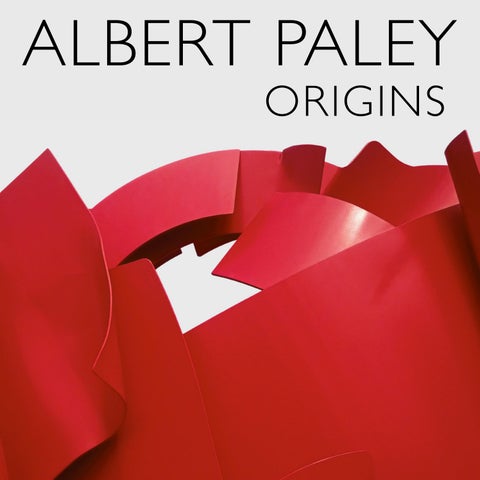
pinwheeling forms of Odyssey, created in 2007 for a site in Council Bluffs, Iowa. Models in cardboard, wood, string, painted foam core, and steel display options considered for the exuberant, uplifting cluster of flamelike shapes envisioned for Beckoning, a 2008 sculpture created for the National Harbor waterfront development in Maryland, just outside Washington, D.C. Models in cardboard, glue, and 3-D printed plastic show the evolution of ideas for Cloaked Presence, (2022) a sculpture conceived for a site in Toronto as an energetic bouquet of red-painted interlocking cylinders, discs and swirling belts of steel with edges cut to suggest the action of tearing or ripping. The exhibition also includes numerous examples of Paley’s animal studies for the Animals Always sculpture at the Saint Louis Zoo. Among them are studies for penguins, a female monkey and her baby, a lemur, a giraffe, an angelfish, elephants, a cheetah, a toucan, an ostrich and a cockatoo.
Iowa Interstate 80, South 24th Street
OPPOSITE
Paley didn’t start out with the ambition to create monumental works of public art. It was a calling he discovered while pursuing his career. A native of Philadelphia, Paley earned bachelor of fine arts and master of fine arts degrees at Temple University’s Tyler School of Art, respectively, in 1966 and 1969. After joining the faculty of the School for American Craftsmen at the Rochester Institute of Technology, where he taught for many years, he became a goldsmith and jewelry designer associated with the emerging American Studio Craft


Cloaked Presence Presentation Model, 2016
Installation of Cloaked Presence sculpture, 2020 Pedestrian Plaza, Intersection Gloucester and Yonge Streets Toronto, Canada
Cloaked Presence, 2020 (Detail) Gloucester on Yonge Pedestrian Plaza Toronto, Canada


Animals Always Cardboard Maquette,
[Cardboard Maquette for Saint Louis Zoo], 2005
Animals Always Angelfish Cardboard Maquette, 2005
Animals Always Mother Monkey and Baby Cardboard Maquette, 2005


Movement. Critics and curators grouped him with masterful peers, such as glassblower Harvey Littleton and goldsmith John Paul Miller. Ultimately dissatisfied with making small, decorative objects, however, Paley dreamed of transitioning from adorning the body to adorning cities. In 1974, Paley won a breakthrough commission to design Portal Gates, a pair of decorative doors made in forged steel, brass, copper and bronze, for the museum shop at the Renwick Gallery of the Smithsonian American Art Museum in Washington, D.C.
Based on the enthusiastic response to his work for the Renwick, Paley soon began to win numerous other architectural commissions. With Rochester as his home base, Paley developed a practice aimed at endowing historical and contemporary buildings and landscapes with what he calls “humanistic” focal points expressing an emotional, intuitive response that communicates a powerful sense of place. Paley’s career flourished as he earned support from sympathetic architects eager to enlist high-quality art as a critically important element in place-making. “I felt a real kindred spirit in those relationships,’’ as Paley put it in a recent conversation. His collaborators have included stylistically diverse American architects, such as Malcolm Holzman, Kevin Roche, William Pedersen and design firms such as, Pressley Associates, Sasaki and Morris Albury. Paley is particularly proud of having won an Institute Honors Award in 1995 from the American Institute of Architects, the field’s leading organization, for “distinguished achievements that benefit the environment and the architectural profession.’’
Paley’s substantial sculptural models, many standing three feet high or more, reflect a particular facet of Paley’s creative process. He used them to present at least several near-final options for consideration by client groups, ranging from government committees to corporate boards. “I will do three prevariations or three proposals,’’ he said, “one more dense, one more open, one more angular, one less. It will create a spectrum of possibilities for the project, and it allows for dialogue.’’ Through such conversations, Paley has sought to better understand the needs and possibilities of a given project from his interlocutors. “I try to find out why they respond,’’ he said. There is give and take, but Paley said he never accepts commissions in which a client outlines a goal so specific that it would constrain his creativity or compromise his artistic

Portal Gates Concept Drawing I [Preparatory Drawing No. 1 for Renwick Gallery], 1972
Portal Gates Concept Drawing II [Preparatory Drawing No. 2 for Renwick Gallery], 1972
Portal Gates Concept Drawing III [Preparatory Drawing No. 3 for Renwick Gallery], 1972 ABOVE
Reinterpretation of the Portal Gates , 2009
(For the 20 th Anniversary of the installation of the Renwick Gallery Gates) Smithsonian American Art Museum


ABOVE L/R
Paley Studio, 1974
Fabrication of Portal Gates for Renwick Gallery
OPPOSITE
Portal Gates, 1974
Renwick Gallery, Smithsonian American Art Museum
Washington, D.C.
Reinstallation of Portal Gates, 2009
Renwick Gallery, Smithsonian American Art Museum
Washington, D.C.


ABOVE L/R
Paley Studio, 2004
Threshold Wood and Paper Maquette
Paley Studio, 2004
Artist working on large Threshold Concept Drawing


integrity. He’s not a fabricator for hire. “The one thing that I have never done if an architect or client wants me to do a certain thing, something of their own design, forget about it. They’re coming to me for my insight and background. It’s what I have to offer. It’s not for me to execute their image of what something should be.’’
Before embarking on making a full-scale sculpture, Paley prepares a final presentation model, often fabricated in metal. These exhibition-worthy sculptures have been sold and collected and have a life of their own in the art market. Paley meanwhile retained his late-stage cardboard and wood maquettes, and it is these works that form the backbone of the Clarinda Carnegie Art Museum’s Collection of his work, along with a selection of working drawings and other materials generated in the creative process.
Among other qualities, the models embody an acute understanding of the materiality of a finished project. As late-in-the-game explorations of a particular idea, models rendered in cardboard and wood reflect Paley’s insight, gained through experience, of exactly how any particular form may actually be rendered in steel. They echo earlier practices in which sculptors created small-

Cardboard and Paper Maquette, and Threshold Steel Maquette
Paley Studio, 2004
Artist and studio assistant measuring maquette for Threshold sculpture


scale studies in plaster or clay as a way to explore what might be possible in marble or bronze. His models also reflect Paley’s grasp of the structural forces involved in constructing large-scale sculptures that may weigh many tons. Working with a consulting engineer, he will calculate, for example, how strong a foundation for a given sculpture needs to be, how it should be anchored in place, how its component parts should be made, and how they should be fastened together. The models combine art and science, engineering and aesthetics.
Encountering Paley’s models and sketches in the Clarinda museum enables us to stand in proximity to an important step in Paley’s creative process as he imagined his artworks and how they could be built. The preparatory studies place viewers today in the position of the client groups that once surveyed these materials as they debated pros and cons of various versions with Paley, seeking to decide on which direction to take. Most important, the models turn us into witnesses of one artist’s search to satisfy a need that has remained constant across centuries: that of creating large-scale objects of beauty and meaning in public space that crystallize emotion and humanize the world in which we live.
Steven Litt Art and Architecture Critic, The Plain Dealer
Cleveland, Ohio


SCULPTURE COMMISSIONS: A DEMANDING PROCESS. Albert Paley’s first major success was his winning gate design for the Renwick Gallery at the Smithsonian American Art Museum in Washington, D.C. The project had brought him to national attention. In fact, the brass, steel, bronze and copper Portal Gates were so popular, they stimulated enough commissions for Paley to shift the focus of his career to architectural ironwork.
Paley still thrills at the capacity of metal to transform when heated from a rigid state to a corpus that moves and is manipulable.
“You heat a piece of metal, you hit it, it forms, and it develops a line in space that has continuity,” Paley told Susan Stamberg in a 2014 PBS interview. “When I’m working on it, I’m experiencing movement. It’s almost like, if this were heated up again, it would continue to move.”1
The vast majority of Paley’s works are commissions for public or corporate projects, fewer are for collectors, and an even smaller number spring from the artist’s desire to make them. The latter group might be for exploration or mastery of a technical skill.
“I’ve never turned something down because I didn’t feel I was capable of doing it,” Paley said. “I figured I’d find a way to do it. That’s part of the growth process. So, when the jobs or projects, the commissions, got larger, I couldn’t do
Artist working on fabrication drawing for the W.J. Beal Garden Gates, University of Michigan Ann Arbor, MI

them by myself, so I would hire somebody. The studio grew and grew and grew. Basically, it was to create opportunities for me to be able to (accept more projects). At this point in time, I have a 50,000 square-foot studio and 16 full-time employees.”2
Paley said every project is unique, but the customary process for commission competitions begins with submission of credentials and data regarding past projects. A committee will usually invite from five to seven artists to make verbal proposals. These are frequently Zoom calls in which the artists give rough ideas about their media and types of works they might create. From this group, three or four artists might be invited for a site visit and given a small payment to submit a refined proposal. It is only after visiting the site that Paley will begin to formulate an idea about his design.
When he does turn his attention to the creative process, it is a demanding balance of aesthetics and pragmatism. Each piece must fit funding parameters, space availability, safety requirements for traffic, access and physical protection of pedestrians and have structural integrity.
He will consider how the sculpture’s scale, concept and design will enhance and be enhanced by the surrounding architecture and natural environment. Of utmost importance is how he can invite viewers’ active and passive interaction, which he considers the ultimate success of any sculpture.
If Paley’s proposal is successful, the work ahead is formidable. The process will begin with a timeline and financial feasibility study. Before a contract is signed, an engineer will prepare a report on the design’s structural soundness. Paley will assure appropriateness of the sculpture to the setting, submit a plan for site preparation and assure that costs will fit within the budget. When the contract is signed, Paley will no longer have the option of modifying the design.
While still in his large space, he would order materials at this point, with steel cut to the necessary shapes. Then Paley and his crew would begin the process of bending, contouring and refining each element. When this part of the process was completed, they would join the components, using such processes as bolting and welding, working the sculpture in sections precisely scaled for transporting. During the building process, Paley would have been in communication with his client to keep the timeline moving on both ends, assure

regulations were being met, and the site was being prepared for the crew to conduct the installation.
By the time Paley downsized, he had begun to focus on generating concepts and developing prototypes, leaving the grinding, sandblasting, welding, painting, lifting, moving and installing to his staff.
“Architects don’t lay bricks, they design-build,” Paley said. “Basically, the core of my value is in design development, and that’s going to be the same. I’m working on four or five commissions now, so I’m handling the design and feasibility study, and I’ll outsource the fabrication.”3

After refining his composition through concept drawings, Paley moves on to spatially exploring his ideas through a series of maquettes. A specific example of Paley’s working process can be followed in the preparatory drawings and maquettes that become realized in his large-scale sculpture Counter Balance
“All I’ve wanted to do my whole life is to make artwork,” Paley said, “and the art and what I experience as far as the creative process of developing form comprises a small amount of my time, The older you get, time becomes an incredibly valuable commodity.”4


ABOVE L/R
6.
Artist
Smithsonian American Art Museum
Washington, D.C.
7.
OPPOSITE
8.
Artist
Renwick Gallery
Smithsonian
FORGING IDEAS: THE CREATIVE PROCESS. Paley’s success with the Renwick’s Portal Gates in 1974 led to commissions such as the Hunter Museum Fence in Chattanooga, Tennessee, in 1976; the Portal Gates for the New York State Senate Chamber of the State Capitol in 1980; and Garden Gate for the 1983 exhibition Towards a New Iron Age, organized by the Victoria and Albert Museum in London. The gate exhibited in London included with its lissome bends and tendrils tightly twisted elements, stacks of welded geometric forms and complex hinges, demonstrating the breadth of Paley’s forging skills.
This experience with gates, elevator doors, fences and other such architectural features kindled Paley’s desire to learn more about architectural design and history. As he combined his project experiences with research, he developed an architectural vocabulary and began to build proficiencies around working with architectural plans, blending aesthetics with function, using form to direct pedestrians, playing off architecture to give sites unique identities and scaling his sculptures to give buildings, their environments and pedestrians a cohesive, welcoming environment.


As he built these competencies, Paley was given a diversity of commissions in varying media, primarily steel. He finds it difficult to characterize the scope of his work beyond saying they are evolutionary and that he has no idea what he is capable of until he delves into a project.
His creative decisions are driven first by emotion and then by a hunger to explore the limits of his medium, as he melds the unique requirements of each project with a storehouse of skills.
“Emotions by their nature are invisible, and they don’t have a verbal language,” Paley said. “It has to do with feelings, sensations and so forth.”5
He likens his creative process to the Roman god Janus, the god of beginnings, transitions, portals, passages and endings, whose two faces look to the past and the future, together representing the present.


“So, you’re always in the present,” Paley said, “and it’s not necessarily paradox, but we live in those realities all the time. And that’s why my work deals with complexity. I don’t see singularly because everything is codependent on everything else.”6
He has amplified these seeming incongruities by infusing his sculptures with a sense of movement and weightlessness. He sometimes incorporates graceful ribbons of steel that appear to flutter 40 or more feet overhead as though, with the next gust, they might float away. One such sculpture is Tribute to Volunteerism, a vibrant, 40-foot work that seems to sizzle with the energy and positivity that community volunteers bring to a region.


ORIGINS: THE MOVING LINE. As his reference to Janus indicates, Paley is acutely attuned to the passage of time, from the unfolding of the universe to the time it takes for a pen to engage with paper and, being moved along, transform into a line that will at some point end. He contrasts the sensuous nature of this act and its results to the phlegmatic immediacy of a computerized image.
“I move through states,” Paley says of his design process, “and all I experience is motion and gesture, and within gesture there’s nuance, there’s continuum, there’s possibly repetition and so forth.”7 Paley begins the creative phase with between 100 and 200 quick gestural sketches. As he draws, he is thinking threedimensionally. He imagines a line defining space rather than of a two-dimensional rendering of a sculptural object.
He likens the process to the way in which Alberto Giacometti built an organizational structure from which his image would emerge, “almost like coming out of a fog.”8
As he sketches, imagining the tip of his pencil as a point in three-dimensional space, Paley also envisions the image magnified to a scale that might be 80 or 90 feet in height. He experiences a time and spatial relationship with every line and says that for him, the line defines the edge of a form, in contrast to planar relationships. He finds pulse and flow in the shaping of languorous, coiled, twisted, toothed or ragged lines.
“Initially I start out with quick gestural sketching, so I can get the composition,” Paley said in an episode of PBS’s Craft in America. “I draw and draw and draw, and I start to build up a matrix, and I will select what I feel are the most important, thinking all the time I’m drawing about the structural necessity of the metal and what the metal will do.”9
As the form takes shape, he begins to solidify his concept through more particularized drawings. He thinks of his lines as motion, frozen but not static, which makes them intimate and distinguishes them from the computer-assisted images his assistant produces from his drawings.
“So, the drawing process creates its own sense of logic,” Paley said. “It’s one experience compounding on another.”10


OPPOSITE L/R
16. Sculptural Forms Concept Drawing No. 4, 1991
17. Sculptural Forms Concept Drawing No. 3 [Paragon, Water Walk Concept Drawing], 1991
18. Sculptural Forms Concept Drawing, 1991 ABOVE L/R
19. Sculptural Forms Concept Drawing No. 2, 1991
20. Sculptural Forms Concept Drawing [Birmingham Sketchbook, Page 3], 1989


THE CREATIVE PROCESS: COUNTER BALANCE . After defining his composition through drawings, Paley moves on to actual space by creating a series of models. The first of these are cardboard, which is flexible and easy to manipulate. The computer will read his drawing and laser cut the forms. “With sculpture, specifically, you deal with the physicality of the materials,” he said. “You deal with space. And so there are the two. Space is invisible, but it is just as tangible as anything else.”11
Paley will then maneuver the cardboard components in space, fitting them together until he feels the sculpture is balanced and unified. The works must have structural integrity and must be constructed so they can be taken apart for shipment. After working through these issues with cardboard, he will turn to metal for his presentation model. “With all of the preparatory information and evaluation that happens with the model form,” Paley said, “when we finally get into the fabrication, it’s very clear what needs to be done, how much it’s going to cost, and so on.”12


Paley is prone to carry the sensation of the moving line into his drawing and modeled forms, the allusion to movement is generally present in his finished works. We find currents and cadences even in his geometric gates, and the doorways like lacy organic walls are filled with modulations of light and shadow that pull our eyes this way and that.
His preparatory drawing for Encore depicts the unmistakable gesture of a moving figure. While the cardboard model and final form are more abstract, the sense of forward stride remains. Such comparisons of Paley’s drawings and models demonstrate the distinctions between the two- and three-dimensional aspects of his design origins. The uniqueness that distinguishes each of his works is rooted in this tactile phase.


FORMING A CONTEXT: THE BECKONING . Paley’s 2008 polychrome steel sculpture The Beckoning is a dynamic, welcoming presence near the entrance of the burgeoning convention-resort destination of National Harbor, Md. The site is a 12-minute drive from the U.S. Capitol and a short boat ride across the Potomac to Mount Vernon.
ABOVE L/R
33. The Beckoning Concept Drawing, 2006
34-35. The Beckoning Cardboard Maquette III, 2006
OPPOSITE L/R
36-37. The Beckoning Cardboard Maquette III , 2006
38. The Beckoning, 2008
National Harbor Complex
National Harbor, MD
The present and the past were very much in Paley’s thoughts as he conceived a design and then constructed a half-dozen cardboard models and a 119-inch maquette of hot rolled steel to enable him to work through ideas and structural issues.
The colossal sculpture is well situated in a verdant park and visible from afar. The Beckoning rises 85 feet, with a pinnacle of leaflike forms that seem to


burst forth like Independence Day fireworks. A wing-like form enfolds the lower area, dipping below the sculpture’s base and across its concrete pedestal. Its bold colors bring to mind Emma Lazarus’ poem acclaiming the Statue of Liberty as a symbol of open arms to those who would build a great nation. Nearby, a pair of stainless-steel eagles, also designed by Paley, appear to fly above 60-foot columns. They are neither taking off nor soaring, but instead, seem to be negotiating the air currents high above, in acts of strength and perseverance. Paley’s designs hit a sweet spot in celebrating the nation’s complex history, its rich natural resources and the compelling site it occupies.


THE MUSIC OF DESIGN: CLOAKED PRESENCE , THE BECKONING , PROGRESSIONS , AND COMPOSED PRESENCE. Cloaked Presence, which Paley designed for Concord Adex’s Clover on Yonge Development in Toronto, Canada, in 2022, is less than half the height of The Beckoning in National Harbor, yet its fire-engine red color, the dynamism of its diagonal components and the girth created by the curved steel plates that comprise its base give it a formidable presence on the Yonge and Gloucester Street pedestrian plaza. The base is designed so that not only can light pass between the elements, but it invites pedestrian interaction.
Its lines draw attention upward to an arch that leads the eye down, then up and across long jazzed rectangles. The work’s organic form and height reconcile the building’s magnitude with human scale.
39, 40. Cloaked Presence Presentation Model, 2018
41. Cloaked Presence, 2022
Pedestrian Plaza, Intersection
Gloucester and Yonge Streets Toronto, Canada
The cardboard models for Cloaked Presence reinforce Paley’s desire to encourage pedestrians’ interaction by designing the base as both opened and closed. Its slight tilt seems to marry the work with the building it enhances. His handsome presentation model was generated with a 3-D printer, of Polylactic Acid, using an extrusion process called fused filament fabrication.
When Paley talks about his finished sculptures, his vocabulary changes from pragmatic and technical to lyrical. He uses terminology common to dance or music … counterpoint, rhythm, tempo, repetition, variation, energy, pattern, flow.
The uniqueness of his art lies in introspection, the understanding of self, and how that is manifested through inorganic and organic materials, he said. He believes emotion reveals itself through subtle or violent gesture, light and shadow, balance and asymmetry, accord and deviation. Those perspectives are reflected in Cloaked Presence
In a poem Albert Paley wrote and read at the dedication of Cloaked Presence, Clover on Yonge, Toronto, Canada, December 7, 2022, he references the musicians who will play for the event, alluding to the musicality of the sculpture. Paley points out how the work’s shadows cast a patterned carpet across which pedestrians walk and how its curves form a counterbalance to the geometric simplicity of the surrounding buildings.
Cloaked Presence
ALBERT PALEY, 2022
Exotic flowers in tall vases placed
And musicians’ violin and cello played In patterns
Formed and rearranged sliding off its crimson skin Soft white
Layered this the first of falling snow
Interlocking planes here cradled
Its countenance in gesture revealed
Amidst the crystalline geometry of reflective glass and steel In stasis
Its imagined stance of those who came Where once the sun’s shodows had crossed their prints
Now trace in the follen snow
In the coldness of night here
In the openness of becoming
Its nascent breath had formed
In the warmth of intimacy wrapped cloaked
Here its presence unveiled.


IN
Cloaked Presence, The Beckoning, Progression, and Composed Presence, are dissimilar in form and sensibility, yet they share a treelike configuration that Paley revisits from time to time. One might assume that the choice stems from his lifelong love of nature, but the fact that half of the mass of a tree in nature is invisible isn’t lost on the artist. He is aware that mighty trunks and lush canopies depend on complex root systems, a fitting metaphor of the creative process itself.
“Organic forms deal with cause and effect,” Paley said. “You have a plane of water, and it looks like a mirror and if you touch it, it makes ripples. So, there’s a definite cause and effect, an interaction from one to the other. In my work too, the forms are not independent. They’re interdependent. One relates to the other, the same as a dance or dancing. The hand is different from the foot is different from the back, but they all relate to one another, as they deal with the unified gestural system.”13
Paley says no two projects are the same. The demands of each are unique, and that’s the way he likes it. “I have extensive knowledge and technical skills, but all that stuff is meaningless to me,” Paley said, “because what excites me is what I don’t know. I use my understanding and skill set to explore new realities and, for me, that’s the excitement.”14 Such statements come from decades of building proficiencies and never hesitating to jump headlong into any project.
45.


He determined early on that every opportunity would make him a better artist and was always confident he could find a way to succeed. Failing that, he valued lessons learned.
ABOVE L/R
49. Composed Presence Concept Drawing, 2011
50. Composed Presence Cardboard Maquette, 2011
OPPOSITE L/R
51. Composed Presence Steel Maquette, 2013
52. Installation of Composed Presence, 2013
Park Avenue and 64th Street
New York, NY
53. Composed Presence, 2013
Park Avenue and 64th Street
New York, NY
Paley spent the early years of his childhood roaming the streets of Philadelphia, where he was always on the lookout for bottlecaps, bits of metal objects and other interesting treasures. When his family moved to a rural setting, the explorations yielded riches from the verdant environment. His love of nature remains integral to his makeup. In the same way he references music and dance, he might allude to how an ocean swell is followed by seafoam or how shadows are both distinguishable and nuanced. He has a lovely garden, and his home is filled with many of his own ornate metal furnishings offset by the natural grace of dried grasses and gnarly branches. Still, he has lived in cities most of his life and is energized by the complexities of urban environments. Both catalysts are apparent in his work and can manifest in forms that appear organic.
“In many ways that’s the way the mind functions,” Paley said. “You focus on one thing, and it translates into something else. Sometimes it goes back, sometimes there’s a shadow, sometimes there’s a memory, and it kind of creates a reality. And because of that, when you look at natural forms, there’s a causeand-effect relationship. You know, there’s motion, there’s material.”15


PASSAGES AND PORTALS: GARDEN GATE , GENESSEE PASSAGE , AND ODYSSEY In the earlier years of Paley’s career, when much of his professional activity was focused on architectural elements such as doors, gates, fences and archways, he began to consider the myriad ways in which individuals experience portals.
OPPOSITE L/R
55. Genesee Passage Concept Drawing II [Bausch & Lomb Genesee Passage Study No, 2], 1992
56. Genesee Passage Concept Drawing VI [Bausch & Lomb Genesee Passage Study], 1992
“The whole aspect of the act of passage … of entering through something, entering through time, moving from one point in time to another,” Paley said, “you think of something, you experience something, and you go through a portal to a different reality. Our life is a passage of time.You experience that act of passage. It’s just fundamental to the human condition.”16

A reflection of this concept is Genesee Passage, a 60-foot sculpture Paley created in 1996 for Bausch & Lomb’s new headquarters in Rochester. The work is a fascinating deconstruction of a classical column, with a flowing vertical ribbon of steel that echoes the nearby Genesee River. The halved column with stepped breaks is an appropriate metaphor for the company’s mission of vision care innovation and production. The elliptical space the sculpture anchors accommodates both automobiles and pedestrians. Its 60-foot height is proportionate to the building’s façade, while the lower, horizontally oriented elements bring human scale to the work.


AN OVERLAND ODYSSEY. Among Paley’s most innovative portals is Odyssey, a work in four parts sited on the outer corners of an Interstate-80 overpass in Council Bluffs, Iowa, that he designed specifically for motor vehicles.
Motorists enter western Iowa on a multifaceted stretch of highway. The works respond to the site in full.
Traveling east on Interstate 80 at Omaha, you cross the mighty Missouri River that separates Nebraska and Iowa. Giant chunks of frozen river below bump their way downstream. In a couple of months, they will give way to cargoladen barges. Cresting the bridge, you see the Loess Hills that run the length of the Missouri River Valley. These grassy slopes with wooded ravines give shelter to the 63,000 inhabitants of Council Bluffs. I-80, which continues east to Des Moines, merges for a short span with Interstate 29, which connects Sioux City to the north with Kansas City to the south.


Semis bearing heavy machinery, electronics and hazardous waste work the roads, along with automobiles, livestock and produce trucks, flatbeds carrying sophisticated farm equipment, and multi-bed trucks bearing gargantuan single blades for wind turbines. Overhead, planes take off from and land at Omaha’s Eppley Airfield, and flocks of geese, sandhill cranes, hawks and songbirds migrate through the Missouri River Flyway.
On this stretch of I-80, agriculture has given way to light industry, but there is still plenty of farming, mostly corn, along the rich Missouri River watershed.
Within five minutes of crossing into Iowa, we encounter Odyssey, Paley’s four-part sculpture on the 24th Street Bridge that crosses over I-80, and what a welcome to Iowa it is.
The component works mounted at the corners of the overpass and rising 100 feet above the interstate become visible long before we reach them. Darting along at 75 miles per hour, it is exhilarating to spot the great, spiky sculptures. We reach them too quickly, amazed by their huge scale and how the four segments assert themselves, as though they are flagrantly trying to seize the sky. We speed by, feeling we’ve been granted a sip but wanting a slurp. Of course, there is the anticipation of getting a better look the next time through. Known fondly to the regional population as the “Edward Scissorhands” sculptures, the works are in fact, an insightful acknowledgment of the area’s complexity.
Made of stainless steel, COR-TEN and bronze with a jade patina, the sculptural segments are disparate, but give virtual nods to one another. Their parts seem to echo the Great Plains’ persistent winds, the cumulous clouds that float across the blue skies and the agricultural crops that form the economic bedrock of the Midwest.
Iowa Interstate 80, South 24th Street Bridge (NE)
Council Bluffs, IA
OPPOSITE
62. Odyssey, (Sculptures 3 of 4 and 4 of 4), 2010
Iowa Interstate 80, South 24th Street Bridge
One of the Odyssey sculptures initially appears fanlike, but as we continue to look, it takes on the appearance of a straggler cornstalk, slowly bending under the weight of winter snows and winds, to be left for a spring plow to turn for nourishing next year’s crop. We think of Edward Muybridge’s photographs of running horses rolled into one enormous sculptural image, then notice all four sectors seem similarly activated. ABOVE
Council Bluffs, IA


Paley has digested the environs and designed an abstraction that invites viewers to respond. Before he left his massive Rochester workspace, truckers who traveled I-80 visited Paley, wishing to meet the artist and see where such wonders were made.
The drawings and models of Odyssey offer the chance to satisfy curiosity about the works’ details, such as the various devices he has used to mirror the interminable noisy flow of traffic and ceaseless Midwestern winds.


ABOVE L/R
OPPOSITE


EXPERIENCING TRANSITIONS: ANIMALS ALWAYS In contrast to Odyssey’s fleeting but dynamic experience is a ceremonial archway at the Saint Louis Zoo that offers visitors an opportunity to decompress, consider the bonds and synergies humans and animals share, and to anticipate an exceptional experience.17
The kernels of the project had germinated for more than two decades before the possibility of its realization arose. It had begun with a proposed gateway to Central Park Zoo derailed by funding constraints. So, years later, when an animal lover from Saint Louis toured Paley’s studio and admired a maquette of a bird, he told her about the Central Park project and showed her the presentation drawing. Before week’s end, Thelma Zalk had called to say she was interested in funding such a project in Saint Louis. Paley visited the zoo and began developing ideas for the design of Animals Always 18

It would take three demanding years to design and fabricate an archway with 60 animals and the grasses, trees, waters and icefloes each species would inhabit to be placed near the Forest Park entrance to the zoo. The final work would be 36 feet high, 130 feet wide and 8 feet deep. It would weigh more than 100 tons. 19
Because Paley was accustomed to designing abstractions in an intuitive, spontaneous way, figuring out how to portray animals and their habitats in steel presented a challenge. Characteristically, he plunged in, balancing an emotional impetus with his knowledge of the materials’ properties. He had no intention of replicating the animals’ likenesses but did want to suggest specific forms and surfaces. He solved the issue of fur, feathers, scales, spots and stripes by edging and overlaying steel shapes with patterned cutouts.


When Paley felt that each animal had the balance and gesture he wanted, he drew the individual elements. The drawings were fed into a computer, which laser cut the steel forms from which the animals would be made.20
ABOVE L/R
74. Animals Always Giraffe Patterns 1 of 2, 2005
75. Animals Always Giraffe Patterns 2 of 2, 2005
76. Animals Always Giraffe Cardboard Maquette I , 2005
OPPOSITE
77. Paley Studio, 2005
Fabrication of steel maquettes for Animals Always
With the finished components assembled, it was apparent Paley had paid attention to how sunlight and shadows would play across the sculpture and how the grasses would lean toward an imposing entry arch. The animals are placed rhythmically and intentionally so that each is clearly visible, but visitors must look closely to see monkeys high in jungle trees, migrating geese, oceanic angelfish and the little penguins who huddle on an iceberg at the sculpture’s end. Paley even tucked a canine, using his own dog as a model, into the composition. Among the most endearing aspects of Animals Always is that an elephant, cheetah, giraffe and rhinoceros stand independent from the habitat area, so as visitors transition from the plaza to the zoo’s interior, they intermingle with the life-sized animals, offering an experience of anticipation distinct from their impending encounters.


ABOVE L/R


ABOVE L/R


ABOVE L/R


When Paley’s works are considered retrospectively, one can see identifiable stylistic and technical characteristics that distinguish them. There is no apparent overriding influence, nor do they show a slow, steady stylistic evolution, probably because Paley is inclined to seek jobs that offer new opportunities for experimentation and discovery.
Fragments of art historic ideas appear in the form of Gothic arches, curvy art nouveau tendrils, constructivist assemblages and expressionistic steel diagonals.
In discussing his work, he might quote Pablo Picasso as saying, “I don’t work from nature, I work like nature,”21 or he might refer to how the early nonobjective painter Wassily Kandinsky saw music and painting as parts of the same thing.
Paley’s 2012 sculpture Tilted Column nods to both the early 20 th century Constructivism movement as well as its late 20 th-century postmodern


counterpart, deconstructivism.22 Its simple geometric shapes seem to be slipping and sliding, and the top two-thirds appears to be in danger of toppling. Even the steel ribbons that typically unify Paley’s works look as though they’re beginning to melt. This work is just one example of Paley’s droll wit ensnaring unsuspecting viewers into a conundrum of eye versus intellect. Tilted Column was among 13 sculptures displayed on New York’s Park Avenue in 2013.
Threshold, a 71-foot sculpture Paley created for the Klein Steel headquarters in Rochester, New York in 2006 and Threshold II, a similar 20-foot work currently being fabricated for Karen and Robert Duncan, are both good examples of Paley’s penchant for combining incongruent elements that are simultaneously familiar and alien—majestic, yet organic—with leafy forms cut from steel plates that rest among their branches. In this way Paley cleverly accentuates the contrast between industrial abstraction and the natural world.
“Can you do something and actually amaze yourself with what you’ve done? There have been times I’ve done that,” Paley said. “So much of what I do deals with introspection. Why am I doing that? Or why do I consider that important? It’s problem solving all the time. People think creativity is freedom. It’s really the opposite. There’s this anguish because you’re dealing with problems that have no answers.”23
Paley has dared to look deep within, allowing the melodic and the discordant to take physical form.
“I’m not a minimalist,” Paley said chuckling. “Some artists are rational and logical, and others come from a more emotional context. I come from the emotional side, feelings and emotions. How does an emotion manifest itself in physical form? “24
Paley can’t answer that question specifically, but knows it is in part from a lifetime of venturing beyond any place he ever thought possible.
Anne Pagel, Curator
Clarinda Carnegie Art Museum and the Karen and Robert Duncan Collection

1. Susan Stamberg, With Swirls of Steel, These Sculptures Mark the Passage, Byline, 2014, PBS.
2. Albert Paley, interview by author, Rochester, N.Y., October 7, 2019
3. Ibid.
4. Ibid.
5. Albert Paley, interview by author, telephone, September 17, 2023
6. Albert Paley, interview by author, telephone, October 7, 2019
7. Ibid.
8. Ibid.
9. PBS, Craft in America, FORGE episode, 2013, https://www.pbs.org/video/craft-america-forge/
10. Ibid.
11. Albert Paley, interview by author, Rochester, N.Y., October 7, 2019.
12. Ibid.
13. Albert Paley, interview by author, telephone, September 17, 2023
14. Ibid.
15. Albert Paley, interview by author, Rochester, N.Y., 2019
16. Albert Paley, interview by author, telephone, September 17, 2023
17. Albert Paley, interview by author, telephone, May 12, 2023
18. Jim Kirchherr, “Animals Always Sculpture at the Zoo,” PBS, Channel 9 video, St Louis, Nov. 28, 2007 / Jim Kirchherr, “Animals Always Sculpture at the Zoo,” PBS, Channel 9 video, St Louis, Oct 18, 2021, https://www.pbs.org/video/october-18-2021-nut7l9/.
19. Lena Singer, “What’s Cool in Steel,” Modern Steel Construction, August 2006
20. Albert Paley, interview by author, telephone, October 7, 2019
21. Ibid.
22. Castro, Jan Carden, “Baroque Paradoxes: A Conversation with Albert Paley,” Sculpture, July/August 2014.
23. Albert Paley, interview by author, telephone, October 7, 2019
24. Albert Paley, interview by author, telephone, September 17, 2023
Albert Paley, interview by author, telephone, October 7, 2019
Albert Paley, interview by author, telephone, May 12, 2023.
Albert Paley, interview by author, telephone, Aug. 16, 2023.
Albert Paley, interview by author, telephone, Sept. 17, 2023.
Corning Museum of Glass. Harmony of Fusion: Specialty Glass Resident Albert Paley. Video. April 2015. www.youtube.com/watch?v=O3 tmb5MDQrk&t=25s
Corning Museum of Glass. Specialty Glass Resident. Albert Paley. Video. Dec. 2014, https://www.youtube.com/watch?v=rYzKbR8309o&t=95s
Corning Museum of Glass. Albert Paley, Behind the Glass Lecture. June 1, 2015. http://blog.cmog.org/tag/albert-paley/.
Dingfelder, Sadie. Find Albert Paley’s sculptures at the Corcoran Gallery’s American Metal and on area streets. The Washington Post. July 3, 2014.
Joslyn Art Museum Opens Albert Paley: Celebrating a Contemporary American Sculptor, Editor. August 8, 2010.
Kirchherr, Jim. Animals Always Sculpture at the Zoo. PBS. Channel 9 video. St Louis, Nov. 28, 2007. www.youtube.com/watch?v=ie8 eSzLvdjc
Kirchherr, Jim. Zoo Sculpture, Living Saint Louis. PBS. Channel 9 video. St Louis, Oct. 18, 2021. www.pbs.org/video/october-18 -2021-nut7 l9/.
Kuspit, Donald. Albert Paley: Sculpture. Skira, 2006. Lewis, Brent. Albert Paley Prepares for Park Avenue. Modern Magazine. June 18, 2013.
Lucie-Smith, Edward. The Art of Albert Paley. Harry N. Abrams. 1996. Craft in America, FORGE. PBS episode, 2013. https://www.pbs.org/video/craft-america-forge/
Ratcliffe, Carter. Albert Paley In the 21st Century. Rochester, N.Y. Paley Studios Ltd. 2010. Rowe, M. Jessica. Albert Paley Portals & Gates. Ames, Iowa. University Museums, Iowa State University. 2007.
Shearer, Linda. Albert Paley Threshold. Skira. 2008. Sims, Patterson. Albert Paley On Park Avenue. Italy. Silvana Editoriale. 2013. Singer, Lena. What’s Cool in Steel. Modern Steel Construction. Aug. 2006.
Stamberg, Susan. With Swirls of Steel, These Sculptures Mark the Passage. Byline. July 22, 2014. PBS. www.npr.org/transcripts/333596118.
Yarrington, James. Sentinel: The Design, Fabrication, and Installation of the Monumental Sculpture by Albert Paley at Rochester Institute of Technology. RIT Cary Graphic Arts Press. 2005.


1966 National Merit Award, American Craftsmen’s Council.
1973 National Design Competition (Portal Gates, Renwick Gallery, Smithsonian Institution, Washington, D.C.).
1975 Lillian Fairchild Award, University of Rochester, Rochester, NY.
Design in Steel Award (Architectural Medal), American Iron and Steel Institute of America.
Master Apprenticeship Grant, National Endowment for the Arts.
1976 Craftsman Fellowship Grant. National Endowment for the Arts.
Master Apprenticeship Grant, National Endowment for the Arts.
1978 Fullbright Fellowship/New Zealand.
(NOTE: Awarded, but unable to comply due to time constraints.)
1979 Craftsman Fellowship Grant, National Endowment for the Arts.
Master Apprenticeship Grant, National Endowment for the Arts.
Japan/United States Exchange Program, National Endowment for the Arts.
(NOTE: Awarded, but unable to comply due to time constraints.)
1980 National Design Competition (Park Benches and Tree Grates, Pennsylvania Avenue Development Corporation, Washington, D.C.).
1981 Certificate of Honor Award, Tyler School of Art, Temple University, Philadelphia, PA.

1982 Award of Excellence, American Institute of Architects: Art in Architecture (Portal Gates, New York State Senate Chambers, Albany, NY.
Faculty Exchange Scholar for the State University of New York, Brockport, NY.
1984 Visual Artists’ Fellowship Grant, National Endowment for the Arts.
1986 Silver Medal, International Teaching Center of Metal Design, Aachen, West Germany.
1988 Art in Public Space Award, DFA Ltd., National Juried Competition
1990 Culture and Arts Award, Greater Rochester Metro Chamber of Commerce, Rochester, NY.
1991 Artist’s Fellowship, New York Foundation for the Arts, New York City, NY.
1994 Gold Award - Furniture Category, National Ornamental & Miscellaneous Metals Association (NOMMA).
Elected a Fellow, College of Fellows, American Craft Council.
1995 Citations and Fellowship Award, National Association of Schools of Art and Design (NASAD).
Institute Honors, The American Institute of Architects (AIA), National Committee on Design.
Mitch Heitler Award for Excellence; Gold Award - Furniture Category; Silver Award - Metal Fabrication, Interior Category; Gold Award - Forging Category, National Ornamental & Miscellaneous Metals Association (NOMMA).
Second Prize, Exhibition Catalogues, Museum Publications Design Competition, Inspiration & Context: The Drawings of Albert Paley, American Association of Museums.
Visionary Award, American Craft Museum, New York, NY.
1996 Silver Award – Ornamental Metalwork Category; Silver Award –Furniture Category; National Ornamental & Miscellaneous Metals Association (NOMMA).
1997 Masters of the Medium Award, James Renwick Alliance, Renwick Gallery, Smithsonian Institute, Washington, D.C.
Bronze Award – Exterior Metal Fabrication Category, National Ornamental & Miscellaneous Metals Association (NOMMA).
Award of Excellence, Catalog, Salt Lake City AIGA 100, Age of Steel, American Institute of Graphic Artists, Salt Lake City, UT Chapter.
1998 Lifetime Achievement Award, Arts and Cultural Council of Greater Rochester, Rochester, NY.
2004 The Alex Bealer Award, Artist-Blacksmith’s Association of North America (ABANA).
2006 Philadelphia Craft Show Award, Bronze Medallion, Philadelphia, PA.
2010 American Craft Council Gold Metal Award for Consummate Craftsmanship.
2011 Rochester Institute of Technology Innovation Hall of Fame Inductee, Rochester, NY.
2013 George Eastman Award, the University of Rochester, Rochester, NY.
2014 Art Palm Beach Visionary award, Palm Beach, FL.
2015 Tyler Tribute Award, Tyler School of Art, Temple University, Philadelphia, PA.

AAdcock, Craig E. Albert Paley: Sculpture, Drawings, Graphics & Decorative Arts. Tallahassee, FL: Florida State University, Museum of Fine Arts, School of Visual Arts & Dance, 2001.
Anderson, Clay et al. The Craftsman in America. Washington, D.C.: National Geographic Society, 1975.
Albert Paley: Age of Steel. Provo, UT: Museum of Art, Bringham Young University, 1996.
Albert Paley: The Art of Metal. Springfield, MA: Museum of Fine Arts, 1985.
Albert Paley Monumental Forms: Drawings, Models and Sculpture. Easton, MD: Academy Art Museum, 2008.
Albert Paley: Recent Works. Gainesville, FL: Samuel P. Harn Museum of Art, University of Florida, 1992.
Albert Paley: Sculptural Adornment. Washington, D.C.: Renwick Gallery of the National Museum of American Art, Smithsonian Institution, 1991.
Albert Paley: Sculptures. Philadelphia, PA: Rosenwald-Wolf Gallery, Philadelphia College of Art and Design at The University of the Arts, 1992.
American Crafts ’76. Chicago, IL: Museum of Contemporary Art, 1976.
American Crafts 1977. Philadelphia, PA: Philadelphia Museum of Art, 1977.
American Jewelry Today. Scranton, PA: Everhart Museum, 1965.
American Metal Work, 1976. Lincoln, NE: Sheldon Memorial Art Gallery, University of Nebraska, 1976.
Architectural Art: A Discourse. New York, NY: American Craft Museum, 1988.
Art to Art: Albert Paley, Jim Dine, Therman Statom Respond to Toledo’s Treasures Toledo, OH: The Toledo Museum of Art, 1996.
Art That Works: Decorative Arts of the Eighties. Seattle, WA: University of Washington Press, 1990.
B
Bach, Penny Balkin. Public Art in Philadelphia. Philadelphia, PA: Temple University Press, 1992.
Barquist, David L. American Tables and Looking Glasses in The Mabel Brady Garvan and Other Collections at Yale University. New Haven, CT: Yale University Art Gallery, 1992.
Bell, Robert. Design Visions: International Directions in Glass, American Jewellery and Metalwork. Australia-New Design Visions. Perth, Australia: Art Gallery of Western Australia, 1992.
Bishop, Robert and Patricia Coblents. American Decorative Arts: 360 Years of Creative Design. New York, NY: Harry N. Abrams Inc., 1982.
Brayer, Elizabeth. Magnum Opus: The Story of the Memorial Art Gallery Rochester, NY: Memorial Art Gallery of the University of Rochester, 1988.
Buff, Sheila. Custom Made: A Catalogue of Personalized and Handcrafted Items. New York, NY: MacMillan Publishing Company, 1990.
Byars, Mel. The Design Encyclopedia. New York, NY: John Wiley & Sons, Inc., 1994.
Baroque ’74. New York, NY: Museum of Contemporary Crafts of the American Crafts Council, 1974.
Breaking Barriers: Recent American Craft. New York, NY: American Craft Museum, 1995.
CCampbell, Marian. An Introduction to Ironwork. London, England: Her Majesty’s Stationery Office, 1985.
Campbell, Marian. Decorative Ironwork. London, England: V & A Publications, 1997.
Carlock, Marty. A Guide to Public Art in Greater Boston: from Newburyport to Plymouth. Boston, MA: Harvard Common Press, 1988.
Chamberlain, Marcia. Metal Jewelry Techniques. New York, NY: WatsonGuptill Publications, 1976.
Chatwin, Amina. Into the New Iron Age: Modern British Blacksmiths.
Cheltenham, England: Coach House Publishing, 1995.
Christ, Ronald and Dollens, Dennis. New York: Nomadic Design. New York, NY: Gustavo Gili, 1983.
Christ, Ronald and Dollens, Dennis. New York: Nomadic Design. New York: Watson-Guptill Publications, 1993.
Clarke, Mathew S. From Fire to Form: Sculpture from the Modern Blacksmith and Metalsmith. Atglen, PA: Schiffer Publishing, 2009.
Coffin, Sarah; Davidson, Gail; Lupton, Ellen; and Hunter-Stiebel, Penelope. Rococo: The Continuing Curve, 1730-2008. New York: Cooper-Hewitt National Design Museum, 2008
Conway, Patricia. Art for Everyday: The New Craft Movement. New York, NY: Clarkson Potter, 1990.
Cook, Beth; Reynolds, Rebecca; and Speight, Catherine. Museums and Design Education: Looking to Learn, Learning to See. Surrey, England: Ashgate Publishing, 2012.
Cooke, Edward S. and Museum of Fine Arts, Boston. Collecting American Decorative Arts and Sculptures: 1971-1991. Boston, MA: Museum of Fine Arts, 1991.
Charles Rand Penney Collection: Twentieth Century Art, The. Rochester, NY: The Memorial Art Gallery of the University of Rochester, 1983.
Centennial Arts and Crafts Exhibition: Celebrating Contemporary Craft 2001. Providence, RI: Providence Art Club, 2001.
Copper 2: The Second Copper Brass/Bronze Exhibition. Tucson, AZ: University of Arizona Museum of Art, 1980.
Contemporary American Crafts. Philadelphia, PA: Philadelphia Museum of Art, 1991.
Contemporary American Decorative Arts and Sculpture: 1971-1991. Boston, MA: Museum of Fine Arts, 1991.
Contemporary Furniture Makers of the American Northeast. Princeton, NJ: The Gallery of Bristol-Myers Squibb, 1991.
Contemporary Jewelry and Leather. Kentfield, CA: College of Marin, 1978.
Contemporary Jewelry and Silversmithing. Mexico City, Mexico: Universidad Nacional Autónoma de México, 1975.
Craft, Art, and Religion, Second International Seminar Exhibition: Summer 1978. New York, NY: The Committee of Religion and Art of America, Inc. for Smithsonian Institution, Washington, D.C., and The Vatican Museum and Galleries, Rome, Italy, 1978.
DDi Pasquale, Dominic; Delius, Jean; and Eckersley, Thomas. Jewelry Making: An Illustrated Guide to Technique. Englewood Cliffs, NJ: Prentice-Hall, 1975.
Daniels, Myra. Living with Studio Furniture: Collection of Robert and Carolyn Springborn. Naples, FL: Naples Museum of Art, 2009.
Diamondstein, Barbara Lee. Handmade in America: Conversations with Fourteen Craftmasters. New York, NY: Harry N. Abrams, Inc., 1983.
Dormer, Peter and Turner, Ralph. The New Jewelry: Trends and Traditions London, England: Thames and Hudson, 1985.
Dormer, Peter and Turner, Ralph. The New Jewelry: Trends and Traditions Revised edition. New York, NY: Thames and Hudson, 1994.
Doubilet, Susan and Fox & Fowle Architects. Fox & Fowle: Function, Structure, Beauty (Talenti). Milan, Italy: L’Arca Edizioni, 1999.
Decade of Craft, A. New York, NY: American Craft Museum, 1990.
Decorative Metalwork in Architecture. Minneapolis, MN: University of Minnesota, 1986.
Design is the Art of Our Time. New York, NY: Design Industries Foundation for AIDS/Metropolitan Home, 1988.
Design Visions: International Directions in Glass, American Jewellery and Metalwork. Perth, Australia: Art Gallery of Western Australia, 1992.
EEnglish, Helen Drutt and Dormer, Peter. Jewelry of Our Time: Art, Ornament and Obsession. New York, NY: Rizzoli, 1995.
Eloquent Object, The. Tulsa, OK: The Philbrook Museum of Art, 1987.
8th General Assembly and International Conference, Kyoto, Japan. New York, NY: World Crafts Council, 1978.
Exhibition of Liturgial Arts. Philadelphia, PA: Museum of the Philadelphia Civic Center, 1976.
F Fitzgerald, Oscar P. Studio Furniture of the Renwick Gallery Smithsonian American Art Museum. East Petersburg, PA: Fox Chapel Publishing, 2008.
First International Festival of Iron. Wales, United Kingdom: National Museum of Wales, 1990.
First International Metal Art Workshop & Seminar, The. Iri, Korea: Won Kwang University, 1995.
Five Modern American Masters. Cleveland, OH: The New Gallery of Contemporary American Art [Cleveland Centre for Contemporary Art], 1983.
Five Visiting Artists. Pittsburgh: Carnegie-Mellon University, 1984.
Form ’74. DeKalb, IL: Northern Illinois University, 1974.
Forms in Metal/275 Years of Metalsmithing in America. New York, NY: Finch College Museum of Art and Museum of Contemporary Crafts of the American Crafts Council, 1975.
Fourth Invitational Contemporary Crafts Exhibition. Saratoga Springs, NY: Skidmore College, 1975.
Functional Ornament: The Ironwork of Albert Paley. Iowa City, IA: University of Iowa, Museum of Art, 1983.
GGilbert, Lela. Albert Paley: Reconfiguration. Portland, OR: Pinatubo Press, 2008. Greenhalgh, Paul. The Persistence of Craft. London, England: A & C Black, 2002.
Gribaudo, Paolo. Albert Paley on Park Avenue. Milan, Italy. Silvana Editoriale, 2013.
Goldsmith, The. St. Paul, MN: The Minnesota Museum of Art, St. aul, 1974.
Goldsmith ’70. St. Paul, MN: Permanent Collection Gallery, Minnesota Museum of Art, 1970.
Goldsmithing Exhibition. Mexico City, Mexico: Universidad Nacional Autónoma de México, 1975.
HHall, Julie. Tradition and Change: The New American Craftsman. New York, NY: Dutton, 1977.
Hesselbom, Ted; Jonsson, Love; Zunnernabb, Heiner; and Paley, Albert. Albert Paley, Steneby & Rohsska Museet. Gothenburg, Sweden: Röhsska Museet, 2002.
Hollander, Harry. Plastics for Jewelry. New York, NY: Watson-Guptill, 1974.
Holzman, Malcolm. Stone Work: Designing with Stone. Victoria, Australia: Images Publishing, 2002.
Holzman, Malcolm. A Material Life: Adventures and Discoveries in Materials Research. Victoria, Australia: Images Publishing, 2009.
Horn, Robyn. Living with Form: The Horn Collection of Contemporary Crafts Little Rock, AR: Bradley Publishing, 1999.
Hughes, Graham. The Art of Jewelry: A Survey of Craft and Creation. London, England: Peerage Books, 1972.
Inspiration & Context: The Drawings of Albert Paley. Richester, NY: Memorial ArtGallery of the University of Rochester, 1994.
Iron, Solid Wrought/USA. Carbondale, IL: Southern Illinois University, 1976. Invitational Crafts Exhibition. Albuquerque, NM: The University of New Mexico, 1973.
International Jewelry Art Exhibition. Tokyo, Japan: Nihon Keizal Shimbun, 1976.
Invitational Jewelry Exhibition. Pensacola, FL: Pensacola Junior College, Visual Arts Gallery, 1975.
JJeon, Yong-il. Techniques of Metalsmithing & Jewelry Making. Seoul, Korea: Design House, 1994.
Jensen, Robert and Conway, Patricia. Ornamentalism: The New Decorativeness In Architecture and Design. New York, NY: Clarkson Potter, 1982.
Jewelers, U.S.A. Fullerton, CA: California State University, 1976. Jewelry ’71. Toronto, Canada: Art Gallery of Ontario, 1971.
KKangus, Matthew. Craft and Concept: The Rematerialization of the Art Object. New York, NY: Midmarch Arts Press, 2006.
Korman, Jane. Splendid Settings: The Art and Craft of Entertaining. Minneapolis, MN: Chester Book Company, 2010.
Kuspit, Donald. Albert Paley: Sculpture. Milan, Italy: Skira, 2006. Kanazawa Arts and Crafts Competition ’91. Kanazawa, Japan, 1991.
LLauria, Jo and Fenton. Stephen. Craft in America: Celebrating Two Centuries of Artists and Objects. New York, NY: Clarkson N. Potter, 2007.
Lewin, Susan Grant. One of a Kind, American Art Jewelry Today. New York, NY: Harry N. Abrams. 1994.
Lovenheim, Barbara. Breaking Ground: A Century of Craft Art in Western New York. Manchester, VT: Hudson Hills Press, 2010.
Lucie-Smith, Edward. The Art of Albert Paley. New York, NY: Harry N. Abrams Inc., 1996.
Lucie-Smith, Edward. Art Today. London: Phaidon Press, 1995. Landmark Society of Western New York., The. Walking Tours of Downtown Rochester: Images of History. Rochester, NY: The Landmark Society of Western New York, 1993.
MMcCreight, Tim. Design Language. Brunswick, ME: Brynmorgen Press, 1996.
McMaster, Julie A. The Enduring Legacy: A Pictorial History of the Toledo Museum of Art. Toledo, OH: Toledo Museum of Art, 2001.
Manhart, Marcia. The Eloquent Object: The Evolution of American Art in Craft Media Since 1945. Seattle, WA: University of Washington Press, 1987.
Marquis Who’s Who, Inc. Who’s Who in the East (1979-1980). Berkeley Heights, NJ: Marquis Who’s Who, Inc. 1979.
Mayer, Barbara. Contemporary American Craft Art: A Collector’s Guide. Layton, UT: Peregrine Smith Books, 1988.
Meilach, Dona Z. Decorative and Sculptural Ironwork: Tools, Techniques & Inspiration. New York, NY: Crown Publishing Group, 1977.
Meilach, Dona Z. Decorative and Sculptural Ironwork: Tools, Techniques & Inspiration, 2nd Edition. Atglen, PA: Schiffer Publishing, 1999.
Meilach, Dona Z. Ironwork Today: Inside & Out. Atglen, PA: Schiffer Publishing, 2006.
Miller, Judith H. Decorative Arts: Style and Design from Classical to Contemporary. New York, NY: DK Publishing, 2006.
Miller, R. Craig. Modern Design in the Metropolitan Museum of Art: 1890-1990. New York, NY: Harry N. Abrams Inc., 1990.
Minamizawa, Hiroshi. The World of Decorative & Architectural Wrought Iron. Kyoto, Japan: Yoshiyo Kobo Co., Ltd., 1990.
Monroe, Michael. The White House Collection of American Crafts. New York, NY: Harry N. Abrams Inc., 1995.
Morton, Philip. Contemporary Jewelry: A Studio Handbook. New York, NY: Holt, Reinhart, and Winston, 1970.
Muhlberger, Richard, Hunter-Stiebel, Penelope et all. Albert Paley: the Art of Metal. Springfield, MA: Museum of Fine Arts, 1985.
Metal ’74. Brockport, NY: State University of New York College at Brockport, 1974.
Metals and Fibers. Amherst, MA: University of Massachusetts, 1972.
Metals Invitational 1975. New Paltz, NY: Sstate Universityof New York College at New Paltz, 1975.
Metals Invitational 1975. Richmond, VA: Anderson Gallery, Virginia Commonwealth University, 1976.
Metalwork of Albert Paley, The. Sheboygan, WI: John Michael Kohler Arts Center, 1980.
Museum of Glass. Complementary Contrasts: The Glass and Steel Sculptures of Albert Paley. Tacoma, WA: Museum of Glass, 2014.
NNeff, Terry Ann R. Toledo Treasures: Selections from the Toledo Museum of Art. Manchester, VT: Hudson Hills Press, 1995.
Norton, Deborah L. Albert Paley: Sculptural Adornment. Washington, D.C.: Renwick Gallery of the National Museum of American Art, Smithsonian Institution in association with the University of Washington Press, 1991.
National Invitational Crafts Exhibition 1976. Urbana, IL: Krannert Art Museum, University of Illinois, 1976.
National Invitational Exhibition in Contemporary Jewelry. Atlanta, GA: Georgia State University, 1974.
National Jewelry and Hollowware Invitational. DeKalb, IL: Northern Illinois University, 1972.
National Museum of American Art. National Museum of American Art Washington, D.C.: Bulfinch Press, 1995.
New Art Forms. Chicago, IL: The Chicago International Exposition, 1988.
New Art in an Old City. New Orleans, LA: The Virlane Foundation and The K & B Corporation Collection, 1990.
New York State Craftsmen: 1972 Selections. Albany, NY: State University of New York at Albany, 1972
OOldknow, Tina. Complementary Contrasts: The Glass and Steel Sculptures of Albert Paley. Tacoma, Washington: Museum of Glass, 2017.
Objects for Preparing Food. New York, NY: Museum of Contemporary Crafts of the American Crafts Council, 1972-1973.
PPaley, Albert. American Metal: The Art of Albert Paley. Washington, D.C.: Circiran Gallery of Art, 2014
Paley, Albert. Introduction. American Gold and Silversmiths. Pforzheim, West Germany: Goldschmiede Zeitung, January, 1969.
Park, Edward. Treasures of the Smithsonian. Washington, D.C.: Smithsonian Institution, 1983.
Pearson, Katharine. American Crafts: A Source Book for the Home. New York, NY: Stewart, Tabori, and Chang, 1983.
Paley/Castle. Ithaca, NY: Cornell University, Herbert F. Johnson Museum of Art, 1974.
Paley/Castle/Widenhain. Rochester, NY: Memorial Art Gallery, University of Rochester, 1979.
Precious Metals. Coral Gables, FL: Lowe Art Museum, University of Miami, 1975-76.
Public Art Proposals. Yokohama, Japan: International Contemporary Art Fair, 1992.
RRamljak, Suzanne. Crafting a Legacy: Contemporary American Crafts in the Philadelphia Museum of Art. New Brunswick, NY: Rutgers University Press, 2002.
Ratcliff, Carter. Albert Paley In The 21st Century. Rochester, NY: University of Rochester, Memorial Art Gallery, 2010.
Reisem, Richard O. 200 Years of Rochester Architecture and Gardens. Rochester, NY: Landmark Society of Western New York, 1994.
Rochester Finger Lakes’ Exhibition, 1971. Rochester, NY: Memorial Art Gallery, University of Rochester, 1971.
Rochester Finger Lakes’ Exhibition, 1972. Rochester, NY: Memorial Art Gallery, University of Rochester, 1972.
Rowe, M. Jessica. Albert Paley: Portals & Gates. Ames, Iowa: University Museums, 2007.
SSchmuch Unserer Zeit, and Sammlung Helen Drutt. Jewelry of our Time, Helen Drutt Collection. Zurich, Switzerland: Museum Bellerive, 1994.
Schon, Marbeth. Form & Function: American Modernist Jewelry, 1940-1970 Atglen, PA: Schiffer Publishing Ltd., 2008.
Shaw, Milton C. Metal Cutting Principles. Oxford, England: Oxford University Press, 1984.
Shaw, Milton C. Metal Cutting Principles. Oxford, New York, NY: CBS Publishers and Distributers. 2002.
Shearer, Linda. Albert Paley: Threshold Klein Steel. Milan, Italy: Skira Editore, 2008.
Silkes, Kraus. Creative Designs in Furniture. Madison, WI: The Art Guild, 1991.
Simpson, Tommy, and Lisa Hammel. Hand and Home: The Homes of American Craftsmen. Washington, D.C.: Bulfinch Press, 1999.
Sobieszek, Robert A. The Metalwork of Albert Paley: April 13-June1, 1980, John Michael Kohler Arts Center, Sheboygan, Wisconsin, October 19-November 23, 1980, Hunter Museum of Art, Chattanooga, Tennessee. Sheboygan, WI: The Center, 1980.

Southworth, Susan, and Southworth, Michael. Ornamental Ironwork: An Illustrated Guide to its Design, History and Use in American Architecture. Boston, MA: David R. Godine, 1978.
Strauss, Cindi. Ornament as Art: Avant-Garde Jewelry from the Helen Williams Drutt Collection, The Museum of Fine Arts, Houston. Stuttgart, Germany: Arnoldsche Art Publishers, 2007.
Sculptural Concerns: Contemporary American Metalworking. Cincinnati, OH: The Contemporary Art Center, 1993.
2nd Annual Jewelry Invitational. Ellensburg, WA: Central Washington State College, Fine Arts Gallery, 1976.
Second Invitational Contemporary Crafts Show. Saratoga Springs, NY: Skidmore College, 1971.
Seventh Biennial National Invitational Crafts Exhibition. Normal, IL: Center for the Visual Arts Gallery, Illinois State University, 1978.
Smithing ’73. Brockport, NY: State University of New York College at Brockport, 1973.
Smithsonian Institution. Official Guide to the Smithsonian. Washington, D.C.: Smithsonian Institution Press, 2002.
Smithsonian Institution. A Picture Tour of the Smithsonian. Washington, D.C.: Smithsonian Institution Press, 1990.
SNAG, Jewelry and Metal Objects from the Society of North American Goldsmiths. Pforzheim, Germany: Schmuckmuseum Pforzheim, 1979.
Symbolism and Imagery: 1975 Jewelry International. Ellensburg, WA: Central Washington State College, Fine Arts Gallery, 1975.
TThames and Hudson. International Crafts. New York, NY: Thames and Hudson, 1991.
Toledo Museum of Art. Art to Art: Albert Paley, Jim Dine, Therman Statom Respond to Toledo’s Treasures. Toledo, OH: Toledo Museum of Art, 1996.
Trapp, Kenneth R. Skilled Work: American Craft in the Renwick Gallery Washington D. C.: Renwick Gallery and Smithsonian Institution Press, 1998.
Trilling, James. Ornament: A Modern Perspective. Seattle, WA: University of Washington Press, 2003.
Trilling, James. The Language of Ornament. London, England: Thames and Hudson, 2001.
Turner, Ralph. Jewelry in Europe and America: New Times, New Thinking London, England: Thames and Hudson, 1996.
Turner, Ralph. Contemporary Jewelry: A Critical Assessment 1945-1975. New York, NY: Van Nostrand Reinhold Co,1976.
Tyler, Christopher and Hirsh, Richard. Raku. New York, NY: Watson-Guptill Publication, 1975.
Tendencies – 1970: Gold and Silver. Pforzheim, West Germany: Schmuckmuseum um Reuchlinhaus, 1970.
3rd Annual National Exhibition in Contemporary Jewelry. Atlanta, GA: Georgia State University 1976.
Towards a New Iron Age. London: Victoria and Albert Museum, 1982.
25th Anniversary Exhibition. Rochester, NY: Rochester Institute of Technology, School for American Craftsmen, 1975.
Tyler Directions ’71. Philadelphia, PA: Museum of the Philadelphia Civic Center, 1971.
Tyler Profile ’72. Philadelphia, PA: Museum of the Philadelphia Civic Center, 1972.
Tyler Years/Lechtzin,Staffel, Viesulas, The. Philadelphia, PA: Tyler School of Art, Temple University, 1973.
U, V
Untracht, Oppi. Jewelry Concepts and Technologies. Garden City, NY: Doubleday, 1982.
Untracht, Oppi. Metal Techniques for Craftsmen: A Basic Manual for Craftsmen on the Methods of Forming and Decorating Metals with 769 Illustrations Garden City, NY: Doubleday, 1968.
Verlag, Julius Hoffmann. Kunst aus dem Feuer. Stüttgart, Germany: Hoffmann, 1987.
W
Waite, Diana S. Ornamental Ironwork: Two Centuries of Craftsmanship in Albany and Troy, New York. Albany, NY: Mount Ida Press, 1990.
Willcox, Donald J. Body Jewelry: International Perspectives. Washington, D.C.: H. Regnery, 1973.
Who’s Who in American Art 1976. Chatham, NJ: R. R. Bowker Company, and Lancaster, PA: Jaques Cattell Press, 1975.
World Competition of Arts and Crafts Kanazawa ’99. Kanazawa, Japan: Executive Committee of the World Competition of Arts & Crafts Kanazawa ’99, 1999.
World Contemporary craft Now. Korea: Organizing Committee of Chougju International Craft Biennale, 1999.
X, Y, Z
Yarrington, James. Sentinel: The Design, Fabrication, and Installation of the Monumental Sculpture by Albert Paley at Rochester Institute of Technology Rochester, NY: RIT Cary Graphic Arts Press, 2005.
Zeigerman, Gerald. Albert Paley, Sculptures: Organized by the Rosenwald-Wolf Gallery, University of the Arts, Philadelphia, March 22-May 4, 1991. Philadelphia, PA: University of the Arts Press, 1991.
Yale University Art Gallery Bulletin 1991. New Haven, CN: Yale University Art Gallery, 1991.
Year of American Craft… In Celebration. Ames, IA: Iowa State University, Brunnier Art Museum 1993.
111. Paley Studio, 2012 Counter Balance Steel Maquette, Counter Balance Cardboard Maquette, and Counter Balance sculpture

1974
Renwick Gallery, National Museum of American Art, Smithsonian Institution, Washington, D.C. Portal Gates, interior gates. Forged and fabricated steel, brass, and bronze.
1976
Hunter Museum of Art, Chattanooga, TN. Hunter Museum Fence. Forged and fabricated painted steel.
Gannett Corporation, Inc., Corporate Headquarters, Rochester, NY. Fireplace Hood. Forged and fabricated steel, copper plated. Architects: Burwell, Bantell Architects, Rochester, NY.
1977
Columbia Bank, Columbia, NY. Gates Interior Lighting Fixture. Forged and fabricated steel.
1978
Redevelopment Authority of the City of Philadelphia, Philadelphia, PA. Philadelphia Gate Forged and fabricated steel. Albert Paley’s first percentage for the arts commission. Architects: Louis Sauer Associates, Philadelphia, PA.
1979
Clyde’s Restaurant, Tyson’s Corner, VA. Pergola, Banisters, and Railings. Forged and fabricated painted steel and bronze; Push Plates for revolving doors. Cast bronze. 112. Paley Studio, 2012 Artist and studio assistant fabricating Counter Balance sculpture
1980
Prospect Place, Washington, D.C. Exterior Clock. Forged and fabricated painted steel, brass, and bronze. Architects: Metcalf and Associates, Washington, D.C.
State Senate Chambers, Capitol Building, New York State Senate, Albany, NY. Portal Gates. Forged and fabricated steel, brass, and bronze.
1981
Pennsylvania Avenue Redevelopment Corporation, Washington, D.C. Eight hundred Tree Grates, cast iron and thirty Benches.
1982
Edward J. Lenkin, Washington, D.C. Vehicular Gate. Forged and fabricated painted steel. Entrance Gate. Forged and fabricated painted steel.
Strong Museum, Rochester, NY. Sculpture for the Strong Museum. Hollow formed and fabricated Cor-ten steel.
1983
The Hyatt Corporation, Hyatt Grand Cypress Hotel, Orlando, FL. Orlando Stairway Canopy. Formed and fabricated steel and brass with a chemically blackened patina.
Quadrangle Development, J. W. Marriott Hotel, Washington, D.C. Merritt Entrance Gate. Formed and fabricated steel and brass.
1984
Harro Theater East, Rochester, NY. Conclave, exterior sculpture. Forged and fabricated painted steel.
Port Authority of Allegheny County, Pennsylvania for the Light Rail Transit System of Pittsburgh, PA. Poster Cases. Forged and fabricated painted steel.
1985
Virginia Museum of Fine Art, Richmond, VA. Pedestrian Entrance Gate. Formed, fabricated and painted steel; Vehicular Entrance Gate. Formed and fabricated painted steel. Architects: Hardy, Holzman & Pfeiffer Associates, New York, NY.
The Willard Office Building, Washington, D.C. Interior Sculpture. Formed and fabricated steel and brass; Door Handles. Cast bronze. Architect: Valstimil Koubeck, Washington, D.C.
Gannett Publishing Corporation, Washington, D.C. Bronze Wall Relief. Forged and fabricated bronze. Architects: Burwell-Bantell Architects, Rochester, NY.
New York State Council on the Arts, New York, NY. New York State Governor’s Art Awards. Forged and fabricated steel.
Houston Lyric Theater Foundation, Inc., Houston, TX. Wortham Center for the Performing Arts. Eight Stairway interior sculptures. Forged and fabricated painted steel. Door Pulls and Pushes, cast bronze. Architects: Morris Architects (formerly Morris Aubry Architects), Houston, TX.
Massachusetts Bay Transit Authority, Milk Street Station, Boston, MA. Entrance Gateway. Forged and fabricated painted steel.
Redevelopment Authority of the City of Philadelphia for Museum Towers, Philadelphia, PA. Synergy, archway exterior sculpture. Formed and fabricated painted steel. Architects: Salkin Group, Philadelphia, PA.
Cornell University Medical College, Lasdon Biomedical Research Building, New York, NY. Window Screen, interior sculpture. Forged and fabricated painted steel. Architects: Payette Associates, Boston, MA.
Memorial Art Gallery of the University of Rochester, Rochester, NY.
Convergence, interior sculpture. Forged and fabricated painted steel. State of Connecticut, Bureau of Public Works, Hartford Superior Court Building, Hartford, CT. Hexad, interior sculpture. Forged and fabricated painted steel with brass.
Washington Hebrew Congregation, Washington, D.C. Two menorahs, forged and fabricated painted steel. Flower stands, forged and fabricated painted steel. Sconces, cast bronze.
1989
City of Rochester, Main Street Redevelopment Project, Rochester, NY. Bridge Railings. Forged and fabricated painted steel.
Marco Philharmonic Building, Naples, FL. Door Handles. Formed and fabricated naval bronze. Architect: Eugene Aubry, Aubry Associates, Sarasota, FL.
1990
The Landmarks Group, Promenade Two Building, Atlanta, GA. Olympia, exterior sculpture. Forged and fabricated painted steel. Architect: Thompson, Ventulett, Stainback & Associates, Inc., Atlanta, GA.
Arts Council of Roanoke Valley, Roanoke Airport Authority. Roanoke Regional Airport, Roanoke, VA. Aurora, exterior sculpture. Forged and fabricated painted steel.
Birmingham Museum of Art, Birmingham, AL. Confluence, exterior sculpture. Formed and fabricated Cor-ten steel.
1991
Arizona State University, Phoenix Campus. Ceremonial Gates, exterior sculpture. Forged and fabricated painted steel. Phoenix, AZ. Architect: Coover, Saemisch, & Anderson.
1992
Montgomery County, MD. Criss-Cross, exterior sculpture. Forged and fabricated painted steel. Silver Springs, MD.
1994
General Services Administration, Washington, D.C. for the Federal Courthouse, Camden, NJ. Metamorphosis, interior sculpture. Forged and fabricated painted steel.
Temple Israel, Dayton, OH. Tabernacle Screen. Forged and fabricated painted steel. Architects: Hardy, Holzman & Pfeiffer, New York, NY.
Victoria and Albert Museum, London, England. Museum Bench. Fabricated steel, mahogany.
1995
General Services Administration, Washington, D.C., for the New Federal Building, Asheville, NC. Passage, exterior sculpture. Formed and fabricated, weathering steel.
1996
Bausch and Lomb Inc., Corporate Headquarters, Rochester, NY. Genesee Passage, exterior sculpture. Formed and fabricated steel.
Sony Pictures Entertainment, Culver Studios Office Building, Culver City, CA. Primordial Reflections, security screens. Formed and fabricated painted steel.
Congregation Adath Jeshurun, Elkins Park, PA, Revelation, set of sliding screens. Formed and fabricated steel.
Temple Israel, Dayton, OH, Eternal Light and Menorahs. Forged and fabricated painted steel.
1997
San Francisco Art Commission, Civic Center Courthouse, San Francisco, CA. Rotunda Gates, Door Handles and Elevator Doors. Forged and fabricated stainless steel.
The Ohio State University, Columbus, OH. Gnomon, exterior sculpture. Formed and fabricated steel with natural patina.
Canandaigua Wine Company, Canandaigua, NY. Helix, exterior sculpture. Formed and fabricated steel with natural patina.
American Bankers Insurance Group, Miami, FL. Exterior Sculpture. Forged and fabricated painted steel.
Victoria and Albert Museum, London, England. Benefactors’ Wall sculptures honorary awards. Formed and fabricated steel.
Miami University, Oxford, OH. Door Handles, door handles for Alumni Hall. Formed and fabricated bronze.
Congregation Adath Jeshurun, Elkins Park, PA, Flower Urns. Formed and fabricated steel, bronze.
Adobe Systems, Inc., San Jose, CA. Horizon, exterior sculpture, water fountain and lighting features for plaza complex. Forged and fabricated steel, stainless steel, bronze, natural patina.
The Municipality of Anchorage, Anchorage, AK. Solstice, exterior sculpture. Formed and fabricated painted steel, stainless steel, natural patina.
The University of Toledo, Toledo, OH. Symbion, exterior sculpture. Formed and fabricated painted steel, stainless steel, natural patina.
Temple Israel, Dayton, OH, Menorah. Formed and fabricated steel, stainless steel.
Florida State University, Tallahassee, FL. Stadium Gates. Forged and fabricated steel and stainless steel.
The Toledo Museum of Art, Toledo, OH. Confluence, design of meeting and banquet space including sideboards, sconces, and mirrors. Forged and fabricated stainless steel.
Private residence, Front Entrance Gates, Admiral’s Cove, FL. Forged and fabricated steel.
University of the South, Sewanee, TN. Monumental Gates. Forged and fabricated steel.
Naples Philharmonic Center for the Arts, Naples FL. Portal Gates. Forged and fabricated steel, stainless steel, and bronze.
Monahan Pacific Development Corporation, San Francisco, CA. Volute, entryway sculpture; Torches and Door Handles. Forged and fabricated stainless steel.
Eastman Kodak Company, Rochester, NY. Diversity Award Sculpture and Medallions.
Florida Gulf Coast University, Fort Myers, FL. Cross Currents, exterior sculpture. Forged and fabricated painted steel.
La Cienega Center Beverly Hills, CA, Oblique, exterior entryway sculpture. Forged and fabricated steel, stainless steel, bronze.
The Commission Project, Rochester, NY. J D Award Sculpture and Personalized J D Award Sculptures.
Hotel Pattee, Perry, IA. Reconfiguration, gateway sculpture for city park. Forged and fabricated steel, stainless steel.
Wellington Place, Toronto, Canada. Constellation, relief sculpture for building facade. Forged and fabricated stainless steel.
Columbia Public Library, Columbia, MO, Cypher, pair of exterior entrance sculptures. Forged and fabricated painted steel.
Rochester Institute of Technology, Rochester, NY. Sentinel, exterior sculpture. Forged and fabricated painted steel.
Syracuse University, Syracuse, NY, Banner, exterior sculpture. Forged and fabricated painted Cor-ten steel.
Monahan Pacific Development Corporation, San Francisco, CA. Volute. Nine torch lights and entryway sculpture including a set of interior and exterior door handles. Forged and fabricated stainless steel, with brass. North Bridge Commons, Millenia Blvd., Orlando, FL, Rhapsody.
M. D Andersen Cancer Complex, Houston, TX, Tree of Life, interior sculpture to help guide guests and staff through the large complex. Forged and fabricated painted steel.
D.C. Commission on the Arts and Humanities, Washington, D.C. Epoch, exterior sculpture.
Lake Mirror Park, Lakeland, FL. Tribute to Volunteerism, exterior sculpture. Formed and fabricated painted steel.
Cleveland Botanical Garden, Cleveland, OH. Cleveland Botanical Garden Gate, exterior gate comprised of elements representing native botanical flora and fauna. Forged and fabricated steel.
Memphis Museum of Art, Memphis TN. Memphis Gate, exterior gates. Forged twisted and cut steel.
2006
Klein Steel Corporation, Corporate Headquarters, Rochester, NY. Threshold, exterior sculpture. Forged and fabricated painted steel.
Saint Louis Zoo, St. Louis, MO. Animals Always, exterior sculpture. Formed, and fabricated steel.
2007
Iowa State University, Ames, IA, Transformation, entrance sculpture, formed and fabricated stainless steel, National Cathedral, Washington, D.C., Good Shepard Chapel, Entrance Gates. Formed and fabricated steel, brass, and 24k gold plate.
Jewish Community Center, Cincinnati, OH. The Light, exterior entrance sculpture, formed and fabricated, stainless steel.
Trenton Station, Trenton, NJ. Zenith, freestanding exterior sculpture, formed and fabricated polychromed steel.
Riviera Condominiums, Fort Myers, FL. Naiad, freestanding sculpture. Forged and fabricated painted steel.
Village of Hope, Orange County, CA. Village of Hope Gates, exterior gates. Forged and Fabricated Co-ten steel with natural patina.
National Harbor, Fort Washington, MD. The Beckoning, exterior pylon sculpture. Forged and fabricated steel, painted steel. Architects: Sasaki Associates, Boston, MA.
National Harbor, Fort Washington, MD. Eagle, formed and fabricated stainless steel.
2009
Monterrey, Mexico, Parque Fundidora. Evanesce, exterior sculpture. Forged and fabricated painted steel.
Clay Center for the Arts and Sciences, Charleston, WV. Hallelujah, exterior sculpture. Forged and fabricated steel, stainless steel and bronze.
2010
24th Street Bridge Project, Iowa West Foundation, Council Bluffs, IA. Odyssey, four gateway sculptures. Forged and fabricated steel, stainless steel and bronze.
2011
Michigan State University, East Lansing, MI. Cadence, external and internal relief sculpture, formed and fabricated steel and stainless steel.
Wichita Waterwalk, Wichita, KN. Paragon, exterior plaza sculpture. Forged and fabricated painted steel and stainless steel.
Hershey Penn State Children’s Hospital, Hershey, PA. The Promise, exterior plaza sculpture. Forged and fabricated painted steel.
Hilo University, Hilo HI. Makalii, freestanding exterior entryway sculpture. Forged and fabricated steel, stainless steel and bronze.
2013
Cedar Rapids Library, Cedar Rapids, IA, Regeneration, exterior plaza sculpture. Forged and fabricated painted steel.
Memorial Art Gallery of the University of Rochester, Centennial Sculpture Park, Rochester NY, Soliloquy, exterior sculpture. Forged and fabricated painted steel, and stainless steel.
2016
Tamarac Fire Station, Tamarac FL. Vigilance, relief sculpture. Forged and fabricated painted steel.
2017
Breckenridge, CO. Syncline, exterior sculpture. Forged and fabricated painted steel.
Boynton Beach, FL. Cavalcade, exterior sculpture. Forged and fabricated painted stainless steel.
2018
Texas Tech Permian Basin Campus, Odessa,TX, Mirage, exterior plaza sculpture. Forged and fabricated painted steel.
Chattanooga, TN, Resurgence, exterior two plaza sculptures. Forged and fabricated painted steel.
2019
Cornerstone University Campus, Grand Rapids, MI, Creation, exterior plaza sculpture. Forged and fabricated painted steel.
2020
Pedestrian Plaza, Intersection Glouster and Yonge Streets, Toronto Canada. Cloaked Presence, exterior sculpture, formed and fabricated painted steel. Concord Apex, Toronto, Canada.

NOTE : Dimensions are listed as
Height × width × depth.
FRONT AND BACK COVER
Composed Presence, 2013 (Detail)
Park Avenue at 64th Street
New York, NY
Stainless steel, oil-based pigments
10 × 13.5 × 6.8 ft./Base .6 × 12 × 7 ft.
3.0 × 4.1 × 2.0 m/Base .18 × 3.6 × 2.1 m
Paley Studio I.D.#: SF 2013.07
Photo: Paley Studio Archive
FRONT/BACK END SHEETS
Threshold Concept Drawing, 2007
Graphite, red pencil on paper
73 × 45 in.
185.4 × 114.3 cm
Paley Studio I.D.#: SCU 20007.03
Duncan Collection I.D.#: 2019.FA2829
Karen and Robert Duncan Collection
PAGE ii
Paley Studio 1974
Albert Paley fabricating Portal Gates for Renwick Gallery, Smithsonian
American Art Museum, Washington, D.C.
Photo: Paley Studio Archive
PAGE iv
Paley Studio, 1974
Albert Paley and studio assistant forging steel for Renwick Gallery’s Portal Gates
Smithsonian American Art Museum
Washington, D.C.
Photo: Paley Studio Archive
PAGE vi
Paley Studio, 1974
Albert Paley forging steel for Renwick Gallery’s Portal Gates
Smithsonian American Art Museum
Washington, D.C.
Photo: Paley Studio Archive
PAGE viii
Paley Studio, 2019
Artist with Anne Pagel, Curator
Clarinda Carnegie Art Museum
Clarinda, IA
Photo: Robert Duncan
PAGE x
Karen and Robert Duncan, 2017
Photo: Cole Sartore
Duncan Gate Concept Drawing, 2002 Red pencil on paper
11 × 14 in.
27.9 × 35.6 cm
Paley Studio I.D.#: GA 2002.02
Photo: Paley Studio Archive
113.
Counter
Duncan’s Gate Steel Maquette, 2007
Stainless Steel
28 × 54 × 10 in./Base ¾ × 14 × 14 in.
71.1 × 137.2 × 25.4 cm/Base 1.9 × 35.6 ×
35.6 cm
Paley Studio I.D.#: PM 2007.03
Photo: Lynette Pohlman
Iowa State University Museums, Ames, IA
PAGE xi
Duncan’s Gate, 2003
COR-TEN steel, stainless steel
11.9 × 17.1 × .5 ft.
3.6 × 5.2 × .2 m
Paley Studio I.D.#: AG 2003.02
Karen and Robert Duncan Collection I.D.#:
Collection: Karen and Robert Duncan
Lincoln, NE
Photo: Ricardo Barros
PAGE xii
Paley Studio, 2011
Maquettes and drawings for sculpture projects
Photo: Paley Studio Archive
PAGE xiii
Vegetal Chair Concept Drawing (Front View), 2005
Red pencil and graphite on paper
22¼ × 15½ in.
56.5 × 39.4 cm
Paley Studio I.D.#: LDA 2005.01
Photo: Paley Studio Archive
Vegetal Chair Concept Drawing (Side View), 2005
Red pencil and graphite on paper
22¼ × 14½ in.
56.5 × 36.8 cm
Paley Studio I.D.#: LDA 2005.02
Photo: Paley Studio Archive
Vegetal Chair Cardboard Maquette, 2005
Cardboard
12½ × 7½ × 6 in.
31.8 × 19.0 × 15.2 cm
Paley Studio I.D.#: PM 2005.42
CCAM I.D.#: 3198
Photo: Paley Studio Archive
Collection: Clarinda Carnegie Art Museum
Clarinda, IA
Vegetal Chair Steel Maquette, 2005
Steel
12½ × 7½ × 6 in,
31.8 × 19.1 × 15.2 cm
Paley Studio I.D.#: PM 2005.43
CCAM I.D.#: 3196
Photo: Paley Studio Archive
Collection: Clarinda Carnegie Art Museum
Clarinda, IA
PAGE xiv
Paley Studio, 2019
Artist with Rotunda Gates
Photo: Paley Studio Archive
Rotunda Gates, 1997
San Francisco Civic Center, CA
Stainless steel
10.7 × 8 × 3.3 ft.
3.25 × 2.4 × 1.02 m
Paley Studio I.D.#: AG 2014.01
Photo: Paley Studio Archive
Paley Studio, 2019
Preparing Rotunda Gates for shipment to Clarinda Carnegie Art Museum, Clarinda, IA
Photo: Jeffrey D. Jubenville
Black North Arts, Kent, NY
PAGE xv
Karen and Robert Duncan, Rotunda Gates
Clarinda Carnegie Art Museum, 2019
Clarinda, IA
Photo: Clarinda Carnegie Art Museum Archive
Clarinda, IA
PAGE xvii
Paley Studio, 2005
Artist with Animals Always Cardboard Maquettes
Photo: Paley Studio Archive
PAGE xviii
Clarinda Carnegie Art Museum, 2016
Arrival of children participating in Museum’s Youth Program
Photo: Trish Bergren, Clarinda, IA
Clarinda Carnegie Art Museum, 2016
Children participating in Museum’s Youth Program
Photo: Sandra Williams, Clarinda, IA
PAGE xix
Clarinda Carnegie Art Museum, 2019
Director Trish Bergren with student
Photo: Sandra Williams, Clarinda, IA
Clarinda Carnegie Art Museum, 2016
Student volunteers participating in Museum’s Youth Program
Photo: Trish Bergren, Clarinda, IA
PAGE xx
Clarinda Carnegie Art Museum, 2019
Student Volunteer with Museum’s exhibition catalogues
Photo: Sandra Williams, Clarinda, IA
Clarinda Carnegie Art Museum, 2019
Director Trish Bergren with students in Museum’s library
Photo: Sandra Williams, Clarinda, IA
PAGE xxi
Millinery Store Annex
Clarinda Carnegie Art Museum, 2019
Student volunteer’s participating in Museum’s Youth Program
Photo: Trish Bergren, Clarinda, IA
Millinery Store Annex
Clarinda Carnegie Art Museum, 2019
Student volunteer’s participating in Museum’s Youth Program
Photo: Trish Bergren, Clarinda, IA
PAGE xxii
Paley Studio, 2003
Albert Paley working on Tribute to Volunteerism sculpture
Photo: Paley Studio Archive
PAGE xxiv
Genesee Passage, 1996
Bausch & Lomb Corporate Headquarters Rochester, NY Steel
60 ft. × 16 ft. × 20.3 ft./Base 5 ft. × 13 ft. × 13 ft.
18.3 × 4.9 × 6.2m/Base 1.5 × 4 × 4m
Paley Studio I.D.#: SS 1996.01
Photo: Paley Studio Archive Collection: Bausch & Lomb Inc. Rochester, NY
Animals Always, 2006 (Detail) Saint Louis Zoo
Forest Park, St. Louis, MO
Photo: Paley Studio Archive
PAGE xxv
New York State Senate Chamber, 1990
Designed by Henry Hobson Richardson, Architect
Albany, NY
Photo: Courtesy New York State Senate Chamber
Portal Gates, 1990
New York State Senate Chamber
Albany, NY
Steel, brass, bronze, copper
13.5 × 9 × .5 ft.
4.1 × 2.7 × .2m
Paley Studio I.D.#: AG 1980.01
Photo: Paley Studio Archive
Collection: New York State
PAGE xxvi
Clarinda Carnegie Art Museum Interior views, 2014
Clarinda, IA,
Renovation, Alley Poyner Macchietto Architecture
Omaha, NE
Photo: Erin Giannangelo, Omaha, NE
PAGE xxvii
Clarinda Carnegie Art Museum, 2022
Clarinda, IA
Renovation, Alley Poyner Macchietto Architecture
Omaha, NE
Photo: Heather Marsh, Clarinda, IA
PAGE xxviii
Odyssey (Four Sculptures), 2007
Iowa Interstate 80, South 24th Street
Council Bluffs, IA
Photo: Paley Studio Archive
PAGE xxix
The Beckoning Cardboard Maquette, 2006
Cardboard, string with graphite markings
19½ × 8½ × 6¾ in./Base ½ × 6¾ × 6¾ in.
49.5 × 21.6 × 17.2 cm/Base 1.3 × 17.2 × 17.1 cm
Paley Studio I.D.#: PM 2006.05
CCAM I.D.#: 3136
Photo: John Nollendorfs
Collection: Clarinda Carnegie Art Museum
Clarinda, IA
PAGE xxx
Installation of Eagles sculpture, 2008
National Harbor Plaza
National Harbor, MD
Photo: Paley Studio Archive
Paley Studio, 2008
Artist with Eagles Cardboard Maquettes
Photo: Paley Studio Archive
Eagles , 2008
National Harbor Plaza
National Harbor, MD
Stainless steel
71 × 16 × 7 ft.
21.6 × 4.9 × 2.1m
Paley Studio I.D. #: SS 2008.02
Photo: Paley Studio Archive
PAGE xxxi
Installation of The Beckoning sculpture, 2008
National Harbor Complex
National Harbor, MD
Photo: Paley Studio Archive
The Beckoning, 2008
National Harbor Complex
National Harbor, MD
Steel, oil-based pigment
85 × 33 × 33 ft.
25.9 × 10.1 × 10.1 m
Paley Studio I.D.#: SS 2008.01
Photo: Paley Studio Archive
PAGE xxxii
Cloaked Presence Cardboard Maquette, 2016
Cardboard
21 × 40 × 36 in.
53.3 × 101.6 × 91.4 cm
Paley Studio I.D.#: PM 2016-10
CCAM Inventory I.D.#: 3259
Photo: John Nollendorfs
Collection: Clarinda Carnegie Art Museum
Clarinda, IA
PAGE xxxiii
Cloaked Presence Presentation Model, 2016
Fused filament 3-D print
21 × 40 × 36 in.
53.3 × 101.6 × 91.4 cm
Paley Studio I.D.#: PM 2016.12
CCAM Inventory I.D.#: CCAM 3259
Photo: John Nollendorfs
Collection: Clarinda Carnegie Art Museum
Clarinda, IA
Installation of Cloaked Presence sculpture, 2020
Pedestrian Plaza, Intersection Glouster and Yonge Streets
Toronto, Canada
Photo: Paley Studio Archive
Cloaked Presence, 2020 (Detail)
Pedestrian Plaza, Intersection Gloucester and Yonge
Toronto, Canada
Photo: Paley Studio Archive
PAGE xxxiv
Paley Studio, 2004
Artist with Animals Always Cardboard Maquette, [Cardboard Maquette for Saint Louis Zoo]
Photo: Paley Studio Archive
PAGE xxxv
Animals Always Cardboard Maquette, [Cardboard
Maquette for Saint Louis Zoo], 2005
Cardboard, red pencil on wood board
29 × 119 × 11¼ in.
73.7 × 302.3 × 28.6 cm
Paley Studio I.D.#: PM 2004.01
CCAM I.D.#: 2020.FA 3110
Photo: John Nollendorfs
Collection: Clarinda Carnegie Art Museum, Clarinda, IA
Animals Always Angelfish Cardboard Maquette, 2005
Cardboard, foam core on cardboard base
52 × 37 × 12 in.
132.1 × 94 × 39.5 cm
Paley Studio I.D.#: PM 2005.10
CCAM I.D.#: 2020.FA 3115
Photo: John Nollendorfs
Collection: Clarinda Carnegie Art Museum
Clarinda, IA
Animals Always Mother Monkey with Baby Cardboard Maquette, 2005
Cardboard, foam core on wood base
56 × 25 × 14 in.
142.2 × 63.5 × 35.6 cm
Paley Studio I.D.# PM 2005.35
CCAM I.D.#: 3129
Photo: John Nollendorf
Collection: Clarinda Carnegie Art Museum
Clarinda, IA
PAGE xxxvi
Portal Gates Concept Drawing I [Preparatory Drawing No. 1 for Renwick Gallery], 1972
Ink on paper
12 × 9 in.
30.6 × 22.9cm
Paley Studio I.D.#: GA 1972.01.11
Photo: Paley Studio Archive
Portal Gates Concept Drawing II [Preparatory Drawing No. 2 for Renwick Gallery], 1972
Ink on board
27½ × 37¼ in.
69.8 × 94.6 cm
Paley Studio I.D.#: GA 1972.01.18
Photo: Paley Studio Archive
Portal Gates Concept Drawing III [Preparatory Drawing No. 3 for Renwick Gallery], 1972
Pencil and watercolor on paperboard
11 × 13½ in.
27.9 × 34.3 cm
Paley Studio I.D.#: GA 1972.01.01
Photo: Paley Studio Archive

PAGE xxxvii
Reinterpretation of the Portal Gates, 2009
(For the 20th Anniversary of the installation of the Renwick Gallery Gates)
25 × 20 in.
63.5 × 40.8 cm
Paley Studio I.D.#: GA 1992.01
Photo: Paley Studio Archive
PAGE xxxviii
Paley Studio, 1974
Fabrication of Portal Gates for Renwick Gallery
Photo: Paley Studio Archive
PAGE xxxix
Portal Gates, 1974
Steel, brass, copper, bronze
90¾ × 72 × 4 in.
230.5 × 182.9 × 10.3 cm
Photo: Paley Studio Archive
Collection: Renwick Gallery
Smithsonian American Art Museum
Washington, DC.
Reinstallation of Portal Gates, 2009
Renwick Gallery, Smithsonian American Art Museum
Washington, D.C.
Photo: Paley Studio Archive
PAGE xl
Paley Studio, 2004
Threshold Wood and Paper Maquette
Photo: Paley Studio Archive
Paley Studio, 2004
Artist working on large Threshold Concept Drawing
Photo: Paley Studio Archive
PAGE xli
Paley Studio, 2004
Artist and studio assistant measuring maquette for Threshold sculpture
Photo: Paley Studio Archive
Paley Studio, 2004
Albert Paley and studio assistant with Threshold Cardboard and Paper Maquette
Photo: Paley Studio Archive
PAGE xlii
Installation of Threshold sculpture, 2006 Klein Steel Services, Corporate Headquarters, 2006 Rochester, NY
Photo: Paley Studio Archive
Threshold, 2006
Steel, oil-based pigments
71 × 40 × 40 ft.
21.6 × 12.2 × 12.2 m
Paley Studio I.D.#: SS 2006.01
Photo: Paley Studio Archive
Collection: Klein Steel Services
Rochester, NY
PAGE xliii
Threshold, 2006 (Detail) Klein Steel Services Rochester, NY
Photo: Paley Studio Archive
PAGE xliv
Paley Studio, 2012
Artist working on fabrication drawing for the W.J. Beal Garden Gates, University of Michigan
Ann Arbor, MI
Photo: Paley Studio Archive
1. Paley Studio, 2013
Artist working on Progression drawings
Photo: Paley Studio Archive
2. Paley Studio, 2013
Artist working on concept drawings
Photo: Paley Studio Archive
3. Paley Studio, 2006
Artist with Threshold Foam Core Concept Maquettes
Photo: Paley Studio Archive
4. Paley Studio, 2006
Artist, Klein Steel Services representatives with Threshold Concept Maquettes
Photo: Paley Studio Archive
5. Paley Studio, 2006
Artist, studio assistant marking steel for Threshold sculpture
Photo: Paley Studio Archive
6. Paley Studio, 1974
Artist forging steel for Portal Gates , Renwick Gallery
Smithsonian American Art Museum
Washington, D.C.
Photo: Paley Studio Archive
7. Garden Gate [Victoria & Albert Gate], 1983
Forged steel with patina
6.9 × 8.9 × 1.1 ft./Base: .5 × 9.8 × 2.5 ft.
2.1 × 2.7 × .3 m/Base: .03 × 3.0 × .8 m
Paley Studio I.D.#: AG 1982.01
Photo: Paley Studio Archive
Collection: Victoria and Albert Museum
London, England
8. Paley Studio, 1974
Artist forging steel for Portal Gates , Renwick Gallery
Smithsonian American Art Museum
Washington, D.C.
Photo: Paley Studio Archive
9. Ceremonial Gate Concept Drawing [Preparatory
Drawing for Arizona State University Gate], 1991
Graphite on paper
11½ × 34½ in.
29.2 × 87.6 cm
Paley Studio I.D.#: GA 1991.01.01
Photo: Paley Studio Archive
10. Ceremonial Gate, 1991
Arizona State University
Phoenix, AZ
Steel with patina
14 × 8.3 × 1.5 ft.
4.3 × 2.5 × .5 m
Paley Studio I.D.#: AG 1991.02
Photo: Paley Studio Archive
11. Tribute to Volunteerism Concept Drawing, 2003
Red pencil, graphite on paper
29 × 11 in.
73.6 × 27.9 cm
Paley Studio I.D.#: PM 2009.2003
Photo: Paley Studio Archive
12. Tribute to Volunteerism Cardboard Maquette, 2003
Cardboard
29 × 11 × 11 in.
73.6 × 27.9 × 27.9 cm
Paley Studio I.D.#: PM 2009.26
CCAM Inventory I.D.#: CCAM 2190
Photo: John Nollendorfs
Collection: Clarinda Carnegie Art Museum
Clarinda, IA
13. Tribute to Volunteerism, 2004
Lake Mirror, Munn Park Lakeland, FL
Steel, oil-based pigments
41 × 12 × 9.2 ft.
12.5 × 3.7 × 2.8 m
Paley Studio I.D.#: SS 2004.02
Photo: Paley Studio Archive
14. Paley Studio, 2011
Artist working on drawing patterns for sculpture fabrication
Photo: Paley Studio Archive
15. Paley Studio, 2011
Artist working on Progression drawings
Photo: Paley Studio Archive
16. Sculptural Forms Concept Drawing No. 4, 1991
Graphite, ink on paper
13¾ × 10½ in.
34.9 × 26.7 cm
Paley Studio I.D.#: DW 1840/Catalogue
CCAM Inventory I.D.#: CCAM 2020.FA3269
Photo: John Nollendorfs
Collection: Clarinda Carnegie Art Museum
Clarinda, IA
17. Sculptural Forms Concept Drawing No. 3
[Paragon, Water Walk Concept Drawing], 1991
Graphite on paper
13¾ × 10½ in.
34.9 × 26.7 cm
Paley Studio I.D.#: DW 0839/Catalogue.
CCAM Inventory I.D.#: CCAM 2020. FA 3268
Photo: John Nollendorfs
Collection: Clarinda Carnegie Art Museum
Clarinda, IA
18. Sculptural Forms Concept Drawing, 1991
Graphite on paper
12 × 5¼ in.
30.5 × 13.3 cm
Paley Studio I.D.#: DW 1837/Catalogue
CCAM Inventory I.D.#: CCAM 2020.CA3266
Photo: John Nollendorfs
Collection: Clarinda Carnegie Art Museum
Clarinda, IA
19. Sculptural Forms Concept Drawing No, 2, 1991
Graphite on paper
13½ × 10½ in.
34.3 × 26.7 cm
Paley Studio I.D.#: DW 1838/Catalogue
CCAM Inventory I.D.#: DW 1838/Catalogue
Photo: John Nollendorfs
Collection: Clarinda Carnegie Art Museum
Clarinda, IA
20. Sculptural Forms Concept Drawing [Birmingham Sketchbook Page 3], 1989
Graphite, colored pencil on paper
13¾ × 10½ in.
34.9 × 26.7 cm
Paley Studio I.D.#: DWG 0375/SCU 1988.01.02
CCAM Inventory I.D.#: CCAM 2020.FA.3146
Photo: John Nollendorfs
Collection: Clarinda Carnegie Art Museum Clarinda, IA
21. Counter Balance Concept Drawing, 2011
Graphite, red pencil on paper
221∕8 × 15¼ in.
56.1 × 38.7 cm
Paley Studio I.D.#: PM 2011.22
CCAM I.D.#: CCAM 3229
Collection: Clarinda Carnegie Art Museum, Clarinda, IA
Photo: Paley Studio Archive
22. Counter Balance Cardboard Maquette, 2011 Cardboard
25 × 12 × 9½
Paley Studio I.D. #: PM 2011.22
CCAM Inventory I.D.#: 3229
Photo: Paley Studio Archive
Collection: Clarinda Carnegie Art Museum, Clarinda, IA
23. Counter Balance Steel Maquette, 2013
Steel on stainless steel base
37½ × 21½ × 21½ in.
95.3 × 54.6 × 54.6cm
Paley Studio I.D. #: PM 2013.16
Photo: Paley Studio Archive
Collection: Private Collection
24. Paley Studio, 2012
Artist fabricating Counter Balance Steel Maquette
Photo: Paley Studio Archive
25. Counter Balance, 2013
Park Avenue and 58th Street
New York, NY
Steel
18.3 × 11 × 8.5 ft. /Base 1.5 × 8 × 8 ft.
5.9 × 3.4 × 2.6m /Base.5 × 2.4 × 2.4 m
Paley Studio I.D.#: SF 2013.11
Photo: Paley Studio Archive
26, 27. Paley Studio, 2012
Artist fabricating Counter Balance Steel Maquette
Photo: Paley Studio Archive
28. Encore, 2013
Lincoln, NE
Stainless steel, steel
21x 8.5 × 6.3 ft./Base 1.2 × 8 × 8 ft.
6.4 × 2.6 × 1.9 m/Base .4 × 2.4 × 2.4 m
Paley Studio I.D. #: SF 2013.04
LeBaron Collection I.D.#: PALEAL.13.001
Photo: Susan Simon
Collection: Kathryn and Marc LeBaron
Lincoln, NE
29. Encore, 2013
Park Avenue at 57th Street
New York, NY
Stainless steel, steel
21 × 8.5 × 6.3 ft./Base 1.2 × 8 × 8 ft.
6.4 × 2.6 × 1.9 m/Base .37 × 2.4 × 2.4 m
Paley Studio I.D. #: SF 2013.04
Photo: Paley Studio Archive
Collection: Kathryn and Marc LeBaron
Lincoln, NE
30. Encore Concept Drawing, 2009
Graphite, red pencil on paper
44 × 30 in.
111.8 × 76.2 cm
Paley Studio I.D.#: DW 1397
CCAM Inventory I.D.#: 2020.FA 3239
Photo: Paley Studio Archive
Collection: Clarinda Carnegie Art Museum
Clarinda, IA
31. Encore Cardboard Maquette, 2011
Cardboard on cardboard base
24 × 10 × 10 in./Base ½ × 10 × 10 in.
60.9 × 25 × 25 cm/Base 1.3 × 25 × 25 cm
Paley Studio I.D.#: PM 2011.19
CCAM Inventory I.D.#: CCAM 3227
Photo: John Nollendorfs
Collection: Clarinda Carnegie Art Museum
Clarinda, IA
32. Encore Steel Maquette, 2011
Steel, oil-based metallic pigments
40½ × 12 × 12 in.
102.9 × 30.5 × 30.5 cm
Paley Studio I.D.#: PM 2013.11
Photo: Paley Studio Archive
33. The Beckoning Concept Drawing, 2006
Graphite on paper
22 × 30 in.
55.9 × 76.2 cm
Paley Studio I.D.#: SCU 2006.02.01
Photo: Paley Studio Archive
34-37. The Beckoning Cardboard Maquette III, 2006
Cardboard, water-based pigments
39¼ × 17 × 14 in./Base ¾ × 14 × 14 in.
99.7 × 43.2 × 35.6 cm/Base 1.9 × 35.6 × 35.6 cm
Paley Studio I.D.#: PM 2006.07
CCAM Inventory I.D.#: CCAM 3133
Photo: John Nollendorfs
Collection: Clarinda Carnegie Art Museum
Clarinda, IA
38. The Beckoning, 2008
National Harbor Complex
National Harbor, MD
Steel, oil-based pigments
71 × 116 × 7 ft.
21.6 × 4.8 × 2.1 m
Paley Studio I.D.#: SS 2008.02
Photo: Paley Studio Archive
Collection: National Harbor Complex
National Harbor, MD
39-40. Cloaked Presence Presentation Model, 2018
Fused filament 3-D print
21 × 40 × 36 in.
53.4 × 101.6 × 91.4 cm
Paley Studio I.D.#: PM 2016.12
CCAM Inventory I.D.#: CCAM 3259
Photo: John Nollendorfs
Collection: Clarinda Carnegie Art Museum
Clarinda, IA

41. Cloaked Presence, 2022
Concord Adex Building Pedestrian Plaza, Intersection
Gloucester and Yonge Streets
Toronto, Canada
Steel, oil-based pigments
32 × 20 × 15 ft.
9.8 × 6.1 × 4.6 m
Paley Studio I.D.#: SS 2020.01
Photo: Ramona Galea
42. Progression Concept Drawing I, [Progression Sketch], 2011
Graphite, red pencil on paper
31½ × 50½ in.
80 × 128.3 cm
Paley Studio I.D.#: SCU 2013.04.01
CCAM Inventory I.D.#: CCAM 2020-FA 3236
Photo: John Nollendorfs
Collection: Clarinda Carnegie Art Museum Clarinda, IA
43. Progression Concept Drawing II, 2011
Graphite, red pencil on paper
29 × 50½ in.
73.7 × 128.3 cm
Paley Studio I.D.#: SCU 2013.04.02
CCAM Inventory I.D.#: CCAM2020.FA 3237
Photo: John Nollendorfs
Collection: Clarinda Carnegie Art Museum Clarinda, IA
44. Paley Studio, 2011
Artist working on Progression drawings
Photo: Paley Studio Archive
45. Progression Cardboard Maquette, 2011
Cardboard, foam core on wood base
23½ × 108 × 11 in.
59.7 × 274.3 × 27.9 cm
Paley Studio I.D.#: PM 2011.12
CCAM Inventory I.D.#: CCAM 2020.FA 3225
Photo: John Nollendorfs
Collection: Clarinda Carnegie Art Museum
Clarinda, IA
46. Paley Studio, 2011
Artist working on Progression Cardboard Maquette
Photo: Paley Studio Archive
47. Installation of Progression sculpture, 2013 Park Avenue at 52nd Street
New York, NY
Photo: Paley Studio Archive
48. Progression, 2013 Park Avenue at 52nd Street
New York, NY
Steel, oil-based pigments
9.3 × 44.3 × 4 ft.
2.8 × 13.5 × 1.2 m
Paley Studio I.D.#: SF 2013.06
Photo: Paley Studio Archive
49. Composed Presence Concept Drawing, 2011
Graphite and red pencil on paper
24 × 28½ in.
61.0 × 72.4 cm
Paley Studio I.D.#: SCU 2013.02
Photo: Paley Studio Archive
Collection: Private Collection
50. Composed Presence Cardboard Maquette, 2011
Cardboard, graphite
18 × 25 × 13 in.
45.7 × 63.5 × 33 cm
Paley Studio I.D.#: PM 2011.13
Photo: Paley Studio Archive
51. Composed Presence Steel Maquette, 2013
Steel, oil-based pigments on stainless steel base
30½ × 37 × 23 in.
77.5 × 93.9 × 58.4 cm
Paley Studio I.D.#: PM 2013.08
Photo: Paley Studio Archive
52. Installation of Composed Presence, 2013 Park Avenue at 64th Street
New York, NY
Photo: Paley Studio Archive
53. Composed Presence, 2013 Park Avenue at 64th Street
New York, NY
Stainless steel, oil-based pigments
10 × 13.5 × 6.8 ft./Base .6 × 12 × 7 ft.
3.0 × 4.1 × 2.0 m/Base .18 × 3.6 × 2.1 m
Paley Studio I.D.#: SF 2013.07
Photo: Paley Studio Archive
54. Gates, 2017
W. J. Beal Garden, University of Michigan
Ann Arbor, MI
Stainless steel
3.9 × 6.4 × 2 ft.
1.1 × 1.9 × .6 m
Paley Studio I.D.#: AG 2017 01
Photo: Paley Studio Archive
Collection: University of Michigan
Ann Arbor, MI
55. Genesee Passage Concept Drawing II [Bausch & Lomb Genesee Passage Study No, 2], 1992
Graphite on tracing paper
8.5 × 11 in.
21,6 × 27.9 cm
Paley Studio I.D.#: SCU 1994.03.09
56. Genesee Passage Concept Drawing VI [Bausch & Lomb Genesee Passage Study],1992
Graphite on paper
8.5 × 11 in.
21,6 × 27.9 cm
Paley Studio I.D.#: SCU 1994.03.02
Photo: Paley Studio Archive
Collection: Clarinda Carnegie Art Museum
Clarinda, IA
57. Genesee Passage Presentation Maquette, 1994
Foam core, wood, steel, water-based pigments
50 × 66 × 44 in.
13 × 167.6 × 111.8 cm
Paley Studio I.D.#: PM 1994.03
CCAM Inventory I.D.#: 3109
Photo: Paley Studio Archive
Collection: Clarinda Carnegie Art Museum
Clarinda, IA
58. Odyssey, (Sculpture 1 of 4), 2010
Iowa Interstate 80, South 24th Street Bridge (SE)
Council Bluffs, IA
Steel, stainless steel, and bronze
60 × 46 × 21 ft.
18.3 × 14.0 × 6.4 m
Paley Studio I.D.#: SS 2010.01
Photo: Paley Studio Archive
59. Odyssey, (Sculpture 2 of 4), 2010
Iowa Interstate 80, South 24th Street Bridge (SW)
Council Bluffs, IA
Steel, stainless steel, and bronze
60.7 × 26.8 × 22 ft.
18.5 × 8.2 × 6.7 m
Paley Studio I.D.#: SS 2010.02
Photo: Paley Studio Archive
60. Odyssey, (Sculpture 3 of 4), 2010
Iowa Interstate 80, South 24th Street Bridge (NW)
Council Bluffs, IA
Steel, stainless steel, bronze, oil-based pigments
60 × 47 × 20.5 ft.
18.3 × 14.3 × 6.3 m
Paley Studio I.D.#: SS 2010.03
Photo: Paley Studio Archive
61. Odyssey, (Sculpture 4 of 4), 2010
Iowa Interstate 80, South 24th Street Bridge (NE)
Council Bluffs, IA
Steel, stainless steel, and bronze
46.3 × 42.3 × 26 ft.
14.1 × 12.9 × 7.9 m
Paley Studio I.D.#: SS 2010.04
Photo: Paley Studio Archive
62. Odyssey, (Sculptures 3 of 4 and 4 of 4), 2010
Iowa Interstate 80, South 24th Street Bridge (NE)
Council Bluffs, IA
Photo: Paley Studio Archive
63. Odyssey Concept Drawing, Sculpture 1, 2010
Graphite, red pencil on paper
76½ × 45½ in.
23.3 × 115.6 cm
Paley Studio I.D.#: SCU 2010.01.01
CCAM I.D.#: 3211
Photo: Paley Studio Archive
Collection: Clarinda Carnegie Art Museum
Clarinda, IA
64. Odyssey Concept Drawing, Sculpture 2, 2010
Graphite, red pencil on paper
76½ × 45½ in.
23.3 × 115.6 cm
Paley Studio I.D.#: SCU 2010.01.02
CCAM I.D.#: 3212
Photo: Paley Studio Archive
Collection: Clarinda Carnegie Art Museum
Clarinda, IA
65. Odyssey Concept Drawing, Sculpture 3, 2010
Graphite, red pencil on paper
76½ × 45½ in.
23.3 × 115.6 cm
Paley Studio I.D.#: SCU 2010.01.03
CCAM I.D.#: 3213
Photo: Paley Studio Archive
Collection: Clarinda Carnegie Art Museum
Clarinda, IA
66. Odyssey Concept Drawing, Sculpture 4, 2010
Graphite, red pencil on paper
76½ × 45½ in.
23.3 × 115.6 cm
Paley Studio I.D.#: SCU 2010.01.04
CCAM I.D.#: 3214
Photo: Paley Studio Archive
Collection: Clarinda Carnegie Art Museum
Clarinda, IA
67. Odyssey Cardboard Maquette, Sculpture 1
[Council Bluffs Model A], 2007
Cardboard, wood on cardboard base
20 × 15 × 7 in.
50.8 × 38.1 × 17.8 cm
Paley Studio I.D.#: PM 2007.12.01
CCAM I.D.#: 2020.FA 3141.1
Photo: Paley Studio Archive
Collection: Clarinda Carnegie Art Museum
Clarinda, IA
68. Odyssey Cardboard Maquette, Sculpture 2
[Council Bluffs Model B], 2007
Cardboard, wood on cardboard base
18 × 8 × 9 in.
45.7 × 20.3 × 22.9 cm
Paley Studio I.D.#: PM 2007.12.02
CCAM I.D.#: 2020.FA 3141.2
Photo: John Nollendorfs
Collection: Clarinda Carnegie Art Museum
Clarinda, IA
69. Odyssey Cardboard Maquette, Sculpture 3
[Council Bluffs Model C], 2007
Cardboard, wood on cardboard base
21 × 15 × 6 in.
53.3 × 38.1 × 15.2 cm
Paley Studio I.D.#: PM 2007.12.03
CCAM I.D.#: 2020.FA 3141.3
Photo: John Nollendorfs
Collection: Clarinda Carnegie Art Museum
Clarinda, IA
70. Odyssey Cardboard Maquette, Sculpture 4
[Council Bluffs Model D], 2007
Cardboard, wood on cardboard base
15 × 15 × 7 in.
38.1 × 38.1 × 17.8 cm
Paley Studio I.D.#: PM 2007.12.04
CCAM I.D.#: 2020.FA 3141.4
Photo: John Nollendorfs
Collection: Clarinda Carnegie Art Museum
Clarinda, IA
71. Animals Always Concept Drawing, 2005
Laminated photocopy of drawing with red tape
17½ × 23¼ in.
44.45 × 59.06 cm
Paley Studio I.D.#: No number assigned
CCAM Inventory I.D.#: 2024.FA3733
Photo: Paley Studio Archive
Collection: Clarinda Carnegie Art Museum
Clarinda, IA
72. Animals Always Cardboard Maquette, [Cardboard Maquette for Saint Louis Zoo], 2005 (Detail)
Photo: John Nollendorfs
73. Paley Studio, 2005
Artist working on Animals Always Cardboard Maquette, [Cardboard Maquette for Saint Louis Zoo]
Photo: Paley Studio Archive
74. Animals Always Giraffe Patterns 1 of 2, 2005
Graphite on tracing paper
17 × 11 in.
43.2 × 27.9 cm
Paley Studio I.D.#: GRFA
CCAM I.D.#: 2024.FA3730
Photo: John Nollendorfs
Collection: Clarinda Carnegie Art Museum
Clarinda, IA
75. Animals Always Giraffe Patterns 2 of 2, 2005
Graphite on tracing paper
17 × 11 in.
43.2 × 27.9 cm
Paley Studio I.D.#: GRFA
CCAM I.D.#: 2024.FA3730
Photo: John Nollendorfs
Collection: Clarinda Carnegie Art Museum
Clarinda, IA
76. Animals Always Giraffe Cardboard Maquette I, 2005
Cardboard, foam core on wood base
75 × 39 × 20 in.
190.5 × 99.1 × 50.8 cm
Paley Studio I.D.#: PM 2005.17
CCAM I.D.#: 3120
Photo: John Nollendorfs
Collection: Clarinda Carnegie Art Museum
Clarinda, IA
77. Paley Studio, 2005
Fabrication of steel maquettes for Animals Always
Saint Louis Zoo
Photo: Paley Studio Archive
78. Animals Always Large Elephant Patterns
1 of 2, 2005
Graphite on tracing paper
17 × 11 in.
43.2 × 27.9 cm
Paley Studio I.D.#: EPTA
CCAM I.D.#: 2024.FA3731
Photo: John Nollendorfs
Collection: Clarinda Carnegie Art Museum
Clarinda, IA
79. Animals Always Small Elephant Cardboard
Maquette I, 2005
Cardboard, foam core on cardboard base
16½ × 22 × 6 in.
41.9 × 55.9 × 1.3 cm
Paley Studio I.D.#: PM 2009.13
CCAM I.D.#: 3272
Photo: John Nollendorfs
Collection: Clarinda Carnegie Art Museum
Clarinda, IA
80. Animals Always Large Elephant Patterns 2 of 2, 2004
Graphite on tracing paper
17 × 11 in.
43.18 × 27.94cm
Paley Studio I.D.#: EPTA
CCAM I.D.#: 2024.FA3731
Photo: John Nollendorfs
Collection: Clarinda Carnegie Art Museum
Clarinda, IA

81. Animals Always Mother and Baby Elephant Cardboard Maquettes, 2005
Cardboard, foam core on wood base
Mother Elephant: 41 × 56 × 24 in.
104.1 × 142.2 × 61.0 cm
Baby Elephant: 39 × 37 × 24 in.
99.1 × 94.0 × 61.0 cm
Paley Studio I.D.#: PM 2005.11/PM 2005.26
CCAM I.D.#: 2020.FA3116/3127
Photo: John Nollendorfs
Collection: Clarinda Carnegie Art Museum
Clarinda, IA
82. Paley Studio, 2005
Fabrication of Elephant maquettes for Animals Always Saint Louis Zoo
Photo: Paley Studio Archive
83. Animals Always, 2006 (Detail) Saint Louis Zoo
Forest Park, St. Louis, MO
Photo: Paley Studio Archive
84. Paley Studio, 2005
Fabrication of Ostrich for Animals Always sculpture
Saint Louis Zoo
Photo: Paley Studio Archive
and C
85. Animals Always Ostrich Cardboard Maquette, 2005
Cardboard, foam core on wood base
67 × 40 × 23 in.
170.2 × 101.6 × 58.4 cm
Paley Studio I.D.#: PM 2005.19
CCAM I.D.#: 2020.FA3121
Photo: John Nollendorfs
Collection: Clarinda Carnegie Art Museum
Clarinda, IA
86. Animals Always Rhino Cardboard Maquette I, 2005
Cardboard, foam core on wood base
34 × 69 × 36 in.
86.4 × 175.3 × 91.4 cm
Paley Studio I.D.#: PM 2005.20
CCAM I.D.#: 2020.FA3123
Photo: John Nollendorfs
Collection: Clarinda Carnegie Art Museum
Clarinda, IA
87. Animals Always Rhino Cardboard Maquette II, 2005
Cardboard, foam core on wood base
35 × 72 × 14 in.
89.0 × 182.9 × 35.6 cm
Paley Studio I.D.#: PM 2005.41
CCAM I.D.#: 2020.FA3179
Photo: John Nollendorfs
Collection: Clarinda Carnegie Art Museum
Clarinda, IA
88. Paley Studio, 2005
Artist welding Animals Always Rhino
Steel Maquette
Saint Louis Zoo
Photo: Paley Studio Archive
89. Animals Always Zebra Pattern, 2005
Graphite on tracing paper
11 × 8½ in.
27.94 × 21.59cm
Paley Studio I.D.#: ZBAA
CCAM I.D.#: 2024.FA3729
Photo: John Nollendorfs
Collection: Clarinda Carnegie Art Museum
Clarinda, IA
90, 91. Animals Always Zebra Cardboard
Maquette, 2005
Cardboard, foam core on wood base
33 × 35 × 13 in.
83.8 × 89 × 33 cm
Paley Studio I.D.#: PM 2005.03
CCAM I.D.#: 3111
Photo: John Nollendorfs
Collection: Clarinda Carnegie Art Museum
Clarinda, IA
92, 94. Animals Always Gorilla Cardboard
Maquette, 2005
Cardboard, foam core on wood base
30 × 33 × 13 in.
76.2 × 83.8 × 33.0 cm
Paley Studio I.D.#: PM2005.30
CCAM I.D.#: 3130
Photo: John Nollendorfs
Collection: Clarinda Carnegie Art Museum
Clarinda, IA
93. Animals Always Gorilla Pattern, 2005
Graphite on tracing paper
11 × 8½ in.
27.94 × 21.59 cm
Paley Studio I.D.#: GRAA
CCAM I.D.#: 2024.FA3729
Photo: John Nollendorfs
Collection: Clarinda Carnegie Art Museum
Clarinda, IA
95. Paley Studio, 2005
Fabrication of Animals Always Saint Louis Zoo
Photo: Paley Studio Archive
96. Animals Always sculpture, 2006
Saint Louis Zoo
Forest Park, St. Louis, MO
COR-TEN steel
36 × 130 × 8 ft.
10.9 × 39.6 × 2.4 m
Photo: David Merritt, Saint Louis Zoo
Forest Park, St. Louis, MO
97. Animals Always sculpture (Detail), 2006
Saint Louis Zoo
Forest Park, St. Louis, MO
98. Tilted Column Concept Drawing I, 2011
Graphite on paper
10 × 18.5 in.
25.4 × 47 cm
Paley Studio I.D.#: SCU 2013.10
CCAM I.D.#: 2024.FA 3734
Photo: Paley Studio Archive
Collection: Clarinda Carnegie Art Museum
Clarinda, IA
99. Tilted Column Concept Drawing II, 2011
Graphite, charcoal, and red pencil on paper
24 × 19 in.
60.96 × 48.26 cm
Paley Studio I.D.#: SCU 2007.0202
Photo: Paley Studio Archive
100. Tilted Column Cardboard Maquette, 2011
Cardboard on cardboard base
27 × 12 × 8½ in.
68.6 × 30.5 × 21.6 cm
Paley Studio I.D.#: PM 2011.24.2012
CCAM I.D.#: 3231
Photo: Paley Studio Archive
Collection: Clarinda Carnegie Art Museum
Clarinda, IA
101. Tilted Column Steel Maquette, 2012
Steel with patina on wood base
40 × 17 × 15 in.
101.6 × 43.2 × 38.1 cm
Paley Studio I.D.#: PM2013.17
Photo: Paley Studio Archive
102. Titled Column, 2012
Park Avenue and 60th Street
New York, NY
Steel
19.8 × 9.4 × 7.9 ft./Base 3.5. × 8 × 8 ft.
6.0 × 2.9 × 2.4 m/Base 1.0 × 2.4 × 2.4 m
Paley Studio I.D.#: SF 2013.13
Photo: Paley Studio Archive
103, 105. Threshold II Wood Maquette, 2021
Wood on wood base
42 × 26½ × 23½ in.
106.7 × 67.3 × 60.0 cm
Paley Studio I.D.#: No number assigned
CCAM Inventory I.D.#: 2024.FA3725
Photo: John Nollendorfs
Collection: Karen and Robert Duncan Lincoln, NE
104, 106. Threshold II Steel Maquette, 2022
Steel with oil-based pigments on steel base
44 × 26 × 26 in.
111.8 × 66.0 × 60.0 cm
Paley Studio I.D.#: SF.2007.06
CCAM Inventory I.D.#: 2024.FA3726
Photo: John Nollendorfs
Collection: Karen and Robert Duncan Lincoln, NE
107. Paley Studio, 2012
Fabrication of Counter Balance sculpture
Photo: Paley Studio Archive
108. Paley Studio, 2012
Fabrication of Counter Balance sculpture
Photo: Paley Studio Archive
109. Paley Studio, 2012
Fabrication of Counter Balance Steel Maquette
Photo: Paley Studio Archive
110. Paley Studio, 2012
Artist fabricating Counter Balance Steel Maquette
Photo: Paley Studio Archive
111. Paley Studio, 2012
Counter Balance Steel Maquette, Counter Balance
Cardboard Maquette, and Counter Balance
sculpture
Photo: Paley Studio Archive
112. Paley Studio, 2012
Artist and studio assistant fabricating Counter Balance sculpture
Photo: Paley Studio Archive
113. Paley Studio, 2012
Counter Balance sculpture (Detail)
Photo: Paley Studio Archive
114. Paley Studio, 2012
Fabrication of Counter Balance sculpture
Photo: Paley Studio Archive
115. Paley Studio, 2012
Artist and studio assistant fabricating
Counter Balance sculpture
Photo: Paley Studio Archive
116. Paley Studio, 2012
Artist and Counter Balance sculpture
Photo: Paley Studio Archive
117. Paley Studio, 1012
Artist and studio assistants fabricating
Counter Balance sculpture
Photo: Paley Studio Archive
118. Paley Studio, 1012
Artist and studio assistants fabricating
Counter Balance sculpture
Photo: Paley Studio Archive

ALBERT PALEY’S 164 PREPARATORY SKETCHES , drawings and models are so much more than the material objects he has given to the Clarinda Carnegie Art Museum. They offer endless opportunities for examination and analysis. Beyond this gift, he has given generously of his time and expertise for interviews and far-ranging communications throughout the process. For those things, we are grateful.
We are indebted to Steven Litt, the art and architecture critic for the Plain Dealer, Cleveland, Ohio, for his insightful introduction. His expertise and viewpoints couldn’t be more ideally aligned with Paley’s determination to visually layer and meld each sculpture with surrounding architecture, environment and utilities.
Special appreciation goes to Anne Kohs & Associates for undertaking the enormous task of coordinating the content, design, layout, photography and production of this catalog. She was ably assisted by Pam Rino Evans.
Elizabeth Cameron, Paley’s former archivist and a founding partner of The Art Administrators, Rochester, N.Y., has been a treasured resource. She undertook the sizeable task of providing biographical and bibliographical data, along with photographs of the artist and his work from the Paley Studios Archives. Among those contributing photographers are Jeffrey Jubenville,

Bruce Miller and John Myers of Myers Creative Imaging whose photographs of the artist, works in progress and finished sculptures offer readers of this catalog a historical perspective and illuminating behind-the-scenes glimpses.
We also wish to acknowledge John Nollendorfs, who photographed the works gifted to the Clarinda Carnegie Art Museum, as well as Robert Duncan, Ricardo Barros, Trish Bergren, Heather Marsh and Erin Giannangelo whose photographs of the museum and children participating in its many educational programs offer glimpses into ways the museum will benefit from the Paley gift.
The catalog has been brought to life through the beautiful design and layout by John Hubbard/EMKS, Finland. John Bailey and Stephanie Lock, at I/O Color, Seattle, have set the standard for expert color management and coordinating the printing for this publication.
The Lincoln team that coalesced to bring the Albert Paley: Origins catalog and exhibition to fruition included Patty Beutler, catalog editor; Tessa Peters, executive assistant to Robert Duncan; along with preparator Michael Larsen and Reid Martin, Duncan Collection inventory manager, who with his University of Nebraska-Lincoln interns, have capably overseen registration, handling, storage, transportation and installation of each delicate object.
The Paley Collection could not be placed under the care of a more capable or passionate leader than Trish Bergren, director of the Clarinda Carnegie Art Museum. Her hard-working contingent includes Chelly Kendrick, assistant director; Cade Solivan, art preparator; Morgan Manes, administrative assistant; and Connor Stogdill, museum intern. These individuals will continue to work their magic as the Paley Collection becomes integrated with the museum’s Art-on-the-Fly traveling exhibition program and its regional educational curricula.
Finally, special recognition, along with our hearts, goes to Clarinda Carnegie Art Museum Founders Karen and Robert Duncan for bringing their enthusiasm, ideas and advocacy to the Paley project. Untold numbers of people have been impacted by their goal of making art an accessible part of human experience.
Albert Paley: Origins is one such program. The exhibition and catalog will enhance understanding of how artists unlock the creativity that brings unique form and substance to works of art far into the future.
Anne Pagel, Curator, 2024
This catalogue is published to accompany the exhibition ALBERT PALEY: ORIGINS presented at the Clarinda Carnegie Art Museum November 10, 2024 – April 6, 2025.
The Clarinda Carnegie Art Museum has organized this exhibition in celebration of an extraordinary gift of art from Albert Paley. Additional works included in the exhibition are on loan from the Collection of Karen and Robert Duncan, and the Collection of Kathryn and Marc LeBaron.
Copyright of artwork by Albert Paley is held by the artist. Text copyrights published in the catalogue are held by their respective authors. Photography copyrights are held by their respective photographers.
Unless otherwise noted, photographs are courtesy of the Paley Studio Archive, Rochester, New York.
No parts of this book may be reproduced or utilized in any form or by any means, electronic or mechanical, including photocopying, recording, or by any information retrieval system, without prior permission in writing from the Clarinda Carnegie Art Museum
Copyright for this publication is held by the Clarinda Carnegie Art Museum, 2024. All rights reserved.
ISBN 979-8-3507-3883-4
Catalogue concept, research, and project coordination by Anne Kohs & Associates, Inc., Portola Valley, California. www.artistsforum.com
Designed by John Hubbard / EMKS, Finland
Typeset in Gill Sans Standard by EMKS, Finland
Color and print management by I/O Color LLP, Seattle, Washington
Printed and bound by Artron Color Printing Company, China


This catalogue is published to accompany the exhibition ALBERT PALEY: ORIGINS presented at the Clarinda Carnegie Art Museum November 10, 2024 – April 6, 2025.
The Clarinda Carnegie Art Museum has organized this exhibition in celebration of an extraordinary gift of art from Albert Paley. Additional works included in the exhibition are on loan from the Collection of Karen and Robert Duncan, and the Collection of Kathryn and Marc LeBaron.
Copyright of artwork by Albert Paley is held by the artist. Text copyrights published in the catalogue are held by their respective authors. Photography copyrights are held by their respective photographers.
Unless otherwise noted, photographs are courtesy of the Paley Studio Archive, Rochester, New York.
No parts of this book may be reproduced or utilized in any form or by any means, electronic or mechanical, including photocopying, recording, or by any information retrieval system, without prior permission in writing from the Clarinda Carnegie Art Museum
Copyright for this publication is held by the Clarinda Carnegie Art Museum, 2024. All rights reserved.
ISBN 979-8-3507-3883-4
Catalogue concept, research, and project coordination by Anne Kohs & Associates, Inc., Portola Valley, California. www.artistsforum.com
Designed by John Hubbard / EMKS, Finland
Typeset in Gill Sans Standard by EMKS, Finland
Color and print management by I/O Color LLP, Seattle, Washington
Printed and bound by Artron Color Printing Company, China
