DISCOVERCRYSTALRIVERFL.COM
DISCOVER CRYSTAL RIVER•INVERNESS•HOMOSASSA•FLORAL CITY
Plantation Realty & Rentals, Inc. For all your Real Estate needs from the Gulf to the Golf Course...
Two offices to better serve you 918 E Norvell Bryant Hwy., Hernando FL 34442 352.795.0784
1250 N Country Club Dr., Crystal River FL 34429 352.423.1424
plantationrealtylistings.com If you are looking for a vacation rental, short or long term, we have options all over Citrus County! visit plantationrentals.com for more details.
CONTENTS
352.794.5506
//
D I S C O V E R C R Y S TA L R I V E R F L . C O M
2017 VISITORS GUIDE
26
Return of the Manatee After a near miss with extinction, the Florida Manatee makes an incredible comeback.
30
Swimming with Manatees A seasoned world traveler’s face to face discovery of Florida’s gentle giant.
32
Epic Springs How three incredible first-magnitude springs systems make Florida’s Citrus County the Manatee Capital of the World.
C R Y S TA L R I V E R . H O M O S A S S A . I N V E R N E S S . F L O R A L C I T Y
Featuring
5
2017 OFFICIAL VISITOR’S GUIDE
Sections 8
From the Commissioner
10
From the Director
Where Past is Present
Four historical sites that define our region’s rich cultural heritage.
Florida Without The Fuss Slip away from the crowds into laid back Florida and find a perfect little piece of paradise in a place just right for you.
6 D I S C O V E R C R Y S TA L R I V E R F L O R I D A
18
22 LOD G I N G A N D ACCOM M ODAT I ON S
City Guide Citrus County is full to the brim with places to see and things to do. 12 13 14 15
16
CRYSTAL RIVER INVERN ESS H O M OSASSA FLORAL CIT Y
Map of Florida’s Citrus County
Water Adventures Grab a paddle, spool a reel, or slap on a snorkel. Water activities abound on our rivers, lakes and endless Gulf coast. 62 FI S HI N G 64 KAYA K I N G & PA D D LI N G 68 S CA L LOP I N G
Food & Fun Discover the best spots to satisfy your hunger, quench your thirst, and shop ‘til you drop. 73 D I N I N G 77 S HOP P I N G
Land Adventures Venture into a limitless world of natural beauty to discover the heart of Florida. There’s plenty of room to roam. 4 0 PA R KS & P R E S E RV E S 4 8 HOM OSASSA S P R I N G S W I L D L I FE PA R K 53 T HE W I T HL ACOOC HE E STAT E T RA I L 5 6 G OL FI N G
80
Calendar
From festivals to fireworks, there’s never a shortage of amazingly fun events.
GET TO KNOW US
2017 OFFICIAL VISITOR’S GUIDE
Discover the Nature Coast with this destination guide
D I S C O V E R C R Y S TA L R I V E R F L O R I D A
8
Bienvenida, Welkom, Herzlich Willkommen, Ben Arrivata, Bienvenue, and welcome to Citrus County! This beautiful, natural gem of Florida’s west coast is just a hair over an hour’s drive from Tampa, St. Petersburg, Orlando, or Gainesville — close enough to commute, but far enough away from urban congestion. Take a journey through the heart and soul of Florida and discover what Citrus County has to offer. The Old Courthouse Heritage Museum in Inverness is a great place to start. Learn about the community’s rich culture and history, and enjoy antique shopping and historic eateries in the charming downtown. During your stay on the east side of the county, embrace your wild side on the Withlacoochee State Trail and try some off-road biking and bird watching. Seven miles south on U.S. Highway 41, you can venture down to the Floral City Heritage District and take a leisurely drive under the town’s regal canopy of live oaks. And don’t forget Fort Cooper State Park, a Second Seminole Indian War site that’s a must see for history buffs. As you make your way through the county, be sure to explore the Withlacoochee State Forest’s Citrus Tract south of State Road 44. It’s a 50,000-acre wilderness wonderland that houses three recreational areas with camping spots.This wide-open space is ideal for hunting, wildlife viewing, camping, hiking, biking, picnicking, and horseback riding. Continuing west leads to the coastal communities of Crystal River, Homosassa, and Chassahowitzka, each with its own first-magnitude spring. These west Citrus water systems offer opportunities for manatee watching, boating, fishing, birding, or just sitting on the dock of the bay watching the sun set. Homosassa in particular boasts the Ellie Schiller Homosassa Springs State Wildlife Park. It is truly a one-of-a-kind natural resource for the resident manatee population in the cool headwaters of the Homosassa River. In this park, guests can enter an underwater glass chamber and meet these endangered gentle giants up close. Citrus County has many other activities to offer as well, such as a visit to the Crystal River Archeological State Park, one of the most impressive prehistoric sites in the South. For the avid golfer, Citrus has a number of outstanding golf courses for you to perfect your swing. From the land to the water, Citrus County really is a great place to visit, play, and stay awhile. This visitors guide has everything you need to know to plan your perfect vacation. Whether you’re coming to unwind, refresh and rejuvenate, or experience outdoor wonders, Citrus County offers unique places and Southern hospitality to make your trip unforgettable. See you soon!
RONALD E. KITCHEN District 2 Commissioner & TDC Chairman
C I T R US COUN T Y V I S I TOR S & CON V E N T I ON BUR E AU RANDY OLIVER County Administrator
ADAM THOMAS Bureau Director
MILES SAUNDERS Media Relations/Marketing Specialist
VERONICA DAVIS Media Relations/Marketing Specialist
MARTI SPEWOCK Senior Secretary
EDITORIAL MILES SAUNDERS Managing Editor
CON T RIBUTOR S DIANE BEDARD MARY ANN DESANTIS DIANE DOBRY ROBIN DRAPER MELISSA MEDEROS MANNY PRADES LORI SORRENTINO CHRISTOPHER STONEY CAPTAIN WILLIAM TONEY PHOTOGRAPHY URSULA CASSUTT VON BATEMBERG cvb-photography.com
CAROL GRANT carolgrant/oceangrant.com
ED RUNYON The Cutting Edge Photography
Discover Crystal River Florida 2017. Published annually by the Citrus County Visitors and Convention Bureau, 915 N. Suncoast Blvd., Crystal River, FL 34429. All editorial contents copyright 2017 by the Citrus County Visitors and Convention Bureau. All rights reserved. Discover Crystal River Florida is a registered trademark of the Citrus County Visitors and Convention Bureau. Nothing may be reprinted in whole or in part without written permission from the publisher. For back issues or billing information, call 352.628.9305. Return postage must accompany all unsolicited manuscripts and artwork if they are to be returned. Manuscripts are welcomed, but no responsibility can be assumed for unsolicited materials. Publisher is not responsible for claims or contents of advertisements. The ideas and opinions contained in this publication do not necessarily reflect the thoughts or opinions of the Citrus County Visitors and Convention Bureau.
VIP tours available
5
$ OFF
when you mention “Visit Citrus” at time of reservation.
352.795.7033 CrystalRiverWatersports.com info@CrystalRiverWatersports.com 2380 N. Suncoast Blvd., Crystal River
D I S C O V E R C R Y S TA L R I V E R F L . C O M //
Founded as a public hospital in 1957, today it thrives as part of HCA, one of the nation’s leading healthcare companies. Expansion and renovation, new services, a dynamic team and access to the latest in medical technology and innovation make Citrus Memorial Hospital an exciting career destination. The Hospital has 334 Active Physicians on the Medical Staff and growing. To explore practice opportunities in the area, please contact: Miriam Tyson, HCA Physician Services Miriam.tyson@hcahealthcare.com or call 813.402.9454
352.794.5506
All in-water gear is provided 3+ hour tours
Citrus Memorial Hospital is a source of pride for Inverness and Citrus County. As one of the area’s largest employers, the hospital brings nationally recognized Cardiology, Cardiac Surgery, Orthopedics, Women’s Services and Spine Surgery Services to the community.
9 C R Y S TA L R I V E R . H O M O S A S S A . I N V E R N E S S . F L O R A L C I T Y
Semi Private Manatee and Eco Tours
PHYSICIAN PRACTICE OPPORTUNITIES FLORIDA’S NATURE COAST (CITRUS COUNTY)
FLORIDA UP-CLOSE AND NATURAL
2017 OFFICIAL VISITOR’S GUIDE
A message from our Director
D I S C O V E R C R Y S TA L R I V E R F L O R I D A
10
Welcome to Citrus County! Encompassing a diversity of natural and cultural wonders, Citrus County brings out the true meaning of “Real Florida.” When you visit Citrus, you visit an outdoor enthusiast’s paradise of endless adventures. This visitor’s guide will help you plan your next fun-filled vacation, and create memories for decades to come. Located about 65 miles north of Tampa and 80 miles west of Orlando on the Gulf of Mexico, Citrus County is in the heart of Central Florida and is easily accessible to any major market. Did you know that this is the only place in North America where you can swim with an endangered sea mammal? That’s right! Citrus is the only place you can have a face-to-face encounter with a lovable manatee. These amazing creatures migrate by the hundreds to the year-round 72-degree spring waters of Kings Bay, Three Sisters Springs, Homosassa Springs, and the Chassahowitzka River. Another fun fact: the longest paved rail trail in Florida runs right through Citrus. The 46-mile Withlacoochee State Trail is a cyclist haven for all skill levels. Activities on the trail include bird watching, jogging, skating, and horseback riding. The trail flows through the heart of downtown Inverness, Floral City, and other natural areas that provide a canopy of trees to escape the Florida sun. Highlights along the trail include the Withlacoochee State Forest, Fort Cooper State Park, and the Withlacoochee River Paddling Trail. Our unique water systems are truly perfect for boaters of all ages. Renowned for its summer scalloping and abundance of life, our waters held a 19-year world-class fishing record for the largest Tarpon caught on a fly fishing rod. Inshore, offshore, and freshwater fishing destinations can fill any angler’s itinerary for a multi-day fishing excursion. Not into fishing? Take a scenic kayaking, paddleboarding, or canoeing trip through our pristine rivers and springs to see Florida’s indigenous wildlife. Award-winning golf courses, the freshest cuisines, and antiquing in historic downtowns are a few more delights we have to offer. This is a home-style, hospitable haven that hearkens back to the glory days of the Sunshine State. So start planning today to visit Citrus County, a rich Florida environment preserved for you to discover. See you soon!
108 5TH ST. LEESBURG, FL 34748 akersmediagroup.com 352.787.4112
KENDRA AKERS Publisher/Editor-in-Chief kendra@akersmediagroup.com
DOUG AKERS Vice President doug@akersmediagroup.com
JAMIE EZRA MARK Chief Creative Officer jamie@akersmediagroup.com
EDITORIAL LEIGH NEELY Managing Editor leigh@akersmediagroup.com
THERESA CAMPBELL Staff Editor theresa@akersmediagroup.com
DEBBI KIDDY Staff Editor debbi@akersmediagroup.com
DESIGN STEVEN J CODRARO Art Director steve@akersmediagroup.com
RHEYA TANNER Designer rheya@akersmediagroup.com
JOSH CLARK Designer josh@akersmediagroup.com
MICHAEL GAULIN Production Director michael@akersmediagroup.com
FRED LOPEZ Photographer fred@akersmediagroup.com
ADAM THOMAS Director, Citrus County Visitors & Convention Bureau
SALES DONDI COTÉ Account Representative dondi@akersmediagroup.com
CITY GUIDE Citrus County is full to the brim with places to see and things to do. Check out the highlights of its four most popular towns.
Avenue of The Oaks, Floral City
Ed Runyon, Cutting Edge Photography
W ELCO M E TO
CRYSTAL RIVER
Home to Kings Bay and Three Sisters Springs, it’s no wonder that Crystal River is called “The Gem of the Nature Coast.”
Crystal River offers plenty to see and do for visitors of all ages. Whether you want to meet a manatee face to face, drop a line for the catch of a lifetime, or just relax near the water with a tropical libation, a trip to Crystal River isn’t easily forgotten.
For the outdoor enthusiast, Crystal River offers kayaking, paddle boarding, fishing, golf, and hiking. Put on your tanks and masks for an amazing scuba experience in King Spring. From July through September, scalloping is an adventure, and Crystal River is one of the state’s prime locations for the sport. Three Sisters Springs is rapidly becoming a global travel destination. Highlighted in national publications such as National Geographic, it attracts hundreds of thousands of visitors a year and is a year-round home to the West Indian manatee.
Crystal River invites you to come explore.
Visitors can see the springs via the Three Sisters Springs Trolley, which starts from City Hall. The trolley tour includes stops in the historic downtown area. After visitors experience Three Sisters Springs, they can wander the shopping and dining district in the heart of downtown. Crystal River invites you to come explore. Southern hospitality will greet you, but the memories you make will lure you back.
INVERNESS
being part of the 1962 Elvis Presley movie “Follow that Dream.”
Outdoors It’s hard not to enjoy the great outdoors in Inverness; it has magnificent parks, picturesque lakes, and access to the
Withlacoochee State Trail, a 46-mile recreational trail perfect for bikes and horses. Whispering Pines Park is 290 acres of natural beauty with three walking trails, an Olympic-size swimming pool, splash pad, tennis courts, disc golf, a baseball field, and pavilions. Liberty and Wallace Brooks parks are waterfront parks located along the Withlacoochee State Trail and open yearround. Birding trails and camping sites are nearby at Potts Preserve and Fort Cooper State Park.
Downtown Restaurants and Shops Calling all foodies! Inverness’ downtown
has culinary delights for all tastes. You’ll find European-style dining establishments, savory Italian restaurants, a gourmet cupcake bakery, wood fired pizzerias, a farm-to-table café, downhome comfort food spots, ice cream, barbecue, pubs, and a winery. There is also a wide variety of shopping from antiques, apparel, accessories, and art to books, biking, furniture, and more. Inverness, the small town with all the benefits of a large city, is also host to several festivals, concerts, performing arts shows, and special events.
352.794.5506
The city is home to the newly renovated Valerie Theatre Cultural Center and the Historic Old Courthouse Museum. The Valerie Theatre dates back to the 1920s, but was recently restored into a modern cultural center featuring concerts, plays, educational exhibits, comedians, and movies. The Historic Old Courthouse Museum is home to the Citrus County Historical Society and houses special collection exhibits and hosts a number of special events year-round. The iconic building is known for its copper cupola and clock face on all four sides. It’s also famous for
13 C R Y S TA L R I V E R . H O M O S A S S A . I N V E R N E S S . F L O R A L C I T Y
Arts & Culture
//
Even with just over 7,000 residents, Inverness has something for everyone, from art lovers and avid outdoorsmen to foodies and shopaholics.
D I S C O V E R C R Y S TA L R I V E R F L . C O M
W ELCO M E TO
T HE TIME LE SS MAGIC OF
HOMOSASSA 2017 OFFICIAL VISITOR’S GUIDE
“Old Homosassa” is an eclectic mix of fishing village, artists’ colony and true Southern hospitality.
D I S C O V E R C R Y S TA L R I V E R F L O R I D A
14
STORY DIANE BEDARD
Radiating out from the spring-fed Homosassa River, this tight-knit, hardworking community is one of Florida’s oldest. Yulee Sugar Mill Ruins State Park preserves the remains of a sugar plantation that was the initial settlement in Homosassa at the time of Florida statehood. Ellie Schiller Homosassa Springs Wildlife State Park, which includes a magnificent boat ride down Pepper Creek, is famous for the manatees that gather around Homosassa Spring. They can be viewed from the “fish bowl” underwater observatory.
Fishing and river life are central to Homosassa’s identity. The seafood choices along South Cherokee Way and South Boulevard are magnificent whether it’s the celebrated Trash Can Lid seafood platter at the Yardarm Lounge or one of the ten best
hole-in-the-wall seafood joints in Florida, The Freezer. Two popular resorts anchor the waterfront, MacRae’s of Homosassa and the Homosassa Riverside Resort, home of Monkey Island. Both feature live music most weekends as well as charters, equipment, bait, and boat rentals. Just down river, the Seagrass Waterfront and Resort sports a beautifully crafted palm-thatched bar with spectacular food and breathtaking river views. Old Homosassa attracts many talented artists and artisans. It’s a fun afternoon to visit the shops and inspect
the many handcrafted items produced here such as glass and pottery and exquisite copper sculptures depicting themes of river, sea and life. Festivals also add to the fun, from the Homosassa Arts, Crafts and Seafood Festival in November to superb fishing tournaments like the Homosassa Cobia tournament each June. Scallop season, from late June to late September, may just be the happiest and tastiest time of the year. Discover timeless Florida magic and spring-fed fun in Old Homosassa!
D R E AM I NG O F
FLORAL CITY
Park the car, walk around and let the many surprises of this passionately proud Old Florida village surprise you. STORY DIANE BEDARD
Beautifully idyllic Floral City is set in an exquisite Florida landscape covered in an oak canopy and surrounded by Florida’s magnificent Tsala Apopka Chain of Lakes. Down the side streets water glitters as you walk along the moss-draped Avenue of the Oaks with its lovingly maintained historic homes. The Historic District here was listed on The National Register of Historic Places in 1993. “It’s a welcoming place that manages to honor history while embracing the present,” shares Shannon Lee Burns, longtime resident and history enthusiast. The Floral City Heri-
tage Museum and Country Store offers surprisingly innovative and informative displays that place local history—such as the Hernando DeSoto expedition which passed through here in 1539— in fascinating historical context. The Heritage Council presents Floral City Heritage Days, which includes a tour of the Historic Homes and folk-life events the first weekend of December each year. It’s a wonder to see the town lit up in pre-electric grandeur during the festival’s night of illuminations. One of the best ways to discover Floral City is on a bicycle. The Withlacoochee State Trail, one
of Florida’s longest paved recreational trails, passes right through the center of town. Bicycle rentals, food and drink are all conveniently available. Floral City is also an artists’ enclave with two galleries featuring international artists and gifts.
Fresh Florida produce is always of central importance. With farms all around, the time-honored local roadside produce stands offer healthy fresh food and some true southern favorites like boiled peanuts. Iconic Ferris Groves still puts the “citrus” in Citrus County. Stop in the seasonal gift shop for that iconic Florida favorite—a glass of fresh-squeezed orange juice--or the freshest Strawberry Milkshake you’ve ever tasted. Strawberries steal the show in March during the delectable Floral City Strawberry Festival. You’ll love Floral City. Its authentic Old Florida!
488
41
Inglis Lake Rousseau
W Corrine St
W G
M
r
B
N El kc am Sp ri
N Basswood Ave
Ci
trus
Citrus SpringsW Country Golf and Country Club
N
C Sp
W Dunklin St
Citronelle W Ci trus
d N Elkcam Blv
495
W Power Line St
Bl vd
ge
Ri ne Pi
W
N Museum Pt
N Sailboat Ave
N Citrus Ave
W State Park St
Crystal River Archaeological State Park
Cross Town Trail
44
NE 3rd St
Black Diamond
Kings Bay Dr
Welcome Center Seven Rivers Golf & Country Club
la n d
Plantation Golf & Country Club
el Oz
lo
l Tr
19
Dr W ay
W
Y
r Yu lee D
r
hw ay
l Tr
a os
H
Lecanto
W
Ellie Schiller Homosassa Springs Wildlife State Park
98
HOMOSASSA
Yulee Sugar Mill Ruins Historic State Park
SM
ek
Rd
ul
ee
Chassahowitzka Salt Marsh Trails
Ch er ok ee
lD ow
om
W
er Rd
S
hb Fis
ig
W Grover Cleveland Blvd
W H a lls River Rd
W
a ss
491
H
490
16 GULF OF MEXICO
44
Crush
Ozello
Citrus
La
ke
S Rock
W
CRYSTAL RIVER
ft o
WV ena ble St
Suncoast Boulevard
St Jefferson S
St
Ave St Lincoln
Harrison S
S
s St
Fillmore S
Columbu S
St Lucille
St
S St
s St
Jefferson S
St Ave
St
Columbu
Harrison S
S Jackson St S Harrison St
S
Fillmore
Lucille
S
ul
C RY S TA L R I V E R
S
Lincoln
G N Rock Crusher Rd
Tra il
dise Point Rd SE Para
N Dunkenfield Ave
t
r
l Trai
ay
t Is
Citru and C
ring
Fo r
B gs
W
Sp ters Sis
Dixie Shores & Lakes Loop
D
on as
Cr
Blv d
486
W Norvell Bryant Hwy
486
ee Thr
Ki n
Kings Bay
Dunnellon
Ro os ev elt
Beve
495
44
S
Be ve rly
Mu stang Blvd W
Fort Island Gulf Beach
S Monroe St
49
d
W
Seven Mile Loop
S Bardour St S.Adams St
vd Bl
Crystal River Preserve State Park
S Jefferson St
W Hampsh
Pine Ridge Country Club
Eco Walk Trail
2017 OFFICIAL VISITOR’S GUIDE
Springs Blv
ire
98
e
W Cardinal St
Chassahowitzka National Wildlife Refuge
Sugarmill Woods Country Club
Chassahowitzka
Cy
Bl ess vd E pr
D I S C O V E R C R Y S TA L R I V E R F L O R I D A
El
lvd sB ng
488
Saint Martins Marsh Aquatic Preserve
ND
lv d
oo W River w
i nelli Blvd
B na to el
19
N Northcut Ave
he
cooc
la With
il y Tra e Ba
dD
Inglis Island Trails
art
lvd
488
Sugarmill Woods Southern Woods Golf Club
480 480
19
98
W
O
ak
Pa rk
vd
Bl
Spruce Creek Preserve Golf Club
E it W
hl
ac o
e he oc
Tra il
l Diablo Golf N & Country Club en D Ath i a
Huntington Golf Club
From the Gulf to the Lakes and everywhere in between, Citrus County is home to fun and adventure.
41
vd
491
oo lac
Twisted Oaks Golf Club
ch ee
91
Hernando ith W
Pine Ridge
il ra eT at St
N i Fore st R
Hil ls
Blv d
d
Blvd ge
200
FLORIDA’S CITRUS COUNTY Marion Oaks Country Club
Potts Preserve
erly Hills
KEY
Bike
Fish
Manatee
Bird
Hike
Paddle
Camp
Horse
Swim
W Norvell Bryant Hwy
486
T
41
s a Point O'Woods Golf Club
Trail 13
la
N Kensington Ave
44
Lakeside Country Club
N Croft Ave
s Hills
N Citrus Hills Blvd
us Hills Golf Country Club
W ith
la
ch
ee
44
INVERNESS
581
c oo lac
Trail 10
E Anna Jo Dr
491
48 581
FLORAL CITY 48
oa ch
Trail 13
Tr l
480
E
e ag St
C
E Stage Coach Trl
480
41
Flying Eagle Ranch Preserve
a
41
491
17
k
il ra eT at St
E Arbor St
Fort Cooper State Park
p
e he
Trail 10
o
ith W
Inverness Golf & Country Club
p
Withlacoochee State Forest
Ri
ve r
A
44
To I-75
co o
D I S C O V E R C R Y S TA L R I V E R F L . C O M
200
//
itr
C E
Citrus prings
352.794.5506
i
us
Sp r
ng
vd Bl
C R Y S TA L R I V E R . H O M O S A S S A . I N V E R N E S S . F L O R A L C I T Y
s Blvd
r
lu b yC
The Yulee Sugar Mill Ruins Historic State Park in Homosassa is named for David Levy Yulee, Florida’s first United States Senator.
OLD COURTHOUSE HERITAGE MUSEUM 1 Courthouse Square, Inverness 34450
One of the most prominent historic fixtures in Citrus County, the Old Courthouse Heritage Museum served as the seat of county government from 1912 to 1978. The museum has many permanent exhibits, displays, and artifacts showcasing Citrus County’s history, including the filming of the Elvis Presley movie Follow That Dream here in 1961. Don’t leave without visiting the gift shop! FLORAL CITY HERITAGE MUSEUM & COUNTRY STORE 8394 E Orange Avenue, Floral City 34436
thousand years it served as an important center of trade and culture in the eastern Gulf of Mexico. Temple Mound A remains the highest geographical point in Crystal River. A museum onsite contains artifacts and interpretive displays.
Fort Cooper State Park Beginning in 1835, the United States sought to expel Native Americans resisting removal from Florida Territory to lands west of the Mississippi River. Much of the fighting in this Second Seminole War took place in and around the Cove of the Withlacoochee, today’s Tsala Apopka Chain of Lakes in Citrus County. During fighting in 1836, U.S. Army volunteers established a temporary outpost for sick and wounded soldiers on today’s Lake
part of a 5,000-acre plantation hacked out of the hammock forest along the Homosassa River by roughly 1,000 slaves in 1851. Early Florida Senator David Yulee owned the plantation, of which the Mill was the centerpiece. During the American Civil War, it helped supply sugar for Confederate forces. It was abandoned in 1864 when Union forces retook Homosassa.
Floral City Historic District Floral City was briefly one of the most populous cities in Florida during a phosphate mining boom here at the turn of the twentieth century. The Historic District, listed on the National Register of Historic Places, contains more than 28 period homes and buildings. The community’s history
While you’re in the area, make sure to visit the Floral City Heritage Museum, located in historic downtown Floral City. Open Friday and Saturday from 10 a.m. to 2 p.m., the museum features a turn-of-the-twentieth-century Country Store, an incredibly informative exhibit on the Hernando Desoto Expedition’s passage through here in 1539, and information about the Great Train Wreck which occurred nearby in 1956.
D I S C O V E R C R Y S TA L R I V E R F L . C O M
These ruins of an antebellum Sugar Mill were
___________________________
//
Yulee Sugar Mill Ruins State Park
HISTORICAL MUSEUMS
352.794.5506
A National Historic Landmark, this 61-acre Native American ceremonial site on the Crystal River was active and abandoned before Europeans ever arrived in the Western Hemisphere. The six-mound complex is one of the longest continuously occupied sites in Florida. For over a
Holathlikaha. Seminole forces quickly brought the makeshift fort under repeated attack. A reconstructed palisade marks the fort site and a reenactment of the battles fought here is held each year in March.
COASTAL HERITAGE MUSEUM 532 North Citrus Avenue, Crystal River 34428
The Coastal Heritage Museum, originally built in 1939, is located on Citrus Avenue in downtown Crystal River. The building once housed the Crystal River City Government, Police Department, and jail. It features exhibits, artifacts, furniture, and photographs of the early history of the west side of Citrus County, including a 1927 diorama of Citrus Avenue, a fish house façade, and an original jail cell.
is lovingly preserved at the Floral City Heritage Museum and walking tours are held each December during Floral City Heritage Days. The community still has links to the citrus
groves that originally gave Citrus County its name. Ferris Groves, open from October to April, is an authentic Florida fruit stand providing locally grown citrus, strawberries and other tasty treats.
19 C R Y S TA L R I V E R . H O M O S A S S A . I N V E R N E S S . F L O R A L C I T Y
Crystal River Archaeological State Park
D I S C O V E R C R Y S TA L R I V E R F L O R I D A
20
LIGHTHOUSE AWARD WINNER
2017 OFFICIAL VISITOR’S GUIDE
FLORIDA WITHOUT THE FUSS Welcome to laid back Florida. No traffic. No lines and nothing is more than a short drive or walk away. Stay right on the waterfront at a reasonable price. Whatever floats your boat! Whether you’re looking for a full service resort, a trusted national brand hotel, a vacation rental where family and friends can be together, or a cabin by a lake, it’s here waiting for you. We also have over two thousand prime spaces for RV travelers. You’ll enjoy our welcoming small communities, great food, fun shops, stunning natural beauty and comfortable accommodations.
ACCO M M O DAT I O N S HOTELS / MOTELS CRYSTAL RIVER
Best Western Crystal River Resort 614 NW Hwy 19 Crystal River, FL 34428 352.795.3171 800.435.4409 crystalriverresort.com
Crystal Manatee Suites 310 N Citrus Ave Crystal River, FL 34428 352.586.1813/352.795.2836
Days Inn 2380 NW US Hwy 19 Crystal River, FL 34428 352.795.2111/800.329.7466 visitcrystalriver.com
2017 OFFICIAL VISITOR’S GUIDE
Econolodge 2575 NW US Hwy19 Crystal River, FL 34428 352.795.9447 800.553.2666 choicehotels.com/florida/ crystal-river/econo-lodgehotels/fl059
Hampton Inn 1103 N Suncoast Blvd Crystal River, FL 34429 352.564.6464 hamptoninn3.hilton. com/en/hotels/florida/ hampton-inn-crystal-river-fl-OCFCYHX/index.html
Holiday Inn Express
D I S C O V E R C R Y S TA L R I V E R F L O R I D A
22
1203 NE 5th St Crystal River, FL 34429 352.563.1111/888.465.4329 hiexpress.com/crystalriverfl
Kings Bay Lodge 506 NW 1st Ave Crystal River, FL 34428 352.795.2850/866.598.1581 kingsbaylodgefla.com
Plantation on Crystal River
Quality Inn 4486 N Suncoast Blvd Crystal River, FL 34428 352.563.1500 800.424.6523 qualityinn.com/hotel/ FL249
HERNANDO
Beverly Hills Motel 4395 N Lecanto Hwy Beverly Hills, FL 34465 352.746.3511
Quality Inn Conference Center at Citrus Hills 350 E Norvell Bryant Hwy Hernando, FL 34442 352.527.0015 citrushillshotel.com
HOMOSASSA
Bella Oasis Hotel 4076 S Suncoast Blvd Homosassa, FL 34446 352.628.4311 bellaoasis.com
The Chassahowitzka Hotel 8551 W Miss Maggie Dr Homosassa, FL 34448 352.382.2075/877.807.7783 chazhotel.com
Homosassa Riverside Resort & Marina 5297 S Cherokee Way Homosassa, FL 34448 352.628.2474 800.442.2040 riversideresorts.com
The Last Resort
INVERNESS
Central Motel & Townhouses 721 US Hwy 41 S Inverness, FL 34450 352.726.4515/800.554.7241 centralmotel.com
Florida Motel 1301 US Hwy 41 N Inverness, FL 34451 352.726.2631
Holiday Inn Express Inverness/Lecanto 903 E Gulf to Lake Hwy Lecanto, FL 34461 352.341.3515/888.465.4329 invernessflhotel.com
BED & BREAKFASTS CITRUS SPRINGS Epona Place Guest House
4 West English Ln Citrus Springs, FL 34433 352.533.1321 eponaplace.com
CRYSTAL RIVER
The Port Hotel & Marina
Three Rivers Motel
1610 SE Paradise Circle Crystal River, FL 34429 352.795.3111 porthotelandmarina.com
4891 S Suncoast Blvd Homosassa, FL 34446 352.628.6629
Florida Villa Rentals 4794 E Van Ness Rd Hernando, FL 34442 352.726.8122/352.419.2896 fl-villa.com
Greenbriar Rentals 1049 E Norvell Bryant Hwy Hernando, FL 34442 352.746.5921/888.446.5921 greenbriarrental.com
Weston Properties, LLC 798 E Whitecloud Ln hernando, FL 34442 352.613.2644 homesinflorida.com
HOMOSASSA
Phantom Vacation Rentals
Property Management Citrus County LLC
INVERNESS
Lake House Bed & Breakfast 8604 E Gospel Island Rd Inverness, FL 34450 352.344.3586 thelakehouse.biz
CRYSTAL RIVER
10386 W Halls River Rd Homosassa, FL 34448 352.503.6808 seagrassresort.com
HERNANDO
244 NE 2nd Court Crystal River, FL 34429 352.586.3532
MacRae’s of Homosassa
Seagrass Waterfront Resort
Cottages and cabins in Floral City and Inverness 813.967.5580 See on Facebook
5175 S Gray Pelican Way Homosassa, FL 34448 352.628.2200
PROPERTY MANAGEMENT COMPANIES
9301 W Fort Island Trail Crystal River, FL 34429 352.795.4211 800.632.6262 plantationoncrystalriver. com
Affordable Nature Coast Vacation Rentals
Crystal Cove Bed & Breakfast
10738 W Halls River Rd Homosassa, FL 34448 352.628.7117/800.968.7117 homosassalodging.com 5300 S Cherokee Way Homosassa, FL 34448 352.628.2602 macraesofhomosassa.com
FLORAL CITY
Ensing Properties 36-49 NE 4th St Crystal River, FL 34429 352.795.1795 ensingproperties.com
Plantation Rentals 1250 N Country Club Dr Crystal River, FL 34429 352.795.0782 866.795.0784 plantationrentals.com
5366 S Cherokee Way Homosassa, FL 34448 352.628.5600 homosassariverrentals.com
INVERNESS
Lakeside Vacations 4543 E Windmill Dr Inverness, FL 34453 352.419.7901/855.853.3247 lakesidevacations.net
PRIVATE RENTALS CRYSTAL RIVER
Native Vacations House Rental 547 W Fort Island Trl Crystal River, FL 34429 352.601.8992/866.466.2848 nativevacations.com
Norwood House 10830 W Bentbow Path Crystal River, FL 34428 352.795.7387 vrbo.com/775165
Paradise Found Island Retreat
Homosassa River Retreat
Lake Rousseau RV Park & Fishing Resort
Chassahowitzka River Campground
14195 W Beachview Dr Crystal River, FL 34429 352.564.1757 paradisefoundisland.com
10605 Halls River Rd Homosassa, FL 34448 352.628.7072 800.442.2040 homosassariverretreat.com
Tents Allowed 10811 N Coverview Ter Crystal River, FL 34428 352.795.6336 lakerousseaurvpark.com
Tents Allowed 8600 W Miss Maggie Dr Homosassa, FL 34448 352.382.2200 chassahowitzkaflorida.com
Homosassa Riverfront Private Rental
Nature Coast Landings
Chassahowitzka River Lodge & Campground
Sunshine Lodge
The Jockey’s Quarters
9161 E Devil’s Neck Rd Floral City, FL 34436 352.344.1025 sunshinelodgefl.com
10605 W Yulee Dr Homosassa, FL 34448 352.503.2076 thestartinggaterestaurant. com
HOMOSASSA
Bird’s Nest Vacation Rental - Fishbowl House 9468 Fishbowl Dr Homosassa, FL 34448 352.563.2763/800.771.2763 birdsunderwater.com
Bird’s Nest Vacation Rental - Halls River House 2304 S Gabin Terrace Homosassa, FL 34448 352.563.2763/800.771.2763 birdsunderwater.com
Chaz Lodge Accessible by water only Homosassa, FL 34448 813.310.2521 chazlodge.com
Classic Old Homosassa Tree House 10823 W Yulee Drive Homosassa, FL 34448 352.628.5222 800.758.3474 riversafaris.com
Creekside Vacation Home 11929 W Creekside Ln Homosassa, FL 34448 352.628.5686/352.464.3730 vrbo.com/156427
Dreamcatcher Island 12585 Homosassa River Homosassa, FL 34448 352.302.7441 dreamcatcherisland.com
Heilig Haus 8022 W Grove St Homosassa, FL 34446 352.765.4037 heilighaus.com
Quail Roost RV Campground
8501 W Miss Maggie Dr Homosassa, FL 34448 352.382.2081
Covered Wagon Campground
9835 N Citrus Ave Crystal River, FL 34428 352.563.0404 quailroost.com
6049 S Suncoast Blvd Homosassa, FL 34446 352.628.4669 coveredwagoncampground.com
Sunset Point on Homosassa River
Rock Crusher Canyon RV Park
Homosassa River RV Resort
5650 S Sea Otter Path #14 Homosassa, FL 34487 352.628.5482 vrbo.com/3517172ha
237 S Rock Crusher Rd Crystal River, FL 34429 352.564.9350 877.722.7875 rockcrusherrvpark.com
Tents Allowed 10200 W Fishbowl Dr Homosassa, FL 34448 352.628.2928 carefreervresorts.com
Tarpon Key Lodge 15970 Shell Island Homosassa, FL 34448 352.628.5600/877.818.7000 tarponkeylodge.com
TradeWinds Homosassa Marine Resort 4849 S. Amstel Dr Homosassa, FL 34448 352.287.1326 tradewinds-homosassa. com
INVERNESS
Rustic Comfort Log Cabin S Mohican Trail Inverness, FL 34450 727.446.1200 woodedretreats.net/rustic-comfort-log-cabin.html
Van der Valk Golf Resort 4543 E Windmill Dr Inverness, FL 34453 352.637.1140 valkusa.com
RV & CAMPGROUNDS CRYSTAL RIVER
Encore Crystal Isles RV Resort Tents Allowed 11419 W Fort Island Trl Crystal River, FL 34429 352.795.3774/800.783.6763 rvonthego.com/Crystal-Isle. html
FLORAL CITY
Moonrise Resort 8801 E Moonrise Ln Floral City, FL 34436 352.726.2553/800.665.6701 moonriseresort.com
HERNANDO
Sandy Oaks RV Resort 6760 N Lecanto Hwy Beverly Hills, FL 34465 352.465.7233 sandyoaksrvresort.com
HOMOSASSA
Camp N’ Water Outdoor Resort 11465 W Priest Ln Homosassa, FL 34448 352.628.2000 campnwater.com
Cedars Lake Mobile Home & RV Park 6400 S. Mason Creek Rd Homosassa, FL 34448 352.628.4441 cedarslakervpark.com
Chassa Oaks RV Resort 11000 S Suncoast Blvd Homosassa, FL 34446 352.628.0900 chassaoaksrvresort.com
Nature’s Resort RV Park Tents Allowed (by the week only) 10359 Halls River Rd Homosassa, FL 34448 352.628.9544 800.722.7875 naturesresortfla.com
INGLIS
Big Oaks River Resort 14035 W River Rd Inglis, FL 34449 352.447.5333 bigoaksriverresort.com
D I S C O V E R C R Y S TA L R I V E R F L . C O M
11535 W Clayton Dr Homosassa, FL 34448 561.277.9843 vbro.com/272244
10173 N Suncoast Blvd Crystal River, FL 34428 352.447.5820 naturecoastlandingsrvresort.com
//
8801 E Moonrise Ln Floral City, FL 34436 352.726.2553 800.665.6701 moonriseresort.com
352.794.5506
Moonrise Resort
23
Gulf Coast RV Resort 13790 W Foss Grove Path Inglis, FL 34449 352.447.2900 800.953.5378 gulfcoastrvfl.com
INVERNESS
Lecanto Hills Mobile Home & RV Park 4400 W Gulf to Lake Hwy Lecanto, FL 34461 352.746.4648 lecantohills.com
Riverside Lodge Cabins & RV Resort Tents Allowed 12561 E Gulf to Lake Hwy Inverness, FL 34450 352.726.2002 888.404.8332 riversidelodgeresort.com
C R Y S TA L R I V E R . H O M O S A S S A . I N V E R N E S S . F L O R A L C I T Y
FLORAL CITY
B
uddy Powell was like a lot of kids growing up in Crystal River and Homosassa. “I grew up on the water,” he remembers. “I used to row my grandma around in her boat so she could fish with a cane pole.” It was in a boat, one day in 1967, that today’s James Powell, PhD—world renowned conservation biologist and Pew Fellow—found his calling. He noticed a lanky young guy with a long ponytail standing in a Sears and Roebuck Jon boat peering through binoculars. “He didn’t have a have a fishing pole or a can of beer,” Buddy remembers with a smile. “So I thought, ‘He’s not from around here.’” It was Daniel Hartman, a graduate student from Cornell University. It was the beginning of the first serious scientific research on a little-known marine mammal heading for extinction: the Florida Manatee. “No one knew anything about manatees back then,” Buddy remembers.
STORY MILES SAUNDERS
AFTER A NEAR MISS WITH EXTINCTION, THE FLORIDA MANATEE MAKES AN INCREDIBLE COMEBACK.
RETURN OF THE MANATEE
2017 OFFICIAL VISITOR’S GUIDE D I S C O V E R C R Y S TA L R I V E R F L O R I D A
26
Manatee Capital of the World It’s a cold January morning in Crystal River. The thermometer dips close to freezing. Water vapor rises in little swirls from Three Sisters Springs. Beneath the surface, more than 300 manatees safely rest in the warm 73 degree (23 C) water. A chorus of loud breaths intermingles with the songs of birds in the surrounding trees. This morning there are also more than 400 manatees at other springs in Kings Bay. Another 250 are huddled
Buddy Powell
into Homosassa Spring a few miles south. There are still more in the Halls and Chassahowitzka rivers—more than a thousand in all. One of every six manatees in Florida is here today. It’s the manatee capital of the world. On the boardwalk, Cathy Beck of the United States Geological Survey’s Sirenia Project works with camera and clipboard. She carefully examines prop scar patterns on each manatee and makes corresponding marks on two manatee diagrams. She knows the name of nearly every manatee we see. “The male manatee Zack is now over 50 years old,” Cathy tells me. “He is designated CR-25, which means he is the 25th manatee Hartman and Buddy Powell documented in Crystal River in 1967.” “I still see manatees I’ve known since I was a kid,” Buddy smiles. “For me and other biologists, it’s kind of exciting to see old friends come back.” The Manatee Individual Photo-Identification System (MIPS)
A rescued manatee with marine biologists in Crystal River.
IT’S PERSONAL ___________________________
The sun is just up when what seems like a great army of people and trucks arrives in a steady stream at the Plantation on Crystal River’s Golf Course. Hurricane Hermine has pushed four, maybe seven, manatees into a Golf Course pond and left them stranded. It’s time to get them back into Kings Bay. Well over two hundred people are here in a range of different colored t-shirts: FWC, USGS, UF, US Fish and Wildlife, Clearwater Marine Aquarium, Tampa’s Lowry Park Zoo, the list goes on. Then, there are the volunteers. These are the captains and guides who will take you on your manatee tour or launch your kayak. They spend a tremendous amount of time in the water with manatees. “It’s all about the animals,” says Robert Story, an in-water guide, “making sure they’re taken care of.” It’s an elaborate dance extracting a calf and mother from the pond and it’s deadly serious. The moment the calf is out of the water, seconds seem to last minutes before three people say in unison, “Breath!”. The baby is breathing. This mantra will be repeated every time each manatee breathes for the entire time they are out of the water. By day’s end seven manatees are safely returned to Kings Bay. The next day golfers notice an eighth. The team returns and begins again. “It’s not just economics for us,” say’s Captain Mary Morgan. “It’s personal. We love the manatees.”
Photo courtesy of Clearwater Marine Aquarium.
“There were only about 60 here in winter.” Buddy became Hartman’s guide and assistant, motoring around the bay in a new Boston Whaler that Buddy’s grandmother left money for when she died. “He was definitely my mentor and it broadened the horizons of this Crystal River kid.” Hartman and Buddy began documenting manatee individuals—some of whom, 50 years later, are still with us today.
grew out of Hartman’s research and Buddy’s early work at Sirenia. It now tracks not hundreds, but thousands of living manatees throughout their entire life cycle. The numbers are impressive. Back when Hartman did the first aerial survey of manatees in Florida in 1973, he found just 255. Last year, when researchers did the same, they found 6,250! The Florida manatee has made a remarkable comeback.
The Road to Recovery “I’m surprised by how high the numbers are now but maybe I shouldn’t be,” says Buddy, reflecting on 50 years of remarkable change. We talk about key moments—the passage of the Marine Mammal Protection Act in 1972 and the Endangered Species Act in 1973— that allowed for the protection of manatees and their habitat. We talk about the formation of the Crystal River National Wildlife Refuge in 1982, the only federal refuge in the United States dedicated to the protection of a single species. Buddy had a hand in that too. We talk about the affinity people have for manatees as a trolley full of visitors arrives
at Three Sisters. “That public good will has helped protect them to the extent that now we have hundreds of manatees in Crystal River instead of just a handful,” Buddy tells me. “We’ve used Crystal River very often as an example in other countries—some where manatees were still being hunted—as an example of how people can benefit by preserv-
“…now we have hundreds of manatees in Crystal River instead of just a handful.” —JAMES “BUDDY” POWELL
Manatees resting just outside Three Sisters Springs.
ing these animals.” A few feet below, a juvenile manatee comes up and lets out a breath. Children squeal. The small crowd is in awe.
JAMES “BUDDY” POWELL is a Pew Fellow in Marine Conservation and Executive Director of the Sea To Shore Alliance, a consortium of research scientists dedicated to conservation of coastal ecosystems critical for manatees, sea turtles and Right whales.
STORY LORI SORRENTINO
2017 OFFICIAL VISITOR’S GUIDE
T
D I S C O V E R C R Y S TA L R I V E R F L O R I D A
28
he early December morning in Central Florida is downright chilly at 46 degrees (8° C). I’m excited to be going out to see manatees but I’m not at all thrilled to be climbing into a wetsuit and cold water before the sun is even up. The water is smooth as glass as our pontoon boat glides along into the middle of Kings Bay. One by one we follow Captain Mike Dunn, slipping quietly into the water. The 5mm wetsuit is surprisingly toasty—even barefoot—as I adjust my mask and ease my breathing through the snorkel. I peer down into the water but I can’t see a thing. “Lori, behind you!” I hear Captain Mike call from above the water. I paddle my hands around trying not to kick my feet for fear of hitting something. Sud-
denly I’m face to face with a manatee—two of them, then a baby! Giant floating gray torpedoes and whiskers float toward me. Holy sea cow! There are manatees everywhere. It’s incredible. After a while, Mike brings us back on board. Our next stop comes at Spring Run with its gorgeous live oak trees dripping with Spanish moss at water’s edge. A dozen or more playful manatees chase each other around, twirling among us near the boat ladder. The juveniles are so curious. They approach each of us one by one and look at us square in the face. My favorite encounter comes near the end when a huge manatee swims up behind me and then right underneath, gently lifting me out of the water as he surfaces. Amazing! There are just a few
manatees in Three Sisters Springs this day since the coldest winter temperatures have not yet arrived. Peak season for seeing manatees in these clear springs comes between November and March. Still, the underwater scenery is incredible— aqua blue and crystal clear. I snap a few pictures then let the strong current carry me back out of the spring as if I was sledding a downhill run. It’s a day I’ll always remember. I’ve traveled all over the world. Still, with all the epic adventures I’ve enjoyed, swimming with manatees is truly one of the highlights.
LORI SORRENTINO travels the world and shares her experiences for travlinmad.com
C R Y S TA L R I V E R . H O M O S A S S A . I N V E R N E S S . F L O R A L C I T Y
29
352.794.5506
//
D I S C O V E R C R Y S TA L R I V E R F L . C O M
D I S C O V E R C R Y S TA L R I V E R F L O R I D A
30 2017 OFFICIAL VISITOR’S GUIDE
SPRINGS STORY BY ROBIN DRAPER
O
n a crisp winter morning, shafts of sunlight pierce the lush overhanging greenery. In the gleaming water below, a steady flow wells up from beneath the earth and creases the transparent surface. Huge gray manatees gently glide by in a slow-motion dance.
2017 OFFICIAL VISITOR’S GUIDE D I S C O V E R C R Y S TA L R I V E R F L O R I D A
32
It is a surreal scene. It can’t be real. But it is. The 750 springs of Florida—the largest collection of springs on earth—are epic indeed, but maybe none more so than these. For manatees, they’re in the perfect spot. “Manatees depend on fresh water for survival,” says the Crystal River National Wildlife Refuge’s Ivan Vicente. “But they like to feed in salt water. The vegetation there is more nutritious.” (See pg. 68) This juxtaposition of springs and Gulf is critical. “They’re marine mammals,” says Sky Notestein, a senior environmental
scientist with the Southwest Florida Water Management District. “Such easy access between salt and freshwater environments makes this part of Florida unique.” The other critical factor is water temperature. Below 68 degrees (20° C), manatees experience cold stress. A greater danger is a severe cold snap plunging water temperatures below 65 (18° C). Water that cold can quickly lead to death. The springs are the key to survival with constant temperatures hovering between 73 and 74 degrees (23° C). They provide manatees with what scientists like
Bob Bonde call a “thermal refuge.” “Citrus County draws an average of 1,000 manatees per year,” says Bonde of the U.S. Geological Survey’s Sirenia Project. “With a Florida population exceeding 6,000, that’s a significant draw.”
River of Life It was the presence of springs that likely allowed cold-sensitive West Indian manatees to extend their range this far north long ago. The Florida aquifer makes this possible. It is one of the most productive aquifers in the world and filters water from as far away as the
Appalachians through the porous ancient sea floor that runs beneath the Florida peninsula: limestone. When pressure forces this groundwater up and out through natural openings, that’s a spring, and this place has them in super abundance with three first-magnitude springs systems.
Kings Bay Kings Bay, the source of the Crystal River, has at least 70 springs producing 240 million gallons (908mL) of freshwater a day. It’s called a first-magnitude springs complex. Florida has more of these first-magnitude spring
HABITATS TO VIEW MANATEES Swimming with a manatee is the ultimate experience, but you don’t have to get wet to have an incredible up-close encounter. These four spots are ideal for seeing of manatees from land or water. THREE SISTERS SPRINGS REFUGE: It’s hard to overstate the beauty of this world famous spring. It’s one of the most important winter shelters for manatees in Florida. A boardwalk provides great views. More info: threesistersspringsvisitor.org HUNTER SPRINGS PARK: A new boardwalk takes you right out over the water. A sandy beach allows entry right into Hunter Spring and a public kayak lagoon lets paddlers launch into this prime manatee viewing area. HOMOSASSA SPRINGS: There’s no better location for seeing manatees year round than the Fishbowl Underwater Observatory in Ellie Schiller Homosassa Springs Wildlife State Park. This deep spring hosts scores of wintering manatees from November to March and rescue manatees that can no longer live in the wild during the rest of the year. CHASSAHOWITZKA RIVER: Though you may see manatees from the boat launch and store, your best view will be from boat or paddle-craft, which you can rent on-site. Deep and shallow springs are right offshore. KEY King’s Bay Spring System Homosassa Spring System Chassahowitzka Spring System
systems than any other place on earth. King Spring, on the southern tip of Banana Island, is the largest and deepest of them all. It often sees huge aggregations of manatees in winter, though in recent years, as manatee numbers grow, Three Sisters Springs is more heavily used and now sees hundreds of manatees as well. “Three Sisters Springs really affords a perfect opportunity to see manatees,” says Bob Bonde, “because you can see them in clear water from land.” Another spring,
Hunters Spring, can be reached by land as well. This season a new boardwalk for manatee viewing makes its debut at the City of Crystal River Park. A new sandy beach next to it allows people to swim there, too.
Homosassa Springs Six miles south of Kings Bay is another first-magnitude springs system. Homosassa Spring is the source of the Homosassa River. The headspring is located at the Ellie Schiller Homosassa Springs Wildlife State Park,
an attraction that has drawn tourists since the early 20th century. (See pg. 48) This spring system pumps 65 million gallons of water a day from three spring vents. An underwater observatory inside the headspring allows for stunning views of the spring, its swirling schools of fish, and manatees. Springs are also found in the Halls River.
Chassahowitzka Springs Five miles south of Homosassa, the five-mile long Chassahowitzka River (Chass-a-how-ITZka), or “Chaz” to locals,
is a stunning river fed by several tributaries and springs, and is one of the ecologically healthiest rivers in Florida. A dozen springs form a first-magnitude system at its headwaters. Manatees are often seen near the boat ramp and feeding along the riverbank. A number of springs are easily accessible by kayak, canoe or paddleboard.
ROBIN DRAPER is a writer and owner of the award-winning website AuthenticFlorida.com
Experience the ZEN of swimming with the Manatees • MANATEE SWIM TOURS • Kayak Tours and Rentals • Scallop Tours • River Eco Tours
$5
OFF ANY KAYAK RENTAL WHEN YOU MENTION THIS AD.
352.795.2255
2017 OFFICIAL VISITOR’S GUIDE
w w w. C r y s t a l R i v e r K a y a k C o m p a n y. c o m
D I S C O V E R C R Y S TA L R I V E R F L O R I D A
34
Working to promote better awareness, appreciation, conservation, and Working totopromote awareness, Working promotebetter better awareness, responsible utilization of the Crystal appreciation, conservation, appreciation, conservation,and and Riverutilization Natl. Wildlife Refuge Complex, Inc. responsible ofofthe Working to promote better awareness, responsible utilization theCrystal Crystal River Natl. Complex, Inc. River Natl.Wildlife WildlifeRefuge Refuge Complex, Inc.to BECOME A FRIEND! Go appreciation, conservation, and BECOME A AFRIEND! Go Go to to BECOME FRIEND! responsible utilization of the Crystal www.friendsofcrystalriver.org www.friendsofcrystalriver.org www.friendsofcrystalriver.org Working to promote awareness, River Wildlife Refuge Complex, andaNatl. a better difference for and for and make difference for and and make amake difference fortoday today andfor for todayInc. appreciation, conservation, and BECOME A FRIEND! Go to future generations! future generations! responsible utilization of the Crystal future generations! www.friendsofcrystalriver.org River Natl. Wildlife Refuge Complex, Inc. BECOME A FRIEND! Go to for today and for and make a difference www.friendsofcrystalriver.org future generations! and make a difference for today and for future generations!
Manatee mother and child in the waters of the Crystal River National Wildlife Refuge Complex, Crystal River, FL
Manatee mother and child in the waters of the Crystal River National
Manatee and child in River, the waters of the Crystal River National Wildlifemother Refuge Complex, Crystal FL of the Manatee mother and child in the waters Crystal River National Wildlife Refuge Complex, Crystal River, FL Wildlife Refuge Complex, Crystal River, FL
//
352.794.5506
35 C R Y S TA L R I V E R . H O M O S A S S A . I N V E R N E S S . F L O R A L C I T Y
D I S C O V E R C R Y S TA L R I V E R F L . C O M
2017 OFFICIAL VISITOR’S GUIDE
“It is going to define who your leaders are and who your followers are.” — Scott Baggerly
D I S C O V E R C R Y S TA L R I V E R F L O R I D A
36
S P E C IA L
A DV E RT I SI N G
F E AT U R E
RETREAT, RE-ENGAGE, REFRESH
S P E C IA L
A DV E RT I SI N G
F E AT U R E
improve our humanity and to get kids outside to run, scream, holler and be kids.” Among the youth Diane has worked with through EAGALA are children on the autistic spectrum, youth groups and court-ordered youth with anger management issues. The horses are therapeutic. “They have a calming effect on the children and on adults,” Diane says. Some children on the autistic spectrum have been coming to Faith Haven one at a time to work with the horses. “If they are able, they can ride, and they spend their time with the horse and build a relationship.” “This is their happy place,” adds Stacey Foster, horse trainer, who relishes her time at Faith Haven, and she enjoys seeing the calming effect the horses have on people of all ages. The Baggerlys would love to see Faith Haven help put Citrus County on the map. They feel it’s what they have got to do. “It’s not what you do in life, it’s what you leave in life,” Scott says. To learn more, call 352.795.7387 or visit www.faithhavencrc.org.
//
learning, both noted as being vital in providing personal development and team building. The majority of the horses at Faith Haven are Florida Cracker horses, Florida’s official heritage horse. The perfect retreat center: Team-building activities available year round, including riding horses and connecting with nature.This year our brand new facilities open featuring two bunk houses that accommodate 20 people each for overnight stays and a conference room that holds up to 100 people. “We decided to go ahead and build it. We had no outside finances, and we have taken our entire estate and mortgaged it to build this place, and by the grace of God it is going to work,” he says. “We are only stewards of this land, so we put this entire property into a trust so that it can’t be developed and it will be here forever and ever,” Scott says. They want visitors, especially children, to be able to enjoy nature. “We want this to be a lasting thing to benefit the community to
352.794.5506
River property and took part in the Tree Top Adventure. One little girl was nervous at first. “It was the scariest thing she ever did, but what happened is she overcame that and got up there, and that is what they need to do in growing in self-confidence— trying things they never tried before,” Scott says. Within Tree Top is a fun 410-foot zip line for visitors to enjoy; guests are carefully harnessed before embarking in the ride. “The ropes course was designed by Tree Tops Concepts and they design all over the world and they are a very, very reputable company,” Scott says. “And the high ropes course is an obstacle course, but it’s a fun obstacle course, where you challenge yourself.” Visitors also enjoy seeing horses at Faith Haven and take part in a 1 1/2 hour trail ride. The owners take pride in having an EAGALA certified staff member, an acronym for Equine Assisted Growth and Learning Association-certified in providing equine assisted psychotherapy and equine assisted
37 C R Y S TA L R I V E R . H O M O S A S S A . I N V E R N E S S . F L O R A L C I T Y
Faith Haven Christian Retreat Center is being developed on 65 acres in Crystal River, where youth groups, corporate associates, and guests of all ages can enjoy the rustic natural setting and experience team building skills in unique ways. “Faith Haven is my passion,” says Scott Baggerly, who along with his wife Diane of 30 years, purchased the 10830 West Bentbow Path property with the idea of “giving back to the community.” The mission of Faith Haven is to facilitate community, team building, and education in a Christian-base environment. Team building and personal development includes: high ropes (Tree Top Adventure), low ropes elements, mobile games, and horses. We are the only facility known to offer all four activities on one campus. “You can’t go through life without communication and one of the most key points to team building is communication,” Scott says. “It is going to define who your leaders are and who your followers are.” Some church youth groups visited the Crystal
D I S C O V E R C R Y S TA L R I V E R F L . C O M
Faith Haven Christian Retreat Center is a place to commune with God and nature, and experience unequaled peace.
Valk
VACATION RENTALS
VAN DER VALK FLORIDA
VAN DER VALK RESTAURANT & GOLF RESORT
2017 OFFICIAL VISITOR’S GUIDE
www.VALKUSA.com | 352.637.1140 | 4543 E Windmill Drive, Inverness
FLORAL CITY HERITAGE MUSEUM 2017 Floral City Heritage Days December 1-2 8394 E. Orange Ave., PO Box 328
Floral City, FL 34436
38
(352) 860-0101
D I S C O V E R C R Y S TA L R I V E R F L O R I D A
Friday–Saturday 10 am to 2 pm The-FCHC@hotmail.com FloralCity.org
OLD COURTHOUSE HERITAGE MUSEUM Call, e-mail, or visit website for complete listing of concerts and activities.
One Courthouse Square Inverness FL 34450
(352) 341-6428 Monday–Friday 10 am to 4 pm csociety@tampabay.rr.com CCCourtHouse.org
COASTAL HERITAGE MUSEUM 532 N. Citrus Ave. Crystal River, FL 34428
(352) 257-3870 Tuesday–Saturday 10 am to 2 pm crcoastalmuseum@aol.com
Hernando Heritage Council
ANNUAL CRACKER CATTLE DRIVE
Hernando Heritage Festival October 21, 2017
D I S C O V E R C R Y S TA L R I V E R F L . C O M // 352.794.5506
LAND ADVENTURES Looking for an outdoor adventure in the Real Florida? You’ve come to the right place. Miles of trails and endless discoveries await in Florida’s Citrus County.
C R Y S TA L R I V E R . H O M O S A S S A . I N V E R N E S S . F L O R A L C I T Y
39
D I S C O V E R C R Y S TA L R I V E R F L O R I D A 2017 OFFICIAL VISITOR’S GUIDE
LIMITLESS
40
Hikers in the Withlacoochee State Forest.
S
Explore the part of Florida where there’s endless room to roam. STORY VERONICA DAVIS
plenty of short trails leading through forested areas that allow access to saltwater canals, marshes, and a freshwater pond. Off US 19, take W. State Park St. to N. Sailboat Ave.
A ceremonial shell mound at Crystal River Archaeological State Park.
KEY
Bike
Camp
Hike
Paddle
Bird
Fish
Horse
Picnic
Boat
Handicap Accessible
Manatee
Swim
2017 OFFICIAL VISITOR’S GUIDE
CRYSTAL RIVER
D I S C O V E R C R Y S TA L R I V E R F L O R I D A
42
Crystal River Archaeological State Park This 61-acre historical park located on the Crystal River offers panoramic views of the river and coastal marsh. A paved network of trails makes for an easy and informative walk. An observation deck atop a ceremonial shell mound is the highest point in Crystal River and provides stunning sunset views. From US 19, take State Park Road to Museum Point Drive.
Crystal River National Wildlife Refuge The only National Wildlife Refuge in the
United States dedicated to the preservation of a single species: The West Indian manatee. The Refuge on Kings Bay includes King Spring, Tarpon Hole, Banana, Parker and Buzzard Islands. Accessible only by watercraft. Visitor Center at 1502 SE Kings Bay Drive, Crystal River.
CRYSTAL RIVER PRESERVE STATE PARK
Crystal Cove, Mullet Hole, Redfish Hole & Eagle Scout Trail Many fishing spots, including Mullet Hole and Redfish Hole, can be found along the saltwater canals in this area. Manatee encounters are not uncommon here! Crystal Cove also has
CRYSTAL RIVER PRESERVE STATE PARK
Dixie Shores: Lake Loop & Hammock Island Trail Both of the Dixie Shores Trails are located across the street from one another. On the right is the Lake Loop trail, a mile long hike that passes by three pristine lakes. The Hammock Island trail on the left is about three quarters of a mile and offers views of coastal scrub, salt marsh, and the hammock island that gives the trail its name. Located on W. Dixie Shore Drive, about 2.5 miles down W. Fort Island Trail off U.S. 19.
CRYSTAL RIVER PRESERVE STATE PARK
Eco-Walk Trail Eco-Walk is a family-friendly level two-mile trail through pine flatwoods, hydric hammock, oak savannah and freshwater marsh. Interpretive signs beautifully explain each environment and the animals that live in them. There are plenty of places to stop and sit along the trail. 4.5 miles north of Crystal River on US 19 at Curtis Tool Road.
CRYSTAL RIVER PRESERVE STATE PARK
Seven-Mile Loop This seven mile trail on regularly maintained fire roads circles through diverse coastal ecosystems, such as pine flatwoods, coastal marsh, freshwater marsh and hammock forest. Benches are Birders on the Eco-Walk Trail
CRYSTAL RIVER
FLORIDA TREE TOP ADVENTURE STORY: CHRISTOPHER STONEY
Climbing up the wooden ladder, my hands begin to sweat. I’m only fifteen feet above the ground but it feels like a skyscraper up here in the trees. The goal is simple: walk from one tree to another but we’re up here in mid-air. “Focus on the task at hand,” says guide Jason Roth calmly. “Hold the black rope and don’t let both your feet rest on the same board.” It’s against my instinct but I take his word for it. Sure enough, I make it to the next tree safe and sound. What a rush to be faced with a seemingly-impossible obstacle yet overcome it. Confidence and team building are at the heart of Faith Haven’s Florida Treetop Adventure, a challenge course set in forest just north of Crystal River. The highlight, of course, is the zip line course. After completing eight challenges, I finally begin to fly. I zip through a shaded maze of marshland and pine forest. Each course is more breathtaking and exhilarating than the last. What feels like 15 minutes takes just shy of two hours. It’s an indescribable rush of adrenaline and satisfaction. 4 miles north of Crystal River at 10830 W Bentbow Path, Crystal River, FL 34428. 352.601.4687
CRYSTAL RIVER PRESERVE STATE PARK
Churchhouse Hammock Boardwalk & Primitive Trails This boardwalk trail offers a fun and accessible experience to visitors of all ages and abilities. It features palms, oaks, pines, and many other varieties of local plants and animals. A complete hike on this trail—one third of which is boardwalk—is approximately one mile long.
2017 OFFICIAL VISITOR’S GUIDE
Across from Crystal River Mall on US 19.
D I S C O V E R C R Y S TA L R I V E R F L O R I D A
44
located at each mile marker. Take water with you and be prepared for muddy spots after rain. Access can be limited in summer. Excellent for mountain bikers.
nic tables, as well as restrooms and showers, it’s a great place to play. The pier and shoreline are great for sightseeing and fishing. The sunsets are spectacular.
Off US 19 North of Crystal
From US 19, take W. Fort Island
River, take W. State Park St.
Trail west nine miles to end.
west 1 mile. Go straight onto unpaved road.
Fort Island Gulf Beach This is a family-friendly beach on the Gulf of Mexico in Crystal River. It features white sands, a swimming area, and a pier. With plenty of covered pic-
Hunter Springs Park This recently redesigned city park is a favorite yearround swimming spot
on Kings Bay. The Park features a sandy beach, public kayak and paddleboard launch, boardwalk and playground. 104 NE 1st Avenue, Crystal River
Hunter Springs Park
Kings Bay Park This city park sits directly on Kings Bay with sweeping views of the Crystal River waterfront. The Park includes a pier, boat tie-ups, public kayak and paddleboard launch and playground. It is a frequent venue for public events including the Florida Manatee Festival and Stone Crab Jam.
refuges for manatees in the world. A boardwalk around the secluded one-acre springs complex provides excellent views. Swimmers may only enter the spring from water. Seasonal restrictions apply. Land access between November 15 and March 31 provided by the City of Crystal River: www.threesistersspringsvisitor.org
267 NW 3rd Street, Crystal
Manatees in Three Sisters Springs.
River FL 34428
Three Sisters Springs A national treasure, Three Sisters Springs is one of the most important warm-water
Saint Martins Marsh Aquatic Preserve This incredible span of shallowwater defined by mangrove islands is a rich ecological environment preferred by flats fishermen and paddlers seeking an expeditionclass adventure. From US 19 take Ozello Trail west 9 miles to Pirate’s Cove boat launch.
Withlacoochee Bay Trail Nine miles north of Crystal River, the Withlacoochee Bay Trail is often overlooked but provides a well-maintained paved cycling trail leading directly from US 19 to stunning views of Withlacoochee Bay on the Gulf of Mexico. The level trail follows the course of the Cross Florida Barge Canal and provides many other opportunities for exploring off the main trail. Nine miles north of downtown Crystal River on US 19.
HOMOSASSA
Chassahowitzka River The Chassahowitzka is one of Florida’s wildest rivers largely due
to the existence of the Chassahowitzka National Wildlife Refuge, one of Florida’s oldest refuges. This intricate water world is almost exclusively accessible by water craft. The headsprings of the river in the village of Chassahowitzka provide an excellent launch point. 8600 W. Miss Maggie Drive, Homosassa FL 34448
Chassahowitzka Salt Marsh Trails The Salt Marsh Trail system consists of three separate trails including the impressive Lastinger Tower Trail. The refuge also includes a covered pavilion and a kayak/ canoe launch. Lastinger Tower is a quarter-mile, family-friend-
The view from Lastinger Tower at the Chassahowitzka Salt Marsh Trails.
ly hike that ends at the tower, which provides a sweeping view over marsh and river. One mile south of Old Homosassa on S. Mason Creek Road
Bluebird Springs Park This 5.5-acre, dog-friendly park is centered around Bluebird Spring and provides an excellent spot for birding in the early morning hours. 8950 W. Bluebird Springs Lane, Homosassa FL 34448
Withlacoochee State Forest: Homosassa Tract This network of Wildlife Management Areas and trails is located along US 19 at two points immediately south of Homosassa Springs and includes the 2.7-mile Rooks Loop Trail. INVERNESS / FLORAL CITY
Flying Eagle Preserve Pepper Creek Trail Part of Ellie Schiller Homosassa Springs Wildlife State Park, this fully accessible paved trail follows along the course of Pepper Creek and provides an easy walk through the forest from the Visitor Center on US 19 to the main Park entrance on Fishbowl Drive. Trams and tour boats provide free transport back to the trailheads if necessary. 4150 South Suncoast Blvd, Homosassa FL 34448
Flying Eagle is an extensive 13-mile trail system within the wetlands of the Tsala Apopka Chain of Lakes between Floral City and Inverness. The Preserve is managed by the Southwest Florida Water Management District. Trailheads on E Gobbler Drive in Floral City & 11080 East Mocassin Slough Road in Inverness.
Fort Cooper State Park This historical park contains five miles
aded Woodpecker that nests here.
2988 N Hooty Point, Inverness
Bordered by FL-44, Lecanto
FL 34453
Highway, West Stage Coach Trail, and S Pleasant Grove
Wallace Brooks, Liberty & Cooter Pond Parks
Inverness FL 34450
Potts Preserve
Two Blocks Northeast of Downtown Inverness on Dampier Avenue
The Withlacoochee State Forest is home to the Florida National Scenic Trail’s Citrus Tract. There are 43 miles of trails to choose from, each with loops of various lengths. With more than 200 species of trees and plants, nature abounds, including the rare Red-cock-
Withlacoochee State Trail The 46-mile long Withlacoochee State Trail passes directly through Citrus County with trailheads at Citrus Springs, Hernando, Inverness and Floral City. (See article on page 53)
352.794.5506
This large preserve east of Inverness is bordered by the Withlacoochee River and includes extensive hiking and equestrian trails within the Tsala Apopka Chain of Lakes. It is managed by the Southwest
These three City of Inverness Parks spread along the shores of Lake Henderson on the Tsala Apopka Chain of Lakes and are connected by the Withlacoochee State Trail. Incredible boardwalks provide stunning views through intricate natural settings.
Withlacoochee State Forest: Florida Trail
Road.
D I S C O V E R C R Y S TA L R I V E R F L . C O M
3100 Old Floral City Road,
Florida Water Management District.
//
of trails with a mix of hardwood hammock, meadow, flatwood sand hills, and freshwater marsh along Lake Holathlikaha, the centerpiece of the Park. The trail system connects directly with the Withlacoochee State Trail.
Cooter Pond Park in Inverness along the Withlacoochee State Trail.
C R Y S TA L R I V E R . H O M O S A S S A . I N V E R N E S S . F L O R A L C I T Y
47
2017 OFFICIAL VISITOR’S GUIDE D I S C O V E R C R Y S TA L R I V E R F L O R I D A
48
WILD|LIFE The two identities of Ellie Schiller Homosassa Springs Wildlife State Park STORY MILES SAUNDERS
D I S C O V E R C R Y S TA L R I V E R F L . C O M // 352.794.5506
The forest food we see has to do with foraging skills. The silence has to do with us. “We want every animal that’s released to keep that natural, healthy fear of people,” Andrea explains. “If you change their behavior, they’ll look to humans for food and that’s how people get attacked.” Here, behind the scenes, we see one side of Ellie Schiller Homosassa Springs Wildlife State Park’s identity. The other, you might say, is its day job as one of the Florida State Park system’s most popular attractions, accommodating more than 300,000 visitors annually. “We’re a home for native Florida Wildlife,” explains Susan Strawbridge, one of the park’s original employees. “We’re sort of an assisted living facility for animals that can’t survive in the wild and a rehab unit for those that can.” When the State of Florida’s Department of Environmental Protection took over this exotic animal Park and former roadside attraction in 1989, it came with a mission: protect Homosassa Springs—source of the Homosassa River and one of the most important springs in Florida— and join multiple other agencies in the task of protecting and saving native Florida wildlife. “Our main objective for any rescued animal that comes to this park
49 C R Y S TA L R I V E R . H O M O S A S S A . I N V E R N E S S . F L O R A L C I T Y
I
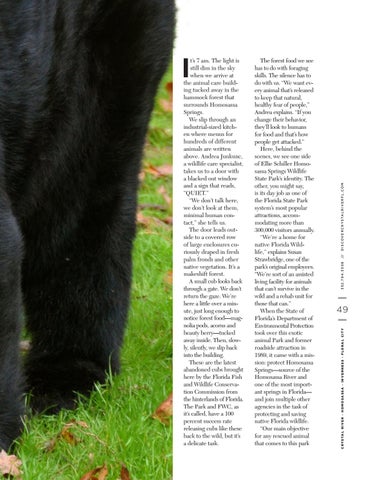
t’s 7 am. The light is still dim in the sky when we arrive at the animal care building tucked away in the hammock forest that surrounds Homosassa Springs. We slip through an industrial-sized kitchen where menus for hundreds of different animals are written above. Andrea Junkunc, a wildlife care specialist, takes us to a door with a blacked out window and a sign that reads, “QUIET.” “We don’t talk here, we don’t look at them, minimal human contact,” she tells us. The door leads outside to a covered row of large enclosures curiously draped in fresh palm fronds and other native vegetation. It’s a makeshift forest. A small cub looks back through a gate. We don’t return the gaze. We’re here a little over a minute, just long enough to notice forest food—magnolia pods, acorns and beauty berry—tucked away inside. Then, slowly, silently, we slip back into the building. These are the latest abandoned cubs brought here by the Florida Fish and Wildlife Conservation Commission from the hinterlands of Florida. The Park and FWC, as it’s called, have a 100 percent success rate releasing cubs like these back to the wild, but it’s a delicate task.
Volunteers prepare surprises for bobcats to find as part of daily animal enrichment.
Animal photography by Joe Dube and Adobe Stock
Andrea Junkunc with Yuma.
is to release them back into the wild,” says Tricia Fowler, who manages animal care. “If we can’t get the animal back to the wild, then we’re able to provide a home for them here so they can live out their life.” These are the animals you see. Mammals, birds, reptiles—there are more than 300 who live here. Each one has a story. Brutus and Bitty, two fully grown black bears, lost their mother to a car accident while they
open so wild manatees can freely come and go. The rest of the year, the manatees that swim here and delight the crowds in the Fishbowl Underwater Observatory are the injured, the orphaned. They, like the other animals in the park, are
wildlife ambassadors. They teach us what it’s like to be an animal. We learn, in the best sense, how to be human. That’s when the two identities of the Homosassa Springs Wildlife State Park come together as one.
ANIMAL AMBASSADORS
//
The animals at Ellie Schiller Homosassa Springs Wildlife State Park are considered ambassadors. Through injury or imprinting from interactions with humans, they can no longer survive in the wild. They live here in daily contact with people— lots of people from all over the world. We found this out in a remarkable way: Twitter. Jennifer Truong, an elementary school teacher in Rochester, New York contacts us. Her second graders have adopted Electra, one of the three resident manatees that live in Homosassa Springs, through a program with the park and the Save the Manatee Club. Young Jordyn Ahl, who is fascinated with manatees, proudly lifts the certificate of adoption with Electra’s picture and full biography, “and the classroom squeals for joy,” says Jennifer. Electra, it turns out, is a social media sensation!
D I S C O V E R C R Y S TA L R I V E R F L . C O M
___________________________
352.794.5506
— TRICIA FOWLER, ANIMAL CARE MANAGER
were still nursing. The call from FWC came in the middle of the night and the park’s then-director, knowing they would need care for the rest of their lives, said “bring them here.” Yuma, a Florida panther, hadn’t even opened his eyes when he was found abandoned. The first thing he ever saw was people feeding him with a bottle. He’s one of the last of the big cats that once roamed eastern North America. There are fewer than 200 left, dangerously close to the genetic cliff scientists call the “vortex of extinction.” Through coaxing and training, veterinarians and staff have trained Yuma to present his tail for blood samples. “He can even be a blood donor for other injured panthers,” Andrea tells us as Yuma passes by. If the species is to survive, every life counts. The biggest attraction, of course, is the manatees. Homosassa Springs is one of a group of manatee rehabilitation facilities in Florida that includes Orlando’s SeaWorld, Tampa’s Lowry Park Zoo, and the Miami Seaquarium. Manatees have used Homosassa Springs as a critical warm water refuge for thousands of years. Each year, from mid-November until the end of March, the spring is wide
51 C R Y S TA L R I V E R . H O M O S A S S A . I N V E R N E S S . F L O R A L C I T Y
“If we can’t get the animal back to the wild, then we’re able to provide a home for them here so they can live out their life.”
2017 OFFICIAL VISITOR’S GUIDE D I S C O V E R C R Y S TA L R I V E R F L O R I D A
52
We cater to our RV vacationers with beautiful and accommodating RV sites Our affordable rates and flexible plans allow for RVs, tents, and fully furnished A-frame chalets or park models.
Full Hookups and Concrete Pads
On Site Rental Equipment
30 or 50 Amp Electrical // Water // Sewage // Cable TV // Wifi
Pontoons // Kayaks // Canoes // Paddle Boards // Golf Carts
Camp Sites and Rental Units Availability
Waterfront and Fully wooded sites available
Daily // Weekly // Monthly // Annually
We now have 400 sites along the addition of pull through sites Planned activities all year // Tiki bar open 7 days a week // Huge waterslide and bounce pad
352.628.9544 // 800.301.7880
10359 West Halls River Road, Homosassa // www.NaturesResortFla.com
JOURNEY TO THE CENTER Two millenials from Miami escape the big city for a fun getaway on the 46 mile Withlacoochee State Trail. STORY MELISSA MEDEROS
Florida, the state without winter, is embracing bicycles in a big way. Soon this trail, which passes through three Florida counties, will join two new cross Florida cycling trails, one at its north end and the other at its south. Pronounced with-la-coo-chee, the nine-mile stretch between Inverness and Floral City is the most popular segment. In fact, we stay right on the trail at the Central Motel in Inverness. “The Central,” as general manager Teri Adkisson calls it, is aptly named since it’s centrally located at the halfway point of the trail. It’s popular with cyclists like us, since we can roll out of bed and right onto the trail.
2017 OFFICIAL VISITOR’S GUIDE D I S C O V E R C R Y S TA L R I V E R F L O R I D A
54
The bikes we’ve rented from Inverness Bicycle and Fitness, one of three area bike shops located right off the trail, are already waiting for us when we arrive at the hotel. We’re here from busy Miami, and for us, exploring the Withlacoochee State Trail uncovers some magical experiences. With transitions from lakes to wide-open spaces to scenic small towns, there are countless opportunities for viewing the natural beauty Florida offers without ever feeling lost in the wilderness. Call it a gentle urban reprieve. For instance, just off the trail a few miles away, we access the connector trail to
cluding threatened and endangered species. We find a gopher tortoise hurrying alongside the trail. Dennis Reiland, Director of Rails to Trails of the Withlacoochee, lists the incredible variety of wildlife he’s seen over the years. “We have seen bobcats, rabbits, deer, and some not so local animals: armadillos,
of the great outdoors wafts through the air as we reach Floral City. This “Old Florida” town will leave observers in awe as they take a ride under the tree canopy on East Orange Avenue, also known as “The Avenue of Oaks,” one of Florida’s most alluring views. The ride back to the hotel is pleasant since the trail is mostly level. We ride into downtown
“…there are countless opportunities for viewing the natural beauty Florida offers without ever feeling lost in the wilderness. Call it a gentle urban reprieve.” Fort Cooper State Park. We pedal through the forest and sit by Lake Holthlikaha, a stop along the Great Florida Birding Trail. All is peacefully quiet here except for the playful songs of birds. Not surprisingly, the park’s diversity makes it a refuge for many plants and animals, in-
camels, land tortoises, and miniature blueeyed horses.” Back on the main trail, we see horses too! The Withlacoochee State Trail is popular with equestrian riders who ride just off the cycling trail. Our course continues south under the shade of tree. The fresh smell
Fort Cooper State Park
Inverness for the evening. The trail takes us beneath a lush canopy of trees that pass beside slow rippling blue-green lakes. We pedal into the beautiful historic downtown centered around Old Courthouse
Square. The restaurants and pubs of this incredible little city hum with activity and make for a perfect evening out. To end our getaway, we travel north to take a peek at Florida’s cycling future. Just beyond the north end of the
Withlacoochee Trail, we ride the short four-mile Dunnellon Trail. The trail, already built, will be the connector to the Cross Florida Greenway and passes over the Withlacoochee River. Its new innovative bridge is spectacular
and makes for captivating panoramic views. It’s the view of things to come. We can’t wait!
MELISSA MEDEROS is a travel writer based in Miami, Florida.
GOLF IN CITRUS:
STAY AND PLAY 2017 OFFICIAL VISITOR’S GUIDE
The natural beauty of Citrus County courses rivals the scenery of some of America’s most famous golfing venues.
D I S C O V E R C R Y S TA L R I V E R F L O R I D A
56
STORY MARY ANN DESANTIS
Black Diamond Ranch (352) 746-3446 /// blackdiamondranch.com
What do tennis great Pete Sampras, NBA star Julius Irving, ballet legend Mikhail Baryshnikov, former Governor Jeb Bush, and golf legend Tiger Woods have in common? They’ve all played golf at Black Diamond Ranch, a 45-hole Tom Fazio-designed course in Lecanto. The secluded development off County Road 491 near Lecanto is home to one of America’s Greatest 100 Golf Courses, according to Golf Digest Magazine. Its beauty is undeniable, but with that beauty comes challenges that are unique for a Florida course—specifically 30foot cliffs surrounding the 17th hole on The Quarry, Black Diamond’s most iconic course. The Quarry, which opened in 1987, is the most famous of Black Diamond’s three courses, but the others are just as beautiful and challenging. The Ranch, also 18 holes, is a little more rugged than The Quarry, and designer Fazio has said the course’s final three holes “represent the best three finishing holes I’ve ever designed.” Although The Highlands is only nine holes, don’t get the mistaken idea it is an executive course. With elevations as high as 150 feet, the par-36 course has a slope rating of 130, making it one of the most challenging. Black Diamond Ranch offers a stay-and-play package for out-of-town guests that includes two rounds of golf. The club manages several beautifully decorated houses where golfers can enjoy a home-away-from-home inside the private community.
The Plantation on Crystal River (352) 795-7211 /// plantationoncrystalriver.com
The Plantation on Crystal River is one of Florida’s top destinations because of its Old-Florida charm and the breadth of activities the resort offers—swimming with manatees, a full-service spa, and 27 holes of golf for every skill level. The Championship course, originally designed by highly regarded course architect Mark Mahannah, reflects the traditional Florida style with a variety of water and bunker obstacles. The course has aged well during the last 50 years with mature emerald pine and oak trees and beautiful natural fairways. If you only have time for a “quick nine,” schedule a tee time on “The Lagoons,” and sharpen your short game. It’s a challenging course that focuses on wedge play, putting, and fun! Complete your golf vacation with a lesson or two at The Plantation’s Original Golf School™, directed by PGA pro Jay Morelli. Original Golf School™ has a 4:1 student-to-teacher ratio, on-course instruction, and all of the instructors are well-experienced professionals. Golf packages are available at The Plantation on Crys-
‘FORE’ A FUN-FILLED DAY OF GOLF _________
PUBLIC COURSES Citrus Springs Golf & Country Club 352.489.5045 or 877.405.GOLF citrusspringsgolf.com
SEMI-PRIVATE & PRIVATE COURSES Citrus Hills Golf & Country Club 352.746.4425 citrushills.com/golf
Lakeside Golf & Country Club 352.726.1461 lakesidecountryclubgolf.com
Inverness Golf & Country Club 352.637.2583 or 352.637.2526 golfinverness.com
Crystal River Golf Club 352.795.2100 crystalrivergolf.com
Twisted Oaks Golf Club 352.746.6257 twistedoaksgc.com
Southern Woods Golf & Country Club (Homosassa) 352.382.1200 southernwoodsgc.com/ southern-woods-golf-club Sugarmill Woods Golf & Country Club (Homosassa) 352.382.3838, Ext. 20 sugarmillwoodscc.com/ sugarmill-woods-country-club
(352) 746-3664 /// skyviewgolfandcountryclub.com
At Skyview, golfers enjoy the flatlands of Florida along with rolling hills comparable to those in North Carolina and northern Georgia. Home to the second highest point in Central Florida, Skyview’s numerous ponds and lakes provide many hazards, but it’s still a great course for players of all levels. The well-maintained course offers reasonable prices, making it a great place to play, and there are always special offers and discounts available on their website. There’s also the impressive clubhouse with its restaurant, bar, and full-featured pro shop.
//
Skyview at Terra Vista
352.794.5506
tal River all year. In addition, customized golf packages for groups of 16 or more are available through the group sales department.
D I S C O V E R C R Y S TA L R I V E R F L . C O M
SOURCE: discovercrystalriverfl.com/play/golf
57
(888) 828-6740 or (352) 637-1140 /// valkusa.com
With more than 70 luxury vacation rentals, this Inverness golf resort can fit any vacation budget for families or groups. Booking includes reduced golf fees at nine local courses and an on-site 18-hole championship course, which is semi-private; the price includes your cart. It’s 6,400 yards from the back and is a par 72 course. The club graciously hosts groups and also offers gold lessons. If the family enjoys other activities, there’s canoe rental, a boat ramp, fishing dock, and horseback riding. The resort’s restaurant focuses on quality food and excellent service. Much of the food is locally grown, and the cuisine is “European with a Twist,” with great variety and taste. The Gastro Lounge features tap beers and amazing cocktails.
C R Y S TA L R I V E R . H O M O S A S S A . I N V E R N E S S . F L O R A L C I T Y
Van der Valk USA Golf Resort Inverness
CITRUS COUNTY A Great Place to Live, Work AND Play
2017 OFFICIAL VISITOR’S GUIDE
2017 Citrus County Chamber of Commerce Events:
D I S C O V E R C R Y S TA L R I V E R F L O R I D A
58
30th Annual Florida Manatee Festival January 14th and 15th Downtown Crystal River, FL gomanateefest.com
30th Floral City Strawberry Festival March 4th and 5th Floral Park ~ Floral City Florida gostrawberryfest.com
Crystal River Christmas Parade ~ December 2nd Downtown Crystal River, FL
Inverness Christmas Parade December 9th Downtown Inverness, FL
915 N. Suncoast Blvd. Crystal River, FL | 352.795.3149 | www.citruscountychamber.com
1 STOP INFORMATION! DISCOVER CRYSTAL RIVER FLORIDA WELCOME CENTER A Certified Travel Information Center Destination information for Inverness, Homosassa, Floral City and Crystal River
Open Monday to Friday 8am to 5pm 915 N Suncoast Blvd. Crystal River
(800) 587-6667 www.discovercrystalriverfl.com
Floral City | Homosassa | Inverness
iF n d You r
e r u t dA v e n N EW Snorkeling Tours SERVICES
Kayak, Paddleboard, Canoe, and Paddle Boat Rentals • Beach Rentals (WaterMats, QuickShade Canopys) • Sea Scooter and Snorkeling Tours • All Inclusive River Glamping Tours • Ziplining • Fishing Charters • Area Tickets • Manatee Snorkeling Tours
352-228-4715
CrystalRiverAdventures.com // 36 NE 4th St., Crystal River
WATER ADVENTURES Welcome to the water lover’s Florida! From the teeming waters of the Gulf of Mexico, to crystal-clear springs and our chain of inland Lakes, you are ready for launch.
D I S C O V E R C R Y S TA L R I V E R F L O R I D A
62
Bass fishing on the Tsala Apopka Chain of Lakes in Inverness.
2017 OFFICIAL VISITOR’S GUIDE
Fishing for grouper on the Gulf.
D I S C O V E R C R Y S TA L R I V E R F L . C O M
Both Homosassa and Crystal River are great jumping-off points for inshore fishing. To the north are the fertile estuaries of the Ozello Keys, St. Martins Keys and Crystal Bay. To the south is the vast Chassahowitzka National Wildlife Refuge. Our county fishing guides are committed to protecting it as well as all local waters because
//
L
ong before outboard motors, flats skiffs and graphite fishing poles, Homosassa was a major destination for anglers. Commercial fishermen built the town on the south side of the river where they worked from the fish house docks day and night. Shrimping at night and catching mullet, stone crabs and blue crabs by day helped hone the skills of some of best fishing guides in Florida. Some of the historic buildings that still stand on the Homosassa River are a tribute to its rich angling heritage. The Atlanta Fishing Club was built in 1890, on what some say was the best fishing hole on the river. The Homosassa Riverside Resort and MacRae’s Bait House followed years later to accommodate visiting sport fishermen.
CAPTAIN WILLIAM TONEY is a fourth generation fishing guide and a Homosassa native.
352.794.5506
STORY CAPTAIN WILLIAM TONEY
many different reef species to catch. Our offshore captains have comfortable vessels and reliable knowledge of how to fish the deep waters. They’ll even do an overnight run to the famous Florida Middle grounds. Homosassa and world-class fly fishing go hand in hand. Look up the all-time world records for fly caught tarpon and you will find most are caught in Homosassa. Redfish and trout are also a great sight cast fishery for the fly angler. Whatever the season, you’ll find that Homosassa, Crystal River and the waters of Citrus County have excellent fishing year-round.
63 C R Y S TA L R I V E R . H O M O S A S S A . I N V E R N E S S . F L O R A L C I T Y
THE LURE OF FISHING
we realize what a beautiful environment we share with all anglers. Keeping fish to take home is all part of a guided fishing trip, but there’s really no need to wait. If requested, your guide can prepare a fresh-catch shore lunch for you on a private island. Excellent service is our hallmark. For the inshore guide, sea trout and redfish are the bread and butter, but many other species of fish can be caught in our waters because of the rich environment created by spring fed rivers, abundant mangroves and the seagrass beds of the Gulf. Snook are becoming more and more common to catch along with others like pompano, Spanish mackerel, sea bass, blue fish, flounder, triple tail, sheepshead, mangrove snapper, jacks and lady fish. Offshore we have excellent grouper, kingfish, cobia and
2017 OFFICIAL VISITOR’S GUIDE D I S C O V E R C R Y S TA L R I V E R F L O R I D A
64
OF RIVERS AND SPR In search of Florida in its natural state, two adventurers paddle into a land of seven rivers and endless springs to find the soul of wild Florida. STORY MANNY PRADES
INGS T
he journey begins with us scanning Florida maps and searching online. We’re looking for the real Florida, the unpackaged adventure.
Google Earth shows a vast patch of green fading into blue along the Gulf of Mexico. Two words tell us all we need to know: “rivers” and “springs.” That’s
how we’ll discover Citrus County. There are seven rivers on this stretch of central Florida’s Gulf Coast alternately referred to as the Nature Coast
or Springs Coast. We want both so we head to Crystal River, home of Kings Bay and an astounding 70 springs!
Kings Bay We book our stay at one of Crystal River’s three waterfront resorts. Ours, the Plantation on Crystal River, provides complete packages and rentals. Other resorts and hotels do too, and you can find plenty of
great kayak, paddleboard and dive shops throughout town. Minutes after unloading our luggage, we’re in kayaks paddling off into Kings Bay. From the banks of inlets, blue herons, ibis and anhinga work the shoreline and piers. The bay soon opens up into a vast expanse. The biggest spring, King Spring, lies straight ahead just off the south edge of Ba-
nana Island, part of the Crystal River National Wildlife Refuge. After stopping to plunge into the deep spring, we paddle on. We discover secluded bays, fishing camps and other islands. Manatees occasionally break the surface for loud breaths. A memorable moment comes when we find a shallow spring tucked away in a stand of island forest. It’s amazing to see
water from the Florida aquifer welling up in bubbles through the sandy bottom.
The Chazz The following day, we journey to the Chassahowitzka River Campground, 10 miles south of Crystal River. We’ve heard “the Chazz” is one of the wildest rivers left in Florida. Civilization melts away as we paddle down the
Taking an underwater selfie at Seven Sisters Spring.
D I S C O V E R C R Y S TA L R I V E R F L . C O M // 352.794.5506
Discovering a hidden forest spring.
long, wide river. Flowers bloom and birds fish from the thick forest edge. Our map points to our objective: Baird Creek, home to one of the Chassahowitzka’s most secluded forest springs, what locals call “The Crack.” A narrow channel, hardly wider than the length of a kayak paddle, that leads
deep into the forest. It’s incredibly fun paddling! The creek turns crystal clear as we approach the spring. Suddenly, we’re there. We come to a nearly circular natural pool—maybe 50 feet in diameter. Sure enough, there’s a crack in the spring’s limestone floor. Water gushes up. Glee gives way to quiet as we
“Civilization melts away as we paddle down the long, wide river.”
float in the spring and gaze up into the forest canopy. Exploring Citrus County leaves us in awe. We must return to this magical place. MANNY PRADES lives in Miami and loves to travel across Florida.
C R Y S TA L R I V E R . H O M O S A S S A . I N V E R N E S S . F L O R A L C I T Y
67
2017 OFFICIAL VISITOR’S GUIDE D I S C O V E R C R Y S TA L R I V E R F L O R I D A
68
Scallop season provides the perfect invitation to experience one of the earth’s most incredible hidden wonders. STORY MILES SAUNDERS
“This particular area of Florida is one of the most diverse and biologically productive ecosystems in the world” —TIM JONES, BIG BEND SEAGRASS PRESERVE
Florida Bay Scallop
The Big Bend Seagrass flourishes in shallow water where sunlight filters to the sea floor. The underwater shelf of the Florida peninsula is uniquely suited since it stretches 200 miles offshore. “The transition is very gradual, about one foot per mile, so you can go
D I S C O V E R C R Y S TA L R I V E R F L . C O M //
Underwater Eden It is a rich planetary gold mine of life. In fact, seagrass beds are so critical to so many living things they are often called the rainforests of the sea. “This particular area of Florida is one of the most diverse and biologically productive ecosystems in the world,” says Tim. “So many other species depend on seagrass for survival that if you take them away, you take away everything,” adds Clinton Dawes of the University of South Florida. “Seagrass beds
are a keystone species.” In fact, a single acre can support as many as 40,000 fish and 50 million invertebrates such as scallops. “There’s plenty of protection. Small fish that will develop into large species, like grouper, are essentially hidden in these seagrass beds until they grow to the size to leave them,” explains Clinton. “The fishing industry, shrimping industry, all these are dependent on sea grass beds.” So, as it turns out, are manatees. It’s one of the reasons Crystal River and Homosassa are the Manatee Capital of the World. Hundreds of manatees spend their entire summer munching on sea grass in the warm Big Bend before seeking winter shelter in the springs of Kings Bay and the Homosassa River. Loggerhead, Kemps Ridley, and Green sea turtles also abound. “The Crystal River Homosassa area has more sea turtles than anywhere else in the state,” says Tim Jones. “It’s a really important foraging ground for juveniles.”
352.794.5506
floor stretching from the Homosassa River to Apalachicola.
69 C R Y S TA L R I V E R . H O M O S A S S A . I N V E R N E S S . F L O R A L C I T Y
I
t is already a blazing hot summer morning when we head for the Gulf of Mexico on the Salt River. With the breeze blowing over our swiftly moving boat, we hardly notice. The shoreline vanishes behind us and, not long afterward, a mysterious white line appears across the horizon ahead. It’s a great white fleet of boats. It is the first week of scallop season. Captains stop to talk to each other, trading news on the best spots so far. Heads bob in the water. Dive flags wave in the light wind. Cooled by the breeze, we slip into the warm bath-like water of the Gulf. Beneath us lay another world… A great green meadow stretches as far as the eye can see. Small colorful fish circle above. Reach out your hand and your fingers pass through blades of softly swaying grass. We’ve come for the scallops but we’ve arrived in one of the most incredible places on earth: the largest seagrass beds of North America. “Some people call it the womb of the Gulf of Mexico,” says Tim Jones, manager of the Florida Department of Environmental Protection’s Big Bend Seagrass Preserve. With the Saint Martins Marsh Aquatic Preserve, it covers over a million acres of sea
A manatee feeds on seagrass near Crystal River.
2017 OFFICIAL VISITOR’S GUIDE
Manatee photo: Masa Ushioda, CoolWaterPhoto; Overhead boat photo: Ed Runyon, Cutting Edge Photography
D I S C O V E R C R Y S TA L R I V E R F L O R I D A
70
Sea floor sponges
Before we leave, though, I submerge one more time into the underwater quiet. The sun shines through the water in parallel bands. The grass reaches back as it sways with the current. A seahorse flits by. The ancient dance of sun, earth, life, continues on….
Scallop season runs from late June to mid-September.
D I S C O V E R C R Y S TA L R I V E R F L . C O M
into a mesh bag wrapped around my wrist. Now that I’ve spotted one, I can spot many. People call it an underwater Easter egg hunt. Before long, the mesh bag is too heavy to swim with. I surface back into the bright world of sun and sky. We’ve nearly reached our limit of scallops.
//
ment full of corals, sponges, and different kinds of macro-algae,” explains Tim. Scallops are what we’ve come to see, however, and at last I spot one. It’s hidden in the grass and, what’s more, it’s looking at me! As I dive down I see its blue iridescent eyes. It begins to flee but I snatch it up and slip it
352.794.5506
Scalloping The scallops, meanwhile, are tricky to find. It doesn’t matter. One discovery leads to another as we scan the bottom. “You have these large seagrass beds and 20 feet away you have this hard-bottom environ-
Afloat in an emerald sea.
71 C R Y S TA L R I V E R . H O M O S A S S A . I N V E R N E S S . F L O R A L C I T Y
out 30 miles or more before you hit really deep water,” explains Tim. Because this shelf is tucked up into a corner of the Gulf of Mexico, it creates what scientists call a zero energy environment. “It means there is very little wave action,” explains Clinton Dawes, “perfect for seagrass.”
Epona Place An Enchanted Escape
Seven trap fields, two skeet fields, one five stand, and quail trap • Shoot from a platform 5 ft. off ground; traps under your feet • 25 Targets
2017 OFFICIAL VISITOR’S GUIDE
(352) 572-7339 Robinsonranchtrapandskeet.com 19730 SE 127th Terrace, Inglis FL 34449
top-rated Easy access to the Trail Withlacoochee Bike
Biking Done Right
D I S C O V E R C R Y S TA L R I V E R F L O R I D A
72 SmallTownDoneRight.com
October 27 to 29, 2017
FOOD & FUN
352.794.5506
//
D I S C O V E R C R Y S TA L R I V E R F L . C O M
With authentic Old Florida villages filled with treasures and fresh seafood just off the boat, there’s always something wonderful to look forward to after a day’s adventure.
C R Y S TA L R I V E R . H O M O S A S S A . I N V E R N E S S . F L O R A L C I T Y
73
SEASONS T OF SEAFOOD The fresh flavors of the Florida Gulf Coast
2017 OFFICIAL VISITOR’S GUIDE
STORY MILES SAUNDERS
D I S C O V E R C R Y S TA L R I V E R F L O R I D A
74
Stone Crab fishermen from The Crab Plant, LLC.
he boat parade begins nearly every afternoon as the sun dips low in the sky. The sport fishermen come in. The commercial fishermen head out. A steady stream of crab, shrimp, and fishing boats ply the waters of the Crystal and Homosassa Rivers heading for the Gulf of Mexico.
“My dad, who was Charlie, bought this location in 1959. “We’re happy to continue…”
The waterfronts of Homosassa and Crystal River have been home to fishing boats and fishermen for well over a century. The faces and architecture may have changed, but the trade remains. On a busy October afternoon, small boats jockey for position off the little dock at Shelly’s Seafood and Fish Market on the Homosassa River waterfront. It’s Stone Crab season and big boats or little, it doesn’t matter. The
Stone Crab Chowder
“It doesn’t get any fresher than that.” — DARCI KNECHT, WILD SASSA SEAFOOD TRAILER
River, a similar scene plays out daily at the appropriately named Crab Plant, LLC. “I kind of call it dinner and a show,” says Kelly Kofmehl as fishermen pass through the restaurant with bags full of crab claws and trays of fresh grouper. “We are still a working processing plant. Folks at the tables get to see what we’re doing and they get to see it’s fresh.” Kelly and his wife, Candy, are now the third generation of their family in the fishing business here. “I didn’t choose it. It chose me,” says Kelly. “I was born into it. My dad was a fisherman, and I was born and raised at that house
352.794.5506
Authentic Florida
little fish market is humming with fishermen bringing baskets of fresh crab claws in one door and customers toting bags full of them out the other. Across the little parking lot, Darci Knecht has already picked through 40 pounds of claws as she stirs a huge pot of Stone Crab chowder. With the fishing boats lining the docks, the Fish Market and Darci’s Wild Sassa Seafood Trailer, you might call it the Seafood triangle. “Stone Crabs literally go from the boat right into Shelley’s and then right over here,” she laughs. “It doesn’t get any fresher than that.” A few miles north on Kings Bay in Crystal
75 C R Y S TA L R I V E R . H O M O S A S S A . I N V E R N E S S . F L O R A L C I T Y
“Where can I find fresh local seafood,” you ask? You’ve come to the right place.
//
D I S C O V E R C R Y S TA L R I V E R F L . C O M
— PHIL KOFMEHL, CHARLIE’S FISH HOSUE
A dinner cruise
Shelly’s Seafood & Fish Market in Old Homosassa.
“We really want for people to be able to have that authentic experience we so often enjoy. We serve the food right on the boat.” — CAPTAIN SEAN DAUGHERTY
right over there,” he says motioning toward the restaurant’s stunning view of the water. “Through the summer months, blue crab is our staple,” says Kelly, explaining the cycle of seasons. “Our big boats fish grouper in the summer and do stone crabs in the winter. Blue crabs are pretty much year-round, as are the mullet and snapper.”
Generations Across from The Crab Plant, Kelly’s uncle, Phil Kofmehl, is weighing mullet and grouper on a dock at Charlie’s Fish House and Seafood Market. “It just gets in your blood,” says Phil who is still actively involved in running this local fresh seafood landmark. “My dad, who was Charlie, bought this location in 1959,” he says as he feeds tarpon from a dock behind the
market. “We’re happy to continue just as long as the Lord lets us.” Generations are important here. One generation picks up where the last one left off, and each contrib-
Wild Sassa Seafood Trailer
utes something new. Back on the Homosassa River, Captain Sean Daugherty welcomes aboard a couple celebrating their anniversary. Like a lot of people here, he grew up on the water
Local fishing captains at Greenhouse Bistro & Venue
and turned that knowledge into a trade as a respected guide. Tonight, it’s a Mellow Mangrove Charters dinner cruise in collaboration with Wild Sassa. “We really want for people to be able to have that authentic experience we so often enjoy,” says Sean. “We serve the food right on the boat,” he adds as he sets out toward the setting sun. “What you get depends on what’s on the market that day. We make sure you’re getting what’s fresh.” Once the boat reaches the Saint Martins keys, Sean slides it into a gentle glide. In the distance, the sun touches the horizon. A champagne cork pops over a feast of mussels and Gulf shrimp. Laughter briefly breaks the evening calm as the sun slips away and twilight lingers. It’s the sumptuous ending to a perfect day as they turn for home.
If you’re interested in Cook your Catch, check out our website, DiscoverCrystalRiverFL.com. Under Dining, click on Cook your Catch. Be sure to call ahead for price and policy.
//
No one really knows when it started, but for as long as anyone can remember, Cook Your Catch has been a tradition in this part of Florida. More than 15 restaurants here offer the service, which includes preparing freshly caught and cleaned fish or scallops and providing all the fixings. The practice is so popular with anglers and scallopers that even the newest restaurants offer it. “We’re a fresh food restaurant,” says Craig Shatto of the Greenhouse Bistro & Venue, “so this fits.” The restaurant, located at the headsprings of the Halls River along U.S. Highway 19 in Homosassa, has quickly gained a stellar reputation for inventive fresh cuisine. Today, along with the regularly updated menu items, Executive Chef Marc Bell is sautéing fresh scallops and grilling red snapper brought in by local fishing guides. He combines it with roasted asparagus and braised red cabbage with apples. The steaming plates are greeted with oohs and aahs when Chef Marc brings them out. The guides happily dig in. “Food should be as close to its natural state as possible,” says Cindy Shatto, “that’s why we make pretty much everything from scratch.”
352.794.5506
___________________________
77 C R Y S TA L R I V E R . H O M O S A S S A . I N V E R N E S S . F L O R A L C I T Y
COOK YOUR CATCH
D I S C O V E R C R Y S TA L R I V E R F L . C O M
Lunch by the water at The Crab Plant in Crystal River.
YOU CAN TAKE IT WITH YOU Sun shines through mossdraped trees that form a perfect canopy over the Avenue of the Oaks in Floral City. Despite its Old Florida feel, it’s a village full of new surprises. STORY DIANE DOBRY
Floral City Red Brick Place, though housed in one of the oldest commercial buildings on historic East Orange Avenue, is entirely contemporary. A welcoming warm interior features colorful goods like baskets, handbags and sandals from across the globe, with stunning glass, pottery, wood, and metal pieces filling the gallery. “People come in not expecting this,” says Laura Henning, who created the shop with Deedra Harris. “They say ‘Wow! I can’t believe this is in a little town like Floral City.’” Across Florida Avenue I visit the impressive Florida Artists Gallery. This delightful original Florida Cracker-style home is
three historic buildings combined into one—including a gallery packed with engaging works by more than 40 local artists, some internationally acclaimed, and a café run by Chef Ron Alterio. “We like to think of food as art,” says Ann Covington, who founded the gallery with her husband Bill. “Everything is made from fresh ingredients and from scratch.”
Inverness Heading north, alongside the Withlacoochee State Trail, I arrive in Inverness, City on the Lakes. “We call it a ‘Small Town Done Right!’” says Sharon Skeele-Hogan, the city’s chief ambassador and head of the Visitor’s Bureau. The friendly, walkable downtown streets are dotted
Florida Artists Gallery in Floral City
West of Inverness on Gulf to Lake Highway, stopping at Publix in Crystal River leads me to discover The Honey Hole, filled with an incredible collection of
D I S C O V E R C R Y S TA L R I V E R F L . C O M
Pepper Creek Pottery in Homosassa
//
clothing, collectibles, and accessories. “It’s a destination tourists love where locals also like to shop,” says owner Connie Crandall. Skirting the waterfront of Kings Bay, I arrive at Crystal River’s historic downtown, where, during Manatee Season, trolleys deliver visitors to Heritage Village. Red brick sidewalks connect the shops lining Citrus Avenue. Heritage House owner
352.794.5506
Crystal River
Manatees abound at All About Nature in Crystal River
79
Homosassa’s The Glass Garage
Lou Fitzpatrick says “We are a welcome center, too,” with many local events held on-site. After exploring the mana-
tee- and wildlife-themed All About Nature and nearby Franklin Anderson Gallery, I cross the street to Karma Cottage
C R Y S TA L R I V E R . H O M O S A S S A . I N V E R N E S S . F L O R A L C I T Y
with shops and cafes anchored by scenic Courthouse Square. I’m immediately tempted by the specialty cupcakes at Nicole’s House of Cakes, set between Joyce’s Pub and the Valerie Theatre. Along Old Main, I step into a world of fun and fantasy at Ritzy Rags and Glitzy Jewels Etc., which has upscale women’s accessories interspersed with enticing statuettes such as the mythic motorcycle riding fairies. Across from City Hall, Connors Gifts, a mainstay of the community, welcomes me with its assortment of colorful outdoor décor and cute gifts that give the Small Town Done Right its friendly appeal.
2017 OFFICIAL VISITOR’S GUIDE
Crystal River’s Heritage Village in Autumn
D I S C O V E R C R Y S TA L R I V E R F L O R I D A
80
for its assortment of spiritual items. The array of shops and galleries includes cafes like Teahouse 650, where the aroma of perfectly brewed organic tea mingles with the smell of fresh baked scones. Across US Highway 19, Amy’s on the Avenue, a sweet upscale boutique, also offers lunch and handmade chocolates.
Homosassa Southbound Suncoast Boulevard (US Highway 19) leads to West Yulee Drive and the original Florida Fishing Village of Old Homosassa, where life has a laidback feel. Seafood and fishing dominate the waterfront, but soon I find hidden treasures awaiting in the historic area. “Our shop is a little bit of an art
museum,” says Angela Davis, who with Martha Brunson, runs Peppercreek Pottery known for its original collection of Raku, horsehair, and unusual stoneware pieces. The Glass Garage is next door, displaying assorted suncatchers, light panels, fused-glass jewelry, and more. “We have the same customers who come back and bring their guests here to shop,” says Louise Whitney, who, with business partner Lori Lenoir, crafts glass in unexpected ways, both practical and whimsical. Throughout Old Homosassa, more intriguing discoveries beckon. Life takes on a welcomed slower pace here in Citrus County. Luckily, that means more time to browse!
Tea House 650 in Crystal River
Ritzy Rags and Glitzy Jewels, Etc. in Inverness
2017–2 01 8
CALENDAR JANUARY JAN 14 & 15
FLORIDA MANATEE FESTIVAL Downtown Crystal River JAN 27 & 28
BLUEGRASS OLD-TIME MUSIC FEST & CAR SHOW Downtown Crystal River
FEBRUARY FEB 20
CRAFT SHOW & CHILI COOK-OFF
JULY NOVEMBER 11 & 12
HOMOSASSA ARTS, CRAFTS & SEAFOOD FESTIVAL This weekend street festival has been an Old Homosassa tradition for over 40 years. Sponsored by the Homosassa Civic Club and held on their festival grounds, this event features arts and crafts, live music, and a wide variety of local food. Enjoy the sights, sounds, and smells of delicious seafood as you browse handcrafts, edible crafts, and more.
MARCH 3
MARCH 5 & 6
FLORAL CITY STRAWBERRY FESTIVAL
Fort Cooper State Park, Inverness
SHRIMP-A-PALOOZA Old Homosassa
King’s Bay Park, Crystal River
AUGUST AUG 5
SEPTEMBER SEPT 15–23
Liberty Park, Inverness
SAVE OUR WATERS WEEK
MARCH 25
Various Locations
CLEAN AIR BIKE RIDE Withlacoochee State Trail, Inverness Fort Cooper Bluegrass Festival
APRIL
OCTOBER OCT 2
WITHLACOOCHEE RIDE
TASTE OF INVERNESS
MAY
Liberty Park, Inverness
Withlacoochee State Trail, Inverness
MAY 21
KINGS BAY PIRATE FEST
APRIL 22 MARCH 18
OLD-FASHIONED FOURTH OF JULY
BIG BASS CLASSIC
APRIL 8
FORT COOPER DAYS
JULY 4
MARCH 18
Floral City Park MARCH 11 & 12
Liberty Park, Inverness
Downtown Inverness
BERRIES, BREWS & BBQ Downtown Floral City
PATRIOTIC EVENING
PINE STREET JAM
Visit homosassafoodfestival.com for more info.
Ozello Civic Association, Ozello
MARCH
JULY 3
FORT COOPER BLUEGRASS FESTIVAL
Downtown Crystal River
Fort Cooper State Park, Inverness
JUNE LATE JUNE
HOMOSASSA FIREWORKS DISPLAY Old Homosassa
Clean Air Bike Ride
OCT 6–8
CITRUS SERTOMA OKTOBERFEST Mall Grounds, Crystal River OCT 8
HERITAGE VILLAGE SCARECROW FESTIVAL Heritage Village, Crystal River
OCT 27–29
COOTER FESTIVAL 3-DAY MUSIC FESTIVAL Liberty Park, Inverness OCT 27 & 28
HAUNTED TRAM RIDE Homosassa Springs
NOVEMBER NOV 4
STONE CRAB JAM Downtown Crystal River
OCTOBER 27–29
COOTER FESTIVAL 3-DAY MUSIC FESTIVAL This three-day music fest draws over 10,000 attendees each year. It’s a groovy vibe with music of the 1960s, including national and regional acts. There’s a slew of carnival rides, impressive water shows, and the best food trucks around. Vendors in the area offer a variety of arts, crafts, and goods. In the Cooter Races, turtles race and a winner is declared each hour.
NOV 4
BLUES ‘N’ BBQ Old Homosassa NOV 4 & 5
FESTIVAL OF THE ARTS
Visit cooterfestival.com for more information.
Downtown Inverness NOV 12–13
ARTS, CRAFTS & SEAFOOD FESTIVAL Old Homosassa NOV 12
LAKE HERNANDO DRAGON BOAT FEST
LATE NOV
DEC 8–12
LIGHT UP INVERNESS
FORT COOPER NIGHTS OF LIGHTS
Downtown Inverness
NOV 17 & 18
INVERNESS GRAND PRIX & MOTORSPORTS FEST Downtown Inverness
Fort Cooper State Park, Inverness
DECEMBER
Lake Hernando Park DEC 1
DEC 23
CHRISTMAS TREE LIGHTING FESTIVAL PRESENTS WHOVILLE
HOMOSASSA BOAT PARADE Old Homosassa
Downtown Crystal River DEC 18–24, 26
NOV 25
ARTS, CRAFTS & BLUE CRAB FEST Ozello Civic Association
CELEBRATION OF LIGHTS
DEC 1 & 2
FLORAL CITY HERITAGE DAYS Downtown Floral City
Homosassa Springs Floral City Heritage Days
MARCH 5–6
FLORAL CITY STRAWBERRY FESTIVAL A “berry” fun festival! Enjoy strawberries any way imaginable from shortcakes and milkshakes to jams and jellies. Buy your berries and take them by the flat or half-flat. You’ll also find turkey legs, funnel cakes, fresh seafood, and a variety of beers. “Berries, Brew & BBQ” kicks off this annual event, and features live entertainment. In addition to a delicious array of food, there are more than 100 craft booths as well as pageants for Miss Strawberry and Little Miss Strawberry. Visit gostrawberryfest.com for more information.
Now is the time…
This is the place!
FLORIDA’S PREMIER MASTER-PLANNED COMMUNITY IN THE HEART OF CITRUS COUNTY
World-Class Amenities – Active Resort-Style Living Unhurried Lifestyle There’s never been a better time to build the home of your dreams. And for value, location, and lifestyle there is no better place than the Villages of Citrus Hills. If you’re considering Florida for a second home, or active resort-style living, then you owe it to yourself to visit with us. Customizable homes and site packages from the mid $300s to $1.2 million. Spectacular Championship Golf and Tennis 45,000 sf BellaVita Spa & Fitness Center Ideal Citrus County Location WELCOME CENTER OPEN EVERY DAY! Over 20 Customizable Home Designs 4,500 sf. Tiki Bar If you’re visiting Central Florida you owe it to yourself to stop by and experience the Villages of Citrus Hills for yourself.
To schedule a personal tour call 800-511-0814
Located at the intersection of Norvell Bryant Hwy (Rte. 486) & Forest Ridge Blvd./Terra Vista Blvd.
www.CitrusHills.com
2400 N. Terra Vista Blvd., Citrus Hills, FL 34442