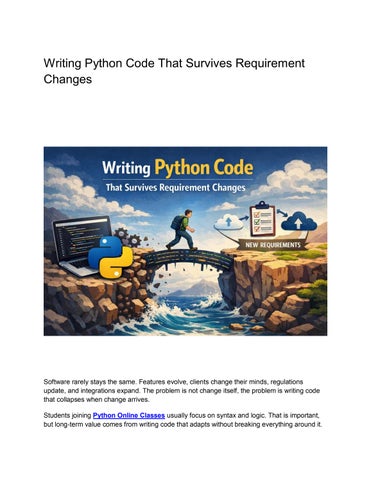
Writing Python Code That Survives Requirement Changes

Page 1


Writing Python Code That Survives Requirement Changes

Software rarely stays the same. Features evolve, clients change their minds, regulations update, and integrations expand. The problem is not change itself, the problem is writing code that collapses when change arrives.

Students joining Python Online Classes usually focus on syntax and logic. That is important, but long-term value comes from writing code that adapts without breaking everything around it.

Stable Python systems are not rigid. They are structured.

Why Requirement Changes Break Code?

Most systems fail under change because of:

● Hard-coded assumptions

● Tight coupling between modules

● Duplicate logic

● No separation between business rules and processing

● Poor naming and unclear structure

Requirement changes expose design shortcuts.

If tax logic is scattered across five files, updating tax rules becomes risky. If validation rules are embedded inside database logic, expanding inputs becomes messy. Change tests structure.

Principle 1: Separate Business Logic from Infrastructure:

One common mistake is mixing:

● Database operations

● Business rules

● API calls

● Data formatting inside a single function.

Better structure:

Layer

Data Layer

Service Layer

API Layer

Utility Layer

Responsibility

DB interaction

Business rules

Input/output

Shared helpers

When rules change, you modify the service layer, not everything.

Change database without touching logic

Modify rules safely

Adjust endpoints without breaking core logic

Reduce duplication

Students from a Data Analytics Course often learn how logic must remain clean for analysis workflows. The same applies to backend systems.

Principle 2: Avoid Hard-Coded Conditions:

Hard-coded values cause fragile systems.

Example of fragile code:

if order_amount > 5000: discount = 0.10

When policy changes, this logic must be hunted everywhere.

Better approach:

DISCOUNT_THRESHOLD = 5000

DISCOUNT_RATE = 0.10

if order_amount > DISCOUNT_THRESHOLD: discount = DISCOUNT_RATE

Even better: move rules into configuration.

Hard-coded

Config-based

Requirement changes become configuration changes.

Principle 3: Design for Extension, Not Modification:

Instead of rewriting existing logic, structure code so new behavior can be added.

Poor design:

def calculate_price(order): if order.type == "retail":

elif order.type == "wholesale":

elif order.type == "corporate":

Every new order type forces code edits.

Better design using strategy pattern:

class PricingStrategy: def calculate(self, order): raise NotImplementedError

class RetailPricing(PricingStrategy):

class WholesalePricing(PricingStrategy):

Now new pricing types can be added without modifying existing logic.

Students taking a Python Course in Delhi often encounter object-oriented concepts, but real value appears when those concepts protect code from change impact.

Principle 4: Keep Functions Small and Focused:

Large functions are difficult to modify safely.

Bad example:

● One function does validation

● Database writes

● Calculations

● Email sending

Better approach:

● validate_order()

● calculate_total()

● save_order()

● send_notification()

Function Size Risk During Change

200+ lines High

50–100 lines Medium

<30 lines Low

Small units reduce side effects.

Principle 5: Write Defensive Code:

Requirements change unexpectedly. Defensive programming helps avoid system crashes.

Examples:

● Validate inputs

● Handle None values

● Use default parameters

● Avoid assuming data types

Instead of:

user_age = user["age"]

Use:

user_age = user.get("age", 0)

Graceful handling prevents failures when data formats evolve.

In advanced modules of an Advance Python Course, emphasis is placed on handling edge cases rather than assuming ideal inputs.

Principle 6: Use Clear Naming:

Poor naming increases change difficulty.

Compare:

def process(data): vs def calculate_monthly_subscription_fee(user_plan):

Clear naming reduces misunderstanding during updates.

Future developers (or you in six months) must understand intent immediately.

Principle 7: Isolate External Dependencies:

External APIs change. Libraries update. Database schemas evolve.

Wrap dependencies:

Instead of:

requests.get("https://api.example.com/data")

Create:

def fetch_external_data(): return requests.get(API_URL)

Now changes are centralized.

Design Choice

Direct calls everywhere

Effect

High maintenance

Wrapped abstraction Easier updates

Abstraction absorbs change.

Principle

8: Add Tests Before Changing Code:

Requirement changes should not be blind edits.

Types of useful tests:

● Unit tests for functions

● Integration tests for workflows

● Regression tests for known behavior

Example: def test_discount_calculation():

assert calculate_discount(6000) == 0.10

When requirements change, update tests first. Then update logic.

Tests confirm stability.

Principle 9: Avoid Premature Optimization:

Highly optimized code is often hard to modify.

Readable code survives longer than clever code.

Compare:

sum(x for x in orders if x.status=="active") vs total = 0 for order in orders: if order.status == "active": total += order.amount

Readable logic is easier to adjust. Optimization can follow stability.

Common Mistakes That Make Code Fragile:

● Global variables controlling behavior

● Copy-paste logic blocks

● Business rules inside templates

● No separation between validation and processing

● No documentation

These patterns make every change risky.

How Structured Python Supports Evolving Projects?

Requirement changes typically involve:

● New business rules

● New fields

● Modified validations

● Expanded integrations

● Performance adjustments

If architecture is layered and modular:

● Changes remain localized

● Testing is easier

● Side effects are limited

If architecture is flat:

● Changes ripple everywhere

● Bugs multiply

● Deadlines increase

Long-Term View:

Python’s flexibility can be dangerous if discipline is missing. The language allows quick solutions, but quick solutions often ignore structure.

Professionals who understand maintainable design:

● Separate concerns

● Avoid duplication

● Abstract dependencies

● Protect core logic

write code that survives evolving requirements instead of breaking under them.

Conclusion:

Requirement changes are not interruptions. They are expected. Writing Python code that survives change means thinking about structure before writing logic.

Design decisions matter more than syntax. Stable systems are not rigid. They are organize, and modular. That is what keeps Python projects alive long after version one is shipped.

Turn static files into dynamic content formats.

Create a flipbook