SYSTEM INTEGRATION AND DEVELOPMENT OF WEB-BASED APPLICATIONS (ELDER CARE2)
Project Duration: 1 October 2022 to 16 January 2025
Description:
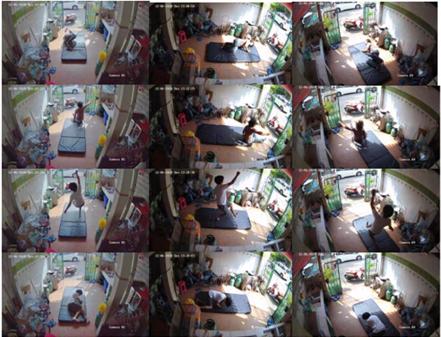
The research project funded by The National Broadcasting and Telecommunications Commission (NBTC) have the purpose to increase the quality of life of the elderly in the community to protect them from living alone by AI technology (Elder care System) and Telehealth Monitoring and Assistive Systems for Elderly and Disabled People. The AI Center, AIT has developed an AI Video Analytics system for early detection systems for monitoring an elderly person or a disabled person.
Work Package1: A wearable raman spectroscopy system for Non-invasive Blood Glucose Monitoring.
Work Package2: Activity Monitoring, Mobility Analysis, and Detection using Video Analytics and Deep Learning. Using machine vision, Deep Learning, Wi-Fi Learning.
Work Package3: Telemedicine, Telerehabilitation, Haptic.
Work Package4: Cloud and Mobile-based Platform for Management, Analytics and Visualization of Health, Activity and Rehabilitation Data for Elderly and Disabled People.
SIGN LANGUAGE PRODUCTION USING DEEP LEARNING
AIT Research Theme: Smart communities
AIT Unit: SET / CS
Project Duration: 3 November 2023 to 28 February 2025
Project Sponsor/Client: AIT Research Initiation Grant
Expected Social Impact:
This project holds immense social significance as it endeavors to break down communication barriers for individuals with hearing impairments. By developing a realtime sign language production system, it empowers them to engage more fully in social interactions, education, and employment opportunities. Through its deployment on online platforms, it not only provides access to a wider range of information and entertainment but also promotes greater societal understanding and acceptance of the challenges faced by the hearing-impaired community. Ultimately, this project has the potential to greatly enhance the quality of life for individuals with hearing impairments by fostering inclusivity, empowerment, and equal participation in society.
Description:
This project aims to develop a real-time sign language production (SLP) system for hearing impaired people. We propose using a deep learning-based system to develop the SLP that enhances accuracy with acceptable computational complexity. The proposed system will be deployed on online VDO channels to test its performance in different contexts. Key Performance Indicators (KPIs) for evaluating the success of the project could include:
⏵ Accuracy Rate: Measure the percentage of correctly interpreted sign language gestures compared to total gestures produced by the system.
⏵ Latency: Assess the time taken by the system to interpret and produce sign language gestures in real-time.
⏵ Computational Complexity: Evaluate the computational resources required by the system, such as CPU and
memory usage, to ensure it remains within acceptable bounds.
⏵ User Feedback: Gather feedback from hearingimpaired individuals who use the system to assess user satisfaction, ease of use, and effectiveness in facilitating communication.
⏵ Performance Across Contexts: Test the system’s performance in different environments and lighting conditions to ensure robustness and reliability.
⏵ Integration with Online Channels: Measure the integration and performance of the system when deployed on various online video platforms, including its compatibility and reliability.
⏵ Scalability: Evaluate the system’s ability to scale, particularly concerning the number of users it can support simultaneously without compromising performance.
⏵ Accessibility: Assess the accessibility features of the system, such as compatibility with different devices and assistive technologies, to ensure inclusivity.
⏵ Tracking these KPIs will provide insights into the effectiveness, efficiency, and user satisfaction of the realtime sign language production system.
“EMPOWERING
MIGRANT WORKERS: BRIDGING CULTURES AND
BUILDING ADVOCACY IN JAPAN” LEARNING ACROSS AND BEYOND BORDERS: OUR LEARNING AND EXPERIENCE DURING THE EXCHANGE PROGRAM
WITH OCHANOMIZU UNIVERSITY, TOKYO, JAPAN


22 August 2023 – The Asian Institute of Technology (AIT) has consistently advocated “Learning across borders” over the years. It promotes learning across borders from students worldwide and allows its students to travel and learn different interesting perspectives through exchange programs. We were lucky enough to be a part of one of those exciting exchange programs at Ochanomizu University, Japan, from our course Gender and Development Studies, as a part of the agreement between Gender and Development Studies at AIT and the Institute of Gender Studies at Ochanomizu University. The seven-night, eight-day program was enriching and exciting. It enhanced our personal and academic avenues. The visits to different organizations and experts advocating and researching migrant workers based in Japan were particularly interesting. We garnered a lot of insights and information associated with the data and status of migrant workers based in Japan, particularly from our countries of origin, Myanmar and Nepal.
The very first interaction of the visit was with “Link to Myanmar,” an organization based in Japan working on the rights and placements of Myanmar migrant workers. We not only learned about the issues faced by Myanmar migrant workers in Japan but also were excited to hear about the effort made by the organization to resolve the issues. It was interesting how the organization, led by an international couple originally from Myanmar and Japan, was working so passionately towards orienting migrant workers from Myanmar to adapt to the Japanese working environment, also facilitating them to settle in Japan through the provision of jobs, helping in accommodation and other necessities for incumbent migrant workers from Myanmar. It mainly showed their respect and empathy towards each other’s culture while embracing their differences to promote people from each other’s country.
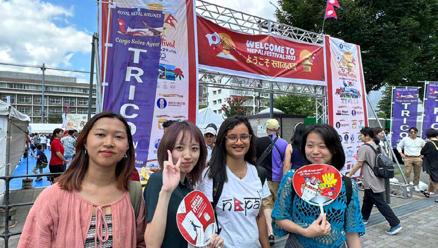
Another key highlight was the visit to “Solidarity Network with Migrants, Japan,” based in Ueno, Tokyo, where we learned about the challenges faced by the migrants in Japan and how they were attempted to be mitigated by this institution. It was particularly intriguing to know the pros and cons of different training programs attracting many migrant workers to Japan, leading to terrible violence through systems, violated labor laws, and poor living conditions. However, the attempt made by this institution explored our horizons on how a national network of organizations and individuals has been attempting to resolve the issues from policy to individual levels. A representative of this institution, whom we interacted with later, National General Workers Group, Nambu, further portrayed the advocacy campaigns they were undertaking to protect the female migrant workers and strengthened social protection of the migrant workers from the end of government. This particularly led to understanding the feminized migrational theories we learned back in AIT and their applicability in professional settings, which were extremely exciting and empowering � https://ait.ac.th/2023/08/learning-across-andbeyond-borders-our-learning-and-experienceduring-the-exchange-program-with-ochanomizuuniversity-tokyo-japan/.