













OPERATIONS: NAVIGATING THE IRAN WAR
CHARITY: AVIATION SANS FRONTIERES TO THE RESCUE
SAFETY: KEEPING CYBER THREATS AT BAY
Special Report: Reliable Maintenance

OPERATIONS: NAVIGATING THE IRAN WAR
CHARITY: AVIATION SANS FRONTIERES TO THE RESCUE
SAFETY: KEEPING CYBER THREATS AT BAY
Special Report: Reliable Maintenance
Despite the obstacles, restrictions, and high costs, European operators remain optimistic


42 Collins showcases vision for common ATC

2 Flexjet’s Ricci rails against private equity’s hold on bizav
4 Gulfstream G600 notches milestone with 200th delivery
6 NetJets takes delivery of its first Bombardier Global 8000
8 Bizav accident fatalities drop 50% in first quarter
10 AIN’s 2nd annual FBO Awards honor industry excellence
12 Iran hostilities spur uncertainty for Middle East bizav outlook
14 European Report: Caution reigns as bizav faces slow growth, headwinds in Europe
26 Higher Plane: How grounded crews helped rescue France in the pandemic



BY CURT EPSTEIN
S&D 2026
“Private equity has found our industry in a bad way,” said Flexjet chairman Kenn Ricci, speaking on March 25 in the keynote conversation at the opening session of NBAA’s Schedulers & Dispatchers Conference in Cleveland. “We have a lot of capital trying to find the next thing in our industry, and the result of that has been that innovation is getting stifled to some extent.”
Interviewed by NBAA president and CEO Ed Bolen at the standing-room-only event, Ohio-native Ricci did not hold back on his opinion that this cash influx is having a deleterious effect on the business aviation industry. “What’s happening in the maintenance business, they’re rolling up all the mom-and-pop shops,” he explained, adding that as a result of the consolidation, five-year projections suggest maintenance labor costs rising to more than $300 an hour. “So private equity made an investment in this maintenance business with the vision that the investment basis is to get to $300 an hour in maintenance.”
Ricci pointed to the longer times now associated with maintenance activities in many cases. “That’s because private equity big money has narrowed the funnel in the interest of profitability.” Even engine
hourly costs have seen an impact, according to Ricci. “You look at the hourly rates that they’re charging now; this influx of private equity is raising the cost.”
On the FBO side, he discussed the recent phenomenon of the special event fees, which universally draw the ire of aircraft operators. “Everyone of us negotiated a contract that probably included [lavatory] service and parking and a fuel surcharge, and whatever it needed to be. But they then invented a category called event fees, and it wasn’t in our contract, so now that’s private equity; they came into that industry.”
As a plus for business aviation, Ricci credited the airlines in their post-Covid actions for pushing what he described as the “frugal wealthy”—those who could afford private aviation, but for whatever reason chose to avoid it—into trying private flights. “When Covid hit, they gave up the frugalness, and then once they did that, they didn’t go back, and we see that.”
That stickiness has resulted in a demographic shift in the industry. “We have a whole different class post-Covid,” Ricci explained. “Our average owner is 10 years younger, so we’re getting people to buy in at a younger age.” As well, he noted that the line between aircraft leisure use and business use has blurred. z

NBAA president and CEO Ed Bolen (left) interviewed Flexjet chairman Kenn Ricci about his career and industry trends during the organization’s annual Schedulers & Dispatchers Conference in Cleveland.
Indonesia’s ministry of defense placed a firm order for a dozen Pilatus PC-24s to support the Indonesian air force’s air transport, liaison, and training requirements. The firm order, placed with defense contractor PT E-System Indonesia, includes an option for more of the light twinjets. An additional letter of intent covers the supply of 24 PC-21 turboprop trainers. The contract includes ground support equipment, tools, parts, training, and technical support.
Embraer delivered 44 aircraft in the first quarter, 47% more than the 30 jets it delivered in the same period last year, as production leveling e orts continued to show progress. The Brazilian manufacturer’s executive jets division handed over 29 business aircraft in the first three months, up from 23 a year earlier. These deliveries included one Phenom 100, 15 Phenom 300s, nine Praetor 500s, and four Praetor 600s. Its commercial aviation unit shipped 10 airliners in the quarter, while the company’s defense and security division delivered five aircraft. Embraer is forecasting 160 to 170 executive jet deliveries for this year—6% higher than in 2025.
With low to nonexistent available inventory, pricing for preowned Gulfstreams has firmed, and aircraft transactions are moving quickly, according to Savannah, Georgia-based aircraft broker Hagerty Jet Group. Hagerty noted that no preowned Gulfstream G700s or G800s are for sale. Of the nearly 600 G650s built, only two were for sale as of March 31. G550 and G500 available inventory has also tightened. The G450 and G280 fleets are the most available, with about 4% to 5% for sale.


Gulfstream’s G600 has logged 200 deliveries and 197,000 fleet flight hours in seven years of service, with the manufacturer reporting strong continued demand for the ultra-long-range jet.
BY KERRY LYNCH
Gulfstream Aerospace delivered the 200th G600 to a customer, the Savannah, Georgia aircraft manufacturer announced March 23. Handed over to an unnamed customer in North America, the milestone aircraft was outfitted at Gulfstream’s facility in St. Louis.
The delivery took place nearly seven years after the ultra-long-range business jet entered service. To date, the G600 fleet has logged more than 197,000 flight hours and completed 87,000 landings, picking up 95 city-pair speed records along the way.
Earlier this year, the aircraft surpassed a more-than-decade-long record flying from Aspen, Colorado, to the UK’s London City Airport in 7 hours 42 minutes at an average speed of Mach 0.91. In January, the aircraft,
along with its G500 sibling, had received EASA certification for steep-approach landing, clearing the way for operations at airports such as London City.
“Interest in the G600 remains incredibly strong worldwide as customers continue to be impressed with its remarkable capabilities,” said Gulfstream president Mark Burns. “Reaching the 200th delivery reflects the program’s continued momentum while reinforcing the aircraft’s proven maturity and reliability.”
Capable of accommodating up to four living areas and seating 19 passengers, the aircraft can fly 6,600 nm at Mach 0.85 or 5,600 nm at Mach 0.90. The G600’s Mmo is Mach 0.925. z
NBAA has partnered with 4Air to expand its sustainable flight department accreditation program, which launched in 2022 to recognize business aviation organizations working to reduce their environmental impact. The collaboration helps the program expand while maintaining transparency and measurable outcomes, according to the organizations. 4Air characterized the partnership as reflecting the sector’s movement toward verified, data-based sustainability approaches.
Aviation industry software provider X-1 purchased private aviation industry consultancy FBO Partners and its HangarIT hangar management product. Through the addition of FBO Partners, X-1 expands into advisory capabilities, bringing expertise in transaction support, operational strategy, and market insight across the FBO and airport arena, while HangarIT strengthens its capabilities in aviation real estate and infrastructure data. As part of this transition, HangarIT will be rebranded as X-1 Property.
Apcela ATG, developer and operator of the former SmartSky air-to-ground connectivity network, is o ering new incentives and marketing support for dealers selling Apcela systems. Under the expanded Sign & Fly financing program, Apcela is underwriting 4% loans for dealers to incentivize customers to upgrade to an Apcela One or Dual system while having other work done, such as interior refurbishment and paint. Apcela highlighted dealer Elliott Aviation, which used the Sign & Fly program for a job that included paint and interior refurbishment of two Cessna Citation Excels and installation of Apcela One.
BY KERRY LYNCH
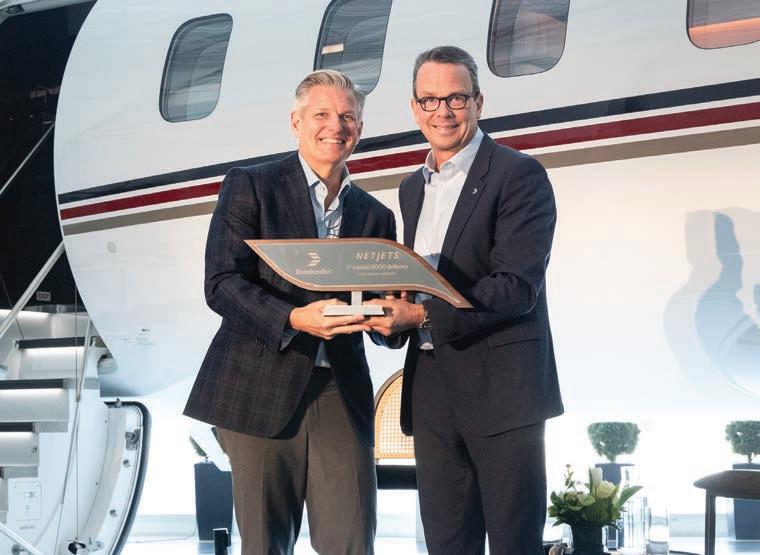
Bombardier has handed over the first of a fleet of Global 8000s to fractional ownership provider NetJets. The delivery took place on April 1 in a ceremony at Bombardier’s Laurent Beaudoin Completion Centre in Montreal with hundreds of employees and guests.
In 2022, Bombardier named NetJets as the fleet launch customer for the Mach 0.95 business jet under an initial order that included four new Global 8000s and the conversion of eight existing Bombardier orders (originally for the Global 7500). In addition, that order called for the planned upgrade of NetJets’ in-service Global 7500 fleet to Global 8000s, bringing the total to 24. The NetJets Global 8000 fleet could further grow in the coming years through a
series of options placed for the model.
With an 8,000-nm range, the aircraft expands route options for NetJets customers and is coupled with takeoff and landing performance that enables it to operate at more airports, Bombardier noted.
To ensure comfort during those lengthy trips, the four-zone aircraft is equipped with features such as Bombardier’s P ū r Air System, Soleil circadian lighting system, and the lowest cabin altitude in production.
“Our long-standing partnership with Bombardier has been built on a shared vision of excellence and innovation,” NetJets Aviation president Patrick Gallagher said. “The Global 8000 is the ultimate expression of that partnership.” z
Daher said its “Take O 2027” five-year strategic plan, launched in 2023, is progressing as planned. The company is building a third aircraft assembly line in Stuart, Florida, with boosted production capacity complementing technology development.
Construction of the dual TBM and Kodiak assembly facility is now underway after renewal of the Stuart site’s long-term lease. Although the OEM had stated in 2024 that the first aircraft would roll o the combined line in early 2026, this has now been revised to 2027.
Michelin is targeting weight reductions and service life increases of 10% to 20% when its new Air X Sky Light tires enter service on the Dassault Falcon 10X next year. The France-based group developed the tires specifically for the new business jet and now aims to be selected for other aircraft. The sidewall and bead areas of the Sky Light tires feature hybrid cords and fabrics that Michelin said are stronger and lighter than those used for earlier tires.
Moog has sold its S-TEC 3100 airplane autopilot product line to Innovative Aerosystems. The deal adds to Innovative Aerosystems’ avionics, flight control, and mission-critical aerospace systems products for the business, commercial, and military aviation segments. Moog purchased S-TEC manufacturer Genesys Aerosystems in 2020. According to Innovative Aerosystems, it plans to support existing S-TEC 3100 customers and invest in “future enhancements, certification expansion, and seamless integration with the company’s broader avionics ecosystem, including advanced flight decks, autothrottle systems, mission computers, and display technologies.”






A worldwide network, now with even more feld and airborne support teams near you.


































































BY GORDON GILBERT
Fatalities from worldwide accidents involving nonscheduled turbine business airplanes fell 50% year over year (YOY) in the first quarter, according to preliminary data tabulated by AIN.
In the first three months of this year, 23 people lost their lives in five fatal crashes, versus 46 who perished in 12 turbine
business airplane accidents during the first quarter of 2025.
That said, six people died in one accident involving a U.S.-registered business jet in the first quarter, compared with two fatalities in two crashes in the same period last year.
Gulfstream Aerospace appointed MJets as the authorized international sales representative for Gulfstream business jets in Thailand. MJets handles aircraft sales, management, and FBO services at Bangkok Don Mueang International Airport (VTBD). Under the agreement, MJets will promote and support Gulfstream throughout the country. The aircraft manufacturer continues to see significant growth for business jets in Asia, particularly for the Gulfstream G700 and G800 ultra-long-range jets.
The owners of business aircraft brokerage Guardian Jet are breaking into the ondemand charter flight sector with Capstone Jet Charter. Independently operated from Guardian Jet, the new air charter broker will evaluate operators based on factors such as the quality of their aircraft maintenance and mission suitability before making a recommendation. An assigned advisor will take full responsibility for each trip, from the initial request through to final billing, to maintain continuity.
Signature Aviation has opened a new FBO terminal at Scotland’s Glasgow Airport (EGPF). Designed to enhance the guest experience as a gateway to one of the most culturally rich and historic cities in Scotland and greater Europe, the facility provides 4,660 sq ft of space. It features an expansive lounge, large meeting room, showers, and a dedicated security screening room. Built on the same site as the previous facility, it nearly doubles the size of the former terminal. Signature CEO Tony Lefebvre said the opening reflects “our continued investment in key international markets.”


BY CURT EPSTEIN



AIN president Ruben Kempeneer (top right) welcomed the more than 250 aviation service professionals who gathered on March 26 to celebrate the best of the global FBO industry at the Agora Theater in Cleveland at the conclusion of NBAA’s Schedulers & Dispatchers conference.
AIN Media Group honored the business aviation services sector during the second annual AIN FBO Awards Gala on March 26, capping off NBAA’s Schedulers & Dispatchers Conference that attracted record crowds to Cleveland. Despite the stormy weather and torrential rains, more than 250 aviation service professionals gathered at the city’s landmark Agora Theater to celebrate the best of the global FBO industry.
Following a welcome address by AIN president Ruben Kempeneer, master of ceremonies and bestselling author Andrew Davis led the audience through this year’s most highly reviewed FBOs, as rated by AIN’s readers in the magazine’s annual FBO Survey. Survey results were included in the April edition.
Following the recognition of the top 20%, 10%, and 5% of FBOs from the Americas and the Rest of World, the individual top-scoring FBOs from both groupings were recognized in the following
categories: Passenger Amenities, Pilot Amenities, Facilities, Line Service, and Customer Service. In all, more than 75 FBOs were recognized through these awards, along with 75 individuals as going “Above & Beyond.”
Celebrating the two FBOs that showed the highest increases in their survey scores, Commitment to Progress Awards were presented to Modern Aviation’s facility at Sacramento Mather Airport (KMHR) in California, and Universal Aviation/CJet, the lone service provider at China’s Beijing Capital International Airport (ZBAA).
This year’s award for Best FBO-Sustainability was presented to Signature Aviation Vail Valley (KEGE) by Curt Castagna, president and CEO of the National Air Transportation Association (NATA). The facility was the first in the world to achieve Tier III under NATA’s Sustainability Standard for Aviation Business. It has converted
more than half of its ground service equipment to electric and offers continuous supplies of sustainable aviation fuel.
Honoring individuals whose dedication, leadership, and contributions have shaped the FBO industry, this year’s Lifetime FBO Achievement Award was presented to the late Jerry Holland, Sheltair founder, chairman, and CEO, who grew his company from a set of hangars into an aviation real estate empire totaling roughly 5 million sq ft of airport infrastructure, spread across 16 locations in four states. It was accepted in his name by his daughter, current Sheltair president and CEO Lisa Holland.
Capping off the evening, the top FBO in the Americas was presented to Detroit-area Pentastar Aviation for a sixth consecutive year, while in the rest of the world, TAG Aviation Macau, in its first year of survey eligibility, took the top slot, unseating 19-year incumbent Farnborough Airport. z

BY PETER SHAW-SMITH

Once the Iran war ends, reconstruction and recovery in the Middle East will take many months.
As they went about weekend outdoor pursuits on February 28, only to sense distant but almost palpable explosions thudding ominously through afternoon skies, few Dubai residents immediately understood that the Persian Gulf was suddenly, once again, at war.
One month later, there was no clear end in sight. By early April, President Trump hinted that the war may end in “two to three weeks,” but the unpredictability of Middle East geopolitics may mean that the decision is not entirely his to make. Anxious to secure food supplies and oil deliveries, the UAE threatened to join the war to reopen the Strait of Hormuz.
Iranian retaliation to U.S.-Israeli bombing has led to serious incidents, including a drone attack on Dubai International Airport (OMDB) on March 7 that briefly halted operations. Demands for private evacuation and rescue charters spiked after missile activity repeatedly interrupted state-organized repatriation flights.
A March 18 attack on Qatar’s Ras Laffan LNG processing hub caused extensive damage, leaving around 17% of capacity impaired,
with repairs likely to take three to five years.
Iranian missile attacks in late March on airports in Kuwait and Iraq, and a strike on a U.S. airbase in Saudi Arabia, underlined the danger to aircraft, even on the ground. Yet commercial aviation came back to near full operations: Cirium data issued on March 27 showed only 13% of regional scheduled flights were cancelled or no-fly at the time.
Since the start of the war, UAE air defenses have engaged more than 430 ballistic and 20 cruise missiles, and 2,000 UAVs. News agency WAM said two Emirati soldiers and a Moroccan contracted to the armed forces have been killed, along with nine civilian fatalities. Some 190 non-Emiratis have suffered various injuries.
Hany Bakr, senior v-p, aviation and maritime security for MedAire in Cairo, said business aviation operators were contending with rapidly changing notams, evolving conflict zone advisories, and short-notice airspace closures and
restrictions, which significantly complicated flight planning.
“The dominant drivers behind the risks within the region are airspace volatilities and unpredictability, rather than a single fixed threat,” he told AIN. Flights have been facing longer routings, increased fuel loads, crew duty limitations, and insurance constraints. Collective flight crew resistance to operating certain flights, beyond acceptable risk thresholds, is leading to postponement and disruption.
Eric Schouten, CEO of Dyami Security Intelligence, said Qatar, the UAE, and Bahrain remained areas of most concern for business aviation operations. Threats involve Iran trying to hit either tourist areas or business centers hosting banks or American companies, military or air bases, ports, and embassies.
“Iran still has a huge amount of ballistic missiles and drone capabilities,” he told AIN. “They only have to send one out once or twice a day to disrupt.”
WingX Advance estimated a fall of 41% in Middle East business jet departures in late March, with a 14% year-to-date decline.
Argus International data shared with AIN on business jet activity showed Middle East month-on-month movements down 58% in March vs February 2026, while the year-over-year figure for March 2026 versus March 2025 fell 55%.
Dumani Ndebele, regional FBO director, ExecuJet Middle East, said that earlier in March, many flights were positioning in for charters. “There were very heavy movements during the first two weeks,” he said. “Things have now stabilized. We’re now seeing a softening in traffic, given the uncertainty of the situation, but a lot of our Middle East-based clients are still in-region, and our hangar is full.”
Mohammed Husary, executive president of UAS International Trip Support, said business aviation is crucial to Middle East governments, NGOs, and commercial entities. “We are seeing operators, service providers, and suppliers demonstrate
remarkable agility and foresight, adjusting flight plans, strengthening risk management, and leveraging real-time intelligence to ensure the well-being of crew and passengers,” he said.
WingX Advance said on April 2 that U.S. jet fuel prices have more than doubled since the start of March, with jet fuel hitting $1,710 per tonne at the end of the month, compared with just $742 a year ago.
Vito Gomes, CEO, Aviation Services Management, Dubai, said it was difficult to predict the outlook for fuel prices in the region. “It all depends on the crisis in the Hormuz area,” he said.
Before the war broke out, Universal Weather and Aviation planned to launch FBOs in Riyadh, Jeddah, and Dammam within months. It said that the strategy remained in place.
“We recognize that a prolonged conflict could impact flight activity levels in the near term, and that traffic at opening may be lower than originally forecast,” said John Hewett, regional v-p, EMEA. “That said, it does not change our commitment to bringing these locations online.”
Mohammed Al Bokhari, CEO of Aviation Horizons, Jeddah, bemoaned a litany of problems in Egypt, Lebanon, and Syria, from the pandemic and the 12-Day War with Iran to now, another war. “Every time we say, ‘Okay, things will stabilize,’ something new comes up,” he said.
The Middle East is heading in a direction that no one can predict, and unless the situation stabilizes, planning is difficult. “This war will change a lot of things in the future, politically,” Al Bokhari told AIN. “The Middle East will not recover for at least another three months [after the war ends], just for people to understand what’s really coming up.” z

BY CHARLES ALCOCK AND CHARLOTTE BAILEY
While fleets and flight hours tick up ever so slightly, Europe’s business aviation community is facing an array of tax, access, and environmental constraints that threaten to hinder further growth. Even so, manufacturers and operators are hopeful that a growing clientele and environmental advances will spur the industry on the continent. The industry is also seeing some seeds of support take root at the European Commission. AIN takes an in-depth look at the state of business aviation in the region from an operational, environmental, regulatory, and technological perspective.

Focusing on the bright side, the European business aviation industry might take comfort from the fact that Extinction Rebellion and other environmental direct-action lobbyists seem to have lost their appetite for invading airports to damage business jets. That was very much in vogue two or three
years ago, and cynics might now conclude that Europe’s governments are doing the work of Greta Thunberg and her fellow eco-warriors with their efforts to stifle the sector through allegedly discriminatory taxes and measures such as its ReFuelEU sustainable aviation fuel (SAF) mandates.
Politics apart, it is easy to be underwhelmed by business aviation’s progress in Europe, with Richard Koe, managing director of data specialist WingX Advance, recently describing the sector’s compound annual growth rate of 2% as “quite frankly miserable.”
There have been some bright spots of growth over the years, such as in the late 1970s before the second energy crisis, when the industry grew by 11%; followed by the pre-millennium dot-com boom (24%); and before the financial crisis in the late 2000s (17%). Compared with activity levels in February 2025, growth has been meager at 1%.
Traffic levels tracked by the European Business Aviation Association (EBAA), with data from JetNet subsidiary WingX and Eurocontrol, paint a similar picture. With peaks of almost 790,000 movements in 2007 and 800,000 in the post-Covid euphoria of 2022, European activity barely got above 750,000 movements in 2025, which represented a 1% increase over 2024.
EBAA’s most recently confirmed traffic data runs through the end of February, just as the Iran war broke out. Factoring in arrivals and departures at airports in the 44 member states of the European Civil Aviation Conference, these figures showed overall growth of 1.5% in the 12 months since the start of March 2025.


Predictably, the summer months spanning June through September once again showed elevated activity levels. Some charter brokers have told AIN they are already anticipating above-average bookings this summer as private travelers gravitate toward locations in Western Europe to avoid disruption and risk in the Gulf states. The villa rental market in Mediterranean resorts is reportedly very hot.
Tracking European flights in January and February, there are some significant variations between countries. In France, the UK, and the Netherlands, where taxes on charter flights are already in e ff ect or threatened, year-to-date movements were down by up to 5%. By contrast, Italy, Spain, Greece, Portugal, and Finland recorded increases of between around 7% and 24%.
Breaking down year-to-date traffic by business jet manufacturers reveals growth for Gulfstream (12%), Bombardier’s Global and Challenger families (10%), Embraer (5%), and Pilatus (16%). Cessna Citation, Dassault Falcon, Hawker, HondaJet, and
Bombardier’s Learjet types all saw dipping levels of activity in the first two months of this year. Flight totals ebbed for all the main turboprop brands, including Piper, Piaggio Aero, Cessna, Pilatus, Beechcraft, and Daher.
The consensus among experienced business aviation professionals interviewed by AIN in March for this report is that it is hard to assess what 2026 will amount to in Europe. “It feels too early to tell,” commented Julie Black, head of business aviation with charter broker Hunt & Palmer, almost three weeks into the Iran war. “Fractional ownership has been strong, but charter is generally doing less well. If something doesn’t change, there could be a loss of confidence in travel and impacts such as fuel surcharges.”
At Malta-based aircraft management and charter group Skyfirst, company CEO and founder Olivier Perdriel shared the sense that uncertain market forces have been triggered by the Iran war. “The industry


mood is neither optimistic nor pessimistic; it is more that we are in shock and do not know what is going on,” he told AIN
According to Perdriel, European operators are hoping the conflict and its economic fallout will come to an end in time to avoid denting the usually lucrative summer season. He said demand slowed from around the end of 2025 as investment decisions stalled over economic uncertainty caused by Russia’s ongoing invasion of Ukraine and U.S. tariffs.
“But they [charter customers and aircraft owners] are not going to change their way of living,” Perdriel commented. He indicated that leisure-driven trips might be less impacted than those purely associated with business, while also pointing out the high degree of crossover between these two purposes in the private flight market.
Charter marketplace Avinode’s rolling 28-day pricing index through late 2025 showed flight-hour charter rates as being consistently higher for trips in Europe compared with the U.S. The difference likely reflects higher operating costs in Europe and also the significance of seasonal demand fluctuations.
According to Harry Clarke, the Swedenbased group’s director of commercial development, in the post-Covid cost environment, it is even more important for charter flight providers to have market intelligence to understand when they can raise prices. “Our customers are seeing more purpose in using the search comparison tool, because it makes even more sense to do that in peakier markets,” he told AIN , referring to Europe’s more entrenched seasonal demand patterns.
Avinode’s platform has a feature that allows operators, when they receive a flight request, to run a comparison search to see what brokers saw when they initiated the search among multiple potential trip providers. Around 40% of European operators are using this function, which is almost four times the rate in the North American

market and twice that of the Middle East.
The dislocation caused by the Iran war has also illustrated the importance of realtime market intelligence; charter providers scrambled to respond to the urgent need to evacuate people from Gulf states under fire from missiles and drones. Clarke said there
has been a shift in demand for flights to destinations at the western end of the Mediterranean Sea, but that at the same time, searches for trips more than a month ahead of departure appeared to be dropping, perhaps in the context of economic uncertainty.
Avinode has noticed more operators
gravitating toward a floating fleet model in an attempt to be better placed to pick up empty leg bookings. “The challenge is to find where the charter opportunities are and to navigate these while dealing with rising fuel costs,” Clarke concluded. “It is more important than ever to be able to find these solutions.” z
Despite heavy jets comprising the largest portion of the European fleet, Textron Aviation has accounted for the largest market share of the nearly 4,000 business aircraft in the region.
According to JetNet data published by the EBAA, there were 3,982 business aircraft based in Europe at the end of February. The largest contingent of these (1,042 aircraft and 26.1% of the total) were heavy jets, followed by light jets (1,013/25.5%), single turboprops (787/19.8%), twin turboprops (585/14.8%), midsize jets (471/11.9%), and so-called bizliners (84/2.1%).
This data, which does not tally with that provided by some of the manufacturers themselves, shows Textron Aviation dominating the Europe-based fleet with 903 of its
Citation jets and 536 King Air and Caravan turboprops. The rest of Europe’s jet fleet is accounted for by Bombardier (529), Dassault (357), Gulfstream (165), and Embraer (139). In the turboprop contingent, Pilatus’ PC-12 is in second place (276), followed by Piper (239), Daher (160), and Piaggio Aero (80).
According to Textron Aviation, it has more than 1,700 aircraft in Europe, including 850 Citations, 450 King Airs, and 175 Caravans, with the remainder being its piston models. The company has introduced new models such as the Citation Ascend and the Beechcraft Denali with prospective European customers in mind.
“We’re seeing customers prioritize versatility and long-term value,” said Duncan






Van De Velde, Textron Aviation’s sales vice president for Europe. “Many owners fly for a mix of business and personal missions, so they want aircraft that are flexible, comfortable, and a strong investment over time.”
According to Dassault Aviation, 360 of 2,170 Falcons operating worldwide are now based in Europe. More than 40% of the new Falcons delivered in 2025 went to customers in Europe.
Gulfstream said that it has 220 aircraft based in Europe and that its fleet there has grown by more than 34% over the past decade. According to Michael Swift, the U.S. manufacturer’s group vice president for international sales in Europe, the Middle East, Africa, and Asia-Pacific, European demand is still showing strong year-over-year growth momentum.
“We’re seeing European customers continue to be drawn to Gulfstream because of our long-standing investments in sustainability, as well as the advanced technology and performance capabilities featured throughout our next-generation fleet,” Swift told AIN. He pointed to the manufacturer’s efforts to promote decarbonization by flying more than 3 million nautical miles on SAF, including the first-ever transatlantic flight on 100% unblended fuel.
According to Embraer, the European business aviation market regained some momentum in 2025 after what it said had been several challenging years. The company told AIN that it has more than 300 aircraft operating in
Europe, including 154 Phenom light jets, 46 Praetors, 97 Legacys, and eight Lineage 1000s.
The Brazilian airframer said Phenom and Praetor models have proven popular with European customers seeking the right level of performance. Private flight providers NetJets Europe and Flexjet have both deployed the latest Praetor 500E and
600E jets for customers on the continent. Gulfstream and Bombardier have made significant investments in their respective factory-owned European service centers at Farnborough and Biggin Hill in the London area. Textron Aviation has six service centers across the continent, plus a parts distribution hub in Düsseldorf, Germany, while








Dassault Falcon Service’s Paris Le Bourget MRO center is the epicenter of the French airframer’s product support operation in Europe. Embraer Executive Jets has multiple authorized service centers in Europe.
Breaking Europe down in terms of where these aircraft are physically based, Germany has the top locations with 758, with the other main countries in descending order being the UK (519), France (490), Switzerland (227), Italy (224), Austria (188), Spain (163), and Malta (160). Collectively, the eight nations account for just over two-thirds of Europe’s entire fleet.
Where the aircraft are registered is a different story. Germany’s D- tail number is emblazoned on 703 of the aircraft, but the U.S. N-register is in second place with 393 aircraft. The next most popular national registries are France (321), Malta (241), the UK (239), Austria (227), and Portugal (155). z
Flexible access to airports is arguably the most enticing item on the business aviation menu. Without this ingredient, the industry’s secret sauce isn’t as special, and yet that is the dilemma increasingly facing operators in Europe.
Securing proportionate and fair access to slots in increasingly capacityconstrained airports remains a major headache, according to EBAA. Róman Kok, the group’s director of public affairs and communications, told AIN the sector has been treated as “the underdog” for slot access for too long, and lobbying efforts are being ramped up to demand equitable treatment.
Europe’s current slot regulation system was devised in 1993 and, while Kok said it was built for air transport
growth, regulators evidently “never considered how to operate under a system of constraint.” At the time, EBAA had minimal influence on the process, and now its members find themselves disproportionately excluded as airports maximize bandwidth for scheduled airlines while also, apparently, seeking to appease environmentalists.
In January, Eindhoven Airport in the Netherlands effectively banned business aircraft, and EBAA is concerned that if this precedent is not adequately challenged, the approach could be normalized in other European cities. Kok told AIN that while Eindhoven’s management initially used environmental and noise complaint concerns, “they soon realized this was
a discriminatory way of arguing, so they changed their defense to invoke the slot regulation.” EBAA subsequently lost a legal challenge to the ban.
The rationale of airports wanting to restrict access—also exemplified by efforts elsewhere to restrict nighttime access in cities such as London—is, according to EBAA, fundamentally flawed; most business jets make less noise than larger commercial airliners. Should the latter secure more slots, the increased movements would mean an inevitable rise in overall noise, according to EBAA. But “the ramifications seep their way into public perception, and seep through into regulation,” Kok suggested.
However, EBAA sees some cause for optimism since the European Commission is now reviewing regulations that the body appears to recognize as being flawed. Despite losing the Eindhoven injunction, Kok said, “The Commission understood that it is effectively undermining the basic principle of a single market, fair access, and a level playing field.”
The EBAA team is working closely with around 80 members of the European Parliament, including the head of aviation within the Renew Europe political grouping. The association is collaborating on the position paper that the group will present to the Commission, leveraging their combined lobbying attempts and pushing for fairer access for all airspace users. This, affirmed Kok, “is the first time
in history that a parliamentary group has taken an o ffi cial stance in defending the interests of business aviation.”
He believes the current European Parliament (2024 to 2029) is offering more space for constructive discussion within the industry than its predecessor. “There is a recognition starting to take place…and we are gaining more traction in our normal dayto-day lobbying work,” he concluded. z
During February, Europe’s busiest business aviation airports were—in descending order, according to WingX data—Paris Le Bourget, Geneva, Milan Linate, Farnborough (London area), Zurich, London Luton, Nice, Madrid Barajas, London Biggin Hill, and Sion. Three of these—Le Bourget, Farnborough, and Biggin Hill—are dedicated business aviation gateways, which signals the importance of operators having the right operating environment in Europe.
According to Biggin Hill CEO David Winstanley, the exclusive business aviation ecosystem that airports like his can o er makes a big difference to the sector’s viability. “What we notice from operators is that operational e ciency and
schedule predictability are everything, and over the past couple of years, fractional ownership and shared use services require even more connectivity,” he told AIN. “As an airport owner, I can give the transparent pricing structure and flexibility with no slot constraints, plus a highly trained and motivated sta , all of which reduces the variability from your schedules.”
Privately owned Biggin Hill has invested more than $26 million to resurface its main runway, as well as adding new centerline and edge lighting. The airport also now has an instrument approach on both runways and 24/7 meteorological aerodrome report capability, which Winstanley said makes it a more viable option for operators.

Like other dedicated business aviation enclaves, Biggin Hill has attracted an array of service providers to support operators. Among more than 70 companies onsite, the airport has Bombardier’s European service center, as well as MRO specialists for Pilatus aircraft and Leonardo helicopters.
The European business aviation community may have to wait until September to learn whether the European Union General Court considers the industry to be “an environmentally sustainable economic activity.” That is what is at stake in a case filed by Dassault Aviation and the EBAA to challenge the European Commission’s exclusion of the sector from its EU Taxonomy in a move the plaintiffs say
is discriminatory and makes it harder to invest in decarbonization efforts.
Judges in Luxembourg started hearing the case on February 10, and this process is expected to run for up to six months. EBAA is determined to reverse the Commission’s ruling to avoid a precedent in which one part of the aviation industry can be—in the words of the group’s director of public affairs and communications, Róman Kok—“carved
out” and treated as “sacrificia l lambs.”
Attorneys Jacques Derenne and Dimitris Vallindas, with EBAA’s law firm Sheppard, appeared at the group’s members conference near Brussels on March 19. They spelled out the dangers of business aviation remaining outside the EU Taxonomy, which is widely used in the finance sector to determine activities that are deemed worthy of investment and funding.

Vallindas explained that the Commission views business aviation as mainly being used for leisure travel and that such trips could easily be replaced with other modes of transport. He and his colleague are disputing this contention and other points that it considers “legally erroneous.”
The lawyers accused the Commission of failing to accept that the majority of Europe’s airports have no scheduled airline services. They have pushed back hard on the notion that business aviation is not predominantly used for business purposes, giving the example of Dassault Falcon aircraft ordered by the French Navy for “public
interest” missions such as maritime patrol.
“Because they insisted so much on the alleged leisure objective, we thought it totally right to tell them that it’s actually commercial aviation which is used mostly for leisure purposes,” Vallindas said. “If it was the main reason to exclude business aviation, it should also work against commercial aviation.” z
The European business aviation sector continues to insist that the European Commission’s ReFuel EU mandate for increased SAF usage is a blunt instrument that is not fit for purpose. At the same time, Europe’s airlines agree with the Airlines for Europe and European Regions Airline Association calling for changes to the rules in mid-March.
From January 2025, ReFuel EU mandated the use of 2% blended SAF at EU airports, rising to at least 6% by 2030 (of which 0.7% must be e-fuel). However, the physical unavailability of SAF at many smaller airports serving business aviation—along with a lack of recognition for book-and-claim options—is only part of the problem.
Operators flying into and within Europe are also mandated to refuel at least 90% of their annual fuel requirements from EU airports. According to EBAA EU affairs manager Federico Ricci Buffetti, this has “created a huge administrative burden for business aviation…which, in a way, endangers the business model of our sector.”
Compliance tensions are underpinned by what Buffetti perceives as “inconsistent application of this regulation by civil authorities,” with different compliance schemes—including CORSIA and the EU Emissions Trading Scheme (EU ETS)— requiring conflicting data and calculation methodologies.

“Operators are really struggling with consolidating the data that they need and putting that into the required templates for the different reports,” stated Puja Mahajan, CEO and co-founder of climate tech software provider Azzera. The company’s proprietary aviation-specific Celeste software platform provides what the company terms an “all-in-one solution for emissions measurement, compliance management, and reporting.”
When Azzera launched in 2021, “the real genesis was voluntary action for sustainable sustainability,” Mahajan explained. “Almost 50% of [business aviation]
operators now have some sort of SAF solution or voluntary carbon credit solution, whereas maybe two years ago, that was 15% of the market.”
Another aviation sustainability support provider, 4Air, leverages its expertise to support large and small operators navigate and manage compliance. The company believes that while regulation has “really pushed the industry in the right direction,” the regulatory landscape has become increasingly complex since around 2020.
The fast pace of evolving regulation means it’s imperative for operators to stay informed of ongoing compliance
responsibilities, with 4Air European program manager Maureen Gautier stressing that “it’s more important to be proactive than reactive.”
That task, according to EBAA’s Buffetti, is easier said than done. He told AIN that the European Commission was very late in presenting guidelines regarding what was accepted for the justifications, and exemptions are also complicating compliance efforts.
“ICAO is trying to simplify [regulation] on the international level, but we still have the specifics and politics of each region that are very important,” continued Gautier, who described the potential
recognition of a SAF book-and-claim system as a “win-win.” This would help combat the ongoing shortfall in SAF supply by allowing climate benefits to be purchased independently from the physical fuel.
However, Gautier believes regulatory reticence to do so comes from a worry over fraudulent certificates and concerns of erroneous double-counting. Nonetheless, with workable solutions in place, she hopes the 2027 review of ReFuelEU and ETS will open up the discussion once more.
The European Commission’s sustainable transport investment plan, published in late 2025, included “the willingness to assess the feasibility of a book and
claim system…but most importantly, the opportunity to simplify review reporting requirements,” explained Buffetti. Alongside the EBAA’s work to inform operators via its own compliance guide, the association’s ReFuelEU working group sees an “important opportunity to influence this simplification.”
More than 300 EBAA members signed an open letter to the EU commissioner for sustainable transport and tourism, Apostolos Tzitzikostas, calling for changes to the rules. Bu ff etti said this represented a strong starting point for what the group hopes will be more constructive dialogue on this important topic. z
Beyond taxes, airport access, and decarbonization costs, Europe’s charter operators are now facing a new cost burden in the shape of revised EASA pilot flight time limitations (FTL) that are due to take effect in 2027.
According to Olivier Perdriel of Skyfirst, the tighter NPA 2024-106(B) rules around rest periods during and after trips will be “horrible” for operators, and he called for the industry to counter strong lobbying by commercial pilots’ unions.
The rules, which have been drawn up specifically for the business aviation sector, are expected to mean that operators of ultra-long-range jets, like the new Dassault Falcon 10X model, will have to have more pilots on the payroll and allow longer rest periods between trips. “If you go [from Europe] to New York for two days, you then have to stop flying for three days, and if you go to Los Angeles, it would be five days,” Perdriel explained.
Describing the new rule as “very strange,” he said it includes confusing requirements such as additional rest periods during trips
depending on whether the flight crew is notified of changes in a departure time via email or WhatsApp messages. The business aviation industry has previously asked for FTL rules to be reshaped around its operational realities—as opposed to those of scheduled airlines—but Perdriel indicated that keeping the existing rules would be less bad at this point.
According to Perdriel, 106(B) gives no credit for the fact that the latest long-range jets are far more comfortable for pilots and that their workload has been reduced by new technology. He predicted that
the changes could require three or even four pilots to be assigned to trips of up to 15 hours.
“I think at some point owners will just find all of this too much of a burden and start registering aircraft outside Europe and under purely private flight rules,” he predicted. “We are in real danger from increased taxes and complex regulations that are not always clear and fair. We have already been operating with chains on our feet, and now they [regulators] are attaching the chains to the wall to make sure we cannot go far.” z

If opportunities for business aviation growth in Europe remain fairly constrained, achieving greater efficiency has become an ever-more-compelling priority for aircraft operators and those who support them. Increasingly, the path to progress is being pursued through technology with a focus on breaking the industry’s deeply ingrained manual work processes and tapping automation to free up time for humans to apply the personal touch.
Stack Aero is part of the digitization trend, o ff ering charter brokers and operators a Salesforce-powered Business Operations System that automates and streamlines their core workflows. The company believes business aviation service providers could significantly boost their competitiveness by ditching analog processes.
According to Stack Aero’s business development director, Cat Buchanan, there isn’t a moment to lose, or the industry risks being seen as antiquated by a new generation of clients. She told AIN she fears the European market could remain stunted by cost burdens, including taxes on private flights and SAF mandates.
Web Manuals, for example, believes that its document management system is saving charter operators and flight departments as much as 70% of the time they spend managing regulations and recordkeeping. The Swedish company helps its clients to manage their compliance libraries, helping them to keep on top of regulatory updates and ensure that flight manuals and maintenance documentation remain current.
According to COO Paul Sandström, Web Manuals’ automated approach is especially impactful for smaller operations where employees commonly shoulder multiple responsibilities that could result in them drowning in bureaucracy. Much of

Web Manuals is helping charter operators reduce time spent managing regulations.
the time-savings benefits those responsible for editing and updating documents because the company’s AI-backed software maintains the required standard structure for elements such as revisions, footnotes, and headers.
Companies are now having to implement EASA’s new Part IS covering requirements for cybersecurity protections, and Web Manuals is helping on this front, too. According to Sandström, increased use of AI can reduce the burden of repetitive tasks, “if we get this right, but it needs the right quality assurance.”
FL3XX is also trying to streamline the business aviation sector with its platform to help charter operators handle sales, flight dispatch, and the management of crew and aircraft maintenance. According to chairman and co-founder Paolo Sommariva, the industry’s mood is positive
despite burdens including increased regulatory and tax pressure points.
Sommariva also sees the industry’s somewhat stubborn attachment to antiquated Excel spreadsheets and “Post-it” notes as an obstacle to progress. In his view, companies need to invest more in IT, but with a smaller revenue base than his airline clients, “budgets are just not large enough.”
To add value, FL3XX has worked hard to integrate other software tools with its platform. Apart from making sense of Europe’s regulatory maze, the company believes it can help operators avoid missing out on commercial opportunities.
“We can help charter operators filter key market factors such as big sporting events so that they are not left guessing what the best price [for a flight] should be,” he said. “We are making this much more of a science so that our clients have far more time to focus on customer relationships.” z
In a mature and always-challenging market like Europe, it falls to professionals like Sabine von der Linden to ensure that business aviation remains viable and rewarding for its clients. Now in her 10th year as a corporate pilot, she is an experienced captain and instructor on Bombardier’s Global 6500 and 7500 jets and group standards officer with the Luxaviation aircraft management and charter group.
“So far this year, it is too early to say whether the industry should be optimistic or pessimistic,” she told AIN two weeks after the Iran war broke out and triggered a steep increase in fuel prices and airspace disruption. “There is more of a sense of caution that leaves us wondering what is happening and how we will feel the impact.”
In Europe’s largely stagnant economies, consumer confidence seems to be languishing, and political uncertainty around elections pending in several countries is not helping. But the uncertainty can also present opportunities that are reflected in rising demand for charter flights from what could be an expanding customer base.
tomorrow,’ whereas in the past it was easier to monitor what the market would do.”
Some might say the way European business aviation is governed can be overly burdensome. For von der Linden—a vocal safety advocate—the continent has a strong regulatory base that delivers credible asset protection.

crews, including increasingly tight airport slot restrictions. For example, Eindhoven Airport in the Netherlands now just has two slots available each day, so Luxaviation typically takes clients to Rotterdam instead. In the current Middle East crisis, non-scheduled charters have to accept that they are a lower priority than airlines for whatever airspace and airport access is possible.
“We have to explain the limits to passengers, such as the fact that there are fewer 24-hour airports without night curfews,” von der Linden explained. “Clients provide us with their business schedule, and we make the most of their time in relationships built on trust.”
Not all pilots would be wellsuited to Europe’s distinct environment for business aviation. “Aircraft knowledge is only part of the job; collecting flight hours isn’t everything,” von der Linden commented.
According to von der Linden, operators like Luxaviation are increasingly serving a rising younger generation of customers, and the demands they make are shifting. “In the past, a typical business traveler might start with a Citation and move up [to larger aircraft], but now younger clients start with something more like a Challenger 650,” she commented. “The question is how steady and predictable this demand will be. These customers could be ‘in-today-and-out
Aircraft owners have options in terms of where they register their jets, with an array of tradeoffs in terms of the extent to which they can earn revenue from charter availability to offset costs, but also for tax deduction and depreciation considerations. Luxaviation holds 11 different air operator certificates to meet the varying needs of its global fleet, and seven of these are in Europe.
Von der Linden and her fellow pilots routinely have to navigate operational disadvantages faced by business aircraft
A core part of the job is absorbing the operational changes clients in the back of the aircraft make and squaring these as far as safety permits. “You have to make multiple small risk assessments, and you only get what this takes through experience,” explained von der Linden, who holds licenses from EASA, the UK, the FAA, and the UAE.
In her experience, these factors are part of the balance that has to be struck when recruiting addtional pilots. “There are brilliant young people with a very technical mindset, and then older pilots with more experience, but who may not have the right commercial mindset [for business aviation] and could be better off flying for the airlines,” she said. z
BY AMY WILDER

In 2020, Aviation Sans Frontières mobilized grounded airline crews to assist overwhelmed hospitals and healthcare services across France.
It was mid-2020, and the Covid-19 pandemic was escalating across Europe. Every morning, Vadim Feldzer’s phone rang. On the other end was a hospital executive from AP-HP, the network of public hospitals serving Paris. The calls always carried the same urgency—and the same impossible ask: Find us more volunteers. Find anyone who can help. The French hospital system was collapsing under Covid-19’s first wave, and the executive was running out of options.
“He was calling me every day, every day at eight,” recalled Feldzer, head of global communications at Dassault Falcon. “He was so desperate to find people.” Feldzer, a board member at Aviation Sans Frontières (ASF), wasn’t a healthcare administrator or medical recruiter. He
worked in business aviation. But in the chaotic early months of 2020, when France’s curfew-bound citizens watched daily death toll announcements on television and hospitals in the eastern regions began to fail, traditional boundaries dissolved.
ASF, the humanitarian organization founded in 1980, had mobilized France’s aviation community to transport medical volunteers between overwhelmed facilities. Feldzer helped coordinate those flights with his wife, who is an anesthesiologist, and other business aviation community members. Through that work, Feldzer made connections with hospital administrators who began approaching him for help, knowing he had access to networks they didn’t.
For more than 40 years, ASF has put aviation resources and expertise at the service of humanitarian aid, operating in conflict zones and remote areas of Africa, partnering with UN agencies and NGOs for medical evacuations and supply delivery. The organization is recognized as a public utility in France and holds the distinction of being the first NGO certified as an airline with a European air operator certificate. When Covid-19 struck France, ASF pivoted its mission homeward.
In March 2020, ASF immediately mobilized for what Feldzer called the “Covid mission,” a coordinated effort to fly medical volunteers to overwhelmed hospitals. The first flight launched in March 2020, using a Dassault Falcon 8X with a
Double Your Value. Double Your Reward.

Multi service aviation Card + TITAN Rewards = double the points
Because Double the points are twice as nice. 1 point per gallon at participating locations 1 point per $10 spend


TITAN Aviation Fuels is a Global Aviation fuel supplier with a dedicated network of 665+ TITAN branded FBOs, 2,400+ TITAN contract fuel locations and 7,500+ multi service acceptance

Dassault crew. Within days, the operation expanded dramatically.
Feldzer reached out to his industry contacts. Nicolas Chabbert at Daher offered a TBM 900 demo aircraft. Cédric Lescop at Jetfly, a fractional ownership company operating Pilatus PC-12s and PC-24s, offered his fleet and convinced fractional owners to donate flight hours to the cause. Training schools contributed aircraft. Engineering schools volunteered airplanes. The fleet grew to include more than 20 different aircraft types, from small trainers to business jets.
The crisis was most acute in eastern France at first, where hospitals were crushed under the pandemic’s initial onslaught. “We had been successful in bringing some assistance to them,” Feldzer recalls. Over two to three months between March and May 2020, volunteer pilots flew 600 hours, transporting doctors, nurses, and specialists with critical skills to facilities crying out for help.
The aviation community united with remarkable generosity. “You realize that there are lots of generous people, and generous people united to serve for a good cause,” Feldzer said.
But by late April, the crisis had evolved beyond what wings alone could solve. The pandemic had spread from isolated regional hotspots to all of France. Paris hospitals faced systemic collapse as they operated beyond capacity with exhausted medical personnel. The hospital executive calling Feldzer each morning needed something different: not transport capacity, but human resources. Bodies. Hands. Helpers capable of supporting overwhelmed medical staff Feldzer reached out to contacts across Europe searching for nurses willing to volunteer in French hospitals. He found goodwill in abundance. “I found people who wanted to come to help or save French hospitals, Parisian hospitals,” he said. But pandemic quarantine rules created significant barriers. Crossing borders meant isolation
periods of uncertain duration. No one could risk getting trapped away from home with no clear path back. After failed attempts, Feldzer delivered the bad news to his hospital contact: “I’m sorry, so sorry. I tried my best, but it looks like I’m wasting your time.”
At the same time, a flight attendant acquaintance sat grounded at home, along with thousands of crewmembers across France. Commercial aviation had frozen. This flight attendant kept telling Feldzer that her colleagues—trained in emergency procedures, customer service, conflict de-escalation, and basic medical response—were idle and wanted to do something to help. Flight attendants have skills and capacity, she insisted. They should be able to help.
“Because I just wanted to offer an option—[even if] that seemed a totally stupid option, but the only one that came to my mind—I said to the guy, ‘Maybe you would be interested in flight attendants,’” Feldzer recalled.
He expected outright rejection. Instead, the hospital’s innovation team identified missions appropriate for flight attendant skills: patient support, Covid-19 testing assistance, and work in nursing homes where facilities had sealed the doors and isolated vulnerable
residents from outside contact. “They have special behavior,” Feldzer explained, referencing the extensive training flight crewmembers receive. “They have, first, skills in medical stuff, but they can calm down people. They can do a lot of things.”
Arnaud Heuze, a flight attendant trainer with 26 years of experience at Air France, was in the advance guard of volunteers. He was contacted by Laurent Bertucat, a pilot and ASF ambassador, who invited him to join the civic reserve within Covisan teams, government brigades established to stop Covid-19’s spread.
“The required qualities—empathy, kindness, adaptability, and teamwork—are shared between medical and aviation professions,” Heuze wrote about his experience. His flight attendant training proved directly applicable—particularly the importance of reassuring patients, just as he would reassure passengers.
After training, Heuze swapped his flight attendant uniform for an investigator’s role, conducting home visits to test for Covid-19 cases, perform personalized health assessments, and provide human support to isolated, elderly, and anxious individuals for whom these visits were


Sheltair proudly serves business and private aviation with 16 FBOs and 19 properties in Florida, Georgia, Texas, and Colorado. Our newest location, Sheltair Sarasota (KSRQ), delivers unmatched convenience on the Gulf Coast. From spacious hangars to exceptional hospitality and service, every detail is crafted for your mission. Wherever you fly,


sometimes the only contact with the outside world during lockdown.
As ASF ambassador, Heuze helped recruit others. The call went out across French airlines. Air France crewmembers responded first, but the effort quickly expanded across the industry. “We had people from all the [airlines] in France,” Feldzer said. “We had people from a dozen airlines.”
Working nights at Dassault while coordinating volunteer recruitment, Feldzer tapped his extensive industry contacts. Flight attendants responded in remarkable numbers. By July 2020, hundreds of crewmembers had volunteered. Some worked directly in AP-HP hospitals, supporting medical staff through the months of exhausting, round-the-clock crisis response. Others staffed nursing homes, bringing care and entertainment to elderly residents cut off from families. Still others joined Covisan teams conducting community testing and prevention work in suburbs and neighborhoods where clusters threatened to reignite the pandemic.
“For doctors, people working in hospitals, it’s been three, four months of work, sometimes days and nights, seven days— it’s been exhausting,” Feldzer explained. “Being reinforced by fresh people, highly motivated, coming from the airlines, even for doctors...it’s very refreshing to have people with a different kind of experience, kinds of jobs that bring a lot of energy, positive energy.”
Gérard Feldzer, ASF’s president, praised the volunteers in an official statement at the time, saying, “The spirit of solidarity, spontaneity, and professionalism of the flight crew, as well as their strong and assiduous commitment over several months, was remarkable and greatly appreciated by caregivers. The continuous training associated with their professions, oriented toward safety and hospitality, contributed to the effectiveness of interventions.”

The scope of the effort was unprecedented. Between April 7 and June 30, 2020, the combined aviation mobilization—transport flights and flight attendant volunteers— represented the largest operational aviation effort in France. As of July 10, 2020, 200 flight attendants remained deployed in hospitals and nursing homes. When France’s Bastille Day ceremonies that summer honored healthcare providers and others who mobilized against the virus, ASF received special tribute for its teams’ frontline work.
For Heuze, the experience represented a profound purpose during a period of professional paralysis. “Aviation Sans Frontières was involved as a way to not just endure the epidemic but actively contribute to the solution,” he wrote.
Recognition followed. France awarded Heuze the Médaille de l’Aéronautique for his critical role during the pandemic. The program itself earned formal acknowledgment from French authorities for its innovation and effectiveness.
When Covid-19’s second wave struck France in autumn 2020, ASF, AP-HP, and the Regional Health Agency of Ile de France reactivated the system through an online recruitment platform. The aviation community, still experiencing the deepest crisis in its history, with most airliners grounded and crewmembers furloughed, again responded with voluntee r muscle.
The effort demonstrated how specialized professional communities, when mobilized with creativity and urgency, can cross boundaries to address societal crises. “It’s not just about business aviation, or aviation,” Vadim Feldzer said. “It’s also flight attendants. All of business and airline aviation. But again—aviation for a good cause.”
ASF stated when it was founded, “We could have called ourselves Pilots Without Borders, but it would have been too reductive. From the beginning, we wanted to involve all aviation personnel, both flying and groundbased.” Four decades later, during the worst health crisis in a century, that vision proved prophetic. The organization known for flying medical supplies to remote African villages had mobilized its home nation’s aviation ecosystem—pilots, mechanics, manufacturers, and hundreds of grounded flight attendants— to save France’s hospitals from collapse.
It started with early morning phone calls and what at first seemed to be an outlandish solution. It ended with airline crewmembers earning medals for bringing fresh energy, human compassion, and professional discipline to overwhelmed caregivers near their breaking point.
The idea and volunteerism of the aviation community saved lives—and revealed unexpected connections between two professions that share, as ASF wrote, “emphasis on thoroughness, humility, and a passionate sense of commitment.” z

BY DALE SMITH

When was the last time you opened your email and didn’t see it loaded with spam? Or go a day without receiving a text asking you to confirm an account number or payment method? Like practically anyone with a smart device, you probably can’t remember. And it’s no surprise that phishing schemes have become part of our everyday lives.
And while not long ago, your aircraft’s cabin Wi-Fi was believed to be a safe refuge from cyber-threats—with firewalls protecting against the flow of phishing attempts through email—it isn’t anymore, if it was at all. Anywhere your personal connectivity device goes, phishing is sure to follow—and along with it, the threat of having your personal and business data stolen and possibly used against you.
“Today, the only secure cabin is the one with no data network at all,” said Josh Wheeler, senior director, entry-into-service and customer service for Gogo. “Cyber threats have grown and become multifaceted, and it’s all due to the growth of highspeed cabin connectivity.” The risk profile goes up as passengers can do more on their aircraft, such as real-time video conferences and video streaming.
“Hackers know that private aircraft carry very important and influential people, and that access to these high-net-worth individuals means access to their personal information,” Wheeler added. “And with so many C-level individuals using social media, it makes it even easier for hackers to find out where they are.”
Joshua Crumbaugh, founder and CEO of PhishFirewall, warned that this activity is no longer limited to bored teenagers or professional criminal hackers.
“Unfriendly nation-states are 100% doing this right now, and it happens every time a high-value target lands,” Crumbaugh said. “If you are a defense contractor or an executive carrying sensitive intellectual property, your device and aircraft will be targeted.”
He further pointed to FBO vulnerabilities. “Most private FBO terminals are designed for convenience, placing the aircraft just a few hundred feet from public parking lots,” he explained. “With a Yagi [high-gain directional] antenna, a hacker can maintain a two-way connection with
your aircraft’s network and sit there and pound away through the Wi-Fi, and you would never know they were there.
“If I were a hacker tasked with compromising a major corporation, I wouldn’t waste my time trying to break through their corporate firewall,” Crumbaugh added. “I would just wait for their Gulfstream to land at a private terminal and attack it from a distance.”
According to experts, many private aircraft require no password to access the cabin Wi-Fi. More often than not, the owner or CEO doesn’t want the added inconvenience of signing in.
Claudio D’Amico, Viasat’s v-p of strategic market engagement, business aviation, explained, “As personal connectivity solutions have become more advanced, enabling a greater volume and diversity of devices onboard, so too have the number of access points for malware or a cyber threat of some form to be introduced into the aircraft’s network.”
A rough estimate says that there are some 8.8 billion connected devices, and Crumbaugh said, “While exact numbers vary widely, industry reports often suggest figures ranging from 10% to over 30% are infected with some malware, especially when considering all types of lower-risk adware and potentially unwanted programs. It’s an ever-present, evolving threat.”
Even if a personal device is completely clean, hackers have a range of tools to obtain the information they need. In today’s world, one of the most popular tools is phishing.
“Statistics show that email phishing schemes are growing at about 600%, year over year,” Wheeler said. “And in business aviation, I’d say it’s doubling each year, so it’s definitely a growing problem.”
Created to be pixel-perfect duplicates of familiar emails or texts, these phishing
schemes usually ask a user to log in to confirm an account number or payment source, and they often have some pressure for you to act immediately—that’s a red flag.

With a Yagi [directional] antenna, a hacker can maintain a two-way connection with your aircraft’s network and sit there and pound away through the Wi-Fi, and you would never know they were there.
Once the unsuspecting person is on their website, the bad actors can not only collect all of the device’s data, but also plant a bug on said device, giving them access to its ongoing connections.
“You are inadvertently divulging where you are and who you may be with, and no, the hackers aren’t trying to take down aircraft—that’s not happening—what they want is passenger data,” Wheeler said. “Proprietary information, intellectual property, trade secrets, executive schedules, and the like.”
As if cyber-pirates weren’t crafty enough, Crumbaugh said they’re upping their game with the use of sophisticated AI voice and video.
“I only need a few minutes of audio to create a deep fake impersonation of someone’s voice, and believe me, you can’t tell it apart from the real thing,” he explained. “And the audio is easy to get. I don’t know of many C-level executives who are not very public-facing, and that makes it easy to get the voice sample they need.”
Hackers can do more than most realize with a deep fake voice. Crumbaugh shared the following scenario: if the hackers know when the senior executives are on the airplane—and they do because they’ve hacked that person’s schedule—they can place a Zoom call to someone in the CFO’s department, and, using the executive’s voice, tell them they need to do an immediate wire transfer of a large sum of money to close a deal quickly.
While this might seem too much like a plot from an Ian Fleming book, a situation like that occurred involving a multinational financial institution, and the hacker’s take was $25 million.
“It was a great example of the deepest level of fake, but it’s not that uncommon,” Crumbaugh said. “We work with call centers for a Fortune 500 company, and they get these kinds of deep fake calls almost daily. The scary thing is that with AI, they can be automated, with no human interaction.”
Crumbaugh also shared that tech-savvy scammers are now starting to use AIcreated videos to simulate kidnappings of people and even pets. As an illustration, he told a story about an executive receiving a video call showing her daughter being held hostage and demanding the immediate payment of her ransom. As the executive’s mind reeled with panic about what to do, her daughter walked into the room and asked what was wrong.
What can your flight department do to help keep its aircraft and passengers safe from cybercriminals? The first step,
and often the most difficult, is to educate everyone who has anything to do with the aircraft about the dangers that come with the convenience of high-speed cabin connectivity.
“When it comes to approaching the aircraft’s owner or C-suite executives on the subject, we strongly advocate that flight departments use caution and diligence,” D’Amico said. “The increasing reliance on connected platforms for critical business operations and sensitive data means that understanding and mitigating cyber threats is no longer an IT concern; it’s a strategic business imperative.
“We firmly believe that an educated and engaged leadership team is critical for driving e ff ective cybersecurity strategies across the organization. Perhaps the biggest mistake we see is a perception that cybersecurity can be an afterthought or that a one-size-fits-all approach is sufficient. It’s not.”
Experts say there are still a significant number of executives and aircraft owners who incorrectly believe that, because their aircraft is cruising at FL410, their data is secure.

One of the most critical aspects is educating C-suite executives on the fact that if they can see the internet, the internet can see them, and secondly, no network is secure if they leave the proverbial door open.
“What I’ve seen in so many instances is the more responsibility someone has, the

Everyone on board needs to be educated about the risks that come with connectivity.
less time they are going to spend on the little details,” Wheeler said. “It’s not that they don’t care, but cybersecurity is just one more thing they don’t want to think about because their IT provider is ‘taking care of it.’”
That’s why experts stress that C-level buy-ins are essential and that no one with access to the aircraft’s network should be allowed to bypass any available security protocols. Everyone must follow established protocols to use the aircraft’s Wi-Fi network, which may include:
» Use passwords, update them frequently, and never share them with anyone.
» Use multi-factor authentication for emails, VPNs, and everything else that requires login.
» Control AI use and ban pasting of sensitive company data into public tools.
» Train people by providing recurring updates on phishing, deep fake, and other cybercrime activities.
» Stop allowing passengers to log into the company network with their personal devices. If that’s not possible, require that their devices be scanned for bugs before use on the aircraft.
» Have a third-party service audit the aircraft and the flight department’s cybersecurity protocols.
» Talk to the connectivity service provider about the types of data security services it offers.
“We have to reevaluate what we are doing with our human element, because at its root, cybersecurity is not a technology problem, it’s a human problem,” Crumbaugh continued. “I know a lot of people will argue that, but I’ve seen hundreds of breaches, and I cannot find a single instance that cannot be tracked back to human error. If we can just stop making the simple mistakes—like clicking on the wrong email—we can stop being victims of cybercrime.”
Slow down, he advised. “In most cases, hackers are trying to use emotions like urgency, authority, and fear to get to you. If you can just step back and look at what the likelihood is that you not doing anything at all will turn out badly, you can free your mind up to make an informed decision.”
Wheeler added, “Unfortunately, cybercrime is not going to go away, and that’s something that most people don’t consider. There’s just a lot more opportunity, availability, and exposure to your personal and business information today than ever before. You need to be actively aware of what you are sharing with the world.” z


BY MATT THURBER

An extraordinary amount of data is flowing from aircraft to manufacturers, operators, and data analysis teams, and this informs more efficient maintenance programs and ultimately improved availability. Maintenance support is critical, but fewer visits to the maintenance shop have huge benefits not only for reliability and availability but also for safety.
While it might seem like the term reliability- centered maintenance (RCM) is a modern development, it all started decades ago with a book written in 1978 by two United Airlines maintenance experts: Stanley Nowlan, director of maintenance analysis, and Howard Heap, manager of maintenance program planning. Their work was sponsored by the Department of Defense, which wanted to find better ways to support different types of military equipment.
In an industry in which people are generally taught that aircraft are safe because
of time limits for how long certain components can be flown and strict maintenance intervals that must be adhered to, the RCM concept might seem to raise the risk of problems caused by a lack of maintenance. However, this is exactly the opposite.
Essentially, Nowlan and Heap were able to show that more maintenance is not better and, in fact, can contribute to less availability and more failures caused by maintenance actions. Tellingly, the authors concluded that “the failure process is a phenomenon that cannot be avoided by any form of preventive maintenance.” This is an extraordinary statement for an industry that spends so much time and expensive resources on preventive maintenance, under the assumption that doing so will improve reliability.
“At one time, it was believed that all equipment would show wearout characteristics,” they wrote. United Airlines developed conditional-probability curves
for components to help ensure that higher overhaul times didn’t reduce reliability. What’s interesting about these curves is that “the presence of a well-defined wearout region is far from universal…Some 89% of the items analyzed had no wearout zone; therefore, their performance could not be improved by the imposition of an age limit…Another 5% had no well-defined wearout zone but did become steadily more likely to fail as age increased. For a few of these items, an age limit might prove useful, provided it was cost-effective. Only 6% of the items studied showed pronounced wearout characteristics.
“Usually, also, the conditional-probability curve shows no marked point of increase with increasing age; the failure probability may increase gradually or remain constant, but there is no age that can be identified as the beginning of a wearout zone. For this reason, unless there is a dominant failure mode, an age limit does little or nothing to
improve the overall reliability of a complex item. In fact, in many cases, a scheduled overhaul actually increases the overall failure rate by introducing a high infant mortality rate in an otherwise stable system.”
The authors go on to point out, “It is apparent from our discussion thus far that most statements about the ‘life’ of equipment tell us little about its age reliability characteristics…The definition of reliability is the probability that an item will survive a given operating period, under specified operating conditions, without failure. In discussions of reliability, therefore, it is insufficient to state an operating period alone as the ‘life’ of an item. This statement has no meaning unless a probability of survival is associated with it.”
Nowlan and Heap’s research helped inform the development of the next iteration of the Maintenance Steering Group (MSG) process. MSG-2 was more focused on prescriptive component time limits, but MSG-3 o ff ered OEMs the ability to use data from in-service operations to adjust inspection intervals and develop more intelligent approaches to component replacement requirements.
service after inspective maintenance?”
They analyzed general aviation accidents from 2008 through 2024, “comparing the post-maintenance reliability sampled on adverse events caused by aircraft alone, against those caused by human error alone. We find that the answer is yes: the risk is 33.8% higher than baseline in the first hour following an inspection, and it remains higher than baseline for at least the first 31 hours. Heightened pilot and operator caution in the early hours in service after an inspection is therefore justified.”
In an examination of NTSB accident reports from 2001 through 2005, Busch showed “that engines fail with disturbing frequency during their first few years and few hundred hours in service after manufacture, rebuild, or overhaul.” Aircraft operated under Part 91 of FAA regulations aren’t required to adhere to manufacturer TBOs, and some owners are taking advantage of that and using Savvy Aviation’s guidance to monitor their engines’ health and successfully and safely fly well past TBO.
Does evidence show higher rates of aircraft-caused accidents and serious incidents in GA airplanes just returned to service after inspective maintenance?
Research such as the above two examples bolsters efforts in the aviation community to put this knowledge to work. One prominent example is a groundswell among light airplane owners flying their piston engines well beyond the manufacturers’ recommended time between overhauls and calendar limits.
Although not aimed at the business aviation segment, a study by Daniele Scarpazza and Joseph Hutter uncovered a pertinent and related issue: the prevalence of failures caused by maintenance actions or maintenance-induced failure (MIF). Pilots may be aware of heightened risk when flying an airplane for the first time after maintenance is accomplished, and this study highlights that risk in relation to light airplanes.
In “Quantifying the Risk of Accidents and Serious Incidents Due to Maintenance in General Aviation,” the authors asked: “Does evidence show higher rates of aircraft-caused accidents and serious incidents in GA airplanes just returned to
Mike Busch, founder of Savvy Aviation, is a prominent advocate of running piston engines past TBO and maintaining them under an on-condition maintenance program, just like many airlines and business jet operators do with turbine engines. Busch explained that piston-aircraft engine components don’t run reliably, then suddenly start failing around TBO time. In an article for Sport Aviation magazine, he said: “Piston aircraft engines don’t exhibit this kind of failure pattern. We know these engines suffer the highest risk of catastrophic failure not when they pass TBO, but rather when they’re fresh out of the factory or field overhaul shop.”
Strangely, while the information that Savvy Aviation has gathered is widely available, piston engine OEMs have not changed their TBO recommendations. And one country, South Africa, has even changed its policies and now requires that all piston aircraft engines be overhauled at the specified manufacturer interval, regardless of the type of operation.
A key aspect of RCM is to prevent MIF. The more maintenance that is done, the higher the risk of MIF and the resulting consequences of safety risk and excessive downtime. An incident documented in the NASA Aviation Safety Reporting System archives captured an example of MIF that could have been a factor in an accident.
The crew flying a Gulfstream G200 on a repositioning flight was not only well aware of the need to perform a detailed preflight inspection following a maintenance visit but also faced poor weather on departure, including rain, icing, snow, visibility of 1 mile, and a 300-foot ceiling.
Splitting the preflight duties, the pilot in command (PIC) performed the external inspection while the second in command (SIC) checked over the flight deck. With everything appearing normal, they started the engines, taxied to the active runway, and took off into the weather.
Shortly after takeoff, the pilots were presented with a left and right pitot heat EICAS message. After climbing to a safe altitude, the pilots ran the checklist for that issue and selected OVRD (override) on the pitot heat switch. The pilot flying (PF) checked circuit breakers “but did not notice anything,” according to the report.
After the airspeed indication on the left side deteriorated, the pilots asked ATC for vectors back to the departure airport and for the ILS 11 approach. The right-side instruments appeared normal, so the PF transferred control to the SIC. They then selected air data computer reversion and saw that the PIC instrumentation looked normal, and the PIC retoo k control.
According to the report, after inputting the approach to the FMS and briefing the approach, both the right air data computer and standby instrument’s airspeed decreased to zero, “and crew quickly discussed and decided to disregard all airspeed indications.” They asked for vectors for the ILS approach and “flew using pitch, power, [and] altitude indications with ATC information and vectors to get established on the ILS. Once on the ILS, crew used power settings and ATC as [a] resource to keep the aircraft in [a] stable approach and landed without incident.”
After shutting down, the pilots debriefed the flight and re-checked the flight deck and found that both pitot heat circuit breakers were tripped. While neither pilot’s narrative blamed the maintenance shop for neglecting to ensure that the circuit breakers were reset, it appears that this may have been the case.
Both shared some lessons learned, including adding a circuit breaker check to the pitot heat checklist and performing the preflight inspection together before a post-maintenance flight. “Always use extra
caution and diligence when an aircraft is fresh out of maintenance,” one of the pilots wrote.
Digital aircraft records management provider Bluetail has digitized thousands of logbook records and is now using AI to dig up useful information from documents that used to live in dusty boxes or file cabinets in a room in the hangar. This data could prove a boon to OEMs that want to learn more about what breaks and what doesn’t during an aircraft’s life, but it’s still early days in the AI revolution, especially in business aviation.
“There is for sure value to the OEMs and MROs,” said Kent Pickard, Bluetail chief technology officer. “While the customers generally look at things one aircraft at a time, there is value in the anonymized, aggregated data. If I’m going to bring my Challenger 600 in for the five-year inspection, what should I expect? We are actively talking with OEMs in terms of potentially entering agreements to improve their ability to do analysis.”
AIN asked business aircraft OEMs about their approaches to RCM and received responses from Textron Aviation, Gulfstream Aerospace, and Bombardier.
“We’ve been at this business for a while,” said Brian Adams, Textron Aviation v-p, aftermarket innovation. Over time, the company’s maintenance programs have evolved, and RCM and MSG-3 are important facets. “We use an MSG-3-based program, but…we look at it as part of a broader system, an intelligent maintenance system from Textron Aviation that allows [operators] to operate our aircraft in a more efficient way. It’s very data-driven.”
That data comes from multiple sources, including field reports and reliability and quality data from Textron Aviation product
support team members who work directly with operators, and data from later-model airplanes equipped with onboard diagnostic systems. While many older airplanes’ maintenance records are on paper, making it hard to collect data, last year Textron Aviation implemented a digital maintenance transaction report that helps with more efficient data collection from its 20 company-owned service centers, more than 40 mobile service units, and 300 authorized facilities.

At the same time, Textron Aviation’s safety management system offers technicians a way to give feedback. Technicians often complain that engineers don’t understand how difficult it can be to access a component, and this is one way to provide input on those issues or to highlight risks they discover while working on an airplane. The Textron Aviation parts operation is also a key source of useful information on premature failures and how often parts need to be replaced.
“All that data goes into the development of the MSG-3 program,” Adams said, “and that helps optimize the tasks in that maintenance plan and tailors them specifically for each product. The results we’re looking for would be to target any unnecessary inspections and eliminate those, extend the intervals where possible, based on that data, and then the output of that would be improved dispatch reliability, lower overall operating costs for our customers, and
increased availability. We’re focused on delivering that value to our customers by doing the right maintenance at the right time, in the most efficient manner.”
All of the efforts to manage this process begin during the design phase for a new airplane, with an integrated product team that includes members of the quality, reliability, and customer support organizations. “From day one on those advanced design teams, they’re giving input to our engineering team around component sourcing, system architecture, and design for maintainability and reliability,” Adams said. In parallel, a maintenance engineering team develops the initial MSG-3 program, “because the design is going to dictate some of the maintenance requirements. We’ve
got to get in early on these programs to have an influence on the cost of operation, the amount of inspection, and the longterm maintenance.”
Because that initial work during the design phase tends to be theoretical, once the airplane enters service, Textron Aviation supplements the MSG-3 program with operational data. “We’re looking,” he said, “as technicians and operators are doing these maintenance tasks, what are they finding? As we get this data from the field, it tells us how well the aircraft and the maintenance program are working.”
Textron Aviation also examines findings from maintenance tracking providers. If a component isn’t meeting its original reliability target, this will surface in the mean time between unscheduled removal metric. Textron Aviation engineers consult
From day one on those advanced design teams, they’re giving input to our engineering team around component sourcing, system architecture, and design for maintainability and reliability..
— Brian Adams
Textron Aviation v-p, aftermarket innovation

programs.
with the supplier to improve that component’s performance, all under the auspices of the MSG-3 committee and regulatory requirements.
Ultimately, this process helps Textron Aviation move to more on-condition maintenance, where components are monitored but not necessarily replaced at specific intervals. “That is to help us not put the airplane down and not induce more maintenance requirements than we need,” Adams explained. “It’s a balance. There’s a limit to how far we can push some of these intervals, because there are some required maintenance tasks, or…major inspections. We need to understand what’s going on with the aircraft, so we can gather that data and then push the interval out or pull the interval in. It’s a fine balance. We want to limit the amount of downtime and the amount of tasks that we’re inducing during a maintenance event. But also, we want to be able to catch those [problems]. We want to be able to be proactive with our maintenance and eliminate unscheduled events.”
One way to examine whether these programs are working is with a new version of a classic Citation, the recently certified Ascend, which started as the 560 Excel, then XLS, XLS+, and XLS Gen2. The XLS Gen2 has a maintenance interval of 800 hours and 12 months, but the latter is now 18 months on the Ascend. “That’s a significant move,” he said, “and we’re estimating a 33% reduction in the amount of scheduled maintenance events.”
This change was a result not only of extensive data from the 560 fleet but also of some engineering changes on the Ascend. “We learned how to maintain these aircraft more efficiently,” he said. “And so all those things went into the Ascend, and we’re pretty excited about being able to extend those intervals. We’re doing that same process for the Denali and the CJ4 Gen3.”
Textron Aviation isn’t immune to the need to put AI to use. “It wouldn’t be 2026 if we
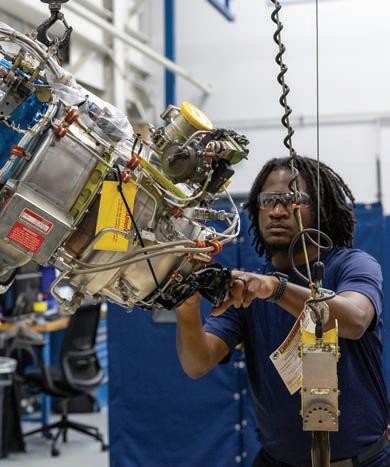

didn’t talk about AI every day,” Adams said. In fact, his team has been working with AI tools since 2024 and developed the Textron Aviation maintenance intelligence system.
The idea is to help technicians find what they need quickly in the voluminous maintenance documents that accompany any aircraft.
“It’s used every day in our service centers, not only by our technicians, but also by our engineers who want to look up information about our products,” he said. “It’s taking our maintenance records, maintenance manuals, instructions for continued airworthiness, flight manuals, product catalogs, and databases we have from product support and putting that in the hands of our technicians so they have access to the data they need. It saves them time finding what they’re looking for. We’re not simply using what the AI says to do; it is giving us a link to that [information] we can then use during maintenance.”
Another AI use is more predictive maintenance, which will further help reduce unscheduled maintenance and AOG events.
The Ascend, for example, has a communications hub that can transmit helpful information via cellular or Wi-Fi connections on the ground. “We’re getting data from all
these systems that are smarter, that have more sensors, and di ff erent components are reporting their health and their status to us,” he said.
That enabled the recent launch of a condition-monitoring system. “Now customers can select a set of parameters that they might be interested in tracking over time, to see how well their aircraft is performing compared to the fleet, and start to suggest proactive maintenance that could help prevent an AOG. We’re not going to say that you need to put your aircraft down immediately to take care of this, but you may be able to plan it into your next scheduled downtime.
“One of the things we struggle with [in] the MSG-3 program is the lag in the timeliness of the data,” Adams said. “Now we’re going to be able to get more timely information and more specific information around how the aircraft are being operated and how they’re performing in the field at a more granular level.”
Gulfstream engineers use information from the MyCMP maintenance-tracking service to inform RCM programs. “This
enables Gulfstream engineers to continuously monitor and analyze maintenance programs based on fleet data and the in-service experience, and has the corresponding benefit of providing an enhanced and holistic customer maintenance experience,” according to Lor Izzard, senior v-p of customer support.

By evolving to a focus on preventing unscheduled maintenance events rather than fixing something after a discrepancy occurs, he explained, “Gulfstream is leveraging fleet data to drive towards a more predictive maintenance environment, supported by new and integrated tools, such as our Diagnostics Direct mobile application. Diagnostics Direct complements MyCMP
and is solely dedicated to diagnostics— with it, operators can also troubleshoot in real time via the app.”
An example of Gulfstream’s application of RCM protocols is the extension of A-Check intervals to other models, matching those of the new G700 and G800. “As reliability improvements have been demonstrated over time, we were recently successful in extending and aligning the A-Check interval to 750 hours on all the other Gulfstream large-cabin models as well as the super-midsize G280, giving operators the full benefit of enhanced maintenance programs and higher aircraft availability,” according to Izzard.
Bombardier said it uses RCM and MSG-3 to optimize inspection intervals, prioritize important tasks, and eliminate unnecessary tasks to enhance efficiency and reliability, both for in-production and in-service aircraft (although not the Challenger 600). “This allows our teams to lengthen inspection intervals (when supported by fleet data), remove redundant tasks, extend or shift component replacements, and work closely with suppliers to improve component reliability. Collectively, these efforts reduce the maintenance burden while maintaining high safety and performance standards.”
To bring useful data back to the maintenance data analysis (MDA) team, Bombardier said it “monitors fleet reliability to quickly identify components that may be failing early.” That team shares information with engineering “to drive product and reliability improvements.” Maintenance intervals can be adjusted based on that information, either up or down, and all changes are reviewed by an industry steering committee as part of the MSG-3 process.
For individual components, Bombardier’s Failure Review Board ranks component reliability according to mean time between unscheduled failure data from
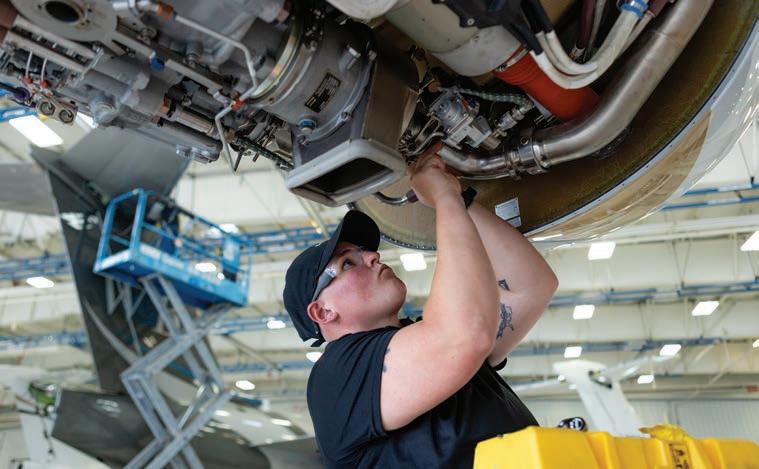
Bombardier’s use of RCM and MSG-3 protocols is helping eliminate unnecessary tasks.
the MDA team, combined with warranty information and feedback from operators. “This process helps identify pain points, prioritize critical components, and work
with vendors to improve reliability, reducing the maintenance burden and helping maintain aircraft availability even amid supply-chain challenges.” z

BY KERRY LYNCH

RTX’s Collins Aerospace is exploring a range of advanced ATC technologies, including digital control towers, infrastructure that can handle more complex airspace, and simplified workstations that can combine up to 10 functions on one or two screens.
While FAA and Department of Transportation officials outline a vision for evolving the air traffic control systems to a connected, common platform, Collins Aerospace is developing technologies that could provide a glimpse of what that might look like. Company executives did not say whether the RTX subsidiary has submitted to the FAA’s request for information (RFI) on a common automation platform (CAP), but they did showcase their own AutoTrac common platform that can provide a foundation for an array of connected air traffic management capabilities.
The FAA in November released its RFI for a potential CAP that will replace legacy equipment, combining systems such as En Route Automation Modernization (ERAM) and Standard Terminal Automation Replacement System (STARS) into a unified system. Congress provided the agency with $12.5 billion to rapidly move forward
with modernization, but that money primarily will update existing systems. Agency officials maintain that they will need closer to $31 billion to conduct such a massive overhaul involving a CAP.
Collins has already secured a key piece of the modernization, a contract to replace current radars with “modern, commercially available” surveillance radar installations. But at the same time, it is developing other capabilities, including its AutoTrac common platform, a multi-function controller workstation, and digital control towers.
Cedric Vigil, Collins Aerospace associate director of program management, likened the Collins platform to a layer cake. The hardware base provides an open architecture that powers a range of applications. There is a middle layer that is situated atop
the hardware, which Vigil called the glue to link the hardware and software. Software serves as the top layer, providing capabilities from terminal operations to oceanic and en route operations. The system can also accommodate other applications, such as weather mapping. Customers can select the capabilities they want for the system.
Altogether, the system can combine functions that are currently handled separately, and it can be modified over time to add new, yet unforeseen capabilities. Pointing to the en route, approach control, and oceanic functions, Vigil said, “Domestically, those things are separate stovepipe systems. Those are their own programs, and they are programs that deliver bottom to top, meaning from the processing hardware all the way…to the capability sets that are in front of them.”
This makes changes cumbersome and
slow, requiring the entire technology to be reset and undergo a recertification process for modifications or updates. “If you have two million lines of code and you change 1,000 lines of code, you have to take the entire system back through a set of changes. That’s because it’s in what we’ll call a monolithic structure.”
With a common platform, the idea is to take sets of stovepipes that sit next to each other and fold them into layers that can be managed, acquired, and tested separately, he explained. “The power of that is that as you start with the hardware, instead of today, for instance, where you have different sets of hardware per system, you can now, as a customer, take and expand your hardware across the enterprise and then have a software platform that sits on top of it.”
Customers can manage the software capabilities separately without needing to take down the entire system. They can just address the lines of code in question. This is not only time-effective but also costeffective, he added. In many cases, processors running the software currently have much more capability than needed, but the customer still has to pay for all of that capability. “There’s no other way to do it.”
Also, with the different software capabilities, a customer may need to find a different vendor for each aspect and require separate hardware. “You have to create your own architectures and your own interfaces as a customer to translate between them,” making the system complex to manage. Under a common platform, this can be folded in atop the same hardware. “All of these capabilities [are] running on the same platform.”
These capabilities would be interconnected, enabling controllers to have visibility into a seamless National Airspace System rather than their individual sectors. “That doesn’t mean that each controller in each area needs to have this full set of information. A terminal controller doesn’t necessarily need to know what’s happening directly on surface management,” he added. “It does mean that…the terminal is
Ultimately, our hope is that as these systems progress, the user no longer needs to worry about the technology. They only worry about the capability they need.
— Cedric Vigil Collins Aerospace associate director of program management
a window into the total system as opposed to being a representation of just one segment of the system. The user can say what capability do I need? What is it that I want to see?”
Users can then ask for what they want to see instead of being constrained by the capabilities of the system given to them. “Ultimately, our hope is that as these systems progress, the user no longer needs to worry about the technology. They only worry about the capability they need,” Vigil said.
Such a system can unlock potential for tapping into data and creating tools for predictability and other insights that could be useful to controllers or airlines, such as “What types of things happen in different congestion situations?”
In the ATC tower, pulling all of this together for the air traffic controllers is a new Collins workstation, the MultiPlatform Application Re-Hosting Solution, or MARS, that can consolidate air traffic management. With MARS, up to 10 applications could be visible on one or two monitors rather than being spaced out among several monitors. Collins said the touchscreen technology was designed with extensive input from potential operators. It is hardware agnostic, capable of marrying up with existing equipment or new options. Other technologies include scalable remote digital towers with 360-degree camera arrays and situational awareness capabilities, such as graphical overlays. This comes as the FAA renews its exploration of such technologies and as such towers expand internationally.
As for the common platform, Vigil maintained that this is not about solving today’s

The Condor Mk3, Collins’ surveillance radar capable of communicating directly with transponders.
needs but putting infrastructure in place that can evolve as the airspace becomes more complex. “We have more entrances, and frankly, there’s going to be things that none of us have currently anticipated.”
To that end, Collins has already trialed the technology with an international air navigation service provider (ANSP). Vigil, who was not disclosing the customer, said this was an unexpected application, scaled for lower-altitude operations. Under this test, the system runs around how uncrewed aircraft system traffic management (UTM) is approached.
Rather than having UTM operations staged within a corridor and within defined flight paths, this would instead provide a public picture of what is available and essentially provide “keep-out” zones. “The challenge [with the current system] is that it severely constrains the airspace that’s available for UTM applications,” Vigil said, explaining that with the Collins application, it effectively provides a more flexible dynamic picture of the airspace available to UTM operators.
The creation of this involved a relatively small set of code, and the ANSP could quickly integrate it on its platform.
Collins has long worked with international and domestic providers. Nathan Boelkins, president of avionics for Collins Aerospace, estimated that Collins manages about two-thirds of the airspace globally. In the U.S. alone, RTX has been involved in 140 STARS installations that cover about 800 towers and about 3,000 positions. It has also installed some 550 radars.
As for the radar contract, Collins was one of two contractors tasked with replacing up to 612 radars by June 2028. Valuing its portion at $438 million, Collins is supplying its Condor Mk3, a cooperative secondary surveillance radar capable of communicating directly with aircraft transponders, along with the ASR-XM, the primary, non-cooperative radar that detects aircraft using reflected signals that will scan airspace regardless of whether there is a transponder on board the aircraft.

The new radar will have capabilities to reduce clutter in the airspace that may give false signals to air traffic control, such as interference from windmills or 5G signals. The radar was also to “future-proof” to accommodate future technologies, said Nicole White, Collins Aerospace v-p and general manager of connected aviation.
White noted the long history the company has had with radar and said that experience has built the knowledge and expertise on large-scale deployment.
Both radar systems have met FAA surveillance requirements through prior test site certification activities. “All of last year, a lot of what we did was operational tests and evaluation,” she said, adding that this has laid the groundwork for the speed of installation. Meeting timelines is critical in the modernization program because lawmakers have already insisted that they need to see results from the initial tranche of $12.5 billion allocated toward new technologies before supporting the remaining $18 billion-plus that the FAA seeks.
The CAP and radars are part of rapidly evolving technologies under the Collins Aerospace Avionics group that combines the traditional Rockwell Collins avionics
business with RTX’s legacy air traffic control business and FlightAware into a roughly $30 billion business. The group has continued to evolve since Raytheon acquired Collins Aerospace in 2018, and the three pieces—avionics, ATC technologies, and data—are now working together to lay the groundwork for the future of navigation.
For instance, Boelkins noted that FlightAware has provided a deep resource of operational data to offer insights on various scenarios and choke points that it can explore as it develops the technologies. The legacy Collins avionics expertise provides another view of this to offer a complete picture of the airspace from the cockpit to the tower. Boelkins estimated that some 60,000 flight decks have some sort of Collins technology aboard. This combination has set the stage for the group to develop systems that are adaptable to growth in air traffic and meet the demands for rapid change, he maintained, and added that the timing of this is critical.
“Predictions are anywhere between the next decade and 15 years, traffic’s going to double,” he said. “And then on top of it, I would say something that none of us can predict is where the unmanned and drone situation is going and how quickly is that going to explode…And so that is the rally cry for why we need change.” z
September 15-16 | Frankfurt, Germany

and clients. The one-on-one time and small group sessions are very valuable settings.”
– CALS SPONSOR

Fresh off Milan’s hosting of the Winter Olympics, SEA Prime, which manages the private aviation infrastructure at the city’s Linate and Malpensa Airports under the Milano Prime brand, held the official grand opening of the new wing of its terminal at Linate in an event that featured speeches from members of Italy’s 2026 Olympic team.
The project—launched in late 2024—included the rebuilding of existing infrastructure and widening the entrances for improved accessibility.
The new addition brings the facility to 2,000 sq m (21,530 sq ft). It features nine glass-walled lounges overlooking the ramp and landside, which have been assigned to leading Italian and international business aircraft operators who will customize them to their own standards.
In the main hall—which was finished with materials used in traditional Milanese architecture—a custom-made polygonal concierge desk, illuminated by a large skylight, welcomes guests.
The expansion is tied to the company’s growth. Last year, the Linate facility managed 35,900 movements, a year-overyear increase of 7%. For the first two months of 2026, traffic— spurred by the Olympic Games—nearly doubled the pace over 2025, with the terminal handling up to 130 operations a day.
Republic Jet Center, one of three service providers at Republic Airport (KFRG) on New York’s Long Island, has changed hands in a deal involving SR Aviation Infrastructure (SRAI)—the recently-launched subsidiary of real estate investment and development firm SomeraRoad that is looking to develop a nationwide network of aircraft hangar complexes—and FBO chain Modern Aviation.
SRAI purchased the full-service facility and immediately flipped it’s FBO assets to Modern, which already operates one of the other two facilities at KFRG. The former Republic Jet Center site features a 2,000-sq-ft main terminal, a 1,500-sqft satellite terminal on the north side of the field, and more than 60,000 sq ft of hangar space. For SRAI, the real prize was Republic Jet Center’s more than 50 acres of undeveloped leasehold. While the company declined to provide more specific information at this early stage, it plans a multiphase hangar development at Metro New York-area KFRG with modern amenities and 28-foot hangar door heights designed to accommodate ultra-long-range private jets.
Desert Jet, an FBO and maintenance provider at California’s Jacqueline Cochran Regional Airport (KTRM), has signed an agreement with its landlord, Riverside County, to expand its leasehold by 7.5 acres. This will more than double its existing size.
The company, which has been in operation since 2007, has big plans for that additional real estate with a $20 million expansion on tap. Included in the project is 3.5 acres of additional ramp, which is expected to be completed by year-end, followed by 4,000 sq ft of office and VIP lounge space, and two additional 28,000sq-ft hangars (the location’s second and third).
The first of these additional hangars is expected to break ground early next year, with an eye toward completion by mid-2028. Its adjoining twin will follow thereafter. Both new hangars will be used for aircraft storage and the expansion of Desert Jet’s maintenance operation.

If you ask someone what the busiest general aviation airports are in the U.S., you might expect answers such as Teterboro Airport in New Jersey or Centennial in Colorado. But, for sheer numbers of airplanes going up and down, Falcon Field Airport (KFFZ) competes for that title. The Mesa, Arizona airport last year saw nearly half a million operations, mainly due to its high concentration of flight schools. These numbers rivaled some of the busier airline hubs.
Cunningham Aviation is now the only full-service FBO on the field after it purchased rival Avflight’s facility last year. In 2020, owner George Cunningham bought a dilapidated 30,000-sq-ft hangar, which once housed Hughes Helicopters’ (later McDonnell Douglas, now Boeing) assembly facility for the AH-64 Apache attack helicopter. After a million-dollar renovation, the company began operations as a hangar keeper the following year, o ering ground handling.
Cunningham's decision to establish a full-service FBO came about somewhat by chance when a sinkhole appeared behind his hangar, it was traced back to a longburied underground fuel farm, a remnant of the site's helicopter manufacturing past.
“I looked at the cost to remove the old fuel tanks versus the cost to remove and install a brand new fuel system, and it was only a couple of hundred thousand dollars’ di erence,” Cunningham told AIN. “I’ll just put in that new fuel farm and go into the fuel business.”
That decision put him in competition with the existing chain FBO on the field, and the matter was soon resolved. “Because it’s really not a two-FBO airport, we were knocking heads on price, and neither of us was making any money,” Cunningham explained. “It was more than a year of discussions and negotiations of whether they were going to

Cunningham Aviation has 60,000 sq ft of aircraft storage space at KFFZ, including a 12,000-sq-ft hangar that can accommodate the latest ultra-long-range business jets.
buy us or we were going to buy them.”
In the end, Cunningham’s greater hangar space and the fact that he was planning a new major FBO development at KFFZ sealed the deal. “I was making money on my hangars and was going to be able to hang in there,” he said.
Last August, Cunningham purchased the 3-year-old facility on the north side of the field. It features a 14,000-sq-ft terminal with a pilot lounge, three snooze rooms, shower facilities, a trio of conference rooms, and a flight planning area. That is in addition to the lobby area of its rebuilt 30,000-sq-ft hangar on the south side of the field, and its nearby 25-year-old, 2,500-sq-ft “line shack” that houses a separate pilot lounge.
Through the consolidation of the other FBO, Cunningham—a member of the Paragon Aviation Network—also acquired a 12,000-sq-ft hangar that can accommodate the latest ultra-long-range business jets.
Later this year the company’s new $14 million facility will make its debut on the south side of the field, near its existing original hangar. It will feature an additional 30,000-sq-ft hangar with 28-foot-high
doors—bringing the FBO to 90,000 sq ft of space—and a 14,000-sq-ft two-story terminal. “That will become, pretty much, the nicest state-of-the-art FBO facility in the entire Southwest,” Cunningham said, adding that the facility will include an atrium lobby and amenities such as a sauna. After its opening, the company plans to continue to operate both facilities.
There are 20 jets and 30 turboprops based at KFFZ, and Cunningham is home to 12 of them. While flight training runs nonstop year-round (the city recently approved a landing fee measure, in an apparent e ort to curb the activity), in the summer, when temperatures can reach 120 degrees in Mesa, the density altitude can prove an issue for jets. This led the airport to explore a 1,200-foot addition to its main runway, 4R/22L, to bring it to 6,300 feet.
Open 24/7 to accommodate aeromedical flights, the FBO has a sta of 25. “What we are striving for is to become a truly legitimate option other than Scottsdale [KSDL],” Cunningham stated. “If people come to Falcon Field, I want them to feel like they are being given the red carpet treatment.” C.E.

Dallas-based Aero Star Aviation, which specializes in Embraer Phenom and Praetor maintenance, is expanding by adding services for Cessna Citation 560XL and Latitude owners. An FAA-approved Part 145 repair station, Aero Star was founded in 2013 and has facilities at Love Field (KDAL) in Texas and a satellite office in Fort Lauderdale, Florida. Services for Citation owners include scheduled and unscheduled maintenance, inspections, troubleshooting, and airframe support, according to Aero Star. Aero Star also offers pre-purchase and 10-year inspections, engine changes, line maintenance, wheel assembly exchange, and AOG support, plus aircraft consulting and management.
StandardAero has established an authorized installer network for the Thales and StandardAero StableLight four-axis autopilot system for Airbus H125 and AS350 helicopters. StableLight is the only fully integrated four-axis autopilot currently available for the H125 and AS350 series, according to StandardAero. The installer network is designed to maintain installation standards, ensure compliance, and expand geographical access for operators seeking the autopilot system. StandardAero delivers each system as a complete installation kit with all components and instructions.
The first three authorized autopilot installers in the program are AeroBrigham in Decatur, Texas; Precision Aviation Services in Georgia; and Aero Products in Arizona.
Cutter Aviation has opened its fifth southwest U.S. maintenance facility, at Rocky Mountain Metropolitan
Airport (KBJC) in Broomfield, Colorado. The 22,000sq-ft facility provides maintenance services for Pilatus PC-12 turboprops and PC-24 twinjets and is a designated PC-24 service bulletin modification center.
The KBJC location is led by general manager Josh Golabi; he also runs Cutter Aviation’s maintenance facility at Centennial Airport (KAPA) in Englewood, Colorado. Technicians at the KBJC and other facilities have been factory-trained on the Pilatus models.
As a Pilatus-authorized sales and service center for the past eight years, Cutter Aviation provides engine and airframe maintenance, avionics installations, interior refurbishments, parts support, and other services..
California-based aircraft operator and charter marketplace provider FlyHouse has acquired Dallas-area FAA Part 145 aircraft maintenance, repair, and overhaul provider JetsMRO. Launched in January 2024, the company specializes in business aircraft maintenance and aircraft-on-ground support.
JetsMRO was founded by aviation industry veteran Suresh Narayanan, whose background includes aircraft maintenance and operations. Under his direction, the company has built a reputation for technical expertise, experienced technicians, and responsive service.
JetsMRO also has a satellite aircraft component repair facility in South Florida, which was included in the transaction.
At NBAA-BACE in October, FlyHouse announced it had purchased Los Angeles-area FBO and charter fleet operator Sun Air Jets, along with its Part 145 repair station, giving it its first entrance into the aircraft maintenance arena.

Aircraft maintenance, charter, and management provider New World Aviation began operations in 1998 at Lehigh Valley International Airport (KABE) in Allentown, Pennsylvania, placing the MRO close to the busy Northeast corridor where it could tap into the heavy business jet market. The aviation services business occupies a 1970s-era 85,000-sq-ft hangar, which once housed the corporate flight department for former conglomerate ITT. In addition, New World occupies a newer 20,000-sq-ft hangar to handle its recent growth.
President, CEO, and managing partner Darrell Frey joined the company five years ago, after 32 years at Gulfstream in roles such as director of the airframer’s field and airborne support team, and general manager of its Savannah, Georgia service center. He noted that during his tenure, New World has expanded from seven technicians in its FAA Part 145 repair station to 50 today. Some of those employees have been there since the company’s founding.
New World specializes in Gulfstream maintenance, with FAA approvals for the GIV, GV, G450, G500, G550, and G650. The MRO expects to add the super-midsize G280.
As an operator with Bombardier aircraft in its fleet, the provider also works on the Global 5000 and 6000, Challenger 604, Dassault Falcon 900 and 2000, several models of Learjets, Hawkers, and even the Sikorsky S-76.
The facility has up to 10 aircraft under work at a time, with a backlog stretching through the end of the year. “The neat thing about airplanes is the calendar never stops,” said Frey. “Inspections are pretty steady through the year.”
New World focuses on scheduled heavy maintenance and inspections on

With a main 85,000-sq-ft hangar, New World Aviation’s facility at Pennsylvania’s Lehigh Valley International Airport can accommodate up to 10 large-cabin jet projects at once.
Gulfstreams. “We’ve changed the sponson rib, which is the rib that holds the landing gear on the GIV [and] which is something very few have done outside of the OEM. Through the models, we’ve done all the heavy checks on each, including the G650,” explained Frey. “Right now we’re doing the 192-month, which is a 16-year inspection on the G650, so it’s actually one of the first.”
The faclity is one of the few outside of Gulfstream itself to own and operate a MAUS (mobile, automated, ultrasonic, scanner) system, a device used to replace X-ray technology for non-destructive structural testing. According to Frey, among its applications are the 5,000-landing inspection on the GIV and identification of possible corrosion between the horizontal stabilizer bonded-skin-to-rib attachment points.
“The ultimate goal was not to take the interior out or gain access to put film behind it,” he said. “Now that the G650 has got bonded skin to rib, it’s used to inspect impact damage and damage to the fuselage; it’s going to grow into being a very important inspection tool.”
New World has an avionics shop and is
an authorized dealer for Starlink, Honeywell, Gogo, CMS, and DPI.
The company operates seven days a week, with three shifts total: a day shift, a second shift, and then a weekend shift.
“What we really try to focus on is downtime,” said Frey. “At Gulfstream, I started the Fast team, and what I learned very quickly from that and in other roles I had was downtime on these airplanes was more important than the cost, because every day does cost.” The company strives to adhere to its quoted schedules and does not charge overtime.
With its recent growth spurt on the maintenance side, talent recruitment—as with most maintenance facilities—is a major consideration for New World. “There’s a challenge in experience that everybody’s trying to deal with because of the aging-out process, but the northeast is not really so bad,” Frey told AIN. “I mean, there’s people out there.”
Last year, the company started up a satellite repair facility at Fort Lauderdale–Hollywood International Airport in Florida with 26 employees. It is located in a 24,000sq-ft hangar on the Sheltair campus. C.E.
BY DAVID JACK KENNY
Beechcraft B300, Dec. 22, 2025, Galveston, Texas
Rescuers located two survivors after a medical transport flight operated by the Mexican Navy crashed on final approach to Scholes International Airport in Galveston, Texas (KGLS). The remaining six occupants, including both pilots, two medical crew members, and two passengers, were killed. Among the survivors was a twoyear-old burn victim who was transported to Shriners Children’s Texas Hospital in Galveston.
The flight departed from Mexico’s Merida International Airport (MMMD) shortly before 18:50 CST, climbing to an en route altitude of 27,500 feet, and then began a descent to 3,000 feet at 20:34. At 20:48 the flight checked in with Houston approach control, and communications were largely routine as the approach controller provided vectors to the final segment of the RNAV (GPS) approach to Runway 14. At 20:59, the King Air crew were cleared for the approach and handed off to the KGLS control tower. The approach controller subsequently issued multiple low altitude alerts, which went unanswered.
ADS-B track data showed that after turning onto the final approach course, the King Air began to descend; the last report showed it was three miles from the airport at an altitude of 275 feet. A witness reported hearing its engines “pull back,” then briefly go to full power before the sound ended. The prevailing weather included 5-knot winds from 100 degrees, one-quarter mile visibility in fog, and vertical visibility of 200 feet.
Bombardier CL-600-2B16 Challenger 650, Jan. 25, 2026, Bangor, Maine
Comparison of the cockpit voice recording (CVR) and the FAA Holdover Time Guidelines for Winter 2025-2026 suggests that the flight crew may have overestimated how long the anti-ice treatment applied before takeoff would remain effective in preventing airframe icing. Both pilots and all four passengers were killed when the jet rolled right just after takeoff, striking the wingtip. Airport CCTV cameras captured images of multiple explosions as the airplane crashed off the right side of the runway, and rescue e ff orts were impeded by the prolonged post-impact fire.
The aircraft, on a Part 91 business flight, stopped for fuel at Bangor International Airport (KBGR) en route from Houston’s William P. Hobby International Airport (KHOU) to Châlons Vatry Airport (LFOK) in Châlons-en-Champagne, France, remaining on the ramp for just over an hour as it was refueled to a total load of 19,872 pounds. At 19:18, the jet taxied to the deicing pad. Over about eight minutes, an estimated 41 gallons of Type I deice fluid were applied, followed in the next three minutes by 28 gallons of Type IV anti-ice fluid. The prevailing weather included three-quarter-mile visibility in light snow, a temperature of -16 C, and 6- to 8-knot winds from 040 degrees.
The Challenger remained on the deicing pad for four minutes 51 seconds. As it taxied to Runway 33, the CVR captured the pilot’s comment that “standard” holdover time was 14 to 18 minutes, and that they’d need a second deicing if the wait exceeded 30 minutes. The copilot concurred. They began their takeoff roll at 19:44, 13 minutes after the anti-icing
application ended. The stick shakers activated about one second before the right roll began, at a radar altitude of 11 feet.
FAA holdover guidelines indicate that three-quarter-mile visibility in snow at temperatures below -1 C is considered “moderate” snowfall; in moderate snowfall at -16 C, holdover times ranged from two to nine minutes.
Bell 407, Feb. 5, 2026, Flagsta , Arizona Investigators found “no evidence of ballistic punctures” in the wreckage of an Arizona Department of Public Safety helicopter that crashed while supporting ground units responding to a shooting in progress. The pilot and tactical flight officer (TFO) were killed after the aircraft apparently departed controlled flight and entered a rapid spinning descent. Video and ADS-B data showed that their closest proximity to the suspect during the shooting was about 7,500 feet.
The flight departed Kingman about 21:10 MST in communication with ground units. At about 22:05, it orbited the vicinity of the shooting between 300 and 500 feet above ground level. After maneuvering to avoid a helicopter inbound to the hospital, the pilot began “a gradual climbing left turn, consistent with aligning for an out-of-groundeffect hover to maintain visual contact [with] the suspect.” There were no indications of abnormalities in the TFO’s communications with ground personnel.
Video recordings showed the helicopter in a slow climb until 22:16:43, when it began “a rapid rotation to the right,” At the same time, an unidentified verbal sound on the radio was followed by “two loud banging sounds from the helicopter.” At 22:16:51, the TFO transmitted, “We’re going down.” Periodic flashes of the ship’s spotlight during the descent confirmed its continued rotation.
Wreckage was found along a 6,150-foot debris path. The tailboom was fractured, with remnants of its upper-right attachment fittings showing outward bending. Angular cuts were found in the tail rotor drive shaft, and the surrounding skin had deep grooves with blue paint transfer marks “consistent with contact with a main rotor blade.” There was no record of recent maintenance to the tail boom or tail rotor assemblies.
BAE Jetstream 3212, Jan. 23, 2024, Fort Smith, Northwest Territories, Canada
Concern that snow might have accumulated on the aircraft after the passengers boarded led the captain to fly an unusually
shallow climb profile to build airspeed in an attempt to blow off any snow that might have adhered to the wings. The operator’s only compatible deicing truck had been inoperable for several months before the accident. However, the increased air load prevented one leg of the landing gear from retracting completely, a problem that had been intermittently observed in the accident airplane’s left main gear at temperatures below -20 C and airspeeds in excess of 140 knots. Shortly after the first officer called for a reduction in airspeed, the captain reduced power, and the twin-engine turboprop began an inadvertent descent from an altitude of about 140 feet. Both pilots and four of the five passengers were killed when the Jetstream struck trees 15 seconds after takeoff, igniting a post-crash fire. One passenger was ejected from the airplane and survived with only minor injuries.
The aircraft departed on a scheduled flight from Fort Smith (CYSM) to Diavik (CDK2), both in the Northwest Territories, before dawn from Runway 30. Due to falling snow, the airplane was “cold-soaked” in an unheated hangar for 35 minutes before being fueled to its 3,200-pound capacity. No snow was found adhering to the aircraft during pre-flight checks, but some was observed on the left wing’s outboard leading edge while the pilots ran the after-start checklist. ADS-B data showed a shallower climb than on the three previous takeoffs from the same runway. Eight seconds after takeoff, the first officer reported an abnormal gear indication and called for the captain to reduce airspeed; six seconds later, he called out “descending.” One second after that, the terrain awareness and warning system issued an alert just as it struck trees half a mile from the departure end of the runway, igniting a fireball. z

BY GORDON GILBERT
9, 2026
Between June 9 and July 19, 2026, flight limitations and slot restrictions for private aircraft will be in e ect at many airports during the FIFA World Cup Games taking place at 16 host cities in Canada, Mexico, and the U.S. The period is expected to be one of the busiest for business aviation that North America has seen. International flight information provider OpsGroup has published a comprehensive guide for the game schedule, operational limitations anticipated at 15 of the airports nearest the game venues, suggestions to ease restrictions, and an interactive map to help in flight planning.
May 7, 2026
A supplementary instruction for the UK's manual of air traffic services adds a UAS lost link secondary surveillance radar code—A7400—to the list of special-purpose emergency codes. The instruction notes, “This conspicuous code shall be used by unmanned aerial systems/remotely piloted aircraft that have lost communications with their remote pilot and are following a pre-programmed lost link flight profile.” Operators of UAS operating beyond visual line of sight within controlled airspace are required to inform air traffic services on the procedures that the UAS has been programmed to follow in the event of a loss of its command and control datalink. “In the unlikely event that a UAS displays A7400 and flies a trajectory other than that which has been briefed, controllers are to consider the UAS as flying with unknown intentions” and “they should respond in the same way as to any unknown aircraft.” Mandatory addition of this code is effective on May 7, 2026.
May 14, 2026
Terminal Maneuvering Area (TMA) and ADS-B Out mandates apply at Greenland's Nuuk Airport (BGGH) starting May 14, 2026. Greenland is introducing a TMA (Class C) over BGGH when Nuuk approach is open, roughly 8 a.m. to 10 p.m. local time.
“During these times all flights in the TMA up to FL195 will need ADS-B Out,” according to international flight operations information provider OpsGroup. “At night the airspace drops back to Class G, so ADS-B is not required, but you must contact Nuuk ATC in advance and get approval for the flight.”
May 29, 2026
Multiengine turbine-powered aircraft configured for six or more passenger seats and that are being operated by two pilots have been granted a temporary exemption from new cockpit voice and data link recorder requirements that were e ffective on May 29, 2023. The exemption is due to Covidrelated delays in parts production, supply chains, and transportation, as well as labor shortages at manufacturers and installers. This exemption is in effect until the earliest of May 29, 2026, or a date when the exemption is canceled by Canada’s DOT.
May 30, 2026
Budapest will host the 2026 Union of European Football Associations (UEFA) Champions League Final at Puskas Arena on May 30, drawing intense concentrations of charter, corporate, team, sponsor, and VIP traffic into a compressed operating window. According to flight planning company Universal Weather and Aviation, “For business
aviation operators, the primary constraint will be severely limited aircraft parking at Budapest Ferenc Liszt International Airport (LHBP) and cascading congestion across nearby regional airports.”
June 30, 2026
On September 29, the FAA started its scheduled eight-month transition timeframe to align the U.S. notam format with ICAO international standards. According to the FAA, the new format will result in improved accuracy and accessibility of notam information for pilots, dispatchers, and other notam consumers, provide notam consumers with one consistent format for domestic and international operations, and allow for enhanced search, sorting, filtering, and archiving capabilities of notam information. “This initial deployment establishes the framework for the new service, enabling testing and validation with early user adopters,” said the agency. Completion of the transition is expected in the second quarter of 2026.
June 30, 2026
Transport Canada (TC) has published a Civil Aviation Safety Alert announcing that major telecommunications service providers in Canada have voluntarily agreed to postpone the sunset of existing 5G mitigation measures until June 30, 2026. After
that date, TC said, “Aircraft may be subject to stricter aviation limitations and/or radio altimeter retrofit expectations.” On Jan. 1, 2028, the remaining voluntary spectrum mitigations are scheduled to end, “which may further alter aviation limitations and or retrofit expectations.” Meanwhile, ADs issued in 2024 describe current radio altimeter tolerance requirements and con tinue to be effective while 5G mitigations are being maintained.
June 30, 2026


The FAA received 46 comments on its pro posed regulations that would require radio altimeters to withstand interference from wireless signals in neighboring spectrum bands. An industry/government committee is scheduled to develop the required meth odology and publish recommended stan dards by June 30, 2026. Those standards will be available for public comment.
July 1, 2026








The European Union has pushed the com pliance date from Jan. 1, 2025, to July 1, 2026, for certain large airplanes used in commer cial air transportation to be equipped with a runway overrun awareness and alerting system (ROAAS). The requirement applies to aircraft with mtows of more than 12,500 pounds for which the first individual cer tificate of airworthiness is issued on or after July 1, 2026. “Several large airplane type certificate holders are facing indus trial issues resulting in significant delays preventing them from being able to deliver newly produced airplanes equipped with a certified ROAAS before Jan. 1, 2025,” said the EU. “Hence, the date of application of EU regulations 26.205 should be postponed to reflect the current industrial capabilities and to permit business continuity for large airplane operators.”


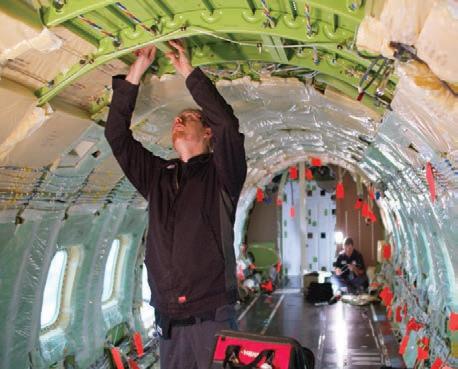
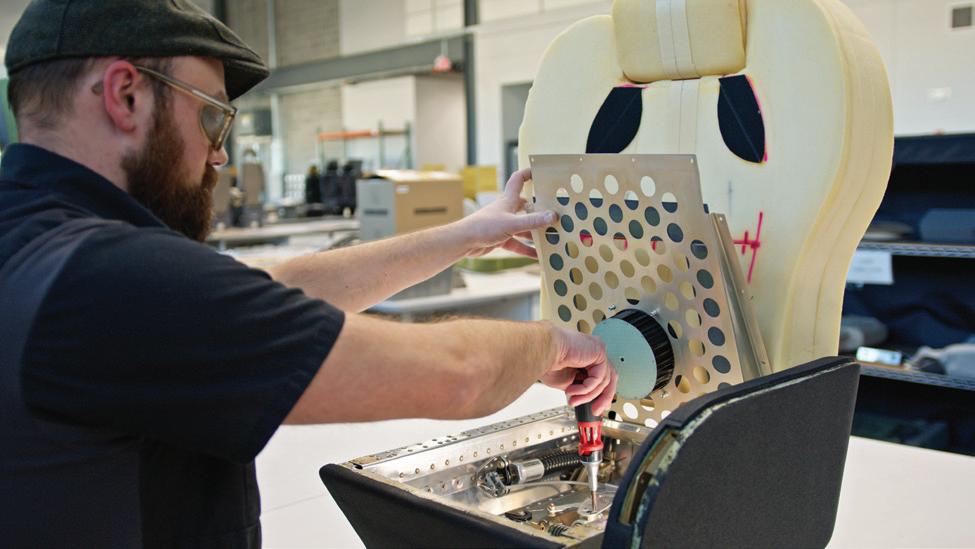
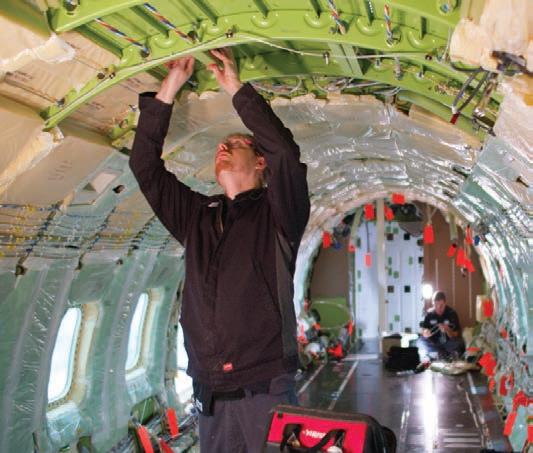

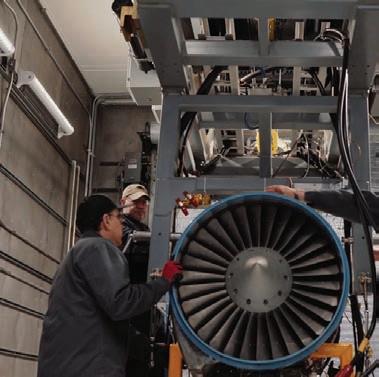
For the most current compliance status, see: ainonline.com/compliance


BY JESSICA REED
Gregg Williams , chairman of aircraft engine manufacturer Williams International , has transitioned out of the roles of president and CEO and is now chief visioneering officer. Taking over as president and CEO is John Sordyl, who has been with the company since 2002 and previously served as executive v-p of customer experience.

Thibault Scaramanga took on the role of board chairman and interim CEO at Daher, replacing Didier Kayat, who is stepping down after leading the company for 10 years. Deputy CEO Aymeric Daher shifted to executive deputy CEO. Additionally, Marwan Lahoud and Éric Versey were recently added to Daher’s board of directors.
AOPA named CFO Jill Baker and senior v-p of membership strategy and growth Katie Pribyl as acting co-presidents to run day-to-day operations while the association searches for a permanent successor to fill the role of president and CEO Darren Pleasance, who has stepped down. Pleasance is moving into an advisory capacity supporting the association and its board of trustees.
Air Charter Service (ACS) appointed Robert Nicholes CEO of the company’s Atlanta office. He previously worked for ACS as sales director of the private jets division.

John DeLeeuw was confirmed as a member of the National Transportation Safety Board, filling a term that expires at the end of this year. A former U.S. Air Force pilot who has served as managing director of safety and efficiency at American Airlines, DeLeeuw teaches aviation safety at the University of Southern California. Meanwhile, NTSB board member J. Todd Inman was unseated as an NTSB member by the White House. Inman was nominated by President Biden two years ago and was confirmed by the Senate on March 8, 2024, for a five-year term slated to end in 2029.
Brian Howell was named chief commercial officer at West Star Aviation . Howell has held leadership roles at Honeywell Aerospace
and Textron Aviation, among other companies.
Dassault Aviation has appointed Didier Raynard as its new senior vice president of sales for the Asia-Pacific region. Raynard joined Dassault in 2008 as a sales manager and has more than 24 years of experience in the region, having previously worked for EADS and Airbus.

Guardian Jet has named Anantha Krishna sales director for Asia, establishing regional leadership for the business aircraft brokerage and advisory firm’s operations across the Asia-Pacific market. Krishna previously held senior sales roles at two aircraft brokerage firms and developed the Pioneer Jet Program, an advisory service for first-time buyers.
Anastasija Visnakova is now chief commercial officer of Deutsche Aircraft after threeplus years as v-p of sales and marketing. Her experience includes commercial strategy, sales leadership, customer partnerships, and market development for the airline and aerospace industries.
In a series of changes to the Web Manuals executive team, Paul Sandström joined the company as COO and managing director. Co-founder Richard Sandström was named chief product officer. Web Manuals appointed Julia Wicksell v-p of operations, and Jesper Ekberg as CTO. Additionally, Stefan Rinse recently joined the company as its CFO.
David Deitch was named executive v-p of sales for Indianapolis-based Jet Access. Deitch’s experience in the aviation industry spans more than four decades, including 23 years at Jet Aviation.
Luxaviation One tapped Helen Hollis as its U.S. managing director. Hollis previously was senior v-p of passenger charters for the Americas at Chapman Freeborn.

Sébastien Kubler assumed the role of chief operating officer at JCB Aero SAS after a term as technical director of production and engineering. His other experience includes working for AMAC
Aerospace Switzerland and founding his own Part 21 organization, KES.
Duncan Aviation appointed Dillard Knight as engine technical representative, supporting customers operating Pratt & Whitney Canada PW300 and PW500 engines. Knight joined the company in 2019 as an engine line technician and has also worked on Duncan’s engine rapid response team. Meanwhile, Mason Minchow joined the company’s completions and modifications service sales team as sales representative for paint and interior, offering support for Gulfstream operators. Minchow started at Duncan as an apprentice in 2021.

C&L Aerospace hired Kristen Lintner as regional sales manager of business jet parts in the southwestern U.S. Lintner’s more than two decades of experience in the aviation industry include 10 years in business aviation, with stints at Bombardier and West Star Aviation.
Hannah Wolf, previously sales engineer at JetHQ, was promoted to sales director, focused on the U.S. market. Wolf brings OEM and technical expertise in her work to support active transactions and contribute to sales strategy and pipeline development.
Vertical Aviation International (VAI) appointed Cade Clark executive v-p and Sarah Arnold chief of staff. Clark previously worked as chief government affairs officer at the association, where he has been since 2017. Arnold, who will continue to serve as corporate secretary for VAI’s board of directors, previously held the roles of director of corporate affairs as well as executive assistant to the president and CEO.

Avpro promoted executive sales director Eddie Kilkeary III to managing partner. In his former role, Kilkeary advised clients on complex aircraft transactions across multiple market cycles.
Baron Weather named industry veteran Dave Hubner to spearhead the expansion of its services and partnerships.
Mente Group promoted business and development manager Brent Hanson to managing director. Hanson was formerly a sales executive at Gulfstream and at Pentastar Aviation. Steve
Main has also rejoined Mente Group as chief revenue officer; his experience includes sales leadership and revenue generation across multiple aviation sectors.
Freestream Aircraft hired Mauro D’Angelo for its aircraft sales team. D’Angelo’s experience includes work in civil aviation as well as in the U.S. intelligence community.

Chris Skurat was named director of sales for Amstat. Most recently, he worked at VisionSafe/EVAS as v-p of OEM and strategic partnerships for six years, and before that, he had spent 24 years on the Amstat team.
Dave McGrath is now part of the business development and sales team at Victoria Helicopters. His expertise includes aviation business development and marketing.
Clay Nolen , former chief of engineers at Gulfstream Aerospace, was named senior v-p of innovation, engineering, and flight. Vicki Britt is retiring in that role after working at Gulfstream for 27 years. Nolen has worked at Gulfstream since 2006, including as chief engineer for the G700 and G800.
The National EMS Pilots Association named Gabe Sheeran president of the board of directors after serving on the board for two years. The previous president, Brett Reeder, remains on the board of directors.
CAE has appointed Carter Copeland president of Flightscapes. He previously co-founded Melius Research and recently served on CAE’s executive management committee. Andrew Arnovitz takes on the role of chief strategy officer at CAE after leading the company’s corporate strategy. z
Stephanie Pope, executive v-p of The Boeing Company and president and CEO of Boeing Commercial Airplanes, was awarded the 2025 Cli ord Henderson Trophy by the National Aeronautic Association. Pope was commended for taking decisive actions to improve safety and quality standards.
On January 25, a Bombardier Challenger 650, planning a Part 91 flight, crashed during its takeoff roll at Bangor International Airport (KBGR) in Maine, killing the two pilots and four passengers.
The other four turbine business aircraft fatal accidents in the first quarter included a non-U.S.-registered jet and three turboprops (including both U.S. and non-U.S. registered). On January 28, a Bombardier Learjet 45XR on a charter flight and registered to an operator in India crashed short of the runway on its second landing attempt, killing all five onboard.
India was also the site for one of the three fatal business turboprop accidents in the quarter. Seven people aboard an Indian- registered air ambulance Beechcraft King Air C90A died when the turboprop twin crashed on February 23 while diverting from its originally planned destination.
On February 13, the four people aboard a U.S.-registered Epic E1000 were killed when the turboprop single crashed on an instrument approach to Colorado’s Steamboat Springs Airport (KSBS) in night IMC.
The third fatal business turboprop accident in the first quarter occurred on March 22, when a U.S.-registered King Air B200 crashed after rapidly descending from cruise altitude on a Part 91 flight, killing the sole-occupant pilot.
While runway and taxiway excursions have steadily decreased over the past few years, this progress appears to have stalled; there were 18 such mishaps in the first quarters of this year and last year.
This year, none of the events resulted in fatalities, which was not the case in the previous two first quarters.
The pilot of a Textron Aviation Cessna Citation CJ1+ was killed in a landing overrun in Brazil on Jan. 1, 2025, and two of the five fatal business jet accidents in the first quarter of 2024 were runway excursions. z

JAMES HOLAHAN (1921-2015), FOUNDING EDITOR, WILSON S. LEACH, FOUNDER & CHAIR EMERITUS
EDITOR-IN-CHIEF – Matt Thurber
MANAGING EDITOR – Charles Alcock
DIGITAL EDITOR – Chad Trautvetter
EDITOR AIN MONTHLY MAGAZINE – Kerry Lynch
BUSINESS AVIATION SERVICES EDITOR – Curt Epstein
SENIOR EDITOR – Hanneke Weitering – Technology Editor
COPY EDITOR – Jessica Reed
NEWS REPORTERS – Charlotte Bailey – Europe, Amy Wilder
CONTRIBUTORS – Julie Boatman, David Donald – U.K., Jennifer Leach English, Gordon Gilbert, David Hughes, David Jack Kenny – Safety, Stuart “Kipp” Lau, Robert P. Mark, Jennifer Meszaros – Southeast Asia, Richard Pedicini, Dale Smith, James Wynbrandt
PRODUCTION MANAGER – Martha Jercinovich
GRAPHIC DESIGNER – Grzegorz Rzekos
DIRECTOR OF VIDEO – Ian Whelan
SENIOR DEVELOPER – Cameron MacPherson
FRONT END DEVELOPER – David Lohmeyer
EXECUTIVE CHAIR – Dave Leach
PRESIDENT – Ruben Kempeneer
HEAD OF PEOPLE & BRAND – Jennifer Leach English
SENIOR DIRECTOR, INDUSTRY AFFAIRS AND EVENTS – Nancy O’Brien
ADVERTISING SALES
Victoria Tod – Northeastern U.S./Eastern Canada/United Kingdom, +1 (203) 733-4184
Michelle James – Western U.S./Western Canada, +1 (520) 343-0236
Joe Rosone – Midwestern U.S., Southeastern U.S./Caribbean/Brazil, +1 (301) 693-4687
Diana Scogna – Europe/Middle East, +33 6 62 52 25 47
DIRECTOR OF MARKETING AND CLIENT SERVICES – Lisa Valladares
AUDIENCE DEVELOPMENT DIRECTOR – Eileen Silberfeld
EVENTS SPECIALIST – Brien O’Brien
MARKETING SPECIALIST – Alyssa Barry
SOCIAL MEDIA MARKETING – Zach O’Brien
SALES ADMINISTRATOR – Cindy Nesline
FINANCE AND HR DIRECTOR – Tracy Britton
ACCOUNTS PAYABLE MANAGER – Mary Avella
ACCOUNTS RECEIVABLE MANAGER – Bobbie Bing
U.S. HEADQUARTERS
214 Franklin Ave., Midland Park, NJ 07432, +1 (201) 444-5075
Advertising Inquiries: +1 (201) 345-0085, adsales@ainonline.com
Circulation Inquiries: +1 (201) 345-0085, subscriptions@ainonline.com
WASHINGTON, D.C. EDITORIAL OFFICE: Kerry Lynch: klynch@ainonline.com, Tel: +1 (703) 969-9195
EUROPEAN EDITORIAL OFFICE: Charles Alcock: calcock@ainonline.com, Tel: +44 7799 907595
Aviation International News (ISSN 0887-9877) is published twelve times per year (monthly). Periodicals postage paid at Midland Park, N.J., and additional mailing o ces. Postmaster: Send address changes to AIN Media Group, 214 Franklin Ave., Midland Park, NJ 07432.
Allow at least eight weeks for processing. Include old address as well as new, and an address label from a recent issue if possible. Subscription inquiries: +1 (201) 345-0085 or email: subscriptions@ainonline.com.
Aviation International News is a publication of AIN Media Group, 214 Franklin Ave., Midland Park, NJ 07432; Tel.: +1 (201) 444-5075. Copyright © 2026 All rights reserved. Reproduction in whole or in part without permission of AIN Media Group is strictly prohibited. AIN Media Group publishes Aviation International News, AINalerts, AINonline, Business Jet Traveler, BJTwaypoints, ABACE Convention News, Dubai Airshow News, EBACE Convention News, Farnborough Airshow News, FutureFlight.aero, VAI Convention News, LABACE Convention News, MEBAA Convention News, NBAA Convention News, Paris Airshow News, Singapore Airshow News, Mobile Apps: Aviation International News; AINonline. PUBLICATION MAIL AGREEMENT NO. 40649046 RETURN UNDELIVERABLE CANADIAN ADDRESSES TO: PITNEY BOWES INTERNATIONAL MAIL, STATION A, P.O. BOX 54, WINDSOR, ON, N9A 6J5, returns il@imex.pb.com.
For feedback, letters to the editor, or other editorial needs, please contact AIN’s Editors at ainedit@ainonline.com





JULY 15 - 17, 2026
“The AIN CALS event has been a refreshing experience for leaders within the corporate aviation community and the vendors that support their businesses. 100% engagement for 2.5 days. Truly a working event that leaves us all a bit tired but very enthused!”
– CALS FLIGHT DEPARTMENT ATTENDEE
“The AIN CALS event provides excellent opportunities for high level interaction between vendors and clients. The one-on-one time and small group sessions are very valuable settings.”
– CALS SPONSOR