KnellReflection

Page 1


OVERVIEW

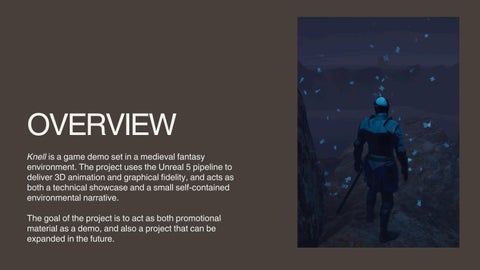
Knell is a game demo set in a medieval fantasy environment. The project uses the Unreal 5 pipeline to deliver 3D animation and graphical fidelity, and acts as both a technical showcase and a small self-contained environmental narrative. The goal of the project is to act as both promotional material as a demo, and also a project that can be expanded in the future.

STATEOFTHEPROJECT

Knell currently consists of around 10 minutes of gameplay, with several interactive elements and fully implemented sound design. The setting and character draws inspiration from 80s and 90s fantasy films such as the Neverending Story, as well as many existing games within the fantasy genre such as Kingdom Come and Dark Souls.

The goal of the piece is to elicit a sense of foreboding, culminating in a situation of inevitability as the player passes a point of no return. The project will be hosted on my online portfolio for download alongside a playthrough video.

CHARACTERDEVELOPMEN

Character development consisted of modelling, texturing and rigging. The early stages of development and 1st round of user testing focused on the perceived relationship between the character and environment. One challenge in this stage of development was the rigging of the character. Having the cloth and chainmail deform properly around the metal armour plates was extremely time consuming and required a lot of careful tweaking of different deformation weights.

During this stage, it became apparent that the character needed additional geometry in order to deform properly. This created the problem of needing to retexture the entire character. I used this to my advantage by also taking this time to redesign the character’s faceplate, and create a more HD texture.

As the character was not yet animated or implemented in unreal, round 1 of user testing consisted of a series of still renders in blender of the character traversing a swamp scene. The consensus from users was that the relationship between knight and swamp was visually antagonistic. Key feedback from my mentor was that it would be important to differentiate the project from Dark Souls in other aspects, as the character design was clearly inspired.

LOCOMOTION

One of the key challenges of the project was making sure all assets matched the visual fidelity of the knight. This meant creating responsive and dynamic animation within a timeframe of 4 weeks. The approach I adopted in order to save time was to retarget existing animations to the knight and then touch them up as needed, while only hand animating very specific animations.

Generic animations such as a walk cycle did not need to be tailored to the knight’s skeleton, whereas movements like sheathing the sword had to fit to very specific motions. Most of the animations are dynamic, with many variables driving blending of several animation layers.

THEMUD

If the knight is half of the project, then the mud is the other half. As the main antagonistic force within the project, the mud needed to feel visceral, with clear feedback being given to the player that the mud is bad and should be avoided.

To achieve this, a combination of tightening the camera field of view, slowing down the movement speed and having the arms and torso rise up to emulate wading were used to make the mud feel thick and inhibitive.

While the locomotion feedback was quite simple to implement, the painting of the mud on to the knight was very complex. The solution was to use vertex painting at runtime to assign vertex channel colours that control material blending between the base knight texture and a muddy texture.

USERTESTINGROUND2

The 2 round of user testing coincided with week 9 presentations to a panel of industry professionals. nd This round of user testing was less formally structured than the first, as it predominantly consisted of a presentation of the state of the project rather than a questionnaire.

At this stage, the project consisted of a playground environment with 1 large mud patch and several objects to help showcase the character visuals and animation.

Feedback from this round of testing was that while the project was visually impressive, the lack of interaction and narrative meant that it felt flat and unsubstantial, more like an in progress tech demo than a major project.

ENEMIES

The addition of an enemy to the piece added an element of ‘gameplay’ to Knell. The existence of an enemy and the ability to ‘die’ provides purpose to the gameplay, while also reinforcing the adversarial interaction with the environment.

In early stages of planning, I had planned out stretch goals in terms of how much time I had to devote to particular aspects of the project. One of these was the enemy. In an ideal scenario, the enemy interaction would consist of a monster emerging from the mud that the player could fight, however the programming of AI as well as modelling and animating a complex NPC was outside the timeframe of the project. A ‘quicktime event’ style enemy was the compromise made to keep the mud feeling dangerous without falling outside the scope of a 12 week timeline.

ENVIRONMENT

The environment of Knell acts as a vehicle with which to force the player into interacting with all the elements of the project organically. Instead of a playground with a list of features, the environment allows players to discover certain elements, such as the sword features or the interaction with the mud and enemies. In order to facilitate this, the player begins on a starting island and is given the option to explore the swamp at their own pace.

There are no invisible walls or limitations stopping the player, however the longer the player spends deep in the mud, the quicker the hands will grab them. After being grabbed too many times, the player will instantly be dragged under and the game will restart. This produces a natural limitation forcing the player to work within the confines of the level design without creating barriers that are apparent to the player.

SOUND

Sound is a key component reinforcing both the physicality of Knell’s character and environment, as well as providing emotional and narrative feedback to the player. Fortunately, Unreal engine has extensive ways in which to allow for sounds to play dynamically. In addition, all of the numerical variables used to drive the animations can also be used to control sound pitch, volume and position.

In order to cut down on production time, all the sounds in Knell are either taken from royalty free websites such as freesound.org, or created in Ableton when appropriate.

FINALUSERFEEDBACK

In the leadup to final submission, iterative feedback focused on changes that could be implemented in a week or less. My mentor gave me key feedback in areas that would improve the project significantly in a short period of time.

These consisted primarily of:

Improving the audio feedback for when the player is caught with an audio sting Making the mud sounds more ‘thick’ to match the visuals

On a larger scale, it was suggested to really hone in on the feeling of helplessness and the idea of inevitable failure as a narrative element both to reinforce the existing features, as well as further differentiate the project from existing IP such as the Dark Souls series.

Turn static files into dynamic content formats.

Create a flipbook