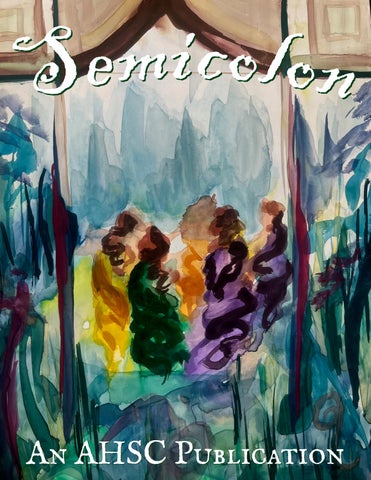
Semicolon Semicolon
Onceuponatime...
Semicolon
AnAHSCPublication
Issue2|Spring2026
Copyrights remain with the artists and authors. The responsibility for the content remains with the artists and authors. The content in this publication does not reflect the opinions of the Arts and Humanities Student Council (AHSC) or the University Student Council (USC).
What We’re About
Vice President Publications
Nicole Godlewski Hennigar
Associate Vice President Publications
Alyssa Naoum
Creative Managing Editor
Tanya Matviyiva
Academic Managing Editor
Lina Drummond
Layout Editor
Evan Rogers
Cover Designer
Kendra Jackson
Copy Editors
Khadeejah Abdul-Khadir
Afrah Fatima
Cadence Desmarais
Iris Zhao
Social Media Coordinator
Beatrix Nemec
Alumni Relations Commissioner
Paige Hammond
Symposium and Semicolon are official publications of the Arts and Humanities Students’ Council, published bi-annually. To view previous editions or for more information about our publications, please contact us at the AHSC council office in University College 2135. Publications can also be viewed virtually at issuu.com/ahscpubs
Semicolon is the AHSC’s academic journal. It accepts outstanding A-level submissions written in any arts and humanities undergraduate course.
Editor’s Letter
Dearest reader,
We all need a bit of magic in our lives. A dream… a wish… a light to guide us through hopeless times. We need a place where the impossible becomes possible, a story that transports us to a vivid new world.
We need a fairytale.
For this issue, we asked for pieces that embody this wonder And what a wonder it has been to receive and weave together these stories Each piece demonstrates the exceptional creative and academic skills of our A&H students, the utter necessity of the arts and humanities in a world of chaos
It has been my honour to serve as the AHSC’s Vice President of Publications for the 2025/2026 term, and I am thrilled to present you with our final publications of the academic year the happily ever after. This issue would not have been possible without the Publications team working hard behind the scenes: Alyssa, our AVP; Kendra, our cover designer; Evan, our layout editor; Tanya and Lina, our managing editors; and our copy editors, Khadeejah, Iris, Cadence, and Afrah.
A special thank you goes out to all the contributing writers and artists and everyone who submitted That engagement is the magic that brings our publications to life
Finally, I would like to thank you, dear reader Whether or not your work lies in these pages, your support means the world to the AHSC Publications team I hope that this issue grants you a little fairytale magic, that you walk away with a sprinkle of pixie dust or a surge of courage to get you your happily ever after.

NicoleHennigar VicePresidentofPublications
able of Con ents
7-9
10-11
12-13
The Impermanence of Empires: Coleridge and Shelley’s Critiques of Napoleonic Europe by Robbie Tucker
The Myth of Innocence: Systemic Non-Recognition of Racial Violence in Canada by Khadeejah Abdul Khadir
Resisting Change and the Death of Meaning: A Case for Indigenous Oral Tradition by Shayn Barnes
14-17
Echoes of Extremism: How the Death of the Euphemism and Social Media Fueled the Mainstreaming of Far-Right Ideologies by Truman Topolski
18-19
20-22
23-24
The Monster’s Vision: How Grendel Uses Fantasy to Expose Reality by Elora Chambers
A Victim of Circumstance: Why Eve Eats the Forbidden Fruit in John Milton’s Paradise Lost by Vasoula Ioannidis
The Company of the Leaf in The Floure and the Leafe Represents Female Desire by Morgan Kerr
25-27
28-30
'Till We Have Faces: Invisible Women in J R R Tolkien's The Lord of the Rings by Jayde Soares
Dracula: The Catalyst for Fetishizing Femicide by DeeDee El-Hage
The Impermanence of Empires: Coleridge and Shelley’s Critiques of Napoleonic Europe
English 3351
Written by Robbie Tucker
Humanity writes its history in the ruins of its ambitions; rulers who once envisioned permanence construct their visions of empires and monuments to glorify their names throughout time Nowhere is this more apparent than in the remains of great civilizations, such as Mongolia and Egypt, whose imperial legacies embody a paradox: every empire’s pursuit of eternal dominion becomes, in time, a monument to its own impermanence In the late eighteenth and early nineteenth centuries, as Europe’s own continental and colonial empires expanded, Romantic poets expressed a renewed fascination with these ruined empires and the remains of past civilizations; they reveal the cycle of human ambition and decline Samuel Taylor Coleridge’s “Kubla Khan” and Percy Shelley’s “Ozymandias” transform visions of the ruined Mongol and Egyptian empires into symbolic explorations of the imperial ambitions of their own age, specifically Napoleon Bonaparte’s creation of a French continental empire and his pursuit of absolutist power Examined in sequence, these poems reveal how Coleridge and Shelley approach this paradox through the Romantic theory of imagination: Coleridge presents empire at its moment of creation in his vision of Shangdu, Kublai Khan’s summer capital, while Shelley imagines its end through the ruined statue of Ramses II, and together they reveal how the desire to eternalize power leads to its inevitable collapse
In “Kubla Khan,” Coleridge transforms poetic creation into an imperial decree, presenting Kublai Khan’s vision of Shangdu as an attempt to impose order on nature Coleridge opens the poem with the ruler-artist’s “decree,” suggesting that creation comes from a command expressed through language, authority, and control The speaker asserts, “In Xanadu did Kubla Khan / A stately pleasuredome decree” (lines 1-2) Kubla’s imagination divinely creates his world through the king’s authoritative command and through the architect’s design; when he speaks, his world takes form (Khan 80) His pleasure-dome thus represents the human wish to impose symmetry and permanence on the world, using the imagination to shape it into order, in the same way an empire orders its lands This wish supports Paul Stock’s Romantic theory of “imposition,” which occurs when an “observer” overlooks the scene ’ s actual details and forces their own ideas and emotions onto it (383). This idea explains why the world
Professor Lee
Kubla orders resists this imposition and cannot be fully contained, a tension expressed by Coleridge’s sacred river Alph, which runs beneath the ordered dome: “Through caverns measureless to man / Down to a sunless sea ” (lines 3-5) The sub-surface caverns are immense, dark, and completely uncontrollable This setting presents a poetic vision of nature that defines the limits of power and imagination, thus framing creation as a tension between order and chaos Imposed order depends on the very forces it cannot fully command, since without resistance there could be no decree nor spectacle of authority, making the ruler’s power insignificant and unsustainable
As the poem continues, Kubla’s imaginative empire, once seemingly invincible, begins falling apart as the tension between order and chaos that sustained his vision collapses; creation becomes a memory of it This tension appears again in Coleridge’s description of the palace as “A miracle of rare device, / A sunny pleasure-dome with caves of ice!” (lines 35-6) The dome’s imposed order reveals the impossibility of holding such opposites together, foreshadowing the vision’s dissolution This collapse begins as Coleridge shifts from the confident tone of decree to the uncertainty of memory: “A damsel with a dulcimer / In a vision once I saw ” (lines 37-8) The poet can no longer command his imagination as Kubla once did, which parallels the collapse of his empire, where political and imaginative authority function and are undone by commanding limits they cannot overcome. The damsel’s song of “Mount Abora” recalls the creative power that has vanished, leaving only fragments of inspiration that the poet can hear, remember, but no longer command (line 41) Coleridge’s speaker longs to recover that lost vision, lamenting, “Could I revive within me / Her symphony and song, / To such a deep delight ‘twould win me I would build that dome in air” (lines 42-6) However, his plea exposes the futility of trying to eternalize what is, by nature, impermanent Coleridge, therefore, conveying this futility by opening with the commanded “decree” and ending with the ephemeral “air,” suggests that imagination cannot make its visions permanent and that only the memory of creation remains (lines 2, 46)
The Xanadu of Coleridge’s poem reflects Shangdu, the real place that the Mongol emperor Kublai Khan decreed in 1256 as the capital and summer city of his newly unified
empire, stretching from East Asia to Eastern Europe (Rossabi 31) Designed by the Chinese architect Liu Bingzhong, Shangdu was meant to embody the harmony between the Mongol Empire and Chinese Civilization under the Yuan dynasty (Rossabi xiv). Planned according to complementary principles of “wind and water,” the site brought together opposing natural elements in an imposed balance of order (Rossabi 31) This balance is described by Jalal Uddin Khan as an “autocratic yet successful exercise of power by decrees in creating something beautiful befitting his royal taste” (80) The magnitude of this design also reveals its fragility As Khan observes, the “pleasure-dome” represents the completed feat of imperial construction, set against the “uncompleted process by which the Romantic ideology of imagination sets itself in motion” (80), meaning that Romantic imagination is not ever meant to fully master the forces it orders Therefore, like the speaker who “drunk the milk of paradise” (Coleridge line 54), the city that had once promised a completed imperial vision fell into neglect Kublai’s death in 1294 coincided with the deterioration and dismemberment of the Mongol Empire itself (Rossabi xiv). Complete in its making but impermanent in its glory, Shangdu became both a literal and symbolic ruin to the paradox of the creator’s unfinished ambitions Coleridge’s depiction of Kublai Khan also serves as a critique of Napoleon’s imperial ambitions to reshape Europe through vision and decree Written ca 1797-98 and published in 1816, as Napoleon rose to the French throne and reigned as emperor, “Kubla Khan” can be read as a symbolic exploration of the imperial imagination that drives both emperors As Rossabi notes, Kublai Khan’s reign in China “witnessed the construction of a capital city, the development of a legal code, and a new written script for all the languages of the Mongol domains” (xvii) This same desire to unify and reorder appears in Napoleon’s 1804 Civil Code, which harmonized and coordinated France under a single centralized system (Harnay 237) This ordering became decrees of creative domination, in which leaders “impose their will on society at the expense of ordinary people,” revealing how imperial and tyrannical power depends on the same illusion that the world can be controlled, shaped, regulated, and sustained through imagination (Stock 372) Furthermore, Rossabi observes that Kublai governed “with the interests of his Chinese subjects, but also with exploiting the resources of the empire for his own aggrandizement” (115-16), a tension that reflects Napoleon’s similar ambitions between reform and self-glorification, where “his own imagination has superimposed these qualities onto his surroundings” (Stock
384) Thus, his empire, like Kublai’s unfinished city of Shangdu, sought perfection and depended on the imagination of a single ruler When that vision faltered, the order it imposed began to unravel
This fate is represented in Shelley’s “Ozymandias,” which reimagines the end of empires through the ruined statue of Ramses II, transforming a once-colossal monument into a symbol of imperial ambition undone by time In contrast to “Kubla Khan,” with its commanding opening decree, Shelley’s poem begins as far away as possible from the Pharaoh’s voice, introduced through a “traveller from an antique land” (line 1) This separation immediately casts the empire as surviving only through fragments and retellings rather than living memory The poem layers these retellings, from the speaker to the traveller to the sculptor, and finally to the broken monument itself; the reader encounters Ozymandias’s story across a chain of voices and recollections ending in the “Half sunk” ruins in the desert (Shelley line 4) This layering emphasizes the inaccessibility of the Pharaoh’s original powers and “passions” which vanished in time, surviving only as a stamp on “these lifeless things” (lines 6, 7). Shelley’s description of the statue, “Two vast and trunkless legs of stone / Stand in the desert,” reinforces this imagery of utter hollowness as the monument’s “colossal” scale only emphasizes what is missing (lines 2-3, 13) This description is metaphorical, as what survives of Ozymandias is not his power and authority but the ruined artwork that records its impermanence The Romantic imagination does not decree a world as in “Kubla Khan,” but reconstructs a lost one from its broken remains Shelley shows that the imaginative power that once “superimposed” Ozymandias’ greatness now belongs to the sculptor who records and exposes his tyranny (Stock 384) Shelley emphasizes this change by shifting from the imagery of natural decay to the traces of the character, “Which yet survive” (Shelley line 7) The traveller emphasizes that the sculptor “well those passions read,” personifying Ozymandias’s “wrinkled lip, and sneer of cold command” (lines 6, 5). He faithfully represents his pride and contempt The artist, therefore, paradoxically becomes the true architect of his empire, as what endures is the sculptor’s interpretation: a portrait of vanity and authority preserved in stone long after the social and political world that produced it disappeared This paradox culminates in Shelley’s ironic inscription, which boasts, “My name is Ozymandias, King of Kings, / Look on my Works, ye Mighty, and despair!” (lines 10-11) Intended to proclaim ultimate greatness and authority against his despairing enemies and subjects, the words now survive as an epitaph
commanding despair at the complete erasure of power Finally, Shelley returns to the setting and, using enjambment, emphasizes the natural ephemerality of power as “Round the decay / Of that colossal Wreck, boundless and bare / The lone and level sands stretch far away ” (lines 12-14), transforming the monument into a Romantic preservation through imagination The sculptor and the poet record the truth of Ozymandias’s empire and ambitions, which are levelled by time Ozymandias reflects the real imperial rule of the Pharaoh Ramses II (1303-1213 BCE) during the ancient Egyptian empire’s New Kingdom (c 1550-1070 BCE), a civilization that built political power on the promise of divine permanence As Toby Wilkinson notes, “The kings were the gods Monarchy was not just an integral part of religion, the two were synonymous ” (49) Therefore, Ramses II ruled under the authority of the gods, and his monuments served to “buy the king immortality” by asserting this divinity over his subjects (Wilkinson 105) Colossal structures such as the pyramids and giant monuments became “the ultimate projection of absolute power ” and symbols of dominion, which “ensured that his name would live forever” (Wilkinson 87, 330) Egyptologist Jan Assmann notes how “monumental discourse” indicated “the special relationship between the concepts of state and eternity (or immortality) in Egypt” (qtd in Neumann 335) This discourse is evident in Ozymandias’s ruined monument, where Shelley’s sculptor, who “mocked” the “heart that fed” (Shelley line 8), was expected to portray rulers not as they really were but as they wished to appear (Wilkinson 96) Ramses II, driven by “ a deep desire to surpass all his predecessors,” heightened the scale and amount of his monuments to reinforce a social hierarchy where the king stood “tall, dominating every scene ” (Wilkinson 330, 96) Together, these practices reveal a political theology where power and permanence are inseparable; the ruler’s authority depends on projecting a lasting image of dominion The symbolism of these monuments reflects Napoleon’s ambition to expand his empire across Europe and secure eternal glory; however, their eventual decay anticipates his own fate and that of all empires After invading Egypt in 1798, during his North Africa campaign, Wilkinson notes how Napoleon “made straight for Giza ” He rallied his troops beneath the pyramids by declaring, “Soldiers of France, forty centuries gaze down upon you, ” clearly displaying his fascination with antiquity (87) Napoleon’s awe shaped his own monumental self-aggrandizement: the Arc de Triomphe in Paris, commissioned after his victory at Austerlitz in 1806, exemplified the desire for “spatial marks
of identity” modelled on “those virtues that had been appropriated from the ancients’ world (Neumann 346) Napoleon’s absolutist and ambitious regime, grounded in the pursuit of lasting glory, sets up the paradox that Shelley exposes (Stock 376). As Neumann notes, “attempts to endow eternity on an event are bound to fail” (336). The fallen colossus of Ramses II in Western Thebes, once a proclamation of divine kingship, now stands symbolically for the “transience of power ” by embodying the might of Pharaonic Egypt and “its impotence in the face of longterm historic forces” (Wilkinson 303) Napoleon’s exile on St Helena similarly reveals that, despite “using circumstances to fashion self-preservation,” he found himself “at the mercy of incidental fluctuations,” of circumstance itself (Stock 381) Therefore, like Ramses II, Napoleon’s greatness ultimately submits to “time’s scrutiny” (Stock 372), leaving behind monuments of triumph as the enduring and symbolic “annulment of their power ” (Davis 536)
Samuel Taylor Coleridge’s “Kubla Khan” reveals a Romantic critique of empires and their belief in permanence by exposing their ambition at the moment of creation through Kubla Khan’s decree and attempts to impose order on nature Percy Shelley’s “Ozymandias” confronts it at its end, where Ramses II’s monument survives only to record the collapse of the imperial vision it commanded Taken together, these poems ’ historical representations critique Napoleon Bonaparte, whose French empire was built on imposition and conquest, exemplified by his decision to crown himself emperor in 1804; an act that ensured his place at the top of the social and political hierarchy As Paul Stock argues, the Romantic “idea of Napoleon” fuses with the concept of imagination itself, for he becomes the example of the desire to shape reality according to one ’ s own vision (384) Thus, like Kublai Khan’s neglected “pleasure-palace” Shangdu and the ruined monument of Ramses II, Napoleon’s self-aggrandized image was impossible to sustain. Both poems suggest that the emperors ’ imaginations, which preserve their empires whether in law or stone, decree or art ultimately meet forces they cannot command; Coleridge and Shelley’s poems thus reveal that every dream of eternal power ends in the ruins left behind to remember its failure
The Myth of Innocence: Systemic Non-Recognition of Racial Violence in Canada
English 3204F
Written by Khadeejah Abdul Khadir
Canada has long positioned itself as a tolerant, multicultural country, distinct from the historical and current racism of the United States The dominant narrative centers Canada as a safe haven for Black Americans who fled the United States through the Underground Railroad (Maynard 4)
The deeply troubling reality is that, although overt “classical racism” is not tolerated, anti-Black racism remains deeply intertwined with Canadian state institutions (Rattansi 7) While slavery was abolished in 1834, segregated schools persisted until 1983, and today, Black Canadians face disproportionate rates of incarceration, poverty, and access to education and healthcare (Maynard 4) In “On State Violence and Black Lives,” Robyn Maynard challenges the myth that Canada is free from antiBlack racism She does this by arguing that anti-Blackness is still upheld by the state through legal and educational institutions She broadens the definition of ‘state violence’ and uses historical analysis to express that anti-Black racism often goes unrecognized Maynard aptly warns us: “A history that goes unacknowledged is too often a history that is doomed to be repeated” (4) ‘State violence’ often refers to the usage of law enforcement and police brutality Maynard reminds readers to include “immigration and child welfare departments, social services, schools and medical institutions” in their definition of ‘state’ (7) This broader definition allows her to explain how different branches of the state play a role in conducting state violence. Therefore, state violence includes more than physical harm: all these institutions are able to perpetuate state violence through administrative and psychological forms As Maynard explains, “State agencies are endowed with the power to privilege, punish, confine or expel at will,” and it disproportionately uses these powers against Black communities (5) The overrepresentation of Black people in Canadian prisons reveals how the so-called justice system is not free of racial bias Since a significant portion of Canada’s Black population was born abroad, incarceration is often followed by deportation (Maynard 5) This exposes how the state reinforces the devaluation of Black life under the guise of the law While Black individuals hold government and leadership positions, this individual representation does not equate to structural equality, as Maynard’s analysis suggests. Systemic oppression operates not through isolated acts of
Professor Lawson
prejudice, but rather through the normalization of policies and practices that sustain racial hierarchies
Abdirahman Abdi’s brutal murder by the police was not acknowledged as an act of racial violence by the President of the Ottawa Police Association (4) Instead, he insisted that police brutality is an exclusively American issue
Perpetuating this narrative through the press is deeply harmful, as it reinforces a long-standing social construct that positions police officers as protectors Media outlets play a critical role in maintaining this illusion by selectively reporting incidents of police violence and framing them as isolated events rather than a systemic pattern Black history in Canada, when taught at all, is an afterthought to the study of Black history in the United States It begins and ends with learning about the Black Americans who escaped slavery by seeking refuge in Southern Canada Within this framework, it follows that individuals like the President of the Ottawa Police Association refuse to believe that such incidents are due to anti-Black racism and continue to deny the privilege white people receive in their interactions with the police
State violence persists because there is an innate lack of value placed on Black lives, which is traced back to slavery, when Black people were legally considered possessions
This history of dehumanization has continued into modern structures of control that demonize and marginalize Black communities. As Maynard notes, enslaved Black people were seen as animalistic, lacking sentience, hypersexual, and dangerous (8) These racist ideologies have not disappeared; instead, they are repackaged For instance, “ many poor Black mothers have experienced child welfare agents entering and searching their homes with neither warrant nor warning in some instances seizing their children as a result of an anonymous phone call” (6) An anonymous caller is treated as sufficient evidence for state intervention, due to the already ingrained stereotypes that Black mothers are negligent In these instances, state violence is not acknowledged, much less prosecuted in criminal courts (6) It is important to honour Black lives at all levels, including those who do not fit the image of the ‘perfect victim’ Factors such as documentation status, substance use, sex work, gender, or sexual orientation should not serve as a litmus test to be deemed worthy of dignity and protection. When human rights are conditional,
they do is urge sufferin
The pe anti-Bla commu United Cultura Black p housing healthca anti-Bla has fos crucial t on Blac like Ma push so governm systems key rol pressure prompt change society


Resisting Change and the Death of Meaning: A Case for Indigenous Oral Tradition
Writing 2202F
Written by Shayn Barnes
The following paper is dead That is to say, it is not living Once it is handed in, the words carrying you through these pages will be static, fixed, stationary; hopefully reduced to a coherent narrative If this paper is to convince you of anything, it is to convince you to believe a different story Whichever story you choose to believe is up to you just do not be afraid to bring into question your own certainty Without stories, we could not make sense of the constantly changing world around us Indigenous oral history is a mechanism of sense-making that precedes the written word. It updates with relevant understanding while maintaining a sense of meaning This adaptability reflects the fundamental phenomenon of change within our universe As an exploration in the cultivation of wisdom through Indigenous oral traditions, entropy theory, and modern literature, this paper argues that Storytelling is a fundamental human mechanism for adapting to change In Thomas King’s CBC Massey Hall Lecture Series “The Truth About Stories: A Native Narrative,” King shares that “the truth about stories is that that’s all we are ” (2) He elaborates on this with knowledge from Okanagan storyteller Jeannette Armstrong:
“Through my language, I understand I am being spoken to; I’m not the one speaking The words are coming from many tongues and mouths of Okanagan people and the land around them I am a listener to the language’s stories, and when my words form, I am merely retelling the same stories in different patterns.”
In the book, King compares the Indigenous creation Story, “The Woman Who Fell from the Sky,” with the creation story of the Abrahamic religions At the end of the chapter, he ponders what kind of world we would have today if the Genesis story “featured a flawed deity who was understanding and sympathetic rather than autocratic and rigid What kind of a world might we have created with that kind of story?” (King 19) King’s analysis shows how contrasting stories lay the foundation for different ways of perceiving the world Both King and Armstrong demonstrate that our thoughts are not individually generated; they emerge from our cultural stories and the context of our environment As our environment changes, so must our stories This perspective on Storytelling as foundational to human understanding also relates to broader themes of change and adaptability in philosophical
explorations of entropy
Dr Kathleen Fraser
Change is fundamental to our experience Things tend to fall apart, and we are all subject to the phenomenon of entropy In Jeremy Campbell’s book Grammatical Man, he explores the relationship between entropy, language, and life Campbell explains that the entropy principle “ as time goes on energy tends to be transformed from an orderly into a less orderly form” creates our distinction between past and future (83) This increase in randomness creates not just the arrow of time but shapes physical systems and meaning itself. Just as entropy drives natural systems to evolve, oral traditions evolve to maintain their cultural significance in a changing environment Our shared sense of meaning must be regularly updated, or risk becoming trapped in antiquated concepts Life and meaning are inextricably tied to processes of transformation The ability to adapt to change is fundamental to life Why then do we become deeply entrenched in our ideas? Why do we get stuck in the stories we tell ourselves, shackled by certainty in a fundamentally uncertain universe? This paradox reveals the tense relationship we have with words a relationship masterfully explored by Virginia Woolf
In 1937, Virginia Woolf recorded a broadcast for the BBC series Words Fail Me Woolf takes the audience on an interesting journey through our relationship with words Exploring the peculiarity of the written word, she claims that in dictionaries all the greatest stories and poems that are not yet written lie there on the pages waiting for someone to put them in the right order, “but we cannot do it because [words] do not live in dictionaries; they live in the mind ” She explains that words live in the mind like humans live “by falling in love, and mating together ” Joking about the complex ethnic make-up of Mother English, Woolf says we should not dig too deep into our language’s past, “for she has gone a-roving, a-roving fair maid” (MacDonald) Woolf’s insistence that words “live in the mind” rather than on the page echoes Armstrong’s understanding of language as a relational, living process Yet if words live in our minds, they can also deceive us there Words run through our minds and trick our brains into believing them, causing havoc when we forget to observe them with objectivity Australian artist Loui Jover’s collage print “Think” visually explores this concept with the bold words “Don’t Believe Everything You Think” covering
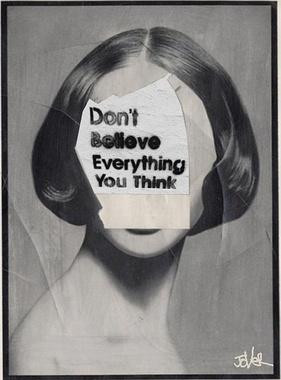
Our thoughts feel uniquely our own, yet they are formed by inherited words and cultural patterns Ask any writer about the challenges they face, and they will describe the battle with their mind to sift through torrents of thought and convey meaning through words This is why stories are so essential, and why they don’t need to be literally true, only metaphorically resonant Fictional stories can tackle the most complex subjects, offering insight to readers without triggering our internal fact checkers you know, the salty critic that takes over when we realize that someone is trying to convince us of something Stories help us navigate the chaos of thought by using metaphor to challenge and transcend rigid patterns of certainty and hubris
Another perspective on chaos, words, and thought comes from the concept of Indigenous trans-systemics In their paper Cultivating Pearls of Wisdom, authors Kira Jade Cooper and Dan McCarthy share gifts of Indigenous wisdom from Indigenous professor Don G McIntyre They use the metaphor of a pearl forming in an oyster as a model to understand human resilience: just as an oyster transforms something toxic into something beautiful, humans can take difficult situations even toxic ones and leverage inner transformations to heal injuries and become more resilient This process requires a broader perspective, one that transcends rigid ideology and creates space to simultaneously hold and analyze conflicting perspectives without judgment This wisdom reaches beyond traditional Western dichotomies, offering grace to perspectives that question one ’ s underlying narratives
Indigenous trans-perspectives model what McIntyre calls a panarchy: rather than a foundational narrative underlying a
hierarchy of superior knowledge, panarchy envisions interrelated systems across varying scales that constantly adapt to changes in their environment (see Fig 2)
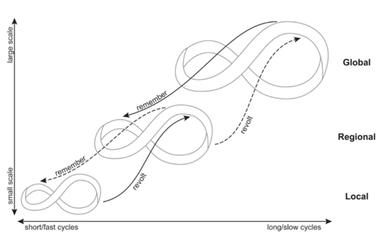
This model demonstrates the wisdom of adaptation inherent in Indigenous oral traditions By understanding the world as constantly in flux, Indigenous perspectives construct a worldview that not only adapts to new information but openly invites debate as a mechanism for survival This also relates to Virginia Woolf’s perspective on words; she argues their desire to change creates complexity, “and it is because of this complexity that they survive” (MacDonald). Both words and oral traditions survive through their capacity to evolve Change is fundamental to the human experience Our adaptability and need to communicate has given birth to systems that allow us to use gestures, sounds, and symbols to convey meaning to each other Before the written word, Indigenous oral tradition developed as a means to explore the unknown through Storytelling As a method of transmitting knowledge before ideas would be galvanized in print, Indigenous Ways of Knowing adapt to a world that never ceases to change Considering the universe through an Indigenous trans-perspective is reflected in some Western arenas, as demonstrated by Virginia Woolf’s BBC broadcast, and Loui Jover’s digital collage Think There is humility in simultaneously holding conflicting perspectives without judgment This humility is often perceived as weakness. However, when certainty and pride lead to hubris, it is the humble respect for uncertainty and the unknown that proves to be a more resilient method for surviving in a universe bound to a growing rate of randomness and complexity Indigenous oral tradition reminds us that meaning does not survive by resisting change, but by learning to adapt within it Now more than ever, our world is rife with uncertainty Perhaps the rigidity of our old stories has become our shackles This paper may be dead, but like a dying tree, it drops a seed What meaning is imbued in the better world we dream of? Let’s begin telling the stories that bring that meaning to life
Fig. 1. Think is a digital collage by Australian artist Loui Jover. From “Loui Jover.” Tumblr, louijover.tumblr.com/page/62.
Fig. 2. A model of panarchy which demonstrates adaptive cycles interconnected at different scales. From Cooper, Kira Jade, et al., p. 9.
Echoes of Extremism: How the Death of the Euphemism and Social Media Fueled the Mainstreaming of Far-Right Ideologies
SASAH 1020E
Written by Truman Topolski Dr Faflak
On August 11th, 2017, the Unite the Right rally in Charlottesville, Virginia, drew participants from across the far-right spectrum: neo-Confederates, fascists, neo-Nazis, and Klansmen They gathered to protest the removal of a statue of Confederate General Robert E Lee (Schein 270–272) By sunset that evening, marchers filled the streets and their voices chanted racist rhetoric Torchlight reflected off Confederate statues and swastika-emblazoned banners The rally resumed the next morning on August 12th, swelling in both numbers and intensity. Counter-protesters arrived, a diverse group united in their outrage against the hatred they had witnessed the night before The initial clash of ideologies soon spiralled into physical altercations, with skirmishes erupting sporadically across the city (Segrest 22) Outnumbered and overwhelmed, the police struggled to maintain control At 1:45 p m , amidst the confusion and shouting, a car accelerated down a narrow street packed with counter-protesters The driver, James Alex Fields Jr , later identified as a self-proclaimed white supremacist and neo-Nazi, caused one fatality and left nineteen others critically injured
This event, now referred to as the Charlottesville Massacre, exposed the underlying hatred simmering in right-wing politics for decades; however, it soon became evident that Charlottesville participated in a broader social and political transformation toward right-wing extremism Far-right ideologies, once lurking on the political fringes, now operated with increasing visibility and boldness; a phenomenon resulting from the erosion of linguistic barriers, specifically through euphemisms (Segrest 22) The Charlottesville Massacre demonstrates how euphemistic language cloaking far-right extremist rhetoric evolved to brazen hatred Hitherto, when predominantly white hate groups committed crimes, their actions were often not acknowledged or labelled as terrorism (Azani 13–14) Nevertheless, the overt acts of domestic terrorism in Charlottesville made it impossible for the media to ignore or downplay their acts Prominent public figures, including then-President Donald Trump, offered responses that many perceived as enabling Trump infamously stated that there were “ very fine people on both sides,” thus, blurring the line between legitimate political grievances and extremist violence. Extremism was amplified by these coded messages rather than diminished by horrific violence. Such
reception to James Alex Fields Jr ’ s actions emboldened the Unite the Right movement, turning the tragedy into a rallying point for its supporters
The Charlottesville Massacre parallels the Insurrection on January 6th, 2021 The event in Washington, D C , amalgamated militia members, conspiracy theorists, white nationalists, and, most notably, MAGA supporters Thousands of demonstrators protested the certification of the 2020 presidential election, chanting against the “stolen election” and vowing to “take back the country” (Tinnes 1–2). Emboldened by weeks of incendiary rhetoric, they marched to the United States Capital and surged past overwhelmed police to breach the barricades They smashed windows, forced themselves into Congress’s halls, ransacked offices, vandalized property, and shouted threats (Moskalenko 2–4) It was a scene of desecration A tweet from then-President Trump further inflamed the mob, criticizing Vice-President Pence for refusing to overturn the election results Chants of “Hang Mike Pence” echoed ominously through the Capitol's halls While the insurrection was ignited by the false narrative of voter fraud, a lie repeatedly amplified by Trump and his allies, the events of January 6th may be interpreted as a culmination of extremist rhetoric infiltrating mainstream political discourse
During the twentiethth-century, right-wing movements emerged as reactionary forces to counter the social and political changes of their times. These radicals denounced "othered" groups, including the LGBTQ+ community, racial minorities, and individuals with disabilities Instead, they championed nationalism, religious conservatism, and economic liberalism as counterweights to the progressive forces of the era (Brubaker 5) In aligning with powerful economic interests, early right-wing movements solidified their position as protectors of the established order; this alignment appealed to those who feared the redistributive aims of left-wing politics (5) While their messaging remained largely confined to elite circles, broader cultural and political strategies brought these ideas into mainstream political consciousness Euphemisms became an adopted strategy to penetrate and influence public discourse; they served as linguistic shields, cloaking radical beliefs in terms that seem centred and non-alienating (2–4). The normalization of extremist views is often achieved through
the gradual redefinition of what is considered politically acceptable (Schroeder 60–61) Hence, euphemisms make extremist ideologies more acceptable to a broader audience by subtly reshaping societal norms and enabling extremist ideas to gain legitimacy (Azani 5).
Following the New Deal era (1933–1938), conservatives struggled to counter dominant progressive policies To broaden their political base, prominent figures redefined conservatism by distancing the party from overtly racist and anti-progressive elements; however, they simultaneously needed to appeal to many white Americans who harboured anxieties about racial integration, secularism, and perceived threats to “traditional values” (Auger 3) Navigating this tension was central to the mainstreaming of right-wing ideologies during this period (4) By the mid-twentiethth century, the Conservative Party used the euphemism of “states’ rights” to galvanize support from those maintaining both explicit and implicit racial biases This euphemism was employed to resist civil rights advancements without explicitly endorsing segregation Similarly, during the civil rights movement and Richard Nixon’s 1968 campaign, “law and order” became a coded appeal to fearful white voters. Accordingly, politicians maintained plausible deniability while appealing to mainstream audiences through euphemism
Furthermore, the concept of “white replacement theory” (WRT) exemplifies how extremist ideologies are normalized through euphemistic language (Azani 5) WRT posits that the influx of immigrants, particularly from non-white, nonEuropean backgrounds, directly threatens the cultural, racial, and political hegemony of white populations These beliefs are amplified by false conceptions that “native white populations” are being “replaced” by immigrant groups When expressed in more palatable terms, WRT becomes less likely to be dismissed outright as racist In the United States, prominent figures have invoked concerns about the demographic changes brought by immigration, often using language like “preserving American values” or “protecting our borders.” Upon Donald Trump’s electoral victory in 2016, he made inflammatory statements about immigration, such as: “When Mexico sends its people, they’re not sending their best They’re bringing drugs They’re bringing crime They’re rapists ” Rather than framing immigration concerns with coded language like “border security” or “economic challenges,” Trump defied political expectations by speaking directly to far-right extremists without softening his rhetoric What should have been political suicide instead became a defining feature of Trump’s appeal Trump signalled the end of euphemistic
discourse and ushered in a new era of unvarnished, direct political communication (Stott 56-–57) While euphemistic language carries its own negative implications, its disappearance often leads to more severe societal consequences. Paradoxically, euphemisms soften the overall impact of blatant hatred; they offer a degree of protection for vulnerable communities, even as euphemisms insidiously normalize prejudice (59)
At the beginning of the COVID-19 pandemic, terms like “Mask Police” gained popularity online, mocking the stereotype of Asians frequently wearing masks Meanwhile, phrases like “Lab Workers” perpetuated harmful stereotypes linking Asian communities to the pandemic's origins These euphemistic terms preceded more overtly racist rhetoric, such as “China virus” or “Wuhan virus” (DeCook 74) The escalation from subtle euphemisms to racial slurs underscores how the erosion of rhetorical filters can embolden hate crimes According to a report by Stop AAPI Hate, over nine thousand incidents of anti-Asian hate were reported between March 2020 and June 2021 These incidents ranged from verbal harassment to physical assault (74). In one case, a 91-year-old man was violently assaulted and hospitalized in Oakland, California In another case, a woman in New York City was slashed across the face in a subway attack; she bled profusely in the subway and needed medical attention These horrifying acts were fueled by the normalization of overt racism; such rhetoric contributes to a broader culture of violence and marginalization against vulnerable communities
As demonstrated in the case of Asian hate during the COVID-19 pandemic, this normalization process has two primary impacts: firstly, explicit hatred becomes more socially acceptable through repetition and exposure; secondly, it shifts political discourse by shifting the ideological spectrum toward extremism (Stott 56) When right-wing extremist ideas are accepted within mainstream political conversation, traditional right-wing positions appear moderate or centrist by comparison. This gradual repositioning of the political center legitimizes ideologies that were once widely condemned, gaining traction without facing the scrutiny they deserve Ultimately, this leads to polarization in societies by adopting and amplifying extreme rhetoric within the mainstream political sphere (58)
Social media promotes extremist discourse by facilitating the rapid dissemination of ideas and redefining how political movements gain traction Traditional platforms like Facebook, Twitter, and YouTube, along with newer, more politically-charged spaces such as Gab and Truth Social,
have provided far-right movements with unprecedented opportunities to bypass traditional media gatekeepers and engage directly with audiences Unlike traditional media, where editorial standards would curtail overtly extremist messaging, social media platforms operate with far fewer constraints. This newfound freedom allows far-right figures to communicate their ideologies unfiltered to millions of individuals (Pasieka 20) Fundamental to this process is pushing right-wing ideologies as a comprehensive way of life Known as the “right-wing pipeline,” individuals are gradually exposed to extremist content through algorithmic recommendations on social media platforms This pipeline often begins with moderate content that appears aligned with mainstream conservative values, such as discussions on free speech, critiques of political correctness, or debates over economic policies (Macnair 5)
Right-wing ideology is positioned as integral to an individual’s identity, cultural heritage, and moral values (Macnair 2) Furthermore, the right-wing pipeline appropriates humour to convey controversial ideas in a “harmless” and entertaining format (Prier 53). This approach allows them to engage a wider audience, often younger viewers unaware with the political undertones of content they consume However, as users increasingly engage with this content, algorithms recommend more provocative material, often involving controversial figures or polarizing topics For example, individuals interacting with a relatively benign YouTube video on “Western values” might be directed toward channels discussing “ethno-nationalism” or conspiracy theories like the aforementioned “White Replacement Theory” Similarly, Twitter threads critiquing immigration policy can lead to accounts openly promoting xenophobic rhetoric This process is facilitated by the interconnected nature of social media platforms, where one post or video often leads users to a network of related content (Krosravinik 57) A 2018 study published in the Proceedings of the National Academy of Sciences found that YouTube’s recommendation algorithm significantly contributed to directing users toward radicalizing content. Regardless of this facade of benignity, the lifestyles and humour promoted have proven to escalate to violence and terrorism Online spaces enable right-wing extremist groups to organize, recruit, and incite violent action Furthermore, the mainstreaming of far-right ideologies undermines core democratic principles, including equality, pluralism, and the rule of law By framing extremist views as legitimate political positions, this shift distorts the democratic process; hate-fueled rhetoric then serves to influence public policy and electoral outcomes Politicians
who adopt far-right policies often seek to capitalize on voter anxieties by entrenching divisive narratives in the political mainstream (Day 24) This erosion of democratic values is particularly evident in the realm of voter suppression and election integrity. Far-right movements have weaponized unfounded claims of voter fraud to justify restrictive voting laws that disproportionately target marginalized communities These efforts erode public trust in democratic institutions and fuel polarization, as voters increasingly perceive the opposing party as illegitimate Furthermore, as harmful narratives permeate mainstream debates, advocates for equality/inclusion are cast as destabilizing forces in society For example, the far-right deliberately targets marginalized communities, such as the LGBTQ+ and people of colour LGBTQ+ individuals are often framed as threats to traditional family values or accused of endangering children; meanwhile, POC are portrayed as criminals or as threats to the majority population (Leonardi 71) Such hostile framing stifles productive dialogue; societies become increasingly polarized along ideological lines. Far-right actors employ such rhetoric as a calculated strategy to consolidate power and control over those they view as inferior (Leonardi 73) By prioritizing engagement over accuracy and ethical considerations, social media platforms have rewarded extremist content with increased visibility and reach This dynamic ensures that far-right ideologies remain a prominent feature of public conversations, further entrenching their influence in society (Schroeder 32) Efforts to regulate social media platforms have faced significant challenges, primarily due to resistance from companies concerned about the impact of such measures on their profitability While various platforms have introduced content moderation policies, these reformations are often inconsistent and allow harmful content to persist (30) A 2021 report by the Center for Countering Digital Hate found that social media companies failed to act on 84% of posts containing anti-Semitic content reported by users (Pasieka 22). Additionally, the global nature of social media complicates regulatory efforts, as varying legal standards and enforcement mechanisms create opportunities for extremist movements to exploit Without coordinated efforts, the normalization of hate and division will continue to erode the foundations of democracy, equality, and justice Transparency is essential Social media platforms must disclose how their algorithms operate, offering users clearer information about their recommended content Introducing features that allow users to customize their content feeds
could counteract the right-wing pipeline and promote exposure to diverse perspectives Additionally, companies must be held accountable for failing to moderate harmful content Financial penalties for negligence, alongside incentives for platforms that successfully curb extremist material, can encourage responsibility. International cooperation will also be critical, as the global nature of social media means hate speech and extremism often transcend national borders This approach combines technological innovation, policy reform, and public accountability to foster a more equitable and democratic digital environment Moreover, education serves as the most effective solution to combating extremism and hate Hate is not natural; it is taught A concerted effort to enhance media literacy across all age groups will empower individuals to critically evaluate the information they encounter online Schools should integrate media literacy into their curricula, teaching students how to identify propaganda, discern reliable sources, and understand the tactics used by extremist groups to spread their ideologies Community organizations, employers, and public institutions can host workshops and provide resources on responsible social media use Governments and non-profits should invest in public awareness campaigns to demystify the tactics of radicalization, emphasizing the importance of critical thinking and civic engagement
Addressing economic inequalities is equally critical Extremism thrives on fear, uncertainty, and a sense of disenfranchisement Societies must confront structural inequalities and historical injustices that have perpetuated divisions Investments in education, healthcare, and job creation in marginalized communities can reduce the appeal of radical ideologies by fostering stability and opportunity Programs that encourage cross-cultural interactions, celebrate diversity, and strengthen local communities can counteract the isolation and alienation that often drive individuals toward radicalization Reforms in criminal justice, housing, and education can create more equitable conditions and diminish the grievances that extremists exploit Robust legislation must balance enforcing laws with protecting individual freedoms Laws targeting hate speech, incitement of violence, and the spread of disinformation must be applied consistently and equitably to maintain fairness Reforming government funding and lobbying laws can help reduce the influence of extremist groups in mainstream politics Increasing transparency in political funding and restricting contributions from organizations that promote hate will ensure that democratic institutions remain focused on the common good
Though the mainstreaming of far-right ideologies is a multifaceted challenge for modern society, it is not insurmountable By becoming vigilant consumers of information and active participants in our communities, we can individually resist the normalization of extremist ideologies. Supporting organizations that combat hate, mentoring at-risk youth, volunteering for initiatives that promote inclusion and equity, reporting harmful content online, and initiating conversations about media literacy can foster broader societal change Likewise, by addressing systemic flaws through legal measures, we may dismantle the culture that enables hateful rhetoric Those in positions of power (social media companies, politicians, and individuals) must take collective responsibility to ensure that human dignity prevails over hate Education, equitable policies, and a commitment to empathy and respect are essential tools to counteract the forces that threaten social cohesion Together, we can foster a society where understanding and inclusion triumph over division and hate


“Darkness cannot drive out darkness; only light can do that. Hate cannot drive out hate; only love can do that."
–Martin Luther King Jr
English 2072F
The Monster’s Vision: How Grendel Uses Fantasy to Expose Reality
Written by Elora Chambers
One way to understand the history of the novel is to see it as a slow takeover of fiction by realism a movement toward representing the ordinary world as it is Realism promises a stable mirror of human life, one in which characters and events imitate the surface of reality Fantasy, in contrast, refuses imitation It opens the possibility that the world itself might be unstable, that reality is something imagined, revised, or dreamed into being John Gardner’s Grendel transforms fantasy into precisely this philosophical experiment. By retelling the Beowulf legend from the monster’s point of view, Gardner turns myth into a reflection on meaning, perception, and creation The novel’s fantasy world becomes a mirror in which human reality is revealed as a fragile construction a story we tell to hide the void beneath it
The novel begins by dismantling the realist assumption that the world can be observed from a neutral distance Grendel opens in chaos, with the narrator wandering through a dark, shifting landscape that seems to echo his mind Gardner’s first-person fantasy perspective does not describe a coherent world; it invents one moment by moment As Grendel explains, “I undertook that the world was nothing: a mechanical chaos of casual, brute enmity on which we stupidly impose our hopes and fears I create the whole universe, blink by blink” (Gardner 16) The sentence collapses the difference between perception and creation
For a realist novelist, the task is to show life as it is; for Gardner, the task is to show that such faithfulness is an illusion By making the monster both narrator and worldbuilder, Gardner turns fantasy into an inquiry about consciousness the place where the real is made The fantastic form allows him to visualize what realism can merely describe: how every mind invents the reality it believes it perceives
This collapse of external and internal reality continues when Grendel meets the Dragon, a creature who transforms the traditional fantasy figure of hoarder and oracle into a philosopher of meaninglessness The Dragon says, “ my advice to you, my violent friend, is to seek out gold and sit on it” (53) The line sounds absurdly simple, but its irony cuts deep: if all meaning is illusory, then hoarding treasure is as rational a purpose as any The Dragon’s omniscience is both comic and terrifying he boasts that he “see[s] from the mountaintop: all time, all space, ” yet his awareness
Professor Kelly
renders him detached and purposeless, embodying the futility of pure knowledge without meaning (45) In this encounter, fantasy becomes a theatre of metaphysical argument The Dragon’s invisible presence and Grendel’s inability to comprehend him dramatize how knowledge exceeds language Where realism might attempt psychological realism or social explanation, Gardner’s fantasy stages philosophy as myth The hidden world the novel reveals is not an alternate dimension of elves and heroes but the unseen world of thought itself the restless space of consciousness that no realist technique can render visible
At the same time, Grendel uses its mythic setting to challenge the moral and cultural assumptions of the world it imitates
By allowing the “monster” to speak, Gardner reverses the moral polarity of the Beowulf epic What had been a tale of heroic order becomes a story of existential confusion
Observing the Danes, Grendel sees that their civilization depends on illusion: “He told how Scyld by the cunning of arms had rebuilt the old Danish kingdom and all of them, incredibly, lies” (31) The Shaper’s songs, which transform violence into legend, reveal how language constructs social reality When Grendel observes that the Shaper’s “coldblooded lie” about divine creation might be made “true” by his song, Gardner exposes how myth functions as ideology: fiction that becomes belief through beauty and repetition (40). Therefore, the fantasy world of Grendel critiques the real world’s dependence on narrative to maintain power and meaning The Shaper’s beautiful lies parallel the stories every society tells about its own goodness In this sense, Gardner’s fantasy revises and challenges the human world by revealing that what we call civilization rests on artful deception
What makes Grendel original within the fantasy tradition is how it treats imagination not as escape, but as the medium of truth The monster’s ability to see the arbitrariness of human stories gives him a kind of dark insight, yet it also isolates him After hearing the Shaper’s music, Grendel experiences both revelation and despair: he wants to believe in the world the songs can create, but cannot His tragedy is that he recognizes myth as false yet needs it to live The fantasy landscape externalizes this inner conflict caves, mead-halls, dragons, and warriors become symbols of competing versions of reality. Through this doubling of
inner and outer worlds, Gardner transforms myth into a model of how all meaning is made and unmade by imagination
By the novel’s end, the boundary between fantasy and reality has collapsed entirely. Grendel’s death scene is chaotic and almost hallucinatory. His final words, “Poor Grendel’s had an accident So may you all,” read like a grim joke on the reader’s desire for closure (121) If the monster’s consciousness has created the universe “blink by blink,” then his death might dissolve that universe (16) The fantasy world literally ends with its narrator Gardner thus achieves what realism cannot: he lets ontology depend on the point of view In doing so, Grendel reveals that the real world, too, exists only through narrative consensus a collective act of storytelling no less imaginative than myth Gardner’s reimagining of Beowulf is therefore not only a moral or psychological revision; it is a formal and philosophical one The novel uses the tools of fantasy monsters, dragons, and ancient kingdoms to explore modern existential questions It envisions a hidden world, not beneath or beyond reality, but within it: the invisible realm of perception, art, and belief that realism flattens into objectivity Where realism strives to depict the surface life, Grendel peels that surface back to show the stories pulsing underneath In exposing those stories as fragile constructions, Gardner turns fantasy into the truest realism a vision that admits its own invention In the end, Grendel challenges the assumption that fantasy is escapist or childish Its imagined world forces readers to see how imagination itself structures reality Gardner’s monster becomes the voice of doubt inside every human story, asking whether our truths are anything more than beautiful lies Through the world of fantasy, Grendel reveals the hidden realm that realism cannot face: the emptiness that lies beneath meaning, and the creative urge that keeps us from falling into it
A Victim of Circumstance: Why Eve Eats the Forbidden Fruit in John Milton’s Paradise Lost
English 3321F
Written by Vasoula Ioannidis Professor Leonard
Eve’s decision to eat the apple has been a widely studied topic in the literary criticism of John Milton’s Paradise Lost Some arguments have been made for why Eve ate the apple, but pay less mind to the circumstances that left her susceptible to Satan’s manipulation Eve is created in a world where she is objectified and oppressed in nearly every aspect of her life, making her uniquely vulnerable to Satan’s temptation In this essay, I argue that the circumstances of Eve’s existence in Paradise, coupled with her vulnerable, agitated state after her first argument with Adam in Book IX, lay the framework for Satan to succeed in tempting Eve When one considers that Eve is, more than anything else, a victim of circumstance, it is easy to see how she could fall prey to one of literature’s greatest conmen After taking these circumstances into account, one might consider rather than asking why Eve ate the apple, a better question is how could she have done anything else? Liberty takes a central role in Paradise Lost, so how it functions within the constraints of Paradise must be defined before looking at individuals in the poem Liberty is often discussed in terms of having freedom from tyranny or freedom from necessity In his article, “Two Concepts of Liberty in Paradise Lost, ” Benjamin Woodward argues “that the poem in fact portrays two distinct versions of liberty: one espoused by God, negative liberty, and the other by Satan, positive liberty” (68) Woodward situates liberty in Paradise Lost in terms of Isiah Berlin’s definition of negative and positive freedom, where negative freedom denotes a “liberty from the interference of others” and positive liberty is a freedom to live life in a chosen manner rather than a freedom from some constraint (70) Referring to man, God tells the angels that he “made him just and right, / Sufficient to have stood, though free to fall” (Milton 3 98–9) The argument from which this passage is pulled is clear: God is the creator, which makes man beholden to him, but he has allowed them negative liberty or freedom from necessity by not interfering with their free will they are given choice but are not free from consequence Woodward argues quite rightly that both the liberties offered by God and Satan require Adam and Eve to be beholden to some form of higher power, with God being the rightful, non-tyrannical monarch; consequently, in the context of Paradise Lost, “by not forcing Adam and Eve to be obedient (and happy), God enables them to be free”
(74) The matter of freedom and liberty becomes harder to define, however, when considering the individual freedoms afforded to Eve compared to those of Adam, who is essentially in charge of Eve When Woodward writes that Paradise Lost presents “negative freedom in its most undiluted form, therefore the benefits that such freedom brings (the opportunity for self-development through free choice) are also on full display,” he assumes that Adam and Eve are free to engage in self-development through their freedom of choice (85). But this is not the case. While Adam is able to enjoy the negative liberty God provides, Eve has a more limited liberty in Paradise because she is expected to obey both God and Adam Milton presents two divergent examples of personal development through Adam and Eve: the former being selfdevelopment and the latter guided-development From his creation, Adam was able to inquire, wonder, and explore, recalling to Raphael that he “strayed [he] knew not whither, / From where [he] first drew air, and first beheld / This happy light, when answer none returned / On a green shady bank profuse of flow’rs / Pensive [he] sat [himself] down” (Milton 8 283–87) Then God comes to Adam, telling him that not only Paradise, “but all the earth” has been given to Adam’s race, and they will own, “ as lords / / all things that therein live, / Or live in sea, or air, beast, fish and fowl” (Milton 8 338–41) As the first and only man, Adam is explicitly ruler of Earth, beholden to none but his creator, and will consequently experience all the positives Woodward associates with an “undiluted” negative liberty (Woodward 85)
Eve’s moments after creation follow the same structure as Adam’s, but her experience lacks the essential criteria for the negative liberty that Woodward lays out Eve strays not far from where she wakes, moving toward the sound of water “with inexperienced thought, and laid,” down to examine the beautiful reflection in the lake (Milton 4 457) She tells Adam that her eyes would have been fixed on the lake “till now, and pined with vain desire, / Had not a voice thus warned” her that the reflection was her own (4 466–67) On its own, this event is similar to what Adam experienced after waking, albeit in a shorter time frame because the voice of God came to Eve quicker than He did to Adam. However, it becomes evident that Eve’s path to the Garden is a gentle coercion that Adam does not go
through Eve recounts to Adam that she had a desire to stay with her reflection rather than be led away, saying “what could I do, / But follow straight, invisibly thus led? / Till I espied thee / / back I turned, / Though following cried’st aloud, Return, fair Eve” (4. 475–81). In this sequence of events, Eve is led from engaging in the activity of her own choosing, and she is met with an imperative “Return” from Adam after she chooses to turn back to her reflection (4 481) While Adam is given dominion over Paradise, Eve is given to Adam and is expected to act with “meek surrender” as she does after telling her story Further complicating Eve’s liberty is the instrumental reason why she was created as a gift for Adam and the mother of humanity (4 494)
In the colloquial definition, objectification is the act of treating something as an object, which is not an object For a more in-depth analysis of objectification, along with its moral and philosophical implications, we may turn to Martha C Nussbaum’s article, “Objectification ” Nussbaum analyzes the negative and positive uses of the term throughout feminist criticism and identifies the seven ways one may objectify a person:
1 Instrumentality: The objectifier treats the object as a tool of their own purposes.
2 Denial of autonomy: The objectifier treats the object as lacking in autonomy and self-determination.
3 Inertness: The objectifier treats the object as lacking in agency, and perhaps also in activity
4 Fungibility: The objectifier treats the object as interchangeable (a) with other objects of the same type, and/or (b) with objects of other types.
5. Violability: The objectifier treats the object as lacking in boundary-integrity, as something permissible to break up, smash, or break into.
6 Ownership: The objectifier treats the object as something that is owned by another, can be bought or sold, etc.
7.Denial of subjectivity: The objectifier treats the object as something whose experience and feeling (if any) need not be taken into account. (257)
According to Nussbaum, some forms of objectification are not sinister In terms of objectification by instrumentality, the affections of a lover may be quite pleasant in Eve’s case, she is quite open to Adam, who considers her to be the beautiful object of his affection There are, however, situations where seeing a person as instrumentally useful is a
true impediment to their personal liberty
Any concept of liberty negative or otherwise where Eve is concerned is undone after one considers the lack of autonomy she is afforded and the objectification she endures in Paradise. In her article. “Feminism Regained: Exposing the Objectification of Eve in John Milton’s Paradise Lost,” Alison L Bare takes a contemporary feminist critical approach, creating a Nussbaumian analysis of Eve’s everyday life, from her creation to her fall Bare argues that Eve’s culpability in the fall is lessened by her status “ as an agitated unequal,” and her argument goes step by step through what she calls Eve’s “triple objectification at the hands of God, Adam and Satan, in an environment of widespread and entrenched sexual inequality” (93) Bare writes that patriarchal “assumptions about women ’ s inherent inferiority, instrumentality, and violability, all receive one of their earliest and fullest iterations in Milton’s depiction of Eve” (93); for the scope of this essay, however, I will focus on Eve’s inferiority and instrumentality in Paradise Lost, which sets her up to be Satan’s victim of circumstance.
Eve is created as lesser than Adam, and her inferior position sets her up to be coerced into fulfilling her prescribed purpose Before Adam receives Eve, the “fairest” gift that he had yet received and names her woman (an act quite similar to his naming of the animals in Paradise) (Milton 8 493) God tells him that “what next I bring shall please thee, be assured, / Thy likeness, thy fit help, thy other self, Thy wish exactly to thy heart’s desire” (8 449–51) The knowledge that Eve is created as a gift for Adam, the fact that as she is led to Adam, and God telling her that “to him shalt bear / Multitudes like thyself, and thence be called / Mother of human race, ” shows an evident instrumentality in Eve’s creation and that she is inferior in position to Adam; Eve is oppressed in Paradise (4 473–75)
While Eve is certainly oppressed in Paradise Lost, it becomes difficult to pinpoint exactly why she succumbs to Satan’s second attempt at tempting her but stays strong against his first temptation. Bare argues that “Eve had no other choice but to take the most convenient course of action offered by Satan to transcend the disabling conditions of Paradise,” but this leaves open the question of when the conditions of her life in Paradise became ‘disabling’ (110)
Satan first attempts to tempt Eve into eating the forbidden fruit by whispering in her ear while she is dreaming Disguised in angelic form, Satan eats the fruit and tells Eve to “taste this, and be henceforth among the gods / Thyself a goddess, not earth confined” for she may be happier after
eating (Milton 5 77–8) At this point in the poem, however, Eve is unequivocally happy on Earth with Adam, so much so that she is filled with “damp horror” when he eats the apple (5 65) Eve is “glad / / To find this but a dream” when she wakes (5.93-4). It is only in Book IX, after Adam and Eve argue about working separately, that Eve shows what Bare calls “revealing vulnerable conditions for the fall” (97) After Adam and Eve argue about working separately, Eve is indignant, frustrated, and has a newfound urge to prove herself worthy to the task of resisting temptation When Adam argues for Eve and himself to work together, he thinks they will be stronger together, feeling that “hopeless to circumvent [them] joined, where each / To other speedy aid might lend at need” (Milton 9 259–60) At the very least, Adam feels it best that if there is danger, Eve is safest by him, “who guards her, or with her the worst endures” (9 269) While Adam should be commended for wanting to protect Eve and for suggesting that they can help each other while under attack, as the inferior being, Eve can only see an attack on her strength and devotion; she “expected not to hear” from her husband (9.281).
Satan’s second attempt at tempting Eve works because it happens in a moment where she feels, perhaps for the first time, the effects of her inferiority in Paradise Author of The Confidence Game, Maria Konnikova, describes a con man as “displaying a dark triad-influenced bent, and when the opportunity arises, for unlike any oth sinister-minded counterparts, he can rationalize aw about any behaviour as necessary ” (33) In what can described as an extraordinary stroke of good luck fo in his search for a victim, “beyond his hope, Eve sep spies” (Milton 9 424) The opportunity has arisen to con on Eve who, in her heated state, is the only pe Paradise who would be vulnerable to his con It is only when Eve feels the sting of her inferiority t becomes the perfect mark for Satan’s con Konniko an exercise where members of the Better Business gave their ideas on what separates the scammed from who escape the scam. According to Konnikova responses showed perceived traits in potential ma generally considered to be “gullibility, a trusting n proneness to fantasy, and greed,” coupled wi assumption that marks were “less intelligent and ed poorer, more impulsive, and less knowledgeable and (46); however, that assessment did not account copious number of people who did not fit these crite had also been targeted by conmen The conclusion Konnikova came to was that a good con artist did not
adhere solely to these criteria, quite to the contrary: “ one of the factors that emerges is circumstance: it’s not who you are, but where you happen to be at this particular moment in your life” (47–8) She states that angry people want to lash out, causing “something that once seemed like a gamble looks awfully appealing,” and it is here where we see an alignment with Bare’s argument that Eve’s fall is solidified by her vulnerable and “agitated” state (48) Konnikova writes that an important factor in resisting a con man “is to know yourself well enough to recognize and control your emotional reactions” (312), but Eve does not know herself away from Adam From the day of her creation, Eve is Adam’s gift and has been guided and taught by him When she feels he is doubting her strength and devotion, her need to prove herself equal is what makes her fall victim to Satan’s promises of exaltation Konnikova writes that “what a confidence artist sells is hope Hope that you’ll be happier, healthier, richer, loved, accepted, better looking, younger, smarter, a deeper, more fulfilled human being hope that you that will emerge on the other side will be somehow superior to the you that came in” (321). Satan opens a possibility for her to obtain the one thing that will fix her circumstance and let her emerge liberated on the other side

The Company of the Leaf in The Floure and the Leafe Represents Female Desire
English 3316E
Written by Morgan Kerr
The Floure and the Leafe is a fifteenth-century dream vision poem with an unknown author It follows an unnamed female narrator unable to sleep, so she wanders to a grove and finds two groups of people: the Company of the Flower and the Company of the Leaf (Floure and Leafe) The Flowers are destroyed by a storm, while the Leaf persists After a display from both groups, the narrator decides to devote herself to the Leaf This poem is an allegory for love the Flower representing fickle love and the Leaf representing enduring love. The female narrator and unknown, possibly female author, bring forth the notion that the love in this poem is not necessarily between a man and a woman The Company of the Leaf in The Floure and the Leaf represents a model of female desire which the female narrator chooses to identify with As well as how virginity is a form of protest towards fifteenth-century norms, leaving more room for female desire, and the compassion that the Company of the Leaf shows the Company of the Flower after the storm damages them Female desire in this poem is not lustful in nature; it is desire for companionship, whether it be romantic or platonic
The Floure and the Leaf poem has an unknown author, but a confirmed female narrator Along with The Assembly of Ladies, The Floure and the Leaf is often attributed to Geoffrey Chaucer and included in collections of his other works, although authorship has never been confirmed It is not an unreasonable thought that the poem might have been written by Chaucer. For example, in his Legends of Good Women, which is also a dream vision, Chaucer expresses the concerns of women; while not entirely positive, few male authors care to write on the concerns of women Even if Chaucer has been the author all along, the fact that the narrator is female does not change Throughout the poem, the narrator tries to decide which group to join, the Flower or the Leaf, of which she ultimately chooses the Company of the Leaf There are moments in the poem where the narrator expresses desire towards the other women that she is observing: “whereof I had so inly gret pleasure/that as me thought I surely ravished was ” (lines 113–114) She is in the arbour where the ladies reside, talking of her great pleasure and the fact that she is ravished Michelle Sauer, in her writings regarding lesbian desire in Middle English prose, says
Dr Richard Moll
“‘ravished’ is a multifaceted word in Middle English”; it could mean to steal or capture, and in some cases, enrapture or delight (Sauer 131) The many meanings of ‘ravished’ all suggest “pleasure, power and sexuality” (131) The narrator is captured and delighted by the scene before her, flora and ladies equally While the desire could be sexual in nature because of the many meanings of ravished, it does not mean that it has to be The female narrator’s desire is showcased in her words and the connotations they carry The leader of the Company of the Leaf is Lady Diana. She is the goddess of the moon, childbirth, and chastity. She is a maiden (virgin) who is often accompanied by a group of maidens, which is mostly true for the Company of the Leaf, as there are knights as well Ann McMillan points out that the knights, however, are known to be “the Nine Worthies, the Twelve Peers, and the Knights of the Garter,” which are all men of chivalry and chastity (McMillan 35) Chastity is imperative to their group and an act of protest It is a push against the male desire that expects women to provide sex and a family for a man McMillan says that “ a woman is good because she repudiates the love of men and her own sexual nature; or because she loves a man to the extent of losing dependent identity” (29) She is referring to the expectations of women in the fifteenth-century, who must lose themselves in terms of sexuality and identity to become a good wife and/or woman The women who are a part of the Company of the Leaf do not partake in such things. The followers of the Leaf, knights included, wear white and chaplets of Agnus castus, both of which are representative of chastity (Pearsall 23) The act of chastity from women is a direct protest of their expectations, pushing out male desire and opening up space for female desire Carl Whithaus, in his paper about narrative voice and gender in The Floure and the Leaf, says that “the potential for chastity to be part of a repressive patriarchal ideology is undeniable; however, its potential use by late-medieval English women is either as a means of freeing themselves from the duties of motherhood or communicating values and behaviours” (Whithaus 40) By freeing themselves from the duties typically expected of them, they could become part of an all-female community, like the Company of the Leaf, or pursue becoming a nun Sauer says that “by the fifteenth century instances of female privacy and all-female communities, even nunneries, were a growing
concern for the Church” (Sauer 122) The chaste love of the Company of the Leaf reflects that of a nunnery
After the revelry of singing and dancing, the Company of the Flower is hit by a storm that damages them; however, the Company of the Leaf stays safe from the storm as they find shelter under a large laurel tree. Throughout the poem, although not in a hostile manner, the Flower and the Leaf are pitted against each other as the narrator must choose one to eventually join An unnamed guide, in conversation with the narrator, speaks ill of the Company of the Flower: “it are such that loved idlenes/ and not delite of no busines/ but for to hunt and hauke, and pley in medes, and many other such idle dedes” (lines 536–539) She reprimands the Company of the Flower for playing in idleness, instead of committing to something, the way the Company of the Leaf is committed to chastity Despite being pitted against each other and disagreeing on fundamental values, the Company of the Leaf aids the Flowers when they are hurt by the storm When the Company of the Flower becomes overheated and soaked by the rain of the summer storm, the ladies of the Leaf help dry their clothes over fires and go so far as to make salades for them. According to Derek Pearsall, salades are “parsley and lettuce, specifically, are recommended for those who are over-heated” (Pearsall 25) Pearsall also notes that “the ladies of the Leaf and the Flower treat each other with exquisite politeness” (2) Despite differences and mild insults, the ladies all treat each other with respect and cultivate an environment of female communities, which is a result of female desire in a platonic sense
The Floure and the Leaf is a fifteenth-century dream vision poem that is entrenched in female desire, and the question for this paper was only that of how the Company of the Leaf represents the same topic This is shown through the unknown author and female narrator, who chooses the Company of the Leaf in the end, as she conveys female desire The leader of the Leaf is Lady Diana, goddess of chastity, and chastity is a form of protest against fifteenthcentury norms and male desire, leaving more room for the possibility of female desire Finally, the compassion shown by the Company of the Leaf to the Company of the Flower after the summer storm damages them is an example of platonic female desire and the cultivation of positive female communities
'Till We Have Faces: Invisible Women in J.R.R. Tolkien's The Lord of the Rings
English 3326G
Written by Jayde Soares
The ' women question' is often brought up in relation to J R R Tolkien's The Lord of the Rings in both critique and defence Scholars have argued for both sides; some cite Tolkien as a misogynist due to his lack of female characters, or the complete opposite, a champion of women, as his female characters are very powerful Melanie A Rawls argues that Tolkien, though lacking in numerous female characters, makes up for this in their power; quality over quantity, as it were Though the role of female characters is pertinent to discuss through the lens of feminist and queer thought, I posit that Tolkien's women are the main 'other' in the world of the Legendarium Of course, every kind of being in The Lord of the Rings has some nature of otherness to it, whether that be in species or in kind; however, women, even within their own races and species, are entirely othered, not only from their male counterparts but also in the roles they play within the narrative Many objections come to mind when considering that women are 'other', specifically in the character of Éowyn; however, even Éowyn is othered from the narrative, despite her seemingly integral role
To illustrate this, it behooves us to consider the role women played in Tolkien's real life, mainly through the loss of his mother In her paper, “Women Figures in George Macdonald's and J R R Tolkien's Fantasy Writings,” Laura Macineanu writes, "Both were deeply affected by the loss of their mothers… this theme later appeared in their fiction… Arwen Evenstar and Éowyn… all of whom grew up without a mother" (Macineanu 70) This loss of a mother figure for Tolkien seemingly sparked a romanticized and immortalized view of motherhood and the feminine by extension His staunch Catholicism added to this romanticization, specifically in his creation of Galadriel: "I owe much of this character to the Christian and Catholic teaching and imagination about Mary" (Carpenter 442) The fact that Tolkien, not having the chance to know his mother in a physical way, only a spiritual one, may very well have unknowingly adopted that sentiment in his creation of female characters Macineanu comments on another pertinent point toward the deification of women in his real life: "Tolkien immortalized his love for his wife when he imagined the pair of lovers Beren and Lúthien " (Macineanu 70). Though Tolkien admitted in a letter that he never actually called Edith Lúthien, he did say she was
an inspiration for the tale
Dr Jane Toswell
With these impressions from his life in mind, “The Lay of Beren and Lúthien” is an example of how Tolkien others women Firstly, the language Tolkien uses to talk about the love story of Beren pursuing Lúthien sounds very similar to the language used when describing the pursuit of some sort of untouchable goddess: "he sought her ever, wandering afar," (The Fellowship of the Ring 193) This verbiage mirrors the journey of the Christian in their search for God, "seek and ye shall find knock and the door shall be opened to you, " and again in the book of Hosea, where the prophet seeks God in the wilderness (Matthew 7:7–8; Hosea 2:14) Thus, Tolkien, using this language to describe Beren's search for Lúthien, others Lúthien, not only by putting her outside of the narrative, but also by suggesting that the search for her will take Beren away from the things he knows Goldberry illustrates othering from another perspective Goldberry is a spirit and therefore, already deified Tom Bombadil is also not human, though the Hobbits respond to Tom in a more human way than they do to Goldberry Both are strange and magical, but Goldberry is strange and magical to Tom as well: "[T]he hobbits looked at her in wonder Frodo [felt] his heart move with a joy he did not understand" (The Fellowship of the Ring 125) Tolkien describes Frodo explicitly as having a feeling that "he did not understand," and yet Tom, who puts on the ring and is unaffected, responds too in a much different way. There is still amazement from Frodo and his companions, but it is the femininity of Goldberry that renders them speechless The difference in treatment between Goldberry and Tom illustrates how polarized women are Indeed, this amazement when faced with female characters is a theme throughout the books, simply due to the fact that, though the women are just as strong and often more powerful than their male counterparts, they are still women Though the male characters worship and respect these women, that very reverence is what others them from the story
Although it may be argued that the Hobbits are rendered speechless in the presence of such great and enchanting, beautiful and powerful beings as Goldberry, Galadriel and Arwen, simply because they are Hobbits who have never left The Shire, it is apparent that every character, including Aragorn, cannot speak to these women in any kind of humanizing way. Goldberry and Lúthien are easily othered
as they do not exist much in the narrative and are godlike; however, the very fact that they are outside of the narrative, others them Macineanu discusses that "it is often noticed that women are hardly present in Tolkien's Legendarium, however few they are, though the women have positions of power… easily outweigh that of the male characters" (Macineanu 70) In their article "The Perilous and the Fair," Janet Brenan Croft and Leslie A Donovan corroborate the idea that " women fulfill essential rather than merely supportive roles in Middle-Earth" (Croft and Donavan 2–3)
Despite this, I argue that a role can be supportive and necessary, a woman can be powerful and independent, yet still other In Tolkien's case, his women are all necessary and powerful supporting roles, supporting men As A Companion to J R R Tolkien points out, when “ a woman displays a high degree of personal agency, potency over her environment and others, and deviates from expected gender norms, her otherness is amplified” (Hammond and Skull 464) As such, Tolkien's female characters, in that they "[display] a high degree of personal agency [and] potency over her environment," deviate from social norms, and as a result are banished to supporting roles of the narrative (464). Galadriel and Éowyn exemplify the idea of necessary but 'othered' roles
Galadriel is positioned as a great and powerful lady, and her wisdom and beauty is renowned across Middle-Earth Nevertheless, Galadriel is othered in the sense that she possesses some kind of magical quality distinct from the other Elves, described by Peter Damien Goselin as the "divine anime figure," the female spirit guide of the Fellowship The very idea of the "divine anime" is othering to women; it simply positions women to be seen as magical and deified creatures who cannot be understood by anyone because of their magical qualities Weronika Laszkiewicz argues that "the images of females and femininity present in Tolkien's work become ambiguous" (Laszkiewicz 20) The women defy categorization, thus positioning them nicely to be other. The way that Frodo describes seeing Arwen for the first time illustrates this: "such loveliness in a living thing Frodo had never seen before or imagined in his mind" (The Fellowship of the Ring 227) The fact that Frodo calls Arwen a 'thing' and goes on to say that she, or rather it, is more lovely than he can imagine, others Arwen beyond the imagination Arwen, to her own people, is considered beautiful beyond even their normalcy, and this is not a mistake by Tolkien In his article "A Bleak and Barren Land," Dylan L Henderson describes this encounter, corroborating that "Tolkien's description of her makes Arwen seem frigid, more of an image than a living woman "
(Henderson 96) The use of nature description others Arwen further, "for she was the Evenstar of her people" (The Fellowship of the Ring 222) Calling her "Evenstar" denotes not just distance, in that she is as far as the stars in the sky, but also otherness. No one knows what stars are made of; they are far and mysterious, beautiful but still other. Henderson fleshes this out: "Arwen's coldness separates her from the male Fellowship and distances her in the minds of the reader for Aragorn, Arwen exists not as a woman but as a ghost, a memory that haunts and troubles Aragorn" (Henderson 96) Arwen is not just othered from Aragorn and the rest of the Fellowship, but also from her people She chooses to stay with Aragorn rather than to go back to The Undying Lands, and is othered once again in the face of this choice upon Aragorn's death, where she is left to fade away alone (Return of the King 1033)
Lastly, Éowyn, the woman of the race of men who often is touted as a feminist beacon in the boys club of The Lord of the Rings, still faces her own othering Éowyn, in the rejection of the expectations of her gender becomes the most othered of all. Éowyn is first described through the eyes of Aragorn, who notes her beauty and her coldness: "fair, fair and cold, like a morning of pale spring that is not yet come to womanhood" (The Two Towers 515) Even in this first interaction, Éowyn is othered from women, as she is described as having not yet come to womanhood This observation of Aragorn's is clearly incorrect as Éowyn is a full-grown woman Henderson argues that it is a state of mind that prevents her maturation, that in her desire for adventure and death, her discontent spirit is what holds her back from womanhood and thus motherhood: "Aragorn thinks of her not as a summers day when the earth is in full bloom, but as a spring morning, as a daughter of kings, but not a mother of kings" (Henderson 98) In this way, Éowyn is othered by Aragorn's perception that she is not yet ready to be a woman because she does not desire what he thinks are womanly things Her fear for the very life that other women would aspire to speaks to her otherness: "A cage, " she says, "to stay behind bars until use and old age accept them and all chance of doing great deeds has gone beyond all recall or desire" (The Two Towers 784) Thus, Éowyn is othered from figures like Arwen and Galadriel, as she resists the passivity of their roles Even in her desire to be accepted into the great deeds of kings, Éowyn is still othered as she must dress like a man to be accepted as a warrior Even her great deed others her, as she defeats the Witch King of Angmar The very scene denotes that no man can defeat him, and thus Éowyn must reveal herself to his demise (The Return of the King 84) The very idea that
only a woman can defeat this grea demonstrative of a feminine deific Powerful as these women may be, th are beyond the realm of imagina acceptance and understanding. Aragor Houses of Healing: "for she is a fair maid house of queens And yet I know not her" (The Return of the King 867) Éowyn the skill of even Aragorn, and this Tolkien's female characters Women ar because they possess illogically divine foresight All of the female powers a and emotional struggle Galadriel, wit the ring and her future-telling mirro hold on nature; Arwen's intuitive wisd father; and Éowyn's abnormal lust fo depression all deal with issues of the 'other ' In their article "Battling the Wo and Combat in Tolkien and Lewis,” Sam McBride describe this menta depicts women striving against the e and magical rather than physical" (F 33) They go on to say that women are war of physical properties, the menta no place As a result, though Tolkien's useful, powerful and independent, they realm of men and function outside of t The Lord of the Rings covers many differ in species, language and geographica the othering of women is uniquely se the female characters are set comp realm of Middle Earth and deified Reduced to their base biological women haunt rather than participate in decide the fate of their world using fem

English 3362F
Dracula: The Catalyst for Fetishizing Femicide
Written by DeeDee El-Hage
Bram Stoker’s Dracula delivers several messages through metaphorical language and symbolism The novel indirectly favours male pleasure and does so through its symbolic sexual assault of the female characters Lucy Westenra and Mina Harker, as well as the decline of their mental and physical health throughout the novel The male characters, such as Arthur Holmwood, Dr Abraham Van Helsing, Dr John Seward, Quincey Morris, and Count Dracula himself, exercise their male privilege and power over Lucy and Mina’s bodies in the name of ‘redemption’ or ‘salvation.’
The men often claim that they know what is best for these young women and strip them of their autonomy The novel also plays upon the slasher film ‘Final Girl’ trope (almost a century before the term was coined) through Mina’s character Mina is seen as the chaste virgin who, even though she is assaulted by Dracula, is worthy of survival by the end The Dracula figure and image resemble that of Jack the Ripper and raise questions about the erotic male urge to assault women physically and sexually
This essay analyzes the difference between male and female sexuality and abuse in Dracula, as well as how the novel highlights and glamourizes the fetishization of sexual violence against women, translating to modern-day pornography I argue that Stoker’s Dracula glorifies sexual pleasure for men at the expense of women ’ s lives and bodies, labelling the female protagonists Lucy and Mina as taboo female characters and applying the erotic ‘Final Girl’ trope to the novel via the survival and redemption of Mina’s character; ultimately, female bodies are connoted as vessels that can be used and stained by men, for men The novel conveys that men have a right to women ’ s bodies, and this fictional text is relevant to real-life situations where men are aroused by the idea of sexually assaulting women after viewing increasingly violent pornographic films that share several tributes with the actions of male characters in Dracula I analyze Jane Smith Monckton’s Relating Rape and Murder: Narratives of Sex, Death and Gender, as well as Marilyn Corsianos and Walter DeKeseredy’s Violence Against Women in Pornography, to examine how pornography and other media depicting violence against women like Dracula contribute to male urges of sexual violence towards women I also draw on Stephanie Demetrakopoulos’ “Feminism, Sex Role Exchanges, and Other Subliminal Fantasies in Bram Stoker’s Dracula, ” and
Dr Matthew Rowlinson
Macy Todd’s “What Bram Stoker’s Dracula Reveals about Violence” to examine the language and symbolism used to depict the sexual undertones of Lucy’s blood transfusions and her murder
Stoker’s Dracula is surely not the only Victorian novel to imply and illustrate female suffering and mutilation in a sexual nature, but the gore of his novel is romanticized and fetishized in the porn industry through increasingly violent and masochistic ‘kinks’ that are labelled as such to disguise them for what they are: abuse and violence. The novel’s male characters act on their sexual desires without any consent from Lucy and Mina The novel effectively downplays Lucy and Mina’s assaults because they are ‘textbook definitions’ of sexual assault, and not the stereotypical sexual circumstance in which a man and a woman are about to have intercourse, and the man asks for the woman ’ s consent Since the novel places Lucy in the ‘helpless patient in distress’ position, Arthur, Van Helsing, Quincey, and Seward can deflect the guilt of their actions (that is, if they would feel guilty to begin with) by viewing their blood transfusions as a saving of her life, or at least an attempt to Arthur’s transfusion to Lucy is excused by the other men because Lucy is to be married to him; in a distorted and illegitimate way, he is most fit to ‘mix’ with her In this sense, his blood is a symbol of semen Early in the novel, Stoker villainizes female-perpetrated sexual assault and then parallels it by glamourizing maleperpetrated assault during Lucy’s murder. When analyzing sexual acts performed by a group, the novel depicts Jonathan Harker as excited and seemingly aroused at the sight of Dracula’s three women approaching him Demetrakopoulos says the following about Jonathan during the passage on pages 46-49: “Mesmerized, he adopts the pose of a swooning maiden and coyly peeps out at them under his eyelashes” (Stoker 106) Jonathan describes a feeling in his heart of “wicked, burning desire that they would kiss [him] with those red lips” and that he was “looking out from under [his] eyelashes in an agony of delightful anticipation,” and finally, “closed [his] eyes in languorous ecstasy and waited waited with a beating heart” (47–48) Stoker writes Jonathan as someone who is intrigued and morbidly excited to be preyed upon by the three women. Dracula, however, stops the women before they can get to Jonathan, punishing them for their sexual
fantasies to feed on Jonathan’s blood Jonathan narrates, “But the Count! Never did I imagine such wrath and fury, even to the demons of the pit His eyes were positively blazing The red light in them was lurid, as if the flames of hell fire blazed behind them. His face was deathly pale, and the lines of it were hard like drawn wires. The thick eyebrows that met over the nose now seemed like a heaving bar of white-hot metal” (48) Dracula is furious with the three women, not because preying on Jonathan’s innocence is wrong, but because Dracula wants to do it himself Although the male and female vampires are driven by the same motive to feed on human blood, only the female vampires are punished for their perversity and shamed for acting on their desires Dracula says to the three women, “‘How dare you touch him any of you? How dare you cast eyes on him when I had forbidden it? Back, I tell you all! This man belongs to me! Beware how you meddle with him, or you’ll have to deal with me ’” (48) Here, Dracula shames the women for having the same desires and motives as he; his hypocrisy creates a taboo of their gender, and identical impulses. Demetrakopoulos explains that “perversely aggressive, the vampire women are interested only in sexual uses of men that will render the male helpless and they sacrifice children to their appetite[,]” and that “they are sexual sociopaths” (Demetrakopoulos 107) In this passage, Dracula and Stoker make it clear that the women ’ s attempted sexual assault of Jonathan is wrong The opposite is seen in Lucy’s murder scene In the same way, Dracula’s three vampire women corner Jonathan to commit an act against him without his consent, Van Helsing and the other vampire hunters corner Lucy before driving a wooden stake through her heart Demetrakopoulos describes the scene: “[T]he men gather in chivalry around ultra-pure, sweet, good, frail Lucy and incongruous heroism slaughter her Accomplished by driving a stake through her heart, which has obvious phallic connotations” (108) As Demetrakopoulos says, the men are seen as chivalrous, and their murdering Lucy is heroic. Lucy is chosen as Dracula’s first English victim largely because of her Aryan qualities and because she is ‘ pure ’ His feeding on her connotes a corruption of her innocence, which eventually turns her into a vampire, the immediate opposite of the ‘New Woman’ she once was, and her death is “presented as the ultimate chivalry because [the men] release the woman to goodness” (108) When Arthur, Lucy’s former fiancé, begins to hammer the stake through her heart, Stoker writes that “the body shook and quivered and twisted in wild contortions,” a clear comparison being made to the female body during an orgasm (Stoker 265)
Unlike the fair-haired vampire woman who looms over Jonathan, Stoker admirably writes about Arthur He says, “Arthur never faltered He looked like a figure of Thor as his untrembling arm rose and fell, driving deeper and deeper the mercy-bearing stake, whilst the blood from the pierced heart welled and spurted up around it” (265). Here, Arthur is depicted as brave for not succumbing to his fears and brutally murdering his fiancée by literally penetrating her The men surrounding Arthur encourage his bloody murder, reflecting toxic masculinity and peer pressure that were present in the Victorian era, and are very much alive and well today Todd says that in the novel, “sexuality has less to do with sex than it does with representation; within Dracula, representation is intimately tied to the question of violence” (Todd 368)
When questioning the novel’s sexual undertones about violence, analyzing the porn industry proves effective Monckton writes that “ rape is still popularly perceived as a sexually motivated offence related to biological sexual need in males Similarly, many homicides of women are perceived as “sexually motivated or precipitated by natural biological sexual jealousies in men ” (Monckton 5). This shows how Lucy’s death can be seen as Arthur feeling as though he has sexual authority over her and is upset that he will not be able to have intercourse with her now that her fate is outlined Monckton’s quote can also be applied to Arthur’s desire to be the one to kill Lucy out of jealousy Initially, he is the only one mixing blood with Lucy; however, by the time of Lucy’s demise, multiple men have mixed blood with her, symbolizing that multiple men have been sexually intimate with her, seeing as blood stands for semen in the transfusion scenes Although Arthur is not entirely aware of the other transfusions, the readers are, which allows us to theorize that one of his and Van Helsing’s motives to kill Lucy stems from sexual jealousy, because they both desire her, but cannot technically have her I made a brief connection between Dracula and Jack the Ripper on the first page, and here, Monckton makes a similar reference to Jack the Ripper. She says the following: “I specifically argue that rape and murder share meaning in these narratives and have even become conflated in some contexts It is stories of serial/sexual murder that exemplify the relationship between rape and murder, and in particular, stories like those told of Jack the Ripper and his crimes” (7–8) Monckton highlights how media and narratives with sexualized Jack the Ripper traits (i e Dracula) further enforce and glamourize the abuse, assault, degradation, and inferiority of women Stoker’s novel was published before the invention of pornographic sites, but it is media with this
grotesque trope that validates men ’ s feelings of sexual violence, or sex and violence towards women Corsianos and DeKeseredy write about a study done in 1986 that found that 68 7 percent of undergraduate men have seen pornographic films depicting forced sex, and the results from the year prior showed that 81 percent of undergraduate men watched pornography, and of that group, 41 percent and 35 percent watched violent and sexually violent pornography (Corsianos and DeKeseredy 58) Novels like Dracula representing the desires and actions of men as noble and heroic, and the desires and actions of women as weak and tainted along with several other novels, films, television shows, music, and pornos delivering the same message differently contribute to the societal reinforcing of men as inherently ‘strong’ sexual beings, whose sexuality does not ‘morally corrupt’ or ‘stain’ them in any way On the other hand, women must always be chaste, even in vampirism, and deny and repress their sexual urges, inviting shame and degradation if they fall into temptation Mina’s character, although assaulted by Dracula as well, is at least granted her life in the end, and some progression in terms of female liberation, as the story could not have been told were it not for Mina collecting the records and publishing them Mina represents a more liberated New Woman in Stoker’s novel She is modest and voluntarily bound to her domestic responsibilities, an obedient wife to Jonathan, educates herself to understand him, and is more independent socially and financially than Lucy is She plays a key role in the discovery and defeat of Dracula, as it is her research that directs Van Helsing and his men to Dracula’s castle The term ‘Final Girl’ was first mentioned in Men, Women, and Chainsaws: Gender in the Modern Horror Film by Carol J Clover in 1992 It depicts young women who are smart, introverted, boy-shy, nerdy, and usually virgins The Final Girl is different from other girls in the horror film because she does not indulge in her sexual impulses and resists the urge and desire for intercourse, instead avoiding it or declining it. In this way, she is ‘ pure ’ and ‘deserving of salvation,’ so she is spared by the end of the film and usually defeats the antagonist The trope has been criticized by some feminists, saying that it is sexually oppressive and creates harmful stereotypes and notions of female sexuality Also, it allows for the male fetishization of virgins Other feminists argue the contrary, saying it is empowering to see young women denying men sex and then defeating them in the end Mina plays the role of the Final Girl in the way that she contrasts Lucy’s sexual desires, her hobbies, and her passivity Lucy enjoys galleries and ‘walks
and rides in the park ’ She feels overtaxed just by the demands on her as a correspondent of Mina The most frequent adjective to describe Lucy is ‘sweet,’ and this comes to mean cloyingly saccharine, not very bright, hysterically emotional, and easily had. She never attempts to resist Dracula, she “must be rescued, transfused by the men ” (Demetrakopoulos 109) In chapter 21, Mina tries to escape from the Count’s grasp as he is forcing her onto him, unlike Lucy, who, earlier in the novel, does not resist or fight him when he feeds on her Stoker writes in the violent scene featuring the Count and Mina: “His right hand gripped her by the back of the neck, forcing her face down on his bosom The attitude of the two had a terrible resemblance to a child forcing a kitten’s nose into a saucer of milk to compel it to drink” (Stoker 348) Despite Dracula’s attempts to seduce and lure Mina to drink his blood, again, symbolizing semen, she fights against him as the Final Girl would, and ultimately assists in his defeat, as the Final Girl would Stoker’s Dracula brings metaphors to life and uses vampirism, blood, and murder to enforce Victorian ideologies of sexuality and its taboos in men versus women. The novel is a product of its time, holding misogynistic and sexist views, liberating its male characters by inflicting violence and oppression on its female characters Dracula is the perfect handbook for men who fetishize violence against women and contribute to the increasingly violent scenes acted out in pornography that young men are consuming The tropes written in Dracula are also consumed by young men in varying forms of media The Final Girl trope is Stoker’s only semi-liberating tribute to women Mina and it does not come for free, but rather in exchange for her traumatizing assault Male pleasure being favoured in the Victorian era makes the novel a product of its time, whilst also being the base of a tree whose branches are different forms and deliveries of the ‘eroticism’ in sexual violence
The Impermanence of Empires: Coleridge and Shelley’s Critiques of Napoleonic Europe
Coleridge, Samuel Taylor. “Kubla Khan.” The Norton Anthology of English Literature: The Romantic Period, vol. D, 11th ed., edited by Deidre Shauna Lynch and Eric Eisner, W. W. Norton, 2024, pp. 491–93.
Davis, Robert A. “‘Look on My Works Ye Mighty…’: Iconoclasm, Education, and the Fate of Statues.” Journal of Philosophy of Education, vol. 55, no. 3, 2021, pp. 534–44.
Harnay, Sophie. “Was Napoleon a Benevolent Dictator? An Economic Justification for Codification.” European Journal of Law and Economics, vol. 14, no. 3, Nov 2002, pp. 237–51.
Khan, Jalal Uddin. “Coleridge’s Kubla Khan: A New Historicist Study.” Alif: Journal of Comparative Poetics, no. 32, 2012, pp. 78–84. Neumann, Iver B. “Halting Time: Monuments to Alterity.” Millennium, vol. 46, no. 3, 2018, pp. 331–51. Rossabi, Morris. Kublai Khan: His Life and Times. 20th anniversary ed., 2nd ed., University of California Press, 2009. Shelley, Percy Bysshe. “Ozymandias.” The Norton Anthology of English Literature: The Romantic Period, vol. D, 11th ed., edited by Deidre Shauna Lynch and Eric Eisner, W. W. Norton, 2024, pp. 491–93.
Stock, Paul. “Imposing on Napoleon: The Romantic Appropriation of Bonaparte.” Journal of European Studies, vol. 36, no. 4, Dec. 2006, pp. 363–88. Wilkinson, Toby The Rise and Fall of Ancient Egypt: The History of a Civilisation from 3000 BC to Cleopatra. Bloomsbury, 2010.
The Myth of Innocence: Systemic Non-Recognition of Racial Violence in Canada
Ali, Rattansi. “New Racisms?” Racism: A Very Short Introduction, Oxford University Press, 2007, pp. 1–19. Maynard, Robyn. “On State Violence and Black Lives.” Policing Black Lives, Fernwood Publishing, 2017, pp. 1–16.
Resisting Change and the Death of Meaning: A Case for Indigenous Oral Tradition
Campbell, Jeremy Grammatical Man: Information, Entropy, Language and Life. 1982, ci.nii.ac.jp/ncid/BA04935191.
Cooper, Kira Jade, et al. “Cultivating Pearls of Wisdom: Creating Protected Niche Spaces for Inner Transformations Amidst the Metacrisis.” Challenges, vol. 15, no. 1, Feb. 2024, p. 10. https://doi.org/10.3390/challe15010010.
King, Thomas. The Truth About Stories: A Native Narrative. House of Anansi, 2003. “Loui Jover.” Tumblr, louijover.tumblr.com/page/62.
Macdonald, Fiona. The Only Surviving Recording of Virginia Woolf 24 Feb. 2022, www.bbc.com/culture/article/20160324-the-only-surviving-recording-of-virginiawoolf
Mina. “Figurative Book Page Art | Capturing Creativity With Loui Jover - Obsessed With Art.” Obsessed With Art, 14 Apr. 2021, obsessedwithart.com/bookpage-art-loui-jover
The
Monster’s Vision: How Grendel Uses Fantasy to Expose Reality
Gardner, John. Grendel. Gollancz, 2004.
'Till We Have Faces: Invisible Women in J R R Tolkien's The Lord of the Rings
Croft, Janet Brennan, and Leslie A. Donovan, editors. Perilous and Fair: Women in the Works and Life of J.R.R. Tolkien. Mythopoeic Press, 2015. Fredrick, Candice and McBride, Sam. "Battling the Woman Warrior: Females and Combat in Tolkien and Lewis," Mythlore: A Journal of J.R.R. Tolkien, C.S. Lewis, Charles Williams, and Mythopoeic Literature: Vol. 25: No. 3, Article 4, 2007.
Goselin, Peter Damien. "Two Faces Of Eve: Galadriel and Shelob as Anima Figures," Mythlore: A Journal of J.R.R. Tolkien, C.S. Lewis, Charles Williams, and Mythopoeic Literature: Vol. 6: No. 3, Article 1, 1979. Hammond, Wayne G, and Christina Scull. 2005. The Lord of the Rings: A Reader’s Companion. Boston: Houghton Mifflin Co. Henderson, Dylan. "'A Bleak, Barren Land.'" Mythlore, no. 143.
Łaszkiewicz, W. “J.R.R. Tolkien’s Portrayal of Femininity and Its Transformations in Subsequent Adaptations.” Crossroads. A Journal of English Studies, no. 11, Dec. 2015, pp. 15-28, doi:10.15290/cr.2015.11.4.02. Macineanu, Laura. “Women Figures in George Macdonald’s and J.R.R. Tolkien’s Fantasy Writings.” Gender Studies, Walter de Gruyter GmbH, 2019. Rawls, Melanie. "The Feminine Principle in Tolkien," Mythlore: A Journal of J.R.R. Tolkien, C.S. Lewis, Charles Williams, and Mythopoeic Literature: Vol. 10: No. 4, Article 2,1984.
The King James Version of the Holy Bible. PDF, Dan Cogliano, 2001, http://www.davince.com/bible.
Tolkien, J.R.R. (John Ronald Reuel). 2011. The Fellowship of the Ring: Being the First Part of the Lord of the Rings. London: HarperCollins. Tolkien, J.R.R. (John Ronald Reuel). 2011. The Return of the King: Being the Third Part of the Lord of the Rings. London: HarperCollins. Tolkien, J.R.R The Letters of J.R.R. Tolkien: Revised and Expanded Edition. Edited by Humphrey Carpenter with Christopher Tolkien. New York: HarperCollins, 2023.
Auger, Vincent A. “Right-Wing Terror: A Fifth Global Wave?” Perspectives on Terrorism 14, no. 3 (2020): 87–97.
Azani, Eitan. “The Development and Characterization of Far-Right Ideologies.” The Far Right — Ideology, Modus Operandi and Development Trends. International Institute for Counter-Terrorism (ICT), 2020.
Brubaker, Rogers. “Why Populism?” Theory and Society 46, no. 5 (2017).
Day, Keri. “The Future of Sexual Inclusion: Anti-Black Racism, Black Patriarchy, and Prospects for Political Democracy.” CrossCurrents 68, no. 1 (2018): 21–37.
DeCook, Julia R. “Tech Will Not Save Us: The Subjugation of Politics and Democracy to Big Tech.” International Journal of Critical Diversity Studies 3, no. 2 (2020): 73–79.
Khosravinik, Majid. “Right Wing Populism in the West: Social Media Discourse and Echo Chambers.” Insight Turkey 19, no. 3 (2017): 53–68. Leonardi, Bethy. “Affirm Gender and Sexual Diversity within the School Community.” The Phi Delta Kappan 97, no. 3 (2015): 69–73.
Macnair, Logan. “Right-Wing Extremists’ Persistent Online Presence: History and Contemporary Trends.” International Centre for Counter-Terrorism, 2019. Moskalenko, Sophia, and Clark McCauley. “QAnon: Radical Opinion versus Radical Action.” Perspectives on Terrorism 15, no. 2 (2021): 142–46.
Pasieka, Agnieszka. “Taking Far-Right Claims Seriously and Literally: Anthropology and the Study of Right-Wing Radicalism.” Slavic Review 76, no. S1 (2017): S19–29.
Petchesky, Rosalind Pollack. “Reproductive Freedom: Beyond ‘A Woman’s Right to Choose.’” Signs 5, no. 4 (1980): 661–85.
Prier, Jarred. “Commanding the Trend: Social Media as Information Warfare.” Strategic Studies Quarterly 11, no. 4 (2017): 50–85.
Sardar, Ziauddin. “Islamophobia and the Rise of the Alt-Right.” In Muslim Societies in Postnormal Times: Foresights for Trends, Emerging Issues and Scenarios, 87–92. International Institute of Islamic Thought, 2019.
Segrest, Mab. “Flagged Up, Locked and Loaded: The Confederacy’s Call, the Trump Disaster, and the Apocalyptic Crisis of White People.” South: A Scholarly Journal 50, no. 1 (2017): 22–36.
Schein, Richard H. “After Charlottesville: Reflections on Landscape, White Supremacy and White Hegemony.” Southeastern Geographer 58, no. 1 (2018): 10–13. Schroeder, Ralph. “Digital Media and the Rise of Right-Wing Populism.” In Social Theory after the Internet: Media, Technology, and Globalization, 60–81. UCL Press, 2018.
Schroeder, Ralph. “Media Systems, Digital Media and Politics.” In Social Theory after the Internet: Media, Technology, and Globalization, 28–59. UCL Press, 2018. Spanje, Joost van. “The Wrong and the Right: A Comparative Analysis of ‘Anti-Immigration’ and ‘Far Right’ Parties.” Government and Opposition 46, no. 3 (2011): 293–320.
Stott, Paul. “The White Wolves: The Terrorist Manifesto That Wasn’t?” Perspectives on Terrorism 13, no. 4 (2019): 56–62. Tinnes, Judith. “Bibliography: Terrorism and the Media (Including the Internet).” Perspectives on Terrorism 13, no. 2 (2019): 79–141.
A Victim of Circumstance: Why Eve Eats the Forbidden Fruit in John Milton’s Paradise Lost
Bare, Alison L. “Feminism Regained: Exposing the Objectification of Eve in John Milton’s Paradise Lost.” English Studies, vol. 99, no. 2, Routledge, 2018, pp. 99–112, https://doi.org/10.1080/0013838X.2017.1405324.
Konnikova, Maria. The Confidence Game. Penguin, 2016. Milton, John. Paradise Lost, edited by John Leonard, Penguin, 2003. Nussbaum, Martha C. “Objectification.” Philosophy and Public Affairs, vol. 24, no. 4, Wiley, autumn 1996, pp. 249–291. JSTOR, https://www.jstor.org/stable/2961930. Accessed 17 Nov. 2025.
Woodford, Benjamin. “Two Concepts of Liberty in Paradise Lost.” Forum for Modern Language Studies, vol. 61, no. 1, Oxford UP, 2025, pp. 68–87, https://doi.org/10.1093/fmls/cqaf005.
Company of the Leaf in The Floure and the Leafe Represents Female Desire
The Floure and the Leafe, The Floure and the Leafe, The Assembly of Ladies, The Isle of Ladies, ed. David Pearsall, Medieval Institute Publications, 1990, pp. 1–27. McMillan, Ann. “‘Fayre Sisters Al’: The Flower and the Leaf and The Assembly of Ladies.” Tulsa Studies in Women’s Literature, vol. 1, no. 1, 1982, pp. 27–42. JSTOR, https://doi.org/10.2307/464090. Accessed 27 Nov. 2025.
Sauer, Michelle M. “Amazed and Ravished in the Medieval Garden: The Space of Lesbian Desire in The Assembly of Ladies and The Floure and the Leafe.” Gender and the ‘Natural’ Environment in the Middle Ages, edited by Tyers, Theresa L. and Skinner, Patricia, University of Wales Press, 2023, pp 119–140. UWO Library via UUM Library, file:///C:/Users/mkerr/Downloads/25719308_63126292110005163.pdf
Whithaus, Carl. "'Wrethen in fere': narrative voice, gender and chastity in The Floure and the Leafe." Women and Language, vol. 22, no. 1, spring 1999, pp. 37–43. Gale Academic OneFile, link.gale.com/apps/doc/A131686698/AONE?u=lond95336&sid=bookmark-AONE&xid= 0c4b45e4. Accessed 27 Nov. 2025
Dracula: The Catalyst for Fetishizing Femicide
DeKeseredy, Walter, and Marilyn Corsianos. Violence Against Women in Pornography, Taylor & Francis Group, 2015. ProQuest Ebook Central, https://ebookcentral.proquest.com/lib/west/detail.action?docID=4098153.
Demetrakopoulos, Stephanie. “Feminism, Sex Role Exchanges, and Other Subliminal Fantasies in Bram Stoker’s ‘Dracula.’” Frontiers: A Journal of Women Studies, vol. 2, no. 3, 1977, pp. 104–13. JSTOR, https://doi.org/10.2307/3346355. Accessed 27 Nov. 2024.
Smith Monckton, Jane. Relating Rape and Murder: Narratives of Sex, Death and Gender, Palgrave Macmillan UK, 2010. ProQuest Ebook Central, https://ebookcentral.proquest.com/lib/west/detail.action?docID=652416.
Todd, Macy. "What Bram Stoker’s Dracula Reveals about Violence." English Literature in Transition, 1880-1920, vol. 58 no. 3, 2015, p. 361-384. Project MUSE, https://muse.jhu.edu/article/582556.
The
Sharing one ’ s work can be daunting, so the publications team would like to thank all students who submitted. Thank you for trusting us with your pieces.
Thank You Thank You