S S Se e em m mi i ic c co o ol l lo o on n n

An AHSC Publication An AHSC Publication An AHSC Publication

An AHSC Publication An AHSC Publication An AHSC Publication

Copyrights remain with the artists and authors. The responsibility for the content in this publication remains with the artists and authors. The content does not reflect the opinions of the Arts and Humanities Students’ Council (AHSC) or the University Students’ Council (USC).
Vice President Publications
Nicole Godlewski Hennigar
Assistant Vice President Publications
Alyssa Naoum
Creative Managing Editor
Tanya Matviyiva
Academic Managing Editor
Lina Drummond
Layout Editor
Evan Rogers
Cover Designer
Kendra Jackson
Copy Editors
Khadeejah Abdul-Khadir
Afrah Fatima
Cadence Desmarais
Iris Zhao
Social Media Coordinator
Beatrix Nemec
Alumni Relations Commissioner
Paige Hammond

Symposium and Semicolon are the official publications of the Arts and Humanities Students’ Council, published bi-annually. To view previous editions or for more information about our publications, please contact us at the AHSC council office in room 2135 at University College. Publications can also be viewed virtually at issuu.com/ahscpubs
Semicolon is the academic journal for the AHSC. It accepts outstanding A-level submissions written in any arts and humanities undergraduate course.
Dearest reader,
Living in an age of uncertainty, it is easy to become overwhelmed We are fed an endless stream of violence, conflict, ecological peril, and technological upheaval at a staggering rate There seems to be so much happening all at once that it becomes difficult to situate ourselves amid the chaos and as A&H students, it certainly doesn’t ease anxiety knowing that AI lurks around every corner, just waiting to snatch our jobs. The theme of this issue is Regenesis, which beckons new ways of thinking about the future It challenges us to question tradition and explore our intimate opinions to help us navigate uncertainty and create space for a brighter future
Symposium and Semicolon have showcased 12 Volumes of exceptional creative and academic work in the Faculty of Arts & Humanities. Each year we are amazed at the dedication and artistry of A&H students, and it is an honour to present to you Issue One of Volume 13 The compilation of poetry, prose, visual art, and essays in this issue is truly a testament to the resilience of art, culture, and intellect We are so proud to represent such phenomenal work within Arts & Humanities and thank you to everyone who submitted.
The AHSC Publications team has been working diligently throughout the semester to produce the publication you are currently reading From carefully selecting your wonderful submissions, to reading over the final products, they have been rising to the occasion every step of the way. I would like to extend my gratitude to our AVP Alyssa for all the support; Kendra for the beautiful cover art; Evan for the layout; Tanya and Lina for managing submissions; and to our copy editors, Khadeejah, Iris, Cadence, and Afrah Your contributions have been invaluable
Finally, I would like to thank you, dear reader. Whether your work is featured in this issue, or you are simply skimming through a publication that caught your eye, your support means so much to all of us on the publications team I hope you find something beautiful and learn something new in these pages



Bridging the Gap: Land Acknowledgements, Newcomers, and Canadian Settler Colonialism by Anna Oliveira
Irrational Selfhood: The Underground Man’ s Struggle Against the Enlightenment Ideal in Fyodor Dostoevsky’ s Notes from Underground by William Rodrigues
Embracing Temporal Liberation: Resilience and Memory in Janelle Monáe' s "Dirty Computer" by Shely Kagan
Transcending the Shell: The Gendering, Subjugation, and Liberation of Cybernetic Feminine Bodies in Ghost in the Shell by Purushoth Megarajah
Food Culture: Loss of Identity in Zitkala-Ša’ s Autobiography by Amy Heaman
The Personal has Become Political The Conflation of the Private and Public Realms by Heather Stanley
Marriage, Inheritance, and Economic Dependence in She Stoops to Conquer and Sense and Sensibility by Elora Chambers
Race and Modernity in Harlem - A Comparative Analysis of the Photographs of Roy DeCarava and Paul Strand by Emma Hardy
The Dual Narrative in “Malcolm’ s Katie” : House vs Home by Morgan Kerr
Feminine Isolation: Women Behind the Bars of Society & Literature by Tehya Laporte
Man’ s Need: How Android Women are Represented, contra Human Women in Do Androids Dream of Electric Sheep? by Sura Jasim
Theatre 2202G
Written by Anna Oliveira Professor Solga
Since the release of the Truth and Reconciliation Commission’s final report in 2015, land acknowledgements (LAs) have gained prominence in Canada as a means of recognizing and honouring Indigenous peoples and their traditional territories However, despite their intended purpose of fostering reconciliation and connection, many current LA practices are criticized for being formulaic, impersonal, and lacking depth in historical context This essay explores the inherent limitations of these acknowledgements, particularly in relation to immigrant and refugee populations who may experience confusion, detachment, and complex feelings about their meaning By analyzing the relationship between newcomers and LAs within the broader framework of settler-colonialism, I argue that for these acknowledgements to be effective, they must evolve beyond mere formalities into reflective, educational performances that invite meaningful engagement and understanding. Ultimately, this essay proposes actionable steps for reframing land acknowledgement performances as powerful tools for education, solidarity, and collective responsibility toward Indigenous issues in contemporary Canada
Notably, since the release of Truth and Reconciliation Commission’s final report in 2015, land acknowledgements have become progressively popularized across Canada These acknowledgements can be met in various forms (e g , signs in buildings, pamphlets, social media posts, email signatures), but a vast portion of present-day land acknowledgements are delivered through speeches or brief oral remarks Through these forms of spoken declarations, LAs have become a common feature of public events, institutional gatherings, and civic spaces in Canada throughout the past decade. Their established goal is to recognize and honour the traditional territories and Indigenous peoples who have lived on the colonized land, and they aim to contribute to reconciliation efforts However, land acknowledgements notably face limitations in accomplishing their goals, many stemming from their standardization as a practice LAs frequently appear formulaic, detached from any historical context, highly impersonal, and procedural This happens because they are often a product of thoughtless reproduction and simple memorization, and are disconnected from the speaker
and the audience. An example of this is how public institutions and organizations often rely on generic scripts that simply name the Indigenous nations on whose lands an event is taking place While these statements recognize Indigenous presence, they often fail to explain the histories of dispossession and resistance that have shaped those lands and to critically reflect on the true relationship between the speakers and those displaced/dispossessed peoples This represents a critical distancing from what Robinson et al define as the true act of acknowledgement: “To acknowledge Indigenous territories and lands that we are guests upon (and often as uninvited guests) is to begin to name specific histories of colonization and continued non-Indigenous occupation of Indigenous lands” (20)
As a result of this deficit in addressing key elements that compose a “true acknowledgement,” Robinson et al argue that such LA practices tend to result in passive discourses by presenting historical facts without demanding further engagement from the speaker or audience (20–21). Moreover, the way land acknowledgements are performed can further dilute their impact Many speakers read them mechanically, treating them as obligatory statements rather than meaningful acts of recognition This tendency reduces acknowledgements to bureaucratic formalities rather than opportunities for reflection and action In some cases, LAs can even serve to ease settler guilt without requiring any substantive commitment to change Because of this detached, impersonal, and formulaic approach largely observed, land acknowledgements fail to fully achieve their goals Furthering these complications, another major shortcoming of current LA practices is their failure to acknowledge the diverse positions of their audience members Many acknowledgements are written from the perspective of long-established settlers but do not account for the experiences, perspectives and relationships of newcomers to that land who may not yet understand their place within Canada’s colonial landscape This happens because incoming immigrants and refugees often receive little to no education about Indigenous peoples upon arrival In this context, land acknowledgements are often the first (and sometimes only) exposure newcomers have to Indigenous history However, if these acknowledgements remain perfunctory and impersonal, they do little to bridge the gap in understanding Instead, this ineffectiveness of LAs risks
reinforcing a sense of detachment and confusion, given that when newcomers hear those land acknowledgements, they may not fully understand their meaning or relevance. Although many immigrants and refugees come from countries with their own histories of colonialism and displacement, the integration process in Canada does little to connect those experiences with the ongoing impacts of settler-colonialism in the country they are settling into For that reason, newcomers can have difficulties understanding both the context of Canada’s colonial history with Indigenous peoples and understanding where they, as incoming populations, “fit” into that scenario What is their relationship to the Indigenous peoples and the settler-Canadians? Are they included in the category of “settlers”? What is their position on the issues of displacement in that land? What is their relationship to these words being spoken?
The Newcomer as a Settler
To understand the complex relationship of newcomer populations (immigrant and refugee) with the current standard of land acknowledgements in Canada, we must first situate them within the broader framework of settler-colonialism
Unlike other forms of colonialism, settler-colonialism is not defined simply by the extraction of resources from a land, but by the permanent occupation of that land and the erasure of sovereignty of Indigenous populations Regarding the settlercolonialist relationships, Snelgrove et al argue that all nonIndigenous peoples residing in settler states are complicit in this system, regardless of their intentions for settling there (5–6) This position is supported by the fact that settlercolonialism is not simply an individual act, but a structural process that relies on the dispossession and denial of selfgovernance of Indigenous peoples (Snelgrove et al , 7) However, complicity in this process of settler-colonialism is not experienced equally by all non-Indigenous people; Saville highlights that many immigrants and refugees arrive in Canada with their own histories of marginalization, displacement, and colonial violence (Saville) In fact, some come from countries still grappling with the legacies of European imperialism, while others flee regions where colonial borders and policies have contributed to conflict, instability, and economic hardship (Saville) For these individuals, coming to Canada seeking safety and opportunity, the idea of being categorized as “settlers” may feel unsettling or contradictory As one immigrant reflects, in Nobe-Ghelani’s testimony, “Colonialism here and colonialism back home are not separate I came here because of colonialism, but I see colonialism here too I find myself stuck with colonization” (25) Despite these complexities, newcomers to Canada are rarely provided
with the tools to understand their relationship to Indigenous peoples. As Aslam et al. point out, most immigrant integration programs focus on language acquisition, employment, and cultural adaptation, but offer little to no education on Indigenous history and contemporary realities This lack of information and guidance contributes to creating what NobeGhelani highlights as the “perfect strangers” to Indigenous issues: newcomers who are encouraged to integrate into Canadian society without ever critically engaging with its colonial foundations (25)
In the face of all these limitations observed in the current employment and performance of land acknowledgements, it is evident that changes in these processes are needed to fully accomplish the proposed goal of LAs As Robinson et al propose: “There is a need to move beyond the mere “spectacle” of acknowledgement as a public performance and actually question the relationship between the speaker and the Indigenous peoples of that land” (21). Instead of serving as empty recitations, land acknowledgements must be restructured as performances that encourage deep and personal reflection, while engaging with the history of settlercolonialism and its impacts today These changes would allow newcomer populations to gain more understanding, respect, and connection with the land they are arriving in as well as with the Indigenous populations who hold ancestral ties to it For LAs to be effective, they must go beyond scripted declarations They should function as reflective, interactive, educational tools that foster deeper understanding and solidarity building This therefore includes a shift from more expository acknowledgements (which simply state facts, list names, and declare acknowledgement) to explanatory acknowledgements (which provide historical context, invite reflection, and propose concrete actions) This way, instead of operating as mere protocol and impersonal speech, land acknowledgements could be helpful performative tools providing opportunities to educate, build relationships, and create a shared understanding of history and responsibility towards the land that is being acknowledged Furthermore, Nobe-Ghelani argues that another important shift involves making land acknowledgements more participatory, encouraging collective engagement in critical reflection about the meaning and practice of newcomer integration and settlement (27–28) In Practice
To put this commitment to a true acknowledgement in practice, rather than treating LAs as static statements delivered by a single speaker, events could incorporate moments of reflection where audience members are asked to consider their own relationship to the land such as: How 8
did I come to live on this land? What histories of displacement, oppression, or migration shape my journey to Canada? How do these histories connect to Indigenous experiences of colonization here? How can I engage in supportive actions of the Indigenous populations from this land? Additionally, land acknowledgement practices could also serve as tools to question the negligible information/education provided to newcomers about Indigenous history, culture, geography, and resistance in the territory of Canada Furthermore, LAs could incite critical reflection about pre-established notions of land ownership and national belonging that newcomers may carry in relationship to generational settlers and the Indigenous peoples of this land; thus, constructing a stronger understanding of what we call “Canada” as inherently Indigenous land Ideally, as Robinson et al argue, this commitment to a true acknowledgement should also introduce matters such as treaty education and the history of colonial oppression of Indigenous populations, such as their forced displacement and the establishment f residential schools. Alongside that, revitalized la acknowledgements should indicate possibilities of person engagement and action to audience members This cou include: incentivizing people to discover, connect, a contribute to Indigenous-led businesses; familiarizi themselves with Indigenous storytelling and literature; attending cultural events such as educational workshop artisan markets, or powwows that are open to gene audiences Finally, for LA practices to truly carry out th intended function in Truth and Reconciliation efforts, th must call for personal and collective commitment Indigenous visibility and resistance This could be assert by listening to activist voices to learn about crucial ongoi political stakes for Indigenous peoples and engagi accordingly by uplifting their claims, sharing informatio and supporting protests By framing la acknowledgements as moments of critical self-reflecti and learning, those practices would challenge both settle and newcomers to engage with settler-colonial histories a Indigenous sovereignty in an active way Ultimate foregrounding possibilities of personal support a engagement with Indigenous peoples cultural economically, and politically would carry out the practice land acknowledgements beyond the restricted moment o speech
Conclusion
In conclusion, current forms of land acknowledgements not fully accomplish their purpose of providing reflectio honouring, and connecting with the historical settle colonial oppression faced by Indigenous people Furthermore, the inefficiency of LAs is heightened in
relationship to immigrant and refugee populations in Canada since those newcomers, not often provided information elsewhere, can experience detachment and confusion about what is being addressed shallowly and impersonally in those speeches. Because of this, it is important that LAs function as performances providing moments of education, personal reflection, solidarity, accountability, and understanding of one ’ s own position within the context of settler-colonialism in Canada Through this reframing, land acknowledgements could help newcomers recognize that their integration into Canada can also be an opportunity to engage in shared learning, solidarity, and decolonial action Ultimately, land acknowledgements must be more than words: they must be performances of responsibility, with statements that call for education, relationship-building, and tangible steps toward justice By embracing this approach, Canada can move beyond empty acknowledgements and toward a more equitable, shared future

Great Global Books 3303F
Written by William Rodrigues
Fyodor Dostoevsky's Notes from Underground is a philosophical and psychological narrative that critiques the rationalist ideals of the Enlightenment. The novel is set amidst the intellectual climate of nineteenth-century Russia, where Enlightenment ideas of reason and progress were deeply influential Nevertheless, Dostoevsky radically rejects the belief that human nature can be governed by logical principles The novel's narrator, the Underground Man, is a disillusioned former civil servant whose existence renounces Enlightenment ideals He exists in a paradoxical state between desire for self-assertion yet is incapable of meaningful engagement with society Rather than embracing reason or social advancement, he chooses a life of isolation The Underground Man gravitates toward irrationality, self-sabotage, and an embrace of suffering This essay argues that Dostoevsky’s portrayal of the Underground Man critiques the Enlightenment ideal of rationalism by revealing its inability to fully grasp the complexities of the human soul. Through the Underground Man’s paradoxical actions and self-destructive behavior, Dostoevsky illustrates that authenticity and true selfknowledge emerges from an irrational, often painful engagement with the self Firstly, the novel’s introductory lines, “I am a sick man I am a spiteful man, ” immediately establishes the Underground Man’s bitterness and dissatisfaction with his existence (Dostoevsky 7) This assertion directly confronts the rational ideals of the Enlightenment Throughout the narrative, the Underground Man articulates a deep disdain for a society that values logic, productivity, and personal advancement He is trapped in a state of existential dissatisfaction, rejecting the very principles that were supposed to lead to human fulfillment In rejecting these ideals, the Underground Man casts himself into a selfimposed exile from society. This refusal to conform is his way of asserting a more authentic form of selfhood, unrestrained by rationality He directly critiques these ideals in his assertion that “to act rationally is a matter of calculation, and man ’ s nature refuses to conform” (8) This statement directly challenges the Enlightenment assumption that individuals naturally seek rational selfadvancement Argued by Joseph Frank, in Dostoevsky: A Writer in His Time, the Underground Man is “conceived as a parodistic persona whose life exemplifies the tragic-comic impasses resulting from the effects of such influences on
Dr John Hope
the Russian national psyche” (Frank 416) Frank’s interpretation situates the Underground Man as a symbolic representation of broader societal tensions in nineteenthcentury Russia, where Enlightenment rationalism was incompatible with the emotional and psychological realities of individuals By framing the Underground Man as a “parodistic persona, ” Frank emphasizes how the character’s intellectual self-awareness and moral superiority is undermined by disillusionment and stagnation that prevents any meaningful action The Underground Man’s claim that “I am a man of great intellect, but I have no power over myself,” is a manifestation of this paradox (Dostoevsky 38) The Underground Man’s self-awareness of his flaws amplifies his impotence and inner torment While he possesses self-awareness, his inability to act reveals the futility of attempting to apply rationality to the complexities of human nature
This critique of rational philosophy is further affirmed by James P. Scanlan in his article “The Case against Rational Egoism in Dostoevsky’s Notes from Underground.” He argues that the Underground Man “ can easily be viewed as a sheer irrationalist whose rejection of Rational Egoism is a tortured emotional outburst with no logical credentials” (Scanlan 549) This view affirms how Dostoyevsky challenges the philosophy of rational egoism, as the Underground Man consistently avoids seeking the most beneficial outcome for himself For example, when the Underground Man is offered a promotion, an opportunity that would seemingly improve his social and professional standing, he rejects it Rather than seizing a rational opportunity for advancement, the Underground Man rebels against the utilitarian logic that defines success materially, embracing instead a life of purposelessness and suffering In this rejection of personal advancement the Underground Man asserts his individuality through selfdestructive means. As the Underground Man asserts, “Suffering is the sole origin of consciousness” (Dostoevsky 34) This declaration captures Dostoevsky’s belief that authentic self-knowledge emerges not from detached reasoning but from confronting the irrational and painful aspects of human experience Accordingly, the Underground Man’s rejection of the promotion represents a deeper condemnation of rational egoism Instead of pursuing logical outcomes, the morally flawed character seeks suffering, believing it to be the source of greater
Furthermore, the Underground Man’s interactions with others expose the limitations of reason in understanding the complexities of human nature For instance, the Underground Man’s encounter with the officer in the street reveals his obsession with social validation and superiority, despite his professed disdain for societal norms. Although he is aware the officer is oblivious to his presence, the Underground Man’s irrational desire to assert his superiority overwhelms him He describes his hollow victory, writing: “I had put myself publicly on an equal social footing with him I returned home feeling that I was fully avenged for everything” (Dostoevsky 9) Despite feeling ‘avenged’ by this interaction, the Underground Man gains no personal advancement in the social order as the officer never acknowledges him Dostoevsky emphasizes the futility of the Underground Man’s desire for revenge and recognition, reinforcing Elena Namli’s argument in “Struggling with Reason: Dostoevsky as Moral Theologian” that “Only volition can cause human action, and there is no proof for the idea that free will always chooses guidance by reason ” (199) Consequently, the Underground Man’s erratic behaviour reveals the irrational and unpredictable nature of human desires. His longing for acknowledgment, despite his disavowal of societal norms, further exposes the inadequacy of reason as the ultimate explanatory force for human action
Likewise, Gary Saul Morson in “Paradoxical Dostoevsky” reinforces how paradoxical logic governs the Underground Man’s actions Morson notes how the narrator “praises the advantage of disadvantage, the benefit of harm, the selfgratification of self-inflicted pain, the exaltation of humiliation, and numerous other variations on the logic of deliberate spitefulness” (484) This is evident during the farewell dinner for Zverkov, a former schoolmate who the Underground Man simultaneously despises and envies Despite his disdain for Zverkov’s superficiality and societal success, the Underground Man actively seeks an invitation to the dinner, driven by a conflicting desire for recognition and validation. This act of deliberately placing himself in an antagonistic and humiliating situation exemplifies the “logic of deliberate spitefulness” that Morson identifies (484) During the dinner, the Underground Man drinks excessively, alienates the group with his awkwardness, and lashes out in a clumsy attempt to assert moral superiority His bitterness escalates into an embarrassing outburst: “I was overcome by a desire to insult them all at once, and at the same time to apologize to each one of them” (Dostoevsky 39) This dual impulse of aggression and contrition demonstrates the contradictions in his psyche The Underground Man’s humiliation reaches its peak when
the other attendees mock him and leave the table without taking him seriously However, this degradation is a form of moral triumph for him: by enduring this experience, he confirms his superiority over what he perceives as the superficiality of societal norms The Underground Man’s suffering, while excruciating, serves as a source of distinction, affirming his separation from the “complacent masses ” who conform to societal expectations.
Finally, Dostoevsky’s Notes from Underground also offers a theological critique of Enlightenment rationalism, emphasizing the moral and existential struggles that define the human soul
As Emily Lehman argues in “Demons and the Heart in Dostoevsky’s Notes from Underground,” the Underground Man’s defiance of rational ideals is entrenched in a theological conflict between faith and doubt; this conflict both shapes his moral responses and his understanding of humanity This is demonstrated in the Underground Man’s relationship with Liza, a young prostitute whose vulnerability challenges his worldview Initially, he seeks to assert dominance over Liza, exploiting her vulnerability to reinforce his own sense of superiority However, when Liza responds with unexpected compassion and offers him genuine connection, the Underground Man recoils, exclaiming, “Can a man who knows the truth respect himself?” (Dostoevsky 18). This question reveals the depths of the Underground Man’s inner turmoil as his ultimate rejection of Liza originates from his ingrained fear of vulnerability and redemption By highlighting yet another refusal for selffulfillment, Dostoevsky critiques the Enlightenment's emphasis on reason as a sufficient guide to understanding the complexities of the human soul The Underground Man’s declaration that “ man is sometimes extraordinarily, passionately in love with suffering,” captures his belief that true selfknowledge and authenticity arise through the painful confrontation with one ’ s flaws and contradictions (Dostoevsky 34) In rejecting Liza, the Underground Man endures a theological rejection of redemption and the possibility of transcending suffering Moreover, Dostoevsky’s Notes from Underground draws from theological themes of personhood, freedom, and willpower to challenge rationalist ideologies James McLachlan argues, “For the underground man, the will is capricious. His consciousness of his capricious will plunges him into the vortex of possibilities He spends his days imagining a host of wonderful dreams without actualizing any of them” (91) This observation highlights the Underground Man's existential struggle with the burden of choice and the paralysis that accompanies his awareness of personal freedom Theologically, this crisis reflects the tension between human autonomy and divine grace, with Dostoevsky portraying the Underground Man as caught
between the allure of self-determination and the despair of its inherent futility. Th tormented by the vast pote will Nevertheless, the U this freedom often drives h free, and therefore I a Accordingly, freedom bec confront the immense resp comes with it; an existentia Enlightenment ideals of embracing suffering r Underground Man rejects reason and affirms the the through confrontations w suffering becomes a theolo that humans cannot achiev alone Ultimately, Dosto portrays the human quest paradoxical, and often p reduced to rational analysis
Through the character Dostoevsky illustrates the the complexities of the h self-knowledge can only insight, personal revelatio one ’ s inner contradictions ideals of rational autono challenges the belief that understanding of the self to authenticity requires em shape human existence, n painful this journey may Underground Man’s strugg the search for truth is no but a deeply personal an transcends the boundaries

GSWS 2170B
Introduction
Written by Shely Kagan Professor Katrina Younes
In the realm of cultural discourse, Afrofuturism has emerged as a captivating and dynamic movement, offering a visionary lens through which to explore the experiences and aspirations of the African diaspora Coined by cultural critic Mark Dery, Afrofuturism is defined as "speculative fiction that treats African-American themes and addresses African-American concerns in the context of 20th-century technoculture" (136) At the forefront of this movement stands Janelle Monáe, whose work serves as a pioneering exploration of Afrofuturism and the concept of temporality within it Through her artistry, Monáe navigates themes of memory, identity, and resilience within a framework unbounded by traditional notions of time and space This paper delves into Monáe's "Dirty Computer" as a case study to examine how she utilizes Afrofuturist aesthetics to disrupt and reshape our understanding of temporality By analyzing Monáe's opening monologue, as well as one of the opening scenes in relation erasure and traces, we aim to explore the ways in which her work challenges and redefines notions of time within Afrofuturism Through this exploration, we seek to uncover the deeper implications of temporality in Afrofuturist thought and its significance in contemporary cultural discourse
Temporal Liberation: The Inevitability of Change
In the opening scene of "Dirty Computer," Janelle Monáe's monologue delivers a stark indictment of a society that enforces conformity through the concept of being "dirty" for exhibiting any form of difference or opposition The line, "You were dirty if you showed any form of opposition at all And if you were dirty It was only a matter of time," (Monáe 0:18-0:24) resonates profoundly with the overarching themes of the film, particularly regarding the fluidity of Afrofuturism The emphasis on the phrase, "It was only a matter of time," serves as a potent commentary on the inevitability of change and transformation In the context of the oppressive society depicted in "Dirty Computer," this phrase suggests a recognition that systems of oppression are not sustainable long term Despite the regime's attempts to suppress individuality and dissent, there is an implicit acknowledgment that resistance is inevitable and that change will eventually come This notion aligns with Afrofuturism's emphasis on the cyclical nature of history and its belief in the potential for liberation and renewal Moreover, the deliberate use of the word
“time” (Figure 1), appearing alone on the screen in yellow letters, underscores its significance within the narrative By isolating this word and presenting it in yellow, reminiscent of cautionary signage, Monáe draws attention to the fluidity and elasticity of time, a central theme within Afrofuturism Ytasha Womack’s characterization of Afrofuturism as “ an intersection of imagination, technology, the future, and liberation” offers deeper insights into the transformative potential of it as a tool for social critique and reclamation within the African diaspora (6). In “Dirty Computer,” time is not a linear progression but a complex, nonlinear entity characterized by loops and cycles that intersect and influence each other The isolated appearance of “time” in yellow serves as a visual cue prompting viewers to contemplate the oppressive nature of temporal constraints In the dystopian society depicted in the film, time is not merely a neutral force but a tool wielded by those in power to maintain control and suppress dissent The cautionary yellow hue of the word “time” suggests a sense of foreboding, signaling the dangers inherent in rigid adherence to temporal norms Just as the regime in “Dirty Computer” labels individuals as “dirty” for deviating from societal norms, the presentation of time in yellow evokes a sense of warning, highlighting the potential consequences of resisting temporal conformity This emphasis on the fluidity of time also speaks to the broader Afrofuturist tradition of reimagining history and reclaiming narratives In “Dirty Computer,” time becomes a site of resistance against oppressive power structures. By challenging traditional notions of temporality and emphasizing the nonlinear nature of time, Monáe invites viewers to reconsider their understanding of history and the ways in which it shapes the present and future; temporal oppression is pervasive and insidious, lurking beneath the surface of society and perpetuating cycles of inequality and injustice
In Janelle Monáe’s “Dirty Computer,” one scene stands out as a profound meditation on the themes of erasure, memory, and identity within the context of Afrofuturism This pivotal moment occurs when the main character, Jane 57821, an android, undergoes deliberate memory erasure, effectively stripping away aspects of her identity (Monáe 3:20-4:09) The act of erasure serves as a powerful allegory for the systemic erasure of marginalized voices and histories within society; a phenomenon all too familiar to those who have
been marginalized throughout history However, particularly striking in this scene is the resilience of memory despite attempts to suppress it As Hill-Jarrett suggests, “The imagination also exists on a temporal plane in that it can be oriented toward past happenings, alternative presents, or possible futures” (Hill-Jarett) This analysis emphasizes the dynamic nature of memory and imagination, which extends beyond the constraints of linear time. It underscores how memory serves as a tool for both preserving the past and envisioning alternative narratives and possibilities, even in the face of erasure Thus, Hill-Jarrett’s insight enriches the understanding of Monáe’s work by highlighting the interplay between memory, imagination, and resistance against oppressive forces
In this scene (Figure 2), the camera is positioned behind the two white male scientists performing the erasure This angle gives viewers an impression that they are witnessing something private or something not intended to be seen As observers, we are granted access to the intimate act of erasure, which heightens the sense of intrusion and discomfort Monáe therefore implicates us in the act itself and challenges us to confront our complicity in systems of oppression Through the erasure of the androids’ memories, Monáe confronts the viewer with the harsh reality of systemic erasure. The memory serves as a potent symbol of the erasure cultures, histories, and identities; a process that co perpetuate systemic inequality to this day This ana depth to Hill-Jarrett’s exploration of memory and im revealing how Monáe utilizes cinematic techniques portray the erasure process, thereby reinforcing the resistance
However, despite the attempt to erase these memor of them persist, challenging the notion that erasure truly be complete As Jane 57821’s memories are systematically erased, viewers watch this occur, and audiences themselves form memories of the android’s memories, creating an additional layer that expands beyond temporality We, as viewers, watch as her memories are taken away: in her m they cease to exist, but in ours they have just been ne created. The audience maintains Jane 57821’s memories realities remembering not only her original experiences, her experience when erasing them These traces are not me vestiges of the past but rather active agents in shap narratives of resistance and resilience In preserving reclaiming these traces, the audience itself asserts agency o their own identities and histories, challenging domin narratives of erasure and marginalization Conclusion
case study within Afrofuturism illuminates profound insights into the nature of temporality, memory, and resistance Through Monáe’s masterful storytelling and use of Afrofuturist aesthetics, we are prompted to reconsider our understanding of time as fluid and nonlinear, challenging the oppressive temporal constraints imposed by society The allegorical portrayal of memory erasure underscores the systemic erasure of marginalized voices and histories, yet also emphasizes the resilience of memory in shaping narratives of resistance and resilience As viewers, we are implicated in the act of erasure, urged to confront our complicity in perpetuating systems of inequality However, the persistence of traces serves as a powerful reminder of our agency in reclaiming narratives and identities Ultimately, “Dirty Computer” invites us to envision alternative futures and narratives, guided by the principles of liberation and collective empowerment; a testament to the transformative potential of Afrofuturism in shaping contemporary cultural discourse Through Monáe’s work, we are challenged to imagine and strive for a world where temporal liberation and memory resilience pave the way for a more just and equitable future


The examination of Janelle Monáe’s “Dirty Computer” as a
English 2071G
Written by Purushoth Megarajah
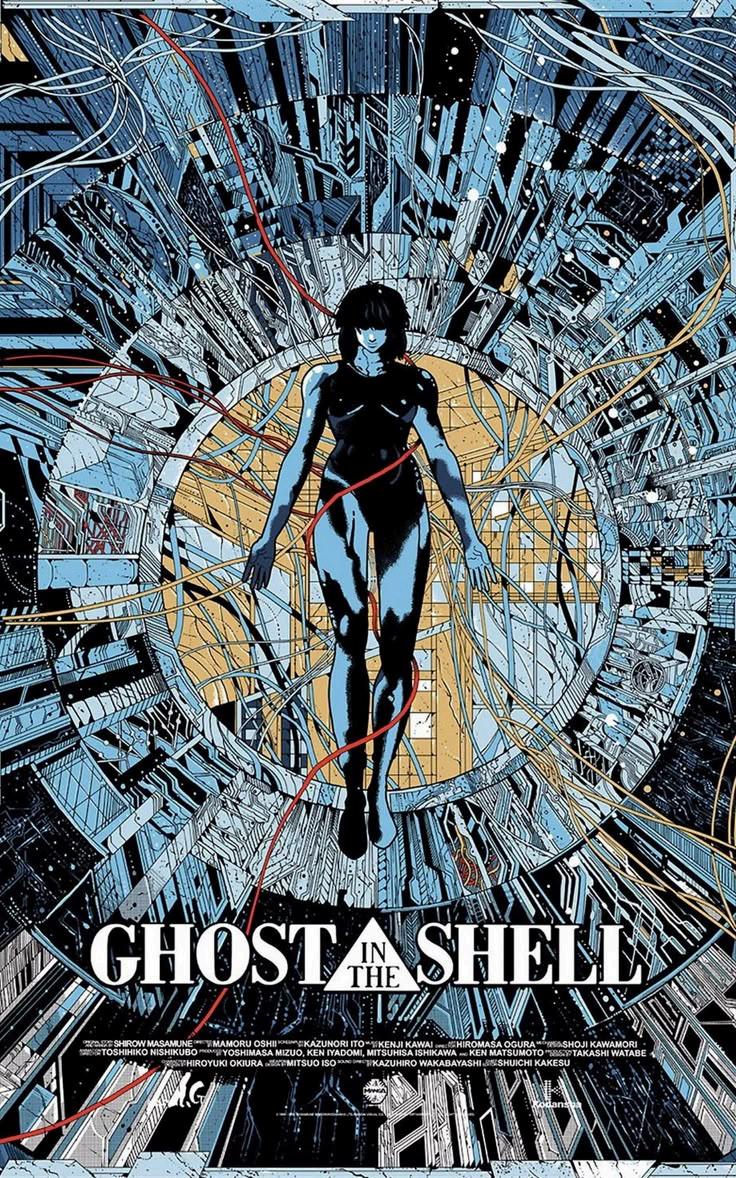
Science fiction provides a potent playing field for questioning the essence of humanness and studying ways to push its boundaries; the introduction of gendered dynamics within science fiction narratives provides opportunities to theorize radical futures while actively examining the presence of gendered constructs in present society. Mamoru Oshii’s 1995 cult-classic film Ghost in the Shell genders its cyborg protagonist, Major Motoko Kusanagi, in a fascinating manner that shifts between overtly feminized and masculinized throughout various elements of the film; thus, providing the opportunity to develop a nuanced reading of the role that “femaleness” plays in Oshii’s fictional universe Within this essay, I will explore the gendering of the cybernetic body through the film’s visual presentations of masculine and feminine bodies, and the implied connection between selfhood and constructed bodies, as well as provide two contrasting perspectives that transcend and reinstate traditional gender normativity
“Though the cyborg, ‘ a hybrid of machine and organism,’ may represent the final imposition of information technology as a means of social control, it may also be potentially recoded and appropriated by feminism as a means of dismantling the binarisms and categorical ways of thinking that have characterized the history of Western culture ” (Silvio 54)
The preceding excerpt is from Carl Silvio’s article, “Refiguring the Radical Cyborg in Mamoru Oshii’s Ghost in the Shell, ” in which Silvio references Donna Haraway’s “A Cyborg Manifesto: Science, Technology, and SocialistFeminism in the Late Twentieth Century,” connecting his analysis of Oshii’s film to Haraway’s paper Haraway presents two opposing visions surrounding the interplay of gender and information technology that Silvio uses to build his analysis of Ghost in the Shell: one where the advent of cyborg bodies plays a key role in furthering social control via technological interference with bodily autonomy, and another feminist reading in which the presence of cyborg bodies can dismantle gender binaries. I will build upon the foundations laid by both writers as I analyze the portrayal of feminine bodies in Ghost in the Shell
Visual design plays a key role in the film, with character design playing directly into the film’s presentation of transhumanist gender binaries Kusanagi and Batou, partners at an anti-crime intelligence department called “Section 9,” are presented as caricatures of femininity and
Professor Ariana Potichnyj
masculinity respectively, with Kusanagi drawn with a thin, hourglass figure while Batou is a lumbering, muscular character Following both Western and Japanese ideals of gender normativity, the visual form of Kusanagi’s body would traditionally be associated with passivity and sexuality, while Batou’s larger, masculine frame would take on an assertive or aggressive role These figures of maleness and femaleness are subverted when placed within the context of cybernetic advancement, however, as the constructed nature of their bodies allows a subtle reversal of roles between the masculine and feminine Batou is a mostly human body with minimal cybernetic enhancements, while Kusanagi is an artificially constructed body housing a human brain This artificial body allows Kusanagi to perform superhuman feats of strength and positions her as Section 9’s most valuable asset Within action sequences, Major consistently outshines both Gatou and other male characters with lesser cybernetic enhancements This lifts the characters out of the typical binary implications of their physical bodies onto a more even playing field in which the viewer perceives the existence of Kusanagi’s body as her means of strength, rather than a property that would traditionally feminize her and detract from her strength.
Ghost in the Shell’ s narrative applications of body modification allow for a shift in the gendered readings of the characters, specifically through the imagery of Kusanagi’s character that roots the story back into traditional gendered dynamics While Kusanagi is mostly desexualized in terms of her relations to the male characters around her, the visual presentation of her body is hypersexual, inviting the viewer to study her unhumanness in a perverse way At the start of the film, we view the construction of Kusanagi’s shell, following the process from the technical and mechanical details to the more superficial, humanoid exterior In this transition from visually presenting as a machine comprised of wires and metal parts to something more closely resembling a woman, Kusanagi’s femaleness is emphasized via shots that center her nudity, specifically following the curves of her body and her breasts Later in the film, when Kusanagi’s superhuman attributes are further emphasized, a narrative focus is placed on her artificial skin and its thermo-optic camouflage properties In fight sequences, Kusanagi often disrobes to reveal her skin and trigger its invisibility; this is an action the character is portrayed as feeling relatively detached from, resulting in shots where she
nonchalantly stands nude and visible to male characters, as well as the film’s viewer This nonchalance detaches Kusanagi’s sense of self from her body and reduces the shell to a means of fulfilling the responsibilities of her work rather than a vessel for her personhood
Even further, the masculinization of Kusanagi’s strength and superhuman form is continuously undercut by the fact that Kusanagi does not actually “ own ” her body During periods of existential, humanist introspection, most notably in a dialogue between herself and Batou, she acknowledges the interplay between her consciousness and her cybernetic body, and how her sense of self is innately tied to her employer Kusanagi mentions that although Section 9 employees are free to resign at any point, they must “give back [their] cyborg shells and the memories they hold” (Ghost in the Shell 31:48-31:53) Kusanagi’s mention of returning her memories is especially poignant, as it crafts a clearer conception of the link between the ghost and the shell, and how the two constitute a complete selfhood. Upon establishing the complex interplay between her mechanical and biological self, she ponders the nature of her selfhood further, as seen in the following excerpt: Just as there are many parts needed to make a human a human, there’s a remarkable number of things needed to make an individual what they are A face to distinguish yourself from others A voice you aren’t aware of yourself The hands you see when you awaken The memories of childhood, the feelings of the future That’s not all There’s the expanse of the data-net my cyber brain can access All of that goes into making me what I am, giving rise to a consciousness that I call me And simultaneously confining me within set limits (Ghost in the Shell 31:57-32:20)
The joining of her biological brain with the advanced capacities of her cybernetic body physically liberates her by allowing her to exhibit extreme displays of strength; but, this confines her to an experience of humanity informed through the present and past sensory perceptions of a cybernetic body designed to work for the government With the majority of Section 9 personnel portrayed as men, the ownership of Kusanagi’s shell and the manner in which that ownership affects her lived experience of the world play a key role in the narrative structuring of a patriarchal society and the subjugation of the female bodily experience within it Both the masculinization of Kusanagi’s character via her cybernetic enhancements and the forcible feminization in the portrayal of her body contribute to the very nature of the character and the state of “humanness” within this fictional world Carl Silvio asserts that, inspired by Haraway, two contrasting arguments can be made regarding the gendering of Kusanagi, one that is liberatory in nature and another that is oppressive
In expanding upon the film’s hypersexual depiction of the female form, Silvio notes a two-way directionality between the masculinization and feminization of “feminine” cyborg bodies: the film “[relies] upon many classic visual tropes in order to represent differently sexed bodies, ultimately [eliminating] or [disrupting] the significance of these tropes” (66) Silvio’s paper argues that a feminist reading of the film’s portrayal of the female body can be refuted by the fact that the visual presentation of masculine characters does not invoke the same eroticism as those of the feminine, stating that Batou’s hypermasculine features “ emerge for the viewer as a necessary part of the narrative; there is no gratuitous lingering of the camera ’ s gaze on his body in shots that seem designed exclusively for erotic enjoyment” (Silvio 66–67)
My own reading of this film applies a neutrality that I feel is present throughout all aspects of the film, from dialogue to soundtrack. Ghost in the Shell avoids asserting a distinct morality through its intentionally ambiguous narrative design, contrasting futurist cyberpunk environments with a soundtrack that utilizes organic instrumentation, as well as interspersing lengthy scenes of dialogue between relatively dialogue-free action sequences to create a great deal of “ space ” within the viewer’s experience of the film I am not asserting the belief that Oshii intended to make a film that is meant to be read through a feminist lens, but simply that the design of his work enables the viewer to build their own perspectives upon the nature of the characters and their settings Further considering the enigmatic nature of the film’s conclusion, I feel that the unstable nature of the story’s gendering provides a great deal of opportunity for viewers to apply various philosophical and social lenses to it
Building upon the contrasting gendered readings of Kusanagi’s character, the most visceral destabilization that occurs within Ghost in the Shell’ s narrative landscape is presented through the film’s antagonist, the “Puppet Master” (formally referred to as “Project 2051”) The character, initially assumed to be a cyborg capable of “ghost-hacking” the consciousnesses of other cyborg characters via their connected neural networks, is revealed to be an entirely artificially constructed lifeform This pushes beyond the film’s transhumanist themes and into posthumanism, decentering the idea of “humanness” entirely by presenting an autonomous entity capable of addressing their needs and wants from a non-human perspective The character’s lack of history within humanness and their freedom from overarching structure or imposed ownership provide a direct foil to Kusanagi and the existentialist concerns she raises Additionally, since Project 2051 is an “escaped” or “ rogue ” version of an intelligence
created by Section 6, they do not face the social confinement within power structures that Kusanagi does When presenting the artificial, and therefore biologically sexless, character, the writers place 2051 within a feminine shell, specifically that of a long-haired, blonde, thin, female body hijacked from an assembly line The character, despite being acknowledged as sexless by members of Section 9, is consistently referred to using male pronouns in discussions between characters Midway through the scene, 2051 electronically reactivates its shell by hacking Section 9’s power grid and speaks directly to Kusanagi and her peers with a low, male tone of voice This is the film’s most intense and forward deconstruction of gender and sex binaries, with the harsh contrast of a hyper-masculine voice speaking through a hyper-feminized body serving to confuse both the characters within the narrative and the viewer Because 2501’s temporary shell is implied to be sourced from an assembly line, we can extrapolate that within this fictional universe, the manufacturing of shells still follows a binary format, and utilizing this knowledge and applying it to Kusanagi’s portrayal allows us to understand the presence of sexualized, gendered portrayals within the structuring of this society Upon establishing the context of this binary society, Silvio mentions that “this scene may not represent the actual transcendence of a sexed or gendered identity, [but] it does represent the capacity of cyber-technology to confuse and disrupt its conventional deployment” (62) This ties back to Donna Haraway’s paper that Silvio refers to throughout his writing, in which she asserts the possibility of liberation from patriarchy through human interaction with technology Project 2051’s lack of humanness and their freedom from governmental ownership allows them to shift between various shells throughout the film, stripping each mechanical body of the gendered implications they may carry. The result of this is not a complete liberation from gender, as the characters in the narrative still apply a male reading to 2051, but the technical method by which they destabilize gender is one that is unique to the cyborg mechanics of this fictional universe This radical perspective can, however, be undermined by how this scene utilizes visuals of glorified violence upon the female form to drive forward its narrative Project 2051’s temporary shell is presented to the viewer as semi-destroyed and physically confined for study within a Section 9 laboratory as a dismembered, nude, female torso Following visual cues utilized in the portrayal of Major Kusanagi, the scene ’ s art direction attempts to heavily emphasize the character’s femininity through a voyeuristic lens, drawing the naked shell with gentle facial features,
flowing hair, and breasts that are prominently centred in the frame
Further, the shell remains relatively emotionless and still, aside from grotesque twitching, with its mouth unmoving; this creates the discomforting visual of a disembodied, objectified female form governed by a male voice Through the employment of an uncomfortable, detached male gaze to drive forward tension, the narrative parallels the perspective by which Kusanagi is portrayed However, the complete lack of bodily autonomy or personhood afforded to 2051’s shell in this scene, as well as the forcibly gendered implications of a “male” voice speaking through a “female” body serve to dehumanize and objectify femaleness
Kusanagi’s and 2051’s gendered narratives interplay fantastically in the climax of the film, during which Silvio finds that Haraway’s two opposing readings of science fiction can be applied in the most scintillating manner (Silvio 62). In this extensive sequence, 2051 pursues their desire to transcend their limited digital form and experience humanness by merging consciousnesses with Kusanagi, before having both of their shells physically destroyed by Section 6 operatives The merging utilizes the biological medium Kusanagi’s brain to house 2051’s consciousness alongside her own, ultimately creating a new, posthuman joint consciousness Upon recovering the casing that holds Kusanagi’s brain, Batou implants it into a shell obtained from the black market The shell is that of a young girl and upon activation, Kusanagi’s new consciousness utilizes various voices when speaking through the new body In initially speaking through the voice of a child, and eventually utilizing the voice of their former shell, Kusanagi’s merged self exhibits a willingness to depart from the limitations of their shell; it is seen simply as a medium to physically carry their newly freed mind rather than a gendered or aged body with any association to the structures around them. While this reading of the climactic scene implies a complete liberation from gender and from the physical body in its entirety, Silvio makes note of gendering within the characters’ dialogue and how the merging of Major and 2051 can be read as an analogy for procreation and childbirth, with a distinct maternal role applied to Kusanagi (Silvio 67) 2051’s act of “entering” into Kusanagi’s physical brain may be read as an allusion to a dominant masculine role within human procreation to some extent, but their utilization of gendered language in statements such as “ you will bear my offspring onto the net itself” alludes to a strangely destabilized version of a heterosexual parental dynamic (Ghost in the Shell 01:11:4401:11:47) The placement of the merged consciousness within a child’s body only furthers this gendered analysis by asserting
Kusanagi’s body as a ma l fi d di h pregnant “carrier” of a ne Ultimately, while it does n a feminist narrative, G characters allows space analysis The transhuman presented by the film inte and media analysis in a While Carl Silvio’s artic Donna Haraway’s in 198 read through a contempo science fiction to transcen a distinct vision of the destabilizes the nature o presents an ambitious content within its 83-mi extensive presentations creating an ambiguous opportunities for reading binary and re-establish it.
English 2401E
Written by Amy Heaman
The representation of food in Zitkala-Ša’s autobiographical writing is symbolic of her removal from her indigenous community The way that eating meals is shown varies between Zitkala-Ša's experience when living with her mother in "Impressions of an Indian Childhood" and when she is away at a boarding school in "The School Days of an Indian Girl," transitioning from touching tales of interpersonal contact to stale and mechanical actions done at the request of school teachers With Kishigami Nobuhiro's work expanding Levi-Strauss's kinship theory to explain food sharing practices in small-scale societies, we can understand the cultural significance of sharing meals with community members, as seen in "Impressions," and how the removal of that cultural element effects young Zitkala-Ša, impacting her sense of self and community The representation of food tells a story that mirrors Zitkala-Ša's connection to the Dakota people As Zitkala-Ša is removed from the practices and rituals of the Dakota, she loses her connection to them and she is replaced by a colonial model of who she once was Kishigami endeavours to categorize ways of food sharing in small scale societies In his study titled "A New Typology of Food-Sharing Practices among Hunter-Gatherers, with a Special Focus on Inuit Examples," he outlines the many specific ways that societies which rely on the hunting and gathering of food engage in trade and giving to solidify social bonds. Kishigami references Levi-Strauss's theory of kinship and the several other theories that have built upon it to identify and understand the importance of sharing food in these groups The study reports "that gift exchange is a basic principle in human societies and that it is a means to forge and expand social relationships and to establish social solidarity" (342) Taken from Strauss's theory, the benefits that are connected to sharing in small scale societies reinforce the bonds within the community and can affirm one ' s place within the group Various types of sharing are carried out depending on place, time and the needs of the group but offering food can "emphasize the ethical significance of generosity" (344) Not only does the redistribution of resources help to ensure the health and welfare of the group physically, but it also promotes core values to those who engage in the practice I find practice the proper term to use in this instance because, as shown in Zitkala-Ša's writing, engaging in food sharing is a ritual of hospitality in the Dakota community she grows up in
Dr Alyssa MacLean
The importance of such food-sharing rituals is displayed in Zitkala-Ša's writing, where she remarks that "the law of our custom had compelled [him] to partake of my insipid hospitality," after serving a community member bad coffee ("Impressions") Zitkala-Ša informs the reader of the importance of food and ritual by showing food-sharing as meal scenes, vital to the existence and continuation of the Dakota community
Food-sharing is a ritual that evokes storytelling and the keeping and sharing of legends which create and sustain bonds within the Dakota society. In the second section of "Impressions," Zitkala-Ša sets up a dinner scene Zitkala-Ša as a young girl gathers elders, inviting them over for dinner with intentions of hearing the legends of the Dakota's past In this scene we see Zitkala-Ša learning the customs of the Dakota Zitkala-Ša describes her love for "the evening meal, for that was the time when the old legends were told" ("Impressions") Karen E Beardslee states that "Zitkala-Ša marks [the legend telling] as a most important ritual in itself" (101) For ZitkalaŠa, the tradition of sharing a meal with her elders is bound to the telling of legends When people are invited into your home, you provide them with food and once you have shared a meal with your guests you are free to ask them to tell you legends This progression of thought is shown by Zitkala-Ša's mother In her youth Zitkala-Ša's behaviour is corrected by her mother and the social cues that are customs of the Dakota are taught to her through her mother’s guidance. Throughout the section, her mother’s explanation of how the dinner ritual is supposed to go is prevalent Her mother is the one who sends her to invite the others over and gives strict instruction to "wait a moment" when interrupting their evenings ("Impressions") This observational instruction is active during the end of dinner when Zitkala-Ša's mother is the person to initiate the storytelling, showing her daughter the appropriate way to do so Young Zitkala-Ša treasures the retelling of the legends, it is clear in her enthusiasm about the meal Even more important is the meals function, it is a way for Zitkala-Ša to learn about herself through learning about the Dakota Zitkala-Ša is exposed to the dinner ritual, the oral history of the legends, and the values of the Dakota people through the ritual itself This knowledge imparted to her by the ritual affirms her sense of self and her identity within the community In contrast to the dinner scene in "Impressions," "School
Days" illustrates a stark change in mealtime and eating habits. Zitkala-Ša's account of her first breakfast at the residential school is bitter and uncomfortable She is alone at school and suffering a "constant clash of harsh noises" and sounds that are foreign and confusing to her ("School Days") There is a parallel of observational learning when Zitkala-Ša is trying to sit down for the meal without her mother’s presence There is no one to go first and be an example, instead the observational learning process is perverted by the school’s attempt to make her act before she has the chance to learn from the other children Overwhelmed by the new way of taking meals, Zitkala-Ša expresses that her "spirit tore itself in struggling for its lost freedom, all was useless" ("School Days") Her sense of self struggles in adapting to the new way of eating that is so fundamentally different from the way she was taught to eat Rather than listening to the elders speak with each other, waiting for the promised telling of legends, Zitkala-Ša must listen to a man "murmuring an unknown tongue" before she is even allowed to pick up her fork ("School Days"). The ritual of eating and sharing is entirely flipped backwards. Adding insult to the disruption of the meal ritual, its place in the narrative makes the trial of breakfast the preface to the cutting of her hair If the differences between the scenes were not obvious enough, the school teachers go about physically severing ZitkalaŠa's connection to the Dakota through the removal of her hair Beardslee characterizes breakfast at school as " a lesson in restraint and submission" (Beardslee 104) The submission of Indigenous children directly relates to the children being subjected to foreign, Christian beliefs and replacing their culture through the subversion and removal of their own rituals and practices After spending years away from the Dakota and her mother, Zitkala-Ša returns home in the sixth section of "School Days " In the feast scene we see the glaring disconnect of culture from not only Zitkala-Ša but many of the young Dakota The cultural annihilation done by the residential schools follows the children home. Zitkala-Ša describes the party goers saying, "They were no more young braves in blankets and eagle plumes, nor Indian maids with prettily painted cheeks They had gone three years to school in the East, and had become civilized" (“School Days”) The time that the children spend in Residential school disrupts their knowledge and severs their connection to their community When the children return home, they attempt to engage in food sharing through a feast We see an example of a proper feast through the eyes of young Zitkala-Ša in "Impressions" where we are told of the Dakota custom by which “ young Indian women [are] to invite some older relative to escort them to the public feasts " Zitkala-Ša tries to engage in this custom by asking her brother to take her but he will not
(“School Days”). Her brother, also changed by his time in residential school, refuses to perpetuate the ritual. Zitkala-Ša does her best to hold onto rituals but suffers in a liminal space of not being fully Dakota or fully assimilated to colonial culture Beardslee describes how she "recognizes the threat to her sense of self" when she rides away on the train as a young girl, and that is confirmed to her when she returns changed (103) This inability to engage in ritual also estranges ZitkalaŠa from her mother, who can only offer her a Bible, a symbol of colonialism, in the face of Zitkala-Ša’s grapple of lost identity
Throughout her life Zitkala-Ša has experienced the way that "bit by bit native habits are relinquished to Eastern influences" (Beardslee 103) Zitkala-Ša shows the reader the way that we experience life through food and extends its importance to the ritual of food sharing Chronologically, she builds the relationship between her connection to the Dakota and her connection to food, then uses food and mealtimes to showcase the destruction of her sense of self during her time in residential school Kishigami’s study on food-sharing places the roots of the practices in history and shows their significance by exemplifying the ways in which it solidifies community The solidarity of community is lost to Zitkala-Ša when she can no longer take part in the rituals, and without her community she loses a part of herself

ARTHUM 2240F
Written by Heather Stanley Professor Jeremy Arnott
Is it possible to live an utterly private life? To this question, German-Jewish philosopher Hannah Arendt would say that “[n]o human life, not even the life of the hermit in nature’s wilderness, is possible without a world which directly or indirectly testifies to the presence of other human beings” (Arendt 22) Humans are social beings by nature, and although one might attempt a solitary existence like Thoreau at Walden Pond, one cannot escape society, from which one was born, and which has shaped the very land we inhabit Perhaps a more practical question, then, would be to ask: is it possible to keep one ’ s private and public lives entirely separate? Arendt asserts that while this may have been the case in antiquity, the line between the private and public spheres has blurred to the point that neither exists independently anymore In Ancient Greece, private life was clearly defined by the drive to sustain life Eating, sleeping, giving birth, raising children all the essential actions for survival took place in the realm of the household By contrast, the public sphere, or polls, was concerned with what were deemed man ’ s greatest capabilities: action and speech. Arendt observes “if there was a relationship between these two spheres it was a matter of course that the mastering of the necessities of life in the household was the condition for freedom of the polls” (Arendt 30–31) Under this framework, only the head of the household could be a member of public life, since he had the power to free himself from the necessity of labour, and from concern for his own life He was able to discuss concepts such as societal structure, virtue, and immortality amongst equals, as all those who participated in the polls were deemed to be Arendt pinpoints the advent of Christianity as having a major role in shifting attitudes regarding what should be made public Christianity values worldlessness, and it defines “good deeds” as charitable works done entirely in private This contradicts the long-held perspective that “[t]o live an entirely private life means above all to be deprived of things essential to a truly human life: to be deprived of the reality that comes from being seen and heard by others” (Arendt 58) I am reminded of a poem in which the author expresses a strong desire “[t]o be made whole / by being not a witness, / but witnessed” (Limón 13–15) But if the good Christian life is one of kind acts done in private, is being witnessed somehow unholy? In antiquity, this was certainly not the popular belief, as
members of the polls strove to distinguish themselves, to be remarkable and unique This begets the consideration of another major contributor to the collapse of the public and private realms: the modern view that people should conform rather than stand out.
The Industrial Revolution produced a shift in labour from a private practice to a social one The division and mechanisation of labour are the two factors that, according to Arendt, led to the acceleration of labour productivity This necessitated the new field of economics, which “could achieve a scientific character only when men had become social beings and unanimously followed certain patterns of behavior, so that those who did not keep the rules could be considered to be asocial or abnormal” (Arendt 42) While the Ancient Greek polls demanded individuality, modernity promotes predictability and assimilation Arendt astutely notes that the behavioural sciences rely on most people acting in a similar fashion; thus, it draws conclusions that are exclusionary of the exceptions, which arguably say more about human behaviour As discussed during a class on Marx, the socialization of labour also led to the perspective of labour as the source of value. Traditionally, owning private property was the prerequisite for entering public life With the new capitalist structure came a greater emphasis on private wealth “not because its owner was engaged in accumulating it but, on the contrary, because it assured with reasonable certainty that its owner would not have to engage in providing for himself the means of use and consumption and was free for public activity” (Arendt 65) Arendt disagrees with the “liberal economists” who believe the private appropriation of wealth will replace the role of private property; she argues that since jobs are controlled by society, and the exchange of money is fluid, individual wealth is constantly under threat It would seem, then, that there is no longer a clear delineation between who is “eligible” to participate in the public realm
Other aspects of the private and public spheres that were traditionally very distinct have amalgamated into what Arendt calls the social realm Action and speech are no longer exclusive to the public realm where everyone was deemed equal but are actively employed in private life
Since the hierarchical household structure of antiquity is no longer the standard, more citizens can exercise their right to free speech in a world where equality has a broader connotation
As the public realm seeped into the private, the reverse also occurred; aspects of life that promote survival are now acceptable in public Arendt notes the liberation of the working class and the women ’ s rights movement as indicators of this shift From employees picketing for liveable wages to mothers breastfeeding on a park bench, the necessities of life are no longer hidden However, the commodification of goods may perpetuate a lack of appreciation for these necessities Arendt addresses her concern that “greatest threat here, however, is not the abolition of private ownership of wealth but the abolition of private property in the sense of a tangible, worldly place of one ’ s own ” (Arendt 70) If Arendt were still alive, I believe she would cite the birth of the Internet as the conclusive death of the private and public spheres In a sense, the idea of a ‘worldly place of one ’ s own ’ no longer exists, because so much of our lives are accessible and are on display to all of society Can I even call my bedroom where I sit as I write this a place of my own, when dozens of students have lived here before me; when I am paying to rent it; when I just posted a photo of it to my BeReal app? In a world of ubiquitous connectivity, we must find ways to protect our identities, so we do not lose ourselves within the all-consuming social realm
English 2301E
Written by Elora Chambers Professor Doelman
In both Oliver Goldsmith’s She Stoops to Conquer and Jane Austen’s Sense and Sensibility, family dynamics and inheritance practices enforce a gendered system of economic dependence Daughters are subjected to their fathers’ wills, while sons struggle to balance familial duty with their pursuit of financial autonomy By situating these texts within the broader historical context of eighteenth and early nineteenth-century legal structures, including primogeniture, coverture laws, and marriage settlements, this essay demonstrates how economic forces shaped gender roles and personal agency. Through an analysis of marriage as a financial transaction, the economic dependence of women, the restrictions of inheritance laws, and the pressures imposed on men, both texts critique a system that conflates wealth with personal autonomy In both She Stoops to Conquer and Sense and Sensibility, marriage is presented as a transactional institution in which women are evaluated based on their dowries and social status In She Stoops to Conquer, Mrs Hardcastle prioritizes financial concerns over personal happiness, ensuring that her niece Constance marries her son Tony so she and the pair can maintain control over the family fortune: “I expect the young gentleman I have chosen to be your husband from town this very day” (Goldsmith 3) Constance’s inheritance is viewed as a resource to be controlled through marriage, reinforcing that financial independence was unattainable for women outside of wedlock. In Sense and Sensibility, John Dashwood rationalizes withholding financial support from his sisters, that their inheritance “need not be three thousand pounds,” reinforcing the idea that women ’ s financial security was secondary to male economic interests (Austen 5) Fanny Dashwood exemplifies this, asserting that “people always live for ever when there is an annuity to be paid them” (Austen 6) Mary Astell’s Some Reflections Upon Marriage critiques this commodification of women, arguing “ a woman indeed can’t properly be said to choose, all that’s allowed her is to refuse or accept what is offered” (Astell 23) Despite being written a century before Austen, Astell’s work remains relevant, as coverture laws and patriarchal inheritance structures persisted Marie-Laure MasseiChamayou asserts in “Economic and Symbolic Transmissions in Women’s Novels: Frances Burney, Jane Austen, Elizabeth Gaskell” that primogeniture “severely restricted women ’ s access to property” (Massei-Chamayou
4), and Rory Muir explains that women of the gentry were often raised to secure economic stability through marriage due to limited financial autonomy (Muir 12) Austen critiques this economic reality by satirizing men who justify their financial decisions under the guise of moral duty John Dashwood manipulates his father’s final wish into a vague obligation, claiming, “He did not stipulate for any particular sum, my dear Fanny; he only requested me, in general terms, to assist them” (Austen 5) This highlights how male figures could manipulate verbal contracts to serve their financial interests. Joyce Kerr Tarpley notes in “Playing with Genesis: Sonship, Liberty, and Primogeniture in Sense and Sensibility” that primogeniture created “ a moral paradox where those with wealth rationalized keeping it rather than distributing it” (Tarpley 90) Austen’s broader depiction of inheritance and marriage negotiations reinforces how women ’ s fates were determined by maledominated financial strategies Similarly, in She Stoops to Conquer, Kate Hardcastle recognizes the societal expectations regarding marriage and manipulates them to her advantage She acknowledges her position in the marriage market, stating, “In the first place I shall be seen, and that is no small advantage to a girl who brings her face to market” (Goldsmith 3) Unlike Constance, who remains a passive victim of marriage negotiations, Kate subverts these constraints As Brooks argues, Kate “undergoes voluntarily the reversal of class-roles” to carve out agency in a rigid social hierarchy (Brooks 38). The play critiques the commodification of women through Mrs Hardcastle’s obsession with wealth, which mirrors Austen’s concerns Mrs Hardcastle’s insistence that Constance marry Tony is less about happiness than keeping family wealth consolidated This reflects Massei-Chamayou’s argument that marriage institutionalized women ’ s bodies as “economic currency in the marriage market” (Massei-Chamayou 20)
The idea that women ’ s worth was tied to securing an advantageous marriage is reinforced by legal frameworks limiting their rights to property Austen and Goldsmith expose how these structures forced women into financial dependency through marriage By satirizing this system, both critique rigid gender roles confining women to financial dependence, revealing the limited agency they could exercise.
Economic dependence in Sense and Sensibility and She Stoops to Conquer shapes women ’ s lives The Dashwood
sisters, who left without financial security after their father’s death, embody the precarious situation of women excluded from formal economic participation Kevin Wong describes this in “John Dashwood’s Contract to Care: Parodic Legalism in Sense and Sensibility,” noting, “dispossessed at the beginning of Sense and Sensibility, the Dashwood women the novel’s have-nots are systematically excluded from this contractual matrix” (Wong) Without independent legal standing, they must rely on marriage or the goodwill of male relatives Their mother, though of a higher class, lacks financial agency, illustrating how coverture laws severely restricted widows and unmarried women Wong highlights this system’s rigidity: “Under the laws of coverture, the separate legal personality of married women was subsumed by their husbands, leaving them unable to even enter into contracts” (Wong) Elinor Dashwood acknowledges the financial strain on women, stating, “It is not everyone…who has your passion for dead leaves,” subtly critiquing Marianne’s romantic idealism while emphasizing the practical concerns of financial security (Austen 58) Her words highlight the tension between dignity and economic vulnerability In She Stoops to Conquer, Constance Neville also expresses frustration over her financial dependence: “A fortune like mine, which chiefly consists in jewels, is no such mighty temptation” (Goldsmith 5) Both Austen and Goldsmith’s female characters recognize their economic constraints but struggle to navigate them Men in both novels justify controlling wealth through legal and moral rhetoric Wong points out, “Encoded within John and Fanny’s insistence that they are obeying the letter of the law is Austen’s ventriloquism of their faulty justifications,” illustrating how those in power manipulate legal frameworks to maintain privilege (Wong) Likewise, Goldsmith’s portrayal of inheritance demonstrates how rigid economic systems dictated personal relationships, ensuring women remained financially reliant on men Both texts critique a system that conflated financial dependence with moral order While some female characters, like Kate, found ways to navigate these constraints, the overarching reality remains that women ’ s economic security was largely out of their control Inheritance laws in the eighteenth and early nineteenth centuries overwhelmingly favoured male heirs, leaving daughters in precarious financial positions Both Sense and Sensibility and She Stoops to Conquer reflect this reality, portraying how inheritance shaped lives The system of primogeniture, granting estates to eldest sons, limited economic independence for younger sons and forced daughters into strategic marriages In Sense and Sensibility, the Dashwood family's plight is a direct consequence of primogeniture Mr Henry Dashwood’s estate passes to his
son from a former marriage, leaving his wife and daughters financially vulnerable: “By a former marriage, Mr Henry Dashwood had one son; by his present lady, three daughters” (Austen 1) John Dashwood, influenced by his wife, minimizes his financial support for his half-sisters: “Well, then, let something be done for them; but that something need not be three thousand pounds” (Austen 5) This underscores the legal expectation that men control family wealth, while women remain dependent on male relatives’ generosity Similarly, in She Stoops to Conquer, inheritance dictates financial futures, reinforcing gendered power imbalances Kate Hardcastle’s inheritance is an anomaly, as her stepbrother Tony is unrelated to Mr Hardcastle Tony’s reluctance to marry Constance highlights how inheritance influences marriage negotiations: “Since his death, I have been obliged to stoop to dissimulation to avoid oppression” (Goldsmith 59) Constance’s struggle to claim her jewelry, controlled by Mrs. Hardcastle, exemplifies women ’ s economic vulnerability under male guardianship. Primogeniture also disadvantaged younger sons, who often sought fortunes through military service, the clergy, or marriage Muir explains, “For most younger sons there was neither prospect of an inheritance nor an heiress waiting in the wings to rescue them” (Muir 12) Edward Ferrars in Sense and Sensibility embodies this struggle: “The whole of his fortune depended on the will of his mother” (Austen 9) Despite being the eldest son, he lacks financial independence without his mother’s approval Legal historians highlight primogeniture’s disadvantages for women Massei-Chamayou states, “The legal practice of inheritance and wills deriving from the Common Law’s endorsement of the primogeniture principle severely restricted women ’ s access to property” (Massei-Chamayou 4) Marriage emerges as the only viable financial security for women. Constance is told she does not need her inheritance yet: “Indeed, Constance, you amaze me. Such a girl as you want jewels! It will be time enough for jewels, my dear, twenty years hence, when your beauty begins to want repairs” (Goldsmith 30) This suggests women ’ s value is tied to youth and marriage eligibility Both texts link inheritance to social mobility In She Stoops to Conquer, Marlow’s hesitancy around upper-class women contrasts with his ease around lower-class women: “Marlow’s sexual phobia of ‘modest’ women emasculates him around prospective spouses, libidinally curtailed to lower-rank women who are conveniently unsuitable for marriage” (Griffin and O’Shaughnessy 106) His behaviour reflects rigid class structures where marriage secures financial stability Both novels critique a system concentrating wealth in male hands, leaving women and younger sons with limited autonomy
Tarpley notes, “Austen shows her readers that the institution of primogeniture cannot protect its beneficiary which may unintentionally negate the benefits of primogeniture” (Tarpley 96) Even men, though privileged, faced constraints; eldest sons were financially secure, younger sons were left uncertain, reliant on family favour or specific careers Edward Ferrars’ financial future is precarious if he does not conform to expectations His disinheritance following his engagement to Lucy Steele highlights financial control as a coercive tool She Stoops to Conquer’ s Marlow faces similar pressures Though from a respectable family, his marriage prospects are dictated by social and financial expectations: “Were I to live for myself alone, I could easily fix my choice But I owe too much to the opinion of the world, too much to the authority of a father” (Goldsmith 43) His financial dependence limits his autonomy Unlike Edward, Marlow avoids disinheritance, his situation reveals how economic security and social duty are deeply entangled. Beyond inheritance, younger sons had limited opportunities for financial independence As Muir notes, they often relied on military or clerical careers (Muir 12) Colonel Brandon exemplifies this in Sense and Sensibility As a younger son, he had no estate claim and pursued a military career His early love, Eliza, also suffers under inheritance laws, forced into an unwanted marriage for financial security, demonstrating the system’s constraints on both men and women Willoughby’s storyline reinforces economic constraints on men Initially appearing wealthy, his financial recklessness forces him to marry Miss Grey for money: “My affections have long been engaged elsewhere, but reason has drawn me to her” (Austen 120) Unlike Edward, who maintains moral integrity, Willoughby is driven by financial survival, illustrating inheritance dictated men ’ s marital choices Despite men ’ s greater financial rights, their futures were often controlled by families. Continuing this theme of men not having total say of what to do with their inheritance, it is claimed that the Dashwoods (including John himself) are at the “will of their greedy half-brother’s wife, who insists on keeping wealth consolidated in the patrilineal line” (Massei-Chamayou 20)
Whether through inheritance, career limitations, or arranged marriages, men in both novels experience financial constraints While legally privileged, their security depended on adhering to familial expectations
Marriage in both Sense and Sensibility and She Stoops to Conquer functions as an economic safeguard, where financial security often takes precedence over personal choice Edward Ferrars, despite Colonel Brandon’s support, cannot afford to marry without a larger fortune: “Edward Ferrars is financially unable to marry with only the living
provided by Colonel Brandon” (Tarpley 95). Elinor Dashwood’s own marriage prospects are similarly determined by economic factors As Austen writes, “It is not time or opportunity that is to determine intimacy; it is disposition alone,” showing how survival, rather than romance, often dictated marriage decisions (Austen 38) In She Stoops to Conquer, Mrs Hardcastle’s manipulation of her son Tony’s marriage for financial gain further illustrates this theme She insists, “There’s nothing in the world I love to talk of so much as London, and the fashions, though I was never there myself,” emphasizing her preoccupation with wealth and social standing (Goldsmith 23) Her attempts to force Tony into marriage prioritize financial stability over personal choice, reinforcing the transactional nature of marriage in the play Marlow, too, is constrained by the economic and social consequences of marriage Tarpley aptly points out, “Love alone is never enough for happiness in an Austen novel, but neither is the wealth afforded by the inheritance of an elder son ” (Tarpley 100) Thus, both works reinforce how inheritance laws shaped the personal lives of men and women, with financial stability often dictating the choice of a spouse
Austen and Goldsmith reveal a society in which financial dependence dictates personal autonomy, forcing both men and women into rigid economic roles Women, constrained by inheritance laws and coverture, find their futures determined by marriage negotiations, while younger sons and men of modest means must navigate their own financial constraints within the same system In Sense and Sensibility, the Dashwood sisters’ survival depends on financial alliances, while She Stoops to Conquer exposes how inheritance shapes marriage choices and personal agency Yet both works also highlight ways in which characters attempt to subvert these structures Kate Hardcastle manipulates social expectations to her advantage, and Elinor Dashwood finds stability through her own prudence and emotional restraint While neither text fully escapes the economic realities of their time, they offer incisive critiques of a system that conflates wealth with personal freedom, ultimately questioning whether true independence can exist within such rigid financial constraints

Art History 2650G
Written by Emma Hardy Professor Sarah Bassnett
New York City has long been regarded as a metropolitan setting, rich in diversity and a site for industrial advancements in society The photographs “From the Viaduct, 125th Street, New York” (1916) by Paul Strand, and “Sun and Shade” (1952) by Roy DeCarava investigate different perspectives of the neighbourhood of Harlem The photographers extend their cameras into the modern world and look at the everyday occurrences in the city, which manifest as social commentary Despite Strand and DeCarava producing these images almost forty years apart and embodying different photographic movements in their practices, they both portray distinct sociocultural aspects of New York City by using the encompassing architecture as a framing device, as well as displaying similar formal elements such as the use of vantage point, fragmentation, framing, and light
Paul Strand, a Jewish-American photographer born in 1890, was a prominent figure in the transition from the Pictorialist movement to Modernism in the field of photography, a period that emerged in the early twentieth century (Orvell 43) With the tutelage of renowned photographers, Lewis Hine and Alfred Steiglitz, Strand developed his unique style with elements adopted from Cubist artists such as Pablo Picasso (Orvell 43) This Modernist approach is characterised by: fragmentation of forms, abstraction, exploring different or unusual perspectives, and an interest in the effects of light and shadow on the image, as well as the concept of the camera as a tool for representing modernity, as it could act as an extension of artistic vision (Orvell 83–98) As a native New Yorker, Strand viewed the industrializing city as a site of modernity, and he often emphasised the overwhelming urbanisation of the cityscape by using the architectural features of the surrounding structures as a framing device The focus on the modernisation of New York also highlighted the feelings of loneliness, loss of individuality, or insignificance in such a big city, which Strand represented by including small, indistinct human subjects amongst the hustle and bustle of his cityscapes Strand was also interested in capturing images of people who were unaware they were being observed, which is consistent with the modernist view of the camera as a tool to extend one ’ s vision into the new world as it provided a unique honesty and subjectivity to his work (Whalan 43) Correspondingly, Roy DeCarava was another influential
photographer born in New York; however, his representations of society differ from Strand’s work as his subject matter mainly focused on the lives of African Americans in the neighbourhood of Harlem (Stange 63–92) DeCarava often used his choice of the moment to capture images of everyday life in Harlem, and this snapshot aesthetic is one of the main characteristics of the New Documentary Movement of the 1950s-1970s (Bassnett, “6 3”) New Documentary was a contrast to Modernist traditions of pre-visualising an image, and was regarded as “art photography” with the artists often immersing themselves to represent a subculture (Bassnett, “6.3”). As a Black man, it was important that DeCarava portrayed life in Harlem from an insider’s perspective, as many other representations only focused on the ways in which the community was divergent from the standard of white, uppermiddle-class society (Stange 63–92) In 1952, DeCarava became the first Black photographer to receive the Guggenheim Fellowship, an accolade that allowed him to pursue his long-term project, “The Sweet Flypaper of Life,” in collaboration with the Black American poet Langston Hughes (Edwards 173–74) DeCarava wrote in his application to the Guggenheim that he wanted “to show the strength, the wisdom, the dignity of the Negro people I do not want a documentary or sociological statement I want a creative expression” (Edwards 174) His aim for the project was to give a dignified, humanised depiction of the predominantly Black inhabitants of Harlem; a representation that would defy harmful stereotypes while offering insight into the complexities of their lives, rather than exhibiting his community as subject for pity
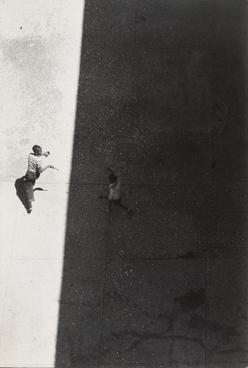
Roy DeCarava’s “Sun and Shade” (1952) is a striking black and white image made by the gelatin silver print process which shows two young Black children (possibly both boys) walking side by side on a Harlem street, one immersed in shadow and the other illuminated by the sunlight The boy in the lit left half of the image holds a toy gun in one hand and an indistinguishable block in the other The other child, who is obscured by darkness, raises their hands in surrender, though it is unclear whether they are also wielding a fake weapon The compelling black and white contrast and asymmetrical balance between the two halves of the image invoke connotations of racial inequality specific to the injustice faced by residents of Harlem in the 1950s (Stange 86) Though the one in the spotlight is more clear to us and holds the obvious weapon, the darker half of the photograph overwhelms most of the frame as the subject faces their opponent fiercely Given the sociopolitical context of segregation in the U S at this time, this can be interpreted as the Black community’s struggle for dignified representation in society, and resistance against oppression
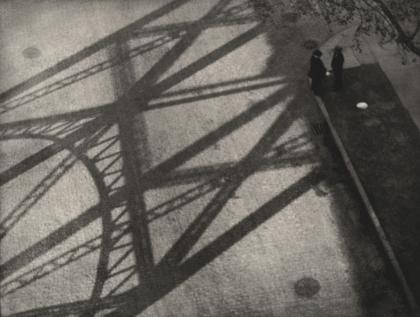
Similarly, Paul Strand’s “From the Viaduct, 125th Street, New York” (1916) is a black and white photograph taken in New York City In fact, 125th Street is in the neighbourhood of Harlem, which gives a much different perspective of the neighbourhood depicted many decades before DeCarava’s photography The image was captured using the photogravure process, which involves etching the photograph onto a copper plate, producing prints with a more subtle tonal range, and providing a more delicate, moody image due to the soft differences between the values (Bassnett, “6 1”) “From the Viaduct” depicts two anonymous dark figures basking in the arching shadow of a bridge The photograph provides the audience with a mysterious mood perhaps the two figures are having a
clandestine meeting under the bridge but also emphasizes the feeling of insignificance in a metropolitan city The people, who are in such minute scale compared to the overwhelming structure, are swamped in darkness with little to no distinguishable features; this describes the psychological experience of living in the modern era Strand, therefore, represents the city as a site for modernity by abstracting the space to highlight alienation and urbanisation
“Sun and Shade” (1952) by Roy DeCarava and “From the Viaduct, 125th Street, New York” (1916) by Paul Strand share many similar formal qualities such as vantage point, lighting, and framing–despite being made almost 40 years apart and belonging to different artistic movements “Sun and Shade” is vertically severed down the line of shadow, creating a sense of separation between the two subjects as they exist in different realms within the contrast of light This strong line creates a sense of tension amongst the children, defining them as on either side of a battle as one raises their arms in defense to the other who is pointing the weapon (though some interpret the photograph as both children holding a toy gun and aiming it at one another) (Stange 86) DeCarava utilises a bird’s eye vantage point to remain outside of the view of his subjects, capturing a more truthful display of the events while placing the photographer in a position of power as he surveils them from above The instinctive choice of moment is also an important fixture of the image, as that snapshot moment is such a recognizable characteristic of New Documentary photography It gives us a once-in-a-lifetime shot, offering insight into the subjects’ lives DeCarava’s use of light and surrounding architecture to fragment the image is rooted in Modernism, and is similar to the methods that Paul Strand uses in “From the Viaduct, 125th Street, New York” (1916) (Stange 75) Strand’s use of a unique aerial vantage point in this photograph is a key feature of Modernism as it defamiliarizes the space and ensures the subjects do not know they are being observed, which adds an aspect of honesty to the work as the figures behave as they would naturally (Bassnett, “6 3”) The shadow of the bridge fragments the image into many pieces as the repetitive abstract forms take up the vastness of the frame; it is interesting that the bridge itself is not included in the picture, perhaps so the viewer only gets bits and pieces of the city, which they have to connect for themselves The shadows also create leading lines which guide the viewer’s eye towards the upper right segment, which includes the small pair of human subjects as well as spindly branches creeping into the frame These more natural elements with organic forms, therefore, juxtapose the mechanical, repetitive shapes of the scaffolding suggesting that nature
and industry can exist in harmony in this modern city
Strand and DeCarava’s photographs, while visually similar, depict vastly different representations of the same area of New York City and are informed by distant artistic movements Modernism and New Documentary Strand’s “From the Viaduct” is more interested in the anonymity of his pair of nondescript human figures to emphasize the psychological effects of modernity on inhabitants of the city; whereas, DeCarava purposefully defines his two subjects as being Black, as the aim of his photographic practice stressed realistic African American representation in Harlem Furthermore, DeCarava uses a higher contrast than Strand to delineate his image, and places his subjects on opposing sides to highlight the visual tension between them On the other hand, Strand’s use of tonal range is a bit softer and contains more complex abstract shapes which lead the viewer’s attention to the unified couple in the upper right quadrant Their differences also correspond to their photographic styles; while Strand represented Modernist concepts like abstraction, industrialization, and the city as the site for modernity, DeCarava aligned with the New Documentary elements of snapshot aesthetics and subjective experiences of everyday life
Despite the vastly different time frames, artistic movements, and social contexts in which this pair of photographs were made, “From the Viaduct, 125th Street, New York” (1916) by Paul Strand and “Sun and Shade” (1952) by Roy DeCarava still align in many ways Both photographers utilized the features of the surrounding architecture of Harlem to frame their subjects, using the contrast between natural light and shadows to fragment the image They also both employed the use of a high vantage point which looked below at the scene, and served the purpose of remaining anonymous while capturing the candid shot Thus, their subjects behaved as they would naturally in the moment, adding a sense of sincerity and objectivity to the work. Furthermore, while Strand’s and DeCarava’s photos share visual similarities, their interpretations are vastly different DeCarava emphasizes action, tension, and contrast in his portrayal of African American children in Harlem, and Strand, on the other hand, stressed the importance of the abstraction of the city’s architecture, leading lines, industrialization, and modernity
English 2501
Written by Morgan Kerr
Isabella Valancy Crawford was a Canadian poet who wrote during the end of the Confederation era into the Victorian era She communicates a dual narrative in her poem “Malcolm’s Katie: A Love Story” Despite its relatively simple plot, her word choice provides two narratives on nation building and home making; which were the roles of men and women during the times of European settlement in Canada, respectively Crawford is able to portray the multifaceted requirements for creating a sense of belonging and a home. Men are a part of the nation building through the construction of actual houses, providing money and fighting in wars The male characters in this poem are used to exemplify these values in general, though Max is the most prominent embodiment of these values Women were more important to building a home, as opposed to a house, they did all of the domestic tasks and were idolized for their religious purity Katie is the character of the poem who shows the values of women during this time period Overall, a man makes a house, but a woman makes a home in terms of family and this influences the personalities and views of the characters in Crawford’s “Malcolm’s Katie ” The role of men in creating a home lies more in the act of homesteading, rather than taking on domestic tasks In “Malcolm’s Katie,” the male characters are written as typical men of the nineteenth century. This era of poetry fixates on nature and the appeal of the frontier, pioneers and settlers; because of that, the men in “Malcolm’s Katie” spend most of their time out in nature Max, Katie’s love interest in the poem, has an axe that is an important piece to his character and for the nation building narrative: “‘My axe and I we do immortal tasks / We build up nations this my axe and I!’” (Crawford 4 55-56) This is said during an argument between Max and another male character, Alfred Max is speaking to Alfred about all he can accomplish with just his axe and building a nation is the top priority and number one source of pride for men After Max pledges himself to Katie in the first part of the poem, he departs to the woods to chop down trees: “And Max, the labourer and the lover, stood / Within the forest’s edge, beside a tree; / The mossy king of all the woody tribes” (Crawford 2 149-151) Max is referred to as a ‘labourer’ first and a ‘lover’ second. Although he loves Katie, the more important part of his character is that he is a man of nature He has defeated the “ mossy king of all the woody tribes” (Part 2, 151); the term ‘woody tribes’ references
Dr Manina Jones
how settlers forced Indigenous people off their land in order to build a colony Situating Max in the trees references the homesteading actions of men as he is deforesting an area to make money for a home Additionally, Crawford exemplifies how men were a part of nation building through fighting in wars and battles Max’s work in the forest is described as a battle of sorts: “Swift fell the axe, swift follow’d roar on roar, / Till the bare woodland bellow’d in its rage, / As the firstslain slow toppl’d to his fall” (Crawford 2.157-159). A close reading of this passage shows the ways in which men were a part of nation building by displacing Indigenous people as well as engaging in battle with them and French settlers The language used to describe Max wreaking havoc on the woods with his axe gives insight into the roles men hold in building a nation as well as a house
Another male character in “Malcolm’s Katie” that shows off the era ’ s masculine values is Katie’s father, Malcolm He works in the forestry industry and has lots of money, which makes marrying his daughter Katie a favourable prospect for the men in the area In the opening scene, Max makes a ring for Katie with a K and M intertwined on it, showing their love while implicitly exposing the ownership Max will have over Katie once they are married She is seen as a commodity by the men in her life Although at surface level it seems that Max wants to marry Katie purely for love, the language used in the opening sequence proves otherwise: Max plac’d a ring on little Katie’s hand,
A silver ring that he had beaten out
From that same sacred coin first well-priz’d wage
For boyish labour, kept thro’ many years (Crawford 1 1-4)
The ring is meant to last ‘ many years, ’ and the carvings seem to be done out of love However, the ring was made by Max out of a ‘sacred coin,’ implying ownership over Katie and her father’s money; therefore, exposing the ulterior motive behind Max’s love for Katie The branding of the ring is similar to how Katie’s father, Malcolm, brands the trees he sells as they all have “M”s carved into them to mark his ownership
Alfred interjects to steal Katie’s love from Max He wants Katie only for her father’s money, but when she rejects him, he does not want to accept her answer Her father allows her to make decisions for herself:
But Kate shall say him ‘Nay’ or say him ‘Yea’
“At her own will ” and Katie said him “Nay,”
In all the maiden, speechless, gentle ways
A woman has But Alfred only laugh’d (Crawford 387-90)
Malcolm allows Katie to refuse Alfred, and it is mentioned that she refuses in only a way a woman could Katie’s agency over her marriage shows the power that women hold over domesticity and the building of a community and home
The three male characters in this poem show different versions of how masculinity is viewed during the time of colonialism Max is after a wife for domestic purposes, he has his axe which is representative of power Alfred is after Katie because of her father’s money, and Malcolm allowing her agency is representative of the power a woman has over her ability to make a house, a home Katie is an example of how a woman is the person who really makes a house and home through their domestic actions. When Max and Alfred argue over who will marry Katie in the woods, their views on the roles of women become prevalent Alfred disparages the importance of all women, including Katie, in building the future He does not believe that women have a role in making a home, instead insisting that men feel like they belong anywhere without a woman ’ s help Max on the other hand, is aware of the importance of domestic acts in making a home:
‘She dream'd new Gods, and rear'd them other shrines, ‘Planted young nations, smote a feeble flame ‘From sunless flint, re-lit the torch of mind; ‘Again she hung her cities on the hills, ‘Built her rich towers, crown’d her kings again (Crawford 4 114-118)
He speaks of Katie in high regard, not only because he loves her, but because he sees the value that women have in creating community and a sense of belonging in a new settlement. Max describes the beauty and life that a woman brings to a home in a new colony. Furthermore, during colonial times, women were brought into new settlements to bring religious purity and domesticity to homes Throughout the poem there are religious themes, and many mentions of God Religion has influenced this writing so much that God interjects into the poem via a disembodied voice:
‘O shall I slay him? Satan, answer me ‘I cannot call on God for answer here
A voice from God came thro' the silent woods And answer'd him for suddenly a wind (Crawford 4 197201)
God is referenced most when there is discussion of Katie
When Alfred wonders whether he should kill Max to keep Katie for himself, God shows disapproval and favours Katie’s future. The nurturing provided by women in settlements, makes a place feel homey and allows for a sense of belonging amongst people in a new place Having
children in a new place also makes it feel less alien Katie and Max have a child at the end of the poem, who they name Alfred, perhaps as a reminder of how a person without a woman in their life feels as though they must compete for the most comfort Alfred was competing against Max for Katie because he wanted the comfort that the money from Malcolm would provide him Max felt comfortable and at home with just Katie, not with her dad’s money
Overall, in new settlements, a woman makes a place a home and provides a sense of belonging, while men simply build the literal foundations Men contribute to the economy, conquer land and construct buildings Max and Malcolm work in forestry, there is an ownership over their trade, which is seen through Malcolm branding his logs, and Max “fighting” in the woods with his axe. The three male characters in this poem exhibit different views towards Katie, showing how fragile their masculinity may be Malcolm views Katie as her own person, Max views her with high regard and Alfred sees her only as her fathers money Katie shows that nurturing and falling into domestic roles is just as important as what the men do Religious purity and care brought to communities by women allow people to feel much more at home in a new place Men build a nation and a house, while women build a community and a home
Written by Tehya Laporte
The literary and social concept of feminine isolation was intended to suppress female hysteria, and by extension, keep women contained within their designated role in a patriarchal society While Charlotte Perkins Gilman’s “The Yellow Wallpaper” challenges this patriarchal construct, Katherine Mansfield’s “The Garden Party” passively accepts it In relation to literature, feminine isolation can be defined as a theme whereby women are faced with a detachment from the world around them, either physically and/or psychologically, usually with the intention of cementing their socially expected matriarchal roles Such a process is often characterised through key factors; social constraints, which reinforce the societal expectations of the ‘traditional’ woman, lack of agency, as their decisions are not within their control and are instead left to a male authoritative figure, and also physical isolation, whereby they are cut off from everyday society, forced to remain in this cycle of suppression and constraint
We see glimpses into the theme of feminine isolation in works such as Charlotte Brontë’s Jane Eyre. Throughout the novel, Jane, the female protagonist, experiences various characteristics of feminine isolation; she lacks agency due to her dependency on the Reed family and Mr Rochester, and she is physically isolated in settings such as Gateshead and Lowood Institution In Jane’s case, this isolation isn’t directly motivated by a male figure, but rather by a patriarchally conditioned society whereby financial autonomy (often restricted to men) equates to certain levels of power Other works, however, such as that of Robert Browning, showcase feminine isolation in a more literal sense In Browning’s “My Last Duchess,” the ‘duchess’ is not actually present, but rather encapsulated within the canvas of her portrait Her character subsequently exists only within the margins dictated by her husband, who is the main speaker throughout the text Here, we see feminine isolation take form literally, resulting in the male speaker controlling the narrative surrounding his absent wife In the texts being examined, feminine isolation is present in both literal and theoretical formats
Female hysteria, on the other hand, is an umbrella term used medically (and controversially) to diagnose female behaviour expressing excess or irrational emotion The term is perhaps a bit vague as it was used to describe various conditions experienced by women in the
Dr Michelle Hartley
eighteenth and nineteenth centuries: depression (including postpartum), anxiety, post-traumatic stress disorder, and even infertility Hysterical episodes were thought to motivate behaviour that fell outside of the desired and expected behavioural norms for women at the time (high temperament, outspokenness, paranoia, etc ), and so they were treated extensively The diagnosis itself was unreliable as it derived from ideas of how a ‘sound-minded’ woman should look and behave from a pre-modernist, male-dominated standpoint
Using Patricia Vertinsky’s article, “Feminist Charlotte Perkins Gilman’s Pursuit of Health and Physical Fitness as a Strategy for Emancipation,” Vertinsky attributes the motivation behind this diagnosis of female hysteria to a “fear of female independence and competition” (Vertinsky 12) Vertinsky elaborates that gender differentiation was a key aspect in nineteenth-century medicine, as social politics were often reinforced through medical practice She notes that this was exercised through male doctors’ inclination to “concentrate upon the close supervision of female patients’ bodies (and hence minds)” as well as their “regulation of all aspects of women ’ s lives” (Vertinsky 12) In associating displays of female agency as a prospective threat to male authority, Vertinsky’s theory aligns with my thesis of feminine isolation being a tool of suppression against women existing beyond the margins within a patriarchal society
In Gilman’s “The Yellow Wallpaper,” the female protagonist offers insight into her isolation and hysteria She and her husband have relocated to an old Victorian house in the countryside for the summer, the change of location coming in the wake of her “temporary nervous depression–a slight hysterical tendency” (Gilman 30) Although she notes that her husband “does not believe [she is] sick,” she details her strict regimen involving “tak[ing] phosphates or phosphites and tonics, and air and exercise, and journeys,” completely excluding any and every form of ‘work’ (Gilman 30). The margins of this strict regimen are controlled by the narrator’s husband, John, who holds ultimate agency over the narrator His authority is asserted not only by his role as her husband, but also due to his occupation as a physician more significantly, as her physician He is described as “practical in the extreme” with “ no patience with faith, an intense horror of superstition” and as dismissive of “ any talk of things not to be felt and seen and put down in figures” (Gilman 29) From early in English 1020E
the text, John’s word holds more power and finality than that of the narrator. When the narrator expresses that she and John have opposing views on her condition, even wondering if John’s role as her physician is “ one reason [she does] not get well faster” (Gilman 30), it is made clear that John has the ultimate say; the narrator concludes “what is one to do?” (Gilman 30) It should be noted that the female protagonist is not only isolated physically (in regard to her location), but also intellectually In addition to being forbidden to work, her social interactions are mostly limited to those involving John and Jennie (the maid) who, for all intents and purposes, is an extension of John, as she operates within the margins of John’s will for his wife When she asks to visit ‘Cousin Henry and Julia,’ John insists that she “ wasn’t able to go, nor able to stand it after [she] got there” (Gilman 35) John even goes as far as limiting her use of imagination, stating that “ a nervous weakness like [hers] is sure to lead to all manner of excited fancies” and encouraging her “to check the tendency” (Gilman 32). Here, we see an integration of Vertinsky’s theory whereby the observation of the female patient extends to the mind just as much as it does to the body
Even under this intense observation, the narrator still fights against the constraints placed on her, with the very text we are reading serving as proof She writes in secret, in spite of John not permitting her to do so In Alexandra W Lough’s “Editor’s Introduction Imagining a Better World: A Survey of Feminist Literature,” Lough makes reference to “The Yellow Wallpaper,” stating that “Gilman skilfully challenges the gendered medical practices at the time, which to the detriment of women ’ s mental health, dismissed postpartum depression and other hormonal maladies as an outgrowth of women ’ s natural tendency for hysteria” (Lough 1202) We see this take form in the text not just through the narrator’s rebellious act of writing, but also in her persistent questioning of her condition and the efficiency of John’s treatment method. At various points in the text, she challenges her treatment. For instance, in response to being banned from writing, she offers that “congenial work, with excitement and change, would do [her] good” (Gilman 30)
In contrast to “The Yellow Wallpaper,” “The Garden Party” has a more theoretical approach to the theme of feminine isolation While the isolation experienced by the female protagonist, Laura, is not as explicit, there are subtle characteristics still present We see some lack of agency with Laura, although it is more so to do with the affairs surrounding the party rather than her personal freedoms In her interaction with the workmen in the garden, Laura struggles to assert authority as they discuss the placement of the marquee When Laura suggests placing it on the lily-lawn, she is met with casual disagreement:
“I don’t fancy it” (Mansfield 74) The appropriateness of the exchange is questioned by Laura, whose “upbringing made her wonder for a moment whether it was quite respectful of a workman to talk to her of bangs slap in the eye ” (Mansfield 74) She struggles to gain control of the situation, and this can be attributed to the social constraints she faces as a woman Especially in regards to more practical, hands-on work, men were thought to be more equipped, and therefore their word and/or opinion usually held more weight While Laura’s class places her higher on the socio-economic hierarchy, her role as a woman weakens her authority in situations such as this As it relates to physical and intellectual isolation, Laura is detached from the ‘world’ outside the gates of her home With the mention of the Sheridan siblings having been “forbidden to step foot [near the lane of impoverished cottages]” and Mrs Sheridan referring to the working class inhabitants of the neighbourhood as “people like that,” we are given a strong impression that Laura is both isolated from the location itself and the reality faced by those belonging to the working class (Mansfield 79–80)
Laura’s emotional reaction to the death of a working-class man is treated in a similar manner as the ‘nervous-depression’ of the protagonist in “The Yellow Wallpaper” through their suppression When Laura first learns of the death, her immediate response is to cancel the party, but she is belittled by Jose, who calls the idea “absurd” and urges her not to “be so extravagant” (Mansfield 79) While later confiding in her mother, she is met with an almost identical response, claiming that “it’s not very sympathetic to spoil everybody’s enjoyment as you ’ re doing now ” (Mansfield 80) Instead of engaging with her deep emotions, Laura is encouraged to lean into the docility and naivety that comes with being a woman belonging to such a privileged class As she converses with her mother about the tragedy of the death, her mother is dismissive and instead urges her to shift her attention to her attire for the party: “I have never seen you look such a picture. Look at yourself!” (Mansfield 80)
We can see similarities in Laura’s emotional reaction and the pleading of the narrator to John in “The Yellow Wallpaper,” specifically where she begs to visit with relatives Both ‘hysteric’ reactions are met with dismissal, isolating both women further That being said, Laura is far more accepting of her isolation Unlike the narrator in “The Yellow Wallpaper,” Laura conforms to what is expected of her by suppressing her feelings and adapting her behaviour The only time where her feelings are somewhat validated is when she confides in her father, who passively states that the death of the working-class man was “ a horrible affair all the same ” (Mansfield 82) Only at this point does Mrs
Sheridan change her behaviour to fit the mood set by Mr Sheridan’s comment His authority as the man of the house offers him agency over the nature of such topics, and the women in the family follow suit
In conclusion, the literary and social theme of feminine isolation has been evident in the works of both Perkins Gilman and Mansfield, as both writers have showcased the theme as a means of suppressing female hysteria in their female protagonists Both women experience a lack of agency and are also faced with social constraints motivated by their roles as women in a pre-modernist society. In both texts, excessive emotion is seen and treated as ‘hysterical’ behaviour and subsequently leads to suppression Although the narrator in “The Yellow Wallpaper” fights against this constraint and suppression, the main protagonist in “The Garden Party,” Laura, remains trapped within this cycle

Written by Sura Jasim
In the postmodern, dystopian world of Philip K Dick’s Do Androids Dream of Electric Sheep?, patriarchy has been revolutionised against the assumed progression in the women ’ s liberation movement, now incorporating a new victimised derivative of women: the feminised android Society moves with an additional divide beyond “Man vs Woman” for androids have been introduced as the slaves of humanity, and android women have transformed into potential placeholders for their human counterpart The existence of androids raises questions about autonomy and the implications of manufacturing android women; creations deliberately gendered as female, only to be service providers This paper will argue that the depiction of Rachael as a renewable commodity displays how female bodies, both human and otherwise, are discarded emotionally and sexually in Dick’s Androids, thereby revealing a parallel where human women are rendered disposable Dick positions Iran and Rachael Rosen as plot devices for Rick Deckard's one-day adventure; even with the absence of a proper female perspective, this positioning reveals how human women and android women are regarded as two beings independent from each other, ultimately exposing gendered oppression as constructs Unlike Iran, however, Rachael is entirely deprived of personhood and cannot be “corrected” through submission to return to her role as the caretaker, marking android women as expendable fantasies
could do to you what you did to me
At the beginning of Dick’s Androids, Iran makes her introduction in the bedroom as Rick’s insufferable wife, one with a lost purpose After being convinced by Rick to dial her Penfield mood organ according to his suggestion rather than hers, she offers to “endure ecstatic sexual bliss” (Dick 4) out of guilt for her earlier temper The novel’s opening scene already presents human women to be sexual beings, entitled to Rick as a man, a mentality shared by other human men, supported by Phil Resch’s conscious statement: “If it's love toward a woman or an android imitation, it's sex ” (65) Rick exhibits subconscious agreement with Phil concerning his latter remark on android women, since he centres their existence around their physical and sexual appeal to him; only from his attraction can he experience empathy toward them However, after discovering the murder of his and Iran’s goat, Rick processes his empathy toward Rachael as a mistake and regrets his inability to retire her: “I wish I
Dr Christopher Keep
If I had killed you last night my goat would be alive now There's where I made the wrong decision It can all be traced back to that and to my going to bed with you ” (106-07) While he attributes the goat’s death to his decision to have sex with Rachael, he fails to acknowledge the nature of the infidelity he committed, further emphasising his normalized perception of women as disposable whenever it is convenient, even after the mending of his and Iran’s marriage Prior to this, before they commence their path to reconciliation as a couple, Rick internalises two impulsive thoughts against Iran: “I wish I had gotten rid of her two years ago when we were considering splitting up I can still do it,” and “[m]ost androids I've known have more vitality and desire to live than my wife She has nothing to give me ” (42) In a period of insensitivity and self-absorption, he considers Iran as someone to “free himself from” because of her seeming lack of use to him, equating her existence as his wife to her service to him, a form of objectification that neglects women ’ s feelings and condition Furthermore, he vilely antagonises her and her depression as the singular root of his problems, in the same manner he later antagonises Rachael: through ignoring his contributions to her state and his responsibility to bear in the aftermath Hence, the sexualisation and maltreatment endured by both Iran and Rachael indicate that gendered oppression impacts all beings gendered as female, because Earth's revolutionised patriarchy does not care to treat human women better than android women, even when android women are illegal, in comparison.
Further complicating the dynamic between human and android is the disparity in the short, few descriptions of Iran’s appearance and the extensive descriptions of Rachael’s; this isolates android women to their bodies, while not directly doing so for human women Drawing on one example, Iran’s eyes are merely described as “ gray ” (3), whereas Rachael’s “great eyes, with their elaborate lashes, could only be those of a grown woman There the resemblance to adolescence ended” (84), associating her eyes with adulthood as a separate entity from her body, one with “ no real development” (43) While Iran does not receive any comments on her hair or body, Rick muses over Rachael’s appearance: with her heavy mass of dark hair her head seemed large, and because of her diminutive breasts her body assumed a English 1028
lank, almost childlike stance. (...) Rachael rested very slightly on the fore-part of her feet, and her arms, as they hung, bent at the joint ( ) No excess flesh, a flat belly, small behind and smaller bosom Rachael had been modeled on the Celtic type of build, anachronistic and attractive, Below the brief shorts her legs, slender, had a neutral, nonsexual quality, not much rounded off in nubile curves The total impression was good, however Although definitely that of a girl, not a woman (84) Evident from this excerpt alone, Rachael embodies an idealised and arguably paedophilic form of Eurocentric femininity catering to men ’ s fantasies The language addressing Rachael exemplifies the belief that android women, devoid of agency, are designed to fulfil sexual roles for men, ones they may not request from human women As Kristin Bebout notes in her essay “Shattered Walls and Silent Screams of Conscious Machines: Gender, Women, and the Emergence of Posthuman Androids,” these “stories about female bodies have the power to reveal what we do to human women in reality When the boundaries of the female body are invaded, when a female body is battered and broken, when the female body is treated as property, then the female body represents human subjectivity reduced to objectivity” (5) Both the novel and Rick’s treatment of Rachael are relevant to Iran simply because she is treated similarly as well The systemic oppression of android women ’ s bodies is instantly applicable to human women because said body is a direct replication of human women ’ s bodies Specifically, android women ’ s bodies are oppressed both in possible substitution of and alongside human women ’ s bodies; the existence of android women does not free human women from gendered labour on Earth, as Iran is still a housewife and cannot rely on an android for total replacement or even aid Beyond that, the deliberate coding and modelling of android women according to personal desires are often gendered from stereotypes or expectations. This underscores the origins of gender as not biologically predetermined but culturally constructed, shaped by society’s dictation on how specific bodies should be perceived, employed, and controlled The restrictive identification of both human and android women through relationships with men is seen through Dick using the secondary and supporting female characters as tools to develop one of the two primary male characters While the novel follows Rick as he interacts with and observes characters outside of his love interests, accomplishing drastically and evolving his philosophical thoughts, Iran and Rachael are limited to him alone However, Iran does manage to converse with another character at the end of the novel, calling a saleswoman to make a purchase:
‘I'd like to order one pound of artificial flies that really fly around and buzz, please ’ ‘Is it for an electric turtle, ma 'am?’ ‘A toad,’ she said ‘Then I suggest our mixed assortment of artificial crawling and flying bugs of all types including ’ ‘The flies will do,’ Iran said ‘Will you deliver? I don't want to leave my apartment; my husband's asleep and I want to be sure he's all right ’ The clerk said, ‘For a toad I'd suggest also a perpetually renewing puddle, unless it's a horned toad, in which case there's a kit containing sand, multicolored pebbles, and bits of organic debris And if you ' re going to be putting it through its feed cycle regularly I suggest you let our service department make a periodic tongue adjustment In a toad that's vital ’ ‘Fine,’ Iran said ‘I want it to work perfectly My husband is devoted to it ’ She gave her address and hung up And, feeling better, fixed herself at last a cup of black, hot coffee (111)
The novel, for the first time, perceives Iran outside of Rick’s point-of-view. She is characterized as practical, committed, and a perfectionist instead of depressed, irritable, and sensitive, offering another, less biased, understanding of her character
Although the conversation relays Iran back to being Rick’s wife, considering she makes the purchase for his sake, it equally relays Rick back to being Iran’s husband He is named only as her husband and is nothing else within the conversation In addition, he now takes on the passive role, and she takes on the active role in the storyline, turning over their relationship dynamic to allow Iran her own focused moment This absence of Rick’s dominance and allowance of Iran’s lead highlights her individuality while subverting the narrative that human women are mere extensions of men Moreover, by preparing herself a cup of coffee, as she had done for Rick earlier, Iran’s action symbolises a regaining in her standing as Rick’s equal in marriage, as her happiness is explicitly considered and noted
On the other hand, Rachael mentions Eldon Rosen, Pris Stratton, and Irmgard and Roy Baty in her conversations with Rick, but no interactions between her and the other characters are detailed on page As a result, her role can only be identified as the participant of Rick’s Voigt-Kampff Empathy Test and onenight stand, never developing into anything else for anyone else Likewise, she serves as the temporary placeholder for Iran, but at the end, Rick “could do better,” because no matter how undesirable Iran and her depression can get, she possesses inherent personhood, enabling her to form a relationship with Rick that he treasures above the physical attraction and sex Rachael can easily provide (43) Naturally, Rachael's gendering as female does not imply that she will be like Iran, possessing the same abilities and written with similar considerations by Dick, which is the first major divergence that makes gender and its effects more subjective to each
The treatment of human and android women in an extended, long-term context is observed by the differences between Iran and Rachael's outcomes at the end of the novel Rachael only has four years to live after her three companions are murdered by Rick, whereas Iran has an improved life ahead of her with Rick, even with the murder of their goat Despite Iran’s initial characterisation as a useless burden to Rick, their interactions progress from obligatory to tender and vulnerable after Rick purchases their goat, ultimately allowing her to reclaim her position as his nurturing wife For example, in the final chapter, Iran now takes the initiative with respect to their communication, calling Rick’s workplace concerned for his well being instead of him amidst danger calling home to report to a depressed version of her This return signifies a restoration of gender roles, where Iran’s proximity to humanity enables her to provide care and companionship to Rick; thus, enforcing the idea that human women can find redemption and purpose within domesticity, where they are to remain submissively as a method of correction for previous shortcomings Conversely, Rachael, as an android woman, is doomed to exist outside this framework of familial restoration, forever unable to assimilate or return to her role as a human caretaker Considering she has committed severe crimes, she will not be forgiven due to humanity’s overwhelming lack of empathy toward androids. Donna Haraway’s essay, “A Cyborg Manifesto: Science, Technology, and Socialist-Feminism in the Late Twentieth Century,” examines that “[t]he cyborg does not expect its father to save it through a restoration of the garden; that is, through the fabrication of a heterosexual mate, through its completion in a finished whole, a city and cosmos The cyborg does not dream of community on the model of the organic family” (105) Rachael not only challenges the definition of human but also disrupts the concept of motherhood and the “organic family” structure imposed by society because of her inability to reproduce While she can have an android husband, as Irmgard has Roy, she does not have the genetic makeup or functioning reproductive organs required to conceive a child, and from awareness, questions Rick if such is “ a loss” in terms of relationships (86) She displays jealousy over being Rick’s last priority: “First the goat, then your wife, then last of all ” (90), but because of that incapacity to bring life, she does not consider herself “alive,” and thus, tells Rick he is “not going to bed with a woman ” to devalue herself (87) From that grounded sentiment, Rachael does not allow herself to express rightful frustration and denies her womanhood an original reality; adopting bio-essentialist views, she defines women by the capacity to birth children, maintaining
human women as the only “real women ”
Thus, Rachael, like Haraway's cyborgs, does not seek the “organic family,” both because she cannot have it in the traditional sense, and because it cannot save her in the way it saved Iran from her once-inevitable marital separation In fact, it cannot save Rachael at all, because she is continually being made anew through the reuse of her model, continuing to exist after the end of her life span with no single, fixed creator to return to and life to prosper in.
Through the characters, treatments, and fates of Iran and Rachael, Dick illustrates how a revolutionized patriarchy operates when involving two categories of women From closer readings of Dick’s Androids, it is observed how both human and android women are subjected to sexualization, objectification, and disposability, as the treatment of android women generally translates into the treatment of human women There are two major distinctions: while Iran can evolve from a perceived burden to a nurturing wife, Rachael can never access the opportunity to be “corrected” and in turn, chooses to distance herself from womanhood by centring it around childbirth in agreement that it is inherently biological, unaware that her existence alone disproves such Therefore, Dick's portrayal of Iran and Rachael exposes the constructed origins of gender notions by showing differentiations in narrative roles, agency, and appearances.
Bridging the Gap: Land Acknowledgements, Newcomers, and Canadian Settler Colonialism
Aslam, Awish, et al “Pathways to Prosperity: Canada ” Pathways to Prosperity Canada, June 2024, http://p2pcanada ca/library/measuringwelcoming-communities-a-toolkit-for-communities-and-those-who-support-them/ Nobe-Ghelani, Chiruzu. “Renewing Relationships with Glocal Lands: Exploration of Indigenous - Refugee Relations with the Canadian Centre for Victims of Torture ” 1, Toronto Metropolitan University, 23 July 2024, https://doi org/10 32920/26356669 v1
Robinson, Dylan, et al “Rethinking the Practice and Performance of Indigenous Land Acknowledgement ” Canadian Theatre Review, vol 177, 2019, pp 20–30, https://doi org/10 3138/ctr 177 004
Saville, Tom “Indigenous Perspectives on Immigration: News ” Immigrant Services Society of BC (ISSofBC), 24 Sept 2024, http://issbc org/blog/indigenous-perspectives-on-immigration/
Snelgrove, Corey, et al “Unsettling settler colonialism: The discourse and politics of settlers, and solidarity with Indigenous nations ” Decolonization: Indigeneity, Education & Society, vol 3, no 2, 2 Nov 2014, pp 1–32
Irrational Selfhood: The Underground Man’ s Struggle Against the Enlightenment Ideal in Fyodor Dostoevsky ’ s Notes from Underground
Dostoevsky, Fyodor Notes from the Underground and The Gambler Translated by Jane Kentish, introduction and notes by Malcolm Jones, Oxford University Press, 1991
Cherkasova, Evgenia V "Kant on Free Will and Arbitrariness: A View from Dostoevsky's Underground " Philosophy and Literature, vol 28, no 2, 2004, pp 367–378
Frank, Joseph, and Mary Petrusewicz Dostoevsky: A Writer in His Time With a New preface by the author, Princeton University Press, 2010 Lehman, Emily “Demons and the Heart in Dostoevsky's Notes from Underground,” Logos: A Journal of Catholic Thought and Culture, vol 26, no 4, 2023, pp 46–72
McLachlan, James "I've Loved You Since the Beginning of Time": The Problem of the Person in Boehme, Schelling, Dostoevsky, Errol Flynn, and Jan Olof Bengtsson " The Pluralist, vol 3, no 2, 2008, pp 81–99 https://www jstor org/stable/20708939
Morson, Gary Saul “Paradoxical Dostoevsky” Slavic and East European Journal, vol 43, no 3, 1999, pp 471–94 https://doi org/10 2307/309866 2
Namli, Elena "Struggling with Reason: Dostoevsky as Moral Theologian " Studia Theologica, vol 63, no 2, 2009, pp 197–216 https://doi org/10 1080/00393380903335264
Scanlan, James P “The Case against Rational Egoism in Dostoevsky’s ‘Notes from Underground ’” Journal of the History of Ideas, vol 60, no 3, 1999, pp 549–623 https://doi org/10 2307/3654018
' s "Dirty Computer"
Dery, Mark (1994) "Black to the Future: Interviews with Samuel R Delany, Greg Tate, and Tricia Rose" (FLAME WARS: THE DISCOURSE OF CYBERCULTURE)
Hill-Jarrett TG The Black radical imagination: a space of hope and possible futures Front Neurol 2023 Sep 22;14:1241922 doi: 10 3389/fneur 2023 1241922
Monáe, Janelle “Janelle Monáe - Dirty Computer [Emotion Picture] ” YouTube, uploaded by Janelle Monáe, 27 April 2018, https://www youtube com/watch?v=jdH2Sy-BlNE&list=PLd6pWDl8nMg-NdmGBfOE-Il0O1A0LANKj&index=2 Monáe, Janelle “The ArchAndroid ” Discogs, 2010, www discogs com/master/260095-Janelle-Mon%C3%A1e-The-ArchAndroid Womack, Ytasha Afrofuturism: The World of Black Sci-Fi and Fantasy Culture First edition , Lawrence Hill Books, 2013
Transcending the Shell: The Gendering, Subjugation, and Liberation of Cybernetic Feminine Bodies in Ghost in the Shell
Carl Silvio “Refiguring the Radical Cyborg in Mamoru Oshii’s ‘Ghost in the Shell ’” Science Fiction Studies, vol 26, no 1, 1999, pp 54–72 JSTOR, http://www jstor org/stable/4240752 Accessed 8 Apr 2024
Oshii, Mamoru, director Ghost in the Shell Kodansha, Bandai Visual & Manga Entertainment, 1995
Food Culture: Loss of Identity in Zitkala-Ša’ s Autobiograph
Beardslee, Karen E "New Footing on Ancient Groud: Zitkala-Ša-Sa's American Indian Stories and Leslie Marmon Silko's Ceremony " Literary Legacies, Folklore Foundations: Selfhood and Cultural Tradition in Nineteenth and Twentieth-Century American Literature 1st ed , University of Tennessee Press, 2001 pp 99-128
Kishigami, Nobuhiro “A New Typology of Food-Sharing Practices among Hunter-Gatherers, with a Special Focus on Inuit Examples ” Journal of Anthropological Research, vol 60, no 3, 2004, pp 341–58 JSTOR, http://www jstor org/stable/3630754 Accessed 7 Feb 2025
Zitkala-Ša-Sa (Gertrude Bonnin Simmons) "Impressions of an Indian Childhood" American Indian Stories Hayworth Publishing House, 1921 https://digital libraryupenn edu/women/Zitkala-Ša-sa/stories/stories html
--- "The School Days of an Indian Girl " American Indian Stories Hayworth Publishing House, 1921 https://digital libraryupenn edu/women/Zitkala-Ša-sa/stories/stories html
The Personal has Become Political The Conflation of the Private and Public Realms
Arendt, Hannah “The Public and the Private Realm”, The Human Condition, www frontdeskapparatus com/files/arendt pdf Accessed 6 November 2023
Limón, Ada “The End of Poetry” The New Yorker, 27 April 2020, www newyorker com/magazine/2020/05/04/the-end-of-poetry Accessed 27 September 2023
Astell, Mary Some Reflections Upon Marriage University of Illinois Press, 2015
Austen, Jane Sense and Sensibility (Wordsworth Classics) Wordsworth Editions Limited, 1998 Brooks, Christopher K “Goldsmith’s Feminist Drama: She Stoops to Conquer, Silence and Language ” Papers on Language & Literature, vol 28, no 1, Jan 1992, p 38 EBSCOhost, research ebsco com/linkprocessor/plink?id=120388db-ed67-370d-bd1a-fc0a6ecb30c1 Goldsmith, Oliver She Stoops to Conquer Dover Publications, 1991
Griffin, Michael, and David O'Shaughnessy, editors Oliver Goldsmith in Context Cambridge University Press, 2024, https://www cambridge org/core/books/oliver-goldsmith-in-context/gender/ Massei-Chamayou, Marie-Laure “Economic and Symbolic Transmissions in Women’s Novels: Frances Burney, Jane Austen, Elizabeth Gaskell ” Hitting the Road : expériences et récits de voyage à l’époque victorienne et édouardienne, no 99 Printemps, 2024, https://journals openedition org/cve/14659
Muir, Rory Gentlemen of Uncertain Fortune: How Younger Sons Made Their Way in Jane Austen's England Yale University Press, 2019
Tarpley, Joyce Kerr “Playing with Genesis: Sonship, Liberty, and Primogeniture in Sense and Sensibility” JASNA Persuasions No 33, Jane Austen Society of North America, Inc, 2011, pp 89–102, https://www jasna org/persuasions/printed/number33/tarpleypdf
Wong, Kevin “John Dashwood’s Contract to Care: Parodic Legalism in Sense and Sensibility” Persuasions: The Jane Austen Journal (Online Version), no 42, 2020, pp 181–93, https://link gale com/apps/doc/A688554547/AONE?u=lond95336&sid=bookmarkAONE&xid=d6b5938c
Race and Modernity in Harlem: A Comparative Analysis of the Photographs of Roy DeCarava and Paul Strand
Bassnett, Sarah “6 1: Pictorialism ” Lecture, 2025
Bassnett, Sarah “6 3: Celebrating Modernity - Strand ” Lecture, 2025
Bassnett, Sarah “8 2: New Documentary - New Approaches ” Lecture, 2025
DeCarava, Roy Sun and Shade Photograph MoMA Harlem, New York, 1952 Harlem, New York
https://www moma org/collection/works/46018
Edwards, Susan H “Roy Decarava ” History of Photography 21, no 2 (June 1997): 173–74
https://doi org/10 1080/03087298 1997 10443739
Maddow, Ben “A View from below: Paul Strand’s Monumental Presence ” American Art 5, no 3 (July 1991): 49–67
https://doi org/10 1086/424120
Orvell, Miles “Chapter 5 - A Photographic Art ” Essay In American Photography, 81–103 Oxford, UK: Oxford University Press, 2003
Stange, Maren “‘Illusion Complete within Itself’: Roy Decarava’s Photography” The Yale Journal of Criticism 9, no 1 (March 1996): 63–92
https://doi org/10 1353/yale 1996 0007
Strand, Paul From the Viaduct, 125th Street, New York 1916 Photograph MoMA https://www moma org/collection/works/54314
Whalan, Mark “The Majesty of the Moment: Sociality and Privacy in the Street Photography of Paul Strand ” American Art 25, no 2 (July 2011): 34–55 https://doi org/10 1086/661968
The Dual Narrative in “Malcolm’ s Katie” : House vs. Home
Crawford, Isabella Valancy “Malcolm’s Katie: A Love Story” Essay In An Anthology Of Canadian Literature In English, 4th ed , Oxford University Press, 2010, pp 132–69
Feminine Isolation: Women Behind the Bars of Society & Literature
Brodowicz, Mateusz “Analysing the Theme of Isolation in ‘The Yellow Wallpaper ’” Lough, Alexandra W “Editor’s Introduction Imagining a Better World: A Survey of Feminist Utopian Literature ” The American Journal of Economics and Sociology, vol 77, no 5, 2018, pp 1195–1208 JSTOR, http://www jstor org/stable/45129529
Mansfield, Katherine “The Garden Party” The Broadview Introduction to Literature Second Edition, edited by Lisa Chalykoff, Neta Gordon & Paul Lumsden, Broadview Press, 2018, p 88, https://bibliu com/app/?link=f7213dd08754aef187b7a583335 e36a8&userId=20750649&query=wide%20sargasso#/view/books/1001294932328/pdf2htmlex/index html#page 95
Perkins Gilman, Charlotte “The Yellow Wallpaper ” The Broadview Introduction to Literature Second Edition, edited by Lisa Chalykoff, Neta Gordon & Paul Lumsden, Broadview Press, 2018, p 45, https://bibliu com/app/?link=f7213dd08754ae f187b7a583335e36a8&userId=20750649&query=wide%20sargasso#/view/books/1001294932328/pdf2htmlex/index.html#page 45. Vertinsky, Patricia “Feminist Charlotte Perkins Gilman’s Pursuit of Health and Physical Fitness as a Strategy for Emancipation ” Journal of Sport History, vol 16, no 1, 1989, pp 5–26 JSTOR, http://www jstor org/stable/43609379
Man’ s Need: How Android Women are Represented, contra Human Women in Do Androids Dream of Electric Sheep?
Bebout, Kristin “Shattered Walls and Silent Screams of Conscious Machines: Gender, Women, and the Emergence of Posthuman Androids.” ScholarWorks, 12 Apr. 2017, https://scholarworks.calstate.edu/downloads/hq37vp13r.
Dick, Philip K Do Androids Dream of Electric Sheep? 1st ed , Doubleday & Company, 1968 Haraway, Donna, et al “A Cyborg Manifesto: Science, Technology, and Socialist-Feminism in the Late Twentieth Century” The Transgender Studies Reader, 1st ed , Routledge Taylor & Francis Group, 2006, pp 103–18, https://transreads org/wp-content/uploads/2019/03/2019-0316 5c8d876134a16 susan-stryker-the-transgender-studies-reader pdf
Sharing one’s work can be daunting, so the publications team would like to thank all students who submitted. Thank you for trusting us with your pieces.

Want to keep up to date with current and future publications? Follow us on Instagram: