CONTINUES to supply all the Class Books (New or Second-hand) suited for the requiremenh of the Higher Educational Institutions in the City, at the Loweet Price•.
N.B.-Besl Valu• in Stud,nts' Not, Book,.
Classical, Medical, and Educational Booksaller, 85 BROAD STREET
(Opposd, Mar'lsclaal Colltg6) ,
For the children especially Is It necessary to ensure their stamina and energy with good, wholesome, nourishing bread . In Hutchlson's bread you'll find all these requirements are fully met. Phone or give lnstructlon_i; to have It supplied dally.
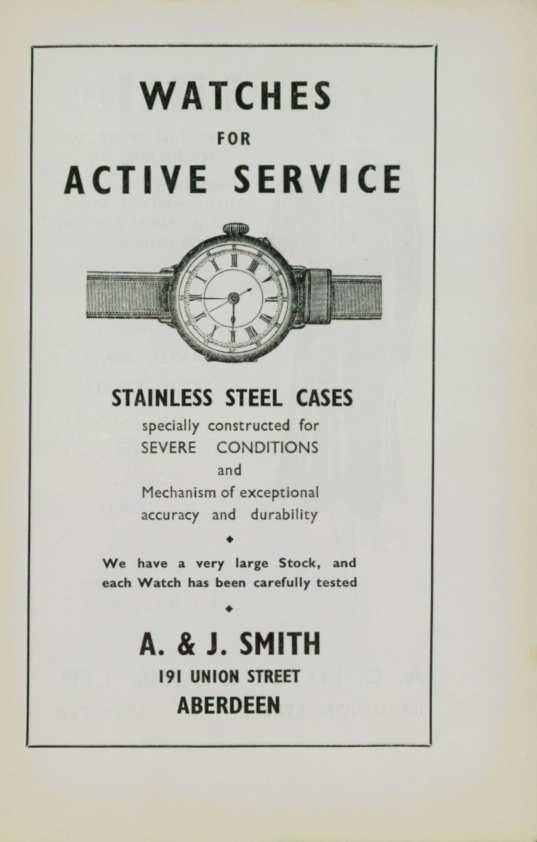
specially construct ed for SEVERE CONDITION S and Mechanism of exceptional accuracy and durability
We have a very large Stock, and each Watch has been carefully tested

Have just what you are looking for.
Something to wear that iswell cut, smart, and practical and not too expensive. -
-
Sizes to fit all figures from 36whip to 56whip.
WINTER SESSION • • OCTOBER TO MARCIi, SUMMER SESSION • • APRIL TO JUN£,
II rou are considering Agriculture II a Career, why not come lo the Collegeof Agriculture. whereyoucan correlate £arminstheory with practice •nd equip rourieH either for practical farminJ or for securing one of the teachin1 or adrrumatrative posts now available to qualifiedstudents ? College Oasscs arc open to young women as well as men in all branches of Airricultural Science, and Calendars and full particulars of the various Courses may be obtained free from the undersigned.
R. M. LEMMON, Secretary, 411 UNION STREET. ABERDEEN.
Here you get the finest of food, daintily served, and at a reasonable price. The Restaurant is comfortable and commodious, and is Just the place to enterta in your friends . Our rooms are available for all types of functions . 'Phone 2371, and ask the Manageress for quotations
Quality Bakers , Confectioners and Cate rers, Aberdeen
" We have been recommended to you by " Every day that phrase is being used by Customers on their first visit to our showrooms. THE REASON -
OUR STOCK is of good quality and our prices are reasonable . OUR SERVICE ls of a personal nature and we study the requirements of every Customer.
when you go In search of Fish, Game or Poultry. But actually there la no need to search: you have but to call at A. &. W. ALEXANDER to have your requirements amply satisfied. Should you prefer to 'phone (which Is often so much handier), your instru ctions will have personal at, tention. The numbers are 5172, -3 and •4
Lacblan ::\iacKinnon, D.L., M.A., V.D.
School Prefects-June 1940 .
School Cricket 1st Xl- Session 1940
Sir Henry Alexander, D.L., M.A., LL.D.
A ::\Iessageto Former Pupils .
The End of the Graf Spee. By E. G. \!arr
Roll of F.P. \\'ar Scrvicc- fin.t Instalment
Note5 About Old Boys
Obituary \larria~cs
The School in 1865-1870. By Lachlan ;\lacKinnon
Facing page 214 Bctv,ecn pp. 214 and 2 15
Facing page 215
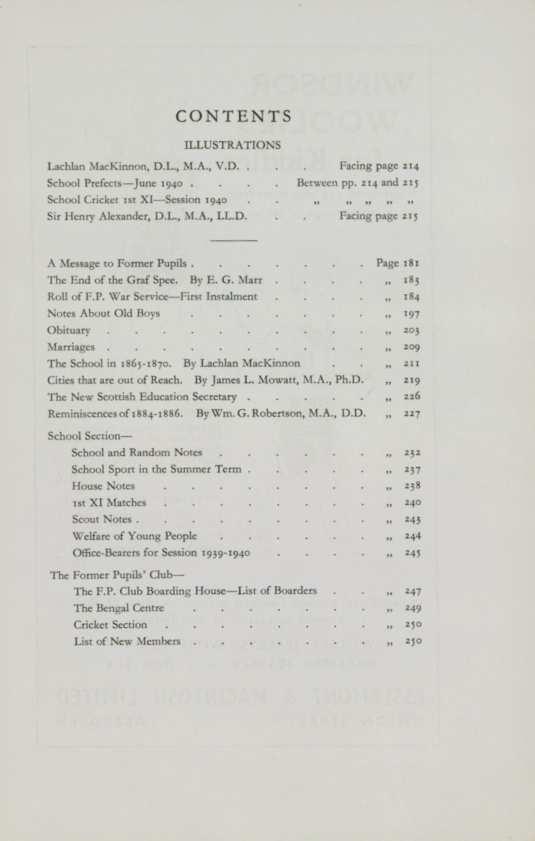
Cities that arc out of Reach. Dy James L. Mowatt, .\LA., Ph.D.
The cw Scottish Education Secretary . Reminiscences of1884-1886. ByWm. G. Robertson, M.A., D.D.
School SectionSchool and Random Notes
School Sport in the Summer Term House Note~ 1st XI Matches Scout Notes . Welfare of Young People
Office-Bearers for Session 1939-1940
The Former Pupils' OubThe F.P. Club Boarding House-List of Boarders
The Bengal Centre Cricket Section List of New \[embers
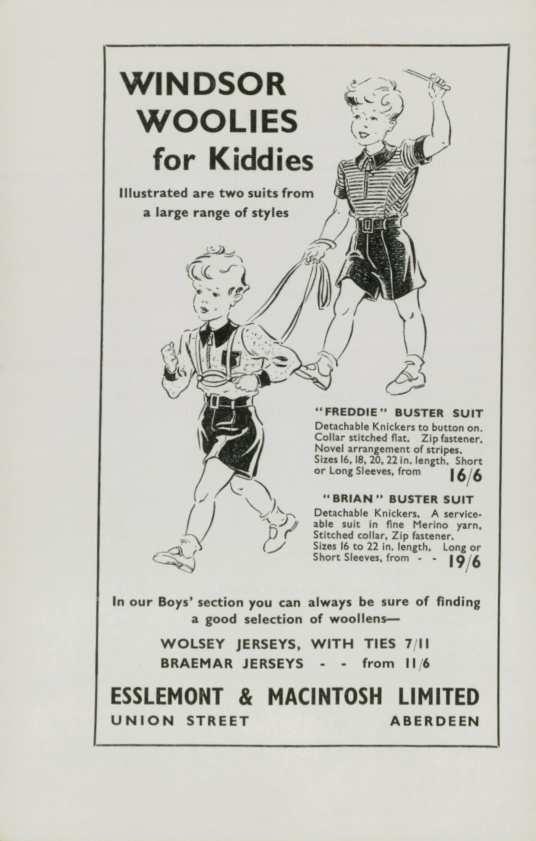
Illustrated are two suits from a large range of styles
0 · , t) = e.-
" FREDDIE " BUSTER SUIT
Detachable Knickers to button on. Collar stitched flat. Zip fastener . Novel arran gement of stripes. Sizes 16, 18, 20, 22in length Short or long Sleeves, from f6/6
" BRIAN " BUSTER SUIT
Detachable Knickers. A serviceable suit In fine Merino yarn, Stitched collar, Zip fastener Sizes 16 to 22 In. length, long or Short Sleeves, from - - 19/6
In our Boys' section you can always be sure of finding a good selection of woollens-
WOLSEY JERSEYS, WITH TIES 7 11 BRAEMAR JERSEYS - - from 11 '6
Teletrams-"
49-5 l .Scbool~\ll
'Phone :2870

Little Poruble Typewriten nowadays are very cheap, and enormous value for money- thr« British Porubles : the BarloclcPoruble, the Baby Empire, and, the best of all, the Imperial Portable, the famous "Good Companion." AliiOaU the forei,n Porublea. :: ..
You can set literary, scientific.medical, or Continental lceyboards.
EASY DEFERRED PAYMENTS ON ANYTJUNO
Come along and see me : C. H. WEBSTER
489 Union Street, Aberdeen 'Phone 505
27WORLD RECORDS
Ideal Watch for MllJtary Service.
Oyster Models from £8 8s. 0d.
We stock the complete ranae of Rolex Oyster and Rolex Prince Watches.
PERSEVERANCE is the determination to carry on in the face of difficulties and discouragements and to overcome them in the end.
At the present time we are faced with great difficulties and many discouragements, but we are determined to carry on and give our customers - as far as in us lies- the same service which has been a feature of our business for nearly a hundred years.
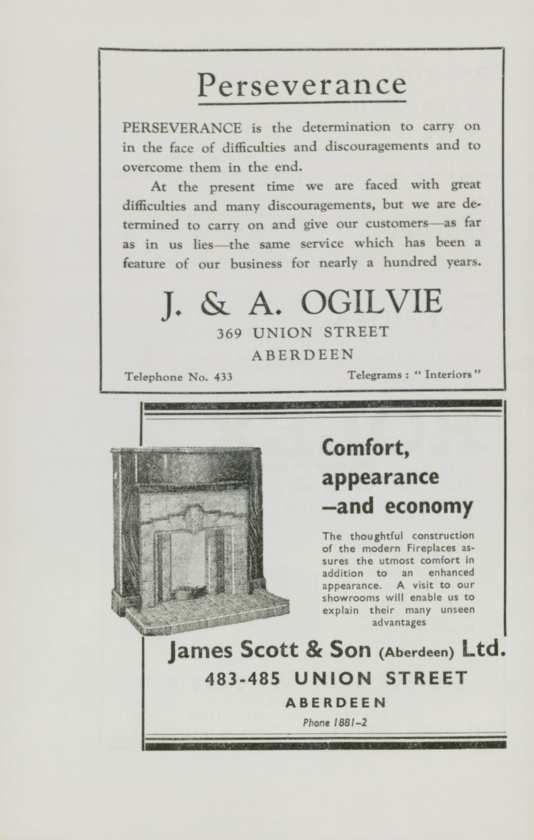
The thoughtful construction of the modern Fireplaces assures the utmost comfort in addition to an enhanced appearance. A visit to our showrooms will enable us to explain t heir many unseen advantages
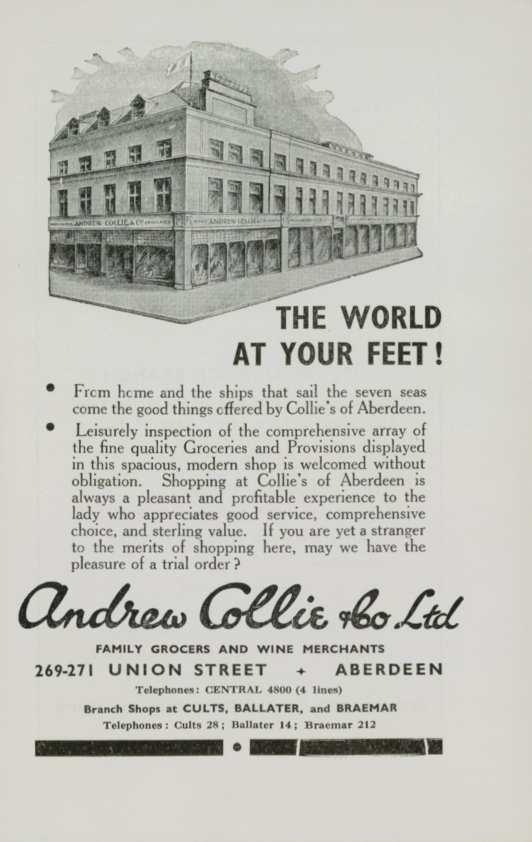
• Frcm hcme and the ships that sail the seven seas come the good things cffered by Collie's of Aberdeen.
• Leisurely inspection of the comprehensive array of the fine quality Groceries and Provisions displayed in this spacious, modern shop is welcomed without obligation. Shopping at Collie's of Aberdeen is always a pleasant and profitab le experience to the lady who appreciates good service, comprehensive choice, and sterling value. If you are yet a stranger to the merits of shopping here, may we have the pleasure of a trial order ?
The Company's tables of rates for Life Assurance include every class of Policy
Special Leaflets onThe "Optional " Policy The Educational Endowment Policy Child's Deferred Assurance Policy Annuities
Branches and Agencies throughout the World
55th yMr : No I45 (New Seru s, 46th year, No. IJ6)
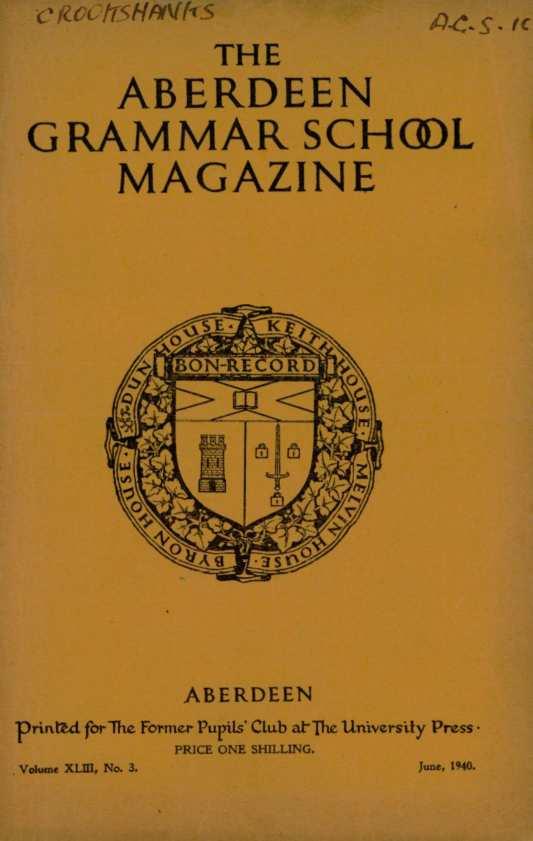
Vol. XLill
JUNE 1940 No. 3
T he " Gramma r School Magazine " is issu ed under the auspices of The Former Pupils' Club, in March, June, and N ovem ber All communication s with regard to the" Magazine" should be addressed to the Editor (the Secretary and Treasurer of the Club),
THEODORE WATT, M.A., LL.D , The Univers ity Press, 6 Upper Kitkgate, Aberdeen.
In my last Message I had something to say of the changes which the War had wrought on the life and work of the School. There is little to add now except that we are becoming accustomed to the altered conditions . \YJe still meet in our own buildings for three days weekly. On the alternate days we find shelter, if not comfort, in temporary premises in Leadside Road. These arrangements have not found favour in certain quarters, but a solution of the difficulry seems likely by the time we re-open in September. To compensate for these minor trials, we have enjoyed one of the loveliest Spring:; and early Summers we can recall. School has never looked more attractive in its setting of flower beds and verdant lawns, and we can forget, for the time being, such grim reminders of reality as trenches and stretchers and wardens' posts.
School activities have not suffered to any material extent. Cricket, tennis, and sports practice have continued as before, but we miss the assistance of those Masters who are on Military Service. The departure of Mr. Macgregor, our Sports Master, to rejoin his old regiment was a major loss; but Mr. Edwards, Lower School Master, has filled the breach with much acceptance. He has given ungrudgingly of his time and energies, and he has been loyally supported by Masters and boys.
The problem of staffing next session will be a serious one. Five of our Masters are already with the Forces and several others may have left by September. It becomes increasingly difficult to find substitutes, and some system of pooling of the available teaching staff in each area seems to be the only solution.
\"'c have received many appeals to assist in various forms of national effort and have responded to most of them-\'var Savings, Red Cross, Forestry, Farming, etc. Savings Bank accounts, formerly confined to the Lower School, have been extended to the Upper School, and weekly contributions arc made by all classes to the funds of the Red Cross Society. Ne'.'tt term the handwork classes will de\·otc themselves co the making of equipment for war hospitab. :\ holiday camp for assistance in forestry, under a scheme sponsored by the forestry Commission, will he established in Upper Decside, and relays of boys, in charge of \!asters, will givc their services during July and August. Another contingent will work on the farms in the Countr. There can be no doubt of the eagerness of the boYS to be helpful. The spirit which was in evidence last Septcmhrr shows no abatement.
The one thing I have missed more than anything else •his session has been the morning assemblr of the boys in Ilall. Part of the I!all had to be utilized for other purposes, but, apart from that, concentrauons of young people, in present circumstanct:s, are not regarded with favour. \\ e have had only one such meeting since the War began, when Sheriff Laing made an eloquent appeal on behalf of the National Savings Campaign.
The Swimming Sports were not held this year. The Corporation Baths arc in a somewhat dangerous area and we are not justified in incurring a\·oidable risks. .\ir-raid practices have made us increasingly proficient in the taking of cover. It is true that, at a recent combined practice, the whole of the Lower School, thanks to a faulty electric bell, failed to appear ! Result, on paper, about 300 potential casualties and an immediate and effective overhaul of the system of alarms. fortunately we were not denied the one event we should have missed most of all-the Annual Sports. Even here there were difficulties. I have alluded to the absence of the Games ;\faster. In addition, the cutting of trenches across the playing field was not exactly helpful. Lastly, we had to forgo the social amenities of the tea-room. Sugarless tea might haYe heen tncd but, in any c,·cm, the central room of the Pavilion had been taken over as a first-aid post.
The weather ·wasabout as perfect as we could have wished. A full programme was carried through in brilliant sunshine and the attendance, despire the crisis, was excellent. This year we eliminated the Friday meeting. Heats were run off on the preceding evenings and finals were decided on the Saturday. Performances in the various events were well up to standard. D. \X'. C. Smith, our pocket Hercules, improved on his previous records in the Cricket Ball and the Shot and added a further record in the Discus.
There is, as you know, a shortage of paper and I must bring
these random jottings to a close ; not, however, before 1 send a special message of remembrance to all F.P.s who arc serving at home or overseas. \Y/c are confident that they are playing their part worthily in the struggle and they may rest assured that we are following their fortunes with equal interest and pride.
D. 1\L A.
q th June 1940.
Although the Battle of the River Plate is now a page of glorious history and the details of the scuttling of the Graf Spee have been widely reported, my own impressions might not be uninteresting. The first rumour received was that a battle was being fought between a pocket battleship and some of our cruisers, and that the Achilles, whose crew we had entertained for a few hours in port onl)' some days previous, had been sunk. Our relief can be imagined when the Graf Spee appeared in the harbour and we learnt that our ships, although battered, were still afloat.
Excitement was intense during the following days, and the harbour boatmen made fortunes. The Graf Spee certainly looked most impressive. Everyone was on tiptoe on the Sunday. Would she leave or be interned? From our high flat overlooking the river we would have a splendid view if she proceeded seawards, but the harbour entrance was just hidden. Strange to say the first news 1 had of her movements was from London at 6.4~ p.m., Montevideo time, when the B.B.C. announced that the Graf Spee, having steamed up river towards Buenos Aires, had turned round and was then heading towards the mouth. \Ve could distinctly see one of our ships on the lookout far on the horizon, and our feelings can well he imagined as we waited for the Graf Spee to come into view. From the hill from which the t0wn takes its name the gun boomed out the hour of sunset and, seconds later, a terrific explosion was felt rather than heard. \¥/e dashed to the roof of our apartment house and from there had a perfect view of the burning ship and the attendant Tacoma, since interned in Montevideo, which had taken off the crew. Explosions continued intermittently as dusk fell rapidly, and although some seven miles from the shore, the effect was truly awe-inspiring.
Some three months later we had our last view of her as we steamed homewards out of Montevideo, her immense control tower at a rakish angle and her decks awash, a fitting monument to a magnificent naval victory.
E. G. MARR.
As the result of the circulation of an Inquiry Form with the last issue of the 1\Iagaz_ine, a very considerable amount of information about \X'ar Service has been receiYcd from members of the F.P. Club. 1t has, therefore , been possible to compile the follow ing first instalment of a Roll of Sen·ice. The Editor is aware that the Roll is far from being complete, but it records practica lly all the information that I-ms yet been sent. lt should be noted that this instalment contains the names on(y of For,mr Pupils who are met11bersof the F.P. Clt1b. l\o attempt has been made to collect information about non-members. To stimulate those who so far have not supplied any particulars about their service, additional copies of the Inquir} Form arc being circulated with this issue of the Ma,e.azine. The Form may also be used by those who returµcd the pre, ious one but have now additional information (e.g. about commission or promo tion) to gi,·e. ln the Roll brief particulars of service in the last \X'ar have been inserted within square bracktts .
Navy, The Army, and The Air Force.
ADAM, William (1925-37), arts student, Aberdeen University. 2nd Lieut. (June 1939), Gordon Jlighlanders.
ADAMS , William Crombie (191 5 18), tea merchant, Aberdeen. Flying Officer, R.i\.L
AITKEN, John Abel (1918-22), representative, II. J. Ilemz Co., Ltd., Edinburgh Battery Quarte rmaster-Sergeant (Sept. 1939), R.A.
AITKEN, Robert (1928-37), insurance clerk, ,\berdecn. Lance-Bombardier (Sept. 1939), R. \. ANDERSON, Alexander Donald Stewart (1918-24), ~Lt\. , chartered accountant, London. Pilot Officer, R.A.F V.R. ANDERSON, Ian Alfred (1912-24), B.Sc., M.B., Ch.13., Aberdeen Captain (May 1940), R.A.~ 1.C. ANDERSON, Thomas Edge (1912-21), M.D., 1\benken. Major (Sept. 1939), R.A.M.C.
ANGUS, Colin George Marr (1925-36), hotelier. rnd Lieut. (May 1940), Gordon Highlanders
ASHER , Robert Smith (1898-1903), garrison engineer, \\ .D. Major (Dec. 1939), R.E. [Captain, R.E., 1914-19.]
AYRTON, Thomas (1919-24), piano tuner, Aberdeen. Sapper (Mar. 1938), R.E.
BARNET , Avon Alexander (1911-19), chief officer, ~lcrchant Service . Lieut.-Commander (l\lay 1937), R.l\.R.
BARTLET, James Eric Alexand er (1922-34), \LB., Ch.B., house surgeon, Royal lnfirmary, Abcr<leen. Lieut. (Apr. 1940), R.1\.1\1.C.

Aberdeen Grammar School Magazine
BEGG, Stewart Duncan (1909-10), secretary, John I. Thornycroft & Co., Led., China Branch Sergeant, Volunteer Defence Corps.
BISSET, James Gordon (1919-20 and 1921-29), timber merchant, Aberdeen. Captain (Feb. 1940), Royal Corps of Signals.
BOYD, Leslie George (1918-29), M B , Ch.13., Aberdeen Surgeon Lieut., R.N.V.R.
BRANDER, Derek Alexander George (1928-31), Stonebaven. rnd Lieut., Highland Light lnfantry .
BRUCE, Alexander Eric (1902-1~), M.A., LL.B., advocate in Aberdeen. rnd Lieut. (Oct. 1939), R.A. [R.A. 1916-19Lieut., Aug. 1918.]
BRUCE, Andrew H. (1921-37), Aberdeen. rnd Lieut., Gordon Highlanders.
BRUCE, George William (r91 ~-24), specialist in precast concrete products, Aberdeen. Major, Gordon Highlanders.
BRUCE, Robert Douglas (1913-21), ilLB., Ch.B., Cults, Aberdeenshire. Flight Lieut ., R.A.F., Medical Branch.
CARRY, Joseph Robert (1918-30), jeweller, Aberdeen. rnd Lieut., Royal Corps of Signals.
CARSON , Marcus Harvey (1926-36), Aberdeen. Private, R.A.M.C.
CHRISTIE , Angus Webster (1931-37), apprentice civil engineer, Aberdeen Driver (Clerk), R.A.S.C.
CHRYSTALL, Stewart Buyers (1921-31), bank clerk, Cults, Aberdeenshire. Private, R.A.P.C.
CLARK, Norman Stuart (1919-29), B.Sc , .M B , Ch.B., Aberdeen . Lieut. (June 1940), R.A.M.C.
COCHRAN, Duncan Scott (1914-24), M.B., Ch.B. Captain, R.A.M.C. (regular commission).
COLLIE, Georg e Franci s (1916-26), B.L., adyocate in Aberdeen. Captain (Nov. 1939), R.A.S.C.
COOPER , Ian H amish (r923-33), ship's officer, Merchant Service Sub-Lieut., R.N.R
COULL, Albert (1920-p.), M.B., Ch.B., Aberdeen. Surgeon Lieut., R.N.V.R.
COULTER, James Ronald (1923-32), Aberdeen. Trooper, King's Own Hussars.
COWAN, Nigel Smart (1924-28). Captain, R.E. (regular commission).
CRUICKSHANK, Charles Robertson (192~-39), Aberdeen. Aircraftsman (2nd Class), R.A F.
CUMMING, Ian (1907-14), merchant, Madras, S. India. Lieut.-Co loncl, E.D., A.D.C., Southern Provinces Mounted Rifles, India. [Gordon Highlanders, 1914-19-Captain, June 1917.]
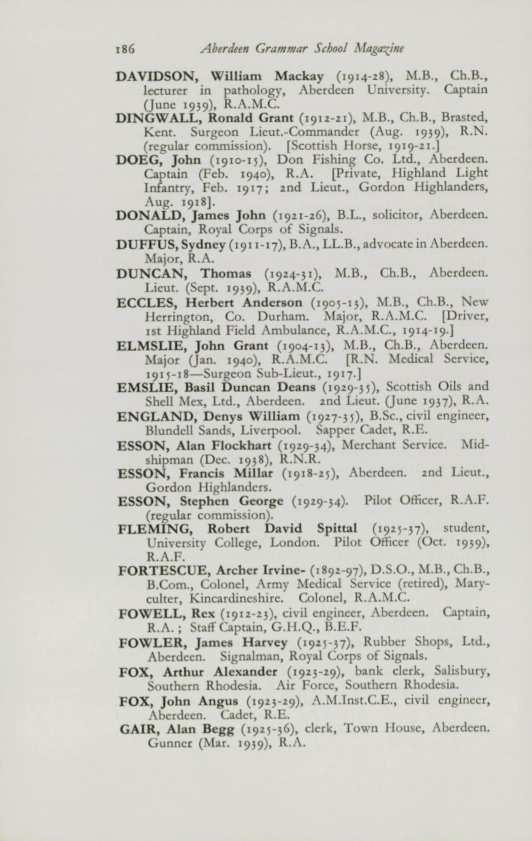
DAVIDSON, William Mackay (1914-28), M.B., Ch.B , lecturer in pathology, Aberdeen University. Captain (June 1939), R.A.M.C.
DINGWALL, Ronald Grant (1912-21), M.B., Ch.B., Brastcd, Kent. Surgeon Lieut.-Commander (Aug. 1939), R.N (regular commission). [Scottish Horse, 1 919-2r.]
DOEG, John (1910-15), Don Fishing Co. Ltd., Aberdeen. Captain (Feb. 1940), R.A. [Private, Highland Light Infantry, Feb. 1917; znd Lieut., Gordon Highlanders, Aug. 1918).
DONALD, James John (1921-26), B.L., solicitor, Aberdeen. Captain, Royal Corps of Signals.
DUFFUS, Sydney (1911-17),B.A., LL.B., advocate in Aberdeen. Major, R.A.
DUNCAN, Thomas (1924-31), M.B., Ch.B., 1\bcrdeen. Lieut. (Sept. 1939), R.A.M.C.
ECCLES, Herbert Anderson (1905-13), M.B., Ch.B., New Herrington, Co. Durham. Major, R.A.M.C. [Driver, 1st Highland Field Ambulance, R.A.M.C., 1914-19.)
ELMSLIE, John Grant (1904-13), M.B., Ch.B., Aberdeen. Major (Jan. 1940), R.A.1LC. [R. . Medical Service, 1915-18-Surgeon Sub-Lieut., 1917.)
EMSLIE , Basil Duncan Deans (1929-35), Scottish Oils and Shell Mex, Ltd., Aberdeen. znd Lieut. (June 1937), R.A.
ENGLAND, Denys William (1927-35), B.Sc., civil engineer, Blundell Sands, Liverpool. Sapper Cadet, R.E.
ESSON, Alan Flockhart (1929-34), Merchant Service. Midshipman (Dec. 1938), R.N.R.
ESSON, Francis Millar (1918-25), Aberdeen. 2nd Lieut., Gordon Highlanders
ESSON, Stephen George (1929-34) Pilot Officer, R. \.F. (regular commission).
FLEMING, Robert David Spittal (1925-37), student, University College, London. Pilot Officer (Oct. 1939), R.A.F.
FORTESC UE, Archer Irvine- (1892-97), D.S.O., M.B., Ch.B., B.Com., Colonel, Army .Medical Service (retired), Maryculter, Kincardincshire. Colonel, R.A.M.C.
POWELL , Rex (1912-23), civil engineer, Aberdeen. Captain, R.A. ; StaffCaptain, G.H.Q. , B.E.F.
FOWLER , James Harvey (1925-37), Rubber Shops, Ltd., Aberdeen. Signalman, Royal Corps of Signals.
FOX, Arthur Alexander (1923-29), bank clerk, Salisbury, Southern Rhodesia. Air Force, Southern Rhodesia.
FOX, John Angus (1923-29), A.M.Inst.C.E., civil engineer, Aberdeen. Cadet, R.E.
GAIR, Alan Begg (1925-36), clerk, Town House, Aberdeen. Gunner (Mar. 1939), R.A.
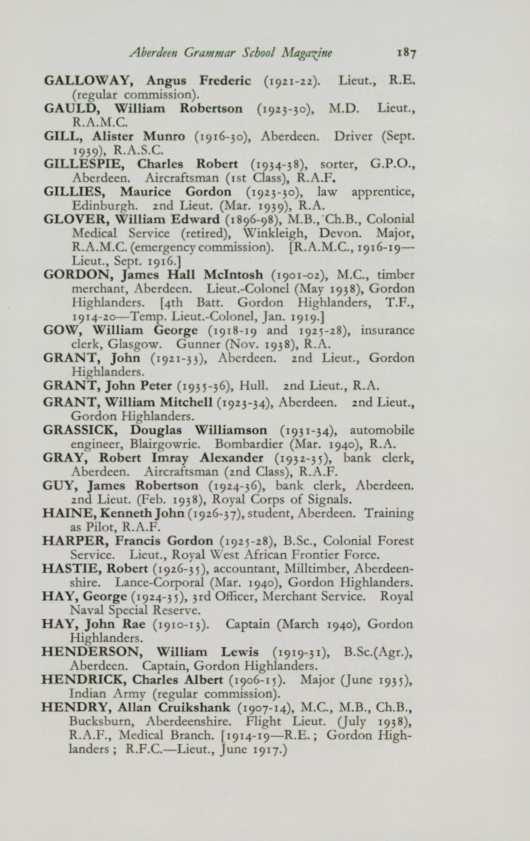
Aberdeen Gra111111ar S,hool Magazine
GALLOWAY, Angus Frederic (1921-22). Lieut., R.E. (regular commission).
GAULD , Willi am Robertson (1923-30), l\LD. Lieut., R.A.M.C.
GILL, Alister Munro (1916-30), Aberdeen. Driver (Sept. 1939), R.A.S.C.
GILLESPIE, Charles Robert (1934-38), sorter, G.P.0., Aberdeen. Aircrafrsman (1st Class), R.A.F.
GILLIES, Maurice Gordon (1923-30), law apprentice, Edinburgh. znd Lieut. (Mar. 1939), R.A.
GLOVER, William Edward (1896-98), M.B., Ch.B., Colonial Medical Service (retired), Winkleigh, Devon. Major, R.A.M.C. (emergency commission). [R.A.M.C., 1916-19Lieut., Sept. 1916.]
GORDON, James Hall McIntosh (19oi-02), M.C., timber merchant, Aberdeen. Lieut.-Colonel (May 1938), Gordon Highlanders. f4th Batt. Gordon Highlanders, T.P., 1914-20-Temp. Lieut.-Colonel, Jan. 1919.]
GOW, William George (1918-19 and 192s-28), insurance clerk, Glasgow. Gunner (r ov. 1938), R.A. GRANT, John (1921-33), Aberdeen. 2nd Lieut., Gordon Highlanders.
GRANT, John Peter (193s-36), Hull. 2nd Lieut., R.A.
GRANT, William Mitchell (1923-34), Aberdeen. 2nd Lieut., Gordon Highlanders.
GRASSICK, Douglas Williamson (1931-34), automobile engineer, Blairgowrie. Bombardier (Mar. 1940), R.A.
GRAY, Robert lmray Alexander (1932-3s), bank clerk, Aberdeen. Aircraftsman (znd Class), R.A.F.
GUY, James Robertson (1924-36), bank clerk, Aberdeen. 2nd Lieut. (Feb. 1938), Royal Corps of Signals. HAINE, KennethJohn (1926-37),student, Aberdeen. Training as Pilot, R.A.F.
HARPER, Franci s Gordon (192s-28), B.Sc., Colonial Forest Service. Lieut., Royal West African Frontier Force.
HASTIE, Robert (1926-3s), accountant, Milltimber, Aberdeenshire. Lance-Corporal (Mar. 1940), Gordon Highlanders.
HAY, George (192-4-3s),3rd Officer, Merchant Service. Royal Naval Special Reserve.
HAY, John Rae (1910-13). Captain (March 1940), Gordon Highlanders.
HENDERSON, William Lewis (1919-31), B.Sc.(Agr.), Aberdeen. Captain, Gordon Highlanders.
HENDRICK, Charles Albert (i906-1s). Major (June i93s), Indian Army (regular commission).
HENDRY, Allan Cruikshank (1907-14), M C., M.B., Ch.B., Bucksburn, Aberdeenshire. Flight Lieut. (July 1938), R.A.F., Medical Branch. f1914-19-R.E.; Gordon Highlanders; R.F.C.-Lieut., June 1917.)
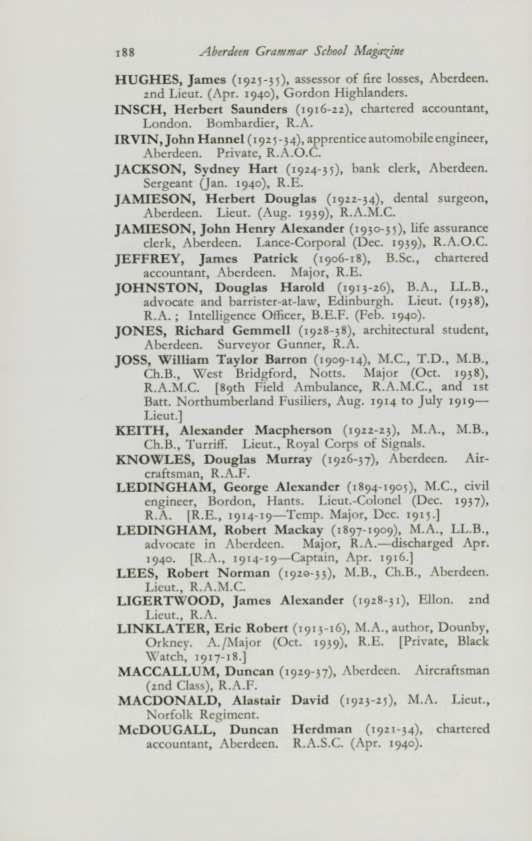
HUGHES, James (1925-35), assessor of fire losses, Aberdeen. znd Lieut. (Apr. 1940), Gordon Highlanders.
INSCH, Herbert Saunders (1916-22), chartered accountant, London. Bombardier, R.A.
IRVIN,J ohn Hannel (1925-34),apprenticeautomobileeng ineer, Aberdeen. Private, R. \.O.C.
JACKSON, Sydney Hart (1924-35), bank clerk, Aberdeen. Sergeant (Jan. 1940), R.E.
JAMIESON, Herbert Dougla s (1922-34), dental surgeo n, Aberdeen. Lieut. (Aug. 1939), R.A.M.C.
JAMIESON, John Henry Alexand er (1930-35), life assurance clerk, Aberdeen. Lance-Corporal (Dec. 1939), R.A.O.C.
JEFFREY, James Patrick (1906-18), B.Sc., chartered accounta nt, Aberdeen. Major, R.E.
JOHNSTON, Douglas Harold (1913-26), H.A., LL.B., advocate and barrister-at- law, Edinburgh. Lieut (1938), R.A.; Intelligence Officer, 8.E.F. (Feb. 1940).
JONES, Richard Gemmell (1928-38), architectura l student, Aberdeen Surveyor Gunner, R.A.
JOSS, William Taylor Barron (1909-14), :1\l.C., T.D., ~LB., Ch.B., West Bridgfor d, otts. Major (Oct. 1938), R.A.M.C. (89th Field Ambulance, R.A.M.C., and 1st Batt. orthumberlan d Fusiliers, Aug. 1914 to July 1919Lieut.]
KEITH, Alexander Macpherson (1922-23), M. \., :M.B., Ch.B., Turriff. Lieut., Royal Corps of Signals.
KNOWLES, Douglas Murray (1926-37), Aberdeen. Aircraftsman, R.A.F.
LEDINGHAM, George Alexander (1894-1905), M.C., civil engineer, Bordon, Hants. Licut.-Colonel (Dec 1937), R.A. [R.E., 1914-19-Temp. ~1ajor, Dec. 1915.]
LEDINGHAM, Robert Mackay (1897-1909), M.A., LL.B., advocate in Aberdeen. Major, R.A.- discharged Apr. 1940. [R..\., 1914-19-Captain, Apr. 1916.)
LEES, Robert Norman (1920-,3), .M.8., Ch.B., Aberdeen Lieut., R.A.M.C.
LIGERTWOOD, James Alexander (1928-31), Elion. znd Lieut., R.A.
LINKLATER, Eric Robert (1913-16), M.A , author, Dounby, Orkney. A /Major (Oct. 1939), R.E. [Prh·ate, Black \'\'arch, 1917-18.)
MACCALLUM, Duncan (1929-37), Aberdeen. Aircraftsman (znd Class), R.•\.F.
MACDONALD, Alastair David (i923-25), M A Lieut., ·orfolk Regiment.
McDOUGALL, Duncan Herdman (1921-34), chartered accountant, Aberdeen. R.A.S.C. (Apr. 1940).
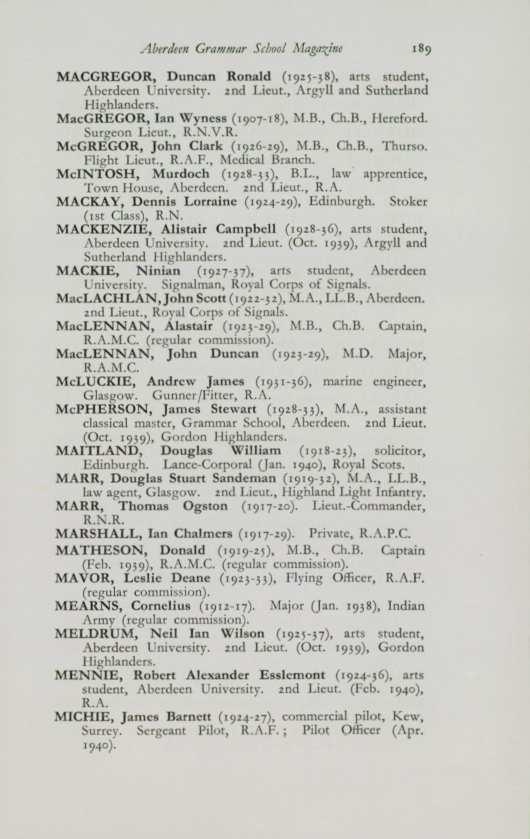
MACGREGOR, Duncan Ronald (1925-38), arts student, Aberdeen University . rnd Lieut ., Argyll and Sutherland Highlanders.
MacGREGOR, Ian Wyness (1907-18), t.I.B., Ch.B., Hereford. Surgeon Lieut., R.'\J.V.R.
McGREGOR, John Clark (1926 29), \LB., Ch.B., Thurso. Flight Lieut., R.,\.F., Medical Branch.
McINTOSH, Murdoch (1928-33), B.L., law apprentice, Town House, Aberdeen. 2nd Lieut., R.A.
MACKAY, Dennis Lorraine (1924-29), Edinburgh. Stoker (1st Class), R.N.
MACKENZIE, Alistair Campbell (1928-36), arts student , 1\berdeen University. 2nd Lieut. (Oct. 1939), Argyll and Sutherland 1Jighlanders.
MACKIE, Ninian (1927-37), arts student, Aberdeen Cniversit}. Signalman, Royal Corps of Signals.
MaeLACHLAN,John Scott (1922-32),M.A., LL.B., Aberdeen. znd Lieut., Royal Corps of Signals. MacLENNAN, Alastair (1923-29), J\LB., Ch.B. Captain, R.A.J\LC. (regular commission).
MacLENNAN , John Duncan (1923-29), M.D. Major, R.A.M.C.
McLUCKIE, Andrew James (1931-36), marine engineer, Glasgow. Gunner /Fitter, R.A.
McPHERSON, James Stewart (192.8-33), l\f.A., assistant classical master, Grammar School, Aberdeen. 2nd Lieut. (Oct. 1939), Gordon Highlanders.
MAITLAND, Douglas William (1918-23), solicitor, Edinburgh. Lance-Corporal (Jan. 1940), Royal Scots.
MARR, Douglas Stuart Sandeman (1919-32), M.A., LL.B., law agent, Glasgow. znd Lieut., Highland Light Infantry . MARR, Thomas Ogston (1917-20). Lieut.-Commander, R..R.
MARSHALL, Ian Chalmers (1917-2.9). Private, R.A.P.C.
MATHESON, Donald (1919-25), ,\LB., Ch.B. Captain (Feb. 1939), R.A.l\i.C. (regular commission).
MAVOR, Leslie Deane (192.3-33), Flying Officer, R.A.P. (regular commission).
MEARNS, Cornelius (1912-17). Major (Jan. 1938), Indian Army (regular commission).
MELDRUM, Neil Ian Wilson (192.5-37), arts student, Aberdeen University. rnd Lieut. (Oct. 1939), Gordon Highlanders.
MENNIE, Robert Alexander Esslcmont (r924-36), arts student, Aberdeen University. znd Lieut. (Feb. 1940), R.A.
MICHfE, James Barnett (1924-2.7), commercial pilot, Kew, Surrey. Sergeant Pilot, R. \.F. ; Pilot Officer (Apr. 1940).
Aberdeen Gra111111ar School Magazine
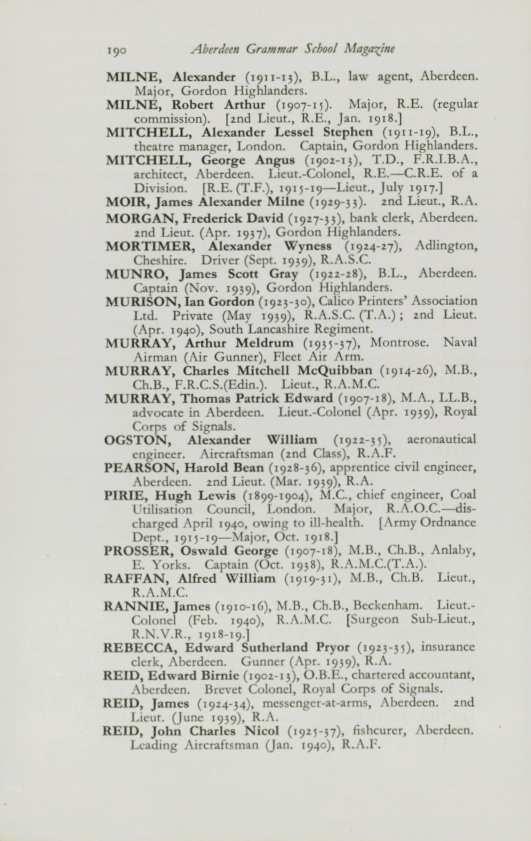
MILNE, Alexander (191I-13), B.L., law agent , Aberdeen. Majo r, Gordon Highlanders.
MILNE, Robert Arthur (1907-15). Major , R.E. (regula r commiss ion). [znd Lieut., R.E., Jan. 1918.]
MITCHELL, Alexander Lessel Stephen (1911-19), B.L., theatre manager, London. Captain, Gordon Ilighlan ders.
MITCHELL, George Angu s (1902-13), T.D., F.R.l.B.A., architect, Aberdeen. Lieut.-Coloncl, R.E.-C.R.E. of a Division. [R.E. (T.F.), r9q-19-Lieut., July 1917.]
MOIR, James Alexander Milne (1929-33). md Lieut. , R A.
MORGAN, Frederick David (1927-33), bank clerk, Aberdeen. rnd Lieut. (Apr. 1937), Gordon Highlanders.
MORTIMER, Alexander Wyness (1924-27), Adlington, Cheshire. Driver (Sept. 1939), R.A.S.C.
MUNRO, James Scott Gray (1922-28), B.L., Aberdeen. C..aptain(Nov. 1939), Gordon Highlanders.
MORISON, Ian Gordon (1923-30), Calico Printers' Association Ltd. Private (May 1939), R.A.S.C. (T.A.); 2nd Lieut. (Apr. 1940), South Lancashire Regiment.
MURRAY, Arthur Meldrum (1935-37), Montrose. Naval Airman (Air Gunner), Fleet Air Arm.
MURRAY, Charles Mitchell McQuibban (r914-26), M.B., Ch.B., F.R.C.S.(Edin.). Lieut., R.A.M.C.
MURRAY, Thoma s Patrick Edward (1907-18), M.A., LL.B., advocate in Aberdeen. Lieut.-Colonel (Apr. 1939), Royal Corps of Signals.
OGSTON, Alexander William (1922-35), aeronautical engineer. Aircraftsman (rnd Class), R.A.F.
PEARSON, Harold Bean (1928-36), apprentice civil engineer, Aberdeen. rnd Lieut. (Mar. 1939), R.A.
PIRIE, Hugh Lewis (1899-1904), ~J.C., chief engineer, Coal Utilisation Council, London. ;\fajor, R. \.O.C.-discharged 1\pril 1940, owing to ill-health. [ \rmy Ordnance Dept., 1915-19-~lajor, Oct. 1918.]
PROSSER, Oswald George (1907-18), M.B., Ch.B., Anlahy, E. Yorks. Captain (Oct. 1938), R.A.M .C.(T.A.).
RAFFAN, Alfred William (1919-31), M.B., Ch.B. Lieut., R.A.M.C.
RANNIE, James (1910-16), M.B., Ch.B., Beckenham. Lieut.Colonel (Feb. 1940), R.t\ ..M.C. [Surgeon Sub-Lieut., R..V.R., 1918-19,l
REBE CCA, Edward Sutherland Pryor (1923-35), insurance clerk, Aberdeen. Gunner (.\pr. 1939), R.A.
REID, Edward Birnie (1902.-13),O.B.E., chartered accountant, ,\berdeen. Brevet Colonel, Royal Corps of Signals.
REID, James (1924-34), messenger-at-arms, ,\berdeen. 2nd Lieut. (June 1939), R. \.
REID, John Charles Nico l (1925-37), fishcurcr, Aberdeen. Leading ,\ircraftsman (Jan. 1940), R. \.F.
Aberdeen Gra,n,nar Srhool Magazine
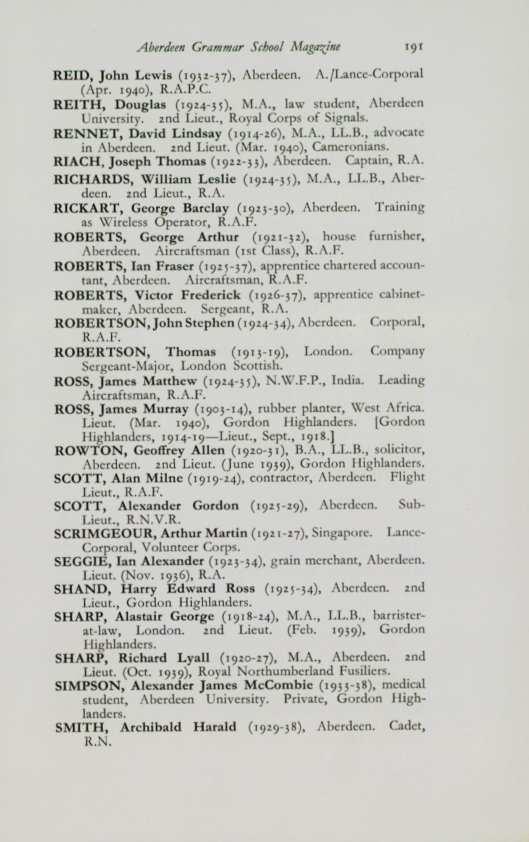
REID, John Lewis (1932-37), Aberdeen. A./Lance-Corporal (Apr. 1940), R.A.P.C.
REITH, Dougla s (1924-35), M.A., law student, Aberdeen University. rnd Lieut., Royal Corps of Signals.
RENNET , David Lindsay (1914-26), M.A., LL.B., advocate in Aberdeen. rnd Lieut . (Mar. 1940), Cameronians.
RIACH, Joseph Thomas (1922-33), Aberdeen. Captain, R.A.
RICHARDS, William Leslie (1924-35), M.A., LLB., Aberdeen. rnd Lieut., R.A.
RICKART, George Barclay (1923-30), Aberdeen. Train ing as \'{fireless Operator, R.A.F.
ROBERTS, George Arthur (19zr-32), house furnisher, Aberdeen . Aircraftsman (1st Class), R.A.F.
ROBERTS, Ian Fraser (1925-37), apprentice chartered accountant, Aberdeen. Aircraftsman, R.A.F.
ROBERTS, Victor Frederick (1926-37), apprentice cahinetmaker, Aberdeen. Sergeant, R.A.
ROBERTSON,John Stephen (r924-34), Aberdeen. Corpora l, R.A.F.
ROBERTSON, Thoma s (1913-19), London. Compan)' Sergeant-Major, London Scottish.
ROSS, James Matthew (1924-35), .\'1:1.F.P., India. Leading Aircraftsman, R.A.F.
ROSS, James Murray (1903-14), rubber planter, West Africa. Lieut. (Mar. 1940), Gordon Highlanders. [Gordon Highlanders, 1914-19-Lieut., Sept , 1918.]
ROWTON, Geoffrey Allen (1920-31), B.A., LLB., solicitor, Aberdeen. rnd Lieut. (June 1939), Gordon Ilighlanders.
SCOTT, Alan Milne (1919-24), contractor, Aberdeen. Flight Lieut., R.A.F.
SCOTT, Alexander Gordon (1925-29), Aberdeen. SubLieut., R. .V.R.
SCRIMGEOUR, Arthur Martin (1921-27), Singapore. LanceCorpora l, Volunteer Corps.
SEGGIE, Ian Alexand er (1923-34), grain merchant, Aberdeen. Lieut. (Nov. 1936), R.A.
SHAND, Harry Edward Ross (1925-34), Aberdeen. rnd Lieut., Gordon Highlanders.
SHARP , Alastair George (1918-24), M.A., LL.B., barristerat-law, London. 2nd Lieut. (Feb. 1939), Gordon IIighlanders.
SHARP, Richard Lyall (1920-27), M.A., Aberdeen . rnd Lieut. (Oct. 1939), Royal Northumberland Fusiliers.
SIMPSON, Alexander James McCombie (1933-38), medical student, Aberdeen University. Private, Gordon Highlanders.
SMITH, Archibald Harald (r929-38), Aberdeen. Cadet, R.N.
1<)2 Aberdeen Gra111f//ar School Magaz111e
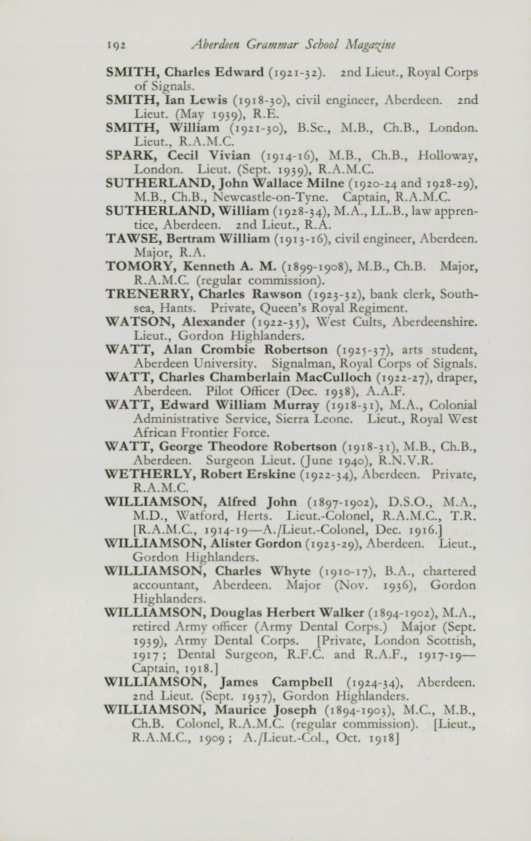
SMITH, Charles Edward (1921-32). 2nd Lieut., Ropl Corps of Signals.
SMITH, Ian Lewis (1918-30), civil engineer, Aberdeen. rnd Lieut. (May 1939), R.E.
SMITH, Willi am (1921-30), B.Sc., 1\1.B., Ch.B., London. Lieut., R. \.M.C.
SPARK, Cecil Vivian (1914-16), M.B., Ch.B., Holloway, London. Lieut. (Sept. 1939), R. \.\I.C.
SUTHERLAND, John Wallace Milne (1920-24 and 1928-29), M.B., Ch.B., ewcastle-on-Tyne. Captain, R.A.~f.C.
SUTHERLAND, William (1928-34), M.A., LL.B., law apprentice, Aberdeen. rnd Lieut., R.A.
TAWSE, Bertram William (1913-16), civil engineer, Aberdeen. Major, R.A.
TOMORY, Kenneth A. M. (1899-1908), 11.B., Ch.B. Major, R.A.M.C. (regular commission).
TRENERRY, Charles Rawson (1923-32), bank clerk, Southsea, Hants. Private, Queen's Royal Regiment.
WATSON, Alexander (1922-35), \'X'est Cults, Aberdeenshire. Lieut., Gordon Highlanders.
WATT, Alan Crombie Robertson (192i-37), arts student, Aberdeen University. Signalman, Royal Corps of Signals. WATT, Charles Chamb erlain MacCulloch (1922-27), draper, Aberdeen. Pilot Officer (Dec. 1938), A.A.P.
WATT, Edward William Murray (1918-31), M.A., Colonial Administrative Service, Sierra Leone. Lieut., Royal \\'.'est African Frontier Force.
WATT, George Theodore Robertson (1918-31), ~LB., Ch.13., .\berdecn. Surgeon Lieut. Oune 1940), R.~.V.R.
WETHERLY, Robert Erskine (1922-34), \berdcen. Private, R.A.M.C.
WILLIAMSON , Alfred John (1897-1902), D.S.O., :M.A., M.D., \Xatford, Iforts. Lieut.-Coloncl, R.A.M.C., T.R. !R.A.M.C., 1914-19-,\./Lieut.-Colonel, Dec. 1916.)
WILLIAMSON, Alister Gordon (1923-29), Aberdeen. Lieut., Gordon JIighlandcrs.
WILLIAMSON, Charles Whyte (1910-17), 13.A., chartered accountant, Aberdeen. Major (.t\m. 1936), Gordon Highlanders.
WILLIAMSON, Dougl as Herbert Walker (1894-1902), M.1\., retired 1\rmy officer (.\rmy Dental Corps.) Major (Sept. 1939), Army Dental Corps. [Private, London Scottish, 1917; Dental Surgeon, R.F.C. and R..\.F., 1917-19Captain, 1918.]
WILLIAMSON, James Campb ell (1924-34), Aberdeen. rnd Lieut. (Sept. 1937), Gordon Highlanders.
WILLIAMSON , Mauric e Joseph (1894-1903), \f.C., l\f.B., Ch.B. Colonel, R. \.\f.C. (regular commission). [Lieut., R.A.~LC., 1909; \./Lieut.-Col., Oct. 1918]
Abrrdun Grammar School Magazine
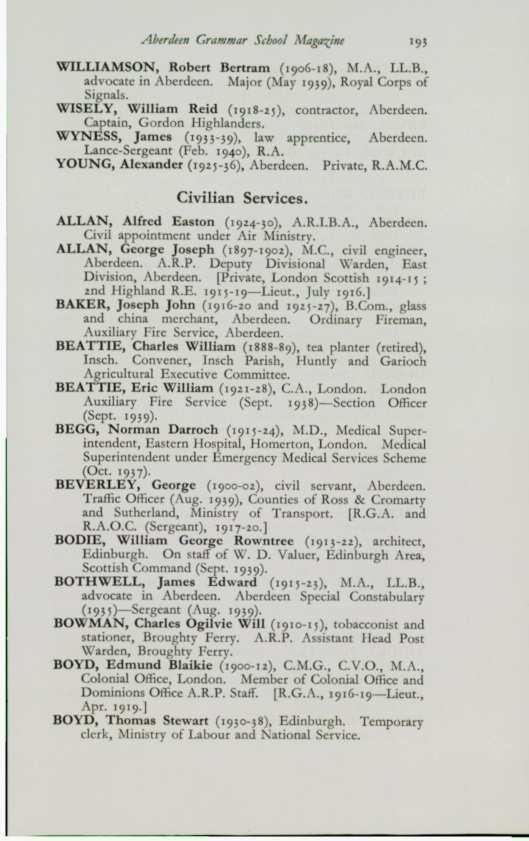
WILLIAMSON, Robert Bertram (1906-18), M.A , LL.B., advocate in Aberdeen. Major (~fay 1939), Royal Corps of Signals.
WISELY, WiUiam Reid (1918-25), contractor, Aberdee n. Captain, Gordon Highlanders.
WYNESS, James (1933-39), law appren tice, Aberdeen. Lance-Sergeant (Feb. 1940), R.A.
YOUNG, Alexander (1925-36), Aberdeen. Private, R.A.M.C.
Civilian Services.
ALLAN, Alfred Easton (1924-30), A.R.I.B.A., Aberdeen Civil appointment under Air Ministry.
ALLAN, George Joseph (1897-1902), M.C., civil engineer, Aberdeen. A.R.P. Deputy Divisional Warden, East Division, Aberdeen [Private, London Scottish 1914-15 ; rnd Highland R.E. 1915-19- Lieut., July 1916.]
BAKER, Joseph John (1916-20 and 1925-27), B.Com., glass and china merchant, Aberdeen. Ordinary Fireman, Auxiliary Fire Service, Aberdeen.
BEATTIE, Charles William (1888-89), tea planter (retired), Insch. Convener, lnsch Parish, Hundy and Garioch AgriculLUral Executive Committee .
BEATT IE, Eric William (1921-28), C.A., London. London Auxiliary Fire Service (Sept. 1938)-Section Officer (Sept. 1939).
BEGG, Norman Darroch (1915-24), M.D., Medical Superintendent, Eastern Hospital, Homerton, London. Medical Superintendent under Emergency Medical Services Scheme (Oct. 1937).
BEVERLEY, George (1900-02), civil servant, Aberdeen. Traffic Officer (Aug. 1939), Counties of Ross & Cromarty and Sutherland, Ministry of Transport. lR,G A. and R.A.O.C. (Sergeant), 1917-20.)
BODIE, William George Rowntree (1913-2.2), architect, Edinb urgh. On staff of \V./. D. Valuer, Edinburgh Area, Scottish Command (Sept. 1939).
BOTHWELL, James Edward (1915-23), M.A., LL.B., advocate in Aberdeen. Aberdeen Special Constabulary (1935)-Sergeant (Aug. 1939).
BOWMAN, Charles Ogilvie Will (1910-15), tobacconist and stationer, Broughty Ferry. A.R.P. Assistant Ilead Post \\7arden, Broughty Ferry.
BOYD, Edmund Blaikie (1900-12), C.M.G., C.V.O., M.A., Colonial Office, London. Member of Colonial Office and Dominions Office A.R.P. Staff. [R.G.A., 1916-19-Lieut., Apr. 1919.)
BOYD, Thomas Stewart (1930-38), Edinburgh. Temporary clerk, Ministry of Labour and National Service.
BROWN, George Stephenson (1910-13), chartered civil engineer, L. and .E. Railway Co. Temporary Assistan t Civil Engineer in H.M. Dockyard (Apr. 1940). lPrivate, 4th Battalion Gordon Highlanders and .M.G.C., 1914-19.]
BRUCE, Ian Leslie (1922-26), Beckenham. Costs Im·estigator, Ministry of Supply ( ov. 1939).
BULMER , George Gordon (1910-16), M.A., iron and steel contractor, Aberdeen . A.R.P. Casualty Services, Aberdeen -Leader of First Aid Parties (Sept 1939).
BUYERS, William (1894-99), planter (retired), Aberdeen. A.R.P. Warden, Aberdeen .
COOPER, Patrick Ashley (1896-1901), B.\., LL.B., Governor, Jludson's Bay Company, London. Director-General of Finance, Ministry of Supply.
CRUICKSHANK, James S. R. (1914-21), B.A., LL.B., W.S., advocate in Aberdeen . Administrative Officer, Chemical Inspection Dept., Ministry of Supply.
DEAN, Frederick John (1896-1901), M.A., head master, Bonnybridge. A.R.P. Post Warden, Greenhill Arca, Bonnybridge (Dec. 1937).
DICKSON, Eric Henry Randal (1936-39), Cults, Aberdeenshire Radio Officer, Merchant Service (May 1940).
DUGUID, Sidney Wardlaw (1922-27), civil engineer, Admiralty. In Civil Engineer-in-Chief's Department, I 1.M. Dockyard
DUNCAN, Douglas Stanley (1928-33), M.A., B.Sc., Aberdeen. ln Meteorological Office, Air Ministry-Forecaster (Apr. 1940).
EDWARDS, Henry George (1905-14), life assurance branch manager, Glasgow. A.R.P. Deputy Head Warden. [Private, 4th Gordon Highlanders, 1914-q; R.A.M.C., 1915-19-Quartermaster-Sergeant.]
ELLIOT, Nenion (1909-15), M.A., B.D., Minister of Slamannan, St. Laurence. Commandant, Local Ambulance Unit. [R.G.A., 1916-19-Signaller. )
ESSLEMONT, George (1905-15). Appointment under Ministry of Supply.
FIDDES, John Douglas (1896-1902), .\LC., M.A., B.Sc., M.B., Ch.B., F.R.C.S. (Edin.), surgeon, llutton, Essex. Medical Superintendent, Emergency Medical Sen ices Advanced Base Hospital. [1st Highland Field ,\mbulance, R. \.;\1.C., 1914-19- Lieut.-Colonel, 1918.)
FIDDES, John Law (1906-16), wood case manufacturer, Aberdeen. British Red Cross Ambulance Driver and Special Constable, Aberdeen.
FORBES, George (1902-04), advocate in Aberdeen. A.R.P. Group W'arden.
FRASER, Douglas Christian (1907-17), formerly tea planter, Assam. Civil appointment under Air Ministry.
Aberdeen Gram,nar School Magazine
FRASER, George Angus Paterson (19u-21), M.B., Ch.B., Peterborough. Attached to Military Hospital; Physicianin-charge, A.R.P. First Aid Post.
GRAHAM, Walter (1913-19), M.D., London. 1'1.0. in charge, Casualty Evacuation Train, Emergency Medical Services. HAY, Johnston Farquharson (1922-31), aerated water manufacturer, Aberdeen. Electrical Engineer on Admira lty work.
INKSTER, James (1882-88), master mariner (retired), Peterculter. A.R.P. Section Leader, First Aid Point. [In command of H.M. Transports, 1914-19 ]
IRVINE, Charles Ross (1912.-26),M.A., head master, Plockton, Ross-shire. Chief Air Raid \X'arden, Kyle of Lochalsh Area (May 1939).
LAING, George Innes (1911-20), M.A., classical master, Grammar School, Keith. Member ofA.R.P. First Aid Parry.
LEITH, George Seton Simpson (1903-11), hotel proprietor, ~finstcad, Hams. Air Raid Warden (Sept. 1939). [Pri,·ate, 44th Calcutta Scottish, Indian Defence force, 19q-19.J
MacIVER, William (1923-26), radio officer, Merchant Service. Senior Radio Officer-in-charge (Mar. 1940).
McLEOD, Douglas James (1930-33), draughtsman, Aberdeen. Junior Engineer, Merchant Service.
MATHESON, John Cowan (192i-30) . 3fd Officer, Merchant Sen.ice.
MIDDLETON, Douglas Falconer (1920-2i), bank teller, Aberdeen. Member of A.R.P. first Aid Parry.
MILNE, Arthur P. (1881-83), Mayford, \X'oking. A.R.P., Woking District. [Royal Engineers (T.F.), 19q-180.C. 3/1st Highland Field Coy.]
MORTIMER, Douglass Alexander (189)-99), solicitor, Dundee. Chairman, Dundee District Advisory Road Transport Committee under Ministry of Transport. [Private, Malay States Volunteer Rifles, 1914-18.]
PHILIP, Donald Ellson (1924-32), Rugby. Employed in a Government Factory.
PHILIP, Peter William (19q-19), M.B., Ch.B., Uuntly. In charge of two A.R.P. Units, and member ofMobile Surgical Unit for Aberdeenshire.
PIRIE, John Riddell Knight (191i-26), B.Sc., B.L., solicitor, Aberdeen. District Officer for Scotland (Food Economy Division), Ministry of Food.
PROCTOR, Donald Fraser (1908-12), M.C., farmer and flock.master, Tillyfour, Tough, Aberdeenshire. Chief Air Raid Warden for Craigievar District of Aberdeenshire ; member of Alford and Deeside Agricultural Executive Committee. [Private, 1\.S.C. (M.T.), 1914-17; Gordon Highlanders, 1917-19-rn d Lieut., Sept. 1917.)
Aberdeen Gra111mar School Ma,p_azine
RATTRAY, Arthur Smith (192.3-35),science student , Aberdeen University . Temporary Meteorological Assistant (Dec. 1939).
SANGSTER, Patrick Barclay (1884-88),C.B., C.M.G., D.S.O., ~Iajor-General (retired), Jndian Army. Air Raid Warden, Roehampton, London.
SMITH, Alexander Albert Rae (1909-16), B.Sc., teacher, Glasgow. A.R.P. Warden. [\X'ireless Operator, R.F.C. and R.A.F., 1916-19.]
STEWART, John Alexand er (1897-99), C.I.E., ~LC., M.A., LL.D., I.C.S. (retired), Bishop's Stortford , Herts. A.R.P Senior \'v'arden. [Burma Sappers and Miners, Indian Army, 1915-t9-Capta in.]
STILL, Sydney Cardno (1904-10), M.A., Minister of Church of Scotland, Paisley. A.R.P. Report Centre, Paisley. [4th Battalion Gordon Highlanders, 1914-q-Corpor al ]
THOMSON, John Gibb Strachan (1917-33), Aberdeen. Assistant Gvil Engineer under Air Ministry.
TURNBULL , James Bruce (1897-99), farmer, Ashgrove, Forgue. Sergeant, Aberdeenshire Special Constabulary. [6th Battalion Gordon llighlanders, 1915-19-Lieu t., 1915.]
WALKER, James McDonald (1900-06), D.F.C., publisher, Edinburgh. A.R.P. \X'arden. [R.F.C. a.nd R.A.F., 191619-Flight Commander (Captain), July 1918.]
WATT, Edward William (1883-94), 'f.D., M.A., LL.D., Aberdeen. Deputy Divisional Food Officer, North-East of Scotland Division, Ministry of Food-resigned May 1940. [Gordon Highlanders, 1914-19-Temp. Lieut.Colonel, Nov. 1915.]
WILLIAMSON, Arthur Alexander (1904-07), insurance accountant, ,\berdeen. Air Raid \Varden, Aberdeen. [Gordon Highlanders, 1915-19-Lieut., July 1918.]
WILLIAMSON , George Alexander (1904-12), B.L., advocate in Aberdeen. Controller of Group Centre, Observer Corps (Air Ministry), June 1939 [Indian Army, 1916-19Acting Captain, 1918.]
YOUNG, William (1889-94), Enfield, London. A.R.P. Warden. [R.W. Kent Regiment; .M.G.C.-2.nd Lieut.]
In the last War Mr. DUNCAN :MACGREGOR,who has been Games Master at the School since 1919, served as an officer in the Argyll and Sutherland Highlande rs, and recently he has received a commission in his former regiment. His son, DUNCANRONALD MACGREGOR(1915-38),who was Senior Prefect and Captain of the School Rugby XV in 1937-38, also holds a commission in the Argylls.
••*The Editor is glad at all times to receive from any quarter items of informati on for this section of the" Magazine." The dates givm in parentheses after names indicate the sessions of attendance at the School.
Pilot Officer Vernon William Lamond Stanion (1920-23), R.A.F., is, we believe, the first F.P. to receive an award for gallantry and devotion to duty in the present \Var. He has been given the Distingubhed Flying Cross. "Two airmen Rew over the -orth Sea in fog and rain to Jay their mines and drop their bombs. \\;'hile reconnoitring Northern Denmark one of these officers discovered large concentrations of enemy aircraft at Aalborg. Three days later he successfully bombed this aerodrome under most adverse weather conditions and in the face of intense opposition from the ground." Sq. Ldr. A. 0. Bridgman was the pilot and Stanion the rear gunner who directed the .firing Stanion was born in China, and after being for some years at the Grammar School, passed on to Fettes College. He then went back to China, where he had an appointment with Imperial Chemical Industries, Ltd. Coming back to this country, he was employed as a motor salesman until a }Carago, when he joined the Air Force. J!is younger brother, KENNETH DUDLEY Sr.ANION (1921-26), is also in the R.A.F., holding the rank of Squadron Leader.
James Smart Abernethy • (1925-26), LL.B., \V.S., Legal Adviser and Commissioner of Lands in the North Borneo Government Scrvice, was appointed a First Class Magistrate last June in anticipation of his taking over the post of Chief Justice when the Governor went on leave for six months, but owing to the outbreak of war this leave was cancelled. Our F.P., however, still remains a Magistrate, and already has had a remarkable variety of cases to try. lie hopes to be home on leave during the latter half of this year.
Lord Alness * (1884-85), P.C., LL.D ., has been appointed in the new Government a Lord in \X'aiting in His Majesty's Household. This is a political appointment, and Lord Alness, who is a former Secretary for Scotland, is taking charge of Scottish business in the Upper Chamber.
*Members of Former Pupils' Club ,
Alexander Smith Anderson * (1905-09), M.B.E., resigned in December from the post of Assistant Divisional Officer (Rationing) for the 'orth-East of Scotland, Ministry of Food, to resume his chairmanship of the orth-East of Scotland War Pensions Committee. He has been for two years a member of the Aberdeen City A.R.P. Committee entrusted with the formation and organization of A.R.P. Services. Baillie Anderson has just been appointed to the command of the City of Aberdeen Group of the Local Defence Volunteers.
Avon Alexander Barnet* (1911-19) was Chief Officer of the s.s. Baron Lovat when she was shelled by and escaped from a U-boat off the orth coast of Ireland in September of last year.
Herbert Haddon Bower (1881-91), whose death at Aberdeen on llth January 1940 was recorded in the last issue of the Afogozine, left net heritable and movable estate amounting to £41,003.
George William Bowes * (1915-28) is with a firm which some time ago was appointed consu ltant architects to the Admiralty and is resident architect at a naval establishment. George Leslie Cruickshank * (1918-13) is with the same firm and is also handling Admiralty architectural work.
James Alexander Cardno * (1919-31), M.A., has been placed in Class I of Part II of the Moral Sciences Tripos at Cambridge. He graduated at Aberdeen in 1938, with double First Class Honours-in English (Language and Literature) and Mental Philosophy. At Cambridge he has been a scholar of St. John' s College, and has devoted himself exclusively to Psychology.
Bramwell William Harold Cook"' (1936-39) is at present in the service of the Petroleum Board, Aberdeen. He is a student for the higher grades of the Civil Service, and is Assistant Director of Music at St. Machar's Cathedral.
Andrew John Maxton Cruickshank (1919-25), who is a member of the permanent company at The Old Vic, London, took the part of Cornwall in the recent revival there of" King Lear." The ObJerversaid, " Mr.1\ndrew Cruickshank's Cornwall stood out with baleful brilliance"; and Mr. James Agate in the S1111day Tima wrote, "There is a very well spoken and truly Shakespearean study of Cornwall by Mr. J\ndrew Cruickshank."
John Wight Duff"' (1877-82), M.A., D.Litt., LL.D., F.B.A., Emeritus-Professor of Classics and Ancient History, Armstrong College, Newcastle-upon-Tyne, has since his return from holding the Sather Classical Chair in the University of California over three years ago been actiYcly occupied as an Editor of the Oxford Classical Dictionary. This is planned to deal with theliterature, history, mythology, religion, and antiquities ofGreece and Rome,

Abtrdttn Cra111111ar School Magazi11e
and has involved heavy work both in writing articles and in conducting correspondence with many contributors, British and foreign. Dr. Wight Duff is in charge of the articles bearing on Latin literature. The Dictionaq ris now in an advanced state of prepa ration . Since the outbreak of war Dr. Wight Duff has been a member ofa re-established "Tyneside Scottish" Committee in ~ewcastle-upon-Tyne. He served on the original Committee, which raised a brigade in 1914.
James Hastings Edward s• (1894-99), M.A., LLB., of the firm of Edmonds and Ledingham, advocates, Aberdeen, was in March appointed Chairman of the Board of Directors of the Aberdeen Royal Infirmary. About the same time George Robb., (1892-97), a partner in the same firm, was re-elected Chairman of the Board of Directors of the Aberdeen Royal Mental Trospital.
Stanley Maver Fraser* (1908-19), who has been engaged in tea planting in Assam for a considerable time, has recently got his first appointment as a manager-at the CleYedon Estate, Rangirku l P.O., Sylhet.
Lewis Garden.. (1930-38) is at present in rhe senice of Messrs. II. Dawson & Co., sugar planters, Berbice, British Guiana.
James Inkster "' (1882-88) has been appointed a Temporary Surveyor under the Ministr} of Shipping in addition to being Examiner of Fishermen.
Sir William Wilson Jameson* (1892-1902), M. \., ~f.D., f.R.C.P. (Lond.), received in April the honorary degree of LL.D. from the University of Aberdeen. \'\1hen" promoting" him at the Graduation Ceremonr Professor A. C. Morrison said:-
Like Dr. f..ntwistlc [who also ~01 the degree of LL.D.] Sir W'iUiam Jameson received his early education in this City. Unlike him, he was a pupil of Aberdeen Grammar School. Thus, he equates, for the day, the records of our two !treat Schools dwelling side b>• side in friendship and rivalry. Sir William is a graduate both in Arcs and .\Jedicinc of our own Univer,;iry. Thence he set out on a career of high distinction, culminating in his appointment as Dean and Professor of Public Health in the London School of Ilygicnc anJ Tropical \lcdicine. ln this capacity he has been a pioneer in the organization and dc,·elopmcnt of Public llealth Administration throughout the country.
:\lcdical Science, in its highest manifcsracinn, now seeks that prevention of disease which, while it cannot eliminate, will diminish the need for cure. As a sequel i\tcdical Science srri, cs to procure and foster that physical and mental fitness in the individual so essential 10 nationa l well-being. Sir \\ illiam has served in Government Commi11cc,, too man)' to be detailed, but all set up for the attainment of those twin objectives, not only at home, but abroad, and especially in places under British care in Central and South Africa. I le has laboured unceasingly in this field of service, making frequent and nntablc contributions to the literature of the subject. In short, Sir \X:illiamJamcson's achievements in this beneficent region of human activity have earned thc gratirude of all interested in finding places in the sun for the kss fortunate of our people.
Incidentally, 1 mention with satisfacnon that Sir \\:"illiam is a barristcrat-law of the \liddle Temple, an additional reason, if another were needed, as another is not, to jusufy the conferment on him of our Doctorate of Law~. Sir \X'ilson Jameson was entertained at dinner on the night before the Graduation by members of the University Arts Class of 1902-06 and the 1fedical Class of 1904-09. 1\mong those present at the dinner were Rev. ALEXANDERG. CAn-o (1895-99), WILLIA11 G. CRAIGEN* (1894-1902), GEORGE E. llAY"' (18951902), jA\IES A. ~foRRlSON (1896-1902), Dr. \X'rLLIA\1 L. STEPil.fu's,..(1902-04), and ORMAN J. J. \X"ALKER• (1893-1902). The Professor has since been appointed br the Secretary of Stale for the Colonies (Lord Lloyd) to be his Medical Adviser.
John Laird* (1901-03), M.A., LL.D., F.B.A., Professor of Moral Philosophy in the University of Aberdeen, is Gifford Lecturer in the Cniversity of Glasgow for the academic years 1939-40 and 1940-4r. His subject is" Metaphysics and Theism," and the first of the two series of lectures has recently been published by Messrs. George 1\llen and Linwin, under the title of" Theism and Cosmology." The lectures have a distinctive, literary style which is not generally associated with works on metaphysics.
George Seton Simpson Leith * (1903-II), who was engaged in the jute trade in Calcutta for nearlr a quarter of a centur}, has now retired from India and is the proprietor of" Ye Olde Trusty Servante Hotel," Minstead, near Lyndhurst, in the 1ew Forest.
Jame s Glover Thomson Lunn * (1924-3r), M.B., Ch.13., of the City General Ilospical, Sheflicld, has received an appointment as physician-in-charge of a camp reception hospital.
Donald Maitland M•Farlan (1921-23)-a grandson of the late Lord Provost Adam \faitland, Aberdeen-has been appointed a missionary to Calabar by the Church of Scotland Foreign Mission Committee. 1le was a student of Glasgow University.
Joseph McKenzie McPherson (1881-91), M.A., B.D., D.D., who was until recentlr minister of Forglen, Banlfshire, has been granted a Civil List Pension of £100 in recogn ition of his services to anthropology in Scotland. He is the author of " Primitive Beliefs in the North-East of Scotland."
Edward George Marr* (1899-1901) has recently retired from his post with the Bank of London and South America, Ltd., in .Montevideo, and come home to reside in \berdeen. l le has consequently had to resign the F.P. Club Consulship for l'ruguay. He was an eye-witness of the scuttling of the Graf Spee, and has sent the all too short account of that historic event which appears on another page of this issue.
George Polson Merson"' (1918-28), M.B., Ch.B., is in the Colonial .Medical Service, Zanzibar.
Ian Alexander Moir" (1924-32.), 11.A., B.D., was licensed as a minister by the Presbytery of Aberdeen in April 1939 and is now a research student in the University of Cambridge. During the summer months he is working for the Church of Scotland at Strachur, Argy llshire.
Frederick David Morgan * (1927-33), rnd Lieut., Gordon Highlanders, has been reported to be a prisoner of war. He was on the staffat the George Street Branch ofThe 'orth of Scotland Bank, Aberdeen, and was commissioned about three years ago.
James Ogilvy Rae · (1912-21), who is in the sen"ice of the North British and Mercantile Insurance Co., Ltd., went out to Calcutta in January 1938 and two months later was sent to the Bombay office for, it was anticipated, a period of eight months. lle has, however, remained there until the end of May of this year, when he was transferred back to Calcutta.
David Roberts* (1928-39) has started his apprenticeship as an engineer with Messrs. J. M. Henderson & Co., Ltd., Aberdeen.
Edward J. Savage"' (1875-79) recentl}' retired from the managership of the Aberdeen Steam ~avigacion Co., Ltd., whose service he entered as an apprentice immediately after he left the Grammar School. Ile had been for 61 years with the Company, and for 38 years he was its Manager. He has been for a long time a member of the Aberdeen Harbour Board.
Harry Edward Ross Shand* (1925-34), znd Lieut., Gordon Jlighlanders, has been reported to be wounded and missing, but there is reason to believe that he has been taken a prisoner of war. I re served as an apprentice with ~fessrs. Bower & Smith, C.A., Aberdeen.
James Stewart Tawse-t< (1913-26), who was previous ly with the Automatic Telephone and Electric Co., Ltd., Liverpool, has for the past year had an appointment in the \X'ar Office and then in the Ministry of Supply.
George Wood* (1922-32), of the Oxford Group, has recently been engaged in the campaign for " Moral Re-armament " in Western Canada. " Our aim in general," he says, "is to bring together all the divergent elements and sections of Canada into a solid whole. This Dominion will be better fitted to weather the hard times of war and sacrifice ahead if she is united, with all her energies working together . One thing that must be done is the bridging of the gap in thought and understanding between Eastern and \Vestern Canada."
Robert William Young * (1914-2.1) has recently been appointed the F.P. Club Consul for Colombia, South America. He went there from Mexico in December 1938, and obtained the Coca-Cola " franchise " for the Atlantic Coast and Magdalena River territory. " After seven months' production of
Aberdeen Crat11n1ar School Magazi11e
beverages," he writes, "we are selling in the neighbourhood of 100,000 cases annua llr. The business is verr interesting, and should pro,·e a very lucrative investment." His plant is the most modern and efficient one of its kind in South \mcrica, and he intends to branch out into the mineral water and orange crush business. He says that Colombia is one of the best governed countries in South \menca, and is onlr now begmning to come into its own. There is great activity in oil exploration; mining, including gold and emeralds, is also very successful. "The country offers a great many opportunities, and L would he ,cry glad to give service to any F.P. who may wish to be informed about any particular line."
James Runcieman Sutherland ( 1907-17), .\1. \. ( \herd.), B.Litt. (Oxon.), Professor of English Literature m Birkbeck College, University of London, and a former School Editor of the AberdeenGrat11111arSchoolMagazfne,was the writer of the following letter which appeared in large type in the main page of The Ti111es of 8th May, succeeding a letter by Mr. J. .\. Spender on the conduct of the \'far, and preceding another on the same subject by Margot, Countess of Oxford and Asquith. \\'e reproduce the letter, without comment, for its historical interest.
Sir, There are many of us who continue co read T/14 Timu, not lx·cause we agree with Jt on all occa~ions, but because we believe that its heart, like that of Queen Anne, is " entirely En~lish," and that 111 time of crisis it will 1101fail cosay what must be said. Fnglan d-it is our sreatest comfort -remains astonishingly true to her past history. 1'.othing, apparently , can prevent us from waging war in our own way, stumhlinl.( about ineffectively in the early months until some reverse brings home to our people the seriousness of the situation, and compels us to set about the business in real earnest.
Ilas that hour oot come round al,!ain? To put it quite blumly, is \fr. Chamberlain ever likely to lead us to victory ? He has courage, and tenacity, and an unfailing conhdencc in himself, but he has ncaher the ruthlessness nor the imagination of a great leader. His real successes as a Prime ~linistcr have been inside the House of Commons, which he continue,, onl} too easily, to dominate ; outside, there is a grou·ing sense that the country is not being g1,·en adequate k-adership. \Jr. Chamberlain is a disciplin.irian, and in times of peace his ment.11 rigidity has all the appearance of strcOj.!th, but it simply will not do in a pcrio<llikc the present when events arc ch,uw1ng with every hour. Of several of those whom he has placed in key positions, their outstandini.r quality is loyalty to thcir chief; but unswerving loyalty to a man of mediocre ability is not in thc best interests of their countrv. The time has come, in fact, for plain speaking. Those nf us who ha,·c criticized \ Ir. Chamberlain in the past mav he susp<:ct; but to Ih, 1 ,mes even the Prime 1\linister must listen. \\ ill TI~ Timu nm speak? I am your obedient servant, JA\11-.S R. Sli'll 1£:RLA:-.D. Birkbeck College (University of London), E.C. 4, l\Iay 5.
Mr. Chamberlain, it will be recalled, tendered his resignation on 10th May.
Sir Henry Alexand er · (1881-91), M.A., LL.D., died suddenly at his residence, 31 Queen's Road, Aberdeen, on 7th April 1940, in his 65th year. He was the eldersonofthelate Mr. Henry Alexander, of the Aberdem Free Press, and after passing through the Schoo l, graduated in Arts at the University in 1895. Thereafter he joined the staff of the Free Press as a reporter, and then went south to gain wider experience in the Press Gallery of the House of Commons and in the office of the LiverpoolPost. On the death of his father in 1914, he became Editor of the Free Press, continuing in that position until 1922, when he retired, on the merging of the Fru Press and the Daily ]011malin the Press a,rd]011mal. In 1925he entered the Aberdee n Town Council, and shortly afterwards was appointed Convener or the Town Planning Committee. Jle became Chairman of the Aberdeen and Dbtrict Joint Town Planning Committee , inspiring and directing the tremendous task of prepar ing the town-p lanning scheme for the area. This scheme is the largest and most comprehensive of its kind in this country, and is generally regarded as a model. From 1932 to 1935 he was Lord Provost of Aberdeen, and in all that he did and said in that capacity showed a high conception of the dignity and responsibility of the office. He subsequently became Chairman of the Scottish Housing \dvisory Committee, a member of the Consumers' Committee for Scotland, the Food Council for Great Britain, the Scottish Committee of the Council for Art and Industry, and the Argyllshire National Forest Park Advisory Committee . lle was a Deputy Lieutenant and Justice ofthe Peace of the County of the City of 1\berdeen. Tn 1935 he received the Honorary Degree of LL.D. from the University of Aberdeen, and in 1936 he became Rector's Assessor in the University Court. He received the honour of Knighthood at the ew Year, 1938.
After Sir llenry retired from professional journa lism, he gave his services to the Aberdeen University Review as Convene r of its Editorial Committee. lie also devoted a number of years to the preparation of " The Cairngorms" section of the Scottish Mountaineering Club Guide There were few that knew the Cairngorms more intimately than he did, and his guide is rightly regarded as a masterpiece.
Sir Henry was a nephew of the late Dr William Alexander, author of the Scottish classic " Johnnie Gibb of Gushetneuk," and a grandson of the late Mr. \'qilliam M'Combie, one of the founders of the Free Press and its first Editor. Tle is survived by Lady Alexander, a daughter of the late Dr. John Clarke, Old 1\bcrdeen ; a son, Gavin, who is a pupil at the Grammar
Schoo l; and a daughter; also by his younger brother, \X'rLLIAM M'Cm.rnrn .i\LEXANDFR* (1887-96), 1L\., B.L., who has been a frequent contributor to the pages of the Grammar School Magazi1u. Sir Ifcnry, too, always took a very keen and appreciative interest in the Magazine. lle was President of the F.P. Club for 1933-34 (during his Provostship) and presided with great acceptance at the annual dinners in Aberdeen, Edinburgh, and Glasgow. On Empire Day 1938 he delivered to the School a memorab le address, which was printed in full in the Magazine.
Twenty years ago the late Sir Henry Alexander, breaking through his habitual reserve, told me that he could think of no higher honour than to represent his fellow-townsmen of Aberdeen in Parliament. This aspiration exhibited the two character istics which distinguished his public life-his intense local patriotism and his urgent sense of social service. His ambition ·for it was an ambition, although perhaps never completely formulated-was not entirely fulfilled. At the time it was expre%ed one would have said it was impossible of fulfilment. Yet since then he had become Chief Citizen of Aberdeen, had received well-desen·ed honour from His .Majesty and, as a counsellor of statesmen and administrators , had largely influenced the social legislation of his time-influe nced it as much, probably, as ifhe had had a scat in the I louse of Commons . Sir 1Icnry Alexander's was a case of character coming out. l le was by instinct and education, by heredity too, a profou nd reformer. l le believed, and felt, that every man had his righ ts in this world. I!is celebrated diffidence, the shy statement of his thoughts which was the first thing strangers noticed about him, was due to his appreciation that the other man was also entitled to a point of view ; he did not wish to trespass upon the other's integrity. This was a trait specially marked in his dealings with his employees, as I can testify. His conviction that all men had their rights, and that the worse off they were the more they were entitled to those rights, inspired his public life as well as his private actions.
He sought membership of the Town Council, he ~erved upon nrious Departmental and other Committees dealing with Scottish and English reforms, not from anr wish for the limelight, but because he thought he could make his City and his Country a little better than they were before. That respect, popularity, honours came his way was reall) merely incidental. I le himself, it is certain, felt repaid when he saw a recommendation carried out or a scheme working.
But of course, while civic and Scott ish patriotism directed Sir IIcnry Alexander's energies, they would not have carried him far without other qualities. He was a clever man, well
educated, well travelled, well read, and thoughtful. And the diffidence which has been referred to, while it may have masked his great ability, was never suffered to deflect his purposes. From a stumbling public speaker he evolved into one who, if never fluent, was always master of his matter and its expression. J!is later speeches were like good sermons-they always gave you "something to carry away."
There have been manv members of the Grammar School more prominent in the p~blic eye than Sir Henry Alexander. But really when one comes to consider the work they have done for their City, few have done better than he did. His greatest effort, the town-planning scheme, will give cause to future generations of citizens to arise and call him blessed for his care for the beauty and comfort of his native City.
So far one has spoken only of his public life. It may be that others will tell of his devotion to the School, which this writer cannot do. Of his private life in its many contacts with all classes of peop le, one need say only this, that he was kind, forbearing, and good. R.
James Henderson Bisset (1886-? ), son of the late Mr. James Ilay Bisset, Burnside House, Aberdeen, died at Aberdeen on 29th March 1940, aged 70 years. Owing to ill-health he never followed an occupation and was resident for many years at a farm in Aberdeenshire.
William Fraser Bisset (1881-86), l\I.B., Ch.B., died at Perth on 26th May 1940, aged 70 years. A son of the late Mr. George Bisset, merchant, Aberdeen, he graduated in medicine at Aberdeen in 1900, and took the D.P.H. two years later. He was a civil surgeon with the South African Field Force in 1902-3, and settled in practice in Perth in 1904, continuing there until his retirement about four years ago. A younger brother was JouN lJENRY JAcKsor-.. Brssn (1882-92), M.A., B.D., minister successively at the U.F. Churches of Fyvie and Rothes, who died in August 1936.
George Herbert Bruce (1890-? ), a son of the late Rev. William R. Bruce, minister of, ewmachar, died at Johannesburg, South Africa, as the result of an accident, on 2nd May 1940, aged 63 years. He went to South Africa in 1903 and became an accountant in a mercanti le office in Johannesburg.
Robert Watson Cruickshank * (r880-84), M.B., C.M., died at Oxford, after a long illness, on 2lth May 1940, aged 70 years. After serving as an apprentice chemist with Messrs. Davidson and Kay, Aberdeen, from 1885 to 1890, he began the stud}' of medicine at Aberdeen Uni,·ersity and graduated in 1895. He started in medical practice at Eynsham, Oxon, in 1901, and continued there until his retirement some years ago.
Sir George Stuart Forbe s* (1860-64), K.C.S. I., M.A., died at Sevenoaks, Kent, on 17th April 1940, in his 91st year. He was one of several sons of the late Rev. Alexander Forbes, Free Church Manse, Drumblade, who were educated at the Grammar School. l le graduated M.A. at Aberdeen in 1871, having been appointed to the Indian Civil Service after the examination of I 870. On going to India in 1872 he was posted to Madras as \ss1stant Collector and Magistrate. From 1880 he he ld successi,e Under-Secretaryships of the Provincial Government, and three years later went to the Government of India in similar capacities. He was for some time in the Foreign Department, and later was First Secretary to the Resident in Hyderabad and Secretary for Berar. Ile returned to his old Province in 1890 for further work in district charges. From 1895 he was Secretary to the Government of Madras in various departments and reached the Chief Secretaryship in 1901. He was the principa l author of the Madras Estates Land Act, which secured the ancient righrs of fixity of tenure to the cultivators on zamindari estates throughout the Presidency. Ile also piloted through th1,; local Legislature other agrarian reforms, and notab ly one recognizing the rule of primogeniture in the succession to ancient estates Sir George completed his career in India as a member of the Madras Executive Council from 1906 to 1909. l le was made C.S.1. in 1904, and promoted to the Knighthood of the Order five years later. During the latter part of the last \\ ar he was 10 charge of the Inspectorate Department, Central Prisoners of \\'.'ar Committee, London. He married in 1909 the widow of ::-lr. Justice Boddam, and in 1920 the widow of Prancis Brace, The East Yorkshire Regiment. ir George was an Honorary Vice-President of the F.P. Cluh, and latterly one of the very small number of surviving f•.P.s who were pupils in the old Grammar School building in Schoolhill. One of his brothers, llENRY OGG FORBES (1863-67), LL.D., made a name for himself as an explorer and zoologist.
Douglas Willi am Gordon (1908-09), Major, The Gordon Jlighlanders, was killed in action in France in June 1940, aged 40 years. He was at the School for onl) a year, in Lower II. The youngest son of the lace I\Ir. George Gordon, timber merchant, 1\berdeen, he was a Cadet at the Ropl Military College, Sandhurst, in 1917-18, and was ga1etted 2nd Lieutenant in the 1st Battalion Gordon IJighlanders in December 1918. Ile was promoted Captain in 1934 and Major in 1938. lie was employed with the \\ est African Frontier force from 1924 to 1926, and ser\'ed as G.S.O. at the \\'."ar Otfice from 1936 to 1938, when he was appointed Military Assistant to the Chief of the Impcrial General Staff, Lord Gort.
George Edmond Hay (1875-77), eldest son of the late Mr. George Gordon Ilay, Schoolhouse, Kingswells, died at Aberdeen on 1st May 1940, aged 77 years. After leavin!! the School he was for seven years in the Mercanti le Marine Office of the Board of Trade at Aberdeen, and then for about fifty years with Messrs. John Cook & Son, shipowners, Aberdeen, being latterly h<.-ad clerk and cashier.
Alexand er Smith Black Kemp* (1907-16), 3rd Engineer, s.s. Stancliffe, was killed at sea by enemy action in April 1940, aged 38 years He was the elder son of l\fr. Frank Kemp, Aberdeen, and served his apprenticesh ip as an engineer with Messes. Clyne, Mitche ll & Co., Ltd., Aberdeen. In 192.4 he received an appoi ntment as assistant engineer with the AngloPersian Oil Co. Ltd. in Persia, and three years later he transferred to the llurmah Oil Co. Ltd. in Burma. He then took tO marine engineering, sailing in various ships to many parts of the world .
During the Spanish War, Kemp was arrested in Valencia on a false charge of espionage. This was caused by his usin_g a flash-light when ashore. Ile was tried and was kept in close confinement for several weeks, until the Spanish Court could make up their minds whether to sentence him to death. The British Consul took the matter up, but Kemp was sentenced to thirty years' imprisonment. He was put in a model prison with other political prisoners. He met many interesting people there. Jle was released after nine months, on the cessation of hostilities, and through the good offices of the British Consul he made his way home as quickly as possible. Ile was none the worse of his trying experiences.
Kemp went to sea again and made several voyages to the U.S.A. after the present \Xfar started. His last voyage was to i arvik in March 1940. His vessel was torpedoed on the way home, off the Shetland Islands. Several survivors got off in a boat and landed safely after three days of great privation, but Kemp, alas, was not amongst them.
A brother, GEORGE\X'ILLIAM KEMP (1913-rS), is a chartered accountant in Montrose. l le is at present serving as a Lieutenant in the Royal Navy; having been a Lieute nant in the R.i\. V.R.., he was called up on the outbreak of war.
David Bruce Millar (r886-87), M.A., son of the late Mr. Alexander Millar, Schoolhouse, Torphins, died recently in Saskatchewan, aged 69 years. After graduating in Arts at St. Andrews University, he studied Divinity there, and became a probationer of the Church of Scotland. He was minister of St. James's Parish, Kirkca ldy, 1902.-06,and then went to Canada, where he was received into the Presbyterian Church, later the
United Church of Canada. He held various charges, the last being at Sintaluta, Saskatchewan.
John James Alexand er Neil (1883-92), M.B., C.M., died at Durban, South Africa, on 28th March 1940, aged 64 years. He was born at Lahore, India, a son of the late Surgeon-Major Alexander Neil, Indian Army, and after being educated at the Grammar School, went to South Africa and engaged in banking. Later he took up farming, but having a desire for a medical career, he returned to 1\berdeen and qualified as a doctor in 1910. \X'hile a student he married Miss Marian Polson, only child of the late Dr. Robert Polson, Old Aberdeen. \fter graduating he took up practice in -atal.
About thirteen years ago Dr. Neil suffered a tragic loss, bis wife and daughter (aged u), the only child of the family, being murdered upon the verandah of their bungalow near Durban, while be was absent on duty. Mrs. and Miss Neil bad returned from spending a social evening at a neighbour's house about a mile distant. The weather was oppressively warm, and mother and daughter decided to sleep on their bungalow verandah. I Iere they were attacked and killed, their wounds being of such a nature as to suggest that they had been inflicted by a knife used for cutting sugar cane.
Dr. Neil bequeathed the residue of his estate to the University of Aberdeen, to be applied either for or towards the establishment of a Chair of Music or for a Lectureship in Music.
James Cumming Niven * (1920-26), ~LD., only son of Rev. Professor \X'. D. iven, D.D., Glasgow, died at Batu Gajah Hospital, F .M.S , on 3rd June 1940, aged ;1 years. He graduated M.B., Ch.B., at Aberdeen in 1932, and in the same year was awarded a Carnegie Research Scholarship, with which he worked in the Physiology Department of the Univers ity. After holding several hospital appointments, he left this country in April 1935 to take up a post as Malaria Research Officer in the Maia\ an Medical Service at the Institute for Medical Research, Kuala Lumpur. In July of last year he receiYcd the degree of M.D. from \berd een University, the subject of his thesis being " The Toxicology of Atehrin."
James Andrew Simpson • (1891-94), 1LB., Ch.B., son of the late Dr. James Simpson, Forbes Cottage, ,\!ford, died at Alford on 1~th April 1940, aged 63 years. Immediately after graduating in medicine at Aberdeen in 1900, he became a civil surgeon attached to the Field Force in South .\frica. On returning to this country he took the D.P.Il. in 1903, and in the same year $ettled as a medical practitioner at Alford, continuing there until his retirement owing to a breakdown in health about a year ago. In the last \\''ar he served as a Captain in the R.A..M.C. in Gallipoli, Egypt, and the Sinai Peninsula, until
Grmnmar School Magazine
September 1916, when he was invalided home. He was an expert shot and angler, and made a special hobby of horticulture.
John Thomson (1860-62) died at Elgin on 28th April 1940, in his 96th year. Born at Mill of Cults, he received his early education at the Banchory -Dcvenick Parish School and the Aberdeen Grammar School. He then took the full Arts curriculum at Aberdeen University but did not graduate. In 1868 he was appointed schoolmaster of New Spynie, Morayshire, and held that post for 57 years. He also held the office of registrar of births, deaths , and marriages for Spynie Parish for 72 years. His work as a teacher and a registrar was characterized by minute attention to detail, and his registration books, written in a beautiful hand, were regarded as models.
Aitken (1924-29).-At West l:-.fanse, Inverness, on 30th March, 1940, WILLIAM NOEL AITKEN (Royal Artillery), of Aberdeen, to Betty Norma Dawson, of Leicester.
Coutts (1930-32).- At the Royal Hotel, Dundee, on 8th June, 1940, GEORGELEWIS Courrs, Lecturer, Dundee \X'ireless College, son of the lace Capt. W. E. Coutts and of Mrs Courts, Inverurie, to Evelyn Stevenson, younger daughter of the late Mr. and Mrs. Tulle, Dundee.
Duncan (1924-29).- At Sandbank, on 7th June, 1940, ALEXANDER STUARTDUNCAN,*son of Mr and Mrs. A. N.Duncan,21 2 Springfield Road, Aberdeen, to Margaret Ferguson, daughter of Mrs. and the late Mr. James Jackson, Burnside, Sandbank, Argyll.
Esson (1918-25) -At Sr. George's Church, Newcastle-on-Tyne, on nth May, 1940, FRANCIS MILLAR EssoN,* Second Lieut., The Gordon Highlanders, son of Mr. and Mrs. F. S. Esson, of Aberdeen, to Mary, daughter of Mr. H. Stanley, Royal Corps of Naval Constructors, and Mrs. Stanley.
Fraser (1923-28).-At Holburn Central Church, Aberdeen, on 24th April, 1940, ORVILLELouis PAUL FRASER,*only son of Mr. and Mrs. Lewis P. Fraser, 172 Mid Stocket Road, Aberdeen, to Ina M'Donald, second daughter of Mr. and Mrs. William .M Menzies, 37 Craigton Road, Aberdeen.
Gorrod (1924-28).- At Queen's Cross Church, Aberdeen, on 27th April, 1940, GEORGE GORROD,* only son of Mr. and Mrs. J. L. Gorrod, 27 St. Swithin Street, Aberdeen, to Jean, twin daughter of the late Mr. Edward Gibb and of Mrs. Gibb, 34 Murray Terrace, Aberdeen.
Hunter (1921-29).- At St. Ninian's Church, Aberdeen, on 8th June, 1940, GEORGE ALEXANDERHUNTER, younger son of Alexander Hunter and the late Mrs. Hunter, 286 Great Western Road, to Gwcndoline Margaret, elder daughter of J\l_r, and :Mrs. John W. Hendry, 161 Mid Scockct Road, Aberdeen.
Jackson (1921-24).- At West Church of St. Nicholas, Aberdeen, on 13th April, 1940, CouN CAMPBELL JACKSON,* youngest son of the late R. C. Jackson, solicitor, and Mrs. Jackson, 26 Cairnaquheen Gardens, Aberdeen, to Gladys Isabella, younger daughter of the late William A. G. Allan, physical instructor, and of the late Mrs. Allan.
Liddell (1920-31).- At King's College Chapel, Aberdeen, on 12th June, 1940, CHARLES MITCHELL LIDDELL,* J\'LB., Ch.B., Birmingham,
eldest son of Mr. and Mrs. A. C. Liddell, 17 Louisville Avenue, Aberdeen, to Elsie Jean Thomson, M.B., Ch.B., daughter of Mr and J\lrs. Wilson Thomson, 28 Anderson Drive, Aberdeen.
Paterson (r920-30).-At Temperlcy Scottish Church, Buenos Aires, on 20th May, 1940, GEORGE ALEXANDER PATERSON* ("Sandy"), second son of Mr and Mrs. George Paterson, 66 Gray Street, to Muriel Edwards, daughter of Mrs. Jeanie Dunn, 27 Hutchison Terrace, Aberdeen.
Paterson (r919-20).-At Belmont Congregational Church, Aberdeen, on 30th April, 1940, HARRY SANGSTERPATERSON,elder son of Mr. and Mrs. George Paterson, 66 Gray Street, Aberdeen, to Ellaline (Bimty), younger daughter of the late Mr. George S. Gerard and of Mrs Gerard, 6 Raeden Avenue, Aberdeen
Riach (r922-33).- At Carden Place Church, Aberdeen, on 2nd April, 1940, Captain JOSEPH THOMAS RUCH,* R.A., eldest son of Mr. and Mrs. T J. Riach, 27 Anguslield Avenue, Aberdeen, to Alison Keith, youngest daughter of Charles P Christie, 34 Harcour t Road, Aberdeen.
Simps on (1916-26).-At Battlefield East Churc h, Glasgow, on 8th June, r940, \'V1LLIAM EvAN FRASER SIMPSON,* B.Sc , of Birmingham, cider son of the late William Evan Simpson and of Mrs. Simpson, Swastika, Ontario, Canada, to Jean Heron, younger daughter of Mr. and Mrs. Anthony McCrcadic, Kenmure, Stewart Drive, Clarkston, Glasgow.
Stewart (1906-r2).-At St. Mary's Church, Wilby, Northants, on 15th April, r940, HueERT JAMES STEWART,* B.Sc., eldest son of the late James Stewart and of Mrs. Stewart, 5 Springfield Road, Aberdeen, to Eleanor Cowper, younger daughter of Mr and Mrs Thomas Winby, Kew Gardens, Surrey
Sutherland (1920-24 and 1928-29).- At King's College Chapel, Aberdeen, on !St June, 1940, Captain JOHN W. M. ScrrHERLAND,* R.A.M.C., cider son of John Suther land* (r899-1904), M.A., and of Mrs Sutherland , 99 Clifton Road, ro Margaret Mary Harvey, M.A., eldest daughter of the late James Harvey and of Mrs. Harvey, 52 Mid Stocker Road, Aberdeen.
Taylor (1923-28).-At College Church, Edinburgh, on rst June, 1940, FRANK SALMOND TAYLOR,*elder son of the Rev. and l\frs. A. R. Taylor, 119 Great Western Road, Aberdeen, to Leita, elder daughter of the Rev. and Mrs. David Mair, 19 Mansionhouse Road, Edinburgh.
Waugh (r928-30).- At St. Ninian's Church, Aberdeen, on 12th June, 1940, FREDERICK WAUGH, son of Mr. and Mrs. F. Waugh, 23 Polwarth Road, Aberdeen, co Isobel Margaret, only daughter of Mr. and Mrs. Stewart , 2 Richmond Terrace, Aberdeen.
Wilson (1923-30).-At St. Andrew's Church, Frognal, Lond on, N.W.3, on 27th April, 1940, JOHNWILSON,*R.A.F., younger son of the late J. Horne Wilson (r885-91), J\l.D., of Aberdeen, and Mrs. J. Horne Wilson, of London, co Joan J\fary, only daughter of Mr. and Mrs. A. L. J\1. Giller of Kelvin , Pinne r
Wylie (1915-20).-At Sc. Clement's Church, York, on 8th June, 1940, CHARLESFEATHERSTONIIAUGIIWYLIE,*son of John ll. \X1ylic, 30 Sc. Swithin Street, Aberdeen, to Winifred Joyce, daughter of J\lr. and Mrs. Albert Mells, Clcmthorpe, York.
Young (1914-21).-At Balboa Union Church, Panama, on 23rd March, 1940, ROBERT WILLIAMYouNG,* Embotcllad ora Tropical Company, Barranquilla, Colombia, to J\lrs. Frankie Broyles Dickson, of Kilgore, Texas.
Stewart.- Ar West Church, Breehin, on 26th April, 1940, PETERMURRAY STEWART (Aberdeen Grammar School), son of J\lr. and Mrs. P. J\I. Stewart, Alloa, to Lilias Elizabeth Brown Roberts on, eldest daughter of ,\Jr. and J\lrs. Wm Mather, Maisondieu, Brechin.
By LAcnLAN i\1AcK1NNON, THE Dux OP 1870.
I was a pupil in the Grammar School from 186j to 1870, and passed through its classes First to Fifth in these years. 1 may therefore speak with such authority as age and experience afford. But I shall not presume upon the authority of age ; for it is but a crumbling eminence from which to address the readers of this Magazine. I have been invited by your Editor to give expression to my recollections of the School in these long past days and have willingly consented, but with due notice to him that what T may have to say will not all be colflertr de roJe for the old School. I make no claim to authority on the subject of education. I shall set out facts and experiences, and comment upon them in my own way, which means that I shall sometimes deviate from the subject and be irrelevant, if I think that interest may thereby be added to my tale.
Tt will be treading beaten ground, but for the benefit of the rising generation it may be useful if, as a background to the ~cene, I recall briefly what the Grammar School of Aberdeen was originally designed to do, and did successfully for many years. Professor David M. :Masson (who was a pupil in the 'Thirties), writing in 1864 of Dr. James Melvin, the famous Latinist and Rector, says :
The School was a grammar school in the olJ sense of the term It was exclusively a Jay school for cla~sical education in preparation for the University. In fact, down to my time, it was all but entirely a Latin school. The rudiments of Greek had recently been introduced as pare of the business of the higher classes ; but, with this exception, and with the further exception that, in teaching Latin, the masters might re~c their classes with whatever little bits of history or of general lore they could blend witb their Latin lessons, the business of the School was Latin, Latin, Lacin There is no'J. more of Greek, anJ express instruction in Geography, History, and l know not what all; but in those days it was Latin, nothing but a four or five years' perseverance in Latin, within chose dingy old walls.
l\Iy father, Lauchlan McKinnon, who so spelt his name, was born in 1819 and died in 1899. lle was an advocate in Aberdeen, and a pupil of Dr. Melvin, and I have often heard him speak of his old teacher. 1 don't think that he loved the Rector; but he greatly respected and stood in awe of him. He used to tell and enjoyed telling the following story. He was called upon by the Rector on one occasion to translate orally from English into Latin in presence of his classmates the words "I am no longer dux." I shall venture to imagine (for 1 don't know) that he had been at the top of the class, but had tripped and had come down a place, and was ordered as an expiation to make the translation in question. At any rate he waJ so instructed, and, being nervous, he, instead of
212. Aberdu11 C,ra111111ar School ,\fo,e,,1zi11e
using the terse Latin words " ~on jam dux sum," made a " howler" and translated " ~on di11ti111 dux sum." The Rector put him right with some scathing observations, which may have been to the effect that the reasons for his being no longer dux were sufficiently apparent.
My father, however, must have been a fair scholar. I have before me two of his school prizes : Zumpt's Latin Grammar translated from the German, which 1s inscribed " Lauchlan McKinnan, 8th prise [sic], 4th Class, Grammar School, Aberdeen 1832 " ; and the other is Mavor's " Select Lives of Plutarch," which is inscribed " Lauchlan McKinnan, 1st prise [sic], 1st Reading Class, Drum's Lane, Aberdeen 1828." Both books arc well bound in calf, and are stamped on the covers with the City Arms in gold letters. The inscriptions arc in the hand (beautifully written) ofmy grandfather, Lachlan Mackinnan (the old spelling of the clan name), retired shipmaster who lived in Reid's Court, off the Gallow gate, just north of Marischal College, which Court and his house were demolished many years ago to make room for the 1fiddle School. My grand- father, who died before I was born, was an intelligent, kindly and humorous man, as his letters to friends in my hands testify, but his spelling is at times at fault. And not much wonder; for he was in command of a ~mall ship in 1788 at the age of 22. Ile must therefore have gone to sea at an early age, and not had much schooling. The inscription in the Drum's Lane prize is witness of the fact that, if in those days one wanted education other than in Latin, one had to go outside the Grammar School to other schools in the City also maintained by the Town Council. My father had a regard for the Drum's Lane School, which had become a slummr dwelling-house, and long afterwards bought the old building at a price which paid him 38 per cent. on his outlay I Jle did not own it long but resold it, because he didn't like to make profits wrung from the poor folks that lived in it and paid exorbitant weekly rents.
On the death of Dr. Melvin in 1853, Mr. (later Sir) \Villiam D. Geddes was appointed Rector, and acted until 1855. One may safelr assume that the School did not fall away under his direction. In 1855 he was transferred to the Greek Chair at King's College and was succeeded as Rector by Mr. T. WI E. EYans, a hot-tempered \X'cbhman, whose career at the School was a stormy one. 1le was a good Latinist, and had been appointed by the Town Council on the strength (probably) of his scholastic certificates; but he docs not seem to have had much experience in teaching. That was then, and later in my day, a grave fault in the admini stration of the School. Too often men were appointed teachers because they had been good scholars, and their competency to teach and enforce discipline was not sufficiently considered. Also the Rector had no direct
control of the teachers, and seldom interfered. The public dissatisfaction with Mr. Evans was great, and ultimately found expression, and an Enquiry was held in 1859 by a Commit tee of the Town Council under the chairmanship of Lord Provost John \'<'ebster. Evidence was given by Principal Campbell ofKing's College, by Professors of Greek, Humanity, Mathematics and Divinity; Teachers, Baillies, and quite a number of students and former pupi ls (whose ages ranged from 15 upwards). The evidence is interesting and sometimes amusing-for example, the evidence of a then lawyer's clerk, aged 18, who had been a pupi l of the Rector, and had from time co time taken careful notes in a shorthand of his own of the very words which the Rector had used in his moments of exasperation. It is curious to think of this boy, who was later, it would seem, to become a limb of the law, taking these notes with merciless fullness and detail.
After a short interregnum the Reverend William Barrack was appointed Rector in 1860, and continued in office until 1869, when he was succeeded by the Reverend .Alexander Martin. These cwo gentlemen were the Rectors in my time. Of Mr. Barrack I saw and knew little, but he must have been efficient, as he took office when the School was in bad condition, and left it adequately housed in the existing building, with the confidence of the public restored, and the number of pupils increased. One incident, when Mr. Barrack was present, is clear in my memory, and it took place very soon after I joined the School. It was the chastisement with the tawse of a boy before the whole School assembled in the I Iall. The Hall has been much altered since then. It was originally loftier and open to the roof of the building. There was a long platform in the form of a segment of a circle, which was approac hed by steps and covered with red cloth. This filled the space between the doors into the corridor. On special occasions the Rector and Masters occupied the platform, and the five classes were ranged round it in five divisions separated by gangways, and in rising tiers of seats, so that every boy could see and hear. On this occasion the Llnfortunate youth was brought up on the platform and soundly leathered on the hands. What his name was or his offence I don't remember. The point of interest to me is- Who was it that administered the punishment in those circumstances, and what could have induced him to do it? A mistaken sense of duty, I suppose. Though my memory is itrongly suggestive of the identity of the official (and it was certainly not the janitor), I am noL quite sure about it, and shall give him the benefit of the doubt. To-day we take a different view of the expediency of corporal punishment, and I humbly think a better one. Spare the rod and spoil the child seems to me to be a counsel of despair, except in extreme cases. It is, however, a difficult question, like that of treatment of prisoners, and the Solomons of to-day are much divided about it.
I took my place after a simple preliminary examination as a scholar , ro years of age, in the First Class, under the Reverend James \\;'. Legge, and remained for four years under his tuition (in the First, Second, Third, and Fourth Classes). I have already in another place * given accounts of this amiable teacher and of other occurrences at the School, and shall not repeat them. The subjects taught by Mr. Legge comprised Latin, Greek (in the third year), and English (which comprised Reading, \X'riting to Dictation, Grammar, History, and Geography). The exact proportions in which these subjects were taught I cannot say, for no curriculum is printed in the School prospectus until 1869, when Mr. Alexander Martin became Rector. Latin, of course, largely predominated. Here is the curriculum (imperative) for the First and Second Classes of 1869-70 : " Latin, 1 hours a day ; English, I hour a day; Arithmetic, 1 hour a day, History and Geography, 1 hour a day." In the Fourth and Fifth Classes I Iistory and Geography disappear, and Greek is substituted. It may therefore be stated generally that from two-fifths to three-fifths of the education given at the School in the 'Sixties were devoted to Latin and Greek-an advance no doubt on Melvinian education, but pitifully inadequate to the quickened marching of the times I The fact is that teachers and taught had always in view the Bursar y Competition (at which the relati,·e values of the marks were-for Latin and Greek 715, for English 175, and for Arithmetic and Euclid 150 each). It was a vital question for the schools to put forward successful bursars, and for the scholars to get good bursary places. \Vith the aid of that incomparable mathematical coach, ~fr. (later Dr.) David Rennet, bursars often attained high posts in the Indian Civil Service and elsewhere. But for the majority of the scholars, who had no special ability, or whose mental equipment could not assimilate the classics, the School time spent upon Latin and Greek was in great part wasted. Do not let it be supposed, however, that I am belittling the noble Latin tongue as a factor in education. o man can call himself fully cultured without a knowledge of it.
There were special optional classes for English, French, \\'riting, Drawing, and Gymnastics and Fencing, at which the attendances were small. l attended them all except the English class. :::S:o access was allowed to the Gymnasium except for two hours a week, when the class was being taught, so that the benefit deri,·e<l was almost negligible. The institution of this class is the first symptom of realization by the Education ,\uthority (the Town Council) that the bodies of the scho lars as well as their minds would be the better of education. The numbers attending the School in October 186~ were 318, and
• "Rccollc<1ions of an OJ<l Lawyer" (pp. 28-35), published in 1934 (D. \\ yllic & !:,on, Aberdeen).
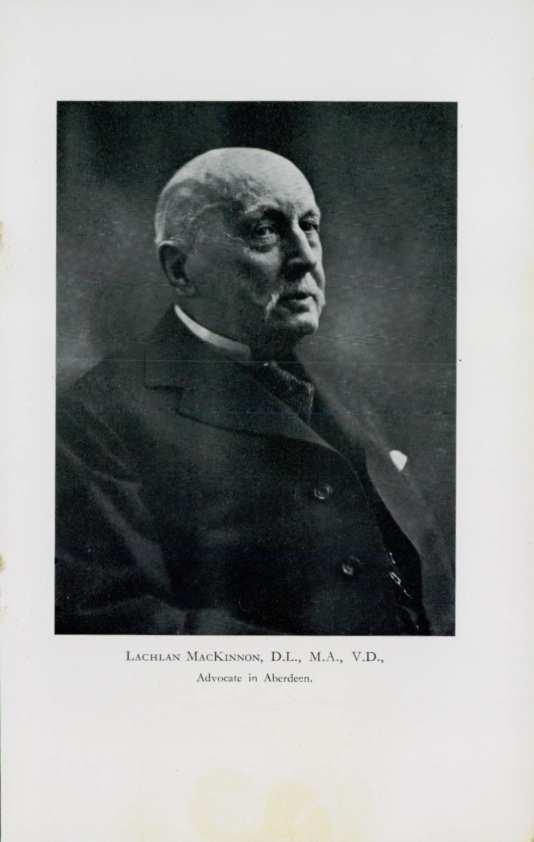
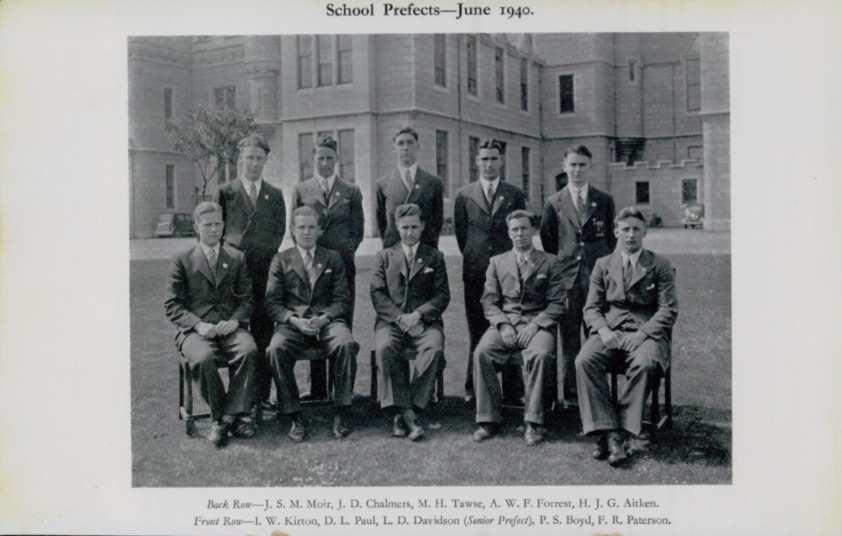
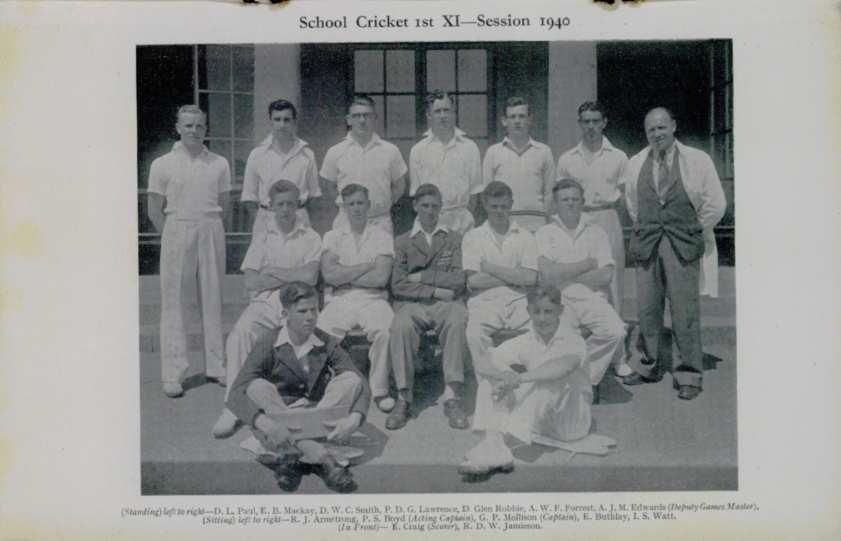
l-~•11.,,~) r,;• la ,ie~-R. J ..\rm,tnmJt, I'. S. Boyd (,tctin~ c..ptd11), c;. I'. \lolhs-m {Gopla111,.I,, llut'hla\', I, S,
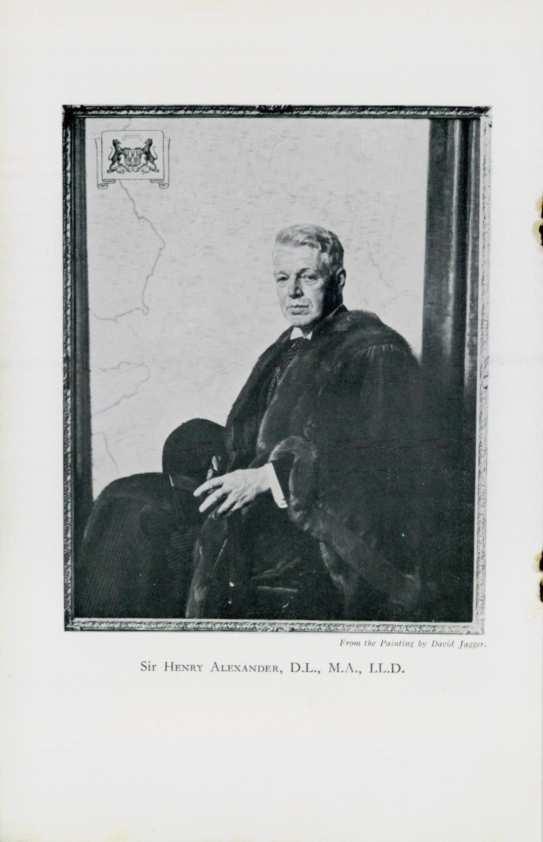
in October 1866, 28l, and thereafter the information was discreetly withheld from publication. ports and games were not olftcially recognized, and indeed there was no accommodation available for them. Speaking generally, therefore, it would be futile for me to attempt comparison in detail of the old and the new methods. The changes are not merely reformatory but revolutionary, and I respectfully think are all very much to the good. I am indeed proud of my old School as at present conducted.
I shall now tell you something of the teaching of Latin in :\[r. Legge's class, and if I use too many Laun words, you will please excuse it. It is difficult to get away from Latin in writing of that class, for its atmosphere was almost whollr Latin, flavoured now and again with a sprinkling of English and of Greek.
The Latin Version, though less engrossing than in Dr. :\feh·in's day, was rnll a most important factor. \X hen l went to the !:,chool, m} father bestowed on me the dr) and arid little \insworth's Dictionary which had sen·ed him in his own !:ichool days. But I at once found myself confronted by rival Version writers who possessed the magnificent English -Latin Lexicon of Riddle and Arnold, and the no less fine Latin-English dictionary of \ndrews. Bors were allowed to use dictionaries when writing Versions, and many boys, who couldn't or wouldn't buy the modern dictionaries, were hopelessly handicapped by the want of them. Out of curiosity I had them weighed the other day and found that they turned the scale at l k lb. each of illustration, idiom, and Roman lore. As for poor little Ainsworth - a I lb. weight would hne made him kick the beam. I had to borrow the big modern tomes from a schoolfellow and exhibit them to my father before he at length consented to mYest in them, and thereafter l bore them wearily to and from the School with my other impedimenta twice a week on Version days.
The following isa humorous incident in our Version writing. One of the boys was named Jeremiah D. \\ illiamson, a quiet and not too bright lad, who was worried at times in his social intercourse with other boys by the Christian name which his misguided parents had given him. Jn a Version set for translation into Latin there occurred the phrase " the matter was settled." I can imagine )err) consulting such dictionary as he had, and looking up the Latin for "matter ." The dictionary at once replied "pus." "That will do," thought Jerry, "it's short and easy to spell." With the aid of his Latin grammar he adjusted the verh quite successfully. However, his "Pus confectum est " was criticised by Mr. Legge as a masterpiece in Latin howlers. llut 1 doubt whether more than fifty per
cent. of the class took in the joke, for Latin was but their daily task with no fun to be got out of it.
\nother story is this-\X'e were reading the Fifth Book of the" .IEneid "of Virgil. There was a fair-haired pretty little girl whom we encountered sometimes in the street, and who would smile to the boy friends whom she knew, and why not? I remember her and her sister quite well, and think they lived in Crown Street. There are two words in the poem which Virgil often used-a noun and an adjective, and the words are " scra nox" and mean, roughly speaking, "late at night." One of the boys, named Charles Griffith, a joyous youth (whose brother is Dr. Thomas Wardrop Griffith, Emeritus Profe ssor ofMedicine
• at Leeds University, an F.P., and an old friend who comes to sec me less often than I could wish), was called on to translate "sera nox." .As he did so, the coincidence flashed upon him that " Sarah Knox " was the name of his little girl acquaintance, and he called out her name and burst into laughter, which the class echoed heartily. Mr. Legge was puzzled, and Charles was ordered to explain his conduce when the class rose, but he wasn't punished, for i\fr. Legge had a humour of his own, such as the situation would appeal to.
I have mentioned elsewhere that Mr. Legge had a taste for gentle poetry ofthe style ofThomson's" Seasons." I remember his quoting the following passage in praise of angling where the lines run :
But let not on the hook the tortured worm Convulsive twist in aRonising folds ; \\hich as you tear it from the bleeding breast Of the weak, helpless, uncomplaining wretch," ere. etc.
I quote from memory, haYing no copy of the poem to refer to. rot high-class poetry, perhaps, but sufficient to arouse in me, who was then a keen trout fisher, an enduring antipathy to the use of li\'e bait in fishing.
When skimming for the first time and for the purpose of this paper, "Memoirs of 88 Years," by the late Alexander Falconer Murison, LL.D. , I read the following statement made in an endeavour by Dr. Murison to account in some degree for the disorder which prevailed in the English Class after he became its teacher in 1869 :-
l have indicated that my collcahrue Macarchur's classes (that is the classes in Arithmetic and \1athcmatics taught by the Reverend George J\lacanhur, M.A.] were in grievous insubordination. Everybody knew it, and in the common-room we talked it over and shook our heads helplessly, for nobody, not even the Rector, could imerfere--at any rate without invitation, and invitation there was none. On ;\facarthur's dcpanure, Sleigh J\lr. l'\lacanhur's successor] at once quelled the rebellion. But, checke in the ~lathcmatical class, it raised its head in \lr. Lc!,!'_c;e'sclass, and then it invaded myclass. Till then I had nc,·er had the slightest difficulty: now I was subjected to persistent petty annoyances. It would have been easy enough co stamp them out at once bur at last the Town
Council intervened and some of u~ were summoned before a Committee," etc., etc.
The matter ended in Dr. (then Mr.) Murison's resignation.
Dr. Murison, writing of Mr. Legge sympathetically at pp. JO-p, says that :.\Ir. Legge "never had to raise a finger to check disorder ; he very seldom had to speak a word of remonstrance." That is true. \v'hy then put down the disorder in his own classroom to an invasion from that of Mr. Legge ? Be it observed that I was a scholar in Mr. Legge's class (the Fourth) in 1868-69, when there was not the least disorder of any kind, and that in 1869-70 I passed into the Rector's class (the Fifth), and attended Mr. Murison's English class, of which he first took charge in that year. Be it further observed that Mr. Legge had in 1869-70 taken up the teaching of the First Class in the usual routine and that disorder prevailed in :t,.,ir. Murison's class throughout that (his first) year. It is most unlikely to have raised its head in Mr. Legge's First Class (of very young boys). Also I would have heard of it. 1\s Mr Legge did not survive to defend his discipline against the insinuation made, I take leave to say that I don't believe in its accuracy. To my knowledge Mr. Murison himself was a kindly man, and no doubt a good scholar, but he failed fron, the firs/ to keep his class in order in 1869-70. Mr. Murison's brother, George, was the first prizeman in that year and l was the second, so that l know the facts. I learned little from Mr. Murison, perhaps because his scholarly abilities got little opportunity to show themselves.
The only masters of my day for whom I had real affection were Mr. Legge and the Rector, Mr. l\Cartin. I will, however, " snap" a gHmpse of two other teaching personalities. My first teacher of arithmetic in x870 was the Reverend Robert A. Gray, a teacher of experience who stood no nonsense. He was tall and erect, ifl remember aright, and much addicted to snuff. The School name for him was "Snuffy Bob." Two incidents only stand out in my recollection of him. The first was that, as he stooped over my shoulder to deal with a sum, a large drop from his nose fell upon my slate. He had the presence of mind to say aloud, " Hoots, min," as if 111.J nose had been the culprit, and then removed the splash with his red handkerchief. The other item is the sting of his cane, from which I received a " smart one " between the shoulders when he had come up behind and found that his pupil of ten was giggling or something of that sort. Mr. Gray's son, Andrew, who died recently, was a friendly co-pupil with me in Mr. Legge's class.
Mr. John l\Citchell, the Drawing Master, was a very gentle artist, whose pretty water-colours of scenes on Deeside, generally drenched in sunlight are in many local homes. I was his pupil in I 868 and 1869, and took a first prize for landscape drawing.
I may have been a capable.:copyist with a correct eye, but otherwise had no aptitude. I remember Mr. Mitchell pointing out with his right thumb nail (which he always applied to the drawing paper when teaching) that a curved line on my drawing wanted a little more (or a little less) fullness. I listened in silence, not being quite convinced. But he returned in half an hour and pronounced that the alteration (which 1 had 1101 made) was a great improvement. I said nothing, for :\fr. Mitchell's boys would not have annoyed him on any account
In 1868-69 I was in the Fourth Class and joined the English Class taught specially for the Fourth and Fifth Classes by Mr. John Hector, M.A. (who was then, I think, a Divinit y student) . l Ie was not fortunate in his handling of the boys, and there was much disorder in his classroom. JIe singled me out on one occasion as having taken part in a disturbance, and called me out for punishment. I strong ly denied that I had taken part, defied him, and returned to my seat. He then pronounced me to be " expelled " ; but I continued to attend the class as before, and nothing came of it. Mr. Hector resigned soon after, and was succeeded as interim teacher by Mr. George Stephen, M.A. 1867 and B.D. 1871, who became minister of the first charge in Culross, and died in 1908. From the first the boys took to Mr. Stephen, who was amiable and sensible, and they behaved like lambs during his brief tenure of office. I may add that I took the first prize for English in that same class, and was Dux of the School in the year following. I tell this (not to me agreeable) talc because, if I criticise, I ought also to be candid, in so far as candour may remain part of the make-up of a very old lawyer. There is something almost " Gilbertian " in the sequence of the incidents. They may not be for edification, but at least illustrate that the career of a budding Dux has its ups and downs, as in the case of other boys. Liberavi a,111111,,,,.
During my five years' schooling I spent many, many happy days and made many friends. These last have passed onalmost without exception. " \fay they rest in peace," and, as Thackeray says somewhere, "\\:'e, too, when our day is over."
As l write this, the news has come throug h that the Germans ha\·e entered Paris. Only three weeks ago l was basking in the sunshine in the Tuileries Gardens, waiting to hear of a boat that would take me across the Channel. Paris was as lovely as ever, save for the changes wrought in public parks and gardens by the construction of air-raid shelters, but we felt that the city had lost some of its gaiety. It was not merely that all places of entertainment had to close by 11 p.m., after which one strolled home through streets that were dark for the City of Light, although well lit in comparison with London. It was not only that Josephine Baker and :\faurice Chevalier were playing to a half-empty house in the Casino de Paris. or was it only the tragic groups of refugees that filled the stations, or the sight of numerous Belgian cars with mattresses tied on the roofs, presumably as a protection against splinters. \part from these things, one saw the Parisians going about their daily tasks with a look ofgrim determination that one had not known on earlier visits. They could still chatter in cafcs and indulge in witty repar tee-just as, a week later, I heard a Cockney newsvendor shouting : " Better news to-night ; Germans in Berlin ! "-but everyone with whom we spoke had one idea in mind : we must deal with the aggressor so thoroughly this time that there can be no recurrence of the German menace to peace.
The outward signs of war were fow. \\ e saw a few soldiers on leave, an occasional lorry-load of Bntish troops (" Voila ! des Tommies I" cried the french girls) and dozens of war correspondents-or else the same half-dozen crossed our path very frequently. Twice during our four days of waiting tht: cafe in which we were was surrounded by a cordon of police, and identity cards were carefully examined. In the cafes, too, everrthing had to be paid for immediately ; certain customers had found air-raid warnings a convenient opportunity for slipping off without paying. Then, of course, there were the meatless and alcohol-less days. \s " meat" did not include veal, pork, poultry, rabbits, etc., a meatless day presented no problem at all to the ingenuitr of a French chef. The definition of" alcoho l " seemed to be even more elastic. True, on certa in days all the usual aperitifs are banned, and one is offered " Banyuls," which appeared to be a mixture of cheap port or red wine with some sticky syrup. But then one can always have a glass of champagne instead, and there is no restriction on the amount of beer or wine one drinks, so that the loss of aperitifs and ltqueurs is no very great hardship.
Living in this war-time Paris induced memories of eadier vi,its, such as that of Easter 1939, when heavy rain and some snow in the Jura ~fountains made us abandon our plan of
v1s1ting Strasbourg and the Vosges and turn our car towards Paris. That was the first occasion on which l had done more than motor through Paris, and l was pleasantly surpr ised to find that even the apparently chaotic traffic of the Place de la Concorde was not really difficult to negotiate. 1\nd as for parking-well, I don't think I eyer failed to find a place within about twenty yards of my destination. All along the main boulevards there are signs which I interpreted as meaning that parking was allowed for half-an -hour only. Having drawn up under one such sign on my first evening when going to a theatre, I asked a policeman how long I could leave the car. " Till to-morrow morning if you like " was the reply. That is an advantage of the wide Parisian boule,·ards which those who planned them probably did not foresee, but London and other cities must often envy Paris on this account.
In these days one's thoughts go back to other cities visited in happier times that now seem so far away. Many of them are in German hands, and there is no knowing how many of the buildings, parks, or collections one has admired have been destroyed by the ranges of war. The following rambling recollections of a purely personal nature may not be of great interest to the reader, but they mar gh·e some pleasure by recalling in his mind happy memories of the same or other places that are for the time being out of reach. I apologize in advance for any inaccuracies; I am writing from memorr, without an}' books of reference or any notes made at the time of my visits. First in point of time must come Brussels, which I first visited a month after it had been delivered from the Germans in 1918-and now it is occupied once more. 1t was then extremely gay, with that rather unnatural, hectic gaiety that follows a period of strain, and the British "saviours of the country " were given a great welcome-at least until the wealthier 1\ustra lian and American troops ousted us from favour I As we had quarters in a country house which had a fine ballroom, we organized a dance and sent lorries to fetch the ladies, duly chaperoned ; this noYcl, if uncomfortable, mode of travel probably delighted them more than a fleet of limousines. .\t that time l knew no dances sayc the Sailor's IJornpipe, the Jlighland Schottische, and others taught at dancing classes of my youth, but a fdlow officer from Dundee coached me for a week in the Viennese waltz. Alas ! I found that it was not danced in Brussels society in December 1918. IIowever, I had many interesting talks, including one with a girl who had helped Nurse Cavell in her work. About that same time an important ball was given in Brussels, to which each British unit in the neighbourhood was invited to send one ofliccr. .As the Prince of \X"ale~ and the cream of Belgian society were to be
present, competition was keen. I was not the lucky one in our battery, but in view of my inability to dance 1 did not mind. Incidentally, I never saw the Prince of \'\'ales until 1934, when some ladies with whom 1 was stro lling throllgh Biarritz caught sight of him sitting outside a cafe with the lady who is now Duchess of \X'indsor
On a second visit to Brussels in 1930 much of the glamour with which a youth unused to cities, except for a few months in Aberdeen and in Edinburgh, had invested it seemed to have gone. It looked rather grimy and provincial, and a killjoy spirit seemed to animate the authorities. But the old Market Place still remained one of the beauty spots of the Cominent; there are many squares with one or two fine old buildings, but I know of none that contains such a perfect, harmonious group of buildings dating back several centuries, many of them individually of great beauty.
The country round Brussels, except for the Bois de la Cambre (corresponding to the Bois de Boulogne in Paris) and the Pare de Terveuren, is flat and unintere sting. But one place in the neighbourhood stands out in memory - the Chatcau de Gaesbeek, a fine old castle with moat and drawbridge and some very valuable pictures. I recall in particular one (I think it was by Van Dyck) of a lady in a white satin gown; I have never seen the sheen of satin more wonderfully rendered ,I( * *
Mention of painting makes me wonder what has been the fate of the Rijksmuseum in Amsterdam-that wonderful collection ofFlemish art, with the hundreds ofportraits ofworthy Dutch burghers, in which the beautifully painted delicate lace ruffles contrast oddly with the heavy, placid faces; there also was Rembrandt's "Night \Vatch," and many delightful snow scenes and genre pictu res by Ilreughel. Have they been destroyed, or \viii they be carried off to grace the Zwinger in Dresden or the Pinakothek in Munich?
Surely these galleries have such a wealth of treasures already that the Amsterdam collection, if unharmed by bomb or shell, may be left.
Amsterdam is a pleasant commercial city, through which one may pass very agreeably by motor boat along the innumerable canals. One thing that puzzled me there was the existence of gibbet-like beams projecting horizontally from the tops of the houses. On investigation l found that Dutch doorways are so narrow that it is a marvel how anyone so huge as the average Dutchman or Dutchwoman of a certain age ever gets through (having no sideways, as the old lady said), and consequently furniture is slung up by tackle attached to these beams and is passed through the windows. It is to be hoped that removals take place in fine weather.
Perhaps the feature of the Dutch character that strikes the visitor most forcibly is the pride they take in their homes. In
city flats a spring cleaning seems to take place every day, and the poor maidservants appear to be washing and polishing from dawn till dusk. On country roads the villas and cottages are repainted externally every year, and the paint work would seem to be washed weekly. No wonder the clean, bright colours of those houses, supplemented by the gay Rowers in the gardens, lend so much charm to the Dutch landscape, which in itself is often monotonously Aat, although parts of Holland are covered with pleasant woodland.
Again it is painting that sugges ts the next memory. The mention of Breughel above reminds me that there is a very fine collection of his works in the Vienna Art Gallery. It is difficult to write of Vienna without lapsing into a nostalgic sentimentality. I think the climate of the place must be at least partly responsible for this. Surely it is the climate that induce s that Scblamperei-a kind ofslackness, with a fatalistic acceptance of what life may bring-which is characteristic of the Viennese and which also affects visitors to the city, as witness this experience . I think I may claim to be a fairly hard-headed Scot, brought up since the age of two in Aberdeenshire, although born farther North; I am reasonably careful about moner, and friends often chaff me about the fact that I like to carry £2 or £3 around with me, whereas many men seem obliged to borrow ten shillings when suddenly faced with the necessity of inviting a friend for a drink or are unable to pay a live shilling subscription when visited by the treasurer. I know about it, because they borrow from me I \'\'ell, in Vienna [ found myself one evening in one of the city's thousand cafes with a friend (a Celt from :\orth of Inverness). .\fter settling up, we found we had about a shilling between us, and we didn't know when supplies from home would arrive. Anywhere else, I am sure this would have troubled me, but in Vienna we simply said : "\'('ell, it's enough for our mid-morning coffee to-morrow, so we needn't worry." 1 should add that an Austrian who was with us and who knew nothing about us except that we had suddenly arrived from Germany and applied to join a holiday course that was just starting, at once offered us a loan and was so hurt when we declined that we eventually accepted it.
The holiday course (in German Ferie11k.J1r.r, but refem:<l Lo with some justification by the lazy ones among us as the fail rien course) was intended for British teachers and students, and some of those who attended had very little knowledge ofGerman. Many of you will know that the usual Austrian greeting was "Griiu Golt "-l wonder whether this verr pleasant formula is ever heard now. Anyhow, one member of the course who had heard it several times without understanding it made a gallant attempt by replying: "Great Scott, / Terr ProfessorI"
Vienna still is, and 1 think always will be the city of my dreams, as the waltz-song calls it. \X'hatever may be the fate of Austria at the hands of those who remake the map of Europe after the present struggle, I am certain that when Vienna is released from azi domination, it will once again be the same city of charming, cultured people, haunting music, quiet humour, gracefu l idleness, and gay enjoyment of the moment, even in face of hardship and suffering-a city of such entrancing characteristics that one forgets, or rather comes to sympathize with, that Scblampmi which is so despised by the cold, efficient Prussian from the hard Korth, where, to quote an eminent German economist, " when it isn't cold it's raining and when it's dry it's freezing, so that there's nothing better for people to do than their confoun ded duty." When that time comes, there is one way in which I am looking forward to getting my own back For years, when I have praised Vienna, I have heard the retort: " Ah, but you didn't know it before the war," and undoubtedly Vienna has lost in the Imperial Court something colourful chat was a very essential part of its charm. In future I shall be able to make the same remark to those who only know it after the present war, but I am sure that my love for Vienna and its people will remain unchanged. One's affection for a friend docs not lessen because the friend becomes poor and is obliged to ....-ear shabb) clothes . Vienna radiates from a centre, St. Stephen's Cathedral, and this fact has been utilized in one little practical respect that may be worrh mentioning. All the streets chat radiate from that centre arc numbered from there outwards, and the name of the street at each corner is marked on a rectangular plate. All the cross streets have oval plates A stranger who gets lost and finds that his street bears an oval plate has therefore only to go to the nearest corner, turn into the street with a rectangular plate and follow the numbers in descending order ; he can be sure of returning to the heart of Vienna. The inner city, lying within a radius of perhaps a quarter of a mile from the Cathedral (if my memory serves, the radius is longer to the orth and shorLer to the South, the Cathedra l not being exactly in the centre) contains most of the districts and build ings of historic interest and is bounded by the Ringstrasse, a handsome, wide boulevard constructed, 1 think, about 1860. Trams go round the Ring, but none penetrate into the inner city, where many of the streets arc narrow and unsuited for much traffic. ]ndeed, in many parts one could stroll round the inner city in comparative peace sa,e for the pleasant voices of those selling their wares in the markets held in the old squares J!ere and there around the Ring arc numerous parks, where one may enjoy the coolness of shady trees and running water, or, in the c,·cnings, listen to the melodies of Schubert or one of the Strauss family played in the open air .My favourite
part of the Ring is that from which can be seen, one beyond the other, the classical severitr of the Parliament buildings, the beautiful Gothic City 1Jail standing a little back behind a stretch of grass and trees, the solid block of the l,.;niversity buildings and, finally, the tracery of the twin spires of the modern Votivkirche, through the open white stonework of which shines the deep azure of Vienna's summer sky by day or a rich blue velvet, studded with stars, by night. /\t other parts of the Ring are the Opera House, the huge Burgtheater, the chief picture gallery and a number of Government offices. Beyond, the rest of the city and its suburbs extend over an area much larger than that covered by any other place of comparable size (about 1,800,000 some years ago). This is due to good town-planning, the preservation of many ducal and princely residences with their grounds, and the provision of numerous parks, the largest being the Prater, which has an area ofover seven square miles and contains a permane nt fair-ground, a race-course, and miles of pleasant, shady avenues for walking, riding, or driving. If I have laid undue stress on the slackness with which the Viennese are often reproached, let me set against it the energy shown by the city authorities in their planning and in the development of social institutions and workers' housing schemes : these are so well known that I need not say more here.
In any case, l am perhaps more competent to speak on another Vienna institution-the coffee houses. These are of all kinds: cheap, expensive, quiet, noisy, but in all there was the friendly welcome, "Gruss Gott," and in many of them an enormous selection of newspapers and periodicals in practicall> every civilized language. During my second visit to Vienna Thad to work all day, and my wife was left to her own devices, but she found she could spend two or three hours on end in a cafe, read half a dozen English newspapers, all the best English illustrated papers and a variety of fashion journals, and no one expected her to order more than a cup of coffee. You don't even have to ask for literature; even before you give your order, a waiter has guessed your nationality and tastes and has brought you a selection of appropriate reading matterand he is usually not far wrong. Viennese coffee is said to be so excellent because the Viennese learned the secret from the Turks when the city was in their hands. Be that as tt may (and personally 1 am not , cry fond of so-called Turkish coffee), they certainly know how to make it. A glass of water is always served with coffee, perhaps because of the pinch of salt that is added when the coffee is being made. 1 noticed chat whenever 1 emptied a glass another was brought, so one day, egged on b) a companion, I tried to see how long this would conttnuc, but when I had drunk six glasses and the waiter had quietly brought a seventh, I gave up the struggle.
Some people who visited Vienna and Prague shortly before the Germans entered these cities considered the latter the more attractive. Possibly economic difficulties and political tension had caused even the light-hearted Viennese to become depressed, whereas the Czechs, being more active and resolute, were able to maintain an air of normal life and bustle in their capital. l imagine, too, that Prague, having a larger area to suppo rt it, was in a better economic position than Vienna, which was disproportionately large for the territory left to Austria in 1919. Certainly, when l was in Prague in 1937 the city appeared to be flourishing, and l was struck by the number of people in the streets. In my week's sray J had little time for sight-seeing, but a few scenes glimpsed in passing remain in the memory. There is the dark bulk of the Palace (formerly occupied by the President) , and the Cathedral on the hill rising above the River Moldau ; on the other side of the river is the Market quare with a very handsome Town Hall. One of the most interesting buildings is the Jewish synagogue, said to be the oldest in Europe; it is a tiny place, half underground, because when it was built the Jews were not allowed to erect any edifice more than a certain height (six or eight feet, T believe) above ground level. Beside it is a clock with 1fcbraic numerals on the facethe only one of its kind l haYe seen.
One day I came upon a large open-air market with a tremendous variety of fruit, Yegctables, and other goods. I wondered whether there was any special significance in the fact that two adjoining stalls were selling mushrooms and funeral wreaths respccth·ely I Prague is the only place in which I have seen a person fined for jumping off a moving tram; one unlucky offender jumped off within a couple of yards of a policeman and was fined on the spot a system that was formerly used (and perhaps still is) in German) for minor offences, such as riding a cycle without a light, walking on the grass in parks, dropping litter, etc.
Prague seemed to me to be a city of middle-class folk and workers, with very few "idle rich." There may have been exclusive restaurants or cafes, but in none of those I tried did I see much sign of wealth or luxury. Ilard work and plain living appeared to be the order of the day-and I hope I am not libelling the Czechs when I say that plain faces were also the rule. My wife and l were both struck by the lack of good looks in both sexes and by the fact that the people were so badly dressed (by which ] do not mean poorly clad). That certainly was one of the striking differences between Prague and Vienna, and the contrast was perhaps even greater with Budapest, which I would rank with Paris and Buenos Aires as the cities with the most smartly dressed women. But if the Czechs arc indifferent to clothes, it is strange that they should he (as l am told) excellent tailors and, at one time at least, widdy emplo)ed in that capacity
in Vienna and London, both of which arc noted for good tailoring.
One thing spoiled my complete enjoyment of Prague, as of Budapest : I could make no attempt to speak the language. In both places I got along quite well with German, but I object to having to ask the waiter to translate the menu or to being obliged to find an interpreter to explain to the bus conductor where I want to go. Ilowever, this is probably a just punishment for the sense of superiority I ha\'e been guilty of feeling in other countries over chose who were ignorant of the language. So, being thus reduced to a spirit of humility, let me draw these reminiscences to a close with the hope that before long those cities and others I know, which arc at present in the hands of a foreign im·ader, such as \X"arsaw, will have regained their independence, and that conditions of peace and prosperity will make it possible for those of us who lmc travel to indulge in it once again.
JAMES L. MOWAT (1915-16), \1.A., Ph.D., F.l'. Consul for Switzerland.
The New Scottish Education Secretary.
The recent announcement that the Secretary of State for Scotland has appointed Mr. J. 1fACKAY T11m1~0:-. LO be Secretary of the Scottish Education Department trom 1st August 1940, in succession to Sir James Peck, is of special interest to the Grammar School, as Mr. Thomson is a former Rector. Although not himself an F.P., Mr. Thomson is the son of an P.P.-the late Re\·. Peter Thomson (1861-63), D.D., minister of Dunnin g, Perthshire. He was educated at Glenalmond and the I.Jniverslty of Edinburgh, where he graduatc<l :\1.A. with First Class Ilonours in Classics, and at Oxford (Oriel College), where he graduated with honours in Classics in 1913. .\fter acting as assistant to Professor l lard1e at Edinburgh l.JniYenity and as Sixth Form :\faster at Fettes College, he was appointed Rector of .i\bcrdccn Grammar School in 1920, in succession to the late Dr. 11. r. Morland Simpson. I!is period at the School, however, lasted for only one session, as in the spring of 192t he was appointed one of IJ.M. Inspectors of Schools. Four years later he became a Junior Assistant Secretary 10 the Scottish Education Department, serving for four years 10 the Lon<lon office before coming ro Edinburgh. Tn January 1935 he was appointed Senior ,\ssistant Secretary, and in September 1936, Second Sccrctarr. He is still remembered in \berdecn for his high ideals, his ability, and his charm of manner. \\ e offer him the School's sincere congratulations on his promotion.
Remini scences of 1884-1886.
Ilaving been invited by the Editor of the Aberdeen Cra1111110r School li,1agazine to write some more of my reminiscences of fifty years ago l readily do so, though there are many of my classfellows, fortunately still alfrc, more competent than 1 am to recall and to record our, common experiences of the years 1884-90. As my recollections are personal, I hope to be pardoned if they appear somewhat egotistic .
\X'hen I came up from Edinburgh to join the Grammar School in 1884 I was struck by two characteristics of Aberdeen schoolboys . 1 had never heard such swearers, nor had I eyer seen such " bonnie fcchters." I shou ld think that a fight took place at least once a fortnight, if not once a week, behind a certain round building, surrounded by a wall, the whole encircled by a dense clump of trees-the recognized battleground of the School. The wood and round building have long since disappeared, and only the ghosts of former warr iors now haunt their chosen preserYcs. l well remember two brothers, with fists like small soccer footballs, who thought nothing of absenting themselves from our class, without leave asked, to practise their beloved art of fisticuffs behind the round building 1 have mentioned, and who, cheered and refreshed by their encounter, would return with damaged eyes and cut lips to resume the places they had temporarily vacated.
w·eu, one day in August 1884 I was taken by my father to be enrolled in the Grammar School, and was ushered into the sanctum of the Rector, Dr. James Moir. I may say that special]r at that time my father had good reason to take a despondent view of my scholastic attainments, and to regard my Latinity with snorting contempt. \X'hat despondent fears may have crossed his mind when Dr. Moir (he was Mr. Moir then) asked me the Latin for " a black dog" 1 can only guess at; but l well remember both his astonishment and his relief when l replied, Ca11is 11igerI l was promptly assigned to the Middle Second, a rather unruly class.
Of our teachers in 1884-8s some arc now but shadowy memories - Green, famous for his prowess with the tawse, and Crow and Farquhar, young men who united teaching with their studies to obtain the means to carry them through the years to a degree. Poor Crow died shortly after, I believe. John 1icol Farquhar was a f'irst Bursar, a fine classical scholar, and, ultimately, a very distinguished Tndian missionary, whose premature death was deep!)' deplored. Alas, my contact with him, shall I call it, when he was on the staff of the School and was endeavouring to put some Latin into me, was a dose of the tawse, because of my total inability to extract from the classic page any truth at all about a hen that was alleged to lay golden eggs. However, long afterwards, I was able to remind
Aberdem Gratnn1ar School
him in Delhi of that trouble-bringing hen, and to assure him bow feelingly I had entered into something of Sir Roger de Covcrley's reverence for the great Dr. Busby! "A great man, a very great manl "
Our principal teacher was Mr. James Morison, of happy memory, irreverently (but in no unkindly spirit) known as "Nosie." One of his cheeks appeared to have been injured at some time or other, and his nose to have been broken. One arm, too, was stiff: yet that was the arm which wielded the tawse he possessed-a quite contemptible instrument . It may be ofinterest to note, in observing how strangely run the speculations ofboys' minds concerning their Masters, that the explanation of poor" Nosie's" accumulated deprivations which was current among us was that he had been a soldier in the Crimean \Var, and that a cannon-ball had shaved his cheek, and in some curious way had curved round and damaged the nose! Mr. Morison taught us Bain's Smaller English Grammar (detestably dry), English Literature in the pages of the "Vicar of Wakefield" (which we unanimously regarded as " tripe"), History, Geography, and, I think, Arithmetic. This old bachelor had a genuine liking for his class of care-free boys, and I well remember how, with a characteristic sniff and a kindly look, he would ask one of us, say, " \X/ell, my little min" (always " min "), "what arc the products of Dacca ? "
But much as " osie" was liked, he had a formidable rival for the first place in our affections in Samuel Pope, our far-famed Writing and Drawing Master. He used to draw on the blackboard the most wonderful sunflowers for us to copy. Even Spottiswood Duthie, who, as a senior boy, sat in solitary state behind our class, and who drew pen-and -ink sketches of 1 elson's ships of the line which we all co,·ctcd, was obliged to acknowledge the eminent work of our master's art and handiwork. The order in the class was often good, and sometimes just so-so. A cheery buzz prevailed in the room Now and then the tawse landed on a desk before some extra loud talker, who was invited to bring it back to Mr. Pope. It was returned much more slowly than it was despatched. Justice having been appeased and quiet restored, work was resumed on the sunflower, until irrepres sible youth caused fresh annoyance to our long-sufferin g but always sweet-tempered master. Darts manufactured out of our pen-nibs, and deftly feathered with paper, were fired about in a discreet manner. Once \fr. Pope was struck : he thought inadvertently. But about petty personal annoyances he cared little. At such times he would burst into improvised doggerel, such as,
\\ illiam Garvie, Do not act like Barnet Harvey, or,
George Foggo, Do not tca,e me ~o!
Samuel Pope taught us well in his breezy manner, and, to this day, Tuesdays and Thursdays, which were our days for writing and drawing in those far-off times, are favourite days of the week with me.
Boys always have heroes, and the School was divided into two camps, the partisans of Erskine Jameson and the followers of Barnet Harvey. The former is still with us, the highly respected former Clerk for the County of Moray; but Barnet Harvey has long been dead. I was a follower of Barnet Harvey, and that is why I remember very vividly his defeat by Erskine Jameson in the 100 yards' race in the School Sports of 188 5, contrary to the prognostications of the prophets. That was one of Lhe finest races l ever witnessed, the fair, slight winner, and his swarthy rival pounding along by his side, shoulder to shou lder, till an extra effort gave Jameson the prize, won by a split hair from Harvey. How earnestly Erskine Jameson ran! JIis friends will tell you that this was characteristic of his work in the real race of his life.
A word of kindly remembrance of Barnet Ifan ey. Short, dark, good-looking, a broad-shouldered boy in ample knickerbockers, he was approachable, and very likeable, and extraordinarily decent to the small boys. His smile curled up to his laughing eyes; and, indeed, laughter was never long absent from his face. His followers worshipped him, and chiefly the small boys. He was supposed to be very rich, because he wore a heavy gold signet ring, and at lunch time did an extraordinary thing- he bought three buns, which he did not eat, but broke into pieces which he fired off in a playful manner at this friend and at that! I think he was preparing for the Army, for, in the year 1886, while we were being instructed by a certain " Mac" in the Rector's classroom in Classical Geography, Harvey sat far behind us, thoroughly enjoying the " scenes " enacted before his eyes, and imperishably impressed on the memories of all who took part in them. l may add that Harvey was the idol of our football "fans."
While on the subject of boy heroes let me say a word or two about Anthony ~litchell, afterwards the Scottish Episcopal Bishop of Aberdeen, and Joseph Jobberns, subsequently Dean of the Diocese of Brechin in the same Church. As boys they were inseparab le, a cheerful pair. The former was an " allround man," able in the sense that he did anything well which he undertook to do. He was an excellent scholar, cricketer, and footballer, the type of boy who is made Captain of the School in an English Public School. .At the Grammar he was Captain of the cricket and football teams of 1881-86. Wnile Mitchell was plump and broad, Jobberns was tall and lanky, a fair scholar and fair cricketer. How trifling are many of the recollections of past days stored up in one's memory I For example, 1 sec Mitchell and Jobberns walking up to the wicket to practise-
it had but recently been relaid with turf-and T hear Mitchell make a remark to which Jobberns responds with "Pourquoi?"
While football and cricket were our chief games, one recalls other sources of physical exercise and amusement than these stock athletic recreations. Gymnastics I always detested, and I recall our instructor, Sergeant Black of the 7th Hussars, and his " 'ock swing off," with little joy, excepting the all too brief period when he was permitted to teach us to dig trenches and fight sanguinary battles with fencing sticks, in defending or assaulting these earthworks.
There was one form of exercise in which we indulged which was sometimes carried to questionable lengths. This was the play of" Bobbies and Thieves." During the forty-live minutes of the lunch interval the bobbies chased the appointed thief over a considerable part of Aberdeen. Every street and lane within half-a-mile of the School was known to us. We had an intimate acquaintance with the Denburn, both open and underground. Even streets further afield than half-a-mile were familiar to us. One of these hunts I remember very vividly. The "thief" of the day had the nickname of" Smeesh." He was pursued down Albert Street, onwards by \Xiaverley Place to Alford Place, the " bobbies " being some forty yards behind him. \'v'hen the latter reached \lford Place there was no sign of Smeesh. \X'e looked up and down the street; clambered up walls to see if he were hiding in some garden ; examined lanes ; and peered into umbrageous trees ; but all co no purpose. Smeesh had vanished and had left not a trace behind I Not till long afterwards did he disclose his successful manceuvre. Realizing, as he turned into Alford Place, that he was hard pressed, Smeesh looked around for a way of escape. llis quick eye observed that the door of what is now Dr. Semple's residence was open. He skipped up the steps, entered the house, and quietly closed the door. Fortune aided him, for there was no one in the passage! Ile turned the handle of the first door on the left, and found himself in a bedroom with a window looking into Victoria Street. Fortune did not desert Smeesh. His presence in the house had not been detected l Through the window he beheld the chase streaming hard after him. \X'hen his baffled pursuers had passed, Smeesh coolly opened the window, leapt out, and, vaulting over the railings, doubled on his tracks, and so escaped. However daring Smeesh had been, his conduct was most reprehensible, and cannot be excused. It had been better to be captured by the sham " bobbies " than to be arrested by the real police. Luckily for our "thief," he escaped both( Reverting to our more legitimate and reputable games, T should like to record three incidents which made a deep impression on my mind at the time. In a match with the omads, 1 saw a classic duel between Johnny Gillandcrs and "-Jorval
Clyne for possession of the ball behind the chool goal line. Despite his utmost efforts, Clyne could not get the ball to the ground. Plucky Gillanders tussled long with his much heftier opponent, and at last succeeded in wresting the ball from Clyne and in touching down, but at the cost of broken ribs. Then, I recall a grand drop-kick, when \{. M Duncan, playing at the Grammar School field, landed a beautiful goal from his own 2 5 flag-a long, low kick. Finally, I witnessed ".Bottomless " punt a rugby ball clean over the School-a remarkable performance. Oh, "Bottomless," where art thou now? These tales arc 1101 myths. \\'hat is, or was, a myth is that I, the present writer, once dropped the football o, er the School l Such a drop-kick would be a miracle indeed. Of this legend l heard for the first time fifteen years after I had left the Schoo l, and, of course, I promptly killed it. Thus it is that admiring small boys magnif1 the deeds of their ciders and heroes.
All schoolboys arc given to the practice of conferring nicknames on one another. In doing this, certain principles arc followed. One of these principles is the Law of Opposites For example, "Bottomless " was so called because, posteriorly viewed, he belied his name. Similarly, my bosom friend with a head of carroty hair (used by him as a pen-wiper) I dubbed "Corvus." Happily, he has survived to this day; and, though his golden head is now grey, his heart remains as true gold as ever
Another principle was religious in character. We had some Roman Catholic boys in our class. They were solemnly addressed as "Father "-Father ~[athieson and Father Thomson. Other Catholic boys were often called "Brother." So, too, were Protestant lads
Others were known by attributes which they were supposed to possess. Thus a particu lar boy was known as" kid," because he could assume a look of simplicity and innocence, though who that heard him disclaiming responsibility for some mischief done in "Nosie's " classroom could ever forget the infinitely sly gravity of his look when he made answer, " oser "l Similarly, a boy with a sweet tooth was called "Toffee."
A fourth principle is based on the Law of Resemblance, whether the resemblance found be real or fanciful. \v'e drew no fine distinctions. Because Robertson and Robinson sound much the same, I was known as " Crusoe." So, coo, a country lad whose name was Campbell was nicknamed" Dromedary."
\'fM. G. ROBERTSON (1884-90), .:-1.A., D.D.
" \'fc aim above the mark to hit the mark. Every act bath some falsehood or exaggerati on in it."
The School's greatest loss for many years occurred with the departure of the Games Master for active service. 1Ir. Macgregor has been with the School for z I years and has raised the standard of its sport, especially rugby, to the level of the best schoo ls in Scotland. In conveying to Mr Macgregor the School's best wishes for the future, we would voice our pleasure and satisfaction that Mr. Edwards has taken his place. o happier choice could have been made, for he knows us thoroughly and we, no less, know his gifts as a master and a sportsman. > * *
Our friend across the water did not, alas, prc, cnt the usual School contingent from storming the placid precincts of the Mitche ll Ilall. ,\bout fifteen of us sat the Bursar} Comp., and usually reliable sources confirm that all survived. \X'e were pleasantly surprised to meet "Finny ," a misguided youth who discarded the red, white, and blue for the " vain, transitory splendours " of a southern seminary. One of our number, who seems to indulge 10 veritable orgies of B.C.s, is, at the time of writing, in St. >\ndrews-we wish him the best of luck.
This term an excellent rendering of" A ~[idsummer '-Jight's Dream" was given by the students in their Lnion. \X'eattended it at various times during the run of three days, and were somewhat astonished to sec a diminutive band of seven fairies taking part, whose ages, we should judge, ranged somewhere between two and three. The producer (of the play, by the way, and not of the fairies) most aptly described these young maids, in a speech at the end of the performance, as " undoubted actresses in the bud." \\ e "vere relieved to learn from the programme that they were not yet students of the University. * * >I
A notice has recently appeared at the Lodge prohibiting the passage into the grounds of vehicles conveying pupils to the School. This has lifted a weight from our minds, as we were constantly in fear and trembling that we might be run over. But whether the notice was produced in order to safeguard our lives or merely to encourage the growth of the youngsters' legs is a moot point. "' *
The occupation of our Pavilion by \.R.P. personnel at one time gave rise to serious doubts as to whether our annual ~ports meeting could be held. But, despite the difficulties, it was

finally decided, in \"iew of the popularity of the event, that it should be carded out on as nearly norma l lines as possible. Unfortunately no teas were available; hut the provision of a canteen and unlimited supplies of ice cream more than compensated for this slight set-back. * * *
Congratulations are due to Mr. Edwards and the Sports Committee on the magnificent way in which they carried through the Annual Athletic Sports under extremely difficult circumstances. \X'e congratulate also F. R. Paterson, who was Senior Champion, and D. W. C. Smith, who, in addition to being Junior Champion for the second year in succession, broke three School Records.
* * *
At the beginning of the Summer term it was decided to form a First Aid Corps, and a most heartening response was made. Over forty boys attended the opening lecture, and though a slight suspicion pervaded some quarters that this was due more to the golden opportunitr of absenting themselYes from School than to an honest desire for First Aid knowledge, yet the examination results prove che genuineness of their intentions. Dr. MacDonald was an interesting lecturer, and some incidental information that we picked up included an ingenious method of reviving unconscious patients by a soda-water bottle, and a recipe for a hair fixative. \'('e trust chat the latter was not intended by way of a gentle hint on our appearance. * "' *
Owing to the recent military operations on the Continent some doubt was cast on the advisability of holding the 1\nnual Masters 11. Boys Golf Match. It was decided, however, that if che situation did not worsen, the fixture would be carried through. But we must say that we had some difficulty in understanding the hesitation when such an enthusiastic band was so ready to help in the Dig for Victory Campaign!
"'
The age of chivalry is not yet dead. One glorious day in the month of - [no information to the enemy], a lady member of the staff led her youthful flock to the warm depths of the School Garden, where, as she was about to seat herself upon the soft grass, a youth sprang forward and with a flourish laid his blazer upon the sward at her feet. Graciously accepting it, she smiled-" Thank you, Sir \X'alter!"
* * *
Owing to the national emergency, arrangements have been made for schoolboys to work at farming and forestry. Last summer many Grammar boys helped during the harvest and came back bronzed and enthusiastic. This summer the response was so overwhelming for forestry that the required numbers
were far exceeded. In the Grammar School the total for forestry alone approached So, but we notice that many have scratched on hearing that the " limited pocket-money " is to be a half-crown a week I
The School is pulling its weight nobly in the defence of the nation. Several of the senior members have given their services as Local Defence Volunteers, and a few have already been on guard at key points in the city. Fifty per cent. of the editorial team may now be seen ferociously brandishing a rifle-a real rifle, mark you I-in the B-- vicinity : but in spite of the murderous gleam in his eye, the younger boys seem to fear him not a whit. Nay! they even appear to find something f11nn_y in his appearance. But the resulting glare of menace certainly bodes no good for stray parachute troops who may cross his path.
* * *
A request was recently posted in the corridor asking that pupils collect the " face cream containers, aluminium and lead capsules from whisky, wine, and champagne bottles." Sisters (and other boys' sisters) find that not only the cream but the lids are vanishing. We must further affirm that there is little truth in the prevalent rumour that a certain youth brought down parental wrath by drinking the contents of bottles in order to collect (so he said) the tops.
We are still tingling with a glow of interna l satisfaction after the most notable cricketing achievement of the term-a cutting victory over we-won't-mention-the-name College. The finish was probably the most breath-taking we have ever witnessed. Sixteen runs to win and our last man was making his way to the wicket. The large crowd was tense and expectant, hushed by the import of the moment. For fifteen minutes Fate played cat-and-mouse with us. Then came the tremendous finale. The ball cracked across the pitch; one run-two-and the pent-up emotion of the crowd burst forth in a mighty roar of applause as the batsmen hurled themselves into their creases for the winning run.
On Tuesday, 21st May, Sheriff Laing honoured us by delivering a stirring speech on the subject of "Savings." Facetious " barbari " would probably ridicule the addressing of an Aberdeen audience upon such a topic, but the appeal had its result.
On the first morning of every week there can be seen proud youths jangling green metal boxes before their comrades, who are compelled to " fork up " at least a penny in aid of the Red Cross. The Senior Class of the School, however, has never been
Abtrdem GratJ11JJar School Magazine
able to amass more than fi\·epcnce. This is so distressing to the Charitable Cheerr One that he is compelled to drop penny after penny into the box to make up the deficiency
We wish to congratulate the following on their being awarded Cricket Colours : D. L. Paul, I. S. Watt, D. G.Robbie, P. S. Boyd, E. B. Mackay, D. \X'.C. Smith, 1st Colours; A. \YI. F. Forrest, E. Buthlay, and R. J. Armstrong, 1st Half Colours; A. D. R. Fiddes, K. G. Peters, J. Scorgie, and G. Reid, znd Colours.
We declare that we are becoming quite bewildered in our endeavours to keep track of the recent crop of changes in the School Staff. Miss I. Mackinto sh, who now fills the vacancy left originally by ~fr. Maciver, has the unique distinction of being the sole lady teacher of the Uppe r School. In place of l\fr. Morrison, also gone from the Mathematics Department, we now have Mr. A. Henderson; in the Primar y Department, Mr K. Paterson is assisting Mr. Edwards, who has now to attend to sports duties over and above normal functions ; finally, Miss S. Forsyth and Miss II. .Matthew have come to fill vacancies in the Kindergarten Department. We wish them all a happy stay in the School.
\v'hile engaged in research work recently, some scientists of the Sixth discO\'ered a large quantity of tadpoles lazing in a glass tank in the "Lab." Desirous, no doubt, of making the creatures imagine themselves back in the Stygian depths of the sea, the heartless wretches added ink (School ink I) in liberal quantities over the unfortunate batrachian larvae. Finally, a label bearing the words " /10 Tadpoles " was pasted on the glass, being a mysterious formula whose deadly nature isknown only to the evil alchemists themselves. W/e shall draw a curtain, gentle reader, 0\er the fate of these denizens of the deep.
We were deprived of yet another annual event, when Empire Day fell on one of the " Central School's days." This was to some extent atoned for by the earlier commencement of hostilities in the Masters v Boys cricket feud at the Field. The Boys' score was not inconsiderable ; in fact, it was the highest for several years, and a win was expected with some degree of confidence.
This hopeful feeling was encouraged by the speedy exodus of Mr. Eddison (did we hear someone quack?) and of his partner. Then Messrs. McCrea and Edwards took charge of the game . all we can add is that we cannot see the Boys' gairung a victory for many a long year to come.
MOTOR CARS CONVEYING PUPILS TO SCHOOL ARE REQuESTED TO STOP HERE.
Such was a notice that was posted on the main gate. The cars did not stop. The notice was altered toMOTOR CARS CONVEYING PUPILS TO SCHOOL STOP HERE.
Still the cars came. Once more the notice was alteredMOTOR CARS CONVEYING PUPILS TO SCHOOL MUST s·roP HERE.
The augmented imperative was effective. The cars stopped! It serves to show what can be done when suitable methods are employed.
Since School beat Gordon's College at rugby away back in 1938, the School Editors have had to refer to various defeats inflicted by the latter upon School teams as "minor mishaps," "untoward events," and " unfortunate incidents." They have also refrained from mentioning definitely the College name. But this term, how are the fallen become mighty! We have achieved successes which give us the right to hold our heads high once more. \X'e could gloat : but no. Let it suffice to say that we have out-paced the Gordon's relay team twice (last accomplished when J. R. W. Catto, Scottish Uni,·ersity sprint champion, was at Schoo l); we have out-driven and out-putted them at the Royal and Ancient game; and the cricket- Ha! the cricketl-but you can read about that elsewhere. The "sands of fortune are changing," the "Seven Lean Years" are passing.
* * *
This ends our labours (from time to time they have been labours indeed I). For the last five years we regarded those exalted personages, the School Editors, with wonder and awe: we read with great enjoyment the" School and Random ·ores" and laughed at "the funny bits." But little did we realize wlut a "sair trachle" these same notes could be. The lastminute rush before going to press, the feverish racking of brains for ideas, and the awful suspense upon opening the new issue of the "Mag" to see what the Notes are like-all these are but a few of the factors that have chased away the last shreds of glamour which we had thought to surround the m}•sterious " den " of the otes Eds. But it has been good fun. And now the race is run; it only remains for us to say "Good -bye" to our School, and to wish it the best of luck in the years to come. "Toutes choses se meuvent aleur fin." •
School Sport in the Summe r Term.
Up to the time of writing the War has had no adverse effect upon School Sport during the Summer term. Games have gone on as usual, despite curtailment on successive Saturdays recently, when School has been in session. Swimming alone has suffered, it having been decided not to hold the annual Gala at the Corporation Baths owing to the inadvisability of assembling a large crowd in a comparatively small building. The only swimming event of importance was the meeting with Gordon's College at the College pond. Labouring under the disadvantage of lack of practice, School swimmers were decisively defeated in all Relay );:vents and at Water Polo by their exceedingly skilful and well-trained rivals.
Later, however, at cricket, the School team gained a narrow win o\'cr " Gordon's " at Rubislaw, their first victory over their traditional rh·als for some three years. Even a subseque nt heavr defeat at Sea/icld did not altogether dim the glory of this achievement. The School XI has had a highly successful season to date, having won eight and drawn one of fourteen matches played. \\;'ins were secured at the expense of Dundee lligh School, rnd University , orth, Balmoral, F.P.s, Gordon's College, two Royal .Kavy Xls ; and the match with Strathallan at Rubislaw was drawn. Two of the defeats were "domes tic affairs"-reverses suffered in games with a "Rest of School" XV and with the Masters- the others being administered by a strong Aberdeenshire C.C. XI and by the t;niversity and Gordon's College. In the absence of G. P. Mollison owing to injury the School XI was effectively captained by P. S. Boyd, a quick run-getter, useful change bowler, and a player who set the side a splendid example in the field. The outstanding batsmen were D. Glen Robbie, E. Buthlay, E. B. Mackay, and Douglas Smith, the last-named being the hardest hitter School has produced for many years.
D. L. Paul, the rugby Captain, proved himself an accomplished wicket-keeper and a useful run-getter on several occasions. The brunt of the bowling was borne by Ian Watt, R. J. Armstrong, and P. D. G. Lawrence. \X'attwas most consistently effective, but both Armstrong and Lawrence showed considerable promise. The latter, a newcomer to School from \Vatson's College, is a son of a former F.P Cricket Club Ilon. Secretar}', the Rev. P. D. Lawrence, who is now resident once more in Aberdeen. A. \X'. F. Forrest and R. D. \X. Jamieson, two improving bats and very capable fielders, completed a very workmanlike team.
The znd XI, captained by K. G. Peters, probab ly School's most enthusiastic cricketer, has also enjoyed a successful season. lt is in the sphere of J\thletics that Mr. Macgregor has been most missed, but the fruits of his careful coaching are still being
Grammar Sfhool Magazine
seen. The School relay team has twice defeated Gordon's College, once at the Red Cross Carnival Meeting at Pittodric and once at the Uni,·ersity Sports at King's College. At the latter meeting the School team, captained by F. R. Paterson, gained the Evming Express Trophy. Also at the Pittodrie Sports the School gained a signal success when a Lower School relay team proved the fastest of sixteen teams entered by City Primary Schools.
The School Sports this year occupied only one afternoon instead of two. One achievement of note was Douglas Smith's record-breaking throw of the cricket ball-112 yards, 1 foot, 8 inches .
F. R. Paterson, Senior Champion, and D. W. C. Smith, Class II Champion, were the outstanding athletes at the meeting. The IIouse Championship was again won by Byron, whose repeated successes arc beginning to become monotonous, but whose monopoly may soon be ended. The Lower School Champion was a very promising young athlete, Alexander Duncan. The culminating event of the Athletics Season will be the eagerly-awaited inter-Schools contests with Gordon's College at Sealield on Thursday, 2 7th June.
A.J.M.E.
Before mentioning the present term acuvmes, I should like to congratulate the following on gaining their 1st XV Colours at tbt close of the rugby season: J. S. Duguid, J. D. Garden, J. A. S. Grant, D. \\. C. Smith and G. P. Mollison.
The officials for the present term were elected as follows : C..aptainof Athletics, C. 1\1. Ilall ; Vice-Captain of Athletics, D. L. Paul ; Captrun of Cricket, G. P. :\lollison ; Vice-Captain of Cricket, D. L. Paul.
The following arc 10 be congratulated on gaining 1st XI cricket Colours: E. B. Mackay, D.\\.. C. Smith, D. G. Robbie and D. L. Paul ; and E. Buthlay on gaming 1~t XL lfalf-Colours. One imcr-Housc cricket game has been played, and ,n it Byron defeated Keith after quite an exciting struggle.
The greatest honour has befallen Byron House this year. Not for 2 long time has one Ilouse produced both the Classical and the Modem Duxes in the same session. \\.'e heartily congratulate H. G. J. Aitken (Classical Dux) and A. W. L. Torvaney (lllodern Dux) on bringing such a distinction to the House.
To end, I should like to thank all those who have co-operated in maintaining the high position of Byron House throughout this session.
D. L. PAUL, IIouse Captain.
At a meeting of the 1lousc the following officials for the summer term were appointed: Athletic Captain, A. .M. Durward; Cricket Captain, I'. S. Boyd.
\\ c would also take this opponunity to congratulate the following on
gainin~ 1st XV Colours: P. S. Boyd; and I. S. \\au, R. J. Annstrong and R. Bell on gaining 2nd XV Colours. At the ume of wming the following are offered our congratulauons on gaining their Colours: 1. S. Watt and P. S. Boyd, 1st XI cricket Colours; R. J. Armstrong cricket l lalf-Colours; and K. Peters, J. Scorgie and A. D. Fiddes 2nd XI Colours. Dun has played one game against an augmented side and gained an easy win. I can safely say that the Dun cricket team is more than a match for the other Houses. ln conclusion, we who have reached our final few weeks at School bid the Ilouse farewell and good luck.
P. S. lloYD, H, 1m Caplam.
At a meeting of the Ilouse the following ;tppointmcncs were made : Captain of Athletic~. A. W. F. Forrest; \ 1ce-Capta1n,H. Ross ; Captain of Cricket, A. \XI. f. l'orrcst, Vice-Captain, R. D. \'(', Jamieson. Congratulations arc due to R. B. Brooker, H. Ross and A. W. F. Forrest on gaining their 2nd XV Colours and also to A. \'ii. F. Forrest on gaining has !St XL Half-Colours.
Again we have come to the summer term and cricket. Up to the 11meof wnting, we have played only one inter-I louse game, against Byron. Since B>•ron have six players of the 1st XI in their team, we had little chance of winning ; but they willingly admit that we ir.tvc them a good game.
As regards Athletics, Keith House has been very unlucky in losing its two best runners, R. F. David and J. 11. S. Moir. Those of us who arc left arc doing our best co uphold the tradnaons of the House. I may safely ,ay that in a few years' time, when some of the Lower School <talwarts reach the age of seventeen, Keith House will cause many surprises. Swimming, this year has been compelled to stand in the background, but we may rest assured that with L. M. Shutte and N. \\'.'ishart leading our swimmers we should have acquitted ourselves well.
All that remains for those of us who arc leaving the old School is to say " Good-bye " and wish you, in Keith Jlousc, better da}·s.
A. \VI. F. fORREST, Ho1m Captain.
At a meeting of the Ilouse, F. R. Paterson was appointed Athlet ics Captain, and \'\'. L. Connon was appointed \'icc,Captatn.
\'\c take this opponunity of congratulatinj! A. D. Calder, J. S. Calder and F. R. Paterson on being awarded their 1st XV ups, and W. L. Connon and J, D. Chalmers on gaining their 1st XV Colours. It will be seen that the live representatives of the House have distinguished themselves during the rugby season.
The llou<c, ho\\'e\'er, is not so \\·ell supplied with cricketers, but congratulations are due to G. Reid for his success in ~ainmg rod XI Colours.
This year the Ilouse is very well stocked wnh athletes : these should make a good showing at the Sports. lt is our earnest wish that the younj!cr members sf the Ilou•e would buckle to, and emer in large numbers. \'\'c hope that this year we shall be able to show the " House in Blue " how fields arc won.
The fact that there is to be no House Trophy nor Athletics Trophy award made no di!Tercnceto the enthusiasm of the players. Last tcnn the Ilouse team easily defeated Dun House. But we were forced to bow the knee to Dun ,n the first of a series of inter-I louse cricket matches.
We hope that next year boys will rally round the new Captain and give him all the support po~siblc, and so keep the green flag flying.
f. R. PATl:.llSON, How, Captain.
4th May, 1940---t. Dundee Iligh t 1th ;\fay-.r:. znd Tar.icy, at School, ar Rubislaw. Rub1slaw.
SCIIOOL.
D. W. C. Smith b l\lain 4
E. Buthlay b Ritchie 2
I S. Wact c Laird b ,\lain o
E. B. Mackay lbw \lain
P. S. Boyd b Main o
R. D. W. Jamieson lbw ;\lain o
D. L. Paul b Ritchie 4
A. W. F. Forrest b Tullis. 4
C. Forbes b :\lam 5
R. J. Armstrong c Sherrif b Duncan o
W. Davidson not out o Extras 17
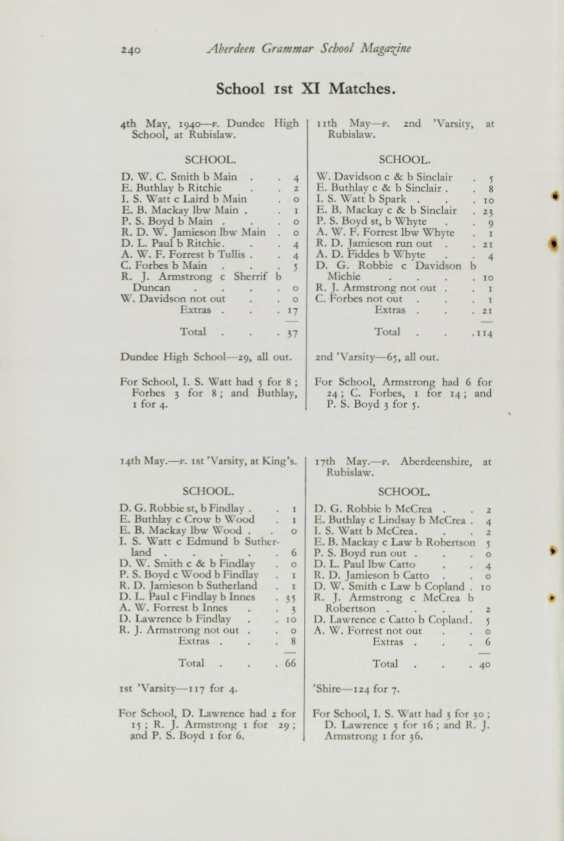
SCHOOL.
\V. Davidson c & b Sinclair
E. Uuthlay c & b Sinclair
l. S. Wate b Spark
h. B. l\lack.ty c & b Sinclair
P. S. Boyd st, b Wbyre
A. \V. F. Forrest lbw Whyte
R. D. Jamieson run out
A. D. Fiddcs b \'\"hvcc
D. G. Robbie c ·navid~on M1ch1e
R. J. Armstrong not out
Dundee High School 29, all out. znd '\'ar,,it>·-65, all out,
For School, I. S. \\',-atthad 5 for 8 ; Forbes 3 for 8; and Uuthlay, 1 for 4. 14th l\lay.-1'. 1s1'\ ar,,ity, at King's.
SCIIOOL.
D. G. Robbie sr, b Findlav
E. Buthlay C Crow b \\ ood I
E. B. Mackay lbw \Xood o
I. S. Ware c Edmund b Suthuland 6
D. \\. Smith c & b findlav o
P. S. Boyd c \'i'ood b rindl~y
R. 0. Jamieson b Sutherland
D. L. Paul c Findlay b Innes 35
A. w·. Forrest b Innes 3
D. L.'lwrcncc b Findlay ro R. J. Armstrong not out o Extras 8
Toca! 66 1st 'Yarsir:y-117 for 4.
For School, D. Li.wrcnce had 2 for 15 ; R. J. Armsrron1,: 1 for 29; iind P. S. Boyd I for 6,
I'or School, Armstrong had 6 for C. Forbes, for and P. S. Boyd 3 for 5. 17th :'-fay.-,.. Aberdeenshire, at Rubislau SCHOOL.
D. G. Robbie b \kCrea 2
F. Huthlay c Lindsay b .\kCrca 4
I. S. Watt b McCrea. 2
c. B. Mackay c Law b Roberts on P. S. Boyd run our o
D. L. Paul lb\\ Carco 4
R. D. Jamieson b Carco . . o
D. W. Smith c Law b Copland 10
R. J. Armstrong c l\lcC.rea b Robertson 2
D. La\\ rence e Catto b Coplan,I. A. \'ii. Forrest not out o Extras 6
Total 40 'Sh1rc- 124 for 7.
For School, I. S. \\ act had 3 for 30 ; D. Lawrence 3 for 16; and R. J. Armstrong 1 for 36.
23rd May.-v. North Church. SCIIOOL.
D. G. Robbie c Yeoman b Scott. 12
E. Buthlay c Yeoman b Beverly 27
I. S. Watt b Scott l
E. B. J\lackay b Allison 10
P. S Boyd lbw Beverly 0
D L. Paul b Allison 2
R. D. Jamieson b Beverly 2
D. W. Smithe Steven b Dcverly. It
D. Lawrence b Yeoman 0
A. \'(/, Forrest nor out 0
R. J. Armstrong b Ycoma~ 0 Extras 2 Total
North Church-i 3 for 6.
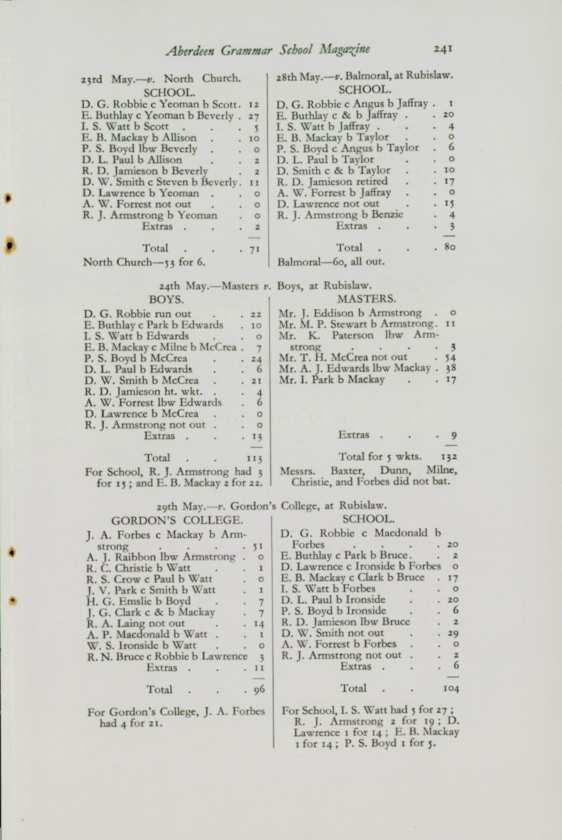
28thMay.-v. Balmoral, at Rubislaw. SCHOOL.
D. G. Robbie c Angus b Jaffray
E. Buthlay c & b Jaffray
l. S. \X'a1tb Jaffray
E. B. Mackay b Taylor .
P. S. Boyd c Angus b Taylor
D. L. Paul b Taylor
D. Smith c & b Taylor
R. D. Jamieson retired
A. W. Forrest b Jaffray
D. Lawrence not our R. J. Armstrong b Benzie Extras
24th May. :\fasters ,,. Boys, at Rubislaw. BOYS
D. G. Robbie run out . 22
E. Buthlay c Park b Edward~ 10
I. S. Watt b Edwards . . o
E. B. t-lackay c :Milne b .McCrea. 7
P. S. Boyd b McCrca 24
D. L. Paul b Edwards 6
D. \'<I. Smith b McCrea 21 R. D. Jamieson ht. wkc. . 4
A. \'<I. Forrest lbw Edwards 6
D. Lawrence b McCrea o
R. J. Armstrong not out o Extras 1;
Total 1 1 3
For School, R J Armstrong had 3 for 1 l ; and E. B. Mackay 2for 22.
Mr. J. Eddison b Armstrong o \[r. 1\1. P. Stewart b Armstron~. Jt :\fr. K. Paterson lbw Annstrong 3 '.fr. T. H. McCrea not out 54
Mr. A. J. Edwards lbw ~tackay . 38 Mr. I. Park b Mackay 17
Extras . 9
Total for l wkrs. 132
Messrs. Baxter, Dunn, Milne, Christie, and Forbes did not bat.
29th May. I' Gordon's College, at Rub1slaw. GORDON'S COLLEGE. SCIIOOL.
J. A. Forbes c Mackay b Armstrong . . . l 1
A. J. Raibbon lbw Armstrong o
R. C. Christie b Watt 1
R. S. Crow c Paul b Watt o
J. V. Park c Smith b \'\'att
H. G. Emslie b Boyd 7
]. G Clark c & b Mackay 7
R A. Laing not out 14
A. P. Macdonald b Watt 1
W. S. lronsidc b Wart o
R N. Hrucc c Robbie b Lawrence ; Extras 11
Total
For Gordon's College, J. A. rorbes had 4 for 21.
D. G. Robbie c .Macdonald b Forbes 20
E. Buthlay c Park b Bruce. 2
D. Lawrence c Ironside b Forbes o E. B. Mackay c Clark b Bruce 17
L S. Watt b Forbes o
D. L. Paul b Ironside 20
P. S. Boyd b Irons ide 6
R. D. Jamieson lbw Bruce 2
D. W. Smith not out 29
A. \'V. Forrest b Forbes o R. J. Armstrong not out 2
Extras . 6
Total 104
For School, I. S. Wall had l for 27 ; R. J. Ammrong 2 for 19 ; D. Lawrence 1 for 14 ; F. B. \ lackay 1for 14 ; P. S. Boyd 1 for S·
3rcl June.--v. Royal Naval XI, at 51h June. t'. S1rathallan, at Rubislaw. Rubislaw. SCHOOL. SCHOOL.
A. W. Forrest b Reed
R. J Armstrong b Reed
D. W. Smith b Reed
D Lawrence lbw llltlls
D. L. Paul b Oniwcll
R. D. Jamieson b Mills
I. S. Wait b Mills . .
E. B. Mackay c Casley b Mills
P. S. Boyd c Casley b Mills
D. G. Robbie not out
E. Buthlay not out
Toral for 9 wkrs. 1So
Royal Naval XI-153, all out.
For School, I. S. Watt had I for 29 ; P. S. Boyd 4 for 14; E. B. Mackay 2. for 28; D. Lawrence I for 30; and E. Buthlay 1 for u.
D. G. Robbie c Sandersman b Nicol . . .
E. Buthlay c Philp b Wilson
D. W. Smith b Wilson .
A. W. Forrest c Wilson b Nicol
I. S. Watt lbw Fulton
E. B. Mackay lbw Fulton
D. L. Paul b Nicol
P. S. Boyd c Smith b Jack
R. D. Jamieson run out . R. J. Armstrong not out
Total for 9 wkts. . too
Strathallan 112 for 8. Match ended in a draw.
For School, I. S. Watt had 3 for 29 ; R. J. Armstrong t for 2.8 ; D. Lawrence I for 2.5; and E. B. Mackay 3 for 2.2..
7th June.-11. 1st F.P.s. School, 110for 4; F.P.s, 107for 8. Match drawn. For School, I. S. Watt had 3 for 43 ; and R. J. Armstrong 2 for 27.
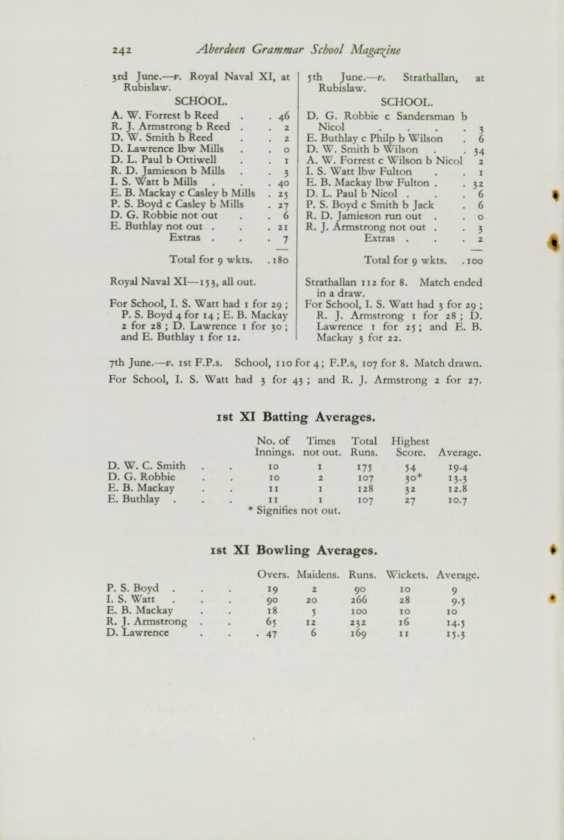
• Signifies not out.
O,·ers. Maidens. Runs. Wicke1s. Average.
GRAMMAR SCHOOL HOUSE:
SENIOR HOUSE, JUNIOR HOUSE, 8 QUEEN'S ROAD, 6 QUEEN'S ROAD, ABERDEEN.
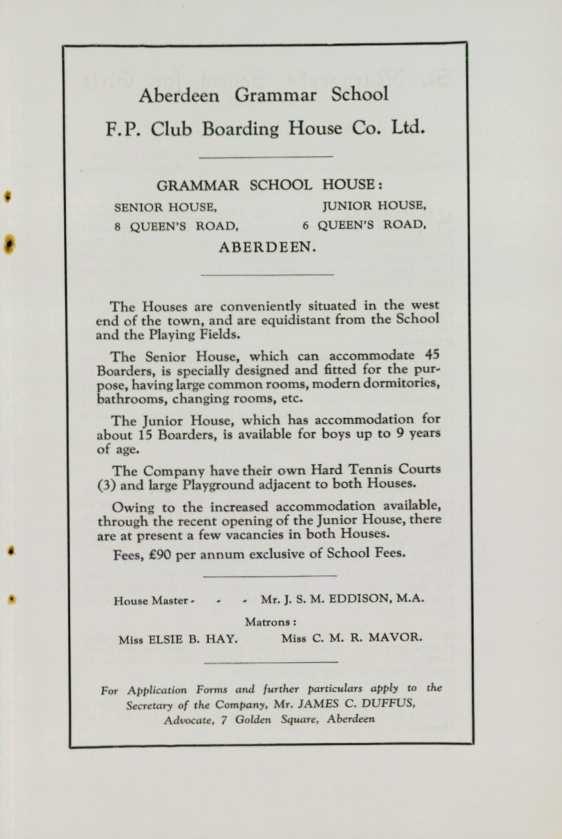
The Houses are convenien tly situated in the west end of the town, and are equidistant from the School and the Playing Fields.
The Senior House, which can accommodate 45 Boarders, is specially designed and fitted for the purpose, having large common rooms, modem dormitories, bathrooms, changing rooms, etc.
The Junior House, which has accommodation for about 15 Boarders, is available for boys up to 9 years of age.
The Company have their own Hard Tennis Courts (3) and large Playground adjacent to both Houses.
Owing to the increased accommodation available, through the recent opening of the Junior House, there are at present a few vacancies in both Houses . Fees, £90 per annum exclusive of School Fees.
House Master • Miss ELSIE B. HAY. • Mr. J. S. M. EDDISON, M.A.
Matrons: Miss C. M. R. MAVOR.
For Application Forms and further particulars apply to the Secretary of the Company, Mr. JAMES C. DUFFUS , Ad~'OCllte, 7 Golden Square, Aberdeen
Htad MiitrtJJ: Miss M. E. HOLLAND, M.A.Cantab. (Classical Tripos). Chairmanoft!MS,boolCollllril:Dr. E.W WATT, Ex-Lord Provost ofAberdeen.
ST. MARGARET'S SCHOOL FOR GIRLS is an Incorporated School, regi~ered according to the Companies (Consolidation) Act, 1908. It is admini~ered under the management of an elective Council of prominent citizens, on lines similar to those of well-known Girls' Schools in other parts of Scotland.
The School ~ands in its own grounds in the be~ part of the City of Aberdeen, and in all respeas is well equipped to secure the comfort of pupils and the efficiency of the education imparted.
The aim of the School is to provide a 6rst-class education on modern lines, to care specially for the development of charaB:er in the pupils, to prepare them for the intere~s and responsibilities of social life, and to enable those who desire it to proceed to the higher education of the Universities or to train for a career.
The School has two Boarding Houses, Nos. 6 and 7 Queen's Gardens (close to the Grammar School Boarding Houses in Queen's Road), for Senior Girls, and special accommodation for Junior Boarders is provided at Canmore House, Albyn Place. These are very commodious, well-appointed Modern Houses, in which Boarders are provided with the comforts of home and given ample opportunity both for quiet study and for the social side of life. Complete charge taken during holidays if desired. The Head Mistress is in residence at the Senior House.
SPECIAL NOTICE.-Since the outbreak of war, the two Boarding Houses have been removed to Glen Buchat Lodge and the Castle Lodge, Glen Buchat, where normal school routine continues in tranquil and health-giving surroundings.
Information as to Fees, Entrance Scholarships, Courses of Study, etc., is given in the Prospe&s, whicb may be bad on application to the Hun MISnl!SS, I j ALBYN PLACB, ABERDHEN.
Since the last number of the M11g:r<"'' was published the War has made further inroads upon Scoutini; personnel. S.:--1. Lvans of the 17th has been accepted for membership of an Air Crew and may be called away any day. All who knew him miss his mspiring cheeriness and !!:ood leadership, and wish him godspced when the call comes, and a safe return. \'\"hether flying or matrimony calls for the greater coolness, courage, and endurance may be a moot point : 1[r. E\"ans has faced the one test with flying colour,;, and we wish both J\lrs. Evans and hunsclf loni:r years of happiness and prosperity. Prom the 9th Troop the war has now taken that stalwart Scouter " Pip" Dawson. He had a drive and encr!zy, and a fonhri!!;ht manner that braced one like a tonic : it acted as a challenge to laggM<l and a rebuke to defaulter,;. Ile, too, is joining the R.A.F. and takes with him the best w·ishesof all who knew him for health and success in his new career. lt is learned that Alan \\ att is now well under training and, if this reaches him, we wish bim to know he is not forµottcn. From the 1st Troop has ).!One A.S.\I. .A. Calder, who is now in London in the 5cots Guards. The Scotsmen who were there before him must be pleased to find th.n Scotland still rnrns out as sturdy sons as ever. ln a reccm letter Calder says that nothing has benefited him for his present po,irion more than the trainin1-: he got among the Scouts, es~cially kit inspection, lookmg after his own bel, 0n1Jinl?'\,and the <li<cipline. Bed at 10, up at 6- that's what they get in the Guards!
To deal with the 17th Troop first this would have been their cafc }car -thin!,!S have been goin.,. on in a nonnal sort of wa\·. .\t Laster a few indi\'i.dual senior boys went to 13raemar. They climbed one or r.vo hills and got well whitened in a blizzard on one of them : thereafter they explored the lower reaches of the district on hicycks and otherwise enjoyed agood holiday. At the \lay week-end some of the patrols camped at Blacktop, while one went ott on its own to Ballogie. The gorgeous wann weather was a guarantee of enjoyment and not too strenuous acti\"ity. At the time of writing, the 17th expect to camp at J\lonymusk 111 the summer. During the summer tenn at School full a<lvant3ge of the good weather has been taken in ouungs to different spots around the town. After some bar!o(ainin)!,they have been able to let some pupils of 13roomhill School use their llut for class-work throuJ!h the week. En'.ry good rum helps, these days!
The 17th Cubs ha\·e been meeting ,1long w·ith the 1st Pack for a few months, but that state of affairs will be straigbtcned out when A. G. Maclean takes O\'Cr the 17th Pack very soon.
Jn the ab,1Cnceof \lr. Evans, A.S.M. C. Coutts is to take control as S.~f. He commands the respect of everyone and will certainly have the loyalty and support of the Troop. All success to him.
The sudden departure of A. Calder from the 1st Troop ratber upset the arrangements for thdr Easter week at Clintcrty, but J. Skoylcs at a moment's no11ccstepped into the breach. The weather was not of the best, but the boys enjoyed the week thorough ly and returned in the best of health .ind spiritS. They \\Ould particularly thank J. Skoylcs and J. W. Davidson for their good work in takinS charge.
'onnan \X'illox is now S.M. of the 1st Troop, ably and energe1ically supported byA.S.\l.s J. l.lallantyneandJ. Blair, and LM. J.Skoylcs. J. \\. Da,id,on has been promoted Troop Leader, .m<l E. J. Craig and D. Makkawi P.L.s.
The 1st Cub l';;ck is mt:cting under C.~l. Sko) les. Their entry tmo the Totem Pole Competition was a good experience for them, and they wrll face it wnh more contidcnce next time. The Pack u·ill ha\"e a w·cckat Cltntertr in July, an<l there could be no better spot for Cub work or Scout work.
During the summer term the rst Troop have vimed many favourite scouting haunts; Jlazlehead, Murcar, Cults W'oods, and other~. The place of their summer c.1mp is not yet settled. Drucklay Castle had been intended, but for various reasons there will be a scarcity of numbers, especially of senior boys, and it may be found more practicable not co go so far afield.
In the 9th changes of command have become too frequent for the good of the Troop. But then it's that man Hitler's fault al.':ain. Anvhow the Troop arc not to be daunted and when one goes, there is always someone able and willing to fill the place. A.S.:\L Bm;s has taken over now, and will have the loyal support of the whole Troop , from the Court of Honour downwards. New P.L.s arc G. Milne and G. Anderson, while E. Alexander, F. Alexander, and D. Watt have been promoted Seconds. Recently \X'. Pratt and G. Rhind were invested as Scouts.
During the Easter holiday the 9th rolled their sleeves up and springcleaned their "lleac.lies." At the May week-end holiday several members of the Troop spent a grand time at \laryculter. In the County f-'Jag Competition the 9th took third place. \'<,hile it is rather a thrill to be first in any competition, one like the County Flag is far more valuable as an experience and a lesson in Scouting, and every Troop should send a patrol. The best possible teacher is the discovery of one's own failings and the example of others. The Grammar School Troops congratulate the 41st on their success, but arc determined to do something more about it next cimcl
The 9th Cub Pack won the Totem Pole. This splendid achievement speaks volumes for the work of their C.M., Miss E. Robertson. In it she had the willing help of some of the Scouts. To all of them the Cubs and all concerned say, "Thank you very, very much." The Cubs themsch-es have given fine proof of their keenness and industry and deserve to be proud of themselves. To all concerned -<:ongratulations I
In conclusion it should be stated that all the forms of 'ational Servicecollection of waste paper, messenger work, A.R.P. duties and me like -are being well maintained. Names of new boys wishing to join one or other of these will be welcomed, and 1f the boys are suitable in age and qualifications, they will be gladly accepted for service.
Shortly after the outbreak of war a 'ational Youth Committee was set up to advise the Government on matters affecting the welfare of young people between the ages of 14 and 18, the aim being to avoid a recurrence of the deterioration which took place during the last \\ ar m rhe physical, mental, and moral well-being of young people. \'(iich that end m vie"', a concerted effort is being made to encourage young people to join or1samz:it1ons as a means of utilizing leisure time co the best possible advantage.
Local Consultat1,·e Panels-one for boys and another for girls-have been set up in Aberdeen, these Panels being representative ofyourh organizations and other bodies interested in the welfare of the young people of the city.
The Panels are at present engaged in the preparation of schemes for the development of open-air activities, but, not unexpectedly, considerable difficulty is being experienced in securing an adequate number of leaders. Because of the urgent need for these, an appeal is now made co members of the Grammar School F.P. Club to lend a hand with the open-air activities which it is proposed to organize. These activities will include athletics, cycling, climbing, rambling, camping, tennis, cricket, and numerous minor games. Any f<.P. who is interested in the proposal and willing to give assist.ince in the carrying out of it, is requested t0 communicate with the Dirt:ctor of Education, \lr. If. Stewart Madinto,h, Education Otlices, Aberdeen.

Despite the handicaps of the present day-
remains, as before, at your service
ABERDEEN 1531 BALLATER 30
,
Prefects. L. D. DwrDSON (Smior Pr,fut).
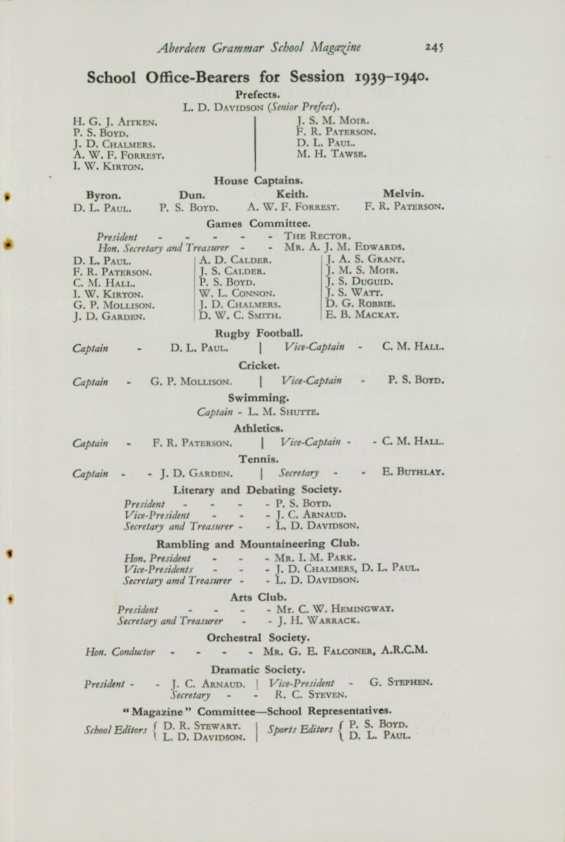
H. G. J. AITKE.'I. P. S. Born. J. D. CHALMERS. A. W. F. FoRRP.ST. I. \X1 , KIRTON,
Dun. J. s. :\L MOIR. F. R. PATERSON. D. L. PAUL. M. H. TAWSP..
House Captains. Keith. Melvin. Byron D. L. PAUL. A. W. r. FORREST. I'. S. Boro. F. R. PATERSON. Garnes Committee.
Prnidtnt - T1111 RECTOR • Ilon Secretarya11dTrtaiurtr - - MR. A. J. :\I. EDWAROS. D. L. PAIJL. A. D. CALDER. J. A. S. Gu.NT. F. R. PATERSON. J. s. CALDI:;R, IJ. \[, s. MOIR, C. M. HALL. P. S. Born. J. S. Ducum. 1. w. KIRTON, W. L. CON:SOS. J. s. WAIT. G. P. \ioLLISON. J. D. CHAL\IERS. D. G. ROBBIE. J. 0. GARDEN. D. W. C. S\lrTH. E. 13. MACKAY.
Rugby Football.
Captain D. L. PAUL. I Vir,-Caplain C.M. HALL. Crickcr.
Captain G. P. ~Iou1sos. Vif,-Captain P. S. BoTO. Swimming. Captain - L. :\L S11UTTE. Athletics.
Captain F. R PATF.R~ON. Vire-Caplam - c. I\[. HALL. Tennis.
Captain- J. D. GARDP.s. Sunlary E. BtrrHLAY.
Lirerary and Debating Society.
Prwdtnt - P. S Boro. Vict-Prtsidmt - J. C. ARNAUD. Secretary a11d Trta111rtr- - L. D. DAvrosos.
Rambling and Mountaineering Club.
Hon. Pruidmt - \fR. 1.11. PARK. Vict-Prnidm/I - J. D. CHAUfERS, D. L. PAUL, Secretaryamd Trtaillrtr - - L. D. DAVIDSON. Ans Club.
Prt1idtnl - Mr. C. W. HEMINGWAY. Surttary and Trtaiurtr - J. H. WARRACK. Orchestral Society.
Hon. Cond11&/&r - MR. G. B. FALCONER, A.R.C.M.
Dramatic Society.
Pruidtnl- J. C. ARNAUD. Vi.t -Prnidtnl S1Crttary R. C. STEVEN. G. STEPHEN.
"Magazine" Committee - School Representatives.
SchoolEdifqr1 f D. R. SUWART. I SporlI 13,aiton{ P. S. Boro. l L. D. DAVIDSON. D. L. PAUL.
Ab,rdeen Gra111mar School i\Iagazi11e
Founded 1893.
Presi dent:
Colonel ARCHER IRv1:r-..'E-FORTESCUE,D.S.O., ~LB., Ch.B.
Vice-President and Chairman of Executive : JOHN LENNOX RIDDELL.
Secretary and Treasurer :
TnEODORE WATT, M.A., LL.D. , The lJniversity Pres~, Aberdeen.
Secretarie s of Centres (in abeyance meantime) :
London Centre-D P CocnRAN, Royal Exchange Assurance , 4 Mitcham Lane, Streatham, London, S.W. 16.
Glasgow Centre-H . G. EDWARDS, 43 Marlborough ~\venue, Glasgow, W 1.
Edinbu rgh Ccntre.-ALLAN C. FRAZER, LL.B., 68 Great King Street, Edinbur gh, 3.
LIFE MEMBERSHIP
Or Five Consecutive Annual Paymen ts of £1 1s. each.
ORDINARY MEMBERSHIP-
For those of 21 years of age and upwards at commencement of Club year (1st January)
For those under 21 years of age at the com0 5 0 mencement of Club year (1st January) o 2 6 but a sing le payment of £r rs. will secure memb ership for SEVEN YEARS.
~Icmbcn; of the Club, and paruculady thoM! who arc , is1tingAberdeen and wish lO call on the Secretary, arc requested t0 nvte chat his office is no longer at The Roscmount Press, Farmer's Ilall Lane, but at The Aberdeen University Press, 6 1,;pper Kirkgatc The Secretary is always deli,:thced to be brought into personal touch with F.P.s. ,
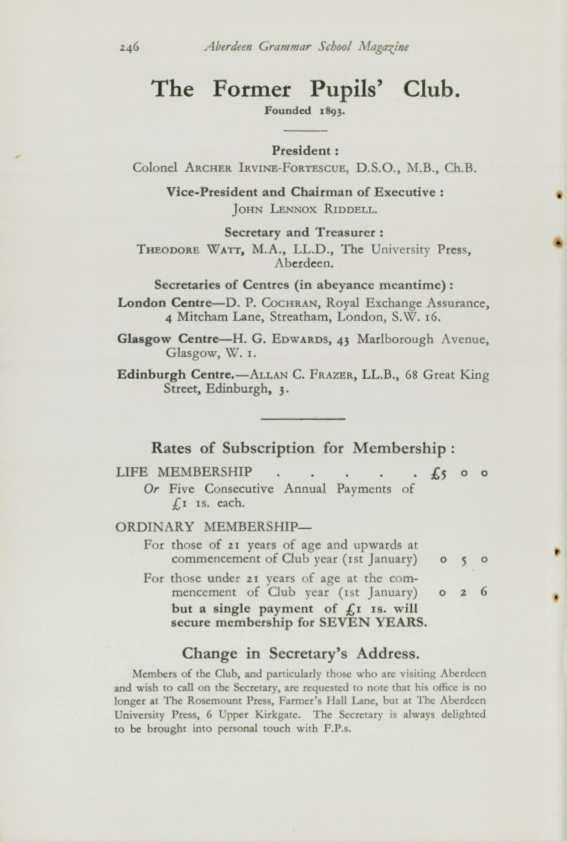
Hardware, China, Linen, Upho lstery, Furn ishings, Paper Patterns and Cutting-out Services.
Trimm ings, Gloves, Vcilings, Ribbons , Laces, Spencers, Scarves , Hosiery, Handkerchiefs , Umbrellas, Fancies, Perfumery, Boys', Youths', and Men's Cloth ing, and Dress Fabrics
Shoe Shop, Needlework, Coats, Costumes, Furs, Gowns, and Photography.
Inexpensive and Model MIiiinery, Flowers, House Frocks, Lingerie, Negligee, Baby Wear, Corsets .
Tea Room, Lounge, Lamps and Lampshades, Orienta l Ware, Trave l Goods, Toys, Optician, Blouses, Knitwear, Juven iles, Girls• School Clothes.
Hairdressing, Chiropody, Beauty Culture ( 16 beaut ifully appo inted Cubicles).
JOHN FALCONER&CO., LTD.,
... but how they wear out their clothes.
:\1others may find it hard in these unsettled times to keep their Suits, Overcoats, and smart . Raincoats
We wish to remind you that every article of your boy's clothing can be revived and restored in a few days. time is lost-this Cleaning and Dyeing Service is reasonable, and you will be saved unnecessary expense.
Pack them off to-day to your local agent, or send for our com-
plete price list .
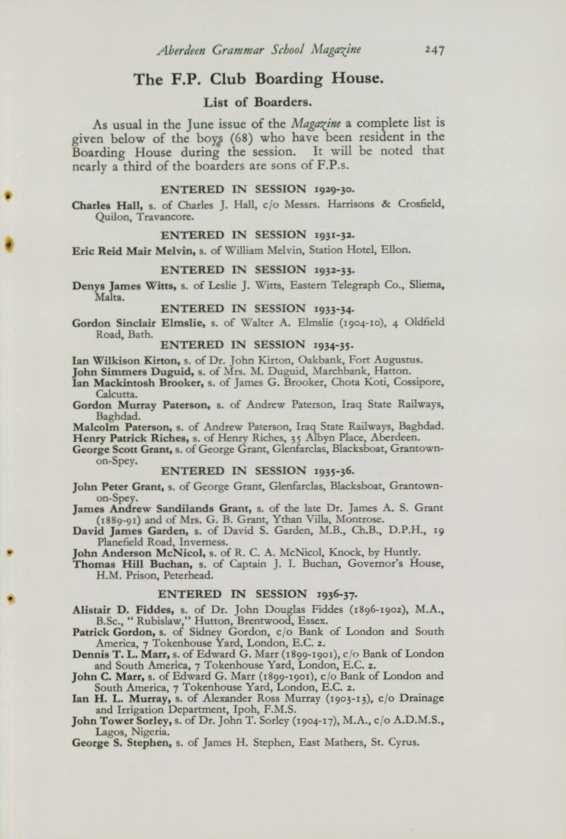
As usual in the June issue of the Magazine a complete list is given below of the boy,.s (68) who have been resident in the Boarding House during the session. It will be noted that nearly a third of the boarders are sons of F.P.s
ENTERED IN SESSION 1929-30.
Charles Hall, s. of Charles J. Hall, c/o Messrs. Harrisons & Crosfield, Quilon, Travancon:.
ENTERED IN SESSION 1931-32
Eric Reid Mair Melvin, s. of William Melvin, Station Hotel, Elion.
E NTERED IN SESSION 1932-33.
Denys James Witts, s. of Leslie J. Wim, Eastern Telegraph Co., Slicma, Maha.
ENTERED IN SESSION 1933-34.
Gordon Sinclair Elmslie, s. of Walter A. Elmslie (1904-10), 4 Oldfield Road, Bath.
ENTERED IN SESSION 1934-35.
Ian Wilkison Kirton, s. of Dr. John Kirton, Oakbank, Fort Augustus.
John Simmers Duguid, s. of :0.lrs.M. Duguid, \farchbank, Hatton.
Ian Mackintosh Brooker, s. of James G. Brooker, Chota Koci, Cossiporc, Calcutta.
Gordon Murray Paterson, s. of Andrew Paterson, Iraq State Railways, Baghdad.
Malcolm Paterson, s. of Andrew Paterson, Iraq State Railways, Baghdad.
Henry Patrick Riches, s. of Henry Riches, 3s Albyn Place, Aberdeen.
George Scott Grant, s. of George Grant, Glenfarclas, Blacksboat, Gtllntownon-Spey.
ENTERED IN SESSION 1935-36.
John Peter Grant, s. of George Grant, Glenfardas, Blacksboat, Grantownon-Spey.
James Andre w Sandiland s Grant, s. of the late Dr. James A. S. Gram (1889-91) and of Mrs. G. B. Grant, Ythan Villa, Montrose.
David James Garden, s. of David S. Garden, M.B., Ch.B., D.P.H., 19 Planefield Road, Inverness.
John Anderson McNicol, s. of R. C. A. McNicol, Knock, by Humly.
Thoma s Hill Buchan, s. of Captain J. I. Buchan, Governor's House, H.M. Prison, Peterhead,
ENTERED IN SESSION 1936-.37.
Alistair D. Fiddes, s. of Dr. John Douglas Fiddes (1896-1902), M.A., B.Sc., "Rubis law," Hutton, Brentwood, Essex.
Patri ck Gordon, s. of Sidney Gordon, c/o Bank of London and South America, 7 Tokenhouse Yard, London, E.C. 2.
Dennis T. L. Marr, s. of Edward G. Marr (1899-1901),c/o Bank of London and South America, 7 Tokcnbouse Yard, London, E.C 2
John C. Marr,s. of Edward G. Marr (1899-1901),c/o Bank of London and South America, 7 Tokenhouse Yard, London, E.C. 2
Ian H. L Murray, s. of Alexander Ross Murray (1903-13), c/o Drainage and Irrigation Department, Ipoh, F.M.S
John Tower Sorley, s. of Dr. John T. Sorley(1904-17),M.A., c/o A.D.M S., Lagos, Nigeria.
George S, Stephen, s. of James H. Stephen, East Mathers, St. Cyrus.
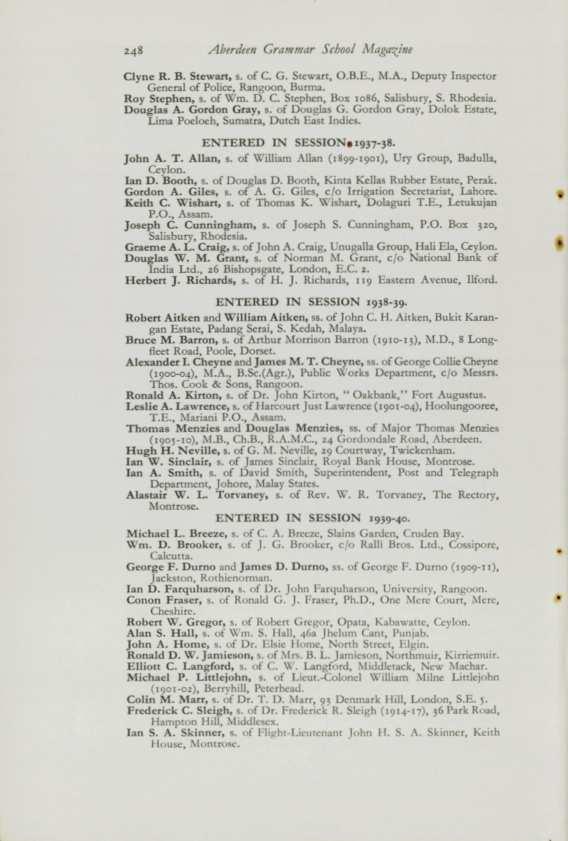
Clyne R. B. Stewart, s. of C. G. Stewart, O.B.L., M.A., Deputy Inspector General of Police, Ran11:oon,Burma.
Roy Stephen, s. of Wm. D. C. Stephen, Box 1086, Salisbury, S. Rhodesia. Douglas A. Gordon Gray, s. of Dou~las G. Gordon Gray, Dolok Estate, Lima Poeloeh, Sumatn, Dutch tast Indies.
ENTERED IN SESSION , 19)7-38.
John A. T. Allan, s. of William Allan (1899-1901), Ury Group, Badulla, Ceylon.
Ian D. Booth, s. of Douglas D. Booth, Kjnta Kellas Rubber Estate, Perak. Gordon A. Giles, s. of A. G. Giles, c/o Irrigation Secretariat, Lahore. Keith C. Wishart, s. of Thomas K. Wishart, Dolaguri T.E. , Lerulrujan P.O., Assam.
Joseph C. Cunnin gham, s of Jo~eph S. Cunningham, P.O Box 320, Saljsbury, Rhodesia.
Graeme A. L. Crajg, s. of John A. Craig, l,nui;talla Group, Hali Ela, Ceylon.
Douglas W. M Grant, s. of Norman M. Gram, c/o 1'adonaJ Bank of India Ltd., 26 Bishopsgate, London , E.C. 2.
Herbert J Richards, s. of JI. J Richards, 119 Eastern Avenue, Ilford.
ENTERED IN SESSION 1938-39.
Rohen Aitken and William Aitken, ss. of John C. II. Aitken, Bukit Karangan Estate, Padang Serai, S. Kedah, .Malaya.
Bruce M. Barron, s. of Arthur Morrison Barron (1910-13), M.D., 8 Longfleet Road, Poole, Dorset.
Alexander I. Cheyne and J:une, M. T. Cheyne , ss. ofGeorge CollieCheyne (1900-04), M.A., B.Se.(Agr.), Public \\orks Department, c/o :',Iessrs. Thos. Cook & Sons, Rangooo.
Ronald A. Kirton, s. of Dr. John Kirton, "Oakbank," Fort Augustus.
Leslie A. Lawrence, s. of I12rcourt Just Lawrence (1901-04), Hoolungoore c, T.E., ;\Iariani P.O., Assam.
Thomas Menzies and Douglas Menzies, ss. of Major Thomas Menzies (190i-10), \I.B., Ch.B., R.A.M.C., 24 Gordondalc Road. Aberdeen.
Hugh H. Neville, s. of G. ~f. Neville, 29 Courtway, Twickenham.
Ian W. Sinclair, s. of James Sinclair, Royal Bank House, Montrose.
Ian A. Smith, s. of David Smith, Superin tendent, Post and Telegraph Department, Johore , \talay Scates.
Alastair W. L Torvaney, s. of Rev \'f. R. Torvancr , The Rectory , Montrose
E TERED IN SESSION 1939-40.
Michael L. Breeze, s. d C. A. Breeze, Slains (,ardcn, Cru,kn Bay.
Wm D. Brook er, ,. of J. (,. Brooker, c 1o Ralli Bros Ltd., Cossiporc, Calcutta.
George F. Durno and James D Durno, ss. of George F. Durno (1909-11), Jackston, Rothicnonnan.
Ian D. Farquh arson, s. of Dr. John f'arquharson, University, Rangoon. Conon Fraser, s. of Ronal<l G. J. Fraser, Ph.D., One ,\krc Court, ,\lcrc, Cheshire
Robert W. Gregor, s. of Robert Gregor, Opata, K,1ha\\attc, Ceylon.
Alan S. Hall, s. of \\ m. S. IJail, 46a Jhclum Cam, Punjab.
John A. Home, s. of Dr. hbic Ilomc, t-;orrh Strct:t, l·.l!!in.
Ronald D. W.Jamieson, s. of \1rs. B. L. Jamieson, t-;onhmutr, Kirriemuir.
Elliott C. Langford, s. of l. \\. Langford, \liJ<lkiack, \.cw \lachar.
Mich ael P Littlej ohn, s. of Licuc.-Coloncl \\ illiam \ !tine Littlejohn (1901-02), Berryh1II, Pctcrhca<l.
Colin M. Marr, s. of Dr. T. D. \!arr, 93 Denmark Hill, London, S.E. 5. Frederi ck C. Sleigh, s. of Dr. Frederick R. Sleigh (1914•17), 36Park Road, Hampton Hill, \lid<llcsc~.
fan S. A. Skinner, s. of l li)!ht-1.ientenant John 11. S. ,\, Skinner, ls.cith Ilouse, \lontros<e.
John C. K. Steele, s. of Charles S. Steele, 82 l]edford Court Mansions, London, W.C. 1.
Alan Taylor, Ian Taylor, Robin D. Taylor, ss. ofJohn C. Taylor (1904-06), 192 The Peak, Ilong-kong.
Norman Taylor, s. of James D. Tavlor, Cairnfcchel, Udny. James L. Watt, s. of William L. Watt, P.O. Box 29, Nyeri, Kenya Colony.
The first Annual Dinner of the Bengal Centre of the I .P. Club was held at the Bengal Cluh on 23rd Pchruary, 1940, when the following nine out of a membership of 19 attended: I. C. Barclay, D. Inglis Duff, R. H. Duguid, W. C. :'.\Iacmillan, Alan Reid, .\. L. Simpson, II. B. Scott, C. F. Thomson, and G. C. Whyte (Pruidtnt).
,1r J.M. :'.\forrison presented his apologies for not being able to attend the Dinner in vie" of his having m proceed the next day on an Officers' Training Course. He attended, however, before dinner and all members joined in wishing him the best of luck during his service with Iii$ .\Iajesty'~ rorces.
The Dinner was a complete success and the member were regaled with many amusing Buchan wccdotcs by the President and \fr. C. P. Thomson
After dinner, the business of the Centre was dealt with, the mam items being:-
1 Cr,,ufilulion. The Secretary announced that the Executive of the Parent Club had approved the formation of aBengal Centre and the adoption of the rules proposed.
2. Rt-4/ulion of Cnmmillte.-The Secretary indicnted that it would be necessary m accordance with the Rules to elect a Committee for the ensuing year, consisting vf President, Honorary Secretary, and Treasurer. Dr. Macmillan proposed that, since the Committee had not been in office for a full year, and in \'iew of the exccllcnc manner in which they had rallied members together, the same memhc:rs be invited to carry on for another rear. This was seconded by \1r. Barclay, and had the unanimous approval of all present.
President
Mr. G. C. Whyte.
Secretary :'.\lr.H. B. Scoit.
Treasurer :'.\lr.Alan Reid.
3. S11bf(riplio11.- It "·as then brought to the notice of members that while they had dected a \'Cry capable and efficient Treasurer, the~• had not provided hnn wtth a treasury, and members were asked whether a suhscripuon of Rs.10 per annum should be in\'itcd to start a Club fund. There was a certain amount of discussion on this subject, and views were expressed that cons1dcrin~ the number of members who were not resident in Calcutta and did not, therdore, have tbe opportun ity of taking part m the ac11v1tics of the Centre, the subscription should be placed on a , oluntary basis, and this v:as finally agreed to
4. l/7ar ComforlJ J·1md.~ The Secretary next referred to a letter received from Colonel H. S. Ta\\·sc, Aberdeen, regarding contributions to a Comfort Fund for soldiers, sailors, and airmen belonging to the Counties ofAberdeen, Banff, and Kincardine. The President expressed the view that, on account of the many local commitments with regard to war charities, contributions should be left to individual members and that those willing to contribute to the rund should ~end their donations co the Treasurer , wfto would remit a bulk sum from the Beni;!"alCentre. This was endorsed by all present .
5. Pruidmt'J Cup.-The Pre ident prm·ided a most excellent silver tankard, which was presented, suitably engraved, to Mr. C. f'. Thomson, the "inner of the Bogey Golf Competition held by members on 28th January. The u•inning score was 2 down on bogey, which, in view of the rather difficult scoring conditions prevailing, wa:. a highly creditable performance.
It is our first dury to remember those member; of the Secuon whQ ha,·e left 10 join the forces : \X'. I'ra~cr, \\. S. Gibb, \\. \I. Grant, \'. \\'. _Jaffray, A. C. .\tackeruie, K. \lackinro,h, J. S. \fanlcy, R. -\, L \lenn,e, R. P. :\lunro, H. B. Pearson, G. B. C. ~aniister, H.<.. .\lcHardv, an<l0. H. R. Still-to each of whom we wish all the best. \\ c have als;, to record the departure of one who has been n staunch mcmhcr for some years an<l is now greatly missed, A. H. :\lort1mcr, who has followed the nample of J. L. Connor and J. A. Brockie by goin>1 to l•.n_1rland. Ile takes with him the Section's best wishes in his new sphere of activi1r,
It has thus been lcfc w a youthful remnant, under the captaincr of G. P. \[arr, to carry on the good work. Up to now resulcs havc been a little disappointing , but the circumstllflccs explain a lot. Practice has been difficult through late work and exams, and we have not yet been ahlc to field our best team. Up co date we have won one out 0f five matchc , but survi,·ed rill the second round of the Cup. \Ve had a bye 1n the first round. Again we extcn<l a w·ann welcome to th, ,se at the School who wish to play during the holidays. Similar arran~ements to !as, ye,1r's will be in force whereby a reduced suhscripuon will bc a,·ailablc for those pla)·ing for part of the season only. ,\I] "'ho arc keen should get in couch with the Secrctat)·, and it is hoped that the number will not be fow. It will be great!} to the Section's credit if it can make a goo<l recovery from its false ,tan and finish the season in a worchy position in the Lcai,:u .
D.
r. "'· CRAWi ORD, I fon. Ji.rtlary.
Bonner, Robert .\Iitchell 1922 2S), \I ,llhank, Tarland, .-\bcrdecnshire. Cooper, Ian Hamish (19z3-n), \\'aratah, 8 Royfol<l Crescent, A.bcrdecn. Forbes, James l·rancis (1921-27), C.•\., c/o \le<srs. :\l,lne & Co. S. -\., Lima, Peru, South Americ,1.
Humphrey, Stanley !rank \\alkcr 't912-22), \f.\., B.L., C.:\., Craigton House, Cults, Abcr<lccnshirc.
lrvin, Richard (1914-18), Dcnhead, Culcs, Aberdeenshire . .\1 aitland, llarry (1931-33), c 1o ~lcrcantile Hank of ln<lia, Ltd., Bangkok, Siam.
,\filler, John Irvine (1918-25), Sam Smg Worksh<•p, .\latclli P.O., Dooars, Benl(al, India.
Rus«cll, Gerald Brown (19Z1-23), Hona \ Ma, Banchory. Wisely, Norman Forsyth (1920-32), zr9 Great \\'c\tcrn Road, Aber<lt:en.
ORDINARY MEMBERS.
Ballantyne, Jamcs Shearer \\' ooJ (1927-38), 67 Stanley Street, Aberdeen.
Black, James Anderson (1936-39), 68 Forest Road, Aberdeen.
Blair, John Kinniburgh (1927-37), 44 Forbesficld Road, Ahcrdcen. Christie, Angus \\ cbs1cr (19p-37), Birkhill, Millumber, a\berJccnshire.
Drennan, Robert Norman (1926-39), 10 South Crown Street, Aberdeen. Duffus, Alex:tnder Jn.mes (1932-38), 62 Rubislaw Den South, Aberdeen.
Lindsav, Robert ,\nhur Drv,dale (1933-39), 62 Caimcry Road, Aberdeen.
\lacLcoJ, Jnhn Bruce (1936-\9), Fastkigh, Pecerculcer, Abcrdcensh1rc.
i\litchcll, John George (193.1•38),.p Anl!U<ficld A\'enuc, Aberdeen. Robem, David (1928-39), 16 Polmuir RoaJ, Aberdeen.
Smith, Archihal<l HaralJ (1929-38), 86 Hamilton Place, Ahcr<lccn.
\\alker, William Henry Pibcl (192639), WinJermere, \lilltimber, Aberdeenshire.
?;he Best Place to Lunch in ,Aberdeen-
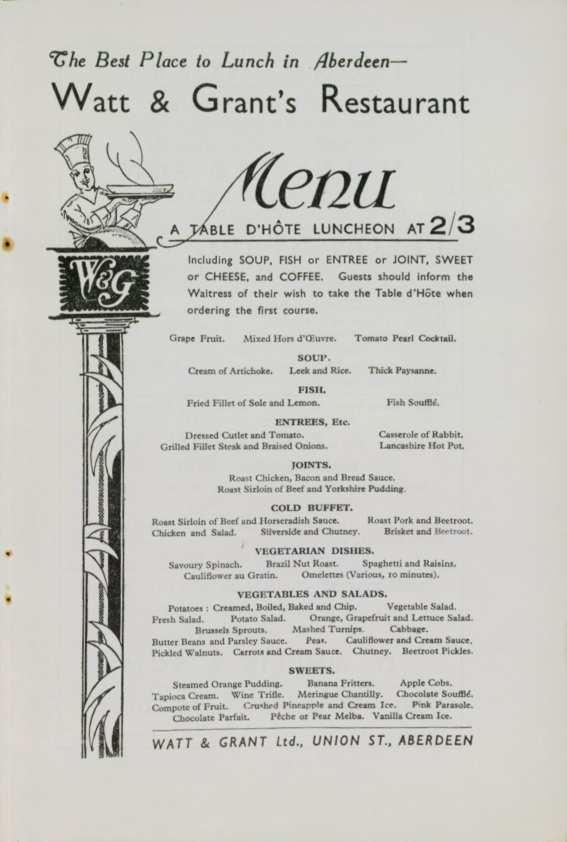
Including SOUP, FISH or ENTREE or JOINT, SWEET or CHEESE, and COFFEE. Guests should inform the Waitress of their wish to take the Table d'Hote when ordering the first course.
Gnpe Fruit. Mjxed Hors d'CEu,,re. Tomato Pearl Cocktail.
SOUP
Cream of Artichoke. Leek and Rice. Thick Paysanne FISH
Fried Fillet ofSole IJld Lemon. Fish Sou.If!.!.
ENTREES, Etc.
Dressed Cutlet and Tomato.
Grilled FiUet Steak and Bni•cd Oruons.
JOINTS
Casserole of Robbit. Lancashire Hot Pot.
Roast Chicken, Bacon and Bread Sauce. Rout Siiloin of Beef and Yorkshire Puddins COLD BUFFET.
Roast Sirloin of Beef ,md IJorscracllih Sauce. Roast Pork ond Beetroot Chicken and Salad. Silverside and Chutney. Brisket and ll<"'lroot.
VEGETARIAN OISIIES.
Savoury Spinoch. Brazil Nut Roast. Spaghetti and Ral1iru. Caulillower au Cratin. Omelettes (Various, 10 minutes).
VEGETABLES AND SALADS.
Potatoes : Creamed, BoUed, Baked and Chip. VeK<tableSalad. Fresh Salad. Potato Salad. OranKe, Grapefruit and Lettuce Salad. Brussels Sprouu. Muhed Turnips Cabbage. Butter Bean• and Panley Souce. Pea,. Cauliftower and Cream Sauce. Plc:kledWalnuts. Carroll and Cream S•u«. Chutney. Beetroot Pic:klcs
SWEETS.
Steamed Oranac Puddina. Banana Fritters . Apple Cob,. Tapioca Cream. Wine Trillo. Meringue Chantilly. Chocolate Soufll<!. Compote of Fruit. C"'..ru•h•dPineapr>le and Cream Jc•. p;nk Par11ole. Chocolate Parlait. Pkbe or Pear Melba. Vanilla Cream Ice.
IRONMONGERY
A LARGE AND VARIED STOCK ALWAYS ON HAND--
SHEETMETAL WORK A SPECIALITY
H. LE ITH & SO N
26 and 28 NETHERKIRKGATE
Phone 259
ABERDEEN
Famed for Aberdeenshire
Butter, Eggs, Cheese, Poultry.
Honey-Clover and Heather (lo comb• or u:trac1ed) Also
Jams, Jellies, and Marmalade (ALL OUR OWN MAKE)
EGG GRADIN G MACHINE \\ORKING DAILY
J. B MILNE, Propr Tel 746
There Is none better than the "BEST" but Davidsons' Coals are better than the "REST"
J. & A. DAVIDSON,
2 BLAIKIE'S QUAY, ABERDEEN
Branch Office:-MAJESTIC BUILDINGS, 238 UNION STREET
Teterrams--" Davidson" Phone 2873
Various kinds of ENGLISH, SCOTCH HOUSE, STEAM COAL, ANTHRACITE, and "Ideal" Triplex Fuel at keenest prices WE SOLICIT A TRIAL ORDER
AGENTS FOR ORDNANCE SURVEY MAPS
WEST-END CIRCULATING LIBRARY
D. WYLLIE & SON
Booksellers Publishers Stationers
Established 1814 Telephone .(02
ABERDEEN TOWN COUNOL- EDUCATION COMt.ilITEE.
{FOUNOfD PREVIOUS TO 1256,)
Rector DAVlO MIDDLETON ANDREW, M,A,
THE GRAMMAR SCHOOL provides for Boys a complete course of Study, both Elementary and Secondary, Classical and Modern.
The School, which is or~nized in three Departments-Lower, .Middle, and Upper Scbools-contauu, in addition to the usual classrooms, a Chemical Labo1:2tory, Science Theatre with Physical Labo1:2tory attached, Natural Science Laboratory, Art Room, Gymnasium, Workshop, Botanical Garden, Library, Reading Room, and Museum.
Pupils in the Middle School arc prepared for the Leaving Certificate of the Scottish Education Department, passes in the latter aarnination being recognized as exempting from further examination 1r1 the corresponding subjects of the Preliminary Examination for 11raduationin Arts, Science, Law, and Medicine at the Scottish Univemt:les.
The airuation of the School in the West end of the City is open and hC21tby. The Class-rooms arc large, and the Grounds for Recreation include separate Playgrounds for Juniors and Seniors, Tennis Courts, and a field for Cricket and Football There isalso a Boarding House run in conjunction with the School.
(ALBYN PLAOlll.)
Head Mlstrees • Min BEATRICE M. ROSE, M.A. (Abud., Oxon.)
THE :filGH SCHOOL provides a liberal education for Girls from 5 co 1 8 years of age, and aims at fitting them for home life and for professions open to women.
The School buildings occupy an excellent and spacious site in the West end of the City. A Playing Field of 11 acres, situated at Hazlehcad and provided with a suitable pavilion, is used for organized ~cs.
The School is organized in three Departments-Infants, Primary, and Secondary. The Classes in the Infants and Primary divisions arc graded m accordance with the requirements of the Scoccish Code. Pupils in the Secondary Department arc prepared for the Leaving Certificate of the Scomsh Education Department.
Pupils whose parents desire it arc taught Theory and Practice of Mu1ic (Pianoforte, Violin, and Organ) in preparation for the Examinations of tbe AssociaccdBoard of the Royal Academy and Royal College of Music. Advanced pupils arc prepared for cbc Llccnciaccof the Royal Academy.
Information as to Fees, Scholarships, Course, of Study, etc., at tbc Grammar School and High School for Girl1 is given in the School Prospectus, which may be had free on application to the Director of Education, Education Offices, or to the Rector or Head Mistteu rcspcctively.
Tdephont Nos. , 2916 (3 line,) .
80 Bedrooms.
WHY
Telegr4ms: " Rt:Pase, Aberdeen."
15 Bathrooms.
BECAUSE
It is a Comfortable, Modern Hotel, with Good Cooking and Reasonable Term•. Electric Fires. Hot and Cold Running Water in all Bedrooms.
Central Heating . Lift to all Floors.
Private Suites of Rooms with Bathrooms.
Private Suites of Rooms for Weddi ngs, Dinners, etc.
Restaurant. Grill Room. Lounges. American Bar.
UNDER ENTIRELY NEW PROPRIETORSHIP AND MANAGEMENT .
K. q. AMNER, Manager.