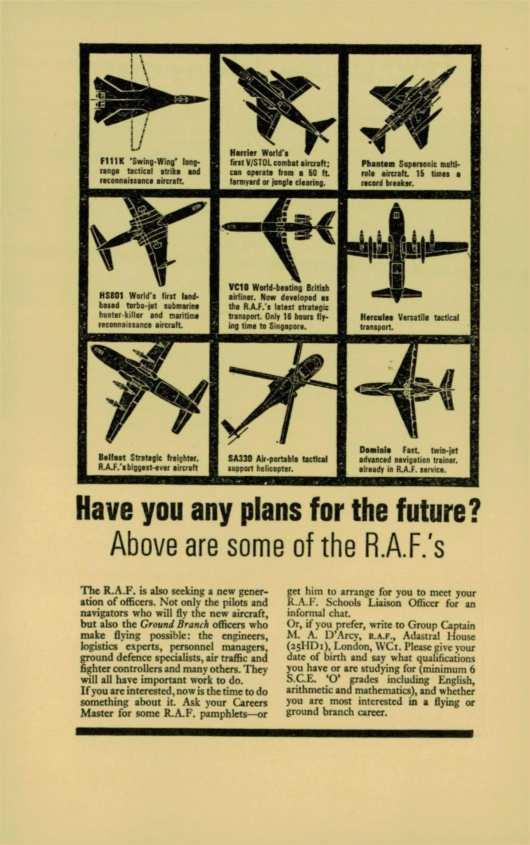
The R.A.F. is also scck.inga new generation of officers. Not only the pilots and navigators who will fly the new aircraft, but also the Ground Brand, officerswho make flying possible: the engineers, logistics eiperts, personnel managers, ground defence spew.lists, air traffic and fighter controllers and manyothers. They will all have important work to do. U youare interested, nowisthe time todo something about it Ask your Careers Master for some R.A.F. pamphlets-<>r
get him to arrange for you to meet your R.A.F. Schools Liaison Officer for an informal chat. Or, if you prefer, write to Group Captain M. A. D'Arcy, R A P, Adastral House (a5HD1), London, WC1. Pleasegiveyour date of birth and say what qualifications you have or are studying for (minimum 6 S C.E. 'O' grades including English, arithmetic and mathematics),and whether you arc most interested in a flying or ground branch career.
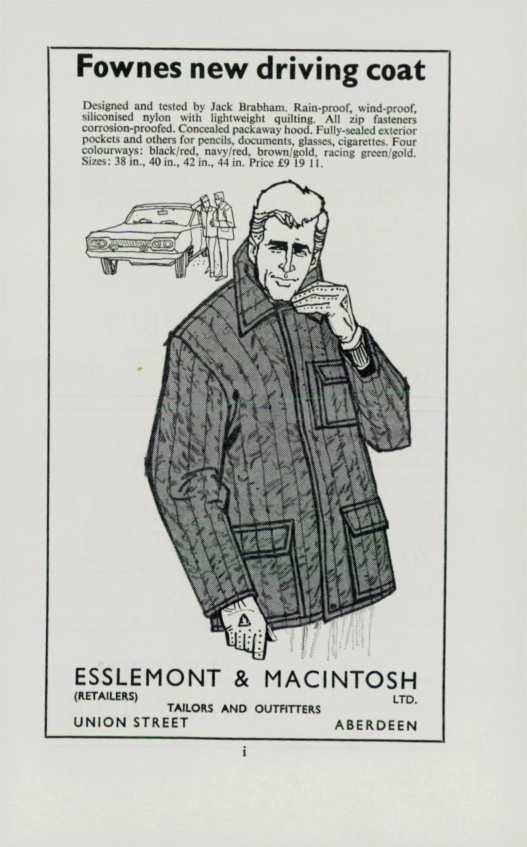
Fownes new driving coat
Designed and tested by Jack Brabham. Rain-proof, wind-proof, siliconised nylon with lightweight quilting. AU zip fasteners corrosion-proofed. Concealed packaway hood. Fully-sealed exterior pockets and others for pencils, documents, glasse:.,cigarette~. Four colourways: black/red, navy/red, brown/gold. racing green/gold. Sizes: 38 in., 40 in., 42 in., 44 in. Price £9 19 11.
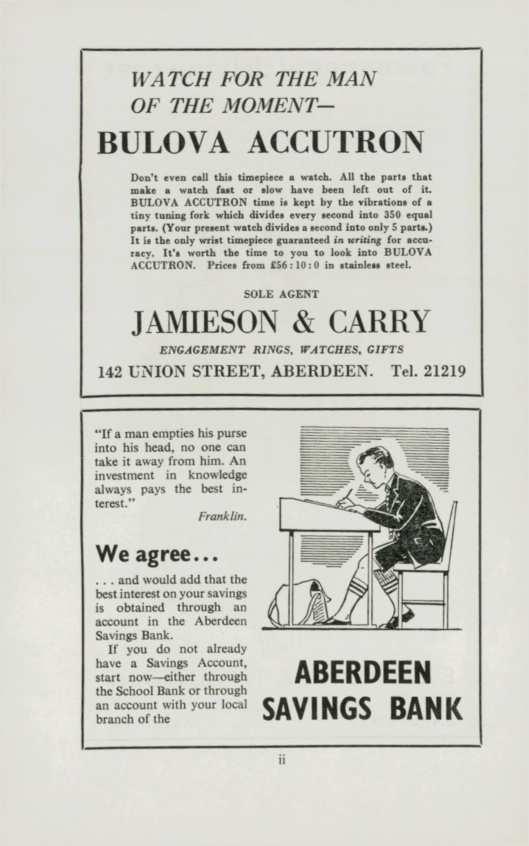
WA TCH FOR THE MAN OF THE MOMENT-
BULOVA ACCUTRON
Don't even call thi1 timepiece a watch. All the that make a watch fa1t or •low have been left out of it. BULOVA ACCUTRON time i• kept by the of a tiny tuning fork which divide, every 1econd into 350 equal part.,. (Your pruent watch divide, a 1econd into only 5 parta.} It ia the only wriat timepiece guaranteed in writin1 for accu• racy. lt'1 worth the time to you to look into BULOVA ACCUTRON. Price, from £56: 10: 0 in 1tainle11 1teel.
SOLE AGENT
JAMIESON & CARRY
"If a man empties his purse into his head, no one can take it away from him. An investment in knowledge always pays the best interest."
Franklin.
We agree... and would add that the bestinterest on your savings is obtained through an account in the Aberdeen Savings Bank If you do not already have a Savings Account, start now-either through the School Bank or through an account with your local branch of the
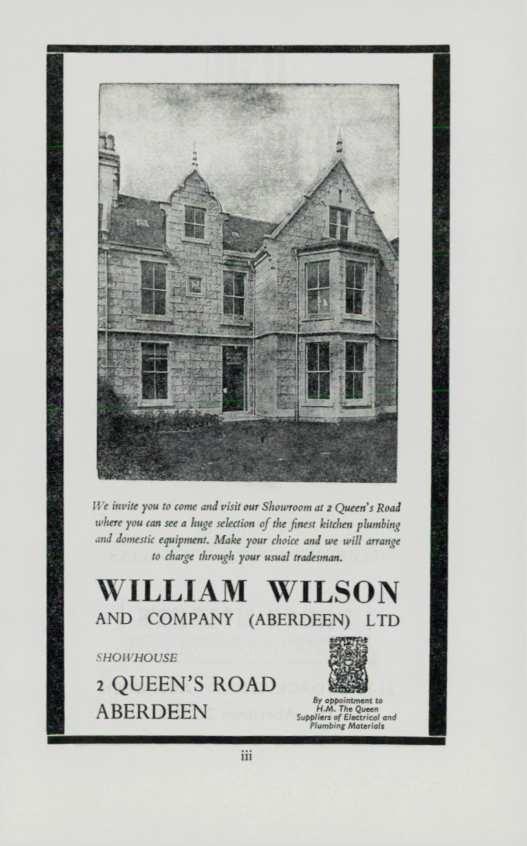
IFt iuviteyou to come and visitorir S/rowroom at 2 Q11un's Road wlrtreyor1 ca11 see a hugt selectionof tlrtfinest kitcht11plumbi11g J11d domestictq11ipmtnt . Make your cl,oict and we will arrange to charge 1/,rouglryour umal tradtsman.
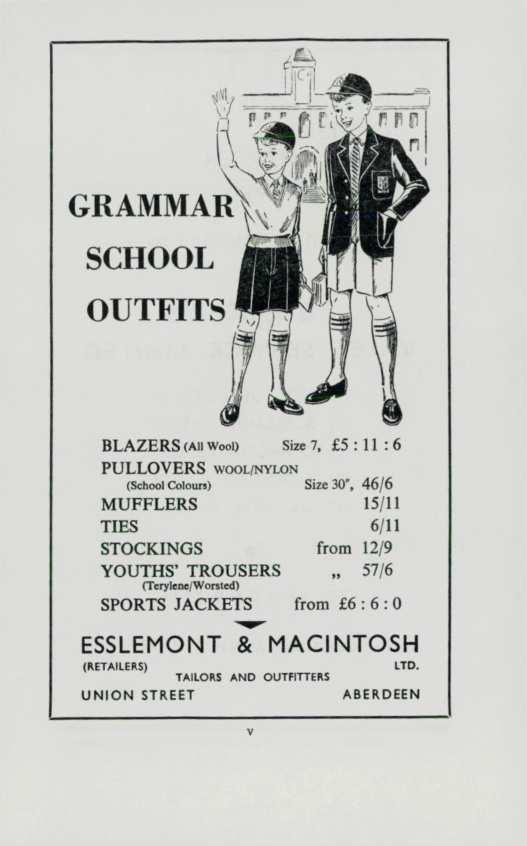
GRAMMA SCHOOL OUTFITS
BLAZERS (All Wool) Size 7, £5: 11 :6
PULLOVERS WOOL/NYLON
(School Colours) Size 30*, 46/6
MUFFLERS 15/11
TIES 6/11
STOCKINGS from 12/9
YOUTHS' TROUSERS ,, 57/6 (Tcrylcne/Worstcd)
SPORTS JACKETS from £6 : 6 :0
ESSLEMONT
& MACINTOSH (RETAILERS) LTD. TAILORS AND OUTFITTERS UNION STREET ABERDEEN
With its powerful, east-west mounted engine, velvet smooth Hydrolastic suspension, fresh-air ventilation, and ample room for five, the
AUSTIN 1800 Mk 11
IS A WORLD BEATER
Why not let us quote you for anew 1800 Your present car taken in part exchange.
TV'S· RADIOS · GRAMS· HI-FI· STEREO SOUND· TAPE RECORDERS·RECORDS·WASHING MACHINES· FLOOR POLISHERS • SPIN DRYERS • CLEANERS • FRIDGESin fact, everything for the modern home !
Achieve your aim!
Our advertising men are geared to help you promote your sales or project your company's image. You can have their advice just by lifting the phone to:
Mr. George Durward, Display Advertisement Manager, "The Press &Journal ", Tel. 22331 Ext. 3
Mr. William Gordon, Classified Manager, Tel.22331 Ext.21
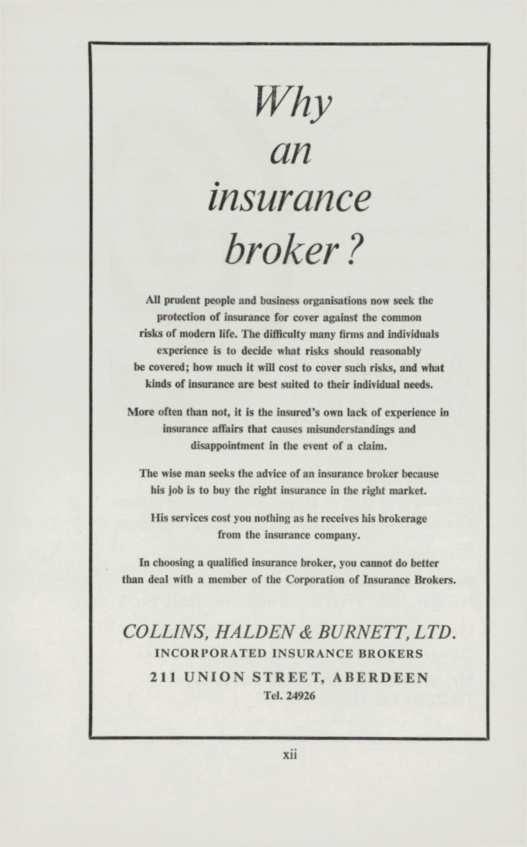
Why an znsurance broker?
All prudent people and business organisations now seek the protection of insurance for co\·er against the common risks of modem life. The difficulty many flnns and individuals experience is to decide what risks should reasonably be covered; how much it will cost to cover such risks, and what kinds of insurance are best suited to their individual needs.
More often than not, it is the insured's own lack of experience in insurance affairs that causes misunderstandings and disappointment in the e\ent of a claim.
The wise man seeks the advice of an insurance broker because his job is to buy the right insurance in the right market.
His services cost you nothing as he receh·es his brokerage from the insurance company.
In choosing a qualified insurance broker, you cannot do better than deal with a member of the Corporation of Insurance Brokers.
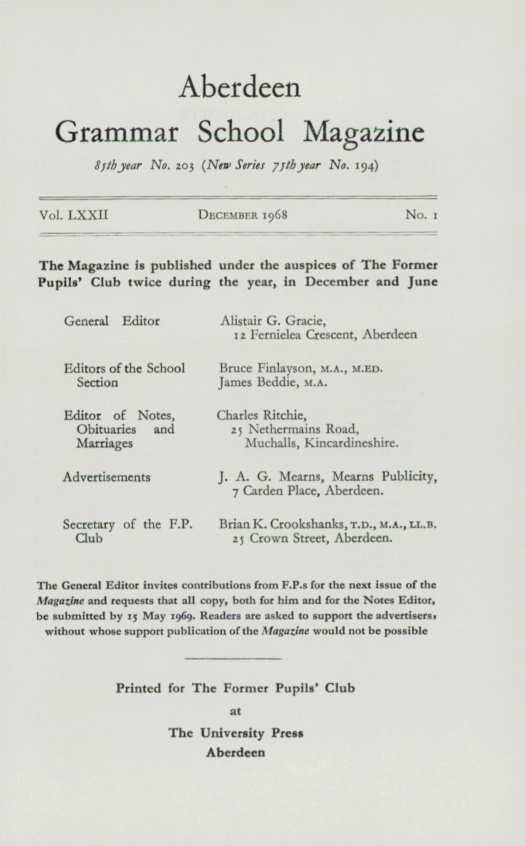
Aberdeen Grammar School Magazine
8Jthyear No. 203 (N,w S1ries 7Jlhyear No. 194)
Vol. LXXII No. 1
The Magazine is published under the auspices of The Former Pupils' Club twice during the year, in December and June
General Editor
Editors ofthe School Section
Editor of Notes, Obituaries and Marriages
Advertisements
Secretary of the F.P. Oub
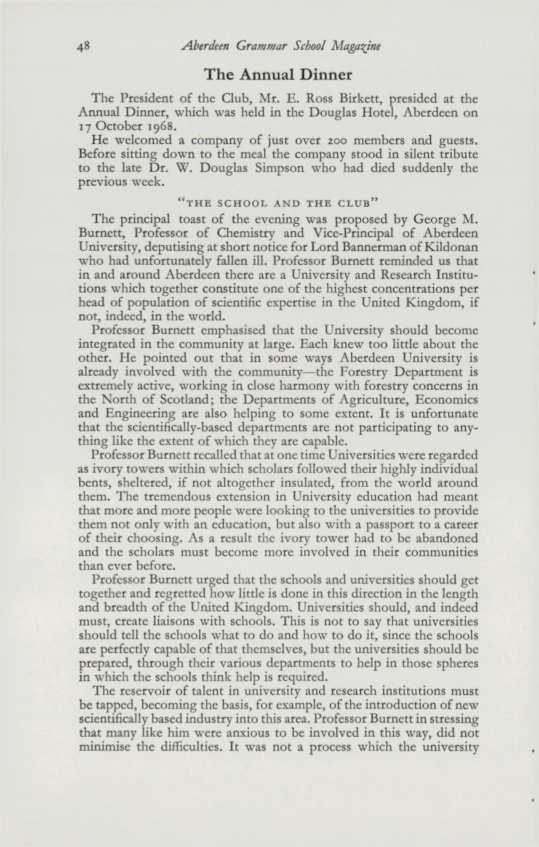
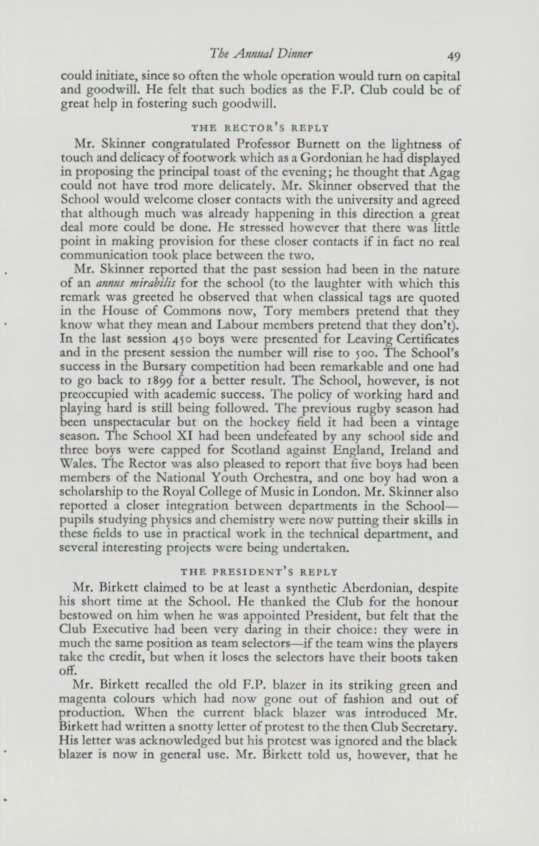
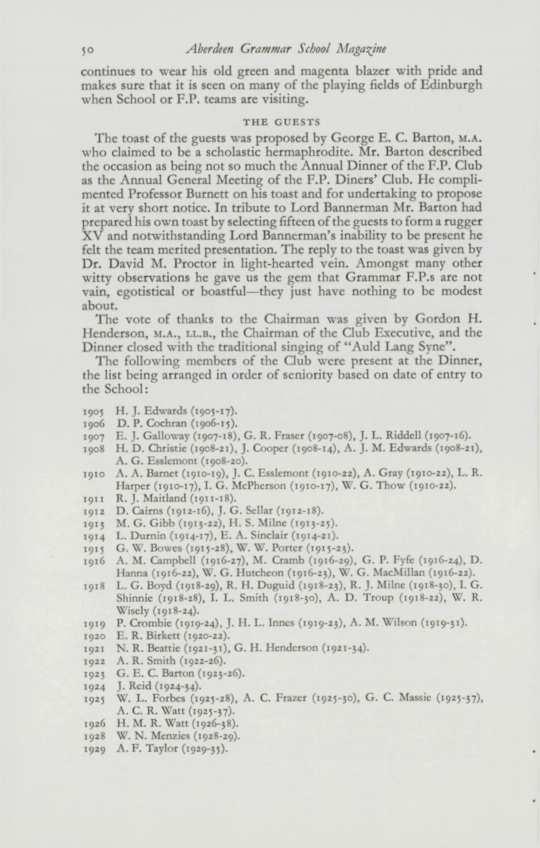
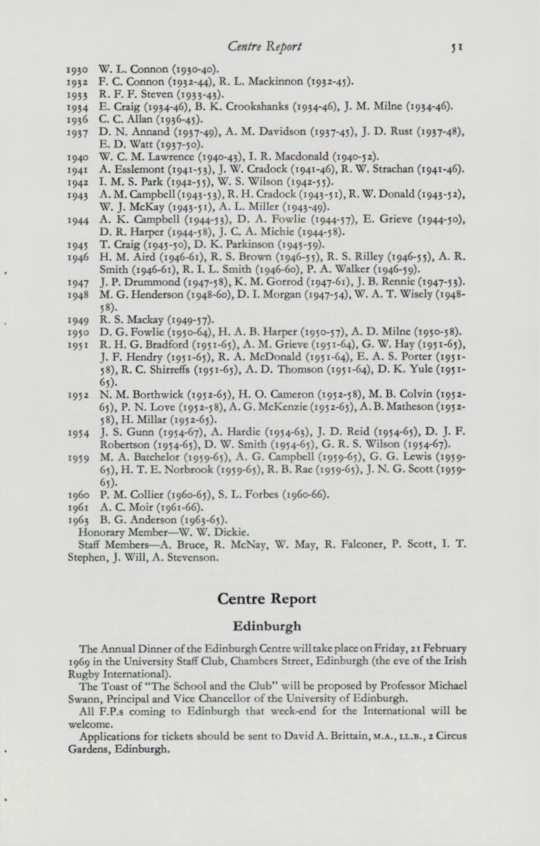
Alistair G. Gracie, 12 Fernielea Crescent, Aberdeen
Bruce Finlayson, M.A., M.ED. James Beddie, M.A.
Charles Ritchie, 2 5 Nethermains Road, Muchalls, Kincardineshire.
J. A. G. Mearns, Mearns Publicity, 7 Carden Place, Aberdeen.
Brian K. Crookshanks, T D., M.A.,LL.B. 2 5 Crown Street, Aberdeen.
The General Editor invites contributions from F.P.s for the next issue of the Maga1,ine and requests that a.11 copy, both for him and for the Notes Editor, be submitted by 15 May 1969. Reader s arc asked to support the advertisers , without whose support publication of the J\faga1,inewould not be possible
Printed for The Former Pupils' Club at
The University Preu Aberdeen
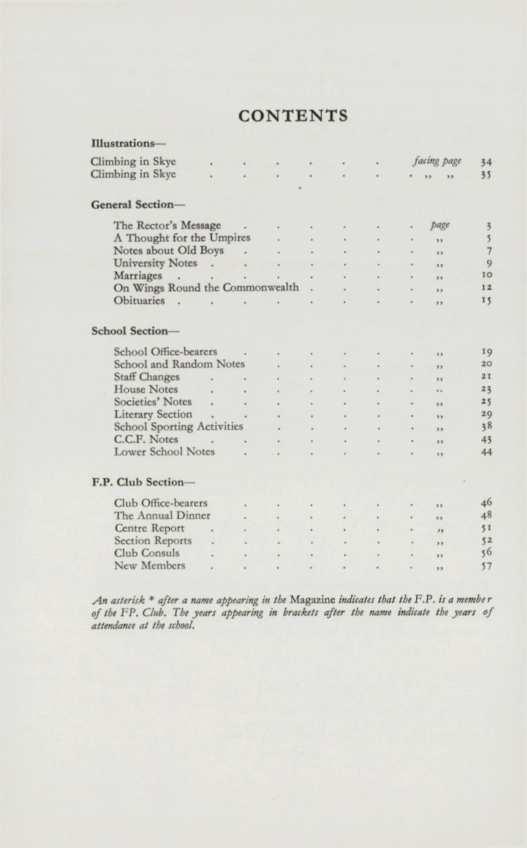
Illustration s-
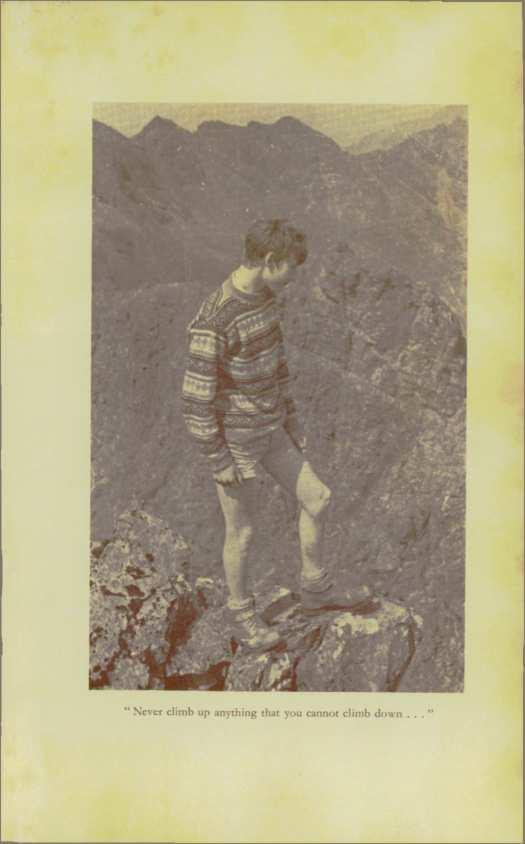
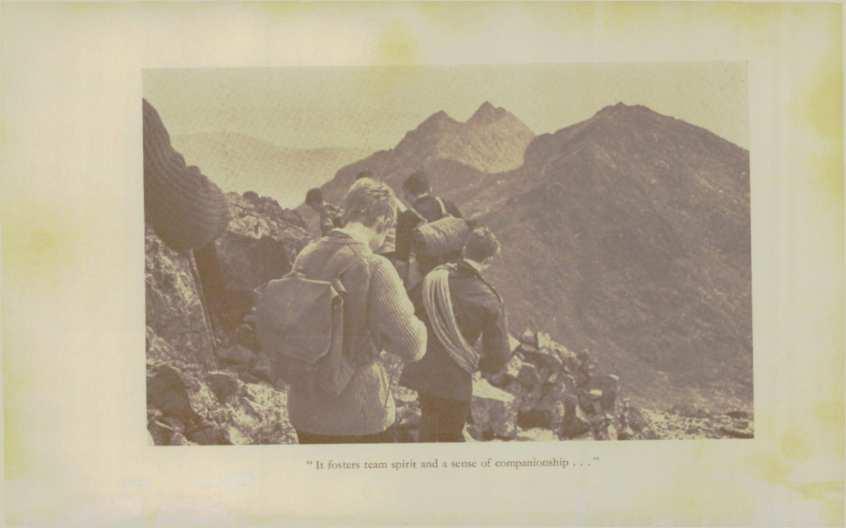
Climbing in Skye
Climbing in Skye
General Sectfon-
The Rector's Message
A Thought for the Umpires
Notes about Old Boys
University Notes Marriages On Wings Round the Commonwealth Obituar ies
School Section-
School Office-bearers
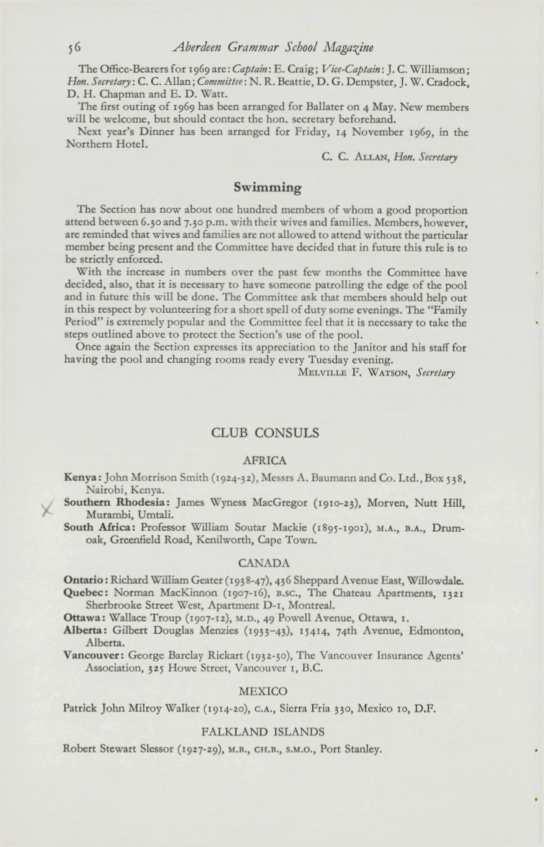
School and Random Notes
Staff Oiangcs
House Notes
Societies' Notes
Litcruy Section
School Sporting Activities
C.C.F. Notes
Lower School 'otes F.P.
Club
1be
An aJ/tris/e * afltr a nam, apptaring in IIH Magaune 1iiditalt1that 1h, F.P. is a mtmbe r of lh1 FP. C/11b. Th, years apptaring in brac/ee/J after JIH nam, indiu te tbt years of alltndanu al the school.
The Rector's Message
New material suitable for inclusion in a report like this is a very scarce commodity in the late autumn and I must crave the indulgence of many of my readers if I refer in some cases to matters already touched on in my Annual Prize-giving report in June or in my reply to the toast of the School at the Annual Dinner of the Former Pupils' Club in October. The major events of the School year occur between November and July and the opening weeks, although crowded with routine School business, offer only the slightest of hand-holds for the chronicler. I can only take comfort from the fact that this Magazine finds its way into homes far forth of Aberdeen and is read by many who have no access to other sources of School news.
As I write, the new session is well on its way-so much so that its birth-pangs in August are only a memory and we are already beginning to look forward to the Christmas break. There is, it is true, the small hurdle of the Term Examinations still be to cleared but these are only a week away and by the time these words are in print they will be past history. The reckoning will still have to come, of course, but report cards are not issued till well on in January, on the far side of Christmas dinners and parties, Christmas presents and all the good cheer traditionally associated with that season, and boys, being in the nature of things either optimists or ostriches, are not likely to worry very much about them. Sufficient unto the term is the evil thereof.
Meanwhile the School carries on very much as usual. There are, it is true, some minor variations in the pattern this year. For one thing we are having the novel experience this month of watching the mornings, as well as the evenings, "draw in" and are looking forward with little enthusiasm to the prospect of spending the first period of the School day during the months of December and January in artificial light. No doubt we shall survive.
The School roll, again, has increased only marginally over last year's. This we know to be a fact. Yet the corridors seem more crowded than ever and what is more seem to carry a disproportionately large population of small boys. The explanation is twofold. In the first place the annual loss of sixty boys from the Lower School has again been made up by a rise in the Secondary roll. Secondly, much of this increase is accounted for by the fact that an unusually large number of boys opted for admission to the Grammar School from Primary Schools in the city this year. The roll ofMiddle I is in fact approximately 240 boys, roughly thirty more than have been admitted in any previous session. At the other end ofthe scale we expect to have some 52 5boys presented for the Scottish Certificate of Educati on Examination next May, again an increase of about thirty on last year's figures.
In my last report I spoke of the staffing situation, pointin g out that the problem we face in the Grammar School is not so much shortage of staff- although that can provide head-aches from time to time- as the lack of continuity of teaching resulting from the large annual turnover of staff. The last twelve months have repeated the pattern and some twenty-odd teachers have left the staff in that period. The
majority of these have been, for one reason or another, birds ofpassage, spending anything from two months to two years in the School before moving on. Only a few have been senior members of staffand of these only one, by virtue of his length of service to the School, calls for special mention here. I refer, ofcourse, to Mr. William Watt, who came to the Technical Department in 1949, was subsequently transferred to the Mathematics Department and has now left to train for the Ministry of the Church of Scotland. Tribute is paid to his fine record of service elsewhere in these pages but I should like to take this opportunity of expressing my personal appreciation of the contribution he had made to the School. All who knew him, whether as a teacher or as a colleague, must take pleasure in the thought that those qualities of sympathy and understanding, which were among his most conspicuous assets in teaching, will find ample scope for deployment in his new sphere of duty.
Despite staffing difficulties, the administrative problems resulting from large numbers and the constant succession of changes and innovations, which has become the order of the day in education now, the School continues to flourish and, I think I may venture to say, is managing to cope with the challenge of the new era without losing its traditional character or ethos. Indeed the year that has elapsed since I last wrote for the /i,fagazinehas been one of outstanding achievement on several fronts and deserves to be regarded as one of the most successful we have had for quite some time.
The remarkable success of our boys in the University Bursary Competition, the rich harvest of achievement in the field of Music and the fine record of the 1st Hockey XI have all been mentioned in the June issue of the Magazine.To these might also have been added some reference to the impressive performance of the Denburn Project team in taking second place at the national finals of the B.B.C. Science Fair Competition in London.
Although these must be regarded as providing the high-lights of the year, behind them lies a wide and varied range of activities, academic and extra-curricular, which testify most convincingly to the health and good standing of the School. As Rector I never cease to be grateful to the many members of staff who give so ungrudgingly of their time and energies, often in the evening or at the week-end, to run these activities. Evidence that many parents feel the same way is provided not only by the comments and letters I receive from them but also by the generous support they so readily give to many of our projects and undertakings.
Change, I said earlier, is now the order of the day in education. It is difficult not to sympathise with parents today, interested as most of them are, in their son's progress, but alltoo often baffledby innovations - by the "new" Mathematics, by "alternative" syllabuses in Science, by changes in the approach to English Studies, by new methods in the teaching of History, by newcomers to the School curriculum such as Russian, Economics or Statistics, by Certificates of Sixth Year Studies, by new universities or by new regulations for entrance to the older universities.
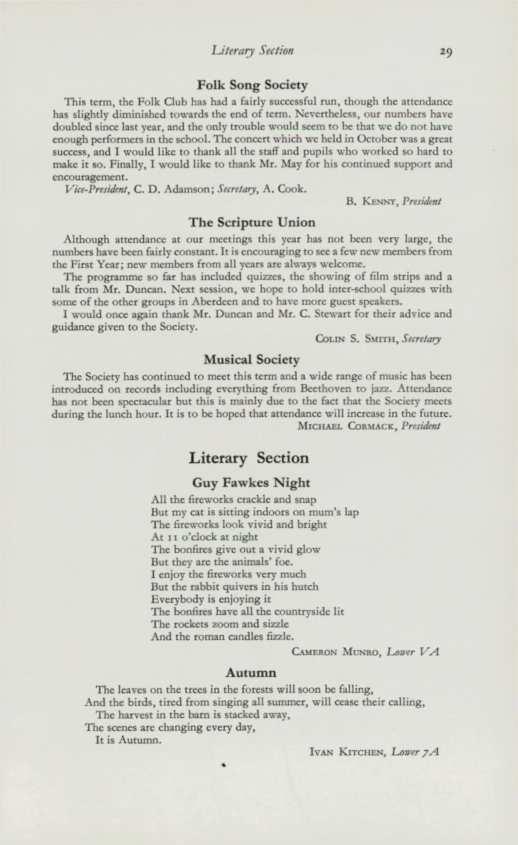
A Tho11ghtfor the Umpires
Confusing as it all must seem, there can be little doubt that in these changes we are witnessing the first stages of something in the nature of an educational revolution, a revolution which seems likely to extend in the course of the next few years from such traditional matters as the content of the curriculum to every aspect of education, social, emotional, recreational and ethical. If it is any comfort to parents, let me assure them that many of the older generation of teachers-of whom I must count myself one-are looking forward with a certain degree of apprehension to the changes ahead, not, I hasten to add, from any lack of conviction as to their value but simply because they realise that they will be faced in many cases with a long and perhaps taxing period ofreadjustment. We can only hope the process will be a rewarding one.
Meanwhile let me take this opportunity of assuring parents that, if they are in doubt at any time about any aspect of their son's education, we in the School shall always be happy to do what we can to resolve the difficulty.
To all readers of the Magazine, whether Former Pupils, parents or boys, I would offer my warmest good wishes for Christmas and the cw Year.
A Thought for the Umpire s
The West Indies cricket team are touring Australia this winterand M.C.C. would have been touring South Africa if politics had not interfered. This isagood time, therefore, to sympathise with theumpires because in the heat of battle, perhaps with the result of a Test match depending on a raised finger or a shaken head, few feel so generous.
Umpires cannot escape. Ifa batsman does not feel in a batting mood be can get himself out. ~othing could be simpler, particularly if he is facing, or trying to face, McKenzie, Hall or Peter Pollock. All he has to do is remove his bat from the path ofa straight ball, and the peace of the pavilion will be his until the end of his team's innings. By then he may have sloughed off his mood and be ready for double figures at least.
Likewise a bowler. Ifhe does not feel like pinning down the batsmen at one end while a colleague knocks down wickets at the other, he can set the batsmen free, so to speak, with long hops, half volleys and full tosses, thereby setting himself free of the responsibility of bowling. llis shocked captain will take him off and send him to the farthest corner of the field to repent.
But the umpire must umpire on, whatever his mood. He cannot afford to doze on duty, any more than a sentry can, because- like an orderly officer- a catch, a stumping or a leg-before-wicket decision
may come along at any time and find him out Then he will be put on a charge, or, to be exact, exposed in next morning's newspapers under headlines such as "Umpire's boob angers beaten skipper".
I know about these things because I have umpired a good deal: not at Lord's or Old Trafford or even in Sydney, but mainly in Scotland, where the old men on benches beside the sightscreen are as prone to splutter over cricket wrongdoings as any squat Cockney at the Nursery end, and possibly with more effect, since the Doric "carries" powerfully.
At the age of seventeen I umpired for the first time, on a grey Saturday afternoon at Montrose. :\fy first decision, I was tactfully assured later, was wrong: I gave a batsman out, caught at slip, when allegedly he had not touched the ball. But since he belonged to my side- the custom in the league being for each team to supply their own umpire- the benches beside the sightscreen were silent.
They were anything but silent on another occasion, on the orth Inch at Perth. On a sunny Saturday evening the last two batsmen in my side came together needing to play out the last over for a draw. There was some doubt about whether there would be time for this over, and the benches beside the sightscreen evidently considered that I walked or rather, proceeded-too deliberately to square leg. They suggested in outraged chorus that I "get a move on" (or words to that effect). I did not consciously dawdle: I merelyimitated what I imagined to be Frank Chester's pace. In any event, my two batsmen held out I umpired, too, when I was doing :\J'ational Service. By then I was comparatively experienced in the patient and all-seeing art. But I still made many mistakes, and on the playing fields of Bielefeld, while a member of the British \rmy of the Rhine, I made a particularly unfortunate one: I, a full private, gave my company sergeant-major out leg-before when he was not. He told me so afterwards, quite pleasantly, but with enough sad bewilderment in his voice to make me want to cut off my umpiring finger.
Who would have believed it possible to feel sorry for a sergeantmajor? Ile had been batting well, too.
Since then I have been blooded in English village cricket- once, deep in the heart of Northamptonshire, in a match in which an uncle of mine took part. But all I can remember about that afternoon is the considerable gradient of the pitch, and the difficulty I had in understanding one of the fieldsmen who tried to strike up a conversation with me at square leg. Cricket may transcend national barriers, but accents do not.
I would not go so far as to say that my golden rule in umpiring was "When in doubt, give him out"; but it must have seemed as arbitrary now and again. There is one mistake, however, that I cannot recollect making: miscounting the balls in an over. I always transferred the pebbles or pennies punctually from one pocket to the other. ;\fay the umpires this winter carry on the good work.
G. GoRuo, J\1.L \N* (1939-51)
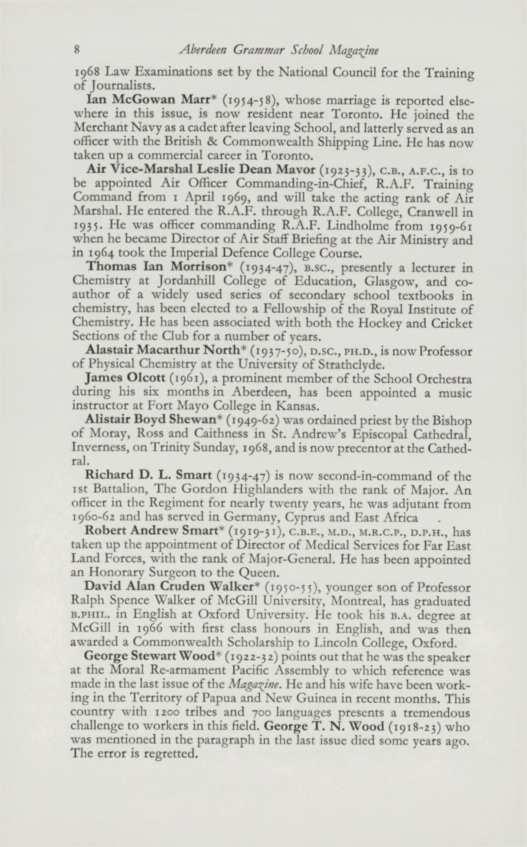
HONOURS AND AWA R,DS
Doctor of Divinity
(D.D.)
Thomas James Traill Nicol* (1930-35), M.B.E., M.c., M.A., received the honorary degree of Doctor of Divinity at Aberdeen University's Summer Graduation. lie served in World War II with the Black Watch, first as a combatant and thereafter as Chaplain. After the war he was for a short time minister of St. Luke's, Broughty Ferry, but returned to the army in 1949. He served as chaplain to the 1st Bn. Royal Scots Fusiliers and later in Korea and Kenya with the Black Watch. IIe was awarded the 1\1.B.E. in 19B for his services in Ko1ea. In 1954he was appointed to St. Andrew's Garrison Church of Scotland in Catterick. He has served since then in various theatres, latterly in Rhine Army, before taking up his present post as Assistant ChaplainGeneral at Scottish Command, the senior chaplaincy appointment in Scotland.
John BernardAnton (1936-46),M.A., has been appointed stipendiary magistrate of the Kalgoorlie District in Australia After graduating he joined the Eastern Bank of Ceylon. Uc then studied law and became an assistant in a legal firm in Perth, Western Australia . He is now in practice on his own in Gcraldtown some two hundred miles north of Perth.
Colin Glynn Frederick Brockie (1955-60), B SC , ».o., has been inducted to his first charge of St ~fartin's, Edinburgh
Graeme Findlay Bryce"'(1942-56), n.sc., formerly on the research staff in the Department of Molecular Biophysics at Yale University, has beenappointed Protein Chemist at the Roche Institute ofMolecular Biology at Nutley, New Jersey.
Douglas Paterson Cochran* (1906-15), previously manager of the Royal Exchange Assurance in Dundee and now in business as an Insurance Consultant has been admitted as a Fellow of the Institute of Insurance Brokers and as an Associate of the Association ofinsurance Brokers.
Ian Archibald Glendinning * (1948-62), n.sc., graduated M.Sc., al Aberdeen and is now working as a Seismologist with Seismograph Services Ltd. in Arabia.
Roger Graham Gooding * (1951-61) has taken Second Class Honours in Part II of the Medical Tripos at Clare Coliege, Cambridge and is continuing his medical course at Middlesex Hospital, London.
Alistair George Gracie* (1953-66), a junior journalist with Aberdeen Journals Ltd., took second place for the whole of Scotland in the
1968 Law Examinations set by the National Council for the Training of Journalists.
Ian McGowan Marr* (1954-58), whose marriage is reported elsewhere in this issue, is now resident near Toronto. He joined the Merchant Navy as a cadet after leaving School, and latterly served as an officer with the British & Commonwealth Shipping Line. He has now taken up a commercial career in Toronto.
Air Vice-Marshal Leslie Dean Mavor (1923-33), C.B., A.P. c ., is to be appointed Air Officer Commanding-in-Chief, R.A.F. Training Command from I April 1969, and will take the acting rank of Air Marshal. He entered the R.A.F. through R.A.F. College, Cranwell in 1935. He was officer commanding R.A.F. LindhoJme from 1959-61 when he became Director of Air StaffBriefing at the Air Ministry and in 1964 took the Imperial Defence College Course.
Thomas Ian Morrison· (1934-47), B.Sc., presently a lecturer in Chemistry at Jordanhill College of Education, Glasgow, and coautho r of a widely used series of secondary school textbooks in chemistry, has been elected to a Fellowship of the Royal Institute of Chemistry. He has been associated with both the Hockey and Cricket Sections of the Club for a number of years.
Alastair Macarthur North * (1937-50), D.sc., PH.D., is now Professor of Physical Chemistry at the University of Strathclyde.
James Olcott (1961), a prominent member of the School Orchestra during his six months in Aberdeen, has been appointed a music instructor at Fort Mayo College in Kansas.
Alistair Boyd Shewan * (1949-62) was ordained priest by the Bishop of Moray, Ross and Caithness in St. Andrew's Episcopal Cathedral, Invern ess, on Trinity Sunday, 1968,and is now precentor at the Cathedral.
Richard D. L. Smart (1934-47) is now second-in-command of the 1st Battalion, The Gordon Highlanders with the rank of Major. An officer in the Regiment for nearly twenty years, he was adjutant from 1960-62 and has served in Germany, Cyprus and East Africa
Robert Andrew Smart"' (r919-31), C.B.E., :-1.0., ~1.R C P., o.P.H., has taken up the appointment of Director of :Medical Services for Far East Land .forces, with the rank of .Major-General. He has been appointed an Honorary Surgeon to the Queen.
David Alan Cruden Walker· (1950-55), younger son of Professor Ralph Spence Walker of McGill University, Montreal, has graduated D.PHIL. in English at Oxford UniYersity. He took his B.A. degree at McGill in 1966 with first class honours in English, and was then awarded a Commonwealth Scholarship to Lincoln College, Oxford.
George Stewart Wood• (1922-32)points out that he was the speaker at the Moral Re-armament Pacific Assembly to which reference was made in the last issue ofthe A[agazine.He and his wife have been working in the Territory of Papua and New Guinea in recent months. This country with 1200 tribes and 700 languages presents a tremendous challenge to workers in this field. George T. N. Wood (1918-23) who was mentioned in the paragraph in the last issue died some years ago. The error is regretted.
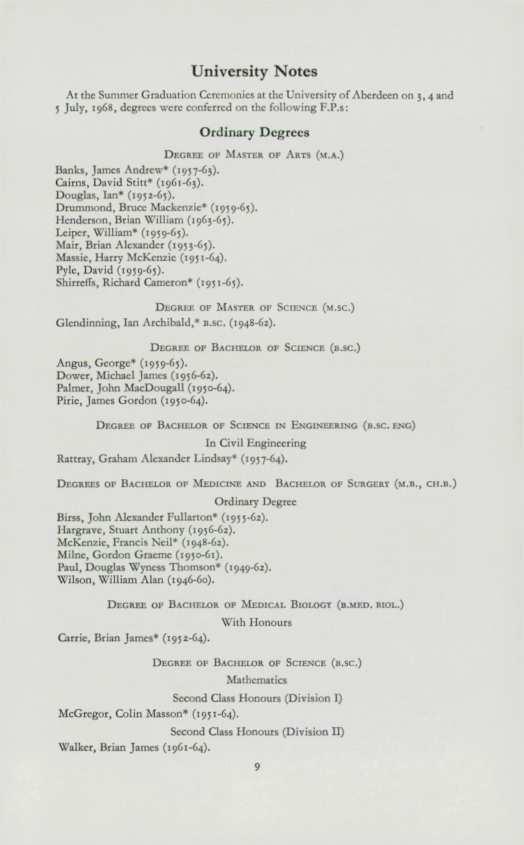
University Notes
At the Summer Graduation Ceremonies at the University ofAberdeen on 3, 4and 5 July, 1968, degrees were conferred on the following F.P.s:
Ordinary Degre es
DEGREE OP MASTER OP ARTS (M.A.)
Banks, James Andrew• (1957-63).
Cairns, David Stitt* (1961-63).
Douglas, Ian* (1952-65).
Drummond , Bruce Mackenzie" (1959-65).
Henderson, Brian William (1963-65).
Leiper, William* (1959-65).
Mair, Brian Alexander (1953-65).
Massie, Harry McKenzie (1951-64).
Pyle, David (1959-65).
Shirrcffs, Richard Cameron" (1951-65).
DEGREE OP MASTER OP ScrESCE (M.SC.)
Glendinning, Ian Archibald,* B Sc. (1948-62).
DEGREE OP BACHELOR OF Scu:NCE (e.sc.)
Angus, George* (1959-65).
Dower, Michael James (1956-62).
Palmer, John .MacDougall (195o-64).
Pirie, James Gordon (1950-64).
DEGR£1l OP BACHELOR OP SCI&'-CE IN EJ-G INEERTNG (B.SC. ENG)
In Civil Engineering
Rattray, Graham Alexander Lindsay* (1957-64).
DEGREES OP BACHELOR OP ::\fEDICU..."ll AND BACHELOR OP SURGERY (M,B., CH,B,)
Ordinary Degree
Birss, John Alexander Fullarton* (1955-62).
Hargrave, Stuart Anthony (19 56-62).
McKenzie, Francis Neil* (1948-62).
Milne, Gordon Graeme (195o-61).
Paul, Douglas Wyness Thomson* (1949-62).
Wilson, William Alan (1946-60).
DEGREE OF BACHELOR OF 1:lc.olCAL BIOLOGY (B.MED. BIOL.)
With Honours
DEGREE OF BACHLLOR OP ScIE.-.cE (n.sc.)
Mathematics
Second Class Honours (Division I)
McGregor, Colin Masson* (1951-64).
Second Class Honours (Division II)
Walker, Brian James (1961-64).
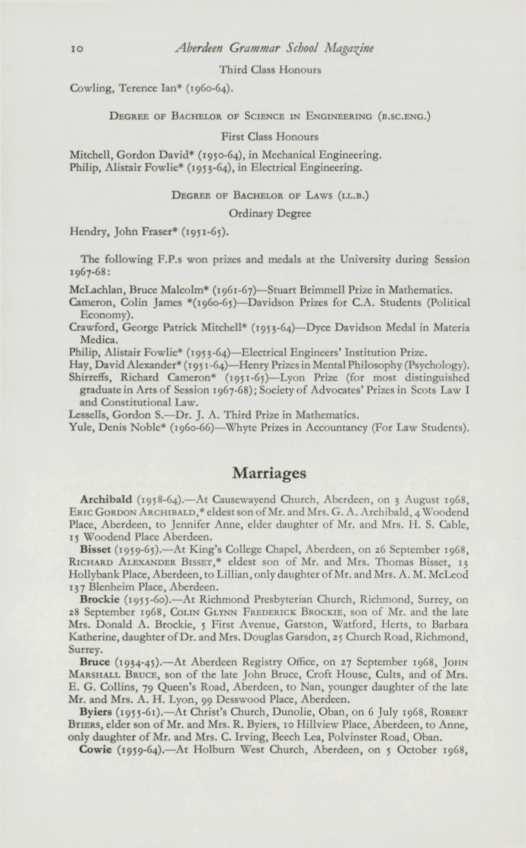
Aberdeen Gra111111ar School ~Magazine
Third Class Honour~ Cowling, Terence Ian* (1960-64).
DEGRI:£ OP BACHELOR OP SCIENCE IN ENGL"IEERING(B.SC.l'.NG.)
DEGRC!l OP BACHfil.OROP LAWS (LL.B.) Ordinary Degree
Hendry, John Fraser*(1951-65).
The following P.P.s won prizes and medals at the University dudng Session 1967-68:
McLachlan, Bruce :!vfalcolm* (1961-67)-Stuart Brimmell Prize in Mathematics. Cameron, Colin James *(196o-65)-Davidson Prizes for C.A. Students (Political Economy).
Crawford, George Patrick Mitchell* (1953-64)-Dycc Davidson Medal in Materia Medica.
Philip, Alistair Fowlie• (1953-64)-Electrical Engineers' Institution Prize. Hay, David Alexander• (1951-64)-Hcnry PrizesinMental Philosophy (Psychology). Shirreffs, Richard Cameron• (1951-65)~ Lyon Prize (for most diMinguished graduate in Arts of Session 1967-68);Societyof Advocates' Prizesin Scots Law I and Constitutional Law.
Lcssells, Gordon S.- Dr. J. A. Third Prize in Mathematics. Yule, Denis Noble· (1960-66)· Whyte Prizes in Accountancy (For Law Students).
Marriages
Archibald (1958-64).-At C.ausewayendChurch, Aberdeen, on 3 \ugust 1968, ERICGORDONARCHIBALD,·eldest son of:\Ir. and 11rs. G. .\. Arch ibald, 4 \\ o<,dend Place, Aberdeen, co Jennifer Anne, cider daughter of Mr. and Mrs. H. S. Cable, 15 Woodend Place Aberdeen.
Bisset (1959-65).-At King's College Chapel, Aberdeen, on 26 September 1968, R1C1CARD ALF.XANDERB1sscT,* eldest son of .Mr. and Mrs. Thomas Bisset, 13 Hollybank Place,Aberdeen, to Lillian, only daughrer ofMr.and Mrs. A. M. McLeod 137 Blenheim Place, Aberdeen.
Brockie (1955-Go).-At Richmond Presbyterian Church, Richmond, Surrey, on 28 September 1968, CoLIN Gui-N FRLDLI\ICKBROCKIE,son of Mr. and the late Mrs. Donald A. Brockie, 5 First Avenue, Garston, Watford, liens, to Barbara Katherine, daughter ofDr. and Mrs. Douglas Garsdon, 25Church Road, Richmond, Surrey.
Bruce (1934-45).-At Aberdeen Registry Office, on 27 September 1968, Jo11N MARSHALLBRUCE, son of the late John Bruce, Croft House, Cults, and of Mrs. E. G. Collins, 79 Queen's Road, Aberdeen, to Nan, younger daughter of rhe late Mr. and Mrs. A. II. Lyon, 99 Desswood Place, Aberdeen.
Byiere (1955-61).- At Christ's Church, Dunolie, Ohan, on 6 July 1968, ROBERT BYIERS,elder son of Mr. and Mrs. R. Byicrs, 10 Hillview Place, Aberdeen, 10 Anne, only daughter of Mr. and Mrs. C. Irving, Beech Lea, Polvinster Road, Oban.
Cowie (1959-64).-At Holburn \\~est Church, Aberdeen, on 5 October 1968,
RAntoi-o ALE.X.ANOERCowm, son of Mr. and l\lrs. James B. Cowie, 66 Cranford Road, Aberdeen, to Jennifer Margaret Booth, daughter ofl\lr 11ndMrs. Thomas P. Officer, 77 Rosemount Viaduct, Aberdeen.
Crail< (1959-65).-At the Amatola Hotel, Aberdeen, on 7 August 1968, IAN W1u..xAMCRAlK,son ofMr.and Mrs. \X'illiam Craik, 37Ilazlthcad Road, Aberdeen, to Patricia June, younger daughter ofMr.and Mrs. Robert Mcff,6 Bracside Terrace, Aberdeen.
Fraser (1953-6o).- At the Parish O,urch of St. Jude, Mapperley, l\ottingham on 20 July 1968,NEILMcCALLUMFRASLR,only son of Henry James Fraser* (1918-22) and ofMrs. Fraser, 71 Cyprus Road, Mappcrley Park, l\ottingham, to Shirley, elder daughter of Mr. and 11rs. R. J. Syder, O,erryholt, Alexandra Park, Nottingham.
Fraser (1958-61).- At Ferryhill North Church, Aberdeen, on 20 September 1968, EowrN !Rvrsi; FRASER,' son of Mr. and Mrs. Edwin Fraser, 7 Portland Street, Aberdeen, to Elizabeth And<:rson,only daughter of Mr. and Mrs. C. Urquhart, 8 Ashvale Place, Aberdeen.
Fraser (1956-62).- At King's College O,apcl, Aberdeen, on 29 June 1968, GRAJ'ME\VJ!.LIA.MPRASCR,* son of the late William Fraser and of Mrs. Fraser, 17 Bon-Accord Terrace, Aberdeen, to Angela Clare, daughter ofMr. and Mrs. George T. MeCue, 2 Oakdale Terrace, Aberdeen.
Freeland (1957-61).-At St. James' Episcopal Church, Aberdeen, on 14 September 1968, DERLKM1c1JALLFRED.ANO,son of the late Mr. F. J. Freeland and of Mrs. N. freeland, 37 Louisville Avenue, Aberdeen, ro Muriel Ann, daughter ofthe late Mr. 11. G. Smith and ofMrs. P. M. Smith, 405 Great \X'cstcm Road, Aberdeen.
Fyall (r953-62).-At King's College Oiapcl, Aberdeen, on 23 August 1968, ALASTAIRMoIRFYALL,•only son of Mr. and Mrs. A. A. Fyall, 81 Cranford Road, Aberdeen, to Elizabeth Booth, only daughter of Mr. and l\lrs. A. Simpson, 135 Manor Avenue, Aberdeen.
Gamrnie (1959-59). At Glenmuick Parish O,ureh, Ballater, on 27 July 1968, ALAN GR1GOR GAMMIB, son of Mr. a.nd l\1rs. \. B. Garnmie, 110 Gray Street, Aberdeen, to Elizabeth Margaret, daughter of Mr. and Mrs. J. S. Sutherland, Kjlcraggan, Ballater.
Gauld (1947-61). At King's College Chapel, Aberdeen on 2. August 1968, MALCOLMWILLJAMRoBCRTSONGAt:1.0•,eldest son of\\, illiam Robertson Gauld• and of Mrs. Gauld, 90 Fountainha ll Road, Aberdeen, to Lesley, only daughter of Mr. and Mrs. J. Riddell, 9 Plane Tree Road, Roschill, Aberdeen.
Gentle (1959-65).-At Aberdeen Registry Office, on 19 August 1968, TERENCE ALLXANDERGl'.NTLI!,only son of Mr. and Mrs. James Gentle, 56 Arnage Drive, Aberdeen, to Ishbcl McLean, only daughter of Mr. and .Mrs. Robert Low, 3IS Broombill Road, Aberdeen.
Harper (1944-58).-At King's College O,apcl,Abcrdeen, on July, 1968,Dot:GLAS Ross I.IARPER*M.B , c11.o.,younger son of Louis R. Harper (1910-17)and of:Mrs. Harper, C~irnbaan, 40 North Dct.-side Road, Bieldside, to Dorothy Constance, daughter of Norman F. \'riscly* (1920-32)and Mrs. Wisely, Craigievar, 32 Cairn Road, Bieldside.
Hollifie ld (1948-60).-At St. Bernard's Parish O,urch, Edinburgh, on 18 July 1968,JoHNCRAIBlloLLtFIELD,onlyson of1'1r.and l\1rs.John Ilolli6cld, 35l\orfolk Road, Aberdeen, to Aileen Ann, daughter of Mr. and Mrs. A. Bruce Ewen, 49 Silverknowes Gardens, Edinburgh 4.
Hutcheson (1946-59).- At King's College O,apel, Aberdeen, on 7 August 1968, Jo11N IlUTc11£SON,*son of Herbert CecilHutcheson* and of Mrs. Hutcheson, 37 Gray Street, Aberdeen, to Doreen Catherine, daughter of Mr. and Mrs. A. Fraser, 14 Beechgrovc Terrace, Aberdeen McInto sh (1951-57).-At Edinburgh, on 23 March 1968, IAN Mclmo s11,•only son ofMr. and Mrs. I. M. McIntosh, 10 Bridge Terrace, Bridge of Don, Aberdeen, to Ann, second daughter of Mr. and Mrs. D. M. Duffus, 335 Easter Road, Edinburgh .
Aberdeen Gra11J111ar School
Macmillan (1952-55).-At All Saints Church, Staplehurbt, Kent, ~FIL PARQl:llAR MACMILLAN,younger son ofDr. William George l\lacmillan* (1916-H) and ofMrs. Macmillan, 7 Rubislaw Den South, Aberdeen, to Jane, younger daughter of WingCommander and M.rs.T.V. Yonge, Little knoxbridge, Staplehurst, Kent, Ma.rr (1957-63).-At Trinity Church, Crown Street, Aberdeen, on 24 August 1968, IAN Scorr MARR,* younger son of Mr. and .Mrs. Peter T. Marr, 4 Stanley Street, Aberdeen, to Isobel Louise, daughter of Mr. and l\lrs. Lewis W. Noble, 22 Talisman Road, Aberdeen.
Marr (1954-58).-At Milton, Kent, on 5 August 1967, IAN McGowA..'1:MARR,· son of Mr. and .Mrs. Magnus Marr, Torgyle Crescent, Glenmoriston, Invemes sshire, to Margaret, daughter of Mr. and Mrs. Harry Mason, 15 Berkeley Road, Gravesend, Kent.
Marwick (1947-60).-At Northmaven Parish Church, Hillswick, Shetland, on 11 July 1968, DAVIOCoRRJGALLMARWICK,only son of Mr. and :Mrs.William C Marwick, 85 Duthie Terrace, .Aberdeen, to Jean Mary Harrison, only child ofMr. and Mrs. Arthur H. Sandison, .Assarer,Heylor, Shetland.
Milne (195o-61).At King's College Chapel Aberdeen, on 10 July 1968, GoaooN GRALMBMu.NB,younger son ofGeorge P. Milne, M.B., CH.D.,F.R.c.o.G.and ofMrs. Milne, 21 Gordondale Road, Aberdeen, to .Margaret Jean, M.A. daughter of Mr. and ;\frs. George Milne, \\"oodlands Farm, Dyce Nixon (1946-57).-.'\.t St. John's Church, Abbeydalc, on 12 August 1968, RONALD DAVI.ES NtxoN, son of Mr. and Mrs \V Nixon, 7 Orchard Road, to Rosemary Jane, younger daughter of Mr. and Mrs. George Bethell, 6 Dore Roa<l, Dore, Sheffield.
Peterson (195o-61).- At 1-.:.ing's College Chapel, Aberdeen, on 17 July 1968, GOROONCRAIG PETERSON,*son of Mr. and Mrs W11liamG. Peterson, 2 Cairncry Avenue, Aberdeen, to Helen Elaine, daughter of l\lr. and Mrs. James S. Cam, 358 King Street, Aberdeen Smith (1961-62).-At Hebron Evangelical Church, Kirkcaldy on 10 May 1968, RAYMOND SMITH,s.o.s., elder son of J\fr. an<lMrs. J. 5. Smith, Roneval, Abbotshall Drive, Cults, to Evelyn Elizabeth, youngest daughter of Mr. and Mrs. J. Murray, 6 Valley Gardens, Kirkcaldy.
Smollett (1938-.u).- At ,\berdcen, on 7 October 1968, J011N CoUTTss~mLLITT, son ofthe laceMr. R.Smollctt, and ofMrs. C. Smollctt, 131 South 1\ndcrson Drive, Aberdeen, 10 Isabel, daughter of the late .Mr. W. .'.\[unroand of ;\frs. I. Munro, 88 Middlefield Terrace, Abcr<lecn. Taylor (1947-61). At Trinity Methodist Q1urch, Redcar, on 10 1\ugust 1968, ANDREWTHOl!ASTAYLOR,·son of the late Sir Thomas Taylor, and of Lady Taylor, 39a Queen's Road, Aberdeen, tO l\largaret Sarah, daughter of the late .'.\it. J. 11. Coyle and of Mrs Coyle, 31 Turner Street, Redcar, Tees-side.
On Wings Round the Commonwealth
When I made my exit from the school in which I had taught for forty-four years I felt that my world had collapsed but in fact it pro,·cd to be the dawn of a new era. Always fond oftravel, I had a sudden urge rogo farther afieldand explore, so within days had completed bookings and set off on my venture by air. Before I left one of my former pupils gave me a list of "Old Boys" overseas. I would still be "on the wing" had I attempted to contact them all, but several were within my orbit. 'The first was in London where Dr. 1kLusky of Sr. Columba's welcomed me to his home. This ~-asa wonderful re-union after so many years and with his remarkable memory he recalled his old class-mates.
On l17ingsRo1111d the Co111111011wea/1h
Kenya, which I had previously visited, was my first stop after leaving London. In Nairob i there were many changes with few Europeans and fewer Indians but still one old F.P., Graham Sutherland. On learning that I was to be at the New Stanley Hotel, a letter awaited me to say l'd be picked up and driven to 01' Kalou as a guest at the end ofseason shooting party. This meant a drive of 130 miles over the Escarpment and through the Rift Valley. On my arrival I was welcomed with open arms to "The White IIighlands" by those who still have their roots in the land which to them has always been their home. During my stay we paid a visit to Thomson's Falls, a wonderful sight in the heart of the forest where leopard, lion and elephant roam and the air isimpregnated with the scent ofcedar and eucalyptus.
Meer Kenya I stopped at Mauritius which had just got its independence. It is certainly a desirable place with a sub-tropical climate, lush vegetation, beautiful Tamarisk and Flamboyant trees, and fields of sugar cane and sisal. I visited the market where all kinds of fruit, flowers and fish were on sale. In Mauritius I also visited a museum with relics of Napoleon, saw the monument at Grand Port and toured the island with its background of mountains and its cornI shores.
My next stop was Perth which is a modern city with spacious parks and gardens. I visited the city's Yanchop Park where I saw emu, koalasand kangaroos. From Perth I travelled by air over Calgoorlie and the Great Austrnlian Bight to Melbourne and from there to Christchurch The gracious town has an English look with its rectangular pattern of streets named after English bishoprics. The River Avon meanders through the heart ofthecityand itsgrnssybankswith their drooping willows were a riot ofbloom during my visit. After a flight in a small plane up to Mt. Cook, I travelled by coach over the vast plains which today support tjo,ooo sheep and 130,000 cattle on its 3io,ooo acres of rich pasture. En route were little townships bearing such names as Roxburgh, Teviot and Bannockburn-urely very Scottish.
I wasthen offto 'orrh Island,couching down at Wellington, which, viewed from above, presents a fine sight. We fortunately reached Rotorua before the impact of a cyclone in full fury-the country's worst storm in sixty years
The highlight of my visit to the North Island was a Maori concert which I can still hear and see. An now came the last hop to Auckland, New Zealand's largest city which is on an isthmus between two lovely harbours. Here we saw evidence of volcanic activity for on the present site of the city are fifteen cones, now attractive residential suburbs, while the naturnl basins provide playing fields.
But, all too soon I had tO pay farewell to the land of koala and kangaroo and was off on wings coHong Kong. Landing in the evening and seeing myriads of lights at so many levels waslike Fairyland The next day, I made an extensive tour of the Hong Kong colony which covers some 400 square miles. Crowded into this area are 4,000,000 people a third of them refugees. I found it difficult to adjust myself to thisstrange environment after the vast open spaces ofNew Zealand and Australia. Here were millions concentrated in the confined area around the harbour and on the mountain slopes The prosperity of H.K. has depended upon its position as a free port and its trade with the outside world. Today the emphasis is on industry, and the visitor has a kaleidoscopic impression ofold and new. A trip around reveals everything from crowded street markets to spacious residential areas. One mayspend an evening in Aberdeen (afishing village whose water-from is nforest ofjunk boats) at one of the famous floating restaurants. Where thousands of old junks had lain rotting, this reclaimed land now supports as many refugees in these flats which are now rearing upwards. An afforestation scheme is afoot in order to hold the soil on the mountain slopes. In the New Territ ories we drove past paddy fields, duck farms and oyster beds. All food has to beimported, and the water supplycomes from China. Leaving Hong Kong, my greatest regret was that I had not contacted one of the "Old Boys". Perhaps the fact that one was a Judge in the Supreme Court and another (Alistair McNutt), Superintendent of the C.I.D. overnwed me. This need not have been the case for on the morning of my departure I 'phoned the latter.
Aberdeen Grammar Srhool Magazin,
Where was I? Why had I not rung up the previous day? They had had their annual re-union that night and would have had me there "to keep them in order". However, he came to the airport, wearing the F.P. tic. I shall never forget this brief re-union and shall always regret having missed the opportunity of being with my Old Boys at that dinner. It would have been the climax to my forty-four years. I felt rather sad on this next flight and was inpensive mood, when the pilot announced that we were crossing over the Philippines and visibility was so good we might secanactive volcano. Sure enough, there it was belching out smoke. Again I becameinterested in the sights below and around me until I arrived in Singapore which was to be another high-light for me, for an arriving at RafflesHotel, in my suite was a basket of fruit from Robert Booker who as a boy had "sat at my feet". Then my 'phone rang. He would sec mein the lounge at 2.30 p.m. As he had business to attend to that afternoon, his car and chauffeur were at my disposal, and I was taken across the causeway to Malaysia to Johore, where we visited the War Cemeteryand tbe Sultan's Palace. This was a marvellous experience for me, as my well-informed driver plied me with information all along the route.
Mixed with the sight and sounds of this polyglot society arc the exotic smells of produce on the move by day and the perfume ofthe Frangipani by night.
My next stop was Ceylon where I was content to tour Colombo with its beautiful palm-fringed beach. I had to paya visit to the renowned Botanic Gardens at Kandy. Here are rwo hundred species of palms, a magnificent orchid house, and the spice area with lemon grass, citconella, Jamaic.~pepper, cloves, nutmeg, cinnamon and sandalwood to me recalled the lines "what though the spicy breezes blow soft o'er Ceylon's isle".
Now I bad left the humidity for the dry burning heat oflndill. From the 'plane it seemed one great expanse of brown arid land. Crossing the tarmac at Bombay airport was a test ofcndumncc in the fierceblazing sun, but the Taj Mahal Hotel was pleasantly cool. Here again I had a luxurious suite, but in the street below was a picture ofpoverty with beggars at every point. I visited the home ofGandhi. This is now a museum which houses his personal belongings. On the walls were excerpts from his speeches and letters. The Parsee quarter was nauseating, for according to their religion, the dead bodies are hung up for the vultures. ln ten minutes, only the bones remain and these drop into acid to be burned. I was struck by the contrasts in this city- the beautiful Ilanging Gardens with topiary simulating an elephantand a giraffe, the fine High Court buildings and the Victoria Terminus, the large stores displaying treasures, the spacious Marine Drive and the melee of bullock carts, rickshaws, bicycles, goats, cars and pedestrians all wrestling together.
Jaipur came next on my itinerary. Here the temperature was 110° Even the natives were lying down where there was any shade. Here I took up residence in the Rambah Palace formerly occupied by the Maharajah. Whilst in this region, a visit to Amber, the lost city, wascalled for. Ilere I saw the throne room, the harccm and courtyard where the concubines took exercise.
But, my tm"clling was nearly over and I was now to be turning back the hands of my watch, sometimes not sure whether it was today or tomorrow. Now, although poorer in terms of currency, I am richer in memories which will be the "bliss of solitude" in the years which lie ahead.
ETIIF.L M. STEWART
Obituaries
Robert Gordon Courage• (1908-19)died at Aberdeen on 11 January 1968. He was one of a well-known Aberdeen family and was for over thirty years proprietor of the Royal Oak Bar and Restaurant, having succeeded his father in 19n. As a younger man he was a noted violinist, and also a keen horticulturalist. He was associated with St. Clement's Masonic Lodge in which he was a Knight of Malta. His four brothers also attended the School- Arthur (1905-12), David (1903-11), Gilbert (1910-23)and William (1907-15).
John Robertson Cowper (1910-17),O.B.E , died earlier this yearat Coupar Angus. A graduate ofSt. Andrews University, Fellow ofthe Institute ofChartered Insurance Brokers and a Member of the Institute of Transport , he was awarded the O.B.E. for services on the planning of the Nomw1dy Landings. Following a term with the Ministry of War Transport, he spent over thirty years with the Dundee, Perth and London Shipping Co. Ltd. succeeding his father as General Manager in 1947 and being appointed Managing Director in 1963.He retired from the firm early in 1967.
Robert Warrender Farquhar• (1919-22), u.sc. (Agr.), M.u , CH.B., D,P,R , died at Lancaster on 15 February 1968, aged sixty-three. After graduating in agriculture in 1925 he undertook research projects under the direction ofLord Boyd-Orr at the Rowett Research Institute. He was later engaged in field work in Kenya, but decided after a time to study medicine. He returned to Aberdeen University and graduated in 19n; ten years later he obtained bis Public Health Diploma. On graduating he entered general practice at Kidsgrove, Staffordshire, leaving this for war service in 1939.In 1943-44he commanded No. 3West African Field Ambulance and thereafter as Colonel he commanded 156 West African General Hospital. In 1946-47 he was deputy superintendent of Woodend Hospital, Aberdeen, before being appointed Assistant Medical Officer to Lancashire County Council. After holding a number ofother posts in the area he became Medical OfficerofHealth for Lancaster and several District Councils in the vicinity. He was active in promoting c~peration between the three arms of the National Health Service in northern Lancashire.
William Clow Knight Goodbrand* (1905-7)died in Aberdeen on 7 July 1~8, aged seventy-eight. On leaving School be entered the family business of Stephen Goodbrand and Son, wholesalewarehousemen in Aberdeen which had been founded by his father. After training he becamea traveller for the firm and thereafter assistant manager. In World War I he served in France and Belgium with the 4th Battalion, Gordon Highlanders , and was wounded in April 1918.After the war he returned to the family business of which he became managing director. He was associated also with Messrs. D. McAndrew, builders and contractors, and had in addhion other business interests in the North-t.
Alexander Findlay Gorton (1942-48)died in New York on 13 July, 1968, from injuries received earlier in the year afer being attacked and robbed in a New York street. After leaving School, be trained as a ship's officer on H.M S. Womsltr before joining the P. and 0. Line where he became a first officer After gainjng his master's ticket he entered the managerial side of the company. Three years ago he joined the Booth Shipping Co. and after eighteen months service in Brazil becamemanager of their New York branch
Redvers Noel Ironside • (1907-17),M.B., c11.n , P.R.C.P., died at E.-istbouroeon 18 July 1968, aged sixty-eight. After leaving School he served with the Royal Artillery before proceeding to Aberdeen Universjty. There, after a distinguished eareer, he graduated in medicine in 1922.. He held appoinrmenrs at Westminster Hospital and the National Hospital, Queen's Square, London, before becoming a registrar at Guy's Hospital. His interest was always in neurology, and after a period at WestLondon Hospitalhewasappointed to MaidaValeIIospital for Nervous Diseases in 1935.He was elected to a Fellowship of the Royal College of Physicians in 1936. During World War ll Dr Ironside served with the R.A.F. attaining the r,
Abtrdem Grammar School Magazine
rank of Air Commodore. After the war he returned to his hospital appointments and to private practice, but failing health forced his premature retiral from certain posts and curtailed some of his m.1nyactivities. Despite this he was able to take up the post of .Neurologist at Charing Cross Hospital from 1960 to 1965. He served on the board of governors of the 1':ational Hospital for Nervous Diseases from 1955 to 1958and again from 1962to 1963.Ile waspresident ofthe Neurology Section of the Royal Society of.Medicine in 1956 and Master of the Society ofApothecaries in 1963. Dr. Ironside was elected a Fellow of the Royal Society of Arts in 1964.
At a service of thanksgiving in the Royal Parish Church, St. .l\iartin's-in-theField, London, on 18 September 1968 the London Centre of the F.P. Club was represented by Dr. Francis Charles Kelly* (1905-14),Dr. Walter Graham• (1913-19) and Angus Henry Klic Slater" (1922-35)along with Dr. Ironside's brother William Dalton Ironside* (1914-24)who is in practice as an architect in Tenterden, Kem.
J'ORMER REGISTRAR-GENEIVII.FOR SCOTI.ANO
James Gray Kyd• (1891-98), c.o.F.., F.F.A., F.R.S.L.,died in Sussex on zi June 1968,aged eighty-five. A son of the late Mr. Thomas Kyd, a former manager ofthe Northern Assurance Company Ltd. in ,\berdeen, Mr. Kyd himself joined the Northern Assurance in 1898 serving in Aberdeen and London till 1911. He was then appointed Actuary to the National IleaIth lnsurance Commissioners (Ireland) From 1919to 1921 he held the chief post in the Government Actuary's Department in Ireland, and for the next live years he held the same post in Scotland. In 1926 he became principal actuary of the Government Actuary's Department at the Treasury, a post which he held for eleven years, being latterly also Secre111ryof the Department. Jn 1937 he was appointed Registrar-General for Scotland, and in this capacil-yhe becameknown throughout the country. !le had a keen flairfor explaining statistica l matters in an attractive \\-ay, and in both his regular reports and in the press conferences which he held he demonstrated the fascination of figures, and thanks to his li,,cly wit dull statistics took on for many a new interest. Many an argument arose over his disclosures as to, for example, the relative expectancy oflifc in Edinburgh and Glasgow, or over his periodical authoritative commentaries on the rival claims ofAberdeen and Dundee for the position ofThird Ciry in Scotland. from 1944 to 1946 Mr. Kyd was president of the !'acuity of Actuaries, his elevation to which, he said in his presidential address, he would ever regard as the greatest event m his professional life. In 1948,the year of his retiral, he wasadmitted to honorary membership of the ,\ssociation Royale des :\ctuaires Bclges.
The great permanent memorial t0 ~fr. Kyd must surely be the Third Statistical Account of Scotland which was undertaken at his suggc:,tion. The I'irst Statistical J\ccount was prepared in 1791-98and the Second in 1834-4). In view of the great changes talcing place in the country and all the reconstruction and planning being discussed, he considered the mid-twentieth century a suitable time for putting on record a further comprehensive study at local level of traditions and conditions throughout the country.
Mr. Kyd's ffifillYinterests covered a wide field. llc was for many years chairman of the Scots Ancestry Research Society; he was a member of the Scottish Council of Social Senice and of the Council of the °'.':ationalTrust for Scotland; he was from 1940 to 1948 chairman of the Scottish Civil Service Savmgs Committee; for a numhcr of years he was convener of the Church of Scotland's .\ged and Jnfirm Ministers' Fund; and he was a director of the Scottish Rights of Way Society.
Mr. Kyd was an active member of the I .dinburgh Centre of the f.P. Club before retiring to the South of England. l lc was appointed President of the Club for 1950-p, and during his year of olficc the new War Memorial in the School Hall was unveiled and dedicated. Mr. Kyd, in the name of the F.P. Club, presented the Rector with a specially-bound cop}·of the Roll of Ht nour.
Roben Daniel Lawrence* (1900-9), M.o., F.R.C.P., LL.o., died in London on 27 August 1968, aged seventy-five. A student at Aberdeen University he ,vas
Obitflaries
awarded the Fife Jamieson and Li7.arsGold Medals in 1913 and the Shepherd and Anderson Gold Medals in 1915. He graduated M.B., Ch.B. in 1916 with honours, and proceeded to M.D. in 1922.In the intervening period he served in the R.A.M.C. and held the post of hou~c surgeon and casualty oHicer at King's College Hospital, London While operating at King's a chip of bone from a diseased mastoid entered his eye and damaged the cornea. Dunng the treatment of the severe sepsis which resulted he was found to be a diabetic. Dr. Lawrence was one of the first patients to be treated when insulin became available in this country and, his own life being saved he devoted it to the study ofdiabetes. He was appointed bio-cllemist at King's in 1924, becoming occupied mainly in research in connection with the treatment of diabetes. He also became lecturer in biochemistry in the medical school at King's. Dr. Lawrence was admitted to Membership of the Royal College of Physicians in 1927 and elected a Fellow in 1932. In lhe same year he was appointed assistant physician-in-charge of the Diabetic Departmcnr, becoming physician in 1939, and there he dc,elopcd a large and eHicient department. In 1925 he had published The Diabelif Life which subsequently went through seventeen editions and was translated into many languages. He founded the Diabetic Association (later the British Diabetic Association) and was first president of the International Diabetic Federation. Inevitably honours came his way: in 1946 he was Oliver-Sharpey Lecturer ofthe Royal College of Physicians; in the sameyear he received the Banting Medal; in 1956the :\fedical Sociery of London awarded him its Father Julian Gold Medal. Dr. Lawrence was a president ofseveral sections of the Royal Society ofMedicine, and in 1964Toronto University conferred on him its honorary doctorate of laws.
Kennet h Pirie J\kKcnzic* (1901-7), M.A., M.B., c11.s., died at Inverness on 7 March 1968,aged seventy-eight. After leaving School he attended Aberdeen University graduating in Arts in 1910and in Medicine in 1914.He then served with the R.A.l\I.C. in France and Greece. Ile was mentioned in dispatches in 1919for services in France. He had by this time been appointed to a regular commission and served in various parts of the world, most frequently in India where in 1939 he had been appointed Assistant Director of Medical Services with the Indian division. During the Second World War he served in Burma and was captured by the Japanese at the Sittang River crossing, being subsequently interned in Rangoon Jail until 1945.His experiences at that time brought him later fame through his best-selling book OperationRangoonJail, which describes the hardships suffered by himself and his fellow prisoners at the hands of the Japanese. He retired from the Army in 1947and took up residence in Inverness. lie served for several years on Inverness Town Council and was also a member of Inverness County Council. He was for a time seoior magistrate in Inverness and amongst other public positions he was County Medical Officerfor the Inverness-shire branch of the Red Cross, and a vice-president of the Inverness branch of the British Legion.
David Graeme Robertson* (19e>0-9)died at Aberdeen on 26 July 1968, aged seventy-six. On leaving School he served his apprenticeship as an engineer with Wm. McKinnon and Co. Ltd., Spring Garden, Aberdeen. After completing his training he engaged in rubber planting and was based in nrious parts of Malaya. While there he acted as Consul for the F.P. Club. In 1926 he returned to Aberdeen to rejoin Wm. McKinnon and Co. as managing director, a posirion which he retained for forty-two years until his death.
DlS'l'JNGUlSHED FORMER PRESlDEN'l'
William Douglas Simpson* (1901-13),c.B.E.,M.A.,o.ul'l'., LL.D.,P.S.A.(Scot.)., F.S.A.,died with tragic suddenness in the Library of King's College, Aberdeen, on 9 October 1968. After graduating with first class honours in history in 1919 Dr. Simp,son was appointed assistant to the Professor of History and in the following year became lecturer in British History. In 1926he was appointed Librarian to the University, Registrar, and Clerk to the General Council, appointments which he held for forty years until his retiral in 1966.During that time he guided an expansion
Aberdeen GrammarS,hool Magaz.ine
of the Library in all its branches which students of yesteryear find hard to credit, embracing new buildings at King's and in other parts of the University and the acquisition of many thousands of volumes. At the same time Dr. Simpson was busily engaged on archaeological research, including works of excavation and restoration not only in the North-cast but over a wide area. He was for many years chairman of the Ancient Monuments Board for Scotland, and was recognised as one of the leading authorities on the history and archaeology of Scotland. He was the author of numerous publications on these subjects, and notably on the castles in the Buchan area. Dr. Simpson was also prominent in the Scout Movement, his services in this field being recognised by the award of the Silver Acorn in 19s8 to mark fifty years' active work.
Honours came in profusion to this distinguished Grammarian. He was awarded the O.B.E in 1954and created a Commander ofthe Order in 1961.His Alma Mater bestowed its honorary doctorate of laws on him in 1962.The F.P. Club did him the rare honour of elevating him to its principal officeon two occasions, in 19s3-54and again ten years later in1963-64.On this lastoccasionhepresided over the dinnerwhich marked the Centenary of the opening of the old School Hall. On his retiral in 1966 Dr. Simpson was presented with his portrait in oils the subscribers ranging from University graduates and colleagues, through the many organisations with which he was associated, to the general public who so admired his Local History lectures in the city's Further Education syllabus.
R.J.M., writing in the June 1963 issue of the Magazine,observed that in taking officeas president for the second time, "Dr. Simpson does honour to a Club which owes its inception seventy years ago to his father, Dr. H. F. Morland Simpson, a great Rector, who moulded the School's character from 1893until his death in 1919. Dr. Morland Simpson, bearing down the 1'.fainCorridor like a ship-of-the-line with all sail set, was a singularly distinctive and identifiable figure: and bis notable son has, in his own right, always imprinted on those around him the seal ofhis stronglymarked, scholarly, and warmly-regarded individuality. Grammar School boys of another day, who knew a kind and good man when they saw one, bestowed their ultimate accolade on so benign a mandarin by calling him 'Fossil'-n ot infrequently to his face This tells more, even, than the writings for which Dr. Douglas Simpson is so well-known-and that isa feat in itself."
Hetben Tower Sorley* (1899-1909),c.s.1., c.1.B., ~f.A.,D.L1rr., P.R.s.A., died in Salisbury, Rhodesia, on 7 August 1968,aged seventy-six. From School heproceeded to Aberdeen University where he graduated in arts in 1914. He served in the Indian Civil Service from 1914 to 1947, holding various magisterial and revenue appointments and latterly '1-as Chief Secretary to the Political and Services Department of the Government of Bombay. On retiring when the Britjsh withdrew from India in 1947he took up a post as lecturer in English at Aberdeen Training College. In 1949 he went out to what -w-as then Southern Rhodesia and settled in Salisbury. In the following year he accepted a two-year contract as Secretary to Government, Finance Department (Revenue) in Palcistan,and he spent this period in Karachi. He was at the same time a member of the Central Board of Revenue for Pakistan. In 1939he had been awarded the Doctorate of Letters from Aberdeen University, and in the following year there was published his translation into English, with historical and literary comment, of the Risalo of Shah Abdul Latif, the Sindhi mystic poet of the eighteenth century.
Arthur Alexander Williamson* (1904-7)died in Aberdeen on 3 January 1968, aged seventy-seven. From School, he joined the Royal Insurance Company. During the First World War, he served with the Gordon Highlanders in France and Salonica, reaching the rank of Lieutenant. On demobilisation, he returned to the Royal until his retiral in 1952 after 4S years' service, latterly holding the positions of Accountant and Cashier. Three brothers also attended the School, his twin, Norval Stewart* (1904-7), Alfred John* {1897-1902) and William Beveridge• (19(>0-2).
School Section
School Office-bearers Prefects
MARSHALL H. BYRES (Senior Prefect)
DAVID S. CARROLL (Deputy Senior Prtjtcl)
BRIAN E. F. ANGUS
Dll!U!K D. BAVmGE
PAUL D. BEGG
BRIAN S. Boro
JON H. LliAISTIANSEN
STUART W. CUMMINGS
STEPHEN M. DAVIDSON
RICHARD W. DUNCAN
Byron
ALASTAIR M. HARGREAVCS
ScoTT l I.E..-ioERsoN
Roy S. KEIL
DAVID F. MCNAY
JA\lf.S T. MERSON
GRAHAM G. REID
At.rRF.D T. ROBERTSON
}AN M. TAIT
House Captains
DAVlD S. CARROLL
Keith BlllAN S. BoYD
CaptainMARSHALL II. BYRES
CaptainDAVID F. MCNAY
CaptainSTEPHEN M. DAVIDSON
Rugby
P ETER THAIN
WILLIAM S. URQUHARl"
GRAHAM c. .M WAl"T
IGEL G. M. WATT
IAN M. WESLEY
ALISTAIR T. WILKINSON
Dun PETEil THAIN
Melvin STUART W. Cui.wrnG
Vice-CaptainGRAHAM G. REm
Hockey
Vice-CaploinBRIAN E. F. ANGUS
Swimming
Vice..CaplainTo beappointed.
Literary and Debating Society
Pruidtnl MICHAEL G. S1MPSON
Stertlary JoHN H. ALLEN
Pmidtnt ANDREW G. CooK
Surtlory PE1°ERTHAIN
CoLIN D. ADAMSON
MARSHALL H. BYRES
Vice-PmidmJ GRAILUI C. M. WATT
Trta11mr ROBERl" J. MERSON
Dramatic Society
Vice-PrtsidtnJSl"EPIL!l.."1INGLIS
Trtosurtr 1-.ficHALL G. SniPSON
Cadet Force
C.S.M. I.ANM. TAI,-
Editors of School Section
BRIAN A. S. ANGUS
IAN S. FRASER
PETER THATN
PAUL D. B EGG
ALASTAIR J. SMtTII
School and Random Notes
A 6 foot 6 inch Prefect (Not Paul Begg) has been seen carrying our new secretary's typewriter. A keynote for a future romance?
StaffAwards 1968.New Lab Technician-Order of the Bath. Mr. Davis-recording of "I say a little prayer for you".
Staff's favourite T.V. programmes: Mr. Steven-Lost in Space; Bruce-Dr. Finlayson's Casebook; Tricker Roy Rogers; Tinto-Lone Ranger; Mr. SpenceGarrison's Gorrillas; Mr. Ilawksworth - Going for a Song.
Great Non-Events ofthe Year: Mr. Galloway did not beat Rod Laver at Wimbledon. Mr. Stewart did not win the 25 c c. T.T. race at Isle of Man due to inclement weather.
For the first time card playing has been banned in the Jlowff. Is Dave's Dad tired of paying his son's debts?
Following the Rector's ban on scarves not having Grammar School colours, we are informed that pride of place in the IIowffTrophy Room is at present occupied by a High School scarfconfiscated byan over-zealous prefect from acertain member of the Modern Languages Department.
Instead of taking a party to next year's Edinburgh Festival, the Engli~h staff has decided to visit the BassRock in a bid to boost EXPORTS. They look as though they arc getting Younger every day.
Found pinned to the door of Room B last week-a note bearing the inscription "Come back Bob-all is forgiven."
One result the Rectoromitted to read in Hall on Monday morning was Arsenal or Tottenham Ilotspur o---(allclaims for 23 points and over to be made in Lab. 4 at 4.00o'clock).
Mid-way through the term, Mr. Bruce was seen on the <living boards in the swimming pool-has he at last decided to take the plunge?
Staff Changes
ln times not so long distant, staff changes at Grammar were relatively few, but now it seems to be quite in the natural order of things to expect a considerabl11 number of arrivals and departures of colleagues in the School year; perhaps what we lose in continuity of education, we make up for in variety ofnew ideas and new approaches. Certainly the School is fortunate in the number and quality of replacements and in the speed with which vacancies are filled.
We said farewell this term to Mr. Watt of the Mathematics and Technical Departments; Mr. \'v'att, a stal\\·art of the staff, of over twenty years service, left to read Divinity at Aberdeen University. A colleague who knew him well pays a deserved tribute in a later paragraph
Mrs. Thoma s of the Modern Languages Department left in November for family reasons. A teacher, popular with staff and pupils, Mrs. Thomas joined the School in August 1966, after teaching some years at Plaistow in London. So rapid and numerous have the changes been in this department that, after only two years, Mrs. Thomas is a senior assistant. We hope that l\.frs. Thomas is not altogether lost to the School in future.
'ew members of staff this term, at the last count, number fifteen.
To the Mathemacics Department have come Messrs. E. F. Tricke r, D. M. Sutherland, J.M. May and J.M. Guthrie.
Mr. Tricker, a Gordonian, was a na,·al draughtsman before taking his degree in Mathematics and diploma in education; a golfer and swimmer, he is also blessed in having handyman talents about the home. Mr. Sutherland who hails from Lybstcr in Caithness, attended Wick High School and Edinburgh University where he graduated B.Sc. (Hons.) in :Mathematics; a golfer, he isalso keen on sea-fishing. Mr. May, a former pupil, graduated B.Sc. at Aberdeen and his interests range over soccer, golf, swimming, bridge and motoring. Mr. Guthrie, M.A., comes to swell further the number of Fraserburgh expatriates in the School. He enjoys bridge, electronics and assisting in the School Radio Club.
New members of staff in the Science Department arc Messrs. P. G. Henderson, B. G. Houston and D Scott.
Mr Henderson graduated with honours in Chemistry and,after a yearofteaching at Montrose, has rejoined his old school. Keen on climbing, ski-ing and weightlifting, Mr. Houston brings to Grammar a wealth of overseas experience A C-iru1dian,he graduated B.Sc. with honours in Agriculture in 19p at Aberdeen. After further study at Cambridge, he was a member of H.M. Overseas Civil Service holding various responsible research posts in Tanzania from which he returned in 1967. A rotarian, his interests range over photography, gardening, country dancing and reading. Mr. Scott, a Dundonian , graduated with honours in Mechanical Engineering; his leisure interests arc cape-recording, folk music and gliding. His first appointment.
Mr. J. A. B. Coull joined the Classics Department from Brechin High School. r.ducated at Peterhead J\cademy, J\1r. Coull graduated with honours in Classics at Aberdeen in 1966. Photography , railways and history arc his interests.
Mr. I. R. Cormack , an F.P. and former member of the 1st XV, graduated B.Sc. (Hons.) in Geography and has returned to the School to his first appointment A keen golfer with a handicap of fifty!
Mr. J. Tinto has joined us from Aberdeen Academy. A former pupil, he spent some years in industry before returning 10 studies at Aberdeen University where he graduated with honours in English. Interested in amateur drama, and natural history
Born and educated in Melbourne, Australia, Mr. G. Swalwcll taught there for. some time before raking up similar appointments in 1'orchumberlan d and London. As a new member of the Music Department his hobbies of record-collecting and singing should be of considerable value 10 the Department.
Aberdeen Grammar School Magazine
Mr. J. B. Morrison became a full-time member of the Technical Department in August 1968. A Gordonian, Mr. Morrison first trained as an engineer before becoming a teacher in 19~6.His interests are rugby (President ofGordonians' Rugby Club) golf and the Army, being R.A.M.C. Quartermaster in T.A.V.R. Mr. Eric Brooks has also joined the Technical Department. Also a Gordonian, Mr. Brooks enjoys flying and gliding with the clubs in the area.
To all these new members of staff the School extends good wishes and hopes that they will find rC\\'llrdand satisfaction in their new appointments.
We al"O thank, rather belatedly, Madame Ross ,,rho taught French for a year before returning in August to the United States: also to Miss Henders on for assisting in the English Department and Mr. Anderson in the Modern Languages.
And now briefly a word on someone who deserves more than that. Mr. James Beedie left the Gmmmar in December to take over the post of principal teacher of English in Powis Secondary School. He taught with us for two yearsalmost to the day-not a long stay even for these speeded-up times, but long enough for him to have made his own distinctive mark. His promotion - as the School,and the English department especially, recognise-was well merited. Jn a sense, indeed, it was not promotion, for he '11.-asmerely resuming the promoted status that he formerly held when he was head of his department in Arbroath Academy. But then he chose to return to Aberdeen, and so came to the Grammar. llis translation to Powis we would be right to regard asa warm recognition by the Education Committee ofMr. Beedie; long dedication to the whole business of teaching and particularly to his brisk, methodical skill in its practice. IJis pupils know his qualities; they recognise what was expected ofthem, just as they saw from his first appearance in class till his last that his time and his care were directed to their interest.
Ironicallyhis lastimportant extra-curricular job wasto help produce this magazine. He commented (as we all must) on the dizzying speed of staff changes and their number, not knowing at the time ofhis writing that he himself was so soon to find himself on that moving band that goes from here to somewhere else. For our part we feel wehave scarcelysaid, "Hail", before being called to say, "Farewell". He will recognise how apt the old tag is, and we all may feel the truth and the sadness in the measured syllables.
"Tempora mutantur; et nos mutamur in illis."
We wish l\lr. Beedie -e11in his new post.
Mr. William G. Watt left at the end of September to study for the Ministry, afteralmost twenty years' service to the Grammar School. During the war he had served in the R.A.F. and after completing a full tour of operations in Bomber Command he was appointed chief instructor on the Flight Engineer Leader Course with the substantive rank of Squadron Leader. His experience as an instructor impelled him, on demobilisation, to qualify as a teacher and for the first ten years of his service here, he was employed as a teacher of Technical Subjects. Keenly interested and enthusiastic about mathematics, he unselfishly transferred to the l\fathematics Department in 1960, at a time '11.·hcnthe scarcity of teachers of mathematics was a problem.
O,·cr the years Mr. Watt proved himself co be a man ofmost estimable character, sincere and courteous to a degree. He was patient and understanding in his dealings with his pupils and generous in his appraisal of them; he looked for the good in people and was e,·er willing where help was needed. Always responsible and conscientious in his attitude to his work, he was a cheerful, co-operative and well loved colleague. He was, too, an expert on motor-cars and their ills. and many a member ofstaffhas benefited from his expertise.
It ·was natural that his continuing interest in the R.A.F. and his capacity for leadership and responsibility should find an outlet inthe School and he wasfor some years Commandant ofthe Grammar School Cadet Contingent with a specialinterest in the R.A.F section. Many boys who became expert flyersowe much to his early
IIoHse Nolts
encouragement, ability and enthusiasm. All these services he gave quietly and unsparingly.
The admirnble qualities that he displayed in School have shown Mr. Watt to be a man well suited to his new career. We wish him well.
Obituary
The School mourned the dearh on 18 October of Mr. Ronald Henson, formerly Principal Assistant Teacher of English, who had to retire in 1966 because of ill healrh. We deeply regret the passing of one who, in well-merited retirement, still maintained a keen interest in the Department and School. We extend ow:sympathy to his brothers and sister-in-law who cared for him in his extended illness.
House Notes
Byron
At the beginning ofthe term, the following officialswere elected to represent the House: House Captain, David S. Carroll; Viu-Captai11, Brian E. F. Angus; Rug~ Captain, David S. Carroll; Vice-Captain, James S. Lessclls; Hoe½ Captain, Brian E. F. Angus; Vice-Captain, Charles Tease; Swimming Captain, Stephen N Davidson.
The Summer Term of last session was rather disappointing and uninspiring for the House, and our results were well below the expectations of both the team members and officials. Ow: main failing in the School Sports was definitely the lack of enthusiasm and effort on the part of the senior members of the House although good perfomiances were recorded by several individuals, notably Kevin Carter who became School Champion for the second year in succession. The cricketing side failed to make an impression on the School records but we hope for greater success in the coming year.
This term's rugby XV is a relatively inexperienced side and any success will be the result of hard team-work and great determinati on. Ow: prospects in the hockey tournaments are much better, however, and at the half-\\>-aystage in the competition the House is well up on the points sheet.
After lastyear's performance in the Gala wecan only hope that a more experienced swimming team will achieve greater success.
Finally I would like to take this opportunity to thank Mr. Baxter and his colleagues for their help in the organisation and running of the Ilouse.
DAVID CARROLL, House Captain
Dun
The following officials have been elected to represent the House this session: House Captain, P. Thain; Viet-Captain, D. ;\fcNay; Rug~ Captain, P. Thain; VfreCaptai11, G. Reid; H ockty Coptaii1, D. McNay; Vkt-Captain, J. Rennie; Swimmii1g Captain, G. Reid; Vitt-Captain, D. Fggie.
Our athletes performed nobly in the sports, but without any luck. However, with a more sustained effort this session, the House may well emerge victorious.
The cricket cup will be very difficult to win next year, for the majoriry of last year's victorious team have now left School, but we still have a few fine players, and a keen competition is expected.
The House rugby team is again very strong and a repeat oflast year's resounding success seems almost inevitable.
Aberdem Gran1111nr School Magazine
At the present time, with two games still to be played, our relatively inexperienced hockey team are leading the House Championship by two poincs, and a wellmerited victory looks probable.
It is true to saythat our swimming prospects arc not very good, but our swimmers will, no doubt, acquit themselves as well as possible.
PETER T11A1N, Ho,111Captain
Keith House
At the House meeting earlier this term, the following officials were elected to repre<ent Keith: Iloust Captain, Brian S. Boyd, Vitt-Captain, Marshall H. Byres; RnglryCaptai11,Marshall H. Byres; Vi&e-Capta1i1,Brian S. Boyd; I IochyCaptai11,Alex A. Tait; Vict-Captai11,Ronald M. Barrlett; S11:imming Captain, Steven G. Boyne; Vice-Captai11,Derek D. Bavidge.
During the Summer Term, a very strong House athletics team won the sports for the second year in succession. Our cricketers were also successful, winning the seven-a-side House competition, and losing narrowly to Dun in a closely fought XI-a-side final.
Retaining most oflast year's winning team, we look to our swimmers foranother success in the Gala this term.
"Hope" must be the operative word with regard to an inexperienced rugby XV this year. \Ye can, however, expect to do better in the se,·ens. Despite failing to record a win in the hockey tournament, a young, but very enthusiastic, House team has been unlucky colose three times by the only goal ofthe match. Hockey prospects are therefore very bright for the future
Many thanks ro Mr. Stephen and his colleagues for encouragement and advice through out the term.
BRIAN S. BoYD, Ilotllt Captain
Melvin
At a IIou<e meeting held earlier this term, the following officials were elected: House Captain,Stuart \V/. Cummings; Vice-Captain,Alan L. Hendry; RugbyCaptain, Alan L. Hendry; Vire-Captain, Stuart W. Cummings; Ho,hJ· Captain, James T. Merson; Vire-Captain, William J. Taylor; Swimming Captain, Roy S. Keil; VfreCaptai11,Euan J. Lawrence.
In the School athletics, lack of support among Upper School boys was the main reason for a dispirited performance which shall no doubt be rectified by next year. \Vith an influx of new Vth year member~into the House rugby team, we must be looking towards them for the incentive which bas been lacking for the past few years.
Inexperience bas been the failing of this year's hockey team but, despite a poor start, enthusiasm is still well to the fore among the players.
In the swimming gala our hopes must depend on the .Middle School ifwe are to succeed in beating our rivals Keith t0 whom we narrowly lost last year
Finally I should like to express our thanks to ~fr. Will and his colleagues for their continual help and support.
STUART WI cu~IMrNGS, HouseCaptain
Societies' Notes
Literary and Debating Society
At the Annual General Meeting in June the committee for this session was elected as follows: Pruidtnt, Michael G. Simpson; Viu -Pruidcnt, Graham C. M. Watt; Stcrtlary, John II. Allen; Treasurer, Robert J. Merson.
The committee arranged a wide variety of meetings and chose held so far have been both successful and well attended. There has been no shortage ofspeakers; in fact many have come forward to speak whether it be from the floor or as a principal speaker who did not previously participate .
The meetings held have ranged from the serious political issues such as Scottish Nationalism to the more light hearted such as the debate on the motion "That this house would sell its soul 10 the devil". ?\eedless 10 say, it did 1The School bas participated in three inter-school debates, one with Albyn school, a seven-schools debate at Gordon's College and a debate with St. Margaret's School, all of which have been successful and enjoyable.
JonN II. ALLEN, Stcrtlary
Dramatic Society
At the Annual General Meeting held in September the following officials were elected to serve the Society this session: Pruitknl, Andrew Cook; Vice-Pruident, Stephen Inglis; Stcrtlary, Peter Thain; Trea111rer, Michael Simpson; Production AssiJtanl, David Malcolm.
After the financial success of "Julius Caesar", the Society rums to the more experimental and unconventional "Chips with Everything" by Arnold Wesker. It has been decided this year to split the Society imo two sections, and so along with the main production three one-act plays, written by School pupils, are to be performed, the cast being made up mostly of younger members of the Society. At present, six such plays have been received, one of which is outstanding. Rehearsals which are to stop three weeks prior to the December examinations, are now well under way, thanks to the unflagging efforts of our producers, Mr. Cramb and Mr. McAllan.
PETER THAIN
Senior Discussion Group
This year is a rather more than usually successful one in the group. Although we have no 4th year members, we have a very good average attendance of about 10 or u, and the standard of discussion has so far been very high. We have discussed things as varied as "The School" and Czechoslovakia, The Monarchy and America. We are grateful to Mr. Duncan, without whose help and guidance the group could not function.
.ALASTAIR SCOTLAND
Music
June 1968 was a memorable month for school music. On 6 June, David Stone's visit to rake the orchestra for a one day course proved a great success, and certainly helped to put our young musicians on their toes for the orchestral concert which ·wasgiven in the Arts Centre on 20 June. 1\'[anyof those who attended held it to be "the best ever"- no small tribute in view of the high standards achieved in recent years. Certainly, the zest and enthusiasm of the players knew no bounds. The programme was built around three concertos - the first movement ofBach's for two violins (soloists, Lachlan Mackenzie and Alistair Robenson); l\lo7.art's in E flat for French Hom, slow movement and 6nalc (soloist, Alistair Robertson); and a most unusual concerto, that in E major for Double Dass (soloist, Kenneth Carnegie, who
Abmken Grammar School Magazine
recently won a scholarship in Double Bass at the Ro}al Academy ofMusic). Robin Grant, Marshall Willox, Grant Mathison, and Kerr Anderson also figured prominently in the programme.
Two days previously, on 18 June in St. Andrew's Cathedral (a new venue for Goimmar music making), the choirs of the School, accompanied by the orchestra, performed Vivaldi's Gloria (soloists Miss Linda Giullianotti and Miss Pamela Mavor), and Faure's Requiem (soloists James Crockett and Hugh .MacLcod), the boys of the Lower School making a particularly favourable impression in the Sanctus and In Paradisum movements from the latter work. Between these two works, l\fr. Diones directed the Lower School Choir in Purcell's Evening Hymn, and Mr. Willox led a select group of string players in a chamber style perform.'\nce of the first movement of Bach's Third Brandenburg Concerto.
This year's choir has a promising and enthusiastic treble section. On Sunday morning, 29 September, the choir officiated at a service in St. Machar's Cathedral, where we hope to return on 17 December to give our Annual Carol Service.
We arc pleased to welcome to the music staff Mr. George Swalwcll, who takes over from JI.fr.Neil Findlay, who had been helping us temporarily since Mr. Galloway left at Easter.
Film Society
Throughout the past few seasons there has been a continual increase in the membership of the Society, and this year is no exception with a regular attendance ofover five hundred pupils, staffand guests. As always,there will bea parents' night on 17 January when the film, "Those Magnificent Men in Their Flying Machines" will be shown. This has been a feature of the Society for several years and we hope that yet again the evening will prove to be a successful one.
Finally I should like to express our appreciation to Mr. Hemingway, Mr. Baxter and Mr. Will for their continued support and help.
STUART
Scientifi c Society
W. CUMMINGS, Surtlary
After a rather disappointing season last year, the Society has picked up a little momentum, and a very wide and varied syllabus has been drawn up. This term we have had lectures on E.S.P., Crystals and modern art and a lecture on the unlikely title "Real Cool, Mani". During the remainder of the year we hope to hold three more lectures, a dance in February and in June, a teach-in, Heart Transplant Surgery and an outing. Our thanks are due to Mr. Bruce, who gave manyexceedingly helpful suggestions at committee meetings.
ALASTAIR ScoTLAND, Pruidmt
Hillwalking Club
Rock climbing on the Pinnacle Ridge of Sgurr nan Gillean, Ben Nevis ,·ia the Carn Mor Dcarg arrete, anall night traverse ofBen-y-Gloe, an ascent ofthe Aonachs -such is the measure of both the range of climbing now being tackled by the Club and, indeed, the capability and fimess of its members.
The highlight of this year's climbing was of course the long weekend in Skye. Three days were spent on the phenomenal Cuillin Ridge, climbing Blaven, Sgurr nan Gillean and Sgurr Alasdair, ofwhich the last named, including a descent of the Great Stone Shoot, wasthe most enjoyed. A small party under the guidance ofMr. Hawkeswonh undcttook some moderate rock climbing on all three days. An exhibition ofphotographs taken in Skye has been on display in the School and, along with a selection ofslides, these will be presented at a parents' evening later this term.
The much less spcctaeular all nighter on Ben-y-Gloc was, predictably, something ofan anti-climax. This term, the Oub has spent a very successful weekend at Glen Nevis and day outings have been made to Lochn.~garand Mount Keen.
Societies'Notes
Congratulations must go to !'\eil Bonner, David Cormack and Stephen C. Inglis all of whom have now climbed fifty 3,000 feet mountains through walking with the school Club.
This year, the senior members have been given a greatu degree of independence on hillwalks and this vote of confidence is much appreciated. Finally, I must thank all the masters who come on the Club's outings, especially Mr. Will and l\lr. Stephen on whose organisa tion and tolerance the Club continues to thrive.
GRAHAM c. M. WATI
Badminton Club
The Badminton Club has bad a very encouraging start to the season. We have finished our tournament which had a large entry and which proved very successful. Early in the term we h.'ld a good win against Gordon's College and a very close defeat at the hands of the masters. We have had several enjoyable matches with High School and St. Margaret's and have future games arranged. Our thanks go to Mr. Shand for his assistance.
RonLRICK SANGSTER, Captain
Historical Society
Office-bearers: Graham C. M. Watt, Pruidtnt; N. John Osborne, Vict-Pruidtnl; David C. Kenworthy, Stcrtlary; Michael G. Simpson, Trearunr.
This year has so far been very successful. Membership has reached new heights and attendances have been uniformly high.
This term we have had a programme of films and talks. The outstanding item was a fascinating talk on Custer's last srand given by l\fr. Jack Hunter , in which he dismissed many popular fallacies about the famous general. Captain Ian Fleming of the Gordon Highlander s spoke on his regiment's history. Our thanks go to the regiment for their kindness in inviting us to hold the meeting at, and providing us with transport to, their regimental museum. Mention must also be made ofa talk on Michael Collins and the Irish Rising gi,en by David Malcolm, a member of the fi&h year, who revealed himself ro be an expert in his subject and a very talented speaker.
The committee has gone to great lengths to make this a successful year, and a stimulating and entenatning programme bas been planned for next term.
Finally we must extend our thanks coMr. McCombie for his advice and assistance.
DAVID C KL.-.woR~HY, Surttary
Motor Club
The Club got off to a good stare this year with an excellent turn-out of thirty members at the preliminary meeting. This was a great improvement on last year's enrolment and we hope rhis means there will be a good attendance in the future at each weekly meeting. We started off the tem1 with an outing to the last IngListon meeting of the 1968 season. A dozen members journeyed <lownin a hired minibus with the capable ban<lsofMr. Diones at the wheel. 1 here we saw a very interesting and exciting day's racing, including several spectacular crashes and a wonderful display offast driving by the works Lotus driver John Miles. Our next item on the agenda was to purchase an elderly car, with the aid of the Club's meagre funds, in orde rto do some practical work with the engine and some elementary driving within the School precincts. Aner a little searching around we mallllged to procure a Consul Mk. l which stood up to its journey from Alford to rhe School very well and with a bit of persuasion starts every week. Little by little we are restoring the car to a better state of health each week and we only hope it doesn't die the slow death of its predecessor. We are hoping to have an outing to Crimond in the near future to try the police skid-pad and we are also intending to invite some local
Aberdeen Gra1n111ar School Magazine
experts along to the club to give us some instruction on rallying, driving and car maintenance. Here we have run into difficulties however as many of these people arc not available at the times when we hold our meetings. \Ve arc very grateful to Mr. Dinncs for his personal interest and expert advice in running the club. Officials for this year arc: l'ruidtnl, Alan \Y/. McLeod; Stcrtlary, John A. Dickson; Trta111rer, John A. M. Milne. ALAN \Y/. McLroo, VI
Photographic Society
This year sees a change in the running of the Society. For the past few years a committee has been appointed to deal with the organisauon but last summer it was decided that although no one holds any specific position each senior member contributes to the running of the Society \Ve would also like to thank Mr. \X'illfor the deep interest he takes in the Society.
The senior members, besides gaining more knowledge and improving their own work, take time to impart what knowledge they have already gained by instructing and encouraging the younger members.
Pleasant and enjoyable times have been had both after School and at the weekends photographing such subjects as architecture, school life, sports and the orchestra. It is hoped that more, new projects will be added in the coming months.
Railway Society
The Society meets on a Monday night and has, Lhis year, shown an increase in membership from all years.
.Meetings have been varied and included slide shows and quizzes, both proving as popular as ever. With the disappearance of steam engines from British Railways, a great deal ofthe character and fascination has also been lost and it is perhaps difficult for many to retain interest in the subject. This, however, is compensated for, to a certain extent, by our large model railway layout which is now well equipped with several model steam engines and a wealth of varied rolling stock. The one disadvanrage is that it has no permanent site and so takes considerable time to set up and join before operation may commence. Despite this we have had it running this term
Looking to the future we hope to have some film shows and one or two guest speakers along.
The Society is again indebted to Mr. Druce for his help and encouragement in running the Society.
\X'tLLLUt A. PETRIE, Pruidml
Chess Club
The office bearers for this session arc: Homrary Prtsidmt, Mr. I. C.R. Galloway; l'rt1itkn1 and Trtasurtr, Nigel G. M. \X'att; Sttrtlary, 1[ichael G. Simpson.
This session there has been a slight fall in membership and the response from the first year has been very disappointing. Nevertheless we have high hopes ofdefeating Dundee High School in the second round of the S1111dayTimu Team Tournament. Already we have played Robert Gordon's College and we hope to have further matches in the near future A team has been entered for the newly formed Aberdeen and District Schools Oless League and we are 1..-agcrlyawaiting our first match. It is hoped that tournaments will be started in the near future as they always provide excellent practice for inter-school matches.
We arc grateful for a grant from the Endowment Fund, with which it is intended to buy additional equipment, and to Mr. Galloway for his continued support and interest.
NtGEL G. M. WATT
Folk Song Society
This term, the Folk Club has had a fairly successful run, though the attendance has slightly dimjnjshcd towards the end of term Keverthe less, our numbers have doubled since last year, and the only trouble would seem co be that we do not have enough performers in the school. The concert which we held in October wasa great success, and I would like to thank all the staff and pupils who worked so hard to make it so. Finally, I would like to thank Mr. May for hjs continued support and encouragement
Vict-Prttidtnt, C. D. Adamson; Surttary, A. Cook
The Scripture Union
B KENNY, Prtsidhtl
Although attendance at our meetings this year has not been very large, the numbers have been fairly constant. It is encouraging to seea few new members from the First Year; new members from all years are always welcome. The programme so far has included quizzes, the showing of film strips and a talk from Mr. Duncan. Next session, we hope to hold inter-school quizzes with some of the other groups in Aberdeen and to have more guest speakers.
I would once again thank Mr. Duncan and :Mr. C. Ste~·art for their advice and guidance given to the Society.
CoLIN S. Sm-ru, Strrtlary
Musical Society
The Society has continued to meet this term and a wide range of music has been introduced on records including everything from Beethoven co jazz. Attendance has not been spectacular but this is mainly due to the face that the Society meets during the lunch hour. It is co be hoped that attendance will increase in the future.
M1cn.u.1. CoRMACK, PrtsitknJ
Literary Section
Guy Fawkes Night
All the fireworks crackle and snap
But my cat is sitting indoors on mum's lap
The fireworks look vivid and bright
At I I o'clock at night
The bonfires give out a vivid glow
But they are the animals' foe.
I enjoy the fireworks very much
But the rabbit quivers in his hutch
Everybody is enjoying it
The bonfires have all the countryside lie
The rockets zoom and sizzle
And the roman candles fizzle.
CAMERON MuNRO, Lo»:tr VA
Autumn
The leaves on the trees in the forests will soon be foJling, And the birds, tired from singing all summer, will cease their calling, The harvest in the ham is stacked away, The scenes are cltanging every day, It is Autumn.
I VAN KrTCll£N, u»·er 7A
Autumn
The towering trees with golden leaves, Twist and turn in the autumn breeze, The wind that blows through the caves Cries to the earth in wonder
The cars roll by, towards the sky, They speed and speed and pass me by, Why do they race with engines high They rip the world asunder.
A wayside brook tinkles along in the sunshine; it has no song. The birds above arc gliding for long hours in the long day.
Fishing
I like to go a fishing, A fishing by the sea, In hope to catch a tasty fish, Which I will cat for tea.
My rod is quite a big one, It can cast very far, It sometimes catches different fish, A salmon, perch or parr.
My Grandpa was a fisherman, Who used a rowing boat, He fished in quite a different way, With pulley, net and float.
My Grandpa caught a salmon once, A beauty to be seen, \'(Thenroyalty came to Berwick Town, He gave it to the Queen.
PrimaryVIIA
PETER ELLIOT, Primary VIIA
Make Love not War
Why? Why all this war? It just means death to more and more People cut down by the savage guns. Why do they do it?
Just for fun?
That's why we protest, That's why we shout, Will one of you people hear us out? We strike, we smash, we end up sore. Be quiet, be peaceful, make love, not wu.
J\.ircKAELRBro, MiddltIM
ALASTAIR NICOL,
The Star Traveller
Go: Blast off towards the sun, Escaping on the run
All science at your feet; But ne'er again to walk an earthly street. YOU IBrave hwnanoid Earthman
In your multi-million pound space can, Will blaze across the Universe anew, Your blue-white jets tearing the Cosmos through and through; Until on some far, terrestrial world It's sleeping peoples still unfurled, Your rocket-ship, amid a clap of thunder Bursts their dormant world asunder And gives to their rising adoration, That thing which you call, civilisation.
But if you land, still all alone, And view their eanh, so like your own, And bear vague snatches of alien laughter whirling across the sky
To the ebony mountains high
And the greenwood forests nigh Till it reaches your wondering eye; Sit, and muse a while,
Think of your world and all its guile Wonder: Would this planet be any better
If it changed its chains for a civilised fetter?
So go now, leave their world unspoiled, Turn back to the star from which you t0iled, To tell your kind it's not their decision
As to whetherothers accept your tradition.
Return to the world you knew so well, To find a blackened, pitted hell, And know that you returned too late
To tell them you had found the gate, Which led to happiness, laughter, life, Away from war and human strife.
The Universe is yours alone, To wonder at and call your home, But you will never share it now, With your friends who lived below. And so in an orbit of live billion years You die above the world's dead fears, Hoping one day that life will find And tell your mistakes to its own kind That your blackened ·world may rise again Under the band of its new born men.
And in the seas so far below, Life prepares to start anew, That in five billion years your dream come true, Jn hope, when rise the appointed years, The bombs don't fall on its children's ears And chatyour death will be their life. And lead them far from war and strife.
ERIC II. CROCKART, JV5
Aberdeen Grammar School Magazine
The Three Arrows
The elements were feuding and battling, The tavern was caught in the bear's drcamy sway When as if by the weather, the door was c.1stopen And a call, green-dad figure stood framed in the way And over his shoulder, there hung a stout longbow And a quiver of arrows there hung at his thigh, And his eyes were alive with bold restless passions And the tones of his voice in the tavern hung high.
"Three arrows in my belt there hang, Three for the three griefs J have known, And each shaft shall a vengeance be On those souls that have hurt mine own The fuse's for the heart that sold my love For an idle idiot's petty purse And here that'll die as thou hast lived Death done, by warrant of my curse."
And stringing bis bow with plaintive shaft, He sent sweet vengeance to the inn-girl's heart,
"The sccond's for the man that killed my trust, That fained a deep friendship with me To drain my purse and drain my soul So here's repaying my debt to thee."
And stringing his bow with plaintive shaft, He sent sweet vengeance to that false-friend's heart.
"The third's to pay a debt long due, A debt I've travelled far to pay Come, happy arrow, find my heart I'll be avenged on death this day."
The thunder and lightning crashed in the sky And wide incensed the evening air, The lightning through the window played, On those three corpses lying there.
STM-'NARD MURRAY, JVr
Words
Words crush my opinions. Words poison my thoughts and impede my expression and blemish the fruit of my existence. I long to reach our and free the embryo that forms in my brain, But all I free arc words That turn and laugh at me and fly. And my brain child is still imprisoned in a frustrated mind. To grow feeble, And perish as I perish.
Al.AsTAIR ADAM, Vr
Five Little Blackbirds
sitting in anest. One was white. Four little blackbirds sitting in a nest. Well, what would the neighbours have said? After all it was hisfault for being born white!
Poor little white bird!
One little white bird, alone all alone. \'<-'intercoming on. No food. No home. 'ot a friend in the world.
Poor little white bird !
Fourlittle blackbirds sitting eating crumbs. From her kitchen, M'rsSmith watched. One little white bird ambled along, looking cold and mjscrable. He was cold and miserable. Mrs. Smith thought, "Poor little white bird I"
One little white bird tried to snatch a bite. Four little blackbirds wouldn't let him. "Shamel" said Mrs. Smith.
"Poor little white bird!"
Four little blackbirds turned on one little white bird "Why should he eat our food?" "He's not like usI"
Poor lfrtle white bird I
J\frs. Smith was shocked. She opened the door. But poor little white bird was no more. She gave him a decent burial.
Poor little white bird I
"Wonder what George would think?" she asked herself. "Imagine turning on their own kind like that. Crying shame it is. Poor little white bird."
J\fr. Smjth came home, late.-"You're late George." - "Mph, a meeting. 'Bout that nigger who moved in down the road. I mean I'r, nothing against him, but it lowers the tone, doesn't it?"-"Quite right George, he'll have to go."
Poor little black man.
A Stormy Autumn
I watch the leaves go swirling by In brilliant golds and reds; Gathering round in every bush To fashion rustic beds.
BRIAN KENNY, Vlr
The wind comes howling through the trees, Which bend beneath the strain. The dark clouds scud across the sky To bring the blinrung rain.
The wind and rain combine to give A vicious, lashing, sound In every field the corn is blown And beaten, to the ground.
The apples fall before the wind, Which whistles through the tree. The harvest mice go scurrying by, As from the scythe they Ace.
),\N THOM, 2A
Rock Climbing
My introduction to rock climbing on the CuiIIins of Skye is an experience u-hich I shall not forget. I find in hillwalking a scme ofachievement and pleasure which I consider myself fortunate to be able to know and enjoy. Now, this feeling has been overshadowed bysomething which has these attractions in greater emphasis and has added a new dimension to my e:iqxrience on mountains.
The most obvious feature of rock climbing is the challenge which it presents. Whatever other factors may come into account, it is the challenge that dominates each day spent rock climbing. Rising to this challenge provides a source of great satisfaction for the climber for it demands a high degree of concentration and care over a prolonged period. There is no room for mistakes.
The technique of rock climbing is developed with C-'<pericnce.Yet, a few basic principles must be recognised before the climber takes to the rocks. It is essential to maintain good balance through even distribution of the body's weight. The movement ofthe hands and feet must be co-ordinated and rythmic. Footwork must be precise and with thehands must make use of whatever holds areavailable. The:jug handle hold is predominant but smooth holds, friction holds and jamming holds arc as important. Each pitch must be thought out carefully before it is negotiated. Never climb up anything that you cannot climb down. These are simple, elementary rules which must be heeded and which go a long way towards eliminating that element ofdanger which is always present in a climb.
There is, ofcourse, arock climber's jargon. Pitches, chimneys, travcr~cs,abseiling, belaying, arretes, gullies and overhangs arc all terms which though obscure to the layman, become exciting realities with the aid of a stout rope and an experienced leader. The thrill of walking backwards down a sheer face has to be felt, before it can be appreciated. Throughout the day, the climber must fell an intimacy with the rock, and the mountain reveals a side to its character which the hillwalker may never come to know. The mountain may be hostile and treacherous if the rocks are wet and slippery or it may be more friendly if the rocks are dry and the holds are clean. \Xnatevcr mood the mountain may be in, it can be very re3l and overbearing to the climber on its crags. Rock climbing is a true sport. It offers a firm challenge to the skill and resourcefulness of each individual climber. There is no third party between the man and the rock. It fosters team spirit and a sense of companionship u-hich is more genuine than that displayed by lc~scrsports. Competiti0n between climbers is mere folly. Por each person who chooses to climb, there is a grade of climbing, whether it be Ilard, Severe or just Difficult which will test his ability to the full and from which he may derive an im,·ard feeling ofachievement.
It may be fairly said, chat the prospects of rock climbing as a spectator sport are not great. 1bis being so, there is little scope for the bridging of the gulf in understanding between climbers and non-climbers. To those who choose to liYcalways at sea level, I would not attempt to justify climbing or hillwalking. I consider it an end in itself. Ilowever I would offer to explain my personal motives for climbing, \\hatevcr the terrain or gradient involved may be, in that I have found in this spore excirement, satisfac11on,exhilaration, achievement, peace and companionship. I have found no other sport or pastime which can match these attractions.
GRAHAM WATT, V
"~c, er climb up anything that }OU cannot climb do\\ n ''
"It fosters tc,im spm, and I scns~ 0 1 companionship .
LiterarySection Mist
A silence, Not one sound. Then it came, Dark fingers probing Into every crevice. Groping Round dark corners
Like a dreaded phant om.
I Wlltchedit gently twisting round, Rising from bare, black ground, Blotting all from sight. And so the mist flows onward Ceaselessly,clutching shadows Flying, floating on high. But who bas seen its streaming path No-one, but I.
lAtN A. W1LSOS, MIIA
Death in a Hospital
Like a slum house, its plaster falling and walls bulging with wet, Old Age grips in cramped fingers the cup oflife, feebly, and dribbles it to the dregs. The glistening eye moves under the drugged lid, murmuring of life, within. Then over the quiet bed and brown floor, with no sound life leaves politely, like a discreet visitor
The Best Years of My Life
In rhe distance, far away I heard a master's voice, Rambling on, on this and that To un-attcntive boys.
Each hour Ralph plays a rugby game I know he's bound to win,
D. WILLI/<MSON, I V
While James dreams dreams of unknown fame And Tom of "pools" he'll win.
My thoughts arc on a distant shore
Where bowling gales and North winds roar
Their anger, loud and long.
G.ithering wool each one, we are But llarkl
The bell peals out and distant roar Heralds the opening of the door.
ALISTAIR J. WESLEY, IIA
Personae Dramatis
This article, a play, won the Dramatic Society's contest for One- \et Plays.
NATAS-allirrd in blad: lrotmrs, h!atlcpolo-nulctdjrrsry.
NAM-allirtd in 11or111a/tmyiay c/0Jht1.
ScL'JF.-sy,,,boli, rtprmnta/,r,n of tttmily, rrprruntrd by a bart sta~t.
Su -T»·o duk1 and ,hairs, stagt lift and right, facing slightly mu·ards, to11·ard.r,wtr, of a11dilori11m.
L!GHnso-One 1pol /xa,,, on dule and ,hair stagt /tfJ,from i~rlira/. Gtntral diff111rdlight in sta/{t /if/ half. Sta,¥ ri!,ht in dark.nm.
Curtain Rist- DOG and NATAS art 1tattd in arm,bairs, stagt /if/ and rigbl ruputivtly. Gradually, spot bta"1 on ,lair 1/ag1 It/I ftUks, and t;tn1ral dijf111tdfull-stagt lighlit« br, · ~, into pll!J.
Doc: There is a man down there who has rejected me.
NATAS: I know.
Doc: I suppo~e he's succumbed to the temptations of your Side.
NATAs: \\no el<e?
(Patut)
DOG: !fas he pledged himself to you, then?
NATAS: Not yet. lle will.
Doc: Oh? How do you know? Ile m.~y yet tum back to my Side.
NATAS: Oh come off it. That's just like you. Alu·ays full of hope. How many of them do turn back once they\·e rejected you, eh? Hardly any.. You know that nearly all of them go on till they join my Side. Just accept that you're losing.
Doc: He may yet turn back.
(J>a11.1t)
~ATAS: E"en if he docs turn back he won't get the full treatment when he arrives at your Place, will he?
Doc: Well, no. After all, he would have a black mark against him, having had these doubts.
r-..ArAs: But there's no saying he'll even reach your Place. Ile's just got to decide one way or the other. He's just as likely to become mine.
DOG: I <uppo<cso. But if he docs turn back I don't think I'll punish him severely.
?\ATAS: Why not? He would ha,e turned away from you. Ile would have doubted your existence. Isn't that what you call wicked?
DOG: Yes, but that's the only thing he's got again<t him, He'<never done anything for you except in doubting me. He hasn't done anything else really e,•il, has he? I mean
~AT.\\: You mean he hasn't pledged him.elf, in word or deed, to me. That's <o, but he never went to church, did he? He's never prayed to ynu, has he' He's never been an acti,·e supporter of your Side, at all.
DoG: 1'0, I must admit that's true. He was an atheist.
".\.\TA,. \\ ell surely that makts him one of mine, doesn't it?
Doc: ,ot really. He's led a "'cry good life. l le helps his fdlow men and has never done your work except in this rcspcc1.l would say he'~ more mine than yours.
1'ATA~: I'm not convinced. But we'll soon find out. \Ve shall compel him to choo~e. You or me. Let's summon him.
DoG: Very u·cll.
(Both clap ha11d1on,t. l .nltr NA", daz.rd.) Come in, come in. Sit down please.
NAM: Wh-what' s this? Who arc you? \"'\1hat do you want? I-I must be dreaming.
Doc: Yes, you arc dreaming. We know you arc troubled in your mind. You have a choice to make. I implore you, do not continue. Turn back. Believe in me Eternal damnation shall be your reward if you carry on. Believe in me.
NATAS: No, no lad. Don't listen to him. \'(!hat a load of lies he's telling you. How can you, a sensible, rational human being belie,•e in ,,hat he cells you? He's going to tell you what a great reward he has for you when you die. He'll tell you that you'll go to Paradise and be happy if you believe in him. Pay no attention, lad. It's all a trick. Deny him. Say you'd rather hne me and what I stand for than him and all his promises. Carry on, now, and pledge yourself to me. Now, lad, what do you say, eh?
N.u1: I know now who you are, and yetthis isonly a dream. I-I don't know whether you exist or not. You ask me to make my choice, and I know I must answer. I cannot hoverundecided likethis. lamalone. I must findan ally.I must-choose.
NATAS: Choose me and I shall make you happy beyond your imagination whilst you are on earth.
Doc: Choose me, be humble whilst you live, and then experience the indescribable ecstasy that will be yours-eternally.
N.u1: I do not know .. .
NATAS:Listen to his lies, lad. Sec! He promises you happiness when you die, but pain, sufftring, degradation while you live. lt is a lie. There is nothing beyond death. Death is ultimate. Bur I offeryou wealth and prosperity while you live. You know you live now. You will know your glory But if you choose him, when will you feel your reward? Never, for it shall never be. Use your sense, lad. Pledge your soul to me. You have nothing to lose and all to gain.
DOG:Heed his words not. Tum back cothe Way ofTruth. Turn to me, and believe.
NAM:Wait! You. (lndiralu 1ATAS.)Do you sayyou will give me anything, anything I ask, ifl do as you say?
ATAS: Yes, yes. Anything. Nothing is beyond my power.
NM.I.:I accept.
Doc: Nol Ohno!
NATAS: What do you wish? Say and it will be done.
Doc: I can say nothing. My poor son, you have committed the most heinous sio possible. You have joined the Opposite One. For this do I now disown you, completely and irrevocably. Nor one word or deed of repentance, not one tear of regret will or can change my word. Begone. I do nor know you.
NAM: This, then, is my bargain. You may have my soul if you enable me to spend the rest ofmy dayswith the power ofadvancing the Holy Church on earth and establishing her dominion more firmly upon the inhabitants ofthe earth.
NATAS:I ... you ... \'vbar?
Doc: Upon my word ...
N.u1: Ifyou give me this power, I am yours. I shall swear it in writing if you so wish.
NATAS:I-I need time. Go now. I will summon you when I have made my decision. (Exit N.u1.)
NATAS:Did you hear?
Doc: Indeed I did. Well? What are you going to do? Are you going to accept his terms and claim him, but in doing so lose countless others on earth? Or are you going to break that oath ofold, and release him to me, and be back where we started. Indeed, you are in a predicament.
NATAs:I cannot let him go. lt is my nature to bite as soon as the food enters the mouth. But ifl do not, then, I lose
Doc: Yes, you lose. Wbatever you decide, I shall gain. You, now, arc defeated.
NATAS:Ko, not defeated. It is stalemate. For if I do release him, then you cannot accept him You have disowned him. and your word is irrevocable, is it not?
Aberdeen Grammar Sfhool Magazine
He has made a pact with me, and in so doing has committed the utmost blasphemy, according to your own code. You cannot receive him.
DOG: It is sol My word is law and cannot be altered, not even by myself. He has broken the cardinal rule of my faith. But what's to be done?
NATAS: I shall not take him. That is defeat.
DOG:I cannot take him.
NATAS: Well, one of us must accept him.
DOG:He cannot be left out there for all time.
NATAS: Otherwise he becomes . . .
DOG: Immortal.
ATAS: He becomes
DOG: ... A god.
(Ft1deoul ligbtt.)
DAVID CoRMACK, Vr
My Guitar
I strum away, I strum away, Upon my old guitar.
I try to make it very loud
But my music don't go far.
I play myself a little tune
Upon my old guitar.
I don't want to make it loud
And my music don't go far.
I make it sing upon my knee When playing my old guitar. It seems to make me sing too And my music don't go far.
I hear a string begin to snap
Upon my old guitar.
I hear it snap-what shall I do?
'Cause my music won't go far.
WILLIAM DURKIN, Mi,J,J/, IM
School Sporting Activities
Rugby
This season, with the return to School ofeleven players with some experience of first team games and the good form shown in practice games, hopes were high that the 1st XV would play good rugby in our school fixtures and, incidentally win a majority of them. However the team's play has been inconsistent, the attitude to certain games has been wrong and some players have lacked confidence or been too tense before games. The pack is, as":as lastycar, asmall one and isoften at a physical disadvantage in the tight play but fitness, determination and action as a unit should, and docs, make up for this deficiency. It was not until the match against Gordon's College that the team played to its true potential in recording a fine ten point victory against a bigger, stronger side.
Perhaps the most disappointing feature of the team's play in earlier matches was the tendency to slackenoffwhen we had scored but we hope that as the team matures it wiJI learn to keep going for a full seventy minutes.
SportingAclit-ities
Matches played so far this season:
v. Dundee High School won 16-11
A satisfactory start to the season even though the play was not particularly inspiring. A slow start and a lapse in the second half while leading by ten points allowed Dundee to score. Boyd scored thirteen of the points (a try, 2 penalti , 2 conversions) and Hendry got a try.
tJ. Glasgow Academy lost 9-12
Reid scored a try early on and Boyd kicked a penalty but the School slackened off a little allowing Glasgow to score just before half-time to make the score 6-3. In the second half Glasgow took control and eventually won the game despite a try by Boyd.
tJ Gordonstoun won 12-8
In a very scrappy and rough game Boyd scored all the School's points. Again there were lapsesin the play of the forwards and Gordonstoun dominated playfor a short time. But the forwards rallied welland pushed the heavier but lessfltopposition back into their own half. On several occasions at the end only bad luck denied us another score
tJ. Dollar lost 0-11
In this game the School were beaten by a team which ·wasnot asgood as the score might suggest. Playing up the slope in the first half the School did well and held Dollar to three points, but after half-time theforwards becamehesitant and allowed the opposition to dominate the play keeping us in our own half. Dollar added eight more points during the second period of play
v. Aberdeen Academy drew 3-3
This game would be better forgotten as it was a very poor display indeed. There was no scoring at half-time; Boyd kicked a penalty in the second half but Academy equalised with a similar kick.
11 St. Aloysius College won 11-9
A very hard, closely contested match in which both sides held the initiative at times during the game. Following good forward play Boyd crossed for a blind side try, but St. Aloysius fought back, equalised with a penalty and in the second half went ahead with an unconverted try. School replied with a Wilkinson try which Boyd converted. However St. Aloysius scored another unconverted try to put them backinthe lead 9-8, but Byres scored a trynear the end togive Schoola welldeserved victory.
v. Robert Gordon's College won 16-6
This was undoubtedly the best performance of the team so far this season. The School withstood tremendous pressure early on from a physically bigger Gordon's side and only great tackling by the threequarters and covering by the forwards prevented scores against us. However, atthe interval the School were three points in arrears but the Gordon's pack was visibly tiring, worn down by our inspired loose play.Byres equalised with a try which Boyd converted but Gordon's College scored another try becauseofa momentary weaknessindefence. Our superior fitness became evident as the game continued and when Boyd kicked a penalty and followed it shortly after with a try, the result wasno longer in doubt. A Smith try converted by Boyd just on time emphasised our victory. A very pleasing result.
MARSHALL H. BYRES, Captainlst XV
The Second XV
The 2nd XV bas shown great promise in practice but has failed to li,e up to expectations in matches having played 6, won 1, lost 4 and drawn 1. This failure cannot be put down to lack of talent but to lack of experience playing together and lack of suitable opposition at times. Therefore we hope the record willimprove by the end of the season. The team has ahvays been reliable and many members are, in fact, members of the "1st XV Squad". The remaining "old war horses" are to be congratulated in their consistent contributions to School games.
4th Year and 4th XV
The fourth year team which has masqueraded on occasions as the third XV has made a promising start to the season. Enthusiasm, good physique and a fair degree ofskill are available and when the boys use these in che right proportion at the right cime then even better results will he achieved. Inevitably the 4th year team is the transitional stage between "junior" and "senior" rugby; fixtures are not particularly interesting and results are not a true reflection of progress. However it is a vital year in development and must not be neglected or taken lightly. The School should benefit next year from this team if improvement continues.
Colts XV
This year Colts arc a strong well balanced side of above-average ability. They have the potential, and are capable of playing excellent combined rugby but have so far regrettably been very sparing in the use of this gift in school matches. Excellent wins have been recorded against Gordon's College, Dundee High School and Inverness Royal Academy. Defeats from Gordonstoun, Glasgow Academy and St. Aloysius were at the hands of very mature boys and involve d no disgrace. In addition ro their playing strength the members of both Colts and Colts "A" arc to be commended for their enthusiasm and reliability. Colts "i\" have had few fixtures but show up well in practice matches. Lacking the physique of the 1st XV a large number still require to eat porridge and grow.
2nd Year
So far this year results have been disappointing to say the least and thus the team has losr confidence. There is talent in the side but individua lskills and teamwork must be worked out to bring about better results Although the team lost heavily against two schools which fielded "Colt" equivalent opposition, there is no need to be too despondent. The boys are keen co do u·clland when they learn to think and play as one unit the Saturday performances will improve.
1st Year
Starting with the nucleus of a promising Lower School team from last session, the Minors can look back on a fairly successful term, with only one defeat, suffered at the hands of Aberlour 8-co. Both local rivals have been defeated but there is still plenty of scope for more drive and fresh blood in the team. Bigger and stronger forwards and faster and more clever backs arc the objectives of every modem team and the Minors arc no exception in these respects.
Hockey
With only Mc:Nay, Urquhart and Angus of last year's side available it was to be expected that the side would take some time to settle. In the event the team got off to a splendid start with a 2-1 victory over a strong 1st Academy F.P. side and an excellent 1-1 draw with the senior Ruthricston tl-am. These matches were very enjoyable affairs and played by these senior sides in a most commendable spirit of good sportsmanship. It is to the credit of those in charge of the Academy F.P.s and Ruthrieston clubs that they continue to give us a place on their fixture list at this level, giving the 1st XI an opportunity to play teams in the premier lcrague.The difference between these matches and league games against lesser senior teams, even of the above clubs, has to be seen to be believed. The team has not maintained its early promise and a mediocre 1-1 draw with Gordon's College and a 4-2.defeat by University "A" has meant changes in the composition ofthe team. The defence has been particularly suspect with a fatal lack ofspeed concributing largely to our defeat by University "A". In an effort to bolster up a shaky defence .Mc:Nay,who is team
SIMPSONS'FOR SPORTS
SKI-ING
Choose your skis from our large Range
Fischer Red Master
Glungezer Standard
Fischer Quick Super
Glungezer Epoxy
Hattric W
Fischer Silverglass Pioneer Senator
CPM 70
£10 17 6
£13
£15 17 6
£18 5 0
£22 10 6
£22 17 6
£31 JOO
£45 15 0
Bindings, sticks, anoraks, trousers, ski racks and other accessories.
Open on Thursdays until 8 p.m. and all day Saturdays.
Aberdeen Grammar S,hool Magazine
captain, has been withdrawn from the forward line to centre half, Brock, a promising young class IV player tried at right back and Walker introduced at inside right. A 3-1 league w10 over F.P.s "A" has been a very encouraging start for the new formation but it is probably too early yet to judge the lasting effectsofthese changes as this is being written early in November.
The 2nd XI are struggling to keep their end up but, under the captaincy ofTait, the team should improve as the season progresses. This team also suffers from lack of pace but, in this case, it is as much in the forward line as in the defence. Speed of thought and action separates the men from the boys in any sport and all members of the hockey section should devote themselves to this aspect of their game, if they propose to aspire to xst XI status.
The 3rd XI have a much fuller fixture list this year and there is no shortage of competition for places in this side. The enthusiasm in this team makes up for its shortcomings in hockey skills and it has returned some good results.
Despite the lack of practice due to weather conditions, the IVth Year hockey team is showing signs of being a well-knit side. Their skill with the ball tends to compensate for lapses in field positioning and teamwork. Special mention should be given to Brock, Cockburn, Park and Nisbet as the most promising players and to Brockie, who is showing signs of becoming a competent goalkeeper.
In the Cohs, an enthusiastic group is at present in training for fixtures starting next term. Many boys have still to master the basic skills of the game, but already McNay (centre half), Johnstone (left half), Milne (outside right) and Cumming (outside left) arc showing remarkable promise.
Swimming
Last session's School v.ila in January proved to be a great success with the standard of swimming well up on previous years. The House Championship was won by Keith house, while J. Boynealso of Keith won the Rector's Silver Medal. Other Group champions were Group 2 R. Fordyce, Group 3 E. Lawrence, Group 4 D. Murray. Competition was very keen among the younger boys and this spells well for future galas. Keith House were never seriously challenged for the championship and as many members of their tcmn returned this year it will need a strong team to take the uophy away from them.
The summer session began with the School swimming in three djstrict leagues. In the under 15 and under 13 leagues some fixtures have yet to be completed but at the time ofprinting the School arc leading by a comfortable margin in both sections. The senior team, however, have met with some stiffopposition and are lying second with one fixture 10 swim.
At the Scottish Championships the School had two representatives, E. Lawrence and R. Fordyce Lawrence woo the Junior Men's 110 yards and in the 220 yards back-stroke came second while Fordyce won both the Junior Men's no yards and 220 yards butterfly; the latter in record time.
At the Scottish Schools' Championships in November, the school team collected several medals. E. Lawrence won the 110 yards backstroke, under 16 years in record time and R. Fordyce won the 1 xoyards butterfly, under 16 years, also in record time. The under x3 years' relay team of E. Rose, I. Robertson, A. Sim and D. Murray swam very well to win their event, again in record time. The under 16 years' freestyle relay team came in third place in their group while E. Rose just lost third place in a touch decision in the under 13 years' 110 yards backstroke.
Again in November, sc,·cral members of the School went down to the Scottish Age-group Championships at Dunfermline and met with success. E. Lawrence gained first place in the 15 age-group 200 yards backstroke, in record time, with R. Fordyce coming second in the same event. Fordyce, however, was narrowly beaten into second place in the 1 5 age-group 200 yards .Medley with E. Lawrence coming third. Fordyce also came third in the 15 age-group 100 yards butterfly.
A
rmy Section 43
Anothe r promising young swimmer, E. Rose, came second in the 13 age-group 100 yards backstroke while in the 15 age-group Medley relay the school team of E. Lawrence, I. Milne, H. Burnett and R. Fordyce came in second.
Training has stopped until after the examswhen under the auspices ofMr. Spence, the boyswill begin preparations for next season. During the close season the School teams will swim against teams from Huntly and Peterhead and the long awaited fixture with Gordon's College has been arranged for after the New Year.
I would like to thank Mr. Spence for all that he has done for the School Club and also other members of the Gym staff and not forgetting Mr. Mackie for his aid in making the Club what it is today.
STEPHEN DAVIDSON, Sdx,olCaptain
C.C.F.
We have a slightly larger number of Cadets in the:Contingent this session, but unfortunately the Army Section has sufferedfrom the overwhelming response given to the R.A.F. Section. From the present declivity, it seems that we shall be all R.A.F. in the not too distant furure. The summer camps,despite very rainyconditions at both, went well and normal training was carried out except that there was no flying at the R.A.F. Camp. We are now well on with routine work and already planning has been done for next year's events with much greater emphasison out-ofdoors activiry. It is hoped that we shall have sufficientCadets to run an Army Camp next summer.
R. McLEoo
Army Section
The promotions for this term in the Section were as follows: C/Sgt. Tait to C.S M., L /Cpls Barton, Christie, Kett and Watt to Cpl.; Cdts. Dey, Rennie to L./Cpl.
Recruiting this session has been rather disappointing but the new members of the Section now all have uniforms
Although there was a lack of numbers for Annual Camp at Cultybraggan, the Section was billeted with Robert Gordon's College and numbers reached Platoon strength for the exercises. All exercises were completed and the Training Team with Cpl. Scott helped certain attacks Cadets saw a demonstration by a Regular Army Platoon ofa valleyclearance.The following daycadetswereableto copythe Regulars in a Platoon in Attack exercise which was a complete success. The Inter-Section Competition was narrowly won by Grammar.
At the Wapinschaw this year two cadets volunteered to officiate as scorers. A contingent team was entered but it met with no success.
The ·22 range has not yet been used this term but once the Army Proficiency Section have sat the Empire Test, all Second Year will be fired off.It is also hoped that the 30-metre range at the Bridge of Don Barracks will be made available for ·303shooting bycadets. An Inter-Section ·22 shooting competition isbeing organised and it is hoped to hold this event some evening before Christmas.
There will be an Annual Inspection this year but after camp training the Secrion should not have much difficulry in reaching the required standard of Drill
A successful training weekend was held on the ut, znd November with Sgr Baldwin, of the Training Team, giving instruction in Section attack. Cadets put this knowledge into practice on the next morning in an exerciseon Section in Attack.
I would like to thank Flt./Lt. McLeod for his smooth and efficientrunning of the contingent, Cpl. Galloway for his support at Weekend Training outings, and R.S.M. Rogers for his unceasing support of the Army Section and his help in training matters.
C.S.M. IAN M. TAJT
Pipes and Drums
The Pipe Band bas started well this year with alllast year's drumming section and a large number ofnew piping members, but our performance is hampered by Jackof equipment. We thank Messrs William Fraser and Russell Gray for their excellent tuition and also Mr. McLeod for his help and advice.
STEPHEN C. INGLIS, Pipe Major
Royal Air Force Section
The section completed last session's programme with a rather disappointing annual camp at R.A F. Colerne, where adverse weather conditions prevented any cadets from gaining Aying experience. However, two of our N.C.O.s attended a star camp at R.A.F. Scampton where they received an educational insight into life on an operational squadron, including a five-hour flight in a Vulcan bomber of the V-bomber force. The section has as yet had no opportunity this session of air experience gliding or Chipmunk flying. It is hoped this will be arranged in the near future. Three of our cadets have been attending a gliding course at Arbroath each weekend and have successfully attained the required standard of proficiency. This year's proficiency and advanced proficiency training programme have had to be modified to cope with the numbers of new recruits, which have reached an almost record level. We add our congratulations on the following promotions for the term, Cdcs. Grant and Caie to Cpl.; Cpl. N. Geddes, D. Henson and J. Fettes to Sgt.; and Sgt K. Geddes to Flt./Sgt. The Section feels a sense of loss at the departure of Fg./Off. Murray, who has entered service with the Royal Navy as an instructor . I am sure we all wish him every success in his new career. As always, we give sincere thanks to Flt./Lt. McLeod, for his unceasing help, advice and support, which makes our Cadet Force possible.
Flt./Sgt K. GEDDES
Lower School Notes
We Started this session \\"ith 174 boys in P V, VI and \'II, all of whom arc now accommodated in the upstairs classrooms of the Lower School building.
During the second week of the summer holidays we held our camp at Aboyne Academy. Although the u-eatber u·as against us-it rained every day-the boys made the most of the amenities available. All of their time was spent on the golf course or fishing on Loeb Davan and the Loch ofAboyne The winners ofthe fishing competition were Peter Hope (total catch, 816. 13 oz.) and James \Vyness (l lb. 12 oz.) while the prize donated by Mr. Allan Brodie for the best fish went to Peter Clarke, who caught a linespecimen ofperch weighing 1¾lb. The winner ofthe golf competition was Graham Hendry. To the members of staff, Dr. Ranald Steven and Mr. Allan Brodie, we extend our thanks for having made the camp such an enjoyable one
Before and during the summer holidays the Lower School Cricket XI played more than twenty games, u·hich resulted in more defeats than victories, due perhaps to the inclusion of so rnanyinexperienced P\'l boys who may be expected to meet with more success next season. In two important games, v Pathers (or O.A.P.'s as it is recorded in the score book) and v Masters, the boys re,·ersed the normal relationships by giving both a good thrashing-without any co-operation from unbiased umpires. Ifour skill had matched our enthusiasm u·e would have chased the M.C.C. to a close decision.
Because of bad weather the rugby XV has missed a number of practices and this, amongst other things, contributed to two defeats, against Abcrlour and a Minors XV, at Rubislaw. We hope for revenge at the return games.
LowerSchoolNotes
The PVI football X1 has had one game against a Kirk.hill team. This resulted in a well-earned 6-3 victory for us.
The Lower School choirs arc now practising regularly under rhedirection ofMr. Swalwclland the dates for public performances arc:
Tuesday, 17 December-Evening Carol Service in St. Machar's Cathedral Friday and Saturday, 21 and 22 March-"The Little Sweep", by Benjamin Britten, in the Arcs Centre.
The Lower School Monitors ha\·ebeen installed and arc performing their duties industriously and efficiently. They arc Alan P. Harper, Abn J. M. Kiltie (Htad Monitor) and Christopher I. Kitchen of 7a; Kenneth A. l\lcRobb (Dtp111.J Head Monilor),Derek R.Reekieand Peter D. Stillof7b; Norman T. Crichton and John R. Kay of 6a and Callum A. McDonald and Forbes F. McLennan of 6b.
London Centre President
As we go to Press we have learned with regret ofthe death ofGeorge William Bowes* (1915-28), president of the London Centre of the Club since 1966. An obituary paragraph will appear in the next issue of the Ma,gazine
Former Pupils' Club Section
(Club Founded II September 1893)
Club Office-Bearers, 1968-69
Honorary President:
JOHN VASS SDNNEll, M.A., II.UTT., DIP. IID. (Rector since I9J9)
The Vice-President of the Club, Chairman Vicc-Omirman-JoHN MAXWI!LLMrLNE(1934-46), ~t.A. The Secretary and Treasurer, and General Editor of Magazine, ,x ojfi,iiJ. The Rector of the School, ,x oj/i,io.
HECTORM. AIRD(1946-61) PmuP N. Lovs (1952-58). JonN W CRADOCK(1940-46). JoHN C A M1cHIB(1944-58) A J.M EowARDS(1908-21). W. WALLACEPoRTBR(1915-a3).
DONALDA Fowwi (1944-57). Jo1INB. RENNm(1947-53).
DOUGLASG. FOWLIE(195o-64). I. LEWISSMITH(1918-30)
RAYMONDA. 1-lAROIJ! (1939-65) A. FROSTTAYLOR(1929-35) DR. DoucLAs R. luRPBR (1944-58). MELVILLEF WATSON(1942-56).
Sution &pr,1111/ativer Crkh1- Jo1IN G. N. FRASJ.:R(1942-55). Go/f-CouN C. ALLAN (r936-45).
IJo,J:~- ALEXANDERCROMAR(1944-50).
~-CHARLES RrrcHlE (1945-p). Staff-RouF.RT McNAT S111imming-H.A. B f!ARPBR(1950-57).
Hon. Auditors : Messrs. BowaRand SMITH, C.A.
The Annual Dinner
The President of the Club, .Mr. E. Ross Birkett, presided at the Annual Dinner, which was held in the Douglas Hotel, Aberdeen on 17 October 1968.
He welcomed a company of just over zoo members and guests. Before sitting down to the meal the company stood in silent tribute to the late Dr. W. Douglas Simpson who had died suddenly the previous week.
"THE SCHOOL AND THE CLUB"
The principal toast of the evening was proposed by George M. Burnett, Professor of Chemistry and Vice-Principal of Aberdeen University, deputising at short notice for Lord Bannerman ofKildonan who had unfortunately fallen ill. Professor Burnett reminded us that in and around Aberdeen there are a University and Research Institutions which together constitute one of the highest concentrations per head of population of scientific expertise in the United Kingdom, if not, indeed, in the world .
Professor Burnett emphasised that the University should become integrated in the community at large. Each knew too little about the other He pointed out that in some ways Aberdeen University is already involved with the community the Forestry Department is extremely active, working in close harmony with forestry concerns in the orth of Scotland; the Departments of Agriculture, Economics and Engineering are also helping to some extent. It is unfortunate that the scientifically-based departments are not participating to anything like the extent of which they are capable.
Professor Burnett recalled that at one time Universities were regarded as ivory towers within which scholars followed their highly individual bents, sheltered, if not altogether insulated, from the world around them. The tremendous extension in University education had meant that more and more people were looking to the universities to provide them not only with an education, but also with a passport to a career of their choosing. As a result the ivory tower had to be abandoned and the scholars must become more involved in their communities than ever before.
Professor Burnett urged that the schools and universities should get together and regretted how little is done in this direction in the length and breadth of the United Kingdom. Universities should, and indeed must, create liaisons with schools. This is not to say that universities should tell the schools what to do and how to do it, since the schools are perfectly capable of that themselves, but the universities should be prepared, through their various departments to help in those spheres in which the schools think help is required.
The reservoir of talent in university and research institutions must be tapped, becoming the basis, for example, of the introduction ofnew scientificallybased industry into this area. Professor Burnett in stressing that many like him were anxious to be involved in this way, did not minimise the difficulties. It was not a process which the university
could initiate, since so often the whole operation would tum on capital and goodwill. He felt that such bodies as the F.P. Club could be of great help in fostering such goodwill.
THE RECTOR'S REPLY
Mr. Skinner congratulated Professor Burnett on the lightness of touch and delicacyoffootwork which asa Gordonian he had displayed in proposing the principal toast of the evening; he thought that Agag could not have trod more delicately. Mr. Skinner observed that the School would welcome closer contacts with the university and agreed that although much was already happening in this direction a great deal more could be done. Ile stressed however that there was little point in making provision for these closer contacts if in fact no real communication took place between the two.
Mr. Skinner reported that the past session had been in the nature of an an,1111 mirabilis for the school (to the laughter with which this remark was greeted he observed that when classical tags are quoted in the House of Commons now, Tory members pretend that they know what they mean and Labour members pretend that they don't). In the last session 450 boys were presented for Leaving Certificates and in the present session the number will rise to 500. The School's success in the Bursary competition had been remarkable and one had to go back to 1899 for a better result. The School, however, is not preoccupied with academic success. The policy of working hard and playing hard is still being followed. The previous rugby season had been unspectacular but on the hockey field it had been a vintage season. The School XI had been undefeated by any school side and three boys were capped for Scotland against England, Ireland and Wales. The Rector was also pleased to report that fiye boys had been members of the National Youth Orchestra, and one boy had won a scholarship to the Royal College ofMusic in London . Mr. Skinner also reported a closer integration between departments in the Schoolpupils studying physics and chemistry were now putting their skills in these fields to use in practical work in the technical department, and several interesting projects were being undertaken.
THE PRESIDENT'S REPLY
Mr. Birkett claimed to be at least a synthetic Aberdonian, despite his short time at the School. He thanked the Club for the honour bestowed on him when he was appointed President, but felt that the Club Executive had been very daring in their choice: they were in much the same position as team selectors- if the team wins the players take the credit, but when it loses the selectors have their boots taken off.
Mr. Birkett recalled the old F.P. blazer in its striking green and magenta colours which had now gone out of fashion and out of production. \Xlhen the current black blazer was introduced Mr. Birkett had written a snotty letter ofprotest co the then Club Secretary. His letter was acknowledged but his protest was ignored and the black blazer is now in general use. ~Ir. Birkett told us, however, that he
Aberdeen Gram111ar School Jrfagazine
continues to wear his old green and magenta blazer with pride and makes sure that it is seen on many of the playing fields of Edinburgh when School or F.P. teams are visiting.
THE GUESTS
The toast of the guests was proposed by George E. C. Barton, M.A. who claimed to be a scholastic hermaphrodite. Mr. Barton described the occasion as being not so much the Annual Dinner of the F.P. Club as the Annual General Meeting of the F.P. Diners' Club. He complimented Professor Burnett on his toast and for undertaking to propose it at very short notice. In tribute to Lord Bannerman Mr. Barton had prepared his own toast byselecting fifteenofthe guests to form arugger XV and notwithstanding Lord Bannerman's inability to be present he felt the team merited presentation. The reply to the toast was given by Dr. David M. Proctor in light-hearted vein. Amongst many other witty observations he gave us the gem that Grammar F.P.s are not vain, egotistical or boastful- they just have nothing to be modest about.
The vote of thanks to the Chairman was given by Gordon H. Henderson, M.A., LL.B., the Chairman of the Club Executive, and the Dinner closed with the traditional singing of "Auld Lang Sync".
The following members of the Club were present at the Dinner, the list being arranged in order of seniority based on date of entry to the School:
1905 II. J. Edwards (1905-17).
1906 D. P. c.ochr2n (1900-15)
1907 E. J. wlloway (1907-18), G. R. Fraser (1907-08), J. L. Riddell (1907-16).
1908 II. D. Christie (1908-21), J. Cooper (1908-14), A. J. M. Edwards (1908-21), A. G. Esslemont (1908-20).
1910 A. A. Barnet (1910-19), J.C. Esslemont (1910-22), A. Gray (1910-22), L. R. Ilarper (1910-17), I. G. McPherson (1910-17), \VI. G. Thow (1910-22).
191I R. J. Maitland (1911-18).
1912 D. Cairns (1912-16), J. G. Sellar (r912-18).
1913 \i. G. Gibb (1913-22), 11. S. Milne (1913-25).
1914 L. Durnin (1914-17), E. A. Sinclair (1914-21).
1915 G. \YI. Bowes (1915-28), W. \VI. Porter (1915-23).
1916 .\.. M. Campbell (1916-27), M. Cramb (1916-29), G. P. Fyfe (1916-24), D. llanna (1916-22), W. G. Ilutchcon (1916-23), \\' G. Mac.\lillan (1916-22).
1918 L. G. Boyd (1918-29), R. fl. Duguid (1918-23), R. J. Milne (1918-30), I. G. Shinnie (1918-28), I. L. Smith (1918-30), A. D. Troup (1918-22), \VI. R. Wisely (1918-24).
1919 P. Crombie (1919-24), J. II. L. lnncs (1919-23), A. M. Wilson (1919-p}.
1920 E. R. Birkett (1920-22).
1921 N. R. Beattie (1921-31), G. H. Henderson (1921-34).
1922 A. R. Smith (1922-26).
1923 G. E. C. B:mon (1923-26).
1924 J. Reid (1924-34).
1925 \VI. L. Forbes (1925-28), A. C. Fra1cr (1925-30), G. C. Massie (1925-37), A. C.R. Watt (1925-37).
1926 11. M. R. Watt (1926-38).
1928 \V/. N. Menzies (1928-29).
1929 A. F. Taylor (1929-35).
1930 W. L. Connon (1930-40).
1932 F. C. Connon (1931-44), R. L. Mackinnon (1932-45).
1933 R. F. F. Steven (1933-43)
1934 E Craig (1934-46), B. K. Crookshanks (1934-46), J. M. Milne (1934-46)
1936 c.c.Allan (1936-45).
1937 D. N. Annand (1937-49), A. M. Davidson (1937-45), J. D. Rust (1937-48), E. D. Watt (1937-50).
1940 W. C. M. Lawrence (1940-43), I. R. Macdonald (1940-p).
1941 A. Esslemont (1941-53), J.\YI Crndock (1941-46), R. W. Suachan (1941-46).
1942 I. M. S. Park (1942-55), W. S. Wilson (1942-55).
1943 A. M. Campbell(1943-53), R. II. Cradock (1943-51), R.W. Donald (1943-51), \YI. J.McKay (1943-51), A. L. Miller (1943-49).
1944 A K. Campbell (1944-53), D. A. Fowlie (1944-57), E. Grieve (1944-50), D. R. Harper (1944-58), J.C. A. Michie (1944-58).
1945 T. Craig (1945-50), D. K. Parkinson (1945-59).
1946 H. M. Aird (1946-61), R. S. Brown (1946-55), R. S. Rilley (1946-55), A. R. Smith (1946-61), R. I. L. Smith (1946-6<>),P.A. Walker (1946-59).
1947 J.P. Drummond (1947-58), K. M. Gorrod (1947-61), J.B. Rennie (1947-53).
1948 M. G. Henderson (1948-6o), D. I. Morgan (1947-54), W. A. T. Wisely (194858).
1949 R. S. Mackay (1949-57).
1950 D. G. Fowlie (195o-64), H. A. B. Harper (1950-57), A. D. Milne (1950-58).
1951 R H G. Bradford (19p-65), A. M. Grieve (1951-64), G. W. llay (1951-65), J. F. Hendry (1951-65), R. A. McDonald (1951-64), E. A. S. Porter (195158), R. C Shirreffs (1951-65), A. D Thomson (1951-64), D. K. Yule (195165).
1952 N M. Borthwick (1951-65), H. 0. C'lmcron (1952-58), M. B. Colvin (195265), P. N. Love (1952-58), A. G. McKenzie (1952-65), A. B.Matheson (195258), H. Millar (1952-65)
1954 J. S. Gunn (1954-67), A. Hardie (1954-63), J. D Reid (1954-65), D J. F. Robertson (1954-65), D. W. Smith (1954-65), G. R. S. Wilson (1954-67).
1959 M. A. Batchelor (1959-65), A. G. Campbell (1959-65), G. G. Lewis (195965), H. T. E. Norbrook (1959-65), R. B. Rae (1959-65), J. N. G. Scott (195965).
196o P. M. Collier (196o-65), S. L. Forbes (196o-66).
1961 A. C. Moir (1961-66).
1963 B. G. Anderson (1963-65).
Honorary Mcmber-\V/. W. Dickie.
Staff Members-A. Bruce, R. McNay, W. May, R. Falconer, P. Scott, I. T. Stephen, J. Will, A. Stevenson.
Centre Report
Edinburgh
The Annual Dinner ofthe Edinburgh Centre willcakeplaceonFriday, 11 February 1969 in the University ScaffClub, Chambers Street, Edinburgh (the eve of the Irish Rugby International).
The Toast of "The School andthe Oub" will be proposed by Professor Michael Swann, Principal and Vice Chancellor of the University of Edinburgh.
All F.P.s coming to Edinburgh that week-end for the International will be welcome.
Applications for tickets should be sent to David A. Brittain, )I.A., LL.B., zCircus Gardens, Edinburgh.
Section Reports
Cricket
The summer of 1968 will not be remembered as a vintage season for the F.P. Cricket Section; the Strathmore XI, after the traditionally disastrous start to the season, recovered well in June and July only to slump again bylosing to a very weak Arbroath side towards the end of August, a result which meant a final place of eleventh equal in rhe Strathmore Union table rntber than a respectable eighth. The Grade XI finished around the middle ofthe Grade IV cable,although it was noticeable that no fewer than five of their defeats were inflicted by fraccional margins.
The most encouraging feature of the season was the great increase in support from the School; at least 14 schoolboys turned out for Strathmore or Grade Xl's, and it is hoped that this trend will continue. Jn view of this support the Section intend to enter a 3rd XI in 1969 in the Aberdeenshire Reserve Grade, de~igned primarily to giYe~choolboys, particularly the younger element, some experience of senior cricket. The successofthis venture depends on the School, so I would appeal to all schoolboys interested in cricket-no lower age limit I-to take advantage of this opportunity of using Rubislaw's excellent facilities and of assisting the Section by contacting Hector Aird, 55 Desswood Place (Tel. No. 26941).
The Strathmore XI lost only two games after 8 June, but at least four out of eight draws should ha-.-ebeen conYcrted into victories had not lack of penetration in bowling and poor fielding allowed the opposition to slip off the hook; two narrow defeats would also have been turned into victories with some resolution in the batting. Emphatic wins were recorded over Brechin and Montrose, and a narrow win over Dundee High School F.P.
The most outstanding individual performance of the season w-as J. B. "Sam" Rennie's century against Meigle at Rubislaw, the first F.P. "ton" for a decade. Seldom has he struck bat against ball with greater effect. All through the season "Sam's" performances were an inspiration to hiscolleagues. Heshared eight sizeable partnerships (39 or more) with John Fraser who, however, did not often show his 1967 form-the cues of captaincy? I Gordon Smirh was never dull to watch; a school-leaver, he showed commendable maturity and his rwencics and thirties of 1968 should become fiftiesand sixties in 1969as he improves his technique. Ilcccor Aird "-as a pillar of strength in the dark days of April and May, but had fewer opportunities to shine later in the season as the batting strength improved and such players as Oliver Will became a,·ailable.
The bowling depended almost exclusively on the broad and willing shoulders of Alistair Stewart. Pre~erved by his captain from the extra responsibiliry ofscoring runs, he ploughed on mercilessly through the season co net a haul of O\'er fifry wickets, including a hat-trick ac Forth ill. Ian Richardson, Tim Morrison and Brian Stephen (in a few welcome appearances) all shone briefly with the ball, and great promise was shown by young schoolboy Michael Milne, who could develop into a really fine pace bowler in a few years' time.
The less said about the fielding the better! Sam Rennie had a safe pair of hands, and many of the schoolboys, particularly Gordon Anderson, showed up well in this branch ofthe game, but too many players required to be "hidden" in the field.
The Grade XJ, keenly led by Alistair Maitland, had a particularly unlucky season and promotion once more eluded them. Some fine individual performances were recorded by Gordon Milne, Ronnie McKay and Forbes Stuart, but inconsistency and Jack of resolution in the batting too often led to defeat. If, however, the present school support continues, there should bea very real chance ofpromotion to Grade III next season.
Mention of the season would not be complete without a tribute to the excellent work carried out by office-bearers l lector Aird, Sandy Davidson and Bill Ewen.
Their constant willingness to help the Section was most appreciated by the captain, as were all voluntary help with umpiring and tea duties. Players should realise how much they owe to their office-bearers and lend such assistance as they can accordingly.
With the encouragement of the younger element, hopes arc high that F.P.s can achieve a high position m the Strathmorc Union in 1969, can obtain that elusive promotion to Grade Ill and get the new Reserve Xl off to a flying start. New members ofthe Section will be made most welcome and should contact Hector Aird for details.
Last but not least a word of thanks to Mr. l\iatthews and his ground stafffor the weeklywicket preparation and general assistance.
SlrathmoreXI: LtadingA11tragt.rrj6I
Ballmg(10 innings)
&11-/ing(10 wickets) o~trs Maidtns Rum Wu.lutr
Rugby
The club this season has been held together by the enthusiastic players who have come up from School and I think they all deserve credit for the way they have integrated into senior rugby. Two players Gordon Anderson and Forbes Stuart have become regular 1st XV members and their basic talcm has been built on so that they arc now rapidly improving mature players. Injuries to key players have meant an unsettled team which, allied to ignorant, unnecessary Press coverage of our Jordanhill College match, has given the impression that the club was on its funeral pyre. This is far from the case as our recent encouraging results show.
IIowcver one cannot help feeling that Grammar F.P. rugby section arguing from a strong position should lead the way to forming an Aberdeen XV representative of the strength of loc.'11 rugby. \'7hilst many people categorically state that this should have been done years ago few if any suggest a PRACTICAL plan for carrying out the transition. Wewould welcome any thoughts you mayhave and will seriously consider any suggestions made.
The Section this year with a playing strength of over sixty isrunning three fifteens and with reasonable freedom from injury should be able co turn out four sidesweather permitting I
Outstanding results thus far by 1st XV are well earned victories over a strong Panmure XV and Aberdeenshire XV with heartening "championship" victories over Allan Glen and Trinity Acadcmicalsand our well fought but narrow defeat by Edinburgh Acadcmicals. Congratulations to Ian Gray who made his dcbut in District rugby being in the North XV which lost to Midlands at Linksfield in October. (Also present Phil Love; Doug. Fowlie; Graeme Fraser- now with R.A.F. Kinloss.)
20ds have had an encouraging season thus far and one must mention the invaluable work of Doug Georgeson who is the computor in charge of the 2nd XV machine. The many young players in his side improve weekly. One hopes that they
Abmleen Grammar School Magazine
will maintain their enthusiasm and continue to strive for ut XV recognition. The 3rd XV is very strong and manages to dispose of most opponents. It should be noted that with half a dozen more recruits the 4th XV would be alive-names and addresses would be welcomed by our secretary.
I would like to remind all F.P.s about the existence of our ladies committee and extend a warm '-"-·elcometo Rubislaw. In addition to attractive rugby be it 1st, 2nd, 3rd or 4th XV-after-match refreshments are provided by the ladies in the pavilion. IIome support means home victories which leadsto good performances down south. I feel sure that spectator participation would greatly strengthen the club and I close with this invitation to come and see us
D. G. FowuE, Captain
Edinburgh and Glasgow fixtures after Oiristmas.
11 January-Edinburgh Wanderers, Murray6eld
18 January-St. Andrews University, St. Andrews
t February - Royal High School F.P., Jock's Lodge
t March-West of Scotland, Bumbrae
tS March- Hutchesons Grammar School F.P., Auldhouse
22 March-Musselburgh, Sroneyhill.
Hockey
The Section were fortunate this year in having a considerable influx of players from School, most of whom have established them~elves as members of their respective teams. The Section arc again indebted to Mr. R. McNay for his efforts in the interests of hockey and for bis continued support of the Hockey Section by training and coaching of players to a high standard.
The tocal number ofmembers in the Section is over fifty and it is always difficult for the selection committee to give every member a game every week.
So far this season the 1st XI have onlylost two matches. The rnd XI, after a good start, lost a few matches and this may be attributable to a number of factors, not the least of these being the fact that there have been positiona l and team changes right the way through the Section, the 3rd XI bearing the brunt of these changes, consequently, the second and 3rd XI have not had a real chance to settle down.
The tst XI results up to date are as follows:
7 Sept. Inverleith at Rubislaw 1-2 L l2 Ruchrieston at Links s-o w
14 M.H.S. Fulmar at Rubislaw 3-0 w
21 Morgan Academy F.P.s at Dundee 4-2 w 2s 'orth District XI at Rubislaw 1-1 D 28 Aberdeen Academy F.P.s at Harlaw 1-2 L
12 Oct. Mannoficld (Scottish Cup) at Rubislaw 5-0 w
19 Harris Academy F.P.s at Dundee 3-0 w
2 Nov. Highland at Inverness 8-o w
9 Aberdeen University (League) at Rubislaw 2-0 w
16 Aberdeen University (Scottish Cup) at Kings 2-0 w
Unfortunately the match against School on 8 October had to be cancelled.
Ayr Festival
As far as the Section is concerned this event has been a proving ground for a number ofthe young enthusiastic members who have been invited to join the pool ofplayers at this event. This year the team finished second on cheunofficialcompetition having won 3 and drawn 1 game. Only one team surpassed us by winning all their four matches. This is quite an achievement at the Festival where all the Cubs are invited to what is Scotland's Premier Hockey Festival.
SectionReports ss
Scottish Cup
Once again the 1st XI have qualified for the District Final by beating Mannofield 5-0 and Aberdeen University 2-0 in the District Semi-Final.
Baxter Trophy
This trophy is competed for by the six Scottish Districts and the North acquitted themselves well finishing runners-up.
The pool of north players included: E. D. Watt, J.P. Drummond, C. L. Forbes, J Leiper, F. K. S. Lawson, A. Hampton and A K. Campbell.
The Club has two representatives at the Scottish Hockey Association Training week-end at Largs these being F. K. Lawson and Jan Middleton, the latter attending as an umpire The Club is honoured by the fact that both these members had been selected.
The F.P. Club hope that F. K. Lawson will be picked to represent his country during the season and therefore add to the number of caps he has already gained.
Last but by no means least, we arc pleased to sec that the Grammarian XI is getting a fair share of support and is settling down nicely under the captaincy of Sandy Cromar.
A. K. CAMPBELL , Captain
Golf
The Section continues to be in excellent health, as an average ofthirty-five members and friends attended the six outings.
Owing to ill-health, the Section secretary, Mr. G. A. C. Walker reluctantly resigned and Mr. J. L. Riddell kindly undertook to act as interim secretary for the rest of the season. To both these gentlemen the Section records its hearty appreciation. In recognition of the valiant services rendered over a score of years, ~ir. G. A. C. Walker was elected an Honorary Member. We wish George Walker a speedy recovery and hope to sec him at Ballatcr on 4May 1969.
During the season four outings were held at Ballater and one each at Cruden Bay and Fraserburgh. Unfortunately the fine weather deserted us this year, the fust at Ballaterwas completely washed out and at the last,also at Ballater, only the dedicated or insane completed the course Competitions for the prizes were keenly contested at all outings At the Ballarer outing held on 7 September the "H.A.R." Trophy was competed for with Gordonians. The Section was represented by W. L. Connon, A. C. Mutch and E. A. S. Porter, whose combined net score of 198 strokes was sufficient to retain the trophy once again for F.P.'s.
The Section sent a team to compete in the Queen Elizabeth Coronation Schools Tournament at the Royal Burgess Golf Club, Edinburgh. The team was D. 11. Chapman, C. C. Allan, D. G. Patterson, R. L. MacKinnon, D. G. Dempster and A. C. Mutch. Although the match was played in atrocious conditions, the standard ofgolfwasgood but unfortunately we met Dollar Academicals and suffered a second round defeat, gaining a bye in the first round The total handicap of the Dollar team was nine, which was about one-and-a-half times the handicap of our best player.
The Annual Dinner of the Section v.as held on Friday, 8 November 1968, in the Northern Hotel with an attendance of forry-nine. The toast of the Club was proposed by Mr. K. J. F. Scotland, and v.as suitably replied to by the Club Captain, Mr. E. Craig, who silenced every protestation. Mr. D H. Chapman proposed the toast of cbeguests which was replied to by l\.f.r.A. Gelman. ~ir. E. Craig concluded the evening's organised entertainment with a rendering of several well-known stories including "Arpin".
The Trophies for year 1968 were won as follows: IValkrr C11p-W. L. Connon; Riim/1 Hmdrrson C11p-R. H. Cradock; Jeffrey Afrtg-N. R. Beattie; Gibb Thow Tropl!J D. G. Fowlie; Allison Fowlie Trop/ty- W. D. Mitchell; Carry Cup-C. C. Allan.
Aberdeen Gra111111ar School Magazine
The Office-Bearers for 1969arc: Captain:E. Craig; Vfrt-Caplain: J.C. Williamson; Ilon. Surtlary: C. C.Allan;Commill tt :N. R. Beattie, D. G. Dempster, J. W. Cradock, D. H. Chapman and E. D. Watt.
The first outing of 19~ has been arranged for Ballater on 4 May. New members will be welcome, but should contact the hon. secretary beforehand.
'ext year's Dinner has been arranged for Friday, 14 November 1969, in the Northern Hotel.
C. C. ALLAN, Hon. Surtlary
Swimming
The Section has now about one hundred members of whom a good proportion attend between 6.3oand 7.30p.m. with their wives and families. Members, however, arc reminded that wives and families are not allowed to attend without the particular member being present and the Committee hne decided that in future this rule is 10 be strictly enforced.
\\'.'ith the increase in numbers over the past few months the Committee have decided, also, that it is necessary co have someone patrolling the edge of the pool and in future this will be done. The Committee ask that members should help out in this respect by volunteering for a short spell ofduty some evenings. The "Family Period" is extremely popular and the Committee feel that it is necessary to take the steps outlined above to protect the Section's use of the pool.
Once again the Section expresses its appreciation to the Janitor and his staff for having the pool and changing rooms ready every Tuesday evening.
MELVILLE F. \'v'ATSON,
Sttrelary
CLUB CONSULS
AFRICA
Kenya: John 1forris on Smith (1924-32), MessrsA. Baumann and Co. Ltd., Box ns, 'airobi, Kenya.
Southern Rhodesia: James Wyness MacGregor (191er23), Morvcn, Nutt Hill, Murambi, Umtali.
South Africa: Professor William Soutar Mackie (1895-1901), M.A., B A., Drurnoak, Greenfield Road, Kenilworth, Cape Town.
CANADA
Ontario: Richard William Geater (1938-47),436Sheppard Avenue East, Willowdalc.
Quebec: Norman MacKinnon (r907-16), B.Sc ., The Chatcau Apartments, 1321 Shcrbrookc Street West, Apartment D-1, Montreal.
New South Wales : Alan Reid (19rr-1 4), Kingscote, 68 Cecil Street, Gordon, Sydney.
Western Australia : Ian Thom (1911-25),Wydgee Station, Mount Magnet, Perth.
NEW ZEALAND
Andrew Alexander Marr Ducat (1924-1.8and 1929-34), 9 Park Avenue, Northcote, Auclwn d
FAR EAST
Singapore: Brian Scott Gray (1943-49), P.O. Box 2.07, Banting, Selangor.
EUROPE
Switzerland: James Lawson Mowat (1915-16),I.I.A.,PH.D.,4Ciernin Du Mt. Blanc, Ciene-Bougeries , Geneva. Yugoslavia: Pwfcssor Dr. Dragoslair :11,filetitch(t9t6- t8), Medicinski Palcultet, Skopje.
Note: Any errors in the above list either in per&onnel or addresses are regretted. It is suggested that, in order to keep records up-to-<iate, Consuls should get in touch with the Secretary to confirm or correct their details above mentioned.
Any P.P.s presently resident abroad who would be willing to participate in the consular scheme should get in touch with the Club Secretary
New Members of the Club
(15 May-15 November 1968)
Life Members
llocc, William Baird (1953-63),42 Anderson Drive, .Aberdeen. Sn.1os, John Hood (1937-49),"Morven", Bettridge Road, Kewtonhill. (Nott: This List does not include, as formerly, Ordinary Members who have changed to Life Membership.)
Ordinary Members
Au.A.'!, Kenneth (1962.-68), 38 Middlcfield Place, .Aberdeen. J\NsTOCK,Jonathan A (1955-68),90 Hamilton Place, .Aberdeen. ARCHIBALD,Graeme Clark (1962.-68),4 Woodend Place, .Aberdeen. AULD,James (1962.-68),9 Greenfcrn Avenue, Mastrick, .Aberdeen. BE..~Zl.ll,Dennis Gordon (1955-68),2.9/31 Newlands Crescent, .Aberdeen. BrNNER,Raymond Allan (1959-68), 2.6 Ashgrove Court, .Aberdeen. B1ssET,Richard Alexander (1959-65),4 Spital, Aberdeen .
Aberdeen Gra11111uir School Afagazi11e
BornE, Douglas \files (1962-68), 65 Brcbner Terrace, Northfield, Aberdeen.
BRUCE,Alastair William (1955-68), 68 Thomgrove Avenue, Aberdeen.
BucHAN,Eric Alexander (1952-65), 56 Hammerficld Avenue, Aberdeen. BucK, Alan G (1962-68), 19 Deevale Terrace, Kincorth, Aberdeen. BuRNs,David (1962-68), 70 Deansloch Terrace, \:orthfie ld, Aberdeen.
Cus, Ronald Herbert (1962-68), 75 Ivanhoe Road, Garthdee, Aberdeen.
You pay no more for this unique guarante e because we have every confidence in the quality of our cars
AUSTIN, JAGUAR, VAUXHALL AND BEDFORDRETAIL DEALERS
Open daily and from 7-9 p.m. on Tuesday and Thunday evening,
Advertisements Without the support of Advertisers it would be a financial impossibility to produce the Magazine. May we suggest that in return you patronize them.
Enquiries regarding advertising in the Magazine should be addressed to : MR J A. G. MEARNS , MEARNS PUBLICITY, 7 CARDEN PLACE, ABERD EEN (Telephone 26311-2-3) xvi
Telephon e: (3 lines)
Whatever your tastes, whether you seek educationa l, Teach Yourself Books, or lei.surereading, you will enjoy spending a happy hour choosing what you want from our crowded shelves.
JAMES G. BISSET
Skilled anglers agreeThe
SHARPE ' SPECIALIST'
- is a rod with a real difference
The Sharpe "Specialis t" ranae or Fly Rocb combine t.11 tht.1'1 best in the lateat materials and fiU"!J', plus the proved t.dva.ruaaes of Splu &mboo, to produce Iha most up.to-date Fly Rods onthe mt.rket, The "Specliillst" ii the rod for the knowledgeable fisherman who can appm;iate the real dilfcreoce he 6nd.tin this new rod. Come to our Showroom and handle these new rods--a:et the proper "fee]" orthem.
MAIN DEALER
MAINFORDDEALERSSINCE1911
'HA.RPER
THE HARPER MOTOR CO. LTD
Car & Commercial Vehicle Department
HOLBURN JUNCTION, & 180HOLBURN STREETABERDEEN
Tract or & Service Department
UNION GLEN, ABERDEEN
depotsat Elion& l.A11rencekirk
llllTCH£LLSSPl ll Sl
ENTlllLYINSllf•DIIVE:111£ tllat', tlta BIG t1i,1r1•ot!
• WtdHt choice of can. 1111 de tuxe modll1,. Mlnla. 1100'1. Coltin11. M.G. 111d Rftoy 1100'a, Z:eph\'f C't. 1aoo·s,Automatics Everycar thotoughty checkedbefore eachhire. You-book with complata confidence-Mitc hell, neverlet you down at the IHI minute
• Proper insurance.•o
Important when you hire a ,~EECOLOUIIROCHURE
g iying full information and r,ta Call. writ~ phone for a COJJV also selfdriveVANS