opher, and Holocaust rch for meaning is a ned circumstances, we , often uncomfortable, enge and possibility of ponse Some, quiet and ting consequences All w we choose to engage o ourselves and others, t cultivate connection, define, or segregate vulnerability as much so offer refuge, clarity, ection can become an rmation The tension gfully in a world that
o reflect on the bridges to reach outward and do we close it? How do and understanding of range of experiences: navigate uncertainty, e make Together, they on, vulnerability and r community We are d courage, and to you,
ur own space between hat barriers are you he meaning you create
TABLE OF CONTENTS
31.2 DEGREES LATITUDE
Diego Renteria
DUALITY
Anthony Sorrentino
ABOVE THE CLOUDS
Dia Beggs
I GO WHERE THE WIND BLOWS
Daniel Wronski
WALLS BETWEEN US
Suparna A. Sarkar
PUENTE
Anthony George Orneta
K BUILDING BRIDGE
Phyllis Smith
READ BETWEEN THE LINES
Becca Siegel
DRY BONES, COME ALIVE
Christina Moawad
PRICE OF PROGRESS
Jeffrey You A CERTAIN SLANT OF LIGHT
EJ Beck INSURANCE
Klara Wichterle
TAXI
Klara Wichterle
THE LANGUAGE OF LIMBS
Elizabeth Markowitz
LIKE PAPER PLANES
Dia Beggs
AGONY BEHIND GLASS
Nikola Koscica
PERFECT UNION
Crystal Yazmin Mehdizadeh
CAUGHT IN THE WIND / CATCHING MY BREADTH
Missy Brandt, Dr. Leon Axel, and Meagan Bruskewicz
THREE MONTHS
Xi Kathy Chu and Patricia Shelton
Missy Brandt
FAITH AS A MUSTARD SEED
Christina Moawad REFLECTION
Philip Moon
THE MESSENGER
Claire Hennigan
WHAT WE CANNOT PREDICT
Missy Brandt
MEDICINE Elizabeth Holmes
WHEN THE NEGRO SAYS OUCH
Nathaniel Mamo
Christian Diaz Curbelo
THE AXIOMS OF MODERN MEDICINE
Liam Young North SNOW DAY
Rohan Mehta
DUALITY OF MEDICAL STUDENTS
Vinh Ton
OVER THE RIVER EAST
Nathaniel Mamo and Kate Morant McGarvey
FLOODGATE 15, EAST RIVER
Aadith Vittala
ON LISTENING AND HEARING
Rohan Mehta
VEIN OF THOUGHT
31.2 DEGREES LATITUDE
Diego Renteria
In the barbed wire covered facility I occupy, forty-three recently processed asylumseeking immigrants stand in line before me with weathered skin and clothes, their lives reduced to meager bags carried on their backs.
A man and a woman approach with their five-month-old baby boy, Xavier, and sit down on the opposite side of the white foldable table in front of me, positioned twenty yards from the US southern border fence.
As I begin a health screening, Xavier, with his chubby cheeks and brown almond eyes, never loses his gaze in my direction. I stretch out my thermometer to his forehead and our eyes lock. I’m instantly imprinted with an image of myself as a child, Xavier’s appearance strikingly mirroring mine as a baby.
In that moment, I was reminded of my father’s story. He had immigrated to this country out of desperation. Crossing the border like the family in front of me.
Because of my father’s immigration, I was born just north of the border fence lying at 31.2 degrees latitude in a small hospital in Southern California.
I regain focus. In a split second, as I look back into Xavier’s eyes, through the reflection on his iris, I see him all grown up walking through the wards of a top medical institution just like myself.
A prophecy?
Or perhaps a mirage? Since he was born just south of the same fence lying at 31.2 degrees latitude, in Tijuana, Mexico.
A second passes, and I look back up at the parents’ tired faces. The contours of their skin enough to explain the pain they’ve endured without uttering a single word. As I lower my thermometer, the uncertainty of Xavier’s future rises before me. His family will most likely be one of the eighty percent rejected for asylum after their court date.
“Todo bien. We’re finished,” I tell the family after completing the health screening. A slight smile emerges across my face as I imagine the bright future Xavier could have in the U.S. But my soul dreads reality: the fact that the wooden gavel of an American judge will decide Xavier’s fate.
Although we were born mere miles from each other, our fates are galaxies apart divided by a border fence only 9 inches wide, yet infinite in consequence: 31.2 degrees latitude.
At the border, I worked with people who had sacrificed so much for a chance at safety and a better life for their families. They left behind entire lives and even risked their lives for a future uncertain. I was reminded that birthplace is pure chance, yet it dictates much of destiny “31 2 Degrees Latitude” examines the thin, arbitrary lines dividing privilege, survival, and shared humanity.
Inspired by a sense of awe on an early morning hike, "Above the clouds" was painted for a friend using acrylics. The painting depicts the dreamy surrealism of nature come-to-life, as the mountain gazes upon the backpacker across the tops of clouds, an unknowable chasm between them.
ABOVE THE CLOUDS
Dia Beggs
I GO WHERE THE WIND BLOWS
Daniel Wronski
After a calm but noisy hour, the sun started to cover the lawn with just a mild sample of its inevitable blaze. Within that hour, the men came, and every bond between the tips of the blades of grass and the rest of the blade was broken. The newly freed tips were helplessly blown away by artificial wind to make the lawn appear clean and orderly, with nothing loose to disturb the view.
Once, those tips had made the grass look so sharp and so neat. But over the course of time, the bottom-dwellers of each blade shot up, trying to take that tip’s spot on top every blade experienced this transition. All curved and unruly, the entirety of the lawn had looked chaotic just an hour ago. The tips curling and blowing wildly, even in a soft breeze, must eventually be cut away so that the lawn may appear straight and uniform again.
The bottom-dwellers get their way; the nervous tips scream, “Oy vey!” Yet few may realize that the freed tips were once striving to rise themselves and not prepared for the invasion of the growing grass beneath them, nor the harsh conformity that they would soon be pressured to adhere to while on top.
Now, the tips blowing through the wind have to no longer strain or obey they pass their blessed curse to those below them, who will one day feel the weight of their duty and be aggrieved of their once glowing naivety. Let the bottom-dwellers rejoice in reaching the top, before humbly begging to be freed from their restraints. The once-shackled tips have passed on their role as part of the lawn and now freely roam this vast world with the wind as their guide. Out of the dark corner, the tips go: to places new, but never old.
“I Go Where the Wind Blows” uses an allegory of cutting grass to explore barriers imposed by conformity and fragile, sometimes scary, bridges toward freedom and connections. The piece reflects how structured systems shape responses to vulnerability and how meaning emerges when separation becomes a new chapter rather than finality.
WALLS BETWEEN US
Suparna A Sarkar
Where soft winds of love once flowed, Feathers of memory drift, Wild birds carried dust on down, Songs of the cells, misunderstood
Remembering every feather in detail, The antigen danced in sunlight, Twirling, whirling, churning, Exhausted tolerance turns to cease
Lacy breath whimpers, Inflammation roars amok, Rumble in the interstitium, Capillaries tuft and tumble.
Gasps, pauses, stilted conversations, Your blue fingers shake, Parched land over withering air, Barren, starved and desolate
The honeycomb of chambers, Rigid and echoing barriers, Breath and I knock together, Doors bolted shut and locked.
Outside the fog and barricade, I wait with bated breath, Yet between us, for now and eternity, Scars of silence permeate
To my ma, who I lost to wild birds that sang.
PUENTE
Anthony George Orneta
The first time I ever heard the word bridge I thought of my father
I know how to say bridge in two languages
English and Spanish
In Spanish, the word is Puente
And then there is the third, universal, language Distance
When I was a child
Bridges brought us together
I watched my father
Build a bridge for 67 years
One day a bridge would Bring my father closer to me
As I grow older
The bridge has become longer
It spans across an ocean
A dream
A limb
A sigh
There is no language that I could speak
To bring my father
Closer to me
A three dimensional architecture. Two buildings bridged together with a slight compromise to meet.
K BUILDING BRIDGE
Phyllis Smith
READ BETWEEN THE LINES
Becca Siegel
German Philosopher Martin Heidegger defines anxiety as fear without an object. In his 1927 text, “Being and Time,” Heidegger asks the question “[w]hat is the difference phenomenally between that in the face of which anxiety is anxious and that in which the face of fear is afraid?” He answers himself with the statement “[t]hat in the face of which one has anxiety is not an entity within-theworld.”
As physicians, we are taught to ignore anxiety as a non-specific state-of-being. Anxiety as a symptom doesn’t scream for one condition versus another on our USMLE questions. However, as Heidegger defines it, anxiety is the body’s indefinite recognition of a disturbance. And in the cases of some patients, the ill-defined might be all we have to listen to.
Such as was the case of Willa, a 23-year-old recently diagnosed with Hodgkin lymphoma.
During Winter 2024, Willa felt off. At the time, she was living in Bilbao, Spain, teaching English in a small suburban school after graduating from college
Her symptoms began unspecifically. She felt a sense of deep malaise and exhaustion, one that she attributed to the constant rain of the Basque country. Despite wanting to be active, her body would not allow her, forcing extended periods of rest. During this time, she also experienced a tightness in her chest when drinking and had cut out alcohol.
Willa had a feeling that something was wrong, but she couldn’t quite put her finger on it. She was young, otherwise healthy - she should’ve been able to take full advantage of a year abroad in Spain, but somehow couldn’t ignore the feeling that her body needed more rest than she could understand how to give it. This feeling, the knowledge that something is wrong, but being unable to identify is a medical correlate of Heidegger’s thesis. Non-specific symptoms are “not an entity within-the world.” Without a diagnosis, we are taught to ignore what feels wrong under the premise that if something were pathologic, medical professionals would’ve given us a name for it. Willa felt this innominate lack of recognition throughout the progression of her symptoms.
In May, after months of fatigue and alcohol intolerance, Willa felt an enlarged lymph node on her collarbone and went to the doctor. Unimpressed by her age and lack of other specific symptoms, the doctor assured Willa she was fine and sent her home. Again, still feeling something was wrong, Willa’s anxiety grew. How could she be fine when she felt this tired?
Over the course of the summer, Willa developed a persistent cough and her fatigue worsened. Willa found herself frustrated with the limitations of her body and puzzled by the clean bill of health she had been given by the medical system.
When she returned to the US in July, Willa’s symptoms worsened, but having passed through multiple rounds of check-ups for an upcoming breast reduction, Willa continued to reassure herself that she was appropriately tired from her year of travel, trusting that if something was wrong, the medical system would have found it. However, despite her reassurance, that nagging feeling that something was off persisted.
After her surgery, Willa lost her appetite and lost weight. Both of these new symptoms felt like cause to worry for Willa, but in conversation with the doctors who had performed her surgery, she had been told that there was nothing to worry about, and in fact her scars were healing perfectly, even faster than normal. However, when her cough worsened, becoming so bad that she would throw up after certain coughing bouts, Willa knew in her body that something was wrong.
One day, Willa’s cough transformed into persistent vomiting, retching clear bile until finally she decided to go to the Emergency Room. This time, Willa and her family pushed the hospital staff for a diagnosis. A family friend who is a physician pushed the hospital doctors to perform a chest xray on Willa, where they finally found a dangerously large pleural effusion. To further investigate the effusion, the ER doctors ordered a CT which finally, after months of nonspecific symptoms, showed a 15cm posterior mediastinal mass.
For Willa, the moment of nominate versus innominate crystallized her anxiety into fear. She had known that something had been wrong in her body, but over and over her own rationalization and that of the medical system had told her otherwise.
Our medical training teaches us to stereotype our patients. Young and healthy are good markers for good prognosis, while “sick” seems to be the opposite. While it makes sense to educate physicians on the basis of statistics, as we are all scientists in foundation, that style of education often forgets to remind us to read between the lines of our cases, seeing the singularity of how each patient disease manifests, each person presenting differently because of their humanity, an organic mess of genetics and epigenetics.
In the months that followed, Willa began chemotherapy, finding herself relieved to have a diagnosis and a treatment plan, but frustrated with the responsibility she felt to communicate between herself, the medical team, and her insurance. Lacking the complete information to make her case to the insurance or even to ask the “right” questions of her care took a toll on Willa, one which could’ve easily been remedied by better communication before she had even left the hospital. This toll, similar to her earlier anxiety stemmed from the lack of definitiveness in how she should approach the insurance or even in the information she was given.
Today, Willa is in remission and will be moving to San Francisco to join her friends, a stronger advocate of herself and her non-specific symptoms in a way that she now is, but shouldn’t have had to be.
This piece reflects the moment when lifeless structure becomes living possibility. Inspired by the imagery of dry bones awakening, the skeletal hand symbolizes both fragility and resilience. In medicine and in life, barriers of injury, loss, or distance can be transformed into bridges of healing, connection, and renewed movement.
DRY BONES, COME ALIVE
Christina Moawad
"Price of Progress" contrasts a now-defunct historical power plant against multiple new developments on the shore of Town Lake in Austin, TX. This photograph symbolizes the history we leave behind for the sake of building the future. Personally, this image also captures the schism between the city I grew up in and once knew, and the new one that has quickly overtaken the old.
PRICE OF PROGRESS
A CERTAIN SLANT OF LIGHT
EJ Beck
Once, many years ago, though it often feels like yesterday, my abuelita died. Though I became suddenly, acutely aware of her presence her wheelchair, her shawl I could not seem to find my grandfather beneath his loss. Abuelito spoke softly, in those days, bizarrely. Before her funeral, he told me a story about a poor man from his village who had been wrongly declared dead. It wasn’t until the pallbearers reached the graveyard that his fists thudded against the thin wooden casket.
Tal vez, Abuelito said, though he had to have known the finality of it all.
My grandfather is a healthy man. How many 78 year olds do you know who take no daily medications, my mother always says; id est, he takes no medications because he doesn’t engage with the healthcare system. My grandfather is a healthy man because he is scared. As a young man, he smoked, and drank, and sank into and out of deep sadness, and worked night shifts in factories, and raised children he could not always feed, and grandchildren who could no longer understand the world he came from. My grandfather is a good and healthy man, and shortly after I began my internal medicine clerkship, he was diagnosed with esophageal cancer.
The patients I follow in Bellevue are not healthy. Maybe they are dying. If they are, I would likely be the last to know. There is an elderly patient with massive mitral and tricuspid regurgitation; her heart is beating backwards, and fluid has pooled into her abdomen. She calls me mi amor, like my abuelita, and insists nothing is wrong, like Abuelito. She needs a valve repair, except the surgeons who would do it press on her legs and press on her stomach and say things that sound like too late. She doesn’t accept that. I am healthy, she says, I have no pain, just do the repair and send me home. And I I am just learning that you cannot convince someone who does not feel ill that they may already be too far gone. When I close my eyes, the thumping murmurs of her heart sound like fists against thin wooden planks. She believes in a future that grows less likely every day, tal vez si, she says, tal vez no.
My patient is a healthy woman and she’s scared, because she knows she isn’t, I think. Some days I speak to her in the early morning and she starts to cry. There is a rapid called for a man who’s sliding in and out of consciousness, clawing into his bloody chest pa’ expulsar al diablo, shouting, trapped in the horror of a pain so deep it must be dug out with his own hands. There is a father of two who can’t eat because cancer is consuming his stomach, and
a young woman who can’t breathe because cancer is crowding her lungs. They all speak the language of my grandparents. I am practicing it the most I have in years. My words, when I translate for them, are communicating fear that doesn't belong to me. I am a medical student, and I am trying to help them, not inhabit them, but I am trying to understand them, and I am hoping for them and with them. Hoping becomes wishing becomes delusional so quickly.
I don’t know what it means when you look at a patient and see your family staring back at you. I have always wished I had been a better granddaughter to Abuelita while she was alive, but I suppose that is the same as saying I wish I had been a better medical student for her, because I wish that I had known what lupus really was, and I wish I had understood how much she suffered every time an ambulette carried her away. My drive to become a better person is now filtered through trying to become a better medical student, which is a fallacy of some sort; only under a certain slant of light can I see the finality of it all.
Once, many years ago though in my grandfather’s voice, it sounds like just yesterday a man was declared dead who was still alive, and he witnessed his own march to the grave. I wonder what that means to Abuelito now. The conversations we have are changing, though I am trying not to let them, and these days we discuss goals of care. When I was a little girl, he made me breakfast every morning with blueberry smiley faces on galletas Eggo. Those are the memories I try to hold onto pa’ expulsar al diablo, tal vez, tal vez.
I wish I had been a better granddaughter to Abuelito before he was sick. I wish I had really heard what it was that scared him so much. My grandfather is a good man, and my abuelita died and left him all alone, and now he is likely to die so much sooner than I ever imagined. I want him to hope and wish as much as he once did that she would come back to him. And I want him to live, I want to believe he will live.
A closed storefront sits quietly along the street, its shutters creating a physical barrier that reads insurance (pun intended). It reflects how parts of the city meant for connection can instead feel distant or inaccessible.
INSURANCE
Klara Wichterle
A yellow cab moves through the city, briefly bringing strangers together before they continue on their own paths. It captures a small, everyday bridge between people that disappears almost as quickly as it forms.
THE LANGUAGE OF LIMBS
Elizabeth Markowitz
“Hey med students, does one of you want to go into a below-the-knee amputation today?” Amputation. Wow. That feels old-school.
“I’ll go!” I say brightly.
I have time to scurry to the OR, read the spark notes of his chart, and look up a picture of knee anatomy before the patient, A, is at the door. The scrub nurse tells me he’s on contact precautions, so we shield ourselves in polyester and latex before we wheel him in. I register his steeled jaw, his close-cropped beard, his gray-brown eyes. I introduce myself and I ask him how he’s feeling.
“We’re going to take good care of you, A. Are you ready?”
“I’ve been preparing myself for this since I got here,” he answers solemnly.
It’s his hospital day #110.
Suddenly he’s on the table, his gown untied and bare back positioned precisely. I smell his fear stronger than the antiseptic. The anesthesiologists begin blocking his nerves.
“He won’t be asleep, not fully if he’s intubated it might be impossible to extubate him, based on his history,” the anesthesiologist explains. “We’ll induce twilight sedation.”
“You can squeeze my hand,” I tell him, doubting he would take me up on it.
To my surprise, he immediately reaches for it. No, he grasps it. I reluctantly ungrasp just a few moments later to scrub in. I place both my hands on his before I do.
Twilight sedation. That was the plan, until the scalpel pierced his skin and he screamed and screamed. The first-year surgery resident, K, stopped cutting. More sedation, but not total. Twilight, but haunted.
Another cut, another scream. Am I a murder accomplice? K and I exchange a glance.
“Okay, we have to intubate him,” says the anesthesiologist.
Another anesthesiologist rushes into the room. The cutting stops. In their deft hands he’s intubated in a flash, under a minute at most. The scalpel continues its premeditated arc. The absence of sound is a momentary balm for our prickled nerves. And then the tools are introduced one by one.
The amputation is both coarser and softer than I imagined. The call for a box cutter. The sound of snapping bone in its teeth. The saw: a thin silver necklace with two flanking “T”s, expertly wielded by K’s strong, careful hands. The tying of the vessels, the snipping of the thread. The chiseling of the bone to smooth. The rounded skin flap of muscle-tendon milieu folded like a half-sandwich back up towards the knee. I suction blood and more blood. One row of sutures, then another, 2-0, 3-0, tie, tie, tie, snip.
We chat about how surgical amputation methods have stayed relatively consistent over the past few centuries. I think about how miniscule surgical small talk feels against the gravity of chopping off someone’s leg.
Then it’s over As the attending surgeon steps away from the table and takes off his gloves, I appreciate his hands. Ordinary hands. I’m reminded of a passage from a book I’m reading called The History of Love. One character telling another how before words, humans communicated with their hands. One motion was an entire sentence, from “the sun came up early today” to “let’s all gather and eat by the fire.”
I think about the language of a surgeon’s hands: the choreography of sutures and bovies and blunt dissection synchronized with the anesthesiologist’s sedation and intubation.
“Does he have family?” I ask the attending surgeon who’s gotten to know him.
“Yes,” he recounts with a masked smile, “they were joking with me this morning, ‘make sure you don’t cut off the wrong leg!’”
This joke is funny you see, because this is his second amputation.
I open his chart to read about his first. My fingers keep scrolling and scrolling and I only make it to hospital day #32.
Heart disease, diabetes, osteomyelitis, sepsis, malnutrition, peripheral artery disease… conditions inbreeding, like a fungus feasting on darkness, a superinfection now, drug resistant, eating his bone, eating him. Hospital day #110. Whac-a-Mole: Chronic Disease Edition. How does it end?
We wheel him to the Post Anesthesia Care Unit (PACU), Level 3, Bed 2. The isolation cabin, his prize for infection with a Multi-Drug Resistant Organism (MDRO)! Isolation, on day #110, after he lost his last leg.
The wound vac isn’t vacuuming. I get replacement supplies from the surgical supply room. I google the manual to decipher the blinking lights. There is a leak. We’ll have to order another vacuum part from the central supply room on the first floor. But maybe I can get this one to work for the intern who needs six hands in three places at once.
“I’ll just stay here and futz a bit with it,” I offer.
As the machine beeps on and off, A wakes up and starts to move. First his eyes, then his right hand – pulling at his IV, his pulse ox. As his quadricep lifts my eyes travel to the empty space ghosted by the knee, the calf, the foot. The toes. For a split second, my mind is confused.
“No, please keep the monitor on, we have to make sure you get good oxygen.” I reach up to steady the pulse ox, dangling off his finger now. He reaches for my hand and grasps it. I hold on this time.
The next day, hospital day #111, I go visit A. His wound vacuum is on and working beautifully. Breakfast has just been delivered: a defrosted cinnamon raisin bagel with butter and jelly. Coffee with two splendas and milk Two hard boiled eggs in their shells A packet of salt-free seasoning Two packets of pepper. Apple juice. Dilaudid delivered specially before; it will come again in two hours.
His lunch order is requested: “lentil soup again, and I guess the salmon today.” (Hospital day #111.) “My son brought me pasta yesterday and my sugars went to 237. I need to be good today,” he explains.
His hand trembles as he reaches to pick up his coffee. The nasal insert of his oxygen is slipping slightly to his right. He sips the muddy liquid and then carefully places it on the tray above his waist. I scoot the tray closer to him. More trembling as he reaches for the bagel. The two ends are stuck together; the circumferential cut doesn’t reach its middle. He pulls, and eventually they unstick. He reaches for the jelly and rips off the top. I see him decide against the challenge of spreading with the knife. One end of the bagel dips in and out. The glob of grape jelly drips down the side of his bagel and onto his chest, nestling in the hair beneath his hospital gown. As he ignores the glob and eyes the hard-boiled eggs still in their shells, I decide to get involved.
“Do you mind if I fix your oxygen? How ‘bout I help with peeling those eggs?”
As I move his nasal insert a centimeter to the left, he starts showing and telling me the best way to peel hard-boiled eggs: “Vinegar is the trick. Any kind of vinegar.”
“How about cold water?” I ask.
“Cold water and vinegar,” he affirms.
He cracks the shell against his hospital tray and slowly peels off one shard after another. There’s an extra layer of edible white that comes away, but not bad for a hospital-bed-executed, water-less, vinegar-less peel. I am impressed. I tell him so.
“Pepper?” I ask.
I crack open the packet and shake, reserving a little for the next egg, as he begins the peeling process anew. Some egg white comes away again, but I sense his pride, nonetheless. I sprinkle a little pepper on the egg.
“How about this saltless seasoning packet?”
“Sure, throw it on there.” I rip it open and sprinkle the petal-pink grains.
I think about the act of peeling an egg: the quick, rough cracking, the delicate nicking of the thin web beneath. How brilliant you feel if it comes away as one. The impossible pursuit of an immaculate ovoid white. The soft orange yolk beneath, a suggestion.
(Egg yolks turn green-gray when kept in a hospital refrigerator for too long.)
As he begins to munch, I tackle the bagel sugar-free jelly on one side, SmartBalance butter on the other. Saltless seasoning, SmartBalance “heart-healthy” hospital food. Did he ever grumble about the condiment confinement? Is his tacit acceptance resignation or hope? Egg crumbs sprinkle on his chest, joining the jelly. I wonder whether he notices, and whether it would be demeaning to retrieve them for him.
***
A sees a doctor he knows pass by the room. He shouts out to him as if to a friend. (Hospital day #111.)
“Dr. D!”
“Oh hi, A! How are you doing?” he says in passing, but with genuine warmth for this man, this man whose home is now the hospital, spreading from his smile lines.
Dr. D is at the nurses’ station now, signing something. He doesn’t have time to stop in right now. The nurse comes in to adjust A’s oxygen. It has dipped to the 70s. Should he stop talking? He keeps telling his story.
“Where was I? Do you have to go anywhere?”
“Nope,” I say, “ my surgery finished early. I came to talk to you.” I see him absorb that I’m here for him, here for this.
***
As he eats, he tells me the story of his family.
32 was the age his first wife, the love of his life, started going to doctors, trying to figure out the root of her tiredness it was more than caring for her two young kids
I wonder how A and his wife soothed themselves in those doctors’ office waiting rooms. Did they sit face-to-face, or knee-to-knee? Did they speak? What didn’t they say?
“It took the doctors two years to figure out it was cancer. By then it was too late. My biggest mistake was not telling the kids she was going to die. I told them she was sick, but I didn’t want them to see and feel the depth of it. I wish I had.”
I think about the meaning of one man’s stride, the way his feet carry him from work to home and back again. Whether the stride slows with the weight of watching the person you love die. What you choke down when your mouth can’t make the words. How one painless diabetic ulcer festers.
His second wife, inspector for a durable medical equipment company, came with the hospice hospital bed and stayed. She helped with chores, picked the children up from school, and eventually went to parties with him. When she got pregnant, they decided to get married.
“It was the right thing to do,” he says, without a hint of romance. “Now we’re having our problems. We still live together. But for the past five years it’s been hard.” Motioning to his absent legs, he adds, “She told me, ‘I didn’t sign up for this.’”
But didn’t she? I wonder silently.
I imagine the hand motion for “I didn’t sign up for this” and “I don’t love you anymore.”
I quickly grab a napkin and pick up the egg shards and jelly glob from his chest. He doesn’t register it happening. The oxygen insert is slipping again, and I again shift it into place in his nostrils, left and right.
He tells me that he’s “working on” his youngest son, who’s 19. “He’s addicted to video games. Weekly therapy helped a little, but it’s structure he needs,” A explains. “My oldest son and I are trying to get through to him. Slowly. Now he has a job. Set hours. He makes money. He knows he has to get up in the morning.”
When he tells me about his daughter’s production design work, he smiles: “She’s up there on sets using power tools, screwing pieces of wood into place and positioning stage lighting. People ask her where she learned to use her hands like that it’s me. I had her helping me out with the house since she was little. She loves it. And she’s good.”
He tells me about his trips with his first wife. “I’m a food and drug inspector, retired now. They would send me to school in Texas. Learn computer skills, learn this new technology. We’d make a trip of it. Eat out every night. Bring the kids and drive our way back. New Orleans, Nashville. I thought I was clever the school supplies went on sale in the South as we were making our way back home in August. School starts earlier there, you know. So, we’d stock up on calculators, the works, at 50% off. Make it home in time for the kids to start school in Brooklyn. ‘Our circuit’ I’d call it,” he recounts with a smile.
“The Southern school supply sale shopping is genius. That’s exactly the kind of thinking that gets my dad excited,” I say. “When Cheerios went on sale at the supermarket, he’d buy out the store, ‘it’s 2 for 1!’ Grab as many as you can, girls! He didn’t account for whether we still liked Cheerios and how fast we could eat them before the expiration date... We had a ‘Costco closet’ at home, filled to the brim.”
“Oh, yes, I actually built a cupboard under the stairs for all the bargains we got at the Stop&Shop!” A says.
When he tells me where he grew up, I am shocked to hear him say the name of the cross street I live on. We swap stories of the neighborhood. He names the bakery where my husband loves to get bread The famous old meat shop is still there, but the coffee shop he loved is now a hipster cafe I have a book on the evolution of the neighborhood, and I promise to bring it to him.
I look at my watch and realize an hour has gone by. I should check on a few more patients before I leave for the day. It’s almost time for his next dose of Dilaudid. I contemplate how to say goodbye.
“I have to check on another patient, but I have so enjoyed talking to you. Thank you for telling me your story. I would love to come back on Monday, if that’s okay? Maybe I’ll bring the Brooklyn book?
“Yes, yes, I’d like that.”
I squeeze his hand and say goodbye. I wonder if his wife is coming today, and what they say to each other now. Will his sons and daughter bring him nuggets of their lives this weekend? How will he fill his empty days, beyond the intervals of Dilaudid, the trays of salmon and lentil soup? Will the space where his leg used to be spook him? How will he soothe the haunting?
The next day, a Friday, I bring A my Brooklyn book. He’s sleeping soundly, so I leave it by his bed.
I start a new rotation the following Monday. Over the next few months, I finish The History of Love. I care for more patients. I think about A often, especially when making hard-boiled eggs.
One day, with a sinking feeling, I Google his name. The first hit is his obituary: “A passed away in March 2024 at 62… he always knew how to make others laugh… he was fearless in his pursuits, always helping others, and knew so much about so many things. He had a passion for building and fixing things with his hands…”
I think about A waking up in his isolation room and reaching for me. The sentence of his gesture. How a gesture, heavy with emotion a hand searching for another’s, the sawing of a leg and the illusion of a limb it leaves behind, the precise peeling of a hard-boiled egg contains an entire story.
He was telling me the story of his life: Vinegar. His daughter’s power tools. Cancer. Southern school supply sales. The love he shared with his first wife. The semblance of it he found with his second.
I thought I knew what he was saying when he reached for my hand. I’m glad I came back and listened.
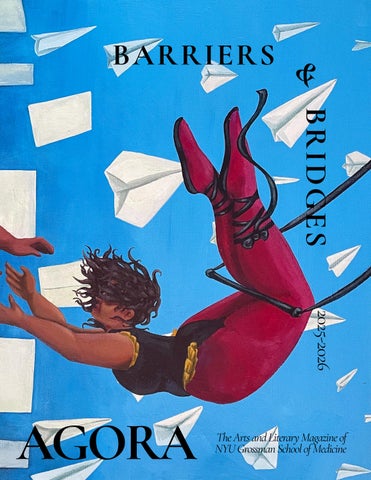
In “Like paper planes,” the acrobats appear to be floating in place in the moment just before connection takes hold. I painted this during the time period when COVID-19 pandemic restrictions started lifting. It was a time when I truly savored every moment of connection, without taking it for granted. With this painting, I wanted to convey a snapshot of that feeling.
LIKE PAPER PLANES
Dia Beggs
How easy it is to see someone in pain. How hard is it to cross over to them.
AGONY BEHIND GLASS
PERFECT UNION
Crystal Yazmin Mehdizadeh
My mother, Dr. Tabatabai and late father, Dr. Mehdizadeh operating together in Tehran, 1970. Adapted from a photograph to capture the quiet moments of connection in medicine. Despite the grief and cruelty their marriage would bear, they remain inextricably bound by time, love, and their craft.
CAUGHT IN THE WIND / CATCHING MY BREATH
Poem by Missy Brandt, Watercolor by Dr. Leon Axel, Video by Meagan Bruskewicz
The moment before I knew what I felt, but I knew it was For another. She was moving on to the place I fear. Taken, not gone.
It was a threat for me, but Never a reality for me. Then, why is It her reality? After all, I cause my Demise, yet hers–that is beyond Her power. I mess up my Equilibrium, putting the evil into me, But she was born with evil.
I’ve been kicked into the ground, and this is how I cope, by digging my hole down To the frozen center. Can it go any deeper?
Through the window, sadness for her. Through the mirror, fear for me.
Is this my time To escape beyond The red line?
A patient in the psychiatric unit awaiting discharge watches her roommate get taken to a state hospital against her will and wonders if she could be next. Through poetry, watercolor, and movement, we traced the emotions that arrived before she was able to fully process them.
Please use the QR code to the left to view the accompanying dance piece, choreographed and performed by Meagan Bruskewicz
THREE
MONTHS
Patricia Shelton & Xi Kathy Chu
I wish I could listen in on the conversations at home. Watch the TikToks over their shoulders. Hear the conversations with the other parents in the grocery store. They’re just too little to get vaccines. I’m worried about what they put in the vaccines. I’m worried about the side effects.
They were first-time parents excitedly running after me in the pediatric resident clinic with Baby T, who was cooing and reaching out to the nurses rushing past. He was too young to associate the blue scrubs and fluorescent lights with vaccinations and blood draws.
Since the very first time I met Baby T at one week old, he was at the top of his curves over 90%ile for height. He recently skipped crawling and jumped straight to walking, surprising everyone in his life and stressing out his first-time parents. I handed him a board book with a rainbow of fruits scattering the pages, and he grasped it with his little hand and immediately put it in his mouth. That’s why they make them cardboard. I noticed that his nevus simplex on his forehead was finally starting to fade.
I have never been successful in the moment, despite my CDC vaccination printouts They tell us in our residency didactics that personal anecdotes are the most effective, so I shared a story about a critically-ill unvaccinated baby I cared for in the PICU, whose development will never be the same again. Baby T’s parents nodded and then changed the subject.
Ms. J comes in to see me in my primary care clinic every three months. A proud 78 years old, she greets me as Dr C, carrying her portable oxygen with a swagger that matches her black rhinestone studded sweatsuit, sleek on her narrow frame. “I want to gain weight, Dr C!,” she announces, with a plop of the oxygen on the ground as she sits down. “I used to have such a nice butt,” she sighs, her head shaking in rhythm with her hands, fluffing her coat on her lap. “The boys used to look, for sure,” she says with a laugh.
Ms. J has smoked the number of pack-years where it almost doesn’t matter what number of pack-years. Each visit, she fluffs an item of clothing on her lap depending on the season, and we talk about different supplements, her sisters - who she says are definitely jealous of her - and her weight. Over the past four years, however diligent at motivational interviewing, I haven’t made it past pre-contemplation with Ms. J.
There is part of me that is jealous of the TikTok parents who win over so much trust with my families. Why do you not trust me like that?
Without fail, shortly after we go over Baby T’s growth chart, his mother has always opened the Notes app on her phone. You know we always have a list, she smiled apologetically at his last visit. Three visits ago, it was the nevus simplex and the Moro reflex. Are you sure this isn’t a seizure? This past visit, it was the visible vein on his nose and him spitting out bananas. I don’t think the list has ever been shorter than 5 questions. As I eased each fear one by one, I felt like we were on the same page. He cried as I examined him and his mother gave me the same apologetic smile.
That night, I opened TikTok, knowing my personalized algorithm was going to take a hit. As I scrolled past parents talking about “injecting mercury in the bloodstream,” I came across dozens of videos of parents who voiced how conflicted they were give vaccines and protect their child versus cause an adverse reaction in their baby. I came across video after video of babies the night after they got their vaccines crying, exhausted, not acting like themselves. One video showed the Moro reflex and attributed it to the vaccine. How can my HIPAA-sanitized story from the PICU compete with videos of children doing the exact movements these parents were so worried about many months ago?
Each visit, Baby T’s parents have asked to see me at his next well-child visit in 3 months, knowing I’ll bring up the vaccines every time. I know that each visit, they’ll bring a laundry list of questions for me, we’ll marvel over his laugh and how much he’s grown, and they’ll probably say he’s still too small for vaccines.
Do you remember Netter’s?
You’re probably asking me, how could anyone who has been through medical school forget it? Google AI summary tells me it is a “gold-standard, highly artistic, hand-drawn medical atlas renowned for its vibrant and clinically relevant illustrations, making complex anatomical structures, relationships and pathways clear and easy to understand.” Do you remember the section on chronic emphysema? The “pink puffer” it said, below an illustration of a man shirtless, ribs stark with shoulders rounded. Weight loss due to increased work of breathing.
We end each visit with me handing Ms. J the handle for her portable oxygen, her getting up and putting on her item of clothing, yelling “ 3 months, Dr C?” on her way out the door. I watch her go down the hall, her frame thin, as Netter suggests; everything else so vibrant - the black rhinestone studded sweatsuit, her echinacea in hand.
HOLDING HIS GAZE
Missy Brandt
While I assisted in long, complex surgeries and engaged with physicians who were leaders in their field, my most impactful moment during the surgery clerkship lasted only a few seconds, while preparing a patient let's call him Tyson for the OR.
I met Tyson on the Bellevue Trauma Surgery service. While listening to sign-out for dozens of patients, I was initially overwhelmed, lost in a blur of unfamiliar diagnoses and foreign abbreviations. Tyson's name didn't stand out. He was just another patient on the long list. However, later that day, Tyson was added to the OR schedule. I quickly pulled out my phone to check his chart. I learned he was a young man with a C4 fracture, paralyzed from the neck down after a fall at work.
When we disconnected Tyson from the ventilator to move him to the OR, he opened his dark eyes and stared directly at me. He seemed to try to speak, but the ventilator held him in silence. For a few powerful seconds, I held his gaze, heavy with fear and vulnerability. He was confused and scared, yet somehow trusting me with his next breaths as we moved toward the elevator. Counting each breath carefully, I felt the weight of responsibility and trust in a way I had never experienced.
I've never engaged in such unfeigned, intense eye contact. In that moment, Tyson was not just another patient on the long list; he was a man, barely older than me, who had lost control over his entire body. I don't think I will ever forget this brief, powerful moment. I can still see his eyes, smell the various drains in his ICU room, and hear his monitors beeping. I am still struggling to articulate what I learned in those few seconds. Perhaps it is simply this: being able to truly see a patient meet their vulnerable gaze and hold their fear is a weighty responsibility, but a worthwhile one.
A mustard seed rests in open hands small, yet full of promise. In faith, even the smallest beginning can move mountains and transform barriers into bridges. What appears fragile holds the power of growth, renewal, and hope when placed in the hands of belief.
FAITH AS A MUSTARD SEED
Christina Moawad
In “Reflection,” a bird finds itself in a paradisial “ eye of the storm,” caught between a receding tide and a lurking darkness. The tide will eventually march back up shore, and the night will continue creeping its way towards the ocean. These forces of nature represent a fleeting opportunity for the bird to take agency over its next flight. It contemplates both directions – its front faces the familiar land it comes from, while its head gazes upon the unexplored, boundless ocean. Through this piece, I consider whether one’s own self serves as a barrier in dictating the trajectory of our lives. The bird’s shadow represents its collected experiences, and notably, it remains tethered beneath the animate self and points inland, perhaps providing a suggestion based on what it knows. We may feel biased to habits or old ways of thinking, pulling us away from opportunities that may not present themselves again. Will the bird return to familiar grounds or explore a new domain?
REFLECTION
THE MESSENGER
Claire Hennigan
I remember you standing at the threshold as I arrived home from school
What a curious sight, I thought, for Dad to be home at this time
“Uncle Larry passed away last night,” you say Or so I imagine you did, my six-year-old brain solidifying the news
Only now do I wonder - how?
To tell your child about losing a loved one, must be different than those bright eyes learning the fact of someone gone long before their life began.
I remember you bringing us to visit Nana, never knowing what we would get.
The acrid mix of soiled linens and cleaning supplies, stale food wafting through the air.
Her flaking skin, the wrinkles on her hands. Waiting, hoping for her to say a word, maybe, if we were lucky.
Usually “Bob,” some exasperation in her tone, at the man she lived to support.
Trips more sporadic with my brothers and me in tow.
“If it’s too hard for you, you don’t have to come.” You know.
But isn’t it harder for you? I never ask.
I remember you picking me up after lacrosse, one of those cool, damp early spring evenings
Sitting in the Blue 1992 Camry, fuzzy feel of the upholstery below my legs, speckled with bits of earth dug up by my cleats mere hours before.
“Nana passed away,” you say.
My 14-year-old mind crystallizes this moment, losing the grandmother I never truly knew.
Christmas Eve 2019, rushing to the airport. Scrubs pasted to my skin, adhered to the sweat of the last 24 hours, each drop evidence of tragedy for the families I encountered on call.
All to get home for 48 hours.
Feet touching down on the country road, we take one of our countless walks.
“I’m not sure about my relationship,” met with an unusually simple response.
To scratch only at the surface was not you.
My 30-year-old heart breaks.
Before the doctor’s visits, before the scans, there was the nearly missed highway airport exit. A route you’d taken countless times before.
And the subtle retreat from leading the dinner conversation.
Once a lively examination of the current times, a meeting of the minds on how we could fix it, now a loop of old stories you can recall.
I remember when you no longer did.
This piece is both an act of grief processing and a tribute to my father, whom I lost last year after a four-year decline from Alzheimer’s disease His illness unfolded during my Pediatric Critical Care fellowship and early attending years, and the anticipatory grief it carried often felt at odds with my expectations of being an ideal physician. In this piece, I sought to capture the unique heartbreak of losing a loved one to dementia a loss that begins long before they are gone. I have found incredible solace in others’ stories of grief, and hope these words offer comfort to those navigating a similar experience.
WHAT WE CANNOT PREDICT
Missy Brandt
I learned last year that if someone has blood clots, you give them anticoagulation. It’s straightforward: the blood is clotting too much, so you make it clot less. That’s the clean version, the way it fits neatly into a lecture slide.
But medicine rarely stays neat. Give too much, and the blood won’t clot at all the patient could bleed out. Give too little, and clots keep forming, silently blocking the body’s highways. Every person’s metabolism is a little different, so we can’t predict exactly how they’ll respond. The fix seems simple enough: check labs, adjust the dose, repeat. Medicine is about course-correcting.
Except sometimes, the course seems so torturous, with no possibility of correction in sight.
What if it’s a child with multiple comorbid conditions? What if the textbooks are thin on pediatric data for anticoagulation? What if the patient is about to leave the country for months because of immigration issues? Can we even monitor aPTT or anti-factor Xa in Guyana? If those tests exist there, who interprets the results? And if we interpret them here, how do we safely adjust the dose across borders, across systems, across oceans? I didn’t know. Neither did the attending.
All these questions were racing through my head while an innocent young girl was sitting before me. A year ago, I may have called her cheeks chubby and adorable. Now, I recognize them as edematous. A sign her kidneys were failing.
Her mother sat beside her, phone in hand. She was attentive but distracted, eyes darting from us to the glowing screen. It wasn’t the absentminded scrolling we normally see. There was tension in her grip.
When she caught me looking, she apologized. “Sorry,” she said quietly. “My best friend just died. She committed suicide.”
The air in the room changed. I thought about how many crises one person can be asked to hold at once a sick child, an uncertain medical plan, a friend’s sudden death, an international move. I could not even think about heparin while personally dealing with just one of the aforementioned challenges.
But this mother was different. Despite being overwhelmed with fear, anxiety, and grief, she was determined to make this work for her daughter. Even as tears welled in her eyes, she was already calling to see what facilities in Guyana could administer anti-factor Xa monitoring. I was inspired. She was doing what I aspire to do as a clinician tackling uncertainty with determination and moving forward with grace. And behind her eyes, I sensed hope, even when the path ahead seemed so precarious.
I don’t know what will happen to this girl when she leaves the USA if she will be able to get her medication, if the labs are available, or if her NYC-based healthcare team can still care for her. But I do know that I will never forget this mother and daughter their courage, steady even in the midst of fear and uncertainty.
WOMEN IN MEDICINE
Elizabeth Holmes
It can be hard to admit that medicine has been built on the backs of those who received no credit Though we honor women now, many were sidelined, their names and faces erased, leaving us to wonder how many have been lost to the annals of history.
WHEN THE NEGRO SAYS OUCH
Nathaniel Mamo
I won’t pump your heart. I won’t mend your bones. I won’t clean your cuts.
But I do have some suture for that gaping wound between those big red lips.
Pain of being ignored is a big, invisible barrier. As a black boy, my "ouch" falls on deaf ears. I wrote this poem as a conversation not with any one doctor, but with the institution of medicine as a whole. I have the feeling it’d prefer I keep my mouth shut.
WHERE ARE YOU FROM? ¿DE DÓNDE ERES?
Christian Diaz Curbelo
Where are you from? ¿De dónde eres?
No fue una pregunta que me esperaba al llegar a la sala de examen la mañana de una de las pruebas más importantes de toda mi carrera
“None of these names sound like they’re from here” Ninguno de estos nombres suenan que son de aquí Rápidamente siguió la inquisición inicial La señora era de pelo canoso, prácticamente la mitad de mi estatura Hasta ese momento había tenido un carácter simpático, sino medio sarcástico, pero de manera chistosa que me caía bien Ya había bromeado sobre lo lentos que eran el resto de los examinantes al alistar sus documentos, completar el examen de contrabando, y registrar sus huellas Me recordaba a ciertos pacientes de mi clínica previa, cuya edad parecía haber desinhibido normas sociales
“I’ve lived here [Florida] most of my life, but now I go to school in New York” He vivido aquí [en Florida] la mayoría de mi vida, pero ahora estoy estudiando en Nueva York
Mi respuesta fue media obtusa a propósito, no porque tenga vergüenza sobre mi herencia, pero porque así me había acostumbrado a responder a esa pregunta.
“Where are you really from?” ¿De dónde eres de verdad?
Es una pregunta tan cliché que a veces se usa sarcásticamente como burla de la xenofobia, pero aquí fue genuina.
“I’m Cuban” Yo soy cubano.
Satisfecha con esta respuesta, terminó la línea de inquisición con una última pregunta.
“See, was that so hard?”. ¿Ves? ¿Eso fue tan difícil?
Su tono nunca cambió. Todo sucedió tan rápido que no pude comprender del todo lo que había pasado. De todos modos, tenía que empezar el examen que me había costado meces de estudio y cientos de dólares. Cuando era más joven, me molestaba que otros no se dieran cuenta de mi identidad. Detestaba la sorpresa al tener que decirle a alguien que soy latino, que me hablaran en ingles dentro de un negocio hispano, o escuchar a conversaciones escondidas bajo el disfraz de la ignorancia. Pero pasar desapercibido también es un privilegio. No sufro de las ideas preconcebidas de extraños ni vivo con el miedo de ser cuestionado en la calle. Ese privilegio no da inmunidad absoluta, ni la opción de ignorar lo que les sucede a otros que viven con una realidad muy diferente.
THE AXIOMS OF MODERN MEDICINE
Liam Young North
Axioms, originally attributed to Euclid (300 BC), delineate assumptions upon which subsequent knowledge and ethics are derived. Axioms come in many forms: Descartes' “Cogito ergo sum,” Kant's categorical imperative, Jesus’ “Love thy neighbor,” Socrates’ universal doubt, Hippocrates’ “Do no harm.”
As I sit eating my sandwich in front of Bellevue Hospital, I wonder what the axioms of contemporary medicine are, the universal assumptions that found the basis of the compassionate science I am lucky enough to witness as a medical student The traditional maxims of medicine are frequently pulled from the Hippocratic Oath, undoubtedly a document of vast importance. That being said, it is 2300 years old or so, some revision to current times may be in order. The purpose of this essay is to attempt such revisions and in doing so articulate the axioms of modern medicine. Before beginning, I must plead patience from the members of the medical and philosophical creeds. It may seem rather blasé or hubristic to attempt such a feat in a short essay, but as a student it has been a meaningful exercise to frame my thoughts. Criticism is welcome.
Axiom 1: The physical, material world – including the human body – exists and is capable of being understood, to an extent, through empirical, causal, and reductionist processes.
Although this may seem like a tedious place to begin, we need to set the epistemological groundwork before we get to the good stuff. The medical field assumes a world external to the mind, a physical world able to be perceived and at least partially understood empirically (via the nervous system). This (large) assumption sidesteps the beautiful but generally solipsistic arguments raised by philosophers such as Berkeley. We will also have to set aside the work done by Hume: his skepticism of induction, and his consequent unhooking of cause and effect. Medicine is framed within the context of empirical, causal biological pathways that doctors are able to alter with surgery or medication. In order to build a positive system, we will have to put aside the Berkelian and Humean arguments that, respectively, the material world and cause/effect are potentially mechanisms of the mind and not reflections of the reality of the material world. Betrand Russell raises a similar point in his essay “Limitations of the Scientific Method.”
Additionally, reductionism must be accepted as a valid framework for understanding the world and the human body. Scientists rely heavily on these models: reducing the body to organ systems and feedback loops, reducing nutrition to glucose, protein and lipid metabolism, reducing stress to HPA regulation, as well as reducing brain function to finite synapse and neural circuits (default mode network, dopaminergic circuits, etc). The caveat is, as British statistician George Box put it, “all models are wrong, but some are useful.” Albeit one of modern science's most powerful tools, it is imperative to not confound reality with these reductions.
Axiom 2: All human life is precious and finite.
Amongst humans, it is generally true that human life is regarded as worthy of protection and esteem; some (including the author) may even go as far as to call it beautiful. It is doubtful that medicine would exist as a profession if this belief were not so vehemently held by the human species. Moreover, the inclusion of finite here might strike some readers as odd, but one of the founding tragedies, or wonders (depending on whom you ask), of human bondage is that our corpus is temporarily finite.
Axiom 3: The physician’s role is to be a healer of humans. Their goal as a healer is to maximize health and happiness, and minimize illness, pain and suffering. They are to staff the paths into and out of this world, the gates of birth and death, extending life when possible and compassionate, and ensuring a gentle exit when not.
As healers, our duty is to treat illness and malaise, to minimize the suffering and pain of patients and maximise their capacity for happiness and fulfillment. Victor Frankl’s second book, “The Doctor and the Soul,” emphasizes a version of this point. The goal of the doctor is to give people health, i.e. the propensity or capacity to create meaning and happiness in their lives. Frankl’s point here, and his “logotherapy” he advocates for in his works, are both deeply rooted in the post World War II existentialist movement. From this perspective, happiness is not something medicine can give, but we can give as best we can the capacity or necessary conditions for it. Now, it is true, some people are able to find and make meaning in spite of illness or suffering, but it is easier when these are minimized. This idea is the crux of Maslow’s hierarchy of needs.
Now in terms of the second sentence: staffing the gates of this material world of ours. This has been one of the most meaningful things to witness as a medical student. My naive impression before medical school was that doctors served as the guardians against death, fighting viciously against the depravity of time and the degradation of the human body. They of course have this role to resist death, but there is an equally important responsibility to respect the ephemerality of the human condition and ensure a compassionate exit. Thus far, being a medical student has been a slow realization that physicians are not so much the guardians of the doors of death but the ushers. Lastly, before moving on, it may be noted that Axiom 3 implies a degree of ethics based in utilitarianism (“maximizing health and happiness, and minimizing illness, pain and suffering”). This is true. Much more of medicine is based in this framework than is often realized: triaging patients in the ER, wait times for surgery, and organ donation systems. However, these systems don’t in practice meet the criteria for utilitarianism, at least in the United States, due to financial inequity and various other political factors.
Axiom 4: Access to healing services is a right and not a privilege reserved for those with means to pay.
I would venture to say that the vast majority of physicians agree with this statement. Unfortunately, this axiom is at odds with political policy in the United States. There are select conditions under which healthcare is codified as a right to a subset of citizens (Medicaid, Medicare, and EMTLA), but generally speaking healthcare services are neither a de jure nor a de facto right.
Pragmatically this axiom is hamstrung by political means, mainly the madness of insurance. Doctors work within a flawed system. People sometimes confound working within this system as implicit endorsement wholesale of said system, but this is rarely the case.
Axiom 5: Health, when juxtaposed to illness or pathology, is dynamic and at times culturally or politically specific.
Here we get into the general heterogeneity of the human experience. Physicians are forced, through practice, to the realization that not every patient has the same definition of health or disease. It is the duty of the physician to be agile and adapt their practice to the wishes of the patient. Michel Foucault and Franz Fanon repeatedly strike upon this theme of the cultural, political and temporal malleability of defining health and disease in their works (for Foucault, see: “Madness and Civilization," for Fanon see: “Black Skin, White Masks” and “Alienation and Freedom”). Of course, there are limits to the accommodation physicians can provide. A physician can not accept a definition of patient health that violates Axiom 2, i.e. harming other people.
Axiom 6: Medicine is both science and art.
Hippocrates certainly thinks so. “Art” is mentioned 4 times in his oath. This may draw some eyerolls and comments about being a starry-eyed medical student. I can hear one of my old research coworker in my ear accusing me of over-sentimentality, “ no manches” as she would say. Regardless, “medicine is an art” remains one of the most common platitudes I hear in medical school. And, as Auden put it: “But noble platitudes: ah, there's a case where the most careful scrutiny is needed.”
So, to scrutiny. Arguably the gem hidden in this truism is that science is necessary but not sufficient for the practice of medicine. Navigating family dynamics, delivering cancer diagnoses, or sharing a skeptical chuckle about local politics with a patient, all this is more art than algorithm. It is not possible nor sane to have a randomized control trial to decide if one chuckle or two is the optimal number for patient satisfaction. Science has its limits.
A writer and physician who understood this keenly was Oliver Sacks. His fascination and passion for both his patients’ health and their “inner worlds” embodies the art of medicine. In “An Anthropologist on Mars,” Sacks describes his case studies as “tales of metamorphosis, brought about by neurological chance, but metamorphosis into alternative states of being, other forms of life, no less human for being so different.”
Axiom 7: The prevailing emotion of medicine is one of tempered hope.
We will end on this note. All of the above statements are meaningless if we do not address the emotional component of our profession. Human nature is fickle and nebulous, but it is certainly a supremely emotional thing. If our actions in the hospital, whether delivering a baby or giving antibiotics for a UTI, are not based in hope, in a tangible and measured optimism of making a difference in our patients’ lives, then we have lost our way.
SNOW DAY
Rohan Mehta
today I trudged, down the ways I used to frequent met the snow, swaddled in my shapes a blistering wind, whipping down a flagpole under pelicans and seabirds turning in.
today I went, and I met the frigid turnpike common shards were studded in my scarf and the wintry mix, spat in my face unrelenting laying bare the blind spots of my heart.
today I reckoned, with the simulation swarming lingered with mythology of my childhood snows And there were all these things, that I don’t think I remember? But they say, we have a hand in our letting go.
please don’t think, it lost on a boy from Texas, the significance of the heavens opening up or amid this, lovers, huddled by a cigarette finding comfort in finally being alone.
It’s hard to ignore the iconless spirituality in empty streets and an echoless place to sing to witness children learn the name and face of Winter falling from temporary places, upon their makeshift sleds.
Something compelled me, maybe my humanity to kneel right down and make myself a bed. I made an angel, just because I’d never done it and when I stood I scarcely recognized its head.
Then on that street, in the city of anonymity, I saw the signature of where some people stood, how long they stayed; how their kids stepped a little smaller, and though alone in the dusk I knew it was not so.
Medical training requires both hard work and breaks, sometimes occurring side by side. I capture this in "Duality of Medical Students" in the parallel structure of one student studying, and the other taking a phone break, separated only by a wall in the familiar Coles classrooms.
DUALITY OF MEDICAL STUDENTS
Vinh Ton
(UNTITLED)
Today, I watched a baby die.
Anonymous
I saw her hand, motionless, a delicate mass the diameter of one of my fingernails, connected to an impossibly small arm, body, head, legs. I saw, through a mass of agitated movement, the NICU team doing its best to overcome the inevitable. I felt the frustration of the attending, throwing his gloves angrily against the trash bin by which I imitated stone. I heard the soft tone of his voice emanate from behind the drapes as he informed the mother, and the sorrow in her wails, and the soft murmurings of the nurses around me.
It took misery to open my eyes to the humanity of the woman laying before me. She was no longer just an “interesting case,” a talking point around the workroom, a record to go on the board: the 68-year-old from Nigeria who had gotten herself pregnant through IVF, with twins no less. She was a human being, pressured by her cultural norms to seek connection and fulfillment through biologic motherhood. And she was in mourning.
I don’t have to close my eyes to see the dead infant, swaddled and laid down peacefully on a table in the corner of the OR. The NICU team had long since departed, leaving the baby quite alone, save my blurring gaze. As the C-section wrapped up, I couldn’t help but keep thinking that someone should be next to her, if only to acknowledge her presence, her short and frenzied existence.
OVER THE RIVER EAST
Nathaniel Mamo and Kate Morant McGarvey
Them rocks
Whispered through that little pipe
Said if I blew
Any wish would come true
I blew I blew so that
The rose would come back
On the shoulders of great clouds
Billowing out my chest
Red like flesh
Dew like jewels.
All that grew was the thorns
Poking through my cloud
Full of rain
Enough for Sodom Enough for Gomorrah
Rikers was an Arc Full of birds with broken wings
And no song to sing, Made of wood from tall trees
Stripped of life and leaves.
Emptied their souls made them light to float right over the flood.
Patient is a 43-year-old black male in DOC custody, with charges of possession with intent to distribute, past psychiatric history of polysubstance use disorder (cocaine, methamphetamine) and substance-induced psychosis, referred to mental health for unprovoked agitation. He presents as oddly related and is largely uncooperative with interview. Utox negative on admission. Will continue to build therapeutic alliance, consider medication. Remains appropriate for general population with mental health follow up in two weeks.
Smoked some rocks
Mined from where Jesus sat
Took me to be with him and her.
Sprinkled a little baking soda
To clean my soul
Like momma scrubbed the kitchen
Leaving them roaches hungry.
Them roaches was skinny Look like ants
When momma was around
She had a shoe big enough
Could squish a man
I lived in that shoe
Like a hole
When momma was around
Now momma’s gone Them roaches
They fat like men
This is a 58-year-old man, incarcerated for 15 years, with a past psychiatric history of substanceinduced psychosis early in incarceration and depression last year, treated with fluoxetine for two months which was discontinued due to worsened anxiety, referred last month for change in behavior, paranoid ideation, social withdrawal, poor hygiene. Per social work note, patient’s mother passed away last month, and the patient was granted a furlough to attend funeral. Mother was a frequent visitor until last year. Utox pending.
Sing
The radiator
Don’t make it past your shoulders. Your neck gets cold It’s warmer under
Sing
White sheets
Soaking up virgin red.
White sheets
Pop your eyes out.
White sheets
Make you a ghost.
My neck got so cold
My feet wanted to dangle.
Southern breeze coming through this iron forest
Knocks my feet around like chimes that
Sing the saddest song you could sing
This is a 60-year-old man, with a history of mental health treatment in prison, arrested last month with charge of assault, sent on hospital run to Bellevue due to disorganization, poor hygiene, and paranoid beliefs. Per Rikers referral, the patient has been requesting a change in his housing assignment and may be malingering for secondary gain of leaving his current environment. He was prescribed risperdal but was mostly noncompliant. Per H&P, he is medically stable, differential includes schizophrenia, intoxication, and antisocial personality disorder. Will continue to offer risperdal and if no improvement pursue treatment over objection. He denies suicidality.
Bugs under my skin
Biting at my thoughts
Makin them itch.
Motherfucking warden
Don’t care Bout them bugs
In my room
Eating bigger and better
Than any bum at Sing Sing
Getting fat on forbidden fruit
Don’t care
They was bigger than us
That they drank, smoked, and sinned In temple
Even called me
A roach
“I am a man” I told the roach And the roach laughed.
Shit they ate good.
On the inside
The crumbs was bigger than the food.
I said, “Warden, there’s bugs in my room ”
He says “What do you want me to do?
I said, “Warden, they in my skin too.”
He says, “Send him down to Bellvue
But Warden, What about Momma’s shoe?
This is a 60-year-old man with schizoaffective disorder, court ordered for Risperdal and transitioned to long-acting injectable, Invega Sustenna, with improvement in disorganization and paranoid delusions. Reporting side effect of akathisia and started on propranolol. Recently found fit on competency evaluation. In context of history of noncompliance and violence, monthly Invega should be continued, next due in 14 days. Patient remains withdrawn, difficult to engage, with poor insight into his diagnosis and need for treatment. He continues to require involuntary hospitalization.
From my window I watch the river East. Down Down the river I see something
The rose! Floating in momma’s shoe Going East With swollen sails Bigger than the Amistad.
From steel clouds
Rain drops fell That looked like men.
Well I’m the biggest Wettest drop. When I fall
The river gonna rise to an ocean and Wash them roaches
In a big flood Right off the Earth’s edge Into the mouth of the sky
This is a 60-year-old man with schizoaffective disorder on Invega Sustenna, with improvement in disorganization and paranoia. He has been more visible on the unit, attending groups, though still with odd beliefs and grandiosity. He has had no aggression or violence since admission, though continues with poor insight, declining discharge services, including substance use referrals. Next court date is tomorrow.
They stole my shoelaces That’s okay Don’t need them no more.
Don’t need them no more
Cause when I leave Bellevue I’m swimming East After the rose.
Imma tell it I’m sorry Imma make it my own Imma yell till I’m hoary Imma take it home
To where the love rose grows.
This piece juxtaposes the interior world of a person experiencing incarceration, substance use, and mental illness through poetry with clinical assessments put to record by psychiatrists. We follow the course of a life through various carceral and treatment settings and question the limits of diagnoses in such encounters All clinical descriptors are fictional
A floodgate lies dormant, built to hold back a century of rising water. I jog past and wave to a classmate, both of us grateful for the cool breeze off the river.
FLOODGATE 15, EAST RIVER
Aadith Vittala
ON LISTENING AND HEARING
Rohan Mehta
Each morning when you wake there is a song between your teeth it makes its getaway in your speckled daze but lingers in the hidden places and twilight hours if you know where to listen: in ordinary indistinct mumbles of morning men who hate their jobs in bubbly slurps of over-extracted coffee that tastes like the desk it knocks against inspired scratches of pen on page the heap of air in your lungs climbing out in a tumbleweed rush –tautological song of life. staccato blinks of muted elevator bells; songbirds warbling and elaborating in stupid blissful glee and voices of loved ones: some sing-song and lilting, some decorated with an edge of laughter –as though they are moments from making a bad joke the songs of this world wrapping you in their familiar shawl
I have a story I have never told: when I was so very small, I would wake so very early on Saturdays and in my boredom, I’d go through my father’s desk where he kept his iPod shuffle.
In the lonely twilight hours, I listened to songs of this world titles I never knew, languages I never spoke but my hamster heart sang poetry in couplets and my pulse ran along in syncopated time and I was a dancer made of song
It’s been so many years since I’ve known that dizzying variety of joy nowadays this song between my teeth is that variety of joy known to the wearer of an inviting shawl in twilight hours the hushed joy of listening, to the songs of this familiar world.
“Vein of Thought” lives in the space between stimulus and response, reflecting the complex landscape of mental health. The fractured, exposed form symbolizes vulnerability, illustrating how thoughts can create barriers that both protect and divide us. It shares an understanding of mental health, healing, and the power of personal choice.