












agendaNi’s annual Northern Ireland Housing Conference, which has become well established as a major annual event for all those with an interest or role in housing in Northern Ireland, is taking place in March. As with previous years, it will have a genuine, in-depth understanding of the key issues via a high-level panel of local and visiting speakers. The conference is an important date in the diary of housing professionals across the region that brings together key stakeholders to look at how we can fulfil the need for safe, affordable housing both now and in the future.
Speakers include...


Gordon Lyons MLA Minister for Communities
Paddy Gray Professor Emeritus of Housing Ulster University
Stephanie Elliott, Head of Operations – Smart Housing Scottish Federation of Housing Associations
Donna Matthewson, Executive Director of Housing and Communities, Apex Housing
Kim McGarry, Project Manager Multi-Disciplinary Homeless Support Team, Extern


Kate McCauley Chief Executive Housing Rights
Nicola McCrudden Chief Executive Homeless Connect


Grainia Long, Chief Executive Northern Ireland Housing Executive
Seamus Leheny, Chief Executive Northern Ireland Federation of Housing Associations
Dorinnia Carville, Comptroller and Auditor General, Northern Ireland Audit Office
Kate Martin, CEO, MACS Supporting Children and Young People
Jennifer Hawthorne, Director of Housing Services, Northern Ireland Housing Executive
Colm McDaid, Chief Executive Supporting Communities
Jonathon Blakely, Community Development Manager, Choice Housing



Finance Minister John O’Dowd MLA’s decision to unilaterally bring forward a draft multiannual budget has set the cat among the pigeons. While such a move has long been called for, his decision not to seek approval from other parties has introduced a degree of political uncertainty at a time when stability is widely sought.
A multiannual budget is a necessary, though not sufficient, condition to address the crisis facing Northern Ireland’s public services.
The DUP has reacted angrily to the manner of O’Dowd’s announcement and, in an exclusive interview with agendaNi, Alliance Party leader Naomi Long MLA says: “I do not know whether I will be Justice Minister in the next month or two months, because we do not know what the future of the Assembly holds. We do not know what the future of the budget holds.”
Multiannual funding has long been advocated amid repeated funding crises. These pressures have manifested in an annual scramble for SEN places, waiting lists consistently higher than elsewhere in the UK and the Republic, and the prospect of stealth charges on citizens, often described as ‘revenue-raising measures’.
While other parties have not criticised the principle of a multiannual budget, the absence of explicit revenue-raising measures has prompted concern among Executive parties. Some have argued that difficult decisions on revenue are being deferred, particularly within departments currently led by Sinn Féin.
The Budget proposals contain notable shortcomings, including funding gaps and the likelihood that they may not fully address persistent annual overspends across devolved departments. However, a multiannual framework is essential if confidence is to be established as Northern Ireland seeks to modernise, invest in new infrastructure, and progress its decarbonisation agenda.
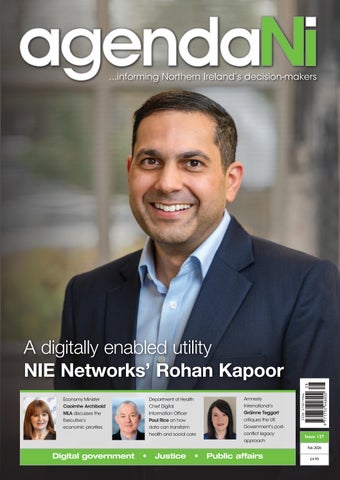
At the forefront of navigating these challenges is our cover story interviewee, Rohan Kapoor. In his role as Chief Information Officer of NIE Networks, he is helping to develop an electricity network that is becoming smarter and greener through the convergence of digital, data, and operational technologies.
Our round table discussion, hosted by Version 1, brings together technology and digital leaders from across the public sector and academia. We also hear from digital leaders in our annual digital government report, sponsored by eir business. In our annual justice report, Minister Naomi Long MLA discusses access to justice, the legal aid strike, and the influence of paramilitaries.
Joshua Murray Deputy Editor
Editorial
Owen McQuade, Managing Editor owen.mcquade@agendani.com
Joshua Murray, Deputy Editor joshua.murray@agendani.com
Ciaran Brennan
ciaran.brennan@agendani.com
Gareth Hamill gareth.hamill@agendani.com
Circulation and Marketing
Lynda Millar lynda.millar@agendani.com
Events
Jillian Wallace jillian.wallace@agendani.com
Advertising
Sarah-Jane Stevenson sarah-jane.stevenson@agendani.com
Design
Gareth Duffy, Head of Design gareth.duffy@agendani.com
Jamie Hogan jamie.hogan@agendani.com
Subscriptions
Sharon Morrison
Email: subscriptions@agendani.com Online: www.agendani.com/subscribe agendaNi
bmf Business Services 19a Maghaberry Road Maghaberry, Co Antrim, BT67 0JE Tel: +44 (0) 28 9261 9933
Web: www.agendani.com
Printed by: GPS Colour Graphics
The FSC® system provides an assurance that products such as wood and paper have been harvested in a socially and environmentally responsible manner.
• This product is made of material from well-managed FSC®certified forests, recycled materials, and other controlled sources.





52 Department of Health Chief Digital Information Officer Paul Rice discusses harnessing data to transform health and social care

Sponsored by
54 Government Digital Service’s Mike Skelton on transforming digital government with AI
60 Manchester City Council’s Sherelle Fairweather discusses using technology for digital inclusion
64 Digital Iceland CEO Birna Íris Jónsdóttir outlines digital solutions for emergencies
68 Jon Burrows MLA set to become Ulster Unionist Party leader
70 Committees in profile: Public Accounts Committee
72 Political platform: Sinn Féin’s Jemma Dolan MLA
76 Back page: Northern Ireland Deputy Director Gráinne Teggart critiques the UK Government’s handling of ‘Troubles’-related legacy cases

The DUP has co-opted Gareth Wilson as its new MLA for Newry and Armagh, replacing William Irwin who stood down during the Assembly Christmas recess.
Irwin was an MLA between 2007 and 2025. Wilson served on Armagh City, Banbridge and Craigavon Borough Council between 2005 and 2025, representing the Cusher District Electoral Area. He was Lord Mayor of the Council for the 2017/2018 term.
The new MLA stood for the DUP in Newry and Armagh during the 2024 general election, coming third with 5,900 votes.

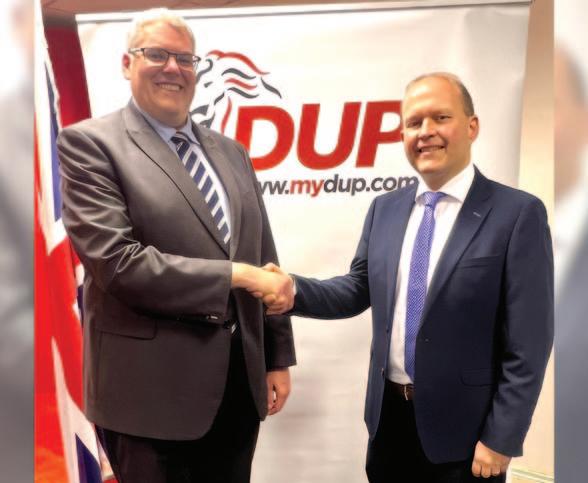
DUP leader Gavin Robinson MP says: “Gareth has always been a champion for the constituency and for the people of that area. He will now continue that focus as their assembly member, focused on the issues that matter.”
Wilson says: “I will continue to be a strong voice for the people of the constituency and, as the only pro-Union representative for Newry and Armagh within the Assembly, I will always seek to promote our place within the United Kingdom and maximise the benefits that brings to everyone.”
EDUCATION
The UK will join the Erasmus+ scheme for the 2027/28 academic year.
It will enable students to spend a year studying at European universities as part of their UK degree courses without paying extra fees. As part of the deal, the UK will make a contribution of £570 million to cover the 2027/28 academic year.
European students will also be able to study in UK universities without paying extra fees. The decision comes after the UK ended its participation in the scheme in December 2020 when the UK announced its post-Brexit trade deal with the EU. Access to the scheme in future academic years is dependent on new deals.

EU relations Minister Nick Thomas-Symonds MP says: “Joining Erasmus+ is a huge win for our young people, breaking down barriers and widening horizons to ensure everyone, from every background, has the opportunity to study and train abroad.”
In a social media post, Conservative shadow foreign secretary Priti Patel MP criticised the move saying that the Labour government was “throwing away billions of pounds of hard-pressed taxpayers’ money on rejoining Erasmus”. She asserted that it undermines the 2016 referendum result on Brexit.


Childcare costs for working families could be subsidised by more than 50 per cent by April 2032 under the draft Executive Early Learning and Childcare (ELC) Strategy, published in December 2025.
It is estimated that it will cost around £500 million to deliver the strategy. Under the strategy, special schools and early years specialist provisions will be funded to purchases resources, training, or equipment in the short term. In the long term, after-school provision for children in special schools and specialist provision will be trialled.
The strategy aims to focus on addressing recruitment and retention challenges through better funding, pay structures,
Local authorities reported a £39 million surplus at the end of 2023/24 but must “exercise caution in managing a volatile and uncertain financial environment”, a report has found.
The Local Government Auditor’s Report 2025, published by the Northern Ireland Audit Office (NIAO) in December 2025, finds that the 11 councils generated total income of £1.19 billion during the year, a 15 per cent increase from the previous year. Expenditure totalled around £1.15 billion.
Staff costs amounted to £475 million, around 42 per cent of operational expenditure. Absence levels have increased in each of the last three years, with an average
career pathways, and incentives. It notes that the number of registered childminders was “decreasing year-on-year, whilst the number of childcare places is remaining largely static”. A public consultation for the strategy is currently underway, running until 24 March 2026.
Education Minister Paul Givan MLA says: “The draft Strategy builds on the progress already made and sets out ambitious proposals to position Northern Ireland among the leading international models of early learning and childcare support.”
of 17.1 days absence per council staff member was reported.

On planning, 63 per cent of decisions on major planning applications across councils were not within the statutory 30-week target. Around 62 per cent of decisions on local planning applications were not processed within the statutory 15-week target.
Director and Local Government Auditor Colette Kane says: “While it is welcome to see higher levels of income reported, this is only the second year that income has exceeded expenditure since councils were restructured back in 2015.”
‘should
A new public service media (PSM) organisation would be required in a reunified Ireland while RTÉ would not necessarily simply subsume BBC Northern Ireland in such an event, a new report has found.
Public Media Ireland: a New PSM Organisation for a New Country, published by Ulster University and Dublin City University in January 2026, argues that a solely private model could not achieve the aims of PSM.
“PSM in a reunified Ireland would not necessarily replicate the dominant RTÉ/BBC model whereby the overwhelming proportion of public funding for journalism is provided to these organisations,” the report states.
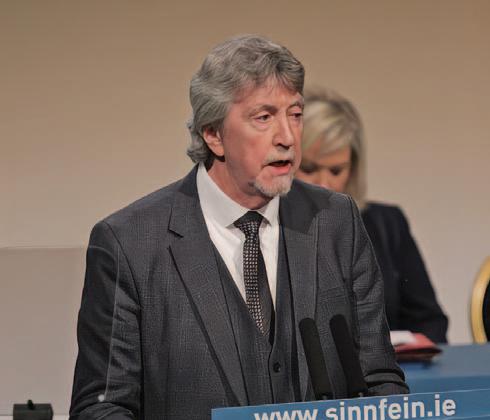


It also suggests that 10 journalism hubs could spread across the island to produce cross-platform content. The report suggests that these hubs could be based in Belfast, Derry, Enniskillen, Newry, Athlone, Galway, Limerick, Dublin, Waterford, and Cork.
Report author Phil Ramsey from Ulster University says: “This report kickstarts a debate on what the future of media might look like across Ireland. This is the beginning of a conversation, and we want interested parties to have their say on the recommendations.”
Tributes have been paid to the former Sinn Féin MLA and MP for Newry and Armagh Mickey Brady, who died in mid-January 2026, aged 75.
Prior to his election to the Assembly in 2007, Brady worked at the Confederation of Community Groups in Newry, a welfare rights advice centre assisting people with benefits and housing issues.
He retained his Assembly seat in 2011 before being elected an MP in 2015. Brady was re-elected at the 2017 snap election and the 2019 general election. The Newry native stepped down before the 2024 general election.
Sinn Féin President Mary Lou McDonald TD paid tribute to Brady, saying: “His legacy will endure in the lives he touched, in the communities he strengthened,
OBITUARY
and in the better, fairer Ireland he worked for every day of his life.”
Former Sinn Féin President Gerry Adams called Brady “a great comrade, a good humoured and committed republican, and a good friend to many of us who enjoyed his company and appreciated his activism”.
SDLP MLA Justin McNulty says: “Sorry to hear of Mickey Brady’s passing; a man who did his best to serve the people of Newry and Armagh. My sympathies are with Mickey’s family, friends and colleagues. Go dtuga Dia suaimhneas sioraí dó.”
Brady is survived by his wife Caroline, his children, stepchildren, and grandchildren.
Ar dheis Dé go raibh a anam.

Potential amendments to the Northern Ireland Troubles Bill to protect British soldiers has been opposed by Irish Minister for Foreign Affairs Helen McEntee TD.
The Bill, at committee stage in the House of Commons, follows the Joint Framework on the Legacy of the Troubles unveiled by the British and Irish governments in September 2025.
The framework replaces the controversial Northern Ireland Troubles (Legacy and Reconciliation) Act 2023. It abolishes conditional immunity for cooperation, reforms the disclosure regime allowing minister to withhold information on “sensitivity grounds”, and establishes a formal role for the Irish Government.
The first stage of an online Lough Neagh data viewer was launched in January 2026 as part of ongoing efforts to tackle blue green algae blooms in the lake.
It will display information on temperature, dissolved oxygen, turbidity, specific conductivity, and phycocyanin fluorescence from nine monitoring sites in the Lough and its main tributaries. This information will be transmitted by three multiparameter in-lough probes located in the northeast, northwest, and southwest of the Lough every 30 minutes.
Studying phycocyanin fluorescence enables people to understand blue green algal levels in the lake and distinguish blue green algae from other non-toxic species.
In late-January 2026, the House of Commons voted in favour of removing the conditional immunity scheme and reinstating the right to pursue ‘Troubles’-related civil cases. The remedial order will also have to pass a vote in the House of Lords.
McEntee states that significant changes to draft legislation from the framework such as this would require the agreement of both governments. DUP leader Gavin Robinson MP labels this a “clear challenge” to Starmer, asking if he would “protect our armed forces; or spinelessly surrender to the Republic”.
First Minister Michelle O’Neill MLA says: “What we need to see is legislation that actually commands the support of victims and survivors and is human rights compliant.”

Six additional river probes, located at the foot of each of the major tributaries, measure temperature and dissolved oxygen. This data is updated monthly. Further enhancements to the data viewer will be available in the coming months including data on nutrient levels and algal types, collected by the Northern Ireland Environment Agency.
Minister for Agriculture, Environment and Rural Affairs
Andrew Muir MLA says: “Making this data accessible greatly improves transparency, supports more effective decisionmaking, and improves the public’s understanding as we work together to address the water quality crisis at Lough Neagh.”


Finance Minister John O’Dowd MLA has boldly published a draft multiannual budget. However, Sinn Féin’s Executive partners have accused O’Dowd of publishing the proposal without agreement from the other parties, and the DUP has accused the Minister of underfunding the departments over which it has control.
The Executive’s draft Multi-Year Budget 2026-2029/30, currently out for consultation, marks a significant procedural shift in Northern Ireland’s public finances. After years of annual settlements and in-year firefighting, the move towards a multiannual framework is intended to provide stability, enable strategic planning, and support public service reform.
The multiannual budget is designed to align funding with policy delivery. Departments can plan workforce requirements, sequence capital projects, and pursue reform agendas with greater confidence when funding is known beyond a single year. This aims to reduce inefficiency, avoid last-minute spending decisions, and improve value for money.
Although the Budget spans three years for resource spending and four for capital, the overall funding envelope remains highly constrained. The draft makes clear that allocations reflect the limits of the Executive’s settlement, rather
than a reassessment of what is required to meet demand. As a result, the multiyear framework risks locking in pressures rather than alleviating them.
In nominal terms, departmental resource allocations increase over the period. However, once inflation, pay pressures, and demographic change are accounted for, real-terms growth is modest at best. For departments with demand-led services, particularly health, education, and justice, this means that multi-year certainty does not necessarily translate into service stability.
The Budget has also been developed against a backdrop of significant in-year overspends, which have not yet been fully reconciled with future baselines. This creates a structural risk because if current pressures are effectively rolled forward, future years may inherit a reduced level of spending power once adjustments are made. This weakens the predictability argument for multiannual budgeting.
While spending pressures are evident across the system, both their scale and persistence vary significantly between departments.
Departments such as Infrastructure and the Economy have generally demonstrated comparatively tighter fiscal management. In 2024/25, the Department for Infrastructure (DfI) was allocated £559.5 million resource DEL and £820.1 million capital DEL.
During monitoring rounds, DfI reported emerging pressures primarily linked to energy costs, public transport subsidies and investment requirements for water and roads infrastructure. While the department did not publish a single consolidated overspend figure, Department of Finance monitoring statements confirm that these pressures were managed in-year through reallocations, capital-to-resource switches, and reprioritisation, limiting the risk of an unmanageable overspend by the end of the year.

Similarly, the Department for the Economy entered the 2025/26 budget cycle with a resource DEL allocation of approximately £799 million, up from £766.6 million in 2024/25. Despite exposure to demand-led areas such as skills programmes, higher education funding, and apprenticeships, departmental evidence to the Assembly and audit coverage indicates that identified pressures were material but relatively modest compared with larger service departments. The department’s higher proportion of discretionary and capital-linked spending has provided greater flexibility to absorb in-year pressures through deferral and reprofiling, rather than requiring significant additional funding.
By contrast, Education and Communities have faced substantially higher and more recurrent financial pressures. The Department of Education received £2.874 billion resource DEL in 2024/25, rising to approximately £3.2 billion in the 2025/26 draft budget. In-year monitoring returns during 2024/25 identified a significant funding gap, driven primarily by teachers’ pay settlements, escalating special educational needs (SEN) demand, and a growing schools maintenance backlog. Independent evidence submissions and departmental briefings to Assembly committees indicated that unfunded pressures in education could exceed £200 million in a single year if not addressed through monitoring allocations.
SEN expenditure represents the most acute structural pressure. Departmental data show that the number of pupils with statements or equivalent SEN support has increased steadily, with special school enrolments rising by around 17 per cent over the past five years. Over the same period, SEN-related spending has increased by well over £100 million, significantly outpacing general funding growth and creating pressures that are not readily absorbed within the existing funding model.
The Department for Communities (DfC) has also reported sustained financial strain. In its 2024/25 budget consultation, DfC identified a Resource DEL shortfall of approximately £115.8 million, alongside a
capital DEL shortfall of around £167.3 million, against assessed need. These pressures reflect rising demand for social housing, homelessness prevention and temporary accommodation, regeneration programmes, and the administrative costs associated with delivering social security benefits. Subsequent monitoring allocations mitigated some immediate risks but did not eliminate the underlying gap between funding and demand.
When assessed relative to their overall share of the resource budget, Education and Communities together account for a disproportionately large share of in-year financial risk.
The extension of capital planning to 2029-30 is one of the more substantive elements of the draft Budget. Longerterm capital certainty is essential for big infrastructure, health, and education projects, particularly given Northern Ireland’s historic under-delivery of capital programmes.
However, the capital plan remains heavily concentrated on a small number of large schemes, many of which have experienced delays or cost escalation in previous cycles. With borrowing levels already elevated, the scope for responding to emerging capital needs such as school maintenance, water infrastructure resilience, or climate adaptation remains limited.
The draft Budget does little to expand the Executive’s revenue-raising capacity. Continued reliance on regional rates increases reflects the limited nature of Northern Ireland’s fiscal devolution. While politically contentious options such as the introduction of water charges remain excluded, this leaves the Executive with few levers to address structural funding gaps.
The DUP has criticised the process and substance of the proposals, arguing that they fail to prioritise key services and lack collective Executive ownership. Other parties have raised concerns about ambition and sustainability. All parties broadly accept the need for a multi-year framework.
In a written ministerial statement to the Assembly, Finance Minister John O’Dowd MLA says: “By moving beyond shortterm cycles, we can enable strategic investment that delivers lasting benefits for our economy, our environment, and our society. Setting a multi-year budget is one of the biggest decisions we will take during this Assembly mandate.”
O’Dowd also accuses the UK Government of “underfunding in public services”, and asserts that the additional funding provided by the Autumn Statement “will not undo the damage caused by the years of underfunding of our public services by successive British governments and is insufficient to plug current and future funding gaps”.
The DUP has responded angrily to the draft Budget. A party statement says: “This draft Budget is John O’Dowd’s Budget, it has not been agreed by the Executive and it is not supported by the DUP. While we recognise the very real financial pressures facing Northern Ireland, the choices and allocations set out by the Sinn Féin Finance Minister are deeply flawed and will require significant changes if they are to command our support.
“The DUP will not accept a Budget that fails to properly prioritise frontline services, particularly education, while wasteful and unnecessary spending continues elsewhere. The Finance Minister must return with proposals that put essential public services first, ensure taxpayers’ money is used efficiently, and deliver for families and communities across Northern Ireland.”
Leader of the Opposition Matthew O’Toole MLA has described the draft Budget as “an unambitious ghost Budget bereft of vision”, adding: “Rather than setting out a plan to transform services and improve people’s lives, it has a few pages of text blaming others and then tables setting out essentially more status quo.”
The draft Budget is currently out for public consultation, for which submissions can be made until 3 March 2026.
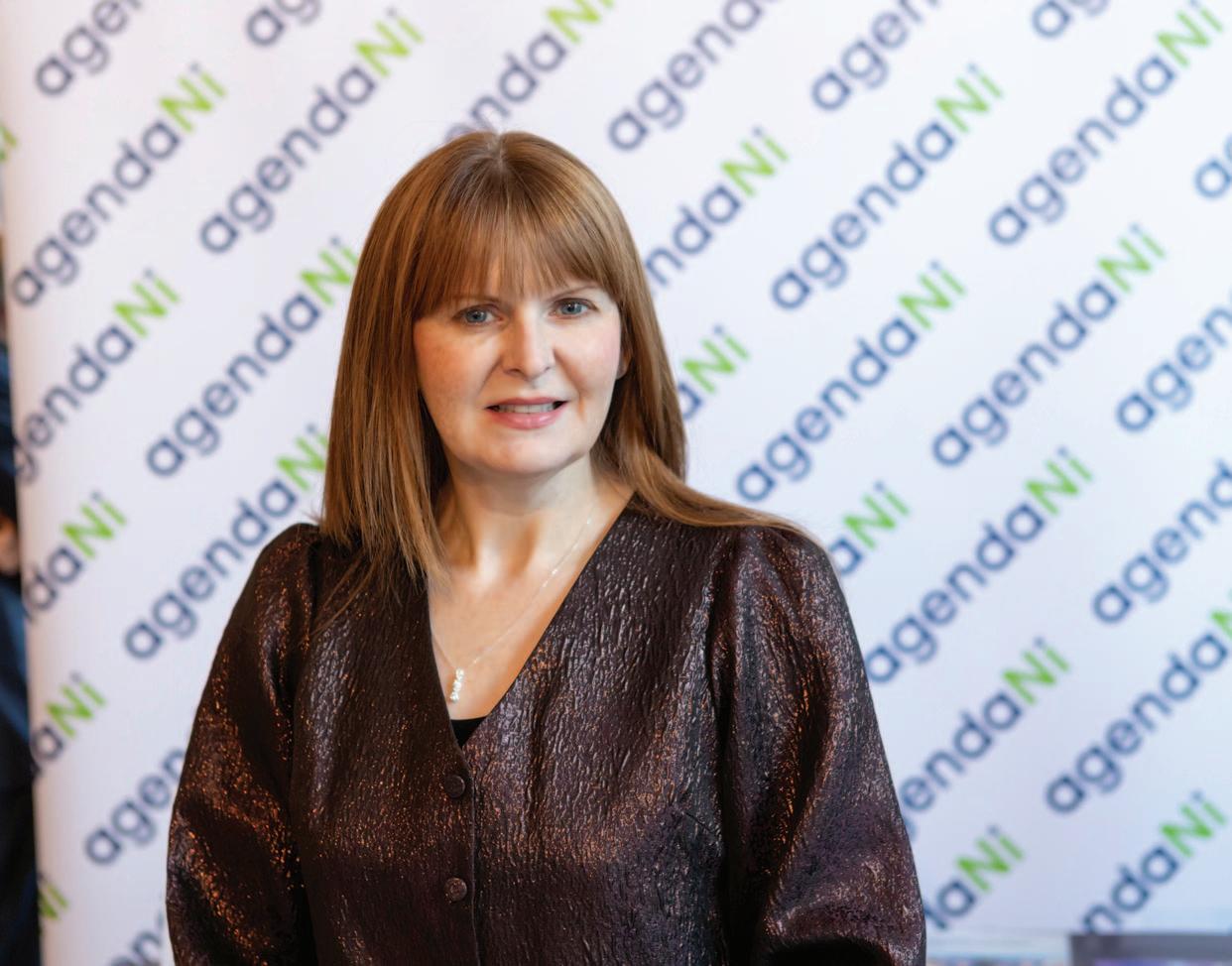

Economy Minister Caoimhe Archibald MLA discusses her four pillar economic vision aimed at harnessing recent growth to deliver good jobs, regional balance, higher productivity, and net zero.
Archibald outlines her four pillars for the local economy: “Creating good jobs, promoting regional balance, increasing productivity and delivering net zero.”
On employment, she says: “My department is drafting the most significant upgrade of our employment law in a generation. The aim is to improve conditions for workers, strengthen trade union representation, and help prevent good employers from being undercut by competitors employing poor working practices.”
She states that Northern Ireland starts from a relatively strong position in terms of job quality. “Currently, two-thirds of jobs here pay at least the real living wage and provide a non-zero hour permanent contract,” she says, describing this as “a good starting point to build upon”.
Productivity remains a structural weakness in the local economy, particularly when compared to neighbouring jurisdictions. “Our productivity is 12 per cent below the UK average and at least 20 per cent lower
than the South.”
To address this, the Minister says that the Executive is focusing on the expansion of seven high productivity sectors, alongside increased adoption of advanced technologies. “The recent matrix AI report [AI and the future of work in Northern Ireland] highlights the potential of artificial intelligence to boost our productivity,” she says.
“Since the Windsor Framework was introduced, our exports have increased by 2 per cent compared to a 9 per cent decline across Britain.”
That potential is being supported by public investment: “We have invested 16 million pounds in the new artificial intelligence collaboration centre, a partnership between Queen’s University, Belfast Ulster University, and Invest NI,” Archibald says.
Addressing longstanding regional imbalance, Archibald highlights reforms to how investment performance is measured. “For the first time, Invest NI has been set a regional target and an ambitious one at that,” she says.
Invest NI has been tasked with increasing the proportion of investments outside the Belfast metropolitan area from 56 per cent to 65 per cent over three years. “Having hit 59 per cent in year one, Invest NI is on course to achieve that target,” she says.
Local economic planning is also being reformed: “My department has also established 11 local economic partnerships, and action plans are now being submitted for my approval.”
Minister Archibald explains the nature of these partnerships: “While I am allocating budget to these partnerships, their key purpose is to ensure that Executive departments have a better understanding of local needs and priorities and can therefore develop policies that better promote regional balance.
“The growth potential of the northwest is particularly strong, and the expansion of Magee is the most important project in that region.”
She adds: “Thanks to the work of the Magee Task Force, we now have a comprehensive roadmap to expand university provision in Derry to 10,000 students,” she says, further contextualising that enrolment at Magee has increased by 55 per cent since 2021 to over 6,300 in 2025.
Reducing income disparities between regions is identified as a longer-term objective. “Over time, we intend to close this gap,” Archibald says, referencing figures showing that “in 2025 full time median weekly wages in Belfast were over £150 higher than in Causeway Coast and Glens”.
On decarbonisation, Archibald acknowledges progress while underlining the importance of maintaining public buy-in.
“If we are to retain public support for continued progress towards net zero, it is crucial that ordinary people feel the benefit of the transition,” she says.
Archibald points to the renewable electricity price guarantee scheme as an example, noting that “the final scheme design… commits to giving people living near renewable electrical generators a discount on their bills”.
The Minister argues that the region’s industrial structure positions it well for green growth. “Our strong manufacturing base provides a solid foundation to create good green jobs,” she says.

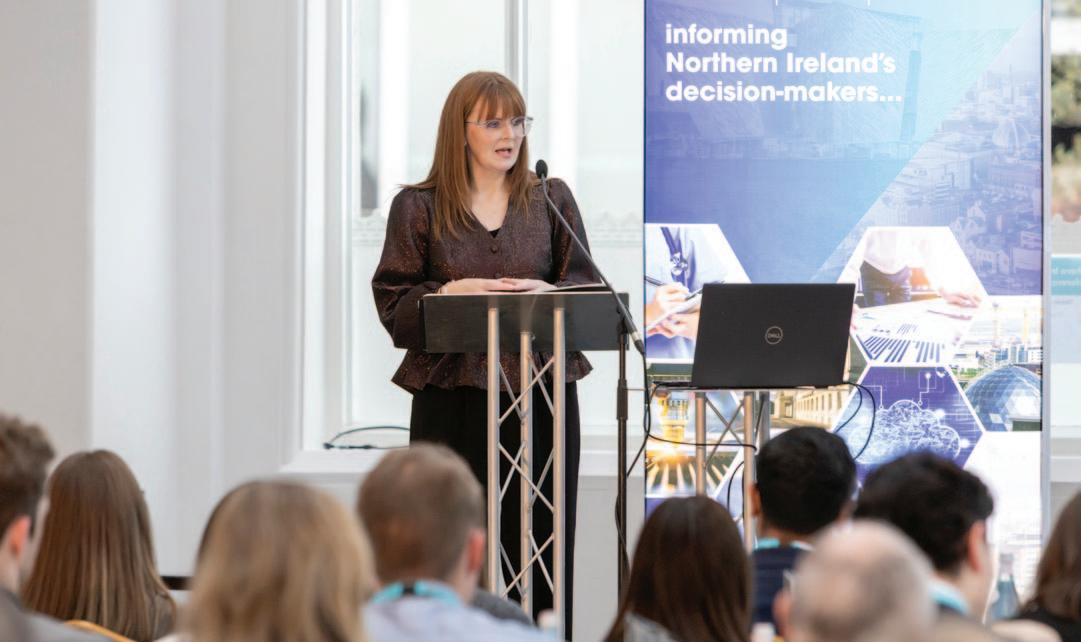
Across all four objectives, skills are identified as the critical enabling factor.
“All four of my objectives are underpinned by skills,” Archibald says.
She outlines recent investment in this area. “Last year, we invested an extra £12 million in 20 different projects supporting over 10,000 people and 500 employers,” she says.
Labour market data suggests some positive early impact. “Over the last year, there has been a 10 per cent fall in vacancies due to skills shortages,” she says.
A longer-term framework has also been set out in the form of the Skills Action Plan, which was launched in October 2025 and aims to increase the proportion of the working age population with qualifications at level three and above from a baseline of 57.2 per cent in 2020 to between 70 and 75 per cent by 2030.
Nearly one year after she succeeded Senator Conor Murphy as Minister for the Economy, Minister Archibald reflects: “When the Executive was restored [in February 2024], our economy was continuing to deal with the inflationary consequences of Russia’s aggression in Ukraine, the aftermath of Covid and, of course, the outworkings of Brexit.
“The cost of doing business crisis has been exacerbated since then by bad decisions like the British Government’s increase in employers’ National Insurance,” Archibald says while also pointing to global trade instability. “Companies have also been dealing with the added costs and uncertainty created by US tariff policy.”
However, Archibald says that overall economic performance in the North has remained comparatively strong. “Despite those challenges, our businesses continue to demonstrate their resilience.”
She points to growth estimated at 3.5 per cent over the last year, compared to 1.5 per cent in Britain. Trade performance has diverged further since the Windsor Framework came into effect, with exports rising locally while declining elsewhere in the UK. “Since the Windsor Framework
was introduced, our exports have increased by 2 per cent compared to a 9 per cent decline across Britain,” she says.
Labour market indicators are presented as similarly positive. “Earnings here increased by 7.4 per cent in the year to April 2025 again, higher than in Britain and all Ireland,” Archibald says, adding that “trade has increased by 5 per cent in a year”.
“This is all positive, but it is critical that this growth is channelled towards societal goals,” she says.
Concluding, Archibald acknowledges concerns within the business community about the state of political affairs as the mandate proceeds. “With less than 18 months left in this mandate, I know there is a concern among some, particularly within the business community, about political positioning under way in some quarters.”
However, she stresses that her priorities remain unchanged. “For my part, my focus is firmly on delivery and on supporting our businesses to continue to thrive.
“I am committed to working together with all partners to ensure that that happens.”

In an era of complex stakeholder relationships, rapid change and growing pressure on leaders, the ability to negotiate effectively and manage conflict is no longer optional; it is a core leadership capability, writes Enda Young, founder and CEO of the Centre for Negotiation and Leadership.
For organisations in Northern Ireland, the cost of destructive workplace conflict is substantial. Research consistently shows disputes affect over one-third of employees and cost employers hundreds of millions of pounds each year through lost productivity, absenteeism, turnover, and reputational damage. Moreover, studies show that leaders who are skilled negotiators not only achieve better outcomes in complex discussions but also improve employee morale, reduce conflict and strengthen the relationships that matter most to organisational performance.
It was against this backdrop that we established the Centre for Negotiation and Leadership (CNL) to help organisations build the negotiation
capability, leadership confidence and conflict competence needed to perform at their best.
My professional background spans more than 25 years in negotiation, mediation and leadership development. I have led Mediation Northern Ireland, lecture on negotiation programmes at Oxford, Trinity and Queen’s University Business Schools, and work with organisations across Europe, North America, the Middle East and Asia. These experiences shape CNL’s practical, evidence-based approach, combining academic rigour with real-world application.
What sets CNL apart is that we do more than train people to negotiate. We support organisations through live, highstakes negotiations, working alongside
leaders before, during and after critical discussions. This often involves a bespoke blend of negotiation training, facilitation and executive coaching, tailored to the specific context from complex commercial negotiations and organisational change processes to sensitive internal disputes and stakeholder engagement.
Alongside this work, we design and deliver bespoke leadership development programmes, executive coaching, and mediation and conflict capability frameworks aligned to each organisation’s culture, challenges and strategic objectives. There are no off-theshelf solutions. Our focus is on solving real problems strengthening leadership pipelines, reducing costly conflict and improving decision-making under pressure.
Our work is underpinned by a highly experienced international and national associate pool, with expertise drawn from institutions including Harvard, Oxford, NATO and the United Nations. Feedback across sectors from finance and manufacturing to public service and global NGOs consistently highlights the credibility, practical relevance and lasting impact of our work.
Workplace conflict and negotiation challenges do not have to undermine organisational performance. Handled well, negotiation and conflict can strengthen decision-making, working relationships and organisational resilience.
To explore how CNL can support your organisation, visit:
W: www.negotiateandlead.com
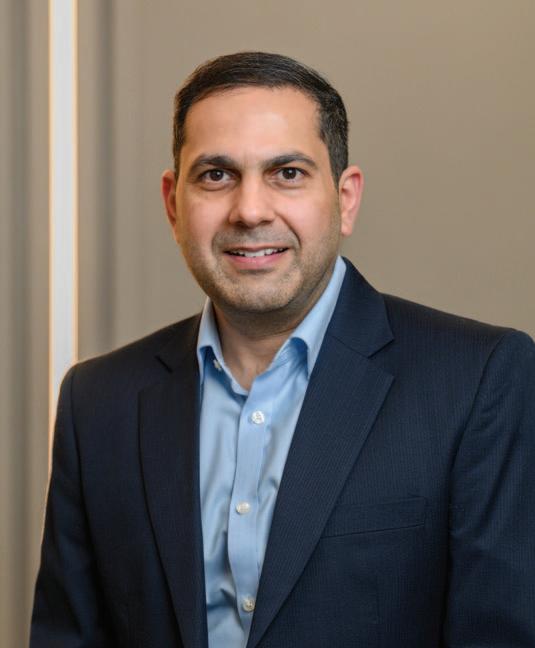
Rohan Kapoor, Chief Information Officer of NIE Networks, talks to Owen McQuade about the company’s new technology partnership with BT and how the electricity network is becoming smarter and greener with the convergence of digital, data and operational technologies.




“This multi-year partnership is a win-win for Northern Ireland’s economy supporting local jobs, skills development, and supply chain opportunities. The partnership also reinforces investment in Northern Ireland’s digital and energy infrastructure, helping create long-term economic value and accelerating Northern Ireland’s net zero transition.”
Rohan Kapoor, Chief Information Officer, NIE Networks
In 2024 NIE Networks went to market for a managed service provider for IT, security, infrastructure, and network services. After an 18-month robust process which received high levels of market engagement, including several global IT players bidding, BT was confirmed as NIE Networks’ new partner.
NIE Networks is entering a transformative era under RP7, the latest regulatory period, running from April 2025 to 2031. The company plans significant investment in digital capabilities to meet the evolving energy landscape.
“The industry is changing rapidly, and our strategy is to become a digitally enabled Distribution System Operator (DSO), powered by data and AI,” says Kapoor. “Our current business plan includes a wide range of transformation projects, and having the right partner is critical. This collaboration will ensure NIE Networks operates as efficiently and effectively as possible, enhancing the customer experience, and supporting delivery of the Executive’s net zero targets.”
Reflecting on the evolution of the sector, Kapoor notes that early in his career, the focus was firmly on core IT services. Today, however, the emphasis has shifted toward digital transformation.
“Digital is far more than traditional IT,” he explains.
“We live in a data-driven world where technology is everywhere, generating vast amounts of data and information. The real challenge lies in refining and using that data effectively. You hear about AI everywhere, but what is equally important is the convergence of IT and operational technologies.
“At NIE Networks, we have both in abundance, and our goal is to integrate these data sets powered by AI to create more efficient operations that deliver real value for customers. This will unlock benefits for the DSO, including improved network visibility, enhanced performance, safer operations and a better customer experience.”
Dynamic line rating (DLR) is a grid technology that uses real-time weather data and line sensors to calculate a power line’s actual safe capacity, allowing it to carry significantly more electricity than the traditional ‘static’ rating. The traditional approach assumes worst-case weather (for example, no wind and/or high heat) to set a fixed, conservative limit, meaning lines are often underutilised. The DLR approach uses sensors to measure conductor temperature, wind speed/direction, solar radiation, ambient temperature, and even line sag. This is used to determine the actual maximum current the line can safely carry at that moment. The main benefits of DLR are increased capacity, reduced curtailment of intermittent renewable energy sources, cost savings by avoiding building new transmission lines, and improved grid stability.


Kapoor adds: “Digital also gives us the tools to transform our technology services. A key part of this partnership is ensuring reliable and resilient services.”
While acknowledging BT’s strong local presence, he highlights the added value of their global perspective: “BT brings expertise and experience from across the digital landscape and industry. It is no longer just about desktop PCs and networks, it is about intelligence, security, and a broader view of what digital can achieve. That insight will be invaluable for us.”
In recent times, cybersecurity has become a critical priority as the number of malware and ransomware incidents continue to rise. With the electricity network classified as critical national infrastructure (CNI), the growing influence of artificial intelligence has introduced new vulnerabilities, making it easier for malicious actors to target essential systems.
“This partnership strengthens our defences by bringing advanced security services and BT’s expertise in managing
cyber operations,” says Kapoor. “As a major industry player, BT’s experience in safeguarding its own operations will be inestimable.”
Kapoor believes the partnership will also benefit the Northern Ireland economy. Much of the expenditure in the partnership is to be spent locally, which means more jobs, enhanced skills, and experience in working with a CNI and a global technology player.
“This multi-year partnership is a win-win for Northern Ireland’s economy supporting local jobs, skills development, and supply-chain opportunities. The partnership also reinforces investment in Northern Ireland’s digital and energy infrastructure, helping create long-term economic value and accelerating Northern Ireland’s net zero transition.”
Aside from technology expertise and experience, Kapoor believes the partnership will be one of shared values.
“There is a shared commitment to climate
change with stringent emission reduction targets that include suppliers and customers.”
NIE Networks is driving the transition to a greener, smarter electricity network, backed by ambitious emissions targets and a dedicated sustainability team.
“Our goal is to combine operational and IT data to create intelligence that informs decision-making,” explains Kapoor. “This insight helps us maximise the existing grid, optimise investment, and increase capacity where it is needed most. For example, dynamic line rating technology uses sensors to deliver real-time data, enabling us to unlock additional network capacity and target investment effectively. By coupling this real time data with our investment plans, we can target investment to where it is needed the most.
“A smarter grid also informs customers about the best time to use electricity, when to use their washing machine,

Kapoor continues: “The energy sector is evolving rapidly with the rise of the ‘prosumer’; individuals generating their own electricity and exporting surplus to the grid. In markets like California and parts of Australia, distributed energy systems featuring solar PV, wind turbines, and EVs are already widespread with households feeding surplus energy back to the grid.
“EVs, for example, can power a home for days during low generation periods,” explains Kapoor. “Some suppliers in Great Britain even incentivise customers to reduce usage at peak times. Our current system is still largely linear, with big producers feeding the grid, but the future will be decentralised with thousands of small producers using rooftop solar and other low-carbon technologies. Combined with smart metering, this will fundamentally change how we operate. Achieving this requires vast amounts of data, operational insight, and technologies to produce valuable insights for decision-making. The future DSO will be as much about data as it is about overhead lines and cables.”

Asserting that his digital leadership of NIE Networks is based on a “partnership approach”, Kapoor says: “The partnership with BT will deliver improved outcomes that will benefit all our customers; homes, businesses, and public services.”
Northern Ireland.
“The collaboration will help meet Northern Ireland’s energy needs, increasing our technological capabilities and enabling further electrification, renewables integration and emerging flexibility markets all of which have a positive impact on the Northern Ireland economy and the Northern Ireland Executive’s net zero targets,” he concludes.

Rohan Kapoor is Chief Information Officer at NIE Networks. Originally from India, where he graduated with a degree in engineering, Kapoor came to the UK to study for an MBA. He then worked in a number of technology roles in the NHS before joining National Grid for a decade. He joined NIE Networks in March 2023, which he sees as an opportunity “to drive change and transformation towards a sustainable future for Northern Ireland’s energy infrastructure”.
Kapoor’s interests outside work are travel and sports, including cricket, football, and Formula 1.
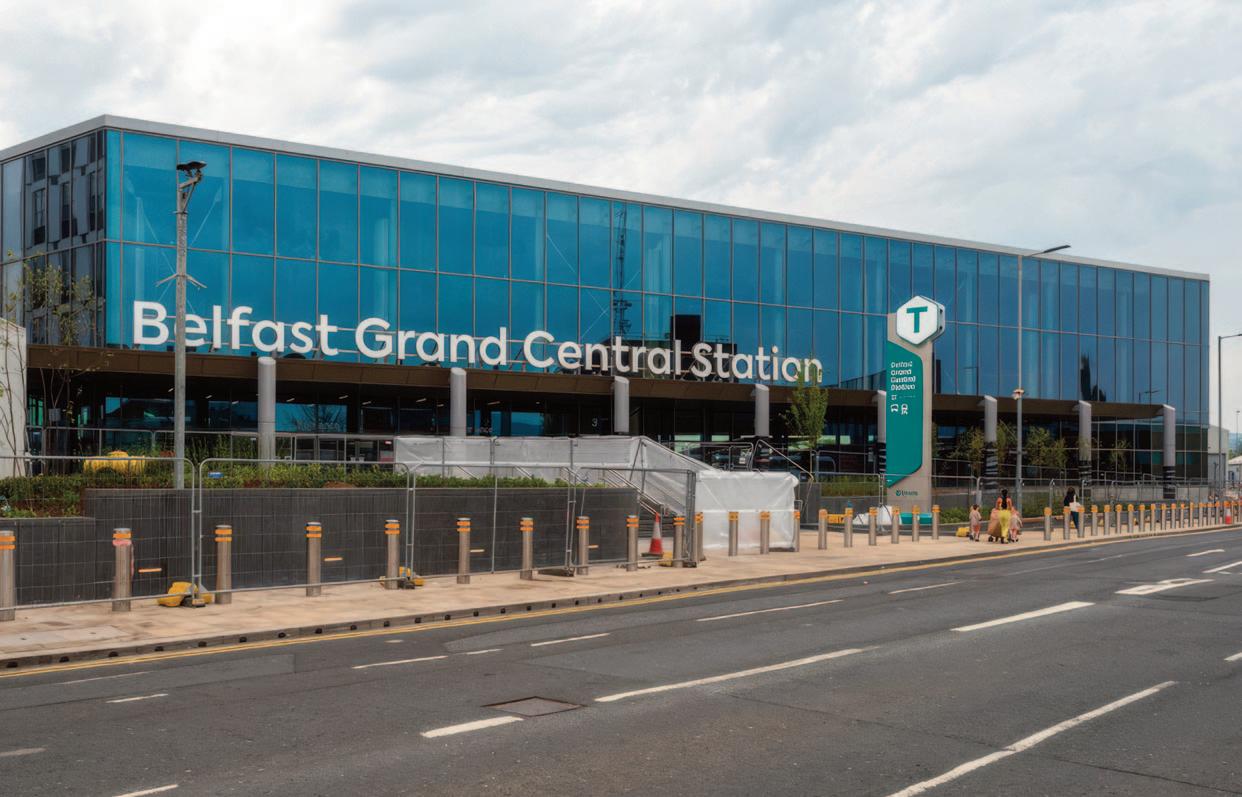

The Rail Project Prioritisation Strategy has set out how major rail schemes across the island could be sequenced and delivered over the coming decades, with upgrades and line reopenings in the North and on cross-border corridors placed at the forefront of the programme.
The strategy, developed to support the All-Island Strategic Rail Review and launched in December 2025, identifies which projects outlined in the review should be progressed first, which can be delivered in the short term, and which will require sustained investment over the medium to long term.
In doing so, it places particular emphasis on improving connectivity between Belfast, Derry, and Dublin, while also restoring rail access to parts of Northern Ireland that have been without services for decades.
Among the most significant projects identified is the upgrade of the Belfast-Derry line, which has long suffered from slow journey times and limited frequency. The strategy prioritises capacity and frequency enhancements alongside line speed improvements, with the aim of delivering faster, more reliable services, and supporting regional economic development in the northwest. These works are identified as a major project to be delivered in phases, subject to further appraisal and funding.
The Belfast-Dublin corridor, the island’s busiest cross-border rail route, is also prioritised for further enhancement. Building on the Enterprise fleet replacement programme, the strategy identifies electrification and line speed improvements as


key next steps. These interventions aim to support journey time reductions, improve reliability, and significantly reduce carbon emissions on a corridor that plays a critical role in cross-border mobility and trade.
Beyond upgrading existing routes, the strategy places renewed focus on rail reinstatement in Northern Ireland, with several long-closed lines identified for progression. The reopening of the Lisburn-Antrim line would reintroduce a strategic link within the Northern Ireland network, improving flexibility and resilience while also enabling, in the longer term, a rail connection to Belfast International Airport.
The Portadown-Armagh line is also identified for reinstatement, reconnecting Armagh city to the rail network for the first time since the 1950s. Armagh is the only city on the island of Ireland with no railway station.
In addition, the strategy highlights a reinstated and partially new corridor from Portadown to Derry via Letterkenny, which would create a new crossborder rail spine serving the northwest and linking into the wider all-island network.
Taken together, these projects would significantly expand rail accessibility in Northern Ireland and strengthen cross-border integration, addressing longstanding regional imbalances in transport provision.
While the strategy focuses on major projects over the medium to long term, it also identifies a series of early interventions to be delivered by 2030. On the Belfast line, these include the reinstatement and increased use of passing loops, which would support hourly Dublin-Belfast services and improve reliability in the shorter term. A new spur at Portadown station is also proposed to futureproof the route for onward services towards Derry.
Outside Northern Ireland, the strategy sets out a wide-ranging programme of upgrades across the Republic, including electrification, line speed improvements and capacity enhancements on key intercity routes such as Cork-Dublin, GalwayDublin, and Waterford-Dublin. One of the most critical bottlenecks identified is the HazelhatchPortarlington section west of Dublin, where capacity constraints affect services across much of the national network.
A notable cross-regional project is the proposed reinstatement of the Claremorris-Athenry line,
which would restore a missing link on the Western Rail Corridor. This would enable new passenger services between the west and south of the island and support the development of rail freight, particularly in conjunction with port connectivity.
Decarbonisation underpins much of the strategy. Around 750km of track are identified for electrification, including major intercity and crossborder corridors. This would enable the majority of long-distance passenger services to operate using electric traction, reducing emissions while also improving performance and operating efficiency.
The strategy adopts a phased delivery approach, with smaller, lower-cost interventions designed to unlock capacity and resilience in the short term, and more complex, capital-intensive projects sequenced over longer timeframes. All projects remain subject to detailed feasibility studies, environmental assessment, and the securing of funding and statutory approvals.
While the document does not commit governments to specific delivery dates, it provides a clearer roadmap than previously existed, indicating how the vision set out in the All-Island Strategic Rail Review could be translated into a sustained programme of investment.
If delivered, the prioritised projects would significantly reduce journey times between major cities, improve service frequency and reliability, and extend rail access to communities across Northern Ireland and the border region. More broadly, the strategy positions rail as a central component of future transport policy on the island, supporting economic development, regional balance, and long-term decarbonisation goals.
Minister for Infrastructure Liz Kimmins MLA says: “This is the next step in progressing the implementation of the All-Island Rail Review. I believe the transformation of our rail network will help address regional imbalance and encourage a shift towards greater use of sustainable transport. This includes important projects including Portadown to Derry, Portadown to Armagh, and Lisburn to Antrim.
“The publication of this Rail Project Prioritisation Strategy provides a way forward for connecting communities who have been without rail, particularly in the northwest, alongside increasing frequency and improving services for those along existing lines. This will help strengthen economic and social ties across the island.”
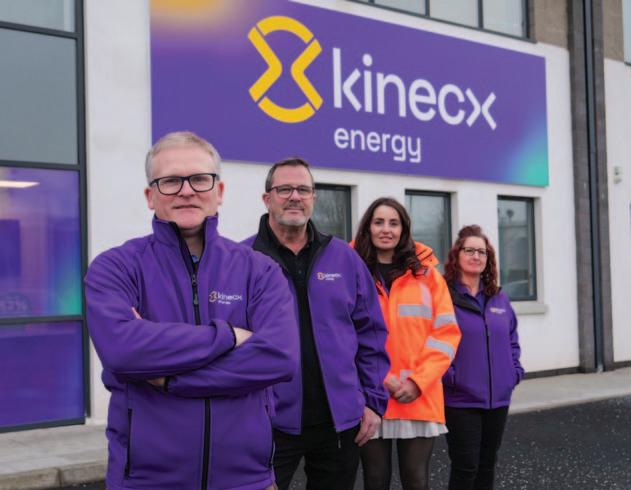
2025 was an important and transformative year for our business with the launch of our new name in September 2025. For the last 20 years, we have operated as a gas network under the firmus energy name, however, subsequent to the sale of our retail business (firmus energy Supply Limited), we rebranded the networks business to Kinecx Energy.
2025: The dawn of a new era
We are immensely proud of our modern and reliable gas network that arcs from Derry in the northwest of Northern Ireland to Newry in the southeast. Our dedicated staff and contractors work 24/7 to ensure that our network is delivering energy reliably, and anything requiring our attention is responded to
within minutes, not hours. This ensures we can maintain an extremely high level of service for our customers, reinforcing our new strapline: ‘Constant, Convenient, Comfort’.
Our pipes may be buried underground and go unseen but do not underestimate the resilience of the gas network and its ability to withstand extreme weather conditions. The wind
may huff and puff, but it cannot blow our pipes down.
The networks business has grown steadily over the last two decades. Today, our gas grid extends to 2,200km of mains, passing 200,000 homes and businesses, and delivering natural gas to over 75,000 connected customers. But our work is far from done.
Having rebranded at the end of 2025, our key focus at the start of 2026 is building our new brand and ensuring our target audience knows who we are and what we do.
Through our marketing campaigns and community outreach we aim to increase awareness of our name and services across all residents in the key towns we serve, including Derry, Limavady, Ballymena, Ballymoney, Coleraine, Newry, Craigavon, Antrim, Banbridge, and Armagh. For those residents thinking of upgrading to natural gas, we need them to instantly think of Kinecx Energy and call our team on 0330 2367 090 or visit our website at www.kinecxenergy.co.uk
We have 125,000 homes and businesses with gas on their doorstep that have yet to realise the many benefits of natural gas, benefits already being enjoyed by our 75,000 connected customers.
Two-thirds of homes in Northern Ireland use home heating oil for heating. Upgrading to natural gas not only brings the advantages of constant supply, instant heat, space savings, multiple uses (cooking, gas fires, barbeques, etc) and increased property value, but also the high efficiency of modern gas boilers and lower carbon emissions means that switching from oil can save up to 48 per cent in carbon emissions.
Connections continue to be our number one focus and connecting to our network remains one of the most effective, low-regret choices customers can make to support Northern Ireland’s transition to a cleaner, future-focussed energy landscape.
In 2026, the natural gas industry in Northern Ireland will be celebrating its 30th anniversary. Compared to other jurisdictions, Northern Ireland is therefore in a relatively unique position, in that its gas network is very modern, constructed almost entirely of new polyethylene (PE) plastic pipes and virtually free of cast iron mains.
With over £1 billion invested in the network, it makes economic sense to maximise the use of this infrastructure and capitalise on the opportunities that it can bring.
As previously noted, households can save up to 48 per cent in carbon emissions by switching from oil to gas and this saving can be improved even further by displacing the natural gas in the pipes with renewables gases.
Biomethane is a renewable gas, produced locally from the anaerobic digestion of organic matter, such as food waste, animal manure agricultural crops, and landfill waste.
The introduction of biomethane into our network offers a clear and credible pathway to decarbonise our existing infrastructure. As a renewable gas that is chemically identical to natural gas, biomethane offers unique advantages: it can be transported through our existing pipelines and used in homes and businesses without any changes to appliances or infrastructure.
In 2024, the distribution network operators in Northern Ireland conducted a request for information which quantified the potential for biomethane to displace natural gas within Northern Ireland’s gas grid. For Kinecx Energy, this potential was shown to be 100 per cent of today’s demand.
Work is ongoing with the Department for the Economy (DfE), the Department of Agriculture, Environment and Rural Affairs (DAERA), the Utility Regulator and gas network operators to explore and maximise the opportunities for developing the biomethane sector in Northern Ireland.
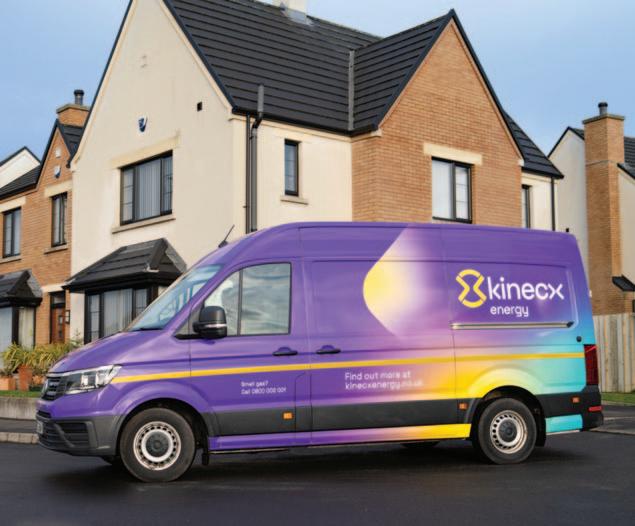
“As Kinecx Energy, we bring forward our experience, our commitment to excellent service, and our belief in a cleaner energy future for Northern Ireland.”
We are proud of the successful business we have built over the last 20 years, and as Kinecx Energy, we may have changed our name, but we will not be changing the strong values and levels of service upon which that success has been achieved.
With over 65 staff, based locally in Antrim, our people, and the communities that we serve are vital to our historical and future success. We continue to invest in learning and development for our staff and support the future of the industry through our groundbreaking Engineering Scholarship Programme with Ulster University’s Derry~Londonderry campus.
Community engagement remains at the heart of everything we do, and we will continue to support local environmental
initiatives and community projects, run educational programmes in schools focussing on energy efficiency and conservation and partner with local charities focused on fuel poverty and environmental causes.
After 20 years of growth and evolution, we are now opening a new chapter. As Kinecx Energy, we bring forward our experience, our commitment to excellent service, and our belief in a cleaner energy future for Northern Ireland. We are excited about what comes next, and we look forward to collaborating with our customers and stakeholders to deliver it.
T: 0330 2367 090
W: www.kinecxenergy.co.uk


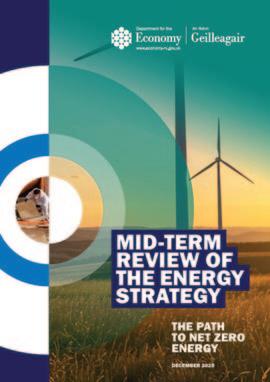
Following criticism of implementation of the Energy Strategy: The Path to Net Zero Energy by the Northern Ireland Audit Office (NIAO), the Department for the Economy (DfE) outlines progress on the strategy in a new report.
For the period of October 2024 to September 2025, 44.2 per cent of local total metered electricity consumption was generated from local metered renewable sources, states the Mid-Term Review of the Energy Strategy: The Path to Net Zero Energy, published in December 2025.
A peak of 51.6 per cent was observed in the 12-month period November 2021 to November 2022. One of three core goals set in the Energy Strategy is delivery of 80 per cent renewable electricity consumption by 2030.
Demonstrating actions taken to progress this goal, the mid-term review states that the Offshore Renewable Energy Action Plan, published in February 2025, provides a blueprint to deliver “at least” 1GW of offshore capacity from 2030.
In 2024, SONI procured two synchronous condensers for delivery at Maydown and Coleraine in 2027. The review states that this will “displace gas plant and provide the conditions for increased amounts of existing renewable generation to be deployed”.
The second core goal of the Energy Strategy is delivery of energy savings of 25 per cent from buildings and industry by 2030. In 2021, the total final energy consumption for heat and power was 32,190 GWh. Based on this, the savings target of 25 per cent set in the strategy was estimated at 8,050 GWh.
However, the final energy consumption figure was subsequently revised to 27,680 GWh, changing the savings target to 6,920 GWh. The review outlines that 330 GWh, 4.8 per cent of the target, has been achieved so far. It also states that the amount of savings delivered may increase as more data becomes available.
The third core goal of the Energy Strategy is to double the size of the low carbon and renewable energy economy to a turnover of more than £2 billion by 2040.
In 2023, the low carbon and renewable energy economy turnover was estimated to be £1.41 billion, the review states. The review asserts that the green economy currently provides around 105,000 jobs in the region and is projected to provide up to 58,000 additional roles over the next decade.
The Green Skills Action Plan, published in May 2025, aims to support a transition to a low-carbon economy. It aims to provide people with the requisite skills and knowledge to support a sustainable, lowcarbon economy.
Tracing challenges to delivery, the review asserts that current energy legislation and regulation centres on electricity and natural gas, with much of heat and transport remaining outside legislative scope. DfE says it is prioritising the delivery of new legislation and regulatory frameworks required for the energy transition.
The NIAO review, published in October 2025, states: “Published information reflects that progress in relation to achieving the energy savings target is considerably lagging, with 90 GWh of energy savings delivered against a target of 8,000 GWh.
“In addition, the renewable energy target is some 35 per cent short of the 80 per cent target to be achieved by 2030. The size of the low carbon and renewable energy economy was reported as £1.58

billion turnover compared to a target of £2 billion.”

The review finds “significant flaws” in the annual Energy Strategy Action Plans (ESAPs). ESAPs contain actions aiming to deliver on the Energy Strategy’s strategic priorities. The NIAO review states that “until 2025, the actions listed in the ESAPs were not outcome focused nor were they aligned to the three key targets”.
Furthermore, the NIAO asserts that there has been “limited progress” on planned actions in ESAPs, reporting on performance is lacking, and that the Energy Strategy Oversight Group (ESOG) did not consider advice from the Climate Change Committee (CCC).
In its review, the NIAO outlines five recommendations for DfE, one of which is the publication of the mid-term review. Another is that, as part of the annual planning process, DfE assesses the extent to which proposed actions will contribute to the three core targets.
The NIAO recommends that, before publication of the annual ESAP, a feasibility assessment of proposed actions be undertaken, including the approach to public consultation.
It also recommends that DfE commission a review of the effectiveness of governance and performance reporting arrangements. The mid-term review states that DfE “intends to strengthen governance, planning, and oversight of the Energy Strategy”.
Additionally, the NIAO recommends that the ESOG examine all energy-related advice from the CCC and that ESOG’s views on implementation be given “appropriate consideration”.
It also advises that accepted CCC advice be reflected in the annual ESAP. The midterm review states that the ESOG “will continue to ensure that there is alignment with statutory targets”.
Furthermore, the mid-term review states that an energy policy position statement will be published in 2026, “setting out a clear direction for delivery through to 2030”. It states that ESAPs “will remain central” in monitoring progress of the Energy Strategy, and delivering on the three core targets.
In her ministerial foreword for the midterm review, Economy Minister Caoimhe Archibald MLA says: “This mid-term review provides a transparent account of our progress, the barriers we must overcome, and the actions we are taking to strengthen governance and delivery.
“Above all, it reaffirms our commitment to a just transition; one that puts people at the heart of change and ensures everyone can benefit.”
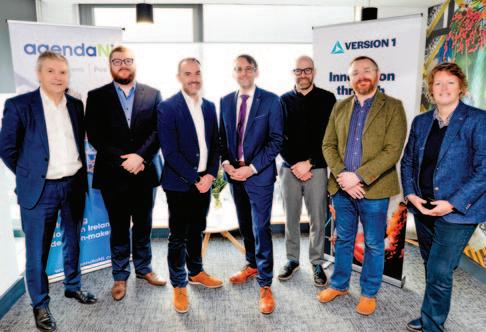
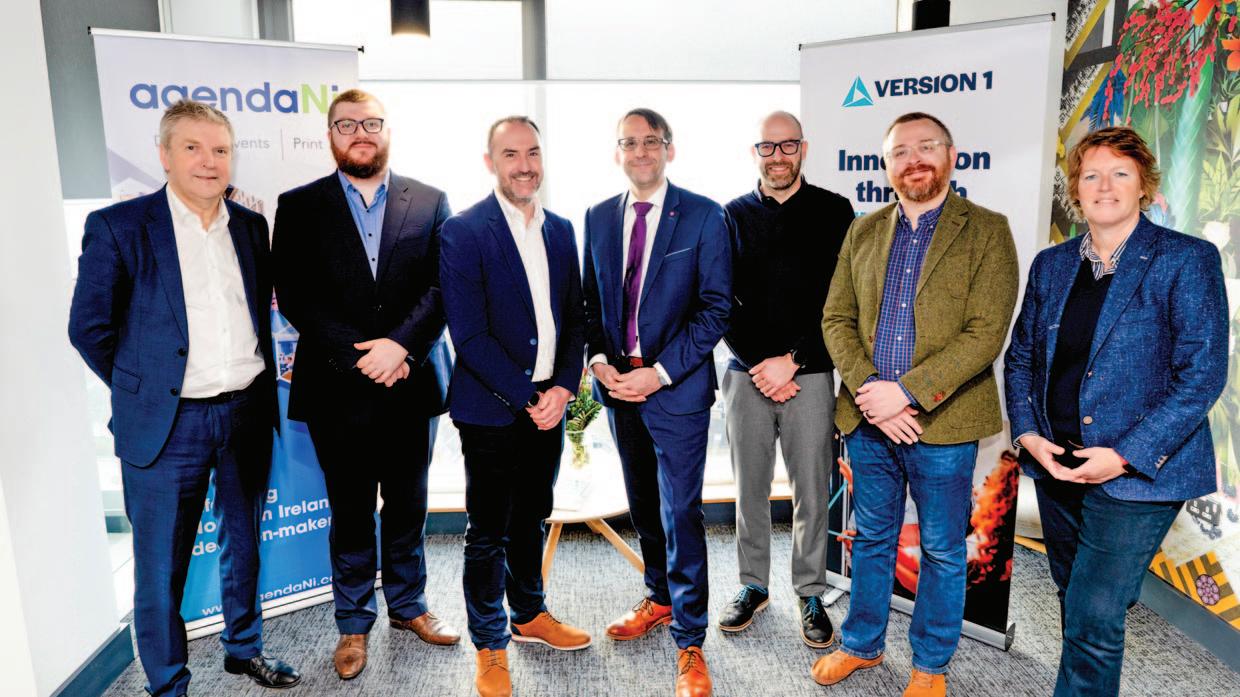
Version 1 hosted digital leaders from across Northern Ireland’s public and academic sectors for a round table discussion on how AI can power smarter decisions across education and government.
How can AI’s ability to predict demand and allocate resources improve policymaking?
Helen McCarthy
AI does not possess the ability to predict demand. To suggest that it does is to anthropomorphise the technology. What it is critical to emphasise is that humans develop the AI systems. Humans also produce the data that goes into those systems, and predictions are based on the quality of that data. So there is significant potential to use AI to predict demand and allocate resource, but first, we need to categorise our data across the public sector to a level that can be used in those systems. Basically, the quality of the output is dependent on the quality of the data, and also on the
Round table discussion hosted by

quality of the system itself. If all of this is set up correctly, AI can provide evidence to help policymaking.
Paul Grocott
Policymaking is about problem-solving. Data and evidence are integral to understanding those problems facing policymakers. AI can help inform that process, although other softer skills rather than just the technology are important in that process. We still need people who are creative and curious, think about problems differently, and can use that data to come up with solutions to a particular problem.
John McShane
There are a lot of things that we do that are termed AI but are actually just better uses of data, and getting to the data much more readily. What AI is really giving us is easier access to data, and if that data can be trusted, we can use that data to understand what is going on under the hood and then to simulate different policy decisions and the impact they might have. One example is understanding the reasons why students drop out of university courses. AI is used to get predictive insights and then put in place interventions to prevent students dropping out. AI, in policy terms, is just another level of data reporting that previously was not available.
David Crozier
When looking at the projects we do at the AICC with SMEs, two particularly come to mind. Both projects were IoT focused and addressed similar challenges. One of those companies had two years of very well understood, governed, structured data, and the other company took a ‘wing and a prayer’ approach to deploying AI. In terms of outcomes it was the company that had a good understanding of its data and the business problem to be solved that had much better outcomes. Having a good understanding of the data and the governance around that data is critical to getting predictive outcomes from any AI technology. It is also important in policymaking to take citizens along with you, particularly where AI is being used for decisions affecting them. In order to build trust, there also needs to be an appropriate means for citizens to challenge any such decisions.
Stephen McCabe
The question is, what can AI do that we are not already doing ourselves, and what value can AI add to the policymaking process? AI systems synthetise large disparate data sets across administrative records, economic data, satellite imagery, and all sorts of different layers of data, and combine and analyse those in ways we have not been able to do before. With

this kind of analysis, we could predict demand for public services. Looking at the issue of creativity, AI should not be just used for scraping whatever is already available on the internet but should be used for hypothesis formulation. This could be of great value to policy formulation. Looking at some practical examples, we could use AI to predict hospital admissions in real time and patient flow through the health care system. This would help greatly with staff planning. In Momentum One Zero, we have worked with the health regulator, RQIA, to develop a natural language process tool to synthesise patient feedback at scale. The charity Care Opinion records patient experiences and we can synthesise that data at scale and feed it back to hospital trusts at board level to facilitate decisions of the quality of service.
Liam Maguire
The benefit of AI is the complexity and the scale. AI is used to create different models and by doing sensitivity analysis we can see how these models are affected by external factors. AI can thus provide information models for others to develop policy and make decisions. AI will be able to give the insight information for politicians to make the actual decisions; it is not the AI system making those decisions.
Liam Maguire
I would ask whether it is just as simple as breaking down silos. There will always be data silos in different organisations. What matters is knowing the format of the data and how it is structured so you can have federated data. As long as you know how to access each silo, the data can interact. Rather than breaking down silos, we should accept they exist and focus on how datasets can work together. It is about interoperability and access, not removing ownership or control of data from organisations.
John McShane
There will always be data centres and silos because organisations want to own and secure their data. Interoperability is largely solved as modern systems can communicate with each other. The real challenges are data-sharing agreements and policy. This is a mindset issue. Organisations are often trained to lock data down early, but data should be treated as an asset to be held securely



David Crozier is Director of the Artificial Intelligence Collaboration Centre (AICC), a joint £16.3 million initiative between Ulster University and Queen’s University Belfast. Awarded a CBE in the 2024 New Year’s Honours for services to the economy, Crozier brings over 25 years’ experience spanning technology, policy, and innovation. Formerly Chief Executive of Software NI, he represented Northern Ireland’s £1.7 billion software sector and led significant strategic growth. His earlier career includes senior roles at Queen’s University Belfast’s CSIT, Invest NI, the Northern Ireland Office, and Intel.

Paul Grocott is Deputy Secretary with responsibility for Digital Transformation and AI at the Department for the Economy (DfE), where he is tasked with improving digital maturity across the organisation and developing a digitally enabled workforce. Grocott has over 16 years’ experience in trade, digital and innovation policy, and a strong track record delivering economic strategies, major investment programmes and international policy engagement. He is particularly committed to responsible technology adoption and mission-driven leadership. In addition to his public service role, Grocott serves as a board member of the Arts Council for Northern Ireland.



Liam Maguire is Pro Vice-Chancellor for Research at Ulster University. Holding MEng and PhD degrees in Electrical and Electronic Engineering from Queen’s University Belfast, Maguire joined Ulster University in 1994 and has held a range of senior academic leadership roles. His research focuses on data analytics and machine learning, with particular emphasis on bio-inspired methods, and he has authored over 250 publications. Maguire represents the University on multiple City and Growth Deal executive boards and is a Director of IUL and the C-TRIC innovation centre.
Stephen McCabe is Executive Director and Senior Responsible Owner for Momentum One Zero under the Belfast Region City Deal. McCabe has extensive experience in research, policy development, and the design and delivery of largescale strategic programmes involving government, industry, and academia. Since 2021, he has played a leadership role in the implementation of the Belfast Region City Deal, including the development of major collaborative initiatives such as the Artificial Intelligence Collaboration Centre. His work is focused on driving innovation-led regional economic growth.
Helen McCarthy was appointed Chief Scientific and Technology Adviser to the Northern Ireland Executive in June 2024. McCarthy is responsible for embedding science and technology at the heart of policy development and chairs the Northern Ireland Science and Technology Advisory Network. She also holds the Chair of Nanomedicine at Queen’s University Belfast. An internationally recognised researcher in drug delivery and gene therapies, McCarthy is now adopting AI within her own research group to advance biotechnology, she has published 200+ papers, supervised over 40 PhD students and is named on multiple patent families across the world. She is also the co-founder and CEO of XapHe Ltd, her second spinout company.

John McShane is a member of the Version 1 Senior Leadership Team, bringing extensive experience in delivering complex projects across the UK, Ireland, USA, and the Netherlands. For over a decade, he has specialised in the Northern Ireland public sector, supporting seven of the eight government departments in delivering a range of key and critical projects. With a proven track record in strategic account management and digital transformation, McShane drives innovation and operational excellence through collaboration and a deep client understanding.
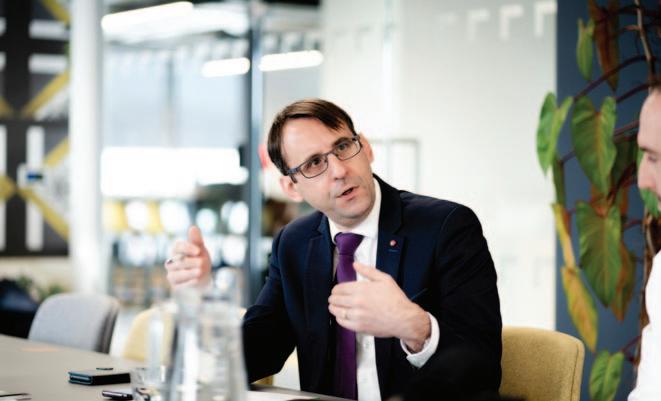
“Baking governance, ethics, and accountability into projects from the start is critical.”
David Crozier
and shared widely where appropriate. The question should be how to store data securely while maximising its value through sharing, rather than restricting access unnecessarily.
Stephen McCabe
There are technical and governance answers, but governance is usually more important. This is about getting silos to interact and providing access to the right people at the right time. Ultimately, it requires political will and mature partnerships between organisations that trust one another and share the same societal goals. AI should inform decisions, not replace democratic processes. Technical safeguards like transparency, human oversight, and accountability help, but trust between organisations and sectors is essential to enabling data sharing and collaboration.
David Crozier
Collaboration is essential for the greater good of Northern Ireland. Projects like the AICC show that cooperation between universities, industry, and partners works when governance and sharing agreements are established upfront. Removing competition and enabling free flow of people, knowledge, and data improves outcomes. Shared infrastructure and facilities allow better returns for organisations and citizens. When government is willing to take managed risks and enable collaboration, it creates better outcomes. Success
comes from shared learning, shared data sources, and a willingness to work together constructively.
Paul Grocott
Most data sharing gateways already exist, and where they do not, agreements can be created. The bigger issue is mindset and culture rather than legislation. There is also a major challenge with legacy systems. Making data accessible is rarely prioritised over new policies or initiatives. We need to find ways to deal with legacy data and systems without creating expensive IT projects that fail. Investment is needed,
but the focus should be on mindset change and practical solutions that unlock existing data rather than overhauling everything.
Helen McCarthy
For a start, we need to move away from a ‘me, myself, and I’ mindset and focus on what is best for Northern Ireland. Sharing data improves decision-making, leads to better citizen outcomes, and delivers fiscal benefits. That is because data is a valuable resource. We are all highly connected in Northern Ireland, so we can use that to bring those who are not yet on board into that shared vision. Mechanisms such as transformation programmes, innovation boards, and collaboration between government, industry, and academia are all key here. Above all, cultural change, supported by governance and legislation, is essential to breaking down silos.
How do we build trusted data ecosystems that meet data governance and ethical AI standards?
David Crozier
Trust must be earned, not assumed. Citizens are open to transformation but still have concerns about AI making decisions. Trust comes from transparency in how data is captured and used, clear accountability, and ethical principles applied early. Governance and ethics should be considered at the planning stage, not retrofitted later. There must be routes to redress where
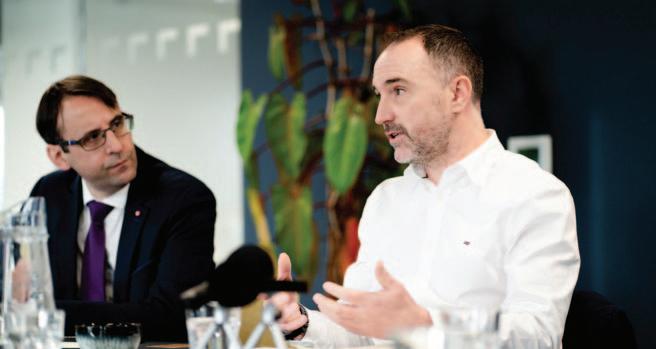
“Innovation should be piloted responsibly, with security by design and ethical by design principles.” John McShane
decisions negatively impact people. If mistakes are not addressed quickly, they become political problems. Baking governance, ethics, and accountability into projects from the start is critical.
Liam Maguire
One of the challenges is that historical data may contain bias that we are not aware of until later. The issue is not just the data itself but how it is interpreted and queried. We no longer have a single source of truth; we have many interpretations. Trust depends on how data is used and how conclusions are drawn from it. Interpretation is as important as data quality, and multiple sources of truth make it harder to ensure consistency and trust across systems.
Helen McCarthy
Trusted ecosystems start with trust between teams working with the data. In the AI strategy, we recommend AI oversight teams rather than single individuals. These teams monitor bias, drift, accountability, and transparency. When issues occur, organisations must be open about them and explain what has happened. That transparency builds trust. The fact that the AI strategy has been co-created across sectors is also important as it means that everyone understands and owns it. In essence, trust begins with collaboration among key players and is reinforced through governance, redress mechanisms, and openness throughout implementation.
Paul Grocott
Trusted systems are built around clear principles that set expectations for behaviour and use. Transparency is critical. Organisations must understand and manage AI’s limitations, including bias, privacy, intellectual property, and misinformation. Building trust also means starting small, piloting, and scaling successful projects. Large failures quickly undermine confidence. Trust grows when people see tangible service improvements and personal benefits from sharing data. Investment in people and education is essential so they understand how to operate responsibly within these ecosystems.
John McShane
Trust is built by removing the mystery around AI. Many people already use AI without realising it. Problems arise when information generated is inaccurate and unexplainable. Data quality remains
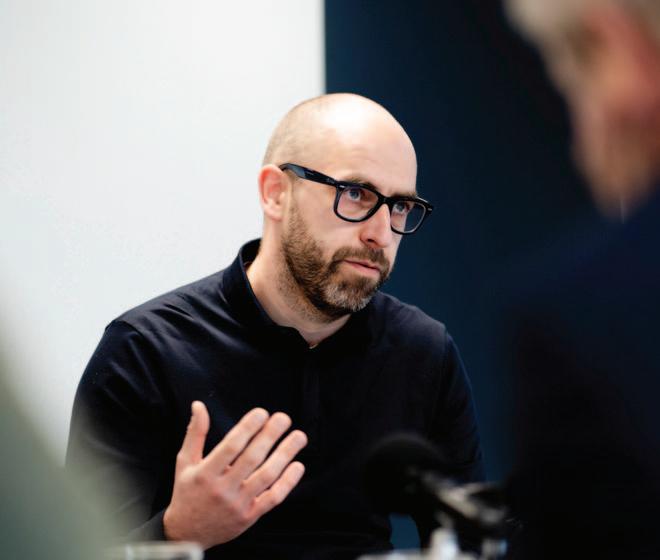
“We need to invest in the people using AI, encouraging them to transform public services while understanding how to deploy technology responsibly and ethically.” Paul Grocott
central. Systems should be designed so outputs can be traced, errors identified, and corrections made. Segregating processes within AI systems allows better auditing and explainability. AI will make mistakes, but trust depends on being able to understand why errors occur and how they are addressed, rather than relying on black box systems.
Stephen McCabe
There are technical and governance elements to building trust. Technically, this includes data hygiene, security by design, privacy by default, anonymisation, and zero-trust environments. Governance is equally important, including public data panels, standardised data-sharing agreements, and aligned governance frameworks. Federated and privacy preserving access models allow sharing without direct data transfer. Healthcare provides a strong example through trusted research environments. Knowing who accesses data and why, combined with strong governance and investment, is key to building trusted ecosystems.
How can we balance innovation with ethical responsibility and AI use?
Paul Grocott
At an organisational level, the UK approach is to be ambitious and proinnovation, underpinned by clear principles. We need to invest in the people using AI, encouraging them to transform public services while understanding how to deploy technology responsibly and ethically. This includes managing bias, respecting privacy laws, understanding limitations, and being able to explain decisions. For example, if AI supports grading or decision-making in education, it must be explainable to those affected. Supporting people to operate responsibly within a risk hungry, pro-innovation environment is essential.
Helen McCarthy
Innovation means different things in different contexts, whether that is advanced research, industry applications, or practical tools for 4
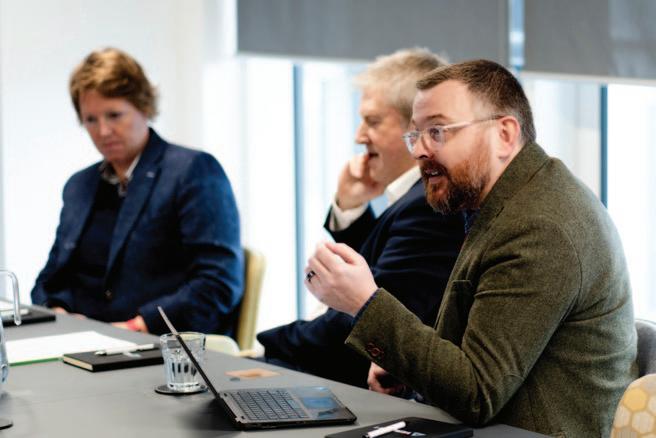
“We need to show that AI works and can be trusted in a meaningful way that the public can understand.” Stephen McCabe
charities, schools, or the public sector. For the public sector, innovation must deliver positive use, positive inclusion, and positive outcomes. Ethical responsibility begins with how AI is used, so it is a false dichotomy to suggest innovation and ethics are opposing forces. Both are needed, with different guidelines for different contexts.
David Crozier
Ethical and moral implications must be considered alongside innovation.
A ‘move fast and break things’ approach is not appropriate in public service contexts. Governance, ethics, and regulatory guidelines need to be incorporated alongside innovation efforts. Policymakers and officials are accountable for delivering public services in an ethical, responsible, sustainable, and repeatable way, not for commercial metrics like funding rounds. Innovation must be balanced with responsibility so that outcomes can be stood over publicly and politically.
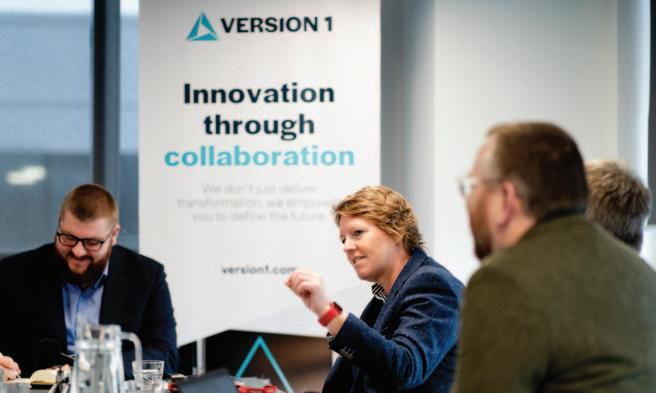
“Sharing data improves decision-making, leads to better citizen outcomes, and delivers fiscal benefits.” Helen McCarthy
For this balance to work, the public sector must have trust in what the private sector provides. So, for example, some innovation can happen in sandboxes that are not suitable for public deployment, but there are also developments that the public sector needs industry to bring forward. Getting this balance right requires partnership. Ethical standards determine what can be adopted into public services, while innovation continues elsewhere. That balance depends on trust, clear expectations, and shared responsibility between public and private sectors.
Innovation naturally pushes boundaries, but not all boundaries are ethical ones. AI can make innovation more accessible, particularly for startups, and accelerate development. That is not inherently an ethical issue. Ethical concerns arise depending on how systems are governed. Guardrails such as governance, audit trails, and controls are needed, but ethical considerations should not stifle innovation. Innovation has to happen, with appropriate guardrails applied to manage risk rather than prevent progress.
Using AI to support startups can replicate existing biases if the underlying data discriminates against minorities, women, or other groups. That is where ethical considerations matter. There is nothing inherently unethical about startups or innovation; the issue is who benefits and who is excluded. Ethical responsibility requires recognising and addressing bias in data and systems so innovation does not reinforce inequality.
Stephen McCabe
The key question is whether innovation is anchored in public value. A risk-based approach is needed, applying safeguards where stakes are highest. Ethical responsibility does not preclude experimentation. Sandboxes allow innovation to move quickly and even fail without exposing the public to harm. This enables learning and progress while protecting citizens. Responsibility is shared, and experimentation should be encouraged in controlled environments.
John McShane
We owe it to society in Northern Ireland to innovate because of real challenges such as an ageing population and a skills shortages. AI can help address these issues. Innovation should be piloted responsibly, with security by design and ethical by design principles. While extreme cases of ethical and unethical use are often clear, there is less consensus in the grey areas. These middle ground cases need further exploration. Over time, as more use cases emerge, there will be greater clarity on ethical boundaries and how to prevent misuse of AI tools.
Helen McCarthy
Tools built in the private sector should not be adopted in the public sector unless they meet required ethical standards. Citizens and services must be brought along on that journey. For example, there are many existing, ethically-sound use cases that could already deliver major public sector benefits. Applying those first will help build confidence; and from there, we can progress to adopting more advanced innovations. Ethical checkpoints should also be in place throughout the technology readiness lifecycle to ensure harmful uses are filtered out before deployment.
Stephen McCabe
Through demonstration. We need to show that AI works and can be trusted in a meaningful way that the public can understand. At Momentum One Zero, we bring cybersecurity and AI together and in doing that we are increasingly working with companies to verify that their AI systems are trustworthy.
Liam Maguire
Public trust is a real challenge. We need to address the different levels of trust in terms of gender, age, or educational attainment. We have to build out from where the trust is strongest, from the younger, digitally-enabled generation. From a teaching perspective, the challenge is around how we assess
students. AI will change how we not only teach students but, more importantly, how we assess them. It used to be about testing rote learning and now we need to identify students’ understanding of a subject. That will be the big challenge in education.
David Crozier
I would put teachers and employees in one group and students in the other. If we want to communicate the benefits of AI to the sector leaders we need to actually deliver the benefits of AI that will automate much of the administrative parts of their jobs. This will free them up to teach and inspire their students. Children need to be taught how to use AI to solve problems and not just as a short cut to do their assignments.
John McShane
There is a generational gap between the two groups. Some of the principles we applied when moving people from paperbased systems to digital systems 30 years ago are very relevant. As with that transition, it is key that we bring people along with us. It will also require a multifaceted approach, starting with debunking some of the myths about AI.
The most successful IT projects involve the stakeholders from the start and they take ownership of the system. In order to achieve that, you need to bring people with you right through the process.
Helen McCarthy
Enhancing training and literacy is a key principle, as there are significant gaps between groups in terms of understanding of AI. That is why we are advocating that, for every AI project, there is a team member tasked with training those using the system. In addition to that, most senior leaders are in roles that are not focused on the workings of AI, so we need bite-sized training for them too. At the other end of the spectrum, AI literacy for students should be a given and will be a key skill into the future. On building public trust, we are advocating a citizens’ forum.
Paul Grocott
To build trust in using AI we need to ensure we are not cementing in existing biases. We should not reinforce existing biases that will leave disadvantaged students, employees, and communities behind. We should deploy AI to make public services better for everyone.
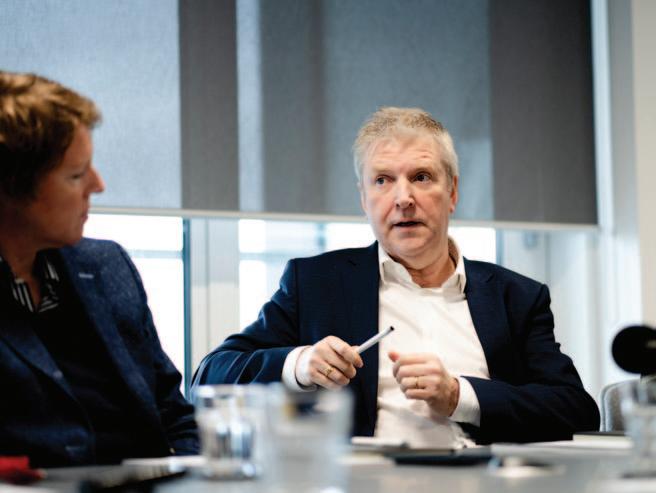
“Rather than breaking down silos, we should accept they exist and focus on how datasets can work together.” Liam Maguire

A 10-year roadmap envisioning an inclusive society that respects, protects, promotes, and fulfils the rights of all deaf and disabled people is laid out in the draft
The draft strategy, published in December 2025, is currently undergoing public consultation which will conclude on 20 March 2026. Census 2021 estimates that 24.3 per cent of the population has a limiting long-term health problem or disability.
Overall, disabled people have significant lower rates of employment, higher rates of economic activity, and lower rates of median hourly pay. School leavers with special education needs (SEN) are less likely to achieve at least level five GCSEs and are more likely to achieve no formal qualifications.
Additionally, disabled people have worse levels of personal wellbeing, are less likely to engage in social aspects of society, and are more likely to report that fear of crime has an impact on their quality of life.
Inclusion of deaf and disabled people in development of policy and legislation is at the core of the strategy. Actions aimed at delivering on these commitments will be included in a disability strategy action plan.
Establishment of a regional disability forum is identified as the primary strategic commitment of the draft strategy. The forum’s purpose would be to advise on the monitoring and implementation of the disability strategy with its membership made entirely of deaf and disabled people.
Outcome one is that deaf and disabled people can participate in society on an equal basis. Strategic commitments underpinning this outcome include publication of a disability data
compendium every two years and an update to disability legislation incorporating the United Nations Convention on the Rights of Persons with Disabilities.
Indicators of the success of this outcome include the percentages of applicants for public appointments declaring a disability, and successful public appointees declaring a disability.
Outcome two is that deaf and disabled people can access the built environment, facilities, and transport on an equal basis. Strategic commitments driving delivery of this outcome include adoption of inclusive design standards in all new public-funded spaces and facilities, and scoping of the introduction of an accessibility rating system.
Indicators of this outcome included the percentage of public transport journeys made by people with a disability and
those without, and the average journeys per year and journey purpose for people with a mobility difficult and those without.
Outcome three is that deaf and disabled people can access public services, government information, and communications on an equal basis.
Strategic commitments supporting this outcome include provision of accessible departmental information and communications, and better access to crime reporting and the justice system. The locus of control, a mechanism measuring the degree to which a person feels they have control over their life, will be one method used to measure progress.
Outcome four is that deaf and disabled people can access and participate in culture, leisure activities, and sport on an equal basis.
Strategic commitments aimed at achieving this outcome include improving deaf and disabled people’s access to and participation in sport through the Active Living: The Sport and Physical Activity Strategy. One indicator for this outcome are the percentages of disabled people involved in cultural activities, and sport and physical activity.
Outcome five is that deaf and disabled people live independently with a sufficient and sustainable standard of living. Strategic commitments underpinning this outcome include improving availability of suitable housing, and production of inclusive design guidance to improve housing standards for people with cognitive and sensory impairments.
every patient, and exploration of greater use of social prescribing. The only indicator for this outcome is the level of satisfaction with health and social care.
Outcome seven is that deaf and disabled people can access, sustain, and progress within quality employment. Strategic commitments supporting this outcome include implementation of the Disability and Work Strategy, the civil service’s People Strategy 2025-2030, and the Executive’s Social Value in Procurement Policy.
This will be measured by the rates of disability employment, disability employment by age group, and disability employment by gender. Additional indicators include the disability pay gap, the percentage of disabled people who are economically inactive, and the rates of underemployment and selfemployment for disabled people.

Outcome eight is that deaf and disabled children and young people can reach their full educational, social, and developmental potential.
Strategic commitments aimed at achieving this include creation of an Executive Childcare Strategy, implementation of the Special Educational Needs Reform Agenda, and delivery of a special education needs framework. This will be measured by school leavers with a disability achieving level two qualifications, and enrolments at higher education institutions and further education colleges by disabled young people.
This will be measured by the percentage of households containing a disabled member spending 30 per cent or more of their household income on housing costs. Additional indicators include the satisfaction of households containing a disabled member with their dwelling, and relative poverty of disabled people.
Outcome six is that deaf and disabled people have access to quality health and social care on an equal basis. Strategic commitments driving delivery of this action include introduction of a digital care record for
In his ministerial foreword for the draft strategy, Communities Minister Gordon Lyons MLA says: “The strategy sets out an ambitious programme of work that will lay a solid foundation for addressing the main societal barriers that inhibit the full participation and inclusion of deaf and disabled people in society.
“It will require government, deaf and disabled individuals, and their representative organisations to work effectively together to ensure its success.”
Edition two of the Strategic Planning Policy Statement (SPPS), published in December 2025, sets out the Department for Infrastructure’s (DfI) regional planning policies for securing consistent development of land under the two-tier planning system.
Under the two-tier system, local authorities have responsibility for local plan-making, development management, and planning enforcement. DfI is responsible for regional planning policy, the determination of regionally significant and call-in applications, and planning legislation.
The SPPS identifies planning as key in achieving a vibrant economy. It sets strategic objectives to supply land suitable for economic development; support re-use of previously developed economic development sites; and promote mix-used developments and improve integration of land uses.
On renewable and low carbon energy, the SPPS sets an aim to maximise sustainable renewable and low carbon energy from various technologies. It sets strategic objectives to facilitate sustainable renewable and low carbon energy development, and secure the delivery of an appropriate mix of energy provision.
Additionally it sets aims to facilitate the integration of renewable and low carbon energy technology in new developments, and to facilitate the onshore development required to enable offshore renewable and low carbon energy proposals.
On transport, the SPPS sets an aim to improve integration with land-use planning and to facilitate safe and efficient access, movement, and parking. To achieve this, the SPPS sets a strategic objective to promote sustainable patterns of development. This is pinned as a way to reduce motorised transport and encourage active travel.
Additionally, it sets aims to ensure accessibility for all, promote the provision of adequate cycling facilities in new developments, and promote parking policies to tackle congestion and reduce reliance on the private car.
The SPPS also sets strategic objectives to protect routes required for new transport schemes, and restrict the number of new accesses and control the use of existing accesses onto protected routes.
Provisions in the SPPS must be taken into account in the preparation of local authorities’ local development plans. They are also material to all decisions on individual planning applications and appeals. DfI intends to undertake a review of the SPPS within five years.
The SPPS indicates that local authorities should consider a planning application’s impact on sustainable development when making a decision. It stipulates that developments that accord with an up-todate development plan should be approved and proposed developments conflicting with an up-to-date plan should be refused.
Infrastructure Minister Liz Kimmins MLA says: “The planning policy framework I am introducing is designed to help support the wider ambitions of the Executive by enabling appropriate development and associated infrastructure that can make a positive contribution towards reducing emissions and decarbonising energy use across the region in the long-term public interest.”




Minister Naomi Long MLA:
‘A fair, efficient, and sustainable justice system’
Justice Minister Naomi Long MLA sits down with Joshua Murray at the Department of Justice headquarters, where she discusses her access to justice agenda, the legal aid strike, and how paramilitary influence can be reduced.
“The legal aid system that we currently have is not sustainable.”

Justice Minister Naomi Long MLA
With court backlogs, legal aid reform, victims’ services, and paramilitarism all demanding attention, Minister Long describes her immediate task as one of stabilisation, delivery, and rebuilding confidence in a justice system stretched close to its limits.
Asked about her priorities since returning to office, Long emphasises continuity rather than radical reform. “When we came back post the suspension that we had, my priority was to try and ensure that the Department was able to be stable and able to deliver,” she says.
“One of the challenges for us was that we had a range of programmes that had stalled during that period and it was about trying to ensure that we could pick those up again and continue to deliver for them.”
While the agenda itself may be familiar, Long argues that the context has shifted significantly. The absence of political decision-making for three years prior to the Executive’s return in February 2024, combined with growing operational and financial challenges, has left the justice system more fragile than when the Executive last collapsed. “It was the same agenda in many ways, but with a slightly different context,” she says.
Among the most contentious issues facing the department is legal aid reform. Long says that change is unavoidable, framing the issue as one of sustainability rather than ideology. “The legal aid system that we currently have is not sustainable,” she says. “It is not sustainable financially, and it is not sustainable in terms of the way it delivers justice.”
She points to a long trail of reviews and evidence underpinning the Department’s position. “There has been a huge amount of work done on this over quite some time,” she says. “We have had a range of independent reviews, a range of different inputs, including Tom Burgess – Judge Tom Burgess’ report – on legal aid, and the conclusion is very clear.”
While acknowledging the concerns raised by legal professionals, Long rejects claims that reform is being pursued without regard for barristers’ pay or access for victims. “The whole point of a legal aid system is access to justice, both for the accused and for the victims,” she says. “We need to ensure that the system is fair, that it is efficient, and that it is sustainable.”

“You have to deal with the underlying causes as well as the criminality.”
Beyond structural reform, Long places strong emphasis on the lived experience of victims engaging with the justice system. She acknowledges that while procedural fairness is essential, the process itself can compound harm if not handled carefully.
“There are a lot of things that we do now that we did not do historically,” she says. “There is much more awareness now of the impact of trauma and the impact of being a victim of crime.”
Long highlights the burden placed on victims by repeated interviews and prolonged court processes. “For many victims, the process itself can be deeply traumatic,” she says. “It can be very traumatic for people to have to recount what has happened to them. To be interviewed multiple times, to have to repeat that story, can be retraumatising.”
This awareness, she argues, must shape both policy and practice.
“Justice should be about recovery,” Long says. “It should be about helping people to rebuild their lives, not just about the outcome of a court case.”
The Minister links this approach to broader efforts within the department to modernise how victims and witnesses are supported.
Despite progress in other areas, paramilitarism remains one of the most persistent challenges facing the justice system. Long is careful to frame the issue as one that cannot be addressed through enforcement alone.
“We have obviously the executive programme on paramilitarism,” she says. “That EPPOC [Executive Programme on Paramilitarism and Organised Crime] programme, it is evidence based. It is evidence led, but it is also very clear that enforcement alone is not enough.”
While acknowledging the importance of policing and criminal justice responses, Long stresses that paramilitary influence extends beyond violence.
“The threats that paramilitaries pose are not just about violence,” she says. “It is about money. It is about power. It is about control.”
Undermining that influence, she argues, requires sustained intervention at community level. “If you want to undermine that, you have to provide alternatives for communities,” she says.
Long also highlights the risks faced by young people in areas where paramilitary structures remain embedded. “I think that is where the EPPOC programme has been really strong,” she says. “It recognises that you have to deal with the underlying causes as well as the criminality.”
Since policing and justice was devolved, the Alliance Party has been the only party to hold leadership of the Department of Justice, with independent unionist MLA Claire Sugden having briefly held the role between 2016 and 2017.
When asked if another party should be allowed to hold the role of Justice Minister, Long says: “That is not a matter for me,” she says. “That is a matter for the Assembly to decide who leads the Department of Justice.”
She rejects the notion that justice should be treated as an exception within the Executive. “People talk about us having some kind of special arrangement around the Department of Justice,” she says. “But ultimately, it is a department like any other, and it should be subject to the same democratic processes.”
Long avoids speculation about her own political future, instead returning repeatedly to the theme of delivery. “I have no idea,” she says. “First of all, I do not know whether I will be Justice Minister in the future. I do not know what the future of delivery holds.
“I have been really clear that I am about delivery,” she states. “I am about making sure that the system works as well as it can for the people who rely on it.”

Proposed primary legislation is set to be brought forward to enable verified media outlets to broadcast from inside courts in selected cases.
The Department of Justice is now seeking, with the agreement of the Lady Chief Justice, to make secondary legislation in the form of an order to disapply section 29 of Criminal Justice Act (Northern Ireland) 1945. This provides for the prohibition of taking photographs, etc., in court.
The Department will also seek to disapply section 9 of the Contempt of Court Act 1981, which pertains to the use of tape recorders in prescribed circumstances.
Public consultation, showing “broad support” for the proposed measure, concluded in October 2025. Should the legislation be enacted, Northern Ireland would become the final region of the UK to allow media organisations to film and broadcast in certain court cases.
However, the development of this legislation will be deferred until the next Assembly mandate in 2027 and will be subject to agreement by the incoming minister and new Executive.
Minister of Justice Naomi Long MLA says: “This is not about turning our courts into livestream entertainment; it is about improving public confidence in our justice
system and, as always, victims and witnesses will remain at the heart of everything we do.”
The Minister adds: “Allowing broadcasting in courts will increase transparency and allow the public to view decisions being made by the judiciary in Northern Ireland.”
There will be strict criteria for who is allowed to film within the court and what they are able to broadcast. Only broadcasters who are permitted in writing by the Department of Justice will be allowed to record certain proceedings and the decision on whether a case can be broadcast will be made by the individual judge who is presiding over it.
The types of proceedings which could be broadcast under the plans include the handing down of a judgement in the Court of Appeal, exchanges between legal representatives and the court, and judges making their sentencing remarks in the Crown Court.


Ciaran Brennan analyses progress on the draft Enabling Access to Justice (EAJ) Programme Delivery Plan, one year on from its publication in late-January 2025.
The draft delivery plan was due for publication in early-December 2024, shortly after Justice Minister Naomi Long MLA unveiled the EAJ programme to the Assembly. However, the draft delivery plan was not published until late-January 2025.
Public consultation on the plan concluded in late-March 2025, but the final version has not yet been published. However, the Department of Justice (DoJ) has been progressing on actions contained in the plan.
It aligns with the EAJ programme which aims to make the justice system more accessible, efficient, and equitable. The programme was informed by reviews which illustrate problems in the justice system including rising legal aid costs, outdate delivery models, and processes that compound trauma for vulnerable users.
Under the delivery plan, the Department was due to introduce legislation amending remuneration for advice and representation in civil and family proceedings by end of May 2025. It also aimed to amend remuneration for representation and advice in the Crown and Magistrates’ Courts, and amend and consolidate mileage rates.
A 16 per cent uplift in fees for advice and representation in criminal, civil, and family cases, backdated to December 2024, was implemented in January 2026. This was recommended in the Fundamental Review of Criminal Legal Aid, published in August 2024.
However, the Bar Council of Northern Ireland says the uplift “has come too late and fallen significantly short of what is required to stabilise a system in crisis”. Additionally, barristers from the Criminal Bar Association (CBA) withdrew from legally-aided Crown Court cases in early January 2026 in protest. Criminal barristers took similar action from early January to lateFebruary 2025.
In December 2025, as the CBA planned the industrial action, Minister Long told the Irish Legal News: “It is clear they want to leverage further trauma and stress on victims and witnesses to advance their arguments for unrealistic and unaffordable significant increases to legal aid fees paid to defence counsel.”
DoJ tells agendaNi that it has also introduced new fees for advice and representation in applications for immigration and asylum.
By the end of June 2025, the Department planned to pilot arrangements for payment of interim fees and early discharge of disbursements. DoJ tells agendaNi that provisions for the interim payment of fees and disbursement for public representation in criminal, civil, and family cases have been introduced.
In January 2026, new administrative arrangements came into effect, removing the need for interim payment requests to be discharged in criminal cases, and the evidence the Legal Services Agency of Northern Ireland requires pre and post payment of an interim or disbursement request.
These were introduced “in the interests of the viability and sustainability of the legal profession and, in particular, career progression for junior and female practitioners”, DoJ says.
Additionally, the Department had intended to introduce a pilot to assess the wider impact of replacing half day refresher fees with full day refresher fees by the end of June 2025. DoJ tells agendaNi that it has developed a proposal for a refresher fee pilot.
“The Minister has said resetting the justice system is a long-term objective that will necessarily extend beyond the current mandate.”
The Department had also aimed to develop a strategy to improve system transparency and awareness of dispute resolution options. There is no evidence of progress on this action.
By the end of September 2025, the Department had planned to publish proposals to reform taxation of legal aid remuneration for High Court bail applications. This was initially part of a phased approach to taxation reform which also included the Criminal Court of Appeal and judicial review proceedings. The initial approach would have removed the role of the Taxing Master in assessing legal aid bills.
DoJ’s revised approach retains the role of the Taxing Master, and proposes expediting reform by setting legal aid fees and rates for solicitors and counsel through remuneration orders in made the Access to Justice (Northern Ireland) Order 2003. Furthermore, the Department had also set an aim to publish a strategy for access to justice which has not yet been achieved.
By the end of December 2025, the Department aimed to publish postconsultation reports on the scope of criminal legal aid and associated merits test. DoJ tells agendaNi that it will “shortly publish discussion papers on options to reform financial eligibility rules for legal aid and new approaches to merits testing”. This is to ensure “the proper purpose of legal aid, namely protecting the most vulnerable, is fulfilled”.
Additionally, the DoJ states that a working group has been established to consider other fee changes and the consequent development of enhanced fees for parole applications and PACE.
The Department says it is “pleased that work is continuing at pace and good progress is being made on what was the draft Enabling Access to Justice Programme Delivery Plan”.
“Some anticipated actions in the draft programme delivery plan have necessarily been delayed as the Department has sought to respond to views expressed during consultation on the draft delivery plan and also through engagement with stakeholders through the Criminal Legal Aid Working Group.”
The working group was established in March 2025 and is independently chaired by retired Judge Tom Burgess. It was tasked with developing advisory proposals relating to the criminal legal aid fee structure. Burgess led the Fundamental Review of Criminal Legal Aid
DoJ says: “A revised plan reflecting those changes, next steps and progress in more detail, including on the previously anticipated legislative and consultative actions, is expected to be published shortly.
“The Minister has said resetting the justice system is a long-term objective that will necessarily extend beyond the current mandate.”

Justice services are under huge pressure. I have worked across the sector and know the pressure felt by victims waiting for their day in court, by practitioners carrying heavy caseloads, by people trapped in cycles of reoffending, and by communities that need both safety and legitimacy, writes Russell Goodenough, Senior Vice President for Consulting Services and Head of Artificial Intelligence at CGI UK and Australia.
When delays stack up, the system does not just slow down, it becomes unfair.
I help organisations adopt AI responsibly, including CGI’s clients across criminal and civil justice, policing, prisons, probation and more widely. I am optimistic about where AI can help now, but clear about where it must be handled with care.
A victim checks their phone again. No update. Months have passed since the incident, the statement, and the first promise that “the court date will come through soon”. Life moves on, but the case does not.
No one is choosing to be slow, and yet the case is travelling through a maze: documents requested,
redacted, re-uploaded and re-checked; hearings listed, relisted and adjourned; digital evidence queued; teams chasing the same missing information in different formats. These are the right places to start with AI and technology can quickly make a measurable difference.
I have seen the cost of fragmentation and feel driven to help. In the hours before hearings involving child abuse, I have watched professionals in the England and Wales Criminal Justice System rekey essential information across systems under crushing pressure because systems do not integrate. I have also seen judges adjourn cases so prosecution and defence can agree basic historical facts about a defendant, simply because different case management systems do not match. These are tasks where AI can have a very human impact.
Justice is a system of systems. Improvements in one part ripple through the rest: policing affects prosecutions, courts affect prisons, and prisons affect communities. The near-term opportunities might actually be unglamorous but very real.
In policing and prosecution, we can see AI improving case file quality, speeding up case preparation, and handling digital evidence more effectively. In courts, it can mean preparing bundles, scheduling and listing, and routine applications. Across each area, the immediate sweet spot is better information handling: completeness checks, version control, and summaries with citations back to source material so professionals can verify quickly. Used well, AI supports preparation and reduces rework. It does not replace professional judgement.
Prisons and probation can benefit too, by reducing paperwork that crowds out rehabilitation work and by supporting education pathways and resettlement planning. Better outcomes here mean less reoffending and safer communities. Civil justice matters as well. AI could widen power imbalances if it becomes a private advantage for those who can afford the best tools, but narrow them if it improves access, clarity and speed.
A common mistake is jumping straight to the hardest challenges. When we discuss AI in justice, we often leap to predicting risk, recommending outcomes, or automating suspicion. Those debates matter, but they can distract from immediate value in highvolume admin and information work that consumes time without improving professional judgement.
That is not to say that complex use cases are not important. On the contrary, we are making great strides with complex topics such as early neutral evaluation for judicial decisionmaking, for example. Rather, it is that we have learned where to start to deliver successful change projects. We start with clear boundaries: AI should assist, not decide, and humans remain accountable. Build assurance in from day one, including robust logging, an audit trail, human review checkpoints, and a named accountable owner. Focus on two or three low-risk workflows at a time, measure what matters, and scale only when the evidence is clear.

We can deliver major improvements in throughput and productivity without taking on the legitimacy risk of algorithmic risk scoring on day one. That does not mean never. It means not without robust governance, clear legal basis, evidence standards, and transparent accountability.
Synthetic evidence and disinformation is a prescient concern. The risk is not only that an AI-generated image, audio clip or document might slip through undetected, it is that people can be exposed to material designed to mislead and influence, even if it is later identified and countered.
The answer is not a single detection tool. It is defence in depth: stronger provenance and chain of custody for digital artefacts, tamper-evident handling, clear standards for what “trusted” evidence looks like, and a culture of verification before reliance. We also need to raise AI literacy across justice professionals and, increasingly, across society.
Public trust in justice is earned slowly and can be lost in a day. It will grow through practical success: fewer delays, clearer updates, and better outcomes for victims. But it could be destroyed by a single ill-advised decision where AI is perceived to have replaced human judgement, or where accountability is
unclear. A minimum standard is straightforward: human accountability stays intact; start low-risk and highvolume; fairness is engineered and monitored; traceability and audit are mandatory; and challenge and redress are designed in.
If you work in the justice sector, you do not need another abstract debate about whether AI is good or bad. You need practical change that improves timeliness, protects legitimacy, and supports professionals to do the right thing.
If you are dealing with backlogs, disclosure friction, fragmented case information, or administrative overload, CGI is working hard to help you deliver value without compromising accountability.
For further information on CGI’s work in Northern Ireland visit:
W: www.cgi.com/uk/en-gb/cgi-innorthern-ireland
• 1,781 sittings with 4,553 applications received and 4,335 disposed
• Average waiting time of 50.3 weeks for applications disposed in public law
• Average waiting time of 31.8 weeks for applications disposed in private law
• 2,931 sittings with 1,520 cases received and 1,498 disposed while 1,816 defendants were received and 1,822 disposed
• Average time from committal to hearing was 149 days while from conviction to disposal was 86 days
• 64 days sat on criminal business with 100 appeals received and 100 disposed
• 121 days sat on civil business with 126 appeals received and 110 disposed
• Judges sat 4,658 sitting days with 21,482 receipts and 18,480 disposals

• 2,052 sitting days with 18% spent on bails business
• 4,294 sitting days with 72% for adult criminal; 6% for youth criminal; and 22% civil and family days
o 346 new civil applications; 2,971 new family applications; 38,204 new adult and 1,082 new youth defendants received
*Source: Judicial Statistics 2024, Northern Ireland Courts and Tribunals Service Statisticians, Department of Justice
Average daily prison population
• Average daily prison population increased by 1.8% to 1,911
o 25.7% had custodial sentences of less than or equal to one year
o 50% identified as Catholic
o 32.2% identified as Protestant or other denominations of Christians
• Average daily immediate custody population increased by 2.5% to 1,205
• Remand population increased by 1.3% to 695

• 4,228 receptions
o 2.9% decrease in receptions into immediate custody
o 3.5% increase in remand receptions
o 30.5% decrease for fine default and non-criminal
o 30-39 year olds accounted for the largest number of immediate custody and remand receptions
o 71.8% of immediate custody receptions had a custodial sentence length of less than one year
o 29.2% of immediate custody receptions were for public order offences, while 20.6% were for violence against the person offences
o 34.8% of remand receptions were for violence against the person offences
o 0.8% increase in discharges from 2023/25 compared to 2023/24
• On 31 March 2025, 4,107 service users were supervised by PBNI
o 89.9% were male
o 35.4% were aged 30-39
o 28.7% were considered high risk
o 4.4% were considered as significant risk of serious harm to others
o 387 new victims registered with PBNI
o 17.2% increase in victims registered from 2024
*Source: Annual Caseload Statistics Report 2024-25, PBNI

Identifying modern slavery and human trafficking in the context of child criminal exploitation in Northern Ireland, published in June 2025, states that paramilitary organisations “remain active in and exert control over many communities”.
Between 2014 and 2024, 45,502 children across the UK and Northern Ireland were referred to the National Referral Mechanism (NRM) as potential victims of modern slavery and human trafficking. The NRM is a framework for identifying and referring potential victims of modern slavery and ensuring they receive the appropriate support.
Of the 45,502, 33 per cent (15,094) were referred for criminal exploitation. Out of this figure, 11,489 were UK
nationals, comprising 10,762 males and 727 females. Only four of the 15,094 were referred in Northern Ireland and there has never been a UK or Irish male child in the region referred to the NRM.
The study states that the low referral rate “is particularly notable given the legacy of the past and continued presence of paramilitarism in Northern Ireland”. It finds that people have safety concerns about issuing referrals to the NRM. Interviewees expressed worries that children would be perceived as ‘touts’ or at risk of further harm.
Furthermore, poor quality NRM referrals may be rejected, potentially causing a child to be labelled a ‘tout’ but left without any of the protections the NRM provides. The study also identifies
repeated collapses of the Executive as impeding progress on child criminal exploitation (CCE).
The study finds that CCE by paramilitaries and organised crime groups is a recognised problem but its framing as modern slavery or human trafficking (MSHT) has remained absent.
Of 43 individuals surveyed on the forms of exploitation, 98 per cent said it was linked to drugs, 79 per cent said it was linked to paramilitary activity, 70 per cent said it was linked to antisocial behaviour, 30 per cent said it was linked to forced shoplifting, and 26 per cent said it was linked to money laundering.



The study states that harms such as antisocial behaviour or drugs often occur “in the context of paramilitarism, or organised criminality with links to the legacy of the past”. It states that the NRM is “largely not being utilised”, and asserts that it could contribute additional support mechanisms.
Potential barriers to the identification of CCE as modern slavery in the North include the absence of a legal duty to do so and associated accountability mechanism. While referral to the NRM is said to be mandatory for children in the region, there are no legal consequences for failure to make a referral. Additionally, there are no requirements to otherwise notify the Home Office regarding potentially trafficked children.
The focus on movement within definitions of human trafficking is another potential barrier. ‘Modern slavery’ is not a term defined in international law. In the UK, it is used as an umbrella term for human trafficking, slavery, servitude, and forced labour. The study finds that human trafficking may be the most appropriate offence to cover much of what is described as CCE in Northern Ireland.
The study finds that CCE is not always recognised as a form of MSHT. When it is, formal identification via the NRM does not always take place. It states that this may be due to a lack of knowledge and awareness of the NRM, lack of confidence in making a referral, and views of the perceived benefits and drawbacks of making a referral.
The study recommends that the UK Government explore regional modifications to the NRM for it to function effectively in each devolved region. It also suggests that the UK Home Office resource a training and awareness programme on MSHT and CCE for those likely to encounter them in Northern Ireland. For the Assembly, it recommends amending section two of the Human Trafficking and Exploitation (Criminal Justice and Support for Victims) Act (Northern Ireland) 2015 to remove the requirement for travel.
It also recommends enforcement of the ‘duty to notify’. The study states: “For adults, where an NRM is not made, a duty to notify (DTN) form must be filled in by those authorities who are deemed by statute to have the duty.”
However, the DTN provision is not yet in force. Under section 52 of the Modern Slavery Act, in England and Wales, certain authorities have a statutory duty to notify the Home Office when they encounter potential victims of modern slavery.
The study also recommends the introduction of Slavery and Trafficking Risk Orders (STROs) which are not yet in place in Northern Ireland. STROS were introduced under part two of the Modern Slavery Act 2015 to restrict the activities of a person who has not been convicted where there is a risk they will commit a trafficking offence.
Furthermore, the study recommends development of an MSHT and NRM toolkit to be incorporated into the CCE toolkit laid out in the CCE Action Plan. It also suggests investment in CCE and MSHT champions within regions, bodies, and sectors. These champions would be equipped to act as subject focal points for their respective organisations.
Minister of Justice Naomi Long MLA says: “Child criminal exploitation is a complex form of child abuse and the Department is committed to continuing to work collaboratively to raise awareness and to protect children at risk of exploitation.
“We will now take the time to consider the recommendations as part of the ongoing cross-government actions to address child criminal exploitation.”


Jury trials for crimes with a sentence of less than three years would be abolished under proposed reforms of the justice system in England and Wales.
The Ministry of Justice’s proposals, aimed at addressing the record backlog in cases, include an intention to introduce judge-only ‘Swift Courts’ for cases with a likely sentence of three years or less. It is estimated that these would be 20 per cent quicker than a typical jury trial.
The plans also include the use of judge-only trials for particularly technical and lengthy fraud and financial offences.
Under the proposals, jury trials would still be used for the most serious and almost all indictable offences, such as grievous bodily harm, murder, and rape.
These reforms are based on recommendations contained in the first part of the Independent Review of the Criminal Courts, published in July 2025.
The most recent data from the Ministry of Justice, published in September 2025, highlights the need for a more efficient system as there were over 78,000 open Crown Court cases.
The effectiveness of these potential reforms at reducing the backlog of cases has been questioned. Barbara Mills, chair of the Bar Council, which represents barristers in England and Wales, has said the Council has “continuously opposed
proposals to curtail jury trials because there is no evidence that their removal would reduce the backlog”.
Most criminal cases in Britain are heard by three magistrates, volunteers who do not require any legal qualifications and currently have the power to hand out sentences of up to 12 months. New proposals seek to increase this limit to 18 months, which could potentially rise to two years if deemed necessary. This is aimed to relieve pressure on Crown Courts to allow them more time to hear cases with the most serious offences.
These reforms would also see the right for those on trial for either-way offences, such as actual bodily harm, theft, or burglary to elect for a jury trial. Instead, courts will now be given the power to decide where cases are heard.
UK Secretary of State for Justice David Lammy MP says: “These reforms are bold and it will take time to turn the tide on the rising backlog, but these measures are necessary to tackle the emergency in our courts. We are putting victims before tradition for tradition’s sake and fairness before those who want to game the system.”
Sponsored by

Jim Montgomery, Head of Pre-Sales and Design at eir business, speaks to Joshua Murray about the infrastructure, security, and policy foundations Nort hern Ireland will need to support a fully digital economy, and how fibre first and software defined networks are central to that ambition.



secure, managed solutions for all.

At the core of Montgomery’s thinking is a strong commitment to fibre-based infrastructure. From eir business’s perspective, fibre is the baseline for a modern digital economy. “At the minute, we provide ubiquitous, fibre-based broadband technologies to coverage across Northern Ireland,” he says, describing an approach that prioritises consistency and reach.
That approach has been applied most visibly in the public sector. Montgomery points to recent work with local councils as an example of how fibre can transform fragmented legacy systems. “We recently worked with the council networks on a full fibre network, where we enabled fibre connectivity to all council locations across Northern Ireland,” he explains.
The project went beyond replacing old lines, as councils were previously operating on “a legacy infrastructure of copper-based technologies with networks that were mismatched at different types of technologies”. As part of that work, all 11 local councils were brought “together into one single, secure, unified, automated platform,” highlighting how policy and delivery can align when objectives are clear.
Digital inequality remains a significant challenge for Northern Ireland, particularly the historic divide between urban and rural connectivity. Montgomery argues that sustained public investment has already begun to shift that balance. “Northern Ireland is ahead of the rest of UK in terms of fibre connectivity,” he says, pointing to initiatives such as Project Stratum.
From eir business’s standpoint, fibre coverage is no longer limited by geography, with 100 per cent fibre connectivity across the region. Montgomery explains that this is because the necessary infrastructure has been extended well beyond urban centres.
This, he argues, is fundamental to reducing inequality. “Somebody in Fermanagh, for instance, will be able to access similar speeds to users in Belfast today,” he says.
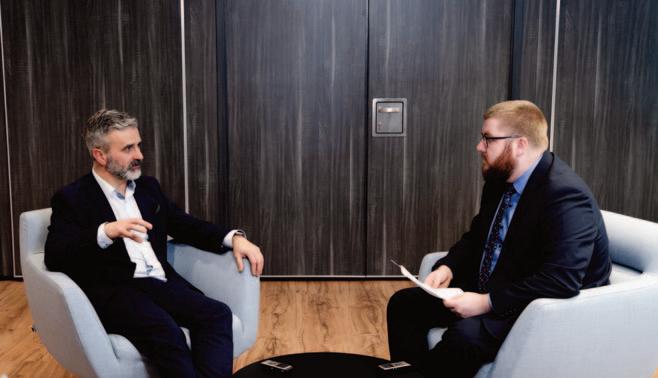
“We provide ubiquitous, fibre-based broadband technologies to coverage across Northern Ireland.”
While fibre provides the physical backbone, Montgomery asserts that the ways in which networks are managed is equally as important as how they are built. “The traditional way of doing networking prior to this software-defined era would have been a lot more complex,” he says. It also “provides a lot less automation” and “does not play into the modern requirements of a modern network”.
In this context, eir business has moved decisively toward software-defined architecture. “Everything we do now is software-defined,” Montgomery explains, “from software-defined WAN to software-defined data centres to software-defined LAN.” He argues that this shift fundamentally changes what organisations can expect from their networks.
“We put in a central platform which our customers can administer their entire network from,” he says, giving them “full visibility across their network which they did not have before”.
Software-defined networking also allows greater flexibility in how connectivity is delivered. “It allows us to use multiple access technologies, such as fibrebased technologies, 4G, satellite,” he says, helping to “enhance the resiliency of the network”. Rather than relying on a single connection, organisations can design networks that continue to operate even when one element fails.
Automation is another defining feature of software-defined networks, particularly when it comes to security. Montgomery contrasts modern approaches with older, labour-intensive models. Historically, networks were “managed by engineers by command line”, but centralised platforms now allow policy to be deployed at scale.
Automation also opens the door to smarter operations, as centralised platforms make it possible to “leverage tools like AI to streamline connectivity and that push out policy”, improving both efficiency and consistency across large networks.
Cybersecurity is woven through every aspect of Montgomery’s approach to network design. He argues that security must be embedded in all design. “Everything we do should have a mindset of security,” he says, describing what he calls a “secure by design” principle.
This approach recognises that no single control can provide complete protection. Instead, Montgomery advocates “technologies where we are not relying on one single factor to secure the network”. He outlines multiple layers, from “physical security” and “perimeter security” through to “network security” and “application security”.
The purpose of this layered model is resilience. “If any one of those layers is breached, the next layer of security should give an additional layer of resiliency. While there is no silver bullet to completely secure a customer, having that mindset of secure by design, principles of defence in depth allows customers to meet that cyber resilience requirements,” Montgomery says.
As IoT and operational technologies become more widespread, Montgomery expects networks to grow in complexity. “The growth in this area is only going to get larger,” he says, predicting that operational technology “will be ubiquitous across all organisations” in the years ahead.
Asserting that a single, flat network is no longer appropriate, Montgomery says: “You have your corporate network, you have your IoT network, and that is all about ensuring that devices joining the network have the right security posture.”
Montgomery also emphasises the need for IoT devices to be “secured in the correct way”, with “the correct connectivity” and policies that “adhere to strict government guidelines in terms of compliancy frameworks”.
AI places especially demanding requirements on network infrastructure, and Montgomery believes these demands reinforce the case for fibre first design. “To support AI workloads in the modern era, we need to be building networks based on high capacity and ultra-low latency,” he says.
“Everything we do should have a mindset of security.”
eir business designs solutions using a mix of approaches. In the fibre domain, Montgomery states that next generation broadband is already moving beyond the gigabit speeds most users are familiar with. “The next generation of broadband, we are going to be seeing multiple gigabits,” he says.
For higher end requirements, technologies such as DWDM come into play. “Today, we are running 400GB for our customers,” Montgomery explains, with “800GB and 1.6TB of bandwidth capabilities on the horizon”.
“These systems deliver extremely low latencies, making them well suited to data-intensive workloads.”
On dark fibre, he adds: “Dark fibre is effectively a piece of fibre between two key locations. From a latency perspective, it operates at the speed of light, and from a bandwidth capacity, it can take as much bandwidth as you throw at it.” For data centres and advanced AI use cases, Montgomery sees this as a critical capability.
All of this, he notes, aligns closely with public policy. “A fibre-centric approach also plays into the Executive’s investment in fibre first policy across Northern Ireland, which reinforces the link between infrastructure strategy and economic ambition.”

One area of growing importance is the ability for organisations to work across traditional boundaries. Montgomery describes efforts to enable “the ability for multiple agencies to communicate with other agencies”, with the aim of “driving efficiencies across the public sector”.
By moving toward shared platforms, he suggests that public bodies can “remove duplication” and support new digital services more effectively.
Looking ahead, Montgomery sees regulation as a key enabler of secure digital growth. “Security is a big regulatory area,” he says, emphasising the importance of “adhering to all the government mandating frameworks coming down the line in terms of security and cyber resiliency”.
He also highlights the need for clarity around operational technology and IoT. “Those networks are secured and, when deploying devices, sensors within your network ensure they meet the regulatory compliance and security requirements before putting them on the network,” he says.
Concluding, Montgomery argues that there is no single blueprint for the network of the future. “There is no one-stop shop that fixes everything,” he says. “Instead, effective solutions come from listening. We like to listen to our customers to build a bespoke service that we know will meet their day-to-day needs while always looking to the future.”
Jim Montgomery is Head of Pre-Sales and Design at eir business. He has worked in telecommunications for almost 30 years and has been with eir business for 17 years, having joined in 2008. Montgomery has held roles across business, network engineering, and solution architecture.

Effective use of data can focus prevention activities, lead to earlier interventions, and provide patients with more agency, outlines Paul Rice, chief digital information officer at the Department of Health.
Rice says that Northern Ireland is ready to exploit digital and data but acknowledges that funding models need to be dynamic. He says: “Inevitably, as we rely more on technology, we build up a tariff of ‘technical debt’ to maintain and enhance the core digital infrastructure that has become central to our new working practices and transformation activities.”
Rice contends that the North has not yet fully leveraged its capacity for innovation but is primed to do so. He states that the health and care sector’s focus has shifted from IT to digital. Rice says this is “profoundly” important, as this is where the greatest level of disruption and transformation opportunity exists.
Fundamental challenges facing the health and social care sector include an ageing population, the high proportion of people with long-term
illnesses, and health inequities. The combination of these three challenges leads to a loss in the number of healthy working years, and this impacts economic activity.
“The magnitude of the challenge can set you back on your heels,” says Rice who adds that data and digital can be utilised to address it.
He says there are multiple assets across the region which can be used to respond to challenges the sector faces including the encompass system. This creates a strong foundation for the sector to digitally develop. Rice asserts that the data developed and delivered through initiatives like encompass must be used to enhance treatment.
He states that the MyCare app enables citizens to “take a higher degree of interest and involvement in their own health and care”. This creates opportunities to provide focused messages to
secure, managed solutions for all.

“Responsible and ethical use of AI will reveal what is locked into and trapped into the data currently.”
Paul Rice, chief digital information officer, Department of Health.
people about self-management and care. However, the digital expert explains that the app covers health and social care but does not yet cover primary care.
Data can also be used to detect diseases earlier, personalise treatment plans and recommendations, and ensure patients remain at the centre of decision-making.
“This is beyond co-creation, this is about agency,” says Rice.
“The idea of patient agency is something we need to exploit and build on going forward. Because we are not IT anymore, we are digital transformation. They are profoundly different.”
The digital expert asserts that AI can be used to help clinicians diagnose more accurately and efficiently, provide easier and more timely access to services, and streamline processes by analysing data for pattern prediction. Rice asserts that “responsible and ethical use of AI” will reveal “what is locked into and trapped into the data currently”.
He identifies implementing neighbourhood health models as central to the Health and Social Care NI Reset Plan. Rice asserts that when data is leveraged in a neighbourhood health model, it enables prevention as citizens are provided with the knowledge they need to stay healthy.
It leads to earlier interventions as citizens can manage their conditions better. Neighbourhood health models also provide patients access to digital services to help them self-manage.
“We are still too paternalistic, we still serve. We do not co-create and beyond co-create, ensure agency,” says Rice. “The neighbourhood model will thrive with some digital and data underpinnings, but also because philosophically it is a different proposition for the population.”
Stating that Northern Ireland is “small enough to be personal, big enough to be powerful”, he adds that there are “really strong assets in the region” including universities and entrepreneurs. The digital expert indicates that the North has the foundations to enable innovation. Additionally, there is a “strong alliance emerging” between the departments of Health and the Economy.
Rice reprises Chuck Friedman’s (a professor from the University of Michigan Medical School) definition of a learning health system: “A place where science, informatics, incentives, and culture are aligned for continuous improvement and innovation, with best practices seamlessly embedded in the delivery process, [with] patients and families active participants in all elements, and new knowledge captured as an integral by-product of the delivery experience.”
Applying this to Northern Ireland, he says: “We need to understand and enable our clinicians and frontline professionals. We also need to understand the improvement opportunities existing in our administrative and operational processes. Using the insights and experience of the public will identify bottlenecks and fractured pathways, using their capabilities boosts our capacity.
“It is that trifecta, professionals, people power and improved processes, and purposive application of digital and data that will give us the sustainable health and care system that we morally have to deliver.”
secure, managed solutions for all.



Deputy Director at the UK’s Government Digital Service (GDS), Mike Skelton, tells agendaNi about how the UK Government’s approach to digital public services has evolved, what challenges remain, and how emerging technologies like AI are being carefully explored to meet the changing expectations of citizens.
Skelton contextualises that, over a decade ago, digital public service infrastructure was “fragmented, inefficient, and largely inaccessible”.
“The landscape was dominated by large, centralised infrastructure projects delivered through traditional waterfall methods, with little attention paid to how people actually experienced government online,” he says.
“There were more than 2,000 government websites at one stage. That created a huge burden on the public to understand how government was structured, just to complete basic tasks. You needed to know whether something was DWP or HMRC or DVLA; and most people do not think in those terms. They just want to get things done.”
The shift came with the publication of a 2010 report by digital entrepreneur Martha Lane Fox, who called for a “radical overhaul” of how government was rolling out digitalisation. The recommendation led to the establishment of the Government Digital Service (GDS) in 2011 and the subsequent launch of GOV.UK in 2012, consolidating previously disparate services into one platform.
“GOV.UK was built around the principle that it should work for everyone,” Skelton says. “That meant rewriting content to be accessible at a reading level of nine years old. It meant designing services for mobile devices. Most importantly, it meant putting users, and not just government departments, at the heart of the experience.”
GOV.UK attracts millions of visits every week, with traffic consistently peaking around key moments like tax deadlines, elections, or crises. Skelton is keen to highlight that GOV.UK is now a trusted source for the public, ranking alongside major technology companies in brand recognition, according to data from YouGov.
“That recognition matters because people need to know where to go for reliable, accurate information, especially in a time of growing misinformation,” he states.
Accessibility remains a top priority, with GOV.UK services built to meet the highest international standards (WCAG AA and above). Skelton describes GDS as “a standard-bearer” for good design and inclusive digital services, a role that extends beyond central government.
“We support other departments and local authorities through tools like the GOV.UK design system,” he explains. “It is a shared language of components that ensure consistency, regardless of which bit of government you are interacting with.”
Despite the platform’s success, Skelton acknowledges that “the world has moved on”, and so too must the way government serves its people. He cites changing behaviours, particularly among younger users, as a key driver of current thinking.
“There is a generation now who do not really use websites. Social media platforms are their search engines. That tells us something important: static content models will not be fit for purpose for much longer. We need to meet users where they are in a way in which they expect to interact.”
This has informed new projects under development, including a GOV.UK app, which will aim to bring together key services in a mobilenative experience. Skelton believes the app could become a “government in your pocket”, with features like notifications, personalisation, and secure integration with digital identity systems.
“It is about making services more proactive, seamless, and secure, especially for those who rely on government support day-to-day,” he explains.
Another significant development area is generative AI, which Skelton describes as offering “huge potential, but requiring careful guardrails”.
In 2024, GDS ran a limited public trial of a generative AI tool trained exclusively on GOV.UK
content, offering conversational assistance to users seeking advice. Skelton states that 70 per cent of users found it helpful.
“Trust is everything,” Skelton cautions. “We are not experimenting for experimentation’s sake. We are taking a measured, responsible approach. Our tools are built only on trusted, curated government data with no scraping and no third-party inputs. That is non-negotiable for us.”
Skelton says the team continues to test, iterate, and evaluate new applications of AI, including content summarisation and improved search, but always under the principle that “humans remain firmly in control of the experience”.
In early 2024, GDS moved from the Cabinet Office to the Department for Science, Innovation and Technology (DSIT), part of a broader shift to integrate digital policy, innovation, and delivery under one umbrella.
“There is an opportunity here to bring emerging technologies like AI closer to real-world delivery challenges,” says Skelton. “It means more joined-up thinking across digital identity, platforms, and innovation units like the AI Incubator.”
The move coincides with a broader look at the state of digital public services. The recent State of Digital Government review highlighted areas where government must improve. In response, a new Digital Blueprint outlines how delivery teams like GDS will help tackle those gaps.
“This is about getting back to basics; making sure services work, are joined up, and meet user needs.
That is still our North Star,” he says.
As government faces new demands from global crises to shifting demographics, Skelton says that GDS’s mission remains unchanged: to make government simpler, clearer, and faster for everyone.
“That means continuing to challenge old ways of working, continuing to advocate for user needs, and continuing to reduce what we call ‘failure demand’ where people are forced to phone government or seek help simply because digital services did not work well enough in the first place.”
He concludes: “Ultimately, digital government is not just about shiny tools. It is about delivering the right outcomes for people, in the moments that matter. That is what good looks like and that is what we are building for.”
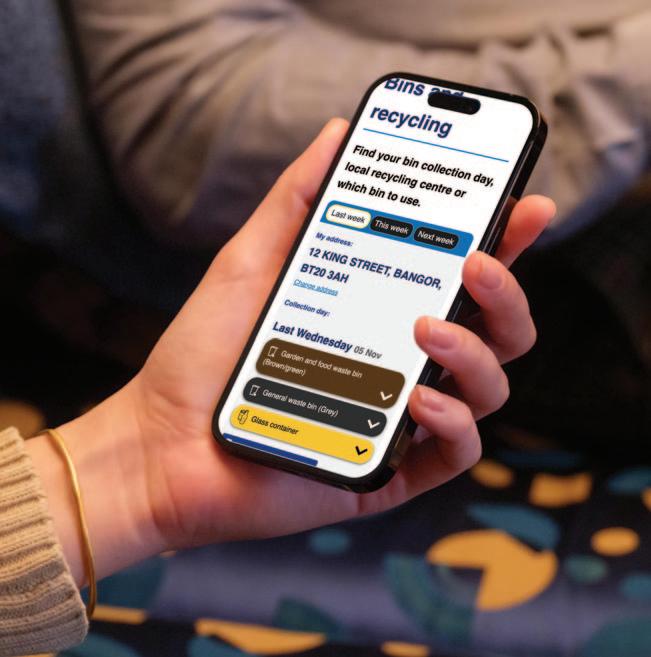
Ards and North Down Borough Council transforms bin collection services with GOSS and Tailwind Digital, improving efficiency, reducing call volumes, and enhancing the resident experience.
Ards and North Down Borough Council is the latest UK local authority to implement significant efficiencies in public service delivery. Formed in 2015 following the merger of the former Ards and North Down councils, it is responsible for a broad range of services, including refuse collection, recycling, environmental health, leisure, and community development.
The council’s long-term vision, outlined in The Big Plan for Ards and North Down 2017-2032, places strong emphasis on
accessibility, sustainability, and community empowerment. A key part of this vision is the modernisation of digital services to better serve residents across the borough. To support this ambition, the council has recently enhanced its bin collection and waste services. Working with GOSS, the council’s digital platform provider, and Tailwind Digital, a public sector delivery partner, the council has reimagined how residents report waste collection issues and check collection information online.
Ards and North Down Borough Council faced several challenges in delivering accessible and efficient digital waste services. Bin-related information was in particularly high demand, with the bin calendar becoming the second most visited page on the council’s website and attracting over 200,000 users since May 2023. Around 75 per cent of this traffic came from mobile devices, highlighting the need for a responsive, mobile-friendly experience.
Despite strong online engagement, many residents continued to rely on phone calls and emails to report missed collections or request support. This placed a heavy workload on customer services staff and slowed response times. The council’s previous content management system also limited opportunities for self-service and integration with back-office systems, making it difficult to scale or improve digital efficiency.
To address these challenges, the council set out clear objectives for transforming its waste services. It aimed to give residents simple, intuitive ways to access collection information and report bin-related issues. Ultimately, aiming to reduce phone and email enquiries, improve operational efficiency, and deliver accurate, real-time information.
To address challenges in bin collection services, Ards and North Down Borough Council partnered with GOSS and Tailwind Digital to co-design a tailored digital solution that empowered residents to self-serve while providing internal teams with flexible tools to manage services more effectively.
Working with Tailwind Digital, the council developed a new Bin Widget, a selfservice tool that enables residents to access personalised bin collection schedules, report missed collections and request new bins quickly and easily. A key part of the solution was the integration of two core data sources,
WebAspx, which manages collection planning, property servicing, and route optimisation, and Routeware, which provides live in-cab operational data such as collection status, contamination reports, and access issues. This integration allows the Bin Widget to display real-time, operationally verified information, replacing static timetables with accurate updates while reducing manual intervention and unnecessary resident contact.
Throughout the project, Ards and North Down also leveraged their GOSS Digital Platform to integrate with the Bin Widget, surfacing real-time bin collection data directly to customers. GOSS CMS enables efficient management and publication of waste-related content, while GOSS Forms supports intuitive, self-service transactions such as reporting missed collections and requesting new bins. Council staff were actively involved across design, prototyping, testing, and refinement, ensuring the final solution met operational needs, improved efficiency, and delivered a seamless experience for residents.
The introduction of the Bin Widget has transformed both the resident experience and operational efficiency at Ards and North Down Borough Council. Since launching, the Bin Widget has delivered clear and measurable results, including:
• A significant, one-third reduction in call volumes, easing the load on the call handling team (see data below).
• 36 per cent fewer missed bin reports compared to before the new process was launched.
• Improved resident satisfaction, with an intuitive, easy-to-use online experience.
• More efficient service management, freeing up time for staff to focus on higher-value tasks.
• Accurate, real-time data, removing manual handling and reducing error rates.
Before the introduction of the new online missed bin process, an average of 25 missed bins were reported per day by customers. By building business rules
and supporting customers in understanding what qualifies as a missed bin, this number has been reduced to an average of 16 per day. Furthermore, the publication of the new online Bin Widget and process has supported a reduction in overall calls to the Waste and Cleansing team.
Staff feedback has been overwhelmingly positive. Waste Collection Services Manager Ian Frazer reported that “the project has reduced calls to service and led to a happier call handling team,” while Admin Officer Susan Hamilton noted that “it has taken some of the calls away and also improved the look of the online calendars.”
The Bin Widget ensures that residents see accurate, up-to-date information, building trust and reducing unnecessary contact. It has been a crucial step in Ards and North Down’s digital transformation journey, showing how collaboration, open communication, and user-centred design can turn everyday services into smarter, more sustainable digital experiences. The success of this project demonstrates how agile,
multidisciplinary teams can deliver real transformation in local government. By combining Ards and North Down’s service knowledge with Tailwind Digital’s and GOSS’s technical expertise, the team has created a solution that is both practical and future focused. Areas for future enhancement have already been identified, ensuring the system continues to evolve as resident expectations and digital capabilities grow.
W: www.ardsandnorthdown.gov.uk


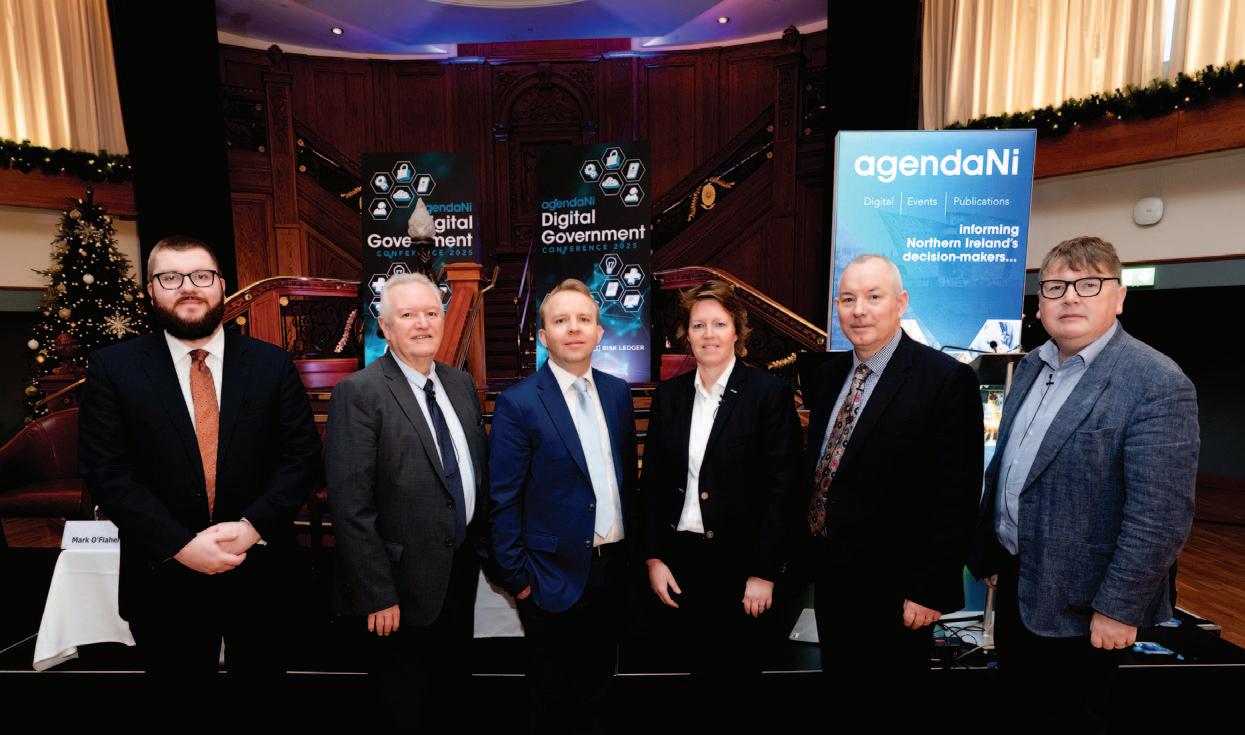

The agendaNi Digital Government conference took place in December 2025 in Titanic Belfast. The event, which was sponsored by BT and Risk Ledger, was attended by over 170 delegates who heard from a range of expert speakers talking about their digital transformation journey and looking ahead to what comes next as organisations prepare for a digitally driven future.
Delegates heard from a range of local and visiting organisations including The Executive Office; The Scottish Government; AICC; Government Digital Service; the Department of Health; and Manchester City Council.
We would like to take this opportunity to thank the 2025 conference sponsors, BT and Risk Ledger, all speakers, exhibitors and delegates who joined us in Titanic Belfast and made the conference a huge success.
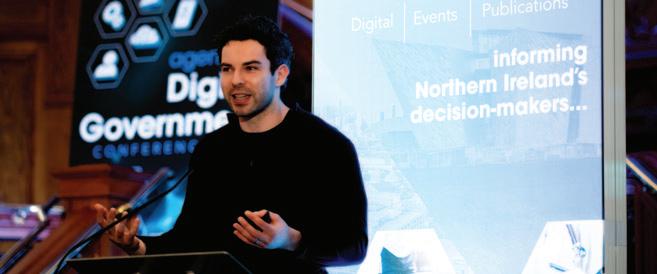
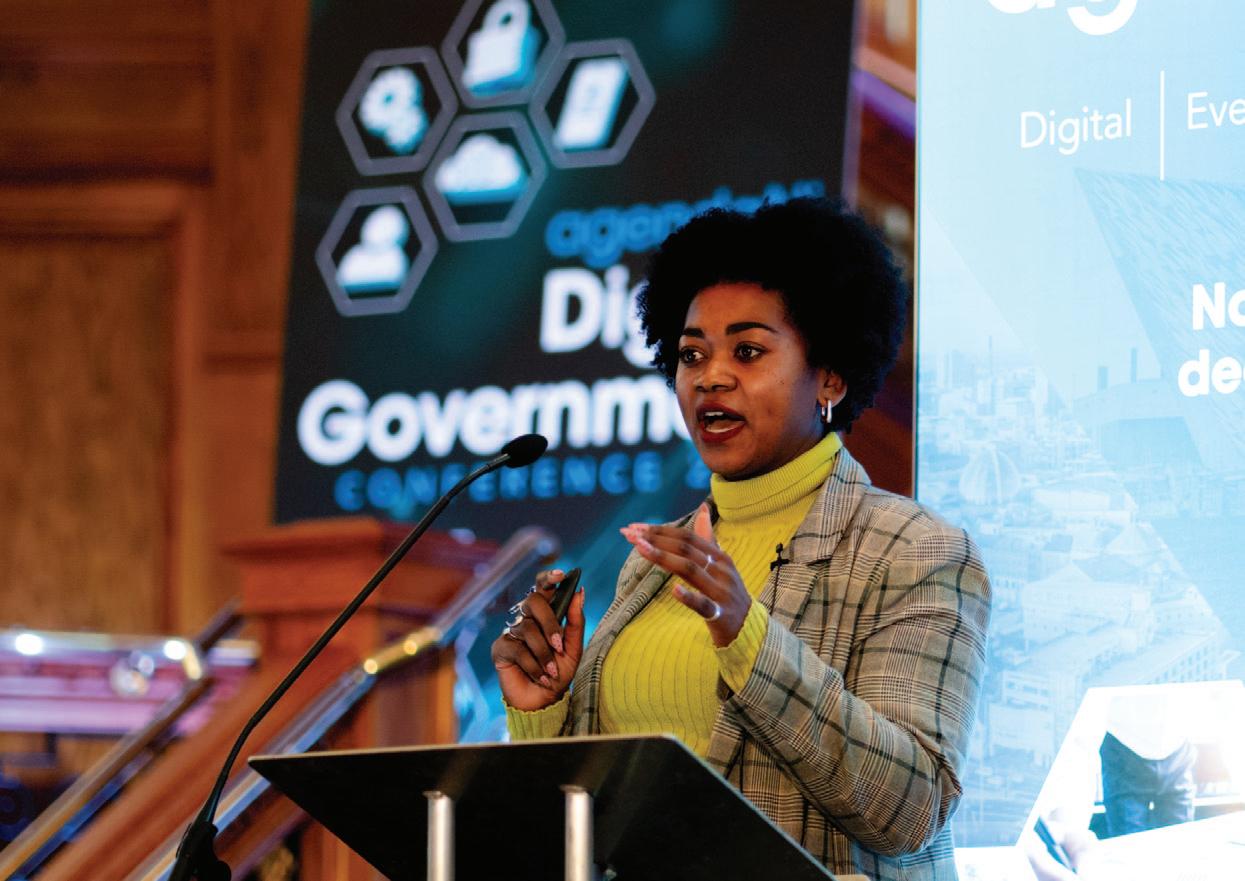


ready cities, says Sherelle Fairweather, Digital Strategy Lead at Manchester City Council.
Fairweather states that the growth of tech in Manchester is the largest of any city in the UK outside of London. However, she adds that a large percentage of young people and families are continuing to experience poverty. She describes the statistics around this as “harrowing”, and insists that it means many people are not feeling the benefits of tech growth in the city.
Fairweather asserts that Manchester City Council takes a human-centred approach to technology. She explains that the authority is endeavouring to make Manchester an “AI-ready city”, adding that it is important to consider what this entails for the city and if it will lead to “sustainable growth for all”.
The city of Manchester is part of the ‘smart city’ movement. This has included development of internet of things (IoT) infrastructure, integrating ICT systems around core infrastructure assets, and scaling up IoT projects in urban areas.
Fairweather discusses Manchester’s digital strategy, Doing Digital Together. It contains four thematic areas. First is ‘Remarkable People, Extraordinary Opportunities’, under which the council aims to ensure everyone in Manchester is represented.

secure, managed solutions for all.
Second is ‘Connecting Places, Enhancing Lives’, which underpins the city’s aim to provide the digital infrastructure that drives digital inclusion and provides capacity for AI uptake.
Third is ‘Pioneering The Future, Prosperity For All’. Fairweather explains: “As more big tech companies move to the city, that pipeline for smaller not-for-profit, tech-for-good organisations is not necessarily growing. How do we retain that legacy knowledge from those organisations?”
Fourth is ‘Rising To Challenges, Future-Proofing Our City’ which underpins the strategy’s aim to “mindfully” deploy tech and use it to address challenges such as emissions targets.
Fairweather asserts that digital inclusion is the core of everything the strategy delivers. “We do not think we can grow, sustain, scale, and digitally transform without ensuring people have access to the things they need,” she says.
“A lot of this work started after the pandemic and there were lots of attempts to support people but initially not much thought was given to people’s capacity to access it online.”
To address this, Manchester City Council created a team which focused on this area. Initially, the team was reacting to emerging problems. Now, the team operates more in a consultancy capacity for services and community organisations to help them identify their challenges and deliver impactful digital inclusion initiatives.
Fairweather explains: “We have been using a data-led approach to understand where there might be specific challenges in the city through an open-sourced model called the Digital Exclusion Risk Index. It is not perfect but it is helping us to focus resources.”
Fairweather asserts that the council intends to make the strategy “more intentional”. She explains that
“People sometimes trust the technology but they do not tend to trust us. People assume that they do not trust the technology, but there is that challenge of trust in us as officers or leaders.”
building is not a challenge for Manchester as it is “seen as quite an attractive city for industry”. However, challenges remain such as overbuilding and connectivity quality.
“We have been working with Inakalum and Network UX to map the quality of mobile connectivity and, furthermore, Ofcom and Greater Manchester Combined Authority to gather more data around high footfall spaces such as events or travel spaces.
“Quality often depends on how many people are accessing at once. Buildings, such as high-rise apartments, can also impact the quality of someone’s connectivity.
“This is where we are being more intentional. We are focusing more on areas of deprivation.”
Fairweather explains that the council is also assessing how it shares infrastructure. The council is set to roll out EV charging points and Fairweather asserts that areas where they are rolled out will need to have appropriate internet quality ensuring smart, safe, and reliable operation.
Fairweather states that Manchester is recognised as being the “most AI-ready city” in the UK outside of London. She states that there is
significant focus on the cost-saving benefits of AI and economic growth but adds that there should be consideration given to what these costs can be used for and the wider social benefits.
Continuing, Fairweather says Manchester City Council is “focussed on how we can put the human back into AI”. She adds that the council aims to achieve this is through its ‘People Panel for AI’.
The council is working with Manchester Metropolitan University to ensure people are involved in the design of services. Using the risk index, the council identifies people likely to be excluded from the AI conversation. It then travels to these areas to talk to them about various uses for AI as well as provide training.
Citizens can then opt in to become paid panel members, where they provide feedback to people creating services and products with AI. A report follows these discussions outlining how the council has acted upon views expressed.
Concluding, Fairweather says: “People sometimes trust the technology but they do not tend to trust us. People assume that they do not trust the technology, but there is that challenge of trust in us as officers or leaders.”


Fourteen out of 29 major IT projects (58 per cent) managed by Northern Ireland departments and their arm’s length bodies have an amber or red project status, a report has found.
Major IT projects in Northern Ireland, published by the Northern Ireland Audit Office (NIAO) in July 2025, states these projects have a total value of £2.2 billion. The current total estimated whole life cost of the 29 projects is £5.2 billion.
Major IT projects are defined as those valued at over £25 million in whole life cost. It takes sixand-a-half years on average for a major IT project to be designed, procured, implemented, and become fully operational.
The report finds that there is an absence of a consistent process to identify, manage, and report on IT systems. There is also no process to appraise systems and set priorities for new or replacement systems. The report adds that there is no overarching portfolio view of major IT projects or existing system and that the approach within individual departments varies.
There is currently no Northern Ireland Civil Service (NICS) IT strategy. Furthermore, there is no authority to mandate the implementation and delivery of such a strategy across departments. Out of the 29 projects, 24 have been undertaken
to replace legacy IT systems. For almost all of these systems, the legacy contract has been extended multiple times with systems “operating well beyond their intended life”.
Many of these extensions were to “maintain continuity of service as opposed to a strategically planned choice”. Legacy system contracts were extended by almost eight years on average.
Repeated extensions incur significant financial costs along with a potential negative impacts on service quality. Five projects were examined as part of the study and all experienced delays which led to contract extensions for legacy systems valued in excess of £573 million. Extensions arise from a pressure on resources, capacity and capability issues, and single-year budgets.
The five projects examined experienced delays or problems at the initiation stage. Reasons included a lack of clarity on
secure, managed solutions for all.

Dorinnia Carville, Comptroller and Auditor General
“Extending contracts on legacy systems risks a gap growing between the system’s functionality and the needs of citizens, businesses, and communities.”
scope and intended outcomes, no clear project plan, no target operating model, and insufficient suitable resources.
Three of the case studies experienced issues with governance arrangements including infrequent meetings, and membership that was not sufficiently representative of stakeholders. The report states that value can be gained from implementation of the Gateway review process. This is an assurance mechanism comprising a series of independent peer reviews undertaken during a project lifecycle.
The report finds that projects are initiated with smaller teams than are needed, key roles are not adequately filled with skilled staff, and staff often do not have the capacity needed for their roles as they retain their day-to-day responsibilities.
If the current approach to major IT projects persists, it will result in continued risk for value for money, while missing out on potential benefits from new technologies, the report asserts.
The NIAO outlines 10 recommendations to reform and transform public services, one of the nine priorities identified in the 2024-2027 Programme for Government (PfG). It suggests implementing these recommendations in the 12 months following the report’s publication.
The NIAO recommends that each department review the maturity and adequacy of support provided by its portfolio, programme, and project offices. It indicates that the Department of Finance should report the findings to the NICS board.
Recommendation two is the establishment of a framework to identify legacy IT systems and those soon to become legacy systems, and assess their associated risks. The NIAO also recommends that an NICS-wide IT strategy, collectively owned by all NICS departments, is implemented and applied across the NICS.
Recommendation four is that “accurate and timely” contract management and cost information is made available. This is aimed at enabling regular monitoring and reporting to support decision-making by the relevant governance mechanisms.
The NIAO recommends that sufficiently skilled staff are available from the early stages of projects to enable realistic timescales and the inclusion of costs and internal resource requirements in business cases.
Recommendation six is that potential benefits of new systems are outlined in business cases. Benefits should also be monitored and reported on once systems are operational with an aim to ensure benefits and value for money are delivered.
The NIAO recommends that projects valued at over £5 million are required to engage with the Gateway process completing a risk potential assessment. Accounting officers should embed project reporting arrangements with an aim to ensuring projects with their remit engage with the assurance process.
Recommendation eight is that governance structures should include key stakeholders with “an appropriate mix of skills and experience”. This structure should be altered and improved as necessary during a project’s life.
The NIAO recommends that the NICS address the adequacy of project management and deliver skills. This includes identifying the skills gap, development of a mature NICS project deliver professions, and ensuring staff with the required skills and training are available. The Department of Finance is recommended as the leader for this recommendation with support from NICS and human resources.
Recommendation 10 is that the NICS board takes the lead in identifying recurrent issues leading to project delays. The NIAO suggests that a “clear, time-bound action plan to address these issues must be developed”.
Comptroller and Auditor General Dorinnia Carville says: “Extending contracts on legacy systems risks a gap growing between the system’s functionality and the needs of citizens, businesses, and communities.
“Major IT projects are recognised as being complex, but this is all the more reason why the Northern Ireland public sector needs to adopt a much more strategic approach. This means planning and working collectively to maximise potential synergies in IT solutions, to better understand shared risks and to ensure best use of skills and resources.”
secure, managed solutions for all.


Birna Íris Jónsdóttir, CEO of Digital Iceland, tells agendaNi how the organisation is consolidating government services and explains how digital solutions can be deployed in an emergency.
Digital Iceland is the Icelandic public service portal, providing all state service in one place. Jónsdóttir traces the organisation’s goal to simplify people’s lives and ensure all Icelandic government agencies are “on the same page”, namely the Digital Iceland website. She says: “We want to move data and not people.
“We see emergency as opportunity. We first saw this during the financial crisis of 2008. In 2015, the Icelandic Government made available a mortgage relief scheme. To access this, citizens needed to have an electronic ID (eID) enabled.”
This led to eIDs being administered to 96 per cent of the population. Now, eIDs are used as an electronic signature in various government services to provide secure online authentication. Jónsdóttir also traces how the organisation took advantage of the Covid-19 pandemic by enacting legislation which obliges government agencies to deliver documents to citizens through Digital Iceland’s digital mailbox.
Outlining the driving force behind Digital Iceland, Jónsdóttir insists: “We always put the citizen first. All of our projects are based on that guideline. It also directs our technical approach. We wake up to simplify citizen lives.”
Stating that the organisation has achieved significant success in its five-year history, Jónsdóttir asserts that this was enabled by its “focus on the user experience and front-end solutions”. Digital Iceland also designed its system to facilitate government agencies in delivering services.
Jónsdóttir explains that they use open source coding and adds: “There is a lot of lock-in with the legacy systems of the Government. This is not only in Iceland, this is all over the world. We are starting to unwind this lock-in, and making the platform more scalable and accessible by generating open source code and engaging with different development teams through a framework agreement.”

However, only between 25 and 30 per cent of Iceland’s agencies have joined Digital Iceland which Jónsdóttir identifies as a challenge for the organisation. She says she would like to see legislation created that would stipulate an obligation for all government agencies to join the portal.
Along with the digital mailbox, Digital Iceland also offers an authentication service, an authorisation service, and an app which gives citizens access to their government data. Jónsdóttir adds that they are currently transferring healthcare data into the portal. She explains that the organisation offers a standardised applications system and has developed around 300 applications for digital services for government. “This is a huge opportunity to do things better and improve processes,” she says.
Jónsdóttir explores the challenges this presents: “We have a clear content strategy and this is often difficult for the agencies because they want their legal text in the portal, but our content strategy states that the content has to be expressed in a way that the citizen understands.”
She asserts that the organisation’s “secret sauce” is a framework agreement which gives them access to over 100 software developers and specialists across 20 teams in the market. The framework agreement goes to tender every two to four years. Digital Iceland makes smaller statements of work agreements within the framework agreement which allows the team “to be very agile and scale up and down according to our focus”.
“We are very flexible. This is an opportunity for the Government to invest in the market, be supportive of development and innovation in the Icelandic market,” says Jónsdóttir.
Stating that it was “time for the drama”, Jónsdóttir displays an image of Grindavík, a small town with a population of about 3,500 in the southwest of Iceland. She follows it up with another image of the town, this time featuring a lava flow originating from the nearby Sundhnúkagígar Crater Row volcano which has erupted multiple times since 2023.
Outlining how Digital Iceland responded to the eruption on one occasion, which destroyed three houses and led to the evacuation of the town, Jónsdóttir says:
“What was needed was digital support and digital services for this event. We were able to put up a web page in only three days with all of the information needed for the people of Grindavík.
“Emergency services needed to apply to access the town because of the dangers, and we delivered this application process. The people of Grindavík also had to apply to enter the town and these applications were set up in a matter of days.”
Concluding, Jónsdóttir says: “The foundations that we have built in the digital journey made it possible to react quickly and well to this emergency and provide services to people in a robust manner.”


A motion seeking Assembly support for Northern Ireland acquiring observer status in the European Parliament was defeated by a petition of concern (POC) in mid-January 2026.
On 8 December 2025, Sinn Féin MLA Ciara Ferguson submitted a motion to request the Assembly support the region to acquire observer status. Leader of the Opposition Matthew O’Toole MLA amended the motion to request support for the establishment of a European Commission office in Belfast.
Subsequently, the DUP led a petition of concern (POC) on the matter which was supported by the TUV and the UUP. A POC is a mechanism whereby 30 MLAs can petition the Assembly for a matter to require cross-community support to be passed.
This means it requires a majority of both designated nationalists and unionists voting, or 60 per cent support from MLAs voting including 40 percent of designated nationalists and unionists voting. This is the first time a petition of concern was successful since November 2015, when the DUP invoked it to veto the passage of same-sex marriage. At the time, the party held 38 seats which allowed it to trigger the petition of concern unilaterally.
Following defeat of the motion during an Assembly meeting on 12 January 2026, O’Toole criticised the use of the POC to oppose the motion. The POC process was reformed through the Northern Ireland (Ministers, Elections and Petitions of Concern) Act 2022 under the New Decade, New Approach agreement.
New Decade, New Approach states that parties “will publicly commit to tabling or supporting petitions of concern only in the most exception circumstances and as a last resort, having used every other available mechanism”.
It also states that the mechanism should not be used for motions and questions “which have no express legal or procedural effect”. During the Assembly meeting on 12 January 2026, Principal Deputy Speaker Carál Ní Chuilín MLA said the relevant standing orders for reforms to POCs have not been introduced, according to the SDLP.
“The ongoing confusion around how petitions of concern operate underlines the dysfunction that continues to define Stormont,” says O’Toole.
“The motion on EU observer status was non-binding and had no legal basis. It was totally inappropriate for this to be subjected to a POC. This is an abuse of power and a waste of precious Assembly time.”
Upon defeat of the motion, DUP Leader Gavin Robinson MP said: “While Sinn Féin dress it up as a technical or diplomatic issue, in reality it is about using the Assembly to advance a deeper EU connection with Northern Ireland and to edge us further away from our position within the United Kingdom.”
Article 13 of the European Parliament’s Rules of Procedure states that observers can be appointed where a treaty on the accession of a state to the European Union has been signed.
The rules outline that observers can speak in committees and political groups but cannot vote, stand for election, or represent the parliament externally. There are no provisions in the rules that extend observer status to regions that have not signed a treaty of accession.
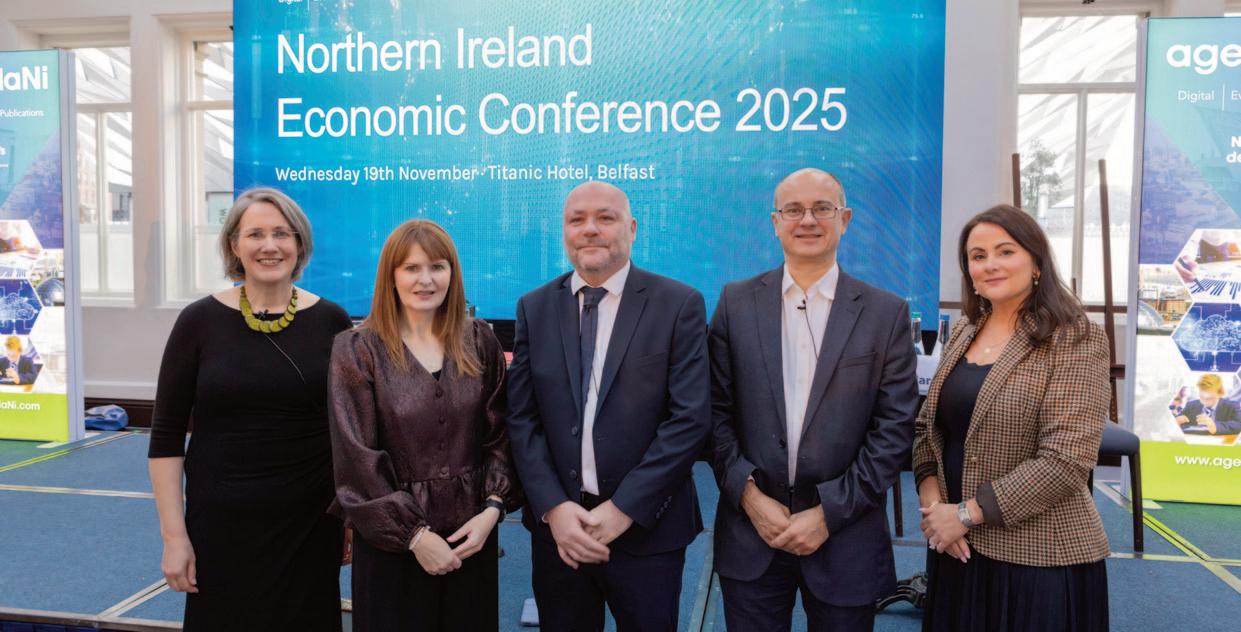
The 2025 Northern Ireland Economic Conference, now in its 30th year, recently took place in Titanic Hotel, Belfast. The conference is Northern Ireland’s premier economic analysis event and is unique in being the only forum that brings together key stakeholders and takes a high-level look at the performance of and prospects for the local economy. It is firmly established as the annual summit for Northern Ireland’s economic community. Policy makers and business leaders came together for a day of discussion and networking.
The top line up of expert speakers, both local and visiting included Caoimhe Archibald MLA, Minister for the Economy; Chris Giles, Economic Commentator, Financial Times; and Mary O’Mahony, Professor of Applied Economics, King’s Business School, King’s College London.
We would like to take this opportunity to thank the 2025 Northern Ireland Economic Conference speakers and delegates who joined us in Titanic Hotel, Belfast and made the conference a huge success.
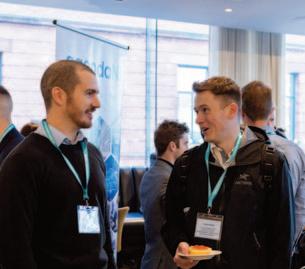

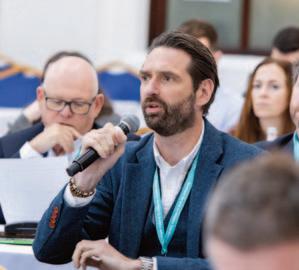


of the Ulster Unionist Party, after incumbent deputy leader Robbie Butler MLA confirmed that he will not seek election.
Former police inspector Jon Burrows MLA is to become the new leader of Northern Ireland’s oldest party, with his leadership signalling a potential move to the right in line with the DUP and TUV.
Burrows’ rise to the top is the culmination of a six-month political career. Immediately after joining the party, he was co-opted into the Assembly in August 2025. He replaced another co-optee, Colin Crawford, who had been co-opted to replace former leader Robin Swann MP in Stormont after Swann was elected to Westminster in July 2024.
Burrows will become the fourth of the UUP’s current crop of nine MLAs to be leader, although Mike Nesbitt MLA has been leader on two occasions. In addition, two of the UUP’s members of the House of Lord and its House of Commons MP have all been leader on at least one occasion each. He also becomes the first Assembly co-optee to become a party leader prior to ever standing in an election.
The new leader-elect describes himself as an “unapologetic unionist who will always advocate confidently for Northern Ireland’s place in the United Kingdom”. Under his
leadership, Burrows says the UUP will be “clear, credible, and on the front foot”.
Burrows succeeds Strangford MLA and Health Minister Mike Nesbitt as party leader. Nesbitt has confirmed he will not seek re-election to the Assembly, but it is not yet clear whether Burrows intends to replace him as Minister.
Nesbitt announced his resignation on 2 January 2026. In a statement, he said: “The next five-year mandate stretches to May 2032, the month I hope to celebrate my 75th birthday. That is a commitment to full-time politics I just do not feel I can make. And I would not be comfortably seeking a vote knowing that privately I was intending to retire during the mandate.”
In addition to its new leader, the UUP is set to appoint Diana Armstrong MLA as its new deputy leader. Armstrong was co-opted into the Assembly in September 2024, replacing Tom Elliott, who was made a member of the House of Lords.
Burrows is expected to assume office on 31 January 2026.
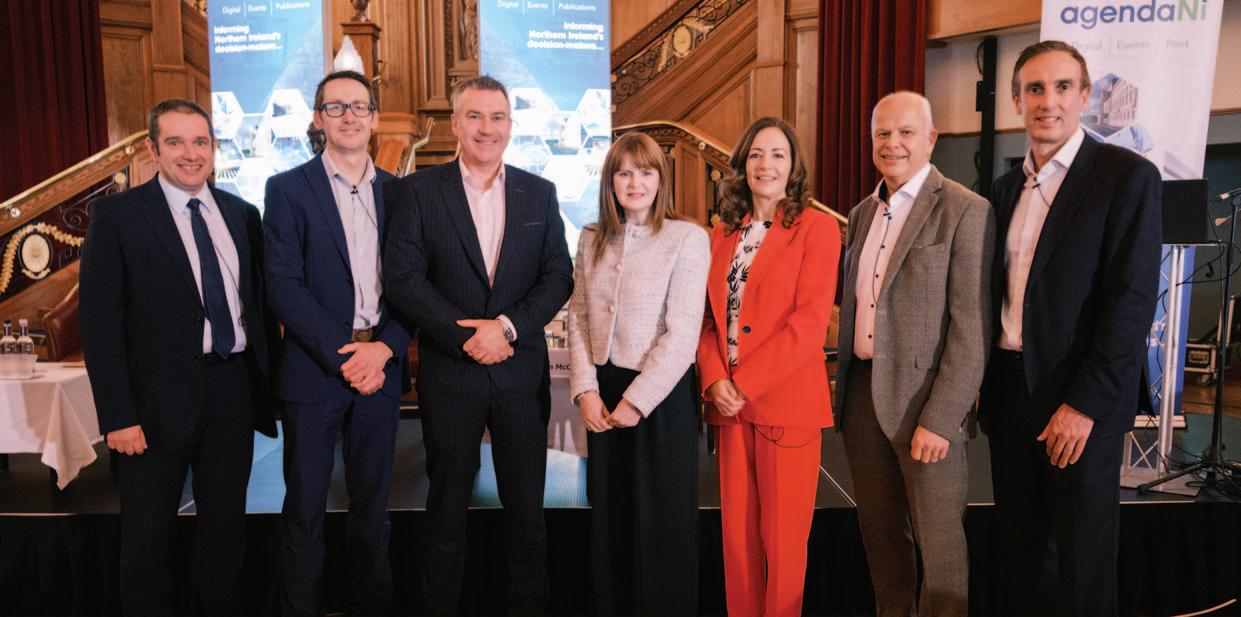

The 2025 Northern Ireland Energy Forum recently took place in Titanic Belfast. The event brought together over 275 attendees, from Northern Ireland and further afield, to focus on the most important aspects of energy policy and latest developments from across the sector.
The top line up of expert speakers, both local and visiting included Caoimhe Archibald MLA, Minister for the Economy; John French, Utility Regulator; Keith Bell, University of Strathclyde and UK Energy Research Centre; Eugene McKenna, Johnson Matthey; Sara Lynch, Queen’s University Belfast; Mark McGranaghan, Smart Grid Ireland and Richard Rodgers, Department for the Economy.
We would like to take this opportunity to thank the 2025 Northern Ireland Energy Forum sponsors – NIE Networks, Kinecx Energy, TLT Solicitors, SONI, SSE and William Orbinson KC – as well as all speakers, exhibitors and delegates who joined us in Titanic Belfast and made the forum a huge success.
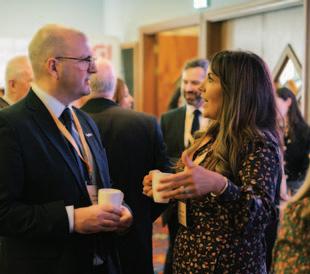
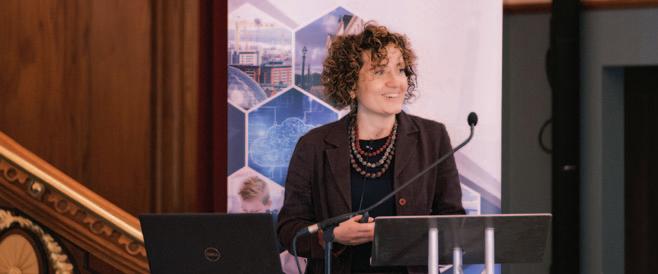


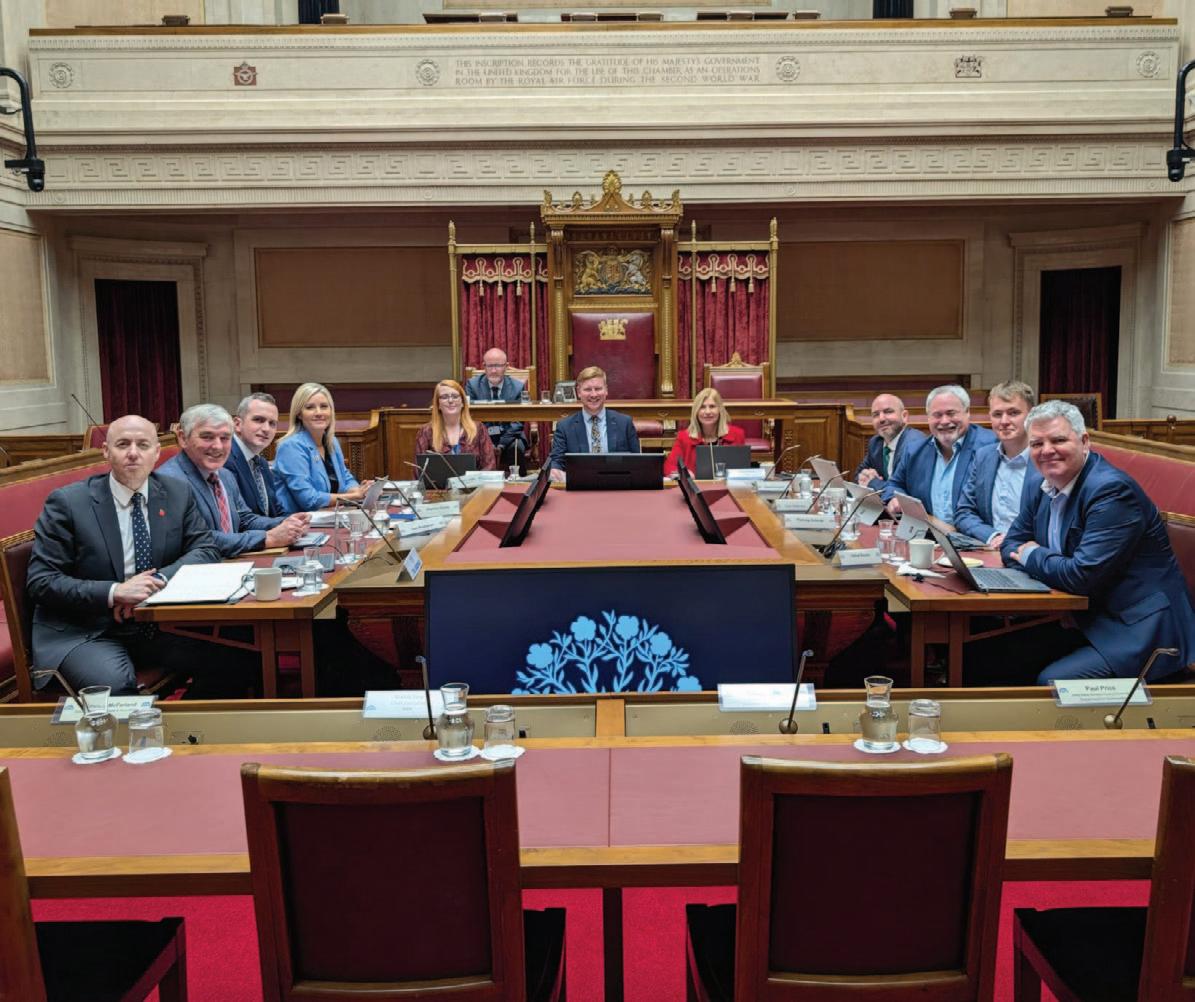
The Public Accounts Committee (PAC) is a standing committee of the Assembly which aims to improve accountability and financial governance in the public sector.
The PAC was established in accordance with section 60(3) of the Northern Ireland Act 1998 and under Assembly Standing Order 56. It has nine members, including a chairperson and deputy chairperson.
When there is an Official Opposition, the

Leader of the Opposition nominates the chairperson of the PAC. If there is a Deputy Leader of the Opposition, they nominate the deputy chairperson of the PAC. SDLP MLA Matthew O’Toole is the current leader of the Opposition, while there is no deputy leader.
It primarily considers reports by the Northern Ireland Audit Office (NIAO) including financial reports or reports on the economy, efficiency and effectiveness of public spending. The PAC works closely with the Comptroller and Auditor General.



About: Co-opted in West Tyrone to replace Joe Byrne in January 2016, McCrossan chairs the PAC. McCrossan is a law graduate and serves as the SDLP’s spokesperson for agriculture, environment and rural affairs. In November 2019, McCrossan opened the Railway Bar in Strabane along with Ireland’s 2013 Eurovision contestant, Ryan Dolan.

About: Elected in 2007 for Newry and Armagh, Boylan is Sinn Féin’s transport spokesperson. He brings local government experience to the PAC having served on the Armagh City and District Council from 2005 to 2008.

About: Elected as South Down MLA in May 2022, Forsythe is deputy chair of the PAC. She was the DUP’s candidate in South Down for the 2024 general election, coming third with 7,349 votes. Forsythe is a law graduate and chartered accountant who serves as the DUP’s finance spokesperson.

About: A Drumquin native, Buchanan was elected to Omagh District Council in 1993 before ascending to the Assembly in 2003, representing West Tyrone. He also serves on the Agriculture, Environment and Rural Affairs Committee.

About: Co-opted to the Assembly in 2025 to replace Colin Crawford representing North Antrim, Burrows is expected to become UUP leader following Mike Nesbitt MLA’s decision to step down. He has master’s degrees in criminal justice and law, and worked as a police officer for 22 years. Burrows is currently the UUP’s education spokesperson.

About: Replaced his father Gordon Dunne in the North Down constituency when co-opted in 2021. He previously served on the Ards and North Down Borough Council between 2013 and 2021. Dunne is the DUP’s spokesperson for sports.

About: Qualified teacher with a Postgraduate Certificate in Education from Ulster University. Delargy replaced Karen Mullan as Foyle MLA when co-opted to the Assembly in 2021. He is Sinn Féin’s spokesperson for employment, skills, further and higher education.

About: Co-opted in 2017 representing the Fermanagh and South Tyrone constituency following his sister Michelle Gildernew’s election to the UK Parliament. He is Sinn Féin’s spokesperson for housing and communities. He is a founding member of Brantry Comhaltas Ceoltóirí Éireann and Aghaloo Credit Union.

About: David Honeyford MLA was elected to the Assembly in 2022, representing the Lagan Valley constituency. He served on Lisburn and Castlereagh City Council between 2019 and 2022. Honeyford is Alliance’s spokesperson for the economy, energy, trade and investment. He also chairs the Stormont All Party Group for Sport.

Sinn Féin MLA Jemma Dolan was first elected in 2017 in the constituency of Fermanagh and South Tyrone. She is Sinn Féin’s employment and workers’ rights spokesperson and sits on the committees for Finance and the Economy.
What inspired you to get into politics?
I grew up in a political house, my earliest memory of being involved in politics was Michelle Gildernew’s 2001 Westminster Election, but I never planned on becoming an elected politician. I was employed as a press officer for Sinn Féin in Fermanagh and in the European Parliament, and I was happy working behind the scenes. However, when I was
approached to run, I agreed due to a strong desire to make a real difference in people’s lives. Growing up in a rural border area, I saw firsthand the challenges families and individuals face, from the lack of healthcare access to rural development. I wanted to be a voice for ordinary people and work to ensure that everyone has a fair opportunity to thrive.

My proudest achievements come from delivering tangible improvements for local residents; whether that is getting a school bus restored on a rural road, helping families access housing, or getting more disabled parking spaces in a car park. Being able to deliver on local issues and see the results of my work is incredibly rewarding.
Who do you admire in politics or public life?
I am inspired by everyday people. I think mothers, fathers, and carers make the world go around but also community leaders and volunteers who quietly work to improve people’s lives and their communities, often putting their own needs to the background.
It might seem cliché, but I have immense admiration for First Minister Michelle O’Neill MLA. Her personal story as a teenage mother, successfully completing her education and now leading the largest political party and our government. Her leadership reflects a steadfast commitment to equality, justice, and the needs of our communities. Michelle’s ability to champion progressive policies, and lead with both strength and compassion is remarkable, and it is a privilege to work alongside her.
From a young age, through my parents, I had been exposed to republicanism. Sinn Féin’s commitment to a new Ireland is my number one aim. Whilst we have come a long way, I think partition is still crippling communities and stifling our potential. Sinn Féin’s work on equality, community empowerment, and standing up for working families really resonates with me. It is about making real change on the ground, whether that is in health, education, or infrastructure, so people can see and feel the difference in their daily lives. As I said previously, whilst the big changes matter, the smaller changes are very rewarding.
My priorities are rooted in tackling the challenges people face every day. Whilst budgets will always be an issue so long as we remain connected to the British Treasury, I am committed to ensuring rural areas have the infrastructure they need. Fermanagh does not have one mile of dual carriageway, never mind a motorway and I want to see that rectified. From roads to public transport, my priority is that our communities can thrive, not just survive. The A5 redevelopment is a major project that Sinn Féin is committed to delivering and I will continue to work with ministers to look at opportunities to improve the road infrastructure into Fermanagh as part of increased connectivity in the North but also across border.
Health services remain a key concern, especially access to GPs, mental health support, and support for families and carers. With the South West Acute Hospital (SWAH) in Enniskillen, we see how the uncertainty around health services affects the community. Three years of anxiety for patients, staff, and families. But we must see SWAH fully utilised as a cross-border hospital, as it was originally intended.
Outside of politics, I love spending time with family and friends. When our little girl came along in 2024, my world and how I see it totally changed, so family is huge for me. I am also an avid follower of the GAA and in particular my home club of Erne Gaels who recently made history by making it to the semi-final of the Ulster GAA club championship for the first time. I think organisations like the GAA and other sporting organisations are the glue that keeps communities together, and in particular, rural areas.

‘It Don’t Cost Very Much’
Any atheist can tell you that being immune to the consolations of faith is no defence against the temptations of great Black American gospel singers such as Mahalia Jackson, writes John O’Farrell of the Irish Congress of Trade Unions (ICTU).
The power and range of her voice can move anyone of all or no beliefs, but her selection of music was chosen to appeal to a broader audience in a more secular society. One example is ‘It Don’t Cost Very Much’, written by her regular collaborator Thomas A Dorsey: Live right each day and smile on your way And it don’t cost very much
Just before Christmas 2025, the workers of England and Wales received the most comprehensive series of improvements in employment rights in a generation. “The Government’s plan to ‘make work pay’
will bring our employment rights legislation into the 21st century, extending the employment protections already given by the best British companies to millions more workers across the country.
“The plan will help more people to stay in work, improve job security, strengthening the foundations of our economy and improving living standards.”
Naturally, the legislation has been opposed at every turn by the UK’s conservative complex of Reform, the Tories, their dark-money think-tanks, and
the media triumvirate of Murdoch, Rothermere, and Marshall, as a huge drain on business.
Notably however, the main business groups in Great Britain either acquiesced or supported the updating of legislation, as they “will also benefit from tackling the undercutting that good employers currently face when trying to do the right thing, as well as benefitting from a more productive workforce”.

You could do for somebody else
It don’t cost very much
There is a trade-off here involving some cost to business here in exchange for wider social gains which will drive economic growth, the primary obsession of this government, and for good reason. It is difficult to argue with the evidence that “not acting would enable poor working conditions, insecure work, inequalities, and broken industrial relations to persist”, according to a recent economic analysis by the Department for Business and Trade (DBT).
The estimated cost to UK businesses is around £1 billion, which seems large from the context of Northern Ireland but less so in the context of a UK GDP of £2.56 trillion in 2024.
It should be noted that some of the political opponents of the Employment Rights Act are quite relaxed about UK GDP being 6-8 per cent smaller than if Brexit had never happened.
The DBT analysis argues that these ‘costs’ to employers are actually transfers to workers in bargaining powers and enforcement to ensure a level playing field for the benefit of good employers against those who undercut them.
“To contextualise the size of this impact, total employment costs in the UK were £1.4 trillion in nominal terms in 2024. This means the estimated increase represents around 0.1 per cent of the UK’s total pay bill, rising to less than 0.4 per cent.”
The other side of the abacus are the gains for wider society (which includes business, and even Brexiters). In the UK: “The number of workers on zero hours contracts has risen significantly over the last decade to over 1 million, and evidence suggests that as few as one in six low paid workers move into and
then stay in better paid work.” Lives are being wasted.
No it don’t cost very much just to place a gentle touch
To give a glass of water to a pilgrim in need of such
Bad laws restricting the rights of workers to be represented by unions has created an imbalance of bargaining power. The market has either failed or is working as intended by past legislators. “Without Government intervention the issues of poor quality and poorly paid jobs will persist, creating anxiety for workers and holding our economy back.
“Whilst most employers want to do the right thing by their workers and already do, the lowlevel of mandated protections for workers means that competitors can undercut them.
“This low level of protection can lead to a race to the bottom, not to the high quality, high productivity jobs that are needed to each achieve the growth the country needs.”
Most of this new Great Britain legislation ought to be in the NI Executive’s ‘Good Jobs’ bill, as well as some improvements made in the last decade in Tory-led Westminster. This deserves the support of every MLA, regardless of identity or, for that matter, faith.
Oh you may not be an angel and you may not go to church
But the good that you do will come on back to you
It don’t cost very much.
*Extracts from Thomas A Dorsey’s ‘It Don’t Cost Very Much’

The ruling in Thompson concerned the 1994 murder of Paul Thompson in west Belfast and long standing allegations of state collusion. For many families, it raised deep concern that there is now a shift away from truth, away from victims, and towards the consolidation of state secrecy.
The case concerned a legacy inquest in which the coroner sought to provide the Thompson family with a limited “gist” of information relating to their loved one’s killing.
Both the High Court and the Court of Appeal in Northern Ireland upheld that approach.
The Supreme Court overturned those decisions. Victims now fear that giving weight to claims of national security could restrict a coroner’s ability to share even partial information and enable the Secretary of State to conceal the involvement of state agents in killings during the conflict.
What is striking about the ruling is not only what it says about state power, but what it fails to say about victims’ rights. Government must not try to use this judgment to reinforce a culture of coverup and impunity, and determine what truth is disclosed; especially when that truth concerns its own conduct.
Just days before Christmas, the UK Supreme Court delivered a judgment with profound implications for truth and accountability in legacy cases in Northern Ireland, writes Gráinne Teggart, Northern Ireland Deputy Director, Amnesty International UK.
For families who have spent decades seeking answers, this is not merely disappointing; it is the State closing ranks against grieving relatives. National security is not legitimate when its purpose or effect is to conceal state wrongdoing.
Despite claims of commitment to victims and a ‘joint framework’ with the Irish Government, the message from Westminster in this and other appeals is one of continued secrecy and concealment; a very different signal from the one many victims hoped for with the Legacy Act being repealed.
Important questions must be asked.
What does it mean when the State is given the final say on what truth is revealed, particularly when it is itself under suspicion? It means that the promise of accountability becomes illusory, and that victims’ access to truth is reduced to a matter of Executive discretion. That is not a foundation on which trust in addressing the past can be built. Victims’ right to truth must be realised.
This ruling comes at a pivotal moment. The Government’s new Troubles Bill will continue its passage through Parliament. That legislation will shape how this society confronts its past for generations. The Government must not use national security as a guise to entrench secrecy.
The Government now stands at a crossroads. One path leads further into the familiar terrain of obfuscation, denial, and managed truth, an era that has already inflicted enormous damage on victims and on public confidence. The other offers a chance to turn a page: to choose transparency over concealment, accountability over institutional selfprotection, and to finally draw a clear line under decades of betrayal.
If ministers are serious about a new approach to the past, they must demonstrate it in the substance of the legislation now before Parliament. That means ensuring that victims’ rights to truth and effective investigation are placed at the heart of the system, not subordinated to sweeping claims of national security. It means recognising that secrecy may protect the State in the short term, but it corrodes legitimacy in the long term.
For families, Thompson already feels like a bad day for truth, justice, and accountability. What happens next, in Parliament and in government, will determine whether it becomes part of a broader pattern of retreat, or a moment that finally provokes a different, better course.
All eyes will be watching.