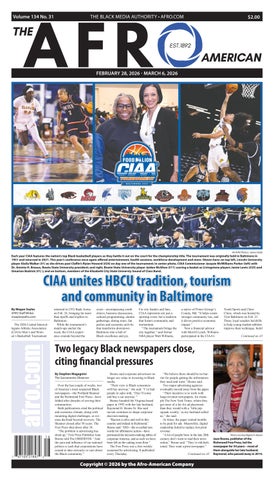
Afro e-edition 02_27_2026

Page 1


FEBRUARY 28, 2026 - MARCH 6, 2026

CIAA unites HBCU tradition, tourism and community in Baltimore

msayles@afro.com

The 2026 Central Intercollegiate Athletic Association (CIAA) Men’s and Women’s Basketball Tournament

returned to CFG Bank Arena on Feb. 24, bringing far more than tipoffs and trophies to Baltimore.

While the tournament’s match-ups anchor the week, the CIAA experience extends beyond the

court—encompassing youth clinics, business discussions, cultural programming, alumni gatherings, dining tours, fan parties and economic activity that transforms downtown Baltimore into a hub of Black excellence and joy.

For city leaders and fans, CIAA represents not just a sporting event, but a tradition that fosters community and momentum.

“The tournament brings the city together,” said former NBA player Walt Williams,

a native of Prince George’s County, Md. “It helps create stronger community ties, and it drives positive economic impact.”

Now a financial advisor with Merrill Lynch, Williams participated in the CIAA’s

Two legacy Black newspapers close, citing financial pressures

Over the last couple of weeks, two of America’s most respected Black newspapers—the Portland Skanner and the Richmond Free Press—have folded after decades of serving their communities.

Both publications cited the political and economic climate, along with mounting digital challenges, as revenue declined beyond recovery. The Skanner closed after 50 years. The Free Press shut down after 34.

“The problem is advertising has dried up,” Free Press Publisher Jean Boone told The OBSERVER. “And the aura and influence of our national politics is such that corporations have ceased to take seriously or care about the Black community.”

Boone said corporate advertisers no longer see value in investing in Black media.

“Their view is Black consumers will buy anyway,” she said. “I’ve had people in sales told, ‘They’ll come and buy a car anyway.’”

Boone founded the Virginia-based paper in 1992 with her late husband, Raymond H. Boone Sr. She said racism continues to shape corporate decision-making.

“Racism is alive and well in this country and indeed in Richmond,” Boone said. “DEI—the so-called new words for affirmative action—have permeated the decision-making tables of corporate America, and as such we have been left on the cutting room floor.”

The Free Press was a free weekly sustained by advertising. It published every Thursday.

“We believe there should be no barrier for people getting the information they need and want,” Boone said.

Two major advertising agencies eventually moved away from the paper.

“Their incentive is to work with large-revenue newspapers, for example The New York Times, where they get more of a fee for ad placement than they would with a ‘little pipsqueak weekly,’ as my husband called us,” she said.

At times, the paper waited months to be paid for ads. Meanwhile, digital readership failed to replace lost print revenue.

“A lot of people born in the late 20th century don’t want to read their news online,” Boone said. “They’re old-fashioned. They want a print newspaper.”

Youth Sports and Cheer Clinic, which was hosted by

Visit Baltimore on Feb. 21. There, local coaches led drills to help young student-athletes improve their technique, build

Photo courtesy Regina H. Boone Jean Boone, publisher of the Richmond Free Press, led the newspaper for 34 years—most of them alongside her late husband, Raymond, who passed away in 2014.

WHAT’S TRENDING ON AFRO.COM

Judge blocks 47th president’s anti-DEI directive in U.S. schools

A federal judge in New Hampshire officially put an end to a Trump administration directive that public K-12 schools and colleges end diversity, equity and inclusion programs, or risk losing millions in federal funding.

The ruling from District Judge Landya McCafferty this week is in response to a lawsuit filed against the Trump administration last year over its “Dear Colleague Letter.”

But it also comes weeks after the Trump administration dropped its appeal in a separate federal court ruling regarding the letter. In that ruling — which stemmed from a lawsuit filed by the American Federation of Teachers and other groups — a Maryland federal judge found that the letter violated educators’ First Amendment rights.

Now that the federal government has lost both cases, the looming anxiety educators feel across the country over what they can or cannot teach is somewhat alleviated.

‘Diversity is our uniqueness and our strength’

Becky Pringle, president of the National Education Association teachers’ union, hailed the decision, slamming Education

Secretary Linda McMahon and the White House for trying to meddle with “curriculum and instruction.”

“Diversity is our uniqueness and our strength,” Pringle, president of the nation’s largest teachers’ union, said in a statement. “Equity means every student gets what they need, when they need it, and in the way that serves them best. And inclusion means all students are seen, valued, respected, and have access to opportunities and support.”

Though the case has ended, “Educators, parents, and community leaders will continue

Your History • Your Community • Your News

The Afro-American Newspapers

Baltimore Office • Corporate Headquarters

233 E. Redwood Street

6th Floor, Suite 600G Baltimore, Maryland 21202 410-554-8200

Customer Service, Home Delivery and Subscriptions: 410-554-8200 customerservice@afro.com

Founded by John Henry Murphy Sr., August 13, 1892

Chairman of the Board/Publisher - Frances Murphy Draper

(Publisher Emeritus - John J. Oliver Jr.)

President - Benjamin Murphy Phillips IV

VP of Marketing and Technology - Kevin E. Peck

Director Digital Solutions - Dana Peck

Receptionist - Wanda Pearson - 410-554-8200, ext. 246

Director of Operations

Andrè Draper - 410-554-8200

Director of Finance

Bonnie Deanes - 410-554-8242

Executive Director/Director of Advertising

Lenora Howze - 410-554-8271 - lhowze@afro.com

Director of Community & Public Relations

Diane W. Hocker - 410-554-8243

Editorial

Managing Editor - Alexis Taylor - 410-554-8257

Editorial Assistant - Ama Brown-Parson Evening / Weekend Editor - Zenitha Prince

Archivist - Savannah Wood - 410-554-8277

Baltimore Circulation/Distribution Manager Andrè Draper - 410-554-8200

Creative Design and Content

Matthew McDonald

Washington Office 1140 3rd Street, N.E., 2nd Floor Washington, D.C. 20002-6723 202-332-0080

(Washington Publisher Emerita - Frances L. Murphy II)

Director of Operations - Andrè Draper - 410-554-8200

to organize, mobilize, and take action to protect our students and their futures.” she said.

The Department of Education did not respond to Word In Black’s request for comment.

What was the “Dear Colleague Letter”?

The letter, signed by Craig Trainor, then the acting assistant secretary for Civil Rights at the Department of Education, told schools they had 14 days to comply with the directive or face consequences, including the loss of funding.

Shortly after the letter was posted last February, the American Civil Liberties Union,

its branches in Massachusetts and New Hampshire, as well as NEA’s attorneys, sued the

federal government. The Center for Black Educator Development, a nonprofit that supports Black teachers, also joined the lawsuit as a plaintiff.

In April 2025, McCafferty temporarily blocked the directive, finding that it “isolated characterizations of unlawful DEI” and clashed with the term’s actual meaning.

Citing Webster’s dictionary, the judge wrote that the phrase “diversity, equity, and inclusion” commonly denotes “a set of values and related policies and practices focused on establishing a group culture of equitable and inclusive treatment” as well as aiding people “who have historically been excluded or discriminated against.”

She later said that the ACLU and its fellow plaintiffs likely would prevail because the

directive was vague, restricted speech the administration disagrees with, and illegally imposed new legal obligations on teachers and schools.

After the case ended Feb. 18, Sharif El-Mekki, CEO of the Center for Black Educator Development, said in a statement that the federal ruling protects teachers’ livelihoods and their responsibility to teach truthfully “at a time when many communities are facing severe teacher shortages.”

Teachers are free to bring “their full selves to the classroom,” El-Mekki said. Now, he said, educators are free to create “inclusive environments that prepare students for the future.”

This article was originally published by Word In Black.

“Diversity is our uniqueness and our strength. Equity means every student gets what they need, when they need it, and in the way that serves them best. And inclusion means all students are seen, valued, respected, and have access to opportunities and support.”

BAFTA and BBC apologize for racial slur during awards show

LONDON (AP) — The British Academy Film Awards and BBC apologized Feb. 23 for a racial slur that was broadcast during the Feb. 22 show while two stars of the film “Sinners” were onstage.

The Tourette syndrome campaigner who shouted the slur said he was “deeply mortified” and what he said was “not a reflection of my personal beliefs.”

The highly offensive word could be heard as “Sinners” stars Michael B. Jordan and Delroy Lindo, who are both Black, were presenting the award for best visual effects during the Feb. 22 ceremony. Host Alan Cumming had earlier told the audience that Tourette syndrome advocate John Davidson was in attendance.

The incident prompted the British Academy of Film and Television Arts (BAFTA) to apologize for “offensive language that carries incomparable trauma and pain for so many,” adding “We would like to thank Michael and Delroy for their incredible dignity and professionalism.”

Davidson, a Scottish campaigner for people with Tourette syndrome, who inspired the BAFTA-nominated film “I Swear,” said in a statement Feb. 23 that he was “deeply mortified if anyone considers my involuntary tics to be inten

tional or to carry any meaning.”

Tourettes Action — a Tourette syndrome charity — called for understanding of the condition.

“We deeply understand that these words can cause hurt but at the same time, it is vital that the public understands a fundamental truth about Tourette syndrome: tics are involuntary. They are not a reflection of a person’s beliefs, intentions, or character,” said Emma McNally, CEO of Tourettes Action.

Tourette syndrome, a neurodevelopmental disorder, is characterized by sudden, involuntary movements or sounds called tics that tend to wax and wane but can worsen with excitement or anxiety, according to the U.S. National Institutes of Health. They may appear to be purposeful but are not, and the NIH’s National Institute of Neurological Disorders and Stroke’s Tourette information page says people trying to suppress them often report a buildup of tension before a tic erupts.

The Tourette Association of America says about 10-15 percent of people with the syndrome experience a kind of vocal tic called coprolalia — involuntary swearing, slurs or other socially unacceptable words or phrases.

Several shouts were audible during the first part of the ceremony, although what was said wasn’t intelligible to an Associated Press reporter in the press room.

After the slur was shouted during Jordan and Lindo’s presentation, Cumming apologized to the audience at London’s Royal Festival Hall for the “strong and offensive language.”

“Tourette syndrome is a disability and the tics you have heard tonight are involuntary, which means the person who has Tourette syndrome has no control over their language,” Cumming said. “We apologize if you were offended.” Davidson said in his statement that “I chose to leave the auditorium early into the ceremony as I was aware of the distress my tics were causing.”

The epithet could be heard when the

BBC broadcast the ceremony about two hours after the live event. The broadcaster apologized for not editing it out before the broadcast, though the offensive word could still be heard on its iPlayer streaming service early Feb. 23. The program was later removed, and the BBC said the slur would be edited out.

“Some viewers may have heard strong and offensive language during the Bafta Film Awards,” the BBC said in a statement. “This arose from involuntary verbal tics associated with Tourette syndrome, and as explained during the ceremony it was not intentional.”

“I Swear” won two BAFTAs, including best actor for Robert Aramayo, who plays Davidson. Representatives for the film and for Jordan and Lindo did not immediately respond to requests for comment.

AP Medical Writer Lauran Neergaard in Washington and National Writer Jocelyn Noveck in Paris contributed reporting.

AP Photo
The U.S. Department of Education’s “Dear Colleague Letter” directing schools to end DEI programs or risk losing federal funding was blocked by a federal judge in New Hampshire.
Photo by Richard Shotwell/Invision/AP
The British Academy Film Awards and the BBC issued apologies after a racial slur was broadcast during the Feb. 22 BAFTA ceremony while “Sinners” stars Michael B. Jordan (left) and Delroy Lindo were presenting onstage. The slur was shouted by a Tourette syndrome advocate in attendance, who later said he was “deeply mortified” and stressed that the utterance was an involuntary tic.
AP Photo/Alberto Pezzali

COMMENTARY

The slow strangulation of Black business opportunity

In Washington, when a government program comes under scrutiny, the conversation often jumps too quickly from “this needs oversight” to “this should be eliminated.”

That instinct is now on display in the debate over the federal government’s 8(a) Business Development Program, a long-standing initiative designed to help small businesses owned by socially and economically disadvantaged individuals compete in federal contracting.

For many Black-owned businesses, 8(a) is often the primary pathway into federal contracting, providing access to capital, experience and credibility that would otherwise remain out of reach in a system shaped by longstanding racial inequities. Yet even with this program, equal access to opportunity remains elusive.

examines what is at stake if the federal government’s 8(a) Business Development Program is weakened or dismantled.

The U.S. Department of Labor reported in 2021 that, despite representing 24 percent of eligible businesses, minority-owned firms accounted for only 3 percent of all contract awards. Critics argue the program is outdated, vulnerable to abuse and legally fragile. Some have gone further, calling for its dismantling. But this debate is unfolding amid a broader political effort to roll back diversity, equity and inclusion initiatives, particularly those that acknowledge race as a

factor in unequal economic outcomes. In that context, enforcement risks being used not to strengthen the program, but to shrink it.

That contraction is already visible. The Small Business Administration has admitted only 65 companies to the 8(a) program in 2025, compared with more than 2,000 admissions over the previous four years. It also suspended more than 1,000 of roughly 4,300 active firms in January for noncompliance.

The real question is not whether 8(a) is flawless. It is whether policymakers will do the harder work of governing it effectively or use enforcement as a pretext for eliminating one of the few federal tools designed to expand opportunity for disadvantaged entrepreneurs.

The 8(a) program is not a permanent preference or a guaranteed pipeline of contracts. It is a time-limited business development initiative, typically lasting up to nine years, intended to help small businesses owned by socially and economically

disadvantaged individuals build the capacity to compete in the federal marketplace. Participants receive contracting opportunities alongside business counseling, technical assistance and mentoring. The goal is graduation, not dependency.

The program exists because Congress recognized that socially and economically disadvantaged businesses, including many Black-owned firms, face documented barriers to capital, bonding and commercial networks. Federal contracting requires past performance, upfront financing and institutional relationships that many entrepreneurs have historically been denied. 8(a) attempts to narrow that gap.

Yet labeling 8(a) as “DEI” distorts both its purpose and its results. Black-owned businesses still receive only about 1.5 percent of total federal contract dollars, a fraction of their share of the small business community and the population. Even with 8(a), the gains have been modest. If this is what critics call preferential treatment, it is a remarkably limited one.

The danger is that in the name of eliminating “DEI,” policymakers are dismantling one of the few structured entry points into federal contracting for disadvantaged small businesses without replacing it with anything stronger. That does not punish elites. It harms small firms that rely on federal contracts to build past performance, stabilize cash flow and create jobs.

Shrinking the program will not produce a more competitive marketplace. It will concentrate federal contracting further among established incumbents, reduce supplier diversity and weaken the resilience of federal supply chains. The result is not neutrality. It is consolidation, higher barriers to entry and potentially higher costs for taxpayers.

There is no serious dispute that the program faces risks. Problems can arise when a small business functions primarily as a pass-through, when large contracts are awarded without competition, or when agencies fail to monitor performance. These issues deserve attention. But acknowledging risk is not the same as proving a program is beyond repair. Oversight bodies have consistently shown that targeted enforcement, better data and risk-based supervision work. The Department of Defense awarded more than $18 billion in contracts to 8(a) firms in 2024. A January memo indicates that the DoD is conducting an 8(a) review intended to eliminate what it describes as unconstitutional and non-merit-based DEI. Eliminating the program would require significant supply chain restructuring and would contradict Commerce Department findings emphasizing the importance of minority-owned businesses for supply chain resilience. The choice facing policymakers is not between oversight and abandonment. It is between dismantling a flawed but necessary tool or reforming it to deliver better results. A reformed and well-enforced 8(a) program is not a special favor. It is a practical mechanism to expand competition and strengthen the small-business ecosystem. Scrapping it may be politically convenient. Fixing it and demanding that it do more is far more valuable.

Vulnerable communities left to breathe consequences as EPA repeals endangerment finding

Nothing brings me more joy than spending time with my beautiful five-month-old grandson. When I am with him, we are in our own special world – the board books, the stuffies, the smiles. I certainly don’t want him to see the dread I am feeling. I work in the climate sector and I know what scary monsters lay ahead for him, especially because of this administration and the current Environmental Protection Agency.

Indeed, when the EPA forsakes its duty to safeguard public health under the Clean Air Act, it is Black, Brown and under-resourced communities that are harmed disproportionately!

I know first-hand, as an African American, how much worse climate change and global warming is for Black communities. I have been filled with deep concern since I first heard rumors that the EPA would recklessly abandon its duty to protect our public

health and welfare by revoking the Endangerment Finding, a foundational part of the EPA’s ability to regulate climate pollution. This week, those rumors became reality and this spells disaster for my community, for my grandson, and for all Black children and grandchildren.

The Endangerment Finding was issued by the EPA in 2009 after the U.S. Supreme Court determined that the EPA had the authority to regulate the emission of greenhouse gases.

“Endangerment Finding” is not an everyday term that rolls easily off the tongue. What matters, though, are not just the words. Rather, what matters is that the EPA is ignoring well-documented scientific evidence clearly showing that the rise in global temperatures and related climate and environmental changes have resulted from a significant increase in greenhouse gases.

What matters also is that the harms of the EPA’s irresponsible new decision will harm children’s health, especially those in Black, Brown and

under-served communities, and increase their rates of asthma, heat stroke, cardiovascular disease and other chronic and debilitating illnesses.

In fact, the World Health Organization has alerted us that while we will all be harmed by increased climate pollution, it is the health of our precious children and grandchildren, as well as pregnant women, those 65 years old or more and those living in under-resourced neighborhoods that will feel the impact first and most severely.

Ultimately, increased air pollution – like the kind made worse by climate pollution – will also mean increased healthcare visits and costs for families who are already facing less access to healthcare in 2026 for numerous reasons, including the large increase in both insurance rates and the uninsured. Black, Brown and under-resourced communities are among those in this group. They are me, they are friends of mine, they are family members, they are neighbors. Because of complex reasons

relating to environmental racism, Black and Brown children often live in under-resourced communities that are already facing numerous environmental threats in addition to intensifying climate risks. These neighborhoods and the schools they attend are close to highways, industrial sites and power plants, exposing them to worse air pollution and other environmental hazards.

In February 2026, researchers reported that “Black Americans, in particular, are more likely than any other group to live in areas with unhealthy air, increasing illness risk.” In the same report, the researchers wrote the cruel fact that, “By removing lifesaving environmental protections and failing to limit harmful chemicals and toxic pollution emitted by gas and coal power plants, oil and gas refineries, petrochemical, chemical and pesticide manufacturers, and other industries, the [current] administration is letting corporate polluters poison the air that kids and families breathe

and the water they drink.”

That is not making America Healthy Again, it is making us all sick!

For years I worked to bring electric school buses to Georgia because I saw how many children, a significant number of whom were Black and Brown, struggled with asthma due to fossil fuel fumes. We simply cannot ignore that air pollution and climate pollution are a threat to children’s health.

There is a direct relationship between worsening pollution and certain diseases such as asthma, which the EPA identifies as a leading chronic disease among children, and which affects Black children more than any other group. The EPA itself has also reported that a Black child is more likely to die because of asthma.

Despite the tsunami of EPA senseless rollbacks, and particularly the Endangerment Finding, every time I hold my grandson, my resolve is strengthened to protect clean air for him to breathe, clean water for him to drink and for him to have a healthy neighborhood to grow up in. This is my sacred legacy for my grandson and for all the other grandsons in the world who need us to protect them. So, we must fight back – by making our voices heard and our actions felt. Their future hangs in the balance.

Gun ownership demands accountability, not excuses

There are some headlines that should never feel routine. Yet across this country—from Baltimore to Chicago to Atlanta—we continue to read the same devastating words: Child injured in accidental shooting. We call them accidents. But too often, they are acts of adult negligence. When a child gets hold of a firearm inside a home, that child did not fail. The adult did. Children do not purchase guns. They do not decide how weapons are stored. They do not control whether a firearm is locked in a safe or left

loaded in a drawer. Adults make those decisions. Adults bear that responsibility. Yet each time tragedy strikes, the conversation drifts. We talk about curiosity. We talk about peer pressure. We talk about bad luck. Rarely do we focus squarely on the one factor that could have prevented the harm: a properly secured weapon.

This is not a debate about whether someone has the legal right to own a firearm. Rights come with responsibilities. Owning a gun in a household with children demands heightened caution— not casual storage. A loaded firearm under a pillow or inside an unlocked nightstand

is not responsible ownership. It is a disaster waiting to happen.

If a child injures themselves because an adult failed to secure a gun, that should not be treated as a mere mistake. It should be prosecuted as criminal negligence. If that same firearm was illegal— unregistered, unlawfully obtained, or prohibited in that household—the penalties should be even more severe. An illegal gun combined with a child’s access is not a technical violation; it is reckless endangerment. Some will argue that tough penalties are excessive. I would argue that burying a child is excessive. We require

parents to use car seats. We mandate smoke detectors. We enforce pool fencing laws. Why? Because society recognizes that children must be protected from preventable harm. Safe firearm storage belongs in that same category of basic responsibility. Accountability is not about politics. It is about prevention. When adults face serious legal consequences for unsecured firearms— felony charges, significant fines, potential incarceration and permanent loss of gun ownership rights—it sends a clear message: safeguarding children is not optional. It is mandatory. The truth is uncomfortable

but necessary. When a child pulls a trigger inside a home, the chain of failure began long before that moment. It began when an adult chose convenience over caution. When an illegal firearm was brought into a house. When a safety lock was ignored. We cannot keep mourning the same tragedy while avoiding the same solution. If you choose to bring a firearm into your home, you choose to shoulder a profound responsibility. And if that responsibility is ignored, and a child is harmed, the law must respond with strength—not sympathy. Because protecting children should never be negotiable.

Courtesy photo This week, Joint Center senior researcher Cantrell Dumas
Meta (Facebook) / Michael Eugene Johnson Michael Eugene Johnson is creator of the Pikes Studio Cinema and cofounder of Black Men Unifying Black Men. This week, he speaks to the idea of gun safety versus the reality.
Courtesy photo Almeta Cooper serves as national manager for Health Justice at Moms Clean Air Force. This week, she discusses the impact of the recent decision by the EPA to revoke the Endangerment Finding, the bedrock for all Clean Air Act protections.

CIAA

confidence and learn to work as a team.

During the clinic, Williams sat on a panel discussing life after sports, financial literacy and the importance of preparing for careers beyond athletics. Drawing from his own transition from the NBA to corporate leadership, he emphasized that lessons learned through sports—discipline, accountability and perseverance—can serve athletes in their academic and professional lives.

“The youth clinic being connected with CIAA is a great example of one of the ways this tournament goes beyond the games,” said Williams.

“The opportunity for students to meet professionals, college recruiters and mentors can change the game for these young people. I think CIAA provides

the student-athletes with a stage to showcase their talents while also supporting scholarships, meaningful relationships and strategic partnerships.”

There were many more events taking place off the court throughout the week, including Downtown Partnership of Baltimore’s Black-owned restaurant tour (BORT), a financial literacy breakfast, mental health forum and step shows. The BORT featured 18 Black restaurants and bars situated across Downtown Baltimore, giving visitors a taste of the city’s culinary scene while supporting local businesses.

Since the CIAA relocated to Baltimore in 2021, Mayor Brandon M. Scott said it’s generated $100 million in economic impact for the city. Last year alone, the tournament delivered $27.4 million in economic impact to Baltimore with $19.8 million in direct spending.

Scott said much of that economic activity flows to Black-owned businesses.

“We’re very intentional about

at his hometown newspaper in Suffolk, Virginia, and later taught journalism at Howard University.

The paper operated what Boone described as an “underground distribution center,” placing boxes throughout the city where readers would take copies— often distributing extras themselves.

Launching a Black newspaper in Richmond—the former capital of the Confederacy—was never easy, Boone said.

“That aura looms very (heavily) in this city,” she said, referencing the paper’s efforts to push for the removal of Confederate statues from Monument Avenue. Despite threats and vandalism, the publication endured.

By the early 2000s, the Free Press had built a weekly circulation of nearly 35,000, reaching an estimated 120,000 readers.

Boone called her late husband “a consummate journalist and the lead player in this drama.” Before co-founding the paper, Raymond Boone worked

Boone said her family is taking time to regroup while navigating health challenges.

“Given the health concerns of all our people, we have to take a deep breath and take care of ourselves,” she said. “It took everything we had to get to this point.”

Still, she expressed pride in what the paper built.

“We were able to do this for 34 years,” Boone said, “and have people who have worked with us since the beginning.”

A similar struggle In Portland

The Portland Skanner faced many of the same financial pressures.

Bernie V. Foster and his wife, Bobbie Dore’ Foster, founded the Skanner in 1975 to “challenge people to shape a better future” and amplify the voices of underserved Black neighborhoods. The paper reported on racism in housing, health care and policing, addressed public policy and

setting up the Black-Owned Restaurant Tour (BORT) and targeting those folks for CIAA events. We’re very intentional about the presidents of the CIAA staying at the Ivy Hotel,” said Scott. “We’re very intentional about making sure that the teams are practicing at school and rec centers throughout the city of Baltimore.”

By spreading activities throughout the city, CIAA not only engages communities but also supports a surge in tourism and spending during what is usually Baltimore’s slow season.

“This event is such an important event for us because normally this time of the year is the deadest time for tourism in Baltimore,” said Scott. “Now, it’s one of the busiest times of the year because you have all of these people coming, and they’re spending money.”

During the tournament’s five-day run in Baltimore, fans from across the country traveled to watch their favorite teams compete—bringing energy and excitement. For some, it was a chance

organized community events. Many young Black and allied journalists launched their careers there.

In 1989, the Skanner led the campaign to rename Portland’s Union Avenue as Martin Luther King Jr. Boulevard, gathering more than 4,000 signatures.

Its circulation peaked at roughly 95,000 in the 1990s. The Fosters later established the Skanner Foundation, which provided scholarships and community awards. The Oregon Historical Society recognized them as “history makers,” and community leaders described the Skanner as a “civic institution.”

But digital disruption reshaped the business model.

“Putting out a newspaper in the Pacific Northwest has changed dramatically, and Black newspapers are no different,” Foster, 85, told The OBSERVER. “Online is for a new generation. We are in a digital age. We’re getting information faster.”

Two years ago, the Skanner generated 1 million digital hits a week, he said.

to cheer on family members, while others have returned year-after-year to soak in the atmosphere and school spirit.

Tajama Ngongba attended on day one to watch her daughter, Naja Ngongba, play for the Elizabeth City State University Lady Vikings. It was her first time at the tournament.

“I’m just super excited to see her play and support her and her team,” said Ngongba. “Hopefully, they can make a run here.”

Kendale Chambers Sr., former assistant coach for the Livingstone College Women’s Basketball team, said he came out to support the Lady Blue Bears during game two of the women’s tournament.

Chambers said the tournament fosters a sense of camaraderie among the young men and women who compete by allowing them to share in the legacy of a tournament that’s deeply rooted in HBCU tradition.

“It’s an event that I come to every year, even when I wasn’t coaching for CIAA,”

But competition intensified.

“All the big internet companies got wind of it and borrowed some of our technology,” Foster said. Traffic dropped to 250,000 hits a month. “And I did not make money online the way I did the old way.”

With artificial intelligence accelerating change, he added, “No one knows where it’s going.”

The Skanner went fully digital in 2023. Foster credited Sacramento OBSERVER founder Dr. William H. Lee with helping him “learn what newspapers were all about.”

“We know we left the Pacific Northwest a little better than we did 50 years ago,” he said.

Though the newspaper has closed, the Fosters are not stepping away from entrepreneurship. Next month, they plan to open a shop at Portland International Airport selling news and gifts.

“We might come back as a news entity,” Foster said. “You can do a lot of things if you put enough eyeballs on it. The old model is out the window.”

Bobbie Dore’ Foster told KOIN 6

for everyone to come out and enjoy.”

News that advertisers increasingly favor social media platforms over newspapers. She said the Skanner leaves behind “a Black-owned enterprise that has served the community by sharing stories that are important to them, highlighting their achievements and offering vital information that demanded attention and action.”

A national crisis

More than 200 African American-owned community newspapers remain active in the United States, according to the National Newspaper Publishers Association, or NNPA. In 2027, the Black Press will mark the 200th anniversary of the nation’s first Black newspaper. Still, leaders warn that closures like those in Richmond and Portland signal deeper instability.

Onyx Impact, a nonprofit research and digital innovation hub focused on Black communities, criticized the shutdowns.

See

said Chambers. “It’s just a good time. It’s empowering not only for the Black community, but
Photo courtesy of the Baltimore Office of the Mayor Charm Jamie Scott (left) enjoys the CIAA tournament on Feb. 24 with his father, Baltimore Mayor Brandon Scott.

What is Lent?

A guide to fasting, prayer and

Given Christianity’s cultural influence in the United States, most people recognize Lent as the 40-day season leading up to Easter. For many Christians, it’s the time of year when believers give up something pleasurable — chocolate, alcohol or red meat — as an act of spiritual discipline.

The truly devoted, however, also choose to fast, abstaining from food, water, or both, as part of their journey towards Easter’s spiritual renewal.

If you’re considering fasting for Lent, you may have questions: What kind of fast should you choose? Give up food, a special activity or a creature comfort? If it’s food, should one include or exclude water? When should the fast take place?

Here’s a simple guide to understanding Lent, fasting, and the different ways Christians observe the season.

Prayer and fasting

Although Lent is familiar to most Christians, the practice of fasting — usually defined as the avoidance of consuming food for a prescribed amount of time — and prayer are traditions in other faiths. It is an annual feature of Ramadan, Islam’s holy month of worship, but it’s also a tradition in Buddhism. Hinduism, and Taoism.

The idea is to eliminate, if relatively briefly, anything that could distract from the

sacrifice

discipline required for the spiritual journey from Ash Wednesday to Easter. The goal is to replace it with the strength and belief to endure.

Generally, faith leaders teach congregants that some failures to abide by Christ’s teachings can be remedied only through prayer and fasting. In Christianity, fasting generally falls into four, mostly self-explanatory categories: total, dry, intermittent and sanctified.

Types of fasting during lent

Total fasting is abstaining from all food for a period of time, while dry fasting means abstaining from food and water. Intermittent fasting requires maintaining a strict schedule of meal times, while sanctified fasting allows one meal each day after 6 p.m.

Then there’s the decision whether to take on an individual fast, where one sacrifices on one’s own, or a corporate fast, where a faith family or community endures the fast together.

Giving something up for lent

Sometimes, faithful Christians can’t or would prefer not to give up food for a period of time. An alternative show of sacrifice and devotion is to sacrifice certain favorite foods, nettlesome habits or pleasurable activities during Lent.

That means 40 days without chocolate, or wine. Some use the time to quit smoking, or

This year, the Lent season will last until April 2. Observance began on Feb. 18, with Christians around the world participating by abstaining from a favorite food or drink as an act of spiritual discipline.

cursing, or eating fast food.

It could be 40 days without shopping, except for essentials. Some choose to sacrifice social media; others deny themselves television shows or movies.

Adding meaningful practices during lent

Some Christians approach Lent by adding meaningful practices rather than subtracting comforts.

That could include spending more time in prayer,

journaling daily, volunteering in the community or intentionally reconnecting with family and loved ones.

Whether through fasting, sacrifice or intentional growth, Lent remains a personal and communal

Five books by Black authors to read during Lent

Lent invites reflection. For 40 days, many Christians fast, pray, and examine their lives in preparation for Easter. But for Black Christians—whose faith traditions were shaped by enslavement, migration, resistance, and communal survival— Lent can carry additional layers of meaning.

From repentance and renewal to liberation and embodied dignity, Black theologians and spiritual writers are offering new ways to approach the season. Their work connects ancient Christian practices to contemporary struggles and to the lived realities of Black communities.

Here are five books by African American authors that explore Lent through history, spirituality, and the enduring wisdom of Black faith traditions.

1. “Lent: The Season of Repentance and Renewal” by Esau

Part of a series, “Fullness of Time,” that explores the seasons of the church calendar, this book declares that Lent “is inescapably about repenting,” but not about despair. The season, the author writes ”is about turning away from our sins and toward the living God. A season dedicated to repentance and renewal should not lead us to despair; it should cause us to praise God for his grace.”

2. “Tarry Awhile: Wisdom from Black Spirituality for People of Faith” by Selina Stone

Chosen as The Archbishop of Canterbury’s Lent Book for 2024, Churchtimes says this book “makes the wisdom of Black spiritualities and faith available for all people.”

Focused on seven themes—darkness as a place of encounter with the divine; the unity of all things; movement, belonging and migration; the Spirit as one who moves in unexpected ways; quiet contemplation as essential to spiritual growth; healing in community; and weeping that turns to joy—the book “centers the stories of often overlooked people and communities, offering wisdom for all people who hope to encounter God in the midst of wearying times.”

3. “Lent of Liberation: Confronting the Legacy of American Slavery” by Cheri L. Mills

In a bold pairing of Christianity and America’s original sin, “Lent of Liberation” offers a devotion for each of the 40 days of Lent, weaving the history of slavery into each one. The devotions are written in the voice of a formerly enslaved person who escaped through the Underground Railroad.

4. “This Here Flesh: Spirituality, Liberation and the Stories That Make Us” by Cole Arthur Riley

journey toward Easter. For many believers, the meaning of the season lies less in what is given up and more in what is gained: clarity, renewal and deeper faith.

This article was originally published by Word in Black.

This week, take a look at the Black authors reflecting on the

The author assigns readings to highlighting the sacredness of Black embodiment. “From the womb, we must repeat with regularity that to love ourselves is to survive,” she writes. “I believe that is what my father wanted for me and knew I would so desperately need: a tool for survival, the truth of my dignity named like a mercy new each morning.”

renewal through Black Christian

5. “Were You There?: Lenten Reflections on the Spirituals”

Unsplash / Kamil Szumotalski
by Luke Powery
The author harnesses the power of traditional African American spirituals to enrich the Lenten experience. Each selection includes the lyrics of
a spiritual, the author’s reflection on its meaning, a relevant passage from scripture and a prayer.
This article was originally published by Word in Black.
By Rev. Dorothy S. Boulware  Word in Black
Photo courtesy of Nappy.co
meaning of Lent, repentance, liberation and
faith traditions.

D.C. community holds candlelight vigil for Julian Bailey, man shot by U.S. Marshal

Family members, residents and activists with the advocacy group Free DC held a candlelight vigil in memory of Julian Marquette Bailey on Feb. 16. The ceremony came following Bailey’s Feb. 11 death at the hands of U.S. Marshals.

Bailey, a native of Northeast (NE) D.C., was 43 years old.

“He was an amazing man. He was an amazing father. He was an amazing son. He was an amazing member of the community. Julian deserves justice,” said NeeNee Taylor, co-founder of Free DC and Harriet’s Wildest Dreams.

Bailey was shot by U.S. Marshals following a call alleging a dispute at a convenience store on Kenilworth Terrace and Hayes Street NE. The Metropolitan Police received a call around 2:10 p.m. EST about a “man making threats with a gun.”

Sixth District officers arrived at the scene to speak with the alleged victim.

Members of U.S. Park Police and the U.S. Marshal Service found Bailey on the 3700 block of Hayes Street NE, according to Metropolitan Police. A marshal was responsible for opening fire on Bailey. There is currently no available information on the altercation between law enforcement and Bailey that led to the shooting.

The AFRO reached out to U.S. Marshal Service for comment. The Marshal

Power, profit and protection: Local advocates weigh risks of Landover data center

As demand for artificial intelligence (AI) grows, the development of hyperscale data centers has surged across the nation—including in Maryland, where a project in Prince George’s County has sparked concerns about environmental, health and infrastructure impacts among residents and community leaders.

Last June, community advocate Taylor Frazier McCollum started a petition against a data center project slated for the old Landover Mall, warning that it could generate light, thermal and air pollution while driving down property values in surrounding neighborhoods. The petition has drawn more than 22,500 signatures so far.

For McCollum and other community leaders, the debate is about who gets to define the

future of their community.

“We can’t have this in our community. My grandfather’s house is less than a mile from that site, my mother’s house as well,” said McCollum. “It’s going to directly impact my family. I just feel like it isn’t something that needs to be close to residential areas and in our community without our say, period.”

The groundwork for the Prince George’s County data center project dates back to 2021 when legislation from the county council formally established data centers as a permitted land use in county zoning law. The bill followed state and county legislation that created tax incentives and streamlined the approval process for large-scale data center development.

In March 2024, the Prince George’s County planning board approved a project,

Continued on A8

Prince George’s County is in the midst of a data center debate, with some residents opposing the development of a massive facility at the old Landover Mall. Community concern led to County Executive Aisha Braveboy pausing the development and creating a task force to examine its potential impacts in September 2025.

Clyde “Cool Mac” Doughty Jr., vice president for Intercollegiate Athletics and Recreation at Bowie

University, is remembered for his visionary leadership, mentorship of student-athletes and lasting impact on the university’s athletic programs.

Bowie State celebrates legacy of athletic leader Clyde ‘Cool Mac’ Doughty Jr.

Bowie State University students, alumni and community members assembled Feb. 13 at the Martin L. King auditorium to pay tribute to the late Clyde M. Doughty Jr., vice president for Intercollegiate Athletics and Recreation and a national leader in the Central Collegiate Athletic Association (CIAA). The event united academia and athletics in a moving ceremony, reflecting on Doughty’s lasting legacy.

Doughty, who died unexpectedly on Feb. 2, was warmly remembered by college presidents, clergy, coaches, student athletes, BSU Hall of Fame alumni, and his CIAA family.

Those who shared reflections about Doughty— known as “Cool Mac” to many—spoke of his impact reaching far beyond athletic

achievements. Bowie State University President Aminta Breaux remarked, “He gave us moments that reminded us how fully he showed up for people. He made people feel seen; he made people feel valued.”

Appointed athletic director in 2015, Doughty became vice president of Intercollegiate Athletics and Recreation in 2018, serving in that role until his passing.

“Clyde had plans. He had dreams. We will honor his vision and his spirit,” said Breaux, mentioning Doughty’s vision of a modern football stadium complex to replace Bowie State’s current field, which opened in 1958.

Advancements and achievements

Doughty is credited with elevating Bowie State’s athletic program, both on the

Photo courtesy of Taylor Frazier McCollum
field
Courtesy Bowie State University
State
AFRO Photo/Mekhi Abbott
Julian Marquette Bailey’s wife shares stories about Bailey’s character and their relationship at his candlelight vigil held on Feb. 16. Bailey was shot by at least one U.S. Marshal on Feb. 11 on the 3700 block of Hayes Street NE. He died from his wounds.

Ward 3 residents raise alarm over planned upzoning, call for more affordable housing

Community organizations in Washington, D.C., are raising concerns about planned upzoning for sections of Wisconsin and Connecticut avenues in Ward 3 as part of the District’s Rock Creek West planning area. The rezoning would include significant increases in building height and density, allowing larger mixed-use developments along major transit corridors with the goal of expanding the D.C. housing supply and promoting transit-oriented growth.

Ward 3 Housing Justice, a grassroots advocacy group, is worried the proposed zoning changes will pave the way for large-scale redevelopment without corresponding guarantees of deeply affordable housing and inclusion for low-income families—especially as Ward 3 already has the lowest share of affordable housing in D.C.

“What’s happening is we’re building housing but excluding people by nature of not

proposed by local developer Lerner Enterprises, at the site of the old Landover Mall. Notably, it did not require approval by the county council.

As more residents learned about the project and opposition grew, County Executive Aisha Braveboy issued an executive order in September 2025, pausing the development and establishing a task force to study potential risks, benefits and revenue.

For McCollum, the sixmonth moratorium is the result of public pressure rather than a meaningful shift in the county’s development priorities.

“I don’t believe the pause is disingenuous, but I feel like it’s because they know we’re watching,” said McCollum. “If we weren’t watching, they wouldn’t have paused anything. They would just continue to proceed with business as usual.”

She believes the push for data centers in the county signals that economic priorities are more important than community interests and protection.

“I think it’s a big money grab for the county. They’re trying to decrease the deficit, and they’re trying to do it by any means necessary,” said McCollum. “I think that’s where we’re making a mistake.”

including affordable housing. Unfortunately, this area has a long history of exclusionary development through redlining and other zoning laws,”

said Deirdre Brown, member of Ward 3 Housing Justice and third generation Washingtonian. “We’re not opposed to density; what we are opposed to is when they’re building density but not creating housing with equity.”

Brown said the organization embraces development when it is designed to be inclusive, ensuring that historically underserved communities have access to the benefits it creates.

“We’re asking that if we’re going to grow, we need to grow with a purpose, and that purpose needs to include Black and Brown working-class families,” Brown continued. “We can’t just keep pushing them out of opportunity.”

A few residential developments have already come out of the Rock Creek West planning area, including Wardman Park, Upton Place and City Ridge. Each are luxury apartment complexes, and out

of the more than 2,000 units they produced, only about 9 percent, or 200, are designated as affordable.

Brown noted that the majority of them are only deemed “affordable” for households earning at least $75,000 annually.

Ward 3 Housing Justice is calling on the D.C. Zoning Commission to reopen the public record for the upzoning of Connecticut and Wisconsin avenues and to allow additional public comment. The group is also urging the D.C. Office of Planning (OP) to respond to questions raised during public hearings and to ensure that affordability requirements are proportional to the significant density increases in the proposed rezoning.

“When we are authorizing this much additional density, we’re getting nothing in exchange. We’re increasing the land value for the developer but the community is not getting anything in exchange,” said Brown. “The only thing we’re asking for is more affordable housing. We believe density is a public gift

and that there should be proportional affordable housing in exchange for that.”

The Office of Planning told the AFRO that the proposed rezoning is intended to expand housing production, improve transit access and support mixed-use development along these corridors. Officials said the zoning amendments implement changes that were adopted by the D.C. Council in the 2021 Comprehensive Plan. They were also informed by the Connecticut Avenue Development Guidelines and the Wisconsin Avenue Development Framework, both developed with public input.

The amendments would require all new developments along the corridors to include affordable units under the Inclusionary Zoning Plus (IZ+) program.

“In total, we estimate these amendments could add about 10,000 new housing units to the area, 2,000 of which would be affordable under IZ+. IZ+ is one of a suite of tools that the District uses to add affordable housing across the city,” said the OP

For Kamita Gray, president of the Brandywine TB Southern Region Neighborhood Coalition (BTB Coalition), the issue goes beyond county finances to questions of equity. Her coalition is an environmental justice and civil rights organization, primarily advocating for the protection of Black and low-income neighborhoods when it comes to local landuse projects.

“Data center development is not inherently negative, but the way it is planned and sited determines whether it becomes an economic opportunity or an environmental justice concern. These facilities bring significant

power demand, water use, heat generation, land conversion and infrastructure stress,” said Gray. “When proposals target rural or historically underserved areas, the question is not simply whether they generate tax revenue—it is whether the host community bears disproportionate environmental and infrastructure burdens.”

In Landover, Md., where the data center is proposed, the U.S. Census Bureau reports that nearly 63 percent of the population is African American. For Brandywine and other Prince George’s communities, Gray said the primary concerns revolve around sequencing and

a member of Ward 3

advocacy group is raising concerns about

zoning changes on Wisconsin and

avenues, which they argue will permit significant density increases without corresponding commitments to creating affordable housing.

in a statement to the AFRO

“We’re continuing to provide analysis to the Zoning Commission to ensure affordable housing is maximized and the zoning changes are responsive to community stakeholders.” The Zoning Commission is set to take further action on the proposed upzoning for Connecticut and Wisconsin avenues in April.

Clyde Doughty Jr.

Continued from A7

and through facility enhancements such as leading the revision of “Kevin Durant Court” at the campus’ AC Jordan Arena in 2023, the renovated aquatics center featuring an Olympic-sized pool opened to the community, resurfaced tennis courts, a nutrition lounge for student-athletes and more. Under his leadership, the Bowie Bulldogs won numerous CIAA championships, including six consecutive women’s bowling titles, three consecutive championships in football and softball, and a men’s championship in 2017.

Style that raised the bar for everyone

safeguards.

Gray emphasized that if the project moves forward, comprehensive assessments and enforceable guardrails are essential.

“Communities should not be asked to absorb industrial-scale infrastructure without guarantees on grid stability, water resources, noise mitigation, land preservation and long-term health monitoring,” said Gray. “Equity-centered development requires enforceable commitments— not aspirational language— ensuring that economic benefits are matched by protections, investment and community oversight.”

“Julian was a good son. I mean, I’m really trying to understand this. You see things on TV, but you never think that it’s going to happen to your family.”

Lou Holder, sports broadcaster and deacon at First Baptist Church of Glenarden International, recalled Doughty’s impeccable style, calm demeanor and unique ability to connect with everyone.

“He raised the bar for everyone around him while helping the university race for excellence,” said Holder before paying tribute by donning a replica of Doughty’s trademark fedora hat and demonstrating that confident “Doughty swagger” to the delight of the audience. Doughty and the CIAA “family”

Doughty served as president of the CIAA Management Council from 2017 to 2021 and was in the midst of serving a 2025-2026 term at the time of his death. He received numerous awards from the organization and was recognized multiple times as CIAA Director of the Year. The CIAA is one of the nation’s oldest athletic conferences.

basketball tournament, Feb. 24-28.

James DuBose Jr., athletic director at Elizabeth City State University, said, “Clyde Doughty Jr. was a mentor, brother and a friend. I’m grateful for having served with him in the CIAA.” In spite of a basketball game in Virginia the next afternoon, the young director drove from North Carolina to Bowie State for the ceremony. “He will truly be missed,” he added of his colleague, “but his legacy will live on in so many of us.”

A passionate dedication to student athletes Throughout the evening, presenters noted Doughty’s passion for his student-athletes. His own transition from student-athlete to academic advisor at the New York Institute of Technology (where he spent 38 years before joining Bowie) laid the groundwork for a lifelong connection and concern for the well-being of his student-athletes both on and off the field.

Student Athletic Advisory Committee (SAAC) Vice President Madyson Brinson remarked, “He genuinely cared about our stories, our struggles and our goals.” Brinson, a veteran women’s volleyball team member, added, “He had an enormous heart for his athletes and pushed us to be better players and people.”

Mike Davis, a junior varsity men’s basketball player, was determined to attend the service honoring Doughty, despite having to prepare for an important game the next day.

“He changed my life,” said the 6-foot-8-inch transfer student on full athletic scholarship. He credited Doughty for noticing his talent at Frederick Community College. “I wouldn’t have this opportunity if it weren’t for AD Doughty. It’s fitting that I pay my respects.”

Service told the AFRO that the Metropolitan Police will be handling the case. The Metropolitan Police said that they are still investigating, but currently have any further information to disclose. Park Police and Metropolitan Police claim no involvement in the shooting. Marshals have been patrolling D.C. for roughly six months as a part of the 47th president’s plan to flood the District with federal officers and members of the National Guard in the name of fighting crime that was already down, according to District leaders.

Bailey’s father, sisters, child and cousin also spoke at the vigil, highlighting the type of man Bailey was and the violence too many Black men face at the hands of law enforcement.

“Julian was a good son,” said Julian’s mother, Gloria Bailey, still reeling from the brutal reality of her son’s death.

“I’m really trying to understand this,” she said.

“You see things on TV, but you never think that it’s going to happen to your family.”

CIAA Commissioner Jacqie McWilliams Parker described Doughty as her “brother from another mother,” expressing sorrow at the loss of a dedicated athletic director and friend who led many initiatives for the CIAA.

“We need to wrap our arms around our athletic staff,” she said, noting the staff needed to keep students prepared for the upcoming national CIAA Men’s and Women’s

Dr. Jolisa Williams has been appointed to serve as interim vice president of Athletics and Recreation. Williams is a veteran Athletics Department staff member having previously led the program’s external operations and strategic engagement.

Within the first 24 hours of her appointment, Williams led the campus’ announcement of new head football coach Dawson Odums, who comes to Bowie after serving as head coach for Southern University.

Photo courtesy of Deirdre Brown
Deirdre Brown is a third-generation Washingtonian and
Housing Justice. The grassroots
proposed
Connecticut
Photo courtesy of Taylor Frazier McCollum
Taylor Frazier McCollum is a Prince George’s County resident. McCollum started a petition against the data center development in Landover, Md., which has garnered more than 22,500 signatures since June 2025.

BALTIMORE-AREA

MCB Real Estate moves forward with $900 million Harborplace transformation

MCB Real Estate’s transformation of Harborplace is underway with construction expected to start this fall.

The $900-million redevelopment will bring a reimagined waterfront featuring green space, two-tiered promenade, outdoor amphitheater and a mix of retail, dining, residential and cultural spaces aimed at restoring the Inner Harbor as a central gathering place for locals and visitors.

David Bramble, managing partner and founder of MCB Real Estate, believes the project will help to revive Baltimore’s downtown, which continues to confront office vacancies, aging infrastructure and reduced

foot traffic.

“The project is basically the key to revitalizing downtown. Downtown is in major, challenging straits. It’s not unique to our downtown—it’s downtowns across the country since the pandemic and changing office environment,” said Bramble. “Our downtown is particularly in deep distress, and we believe this project is the primary catalyst for turning that around.”

Bramble said the project is currently in the “horizontal phase,” with work focused on site preparation and infrastructure. Most recently, MCB Real Estate received city approval for their site plan and is now seeking permits to begin construction.

Though Bramble described Harborplace’s redevelopment as essential

to the city’s long-term success, he emphasized that the project will not be a cure-all for every challenge facing Baltimore’s communities. It will, however, reenergize Baltimore’s central business district in downtown.

“I don’t care where you live in Baltimore, our city will suffer if the central business district— the heart of downtown— is not performing. Nobody wants to live in a city where the central business district looks like a bad film,” said Bramble.

“We as MCB invest across the city in all kinds of neighborhoods— the fanciest neighborhoods and some of the most challenging neighborhoods. We wouldn’t be doing this and making this kind of investment if we didn’t believe it would be a positive benefit for the city.”

Because of the scale of the project, significant disruptions are expected around the Inner Harbor. Shelonda Stokes, president of the Downtown Partnership of Baltimore (DPOB), acknowledged that the interruptions will present obstacles.

She said her organization has already been laying the groundwork to mitigate these impacts—building activity in other parts of downtown and preparing to serve as a communication hub for impacted businesses and residents when construction begins.

“Any construction disruption is a challenge,” said Stokes. “We want to be communicative to make sure that we create places where

Continued on B2

Advocates raise alarm over ICE operation, MOU and detention risks in Baltimore County

As U.S. Immigration Customs and Enforcement (ICE) operations intensify nationwide, community organizations have become the eyes and ears of their neighborhoods—monitoring the agency’s presence and alerting residents to protect themselves and their neighbors.

In Baltimore County, nonprofits like We Are CASA have observed a spectrum of enforcement actions.

“We have seen a range of activity, including traffic stops and ICE showing up in neighborhoods or in seeming response to tips,” said Cathryn Ann Paul Jackson, public policy director for We Are CASA. “Beyond actual ICE activity in Baltimore County, we have seen many detentions of Baltimore County residents across the DMV, as community members tend to travel across counties and cities for work.”

Latino, Afrodescendent and immigrant families.

We Are CASA, a national nonprofit headquartered in Maryland, is dedicated to empowering and improving the quality of life for working-class Black, Latino, Afro-descendent, Indigenous and immigrant communities. Jackson’s personal connection to this mission led her to

the organization. A daughter of immigrants from Guyana and Trinidad, she said she grew up witnessing firsthand how immigration policy can define families’ safety, opportunity and sense of belonging.

Gov. Moore signs emergency legislation to ban state, local cooperation with ICE

Maryland Gov. Wes Moore (D) signed two emergency bills on Feb. 17 banning state and local cooperation with the U.S. Immigration and Customs Enforcement (ICE).

House Bill 444 and Senate Bill 245, effective immediately, prohibit officers from participating in federal civil immigration enforcement through 287(g) agreements, formal contracts giving local law enforcement certain powers under ICE supervision.

“These bills reflect years, more than a decade of advocacy from We Are CASA, the ACLU of Maryland, and partners who believe in the dignity of all,” said Dana Vickers, executive director of the ACLU of Maryland.

at the bill signing. “It says that in Maryland, we defend constitutional rights and we defend constitutional policing. We refuse to blur the lines between state and federal authority in ways that undermine the trust between law enforcement and the communities that they serve.”

Moore added that public safety is his priority, criticizing current ICE operations.

“Safety in our communities does not come from having untrained, unqualified and unaccountable personnel patrolling American streets,” he said.

She said the locations and times of ICE operations in Baltimore County have varied over time.

“We have consistently seen ICE arrest people at their check-in appointments, which were ironically created as an alternative to detention and are now being abused to trap people into custody,” said Jackson. “For a period of time, we were witnessing a significant amount of arrests along the Baltimore-Washington Parkway by U.S. Park Police, who were using a previously rarely enforced law against driving commercial vehicles on this road as a pretext to profile immigrant drivers, detain them and hand them over to ICE.”

Last fall, Baltimore County entered into a Memorandum of Understanding (MOU) with ICE, removing the locality from the Department of Justice’s (DOJ) sanctuary jurisdictions list and formalizing a policy for notifying ICE before the release of inmates with federal immigration detainers or judge-signed warrants.

“We refuse to blur the lines between state and federal authority in ways that undermine the trust between law enforcement and the communities that they serve.”

The Maryland General Assembly fast-tracked the crossfiled bills after introducing them on Jan. 22 amid growing concerns about ICE activity in cities nationwide.

“Across the country, the overwhelming majority of folks who have been detained through 287(g) were never convicted of a crime,” said Vickers. “Families were separated, trust was removed, and police relations with the community were strained.”

Moore laid out the purpose behind these newly enacted pieces of legislation.

“What this bill does is draw a very clear line,” said Moore

Maryland is home to 1.1 million immigrants, about 17 percent of the state’s population, according to the Vera Institute of Justice. Nationwide, immigrants make up roughly 14 percent of the population, including 471,700 noncitizens in Maryland. Opponents, including the Maryland Freedom Caucus, warned the bills could limit jail cooperation with federal authorities, disrupt transfers and increase confrontations.

“The Maryland Democrats’ number one goal for this session is to protect criminal illegals,” said Delegate Lauren Arikan (R-Md.-7B). “Baltimore ICE arrests more child predators than any other field office in the nation. While the rest of the state can barely afford their outrageous energy bills, Democrats are making

Continued on B2

Photo courtesy of the Office of Governor Maryland Maryland Gov. Wes Moore (D) signs two emergency bills banning local cooperation with federal immigration enforcement on Feb. 17. Shown here, Moore (left), with Liliana Ramirez, a 10-year old whose dad was taken by ICE, and House Speaker Joseline Peña-Melnyk (D-Md.-21).
Photo courtesy of We Are CASA Cathryn Ann Paul Jackson serves as the public policy director for We Are CASA, a national nonprofit headquartered in Maryland that works to empower and improve the lives of working-class Black,
Photos courtesy of MCB Real Estate
David Bramble is the founder and managing partner of MCB Real Estate, a Baltimore-based developer. The firm is leading a $900 million transformation of Harborplace, reimagining the city’s Inner Harbor. The redevelopment will include a two-tiered promenade, a new waterfront park, an outdoor amphitheater and residential and commercial space. Construction is expected to start in the fall.

Study finds disjointed youth crime data hinders public understanding

A recent report by the Abell Foundation finds that juvenile crime data is fragmented and siloed across agencies involved in youth crime and justice, including the Maryland Department of Juvenile Services (DJS) and the Baltimore Police Department (BPD).

This breakdown can make it challenging for the public, policymakers and media to accurately understand youth crime trends and the effects of the juvenile justice system in Baltimore.

The Abell Foundation, a Baltimore-based nonprofit supporting education and justice reform initiatives, commissioned the report,

Advocates

Continued from B1

The agreement codified an existing practice within the Baltimore County Department of Corrections. The MOU is not a 287(g) agreement, which is a partnership between local law enforcement and ICE to delegate immigration enforcement authority to police officers. Those agreements were banned by the state of Maryland on Feb. 17. However, Jackson criticized the policy memorialized in the MOU, saying that although it is carefully drafted to avoid legal violations, it effectively allows detention centers to hold people past their court-ordered release so that ICE can take them into custody.

“This is highly problematic given many of the charges that land people in county correctional facilities to begin with are for misdemeanors of which they may not even ultimately be proven guilty and convicted,” said Jackson. “It results in a subversion of the local criminal justice system as a means to further racial profiling and do ICE’s dirty work.”

Baltimore County has said it entered into the MOU in an effort to preserve its access to federal funding. The locality

times but received no response. The Governor’s Office of Crime Prevention and Policy and the Department of Public Safety and Correctional Services also did not respond in time for publication.

Campbell laid out the main point of this report.

authored by Robin Campbell. He analyzed and compared data from BPD, DJS, the Governor’s Office of Crime Prevention and Policy, and

explained its reasoning on a FAQ page about its removal from the DOJ’s sanctuary jurisdictions list.

“Inclusion on DOJ’s list could risk significant federal funding, on which the county and constituents depend,” the entry read. “Signing the MOU ensures that the county avoids risks to federal funding that is used to provide needed services.”

Baltimore County’s removal is not unique, as neither Maryland nor any of its counties appear on the DOJ’s list. Still, community members worry that the county’s MOU with ICE could lead to wrongful detentions and the misidentification of residents.

Immigration detainers are not always confirmation of a person’s immigration status—or lack thereof. They are requests by ICE that can be issued without a judicial determination and do not, on their own, establish a person’s legal status.

“We’re very concerned about errors occurring here in the county because of the amped up nature of this mass deportation push,” said Patterson. “This is a replacement theory-driven immigration policy. That means that at the same time we are importing White South African Afrikaaners—who at one time essentially colonized

Maryland’s Department of Public Safety and Correctional Services.

The AFRO reached out to BPD for comment several

South Africa and oppressed Black South Africans—we are fast deporting people of color. All of us who are the minority can be mistaken for ‘unlawful immigrants.’”

The recent escalation in Minneapolis has heightened Patterson’s concern. He said the city has effectively been made a battleground.

Patterson said the Baltimore County NAACP wants the public to recognize that ICE operates as a militarized organization, unlike local police. He urged people to consider avoiding areas where ICE is active whenever possible and to exercise caution if they encounter agents. If approached, Patterson stressed that people verify warrants are properly signed and directed at them, assert their right to remain silent and contact an attorney before answering questions or consenting to searches.

He also encouraged residents to notify the Baltimore County NAACP of any encounters with ICE.

“We don’t want to wait for Minnesota in Maryland before speaking out about this,” said Patterson. “We want to equip our people to protect themselves behaviorally, consciously and conscientiously because these things are coming to pass. The imprint is among us and we need, therefore, to be aware.”

Grant fuels push to investigate Maryland’s reform school for Black boys

The Maryland Department of Juvenile Services was awarded a $200,000 grant to begin searching for the remains of hundreds of boys in the woods near the Cheltenham Youth Detention Center, the first step toward formal recognition of the boys’ deaths.

Funds will pay for a ground-penetrating radar survey and restoration of the cemetery grounds, according to the Maryland Historical Trust.

“I want to find some decent way to restore dignity to these boys and to give some level of healing to their families,” said Crystal Foretia, a former Juvenile Services researcher who helped draft the grant. The Maryland Historical Trust and Maryland Commission on African American History and Culture announced the grant on Jan. 28.

The survey should show how many boys are buried in an unkept wooded area adjacent to the Cheltenham State Veterans Cemetery.

An estimated 230 boys are buried there, according to the Maryland Historical Trust.

“That’s all necessary prework to do before you can restore the cemetery properly because you need to know what’s there before you’re trying to fix it,” Foretia said. The grant comes as legislation is being considered in Annapolis to push for an independent investigation into the House of Reformation, a priority for the Black caucus.

“The public should be able to go to a reliable resource to fact check allegations about youth crime,” said Campbell. He said that when youth crime is described as “out of control” based on a few high-profile news stories, the public should be able to access authoritative data showing long-term trends. Campbell said the data is currently difficult to find.

He added that navigating youth crime data can be confusing, even for experienced

analysts.

“If you look at the data sources … some of it fits together and some of it doesn’t,” he said. “It can be head spinning to figure it out.”

The report emphasizes the importance of accessibility and cohesiveness in understanding youth crime, particularly as concerns over repeat offenses and juveniles being re-arrested for similar crimes are a recurring topic of conversation.

Despite the media reports of heightened youth crime, Campbell’s analysis found that juvenile crime in Baltimore has been in long-term decline, interrupted only by the COVID-19 pandemic in 2020, which helped skew perceptions.

“Considering how little

activity there was…the number of people who were system involved fell very significantly,” said Campbell. “In the subsequent years, as things went back to normal, there was a substantial increase — not because people were acting worse than they have historically, but because we were getting back to normal trends of extremely depressed numbers.”

Campbell recommended including at least one data point from before 2020 when analyzing trends, noting that overall youth arrests had decreased 46 percent from 2012 to 2017, according to the report.

Among agencies, DJS has the most cohesive and accessible data stated Campbell in

A 2025 analysis by the Cato Institute shows that native-born Americans born

are significantly more likely to be incarcerated by age 33 than both legal and illegal immigrants.

ICE

Continued from B1

sure more child rapists get out of jail.”

During the bill signing, Moore stressed that the legislation does not jeopardize public safety.

“This legislation does not authorize the release of criminals,” said Moore. “It does not prevent Maryland from working with the federal government to hold violent offenders accountable. We

MCB

Continued from B1

Capital News Service has analyzed 142 death certificates from the detention center, formerly known as the House of Reformation for Colored Boys at Cheltenham, the first juvenile detention center for Black boys below the Mason-Dixon Line. An estimated 300 Black youth died while in custody at the House of Reformation between the facility’s founding in 1870 and 1941.

people can go to find information. For businesses that are impacted, we want to make sure that we’re acting as an advocate that’s working with city stakeholders and other partners to create opportunities and bring them to the forefront.”

Stokes noted that Harborplace’s redevelopment is a key part of the broader “Downtown Rise” master plan, a 10-year vision to overhaul Baltimore’s core into a more livable, walkable and vibrant neighborhood.

With construction on the horizon, Stokes said DPOB

will continue to coordinate on shared public safety priorities, including the lawful removal of non-citizen offenders who pose a risk to public safety.”

House Speaker Joseline Peña-Melnyk (D-Md.-21) highlighted immigrants’ low incarceration rates and how they truly come to the U.S. for a better life and not to commit crimes.

“As someone who came to this country when I was 8, who came here with a mother who did not speak a word of English … and who struggled

has focused on activating other corridors and public spaces across downtown, like Hopkins Plaza and War Memorial, through events, cultural programming and collaborations with local tourism organizations. These activations are also designed to generate economic opportunities for local businesses.

“We know what [Harborplace] is. We know what it can be. We also know that getting there can often be more arduous than some of these businesses can manage by themselves,” said Stokes. “We want to be a facilitator, partner and catalyst to help make sure that we are positively

to make ends meet, I can stand here and tell you that immigrants have the lowest rates of people that are incarcerated,” she said.

The Cato Institute reports that by age 33, native-born Americans born in the 1990s are more than two-and-a-half times as likely to be incarcerated as immigrants.

“In our state, we value respect,” said Melnyk. “We value people’s contribution. We value the Constitution. We value and support and protect civil rights.”

stimulating and supporting the entire ecosystem.”

In spite of the inevitable disruptions, Bramble said he believes the long-term benefits for the city and downtown will make it worthwhile.

For him, Harborplace’s success is defined by whether it becomes embedded in Baltimoreans’ everyday lives.

“Success is people embracing it as their own. They love it, and they use it. That’s what always makes me feel good,” said Bramble. “Of course, we have to get it built and get our bills paid, but the true success of these projects is when people take it over and it’s theirs— even people who were against it.”

Unsplash Photo/Jonathan Cooper
Arrests of juveniles in Baltimore have declined over the past decade, though data experts say tracking trends remains challenging due to inconsistent reporting across agencies.
Unsplash Photo/Yianni Mathioudakis
Siloed juvenile crime data in Baltimore makes it difficult for the public and policymakers to track trends and understand the city’s juvenile justice system, according to a new Abell Foundation report.
Rob Wells/Capital News Service
Shown here, the marker of William Jones, 17, in an unmarked grave site in Cheltenham, Md. State officials say hundreds of youths are buried in this area.
Chart courtesy of CATO Institute
in 1990

Maryland Boys and Girls State applications open

High school seniors looking for programming that will help them step out into the world, the Maryland Boys and Girls State programs may be the right opportunity. Applications are currently being accepted for the program.

The Maryland Boys and Girls State program, two separate programs hosted by the American Legion and the American Legion Auxiliary, respectively, is a week-long, volunteer-led civic program, where students build a mock city, county and state government.

The American Legion is a veterans’ community service organization for military service members. The American Legion Auxiliary is a separate, affiliated group for female relatives and female veterans, supporting the Legion while operating under its own mission.

With the supervision of alumni and other volunteers, the students participate in elections, court sessions and legislative debates.

“Our tagline is simple: It’s a week that shapes a lifetime,” said David Heredia, chief administrator for Maryland Boys State. “Maryland’s Boys and Girls State is more than just a summer program. It’s a leadership pipeline for one week where our young men and women don’t just learn about government, they are the government.”

“If we want better leadership 10 or 20 years from now, we need to invest in those 16and 17-year-olds today and bring them into spaces where they can learn their voice

matters,” he added.

Both the Maryland Boys and Girls State programs are run by volunteers, but Maryland Boys State is also run by veterans.

“We have seen young ladies come in who are so shy and reserved and wallflower-type young ladies... but they find

to June 26. The boys program will take place from June 21 to June 27 at McDaniel College in Westminster, Md.

“We bring the girls in on a Sunday, and we hit the ground running,” said Berry. “We will go non-stop until Friday’s graduation.”

“Maryland’s Boys and Girls State is more than just a summer program. It’s a leadership pipeline for one week where our young men and women don’t just learn about government, they are the government.”

their voice through this program and at the end of the week they are a different person,” said Roxanne “Rocky” Berry, director of Maryland Girls State.

Both the girls and boys programs take place over the course of week during the summer. In 2026, the girls program will take place at Salisbury University in Salisbury, Md. from June 21

The boys program goes for seven days and the girls, six days. Through the Maryland Girls State program, more than 6,000 girls have participated, and over 9,000 boys have attended the Maryland Boys State program.

“When each girl arrives, they’re appointed or assigned to a city or a county ... they mimic

the five cities and the problems or the luxuries of each of those environments,” said Berry.

The girls even get a special visit from lobbyists during the week.

“We have a team of lobbyists who come in who actually work in Annapolis, and they argue four bills from the previous year,” said Berry.

The boys follow a highly structured schedule, waking at 5:30 a.m. and ending their activities late in the evening. Throughout the week, they engage in activities similar to the girls, while also building essential life skills through physical training and military-style discipline.

When asked how the program ensures broad access, Heredia said they have made it open to all eligible youth.

“Anybody can apply,” he said. “We especially want students from underrepresented communities to see that their voice belongs in these rooms.”

Students interested in Maryland Boys or Girls State can contact their guidance counselor, local American Legion or auxiliary or apply online. They recommend students find their own sponsor to cover program expenses, but if one cannot be secured, a sponsor will be provided at no cost.

Both Berry and Heredia encourage youth that might be interested in the program to sign up today. Berry advises submitting applications by May 1, 2026, to allow time for the confirmation process, which typically takes two to three weeks.

To apply for Maryland Boys or Girls State please visit mdboysgirlsstate.org.

Grant

Continued from B2

The cemetery is divided into two sections and sits on land owned by the Department of Veterans and Military Families. The first section has four identifiable headstones, though only three are legible, and was likely established in the mid- to late19th century. The second, much larger section from the early 20th century has eight rows of broken cinderblock markers peeking out from the ground by approximately 5 inches. Most of the markers are unidentifiable without excavation, according to the Maryland Historical Trust.

Maryland’s Department of Juvenile Services is working with local historians to uncover the truth about the abuse and neglect at

Crime

Continued from B2

the report.

“DJS has a long-standing commitment to providing access to our data, in every possible way,” said Betsy Fox Tolentino, acting DJS secretary.

Tolentino said the agency examines data in multiple ways to align reporting with other stakeholders.

“When multiple stakeholders talk about it differently, it does create a level of confusion,” she said. “You could have one complaint that has multiple assault charges, and you can have one kid who may have multiple complaints.

Cheltenham. Telephone messages and an email query to a department spokesman were not immediately returned.

The Cheltenham grant was part of $5 million awarded to 29 groups by the Commission on African American History and Culture and the Maryland Historical Trust for projects aimed at preserving African American culture and history.

“This year’s awards will assist threatened places that are often overlooked but are deeply significant to Maryland’s Black history, including cemeteries and sites associated with fraternal organizations,” Elizabeth Hughes, director and state historic preservation officer at the Maryland Historical Trust, said in a statement.

This article was originally published by Capital News Service. Molecule Jongwilai and Rob Wells contributed to this report.

When you look at those differently, the numbers will look different. You almost have to interpret exactly what definitions different stakeholders are using. That’s where a lot of the confusion comes from.” To improve accessibility, DJS has launched a new data dashboard that presents a more succinct version of the annual report, which can be hundreds of pages long.

The report shows that Baltimore’s youth justice system and its partners need a more cohesive, accessible approach to help the public accurately understand juvenile crime trends and how the system is being improved.

to Help

Photo courtesy American Legion Auxiliary Maryland
The American Legion and American Legion Auxiliary host boys and girls from Maryland for one week in summer, during which they bulld mock governments, hold elections and legislative sessions and try court cases.

Ashland Community Development Corp. debuts Baltimore Black Excellence Awards

The Ashland Community Development Corp. (ACDC) hosted its inaugural Black Excellence Awards honoring Baltimore community leaders at The Forum Caterers on Feb. 22. The nonprofit has spent several years working to improve housing, education and wellness across the city.

WMAR-2 News “Good Morning Maryland” host Randall Newsome led the program, which centered faith, unity and support for Blackowned initiatives.

“I’m so proud of the reach and the impact we’re able to make,” said Dr. Jehnae Linkins, a member of ACDC’s board of directors. “It’s really good to see people from the community coming out, especially at our Thanksgiving drives or our book bag giveaways. Working with the organization has been really fulfilling and we’re going to keep this up for the next 10, 20, 30 years.”

Five honorees were recognized for their contributions to athletics, business, religion, education, entertainment and public service. Award recipients included Dr. Frances Toni Draper, Ricardo Gamble, Talven Pearsell and Kelly Swoope.

“The panel did an amazing job selecting the award recipients,” said Phillip Young, ACDC executive president and chairman. “Committed people who want to make an impact on the community.”

Talven Pearsell was awarded for his many years of service as an educator within the Baltimore County Public Schools (BCPS). He was named the 2023-24 BCPS Middle School Teacher of the Year and received Phi Beta Sigma Fraternity, Inc.’s International Teacher of the Year award in 2023-25.

“Being a teacher is one of the most prestigious and underpaid professions,” said Pearsell. “As a Black male teacher for over 25 years, I represent a dying breed. I do this because it’s something that I’m passionate about. When we are here, we are used as servants to help

others. Lord, thank you for allowing me to be a vessel, to reach and teach tomorrow’s future today. You don’t

understand the impact you have on someone else’s life.”

According to Morgan State University’s National Center

for the Elimination of Educational Disparities, despite Black male students making up approximately 7.5 percent of the K-12 public school population, only 1.3 percent of teachers are Black males.

“What it means to be here is being able to support ACDC and the mission of what they’re trying to do,” said Aaron Long, president of the Zeta Sigma Chapter of Phi Beta Sigma Fraternity, Inc. “They’re honoring great honorees, staples in the community.”

Event sponsors included AFRO News and Optima.

“I am deeply honored by this recognition. This may be your first Black Excellence Award but this isn’t your first foray into community service,” said Draper, award recipient and fourth-generation publisher of AFRO News. “I have one ask, that everyone continue to support local news organizations such as the

AFRO, so that we can continue to encourage the next generation of journalists.”

During a time of widespread misinformation and exposure to negative portrayals of minority communities, several speakers urged attendees to uplift stories that reflect progress.

“It’s important to have credible news sources telling our stories that are often misunderstood and also misrepresented,” said Councilman John T. Bullock. “It’s important to have those voices that are here. We stand amongst soldiers and giants, and we’re only one step away from the future and to let all the young people in the room know that the opportunity is yours to move the mantle forward.”

“As I’m concerned we can’t do anything about the national narrative,” said Kelly Swoope, WMAR-2 News award winning anchor.

“But what we can do is share

the good news that is going on in Baltimore. The positive stories don’t always find us. They don’t come knocking on your door; so we want for you all to start sharing them with us.”

Young people were also represented at the ceremony, including Torey Foster, a junior videographer at Bowie State University, and 13-year-old photographer Terryll Foster.

“It feels amazing to be capturing this event and executing it in excellence,” said Torey Foster. “We’re not only doing something for ourselves, but giving back to the community.”

ACDC also recognized HBCU student volunteers Nyla Adams of Hampton University and Dhane Chapman of Bowie State University.

All AFRO Photos / Kendra Bryant
Kendra Bryant Special to the AFRO
Dr. Jehnae Linkins, a member of ACDC’s board of directors, leads educational programming and manages the Ashland 4-H Robotics Club. She also serves as the current Ms. District of Columbia Black United States.
Emcee Randall Newsome (right) and award recipient Kelly Swoope ( left) highlight their shared commitment to community-centered journalism through their work at WMAR-2 News.
Freelancers creatives Torey (right) and Teryll Foster (left) document the ceremony, focusing on youth engagement and storytelling.
Honorees of the Ashland Community Development Corp.’s inaugural Black Excellence Awards come together. Shown here, Phillip Young (left), Randall Newsome, John T. Bullock, AFRO Publisher Dr. Frances “Toni” Murphy Draper, Kelly Swoope, Talven Pearsell, Ricardo Gamble and Jonathan Mangana.
Students Dhane Chapman (far left) and Nyla Adams are recognized for their service.
Shown here, leaders of the Ashland Community Development Corp.: Jonathan Mangana (left), Fandreia Bowman, Frances Campbell, JeNelle Parker, Taqueena Jones, Keitha Robinson, Dr. Jehnae J. Linkins, David Parker and Phillip Young.

Aging while Black: Seniors say listening is the first step to care

When discussing how to best serve older residents, it can be easy to get lost in statistics and policies. Experts and seniors alike say what’s most important when considering the aging Black population is communication.

“When we think about seniors and look at the social determinants of health, I think that we don’t include them in a conversation,” said Pawn Johnson-Hunter, an adult gerontological nurse practitioner in Baltimore. Johnson-Hunter also works as a professor of practice at Morgan State University for its undergraduate nursing program. “I believe seniors need to be more involved in the conversations that impact their community structurally.”

Johnson-Hunter said elderly patients often face stereotypes about their level of independence and misinformation about resources available to them.

“Because of systemic racism and redlining, you have decreased access. You have people that are living in what are considered to be ‘hot spots,’ where they have access with housing but they’re [in] food deserts,” said Johnson-Hunter. “If there is healthcare in their area, the quality of the healthcare or the access to the services they need may not be available to them.”

Even in a city like Baltimore, where hospitals and clinics may appear plentiful, access is not always

straightforward, Johnson-Hunter said. Insurance network restrictions can require seniors to travel farther for care, even when similar providers are located close to home.

For many seniors, these barriers are not just broad discussions but a reality that was on display at a Waxter Senior Center town hall hosted by the Baltimore City Health Department Feb. 11. The meeting addressed the center’s upcoming closure in May 2026. Seniors pressed for clarity on next steps and how long a vital space could be closed.

Sarah Matthews, a member of the center, pushed for transparency.

“As older adults, we are not crazy,” said Matthews. “We may be older, but we also have doctorates. We have master’s degrees, so we would just like to be able to hear the truth.”

Matthews also reflected on what a senior center means for health and community.

“One of the issues that we face as older adults is social isolation,” she said. “If we don’t have a place to come, to exercise, to eat healthy and to communicate with each other, we are going to go back in our homes and be socially isolated again.”

For many older adults remaining connected to familiar environments is central to aging in place and maintaining independence.

Johnson-Hunter said that supporting this independence means communicating with seniors about what their needs are to ensure they have all the information necessary to make choices themselves.

Learn More About Vibrant Senior Living!

• Ashby Ponds® Ashburn, Virginia

• Charlestown® Catonsville, Maryland

• Greenspring® Springfield, Virginia

• Oak Crest® Parkville, Maryland

• Riderwood® Silver Spring, Maryland

• The Grandview℠ Bethesda, Maryland

• Woodleigh Chase® Fairfax, Virginia

Photo Courtesy of The Waxter Center for Senior Citizens
The Waxter Senior Center is set to close in May for repairs, including to the air conditioning and the roof of the center.

BEER, WINE & LIQUOR LICENSE

Applicant: Ovenbird-Gough Street, LLC T/a Ovenbird Bakery - Nadire Duru Petition: New restaurant license requesting live entertainment, outdoor table service, and off premises catering Premises: 3925 Gough Street,

Turn static files into dynamic content formats.

Create a flipbook