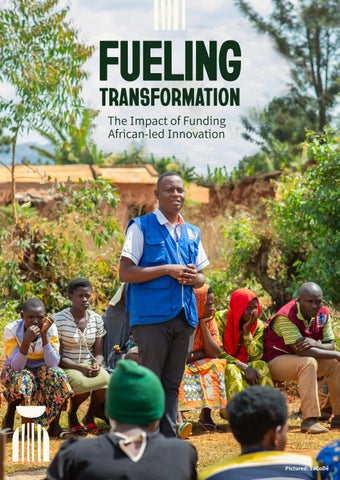
TRANSFORMATION FUELING


The Impact of Funding


African-led Innovation


Pictured:
table of contents

Introduction
Methodology
Insight 1
Insight 2
Insight 3
Executive Summary WHY AFRICAN LEADERSHIP DELIVERS SUPERIOR RESULTS A FUNDING MODEL DESIGNED FOR ORGANIZATIONS TO THRIVE A MOVEMENT TO INVEST IN AFRICA’S VISION FOR AFRICA’S FUTURE
The Path Forward
Acknowledgements
References
Appendices
Africa’s most brilliant social impact leaders are already transforming their communities with innovative, locally-driven solutions that prove locally-led development works. These leaders don’t need imported solutions; they have the expertise, innovation, and deep community trust to drive lasting change. What they need is investment in their proven models and the power to lead their own development.
Since launching in 2020, African Collaborative (formerly African Visionary Fund) has tested a bold hypothesis: that flexible, trust-based funding to African-led organizations would unlock greater impact and shift deeply entrenched power dynamics in philanthropy. We have funded 35 organizations across 13 countries, with $8.4 million committed in unrestricted, multi-year grants.
$8.4M
$9.5M
The results speak for themselves. Our partners alone have impacted 15.4 million lives over the past four years by improving maternal and child health outcomes, improving young people’s access to education, and increasing income to youth farmers—amongst many other impactful solutions across multiple sectors.
Even more remarkable is how our partners turn small investments into exponential impact. Over the course of a three-year partnership, our partners grew their annual budgets by an average of 170% from baseline to endline. During that same time period, they grew the reach of their impact by an average of 1,125%. When African-led organizations are given flexible resources and the power to lead, impact returns multiply.
Our partners also grew their impact with increased efficiency. In 2021, every $1,000 we invested helped our partners reach 143 people. By 2024, that same $1,000 reached 264 people, nearly double the impact with the same resources through improved systems, stronger teams, and refined delivery models. Our partners have proven that they are investment-ready by turning unrestricted grant dollars into accelerated impact and more lives changed.
While our partners drove exponential impact, we utilized our networks and platform to promote their work and crowd-in $9.5 million in new external funding to support and sustain their growth. For every $1 we have invested in our partners, we have leveraged an additional $1.12 in new funding from other funders. This is a $2.12 return on each dollar we invest. This is proof that our model works—connecting funders, elevating partners, and opening doors to new funding opportunities.
THE MOST EFFECTIVE SOLUTIONS FOR AFRICAN DEVELOPMENT DON’T NEED TO BE IMPORTED OR INVENTED; THEY JUST NEED TO BE INVESTED IN.
Our unique value proposition is clear: African-led organizations are not just capable, they are critical for sustainable development. When given trust, time, and flexible resources, they deliver lasting solutions at a fraction of the cost of traditional development approaches.
This report explores the evidence and stories behind this impact. Through the exploration of three core insights, we document our journey and the transformative potential of trusting African leadership. Together, we will push this movement forward, because the future of sustainable development depends on it.

INTRODUCTION
Sub-Saharan Africa’s nonprofit leaders are at the helm of some of the most exciting and innovative solutions in the development landscape, driving progress on a continent that will one day represent nearly half of the world’s population.
Africa is home to some of the world’s fastest growing economies, creating unprecedented pathways to improve livelihoods through job creation and expanded access to education and healthcare. The continent already counts over 500 million internet users, powering digital inclusion at scale. University enrollment has more than doubled in the past decade, fueling a generation of bold thinkers and builders. The development challenges on the continent are profound, but so are the opportunities—and Africa is shaping the future of global development.
And yet, for too long, African development has been shaped by distant donors and implemented through costly International Non-Governmental Organizations (INGOs). Less than 1% of the $187 billion in Official Development Assistance in 2018 went directly to local development actors, and by 2021, only 0.4% of all humanitarian aid reached Local and National Non-Governmental Organizations directly (Development Initiatives, 2023). Meanwhile, according to The State of Global Giving by U.S. Foundations, only 12% of philanthropic dollars from the United States went directly to local organizations between 2011 and 2015, a figure that barely increased to 13% between 2016 and 2019.

The deeply-entrenched exclusion of local actors from funding architecture is both inequitable and ineffective. When crises occur, it is local organizations that move fastest, adapt quickest, and stay closest to their communities. African organizations have proven time and again that they are more sustainable, resilient, and responsive than their foreign and international counterparts.
The global development community is at a critical crossroads. Millions of dollars of funding have ‘disappeared’ overnight with devastating impact, leading to staff cuts, job losses, downsizing or closure of programs that people depend on. But being at a crossroads means we can choose a new way forward. We have an opportunity to build a new system, one that shifts focus to Africanled organizations delivering real, lasting solutions.
THE URGENCY FOR CHANGE HAS NEVER BEEN GREATER, AND THE BRILLIANCE OF AFRICAN-LED ORGANIZATIONS HAS NEVER BEEN MORE CLEAR.
Between 2021 and 2024, African Collaborative raised over $10.9 million and committed $8.4 million to prove fundamental truths about how development works best when power and resources flow to those closest to the issues. This report documents the insights gathered from a mixed methodology approach to understanding our four-year impact.
At the heart of this report are three core insights that together point to a transformative vision for African development:

The first explores how our funding model helps organizations thrive by tracking the journeys of our first two cohorts of partners.
The second offers empirical evidence that highlights the power and necessity of African leadership in shaping sustainable development across the continent.
The third captures the impact of our contributions to a growing movement to invest in Africa’s own vision for its future.
These insights converge in the Path Forward, which offers practical recommendations and calls to action emerging from these insights.
The evidence presented in this report demonstrates that with African Collaborative’s trustbased and equity-centered model, locally-led transformation is predictable, replicable, and accelerating with each cohort of partners we fund. This consistency across different organizations, countries, and sectors proves that proximity, trust, and flexible resources are not just moral imperatives, they are strategic advantages.

METHODOLOGY
A Mixed Methods Approach to Understanding Impact
Conventional impact evaluation frameworks in philanthropy have long privileged donor priorities, extracting data by imposing external and biased definitions of success that often ignore local realities and community values. As a result, they miss the systemic, people-centered transformation that African-led organizations create— like restored dignity, rebuilt social cohesion, and preserved indigenous knowledge (Equitable Evaluation Initiative, 2017).

At African Collaborative, we recognized early that traditional evaluation frameworks are not neutral; they are acts of power that often reinforce the very inequities we seek to address. Therefore, we developed a mixed methods evaluation approach that deliberately disrupts these power dynamics. Our methodology represents a rigorous, multi-dimensional approach to understanding the true impact of trust-based, flexible funding on African-led organizations.
Our methodology triangulates multiple forms of evidence while centering our partners’ voices and experiences as the primary source of truth. This isn’t just about being inclusive; it’s about recognizing that those closest to the work possess the deepest understanding of what change looks like and how it happens.
Research Design and Framework
We employed a longitudinal mixed methods design spanning four years (2021-2024), combining quantitative metrics with rich qualitative insights to capture both the breadth and depth of our partners’ transformation. This approach intentionally inverts traditional evaluation hierarchies: rather than imposing external frameworks and checking for compliance, we start with partner-defined success and build our understanding outward from there. This allowed us to track not just what changed, but how and why these changes occurred, providing critical insights into the mechanisms that make African-led development so effective.
Drop
PARTNER-CENTERED EVALUATION
Partners define their own success metrics rather than conforming to externally imposed indicators. For example, Rays of Hope measures teacher confidence levels alongside test scores while ACADES tracks youth business sustainability and not just job creation. This recognizes that communities themselves are the ultimate experts on their own transformation.
WAS GUIDED BY THREE CORE PRINCIPLES
ADAPTIVE LEARNING
Our approach evolved based on partner feedback and emerging insights, treating evaluation as a tool for collective learning rather than judgment.
TRIANGULATION FOR VALIDITY
Multiple data sources validate findings and ensure we are not just seeing what we want to see, while also acknowledging that ‘objectivity’ itself is a construct that often masks whose perspective is centered.
Data Gathering & Analysis
For more detail on how we gathered and analyzed our quantitative and qualitative data, please see Appendix A: Methodology. It outlines the multiple methods we employed—including impact and reach metrics, financial health and organizational capacity indicators, leveraged funding analysis, partner reflections, organizational development grant surveys, in-depth interviews, site visits, and external research—that allowed us to capture both the numbers and the stories, strategies, and systemic shifts behind them.

A FUNDING MODEL DESIGNED FOR ORGANIZATIONS TO THRIVE
Transforming Philanthropy Through Trust-Based Funding
African Collaborative’s model is simple but revolutionary: we provide catalytic funding to African-led organizations, coupled with tailored support that respects their expertise and amplifies their impact. Every grant we make represents a bet on African expertise, recognizing that those with lived experience and deep-rooted knowledge build programs that create lasting impact. We define our impact by how well we support African-led organizations to achieve their own goals. Our unrestricted funding paired with multi-year commitments allows organizations to invest in their teams, respond to emergencies without bureaucratic delays, seize unexpected opportunities, and plan for long-term sustainability. Scale, for us, means enabling partners to deepen or expand their impact in ways that fit their communities.
We represent a powerful model within the growing landscape of 40+ philanthropic collaboratives operating across the African continent; entities co-created by three or more independent actors that pool resources and employ structured governance to achieve social impact (The Bridgespan Group, 2023). As one of these collaboratives, we exemplify how this model can shift power and resources to those best positioned to create lasting change.
The evidence detailed in this section is compelling. By investing directly in African-led organizations and providing catalytic funding, we are seeing stronger outcomes that compound over time. Our partners don’t just deliver services, they transform systems— influencing national policies, securing government adoption of their innovations, and strengthening local capacity that sustains impact beyond any funding cycle.
Living Our Values Through Operations
Our approach rests on five foundational pillars that work together to create systemic change (see Figure 1).


OUR THEORY OF CHANGE
PILLARS
Our operational approach embodies the change we seek in the broader philanthropic ecosystem:

Radical Accessibility in the Application Process:
Our Open Application System expands access to funding beyond traditional referrals, allowing applicants to showcase their work and impact early in the process. This transparent, techenabled platform also serves as a pipeline database for peer funders to meet organizations with a demonstrated impact in delivering deep, community-rooted change across the continent.
Power Sharing Through Participatory Grantmaking:
Our annually-rotating participatory grantmaking committee, composed of African leaders including current partners, shapes both our strategic direction and partner selection. This peer-led process ensures those who understand the realities of leading African organizations have a meaningful voice and vote in who receives support.
Unburdensome Processes:
We have eliminated burdensome reporting requirements, because partners can’t simultaneously fill out endless reports and deliver their missions effectively. Instead, partners define their own success metrics, transforming accountability from compliance into a tool for growth and learning.
Bespoke Portfolio Services:
During partnership, our support services are tailored to address our partners’ specific requests, ensuring that our support is relevant and effective. We constantly refine our approach to maximize impact, guided by ongoing partner feedback.
Fostering Connection and Collaboration:
As a distributed network across multiple countries and time zones, we prioritize intentional connection with and between our partners. We facilitate quarterly partner community calls, cover the costs of in-country meet-ups, and prioritize in-person community-building events at global convenings, ensuring that collaboration extends beyond virtual touchpoints.
Following our Partners’ Lead:
We co-design site visits that follow partners’ lead, share costs that other funders rarely cover, and focus on learning rather than inspection. Our approach is grounded in respect for partners’ time and expertise. As Wendo Sahar from Dandelion Africa noted, “We really appreciated that you just wanted to walk with us through our day and not disrupt the work.”
From Vision to Reality: Our Proven Track Record
Between 2021 and 2024, we disbursed $8.4 million to 35 organizations across 13 countries, each receiving $60,000 annually plus an additional $15,000 organizational development grant. This investment has catalyzed remarkable growth: our partners have collectively reached 15.4 million individuals, with our first cohort achieving an astounding 936% average growth in impact reach over our three-year partnership.
A MODEL FOR GROWTH: COHORT 1’S JOURNEY
African Collaborative launched our first cohort of six portfolio partners in January 2021. In 2020, BarefootLaw, Dandelion Africa, Rays of Hope, SaCoDé, Shule Direct, and Wezesha Impact had collectively reached 875,084 individuals through their programs to advance educational opportunities, promote reproductive health rights, foster economic empowerment, and provide free legal services. Many Cohort 1 partners invested their first grants in core infrastructure, strengthening financial systems, hiring key staff, and developing strategic plans. This foundation enabled the remarkable growth that followed.
In four years, and with African Collaborative’s support, these partners grew their programs, developed innovative new solutions, grew their operating budgets by an average of 170% and revenue by 133%, and expanded their impact to more than 3.3 million individuals across Kenya, Malawi, Burundi, Tanzania, and Uganda.
ACROSS COHORTS 1 & 2 Summary Growth Data
Cohort 1
Cohort 2
Cohorts 1 & 2
Table 1
Summary Growth Data Across Cohorts 1 & 2: Comparative data showing average impact growth, budget growth, and revenue growth from baseline to endline for Cohort 1, Cohort 2, and combined cohorts, demonstrating the accelerating effectiveness of the African Collaborative model.
Our partners’ transformation illustrates our model’s power:
TRANSFORMATION JOURNEY CASE STUDY 1
FROM GRANTS TO GROWTH: COHORT
1’S
Shule Direct
Reached 484,284 new unique users on their digital learning platform, with 41.9% being female students. They started using Artificial Intelligence (AI) on the continent before AI became popular and were well ahead when it came to incorporating digital technologies in education. They joined the Bill and Melinda Gates Foundation’s Strategic Development Program alongside nine other African organizations. Celebrating their 10th anniversary in December 2023, their growth from reaching thousands to nearly half a million users demonstrates their ability to scale innovative digital education solutions across Tanzania.

Rays of Hope

Established 8 production centers that manufactured 366,045 Agateka sanitary pads, creating 189 jobs for underprivileged women. They have reached 109,970 women with sanitary pads and educated 206,247 women and youth on sexual and reproductive health. Their work includes 1,874 Village Savings and Loan Associations with 56,205 members. SaCoDé is writing a chapter about menstrual health for inclusion in the national curriculum in partnership with the Ministry of Education. With unrestricted multi-year funding they opened a field office in Muyinga to serve remote communities, scaling production of sanitary pads to reach over 100,000 women annually.
Their Teaching at the Right Level program has been integrated into 48 government schools, achieving 100% pass rates for their students versus 60% nationally. They have trained 5,300 public primary school teachers, reaching 350,400 learners across 242 primary schools. Moving up 14 ranks in the Blantyre educational district (from 34 to 28), Rays of Hope Academy scored 2nd position in the region. The Ministry of Education endorsed their teacher training curriculum, and they support 450 secondary school students with scholarships. Additionally, 70% of the 222 youth they trained in 2024 have established businesses.

WEZESHA IMPACT
Commissioned an external evaluation to assess the impact of its program on graduates, comparing them to a control group of similar youth who did not participate. The findings were striking: 88% of graduates are now working, compared to 71% in the control group. On average, they earn $25 more per month, adding up to about $300 extra each year. Women have seen the most dramatic changes; their incomes have risen by 76%, compared to a 27% increase for men. Beyond their own employment, graduates are helping to drive local job creation. In the two years after completing the program, they hire an average of 1.8 people, more than double the 0.8 hired by the control group. These jobs are also more inclusive, with graduates twice as likely to employ women, young people, people with disabilities, and those who have been displaced.


BarefootLaw
Dandelion Africa
Expanded their footprint beyond Their Backpack Nurses model has reached 202,195 people with primary healthcare, while 180,460 women and youth received contraceptives. They have helped 4,123 women launch businesses through savings groups. Dandelion successfully advocated for waived police filing fees for GBV survivors and signed a Memorandum of Understanding with Nakuru County, in Kenya, to scale their health initiatives. They achieved a 96% school transition rate for girls (up from 45% in 2014), with 36 villages declaring themselves 100% FGMfree. This is even more impressive considering they developed an autonomous scaling model that maintains deep community ownership while expanding to new sites.

Expanded their footprint beyond Uganda to having activities in Kenya, Zambia and Malawi. By 2024, they served 1,001,297 people, with their digital platforms receiving 9 million content accesses. Their BarefootLaw Boxes serve as community access points for mediations, legal assistance, and community sensitization sessions. They partnered with Uganda’s Chief Justice who committed to promoting access to justice, and sponsored a legal aid innovation network conference bringing together private, public and social sector actors. Their satisfaction rate increased from 65% in 2023 to 78% in 2024.
THE PATTERN REPEATS: COHORT 2’S ACCELERATING TRAJECTORY
The transformative journey we witnessed with Cohort 1 is not an anomaly, it’s a replicable pattern now emerging across subsequent cohorts. Our second cohort of partners, who joined our portfolio in December 2021, is following a strikingly similar growth trajectory that validates our model’s consistency.
Over our three-year partnership from 2022 to 2024, these eight organizations have achieved extraordinary results. They grew in two important ways: individually experiencing an average growth in their impact reach of 1,313% and expanding their collective reach by 1,554%, growing from serving 107,040 people in 2021 to an impressive 1,747,234 in 2024. Alongside this impact growth, they strengthened their organizational foundations and leveraged new platforms to grow their annual budgets by an average of 170% and their annual revenue by an average of 141%.
These numbers are remarkable, especially when compared to Cohort 1’s already impressive trajectory. While Cohort 1 achieved 936% average impact growth over four years, Cohort 2 has already surpassed that benchmark with 1,313% average impact growth in just three years. This acceleration suggests our model is not only replicable but actually improving as we evolve and our ecosystem matures.
Year
Figure 2
1 & 2
cohort 1 total reach first year of partnership
cohort 2 total reach first year of partnership
Cohort Growth Trajectories Comparison: Comparative analysis showing the impact growth patterns of Cohort 1 (2021-2024) and Cohort 2 (2022-2024), demonstrating accelerating growth trajectories with each successive cohort.
These numbers are remarkable, especially when compared to Cohort 1’s already impressive trajectory. While Cohort 1 achieved 936% average impact growth over four years, Cohort 2 has already surpassed that benchmark with 1,313% average impact growth in just three years. This acceleration suggests our model is not only replicable but actually improving as we evolve and our ecosystem matures.
The individual journeys within Cohort 2 reveal the transformative power of sustained, flexible support:
ACCELERATION THROUGH
ECOSYSTEM MATURITY:
2’S TRAJECTORY CASE STUDY 2
COHORT
AkiraChix is rewriting Africa’s tech narrative through their codeHive program, which has demonstrated remarkable outcomes across six graduating cohorts from 2019-2024. Their graduates achieve 76% employment within 60 days, earning 3.3 times more than peers who did not participate in the program. What makes their success particularly striking is the specialization advantage: graduates in AI, data science, and machine learning roles earn 4.9 times more than those in general software engineering positions, with the highest earner in 2024 reaching $1,900 monthly income within just 180 days of graduation. Beyond immediate employment success, their model generates extraordinary returns on investment—graduates earn back their training costs by year two and up to 15.7 times the investment by year ten.

Impact Growth Becomes A Repeated Pattern

AKIRACHIX
Friendship Bench is a powerful example of transformation, growing from reaching 54,486 people to an astounding 925,040, while simultaneously scaling their model internationally to the United States and the United Kingdom. Since 2006, they have reached 776,876 clients across 10 provinces in Zimbabwe through 890,688 therapy sessions delivered by 2,773 trained community health workers, primarily grandmothers. Their model achieves remarkable clinical outcomes: 78% of clients show improvement in depression and anxiety symptoms, with 60% reporting improved quality of life.
FUNDI BOTS

Fundi Bots also underwent a dramatic transformation, expanding from serving 10,457 individuals in 2022 to reaching 30,999 in 2024, representing a 196% growth. Their Enhanced Science Curriculum demonstrates how African organizations can transform entire education systems through locally-designed innovation. Since 2016, they have trained 70,311 students (53% female) and 1,641 teachers across 235 schools in four regions of Uganda, achieving remarkable results: In 2023, 90% of students in Fundi Bots-supported schools scored in the top divisions on national examinations, compared to just 57% nationally.
This Ability’s journey from 23,466 to 261,241 program participants, a 1,013% increase, demonstrates how intersectional advocacy creates both immediate impact and systemic change for marginalized communities. Since 2012, they have built Kenya’s first comprehensive support system for women and girls with disabilities, with their Mama Siri toll-free service making over 24,562 referrals and achieving 26 confirmed convictions in human rights violation cases. Their technology platforms span 13 counties, with Hesabika registering over 33,000 users while their Skills platform has trained 187 healthcare providers.

THIS ABILITY

Kidame Mart showcases how market-driven models can simultaneously serve underserved communities and empower women economically. Their network of 6,000 rural female entrepreneurs has reached 4.5 million customers across 200 locations in six Ethiopian regions, delivering quality consumer goods that were previously 50-75% more expensive in rural areas.
MSICHANA INITIATIVE

Msichana Initiative doesn’t just respond to systemic barriers, they dismantle them entirely. Since 2016, they have mobilized 287,841 people to advocate for girls’ rights across Tanzania, achieving transformative legal wins including raising the marriage age from 14 to 18. Their comprehensive approach spans 44 community platforms reaching over 46,000 members, 1,000 bicycles distributed to girls living far from school, and recent success securing government commitment to waive excise duties on sanitary pad production.
WAVE drives employment innovation at scale. Their screen-trainmatch-support model has equipped over 8,000 Nigerian youth with employability skills, achieving over 84% job placement rates while increasing participant incomes by 31% year-overyear. Beyond individual transformation, they have trained over 875 hiring managers in skills-based recruitment and engaged 40 policymakers in competency-based education reform.
ACADES

WAVE

ACADES showcases how youth-led agricultural innovation can transform entire value chains. Since 2015, they have served over 49,000 people across 287 communities in Malawi, with 11,397 farmers reached in 2024 alone. Their integrated model achieves impressive results: 78% of farmers increased their incomes, 96% loan repayment rate, and 46% productivity improvements. Beyond individual farm success, they launched AI Farmer—an artificial intelligence platform delivering realtime agricultural extension services—while chairing the youth arm of Malawi’s 2063 National Planning Committee.
Connecting Funders to Extraordinary Organizations
Our collaborative model does not just fund and support our partners, it’s transforming how philanthropy finds and funds African-led organizations ( see Case Study 3 ). A critical component of our work is in supporting partners to unlock new opportunities and build credibility with other funders. Through strategic introductions, advocacy, and amplifying partner stories, we’ve watched our partners grow in visibility and attract aligned support.
Our unique approach has helped partners unlock an additional $9.5 million in funding from other sources, a return of $2.12 for every dollar we have invested. Remarkably, 73% of this leveraged funding was unrestricted, 71% was multi-year, and 51% was both unrestricted and multi-year, demonstrating how our model influences broader funder behavior toward trust-based practices. This leveraged funding multiplier effect tells a powerful story about changing funder attitudes and demonstrates how trust-based approaches can catalyze broader shifts in philanthropic practice.
The impact of this approach extends beyond grants. Partners consistently report that African Collaborative’s support has transformed how other funders engage with them. As Hastings Nhlane from ACADES noted, “ Most of our current funders began funding us after African Collaborative. African Collaborative has provided a platform where funders are noticing us and trusting us more .”
“African collaborative’s support has been a game-changer for us, but what’s truly remarkable is the ripple effect it’s had. Their unrestricted, multi-year funding hasn’t just empowered our work, it’s also opened doors to new partnerships and funding opportunities. By journeying with us and serving as a trusted reference, they’ve helped other funders gain confidence in our model, paving the way for additional support and amplifying our impact.”
Figure 1
The Multiplier Effect - How African Collaborative Investment
Unlocks Additional Funding: This visual demonstrates how African Collaborative’s investment unlocks additional funding, creating a $2.12 return for every dollar invested.
CASE STUDY 3
A FUNDER’S PERSPECTIVE:
WHY WE INVEST IN AFRICAN COLLABORATIVE
FUNDER: SCHOONER FOUNDATION SECTOR FOCUS: MULTI-SECTOR
THEME: PHILANTHROPIC ALIGNMENT & SUPPORT FOR LOCALLY-LED CHANGE
“African Collaborative presents a remarkable opportunity to support visionary local leaders and broaden our network across Sub-Saharan Africa. Our relationship with the AC team continually inspires us to discover new ways of connecting more deeply with community-rooted organizations. Time and again, African Collaborative has surfaced exceptional initiatives driving transformative change across the continent while serving as trusted advisors as we navigate an increasingly complex philanthropic landscape. It is difficult to imagine our portfolio without their insight, partnership, and unwavering vision.
This partnership exemplifies the power of collaborative funds as essential bridges between international funders and african-led organizations—reshaping not only the flow of resources but also our collective understanding of what truly defines effective, locally grounded development.”
JULIA PETTENGILL
EXECUTIVE DIRECTOR
KEY LEARNINGS
AFRICAN COLLABORATIVE’S ACCELERATION EFFECT
Our first cohort of partner organizations have grown exponentially over four years with African Collaborative’s support. And yet Cohort 2 is achieving faster and more sustainable growth than Cohort 1, with seven of eight organizations achieving triple-digit or greater impact growth. This data reveals something profound about the evolution of our model. This is the result of compound learning and ecosystem effects. This acceleration happens because each successive cohort enters a more mature ecosystem. Our support systems have been refined based on lessons learned, making our support more targeted and effective. Our newer partners benefit from an environment increasingly receptive to African-led solutions, and they learn directly from earlier cohorts, accessing tested strategies and avoiding common pitfalls.
KEY LEARNINGS
TRUST MAKES THE AFRICAN COLLABORATIVE MODEL WORK
Trust revolutionizes how we fund. Our model succeeds because it addresses fundamental flaws in traditional philanthropy. It trusts rather than controls, allowing partners to adapt to changing circumstances without seeking permission. It adapts rather than imposes, recognizing that solutions must emerge from communities rather than being imported. It partners rather than directs, respecting the expertise and leadership of those closest to the challenges. The results prove that when you combine trust and flexible resources, extraordinary things happen. By positioning ourselves as facilitators rather than gatekeepers, we are helping build a new social impact system fueled by locally-led solutions.
EQUITY IS IMPERATIVE IN A SHIFTING LANDSCAPE
In a climate where concepts of funding equity have become contentious, we reframe the conversation around evidence: proximity drives innovation, trust enables efficiency, and African leadership delivers results. These aren’t ideological positions, they’re documented outcomes. This isn’t just a funding model; it’s a blueprint for how investing in African leadership is the smartest development strategy available.
THE COLLABORATIVE ADVANTAGE
The collaborative model offers unique benefits that individual funders struggle to achieve. As Bridgespan notes, collaborative funds provide three core advantages: efficiency (navigating due diligence, logistics, and risk), effectiveness (proximity to communities and capacity), and engagement (donor learning journeys). Through our model, donors who might lack deep African networks of local organizations or on-ground expertise can efficiently channel resources to vetted, high-impact organizations while building their own understanding of African development contexts. Our model creates the infrastructure donors need to move funding to local organizations, fast.
WHY AFRICAN LEADERSHIP


THE FUTURE OF SUSTAINABLE AFRICAN DEVELOPMENT IS AFRICAN-LED
African-led organizations deliver extraordinary results when given adequate resources, and the trajectory of African Collaborative’s partners reveals the compounding effect of sustained, flexible support. What began with just 6 partners has grown into a powerful network of 35 organizations achieving systemic change over four years. Each year has built upon the last, with partners using unrestricted funding to strengthen foundations, test innovations, and scale successes.
The sustainability of African-led development extends well beyond project lifecycles, creating lasting change through local talent and ownership. By developing their own expertise, communities build cost-effective solutions rooted in local knowledge, with programs that endure because they emerge from within rather than being imposed from outside. The result is community-rooted, sustainable, and scalable models that reshape entire systems.


Gender Mobile Initiative
AFRICAN-LED ORGANIZATIONS ARE ROOTED IN COMMUNITY
African-led organizations maintain accountability where it matters most, to their communities rather than distant donors. This downward accountability creates a fundamentally different development dynamic where success is measured not by donor satisfaction but by community transformation, ensuring that power flows from those served rather than those who fund.
Our partners consistently report reaching populations that remain invisible or inaccessible to international organizations through relationships built over years, not months. They operate through existing social networks, speaking local languages and understanding unspoken cultural norms that determine whether communities embrace or reject development initiatives:
COMMUNITY ROOTS AS COMPETITIVE ADVANTAGE CASE STUDY 4
Ciyota
Friendship Bench
Msichana Initiative
THEME: WHY PROXIMITY ENABLES ACCESS, TRUST, AND INNOVATION SECTORS: REFUGEE SUPPORT, MENTAL HEALTH, GIRLS’ RIGHTS,
When CIYOTA supports refugees in Uganda, they are not just delivering education programs; they are restoring dignity and providing a beacon of hope for displaced families who see in CIYOTA’s leaders their own potential realized.
When Friendship Bench trains grandmothers to provide mental health support on park benches in Zimbabwe, these women become more than counselors; they become the guardians of their community’s emotional wellbeing, the keepers of cultural wisdom, and living proof that healing comes from within.
Msichana Initiative’s 2016 court victory raising Tanzania’s marriage age from 14 to 18 represents one of Africa’s most significant legal victories for girls’ rights. The national policy change protects an estimated 5.2 million girls over the next decade. Girls who would have married at 14 are now completing secondary education and entering universities.
Our partners are stability anchors in contexts where government services are inconsistent and international organizations come and go. When floods hit, when droughts strike, when pandemics spread, when political upheaval threatens, it is these organizations that communities turn to first, not because they have the most resources, but because they represent continuity, belonging, and shared destiny. This integration ensures sustainability beyond any funding cycle, as solutions become part of the institutional fabric rather than parallel systems dependent on donor support. As one community member told Wandikweza during a recent clinic visit:
“YOU ARE NOT VISITORS HERE. YOU ARE US. WHEN YOU SUCCEED, WE ALL RISE.”

FOR AFRICAN-LED ORGANIZATIONS, PROXIMITY BEGETS INNOVATION
African-led organizations possess what we call the ‘proximity advantage’—they see problems earlier, test solutions faster, and innovate more cost-effectively because they’re embedded within the communities they serve. Resource constraints become catalysts for creativity, leading to breakthrough models that international organizations later adopt.
With flexible funding, our partners have pioneered approaches to scale and systemic transformation that challenge conventional development wisdom and reshape entire sectors, from education and healthcare to agriculture and technology. The freedom to experiment, fail, learn, and pivot has proven that innovation thrives when proximate leaders are trusted to implement their ideas without the constraints of rigid and bureaucratic project frameworks.
The trajectory of transformation follows a clear pattern across our partners. In the early days of 2021, most partners focused on establishing core systems and testing innovative approaches. By 2022, many organizations reported breakthrough moments such as their first government partnerships, initial technology pilots, and early evidence of scalable models. The 2023 data showed these seeds bearing fruit, and by 2024, these same organizations were influencing national policies, scaling across regions, and attracting significant co-investment from other funders.
MJUMITA
This pattern results in deep, systemic change, which we define as a fundamental and significant transformation in the structure, functioning, or behavior of a system:
FROM INNOVATION TO SYSTEMS CHANGE CASE STUDY 5
THEME:HOW PROXIMITY ENABLES DEEP, SYSTEMIC CHANGE
PARTNERS: KEEP LIBERIA, ACADES MALAWI, HELPMUM NIGERIA
SECTORS: EDUCATION, AGRICULTURE, HEALTH
KEEP LIBERIA is playing a leading role in shaping national education policy in collaboration with Liberia’s Ministry of Education. The organization has been entrusted with revising three key national education tools: the National Student Handbook, National Reading Standards, and National School Administrator’s Guidebook. These policies are designed to enhance student learning, improve literacy, and strengthen school leadership across the country. KEEP is coordinating with a wide range of stakeholders, including public, private, and faith-based education systems, to ensure the policies are inclusive and grounded in local realities. In addition, KEEP has created 46 mini libraries across the country to promote the culture of reading. They have also published seven children’s books, five of which are officially listed as supplementary readers on Liberia’s national curriculum.
ACADES in Malawi showcases technological leapfrogging that is rewiring agricultural systems and markets to benefit young farmers. Building on years of agricultural extension work, they expanded to serve 61,325 farmers while pioneering AI-powered agricultural advisory services . This innovation, made possible by flexible funding that allowed experimentation, positions them at the forefront of AgTech in Africa.
HELPMUM in Nigeria illustrates impact at scale, with AI-powered maternal health solutions that have reached 500,000 pregnant women and nursing mothers in just two years. Their Whatsappintegrated MamaBot and VaxBot platforms reach over 200,000 users, and their Vaccination Tracker has over 380,000 registered users. The organization is pioneering API-based scaling through partnerships with peer organizations, government, and private companies—demonstrating how African innovations can serve both local and global markets.
THESE PARTNERS ARE BUILDING ON GOVERNMENT INITIATIVES, STRENGTHENING INSTITUTIONS, AND LEADING SYSTEMIC TRANSFORMATION. THIS DIRECT ENGAGEMENT WITH STRUCTURAL CHALLENGES IS ONLY POSSIBLE ONLY THROUGH DEEP LOCAL LEGITIMACY.
AFRICAN-LED ORGANIZATIONS ACCELERATE
ORGANIZATIONAL EFFICIENCY
When we began tracking our Cohort 1 & 2 partners’ impact-to-revenue efficiency from their baseline year (Year 0) through their partnership journey, a compelling pattern emerged. At baseline, before joining our portfolio, partners generated 0.126 individuals impacted for every dollar raised. This efficiency improved to 0.150 in their first full year of partnership, representing a 19% increase that demonstrates the immediate benefits of trust-based, flexible funding.
The journey tells an even richer story. Partners experienced a strategic dip in Year 2, with efficiency declining to 0.111, a 26% decrease that reflected crucial operational and infrastructural investments. This temporary reduction represents the kind of long-term thinking that restricted funding rarely allows. Many partners used this period to upgrade their financial systems, invest in staff training, and strengthen their governance structures—foundational work that positioned them for sustainable growth.
The payoff came dramatically in Year 3, when efficiency surged to 0.200, an 80% increase from the previous year and a 59% improvement from baseline. This demonstrates that our partners weren’t just growing incrementally but fundamentally reimagining how they operate.
This accelerating efficiency curve proves that our ecosystem approach creates compound returns. The partnership journey shows a clear trajectory—initial improvements and strategic investments enabled by unrestricted resources, then exponential efficiency gains as those investments bear fruit. The result is African-led organizations achieving unprecedented impact with their available resources through a transformation process that unfolds over multiple years rather than single funding cycles.
Their efficiency is further amplified by extensive volunteer networks, which EPIC-Africa’s 2023 research identifies as fundamental to African CSOs that operate with small staff and modest budgets. These volunteers bring not just labor but community ownership, cultural knowledge, and deep local networks that multiply each staff member’s impact. In Burundi, for example, Faith in Action has supported 31,026 community members to establish self-help groups with over 26,000 of these members establishing income generating activities. These groups meet weekly to contribute money, which they loan to each other, with a portion allocated to support vulnerable children in the community. Beyond financial support, group members identify individuals needing help, such as counseling, and encourage them to join, guiding them toward better family harmony.
Faith in Action’s community-driven efficiency model creates a multiplier effect—each dollar invested reaches far beyond direct beneficiaries through community networks that cost nothing to maintain but deliver invaluable social support. It demonstrates that African-led organizations achieve more with less—not by cutting corners, but by leveraging every asset to create lasting transformation— from community relationships to local expertise.
Cohort 1 &2 Impact-Revenue Efficiency
Figure 4

% growth impact-revenue
impact per dollar of revenue
Impact-to-Revenue Efficiency by Year of Partnership
This graph tracks the impact-to-revenue efficiency ratio across the partnership journey, showing how partners achieve 0.126 individuals impacted per dollar at baseline, dip to 0.111 in Year 2 during strategic investments, then surge to 0.200 in Year 3.
African-Led Organizations
Challenge Traditional Philanthropy Dynamics
The rise of African-led development fundamentally challenges decades of aid orthodoxy and its disappointing results. When African-led organizations are subcontracted by international NGOs to implement projects, they receive minimal budgets that are not realistic for implementation while the INGOs retain the highest amount of money for their administration. This extractive model means communities receive cents on the dollar while bearing all the implementation burden. Our partners create systems-level change with annual budgets often under $1 million, matching the quality of international NGOs that operate with far larger budgets.
However, the power dynamics of development are shifting as African organizations prove their superiority in delivering results. EPIC-Africa’s research confirms that “power relations with funders appear to be shifting as African CSOs demonstrate responsiveness, technical capabilities, and relationships with local communities” (EPIC Africa 2020). This shift is evidenced by Ray and Tye Noorda Foundation’s recognition that our partners match international NGO quality at a fraction of the cost (see Case Study 6).

ACADES
CASE STUDY 6
AC PARTNERS IN MALAWI
SHIFTING FUNDER PERCEPTIONS OF AFRICAN-LED IMPACT
PARTNERS: ACADES, WANDIKWEZA, AND RAYS OF HOPE COUNTRY: MALAWI VISITING FUNDER: RAY AND TYE NOORDA FOUNDATION (RTNF)
SECTORS: AGRICULTURE, HEALTH, EDUCATION
In 2025, African Collaborative facilitated a visit to Malawi that included government representatives and one of our funders, RTNF, to meet three of our Partners: ACADES, Wandikweza, and Rays of Hope. While not current RTNF grantees, the organizations left a strong impression on the visiting team, who praised their data-driven, cost-effective models and deep-rooted community leadership.
RTNF noted that despite operating with modest annual budgets (under $2M), all three partners had achieved meaningful systems change: ACADES is transforming youth livelihoods through agribusiness; Wandikweza is professionalizing community health delivery; and Rays of Hope is strengthening education quality and government systems through teacher training and literacy interventions.
What stood out most was the dignified, community-anchored approach of each organization, and the strength of their relationships with government. These partnerships are not only collaborative but also trusted—evidenced by formal government funding and integration into national systems. This level of alignment and confidence is rare and speaks to the credibility and long-term vision of AC partners.
The visit affirmed African Collaborative’s model as a powerful vehicle for surfacing high-impact Africanled organizations that are often overlooked by traditional funders. It also underscores the urgent need to bridge the funding gap for such organizations operating in the so-called “missing middle.”
“African Collaborative presents a spectacular opportunity to support local leaders and expand our network in Sub-Saharan Africa. Our relationship with the AC team helps us to learn new ways to connect more deeply with local organizations.”
JULIA PETTENGILL
Brittany Erikson INVESTMENT ADVISOR
RTNF expressed deep appreciation for the opportunity to engage directly with partners on the ground and encouraged future hosts to consider covering modest visit costs, noting that such experiences are invaluable for building trust, understanding local context, and fostering long-term collaboration.
SELECT PARTNER VOICES
IMPACT IN THEIR OWN WORDS
Direct testimonials from WHER (Nigeria), Wandikweza (Malawi), and Drop of Water (Ethiopia) illustrating the transformative impact of African Collaborative’s flexible, trust-based funding model.
WHER, NIGERIA
Advancing LGBTQ+ Rights

“African Collaborative’s flexible funding model allowed us to innovate and adapt to emerging challenges. This flexibility was crucial in responding to urgent needs within the LBQ-GNC community, such as organizing events for visibility and awareness. Their support went beyond just funding, it was a partnership that empowered us to build a sustainable and impactful organization.”
WANDIKWEZA, MALAWI Transforming Mental Health
“Through the African Collaborative grant, we achieved a major milestone with our certification for antiretroviral drug dispensation, expanding HIV treatment services. Our HIV testing and counseling programs reached 739 pregnant women and 2,313 general patients [in the first year], further strengthening prevention of mother-to-child transmission efforts.”
DROP OF WATER, ETHIOPIA
Returning to Tigray
“Having ceased operations in Tigray for the past six years, we had been actively seeking funding to return to that region, which is the birthplace of Drop of Water. Now we have resumed our operations and renewed our presence, allowing us to support the community after the devastating war that tragically cost more than half a million of lives in the region.”
WHER
KEY LEARNINGS
PROXIMITY AS POWER
The greatest strength of African-led organizations lies in their deep roots within the communities they serve. While international organizations might operate from a distance, African-led organizations are integral parts of their communities’ social fabric. This embedded presence creates unmatched advantages in trust and access. African-led organizations don’t leave when crises hit or funding cycles end—they stay, they adapt, and they build. For them, sustainable development isn’t a project with an end date; it’s their life’s work in their own communities. This proximity transforms African-led organizations into something far greater than service providers, they become the very fabric that holds communities together during crisis and calm alike.
LEVERAGING COMMUNITY ASSETS FOR COST-EFFECTIVENESS
African-led organizations demonstrate extraordinary operational efficiency, achieving transformative impact with limited resources. During COVID-19, EPIC Africa’s 2020 report revealed that despite half of African civil society organizations implementing cost-cutting measures, they maintained and often expanded critical services to their communities. This resilience stems from their lean operational models, which enable exceptional resource optimization and programmatic agility, as well as innovative community engagement models that leverage local knowledge and participation to run sustainable programs.

INNOVATION BORN FROM CONSTRAINT
Resource limitations have catalyzed extraordinary innovation among African-led organizations, producing models that international development agencies later rush to replicate. These aren’t just clever workarounds to resource constraints; they’re fundamentally better ways of creating lasting change, proving that innovation often emerges not despite limitations but because of them. The unrestricted funding provided by African Collaborative has unleashed this innovative potential, enabling partners to experiment, adapt, and pioneer new approaches without the constraints of rigid project frameworks.


A MOVEMENT TO INVEST IN AFRICA’S VISION FOR AFRICA’S FUTURE


Reshaping Global Philanthropy Through Thought Leadership and Advocacy
African Collaborative has emerged as an unwavering voice in the global movement to shift power and resources to African-led organizations. Through strategic engagements, publications (see Figure 5), and partnerships, we’ve moved from the margins to the center of critical conversations about the future of development and philanthropy.
Shaping Media Narratives in Major Publications

“8 Principles for Power-Sharing Development Funding” - Devex Op-Ed (March 28, 2024)


“African Visionary Fund: playing the game to change the game” - Alliance Magazine (July 6, 2021)


FIGURE 5
“How Traditional Philanthropy’s Obsession With Scale Too Often Excludes African Innovators”Skoll.org (September 2, 2022)
“Aid spending in Africa must be African-led – it needs a Black Lives Matter reckoning” - The Guardian (January 11, 2021)
“Foreign Aid Is Having a Reckoning” - New York Times (February 13, 2021)
African Collaborative’s Thought Leadership Platforms Key publications and media appearances that have positioned African Collaborative as a thought leader in the shift toward locally-led development, including op-eds in Devex, Skoll.org, Alliance Magazine, The Guardian, and The New York Times.
Over four years, our team participated in more than 50 speaking engagements, reaching thousands of funders, practitioners, and policymakers. Through these conversations, our advocacy has traced the arc of a system in transition—reimagining what global philanthropy can become when equity and proximity is at the center.
Some of these panels, keynote speeches, and workshops include:
2022 Building Community
2021 Building a Foundation
Exploring equity-centered and trust-based principles to better serve underfunded organizations.
Innovations in International Philanthropy Symposium
Learning to Get Proximal, Build Trust, and Develop Sustainable Relationships , featuring the leaders of our first cohort of partners, Gerald Abila of BarefootLaw and Faraja Nyalandu of Shule Direct
CNBC Africa
How to Address the Funding Inequity to African-led Organizations
Building new equity-driven networks and redefining what sustainable communityled impact looks like.
International Development Innovation Alliance
Innovating with an Equity Lens
CDD Funder Group Session
Redefining Scale , featuring Julius Mbeya of Lwala Community Alliance, Molade Adeniyi of WAVE, and Solomon King Benge of Fundi Bots.

African Philanthropy Forum Podcast
Understanding & Addressing the Imbalance in Funding African CSOs

2023

Building Strategies
Unearthing practical solutions for funding proximate African organizations.
Skoll World Forum

Chain Reaction: Localizing Value Chains to Drive Impact
Catalyst 2030’s Catalysing Change Week
Journeys on Intentionally Shifting Power
Philanthropy Together’s Global Summit of Collaborative Funds
Trends Emerging in Africa’s Collaborative Fund Landscape

2024
Building Momentum
Highlighting collaboratives as transformative vehicles for scaling partnerships and reimagining philanthropy in Africa.
Skoll World Forum
Collaboratives in Africa
Co-hosted by Gates Foundation and ELMA Philanthropies
We Give Summit
Collaborative Approaches to Scale Partnerships
African Philanthropy Forum
Philanthropic Collaboratives as a Pathway to Transformation
Atti Worku
Skoll World Forum 2024
Leveraging Major Global Forums for Partner Visibility
Our strategic presence at global forums has yielded tangible results for both African Collaborative and our partners. One of the most effective ways we have driven $9.5 million in leveraged funding to our partners is through ensuring their access to forums such as Skoll World Forum, UNGA Week, and other key philanthropy conferences. We have supported partners to attend the Skoll World Forum, which has proven to be a valuable platform for networking and fundraising. For example, Willie Mpasuka from Rays of Hope shared that although connecting with funders at Skoll was initially challenging, he has come to appreciate the value of attending repeatedly, as it has helped him build meaningful relationships that have led to funding.
Beyond direct funding, these platforms have elevated our partners from beneficiaries to recognized experts. Partners report that being introduced as ‘African Collaborative partners’ at these events immediately establishes credibility and opens doors that were previously closed. The cumulative effect is increased visibility that has led to speaking invitations, advisory positions, and partnerships that position African leaders as thought leaders rather than aid recipients.
Co-Creating New Standards: The IDIA Equity Framework
In 2023, we served as the Equity and Innovation Lead Learning Partner for the International Development Innovation Alliance, a platform of 14 of the world’s largest development innovation funders. As co-authors of the IDIA Equity Principles & Metrics Framework, we’ve contributed to a sector-wide shift toward direct funding, power-sharing, and accountability rooted in communitydefined outcomes (see Case Study 7).
Some of our own funding partners have shared the framework with their wider team as a resource for their greater equity and localization efforts. Katie Januario, Program Officer at the Conrad Hilton N. Foundation described it as a “great resource [for them] to learn from and support more localization efforts and power shifting .”
CASE STUDY 7
CO-CREATING NEW STANDARDS
THE IDIA EQUITY
FRAMEWORK
African Collaborative’s Partnership With 14 Major Development Funders To Create Practical Equity Principles Now Being Adopted Across The Sector For Institutional Transformation.
“African Collaborative were fantastic partners in the design and development of the International Development Innovation Alliance (IDIA)’s approach to integrating equity and inclusion across members’ policies and processes. They created the right environment for different kinds of actors from these agencies to contribute in different ways, and crucially, ensured the outputs and outcomes from those conversations were practical, actionable and feasible for agencies to start on their own journeys towards stronger, more meaningful E&I within their institutions.
We especially valued African Collaborative’s willingness to listen to where our agencies were at in their own E&I journeys, and without judgment, to help think through concrete steps towards moving E&I forward in their own organizations. The quality and usability of the materials produced are a testament to this collaboration. We look forward to continuing to collaborate in future as we advance E&I within IDIA and beyond.”
Thomas FEENY EXECUTIVE DIRECTOR
Catalyzing Funder Transformation
Our systems change work has yielded tangible results in funder behavior, and the IDIA learning partnership experience illustrates this catalytic role. The growing uptake of the framework by international donors shows that the values we champion—local leadership, equity, and systems change—are becoming core to the future of philanthropy. “It’s been exciting to see how funders, implementers and other IDIA communities have responded to the IDIA Equity Principles & Metrics Framework that we collaborated on with African Collaborative,” shares Jite Phido, IDIA’s E&I and Systems Innovation Lead
JULIA
PETTENGILL
“WE’VE SEEN IT USED TO CONTRIBUTE TO STRATEGY DEVELOPMENT, WITH THEIR STRATEGIC REFRESH. WE’VE ALSO SEEN IT BEING USED FOR ADVOCACY CHANGE, WITH UNICEF’S OFFICE OF INNOVATION SUPPORTING A DEVEX SERIES CONVERSATIONS TO ADVANCE ITS OBJECTIVES. WE’VE HAD ANOTHER MEMBER’S COLLABORATIVE DEVELOPED AS PART OF THIS WORK, TO STRENGTHEN EQUITY WITH PARTNERS; AND YET ANOTHER MEMBER
USED
THE FRAMEWORK TO
IDIA’S EXPLORATIONS, WE ARE CENTERING
THE FRAMEWORK IN OUR APPROACH POTENTIAL TO INSPIRE PRACTICAL,
This depth of connection transforms how funders engage with African development, and in other cases, our direct engagement with peer funders has led to substantial changes in funding practices and processes. As Doug Galen, CEO of Rippleworks, stated: “African Collaborative became invaluable to us in 2021. Back then, we didn’t fully comprehend how important it was to have leaders who intimately understood the problems and were better equipped to make a difference because of that personal connection.”
“African Collaborative gave us some tough love, encouragement, and actionable suggestions. Today, many of the organizations in our portfolio are now led by leaders closest to understanding the problem and they are also the ones making the most impact on their communities... In great part because of African Collaborative’s guidance.”
Since then, Rippleworks has teamed up with African Collaborative as partners in advocacy through Stories of Local Leadership, a collaborative event series hosted parallel to the Skoll World Forum and the UN General Assembly week. At these intimate fireside gatherings, we provided a platform for our partners to share their insights as African leaders, drive conversations, and build partnerships. By centering their voices, we use storytelling as a tool to advocate for a shift in how philanthropy sees and supports African-led work.
WITH ONE MEMBER ORGANIZATION USING IT TO CATALYSE STAFF INPUT ON ADVOCACY AND TO DRIVE THE NEED FOR INSTITUTIONAL AND PROGRAMMATIC
SERIES AMPLIFYING THIS WORK ACROSS THE SECTOR AND ENGENDERING
MEMBER’S EMERGING TECHNOLOGY PROGRAM DRAW ON THE METRICS AFRICAN EQUITY AND INCLUSION IN THEIR IMPLEMENTATION AND RELATIONSHIPS
SPARK ORGANIZATION-WIDE CONVERSATIONS ON LOCALISATION. ACROSS
APPROACH TO PARTNERSHIPS AND LEARNING, AMBITIOUS IN OUR BELIEF IN ITS MEANINGFUL CHANGE IN THE SECTOR.”
JITE PHIDO E&I AND SYSTEMS INNOVATION LEAD, IDIA

Doug Galen, Wawira Njiru, James Katumba - Stories of Local Leadership, 2024
KEY LEARNINGS
EXPANDING FUNDER NETWORKS AND UNDERSTANDING
African Collaborative has become an essential bridge for philanthropies seeking authentic connections with African-led organizations. The various use cases of the IDIA framework, alongside Rippleworks’ transformation story, underscore how our systems change work operates at multiple levels, not just shifting funding flows, but fundamentally altering how international funders understand, value, and partner with African-led organizations.
MOMENTUM IS BUILDING, BUT MORE MUST BE DONE
Through consistent presence at global convenings, opinion pieces in leading publications, strategic media placement, and hands-on funder transformation, our advocacy work has positioned African Collaborative as a thought leader in the shift toward locally-led development. But more can and must be done to scale this systemic change. During this moment of tumult in our sector, investing in our advocacy work is more important than ever to help shape the future of development and prioritize African-led organizations.


THE PATH FORWARD
As traditional philanthropy architectures—the complex web of international NGOs, bilateral agencies, and development contractors—crumble and global challenges intensify, we stand at an inflection point. Our partners exemplify a fundamental shift in development; moving from being seen as aid recipients to being recognized as high-impact organizations worthy of strategic investment. Four years of deep partnership with African leaders has crystallized several fundamental truths about the path forward:
The funding desert is vast and systemic. The 850+ high-quality applications received in our open application call in 2023 revealed not just unmet need, but active exclusion. Application after application told the same story—organizations with years of documented impact, strong community trust, and innovative solutions, yet no access to institutional funding. When we re-opened our updated and techenabled open application in August 2025, we received over 3,000 applications. This is not a pipeline problem; it’s a power problem.
Partners need time to grow into their full potential. While our three-year grants proved catalytic, we discovered that true systems change begins to emerge in years four onwards. Transformation doesn’t follow donor timelines; it unfolds according to community rhythms and relationship building.
Trust and flexibility work. Our partner-centered, non-prescriptive approach didn’t just preserve organizational health; it strengthened leadership capacity, improved staff retention, and enabled innovation. When we removed the constraints of restricted funding and burdensome reporting, partners flourished.
Power can be shifted, but it must be intentionally designed into every interaction. Our participatory grantmaking and deliberate efforts to amplify partner voices created space for African expertise to lead sector conversations. This wasn’t accidental, it required conscious choices to step back, listen more, and use our platform to elevate partner perspectives.
Collaboratives are leading the movement globally. As the traditional development ecosystem collapses, the proximate collaborative fund model is the architecture that philanthropy needs to prioritize locally-led impact. Collaboratives have the infrastructure to move money quickly and the networks to find strong organizations. They are more cost effective, shift power, and achieve exponential results. With entry points for every type of funder—no matter the level of support or infrastructure needed—they make it easier than ever to find and fund exceptional African organizations.
Perhaps most importantly, we learned that impact is self-defined. Our MEL approach focused on how partners define and measure their own success, not externally imposed metrics. This shift from compliance to learning revealed impacts invisible to traditional frameworks. We saw stronger ownership, clearer strategy, and more authentic accountability to communities as a result.
A CALL TO ACTION FOR FUNDERS
The question is not whether to fund African-led development, as our data shows its superior sustainability and impact. The question is how quickly global philanthropy can adapt to share power and resources with those who bring lived experience and proven solutions. Here’s how funders can take action:
Adopt trust-based practices: Move from project to core support, offer fully flexible funding, extend commitments, simplify applications and reporting, and accept partnerdefined success metrics.
Invest directly in African-led organizations and collaboratives: Fund African-led organizations directly as a top priority. Support collaborative funds that understand local context and have built the infrastructure required to connect grassroots innovation to global resources.
Shift power deliberately and center African expertise: Include African leaders in strategy and decision-making, fund locally led research, and amplify African voices. Ensure those with lived experience shape global agendas.
Create multiple funding pathways: Diversify investments to fuel both the growth of individual organizations and the strength of the ecosystem as a whole. Move resources directly to grassroots innovation and to proximate collaboratives, bypassing traditional bottlenecks.
Build evidence that shifts narratives: Invest in research and evidence-based storytelling that shows that proximity, trust, and local leadership deliver better results than top-down control.

Skoll World Forum 2024
JOIN THE MOVEMENT
African Collaborative’s journey proves this isn’t utopian; it’s practical, scalable, and transformative. We’ve shown that when African organizations receive trust, time, and flexible resources, they don’t just solve problems, they transform systems.
This isn’t our movement, it’s Africa’s movement. We’re simply creating the channels through which African brilliance can flow. There’s room in this movement for all who believe that Africa’s future should be determined by Africans.
THE EVIDENCE IS CLEAR. THE MODEL IS PROVEN. THE LEADERS ARE READY.
Together, we’re not just changing how development works, we’re changing who decides what development means. Join us.
ACKNOWLEDGEMENTS
We extend our deepest gratitude to the 35 extraordinary organizations that have trusted us with their stories and allowed us to learn alongside them. From our pioneering first cohort, BarefootLaw, Dandelion Africa, Rays of Hope, SaCoDé, Shule Direct, and Wezesha Impact, to our entire portfolio spanning 13 countries, you have not only validated our model but transformed what’s possible in African development. Your courage, innovation, and unwavering commitment to your communities inspire us daily. Learn more about the impactful work of our portfolio here.
To our Founding Working Group, we honor the transformative leaders who believed in this approach before the evidence existed and dedicated their time to shaping our foundation.
We extend our profound gratitude to our current board members and funding partners whose strategic guidance, financial commitment and championing of our work have made this transformative work possible. To our dedicated team across Africa and the United States: your commitment to equity, excellence, and authentic partnership has made this work possible. You have operationalized our values daily and created the infrastructure that allows African brilliance to flourish.
Get in Touch
Email: info@africancollab.org
Website: www.africancollab.org
LinkedIn: African Collaborative
Facebook: African Collaborative
Instagram: @AfricanCollab
X: @African_Collab
For Inquiries About This Report: alfred@africancollab.org
For Press Inquiries: isatta@africancollab.org
For Partnership Inquiries: shamira@africancollab.org
Citing This Report
Recommended Citation:
African Collaborative. (2024). Fueling Transformation: The Impact of Funding African-led Innovations. Nairobi: African Collaborative.
Short Citation:
Fueling Transformation:The Impact of Funding African-led Innovations. African Collaborative (2024).
This report represents the collective wisdom of our partners, the dedication of our team, and the trust of our supporters. Together, we are reshaping the future of African development.
REFERENCES
Center for Evaluation Innovation, Institute for Foundation and Donor Learning, Dorothy A Johnson Center for Philanthropy, Luminare Group. (2017). Equitable Evaluation Framework™ Framing Paper. Equitable Evaluation Initiative. https://www.equitableeval.org/
Council on Foundations & Foundation Center. (2018). The State of Global Giving by U.S. Foundations: 2011-2015. Council on Foundations and Foundation Center.
Council on Foundations. (2022). The State of Global Giving by U.S. Foundations: 2022 Edition. Council on Foundations and Candid.
Devex. (2024, March 28). 8 principles for power-sharing development funding [Op-Ed]. Devex.
Development Initiatives. (2022). Global humanitarian assistance report 2022. Development Initiatives.
Development Initiatives. (2023). Global humanitarian assistance report 2023. Development Initiatives.
Development Initiatives. (2024). Global humanitarian assistance report 2024. Development Initiatives. https://devinit.org/resources/global-humanitarian-assistance-report-2024/
EPIC-Africa & @AfricanNGOs. (2020). The Impact of COVID-19 on African Civil Society Organizations: Challenges, Responses and Opportunities. EPIC-Africa. https://epic-africa.org/wp-content/ uploads/2023/05/TheImpactofCovid-19onAfricanCivilSocietyOrganizations.pdf
EPIC-Africa. (2023). The state of African civil society 2023: Tackling civic space restrictions. East Africa Philanthropy Network.
International Development Innovation Alliance (IDIA). (n.d.). Equity principles & metrics framework. https://www.idiainnovation.org/resources/charting-a-path-forward-at-the-intersection-ofinnovation-and-equity
OECD. (2020). Development finance for local actors: How much goes directly to local actors? OECD Development Co-operation Directorate.
Share Trust & Warande Advisory Centre. (2022). Passing the buck: The economics of localizing international assistance. Share Trust & Warande Advisory Centre.
The Bridgespan Group. (2023). How philanthropic collaboratives measure, evaluate, and learn. The Bridgespan Group. https://www.bridgespan.org/insights/measurement-evaluation-and-learningin-philanthropic-collaboratives
The Bridgespan Group. (2023). Philanthropic collaborations in Africa and their unique potential. The Bridgespan Group. https://www.bridgespan.org/insights/philanthropic-collaborations-in-africaand-their-unique-potential
The Bridgespan Group. (2023). Want to fund in the Global South? Philanthropic collaboratives can help. The Bridgespan Group. https://www.bridgespan.org/insights/want-to-fund-in-the-global-southphilanthropic-collaboratives-can-help
APPENDIX A: METHODOLOGY
Quantitative Data Analysis
We systematically collected and analyzed quantitative data from all 35 partners across multiple dimensions:
Impact and Reach Metrics: We track the number of individuals directly impacted by partner programs annually from baseline through partnership completion. Our measurement approach recognizes that organizations scale differently, some focus on reaching more people (breadth), while others deepen their work with existing communities (depth). To capture this diversity accurately, we employ a dual analytical framework that calculates both individual organizational growth rates and aggregate cohort expansion.
This dual approach allows us to tell complementary stories about organizational transformation. Individual organizational growth rates are calculated as the average of each partner’s baseline-toendline growth percentage, which controls for different scale models and highlights year-over-year growth regardless of scaling strategy. Aggregate cohort growth measures the total change in people reached across an entire cohort, calculated as total endline impact versus total baseline impact.
The mathematical difference between these two metrics reflects healthy portfolio diversity rather than analytical inconsistency. Organizations with smaller baseline reach but explosive growth create large percentage gains that significantly influence averages, while larger organizations with steady growth contribute more to absolute impact numbers. This analytical framework validates our approach of supporting diverse organizational models rather than imposing uniform scaling strategies.
Financial Health Indicators:
• Annual operating budgets and growth trajectories tracked longitudinally
• Revenue growth trajectories measured from baseline through partnership
• Impact-to-revenue efficiency ratios calculating individuals impacted per dollar raised
Organizational Capacity Metrics:
• Systems and infrastructure investments documented through annual surveys
• Geographic expansion indicators measured through service area mapping
Leveraged Funding Analysis: We track additional funding secured as a result of African Collaborative support, categorizing by restriction level (unrestricted vs. restricted) and duration (multi-year vs. single-year). This analysis measures our collaborative model’s effectiveness in connecting partners to broader funding ecosystems and influencing funder behavior toward trustbased practices.
This comprehensive quantitative framework enables longitudinal analysis that captures not just growth, but the quality and sustainability of organizational transformation across multiple dimensions simultaneously.
Qualitative Data Gathering
We employed multiple qualitative methods to understand the stories behind the numbers:
Annual Partner Reflections (APR)
• Structured annual feedback process where partners reflect on the previous year
• Partners evaluate our support and identify areas where we could support them
• 100% response rate across all partners
• These reflections revealed impacts that numbers alone couldn’t capture, from preserving indigenous knowledge to rebuilding social cohesion
Annual Organizational Development Grant Surveys
• Targeted surveys focusing on how partners utilized their $15,000 annual organizational development grants
• Captured investments in systems, staff development, and infrastructure that enable long-term sustainability
• Revealed strategic decision-making processes and organizational priorities
In-Depth Interviews
Semi-structured interviews with:
• Portfolio Services team members who maintain regular contact with partners
• Co-CEOs to understand strategic evolution and systems-level insights
• Select partners for deep-dive case studies
APPENDIX B: OUR PARTNERS
ACADES (Malawi) — Pages 21, 22, 29, 33
ACADES equips over 10,000 smallholder farmers in Malawi with access to markets, capital, equipment, and training to boost productivity, income, and sustainable livelihoods.
AkiraChix (Kenya) Page 19
AkiraChix trains African women aged 18–24 in tech and entrepreneurship, with 70% of graduates employed within 60 days and average incomes rising 143% after one year.
Barefoot Law (Uganda) — Page 17
BarefootLaw delivers tech-enabled legal support to over 17,800 clients, with 88% reporting satisfaction in resolving their legal challenges.
Bless a Child Foundation (Uganda)
Bless a Child Foundation provides holistic care and support to children with cancer, offering homes near treatment centers and services like nutrition, education, and counseling.
Blossom Academy (Ghana)
Blossom Academy closes Africa’s tech skills gap with 12-week data science fellowships featuring real-world projects, mentorship, and internships.
Chipembere Community Development Organization (Malawi)
CCDO empowers rural women, children, and youth through community-led programs in education, health, food security, and poverty reduction.
Clean Start (Kenya) — Page 22
Clean Start supports imprisoned and formerly imprisoned women with psycho-social care, entrepreneurship training, and reintegration programs reaching over 4,000 women.
COBURWAS International Youth Organisation to Transform Africa (CIYOTA) (Uganda)
CIYOTA empowers refugee youth through quality education and peacebuilding, supporting over 3,000 children and high school students with schooling and scholarships.
Dandelion Africa (Kenya) — Pages 14, 17
Dandelion Africa advances health, gender equity, and livelihoods for marginalized women and youth, achieving a 99% school transition rate through its gender programs.
Dr. Ameyo Stella Adadevoh (DRASA) Health Trust (Nigeria)
DRASA strengthens Nigeria’s health security through training, community outreach, and advocacy to prevent infectious diseases and promote hygiene.
Drop of Water (Ethiopia)
— Page 34
Drop of Water expands access to safe drinking water and sanitation in rural Ethiopia while promoting healthy hygiene practices.
Emergency Medicine Kenya Foundation (Kenya)
EMKF strengthens Kenya’s emergency healthcare system through capacity building, advocacy, and research in partnership with government and providers.
Foi en Action / Faith in Action (Burundi)
Foi en Action empowers at-risk women with skills and confidence to become active, engaged leaders in their communities.
Friendship
Bench (Zimbabwe) — Pages 19, 27
Friendship Bench delivers community-based mental health care to over 87,000 clients, achieving a 61% reduction in depression and suicide ideation.
Fundi
Bots (Uganda) Pages 20
Fundi Bots provides hands-on STEM and robotics education to youth, with initiatives like Fundi Girls increasing female participation in STEM careers.
Gender Mobile Initiative (Nigeria)
Gender Mobile Initiative uses technology to deliver trauma counseling, legal aid, and support services to survivors of gender-based violence.
HelpMum
(Nigeria) Page 29
HelpMum improves maternal health outcomes through affordable, mobile technology-driven healthcare solutions for mothers and babies.
Kidame Mart
(Ethiopia) — Page 20
Kidame Mart empowers rural women as last-mile distributors, increasing their incomes by an average of 36% while expanding access to essential goods.
Kids Educational Engagement Project (KEEP) (Liberia)
Page 29
KEEP promotes literacy and equity by establishing mini-libraries and education programs that enhance reading and learning for underprivileged students.
Msichana
Initiative (Tanzania) Page 21
Msichana Initiative advances girls’ rights through advocacy, education, and empowerment, securing legal reforms such as raising the marriage age to 18.s.
Njira Impact (Malawi)
Njira Impact bridges access gaps in sexual, reproductive, and general health services for women, children, and youth through community-based programs.
Primrose Community Health Organization (PRICHO) (Zambia)
PRICHO delivers HIV prevention and comprehensive care for women, youth, and children while supporting education and livelihood initiative.
Rays of Hope (Malawi) — Pages 16, 33, 40
Rays of Hope supports disadvantaged youth with education, nutrition, and skills training, achieving an 85% pass rate on national exams.
Regional Advisory Information Network Systems (Ghana)
RAINS advances girls’ education, combats exploitation, and provides livelihoods training for women and youth across Northern Ghana.
SaCoDé (Burundi) — Page 16
SaCoDé combines reproductive health education with economic empowerment programs to improve wellbeing and retention for girls and women.
Shule Direct (Tanzania) — Page 16
Shule Direct offers accessible digital learning aligned to Tanzania’s curriculum, reaching over 2.8 million students and teachers.
The Community Forest Conservation Network of Tanzania (MJUMITA) (Tanzania)
MJUMITA unites 117 community groups managing 1.8 million hectares of forest, enhancing sustainable livelihoods through advocacy and capacity building.
This Ability (Kenya)
This Ability amplifies the voices and rights of women and girls with disabilities, fostering inclusion and advocacy in policymaking.
Uganda National Academy of Sciences (UNAS) (Uganda)
UNAS mobilizes multidisciplinary scientists to inform policy and development through evidence-based research and advisory work.
Uwezo Youth Empowerment (Rwanda)
UWEZO equips youth with disabilities with skills and technology access, enabling over 250 to secure permanent employment.
Wandikweza (Malawi)
Wandikweza delivers mobile and home-based healthcare to over 325,000 rural Malawians, advancing universal health coverage.
West African Vocational Education (WAVE) (Nigeria)
WAVE trains youth in employability skills and connects them to jobs, achieving a 70% employment rate and 2.6x income increase for graduates.
Wezesha Impact (Uganda)
Wezesha Impact fosters youth entrepreneurship through skills training, mentorship, and enterprise development programs.
Women’s Health and Equal Rights Initiative (Nigeria)
WHER advances the rights and wellbeing of LBQ women through feminist education, advocacy, and empowerment initiatives.
WoteSawa Domestic Workers Organization (Tanzania)
WoteSawa defends domestic workers’ rights through education, economic empowerment, and advocacy against child trafficking and exploitation.