Volume 31 Issue 3

Page 1


African-American News&Issues

AframNews.com

“Addressing Current & Historical Realities

Affecting Our Community”

TWO NEW DISTRICTS AND A BALL OF CONFUSION

Texas’s newly drawn Congressional District 29 is not starting from scratch. In fact, one of the most important facts voters should know is this: nearly 60 percent of the population that previously made up Congressional District 18 now resides in the new District 29. is means the voices, concerns, and lived experiences of long standing communities are carrying forward into a new political reality.

What is di erent is not the people. What is di erent is the opportunity.

Early voting runs from February 17 through February 27. Election Day is March 3.

District 29 now brings together a broad stretch of North, Northeast, and Northwest Houston and surrounding areas, including ZIP codes 77009, 77014, 77016, 77018, 77022, 77026, 77032, 77037, 77038, 77039, 77040, 77041, 77055, 77060, 77064, 77066, 77067, 77068, 77069, 77073, 77076, 77080, 77086, 77088, 77090, 77091, 77092, 77093, 77315, 77338, 77339, 77346, 77373, and 77396. ese areas re ect the demographic reality of

Houston today: a majority minority district with strong Latino and African American populations, growing immigrant communities, and a high concentration of working class families.

e data behind the new district shows a community that is younger than average, largely made up of renters, caregivers, service workers, small business employees, and entrepreneurs. Median household incomes across much of the district fall below statewide averages, while the costs of housing, healthcare, transportation, and childcare continue to rise. ese are communities that contribute deeply to the regional economy but too o en feel the impact of policy decisions made far from their neighborhoods.

Recently, Christian Menefee won a special election to complete the remaining term of Sylvester Turner for CD-18. at election ensured representation for the remainder of the term which ends next Jan. Menefee is now running for a full term in the newly con gured Congressional District on pg. 3

Jesse Jackson, one of the most recognizable voices of the modern Civil Rights Movement, passed away a er a lifetime devoted to justice, equality, and political empowerment. His death marks the end of an era for many who came of age during the struggles of the 1960s and beyond. For decades, Jackson stood at the forefront of movements demanding voting rights, economic opportunity, and an end to racial discrimination. His presence in American public life shaped conversations about race, poverty, and democracy for more than half a century.

Born in Greenville, South Carolina, Jackson rose to national prominence as a close associate of Martin Luther King Jr.. He worked with the Southern Christian Leadership Conference and later founded organizations dedicated to economic justice and political advocacy. A er King’s assassination in 1968, Jackson continued the work of advancing civil rights, eventually establishing the Rainbow/PUSH Coalition to promote social change and corporate accountability. Jackson made history in 1984 and 1988 when he ran for president of the United States, becoming one of the rst African Americans to mount a serious campaign for the nation’s highest o ce. His campaigns energized millions of voters, especially young people and communities of color, and helped expand the political in uence of Black Americans within the Democratic Party. ough he did not win the nomination, his campaigns laid groundwork that would later in uence future candidates and broaden the national political landscape.

roughout his life, Jackson was known for his powerful oratory and his ability to mobilize diverse coalitions around shared causes. He advocated not only for African Americans but also for workers, immigrants, and marginalized communities worldwide.

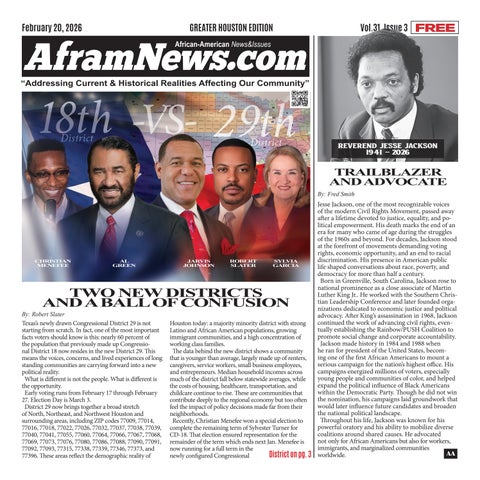
SYLVIA GARCIA
ROBERT SLATER
JARVIS JOHNSON
AL GREEN CHRISTIAN MENEFEE
REVEREND JESSE JACKSON 1941 -- 2026

A Revival of God Consciousness

EDITORIAL

Lincoln said it best: “A nation divided against itself cannot stand”. Sadly, there are some Americans who desire a perpetual Civil War, South versus North.

PO BOX 41820 Houston, TX 77241

Bad Bunny is a Puerto Rican Rapper/Singer. He is a ectionately known as the King of Latin-American Rap. Bad Bunny is a ectionately credited with assisting Spanish language Rap Music achieve mainstream success and universal popularity. No doubt about it, Bad Bunny’s half-time show at Super Bowl (60) profoundly highlighted what it means to be an American. President Trump’s MAGA-Cult has attempted to portray the (60) half-time show as anti-American, because to them America is based upon White culture, not multi-culturalism diversity. MAGA-Cult America know this: “ e beauties of nature come in all colors. e strengths of humankind come in many forms> Every being is wonderfully unique. All of us contribute in di erent and diverse ways. When we learn to honor the di erence, and appreciate the mix, we nd ourselves peace, and harmony”. Glory Hallelujah to God! Bad Bunny’s Super Bowl performance raised a profound spiritual question: “what if I am the true American?” e greatness of America is that we are a nation of immigrants and diverse cultures. Bad Bunny’s half-time show was a Puerto Rican celebration of that diversity of cultures. erefore, together we are America, a multi-cultural nation-state. Divided we are a failed nation state. President

e greatness and strength of America is that we are a nation of immigrant cultures. ough we arrived in di erent boats, we’re now in the same boat and must row together. is is why Bad Bunny at the end of the Super Bowl (60) performance said boldly: “God Bless America”. Sadly, President Trump’s MAGA-Cult was outraged at the half-time performance, because they fool heartedly believe that America is a White nation-state. America is a multi-cultural nation, and White Supremacy is devilish mythology. Immigration and cultural diversity made America great, not White Supremacy. Notions of White supremacy is what has always created confusion and con ict in American society. is is why the Trump MAGA-Cult is freaking out over Bad Bunny, I’m White: why aren’t you praising and glorifying me rather than Bad Bunny! America, let’s get real with each other. Racism drives individuals insane and keeps individuals from sharing and embracing universal aspirations and goals. e devil is a liar. It’s about sin, not skin. France is an accepting culture, but if you were not born in France, you are not totally accepted as a Frenchman. America is absolutely di erent because all Americans came initially from another country, but we all are supposed to believe that “all men are created equal, that they

We Must Understand

POLITICIANS

LOVE BLACK HOUSTON DURING CAMPAIGN

SEASON… BUT WHAT ABOUT AFTER?

Every election year, a familiar pattern unfolds across Houston’s Black communities. e streets get busier. Church pews get more crowded on Sundays. Community centers suddenly become press conference backdrops. Candidates who rarely walk our neighborhoods the other three years of their term now can’t seem to stay away. ey shake hands in ird Ward, pose for photos in Acres Homes, host roundtables in Sunnyside, and promise investment in historically overlooked areas like South Park and Kashmere Gardens. During campaign season, Black Houston isn’t invisible. It’s essential. We are called “the backbone of the vote.” We are praised for our resilience, our culture, our economic power, and our loyalty at the polls. Campaign ads feature our churches, our barbershops, our small businesses, and our families. Politicians speak passionately about closing wealth gaps, improving schools, addressing crime, expanding healthcare, and protecting voting rights.

But once Election Day passes and the victory speeches end, many residents

begin asking the same question:

What changed?

For far too many neighborhoods, the answer feels like: not enough. Potholes remain.

Underfunded schools continue struggling.

Grocery store access stays limited in food desert areas. Infrastructure repairs get delayed. A ordable housing conversations stall while gentri cation accelerates property taxes and pushes long-time residents out of communities their families built decades ago.

e frustration isn’t rooted in cynicism—it’s rooted in lived experience.

Houston’s African American voters have historically shown up in decisive numbers. In local, state, and national elections, Black turnout has o en been the di erencemaker in tight races. Political strategists know it. Campaign managers know it. Candidates know it. at’s why outreach intensi es in our neighborhoods every election cycle.

But voting power without policy follow-through creates a cycle of seasonal attention rather than sustained partnership.

Residents in historic Black neighborhoods o en point out how quickly campaign o ces disappear a er elections. Phone calls that once got returned suddenly go to voicemail. Town halls become less frequent. Budget priorities shi . New developments appear—but not always in ways that bene t longstanding residents.

Economic development becomes a

Bobby Mills, Ph.D.
BAD BUNNY

District Cont. is not name recognition. It is participation.

District 18 which does not include Acres Homes, Humble, Fallbrook, Greenspoint, and any other areas in much of North Houston, while voters who once formed the backbone of that district are now central to District 29.

is election is di erent because District 29 voters are choosing their rst full term representative. ere is no true incumbent shaped by the new lines. Recent voting turnout has been so low that many fear the lack of participation in the process may have a detrimental to the African American community for a generation or more. Turnout and participation will determine whose priorities de ne this district moving forward.

ree candidates are seeking to represent District 29.

Sylvia Garcia, age 80, represents long standing political leadership in Houston and brings decades of experience in government. She is the Incumbent as her district was previously 70%+ Hispanic and is now reduced to 53% Hispanic.

Jarvis Johnson, age 52 is a former State Representative who previously sought a State Senate seat and lost to Molly Cook in 2024. Johnson is running on the work he has done in previous positions and seeks to earn the opportunity to represent the newly formed district.

Robert Slater, age 43 enters the race as a non career politician. A businessman, developer, and civil rights advocate, Slater is known for hands on community work including workforce training programs for formerly incarcerated individuals,, launching small business and agricultural initiatives, and advocating for neighborhoods impacted by environmental and public safety concerns.

e de ning factor in this race

Sylvia Garcia was known to not a be a supporter of Sheila Jackson Lee, and now is poised to represent 60% of the district shes represented for 28 years creating questions on how would she represent communities she has never advocated for. Jarvis Johnson has previously had unsuccessful attempts at several o ces since losing his State senate bid, and doing little to no community work in between running for o ce. Robert Slater has never held public o ce in spite of his storied community and business work as some may question does political experience matter?

With a majority of former District 18 voters now forming the foundation of District 29, voter engagement will determine whether this new district re ects the realities of the people who live here or defaults to decisions made by low turnout. New districts do not automatically produce responsive leadership. at only happens when voters show up.

Early voting from February 17 through February 27 gives residents exibility to participate despite work schedules, caregiving responsibilities, or transportation challenges.

Election Day is March 3.

District 29 is new, but its communities are not. e data is clear. e population is diverse, working class, and deeply invested in the future of Houston. e remaining question is whether that reality will be re ected at the ballot box.

New lines have created a new district. What gives it meaning is participation.

Voting early and voting informed is how residents ensure their voices shape what comes next.

LOCAL

PRAIRIE VIEW CITY COUNCIL MEMBER WANTS PRAIRIE VIEW CITY COUNCIL TO “CLEAR” HER PAST DUE WATER BILL

Barbara Manual was elected to the Prairie View City Council on May 3, 2025, and she has placed many items for discussion and/or action on City Council Agendas.

Councilwoman Manuel placed an item on the February 9, 2026, Prairie View City Council Agenda to discuss, during “Executive Session”, her past due water bill, which has been due and owing since her nal bill issued 03/01/2023 . Water service was disconnected and remains disconnected to date, according to the interim City Secretary, Vivian Rodgers.

Following all other city agenda items and before Mayor Ronald Leverett recessed the February 9th City Council Meeting, to go to the Conference Room for an executive session, Councilwoman Wendy Williams announced to the mayor and other city council members, in open session, that she had contacted the Texas Municipal League (TML) Legal Department, and was informed that a city council member’s unpaid water bill did not qualify pursuant to Chapter 551, Section 551.071 to receive legal advice and discussion, if necessary. Councilwoman Williams also stated that the City Council could not clear an unpaid water bill.

Council Member Manuel was asked and agreed to explain her reason for placing her past due water bill for discussion in Executive Session. Council Member Manuel admitted to entering into a payment plan with then Mayor Frank Jackson for a $3,231.29 past due water

bill on July 14, 2015. She stated payments were made and the water bill was paid in full. en, according to Councilwoman Manuel, on December 19, 2019, she was informed she had another past due water bill. at, she said, was wrong. (NOTE: Water service to the address in question has been disconnected for non-payment since at least 2023, and remains disconnected and unpaid to date.)

Councilwoman Williams stated she was present for the initial city attempt to help Councilwoman Manuel meet her utility payment obligation; however, she stopped making payments, as agreed, on her original payment plan and that water bill was never paid in full. e remaining balance and her then subsequent bill balance remains unpaid and water service to the address remains disconnected. Council member Malcolm Jackson asked Council Member Manuel what her objective was for placing her personal water bill on the agenda. She stated, “Well, it need to be

cleared. is was paid in full.” City Attorney Paula Robnett expressed the matter seemed highly personal in nature and she and Carla would assist Councilwoman Manuel with this water bill issue and not charge her anything, (i.e., legal services).

Council Member Barbara Manuel’s past due water bill was not addressed during the Prairie View City Council’s Executive Session.

e Prairie View City Council members receive a monthly stipend of at least $700 and the councilwoman has made no payments on her documented approximately 3-year-old city debt.

Prairie View residents who are experiencing long-term water service disconnection due to your past due water bill, you may be interested in how this one is “taken care of” for a city council member with the free assistance of our Prairie View City Attorney.

1887 1896 1905 1916 1900 1909 1918

1887. e

1896. Plessy v. Ferguson legitimizes state laws reestablishing racial segregation in Southern states.

1900. A majority of Southern states pass laws that required African Americans to be separated from white citizens in railroad cars.

1905. W.E.B. Du Bois calls for social and political change for African Americans during the Niagara Movement.

1909. e National Association for the Advancement of Colored People (NAACP) is founded.

1916. e Great Migration begins, where more than six million African Americans move from the rural South to various urban metropolitan areas

1918. e Dyer Antilynching Bill is rst introduced, intending to establish lynching as a federal crime.

HOUSTON

AUSTIN

TEXAS TAKEAWAY

Houston says goodbye to rap trailblazer Michael “5000” Watts. Family, friends and fans gathered Monday for a public tribute honoring Michael “5000” Watts, who recently passed away at 54. As the founder of Swishahouse Records, Watts played a pivotal role in bringing Houston’s signature hip-hop sound to national prominence in the late 1990s, helping shape the city’s in uence on rap music across the country.

WACO

Temple residents may soon be required to pay for parking in order to visit and enjoy the downtown district. More than 1,500 people have signed a petition opposing the possibility of paid parking downtown. The petition, launched by the owner of GreenDoor Pub on 2nd Street, argues that charging for parking could discourage customers from visiting local businesses.

SAN ANTONIO

Residents and business owners along East Riverside Drive say congestion is nothing new — but many describe the newest detours connected to the I-35 Capital Express Central project as the most disruptive yet. As construction advances into the Lady Bird Lake portion of the long-term redevelopment, drivers began adjusting to a new traffic pattern on Friday.

Calls Grow for Tony Gonzales to Step Down Amid Alleged Affair with Former Staffer.

EL PASO

Early voting is now underway across El Paso County for the March 3 primary election.

Garrett Morgan (1877–1963) was a prolific African American inventor and businessman who significantly improved public safety with his creations. He patented the first three-position traffic signal (1923) and a groundbreaking safety hood/gas mask (1914). Born to former slaves, he became a successful Cleveland entrepreneur.

GARRETT MORGAN
ibodaux massacre occurs in Louisiana.

AN EXCEPTIONAL PHYSICIAN WHO SERVED RURAL TEXAS

Imagine growing-up and living in a community with no ambulance, no urgent medical care facility, no “911 service”, one hospital, and one medical doctor. e one medical doctor was there to mainly service a college population but also served the community and surrounding rural areas. Prairie View College’s Emery R. Owens was that doctor. He was the pharmacist, family practitioner, obstetrician, surgeon, and any other required specialized practice.

He was on-call 24 hours a day; seven days a week because he made “house Calls”, a er regular working hours. For patients who could not come to him, he went to them. No appointment was made for a visit to the doctor. If you were physically able, you would go to the college (now, Prairie View University) hospital lobby area, sign-in, and sit on one of several long, hard benches that resembled a church pew, and wait, and wait, and wait until your

name was called by the nurse. Being called in to see the doctor was seldom in the order that you signed-in; but rather based on the nurse’s observation of the most seriously ill or who was most in need of immediate medical attention. Additionally, Dr. Owens delivered every baby born in the community and provided both preand post-natal care. Once a waiting patient was called

MRS. EMERY (JULIA) OWENS JULIA OWENS (1921 -- 2010)
Read more at aframnews.com

BLACK HISTORY

THE ONLY AFRICAN AMERICAN AUTOMOBILE COMPANY

At the dawn of the Automobile Age in the early 20th century, hundreds of small auto companies sprouted up across America as entrepreneurs recognized that society was transitioning from horse-drawn carriages to transportation powered by the internal combustion engine. Some of these early companies grew to become giants that are still with us today, such as Ford and Chevrolet. Many others remained small, struggling to compete against the assembly lines of the larger manufacturers.

One such company was C.R. Patterson & Sons of Green eld, Ohio, makers of the Patterson-Greeneld automobile from 1915 to 1918. ough its name is little recognized today, there is in fact a very important reason to ensure that it is not lost to history: it was, and remains to this day, the only African American owned and operated

I AM NOT RUNNING FROM OUR REALITY. I AM LIVING IT.

automobile company.

Robert Slater for Congress, The New CD-29 Acres Homes, Fallbrook, Humble, Greenspoint, Aldine, Independence Heights

EARLY VOTING FEB 17 – 27 • VOTING DAY MARCH 3

keep everything together.

When I say I understand the issues facing this district, I am not speaking from a policy memo. I am speaking from lived experience.

Charles Richard Patterson was born into slavery on a Virginia plantation in 1833. Not much is known about his life on the plantation, and historians have to si through con icting reports about how he came to settle in Green eld, Ohio, a town with strong abolitionist sympathies. Some say his family arrived in the 1840s, possibly a er purchasing their freedom; others suggest Patterson alone escaped in 1861. In any case, he learned the skills of the blacksmith and found work in the carriagemaking trade, where he developed a reputation for building a high quality product. In 1873, he formed a business partnership with another carriage maker in town, J.P. Lowe, who was white, and eventually became sole proprietor

is election is not abstract to me. It is not about political theater or empty promises. It is about real life. e kind lived every day in our homes, our neighborhoods, and our families. It is about survival, dignity, and whether our government nally works for the people it claims to represent. Early voting begins February 17 and runs through February 27. Election Day is March 3. ese dates matter because our district cannot a ord more of the same leadership that has failed us. Recycled politics is what got us into this mess, and we cannot depend on the same voices, the same excuses, and the same broken approaches to get us out.

We need new leadership because what we have now is not working.

I know this because I am living the consequences of those failures every single day.

I am the son of a mother who worked hard her entire life, only to be forced into early retirement because of serious medical issues. When her health declined, the system that promised security failed her. Her bene ts were not enough to live independently. Not enough to cover rent. Not enough to provide stability. Not enough to age with dignity. Today, my mother lives with me because the system did not do its job.

I am also the father of a son who was shot twice during COVID. My child survived, but his life and our lives were forever changed. He is now paralyzed and lives with me. I have navigated hospitals, insurance denials, inaccessible housing, and endless red tape. I know what broken healthcare looks like. I know what it means to be a caregiver while still trying to

My life has been a redemption story rooted right here in Houston. I grew up around the inner city, including Inwood Forest, in communities where becoming a statistic was easy and escaping one required resilience, discipline, and faith. I saw how underfunded schools, poverty, incarceration, and neglect crush opportunity generation a er generation. I also learned that change does not come from speeches. It comes from action.

I became a successful business owner and real estate developer because I refused to accept that where you start should determine where you nish. I became a civil rights advocate because silence allows injustice to thrive. Today, I serve as President of the Texas Chapter of the Southern Christian Leadership Conference, the historic organization founded by Dr. Martin Luther King Jr. at role is not about prestige. It is about responsibility. It is about continuing a ght for justice, economic dignity, and power for the people.

For years, I have been doing the work without waiting for an election.

I helped create workforce training schools for individuals who were formerly incarcerated because a sentence should not become a lifetime barrier to employment. I brought churches and community organizations together to feed more than twenty thousand people hot anksgiving

meals every year because no family should be forgotten. I have created economic development initiatives, small business programs, and agricultural opportunities because people deserve ownership, not dependency.

When Union Paci c train derailments endangered families in the Fi h Ward, I did not issue statements. I took action. Environmental injustice is real, and accountability should be too. But charity alone is not enough. Programs without power are not enough. What our district needs is leadership that is bold enough to challenge systems, not protect them. at is why new leadership is not optional. It is necessary. e same recycled political names, the same insiders, and the same approaches have le our families struggling, our seniors vulnerable, our small businesses under supported, and our communities unheard. We cannot keep electing people who manage decline instead of ghting for progress. We deserve better. And we deserve leaders who will deliver.

For the new District 29, my vision is centered on accountability, transparency, and shared power. at starts with the creation of the Federal Community Advisory Board, known as the FCAB. is will be a resident led board made up of everyday people from across the district. Seniors, veterans, small business owners, educators, faith leaders, healthcare advocates, and young people. e FCAB will have direct access to my o ce, provide oversight of federal funding priorities, and ensure that decisions are guided by lived

experience, not lobbyists or political favors.

I am also advancing the C R E O Act, a comprehensive approach focused on community reinvestment, civil rights enforcement, economic opportunity, and ownership. is means real access to capital for small businesses, strong worker protections, a ordable and accessible housing, expanded healthcare access, and making sure federal dollars actually reach our neighborhoods.

My pillars are clear and rooted in reality.

Healthcare that supports families, caregivers, seniors, and people with disabilities. Economic justice through workforce development, entrepreneurship, and fair wages. Public safety that is e ective, humane, and accountable. Education and training that lead to real careers, not dead ends. Environmental justice that protects communities from corporate negligence. Government that listens, includes, and delivers results.

I am not running because I want a title. I am running because this district deserves a ghter who is built for this moment.

I am not running from the struggles facing our community. I am living them. And that is why I will ght harder, push further, and refuse to accept excuses.

Early voting is February 17 through February 27. Election Day is March 3. is is our opportunity to choose progress over recycled politics, action over promises, and leadership that delivers.

We deserve better. And together, we can demand it.

Turn static files into dynamic content formats.

Create a flipbook