June 19, 2026
Vol.31, Issue 20
AframNews.com
FREE
African-American News&Issues
“Addressing Current & Historical Realities Affecting Our Community”
al edwards
Opal Lee
A LIVING MONUMENT TO CIVIC ENGAGEMENT By: Fred Smith
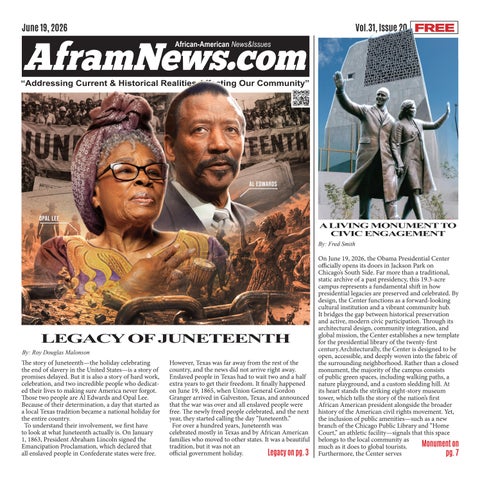
LEGACY OF JUNETEENTH By: Roy Douglas Malonson
The story of Juneteenth—the holiday celebrating the end of slavery in the United States—is a story of promises delayed. But it is also a story of hard work, celebration, and two incredible people who dedicated their lives to making sure America never forgot. Those two people are Al Edwards and Opal Lee. Because of their determination, a day that started as a local Texas tradition became a national holiday for the entire country. To understand their involvement, we first have to look at what Juneteenth actually is. On January 1, 1863, President Abraham Lincoln signed the Emancipation Proclamation, which declared that all enslaved people in Confederate states were free.
However, Texas was far away from the rest of the country, and the news did not arrive right away. Enslaved people in Texas had to wait two and a half extra years to get their freedom. It finally happened on June 19, 1865, when Union General Gordon Granger arrived in Galveston, Texas, and announced that the war was over and all enslaved people were free. The newly freed people celebrated, and the next year, they started calling the day “Juneteenth.” For over a hundred years, Juneteenth was celebrated mostly in Texas and by African American families who moved to other states. It was a beautiful tradition, but it was not an official government holiday. Legacy on pg. 3
On June 19, 2026, the Obama Presidential Center officially opens its doors in Jackson Park on Chicago’s South Side. Far more than a traditional, static archive of a past presidency, this 19.3-acre campus represents a fundamental shift in how presidential legacies are preserved and celebrated. By design, the Center functions as a forward-looking cultural institution and a vibrant community hub. It bridges the gap between historical preservation and active, modern civic participation. Through its architectural design, community integration, and global mission, the Center establishes a new template for the presidential library of the twenty-first century.Architecturally, the Center is designed to be open, accessible, and deeply woven into the fabric of the surrounding neighborhood. Rather than a closed monument, the majority of the campus consists of public green spaces, including walking paths, a nature playground, and a custom sledding hill. At its heart stands the striking eight-story museum tower, which tells the story of the nation’s first African American president alongside the broader history of the American civil rights movement. Yet, the inclusion of public amenities—such as a new branch of the Chicago Public Library and “Home Court,” an athletic facility—signals that this space belongs to the local community as Monument on much as it does to global tourists. Furthermore, the Center serves pg. 7