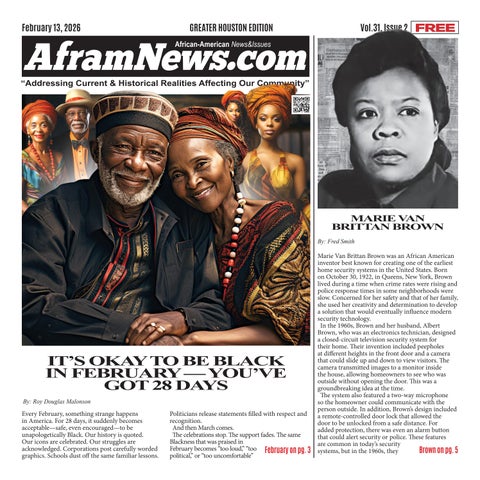
Volume 31 Issue 2

Page 1


AframNews.com

“Addressing Current & Historical Realities Affecting Our Community”

IT’S OKAY TO BE BLACK IN FEBRUARY — YOU’VE GOT 28 DAYS

Every February, something strange happens in America. For 28 days, it suddenly becomes acceptable—safe, even encouraged—to be unapologetically Black. Our history is quoted. Our icons are celebrated. Our struggles are acknowledged. Corporations post carefully worded graphics. Schools dust off the same familiar lessons.

Politicians release statements filled with respect and recognition. And then March comes.

MARIE VAN BRITTAN BROWN

Marie Van Brittan Brown was an African American inventor best known for creating one of the earliest home security systems in the United States. Born on October 30, 1922, in Queens, New York, Brown lived during a time when crime rates were rising and police response times in some neighborhoods were slow. Concerned for her safety and that of her family, she used her creativity and determination to develop a solution that would eventually influence modern security technology.

In the 1960s, Brown and her husband, Albert Brown, who was an electronics technician, designed a closed-circuit television security system for their home. Their invention included peepholes at different heights in the front door and a camera that could slide up and down to view visitors. The camera transmitted images to a monitor inside the house, allowing homeowners to see who was outside without opening the door. This was a groundbreaking idea at the time.

The system also featured a two-way microphone so the homeowner could communicate with the person outside. In addition, Brown’s design included a remote-controlled door lock that allowed the door to be unlocked from a safe distance. For added protection, there was even an alarm button that could alert security or police. These features are common in today’s security systems, but in the 1960s, they

The celebrations stop. The support fades. The same Blackness that was praised in February becomes “too loud,” “too political,” or “too uncomfortable” February on pg. 3 Brown on pg. 5

A Revival of God Consciousness

THE SWAMP

President Trump and his MAGA-Cult declared if elected that they would drain the swamp. Instead of draining the swamp they are replenishing the swamp with ungodly boldness never imagined. Personalization of the swamp is not draining the swamp. The swamp has become the Trump Swamp. Only Trump loyalists can benefit/profit from the swamp. Consequently, America is on the edge of self-destruction/self-annihilation by the Trump Swamp. Civil Rights are granted by the Constitution, not by Presidents. More importantly, human rights are given by divine order, and Presidential privileges/decrees play absolutely no role. The question of questions is: America how do we say “HELL NO” to the ungodly immoral leadership insanity of the Trump Administration? Focus on how, not if. The lack of spiritual-moral conscience on display in the Trump Administration is beyond spiritual-intellectual comprehension. Sadly, with the Trump Administration

EDITORIAL

it is about me, not US. This is precisely why the Trump MAGA-Cult is a real test of the spiritual moral character of America and its Preamble governing creed and moral truths: “that all men are created equal, that they are endowed by their Creator with certain unalienable Rights, that among these are Life, Liberty, and the Pursuit of Happiness”. President Trump and his MAGA-Cult do not spiritually and morally understand that the role of government is to secure and protect human and Civil Rights from want-to-be Kingly Tyrants, not become a Tyrant. Therefore, the idea of human rights is rooted in right spiritual thinking, because: “For as he thinketh in his heart, so is he: Eat and drink, saith he to thee; but his heart is not with thee.”

(Proverbs 23: 7).

President Trump’s MAGA-Cult presents a directional spiritual test concerning the moral character of American society, and at the same time, only the truth can say no to lies. For example, we all know from Bible study that individuals should never speak ill of the dead. After the horrific deaths of Ms. Rene` Good and Mr. Alex Pretti Trump Administration Officials immediately embarked upon character assassination attacks despairingly displaying absolutely no respect for

WHEN BLACK VOICES BECOME COLLATERAL We Must Understand

In moments of national tension, history teaches us a painful lesson: when America fractures internally, Black communities are often pulled into conflicts that were never designed to protect us. The warning circulating quietly—and sometimes loudly—across social media and barbershops is simple but urgent: be careful getting caught in a so-called white civil war. Too often, the system is comfortable watching us turn on each other while power remains untouched.

Recent arrests and detentions have intensified that concern. High-profile Black media figures like Don Lemon and Georgia Fort have become flashpoints in a broader struggle over speech, protest, and visibility. Their cases are not identical, but the pattern feels familiar— Black voices scrutinized, restrained, or punished during moments of political upheaval while others move freely in the same space.

This is not about left versus right. It is about understanding how chaos can be weaponized. Historically, when dominant groups fight among themselves, Black people are often used as symbols, shields, or scapegoats. We are pushed to choose sides, amplify

narratives that don’t serve us, or engage in online and street-level battles that leave our communities divided and vulnerable.

The danger is not only physical. It is psychological. Social media thrives on outrage, rewarding the most extreme takes and encouraging infighting. Algorithms don’t care who benefits—only who bleeds attention. In that environment, internal conflict becomes profitable, and unity becomes inconvenient. Meanwhile, policy decisions, court rulings, and power realignments continue quietly in the background.

The arrests of prominent Black figures send a message, intended or not: visibility comes with risk. But the lesson should not be silence. It should be strategy. Our community has always survived by reading the room, organizing deliberately, and refusing to be distracted from long-term goals by short-term spectacle.

We must ask hard questions. Who benefits when Black communities argue endlessly online? Who profits when protests turn inward instead of upward? And who remains untouched when the dust settles?

This moment calls for discernment, not fear. Speak, but with clarity. Organize, but with purpose. Resist being pulled into conflicts framed as inevitable when history shows they are often engineered. Our power has never been in choosing someone else’s war—it has always been in choosing each other.

February Cont.

the rest of the year. It raises an uncomfortable question many in our community already feel but rarely say out loud: Is it only okay to be Black when the calendar allows it?

Black History Month was created to correct erasure, not contain Black identity. Yet over time, it has started to feel like a permission slip—28 days to acknowledge pain, excellence, creativity, and resistance before returning to business as usual. Outside of February, those same conversations are often labeled divisive, unnecessary, or inappropriate. The irony is hard to ignore. America consumes Black culture year-round—our music, slang, fashion, creativity, and influence never take a break. But Black

Swamp Cont.

grieving family and friends of the deceased individuals. What an ungodly disgraceful shame. Question: can America heal its spiritual moral divide and move to higher level of constitutional conscience reality? America’s moral decline is boldly reflected in the Trump Administration’s professionalism at reverse engineering empirical facts and blaming the victim (s). Christian Right Evangelicals and the GOP MAGA-Cult you must self-acknowledge that what ICE is doing

lives, Black voices, and Black concerns are often treated as seasonal topics. Celebrated briefly. Tolerated temporarily. Then pushed back to the margins.

This isn’t just about holidays or hashtags. It shows up in real life. In classrooms where Black history is reduced to a few familiar names. In workplaces where diversity is praised in February but punished in performance reviews. In media spaces where Black pain trends for a moment and disappears the next. February becomes a comfort zone for institutions. A controlled window where acknowledging Blackness feels manageable. Outside that window, the same truths suddenly feel threatening. For our community, this cycle can be exhausting.

We’re expected to show gratitude for temporary recognition while navigating year-round inequities. We’re told progress is happening, yet asked to stay patient when it stalls. We’re praised for resilience while being denied relief.

The truth is simple: Black history doesn’t start in February and doesn’t end after 28 days. Black identity isn’t a theme month. Black struggle, joy, brilliance, and survival are daily realities. So when February comes around again, celebrate— but don’t be fooled. The goal was never to be accepted for 28 days. The goal has always been to be seen, respected, and protected every day. And that work doesn’t pause when the calendar flips.

TARRANT COUNTY SHOCKER

Until Saturday night, the Texas Senate District 9 had been represented by a Republican for over 30 years. In 2022, Kelly Hancock won the seat by 20 points. Last November, Trump beat Harris in the district by 17 points. So, when Hancock stepped down to accept the appointment as Controller, Republicans had little reason think the seat would be in jeopardy.

But on Saturday, Democrat Taylor Rehmet trounced his Republican opponent by over 14 points – a 31-point swing since the 2024 election. The results have sent shock waves through the Texas Republican establishment.

is not immigration law enforcement, but exacting mental and physical cruelty upon the least of them among US. ICE officials wear masks to protect their identities, not as an imitation of The Lone Ranger. ICE officials wear masks to become unidentifiable criminals. Just as a reminder there is a final judgment: “for I was hungered, and ye gave me no meat, I was thirsty and you gave me no drink: I was a stranger and ye took me not in? or naked and ye clothed me not: sick, and in prison, and ye visited me not. Then shall they also answer him, saying

Lord, when saw we thee an hungered, or thirst, or, a stranger, or naked, or sick, or in prison, and did not minister unto thee? Then shall he answer them, saying, verily I say unto you, Inasmuch as ye did it not to one of the least of these, ye did it not to me.” (Matthew 25: 42-45). America, the question of questions is: who is my neighbor? The reality of God is about the what, not the who, that is the importance of serving wherever service is needed. Amen!

Some Republican pundits have discounted the results because it was a special election with a very low turnout. It is certainly true that the turnout in Saturday’s election was much lower than last November (15% vs. 64%). But the results are consistent with polling over the last year, signaling that Texans have been turning increasingly negative on the Republican leadership of the State.

Over the last year, the University of Texas Polling Project has conducted seven polls asking voters whether they approved or disapproved of the job

King

various state leaders were doing. Trump and all statewide Republican leaders began the year with positive approval ratings. By the end of the year, all were in negative territory. The average move downward was 24 points. The crosstabs in the polls show that the groups who have turned most negative are independents, Latinos, and young people. Of course, there is considerable overlap between these because Latinos and young people eschew both parties at higher rates than other groups. Nonetheless, the moves within these groups in 2025 were breathtaking. For example, this was the drop in Trump’s approval rating with these groups last year. But perhaps even more startling is that Trump’s approval rating with Republicans dropped by 17 points (88→71) –and this was before the debacle that has played out in Minnesota, or his threat to invade Greenland. One political operative I spoke with, who closely followed the Tarrant County race, estimated that 15-20% of Republicans voted for the Democratic candidate.

I think the poll’s questions on what issues Texas voters are most concerned about are telling. The issues

garnering the most response were “political corruption/leadership” (18%), inflation (16%), and the economy (14%). 67% said they were very concerned about the cost of healthcare. Twothirds of Texans believe that Trump’s tariffs are leading to higher prices. Texans also disapprove of state leaders’ handling of abortion (-17), regulation of marijuana/ THC (-20), and public education (-23). Let me tell you what was not on the list at all – the danger that Sharia law would take over the state.

For the last two decades, Republican leaders have governed the state to satisfy their base -- pandering to the issues important to those voters and ignoring what a majority of Texans wanted. That was largely because independents, even though they frequently disagreed with the positions state leaders were taking, found Democratic candidates even further outside their comfort zone. But the Tarrant County results and the polling trends over the last year suggest Republican leaders may have gone so far that independents now view Democrats as the lesser of the two evils.

THROUGH THE LENS OF TIME: BLACK HISTORY IS 24/7/365

1887

1887. The Thibodaux

1896. Plessy v. Ferguson legitimizes state laws reestablishing racial segregation in Southern states.

1900. A majority of Southern states pass laws that required African Americans to be separated from white citizens in railroad cars.

1905. W.E.B. Du Bois calls for social and political change for African Americans during the Niagara Movement.

1909. The National Association for the Advancement of Colored People (NAACP) is founded.

1916. The Great Migration begins, where more than six million African Americans move from the rural South to various urban metropolitan areas

1918. The Dyer Antilynching Bill is first introduced, intending to establish lynching as a federal crime.

HOUSTON

AUSTIN

TEXAS TAKEAWAY

St. Nicholas Catholic Church, a centuryold parish near downtown Houston, now stands amid rows of newly constructed townhomes and lofts as members of the congregation — guided by Pastor Father Eliseus Ogbonna Ibeh, MSP — work to secure funding to restore their aging campus. Renovations to the 1924 brick church began in September, leaving the historic Third Ward building at 2508 Clay St. temporarily boarded up.

EL PASO

Former UTEP Miner Tyrice Knight can now call himself a Super Bowl champion. The second-year linebacker played a key role in anchoring Seattle’s hard-hitting defense, known as “The Dark Side,” as the Seahawks secured a 29–13 victory over the New England Patriots in Super Bowl LX on Sunday at Levi’s Stadium.

DALLAS

One of the few athletes from Texas competing at the Milan-Cortina Games is playing a key role in the United States women’s hockey team’s dominant performance. Coppell native Hannah Bilka netted her first Olympic goal during Monday’s 5-0 victory over Switzerland at Milano Santaguilia Hockey Arena, calling the milestone a “super special” moment.

Dallas City Council members voted to “save DART” by relinquishing the city’s majority control on the regional transit board. Before finalizing the decision to give up its majority representation, council members emphasized that discussions and negotiations with other DART member cities are expected to continue.

Emery R. Owens was an African American inventor from Texas known for his contributions to improving mechanical equipment. Living during a time when opportunities for Black inventors were limited, Owens demonstrated innovation and determination through his work. He focused on practical solutions designed to make machinery more efficient and reliable, particularly in industrial settings.

Imagine growing-up and living in a community with no ambulance, no urgent medical care facility, no “911 service”, one hospital, and one medical doctor. The one medical doctor was there to mainly service a college population but also served the community and surrounding

Owens on pg. 5

EMERY R. OWENS
massacre occurs in Louisiana.

were highly innovative. In 1966, Marie Van Brittan Brown and her husband filed a patent for their home security system, and it was officially granted in 1969. Their patent, titled “Home Security System Utilizing Television Surveillance,” became the foundation for many modern surveillance and security technologies. Over the years, other inventors referenced their patent when developing updated security systems. Brown’s invention gained recognition in The New York Times, helping to bring attention to her work. Although she did not rural areas. Prairie View College’s Emery R. Owens was that doctor. He was the pharmacist, family practitioner, obstetrician, surgeon, and any other required specialized practice. He was on-call 24 hours a day; seven days a week because he made “house Calls”, after regular working hours. For patients who could not come to him, he went to them.

Owens is best known for receiving a U.S. patent in the early 20th century for improvements to mechanical devices. His invention aimed to enhance the performance and durability of equipment, reflecting the growing demand for better

become widely famous during her lifetime, her contributions had a lasting impact on the security industry. Today, video doorbells, intercom systems, and home monitoring cameras all trace their roots back to her original idea.

Marie Van Brittan Brown passed away on February 2, 1999, but her legacy lives on. She is remembered as a pioneer in home security technology and as an important figure in Black history and women’s history. Her story shows how one person’s desire to solve a problem can lead to an invention that benefits millions of people around the world.

technology during a period of rapid industrial growth. Although he did not become widely known nationally, his achievement was significant, especially considering the racial barriers of the era.

Emery R. Owens’ legacy represents the many African American inventors whose contributions helped advance American industry, even if their names are not always highlighted in history books. His work stands as a reminder of the important role Black innovators have played in shaping technology and progress in Texas and across the country.

LOCAL

LONE STAR COLLEGE SYSTEM WELCOMES NEW CHIEF INFORMATION OFFICER

Reginald Brumfield, Ph.D., is joining Lone Star College System as the new chief information officer, bringing nearly three decades of leadership experience across industries including higher education, health care, municipal government and enterprise environments.

Starting Jan. 20, Brumfield will be responsible for leading the Office of Technology Services across LSCS.

The office’s mission is to advance student and employee success by delivering innovative, secure technology solutions and datainformed insights with exceptional customer experiences.

“Lone Star College System is excited to welcome Dr. Brumfield to our team,” said Bridgett Johnson, Ed.D., LSCS executive vice chancellor, Operations.

“He has a strong track record for strategically

implementing initiatives with operational excellence.”

Brumfield holds a doctorate in IT organizational leadership, an MBA in technology management and a bachelor’s degree in computer information systems. Previously, he has served in senior CIO and executive IT leadership positions at Houston Christian University, the University of St. Thomas, Gulf Coast Healthcare

Services, the City of Houston, Chevron and AIG.

“I look forward to working with Lone Star College System. With collaboration, accountability and data-driven decision making, we will continue delivering first-rate technology services to students and employees,” Brumfield said.

REGINALD BRUMFIELD, PH.D
Brown Cont.
Owens Cont.

CITY OF AUSTIN TO HONOR BASEBALL LEGEND DON BAYLOR WITH PARK RENAMING AND HISTORICAL MARKER UNVEILING

Austin marked a significant moment in its ongoing reckoning with history through a park renaming and the unveiling of a new historical marker, signaling the city’s commitment to telling a fuller, more inclusive story. The event drew residents, city leaders, historians, and community advocates who gathered to reflect on the past and affirm shared values for the future. Together, the two actions underscored Austin’s effort to recognize contributions that were long overlooked and to correct narratives embedded in public spaces.

The park renaming replaced a name associated with exclusion or harm with one that honors resilience, service, or cultural significance. City officials emphasized that names matter because they shape how communities understand their surroundings and who feels welcomed within them. For many attendees, the change represented more than symbolism—it was a tangible step toward aligning public spaces with the principles of equity and respect that Austin strives to uphold. Alongside the

renaming, the unveiling of a historical marker added critical context to the site. The marker details key moments, people, and struggles connected to the area, offering visitors an opportunity to learn as they walk the grounds. Local historians and descendants of those honored spoke about the importance of preserving truth in public memory, noting that markers can educate generations while fostering dialogue about progress and accountability. Community voices played a central role throughout the process, from public meetings to research and design. Advocates highlighted how inclusive decisionmaking strengthens trust and ensures that history reflects lived experiences, not just official records. Students, elders, and neighborhood residents alike contributed stories that helped shape the final language of the marker and the meaning behind the park’s new name.

The ceremony concluded with a call to continue the work beyond a single event. Leaders acknowledged that renaming and markers are starting points, not endpoints, in address-

ing historical inequities. As Austin moves forward, the city aims to pair recognition with action—investing in education, preservation, and community partnerships so that public spaces remain places of learning, belonging, and shared pride.

Turn static files into dynamic content formats.

Create a flipbook