
In today’s world, travelers expect more than just a seat on an aircraft. That is why the introduction of the New Distribution Capability (NDC) designed by IATA is a promising step for the airline industry. As this new standard provides more comprehensive product options and real-time pricing, it has the potential to completely change how airlines connect with and cater to their customers. However, the implementation of NDC is not just a simple, one-time technical fix. Airlines must alter their business culture, rethink their processes, and forge closer partnerships in order to meet the high standards of today’s astute travelers and avoid falling behind their competitors. This article examines how airlines can use NDC to transform into true customer-centric retailers.
For more than a decade, NDC has been a popular topic in the aviation industry, and several airlines have already started their NDC implementation journey, especially in North America, Europe, and East Asia. Nevertheless, some parts


Le standard NDC (New Distribution Capability), développé par IATA, marque une évolution structurelle de la distribution aérienne en permettant aux compagnies de proposer des offres enrichies, personnalisées et tarifées en temps réel sur l’ensemble de leurs canaux de vente. Toutefois, l’adoption du NDC ne peut être réduite à une simple mise à niveau technologique. Elle implique une transformation profonde des modèles opérationnels, organisationnels et commerciaux des compagnies aériennes.
Pour tirer pleinement parti du NDC, les transporteurs doivent opérer un changement stratégique vers un modèle de retailing centré sur le client, dans lequel l’offre est conçue en fonction des besoins, des préférences et du contexte de chaque voyageur. Cette transition repose sur plusieurs leviers clés : la refonte des processus pour plus d’agilité et d’efficacité, le décloisonnement des équipes internes, l’adoption d’une culture orientée expérience client, la modernisation des systèmes d’offre et de commande, ainsi que le renforcement des partenariats avec les agences de voyages et les fournisseurs technologiques.
of the world lag behind in development, for instance South America, Africa, India, and the CIS. Regardless of the region, at some point all airlines face the realization that implementing NDC is often much more difficult than it seems. Most of the time, this is because airlines have not fully embraced the organizational changes necessary to unlock NDC’s full potential. Instead, they see it as just another technological advancement. Because of this oversight, they may not be able to leverage NDC’s promise of frictionless content delivery, more diverse product options, and tailored offerings that meet the needs and preferences of today’s passengers.
At its heart, NDC is an XML-based standard designed by IATA to improve data exchange between airlines and travel agents. It empowers airlines to take control of their indirect sales channels, crafting tailor-made offers that resonate with each traveler’s unique needs. As IATA studies show, airlines expect to earn USD 5.30 more per passenger when the full potential of NDC is unlocked, while costing a oneoff investment of USD 1 to 2 per
passenger. But seeing NDC purely as a tool to reduce distribution costs or boost revenues sells this new standard short. True success with NDC lies in adopting a mindset of customer-centric retailing, where every traveler’s experience is enhanced at each step of their journey.
Realizing the full potential of NDC requires a broader, general overhaul of business operations and corporate culture, and even partnerships. But what areas are most important, and where does an airline start? The following five-step roadmap can help airlines to take the necessary steps to fully embrace NDC and make the transition to a retail-centric strategy:

Les analyses du secteur montrent que le déploiement complet du NDC permet à la fois d’améliorer l’expérience passager et de générer des revenus additionnels, tout en renforçant la maîtrise des canaux indirects. Dans un environnement concurrentiel en constante évolution, le NDC s’impose ainsi comme un levier stratégique de différenciation, de performance commerciale et de résilience pour les compagnies aériennes, y compris sur les marchés africains en phase de transformation.
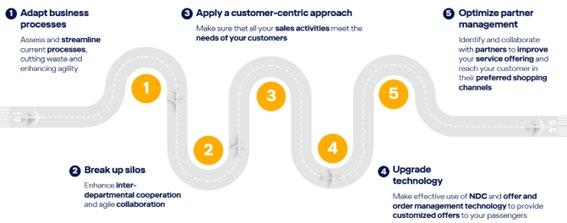
Rethinking processes is the first step to becoming an airline retailer. This requires a fundamental shift toward lean, streamlined processes that enhance responsiveness and reduce waste, as small adjustments alone will not suffice. Strictly following these lean principles can help airlines to become more flexible and enable them to quickly adjust to the rapidly changing travel market by removing unnecessary steps.
Changing processes is the first step, but lasting transformation requires a shift in culture. Airline teams need to work together seamlessly, breaking down the silos that have traditionally separated business units and improving interactions between them. This involves creating low-hierar-
chy structures and fostering a sense of shared purpose focused on delivering the best customer experience. The organization needs to enable employees to make decisions that impact the customer. Furthermore, they must be accountable to clearly established KPIs and empowered to respond accordingly. For NDC to succeed, everyone in the organization, from sales to operations, must collaborate to ensure travelers receive consistent and compelling service across all touchpoints.
3. Adopting a Customer-first Mindset
Airlines need to make a customer-centric mindset a core part of their strategy to succeed with NDC. Understanding passenger needs at every level helps airlines to tailor offers in a better way, boost engagement, and increase customer loyalty. While this shift requires time, investment, and often external guidance, the payoff is substantial. Customized service offers and more effective price differentiation drive customer satisfaction and lead to increased revenues.
This need for customer-first initiatives can be seen around the globe. For example, Lufthansa Group airlines offer customers the option to securely share the location of their AirTag if their baggage is missing. This accelerates the tracking process and helps to reduce stress for the customer.
4. Upgrading Technology to Support Personalization and Agility
By upgrading to NDC as well as modern offer and order management, airlines can adapt their offers in real time through the customization of products and services to each individual passenger. The technology supports the introduction of dynamic pricing, personalized offers, and the distribution of rich content to make the service offer more tangible for the customer.
Airlines can thus deliver a consistent experience across both direct and in-
direct channels that meets passenger expectations and preferences at every stage.
Finally, it is not enough to just change the internal operations of an airline to achieve a true transformation through NDC. External partnerships are essential for an end-to-end travel experience that consists of a well-coordinated service. Airlines need to work closely with providers like travel agencies and technology companies to successfully adopt NDC. This adoption depends on sharing real-time data and aligning KPIs across these partnerships. Many airlines are already strengthening their partnerships. For example, United Airlines has signed an enhanced distribution agreement with Amadeus, while Lufthansa Group airlines have partnered with the German conglomerate Siemens to implement NDC technology for future flight bookings.
The journey to achieving the full potential of NDC is more than a simple technological implementation. It is a complete realignment of how airlines operate. By focusing on customer-centric processes, embracing cultural shifts, investing in the right technology, and optimizing partnerships, airlines can evolve into agile, customer-focused retailers. The path may be challenging, but for those carriers who are willing to commit, the rewards are substantial: stronger customer loyalty, increased revenue, and a more resilient business position for the future of travel.
The authors: