At the University of Nebraska at Omaha, progress starts with processing what matters most, and preservation is about carrying forward what allows for adaptation and growth. Traditionally, preservation calls to mind historic buildings, archival records or traditions. At UNO, the concept is broader and more urgent. Preservation goes beyond saving the past. It is about safeguarding people, ideas and systems so communities can thrive now and in the future. From strengthening civic well-being to advancing cybersecurity and digital integrity, UNO is focused on sustaining the foundations that allow innovation to move forward.
As the premier metropolitan research university educating people of the world, UNO approaches preservation as a public responsibility. Students, faculty and staff conduct research that supports the community, ensuring that knowledge, creativity and innovation remain accessible and secure for future generations.
This commitment is visible in the way Mavericks learn and lead. Through hands-on research, engaging projects and partnerships across Omaha, students apply their knowledge to protect local resources, strengthen neighborhoods and respond to evolving workforce needs. Learning doesn’t stop at the classroom door – it extends into the community, where impact is immediate and meaningful.
In a time defined by rapid technological advancement and social change, preservation has become an essential skill. UNO is dedicated to preparing graduates who know how to move forward without losing what is essential. By preserving knowledge and opportunity, the university remains focused on what it has always done best – transforming lives while strengthening the world around it.
Sincerely,
Joanne Li, Ph.D., CFA Chancellor
Joanne Li, Ph.D.,
CFA
“I just love our students. Just watch their earnestness and great spirit on the Today Show.”
PHOTO I Chancellor Li shares a Maverick moment with Lara Ohling-Guilliatt, College of Business Administration graduate.
SAFEGUARDING THE EVERYDAY
Concerts thrum with energy, rallies roar with passion, conferences buzz with ideas. Each day, thousands of events unfold across the world. But amid the excitement, who is working to secure these gatherings and keep everyone safe?
At the University of Nebraska at Omaha, one graduate student is turning that question into her mission.
Sarah Schappert, a graduate research assistant at UNO’s National Counterterrorism Innovation, Technology, and Education Center (NCITE), spends her days delving into how to protect the public from potential threats at events big and small.
A second-year master’s student in criminology and criminal justice, Schappert spends her days analyzing patterns in terrorist plots against public events and exploring ways to prevent attacks before they happen.
LEARN MORE ABOUT SHAFFERT’S HANDS-ON COUNTERTERRORISM RESEARCH AT NCITE.
EXCLUSIVELY ONLINE SAVING STYLE
Lydia Okuku has brought Y2K fashion trends to Omaha with Crazy Unicorn, a vintage brand that originated from her UNO dorm room. unoalumni.org/unomagazine
PRESERVATION
20
A SECOND LIFE
UNO alum and entrepreneur Scott Kuhlman brings his career full circle from fashion sales to textile recycling and sustainable innovation.
by SUSAN HOUSTON KLAUS
26
BEYOND THE FIREWALL
UNO’s Cyber Matrix pairs students with local companies to defend Nebraska’s digital infrastructure.
by YAHYA SHEMA
22
VOICES RESTORED
The SPEAK OUT!® Therapy and Research Center at UNO sustains speech, confidence and connection for Nebraskans living with Parkinson’s. by
JESSICA STENSRUD
28 FOR KEEPSAKES
The Dr. C.C. and Mabel L. Criss Library is filled with stories, and an important department preserves the ones that belong to UNO.
In collaboration with UNO Archives and Special Collections
24
NOT ALONE
UNO’s Counseling and Psychological Services supports student mental health and academic success. by JULI OBERLANDER
ALUMNI PROFILES: The stories of four alumni who lead progress through preservation, pages 34–37.
Read the full issue and web exclusive content online at: unoalumni.org/unomagazine
MANAGING EDITOR
Davina Schrier
ASSOCIATE EDITORS
Jennifer Arnold Sam Peshek
ART DIRECTION/DESIGN
Heidi Mihelich, cre8ivenergy
CONTRIBUTORS
Jared Craig, Zoë Euteneuer, John Fey, Susan Houston Klaus, Bella LockwoodWatson, Maddie Pospisil, Juli Oberlander, Jessica Stensrud, Kara Schweiss, Yahya Shema
EDITORIAL AND ADVERTISING INQUIRIES contact: 800-432-3216 or unomagazine@unoalumni.org.
EXCLUSIVELY ONLINE
From MCC to UNO, Aislyn Tyler turned uncertainty into a clear vision for her future in social work. Learn more about her journey and the motto that now defines her approach to challenges: do it scared. unoalumni.org/unomagazine
EDITOR’S NOTE
At UNO, preservation protects what matters most while shaping the future. Mavericks strengthen our foundations and lead change with purpose and care. This leadership takes many forms — from restoring archives that keep our collective story alive, to employing cybersecurity to safeguard our digital future, accelerating sustainability practices and supporting the wellbeing of the people in our communities. Together, these efforts signal that preservation is a shared responsibility rooted in legacy and the impact we hope to leave behind. This issue of UNO Magazine underscores that preservation is not only about what we hold onto, but also about what we empower the next generation to create.
UNO Magazine is published three times a year. UNO graduates in Nebraska receive two issues – the fall issue and either the spring or summer issue. All UNO graduates receive the fall issue. UNO Fund donors of $25 or more of the past two years receive all three issues.
Do we have your correct name and address? Send all changes to unomagazine@unoalumni.org or visit unoalumni.org/recordupdate.
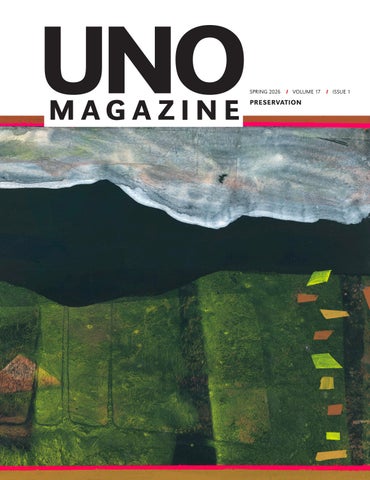
ON THE COVER
Chattermarks by Nancy Manter
Nancy Manter (BFA, MFA) lives and works between Beacon, New York, and Bass Harbor, Maine. Born and raised in Maine, she lived for many years in Brooklyn before relocating to the Hudson Valley. Manter’s paintings are inspired by weather, atmosphere, and geological surfaces both above and below ground. The title of this cover, Chattermarks, is a geological term describing the gouges and markings left in glaciers—indicators of glacial movement. Her work has been exhibited nationally and internationally, and she was inducted into the American Abstract Artists. Manter has previously taught at Parsons School of Design and Princeton University, among other institutions.
SPRING 2026 I 7
Jake Guentzel has played in the Frozen Four and won a Stanley Cup. Now, the former Maverick has added an Olympic gold medal to his hockey accomplishments, page 30.
MANAGING DISCOMFORT
Behind UNO’s student athletes, there is a team of student workers supporting their health – both mentally and physically.
by JARED CRAIG UNO Social Media and Digital Engagement Manager
Supporting student athletes requires far more than what fans see on game day. Behind every practice, competition, and comeback is a network of professionals and student workers dedicated to keeping athletes healthy — physically and mentally — throughout the demands of sports and college classes.
At the University of Nebraska at Omaha (UNO), that support takes shape holistically bringing together strength and conditioning, sports medicine, nutrition and mental health services. Like many areas of UNO, student workers play a vital role, providing hands-on care while gaining experience that shapes their own future careers.
For junior kinesiology major Coleton Dean, supporting studentathletes starts with meeting them where they are.
Dean works as a student intern in Athletics Strength and Conditioning, where he works alongside athletic trainers to boost performance. He is a regular presence around weight training
sessions, as he helps student athletes train while using the right form and offers much needed encouragement between reps.
“It’s important that athletes know we want them here,” Dean says. “Keeping the energy high, recognizing effort, and just being present makes a big difference.”
As a student himself, Dean can offer support as a peer as much as a working professional.
“They see me outside of the weight room because I have several classes with a lot of athletes,” he adds. “That helps build a connection.”
That emphasis on caring for the whole athlete is important, as poor health in one area can affect others. Taryn Ninemire, executive associate athletic director in charge of athletic performance and physical therapy, oversees Omaha Athletics’ integrated performance model. This includes sports medicine and athletic training as well.
“We take a 360-degree approach,” Ninemire says. “We don’t compartmentalize. Physical health is just as important as mental health, sleep, nutrition, and stress management. Performance doesn’t exist without psychological safety. And recovery cannot happen without stress management.”
And the system works. Over half of student athletes use mental health services. But all students use other aspects of the program, such as hydration stations and recommended food menus provided by a nutritionist. Omaha Athletics also has opened access to the convenience of student athletes. Beginning in 2023, a food station at Scott Campus Housing also provides healthy food options for female athletes.
Athletes recovering from injuries work with sports scientists to test the progress of their recovery, a process that gives a quantitative measurement on the injured body part but also provides staff a chance to check in with how the athlete is feeling about their recovery.
On Jan. 12, while students returned to campus for the first day of classes of the spring semester, injured players of Omaha Women’s Basketball were also going through one of these assessments.
Seated in a chair like a workout machine, Billy Lozowski — one of the sports scientists — and biomechanics graduate students test how athletes’ injured muscles perform under strain by moving a mechanical bar connected to a computer. As the team’s athletic trainer took notes and asked questions, the graduate students encouraged the athlete to “push, push, push” and later “pull, pull, pull” the mechanical bar. The data is compared to a pre-season assessment, helping coaching staff to see how injured athletes are getting close to pre-injury performance.
Ultimately, the Department of Biomechanics and Omaha Athletics hopes that this will produce students who can conduct research and practice it.
Collaboration even extends to UNO’s sister university within the University of Nebraska System, where doctoral students from the University of Nebraska Medical Center (UNMC) complete eight or 10-week clinical rotations with Omaha Athletics.
Koby Brandenburg, a physical therapy doctoral candidate at UNMC, works closely with athletes recovering from surgery and serious injuries. Like other student workers and staffers, Brandenburg is a former student athlete and knows well the process of dealing with injuries, among them a broken collarbone on different occasions and torn shoulder labrums. He knows the physical strain of coming back from injury can be, as well as overcoming the vulnerability an athlete can feel during recovery.
WE TAKE A 360-DEGREE APPROACH. PHYSICAL HEALTH IS JUST AS IMPORTANT AS MENTAL HEALTH, SLEEP, NUTRITION AND STRESS MANAGEMENT.”
“These athletes aren’t just rehabbing — they’re trying to get back to who they are,” Brandenburg says. “Empathy is huge, because their sport is often a big part of their identity.”
UNO clinical assignments are highly sought after by UNMC physical therapy students for their exposure to a wide range of athletic injuries. After working with athletes, it didn’t take long for Brandenburg to become invested in their success, as he often attends Omaha Women’s Basketball games to cheer them on.
Ninemire is especially pleased with how Omaha Athletics’ system prioritizes both performance and people. She points to how student workers have bought into the strategy.
Standing in the weight room, Dean is mindful that there are many reasons why an athlete is not reaching a goal.
“Sometimes it’s not physical,” Dean says. “If an athlete is having a tough week mentally, just talking to them, knowing their name, and encouraging them can really help.”
UNO REPORT REVEALS THE TOP 10 MOST IN-DEMAND SKILLS IN OMAHA
by SAM PESHEK
UNO Director of Editorial and Media Relations
The inaugural UNO Skills Report also shows how UNO is aligning academic learning with labor market needs.
For the first time, the Omaha community has a data-backed look at the skills leading Omaha employers want, and a clear roadmap to earn credentials for those skills.
The University of Nebraska at Omaha’s Center for Competencies, Skills, and Workforce Development Hub (CCSW) has released its inaugural UNO Skills Report, a comprehensive guide identifying the most in-demand skills in the Omaha metropolitan area.
The report outlines the top 10 skills employers value most, based on a combination of labor market analytics, faculty input and feedback from the CCSW Advisory Board. Those skills are coordinating, customer service, data analysis, decision-making, interpersonal relationships, Microsoft Office, presentations, project management, teamwork and written communication.
According to CCSW Hub Director Erin Bass, Ph.D., the report is designed to help align academic learning with real-world workforce expectations.
“Skills are currency in today’s job market,” Bass said. “This report reflects UNO’s commitment to integrating skill development into the heart of the academic experience. It’s a blueprint for how our university and industry are working together to build skills that shape Omaha, powered by UNO.”
Beyond identifying in-demand skills, the report provides a framework for how students can earn and verify those competencies. Each skill is paired with a faculty-developed assessment rubric, guidance on how the skill can be embedded into coursework and a corresponding digital badge. Students earn these badges by completing assignments in existing courses that demonstrate specific competencies such as teamwork, data analysis or presentations.
Faculty assess student performance using standardized rubrics developed with subject-matter experts and industry partners. Once verified, digital badges are awarded and stored in Canvas and the Maverick Digital Backpack, where students can share them with employers through LinkedIn profiles, resumes, email signatures or other professional platforms. The badges are designed to be portable and aligned with national credentialing standards.
Jaci Lindburg, Ph.D., assistant NU System vice president for IT strategy and learning technologies and former associate vice chancellor for innovative and learningcentric initiatives, said the approach reflects UNO’s focus on long-term career readiness.
“At UNO, we’re redefining what it means to prepare students for the workforce,” Lindburg said. “When most universities stop supporting students when their degree is in hand, we want to help students verify, share and stack their skills
TOP TEN IN-DEMAND SKILLS
1. Coordinating
2. Customer Service
3. Data Analysis
4. Decision-making
5. Interpersonal Relationships
6. Microsoft Office
7. Presentations
8. Project Management
9. Teamwork
10. Written Communication
in ways that evolve with their careers. It’s about creating a lifelong value proposition for learners and for the employers who hire them.”
The university plans to reassess its top 10 skills annually, expand its digital badge offerings, and further integrate skills-based learning across academic programs. Employers interested in partnering on skills badges or internships can contact CCSW at innovate@ unomaha.edu.
VIEW THE UNO SKILLS REPORT
UNO SECURED $40.7 MILLION IN RESEARCH FUNDING IN 2024-25
by SAM PESHEK UNO Director of Editorial and Media Relations
For the third straight year, the University of Nebraska at Omaha (UNO) exceeded $40 million in grant awards.
In total, investigators secured $40,783,060 in external funding for FY 2024-2025, according to UNO’s Office of Research and Creative Activity (ORCA).
“The momentum we are seeing today in the direct result of a shared vision for excellence in research and discovery across every college, department and division of our university,” UNO Chancellor Joanne Li, Ph.D., CFA, said. “Our investigators sent a loud and clear message that we solve real problems and serve the public good. This university-wide success shows what’s possible when our people come together with purpose and passion.”
Funding was provided by 92 unique sponsors, including 21 different federal agencies and 12 different state agencies. Additionally, 210 proposals were awarded, 118 unique principal investigators (PIs) were awarded external grants, the total number of new submissions increased by more than $18 million from FY 2023-2024 and 205 student awards were given for a total of more than $624,810.
“This is truly something to celebrate. I’m so happy for our faculty because this accomplishment is a testament to their vision, commitment and belief in the work they do. Phil He, Ph.D., Senior Vice Chancellor for Academic Affairs, said. It takes time, energy and persistence to seek funding and deliver real-world impact, and they’ve done that in extraordinary ways. Thanks to them, our students, our city, our state and even the nation are seeing the benefits of research done with purpose. I’m deeply grateful to support such an inspiring academic community.”
NOTABLE PROJECTS THAT RECEIVED FUNDING IN 2024-2025 INCLUDE:
• College of Public Affairs and Community Service Associate Professor Chenyu “Victor” Huang, Ph.D., received a grant from the Federal Aviation Administration (FAA) to help pave the way for safe integration of uncrewed aircraft – including drones –alongside traditional aircraft in the national airspace system.
• College of Information Science & Technology Associate Professor Dario Ghersi, M.D., Ph.D., teamed up with Princeton researchers to develop an AI-powered tool to improve the effectiveness of cancer immunotherapies. Their work was supported in part by a National Institutes of Health (NIH) grant and published in the leading scientific journal Proceedings of the National Academy of Sciences.
• College of Education, Health, and Human Sciences professors partnered with Connecticut-based company Motive Labs to test the FlyBand® ExoBoot, an exoskeleton embedded inside a regulation combat boot. Their work was supported by U.S. Department of Defense-Congressionally Directed Medical Research Programs.
“This year’s grant awards tell a powerful story of grassroots momentum fueled by creativity, curiosity and a deep connection to our community,” said Sara Myers, Ph.D., Associate Vice Chancellor for Research and Creative Activity. “I’m especially proud of the faculty who mentored and led our student researchers. Their leadership is helping shape a new generation of innovators who are learning, growing and changing the world, starting right here in Omaha.”
BEYOND THE NEWSROOM
by BELLA LOCKWOOD-WATSON UNO Communications Specialist
On an afternoon in Omaha, Olivia McArthur is in her element. The third-year journalism and media communications major is not in a classroom but helping host a public panel at the Flatwater Free Press Festival, checking in guests, chatting with local reporters, and soaking up every moment.
“We had our FlatFest a couple weeks ago, and that was the best day ever for me,” she said.
It’s exactly the kind of experience she hoped for when she chose the University of Nebraska at Omaha (UNO) for college. A native of Kearney, Nebraska, McArthur wanted to stay in-state for school and craved a close-knit environment.
“I just knew I would fit in better at UNO. Other schools felt like they were going to be too big for me,” she said of her decision to move to Omaha in 2023.
McArthur first fell in love with journalism back in high school, writing for her school’s news magazine The Echo.
“I really fell in love with doing that, and that’s where I knew I wanted to keep going in this direction,” she said.
It didn’t take long for her to continue that journey at UNO. She became editor-in-chief of the UNO Honors Program newsletter, The Distinction, during her first year.
In one of her introductory journalism classes, a guest panel of professionals introduced her to the Flatwater Free Press, Nebraska’s first independent, nonprofit newsroom focusing on investigative and feature reporting.
She signed up for the newsletter the next day.
More than a year later, her interest in the paper’s reporting would pay off. When McArthur spotted an opening for a Flatwater Free Press internship on Handshake, UNO’s Career Services platform for student employment, she jumped at the chance.
McArthur landed the role, however, it wasn’t a traditional reporting gig at all. The internship was with Flatwater’s development team, the department that handles donor relations, events and fundraising. Despite not having a writing-based role, McArthur was excited to contribute to the inner workings of a publication.
McArthur’s internship is a perfect example of what happens when opportunity finds its spark. At UNO, her classroom lessons didn’t stay confined to textbooks; they came alive across Omaha. Through the university’s deep community connections, she turned theory into action, building the kind of real-world experience that launches careers long before graduation day.
UNOTHEATRE PRESENTS: “JESUS CHRIST SUPERSTAR”
by JARED CRAIG
UNO Social Media and Digital Engagement Manager
UNOTheatre continued its 2025-2026 season with “Jesus Christ Superstar,” the Andrew Lloyd Webber-original and a modern retelling of the most shared story in human history.
The musical combines the world of rock opera into a raw and witty gospel, the renowned “Jesus Christ Superstar” traces Jesus’ final days through the eyes of Judas Iscariot.
The production transformed the Black Box Theatre at Weber Fine Arts and gave a sense of a split society, struggling to decide its future identity.
“It’s taking a very well-known story and putting a fresh spin on it,” said Emilie Rothanzl, a senior theatre major who serves as the assistant director. “It paints Jesus in a more human way — separating the myth from the man — and explores why he was so influential.”
The audience regularly see Jesus’ disciples post flyers, minimalist in design and adorned with a spray-painted crown and “King.” Their dedication is unbreakable until a casually dressed Jesus, white hoodie and all, comes on stage.
Kaden Weis, a junior theatre major, plays Jesus and was mindful of how to play such an impactful figure.
“These characters have been around for so long, so the challenge was figuring out how to make Jesus my own while still respecting who he is to so many people,” Weis said.
For sophomore Lily Pope, who plays Annas, a high priest who rallies the people and the Roman judicial system against Jesus, the thrill comes from reinterpreting such a well-known story.
“The audience already knows how it ends,” Pope said. “But somehow, the writing still makes the ending feel surprising even when you know exactly what’s coming.”
PIONEERING TREATMENT TO ELIMINATE ARTERIAL CALCIUM
by SAM PESHEK UNO Director of Editorial and Media Relations
A $2.7 million NIH grant is supporting the development of the first therapy that can directly remove arterial calcification and improve blood flow in patients with peripheral artery disease.
Peripheral artery disease (PAD) affects more than 200 million people, and over 70% of them develop calcium deposits in their leg arteries – lesions that complicate every treatment and quadruple the risk of amputation. Yet no current therapy can remove this hardened calcium.
A team led by the University of Nebraska at Omaha’s Department of Biomechanics – working in collaboration with vascular surgeons at the University of Nebraska Medical Center (UNMC) and scientists at Virginia Tech – is aiming to change that.
The team led by Alexey Kamenskiy, Ph.D., director of UNO’s Center for Cardiovascular Research in Biomechanics (pictured) has received a $2.7 million National Institutes of Health (NIH) R01 grant to develop a first-of-its kind local treatment for peripheral artery disease (PAD).
“Our goal is to give physicians a safe, targeted way to remove arterial calcium and restore vessel compliance –– something current treatments can’t achieve,” Kamenskiy said.
Researchers at the UNMC and Virginia Tech are partnering with UNO to test whether a localized EDTA chelation therapy can safely remove arterial calcium – a major cause of treatment failure, impaired blood flow and amputation in PAD patients.
“This therapy could be life-changing for patients with severe PAD, offering a new, targeted method to improve artery function and prevent amputations,” Jason N. MacTaggart, M.D., FACS, Professor, UNMC Department of Surgery, said.
Current PAD treatments — including angioplasty, stenting, bypass surgery and atherectomy – can improve blood flow, but none can remove the hardened calcium embedded in the arterial wall.
The team’s approach uses a microneedle catheter to deliver EDTA directly into the calcified arterial wall, targeting the calcium itself rather than working around it. If successful, the project could enable the first therapy capable of directly removing arterial calcium and restoring vessel flexibility – a shift that could dramatically improve outcomes for patients with calcific PAD.
A team of international researchers, including scientists from the University of Nebraska at Omaha, has made a breakthrough discovery about how cancer spreads and becomes deadly.
The study, recently accepted by Nature Medicine, identifies macrovascular infiltration — the invasion of large blood vessels by cancer cells — as a major, previously overlooked driver of cancer mortality. This discovery could redefine how cancers are staged and open new avenues for treatment and survival prediction.
The research team includes collaborators from the University of Texas Southwestern Medical Center, ETH Zurich and multiple European institutions.
UNO RESEARCHERS JOIN GLOBAL EFFORT TO CATCH CANCER’S DEADLIEST SECRET IN MOTION
by BELLA LOCKWOOD-WATSON UNO Communications Specialist
The study included 31 patients enrolled prospectively at UT Southwestern and a retrospective, validation cohort of 1,250 patients (from German institutions). The data analysis for the whole study was carried out at the University of Nebraska at Omaha by Kirk Gasper, Ph.D., a recent graduate from UNO’s Biomedical Informatics program, under the supervision of College of IS&T Associate Professor Dario Ghersi, M.D., Ph.D.
“This work shows the power of collaboration between computation and clinical science,” Ghersi said. “Our expertise in complex data analysis played an important role in linking computational findings with biological and clinical observations, contributing to a discovery that could change how we view cancer.”
UNO’S TICKET TO SPACE
by JARED CRAIG
UNO Social Media and Digital Engagement Manager
At UNO, high-altitude balloon launches from campus are a common occurrence. And it’s a sight to behold every time. When weather conditions are just right, Derrick Nero, an associate professor for the College of Education, Heath, and Human Sciences, leads students in his class to the Pep Bowl — a landmark stretch of lawn near Arts & Sciences Hall — to launch a balloon to 100,000 feet. The whole exercise catches the attention of anyone passing by, as Nero attaches the payload full of his students’ science experiments and releases it to nearspace altitudes.
Throughout the day, the launches spark small talk of “Did you see the balloon launch today?” across campus and
eventually found its way to a professor in UNO’s Department of Biomechanics. What began as a highlight of the year for a general education science course turned into a collaboration to test a new fabric to protect biological matter from radiation.
Despite major advances in cancer treatment, the precise reasons patients die from the disease have remained unclear. By identifying macrovascular invasion as a key factor in cancer progression, researchers have unveiled a biological process that could reshape how clinicians assess risk and design interventions.
The findings have the potential to inform new therapeutic strategies, improve staging systems and enhance patient outcomes.
Research reported in this publication was supported by the National Cancer Institute of the National Institutes of Health under Award Number R37CA242070. The content is solely the responsibility of the authors and does not necessarily represent the official views of the National Institutes of Health.
engineering problems, and presenting their data like professional scientists.”
In 2018, Nero introduced balloon launches into his course, Science Experimentation and Engineering Design, a class open to all majors but includes many education students with a desire to teach science.
“The course is about discovery,” he said. “Students come in not knowing what a near-space experiment even is, and by the end, they’re designing systems, solving
100,000 feet is roughly a third of the way to where Earth’s atmosphere meets space, a boundary called the Kármán line. These projects give students the challenge of fitting an experiment in a payload that has weight and size limitations. These are the same challenges for engineers in NASA or the private sector who launch objects and people into space.
GET TICKETS FOR THE NEXT PRODUCTION
ROMEO & JULIET: AN IMMERSIVE EXPERIENCE
APRIL 16–26, 2026
CAPSTONE TO CAREER
by BELLA LOCKWOOD-WATSON UNO Communications Specialist
Ask Alyssa Cave, Lainey Kula or TJ Andreasen what made their Master of Business Administration (MBA) Capstone different at UNO’s College of Business Administration (CBA), and they’ll tell you it wasn’t the typical sit-and-listen lecture or hypothetical case study. In the final semester of their MBA, all students must participate in the program’s capstone course. A capstone course is the culminating experience of a degree program where students apply the knowledge and skills they’ve gained in the classroom to a real-world project. Instead of completing typical classroom work, students collaborate with community partners, businesses or nonprofits to solve authentic challenges and deliver actionable results.
Tasked with developing a business plan and location analysis for Peterson Orthodontics, Cave, Kula and Andreasen dove into months of market research and strategy.
On presentation day, the trio stood before not just their professors, but also Landon Peterson, D.D.S, M.S, to deliver real recommendations for where and how he might expand his practice. This wasn’t a typical class assignment, and the impact on everyone involved was evident.
For the students, it was an experience that blurred the line between classroom and career, giving them a taste of real consulting work. For the client, it was an infusion of fresh insights and data-driven strategy, courtesy of a team of soon-to-be MBAs.
“The Capstone project felt more like a job than a class. You wanted to do your best because it was for an actual client, not just a test,” said Andreasen.
UNO MBA Alumni Find Real-World Success
Getting an A took a backseat to delivering results for a real client. The team spent weeks conducting a broad market analysis for the orthodontics clinic: evaluating demographic trends, mapping out competitors and gauging local economic growth.
“The project taught me to think more critically. In the real world, things are more subjective; there isn’t always a clear right or wrong answer. It pushed me to analyze situations from different lenses,” said Cave.
Hands-on problem solving became the norm. That difference in learning stuck with them.
Looking back, the trio agree that the Peterson Orthodontics project is one of the most memorable highlights of their UNO MBA experience. By working on a project where the stakes were higher than a GPA, they internalized skills and confidence that carried into their careers.
PHOTO I From left: Alyssa Cave, TJ Andreasen, Dr. Landon Peterson of Peterson Orthodontics and Lainey Kula.
PEAK PERFORMANCE POWERED BY SCIENCE
by MADDIE POSPISIL
Smart tech, sharp data and a holistic team are redefining athlete care at UNO — preventing injuries before they happen and powering peak performance across every sport.
SCIENCE
Last year, Tyler Rollwagen, forward on the Omaha Mavericks hockey team, was skating with an imbalance so slight that it was imperceptible to him.
Over time, the imbalance might have led to an injury — a sports hernia, a hip flexor strain or something else that could have derailed his season.
Fortunately, Rollwagen was wearing a sensor from Catapult, an athlete monitoring system that tracks heart rate, skating symmetry and workload intensity. Coaching staff regularly review the team’s data and analytics, tailoring workouts and adjusting schedules based on what they see.
“My imbalance showed up on Catapult,” Rollwagen said. “So I went to see our physical therapist Taryn and got it taken care of before it got to the point where I needed to miss practice or games, before I got injured.”
Taryn Ninemire, DPT, executive associate athletic director for athletic performance at Omaha Athletics, says that technology like Catapult is crucial for injury prevention and mitigation.
“Our approach has evolved,” said Ninemire. “What was once based on subjective input is now guided by objective data, helping us make smarter decisions and safeguard our athletes’ well-being. We can proactively identify patterns, monitor stress and recovery and intervene before minor issues become major setbacks.”
In the weight room, innovation continues with tools like the 1080 Sprint 2, a resistance training machine that uses a long cable and digital interface to provide assisted or resisted sprint training. Director of Hockey Strength and Performance Ben Silvers uses the data it collects to customize workouts for each student-athlete.
WE SAW A UNIQUE OPPORTUNITY TO CONNECT THE ACADEMIC AND ATHLETIC SIDES OF CAMPUS, BUILDING A PARTNERSHIP THAT FUELS INNOVATION AND DIRECTLY ENHANCES ATHLETE PERFORMANCE AND CARE.”
Omaha Athletics is expanding its use of technology and data through the Maverick Peak Performance Program, a collaboration with the School of Health and Kinesiology and the Department of Biomechanics. In April 2025, the program received funding from the Weitz Innovation and Excellence Fund, established through a $14 million gift from Barbara and Wally Weitz to support strategic initiatives at UNO. The gift was made as part of Only in Nebraska: A Campaign for Our University’s Future.
As part of the Maverick Peak Performance Program, UNO launched a new sports science unit and welcomed its first-ever sports scientists, Billy Lozowski, Ph.D., and doctoral student Dimitri Haan, who work directly with Maverick sports programs to analyze data, reduce injury risk and optimize performance.
“We saw a unique opportunity to connect the academic and athletic sides of campus, building a partnership that fuels innovation and directly enhances athlete performance and care,” Ninemire said.
“By aligning research with real-world athletic needs, we’re creating an integrated support system that helps our student-athletes thrive both in and out of the arena.”
The multidisciplinary athletics team now includes sports psychologists, nutritionists, athletic trainers, strength and conditioning coaches, physical therapists and sports scientists — all embedded within the athletics department to ensure comprehensive support for student-athletes.
This holistic approach is yielding results. The 2024-25 season was a banner year for many Maverick teams. Men’s basketball won the Summit League regular season and tournament title and earned its first-ever bid to the NCAA tournament. Softball went to the NCAA tournament for the third consecutive year after claiming a share of the regular-season Summit League title for the first time in school history. Hockey finished fourth in the National Collegiate Hockey Conference standings. Women’s tennis competed in the Summit League Women’s Tennis Championship final, and volleyball reached the postseason for the third straight season.
But perhaps most importantly, holistic support ensures that student-athletes like Tyler Rollwagen are able to perform at a high level without compromising their education or their future.
“Hockey is what we do, but it’s not who we are,” Rollwagen said. “And I have no question this university is dedicated to making the right decisions for us and making sure we stay strong and healthy well past our years here.”
18 I UNO MAGAZINE
WATCH VIDEO TO LEARN MORE ABOUT CATAPULT
PHOTOS I Top: UNO Director of Hockey Strength and Performance Ben Silvers attaches the Catapult tracking system to Omaha Hockey team member Sean Tschigerl’s shoulder pads.
For UNO graduate student Loni Mickles, a surprise scholarship not only provided peace of mind but was also an answer to her prayers.
“When Chancellor Li presented me with my scholarship, my first thought went to my mom,” she said. “We had just been talking about how I was going to afford my student fees this year.”
Because of UNO donor generosity, Mickles can focus on what matters most to her: pursuing her passion for social work and eventually working as a youth advocate.
Be part of the difference. Visit OnlyinNebraska.org/UNO to learn more.
Loni Mickles
A SECOND
SECOND LIFE
Reducing Textile Pollution with Sustainable Innovation
by SUSAN HOUSTON KLAUS
Scott Kuhlman’s career in the clothing industry spans more than three decades — from his first job in his hometown of Ogallala to store manager of Ben Simon’s in Omaha to operating retail stores under his own brand, Kuhlman Company, and later leading a sourcing company that makes garments for retailers around the country.
About 15 years ago, when the University of Nebraska at Omaha business graduate read a white paper by an industry watchdog that spelled out the negative effect the fashion and textile industry has on pollution, he recognized an opportunity.
Textile pollution is a problem that continues to grow. Industry statistics say fashion production comprises as much of 10% of global carbon emissions. Additionally, an estimated 85% of all textiles are sent to landfills ever year, and some types of fibers are responsible for polluting rivers and streams.
As Kuhlman read on, he saw a call to action for third-party companies to find answers to the problem.
“Being an entrepreneur, I raised my hand and said, ‘let me figure this thing out.’ That’s when we started to dive into it to figure out what we could do,” Kuhlman said.
In January 2020, Kuhlman launched ReCircled, a company focused on eliminating what it calls “unsolved waste.”
Headquartered in Denver, it partners with fashion brands around the world to recycle and reuse components of apparel, accessories and footwear and develop innovative ways to process what’s left over.
“We deal with everybody, from the very top of the food chain of super luxury brands — think of big European luxury brands — all the way down to what’s called fast fashion,” Kuhlman said.
In 2021, the company opened a facility in the 750,000-squarefoot former Cabela’s distribution center in Sidney, Nebraska, not
far from Kuhlman’s hometown. There, a team of 50 employees touches every piece that comes in.
“I tell people that if we’ve become experts in anything, it’s [that] we’re experts in sharp tools,” Kuhlman said. “We moved away from resale as being the main driver of what we do and really jumped into recycling. If we could get it into the pieces, then we could either find a recycling process or develop a recycling process.”
ReCircled also is constantly looking at ways to reduce its carbon footprint, collecting data on the distance clothing travels to Sidney as well as the amount of water used.
Today, Kuhlman continues to be on the leading edge of the industry, exploring solutions to help handle traditionally challenging complex waste streams. The company is working with a partner to implement hydrothermal liquefaction (HTL) technology integration.
HTL breaks down carbon chains in mixed consumer waste and turns it into other products.
“The good news is [HTL] loves mixed waste,” Kuhlman said. “We’ve now shown that we can create tremendous amounts of biofuel, natural gas and fertilizers using inorganics like polyester and plastics.”
Kuhlman and ReCircled will continue to look beyond the ordinary for new ways to recycle and reuse.
“We’ve just got to continue to reduce our carbon footprint wherever we can and just be thoughtful about it,” Kuhlman said. “If we can create systems and processes, that’s really what’s going to move the needle.”
MY MY MY
VOICES
Reclaiming Identity Through the Power of Speech
by JESSICA STENSRUD
Preserving a voice means preserving life as it was once known. Especially in Nebraska, where Parkinson’s disease rates are among the highest in the nation.
Nearly 90% of those diagnosed with Parkinson’s will develop a motor speech disorder. Voices can grow soft. Words might blur. Swallowing becomes more difficult. Once easy to have, conversations can become frustrating and lead to isolation. Yet only a small percentage of patients ever receive speech therapy.
At UNO, that reality is changing.
Inside Roskens Hall, UNO’s Speech-Language Clinic is the state’s official SPEAK OUT!® Therapy and Research Center, offering no-cost therapy to Nebraskans living with Parkinson’s. Funded through a grant from the Parkinson Voice Project, the program removes barriers that often prevent patients from seeking care, such as insurance limitations, financial strain and long commutes in rural communities. Therapy is offered both in person and online, extending access statewide.
“It means everyone in the state gets access to the program,” says UNO professor of special education and communication disorders
MOE MOO
MY MOE MOO
RESTORED
and a Certified SPEAK OUT!® Provider, Lucia Scheffel, Ph.D.
“Research shows that 90% of people with Parkinson’s disease develop a motor speech disorder, yet only 4% ever receive speech therapy. The UNO Speech and Language Clinic removes barriers for Nebraskans.”
Parkinson’s can “shut down” the small, precise movements necessary for speech. Voices may become monotone or breathy. Patients often report constantly being asked to repeat themselves. Over time, many withdraw from phone calls, social gatherings or ordering a meal at a restaurant. Communication challenges can lead to isolation and depression.
SPEAK OUT! Therapy trains individuals to speak with intention, to project, articulate and breathe with purpose. Therapy begins one-on-one and continues in group sessions to build life skills.
The program’s impact is just as meaningful for UNO students.
“Graduate clinicians complete specialized training before working with patients, gaining hands-on experience that prepares them to serve communities across Nebraska after graduation,” says Dr. Scheffel. “Many carry this expertise into hospitals, clinics and skilled nursing facilities statewide, extending the program’s reach.”
MY WIFE, MY BOYS AND MY NEUROLOGIST HAVE ALL NOTICED AN IMPROVEMENT IN MY SPEAKING. I LOOK FORWARD TO THE GROUP SESSIONS AND CONTINUING TO IMPROVE.”
“Because Parkinson’s is progressive, consistency is key,” says Dr. Scheffel. “Patients learn a new speech pattern and practice it continuously to retain their gains.”
For Dave Arneson, who discovered the program at a Parkinson’s convention, the results have been life changing.
“My wife, my boys and my neurologist have all noticed an improvement in my speaking,” he shared. “Since starting the sessions, I’ve experienced less choking. I was reluctant to start a speech program, but I’ve been ecstatic about my progress.”
He credits both faculty and student clinicians for creating a supportive, motivating environment.
“I look forward to the group sessions and continuing to improve,” he said.
The exercises have become second nature, even while sleeping.
“The other night, my wife woke me up because I was practicing ‘may, me, my, moe, moo’ in my dream,” he said.
As National Parkinson’s Awareness Month in April approaches, the message is clear: preserving a voice is about more than speech. It’s about dignity, identity and connection — and work that goes far beyond the clinic walls.
NOT ALONE
Supporting Student Mental Health and Academic Success
by JULI OBERLANDER
Mental health plays a critical role in student success at the University of Nebraska at Omaha (UNO). Through Counseling and Psychological Services (CAPS), the campus community has access to resources that support well-being and personal growth.
Nate Bock, a therapist and director of CAPS, says many students experience depression, anxiety and stress that can affect far more than academics.
“It’s going to really interfere with not just school, but life in general,” Bock says. “One of our goals is not only to help students with what might be going on when they come in and talk to us but also helping them with coping strategies to be preventative for the next time that this might start coming up.”
CAPS prioritizes early intervention and long-term skill building to help students manage challenges. Staffed by
master’s-level therapists, the office addresses immediate concerns while also equipping them for the future. Therapists consider thought patterns, environment and lived experiences to develop individualized treatment plans.
Additionally, CAPS works to foster resilience, stability and a sense of belonging. Nationwide, many college-aged adults struggle with loneliness and difficulty forming connections. Counselors help students examine relationship patterns, social behaviors and self-esteem to identify areas for growth.
“Sitting with someone that you trust is huge, and someone that you understand cares and is listening,” Bock says. “That’s a major aspect of the counseling process.”
While mental health awareness increased during COVID-19, many people still hesitate to seek help, often fearing judgment or misunderstanding. Counselors work to reduce
SITTING WITH SOMEONE THAT YOU TRUST IS HUGE, AND SOMEONE THAT YOU UNDERSTAND CARES AND IS LISTENING.”
stigma by encouraging students to utilize campus resources and seek connection.
The team collaborates with Nebraska Medicine’s Student Health Clinic to provide coordinated care when needed. At UNO, services include Mental Health 101 training, crisis intervention, workshops and alcohol and drug counseling.
CAPS also offers University Gatekeeper Program Suicide Prevention Trainings, which equip students, faculty and staff to recognize and respond to warning signs.
Caz Lowe, a UNO student and resident assistant, says the gatekeeper training was beneficial and eye-opening.
“I really appreciated the specific language we were taught to use at the training,” Lowe says. “I’ve dealt with mental health situations in my personal life from my friends and family, but I never knew exactly how to handle them. Gatekeeper training taught me the explicit language and
questions to ask to make sure a person is safe, and what resources to offer to make sure they get help.”
Through outreach efforts, CAPS supports UNO’s mission to enhance quality of life on and off campus. Staff members regularly visit classrooms to present information about available services, increasing awareness and reducing barriers to care.
For many, seeking counseling can feel intimidating. CAPS therapists acknowledge that discomfort and often follow up after initial sessions. Over time, Bock says staff frequently witness meaningful improvements in confidence, relationships and overall well-being, which can positively influence students’ grades and motivation.
“I love seeing that happen,” Bock says. “It happens often, and that’s what keeps us motivated, too. It’s an amazing part of our work. It’s super rewarding.”
BEYOND THE FIREWALL
Protecting Nebraska’s Digital Infrastructure
by YAHYA SHEMA Marketing and Communications Specialist, UNO College of Information Science & Technology
Technology continues to reshape how Nebraskans live and work — from drones surveying farmland to healthcare systems safeguarding sensitive patient data. As reliance on digital systems grows, so do the threats against them. Cyber threats now put at risk the systems communities rely on, creating an urgent need for skilled defenders who understand both the technology and the place they are protecting. The Nebraska Cyber Matrix program provides homegrown solutions to strengthen digital resilience across the state.
The program launches at a critical time. The demand for qualified cybersecurity professionals in the U.S. far exceeds the available talent pool, while cybersecurity attacks are increasing in both volume and sophistication as digital adoption and emerging technologies accelerate across all economic sectors.
The program addresses a need in both workforce development and cybersecurity defense, said Matt Hale, Ph.D., Nebraska Cyber Matrix program director, director of the School of Interdisciplinary Informatics, and UNO associate professor of cybersecurity.
“It’s about students getting to learn by doing,” Hale said. “It’s about local
companies having home-grown access to talent, and it’s about building Nebraska’s digital resilience together for the public good and for the career pathways it advances for students.”
The Nebraska Cyber Matrix will provide more hands-on learning opportunities to complement the academic rigor of its cybersecurity programs.
An inaugural cohort of UNO students and industry partners have been collaborating on pilot projects prior to the ribbon-cutting ceremony, working with real-world data and threats that local businesses are currently facing.
Jack Misbach, a UNO sophomore cybersecurity major and member of the inaugural cohort of students, has seen immediate career benefits.
“All of the skills gained are exactly what employers are looking for,” he said.
During recent job interviews, employers emphasized his experience in the Nebraska Cyber Matrix makes him ready to impact their teams from day one.
Sam Woolery, cybersecurity engineer at Trexcel Corporation, an Omaha-based cybersecurity company, has been working directly with the inaugural cohort of students in the program. Woolery says
the collaboration has been great and that he has enjoyed being part of the pilot partnership.
“Students who enter the program as early as sophomore year will graduate with close to three years of real-world experience,”
Woolery said.
This advantage will set them apart upon graduation.
In an ever-evolving digital landscape, the Nebraska Cyber Matrix is ultimately about people –– protecting people’s data and privacy, and training Nebraska’s future workforce to combat serious threats.
“The work we begin here today is not only about cybersecurity,” said Martha Garcia-Murillo, Ph.D., dean of the College of Information Science & Technology. “It is about the future of learning, the evolution of protection, and the continuing story of how humanity meets each new challenge.”
The program was made possible as part of a $14 million grant from the Weitz Innovation Excellence Fund, created to support initiatives that address critical needs in Omaha and across Nebraska.
For Keepsakes
Preserving UNO’s History
2
The Dr. C.C. and Mabel L. Criss Library is filled with stories, and an important department preserves the ones that belong to UNO. Archives and Special Collections holds items from across UNO’s history, from well - worn uniforms to fragile documents and personal stories. Archivists stabilize and protect each, storing materials in climate - controlled spaces and rehousing them in archival storage. While the archive’s storage rooms are not open for browsing like the book stacks, all material can be accessed when visiting in person or via the UNO Artifact Collection online. Through this ongoing work, UNO ensures that its past remains available for research, reflection and inspiration for generations to come.
1 CHEERLEADER HAT, 1915
One of the earliest surviving student life textiles in the collection, the Omaha University cheerleading hat documents how school identity and color tradition took shape in the university’s first decade when the team’s nickname was the Crimson and Black.
2 THE GATEWAY
The longstanding student newspaper, The Gateway, documents decades of campus life. Once preserved on microfilm and now fully digitized, the original newsprint
issues remain in the archives as tangible artifacts remembered by generations of students.
3 PHOTOGRAPHS
UNO’s extensive photo collection includes prints, negatives and slides, each stored individually in protective sleeves. Volunteers have helped archivists rehouse and identify these visual records of campus history.
4
FOOTBALL UNIFORM, CIRCA 1920
Worn by Omaha University’s early football team, this uniform arrived bearing the marks of the field. As the oldest football artifact in the archives, it is carefully supported with archival materials due to its fragile condition and cannot be mounted for display.
5 YEARBOOKS
Published from 1915 to 1975, yearbooks capture student life and campus change across six decades. One archival set is preserved long‐term, with additional copies available for research, exhibits and classroom use.
DANIEL JENKINS’S TYPEWRITER AND
emu eggs are traditionally created by Aboriginal Australian artists and Jenkins earned his bachelor’s degree from Melbourne University. His typewriter remains on permanent display, while the delicate egg is stored with added protection.
7 COURSE CATALOG
The earliest Omaha University catalog shows markings from past library staff who used it as a working tool. Today archivists preserve it without further annotation, storing it in an archival envelope alongside other early university publications.
8 HOCKEY JERSEY, 1997
Worn by James Chalmers when he scored UNO men’s hockey’s first goal in 1997, this jersey connects directly to the program’s debut. When not exhibited, it is housed in an archival box and supported with tissue to preserve its shape.
9 OU-NU MERGER SIGN AND BUMPER STICKER, 1967
Used by students campaigning for the 1967 OU–NU merger vote, these pieces represent a pivotal moment in university history. The signs are stored flat to prevent
warping, while the stickers are kept separately to protect other materials from their adhesive.
10 WOMEN’S ATHLETIC JERSEY, CIRCA 1970
This handmade jersey was worn by multiple women’s teams reflecting a time when women’s athletics relied heavily on shared, self - made gear. The jersey is stored in an archival box with tissue support to protect its fabric and hand cut and stitched numbers.
11 JOSLYN HALL BRICK, 1917
This painted brick once formed part of Joslyn Hall, the university’s home from 1917 to 1937. Gifted to early supporters, it survives with minimal deterioration, unlike many mid - century painted bricks that often show flaking or fading.
To see more of the moments preserved across UNO’s history, explore This Day in UNO History! The interactive digital timeline, featured on page 46, highlights a unique moment from UNO’s story every day of the year.
FROM OMAHA TO OLYMPIC
Former UNO star Jake Guentzel helps lead Team USA to its first hockey gold
During Jake Guentzel’s first season at UNO in 2013, he was asked what his favorite hockey movie was. His answer: “Miracle,” which chronicled Team USA winning the gold medal at the 1980 Winter Olympics.
At the XXV Olympic Winter Games in Italy, Guentzel helped lead Team USA to its first gold medal since 1980 — a breakthrough more than four decades in the making.
Starting in 1998, Team USA has selected its Olympic roster from NHL players, and this year Guentzel earned his spot as a member of the Tampa Bay Lightning.
For the veteran left winger, the experience was indescribable.
“Everything about it was pretty special,” Guentzel said in a story on the Lightning’s website. “I can’t
even put into words what it meant to be over there and to be part of the Olympics.”
USA Men’s Hockey went undefeated in the Olympics and capped it with a 2-1 overtime win over Canada.
“Right from the start of this tournament we felt like we were destined to win,” Guentzel said, “and we felt like we had the team to win. It was an unbelievable group to be a part of.”
Before the gold medal and the international spotlight, Guentzel’s foundation was built years earlier at UNO.
Guentzel, 31, has plenty of memories from his UNO career. He helped lead the Mavs to the program’s first Frozen Four appearance in 2015. During his three-year career at UNO, he had 40 goals and 79 assists in 108 games.
His coach at UNO, Dean Blais, was thrilled to learn Guentzel was on Team USA. He labeled Guentzel as the best player he coached during his four years at UNO.
I CAN’T EVEN PUT INTO WORDS WHAT IT MEANT TO BE OVER THERE AND TO BE PART OF THE OLYMPICS.”
“Jake was a great college player,” Blais said. “There were a lot of great college players in Omaha, but he’s the one who surprised everyone when he went on to Pittsburgh and won a Stanley Cup playing with Sidney Crosby (in 2017).”
Several other UNO athletes including Brian Cooper, Fredrik Olofsson, Mike Rostampour, Pinar Saka and Maja Mihalinec have competed in past Olympics, but Guentzel is the first Maverick to bring home gold.
Blais believes Guentzel not only put UNO hockey on the map by becoming an Olympian, but his success could also be used during recruiting by current coach Mike Gabinet.
“It ultimately will help Mike recruit some top-line players from Canada and the United States,” Blais said. “They’ll know where Omaha is because of Jake.”
Mike Kemp, UNO hockey’s first coach, also witnessed Guentzel’s potential during his UNO career.
“I knew he would be a great college hockey player,” Kemp said, “but he’s taken it above where most of us thought he would.”
He added this about Guentzel being an Olympian: “It’s a huge point of pride. When we see any of our kids get that exposure, and they talk about our program, it means the world.”
Still basking in the glow of bringing a gold medal home, Guentzel reflected on an “unbelievable two weeks.”
“It’s pretty incredible what we were able to accomplish over in Milan, and it’s been a long time coming for USA Hockey to get the gold medal,” he said. “We feel pretty blessed.”
$67.5M
PRIVATELY FUNDED CAPITAL PROJECTS FOR OMAHA ATHLETICS
The University of Nebraska System Board of Regents has approved the next phase of the Athletics Campus Masterplan, modernizing the University of Nebraska at Omaha’s athletic facilities and elevating Omaha Athletics as a rising national power among NCAA Division I programs. The projects — a state-of-the-art Omaha Athletics Training Facility and a new Omaha Athletics Baseball and Softball Clubhouse — represent a fully philanthropic, $67.5 million investment in the holistic student-athlete experience. Omaha Athletics has achieved unprecedented success over the past four years. With this momentum comes the need for infrastructure that will help Omaha Athletics sustain its success, build on it and elevate its national competitiveness.
MAVERICK EXCELLENCE AND LEADERSHIP
UNO Alumni Awards honor achievements and service. The 2025 award recipients were recognized at the UNO Alumni Honors Brunch on Saturday, Oct. 25, 2025.
JIM LESLIE OUTSTANDING SERVICE AWARDS
1. DAVID BRISSON (BS 02, MBA 09)
JULIE L. MASTERS, PH.D. (center) with UNO Alumni Association Board Chair Negil McPherson, Jr., (left)
PUBLIC SERVICE AWARD
2. MAYOR JOHN W. EWING (BS 85, MS 87) (center) with UNO Alumni Association Board Chair Negil McPherson (left) and UNO Chancellor Joanne Li, Ph.D., CFA
YOUNG ALUMNI ACHIEVEMENT AWARDS
3. DAVID A. LÓPEZ (BA 08) Mary López and Rodrigo López accepted the award on behalf of their son, pictured with UNO Alumni Association Board Chair Negil McPherson, Jr., (left)
1
2
UNO’s December 2025 commencement ceremony welcomed more than 1,100 new graduates to the UNO Alumni Association and honored leadership, service and Maverick excellence. Patrick Kerrigan (BA 73), president of The Palm Beach Holding Company, Ltd., and chairman of Solid State Networks, and Colleen Williams (BA 76), NBC4 Los Angeles journalist and anchor, were recognized with the Citation for Alumni Achievement Award for their outstanding professional accomplishments and community impact. The ceremony also featured a keynote address by Adam Wright (BS 02), Pilot CEO and former UNO football student-athlete.
4. PATRICK KERRIGAN (BA 73), president of The Palm Beach Holding Company, Ltd., and chairman of Solid State Networks
5. COLLEEN WILLIAMS (BA 76), NBC4 Los Angeles journalist and anchor
6. ADAM WRIGHT (BS 02), Pilot CEO and former UNO football student-athlete
LEARN MORE ABOUT KERRIGAN AND WILLIAMS AND WATCH WRIGHT’S SPEECH
LEARN MORE ABOUT THE AWARDS AND THE 2025 RECIPIENTS
3
NATIONAL MENTORING MONTH
THANK YOU, DR. JEREMY WHITE, FOR GUIDING ME AND SO MANY OTHER STUDENTS IN THEIR CAREERS! YOUR PASSION AND CURIOSITY FOR WILDLIFE AND THEIR ENVIRONMENT ASTOUND AND INSPIRE ME. YOU ROCK!”
LOGAN STECKER, BS 23
Throughout January, the UNO Alumni Association celebrated mentors who have guided and supported Mavericks along the way.
ASK ANYTHING
Trying to figure out which skills matter most in your role? Wondering which certifications make a difference in your industry? Feeling imposter syndrome at work and unsure how to overcome it? Ask Anything is an easy way to get real advice from fellow UNO alumni without the pressure of reaching out to someone directly. You ask the question, and Maverick Network connects you with an alum who can help.
LEARN MORE AND ASK ANYTHING
READ MESSAGES FROM MORE MENTORS WHO HAVE HELPED MAKE A DIFFERENCE IN A MAVERICK’S JOURNEY.
APRIL 2026
Every April, Mavericks give back. In 2025, 245 alumni and friends donated 2,913 hours in their communities.
Help us reach 3,000 hours this year by making a volunteer pledge.
We’ll send a free UNO-branded item to say thank you.
MAKE A PLEDGE AND FIND VOLUNTEER OPPORTUNITIES.
Jeremy White, Ph.D., MA ’03 and Logan Stecker, BS 23
ALUMNI PROFILES
by KARA SCHWEISS
The stories of alumni who lead progress through preservation.
“ THERE ARE ALWAYS A LOT OF OPPORTUNITIES TO SAY YES TO STEPPING UP AND SERVING WITHIN THE PROFESSION. AND I REALLY ENJOY THAT PROCESS OF WORKING ALONGSIDE OTHER COMMUNITY LEADERS.”
MICHAEL HELGERSON
Planning is a first step in executing a concept, but in the context of community planning it includes considering what already exists as much as what is to be constructed or modified, said Michael Helgerson, executive director of Metropolitan Area Planning Agency (MAPA), which serves the greater Omaha-Council Bluffs area.
The balance between preservation and progress is embedded in their work.
“One of the major projects that we’ve been working on over the last almost 10, 15 years now is a project called Heartland 2050 that looks out 20 years into the future,” Helgerson said. “How do we grow? What impacts will that have on our ability to provide infrastructure to be able to actually preserve the quality of life that people have? And those land-use decisions: continuing suburban sprawl versus a more compact development pattern or even having redevelopment in areas of the community that really hadn’t seen that kind of investment; and within that, that preservation of quality of life is really a very central piece of it.”
So, the question of what to keep is just as important as the question of what to change, he said.
“One of the big things that we think about is called system preservation; as our infrastructure grows, do we have the resources to be able to maintain it?” he explained. “And that’s often a challenging thing to get at, but it’s something that we’re very, very focused on.”
He added that thoughtful consideration may still present hard choices to make.
“Ultimately, when we think about master planning out 20, 30 years, how does that context change, and what happens kind of along the way? And boy, that’s just a moving target. I think the core thread of all of that is really working with community members and community leaders to make those intentional choices. And sometimes that’s preserving things that are great, and sometimes that’s not,” he said. “Those trade-offs, that’s such a big part of what we end up having to look at and work on, as we do planning work at the regional level and in partnership with our member community.”
Helgerson has always been community-oriented, even before working his way up at MAPA after joining the organization as an assistant transportation planner in 2013. He received his bachelor’s degree in community and regional planning from Iowa State University and his master’s in public administration-public management at UNO in 2016. His volunteer experiences include community organizations like United Way of the Midlands and Habitat for Humanity; professional organizations like the Omaha Inland Port Authority, where he is a founding board member and Urban Land Institute and the American Planning Association. Iowa State’s College of Design honored him with its Design Achievement Award in 2024.
“There are always a lot of opportunities to say yes to stepping up and serving within the profession,” he said. “And I really enjoy that process of working alongside other community leaders,” he said. “(It’s) interesting to work alongside people who are passionate about similar things but have really different professional backgrounds.”
“ THE WORK I DO IS ABOUT PRESERVING HUMAN DIGNITY FOR PEOPLE WHO HAVE MADE BAD DECISIONS AND MISTAKES.”
JASMINE L. HARRIS
Jasmine L. Harris, MPH, CHES, was recently promoted to vice president of development and external relations for the nonprofit organization RISE, which she joined only seven years ago as a program manager. RISE provides habilitative programming in prisons and reentry support for individuals postincarceration. Its services include employment readiness, job creation through entrepreneurship, family programming and case management, all with an aim to not only build community awareness that fosters support and opportunity, but to also heal families and lower recidivism.
“The work I do is about preserving human dignity for people who have made bad decisions and mistakes, then (are) stigmatized by others and sometimes treated less than human. This work is really about ensuring individuals who have been justice system-involved have the opportunity to come back to communities to have respect and dignity from other folks, and rights around housing, employment and that civic piece, the right to vote,” she said. “So, preservation of the right to participate, typically, in the community, and to come back into the community and do what society wants you to do: be an upstanding citizen.”
Her compassion comes in part from personal experience.
“My father was impacted by incarceration, and my brother. I had my own touchpoints with the criminal legal system, and that kept me out of work for almost two years based on a misdemeanor, and the continuous ‘thanks, but no thanks’ jobs I was overqualified for were jobs I’d done in the past,” she said. “To see the impact of what that had for me and my family, I said that if I am able to get into the rooms to speak truth to power, that I will always do what I can to remove as many barriers as possible for people who are turning their lives around and trying to get on the right track.”
Harris herself is on track and full steam ahead. She’s been recognized many times, including receiving a 2017 Omaha NAACP Freedom Fighter Award, a 2020 Change Maker award from the Greater Omaha Chamber, and an Urban League African-American Leadership Award in 2024.
She’s worked to pass state-level legislation around criminal justice reform and advocated for the restoration of voting rights for people with felony convictions. Harris has even thrown her hat in the ring twice as an Omaha mayoral candidate on the 2021 and 2025 primary election ballots. Harris said she’s not ruling out a future run for office, but her current focus is on RISE and her continuing education.
“I am enrolled in the (University of Nebraska Medical Center) Doctor of Public Health program focused on advocacy and leadership,” she explained. It follows the master’s degree in public health she earned in 2010 from UNMC while also working in an administrative position at UNO’s Criss Library she entered through work study. Prior to that, the native Omahan earned a bachelor’s degree in biology from UNO in 2005.
“A lot of my work has been rooted in community and community education,” she said. “There’s a connection between public health and the outcomes of incarceration and the impact that that has on communities.”
“ WE’RE NOT ON OUR OWN. WE’RE PART OF THIS SYSTEM, AND SO IF YOU DON’T PRESERVE THIS SYSTEM, IT WILL NEGATIVELY IMPACT US. IF WE LOSE OUR POLLINATORS, WE INCREASE OUR FOOD INSECURITY.”
EMILY GEEST
While others may dismiss insects as expendable and mere pests, Oklahoma City Zoo and Botanical Garden Conservation Scientist Dr. Emily Geest recognizes the essential role they play in ecosystems from pollination to decomposition to serving as a food source for other animals, making them indispensable for biodiversity and human survival.
“There’s this famous stat people say, that one out of every three bites of food is due to a pollinator,” Geest said. “We’re not on our own. We’re part of this system, and so if you don’t preserve this system, it will negatively impact us. If we lose our pollinators, we increase our food insecurity.”
Geest’s area of expertise is insect conservation and ecology. Before going on to earn her Ph.D. at Oklahoma State University, The St. Louis native received her master’s degree in biology at UNO, studying at the university from 2015 to 2017.
“I joined the ‘McWolf” lab — John McCarty and LaReesa Wolfenbarger’s lab — and that’s where I did my master’s work with monarchs,” Geest said. Both professors are associated with UNO’s department of biology; Wolfenbarger is chair and McCarty serves as director of the environmental studies program.
“I’m really proud of my project I did in Omaha. That’s where I switched from studying birds to studying butterflies,” Geest said, adding that she compared how monarchs were using gardens versus natural prairies and observed their survival to adulthood rate and health. Her work with the species continues at the Oklahoma City Zoo, like spearheading a project to find and support rare varieties of milkweed, an important food source for monarchs, or tagging the tiny creatures and
tracking their annual migration to overwinter in Mexico.
“(The tags) are so tiny, they’re about the size of your pinky fingernail, and you attach them to the monarch very carefully with eyelash glue, nontoxic,” she said. “It’s very precarious, so it takes just a little bit of maneuvering.”
Geest works with other insects including dragonflies, bees and fireflies, the latter being the focus of her August 2025 TED talk “Mood lighting, mating, and murder: The scintillating lives of fireflies.” She is also inspiring future conservationists and building awareness of ecology through her participation in living classroom programs. Like a microcosm of the earth’s biosphere itself, these and many other contributions of Geest’s are all part of the larger effort by the Oklahoma City Zoo — and beyond — to preserve species worldwide.
In late 2025, Geest was named a United Nations Association-United States of America Global Goal Ambassador for SDG Life on Land. SDGs (sustainable development goals) are part of the 2030 Agenda for Sustainable Development adopted by all United Nations member states in 2015. There are 17 SDGs, with ambassadors selected for each one to serve as part of a working-group cohort.
“I’m an ambassador for terrestrial conservation, and that has been really exciting. I’ve been on a meeting with ambassadors from Palau, I’ve been able to speak with UNESCO folks about the importance of monarch conservation,” she said.
“It’s been really cool to be part of this think tank of how we can increase conservation.”
“ THESE ARE PHYSICAL REPRESENTATIONS OF WHAT WAS IMPORTANT TO THAT CULTURE, AND THAT CAN BE THOUSANDS OF YEARS AGO OR IT CAN BE YESTERDAY. THESE THINGS NEED TO BE PRESERVED AS AN ACCURATE RECORD.”
JERRY PODANY
Looking back on his four decades of conserving antiquities at the Getty Museum in Los Angeles, Jerry Podany said that if he could leave behind a personal artifact, it would be difficult determining what would best give a future generation insight into his work and his life.
“I think probably there just can’t be one, but it might be a work of my art, one of my publications and perhaps the record of some of the objects or some of the projects that I was most committed to in my career as a conservator,” he said. “It’s what I enjoyed the most, and it’s where I think I made — or I hope I made — significant contributions.”
Podany studied for his Bachelor of Fine Arts degree at UNO from 1970 to 1975. His first interest was in studio arts, but he was also intrigued by conservation, which he’d seen firsthand at the Joslyn Art Museum.
“A sort of itinerant conservator restorer came through and was working on the small Egyptian bronze collection that Joslyn had at that time, and I was really fascinated with that. But I decided, after a stint as artist-in-residence for the Omaha Public Schools, to go to graduate school and get my MFA, and that took me to California and Claremont Graduate School for two years between ‘76 and ‘78,” he recalled. “I had this wonderful time for a period where I was teaching young art students how to look and how to see, but I confirmed out on teaching, and in the art world, the sort of gallery scene and what was required to make it in the art world wasn’t very appealing to me.”
Conservation appealed to him again, however, when a lecture on campus by a curator at the Getty Art Museum opened doors to a new career. Podany joined the antiquities conservation department of the museum in 1978, pursued high-level training in London and ultimately served as the department head/senior conservator of antiquities conservation from 1985 until his retirement in 2016.
“That’s a very unusual entry path into conservation, even at that time; now it’s almost impossible to do that. It’s become a very academic/university sort of pathway in one of the three or four training programs in the United States,” he said. “I had the fortune of being in the right place at the right time.”
Podany received the Rutherford John Gettens Award from the American Institute for Conservation and the Engineering Research Institute’s Heritage Innovation Prize. He has lectured and published widely, including a 2017 book on earthquake mitigation for museum collections, and continues to be involved in the heritage preservation community as private consultant. He’s even found time in recent years to revisit his past life as an artist, which he calls a “great pleasure.”
Art and artifact preservation gives voice to the past, he said.
“It’s essentially important because these are physical representations of what was important to that culture, and that can be thousands of years ago or it can be yesterday,” he said. “These things need to be preserved as an accurate record, and that, to me, is what preservation is really about.”
I CLASS NOTES FOREVER MAVERICKS
DAYTON SCHMACHER, MBA 24
Entrepreneur and UNO alum Dayton Schumacher started running to improve his mental health as a college student. Now, his running-inspired apparel brand, Your Pace Your Peace, supports mental health causes.
LEARN MORE ABOUT SCHUMACHER’S JOURNEY AND ADVICE FOR ASPIRING ENTREPRENEURS.
WARD SCHUMAKER, BA 66 has been interpreting text into visual narrative for most of his working life. After beginning in fine art more than 40 years ago, he evolved into an internationally recognized illustrator and remains active in the field. His illustration style integrates text as a core visual element. While a senior at Omaha University, one of his works won first prize in the Nebraska Governor’s Art Show but was deemed obscene by a viewer, prompting its withdrawal. Schumaker subsequently moved to San Francisco in 1966.
His work has been exhibited in New York; San Francisco; Shanghai; UC Berkeley; Los Angeles; Sacramento, California; Charleston, South Carolina; Miami; and Nashville. His work is held in the collections of the Achenbach Foundation, the Zimmerli Art Museum, the Joslyn Art Museum and the Crocker Art Museum. Most recently, Constellation Studios presented painted book covers by Turner McGehee of Hastings, Nebraska, alongside Schumaker’s bound books of painted pages. ward-schumaker.squarespace.com/
JOEL C. SNELL, BA 66, MA 70 is a professor emeritus at Kirkwood College. He began teaching in 1966 and retired in 2010. He was a research fellow and a member of the Arlington Institute. He was on the editorial board of Psychology and Education and was on the board of education. He has hundreds of publications, is featured in Marquis’ Who’s Who, and toured with 40 others on an IOOF tour for peace. During his time at UNO, he was elected vice president of the junior and senior class, was a technical writer for the U.S. Army Corps of Engineers and the criminal justice department and was a member of Omicron Delta Kappa and Pi Kappa Alpha. He received post master’s work at the University of Nebraska–Lincoln and South Dakota State University in Brookings. He has self-published five books and received the Dana College Spirit Award for all-time top-five faculty. Since retiring, he has been writing and doing book reviews and articles. His blog is 56thst.com, and it has thousands of entries.
DEBBY WHITEHILL BLOOM, BSBA 76, MBA 81 just turned 70! She has worn many hats over the years: retail clerk, waitress, security guard, medical claims agent, accountant, programmer, advertising manager, insurance agent, author, stockbroker, banking rep. Her 70th birthday party included much love from family and friends, six of her 12 grandchildren were there, and she was treated to a musical performance by four of the girls.
Many consider career achievements to be defining. I find that my roles as daughter, niece, sister, friend, wife, mom, grandma, great grandma, and coworker have been the most important. Whatever a person does following the Lord and showing up are critical to a happy life.”
W. JOSEPH BRUCKNER, BGS 78 has been inducted into the American Antitrust Institute Hall of Fame. The Hall of Fame recognizes practitioners for three major contributions: distinguished service to the private antitrust enforcement community, commitment to the enforcement of the antitrust laws and success in fighting for competition, consumers and workers.
PATRICK COYLE, BA 82 has procured distribution of his latest feature film, Unholy Communion. It is available on Amazon Prime and Apple TV.
farnamstreetltd@gmail.com
JAMES TROIA, BS 84 retired as an Army Lieutenant Colonel in 2012. Currently, he is an Army JROTC Senior Army Instructor at Henrietta M King High School. He is a former assistant professor of military science at Texas A&M University Kingsville 2003-2012. james.troia.jt@gmail.com
SHARI COLLINS, MS 88 was among those awarded at the Global Power Leaders 2025 as Transformational Leader of the Year at the Global Leadership Conclave 2025, held at the UK House of Lords, UK Parliament. Collins is the CEO and founder of Shari Collins Consulting, specializing in international consultation and keynote speaking on workplace culture, psychological safety, happiness and well-being. She is passionate about fostering inclusive environments and driving organizational growth through customized workplace initiatives. The Global Leadership Conclave 2025 brought together 150 delegates representing more than 25 nations. The event included more than 20 VIPs, including ministers, members of Parliament, lords, mayors, barons, ambassadors and high commissioners. The conclave welcomed dignitaries including the Rt. Hon. Stephen McPartland, former minister of state for security of the United Kingdom; Lord Graham Brady; Lord Taylor of Warwick; and Safiya Saeed, mayor of Sheffield.
This award represents the collective power of what we can achieve when we prioritize people and culture.”
JOHN M. MCNAMARA, BS 77 studied creative writing with Professor Emeritus Richard Duggin and recently released his 14th novel, Death of a Household God, available at Amazon.com. jmcn49@comcast.net
JENNY VAN SOELEN, BA 89 and EMILY POESCHL, MBA 11 along with the production team of Mutual of Omaha’s Wild Kingdom Protecting the Wild, celebrated their fifth Daytime Emmy nomination in two seasons since the show returned to television. Although they did not take home the award this year, the show remains the No. 1 weekend wildlife program, airing Saturday mornings on NBC.
JIM CARROLL, BGS 95 has assumed the role of president of the VSS Catholic Communications Foundation after 23 years as executive director of the Spirit Catholic Radio Network. During his tenure, the network grew from a single station in Omaha to 20 stations across Nebraska and several other states.
In his new role, Carroll is responsible for securing major gifts through estate planning initiatives and for expansion opportunities outside Nebraska. He recently merged Spirit with a 15-station network in Oklahoma.
APRIL DAVIS CAMPBELL, MPA 96 ended 20 years of parish ministry in December 2024, including seven years in her final call. In January 2025, she began serving as director of education for the Omaha Presbyterian Seminary Foundation. She is creating educational opportunities for individuals who want to serve the church but do not feel called to seminary. april68502@yahoo.com
LAVERN BUTLER, BGS 97 says one of her greatest accomplishments has been dedicating her life to service and leadership. She has supported soldiers, military families and survivors by providing resources, guidance and compassion during challenging moments.
She says this work reflects her values of integrity, service and perseverance and has taught her the importance of listening, leading with empathy and never giving up.
butlerlavern@gmail.com
IN MEMORY
We extend our condolences to the family and friends of these graduates. Reported to the University of Nebraska Foundation October 2, 2025 to February 10, 2026
1948 Josephine L. Mierendorf
1950 De Emmett Zerbe
1952 Doris J. Hansen
Virginia J. Wild
1953 Gloria Olderog Webb
1954 Marcel Kahn
1955 Donna R. Kattchee
1956 Betty J. McCart
1957 Thomas P. Kezlan
1958 Warren S. McClure
1959 Roger Taylor
Warren W. Wolpa
1960 Charles H. Ostler
1961 James W. Lindeen
Leonard V. Svoboda
Phyllis D. Beam
J. W. Steinke
1962 Marlyce A. Welch
Harold E. Hutcheson
Julie W. Karstens
Kent C. Strang
1963 Michael J. Millea
1964 George C. Weber
Stuart C. Lynn
Robert W. Traylor
1965 Rita M. Price
John S. Brockington
Anne McAlister
1966 Richard S. Gulizia
Larry R. Forman
James G. Elliott
Patrick G. Payne
John G. Spain
Daniel Rishel
1967 Dennis C. Dervin
Donald Rothenflue
1968 Judy B. Dye
Michael E. Kelley
Thomas L. Truitt
William McKay
1969 Ruben A. Candia
Donald J. Haluza
Donald H. Toner
1970 Carrol L. Fry
Gayle M. Malmquist
Robert C. Mead
Donald E. Brooks
Dean A. Godbersen
Allen K. Holley
Jerry F. Olson
Carolyn G. McDougle
1971 Dennis R. Fernley
Hubert C. Sprecher
1972 Gary L. Lyons
Raymond L. Sumners
Phillip N. Zimmers
1973 Richard E. Ward
Dorothy E. Turley
Darrell W. Katz
David L. Dierenfeld
1974 Donald O. Aldridge
1975 David L. Warner
Leroy R. Miles
John C. Moriarty
1976 Elizabeth J. Hunt
Joseph W. Spresser
1977 John H. Westering
David W. Hoffman
Lorinda L. Langner
Robert F. Reichwein
Gregory W. Stein
Lois E. Schultz
1978 David W. Dunaway
1979 Bruce K. Hayden
Nicholas G. Schinker
Steve M. Swee
James F. Hyland
1980 Richard J. Thramer
1981 Dianne G. Myers
Thomas B. Miller
Joan S. Carnaby
1982 Colleen Z. Finochiaro
Carol A. Keller
James R. Reuting
Lois A. Wieseler
Robert E. Jatczak
1983 Timothy E. Burke
Michael J. Panigot
1985 Robert M. Spears
1987 Mildred Mobley
James J. Koranda
1988 Rene J. McQuinn
Richard A. Orsini
Michael L. Vittitoe
1989 Connie D. Bryant
1992 Barbara L. Tripp
1993 Janet G. Pebley
1994 John G. Kruse
Barry S. Branson
Laurie A. Yonkers
1996 Maureen S. Brush
1998 Wayne A. Crumbley
1999 Gary D. Luft
Sheila J. Miller
2001 Shirley A. Naegelin
2002 Julia R. Jones
LaVern D. Kendall
2003 Beth J. Bosco
2009 Gary L. Prokop
2016 Christopher A. Kaiser
2020 Maximo Rocha
MEGHAN CONWAY ROWEN, BA 02 has opened Avenue Two Consignment, a women’s consignment shop in Omaha. What began as an idea rooted in style, sustainability and community has grown into a curated space where fashion is given a second life. Avenue Two is co-owned with Rachel Heiser.
CRYSTALLE COTTON, BS 04 has worked at Walmart Supercenter #2213 for nine years as of December 7, 2025. She has passed the team lead assessment with competitive results. crystalle.cotton@gmail.com
NAOMI CHAMBERS, BGS 07 earned a Master of Science in business analytics from Creighton University in December 2025.
LAWRENCE LORD, MA 16 completed his database project for the Union Pacific Railroad Museum in June of 2025 regarding nearly 50,000 maps that Union Pacific has in storage. The project took almost two years to complete. Now, all departments have access to needed information. He also was able to participate in RAGBRAI with his daughter. laryy48@yahoo.com
BRANDEE COLLINS, BGS 12 says that her life has stretched in the most meaningful ways this past year—personally, professionally, and academically.
One of the most impactful experiences of her year was traveling to Botswana, Africa for ten days to present on gender-based violence prevention and sexual assault education. Being invited to share knowledge across cultures was both humbling and affirming. She had the opportunity to engage with community leaders, educators and advocates who are doing critical work in their own contexts. While she traveled to teach, she left having learned just as much. The conversations, questions and shared commitment to prevention reminded her that this work is global, deeply human and urgently necessary everywhere.
This year also marked a beautiful personal milestone for her: she got married. Entering into marriage brought a new sense of grounding and partnership into her life. It has shifted how she thinks about balance, support and the ways we grow alongside another person while still pursuing our individual callings. Marriage has been a steady source of joy and encouragement as she continues to navigate a full professional and academic life.
Now, she finds herself stepping into the final year of her doctoral journey. As she works towards completing her Ed.D., she feels a renewed sense of purpose. This past year has reminded her why she started this journey in the first place—to lead with intention, to contribute meaningful knowledge to the field of prevention, and to create systems that better support survivors and communities.
These past 365 days have been filled with travel, transition, partnership and progress. She is walking into this next chapter with gratitude, clarity, and excitement for what lies ahead. mzzbrandee06@yahoo.com
DID YOU RECENTLY ADD A FUTURE MAVERICK TO YOUR FAMILY?
Submit your birth news at unoalumni.org/futuremavs to be featured in a future issue of UNO Magazine (optional) and we will send you an O BABY! t-shirt!
1 BEAU son of LAINEY (LAW-MUMM), BS 13, MBA 22 , and ERIC KULA, BS 13, MACC 15
2 CALLOWAY son of ASHTON (KUCHERA), BS 17, and DAN NEELANS, BS 2013
3 CREW son of MARTI LOCOCO, BS 16, MA 19, and JAMES DUGAN, BS 14
4 DELLA daughter of LINDSAY (JORGENSEN), BS 19, and WYATT PRATT, BS 18
5 EVELYN daughter of YUIKA (SUZUKI), BA 20, and NICHOLAS DASELER, BS 17
6 JAI’ARI son of Kyree Estwick and Jamar Hudson, grandson of TALLINA ESTWICK, BS 20
7 JOHN son of LAURANNE (BECKWITH), BA 12, MBA 18, and JOSHUA LYONS BA 12, MBA 18, grandson of COLLEEN NEE BECKWITH, BS 71, and WILLIAM BECKWITH, BS 71
8 NORA daughter of KATIE (MAIRE), BS 16, MS 20, and Chris Burcal
9 RAELYNN & GRANGER twins of TAYLOR (WORDEN), MA 20, and TIM MCLAUGHLIN
10 VIRAT son of VEENA MADIREDDY, MS 15
JILL RIDDER, MS 16 has received a national Milken Educator Award and a $25,000 cash prize! Ridder has dedicated her career to increasing teacher leadership and preparing students for purposeful, bright futures. Currently serving as principal of Woodbine Elementary in Woodbine, Iowa, she has cultivated an environment has grown math and reading proficiency to the point that over 75% of her students are performing at least a year above their grade level. Previously a fifth grade teacher, preschool teacher, and school-based interventionist, Ridder harnesses her diverse experiences to inform her leadership of Woodbine Elementary. Aligning to the district’s priority on personalized, competency-based learning, every Woodbine student has an individualized plan and can study a range of interests, including STEM, dance, culinary arts, 3D printing, and more. She was surprised with the award on Thursday, Jan. 22, when Milken Educator Awards Senior Vice President Dr. Jane Foley and Iowa Department of Education Director McKenzie Snow presented the honor during a school assembly.
MORGAN GOSLAR, BA 22, MA 24 a management systems specialist with the Council Bluffs Police Department, helped launch a public dashboard titled Prevention Means Progress. The dashboard updates every 15 minutes and is designed to increase transparency and community engagement.
Anything is possible, shoot for the stars!”
JASON ALEXANDER, BSBA 24 completed his bachelor’s degree while having a brain tumor. Recent removal has left him cured.
jasonallenalexander93@gmail.com
MARY WALLACE, BS 25 says that her greatest accomplishment is finishing her degree after 19 years. “Never give up on your dreams.”
ladymlopez@yahoo.com
EMILY GEEST, MS 17 has been named a UNA-USA Global Goal Ambassador. She is a nationally recognized expert in monarch butterfly conservation and has led multiple research initiatives supporting habitat preservation and education. Her work on firefly bioluminescence inspired a TEDx talk, “Mood lighting, mating, and murder: The scintillating lives of fireflies.”
ELIZABETH FRESHMAN MCCLELLAND, BS 07, JD 11
JOHN SANDQUIST, BA 09
STEPHEN “STEVE” CONDON, BS 12
DANIELLE BERKE, BS 12, MBA 14
JAVIER SALDAÑA JR., BMS 21
AMANDA BROOKHOUSER-SISNEY, MS 22
CHRIS HUMPHRIES, ED.S 25
SIERRA ROSEBY, MBA 25 have all been honored on Midland Business Journal’s 2025 40 under 40 list, which recognizes
rotellasbakery.com
WHAT WAS YOUR FIRST JOB AFTER GRADUATION,
AND WHAT DID IT TEACH YOU?
May 20, 1972. My first assignment was as a Special Services Officer assigned to manage the nonappropriated funds at Cannon AFB in New Mexico. A few of the things that I learned and valued were: a strong appreciation for the men and women who make significant sacrifices to help keep our country safe and secure; the importance of practicing strong financial and personnel management in both large and smalls organizations; and the value of having a clearly defined mission statement, a vision of what you want to accomplish, a well-thought-out plan and a strong commitment to work hard to accomplish your goals.”
J. PATRICK ANDERSON, BA 72
I had been working part-time at a self-storage facility in Lincoln during college. After graduation, I was promoted to a full-time facility manager position. All the late-night studying and long hours I put in at the self-storage facility taught me that perseverance pays off. Becoming the facility manager wasn’t my dream job, but earning my bachelor’s degree was very important to me, and that job helped me pay my way through college.”
JARED HIGLEY, BS 05
After graduation, I was able to stay with my current national advocacy employer (The Arc of the U.S.) for many years. What was I taught? First, I learned what a fantastic university UNO is for working with me to complete my degree. My job taught me the importance and value of local, state and national advocacy for people with disabilities. Thank you, UNO for the opportunity to enhance my job security over the years of my working life.”
PAUL YOCHUM, MS
80
After graduation I attended Air Force Officer Training School and was commissioned a 2Lt. Thus, I began another eleven years in my Air Force career, and eventually retired as a Captain with 26.5 years of service.”
JAMES F. BARD JR., BGS 69
I became a licensed stockbroker at TD Ameritrade (Charles Schwab), and because of my internship, I was promoted into a specialist role in New Client Services. It taught me that at different phases in life, I will have to make sacrifices in order to prioritize what matters most. I also learned how important it is to be in an environment that has resources to support learning and development. I’m now a senior manager of the internship program at Schwab and work on nationwide strategy.”
CORTNY TYLER, BBA 19
In collaboration with Criss Library and UNO Archives and Special Collections
JANUARY 11, 1937 I Ground broke for construction of the first building on the Dodge Street campus. Completed in 1938, the Administration Building (now Arts and Sciences Hall) served as the central hub for the university, including the library and cafeteria.
1, 1962 I A
APRIL 26, 1986 I Connie Claussen helped launch the Diet Pepsi UNO Women’s Walk to raise funds for Omaha Women’s Athletics. Today, the Chesterman Coca-Cola Maverick Run continues to directly support Omaha Women’s Athletics.
SEPT. 30, 1975 I UNO’s Student Programming Organization brings Bruce Springsteen to Omaha for his first concert in Nebraska. The event was originally scheduled to be held on Sept. 19 at the Milo Bail Student Center but due to demand, was moved to the Civic Auditorium Music Hall.
SEPTEMBER 24, 1999 I University Village student housing opens marking a significant addition to campus life and the evolution beyond a commuter campus.
AUGUST 5, 1971 I Demons, Roadrunners, Unicorns, or Mavericks? The student body voted to choose a new mascot for the university. Mavericks narrowly won over Unicorns 566–515. The change was announced at the Homecoming football game with the introduction of a new mascot — Victor E. Maverick.
THIS DAY IN UNO HISTORY
Discover UNO’s story with a new interactive digital timeline that highlights moments from our university’s past on every day of the year. From major milestones and memories to unexpected facts about alumni and student life, each entry offers a quick glimpse into Maverick history. Some days include historic photos and links to learn more, making it easy (and addictive) to explore UNO’s rich and surprising history.
MAY 1, 1999 I UNO announced that it would field a men’s Division I hockey team for the 1997-98 season. Ticket reservations for the first season were sold out by May 16.
UNOALUMNI.ORG/UNO-HISTORY TO EXPLORE THIS DAY IN UNO HISTORY.
OCT.
four-lane bowling alley opens in the Omaha University Student Center.
WHERE YOUR STORY SHAPES TOMORROW. ONLY IN NEBRASKA .
One moment in a classroom changed the direction of Margaret Kennedy’s life. Early in her career, she saw how a single comment could discourage a child with a learning disability, and she felt called to respond with compassion, understanding and advocacy.
At the University of Nebraska at Omaha, Margaret earned a bachelor’s degree in elementary education followed by a master’s degree focused on reading and learning disabilities. These equipped her to support students and mentor teachers for more than three decades. Her dedication shaped countless classrooms and helped educators see the strengths in every learner.
Now, Margaret is ensuring that work continues. Through a future gift in her will, she established the Margaret Z. Kennedy Special Education Scholarship Fund, supporting UNO students committed to helping children with learning disabilities. It’s her way of extending the values that guided her life — and shaping tomorrow for generations of Mavericks to come.
Take your first step toward your legacy by downloading our estate planning kit at nufoundation.org/estate-kit
University of Nebraska Omaha
6001 Dodge Street Omaha, NE 68182-0510
UNO Magazine is the flagship publication of the University of Nebraska at Omaha and is published three times a year. It is mailed to all UNO graduates and to community leaders in and out of Nebraska. Please share your copy with anyone who might benefit from the work of our great university.