
2022 ANNUAL REPORT
Contents 3 From Our Chair and CEO 4 2022 Highlights 6 Lending Services and Impact Lending 8 Governance at Affinity 10 Our Board of Directors 11 Meeting Attendance 12 Board Committees 13 Member Councils 14 Remuneration 15 Our Executive Team 16 Working at Affinity 17 Our Remarkable Employee Experience 18 Donations, Sponsorships and Scholarships 20 Our Commitment to Truth & Reconciliation 22 Environmental Sustainability 23 Community Assets 24 Financial & Social Inclusion 26 Management Discussion and Analysis 40 Summary Consolidated Financial Information 47 Member Council Map All deposits held at Affinity Credit Union are fully guaranteed by the Credit Union Deposit Guarantee Corporation. The Corporation was the first deposit guarantor in Canada and has successfully guaranteed deposits held in Saskatchewan credit unions since 1953. For more information about the Corporation and the guarantee, talk to any one of our employees or visit www.cudgc.sk.ca. *If you have questions or comments on Affinity Credit Union’s 2022 Annual Report, please contact Communications@affinitycu.ca.
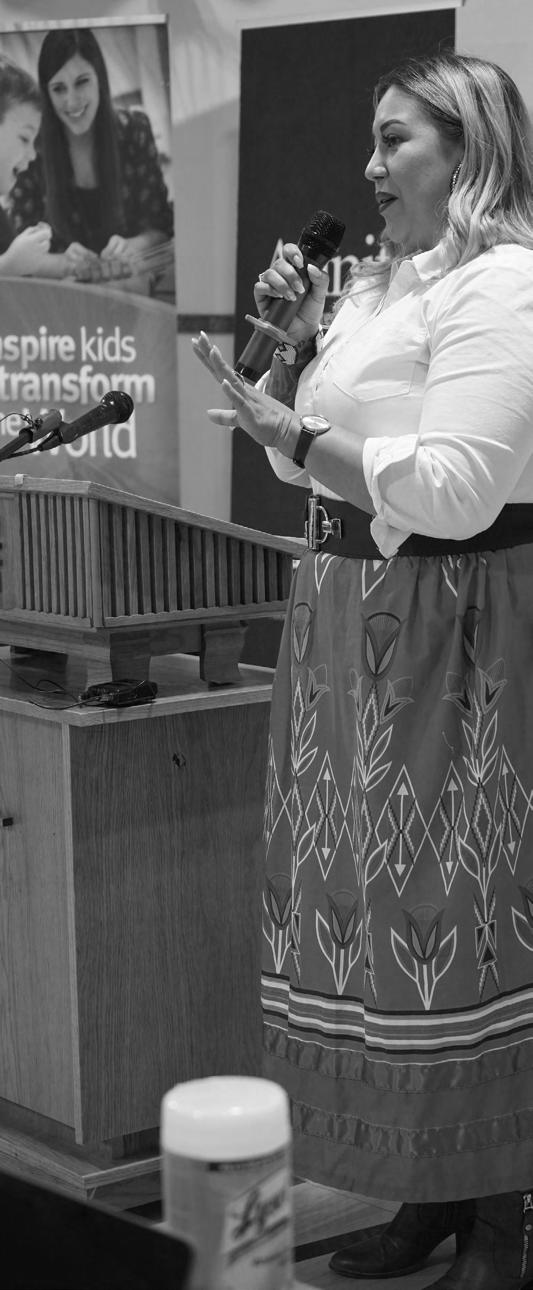
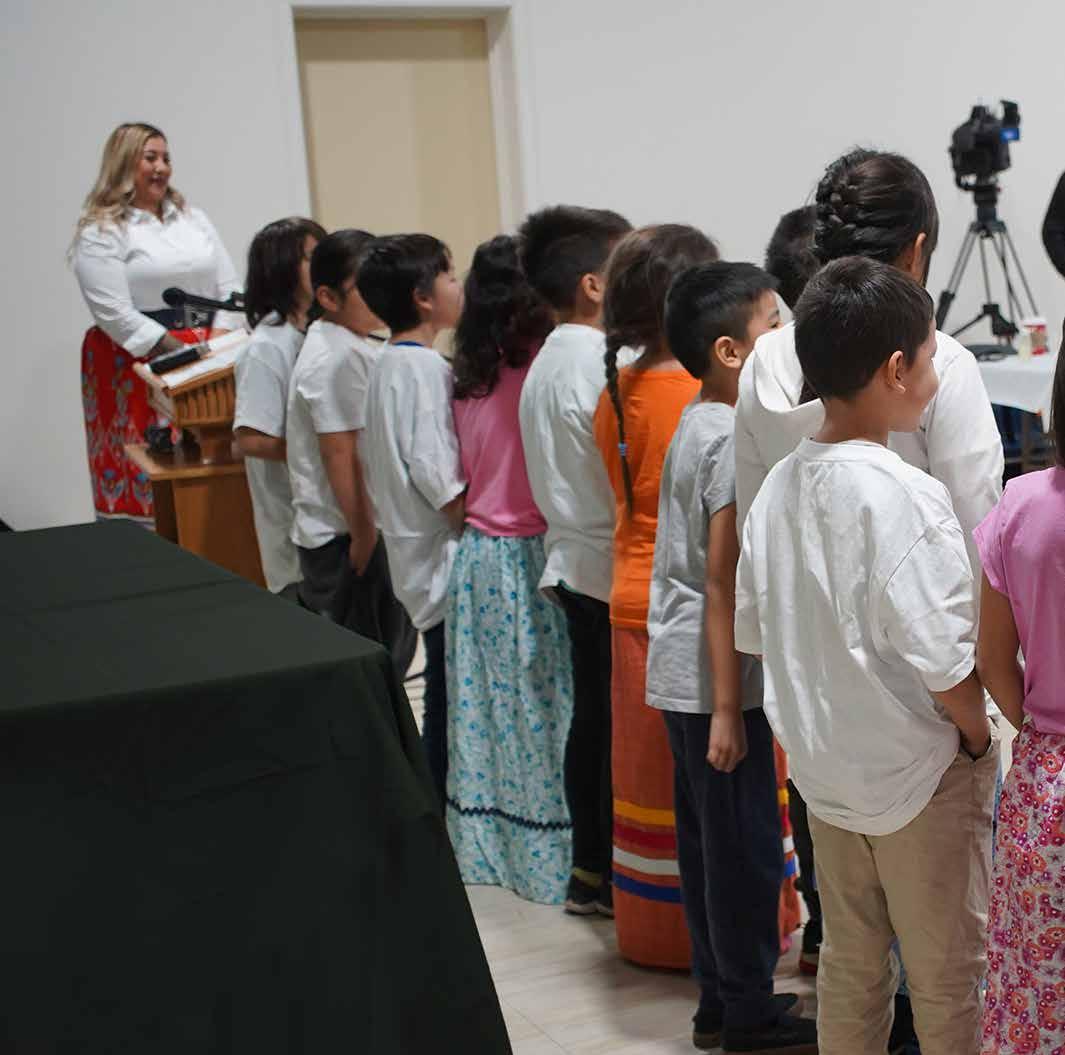
In October 2022, Affinity announced our commitment of $250,000 to enhance STEAM learning (science, technology, engineering, arts and mathematics) at the new St. Frances Cree Bilingual School in Saskatoon when it moves into a new facility.
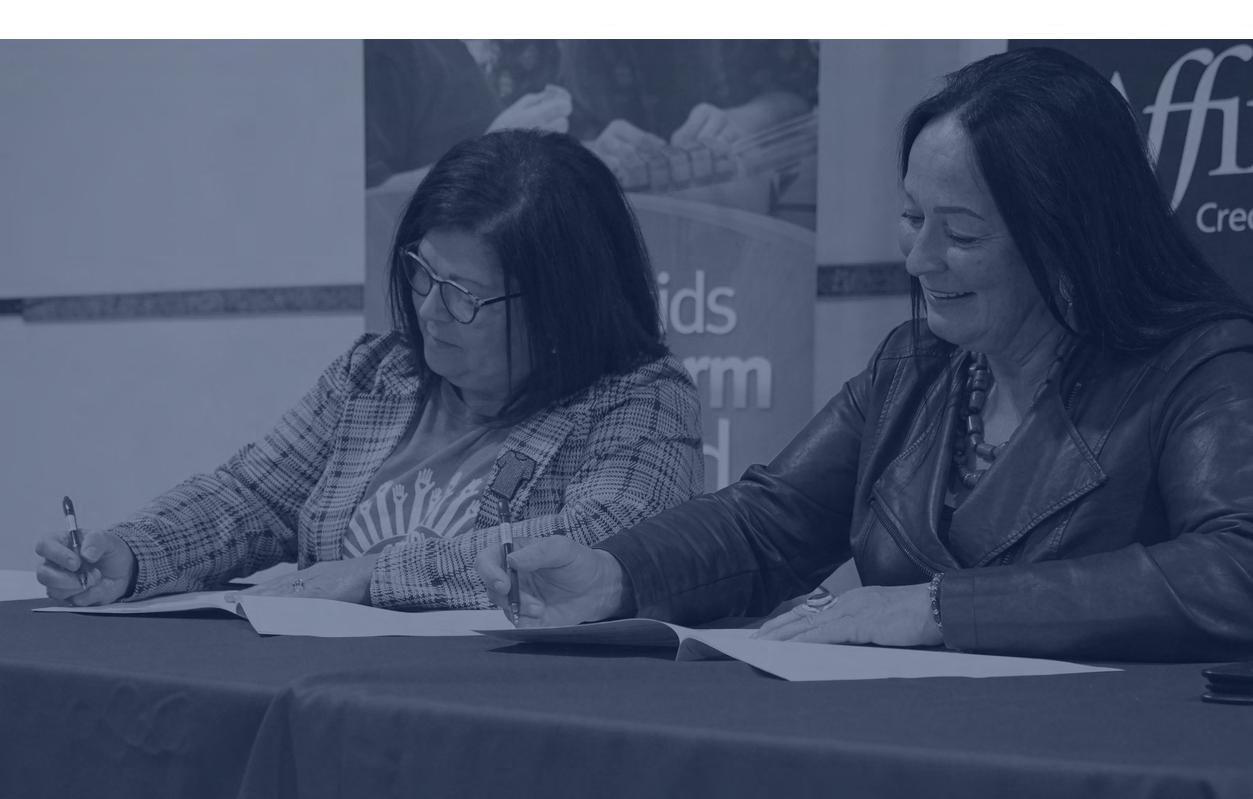
The announcement was made at a Student Learning on the Land Exhibit hosted by the school, where students demonstrated various aspects of their learning. There were also cultural demonstrations, and various rights holders and stakeholders—including Affinity Credit Union representatives, parents, school and division representations, and the design and planning team—spoke about the significant benefits the addition of the STEAM lab would have on student learning. The kēhtāwisowin STEAM Lab will integrate western knowledge and scientific techniques with Indigenous ways of knowing and doing.
Children are going to walk through the STEAM lab doors and feel safe to embrace their culture and expand their knowledge. That’s a long overdue step on the path of truth and reconciliation that we’re honoured to support.

“It’s exciting to be able to show tomorrow’s professionals and leaders that it’s possible to have a healthy balance between tradition and culture, and modern tools and techniques. We’re very grateful for Affinity Credit Union’s support of this important aspect of the soon-to-be built school,” said Diane Boyko, Board of Education Chair for Greater Saskatoon Catholic Schools.
St. Frances Cree Bilingual School is home to Canada’s largest Indigenous language program. Having outgrown its current spaces, construction of a new school is set to begin in 2023 with a projected opening in the fall of 2024.
Mark Lane, CEO at Affinity Credit Union
We’re working hard to futureproof your credit union, not only for tomorrow but for many years to come. As we continue to build more personal relationships with members, whether that’s in the form of in-person visits or digital touchpoints, Affinity will continue to be here for you.
Mark Lane, CEO and Mitchell Anderson, Board Chair

2 Annual Report 2022 Building for the Future
From Our Chair and CEO


2022 was a year that tested the resiliency of our members and their credit union. We’re pleased to report a successful year in spite of the challenges faced. As we move into 2023, your credit union is taking steps to futureproof itself to remain relevant for members for many years to come.
In 2022, everyone realized that there’s never been a better time for financial advice. Implications of inflation and the Bank of Canada raising interest rates caused a level of hardship to borrowers not seen in over a decade. That said, Saskatchewan is faring somewhat better than other parts of the country due to opportunity within our diversified economy and relatively strong commodity prices.
Due in part to the combination of these, your credit union fared very well in 2022 – ultimately benefitting you, our members. In 2022, we funded more than $3.1 million to local organizations, charities and initiatives throughout all of Saskatchewan. We increased the benefits from our Restart Loan, as well as renewed cohorts for the Each One, Teach One financial literacy program – an important community benefit that was put on pause during the first couple of years of the pandemic.
A governance structure bylaw was approved at our AGM in 2022, changing how Affinity’s Board of Directors are elected. Previously, directors needed to be a member representative from a geographic member council but now all members can apply to be considered as a candidate, regardless of which
part of Saskatchewan they call home. We’re optimistic that the additional flexibility will encourage even more qualified candidates.
As we look ahead to 2023, we recognize that in our industry, where change is now constant, we continue to see our membership move further down the path of digital preference. In 2022, we announced that we’ll be introducing an East Central Regional Advice Centre in Humboldt in 2023 as we continue to review our geographic footprint. While the role of advice centres will continue to evolve from transaction processing to the provision of value-adding advice, the need for more personalized relationships with members will grow.
As the title of this annual report suggests, Building for the Future, your credit union continues to futureproof itself to remain relevant and viable for many years to come. In 2023, we’ll continue to introduce payments modernization, open banking and data enablement. You can also look forward to a credit card program that will enable Affinity’s ownership of key attributes in our credit card relationship with you, our member. As always, thank you for your business and support of our growing credit union.
Mark Lane Chief Executive Officer Mitchell Anderson Board Chair
3 Annual Report 2022 Building for the Future
2022 Highlights
100% owned by our
143,102 members
$9B in managed assets
Over
16,000 daily active users on Affinity Mobile
An extra layer of security –Multi-Factor Authentication
July 2022 – We introduced Multi-Factor Authentication (MFA) to online banking and the Affinity Mobile app to provide an extra layer of security for our members. The new security feature verifies members’ identities with a one-time code when they access their digital banking. This feature has resulted in a 96% decrease in online fraud since its implementation!
220,264 calls to our Contact Centre with an average wait time of 2 minutes and 3 seconds
96%
decrease in online fraud since the introduction of Multi-Factor Authentication!

37,968 enrolled SecureKey users
more than 365k
Multi-Factor Authentication (MFA) codes sent by email, text or voice message after its introduction in July 2022
4 Annual Report 2022 Building
the Future
for
56 locations in communities
provided funding to 668 organizations across Saskatchewan
nearly12,000 member responses to our Voice of Member survey with a top-decile score relative to our market benchmark
The membership has spoken
April 2022 – Affinity members voted on the special resolution on proposed bylaw changes, that included a new governance model, and was approved with 89% in favour! The new model will allow for our entire membership to participate in election of our Board of Directors annually, representing the interests of all members, regardless of what part of Saskatchewan they call home. It also allows the Board to determine the skills and competencies that constitute the ideal Board and recruit for specific skill sets while ensuring attributes, such as having a co-operative nature, remain as a foundational part of our Board composition.
over
826 incredible employees
$390k
provided to employees for educational support, tuition reimbursement, training & workshops

Crowned Best of Saskatoon!
December 2022 – Thanks to our members and community, our Eighth Street Advice Centre was voted Best Credit Union Branch in Saskatoon by Planet S Magazine. Not far behind was our City Centre Advice Centre who snagged the second spot!
We’d also like to thank all of our amazing member advisors at these and all of our locations. It’s because of the friendly and knowledgeable service they provide to members that recognition like this is possible. Thank you for voting!
10th largest credit union in Canada
47
Lending Services


When you’re an Affinity member, your money doesn’t just sit around – it gets put to work through investments back into your community. Member deposits are our primary funding source that help your neighbours get loans to buy homes, start businesses, get educated and more! These investments help to drive the Saskatchewan economy forward and help make our province a great place to live!

December 31 portfolio balances: 2022 2021 Residential Mortgages $2,387,809,312 $2,278,498,029 Business Loans $1,848,262,484 $1,634,964,462 Agriculture Loans $901,962,542 $853,639,839 Personal Loans $484,697,391 $468,864,057 Other Loans $16,050,441 $14,232,555 Total $5,638,782,170 $5,250,198,942 6 Annual Report 2022 Building for the Future
Impact Lending
Making a difference in our communities and lending a helping hand is very important to us at Affinity. Whether it’s providing options to those who have little or no credit history, seeking affordable housing loans or making that small business dream a reality – we’re here to help!

Disbursements made: 2022 2021

Loan Type Balance# Balance# Affordable Housing Loans $127,814,122855 $131,392,611892 Small Business Loans $103,770,940624 $108,330,450628 Restart Loans $1,366,604711 $1,199,879703 Student Loans $4,030,898254 $3,382,858237 Total $236,982,5642,444 $244,305,7982,460
7 Annual Report 2022 Building for the Future
*Impact lending presents loans funded in the respective year as opposed to cumulative outstanding balances.
Governance at Affinity
Our governance structure is effective, transparent, accountable, open and ethical. It keeps us connected to our co-operative roots and to each of our diverse members.
Board Governance
The Board of Directors has a comprehensive mandate that guides their accountability to provide oversight and direction for Affinity Credit Union. As a Provincial Systemically Important Financial Institution (P-SIFI), this includes a commitment to achieving the highest standards of corporate governance and overseeing the effectiveness of business operations, financial performance and the risk management framework.
The Board meets at least quarterly to discharge their primary responsibilities to approve and oversee items essential to prudential oversight of Affinity Credit Union, such as strategy, risk appetite, capital plans and key policies, and to provide challenge, advice and guidance to senior management.
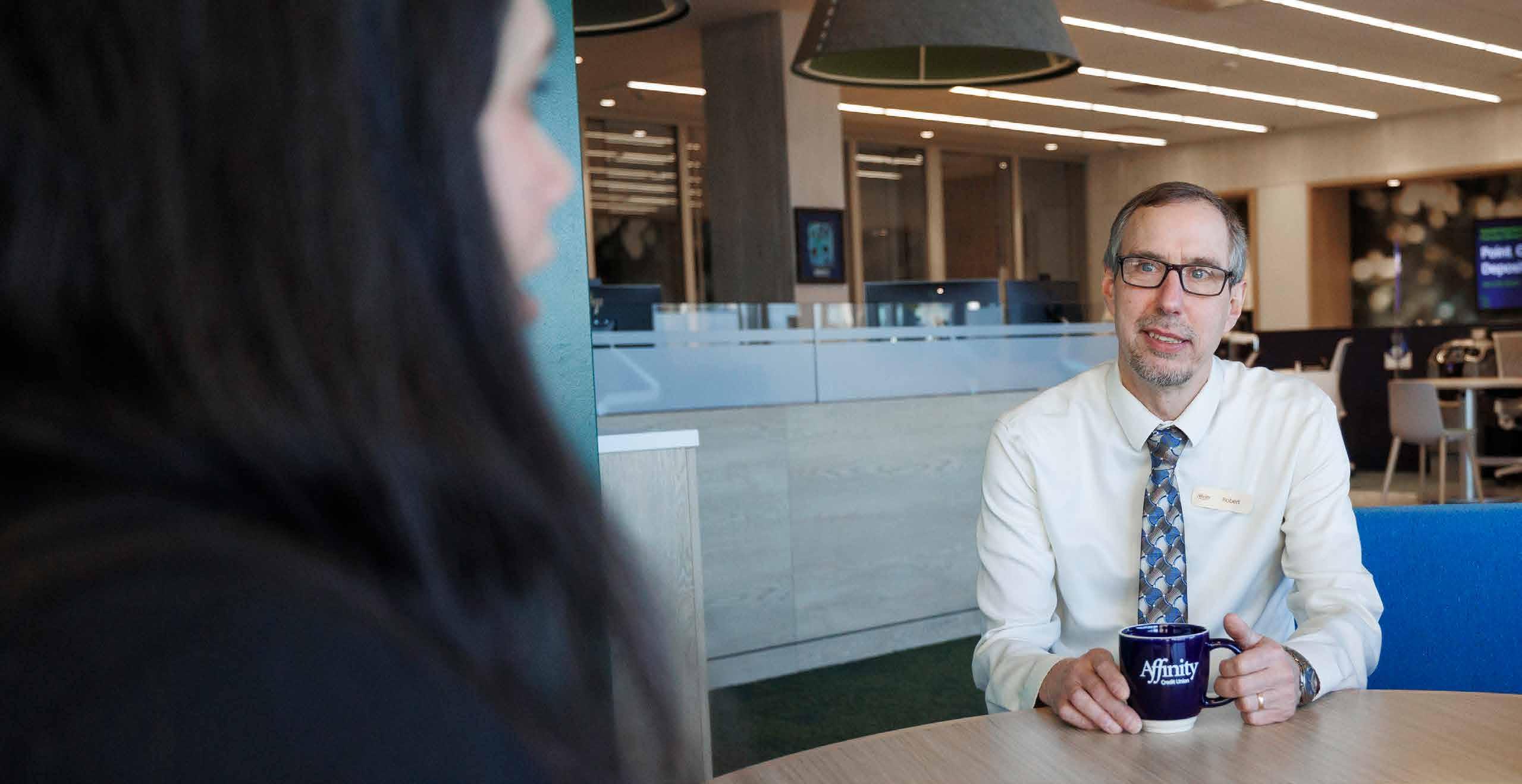
In 2022, the Board met their expectations to discharge their essential duties. Through the execution of their work plan, the Board accomplished the following key deliverables:
• After careful consideration and due diligence, the Board approved an update to Affinity’s Governance Model, including a recommendation to members to vote in favour of the proposed bylaw changes required to effect the change. The special resolution on proposed bylaw changes was approved by 89%
of voting members. The new model allows for the following key changes:
• An at-large director election that aligns with the guiding principles established by the Board including the overarching requirement to respect the co-operative nature of Affinity while meeting regulatory expectations.
• Affinity’s entire membership is eligible to participate on our Board of Directors, regardless of what part of Saskatchewan they call home.
• The Board determines the skills and competencies that constitute the ideal Board and recruit for specific skill sets while ensuring that attributes like having a credit union conscience is a foundational part of our Board composition.
• Established a Nominating Committee to undertake director candidate recruitment and assessment and carry out director elections under the direction and guidance of the Governance Committee who is responsible to develop and oversee the board succession policies.
• Developed and approved a Board Renewal and Succession Policy to provide guidance for effective and orderly succession of directors that will result
in a board composition which is mindful of director competencies, strategic skills, independence, commitment to the credit union values, diversity and inclusion, and tenure, as a collective necessary for the Board to effectively govern Affinity.

• Established an Environmental, Social and Governance (ESG) Committee to provide direction on the development of an ESG Framework that will define Affinity’s approach to implementing, measuring and assessing our environmental, social and governance commitments.
• Continued our reconciliation journey guided by our 2022-2024 Truth & Reconciliation Roadmap, building on our established commitments and calls to action as a credit union with focus on:
• Knowledge Reconciliation – create opportunities for learning and discovery of the history, truth and importance of reconciliation for our employees, members and communities.

• Economic Reconciliation – develop connections to expand employment, education and economic prosperity with Indigenous Peoples, communities and businesses.
• Values Reconciliation – foster an environment that’s inclusive, respectful and welcoming.
Orientation & Continuing Education
The Board is committed to education and professional development of directors to ensure that the Board has the knowledge and skills necessary to fulfill its oversight responsibilities.
New directors are offered orientation and mentorship programs to familiarize themselves with Affinity’s governance processes and business operations. The Governance Committee conducts an annual debriefing of the orientation and mentorship programs to capture enhancement opportunities for subsequent years.
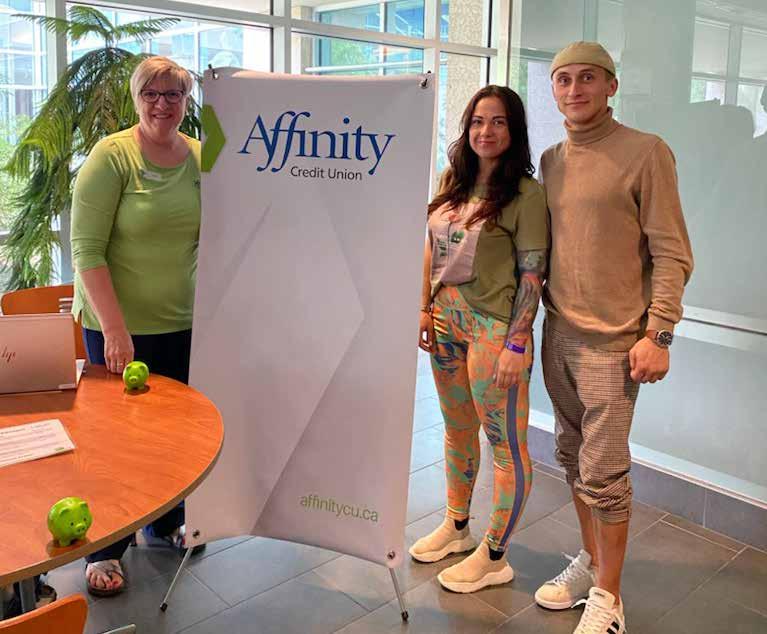
In addition to individual director development, the Board is committed to ongoing director training and development including educational sessions, industry-sponsored seminars and conferences relevant to Affinity’s business. In 2022, the following Board education sessions were held to address topics considered to be particularly important, including Financial Literacy, ESG Strategy, Macro-Economics for Saskatchewan, Developing an Ideal Board Profile and Populating the Board, Director & Officer Insurance, Cyber Security Insurance and Interest Rate Risk.
9 Annual Report 2022 Building for the Future
Our Board of Directors
Did you know that Affinity is 100% owned by our members and our Board is elected by our members to set strategy and oversee senior management? This dedicated group of directors drive where Affinity is headed and what we need to do to get there. They also keep us grounded in our commitment to putting our members first, in support of Affinity’s values and the credit union system as a whole.
All Board members have a fiduciary responsibility to Affinity and follow the standards set out in the
Credit Union Act 1998, the Standards of Sound Business Practice, its regulatory requirements as a P-SIFI, and all applicable legislation. Affinity’s independent Board of Directors is led by Mitchell Anderson, non-executive Board Chair. The day-to-day management is delegated to Mark Lane, Affinity’s Chief Executive Officer.
Affinity’s Board of Directors approve policies and ensure Affinity operates with integrity, honesty, fairness, professionalism and the highest ethical standards.
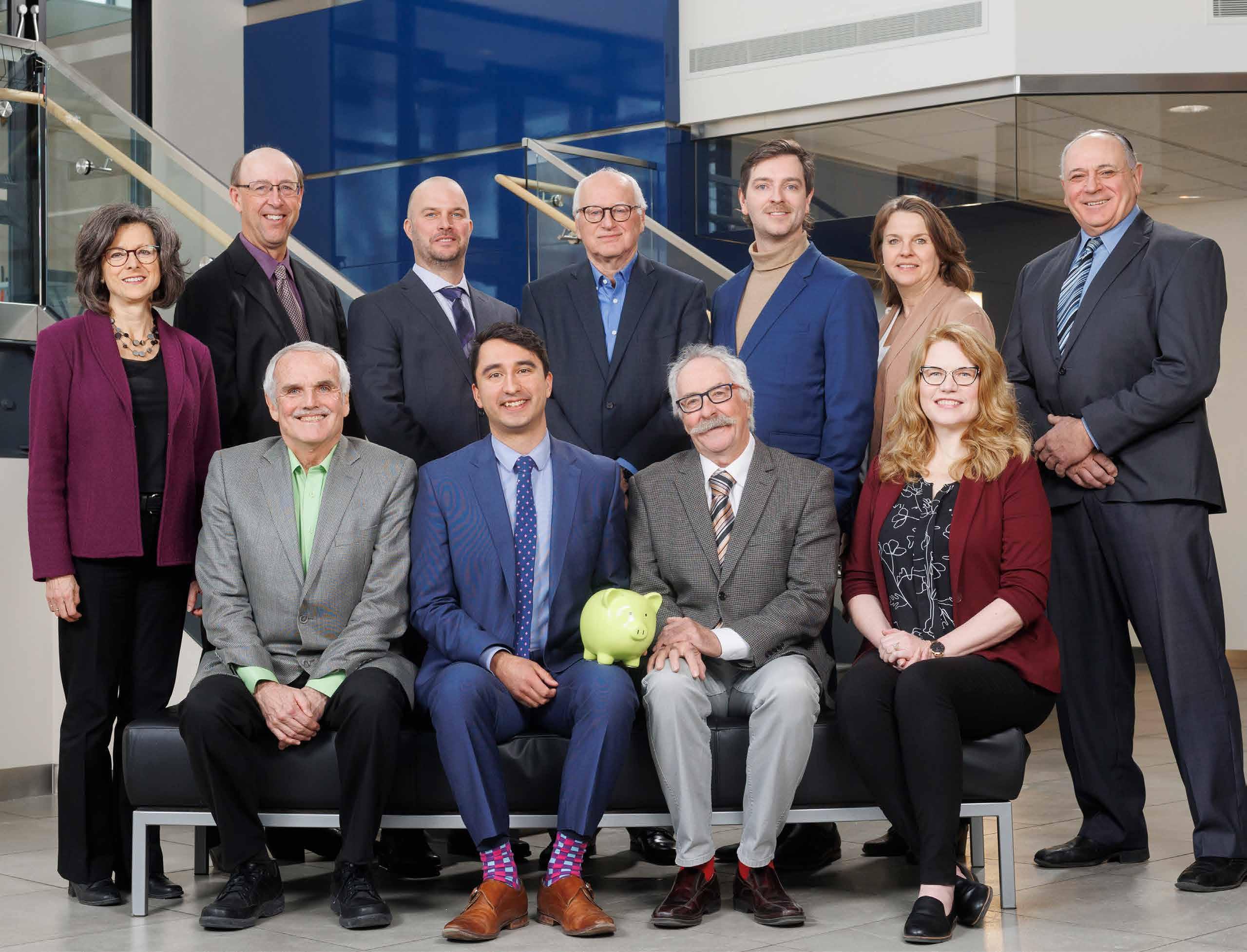 From left to right: Standing: Debra Chobotuk, Scott Flavel, Larry Spratt, Kurt Holfeuer, Nathaniel Cole, Deirdra Ness, Joseph Rybinski
Seated: Bryan Cottenie, Mitchell Anderson (Board Chair), Wayne Amos, Cindy Anderson

Board Meeting Audit & FinanceGovernance Human Resources & Compensation Risk (4) and Conduct Review (3) ESG (Environmental, Social and Governance) Nominating Committee Wayne Amos 8 of 8 3 of 3 4 of 5 6 of 6 Cindy Anderson8 of 85 of 5 5 of 6 1 of 1 Mitchell Anderson* 8 of 8 7 of 7 6 of 6 4 of 4 1 of 1 Debra Chobotuk8 of 8 10 of 10 6 of 6 4 of 4 Nathaniel Cole 8 of 8 9 of 10 7 of 7 1 of 1 Bryan Cottenie 8 of 85 of 5 Scott Flavel 8 of 85 of 5 7 of 7 4 of 4 Kurt Holfeuer 8 of 83 of 3 1 of 1 7 of 7 Deirdra Ness 8 of 85 of 510 of 10 4 of 4 Joseph Rybinski8 of 8 7 of 7 1 of 1 1 of 1 3 of 4 Larry Spratt 6 of 85 of 5 5 of 5 Lois Standing 0 of 2 0 of 1 2022 Director Meeting Attendance January 1 – December 31, 2022
Meeting Attendance
11 Annual Report 2022 Building for the Future
*Board Chair: Mitchell Anderson
Board Committees
The Board as a whole is responsible for all work undertaken on its behalf by committees. The Board holds committees accountable for assisting them in fulfilling their corporate governance responsibilities by ensuring appropriate oversight over committee work. This is done through approval of committee Terms of Reference, appointment of committee members and assurance that the required technical
skills and competencies are present at individual committee levels. All committees meet on a quarterly basis.
Based on self-assessment and reflection, each committee has discharged their duties as outlined in their Terms of Reference and 2022 work plans.
Audit and FinanceCindy Anderson
Bryan Cottenie
Scott Flavel (Chair)
Deirdra Ness
Kurt Holfeuer
Larry Spratt
Ensures Affinity adheres to an effective control framework for the protection of members’ assets. The framework is to provide reasonable assurance that the credit union operates in a manner that adheres to required financial control and reporting standards.
Risk
Wayne Amos
Debra Chobotuk
Nathaniel Cole
Scott Flavel
Kurt Holfeuer (Chair)
Provides effective oversight of the credit union’s risk management framework, legal and regulatory compliance framework. Serves as the credit union’s Conduct Review Committee, which oversees adherence to the principles of ethical conduct and responsible business behavior.
Human Resources & Compensation
Wayne Amos
Cindy Anderson
Mitchell Anderson (Chair)
Larry Spratt
Oversees the compensation strategy and human resource policy framework. Undertakes effective performance management and succession planning for the Chief Executive Officer.
Governance
Mitchell Anderson
Debra Chobotuk (Chair)
Nathaniel Cole
Deirdra Ness
Joseph Rybinski
Oversees the corporate governance framework, including review and recommendations of the Board of Directors-related policies and processes. For example, director compensation, composition, succession and renewal.
ESG (Environmental, Social and Governance)
Mitchell Anderson
Debra Chobotuk
Scott Flavel
Deirdra Ness (Chair)
Joseph Rybinski
Determines priorities to inform the development of an ESG Framework. Recommends optimal governance practices to provide ongoing oversight of ESG.
Nominating
Cindy Anderson
Mitchell Anderson
Nathaniel Cole (Chair)
Conducts all aspects of the director recruitment, nominations and election process.
Board CommitteeBoard Committee Members Responsibilities
12 Annual Report 2022 Building for the Future
Member Councils
As part of the transition to the new governance model and the bylaw changes approved by the members, district councils and delegates were renamed member councils and member representatives.
As Affinity ambassadors, member representatives continue to be role models in their communities and represent Affinity by attending events and member council meetings, as well as being visible to community members.
Member councils identify opportunities for Affinity support, review and approve community development funding and award the Elwood Harvey Co-operative Leadership scholarship program. The member councils are Affinity’s grassroots connection to our members, they put our values into action and connect Affinity to our members and our members back to us.
Saskatoon Member Council
Charity Beres
Jasmin Carlton
Jo Custead
Hilary Gough
Lindsay Herman
Fred Khonje
Audra Krueger
Alison Lackie
Victoria Morris
Indigenous Member Council
Damon Delorme
Cowessess First Nation
David D. Cote
The Key First Nation
Lois Standing
Wahpeton Dakota Nation
Michael Bob
Kahkewistahaw First Nation
Terrance Okemow
Lucky Man Cree Nation
Wayne J. Thomas
Kinistin Saulteaux Nation
North Member Council
Eric Dueck
Roy Eichendorf
Terry Hinz
Debbie McGuire
Peggy Walker
Salton Williams
North East Member Council
Gailmarie Anderson
Jordon Eggerman
Stephanie Gerwing
Devin Hinz
Cindy Porter
Marilee Sterner
North West Member Council
Stephanie Gosselin
Diana Herzog
Tina Stene
Charlene Tebbutt
Dannie Wreford
Adena Viczko
The member councils met four times throughout 2022, three times as individual councils and once as a collective group of all member representatives across the province. Through the execution of their work plans, the member councils accomplished the following:
• reviewed 387 community development funding applications and distributed over $1,869,000 to community initiatives;
• awarded 21 scholarships to young leaders; and
• updated and approved member council funding guidelines including funding priorities, assessment and eligibility criteria.
These are your Affinity member representatives as of December 31, 2022.
East Member Council
Brianne Braaten
Rosalie Daisley
Jason Harbor
Joseph Kozakewich
Carla Krochak
Margaret Rudychuk
South Member Council
Davida Bentham
Joyce Fraser
Bryan T. Leier
Stephen Schury
Virginia Wilkinson
Sherry Wolf
South Central Member Council
Richard Goulet
Grant Greenshields
Mike Heinrich
Patricia Isherwood
Kelvin Schapansky
Owen Sebastian
South East Member Council
Dennis Bode
Duane Chipley
Paulette Howard
Garry Lafrentz
Cameron Nordin
Dyon Stadnick
13 Annual Report 2022 Building for the Future
Remuneration
Director Pay
Executive Pay
All values are rounded to nearest dollar.
* Variable pay amounts are accrued as an expense in the fiscal year earned and paid the following year. The above table represents the timing based on when these amounts are actually paid.
** Includes active and departed members of the Executive Leadership Team throughout 2022.
2022
Board Director Total Per Diems Dates Served as a Director in 2022 Wayne Amos $18,400.04 January 1 to December 31, 2022 Cindy Anderson $18,900.04 January 1 to December 31, 2022 Mitchell Anderson $41,258.50 January 1 to December 31, 2022 Debra Chobotuk $23,100.08 January 1 to December 31, 2022 Nathaniel Cole $19,075.05 January 1 to December 31, 2022 Bryan Cottenie $15,175.04 January 1 to December 31, 2022 Scott Flavel $20,125.08 January 1 to December 31, 2022 Kurt Holfeuer $20,150.08 January 1 to December 31, 2022 Deirdra Ness $27,083.40 January 1 to December 31, 2022 Joseph Rybinski $20,550.04 January 1 to December 31, 2022 Larry Spratt $14,225.04 January 1 to December 31, 2022 Lois Standing $1,333.34 January 1 to February 1, 2022 Total 2022 Director Per Diems $239,375.73 Director Per Diems $239,375.73 Member Representative Per Diems $76,775.00 Director and Member Representative expenses (includes all meals, accommodation, mileage and training) $117,606.00 Director and Member Representative Remuneration 2022 Totals 2022
SalaryVariable Pay* Benefits* Total CEO $696,329 $347,826 $198,071 $1,242,226 Executive Team** $1,726,199 $669,952 $221,120 $2,617,271 TOTAL $2,422,528 $1,017,778 $419,191 $3,859,497
Board Director Per Diems
Board
Director Per Diems
14 Annual Report 2022 Building for the Future
2022 Executive Leadership Team Compensation
Our Executive Team
Our focus is always on outcomes that serve you – our members. As an Executive Leadership Team, we’re committed to leading by example. Guided by decades of expertise and experience, we’re shaping the future of your credit union.

We live and breathe our co-operative values – not only around the executive table but also in our communities. In our spare time, you’ll find us living our values by chairing
committees and participating in community programs and initiatives.
We work collaboratively to strategically execute Affinity’s vision of building a better world for everyone, every day. This is why your feedback is important to us – it helps us futureproof your credit union and bring you the products and services that matter most to you.
From left to right: Back row: Corina Farbacher, Chief Risk Officer; Mike Elchuk, Chief Information Officer; Louis Cho, Chief Experience Officer; Tammy Martins, Chief Data & Operations Officer; Nilesh Kavia, Chief Financial Officer; and Richard Schwan, Chief Banking Officer.
Front row: Mark Lane, Chief Executive Officer; and Heather Sully, Chief People Officer.
Working at Affinity
At Affinity, we continue to create an environment that will attract, motivate and retain incredible talent. Our employees are dedicated and passionate about living our values and building a better world for everyone, every day.
Over the past year, we lived our values by volunteering our time in communities, supporting initiatives that promote inclusivity and awareness, such as Pride Parades, Orange Shirt Day
and many more. Supporting one another and creating a safe place where we do our best work (and have fun while doing it!) is what it means to be an Affinity employee.
At Affinity, we take pride in our work, go the extra mile and deliver remarkable member experiences every day. Living our values is engrained into each and every one of us!
Affinity’s entry-level member-facing role hourly wage vs. Saskatchewan hourly minimum wage
$25.08 vs. $11.81
as of January 1, 2022
EMPLOYEES
FULL TIME
PART TIME 2022 20212020 Employees in Urban Locations 64% 62% 59% Employees in Rural Locations 36% 38% 41% Positions Filled Internally 57.4% 64.6% 58.1% Voluntary Turnover 10.5% 12% 5.4% New Hires of Indigenous Ancestry (Self-Declared) 5.8% 5% 1.5% New Hires from Diversity Groups 24.8% 24.2% 29% Complaints of Discrimination 0 0 0 Average Age of Managers 45.2 45.2 43.9 Average Age of Non-Management Employees 42.0 42.5 41.8 Unionized Employees 19% 18.7% 20% Educational Support, Tuition Reimbursement, Training and Workshops $390,913.63 $386,783.61$439,392.97
826
663
163
SK 16 Annual Report 2022 Building for the Future
Our Remarkable Employee Experience

Affinity’s Remarkable Employee Experience Framework provides tools that are designed to motivate and engage current employees, while also attracting new employees to Affinity. This framework provides access to programs, career opportunities and an environment that makes it a fulfilling, inclusive, challenging and rewarding place to work!
In the fall of 2022, we launched our annual employee engagement survey, which provided us valuable feedback and insights into our employee experience. A total of 88% of employees participated in the survey. And even better news… the results of the survey place us within the top quartile of overall engagement scores, when compared to other Canadian-based, medium-sized organizations!
Using the insights gathered from the employee engagement survey and other relevant sources,

we’ll continue to fine-tune our employees’ experience. Similar to our efforts in providing a frictionless member experience, in 2022, we also worked towards creating a more streamlined and integrated experience for our employees. We did this through expanding the functionality of our Human Resources Information System to provide more of a one-stop-shop for recruitment, onboarding and performance management activities. In 2023, we’ll focus our efforts in areas such as leadership excellence, culture stewardship, change leadership, systems integration, process efficiency and continuous improvement of our training programs.
Using employee feedback shows our commitment and support to our employees. When we work together, we grow together and ultimately, contribute to Affinity’s remarkable member experience!
We embrace challenges together but also share in our collective successes. There’s a strong sense of trust and belonging within our diverse group. Helping contribute to the shared goals of such a high-performing team has provided me with a strong feeling of being valued.
If I was to give one piece of advice to someone applying at Affinity it would be to seek learning opportunities everywhere, not just in the classroom. Consider volunteering your time with a local board or community organization to gain experience.
 Cameron Meier Operations Advisor
Jared Lindgren Senior Accounting Analyst
Sarah Von Niessen Deposit Processing Team Lead
My favourite part of working at Affinity has to be the people. I don’t know if there’s something in the water here or what, but the people at Affinity are consistently great to work with!
17 Annual Report 2022 Building for the Future
Donations, Sponsorships and Scholarships


Thank you to our members for making these community investments possible! It’s because of you that we’re able to invest these profits back into your
communities. It’s good for you, it’s good for your community and it’s good for us as a credit union –supporting the community simply makes good sense!
$3.1 million donated
4.84% post-tax profits of the prior year
668 organizations/initiatives across Saskatchewan
2022 2021 2020 Program Amount # Amount # Amount # Community Development Funding $1,869,174271$571,243156$346,673111 Community Spirit Fund Employee Giving $152,600763$150,200751$150,600753 Corporate and Advice Centre Donations and Sponsorships $991,710212$784,51484$766,999135 Scholarships and Awards $89,50068$80,00050$75,00048 Total $3,102,9841,314$1,585,9571,041$1,339,2721,047 Funding by Program 18 Annual Report 2022 Building for the Future
Each One, Teach One (EOTO) Financial Literacy Workshops
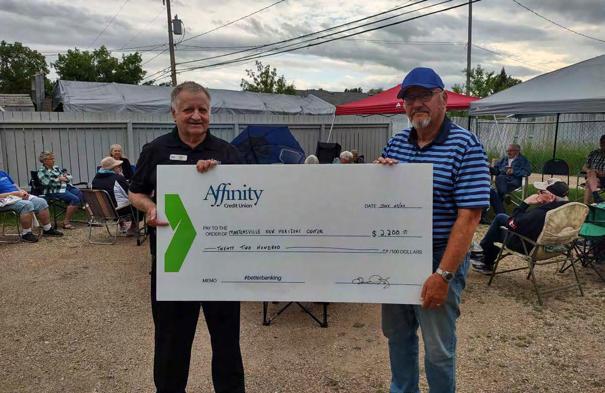
We proudly participate in Each One, Teach One (EOTO), an award-winning financial literacy program, which offers workshops to community groups on money management topics. EOTO workshops are delivered in simple language and tailored to the needs of each community group. Over 40 of our Affinity employees are trained to deliver these workshops and they’ve made a huge impact in our communities!

EOTO Stats 2022 # of Workshops Delivered 46 # of Persons attending EOTO Presentations578 # of Communities Reached 17 # of Certified EOTO Trainers 54 20222021 East $131,592$51,450 North $244,409$86,704 North East $215,063$74,019 North West $163,279$62,632 Saskatoon $1,221,381$583,311 South $267,114$353,013 South Central $381,781$74,194 South East $341,625$177,809 Indigenous $25,000$15,000 Provincial $66,340$107,825 Outside of Province* $45,400 –Total $3,102,984$1,585,957 Funding by District 19 Annual Report 2022 Building for the Future
*This is a new addition to our reporting breakdown. The 2022 number includes donations to out-of-province Community Spirit Fund, Canada-Ukraine Foundation and Co-operative Development Fund.
Our Commitment to Truth and Reconciliation

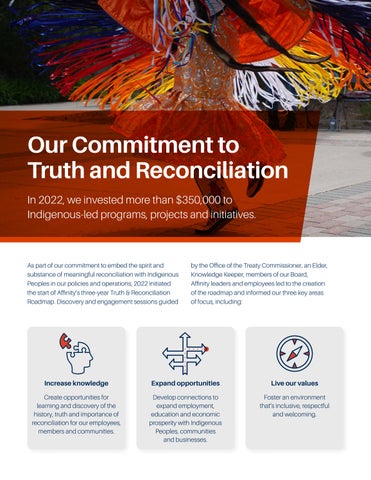
In 2022, we invested more than $350,000 to Indigenous-led programs, projects and initiatives.
As part of our commitment to embed the spirit and substance of meaningful reconciliation with Indigenous Peoples in our policies and operations, 2022 initiated the start of Affinity’s three-year Truth & Reconciliation Roadmap. Discovery and engagement sessions guided
by the Office of the Treaty Commissioner, an Elder, Knowledge Keeper, members of our Board, Affinity leaders and employees led to the creation of the roadmap and informed our three key areas of focus, including:
Increase knowledge
Create opportunities for learning and discovery of the history, truth and importance of reconciliation for our employees, members and communities.
Expand opportunities
Develop connections to expand employment, education and economic prosperity with Indigenous Peoples, communities and businesses.
Live our values
Foster an environment that’s inclusive, respectful and welcoming.
Some of the 2022 initiatives supporting the Truth & Reconciliation Roadmap included:
• Hiring a Community Advisor, Indigenous Engagement as a dedicated resource focused on forging new partnerships and supporting strategies to advance our reconciliation journey.
• Honouring and recognizing days of significance, such as February’s Indigenous Storytelling Month and September 30, National Day for Truth & Reconciliation.


• Creating Affinity’s Circle of Truth & Reconciliation online employee group, an organization-wide safe space for employees to have ongoing conversations and share resources related to their reconciliation journey.
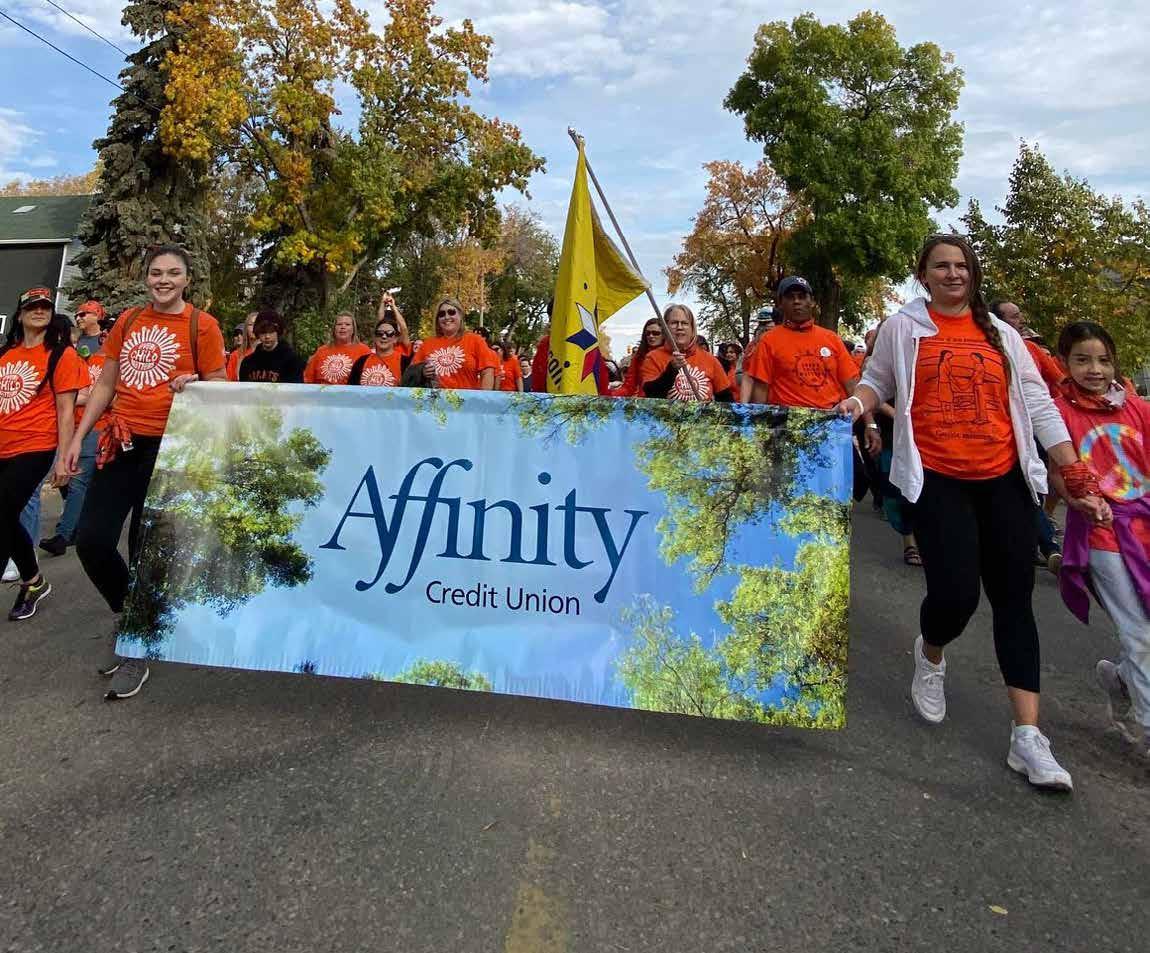
• Providing schol arships and awards across the province through Gabriel Dumont Institute (GDI), Saskatchewan Indian Institute of Technologies (SIIT) and Saskatoon Indian and Métis Friendship Centre (SIMFC).

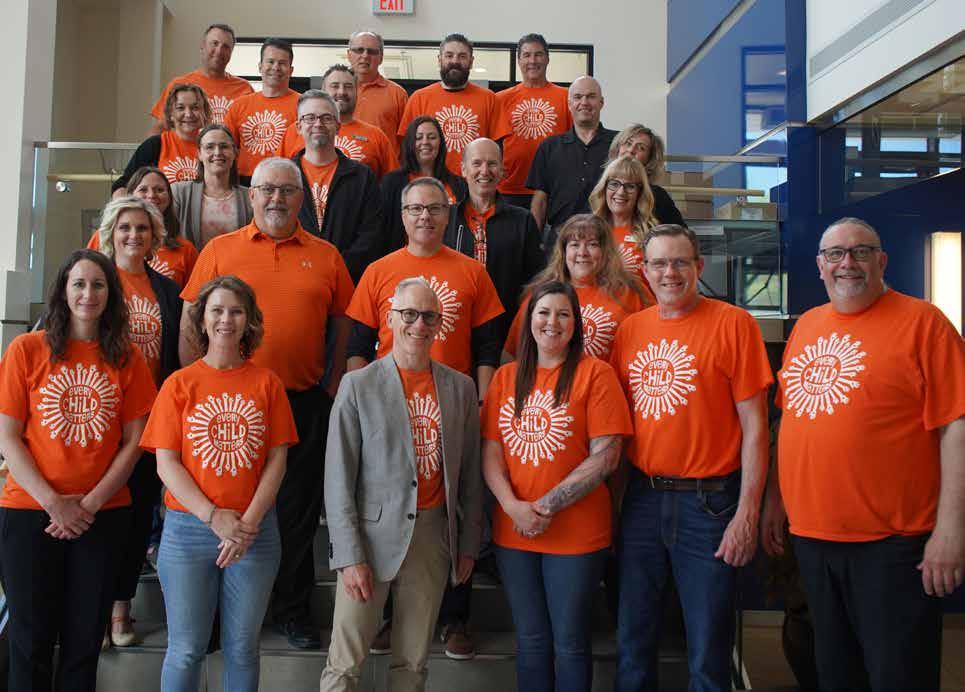
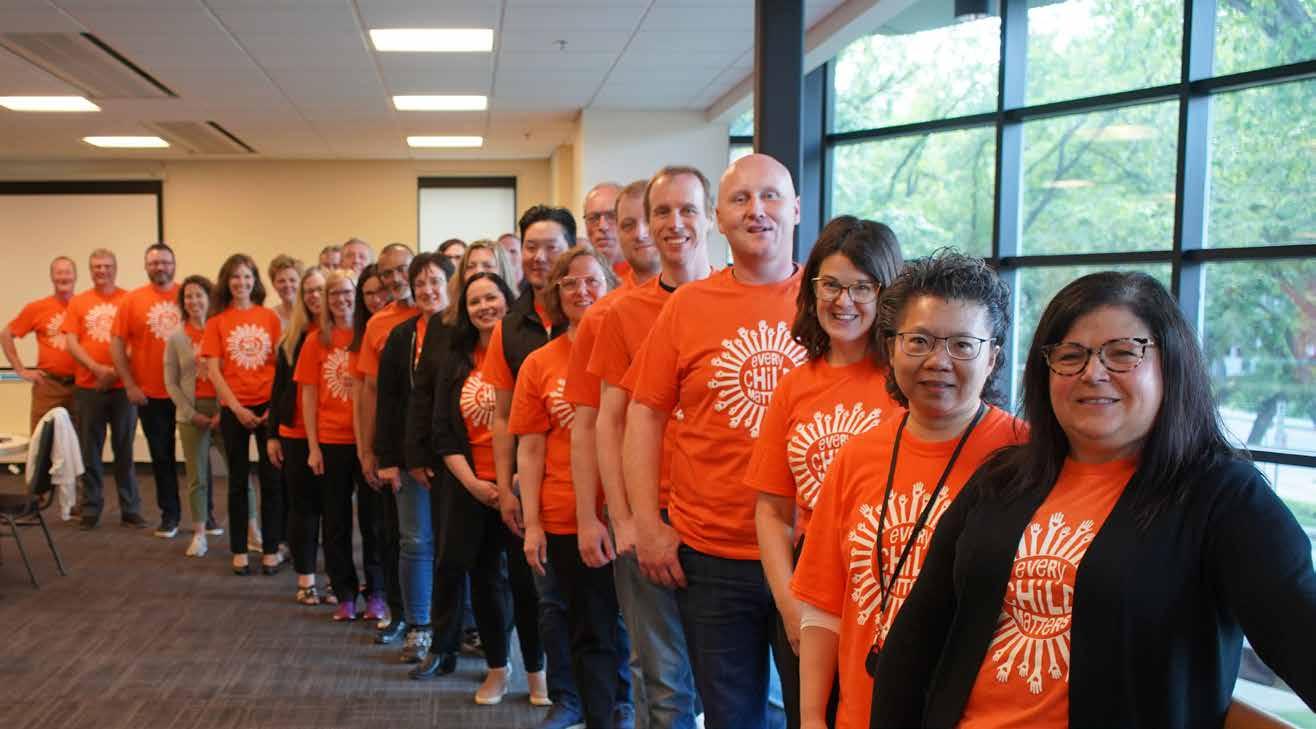
• Partnering with Awasis Boutique, a local Indigenous business, to offer Every Child Matters
orange shirts for employees, directors and member representatives.

• Developing Land & Treaty Acknowledgement guidelines and protocol to equip employees with the knowledge and understanding to create respectful, inclusive and authentic statements.
• Beginning to work with an Indigenous-owned and purpose driven agency to further embed and increase visibility of cultural images and Indigenous artwork in our locations and website.
• Investing over $350,000 in Indigenous-led programs, projects and initiatives, such as Regina Treaty/Status Indian Services Inc.’s Youth Employment Training Initiative, Buffalo People Arts Institute’s Rematriation Community Gathering & Ceremony, Central Urban Métis Federation Inc.’s Round Prairie Elders Lodge, and Touchwood Agency Tribal Council’s Missing and Murdered Indigenous Women, Girls, and Two-Spirited People Family Healing Gathering.
21 Annual Report 2022 Building for the Future
Environmental Sustainability
At Affinity, environmental sustainability is important to us – and we know it’s important to you, our members, too! Here are several environmental initiatives we funded in 2022.
Depave – Saskatchewan Environmental Society
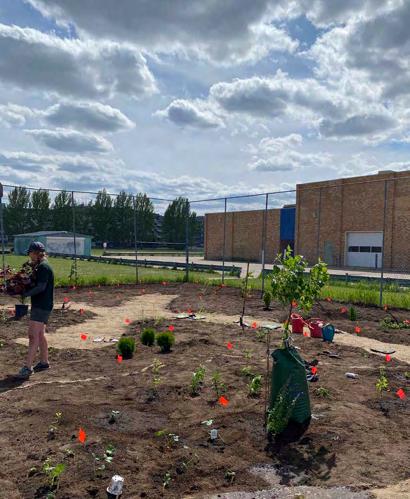
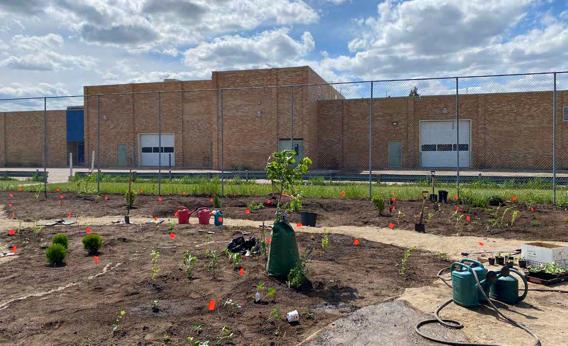
The Saskatchewan Environmental Society organized the province’s first ever Depave Paradise, an initiative of Green Communities Canada (GCC) that seeks out neglected asphalt spaces to replace with plants and green infrastructure. Replacing asphalt with plants means that storm water run-off that picks up road salt, pesticides and other contaminants can be filtered naturally by plants and soil rather than running into the South Saskatchewan River untreated. In addition, this new garden space is accessible to the community and will serve as an educational space for students. The community came together to turn the unused tennis courts at Walter Murray Collegiate Institute in Saskatoon into a green space over two working days: the first to remove broken up asphalt by hand and wheelbarrow, and the second to plant greenery that was mapped out by a garden architect. The garden models various ecoregions in Saskatchewan, including the four sacred medicines that were guided by Elder Tim Eashappie to ensure planting was done by protocol. Affinity was proud to be a major funder for Depave Paradise, and also volunteer alongside over 100 community members to remove asphalt, plant the gardens, and manage the refreshments and snacks.
Repair Cafés and Warm Hearts –Jacket Repair Project – Saskatchewan Waste Reduction Council
A Repair Café is a pop-up event where members of the community can bring household items to be fixed for free by volunteers thereby, diverting waste from the landfill and supporting a culture of repair and reuse. This initiative organized by the Saskatchewan Waste Reduction Council spreads across Saskatchewan communities including Estevan, Regina, Saskatoon and Yorkton, as well as offering a virtual option to enhance accessibility of the service. In 2022, 47 items were fixed, and 15 items were partially fixed or had been advised on next steps such as ordering parts – all diverted from the landfill! Volunteer skills ranged from sewing, small electronics, computer software, small engines, woodworking, welding and bicycle repairs.
The Warm Hearts – Jacket Repair Project is an extension of the Repair Cafés and aims to divert clean, mendable jackets from the landfill, and then redistribute the jackets to those who need them most. The project takes place in Biggar, Estevan, Lloydminster, Moose Jaw, Regina, Rosthern, and Saskatoon, with the big help of volunteers, and will continue throughout the winter!
Our members are helping Affinity go green!
Did you know that 76,856 Affinity members chose to receive e-statements instead of paper statements in 2022? Thank you for taking this step to build a better world for everyone, every day!
22 Annual Report 2022 Building for the Future
Community Assets
Strong, vibrant communities are good for everyone. Our members make our profits possible and for that reason, we’re proud to invest those profits back in our members’ communities.
The local community events and organizations we support with the help of our members make our communities across the province better, and that builds a better world for all of us.
Did you know that in 2022, Affinity Credit Union Member Councils invested $229,500 in community rinks and curling clubs?

Bienfait Coalfields Memorial Arena
Like many arenas that lie at the centre of Saskatchewan small towns, the Bienfait Coalfields Memorial Arena is home to small town hockey players and figure skaters of all ages. It’s now used as Estevan Minor Hockey’s third rink and frequented by men’s recreational hockey games five to six times per week. It’s often tricky to book
a spot since teams are often snatching up times every weekday from 4 pm up to as late as 10:30 pm. During the off-ice season, the arena is also used by Roller Derby as well as Lacrosse.
Add in 2020-2021, when not only did the COVID-19 pandemic prevent the Bienfait Arena from opening, it was also discovered that they would need a new ice plant due to its age and condition. With an arena used by people all over Saskatchewan, our South East Member Council knew they needed to help.
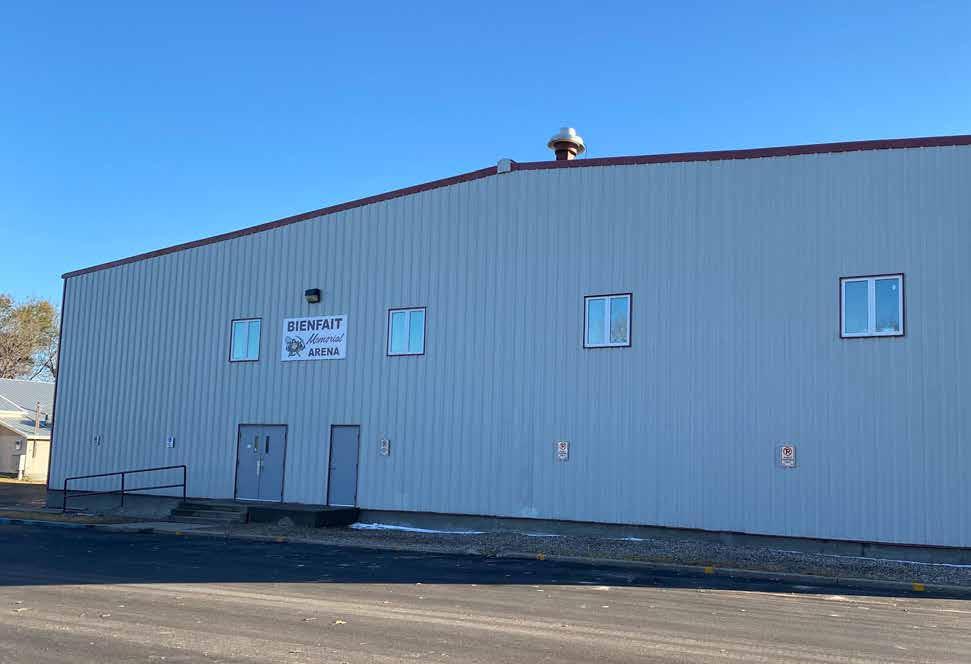
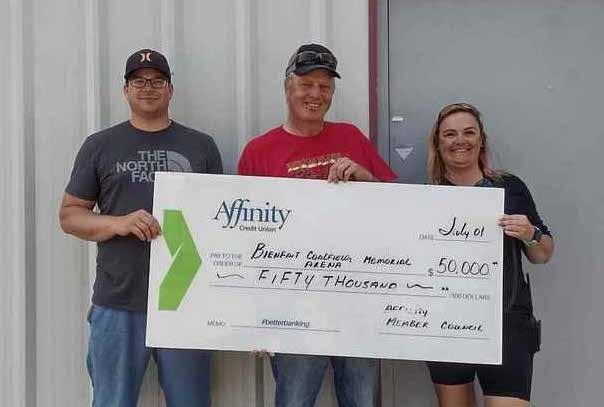
In 2022, the Affinity Credit Union South East Member Council funded $50,000 to the Bienfait Coalfields Memorial Arena to build a new ice plant!


23 Annual Report 2022 Building for the Future
Financial & Social Inclusion
As part of our commitment to social and financial inclusion in 2022, we invested over $129,000 in community programs and assets that increased accessibility and inclusion for people faced with physical and intellectual disabilities.
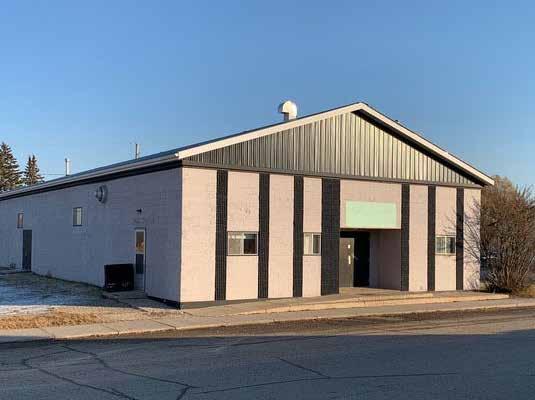
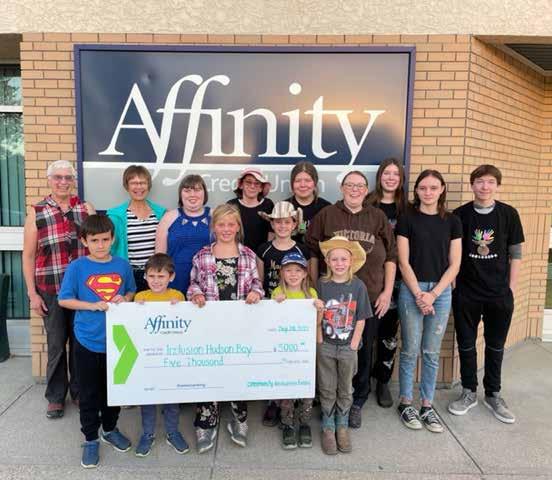
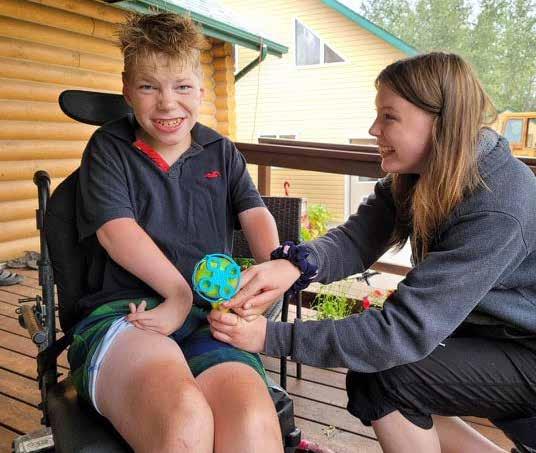
Inclusion Hudson Bay
Inclusion Hudson Bay is a non-profit organization with a mission to help individuals with intellectual disabilities to ensure that they’re valued, supported and included members of society, who have opportunities and choices in all aspects of their lives.
Initially begun as a summer program, the Inclusion program is now a year-round enterprise. Extensive one-on-one, person-centered programs are designed to immerse the individual with an intellectual disability out into the community and participate in the activities they’re drawn to do. These include both recreational and social opportunities for the individual and their family.
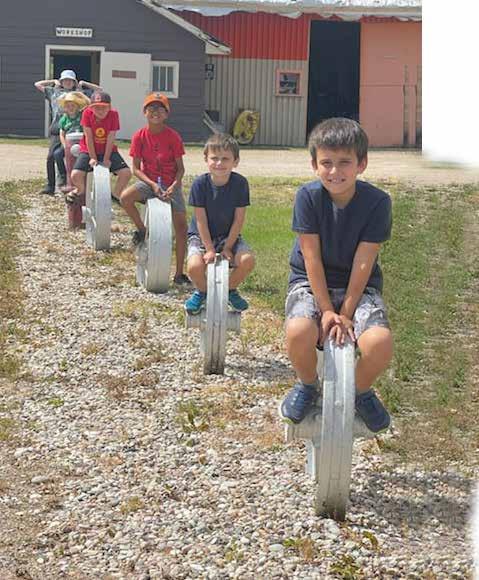

The Inclusion Hudson Bay group offers employment to four full-time employees, as well as part-time staff and
leaders in training. The leaders in training program is aimed at those aged 14 to 16 who are looking for job experience and support in their first paid employment. Inclusion also hires youth and adults who have an intellectual or physical disability, helping them build confidence and success in the workplace.
Inclusion Hudson Bay has worked hard to ensure that everyone is included, and to remove the feelings of isolation that many families of those with intellectual disabilities feel. Families are offered some respite from the care of those they dearly love, but may find difficult to look after day in and day out. And families no longer feel they are alone in their journeys.
The Affinity Credit Union East Member Council was honoured to fund $5,000 to Inclusion Hudson Bay in 2022 to help support their global budget!
Annual Report 2022 Building for the Future 24
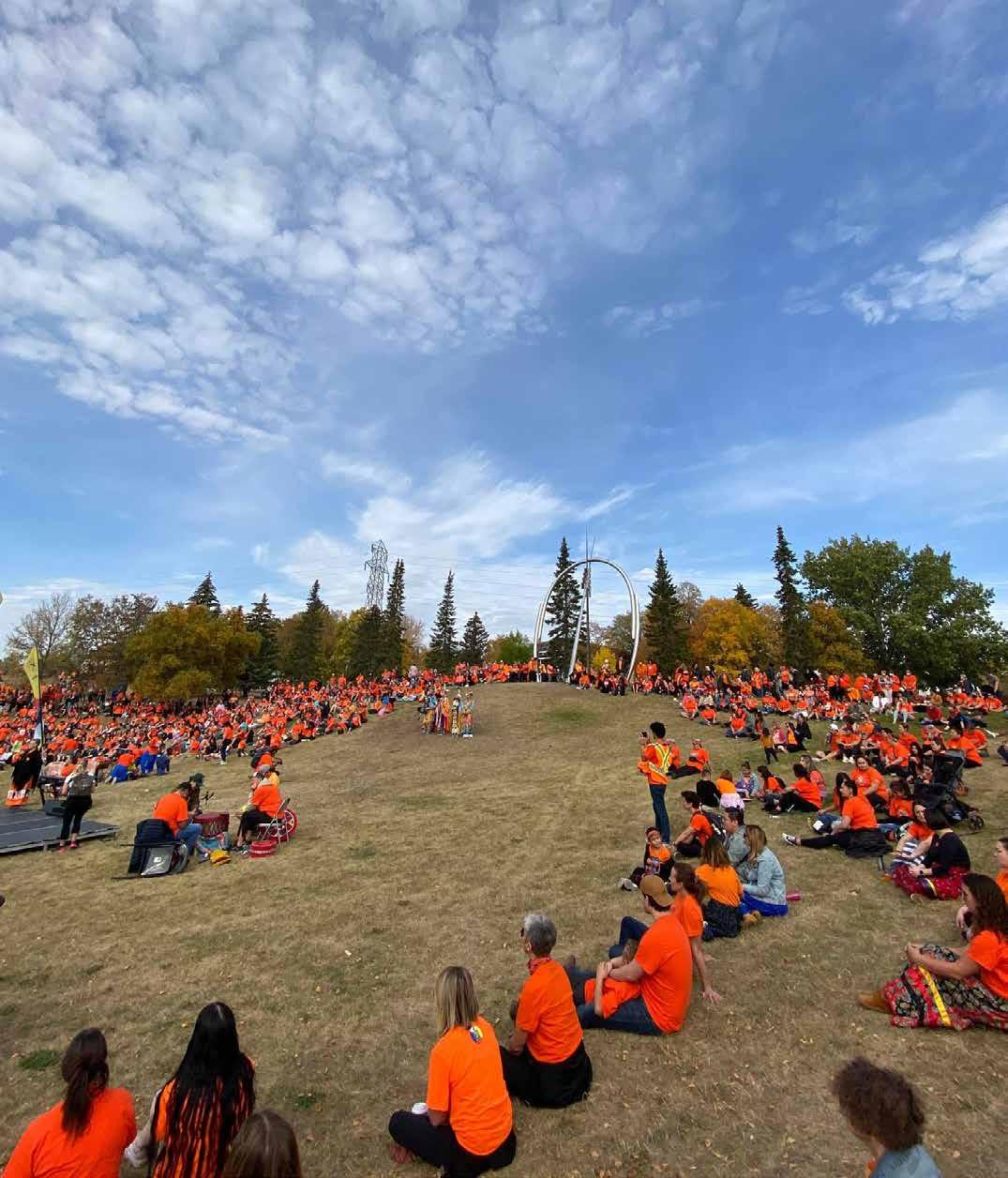
Thanks to our members, we’re funding local initiatives and ultimately, building a better world for everyone, every day.


25 Annual Report 2022 Building for the Future

Management Discussion and Analysis Economic Overview 27 Financial Highlights 27 Operating Summary 29 Financial Position Summary 31 Capital and Liquidity Management 32 Outlook 33 Risk Management 34 26 Annual Report 2022 Building for the Future
Economic Overview
In 2022, inflation and high-interest rates were the main factors affecting Canada’s economy. Although it likely peaked by year-end, inflation was still widely spread through the economy, prompting aggressive monetary tightening throughout the year as the Bank of Canada (BoC) raised the target for the interest rate from 0.25% in January to 4.25% in December.
Efforts to tame inflation brought about concerns over the possibility of a recession. In the national business and consumer confidence surveys (Conference Board of Canada), business owners questioned the rising cost of labour and capital, a shortage of qualified staff, interest rate hikes, and weak market demand. As a result, almost half believed Canada would experience a recession. Additionally, Canadian consumer confidence fell to its lowest level since May 2020 as consumers worried their purchasing power could further erode due to higher prices and borrowing costs. Gas prices and shelter costs elevated inflation, forcing households to retract discretionary spending. Consequently, only 9.7% of Canadians believed 2022 was an appropriate time to purchase large-ticket items and durable goods.
Here at home, the province experienced a supply-driven economic recovery in 2022. Manufacturing sales, wholesale trade, non-residential investment and resource sector growth are among the top in the country. Therefore, the Conference Board expected Saskatchewan’s GDP growth to lead the country in 2022 with a real output gain of 6.8%. The unemployment rate in December was 4.1%, the second lowest in Canada. However, high-interest rates took their toll on housing supply and demand, and housing starts were about the same as in 2021.
The war in Ukraine created an international demand for a stable source of potash and uranium promptly answered by Saskatchewan. Potash production and exports skyrocketed, and BHP moved up its Jansen Stage 1 project by a year. Cameco also announced plans to increase production at the Cigar Lake uranium mine and restart operations at McArthur River. Lastly, crop production in the province rose significantly in 2022, almost entirely returning to 2020 levels after the severe drought of 2021.
Financial Highlights
2022 marked the first year of Affinity’s 3-year Hitting our Stride strategic plan. This plan continues to leverage our member-owned financial co-operative values to position Affinity as a competitive and sustainable differentiator within the financial services sector. The strategies outlined in the plan informed the 2022 annual plan objectives supported by a refreshed capital plan.
Our capital plan emphasized the need for strong financial performance to maintain capital strength and build resilience to weather the uncertainty in the economy resulting from rising interest rates and the inflationary environment.
Focused on sound financial advice to members through highly proficient Advisory team members, complemented with market competitive rates for both loans and deposits, we were well positioned to provide value directly to members in 2022.
At the system level, the sale of Concentra Bank to Equitable Bank resulted in a capital injection for Affinity due to the credit union’s share ownership in Concentra Bank through SaskCentral. This was paid out as a dividend which had a one-time impact on our financial results. Hence, some of the explanations and results that follow will be expressed as total and normalized amounts. The normalized amounts exclude the impact of the Concentra-related dividend and therefore offer comparative results to previous years.
The credit union achieved a $427 million (or 6.2%) growth in assets for 2022 reporting on book assets of $7.23 billion and total managed assets of $8.98 billion. This level of growth supports Affinity’s ability to grow its membership base and market share while maintaining a strong capital position.
27 Annual Report 2022 Building for the Future
At the end of 2022, Affinity was the largest credit union in Saskatchewan based on asset size, and 10th largest credit union in Canada as of December 31, 2022.















Affinity achieved a 16.9% overall Return on Equity (ROE) in 2022 resulting in an increasing ROE in each of the past three years. The 2022 normalized ROE of 7.6% was lower than 2021 but above 2020 results. 2021 included one-time gains from venture capital investments and recoveries from provisions for credit losses that contributed to a 10.4% ROE.
Return on Member Equity
Reported after tax net income for the credit union was comprised of the consolidated results from its wholly owned subsidiary operations including wealth and insurance as well as the Concentra-related dividend. Consolidated net income after tax was $119.5 million or $51.2 million normalized. This level of earnings provided capital strength to support a member focused strategy.

Efficiency ratio is a measure used to assess the effectiveness of a financial institution’s ability to employ its resources, such as its assets and capital, to generate income. It shows how much is being spent on operating expenses relative to the revenue generated. Affinity achieved a strong efficiency ratio of 48.9% overall (65.4% normalized). The increase in this ratio on a normalized basis is attributed to one-time items in 2021 (gains from venture capital investments and recoveries from provisions for credit losses) as well as the impact of inflationary pressure on operating costs and margin compression pressures resulting from deposits repricing sooner than loans due to rising interest rates.






With well managed growth and strong earnings, Affinity continued to build the capital required to support strategic objectives, strengthened its capacity to withstand economic downturns or extraordinary events, and empowered the credit union to pursue opportunities focused on value for members.
Affinity continued its upward year over year trajectory in enhancing its capital position, finishing the year achieving 16.7% or 15.6% normalized total capital to risk weighted assets ratio.
$5.7 $6.2 $6.7 $7.2 2022 2021 2020 2019 $7.23 $5.96 $6.51 $6.80 Assets ($ billions)
3% 6% 9% 12% 15% 18% 2022 2021 2020 2019 10.4% 7.4% 7.4% 16.9%
45% 49% 54% 58% 63% 67% 72% 2022 2021 2020 2019 48.9% 60.0% 68.5% 64.3% Efficiency Ratio
28 Annual Report 2022 Building for the Future
Operating Summary
Net Income
The key components of Affinity’s net income included net interest margin, provision for credit losses, other income, operating expenses and provision for income taxes.


Affinity achieved a record net income result in 2022, closing the year at $119.5 million ($51.2 million normalized).



Net Interest Margin
Net interest margin represents the revenue Affinity earns through financial intermediation. Loan and deposit growth combined with the level of interest rates directly influence improvements to the net interest margin. Through 2022 Affinity reported higher interest income from loans and investments due to rising rates but also experienced higher interest expense resulting from rising deposit rates for members. Year over year, the net interest margin grew by $2 million to $152.5 million.
As a percentage of average assets, net interest margin was 2.17% which was 4 basis points lower than 2.26% in 2021. The declining margin as a percentage of average assets is strategically aligned to the credit union’s commitment to return exceptional value to members in the form of competitive rates.



Provision for Credit Losses
The provision for credit losses is an estimate of the credit union’s potential losses, due to credit risk. Affinity’s sound credit underwriting processes coupled with effective loan rehabilitation practices, limited Affinity’s provision for credit losses to $2 million in 2022.
$33 $43 $53 $63 $73 $83 $93 $103 $113 $123 2022 2021 2020 2019 $119.5 $64.1 $41.4 $38.7 Comprehensive Income ($ millions)
2.0% 2.1% 2.2% 2.3% 2.4% 2.5% 2022 2021 2020 2019 2.26% 2.24% 2.37% 2.17% Net Interest Margin
0.3% 0.8% 1.3% 2022 2021 2020 2019 Consumer Commercial Agriculture 0.41% 0.81% 0.38% 0.54% 0.41% 0.54% 0.82% 0.79% 0.52% 0.47% 0.29% 0.45%
Delinquency 29 Annual Report 2022 Building for the Future
Loan
Credit quality improved in 2022 with overall delinquency greater than 90 days finishing the year at 0.37% of total loans compared to 0.53% in the previous year. The commercial portfolio saw the largest improvement between years with delinquency dropping from 0.81% in 2021 to 0.47% in 2022, a 34-basis point decrease. Consumer and agricultural portfolios also fared better in 2022.
Other Income
Other income includes service fee revenues, returns from wealth advisory services, regular dividends, as well as diversification revenues from insurance operations and gains from the credit union’s venture capital investments.




Operating expenses as a percentage of average assets increased by 2 basis points from 1.87% in 2021 to 1.89% in 2022.
Provision for Income Tax
Provision for income tax is the estimated amount of corporate income taxes based on the earnings from each subsidiary and then reported on a consolidated basis by Affinity. This provision includes both a current, as well as a deferred portion. The income before income tax exclusive of the Concentra-related dividend of $68.3 million is lower than that achieved for 2021, resulting in a year over year decrease in income tax provision. At the end of 2022, the provision for income tax was $17.2 million, which was $6.1 million lower than 2021. The Concentra-related dividend was not subject to tax.





Affinity closed 2022 with a strong $119.1 million in other income, which was a $62.5 million betterment over 2021. $68.3 million of this increase was due to the dividend from the sale of Concentra Bank which was partially offset by lower fee income.
Operating Expenses
Affinity’s operating expenses include the broad categories encompassed by personnel, general business, occupancy, organizational and security. Affinity’s operating cost structure experienced inflationary pressures in the second half of 2022. Affinity reported operating expenses of $132.8 million – an $8.6 million or 6.9% increase in operating costs over 2021.
$40 $50 $60 $70 $80 $90 $100 $110 $120 $130 2022 2021 2020 2019 $56.6 $50.7 $48.3 $119.1 Other Income ($ millions)
$119 $123 $127 $131 $135 $139 2022 2021 2020 2019 $124.2 $122.3 $127.6 $132.8 Operating Expenses ($ millions)
30 Annual Report 2022 Building for the Future
Financial Position Summary
Financial Investments
The credit union’s financial investments were primarily comprised of a liquidity reserve, term deposits, corporate and government bonds, a venture capital portfolio, as well as accrued interest earned on these investments.
Affinity concluded the year reporting financial investments at $1.37 billion, which was approximately $23.6 million lower than 2021. In 2022, the credit union continued its strategy of investing primarily in highquality, liquid investments with only limited exposure to higher risk venture capital funds.







Loans
Loans continue to form the largest component of Affinity’s assets throughout 2022. To best leverage our capital and mitigate risk, the credit union adopted a target loan mix for consumer (50-70%), agriculture (10-20%) and commercial portfolios (30-40%). Loan mix achieved by the end of 2022 was well within expectations.
At the end of 2022, Affinity achieved a 7.4% or $388 million growth in total loans. Member loan growth was 6.23% or $320 million.
Deposits
Deposits formed the largest component of Affinity’s liabilities and served as the primary source for financing asset growth.
Loans made up 78.78% of the credit union’s asset base on a normalized basis. The impact of Concentrarelated dividend reduced the ratio to 78.03%.
Typically, the higher the loan percentage, the larger the net interest margin contribution as more assets are deployed in higher yielding loans.
At the end of 2022 total deposit growth of $304 million or 4.99% was comprised of a $395 million increase in member deposits and a $91 million decrease (44.3%) in nominee deposits. As member deposit growth in 2022 exceeded expectations and outpaced loan growth, we have been comfortable to let a portion of the nominee book run off. Through the year, member demand deposits decreased by $228 million (7.13%) whereas Term and Registered Deposits increased by $444 million (22.3%) and $73 million (8.2%) respectively demonstrating the extent to which members have moved funds into fixed term deposits as interest rates increased throughout 2022.
Member deposit growth was lower than the previous two years. While our outlook for 2023 takes into consideration industry expectations of a run-off of deposits built up during the pandemic, the recent interest rate hikes continue to make consumer behaviour more difficult to predict.
0% 3% 6% 9% 2022 2021 2020 2019 6.2% 0.6% 7.4% 5.2% Loan Growth
2% 5% 8% 11% 2022 2021 2020 2019 4.9% 5.0% 4.0% 9.3%
Deposit Growth
31 Annual Report 2022 Building for the Future
Capital and Liquidity Management
Capital Management
As a regulated financial institution, Affinity is required to maintain an adequate level of capital reserves to mitigate risk. A strong capital position protects the credit union against the impact of unexpected losses and can be leveraged to support ongoing growth in our traditional business lines or through diversification opportunities. With Affinity’s main source of capital being derived from retained earnings, building capital is dependent upon generating strong earnings.
On an annual basis a capital plan is developed to ensure Affinity generates sufficient capital to meet our strategic objectives, provide the credit union with the ability to withstand economic downturns or extraordinary events, while still maintaining the minimum regulatory capital requirements. The 2022 plan considered various growth scenarios and the impact on key financial performance indicators for return on equity and operating efficiency to determine an optimal level of growth. The plan also evaluated Affinity’s internal economic capital requirement to ensure capital levels were appropriate for the credit union’s unique risk profile. Our capital position was monitored on a regular basis by forecasting changes in our business model against capital adequacy to support ongoing business decisions. This included a regular assessment of existing and emerging risks to ensure the adequacy of both the internal capital requirements and the minimum regulatory requirements.
Our regulator, Credit Union Deposit Guarantee Corporation (The Corporation) measures capital adequacy as total capital as a percentage of risk weighted assets. The Corporation’s minimum requirement is 11.5%, which aligns with our P-SIFI (Provincially Systemically Important Financial Institution) designation. Affinity’s capital adequacy policy requires an additional 1% buffer over the greater of (i) the regulatory minimum or (ii) Affinity’s Economic Capital requirement. For all measurement dates, Affinity’s Economic Capital requirement was lower than the regulatory minimum of 11.5%, meaning that inclusive of the buffer, Affinity’s minimum capital requirement in 2022 was 12.5%.




Affinity’s Capital continues to exceed all minimum policy and regulatory thresholds.
Capital / Risk Weighted
As a result of our earnings, asset growth, and Concentrarelated dividend, Affinity maintained its strong capital position to end the year at 16.7% up 120 basis points over 2021. On a normalized basis, eligible capital is 15.5%. This level of capital continues to strengthen Affinity’s capacity to withstand economic uncertainties and provides flexibility to pursue new opportunities.
Internal Capital Adequacy Assessment Process (ICAAP)
Affinity’s Internal Capital Adequacy Assessment Process (ICAAP) quantifies the credit union’s Economic Capital requirement. ICAAP is embedded as a key component of Affinity’s Enterprise Risk Framework. The ICAAP model considers mitigation strategies for each identified risk and evaluates the impact to capital from any residual, unmitigated risk to determine the base Economic Capital requirement. A stress test is then applied to each identified risk using a plausible yet severe stress scenario. The combined base capital together with the additional capital allocation for the stress scenario forms the credit union’s total Economic Capital requirement. All key risks are monitored using a risk register which is reviewed and refreshed on a quarterly basis.
Liquidity Management
Adequate liquidity is critical for the overall safety and soundness of the credit union. Affinity’s liquidity management framework aligns to the liquidity risk management principles issued by The Corporation. These principles complement the regulatory liquidity adequacy standards and cover all facets of liquidity management ranging from the initial setting of the Board’s risk appetite to the daily liquidity management
0% 5% 10% 15% 20% 2022 2021 2020 2019 14.3% 15.1% 15.5% 16.7% Total
Assets
32 Annual Report 2022 Building for the Future
function, including appropriate debt facilities and interaction with third-party liquidity providers. Finally, the principles address the identification, management, and resolution of a liquidity crisis event.
In 2022, liquidity management included continual monitoring of liquidity sources across multiple time periods to ensure that Affinity could satisfy cash demands. The Board established policy limits for minimum operating liquidity surpluses over a one-year timeline ensures sufficient liquidity is available to satisfy all expected cash outflows, as well as an adequate buffer to withstand the stress of an unusual or unexpected event. During 2022, we consistently exceeded the minimum policy limits for all time intervals within the 12-month period.
From a regulatory perspective Affinity must maintain a portfolio of statutory liquidity investments with Credit Union Central of Saskatchewan (SaskCentral) equal to 10% of the credit union’s deposits and borrowings to support the provincial credit union system’s liquidity program. CUDGC also requires all credit unions to maintain a minimum 100% liquidity coverage ratio (LCR). The LCR is a ratio between the credit union’s high-quality liquid assets and the cash outflows associated with the expected deposit run-off from a prescribed 30-day stress scenario. Affinity’s Board established a higher policy minimum of 120% for the LCR. Throughout 2022 we exceeded the higher LCR policy threshold and the 10% statutory liquidity requirement.
The deposit growth that began with the start of the pandemic in 2020 continued through most of 2022 resulting in excess liquidity levels that surpassed the credit union’s lending needs. Our investment strategies have been heavily influenced by the uncertainty surrounding the timing and velocity that our members may deploy the excess savings accumulated over the last two years. With this heightened uncertainty, excess liquidity was invested primarily in short-term deposits or marketable securities that could be easily liquidated as needed. This conservative approach yielded a positive impact on the policy measures noted above.
Affinity’s ability to borrow funds is a key component of the credit union’s overall liquidity management program and Affinity currently has access to $236 million in committed credit facilities. Throughout 2022 these stand-by facilities were largely unused, but this borrowing capacity can provide considerable funding support for the credit union during a stressed liquidity event.
Following the first mortgage-backed security (MBS) issuance in late 2020, Affinity issued two additional MBS pools during 2021 and two in 2022, bringing the total MBS outstanding to $52.4 million.
The credit union also maintained a contingency funding plan (CFP) that clearly sets out strategies for addressing liquidity shortfalls in emergency situations. The CFP outlines the roles, responsibilities, procedures, and action plans required to respond to a severe liquidity event. It incorporates various early warning indicators and trigger events that would initiate the CFP or Affinity’s Recovery Plan, which was developed following assessment criteria outlined in the P-SIFI directive. The CFP and Recovery Plan are reviewed and tested annually.
Overall Affinity’s liquidity remained healthy, and we were well positioned to support a rise in economic activity as well as weather downward economic pressures.
Outlook
Much of the recent inflation is linked to higher energy prices and supply chain issues, resulting in shortages of goods. Manufacturers are reluctant to depend on China and may use more resilient but expensive alternatives. The move to lower-carbon power sources and the effect of the Ukraine war on commodity markets are other forces behind elevated prices. Policymakers have little control over these supply-side factors, which heavily depend on regulatory policy, immigration, the quality of the education system and workers’ skills. Thus, inflation may stay over the 2% target for a prolonged period, forcing interest rate hikes that could lead the economy into recession. The Bank of Canada is well-aware that loss of credibility on its monetary policy hinders efforts to lower inflation rates and may keep interest rates high even as inflation starts to fall.
Although a technical recession is possible, underlying conditions work in the Canadian economy’s favour. For instance, the commodity price increase sparked by the war in Ukraine has left local producers with hefty net savings to support hiring, wages, and investment. In Saskatchewan, the potash and uranium demand shift should maintain growth in both industries over the following years. In the agriculture sector, some southwestern areas of the province were still affected by dry conditions in 2022, leaving room for further improvement in 2023. Non-residential investments will remain elevated, given new potash projects,
33 Annual Report 2022 Building for the Future
canola-processing plants and biodiesel-manufacturing facilities. However, higher interest rates may negatively affect spending on big-ticket items, discretionary consumption, the housing market and residential investment. Softening demand will reduce home sales and prices. That said, the Conference Board of Canada expects Saskatchewan’s GDP growth to outperform the national average and all provinces in 2023 at 3.6%. Affinity and its members are poised to benefit from this optimistic forecast. However, if broader economic obstacles persist, we anticipate some challenges as businesses and consumers adjust. Therefore, we will follow the mentioned economic indicators closely and be prepared to provide excellent products and services in every scenario in 2023, always having our members’ interests at heart.
Affinity has taken the evolving business environment into consideration in developing plans for 2023 and beyond. We are confident that our continued focus on the member and their experience in banking with Affinity will continue to produce strong business results. We’ll maintain a specific focus on making member experiences even more seamless and personalized, to delivering high-quality financial advice that supports the financial wellness of members and to leveraging our key differentiators, like our local presence and co-operative business model. Of course, we’ll also maintain a strong focus on preserving a solid financial foundation to ensure the long-term sustainability of the business, which includes maintaining excellent governance and risk management practices.
Risk Management Overview
Affinity exists to provide value to its members and stakeholders. We do this by taking on strategic risk to create, preserve and realize value.
When taking on strategic risk, we are inherently exposed to other material risks which are consistent with our industry. Affinity’s material risk categories are: strategic, credit, operational, legal and regulatory, liquidity market and reputation risk. We consider our reputation as a strategically important asset and actively manage risks to our reputation as part of our overall risk management framework. Our Risk Appetite Framework contains risk appetite metrics for all material risk categories.
Affinity’s Risk Governance Framework provides overarching guidance to our risk program by outlining our risk philosophy, how we categorize the types of risk we are exposed to and our risk management governance. In addition, it provides the foundation for the Board of Directors’ oversight to management’s risk-based decision making.
Governance
Our Board approved Risk Governance Framework, primarily based on Committee of Sponsoring Organizations of the Treadway Commission (COSO) Enterprise Risk Management Integrated Framework provides an integrated approach to enterprise risk management that encompasses all elements of risk governance.
34 Annual Report 2022 Building for the Future
Members Require Strength, Stability and Safeguarded Assets
Board Desired Key Performance Indicators
Risk Appetite
Credit Risk Market Risk Liquidity Risk
Legal and Regulatory Compliance Requirements
External Rating
Operational Risk
Strategic Risk
Legal and Regulatory Risk
Reputational Risk
Integrated Enterprise Risk Management
The diagram above provides an overview of Affinity’s approach to risk governance through an integrated risk management approach.
35 Annual Report 2022 Building for the Future
Affinity utilizes the lines of defense model to segregate and clarify segregation of risk management accountabilities. Under this model, ownership for risk resides at all levels of Affinity. This provides a structure to organize Affinity’s risk management roles and responsibilities; each line of defense is clearly defined in terms of business lines, roles and accountabilities and is functionally independent.
Risk Management Committee Structure
Our integrated risk management program supports the Board in understanding our key risks and the activities to manage them. The Board has delegated its responsibility to oversee risk management and understanding of the types of risk Affinity is exposed to the Risk Committee. The diagram below outlines Affinity’s risk management committee structure.
Risk Management Committees:
The Strategic Risk Committee (SRCo) includes all members of executive management and sets the ‘tone from the top’. It provides oversight of the Asset Liability Committee, the Credit Risk Committee, and the Operational Risk Committee.
SRCo is responsible to be aware of key risks that have the potential to impact successful execution of strategies and annual operating plans as approved by the Board of Directors. In addition, SRCo monitors internal and external environments to identify and assess existing and emerging risks and the resulting business implications. Subsequently, it directs actions to ensure risks are maintained within the credit union’s risk
appetite and makes recommendations to the Risk Committee for approvals of policies, frameworks and matters of significance that arise from the other risk management committees.
The Asset Liability Committee (ALCo) provides forwardlooking balance sheet management and execution within the parameters of Board approved risk appetite and policy. It reviews economic trends, interest rate forecasts, investment portfolio risk and performance, liquidity, foreign exchange exposures, and capital adequacy. The purpose of the committee is to develop and recommend balance sheet risk management strategies to SRCo and approve and monitor balance sheet risk management tactics.
Board of Directors
HR & Compensation Committee Governance Committee
Audit & Finance Committee Risk Committee
Strategic Risk Committee (SRCo)
Asset Liability Committee (ALCo)
Operational Risk Committee (ORCo)
36 Annual Report 2022 Building for the Future
Credit Risk Committee (CRCo)
The Credit Risk Committee (CRCo) assesses historical and emerging credit risk by reviewing internal reporting and environmental scanning. The committee assesses new areas of opportunity and recommends actions to SRCo to manage risks within approved tolerances while supporting planned growth and profitability objectives.
The Operational Risk Committee (ORCo) comprises cross functional subject matter experts to identify, discuss and mitigate current and emerging operational risk issues that affect, or have the potential to affect, the successful operation of the credit union. Further, it identifies and promotes opportunities to improve service to members, create an operational risk-aware culture, contribute to operational improvements, and foster cross functional synergy.
Risk Philosophy
The credit union balances risk and reward to meet goals for our members, community, employees, growth, and financial sustainability. In pursuit of these goals, we accept risks we understand and can manage within prudent levels.
Risk Culture
At Affinity, we understand that our risk culture is influenced by the actions of our people, the means by which work is done, and the manner in which decisions are made. Our risk culture is congruent with Affinity’s desired culture, and is fostered and supported through strong board oversight, an integrated risk governance structure, awareness and education, risk appetite, policies, program guides and procedures, and a variety of tools that support identification, measurement, analysis, risk communication and reporting, and risk informed decision-making.
Material Risk Categories
Strategic Risk:
Strategic risk is the risk Affinity ineffectively or improperly implements its strategies or is unable to adapt to changes in the business environment to meet the needs and
expectations of members, other stakeholders or achieve expected benefits. It also includes the failure of organic growth initiatives.
Management identifies risks to achieving corporate strategy and develops action plans to mitigate risks that exceed risk appetite. Quarterly, management reviews the risk register and status of action plans at SRCo. Subsequently, Risk Management provides risk status reporting to the Board of Directors.
Credit and Counterparty Risk:
Credit risk is the risk Affinity faces when a borrower, guarantor or counterparty fails to meet its financial or contractual obligations.
Affinity manages credit risk by establishing credit risk policies, delegation of authority, concentration limits including maximum limits on individual and connected accounts. Prudent underwriting standards are designed to ensure an appropriate balance of risk and return. The credit union has approved residential mortgage portfolio limits and limits on relative segments of Affinity’s residential mortgage portfolio in alignment with CUDGC the Corporation’s Residential Mortgage Underwriting Guidelines.
Management monitors credit risk exposures including portfolio concentration on a regular basis and proactively implements enhanced account management of higher risk accounts. This has been effective at resolving problem accounts before they turn delinquent or incur a loss. A strong monitoring process is in place for larger borrowers that are encountering difficulty.
Residential mortgages, including Home Equity Lines of Credit (HELOC) comprise a significant amount of our credit portfolio. At December 31, 2022 Affinity’s residential mortgage gross carrying value was $2,391,387 (2021 $2,279,820). The following table provides a breakdown between insured (including those by both CMHC and Genworth) and uninsured mortgages:
In Thousands of Dollars Insured Uninsured Insured Uninsured Residential Mortgages $717,389 $1,673,989 $724,664 $1,555,156 30.00% 70.00% 31.79% 68.21% 2022 2021 37 Annual Report 2022 Building for the Future
The credit union has established policies and procedures for maximum amortization periods for residential mortgage loans, specific to the loan product.
At December 31, 2022, the credit union’s residential mortgage portfolio original amortizations are outlined in the table below. Portfolio percentages are illustrated for both the outstanding mortgage balance and the number of mortgage loans.
Operational Risk:
Affinity faces operational risk resulting from people, inadequate or failed internal processes, controls, and systems or from external events including the risk of fraud. Operational risk is inherent in all activities within the credit union, including processes and controls used to manage other material risks such as credit, market, liquidity, legal and regulatory and reputational risk. Unlike other material risk categories taking on operational risk does not generate financial gain, however Affinity weighs the cost of mitigating against the cost benefits.
Risk Control Self-Assessments (RCSAs) are the primary tool Affinity uses to identify and assess operational risk exposures. The RCSA process is one component of Affinity’s Internal Control Framework. Affinity relies on the services of third parties. Our Vendor Risk Management program is our primary tool to manage third party service provider risk.
Legal and Regulatory Risk:
Legal and regulatory risk is the risk Affinity faces when failing to comply with governing laws, satisfying contractual obligations or meeting regulatory requirements.
Affinity operates in a heavily regulated industry. We actively monitor and evaluate potential impacts of regulatory developments. Appropriate policies, procedures, training, internal oversight functions and Code of Conduct ensure we are successful in meeting regulatory obligations.
As a Provincial Systemically Important Financial Institution (P-SIFI), our regulator holds us to a higher standard of regulatory rigor.
Liquidity Risk:
Liquidity risk is the risk of loss due to an inability to access funding sources or having insufficient cash or cash equivalents to meet financial obligations as they come due in a timely and cost-effective manner.
Original Amortization Period Under 20 yrs20 - 24 yrs25 - 29 yrs30 - 34 yrs35 yrs+Revolving By Outstanding Balance 9.5%8.3%47.9%24.0%2.9% 7.4% By # of Mtg. Loans 13.9%8.0%33.9%15.0%2.4%26.8% 2022 Original Amortization Period Under 20 yrs20 - 24 yrs25 - 29 yrs30 - 34 yrs35 yrs+Revolving By Outstanding Balance 8.6%7.7%47.4%24.3%3.6% 8.3% By # of Mtg. Loans 13.6%7.6%33.3%14.9%2.8%27.8% 2021 38 Annual Report 2022 Building for the Future
Affinity prudently manages liquidity to ensure sufficient liquidity is available to meets its obligations. Strategies in place to manage liquidity levels include borrowing facilities with SaskCentral and other financial institutions, deposit gathering programs and asset securitization program.
The credit union maintains sufficient levels of unencumbered high quality liquid assets as prescribed by the Credit Union Regulations 1999 and the Standards of Sound Business Practices established by Credit Union Deposit Guarantee.
ALCo reviews liquidity risk and liquidity position and provides reporting to SRCo. Quarterly, an operating liquidity report is provided to the Board of Directors.
As a Provincial Systemically Important Financial Institution (P-SIFI), Affinity provides quarterly net cumulative cash flow reporting to its regulator.
Market Risk:
Market risk exposes Affinity to the risk of loss when decreases in the value of financial instruments or portfolios of financial instruments occur because of changes in interest rates and timing differences in the repricing of assets and liabilities. This also includes changes in movements and volatility of foreign exchange rates.
Affinity actively manages its market risk by modeling several interest rate change scenarios and their impacts to our short term interest rate margin and long term value of equity. ALCo reviews interest rate simulation reports and recommends strategies such as derivatives to manage interest rate risk. Derivatives are limited to interest rate swaps, forward rate agreements, caps and floors, and purchased interest rate options. Interest rate strategies are limited to activities permitted under the Credit Union Act, Regulations and Standards of Sound Business Practices.
Reputational Risk:
Reputation risk is the risk of financial loss, business sanctions or additional oversight, due to deterioration in stakeholders’ perception of Affinity from negative publicity, whether true or not. Reputation risk generally arises from a deficiency in managing another risk. All employees are responsible to manage Affinity’s reputation risk.
39 Annual Report 2022 Building for the Future
Summary Consolidated Financial Information for the year ended December 31, 2021 Management’s Responsibility for Financial Reporting 44 Summary Consolidated Statement of Financial Position 45 Summary Consolidated Statement of Comprehensive Income 46 Summary Consolidated Statement of Changes in Equity 47 Summary Consolidated Statement of Cash Flows 48 Note to the Summary Consolidated Financial Information 49 40 Annual Report 2022 Building for the Future
MANAGEMENT’S RESPONSIBILITY FOR FINANCIAL REPORTING
The accompanying summary consolidated financial information for Affinity Credit Union has been prepared by management, which is responsible for the integrity and fairness of the information presented, including the many amounts that must of necessity be based on estimates and judgments.

The summary consolidated financial information was prepared in accordance with financial reporting requirements prescribed by the Credit Union Act, 1998 of the Province of Saskatchewan, Credit Union Deposit Guarantee Corporation, and by statute. The accounting policies followed in the preparation of these financial statements conform to international financial reporting standards (IFRS).
Financial and operating data elsewhere in the annual report are consistent with this financial information. In discharging our responsibility for the integrity and fairness of the summary consolidated financial information and for the accounting systems from which they are derived, we maintain the necessary system of internal controls designed to ensure that transactions are authorized, assets are safeguarded, and proper records are maintained. These controls include quality standards in hiring and training of employees, policies and procedures manuals, a corporate code of conduct and accountability for performance within appropriate and welldefined areas of responsibility.
The system of internal controls is further supported by a compliance function, which is designed to ensure that we and our employees comply with appropriate legislation and conflict of interest rules, and by an internal audit team, which conducts periodic audits of all aspects of our operations.
The Board of Directors oversees management’s responsibilities for financial reporting through an Audit and Finance Committee, which is composed entirely of independent directors.
This Committee reviews our consolidated financial information and recommends them to the Board for approval. Other key responsibilities of the Audit and Finance Committee include reviewing our existing internal control procedures and planned revisions to those procedures, and advising the directors on auditing matters and financial reporting issues. Our Compliance Manager and Chief Internal Auditor have full and unrestricted access to the Audit and Finance Committee.
Further monitoring of financial performance and reporting is carried out by the Credit Union Deposit Guarantee Corporation. It is given its responsibilities and powers by provincial statute through the Credit Union Act. Its purpose is to guarantee members’ funds on deposit with Saskatchewan Credit Unions and provide preventative services. Preventative services include ongoing financial monitoring, regular reporting and consultation.
KPMG LLP, Chartered Professional Accountants appointed by the members of Affinity Credit Union upon the recommendation of the Audit and Finance Committee and Board, have performed an independent audit of the consolidated financial statements. The auditors have full and unrestricted access to the Audit and Finance Committee to discuss their audit and related findings.
Mark Lane Nilesh Kavia Chief Executive Officer Chief Financial Officer
Saskatoon, Saskatchewan March 13, 2023
41 Annual Report 2022 Building for the Future
Affinity Credit Union
Summary Consolidated Statement of Financial Position
As at December 31 (in thousands of CDN $)
The accompanying note is an integral part of the summary consolidated financial information.

Approved by the Board
..................................................... Chair, Board of Directors
..................................................... Chair, Audit and Finance Committee
2022 2021 (Note 1) (Note 1) Assets Cash 34,413 48,229 Financial investments 1,365,000 1,388,586 Loans 5,638,782 5,250,199 Other assets 187,998 111,414 Total Assets 7,226,193 6,798,428 Liabilities Deposits 6,396,863 6,092,599 Other liabilities 63,654 59,687 Total Liabilities 6,460,517 6,152,286 Equity Retained earnings 765,676 646,142 Total Equity 765,676 646,142 Total Liabilities and Equity 7,226,193 6,798,428
42 Annual Report 2022 Building for the Future
Affinity Credit Union Summary Consolidated Statement of Comprehensive Income
Year ended December 31 (in thousands of CDN $)
The accom pany ing note is an inte gral part of the summary consolidated financial information.
2022 2021 (Note 1) (Note 1) Interest income Loans 197,912 176,921 Investments 26,892 19,750 224,804 196,671 Interest expense Deposits 72,055 46,052 Borrowings 284 130 72,339 46,182 Net interest 152,465 150,489 Provision (recovery) for credit losses 1,983 (4,546) Net interest income after provision for credit losses 150,482 155,035 Other income 119,119 56,569 Net interest and other income 269,601 211,604 Operating expenses Personnel 80,679 76,261 General business 32,911 30,886 Occupancy 11,136 10,583 Organizational 2,762 1,345 Security 5,352 5,138 132,840 124,213 Income before income tax 136,761 87,391 Provision for income taxes 17,227 23,335 Net and comprehensive income 119,534 64,056
43 Annual Report 2022 Building for the Future
Affinity Credit Union Summary Consolidated Statement of Changes in Equity
Year ended December 31 (in thousands of CDN $)
The accompanying note is an integral part of the summary consolidated financial information.
2022 2021 (Note 1) (Note 1) Retained earnings, beginning of year 646,142 582,086 Net income 119,534 64,056 Retained earnings, end of year 765,676 646,142
44 Annual Report 2022 Building for the Future
Affinity Credit Union Summary Consolidated Statement of Cash Flows
Year ended December 31 (in thousands of CDN $)
The accompanying note is an integral part of the summary consolidated financial information.
2022 2021 (Note 1) (Note 1) Cash flows from (used in) operating activities Net income 119,534 64,056 Adjustments to operating cash flows (194,554) (136,070) Changes in operating assets and liabilities (177,542) (24,638) Cash interest received 220,801 200,482 Cash interest paid (58,098) (56,024) Cash income taxes paid (27,238) (17,494) (117,097) 30,312 Cash flows from (used in) investing activities Proceeds from investments 444,945 370,184 Purchases of investments (347,292) (404,978) Purchase of non-financial assets (3,714) (4,714) 93,939 (39,508) Cash flows from (used in) financing activities Other liabilities 15 14 Loans under administration advanced 8,642 90 Repurchase of loans - (318) 8,657 (214) Net increase (decrease) in cash (14,501) (9,410) Net foreign exchange difference on cash held 685 (604) Cash, beginning of year 48,229 58,243 Cash, end of year 34,413 48,229
45 Annual Report 2022 Building for the Future
Affinity Credit Union
Note to the Summary Consolidated Financial Information
December 31, 2022
1. Basis of the Summary Consolidated Financial Information
The criteria applied by management in the preparation of the summary consolidated financial information are as follows:
a) The content in the summary consolidated financial information is derived from the Credit Union’s December 31, 2022 audited consolidated financial statements (the “Audited Financial Statements”); and
b) The Audited Financial Statements can be obtained on-line at: https://www.affinitycu.ca/meet-affinity/how-we-re-governed/annual-reportsand-bylaws
46 Annual Report 2022 Building for the Future
1. Beardy’s & Okemasis’ Cree Nation
2. Cowessess First Nation
3. Kahkewistahaw First Nation
4. Kinistin Saulteaux Nation
5. Little Pine First Nation
6. Lucky Man Cree Nation
7. Muskeg Lake Cree Nation
8. Red Pheasant Cree Nation
9. The Key First Nation
10. Wahpeton Dakota Nation
11. Whitecap Dakota First Nation
Loon Lake Maple Creek Gull Lake Eston Kindersley Unity Rosetown Outlook Davidson Manitou Beach Raymore Wynyard Wadena Preeceville Canora Kamsack Yorkton Foam Lake Lanigan Humboldt Melfort Tisdale Nipawin Tobin Lake Cumberland House Denare Beach Hudson Bay Warman Rosthern Swift Current Shaunavon Eastend Val Marie Assiniboia Gravelbourg Coronach Estevan Weyburn Oxbow Carlyle Kenosee Lake Moosomin Whitewood Esterhazy Melville Indian Head Fort Qu’Appelle Saskatoon Prince Albert North Battleford Regina Moose Jaw Paradise Hill Spiritwood Shellbrook Waskesiu Lake Big River Meadow Lake 1 2 3 4 5 6 7 9 10 11 8 NORTH NORTH EAST SASKATOON EAST SOUTH SOUTH EAST SOUTH CENTRAL NORTH WEST
47 Annual Report 2022 Building for the Future
Indigenous Member Council
Member Council Map
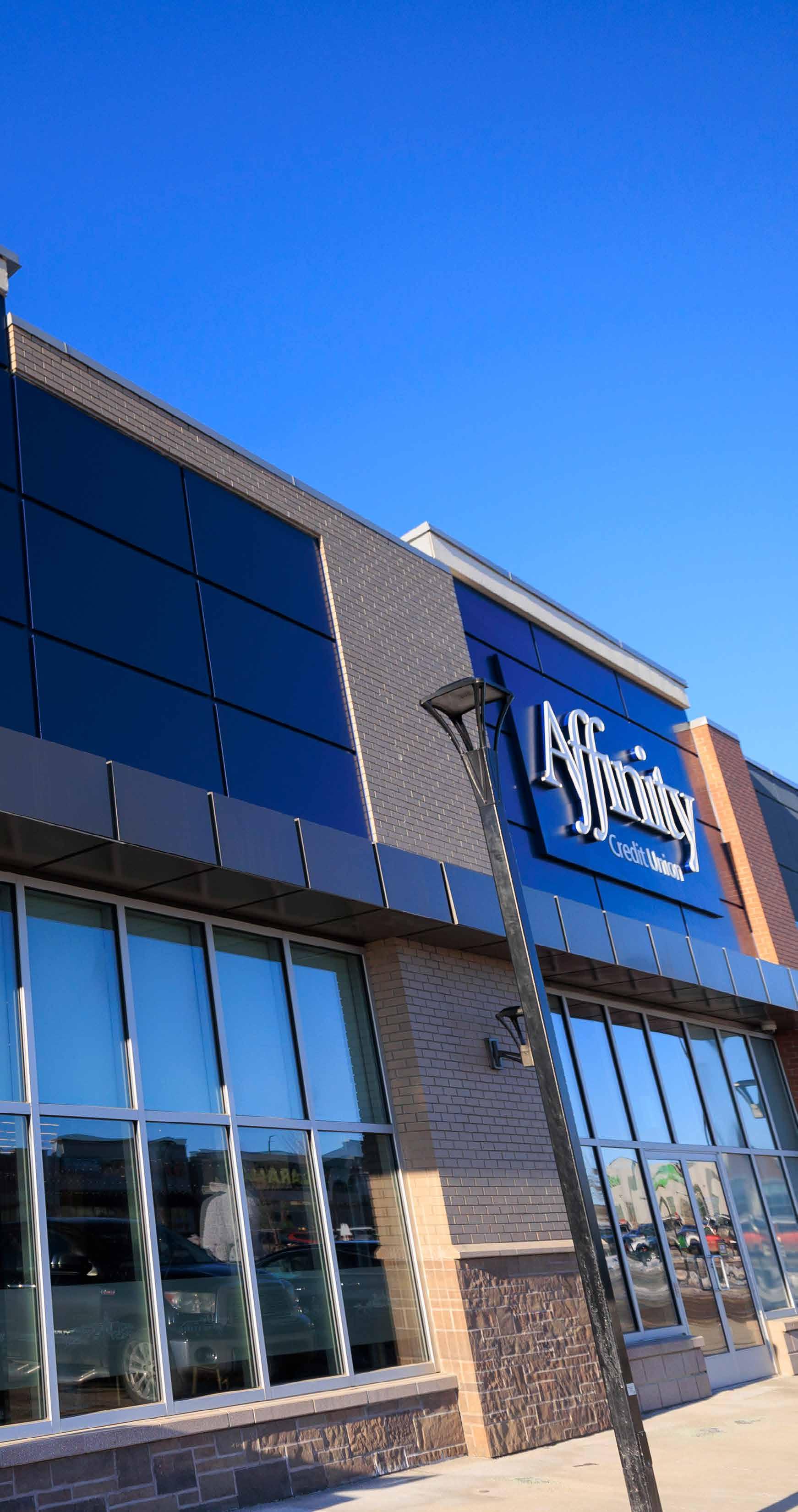
AFFINITY CAMPUS 902 7th Avenue North Mail to: PO Box 1330 Saskatoon, SK S7K 3P4 affinitycu.ca