Designing for Equity

Page 1


Designing for Equity: ADA Compliance and Positive Impact in California Public Schools

Public school campuses are places of learning; and they are civic anchors that serve students, families, and the broader community. In California, these sites fall under the jurisdiction of the Division of the State Architect (DSA), which ensures all public K–12 school construction projects meet accessibility requirements. Compliance with the Americans with Disabilities Act (ADA) is not merely a technical requirement, it is a civil right, a moral obligation, and a means of fostering inclusion and equity for all users. This essay explores the role of ADA compliance in the DSA review process, outlines how it is enforced through state building codes, discusses the value of expert input from Certified Access Specialists (CASps), and highlights the broader ethical and social reasons for creating accessible schools.

Design supporting equity and access
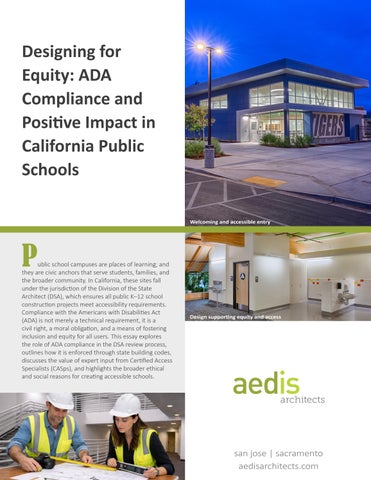
Welcoming and accessible entry

DSA Review and the Role of ADA in California Public School Construction

The Division of the State Architect (DSA) plays a critical role in enforcing accessibility during both design and construction. In plan review, DSA checks that designs comply with the ADA and the California Building Code (CBC), specifically Chapter 11B. This includes verifying accessible routes, entries, restrooms, parking, and program areas.

DSA also applies a cost-based threshold to determine the extent of required accessibility upgrades when projects affect existing buildings. If the construction value is below the state’s annual valuation threshold (e.g., $209,208 in 2026), accessibility improvements must be made up to 20% of the project’s adjusted construction cost. Projects over that threshold must either fully comply or submit a formal hardship request. This cost-based system ensures that upgrades are proportional to the project’s scope and budget, while still advancing access over time. Once construction is complete, DSA conducts field inspections to confirm that accessibility features were built as approved. Certification is contingent on correcting any noncompliant conditions. This two-stage process ensures that compliance isn’t just theoretical; it’s built into the physical environment.

Translation of ADA into Building Codes and Guidelines

The 2010 ADA Standards for Accessible Design (ADAS) set the federal baseline for accessible environments. In California, the California Building Code (CBC), particularly Chapter 11B, incorporates those federal standards and adds more stringent state requirements. For DSA-regulated public-school projects, CBC Chapter 11B is the primary reference, ensuring compliance with both state and federal law. These codes are periodically updated, so staying current is essential for maintaining compliance and creating truly accessible spaces.

Pathway to Compliance: The Role of Experts

Navigating ADA requirements in public school construction is complex. While architects are responsible for code compliance in design, they are not always tasked with performing comprehensive, field-based accessibility assessments. Certified Access Specialists (CASp), however, are certified by the State of California to evaluate compliance with accessibility laws. They conduct detailed reviews of existing conditions, identify noncompliant elements, and recommend corrective actions.

In public school projects, early involvement of a CASp, particularly in modernization or phased upgrades, can help identify issues before they reach the plan-check phase. CASps are often instrumental in evaluating path-of-travel upgrades, prioritizing improvements, and aligning work with DSA’s cost-trigger policies.

It’s worth noting that CASp reports, while valuable for private entities seeking legal protection under California’s Construction-Related Accessibility Standards Compliance Act (CRASCA), do not confer the same litigation protections for public agencies. However, for school districts, the benefits of involving a CASp lie in risk mitigation, clearer design coordination, and the avoidance of post-construction corrections that can delay occupancy and increase costs.

To find a CASp, districts can consult the public registry maintained by the DSA, searchable by name, location, or certification number. Selecting a CASp with experience in education projects and DSA-regulated work is recommended for smoother coordination and outcomes.

Social Inclusion and the Ethical Imperative

Accessibility is more than a technical requirement; it is a visible commitment to equity and belonging. When school environments are inclusive by design, they support not only students with disabilities, but also families, staff, and community members. Accessible campuses are better equipped to serve as community resources, including during elections, public meetings, and emergencies. Neglecting accessibility not only creates barriers for users, it also exposes districts to costly legal risks, delays, and erosion of public trust. Designing with inclusion in mind reflects the values of a community that looks out for all its members.

Noncompliance, identified upon campus evaluation

A final word…

Accessibility compliance on California public school campuses is a foundation of civil rights and educational equity. The approval process, enforceable codes, and professional oversight by DSA give districts the tools they need to meet this responsibility. Overlooking accessibility invites legal risk and community distrust, but getting it right creates more welcoming, functional schools for everyone.

At Aedis, accessibility is integral to our design process. With in-house CASp expertise and deep experience in educational environments, we embed accessibility from day one by supporting inclusion as a cornerstone of design. Our goal is to help districts build schools that reflect their values and serve every member of their community, now and for generations to come.

Aedis Architects is an award-winning design firm that seeks to positively impact our community through innovative learning and living environments. Our clients include leading public and private educational institutions, municipalities, community organizations, and urban housing developers. We provide a full range of services including master planning, educational facility planning, design and construction, development of District-wide and/or Campus-Specific Educational Specifications, community outreach, and project plan evaluation.

Our Head Quarters is located in downtown San Jose’s Arts District, close to the light rail and buses. Our LEED Platinum office lives above a bustling urban market of local food vendors and an architecture-inspired bar.

Our Sacramento office is located in the revitalized historic R Street District, where a diverse array of businesses and restaurants line the neighborhood.

Turn static files into dynamic content formats.

Create a flipbook
Designing for Equity by Aedis Architects - Issuu