![]()


Its goal is to support the BBI as it fosters a dynamic and vibrant Black presence within the Atlantic and broader Canadian business community.
For advertising information, rates, submitting story ideas, notices or community events, and for more information call: 902-426-8683
Publisher: The Black Business Initiative
Editor in chief: Matthew Martel
Editorial services: MDR Strategy Group
Senior director creative design and production: Shawn Dalton
Graphic designer: Lisa Gillis
Black Business Initiative
main office/training department
5450 Nora Bernard Street, Suite 200 Halifax, N.S. B3K 1A9, Canada
New Brunswick Office
24 Coburg Street
Saint John, N.B. E2L 3J5, Canada
Moncton Office:
795 Main Street, Suite 300, Moncton, N.B. E1C 1E9, Canada
Phone: 902-426-8683
Fax: 902-426-8699
Toll Free: 1-888-664-9333
E-mail: bbi@bbi.ns.ca
Canada Post Mail Agreement No. 40026687


Business Is Jammin’ marks twenty-five years of inspiring youth to dream and equipping them to lead. I’m honoured to serve as incoming chair at such a milestone moment for BIJ, the youth charity arm of the Black Business Initiative. Our mission remains steadfast: to empower Black youth through entrepreneurship, education and personal development so they can thrive in the communities they call home.
This anniversary is also a call to action. Youth unemployment sits near 14 per cent, almost double the national rate of 7.1 per cent. Young people are clear about what they need: real skills, real mentors and real pathways. Between April and August, more than 390 youth participated in 15 BIJ programs across the
region. When we include the Unleashing Youth Entrepreneurship Conference, our reach exceeds 1,100 participants. Participation in the first quarter alone rose by roughly 60 per cent compared to last year. The message is unmistakable: when opportunity is accessible, youth show up ready to build.
Our approach is rooted in community. We work with schools, churches and partners such as Saint Mary’s University, NSCC, Mount Saint Vincent University and the Akoma Family Centre to keep programs relevant and local. Support from funders including RBC Future Launch and Deloitte strengthens an ecosystem where youth see themselves as leaders, creators and change-makers.
Looking ahead, three priorities will guide our board:
1. Strengthen pathways that connect learning to leadership, ensuring program experiences lead to post-secondary success, meaningful employment and enterprise creation.
2. Expand reach and representation so our programs reflect the diversity and richness of Black communities across Nova Scotia and Atlantic Canada.
3. Sustain impact by deepening partnerships and testing new models for mentorship, funding and evaluation, with youth voice at the centre of every decision.
I bring to this role a commitment to inclusive, people-centred leadership shaped by a career in learning, development and culture, and by mentors who model resilience, collaboration and continuous improvement. These values will anchor how we serve.
We stand on strong shoulders. My deepest thanks to outgoing deputy chair Tracey Thomas for more than a decade of steady guidance, to our board, staff, alumni, funders and partners, and to the youth who remind us every day what is possible when passion meets purpose.
Dr. Atia Mark, Board Chair, Black Business Initiative

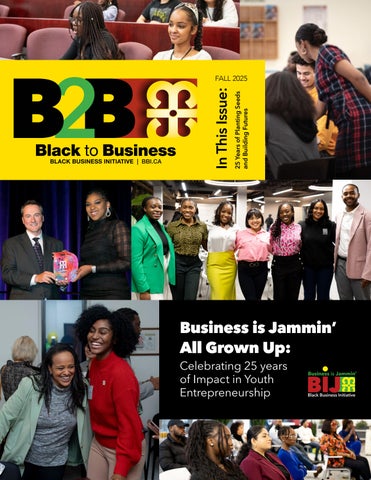
I’m especially excited about this issue of Black to Business magazine, where we take a meaningful departure from our usual focus to celebrate a remarkable milestone: the 25th anniversary of our youth charity, Business Is Jammin’(BIJ)
Twenty-five years is no small feat. This milestone represents decades of impact, growth and dedication to empowering Black youth in Nova Scotia, and more recently, across Atlantic Canada. Since its founding in 1999, BIJ has worked tirelessly to inspire young people aged eight to 35 to develop the skills, confidence and entrepreneurial mindset needed to own and grow businesses of their own.
To date, BIJ has engaged thousands of youths regionally through summer camps, mentorship programs, entrepreneurship training,
youth summits and financial support initiatives. Many of these young people have gone on to launch successful businesses, receive national recognition and make meaningful contributions across a wide range of sectors, including emerging technologies where Black representation remains limited.
Our success over the past 25 years would not have been possible without the unwavering commitment of our past staff, volunteers, community partners, funders, government collaborators and small-business supporters. Your shared belief in the potential of our youth has been the foundation of BIJ’s journey.
Today, BIJ continues to grow steadily. This year alone, our program has reached more than 1,000 youth. We continue to stand out in the non-profit youth space as a culturally relevant, responsive and innovative organization uniquely positioned to meet the needs of Black youth.
As we look to the future, we remain deeply grounded in the values that have shaped BIJ’s legacy while embracing innovation and forward-thinking approaches. My vision is to see BIJ continue expanding its reach, especially into rural communities across Atlantic Canada, and to take an even more hands-on role in supporting youth-led business creation.
In keeping with the rapid evolution of technology, we will also strengthen BIJ’s presence in technological and digital entrepreneurship, ensuring our youth are well equipped to thrive in the modern economy. As we continue to expand beyond regional borders, we envision building stronger partnerships nationally and internationally, creating even greater opportunities for young Black entrepreneurs.
At this 25-year milestone, we have every reason to be proud. From humble beginnings to a thriving legacy, BIJ’s journey has been fuelled by grit, passion and community spirit. As we look ahead, I firmly believe it is never too early to engage our youth in entrepreneurship, because entrepreneurship is not only a path to empowerment but also the vehicle that will drive Black generational wealth for years to come.

Matt Martel CEO, Black Business Initiative and BIJ


By Jahsara Gardner, manager, Business Is Jammin’

In 1999, a bold idea took root in Nova Scotia: to create a program that would introduce Black youth to the possibility of entrepreneurship as a pathway to independence and community empowerment. That seed became Business Is Jammin’ (BIJ), which over the next quarter century has grown into a vibrant regional force, supporting thousands of young innovators and leaders across Atlantic Canada.
When BIJ launched, the mission was simple but radical: to expose Black youth to the tools and confidence needed to own and grow businesses of their own. The late 1990s were not an easy time for aspiring Black entrepreneurs in Atlantic Canada. Structural barriers, limited representation and scarce mentorship made business ownership feel out of reach for many, but BIJ set out to change that narrative.
Within its first two years, the program was already on the move. In 2000–01, BIJ partnered with Junior Achievement, the Centre for Entrepreneurship Education and Development (CEED) and the Canada Youth Business Foundation to deliver entrepreneurial day camps across Nova Scotia. Fifty-one youth completed the camps, gaining practical knowledge about starting and sustaining a business. The team knew the real impact would be seen in the years to come, when those participants turned lessons into action.
By 2001–02, BIJ’s momentum had become undeniable. Since its launch, the organization had engaged more than 500 youth and refined its work around three core pillars: exposure, training and business development. New programs such as Afrikyak (a kayakbuilding initiative), Lunch & Learn leadership sessions and the Invention Convention gave young people hands-on experiences to stretch their creativity.
Those early years also produced the first of many success stories. Justin Mombourquette, just 17, launched his own web design company, Unidesign. Raytia David, 19, earned the CIBC Young Woman of Distinction Award while excelling as a cadet leader. And 12-year-old Bryce Hoyte started a small but profitable recycling business, earning about $25 a month, proof that entrepreneurial thinking could start early and small, but grow far beyond.
As the program matured, so did its ambitions. By 2005-06, BIJ had grown beyond its original mission of exposing youth to entrepreneurship. It was now helping them launch sustainable ventures. An example was The Women’s Faire in Inverness which brought together 172 youth to showcase their business ideas. The event helped spark a wave of youth-owned ventures:
• Jalani Boyce built a lawn care and snow removal service.
• Julian Dorr founded DJ Green Productions.
• Eric Weston secured 13 steady customers for his lawn and odd-jobs business.
• Kyle Worrell expanded his K&W Ice Cream company with a mobile trailer.
• Sisters Sadia and Shukri Yusuf launched a home-based catering service.

These ventures embodied BIJ’s growing focus on long-term development — providing not just inspiration but coaching, mentorship and resources for lasting success.
The following decade brought an unprecedented reach. The 2011-12 report documented 1,183 youth participants across 54 programs, including 30 camps and workshops, 21 networking sessions and a landmark youth conference. BIJ’s provincial footprint stretched from Halifax and Dartmouth to rural communities such as Yarmouth, Kentville, Windsor, Sydney, Sable River and Truro.
Participants gained skills not only in entrepreneurship but also in leadership and community service. BIJ began emphasizing the idea that building a business and giving back were not separate goals — they were complementary. A thriving Black business sector could fuel stronger, more self-sustaining communities.
By 2015-16, BIJ had become a trusted partner for both youth and government. Collaborations with the Nova Scotia Departments of African Nova Scotian Affairs and Communities, Culture and Heritage strengthened the program’s resources and reach.
The popular Role Models on the Road initiative expanded to engage 120 youth across eight schools, including rural Black communities where entrepreneurial mentorship was especially needed. At the same time, BIJ deepened its work with at-risk youth, offering one-on-one mentorship opportunities to those facing additional challenges. The annual Charity Golf Tournament had by then become a signature fundraiser and a celebration of the network of supporters behind the mission.

When the COVID-19 pandemic hit in 2020, BIJ like many organizations faced a critical question: How do we serve youth when in-person programming was impossible? The answer was swift and innovative. BIJ pivoted to virtual programming, delivering its first-ever virtual March Break program with 105 youth participating.
New initiatives such as the Empowering Entrepreneurs program, supported by RBC Future Launch and entrepreneurship training for young professionals ensured that even amid lockdowns, young people continued building skills. BIJ also introduced hands-on programming in trades and agriculture, recognizing the need to diversify opportunities and meet changing market realities. Adding a permanent staff position helped solidify the organization’s long-term stability.
By 2024-25, BIJ had stepped onto a bigger stage. No longer limited to Nova Scotia, the organization expanded across the Atlantic provinces, engaging 750 youth regionally.
Key highlights included:
• Relaunching the Youth Entrepreneur Empowerment Grant, awarding $15,000 to five youth entrepreneurs.
• Scaling regional programs such as the BIJ Mentorship Program, Networking Series and Experiences In: Entrepreneurship.
• Forming partnerships with YIPE, Pure Gold Foundation, PHD Consulting, Dream Pro Services, and Verisult Training & Consulting.
• Delivering four week-long camps, including Pixel-Preneurs, a digital design and marketing program for the next generation of creative entrepreneurs.
• Supporting 90 youth vendors in youth markets, offering a first real-world taste of business ownership.
The year’s theme — “Building Connections and Bridging Gaps”— captured the spirit of a program now uniting young Black entrepreneurs across provinces and industries.


What sets BIJ apart is its holistic vision of entrepreneurship. The organization has always viewed business ownership not merely as a career path but as a vehicle for empowerment, cultural pride and community resilience.
From kayak-building to digital marketing, from rural school visits to regional networking conferences, BIJ programs are tailored to the unique strengths and challenges of Black youth in Atlantic Canada. The emphasis on mentorship ensures that each participant can see themselves reflected in the success of others—something founding groups recognized as crucial back in 1999.
Moreover, BIJ’s journey has mirrored broader conversations about equity and inclusion in the business world. As Canada grapples with systemic racism and economic inequality, BIJ offers a model for how targeted support and culturally grounded programming can create lasting change.

Standing at the 25-year mark, BIJ is proud of its history and clear-eyed about the work ahead. The landscape of entrepreneurship is evolving, technology is reshaping industries, climate change is creating new markets and challenges, and young people are demanding businesses that prioritize sustainability and social impact.
BIJ plans to meet these changes with the same creativity and commitment that have defined its work over the past 25 years. Expanding its reach in Atlantic Canada, strengthening digital programming and investing in new sectors such as green technology and creative industries are all on the horizon. So too is a continued focus on
mentorship and intergenerational knowledge sharing, ensuring that today’s young entrepreneurs become tomorrow’s role models.
From 51 campers in its first full year to thousands of youth across multiple provinces today, Business Is Jammin’ has spent 25 years planting the seeds of entrepreneurship and watching them grow. Some of those seeds became small side hustles; others blossomed into thriving companies. All have contributed to a stronger, more self-reliant Black business community in Atlantic Canada.
Teca Cameron-Tackie, director of communications and marketing at the Black Business Initiative, speaks with Tracey Thomas, deputy minister of African Nova Scotian Affairs and the Office of Equity and Anti-Racism about the early days of Business Is Jammin’ (BIJ), its lasting impact and how youth empowerment continues to shape the next generation of Black entrepreneurs in Nova Scotia.

Q. How did you get involved with BIJ?
A. Back in 1998, while studying at Saint Mary’s University, I was looking for meaningful projects to be part of. That’s when I connected with Rustum and Mike Wise, who were developing a new youth strategy at the Black Business Initiative (BBI). I joined the effort to create a youth program, thinking it would be a shortterm, part-time project. It quickly became much more.
The program eventually grew into a full-time role and laid the foundation for Business Is Jammin’. Even the name reflected youth culture at the time, capturing the energy and excitement of the community. As with most young people, participants preferred to attend programs with friends, and word spread quickly. Soon parents got involved and participation grew organically.
Q. What challenges did young Black youth face at the time?
A. Exposure was the biggest challenge. We didn’t see many Black professionals in diverse fields beyond restaurants, cleaning or construction. Careers in consulting, architecture or medicine felt out of reach, so many youths defaulted to familiar paths.
BIJ helped break that cycle by connecting young people with professionals across industries, inspiring them to imagine different possibilities. Programs like Role Models on the Road continue that work today.
Funding was another challenge. BIJ was initially seen as a side project within BBI. But as participation grew, youth entrepreneurship became central to the organization’s mission, helping to build skills and businesses that drive Nova Scotia’s economy.
3 4 5
Q. How did BIJ help youth build the skills to take the next step?
A. We created a safe, supportive environment where youth felt confident asking questions. Early workshops promoted a “no question is silly” mindset, allowing participants to speak up without fear of judgment.
We also showed them it’s okay not to understand everything right away. Entrepreneurship may not be for everyone but trying builds resilience and confidence. We encouraged youth to make mistakes and learn from them, applying those lessons to both business and personal life.
Q. What was your official title at BIJ?
A. I was the director of the Learning Centre, though the title sometimes varied. BIJ was part of my portfolio. The Learning Centre on Gottingen Street offered workshops and workspace. Youth could use computers, photocopiers and develop business plans. It was like a small business hub.
Q. How are today’s youth different from those early years?
A. One big difference is access to information. Back then, the internet was just emerging, so research was difficult. Today, information is everywhere, and young people are more open to sharing ideas and seeking guidance.
Another difference is scale. Early ventures were often small or seasonal, like lawn care. Now, youth are launching sustainable businesses and have more access to mentorship and support.
6
Q. Can you share a story that stands out?
A. A young man from Sackville near Exit 14 wanted to start a lawn care business but needed a customized ride-on mower. With help from BIJ and community partners, including Home Hardware in Coldbrook, we arranged a $1,500 loan.
He ran the business for two summers. It wasn’t long term, but the pride he took in earning his own money was priceless.
7
Q. What are you most proud of with BIJ?
A. That BIJ has stayed relevant for 25 years. Youth still want to come, learn and be exposed to new ideas. Now that we operate provincially, I hope the program continues to expand.
It’s inspiring to imagine where these youth will be in 10 years, who will start businesses or apply what they’ve learned in new ways. For many, BIJ is a light-bulb moment that stays with them long after they leave.


When Joshua first attended the Business Is Jammin’ (BIJ) Youth Leadership Summit as a high school student, he never imagined how deeply his connection with the program would grow. Recognized for his academic achievements and dedication to community service, Joshua received a scholarship which marked the beginning of a transformative journey with the charitable youth initiative.
Since that first summit, Joshua has continued to grow as a leader and role model within the BIJ community. Now a university student pursuing a career in nursing, he’s committed to giving back to the very initiative that helped shape his path.
“I wanted to make a difference in my community and support youth who, like me, are navigating big decisions about their futures,” he shares.
Joshua’s desire to give back led him to join BIJ’s Role Models on the Road program, where he speaks to students about his journey, career path and challenges. One of his most memorable experiences was a 90-minute panel discussion at Bayview, where he joined other Black professionals and mentors to engage directly with students.
“I introduced myself to students, sharing my journey through school, my work and the steps I’ve taken to reach where I am today,” he says. “I spoke about my passion for science, my studies at Dalhousie and my goal of becoming a nurse. I also spoke about personal interests and the challenges I’ve faced.”
What stood out most for Joshua was the engagement from students who asked thoughtful questions about career paths, motivation, and balancing school and life.
“It reminded me of why mentorship matters. Sometimes, hearing someone’s story can spark hope and create new possibilities.”
While Joshua’s words and experiences undoubtedly inspire the youth he meets, he’s quick to emphasize that the mentorship is mutual.
“Being part of BIJ has given me the chance to connect, inspire, and be inspired in return. It has helped me grow both personally and professionally, teaching me the value of community and representation.”
As BIJ marks its 25th anniversary, Joshua’s story reflects the organization’s lasting impact and its mission to invest in Black and

racially visible youth. From receiving a scholarship in high school to returning as a mentor, stories like his represent the legacy BIJ set out to build.
“Moving forward, I hope to continue mentoring and giving back, just as BIJ has invested in me,” he says.
When Harshita joined the BIJ Mentorship Program, she was simply looking to add an extracurricular experience to her résumé. What she didn’t expect was that it would transform her confidence, give her direction, and inspire her to launch her own business as a rising young entrepreneur.
Over eight months, Harshita worked with her mentor, Grace Temani Chipudla. Together, they built a connection that helped her take the first steps toward real-world success.

“At the start, I joined this program to maybe start something new that would add to my extracurriculars,” Harshita admits. “But gradually, I became so invested in learning how different businesses operate… that it motivated me to start my own henna designing business.”
Throughout the mentorship program, Harshita took part in training and networking sessions that introduced her to the fundamentals of business, from strategy and leadership to creativity and community impact. She credits Grace for her continuous support and for helping her believe in her own potential.
“My mentor was very supportive and always calm with me. Due to her encouragement, I started my own small business as a high school student, which is receiving a decent response from my peers,” she shares.
“She encouraged me with her own entrepreneurial story and those of other young entrepreneurs.”
According to Harshita, that push helped her take the bold step of launching her own business, a blend of culture and modernity. Her designs reflect more than just artistic talent, they are an expression of her identity.
Her growth has extended far beyond entrepreneurship. She’s founded a Business Leadership Club at her school, participated in the BIJ STEM Entrepreneurship Summer Bootcamp, and is now working on a research paper inspired by business and psychology, a reflection of her deepening engagement with the world of innovation and leadership.
“It’s incredible to see how much I’ve grown with the BIJ community,” she says. “To be honest, I wasn’t a businessperson at the start of this academic year. Overall, we need more people of colour to represent excellence, brilliance and inclusivity.”

By Jahsara Gardner
For 25 years, Business Is Jammin (BIJ) has believed the best way to empower youth is through handson experience and to make it accessible to all. Since its inception, BIJ’s free March Break and summer camps have introduced thousands of young people to entrepreneurship while creating opportunities to learn, build and grow.
Each week-long camp blends business basics with creativity and confidencebuilding. Participants explore brand development, marketing, pitching,
financial literacy and more. At the heart of it all is a tradition that has remained constant since day one: the youth market.
At the end of each camp, participants set up shops to sell the products or services they’ve developed. Whether it’s handcrafted goods, baked treats or creative services, campers gain real-world experience interacting with customers and keep the money they earn.
These vibrant markets have appeared across Halifax, turning city corners and
community hubs into incubators of youthful enterprise.
The camps thrive thanks to entrepreneurs, community organizations and local partners who volunteer to facilitate workshops and share resources. These role models provide insight into marketing strategies, overcoming challenges and the possibilities that await young entrepreneurs.
The impact is undeniable. Many former campers have become business owners, community leaders and even BIJ staff members. One example is Jeiel U, who attended BIJ’s Business for a Day camp as a child, earned a Bachelor of Commerce at Dalhousie University and in 2025 returned to lead the very camps that inspired her.
Over the years, BIJ’s camps have evolved to include arts, food entrepreneurship, self-care, social enterprise, STEM and digital media, encouraging participants to tackle community challenges and develop creative solutions. Yet through every new theme, the purpose remains the same: ignite potential, expose opportunity and empower youth to forge their own path.

Suzan first discovered Business Is Jammin’ (BIJ) during her time on the executive team of her high school’s Black Student Support Association (BSSA). That experience sparked what would become a lasting journey of growth and leadership.
Her first introduction to BIJ was through the Youth Leadership Summit—an experience she now describes as a turning point.
“We engaged in workshops and activities that pushed us to dream bigger,” Suzan recalls. “I especially remember two of the speakers who left me so inspired that I walked away ready to take action and set real goals for myself.”
How
Suzan admits she initially expected just another student event. But the summit offered more than information, it delivered inspiration and transformation.
“I left with wisdom, direction and a stronger sense of confidence,” she says.
That confidence was soon put to the test in a moment she’ll never forget. During the closing keynote, scholarship recipients were announced, and Suzan’s name was called. Surprised and emotional, she was asked to share a few words about her story on the spot.
“It was nerve-racking but empowering,” she recalls.
That experience marked the beginning of a deeper connection to BIJ and to her own sense of purpose as a young Black leader.
Suzan was later named one of only two recipients of the Dr. Rudy Ffrench Youth Trailblazer Award, an honour recognizing young people making meaningful impacts in their communities.
“That recognition encouraged me to keep serving and giving back,” she says. “It reminded me to continue being an example for others younger than me.”
Now pursuing a degree in international development studies, Suzan’s focus is on global justice and advocacy, specifically, becoming a voice for refugees and immigrants. It’s a call she credits BIJ with helping her embrace with courage.
“BIJ has impacted me both personally and academically. The financial support helped with my studies, but more importantly, the program gave me the confidence to pursue my goals.”
Fadhlat Shodipe-Olaide is a passionate entrepreneur and creative visionary behind Fadhla Exquisites, a fashion and lifestyle brand known for blending elegance, modesty and cultural beauty. With a bachelor’s degree in mass communication and a Postgraduate Certificate in Administrative Professional Studies, she brings together communication, organization and artistry in every project she leads.
Her professional journey began more than a decade ago, spanning roles in client services, banking and insurance fields that refined her attention to detail, customer experience and business management skills. Today, she channels that expertise into her growing brand, Fadhla Exquisites, curating collections that celebrate confidence, grace and individuality.
Based in Saint John, New Brunswick, Fadhlat has become a familiar face in the local creative community, participating in fashion shows, events and cultural showcases that highlight her brand’s commitment to quality and authenticity. Under her leadership, Fadhla Exquisites has evolved into more than a fashion label; it’s a lifestyle that inspires elegance, empowerment and pride in identity.
Beyond fashion, Fadhlat is an advocate for continuous growth and creative expression. She believes in the power of storytelling through design and remains

committed to building a brand that reflects both heritage and modern sophistication.
As a member of BBI, she continues to find inspiration and opportunity within its vibrant network. The platform has allowed her to connect, collaborate and grow alongside other entrepreneurs, engage with innovative minds and gain valuable insights that shape her business journey. She looks forward to building even stronger partnerships and contributing to future initiatives within the organization.
www.fadhlaexquisites.com @FadhlaExquisites
MLA Eastern Passage
PO Box 116, 1488 Main Rd.
Eastern Passage, Nova Scotia
B3G 1M5
902.406.0656
barbadamsmla@gmail.com


Keisha Carter’s journey to launching her business, Comfort Foodies, began with her passion for cooking. Since childhood, she loved cooking through mother-daughter meal preparations at home. As she pursued her studies in high school, she became even more convinced that she would follow a career path in culinary training.
Convinced of her passion, Keisha packed her bags and moved to Calgary, where she decided to pursue professional cooking. It wasn’t long after completing her studies that she realized the best place to grow her business was back home in Halifax. Upon returning to Halifax, she started her business, Comfort Foodies.
Her mission is simple: she believes food should nourish both body and soul. The business focuses on bringing people together around meals that combine flavour, culture and comfort.
This vision has grown into a thriving company offering catering, meal services and experiences that celebrate food as a connector of people and communities.
With support from the Black Business Initiative (BBI), Comfort Foodies received two business development grants, one for bookkeeping support and another for the development of a strategic plan. This funding gave Keisha the structure and clarity she needed to scale her business successfully and sustainably.
How
Carter is unleashing the inner foodie in Nova Scotians
“
If it weren’t for the community holding us together, this journey would be impossible.”
—Chef Keisha Carter
Comfort Foodies has since expanded its reach with the purchase of a food truck, allowing the business to serve even more customers across the Halifax region.
Today, Comfort Foodies is a recognized name in the community, offering delicious food, creating local employment and fostering cultural exchange through cuisine.
By Jahsara Gardner, Arnez Mclean and Anthony Ekweaga
Q. If I wanted to start a business tomorrow, what’s the first thing I should do?
A. Start with what you’re truly passionate about, something you love enough to keep doing even without getting paid. But passion alone isn’t enough, it should also solve a real problem or meet a genuine need. That’s where sustainable business begins where your passion aligns with a real-world problem.
Q. Do I need a lot of money to start a business, or can I start with almost nothing?
A. You don’t need to be rich to start a business. Many successful companies began as simple ideas that caught people’s attention and grew over time. What matters most is creativity, determination and starting small with what you have.
Q. Why would someone pick my product when big companies sell the same thing?
A. People choose small or local businesses because of the personal connection and customer experience they offer. Small business owners listen, care and add a human touch that big corporations can’t. Many customers also support local businesses because it strengthens their community.
A. A business owner’s day can involve everything from management and sales to finances and customer service. Some days are exciting, while others can be unpredictable. But their main job is guiding the business’s growth, making decisions, solving problems and staying focused on the vision. 1 2 3 4 5 6
Q. How do people come up with business ideas that actually work?
A. Great ideas often come from solving problems. Some people spot challenges in their community and want to make things better; others adapt ideas they’ve seen elsewhere. Many entrepreneurs simply pay attention to daily life and ask, “What could be improved?”
Q. What does a business owner even do all day?
Q. Why do some businesses blow up while others disappear?
A. Successful businesses solve real problems in unique ways and keep improving. They know their audience, adapt quickly and deliver consistent quality. Others fade because they don’t understand their customers, try to do too much or stop innovating after launching.
Q. Can kids or teenagers start a real business?
A. Absolutely. Many successful entrepreneurs started young. You can begin small, selling homemade products, offering digital services or running an online shop. Get guidance from adults, such as parents or mentors, and remember that age doesn’t matter as much as effort and creativity.
Q. What’s the hardest part about running a business?
Q. If my business fails, does that mean I’m not good at business?
A. Not at all. Failure is part of learning. Every entrepreneur makes mistakes, what matters is what you learn and how you bounce back. Each setback brings experience and growth.
A. The toughest part is staying consistent when things don’t go as planned. Every stage has its challenges, be it funding, sales or motivation. The real test is pushing through those moments and learning from them. Persistence is what separates those who succeed from those who give up.
Q. How does a small business become something huge like Nike or Apple?
A. Growth takes time, consistency and vision. It’s fine to start small, even from your kitchen, but plan for longterm success. Set clear goals, track progress and keep improving. Growth doesn’t happen overnight, it comes from steady, strategic effort. 7 9 8 10


When Business Is Jammin’ (BIJ) launched Role Models on the Road (RMOR) in 2005, the goal was to bring accomplished Black business professionals directly into classrooms to show students that entrepreneurship and leadership can, and should include people who look like them.
Over the years, RMOR has remained one of BIJ’s flagship programs, inspiring
hundreds of young people annually and standing as a testament to BIJ’s 25-year commitment to building connections and bridging gaps.
In its early days, RMOR focused on schools within the Halifax area, sending a small but dynamic group of entrepreneurs, professionals and community leaders into classrooms. These visits were more than career talks, they offered representation
for Black students who rarely saw themselves reflected in local business ownership or corporate leadership. The message resonated: Black entrepreneurs belong in boardrooms and storefronts just as much as anyone else.
Teachers quickly recognized the impact. Attendance spiked on Role Model days, and conversations about starting a business became part of everyday school chatter. BIJ knew it had tapped into something essential by blending entrepreneurship education with genuine representation.
Encouraged by this success, BIJ expanded the program beyond Halifax, reaching rural Black communities across Nova Scotia. These visits required more planning and travel. But the rewards were unmistakable. Many students, some of whom had never met a Black business owner in person gained mentors who understood their unique challenges and aspirations. By 2012, annual participation had grown into the hundreds.


A decade after its launch, RMOR was firmly embedded in Nova Scotia’s youth programming landscape. In 201516 alone, the program engaged 120 youth across eight schools. This period marked a deliberate effort to ensure Black youth outside urban centres
could see themselves in the stories of local professionals.
For many, these encounters were the first time they had heard a professional openly discuss both the struggles and triumphs of starting a business. Those authentic conversations helped young
people imagine themselves as future entrepreneurs, artists, engineers or leaders in their own right.
During the global pandemic, BIJ pivoted to a virtual model, connecting role models with students and youth groups online.
While in-person visits remain a powerful part of RMOR’s impact, the virtual format created new opportunities. Professionals who might not have been able to travel because of distance or busy schedules could now log in and share their journeys.
Today, as BIJ marks its 25th anniversary, RMOR continues to inspire youth across Nova Scotia and highlight the importance of representation and mentorship.
The program has evolved beyond school visits into a network connecting generations of Black entrepreneurs and professionals with emerging leaders. Former participants now return as mentors, creating a full-circle moment that reflects RMOR’s lasting impact.
BIJ’s first board of directors came together with a shared mission: to create opportunities for Black youth in business and leadership. That inaugural board — Jocelyn Dorrington, Greg Browning, Joe Parris, Milton Williams, Bruce Johnson, Rustum Southwell, Gordon Doe and Tracey Thomas laid the foundation for what would become one of Atlantic Canada’s most impactful youth initiatives.
Nearly two decades later, the torch has passed to a new generation of leaders. The 2024-25 board is chaired by Tracey Thomas, with Shakara Joseph as vicechair, Adam Cain as treasurer, and members Grace Aldridge, Mapfumo Chidzonga, Vanessa Parris and Dr. Atia Mark, alongside CEO Matthew Martel.
This board represents both continuity and renewal, bridging the wisdom of BIJ’s legacy with fresh energy to propel the organization forward and empower the next generation of Black youth.
As Business Is Jammin’ (BIJ) marks 25 years of empowering Black youth through entrepreneurship, education and personal development, the organization continues to evolve with the changing business landscape. In this interview, Matthew Martel, CEO of Business Is Jammin’, reflects on the program’s journey, its enduring impact and the opportunities that lie ahead for young entrepreneurs across Atlantic Canada.

Q. Looking back, how has BIJ helped young adults in their 20s succeed in business?
A. BIJ supports young people by first building community, creating safe spaces for Black entrepreneurs that extend beyond the school environment, where they are encouraged to explore entrepreneurship.
Second, the organization gives credibility to alternative career paths for many who may not be traditional A-plus students, providing opportunities to learn through experience and demonstrate their resourcefulness and entrepreneurial potential.
Finally, BIJ provides practical support through grants, loans, training and connections to mentors, partners and potential clients. Strong partnerships further expand the opportunities available to participants. Partner organizations include Imhotep’s Legacy Academy, which focuses on STEM skills in collaboration with Dalhousie University.
Q. How have the challenges or goals changed over the past two to three decades?
A. Today’s business landscape is more competitive and transparent. Access to the internet and global markets means clients expect ethical, communityminded practices, not just profit.
Young entrepreneurs also face shifting definitions of success, with social media often highlighting multi-million-dollar ventures, making it harder for youth to see value in smaller, sustainable businesses. Our work continues to show that success can look different for everyone.
Another challenge is succession. Fewer young people are acquiring existing businesses, preferring to start their own. BIJ helps them see the value in taking over established companies and adding innovation, especially as generational wealth is transferred.
Q.
Q. What lessons from early participants still shape the program today?
A. That talent exists in local Black communities. Our camps and workshops focus less on theory and more on hands-on skill-building. I’ve also learned it’s never too early to engage youth in entrepreneurship. Many early participants went on to succeed in business, government and private industry.
Q. With many young adults choosing the security of a “safe” job, how does BIJ encourage them to pursue entrepreneurship?
A. We don’t push entrepreneurship; we build the skills. Whether someone takes an accounting or other professional job, or starts a business, the same financial and problemsolving skills apply. Our goal is to help them make informed choices.
Programs such as Experiences In expose youth to fields where our community is underrepresented. BIJ and BBI share the same goal of building Black community wealth. Whether supporting youth in strong professional careers or entrepreneurship, the mission is to drive that vision forward.
Q. Access to funding is a big barrier. How does BIJ help tackle this?
A. We focus on financial literacy, helping young people understand when a business needs capital, how to identify good versus bad funding and how to avoid credit challenges. We also advocate for grants and low-interest loans to support sound financial habits.
Q. How is BIJ adapting its programs to evolving technology and innovation?
A. Technology has always been part of our program. ICode, for example, taught eight- to 12-year-olds coding and how to build Arduino kits long before those activities became mainstream.
We’ve expanded into ocean technology, given our East Coast roots, and into discussions around generative AI. Our goal is to remove fear around new tools and ensure diverse youth are not only engaged but contributing.
Q. Looking ahead 10 years, what is your vision for BIJ and youth entrepreneurship across Atlantic Canada?
A. For BIJ to honour its past while continuing to innovate. We aim to stay forward-thinking and expand our reach to support more rural youth across Atlantic Canada.
Over the next decade, BIJ will take a more hands-on role in business creation with a stronger focus on techbased entrepreneurship. BIJ can become the platform that supports tech founders while BBI continues to back traditional business owners. We’ll also build national and international partnerships to give youth broader opportunities and connections.


For a quarter-century, Business Is Jammin’ (BIJ) has been dedicated to helping Black and African Nova Scotian youth turn big ideas into real opportunities. That kind of impact doesn’t happen in isolation. Behind every workshop, leadership summit and budding entrepreneur is a network of partners who believe in the potential of young people, and who prove it through consistent, hands-on support.
Among these champions, RBC stands out as a cornerstone ally. Through its Future Launch program, RBC has provided long-term funding for a range of BIJ initiatives designed to open doors where barriers have too often existed. Experiences In, for example, introduces African Nova Scotian and racially visible youth to career paths where they have historically been underrepresented, with the ultimate goal of building a more diverse workforce. RBC’s support has also powered our Youth Leadership Summit, a flagship event that draws high school students from across the Halifax region for a full day of keynotes, skill-building activities and entrepreneurship workshops.
Beyond financial support, the RBC team members regularly step into our programs as guest speakers, workshop facilitators,and mentors, sharing practical knowledge that inspires youth to picture themselves in leadership roles. The expertise and enthusiasm RBC staff bring help make these events memorable.

Their support has amplified the impact of programs such as the Youth Entrepreneur Empowerment Grant, which gives young business owners the resources and confidence to grow their ventures. It has also strengthened BIJ’s Networking Series, connecting Black entrepreneurs and professionals across Atlantic Canada through virtual sessions in New Brunswick, Prince Edward Island and Newfoundland.
While RBC’s sustained commitment anchors much of our programming, BIJ’s success is also built on the energy of other remarkable partners, such as Efficiency Nova Scotia (ENS). ENS has become an essential collaborator in our Experiences In: Green Building Careers program, introducing high school students to an industry where Black professionals remain underrepresented.
At the annual Youth Leadership Summit, ENS hosts breakout sessions and youth-focused booths that foster sustainability and innovation. They also participate in our Annual Golf Tournament Fundraiser, sponsoring a hole and demonstrating a genuine commitment to both our mission and the broader community.
Similarly, Saint Mary’s University, through its Arthur L. Irving Entrepreneurship Centre, is another strong
supporter. The university has opened its doors many times, hosting BIJ’s STEM Entrepreneurship Summer Bootcamp and Youth Leadership Summit in welcoming, professional spaces.
Its staff provide campus tours that broaden young people’s horizons and lead pitching workshops that sharpen real-world business skills. Perhaps most impressively, the Saint Mary’s team travels to meet youth where they are, supporting our Social Entrepreneurship Summer Camps for children aged eight to 13 and hosting several of our networking events.
Together, these partnerships show what real collaboration can achieve. RBC offers not only financial support but also personal time and commitment. Efficiency Nova Scotia brings industry expertise and hands-on engagement. Saint Mary’s University provides space, mentorship and a bridge to academic opportunities. Each partner meets BIJ’s passion with their own, creating a synergy that multiplies our reach and deepens our impact.
As BIJ celebrates 25 years of empowering youth, we know that none of this progress would be possible without the partners who believe in our mission and in the limitless potential of Black and African Nova Scotian youth. Their support has helped turn ideas into enterprises and build sustainable futures.


Interview conducted by Teca Cameron-Tackie
As a new Business Advisor with the Black Business Initiative (BBI), Adedayo Ojo is dedicated to helping Black entrepreneurs grow and succeed. In this interview, she talks about her background, what drives her work, and how she hopes to support Halifax’s Black business community.
Q. Can you tell us a little about your background and what inspired you to join BBI as a business advisor?
A. My journey combines a background in microbiology with a strong passion for entrepreneurship, which I am further developing through my master’s in technology entrepreneurship and innovation. Alongside my studies, I have been running my own fashion accessories business for several years, gaining firsthand experience in entrepreneurship.
Q. What excites you most about working with the Black business community here in Halifax?
A. What excites me most is the incredible resilience, creativity and talent in the community. There’s so much potential here, and I look forward to connecting with entrepreneurs, hearing their stories, and being a part of their growth. For me, it’s about building relationships and helping people see what’s possible when they have the right resources and support.
Q. For those who may not know, how would you describe the support you’ll provide to Black entrepreneurs?
A. I’ll be providing one-on-one advisory support to help entrepreneurs grow and scale their businesses. This includes guidance in areas such as business planning, communication, marketing and promotion, as well as helping them access funding and connecting them with the right resources. Beyond technical support, I aim to empower entrepreneurs, build their confidence and provide ongoing encouragement so they feel supported throughout their journey.
Q. What unique challenges do you see Black entrepreneurs in Halifax facing, and how do you hope to help address them?
A. Many Black entrepreneurs face barriers such as limited access to funding, fewer established networks and systemic inequities that make it harder to scale. I hope to help address these challenges by connecting them to the right financial resources, helping them strengthen their business structures and amplifying their voices within the larger business community.
Q. What strengths or opportunities do you see in Halifax’s Black business community right now?
A. I see incredible passion and creativity. Many entrepreneurs are deeply driven by their ideas, and that passion fuels their resilience and determination to succeed. I also see a strong spirit of collaboration, business owners supporting one another, and an opportunity to leverage digital platforms and e-commerce to showcase their talent on a larger scale.
Q. How do you hope to contribute to building a stronger ecosystem for Black entrepreneurs across Atlantic Canada?
A. I hope to do this by being a consistent support system, building meaningful relationships and ensuring that entrepreneurs know they don’t have to navigate this journey alone. By connecting businesses across provinces, sharing best practices and advocating for resources, we can create a stronger and more united ecosystem.
Q. Do you have a personal philosophy or approach that guides how you work with entrepreneurs?
A. Yes, my philosophy is that every entrepreneur’s journey is unique, so the support should be personalized. I believe in meeting people where they are, listening to their vision, and helping them build step by step with confidence. For me, it’s about empowering them to see their own potential while giving them practical tools to succeed.


Q. What message would you like to share directly with Halifax’s Black entrepreneurs who may be thinking about reaching out to you for support?
A. My message is simple: don’t hesitate to reach out. No matter what stage you’re at, whether you’re just starting an idea or already running your business, you don’t have to do it alone. I’m here to support you, listen and connect you with the right resources. Together, we can take your business to the next level.


“I realized that everyone has their own struggles. It inspired me to take a look at my own career choices and focus on how I could make a difference.”


Martina Kelades, 2007 NSCC alumni
Addictions Community Outreach and Mental Health Recovery & Promotion
• Life Out Loud, founder and podcast host
• TV and film actor, published author


• Mental health facilitator, trainer and speaker


Throughout the year, we’re proud to share stories of African Canadian entrepreneurs, graduates and community builders in the NSCC alumni network who are shaping the history of tomorrow, like Martina.

Read more about her start at NSCC: nscc.ca/martina

This summer, the Black Business Initiative (BBI) launched the first cohort of the Barrier Breakers Youth Program, funded by Employment and Social Development Canada (ESDC) under the Youth Employment and Skills Strategy (YESS). The program empowers youth with tools, experiences and opportunities to build brighter futures.
Launched in June 2025, the first cohort brought together 23 participants in Halifax for a four-week, in-person training focused on résumé writing, financial literacy, digital skills and workplace readiness, preparing them for 16-week paid placements with diverse employers.
Placement sites included BGC Halifax, the Halifax Sexual Health Clinic, Mauya Abstract, the Canadian Red Cross, the Boys and Girls Club, Ambassatours, Delmore Buddy Daye Learning Institute, Business Is Jammin’, One Day Affair Wedding, HCi3, Clean Foundation, HAAC, Saint Mary’s University Career Services, and Dora Construction. These partnerships offered participants professional exposure, mentorship and long-term career connections.
HAAC’s Soliel Gibson praised her intern, Danke Attedjro, for her growth and contributions, calling the experience “mutually beneficial.” Participants also expressed gratitude. Patrick Haddad described his internship as “a privilege,” while Alexandria Pittman said, “It gives such a happy feeling every morning I wake up.”
The second cohort began Sept. 29, expanding across Atlantic Canada with a virtual focus on entrepreneurship, innovation and technology.


Invest Nova Scotia works with diverse-owned companies and entrepreneurs, delivering programs and services that drive growth, profitability, and innovation - helping businesses scale while strengthening representation across the community.
Access specific supplier diversity procurement programs within private sector corporations and government departments via the Supplier Diversity Certification Program (SDCP): investnovascotia.ca/sdcp.
Learn about the benefits of supplier diversity: investnovascotia.ca/businesses-diversity


Entrepreneurs know how to plan ahead. Entrepreneurs know how to plan ahead.
The Road to Economic Prosperity is planning for the economic future of our communities. We are entering the next five-year phase of an economic development strategy designed and led by African Nova Scotians. Our work is already building community capacity , strengthening workforce attachment and driving policy change. Through our third priority—Education, Employment and Entrepreneurship—we are working collaboratively to ensure that Black businesses remain at the centre of Nova Scotia’s economic growth, directly influencing policies that expand opportunity, open access and enhance the ecosystem that supports Black entrepreneurs.
Read the Plan and get involved at www.anseconomicprosperity.com