A “FeAr Not” SeASoN
Three reactions and three lessons from the Nativity
JUSTIN KIM
At the first advent of Christ, news of His arrival generated three negative reactions. To most of the main characters of the Nativity narrative, the angels repeat “fear not”: “Joseph, thou son of David, fear not” (Matt. 1:20, KJV); “Fear not, Mary” (Luke 1:30, KJV); “Fear not, Zacharias” (verse 13, KJV); and to the shepherds, “Fear not” (Luke 2:10, KJV). Here are some lessons we can take away from the account.
The recurring message of the angels is “fear not.” For many, this season as well as the new year brings a sense of worry, anxiety, and stress. But the message from heaven to us is whatever circumstance we are in, we should not fear. Heaven is on the move, and when it does, we are not to fear. We were not created to live in fear, anxiety, and stress, but rather for God’s glory, and to worship Him in love and obedience.

(verse 13). Angels bring “good tidings of great joy” (Luke 2:10) to those who, like the shepherds, are conversing about spiritual things.
In addition to fear were annoyance and indifference. Matthew 2:3 narrates that Herod was “troubled, and all Jerusalem with him.” He was agitated, stirred up, and disturbed. You would think that when the king inquired the priests and scribes about the Messiah, they would react in some way. Yet although they knew the messianic prophecies of time and place, they answered the king with the second reaction of indifference.
If people reacted with annoyance, indifference, and abhorrence when Jesus came the first time, how will we react when He returns for the second time?
Second, in three of these instances the message’s recipient is specifically addressed by name. If heaven knows our names, it also knows every other detail about us (Matt. 10:30). The message of heaven is a personalized one to each of us. Just as the angels spoke directly to Joseph, Mary, and Zacharias, heaven also speaks to you and me individually today through Scripture. This season is a reminder that God has a specific plan personalized for each of us.
Third, in each of the messages, a promise is given, applicable to our contexts today. Just as Joseph was enmeshed in a socially shameful pregnancy, God is also intimately involved in our affairs. In response to Mary’s humility and ours, heaven says we have “found favor with God” (Luke 1:30). To those pleading in the sanctuary, like Zacharias, God says, “Your prayer is heard”
“With amazement the heavenly messengers beheld the indifference of that people whom God had called to communicate to the world the light of sacred truth. . . . In the temple the morning and the evening sacrifice daily pointed to the Lamb of God; yet even here was no preparation to receive Him. The priests and teachers of the nation knew not that the greatest event of the ages was about to take place. They rehearsed their meaningless prayers, and performed the rites of worship to be seen by men, but in their strife for riches and worldly honor they were not prepared for the revelation of the Messiah. The same indifference pervaded the land of Israel.”*
If people reacted with annoyance, indifference, and abhorrence when Jesus came the first time, how will we react when He returns for the second time? May fear be absent from our reaction to His second coming and from our daily lives. May we be reminded that God is intimately involved with our details, that God finds favor with us in Christ, that God hears all of our prayers, and that God will make good out of all the conundrums of our lives. May this be a “fear not” season, dear hoper in the Advent, for the Lord has been with us, is with us, and will be here again soon.
Ellen G. White, The Desire of Ages (Mountain View,

“Fulton has been the educational hub of the Pacific islands for many years. It has trained thousands of workers who now serve in churches, communities, governments, and NGOs (nongovernmental organizations) across the region. Reaching university status will strengthen its role in training leaders grounded in God’s Word and committed to serving others.”
—Talonga Pita, Education director for the Trans Pacific Union Mission, about the transition of Fulton Adventist College to Fulton Adventist University. Owned and operated by the Seventh-day Adventist Church, Fulton offers programs in theology, education, and business studies, serving students from 11 Pacific nations. It joins Avondale University in Australia and Pacific Adventist University in Papua New Guinea as the third Adventist university within the South Pacific Division.
13 teAmS
The number of creative teams of students and professionals gathered on October 2 for the launch of Ideathon, a technology and innovation challenge designed to inspire digital-first solutions for the Southern Asia-Pacific Division. The launch highlighted the church’s expanding presence in a digital world and invited participants to view technology as a powerful instrument to advance the mission.
“We have observed that adolescents have experienced a noticeable increase in social connection after engaging in the NextGen Health Club activities. The programs emphasize community and shared goals, which naturally foster interaction and collaboration. . . .
The
social bonding that occurs through these activities
helps create a sense of belonging, which is a critical component of mental well-being.”
—Orgilzul Batsukh, NextGen CELEBRATIONS! project manager for ADRA Mongolia, about ADRA’s work for World Mental Health Day. In Mongolia ADRA’s project is helping adolescents build resilience and emotional strength long before emergencies arise, empowering them with tools that protect both body and mind.
How loNg HAve you or your FAmily beeN iN tHe AdveNtiSt CHurCH?
In the Global Church Member Survey participants were asked how many generations they or their family has been part of the Seventh-day Adventist Church.
“Depending on how well we educate our future generations, the image of reality will be changed or not. We are decisive factors in shaping both the minds and souls of our children.”
—Marius Munteanu, director of Education Department of the Inter-European Division, about the first national educational conference in Bulgaria, which brought together teachers, educational specialists, parents, and laypeople for whom Christian education is both a missional and personal responsibility.
Do you want to keep up with what is happening in our church? If you want to receive our weekly newsletter that features news, inspirational stories, videos, and more, sign up today.
A member of the educational community during the October 8 celebration. Photo: Adventist Record
gC SeCretAry AppeAlS to leAderS to Keep Fo CuSed oN worldwide miSSioN
“Our mission extends all around the world, until Jesus comes,” Rick McEdward said.
rick McEdward, who was elected General Conference (GC) secretary at the GC Session in St. Louis, Missouri, United States, in July, shared the Secretariat’s report to members of the General Conference Executive Committee (GC EXCOM) at the denomination’s headquarters in Silver Spring, Maryland, United States, October 12. Together with his team they presented statistics and reports, and shared experiences about the church and its mission work—in both the past and the present.
Growth Amid Ongoing Challenges
David Trim, director of the GC Office of Archives, Statistics, and Research, shared the latest membership figures and trends. While 1.9 million became Seventh-day Adventist members in 2024, almost 900,000, or more than 4 in 10 people, are slipping away, he reported.
“In the past five years there was a total of 4,050,104 living losses,” Trim shared. “These are not statistics to celebrate, but there is nevertheless grounds for a degree of
satisfaction, in that membership reviews are taking place around the world . . . [and] we now have a more realistic picture of trends in membership.”
Getting Willing People Ready for Mission
After Trim, Oscar Osindo, director of the Institute of World Mission, shared his report about the activities and accomplishments of what he called “the training arm of the General Conference Secretariat.”
The institute prepares cross-cultural workers and nurtures missionary witness for effective service, he reminded GC EXCOM members.
During the past 12 months the four training sessions around the world equipped 118 adults and 67 children, emphasizing cross-cultural service and adaptation, Osindo reported. To assist those returning from missionary assignments, Osindo said, “three reentry retreats provided muchneeded debriefing and transition support to 73 adults and 29 children.”
The Power of Volunteer Service
Elbert Kuhn, director of Adventist Volunteer Service, followed Osindo with a report on what he called “the growth and expansion”

Marcos Paseggi, Adventist Review
Rick McEdward, General Conference secretary, shares his report with
in Silver Spring, Maryland, United States.
Photo: Peterson Fagundes
of the office that manages the deployment of volunteers around the world.
Among the main achievements, Kuhn highlighted the growth of Schools of Mission, now with 296 schools active across the globe. “These mission centers provide both spiritual formation and practical training, preparing volunteers for service in education, health care, technology, church planting, media, and humanitarian outreach,” he said. “They have become true launchpads for mission.”
Focus and Refocus on Mission
The Office of Adventist Mission is also part of the Secretariat team. Gary Krause, Adventist Mission director, reminded GC EXCOM members of Global Mission, the long-standing initiative of the world church to start new groups of believers in new and unentered areas and people groups. He highlighted the Mission Refocus initiative to reach three high mission-challenge windows: the 10/40 window (the region of the world with most of the population but where Christians are a minority), the post-Christian window (mostly in the secular West) and the urban window (the large cities of the world).
Then Karen Porter, GC associate secretary, reported on the progress of Mission Refocus, which includes sending and receiving workers for the hardest-to-reach areas of the world and to channel resources to areas of the world where needed most.
“Mission Refocus is not just a strategic shift; it’s a spiritual realignment,” Porter said. “It’s about being integrated for mission—intentionally aligning our people, our resources, and our vision with the places where the gospel is least known.”
Focus on the 10/40 Window
In the second part of the Secretariat’s report, McEdward focused on the 10/40 window, which, he said, is an issue that “is not going away until Jesus comes.” The magnitude of the mission challenges across that region is staggering, McEdward explained. “It contains 69 countries and 66 percent of world population, or 5.4 billion people, against 2.8 billion people in the rest of the world.”
Adventist members in the 10/40 window amount to only 12 percent of the global
Adventist membership, or 1 Adventist to 1,946 inhabitants, in contrast with 1 Adventist to just 135 people in the rest of the world, he shared. “It is also the region that contains 11 countries with no official Adventist presence,” he reported.
Relationship With Islam
McEdward also explained that Muslims and Christians make up 55 percent of the world’s population. But Islam is growing faster and has a larger group of young people than Christianity. In some regions of Africa both religions are expanding rapidly, sometimes in direct competition.
He made a special point of the difficulty of sending workers into Muslim nations, because of various restrictions. “[The countries] are not easy for us to send workers to, but the fact that it is not easy doesn’t mean witness is impossible.” Growing numbers of Muslims, McEdward reported, are engaging with the Bible through digital apps, social media, and personal encounters, often in private. To connect, however, Adventists need to move past five barriers, including fear, anger, hopelessness (in the outreach enterprise to Muslims), lack of knowledge about their language and culture, and lack of ministry tools.
“MISSION REFOCUS IS NOT JUST A STRATEGIC SHIFT; IT’S A SPIRITUAL REALIGNMENT.”
Past and Present in Mission
McEdward also explained how the face of mission is changing thanks to Mission Refocus, a strategy “that is not going away” and “will continue to grow and get stronger, with your support,” he said. In fact, this new strategy “has resulted in the GC completely reengineering the missionary sending process to strengthen sending frontline church planters into strategic locations globally,” McEdward reported. “In response, divisions have joined in sending workers to the three mission windows.”
He also reported that so far in 2025 the Adventist Church has sent 33 families,
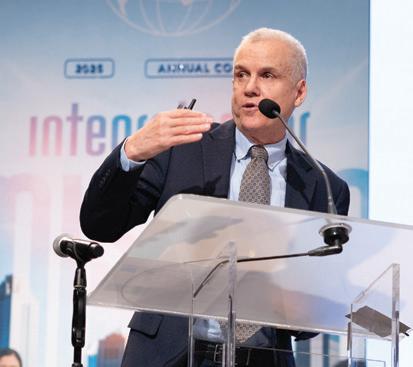
totaling 43 new employees, and 114 children to 21 countries. There are also “58 calls in the pipeline, with workers preparing to move to 33 countries, together with their 77 children, totaling about 310 people.
A Case Study
In the last part of the report, McEdward highlighted the example of Ferdinand and Ana Stahl, who were missionaries in Peru from 1909 to 1939. An old photo of the Stahls was used to create an AI-mediated video, during which, based on Ana’s diaries, the couple shared some of the memories of their experience as missionaries.
After the video McEdward introduced Anthony and Karina Stahl to the GC EXCOM members. Anthony Stahl, president of the Adventist HealthCare White Oak Medical Center in Silver Spring, Maryland, is a great-grandson of Ferdinand and Ana Stahl. “When I see [Ferdinand and Ana’s] faces, hear their voices, it brings the story alive,” Anthony Stahl acknowledged. “It just brings breadth into what they have done.”
McEdward closed by appealing to GC EXCOM members and others listening to the report to remember that Adventist mission is global. “[Our] mission extends all around the world, until Jesus comes.”
The full version of the General Conference Secretariat report is available on the Adventist Review website here.
Gary Krause, Adventist Mission director, talks about Global Mission, which is a long-standing initiative of the world church to start new groups of believers in new and unentered areas and people groups through such means as Global Mission Pioneers, Global Mission Centers, Urban Centers of Influence, and others. Photo: Peterson Fagundes
miSSioN empHASiS iNFormS treASurer’S report
At ANNuAl CouNCil
GC treasurer Paul H. Douglas calls to refocus our efforts on frontline outreach.
icommit to this body and to the world church to be a faithful steward of the resources God has provided His church to be used for His mission,” said Paul H. Douglas, General Conference (GC) treasurer, in his opening remarks October 13. Douglas and his team presented the treasurer’s report to the GC Executive Committee (GC EXCOM) assembled at the denomination headquarters in Silver Spring, Maryland, United States.
Strength, Stewardship, and Strategy
Douglas introduced the three areas of emphasis for this quinquennium, beginning with strength. Church entities should be operating a level of self-support and not dependent on appropriations “to address operational expenses . . . but to make mission investments,” he said. Douglas also called on church leaders to use an increasing amount of funds “for mission, not machinery.”
The second area of Douglas’ emphasis was stewardship, or the careful management of resources God has entrusted to us. He suggested that it should be not only personal (what God requires of us) but organizational (what we do and how we behave as leaders). He also referred to a partnership with the GC Stewardship Department, which will focus on areas of emphasis and collaboration. “Stewardship is about faith-raising, not fund-raising,” he said.
Finally, Douglas addressed strategy, which includes making evidence-based decisions, maximizing the impact of mission investments, and mobilizing resources for mission. “Let’s do more of what works, [but] if something doesn’t work, let’s try something else,” he suggested.
DIGITAL MISSION
STRATEGY IS NOT JUST A PLAN,
BUT “A MOVEMENT TO REACH PEOPLE WHERE THEY ARE.”
Global Economy Impact on the Church
After Douglas, Timothy Aka, GC associate treasurer in charge of investments and banking, presented an overview of the world economic situation and what it means for the church. Challenges include some foreign nations wanting to move away from the U.S. dollar, the increasing level of the U.S. government borrowing, the threat of inflation, and the labor supply uncertainty.
Aka shared that he always thinks about how this could affect the work of the church in the future, including the prophetic role of the U.S. in global events. He acknowledged that the shifting winds certainly can affect the work of the church, including “our
ability to conduct business the way we’ve done [and] move funds around the world to support our work.” It is the reason, Aka emphasized, that self-support becomes much more important.
Financial Results and GC Session Report
Douglas returned to the podium to share the church’s financial statements as of August 2025. He mentioned a 3.9 percent increase in tithe and a 0.5 percent decrease in offerings when compared to the same period last year. Working capital—current assets minus current liabilities—is available for 12.4 months, while Liquidity—funds that can be easily converted to cash—amounts to 9.5 months.
After Douglas, associate treasurer Sabrina C. DeSouza reported on the GC Session earlier this year in St. Louis, Missouri. She reported that in a survey, 91.1 percent of those who answered found the GC Session to be either effective or very effective. She was also happy to report that actual expenses were US$1.1 million less than what had been budgeted.
GC Session Special Offering
GC associate treasurer Richard Stephenson, in charge of digital strategy, reported on the special GC Session offering, which was earmarked for supporting the church’s digital strategy. The GC Session special offering amounted to more than US$3.8 million, he reported.
Marcos Paseggi, Adventist Review

Stephenson explained that plans include initiatives designed so “every click becomes an invitation to engage, and most important, an opportunity to connect an online seeker with their local Adventist church.” Digital mission strategy is not just a plan, but “a movement to reach people where they are.”
How Is Tithe Used?
After Stephenson’s report, undertreasurer Ray Wahlen shared an update on the use of tithe. Based on current policies, Wahlen reminded GC EXCOM members that “administrative and executive committees need to understand scriptural and Spirit of Prophecy counsel regarding the use of tithe.” Worldwide, 35.7 percent of tithe returned by church members was used to fund pastoral work, and 29.2 percent went for operational expenses, Wahlen reported. But when finding the median in world divisions, the money spent on operating expenses in 2024 exceeded the percentage of money spent on pastors (39.7 to 36.4 percent). “Office operating became the primary use of tithes in most division terri-
tories,” Wahlen said. “This is disturbing to us, and we are still exploring what it means for the global church as a movement.”
Appropriations and Mission
Douglas returned to the podium to remind GC EXCOM members that according to policy, appropriations—or the money the GC sends to church regions or institutions around the world—follows a methodology that “promotes mission priorities.” Accordingly, it has been voted to have a baseline appropriation amount adjusted to the economic size of the division. To that, Douglas said, an additional amount will be added “using a matrix related to finances and mission.”
Among the new elements to take into account, Douglas said, will be a newly developed “disciple-making score” that will look at several elements, including mission and outreach activities, active return of tithe, and disciple-making plans. “The higher the score, the higher the additional appropriations,” he said. “It’s a methodology for appropriations that promotes mission.”
Budget Considerations
Wahlen then shared some budget factors that leaders took into account to prepare the 2026 budget. Among them, he mentioned the elimination of an additional 0.85 percent of tithes from the North American Division and operating expenses set within the cap established by policy.
He shared that total budgeted tithe was reduced, and that budgeted offerings and investment earnings are expected to increase. Regarding allocations, Wahlen reported that appropriations and funds for auditing services are expected to increase. The same applies to GC-administered funds, which include insurance premiums and ongoing investment in digital technology.
In a final chart, Wahlen showed a graphic to explain how funds are distributed. According to him, the GC assigns 40 percent—“the largest and most important part of the budget”—of its allocations to mission strategy and support, 31 percent to operating expenses, and 9 percent each to media and publications and to leadership development. Another 8 percent goes to four educational institutions that depend directly on the GC, while a final 3 percent is destined to other uses.
In closing, Douglas reminded GC EXCOM members that “Mission Refocus is still alive.” He shared that for this quinquennium, funds assigned to mission and outreach initiatives in the 10/40 window, the post-Christian window, and the urban window will amount to US$126 million.
The challenges ahead are considerable, but “nothing is impossible for our God,” Douglas said. “When we step up to cooperate with Him, our humanity joined with His divinity will do omnipotent things.”
The full version of the General Conference treasurer's report is available on the Adventist Review website here.
Paul H. Douglas, General Conference treasurer, presents his report to the General Conference Executive Committee during the 2025 Annual Council. Photo: Peterson Fagundes


What does the Bible mean when it calls Jesus the “Son of God”?
Without question, this is the most hotly debated question in Christian history. Really hot, in fact, because some people have been literally burned at the stake for giving what others regarded as the wrong answer to this question.
I’d like to suggest that the only way to accurately answer the question is to zoom out and read the Bible for what it is—an epic narrative—rather than simply lining up individual Bible verses to prove one’s position on the subject. When we read the Bible as a whole, we discover that sonship is a major guiding theme.
For the most part, the sonship of Christ has been addressed through the use of extrabiblical interpretations of individual Bible verses, while overlooking their broader narrative context. My premise is that the answer to the question naturally emerges when we engage in an Old Testament reading of the New Testament—reading the New Testament in the light of the Old. As a primary example, what does John 3:16 mean?
“For God so loved the world that He gave His only begotten Son . . .”
Those who take the position that Jesus is the Son of God in the sense that He was in some manner brought into existence by the Father, having previously not existed, look at this verse and reason as follows:
We all know that a human father exists before his son and is the source of his son. The relationship between a father and a son is chronological: a father always predates a son. Therefore, if Jesus is called the “son” of God, He could not have always existed with the Father, but, rather, must have been brought into existence by the Father in some way at some point. We must conclude, then, that the Father alone is eternal God, and Christ is divine only in some lesser sense conferred upon Him by the Father.
This is all quite logical as an isolated piece of reasoning. The only problem is that when the New Testament calls Christ the “Son” of God, it has nothing like this in mind. The Bible is talking about something completely different than how and when Christ was brought into existence as a lesser divine being after the Father. Rather, the Bible is telling us a story that defines exactly what it means when it designates Christ as the Son of God. Let’s outline the gist of that story.
A Prophecy of Progeny
The Bible begins by introducing us to the first son of God in the story. His name was Adam. In Luke’s genealogy of Jesus, each person in the lineage is called the “son” of some human father, until we get all the way back to Adam, the first man, who is called “the son of God” (Luke 3:38). Adam was the “the son of God” in a primary sense, as the first person created by God, whereas all of us are sons and daughters of God by procreation. He was the first of his kind, the first human, from whom all the others would emerge. God created Adam in His own image, and Adam then proceeded to procreate in his own image (Gen. 1:27; 5:3). That was the divine plan in humanity’s creation. But then came the Fall (Gen. 3:1-5).
In response to the Fall, God promised to send an offspring into the world to save us:
“I will put enmity between you and the woman, and between your offspring and hers; he will crush your head, and you will strike his heel” (Gen. 3:15, NIV).
Notice that the promise of deliverance is set forth in the language of progeny. Two groups of people will be at odds throughout history. Eventually a special “offspring” will be born to conquer Satan and reverse the effects of the Fall. Adam, “the son of God,” failed in the face of temptation. But there will be born a Child who will crush the serpent. A second “Adam,” another “Son of God,” will take the stage of history and succeed where the first Adam failed (1 Cor. 15:45). From the outset God is addressing the sin problem in terms of progeny, family succession, and the eventual birth of a son. The God who made humanity intends to save humanity from the inside, from the strategic position of a “son of God” within the Adamic lineage.
Israel, My Son
God calls Abram and his wife, Sarai, out of Ur, their Babylonian homeland, and promises to establish a great nation through their genetic line, in which all the nations of the earth will be blessed (Gen. 12). The promise is called God’s “covenant” (Gen. 15), which is clearly an expanded version of the promise given in Genesis 3:15. The progeny plan is moving forward. When Abraham and Sarah give birth to Isaac, he is designated the “son” of “promise” (Gen. 21:1-7; Gal. 4:23). It becomes clear that the point is covenant, not chronology. The “firstborn” son is the designated channel through which the covenant promise is to be passed on from generation to generation. But in a narrative twist that emphasizes the spiritual nature of the plan, we soon see that the genetic firstborn isn’t always the covenant firstborn. Isaac is the secondborn son of Abraham, after Ishmael, but Isaac is the firstborn son of promise. Isaac marries Rebekah, and the promise passes to their son, Jacob, who is technically the secondborn son, after Esau. The transmission of the covenant promise is the underlying point God is pursuing, not birth order. What matters is that a line be established through which a new “son of God” will enter the human situation and conquer the serpent to reverse Adam’s failure.
Jacob and his wives then bring forth 12 sons. Jacob’s name is changed to Israel, and his 12 sons and all their children become known corporately by the covenant name of their father, Israel. Israel goes into Egypt and becomes an enslaved people. God finally sends Moses to deliver Israel from Egyptian bondage. At this point in the story the progeny language initiated in Genesis 3:15 takes on an expanded application of sonship with regard to Israel as a nation:
“Israel is My son, My firstborn. So I say to you, let My son go that he may serve Me” (Ex. 4:22, 23).
Israel is now designated God’s “firstborn son,” singular. Israel is God’s firstborn nation-son. Israel, now liberated from bondage, grows, generation after generation, until a boy named David is born. David becomes the chosen king of Israel. In him Israel’s corporate identity is represented and takes on prophetic
significance. Again, to convey the idea of succession, God employs the language of “son.” In Psalm 2 David sings of himself as God’s “son” and God’s “anointed,” while simultaneously singing prophetically of the coming Messiah.
As the story continues unfolding, David has a son, to whom he gives the name Solomon. True to His plan, God transfers the language of “son” to Solomon (1 Chron. 22:10).
The pattern is obvious.
Adam, the son of God, fails in His sonship role. God promises to initiate a lineage through which a son will come to rectify the matter. God establishes a people through whom the promise can be fulfilled, and a succession of sons unfolds from Abraham, the son of God, to Isaac, the son of God, to Jacob, the son of God, to Israel, the corporate son of God, to David, the son of God, to Solomon, the son of God, all to one grand end, which is the birth of the promised “offspring”—Adam’s replacement, who will rectify the Fall by being “the son of God” with covenant faithfulness. There is, therefore, a deliberate narrative bridge between the Old Testament and the New.
Jesus, My Son
The New Testament opens by reaching into the past in order to coherently launch into the future:
“The book of the genealogy of Jesus Christ, the Son of David, the Son of Abraham” (Matt. 1:1).
When we open the New Testament, the first thing we’re told is that Jesus is none other than “the Son of David, the Son of Abraham,” and therefore the “Son of God” in their covenant lineage. The New Testament is simply picking up where the story left off in the Old Testament. Christ is the “offspring” of “the woman” promised to Adam and Eve in Eden. He is the “son” of “promise” typified in Abraham’s son, Isaac, and in Isaac’s son, Jacob, and in Jacob’s sons, Israel, and in Israel’s son, David, and in David’s son, Solomon.
Jesus is the Son of God in the sense that He fulfills the entire narrative plotline of the Old Testament by successfully living out the purpose God had for humanity all along. The moment that this dawns on us, we realize that the intent of the New Testament in calling Jesus “the Son of God” is to inform us, not about His ontological origins, but rather His narrative role. In designating Jesus as “the Son of God,” the New Testament is not attempting to tell us that long ago, in eternity past, God brought another divine being into existence by some mysterious birthing means, but rather that Jesus is God’s covenant Son as the climactic fulfillment of the entire Old Testament narrative.
Jesus is the Son of God in the sense that He fulfills the entire narrative plotline of the Old Testament by successfully living out the purpose God had for humanity all along.

Paul writes to the Romans with perfect awareness that the Sonship position of Jesus occurs within the narrative lineage of Israel and King David:
“Paul, a bondservant of Jesus Christ, called to be an apostle, separated to the gospel of God which He promised before through His prophets in the Holy Scriptures, concerning His Son Jesus Christ our Lord, who was born of the seed of David according to the flesh, and declared to be the Son of God with power according to the Spirit of holiness, by the resurrection from the dead” (Rom. 1:1-4).
Jesus was “declared to be,” or “appointed” to be (NIV), “the Son of God” by virtue of two realities: (1) because He was born in the lineage of David and (2) because He was victorious over death because of His alignment with “the Spirit of holiness.” In other words, His character lined up with His lineage, which could not be said of David. Again this demonstrates that the New Testament is addressing,
not the ancient ontology of Jesus when calling Him God’s Son, but rather His covenant identity in David’s genealogical lineage.
Now we can read John 3:16 for what it actually means within the narrative flow of Scripture.
For God: the covenant-keeping God of Israel so loved: with the unfailing faithfulness of His covenant oath the world: the entire Hebrew and Gentile population of earth that God told Abraham He would bless through his offspring that He gave His only begotten Son: just as, through all the prophets, He promised He would, as foreshadowed in Isaac, Abraham’s “only begotten son” of promise, and as typified in David, God’s messianic son of the eternal covenant kingdom
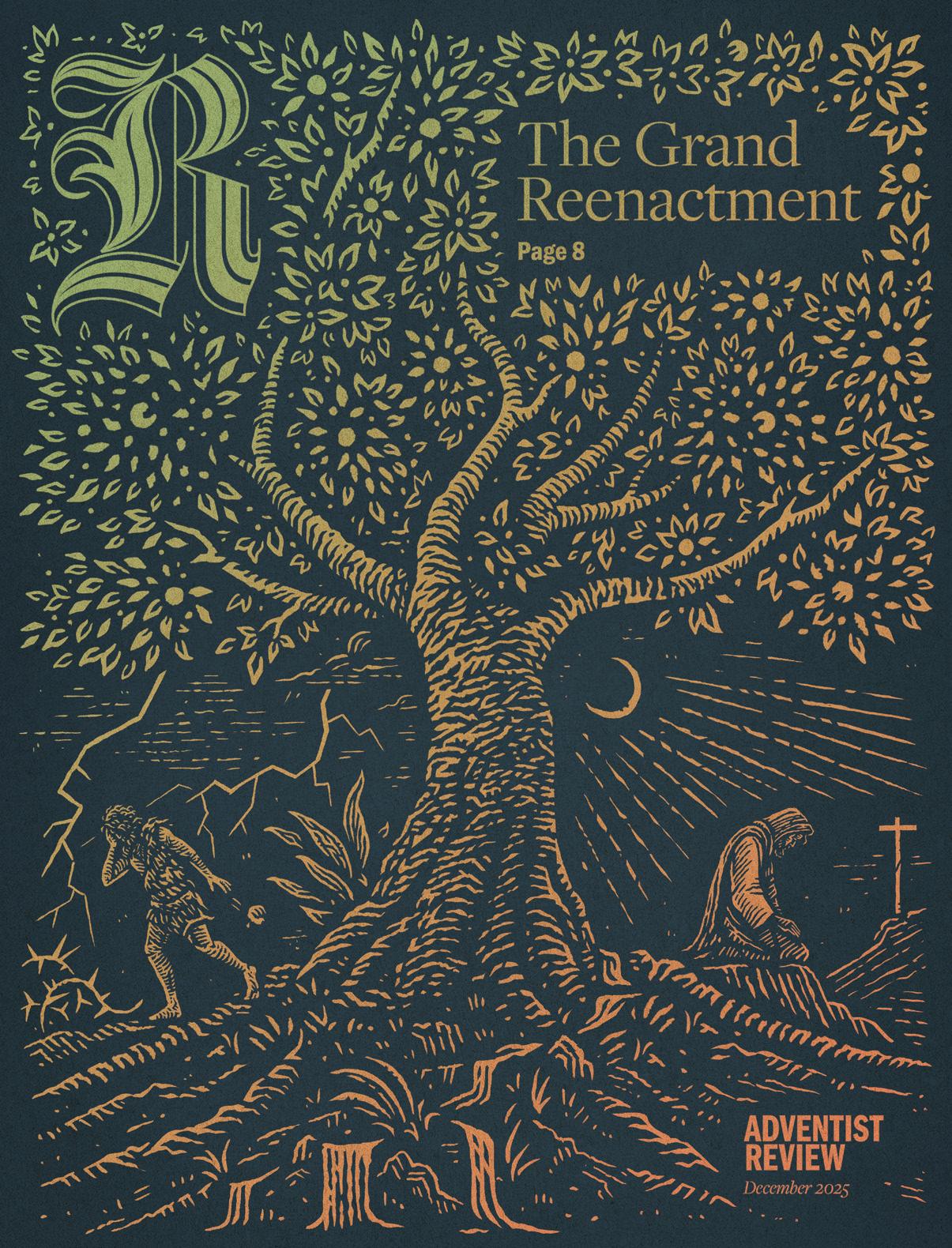
The Grand Reenactment
As the covenant Son of God, the life of Jesus was a complete reenactment of Israel’s history. He passed over the same ground Israel traversed, and He was victorious in place of all their failures. The parallels between the two stories are deliberate and apparent.
In the Old Testament a young man named Joseph had dreams and went into Egypt to preserve his family, followed by Israel relocating to Egypt to escape certain death (Gen. 42; 45:5). In the New Testament another Joseph had dreams and then fled with His family into Egypt to escape certain death (Matt. 2:13-15).
When Israel came out of Egypt, God called the nation “My son” (Ex. 4:22). When Jesus came out of Egypt, God said, “Out of Egypt I called my son” (Matt. 2:15), drawing a deliberate parallel between Jesus and ancient Israel. Israel passed through the Red Sea (Ex. 14:10-13).
The apostle Paul says they were “baptized unto Moses . . . in the sea” (1 Cor. 10:2). Directly after being called God’s Son, Jesus was baptized as Israel’s corporate representative (Matt. 3:13-17).
Israel wandered in the wilderness of temptation for 40 years on their way to the Promised Land (Ex. 16:1-17). Jesus spent 40 days in the wilderness, being tempted by the devil, before He began His earthly ministry (Matt. 4:1-11).
Ancient Israel was composed of the 12 sons of Jacob and their posterity (Gen. 35:22-26). Jesus deliberately called 12 apostles, from which emerged spiritual Israel (Matt. 10:1-4; Gal. 3:29; Eph. 2:19-22).
Moses went up Mount Sinai to receive the Ten Commandments from God, and delivered them to Israel (Ex. 19; 20). Jesus preached the law on the Mount of Olives, during which He magnified the spiritual significance of the law and pronounced the Ten Blessings we call the Beatitudes (Matt. 5-7).
Israel was called by God to be “a kingdom of priests, and a holy nation” (Ex. 19:6). The church that Jesus founded is called to be “a chosen generation, a royal priesthood, a holy nation, a peculiar people” (1 Peter 2:9), composed of people from every nation (Rev. 7).
Finally, Moses lifted up the serpent on the pole in the wilderness and told the people to look and live (Num. 21:9). Jesus was lifted up on the cross, calling all to look upon Him and be healed of guilt and sin (John 3:14-17; 12:32; Heb. 12:1, 2).
It is apparent that when the New Testament calls Jesus the “Son of God,” it is doing so within the very specific framework of the larger biblical narrative. He was designated the “firstborn Son of
God” in direct parallel to Israel’s covenant mission as God’s “firstborn son” (Ex. 4:22, 23; Rom. 8:29; Heb. 1:6). Having come to our world by means of incarnation, Jesus became the corporate embodiment of Israel, or God’s “firstborn [covenantal] Son.” Everything that God promised through Israel was brought to pass in Christ. Clearly this is what the New Testament means when it calls Christ “the Son of God.”
Ty Gibson is an ordained minister, evangelist, church planter, codirector of Light Bearers, and a prolific author.
Old Testament Narrative New Testament Reenactment
Joseph had dreams Was taken to Egypt
Preserved family from death
Israel called “My son” during Exodus
Israel went through Red Sea “baptized into Moses . . . in the sea” (1 Cor. 10:2)
Israel in the wilderness for 40 years
Israel composed of 12 sons of Jacob and their posterity
Moses on Mount Sinai
Received the Ten Commandments
Israel called to be “a kingdom of priests and a holy nation” (Ex. 19:6)
Joseph had dreams Fled to Egypt
Preserved family from death
Jesus called “My Son” coming out of Egypt
Jesus was baptized as Israel’s representative
Moses lifted up the serpent on a pole
All who looked were healed
Jesus in the wilderness for 40 days
Jesus called 12 apostles from which emerged spiritual Israel
Jesus on the Mount of Olives
Magnified spiritual law declaring Ten Blessings
Church called to be “a chosen generation, a royal priesthood, a holy nation, His own special people” (1 Peter 2:9)
Jesus was lifted up on the cross
All who look to Him will be healed from guilt and sin
God with US
only by love is love awakened. To know God is to love Him; His character must be manifested in contrast to the character of Satan. This work only one Being in all the universe could do. Only He who knew the height and depth of the love of God could make it known. Upon the world’s dark night the Sun of Righteousness must rise, “with healing in his wings.” Malachi 4:2, KJV.
The Plan Revealed
The plan for our redemption was not an afterthought, a plan formulated after the fall of Adam. It was a revelation of “the mystery which hath been kept in silence through times eternal.” Romans 16:25, RV. It was an unfolding of the principles that from eternal ages have been the foundation of God’s throne. From the beginning, God and Christ knew of the apostasy of Satan, and of the fall of man through the deceptive power of the apostate. God did not ordain that sin should exist, but He foresaw its existence, and made provision to meet the terrible emergency. So great was His love for the world, that He covenanted to give His only-begotten Son, “that whosoever believeth in him should not perish, but have everlasting life.” John 3:16, KJV. Lucifer had said, “I will exalt my throne above the stars of God: . . . I will be like the Most High.” Isaiah 14:13, 14, KJV. But Christ, “being in the form of God, counted it not a thing to be
For God so loved the world . . .
Ellen G. White
grasped to be on an equality with God, but emptied Himself, taking the form of a servant, being made in the likeness of men.” Philippians 2:6, 7, RV, margin.
This was a voluntary sacrifice. Jesus might have remained at the Father’s side. He might have retained the glory of heaven, and the homage of the angels. But He chose to give back the scepter into the Father’s hands, and to step down from the throne of the universe, that He might bring light to the benighted, and life to the perishing.
The Incarnate God
Nearly two thousand years ago, a voice of mysterious import was heard in heaven, from the throne of God, “Lo, I come.” “Sacrifice and offering thou wouldest not, but a body hast thou prepared me: . . . Lo, I come (in the volume of the book it is written of me,) to do thy will, O God.” Hebrews 10:5-7, KJV. In these words is announced the fulfillment of the purpose that had been hidden from
eternal ages. Christ was about to visit our world, and to become incarnate. He says, “A body hast thou prepared me.” Had He appeared with the glory that was His with the Father before the world was, we could not have endured the light of His presence. That we might behold it and not be destroyed, the manifestation of His glory was shrouded. His divinity was veiled with humanity—the invisible glory in the visible human form. . . .
So Christ was to come in “the body of our humiliation” (Philippians 3:21, RV), “in the likeness of men.” In the eyes of the world He possessed no beauty that they should desire Him; yet He was the incarnate God, the light of heaven and earth. His glory was veiled, His greatness and majesty were hidden, that He might draw near to sorrowful, tempted men.
Seventh-day Adventists believe that Ellen G. White (1827-1915) exercised the biblical gift of prophecy during more than 70 years of public ministry. These excerpts were taken from her book The Desire of Ages, pp. 22, 23.
Dealing With EGRs? p
Tips for dealing with difficult family

astor, please pray for me!”
When Ashley, a twentysomething newly married woman, asked for prayers, my pastor/counselor instincts took over.
“Of course I’ll pray for you. Is there any particular issue you want me to pray about?”
“My family is coming to visit us for a few days, and they are all EGRs!”
I hesitated as I tried to figure out what an EGR might be, but eventually gave up.
“What’s an EGR?”
In her best Texas drawl she replied, “Extra Grace Required!”
EGRs manifest themselves as manipulators, critics, family martyrs, narcissists, or energy vampires who drain you emotionally. Their behaviors include constant criticism, lack of boundaries, and emotional or physical abuse. They can be argumentative, accusatory, judgmental, angry, passive-aggressive, demanding, controlling, and more. Does this sound like someone you know? If so, you know an EGR.
We all require a measure of grace to live as members of a family. None of us is perfect. Giving and receiving grace is a constant and essential part of achieving familial harmony. But there are those in each family who require something extra to survive even short visits.
My young parishioner, Ashley, had seen the ugliness of past family visits. She was desperate for a plan that might help her husband and her survive the visit. While I could not offer a guaranteed “fix” for her problem, I did suggest a few strategies to help make the visit less painful. It is essential to have a plan in place. Never knowingly walk into a visit with dysfunctional people without a course of action. Without
a strategy in mind, your responses to each negative behavior will likely be emotionally charged and exacerbate the situation. It is better to rehearse your responses in advance of the visit. Having a plan provides the best opportunity for a positive experience.
Any plan will require a combination of prayer, patience, forgiveness, and setting healthy boundaries. And remember that while we are called to love and forgive, we are not obligated to tolerate harmful behavior. Here are some thoughts to guide your planned course of action.
PRAYER AND SPIRITUAL PREPARATION
Start by praying for yourself. Your family might see you as an EGR! As unlikely as this might seem to you, it nevertheless remains a possibility. Ask God to reveal your flaws to you. Acknowledge any part you have played in past conflicts. While your behavior may have been provoked, provocation does not justify bad behavior. Pray for healthier ways to handle conflict.
Ask God to soften your heart, and replace anger and irritation with love and compassion. Pray for the ability to discern when tensions are starting to rise, and ask for the wisdom and strength to respond with grace.
In advance of the visit, pray that the hearts of your family will be opened to God’s love. Request that they receive healing from past hurts so that reconciliation can be possible.
RESPOND WITH GRACE
This may sound easy, but I assure you, it is not! It will be impossible to respond in grace if we have not received the grace of God for our

EGRs manifest themselves as manipulators, critics, family martyrs, narcissists, or energy vampires who drain you emotionally.
own lives. Once received, we respond in grace only as we become like the Grace Giver Himself!
If you struggle with forgiveness and grace, as most of us do, meditating on scriptural passages that offer guidance on love, forgiveness, and conflict resolution will be a tremendous source of help. Begin with such passages as 1 John 4:7; Matthew 6:14, 15; 18:15-22; and Galatians 5:19-26. Read the Gospel stories and witness the compassion and grace in Jesus’ interactions with people. Meditate on His life, and His Spirit will help you become like Jesus.
COMMUNICATE WITH LOVE AND RESPECT
Most of us fall into negative patterns of communication without realizing it. This is doubly true when communicating with people who irritate us. Learning to communicate in less-threatening ways can be of value.
When addressing an issue, learn to use “I” statements. Using “I feel” statements to express your feelings rather than blaming others can feel less like an attack. Say, “I feel hurt when you say that,” rather than “You always make me feel angry.”
Listening is an often-overlooked component of communication. Try listening to more than just the words. Listen for the emotions
behind the words. The “presenting problem” is rarely the real issue. Listen for “hidden issues,” such as feelings of rejection, abandonment, disrespect, and fear. Try to employ compassion. Understand their point of view, even if you disagree.
BOUNDARIES
Being compassionate does not mean that you must be a doormat. Every healthy relationship has clear boundaries. Before your visit begins, decide on healthy limits of what you will and will not tolerate. Respectfully communicate your boundaries when things start to escalate.
Change does not happen immediately or without persistence. Don’t be discouraged if you don’t see immediate results.
FORGIVE AND MOVE FORWARD
Forgive as Christ forgave you, but don’t feel obligated to accept or tolerate ongoing toxic behavior. Ending the visit early may be a healthier choice. You cannot control the behavior of others, but you can control your response.
If the situation causes you significant emotional distress, consider seeking the services of a Christian counselor. There should be no shame in seeking competent professional help for struggles with relationships. You may also find strength in turning to Christian friends for support and encouragement. Paul’s instruction to “bear one another’s burdens” is relevant today!
REMEMBER THE BIGGER PICTURE
The gospel is essential to relationships. Keep the gospel message in mind with every interaction. The “love of Christ” is to “constrain” us (see 2 Cor. 5:14, KJV). As we demonstrate His love in our interactions with difficult people, we grow in His likeness.
ASHLEY’S REPORT
A couple of weeks after our first conversation, Ashley came to see me. “Thanks for the prayers,” she said.
“How did the visit go?”
“Not perfect, but a lot better than expected.”
There are no guarantees for successful encounters with EGRs, but thoughtful, prayerful planning will give the best chance for success. Some people are too broken for any approach to help. Even so, it is always best for you to persistently pursue healthy attitudes and behaviors.
Mike Tucker is the speaker emeritus for Faith for Today and speaker for Mad About Marriage.
iNCA r NAtioN
i
n December large parts of the world shift their focus to the Christmas holidays. And while to many it has become all about commerce and very little about Jesus’ birth, we should still seize the opportunity to remind people that, although not technically in December, Jesus did come to this earth to save lost humanity.
His miraculous, humble incarnation as a fully human baby while still remaining fully God, growing up and living among us, His public ministry, death, and resurrection—all highlight the boundless and powerful reality of God’s deep love for each person. He truly is our Immanuel—God with us.
To submit any type of original Adventist art (poetry, music, painting, drawing, film, photography, sculpture, etc.), please contact art@adventistreview.org. Submission does not guarantee publication. Creative works showcased do not imply an automatic endorsement of all works by featured artists.
POETRY
“
eN
u NC i AtioN
“
By Ray McAllister
The Temple is ready
Pure
And dedicated.
All is in order
According to the divine Plan of old.
And so comes the angel
To announce
That in the most sacred space
Of this virgin’s womb
Will dwell
For a time
The Shekinah Glory
The holy Presence
Of Yeshua
The Messiah.

Ray McAllister, recipient of the Jacob Bolotin Award from the National Federation of the Blind for making biblical language materials accessible to the blind, was the first totally blind person in the world to get a Ph.D. in Hebrew Scriptures. He views his blindness as an opportunity to experience God’s love more deeply and help others do the same. His YouTube channel is: youtube.com/@raymcallister6281.
MUSIC
visit the Adventist Review YouTube
Channel or scan this QR code to access a short playlist of original Christmas music, written and composed by Seventh-day Adventists.
This section features original art created by Seventh-day Adventist artists from around the world. Featured art is curated by Jonathan Walter, assistant editor of the Adventist Review. Visit adventistreview.org/art for more original Adventist art.
COMIC
“Je Su S Si Ngi Ng pr A i S e to Hi S FAt H er.”
By Michelle Pak
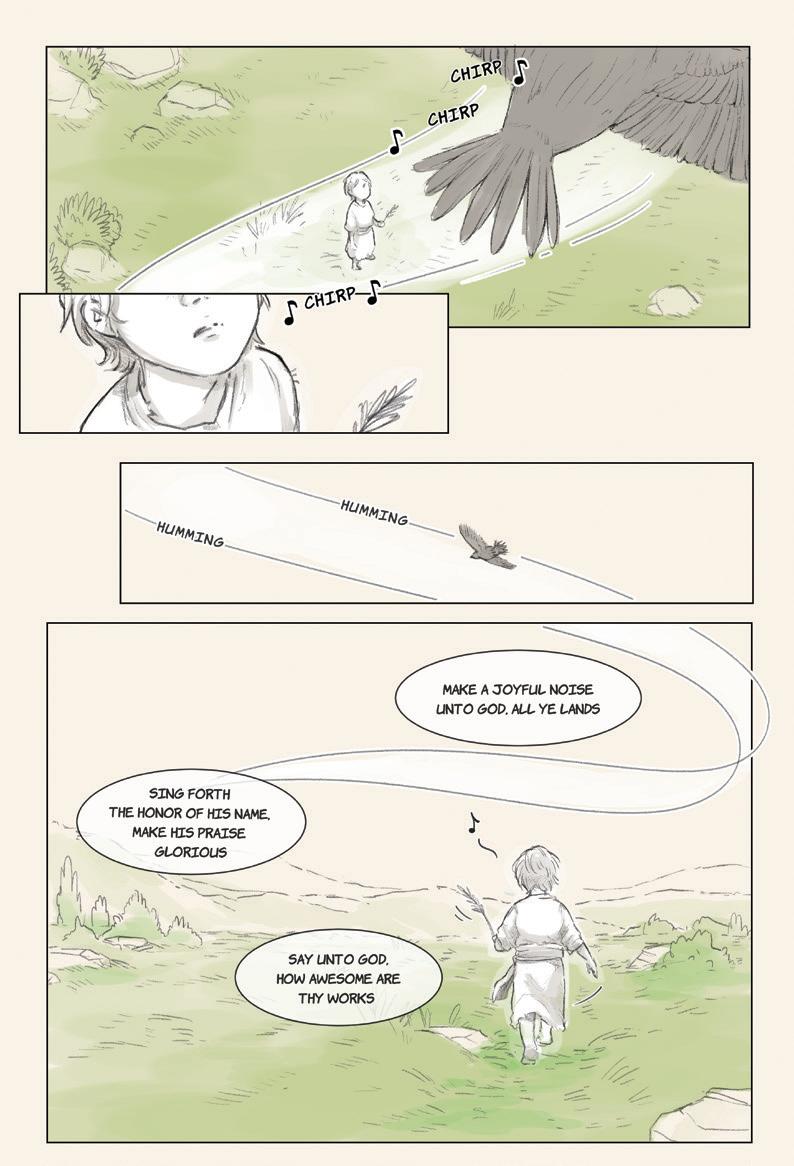
on the rocks and knolls about His home the eye of the Son of God often rested. . . . He saw the sun in the heavens, the moon and the stars fulfilling their mission. With the voice of singing He welcomed the morning light. He listened to the lark caroling forth music to its God, and joined His voice with the voice of praise and thanksgiving. ‘Make a joyful noise unto God, all ye lands: sing forth the honor of his name: make his praise glorious. Say unto God, How terrible art thou in thy works . . .’ This psalm and portions of the sixty-eighth and seventy-second psalms were often sung by Christ.”—Ellen G. White, in Youth’s Instructor, Sept. 8, 1898.
How endearing it is to imagine Jesus as a child, unaware of His divinity as the Son of God, wandering the hills of his home, singing sweet psalms to His Father.
Michelle Pak is an artist who loves storytelling. While she enjoys working in other creative mediums, comics remain her favorite home. She’s currently exploring new ways to visually share biblical concepts, lessons, and reflections with others. | Website: https://linktr.ee/mpak9
Christ at the Center
Ellen White’s views on Christmas

Anna Galeniece
in the culture I grew up in, Christmas was not observed, partly because of atheistic propaganda against religion, and partly for the Adventists’ belief linking December 25 with the pagan winter solstice. Years later, after moving to the United States, I encountered a very different picture. Christmas is widely celebrated, commercialized, and often emptied of its religious meaning. People exchange gifts and enjoy festivities, yet Christ is seldom at the center. These opposite experiences led me to wonder how Ellen White viewed Christmas, and what counsel she may offer to the church.
Preparing for Christmas
While reading Ellen White’s writings, one quickly notices how consistently she exalted Christ. He was the central figure she adored, loved, and devoted her life to. It is no surprise, then, that when it came to Christmas, Jesus remained the focus of this deeply spiritual occasion.
Around Christmas her heart extended to families with children. She urged parents to teach children and youth to understand the true significance of the holiday and to direct their thoughts, anticipations, and offerings to God. She specified that it was her “purpose to call the attention of the children to the humble manner in which the Redeemer came to the world.” And if “all heaven was interested in the great event of Christ’s advent to earth,”1 why should we do differently?
Ellen White also encouraged Christians to be creative in their Christmas celebrations, to enhance its desirability and attractiveness because Christmas was an occasion to honor God with the whole family. Although Christ was not born on Christmas Day, she invited Christians to keep Him at the heart, and not to be dis-
tracted by various worldly practices and traditions. “There is no divine sanctity resting upon the twenty-fifth of December; and it is not pleasing to God that anything that concerns the salvation of man through the infinite sacrifice made for them should be so sadly perverted from its professed design. Christ should be the supreme object,”2 she wrote.
In preparation for Christmas, Ellen White encouraged using an evergreen tree as a source of blessing rather than an object of idolatry or sin.3 To her, it could serve as an inspiration for generosity, with its branches holding gifts for the poor and offerings dedicated to God.4
“God would be well pleased if on Christmas each church would have a Christmas tree on which shall be hung offerings, great and small. . . . Let its boughs be laden with the golden and silver fruit of your beneficence, and present this to Him as your Christmas gift. Let your donations be sanctified by prayer.”5
Thus, she used the available tool, a Christmas tree, by assigning to it the meaning that would give glory to God and elevate Christ’s sacrificial example.
Christmas Gifts
When it came to giving Christmas gifts, Ellen White advocated a balanced approach. While she did not discourage giving some gifts to children,6 she recognized that the “holidays have been perverted from their intended use” and “gifts are lavished upon one another.”7 She, therefore, urged believers to direct their giving toward more meaningful purposes—supporting charities on “behalf of those who are helpless,”8 and advancing evangelism—“the work which Christ came to do.”9
This spirit of self-denial and generosity encourages selfless gifts and festivities, for “it is more blessed to give than to receive” (Acts 20:35). As she put it: “On Christmas let the members of every church assemble, with offerings from willing hands and hearts, the fruits of love and gratitude to God. Let all exert their influence and ability to make these gatherings attractive and interesting. See how much means you can gather to advance the work of the Lord.”10
Instead of promoting “a day of feasting, of gluttony, of selfish indulgence,” Ellen White urged parents to reveal the true meaning of Christmas—generosity and love for those in need. She counseled, “This year we will not expend money in presents upon ourselves, but we will honor and glorify God. We will testify of our gratitude to Him who gave His Son to die as our sacrifice, that we might have the gift of eternal life.”11
What an example to follow!
The Mission of Christmas
For God’s messenger, Christmas also meant a time for mission. She advocated and supported missionary work through her preaching, writings, and personal life. For example, one can read about her preaching on Christmas Eve at Parramatta
church, Australia, in 1893. There were many non-Adventists in attendance, and her message was centered on “the birth of Christ and the Christmas offerings, the great sacrifice made by Jesus Christ to save a lost world.”12 Throughout her active ministry Ellen White often used preaching on Christmas Eve or Christmas Day as a way to reach people.
On another cold Texas Christmas morning in 1878, Ellen and James White had a real celebration—a breakfast with 13 poor, needy, and sick people, among whom were the Moore family of five. Furthermore, the Whites spent that Christmas Day helping the Moores, because they were in acute need. James and Ellen White provided them with the first necessities: food, clothing, some furniture, and arrangements for temporary living. They even gave part of their beddings to the Moores to keep them warm and comfortable.13
Thus, while many shop and buy gifts, not thinking about Christ, Ellen White’s messages call God’s people to open their hearts to the real reason for the season—Jesus Christ and His love for people.
What Now?
This Christmas season, as celebrations surround us, may Ellen White’s call to be mission-focused and Christ-centered guide you and your family. In that spirit, pause to prayerfully reflect on her searching questions:
“Shall we not this year consecrate to God not merely a part but all our holiday gifts for the relief of His cause, which is in so great need? How can we more appropriately celebrate
Ellen White encouraged Christians to use creativity, desirability, and attractiveness because Christmas was an occasion to honor God with the whole family.
the coming Christmas, how better express our gratitude to God for the gift of His dear Son, than by offerings to send to all the world the tidings of His soon coming?”14
1 Ellen G. White, in Review and Herald, Dec. 17, 1889.
2 Ellen G. White, “Christmas Is Coming,” Review and Herald, Dec. 9, 1884.
3 Ibid 4 Ellen G. White, The Adventist Home (Nashville: Southern Pub. Assn., 1952), p. 482.
5 Ibid.
6 Ellen G. White to Lucinda Hall, Dec. 19, 1873 (letter 29, 1873).
7 Ellen G. White, in Review and Herald, Dec. 11, 1879.
8 E. G. White, The Adventist Home, p. 482.
9 Ellen G. White, in Review and Herald, Dec. 15, 1885.
10 Ibid.
11 Ellen G. White, in Review and Herald, Dec. 11, 1888.
12 Ellen G. White manuscript 89, 1893.
13 Ellen G. White, Manuscript Releases (Silver Spring, Md.: Ellen G. White Estate, 1993), vol. 14, pp. 318-321
14 Ellen G. White, in Review and Herald, Dec. 6, 1887.
Anna Galeniece is an associate director of the Ellen G. White Estate in Silver Spring, Maryland, U.S.
Photo by Andrik Langfield / Unsplash
ru NN i Ng t owA rd
t H e l igH t My journey to Jesus
iremember it like it was yesterday. There we were, the head elder, his wife, and I, sitting in the church sanctuary next to an open window, Bibles open in our laps. Outside it was a glorious Australian summer, but inside, everything was old and worn out. The carpet was fraying. The chairs were faded. To 11-year-old me, even the head elder and his wife seemed old and worn out.

Esther Louw
I had chosen to be baptized, but was told that I needed to have Bible studies first. Already I felt drawn to academics and wanted to know more about God than what I could learn from the Sabbath School lesson or the weekly sermon. When
I was asked whom I wanted to study the Bible with, I bypassed the church pastor and chose the head elder and his wife. The choice seemed natural. The head elder was a professor of theology at Avondale College, and his wife was also employed in the Theology Department as an adjunct professor.1
So far, I had learned a lot—about Daniel and Revelation and the fundamental beliefs of the church—but something was still missing.
Mustering up as much courage as I could, I finally blurted out, “I want to know how to follow Jesus. What should I do?”
There was a slight pause. “Oh,” said the head elder’s wife awkwardly. “Why
don’t you read the book Steps to Christ, by Ellen White? Don’t read the first chapter, though. I never understood it, and it’s not very relevant.” I looked at the head elder for confirmation, and he simply nodded in agreement.
I was baptized near the end of the year. It was a wonderful experience, and I was excited to declare my commitment to God. Sadly, however, I still did not know Jesus or what it meant to follow Him. Having dutifully read Steps to Christ, minus the first chapter, I was content to attend church each week and follow what I perceived to be the rules of the Bible.

Running Toward the Light
It wasn’t until five years later that I faced the first turning point in my spiritual journey.
By then I was a pensive, introspective teenager obsessed with classic literature and poetry. I had recently broken up with my boyfriend of three years and was devastated in the way only a teenager can be devastated. One day, as I comforted my misery by reading Emily Dickinson’s “I Felt a Funeral, in My Brain” for the millionth time, I had a moment of enlightenment. Perhaps it came from the poetic revery of death and not knowing. Whatever it was, I suddenly realized that I had never been born again, did not personally know Jesus, and did not have a clue how to find Him.
The gospel, it turns out, is really simple. It isn’t about Jesus. It is Jesus.
On second thought, there was one thing I did know. I had read The Pilgrim’s Progress many times and remembered the part where Evangelist told Christian to flee from the City of Destruction and run toward the little Wicket Gate. I understood enough about the story to recognize that this Wicket Gate was a metaphor for entering into the kingdom of God through Jesus. Like Christian, I wasn’t sure where Jesus was, and couldn’t see the Gate. But Evangelist had told Christian that if he ran toward the light that he could see, he would soon find the Gate.
I put down my volume of Emily Dickinson poetry and made a decision that changed the course of my life. I decided to run toward the light.
That afternoon I went to the storage shed in my family’s backyard and found a large cardboard box.
Photo by Ricardo Gomez Angel / Unsplash
In it I placed all the things that I knew that, on a personal level, were idols, even though there was nothing wrong with them. In went my Emily Dickinson poetry, my Wordsworth, Longfellow, Robert Frost, and Elizabeth Barrett Browning. In too went items that were emotionally connected to my broken relationship. I closed the lid and threw the box and its contents into the dumpster.
I then began to look for Jesus. Every day I read my Bible and I prayed, and instead of spending my spare time crying over poetry, I read books on theology, Christian living, and discipleship. I didn’t really know what would happen, and I didn’t have any expectations. But I did notice that a change was taking place. Christian books no longer seemed boring and dull. The Bible became interesting. I began to feel fulfilled.
Six months into my experiment I had a conversion experience. One day I finished reading a book on surrender and started praying. As I prayed, the sense of God’s presence broke into my awareness. I couldn’t have really explained it if anyone had asked me what had happened. But in that moment I knew beyond any doubt that I was a child of God, that He accepted and loved me, and that He had made me His. Jesus was now my greatest source of joy, and the next few years of my life were very happy.
From Joy to Fear
leather, with a zip that closed in a satisfying way. I could hardly wait to read it. That evening I went to my room with a notebook and pen, and began to study the Testimonies. During the next few months I wrote down every behavioral injunction or rule that I could find. They were all ostensibly good things.
Pray often.
Eat moderately.
Don’t wear jewelry.
Dress simply and modestly.
But somewhere in the process of rule-gathering, I became obsessed with the idea that if I followed all the rules to their utmost letter, I could become perfect and reach God’s standard of holiness.
I became obsessed with the idea that if I followed all the rules to their utmost letter, I could become perfect and reach God’s standard of holiness.
Soon I was praying three times a day for an hour each time.
I began fasting two days a week (sometimes without water).
I became worried that anything decorative that I owned might be a form of jewelry, and threw them away.
I purposefully bought unattractive clothes to help curb my pride.
Before I knew what had happened, my joy and peace in Christ were replaced by fear and anxiety and the burden of trying to figure out what “perfect” actually is.
My religion looked like this for seven years. During this time I plumbed the depths of my moral brokenness and discovered just how impossible it was to be good enough for God. No matter how hard I tried, I couldn’t measure up.
I wish I could say that that was all there was to my Christian experience—that from that moment my journey to heaven was paved with gold and strewn with roses.
The truth is a bit more complicated. No sooner had I found Jesus than I began to try to earn His approval.
This was the second spiritual turning point in my life.
I received a compiled edition of all nine volumes of Testimonies for the Church for my nineteenth birthday. It was rich brown
I attempted to keep the Sabbath as perfectly as I could, for example. But I noticed that I was relieved when the sun began to set on Sabbath afternoon. I continued to dress modestly and plainly, and sometimes people complimented me. But I felt myself flush with pride when I received these compliments, and instantly knew that my modesty was merely a facade. Worse still, while I spent those years working as a Bible worker and literature evangelist, I didn’t love any of the people I was trying to reach. My prayers and journal entries became judgmental and focused on the faults of other people. But while I judged everyone around me, I felt judged and mistreated by them.
I finally reached a place where I could no longer keep going. I felt like I was nothing more than a hypocrite, and that everyone else was too. Just as I was ready to give up on following Jesus, however, the third spiritual turning point in my life occurred.
Overflowing Blessings
A friend invited me to join a volunteer project in Lebanon. I didn’t have other plans that summer, so I went. I soon found myself in a small mountain village trying to interact with locals in a mixture of English and broken Arabic phrases. One afternoon I walked past a small stone house clinging to the side of a
rocky outcropping. Growing up against the house was an apricot tree, weighed down heavily with fruit.
Suddenly I heard an old man calling from the open door. “Tfaddali, tfaddali [come in]!”
“Marhaba [hello],” I said, using up all the Arabic I really knew. The old man laughed and motioned to me to open the bag slung across my shoulder. Before I could register what was happening, he lifted a bucket of fresh apricots and poured them into my open bag. Soft, ripe apricots filled and then overflowed the bag, tumbling onto the ground with careless abandon. I felt the way I had imagined it would feel when I was a kid and heard people talk about God opening the windows of heaven to pour out a blessing.
That was not the last time I experienced Lebanese hospitality. Everywhere, perfect strangers invited me into their homes, offered me food and something to drink, and treated me as if I were an honored guest.
Somewhere between the overflowing bag of apricots and the freshly baked flatbread smeared with olive oil and za’atar, I began to see glimmers of God’s character.
“If you then, being evil, know how to give good gifts to your children,” Jesus once said, “how much more will your Father who is in heaven give good things to those who ask Him!” (Matt. 7:11). I reasoned that if people, sinful and fallen though they may be, can be so generous and hospitable to strangers, God’s generosity and love must be even greater.
I had never asked God for very much because I didn’t think I deserved very much. Now I decided to ask.
My summer in Lebanon turned into a longer volunteer stint teaching English at Middle East University

in Beirut. Often, in the evenings and early mornings, I sat on the rooftop of the dormitory where I lived and stared out over the city and the distant Mediterranean Sea. My prayers were changing. I had stopped complaining about the sins and injustices of other people. Instead I asked God to bless me.
Blessings began to fill my life and overflow it, just as the apricots had overflowed my bag.
Twelve months later, through a series of miracles, I was living in America and married to the kind of person I had always dreamed of marrying but thought I would never find. A few years after that, we welcomed our daughter into the world. My world was now complete.
Here is where the fourth and final spiritual turning point of my life thus far took place.
The Simplicity of the Gospel
In 2022 I began studying toward a master’s degree in church history at Andrews University. I had already come a long way from my days of obsessive perfectionism and fearing God’s anger and judgment.
In the years since the bucket of apricots, I had deconstructed both my faulty theology and my understanding of myself. I understood that salvation is a gift from God, not something that must be earned through hard work. I recognized that God is good and gives good things to those who don’t deserve them. But a dark shadow of doubt still lingered.
What if God’s forgiveness and love were not enough? What if I still failed to please Him?
I chose to write my thesis on perfection, comparing the theology of John Wesley and Ellen White. For me,
it was more than an academic exercise. It was a personal search for truth.
I wrote for hours on end, books piled high on my desk, and my brow furrowed in deep lines of concentration. But rather than alleviate my fears, the research seemed to amplify and intensify my spiritual doubts. Finally, in desperation, I pushed the books to one side and closed my computer. In my mind I saw myself back at the start of my journey, asking the head elder and his wife how I could know Jesus. They were theologians and didn’t know. Yet here I was, on the pathway to also becoming a theologian, and I was still unable to truly answer that simple question.
In my frustration and discouragement I picked up John Wesley’s personal account of his conversion and reread it. This time I read it, not to find content for my writing, but to find out how I could have the same experience.
When I was finished, I finally held all the essential pieces of the gospel in my hands. To my surprise, as I examined these pieces and put them all together, I saw the face of Jesus.
The gospel, it turns out, is really simple. It isn’t about Jesus. It is Jesus.
Thousands of years ago God “preached the gospel to Abraham beforehand, saying, ‘In you all the nations shall be blessed’ ” (Gal. 3:8). “Now to Abraham and his Seed were the promises made. He does not say, ‘And to seeds,’ as of many, but as of one, ‘And to your Seed,’ who is Christ” (verse 16).
The promises, of course, are the promises of the covenant. I had always assumed that these blessings were blessings for me to enjoy through obedience. Now I knew that they never were and never will be for me.
The promises are for Jesus, the only one who could ever deserve them.
If I accept, through faith, that Jesus’ death is my death, and that His resurrection is my resurrection— if I repent, surrender, and believe—then, through faith in Him, His life is counted as my own. I am now accepted as a child of God, because Jesus is the Son of God. Through Him I can produce works of righteousness that God can accept. Through Him I can receive the promises and enter heaven.
“For you are all sons of God through faith in Christ Jesus. . . . And if you are Christ’s, then you are Abraham’s seed, and heirs according to promise” (verses 26-29).
Ellen White expressed the gospel in this way: “Righteousness is obedience to the law. The law demands righteousness, and this the sinner owes to the law; but he is incapable of rendering it. The only way in which he can attain to righteousness is through faith. By faith he can bring to God the merits of Christ, and the Lord places the obedience of His Son to the sinner’s account. Christ’s righteousness is accepted in place of man’s failure, and God receives, pardons, justifies, the repentant, believing soul, treats him as though he were righteous, and loves him as He loves His Son.”2
I finally saw Jesus, and He is not who I thought He was. He is so much better.
He is my Savior, my Friend.
Yesterday I sat on the couch with my 5-year-old as the afternoon sun shimmered through the open window. We had just finished family worship, and I had told her about heaven and how much Jesus loves us.
“Mama,” she said as she turned her face up toward mine, “I can’t wait to go to heaven and live in Jesus’ house!”
“Neither can I,” I whispered. “Neither can I.”

1
2
Esther Louw holds an M.A. in religion from Andrews University and is currently pursuing a Ph.D. at Avondale University.
I finally saw Jesus, and He is not who I thought He was. He is so much better. He is my Savior, my Friend.
The details in some of the stories have been changed for privacy.
Ellen G. White, in Review and Herald, Nov. 4, 1890.
CHroNiCled by tHe reCordiNg ANgel
The judgment is good news.
while preaching a sermon titled “The Pre-Advent Judgment” at a camp meeting in Australia, I glimpsed a woman storm out when I quoted the following lines from The Great Controversy. “Every man’s work passes in review before God and is registered for faithfulness or unfaithfulness. Opposite each name in the books of heaven is entered with terrible exactness every wrong word, every selfish act, every unfulfilled duty, and every secret sin, with every artful dissembling. Heaven-sent warnings or reproofs neglected, wasted moments, unimproved opportunities, the influence exerted for good or for evil, with its far-reaching results, all are chronicled by the recording angel.”1
Left to themselves, these words could be very discouraging—precisely why they must be read, and understood, in the context of the gospel (otherwise I too would have done as that woman did).
To begin, Ellen White is saying nothing that Scripture hasn’t already said. You know: “Every idle word that men shall speak, they shall give account thereof in the day of judgment” (Matt. 12:36, KJV); or for God “will bring to light the hidden things of darkness, and will make manifest the counsels of the hearts” (1 Cor. 4:5, KJV); or “For God shall bring every work into judgment, with every secret thing, whether it be good, or whether it be evil” (Eccl. 12:14, KJV)—texts (along with others) that she quoted immediately before writing about the “recording angel.”
And God, so immanent and so close that He not only could give a pagan king a detailed dream but then tell Daniel in “a night vision” (Dan. 2:19) what that dream was and what it had meant—He doesn’t already know every one of our darkest, dirtiest secrets, and your “every artful dissembling”? Are you kidding?
Sure, I’ve met pure souls who, at least from appearances, put me to shame. I’ve met saints who’d rather die than eat a fruit and vegetable together or let a crumb enter their mouth between meals. But does not the Bible say, “There is none righteous, no, not one” (Rom. 3:10)? How could anyone be deemed “righteous” when every wrong move is marked? What saint could have any hope before such scrutiny?
None—which is why we need a Mediator in heaven, Jesus, who appears “in the presence of God for us” (Heb. 9:24), and who “is also able to save to the uttermost those who come to God through Him, since He always lives to make intercession for them” (Heb. 7:25). Intercession for us now—and in the judgment, when we need Him the most. Otherwise what? We stand in our own righteousness, even though, with “terrible exactness,” every wrong deed is judged?
No wonder that later in The Great Controversy, when talking about the judgment, Ellen White says that Satan accuses God’s people, pointing to their “defects of character, the unlikeness to Christ. . . . Jesus does not excuse their sins, but shows their penitence and faith, and, claiming for them forgiveness, He lifts His wounded hands before the Father.” And, she writes, Jesus then clothes His “faithful ones with His own righteousness.”2 Who else’s righteousness? Our own?
The key text is Daniel 8:14: “And he said to me, ‘For two thousand three hundred days; then the sanctuary shall be cleansed.’ ” First, the “sanctuary” is where the gospel, salvation by faith alone, was taught. Second, the sanctuary was “cleansed” on the Day of Atonement, and atonement is about what God does to save us, through the blood, because we cannot save ourselves. It is Yom Kippur, Day of Atonement, not Yom HaMitzvot, Day of the Commandments. How did we take a teaching dedicated to atonement—atonement!—and turn it into such a calamity that people flee from before it?
1 Ellen G. White, The Great Controversy (Mountain View, Calif.: Pacific Press Pub. Assn., 1911), p. 482.
2 Ibid., p. 484.
Clifford Goldstein is the editor of the Adult Bible Study Guide. His latest book is An Adventist Journey, published by the Inter-American Division Publishing Association (IADPA).

How did we take a teaching dedicated to atonement— atonement! and turn it into such a calamity that people flee from before it?

SCevA ANd SCHemAS
Borrowed faith and broken identity
Candis Braxton
THE NIGHT THE DEMONS SPOKE BACK
Seven brothers, sons of a Jewish high priest named Sceva, boldly approached a man tormented by an evil spirit. They had seen the “unusual miracles” God was doing through Paul (Acts 19:11, 12) and assumed they could replicate his success. After all, Paul invoked the name of Jesus, and evidently the demons had no choice but to obey. Surely if they spoke that same name, they too could wield the same power. So, standing before the possessed man, they declared, “In the name of the Jesus whom Paul preaches, we command you to come out!”
The demons did not ignore them; the name of Jesus could not be dismissed. But authority cannot be borrowed. The demons’ chilling reply exposed their presumption: “Jesus I know, and Paul I know; but who are you?” (verse 15). Lacking a living connection to the One whose name they invoked, the brothers stood unprotected. What followed was not victory but humiliation, as the possessed man leaped on them, overpowered them, and drove them out “naked and wounded” (verse 16).
This moment is a sobering picture of what happens when faith is borrowed instead of lived. Without a real relationship with Christ, identity is shaken, spiritual authority proves empty, and the soul is left wounded and vulnerable. Borrowed faith does not just fail to protect; it actively endangers.
BORROWED
FAITH IS FRAGILE
The story of the sons of Sceva doesn’t just portray some misconceptions of the early church; it’s a mirror for the church today. These religious members wanted the benefits of Jesus’ authority without a personal relationship with Him, and their fall exposed the fragility of borrowed faith.
Most of us don’t face demon-possessed men, but we do face storms, temptations, and losses that test our foundation. Too often, without realizing it, we have tied our sense of stability to human leaders instead of Christ.
That’s why, when those leaders fall—when the pastor we admired confesses an affair, when the mentor we trusted proves corrupt, or when a spiritual elder is exposed in scandal—it can feel as if the ground itself has split apart. For many, grief in those moments is normal and healthy. But for others, the response goes further: it shakes identity, unravels security, and reveals that faith was borrowed rather than rooted. That isn’t just disappointment. It’s identity collapse.
WHEN LEADERS FALL: NORMAL GRIEF VERSUS IDENTITY COLLAPSE
Let’s pause and name the difference.
A normal, healthy response to a leader’s moral or ethical fall might sound like this:
“I’m devastated. I admired them, and this hurts deeply.”
“I need time to process, but I know my faith is in Christ, not in one person.”
“I want to talk and pray through this with trusted friends.”
There’s pain, there’s grief, maybe even disillusionment, but the anchor holds. God is still God. Faith still stands, though shaken.
When someone’s entire spiritual identity rests on another person, the cracks will eventually show. When the leader falls, the congregant’s faith crumbles too.
By contrast, an identity collapse response sounds very different:
“If they couldn’t stand, what chance do I have? Maybe the whole thing is impossible.”
“Everything I believed must have been a lie.”
“I don’t know who I am without their guidance.”
“If they fell, maybe God has abandoned me, too.”
This isn’t just disappointment. It shakes trust in God and fractures identity itself.
That’s what makes the sons of Sceva such a haunting mirror. Their collapse in the face of evil wasn’t simply because they misused a formula. It was because their authority was borrowed. They didn’t know Christ themselves. Their faith had no roots of its own.
The difference, then, isn’t whether grief is present; both responses feel pain. The difference is where the pain leads. Identity collapse spirals into despair and loss of self. Healthy grief, though costly, can lead to deeper rooting in God.
SCHEMAS: THE HIDDEN STORIES WE CARRY
Psychology has names for the deep patterns that surface in collapses like this. Aaron Beck, the pioneer of cognitive therapy, referred to them as core beliefs—deep convictions about ourselves and the world that often remain unchallenged.1 His student, Jeffrey Young, developed these ideas into what he calls schemas.2 In simple terms, schemas are the hidden stories we carry about who we are, what the world is like, and how we relate to others. Formed early, often in childhood, they develop through repeated experiences. If you grew up feeling abandoned, you may carry an abandonment schema: “People always leave me.” If you were constantly criticized, you may carry a defectiveness schema: “Something’s wrong with me.” Schemas are very powerful because, beneath the surface, they shape how we see ourselves and interpret painful events.
When it comes to borrowed faith and identity collapse, one of our deepest human needs comes into focus: the need for autonomy, com-
petence, and identity. According to Young, when this need isn’t met, people struggle to feel capable, independent, or secure in themselves. They look for someone stronger to cling to, someone to “carry” their faith.
That may feel safe for a while, until the leader falters. Then the borrowed identity collapses. The person concludes, “If they couldn’t stand, I can’t either. I don’t even know who I am without them.” That’s an identity collapse. It’s not just disappointment in a leader; it’s the shattering of one’s own fragile sense of faith.
WHEN SCHEMAS AND SCEVA COLLIDE
Picture a congregant who has never felt fully competent before God. They have always leaned on leaders to explain Scripture, to model prayer, to carry the weight of faith. None of that is wrong—mentors and pastors are gifts—but when someone’s entire spiritual identity rests on another person, the cracks will eventually show. When the leader falls, the congregant’s faith crumbles too. Their schema whispers: “See? You can’t stand on your own. You’re too weak. You’ll never measure up.”
Just like the sons of Sceva, they are left exposed in the battle because their faith was tethered to someone else’s story rather than their own lived relationship with Christ.
This is the danger of enmeshment when our identity fuses so tightly with another person’s that we lose sight of where they end and we begin. In spiritual life it shows up as “borrowed faith.” It feels safe for a while, but when the other person falters, our sense of self collapses with them.
God restores our identity and competence— not apart from Him, but in Him.
GOD’S RESTORATIVE INVITATION
The story of the sons of Sceva doesn’t end in humiliation—it ends in revival. Acts 19 tells us the whole region was shaken: people confessed their sins, burned their idols, and turned to God with renewed faith. What looked like collapse became the spark for transformation. The same is true for us. Moments of collapse in our own stories are not the end; they can become turning points. When God exposes borrowed faith, He isn’t shaming us—He is inviting us to root ourselves more deeply in Him. Think of it this way:
Collapse reveals the schema. The old story we’ve been living out of: “I’m incompetent. I need someone else to carry me.”
God ’ s Spirit offers a new story. “You are My child. My Spirit lives in you. You are capable in Me.”
This is the heart of transformation: God restores our identity and competence—not apart from Him, but in Him. He reshapes us into His image, where faith is no longer borrowed but alive and rooted.
REFLECTIVE QUESTIONS FOR THE JOURNEY
If you’ve been shaken by a leader ’ s fall, reflection is the first step toward healing. Ask yourself:
When I think about my faith right now, do I hear more of God’s voice or my leader’s voice? Do I feel as though my spiritual confidence rises and falls with the performance of others?
What old story about myself might be resurfacing in this pain (e.g., “I can’t stand on my own” or “I’m not worthy of God”)?
Once you’ve named the story, here are some practices to help break its grip:
Replace the old script. Write out the negative schema in one column, and in another, write God’s truth about you (i.e., “I’ll never measure up”→“I am chosen and equipped in Christ”). Keep this where you’ll see it often.
Anchor in Scripture. Find passages that speak directly against your schema (Romans 8 for abandonment, Psalm 139 for worth, Ephesians 1, 2 for identity) and pray them back to God.
Practice autonomy in faith. Spend time in Scripture or prayer on your own, not to exclude community but to strengthen your own rootedness in Christ.
Invite trusted community. Share honestly with mature believers who can remind you of truth when your schema whispers lies.
Breaking out of schemas takes time, but each step you take is part of God’s work of reshaping you—from fragile, borrowed faith into a faith that is personal, alive, and secure in Him. And this is not a journey to walk alone. As the church, we are called to bear one another’s burdens, encourage one another, and remind each other of who we are in Christ.
1
2
Candis
See Aaron T. Beck, Cognitive Therapy and The Emotional Disorders (International Universities Press, 1976).
See Jeffrey E. Young, J. S. Klosko, and M. E. Weishaar, Schema Therapy: A Practitioner’s Guide (Guilford Press, 2003).
Braxton is a marriage and family therapist based in Fayetteville, North Carolina, U.S.
Sceva and Schemas
Kencad / Lightstock
the MiSSion of GratitUde
As another year comes to a close, we look back not with nostalgia, but with great gratitude. Amid the storms we discovered that God never failed to place in our hands the paddles needed to cross rough seas, and on our feet sturdy shoes to walk steadily along steep paths. Each step we took reaffirmed that divine guidance never fails.
The psalmist reminds us: “Bless the Lord, O my soul, and forget not all His benefits” (Ps. 103:2). Gratitude is an exercise of spiritual memory. When we record the blessings of the past, our confidence in the future is renewed. We should count our blessings and speak of God’s mercy and love. For if we do so, we will be strengthened, and our lives will be enriched.
praise becomes a testimony to the world, for a grateful heart is a missionary heart. “Nothing tends more to promote health of body and of soul than does a spirit of gratitude and praise.”1 A church that praises in this way is a healthy, integrated, evangelistic, and mobilized church.
Gratitude is an exercise of spiritual memory.
As we approach the new year, we carry with us, above all, divine certainties. The same God who guided each remnant in the past will guide His church, our homes, and personal journeys in the future. He is the one who sustains our steps, strengthens our hands, and calls us to begin 2026 with confidence and expectation in the greatest of all events—the soon return of Jesus.
Founded 1849. Published by the General Conference of Seventh-day Adventists, Northern Asia-Pacific Division
Divison
PUBLISHING BOARD
PUBLISHING BOARD
The urgency of the church’s mission is sustained by a spirit of gratitude. Remembering what God has already done expands our faith to accept challenges that lie ahead. This was true of Israel when it remembered the Lord’s deliverances as it advanced toward the Promised Land. And so it must be with us today as we proclaim the gospel message. Remembering past blessings provides constant fuel for fulfilling the mission in the present. As Moses commanded: “Remember the whole way that the Lord your God has led you” (Deut. 8:2, ESV).
Gratitude also generates praise. Not superficial praise, but deep worship that recognizes each victory as a gift of grace. Such
At the end of this year, may we tenderly recall the privilege of having walked together. May gratitude fill our families, may hope unite our church, and may mission be our renewed priority. May every reader and member of the global Adventist Church close this year with praise on their lips and renewed, unshakable confidence in their hearts. Thus, grounded in the Bible and focused on the mission, we will enter a new year together, certain that soon we will see the Lord return in the clouds of heaven. Maranatha! And a happy 2026!
Ted N. C. Wilson, chair; Guillermo Biaggi, vice chair; Justin Kim, secretary; Audrey Andersson, G. Alexander Bryant, Zeno CharlesMarcel, Williams Costa, Paul H. Douglas, Mark A. Finley, James Howard, Erton Köhler, Geoffrey Mbwana, Magdiel Perez Schultz, Artur Stele, Ray Wahlen, Karnik Doukmetzian, legal advisor
Erton Köhler, chair; Pierre E. Omeler, vice chair; Justin Kim, secretary; Audrey Andersson, G. Alexander Bryant, Zeno CharlesSabrina DeSouza, Paul H. Douglas, Mark A. Finley, James Leonard Johnson, Mario Martinelli, Richard E. McEdward, Magdiel Perez Schulz, Artur Stele, Alyssa Truman, Ray Wahlen, Karnik Doukmetzian, legal advisor
MANAGEMENT BOARD BASED IN SEOUL, KOREA Yo Han Kim, chair; Justin Kim, secretary; Karnik Doukmetzian; SeongJun Byun; Hiroshi Yamaji; Tae Seung Kim; Ray Wahlen; Ex-officio: Paul H. Douglas; Erton Köhler; Ted N. C. Wilson
EDITOR Justin Kim
MANAGEMENT BOARD BASED IN SEOUL, KOREA Soon Gi Kang, chair; Justin Kim, secretary; Karnik Doukmetzian; SeongJun Byun; Toshio Shibata; Tae Seung Kim; Ray Wahlen Ex-officio: Paul H. Douglas; Erton Köhler; Richard E. McEdward
ASSOCIATE EDITORS Shawn Boonstra, Sikhululekile Daco,
EDITOR Justin Kim
ASSOCIATE DIRECTOR Greg Scott
ASSOCIATE EDITORS Shawn Boonstra, Sikhululekile Daco
COMMUNICATION DIRECTOR/NEWS EDITOR Enno Müller
ASSOCIATE DIRECTOR Greg Scott
ASSISTANT EDITORS Beth Thomas, Jonathan Walter
COMMUNICATION DIRECTOR/NEWS EDITOR Enno Müller
ASSISTANT EDITORS
EDITORS BASED IN SEOUL, KOREA Jae Man Park, Hyo-Jun Kim, SeongJun Byun
Hannah Drewieck, Beth Thomas, Jonathan Walter
FINANCE MANAGER Kimberly Brown
EDITORS BASED IN SEOUL, KOREA Jae Man Park, Hyo-Jun Kim, SeongJun Byun
DIRECTOR OF SYSTEMS INTEGRATION AND INNOVATION Daniel Bruneau
FINANCE MANAGER Kimberly Brown
ART DIRECTION AND DESIGN
Brett Meliti, Ellen Musselman, Ivan Ruiz-Knott/Types & Symbols
DIRECTOR OF SYSTEMS INTEGRATION AND INNOVATION Daniel Bruneau
LAYOUT TECHNICIAN Fred Wuerstlin
ART DIRECTION AND DESIGN Brett Meliti, Ellen Musselman, Ivan Ruiz-Knott/Types & Symbols
COPY EDITOR James Cavil
LAYOUT TECHNICIAN Fred Wuerstlin
OPERATIONS MANAGER Merle Poirier
COPY EDITOR James Cavil
EDITORIAL ASSESSMENT COORDINATOR Marvene Thorpe-Baptiste
EDITORIAL ASSESSMENT COORDINATOR Marvene Thorpe-Baptiste
SENIOR ADVISOR E. Edward Zinke
KIDSVIEW DESIGN Merle Poirier
AD SALES Glen Gohlke
SENIOR ADVISOR E. Edward Zinke
DISTRIBUTION Sharon Tennyson
AD SALES Glen Gohlke
WEBSITE: www.adventistreview.org
DISTRIBUTION Sharon Tennyson
WEBSITE: www.adventistreview.org
TO WRITERS: Writer’s guidelines are available at www.adventistreview.org at the footer. For further correspondence, email manuscripts@adventistreview.org
Unless otherwise noted, Bible texts in this issue are from the New King James Version. Copyright © 1979, 1980, 1982 by Thomas Nelson, Inc. All rights reserved. Bible texts credited to NIV are from the Holy Bible, New International Version. Copyright © 1973, 1978, 1984, 2011 by Biblica, Inc. Bible texts credited to NRSV are from the New Revised Standard Version of the Bible, copyright © 1989 by the Division of Christian Education of the National Council of the Churches of Christ in the U.S.A. Used by permission. All rights reserved worldwide. Scripture quotations marked ESV are from The Holy Bible, English Standard Version® (ESV®) © 2001 by Crossway, a publishing ministry of Good News Publishers. All rights reserved. ESV Text Edition: 2016. Scripture quotations marked NASB are from the New American Standard Bible, copyright © 1960, 1971, 1977, 1995, 2020 by The Lockman Foundation. All rights reserved.
TO WRITERS: Writer’s guidelines are available at www.adventistreview.org at the footer. For further correspondence, email manuscripts@adventistreview.org. Unless otherwise noted, Bible texts in this issue are from the New King James Version. Copyright © 1979, 1980, 1982 by Thomas Nelson, Inc. All rights reserved. Bible texts credited to NIV are from the Holy Bible, New International Version. Copyright © 1973, 1978, 1984, 2011 by Biblica, Inc. Used by permission. All rights reserved worldwide. Bible texts credited to NRSV are from the New Revised Standard Version of the Bible, copyright © 1989 by the Division of Christian Education of the National Council of the Churches of Christ in the U.S.A. Used by permission. Scripture quotations marked ESV are from The Holy Bible, English Standard Version © 2001 by Crossway, a publishing ministry of Good News Publishers. ESV Text Edition: 2016. Used by permission. All rights reserved. Scripture quotations marked NASB are from the New American Standard Bible, copyright © 1960, 1971, 1977, 1995, 2020 by The Lockman Foundation. All rights reserved.
The Adventist Review (ISSN 0161-1119) is the general paper of the Seventh-day Adventist® Church. It is printed simultaneously around the world in Argentina, Australia, Austria, Brazil, Germany, Indonesia, Korea, Mexico, South Africa, and the United States.
The Adventist Review (ISSN 0161-1119) is the general paper of the Seventh-day Adventist® church. It is printed simultaneously around the world in Argentina, Australia, Austria, Brazil, Germany, Indonesia, Korea, South Africa, and the United States. It is published monthly by the General Conference of Seventh-day Adventists®, 12501 Old Columbia Pike, Silver Spring, MD 20904, U.S.A. The Korean editorial and business offices are located at the Northern Asia-Pacific Division, 67-20 Beonttwigi-gil, Paju-si, Gyeonggi-do 10909, Republic of Korea.
Copyright © 2025, General Conference of Seventh-day Adventists®.
Vol. 202, No. 19
It is published monthly by the General Conference of Seventhday Adventists®, 12501 Old Columbia Pike, Silver Spring, MD 20904, U.S.A. The Korean editorial and business offices are located at the Northern Asia-Pacific Division, 67-20 Beonttwigigil, Paju-si, Gyeonggi-do 10909, Republic of Korea.
Copyright © 2025, General Conference of Seventh-day Adventists®.
Vol. 202, No. 20
1 Ellen G. White, The Ministry of Healing (Mountain View, Calif.: Pacific Press Pub. Assn., 1905), p. 251.
Erton C. Köhler is president of the General Conference of Seventh-day Adventists.

tH e Joy oF H A rve St
You’re never too young to share your faith.
emma was nervous as she walked into her new classroom at Riverside Primary School. Moving to a new city was a little scary, but her family had come here for her father’s new job at the hospital.
“Class, meet Emma,” said Mrs. Chen. “Tell us about yourself, Emma.” Emma’s cheeks turned red as the teacher and all the children looked at her.
“We moved here from another city. My father is a doctor, and we feel like God brought us here.” As she sat down, she thought to herself, Why did I say that last part? Why didn’t I talk about some of my hobbies or things I like to do? The kids probably think I’m really weird.
At lunch Emma sat alone until a girl with a bright smile approached. “Hello! I’m Amira. May I sit here?”
“Please do,” Emma said gratefully. As the girls got to know each other, they talked about their favorite classes, music, and about where Emma had moved from. Then Amira noticed Emma’s lunch.
“Wow!” Amira said. “Your mom packs you a really healthy lunch. I’m lucky if I get a piece of fruit!” she laughed.
Emma looked down at her rice and vegetables. “My mom says we should take good care of our minds and bodies, since the Bible says they ultimately belong to Jesus” (see 1 Cor. 6:19, 20).
“That’s interesting,” Amira said. “I never thought about it that way.”
Two weeks later Amira had a terrible morning. “I failed my math test,” she whispered to Emma, tears in her eyes. “My parents will be so disappointed. And I forgot my lunch money again.”
Emma’s heart hurt for her friend. At lunch she quietly shared her meal with Amira. “Here, my mom always packs extra.”
“Emma, you don’t have to—” Amira started to protest.
“That’s what friends do,” Emma smiled. “Besides, I’ve been praying for you about that test. I believe God can work anything out for good” (see Rom. 8:28).
Amira looked surprised. “You pray for me?”
“Of course!” Emma replied. “God loves you so much, Amira. He cares about everything that worries you, big or small.”
That afternoon Mrs. Chen announced that anyone who failed the mathematics test could retake it on Friday. Amira squeezed Emma’s hand. “Maybe prayer really does help,” she whispered.
QUESTIONS ABOUT FAITH
As their friendship grew, Amira noticed that Emma was different, but in good ways. She never spoke badly about others, always tried to help, and was generally kind to everyone.
“Emma, you’re always so nice, even to mean kids. How do you do that?” Amira asked one day after Emma had helped a classmate who was rude to her.
“Well,” Emma said thoughtfully, “Jesus teaches us to love everyone, even people who aren’t nice to us. When I remember how much He loves me, it makes it easier to love others, too.”
“Tell me more about Jesus,” Amira said. “My family has our own faith, but I want to understand what makes you so . . . different.”
Emma’s eyes lit up. She couldn’t wait to tell Amira about her Best Friend.
One day Emma invited Amira to visit her family’s small house church gathering. “You don’t have to come if you don’t want to, but we have a loving church family. I think you’d enjoy it.”
Amira was nervous but curious. “I don’t know much about your faith,” she said.

“That’s OK,” Emma assured her. “Nobody expects you to know everything. God just loves it when people want to learn about Him.”
That day Amira experienced something new. The people gathered in Emma’s home were genuinely welcoming—they sang beautiful songs about God’s love, and the speaker talked about how much God cares for everyone, no matter where they come from.
During the children’s time Emma’s teacher shared stories about Jesus helping people and showing kindness to outcasts and foreigners. After the gathering, Emma’s family shared a simple meal with Amira. They played games in the small courtyard, and Emma’s little sister taught Amira to make paper flowers.
“This has been such a wonderful day,” Amira told Emma as they sat in the shade. “I’ve really had a lot of fun. I hope I can come again.”
During the following weeks Amira kept asking questions about God and Jesus. Emma always answered patiently, sharing simple Bible stories and talking about how prayer helped her family through difficult times.
“I’d like to keep learning about Jesus,” Amira told Emma. “Could I get a Bible?”
Emma was thrilled. “Of course! My dad can help us find one.”
Emma realized that months of simply living out her faith— being kind, helpful, and loving—had been like planting seeds. Now those seeds were growing into something beautiful. With her parents’ help Emma started inviting interested classmates to a weekly Bible story time at her house. They’d read simple stories about Jesus, learn easy songs, and talk about how God’s love could make a difference in their daily lives.
THE JOY OF HARVEST
By the end of the school term amazing things had happened. Amira had accepted Jesus and was learning to pray every day. Another classmate was attending the house church and growing in his faith. Three other classmates had started coming to Bible story time and asking their parents about learning more about Jesus.
EMMA REALIZED THAT MONTHS OF SIMPLY LIVING OUT HER FAITH HAD BEEN LIKE PLANTING SEEDS.
One afternoon while the girls were walking home from school, Amira surprised Emma. “Emma, I’ve been thinking a lot about everything you’ve taught me about Jesus. I want to ask Him to forgive my sins and be my Savior. How do I do that?”
Emma’s heart filled with joy. “Amira, that’s the most wonderful decision you could ever make! We just need to pray and tell Jesus that you want Him to forgive your sins and be the Lord of your life.” Right there on the dusty road the friends held hands as Amira prayed, asking Jesus into her heart.
But the most amazing change was in Emma herself. She had started the term as a nervous new girl just hoping to make friends. Now she understood that God had placed her in this school for a special purpose—to be His light in a place that needed hope and love.
“I’m so proud of how you’ve been a witness for Jesus this year,” her mother said one evening as they folded laundry together.
Emma smiled. “I never knew that just being kind and caring could help people want to know Jesus. God really can use anybody— even children like me!”
She knew that this was just the beginning of a lifetime of sharing Jesus’ love with everyone she met.
“In the same way, let your light shine before others, that they may see your good deeds and glorify your Father in heaven”
(Matt. 5:16, NIV).
Beth Thomas is an assistant editor of the Adventist Review
• Perfect for evangelism and small groups
• Bulk pricing and sharing editions available
• An eye-opening, faith-building film you won’t want to miss!

Step into the epic story of Earth’s last days!
In this thrilling new film from Amazing Facts International, Pastor Doug Batchelor guides you through a stunning countdown of the Bible’s final prophetic events—including the signs of the end, Christ’s return, the 1,000-year reign, and the ultimate triumph of God’s kingdom.
Featuring stunning special effects and gripping dramatizations, Armageddon brings the book of Revelation to life like never before and clearly explains why it all matters for you and your loved ones today.