![]()


In this issue of Greenville & Hockessin Life, we have stories about a poet, a labyrinth, and a school where aspiring musicians can work with experienced teachers. This issue features an in-depth look at Greenville and the ongoing transformation of Yorklyn.
In his story, “The transformation of Yorklyn,” writer Ken Mammarella explores how the sensitive reuse of old mill buildings, infrastructure upgrades, and multiple improvements at Auburn Valley State Park are bring real changes to Yorklyn.
Natalie Smith has written a story in this issue about how the Christ Church Christiana Hundred in Greenville offers a spiraling labyrinth as a welcoming site designed for prayer and reflection.
In his article “Play it Loud,” Writer Richard L. Gaw visits the newly opened School of Rock Hockessin, where aspiring musicians work with experienced teachers in a friendly and inclusive environment.
In our Greenville & Hockessin Life Q & A, we introduce you to Melissa Paolercio, who has been the executive director of The Center for the Creative Arts since 2019. Following a challenging year in 2020, Melissa is excited to turn the page to the next chapter of this vibrant arts association, with new ideas and programs.
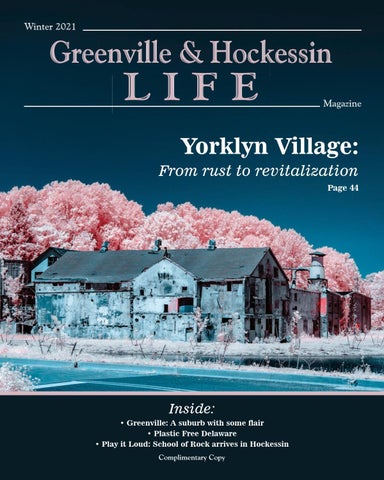
In our photo essay “Yorklyn Village: From Rust to Revitalization,” photographer Jim Coarse took his camera to the former home of the National Vulcanized Fibre Corporation (NVF) that through a consortium of collaborations is being transformed into what will become a marketplace of shops, restaurants and pathways to the historic Auburn Valley.
Lisa Fieldman writes about how Plastic Free Delaware is helping the First State clean up its act. She talked to New Castle County Councilwoman Dee Durham, whose concern for the environment grew into a passion for creating considerable change in Delaware.
In “A lifetime of words,” John Chambless profiles Jill Sharon Kimmelman, a poet who recently published a first collection of her work.
Local historian and author Gene Pisasale offers a story about how Greenville is a suburb with some flair.
We hope you enjoy these stories, and we always welcome comments and suggestions for stories that we can do in the future. The next issue of Greenville & Hockessin Life will arrive in the spring of 2022. Until then, happy holidays!
Sincerely,
Randy Lieberman, Publisher randyl@chestercounty.com, 610-869-5553
Steve Hoffman, Editor editor@chestercounty.com., 610-869-5553, Ext. 13
Cover design: Tricia Hoadley
Cover photo: Jim Coarse
The labyrinth at Christ Church Christina Hundred helps many on their personal journeys


WBy Natalie Smith Contributing Writer
hether in prayer, meditation, self-reflection or a combination thereof, walking a spiraling labyrinth has been used for millennia as a method to experience spiritual or personal growth. Labyrinths exist worldwide, many in places of worship, parks or even hospitals, inviting those seeking introspection to track their paths. Among the churches with a labyrinth on its grounds is one that can trace its location to 1848 — Christ Church Christiana Hundred in Greenville. But the labyrinth is a much newer addition to the church’s grounds. Michael Sayer, facilities manager for Christ Church, has
walked both his church’s labyrinth and others across the country.
“At my mom and dad’s church up in Mount Pocono, Pa., Trinity Church, is out in the woods. The [labyrinth] is made mostly out of wood and stone and with the grass in between. They just kind of blocked it out with sticks and stones.
“There are different patterns, but they all do the same thing,” Sayer explained. “[Unlike mazes], there’s one way in and there’s one way out.” He said of his own labyrinth experience: “It’s basically you on your personal journey, on your path, and it symbolizes one way to God, which is through Jesus Christ. That’s very powerful.”
Continued on Page 12
Continued from Page 11
The process of entering the labyrinth, reaching the center, then returning out, can be accompanied by prayer or reaching out to God. The Rev. Ruth Beresford, rector of Christ Church, recorded a series of videos in 2020 demonstrating how to walk the labyrinth during Lent, Holy Week and Easter. She tells viewers that walking the labyrinth as a way to pray is in three stages: release -- the path to the center; receive -- spending time in the center; and return -- taking the path back out.
An example is “Lent on the Labyrinth: The Way of Lament.” On the path in, the Rev. Beresford said, “Enter and release your sorrows, your grief …” In the center, “What will you receive? That’s up to God and you and the power of the Holy Spirit.” Beresford encourages the viewers to do a hand gesture that symbolizes their lament, and then open their hands, and wait. “You’ll know when it’s time to walk out again.” Then is the return, in which she said she prays that God will show the walker some kind of consolation and comfort.
The Episcopal church’s labyrinth is in a peaceful field behind the Memorial Garden at the large cross on its 22-acre property. The brick-andpaver design is based on the labyrinth at Chartres Cathedral near Paris, built around 1200. The Greenville church’s 40-foot diameter labyrinth measures 91 percent of the original French structure’s size.
There are two access paths that lead to the labyrinth, including one for

those with accessibility issues. When reaching the labyrinth entrance, there are two benches and plaques on both sides with suggestions about how to conduct your journey. A small stone wall forms a border and provides another place to sit.


The labyrinth installation in 2011 seemed meant to be. During the search for a rector four years earlier, the Search Committee used the image of a labyrinth on its communications. And when the Rev. Beresford came to the church, she
Continued on Page 14


Continued from Page 13
said she used labyrinths in her spiritual life.
To familiarize people with the spiritual tool, before investing in a more permanent one, “I went up to St. Mark’s Episcopal Church in Philadelphia and [borrowed] a canvas labyrinth,” Sayer said. “It was in the Chartres design and we put it down in the parish hall.”
It left an impression. The Rev. Calhoun Wick was among those who walked the canvas labyrinth. “He walked it and he was so moved by the experience that he and his wife [joined the effort to create the installation],” Sayer said.
When they were finally ready to install the permanent labyrinth, Sayer said the laying of the first stone needed to be precise.
“The exact center of the labyrinth matches up with the exact center of the cross, and the exact center of the Memorial Garden. And if we open the front doors of the church, from the center of the labyrinth, you can see all the way to the high altar of the church.”
Over the past decade, the Christ Church labyrinth has been used by individuals and groups, both parishioners and others. Sayer noted with a smile that people will call and want to schedule a time.
“It’s open all the time. Day or night, rain or shine,” said Deborah Webb, communications associate and graphic designer at the church.
In addition to walks around holidays, “Clergy will put together full moon walks, where during the full moon they will all walk together around the labyrinth,” Webb said. The labyrinth also plays host to some of the smallest visitors: children in the


church pre-school. “We have 70 children, 18 months to pre-K. The kids like to run all over,” Sayer said.
The labyrinth has also been the site for a wedding, a video location for Renaissance band Piffaro and part of an inspiration for artists in Plein Air Brandywine Valley.
Sayer said there is no wrong way to walk the labyrinth. His experience has honed a way that works best for him. “Some people will do a labyrinth in 10 minutes,” he said. “Some people will go two hours. Some people will go a little bit and stop and think.
“I’m a chronological person, so I do mine chronologically. What happened when I was a child? What happened when I was a teenager? What happened in this decade? Then getting to the middle is not the goal. It’s the journey.”
More information about Christ Church Christiana Hundred is available at https://christchurchde.org/prayer.
More information about labyrinths, including where to locate labyrinths worldwide, can be found at The Labyrinth Society, https://labyrinthsociety.org
Natalie Smith may be contacted at Natalie@ DoubleSMedia.com

Clear-cutting on Yorklyn Road is jarring, but historic structures and natural beauty are being promoted in the village’s core


FBy Ken Mammarella Contributing Writer
rom the sensitive reuse of old mill buildings to infrastructure upgrades, and from multiple improvements at Auburn Valley State Park to the surprising clear-cutting of a large tract on Yorklyn Road, big changes are coming to Yorklyn.
“There’s a lot of hope,” said Carol Ireland, a nearby resident who remembers when Yorklyn’s mills were running decades ago and when they were later damaged by flooding. That hope comes when considering comprehensive planning by the state for the park and Yorklyn’s adjacent “downtown.”
“This is a massive conservation effort by a number of organizations,” said Matt Ritter, administrator of the planning, preservation and development section of the Delaware Department of Natural Resources and Environmental Control, which runs the state parks.
Yorklyn’s roads meander their way along and over the Red Clay Creek, juxtaposed with railroad tracks. The mills that defined the area’s economy no longer produce lumber, flour, paper, snuff and vulcanized fiber, but their period architecture, with preserved space nearby, is drawing new businesses.
The most dramatic addition was the 2016 opening of Dew Point Brewing Co. In December 2020, Garrison’s Cyclery doubled its space when moving from
Centreville to across from Dew Point.
“It’s a good community, very closeknit,” owner Rob Garrison said.
“Yorklyn is starting to bubble. A lot of people, a lot of interest.”
For the past four decades, The Center for the Creative Arts has been helping to build, perhaps even create, a community. It’s housed in the old Yorklyn School, built in 1932.
“The school was originally a gathering place for the community, say for picnics,” said Melissa Paolercio, the center’s executive director. “We’re keeping up with that tradition with all types of people gathering, celebrating and learning.”

Yorklyn’s biggest gathering is the annual Yorklyn Day, and activities at the state park, live music at Dew Point and programming at the arts center draw people from Yorklyn and beyond.
In September, DNREC presented an update of its plans, which date back to the 2008 donation of the parkland – and the world’s largest operating collection of Stanley steam


cars – by the Marshall family.
A big point of contention at that meeting was Quarry Walk, a 12-acre site to the west that was clear-cut for 62 townhomes. It doesn’t look good now, but Ritter said DNREC’s goal is that landscaping will eventually make it blend in well. The quarry that gives the tract its name will be open to the public for fishing, and Ritter hopes for a trail to connect it to the main acreage of the state park.
Shortly after it started thinking about the new state park, DNREC was tasked with leading the way on an 119-acre site, which for more than a century housed various types of mills, last occupied NVF, which had declared bankruptcy several times and finally closed.
“Several portions were set aside as conservation easements or were otherwise acquired by the state,” a meeting poster said, and several portions were marked for development. Posters prepared for the meeting list more than a dozen
Continued on Page 18


Continued from Page 17
highlights at the park, including the construction of a rentable pavilion at the Yorklyn Bridge parking area, the first deer-hunting season and the opening up of the Marshall Bros. paper mill, hastily abandoned, with time cards still in time slots. Tours promise “a rare look at an intact shuttered paper mill.”
There are plans to connect more of the open space, with the possibility of a dramatic bridge running 400 feet across road, creek and track to reach the eastern part of the state park, known as Oversee Farm. Most of the state’s land east of the railroad tracks will remain open space, Ritter said.
In 2016, when the state’s plans had their last five-year update, the state announced multiple “revitalization milestones.” They included several miles of trails for hikers, bicyclists, equestrians and vintage car enthusiasts.
Other improvements are critical but less noticeable. More than 200 tons of contaminated soil and building materials have been removed. Two wetlands have been created. Gun Club Road was shifted out of the floodplain, and other work was done to mitigate the damage of flooding, which NVF said was a major cause in its 2007 liquidation. Sandbags remain in front of some buildings to control water.
DNREC’s plans have evolved. For instance, plans for an amphitheater have been downsized, but it’s still comparable to the outdoor stages at White Clay and Bellevue state parks, Ritter said.
DNREC in 2016 said it was collaborating with the Delaware Symphony Orchestra on plans for the symphony to use the amphitheater as the symphony’s base for summer outdoor concerts and that the symphony would bring other artistic activities to the site.
Continued on Page 20


Continued from Page 18
J.C. Barker said he toured the site shortly after he started as the symphony’s executive director in May of 2020. Having the symphony perform outdoors in Yorklyn “is a terrific idea,” he said. “That falls in line with our strategic planning for outdoor concerts. It’s an exciting project, and we’re still interested in discussing and planning it.”
When asked about the symphony presenting other artists there, he said that question was the first that he had heard about that concept.
For arts’ sake
The arts center’s importance to the community was demonstrated in 2020, Paolercio said, after a violent August storm destroyed its parking lot.
“There was a huge outpouring of support” to fix it, she said. “And that’s a huge testament to be part of this incredible community.”
That wasn’t the only problem in 2020. The pandemic forced the school to close for 15 weeks, and a few online classes were not enough to replace the camaraderie of in-person sessions.


When a full schedule resumed this fall, students enthusiastically returned. “We’ve rebounded,” she said. “We’re doing even better in participation. We’re really happy to create and make together again.”
The building includes an auditorium, seven classrooms, a kitchen and office space. The center has two full-time employees and, depending on the season, 15 to 20 teachers.
Paolercio, who starting running the center in 2019, is working on a plan to “sharpen our mission to serve all members of our community. Having quality artistic experiences is everyone’s right.”
Continued on Page 22

Wed & Thurs | 2:00p-7:30p Fri, Sat & Sun | 11:00a-7:30p


Continued from Page 20
That’s why the center is exploring the needs and desires of differently abled artists, and it also wants to add classes in Spanish, a language of increasing importance in the Hockessin area and nearby stretches of Pennsylvania’s Chester County.
To handle any development in Yorklyn’s core, the state is planning a second Yorklyn pumping station and other work to increase sewage capacity. The state is also working to construct a cell tower on the hill across Creek Road from the Marshall mansion, to cure the valley’s iffy reception.
A recent informal exploration showed a fair amount of construction equipment and material scattered among the old mill buildings. But it’s unclear how commercial development will progress. Several current businesses did not want to talk. Other businesses that have been touted in past news releases in articles didn’t talk, either. Adding to the uncertainty is an April arson fire that destroyed much of the Mill One complex.
A sign for an “Auburn Village” promises luxury
apartments and 12,000 square feet of retail “coming soon,” but it’s unsaid how soon or what is involved. The sign matches up with Yorklyn.org, where the most recent map dates to 2017. Requests for comment were not returned.
The state’s 2016 announcement referred to townhomes on the old mill site that do not exist.
Dew Point founder John Hoffman looks forward to smart growth that preserves Yorklyn’s historic charm and natural beauty. Dew Point often hosts food trucks, and he’s talked up the idea of a nearby restaurant without success. “We would love a niche restaurant, something you can’t find somewhere else,” he said.
Noted Wilmington restaurateur Dan Butler said in November that the idea is “still alive” of what the state in 2016 called a “destination restaurant” from him. Butler said that several concepts have been considered and that “the developer is still waiting for everything to come into place.” Hoffman is patient. “These things always take a long time to coalesce,” he said of Yorklyn’s growth. “One or two moves, and it will happen. The beauty and historic feel will be the key.”


Since it opened in June, School of Rock Hockessin has harnessed the musical journeys of many young people, and done it in an environment of inclusivity and fun

By Richard L. Gaw Staff Writer
It is an early Wednesday evening at the School of Rock in Hockessin, and once in the catacombs of its classrooms and studios, the reverb of electric guitars and clashing drums and songbird swirl of young female voices blends like a symphony of dreams realized.
In one room, an impromptu band of teenagers throttle their way through Led Zeppelin’s “The Immigrant Song” under the note by note tutelage of an instructor. In the next room, a drummer counts his other musicians into The Zombies classic “Time of the Season,” while down the hall, a 9-year-old uses her small hands to weave her way through Stevie Nicks’ “Landslide” to the accompaniment of a teacher on keyboards.
Taking up a narrow sliver of the Lantana Square Shopping Center, it is obvious to anyone born with a conscience and a rock and roll heart that School of Rock Hockessin is the living and harmonious and E-Chord power slam manifestation of what happens when a tennis racket strummed in a bedroom to Santana becomes a real plugged in electric guitar.
This is not banging kitchen utensils into the soft cushions of a couch but a place where the drumsticks and the high hat come with proper instructions. This is not the hairbrush in the hallway scenario, but where an actual microphone is placed in a hand with the unbridled permission to let it rip.
There are no discount amps propped up against an oily engine in a father’s garage but a spread of top-flight musical equipment, and everywhere – near drum kits and at the feet of every young musician – are the line by line and note by note music sheets for them to turn simple noise into a song, and qualified music instructors whose purpose is to harness these aspirations and also unleash them.
A proven method of musical instruction
“A mother and her son just came in for a tour and the mother asked me, ‘Will my son learn how to read music?’” said School of Rock Hockessin Manager Mike Pesce, who opened the franchise with his business partner Aaron Wygonik in June. “It’s a very valid question, because for parents who are skeptical of our educational model, their


assumption is that we just hit the power chords and put the snare on the drum and start to jam.
“I showed the mother some sheet music in a teaching studio, on which a teacher had hand written notes so that the child she was teaching could learn scales.”
Founded by Paul Green in 1998, School of Rock franchises and corporate-run schools anchor more than
Continued on Page 26


Continued from Page 25
300 communities around the world – 245 in the U.S. and 55 internationally – offering a full slate of musical education that reaches close to 50,000 students. Its patented School of Rock Method™ has taught hundreds of thousands of students in musical proficiency by integrating stage performance, individual and group instruction and song-based learning.
In addition to lessons in guitar, bass guitar, singing, keyboards and piano and songwriting, School of Rock Hockessin provides a full array of programs, all under the tutelage of experienced teachers and musicians:
• Its Little Wing music program teaches preschoolers and toddlers foundational music skills by playing games and participating in other interactive musical activities. Little Wing students have one weekly group music lesson in which they use classic rock songs to learn about rhythm, song structure, melody and dynamics through play.
• Designed for children 6 and 7 years of age, Rookies is tailored to students with no previous musical experience, who engage in one weekly group music lesson where they learn music fundamentals like chords, rhythm and song structure.
• Rock 101, for students 8 to 13, is one of School of Rock’s major programs for kids and beginners, that combines performance-based music education with a unique curriculum designed for kids with no previous musical experience. Students have one weekly group rehearsal where they learn classic rock songs that have been simplified specifically for beginner musicians. Traditionally, Rock 101 groups are the “opening act” for the Performance groups at end-of-season shows.
• Targeted to students from 12 to 18, Performance Program consists of a weekly group rehearsal where students learn by playing rock music’s most iconic songs with a band composed of their peers. The goal of this curriculum is to prepare kids and teens for live performances.
• School of Rock’s Songwriting Program, for students 12 and over, teaches the fundamentals of songwriting, arrangement and music theory, and helps students compose original works.
• School of Rock Hockessin’s lessons for adults utilizes a performance-based curriculum, that pair adult students with experienced instructors who teach adult students popular rock songs in a way that’s challenging and fun. Adult students can join a band of their own beginning January 2022.
‘I had the time of my life at School of Rock’
Traditionally, an outgrowth of musical education comes
Continued on Page 28


Continued from Page 26
in the form of live recitals. At the School of Rock, performance takes on a different look, with real rock shows at real venues in front of live audiences. The first live performance by School of Rock will be held on Dec. 12 at The Center for the Creative Arts in nearby Yorklyn, with a concert that will begin at 2 p.m.
For Annette Riblett of Avondale, enrolling her 11-year-old son Vincent in beginning guitar lessons a month ago has allowed him to approach learning based on his own interests, not on a teacher’s choice of what to play.
“The instructors asked him to select five songs he wants to learn how to play,” Riblett said. “I think being here adds another layer of his education in becoming well-rounded and being able to accomplish this all on his own. I’m hoping he takes music as far as he wants, because I think music education in this form is a marvelous gift to young people.”
When Dan DeFlilippo of Kennett Square realized that his 9-year-old daughter Charlotte had a lovely voice, he locked her into singing lessons at School of Rock Hockessin.
“These lessons are helping her discover her range and her key, and how to better control her voice,” he said. “Charlotte also wants to learn how to play guitar, so we’re also signing her up for lessons. She can take her talents as far as she wants, and this is a great place for her to start.”
“We have been able to get kids to a level of proficiency faster, because our method of teaching combines individual instruction and group rehearsals, all
Continued on Page 30


•Certified
•Homemade Sausage


Continued from Page 28
complimented by learning and playing songs that we love and want to celebrate,” Pesce said. “We never promise that we are going to create the next Eddie Van Halen, but we do promise that the student, for as long as he or she is involved in School of Rock, will enjoy their time here, will grow musically, personally, and they will look back on their time here as time well spent.”
‘Create an environment where there is no judgment’
In study after study, musical education has been proven to improve a student’s academic performance, improve test scores and better develop social and emotional skills like perseverance teamwork and core competencies like decision-making. Embedded into the four major music education processes – create, present, respond, connect – becoming involved with music gives young people the essential tools to become impactful leaders, creators, independent thinkers, and empowered young people.
Music can also become the first step one makes in order to determine self-definition and self-value. When Pesce and Wygonik were in the planning stages of School of Rock Hockessin, they attended several franchise meetings where they learned the impact of what their business venture has had on young people.
“We heard time and again from parents who told us that their son or

photo
daughter was aimless and didn’t have a place to land, and then they came to School of Rock and found a place where they felt they belonged,” Pesce said. “One mother told the story about how her son had been suffering with depression and bullying, and how School of Rock had literally saved his life.
“If we can create an environment where there is no judgment-- if we can build self confidence – then we’re doing our very best work. Rock has become a beacon for children who often don’t land in the popular paradigm, and School of Rock is a place where they fit right in. They get to take off all of their hats they wear outside of here when they arrive, and get
Continued on Page 32


Continued from Page 30
to play music.”
When asked how School of Rock Hockessin can best be defined, Pesce spoke about the musical journey of Angie, a 15-year-old girl who has not only begun to take singing lessons there, but is also working on developing her songwriting skills with the School’s teachers, who are songwriters themselves.
The young woman, Pesce said, is blind.
“I’m honored to open our doors to allow Angie to express herself and harness her creativity,” he said. “She is here to give herself that gift and hopefully be able to pass on her gift to others. When I first met her, on a tour with her family, I turned to one of our instructors and said, ‘I want more than anything


for her to front one of our bands – not only because she is so talented, but because I want to drive home the fact that School of Rock Hockessin is a place for everyone.’”
School of Rock Hockessin is located at 138 Lantana Drive in the Lantana Shopping Center, Hockessin, Del. 19707. To learn more about lessons, visit www. hockessin.schoolofrock.com or call 302-433-7625. The school adheres to strict COVID-19 safety protocols.
To contact Staff Writer Richard L. Gaw, email rgaw@ chestercounty.com.


first
(For Rachel, with gratitude)
A gift arrived, an orchid plant my very first a lavish surprise
No hint of challenges to come simply a hand extended in friendship
Instructions seemed simple enough place one ice cube in each pot twice weekly
Delicate “painted” petals, soft soft as a blanket washed a thousand times such colors, a gift of nature’s bounty or created on an artist’s palette
Within three months perfect petals drifted from their stems collapsed one atop the next became a nest of pillowy softness
Gifted an extra cube, just once on my birthday,
Sang the songs, I once sang to my infant son when I brought it to the light of light of my windowsill
A week passed day eight the bare stem boasted seven buds day nine
rebirth of a perfect “painted” orchid blossom day ten yet another.

By John Chambless Contributing Writer
Through all the dark days, Jill Sharon Kimmelman has taken solace in words, wrapping herself again and again in poetry, as if it was a thick blanket against the cold.
At the age of 4, she was reading every line from Best Loved Poems of the World, an anthology she found among her mother’s books.
“I taught myself to read by reading poetry,” Kimmelman said during a recent interview at her home. “I wrote my first poem at the age of 7, but it took me until the age of 10 to learn to ride a bike.”
The muse has stayed with her. In early November, her first collection of poetry, You Are The Poem, was published. It marks the largest collection of her work in one place, although she has contributed her writing to many collections since 2012, when she made her published debut with a powerful elegy for the victims of the Sandy Hook Elementary School massacre. Today she’s a respected member of the global online community of poets, who support one another through live readings and letters of encouragement.

For Kimmelman, life has been a series of challenges – some temporary, some ongoing. To begin with, it’s impossible to imagine her being the hardened lawyer that her parents encouraged her to become. She wears her emotions openly, and can tap into a deep well of hurt and happiness to craft her poems.
After she stepped away from a future in practicing the law, she followed her heart to studying hotel and restaurant management and went on to operate her own business after college. Beginning in the 1980s, she baked desserts out of her apartment to sell to hotels and restaurants in Virginia. That business lasted 14 years, until her first marriage ended and she moved to Chicago. Food still occasionally turns up in her poetry, and she has a gift for equating the pleasures of the culinary arts with emotional states.
But it’s the death of her beloved father, when she was a freshman at Rutgers, that sent her to Israel for a soulsearching expedition.
“It’s been 42 years since he died, but he still lives inside my heart,” she said. “I believe that he put my husband Tim on my path.”
The two met in 2013 at the apartment building where they have both lived since 1998. Tim Little has had his own lifetime of challenges. At 12, he was critically burned in a chemical explosion and has suffered with ongoing effects of his injuries ever since. But he and Jill have a relationship that has survived repeated, extended hospitalizations, and he has contributed some of his photos to You Are The Poem. Kimmelman has a son, Jordan, 32, who lives in Richmond, Va.
Continued on Page 36
Missing Your Poet’s Voice
(For Munmun Samanta, my dearest sister Sam. You are cherished. May we forever embrace & celebrate the contents of each other’s hearts)
Friend to friend, sister to sister, poet to poet, forever linked
Bring back the stories those slice-of life poems from your village portraits of yesterdays that fill me with joy always deliver smiles, wonderful, delicious laughter
Those tales of large cars painted in pinks, peach, melons, waltz blue ladies departing beauty shops proudly bearing stiff bouffant hair children in rumpled uniforms feet and hair flying on Mercury’s wings fleeing school for their holiday week
My heart, overflowing with prayers golden healing beams of optimism for a resurgence of your infectious energy your vibrant peals of laughter
Praying for complete restoration of your God-given gift to coax reluctant smiles, inspire joy with your beautiful musings
Please return to me with stories of adventures exciting experiences transformed into remarkable memorable poems
A momentary escape from the dawning of a closer-and-closer ever-encroaching-darkness
Dog-eared-sweating-glass-ring-smeared-pages of scrawled goals and dreams define compassion, empathy, tenderness eloquence, humor illuminates our heart’s yearning for all of our unanswered prayers
Barely six months ago, an unimaginable concept a global resurgence of HOPE between the cracks of broken concrete steps a proud green stem with yellow petals dancing in the summer wind
Missing your poet’s voice needing your poet’s voice pleading to hear the ripe green treble of your poet’s voice.

Continued from Page 35

Kimmelman’s broad smile and upbeat attitude are in stark contrast to the ongoing health issues that have plagued her since her early years. She has suffered from intense migraines, rheumatoid arthritis, Guillain-Barré syndrome as an adult, glaucoma and now mobility issues that keep her at home most days. She was hospitalized twice in 2018 and twice in 2019, requiring a ventilator when she was conscious.
“My definition of hell,” she said of the experiences. Out of that time, and the current Covid crisis, she wrote “Double Shift,” a tribute to the indomitable spirit of nurses.
“My social distancing started before the pandemic,” Kimmelman said. “In 2019, I was in the same ICU with Tim, where the nurses started calling us ‘The Romance of the ICU,’” she added.
When the poem was published in the summer of 2020, it was distributed throughout Christiana Hospital, and printed copies were delivered to every nursing station. It gets to the heart of the exhaustion and bravery of healthcare staff in passages such as this:
Needy people needing you, each one demanding something different a break, a meal, a hug, change for the bus chatter turns to shouting, demands soar lines swell fighting against their dying, headed for heaven they are scared, you are too face it, some days are just plain hell!
Kimmelman has a writing desk in the tidy living room of her apartment, “but there are more days when I do my writing in bed,” she said. Enlarging the type on her iPad allows her to write poetry and communicate with a global community of authors.
Continued on Page 38
You live inside my heart whisper sage wisdom every day my imagination soars as never before spiraling beyond all earthbound dreams
You longed for my happiness, for your daughter’s sweet smile to return your compass, a father’s pride to find the perfect man to learn who I am, adore me, worship me as you did me in turn Somehow you knew just how it would unfold from love-driven desire you envisioned it all where the dance would lead us how the chips would fall this tale of love unveiled itself just as you foretold First, you had to find him, not an easy task then to understand his journey anticipate the questions, only you knew I would ask
Education, profession, each met your highest bar yet gave no hint of challenges ahead would he make your dreams his own make me his shining star Surely you had doubts he had to be a man of honor my kindred spirit what exactly was this guy all about
A man of the backwoods, his camera never far, images of forest paths midnight starry skies you searched deep within his soul sought to embrace the lamentation of his plaintive cries
His heart was but a satchel for his unheard pleas along with prayers, plans, schemes hope lived on, it flourished emboldened by his dreams
Living each day within love’s tapestry basking in its golden glow like fine wine, a love enriched by age as Yeats’ poems, each more beautiful
when we turn the page
We are pieces on life’s board of chess each move an answered prayer a delivery of dreams once I was your very own princess now I am his newly-crowned queen
You would love him Dad be proud to call him son a his love is true, he treasures me like the rare gem you always said I am Though we can, if only we could, never go back you must know this fact what an extraordinary gift it has been
to be the Jill to your Jack
When my time is nigh I know I will not be alone for you will be there waiting, arms open wide to embrace me re-claim me joyously welcome me home.

Continued from Page 36
“Since COVID-19, the global poetry community has just exploded,” she said. “Nobody gets paid, really, but we’re there to support and mentor each other.”
Kimmelman’s poems have appeared in several international anthologies, and she regularly contributes cover text to collections of poems by others, beginning in 2020.
“I’ve become the ‘It Girl’ for blurbs,” she said. “It’s such an honor to be asked to write them.”
She has learned the time zones of the world so she can interact with friends in India, Africa and beyond, taking part in live readings and discussions with those who share a common language of poetry.
“There’s such respect and etiquette,” she said of her farflung friends. “We refer to each other as Dear Brother or Dear Sister. Across oceans, through deserts and over mountains that divide us, our love of language and our poems unite us.”
She has also formed a deep bond of mentorship and friendship with a 14-year-old girl in Nigeria, Olufunke Elizabeth Omolayo Ogunmodede, affectionately nicknamed Lizzie.
“At the age of 12, she wrote a poem called ‘Garden of Roses,’ although she has never seen or touched a real rose,”
Kimmelman said. “The poem had such an elevated language. We set up a Zoom meeting to talk, and we are still in touch every day. She helped me finish ‘For Jack From Your Jill,’ a poem about my father. It’s the most personal poem I have ever written. She is such an extraordinary, gifted person.”
The long process of getting You Are The Poem to print has paid off with a book that has involved Kimmelman on every level – from typeface selection to photography to which poems would be selected. They include heartfelt statements of love from her husband (“You Knew”), as well as the love between friends, siblings and parents. There are
Continued on Page 40


Continued from Page 38
poems that celebrate the ordinary, such as “Cubby’s Joy,” written with Little:
Buttery bear-claws once among his very favorite things replaced now by something more special a love so joyful, so precious it makes this once-thief’s heart sing In true love he has found a partner faithful, fair, fine her light, her love, her life, a constant delight to his soul, his heart, his mind.
There are little moments, such as the fleeting connection of “Our First Smiles of the Day,” written about Kimmelman’s son when he was 4. The poem “Trading Wishes” centers on two friends trading messages from opposite sides of the world.
There are somber poems as well, but Kimmelman said that “Before Covid, I used to write more about tragic, critical issues, but now there are so many poets forming a chorus, asking people to see the beauty in the world and have a reason to celebrate every day.”
With her book launched into the world, Kimmelman is looking forward to sharing it at local readings and book signings, as well as seeing how readers react to her very personal work.
(A shared Thanksgiving dessert) Kiwis beckon blackberries shimmer an array of ever-changing desserts Decadent, sublime, a delight to the palate rare pleasures to savor Summer’s gifts nestled on ancient hand-painted plates cinnamon-scented coffee cooling within reach.
“There’s poetry in every moment if you’re attuned to it,” she said. “This book has moments of refuge and beauty and stories of survival, of love.”
The book’s epilogue is a message to her fellow writers, but also applies to everyone. “Don’t leave your words unsaid,” she said.
“Listen to people’s stories, and be a receiver of life.”
For more information and updates, visit www. facebook.com/jskimmelman.


During the hardship of the 2020 pandemic that saw the two-month closing of The Center for the Creative Arts, its Executive Director Melissa Paolercio and her colleagues began a vision for the future of this wellestablished arts organization. Recently, Greenville & Hockessin Life met with Melissa to talk about the future of CCArts, its continuing mission and the eclectic group of guests she’d like to see at her dinner party.
Greenville & Hockessin Life: How have you, Program Director Jennifer Hartz and your instructors been able to pivot during COVID-19? Talk about how CCArts was – and has – been able to continue its educational mission during a pandemic.
Melissa: The Center was closed for 15 weeks between March 2020 and June 2020, which was a really difficult time for all of us. Not only were we personally coping with the uncertainty of what would happen, we were also running this non-profit that serves the community, so like many other non-profits, we found ways to move our mission online. We started some on-line classes, and some free open studio time on ZOOM.
We were very pleased to open back in June of 2020 for Summer Camp. It was a relief when we were open again, because part of our essence is found in the power of gathering.
While we begin to see encouraging signs, arts organizations like CCArts must still be mindful of many safety protocols that are in place to continue to help deter the spread of COVID-19. What safety measures are now in place?
We still require masks regardless of vaccination status in the building for all ages, and that is in large part to protect a good portion of our community – the younger folks who come here to learn who have not eligible to receive the vaccination until just recently. We still do a rigorous cleaning protocol of every classroom, and we’re still limiting class sizes and encouraging social distancing, as well.
In terms of safety, we’re perhaps on the more conservative side here, but it’s because we have quite a few people in our community who are members of vulnerable populations. You became the executive director of CCArts in 2019, and no doubt, you arrived with ideas for where the organization needed to expand its footprint, as well as further defining its definition and mission. With the hope that the pandemic will continue to wane, where are we seeing signs of your vision being manifested at CCArts?
I have been so lucky to have been well supported, not just by Jennifer but by the board of directors, who have placed a lot of confidence in me and my leadership abilities. We took the time during the pandemic to work on a strategic plan, that we are about to launch. When I walked into CCArts for the first time, I felt the history of gathering,

the artistic environment of being welcomed, so what we’re trying to with the strategic plan is to message that out to the communities we serve.
Everyone who has ever taken a class here knows what that feeling is, and we want everyone familiar with CCArts to know that feeling – to be in a safe place and to take artistic risks, to feel like they are valued for who they are.
My hope is that this building is bustling with activity, made by people who are trying things for the first time and learning about themselves through the arts.
As the world reopens, my hope is that we kick the doors open with huge welcoming arms for people of all abilities. It’s the core of our mission. It’s what we are here to do.
CCArts is an ever-expanding treasure trove of artistic and creative opportunities. What new programs can the readers of Greenville & Hockessin Life partake in with the coming of the next semester in early 2022?
In the winter semester, we will welcome back our glass fusion teacher as well as re-introduce a stained-art artist, who will teach a class. We will also be welcoming a new teaching artist who will be doing some devised theater work – theater that is made up on the spot. It allows the students to make up their own words and therefore build up their own self-esteem. It allows them to say, ‘I wrote that and that is my line, and I get to say that and be the character that I am envisioning in my head.’ It’s an incredible process to watch a group of people come together with just a thread of an idea and see where it takes them.
We’re also happy to welcome back our collaboration with “Fun A Day,” a Delaware organization that encourages people to create art every day for one month. We have a large gallery here, and this building is bursting at the seams with artwork from amateur and professional artists. It’s been incredible to see the cross-section of people who take this challenge on and show off what they’ve been able to create.
You have an extensive background in the theater arts that includes a BFA in Acting, an MFA in Theater Management from the Yale School of Drama, and management of several regional theaters. In what ways does CCArts’ theater programs serve to inspire those who enroll in classes?
Nowadays, we live in a world of escape, whether it’s through books, video games and social media. What I love about theater is that it offers that same sense of escape. You get to play someone else. It allows you to imagine and test out pieces of yourself and do so within the guise of a character. In so many forms of artistic expression, artists work by themselves, but in theater, you work in collaboration with others.
Even if you don’t aspire to become the next Meryl Streep, being involved in theater – whether it’s through classes at CCArts or with a school or a community production – creates life-long skills that enhance your life.
Describe the feeling you get when you walk down the main corridor of CCArts and see creativity bursting from every classroom. It is energizing and incredibly inspiring. I have always believed in the healing power of the arts, but seeing how the pandemic threatened to shut down our creativity, I feel it even more now. When I walk down the hall and see everything happening at the same moment – theater in the auditorium, Irish Dance in the dance studio and glass fusion in another classroom –it is energizing and inspiring. When you create, you connect.
Seeing those full rooms again with increased enrollment is a

glimpse into the future of CCArts – to re-engage people, and remind them how critical it is to explore themselves and others through the arts.
What is your favorite place in Greenville and Hockessin?
We love La Tonalteca in Lantana Square. My family – I call them my team – and I have had such wonderful times connecting with each over some incredible food. I also love the Hockessin Book Shelf, because I’m a big book nerd, and I think Wild Birds Unlimited is a fantastic place, too. You throw a dinner party and get to invite anyone –famous or not, living or not. Who would we see around that dinner table?
Brene Brown, the professor, lecturer, author and podcast host. Her work has really changed my life and I listen to her podcast, and it would be wonderful to get her to the table. I would also invite Sean Evans, the host of Hot Ones, in which he interviews celebrities while they eat progressively hotter chicken wings. The premise for the show sounds ridiculous, except for the fact that he is one of the most skilled interviewers I have ever watched work.
I am mildly obsessed with Kurt Cobain at the moment, so even though he is no longer with us, the deal is that I can invite anyone. I would definitely have my partner at the table. He’s not only my wing man, but he’s an amazing cook. Finally, what food or item can always be found in your refrigerator?
Good cheeses. I am the worst kind of Italian, because I can’t cook and I don’t like pasta, but I do love cheese. For a complete listing of all upcoming classes at The Center for the Creative Arts – as well as the Center’s safety protocols – visit www.ccarts.org.
The Center for the Creative Arts is located at 410 Upper Snuff Mill Road, Hockessin, Del. 19707.
— Richard L. Gaw
Text by Richard L. Gaw
The photographs you will see on the following pages are here as an invitation for you to dream.
They represent the last vestiges of a moment in the history of Yorklyn Valley – the crumbling memory of a once bustling company known as the National Vulcanized Fibre Corporation (NVF) – that is piece by piece, dream by dream and design by design being reimagined.
Where there is the faded memory, we ask that you see outdoor concerts. Where there is rust, we ask that you see shops and restaurants. Rather than define these photos as the residue of neglect, we encourage you to believe that someday you and your family will get to navigate your way on trails that will circumvent through a new village and connect to the Marshall Steam Museum, the Auburn Heights Preserve and the Red Clay Creek.
Continued on Page 46


Continued from Page 44
Through a partnership of private developers, area organizations, and the Department of Natural Resources and Environmental Control, the development of the Auburn Valley Master Plan is revitalizing the long-shuttered manufacturing plant along Yorklyn Road into a bustling town community that takes the bones and history of the past and melds it with a vibrant place for environmentally-conscious growth and cultural enrichment.
“This recreational space and redevelopment plan will create a destination for Delaware unlike any other in the country,” said former DNREC Secretary Collin O’Mara.
“With the beautiful, historic setting of Yorklyn as a backdrop, we believe the synergy created by the master plan, that includes a trail, an antique car loop, and railroad will make this a uniquely Delaware destination.”
The photographs represent a chapter marker – a single moment in time – that will yield their rust and neglect to a sparkling and brilliant future for Yorklyn – one that will also honor its past.
To learn more about the Yorklyn Village restoration and redevelopment, visit www.yorklyn.org.


By Lisa Fieldman Contributing Writer
If you knew that a little change in your day could reap a big reward for the environment, would you be willing to try? Sometimes a small shift in habit can have a big effect, and that slight difference has the potential to grow into something much more significant. For New Castle County Councilwoman Dee Durham, her concern for the environment grew into a passion for creating considerable change in Delaware.

Years ago, Durham started a Roots & Shoots chapter for her children and searched for a simple environmental project for the group. She had recently read about people worldwide working to ban single-use plastic bags because of their ecological impact. This appeared to be an easy project, and the Roots and Shoots group spent a day handing out reusable bags to shoppers. Their goal was to persuade people to forgo the single-use plastic bags. It turns out that it was not a done-in-a-day project. Over ten years later, Durham is still working to improve the environment through her organization Plastic Free Delaware.
“There wasn’t a lot of momentum yet in the U.S.,” said Durham of a plastic bag ban. “Naive me thought, ‘who
could be against that?’” Durham quickly realized the complexity of the project and started working with the state legislature on the single-use plastics issue.
The facts are real and they are frightening.
Single-use plastics wreak havoc on our environment and our ecosystems. Plastic finds its way into our municipal drain systems causing flooding, littering our landscape, tangling in power lines, and killing marine life and shorebirds. Only about 10 percent of plastics get correctly recycled, sending the remaining 90 percent into our environment or in the landfill. Recyclable plastic does not break down without the help of processing or composting. Plastic that cannot be recycled sits in a landfill, reducing to tiny pieces known as microplastics. Today, microplastics are found worldwide and are a dire threat to our wildlife that unknowingly ingests them. Humans, as well, are affected by microplastics. Studies have shown that the chemicals added to plastic can cause cancer, hormone imbalance, and reproductive problems.
Working under the Delaware Community Foundation umbrella, Plastic Free Delaware set out to change peoples’ thinking about waste. They inform through educational
programming, seeking policy change, and bringing awareness to the problem through community outreach. Although her children had moved on from the Roots and Shoots group, Durham periodically recruited them to hand out reusable bags or man tables at environmental gatherings.
“The kids may have lost interest, but it was a bee in my bonnet, so I kept going,” said Durham. But more effort was needed to help stem the tide of plastic pollution. “Around the time the Universal Recycling Law was passed, we started having conversations with State Rep. Valerie Longhurst about single-use plastic bags.”

While she successfully passed the recycling bill,
Longhurst also wanted a ban on single-use plastic bags. Plastic Free Delaware and Representative Longhurst worked together for ten years and were instrumental in passing a bill banning single-use plastic bags in the state of Delaware.
Through House Bill 130, Delaware became the fourth state nationwide to have a plastic bag ban. Passed in 2019 and effective January 1, 2021, this bill prohibits large retailers from providing single-use carry-out bags to customers.
“The bill had mixed results,” Durham said. “Lots of the large retailers stopped using plastic bags, and that was the goal. People were switching to reusable bags.”
Continued on Page 50

Continued from Page 49
But some of the grocery stores found a way around the ban.
“We did not close the loophole of an allowable bag, so they just switched to slightly thicker bags,” she explained.
Consumer complaints about these thicker plastic bags brought about the realization that the loophole in the law needed to be closed. To that end, Representatives Eric Morrison and Valerie Longhurst sponsored House Bill 212, which increases the thickness of plastic bags from 2.25 mils to 10 mils, requires a stitched handle and durability of 125 uses. HB212 was passed and recently signed by the governor. The bill changes the definition of a reusable bag and expands the law to all retailers.
“This bill will go into effect July 1, 2022. That’s huge,” said Durham. “HB212 was easier to pass than HB130 because of the growing awareness.”
From its inception, Plastic Free Delaware focused on plastic bag pollution. Building momentum, they branched out and founded YES! Delaware Youth Environmental Summit.
“With the bag bill, we had kids as advocates,” Durham said.
She found that teachers were using it as a learning

experience. Kids of all ages, from grade school to college, wrote letters and spoke at Legislative Hall. “The kids are so powerful, and the legislators love to see them and listen to what they have to say,” she said.
Supported by teachers and other nonprofit partners, the Youth Environmental Summit is for high school students and educates them on plastics issues as well as all environmental concerns. “YES! gives them the tools to be good advocates and engages them in environmental issues,” Durham said. In collaboration with area teachers and other nonprofit partners, the first summit was held in Dover in 2020 and offered workshops, presentations, and advocacy opportunities. Due to the pandemic, this years’ YES!


Summit was virtual, and the 2022 summit format has yet to be determined.
Building on Plastic Free Delaware’s achievements, Durham would love to see more people get involved. The organization offers monthly webinars on various environmental topics and a newsletter, available through their website or Facebook page.
“We invite everyone to join us in exploring zerowaste, but one step at a time,” she said. “Don’t let the zero-waste journey overwhelm you.”
Durham suggests picking one thing a month to address. An excellent place to start is with a reusable water bottle rather than a plastic bottle or follow in Durham’s footsteps and switch to reusable bags. Upcoming areas of concern for Plastic Free Delaware include food waste and e-waste.
“We need to get more longevity from the things we use,” said Durham. Consumers need to balance the use of disposable goods with the environmental impact.
Understanding the five Rs of waste management is helpful to keep us focused on a positive ecological lifestyle. Refuse, reduce, reuse, and repurpose should always be considered before the final R of recycle.
“Ideally, we’d like to put ourselves out of business,” said Durham.
But landfill waste is increasing, not decreasing. We are heading in the wrong direction.
“Action needs to be taken,” said Durham. “We are past the stage of wait and see.”
You can find more information on Plastic Free Delaware at https://plasticfreedelaware.org.
Check out Delaware Youth Environmental Summit at https://delawareyes.org.


By Gene Pisasale Contributing Writer
Greenville, Delaware has long been considered a sleepy, less noticed suburb of Wilmington. Yet it is so much more, not just for places within its borders, but sites nearby which have regional and national importance. It is only 2.74 square miles, but Greenville has had an oversized impact on our culture and politics. Besides being the home of President Joe Biden, people who changed our country and the world have lived here, including Pierre Samuel du Pont, as well as notable descendants Alfred I. du Pont and Pierre S. “Pete” du Pont.
Driving toward Wilmington on Route 52 from southeastern Pennsylvania, you quickly see the verdant rolling hills of what has come to be called “du Pont country.” The area got its nickname for good reason—hundreds of those in the family lineage have resided here for generations. Sweeping green fields adjoining rustic country estates is the rule, for many the byproduct of successful careers with Du Pont.
The origins of Du Pont are in France, where the namesake of the family, Pierre Samuel du Pont de Nemours (1739- 1817) was an esteemed writer
on economics, inspector general of commerce under King Louis XVI and later helped negotiate the Treaty of 1783 which ended the Revolutionary War. His son E. I. du Pont studied chemistry under French scientist Antoine Lavoisier. He later came to America and bought land outside Wilmington along the Brandywine Creek in northern Delaware, the site for a major gunpowder operation. E. I. du Pont later met with Thomas Jefferson, who applauded his pursuit of the powder business which would help support the American army.
The Du Pont company would later be one of the most dominant gunpowder producers in the country and the largest supplier to the U.S. military, providing nearly 40 percent of the powder used by the Union Army during the Civil War.
The firm subsequently expanded its operations to include a wide variety of chemicals and materials and became one of the most innovative and successful chemical companies in the world.
People coming into the region recognize the A. I. du Pont Middle School, one of the highest rated in the region. Pierre Samuel “Pete” du Pont served as the U.S. Representative in Congress from 1971 to 1977 and Governor of Delaware from 1977 to 1985; he
passed away earlier this year. Numerous members of the du Pont family have made lasting contributions to the area, including support for local foundations, hospitals and charities. Some of their former homes now stand as tourist attractions, including Winterthur, Nemours and other locations. The Hagley Museum and Library sits on the site of the former gunpowder operations and is now a nonprofit educational institution and research facility; E.I. du Pont’s home within the complex was the first home for the du Ponts in America.
St. Joseph on the Brandywine Church was constructed in 1841 by the family for Irish and Italian workers at the nearby Du Pont facility. The church grounds once contained several buildings, including a school and a convent, but some structures burned down; it was listed on the National Register of Historic Places in 1976. President Joe Biden’s mother and father, as well as his daughter and first wife are buried in the cemetery there, near his son Joseph R. “Beau” Biden.
A site that helped the Union win the Civil War is not far up the road. A blue and gold historical marker on Briars Lane mentions the First and Second Delaware Regiments who served during the conflict. In September 1862, Pennsylvania troops were sent to the area to guard the crucial powder mills. The Fourth Delaware Regiment relieved those men the following month when the site was known briefly as Camp du Pont, subsequently as Camp Brandywine.
You can’t pass through Greenville without noticing a shopping center which holds several different stores and restaurants, as well as a local landmark. Janssen’s Market has been a
Continued on Page 54


Continued from Page 53
Greenville “resident” for decades. Run by three generations of the Janssen family, it was founded in the Fall of 1952 by Joseph Janssen Sr. When you walk inside its doors, you find much more than your average supermarket. Janssen’s has a full-sized bakery, butcher shop and deli, where you can order delicious fresh-made sandwiches and soups. Their cheese shop offers more than 250 selections from around the world. Hungry workers in the area enjoy their lunch break at Janssen’s, with freshly baked bread making their sandwiches delightful. Nearby, Elizabeth’s also offers a wide variety of delicious soups, gourmet salads, pizza and other entrees, as well as a cocktail bar and piano music.


Greenville’s heritage includes what is considered the oldest schoolhouse in the state. The Walnut Green School, also known as District School Number 25, is a one-room structure at the intersection of Delaware Route 82 and Owl’s Nest Road. Founded in 1808, the building is a Colonial Revival styled one-story, whitestucco rectangular stone structure which was remodeled from 1918-1924. Although the school closed in 1947, it was listed on the National Register in 1994.
So, if you’re driving toward Wilmington and are looking for a place to shop, have lunch or delve into local history, Greenville has much to explore. Aside from enjoying the nearby countryside and numerous landmarks, you’ll get a better sense of the rich heritage of the region.
Gene Pisasale is an historian, author and lecturer based in Kennett Square. His ten books focus on the history of the Chester County and mid-Atlantic region. His latest book is titled: “Forgotten Founding Fathers: Pennsylvania and Delaware in the American Revolution.” His books are available on his website at www.GenePisasale.com and on www.Amazon.com. He can be reached via e-mail at Gene@GenePisasale.com.


Chris Strand, the longtime director of garden and estate at Winterthur Museum, Garden & Library, has been named its Charles F. Montgomery Director and CEO. Strand has served as interim director and CEO at Winterthur since May.
“Chris is so skilled in so many areas—fundraising, morale raising, communication,” said Kathy P. Booth, chair of the Winterthur Board of Trustees. “The Board is thrilled to have someone who knows Winterthur so well.”
As interim director, Strand was responsible for all aspects of museum, library, and garden operations, including management of Winterthur’s academic programs through the University of Delaware, fundraising, Board relations, long-range planning, budget oversight, and daily coordination of the senior management team in service of Winterthur’s mission. He continues that work in his new role.
Strand had served as Brown Harrington Director of Garden and Estate at Winterthur since May 2005, managing the care of Winterthur’s nearly 1,000 acres and its diverse resources through close work with its horticulture, natural lands, facilities, and security teams.
“I am pleased and honored to be stepping into this role at this moment in Winterthur’s history,” Strand said. “I have really enjoyed working with the Board of Trustees and the staff over the past several months. The Trustees, staff, and our Members are a community that is very dedicated
to Winterthur’s success. What they want most is to share this wonderful place with our friends and neighbors and that is an exciting and energizing challenge.”
Strand has enjoyed a long career in horticulture outreach, education, and management. Prior to joining Winterthur, he worked as director of Green Spring Gardens in Fairfax County, Va. from January 1998 to May 2005, managing its continuing evolution from a private property to a public garden and historic site, and as outreach horticulturist at The Arnold Arboretum of Harvard University from July 1993 to January 1998.
Strand earned a bachelor’s degree in Environmental, Population, and Organismic Biology from the University of Colorado in 1989 and a master’s degree in Public Horticulture Administration with a certificate in Museum Studies through the Longwood Graduate Program Fellowship of the University of Delaware in 1992.
“The COVID-19 pandemic, recent storm damage on the estate, shifting tastes, changes in school visits, and new technologies all present challenges and opportunities,” Strand noted. He credits the Winterthur staff for their creativity in meeting challenges and embracing new audiences while remaining good stewards of the property and collection. “I am very proud of them, and because of them, I am incredibly optimistic about our future,” Strand said.