Chadds Ford Life


![]()


Feeling good about your health care is easier when you have a team focused on your wellbeing. That’s what makes ChristianaCare’s Concord Health Center special. From routine primary care checkups to a variety of specialty services, you can find everything your health needs all in one place.
Connect with our team to plan care for your overall wellbeing, including:
• Primary Care
• Women’s Health
• Sports & Lifestyle Medicine
• Behavioral Health (treating anxiety and depression)
• Imaging and Lab Services
• Plus many other types of specialty care
Expert care meets convenience, right here in Chadds Ford.
Call (610) 361-1030 or visit ChristianaCare.org/Concord to make an appointment.


Letter from the Editor:
Welcome to the Fall/Winter issue of Chadds Ford Life.
In this issue, we present a story about the return of Hank’s Place. Katie and Anthony Young and the staff at Hank’s Place experienced sheer joy when the restaurant reopened earlier this year. They worked through a natural disaster to reimagine the future for what has been a community meeting place for generations.
Styer’s Peonies has grown into something big – 170,000-plus peonies with millions of blooms in three states, on acreage that draws thousands of people each year for peony festivals. And it’s all from what the company calls “a modest experiment” that began around 1900 with a small patch. In this issue, we shine a spotlight on Styer’s Peonies, which today grows more than 250 varieties of peonies.
Since he joined the Brandywine Museum of Art, James H. Duff Director Thomas Padon has helped guide the museum’s mission forward, and a scan through its exhibitions, events and programs reveals a commitment that believes art is medium that should be enjoyed by everyone.
Recently, Padon answered questions about the museum, the experience that inspired him to pursue a career in art, the museum’s long association with the Wyeth family and a rather large and eclectic dinner party wish list.
The South Creek Road Bridge will soon reopen after an almost two-year hiatus. We offer a story about the new bridge and its impact on the local community.
In the story, “The Devil’s Road and other spooky spots,” writer Ken Mammarella takes readers on an eerie tour of a winding way, a few buildings, a battlefield and a tomb where supernatural elements have been felt in southern Chester County. He also talks to Kevin Lagowski, who has written a book about

ghosts and eerie legends of Chester County.
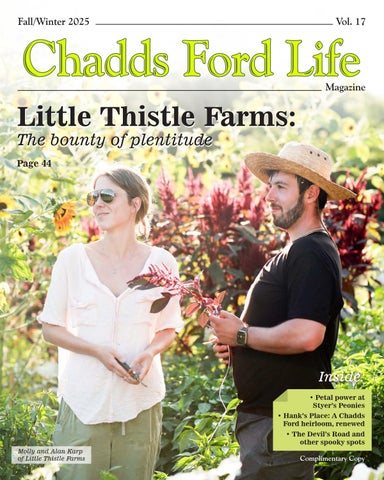
The photo essay highlights Little Thistle Farms.
We hope you enjoy the stories and photos in this issue of Chadds Ford Life and, as always, we welcome your comments and suggestions for stories to highlight in the future. We’re already hard at work on planning for the next issue of Chadds Ford Life, which will arrive in the spring of 2026.
Sincerely,
Avery Lieberman Eaton averyl@chestercounty.com

Stone Lieberman stone@chestercounty.com
Steve Hoffman, Editor editor@chestercounty.com
By Ken Mammarella Contributing Writer
Styer’s Peonies has grown into something big – 170,000-plus peonies with millions of blooms in three states, on acreage that draws thousands of people each year for peony festivals – and all from what the company calls “a modest experiment” that began around 1900 with a small patch.
The company today grows more than 250 varieties of peonies. Some are single blooms, and some are double blooms, with “big bombs of petals,” said company representative Bruce Mowday, Jr.
Some have scents, some not. Some bloom early, some late. One’s named for Ann Styer. Some are pink (popular for Mother’s Day), some white (popular for weddings) and some yellow (popular with people who like yellow). Some are almost a rainbow by themselves, like the Itoh “Lollipop,” which sports a “creamy yellow base with unique raspberry streaks and splashes,” says styerspeonies.com. “Each bloom is a little different, giving it an artistic, almost tie-dyed look.”
The star of them all is “Coral Charm,” an early, double bloom, with delicate, ruffled petals, starting as a deep coral bud and gradually opening to a softer shade. It’s the company’s best seller, and it’s also the biggest draw during the festivals. “It’s the field where everyone loves to be” during the festival, Mowday said. “Just look where they hang out.”
“Everybody loves peonies,” Styer’s Peonies owner Richard Currie told Lancaster Farming “You just have to show it to them and they say, ‘Ooh, I want to buy that!’”
Continued on Page 12
Styer’s Peonies grows more than 170,000 peonies on acreage near Chadds Ford, plus New York and Virginia.


Continued from Page 10
In 1875, John Franklin Styer bought a farm in Concordville. In 1890, his sons Jacob J. and T. Walter split the land. Jacob began Styer’s Nurseries, and Walter began Concordville Nurseries, according to a history by genealogist Karen Furst.


A few years later, Jacob tried sending peonies from his test patch to New York wholesale florists, who dumped them because they were wild.
“Greenhouse growers boycotted any firm which sold outdoor flowers,” according to Styer’s Peonies’ Facebook. Jacob succeeded with an end run, involving the Atlantic City hotels that he was supplying with mushrooms.
“The next year he sent his whole production of peonies to those hotels free,” the corporate history continues. “They created a sensation, to the extent that New Yorkers demanded peonies in that market, and the use of peonies in New York was established.”
Just before World War II, Styer’s bought land outside Pennsylvania to expand the growing and selling season, which now runs from mid-April to July 4.
In 1962, “a rift developed between J. Franklin Styer and his son Jack, and the business was split up,” Furst writes. “Jack became the sole owner of the garden center while his father retained the landscape division and the peony business.” The peony business was sold in 1982 to a nephew of J. Franklin.


The peony land, on Cossart Road in Pennsbury Township was one of the founding farms of the Brandywine Conservancy’s environmental protection project, Mowday said. Fifty acres are devoted to the peonies, with adjacent land previously farmed by Currie’s brother-in-law, H.G. Haskell, who announced in March that he was retiring. Haskell’s nearby SIW Vegetables produce stand has been taken over by the Ramseys, who have been farming in northern Delaware since 1860 and have rebranded the stand as New Roots by Ramsey’s Farm.
Currie, who’d been handling some operations for Styer’s Peonies since 1990, in 2010 bought the business, one of America’s largest peony operations. In 2018, he hired Mowday to execute his “vision, hope and dream” of a festival, which has grown to draw 10,000 in May to Pennsbury Township. Another festival draws crowds to Geneva, N.Y., where there are even more peonies.
Mowday is a Chester County native with a background in event planning for Oxford Mainstreet, the Philly Balloon & Music Festival in Glenmoore, the Lancaster Hot Air Balloon Festival and the Plantation Field Horse Trials in Unionville.
Continued on Page 14


SATURDAY, NOV. 8

SUNDAY, NOV. 9 - 10 AM - 5 PM


Continued from Page 13
Over the decades, Styer’s has figured out the best ways to grow peonies commercially. It offers different advice to consumers, who often have different goals.
It starts in the spring, when the plants start growing.
“We pluck off side shoots and toss them on the ground, leaving only one flower bud on the top of every stem, so that it’s intensifying the energy, sending all that energy to one thick, beautiful stem, with a larger, beautiful flower on the top,” Mowday said.
“That allows our plants to stand straight up in the air in the spring, as opposed to the ones at home that start to fall over. We need that because we are in the cut-flower business. Florists and event planners want one flower per stem.”
Without that trimming, a peony “could have upwards of 20 or more flowers per plant.”
When the flowers are cut for sale, “we never cut off every flower from our plants, and nor should a home gardener,” he said. “We only cut one in every eight flowers so the plant can do its natural cycle and feed those roots for next year.”


The peony harvest window is only a few weeks each spring, so using land in Virginia’s Shenandoah Valley, the mid-Atlantic and New York’s Finger Lakes means that Styer’s can sell cut flowers longer.
Continued on Page 16


Continued from Page 14
Workers cut off the budding stems, which are chilled overnight, slowing their metabolism and “warding off any ants that have snuck in to enjoy the sugary casing sealing the buds,” the Chester County Press reported. The cuttings are graded on the thickness and length of stem, plus the size of the floral head, Lancaster Farming reported.
The minimally harvested plants still look great for the festival, where people just enjoy the flowers by foot and by car as well as dine among them, and take yoga classes in their company. They can also buy cut flowers (which could last a week or more), potted plants, a themed dry rosé blend from Chaddsford Winery and peony-scented products (such as soaps, candles and jellies).
“In the world of flowers and money, the peony flower takes up so much room in an arrangement that your bang for your buck is a really good one, in addition to the fact that they’re really gorgeous,” Laurie Haskell told the Washington Post. She has two reasons to know; Haskell is the wife of Styer’s Peonies owner Richard Currie and retired owner of Wild
In the spring, Styer’s identifies plants that should be thinned from the beds. Starting in early October, these plants are dug up, with the root clumps dropped on the ground several times to knock off excess dirt. Workers then carve the clumps apart, so each section has three to five eyelets.
“They look like fingertips sticking up out of the top of the root, and they’re next season’s stems,” Mowday said.
The sections are cleaned up, packed with peat moss and shipped to customers. The clumps run $28 to $60, depending on variety.
“We send our customers the highest-quality options from these divisions,” Mowday said, “and then we take the smallest and plant them back in the fields and plant them in pots to sell at our festival.”
Before the roots are replanted, “we go through the field with a big machine called a flail to pulverize everything left in the field,” Mowday added. “We don’t want to leave stems laying in the field to cause mold or fungus issues for the following season. Then we enjoy the winter slumber, as our plants do.”

Styer’s offers this advice on receiving their cut peonies:
“Fill your vase with lots of cold water. Your peonies will drink voraciously after first cut.
“Cut your stems, removing at least one inch, then immediately place in the vase. Refill regularly.
“Display in a cool place, ideally away from direct sunlight or blasts of air from heater or air conditioning.”
Cut peonies last the longest when they’re in the shade and when their water is cold – maybe even with some ice cubes, according to Bruce Mowday, Jr., executive assistant at Styer’s Peonies, who grows 175 peonies at his Lancaster County home next to the Octoraro Reservoir.

Styer’s offers this advice on receiving their roots:
“Plant your peonies in the autumn. Peonies like full sun,
well-drained soil and a southern exposure.
“Plant your peonies two to three feet apart, so they do not compete for root space. Slow to establish, new plants may need two to three years to bloom well.
“Prepare planting area with a hole at least 1 cubic foot per plant and enrich the soil with organic material.
“If you plant your peonies too deep, they will not flower. A rough guideline is to plant between 1 inches and 2 inches below the eventual soil line.”
See styerspeonies.com/blogs/news/planting-instructions-1 for details.
“Peonies prefer to be left in peace once planted, and they need a location free of root competition from trees or large shrubs, a site that is free-draining and a location that is sunny or in light or filtered shade,”
Washington Post gardening columnist Adrian Higgins wrote. As with daffodils, the foliage “must be allowed to die back because the greenery is soaking up the energy to make next year’s blooms.” Peony plants can bloom for decades.


Let’s tour a winding way, a few buildings, a battlefield and a tomb where supernatural elements have been felt in southern Chester County.

By Ken Mammarella Contributing Writer
Lincoln University resident Kevin Lagowski is an accomplished writer with a multimedia career who enjoys horror and “being generally creeped out.”
He combines his training and interests in his 2025 book, Ghosts and Eerie Legends of Chester County, Pennsylvania, which covers three dozen places associated with paranormal activities.
It includes research and his personal experiences, such as a visit to the ticking tomb of London Tract Church Cemetery near Landenberg.
“I can’t say I heard any ticking, but there’s definitely an eeriness and stillness there,” he said in an interview. “I was by myself at night, and there was definitely kind of a creepy feeling down there because it’s a very isolated area.”
His book is heavy on historic inns, but it also includes other buildings that are open (or relatively open) to the public, plus outside areas, like graveyards and battlefields. “Any place that there’s this pain and suffering lends itself over time to an uneasiness,” he said. Each chapter includes GPS coordinates for people to plan their own road trips. He’s thinking about sequels covering the Main Line, Delaware and Philadelphia. Here’s a look at places in southern Chester County where something weird has been reported, by Lagowski and other content creators.
A section of Cossart Road, east of Kennett Pike and near Fairville, is notorious for spookiness, especially its weirdly shaped trees and vehicles chasing other vehicles out of the area.
The winding, hilly and very narrow road was famous enough to draw the attention of moviemaker M. Night Shyamalan, who in 2003 shot part of The Village nearby
Five writers open a 2005 book called Weird Pennsylvania with their reports from the road, dubbed Devil’s Road, with several referring to a cult house that’s home to unknown rituals and several being chased by ominous vehicles (red trucks in one, and black SUVs in two). A third writer saw a car carrying people with white eyes (“like perhaps they were rolled up all the way”) and goth-style hair. Near the cult house (or “church,” since variations are
a hallmark of the supernatural), the trees reportedly lack branches on one side, a feature that becomes less prominent as the distance from the house grows. A visit this summer, however, shows few misshapen trees and no ominous vehicles.
An anonymous 2023 “as heard on air” post on WJBR.com claims that “members of the Cult House would use these trees for dumping babies who were born disabled. Over time, Skull Trees would devour their bodies fully and take the shape of the child’s skull.”
Another anonymous post on WJBR (which Google dates to 2019, but the post says it was updated in 2023) connects the hauntings to the Kiddie Gang, a group led by the Johnston family that in the 1970s was involved in multiple robberies and murders of their own members, to keep them
from blabbing. “The gang members were led into an isolated field off of Cossart Road in Chadds Ford, told to dig their own graves, and were killed right then and there,” the post concludes. The gang’s exploits inspired a 1986 movie called At Close Range.
In his book, Lagowski writes that “something unnatural and unholy went down in the house right along Cossart Road, and the whole area is affected by that energy.” He also writes that it lacks a unifying backstory. “Devil’s Road is all over the map, with an assortment of things thrown at it in the hopes that enough sticks to deem it adequately haunted for the purposes of legend.”
A 2020 thread on Reddit starts out by claiming that real estate agents are “hiding things so people will continue to buy land there.” Follow-up posts by believers refer to a “midget cult” and cross-shaped trim on the cult house windows. Skeptics suggest that security guards or other teenagers are the ones doing the chasing and that the trees were “obviously cut long ago to leave room for the power lines.”


The Brandywine Battlefield “is the site of mass death, where truth is even creepier than fiction,” horror writer John James Minster began a 2023 YouTube video. “It is one of the most haunted locations in the state.”
About 2,000 men died at the site in 1777, in the bloodiest day of the Revolutionary War. “It appears that soldiers from both sides never rest as they honor their oath to fight,” Lagowski writes. Apparitions of soldiers and horses have repeatedly been seen without their feet, which makes sense because some areas are two feet higher than two centuries ago, according to Minster.
Re-enactors have seen “phantom soldiers in costume,” Lagowski writes, and sounds of battle – like “musket and cannon fire and the yelling and screaming of troops,” he writes – have also been reported.
There was a friendly spirit back then, who roused a Continental soldier just in time, Minster said.

Continued from Page 19
“Ask your server or bartender for a ghost story!” Letty’s Tavern invites on www.lettystavern.com. The restaurant in downtown Kennett Square doesn’t offer details, but many writers do.
“Letty’s Tavern is named after the resident ghost, a precocious child named in honor of William Penn’s daughter. There have been sightings of her roaming her former home from time to time,” the Chester County Press wrote in 2021, when 4AM Hospitality marked its transformation to “modern interpretations of elevated pub-fare, blending fresh West Coast flavors with house-made and locally sourced ingredients.”
Jacob Short told The News Journal at the time that he didn’t believe in ghosts until one night when he, his wife and business partners Dan Daley and Matt Killion were working onsite after midnight.
“Short said they heard what sounded like footsteps running around the second floor. Then, they heard it again. They checked all around, but no one else was in the building.
“‘We all looked at each other and said “Is that Letitia? Is that Letitia?”’ Short said. ‘After we heard it several more times, we were convinced Letty was here.’ ”
The ghost is reportedly someone named after Letitia Penn. For a glimpse of the ghost, Short suggested standing on State

Street and looking up at the second window from the left. Lagowski offered a long list of specific events, including things falling off the shelves and spinning unnaturally; a former owner feeling “a cold darkness” while trying to sleep; a phone call made to local police from the payphone inside, when the building was empty; a teen girl in Colonial dress appearing and disappearing in the dining room; bottles that fell off the shelves at the bar; and a baby’s cry.
The story of the ticking tomb in London Tract Church Cemetery is a doozy. The version that Lagowski starts with involves a child named Fithian Minuit, who wandered into the camp of surveyors Charles Mason and Jeremiah Dixon. To soothe the child, someone gave him a pocket watch to play with, which he instead swallowed.
In the most emotional version, Mason “cursed the little boy to a lifetime without peace.” Yet, according to veteran local historian Ed Okonowicz, Minuit and his wife, a woman named Martha, instead “agreed that the ticking would symbolize the love that they had for each other, and that it should go on for eternity, even after they died.”
“He died at the gravesite of his beloved Martha, and was discovered by a group of men who were hunting,” the Chester County Press wrote in 2020. “They said that he had a blissful smile on his face, and once he was buried,

the ticking continued—just as the couple had said it would because it symbolized their eternal love.”
Lagowski notes there are multiple variations. Maybe it was Mason’s watch, maybe Dixon’s. Maybe it’s a Minuit or two buried there, and maybe it’s someone who stole the watch and whose initials are “R.C.” That’s important because the flat tombstone that covers the ticking is labeled “RC.”
The story (or stories) fascinated people. Lagowski begins his book with it. The News Journal has written at least three stories about it, in 1984, 2004 and 2024. “Others claim the noise is the telltale heart of a local settler yearning for a long-lost American Indian lover,” the 2024 story mentions.
In Weird Pennsylvania, a contributor named Dupree said it first it sounded like an empty hallway. “By that I mean echoing sounds and footsteps. I listened longer, and all of a sudden, a louder sort of “tick” came from

right underneath the marker.”
Laurie Hull, founder of Delaware County Paranormal Research, writes about her visit with two others in a 2008 book titled Brandywine Valley Ghosts. She heard the ticking—only to realize that it was her own watch. But she was pleased to later hear a recording they made onsite. It included an “electronic voice phenomenon” asking “Does anyone want to talk to us?”
The 1984 News Journal article said “the only scientifically accepted reason for the ticking people have claimed to hear is water dripping on an underground stone.”

The tomb is a few paces from the northeast corner of the 1729 church, now the White Clay Creek Preserve office, Lagowski writes. Take the sidewalk between a break in the stone wall, continue on the grass, turn left after the first row of headstones. “The one most commonly said to be the ticking tomb is small and gray and it is flush to the ground,” according to Okonowicz, next to a heart-shaped stone. The ticking tomb reportedly symbolizes eternal love. A vaguely human shape decorates the top. The penny on the top is a traditional practice signifying a visit to a grave.
Continued on Page 22


Continued from Page 21
Reports of ghosts at the Red Rose Inn are common enough for Penn Township, which has owned the building since 2011, to acknowledge them and then rebuke them.

“The two ghosts who appeared most frequently were that of Emily, a little girl in an old-fashioned dress, with curls and a doll, and Joe, a Native American or “Indian Joe” as he is called,” the township page on the building says. Emily was murdered, and Joe was said to be her killer and “promptly hung.” After the real killer was identified, “in an effort to conceal the murder of Indian Joe, [villagers] buried him in the basement; hence why his body and spirit continued to roam the basement bar area.”
Emily, on the other hand, had always appeared in the main dining area, around the bathrooms, on the staircase or looking out of the windows onto Baltimore Pike.
Weird stuff, Lagowski writes, has included calculators flying off the desk, doors slamming on their own, a mirror being smashed, electronics turning off on their own and sheets being pulled off beds.
Penn Township bought the inn to preserve it (it probably dates to the 1730s) and allow for work to improve the intersection of Route 796 and Baltimore Pike. Since the township has owned the inn, “there have not been any ghostly sightings or strange encounters to report,” the site says.

An inn now known as Brandywine Prime Prime Seafood & Chops @ Chadds Ford Inn has been said to be haunted by two ghosts named Katie and Simon. Search engines are no help in finding out more. Dan Butler and Mike Majewski took over the Baltimore Pike restaurant in 2007, and Majewski told The News Journal that “I haven’t seen anything.”
“Multiple employees” at Chaddsford Winery have had dreams about “a little girl playing in the yard of the winery,” Paranormal in Pennsylvania posted on Instagram in July. The Baltimore Pike winery did not respond to a request for comment.
Mike Rowe, perhaps best known for creating Dirty Jobs and hosting 10 seasons of it, was a struggling QVC personality when he had two days to find a place to live. He found one with a ghost.
Georgia Farm, a 332-acre tract on the east branch of the Brandywine, is where he lived in the 1990s, starting on Halloween. It’s now the heart of the Stroud Water Research Center’s Stroud Preserve.
Rowe learned about Georgia Farm when he saw a newspaper classified ad seeking a “discreet caretaker” to live free in the mansion. In a meeting at the Marshalton Inn, Marion “Kippy” Boulton Stroud explained that she had recently inherited the place from her father, Morris, who died in 1990.
“I’d like to move in, but my father’s still here. We never got along,” she told him in The Way I Heard It. “He walks the grounds at night. In the evenings he sits in the great room by the fire.”
Stroud told Rowe that her father had a “problematic” will that called for her moving in within a year of his death; otherwise, the property would go to a preservation group called Natural Lands. But she was scared of moving in and needed a cover story. If people asked, as they surely will, she said to tell them that he was her lover and she was traveling. “Handle the ghost of my father as you see fit.”
“Kippy turned out to be right. Georgia Farm really was haunted,” he writes. “Let’s just say it was a friendly ghost,” he told Fox News to promote the 2019 book.
On his first night, he was in the great room – fire lit, severed heads of animals above, scotch in hand – reading a mystery when a player piano started to roll with “Georgy Girl.” He dropped his glass.
“Life at Georgia Farm was shot through with a strange feeling that shadowed my every move. … It was a lonely time, unsettled and unsettling,” he writes, referring to life in the mansion and work on the overnight shift at QVC. “I never did see the ghost of Morris Stroud. The player piano turned out not to have a mind of its own – only a timer that sometimes malfunctioned. Creaks and rattles I’d heard in the night all turned out to be just creaks and rattles.”
Stroud representatives did not respond to requests for comment.


With persistence and dedication - together with their loyal staff - Katie and Anthony Young of Hank’s Place saw through a natural disaster to reimagine the future for what has been a community meeting place for generations
By Richard L. Gaw Staff Writer
“You cannot swim for new horizons until you have courage to lose sight of the shore.”
William Faulkner
At about 5:00 a.m. on the morning of July 15, 2025 –nearly four years removed from a devastating flood that forced the close and eventual demolition of their iconic Chadds Ford restaurant - Hank’s Place owners Katie and Anthony Young started their car in their garage, not knowing what was soon ahead of them.
“We took a moment and said, ‘We did this,” Katie said. “I said to Anthony, ‘We made it through this together, and now we need to take a moment to appreciate our efforts.’”
When they arrived at the reopening of the restaurant a half-hour later, the Youngs saw a long line of customers waiting patiently for the doors to open again, including one family who had arrived in their pajamas and slippers the night before so they could be the first people to christen the next chapter of the iconic meeting place, that
had welcomed several generations of locals before them. “Seeing all of those people ready to begin a new chapter of Hank’s Place was sheer joy,” said Anthony, who has owned Hank’s Place with Katie since 2017. “We had been through so many downs and been kicked so many times over the past four years, but to see that family there and all of those other familiar faces was an amazing feeling.”
Together with their long-time staff, the Youngs opened the door to the new Hank’s Place and the people poured in. At first, everyone soaked in the high-ceiling splendor of the new restaurant - designed by Glen Mills-based architect Tom Dever - that featured exposed beams, large windows that let in the morning sun, a larger front counter complete with Windsor chairs, more seating indoors and a new, 32-seat outdoor patio. Then everything that they had grown up with and remembered was suddenly renewed, like an old friend who has been found again, and before the first cups of coffee were poured at each table, diners scanned the menu and found the familiar names again: the Jimmy Spark’s Special, Norwegian Style scrambled eggs, Hank’s Style Eggs Benedict, the Bull’s Eye Breakfast and the William Barn’s, handcrafted chipped beef over southern style biscuits and home fries.
Continued on Page 26

Continued from Page 24
They reacquainted with the familiar faces of the staff, who had stuck by the Youngs through the devastation of Hurricane Ida that wept through Chadds Ford on Sept. 1, 2021 and took down the original restaurant with it. To them, the new Hank’s Place was in many ways their renewal, too; they spent countless hours cleaning through the remnants of damage that the hurricane had left; and they joined the Youngs during a three-year tenure when Hank’s Place took up temporary residence in Kennett Square.
“If it wasn’t for our staff, I don’t think that Anthony and I would still be together as a couple and have the energy to continue to move forward,” Katie said. “They were behind us with emotional support. They attended township meetings. They got petitions signed. They would help us on their days off from their other jobs and work gratis just to make sure that we were okay. I don’t know of many companies that have that loyalty behind them.”

‘The opportunity to reimagine’
While the impact of destruction the original restaurant experienced cannot be overstated to the Youngs, their staff and the thousands of residents who have enjoyed meals and conversation there, a tiny silver lining emerged through the nightmare of Hurricane Ida: it opened a
Continued on Page 28


Continued from Page 26
portal to make the necessary upgrades to assure that the new Hank’s Place would be stable enough to withstand the assault of another severe weather event. In its redesign, the restaurant is now nearly ten feet off the ground, its roof has been reinforced, and the walls at ground level are designed to break away to let flooding flow beneath the restaurant’s main floor. In addition, the new Hank’s Place includes new fire protection improvements and safety ramps for customers.

“Hank’s is so much more than a building – it’s its own creature,” Anthony said. “While we loved the beautiful flower planters and the vibe the original restaurant had, it also had a dated interior that needed a lot of love from the moment that we moved in. We had made improvements, but they were more about just keeping the place together.
“While the experience of losing the restaurant was hor-
rible, we got the opportunity reimagine it through our vision. It began with keeping the breakfast counter, broadening the dining area, but as we continued the process, we realized that creating an outdoor dining area would become very important.”
As the design process for the new restaurant got underway, it was the Youngs’ idea that their new restaurant should match the artistic symmetry of nearby restaurants such as Antica and the Chadds Ford Inn and tap into the talents of local contractors.
“We kept everything hyper local and were very intentional in using people who knew what Hank’s Place was about and pooling their resources together,” Katie said.
“Tom and his team hung on every word that Katie said, and when they showed us their initial rendering, I told them, ‘You guys hit it out of the park on the first go,’” Anthony


To better protect it against future weather incidents, Hank’s Place is now nearly ten feet off the ground, its roof has been reinforced, and the walls at ground level are designed to break away to let flooding flow beneath the restaurant.
said. “They nailed the vision the first time around. Their ability to translate Kate’s words to pen and paper was remarkable. He shared his true wisdom with us.”
With each rendition and blueprint, however, so too came several layers of supply shortages, bureaucratic red tape, FEMA requirements, township meetings, insurance setbacks and the disapproving comments from a small number of residents.
“It tried our patience,” Katie said. “A lot of people kept telling us to put on a good face and keep on smiling, but it was very hard because we suddenly became thrust into the public limelight, which was nothing we were prepared for. We couldn’t even walk into a grocery store without people stopping us and asking what’s going on. While it was touching that so many people cared so much, it was mentally exhausting for us. We were trying to keep our staff upbeat. We were navigating all of the different channels – at the federal, state and local municipality levels. Just trying to corral everything became a heavy lift.
“It was almost as if the two of us felt that the people didn’t want us to survive.”
The Youngs had every opportunity to abandon the concept of a new restaurant. Instead, they chose to dig in.
“Our love for this place has been more than just a job and more than just a restaurant and more than just the people who work here and visit here,” Anthony said. “They are all our family, and they became the fuel for us to continue.”
Continued on Page 30


Continued from Page 29
In 2022, a year after the restaurant closed and one year before it was razed, the Youngs were operating a food truck in the Hank’s Place parking lot, when they received a phone call from Kennett Square Mayor Matt Fetick, who told them that a restaurant space on Birch Street was available if they wanted it.
“Matt invited us down and told us, ‘I have a spot for you to look at,’ and he came in and helped us unpack,” Katie said. “We retrofitted that entire space in 45 days. We put new flooring in, tore out walls, painted, and did minor renovations. Matt just told us to do what we needed to do in order to survive, and for us, it was our three years in Kennett Square that helped us not just survive, but succeed.”
For the next three years, the most common phrase for patrons arriving at the constantly crowded restaurant was, “How long is the

wait?” The temporary location in Kennett Square became an instant success, and it became customary for the Youngs to see their friends from Chadds Ford mix and mingle among the Kennett Square crowd.

For all of the kindness afforded to them by the people of Kennett Square, the next chapter of Hank’s Place was about to be completed in Chadds Ford, and it was time for the Youngs to come back home, back to a place where they had both come since childhood, and where they would often meet for dinner while they were dating - Anthony coming from West Chester and Katie from Wilmington.
“I want to leave Hank’s Place as a legacy for future generations, such as my niece and nephew and their kids, so that they can come here and have those traditions that we had as a couple,” Katie said. “Anthony and I are just stewards here.”
“I want Hank’s Place to continue to be the neighborhood hub, where the community comes together, if for no other purpose than to celebrate a Monday morning with some eggs and bacon and good coffee and great conversation – that home away from home,” Anthony said. “When I think back to every place I ever lived in, there has always been that neighborhood spot that defines that area.
“I want Hank’s Place to continue to be that place where friendly people meet and hungry people eat.”
To contact Staff Writer Richard L. Gaw, email rgaw@chestercounty.com.


Since he joined the Brandywine Museum of Art in 2012, James H. Duff Director Thomas Padon has helped guide the Museum’s mission forward, and a scan through its exhibitions, events and programs reveals a commitment that believes art is a medium that should be enjoyed by everyone.

Recently, Padon answered questions about the Museum, the experience that inspired him to pursue a career in art, the Museum’s long association with the Wyeth family and a rather large and eclectic dinner party wish list.
Chadds Ford Life: You first joined the Brandywine Museum of Art in 2012, so you have had more than one dozen years to witness and help guide the evolving mission of this museum. In terms of its strategic and institutional planning, what was most important to the Museum in 2012 and what is most important now?
Padon: When I came to Brandywine, the most important thing was injecting a renewed sense of energy into what was a beloved institution, but one not known well enough outside the immediate area— even in nearby Philadelphia — by introducing an ambitious program of special exhibitions that would raise the museum’s profile. Right now, we’ve been focused on expanding our collection and educational programming and activities so that we are open to the widest possible audience.
Dr. Albert C. Barnes, whose legacy resides in part at the Barnes Foundation, believed strongly that institutions of art were far too pretentious, catered toward the elite and therefore kept at a far distance from the common man and woman. Through his vision, everyday citizens could now come within a foot of paintings by Henri Matisse, Pablo Picasso, Paul Cézanne and Pierre-Auguste Renoir. That seems to be the working philosophy at the Brandywine Museum of Art, given its ability to connect art to everyone, yes?
Dr. Barnes’s certainly had a dichotomy in his approach! On the one hand, he believed in providing art education and access to his collection to lower and middle-class audiences, while on the other, vehemently denying access to the upper class and art establishment whom he never forgave for their negative reaction to a preview of his collection in 1923 at the Pennsylvania Academy of Fine Arts. At Brandywine, we are very deliberate about mentoring an interest in art at an early age and making children and families feel comfortable in a museum setting. I think the excellence of our collection, the low-key atmosphere at the museum, and the the lush setting on the Brandywine River all work to create a remarkably harmonious experience of art.
For nearly everyone in every profession, there has been a lightning bolt moment that told them, “This is where I need to go and what I need to be doing.” In terms of what may have ignited your professional career, do you have a similar moment?
Indeed! While studying art history as an undergraduate, I volunteered in the Contemporary Art department of the Denver Art Museum. Working alongside the staff there made clear to me a path into the museum world, and I’ve never looked back.
To mark the 25th anniversary of the transition of Kuerner Farm from a family home into a public site, the Museum and Reynolda House Museum of American Art have collaborated on Andrew Wyeth at Kuerner Farm: The Eye of the Earth, which is running currently. This exhibition is the latest chapter marker in a seemingly never-ending tribute to Chadds Ford’s most famous artist. How did the Museum’s relationship with the Wyeth family begin, and how – and with whom – is it maintained?

Frolic Weymouth, Brandywine’s visionary co-founder, was a close friend of Andrew and Betsy Wyeth. It was Wyeth’s iconic art that was a lifelong inspiration to Frolic’s own trajectory as a painter. It’s remarkable that the artistic legacy is still thriving 120 years after it began with N.C. Wyeth, and I’ve so enjoyed the opportunity to get to know Jamie Wyeth, who continues to grow as an artist and one around whom we recently organized a highly successful exhibition that traveled across the United States.
Continued on Page 34

Continued from Page 33
You hold art history degrees from the University of Colorado and the Institute of Fine Arts at New York University. You served as assistant director of the Vancouver Art Gallery, deputy director for exhibitions and programs at the American Federation of Arts, held senior curatorial positions at the Guggenheim Museum in New York City and have collaborated on exhibitions with some of the most prestigious museums of art in the world. Is there a painting or a museum that still remains on your artistic bucket list, one that you haven’t seen or visited? Definitely! I would love to visit the Benesse Art Site Naoshima, a group of museums and art spaces, including many designed by architect Tado Ando and spread across three islands in Japan.
What is your favorite spot in Chadds Ford?
Continued on Page 36


Continued from Page 34
The ruin of Mother Archie’s church on Ring Road. It’s such a remarkable piece of the area’s history and so visually evocative. Lydia Archie was a force of nature in this community in the early twentieth century, and this building, a former Quaker meeting house, was a formidable place of inspiration for Andrew Wyeth.
You organize a dinner party and can invite whomever you wish – living or not, famous or not. Who do you want to see gathered around that table?
Jane Fonda, King Philip II of Spain, F. Scott Fitzgerald, N.C. Wyeth, Marie Antoinette, Gary Cooper, Rameses II, Queen Elizabeth I, Elizabeth Taylor, Theodore Roosevelt, Dorothy Parker, and Miles Davis. There would certainly be no lack of interesting conversation!

The Brandywine Museum of Art is one of the most preeminent resources for art and art history research in the Northeast.
What item can always be found in your refrigerator?
It’s my freezer, technically, but Häagen-Dazs ice cream—always and forever!
To learn more about upcoming exhibitions, collections and events at the Brandywine Museum of Art, visit www.brandywine.org.
~ Richard L. Gaw


For the first time in 150 years, an important masterwork by the artist Jasper Francis Cropsey has been rediscovered and is preparing for a U.S. tour.
Now is your chance to see it, where it will be on view at the Brandywine Museum of Art through May 31, 2026
By Richard L. Gaw Staff Writer
As evidenced by its exhaustive dedication to the thousands of people who walk through its doors every year, the Brandywine Museum of Art presents and collects historic and contemporary works of American art, engaging and exciting visitors of all ages through an array of exhibitions and programs.
Quite often, curating an exhibit at the Museum combines the skills of fact-finding, combing through resources, communicating with colleagues in the art world and collaborating with other arts institutions. Occasionally, acquiring a work of art for the purpose of displaying it also involves a generous amount of sleuthing, as seen in its current exhibit, Brandywine’s special exhibition Cropsey, Wyeth, and the American Landscape Tradition, on view now through May 31, 2026.
Included in the exhibit will be the world-wide museum debut of a rediscovered masterpiece not seen in the United States since it was painted over 150 years ago. The seven-foot-wide painting, entitled Autumn in the Ramapo Valley, Erie Railway, is a monumental masterwork by Jasper Francis Cropsey (1823–1900), one of the luminaries of the Hudson River School of artists. The painting was commissioned by James McHenry, an Irish-born transatlantic businessman who invested in a number of American railroads, to commemorate his amassing a majority stake in the Erie Railroad.
Continued on Page 40
Courtesy of Brandywine Museum of Art Jasper Francis Cropsey (1823–1900), Autumn in the Ramapo Valley, Erie Railway, 1873, oil on canvas, 38⅝ x 68⅛ in. J. Jeffrey and Ann Marie Fox Foundation for American Art.
Continued from Page 39
This painting has been hidden away in McHenry’s and other British private collections since being shipped to England in the fall of 1873. Recently acquired by the J. Jeffrey and Ann Marie Fox Foundation for American Art, this painting by an American artist of a quintessentially American landscape finds its rightful place on an American museum’s wall for the first time in the painting’s history.
Following the painting’s debut at the Brandywine, it will travel nationally to venues across the United States through 2028.
“We searched for a larger scale masterpiece by Cropsey for over 12 years and had to act decisively to acquire this painting with our initial decision based on a condition report and descriptions of the painting from period newspapers,” said Jeff and Ann Marie Fox. “It is an honor that curators from the Brandywine and other museums concur that it is an extraordinary painting with an equally fascinating story whose return to the United States is being celebrated during the country’s 250th birthday.”
The Fox’s collection includes exceptional examples of works by significant American artists of the nineteenth and twentieth centuries, ranging from Thomas Cole to Georgia O’Keeffe.
“Autumn in the Ramapo Valley, Erie Railway is a revelation to historians of American art: a survivor of a moment in which art and industry were entangled in fascinating ways and artists like Cropsey, Albert Bierstadt, and Frederic Church were in competition for new fortunes being spent on imposing paintings of the sources of their wealth,” said Brandywine’s William L. Coleman, Ph.D., the exhibition’s curator and Director of the Wyeth Study Center at the Museum, with a scholarly background in the Hudson River School.
Cropsey’s paintings – which include Autumn on the Hudson and The Old Mill, reflect a deep appreciation for nature and its influence on human existence, which served as a central theme of for Hudson River School artists. Autumn in the Ramapo Valley, Erie Railway — an example of the “great picture” tradition — is the work of a mature


artist tackling sublime, autumnal wilderness in dialogue with the booming railroad business, a frequent subject. Commissioned by a British railroad investor with controlling interests in the railway depicted, the painting naturalizes infrastructure and celebrates the feats of engineering that allowed it to cross such rugged terrain. It also illustrates the extent to which international markets existed for American art, even at this early date.
The work received significant attention from American newspapers at the time Cropsey was painting it before it receded from view into private hands for the intervening 150 years.
This exceptional artwork clarifies the sheer ambition, energy, and expense that were devoted to depicting the natural world in the nineteenth-century United States, a phenomenon in which the Brandywine’s collection is also rich. The fact that its subject matter is a valley on the New Jersey-New York border makes it all the more relevant for dialogue with depictions of similar regional subjects in the collection.
In addition to Cropsey, landscapes by artists including Alfred Thompson Bricher, Albert Bierstadt, William Trost Richards, John
Continued on Page 42

Continued from Page 41
Frederick Kensett, Mary Blood Mellen, and Martin Johnson Heade, among others, are included alongside Brandywine’s presentation of the painting.
The exhibition also continues the story of the landscape tradition with the artists that followed Cropsey.
Through key works in the Brandywine and Wyeth Foundation of American Art collections, a clear line of descent traces the further development of American landscape art, via Winslow Homer, George Bellows, and N.C. Wyeth, to an especially rich flowering in the works of Andrew Wyeth. Archival evidence demonstrates the depth of his engagement with the history of landscape art, including specific lessons in composition, allegory, and the aesthetic potential of industry that Andrew Wyeth learned from the Hudson River School.
Through a variety of works in watercolor and tempera, many of which have never been exhibited before, the story
of the rich American landscape tradition continues and intriguing commonalities between the artists of the Hudson River School and Wyeth emerge.
The exhibition will be accompanied by virtual programs and a robust microsite with additional research background on the rediscovered Cropsey. After its debut presentation at the Brandywine, Autumn in the Ramapo Valley, Erie Railway will make a national tour into 2028, with presentations now confirmed at the following institutions: Dixon Gallery & Gardens, Memphis, Tenn., from September 6, 2026–January 10, 2027; Speed Art Museum, Louisville, Ky., from February 2027–August 2027; Rockwell Museum, Corning, N.Y., from September 2027–February 2028; Georgia Museum of Art, Athens, Ga., from March–June 2028; and Newington-Cropsey Foundation, Hastings-onHudson, N.Y., beginning July 2028.
The Brandywine Conservancy & Museum of Art is located at 1 Mill Road, Chadds Ford, Pa. To learn more about upcoming exhibitions and programs, visit www.brandywine.org.


|Chadds Ford Life Photo Essay|
The farm that Alan and Molly Karp own in Chadds Ford may be small in size, but its mission is enormous
Photos by Jie Deng | Text by Richard L. Gaw
Two years ago, with assistance from his wife, Molly, Alan Karp acted on his impulses and his inspiration and began carving out the landscape of what would become Little Thistle Farms.
Continued on Page 46


Continued from Page 44
Set in a quarter-acre plot at a horse farm in Chadds Ford, Alan has planted the seeds of which has become a bountiful supply of produce: beets, carrots, cucumbers, Swiss Chard, eggplant, sugar snap and snow peas, pole beans, peppers, watermelons, butternut and spaghetti squash, garlic, several kinds of heirloom tomatoes, radishes, herbs, pickles for hot sauces, blueberries – name the crop and chances are it’s there - and topped off with a variety of florals that light up the garden in a canopy of color.
Originally from Baltimore, Alan was introduced to farming at Kim’s Quarry Garden, a 75-acre farm in Plattsburgh, New York, where he had moved to begin a new position as a chemical engineer. During his three- and-a-half years there, he learned about sustainable agriculture, organic produce and the value of local farmers. By the time Alan accepted a new job in Philadelphia – where he met his future wife - the seeds of a larger idea had already been flourishing in his mind: To create his own garden.
“I didn’t have any background in growing, but what I learned from that experience in upstate New York was the knowledge that you can grow anything anywhere,” said Alan, whose passions also extend to yoga, cycling, hiking and cooking. “I began to see what was possible.”
The time clock of a farmer regularly includes seeing the sun rise, so it is customary to see Alan planting, tilling, watering, pruning, weeding and harvesting at the farm well before he begins his day job, and then return to the farm after work. For Alan, Little Thistle Farms is a workshop of growth and a labor of love for ethical farming.
“When you go to the grocery store, you don’t often know where your produce came from, but at Little Thistle Farms, everything is grown organically,” he said. “There is also the reward of growing things from the ground.”
A major recipient of the produce at Little Thistle Farms has been Kennett Area Community Service’s Food Cupboard, which provides food for those living in the Avon Grove, Kennett Consolidated,
and Unionville-Chadds Ford School Districts and who have household incomes at or below the federal poverty level.
“I always feel good about donating food and volunteering in general,” Alan said. “It’s a selfless act that benefits someone else. I come by the Food Cupboard with three whole milk crates filled with zucchini and squash and ask them, ‘Are you sure you want this much?’ Their response is always the same. ‘Thank you and please bring us more.’”
Recently, Alan and Molly found a nearby kitchen space and are in the process of applying to receive a limited food establishment certification, which will open the door to new opportunities to provide food for the community through the establishment of a farm stand on their property, which is three miles away from Little Thistle Farms. They’re working with students from the Dickinson Law School at Penn State to coordinate the legal aspects of starting a business, and Alan and Molly are also developing their website and social media pages.
“We purchased a shed on our property which we project to open as a farm stand and sell vegetables and canned goods all grown on the farm, hopefully beginning next year,” Molly said. “Until then, we’ve been able to market the farm and develop sales through Instagram.”
Much like the produce and flowers that flourish in harmony within it, Little Thistle Farms is a bounty of plentitude, with many more growing seasons to come, crops to be grown and harvested and thousands of tables on which the fresh and wholesome products grown on this farm will be enjoyed.
“Farming is like a full life circle,” Alan said. “You can grow something from seed to cultivation, you can eat it, you can sell it and you can give it away, but it always provides value to whoever receives it.”
To learn more about Little Thistle Farms, visit them on Facebook and on Instagram, or email Alan and Molly at littlethistlefarmscf@gmail.com.


as a $15.2 million
been for a

By Chris Barber Contributing Writer
For the thousands of residents of Chadds Ford and Pennsbury townships who had traversed Route 100 south of Chadds Ford every week and have had their usual mapping routes realigned for the past 20 months, the South Creek Road Bridge will reopen on or about Nov. 14, following the completion of a $15.2 million investment to construct a more modern bridge.
The two-lane bridge over the Brandywine Creek and flood plain – which has been carrying traffic north and south since 1925 and goes over a one-track line of the East Penn Railroad - has been closed since April 1, 2024. The

bridge begins from a mile-and-a-half south of Route 1 in mid-Chadds Ford and runs southward toward Delaware.
During its long life, the bridge has limited its load carrying capacity to vehicles – and often more specifically, trucks – of 12-ton weight maximum and no trucks with trailers over 45 feet in length, except for local deliveries. In 2017, seeing that it needed to be upgraded to more modern standards, the Pennsylvania Department of Transportation (PennDOT) determined that it was time to replace it. The “six span” bridge, including its uprights that sit in the creek, all had to be rebuilt. In addition, the roadway over the train is held up by a concrete leg on one side and the land ridge on the other.
Continued on Page 50
been closed since April of last year, is headed million reconstruction project comes to a close for crossing, again for crossing,
again


Continued from Page 48

The structure type and alignment, as well as details regarding the structure’s appearance, were selected through an Alternatives Analysis of February 2017 and coordination with consulting parties that occurred from mid-2015 through late 2019, according to a press release from PennDOT.
During the closure, motorists have been directed to use U.S. 1 (Baltimore Pike), Route 52 (Kennett Pike), Center Meeting Road, and Delaware State Route 100 (Montchanin Road).
Bicyclists traveling Bike Route L were directed to use Bullock Road, Ring Road, Ridge Road and Delaware State roadway Smiths Bridge Road.
PennDOT announced in advance that the bridge’s reconstruction would be entirely federally funded - and would “ensure safe and efficient crossing for the traveling public.”
The new structure – which is being constructed by Haines & Kibblehouse, Inc. of Philadelphia - will be a six-span concrete arch bridge with two lanes and shoulders. The structure type and alignment, as well as details regarding
the structure’s appearance, will include a new two-lane and slightly wider six-span pre-cast reinforced concrete arch bridge. In addition, the open steel bridge railing, with concrete pilasters at the piers, was chosen to allow scenic viewing. Other features include recessed panels, new signage, plaques and delineators.
The closure has affected two businesses.
The New Roots produce stand keeps presents its shelves and displays sumptuously stocked, selling fruits and vegetables from nearby farms, as well as non-food products that are related to the preparing and serving of vegetables.
New Roots has a loyal customer base, said Manager Donni Pinzone, but in the past two years, the difficulty in accessing the area because of the detours has led to a 30 percent drop in income for the business. In order to access the stand from the north, shoppers must travel a much longer route than before which travels over narrow and winding roads.


Pinzone said she has tried to help by describing the best detours on the stand’s website and yet, as she describes her customer base from the north of the creek, she said, “It’s so close, but so far. … I have been thrilled that they came that far.”
Skirting the side of the produce stand are the tracks for the East Penn train, that travels to and from Wilmington several times a week. Trainmaster Randy Miller said there was only one day during the construction that the train could not travel the route.
“That was the day they totally demolished the bridge,” he said.
There has been work on the south end of the bridge in the area where the train travels, but Miller said they give a call to the workers when the train is about to leave the Pocopson station. A flagger then stops work temporarily as the train goes by, he said.
Pinzone said she and her staff are always happy to see the train as it goes by.
“We love them all, and we throw them fruit. We throw an apple to [the engineer],” she said.


Dan Leader, the owner/operator of Leader Sunoco gas station along Route 1 north of the bridge construction, said he does not hear much complaining about the detours, but people are saying they are happy they are ending soon. “They are bothered, but they are also putting up with it,” he said.


