Pope Leo to Celebrate Holy Thursday Mass at St. John Lateran
By Victoria Cardiel
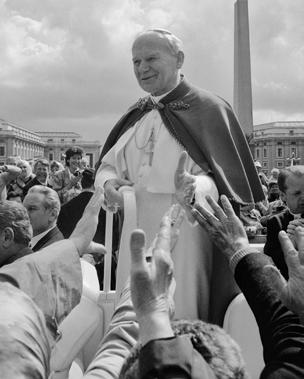
EWTN—Pope Leo XIV will celebrate the Holy Thursday Mass of the Lord’s Supper at the Basilica of St. John Lateran on April 2, restoring a long-standing Roman tradition that Pope Francis set aside throughout his 12-year pontificate.
The announcement appeared last week in the calendar of papal liturgies published by the Prefecture of the Pontifical Household.
In his first Holy Thursday as pope on March 28, 2013, Pope Francis chose to celebrate the Mass in Coena Domini in the chapel of the Casal del Marmo juvenile detention center on the northern outskirts of Rome. As he had often done as archbishop of Buenos Aires, he carefully washed the feet of 12 inmates, including an Italian Catholic woman and a Muslim woman from Serbia.
From that point on, and for the next 12 years, Francis left aside the Holy Thursday celebration at St. John Lateran—the cathedral of the bishop of Rome—in a pastoral approach that broke with the customary practice of his predecessors.
For Monsignor Giovanni Falbo—a canon of the Lateran, camerlengo of the cathedral chapter, and provost of the basilica—that decision should be understood as an interlude.
In his view, Pope Leo XIV’s decision to recover the tradition on April 2 shows that the Francis years were an “exception.”
Adoremus Bulletin
For the Renewal of the Sacred Liturgy
The Revised Order of Anointing: Practical Changes for Pastoral Ministry
By Father Andrew Gutierrez
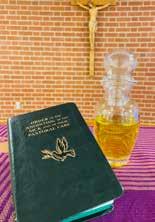
With great anticipation, The Order of Anointing of the Sick and of their Pastoral Care has been published and has been available for use since February 11, 2026, and will be mandatory on Easter Sunday, April 5, 2026. Priests caring for those suffering from illness will find the revised Order much better suited for pastoral ministry and will also be grateful to know that the formula for Anointing of the Sick in English remains unchanged. In this article, I will explain the significant changes in the revised Order as compared with the Pastoral Care of the Sick, the ritual book used in the United States since 1983. These include: (1) a ritual book now primarily for priests; (2) the elimination of the rite known as “Anointing of the Sick in a Hospital or Institution”; (3) a specific ritual for the Order of Confirmation; (4) clearer provision for the Sacrament to be given to those suffering from serious mental illness; and (5) modifications to the formula for the Apostolic Pardon.
Ritual Book Specific to Priests
Story continued on page 2
The previous edition of Pastoral Care of the Sick was for use by priests, deacons, and laity who minister to the sick, all within one ritual book. The revised Order is for use primarily by priests. Without having to decipher the different options for priests and laity, along with a clearer structure to the book, priests will be able to more easily and prayerfully engage the rubrics and texts. Deacons and laity will use a separate ritual book for their ministry to the sick and dying. Many aids for ministry to the sick have been previously developed for Extraordinary Ministers of Holy Communion
Healthy Revisions
and these remain available; however, these should be updated to reflect the revised Order present in Holy Communion and Worship of the Eucharistic Mystery Outside Mass, published in 2024.
In Hospital or Institution
Perhaps the most common rite from the previous ritual book that I saw priests use while I was in seminary formation was the “Anointing of the Sick in a Hospital or Institution” (within Chapter IV of the previous edition) which provided a concise, straightforward version of the ritual consisting of only (1) the opening instruction, (2) the laying on of hands and the formula for anointing, (3) the Lord’s Prayer, and (4) a concluding prayer and blessing.1 This is not present in the Latin typical edition, and therefore the revised Order does not include this form either.
I believe this is an important opportunity for priests to embrace “The Ordinary Rite,” which includes signs and symbols helpful for the sick while they are conscious and able to participate, to spiritually engage in the liturgy for fruitful reception, and to actively offer their suffering in sacrifice and worship to God the Father. For example, the reading of Sacred Scripture stirs into flame the faith of the sick person; the litany offers the sick person the opportunity to seek the Lord’s mercy; the Prayer of Thanksgiving over the Oil between the laying on of hands and the formula of anointing is an explicit prayer of praise to the Trinity as the sick person associates his life with the passion and death of Christ; and the Our Father unites those participating in the liturgy to the entire Mystical
Please see ANOINTING on page 4
Adoremus Bulletin MARCH 2026
The revised Order of Anointing of the Sick and of their Pastoral Care is out and it’s full of good medicine for pastors. Father Andrew Gutierrez gives the revisions a thorough examination 1 Evangelical Counsel
Father Thomas Milota explains how and why the Eucharist is not a tool of evangelization but its end and purpose—the North Star around which all evangelical strategies should orbit 3 Deep Dive
Father Andrew J. Summerson fathoms the insights of St. Gregory Nazianzen’s view on the power of sacramental words and actions to reveal a veritable ocean of mystery 5
Drowning in Meaning Adoremus editor Michael Brummond sees six
facets to the meaning behind the rubrics of the sacrament of Baptism—and parents and priests should immerse themselves in all of them 6 Garden City
According to Nathan Schmiedike, God has a green thumb for helping us cultivate holiness through the liturgy by harvesting the spoils of Eden as a feast fit for the heavenly Jerusalem 8 1+1=1
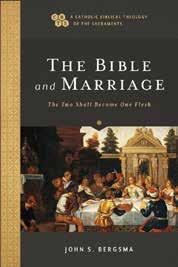
In reviewing The Bible and Marriage: The Two Shall Become One Flesh by John S. Bergsma, Brandon Harvey finds the book a happy marriage of theological and practical insights 12
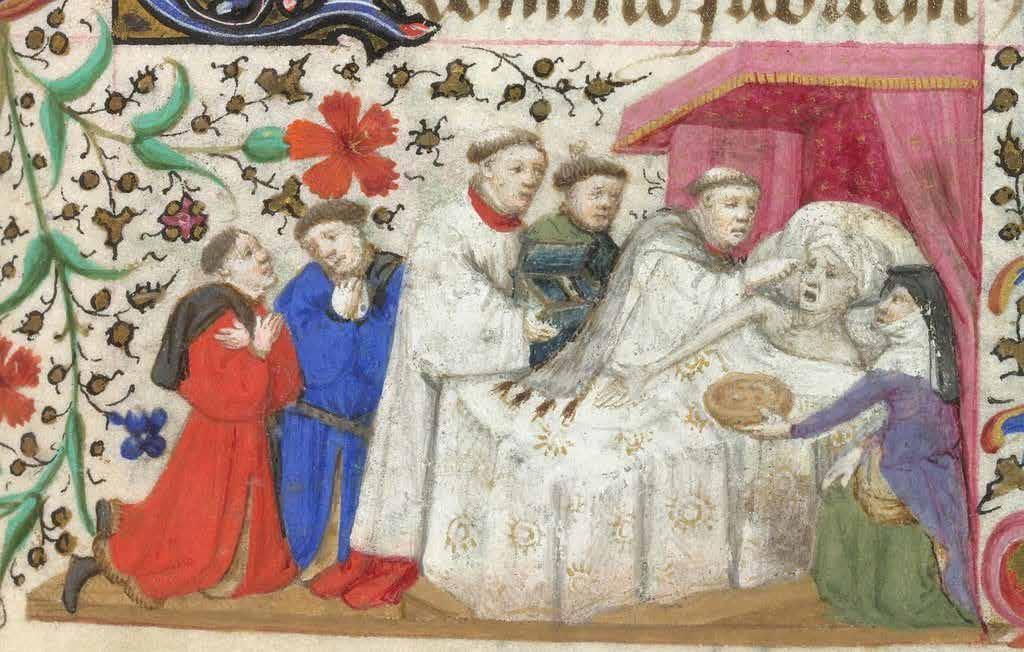
The previous edition of Pastoral Care of the Sick was for use by priests, deacons, and laity who minister to the sick, all within one ritual book. The revised Order is for use primarily by priests.
“The years of Pope Francis’ pontificate,” Msgr. Falbo explained, “as happened with many other celebrations and initiatives, constitute an exception, motivated by the desire to offer the world a clear sign of predilection for the poor and the last, bringing the attention of the bishop of Rome to places of suffering.”
Falbo told ACI Prensa, the Spanish-language sister service of EWTN News, that the approach was “a praiseworthy intention” that nevertheless resulted in “a certain privatization of the celebration of the Last Supper,” since limited space in such locations made it impossible for priests of the Diocese of Rome to take part.
With his decision, Msgr. Falbo said, Leo XIV resumes the tradition of the Church in Rome in line with the uninterrupted practice of the last century, without diminishing attention to the poor.
“There are countless occasions throughout the year,” Msgr. Falbo said, “to underscore the predilection of the Lord and of the Church for the last.”
In that sense, he said, the return to St. John Lateran is another sign of the new pope’s desire “not only to be, but to behave as bishop of Rome.”
Msgr. Falbo also pointed to the bond between Leo XIV and the Lateran basilica that became visible on May 25, when the pope took possession of the chair of the bishop of Rome—the pope’s episcopal seat—in what is considered the first Christian basilica built after the peace of Constantine in the fourth century.
That ceremony marked a fundamental step at the beginning of Leo’s pontificate, since the pope is not only successor of St. Peter and pastor of the universal Church but also bishop of the Diocese of Rome.
Msgr. Falbo recalled that the rite of washing feet “naturally has its roots in the gesture carried out by Jesus in the upper room, when he washed the feet of his apostles before the institution of the Eucharist.”
He noted that the Gospel of John is the only one to transmit the episode, accompanied by a catechesis that makes it a symbol of fraternal love and of the “new commandment,” concretizing love in reciprocal service.
For that reason, he said, “already in the early Church, the washing of the feet was considered a relevant sign for recognizing the authentic disciples of the Lord.”
Msgr. Falbo added that the rite has varied over the centuries. The Council of Toledo in 694 regarded the washing of feet performed by a bishop for his collaborators as a semi-liturgical and obligatory rite. The Ordo Romanus XII even describes a second mandatum in which, after offering lunch to 13 poor people in a hall of the papal palace, the pope washed, dried, and kissed their feet.
In the 15th century, the chronicles of Giovanni Burcardo—papal master of ceremonies from Innocent VIII to Julius II, including under Alexander VI—systematically mention the pope washing the feet of 13 poor people in one of the halls of the Apostolic Palace in the Vatican.
Msgr. Falbo also recalled that before the definitive move to the Vatican after the return from Avignon in 1378, popes lived for nearly 1,000 years near the Lateran cathedral, from the pontificate of St. Miltiades (d. 314) to Clement V (1305–1314).
Although the washing of feet is a rite proper to Holy Thursday, Msgr. Falbo noted that at least since the pontificate of Innocent I in 416, three separate Masses were celebrated that day: a morning Mass for the reconciliation of penitents; another for the blessing of the holy oils, especially the chrism; and a third evening Mass as a memorial of the Lord’s Supper.
For that reason, he said, the foot-washing was not originally joined to the Holy Thursday Mass, even though the Gospel proclaimed at the Eucharist in Coena Domini refers precisely to Jesus’ gesture.
Msgr. Falbo also pointed to the profound reform of the Sacred Triduum carried out by Pope Pius XII in 1955, which took effect the following year, with the goal of restoring greater historical fidelity in the celebrations.
Since then, he said, the practice of the bishop of Rome—conditioned by no longer residing near his cathedral—has been to divide the Triduum liturgies between St. John Lateran and St. Peter’s, reserving to the Lateran the evening Holy Thursday celebration with the foot-washing rite, after the chrism Mass celebrated in the morning at the Vatican basilica.
This story was first published by ACI Prensa, CNA’s Spanishlanguage news partner. It has been translated and adapted by CNA.
Pope
Leo XIV Baptizes 20 Infants in
Sistine Chapel
By Victoria Cardiel
NEWS & VIEWS
care no newborn can do without.
PHONE: 608.521.0385 WEBSITE: www.adoremus.org MEMBERSHIP REQUESTS & CHANGE OF ADDRESS: info@adoremus.org Continued from
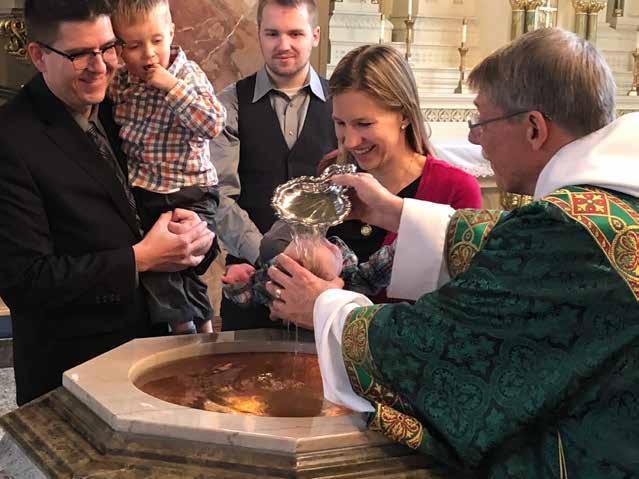
EWTN—Pope Leo XIV baptized 20 infants, the children of Vatican employees, during Mass in the Sistine Chapel on January 11 for the Feast of the Baptism of the Lord.
In his homily, the pope urged parents to see faith as essential for their children’s lives, comparing it to the basic
“When we know that something good is essential, we immediately seek it for those we love,” he said. “Who among us, in fact, would leave newborns without clothes or without nourishment, waiting for them to choose when they are grown how to dress and what to eat?”
“Dear friends, if food and clothing are necessary to live, faith is more than necessary, because with God life finds salvation,” the pope said.
Reflecting on the Gospel account of Jesus’ baptism, Pope Leo said the Lord chooses to be found where people least expect him—“the Holy One among sinners”— drawing near without keeping distance. He pointed to Jesus’ reply to John the Baptist: “Let it be so now, for it is proper for us to fulfill all righteousness,” explaining that God’s “righteousness” is his saving action, by which the Father makes humanity righteous through Christ.
The pope described Jesus’ baptism in the Jordan as a sign renewed with deeper meaning—“death and resurrection, forgiveness and communion”—and said the sacrament celebrated for the infants is rooted in God’s love.
“The children you now hold in your arms are transformed into new creatures,” Pope Leo told parents. “Just as from you, their parents, they have received life, so now they receive the meaning for living it: faith.”
Turning to the rites themselves, Pope Leo explained the meaning of baptism’s symbols: “The water of the font is the washing in the Spirit, which purifies from every sin; the white garment is the new robe that God the Father gives us for the eternal feast of his Kingdom; the candle lit from the paschal candle is the light of the risen Christ, which illumines our path.”
“I wish you to continue it with joy throughout the year that has just begun and for your whole life, certain that the Lord will always accompany your steps,” he said.
The baptism of children of Vatican employees is a tradition begun in 1981 by St. John Paul II. The first ceremonies were held in the Pauline Chapel, and since 1983 the annual celebration has taken place in the Sistine Chapel.
This story was first published by ACI Prensa, CNA’s Spanishlanguage news partner. It has been translated and adapted by CNA.
The Story Behind Pope Leo XIV’s New Papal Staff
By Almudena Martínez-Bordiú
EWTN—During the January 6 closing of the Holy Door of St. Peter’s Basilica, Pope Leo XIV used a new papal staff, or ferula, which is used by pontiffs in solemn ceremonies and represents their leadership as bishop of Rome and supreme pastor of the entire Church.
According to the Office of Liturgical Celebrations of the Holy See, popes have traditionally received this insignia after their election, when they took possession of their see in St. John Lateran Basilica.
The papal staff, used only by the pope and topped with a cross or a crucifix, is different from the bishop’s crozier— the shepherd’s staff—which ends in a curve and is used by bishops and archbishops.
It was St. Paul VI who, in 1965 on the occasion of the closing of the Second Vatican Council, used a silver ferula with a crucifix designed by the sculptor Lello Scorzelli. The pontiff began to use this cross with increasing frequency in liturgical celebrations, as his successors would later do.
St. John Paul II also chose to use the papal ferula from the beginning of his pontificate. Even in the last years of his life, the late pontiff leaned on it while convalescing in his room.
Benedict XVI used a ferula topped with a golden cross, previously used by Blessed Pius IX. Leo XIV used Benedict XVI’s ferula on May 18 during his first Mass as pope and has also used the one designed by Scorzelli for St. Paul VI.
The new papal ferula used by Pope Leo XIV is in continuity with those used by his predecessors, linking the mission of proclaiming the mystery of love expressed by
Adoremus Bulletin
Christ on the cross with its glorious manifestation in the Resurrection.
Furthermore, as the Vatican explains, its style is reminiscent of Scorzelli’s work, as it depicts Christ no longer bound by the nails of the Passion but with his glorified body in the act of ascending to the Father.
The ferula bears the motto chosen by Pope Leo XIV: “In illo uno unum” (“In the one Christ we are one”), which captures the theological dimension of his magisterium, founded on the unity and communion that makes us the Church.
The use of the papal ferula is seen as carrying a profound symbolic meaning: It expresses the specific mission of the successor of Peter to confirm his brothers in the faith and preside over the Church in charity.
This story was first published by ACI Prensa, CNA’s Spanishlanguage news partner. It has been translated and adapted by CNA.
Word on Fire to Provide New Liturgy of the Hours to Every U.S. Seminarian
By Francesca Pollio Fenton
EWTN—On the feast of St. Thomas Aquinas, January 28, Word on Fire announced that the ministry will provide a complete four-volume set of its new Liturgy of the Hours, Second Edition, to every Catholic seminarian in the United States—at no cost to the seminaries or seminarians.
Thanks to a generous donation, Word on Fire estimates that roughly 4,000 volume-sets will be distributed across the United States.
“One particular supporter, who asked to remain anonymous, stepped up in an extraordinary way with a desire to provide every U.S. seminarian with a free set,” Brandon Vogt, executive publishing director at Word on Fire, told EWTN News. “The supporter saw how this gift will shape a whole generation of future priests and bishops, to give them prayer books that they will pray with every day, multiple times, throughout their priesthood.”
The Liturgy of the Hours—also known as the Divine Office—is a set of daily prayers that priests and religious are obliged to pray and that many lay Catholics also make part of their daily prayer practice. The prayers are set according to the Church calendar and are composed of psalms, hymns, and readings from Scripture.
In November 2012, the U.S. bishops voted to revise the translation, following new English translations of the Roman Missal, Third Edition, and the 2001 Vatican document Liturgiam Authenticam. The approval process was completed in November 2024 and in May 2025 the U.S. Conference of Catholic Bishops (USCCB) sent the completed manuscript to the Holy See for confirmation. In October 2025, the USCCB chose Catholic media companies Ascension and Word on Fire to publish the Liturgy of the Hours, Second Edition.
Vogt highlighted Pope John Paul II’s remarks regarding the importance of the Liturgy of the Hours during his visit to the U.S. in 1979.
The pontiff said: “The value of the Liturgy of the Hours is enormous. Through it all the faithful, but especially the clergy and religious, fulfill a role of prime importance: Christ’s prayer goes on in the world... Through this prayer of Christ to which we give voice, our day is sanctified, our activities transformed, our actions made holy.”
The pope added that the Liturgy of the Hours should be “among the highest priorities of our day.”
“We want to help seminarians more easily and fruitfully establish that priority,” Vogt said.
Bishop Robert Barron, founder of Word on Fire, said in a press release: “This gift is an expression of gratitude and hope. While rector at Mundelein Seminary [in Illinois], I encouraged men to lean on the Liturgy of the Hours as a pillar of their priestly life. By placing a beautiful, durable edition into the hands of every seminarian, we hope to foster a lifelong fidelity to the Church’s prayer among those preparing for holy orders.”
DIRECTOR: Christopher Carstens
EDITOR: Michael Brummond
MANAGING EDITOR: Joseph O’Brien
CONTENT MANAGER: Jeremy Priest
GRAPHIC DESIGNER: Danelle Bjornson
OFFICE MANAGER: Elizabeth Gallagher
MARKETING AND FUNDRAISING: Eugene Diamond
TECHNOLOGY: Zach Tudahl
EXECUTIVE COMMITTEE The Rev. Jerry Pokorsky
Lent: A Season of Liturgical Formation
By Michael Brummond, Editor
Lent is often understood as a time of personal spiritual renewal—40 days to focus on practices that deepen one’s relationship with Christ. There is something noble, good, and true in these practices, but they only partially express the heart of the season. Lent is more than a time of individual spiritual growth. In its fullness, Lent is a liturgical season of preparation. Preparation for what? Easter, certainly—but not for Easter hams, Easter eggs, Easter brunch, or Easter baskets. Lent prepares the Church and her members for the liturgical celebration of the Paschal Mystery—the saving events of Christ’s passion, death, and resurrection.
This is, in fact, how the Church herself defines the season: “Lent is ordered to preparing for the celebration of Easter, since the Lenten liturgy prepares for celebration of the Paschal Mystery both catechumens, by the various stages of Christian Initiation, and the faithful, who recall their own Baptism and do penance” (Universal Norms for the Liturgical Year and Calendar, 27; cf. SC, 109). Lent, then, is meant to be an extended and intensive period of liturgical formation.
Historically, Lent took shape as a period of intense preparation for the sacraments of initiation. Once the catechumenate was firmly established by the fourth century, Lent became the final stage of preparation for those to be baptized at the Easter Vigil. The season was also ordered toward the reconciliation of public penitents, whose restoration to communion followed the same paschal pattern of dying and rising with Christ.
But Lenten preparation is not confined to catechumens and penitents. The Church’s own prayers make clear that these 40 days have a purpose for all the faithful. At the very start of Lent, on Ash Wednesday, the priest asks God to grant that, as the faithful “follow the Lenten observances, they may be worthy to come with minds made pure to celebrate the Paschal Mystery of your Son.” Later, on Thursday of the third week of Lent, the Collect echoes this same petition: “We implore your majesty most humbly, O Lord, that, as the feast of our salvation draws ever closer, so we may press forward all the more eagerly towards the worthy celebration of the Paschal Mystery.” In these prayers, “celebrating the Paschal Mystery” refers specifically to the Church’s participation in the Paschal Mystery made present in the liturgies of Easter. The Missal is clear that the season of Lent and its disciplines are ordered toward formation for the liturgy—purification for participation.
The Church celebrates the Paschal Mystery every Sunday, but she does so with greatest intensity at Easter. “Since Christ accomplished his work of human redemption and of the perfect glorification of God principally through his Paschal Mystery, in which by dying he has destroyed our death, and by rising restored our life, the sacred Paschal Triduum of the Passion and Resurrection of the Lord shines forth as the high point of the entire liturgical year. Therefore the preeminence that Sunday has in the week, the Solemnity of Easter has in the liturgical year” (Universal Norms for the Liturgical Year and Calendar, 18). At the beginning of Holy Week, the Palm Sunday liturgy highlights the intensely paschal character of the days ahead: “Today we gather together to herald with the whole Church the beginning of the celebration of our Lord’s Paschal Mystery, that is to say, of his Passion and Resurrection.”
If Easter is the Church’s most concentrated celebration of the Paschal Mystery, then Lent is the Church’s most intentional preparation for it. Our Lenten observances are ordered toward forming in us the dispositions needed to celebrate the Easter liturgy more worthily and fruitfully. On Tuesday of the fourth week of Lent, the Collect makes this explicit: “May the venerable exercises of holy devotion shape the hearts of your faithful, O Lord, to welcome worthily the Paschal Mystery and proclaim the praises of your salvation.” Prayer, fasting, and almsgiving are precisely these “venerable exercises,” forming the heart for authentic participation in the Church’s celebration of the Paschal Mystery.
It is worth asking, then, how our Lenten disciplines can be directed toward a more fruitful participation in the Paschal Mystery made present in the liturgy at Easter. Increased prayer, for instance, forms us in attentive listening to God, who still speaks to his people when the Scriptures are proclaimed in the liturgy. Fasting trains us in self-denial—the ability to forego our preferences—an interior disposition essential for entering into corporate worship with others. Almsgiving directs us to the corporal works of mercy and reminds us that those nourished by the Eucharistic liturgy are sent forth in active service. As Pope St. John Paul II reminds us, “To experience the joy of the Risen Lord deep within is to share fully
the love which pulses in his heart: there is no joy without love!” (Dies Domini, 69). Pope Benedict XVI echoes this point, saying, “A Eucharist which does not pass over into the concrete practice of love is intrinsically fragmented” (Deus Caritas Est, 14). Pope Pius XII described the dispositions proper to participation in the liturgy in terms that fit Lent perfectly: “all Christians should possess, as far as is humanly possible, the same dispositions as those which the divine Redeemer had when He offered Himself in sacrifice: that is to say, they should in a humble attitude of mind, pay adoration, honor, praise and thanksgiving to the supreme majesty of God. Moreover, it means that they must assume to some extent the character of a victim, that they deny themselves as the Gospel commands, that freely and of their own accord they do penance and that each detests and satisfies for his sins. It means, in a word, that we must all undergo with Christ a mystical death on the cross so that we can apply to ourselves the words of St. Paul, ‘With Christ I am nailed to the cross’” (Mediator Dei, 81). Lent concentrates what should be the shape of the whole Christian life: a continual participation in Christ’s dying and rising through conversion and penance. Thus, when the Paschal Mystery is celebrated—whether at the Easter Vigil or on any Sunday of the year—the faithful may participate in it worthily and fruitfully, and be interiorly conformed to the mystery they celebrate.
Is the Eucharist an Instrument of Evangelization?
By Father Thomas Milota
Proem
Pope St. John Paul II began calling for a New Evangelization shortly after his election as Supreme Pontiff and, indeed, the Church realized a new springtime during his pontificate. Pope Francis1 and Pope Leo XIV2 have renewed this call and, in the United States, we have seen the birth of numerous organizations with the expressed and genuine desire to assist and guide the Church in her work of evangelization. These initiatives, rightly and almost universally, highlight the importance of the Eucharist being offered in the most efficacious manner as essential to this new process of evangelization.
Evangelizing with the Eucharist?
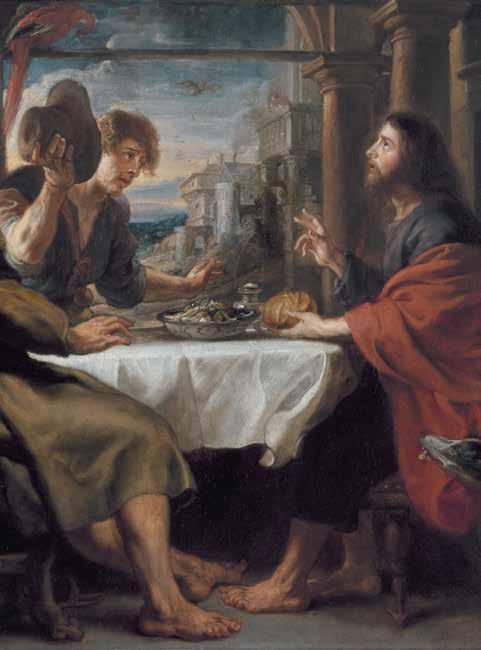
On one hand, we have numerous examples of the power of the Eucharist—Christ himself—acting as the immediate cause of conversion. André Frossard, an atheist, proclaimed, “Dieu existe, je l'ai rencontré (God exists, I have met him),” after entering the adoration chapel on the Rue D’Ulm in Paris.3 Scott Hahn recognized the Lamb of God at Mass in a chapel in Milwaukee.4 The disciples on the road to Emmaus
returned to Jerusalem after he was made known to them in the breaking of the bread. Concrete examples of the power of the Eucharist to cause interior change can easily be multiplied.
On the other hand, it would seem that the Eucharist is not the instrument of evangelization, but the final consummation for those who have been evangelized. Even the name given to the Supper at which the Eucharist was instituted indicates that it was not the first event Christ celebrated with his apostles but the Last. After the Resurrection, the Lord was not made known to the disciples on the road in the breaking of the bread until he first explained to them all that was spoken of him in the Scriptures, beginning with Moses and the prophets. The entire history of the Church—from Christ to St. Paul to ecumenical councils to contemporary pontiffs to canon law5—exhorts conversion, initiation, and a proper state of mind prior to participation in the Eucharist. Sacrosanctum Concilium states: “But in order that the liturgy may be able to produce its full effects, it is necessary that the faithful come to it with proper dispositions, that their minds should be attuned
Prayer, fasting, and almsgiving are the “venerable exercises” that form the heart for authentic participation in the Church’s celebration of the Paschal Mystery.
Pope St. John Paul II began calling for a New Evangelization shortly after his election as Supreme Pontiff and, indeed, the Church realized a new springtime during his pontificate.
Body of Christ. Even a short homily can help the sick understand the nature of the Sacrament and their participation in the salvation of the world by being united to Christ through the grace of the Holy Spirit, offering their lives in worship of the Father as Christ did. The signs and symbols of the fuller Ordinary Rite are rich for the faithful.
Some priests may be uncertain which rite to use in the revised Order. The following guide is a helpful aid for determining which rite to use in specific situations:
Sick Person not in Immediate Danger of Death
Person in Danger of Death having previously received Anointing (unless there is a more serious relapse)
Person in Immediate Danger of Death and in need of Penance, Anointing, and Viaticum
Person in Danger of Death and in need of the sacraments but unable to consume the Eucharist
Extreme Emergencies
Chapter II. The Order of Anointing of the Sick: Ordinary Rite
Chapter III. Viaticum
Chapter IV. The Order of Offering the Sacraments to a Sick Person who is in Imminent Danger of Death: Continuous Rite
Chapter IV. The Order of Offering the Sacraments to a Sick Person who is in Imminent Danger of Death: Conferring Anointing without Viaticum
Appendix IV. The Emergency Rite of Penance, Viaticum, and Anointing of the Sick
The Church does recognize circumstances where an abbreviated form of the Sacrament is necessary. In those cases, the priest has the authority to omit certain aspects of the rite: reading from Sacred Scripture (no. 72), the Litany (no. 75), and the Prayer of Thanksgiving over the Oil (no. 75A).2 Chapter IV should not be used for those who are sick but not near death, although the abbreviated version just described would be similar in structure.
“ The signs and symbols of the fuller Ordinary Rite of Anointing are rich for the faithful.”
anticipation,
Confirmation in Danger of Death
According to canon 883 of the Code of Canon Law, a priest has the faculty by law to confer Confirmation in danger of death. In the previous edition of the Pastoral Care of the Sick, the formula for Confirmation was a possible insert in the “Continuous Rite of Penance, Anointing, and Viaticum.”3 In The Order of Anointing of the Sick and of their Pastoral Care, the Church states, “If possible, Confirmation in danger of death and the Anointing of the Sick should not be conferred in a continuous rite, lest the different Sacraments be confused, since an anointing takes place in both.”4 For this reason, in the revised Order, Confirmation has its own place in Chapter V. Priests should familiarize themselves with the introduction to the chapter. The revised Order states that when circumstances make it possible, the entire rite followed in The Order of Confirmation should be celebrated. However, in cases of urgent necessity, the Church provides the ritual present in the revised Order of Anointing of the Sick and of their Pastoral Care:
• The laying of hands over the sick person (hands extended) while offering the consecratory prayer of Confirmation.
• The priest then dips the tip of his right thumb in Chrism and makes the Sign of the Cross on the forehead of the one to be confirmed, saying: “N. BE SEALED WITH THE GIFT OF THE HOLY SPIRIT.”
Notice the necessity for Sacred Chrism; the Oil of the Sick is not valid matter and would not confer the Sacrament. The Church allows other preparatory and concluding rites from The Order of Confirmation to be added to this ritual. In these cases, the priest should prepare ahead to best meet the circumstances of the individual.
In cases where Confirmation and Anointing must occur at the same time, “Confirmation is conferred immediately before the Blessing of the Oil of the Sick [or Prayer of Thanksgiving over the Oil if the oil is already blessed], omitting the laying on of hands which pertains to the Rite of Anointing.”5 Thus, the order is as follows:
• following the profession of baptismal faith and litany (OAS, 123), the laying of hands on the head of the sick person is omitted;
• the priest proceeds with extended hands and the consecratory prayer;
• the conferral of Confirmation follows;
• the priest then continues with the Blessing of the Oil of the Sick or the Prayer of Thanksgiving over the Oil to proceed to the Anointing (OAS, 126-127).
First Holy Communion in the form of Viaticum ought to also be considered when the individual has not received that Sacrament in order to complete Christian Initiation.
Confirmation thus described is distinct from the “Shorter Order of Adult Initiation to Be Used in Near Danger or at the Point of Death” found in the Appendix of the revised Order. The rite of Confirmation in Danger of Death is for those who have already been baptized but not received the Sacrament of Confirmation. For example, for a previously baptized sick child who is in danger of death, the Sacrament of Confirmation ought to be conferred. Especially when a priest may be tempted to offer the Sacrament of Anointing, the Church does not permit Anointing of the Sick to be conferred on the child prior to reaching the use of reason due to Anointing’s connection to the forgiveness of sins. Thus,
Confirmation can become a very moving pastoral aid to family members and further initiate the child.
Serious
Mental Illness
There is a subtle but pointed pastoral emphasis present in the revised Order: the availability of the Sacrament for those who suffer from mental illness is now present within the General Instruction: “this Sacred Anointing is to be conferred on the faithful who because of sickness, mental illness, or age are seriously ill.”6 Previously, the Pastoral Care of the Sick had placed this allowance for mental illness within the introduction to the first part of “Pastoral Care of the Sick” (PCS, 53). Instead of mention of mental illness being a peripheral note as in the previous ritual, the revised Order places mental illness within an integral description of the proper recipient within the General Instruction, emphasizing it as a serious infirmity. While a “prudent and probable judgment” must be made concerning the “seriousness” of the mental illness, pastors do have the opportunity to offer the Sacrament of Anointing of the Sick in cases where mental illness is severely impairing a person’s life and health. Keeping in mind “the grace of the Holy Spirit, by which the whole person is helped toward salvation, is lifted up by the faithfulness of God, and is strengthened against temptations of evil and anxiety of death,” one can understand how this Sacrament offers great aid to those plagued by serious mental illness to patiently bear their sufferings for their salvation and the welfare of the entire Mystical Body of Christ.7 With increasing awareness and understanding of mental illness, this development demonstrates the Church’s pastoral care for those suffering from this form of sickness.
Formula for Apostolic Pardon
There is great devotion among both priests and laity regarding the Apostolic Pardon. As the Manual of Indulgences states, “A priest who administers the sacraments to someone in danger of death should not fail to impart the apostolic blessing to which a plenary indulgence is attached.”8 Some may find difficulty with the change in the first option of the formula which now states, “By the authority given to me by the Apostolic See, I grant you a plenary indulgence [previously stated, ‘a full pardon’] and the remission of all your sins, in the name of the Father, and of the Son, and of the Holy Spirit.”9 This small change is a more accurate description for both the priest and the person in danger of death to recognize what is being offered to them, namely, a plenary indulgence. Often, I find both priests and laity seeking the Apostolic Pardon as an “automatic ticket” to heaven, placing its power even higher than reception of Penance and Viaticum. The Apostolic Pardon itself does not forgive sins. The sick person ought to seek the Sacrament of Penance before the Apostolic Pardon to receive this indulgence free from all attachment to sin and requesting remission of the temporal punishment incurred through their sins.10
The priest should note that there are two places in the ritual book where the Apostolic Pardon is appropriately administered: when administering Viaticum (Chapter III) and when offering the sacraments to a person in imminent danger of death (Chapter IV). It is not to be administered while offering the Ordinary Rite of Anointing of the Sick (Chapter II). This is because the Apostolic Pardon is offered to those who are approaching death in the same way in which Viaticum is offered to the dying differently than Holy Communion to the Sick.
Reinvigorated Reverence
As we have experienced in recent years, it takes time to gain knowledge of and familiarity with revised rituals. At the same time, it offers us an opportunity to reinvigorate our reverence for the sacred liturgy and examine our pastoral practice with the mind and heart of the Church. If we prayerfully and thoughtfully engage the General Instruction and the revised rites, priests will experience the greatest fruits of this sacred liturgy in which they accompany the sick in their suffering and the dying in their final surrender to the Lord.
Rev. Andrew Gutierrez, STL, is Coordinator of Pastoral Formation and Vocational Synthesis, Chair of Pastoral Theology, and Professor of Sacramental and Liturgical Theology at Notre Dame Seminary in New Orleans, LA. He is also Chaplain at Archbishop Rummel High School in Metairie, LA.
1 Pastoral Care of the Sick: Rites of Anointing and Viaticum (New Jersey: Catholic Book Publishing, 1983), 154-160 (hereafter, PCS; numbers here and in the OAS below refer to numbers within the ritual, not page numbers).
2. “The Order of Anointing of the Sick: The Ordinary Rite,” The Order of Anointing of the Sick and of their Pastoral Care (Magnificat, 2026), 67 (hereafter, OAS).
3. PCS, 246.
4. OAS, 117.
5. OAS, 117. 6. OAS, 8.
Manual of Indulgences, fourth edition (USCCB, 1999), no. 12 §1.
For a short discussion on the Apostolic Pardon, see Father Ryan Rojo’s
The new revised Order of the Anointing of the Sick and of their Pastoral Care is an important opportunity for priests to embrace “The Ordinary Rite,” which includes signs and symbols helpful for the sick while they are conscious and able to participate, to spiritually engage in the liturgy for fruitful reception, and to actively offer their suffering in sacrifice and worship to God the Father.
With great
The Order of Anointing of the Sick and of their Pastoral Care has been published and will be mandatory on Easter Sunday, April 5, 2026.
Immersed in Mystery through Rites and Words
By Father Andrew J. Summerson
Give me the tablets of your heart. I am becoming Moses for you, even if it is bold to say it. I am writing with the finger of God a new decalogue, I am writing a summary of salvation… I will baptize you, instructing you in the name of the Father and of the Son and the Holy Spirit… And you will know both by rites and by words. —Gregory Nazianzen, Oration on Baptism, 40.45
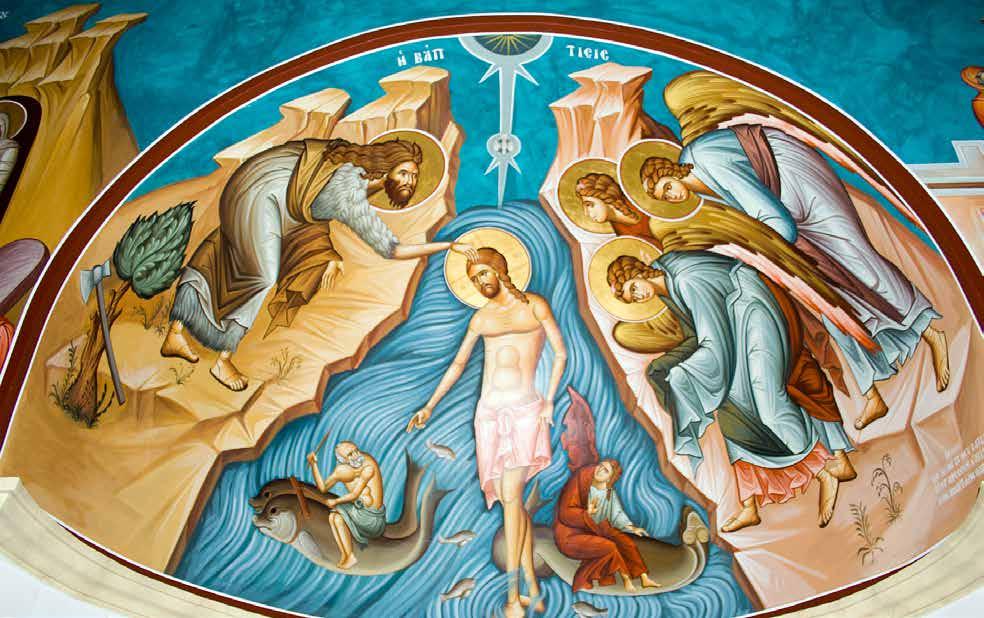
The Byzantine Church commemorates Jesus’ Baptism in the Jordan on January 6, continuing the celebration of Christ’s manifestation to the world begun at Christmas. The central hymn of the feast explains that, in the Jordan, “worship of the Trinity was revealed” (Troparion of the Feast of Theophany). For Christians, what we gain in Baptism is not a new fact to look at, but an immersion into a mystery from which we see and learn everything. Preaching on this feast, St. Gregory Nazianzen intertwines transformation with instruction Baptism chisels “a new decalogue” upon the tablets of the heart “through rites and words.” There is nothing new about Gregory’s teaching. It stems from the Lord himself, who ennobles ritual experience as the domain of instruction: “Go, therefore, and teach everyone, baptizing them in the name of the Father and of the Son and of the Holy Spirit” (Matthew 28:19). Christian life is immersion in lifelong learning from within the life of the Trinity, from within the Church, standing among the cloud of witnesses, the saints.
Gregory issues a call-and-response set of imperatives flowing from the creed, which the new Christians are to adopt. He asks that we believe that God made heaven and earth and all things visible and invisible. He further insists that we believe evil is not a being, but rather that it is parasitic on being, and incapable of anything on its own.
These first two injunctions ring strangely. They bring us into contact with a worldview about the universe, who created it, and who didn’t. The Lord of the Bible reigns, while evil is impotent to rule, let alone create. These are hard-won lessons about how the world works. Philosophers will deduce these principles on the far side of rational arguments. Some modern scientists will exclude these questions altogether as impossible for inquiry, since they can’t be levered out from the world of weights and measures through experiment. They seem like luxury beliefs belonging to the expert class.
These mysteries are revealed ones, public and in plain view. As Paul writes to Titus: “the saving grace of God has been revealed to all” (Titus 2:11). If public and plain, then how is this news mysterious? Christian mystery is not a withholding of information, the way we might hold back ingredients of a recipe so that it stays secret and our own. Christian mystery opens the door to the Father’s house in which there are “many mansions” that lie within, always unlocking new rooms and spaces (John 14:2).
Gregory is speaking here to adults, yet neophytes. It’s hardly kid stuff. A tutorial might be best deferred until the mind can manage. So much for infant baptism. Or is it? Lessons about the created order are best begun young, not because they are easily understood, but because they are painfully hard. God’s mysteries made manifest take a lifetime to unpack.
“Baptism chisels a new decalogue upon the tablets of the heart through rites and words.”
We shouldn’t deny the young the mysteries about how the world works any more than we should deny them a heart transplant. We don’t count the costs when a child’s life is on the line. It is worth cracking the sternum to carry out the surgery or crowdsourcing the funding when insurance falls short. Nor would we deny the lifetime of care required to stem complications or beat back the body’s rejection of the very thing it needs. The prophets promise us a heart of flesh, soft enough for the Lord to scratch his law upon it and his spirit to dwell inside (Ezekiel 11:19; Jeremiah 31:33). The Christian vision of the world begins with the new heart received at the birth of Baptism and it belongs to the Church to keep us healthy and childlike. It is, of course, “out of the mouths of babes and infants” that “God has fashioned perfect praise” (Psalm 8:2). Gratitude for parents, let alone praise before the Creator, is a learned habit. To be childlike entails a lifetime of dependency. Sacraments happen to us; we don’t do them to ourselves. We are bathed, we are forgiven, we are anointed, we are fed. Though Baptism delivers on the prophetic promise of a new heart, we sinners suffer from calcified intellects and misfired affects. To repair
“ We shouldn’t deny the young the mysteries about how the world works any more than we should deny them a heart transplant.”
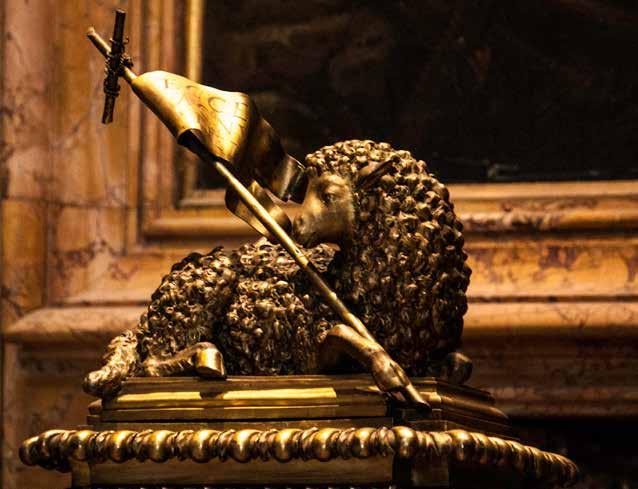
these wounds, the Church feeds our imaginations back to health with the same prescription as Gregory gave: words and ritual. At the beginning of the Gospels, Jesus submits to the hand of the Baptist and submerges his head beneath the water. The entirety of the Scriptures lends a hand to narrate what exactly is going on with this experience. John the Baptist points to Jesus with words of prophecy: “Behold the Lamb of God who takes away the sins of the world” (John 1:29; Isaiah 53:7). The Father himself rips the skies in two, hymning the Psalm, “This is my beloved Son in whom my favor rests” (Matthew 3:17; Psalm 2:7).
The Church’s liturgy collects the psalms to sing out the cosmic nature of the experience: “The Jordan turns back on its course” when it sees the word of God, “the Lord’s voice” coming to rest on the “immensity of the waters” (Psalm 113:5; 28:3, LXX). One has to stretch the imagination to conceive of a river trembling and rerouting, as it “beholds the fire of the Godhead coming down upon it and entering it in the flesh” (Great Blessing of Water, Sophronius of Jerusalem). In all the drama of the Theophany celebration, the service ends by whacking the faithful with holy water, indiscriminately and liberally, both young and old. Everyone feels like a kid again, right where the Lord wants us—so that these new hearts can be caught by and taught by his mysteries.
Father Andrew Summerson is Associate Professor of Greek Patristics at the Sheptytsky Institute of Eastern Christian Studies at the University of St. Michael’s College in Toronto, Canada. He is also Scholar in Residence at the Lumen Christi Institute and Pastor of St. Mary Byzantine Catholic Church in Whiting and St. Nicholas Byzantine Catholic Church in Munster, both in Indiana. He is the author of Divine Scripture and Human Emotion in Maximus the Confessor (Brill, 2021) and co-editor of The Pastoral Theology of the Early Church (CUA Press, 2026).
The Byzantine Church commemorates Jesus’ Baptism in the Jordan on January 6, continuing the celebration of Christ’s manifestation to the world begun at Christmas. The central hymn of the feast explains that, in the Jordan, “worship of the Trinity was revealed.”
What Rubrics Reveal of Rebirth: Six Facets of the Mystery of Baptism
By Michael Brummond
The Catechism of the Catholic Church teaches that “the meaning and grace of the sacrament of Baptism are clearly seen in the rites of its celebration. By following the gestures and words of this celebration with attentive participation, the faithful are initiated into the riches this sacrament signifies and actually brings about in each newly baptized person” (CCC, 1234). This insight invites us to attend closely not only to the great ritual moments—the blessing and pouring of water, the anointings, the white garment— but also to the quiet rubrics and subtle texts that both frame and interpret them.
Though it focuses on ritual details, what follows is not intended as a checklist for compliance. In pastoral situations, ministers must often discern how best to carry out the rite with prudence and fidelity to its meaning. Yet even when a particular direction may not be observed in a given instance, the very inclusion of these instructions and details by the Church is itself significant—in the sense of signifying something real about the nature of the sacrament being celebrated.
Beneath the rubrics’ practical function runs a deep current of meaning, revealing how Baptism immerses newly born children into Christ’s Paschal Mystery, incorporates them into the communion of the Church, and directs them toward the glory of eternal life. The six characteristics of Baptism that follow are each illustrated by details—some less well-known than others—found in the Order of Baptism of Children (OBC). In the measured precision of her rubrics, the Church makes visible what she believes God is doing in the waters of rebirth.
Immersion into Mystery
Already at the doors of the church and at the threshold of the celebration, the child is signed with the cross, the mark of the crucified and risen Lord. The shadow of the cross and the splendor of the empty tomb suffuse the whole rite. “For in Baptism nothing other than the Paschal Mystery is recalled and accomplished, because in it human beings pass from the death of sin into life. Therefore, the joy of the resurrection should shine forth in the celebration of Baptism…” (Christian Initiation, General Introduction, 6). In Baptism, the child is plunged into Christ’s death and raised with him to new life.
Time itself has been taken up into the mystery of salvation, and the preferred time for Baptism highlights its paschal dimension: “To illustrate the paschal character of Baptism, it is recommended that the Sacrament be celebrated at the Easter Vigil or on a Sunday, when the Church commemorates the Resurrection of the Lord” (OBC, Introduction, 9; cf. OBC, 32). The Sacrament does not unfold indifferently within a timeless abstraction, but within the Church’s annual or weekly immersion in the Paschal Mystery. The great prayer which blesses the baptismal water narrates a series of saving “passages”: from chaos to order in the waters of creation, from vice to virtue in the flood waters, from slavery to liberty through the Red Sea, and from the old covenant to the new in the water and blood flowing from Christ’s side. The prayer calls the Spirit down upon the water so that the font becomes the tomb-and-womb of the Church, the place of passage from death to life. The text accompanying this epiclesis explicitly asks that, by the Spirit’s power, all those buried with Christ may also rise with him. With the water thus readied, parents and godparents are led through a twofold movement—renunciation of sin (death to the old) and profession of faith (life in the Risen One)—a kind of ritualized transitus of allegiance from the tyranny of sin to the lordship of Christ. The sign of water at Baptism is multivalent, but we are reminded that baptism by immersion “more suitably signifies participation in the Death and Resurrection of Christ” (Christian Initiation, General Introduction, 22). The preference for immersion (while permitting pouring) rests on its greater paschal expressiveness—burial and rising are made all the more seeable
The very structure of the Order of Baptism of Children situates the Sacrament within the rhythm of Christ’s death and Resurrection, and our passing over from sin and death to freedom and life. The rite unfolds as a physical progression from the fallen world signified by the doors of the church, where one is elected by Christ with the sign of his cross; to hearing the word; to liberation from the dominion of evil through exorcism and anointing; to dying and rising in the water; and finally to being newly clothed and illuminated as the neophyte is led to the altar. The sequence is mystagogical, catechizing by enacting the passage from darkness to light.
“Beneath the rubrics’ practical
function runs a deep current of meaning, revealing how Baptism immerses newly born children into Christ’s Paschal Mystery, incorporates them into the communion of the Church, and directs them toward the glory of eternal life.”
Profoundly Communal
It frequently happens that the Baptism of children takes place as a private or quasi-private event. When Baptism is scheduled after Sunday Mass, before the Church welcomes and initiates its newest members into the Body of Christ, most of the Body departs—a strange irony.
At several points, however, the rite reminds us that the celebration of Baptism pertains to the whole Church and manifests the Church’s own being as a communion. At the very least, this entails gathering all those to be baptized into a single celebration: “As far as possible, there should be a common celebration of Baptism on the same day for all newborn babies. Except for a just cause, Baptism should not be celebrated twice on the same day in the same church” (Christian Initiation, General Introduction, 27).
Beyond gathering the families of those to be baptized, the rite also recommends the presence of a wider assembly, including members of the local parish who, in their persons, make present the whole People of God: “Furthermore, in the celebration of Baptism, the People of God—represented not only by godparents, parents, and relatives, but also, insofar as possible, by friends, acquaintances, neighbors, and some members of the local Church—should take an active part, in order to show their common faith and to express their shared joy with which the newly baptized are received into the Church” (Christian Initiation, General Introduction, 7, emphasis added; cf. OBC, 32, which specifies “a large number of the faithful”). The communal nature of Baptism is even further evidenced when, occasionally, it is celebrated within Mass, “so that the whole community may be able to take part in the rite…” (OBC, Introduction, 9).
Beyond the when and the who, several ritual moments likewise manifest the essentially corporate character of Baptism. In the formula for receiving the child at the door of the church, the acting subject is corporate: “The Church of God receives you with great joy” (OBC, 41). Moreover, the Church’s communion extends beyond those physically present, and even beyond the Church on earth, which is made manifest when we call on the intercession of the saints on behalf of the one to be baptized. Likewise, the profession of faith is not a solitary act—it is more than merely the confession of the parents and godparents, or even of the local community. It is the faith of the Church into which the child is baptized. “This is our faith. This is the faith of the Church. We are proud to profess
it in Christ Jesus our Lord” (OBC, 59; cf. OBC, Introduction, 4). All these rubrical and ritual details disclose Baptism’s ecclesial nature: it is never a private act but a celebration in which the whole Body of Christ rejoices to receive a new member.
Parents and Godparents
Among the few specific directives that Sacrosanctum Concilium gave regarding the revision of the rite for infant Baptism is the decree that “the roles of parents and godparents, and also their duties, should be brought out more clearly in the rite itself” (SC, 67). Even a cursory glance through the Order of Baptism of Children will confirm this: parents and godparents are continually singled out to be addressed, instructed, questioned, or to undertake ritual actions. The parents are said to “perform a true ministry when: a) they ask publicly that the child be baptized; b) they sign the child on the forehead after the celebrant; c) they renounce Satan and make the profession of faith; d) they (the mother in particular) carry the infant to the font; e) they hold the lighted candle; f) they are blessed with the formulas especially intended for mothers and fathers” (OBC, Introduction, 5).
The Church’s esteem for the role of godparents is reflected in a certain ecclesial accountability. Admission to this role presumes a basic moral and sacramental suitability, as well as full communion with the Church. Their role constitutes a recognized ecclesial function rather than a mere familial courtesy. The distinctive role of the godparent appears in greater relief when contrasted with that of a Christian witness at Baptism. Both the rite and canon law permit a nonCatholic Christian to serve as a Christian witness alongside a Catholic godparent (Christian Initiation, General Introduction, 10; CIC, can. 874). In practice, families often regard this person indiscriminately as another “godparent,” and during the celebration of Baptism it is common for the minister to address and question the Christian witness together with the Catholic godparent. Yet in the text of the rite, the Christian witness has no parallel functions or duties corresponding to those of the godparent. Indeed, the Christian witness effectively “disappears” from any further mention in the rite. Only the godparent, for instance, is asked about readiness to assist the parents in their duties (OBC, 40). This is not an anti-ecumenical slight but a demonstration of the godparent’s irreplaceable ecclesial role.
A final example highlights the central role of parents and godparents in Baptism. When the celebrant poses the questions for the renunciation of sin and the profession of faith, it is not uncommon for all those present to respond together. The rite, however, is explicit: only the parents and godparents give the response “I do” (OBC, 56–58). The rest of the community assents only at the conclusion, responding with their “Amen” (OBC, 59). The rite thus underscores the distinct vocation of parents and godparents, a responsibility that cannot be diluted into the collective nor assumed indiscriminately by others.
Power of the Word
Before water is poured, the word is proclaimed. Several details from the Order of Baptism of Children
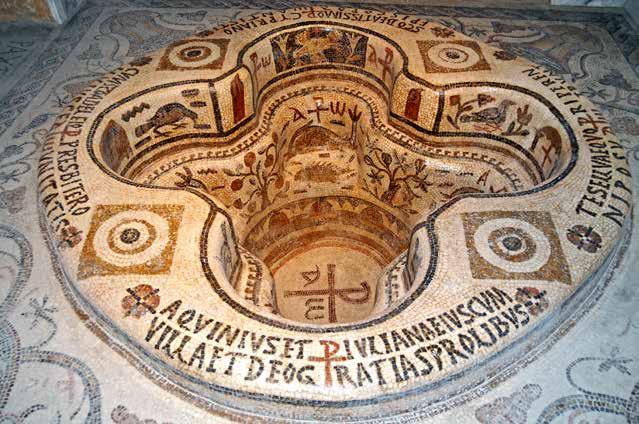
The prayer of blessing in the Order of Baptism calls the Spirit down upon the water so that the font becomes the tomb-andwomb of the Church, the place of passage from death to life. The text accompanying this epiclesis explicitly asks that, by the Spirit’s power, all those buried with Christ may also rise with him.
underline the weighty role Scripture plays in the Sacrament. First, place matters. According to the rite, the Sacred Celebration of the Word of God takes place in a distinct, dedicated location. From the doors of the church, a procession with singing moves “to the appointed place” where the Scripture will be proclaimed (OBC, 42). Afterward, a second procession leads to the font (OBC, 52). The proclamation of Scripture is not simply appended to another part of the rite; its distinct importance is signified by a distinct location, marked and framed by processional movement.
Nothing better illustrates the importance of the proclaimed Scripture at Baptism than the following often-overlooked rubric: “While the Liturgy of the Word is celebrated, it is desirable that children should be taken to a separate place. But care should be taken that the parents and godparents attend the Liturgy of the Word; the children should therefore be entrusted to the care of others” (OBC, Introduction, 14; cf. OBC, 43). There may, of course, be practical reasons for not observing this instruction. Nevertheless, it conveys something of the importance of what is taking place and how the rite envisions it unfolding. First, the very act of removing the children and later bringing them back takes time. This implies that the Celebration of the Word of God at Baptism is meant to be substantial. It is not merely an ornamental embellishment, nor is it to be treated in a cursory or perfunctory way. Why remove the children at all? Children can distract, and the rite insists that parents and godparents, especially, be fully attentive to the word proclaimed—a performative word that has the power to move those who hear it: “The sacred celebration of the Word of God is intended to stir up the faith of the parents and godparents and others present, and to encourage them to pray together for the fruits of the Sacrament, before the sacramental action” (OBC, Introduction, 17, emphasis added). Baptism thus flows from the hearing of the word, as faith comes through hearing (cf. Romans 10:17).
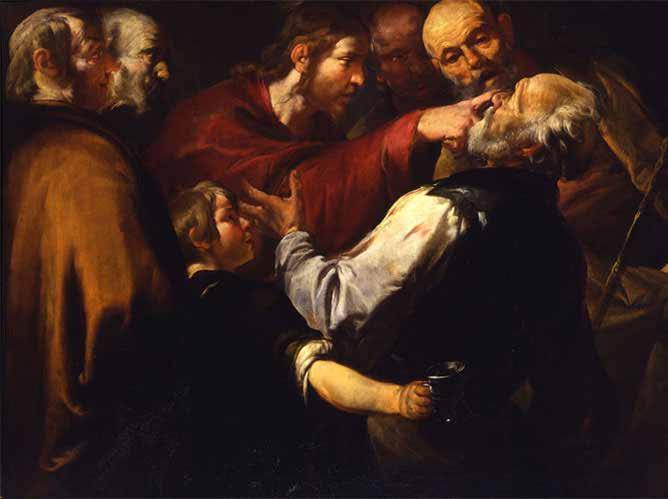
Yet what of the one who cannot yet hear or respond in faith? What of the child to be baptized? In the Ephphatha, the celebrant petitions the Lord Jesus that the child “may soon receive his word with your ears and profess the faith with your lips, to the glory and praise of God the Father” (OBC, 65). The prayer expresses the Church’s confidence that the word now proclaimed will, in time, elicit faith and confession from the one newly reborn.
Anticipating Full Initiation
Though frequently separated in time, the Sacraments of Initiation—Baptism, Confirmation, and the Eucharist—nevertheless form a unity both theologically and in the life of each Christian (cf. CCC, 1285). The Order of Baptism of Children symbolizes this unity and anticipates the sacraments of Confirmation and Eucharist through two significant ritual gestures that follow the baptismal washing. First, in the anointing after Baptism, the rubric states that, “without saying anything, the celebrant anoints each baptized child with sacred Chrism on the crown of his (her) head” (OBC, 62, emphasis added). In the Church’s sacramental life, anointings occur on various
parts of the body, such as the forehead and the palms of the hands. Why, then, the crown of the head in this case? The Catechism explains: “In the Roman liturgy the post-baptismal anointing announces a second anointing with sacred chrism to be conferred later by the bishop [in] Confirmation, which will as it were ‘confirm’ and complete the baptismal anointing” (CCC, 1242). What was begun on the crown of the head finds its completion on the forehead. In other words, the anointing with chrism at Baptism—while truly signifying participation in Christ’s offices of priest, prophet, and king—remains proleptic, pointing toward the fuller gift of the Holy Spirit imparted through the sacred chrism applied to the forehead at Confirmation. A further sacramental connection emerges when we consider where the rite of Baptism concludes. We
a merely pragmatic standpoint, all of this could be done at the font—so why the altar? “The Latin Church, which reserves admission to Holy Communion to those who have attained the age of reason, expresses the orientation of Baptism to the Eucharist by having the newly baptized child brought to the altar for the praying of the Our Father” (CCC, 1244, emphasis added; cf. OBC, Introduction, 19). The rite thus subtly teaches that Baptism’s grace is ordered toward full participation in the Eucharistic mystery, the source and summit of the Christian life. In the Order of Baptism of Children, Baptism already reaches forward: the chrism points to the Spirit’s confirming seal, while the procession to the altar directs the neophyte to the Eucharistic table, where Christian initiation finds its fulfillment.
“ The rite thus subtly teaches that Baptism’s grace is ordered toward full participation in the Eucharistic mystery, the source and summit of the Christian life.”
have already noted a first procession from the doors of the church to the place where the Celebration of the Word of God occurs, and a second to the font.
The Order of Baptism of Children specifies that, after the Explanatory Rites, “there is a procession to the altar, in which the lighted candles of the newly baptized are carried” (OBC, 67). It is there that the Lord’s Prayer is said and the parents are blessed. From
Consummation in Eternal Life
Beyond pointing toward full Christian initiation and sharing in the Eucharist, Baptism also gestures toward its ultimate fulfillment in glory. This orientation is signaled already at the doors of the church, when the parents state what they ask of God’s Church for their child. The first possible response is simply “Baptism.” The final option, however, discloses Baptism’s ultimate horizon: “Eternal Life” (OBC, 37).
This eschatological outlook of Baptism comes into fullest view in the Explanatory Rites. Through the anointing with chrism, the child is to remain a member of Christ—Priest, Prophet, and King—“unto eternal life” (OBC, 62). The white garment, sign of the Christian dignity of the newly baptized, is to be brought “unstained into eternal life” (OBC, 63). The light entrusted to parents and godparents is to be kept burning brightly until the child will “run out to meet the Lord when he comes,” joining those who “go out to meet him with all the Saints in the heavenly court” (OBC, 64). Together, these symbols draw our vision of the child’s new life toward its heavenly horizon. In them we glimpse the promise of Baptism, which will be fulfilled only when the baptized, having persevered in faith, enter the eschatological wedding feast of the Lamb.
Theology in the Rubrics
The Order of Baptism of Children teaches through its very structure and details what the Catechism declares—that the “meaning and grace of the sacrament” are revealed in the rite itself. Each rubric and gesture, however simple, has meaning and expresses the Church’s faith in what God accomplishes through the waters of rebirth. The rite situates the newly baptized within the Paschal Mystery, incorporates the child into the Mystical Body of Christ, entrusts formation to parents and godparents, grounds faith in the living word, anticipates full initiation in Confirmation and Eucharist, and points, at last, to heavenly fulfillment. To study the rubrics, then, is to contemplate the theology they embody: God’s gracious action, the Church’s rejoicing welcome, and the beginning of a journey that leads from the font to the altar—and from the altar to eternal life.
Michael Brummond is the Editor of Adoremus Bulletin.
a cursory glance through the Order of Baptism of Children will confirm that parents and godparents are continually singled out to be addressed, instructed, questioned, or to undertake ritual actions.
The promise of Baptism will be fulfilled only when the baptized, having persevered in faith, enter the eschatological wedding feast of the Lamb.
The Satanic City and the Holy Garden: Eucharistic Transformation in Biblical Symbols
By Nathan Schmiedicke
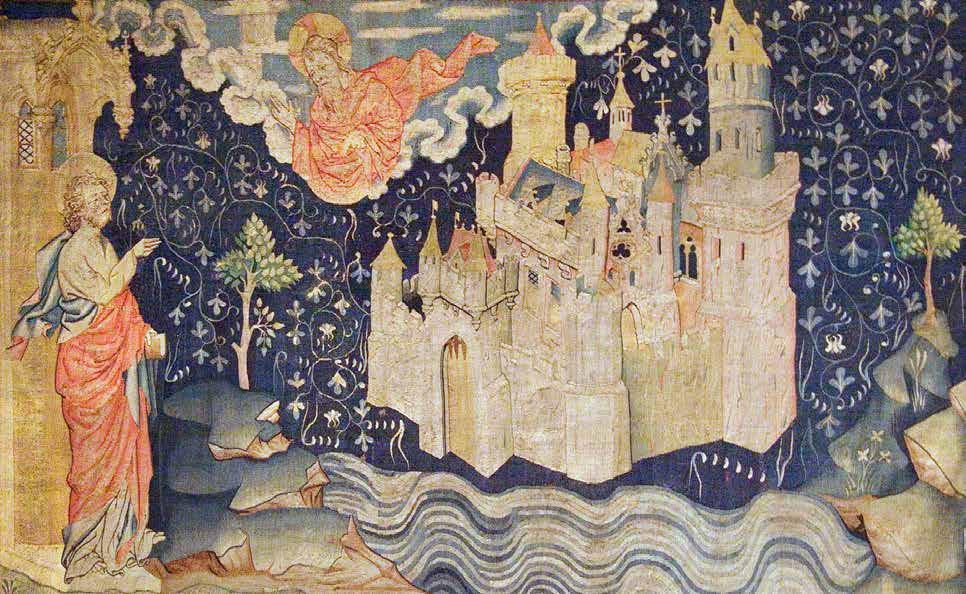
The Bible begins in the Garden of Eden but ends in the Heavenly City, the New Jerusalem. When I first realized this, it bugged me, not only because as a farmer I tend to like gardens better than cities, but also because it seemed to contradict the Bible itself, which also prefers gardens to cities.
The Lord plants the first biblical garden as an intimate sanctuary for an innocent Adam. The first biblical city, by contrast, is built as a sort of antisanctuary by a guilty Cain. Before God sends Adam out of the garden, he mercifully provides the naked vagabond with a covering that was also a sort of exoskeleton of protection—a garment of skin. When Cain sins, God likewise marks him with a protective sign as he sends him away to be a penitential wanderer on the earth.1 Cain, however, has his own ideas and builds what he thinks will be a more reliable exoskeleton—the first city.
This act both rejects the promise of God’s protection as untrustworthy and attempts to avoid the penance of wandering. Cain’s city thus incarnates everything disordered about fallen humanity: violence, fear, rejection of God’s commands, insecurity, hatred of remedial penances, and, ultimately, an attempt to make an order of things based on the work of man apart from and outside of the reality revealed by and in relation to God.
And Cain’s city is not an isolated instance. The tower of Babel embodies mankind’s attempt to recreate aspects of what was lost from the Garden: order, security, control, purpose, and glory. All of these human plans are good, but apart from, outside of, and against a right relationship to God, they become the worst sort of human poison, which is why God consistently, and mercifully, steps into the narrative of Scripture and wrecks them (Genesis 11).
Biblical cities continue to be founded or refounded on these basic anti-principles, making them the negative inversion of the Garden. Cities embody the victory of fallen mankind’s tunnel vision, or self-delusion. St. Augustine hauntingly named this psychosis as incurvatus in se. This “curving in on the
self” is symbolized, in a special way, by the city walls and gates that keep the enemy—especially God and his demands—out. Cities are founded, re-founded, and protected not only on this skewed, partial, and anti-relational view of reality, but also, as you find out later, on human sacrifice, child sacrifice, and ritual rape of the most horrific sort (Genesis 19:1-5; Exodus 1:22; Judges 19:22-28; 2 Samuel 16:22; 2 Kings 3:2627; Matthew 2:16).
“The Lord plants the first biblical garden as an intimate sanctuary for an innocent Adam. The first biblical city, by contrast, is built as a sort of anti-sanctuary by a guilty Cain.”
Reality City
But if the Bible is so critical of cities, what is it doing presenting a city—not a garden—as the joyful consummation and perfection of all things at the end (Revelation 21:2)? This question gets immediately into a problem thorny enough that St. Thomas Aquinas dealt with it in the first question of his Summa Theologiae. It is the problem of biblical symbols, why God uses them at all, and how they can mean different things and be taken in many different senses. After giving several reasons for why God would choose to make use of symbols in Scripture, St. Thomas says something remarkable about how God does so: “The author of Holy Writ is God, in whose power it is to signify His meaning, not by words only, as man also can do, but also by things themselves. So, whereas in every other science things are signified by words, this science has the property, that the things signified by the words have themselves also a signification.”2
St. Thomas first compares a human author and the divine author—they both signify by words. Then, however, he contrasts them—only God can signify by means of “things themselves (res ipsae).”
Human authors use words, metaphors, images, and symbols to signify, but God uses really-existing things. God means something by material, natural, and historical realities—gardens and cities included. At best, human authorship or interpretation makes use of, corresponds to, and reveals some aspect of the meaning of reality. Divine authorship or
“Human authors use words, metaphors, images, and symbols to signify, but God uses really-existing things. God means something by material, natural, and historical realities—gardens and cities included.”
interpretation, however, makes reality to be what it is.
There are two profound implications to this insight. The first is that those really-existing material and historical things that God uses to signify his meaning do not first exist and only later have a symbolic meaning attached to them. Rather, in the divine plan from before the beginning, the being of a thing and its signification are inherently connected. God created these really-existing things to be the way that they were so that they could reveal what he wanted to reveal by them. To take a famous biblical example, God did not first create marriage and later decide to use it as an effective, intimate, and experiential symbol of the love that was to exist between Christ and the Church (Ephesians 5:22-32). That might be the order of experience or discovery on the part of the reader, but it is not the order of being, in which each creature communicates from its inception (Romans 1:20).
The second implication is a practical one for the biblical interpreter. The work of the biblical interpreter is not only to discover the meaning of words and imagery, but also to discover the sense in which God intends the things behind the words to signify. What does dirt or water indicate? What does wheat or a grapevine mean? What does a lion or a lamb or a man or a woman communicate? What does a garden or a city tell us? The world, for the biblical scholar, is a forest of symbols3 that communicate, if we learn the language, by means of likenesses. But how can we know them?
To Serve and Protect
The Bible shows Adam in the garden acting like God who named the parts of the universe he had just created. Adam similarly names the animals and reveals thereby his preternaturally graced ability to know the natures of things, including the intimate knowledge of what that thing signified in the divine plan.
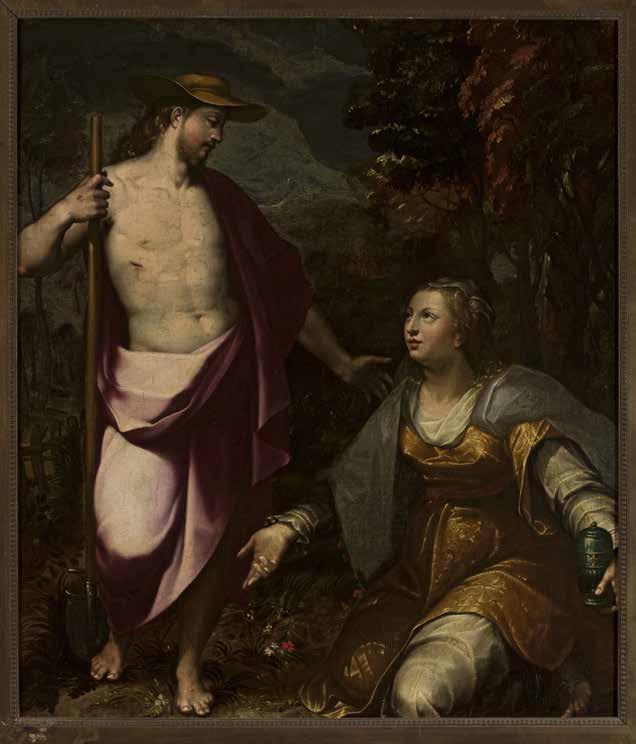
Although the preternatural gifts were lost or mitigated by original sin, the divinely-ordered signification of things is still there in things, still known to God, still available on some level to a man who pays attention to the garden of nature, and is still contained in divine revelation (Wisdom 13:19). Divine revelation, in turn, is present in Sacred Scripture and Tradition, but the essential embodiment of Scripture and Tradition, as both Scripture and Tradition agree, is the sacred liturgy.4 Liturgy, in turn, is the intimate priestly experience and action of bringing about and accomplishing the right relation of all things to the God who made all things: nature and history, cosmos and culture, garden and city. It is no accident, then, that the one biblical figure who unites and transforms garden and city is the figure of the priest in his sanctuary, doing his liturgy. The first example is Adam, who is both gardener and priest. When the Lord puts him in the garden “to serve it and guard it” (Genesis 2:15), the Hebrew verbs used there (abad and shamar) are never used in tandem elsewhere in the Bible except when describing the duties of those who had care for the tabernacle and sanctuary (Numbers 18:7). This is also why, much later in the Bible, the resurrected Jesus, the New Adam and High Priest of the new covenant, is in a garden and is mistaken for the gardener: it was not a mistake (John 19:41; 20:15).
AB/WIKIMEDIA COMMONS. WENZEL COEBERGER, CHRIST AS THE GARDENER AND MARY MAGDALENE. NATIONAL MUSEUM, WARSAW.
The one biblical figure who unites and transforms garden and city is the figure of the priest in his sanctuary, doing his liturgy. The first example is Adam, who is both gardener and priest. This is also the reason why, much later in the Bible, the resurrected Jesus, the New Adam and High Priest of the new covenant, is in a garden and is mistaken for the gardener: it was not a mistake.
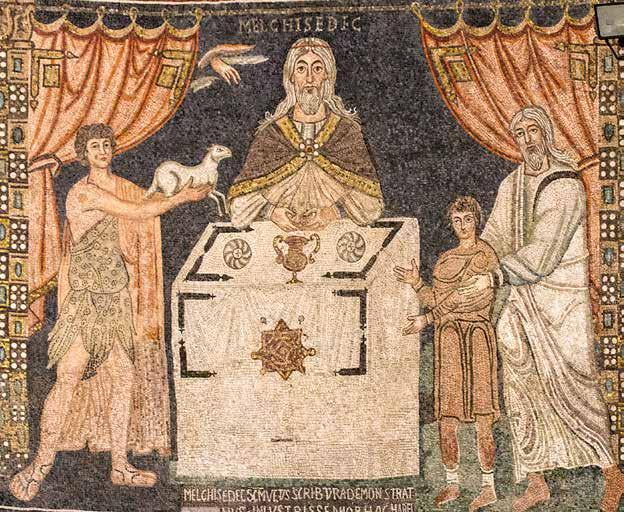
And yet, although the Man from the garden is presented as a priest, he is never named one. That designation is first given to someone from a city. We have already pointed out the dismal reputation of cities in the Bible, but there is one exception—the city first named Salem, later Jebus, and later still Jerusalem (Genesis 14:18; Joshua 18:28; Psalm 76:2). The priest, who is also a king of that city, is named Melchizedek. This mysterious figure comes out to celebrate liturgically and sacrificially the great victory of Abram over the five kings who had captured his nephew Lot and his household.
Melchizedek offers bread and wine in a sacrifice of thanksgiving to God Most High and bestows a blessing on Abram. In the New Testament era, we might be so used to hearing about bread and wine as a sacrifice that we are tone deaf to the radical transformation of biblical symbols that just occurred in this short and cryptic vignette of Abram’s victory and the priesthood of Melchizedek.
The Spoils of Toil Bread and wine, earlier in Genesis, are both introduced in the context of a curse. The Lord says to Adam, just before sending him away from Eden, that because he disobeyed, the earth from which he was taken and to which he is now going to return, is cursed. As a result of this curse, he will labor by the sweat of his brow to produce a pathetic substitute for the Edenic food he formerly enjoyed—a lousy comestible called bread (Genesis 3:19). Wine shows up similarly, functioning as the occasion of the first curse uttered by a man in the Bible, when Noah cursed his son Ham for what he did to him while he was suffering the effects of the first wine-induced drunkenness (Genesis 9:20-25).
In addition to this, bread and wine as realities and symbols unite city and garden. They are the end products of a ponderously long chain of agricultural and culinary and organizational crafting. If you do not believe me, try making bread sometime, and let me know at which step you are ready to quit: tilling, planting, tending, harvesting, drying, threshing, winnowing, grinding, mixing, or baking. Or just read The Little Red Hen. Wine is somewhat easier, but planting, trellising, pruning, gathering, crushing, fermenting, straining, and bottling is still a lot of work—and waiting. Both require tools, organization, cooperation, exchange, knowledge, and backup—in other words, a city.
But that, exactly, is the point of presenting bread and wine as really-existing things in the way that the Bible does. The work of man in cooperation with nature and God is transformed from futile to fruitful, and from fallen-human to transfigured-divine, from curse to blessing. God is interested in the best kind of victory because that is the one that best reveals the kind of God that he is. The deepest victory is not the obliteration of non-being by creation ex nihilo, nor
the uncreation of evil by force of almighty will. The deepest victory is what we might call creation ex malo in which a greater good is created out of evil, where a blessing is fashioned out of what was cursed, and where life comes out of death (Genesis 50:20).
Ultimately it is everything revealed by the meaning of the name Jesus: “The Lord Saves” (Matthew 1:21).
Ultimate Urban Garden
When the Bible concludes by showing us the city, the New Jerusalem, adorned to meet her husband, it is important to recognize not only her beauty, but her transformation. She has walls, but the gates are always open. She is founded on innocent human sacrificial blood, but it gives life. She has no temple, but is herself the holy of holies. She is a gigantic city, but within her is the garden of Eden. Nothing has been lost, but everything has been transformed (Revelation 21:1-22:5).
When Jesus from Bethlehem (“house of bread”), celebrated the first Eucharist with bread and wine, in the city of Jerusalem, according to the order of the high priesthood of Melchizedek, as the sign that
signified and accomplished the one human sacrifice that redeems all the sin of the world, and that brought forth his bride who is a city from his side5 (John 19:34; Genesis 2:21), he knew exactly what he was doing. If we contemplate our biblical symbols carefully, and liturgically, we can know it too.
Dr. Nathan Schmiedicke is Professor of Exegesis at Our Lady of Guadalupe Seminary in Denton, NE (FSSP). When not teaching there, he lives and works on his family’s farm in Michigan.
1. The Hebrew word (‘ot) is the same as the mark or sign-cross made from the blood of the Passover lamb marking the doorposts and lintels of the Israelites in Egypt (Exodus 12:13). The word can also mean “pledge of protection.”
2 Summa Theologiae I, q.1, a.10.
3. I borrow this happy phrase from the book of the same title by Abbe Claude Barthe (2023).
4 Providentissimus Deus, 15; Divino Afflante Spiritu, 26; and Dei Verbum, 21 are three examples from relatively recent Magisterium that Scripture and the liturgy share the same symbolic language, and that Scripture is best understood within the context of the Church’s tradition of liturgy.
5. The Greek word John uses for the “side” of Christ is the same word the Greek translators of Genesis had used for the “side” (pleura) of Adam.
Although Adam, the Man from the garden, is presented as a priest, he is never named one. That designation is first given to someone from a city. The priest, who is also a king of that city, is named Melchizedek.
When the Bible ends showing us the city, the New Jerusalem, adorned to meet her husband, it is important to recognize not only her beauty, but her transformation. She is a gigantic city, but within her is the garden of Eden. Nothing has been lost, but everything has been transformed.
AB/WIKIMEDIA
to accommodate the uninitiated, but the uninitiated must be advanced in the process of conversion so that the Eucharist might have its full effect.
Large numbers of Catholics are in nominal or even adversarial relationships with the Church. Practicing parishioners possess a legitimate desire to bring back into the fold family members or close friends who have drifted away from the practice of the faith. Since the friend has articulated some dissatisfaction with a supposed or authentic teaching of the Church as the cause of departure, the parishioner wishes to find a reason to convince the friend to return. Seeking to change the teaching or practice of the Church or, at least, convincing a particular priest to compromise this teaching, may seem easier than attempting to change the interior state of a friend or family member.
The well-meaning parishioner may also reverse cause and effect or not realize that a cause must be proportionate to its effect. Hence, if the effort to change the Church’s teaching or convince the pastor to compromise this teaching becomes a bridge too far, then the parishioner may seek to lure his friend back to Mass by a means that has nothing to do with the actual purpose of returning, i.e., union with Christ. The well-meaning parishioner may entice the friend with donuts, cool music, or an exciting
“Since the most noble good is that which is sought for its own sake and not for some other purpose, the Eucharist should not be used as a means to another end but is the end itself.”
and relevant homily. The temptation will be to form the liturgy in our image and likeness instead of allowing Christ in the Eucharist to form us in his image and likeness. “If I can just get her to come back, then all will be right.”
Consequently, the friend returns to the Eucharistic celebration only to find that nothing has changed. The process of attempting to change the Church rather than the person continues. Since nothing has changed at church, the parishioner, out of concern for the friend, begins to petition the pastor to have even more exciting music, an awesome homily, and, most importantly, donuts. The problem is that we find ourselves attempting to entice our friend’s return with something other than the only Person who can save him. Our end or goal becomes getting the person back to church rather than seeking the person’s conversion. The first step, in a better approach, would likely be a series of open and honest conversations to bring the fallen-away Catholic into the proper state of mind, seek Reconciliation, and, then and only then, return to the Eucharist.
Errant Methods
Continued from page 3
to their voices, and that they should cooperate with divine grace lest they receive it in vain” (SC, 11). Although it permits of exception, the Order of Christian Initiation of Adults maintains as normative the “Dismissal of the Elect.”6 We can even note that the proper ordering of the Sacraments of Initiation places the Eucharist after Baptism and Confirmation.
What is Evangelization?
Evangelization is the imperative given by Christ in the Great Commission (Matthew 28:19-20). The Catechism of the Catholic Church defines evangelization as “the proclamation of Christ and His Gospel by word and the testimony of life, in fulfillment of Christ’s command” (CCC, 905). Pope St. Paul VI taught that the Church exists to evangelize7 and that the act of evangelizing consists not only in the proclamation of the Gospel but in the interior conversion of the person and of humanity: “The purpose of evangelization is therefore precisely this interior change, and if it had to be expressed in one sentence the best way of stating it would be to say that the Church evangelizes when she seeks to convert, solely through the divine power of the message she proclaims, both the personal and collective consciences of people, the activities in which they engage, and the lives and concrete milieu which are theirs.”8
Since evangelization occurs in specific times and places, Pope St. John Paul II enumerated three milieux or contexts in which the Church carries out her mission: the context in which Christ and the Gospel are unknown; the context in which Christians fervently live out their faith; and the context in which entire groups of the baptized have lost their living faith.9 While the end or goal of evangelization remains constant, the means of evangelization must be configured to the ground into which the seed of the Gospel is planted.
Evangelization and the Eucharist
The Second Vatican Council taught that the Eucharistic sacrifice is the “fons et culmen” of the Christian life10 and Pope St. John Paul referred explicitly to the Eucharistic Jesus as the “source and summit of all evangelization.”11 We often find this phrase translated as “source and summit” of the Christian life but it is more literally translated as the “source (font) and culmination.”12
The “source (font)” is that from which not only every ecclesiastical work and ministry gains its strength and its very existence, but also from which the Church is built and grows.13 In Thomistic terms, we might call this the efficient cause or agent cause as well as the first/final cause of the Church, because the Eucharist is Christ. Although a hammer is an instrument wielded by the arm to drive a nail into a piece of wood, the Eucharist is not an instrument in this way, but the primary mover, Christ substantially present. The Eucharist builds up the Church and incorporates individuals into Christ’s body because the Eucharist is Christ himself who acts in the sacrament as the principal agent.
The Eucharist is also the “culmination” of the Christian life. The Eucharist—as Christ himself—motivates all ecclesiastical activity including evangelization, and the Eucharist is the end to which evangelization aims. Since the most noble good is that which is sought for its own sake and not for some other purpose,14 the Eucharist should not be used as a means to another end but is the end itself. Not only did Pope St. John Paul refer to the Eucharistic Jesus as the “source and summit of all evangelization,” but Pope Benedict XVI stated, “We cannot, as we have seen, talk as if the Eucharist were some kind of publicity project through which we try to win over people for Christianity.”15 In Thomistic terms, the Eucharist would be the first and final cause of evangelization. Once again, the Eucharist cannot be an instrument of evangelization but its motivation and goal.
Pastoral Implications
If we take evangelization to be the initial proclamation of the Gospel to those who do not know Christ or to facilitate the return of the baptized who have lost their living faith,16 then the Eucharist ought not to be instrumentalized as a tool of evangelization, but is the first/final cause of evangelization. The celebration of the Eucharist should not be diluted
Although the Church has made clear the value of incorporating compatible elements of a particular culture into the celebration of the Eucharist and the necessity of using contemporary technology and media in the work of evangelization,17 she cautions against the incorporation of cultural elements that stand in direct contrast to the Gospel message and communion with the universal Church.18 We must not be so naïve as to think that good intentions immunize us from incorporating evangelically incompatible ideas into our celebration of the Eucharist. For example, rather than assisting a community in understanding the purpose and meaning of the Introit chant, which is the first and preferred choice of the Roman Missal, many parishes choose an opening hymn based on the likes or dislikes of a certain segment of its congregation or, even worse, its target congregation. Many a parish worship commission and parishioner in the pew take as self-evident the principle: “If we want to attract people, we need to have exciting music!” This begs the question: Is attracting people the job of the Eucharist? Is the Eucharist not good enough or Christ not a sufficient attraction?
Radical individualism (self-will), pragmatism (loss of divine purpose), consumerism (the customer is always right), proportionalism (each person has his own good), and self-gratification (I like this, not that) ought not motivate liturgical decisions consciously or unconsciously. Each of these common philosophical errors stands in direct contrast to the Gospel message, yet they are easily embraced when we lose sight of the Eucharistic celebration as the fons et culmen of the Christian life, treating the Eucharist as an instrument and not the good sought for its own sake.
For God’s Sake
The Eucharist—Christ—as the “source and culmination” of the Christian life is the “source and culmination” of evangelization. Evangelization is the instrument. The Eucharist is the end sought for its own sake. Although evangelization must take into account the ground into which the seed of the Gospel is planted, no benefit will be received by changing our ultimate end, Christ, into someone who looks more like us and less like him. Christ must remain immutable so that, as St. Athanasius writes, we might become like him.19
Father Thomas Milota, STL, possesses a Licentiate in Dogmatic Theology with a specialization in Sacramental Theology from the Pontifical Athenaeum of Saint Anselm in Rome. He has served as pastor of five parishes in the Diocese of Joliet, IL, during his 33 years of priesthood in suburban, rural, and urban communities. He also served on the seminary faculty of the Pontifical North American College in Rome, Director of the Joliet Diocesan Life Office, Director of Joliet Seminarians, and Master of Ceremonies to the Bishop of Joliet.
1. Pope Francis, Evangelii Gaudium, (November 24, 2013), 14-18.
2. Pope Leo XIV, Dilexi te, (October 4, 2025), 7. Pope Leo XIV, Homily of Pope Leo XIV, Solemnity of Christmas, (December 25, 2025).
3. André Frossard, God Exists I Have Met Him, trans. Marjorie Villiers (Collins, 1970).
4. Scott Hahn, The Lamb’s Supper (Random House, 1999), 7-9.
5. Code of Canon Law, can. 912-916.
6. Order of Christian Initiation of Adults, 165.
7. Pope St. Paul VI, Evangelii nuntiandi, 14.
8. Evangelii nuntiandi, 18.
9. Pope St. John Paul II, Redemptoris missio, 33.
10. Lumen Gentium, 11. “Taking part in the Eucharistic sacrifice, which is the fount and apex of the whole Christian life (totius vitae christianae fontem et culmen), they offer the Divine Victim to God, and offer themselves along with It.” Pope Pius XII’s Mediator Dei uses the terms “caput ac veluti centrum”: “The mystery of the most Holy Eucharist which Christ, the High Priest instituted, and which He commands to be continually renewed in the Church by His ministers, is the culmination and center (caput ac veluti centrum), as it were, of the Christian religion.” Pope Pius XII, Mediator Dei, 66.
11. Pope St. John Paul II, “Address of the Holy Father John Paul II to Jubilee Pilgrims from the Italian Dioceses, Hungary and Various Associations,” (October 21, 2000).
12. Decrees of the Ecumenical Councils, Vol II, ed. Norman B. Tanner, SJ (Sheed and Ward, 1990), 857.
13. Joseph Ratzinger, Collected Works: Theology of the Liturgy (Ignatius Press, Kindle Edition), p. 446.
14. Nicomachean Ethics, Bk. I, Par. 2.
15. Cf. Joseph Ratzinger, Collected Works: Theology of the Liturgy (Ignatius Press, Kindle Edition), p. 462n13.
16. Redemptoris missio, 33.
17. Redemptoris missio, 33. Pope Leo XIV, “Message of the Holy Father to Participants in the Builders AI Forum,” (Collegium Maximum of Rome, November 6-7, 2025).
18. Catechism of the Catholic Church, 1206. Redemptoris missio, 54.
19. St. Athanasius, On the Incarnation of the Word, 54.
COMMONS.
PETER PAUL RUBENS, THE SUPPER AT EMMAUS, CA. 1638, MUSEO DEL PRADO.
The disciples on the road to Emmaus returned to Jerusalem after he was made known to them in the breaking of the bread.
: What are the prescribed practices for the elect on Holy Saturday before the Easter Vigil?
A: The day on which the elect are initiated into the Church ranks among the most important days of their lives. Marking this importance, the Order of Christian Initiation of Adults (OCIA) states that the elect should be reminded that they are “to keep themselves free on Holy Saturday as far as possible from their usual tasks.” They are further instructed to give this time to “prayer and recollection” and, insofar as they are able, they are to fast (OCIA, 185).
The custom of fasting before Baptism—firmly established in antiquity—can be traced back to the apostolic age and the first-century document, The Teaching of the Twelve Apostles (Didache): “Before baptism, let the baptizer fast, and the baptized, and whatever others can; but thou shalt order the baptized to fast one or two days before” (Didache, ch. 7). It is noteworthy that in the practice of the early Church, not only the elect, but also the minister and the whole congregation were instructed to fast. The custom of the faithful observing Holy Saturday as a day of fasting has been preserved in current practice: “The elect, as well as those who assist them and participate in the celebration of the Easter Vigil with them, are encouraged to keep and extend the paschal fast of Good Friday, as determined by CIC [Code of Canon Law] canon 1251, through the day of Holy Saturday until the end of the Vigil itself” (National Statutes for the Christian Initiation of Adults, norm 12).
Since the fast of the elect is associated with their exorcisms in preparation for Baptism, it should be understood primarily as penitential. This is a time for the elect to await the outpouring of grace in baptismal rebirth and the strengthening of the unction in Confirmation, as well as the heavenly food of which they are about to partake. The prescribed fast for the faithful on Holy Saturday is not merely a penitential fast; it is also anticipatory. They are to be so focused on the great mystery of the Resurrection that they “lay aside all worldly cares” (Liturgy of St. John Chrysostom).
Besides fasting, the OCIA calls for Holy Saturday to be set aside as a day for prayer. This custom can also be traced back to the early Church. The church order known as the Apostolic Tradition (which until recently scholars attributed to St. Hippolytus and early thirdcentury Roman liturgical practices) records that those to be baptized were to gather on Friday and Saturday: “On Saturday, those who are to receive baptism shall be gathered in one place at the bishop’s decision. They shall all be told to pray and to kneel. And he shall lay his hands on them and exorcise all alien spirits, that they may flee out of them and never return to them. And when he has finished exorcizing them, he shall breathe on their faces; and when he has signed their foreheads, ears, and noses, he shall raise them up. And they shall spend the whole night in vigil; they shall be read to and instructed” (Apostolic Tradition, 20).
In continuity with these ancient traditions, the OCIA sets forth three liturgical rites for the elect on the morning of Holy Saturday: 1) Recitation of the Creed, 2) “Ephphatha,” and 3) Choosing of a Christian Name (OCIA, 185).
The Recitation of the Creed: The Handing on of the Creed (traditio symboli) and the returning of the Creed (redditio symboli) can be traced back to early customs. The pilgrim Egeria attests that it was customary in fourth-century Jerusalem for catechumens to receive the Creed during Lent and then recite it to the bishop during Holy Week (Egeria’s Travels, 46). It is recorded as an authentic Roman tradition in the writings of John the Deacon (c. 500) and in the oldest sacramentary, the Gelasian Sacramentary (XXXV and XLII). The Recitation of the Creed should not take place if the Handing on of the Creed has not taken place (see OCIA, 186). This Handing on of the Creed usually occurs during the week following the First Scrutiny (see OCIA, 79, 104, 157-163).
“Ephphatha”: This rite, in which the celebrant touches the ears and lips of the elect, commanding them to be opened, was already referenced in the above citation from the Apostolic Tradition. It is also recorded in the writings of St. Ambrose (De Sacramentis I, 2). It is attested as an authentic Roman custom in the letters of John the Deacon and by its presence in the Gelasian Sacramentary (XLII).
Choosing of a Christian Name: The choosing of a Christian name is to be used at the discretion of the diocesan bishop (OCIA, 200). There are numerous examples of significant name changes in the Scriptures, such as Abram becoming Abraham, Jacob becoming Israel, and Simon becoming Peter. In each
of these cases, the new name coincides with a new mission or commissioning from God. These three optional rites are situated within a liturgical context on Holy Saturday. The OCIA says that they should take the following pattern: song, greeting, reading of the word of God, homily, celebration of the rites chosen, and concluding rites (OCIA, 187-192). The optional readings are listed in OCIA nos. 194, 197, and 201. Practically speaking, what the Church envisions for this immediate preparation for the sacraments of initiation could take the shape of a mini parish retreat for the elect. The elect should set Holy Saturday aside as a day of prayer, recollection, and fasting. It would seem commendable for parishes to arrange a retreat for the elect on this day, with periods of silent prayer, Scripture readings, teaching, and fasting. It is an ancient Roman custom, prescribed in the modern Roman Rite, for the rites of the Recitation of the Creed, “Ephphatha,” and the Choosing of a Christian Name to take place on this day before the Easter Vigil.
: How many readings are used at the Easter Vigil?
A: The answer to this question has shifted with the rubrics of the most recently promulgated Roman Missal. The older 1985 Sacramentary states: “In this vigil, the mother of all vigils, nine readings are provided, seven from the Old Testament and two from the New Testament (epistle and Gospel)” (no. 20). To this same rubric, the current 2011 Missal adds: “all of which should be read whenever this can be done, so that the character of the Vigil, which demands an extended period of time, may be observed.”
Similarly, no. 21 of the 1985 Sacramentary states that at least three Old Testament readings should be read, but, for more serious pastoral reasons, the number may be reduced to two. The current 2011 Roman Missal removes the allowance for the number to be reduced to two. It also adds that these readings should be “both from the law and the Prophets and their respective Responsorial Psalms should be sung.”
This preference for using all the readings was also stated in the 1988 Circular Letter Concerning Preparation and Celebration of Easter Feasts from the Congregation for Divine Worship: “wherever this is possible, all the readings should be read in order that the character of the Easter Vigil, which demands the time necessary, be respected at all costs” (85). The same letter highlights the reason for the emphasis on using all of the readings: “The restored Order of the Vigil has seven readings from the Old Testament chosen from the Law and the Prophets, which are generally in use according to the most ancient tradition of East and West, and two readings from the New Testament, namely, from the Apostle and from the Gospel. Thus, the Church, ‘beginning with Moses and all the Prophets,’ explains Christ’s paschal mystery” (85).
This custom stands largely in continuity with past practice. Various readings and canticles have been used during the Paschal Vigil, varying by region and time. There is striking continuity between Le Comes de Murbach (eighth-century lectionary source) and the Missale Romanum of 1570. Both sources record the following twelve readings: Genesis (Creation), Genesis (Noah), Genesis (Abraham), Exodus with canticle (the Red Sea), Isaiah (“You who are thirsty”), Baruch (Importance of Wisdom), Ezekiel (Vision of the dry bones), Isaiah with canticle (Purification of Jerusalem), Exodus (Passover), Jonah (Jonah’s Obedience and the Ninevites’ Repentance), Deuteronomy with canticle (Commissioning of Joshua), and Daniel (Fiery Furnace). The same readings appear to have been used in the liturgy recorded in the Gelasian Sacramentary, with the exception of Baruch and Jonah. The current lectionary allows only seven Old Testament readings, five of which can be clearly traced to these older sources. The first Isaiah reading (the New Zion) and the Ezekiel reading (Regeneration of the People) are not clearly derived from these ancient sources. While the number of readings and the readings themselves have changed from age to age, there has remained consistently a large number of readings, and many of them have always been used.
Whether one follows the current rubrics and the mind of the Church, or one attempts to imitate past practices while still following the current rubrics, the maximum number of Old Testament readings should normally be used so that “the character of the Vigil, which demands an extended period of time, may be observed.”
AQ Q
: What are the norms regarding Confession on Holy Saturday?
: “On this day the Church abstains strictly from the celebration of the Sacrifice of the Mass. Holy Communion may be given only in the form of Viaticum. The celebration of marriages is forbidden, as also the celebration of other sacraments, except those of Penance and the Anointing of the Sick” (Circular Letter, 75). While certain sacraments are restricted on Holy Saturday, no legislation prevents the faithful from Confession on this day.
: Which of the Pre- and PostBaptismal anointings are still part of the Easter Vigil?
A: Historically, there have been various anointings of the catechumens and elect prior to Baptism and various anointings of the neophytes after Baptism. The number of anointings in the current OCIA varies depending on the age of the elect and the pastoral circumstances.
In the Apostolic Tradition, formerly attributed to St. Hippolytus, three anointings are recorded: (1) The bishop anointed the elect after their apotaxis (renunciation of Satan) using the oil of exorcism. (2) After the threefold Baptism, the bishop anointed the neophytes with the oil of thanksgiving, saying, “I anoint you with the holy oil in the name of Jesus Christ.” The neophytes would then wipe themselves and get dressed. (3) The bishop would lay his hands on them and pour the oil of thanksgiving a second time, saying, “I anoint you with holy oil in God the Father almighty and Christ Jesus and the Holy Spirit.” Having then signed their foreheads, he would give them the kiss of peace. The first post-baptismal anointing is associated with the sacrament of Baptism, and the second is usually identified as the sacrament of Confirmation.
(1) Pre-Baptismal Anointing: During the period of the Catechumenate, the catechumens may be anointed with the oil of the catechumens by a priest or a deacon (OCIA, 98-103). The anointing of the catechumens is conferred at the end of a celebration of the Word of God and is only allowed in the periods of the Catechumenate and of Purification and Enlightenment (see OCIA, 33 and 100). The Order of Initiation of Children of a Catechetical Age prescribes the anointing with the oil of the catechumens during the Scrutinies or Penitential Rite (OCIA, 301). Because it is restricted to these periods of Christian Initiation, on Holy Saturday “it is to be omitted both in the Rites of Immediate Preparation and at the celebration of the Sacraments of Initiation” (OCIA, 33.7).
While this anointing has been moved into the Catechumenate for adults and children of catechetical age, children who are not yet of catechetical age follow a different rule: “Before the celebration of the Easter Vigil, at a convenient time and place, the rite of receiving the child is carried out. At the end of this, if appropriate, the Liturgy of the Word is omitted, and the prayer of exorcism and the anointing with the Oil of the Catechumens takes its place” (The Order of Baptism of Children [OBC], 28, 32-51, and 72-88).
(2) First Post-Baptismal Anointing: The anointing with Chrism after Baptism is omitted when Confirmation is to be conferred. Confirmation can only be delayed for adults and children of catechetical age for “special” and “very serious” reasons (see OCIA, 215-216, 228, and 319). If Confirmation is delayed, the post-baptismal anointing follows directly after Baptism (see OCIA, 228 and 319). Children who are not yet of catechetical age are anointed immediately after their Baptism (OBC, 28 and 62).
(3) Second Post-Baptismal Anointing (Confirmation): For adults and children of catechetical age, the modern Roman liturgy preserves the custom that Confirmation follows directly after Baptism (see OCIA, 215 and 233ff.). Children who are not yet of catechetical age and who are baptized at the Easter Vigil are to be confirmed later at the normal time “between the age of discretion and about sixteen years of age, within the limits determined by the diocesan bishop” (Complementary Norm to can 891, approved by the Apostolic See, August 21, 2001).
—Answered by Jacob Zepp Diocese of La Crosse, WI
New Book Offers Deep Biblical Survey of Matrimony’s Sacramental Nature
By Brandon Harvey
The Bible and Marriage: The Two Shall Become One Flesh by John S. Bergsma. Grand Rapids: Baker Academic, 2024. 248 pp. ISBN (13): 978-1540961846. $24.99. Paperback.
In The Bible and Marriage: The Two Shall Become One Flesh, John Bergsma offers a detailed overview of the biblical theology of the Sacrament of Matrimony. One might mistakenly presume that such a work traces the same ground covered by many Catholic books on marriage in Scripture, but Bergsma offers a level of depth, unity, and reflection that makes this a valuable resource for those in pastoral, homiletical, catechetical, or theological situations within the Church. It is even a benefit for those preparing for marriage, those hoping to renew their marriage, or for any Christian seeking fruitful communion with God, which, as this book explains, is a nuptial relationship. The reason for this universal appeal is found in Bergsma’s focus. He demonstrates that the theme of marriage in the Sacred Scriptures touches on the nature of God, humanity’s relationship with God, and particular insights into marriage itself.
This book is part of the series, “A Catholic Biblical Theology of the Sacraments,” with Baker Academic. The series preface states that it aims to “enliven our understanding of the sacraments” through a “theological reading of the Bible” (Bergsma, xii). Bergsma’s opening and closing pages begin with a response to John Calvin’s dismissal of the importance of matrimony which Calvin equated with the importance of agriculture, architecture, and shoemaking within Salvation History and God’s plan. In response, Bergsma argues that matrimony is central to the “plot and message of Sacred Scripture,” serving as a “central organizing theme” (1).
The Bible and Marriage consists of 12 chapters: one with an introductory theology of marriage, seven chapters focused on sections of the Old Testament, three chapters for the New Testament, and a concluding chapter that concisely reviews the witness of the biblical canon on the theme of marriage that the previous chapters developed. Each chapter is written in a way that allows it to stand on its own, referring to ideas from previous and forthcoming chapters, but it is in the development of one chapter to the next that the full depth is appreciated. Taken together, the chapters leave the reader with four recurring themes regarding Scripture’s nuptial centrality: (1) Scripture presents the covenantal relationship with God in a nuptial light. (2) God has particular teachings for marriage in both the Old and New Testaments. (3) The nuptial dimension of the covenant sheds light on the lived experience of marriage between a man and a woman. (4) Many biblical passages have details and insights that one may miss or forget with time.
Setting the Stage
The introductory chapter provides an overview of the Trinitarian and other theological themes that are foundational for the analysis in subsequent chapters. After introducing the book’s theme and importance, Bergsma notes, “The telos of reality is interpersonal communion. The ground of reality, the Trinitarian Godhead, is himself a circle of interpersonal communion” (2). From here Bergsma outlines the description of the Trinity as a gift and exchange of persons, with marriage being the closest analogy to this mystery. He also adds that there is a further analogous reflection of the Trinity in the creation of Adam and Eve. “Adam the son proceeded from God the Father, yet Eve proceeded from both God the Father and Adam the son, and thus the creation of the first groom and bride resembles the processions of the Second and Third Persons from the First” (3). Through a variety of details, Bergsma stresses that all reality, and therefore Salvation History, is nuptial and ordered to communion with the Trinity. These points are further developed in the chapters that follow. In Bergsma’s analysis of the creation of man in the image of God, he examines the linguistic parallel between the singular and plurality of God (cf. Genesis 1:26-27). Within this context, the biblical narrative immediately shifts to this same tension when describing mankind in Genesis 1:27 with “him” and “them.” This unity and plurality are part of the imago Dei. Bergsma argues that, since man is a complementarity of persons resembling and manifesting the Triune God, then the centrality of marriage is unmistakable, since it is in marriage “rather than in a single male or female person that the Imago Dei is most fully expressed” (14). It is in marriage, and in marriage alone, that two—a man and a woman— are called to be a unity that is open to a third person.
Focusing on Eve for a moment, God’s gift of Eve to Adam as helper (Genesis 2:18) indicates the sacramental vision of matrimony because the Hebrew term for “helper” is not the typical word used to describe assistance from a subordinate, but rather from God, from his grace. These early chapters, both in detailing the beauty of nuptiality and its disfigurement by sin, establish the
habit for the analysis in subsequent chapters. While the nuptial dimension of Salvation History remains the focus, this is done in a way that develops the plan for marriage found in these early chapters and seeks to remedy the impact of sin on marriage and on the covenantal relationship with God. For example, in the fall, Adam disorderedly prioritized his
marriage with Eve over obedience to God as expressed in Genesis 3:17. As a result, both covenants have been damaged, the one with Eve and the one with God. This parallel between marital fidelity and covenant fidelity toward God occurs throughout Genesis. In Adam and Eve’s descendants, there is already a growing break between humanity and God, and a further break in the original vision for marriage through bigamy, polygamy, marital infidelity, and familial division which become recurring problems throughout Genesis. These issues, even found in beloved Sunday school characters like Joseph, the son of Jacob, are eventually addressed by marital prescriptions in the Mosaic Covenant.
Tobit: An Illuminating Story
In his chapter on the historical books of the Old Testament, Bergsma’s analysis of the Book of Tobit stands apart in both length, detail, and delight. Although a lesser-known Old Testament story, it serves as an example for those preparing for marriage, for those preparing couples for marriage, or those seeking consolation or guidance in marriage.
The Book of Tobit explores not only marriage but also theodicy (the problem of a good God and the existence of evil), as individuals cope with various difficulties and sufferings amid the Assyrian exile after the fall of the Northern Kingdom. The story serves as an answer to the questions surrounding God and the problem of evil— God’s goodness is discovered through matrimony. This theme of goodness is evident even from the name of the two male protagonists: “Tobit” indicates “goodness” and his son “Tobias” expresses that the “Lord is good!” (111).
The story introduces Tobit and Sarah, in the midst of desolation and anguish. Tobit even asks the Lord to end his life (Tobit 3:1-6). In response to suffering and prayer, God sends the Archangel Raphael to bring healing and hope. He assists Tobit’s son, Tobias, who will eventually marry Sarah. After reviewing the story, Bergsma devotes nearly eight pages to analyzing how Tobit illuminates marriage. He looks at Tobias’s understanding of marriage as rooted in God’s plan. Tobias understands marriage as an institution of divine origin. Therefore, Tobias approaches marriage not from the viewpoint of lust, but of covenantal fidelity and truth (cf. Tobit 8:7). In his analysis of Tobit 8:4 in the Vulgate, Bergsma sees marriage as a reflection of union with God, a union that holds primacy over the couple’s marital union. Bergsma also examines several verses that indicate God’s action in bringing the couple together in marriage, which he briefly relates to Jesus’ emphasis on indissolubility (114).
The Book of Tobit also brings up topics such as companionship in marriage, the unity of families, openness to children, in-law relationships, and the priority of prayer for a good and holy marriage. Bergsma also examines how the marriages of the three primary couples—Tobias and Sarah, and each of their parents— indicate the range of differences in communication and harmony. Many of the topics and themes that may come up during courtship, marriage preparation, or later marital years can be found in the Book of Tobit.
Moses and Divorce
In his chapter on the Mosaic Covenant, one will find a wide range of laws and prescriptions for marriage and family life, often more protective toward women than popular opinion may grant. Bergsma even develops an implied theology of marriage within the fourth commandment—Honor your father and mother and the problem that divorce poses for it (73-74).
One of the many insightful developments from the Old Testament to the New Testament in this book is Bergsma’s analysis of the Mosaic law presumably permitting divorce in Deuteronomy 24:1-4, which Jesus takes up as well. The passage clearly does not promote divorce or establish grounds for the acceptability of divorce, but prohibits the restoration of a first marriage after a subsequent marriage. The verse stipulates action for a very specific situation, which can hardly be understood as a widespread acceptance of divorce, and which beautifully connects with Bergsma’s later chapter
on the prophets wherein God expresses in Malachi a hatred for divorce. Bergsma offers insight from Raymond Westbrook as to why such an unusual and specific scenario would be addressed. Bergsma writes: “So what Deuteronomy 24:1-4 prohibits is a husband profiting twice from the same woman; first, by keeping her dowry after divorcing her for indecency (v. 1), and second, by remarrying her in order to acquire the financial settlement she received from her subsequent husband (v. 4). Although the law tacitly acknowledges that divorce takes place and customs exist to regulate and document it, the text does not condone any of it. Indeed, verse 4 refers to her relations with her second husband as being ‘defiled,’ hardly a positive appraisal” (90). This section also contributes to Bergsma’s later commentary on the Wisdom literature where marital fidelity stands in relation to covenantal fidelity with God.
Jesus and Divorce
When the New Testament chapters begin, it is noted that Jesus’ specific teachings governing marriage focus primarily on topics of the indissolubility of marriage and the temporality of marriage, since a couple’s marriage ceases with the eschaton (198). Yet, the book still examines the early gospel scenes depicting the Holy Family and Jesus’ condemnation of all sexual activity outside of a marriage between a man and a woman. Basing the latter on Matthew 5:28 and subsequent verses, the author relates this to Old Testament examples such as Job’s words on chaste eyes (Job 31:1), and the similar comment by Solomon in Proverbs 6:25. Since this Sermon on the Mount teaching also touches on divorce (Matthew 5:31-32), this is where Jesus’ teaching concerning Deuteronomy 24:1-4 is analyzed.
After an examination of two Rabbinic schools of thought on the matter, and of the Essenes with their strict emphasis on lifelong monogamy, Jesus is presented as being closer to the Essenes as they both base their teaching on the same principle from Genesis. Standing upon several chapters of development, Bergsma’s comment that valid marriages are made in heaven and are not to be demolished on earth holds considerable weight for the reader. The book emphasizes that Jesus’ interlocutors erred by saying that Moses allowed divorce; although Moses recognizes that divorce takes place, this is not the same as permission.
Nuptial Insights
Throughout the book, Bergsma develops with care how the covenantal relationship with God is both nuptial itself, and also illuminating for understanding the purpose of marriage. In his survey of the prophet Hosea, he lists eight such insights from the God-Israel relationship: indissolubility, generous provision, attraction, affection, freedom, mutuality, exclusivity, and safety (125-127). In his chapter on Jesus as the bridegroom and the Church as the bride, he also offers an analysis of the implications for the ideals of marriage: joyfulness, provision, self-gift, love, reception, reciprocal love, exclusivity, and fidelity (192-195).
These ideals, each analyzed in detail, have a clear relationship to the specific prescriptions for a holy marriage. His analysis of Ephesians 5:21-33, as well as his treatment of 1 Corinthians, only deepens this, and even makes connections to the priesthood and sacramental participation (229-234), which correspond well to his earlier analysis of Temple imagery within the nuptial context and the relationship between liturgical worship and nuptial communion (165-167, cf. 169). While sacramental and liturgical details are found in these sections and in others, this dimension is perhaps the least developed. This doesn’t mean that Bergsma handles the matter poorly, but if a work with a liturgical focus is desired, then the reader may want to also examine a book such as Understanding the Sacraments of Vocation: A RiteBased Approach by Randy Stice as a complement.
The Bible and Marriage provides a beautifully written survey of the biblical data concerning marriage and nuptiality, highlighting the nuptial narrative found throughout Salvation History and in the covenant, and offering insight into the biblical prescriptions for marriage. While the book is generally accessible, knowledge of the narrative is sometimes presumed, such as in the chapter on the Mosaic Covenant. For this reason, Bergsma’s ideal reader has some exposure to theological study. The full depth of this excellent work will likely be appreciated by those that have studied or are studying upper-level undergraduate or graduate theology, canon law, or pastoral topics. This book is the kind of treasure trove that a homilist or catechist could benefit from, regularly returning to it for the promotion and formation of holy marriages.
Dr. Brandon Harvey is the director of undergraduate theology programs and faculty member at Catholic International University, Charles Town, WV.