Members of Dyslexia Scotland can log into our website to access magazine articles online at dyslexiascotland.org.uk/dyslexia-voicemagazine, and download a free PDF version in our online shop.
We would love to receive your feedback about this magazine.
Share your views for a chance to win prizes.
https://forms.office.com/e/3EU1KarnYA
2 Dyslexia Voice | Winter 2025
All rights reserved. Dyslexia Voice is published by Dyslexia Scotland. Articles within this magazine provide a view from the author only. Opinions may differ from professional to professional. Dyslexia Scotland may or may not share these views and opinions. Reproduction or transmission in part or whole of any item within this magazine is not permitted. While every effort has been made to ensure the accuracy of the information in this publication, the publisher accepts no responsibility for errors or omissions. Images have been reprinted with the permission of the publishers or copyright holder. We acknowledge the support and funding of the Scottish Government for this work.
Costs keep rising, but our income hasn’t - and that means our work supporting people with dyslexia in Scotland is under pressure.
Will you make your new year’s resolution to turn your talents into donations? Whether it’s baking, running, crafting, event organising or something completely differentyour hobby could help us continue our vital work.
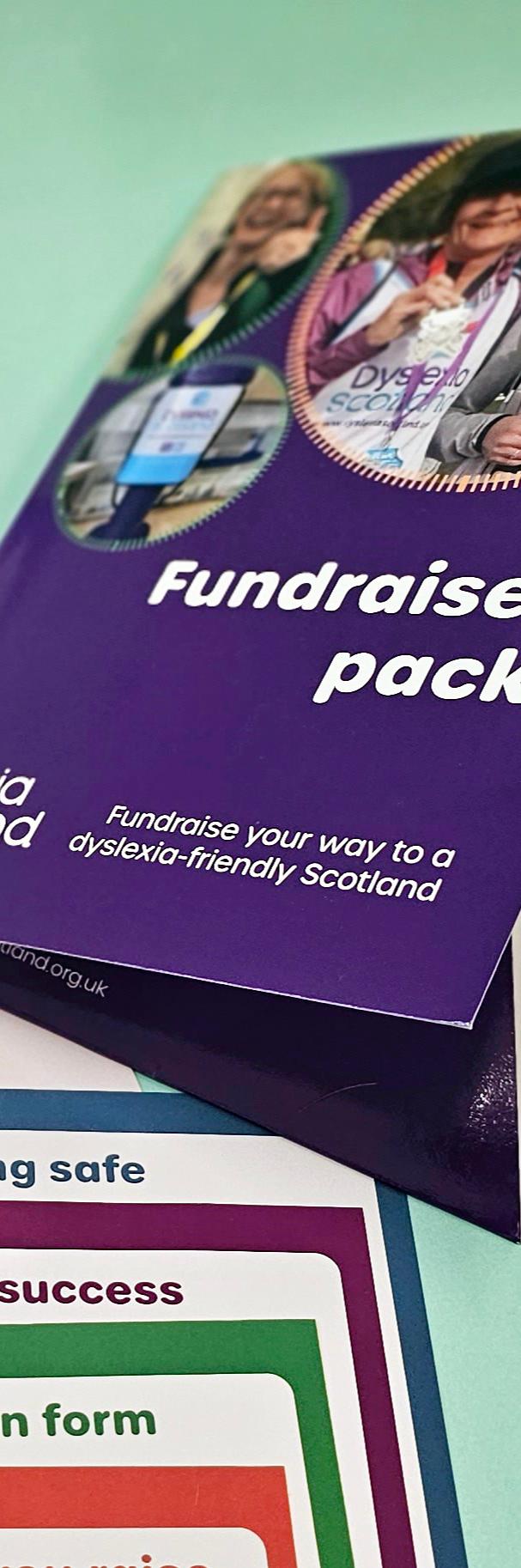
By fundraising for Dyslexia Scotland, you’ll be helping to raise awareness, provide support, and create real change for people across the country. And you won’t be doing it alone - our new fundraising pack gives you everything you need, including ideas, promotional materials and easy ways to collect donations.
Download your free fundraising pack from our website today or order a printed copy. The more you raise, the more we can do together to make a difference right here in Scotland. Get the pack
Changemakers
Changemaker channel
Global changemakers
Resources
Pat tested: AI tools
An AI directory
Taking on the world
Designing for dyslexia
Students
Learning differently with AI
Young and dyslexic
Create and share
Useful stuff
Just for fun On the cover:
The CEO's voice
Dyslexia Scotland
Chief Executive
Cathy Magee, OBE
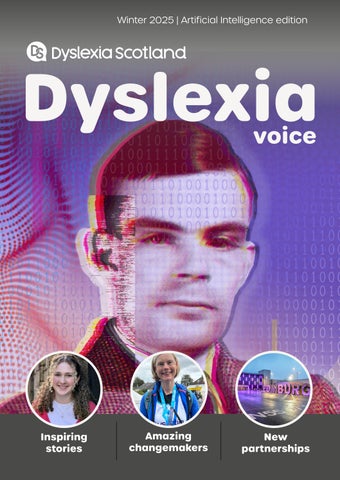
Welcome to our winter Dyslexia Voice edition on the theme of Artificial Intelligence (AI) and what it means for the dyslexia community.
The articles in this edition share fascinating perspectives about AI and offer practical suggestions in a range of different settings.
Our contributors have described what AI means to them, for example:
• Patient writing partner
• Personal assistant
• Quiet teaching assistant
On page 11, the Turing Trust’s article about their vital work reminds us of the importance of tackling the global digital divide.
In her article on page 28, Pat Meach talks about how AI can be a “patient thinking buddy, there to help, suggest and prompt you along the way”. Pat’s very practical article also outlines how to be smart and safe when using AI.
Similarly on pages 32 to 33, Ross Duncan states, “AI is not a substitute for the dyslexic mind, but a companion that helps ideas flow more freely. When used wisely, it can level the playing field for people with dyslexia in today’s digital world.”
Heather Aird’s article on page 40 about teaching with AI highlights two
Dyslexia Voice | Winter 2025
different tools to support teachers and learners with dyslexia.
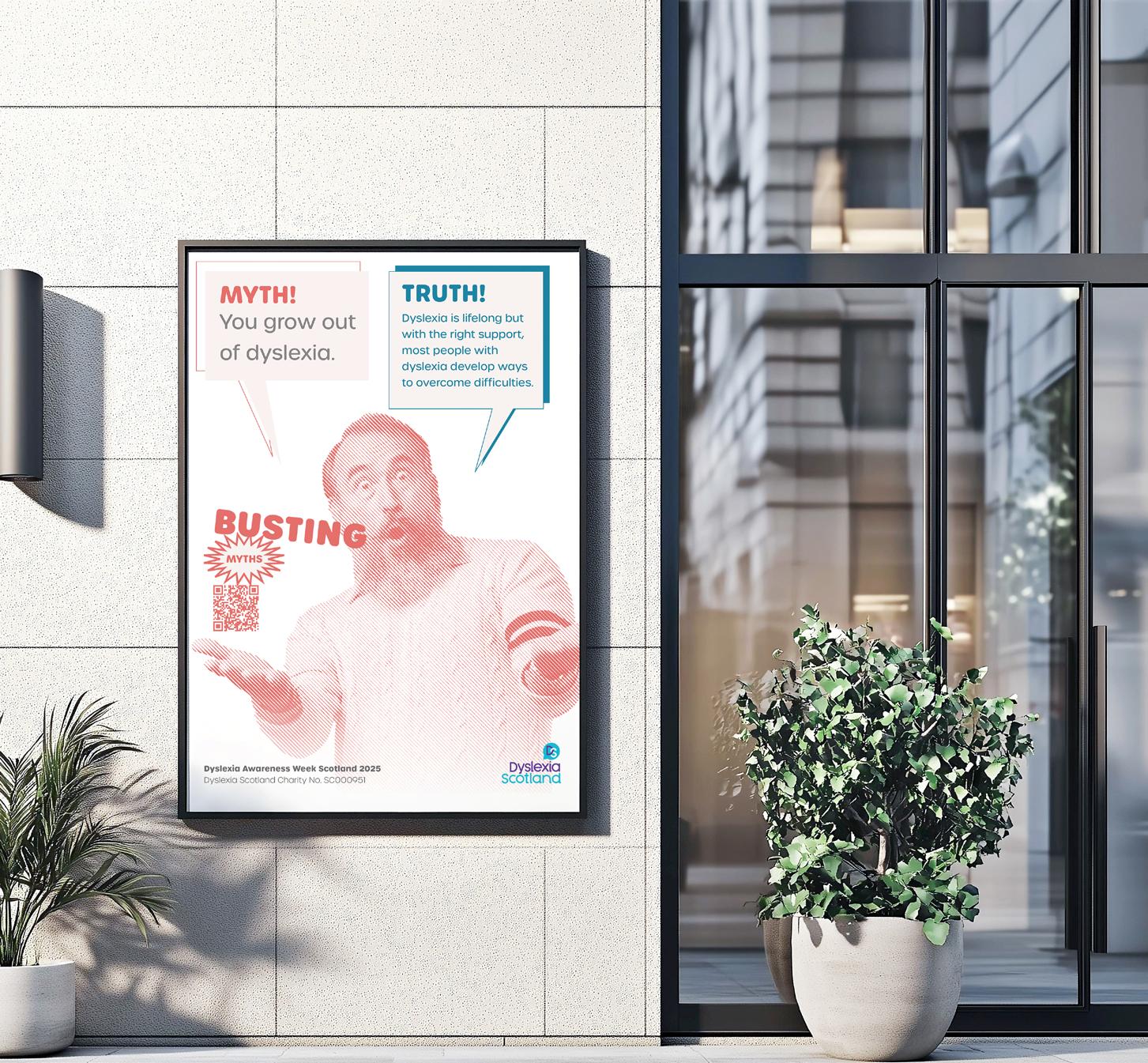
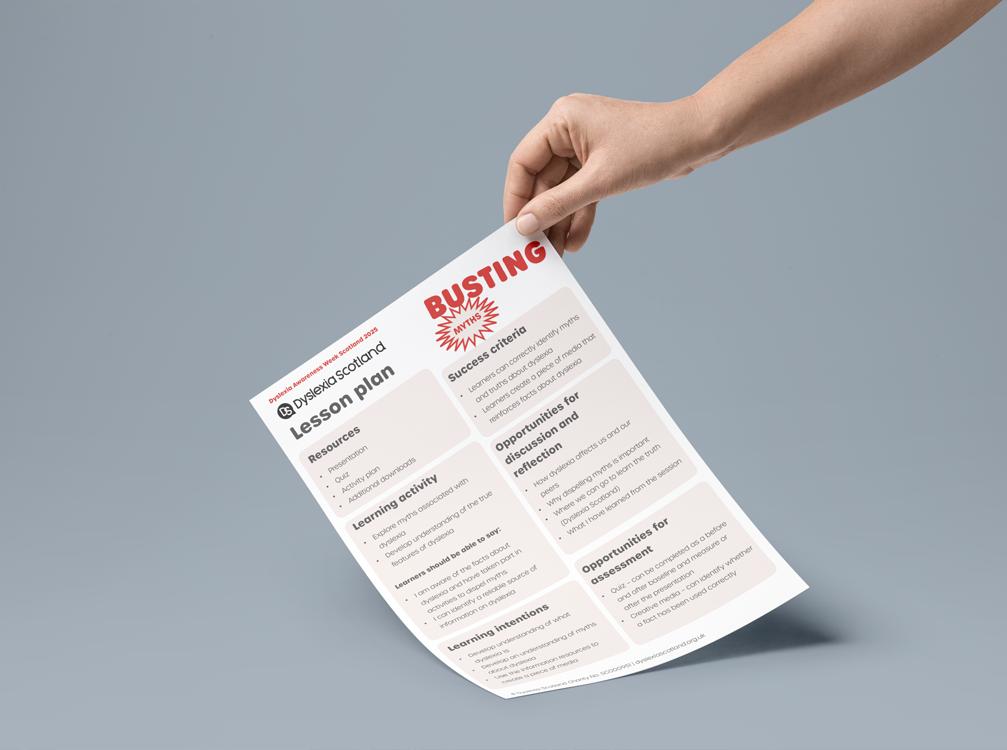
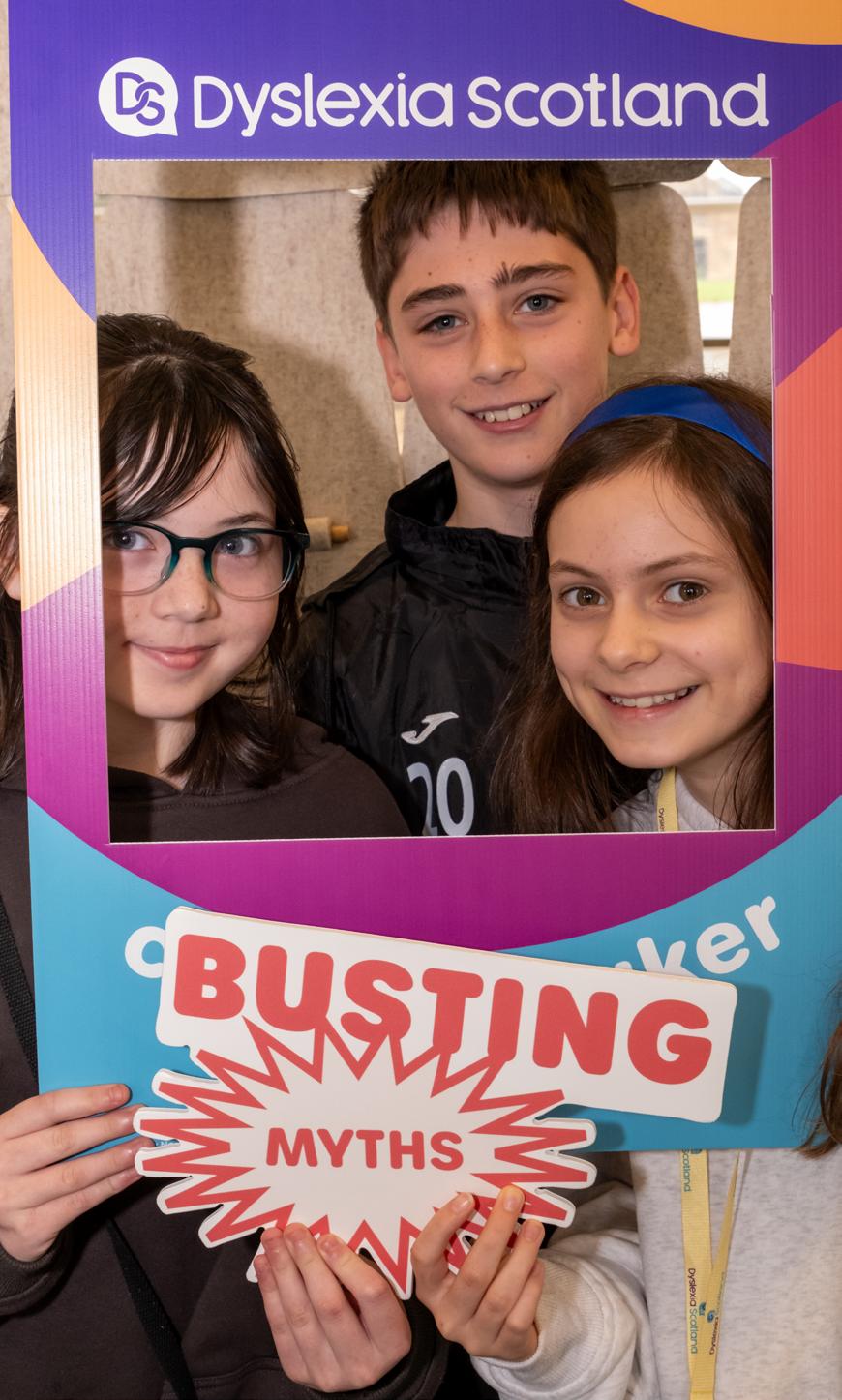
We had a busy time busting myths in Dyslexia Awareness Week 2025. Turn to pages 14 and 15 to read about our exciting campaign. You can still download the free lesson plan and posters from our website.
We loved the article on page 52 by changemakers at Bainsford primary school about how they used our materials to run a Dyslexia Awareness Week quiz in school.
As always, we were delighted by all the articles that came in for the Changemaker channel and Young and Dyslexic section. We’re really grateful to all our contributors for your articles, photos and stories.
The latest highlights of our work at Dyslexia Scotland include:
• Publication of new guidance on two topics: a good practice guide for journalists to report on dyslexia accurately and respectfully (see page 8) and guidance on dyslexia-friendly typed formats (see page 50)
• At our Members’ Day/Annual General Meeting in November, we said a fond farewell to three long-standing Directors, Mike Gibson, Andy Laverty and Karen McGill. We are truly grateful to them all for a phenomenal, combined service of nearly 30 years.
• Read our Behind the Scenes feature on page 20, where we welcome Mary Berrill, Jennie Guise and Barry Macintyre, all joining the Board.
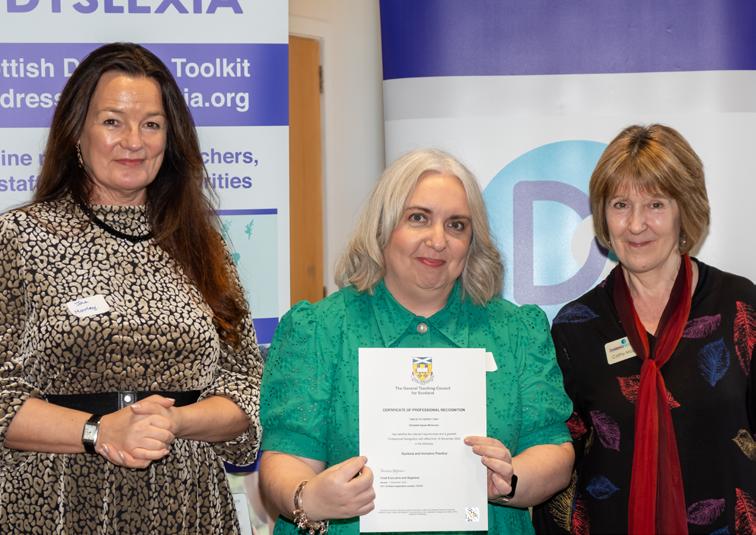
• Congratulations to 35 teachers who have received Professional Recognition Dyslexia and inclusive practice through our GTCS-accredited programme.
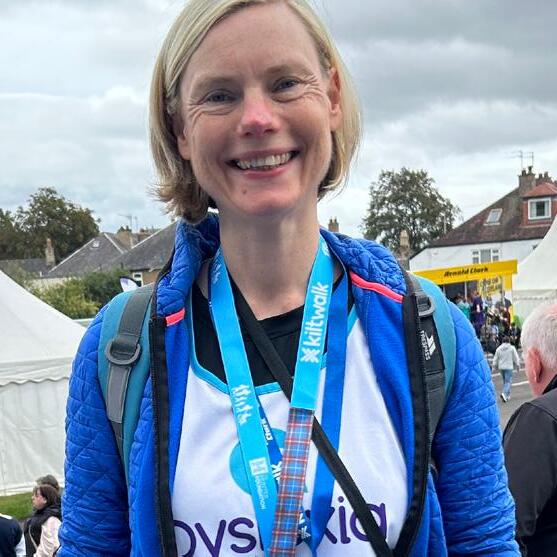
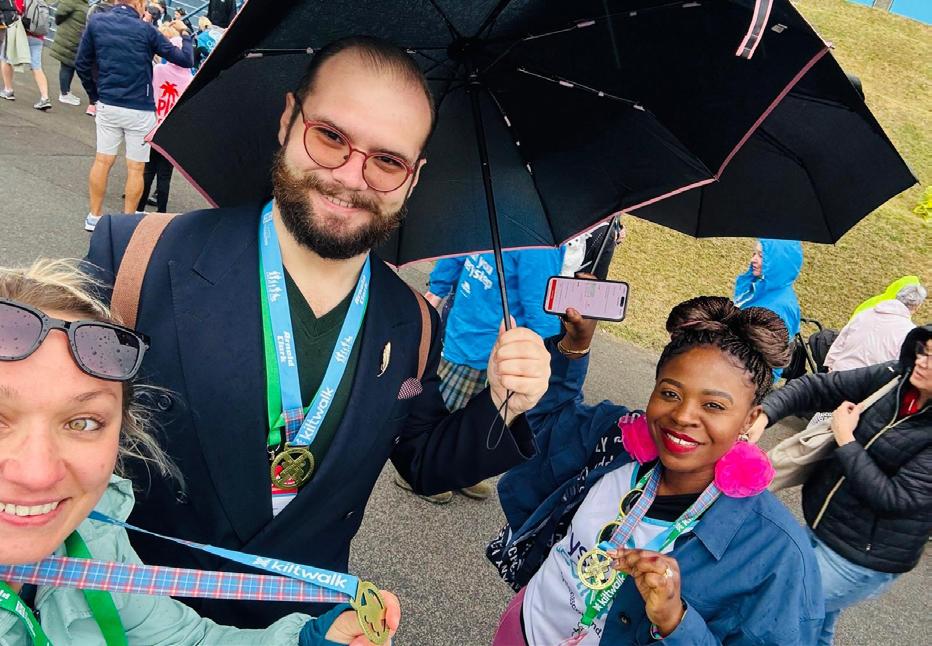
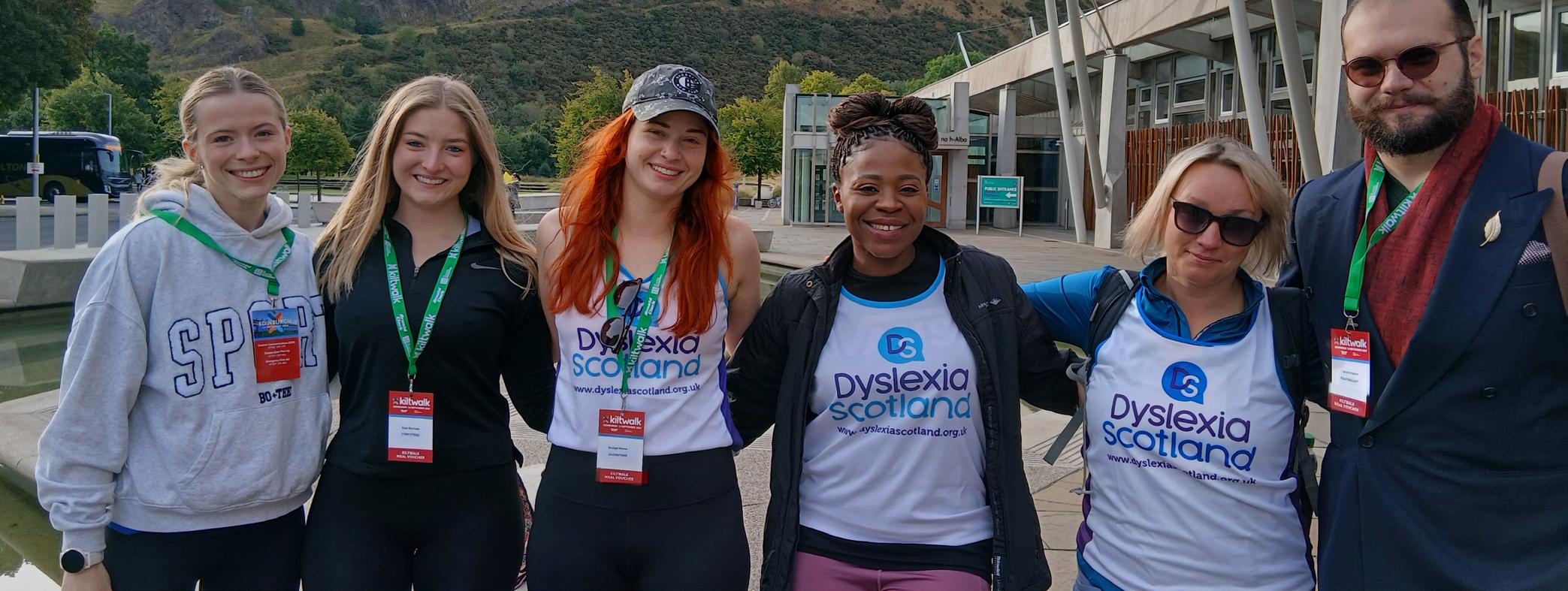
• Fundraising - a very special thanks to the team at MF Mac who raised over £1000 for Dyslexia Scotland at the Edinburgh Kiltwalk in September. If this inspires you to fundraise for Dyslexia Scotland, turn to page 3
I’d like to take this opportunity to wish you all a very merry Christmas and very best wishes for a happy, healthy and dyslexia-friendly New Year.
New guidance for media
New guidance for journalists responds to study which found that 71% of adults with dyslexia in Scotland feel the media misrepresents them.
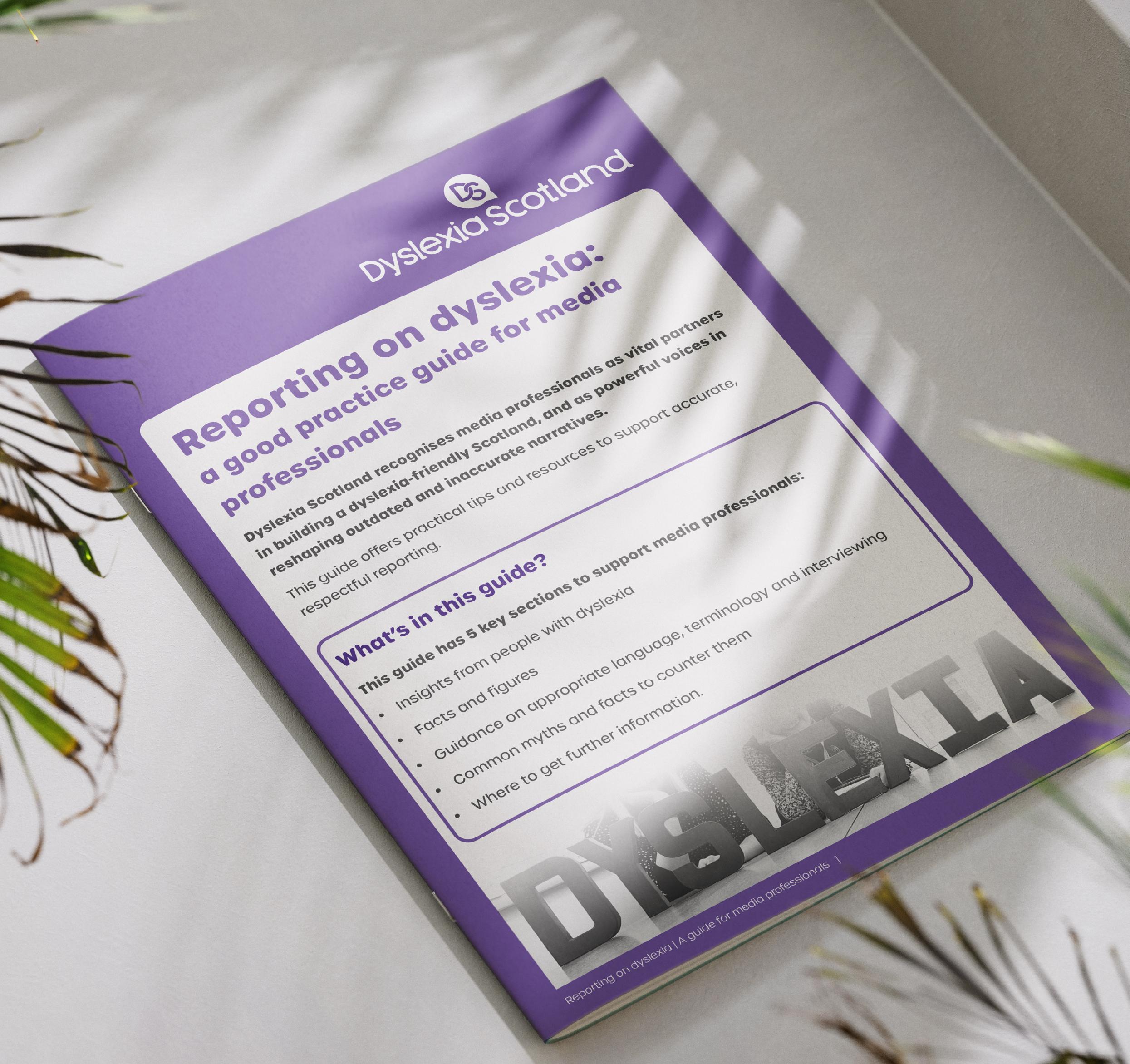
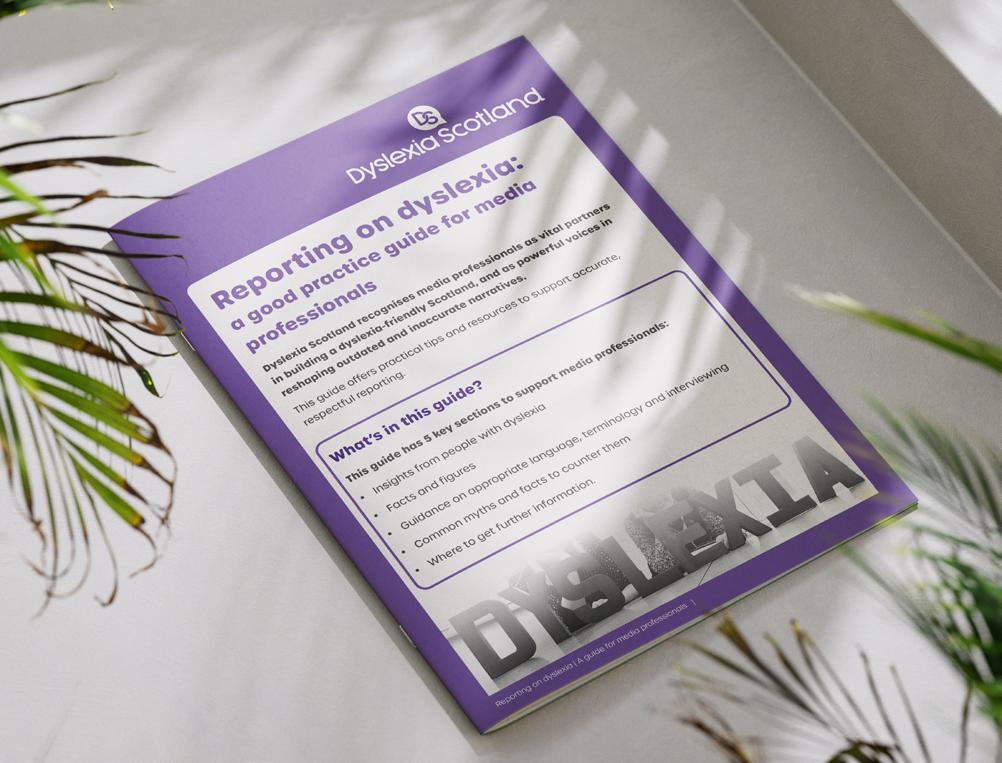
Dyslexia Scotland has published a new good practice guide designed to help journalists and other media professionals report on dyslexia accurately and respectfully.
The resource, Reporting on dyslexia: a good practice guide for media professionals, highlights the important role of the media in reshaping outdated narratives to help create a more dyslexia-friendly Scotland.
What’s in the guide?
• insights from people with dyslexia about how media portrayals affect them
• facts and figures to provide context
• guidance on appropriate language and interviewing
• common myths and the facts to counter them
• links to further information and resources.
The need for the guide emerged from a 2024 study by Dyslexia Scotland and the University of Glasgow which found that 71% of adults with dyslexia in Scotland feel the media misrepresents them by often relying on stereotypes or extreme examples.
Research participant Nick said: “People just don’t understand. Dyslexia has always been the target of cheap jokes and base stereotypes. The problem is the system. Because of time constraints, the media relies on
these stereotypes, feeding them back into society so that the same jokes and stereotypes are repeated.”
Dyslexia Scotland Lead for Creative and Digital Katie Carmichael said: “Media professionals are powerful partners in shaping how the public understands dyslexia. By using this guide, journalists can help to challenge stigma, avoid stereotypes and share accurate stories that reflect both the strengths and the challenges of people with dyslexia.”
The guide was issued to members of the Press in time for Dyslexia Awareness Week Scotland and is available to read on our website. Read the guide
The foundational element: Why digital access is key to the AI revolution
James Turing, Founder and CEO of The Turing Trust
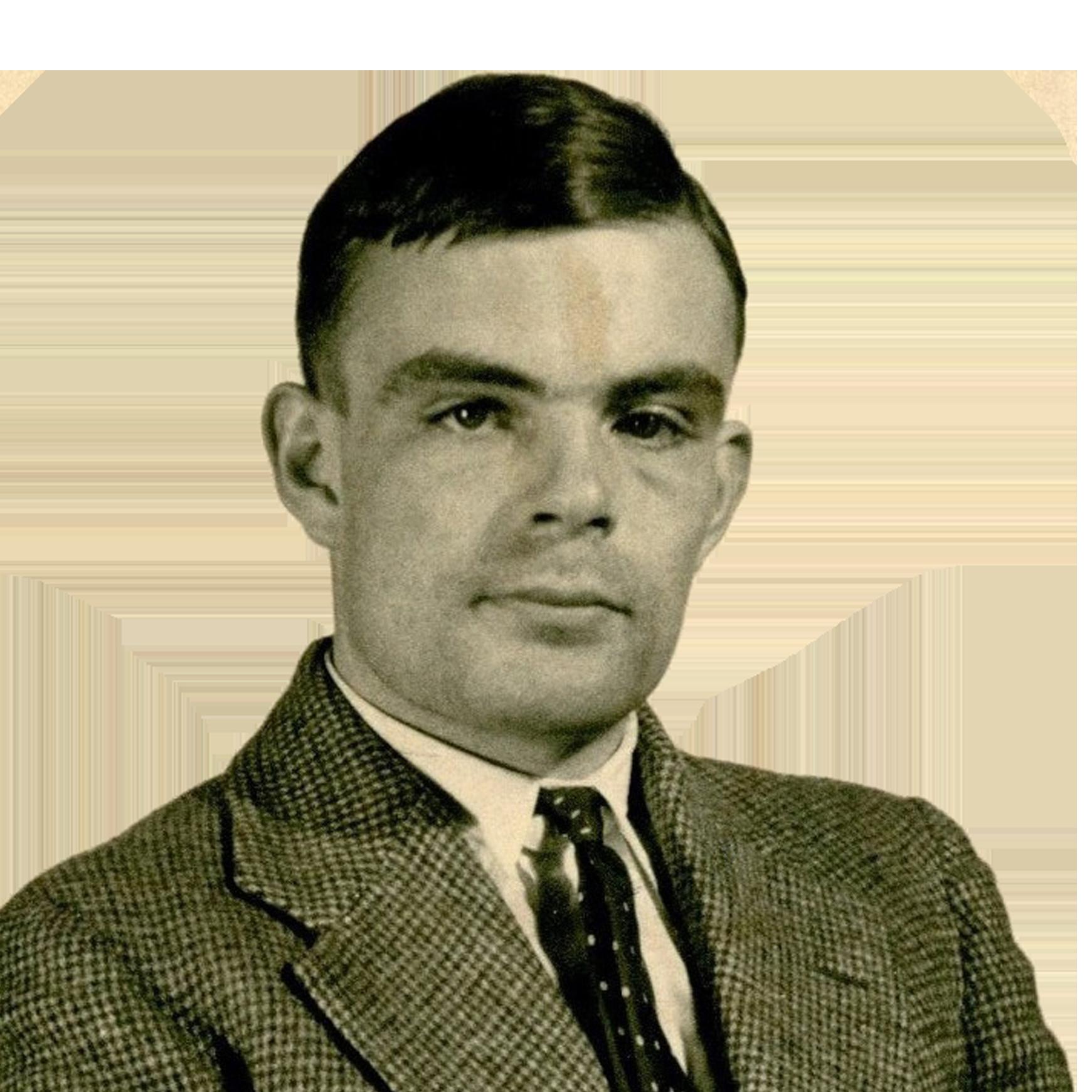
The focus of this edition, Artificial Intelligence, is inextricably linked to The Turing Trust founder’s namesake, Alan Turing
Alan Turing (1912-1954) was a brilliant mathematician, World War II codebreaker, founder of computer science, philosopher, and theoretical biologist. His pre-war work, which laid down the theoretical plan for a programmable computer, and his post-war involvement in the design and programming of the world’s earliest computing machines solidified his status as the father of modern computing. Indeed he is often regarded as having founded the discipline of artificial intelligence itself.
Alan once stated: “We can only see a short distance ahead, but we can see plenty there that needs to be done.”
We can only see a short distance ahead, but we can see plenty there that needs to be done. ”
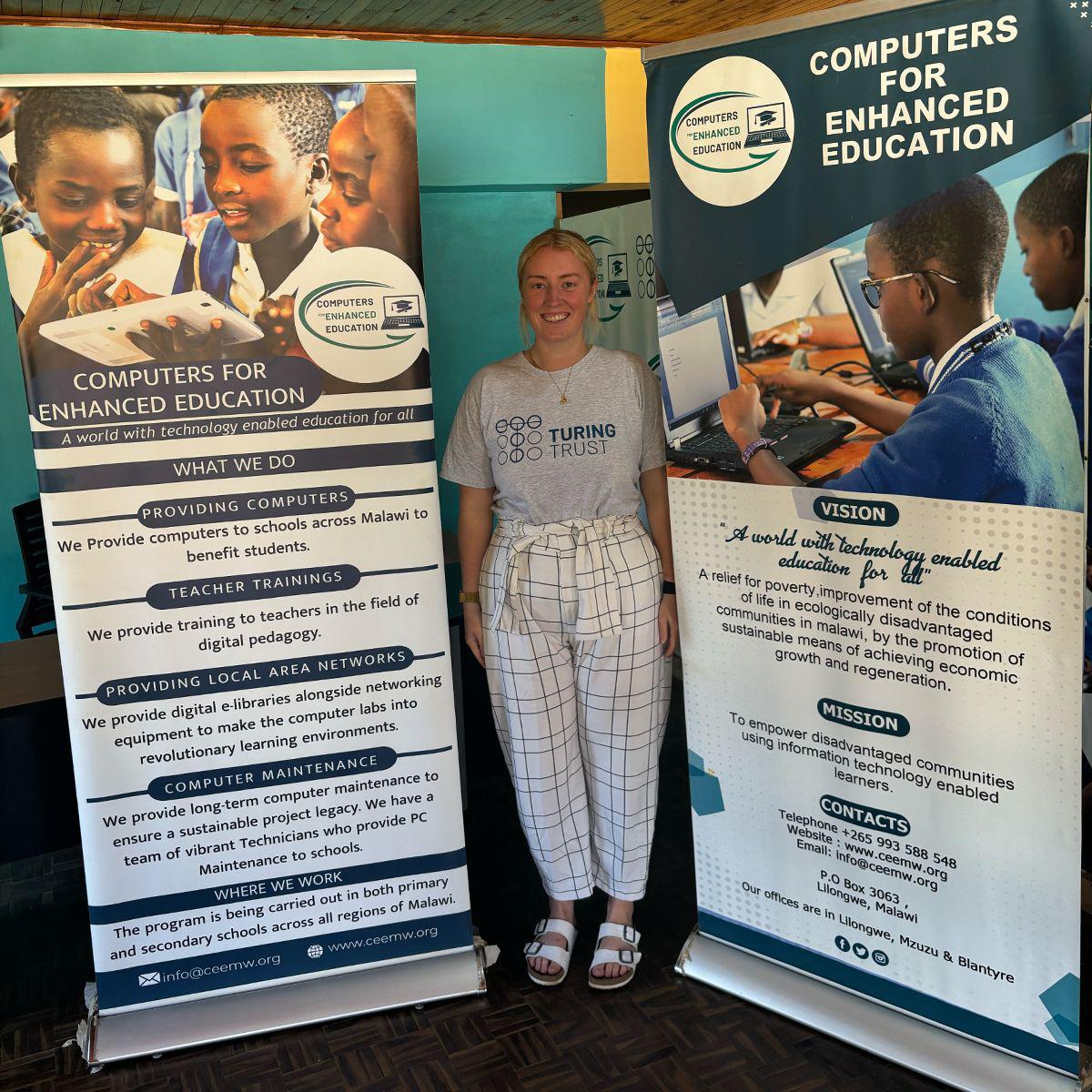
At The Turing Trust, our vision is a world with technology-enabled education for all. We strive to continue Alan Turing’s forward-looking approach by tackling one of the most pressing equity issues of our age: the global digital divide. Whilst AI has immense potential to create a more inclusive world, the current reality is that millions of children remain excluded, both in the UK and globally, lacking access to the computers that form the very gateway to digital literacy and AI-powered education.
From e-waste to empowerment
The Turing Trust collects, securely processes and redeploys unwanted IT equipment from organisations across the UK. This redundant technology, which would otherwise be prematurely recycled, is instead given a powerful second life, loaded with essential educational software, and deployed to our beneficiaries in the UK and globally. In 2024 alone, thanks to the generosity of our donors, The Turing Trust:
• supported over 303,000 students globally with access to critical IT skills
• diverted 100 tonnes of IT equipment from waste
• generated carbon savings equivalent to planting over 4,800 trees.
Crucially, our impact goes far beyond simple device distribution. Our monitoring and evaluation work shows that students who gain access to these computers are 20% more likely to gain a university place. Furthermore, we know that students with digital skills can expect to see their prospective income increase by an average of 39%. ►
Far left: Alan Turing
Left: Recipients of technology
The Turing Trusts diverts from landfill.
Technology and inclusivity
Technology is constantly evolving, with artificial intelligence promising immense positive change across the world. The rich world is often focused on the images AI paints for the future - from self-driving cars to complex medical diagnostics - but we think it is vital to consider how many schools globally lack access to even a basic computer? This stark contrast highlights the urgent necessity of access to ensure a global AI revolution.
The Turing Trust provides this foundational access. By supplying quality, refurbished IT equipment, we ensure students have a reliable, functioning platform to learn IT and develop their digital skills. We deliver the necessary access point for inclusive education, bridging the divide between tomorrow’s digital promise and today’s reality. AI may be the future of learning, and for us repurposed IT equipment is a vital stepping stone. We must ensure every young person is equipped to participate in the digital world. To learn more about our work, find out how to donate old computers, or explore volunteering opportunities, please visit our website. ■
Left: Stephanie from The Turing Trust on a visit to Malawi. TuringTrust.co.uk
How Scotland busted dyslexia myths
This year’s Dyslexia Awareness Week Scotland focused on Busting Myths – and people across Scotland joined in to learn the facts about dyslexia.
Dyslexia Awareness Week
2025 in numbers
Over 42,000 blue ribbons were worn to show support
Our social media posts appeared 65,188 times in users’ feeds and reached 33,904 people
154 new followers joined our online community.
We also saw a welcome rise in new memberships throughout September. ►
Quizzing the public
Our quiz gave us a good insight into how well the public were learning the facts we shared. There were 867 entries and an average score of 83% correct. But only 28% got every answer right, showing that Scotland still has quite a way to go to understanding dyslexia.
New resources released
Our new resources released during the campaign proved popular too, with over 1,200 downloads of lesson plans and posters. In addition to these, we published a new dyslexia-friendly typed formats guide, with feedback describing it as “clearly presented”, “easy to use” and “empowering”. Our new guide for journalists also reached newsrooms across the UK – a great step towards more accurate and inclusive reporting.
Clockwise from left: a poster; the lesson plan; the new guide for journalists.
Lots of other organisations championed the campaign, sharing posts daily with their followers, helping to extend our reach. Independent Living Fund Scotland posted, “We’re seriously learning a lot about dyslexia this week. Things we thought we knew as fact are, in fact, myths! Great job, Dyslexia Scotland.”
“A brilliant campaign. There needs to be far more awareness of all forms of neurodiversity.”
Human impacts
Events such as DyslexiFest and Dyslexia and the Classroom helped parents, educators and young people connect and learn from lived experience. One teacher said, “It really helped me to understand what reading is like for someone with dyslexia.” And one of our Young Ambassadors even received a Pupil Leadership badge at school after recording voiceovers for our campaign animations – a fantastic unplanned outcome that perfectly illustrates the spirit of the week.
“We’re seriously learning a lot about dyslexia this week. Things we thought we knew as fact are, in fact, myths! Great job, Dyslexia Scotland.”
The week culminated in a DyslexiFest event in Stirling
Thank you to everyone who helped make Dyslexia Awareness Week 2025 such a success. Dyslexia Scotland raises awareness all year round, so stay involved. ■
Doctor doctor, I think
I’m dyslexic
Our Dyslexia Awareness Week quiz proved to us that false beliefs about dyslexia in Scotland are no joke
Sometimes we feel that we harp on a bit when we remind people that we don’t talk about ‘diagnosing’ dyslexia because it’s not a medical condition .
Dyslexia is a language-based learning difference and can mean that people have difficulties with:
• working memory
• processing speed
• phonological awareness.
Yet our recent Dyslexia Awareness Week campaign on busting myths showed that we’re right to keep repeating the message - nearly 40% of respondents to our myth-busting quiz thought that a doctor can tell you if you’re dyslexic. Spoiler alert: they can’t.
Dyslexia is usually identified in schools by teachers with specialist knowledge of dyslexia and is a holistic process, meaning that it can take time .
In Scotland, education is needs-led, which means that children and young people don’t need an identification, or ‘label’, of dyslexia to get the support they need. However, knowing that there is a name for the difficulties they experience can be helpful for lots of children and young people.
Adults often need an identification of dyslexia to ask for things like reasonable adjustments in the workplace, but the cost of a private assessment for adults can be a huge barrier to this. Our 2024 report, Towards a Dyslexia-Friendly Scotland?, reinforced this stark reality and
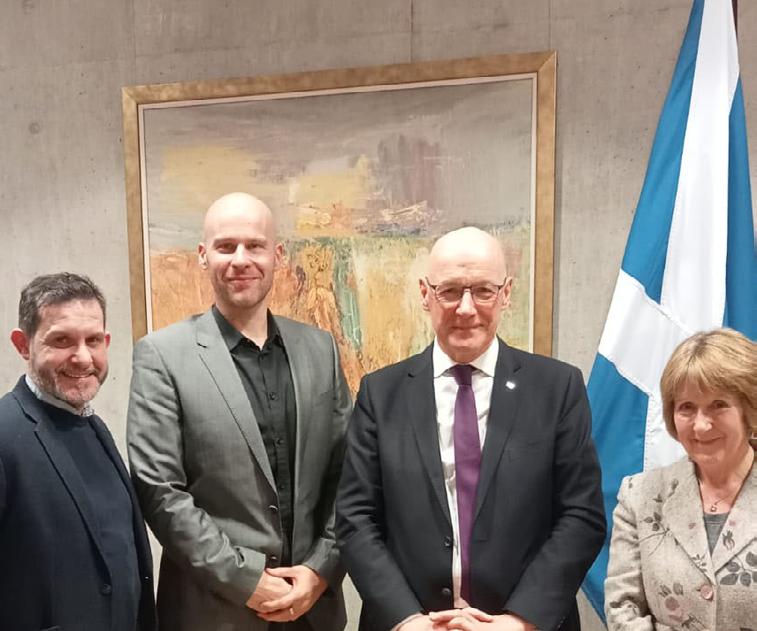
in November 2024 we presented the findings to First Minister John Swinney alongside a call for free dyslexia assessments for adults. We await the outcome of this request .
As misinformation and misunderstanding continues, Dyslexia Scotland will also continue to provide clear and accurate information and support to keep Scotland on its dyslexia-friendly journey.
Nearly 40% of respondents to our mythbusting quiz thought that a doctor can tell you if you’re dyslexic
It’s not too late to remind yourself and others about the all the facts about dyslexia on our Dyslexia Awareness Week webpage. dyslexiascotland.org.uk/dyslexia-awareness-week
The sky’s the limit for our Airport partnership
Dyslexia Scotland has joined a forum of national charities advising Edinburgh Airport on accessibility issues
The Edinburgh Airport Accessibility Forum advises the airport on its approach to supporting passengers with reduced mobility and additional needs.
A range of organisations are involved to help shape the airport’s approach.
The forum provides feedback on current practices and future plans, helping ensure that the airport is accessible and welcoming to everyone.
18 Dyslexia Voice | Winter 2025
Dyslexia Scotland will join the high-flying group that includes Spinal Injuries Scotland, Colostomy UK, Alzheimer's Society, The Yard Scotland, Guide Dogs UK and RNIB.
Dyslexia Scotland Chief Executive Cathy Magee said: “This is a great opportunity for us to influence more inclusive travel settings. Airports can feel busy and overwhelming for most people, so for those with dyslexiawho can have difficulties reading and processing information – the stress is amplified.
“We’re happy to be ‘on board’ with Edinburgh Airport and we applaud their pro-active approaches to making the airport a more welcoming place for passengers with dyslexia flying into and out of Scotland.”
Edinburgh Airport representative Dominique Newman, Service Delivery Manager for Accessibility, said: “Inclusivity is a key part of our approach and our Accessibility Forum provides valuable expertise that helps us make the airport more inclusive for everyone. Dyslexia Scotland brings unique experience and insight into how people experience the airport and how we can help them process information and move through it smoothly. We look forward to working with them and continuing our positive collaboration with our Accessibility Forum.”
What stresses you out with air travel? Let us know.
The Scottish Working Definition of Dyslexia has been updated
Some minor changes to the Scottish Working definition have been made as a result of the review of the definition against internationally agreed criteria, These include the removal of the term ‘condition’ when describing dyslexia, taking into account the working as well as the learning environment, and changes to the wording of the associated difficulties.
The updated definition is at dyslexiascotland.org.uk/what-is-dyslexia.
Behind the scenes
At our Annual General Meeting this year, we announced changes in our Board
We say farewell to long-standing Directors Andy Laverty, Mike Gibson and Karen McGill. Earlier this year, Chris Hughes also stepped down following a decision to relocate.
We’re sad to see these brilliant people go. But we also welcome new Directors, with much to offer.
Jennie Guise
“I’m honoured to be asked to join the Board of Directors of Dyslexia Scotland. In the many years that I’ve worked as an assessor of dyslexia and other Specific Learning Difficulties, our paths have often intertwined. It feels like I’m joining friends. I admire the Dyslexia Scotland mission because of its emphasis on inspiring and enabling all people with dyslexia to realise their potential. It’s crucial for children and young people. It’s vital for adults who may never have had the opportunity when younger to have their learning needs or all of their talents recognised. I’m looking forward to working with Dyslexia Scotland to achieve these aims.
20 Dyslexia Voice | Winter 2025
Mary
Berrill,
Education Adviser
“Dyslexic learners need to be included, engaged and involved in their education, and I have spent my career trying to support them in that. As an education inspector I saw the transformative impact that understanding, assessing and addressing dyslexia has on learners’ confidence and achievements. For the last three years I have supported the successful, innovative partnership between the City of Edinburgh Council, Dyslexia Scotland and the Sir Sean Connery Foundation. This initiative helped almost one thousand children and young people improve their reading scores and comprehension, and their confidence. In joining the board of Dyslexia Scotland, I am excited about this opportunity to support its invaluable work.”
Barry Macintyre, Finance Director
“I have spent most of my professional career working in economic development and urban regeneration particularly within communities of multiple deprivation. One of my driving forces is helping others to shine and reach their full potential no matter what the challenges may be. I am both delighted and proud to be given the opportunity to support the charity’s fantastic work and shall do my best to help people with dyslexia feel understood, valued and celebrated.”
“How far we’ve come”
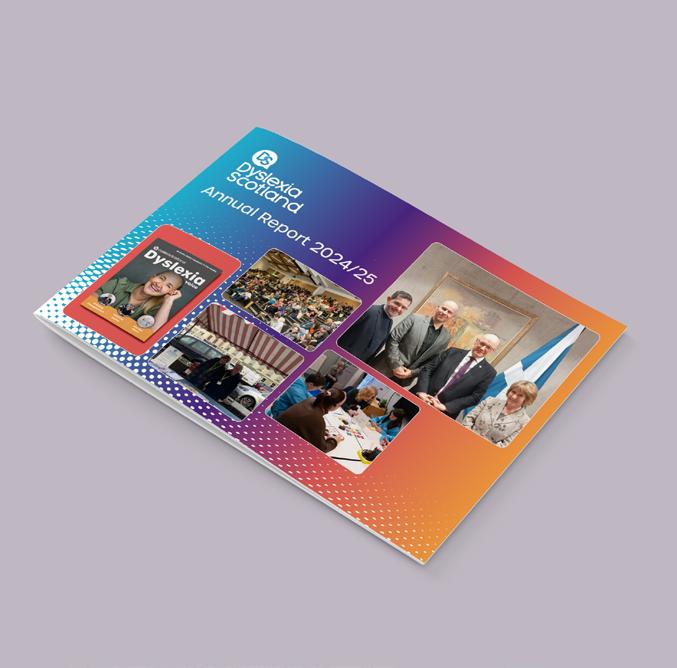
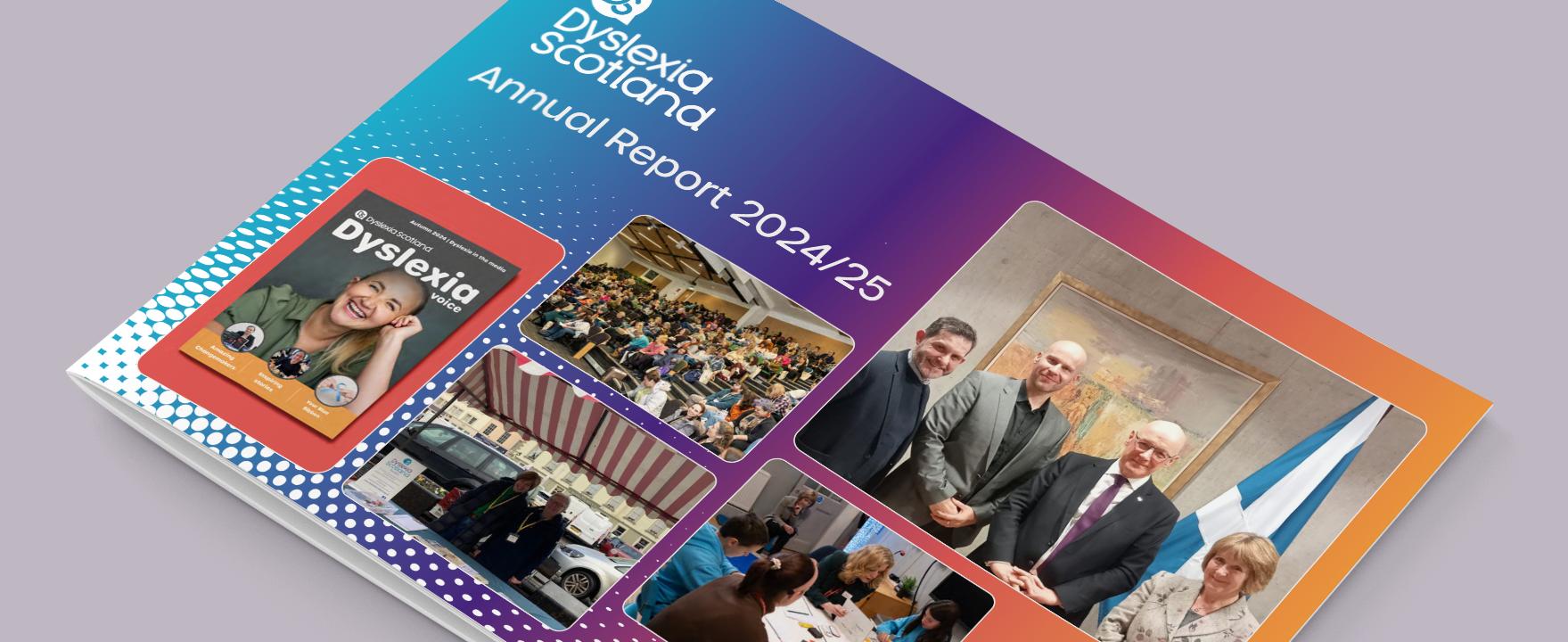
Our Annual Report is our yearly reflection. This year, as we look back, we see how far we’ve come - and how much we’ve achieved. These are just a few highlights from our year.
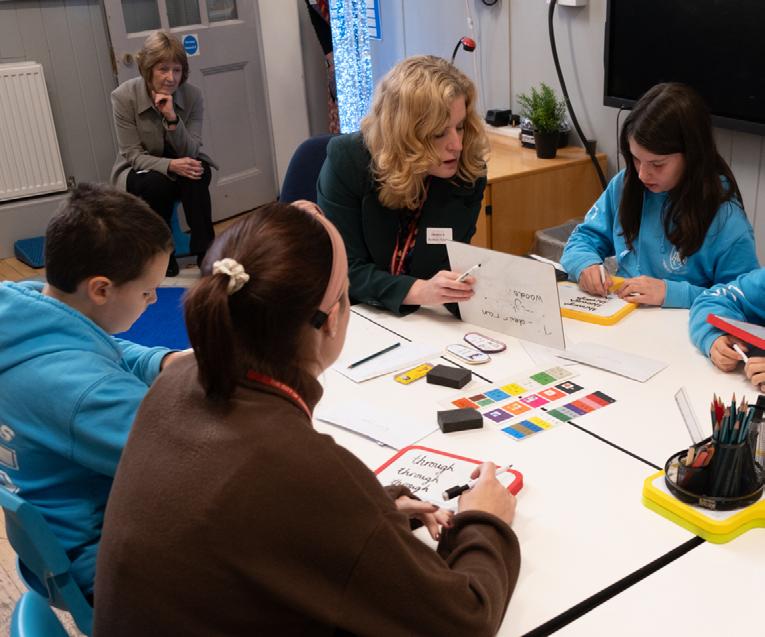
We continued delivery of the Sean Connery Foundation Dyslexia Initiative. Thanks to this funding, 996 learners from 61 schools in City of Edinburgh Council area have benefitted from the programme.
46 teachers gained Professional Recognition in Dyslexia and Inclusive Practice.
22 Dyslexia Voice | Winter 2025
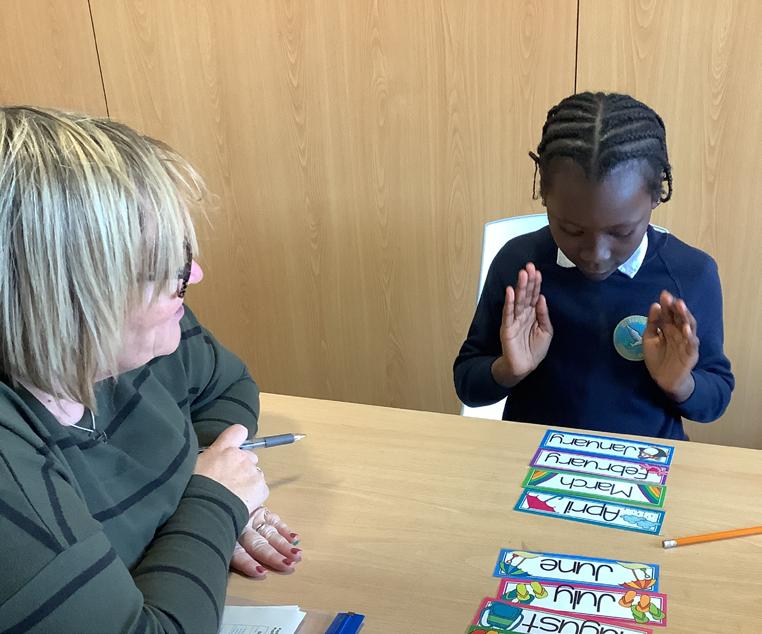
We arranged 263 rounds (usually 10 hours per round) of free individual tutoring to 138 children and young people.
We improved on the venue and increased the frequency of Dyslexic Adult Network meetings in Edinburgh
We continued to arrange free assessments for adults and young people with dyslexia.
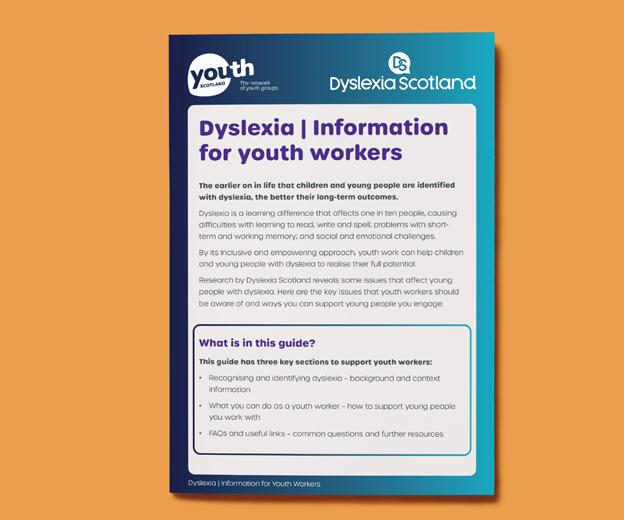
We collaborated with Youth Scotland on a guide to supporting dyslexia in the youth work sector.
We responded to national consultations, including the Learning Disabilities, Autism and Neurodivergence (LDAN) Bill; and the Youth Work Bill; and provided a Scottish perspective to the Delphi review of the definition of dyslexia - an international group of experts’ process of defining dyslexia.
We met with First Minister John Swinney to discuss findings from our research with the University of Glasgow and have had ongoing contact with Cabinet Secretary for Education and Skills Jenny Gilruth about best practice for dyslexia support in Scottish schools.
There’s only one way to sum up the year’s work: “Change is happening.” Read the full report on our website.
David Shaw, Chair of Dyslexia Scotland
Disclosure and dyslexia
by Ross Duncan, a Member of Dyslexia Scotland
An opportunty to share her story gave Abbie from Aberdeenshire the courage to disclose her dyslexia
When Abbie Freeman decided to share her story through the BBC Disclosure: What If I Can’t Read? documentary series, she didn’t expect the opportunity to come her way so suddenly.
“The offer came out of nowhere,” she recalls, “and after watching another episode about a girl with ADHD, I realised how powerful it could be to tell my dyslexia story.”
Abbie’s documentary explored her experience of growing up with dyslexia, which she wasn’t identified with until she was 13. “There’s still so much stigma around dyslexia,” she says. “It wasn’t something I talked about openly. My close friends knew, but I kept it private.”
Watching the finished documentary for the first time was deeply emotional for Abbie. “I cried at the end. I was proud of myself but nervous too, wondering how people would react. But once it came out, I felt even prouder.”
Opening up
Opening up about something so personal wasn’t easy. “It was difficult,” Abbie admits, “but it’s been life-changing and healing. No one should ever feel embarrassed about dyslexia. I’d come full circle. I was graduating from university just as the documentary was released, ten years after my identification. It felt like closing a chapter in my educational journey.”
To her relief, people’s reactions were overwhelmingly positive. “I’d worried that people would see me differently, but nothing changed. My high-school
Dyslexia Voice | Winter 2025
friends are still my friends, and some even appeared in the documentary.”
Abbie emphasises the importance of empathy and awareness. “It’s not about blame,” she explains. “Everyone’s circumstances are different. I want people to see the strengths of people with dyslexia. Parents often worry that their children’s lives will be harder, but being neurodivergent can bring real advantages.”
She recalls speaking at a primary school after the film aired: “Some parents said it helped them feel hopeful. I remember thinking how much it would’ve helped me as a kid to see someone older who’d come out the other side.”
A pivotal figure in Abbie’s education was her English teacher, Miss Murray. “She was the first to really see me. I was in additional support classes, and she was so patient. I’ll never forget when she gave everyone in the class a little gift - mine was a pencil case - and it made me feel seen for my effort, not my mistakes. That encouragement meant a lot.” ►
Abbie strongly believes in the importance of Additional Suport for Learning teachers. “Even in the six years since I left school, funding has changed. Those teachers are vital, not just in school but at university too. Being the first in my family to go to university I needed that help to understand expectations and build confidence.”
Being identified with dyslexia helped Abbie. “It explained everything. Before, I just thought I was slow. Finding out gave me a way forward, and community. I wasn’t alone anymore.”
Her degree in Film, Media, and Journalism suited her strengths in storytelling. “I wasn’t a big reader, but documentaries were accessible to me. I could watch, listen, and absorb everything. That’s what drew me to TV and video - it’s visual, creative, and fast-paced.”
Now working as a casting researcher at STV on Antiques Riviera for Channel 4, Abbie feels she’s found her niche. “I love meeting people, hearing their stories and editing their interviews. It plays to my strengths: storytelling through visuals rather than text.”
What’s next for Abbie?
As for the future, Abbie keeps an open mind. “TV is unpredictable: short contracts, fast turnarounds. But I’d love to move into producing or currentaffairs work. Having been in front of the camera, I understand how vulnerable people can feel. That perspective matters.”
Reflecting on her journey, she adds, “If my story helps even one young person with dyslexia feel less alone, then it’s worth everything.”
Dyslexia Voice | Winter 2025
The adult view
by Liz Rodger, a Dyslexia Scotland volunteer
Dyslexic Adult Network volunteer Liz reflects on the pros and cons of AI for the dyslexic mind
AI can make some things easier - recording our ideas or improving our written work, for example. But it’s not all positive.
I discussed with the Dyslexic Adult Network in Glasgow that I don’t have a smartphone. I expected others to tell me to “invest in modern technology” but instead the majority of responses were “wish that was me” .
Most of the group admitted spending too much time on social media but were afraid of FOMO (fear of missing out). Most wanted to reduce their time on social media but were unwilling to make the effort. Some said they had to be online 24 hours a day for work purposes. But this is unhealthy. As adults with dyslexia, we need to take time out to de-stress and recharge our minds .
Dyslexic people are often celebrated for their creative minds and thinking differently. However, if we become too reliant on smart technology and AI for ideas, we are not allowing our minds to practise these skills.
Most of us spend too much time ‘doom scrolling’. If we continually view information via social media, the algorithms just give us more of the same. We don’t receive details of the opposite side of a debate or argument.
AI has the potential to be a very useful tool for adult dyslexics but we need to use it wisely and most importantly take breaks from it.
See the Events page for Dyslexic Adult Network details
dyslexiascotland.org.uk/events
Pat tested: the AI that helps me
by Pat Meach, a Dyslexia Scotland volunteer
Former Further Education Needs Assessor Pat shares the tech that helps her learn, communicate and stay organised
Ever wish you had a personal assistant who never gets tired, never judges your spelling, and always says, “Sure, I can help with that”? Welcome to the world of Artificial Intelligence, or AI for short .
AI is a smart computer tool that can interact with you in human language. It can be used to help with dyslexic challenges in numerous ways.
As a dyslexic adult, I’ve spent years struggling with my working memory, slow processing speed, and the occasional “Where did I put my keys?” moment. AI hasn’t solved everything, but it’s made life easier, and often more enjoyable.
Here’s why I use AI to support my learning, work, communication and everyday life:
It lightens the load on my brain. Working memory is like a mental Post-it note, but in my dyslexic brain, it sometimes falls off mid-sentence or in the middle of trying to plan and organise my thoughts and ideas.
AI can act like a digital thinking partner for dyslexic minds, supporting working memory by:
• holding ideas in one place so they don’t slip away mid-task
• breaking down plans into manageable steps
• summarising long or complex information
• organising scattered thoughts into clear, structured formats. AI catches the Post-it notes before they fall!
Read, write, and spell with confidence
Writing, in any form, is a stumbling block for me . I often spend time procrastinating rather than getting on with the job . AI is a great tool for getting me started when I’m struggling to know what to write . Instead of typing, I use the ‘speak’ option to input my questions and ideas (prompts) into the chat box . All responses can be read aloud back to me . AI writing assistant checks my spelling, grammar, and even tone. I find this really useful as it helps me to express myself with confidence and clarity.
I also use AI to listen to web pages, emails and documents.
Staying organised without the panic
I use AI-powered calendars and planners to break down tasks into manageable chunks. For example, I’ve used AI to help me schedule a Christmas roast dinner with all the trimmings! I prompted it to give me a start to finish timeline to follow, which worked well for me.
You can ask AI to:
• prioritise your to-do list
• set reminders
• create visual timelines… the list is endless! ►
Maths and maps made easier
AI can explain maths problems step by step, showing how an answer is reached - not just what it is .
It can be of benefit to ask AI to explain maths topics in various ways, until you can fully understand . Always be mindful that AI can get things wrong too!
For those who struggle with directions, I find voice-guided navigation systems, and the navigation arrows (used in Google Maps) are extremely useful. You won’t need to worry about which way is right or left, east or west!
Find the right tool for you
AI works across phones, tablets, and computers. Many tools are built in, but apps like ChatGPT, Copilot , or Gemini offer extra features.
Free versions are great to experiment with. Paid plans give more options for personalisation - choose what fits your needs and budget.
Ask good questions
AI works best when you’re specific. The clearer your question, the better the response. There are plenty of YouTube videos and resources available to help you develop your ‘prompting’ skills.
You might already use AI without realising it. It’s built into browsers, emails, and tools like Microsoft 365 or Google Workspace. Think of it as a patient thinking buddy who never interrupts, but is there to help, suggest and prompt you along the way. Whether it’s to respond to an email, look for an itinerary for your next holiday, or work out a budget to help with money matters.
Word of caution: don’t let AI do all the thinking
AI is brilliant, but it’s not a replacement for your own mind. Over-reliance can mean missing out on:
• building literacy and numeracy skills
• developing independent ideas
• learning to reason and argue your point.
As tempting as it is to let it do all the work, use AI as scaffolding - not a crutch.
Be smart and safe
When using AI for school or work:
• avoid plagiarism: always edit or reference AI-generated work
• protect your data: check privacy settings and don’t share personal details
Adults AI and dyslexia: finding balance
by Ross Duncan, a Member of Dyslexia Scotland
Ross had his doubts about AI, but the tech has been transformative for his communication
For more than sixteen years, I have been passionate about connecting with others who are dyslexic: encouraging people to share their experiences and challenge outdated perceptions.
Technology has always played a central role in that mission, helping bridge communication gaps and build my confidence.
From the early days of using pen and paper to recording interviews on a Dictaphone, technology has continually evolved to make life easier. Yet no development has been more transformative than the arrival of Artificial Intelligence (AI).
In the past, I relied on Dyslexia Scotland to proofread my articles for Dyslexia Voice, support for which I remain deeply grateful. Today, AI tools can perform many of those tasks instantly, checking grammar, suggesting phrasing and helping to structure ideas. This allows me to work more independently and efficiently.
Before AI became widely accessible, I wrote for Civil Service World publication about the strengths often associated with dyslexic thinkers, such as creativity, empathy, perseverance and problem-solving. I argued then that computers may be powerful, but they can’t replicate human imagination or intuition. That message remains as relevant as ever.
AI can amplify what some people do well, like seeing patterns differently, solving problems creatively, and communicating ideas in original ways. But it can never replace the human element that drives those abilities.
Of course, there are challenges. Early on, I was sceptical about AI, concerned about data privacy, accuracy, and becoming reliant on it.
Despite these risks, AI offers enormous potential to empower people with dyslexia. It makes communication faster, clearer, and less stressful, freeing time to focus on creativity and strategic thinking. Used responsibly, AI doesn’t replace human skills; it amplifies them.
AI is not a substitute for the dyslexic mind, but a companion that helps ideas flow more freely. When used wisely, it can level the playing field for people with dyslexia in today’s digital world.
Used responsibly, AI doesn’t replace human skills; it amplifies them. “ ”
Dyslexia, AI and the future of inclusive recruitment
by an anonymous contributor
A point of view on ways AI could break down barriers to recruitment
I know what it feels like to walk into an assessment already convinced I won’t make it through. As someone with dyslexia, I’ve sat in front of online assessments for public sector jobs, only to realise within seconds that I was being eliminated by design, not by ability.
Adjustments promised under the Disability Confident scheme rarely materialised. Instead, the experience left me feeling that the system was built for someone else.
The toll of neurotypical assessments
Recruitment in the public sector often feels like a minefield. For neurodivergent candidates, unstructured questions, time-pressured tests, or ‘informal chats’ that are anything but, create unnecessary hurdles.
My brain thrives on clarity and structure, yet I was constantly thrown into unpredictable scenarios with no preparation. Every vague, open-ended prompt reinforced the message: you don’t belong here. By the end, rejection felt less like a judgement on my skills and more like punishment for the way my brain is wired.
I had expected the public sector to lead on inclusion. Instead, I’ve found private employers far more open to valuing and accommodating neurodivergent talent.
Redesigning recruitment with tech
Recruitment must change - not for me, I’ve given up - but for the millions still navigating these barriers. The good news? We already have the tools.
• Structured interviews: Share formats and themes in advance. Let candidates bring notes. This reduces anxiety and helps applicants show their real abilities.
• Inclusive design: Use plain language, avoid jargon, and simplify online assessments. Offer choices: video, written, or slide presentations, so candidates can play to their strengths.
• AI-powered assessments: Adaptive platforms can rephrase questions, or offer hints when someone struggles. Instead of filtering people out, AI can highlight skills and creativity.
• Meaningful feedback: AI could provide instant, personalised feedback rather than ghosting candidates. If certain tests systematically disadvantage neurodivergent applicants, the system should flag it.
• Strengths-based hiring: Focus on outcomes, not rigid lists of skills. Let applicants show how they’d deliver results, whether through problemsolving, creativity, or strategy.
Why AI matters
Ironically, lots of organsiations are already using AI to analyse thousands of consultation responses on policy, presumably the disability employment gap amongst them, yet not to support disabled candidates in real time. That’s a missed opportunity.
If AI can digest policy meetings, it can also coach applicants, adapt assessments, and deliver transparent feedback. Used wisely, AI could transform recruitment from a barrier into a bridge. The technology is here. Now it’s time to use it to include, not exclude.
Read Dyslexia Scotland’s guide to recruiting dyslexic staff
Learning and leadership
by Elley Petrie, a Member of Dyslexia Scotland
Accepting how her brain works and finding tools for daily life help Elley be an authentic leader
Being a CEO of an educational organisation is not something I ever imagined for myself. I am not an academic, and sometimes that makes me feel like an outsider in a world full of experts, researchers, and policies. Over time, I have learned that leadership is not about being the most academic person in the room. It’s about connecting with people, building trust, and helping everyone around you to belong and thrive.
At the heart of my work are the values of our organisation: to connect, belong, and thrive. These are not just words; they are what I try to live by. I try to connect people who might not otherwise meet, to help them find a sense of belonging, and to make sure our community can grow and succeed together. Sometimes that means sitting quietly and listening. Other times it means standing up and challenging something that doesn’t feel fair.
The other side of my role can be much more formal. There are procedures to follow and important decisions to make. I’m expected to engage with academics and professional service teams, many of whom have deep expertise in their fields. It can be intimidating at times, especially when my brain works a little differently because of dyslexia and ADHD.
My world is colourful and fast-moving. I often think in pictures rather than words. I can see connections and ideas very clearly in my mind but getting them down in a report or email can take longer. I sometimes mix up details or miss small things when I’m juggling too much. I don’t always get things right, and I’ve had to learn that that’s okay. Mistakes are part of the process and part of learning.
I’m always learning from others, from how they speak, write, and make decisions — and I try to adapt styles that work for me. My approach might
Dyslexia Voice | Winter 2025
not look like everyone else’s, but it’s mine, and it’s honest. I’ve learned that being open about how I work helps others to feel they can do the same. When people see me being real about my challenges, it often gives them permission to be real too.
The tools that help me
AI has become a big help in my daily life. It helps me write clearly, check spelling and grammar, and plan out large pieces of work. It saves me time and reduces stress, letting me focus on what really matters — people. It has become another tool that supports how I work, rather than something that replaces my thinking or creativity.
I use other supports. I wear tinted glasses when looking at the computer screen for long periods. Coloured notepads and pens to help keep my thoughts organised. In meetings, I often colour-code my notes to make it easier to follow what’s happening and what needs action later.
Being a CEO with dyslexia and ADHD means my leadership journey is full of creativity, challenge, and constant learning. Some days are easier than others, but I wouldn’t change how my brain works. It gives me empathy, imagination, and the ability to see things from different angles.
I am proof that there are many ways to lead, and that the most important kind of intelligence in leadership is emotional intelligence. With the right tools, support, and a bit of courage, we can all connect, belong, and thrive, in our own unique ways.
Space: 2026?
by Suzy Taylor, a Member of Dyslexia Scotland
Suzy finds herself in a futuristic-feeling world where AI can help with her studies – and save her money
Now I am a sad geek who loves watching sci-fi. Yes, from a young age, I was influenced by TV programmes like Blake's 7, Buck Rogers in the 25th Century, Star Trek, and Space: 1999. I thought everyone would be living in Space by the year 2000. I cried at films such as A.I. Artificial Intelligence (a modern-day Pinocchio-like story) and Minority Report, and thought about all the fantastic things AI could do for humanity.
Now we live in an age where AI is a very real thing. I constantly hear arguments on whether we should be using AI.
My current role involves training people to use various assistive technologies. Under the Equality Act of 2010, using assistive technology is seen as a reasonable adjustment that must be provided to support individuals with disabilities such as dyslexia, ensuring they have equal access to opportunities and services. AI is increasingly being used to help students.
In this area, I have encountered growing opposition from individuals who are being advised against using AI. I have emphasised in my training that I think artificial intelligence is designed to support you, not do the work for you. Chat GPT, Co-Pilot, and Google Gemini can aid in key areas.
For example, if you're having trouble creating a CV, use AI to create an outline. (A person still needs to put in their own information. Many CVs generated using AI technology have been rejected because they are generic.)
I use ChatGPT to proofread my work and correct grammatical errors (it would be frowned upon to submit a tutor-marked assignment without full stops or punctuation). As a self-published author, I found that Amazon's review process required a substantial amount of money to review each chapter and correct my mistakes. Since I didn't have this amount of money, I turned to ChatGPT for help with proofreading and correcting my mistakes. I noticed that certain parts of my story were either omitted or condensed into brief lines. Now I use professional Grammarly to help in this area. I can keep my storylines without them being condensed.
Grammarly also has AI included for brainstorming ideas. Especially when it's difficult to know where to begin, I believe it can enhance the learning experience by helping to narrow down the numerous ideas in my head.
It can also help with referencing for essays, such as putting references in alphabetical order.
However, AI has a negative side where students copy and paste from ChatGPT, Co-Pilot and Gemini. What have they learned? They are automatically flagged as failed because universities have good AI plagiarism filters that detects this.
As with anything, I can see both the good and bad sides of the use of AI. I have not seen my AI have a meltdown, but I have been told it is hilarious, like a toddler having a tantrum. I look forward to reading other people's perceptions on the subject.
Teaching with AI
by Heather Aird, a Dyslexia and Inclusive Practice alumni
As a teacher with several learners with dyslexia in her classroom, Heather has always believed that every learner deserves tools that help them thrive, not just survive, in education
Over the past few years, artificial intelligence (AI) has rapidly evolved from a distant concept into a practical, everyday classroom support. For learners with dyslexia, these innovations are not just helpful - they’re transformative.
Traditionally, supporting learners with dyslexia meant carefully adapting resources, simplifying reading materials, or spending hours differentiating tasks manually. While those strategies remain important, AI has opened new pathways that make this process more efficient, personalised, and empowering. Instead of being a one-size-fits-all classroom, AI allows us to tailor the learning experience to each individual’s strengths and challenges.
AI isn’t just transforming how students learn, it’s revolutionising how we plan, assess, and adapt. By entering the learning objective into AI and noting that I have dyslexic pupils, it can recommend dyslexia-friendly formats, simplified text versions, or multisensory activity suggestions. This means accessibility is built in from the start, not added as an afterthought.
Tools like ChatGPT, Microsoft Copilot, and Canva’s Magic Write can now:
• rephrase complex texts into dyslexia-friendly language while preserving meaning
• suggest vocabulary lists, comprehension questions, or creative alternatives for different reading levels
• generate step-by-step scaffolds or visual supports for pupils who need more structure.
This doesn’t replace the teacher’s expertise, it enhances it. I can focus my energy on how to teach and who I’m teaching, rather than spending hours formatting or retyping resources.
Tools I use
There are two different AI powered tools I want to highlight as good tools to support teachers and learners with dyslexia.
Reading Progress
One of the most exciting developments for literacy support is Microsoft’s free Reading Progress, an AI-powered tool built into Microsoft Teams.
I use Reading Progress as it allows pupils to record themselves reading aloud, at their own pace, in a comfortable environment. The AI then analyses their performance, highlighting accuracy, fluency, pronunciation, and pace. It even identifies specific words a pupil struggled with and automatically generates a personalised word list so they can practise those tricky terms again.
As a teacher, I can see each pupil’s progress over time - data on which words they’re mastering, which ones they need support with, and how their confidence is growing. I can then assign targeted practice tasks or reading passages that focus precisely on those needs. ►
For learners with dyslexia, this removes the pressure and anxiety of reading aloud in front of others. Instead, reading becomes a private, empowering experience - one where students can hear their own improvement and feel proud of their progress.
Notebook LM
Another groundbreaking AI tool is Google’s Notebook LM (Language Model) - a platform designed to help users engage more deeply with information. For learners with dyslexia, its capabilities are remarkable.
With Notebook LM, you can upload any lesson material - documents, notes, or web articles - and the AI instantly summarises, explains, and organises the content into manageable chunks. But that’s just the beginning.
At the touch of a button, Notebook LM can now transform materials into podcasts, flashcards, videos, and mind maps, making learning multisensory, interactive, and far more accessible.
• Podcasts allow learners to listen to summaries or key explanations, ideal for auditory learners.
• Flashcards support memory through quick recall and repetition.
• Videos bring abstract concepts to life with visuals and narration.
• Mind maps help learners visualise ideas and connections - perfect for dyslexic thinkers who often excel in seeing ‘the bigger picture’.
The benefit to teachers
From a teacher’s perspective, Notebook LM gives learners with dyslexia control over how they interact with information. It meets them where they learn best - through sound, sight, or structure - helping to make complex topics less intimidating and far more engaging.
AI has given us the power to personalise learning in ways that were once unimaginable. But it’s important to remember: AI doesn’t replace the teacher’s empathy or the pupil’s effort. It simply enhances them.
AI isn’t replacing teachers. It’s giving us more time to do what really matters - supporting, understanding, and celebrating our learners.
The heart of teaching remains human - the encouragement, understanding, and belief that every learner can succeed. What AI offers is more time for those meaningful moments, and more ways for learners with dyslexia to engage with the world on their own terms.
For learners with dyslexia I teach, AI isn’t just technology. It’s a bridge to confidence, independence, and joy in learning. ■
AI isn’t replacing teachers. It’s giving us more time to do what really matterssupporting, understanding, and celebrating our learners. “ ”
Reaching every child with AI
by Kara Hunter, teacher
In Kara’s experience, AI helps teachers to meet a broader range of educational needs
AI in education tends to split opinion. Some people love it. Others see it as the beginning of the end for human creativity. But for me, someone who’s dyslexic, autistic, and teaching neurodivergent learners every day, AI is a lifeline. It’s not replacing my thinking; it’s amplifying it.
The tools that make a difference
My favourite AI tools are ChatGPT and Grammarly AI. Together, they act like a patient writing partner who never gets tired of helping me shape my ideas. When I have a flood of thoughts but can’t quite make them flow on the page, I can ‘brain dump’ everything: messy sentences, half-formed ideas, bullet points - I can ask AI to help me rephrase it more clearly.
Some people call that cheating. But let’s pause for a moment.
If it took you four hours to finish one piece of English homework, and you had a tool that could take all your ideas - your words, your knowledge, and help you organise them faster, would you use it? Of course you would. Humans have always built tools to make life easier. Pens were once new technology, too.
For many of us with dyslexia, writing cohesively on the first attempt feels like climbing a mountain in flip-flops. AI doesn’t climb it for us… it helps us find the right footholds. It checks tense and tone, smooths structure, and turns that mountain into a manageable hill. We still write the content; AI just helps us polish it into something that finally sounds like the ideas we meant to say all along.
44 Dyslexia Voice | Winter 2025
Teaching students to train their AI
In my classroom, I teach students to ‘train’ their AI tools the way they’d ‘train’ any learning habit… with boundaries, examples, and reflection. We practise setting clear prompts, checking accuracy, and editing AI suggestions to keep their own voice intact.
Together, we talk about what AI does well (clarity, structure, speed) and what it can’t do (feel, imagine, or replace your lived experience). These conversations help children think critically, not just copy. It’s digital literacy with heart. ►
It’s digital literacy with heart. “
”
How AI is changing the learning landscape
Let’s picture a classroom of 30 pupils. Among them: three children with dyslexia, two awaiting assessment, two high achievers, and others facing a range of learning barriers.
Now, imagine explaining adjectives in a way that reaches every child. It’s possible, but exhausting.
AI can act like a quiet teaching assistant, personalising support for each learner. For example, a child might ask AI to reword a tricky paragraph in simpler language, or to generate a few examples that match their reading level. With guidance, “Always fact-check,” “Use your own notes first,” “Make sure it sounds like you”, AI becomes a scaffold, not a shortcut.
This approach nurtures independence. Children learn not only how to write better, but how to learn smarter. They feel empowered to take ownership of their work rather than drowning in frustration.
Is AI hindering education? Only if we let it.
The danger isn’t the tool… it’s the attitude around it. If we ban AI out of fear, we miss a chance to teach critical thinking and digital responsibility. If we use it thoughtlessly, we risk dulling creativity. The sweet spot is teaching how and why to use it well.
When used thoughtfully, AI reduces anxiety, shortens the redrafting slog, and helps both learners and teachers focus on ideas rather than spelling or structure. It turns “I can’t do this” into “I can, with support.”
AI, when used with kindness and curiosity, can transform learning from a battle into a collaboration. It can turn barriers into bridges. ■
A directory of tools for dyslexia
by Iain Kenney, a guest contributor
Iain found AI so helpful, he set up his own organisation to promote it
The moment that changed everything for me came while watching Inside our Dyslexic Minds, the BBC series with Chris Packham.
There was a scene where a site manager, clearly brilliant at his job, looked at construction drawings and instantly understood every detail. But when it came to the written instructions, he felt overwhelmed.
I remember thinking, that’s me. That’s every dyslexic person who sees patterns and solutions instantly, yet still trips over words that weren’t written for our brains.
In that moment, I realised that AI could already remove that difficulty, if only it was designed to. That idea became NeuroAI.help.
NeuroAI.help is a directory of tools that make life easier for people who think differently - writing assistants helping us structure ideas instead of judging our spelling; things that can read out loud, explain them in simpler language, or even turn text into speech. These aren’t big, expensive solutions, they’re just smart ways to make life easier.
A non-profit service
I’m applying to formally establish NeuroAI.help as a Scottish Charitable Incorporated Organisation (SCIO). We want to have a non-profit approach that supports people, not monetises them.
Taking on the world
by Margaret Rooke, author
Author Margaret Rooke revisits the young dyslexic Scottish heroes whose dyslexia stories inspired her book
Around ten years ago I began writing my book Dyslexia is My Superpower (Most of the Time) in the warm and friendly offices of Dyslexia Scotland. I was greeted with welcome cups of tea and – more importantly –enthusiasm and creativity wherever I turned.
Here some wonderful children and teens spoke to me – among the 100 from all over the world who told their stories for the book. Some contributed beautiful illustrations.
They told me what they liked about school and what didn’t work for them. They explained what they were great at (they all knew this) and how home and teachers could help them more.
Children still say the book helps them feel less alone. Parents and schools say it provides ideas and solutions and puts their minds at rest.
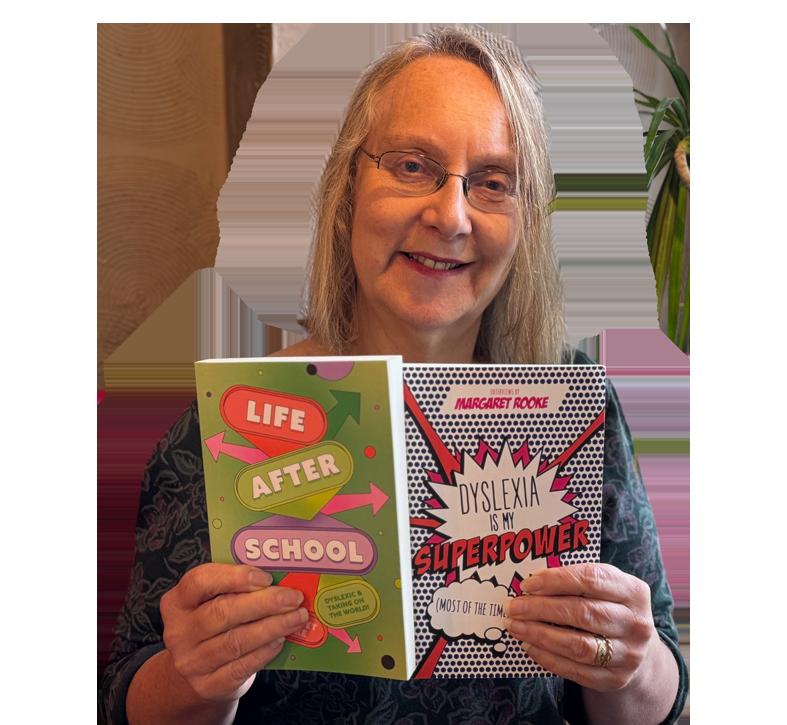
Now I’ve gone back to forty of the original storytellers, plus some of the artists, and I’ve found out how their lives have turned out as young adults. It’s all in my new book: Life After School: Dyslexic and Taking on the World!
I hope this book will inspire and encourage children and families just like the first.
The book includes Molly, 23, from Stirlingshire, who’s specialising in forensic speech science, using speech patterns to help catch criminals.
There’s Jamie, 21, from Glasgow, whose time as a volunteer helping troubled kids has led to a career as a youth and community worker. He’s also a parttime entrepreneur. He told me, “Things didn’t go well at first after school. I felt like I was falling down a hole.
48 Dyslexia Voice | WInter 2025
“My family and friends kept encouraging me. I found motivation from inside myself and I started thinking about what I really wanted to do.”
Gabriella, 24, from East Lothian, has a job she loves in a laboratory, helping to make sure the medication we take is safe.
And Hayley, 26, from South Lanarkshire, is a jewellery specialist, who told me, “If you’re struggling, just remember there are people all over the world with the same struggle. Figure out what works for you and what you care about. Don’t be scared about what other people think.”
The foreword is by Dyslexia Scotland Young Ambassador Marc Ingram who says, “Life after school can be so much better. A different world. We can all encourage each other to build a great future.”
Life After School: Dyslexic and Taking on the World! by Margaret Rooke
Designing for dyslexia
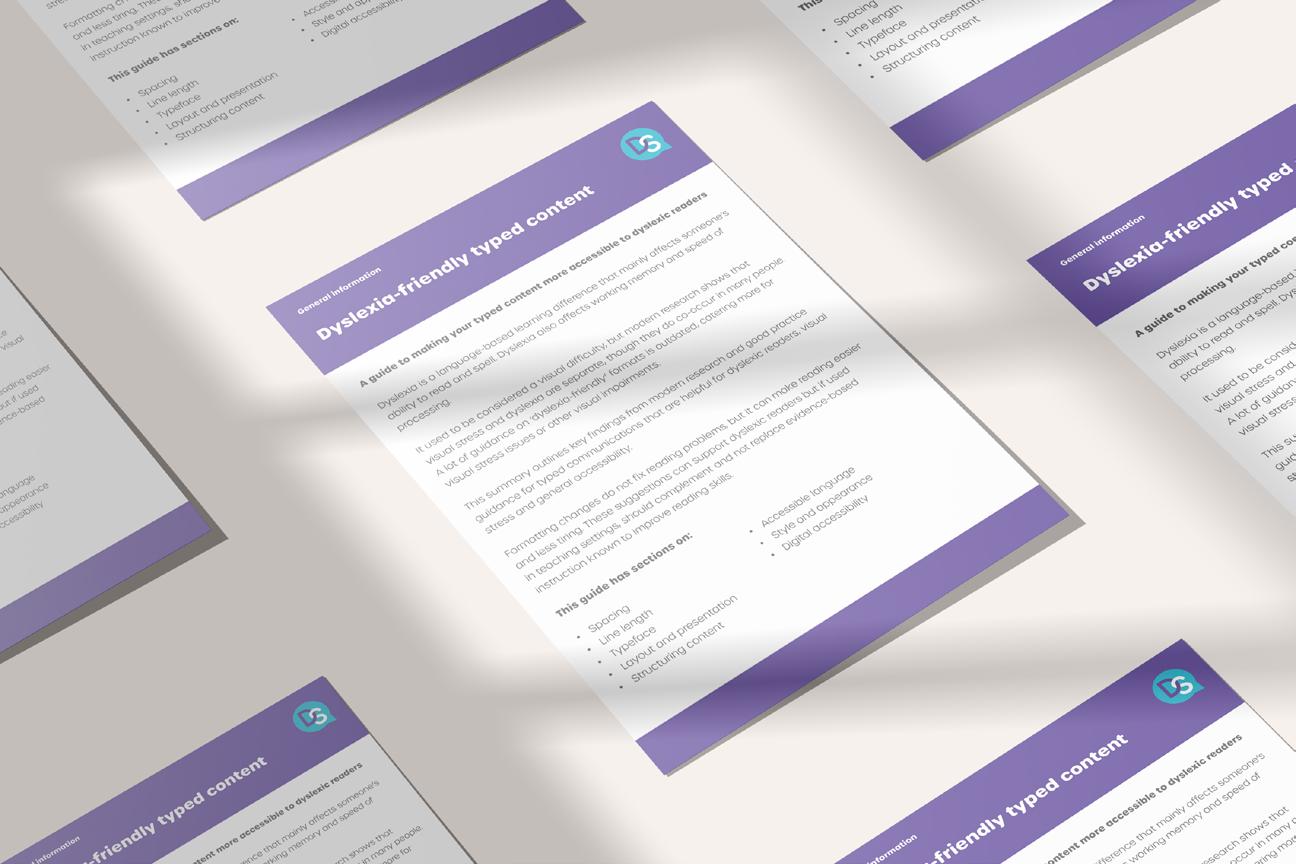
Our new guidance on dyslexia-friendly typed formats aims to help graphic designers and typists to create accessible documents
Our Lead for Creative and Digital Katie Carmichael, a graphic designer, produced the guidance in collaboration with Dr Jeremy Law, a researcher from the University of Glasgow. The guide draws on recommendations from dozens of modern dyslexia research studies and good practice principles from the fields of web design, graphic design, typesetting and user experience design.
The guide has sections on:
• spacing
• line length
• typeface
• layout and presentation
• structuring content
• accessible language
• style and appearance
• digital accessibility.
It also emphasises that while formatting changes don’t fix reading difficulties, they can make reading easier and less tiring.
We’re asking members to share the new guidance with your personal and professional networks. Please let us know how you’re using the guide in practice.
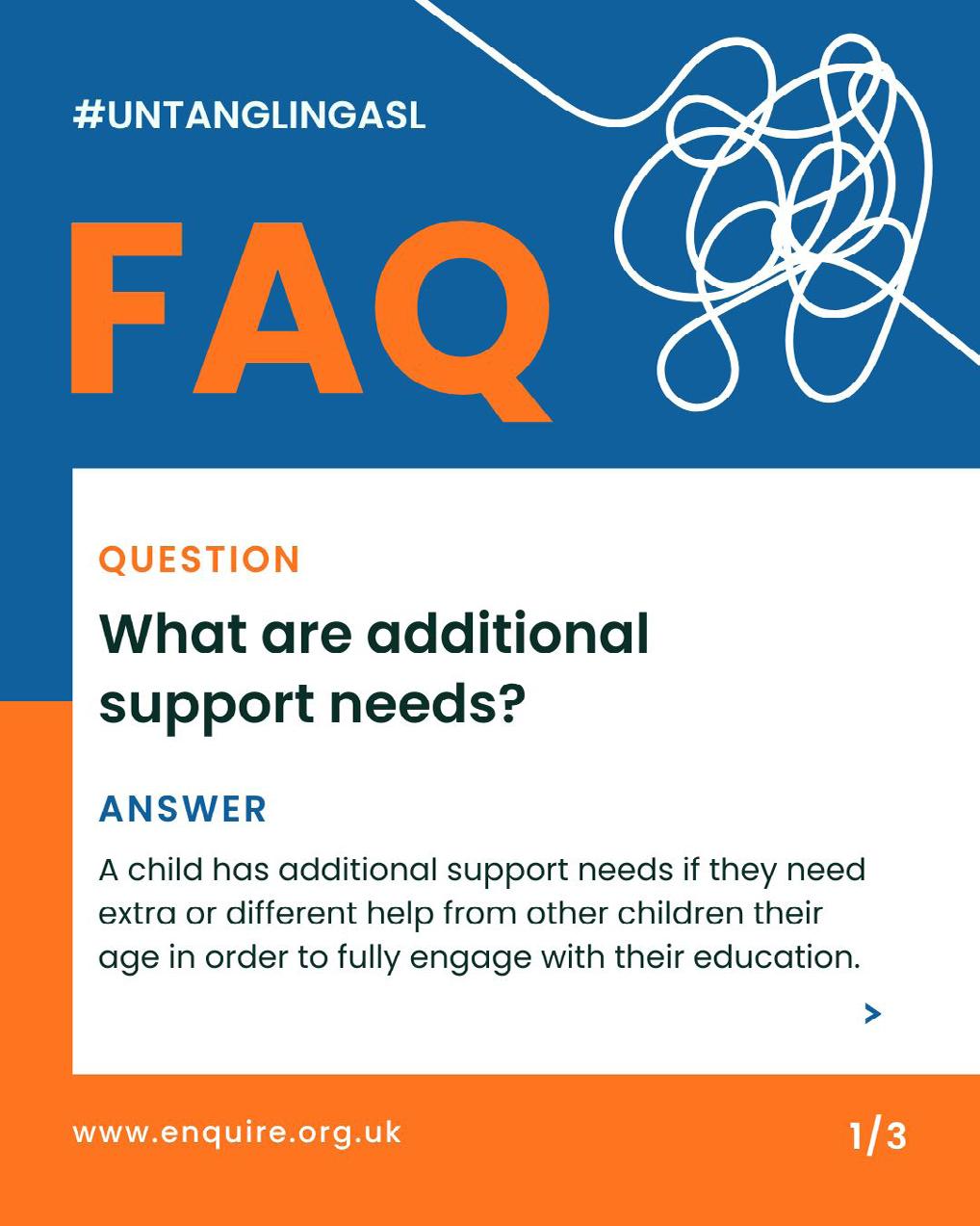
Untangling additional support needs
New shareable resources from Enquire can help you get to grips with additional support needs
The team at Enquire knows that the world of additional support for learning can be overwhelming, and it can be easy to get tangled in knots.
They want to:
Answer some key questions around additional support for learning. Improve understanding of the wide range of support needs, and the right to support for learning.
Signpost to trusted and accurate advice, information and practical resources.
To do this, they’ve created a series of new resources parents can use and share on social media and through your parent networks.
Changemaker channel
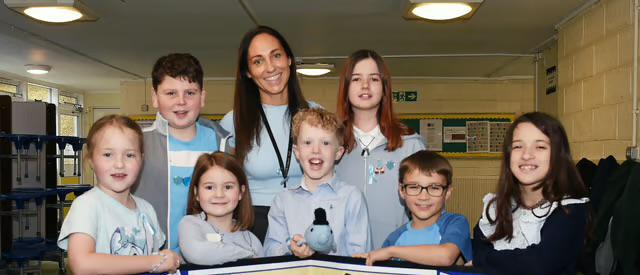
Busting myths at Bainsford
by Lisa Buick of Bainsford primary school, an Educator Member of Dyslexia Scotland
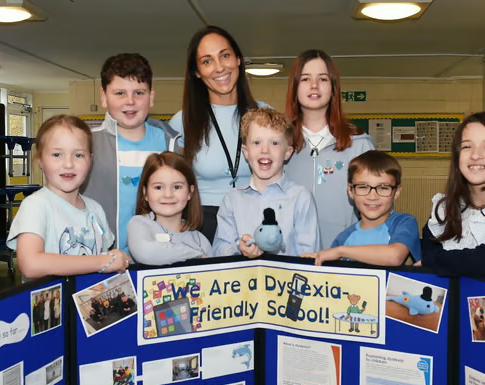
During Dyslexia Awareness Week, pupils and staff at Bainsford Primary School were busy promoting understanding and celebrating the many strengths of dyslexic learners.
Our Bainsford Ambassadors, who formed their group last year, continue to lead the way in making our school a truly dyslexia-friendly community. This year, we were delighted to introduce a new team: the Dolphins; children chosen from each class to support the Ambassadors in spreading awareness and championing inclusion throughout the school.
Inspired by our school mascot, Danny the Dolphin, the group’s name reflects the intelligence, curiosity, and inquisitiveness we value in all our learners, especially those with dyslexia. The Ambassadors and Dolphins worked together throughout the week to share key messages about dyslexia, celebrate diversity in learning, and encourage everyone to recognise and appreciate the unique talents of dyslexic thinkers.
We all took part in a range of class activities during the week and created a wonderful display in our school to celebrate the occasion and showcase our learning. Our local newspaper came to visit and published an article too!
To mark the end of the week, the whole school joined in our ‘Go Sky Blue’ day, dressing in blue to raise awareness and show our pride in being a dyslexia-friendly school. The sea of blue around the building was a fantastic reminder of how our school community stands together to support inclusion and understanding.
A huge thank you to all our children, staff, and families for your enthusiasm and support — together, we’re helping to make sure every learner at Bainsford can shine.
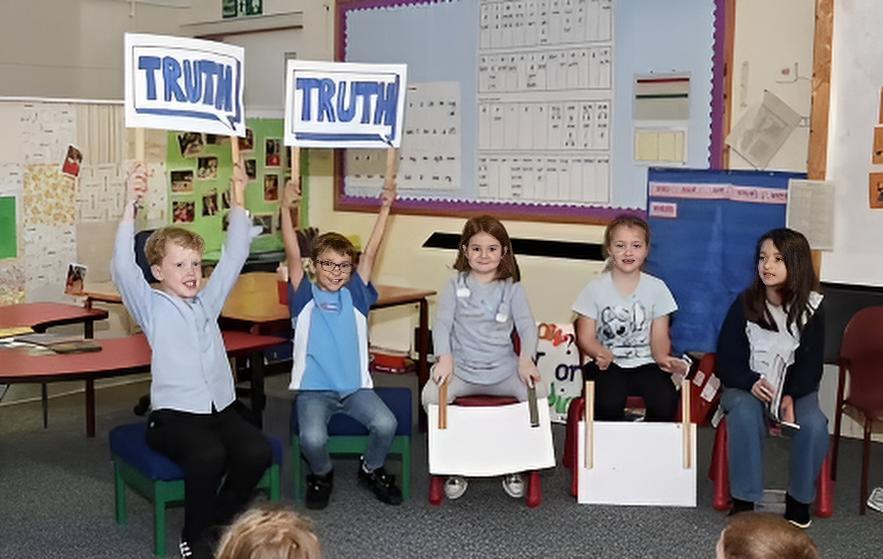
Left: Class teacher Lisa Buick and the Dolphins Above: the pupils take part in the Busting Myths Dyslexia Awareness Week lesson
Walk this way
by MFMac law firm
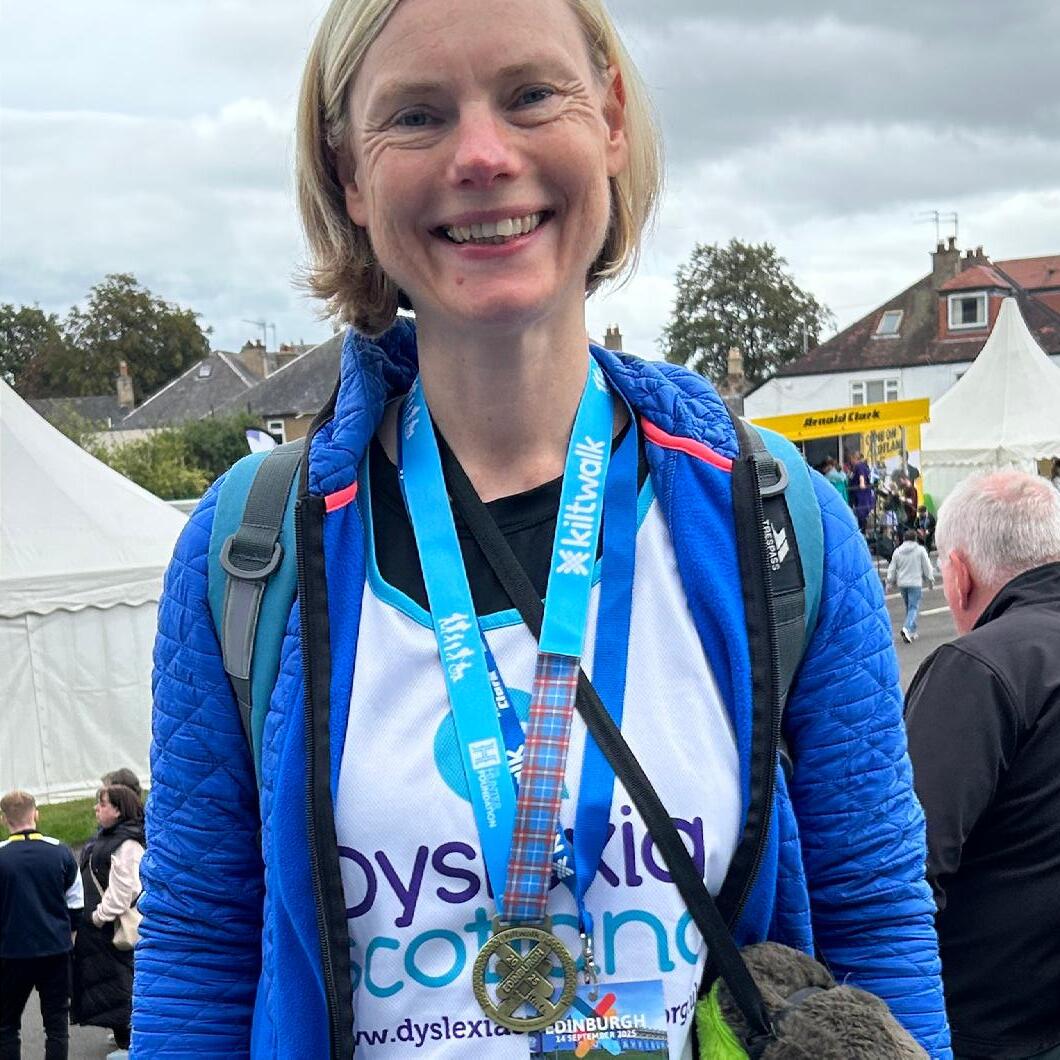
The MFMac team walked a combined 150 miles at the Edinburgh Kiltwalk in support of Dyslexia Scotland, raising over £1000 in donations.
Bridget Keene, Daria Jochemko, Kate Burrows, Kirsty Marsh, Maame Agyare and Martin Kotsev tackled the Mighty Stride (21 miles); Kenechukwu Chukwukelue took on the Big Stroll (11 miles); and Alison Marr was accompanied by daughter Charlotte for the Wee Wander (5 miles).
While there were some sore feet, a fantastic day was had by all!
The MFMac team raised over £1000 for Dyslexia Scotand.
Global changemakers
by Janey Ball, a guest contributor
Karamoja, in north-eastern Uganda, is a dry and remote region where many families depend on livestock to survive. Schools are few, classrooms are crowded, and poverty is high. These problems make learning hard for all children, but especially for those who are neurodivergent, such as those with dyslexia or ADHD. Many never get the support they need.
New, low-cost artificial intelligence (AI) tools could change this. Simple offline apps can help teachers identify children who are struggling, give personalised learning support, and make lessons more engaging. Tools like text-to-speech, voice input and gamified reading apps can help children learn at their own pace while reducing teachers’ workloads.
Scottish artist Mark Stoddart has helped bring this vision closer to reality at Guerin Academy in Karamoja. He worked with Dyslexia Scotland tutor and trainer Sharon Hall to deliver the first online Neurodiversity Teacher Training in October, providing laptops, Wi-Fi, printers, and teaching materials—all from his own funds. He is also sponsoring 10 girls to attend the school.
Mark’s next goal is to raise money for a new classroom through the sale of his art and a school musical about inclusion. He believes AI can help close the digital divide so every child, no matter their background, can learn to read, write and thrive.
Learning differently: using AI as a dyslexic student
by Ayo Bamgbose, a guest contributor
As an early adopter of AI, Ayo found the perfect study buddy to help her achieve her learning potential
I didn’t start using AI because I wanted to be more productive. I started using it because I was tired of forgetting what I had just read. As a dyslexic student, memory has always been the hardest part of studying.
I was identified at 27, halfway through a journey that finally helped me understand why I struggled to keep things in my head. Working memory felt like a leaky bucket. I could absorb ideas in the moment, but they would slip away before I had the chance to use them.
Before I found the right tools, I was constantly battling overwhelm. I’d re-read the same paragraph over and over or sit with pages of highlighted notes I couldn’t make sense of later. ►
Before I found the right tools, I was constantly battling overwhelm.
The right tools
Mind-mapping software and transcription tools also became part of my everyday routine. Instead of trying to remember where everything went, I used these tools to break down ideas visually and talk things out. I stopped expecting myself to hold everything in my head and started creating systems that worked for how my brain processes information.
There was one assignment where I felt completely stuck. The reading was heavy, and I couldn’t hold the thread of the argument. I used AI to break the text into sections and create prompts so I could test my understanding step by step. It didn’t give me shortcuts. It just gave me structure. And that was enough to help me finish and feel proud of how I got there.
AI didn’t magically fix things. But it gave me time. Space. And most importantly, control. It let me learn at my own pace and revisit ideas without shame. When memory slipped, I had something to return to. That safety net made all the difference.
Taking control of my learning
One of the biggest shifts for me has been moving from passive learning to active reflection. I no longer just highlight text and hope it sticks. I interact with it. I question it. I connect it to something real. That’s helped me internalise knowledge in a way that finally feels natural.
Outside of my studies, I’ve spent over 15 years working in education. That experience gave me the language to support others, but I hadn’t yet found the language to support myself. AI has helped me close that gap. It’s allowed me to learn in a way that feels sustainable and human.
I still forget things. But now I don’t spiral. I pause, open a tool, and start again. AI hasn’t made me a different student. It’s helped me become more of the learner I was always trying to be. ■
Young and dyslexic
Off and running
A young athlete’s processing difficulty led to dyslexia awareness for his whole club
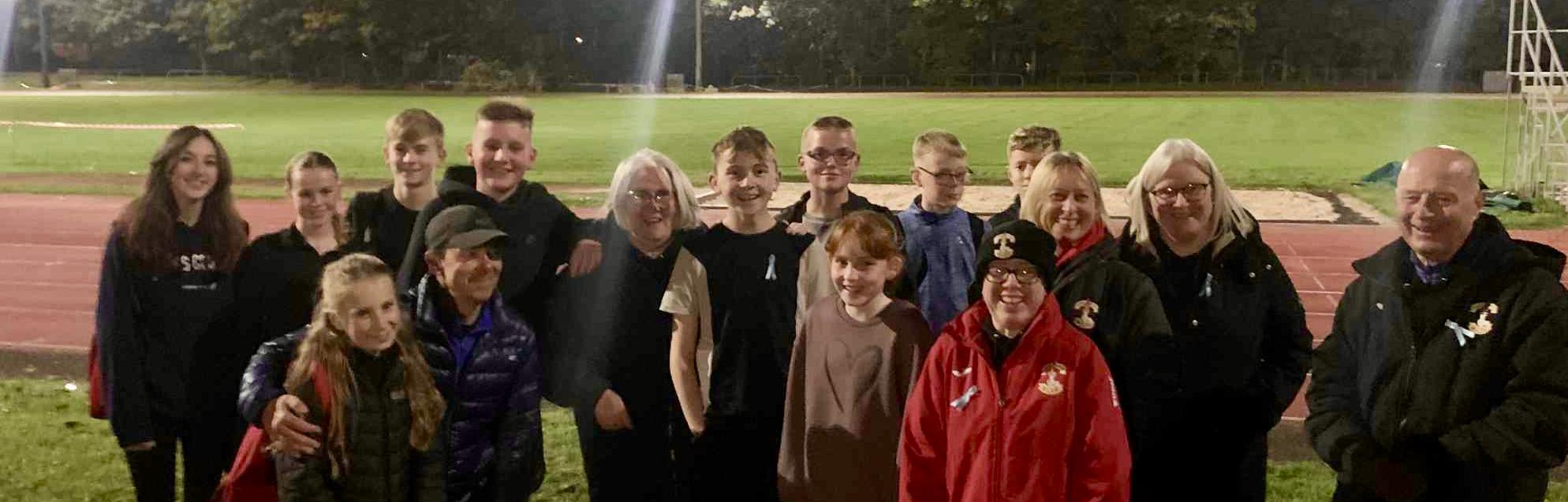
Declan has been in the Law and District AAC Amateur Athletic Club for a year and a half and has thrived since. But as part of his dyslexia, Declan struggles to process the sound of the start gun.
This sparked a big learning curve for the coaches as they didn’t know a lot about dyslexia to begin with. They asked what they could do to support him.
After conversations with coaches and the club secretary and contacting Scottish Athletics for support, they had a plan.
Now, when Declan does a track race, he can have an adjustment to the race start signal. This uses his other senses with either a tap on the shoulder or a visual aid like a white flag at the same time as the start gun. These give him an equal chance at the race and support him in being the best athlete he can be.
This has helped to raise awareness throughout the club for other athletes who have trouble processing sounds or instructions. A lot people think that dyslexia is only about reading and writing but as Declan knows, there is more to it.
Above: The Law and District Amateur Athletic Club with Declan pictured centre.
Create and share
Read all about it!
Jamie from Highland Council set up a school newspaper to raise awareness
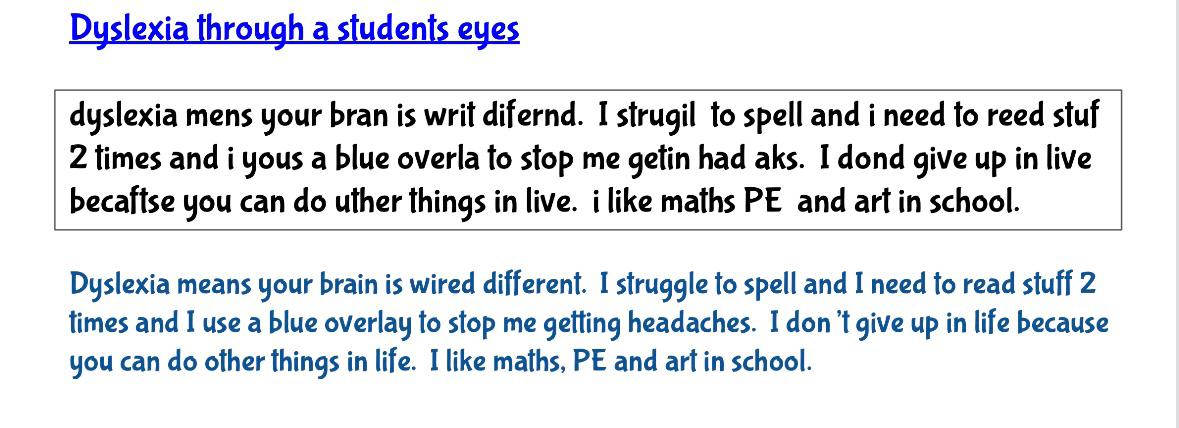
Jamie says, “I have a dyslexia identification and really struggle with spelling and punctuation. I wrote a section for dyslexia awareness that showed what my written pieces of work look like.
My dyslexia awareness paragraph in the school newspaper shows students what your written work might look like if you have dyslexia. Setting up a school newspaper hopefully shows people that with the right support, people with dyslexia can achieve success.”
Myth busters!
Loads of you got involved in the Busting Myths activities for Dyslexia Awareness Week. You can keep spreading the facts with these resources on our website.
Awesome animations
The Young Ambassadors voiced some myth-buster animations. You can check them out on Dyslexia Unwrapped, our website for 8 to 18 year olds.
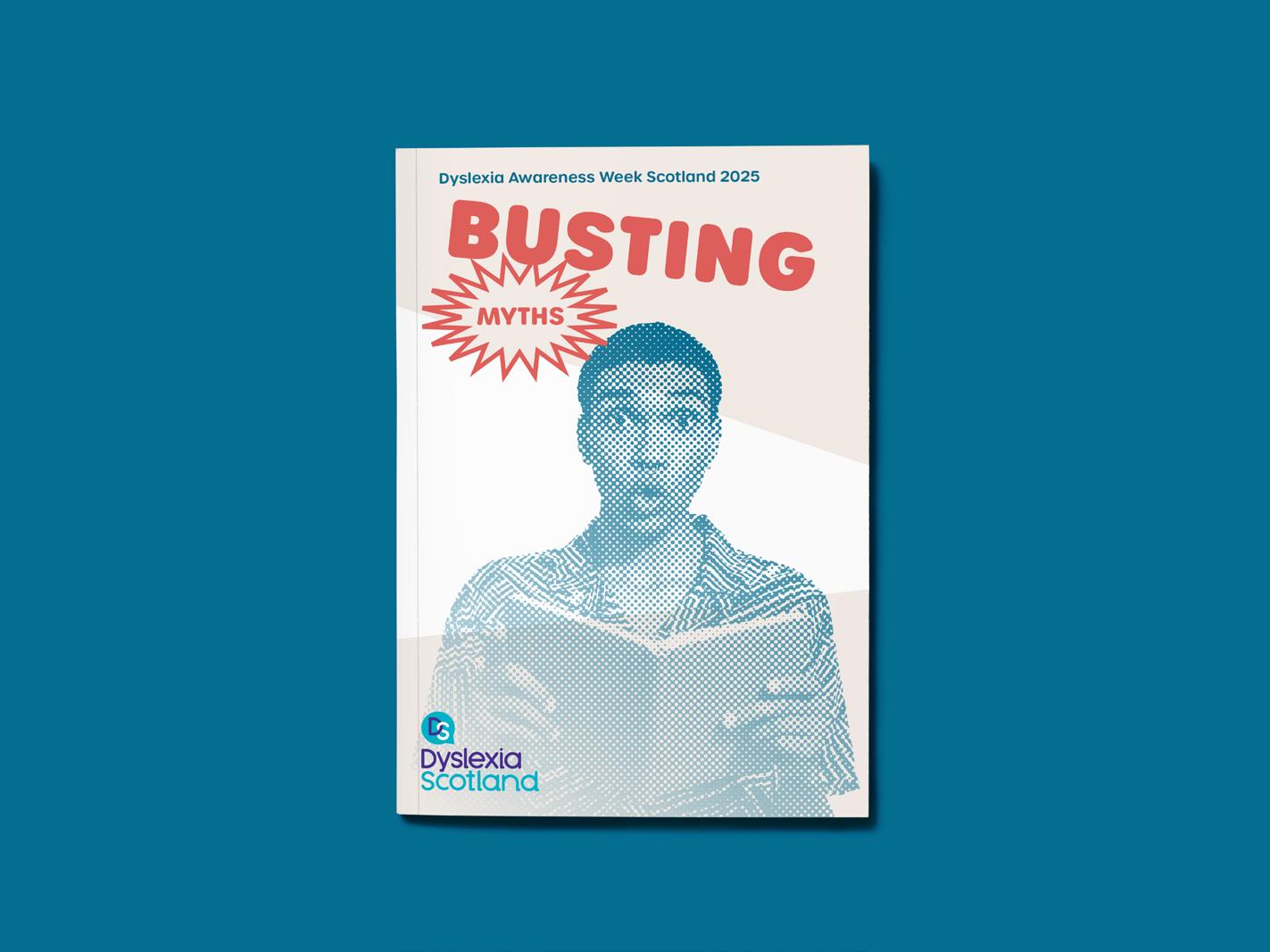
The Busting Myths zine with all our Dyslexia Awareness Week facts is now on sale in our online shop for £5.
Watch the animations
Your photos from Dyslexia Awareness Week
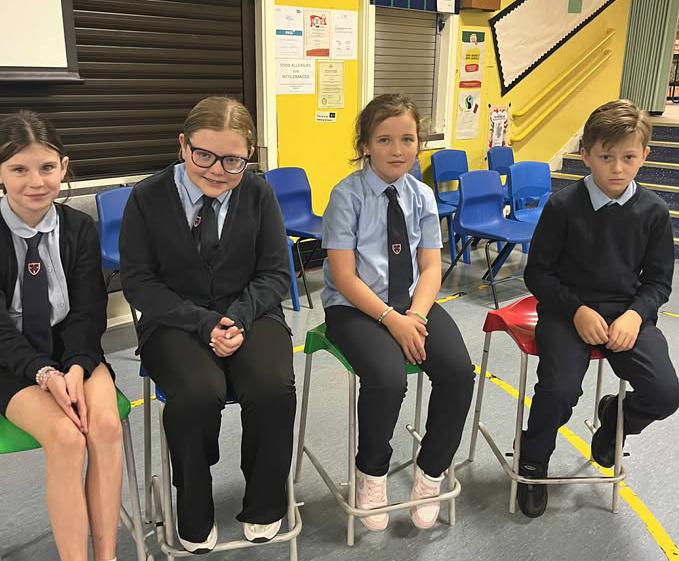
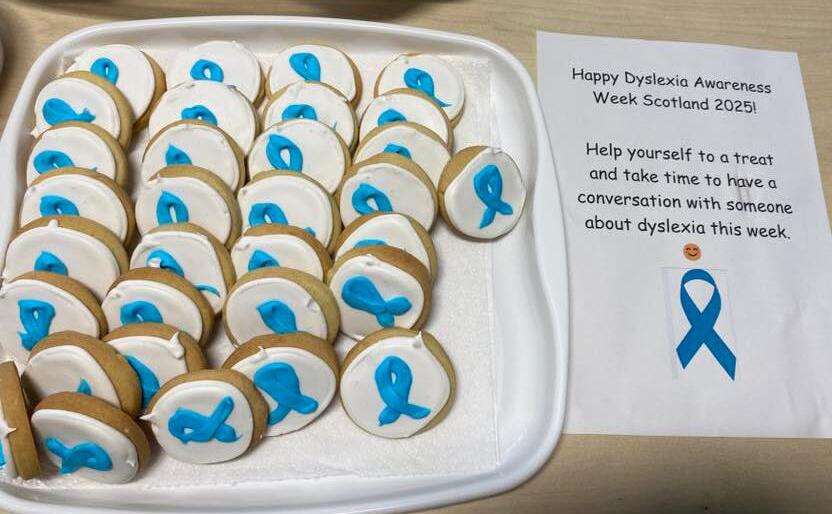
Clockwise from top left: visitors to DyslexiFest in Stirling; Eilidh, Jessica, Rosa and David from Our Holy Redeemer primary, Clydebank; Blue ribbon biscuits; Bainsford primary learners with their handmade signs.
Useful stuff Just for fun
We love getting your photos, artwork, poems, stories and news. We print as many as we can in the magazine and post them on the website too.
Keep sending us your content. You can find inspiration on Dyslexia Unwrapped.
LoL corner
I joked to my friend that AI was in EVERYTHING now. She laughed, I laughed, the fridge laughed...
Thanks to Beano for writing our jokes! You can find FREE jokewriting and reading resources at schools.beano.com and new jokes every day at Beano.com
Game station
Can you tell which art is AI made and which is human?
As we go forward into the future, there will be lots of AI made stuff so we need to keep our eyes and brains peeled!
Wishing our Members and Supporters a merry Christmas and a happy new year
Dyslexia Scotland Board of Directors and staff team thank you all for your continued support for our charity.